EP1334763A1 - Hydrophilized membrane and method of hydrophilization therefor - Google Patents
Hydrophilized membrane and method of hydrophilization therefor Download PDFInfo
- Publication number
- EP1334763A1 EP1334763A1 EP01974897A EP01974897A EP1334763A1 EP 1334763 A1 EP1334763 A1 EP 1334763A1 EP 01974897 A EP01974897 A EP 01974897A EP 01974897 A EP01974897 A EP 01974897A EP 1334763 A1 EP1334763 A1 EP 1334763A1
- Authority
- EP
- European Patent Office
- Prior art keywords
- substance
- membrane
- surface activity
- hydrophilization
- blood
- Prior art date
- Legal status (The legal status is an assumption and is not a legal conclusion. Google has not performed a legal analysis and makes no representation as to the accuracy of the status listed.)
- Granted
Links
Classifications
-
- B—PERFORMING OPERATIONS; TRANSPORTING
- B01—PHYSICAL OR CHEMICAL PROCESSES OR APPARATUS IN GENERAL
- B01D—SEPARATION
- B01D69/00—Semi-permeable membranes for separation processes or apparatus characterised by their form, structure or properties; Manufacturing processes specially adapted therefor
-
- B—PERFORMING OPERATIONS; TRANSPORTING
- B01—PHYSICAL OR CHEMICAL PROCESSES OR APPARATUS IN GENERAL
- B01D—SEPARATION
- B01D67/00—Processes specially adapted for manufacturing semi-permeable membranes for separation processes or apparatus
- B01D67/0081—After-treatment of organic or inorganic membranes
- B01D67/0088—Physical treatment with compounds, e.g. swelling, coating or impregnation
-
- A—HUMAN NECESSITIES
- A61—MEDICAL OR VETERINARY SCIENCE; HYGIENE
- A61L—METHODS OR APPARATUS FOR STERILISING MATERIALS OR OBJECTS IN GENERAL; DISINFECTION, STERILISATION OR DEODORISATION OF AIR; CHEMICAL ASPECTS OF BANDAGES, DRESSINGS, ABSORBENT PADS OR SURGICAL ARTICLES; MATERIALS FOR BANDAGES, DRESSINGS, ABSORBENT PADS OR SURGICAL ARTICLES
- A61L31/00—Materials for other surgical articles, e.g. stents, stent-grafts, shunts, surgical drapes, guide wires, materials for adhesion prevention, occluding devices, surgical gloves, tissue fixation devices
- A61L31/04—Macromolecular materials
- A61L31/06—Macromolecular materials obtained otherwise than by reactions only involving carbon-to-carbon unsaturated bonds
-
- A—HUMAN NECESSITIES
- A61—MEDICAL OR VETERINARY SCIENCE; HYGIENE
- A61L—METHODS OR APPARATUS FOR STERILISING MATERIALS OR OBJECTS IN GENERAL; DISINFECTION, STERILISATION OR DEODORISATION OF AIR; CHEMICAL ASPECTS OF BANDAGES, DRESSINGS, ABSORBENT PADS OR SURGICAL ARTICLES; MATERIALS FOR BANDAGES, DRESSINGS, ABSORBENT PADS OR SURGICAL ARTICLES
- A61L31/00—Materials for other surgical articles, e.g. stents, stent-grafts, shunts, surgical drapes, guide wires, materials for adhesion prevention, occluding devices, surgical gloves, tissue fixation devices
- A61L31/14—Materials characterised by their function or physical properties, e.g. injectable or lubricating compositions, shape-memory materials, surface modified materials
- A61L31/146—Porous materials, e.g. foams or sponges
Definitions
- the present invention relates to a membrane endowed with high blood compatibility and decreased in interaction with blood cells (particularly blood platelets) by conducting hydrophilization of a hydrophobic membrane and a process for hydrophilization. More specifically, the present invention relates to a hydrophilized membrane which can suitably be used as a plasma separation membrane, a double plasma filtration membrane, a blood filtration membrane and a dialysis membrane, and a process for hydrophilization of the hydrophobic part to be in contact with blood for medical equipment in which the part to be in contact with blood is hydrophobic.
- hydrophobic membrane generally is advantageous in that membrane strength is high and dry storage is possible, weak points such as low filtration property, a tendency to adsorb protein and low blood compatibility have been pointed out. And so, attempts have been made from long ago for technical development regarding hydrophilization of a hydrophobic membrane.
- Typical methods are (1) the method of adsorbing hardly volatile water-soluble polyvalent alcohol such as glycerin to a hydrophobic membrane; (2) the method of adsorbing water-soluble polymer such as polyethylene glycol, polyvinyl pyrrolidone and polyvinyl alcohol to a hydrophobic membrane (JP-A-63-31501); (3) the method of immobilizing a hydrophilic polymer to a hydrophobic membrane, the method of chemically bonding a hydrophilic monomer such as acrylamide to the surface of a hydrophobic membrane (JP-A-2-59032); (4) the method of immobilizing a hydrophilic polymer on a membrane by crosslinking and insolubilizing the hydrophilic polymer by irradiating the membrane in a wet state (JP-A-4-300636), the method of insolubilizing and immobilizing the hydrophilic polymer to a membrane by heat treatment in a dry state (JP-A-9-103664); (5)
- the above methods (1) to (3) have been known to one skilled in the art from long ago as a usual method for hydrophilizing a hydrophobic membrane, but as can easily be predicted, have the weakness of the hydrophilic properties being lost, as the hydrophilizing agent used in each of the methods is detached from the hydrophobic membrane after coming into contact with water once. Also, according to the usage, mixing a hydrophilizing agent in the filtrate is not desired in some cases.
- the method of making the hydrophilizing agent difficult to detach from the membrane by making the hydrophilizing agent difficult to dissolve in water by further applying radiation or conducting heat treatment after conducting method (2) has been suggested. However, there are problems such as low membrane strength and effects which are not yet of a sufficiently satisfactory degree.
- the above methods (4) and (5) are advantageous in that the hydrophilic properties of the hyrdophobic membrane are maintained almost permanently and the hydrophilizing agent does not elute into the filtrate, but are weak in that the treatment process is relatively complicated and uneconomical.
- the above method (6) has also been known for a long time, but has problems such as difficulty in controlling the remnant state of the hydrophilic polymer within the hydrophobic membrane, change in filtration properties over time and gradual elution of the hydrophilic polymer.
- method (7) there are problems such as limitation of the treated material and a decrease in membrane strength due to the alkaline aqueous solution treatment.
- method (8) there are problems such as a decrease in membrane strength due to drying, heat treatment or radiation exposure when insolubilizing.
- the hydrophilizing agent usually elutes into the filtrate.
- complicated and uneconomical treatment was employed and obtaining an excellent hydrophilized membrane was difficult.
- improving water permeability by hydrophilization is the main object of these arts and only few mention interaction with blood (particularly blood cells).
- Examples of a method for hydrophilizing the membrane and also imparting high blood compatibility are the method of coating with a polysaccharide having an anticoagulant effect such as heparin and the method of chemically immobilizing polyethylene glycol by covalent bonding, but both are complicated and have insufficient effects.
- a sufficiently satisfactory method in terms of safety and cost has not yet obtained.
- a hydrophilization method and hydrophilized membrane which does not trigger deterioration of the membrane material or decrease in strength which accompanies hydrophilization, has high blood compatibility and safety and is simple and economical, has not been obtained.
- the present invention relates to a hydrophilized porous membrane for medical use, which comprises a hydrophobic porous membrane and a substance having surface activity, the substance being adsorbed on a surface of the hydrophobic porous membrane in an amount of 0.02 mg to 250 mg per dry weight (g) of the membrane.
- a preferable embodiment is a hydrophilized porous membrane in which the substance having surface activity has a number average molecular weight of 500 to 8,000.
- a preferable embodiment is a hydrophilized porous membrane in which the substance having surface activity is a nonionic surfactant.
- a preferable embodiment is a hydrophilized porous membrane in which the substance having surface activity is a polyoxyethylene sorbitan surfactant.
- a preferable embodiment is a hydrophilized porous membrane in which the polyoxyethylene sorbitan surfactant is at least one member selected from the group consisting of polyoxyethylene sorbitan monolaurate, polyoxyethylene sorbitan monopalmitate, polyoxyethylene sorbitan monostearate, polyoxyethylene sorbitan tristearate and polyoxyethylene sorbitan monooleate.
- a preferable embodiment is a hydrophilized porous membrane in which the substance having surface activity is one member selected from the group consisting of purified vitelline lecithin, highly purified vitelline lecithin and purified soybean lecithin.
- a preferable embodiment is a hydrophilized porous membrane in which the substance having surface activity is hydrogenated polyoxyethylene castor oil.
- a preferable embodiment is a hydrophilized porous membrane in which the hydrophobic porous membrane comprises polysulfone as the main structural component.
- the present invention relates to a process for hydrophilization for medical equipment having a hydrophobic surface, which comprises impregnating a hydrophobic part to be in contact with blood into a solution of a substance having surface activity, thereby adsorbing the substance having surface activity on the hydrophobic surface in an amount of 0.02 mg to 250 mg per unit dry weight (g).
- a preferable embodiment is a process for hydrophilization in which the hydrophobic part to be in contact with blood is a porous membrane.
- a preferable embodiment is a process for hydrophilization which further comprises after impregnating the membrane into a solution of a substance having surface activity, rinsing with a solvent in which the substance having surface activity is soluble, thereby eluting excess substance having surface activity.
- the present invention relates to a process for hydrophilization for a hydrophobic porous membrane which comprises storing the membrane in a housing having at least a blood inflow part for blood to flow into the membrane and a blood outflow part for inflowing blood to flow out, passing a solution of a substance having surface activity through the housing and adsorbing the substance having surface activity on the surface of the membrane in an amount of 0.02 mg to 250 mg per unit dry weight (g) of the membrane within the housing.
- a preferable embodiment is a process for hydrophilization which further comprises after passing the solution of a substance having surface activity through the housing, rinsing with a solvent in which the substance having surface activity is soluble, thereby eluting excess substance having surface activity.
- a preferable embodiment is a process for hydrophilization in which the substance having surface activity has a number average molecular weight of 500 to 8,000.
- a preferable embodiment is a process for hydrophilization in which the substance having surface activity is a nonionic surfactant.
- a preferable embodiment is a process for hydrophilization in which the nonionic surfactant is a polyoxyethylene sorbitan surfactant.
- a preferable embodiment is a process for hydrophilization in which the polyoxyethylene sorbitan surfactant is at least one member selected from the group consisting of polyoxyethylene sorbitan monolaurate, polyoxyethylene sorbitan monopalmitate, polyoxyethylene sorbitan monostearate, polyoxyethylene sorbitan tristearate and polyoxyethylene sorbitan monooleate.
- a preferable embodiment is a process for hydrophilization in which the substance having surface activity is one member selected from the group consisting of purified vitelline lecithin, highly purified vitelline lecithin and purified soybean lecithin.
- a preferable embodiment is a process for hydrophilization in which the substance having surface activity is hydrogenated polyoxyethylene castor oil.
- a preferable embodiment is a process for hydrophilization in which the hydrophobic porous membrane comprises polysulfone as the main structural component.
- a substance having surface activity is used as the hydrophilizing agent.
- the substance having surface activity are nonionic surfactant, lecithin, hydrogenated polyoxyethylene castor oil, sodium edetate, sorbitan sesquioleate, D-sorbitol, dehydrocholic acid, glycerin, D-mannitol, tartaric acid, propylene glycol, macrogol, lanolin alcohol and methyl cellulose.
- nonionic surfactant, lecithin and hydrogenated polyoxyethylene castor oil are usually used as a dispersant for intravenous injection preparation and are preferable as toxicity within the blood is particularly low.
- a nonionic surfactant can be broadly divided into polyvalent alcohol fatty acid ester types and polyoxyethylene types.
- the polyvalent alcohol fatty acid ester surfactant are glycerin stearate ester types, sorbitan fatty acid ester and sorbitan acyl ester.
- the polyoxyethylene surfactant are polyoxyethylene alcohol ether, polyoxyethylene cetyl ether and polyoxyethylene acyl ester.
- polyoxyethylene sorbitan surfactant examples include polyoxyethylene sorbitan acyl ester, polyoxyethylene sorbitan monolaurate, polyoxyethylene sorbitan monopalmitate, polyoxyethylene sorbitan monostearate, polyoxyethylene sorbitan tristearate and polyoxyethylene sorbitan monooleate. These may be used alone or in combination.
- These surfactants preferably have a number average molecular weight of 500 to 8,000 from the viewpoint of preventing clogging of the membrane which accompanies hydrophilization of the membrane and rinsing efficiency.
- a low toxic surfactant which is widely known to have little effect on the human body in the case that the surfactant eludes, is preferable.
- the polyoxyethylene surfactants which have been extensively used as intravenous injection preparation are preferable.
- Polyoxyethylene sorbitan monooleate which is a polyoxyethylene sorbitan surfactant is more preferable.
- purified vitelline lecithin, highly purified vitelline lecithin and purified soybean lecithin which have been extensively used as intravenous injection preparation are preferable in that toxicity within blood is particularly low.
- hydrogenated polyoxyethylene castor oil, hydrogenated polyoxyethylene castor oil 10, hydrogenated polyoxyethylene castor oil 40, hydrogenated polyoxyethylene castor oil 50 and hydrogenated polyoxyethylene castor oil 60 are also preferable and of these, hydrogenated polyoxyethylene castor oil 60 which has lower toxicity is more preferable.
- the hydrophilizing agent is not limited to these and can also be a combination of at least two kinds.
- the solution into which the hydrophilizing agent is dissolved preferably comes into contact with the hydrophobic membrane at a temperature of 4°C to 70°C, more preferably, 4°C to 50°C from the viewpoint of production efficiency.
- the concentration of the hydrophilizing agent is preferably 0.001 % (W/W) to 10 % (W/W), more preferably 0.001 % (W/W) to 1 % (W/W) from the viewpoint of rinsing efficiency, further preferably 0.005 % (W/W) to 1 % (W/W) in order to obtain a sufficient effect of suppressing blood platelet adhesion.
- the time of contact of the hydrophilizing agent and hydrophobic membrane can be a short period, impregnating the membrane into the hydrophilizing agent, but is preferably within 1 minute to 2 hours, in order to obtain a sufficient effect of suppressing blood platelet adhesion. More preferably, the time is within 2 minutes to 1.5 hours, from the viewpoint of adsorption stability of the hydrophilizing agent to the membrane and further preferably, the time is within 2 minute to 60 minutes, from the viewpoint of rinsing efficiency of the excess hydrophilizing agent. When the impregnation time is less than 1 minute, the adsorbed amount is insufficient and the effect of suppressing blood platelet adhesion tends to decrease.
- Example of the method of bringing the hydrophilizing agent and hydrophobic membrane into contact are the method of impregnating the membrane into the hydrophilizing agent, the method of impregnating and then shaking and the method comprising storing the membrane into a housing having an inflow part and an outflow part and then bringing the hydrophilizing agent and hydrophobic membrane into contact by passing the hydrophilizing agent through the housing.
- the hydrophobic membrane is preferably rinsed with a solvent into which the hydrophilizng agent is soluble.
- Example of the solvent which dissolves the hydrophilizing agent are water, aqueous solution containing electrolyte (saline, buffer solutions such as phosphate buffer solution), alcohols such as ethanol, warm ethanol and methanol, pyridine, chloroform, cyclohexane, ethyl acetate, toluene or a mixed solvent thereof.
- Water and an aqueous solution containing electrolyte are preferably used from the viewpoint of the effect to the material to be hydrophilized, after-treatment of the solvent, safety and cost.
- TOC total organic carbon
- the amount adsorbed of the hydrophilizing agent can be found indirectly by the above total organic carbon (TOC) method. More specifically, the amount adsorbed can be obtained by subtracting the amount of the hydrophilizing agent found by the TOC value of the hydrophilizing agent solution after hydrophilization and the TOC value of the rinsing solution of the membrane, from the amount of the hydrophilizing agent found by the TOC value of the solution dissolving the hydrophilizing agent before treatment.
- TOC total organic carbon
- the nonionic surfactant can be directly quantified by an improved method (Miura et al, "Extracting a trace of nonionic surfactant using ammonium tetrathiocyanatocobaltate (II)/absorptiometry", (1989) Bunseki Kagaku) of the quantifying method using ammonium tetrathiocyanatocobaltate (II) (JIS K 3363).
- the amount adsorbed of the hydrophilizing agent is 0.02 mg to 250 mg per unit dry weight (g) of the hydrophobic membrane.
- the amount adsorbed of the hydrophilizing agent is at most 0.02 mg, the effect of suppressing blood platelet adhesion may not be sufficiently obtained.
- the amount to be adsorbed is at least 250 mg, time and a great deal of rinsing solution becomes necessary for rinsing the membrane and rinsing tends to become inefficient.
- the amount is preferably 0.1 mg to 250 mg in order to suppress adhesion of blood cells, more preferably 0.1 mg to 125 mg from the viewpoint of suppressing elution of the hydrophilizing agent into the blood.
- the amount is preferably 0.5 mg to 125 mg from the viewpoint of the effect of suppressing blood cell adhesion, more preferably 1.0 mg to 80 mg from the viewpoint of safety such as sufficient suppression of elution of the hydrophilizing agent and the effect of suppressing blood cell adhesion. Further preferably, the amount is 2.0 mg to 50 mg from the viewpoint of production efficiency such as shortening of hydrophilizing agent treatment time and reducing rinsing time after adsorbing the hydrophilizing agent and the amount to be rinsed.
- the shape of the hydrophobic membrane used in the present invention is not particularly limited and may be a hollow fiber shape, tubular shape or a flat membrane.
- the material is preferably a polymer with relatively high hydrophobic properties which can adsorb an extremely small amount with stability, even after sufficiently rinsing the adsorbed hydrophilizing agent, such as polysulfone, polyethylene, polypropylene, polystyrene, polycarbonate, polyurethane and poly(methyl methacrylate).
- polysulfone is particularly preferable from the viewpoint of high adsorption stability of the hydrophilizing agent which is adsorbed in an extremely small amount, but in the present invention the material is not limited to these.
- the embodiment of the above hydrophobic membrane is preferably porous, in order to exhibit the effect of suppressing blood platelet adhesion by the hydrophilizing agent which is adsorbed in an extremely small amount.
- the average pore size of the hydrophobic membrane is preferably 0.03 ⁇ m to 10 ⁇ m.
- the average pore size of the hydrophobic membrane is preferably 0.03 ⁇ m to 10 ⁇ m.
- the average pore size is greater than 0.05 ⁇ m from the viewpoint of efficiency in rinsing the hydrophilizing agent and at most 4 ⁇ m in order to maintain sufficient membrane strength.
- the surface of the hydrophobic porous membrane signifies not only the area which comes into contact with blood but also all surfaces which may possibly come into contact with the hydrophilizing agent.
- the adsorption state is not particularly limited, including homogenous adsorption to a monomolecular level, inhomogenous adsorption, localized adsorption and coagulated state adsorption.
- Examples of the method for confirming the adsorption state of the hydrophilizing agent are the method of confirming by a fluorescent microscope or a confocal laser scanning microscope after adsorbing fluorescent marked hydrophilizing agent or a direct method of confirming by a high resolution scanning electron microscope or atomic force microscope.
- NMP N-methylpyrrolidone
- the glass tube was slowly pulled out and impregnated in a coagulation bath (distilled water) to coagulate the polysulfone.
- the coagulated polysulfone was detached from the glass tube and cut into squares of a length of 4 ⁇ 4 mm to prepare the polysulfone sheet.
- the average pore size of the porous polysulfone membrane obtained here is 0.1 ⁇ m to 5 ⁇ m.
- 40 ml of reverse osmosis water (hereinafter RO water) and the polysulfone sheet were put into a sample tube (100 ml) and after conducting heat treatment at 90°C for 30 minutes, decantation rinsing was conducted. After repeating this step a total of three times, the polysulfone sheet was further rinsed by repeating decantation rinsing by using 40 ml of RO water at room temperature five times.
- RO water reverse osmosis water
- decantation rinsing was conducted 5 times by using 15 ml of RO water and after shaking further for 30 minutes in 15 ml of RO water, decantation rinsing was conducted. This step was repeated a total of three times.
- the TOC value of the polysulfone sheet after rinsing is 0 and indicates that rinsing was sufficient. Furthermore, the TOC value of the supernatant after conducting steam sterilization under high pressure is less than 5 ppm and indicates that elution of the hydrophilizing agent did not occur (Table 1).
- the amount of the polyoxyethylene cetyl ether adsorbed to the above membrane was 21 (mg/dry weight of the membrane g).
- Elution of Brij 58 in Each Step (TOC Measurement) Step Type of solution used Measurement result (ppm) Rinsing Distilled water 0 High pressure sterilization Distilled water Less than 5
- a total of 33 sheets of the polysulfone sheet were put into a PP tube (6 ml, Falcon 2063). Next, 5 ml of a saline containing heparin (heparin concentration 2 IU/ml) was added thereto and after agitating, the supernatant was removed. In the same way, a saline containing heparin was added and this step was conducted a total of 3 times for rinsing of the membrane. After sufficiently removing the supernatant, 1.5 ml of blood collected from a healthy volunteer (anticoagulated by 2 IU/ml of heparin) was added and reverse mixing was slowly conducted.
- a saline containing heparin heparin concentration 2 IU/ml
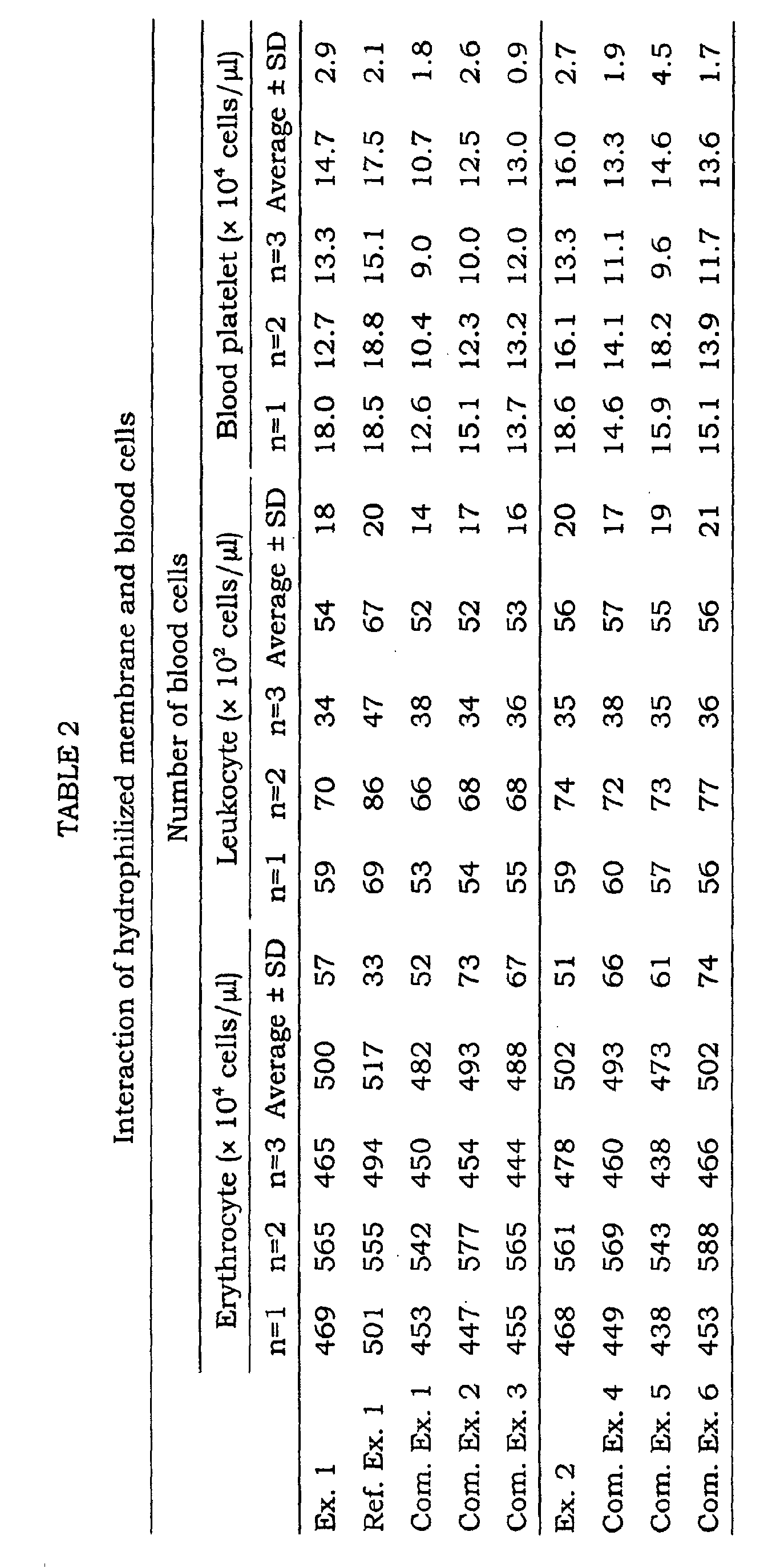
- the tube was placed in a constant temperature water bath of 37°C and shaking was conducted for 40 minutes at a rate of 70 times/minute. After the specified time, 1 ml of the blood was added to a PP tube (6 ml, Falcon 2063) and the number of blood cells was counted by a blood cell counter (Mircocell Counter CC-180, made by Sysmex Corporation). The results are shown in Table 2.
- the interaction with blood was evaluated and the number of blood cells was found in the same manner as in Example 1, except that the polysulfone sheet was not inserted.
- a polysulfone sheet (average pore size 0.09 ⁇ m to 4 ⁇ m) was prepared, hydrophilization was conducted by polyoxyethylene cetyl ether (Brij 58) which is a polyoxyethylene alcohol ether nonionic surfactant and the evaluation of interaction with blood and the measurement of the number of blood cells were conducted in the same manner as in Example 1, except that P-3500 polysulfone (available from Teijin Amoco Co., Ltd.) was used. The results are shown in Table 2.
- the amount of the polyoxyethylene cetyl ether adsorbed to the above membrane was 26 (mg/dry weight of the membrane g).
- a hydrophilized sheet was prepared in the same manner as in Example 2, except that ethylene vinyl alcohol (EVAL) was used as the typical hydrophilizing agent and interaction with blood was evaluated in the same manner as in Example 1. The results are shown in Table 2.
- EVAL ethylene vinyl alcohol
- a hydrophilized sheet was prepared in the same manner as in Example 2, except that polyvinyl pyrrolidone (PVP) was used as the typical hydrophilizing agent and interaction with blood was evaluated in the same manner as in Example 1. The results are shown in Table 2.
- PVP polyvinyl pyrrolidone
- the number of blood platelets in the case of using the polysulfone sheet prepared by using the hydrophilizing agent according to the hydrophilization method as described in Example 1 and 2 is closest to the value of Reference Example 1, indicating that adhesion of blood platelets has been greatly kept down (Table 2).
- Comparative Examples 1 and 4 Comparative Examples 1 and 4 and hydrophilization is conducted by an ordinary hydrophilizing agent
- Comparative Examples 2, 3, 5 and 6 the decrease rate of the number of blood platelets is great, indicating that interaction with blood platelets is large (Table 2).
- Rinsing was conducted by passing purified water which was passed through a 0.22 ⁇ m millipore filter (model number: MCGL 40503) (blowing after passing) through the QB side at 140 (ml/minute) and by blowing at 70 (ml/minute) to the QF side. Sampling of the blow liquid was conducted as time passed at both the QB side and QF side and the TOC was measured. Rinsing was conducted until the TOC value reached 0 (Table 3).
- the plasma separation membrane after rinsing was subjected to ⁇ -ray sterilization (50 KGy) and after the filling liquid was sterilized, the membrane was sampled for testing elution and measurement was carried out by a quantification method improved from the quantification method using ammonium tetrathiocyanatocobaltate (II) (JIS K3363) (Table 3).
- II ammonium tetrathiocyanatocobaltate
- a membrane is cut out from the inside of the plasma separation membrane and 50 strips of the membrane cut into a length of 1 cm were prepared. Furthermore, the membrane was cut into 2 segments (a total of 100 strips) in the length direction (vertically) so that the blood can sufficiently come into contact with the inner surface of the membrane.
- the membrane was put into a PP tube (6 ml, Falcon 2063). Next, 5 ml of a saline containing heparin (heparin concentration 2 IU/ml) was added thereto and after agitating, the supernatant was removed. In the same way, a saline containing heparin was added again and this step was conducted a total of 3 times for rinsing of the membrane.
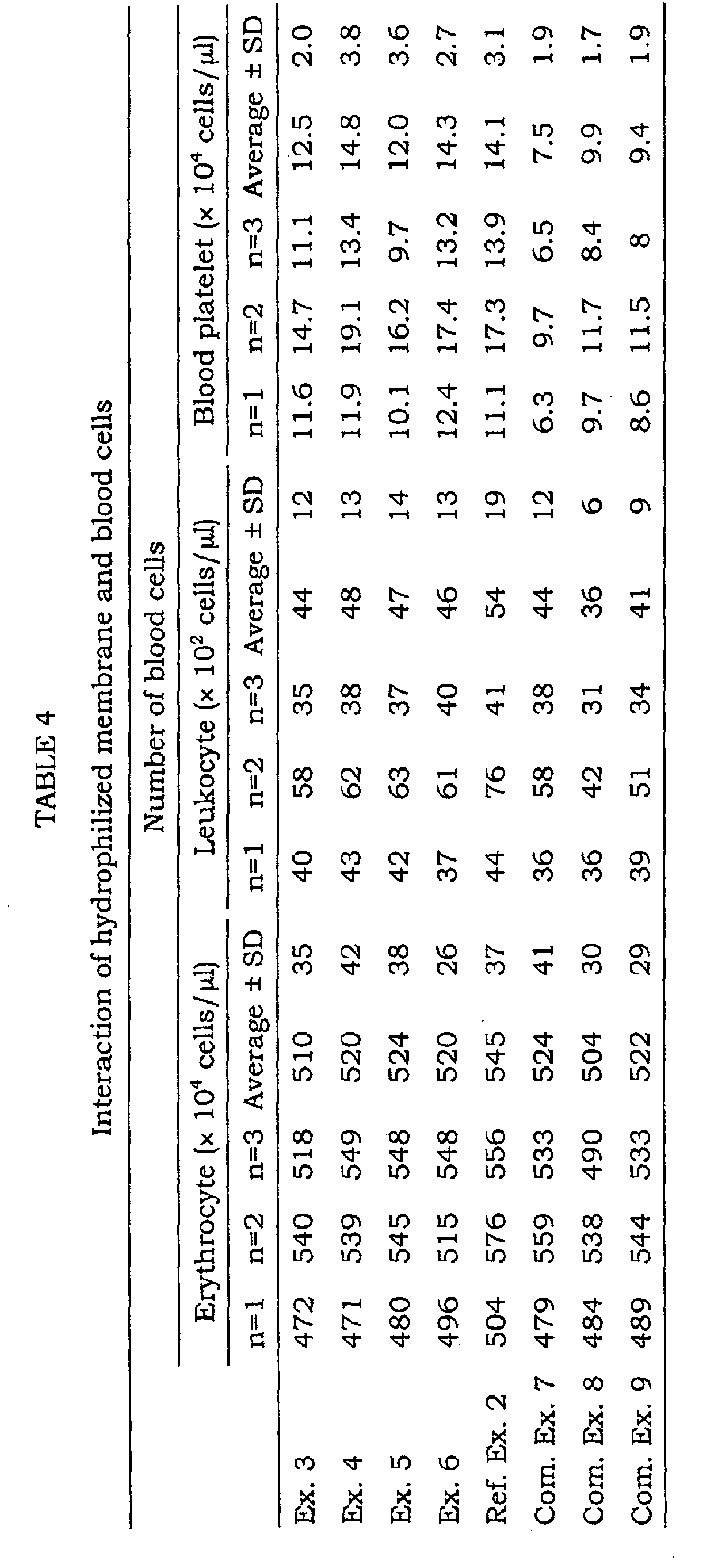
- Example 4 Treatment and evaluation were conducted in the same way as in Example 3 except that polyoxyethylene sorbitan monolaurate (Tween 20, available from Nikko Chemical Co., Ltd., molecular weight 1,000) which is a nonionic surfactant was used and the results are shown in Table 4.
- polyoxyethylene sorbitan monolaurate Teween 20, available from Nikko Chemical Co., Ltd., molecular weight 1,000
- the amount of the polyoxyethylene sorbitan monolaurate adsorbed to the above membrane was 19 (mg/dry weight of the membrane g).
- the amount of the purified vitelline lecithin adsorbed to the above membrane was 33 (mg/dry weight of the membrane g).
- the amount of the hydrogenated polyoxyethylene castor oil 60 adsorbed to the above membrane was 48 (mg/dry weight of the membrane g).
- Example 4 Treatment and evaluation were conducted in the same way as in Example 3 except that the polypropylene glycol (available from Asahi Glass Co., Ltd., molecular weight 4,000) was used and the results are shown in Table 4.
- polypropylene glycol available from Asahi Glass Co., Ltd., molecular weight 4,000
- the adhesion rate of erythrocytes is low in both Examples and Comparative Examples and is less than 10 %, indicating that hardly any adhered (Table 4).
- the adhesion rate of leukocytes is approximately 15 to 30 % in Comparative Examples, while in Examples, the rate remains approximately 10 to 15 % and so the effect of suppressing adhesion of leukocytes has been recognized (Table 4).
- the membrane can be stored in a dry state or in contact with a saline or distilled water and can maintain high compatibility with blood over a long period even after sterilization by an autoclave or ⁇ -ray irradiation.
Landscapes
- Health & Medical Sciences (AREA)
- Chemical & Material Sciences (AREA)
- Chemical Kinetics & Catalysis (AREA)
- Animal Behavior & Ethology (AREA)
- Public Health (AREA)
- Vascular Medicine (AREA)
- Epidemiology (AREA)
- Life Sciences & Earth Sciences (AREA)
- Heart & Thoracic Surgery (AREA)
- General Health & Medical Sciences (AREA)
- Surgery (AREA)
- Veterinary Medicine (AREA)
- Inorganic Chemistry (AREA)
- Engineering & Computer Science (AREA)
- Manufacturing & Machinery (AREA)
- Dispersion Chemistry (AREA)
- External Artificial Organs (AREA)
- Investigating Or Analysing Biological Materials (AREA)
- Medicines Containing Material From Animals Or Micro-Organisms (AREA)
Abstract
Description
| Elution of Brij 58 in Each Step (TOC Measurement) | ||
| Step | Type of solution used | Measurement result (ppm) |
| Rinsing | Distilled water | 0 |
| High pressure sterilization | Distilled water | Less than 5 |
| Elution of Tween 80 in Each Step (TOC Measurement) | ||
| Step | Type of solution used | Measurement result |
| Rinsing | Distilled water | 0 (ppm) |
| γ-ray sterilization | Distilled water | Less than 10 (mg/l) |
| Extraction (after sterilization) | Saline | Less than 10 (mg/l) |
Claims (20)
- A hydrophilized porous membrane for medical use, which comprises:a hydrophobic porous membrane, anda substance having surface activity, said substance being adsorbed on a surface of the hydrophobic porous membrane in an amount of 0.02 mg to 250 mg per dry weight (g) of said membrane.
- The hydrophilized porous membrane of Claim 1, wherein said substance having surface activity has a number average molecular weight of 500 to 8,000.
- The hydrophilized porous membrane of Claim 1 or 2, wherein said substance having surface activity is a nonionic surfactant.
- The hydrophilized porous membrane of Claim 3, wherein said nonionic surfactant is a polyoxyethylene sorbitan surfactant.
- The hydrophilized porous membrane of Claim 4, wherein said polyoxyethylene sorbitan surfactant is at least one member selected from the group consisting of polyoxyethylene sorbitan monolaurate, polyoxyethylene sorbitan monopalmitate, polyoxyethylene sorbitan monostearate, polyoxyethylene sorbitan tristearate and polyoxyethylene sorbitan monooleate.
- The hydrophilized porous membrane of Claim 1, wherein said substance having surface activity is one member selected from the group consisting of purified vitelline lecithin, highly purified vitelline lecithin and purified soybean lecithin.
- The hydrophilized porous membrane of Claim 1, wherein said substance having surface activity is hydrogenated polyoxyethylene castor oil.
- The hydrophilized porous membrane of Claim 1, 2, 3, 4, 5, 6 or 7, wherein said hydrophobic porous membrane comprises polysulfone as the main structural component.
- A process for hydrophilization for medical equipment having a hydrophobic surface, which comprises:impregnating a hydrophobic part to be in contact with blood into a solution of a substance having surface activity, thereby adsorbing said substance having surface activity on said hydrophobic surface in an amount of 0.02 mg to 250 mg per unit dry weight (g).
- The process for hydrophilization of Claim 9, wherein said hydrophobic part to be in contact with blood is a porous membrane.
- The process for hydrophilization of Claim 9, which further comprises after impregnating into a solution of a substance having surface activity, rinsing with a solvent in which said substance having surface activity is soluble, thereby eluting excess substance having surface activity.
- A process for hydrophilization for a hydrophobic porous membrane, which comprises:storing said membrane in a housing having at least a blood inflow part for blood to flow into said membrane and a blood outflow part for inflowing blood to flow out;passing a solution of a substance having surface activity through said housing andadsorbing said substance having surface activity on a surface of said membrane in an amount of 0.02 mg to 250 mg per unit dry weight (g) of said membrane within said housing.
- The process for hydrophilization of Claim 12, which further comprises after passing a solution of a substance having surface activity through said housing, rinsing with a solvent in which said substance having surface activity is soluble, thereby eluting excess substance having surface activity.
- The process for hydrophilization of Claim 9, 10, 11, 12 or 13, wherein said substance having surface activity has a number average molecular weight of 500 to 8,000.
- The process for hydrophilization of Claim 9, 10, 11, 12, 13 or 14, wherein said substance having surface activity is a nonionic surfactant.
- The process for hydrophilization of Claim 15, wherein said nonionic surfactant is a polyoxyethylene sorbitan surfactant.
- The process for hydrophilization of Claim 16, wherein said polyoxyethylene sorbitan surfactant is at least one member selected from the group consisting of polyoxyethylene sorbitan monolaurate, polyoxyethylene sorbitan monopalmitate, polyoxyethylene sorbitan monostearate, polyoxyethylene sorbitan tristearate and polyoxyethylene sorbitan monooleate.
- The process for hydrophilization of Claim 9, 10, 11, 12 or 13, wherein said substance having surface activity is one member selected from the group consisting of purified vitelline lecithin, highly purified vitelline lecithin and purified soybean lecithin.
- The process for hydrophilization of Claim 9, 10, 11, 12 or 13, wherein said substance having surface activity is hydrogenated polyoxyethylene castor oil.
- The process for hydrophilization of Claim 9, 10, 11, 12, 13, 14, 15, 16, 17, 18 or 19, wherein said hydrophobic porous membrane comprises polysulfone as the main structural component.
Applications Claiming Priority (3)
| Application Number | Priority Date | Filing Date | Title |
|---|---|---|---|
| JP2000323859 | 2000-10-24 | ||
| JP2000323859 | 2000-10-24 | ||
| PCT/JP2001/009277 WO2002034374A1 (en) | 2000-10-24 | 2001-10-23 | Hydrophilized membrane and method of hydrophilization therefor |
Publications (3)
| Publication Number | Publication Date |
|---|---|
| EP1334763A1 true EP1334763A1 (en) | 2003-08-13 |
| EP1334763A4 EP1334763A4 (en) | 2004-05-26 |
| EP1334763B1 EP1334763B1 (en) | 2006-12-20 |
Family
ID=18801474
Family Applications (1)
| Application Number | Title | Priority Date | Filing Date |
|---|---|---|---|
| EP01974897A Revoked EP1334763B1 (en) | 2000-10-24 | 2001-10-23 | Hydrophilized membrane and method of hydrophilization therefor |
Country Status (8)
| Country | Link |
|---|---|
| US (2) | US20040026314A1 (en) |
| EP (1) | EP1334763B1 (en) |
| JP (1) | JPWO2002034374A1 (en) |
| KR (1) | KR20040005845A (en) |
| CN (1) | CN1471425A (en) |
| CA (1) | CA2426498A1 (en) |
| DE (1) | DE60125406T2 (en) |
| WO (1) | WO2002034374A1 (en) |
Cited By (2)
| Publication number | Priority date | Publication date | Assignee | Title |
|---|---|---|---|---|
| WO2009040123A1 (en) * | 2007-09-28 | 2009-04-02 | Gambro Lundia Ab | Hydrophilic membranes with a non-ionic surfactant |
| CN1842363B (en) * | 2003-08-28 | 2011-09-21 | 甘布罗伦迪亚股份公司 | Surface treatment of the membrane and associated product |
Families Citing this family (22)
| Publication number | Priority date | Publication date | Assignee | Title |
|---|---|---|---|---|
| JP4728473B2 (en) * | 2000-10-24 | 2011-07-20 | 日機装株式会社 | Modified porous membrane and method for producing the same |
| US20050147757A1 (en) * | 2004-01-07 | 2005-07-07 | Roh Il J. | Method for wetting hydrophobic porous polymeric membranes to improve water flux without alcohol treatment |
| US7147912B2 (en) * | 2004-08-18 | 2006-12-12 | E. I. Du Pont De Nemours And Company | Amphipathic proteinaceous coating on nanoporous polymer |
| JP4885437B2 (en) * | 2004-10-15 | 2012-02-29 | 東洋紡績株式会社 | Blood purifier and blood purifier package |
| JP4731875B2 (en) * | 2004-10-15 | 2011-07-27 | 東洋紡績株式会社 | Blood purifier sterilization method and blood purifier package |
| JP4739730B2 (en) | 2004-11-10 | 2011-08-03 | 三菱レイヨン株式会社 | Hydrophobizing agent for hydrophobic porous membrane, hydrophilizing method and inspection method for hydrophobic porous membrane using the same |
| US9067178B2 (en) * | 2004-12-22 | 2015-06-30 | Nipro Corporation | Blood purifier package and process for manufacturing the same |
| KR101102073B1 (en) * | 2007-07-19 | 2012-01-04 | 주식회사 로보젠 | 3D geographic information acquisition device of underground buried pipe |
| US7964697B2 (en) | 2008-08-13 | 2011-06-21 | General Electric Company | Polyarylether membranes |
| US7834134B2 (en) * | 2008-08-13 | 2010-11-16 | General Electric Company | Polyarylethers, blends and methods for making |
| US20100041837A1 (en) * | 2008-08-13 | 2010-02-18 | Gary William Yeager | Polyarylethers, blends and methods for making |
| US7985339B2 (en) * | 2008-08-25 | 2011-07-26 | General Electric Company | Polyarylether compositions bearing zwitterion functionalities |
| WO2010034497A2 (en) * | 2008-09-25 | 2010-04-01 | Ratiopharm Gmbh | Compacted cinacalcet |
| JP2011110470A (en) * | 2009-11-25 | 2011-06-09 | Fujifilm Corp | Microporous membrane of crystalline polymer, method of producing the same, and filter for use in filtration |
| JP6028533B2 (en) * | 2012-11-19 | 2016-11-16 | 栗田工業株式会社 | Method for producing selective permeable membrane |
| CN103437162B (en) * | 2013-08-27 | 2015-12-23 | 苏州艾吉克膜科技有限公司 | A kind of dry film hydrophilc agent |
| WO2015052177A1 (en) * | 2013-10-07 | 2015-04-16 | Novartis Ag | Treated filter |
| CN103816816B (en) * | 2014-02-28 | 2016-02-03 | 中国科学院长春应用化学研究所 | A kind of polymeric film material and preparation method thereof |
| CN104001425B (en) * | 2014-04-30 | 2015-11-18 | 山东中保康医疗器具有限公司 | The blood plasma filter for removing white blood cell not permeable machine of hydrophilic film |
| CN106823867A (en) * | 2017-03-06 | 2017-06-13 | 北京理工大学 | Using the method for polyalcohols/ester blend hydrophilic modification hydrophobic type polymeric membrane for separation |
| CN109603570A (en) * | 2018-10-26 | 2019-04-12 | 德蓝水技术股份有限公司 | The modified method of polytetrafluoroethylhollow hollow fiber hydrophilic microporous membrane |
| CN116440719B (en) * | 2023-03-09 | 2024-01-16 | 利得膜(北京)新材料技术有限公司 | Hydrophilized polytetrafluoroethylene hollow fiber microfiltration membrane and preparation method thereof |
Family Cites Families (26)
| Publication number | Priority date | Publication date | Assignee | Title |
|---|---|---|---|---|
| GB1412983A (en) * | 1971-11-30 | 1975-11-05 | Debell & Richardson | Method of producing porous plastic materials |
| US4432875A (en) * | 1981-05-29 | 1984-02-21 | Brunswick Corporation | Semi-permeable membranes and processes for making the same |
| EP0111499A1 (en) * | 1982-06-14 | 1984-06-27 | Baxter Travenol Laboratories, Inc. | Wettable hydrophobic hollow fibers |
| JPS612743A (en) * | 1984-06-15 | 1986-01-08 | Mitsubishi Rayon Co Ltd | Porous membrane |
| CA1266827A (en) * | 1984-06-20 | 1990-03-20 | Merck & Co., Inc. | Controlled porosity osmotic pump |
| JPS61101209A (en) * | 1984-10-23 | 1986-05-20 | Asahi Medical Kk | Method for making porous membrane hydrophilic |
| JPS61133105A (en) * | 1984-12-03 | 1986-06-20 | Asahi Medical Kk | Process for improving permeability of porous membrane |
| US4794002A (en) * | 1985-11-01 | 1988-12-27 | Monsanto Company | Modified polymeric surfaces and process for preparing same |
| JPS63141609A (en) * | 1986-12-03 | 1988-06-14 | Terumo Corp | Hydrophilic porous membrane and its production |
| JPS63277251A (en) * | 1987-05-08 | 1988-11-15 | Fuji Photo Film Co Ltd | Production of microporous film |
| US5006256A (en) * | 1988-01-14 | 1991-04-09 | The Standard Oil Company | Affinity membranes having pendant hydroxy groups and processes for the preparation and use thereof |
| JPH0286822A (en) * | 1988-05-02 | 1990-03-27 | Terumo Corp | Hydrophilic porous membrane, production thereof and liquid filter using the same membrane |
| JPH038421A (en) * | 1989-06-05 | 1991-01-16 | Terumo Corp | Hydrophilic porous membrane and production thereof |
| US5019262A (en) * | 1989-10-06 | 1991-05-28 | International Applied Sciences, Inc. | Hydrophilic microporous membrane |
| JPH03143534A (en) * | 1989-10-26 | 1991-06-19 | Toray Ind Inc | Porous membrane |
| JP3153905B2 (en) * | 1990-05-15 | 2001-04-09 | 株式会社新素材総合研究所 | Hydrophilic membrane, method for producing the same, and filtration device using the membrane |
| US5698101A (en) * | 1990-07-09 | 1997-12-16 | Memtec Limited | Hollow fiber membranes |
| DE4023671A1 (en) * | 1990-07-25 | 1992-01-30 | Boehringer Mannheim Gmbh | Non-ionic block copolymers made of propylene oxide and ethylene oxide |
| US5418061A (en) * | 1990-11-27 | 1995-05-23 | W. R. Grace & Co.-Conn. | Microporous polysulfone supports suitable for removal of low density lipoprotein-cholesterol |
| WO1994000222A1 (en) * | 1992-06-23 | 1994-01-06 | Minntech Corporation | Hollow fiber membrane incorporating a surfactant and process for preparing same |
| DE4241714A1 (en) * | 1992-12-10 | 1994-06-16 | Wacker Chemie Gmbh | Compsn. resistant to pollutants, contg. salt of organo-polysiloxane contg. basic nitrogen - organo:silicon cpd. opt. contg. basic nitrogen, swellable clay mineral and hydraulic binder, for sealing walls and linings for waste deposits |
| US6093559A (en) * | 1996-10-24 | 2000-07-25 | Corning Incorporated | Producing low binding hydrophobic surfaces by treating with a low HLB number non-ionic surfactant |
| JP3685283B2 (en) * | 1997-02-13 | 2005-08-17 | 富士写真フイルム株式会社 | Plasma collection tool |
| US6383783B1 (en) * | 1999-09-21 | 2002-05-07 | 3M Innovative Properties Company | Nucleic acid isolation by adhering to hydrophobic solid phase and removing with nonionic surfactant |
| US6844028B2 (en) * | 2001-06-26 | 2005-01-18 | Accelr8 Technology Corporation | Functional surface coating |
| US7182894B2 (en) * | 2004-03-12 | 2007-02-27 | Council Of Scientific & Industrial Research | Process for the preparation of free standing membranes |
-
2001
- 2001-10-23 JP JP2002537415A patent/JPWO2002034374A1/en active Pending
- 2001-10-23 DE DE60125406T patent/DE60125406T2/en not_active Expired - Fee Related
- 2001-10-23 EP EP01974897A patent/EP1334763B1/en not_active Revoked
- 2001-10-23 US US10/398,750 patent/US20040026314A1/en not_active Abandoned
- 2001-10-23 CA CA002426498A patent/CA2426498A1/en not_active Abandoned
- 2001-10-23 WO PCT/JP2001/009277 patent/WO2002034374A1/en not_active Ceased
- 2001-10-23 KR KR10-2003-7005626A patent/KR20040005845A/en not_active Withdrawn
- 2001-10-23 CN CNA018179118A patent/CN1471425A/en active Pending
-
2006
- 2006-06-29 US US11/476,598 patent/US20060243657A1/en not_active Abandoned
Cited By (2)
| Publication number | Priority date | Publication date | Assignee | Title |
|---|---|---|---|---|
| CN1842363B (en) * | 2003-08-28 | 2011-09-21 | 甘布罗伦迪亚股份公司 | Surface treatment of the membrane and associated product |
| WO2009040123A1 (en) * | 2007-09-28 | 2009-04-02 | Gambro Lundia Ab | Hydrophilic membranes with a non-ionic surfactant |
Also Published As
| Publication number | Publication date |
|---|---|
| DE60125406T2 (en) | 2007-10-11 |
| KR20040005845A (en) | 2004-01-16 |
| CN1471425A (en) | 2004-01-28 |
| EP1334763A4 (en) | 2004-05-26 |
| CA2426498A1 (en) | 2003-04-23 |
| US20060243657A1 (en) | 2006-11-02 |
| EP1334763B1 (en) | 2006-12-20 |
| DE60125406D1 (en) | 2007-02-01 |
| US20040026314A1 (en) | 2004-02-12 |
| JPWO2002034374A1 (en) | 2004-03-04 |
| WO2002034374A1 (en) | 2002-05-02 |
Similar Documents
| Publication | Publication Date | Title |
|---|---|---|
| US20040026314A1 (en) | Hydrophilized membrane and method of hydrophilization therefor | |
| EP2286902B1 (en) | Separation membrane and module using the separation membrane | |
| JP4211168B2 (en) | Dialyzer manufacturing method and sterilization method | |
| JP5407713B2 (en) | Polysulfone-based hollow fiber membrane module and manufacturing method | |
| CA2095423A1 (en) | High efficiency removal of low density lipoprotein-cholesterol from whole blood | |
| US5418061A (en) | Microporous polysulfone supports suitable for removal of low density lipoprotein-cholesterol | |
| EP2042230B1 (en) | Hydrophilic membranes with a non-ionic surfactant | |
| EP3141296A1 (en) | Hollow fiber membrane module and manufacturing method thereof | |
| JP5338431B2 (en) | Polysulfone separation membrane and method for producing polysulfone separation membrane module | |
| JP4845417B2 (en) | Hollow fiber blood purification device and method for producing the same | |
| JP2011072987A (en) | Separation membrane, separation membrane module, method of manufacturing separation membrane, and method of manufacturing separation membrane module | |
| JP5857407B2 (en) | Hollow fiber membrane and method for producing hollow fiber membrane | |
| EP3495398A1 (en) | Copolymer, as well as separation membrane, medical device, and blood purifier in which said copolymer is used | |
| EP2774635A1 (en) | Separation membrane for use in treatment of blood, and blood treatment device having said membrane integrated therein | |
| JP5011722B2 (en) | Method for producing medical separation membrane and method for producing medical separation membrane module using the medical separation membrane | |
| JP3966481B2 (en) | Semipermeable membrane | |
| EP1110596B1 (en) | Shaped body for the retention of pyrogenes, process for its manufacture and use thereof | |
| JP3928910B2 (en) | Polysulfone blood treatment module | |
| EP3520886B1 (en) | Separation membrane module | |
| EP3195930A1 (en) | Fiber for protein adsorption and column for protein adsorption | |
| EP0570232A2 (en) | Microporous polysulfone supports suitable for removal of low density lipoprotein-cholesterol | |
| JP7242167B2 (en) | blood processing equipment | |
| JP3933300B2 (en) | Polysulfone selective separation membrane | |
| JP4569315B2 (en) | Modified hollow fiber membrane | |
| JP4148310B2 (en) | Leukocyte selective removal filter |
Legal Events
| Date | Code | Title | Description |
|---|---|---|---|
| PUAI | Public reference made under article 153(3) epc to a published international application that has entered the european phase |
Free format text: ORIGINAL CODE: 0009012 |
|
| 17P | Request for examination filed |
Effective date: 20030516 |
|
| AK | Designated contracting states |
Designated state(s): DE FR GB IT |
|
| RIN1 | Information on inventor provided before grant (corrected) |
Inventor name: OIDE, YASUHITO Inventor name: KOBAYASHI, AKIRA Inventor name: TANI, NOBUTAKA Inventor name: FUJITA, KOJI |
|
| A4 | Supplementary search report drawn up and despatched |
Effective date: 20040408 |
|
| RIC1 | Information provided on ipc code assigned before grant |
Ipc: 7B 01D 69/00 A Ipc: 7A 61L 31/14 B Ipc: 7A 61L 31/06 B |
|
| 17Q | First examination report despatched |
Effective date: 20040723 |
|
| GRAP | Despatch of communication of intention to grant a patent |
Free format text: ORIGINAL CODE: EPIDOSNIGR1 |
|
| GRAS | Grant fee paid |
Free format text: ORIGINAL CODE: EPIDOSNIGR3 |
|
| GRAA | (expected) grant |
Free format text: ORIGINAL CODE: 0009210 |
|
| AK | Designated contracting states |
Kind code of ref document: B1 Designated state(s): DE FR GB IT |
|
| PG25 | Lapsed in a contracting state [announced via postgrant information from national office to epo] |
Ref country code: IT Free format text: LAPSE BECAUSE OF FAILURE TO SUBMIT A TRANSLATION OF THE DESCRIPTION OR TO PAY THE FEE WITHIN THE PRESCRIBED TIME-LIMIT;WARNING: LAPSES OF ITALIAN PATENTS WITH EFFECTIVE DATE BEFORE 2007 MAY HAVE OCCURRED AT ANY TIME BEFORE 2007. THE CORRECT EFFECTIVE DATE MAY BE DIFFERENT FROM THE ONE RECORDED. Effective date: 20061220 |
|
| REG | Reference to a national code |
Ref country code: GB Ref legal event code: FG4D |
|
| REF | Corresponds to: |
Ref document number: 60125406 Country of ref document: DE Date of ref document: 20070201 Kind code of ref document: P |
|
| EN | Fr: translation not filed | ||
| PLBI | Opposition filed |
Free format text: ORIGINAL CODE: 0009260 |
|
| 26 | Opposition filed |
Opponent name: GAMBRO LUNDIA AB Effective date: 20070919 |
|
| PLAX | Notice of opposition and request to file observation + time limit sent |
Free format text: ORIGINAL CODE: EPIDOSNOBS2 |
|
| PGFP | Annual fee paid to national office [announced via postgrant information from national office to epo] |
Ref country code: DE Payment date: 20071018 Year of fee payment: 7 |
|
| PLAF | Information modified related to communication of a notice of opposition and request to file observations + time limit |
Free format text: ORIGINAL CODE: EPIDOSCOBS2 |
|
| PG25 | Lapsed in a contracting state [announced via postgrant information from national office to epo] |
Ref country code: FR Free format text: LAPSE BECAUSE OF FAILURE TO SUBMIT A TRANSLATION OF THE DESCRIPTION OR TO PAY THE FEE WITHIN THE PRESCRIBED TIME-LIMIT Effective date: 20070810 |
|
| GBPC | Gb: european patent ceased through non-payment of renewal fee |
Effective date: 20071023 |
|
| PG25 | Lapsed in a contracting state [announced via postgrant information from national office to epo] |
Ref country code: GB Free format text: LAPSE BECAUSE OF NON-PAYMENT OF DUE FEES Effective date: 20071023 Ref country code: FR Free format text: LAPSE BECAUSE OF FAILURE TO SUBMIT A TRANSLATION OF THE DESCRIPTION OR TO PAY THE FEE WITHIN THE PRESCRIBED TIME-LIMIT Effective date: 20061220 |
|
| PG25 | Lapsed in a contracting state [announced via postgrant information from national office to epo] |
Ref country code: DE Free format text: LAPSE BECAUSE OF NON-PAYMENT OF DUE FEES Effective date: 20090501 |
|
| RDAF | Communication despatched that patent is revoked |
Free format text: ORIGINAL CODE: EPIDOSNREV1 |
|
| RDAG | Patent revoked |
Free format text: ORIGINAL CODE: 0009271 |
|
| STAA | Information on the status of an ep patent application or granted ep patent |
Free format text: STATUS: PATENT REVOKED |
|
| 27W | Patent revoked |
Effective date: 20090927 |