EP1334711A1 - Dental material and composition - Google Patents
Dental material and composition Download PDFInfo
- Publication number
- EP1334711A1 EP1334711A1 EP01974898A EP01974898A EP1334711A1 EP 1334711 A1 EP1334711 A1 EP 1334711A1 EP 01974898 A EP01974898 A EP 01974898A EP 01974898 A EP01974898 A EP 01974898A EP 1334711 A1 EP1334711 A1 EP 1334711A1
- Authority
- EP
- European Patent Office
- Prior art keywords
- group
- meth
- dental composition
- polymerizable monomer
- atom
- Prior art date
- Legal status (The legal status is an assumption and is not a legal conclusion. Google has not performed a legal analysis and makes no representation as to the accuracy of the status listed.)
- Withdrawn
Links
- 239000000203 mixture Substances 0.000 title claims abstract description 175
- 239000005548 dental material Substances 0.000 title claims abstract description 30
- 239000000178 monomer Substances 0.000 claims abstract description 129
- 239000000945 filler Substances 0.000 claims abstract description 64
- 229910052717 sulfur Inorganic materials 0.000 claims abstract description 43
- 125000001424 substituent group Chemical group 0.000 claims abstract description 40
- -1 carboxylic acid ester compound Chemical class 0.000 claims abstract description 39
- 125000004434 sulfur atom Chemical group 0.000 claims abstract description 34
- 125000004435 hydrogen atom Chemical group [H]* 0.000 claims abstract description 26
- 125000000217 alkyl group Chemical group 0.000 claims abstract description 25
- 125000004432 carbon atom Chemical group C* 0.000 claims abstract description 25
- 239000003505 polymerization initiator Substances 0.000 claims abstract description 18
- 125000002496 methyl group Chemical group [H]C([H])([H])* 0.000 claims abstract description 17
- 125000004430 oxygen atom Chemical group O* 0.000 claims abstract description 17
- CERQOIWHTDAKMF-UHFFFAOYSA-N Methacrylic acid Chemical group CC(=C)C(O)=O CERQOIWHTDAKMF-UHFFFAOYSA-N 0.000 claims abstract description 14
- NINIDFKCEFEMDL-UHFFFAOYSA-N Sulfur Chemical compound [S] NINIDFKCEFEMDL-UHFFFAOYSA-N 0.000 claims abstract description 9
- 239000011593 sulfur Substances 0.000 claims abstract description 9
- 125000000962 organic group Chemical group 0.000 claims abstract description 8
- 229910052799 carbon Inorganic materials 0.000 claims abstract description 7
- 238000002834 transmittance Methods 0.000 claims description 25
- 239000002131 composite material Substances 0.000 claims description 21
- 125000003118 aryl group Chemical group 0.000 claims description 17
- 125000003545 alkoxy group Chemical group 0.000 claims description 15
- 125000003710 aryl alkyl group Chemical group 0.000 claims description 9
- 125000005843 halogen group Chemical group 0.000 claims description 9
- 229910052782 aluminium Inorganic materials 0.000 claims description 8
- XAGFODPZIPBFFR-UHFFFAOYSA-N aluminium Chemical compound [Al] XAGFODPZIPBFFR-UHFFFAOYSA-N 0.000 claims description 8
- 125000000449 nitro group Chemical group [O-][N+](*)=O 0.000 claims description 8
- 125000003342 alkenyl group Chemical group 0.000 claims description 7
- 125000004414 alkyl thio group Chemical group 0.000 claims description 7
- 150000002484 inorganic compounds Chemical class 0.000 claims description 6
- 229910010272 inorganic material Inorganic materials 0.000 claims description 6
- 238000006116 polymerization reaction Methods 0.000 abstract description 37
- 239000007788 liquid Substances 0.000 abstract description 12
- 239000011521 glass Substances 0.000 description 73
- NIXOWILDQLNWCW-UHFFFAOYSA-M Acrylate Chemical compound [O-]C(=O)C=C NIXOWILDQLNWCW-UHFFFAOYSA-M 0.000 description 65
- 239000000843 powder Substances 0.000 description 51
- 0 CC=CC=C(C)C=CC1CI=*C1 Chemical compound CC=CC=C(C)C=CC1CI=*C1 0.000 description 49
- VYPSYNLAJGMNEJ-UHFFFAOYSA-N Silicium dioxide Chemical compound O=[Si]=O VYPSYNLAJGMNEJ-UHFFFAOYSA-N 0.000 description 42
- 239000000805 composite resin Substances 0.000 description 29
- 239000002253 acid Substances 0.000 description 23
- 239000002245 particle Substances 0.000 description 20
- 150000001875 compounds Chemical class 0.000 description 19
- 239000000377 silicon dioxide Substances 0.000 description 19
- 239000011347 resin Substances 0.000 description 16
- 229920005989 resin Polymers 0.000 description 16
- 239000010419 fine particle Substances 0.000 description 15
- 238000002360 preparation method Methods 0.000 description 15
- VNQXSTWCDUXYEZ-UHFFFAOYSA-N 1,7,7-trimethylbicyclo[2.2.1]heptane-2,3-dione Chemical compound C1CC2(C)C(=O)C(=O)C1C2(C)C VNQXSTWCDUXYEZ-UHFFFAOYSA-N 0.000 description 13
- 229910019142 PO4 Inorganic materials 0.000 description 13
- 229930006711 bornane-2,3-dione Natural products 0.000 description 13
- NBIIXXVUZAFLBC-UHFFFAOYSA-K phosphate Chemical compound [O-]P([O-])([O-])=O NBIIXXVUZAFLBC-UHFFFAOYSA-K 0.000 description 13
- 239000010452 phosphate Substances 0.000 description 13
- 150000001252 acrylic acid derivatives Chemical class 0.000 description 11
- 230000000052 comparative effect Effects 0.000 description 11
- ORBFAMHUKZLWSD-UHFFFAOYSA-N ethyl 2-(dimethylamino)benzoate Chemical compound CCOC(=O)C1=CC=CC=C1N(C)C ORBFAMHUKZLWSD-UHFFFAOYSA-N 0.000 description 10
- HWSSEYVMGDIFMH-UHFFFAOYSA-N 2-[2-[2-(2-methylprop-2-enoyloxy)ethoxy]ethoxy]ethyl 2-methylprop-2-enoate Chemical compound CC(=C)C(=O)OCCOCCOCCOC(=O)C(C)=C HWSSEYVMGDIFMH-UHFFFAOYSA-N 0.000 description 9
- AMFGWXWBFGVCKG-UHFFFAOYSA-N Panavia opaque Chemical compound C1=CC(OCC(O)COC(=O)C(=C)C)=CC=C1C(C)(C)C1=CC=C(OCC(O)COC(=O)C(C)=C)C=C1 AMFGWXWBFGVCKG-UHFFFAOYSA-N 0.000 description 9
- 125000004122 cyclic group Chemical group 0.000 description 9
- 125000006165 cyclic alkyl group Chemical group 0.000 description 8
- LYCAIKOWRPUZTN-UHFFFAOYSA-N ethylene glycol Natural products OCCO LYCAIKOWRPUZTN-UHFFFAOYSA-N 0.000 description 8
- 239000011159 matrix material Substances 0.000 description 8
- 125000001997 phenyl group Chemical group [H]C1=C([H])C([H])=C(*)C([H])=C1[H] 0.000 description 8
- 239000004342 Benzoyl peroxide Substances 0.000 description 7
- OMPJBNCRMGITSC-UHFFFAOYSA-N Benzoylperoxide Chemical compound C=1C=CC=CC=1C(=O)OOC(=O)C1=CC=CC=C1 OMPJBNCRMGITSC-UHFFFAOYSA-N 0.000 description 7
- 235000019400 benzoyl peroxide Nutrition 0.000 description 7
- 239000000463 material Substances 0.000 description 7
- QVQLCTNNEUAWMS-UHFFFAOYSA-N barium oxide Chemical compound [Ba]=O QVQLCTNNEUAWMS-UHFFFAOYSA-N 0.000 description 6
- MTHSVFCYNBDYFN-UHFFFAOYSA-N diethylene glycol Chemical compound OCCOCCO MTHSVFCYNBDYFN-UHFFFAOYSA-N 0.000 description 6
- 150000001451 organic peroxides Chemical class 0.000 description 6
- 125000000954 2-hydroxyethyl group Chemical group [H]C([*])([H])C([H])([H])O[H] 0.000 description 5
- 150000008064 anhydrides Chemical class 0.000 description 5
- 238000011049 filling Methods 0.000 description 5
- 229910001385 heavy metal Inorganic materials 0.000 description 5
- 238000010298 pulverizing process Methods 0.000 description 5
- WKBOTKDWSSQWDR-UHFFFAOYSA-N Bromine atom Chemical group [Br] WKBOTKDWSSQWDR-UHFFFAOYSA-N 0.000 description 4
- ATUOYWHBWRKTHZ-UHFFFAOYSA-N Propane Chemical compound CCC ATUOYWHBWRKTHZ-UHFFFAOYSA-N 0.000 description 4
- 229910052801 chlorine Inorganic materials 0.000 description 4
- 125000001309 chloro group Chemical group Cl* 0.000 description 4
- 239000008119 colloidal silica Substances 0.000 description 4
- 210000004268 dentin Anatomy 0.000 description 4
- 238000000034 method Methods 0.000 description 4
- UHOVQNZJYSORNB-UHFFFAOYSA-N monobenzene Natural products C1=CC=CC=C1 UHOVQNZJYSORNB-UHFFFAOYSA-N 0.000 description 4
- 239000003504 photosensitizing agent Substances 0.000 description 4
- 239000000049 pigment Substances 0.000 description 4
- 150000003512 tertiary amines Chemical class 0.000 description 4
- PAAVDLDRAZEFGW-UHFFFAOYSA-N 2-butoxyethyl 4-(dimethylamino)benzoate Chemical compound CCCCOCCOC(=O)C1=CC=C(N(C)C)C=C1 PAAVDLDRAZEFGW-UHFFFAOYSA-N 0.000 description 3
- XDLMVUHYZWKMMD-UHFFFAOYSA-N 3-trimethoxysilylpropyl 2-methylprop-2-enoate Chemical compound CO[Si](OC)(OC)CCCOC(=O)C(C)=C XDLMVUHYZWKMMD-UHFFFAOYSA-N 0.000 description 3
- ZOXJGFHDIHLPTG-BJUDXGSMSA-N Boron-10 Chemical compound [10B] ZOXJGFHDIHLPTG-BJUDXGSMSA-N 0.000 description 3
- 239000002202 Polyethylene glycol Substances 0.000 description 3
- DNIAPMSPPWPWGF-UHFFFAOYSA-N Propylene glycol Chemical compound CC(O)CO DNIAPMSPPWPWGF-UHFFFAOYSA-N 0.000 description 3
- ZMANZCXQSJIPKH-UHFFFAOYSA-N Triethylamine Chemical compound CCN(CC)CC ZMANZCXQSJIPKH-UHFFFAOYSA-N 0.000 description 3
- 238000005299 abrasion Methods 0.000 description 3
- 239000000853 adhesive Substances 0.000 description 3
- 230000001070 adhesive effect Effects 0.000 description 3
- 229910052810 boron oxide Inorganic materials 0.000 description 3
- KRKNYBCHXYNGOX-UHFFFAOYSA-N citric acid Chemical compound OC(=O)CC(O)(C(O)=O)CC(O)=O KRKNYBCHXYNGOX-UHFFFAOYSA-N 0.000 description 3
- 230000003247 decreasing effect Effects 0.000 description 3
- 150000008049 diazo compounds Chemical class 0.000 description 3
- JKWMSGQKBLHBQQ-UHFFFAOYSA-N diboron trioxide Chemical compound O=BOB=O JKWMSGQKBLHBQQ-UHFFFAOYSA-N 0.000 description 3
- MZRQZJOUYWKDNH-UHFFFAOYSA-N diphenylphosphoryl-(2,3,4-trimethylphenyl)methanone Chemical compound CC1=C(C)C(C)=CC=C1C(=O)P(=O)(C=1C=CC=CC=1)C1=CC=CC=C1 MZRQZJOUYWKDNH-UHFFFAOYSA-N 0.000 description 3
- 238000009472 formulation Methods 0.000 description 3
- 239000011256 inorganic filler Substances 0.000 description 3
- 229910003475 inorganic filler Inorganic materials 0.000 description 3
- TWNQGVIAIRXVLR-UHFFFAOYSA-N oxo(oxoalumanyloxy)alumane Chemical compound O=[Al]O[Al]=O TWNQGVIAIRXVLR-UHFFFAOYSA-N 0.000 description 3
- FZUGPQWGEGAKET-UHFFFAOYSA-N parbenate Chemical compound CCOC(=O)C1=CC=C(N(C)C)C=C1 FZUGPQWGEGAKET-UHFFFAOYSA-N 0.000 description 3
- 150000002978 peroxides Chemical class 0.000 description 3
- 229920001223 polyethylene glycol Polymers 0.000 description 3
- 229920000642 polymer Polymers 0.000 description 3
- 229920001451 polypropylene glycol Polymers 0.000 description 3
- 235000012239 silicon dioxide Nutrition 0.000 description 3
- OZAIFHULBGXAKX-UHFFFAOYSA-N 2-(2-cyanopropan-2-yldiazenyl)-2-methylpropanenitrile Chemical compound N#CC(C)(C)N=NC(C)(C)C#N OZAIFHULBGXAKX-UHFFFAOYSA-N 0.000 description 2
- JKNCOURZONDCGV-UHFFFAOYSA-N 2-(dimethylamino)ethyl 2-methylprop-2-enoate Chemical compound CN(C)CCOC(=O)C(C)=C JKNCOURZONDCGV-UHFFFAOYSA-N 0.000 description 2
- XNWFRZJHXBZDAG-UHFFFAOYSA-N 2-METHOXYETHANOL Chemical compound COCCO XNWFRZJHXBZDAG-UHFFFAOYSA-N 0.000 description 2
- UEKHZPDUBLCUHN-UHFFFAOYSA-N 2-[[3,5,5-trimethyl-6-[2-(2-methylprop-2-enoyloxy)ethoxycarbonylamino]hexyl]carbamoyloxy]ethyl 2-methylprop-2-enoate Chemical compound CC(=C)C(=O)OCCOC(=O)NCCC(C)CC(C)(C)CNC(=O)OCCOC(=O)C(C)=C UEKHZPDUBLCUHN-UHFFFAOYSA-N 0.000 description 2
- JUVSRZCUMWZBFK-UHFFFAOYSA-N 2-[n-(2-hydroxyethyl)-4-methylanilino]ethanol Chemical compound CC1=CC=C(N(CCO)CCO)C=C1 JUVSRZCUMWZBFK-UHFFFAOYSA-N 0.000 description 2
- SVTBMSDMJJWYQN-UHFFFAOYSA-N 2-methylpentane-2,4-diol Chemical compound CC(O)CC(C)(C)O SVTBMSDMJJWYQN-UHFFFAOYSA-N 0.000 description 2
- ZCYVEMRRCGMTRW-UHFFFAOYSA-N 7553-56-2 Chemical group [I] ZCYVEMRRCGMTRW-UHFFFAOYSA-N 0.000 description 2
- HRPVXLWXLXDGHG-UHFFFAOYSA-N Acrylamide Chemical group NC(=O)C=C HRPVXLWXLXDGHG-UHFFFAOYSA-N 0.000 description 2
- PNEYBMLMFCGWSK-UHFFFAOYSA-N Alumina Chemical compound [O-2].[O-2].[O-2].[Al+3].[Al+3] PNEYBMLMFCGWSK-UHFFFAOYSA-N 0.000 description 2
- CARJCVDELAMAEJ-UHFFFAOYSA-N CC1SCCS1 Chemical compound CC1SCCS1 CARJCVDELAMAEJ-UHFFFAOYSA-N 0.000 description 2
- ANANHBWJLKVNBB-UHFFFAOYSA-N CC1SCSCS1 Chemical compound CC1SCSCS1 ANANHBWJLKVNBB-UHFFFAOYSA-N 0.000 description 2
- HNKJADCVZUBCPG-UHFFFAOYSA-N CSc1ccccc1 Chemical compound CSc1ccccc1 HNKJADCVZUBCPG-UHFFFAOYSA-N 0.000 description 2
- JLTDJTHDQAWBAV-UHFFFAOYSA-N N,N-dimethylaniline Chemical compound CN(C)C1=CC=CC=C1 JLTDJTHDQAWBAV-UHFFFAOYSA-N 0.000 description 2
- NBIIXXVUZAFLBC-UHFFFAOYSA-N Phosphoric acid Chemical group OP(O)(O)=O NBIIXXVUZAFLBC-UHFFFAOYSA-N 0.000 description 2
- QCWXUUIWCKQGHC-UHFFFAOYSA-N Zirconium Chemical compound [Zr] QCWXUUIWCKQGHC-UHFFFAOYSA-N 0.000 description 2
- AZILAGWCZLHDOD-UHFFFAOYSA-N [1-[3-[2-(2-methylprop-2-enoyloxy)-3-phenylsulfanylpropoxy]phenoxy]-3-phenylsulfanylpropan-2-yl] 2-methylprop-2-enoate Chemical compound C=1C=CC=CC=1SCC(OC(=O)C(=C)C)COC(C=1)=CC=CC=1OCC(OC(=O)C(C)=C)CSC1=CC=CC=C1 AZILAGWCZLHDOD-UHFFFAOYSA-N 0.000 description 2
- OLVXYMLBHHCHAA-UHFFFAOYSA-N [1-phenylsulfanyl-3-[3-(3-phenylsulfanyl-2-prop-2-enoyloxypropoxy)phenoxy]propan-2-yl] prop-2-enoate Chemical compound C=1C=CC=CC=1SCC(OC(=O)C=C)COC(C=1)=CC=CC=1OCC(OC(=O)C=C)CSC1=CC=CC=C1 OLVXYMLBHHCHAA-UHFFFAOYSA-N 0.000 description 2
- NIXOWILDQLNWCW-UHFFFAOYSA-N acrylic acid group Chemical group C(C=C)(=O)O NIXOWILDQLNWCW-UHFFFAOYSA-N 0.000 description 2
- 125000002252 acyl group Chemical group 0.000 description 2
- 239000000654 additive Substances 0.000 description 2
- 125000002723 alicyclic group Chemical group 0.000 description 2
- 229910052788 barium Inorganic materials 0.000 description 2
- DSAJWYNOEDNPEQ-UHFFFAOYSA-N barium atom Chemical compound [Ba] DSAJWYNOEDNPEQ-UHFFFAOYSA-N 0.000 description 2
- 125000001797 benzyl group Chemical group [H]C1=C([H])C([H])=C(C([H])=C1[H])C([H])([H])* 0.000 description 2
- 210000003298 dental enamel Anatomy 0.000 description 2
- 239000004851 dental resin Substances 0.000 description 2
- 230000001627 detrimental effect Effects 0.000 description 2
- ZQMIGQNCOMNODD-UHFFFAOYSA-N diacetyl peroxide Chemical compound CC(=O)OOC(C)=O ZQMIGQNCOMNODD-UHFFFAOYSA-N 0.000 description 2
- GGSUCNLOZRCGPQ-UHFFFAOYSA-N diethylaniline Chemical compound CCN(CC)C1=CC=CC=C1 GGSUCNLOZRCGPQ-UHFFFAOYSA-N 0.000 description 2
- LIKFHECYJZWXFJ-UHFFFAOYSA-N dimethyldichlorosilane Chemical compound C[Si](C)(Cl)Cl LIKFHECYJZWXFJ-UHFFFAOYSA-N 0.000 description 2
- 125000003438 dodecyl group Chemical group [H]C([H])([H])C([H])([H])C([H])([H])C([H])([H])C([H])([H])C([H])([H])C([H])([H])C([H])([H])C([H])([H])C([H])([H])C([H])([H])C([H])([H])* 0.000 description 2
- 230000000694 effects Effects 0.000 description 2
- 125000001495 ethyl group Chemical group [H]C([H])([H])C([H])([H])* 0.000 description 2
- 125000004705 ethylthio group Chemical group C(C)S* 0.000 description 2
- 229910052731 fluorine Inorganic materials 0.000 description 2
- 125000001153 fluoro group Chemical group F* 0.000 description 2
- 125000003709 fluoroalkyl group Chemical group 0.000 description 2
- 239000007789 gas Substances 0.000 description 2
- 229910052736 halogen Inorganic materials 0.000 description 2
- 150000002367 halogens Chemical class 0.000 description 2
- 125000000623 heterocyclic group Chemical group 0.000 description 2
- 230000002209 hydrophobic effect Effects 0.000 description 2
- 125000002887 hydroxy group Chemical group [H]O* 0.000 description 2
- WGCNASOHLSPBMP-UHFFFAOYSA-N hydroxyacetaldehyde Natural products OCC=O WGCNASOHLSPBMP-UHFFFAOYSA-N 0.000 description 2
- 238000010348 incorporation Methods 0.000 description 2
- 239000003999 initiator Substances 0.000 description 2
- 229910052740 iodine Inorganic materials 0.000 description 2
- JVTAAEKCZFNVCJ-UHFFFAOYSA-N lactic acid Chemical compound CC(O)C(O)=O JVTAAEKCZFNVCJ-UHFFFAOYSA-N 0.000 description 2
- 238000004519 manufacturing process Methods 0.000 description 2
- 238000005259 measurement Methods 0.000 description 2
- VNWKTOKETHGBQD-UHFFFAOYSA-N methane Chemical compound C VNWKTOKETHGBQD-UHFFFAOYSA-N 0.000 description 2
- DBQGARDMYOMOOS-UHFFFAOYSA-N methyl 4-(dimethylamino)benzoate Chemical compound COC(=O)C1=CC=C(N(C)C)C=C1 DBQGARDMYOMOOS-UHFFFAOYSA-N 0.000 description 2
- 238000002156 mixing Methods 0.000 description 2
- GYVGXEWAOAAJEU-UHFFFAOYSA-N n,n,4-trimethylaniline Chemical compound CN(C)C1=CC=C(C)C=C1 GYVGXEWAOAAJEU-UHFFFAOYSA-N 0.000 description 2
- 125000001624 naphthyl group Chemical group 0.000 description 2
- 229910052757 nitrogen Inorganic materials 0.000 description 2
- 125000004433 nitrogen atom Chemical group N* 0.000 description 2
- XNGIFLGASWRNHJ-UHFFFAOYSA-N o-dicarboxybenzene Natural products OC(=O)C1=CC=CC=C1C(O)=O XNGIFLGASWRNHJ-UHFFFAOYSA-N 0.000 description 2
- ZFACJPAPCXRZMQ-UHFFFAOYSA-N phthalic acid Chemical compound OC(=O)C1=CC=CC=C1C(O)=O.OC(=O)C1=CC=CC=C1C(O)=O ZFACJPAPCXRZMQ-UHFFFAOYSA-N 0.000 description 2
- 230000000379 polymerizing effect Effects 0.000 description 2
- 229920000193 polymethacrylate Polymers 0.000 description 2
- 125000002924 primary amino group Chemical group [H]N([H])* 0.000 description 2
- 239000001294 propane Substances 0.000 description 2
- 125000002572 propoxy group Chemical group [*]OC([H])([H])C(C([H])([H])[H])([H])[H] 0.000 description 2
- 229910000077 silane Inorganic materials 0.000 description 2
- GEHJYWRUCIMESM-UHFFFAOYSA-L sodium sulfite Chemical compound [Na+].[Na+].[O-]S([O-])=O GEHJYWRUCIMESM-UHFFFAOYSA-L 0.000 description 2
- 239000003381 stabilizer Substances 0.000 description 2
- 229910052712 strontium Inorganic materials 0.000 description 2
- CIOAGBVUUVVLOB-UHFFFAOYSA-N strontium atom Chemical compound [Sr] CIOAGBVUUVVLOB-UHFFFAOYSA-N 0.000 description 2
- 150000003513 tertiary aromatic amines Chemical class 0.000 description 2
- 238000012719 thermal polymerization Methods 0.000 description 2
- ZIBGPFATKBEMQZ-UHFFFAOYSA-N triethylene glycol Chemical compound OCCOCCOCCO ZIBGPFATKBEMQZ-UHFFFAOYSA-N 0.000 description 2
- WFKWXMTUELFFGS-UHFFFAOYSA-N tungsten Chemical compound [W] WFKWXMTUELFFGS-UHFFFAOYSA-N 0.000 description 2
- 229910052721 tungsten Inorganic materials 0.000 description 2
- 239000010937 tungsten Substances 0.000 description 2
- XLYOFNOQVPJJNP-UHFFFAOYSA-N water Substances O XLYOFNOQVPJJNP-UHFFFAOYSA-N 0.000 description 2
- 229910052726 zirconium Inorganic materials 0.000 description 2
- DTGKSKDOIYIVQL-WEDXCCLWSA-N (+)-borneol Chemical group C1C[C@@]2(C)[C@@H](O)C[C@@H]1C2(C)C DTGKSKDOIYIVQL-WEDXCCLWSA-N 0.000 description 1
- PUPZLCDOIYMWBV-UHFFFAOYSA-N (+/-)-1,3-Butanediol Chemical compound CC(O)CCO PUPZLCDOIYMWBV-UHFFFAOYSA-N 0.000 description 1
- DDKMFQGAZVMXQV-UHFFFAOYSA-N (3-chloro-2-hydroxypropyl) 2-methylprop-2-enoate Chemical compound CC(=C)C(=O)OCC(O)CCl DDKMFQGAZVMXQV-UHFFFAOYSA-N 0.000 description 1
- BJEPYKJPYRNKOW-REOHCLBHSA-N (S)-malic acid Chemical compound OC(=O)[C@@H](O)CC(O)=O BJEPYKJPYRNKOW-REOHCLBHSA-N 0.000 description 1
- HSFXEOPJXMFQHG-ARJAWSKDSA-N (z)-4-[2-(2-methylprop-2-enoyloxy)ethoxy]-4-oxobut-2-enoic acid Chemical compound CC(=C)C(=O)OCCOC(=O)\C=C/C(O)=O HSFXEOPJXMFQHG-ARJAWSKDSA-N 0.000 description 1
- BEQKKZICTDFVMG-UHFFFAOYSA-N 1,2,3,4,6-pentaoxepane-5,7-dione Chemical compound O=C1OOOOC(=O)O1 BEQKKZICTDFVMG-UHFFFAOYSA-N 0.000 description 1
- 125000004955 1,4-cyclohexylene group Chemical group [H]C1([H])C([H])([H])C([H])([*:1])C([H])([H])C([H])([H])C1([H])[*:2] 0.000 description 1
- IAUGBVWVWDTCJV-UHFFFAOYSA-N 1-(prop-2-enoylamino)propane-1-sulfonic acid Chemical compound CCC(S(O)(=O)=O)NC(=O)C=C IAUGBVWVWDTCJV-UHFFFAOYSA-N 0.000 description 1
- KCWWCWMGJOWTMY-UHFFFAOYSA-N 1-benzyl-5-phenyl-1,3-diazinane-2,4,6-trione Chemical compound O=C1C(C=2C=CC=CC=2)C(=O)NC(=O)N1CC1=CC=CC=C1 KCWWCWMGJOWTMY-UHFFFAOYSA-N 0.000 description 1
- VLDPXPPHXDGHEW-UHFFFAOYSA-N 1-chloro-2-dichlorophosphoryloxybenzene Chemical compound ClC1=CC=CC=C1OP(Cl)(Cl)=O VLDPXPPHXDGHEW-UHFFFAOYSA-N 0.000 description 1
- PSABUFWDVWCFDP-UHFFFAOYSA-N 2,2-dimethylheptane Chemical compound CCCCCC(C)(C)C PSABUFWDVWCFDP-UHFFFAOYSA-N 0.000 description 1
- YAAYJRKCGZQWCB-UHFFFAOYSA-N 2-(1-cyanopropyldiazenyl)butanenitrile Chemical compound CCC(C#N)N=NC(CC)C#N YAAYJRKCGZQWCB-UHFFFAOYSA-N 0.000 description 1
- SBASXUCJHJRPEV-UHFFFAOYSA-N 2-(2-methoxyethoxy)ethanol Chemical compound COCCOCCO SBASXUCJHJRPEV-UHFFFAOYSA-N 0.000 description 1
- DAVVKEZTUOGEAK-UHFFFAOYSA-N 2-(2-methoxyethoxy)ethyl 2-methylprop-2-enoate Chemical compound COCCOCCOC(=O)C(C)=C DAVVKEZTUOGEAK-UHFFFAOYSA-N 0.000 description 1
- DYPOHVRBXIPFIK-UHFFFAOYSA-N 2-(2-methylanilino)acetic acid Chemical compound CC1=CC=CC=C1NCC(O)=O DYPOHVRBXIPFIK-UHFFFAOYSA-N 0.000 description 1
- MIJDSYMOBYNHOT-UHFFFAOYSA-N 2-(ethylamino)ethanol Chemical compound CCNCCO MIJDSYMOBYNHOT-UHFFFAOYSA-N 0.000 description 1
- COEKLFLYTDPGGZ-UHFFFAOYSA-N 2-[(1-cyano-1,3,3-trimethoxybutyl)diazenyl]-2,4,4-trimethoxypentanenitrile Chemical compound COC(C)(OC)CC(OC)(C#N)N=NC(C#N)(OC)CC(C)(OC)OC COEKLFLYTDPGGZ-UHFFFAOYSA-N 0.000 description 1
- SPSNALDHELHFIJ-UHFFFAOYSA-N 2-[(1-cyano-1-cyclopropylethyl)diazenyl]-2-cyclopropylpropanenitrile Chemical compound C1CC1C(C)(C#N)N=NC(C)(C#N)C1CC1 SPSNALDHELHFIJ-UHFFFAOYSA-N 0.000 description 1
- JDKSTARXLKKYPS-UHFFFAOYSA-N 2-[10-(2-methylprop-2-enoyloxy)decyl]propanedioic acid Chemical compound CC(=C)C(=O)OCCCCCCCCCCC(C(O)=O)C(O)=O JDKSTARXLKKYPS-UHFFFAOYSA-N 0.000 description 1
- KRCGBOKYIUDIFY-UHFFFAOYSA-N 2-[2-[2-(2-methoxyethoxy)ethoxy]ethoxy]ethyl 2-methylprop-2-enoate Chemical compound COCCOCCOCCOCCOC(=O)C(C)=C KRCGBOKYIUDIFY-UHFFFAOYSA-N 0.000 description 1
- TXBCBTDQIULDIA-UHFFFAOYSA-N 2-[[3-hydroxy-2,2-bis(hydroxymethyl)propoxy]methyl]-2-(hydroxymethyl)propane-1,3-diol Chemical compound OCC(CO)(CO)COCC(CO)(CO)CO TXBCBTDQIULDIA-UHFFFAOYSA-N 0.000 description 1
- SBYIKSWTXDQNNM-UHFFFAOYSA-N 2-butoxyethyl 4-(diethylamino)benzoate Chemical compound CCCCOCCOC(=O)C1=CC=C(N(CC)CC)C=C1 SBYIKSWTXDQNNM-UHFFFAOYSA-N 0.000 description 1
- ZNQVEEAIQZEUHB-UHFFFAOYSA-N 2-ethoxyethanol Chemical compound CCOCCO ZNQVEEAIQZEUHB-UHFFFAOYSA-N 0.000 description 1
- XEYLAWVXYZUVDD-UHFFFAOYSA-N 2-hydroxy-5-(2-methylprop-2-enoylamino)benzoic acid Chemical compound CC(=C)C(=O)NC1=CC=C(O)C(C(O)=O)=C1 XEYLAWVXYZUVDD-UHFFFAOYSA-N 0.000 description 1
- TVWBTVJBDFTVOW-UHFFFAOYSA-N 2-methyl-1-(2-methylpropylperoxy)propane Chemical compound CC(C)COOCC(C)C TVWBTVJBDFTVOW-UHFFFAOYSA-N 0.000 description 1
- NLSFWPFWEPGCJJ-UHFFFAOYSA-N 2-methylprop-2-enoyloxysilicon Chemical compound CC(=C)C(=O)O[Si] NLSFWPFWEPGCJJ-UHFFFAOYSA-N 0.000 description 1
- ZKFOEDSYSPDTEB-UHFFFAOYSA-N 2-prop-2-enoyloxybenzoic acid Chemical compound OC(=O)C1=CC=CC=C1OC(=O)C=C ZKFOEDSYSPDTEB-UHFFFAOYSA-N 0.000 description 1
- QOXOZONBQWIKDA-UHFFFAOYSA-N 3-hydroxypropyl Chemical group [CH2]CCO QOXOZONBQWIKDA-UHFFFAOYSA-N 0.000 description 1
- VFXXTYGQYWRHJP-UHFFFAOYSA-N 4,4'-azobis(4-cyanopentanoic acid) Chemical compound OC(=O)CCC(C)(C#N)N=NC(C)(CCC(O)=O)C#N VFXXTYGQYWRHJP-UHFFFAOYSA-N 0.000 description 1
- MKTOIPPVFPJEQO-UHFFFAOYSA-N 4-(3-carboxypropanoylperoxy)-4-oxobutanoic acid Chemical compound OC(=O)CCC(=O)OOC(=O)CCC(O)=O MKTOIPPVFPJEQO-UHFFFAOYSA-N 0.000 description 1
- KMLGFOAKCYHXCQ-UHFFFAOYSA-N 4-(diethylamino)benzonitrile Chemical compound CCN(CC)C1=CC=C(C#N)C=C1 KMLGFOAKCYHXCQ-UHFFFAOYSA-N 0.000 description 1
- LNYTUARMNSFFBE-UHFFFAOYSA-N 4-(diethylazaniumyl)benzoate Chemical compound CCN(CC)C1=CC=C(C(O)=O)C=C1 LNYTUARMNSFFBE-UHFFFAOYSA-N 0.000 description 1
- BGNGWHSBYQYVRX-UHFFFAOYSA-N 4-(dimethylamino)benzaldehyde Chemical compound CN(C)C1=CC=C(C=O)C=C1 BGNGWHSBYQYVRX-UHFFFAOYSA-N 0.000 description 1
- YDIYEOMDOWUDTJ-UHFFFAOYSA-N 4-(dimethylamino)benzoic acid Chemical compound CN(C)C1=CC=C(C(O)=O)C=C1 YDIYEOMDOWUDTJ-UHFFFAOYSA-N 0.000 description 1
- JYMNQRQQBJIMCV-UHFFFAOYSA-N 4-(dimethylamino)benzonitrile Chemical compound CN(C)C1=CC=C(C#N)C=C1 JYMNQRQQBJIMCV-UHFFFAOYSA-N 0.000 description 1
- JTEUUUADXRPGAJ-UHFFFAOYSA-N 4-amino-2-prop-2-enoylbenzoic acid Chemical compound NC1=CC=C(C(O)=O)C(C(=O)C=C)=C1 JTEUUUADXRPGAJ-UHFFFAOYSA-N 0.000 description 1
- DBCAQXHNJOFNGC-UHFFFAOYSA-N 4-bromo-1,1,1-trifluorobutane Chemical compound FC(F)(F)CCCBr DBCAQXHNJOFNGC-UHFFFAOYSA-N 0.000 description 1
- IRQWEODKXLDORP-UHFFFAOYSA-N 4-ethenylbenzoic acid Chemical compound OC(=O)C1=CC=C(C=C)C=C1 IRQWEODKXLDORP-UHFFFAOYSA-N 0.000 description 1
- SXIFAEWFOJETOA-UHFFFAOYSA-N 4-hydroxy-butyl Chemical group [CH2]CCCO SXIFAEWFOJETOA-UHFFFAOYSA-N 0.000 description 1
- VQVIHDPBMFABCQ-UHFFFAOYSA-N 5-(1,3-dioxo-2-benzofuran-5-carbonyl)-2-benzofuran-1,3-dione Chemical compound C1=C2C(=O)OC(=O)C2=CC(C(C=2C=C3C(=O)OC(=O)C3=CC=2)=O)=C1 VQVIHDPBMFABCQ-UHFFFAOYSA-N 0.000 description 1
- VEDHYNRLERIEHG-UHFFFAOYSA-N 5-(butylamino)-1,3-diazinane-2,4,6-trione Chemical compound CCCCNC1C(=O)NC(=O)NC1=O VEDHYNRLERIEHG-UHFFFAOYSA-N 0.000 description 1
- DHPLYJLYLIBOHC-CLTKARDFSA-N CC(N)NC/N=C\C Chemical compound CC(N)NC/N=C\C DHPLYJLYLIBOHC-CLTKARDFSA-N 0.000 description 1
- QYHDRJJVNUIMQO-UHFFFAOYSA-N CC1NCNCN1 Chemical compound CC1NCNCN1 QYHDRJJVNUIMQO-UHFFFAOYSA-N 0.000 description 1
- JMDYHOLGUWKACX-UHFFFAOYSA-N CC1SCCSC1 Chemical compound CC1SCCSC1 JMDYHOLGUWKACX-UHFFFAOYSA-N 0.000 description 1
- RCAGLIUGQCZIDE-UHFFFAOYSA-N CC1SCSC1 Chemical compound CC1SCSC1 RCAGLIUGQCZIDE-UHFFFAOYSA-N 0.000 description 1
- XTUVJUMINZSXGF-UHFFFAOYSA-N CNC1CCCCC1 Chemical compound CNC1CCCCC1 XTUVJUMINZSXGF-UHFFFAOYSA-N 0.000 description 1
- YNRGKRCUSMLLPY-UHFFFAOYSA-N COC(C1SCCS1)O Chemical compound COC(C1SCCS1)O YNRGKRCUSMLLPY-UHFFFAOYSA-N 0.000 description 1
- RPZOGBFBNAZTNN-UHFFFAOYSA-N CO[CH+]C1SCCS1 Chemical compound CO[CH+]C1SCCS1 RPZOGBFBNAZTNN-UHFFFAOYSA-N 0.000 description 1
- LFISHUXBJYESRY-UHFFFAOYSA-N CO[NH+](C(N)=C)[O-] Chemical compound CO[NH+](C(N)=C)[O-] LFISHUXBJYESRY-UHFFFAOYSA-N 0.000 description 1
- MVLZCIHUUFSFEN-UHFFFAOYSA-N CO[NH+]([NH+](N)[N-]N)[O-] Chemical compound CO[NH+]([NH+](N)[N-]N)[O-] MVLZCIHUUFSFEN-UHFFFAOYSA-N 0.000 description 1
- MQXOZDKRTJBVKY-UHFFFAOYSA-N CO[NH+](c1ccncc1)[O-] Chemical compound CO[NH+](c1ccncc1)[O-] MQXOZDKRTJBVKY-UHFFFAOYSA-N 0.000 description 1
- QFGRBBWYHIYNIB-UHFFFAOYSA-N CSC1=NCCS1 Chemical compound CSC1=NCCS1 QFGRBBWYHIYNIB-UHFFFAOYSA-N 0.000 description 1
- KIFIOJYWNNLTGG-UHFFFAOYSA-N C[NH+]([NH-])[NH+]([O-])OC Chemical compound C[NH+]([NH-])[NH+]([O-])OC KIFIOJYWNNLTGG-UHFFFAOYSA-N 0.000 description 1
- SNRUBQQJIBEYMU-UHFFFAOYSA-N Dodecane Natural products CCCCCCCCCCCC SNRUBQQJIBEYMU-UHFFFAOYSA-N 0.000 description 1
- 239000004593 Epoxy Substances 0.000 description 1
- 239000004386 Erythritol Substances 0.000 description 1
- UNXHWFMMPAWVPI-UHFFFAOYSA-N Erythritol Natural products OCC(O)C(O)CO UNXHWFMMPAWVPI-UHFFFAOYSA-N 0.000 description 1
- WOBHKFSMXKNTIM-UHFFFAOYSA-N Hydroxyethyl methacrylate Chemical compound CC(=C)C(=O)OCCO WOBHKFSMXKNTIM-UHFFFAOYSA-N 0.000 description 1
- SVKHKEDVAHYEBY-UHFFFAOYSA-N INC1CCCCC1 Chemical compound INC1CCCCC1 SVKHKEDVAHYEBY-UHFFFAOYSA-N 0.000 description 1
- VVQNEPGJFQJSBK-UHFFFAOYSA-N Methyl methacrylate Chemical compound COC(=O)C(C)=C VVQNEPGJFQJSBK-UHFFFAOYSA-N 0.000 description 1
- ZOKXTWBITQBERF-UHFFFAOYSA-N Molybdenum Chemical compound [Mo] ZOKXTWBITQBERF-UHFFFAOYSA-N 0.000 description 1
- NPKSPKHJBVJUKB-UHFFFAOYSA-N N-phenylglycine Chemical compound OC(=O)CNC1=CC=CC=C1 NPKSPKHJBVJUKB-UHFFFAOYSA-N 0.000 description 1
- 229930192627 Naphthoquinone Natural products 0.000 description 1
- OFOBLEOULBTSOW-UHFFFAOYSA-N Propanedioic acid Natural products OC(=O)CC(O)=O OFOBLEOULBTSOW-UHFFFAOYSA-N 0.000 description 1
- BLRPTPMANUNPDV-UHFFFAOYSA-N Silane Chemical compound [SiH4] BLRPTPMANUNPDV-UHFFFAOYSA-N 0.000 description 1
- DWAQJAXMDSEUJJ-UHFFFAOYSA-M Sodium bisulfite Chemical compound [Na+].OS([O-])=O DWAQJAXMDSEUJJ-UHFFFAOYSA-M 0.000 description 1
- 239000004809 Teflon Substances 0.000 description 1
- 229920006362 Teflon® Polymers 0.000 description 1
- RYYWUUFWQRZTIU-UHFFFAOYSA-N Thiophosphoric acid Chemical group OP(O)(S)=O RYYWUUFWQRZTIU-UHFFFAOYSA-N 0.000 description 1
- GWEVSGVZZGPLCZ-UHFFFAOYSA-N Titan oxide Chemical compound O=[Ti]=O GWEVSGVZZGPLCZ-UHFFFAOYSA-N 0.000 description 1
- ZJCCRDAZUWHFQH-UHFFFAOYSA-N Trimethylolpropane Chemical compound CCC(CO)(CO)CO ZJCCRDAZUWHFQH-UHFFFAOYSA-N 0.000 description 1
- GVCOKWQUEXQIDC-UHFFFAOYSA-N [1-[2-(1,3-dithiolan-2-yl)ethylsulfanyl]-3-[4-[2-[4-[3-[2-(1,3-dithiolan-2-yl)ethylsulfanyl]-2-prop-2-enoyloxypropoxy]phenyl]propan-2-yl]phenoxy]propan-2-yl] prop-2-enoate Chemical compound C=1C=C(OCC(CSCCC2SCCS2)OC(=O)C=C)C=CC=1C(C)(C)C(C=C1)=CC=C1OCC(OC(=O)C=C)CSCCC1SCCS1 GVCOKWQUEXQIDC-UHFFFAOYSA-N 0.000 description 1
- LOSPSTDEEZHQJO-UHFFFAOYSA-N [1-[2-(1,3-dithiolan-2-yl)ethylsulfanyl]-3-[4-[4-[3-[2-(1,3-dithiolan-2-yl)ethylsulfanyl]-2-prop-2-enoyloxypropoxy]-3,5-dimethylphenyl]-2,6-dimethylphenoxy]propan-2-yl] prop-2-enoate Chemical group CC1=CC(C=2C=C(C)C(OCC(CSCCC3SCCS3)OC(=O)C=C)=C(C)C=2)=CC(C)=C1OCC(OC(=O)C=C)CSCCC1SCCS1 LOSPSTDEEZHQJO-UHFFFAOYSA-N 0.000 description 1
- RHVQJDYNJOBOSB-UHFFFAOYSA-N [1-[4-[3,5-dimethyl-4-(3-phenylsulfanyl-2-prop-2-enoyloxypropoxy)phenyl]-2,6-dimethylphenoxy]-3-phenylsulfanylpropan-2-yl] prop-2-enoate Chemical group CC1=CC(C=2C=C(C)C(OCC(CSC=3C=CC=CC=3)OC(=O)C=C)=C(C)C=2)=CC(C)=C1OCC(OC(=O)C=C)CSC1=CC=CC=C1 RHVQJDYNJOBOSB-UHFFFAOYSA-N 0.000 description 1
- ZVDJCWFKUPNYJI-UHFFFAOYSA-N [1-phenylsulfanyl-3-[4-[4-(3-phenylsulfanyl-2-prop-2-enoyloxypropoxy)phenyl]phenoxy]propan-2-yl] prop-2-enoate Chemical group C=1C=CC=CC=1SCC(OC(=O)C=C)COC(C=C1)=CC=C1C(C=C1)=CC=C1OCC(OC(=O)C=C)CSC1=CC=CC=C1 ZVDJCWFKUPNYJI-UHFFFAOYSA-N 0.000 description 1
- ZVIXODPUYUBQBL-UHFFFAOYSA-N [1-phenylsulfanyl-3-[4-[[2-(3-phenylsulfanyl-2-prop-2-enoyloxypropoxy)phenyl]methyl]phenoxy]propan-2-yl] prop-2-enoate Chemical compound C=1C=CC=CC=1SCC(OC(=O)C=C)COC(C=C1)=CC=C1CC1=CC=CC=C1OCC(OC(=O)C=C)CSC1=CC=CC=C1 ZVIXODPUYUBQBL-UHFFFAOYSA-N 0.000 description 1
- GBWNEYAVVAOJRS-UHFFFAOYSA-N [1-phenylsulfanyl-3-[4-[[4-(3-phenylsulfanyl-2-prop-2-enoyloxypropoxy)phenyl]methyl]phenoxy]propan-2-yl] prop-2-enoate Chemical compound C=1C=CC=CC=1SCC(OC(=O)C=C)COC(C=C1)=CC=C1CC(C=C1)=CC=C1OCC(OC(=O)C=C)CSC1=CC=CC=C1 GBWNEYAVVAOJRS-UHFFFAOYSA-N 0.000 description 1
- PHSFXMNVSSMULN-UHFFFAOYSA-N [1-phenylsulfanyl-3-[7-(3-phenylsulfanyl-2-prop-2-enoyloxypropoxy)naphthalen-2-yl]oxypropan-2-yl] prop-2-enoate Chemical compound C=1C=CC=CC=1SCC(OC(=O)C=C)COC(C=C1C=2)=CC=C1C=CC=2OCC(OC(=O)C=C)CSC1=CC=CC=C1 PHSFXMNVSSMULN-UHFFFAOYSA-N 0.000 description 1
- RMKZLFMHXZAGTM-UHFFFAOYSA-N [dimethoxy(propyl)silyl]oxymethyl prop-2-enoate Chemical compound CCC[Si](OC)(OC)OCOC(=O)C=C RMKZLFMHXZAGTM-UHFFFAOYSA-N 0.000 description 1
- 150000007513 acids Chemical class 0.000 description 1
- 125000004423 acyloxy group Chemical group 0.000 description 1
- 125000005035 acylthio group Chemical group 0.000 description 1
- 125000005073 adamantyl group Chemical group C12(CC3CC(CC(C1)C3)C2)* 0.000 description 1
- 125000001931 aliphatic group Chemical group 0.000 description 1
- 229910052783 alkali metal Inorganic materials 0.000 description 1
- 125000004450 alkenylene group Chemical group 0.000 description 1
- 150000001346 alkyl aryl ethers Chemical class 0.000 description 1
- 125000005907 alkyl ester group Chemical group 0.000 description 1
- 125000002947 alkylene group Chemical group 0.000 description 1
- BJEPYKJPYRNKOW-UHFFFAOYSA-N alpha-hydroxysuccinic acid Natural products OC(=O)C(O)CC(O)=O BJEPYKJPYRNKOW-UHFFFAOYSA-N 0.000 description 1
- 229960004909 aminosalicylic acid Drugs 0.000 description 1
- 125000004659 aryl alkyl thio group Chemical group 0.000 description 1
- 125000002102 aryl alkyloxo group Chemical group 0.000 description 1
- 125000005110 aryl thio group Chemical group 0.000 description 1
- 125000004104 aryloxy group Chemical group 0.000 description 1
- 150000007656 barbituric acids Chemical class 0.000 description 1
- 239000002585 base Substances 0.000 description 1
- 229910052797 bismuth Inorganic materials 0.000 description 1
- JCXGWMGPZLAOME-UHFFFAOYSA-N bismuth atom Chemical compound [Bi] JCXGWMGPZLAOME-UHFFFAOYSA-N 0.000 description 1
- 239000007767 bonding agent Substances 0.000 description 1
- WKDNYTOXBCRNPV-UHFFFAOYSA-N bpda Chemical compound C1=C2C(=O)OC(=O)C2=CC(C=2C=C3C(=O)OC(C3=CC=2)=O)=C1 WKDNYTOXBCRNPV-UHFFFAOYSA-N 0.000 description 1
- 125000000484 butyl group Chemical group [H]C([*])([H])C([H])([H])C([H])([H])C([H])([H])[H] 0.000 description 1
- 125000003178 carboxy group Chemical group [H]OC(*)=O 0.000 description 1
- 150000001732 carboxylic acid derivatives Chemical class 0.000 description 1
- 125000002843 carboxylic acid group Chemical group 0.000 description 1
- 238000006243 chemical reaction Methods 0.000 description 1
- 239000003638 chemical reducing agent Substances 0.000 description 1
- 235000015165 citric acid Nutrition 0.000 description 1
- 238000004040 coloring Methods 0.000 description 1
- 238000000748 compression moulding Methods 0.000 description 1
- 238000007796 conventional method Methods 0.000 description 1
- DTOJBTUWYBSXIZ-UHFFFAOYSA-N cumene;7,7-dimethyloctaneperoxoic acid Chemical compound CC(C)C1=CC=CC=C1.CC(C)(C)CCCCCC(=O)OO DTOJBTUWYBSXIZ-UHFFFAOYSA-N 0.000 description 1
- 238000005520 cutting process Methods 0.000 description 1
- 125000002993 cycloalkylene group Chemical group 0.000 description 1
- 125000000113 cyclohexyl group Chemical group [H]C1([H])C([H])([H])C([H])([H])C([H])(*)C([H])([H])C1([H])[H] 0.000 description 1
- BSVQJWUUZCXSOL-UHFFFAOYSA-N cyclohexylsulfonyl ethaneperoxoate Chemical compound CC(=O)OOS(=O)(=O)C1CCCCC1 BSVQJWUUZCXSOL-UHFFFAOYSA-N 0.000 description 1
- XJOBOFWTZOKMOH-UHFFFAOYSA-N decanoyl decaneperoxoate Chemical compound CCCCCCCCCC(=O)OOC(=O)CCCCCCCCC XJOBOFWTZOKMOH-UHFFFAOYSA-N 0.000 description 1
- 238000000354 decomposition reaction Methods 0.000 description 1
- 239000000645 desinfectant Substances 0.000 description 1
- LSXWFXONGKSEMY-UHFFFAOYSA-N di-tert-butyl peroxide Chemical compound CC(C)(C)OOC(C)(C)C LSXWFXONGKSEMY-UHFFFAOYSA-N 0.000 description 1
- 239000012933 diacyl peroxide Substances 0.000 description 1
- 150000001991 dicarboxylic acids Chemical class 0.000 description 1
- SXOCZLWARDHWFQ-UHFFFAOYSA-N dioxathiirane 3,3-dioxide Chemical class O=S1(=O)OO1 SXOCZLWARDHWFQ-UHFFFAOYSA-N 0.000 description 1
- SZXQTJUDPRGNJN-UHFFFAOYSA-N dipropylene glycol Chemical compound OCCCOCCCO SZXQTJUDPRGNJN-UHFFFAOYSA-N 0.000 description 1
- 239000000975 dye Substances 0.000 description 1
- 230000002708 enhancing effect Effects 0.000 description 1
- UNXHWFMMPAWVPI-ZXZARUISSA-N erythritol Chemical compound OC[C@H](O)[C@H](O)CO UNXHWFMMPAWVPI-ZXZARUISSA-N 0.000 description 1
- 229940009714 erythritol Drugs 0.000 description 1
- 235000019414 erythritol Nutrition 0.000 description 1
- SUPCQIBBMFXVTL-UHFFFAOYSA-N ethyl 2-methylprop-2-enoate Chemical compound CCOC(=O)C(C)=C SUPCQIBBMFXVTL-UHFFFAOYSA-N 0.000 description 1
- XPKFLEVLLPKCIW-UHFFFAOYSA-N ethyl 4-(diethylamino)benzoate Chemical compound CCOC(=O)C1=CC=C(N(CC)CC)C=C1 XPKFLEVLLPKCIW-UHFFFAOYSA-N 0.000 description 1
- STVZJERGLQHEKB-UHFFFAOYSA-N ethylene glycol dimethacrylate Substances CC(=C)C(=O)OCCOC(=O)C(C)=C STVZJERGLQHEKB-UHFFFAOYSA-N 0.000 description 1
- 238000011156 evaluation Methods 0.000 description 1
- 229910052732 germanium Inorganic materials 0.000 description 1
- GNPVGFCGXDBREM-UHFFFAOYSA-N germanium atom Chemical compound [Ge] GNPVGFCGXDBREM-UHFFFAOYSA-N 0.000 description 1
- 230000002070 germicidal effect Effects 0.000 description 1
- 125000003055 glycidyl group Chemical group C(C1CO1)* 0.000 description 1
- 125000004051 hexyl group Chemical group [H]C([H])([H])C([H])([H])C([H])([H])C([H])([H])C([H])([H])C([H])([H])* 0.000 description 1
- 229940051250 hexylene glycol Drugs 0.000 description 1
- 230000007062 hydrolysis Effects 0.000 description 1
- 238000006460 hydrolysis reaction Methods 0.000 description 1
- 125000002768 hydroxyalkyl group Chemical group 0.000 description 1
- JEIPFZHSYJVQDO-UHFFFAOYSA-N iron(III) oxide Inorganic materials O=[Fe]O[Fe]=O JEIPFZHSYJVQDO-UHFFFAOYSA-N 0.000 description 1
- 125000000959 isobutyl group Chemical group [H]C([H])([H])C([H])(C([H])([H])[H])C([H])([H])* 0.000 description 1
- 125000001449 isopropyl group Chemical group [H]C([H])([H])C([H])(*)C([H])([H])[H] 0.000 description 1
- 238000005304 joining Methods 0.000 description 1
- 235000014655 lactic acid Nutrition 0.000 description 1
- 229910052747 lanthanoid Inorganic materials 0.000 description 1
- 150000002602 lanthanoids Chemical class 0.000 description 1
- 239000002075 main ingredient Substances 0.000 description 1
- 238000012423 maintenance Methods 0.000 description 1
- VZCYOOQTPOCHFL-UPHRSURJSA-N maleic acid Chemical compound OC(=O)\C=C/C(O)=O VZCYOOQTPOCHFL-UPHRSURJSA-N 0.000 description 1
- 239000011976 maleic acid Substances 0.000 description 1
- FPYJFEHAWHCUMM-UHFFFAOYSA-N maleic anhydride Chemical compound O=C1OC(=O)C=C1 FPYJFEHAWHCUMM-UHFFFAOYSA-N 0.000 description 1
- 239000001630 malic acid Substances 0.000 description 1
- 235000011090 malic acid Nutrition 0.000 description 1
- QSHDDOUJBYECFT-UHFFFAOYSA-N mercury Chemical compound [Hg] QSHDDOUJBYECFT-UHFFFAOYSA-N 0.000 description 1
- 229910052753 mercury Inorganic materials 0.000 description 1
- 229960004963 mesalazine Drugs 0.000 description 1
- 229910044991 metal oxide Inorganic materials 0.000 description 1
- NRZLHHHHUNKJOP-UHFFFAOYSA-N methyl 4-(diethylamino)benzoate Chemical compound CCN(CC)C1=CC=C(C(=O)OC)C=C1 NRZLHHHHUNKJOP-UHFFFAOYSA-N 0.000 description 1
- 229910052750 molybdenum Inorganic materials 0.000 description 1
- 239000011733 molybdenum Substances 0.000 description 1
- 150000002763 monocarboxylic acids Chemical class 0.000 description 1
- ISGXOWLMGOPVPB-UHFFFAOYSA-N n,n-dibenzylaniline Chemical compound C=1C=CC=CC=1CN(C=1C=CC=CC=1)CC1=CC=CC=C1 ISGXOWLMGOPVPB-UHFFFAOYSA-N 0.000 description 1
- HKJNHYJTVPWVGV-UHFFFAOYSA-N n,n-diethyl-4-methylaniline Chemical compound CCN(CC)C1=CC=C(C)C=C1 HKJNHYJTVPWVGV-UHFFFAOYSA-N 0.000 description 1
- 125000004108 n-butyl group Chemical group [H]C([H])([H])C([H])([H])C([H])([H])C([H])([H])* 0.000 description 1
- 125000004123 n-propyl group Chemical group [H]C([H])([H])C([H])([H])C([H])([H])* 0.000 description 1
- 150000002791 naphthoquinones Chemical class 0.000 description 1
- SLCVBVWXLSEKPL-UHFFFAOYSA-N neopentyl glycol Chemical compound OCC(C)(C)CO SLCVBVWXLSEKPL-UHFFFAOYSA-N 0.000 description 1
- 150000002894 organic compounds Chemical class 0.000 description 1
- WXZMFSXDPGVJKK-UHFFFAOYSA-N pentaerythritol Chemical compound OCC(CO)(CO)CO WXZMFSXDPGVJKK-UHFFFAOYSA-N 0.000 description 1
- 125000005007 perfluorooctyl group Chemical group FC(C(C(C(C(C(C(C(F)(F)F)(F)F)(F)F)(F)F)(F)F)(F)F)(F)F)(F)* 0.000 description 1
- 125000000864 peroxy group Chemical group O(O*)* 0.000 description 1
- 125000005634 peroxydicarbonate group Chemical group 0.000 description 1
- POZPGRADIOPGIR-UHFFFAOYSA-N phenanthrene-1,4-dione Chemical compound C1=CC2=CC=CC=C2C2=C1C(=O)C=CC2=O POZPGRADIOPGIR-UHFFFAOYSA-N 0.000 description 1
- 150000003018 phosphorus compounds Chemical class 0.000 description 1
- 230000000704 physical effect Effects 0.000 description 1
- 238000005498 polishing Methods 0.000 description 1
- 229920001515 polyalkylene glycol Polymers 0.000 description 1
- 229920006267 polyester film Polymers 0.000 description 1
- USHAGKDGDHPEEY-UHFFFAOYSA-L potassium persulfate Chemical compound [K+].[K+].[O-]S(=O)(=O)OOS([O-])(=O)=O USHAGKDGDHPEEY-UHFFFAOYSA-L 0.000 description 1
- 239000003755 preservative agent Substances 0.000 description 1
- 230000002335 preservative effect Effects 0.000 description 1
- BWJUFXUULUEGMA-UHFFFAOYSA-N propan-2-yl propan-2-yloxycarbonyloxy carbonate Chemical compound CC(C)OC(=O)OOC(=O)OC(C)C BWJUFXUULUEGMA-UHFFFAOYSA-N 0.000 description 1
- MWWATHDPGQKSAR-UHFFFAOYSA-N propyne Chemical group CC#C MWWATHDPGQKSAR-UHFFFAOYSA-N 0.000 description 1
- 239000007870 radical polymerization initiator Substances 0.000 description 1
- 239000012966 redox initiator Substances 0.000 description 1
- FZHAPNGMFPVSLP-UHFFFAOYSA-N silanamine Chemical compound [SiH3]N FZHAPNGMFPVSLP-UHFFFAOYSA-N 0.000 description 1
- 150000004756 silanes Chemical class 0.000 description 1
- 229940079827 sodium hydrogen sulfite Drugs 0.000 description 1
- 235000010267 sodium hydrogen sulphite Nutrition 0.000 description 1
- 235000010265 sodium sulphite Nutrition 0.000 description 1
- 239000007787 solid Substances 0.000 description 1
- 239000000126 substance Substances 0.000 description 1
- BUUPQKDIAURBJP-UHFFFAOYSA-N sulfinic acid Chemical compound OS=O BUUPQKDIAURBJP-UHFFFAOYSA-N 0.000 description 1
- 125000000542 sulfonic acid group Chemical group 0.000 description 1
- PFBLRDXPNUJYJM-UHFFFAOYSA-N tert-butyl 2-methylpropaneperoxoate Chemical compound CC(C)C(=O)OOC(C)(C)C PFBLRDXPNUJYJM-UHFFFAOYSA-N 0.000 description 1
- JJQPJEWSKYMIDU-UHFFFAOYSA-N tert-butyl 7,7-dimethyloctanoate Chemical compound CC(C)(C)CCCCCC(=O)OC(C)(C)C JJQPJEWSKYMIDU-UHFFFAOYSA-N 0.000 description 1
- 125000000999 tert-butyl group Chemical group [H]C([H])([H])C(*)(C([H])([H])[H])C([H])([H])[H] 0.000 description 1
- 150000003510 tertiary aliphatic amines Chemical group 0.000 description 1
- 238000012360 testing method Methods 0.000 description 1
- 150000000000 tetracarboxylic acids Chemical class 0.000 description 1
- OGIDPMRJRNCKJF-UHFFFAOYSA-N titanium oxide Inorganic materials [Ti]=O OGIDPMRJRNCKJF-UHFFFAOYSA-N 0.000 description 1
- VZCYOOQTPOCHFL-UHFFFAOYSA-N trans-butenedioic acid Natural products OC(=O)C=CC(O)=O VZCYOOQTPOCHFL-UHFFFAOYSA-N 0.000 description 1
- IMFACGCPASFAPR-UHFFFAOYSA-N tributylamine Chemical compound CCCCN(CCCC)CCCC IMFACGCPASFAPR-UHFFFAOYSA-N 0.000 description 1
- 150000003628 tricarboxylic acids Chemical class 0.000 description 1
- JLGLQAWTXXGVEM-UHFFFAOYSA-N triethylene glycol monomethyl ether Chemical compound COCCOCCOCCO JLGLQAWTXXGVEM-UHFFFAOYSA-N 0.000 description 1
- YFTHZRPMJXBUME-UHFFFAOYSA-N tripropylamine Chemical compound CCCN(CCC)CCC YFTHZRPMJXBUME-UHFFFAOYSA-N 0.000 description 1
- 229940124543 ultraviolet light absorber Drugs 0.000 description 1
- 239000006097 ultraviolet radiation absorber Substances 0.000 description 1
- 238000000870 ultraviolet spectroscopy Methods 0.000 description 1
- 229910052724 xenon Inorganic materials 0.000 description 1
- FHNFHKCVQCLJFQ-UHFFFAOYSA-N xenon atom Chemical compound [Xe] FHNFHKCVQCLJFQ-UHFFFAOYSA-N 0.000 description 1
Images
Classifications
-
- C—CHEMISTRY; METALLURGY
- C08—ORGANIC MACROMOLECULAR COMPOUNDS; THEIR PREPARATION OR CHEMICAL WORKING-UP; COMPOSITIONS BASED THEREON
- C08F—MACROMOLECULAR COMPOUNDS OBTAINED BY REACTIONS ONLY INVOLVING CARBON-TO-CARBON UNSATURATED BONDS
- C08F22/00—Homopolymers and copolymers of compounds having one or more unsaturated aliphatic radicals each having only one carbon-to-carbon double bond, and at least one being terminated by a carboxyl radical and containing at least one other carboxyl radical in the molecule; Salts, anhydrides, esters, amides, imides or nitriles thereof
- C08F22/10—Esters
- C08F22/1006—Esters of polyhydric alcohols or polyhydric phenols, e.g. ethylene glycol dimethacrylate
-
- A—HUMAN NECESSITIES
- A61—MEDICAL OR VETERINARY SCIENCE; HYGIENE
- A61K—PREPARATIONS FOR MEDICAL, DENTAL OR TOILETRY PURPOSES
- A61K6/00—Preparations for dentistry
- A61K6/80—Preparations for artificial teeth, for filling teeth or for capping teeth
- A61K6/884—Preparations for artificial teeth, for filling teeth or for capping teeth comprising natural or synthetic resins
- A61K6/887—Compounds obtained by reactions only involving carbon-to-carbon unsaturated bonds
Definitions
- the present invention relates to dental materials and compositions. More particularly, the invention relates to dental materials and dental compositions which are capable of forming cured products having excellent transparency and X-ray opacity, have high curability (particularly photo-curability), have small polymerization shrinkage and are useful for composite resins, hard resins and artificial teeth.
- powdery inorganic components such as silica and glass are used for the purposes of imparting mechanical strength to the compositions and improving various properties of the resin matrix.
- the result of the treatment is often confirmed by X-ray photography, so that as a pulverized glass powder contained in the dental composition, a powder obtained by pulverizing a glass containing a heavy metal element having X-ray opacity, such as barium, zirconium or strontium, has been heretofore used so that X-ray photography should be feasible in the dental treatment.
- the pulverized glass powder is generally prepared by, for example, pulverizing such a glass as mentioned above.
- a glass powder having particle diameters of 10 ⁇ m to several tens ⁇ m has been usually employed. If a dental composition containing a glass powder of such large particle diameters is used, it is very difficult to form a finished and polished surface having a polish clinically similar to that of natural tooth.
- composite resins mainly using a finely pulverized glass powder having an average particle diameter of not more than 2 ⁇ m have been developed recently.
- an invention using a pulverized glass powder having an average particle diameter of 0.1 to 5 ⁇ m and/or an inorganic compound having an average particle diameter of 0.01 to 0.04 ⁇ m, such as silica fine particles, is disclosed in Japanese Patent Laid-Open Publication No. 194135/1993.
- the surface polish that has been a disadvantage with conventional composite resins containing a pulverized glass powder can be improved by using composite resins containing such a finely pulverized glass powder.
- the dental composition containing such a finely pulverized glass powder still has many disadvantages to be improved in the balance of properties, such as transparency, photo-curability, polymerization shrinkage and X-ray opacity.
- the boundary area between the filler and a resin matrix (resin cured product) is markedly increased, and in order to ensure its transparency, refractive indexes of the filler and the resin matrix need to be approximated to each other.
- the refractive index of the filler becomes high.
- the refractive index of a resin matrix having been heretofore applied to dental use is at most about 1.55, and by approximating the refractive index of the filler to said value, the transparency of the dental composition has been ensured.
- the light transmittance at the wavelength of 480 nm that is a wavelength of a light from a dental light irradiator needs to be not less than 5 % in many cases.
- the transparency of the dental resin or the hard resin may be relatively low because such a part is free from problems in the appearance, and it is possible to use even a dental resin or a hard resin having a transparency of not more than 1 %.
- a pigment such as titanium oxide or red iron oxide is used, so that even the dentin portion is desired to have high transparency to enhance the degree of freedom of coloring.
- a dental material of photopolymerization type there is an advantage that higher transparency brings about larger curing depth and higher degree of polymerization, and as a result, mechanical properties are enhanced.
- the light transmittance of a dental composition containing no pigment is preferably not less than 0.05 %, more preferably not less than 1 %, and in the practical use, the light transmittance is particularly preferably not less than 5 %.
- the X-ray opaque value of such a material commercially available at present is about 200 to 300 % based on aluminum, so that it is feasible to distinguish such a material from the tooth enamel (X-ray opaque value: about 180 % based on aluminum) by X-rays in the usual filling treatment. In case of filling in a small amount or thin filling, however, it becomes difficult to clearly distinguish such a material from the tooth enamel.
- a dental composition containing a composite filler obtained by pulverizing a cured product of a mixture of an inorganic filler and a polymerizable monomer is known.
- the dental composition can be decreased in the polymerization shrinkage, refractive indexes of the inorganic filler, a resin matrix of the composite filler and a resin matrix of the dental composition need to be finely suited to each other in order to ensure the transparency.
- the present inventors have earnestly studied to solve the problems in the dental materials and the dental compositions, and as a result, they have found that a cured composition containing, as a main ingredient of a sulfur-containing polymerizable monomer, a sulfur-containing unsaturated carboxylic acid ester compound having a substituent containing a sulfur atom and at least two (meth)acrylic acid residues through an oxygen atom bonded to a secondary or tertiary carbon atom satisfies the requirements for dental materials and dental compositions, has excellent and well-balanced curability, transparency and X-ray opacity though the transparency and the X-ray opacity are hardly compatible with each other, and has small polymerization shrinkage. Based on the finding, the present invention has been accomplished.
- the present invention is intended to solve such problems in the dental compositions as described above.
- the dental material of the invention comprises a sulfur-containing unsaturated carboxylic acid ester compound having a substituent containing a sulfur atom and at least two (meth)acrylic acid residues through an oxygen atom bonded to a secondary or tertiary carbon atom.
- the dental material of the invention comprises at least one polymerizable monomer represented by the following formula (1): wherein R 11 is a divalent organic group, each X 11 is independently an oxygen atom, a sulfur atom, -COO- group or -(CH 2 ) q X 12 - group (X 12 is an oxygen atom or a sulfur atom, and q is an integer of 1 to 3), each R 12 is independently a hydrogen atom or an alkyl group, each R 13 is independently a substituent containing a sulfur atom, and each R 14 is independently a hydrogen atom or a methyl group.
- R 11 is a divalent organic group
- each X 11 is independently an oxygen atom, a sulfur atom, -COO- group or -(CH 2 ) q X 12 - group
- X 12 is an oxygen atom or a sulfur atom, and q is an integer of 1 to 3
- each R 12 is independently a hydrogen atom or an alkyl group
- each R 13
- R 11 is preferably a divalent organic group represented by any one of the following formulas (2) to (4) : wherein R 21 , R 22 , R 23 and R 24 are each independently a hydrogen atom, an alkyl group, an alkoxyl group, a nitro group or a halogen atom, wherein Y 31 is a single bond, -C(R 31 ) 2 - group (each R 31 is independently a hydrogen atom or a methyl group), -O-group, -S- group or -SO 2 - group, R 32 and R 33 are each independently an alkyl group, an alkenyl group, an aralkyl group, an aryl group, an alkoxyl group, an alkylthio group, a nitro group or a halogen atom, and m and n are each independently 0 or an integer of 1 to 4, wherein each R 41 is independently a hydrogen atom or an alkyl group.
- the dental material may comprise the polymerizable monomer which is liquid at ordinary temperature (20°C in the present invention).
- the dental composition of the invention comprises:
- the dental composition may further comprise (D) a polymerizable monomer other than the polymerizable monomer (A).
- the refractive index of a cured product of only the polymerizable monomer (A) represented by the formula (1) or a cured product of a mixture containing the monomer (A) is preferably not less than 1.55.
- the light transmittance of a cured product of the dental composition having a thickness of 1 mm, at a wavelength of 480 nm, is preferably not less than 1 %.
- the dental composition usually has X-ray opacity.
- the difference between the refractive index of a cured product of only the polymerizable monomer (A) represented by the formula (1) or a cured product of a mixture containing the monomer (A) and the refractive index of the filler (C) is preferably not more than 0.05.
- the refractive index of the filler (C) is preferably not less than 1.55.
- the average particle diameter of an inorganic compound in the filler (C) is preferably not more than 2 ⁇ m.
- a part or all of the filler (C) is preferably contained as a composite filler formed from a polymerizable monomer and an inorganic compound.
- the dental composition preferably contains:
- the filler (C) contained in the dental composition is preferably a composite filler, and this composite filler is desirably contained in an amount of usually 1 to 2000 parts by weight, preferably 5 to 2000 parts by weight, particularly preferably 50 to 700 parts by weight, based on 100 parts by weight of the polymerizable monomer in the dental composition.
- the dental composition of the invention is a dental composition containing at least a polymerizable monomer, a filler and a polymerization initiator, and this dental composition contains a sulfur-containing unsaturated carboxylic acid ester compound having a substituent containing a sulfur atom and at least two (meth)acrylic acid residues through an oxygen atom bonded to a secondary or tertiary carbon atom, more specifically, a polymerizable monomer represented by the formula (1).
- the dental composition of the invention contains, as the filler, an inorganic compound such as a glass powder.
- an inorganic compound such as a glass powder.
- the refractive index of a cured product of only the polymerizable monomer represented by the formula (1) or a cured product of a mixture of the polymerizable monomer and another polymerizable monomer is not less than 1.55, and the difference between said refractive index and a refractive index of the glass powder is preferably not more than 0.05.
- the glass powder preferably has X-ray opacity.
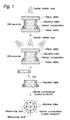
- Fig. 1 is a view illustrating a method to measure polymerization shrinkage of a dental composition.
- the dental material and the dental composition of the invention contain, as a polymerizable monomer, a sulfur-containing unsaturated carboxylic acid ester compound having a substituent containing a sulfur atom and at least two (meth)acrylic acid residues through an oxygen atom bonded to a secondary or tertiary carbon atom, preferably at least one polymerizable monomer (A) represented by the formula (1).
- a sulfur-containing unsaturated carboxylic acid ester compound having a substituent containing a sulfur atom and at least two (meth)acrylic acid residues through an oxygen atom bonded to a secondary or tertiary carbon atom, preferably at least one polymerizable monomer (A) represented by the formula (1).
- R 11 is a divalent organic group
- each X 11 is independently an oxygen atom, a sulfur atom, -COO- group or -(CH 2 ) q X 12 - group
- X 12 is an oxygen atom or a sulfur atom, and q is an integer of 1 to 3
- each R 12 is independently a hydrogen atom or an alkyl group
- each R 13 is independently a substituent containing a sulfur atom
- each R 14 is independently a hydrogen atom or a methyl group.
- R 11 is a divalent organic group and is, for example, an alkylene group, an alkenylene group, a cycloalkylene group or an allylene group, which may be unsubstituted or substituted, though it is not limited thereto.
- groups include pentamethylene, hexamethylene, heptamethylene, 1,3-pentylene, 1,4-cyclohexylene, 1,3-phenylene, 1,4-phenylene, 1,4-naphthalene, 2,6-naphthalene, and their substituted groups.
- R 11 is preferably a group represented by any one of the following formulas (2) to (4), particularly preferably a group represented by the formula (2) or (3).
- R 11 , R 21 , R 22 , R 23 and R 24 are each independently a hydrogen atom, an alkyl group, an alkoxyl group, a nitro group or a halogen atom.
- the alkyl group is a straight-chain, branched or cyclic alkyl group which may have a substituent, preferably a straight-chain, branched or cyclic alkyl group of 1 to 20 carbon atoms, which may have a substituent.
- the alkoxyl group is a straight-chain, branched or cyclic alkoxyl group which may have a substituent, preferably a straight-chain, branched or cyclic alkoxyl group of 1 to 20 carbon atoms, which may have a substituent.
- the halogen atom is, for example, a fluorine atom, a chlorine atom, a bromine atom or an iodine atom.
- R 21 , R 22 , R 23 and R 24 are each preferably a hydrogen atom, an unsubstituted straight-chain or branched alkyl group of 1 to 10 carbon atoms, an unsubstituted straight-chain or branched alkoxyl group of 1 to 10 carbon atoms, a nitro group, a chlorine atom or a bromine atom, more preferably a hydrogen atom, a methyl group, an ethyl group, an n-propyl group, an isopropyl group, an n-butyl group, an isobutyl group, a tert-butyl group, a methoxyl group, an ethoxyl group, an n-propoxyl group, an isopropoxyl group, an n-butoxyl group, an isobutoxyl group, a tert-butoxyl group, a nitro group, a chlorine atom or a bromine atom.
- the polymerizable monomer represented by the formula (1) there are three modes as bonding modes between the benzene ring R 11 and the two X 11 groups bonded to the benzene ring, namely, bonding at the para-positions, the meta-positions and the ortho-positions to R 11 .
- Preferable is a compound having a structure wherein the X 11 groups are bonded at the para-positions or the meta-positions, preferably the meta-positions.
- Y 31 is a single bond, -C(R 31 ) 2 - group (each R 31 is independently a hydrogen atom or a methyl group), -O- group, -S- group or -SO 2 - group, R 32 and R 33 are each independently an alkyl group, an alkenyl group, an aralkyl group, an aryl group, an alkoxyl group, an alkylthio group, a nitro group or a halogen atom, and m and n are each independently an integer of 0 to 4.
- the alkyl group is a straight-chain, branched or cyclic alkyl group which may have a substituent, preferably a straight-chain, branched or cyclic alkyl group of 1 to 20 carbon atoms, which may have a substituent, more preferably an unsubstituted straight-chain or branched alkyl group of 1 to 10 carbon atoms.
- the alkenyl group is a straight-chain, branched or cyclic alkenyl group which may have a substituent, preferably a straight-chain, branched or cyclic alkenyl group of 1 to 20 carbon atoms, which may have a substituent, more preferably an unsubstituted straight-chain or branched alkenyl group of 1 to 10 carbon atoms.
- the aralkyl group is an aralkyl group which may have a straight-chain, branched or cyclic substituent, preferably an aralkyl group which may have a straight-chain, branched or cyclic substituent whose non-aromatic portion has 1 to 20 carbon atoms, more preferably an aralkyl group having a straight-chain or branched substituent whose non-aromatic portion has 1 to 10 carbon atoms.
- the aryl group is an aryl group which may have a straight-chain, branched or cyclic substituent, more preferably an aryl group which may have a straight-chain, branched or cyclic substituent of 1 to 20 carbon atoms.
- the alkoxyl group is a straight-chain, branched or cyclic alkoxyl group which may have a substituent, preferably a straight-chain, branched or cyclic alkoxyl group of 1 to 20 carbon atoms, which may have a substituent, more preferably an unsubstituted straight-chain or branched alkoxyl group of 1 to 10 carbon atoms.
- the alkylthio group is a straight-chain, branched or cyclic alkylthio group which may have a substituent, preferably a straight-chain, branched or cyclic alkylthio group of 1 to 20 carbon atoms, which may have a substituent, more preferably an unsubstituted straight-chain or branched alkylthio group of 1 to 10 carbon atoms.
- the halogen atom is, for example, a fluorine atom, a chlorine atom, a bromine atom or an iodine atom.
- each R 41 is independently a hydrogen atom or an alkyl group.
- the two X 11 groups may be bonded to the same benzene ring or may be bonded to different benzene rings.
- the alkyl group is a straight-chain, branched or cyclic alkyl group which may have a substituent, preferably a straight-chain, branched or cyclic alkyl group of 1 to 20 carbon atoms, which may have a substituent, more preferably an unsubstituted straight-chain or branched alkyl group of 1 to 10 carbon atoms.
- X 11 is preferably an oxygen atom or a sulfur atom, more preferably an oxygen atom.
- each R 12 is independently a hydrogen atom or an alkyl group.
- the alkyl group is a straight-chain, branched or cyclic alkyl group which may have a substituent, preferably a straight-chain, branched or cyclic alkyl group of 1 to 10 carbon atoms, which may have a substituent.
- Each R 12 is particularly preferably a hydrogen atom or a methyl group.
- each R 13 is independently a substituent containing a sulfur atom, and in the structure of the substituent, at least one sulfur atom is contained. Because of the sulfur atom contained in the substituent, the refractive index of the monomer can be easily controlled, so that such a monomer is preferable to the conventional monomers.
- the substituent R 13 is, for example, a substituent represented by the following formula (5) or (6).
- R 13a is a monovalent organic group containing at least one sulfur atom
- R 13b is a monovalent organic group which may contain a sulfur atom
- the substituent R 13a is preferably an alkyl group, an aralkyl group, an aryl group or an acyl group, which contains at least one sulfur atom and may have a substituent.
- the substituent R 13a may be a heterocyclic ring-containing group.
- the substituent R 13b is preferably an alkyl group, an aralkyl group, an aryl group or an acyl group, which may have a substituent.
- the substituent R 13 is preferably a chain or cyclic alkoxyl group containing a sulfur atom, an aralkyloxy group containing a sulfur atom, an aryloxy group containing a sulfur atom, an acyloxy group containing a sulfur atom, an aralkylthio group which may contain a sulfur atom, an arylthio group which may contain a sulfur atom, or an acylthio group which may contain a sulfur atom.
- each R 14 is independently a hydrogen atom or an alkyl group, preferably a hydrogen atom or a methyl group.
- Examples of the polymerizable monomers represented by the formula (1) include the later-described compounds No. 1 to No. 349. Details of the process for preparing those compounds are described in EP1057808A2 (laid open on Dec. 6, 2000). The present invention is not limited to those compounds.
- dental material used in this specification means a material widely used in the dental field, which includes the following dental composition.
- the term "dental composition” means a mixture of a polymerizable monomer, a polymerization initiator, a filler, etc., and the dental composition includes an uncured composition and a composition having been cured by polymerization.
- the state of the polymerizable monomer represented by the formula (1) that is used in the invention is not specifically restricted.
- the monomer is preferably liquid at ordinary temperature (20°C in the invention) and preferably has a viscosity of 100 to 1,000,000 cps at ordinary temperature.
- the polymerizable monomer which is liquid at ordinary temperature and has the above viscosity can be favorably used as a dental material as it is without being polymerized. If the viscosity is lower than the above value, the polymerizable monomer hardly has the desired properties.
- the viscosity of the polymerizable monomer is particularly preferably in the range of 1,000 to 100,000 cps. That the monomer is liquid at ordinary temperature is advantageous from the viewpoint of ease of use, for example, the monomer can be easily used as a dental material or the monomer can easily dissolve other components and additives in the preparation of a cured product from the composition.
- the polymerizable monomer represented by the formula (1) is not limited to a liquid and may be a solid.
- the polymerizable monomer represented by the formula (1) for use in the invention exhibits a liquid refractive index, at room temperature (20°C), of preferably 1.55 to 1.65, more preferably 1.57 to 1.63.
- a cured product of the polymerizable monomer exhibits a refractive index, at room temperature, of preferably 1.57 to 1.65, more preferably 1.58 to 1.65. Owing to such refractive indexes, transparency of the cured composition in which the polymerizable monomer exists together with a filler, etc. can be ensured, as described later.
- the polymerizable monomer represented by the formula (1) may be used singly, or may be used in combination with other monomers of the formula (1).
- the dental composition of the invention further contains a polymerization initiator (B) in addition to the component (A).
- polymerization initiator added to the dental composition or the dental material of the invention known compounds are employable without any restriction.
- a photopolymerization initiator, an organic peroxide, a diazo compound and a redox compound are employable.
- a photosensitizer only or a combination of a photosensitizer and a photopolymerization accelerator is employable.
- the photosensitizers include known ⁇ -diketone compounds and phosphorus compounds, which are excited by irradiation with visible rays or ultraviolet rays to initiate polymerization, such as benzyl, camphorquinone, ⁇ -naphthyl, p,p'-dimethoxybenzyl, pentadione, 1,4-phenanthrenequinone, naphthoquinone and trimethylbenzoyldiphenylphosphine oxide. These compounds can be used singly or in combination of two or more kinds. Of these compounds, preferably used are camphorquinone and/or trimethylbenzoyldiphenylphosphine oxide.
- photopolymerization accelerators examples include:
- tertiary aromatic amines wherein a nitrogen atom is directly bonded to an aromatic ring and tertiary aliphatic amines having a polymerizable group, such as ethyl p-N,N-dimethylaminobenzoate, methyl p-N,N-dimethylaminobenzoate, 2-n-butoxyethyl p-N,N-dimethylaminobenzoate and N,N-dimethylaminoethyl methacrylate.
- a combination of a photosensitizer and a photopolymerization accelerator is preferable, and preferably used is a combination of camphorquinone or trimethylbenzoyldiphenylphosphine oxide and an ester compound of a tertiary aromatic amine wherein a nitrogen atom is directly bonded to an aromatic ring, such as ethyl p-N,N-dimethylaminobenzoate or 2-n-butoxyethyl p-N,N-dimethylaminobenzoate.
- the type of the organic peroxide or the diazo compound used as the polymerization initiator is not specifically restricted, but in order to complete the polymerization in a short period of time, a compound whose decomposition half-life at 80°C is not more than 10 hours is preferable.
- organic peroxides examples include:
- diazo compounds examples include 2,2'-azobisisobutyronitrile, 4,4'-azobis(4-cyanovaleric acid), 2,2'-azobis(4-methoxy-2,4-dimethoxyvaleronitrile) and 2,2'-azobis(2-cyclopropylpropionitrile).
- the type of the redox initiator used as the polymerization initiator is not specifically restricted.
- a combination of the organic peroxide and the tertiary amine a combination of the organic peroxide/sulfinic acid or its alkali metal salt/the tertiary amine; and a combination of an inorganic peroxide and an inorganic reducing agent, such as a combination of an inorganic peroxide (e.g., potassium persulfate) and sodium sulfite or a combination of an inorganic peroxide and sodium hydrogensulfite.
- an inorganic peroxide e.g., potassium persulfate
- sodium sulfite a combination of an inorganic peroxide and sodium hydrogensulfite.
- preferably used are a combination of benzoyl peroxide and N,N-dimethyl-p-toluidine and a combination of benzoyl peroxide and N,N-dihydroxyethyl-p-toluidine.
- the polymerization initiator is used in an amount of preferably 0.001 to 10 % by weight based on 100 parts by weight of the (meth)acrylate monomer.
- the dental composition of the invention contains a filler.
- the filler is added for the purposes of ensuring mechanical strength, enhancing light transmittance, imparting X-ray opacity and decreasing polymerization shrinkage.
- the filler (C) is the following glass powder or the following composite filler consisting of the glass powder and a polymer, and usually, the filler (C) does not include a filler composed of an organic compound only.
- An inorganic compound used as the filler in the invention is generally a glass powder, and the glass powder has an average particle diameter of usually not more than 2 ⁇ m, preferably 0.1 to 1.5 ⁇ m. When the particle diameter is in this range, the specific surface area of the filler is not increased markedly. Hence, the relative proportion of the filler to the polymerizable monomer is greatly increased, and therefore the polymerization shrinkage can be effectively decreased.
- the refractive index of the glass powder is preferably not less than 1.55, particularly preferably 1.57 to 1.65.
- the difference between the refractive index of the glass powder for use in the invention and the refractive index of a cured product (resin matrix) of the polymerizable monomer in the dental composition containing this glass powder is preferably not more than 0.05, particularly preferably not more than 0.02. That is to say, the glass powder for use in the invention has a refractive index very approximate to that of a cured product of the polymerizable monomer.
- the glass powder for use in the invention has a refractive index very approximate to that of a cured product of the polymerizable monomer.
- the glass powder for use in the invention is preferably one having X-ray opacity.
- an element having X-ray opacity such as barium, strontium, zirconium, bismuth, tungsten, germanium, molybdenum or lanthanide, is usually added as a glass-constituting element.
- the heavy metal element of the glass powder in the dental composition of the invention has a function of imparting X-ray opacity to the glass powder and a function of controlling the refractive index of the glass powder.
- the difference between the refractive index of the cured product of the monomer such as (meth)acrylate and the refractive index of the glass powder is larger than 0.05, the transparency of the cured composition is lowered, and lowering of the photo-curability results in decrease of the curing depth or insufficient curing reaction, whereby properties of the cured product are sometimes lowered.
- the refractive index of the glass powder is controlled, it is preferable to adjust the refractive index between the refractive index of the monomer in the uncured state and the refractive index of the cured product of the monomer. This is advantageous in that there is no change between the transparency of the composition before curing and the transparency of the composition after curing.
- the transparency of the composition after curing becomes the highest.
- the methods to control the refractive index can be properly used according to the requirements for the clinical site.
- the dental composition of the invention containing not less than about 60 % by weight of a glass powder of X-ray opacity having an average particle diameter of about sub micron to several ⁇ m, if the refractive index of the glass powder contained in the composition is not less than 1.50, the cured product of the composition becomes transparent, and the presence of the cured product can be clearly confirmed by X-rays.
- the glass powder used herein may be one kind of a glass powder or a mixture of two or more kinds of glass powders having different formulations. When plural kinds of glass powders having different formulations are used, the refractive indexes of the glass powders are approximated to each other, and thereby high transparency of a cured product of the dental composition of the invention can be ensured.
- the glass powder is used in an amount of usually 5 to 2000 parts by weight, preferably 100 to 700 parts by weight, based on 100 parts by weight of the polymerizable monomer.
- a composite filler may be used as the filler.
- the composite filler for use in the invention can be prepared by, for example, mixing a polymerizable monomer, a glass powder and a thermal polymerization initiator such as benzoyl peroxide, then thermally polymerizing the mixture and pulverizing the resulting polymer.
- a thermal polymerization initiator such as benzoyl peroxide
- the composite filler By the use of the composite filler, polymerization shrinkage of the dental composition of the invention can be effectively reduced in the curing stage. Since the composite filler is prepared by polymerizing the polymerizable monomer under such conditions (e.g., thermal polymerization conditions) as are capable of raising the degree of polymerization higher than that in the photopolymerization conditions, the cured product exhibits higher mechanical properties than a cured product obtained by photopolymerization. Accordingly, by the incorporation of such a composite filler, mechanical properties and abrasion resistance of the cured product of the dental composition of the invention are improved.
- thermal polymerization conditions e.g., thermal polymerization conditions
- the refractive index of a cured product of a mixture of the glass powder used for the composite filler and a polymerizable monomer for constituting the composite filler to agree with the refractive index of the aforesaid polymerizable monomer cured product and the refractive index of the glass powder, higher transparency can be obtained.
- fine particle silica, a filler other than the glass powder, such as metallic oxide, a pigment, etc. may be added when needed.
- the average particle diameter of the composite filler is in the range of usually 1 to 100 ⁇ m, preferably 5 to 20 ⁇ m.
- the composite filler is used in an amount of usually 1 to 2000 parts by weight, preferably 5 to 2000 parts by weight, more preferably 50 to 700 parts by weight, based on 100 parts by weight of the polymerizable monomer.
- fine particle silica can be used as the filler in addition to the glass powder.
- the fine particle silica employable herein is usually high-purity colloidal silica prepared by a gas phase process, and has no X-ray opacity. Although the fine particle silica has no X-ray opacity, it is sometimes added for the purpose of controlling viscosity or tackiness of a paste.
- high-purity colloidal silica prepared by, for example, a gas phase process may be used as it is, or high-purity colloidal silica may be used after hydrophobic treatment with a silane compound such as dimethyldichlorosilane.
- the fine particle silica has a low refractive index of 1.45, and this refractive index is widely different from that of the filler used.
- the average particle diameter of the fine particle silica is usually not more than 0.05 ⁇ m and is considerably smaller than 0.3 to 0.7 ⁇ m that is a wavelength of visible ray, so that the fine particle silica does not greatly hinder the transparency.
- Fine particle silica of smaller size can maintain transparency high, and hence it is preferable to use fine particle silica having an average particle diameter of not more than 0.01 ⁇ m from the viewpoint of maintenance of high transparency.
- the fine particle silica is used in an amount of usually 5 to 250 parts by weight, preferably 10 to 200 parts by weight, particularly preferably 20 to 150 parts by weight, based on 100 parts by weight of the (meth)acrylate monomer contained in the dental composition of the invention.
- the polymerizable monomer used in combination with the polymerizable monomer represented by the formula (1) is usually a (meth)acrylate monomer or a (meth)acrylamide monomer.
- the polymerizable monomer is, for example, a monofunctional monomer, a polyfunctional monomer which forms a crosslinked structure to effectively enhance physical properties after polymerization, or an acid group-containing monomer which is added for the purpose of imparting, to the composition, properties of adhesion to dentin or the like.
- Examples of the monofunctional monomers for use in the invention include:
- polyfunctional monomers examples include:
- alicyclic or aromatic epoxy di(meth)acrylates represented by the following formula: wherein R is a hydrogen atom or a methyl group, n is 0 or a positive integer, and R 1 is -(CH 2 ) 2 -, -(CH 2 ) 4 - or any one of the following aromatic groups.
- polyfunctional (meth)acrylates having an urethane bond in the molecule which are represented by the following formula: wherein R is a hydrogen atom or a methyl group, and R 1 is -(CH 2 ) 2 -, -(CH 2 ) 4 -, -(CH 2 ) 6 - or any one of the following groups.
- acid group-containing monomers for use in the invention are described below.
- monomers having at least one carboxyl group in one molecule there can be mentioned monocarboxylic acids, dicarboxylic acids, tricarboxylic acids, tetracarboxylic acids, and their derivatives.
- acids and derivatives include (meth)acrylic acid, maleic acid, p-vinylbenzoic acid, 11-(meth)acryloyloxy-1,1-undecanedicarboxylic acid (MAC-10), 1,4-di(meth)acryloyloxyethylpyromellitic acid, 6-(meth)acryloyloxyethylnaphthalene-1,2,6-tricarboxylic acid, 4-(meth)acryloyloxymethyltrimellitic acid and anhydride thereof, 4-(meth)acryloyloxyethyltrimellitic acid and anhydride thereof, 4-(meth)acryloyloxybutyltrimellitic acid and anhydride thereof, 4-[2-hydroxy-3-(meth)acryloyloxy]butyltrimellitic acid and anhydride thereof, 2,3-bis(3,4-dicarboxybenzoyloxy)propyl (meth)acrylate, N-o-di(meth)acrylate
- monomers having at least one phosphoric acid group in one molecule there can be mentioned, for example, 2-(meth)acryloyloxyethyl acid phosphate, 2- or 3-(meth)acryloyloxypropyl acid phosphate, 4-(meth)acryloyloxybutyl acid phosphate, 6-(meth)acryloyloxyhexyl acid phosphate, 8-(meth)acryloyloxyoctyl acid phosphate, 10-(meth)acryloyloxydecyl acid phosphate, 12-(meth)acryloyloxydodecyl acid phosphate, bis ⁇ 2-(meth)acryloyloxyethyl ⁇ acid phosphate, bis ⁇ 2- or 3-(meth)acryloyloxypropyl ⁇ acid phosphate, 2-(meth)acryloyloxyethylphenyl acid phosphate and 2-(meth)acryloyloxyethyl-p-methoxyphenyl acid
- monomers having at least one sulfonic acid group in one molecule there can be mentioned, for example, 2-sulfoethyl (meth)acrylate, 2- or 1-sulfo-1- or -2-propyl (meth)acrylate, 1- or 3-sulfo-2-butyl (meth)acrylate, 3-bromo-2-sulfo-2-propyl (meth)acrylate, 3-methoxy-1-sulfo-2-propyl (meth)acrylate and 1,1-dimethyl-2-sulfoethyl (meth)acrylamide.
- (meth)acrylic acid esters which are low-poisonous, can be rapidly polymerized, hardly undergo hydrolysis and are readily prepared.
- the monofunctional polymerizable (meth)acrylic acid esters particularly preferably used are, for example, alkyl methacrylates, such as methyl methacrylate (refractive index: 1.42) and ethyl methacrylate (refractive index: 1.42); hydroxyl group-containing (meth)acrylates, such as 2-hydroxyethyl methacrylate (refractive index: 1.45); and (meth)acrylates having ethylene glycol chain in the molecule, such as diethylene glycol monomethyl ether methacrylate (refractive index: 1.44) and tetraethylene glycol monomethyl ether methacrylate (refractive index: 1.45).
- polyfunctional polymerizable (meth)acrylic acid esters particularly preferably used are, for example, di(meth)acrylates having ethylene glycol chain in the molecule, such as ethylene glycol dimethacrylate (refractive index: 1.45) and triethylene glycol dimethacrylate (refractive index: 1.46); and compounds represented by the following formulas: wherein R is a methyl group and m+n is 2.6 on the average (refractive index: 1.54), wherein R is a methyl group (refractive index: 1.54), wherein R is a methyl group (refractive index: 1.48).
- di(meth)acrylates having ethylene glycol chain in the molecule such as ethylene glycol dimethacrylate (refractive index: 1.45) and triethylene glycol dimethacrylate (refractive index: 1.46); and compounds represented by the following formulas: wherein R is a methyl group and m+n is 2.6 on the average (refractive index: 1.54), wherein R
- acid group-containing monomers particularly preferably used are, for example, 11-methacryloyloxy-1,1-undecanedicarboxylic acid, 4-methacryloyloxyethyltrimellitic anhydride, N-methacryloyl-5-aminosalicylic acid, 2-(meth)acryloyloxyethylphenyl acid phosphate, 10-(meth)acryloyloxydecyl acid phosphate and 2-methyl-2-(meth)acrylamidopropanesulfonic acid.
- the acid group-containing monomer is used in an amount of usually 0.1 to 50 parts by weight, preferably 0.5 to 20 parts by weight, particularly preferably 1 to 10 parts by weight, based on 100 parts by weight of the (meth)acrylate monomer contained in the dental composition of the invention.
- the (meth)acrylate monomer in such a manner that the difference between the refractive index of a cured product of a mixture of the polymerizable monomer represented by the formula (1) and this monomer and the refractive index of the glass powder added as a filler should become not more than 0.05, particularly 0 to 0.02.
- the refractive index of a cured product of the monomer usually becomes higher than the refractive index of the monomer by about 0.02 to 0.03.
- a polar group e.g., hydroxyl group, carboxylic acid group
- an aromatic ring e.g., a heavy element (e.g., halogen atom) or a sulfur element
- the refractive index of the (meth)acrylate monomer generally tends to become higher than that of the monomer not containing such a group or an element.
- the refractive index of the monomer containing such a group or a heavy element is in the range of usually 1.48 to 1.54.
- the refractive index of a monomer having only an alkyl group as its structure or a (meth)acrylic monomer having a fluoroalkyl group tends to become lower that that of a monomer not having such a group, and the refractive index of the (meth)acrylic monomer is in the range of usually 1.40 to 1.48.
- the content of other polymerizable monomers in the dental composition of the invention is in the range of preferably 5 to 50 % by weight, particularly preferably 10 to 30 % by weight.
- the dental composition of the invention contains at least the polymerizable monomer represented by the formula (1), the filler and the polymerization initiator, and to the composition, other components, such as pigment, dye, stabilizer, polymer powder and ultraviolet light absorber, may be added when needed, within limits not detrimental to the desired effects.
- the polymerizable monomer (A) represented by the formula (1), the polymerization initiator (B), the filler (C), and if desired, the polymerizable monomer (D) other than the polymerizable monomer (A) are mixed to carry out polymerization reaction. Since it is necessary that the polymerizable composition should not be contaminated with insoluble matters or foreign matters, the composition may be filtered to remove them prior to polymerization. It is more preferable to sufficiently defoam the composition under reduced pressure prior to polymerization curing, because introduction of bubbles into the cured product can be prevented.
- the dental composition of the invention can undergo polymerization reaction by irradiation with ultraviolet rays, visible rays or the like, similarly to the conventional photopolymerizable materials.
- light sources employable for the irradiation include fluorescent lamp, various mercury lamps, xenon lamp, tungsten lamp, halogen lamp and sunlight.
- the light irradiation time is in the range of 1 second to 5 minutes.
- the temperature for the photopolymerization is in the range of usually 0 to 100°C, preferably 5 to 60°C.
- the formulation of the composition may be adjusted so as to complete the polymerization curing in a period of 1 to 30 minutes.
- the dental composition of the invention satisfies requirements for dental materials or compositions, such as mechanical strength, abrasion resistance, water resistance, curability and stain resistance, and has excellent and well-balanced transparency and X-ray opacity though the transparency and the X-ray opacity are hardly compatible with each other.
- the light transmittance (transparency) of a cured product of the dental composition is preferably not less than 1 %, more preferably not less than 5 %.
- the X-ray opaque value of the dental composition is in the range of preferably 100 to 1000 % (based on aluminum), more preferably 200 to 800 % (based on aluminum), still more preferably more than 300 % and not more than 800 % (based on aluminum), particularly preferably 400 to 800 % (based on aluminum).
- the composition of the invention further has a property of small polymerization shrinkage in addition to the above properties.
- the composition of the invention can be used for restoration of a defected part or filling of a cavity drilled, and besides the composition can be widely used for joining or adhesion of dentin of front tooth or the like, preparation of temporary tooth, bonding of bridge, adhesion of facing crown, etc.
- the polymerizable monomer (A) represented by the formula (1) can be used singly or in combination with plural different polymerizable monomers.
- the polymerizable monomer is preferably liquid at ordinary temperature and desirably has a viscosity of 100 to 1,000,000 cps, preferably 1,000 to 100,000 cps.
- This monomer is used as, for example, a primer that is used for undercoating before application of a resin adhesive.
- additives such as germicide, disinfectant, stabilizer and preservative, may be added when needed, within limits not detrimental to the effects of the invention.
- the present invention includes a dental material containing, together with the polymerizable monomer, a polymerization initiator that is used for curing, and such a dental material can be used as, for example, a bonding agent, a resin type adhesive or a temporary adhesive.
- a dental material containing, together with the polymerizable monomer, a polymerization initiator that is used for curing, and such a dental material can be used as, for example, a bonding agent, a resin type adhesive or a temporary adhesive.
- the polymerization initiator the same substance as used for the aforesaid curable composition is employable.
- the sulfur-containing unsaturated carboxylic acid ester compound having a substituent containing a sulfur atom and at least two (meth)acrylic acid residues through an oxygen atom bonded to a secondary or tertiary carbon atom can be widely used singly or in combination with a polymerization initiator and a filler to serve as a dental material or a dental composition.
- the dental composition containing at least the polymerizable monomer represented by the formula (1), the filler and the polymerization initiator satisfies requirements for dental compositions, such as mechanical strength, abrasion resistance and water resistance, is excellent in X-ray opacity, transparency, curability (particularly photo-curability) and stain resistance, and provides a cured product having small polymerizable shrinkage (especially when a composite filler is contained).
- the dental treatment can be made with confirming the position of the composition used.
- MNA-10 1,3-bis(3-phenylthio-2-acryloyloxypropyloxy)benzene (refractive index of cured product of the compound only: 1.62)
- MNA-12 1,3- ⁇ 2'-acryloyloxy-3'-[2-(1,3-dithiolan-2-yl)ethylthio]propyloxy ⁇ benzene (refractive index of cured product of the compound only: 1.61, high-viscosity liquid)
- MNA-13 1,3-bis(3-phenylthio-2-methacryloyloxypropyloxy)benzene (refractive index of cured product of the compound only: 1.61, high-viscosity liquid)
- MNA-30 4,4'-bis(3-phenylthio-2-acryloyloxypropyloxy)biphenyl (refractive index of cured product of the compound only: 1.61, high-viscosity liquid)
- Bis-GMA 2,2-bis[4-(2-hydroxy-3-methacryloxypropoxy)phenyl]propane (refractive index: 1.54, high-viscosity liquid)
- TEGDMA triethylene glycol dimethacrylate (refractive index: 1.46)
- UDMA 1,6-bis(methacryloxyethyloxycarbonylamino)-2,2,4-(or -2,4,4-)trimethylhexane (refractive index: 1.48)
- Bis-MPEPP 2,2-bis(4-methacryloxypolyethoxyphenyl)propane (refractive index: 1.54)
- a glass obtained by treating a glass (refractive index: 1.60, average particle diameter: 5 ⁇ m) comprising 40 % by weight of silicon dioxide, 40 % by weight of barium oxide, 10 % by weight of boron oxide and 10 % by weight of aluminum oxide, with 1 % by weight of [3-(methacryloyloxy)propyl]trimethoxysilane in a conventional manner
- B glass obtained by treating a glass (refractive index: 1.60, average particle diameter: 1 ⁇ m) comprising 40 % by weight of silicon dioxide, 40 % by weight of barium oxide, 10 % by weight of boron oxide and 10 % by weight of aluminum oxide, with 3 % by weight of [3-(methacryloyloxy)propyl]trimethoxysilane in a conventional manner
- C glass obtained by treating a glass (refractive index: 1.55, average particle diameter: 1 ⁇ m) comprising 50 % by weight of silicon dioxide, 30 % by weight of barium oxide, 10 % by weight of boron oxide and 10 % by weight of aluminum oxide, with 3 % by weight of [3-(methacryloyloxy)propyl]trimethoxysilane in a conventional manner
- R-812 obtained by hydrophobic treatment of colloidal silica (average particle diameter: 0.007 ⁇ m) with dimethyldichlorosilane (proportion of particles having particle diameters of not less than 0.01 ⁇ m: about 10 %, available from Nippon Aerozil K.K.)
- the refractive index was measured at 20°C in a conventional manner by the use of an Abbe's refractometer (IT model manufactured by Atago K.K.).
- a dental composition (composite resin) experimentally prepared was filled in a mold of desired shape and irradiated with visible rays for 60 seconds by the use of a visible ray irradiation apparatus (Translux CL manufactured by Kulzer Co.) to cure the composition.
- a visible ray irradiation apparatus Translux CL manufactured by Kulzer Co.
- Tests were carried out in accordance with 7.8 (flexural strength) and 7.11 (X-ray opacity) of ISO-4049 (1988).
- the flexural strength was measured by the use of an autograph AGS-2000G manufactured by Shimadzu Seisakusho K.K. at a crosshead speed of 1 mm/min.
- the X-ray opacity was measured by X-ray photographing a circular cured product having a thickness of 2.0 mm by the use of an X-ray control apparatus (PCX-100 manufactured by Asahi Roentgen Kogyo K.K.) and then calculating the density of the photographed image as an Al equivalent (%) by a densitometer (PDA15 manufactured by Konica K.K.) based on the density of a photographed image of an Al plate of the same thickness.
- PCX-100 manufactured by Asahi Roentgen Kogyo K.K.
- a Teflon mold of 1 mm thickness having a rectangular hole of 10 mm (width) ⁇ 25 mm (length) was filled with a dental composition (composite resin), then sandwiched between a polyester film and a glass plate and irradiated with visible rays for 60 seconds per spot by the use of a visible ray irradiation apparatus (Translux CL manufactured by Kulzer Co.) to cure the composition.
- a visible ray irradiation apparatus Translux CL manufactured by Kulzer Co.
- an alumina ceramic tube having an inner diameter of 6 mm and a height of 5 mm was filled with a dental composition (composite resin).
- a dental composition composite resin
- the tube was sufficiently filled with the composition so that the composition came out of one end of the tube and covered the tube.
- the dental composition (composite resin) filled in the tube was irradiated with a light for 180 seconds from the upper surface side of the tube by the use of a visible ray irradiation apparatus (Translux CL manufactured by Kulzer) to cure the dental composition (composite resin) in the tube.
- the tube with the dental composition was placed in an industrial visible ray irradiation apparatus ( ⁇ -Light II manufactured by Morita Seisakusho K.K.) and irradiated with visible rays around the tube for 300 seconds to completely cure the dental composition (composite resin) present inside and outside the tube.
- an industrial visible ray irradiation apparatus ⁇ -Light II manufactured by Morita Seisakusho K.K.
- the alumina tube was cut at the position of 2 mm from the top of the tube.
- the cut surface was subjected to mirror polishing and cleaned by an ultrasonic cleaner.
- the gap formed between the cured product and the tube was measured at 8 spots, and the total of widths of the gaps at the facing two measuring spots was taken as a width of gap due to polymerization shrinkage.
- a monomer mixture (refractive index: 1.58) consisting of 50 parts by weight of MNA-10 and 50 parts by weight of Bis-MPEPP, 0.5 part by weight of camphorquinone and 0.5 part by weight of ethyl N,N-dimethylaminobenzoate were dissolved.
- the resulting component was mixed with 400 parts by weight of the A glass and 20 parts by weight of R-812 to prepare a dental composition as a homogeneous paste.
- the polymerization shrinkage of a cured product of the dental composition was extremely small, as shown as a gap width in Table 1.
- the refractive index of the cured product of the dental composition was 1.60.
- the flexural strength, light transmittance and X-ray opacity of the cured product of the dental composition are set forth in Table 1.
- a monomer mixture (refractive index: 1.58) consisting of 75 parts by weight of MNA-10 and 25 parts by weight of TEGDMA, 0.5 part by weight of benzoyl peroxide was dissolved. The resulting component and 400 parts by weight of the B glass were sufficiently mixed to prepare a homogeneous paste.
- the paste was heated at 120°C for 15 minutes by a compression molding machine with application of pressure to cure the paste. The cured product of the paste was pulverized by a ball mill and sieved to prepare a composite filler A having an average particle diameter of about 20 ⁇ m.
- a monomer mixture (refractive index: 1.58) consisting of 75 parts by weight of MNA-10 and 25 parts by weight of TEGDMA, 0.5 part by weight of camphorquinone and 0.5 part by weight of ethyl N,N-dimethylaminobenzoate were dissolved.
- the resulting component was mixed with 350 parts by weight of the A glass, 50 parts by weight of the composite filler A and 30 parts by weight of R-812 to prepare a dental composition as a homogeneous paste.
- the polymerization shrinkage of a cured product of the dental composition was extremely small, as shown as a gap width in Table 1.
- the refractive index of the cured product of the dental composition was 1.60.
- the flexural strength, light transmittance and X-ray opacity of the cured product of the dental composition are set forth in Table 1.
- a monomer mixture (refractive index: 1.58) consisting of 60 parts by weight of MNA-12 and 40 parts by weight of Bis-MPEPP, 0.5 part by weight of camphorquinone and 0.5 part by weight of ethyl N,N-dimethylaminobenzoate were dissolved.
- the resulting component was mixed with 400 parts by weight of the A glass and 20 parts by weight of R-812 to prepare a dental composition as a homogeneous paste.
- the polymerization shrinkage of a cured product of the dental composition was extremely small, as shown as a gap width in Table 1.
- the refractive index of the cured product of the dental composition was 1.60.
- the flexural strength, light transmittance and X-ray opacity of the cured product of the dental composition are set forth in Table 1.
- a monomer mixture (refractive index: 1.58) consisting of 60 parts by weight of MNA-13 and 40 parts by weight of Bis-MPEPP, 0.5 part by weight of camphorquinone and 0.5 part by weight of ethyl N,N-dimethylaminobenzoate were dissolved.
- the resulting component was mixed with 350 parts by weight of the B glass and 25 parts by weight of R-812 to prepare a dental composition as a homogeneous paste.
- the polymerization shrinkage of a cured product of the dental composition was extremely small, as shown as a gap width in Table 1.
- the refractive index of the cured product of the dental composition was 1.60.
- the flexural strength, light transmittance and X-ray opacity of the cured product of the dental composition are set forth in Table 1.
- a monomer mixture (refractive index: 1.58) consisting of 60 parts by weight of MNA-30 and 40 parts by weight of Bis-MPEPP, 0.5 part by weight of camphorquinone and 0.5 part by weight of ethyl N,N-dimethylaminobenzoate were dissolved.
- the resulting component was mixed with 400 parts by weight of the A glass and 20 parts by weight of R-812 to prepare a dental composition as a homogeneous paste.
- the polymerization shrinkage of a cured product of the dental composition was extremely small, as shown as a gap width in Table 1.
- the refractive index of the cured product of the dental composition was 1.60.
- the flexural strength, light transmittance and X-ray opacity of the cured product of the dental composition are set forth in Table 1.
- a monomer mixture (refractive index: 1.52) consisting of 70 parts by weight of Bis-GMA and 30 parts by weight of TEGDMA, 0.5 part by weight of camphorquinone and 0.5 part by weight of ethyl N,N-dimethylaminobenzoate were dissolved.
- the resulting component was mixed with 400 parts by weight of the A glass and 25 parts by weight of R-812 to prepare a dental composition as a homogeneous paste.
- the polymerization shrinkage of the dental composition is set forth as a gap width in Table 1.
- the refractive index of a cured product of the dental composition was 1.54.
- the flexural strength, light transmittance and X-ray opacity of the cured product of the dental composition are set forth in Table 1.
- a monomer mixture (refractive index: 1.52) consisting of 70 parts by weight of Bis-GMA and 30 parts by weight of TEGDMA, 0.5 part by weight of camphorquinone and 0.5 part by weight of ethyl N,N-dimethylaminobenzoate were dissolved.
- the resulting component was mixed with 350 parts by weight of the C glass and 20 parts by weight of R-812 to prepare a dental composition as a homogeneous paste.
- the polymerization shrinkage of the dental composition is set forth as a gap width in Table 1.
- the refractive index of a cured product of the dental composition was 1.55.
- the flexural strength, light transmittance and X-ray opacity of the cured product of the dental composition are set forth in Table 1.
- a monomer mixture (refractive index: 1.52) consisting of 35 parts by weight of Bis-GMA, 35 parts by weight of Bis-MPEPP and 30 parts by weight of TEGDMA, 0.5 part by weight of camphorquinone and 0.5 part by weight of ethyl N,N-dimethylaminobenzoate were dissolved.
- the resulting component was mixed with 400 parts by weight of the A glass and 20 parts by weight of R-812 to prepare a dental composition as a homogeneous paste.
- the polymerization shrinkage of the dental composition is set forth as a gap width in Table 1.
- the refractive index of a cured product of the dental composition was 1.54.
- the flexural strength, light transmittance and X-ray opacity of the cured product of the dental composition are set forth in Table 1.
- a monomer mixture (refractive index: 1.52) consisting of 35 parts by weight of Bis-GMA, 35 parts by weight of Bis-MPEPP, 15 parts by weight of TEGDMA and 15 parts by weight of UDMA, 0.5 part by weight of camphorquinone and 0.5 part by weight of ethyl N,N-dimethylaminobenzoate were dissolved.
- the resulting component was mixed with 400 parts by weight of the A glass and 20 parts by weight of R-812 to prepare a dental composition as a homogeneous paste.
- the refractive index of a cured product of the dental composition was 1.54.
- the flexural strength, light transmittance and X-ray opacity of the cured product of the dental composition are set forth in Table 1.
- the flexural strength, light transmittance and X-ray opacity of the cured product of the dental composition are set forth in Table 1.
Landscapes
- Health & Medical Sciences (AREA)
- Chemical & Material Sciences (AREA)
- Oral & Maxillofacial Surgery (AREA)
- Medicinal Chemistry (AREA)
- Polymers & Plastics (AREA)
- Organic Chemistry (AREA)
- Chemical Kinetics & Catalysis (AREA)
- Plastic & Reconstructive Surgery (AREA)
- Epidemiology (AREA)
- Life Sciences & Earth Sciences (AREA)
- Animal Behavior & Ethology (AREA)
- General Health & Medical Sciences (AREA)
- Public Health (AREA)
- Veterinary Medicine (AREA)
- Dental Preparations (AREA)
Abstract
Disclosed is a dental material comprising a sulfur
containing unsaturated carboxylic acid ester compound
having a substituent containing a sulfur atom and at
least two (meth)acrylic acid residues through an oxygen
atom bonded to a secondary or tertiary carbon atom,
specifically, a dental material comprising a
polymerizable monomer (A) represented by the following
formula (1):
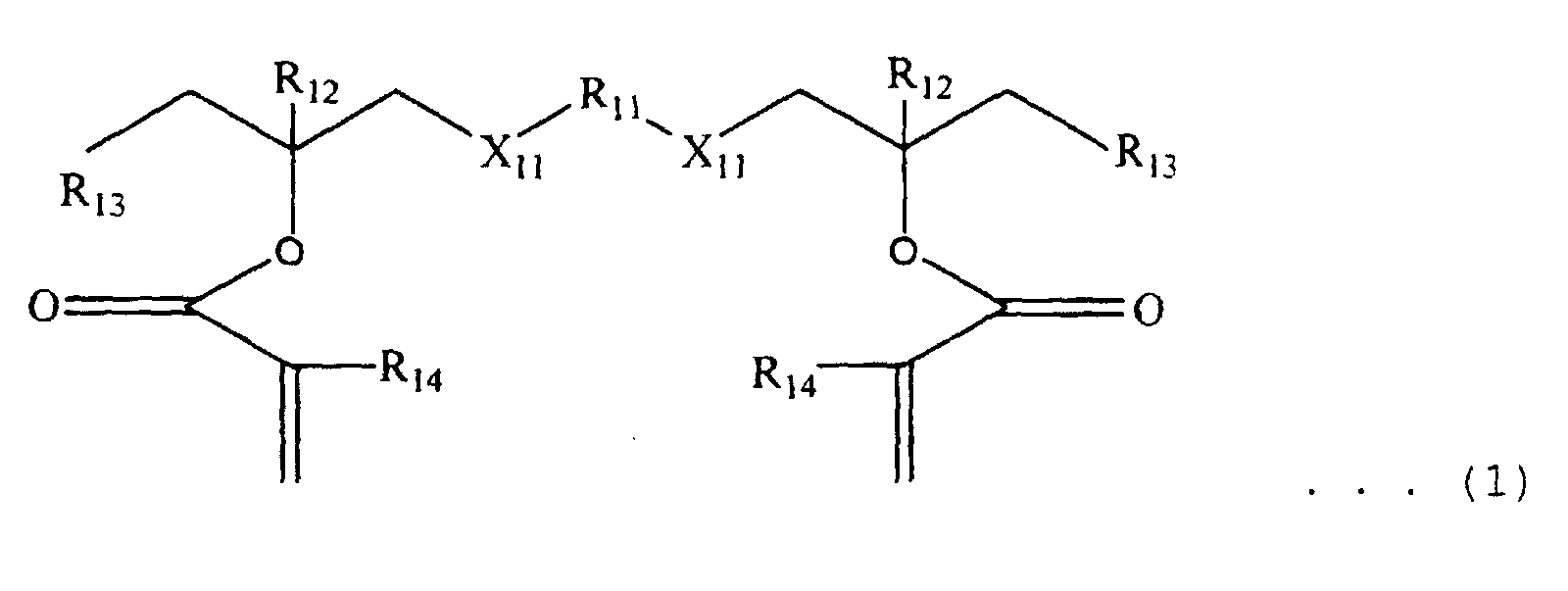 wherein R11 is a divalent organic group, X11 is an oxygen
atom, a sulfur atom, -COO- group or -(CH2)qX12- group (X12
is an oxygen atom or a sulfur atom, and q is an integer
of 1 to 3), R12 is a hydrogen atom or an alkyl group, R13
is a substituent containing a sulfur atom, and R14 is a
hydrogen atom or a methyl group,
wherein R11 is a divalent organic group, X11 is an oxygen
atom, a sulfur atom, -COO- group or -(CH2)qX12- group (X12
is an oxygen atom or a sulfur atom, and q is an integer
of 1 to 3), R12 is a hydrogen atom or an alkyl group, R13
is a substituent containing a sulfur atom, and R14 is a
hydrogen atom or a methyl group,
or a dental material comprising a polymerizable monomer (A) which is liquid at ordinary temperature and has a viscosity of 100 to 1,000,000 cps. Also disclosed is a dental composition comprising the polymerizable monomer (A), a polymerization initiator (B) and a filler (C). The dental material and the dental composition are excellent in X-ray opacity, transparency, curability and stain resistance, and they have small polymerization shrinkage.
or a dental material comprising a polymerizable monomer (A) which is liquid at ordinary temperature and has a viscosity of 100 to 1,000,000 cps. Also disclosed is a dental composition comprising the polymerizable monomer (A), a polymerization initiator (B) and a filler (C). The dental material and the dental composition are excellent in X-ray opacity, transparency, curability and stain resistance, and they have small polymerization shrinkage.
Description
- The present invention relates to dental materials and compositions. More particularly, the invention relates to dental materials and dental compositions which are capable of forming cured products having excellent transparency and X-ray opacity, have high curability (particularly photo-curability), have small polymerization shrinkage and are useful for composite resins, hard resins and artificial teeth.
- As fillers contained in dental compositions for composite resins, hard resins or artificial teeth, powdery inorganic components such as silica and glass are used for the purposes of imparting mechanical strength to the compositions and improving various properties of the resin matrix.
- In the dental treatment, the result of the treatment is often confirmed by X-ray photography, so that as a pulverized glass powder contained in the dental composition, a powder obtained by pulverizing a glass containing a heavy metal element having X-ray opacity, such as barium, zirconium or strontium, has been heretofore used so that X-ray photography should be feasible in the dental treatment. The pulverized glass powder is generally prepared by, for example, pulverizing such a glass as mentioned above. In the conventional technique for glass pulverization, however, it is difficult to finely pulverize a glass, and a glass powder having particle diameters of 10 µm to several tens µm has been usually employed. If a dental composition containing a glass powder of such large particle diameters is used, it is very difficult to form a finished and polished surface having a polish clinically similar to that of natural tooth.
- In order to solve problems associated with incorporation of such a glass powder, composite resins mainly using a finely pulverized glass powder having an average particle diameter of not more than 2 µm have been developed recently. For example, an invention using a pulverized glass powder having an average particle diameter of 0.1 to 5 µm and/or an inorganic compound having an average particle diameter of 0.01 to 0.04 µm, such as silica fine particles, is disclosed in Japanese Patent Laid-Open Publication No. 194135/1993.
- The surface polish that has been a disadvantage with conventional composite resins containing a pulverized glass powder can be improved by using composite resins containing such a finely pulverized glass powder. However, the dental composition containing such a finely pulverized glass powder still has many disadvantages to be improved in the balance of properties, such as transparency, photo-curability, polymerization shrinkage and X-ray opacity.
- For example, in case of a dental composition wherein a finely pulverized filler having an average particle diameter of not more than 2 µm is homogeneously contained, the boundary area between the filler and a resin matrix (resin cured product) is markedly increased, and in order to ensure its transparency, refractive indexes of the filler and the resin matrix need to be approximated to each other. However, if the content of the heavy metal element in the filler is increased to ensure high X-ray opacity, the refractive index of the filler becomes high. The refractive index of a resin matrix having been heretofore applied to dental use, such as Bis-GMA, is at most about 1.55, and by approximating the refractive index of the filler to said value, the transparency of the dental composition has been ensured.
- As described above, with regard to the transparency of teeth, extremely high transparency in the appearance is often required for the composite resin or the hard resin used for the front tooth cutting edge or the like. In such a part, the light transmittance at the wavelength of 480 nm that is a wavelength of a light from a dental light irradiator needs to be not less than 5 % in many cases. On the other hand, in the dentin portion or the like, the transparency of the dental resin or the hard resin may be relatively low because such a part is free from problems in the appearance, and it is possible to use even a dental resin or a hard resin having a transparency of not more than 1 %. In order to control shade of the teeth, however, a pigment such as titanium oxide or red iron oxide is used, so that even the dentin portion is desired to have high transparency to enhance the degree of freedom of coloring. In case of a dental material of photopolymerization type, there is an advantage that higher transparency brings about larger curing depth and higher degree of polymerization, and as a result, mechanical properties are enhanced.
- The light transmittance of a dental composition containing no pigment is preferably not less than 0.05 %, more preferably not less than 1 %, and in the practical use, the light transmittance is particularly preferably not less than 5 %. The X-ray opaque value of such a material commercially available at present is about 200 to 300 % based on aluminum, so that it is feasible to distinguish such a material from the tooth enamel (X-ray opaque value: about 180 % based on aluminum) by X-rays in the usual filling treatment. In case of filling in a small amount or thin filling, however, it becomes difficult to clearly distinguish such a material from the tooth enamel.
- As a means to decrease polymerization shrinkage that is a clinically serious problem in the dental material, use of a dental composition containing a composite filler obtained by pulverizing a cured product of a mixture of an inorganic filler and a polymerizable monomer is known. Although the dental composition can be decreased in the polymerization shrinkage, refractive indexes of the inorganic filler, a resin matrix of the composite filler and a resin matrix of the dental composition need to be finely suited to each other in order to ensure the transparency.
- The present inventors have earnestly studied to solve the problems in the dental materials and the dental compositions, and as a result, they have found that a cured composition containing, as a main ingredient of a sulfur-containing polymerizable monomer, a sulfur-containing unsaturated carboxylic acid ester compound having a substituent containing a sulfur atom and at least two (meth)acrylic acid residues through an oxygen atom bonded to a secondary or tertiary carbon atom satisfies the requirements for dental materials and dental compositions, has excellent and well-balanced curability, transparency and X-ray opacity though the transparency and the X-ray opacity are hardly compatible with each other, and has small polymerization shrinkage. Based on the finding, the present invention has been accomplished.
- The present invention is intended to solve such problems in the dental compositions as described above.
- That is to say, it is an object of the present invention to provide a dental material and a dental composition which have high X-ray opacity and transparency reconciled with each other.
- It is another object of the invention to provide a dental composition having excellent curability (particularly photo-curability) and having small polymerization shrinkage.
- The dental material of the invention comprises a sulfur-containing unsaturated carboxylic acid ester compound having a substituent containing a sulfur atom and at least two (meth)acrylic acid residues through an oxygen atom bonded to a secondary or tertiary carbon atom.
- The dental material of the invention comprises at least one polymerizable monomer represented by the following formula (1):wherein R11 is a divalent organic group, each X11 is independently an oxygen atom, a sulfur atom, -COO- group or -(CH2)qX12- group (X12 is an oxygen atom or a sulfur atom, and q is an integer of 1 to 3), each R12 is independently a hydrogen atom or an alkyl group, each R13 is independently a substituent containing a sulfur atom, and each R14 is independently a hydrogen atom or a methyl group.
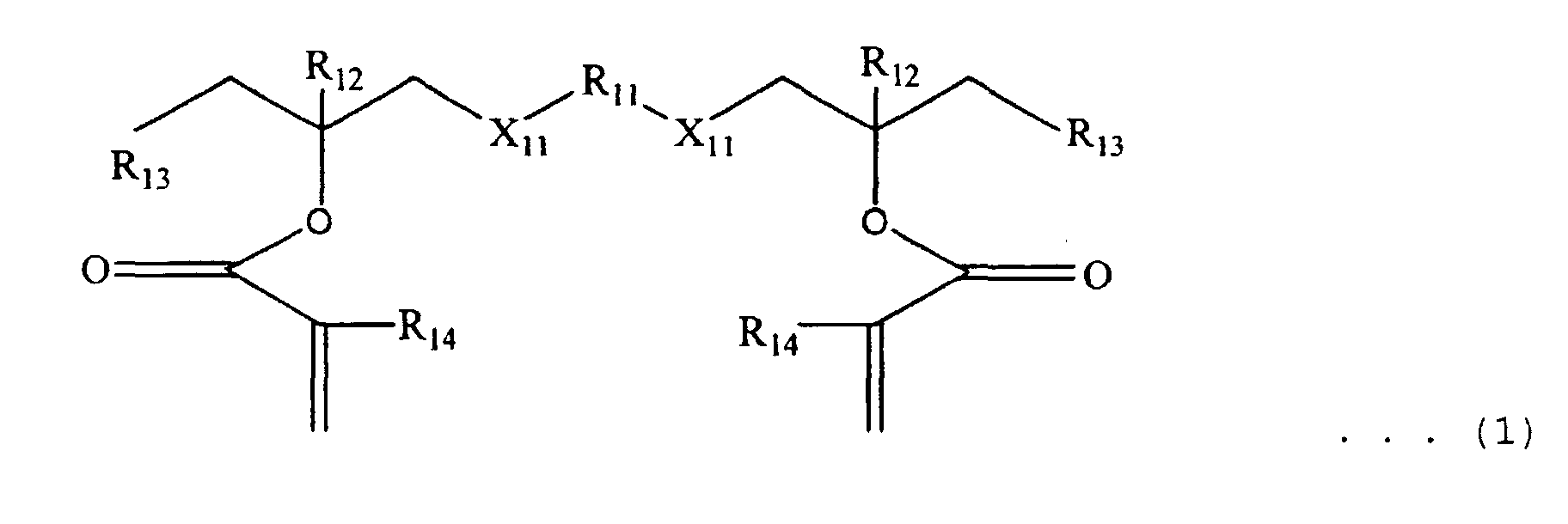
- R11 is preferably a divalent organic group represented by any one of the following formulas (2) to (4) :wherein R21, R22, R23 and R24 are each independently a hydrogen atom, an alkyl group, an alkoxyl group, a nitro group or a halogen atom,
 wherein Y31 is a single bond, -C(R31)2- group (each R31 is independently a hydrogen atom or a methyl group), -O-group, -S- group or -SO2- group, R32 and R33 are each independently an alkyl group, an alkenyl group, an aralkyl group, an aryl group, an alkoxyl group, an alkylthio group, a nitro group or a halogen atom, and m and n are each independently 0 or an integer of 1 to 4,
 wherein each R41 is independently a hydrogen atom or an alkyl group.
- The dental material may comprise the polymerizable monomer which is liquid at ordinary temperature (20°C in the present invention).
- The dental composition of the invention comprises:
- (A) the polymerizable monomer stated in claim 1 or the polymerizable monomer stated in claim 2 that is represented by the formula (1),
- (B) a polymerization initiator, and
- (C) a filler.
-
- The dental composition may further comprise (D) a polymerizable monomer other than the polymerizable monomer (A).
- In the dental composition, the refractive index of a cured product of only the polymerizable monomer (A) represented by the formula (1) or a cured product of a mixture containing the monomer (A) is preferably not less than 1.55.
- The light transmittance of a cured product of the dental composition having a thickness of 1 mm, at a wavelength of 480 nm, is preferably not less than 1 %.
- The dental composition usually has X-ray opacity.
- The difference between the refractive index of a cured product of only the polymerizable monomer (A) represented by the formula (1) or a cured product of a mixture containing the monomer (A) and the refractive index of the filler (C) is preferably not more than 0.05.
- The refractive index of the filler (C) is preferably not less than 1.55.
- The average particle diameter of an inorganic compound in the filler (C) is preferably not more than 2 µm.
- A part or all of the filler (C) is preferably contained as a composite filler formed from a polymerizable monomer and an inorganic compound.
- The dental composition preferably contains:
- the filler (C) in an amount of 1 to 2000 parts by weight, and
- the radical polymerization initiator (B) in an amount of 0.0001 to 10 parts by weight,
- based on 100 parts by weight of the polymerizable monomer in the dental composition.
-
- The filler (C) contained in the dental composition is preferably a composite filler, and this composite filler is desirably contained in an amount of usually 1 to 2000 parts by weight, preferably 5 to 2000 parts by weight, particularly preferably 50 to 700 parts by weight, based on 100 parts by weight of the polymerizable monomer in the dental composition.
- The dental composition of the invention is a dental composition containing at least a polymerizable monomer, a filler and a polymerization initiator, and this dental composition contains a sulfur-containing unsaturated carboxylic acid ester compound having a substituent containing a sulfur atom and at least two (meth)acrylic acid residues through an oxygen atom bonded to a secondary or tertiary carbon atom, more specifically, a polymerizable monomer represented by the formula (1).
- The dental composition of the invention contains, as the filler, an inorganic compound such as a glass powder. The refractive index of a cured product of only the polymerizable monomer represented by the formula (1) or a cured product of a mixture of the polymerizable monomer and another polymerizable monomer is not less than 1.55, and the difference between said refractive index and a refractive index of the glass powder is preferably not more than 0.05. The glass powder preferably has X-ray opacity.
- Fig. 1 is a view illustrating a method to measure polymerization shrinkage of a dental composition.
- The dental material and the dental composition according to the invention are described in detail hereinafter.
- The dental material and the dental composition of the invention contain, as a polymerizable monomer, a sulfur-containing unsaturated carboxylic acid ester compound having a substituent containing a sulfur atom and at least two (meth)acrylic acid residues through an oxygen atom bonded to a secondary or tertiary carbon atom, preferably at least one polymerizable monomer (A) represented by the formula (1).
- First, the polymerizable monomer (A) represented by the following formula (1) is described.

- In the formula (1), R11 is a divalent organic group, each X11 is independently an oxygen atom, a sulfur atom, -COO- group or -(CH2)qX12- group (X12 is an oxygen atom or a sulfur atom, and q is an integer of 1 to 3), each R12 is independently a hydrogen atom or an alkyl group, each R13 is independently a substituent containing a sulfur atom, and each R14 is independently a hydrogen atom or a methyl group.
- Details of the polymerizable monomer (A) represented by the formula (1) are clearly explained below.
- In the formula (1), R11 is a divalent organic group and is, for example, an alkylene group, an alkenylene group, a cycloalkylene group or an allylene group, which may be unsubstituted or substituted, though it is not limited thereto. Examples of such groups include pentamethylene, hexamethylene, heptamethylene, 1,3-pentylene, 1,4-cyclohexylene, 1,3-phenylene, 1,4-phenylene, 1,4-naphthalene, 2,6-naphthalene, and their substituted groups. R11 is preferably a group represented by any one of the following formulas (2) to (4), particularly preferably a group represented by the formula (2) or (3).

- In the formula (2) representing a preferred group of R11, R21, R22, R23 and R24 are each independently a hydrogen atom, an alkyl group, an alkoxyl group, a nitro group or a halogen atom.
- The alkyl group is a straight-chain, branched or cyclic alkyl group which may have a substituent, preferably a straight-chain, branched or cyclic alkyl group of 1 to 20 carbon atoms, which may have a substituent.
- The alkoxyl group is a straight-chain, branched or cyclic alkoxyl group which may have a substituent, preferably a straight-chain, branched or cyclic alkoxyl group of 1 to 20 carbon atoms, which may have a substituent.
- The halogen atom is, for example, a fluorine atom, a chlorine atom, a bromine atom or an iodine atom.
- In the formula (2), R21, R22, R23 and R24 are each preferably a hydrogen atom, an unsubstituted straight-chain or branched alkyl group of 1 to 10 carbon atoms, an unsubstituted straight-chain or branched alkoxyl group of 1 to 10 carbon atoms, a nitro group, a chlorine atom or a bromine atom, more preferably a hydrogen atom, a methyl group, an ethyl group, an n-propyl group, an isopropyl group, an n-butyl group, an isobutyl group, a tert-butyl group, a methoxyl group, an ethoxyl group, an n-propoxyl group, an isopropoxyl group, an n-butoxyl group, an isobutoxyl group, a tert-butoxyl group, a nitro group, a chlorine atom or a bromine atom.
- In the polymerizable monomer represented by the formula (1), there are three modes as bonding modes between the benzene ring R11 and the two X11 groups bonded to the benzene ring, namely, bonding at the para-positions, the meta-positions and the ortho-positions to R11. Preferable is a compound having a structure wherein the X11 groups are bonded at the para-positions or the meta-positions, preferably the meta-positions.

- In the formula (3) representing a preferred group of R11, Y31 is a single bond, -C(R31)2- group (each R31 is independently a hydrogen atom or a methyl group), -O- group, -S- group or -SO2- group, R32 and R33 are each independently an alkyl group, an alkenyl group, an aralkyl group, an aryl group, an alkoxyl group, an alkylthio group, a nitro group or a halogen atom, and m and n are each independently an integer of 0 to 4.
- With regard to the bonding mode between the benzene ring R11 and the two X11 groups bonded to the benzene ring, there is no specific limitation on the positional relation between the two X11 groups.
- The alkyl group is a straight-chain, branched or cyclic alkyl group which may have a substituent, preferably a straight-chain, branched or cyclic alkyl group of 1 to 20 carbon atoms, which may have a substituent, more preferably an unsubstituted straight-chain or branched alkyl group of 1 to 10 carbon atoms.
- The alkenyl group is a straight-chain, branched or cyclic alkenyl group which may have a substituent, preferably a straight-chain, branched or cyclic alkenyl group of 1 to 20 carbon atoms, which may have a substituent, more preferably an unsubstituted straight-chain or branched alkenyl group of 1 to 10 carbon atoms.
- The aralkyl group is an aralkyl group which may have a straight-chain, branched or cyclic substituent, preferably an aralkyl group which may have a straight-chain, branched or cyclic substituent whose non-aromatic portion has 1 to 20 carbon atoms, more preferably an aralkyl group having a straight-chain or branched substituent whose non-aromatic portion has 1 to 10 carbon atoms.
- The aryl group is an aryl group which may have a straight-chain, branched or cyclic substituent, more preferably an aryl group which may have a straight-chain, branched or cyclic substituent of 1 to 20 carbon atoms.
- The alkoxyl group is a straight-chain, branched or cyclic alkoxyl group which may have a substituent, preferably a straight-chain, branched or cyclic alkoxyl group of 1 to 20 carbon atoms, which may have a substituent, more preferably an unsubstituted straight-chain or branched alkoxyl group of 1 to 10 carbon atoms.
- The alkylthio group is a straight-chain, branched or cyclic alkylthio group which may have a substituent, preferably a straight-chain, branched or cyclic alkylthio group of 1 to 20 carbon atoms, which may have a substituent, more preferably an unsubstituted straight-chain or branched alkylthio group of 1 to 10 carbon atoms.
- The halogen atom is, for example, a fluorine atom, a chlorine atom, a bromine atom or an iodine atom.

- In the formula (4) representing a preferred group of R11, each R41 is independently a hydrogen atom or an alkyl group.
- With regard to the bonding mode between the naphthalene ring R11 and the two X11 groups bonded to the naphthalene ring, the two X11 groups may be bonded to the same benzene ring or may be bonded to different benzene rings. There is no specific limitation on the positional relation between the two X11 groups. The alkyl group is a straight-chain, branched or cyclic alkyl group which may have a substituent, preferably a straight-chain, branched or cyclic alkyl group of 1 to 20 carbon atoms, which may have a substituent, more preferably an unsubstituted straight-chain or branched alkyl group of 1 to 10 carbon atoms.
- In the formula (1), X11 is preferably an oxygen atom or a sulfur atom, more preferably an oxygen atom.
- In the formula (1), each R12 is independently a hydrogen atom or an alkyl group. The alkyl group is a straight-chain, branched or cyclic alkyl group which may have a substituent, preferably a straight-chain, branched or cyclic alkyl group of 1 to 10 carbon atoms, which may have a substituent. Each R12 is particularly preferably a hydrogen atom or a methyl group.
- In the formula (1), each R13 is independently a substituent containing a sulfur atom, and in the structure of the substituent, at least one sulfur atom is contained. Because of the sulfur atom contained in the substituent, the refractive index of the monomer can be easily controlled, so that such a monomer is preferable to the conventional monomers. The substituent R13 is, for example, a substituent represented by the following formula (5) or (6).
- In the formula (5), R13a is a monovalent organic group containing at least one sulfur atom, and in the formula (6), R13b is a monovalent organic group which may contain a sulfur atom.
- In the above formula, the substituent R13a is preferably an alkyl group, an aralkyl group, an aryl group or an acyl group, which contains at least one sulfur atom and may have a substituent. The substituent R13a may be a heterocyclic ring-containing group.
- In the above formula, the substituent R13b is preferably an alkyl group, an aralkyl group, an aryl group or an acyl group, which may have a substituent.
- When the substituent R13a or R13b contains a sulfur atom, the refractive index of the monomer represented by the formula (1) tends to increase.
- The substituent R13 is preferably a chain or cyclic alkoxyl group containing a sulfur atom, an aralkyloxy group containing a sulfur atom, an aryloxy group containing a sulfur atom, an acyloxy group containing a sulfur atom, an aralkylthio group which may contain a sulfur atom, an arylthio group which may contain a sulfur atom, or an acylthio group which may contain a sulfur atom.
- In the formula (1), each R14 is independently a hydrogen atom or an alkyl group, preferably a hydrogen atom or a methyl group.
- Examples of the polymerizable monomers represented by the formula (1) include the later-described compounds No. 1 to No. 349. Details of the process for preparing those compounds are described in EP1057808A2 (laid open on Dec. 6, 2000). The present invention is not limited to those compounds.
- Of the above compounds, particularly preferable are:
1,3-bis(3-phenylthio-2-acryloyloxypropyloxy)benzene,
1,3-bis(3-phenylthio-2-methacryloyloxypropyloxy)benzene,
4,4'-bis(3-phenylthio-2-acryloyloxypropyloxy)-3,3',5,5'-tetramethylbiphenyl,
1,3-{2'-acryloyloxy-3'-[2-(1,3-dithiolan-2-yl)ethylthio]propyloxy}benzene,
2,2-bis[4-(2'-acryloyloxy-3'-phenylthiopropyloxy)phenyl]propane,
2,2-bis(4-{2-acryloyloxy-3-[2-(1,3-dithiolan-2-yl)ethylthio]propyloxy}phenyl)propane,
3,3',5,5'-tetramethyl-4,4'-bis{2-acryloyloxy-3-[2-(1,3-dithiolan-2-yl)ethylthio]propyloxy}biphenyl,
1,1-bis[4-(2-acryloyloxy-3-phenylthiopropyloxy)phenyl]methane,
1,1-bis{[2-(2-acryloyloxy-3-phenylthiopropyloxy)phenyl]methane,
1-[2-(2-acryloyloxy-3-phenylthiopropyloxy)phenyl]-1-[4-(2-acryloyloxy-3-phenylthiopropyloxy)phenyl]methane, and
2,7-bis(2'-acryloyloxy-3'-phenylthiopropyloxy)naphthalene.

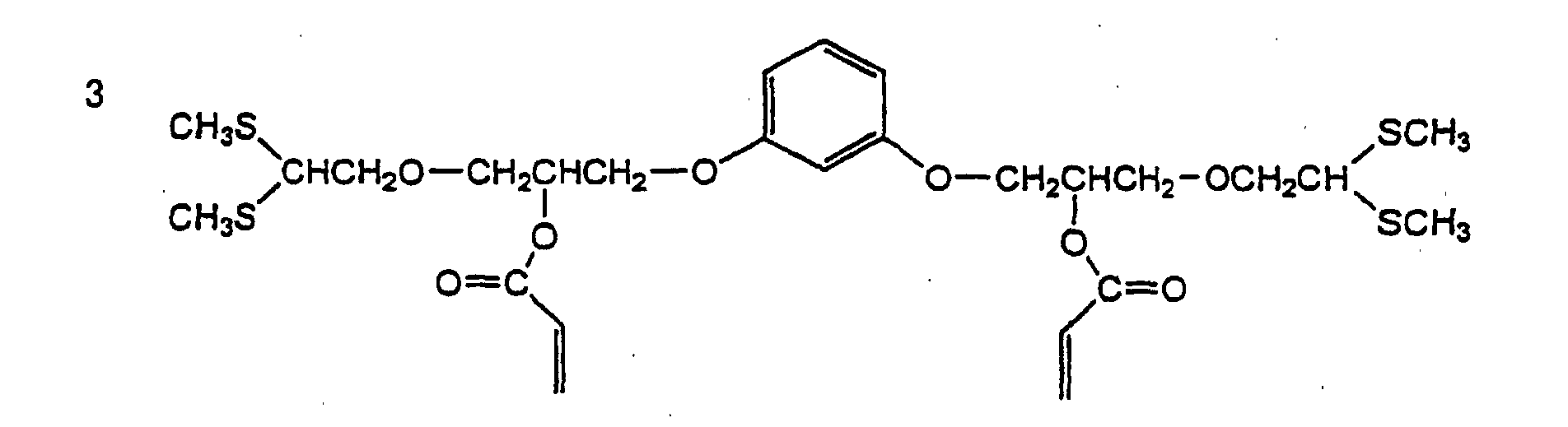
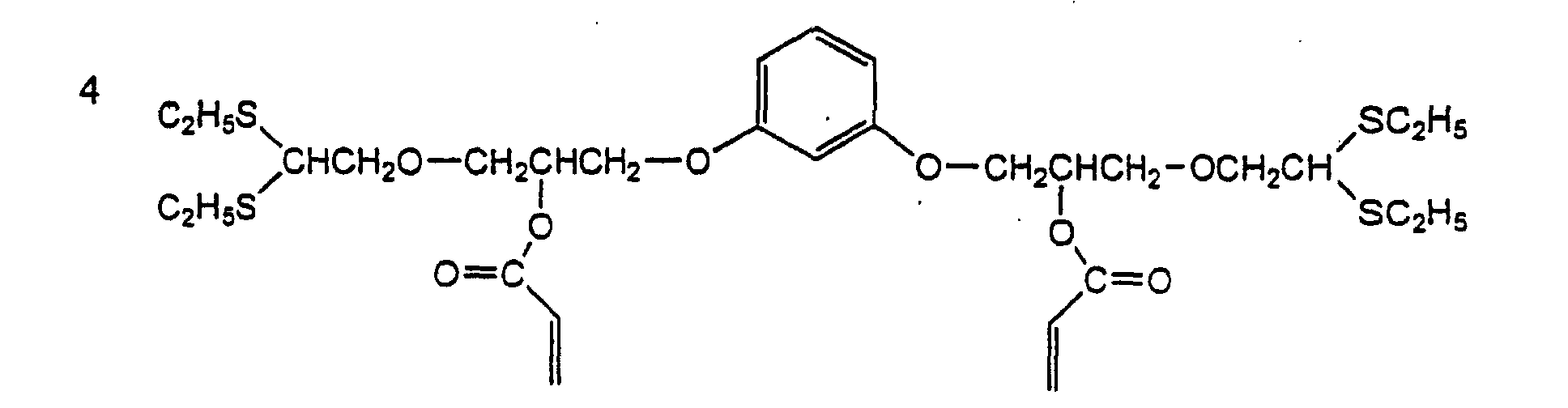


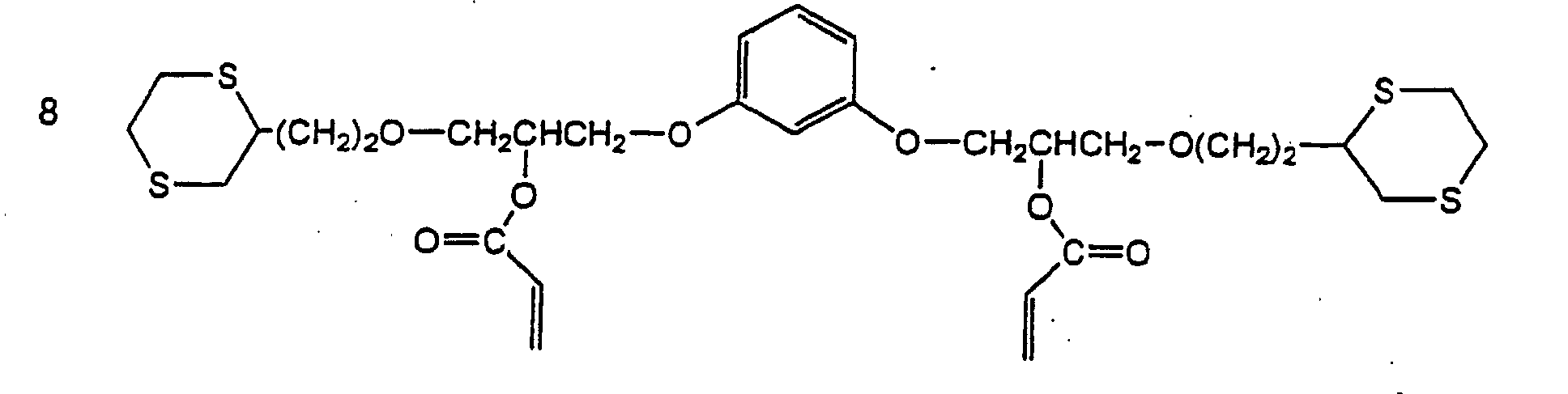
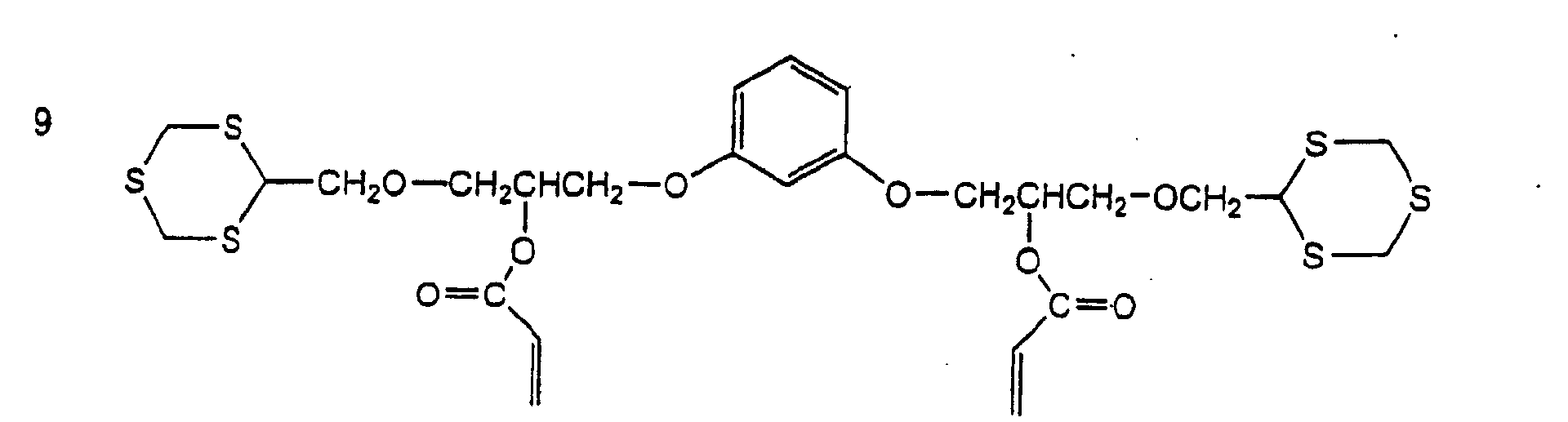


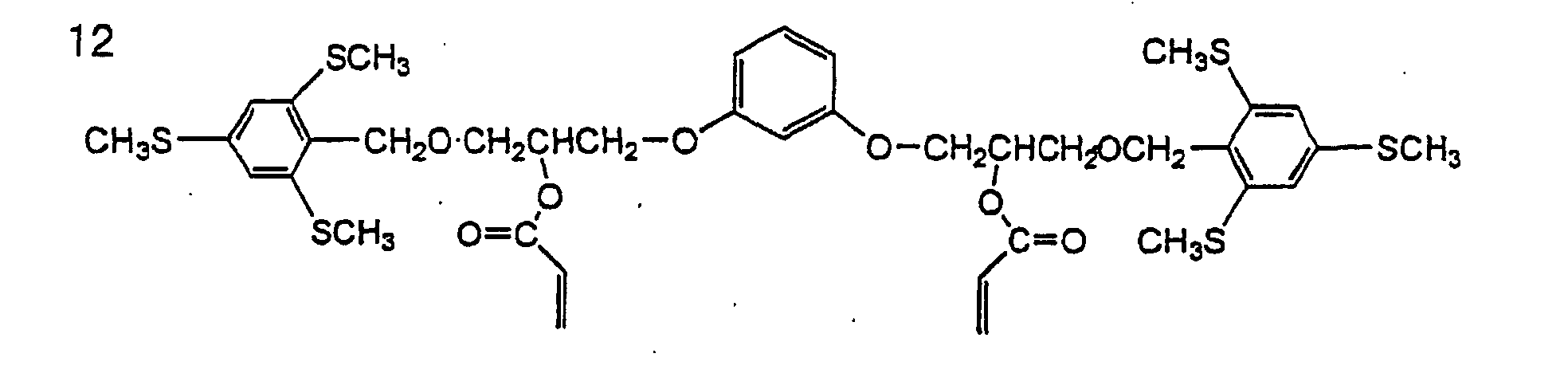

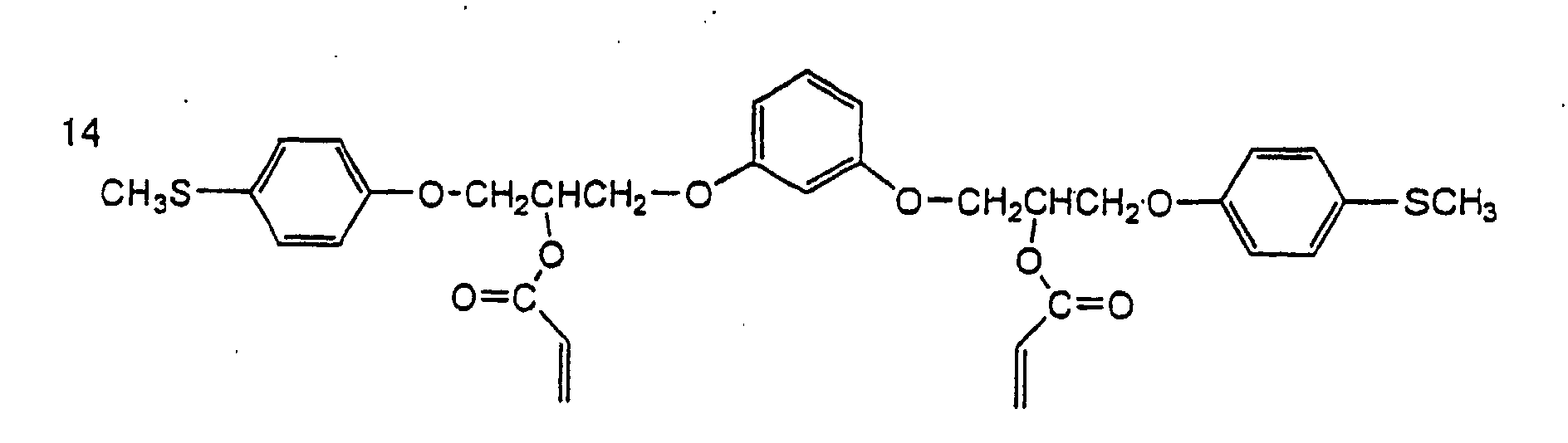
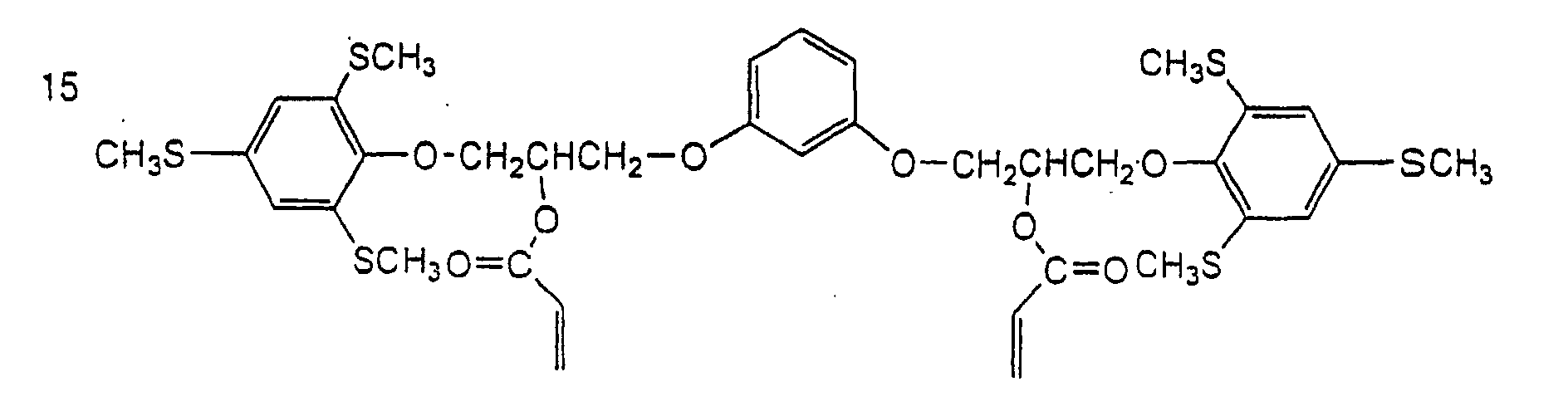

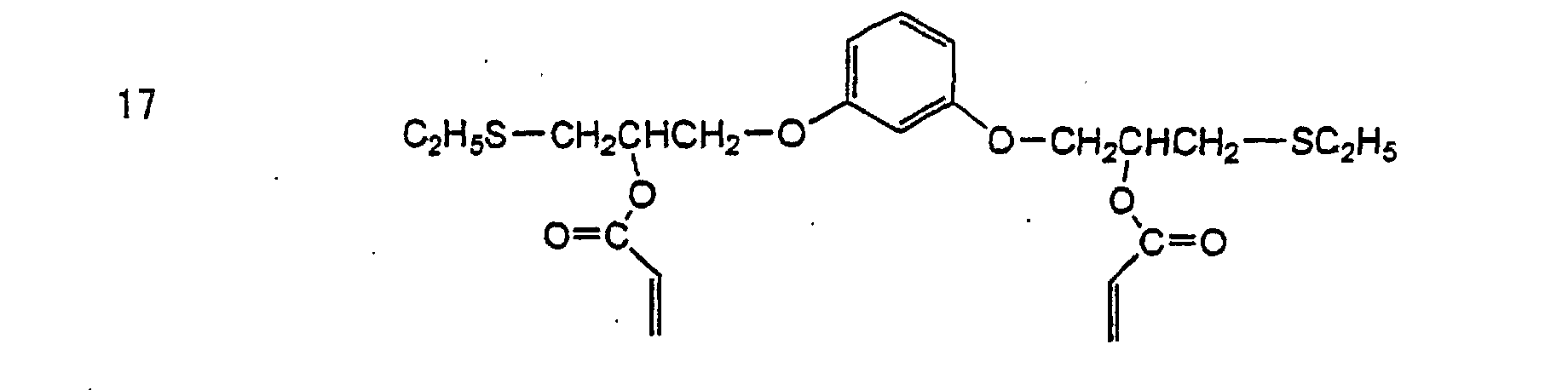

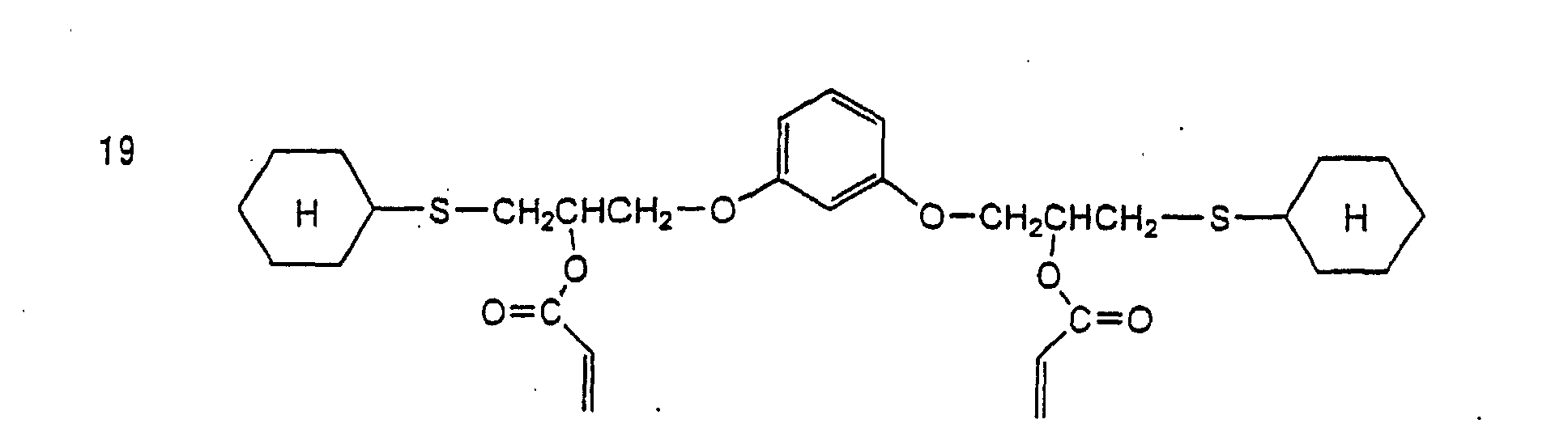
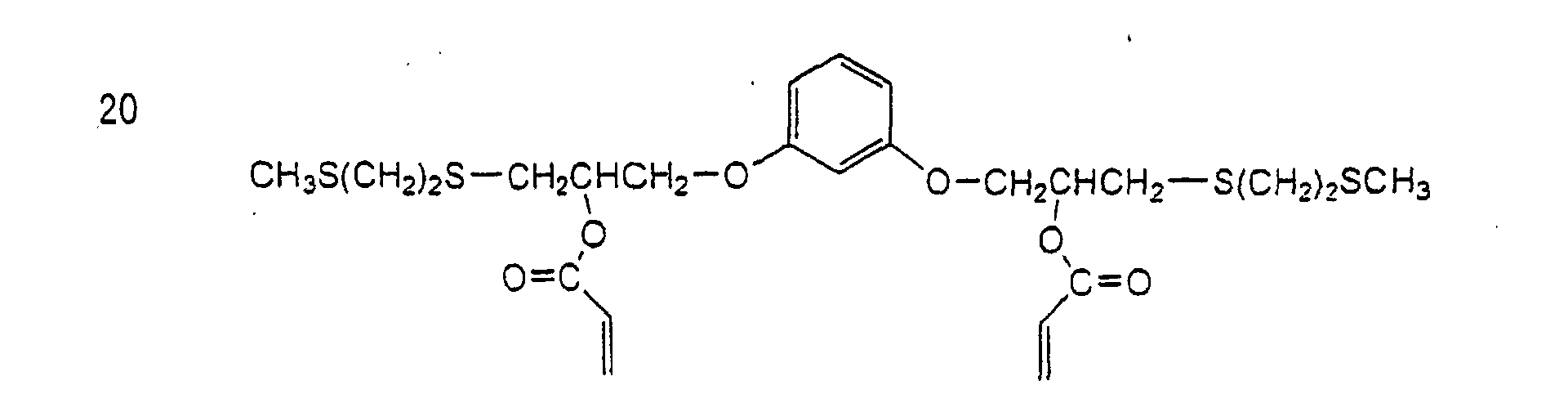

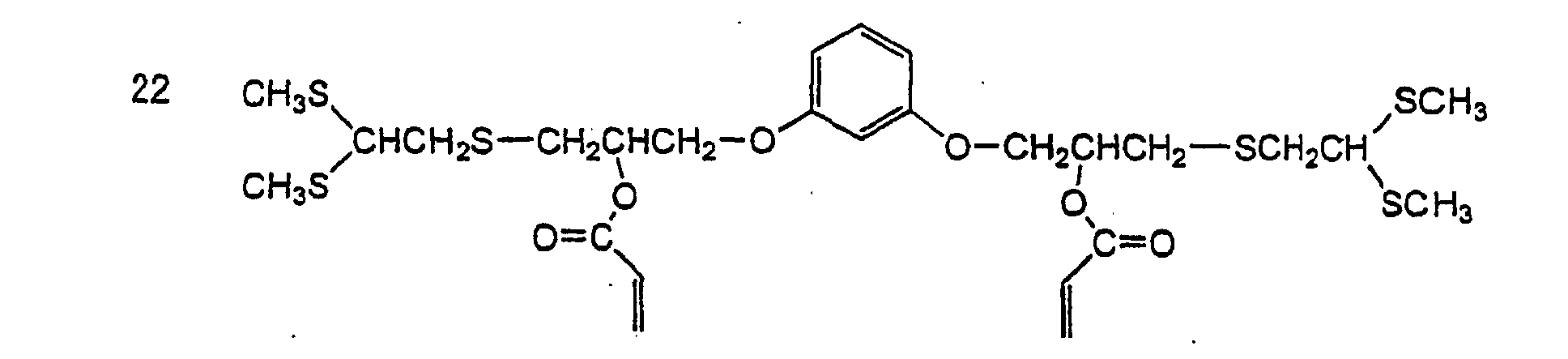
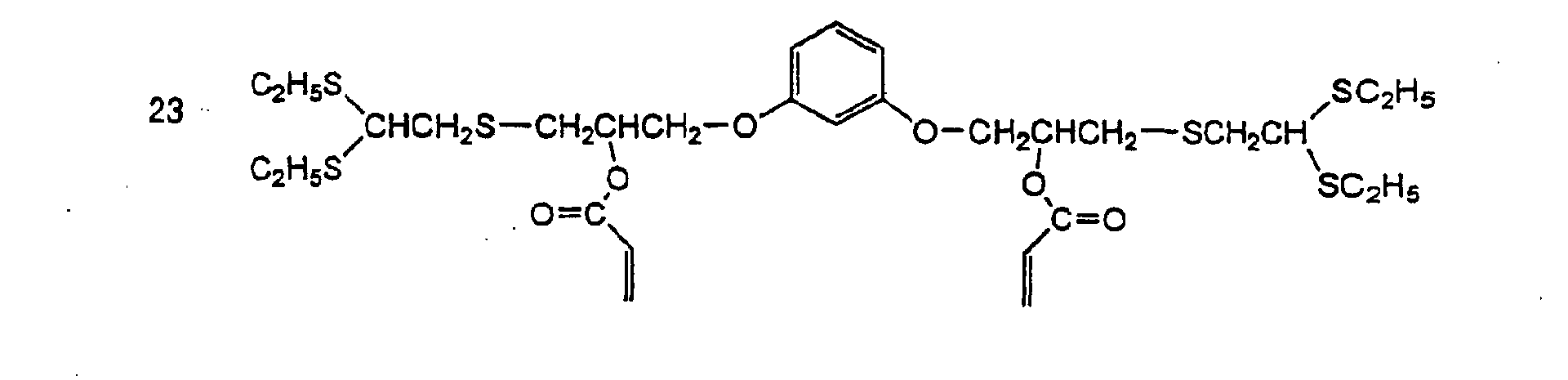

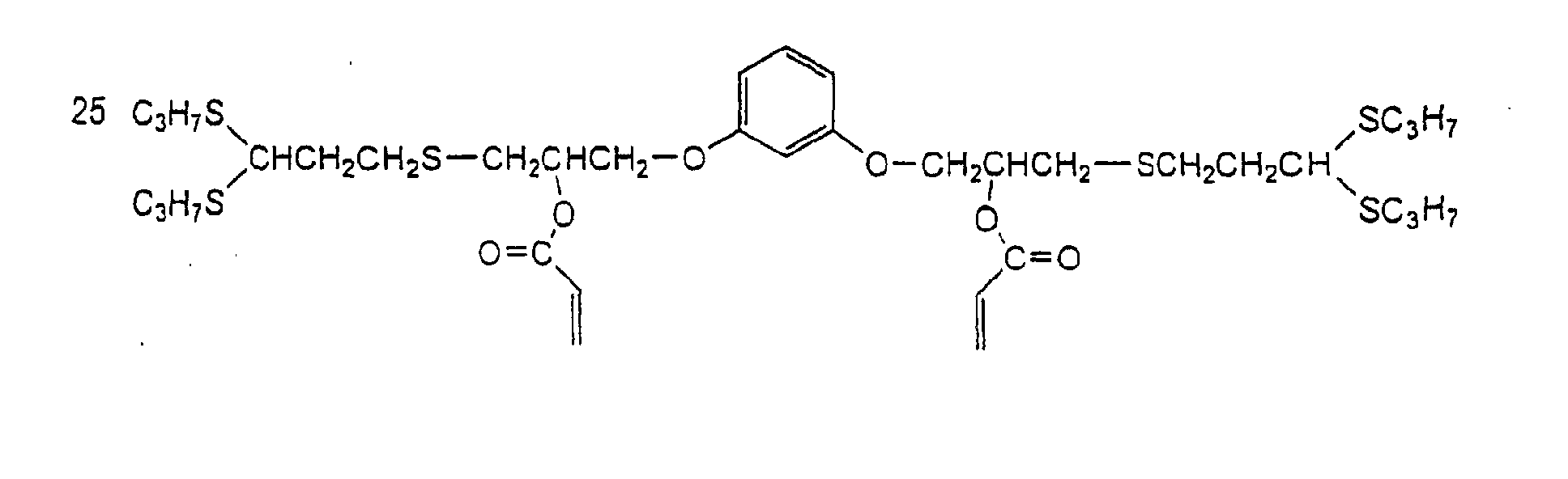


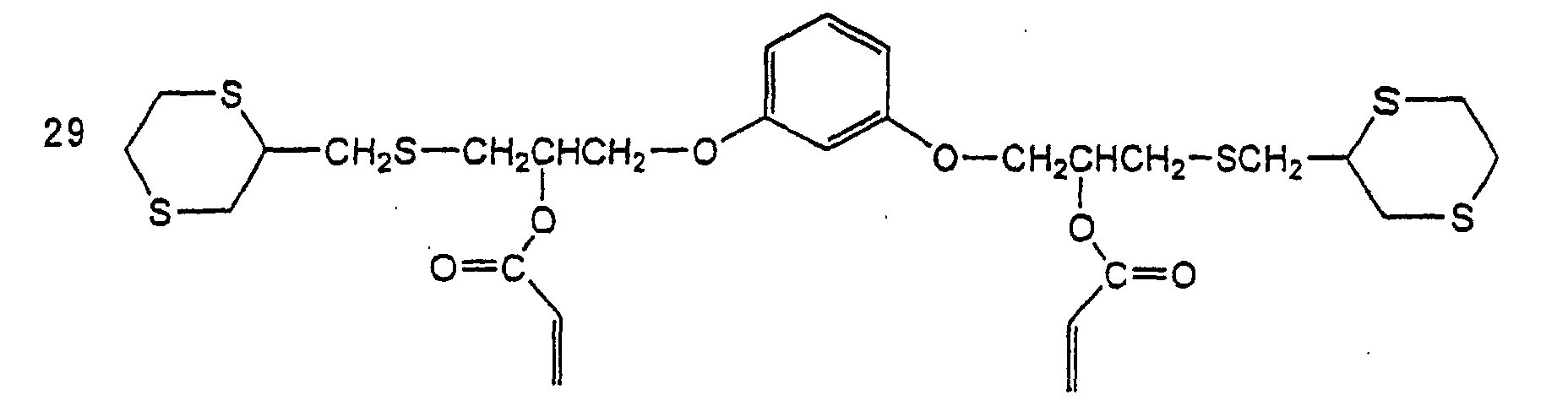

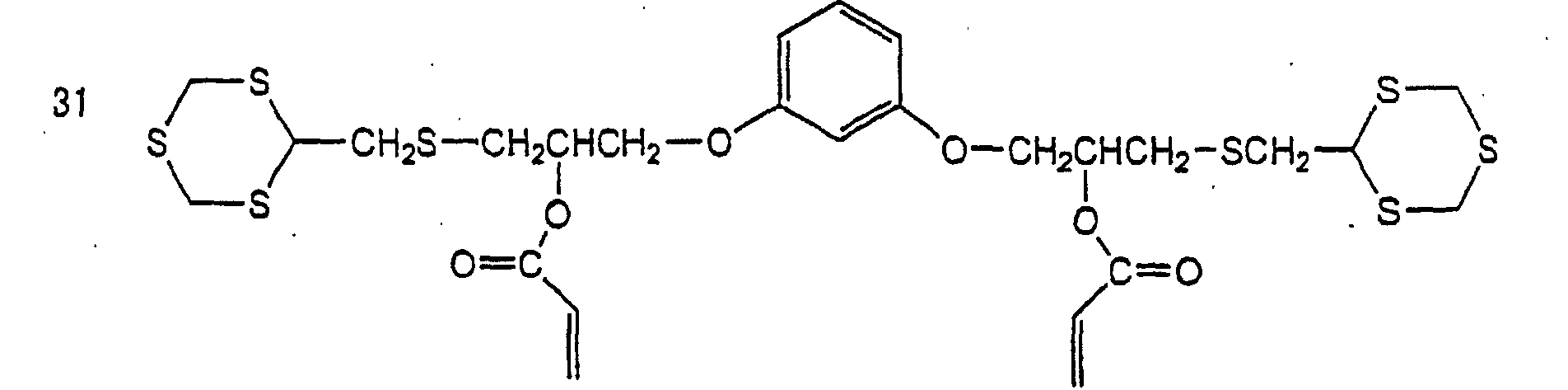

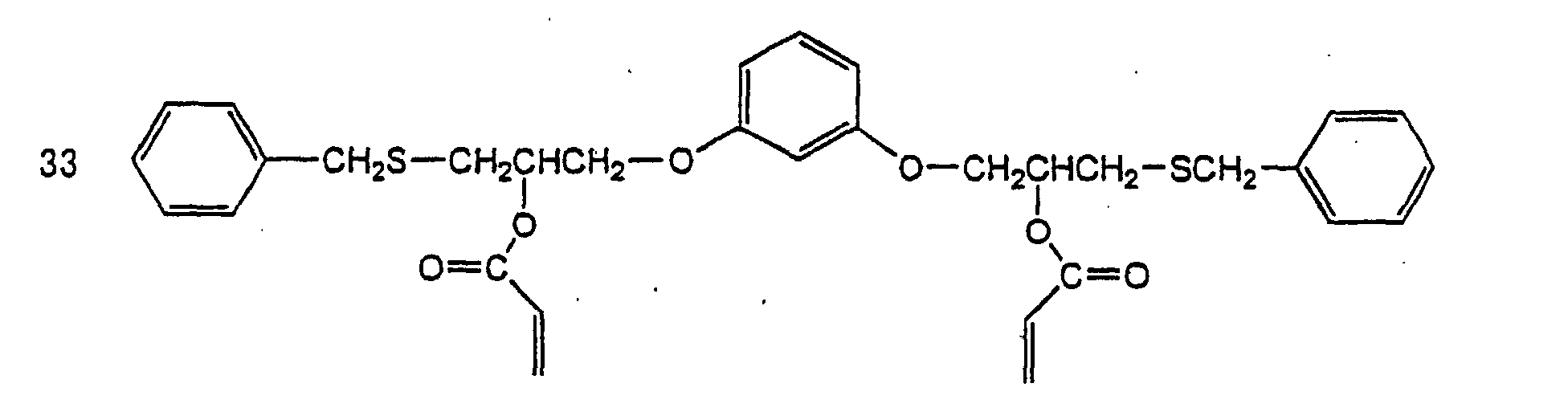
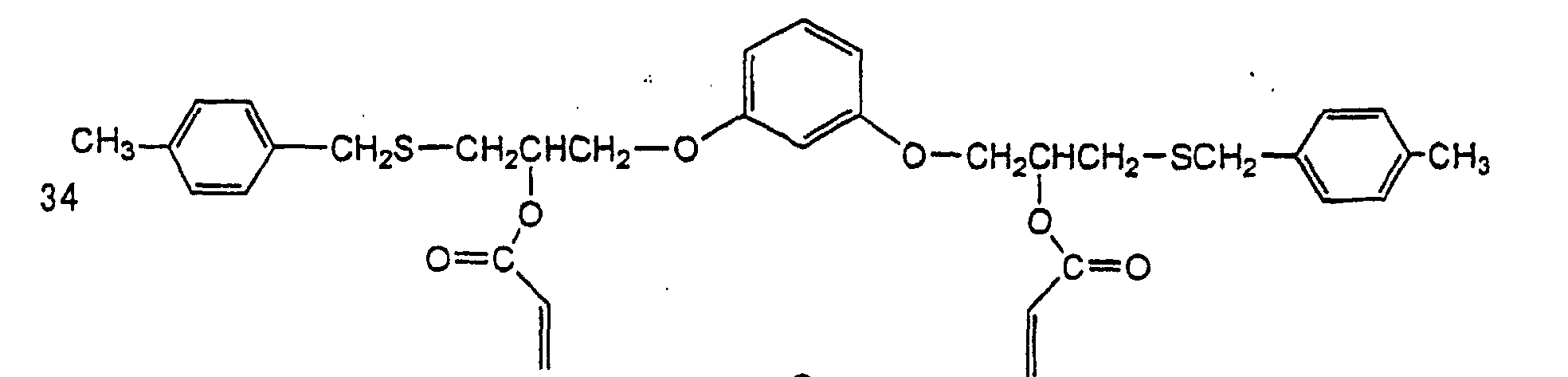
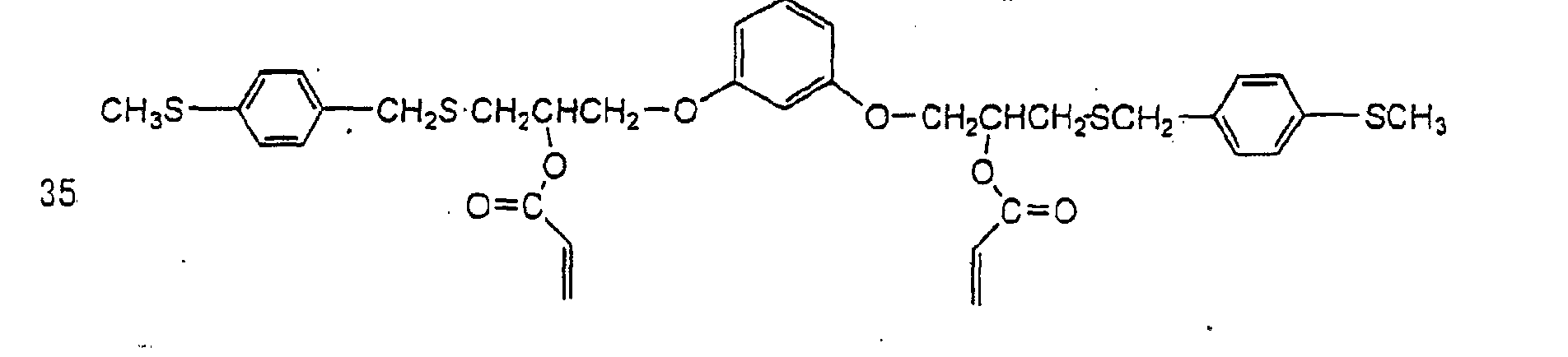


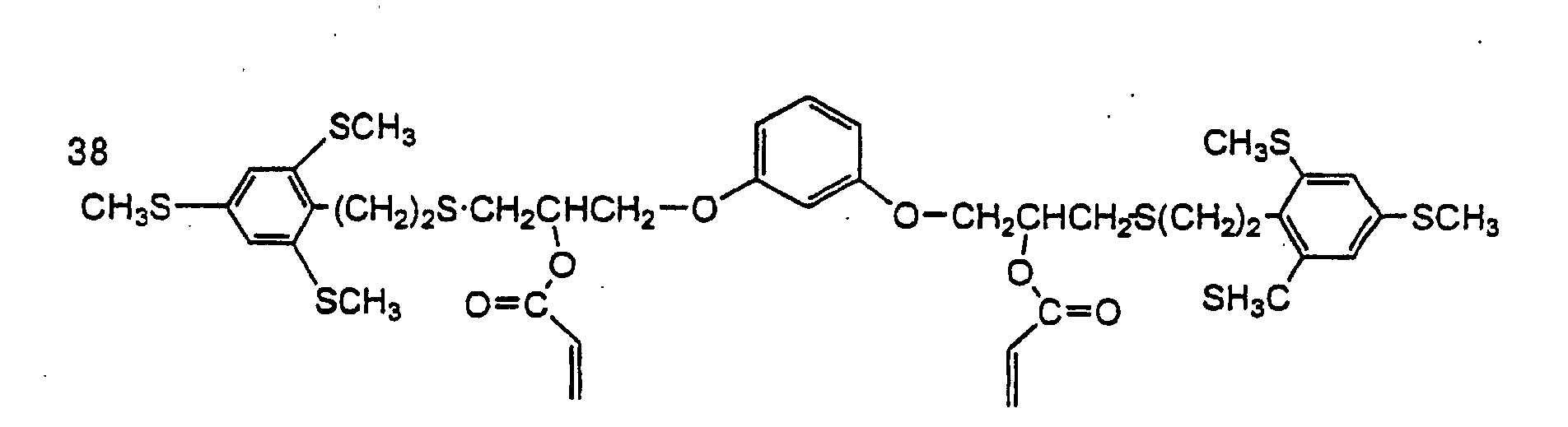

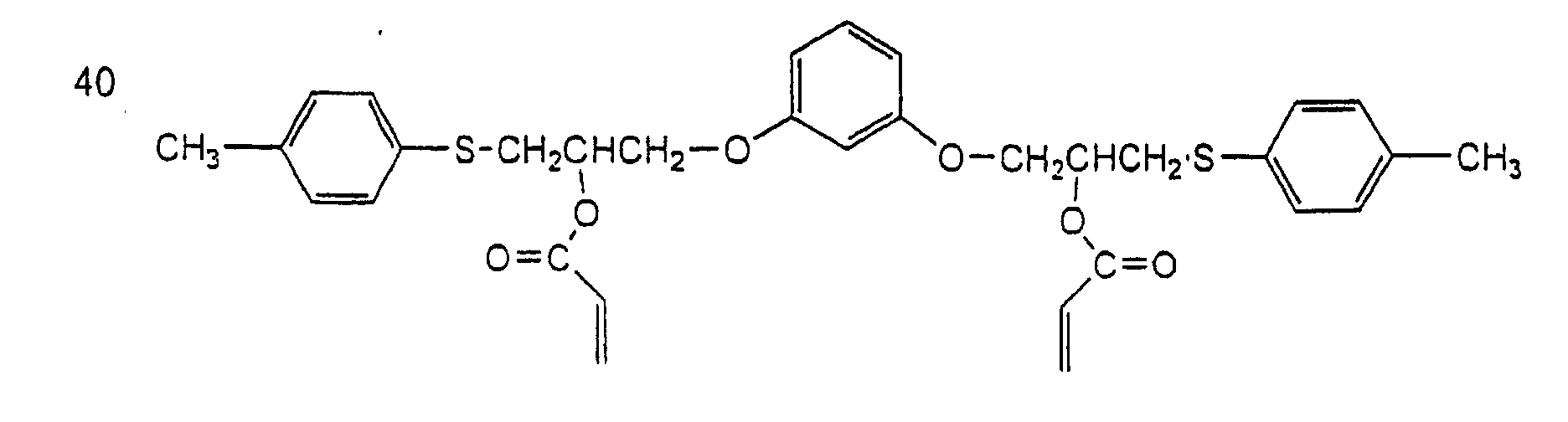
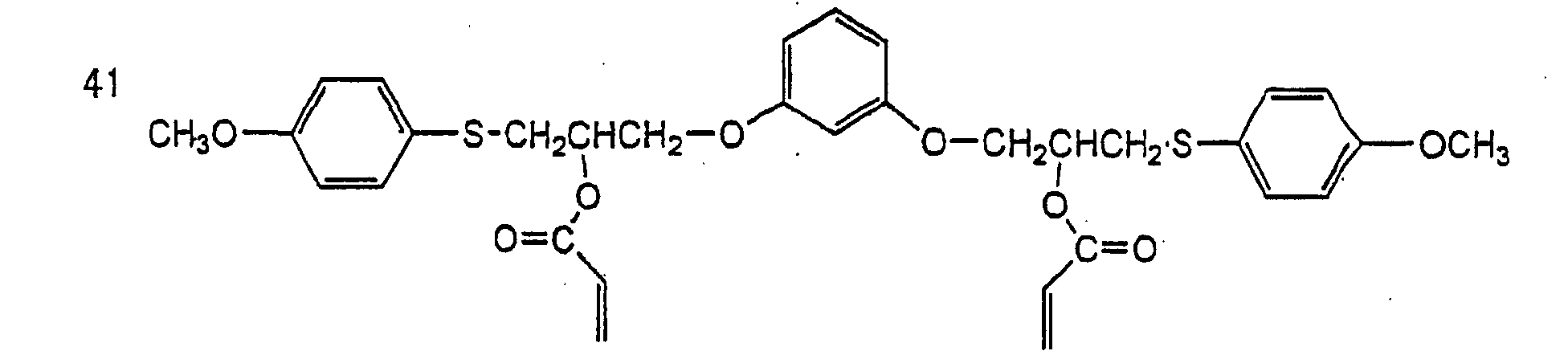

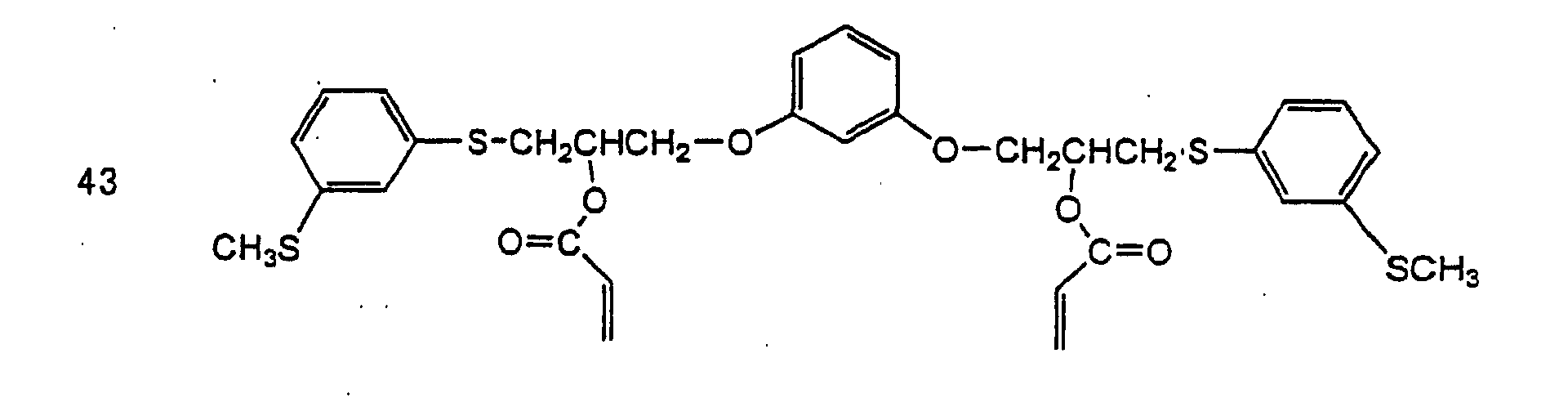
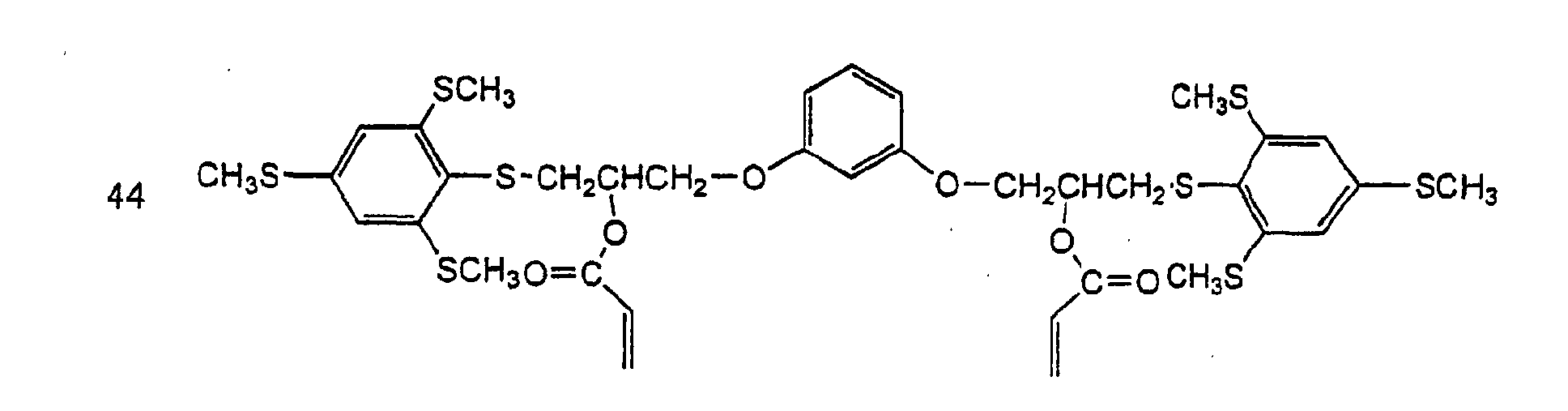
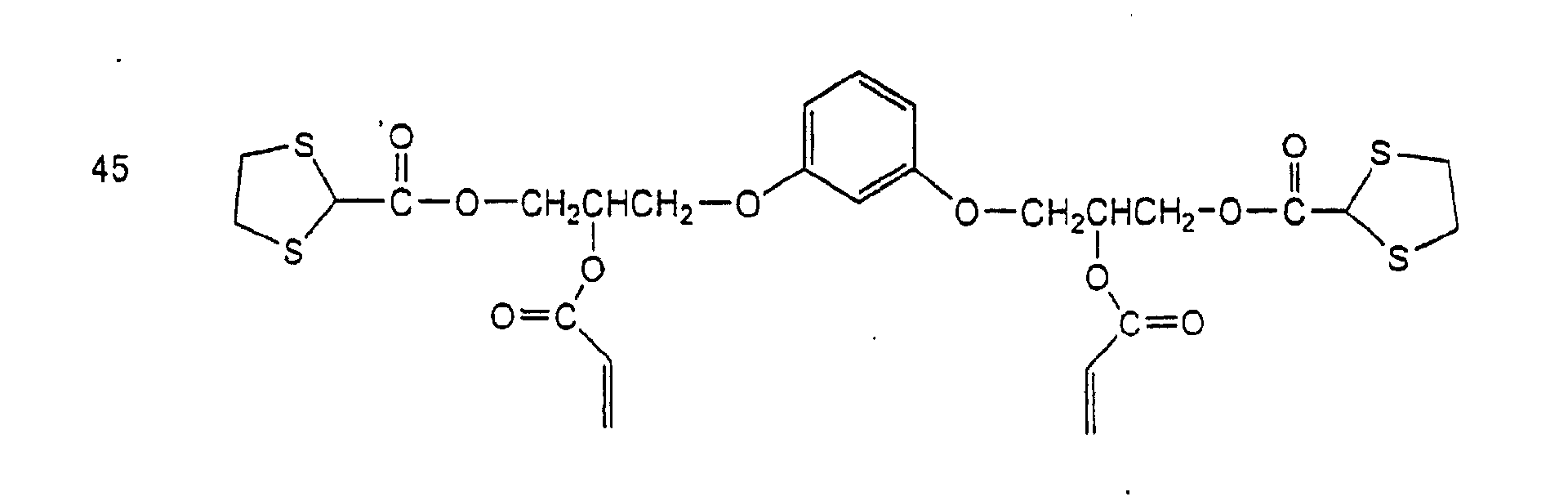
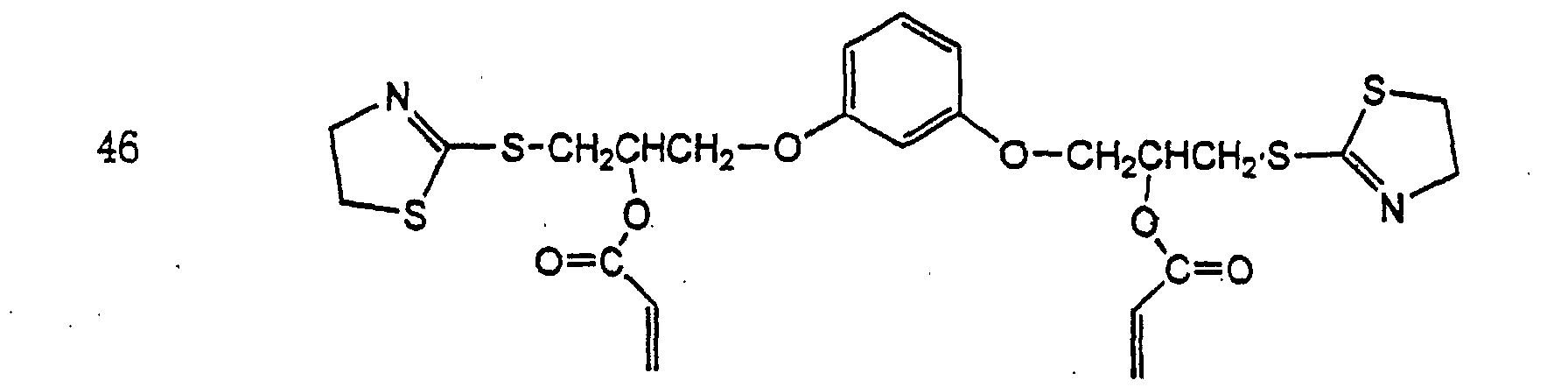
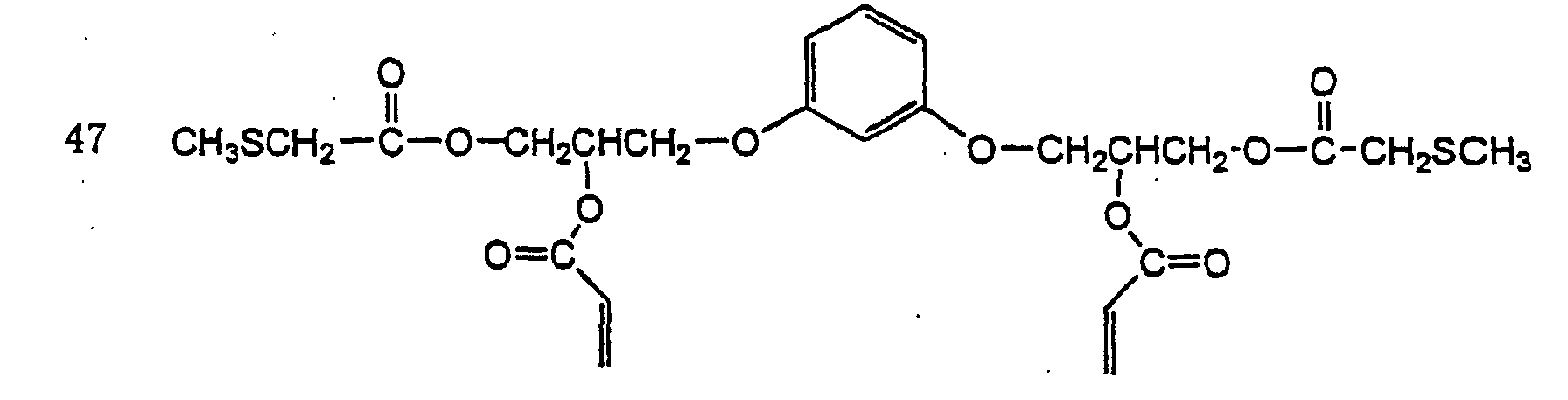
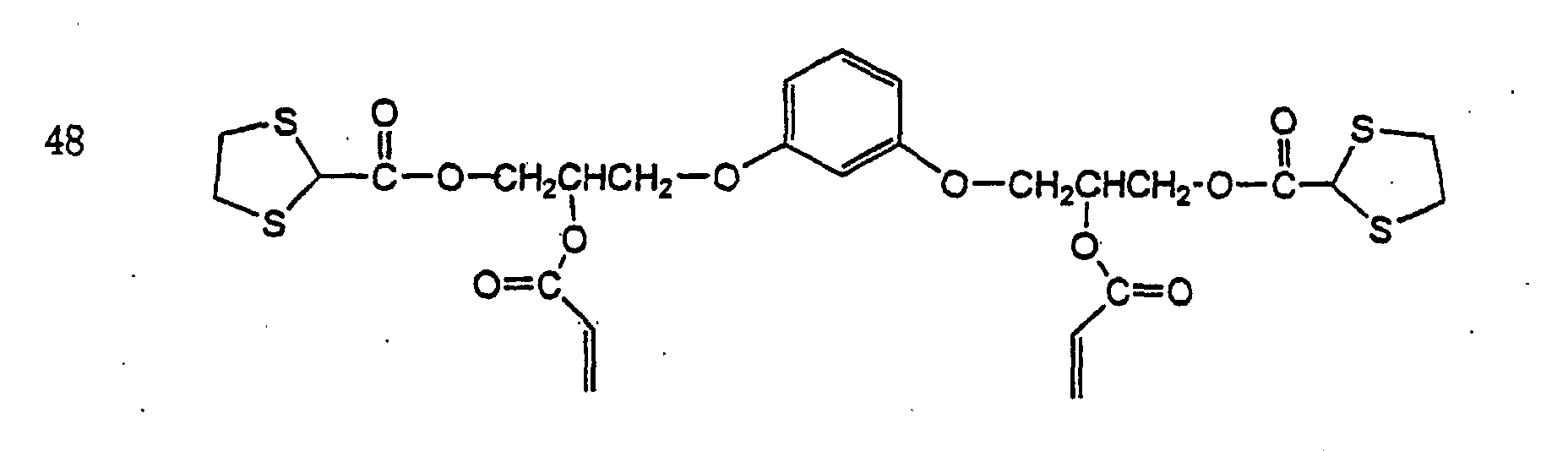
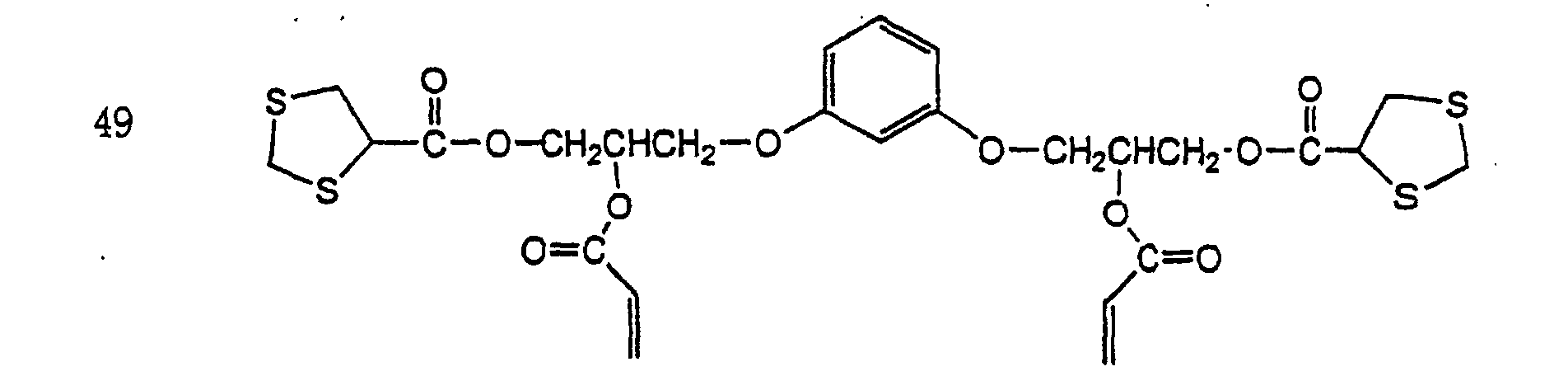

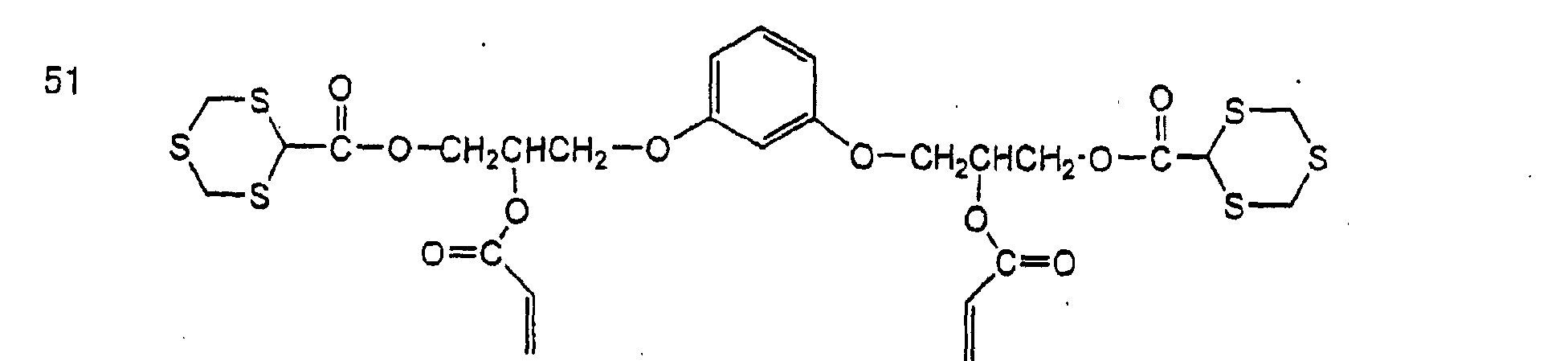
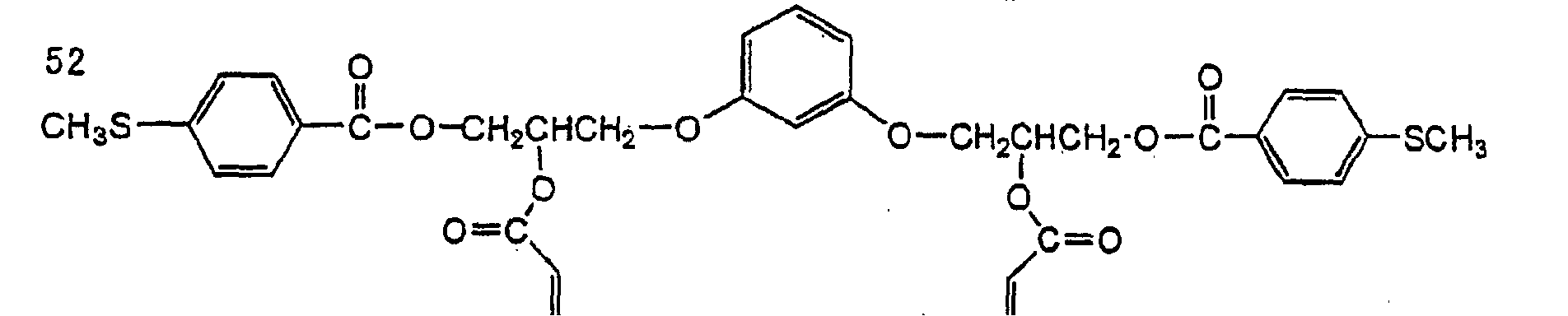


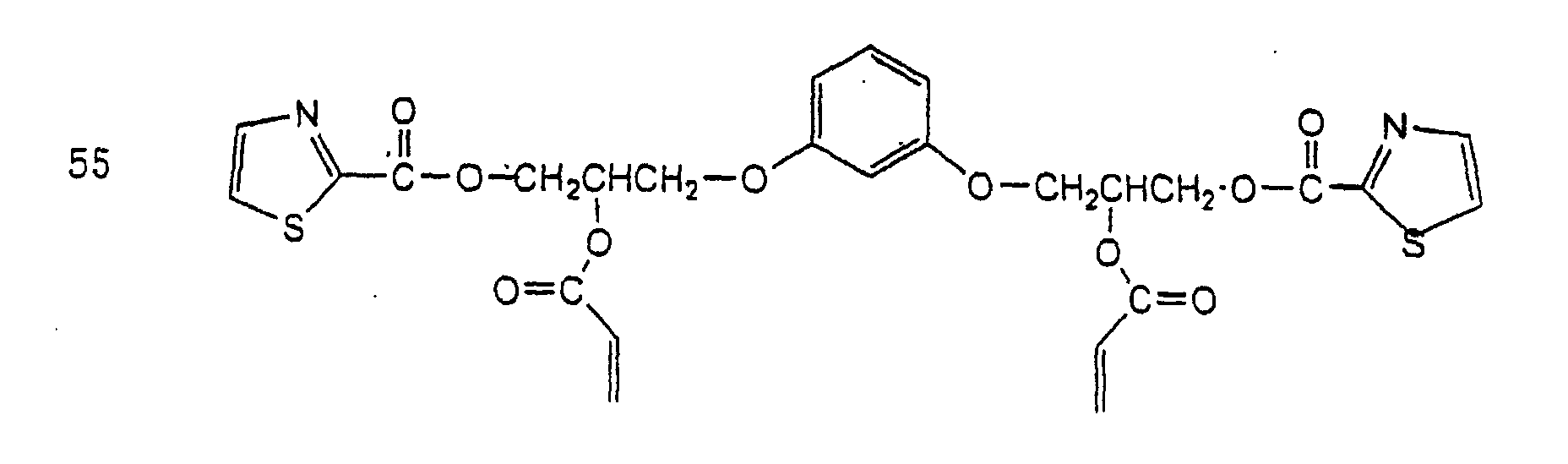


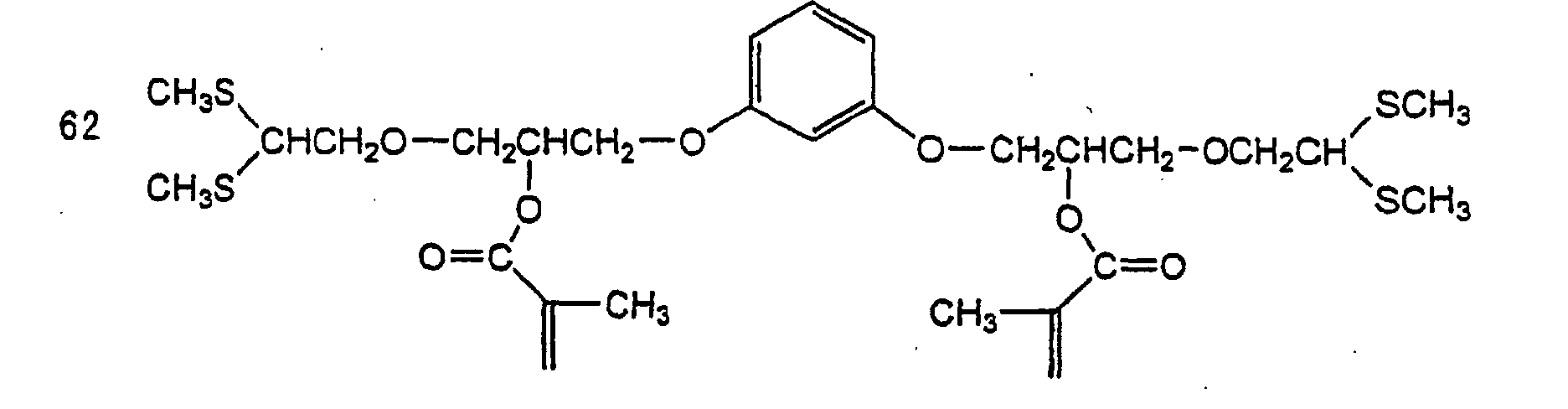

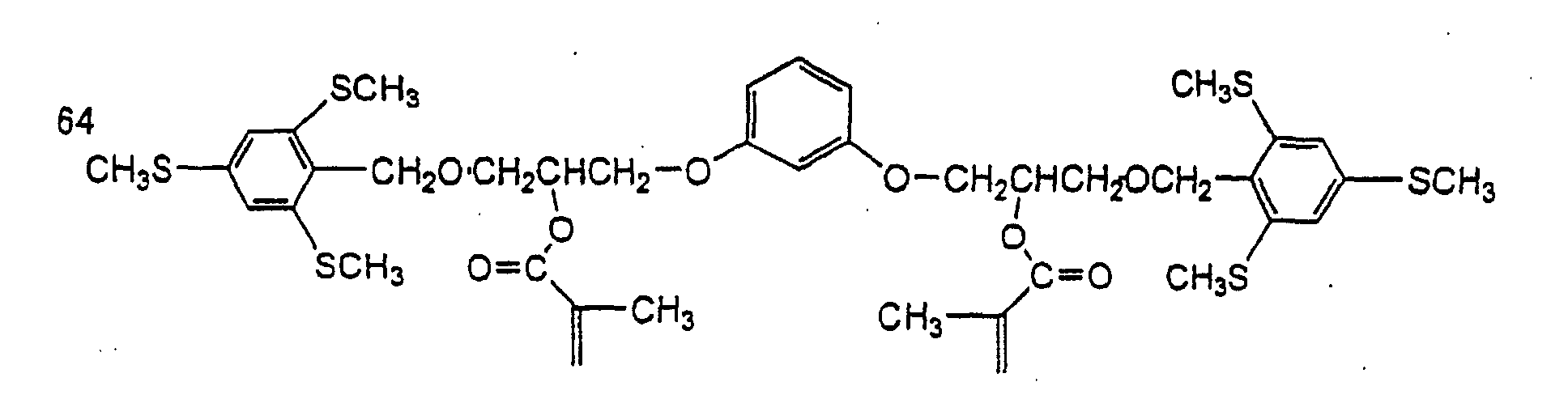


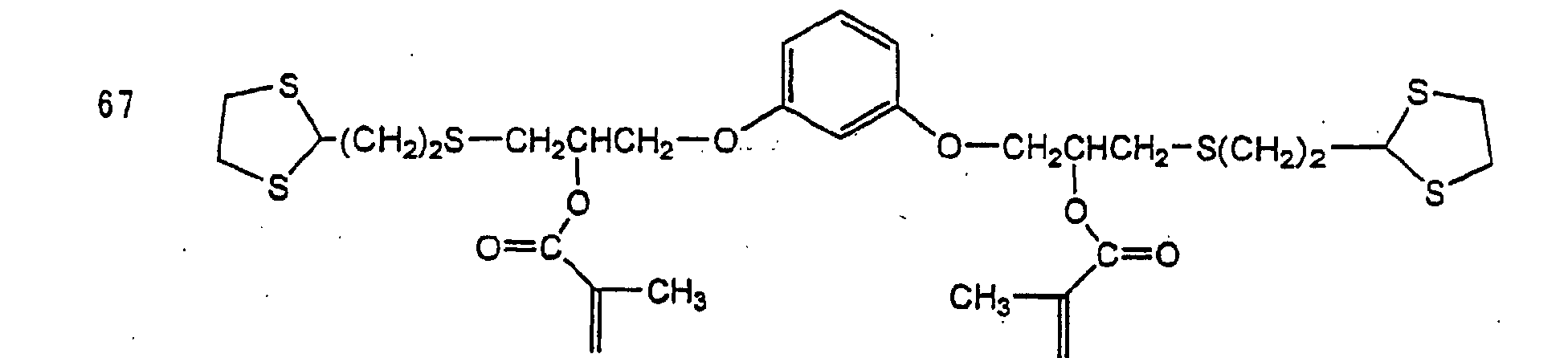
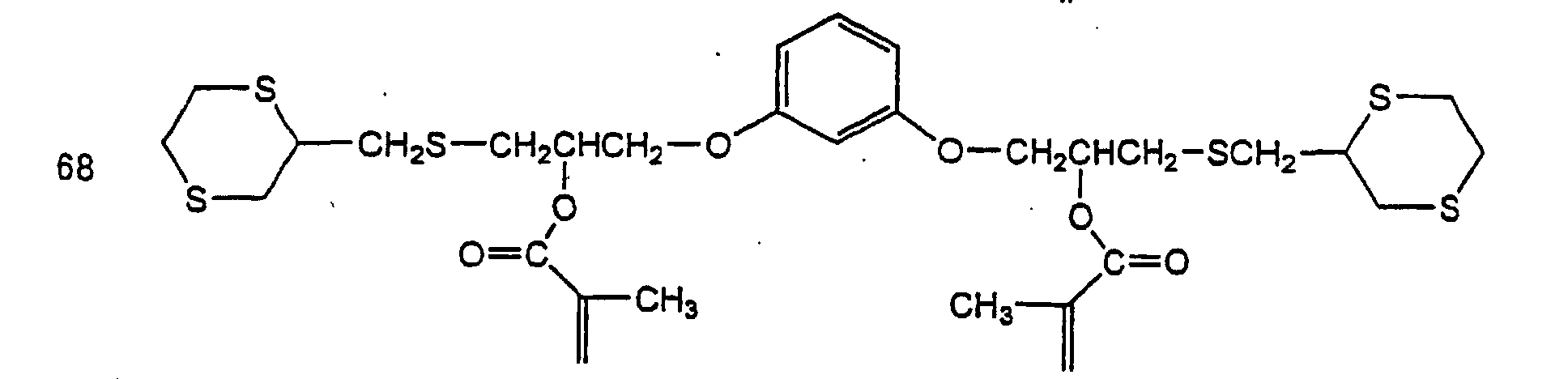

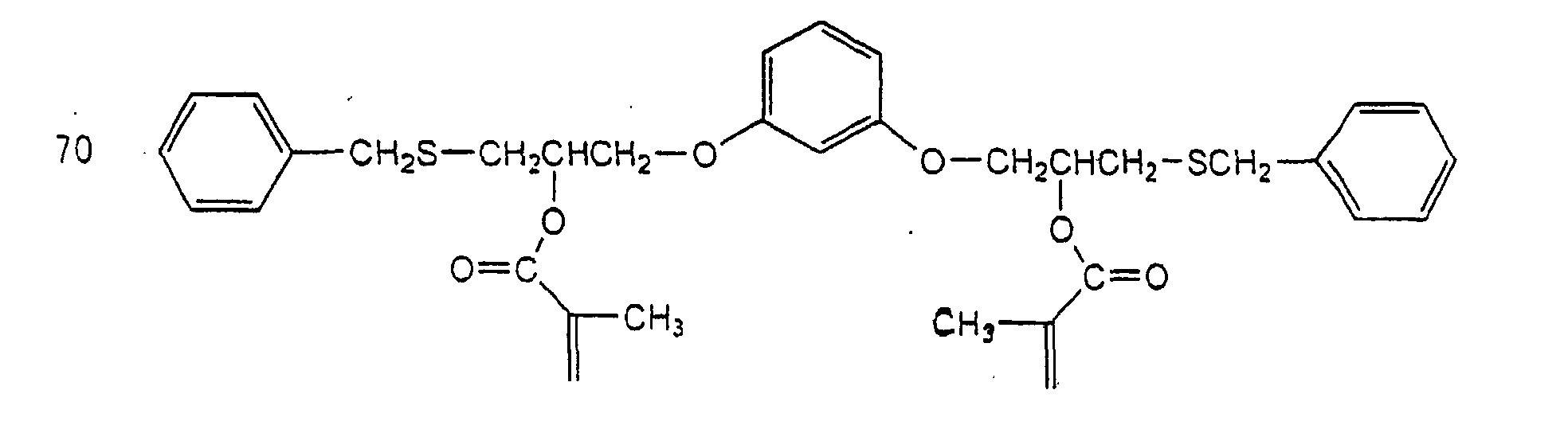
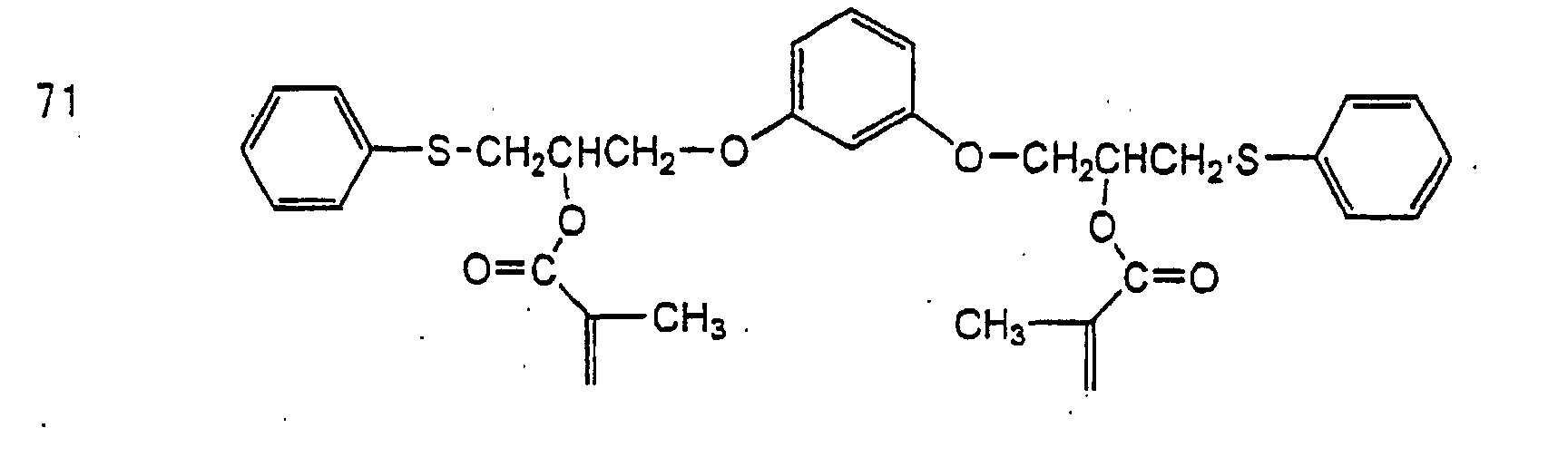
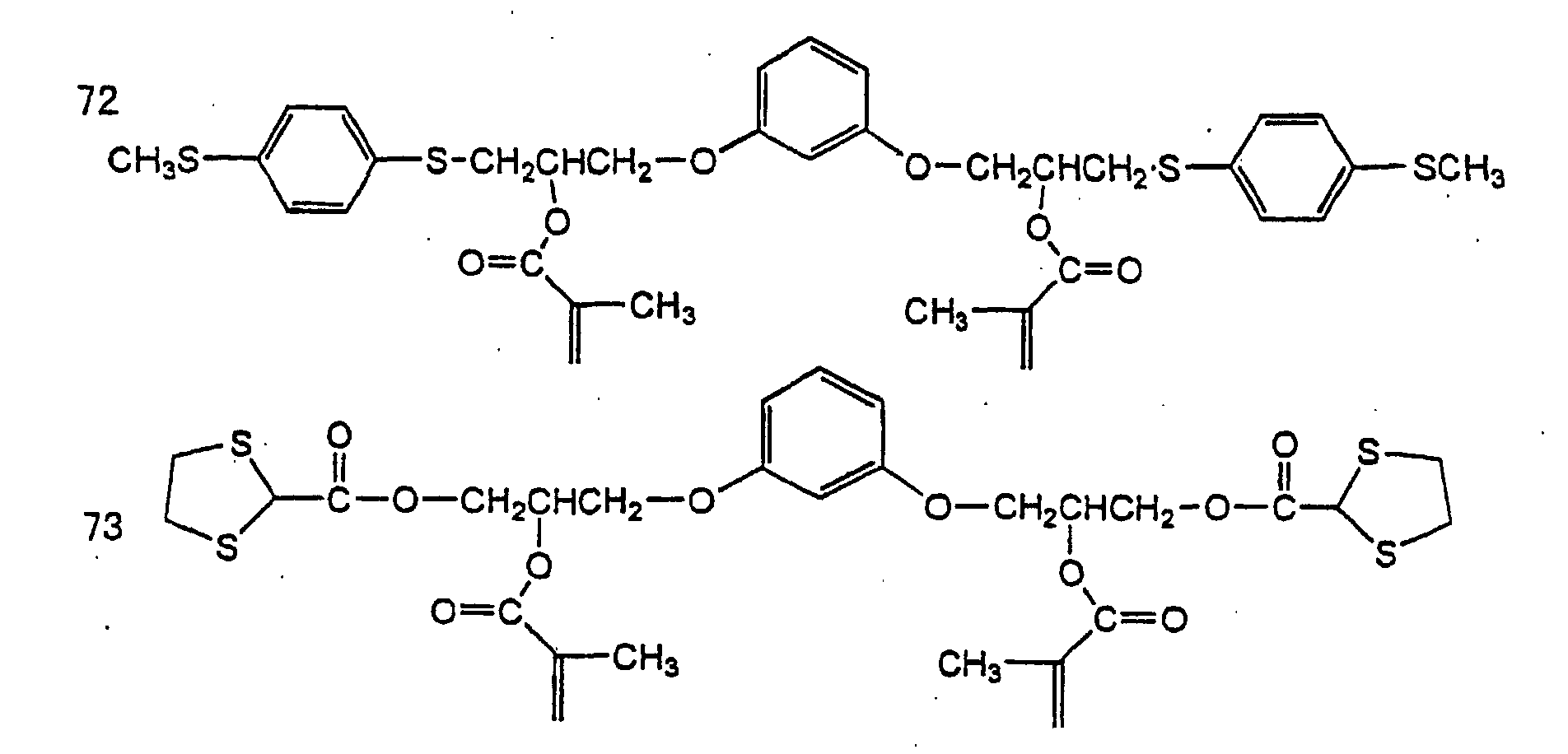


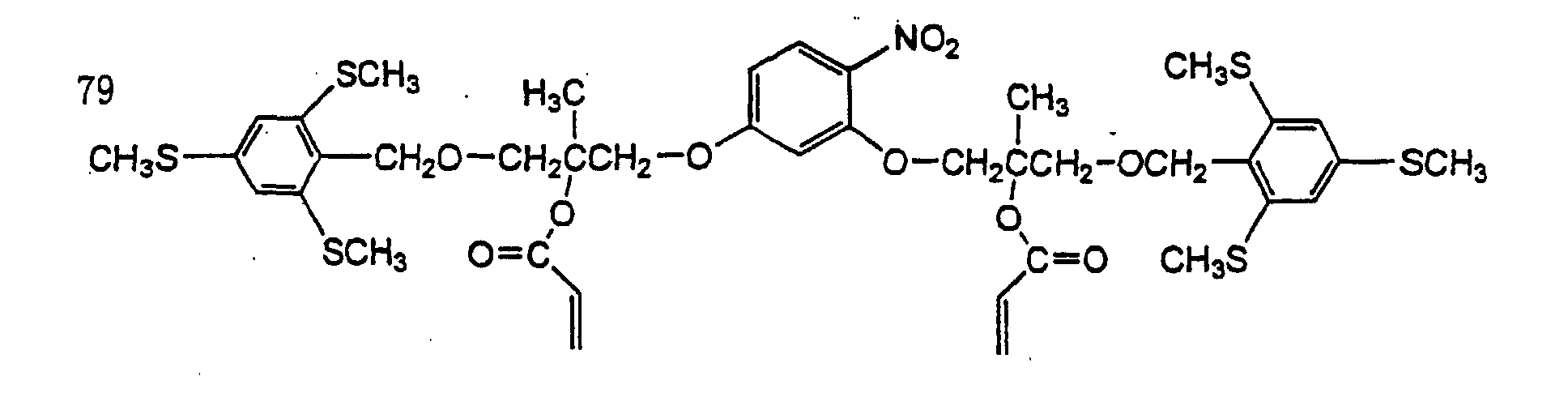


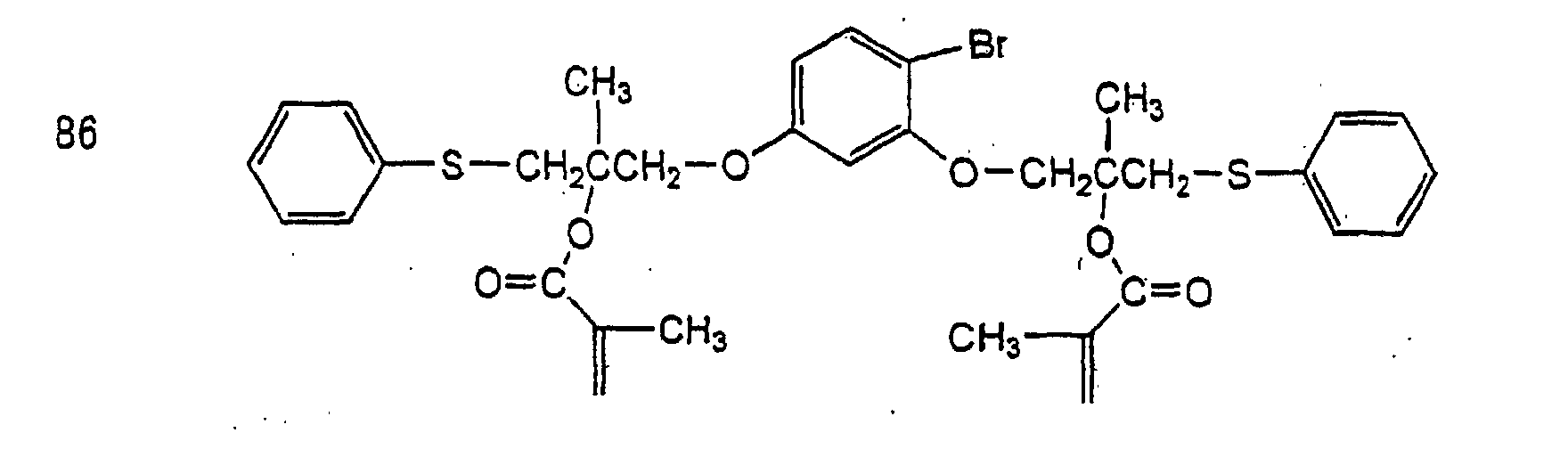

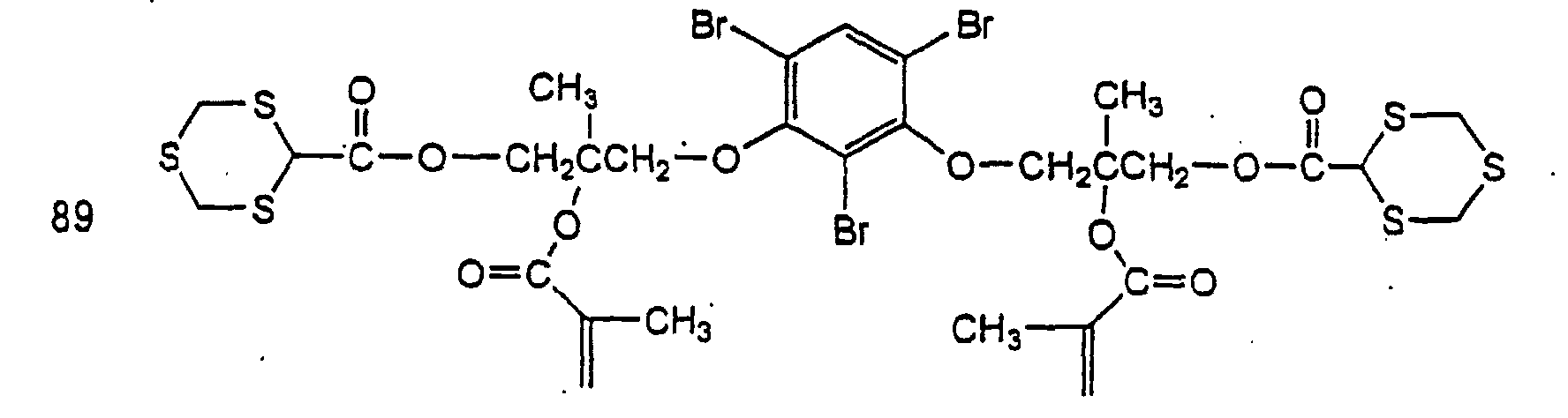
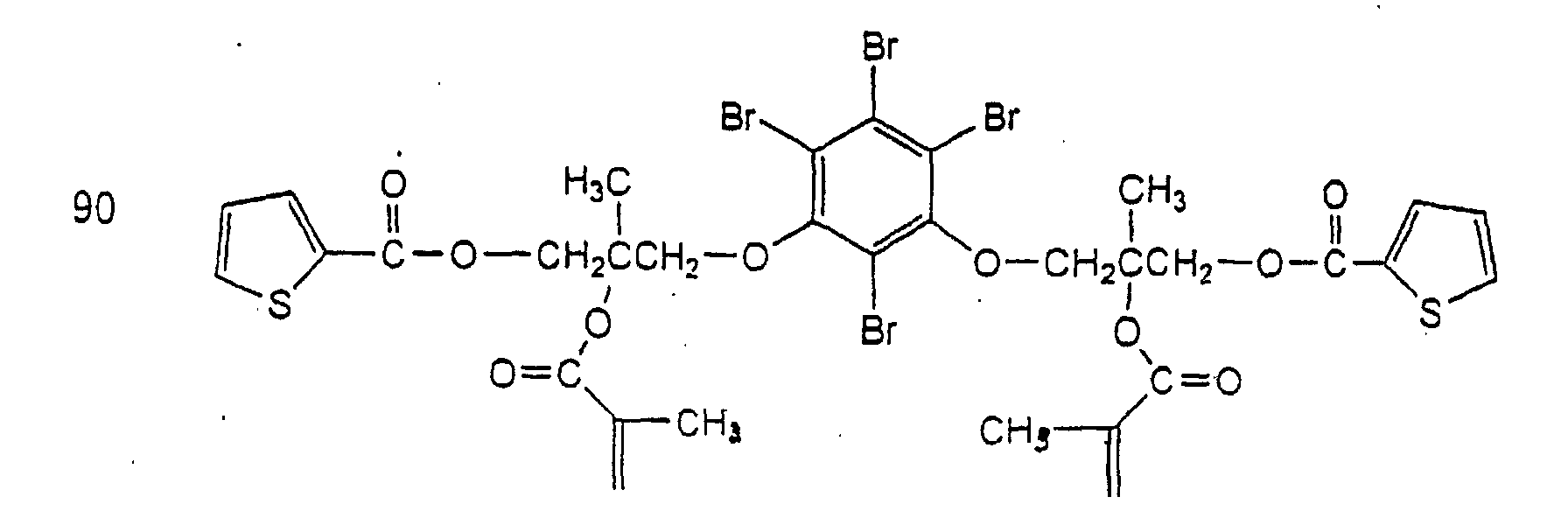

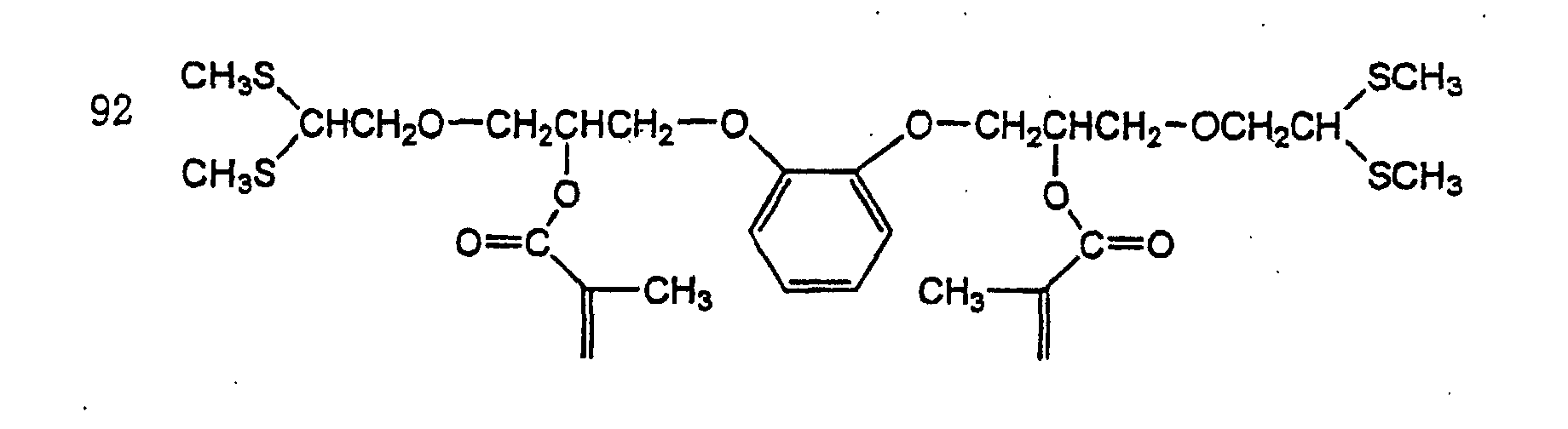
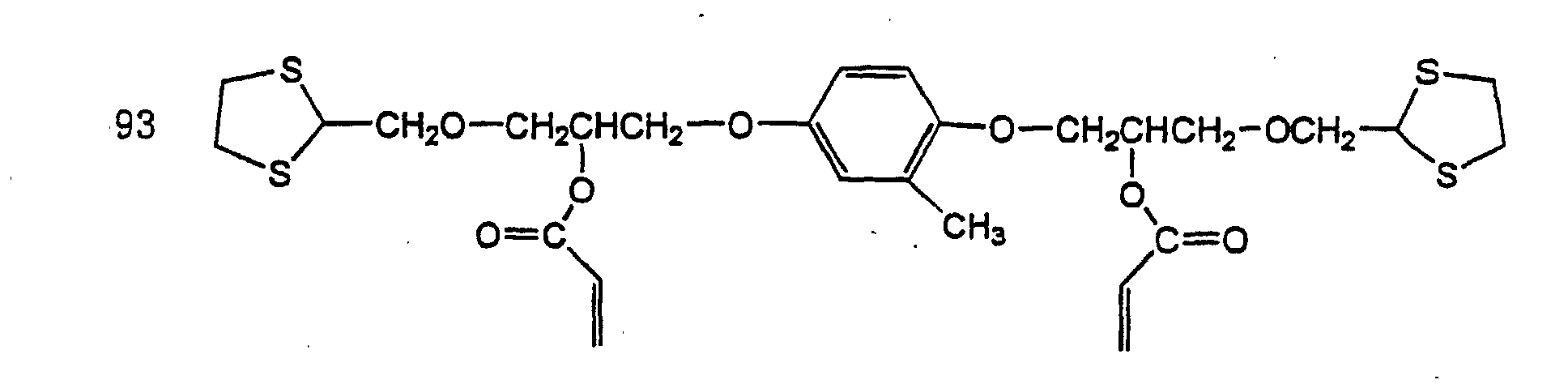

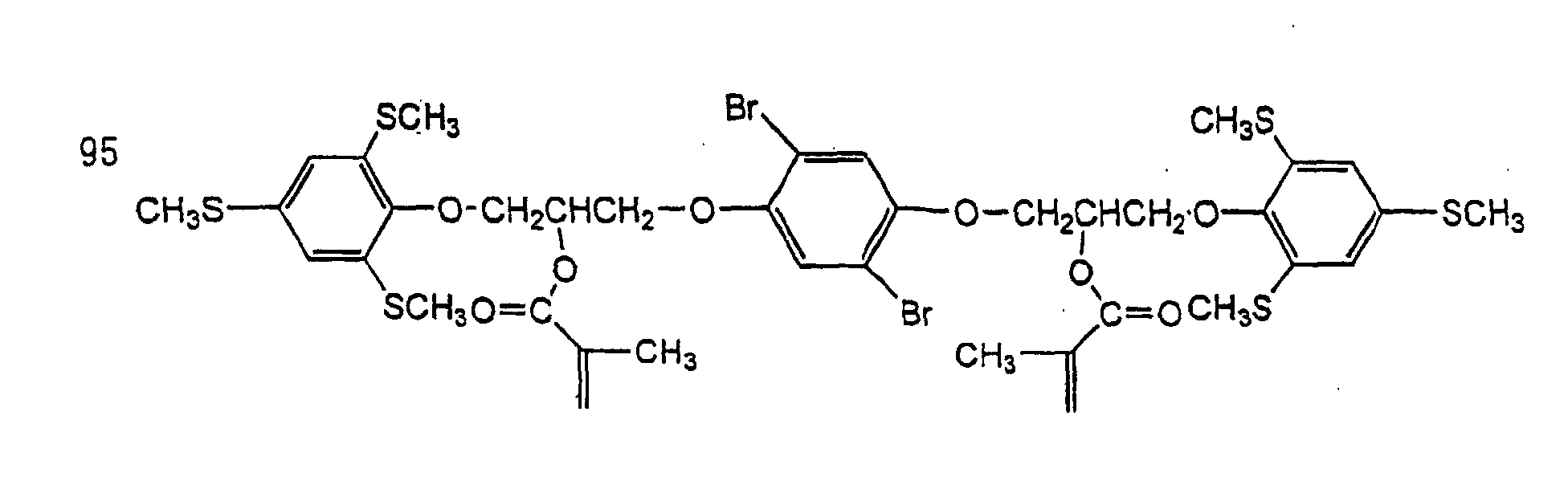

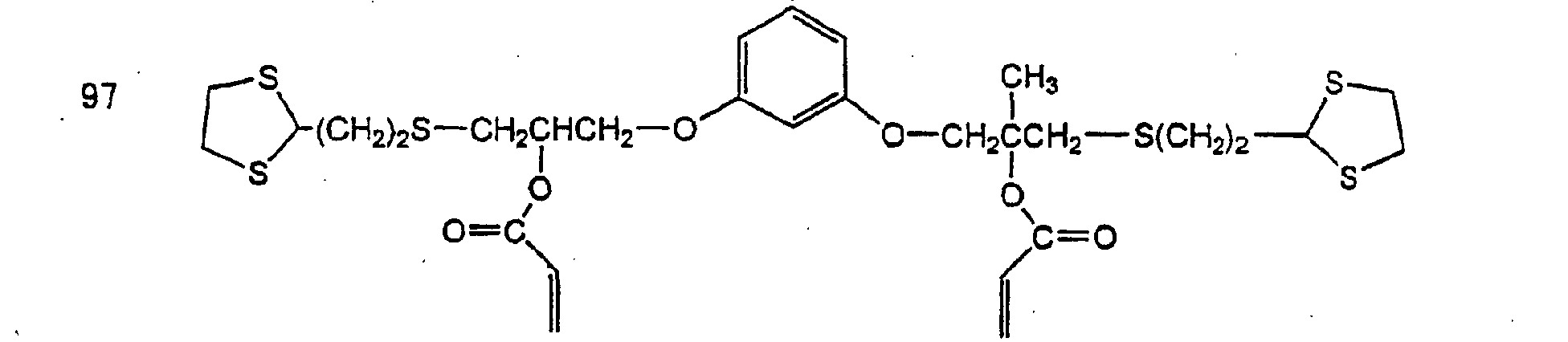

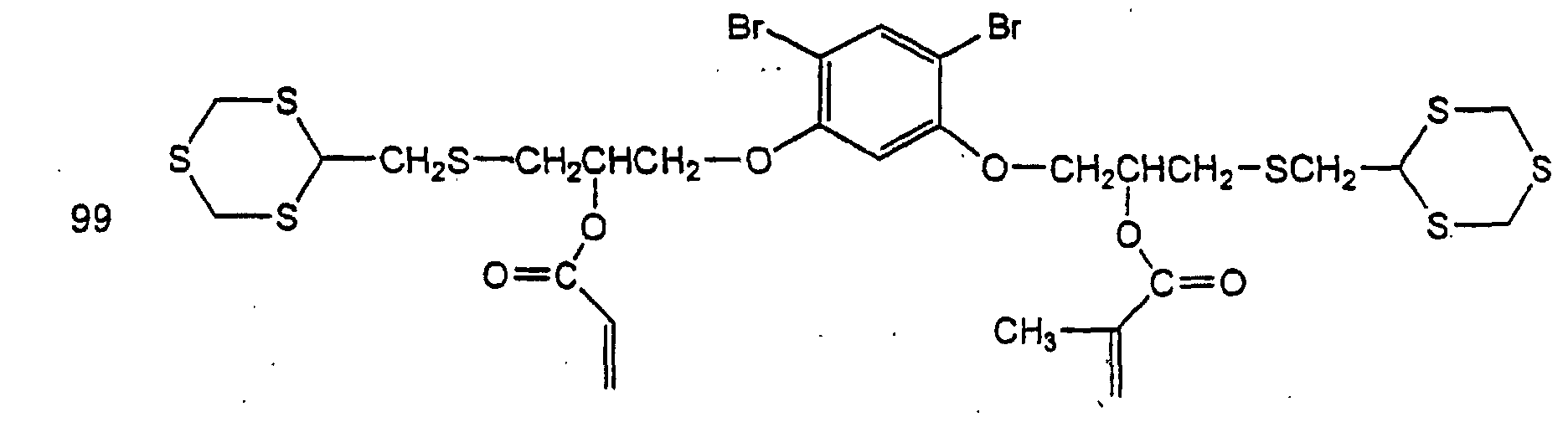
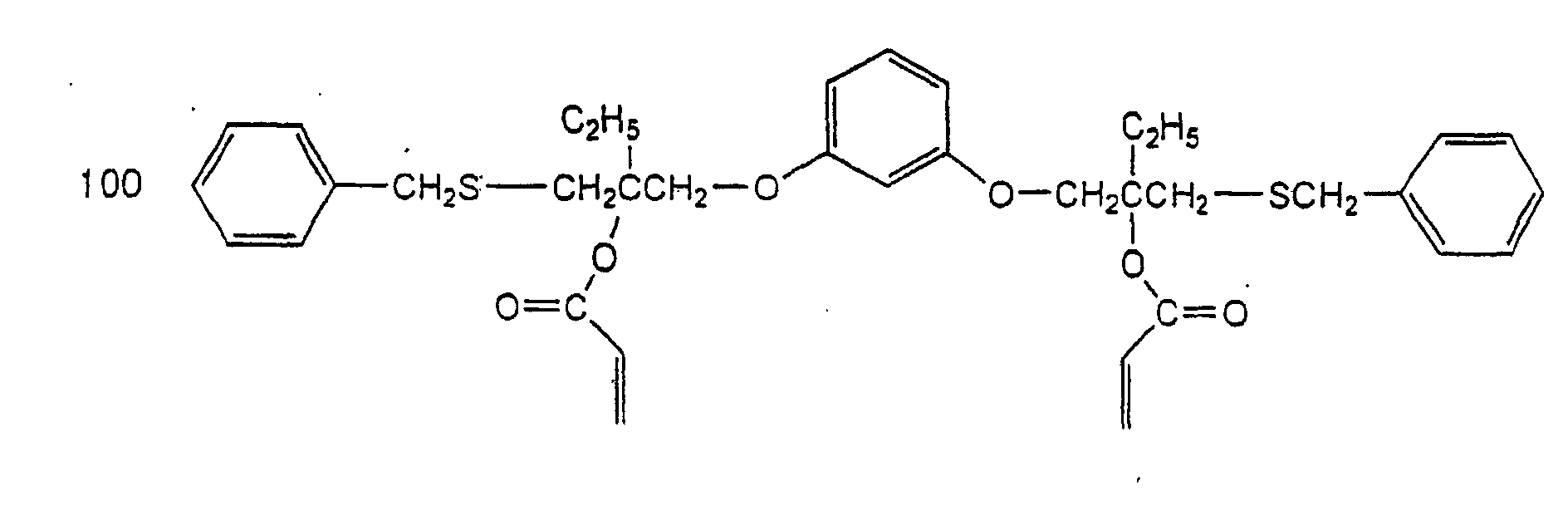

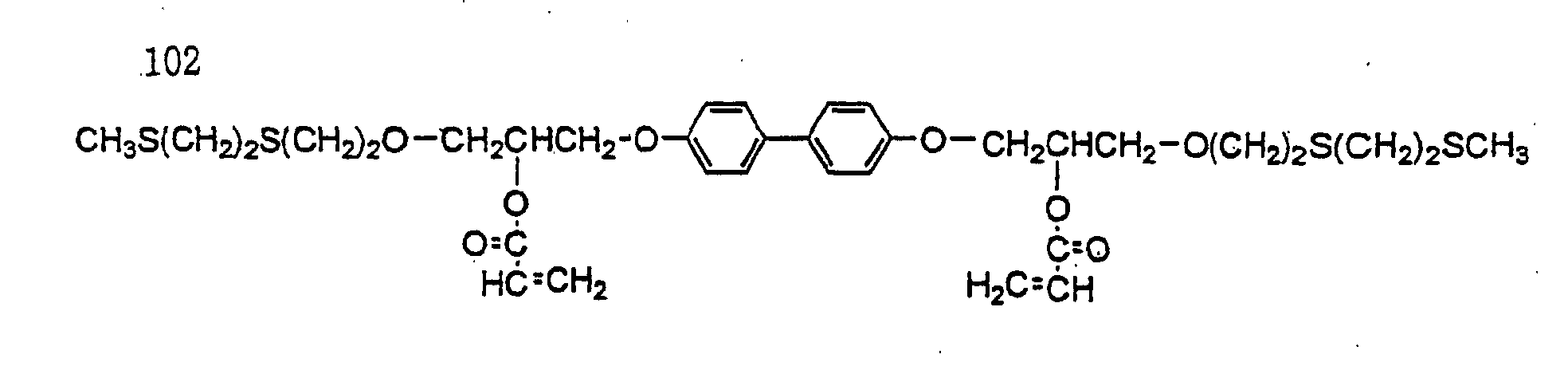
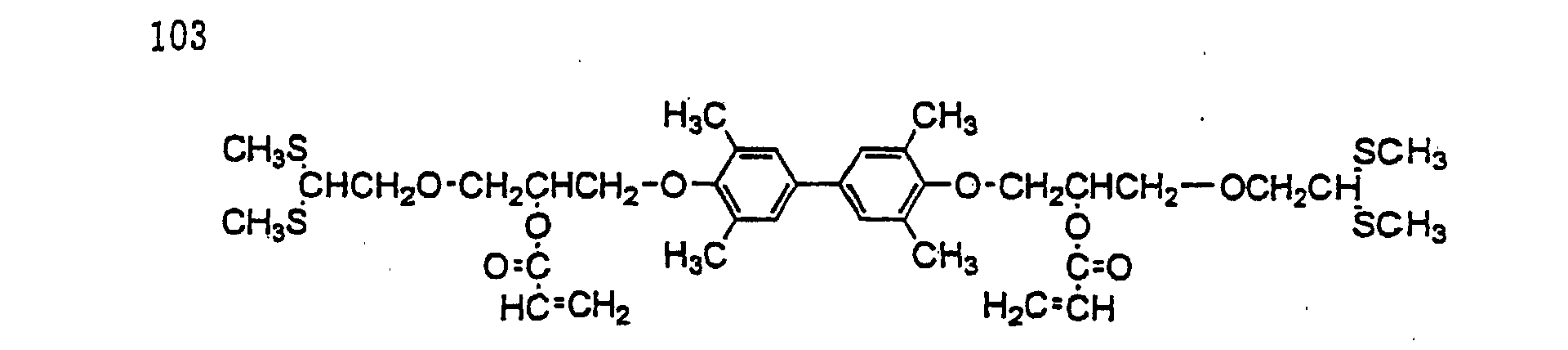
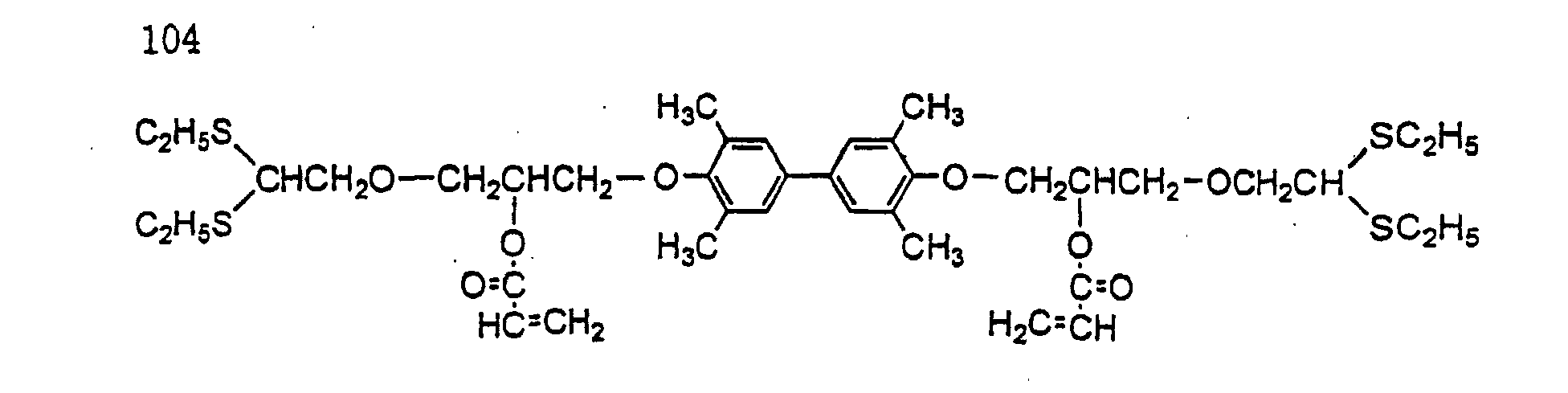


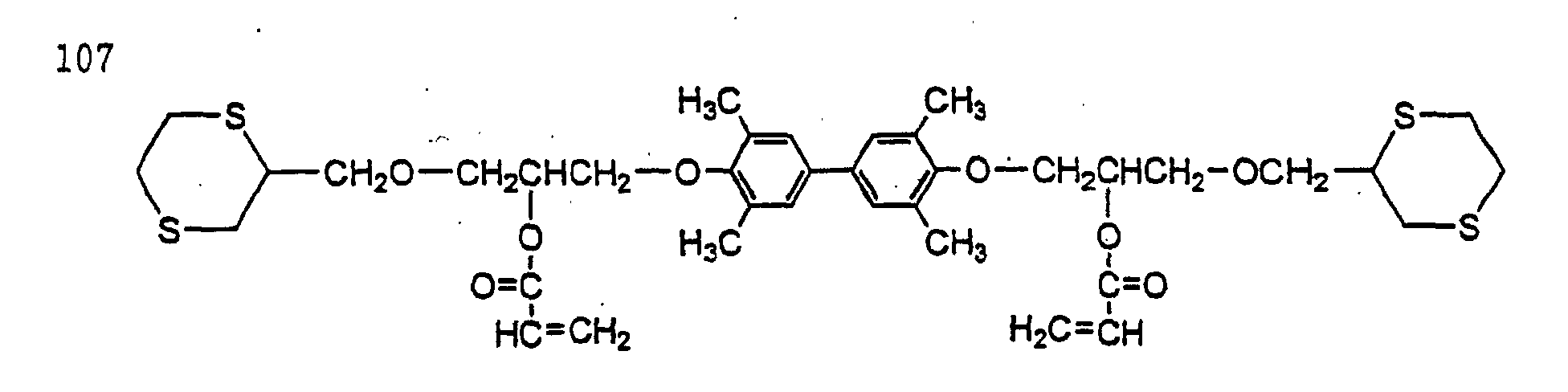


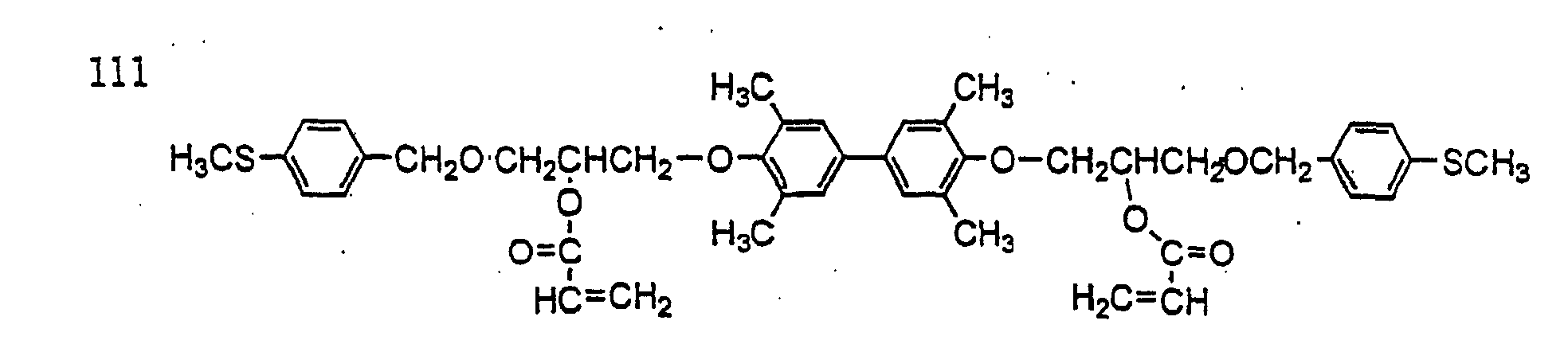

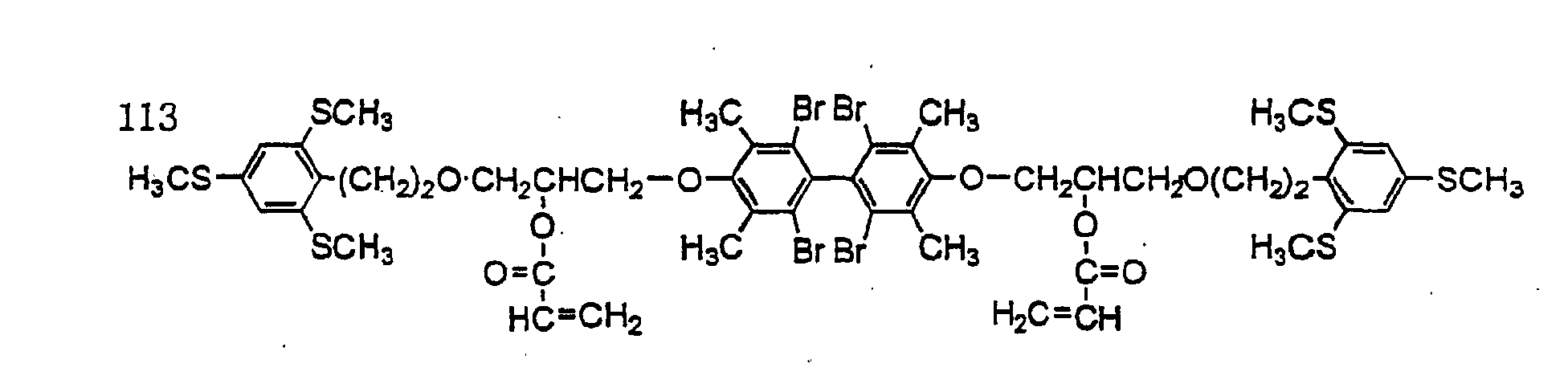
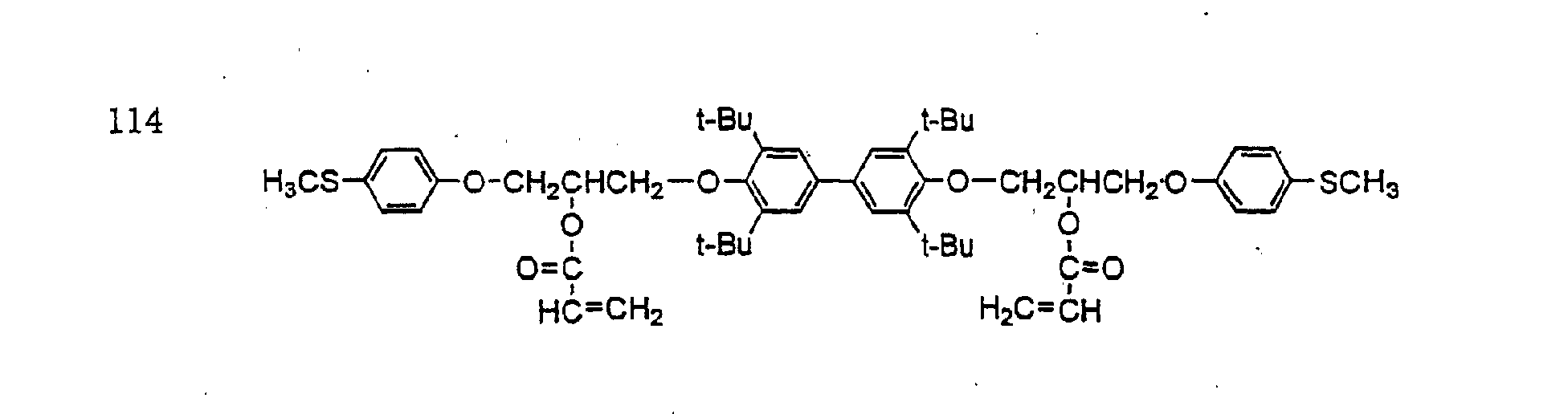
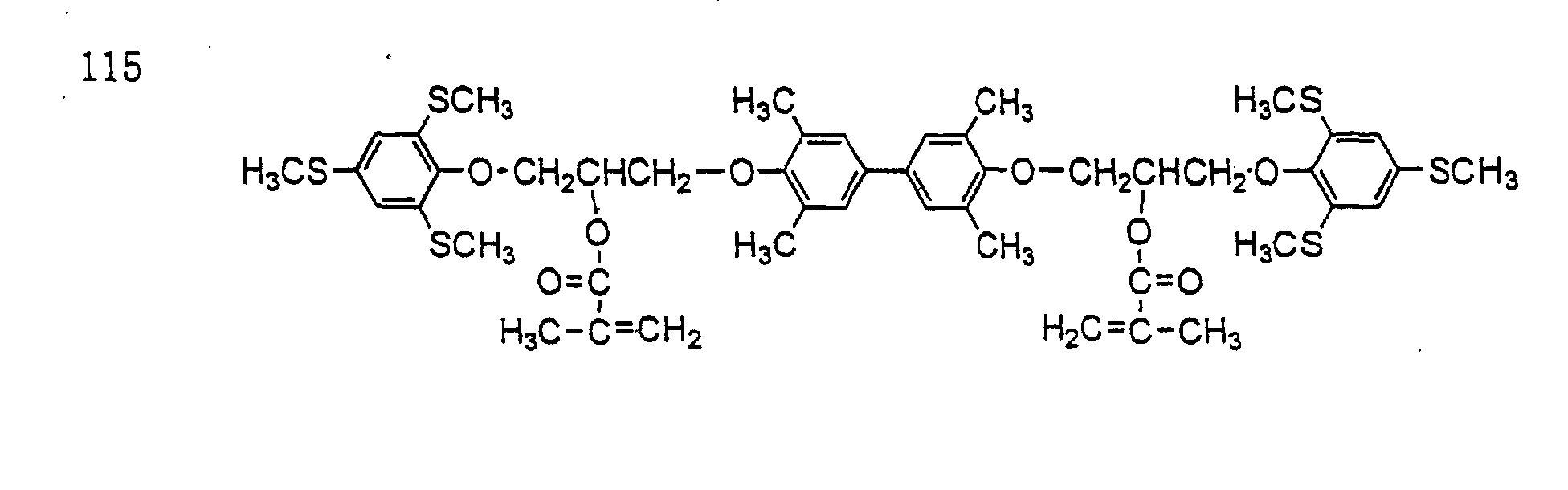
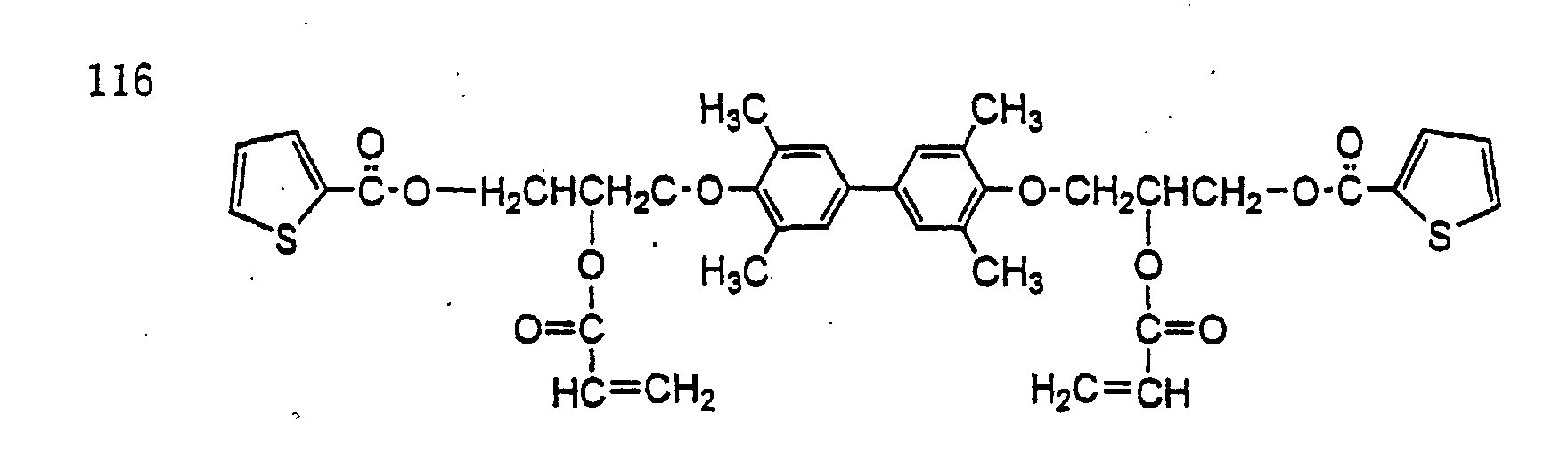
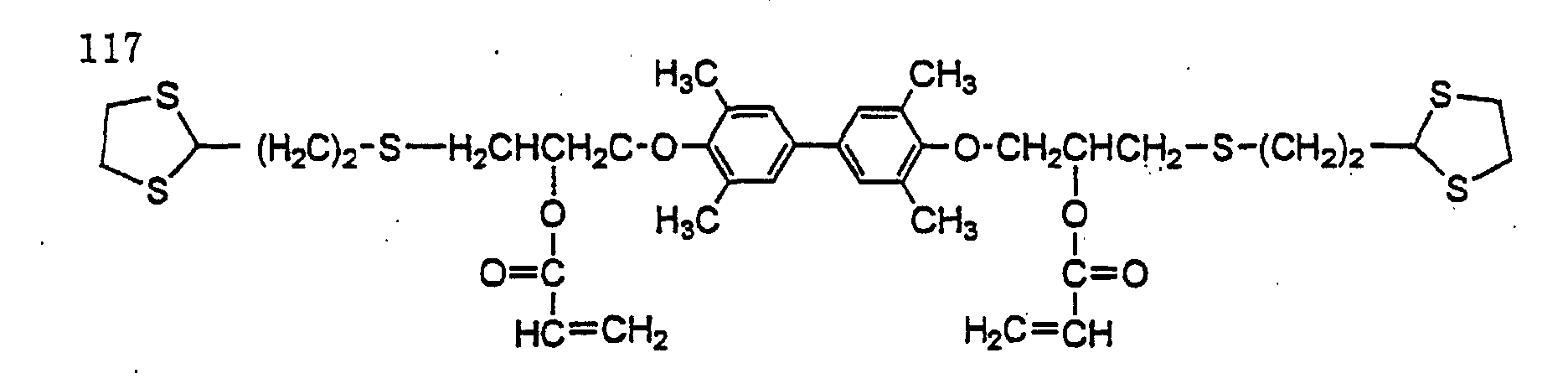

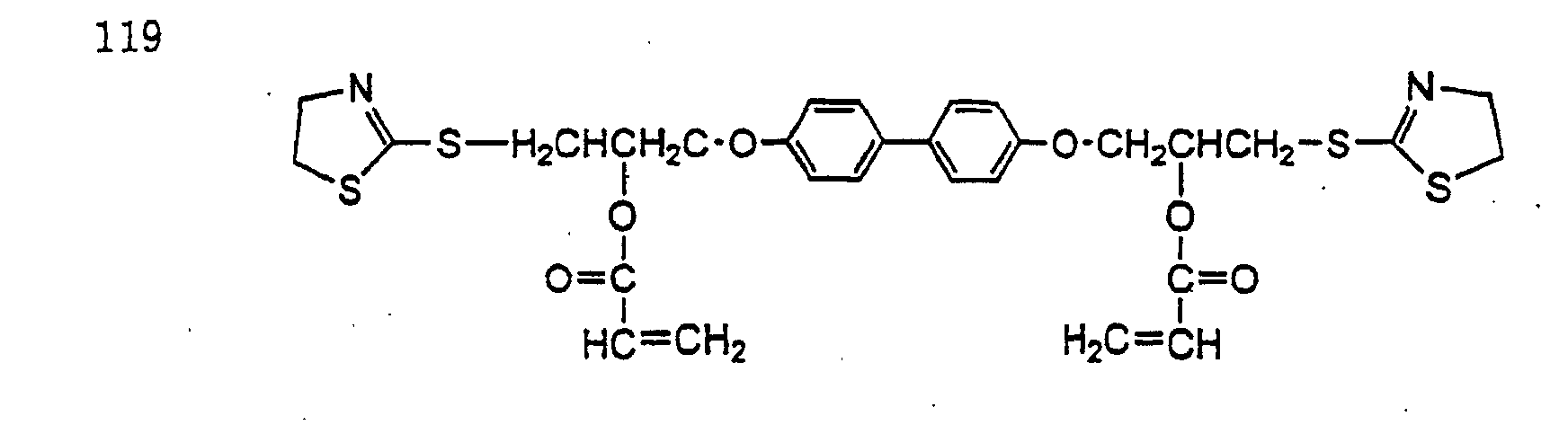
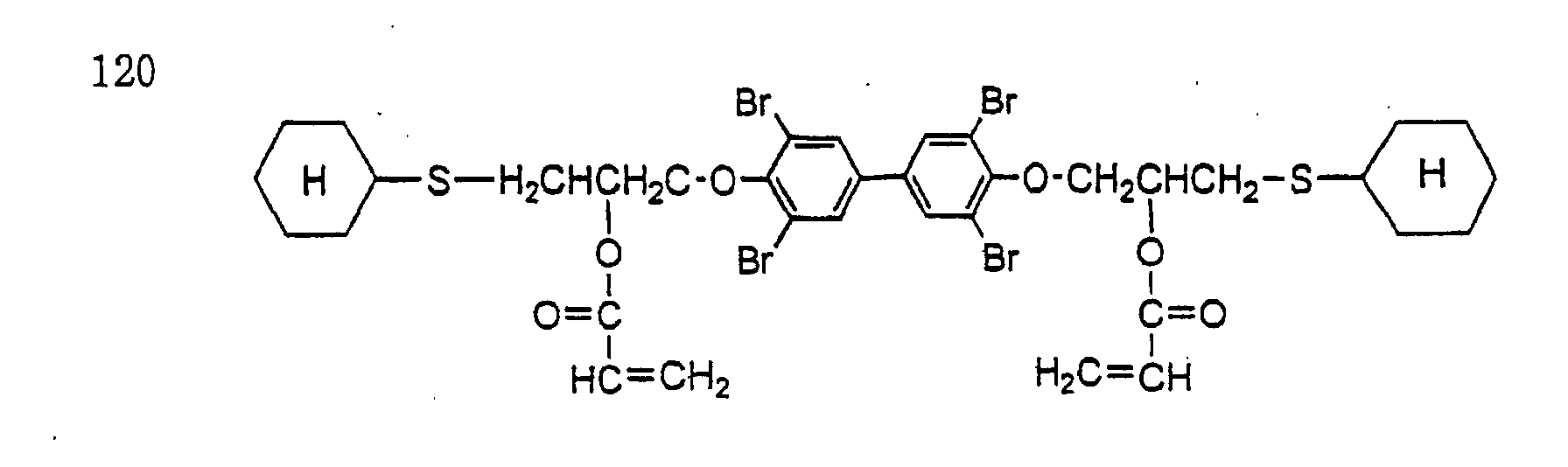
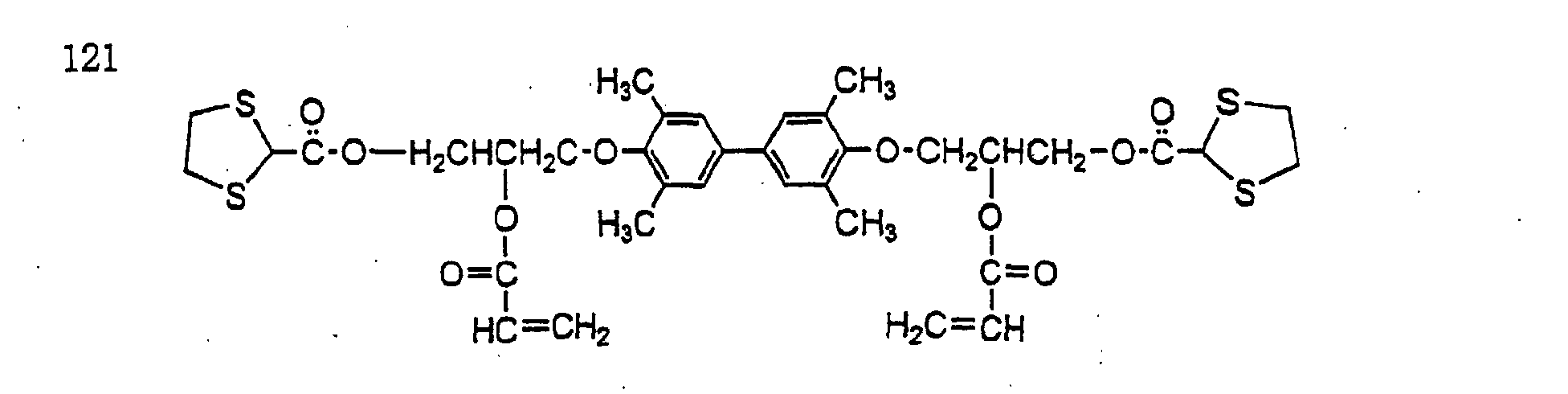
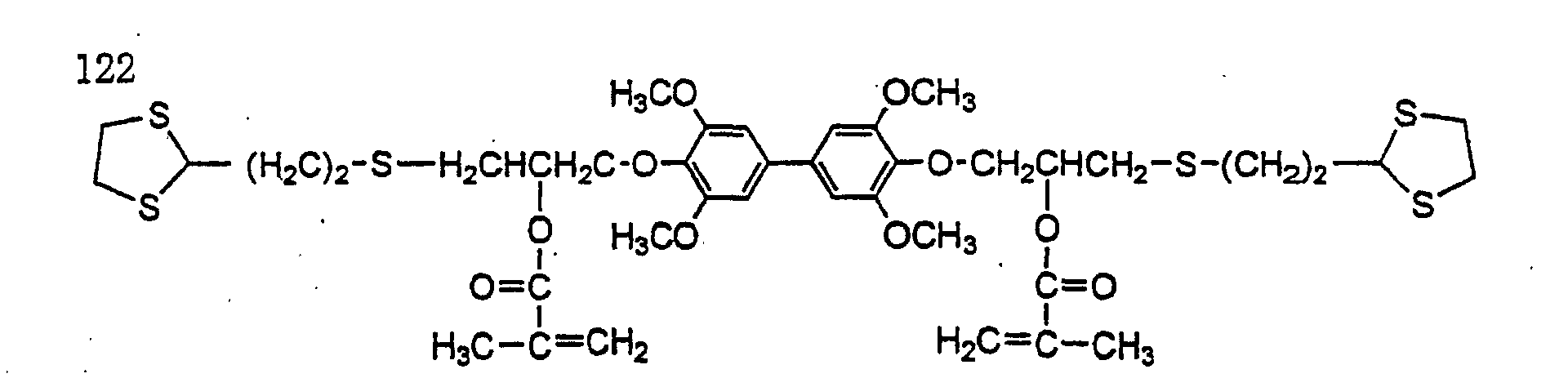
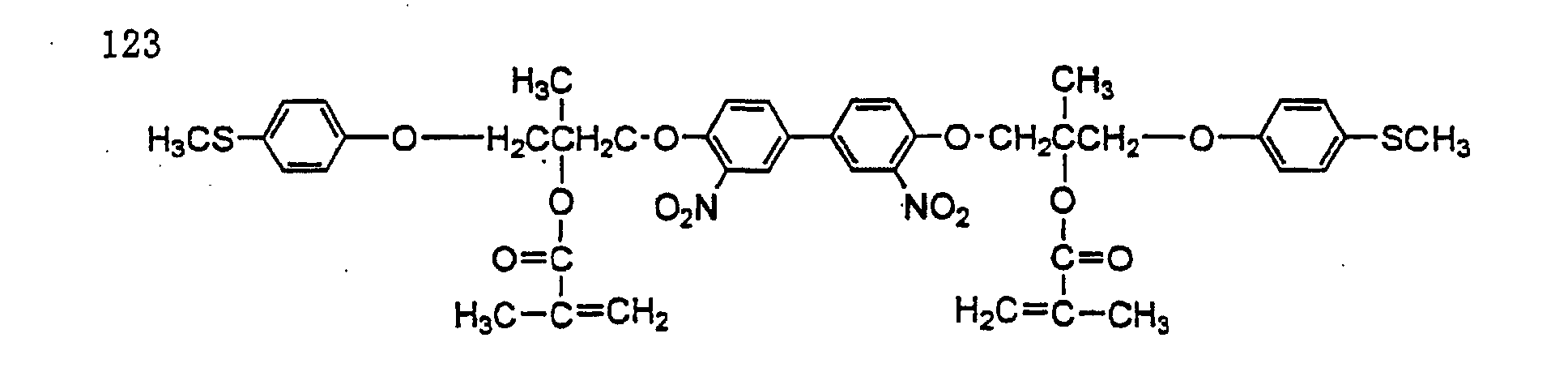


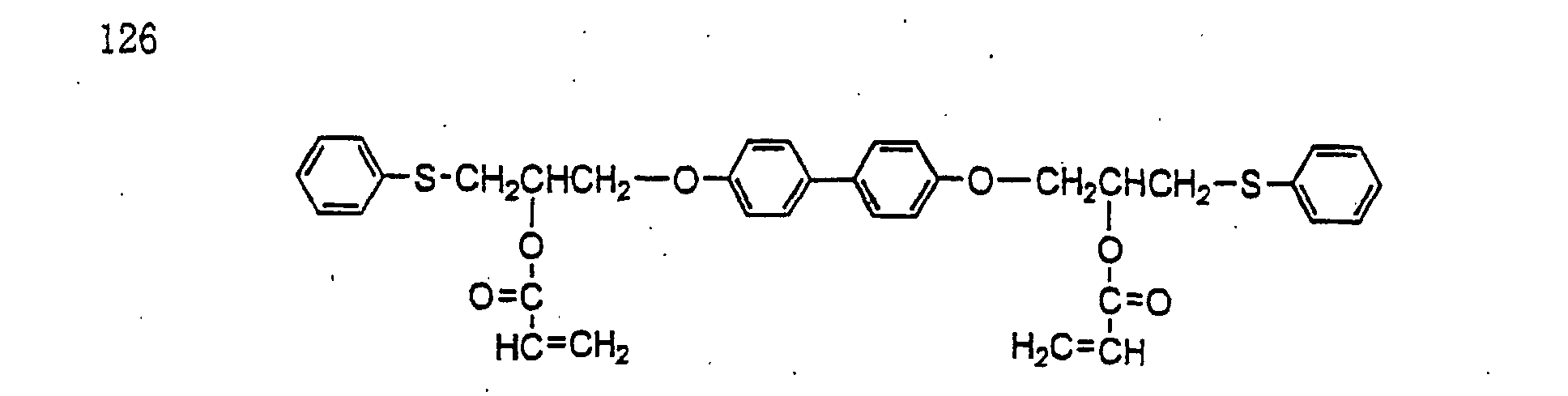


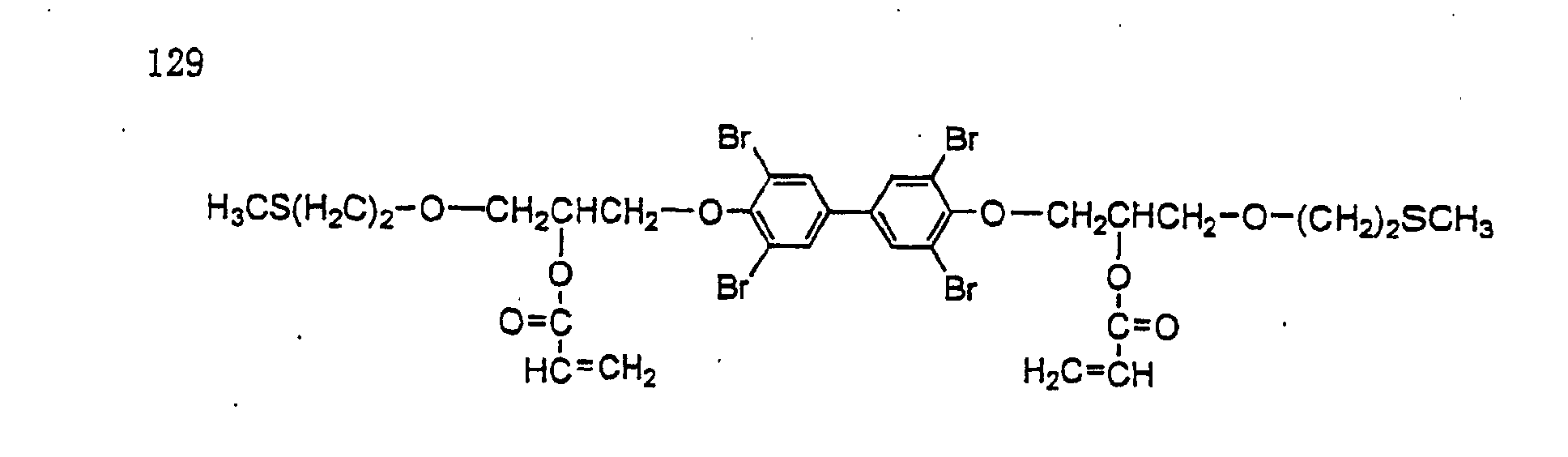
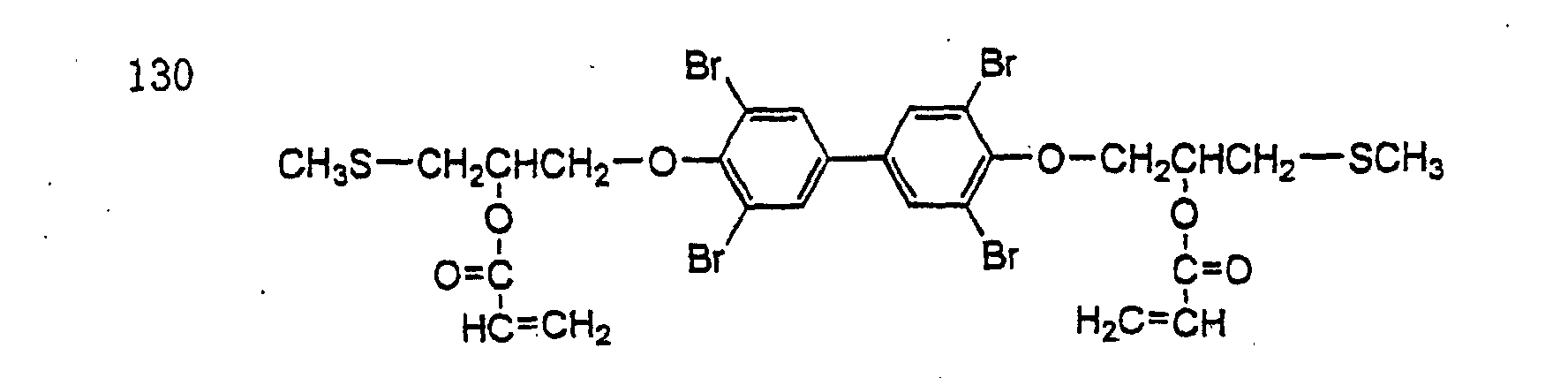
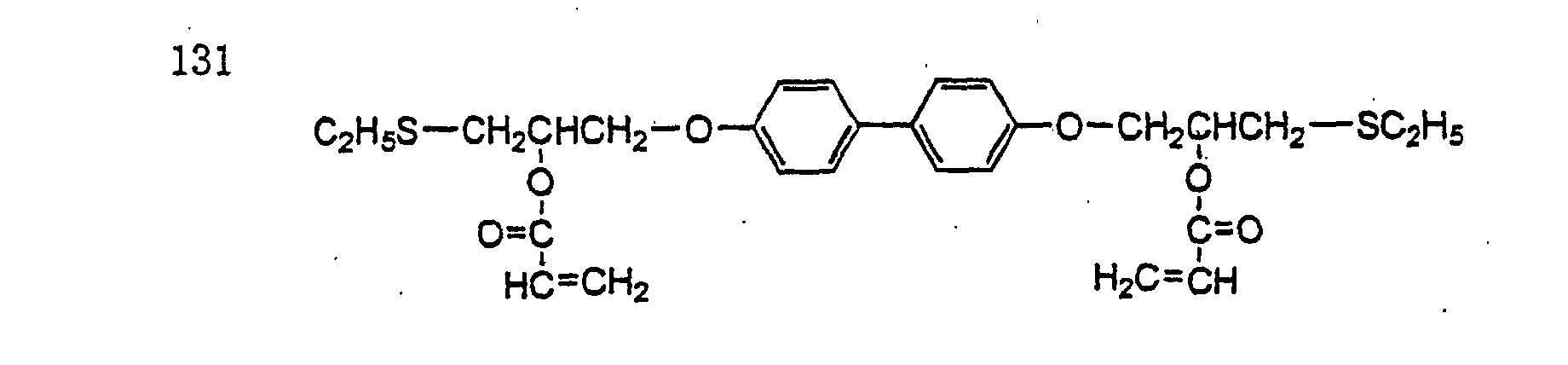
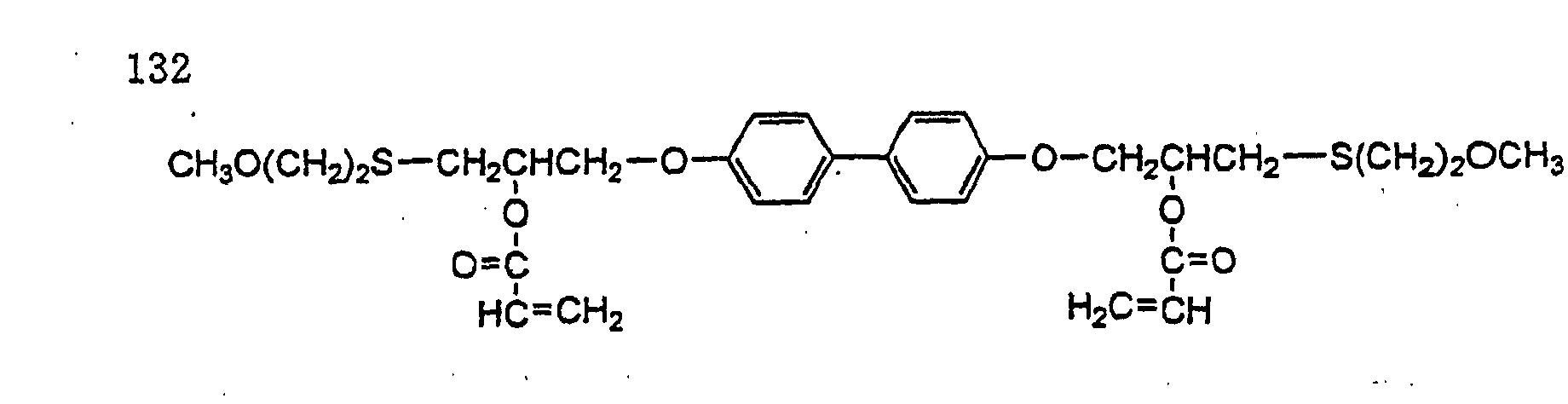
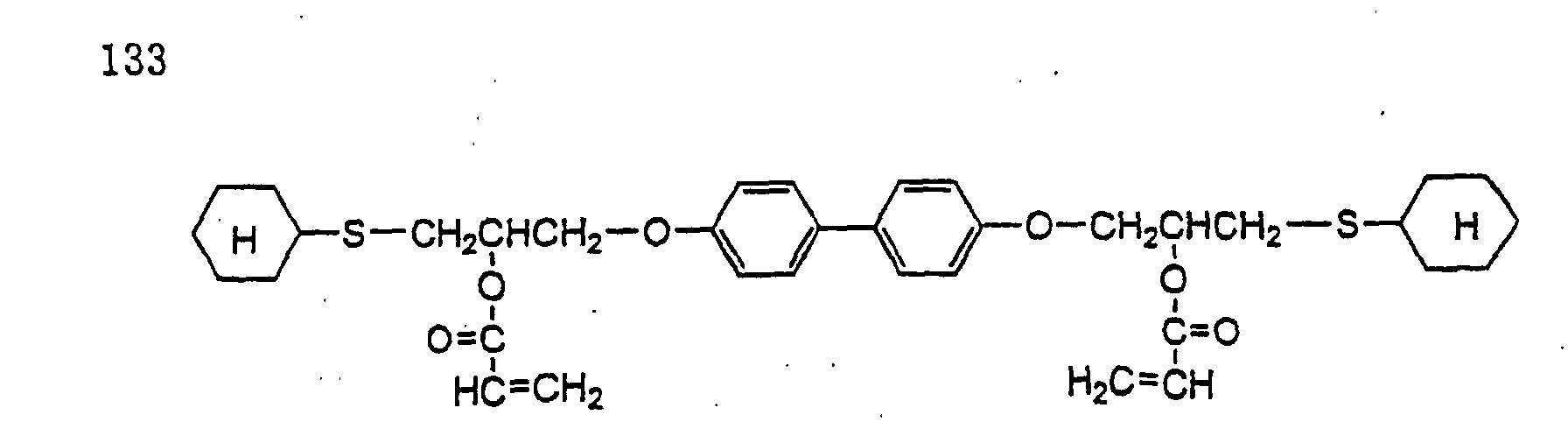
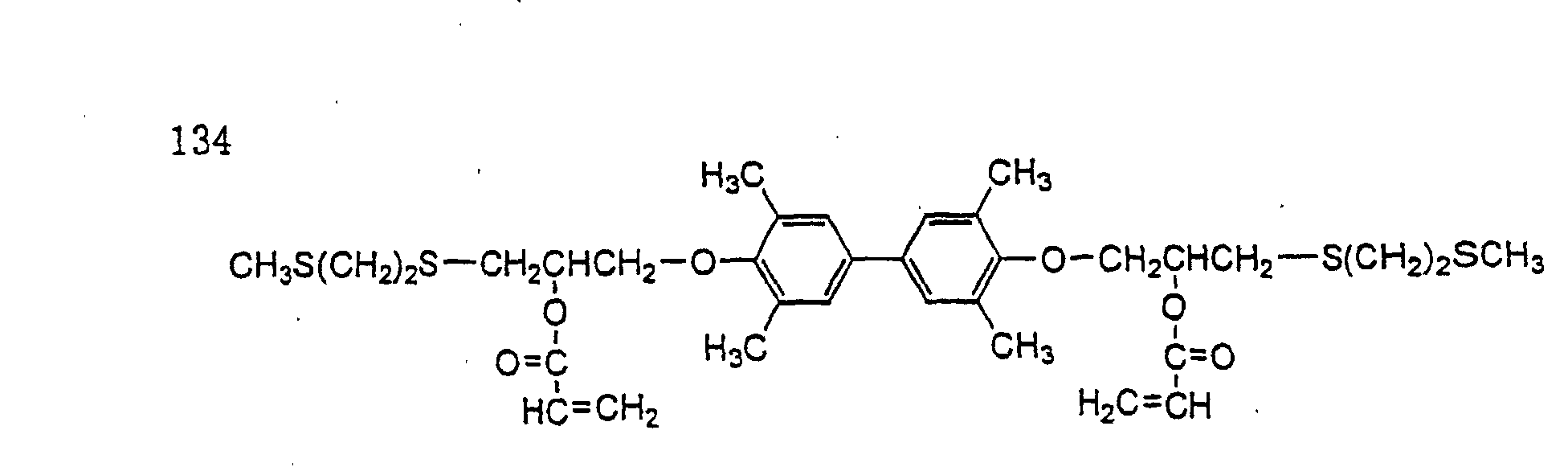
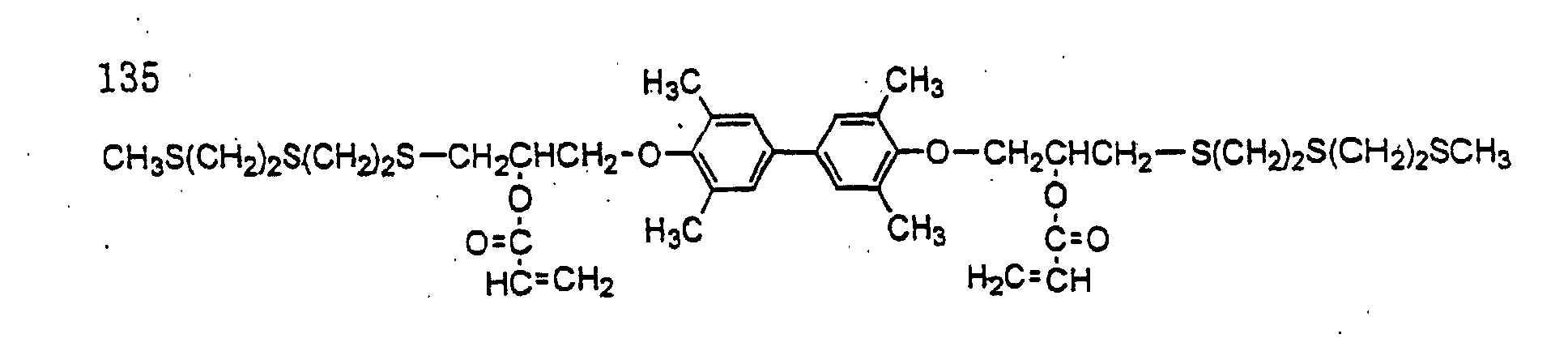
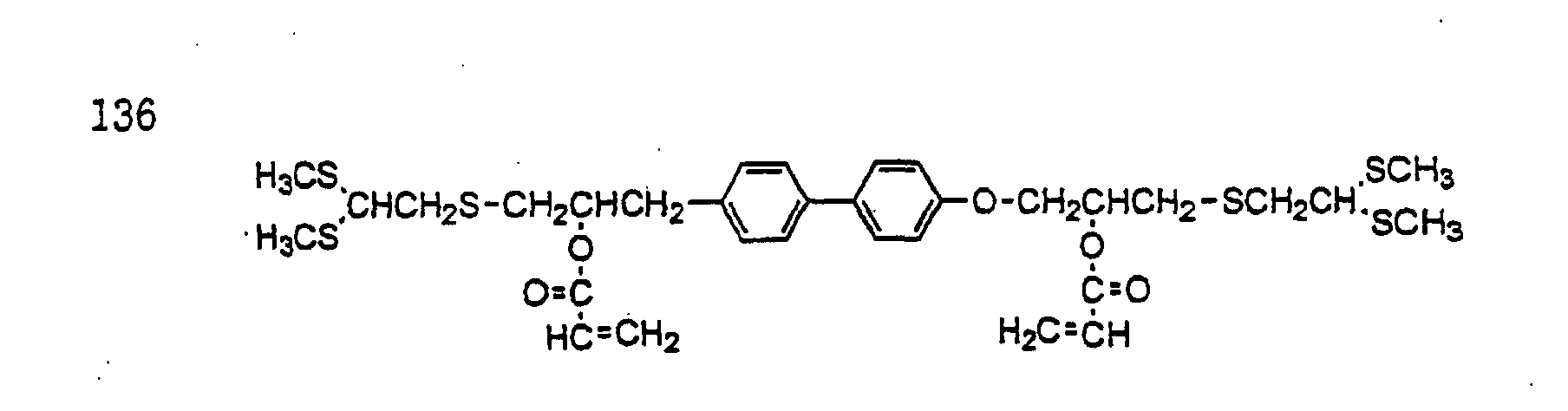
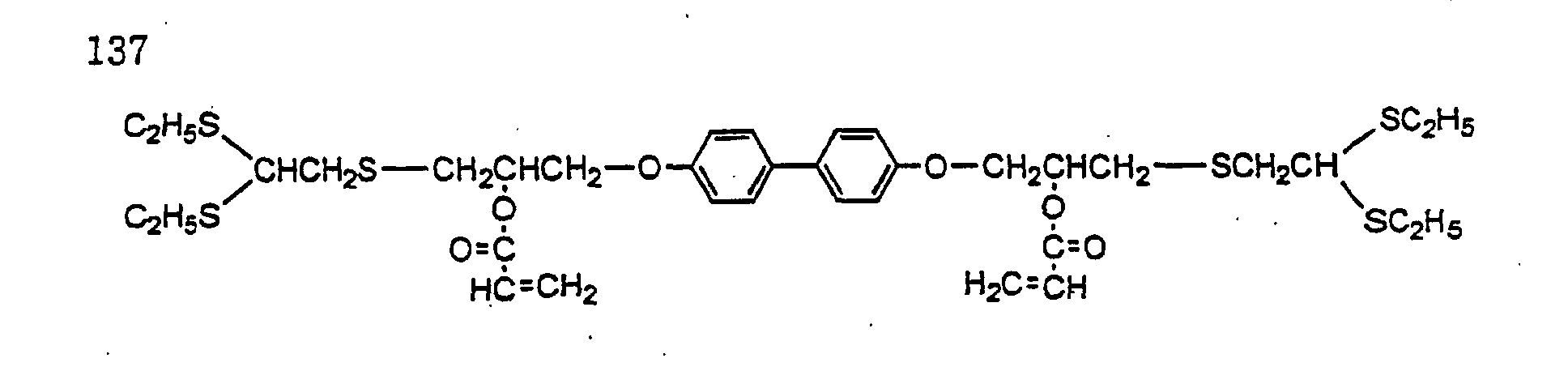

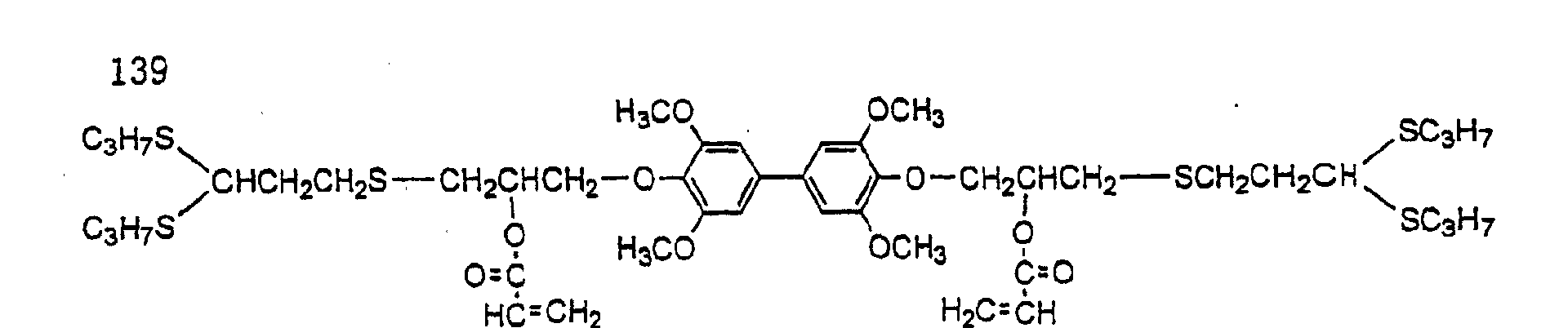
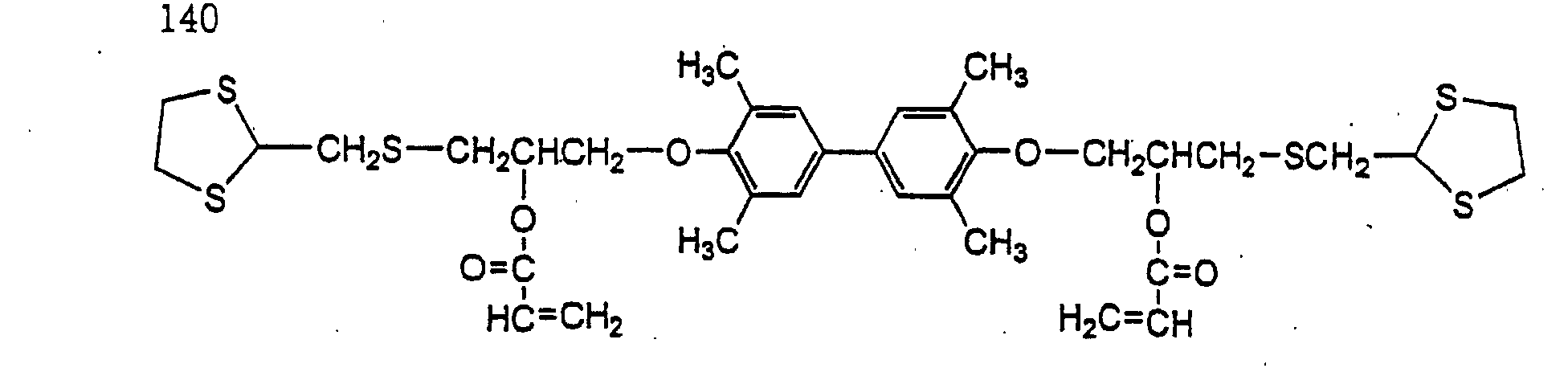


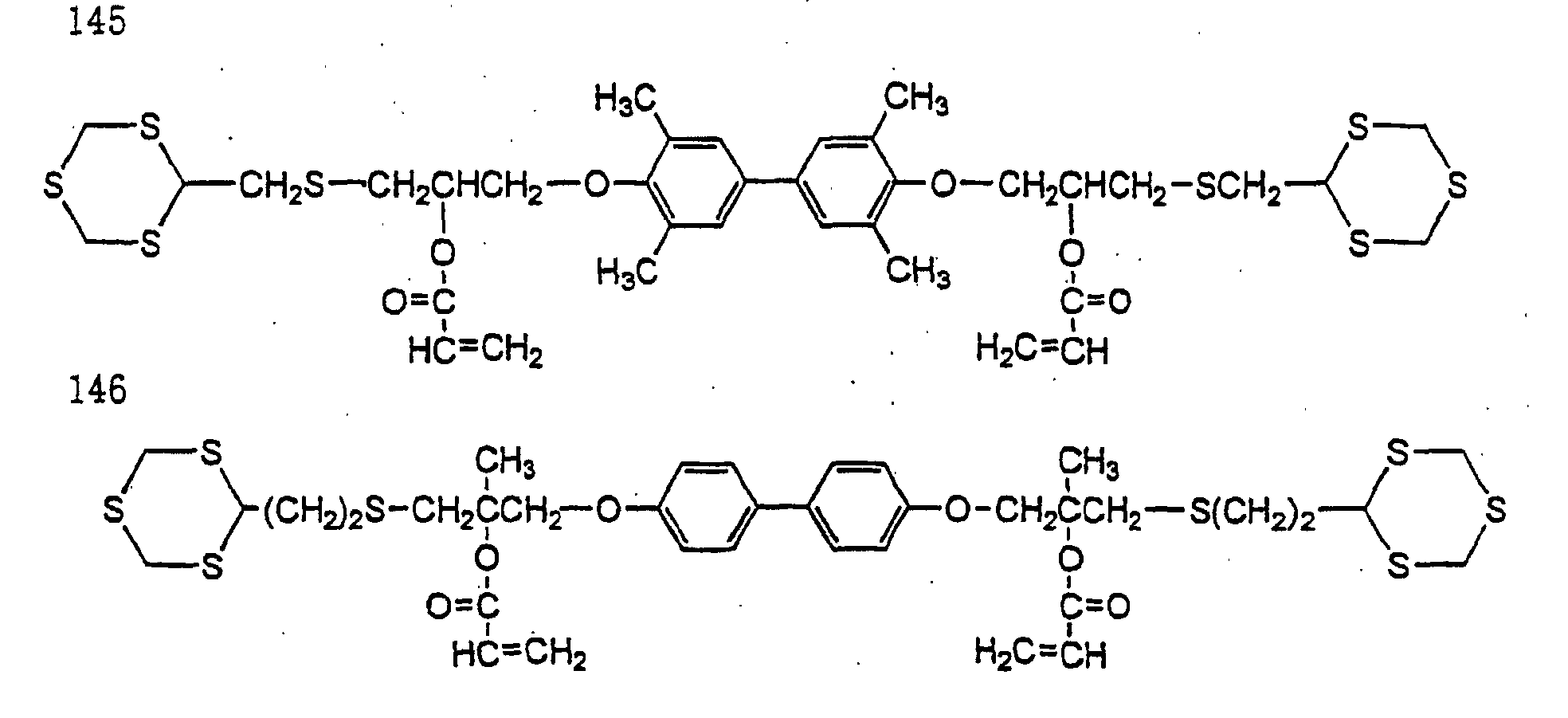
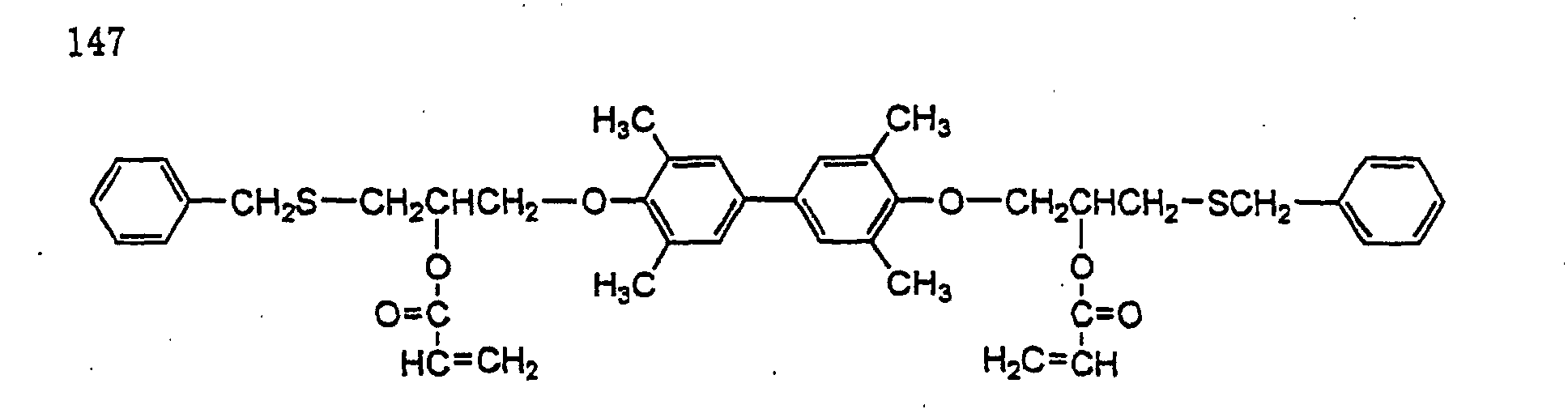
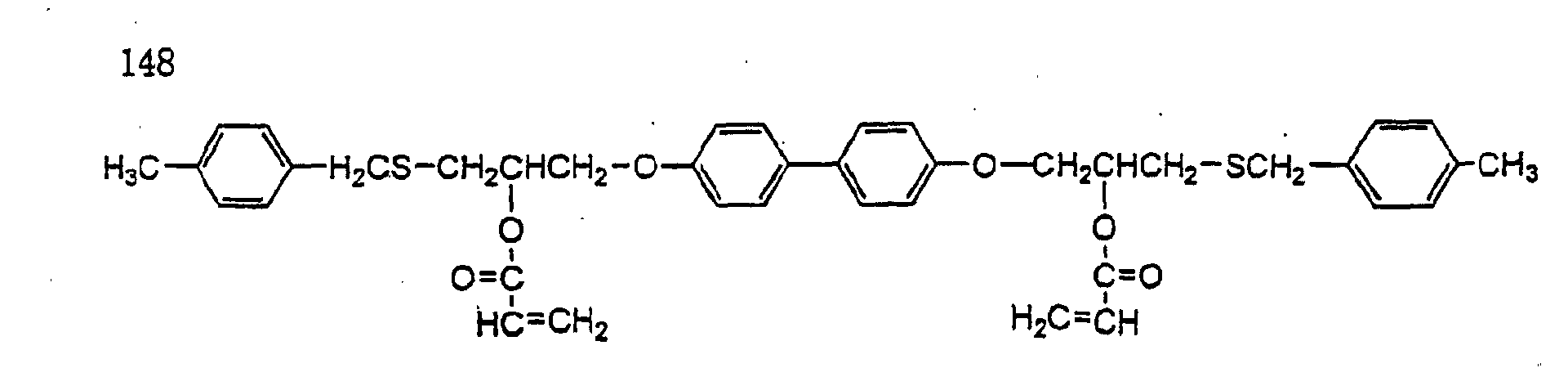
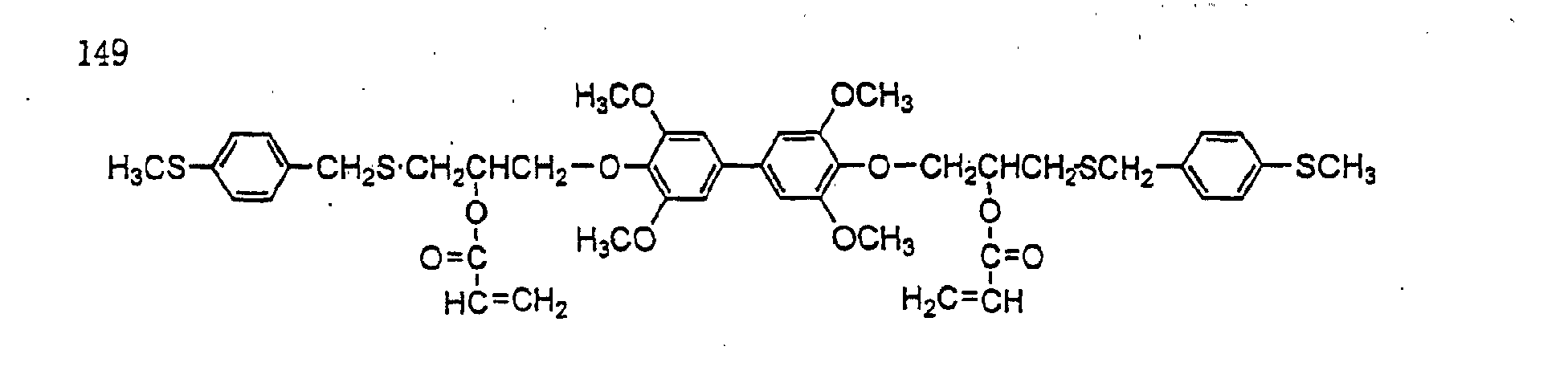
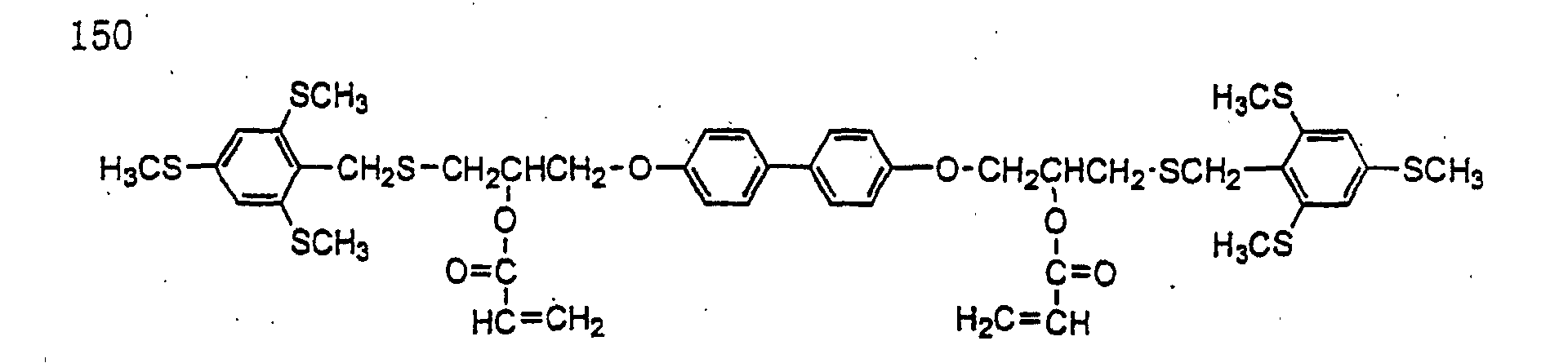
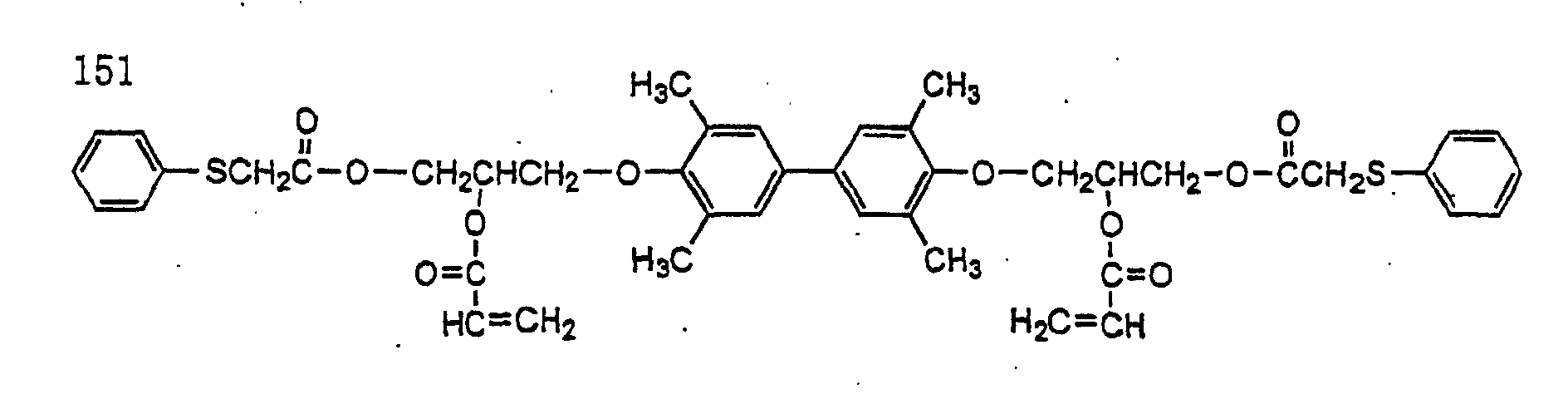
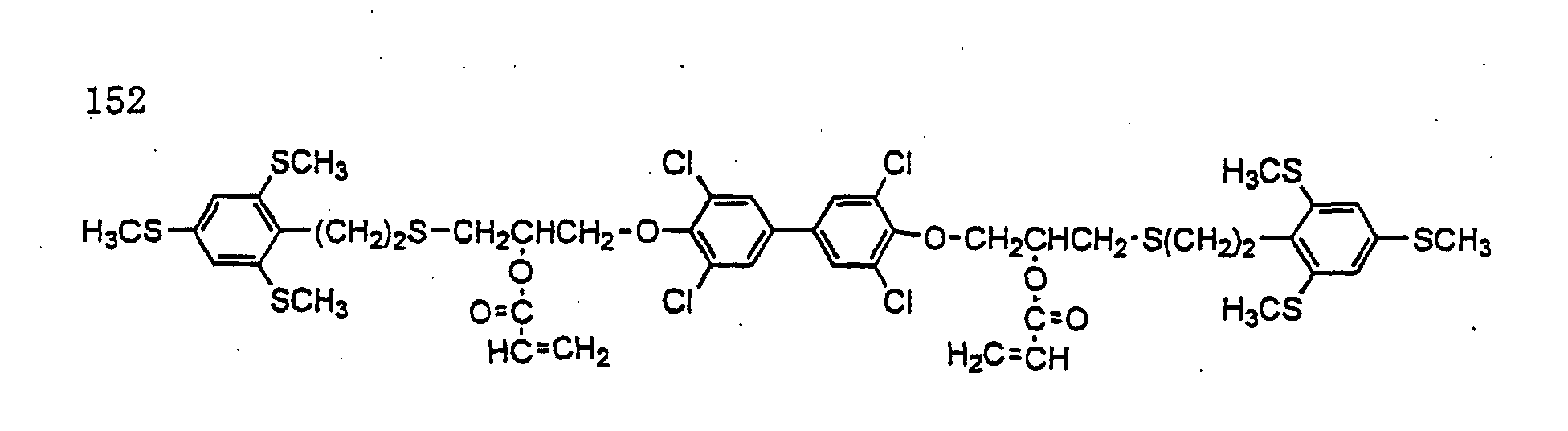
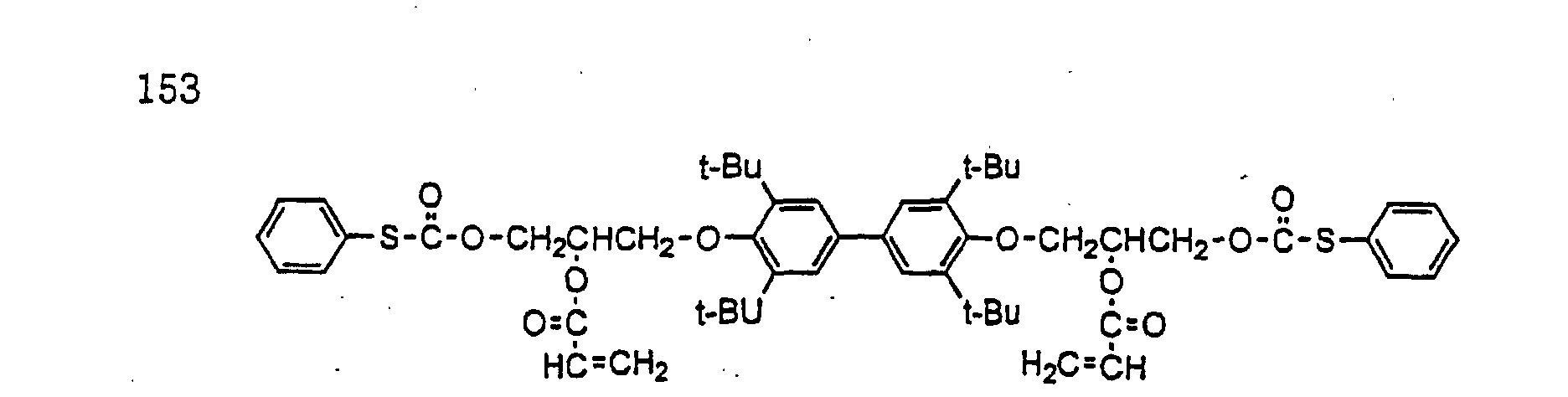


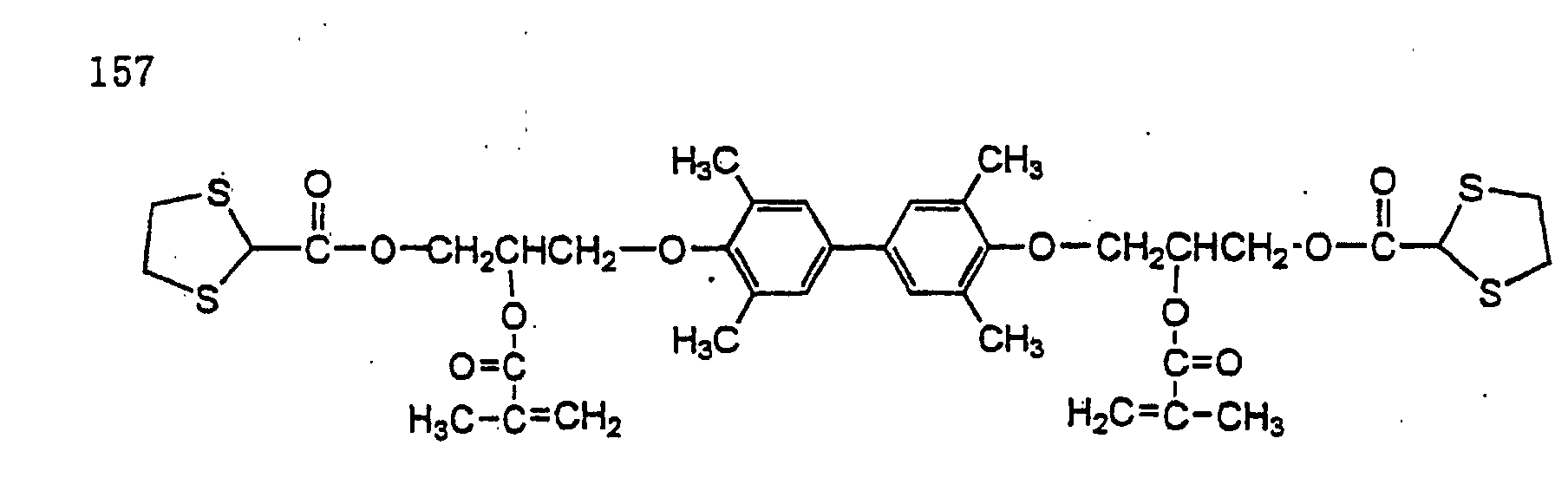
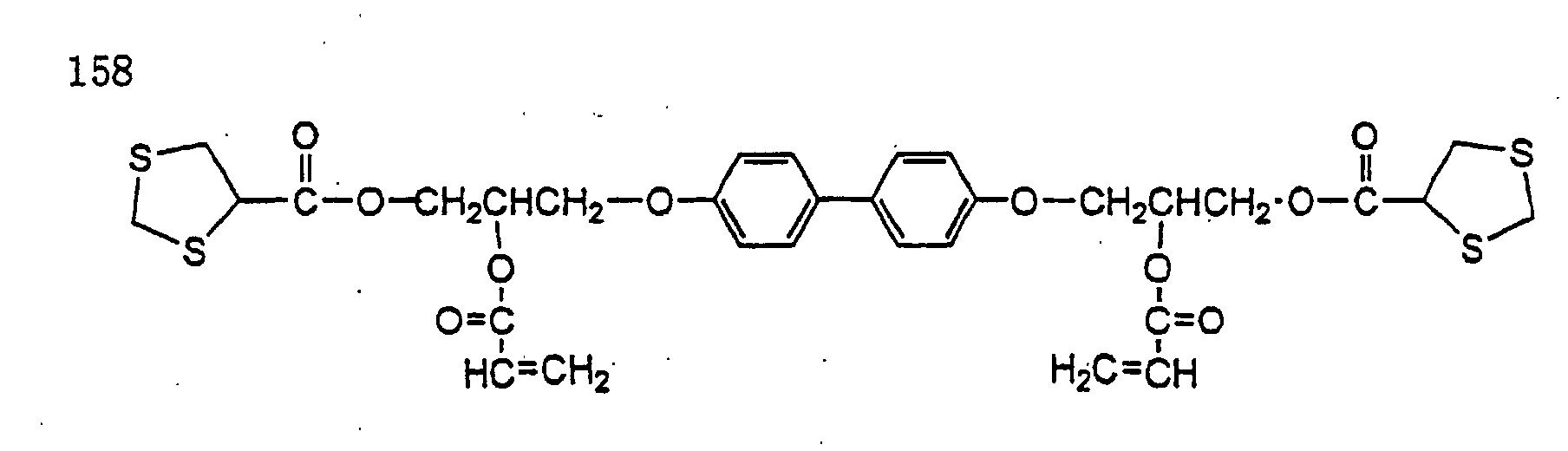

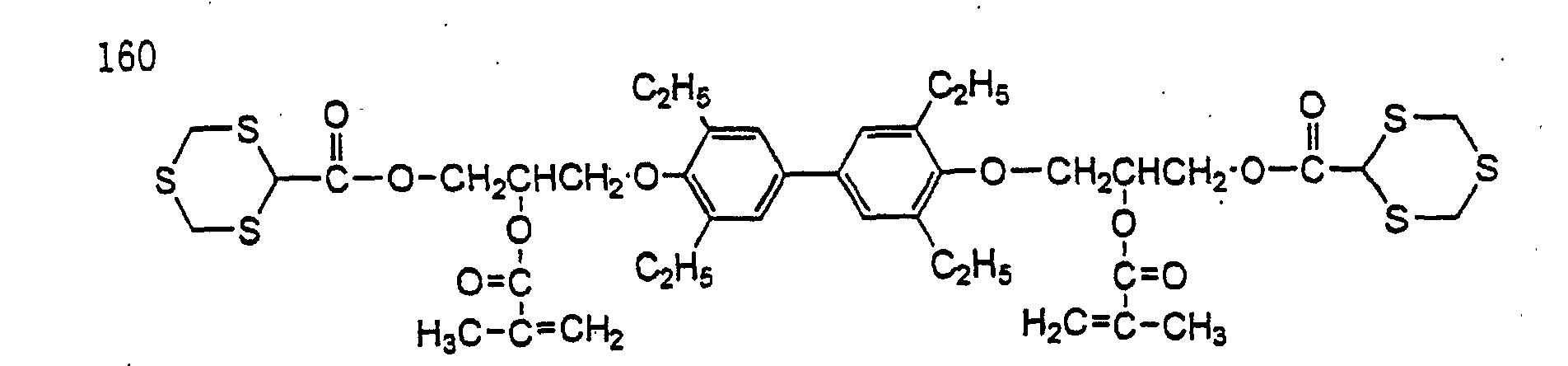
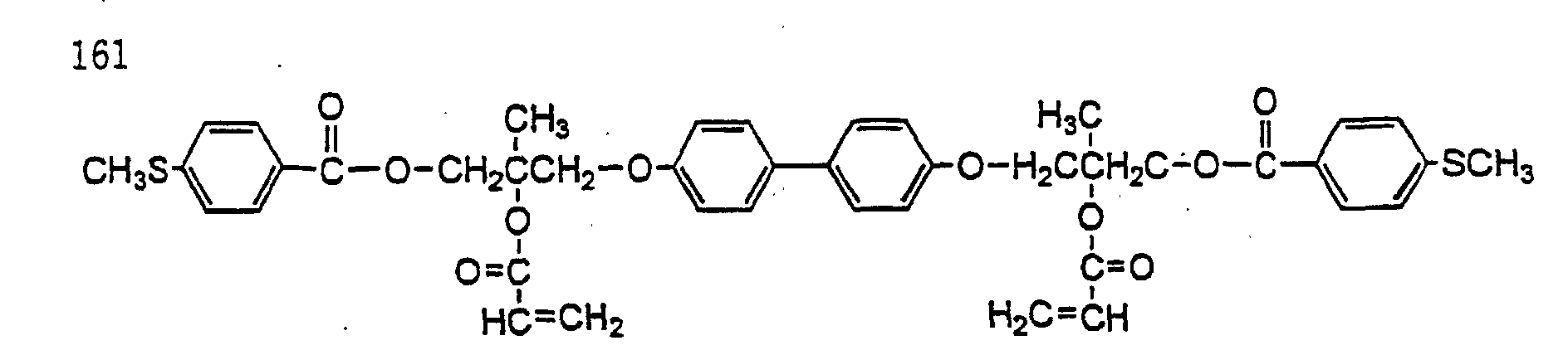

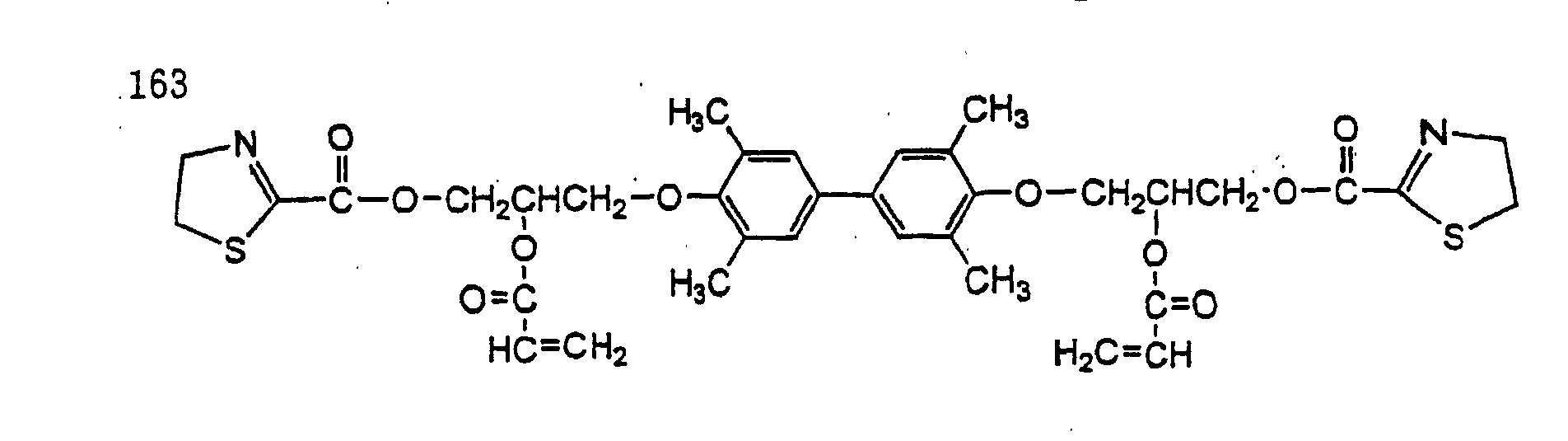

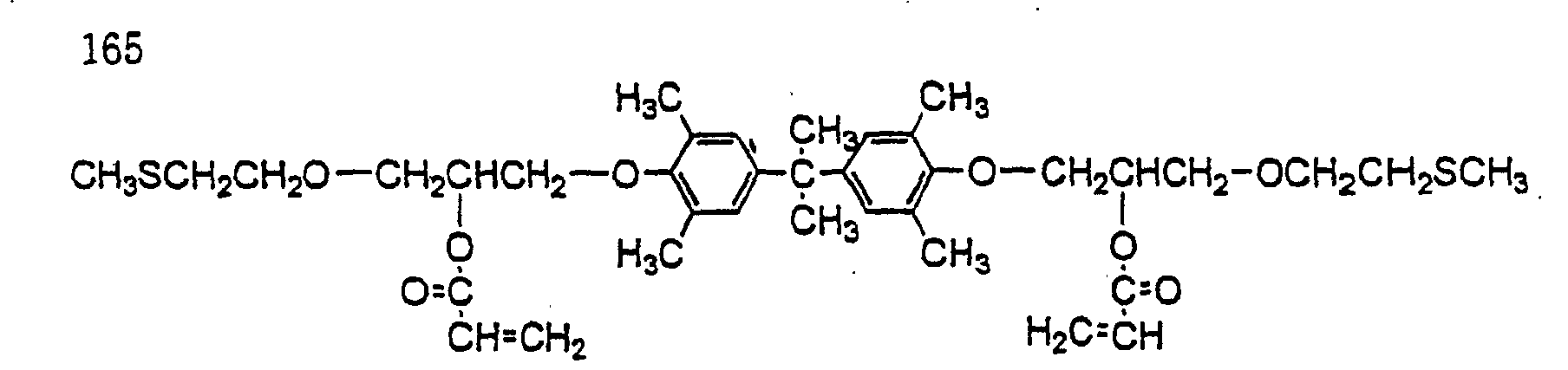
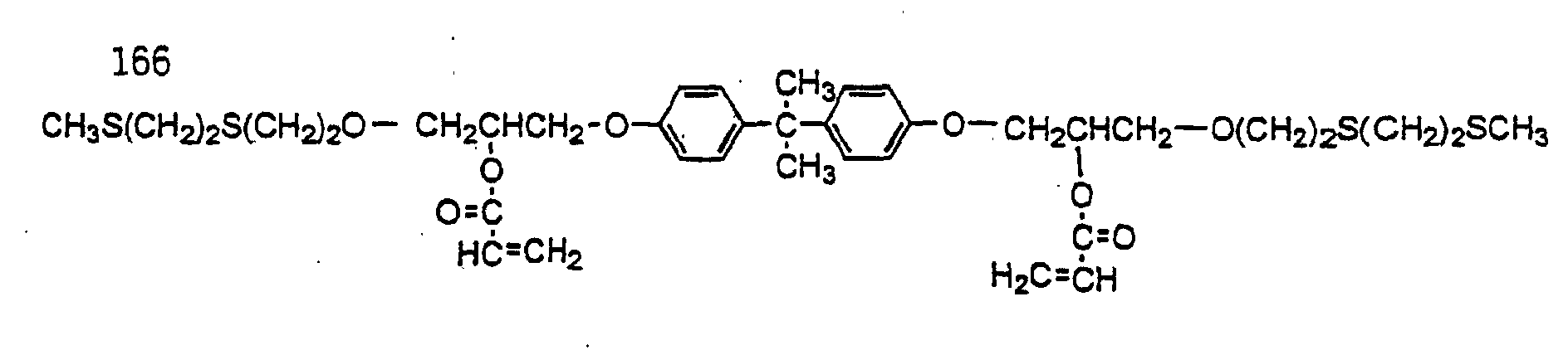
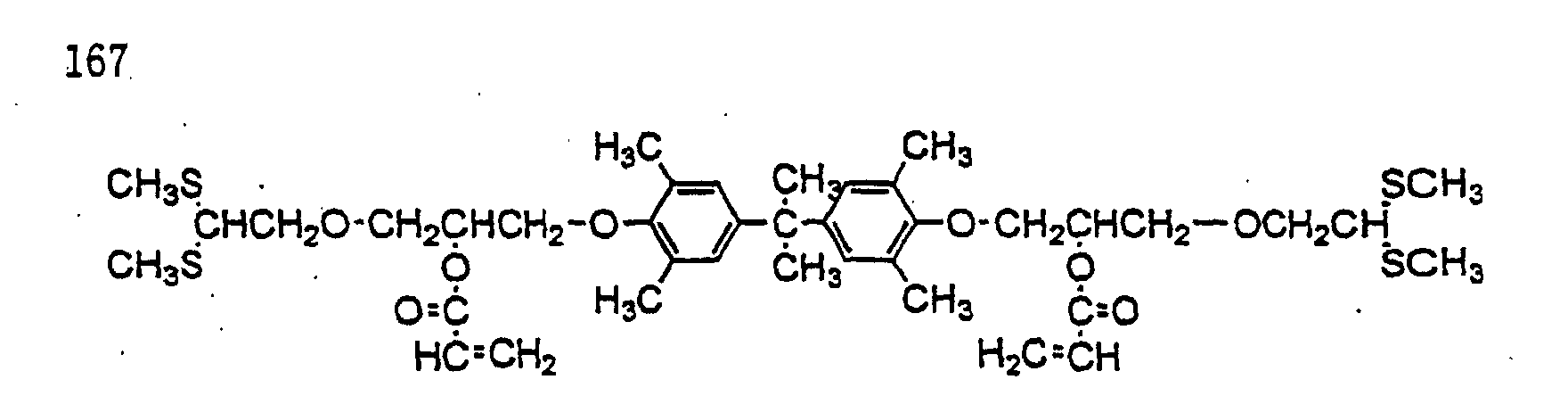
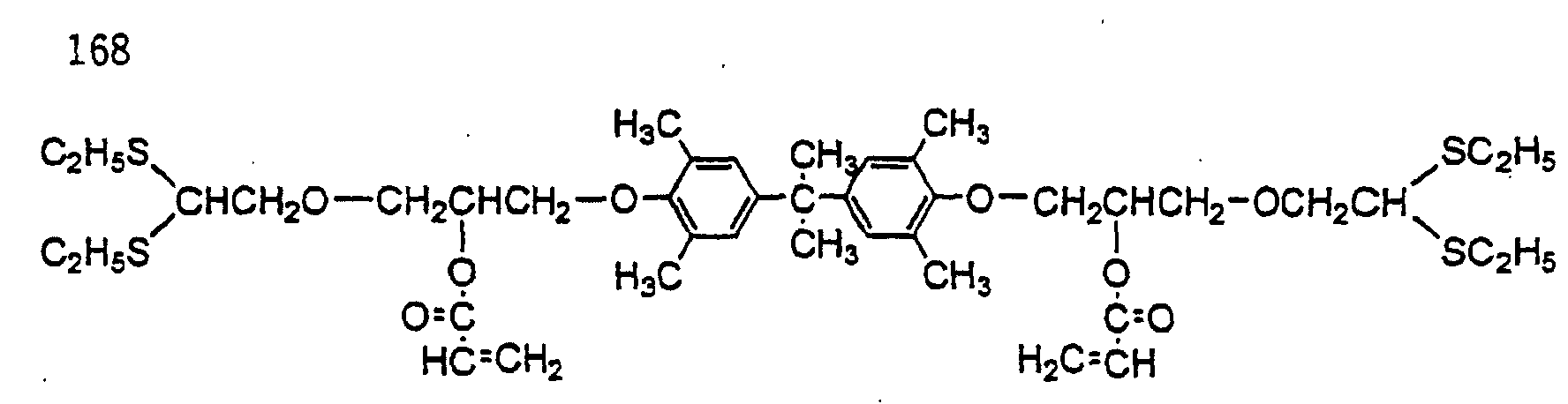


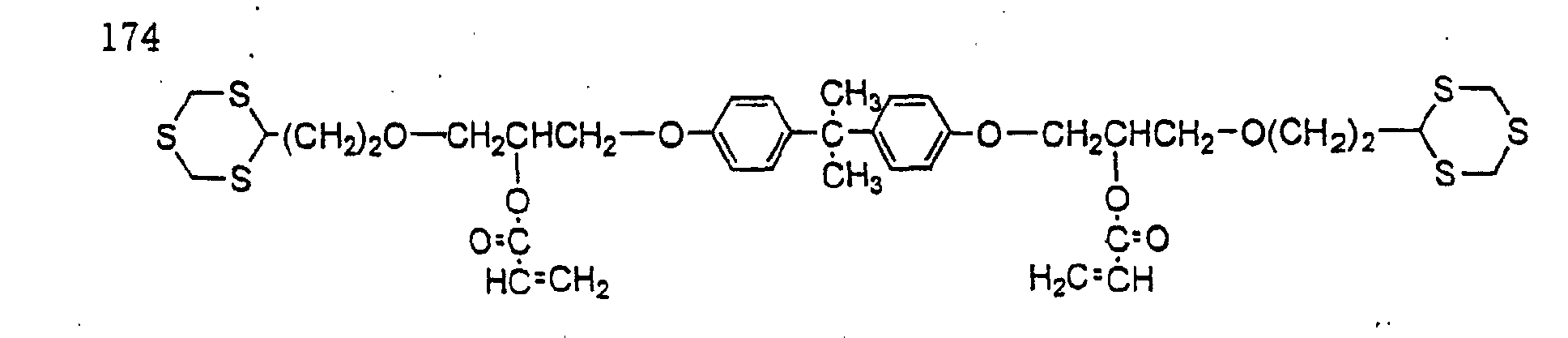
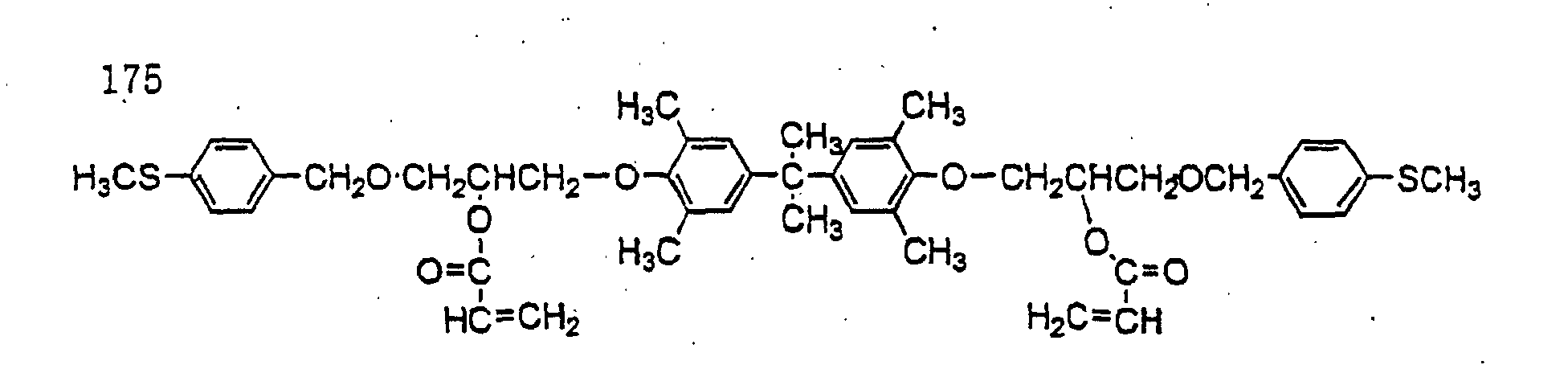


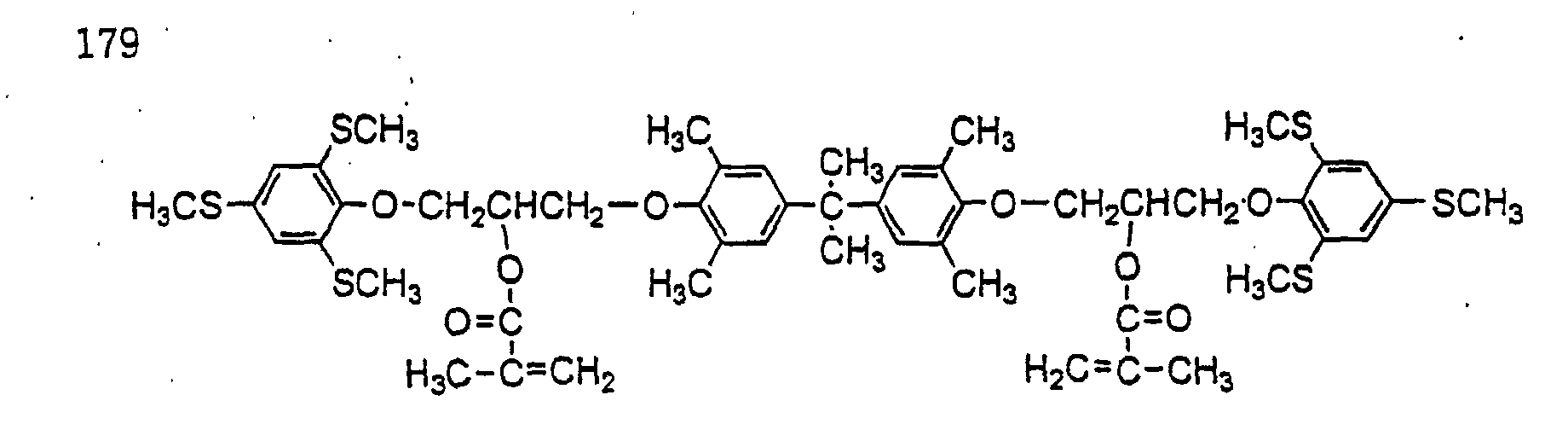
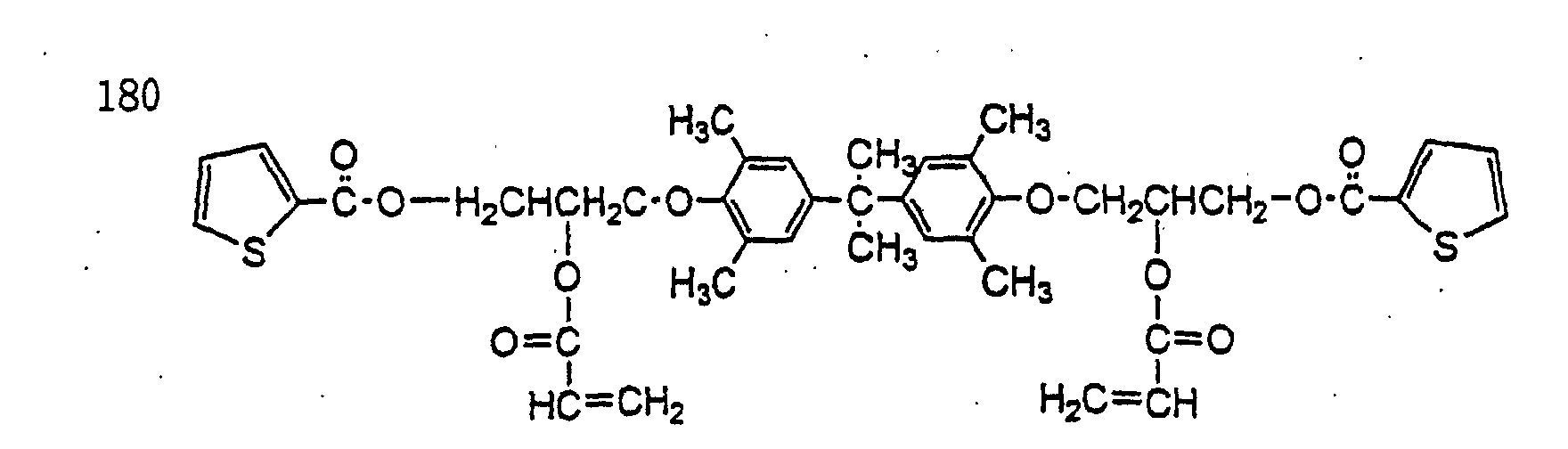

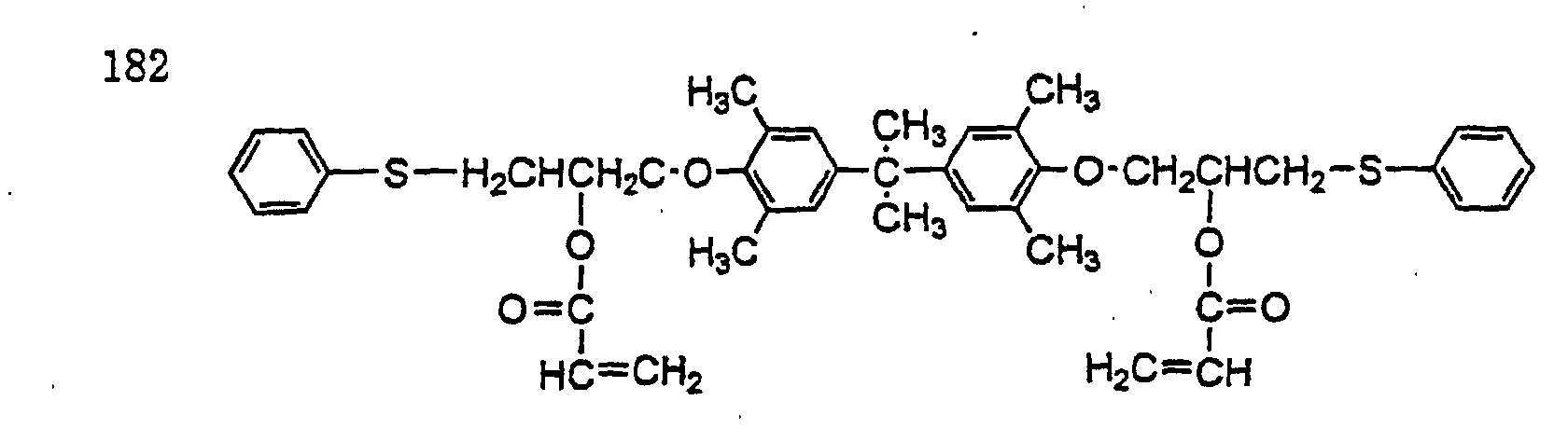
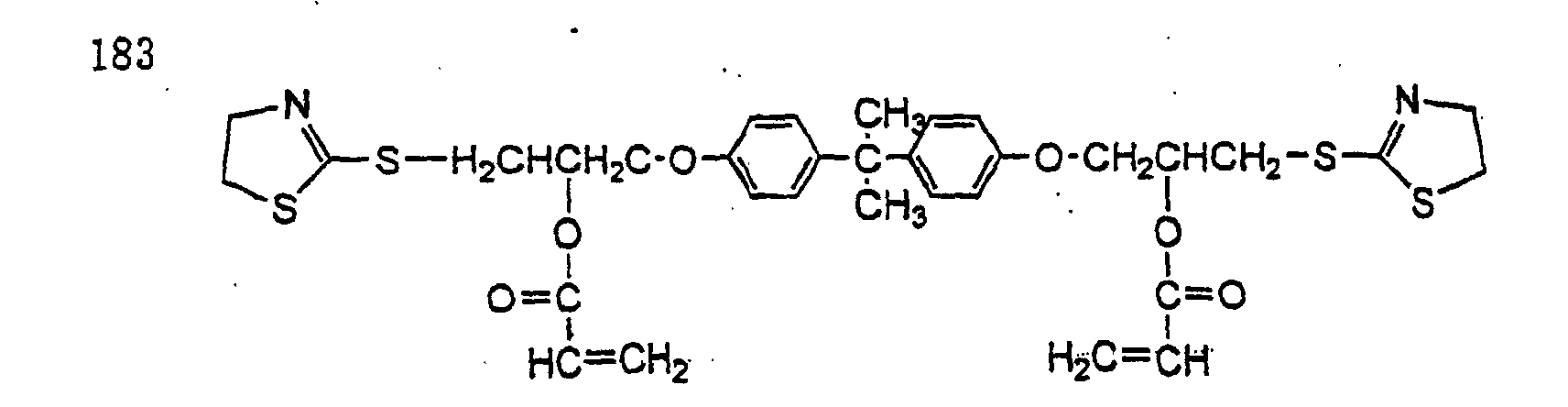
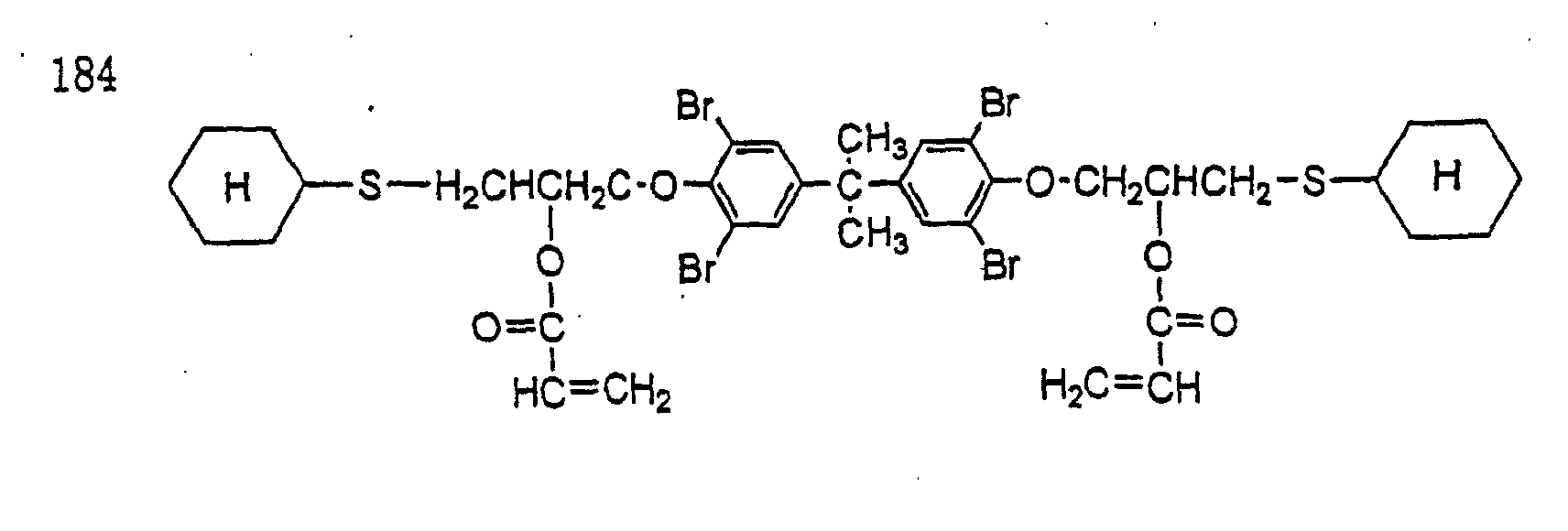
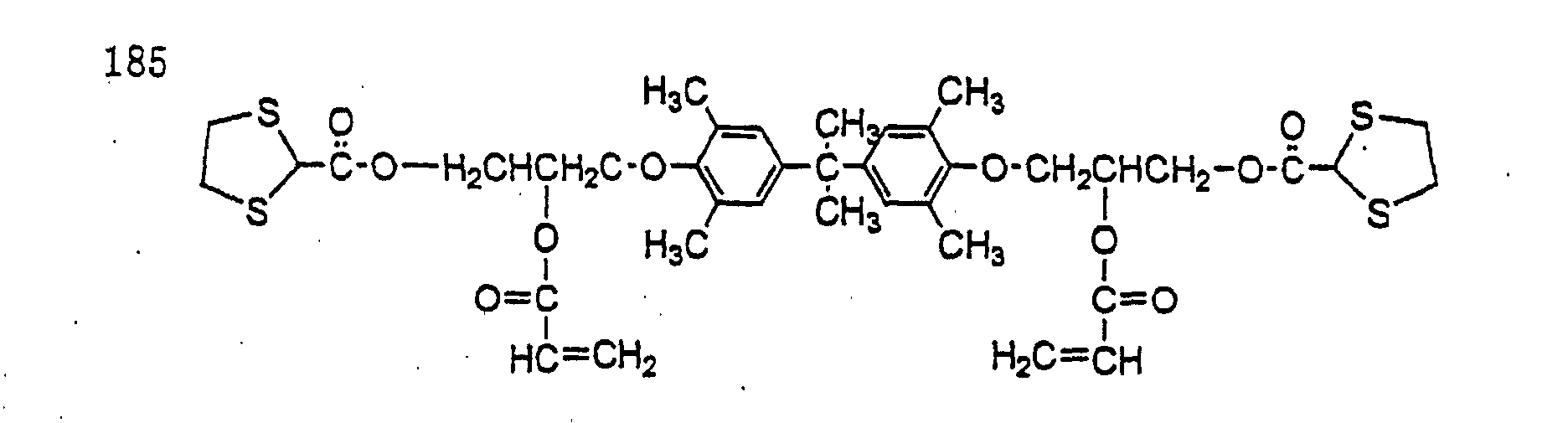
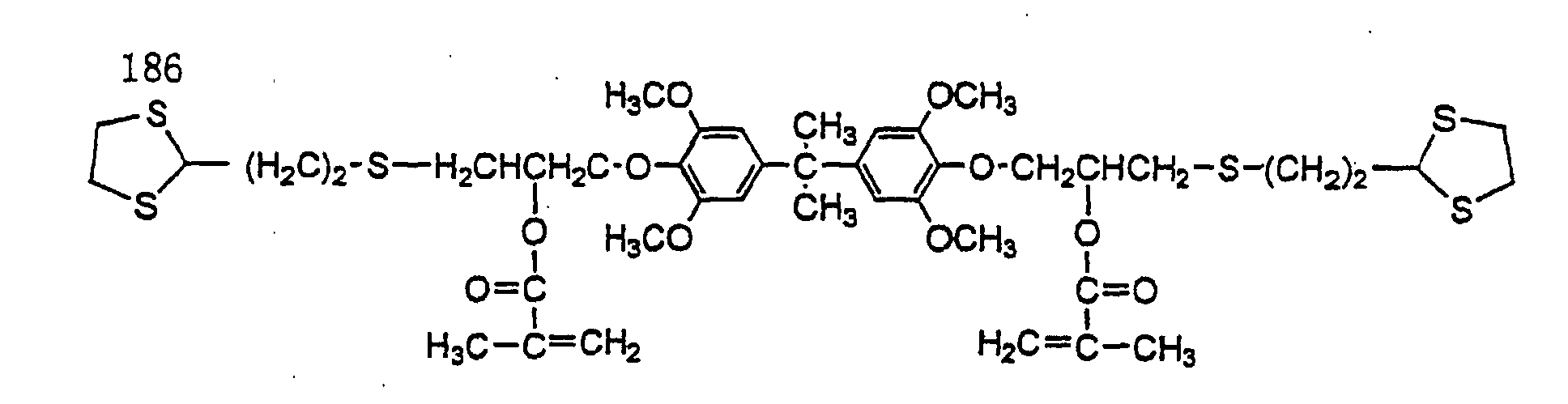

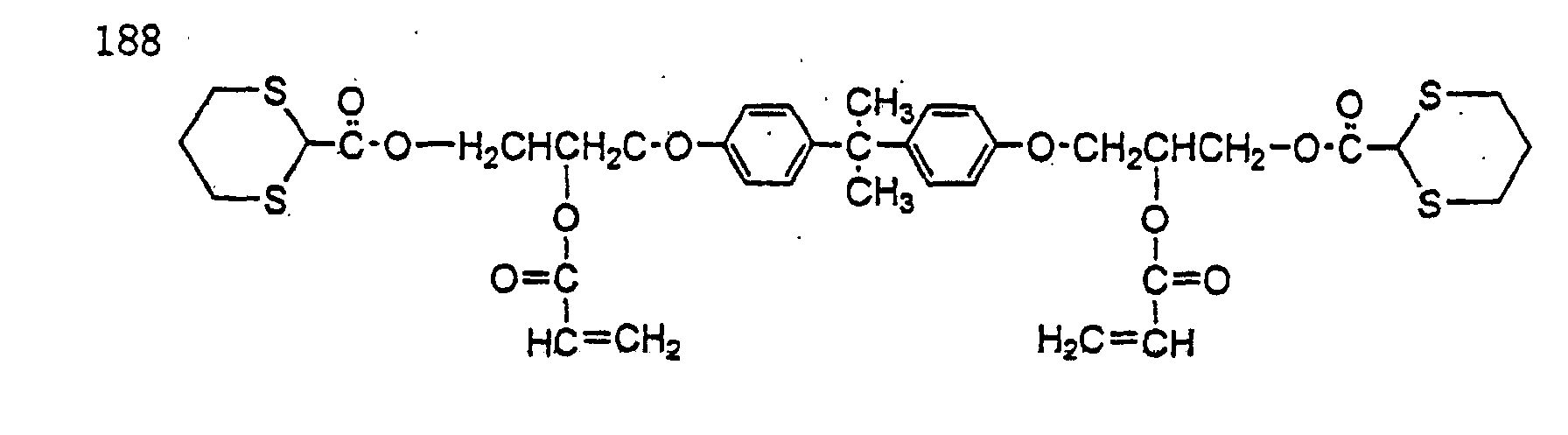
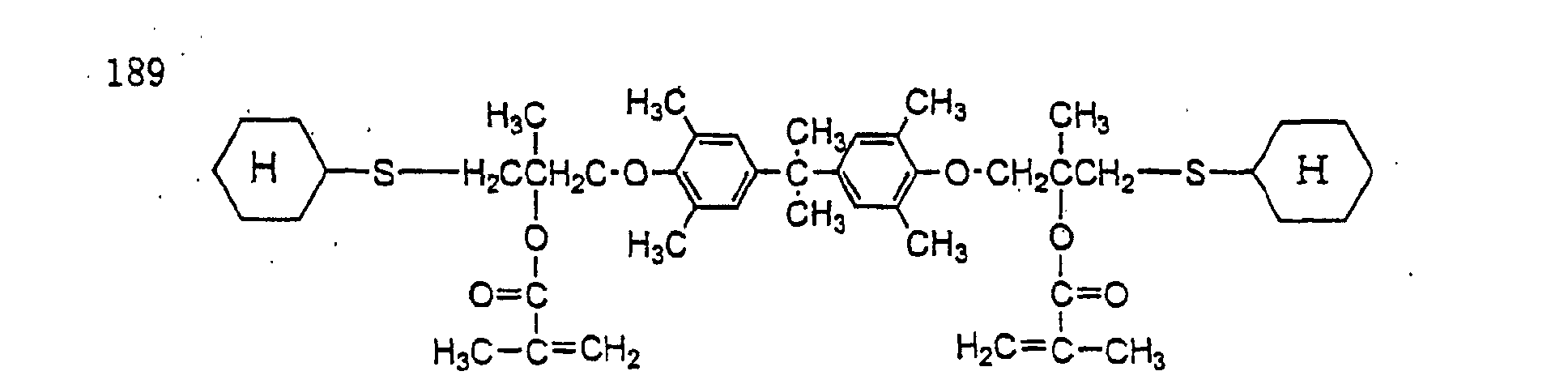
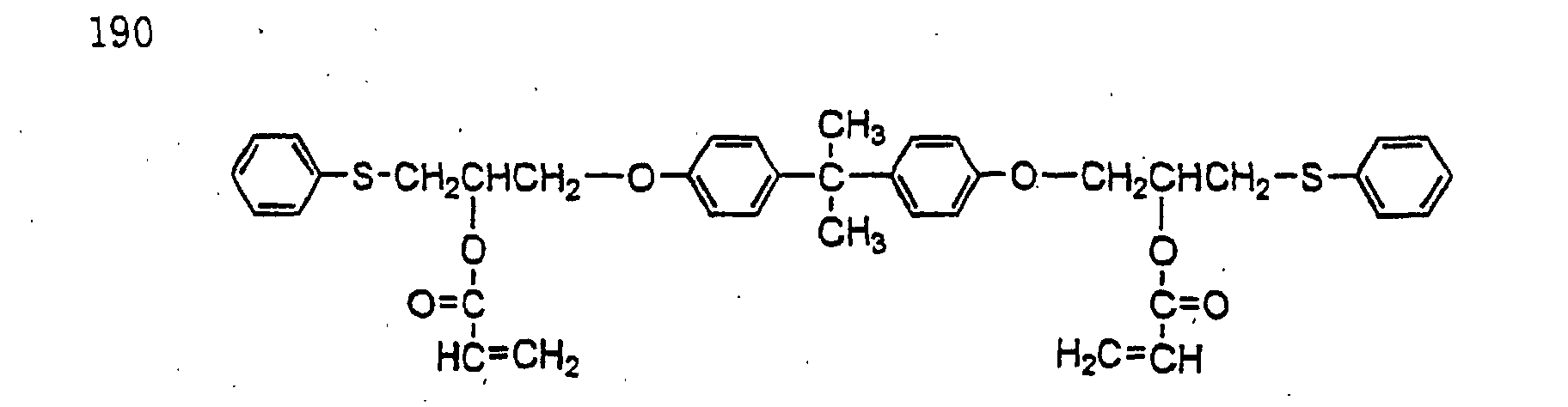

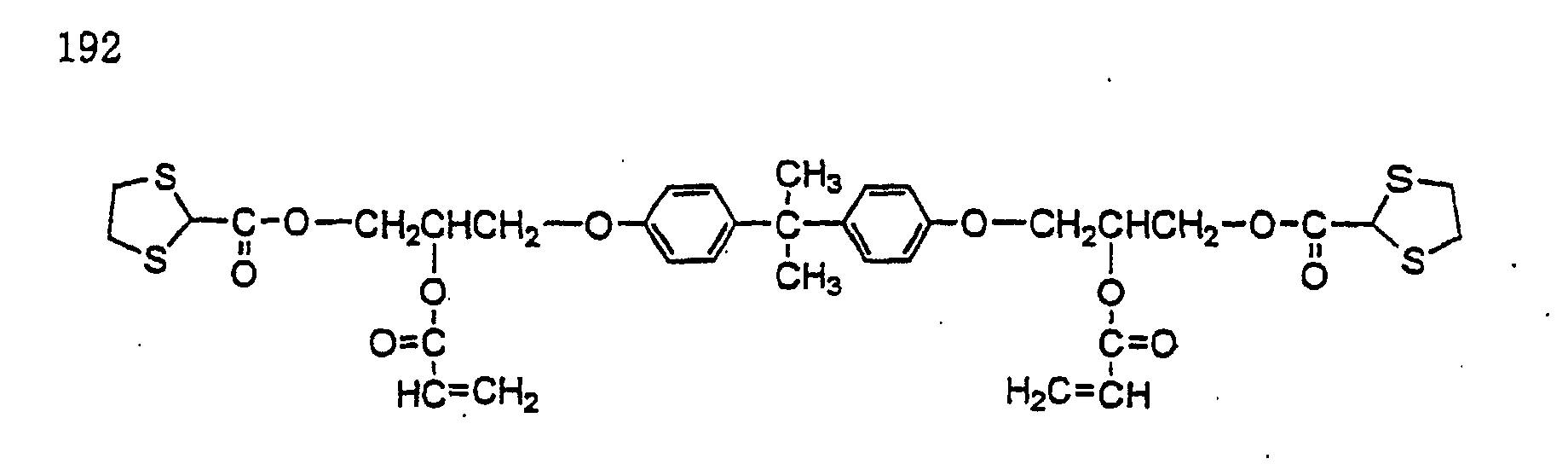


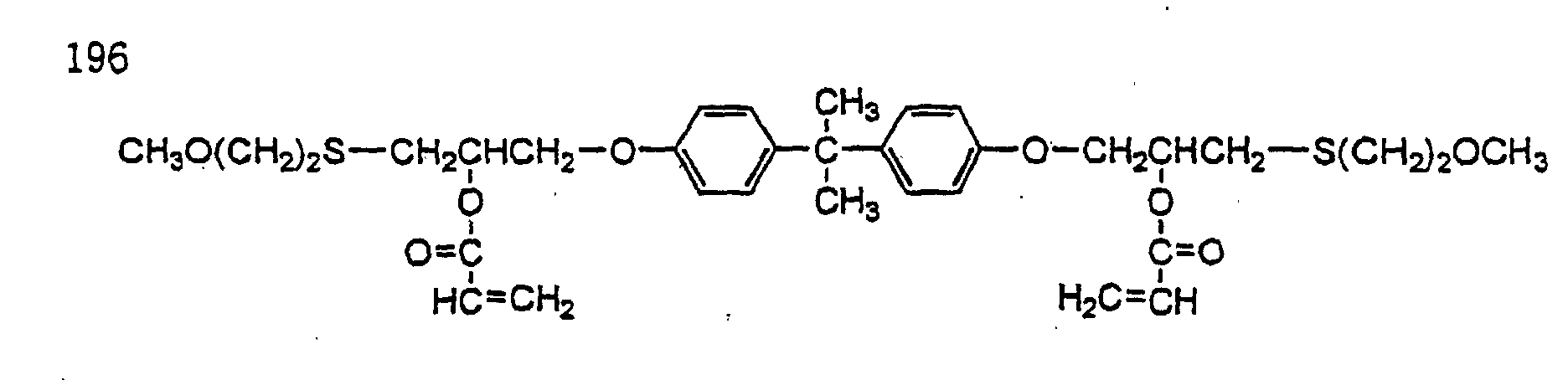

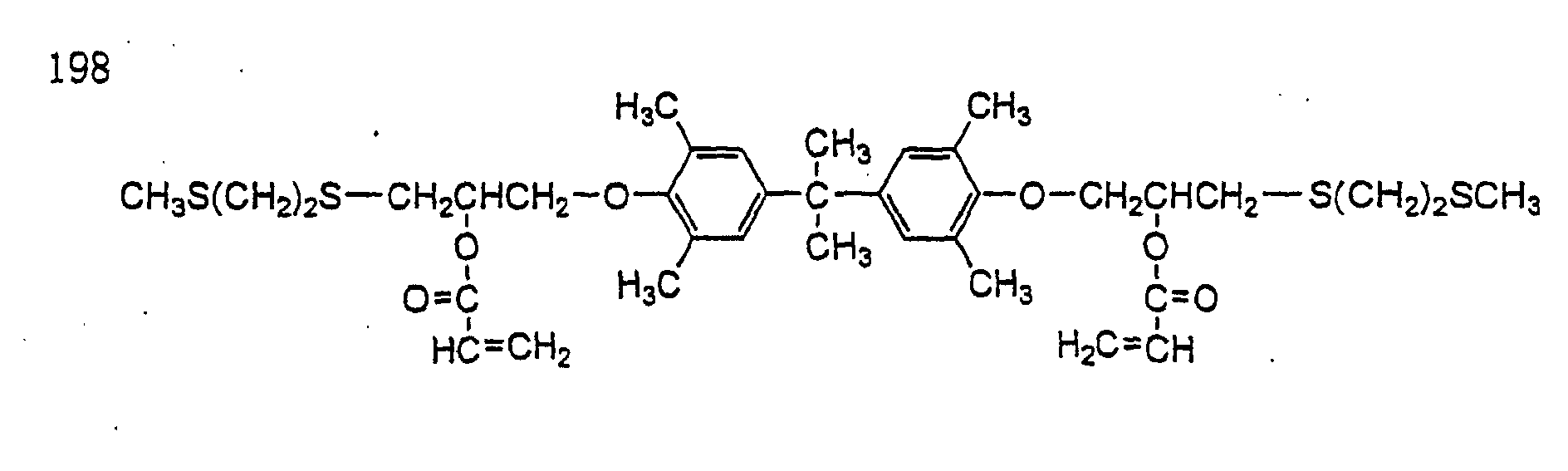

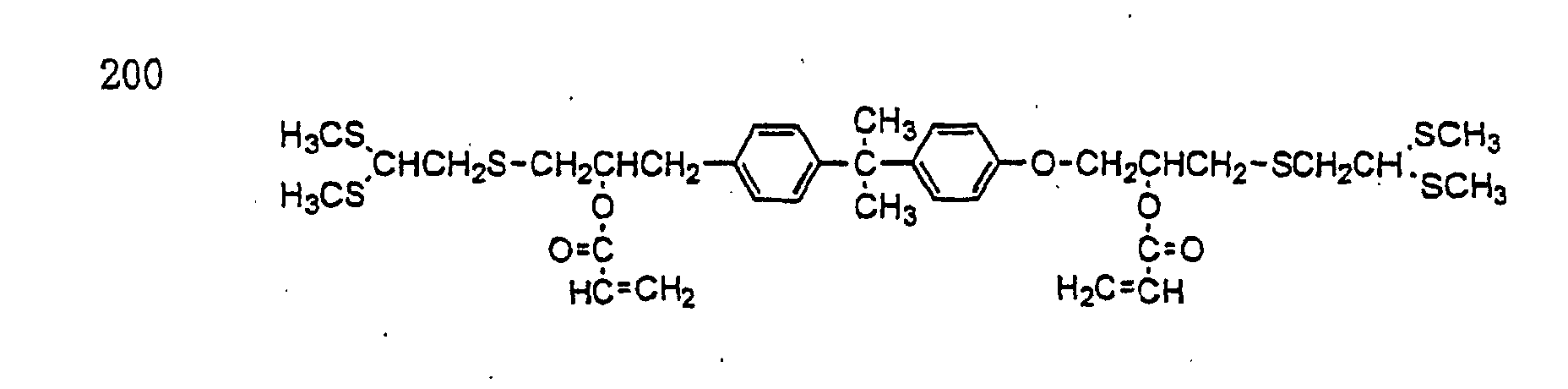

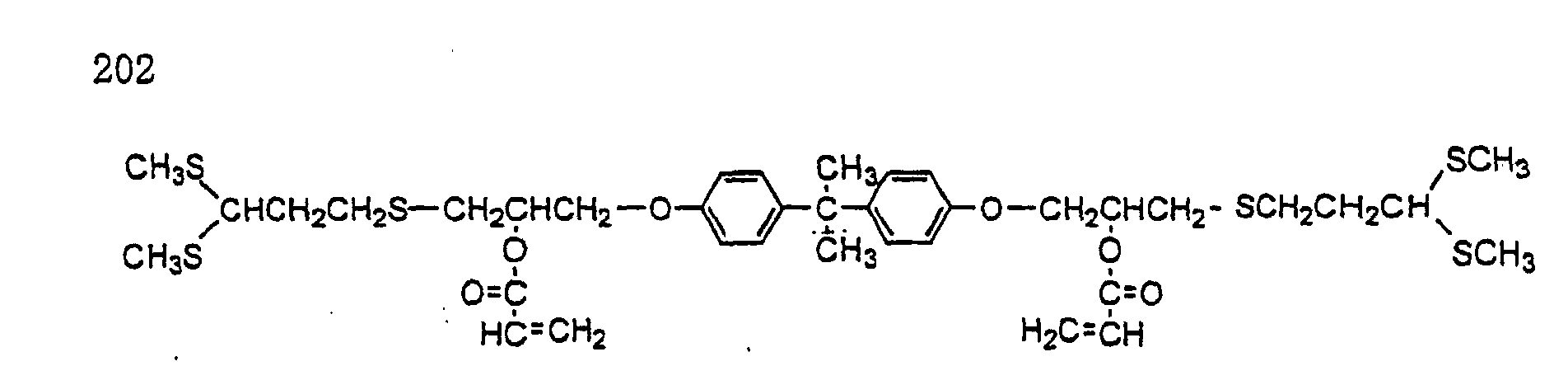
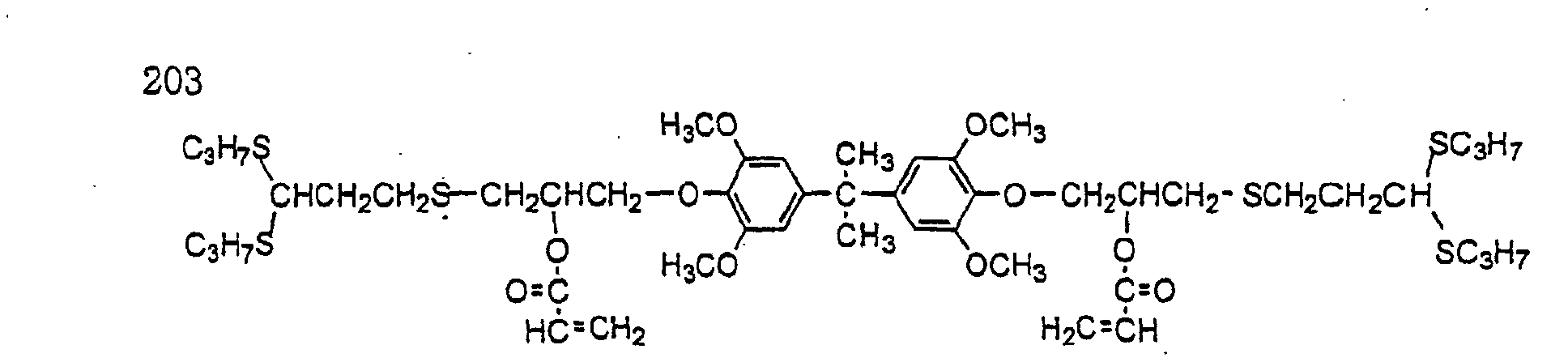


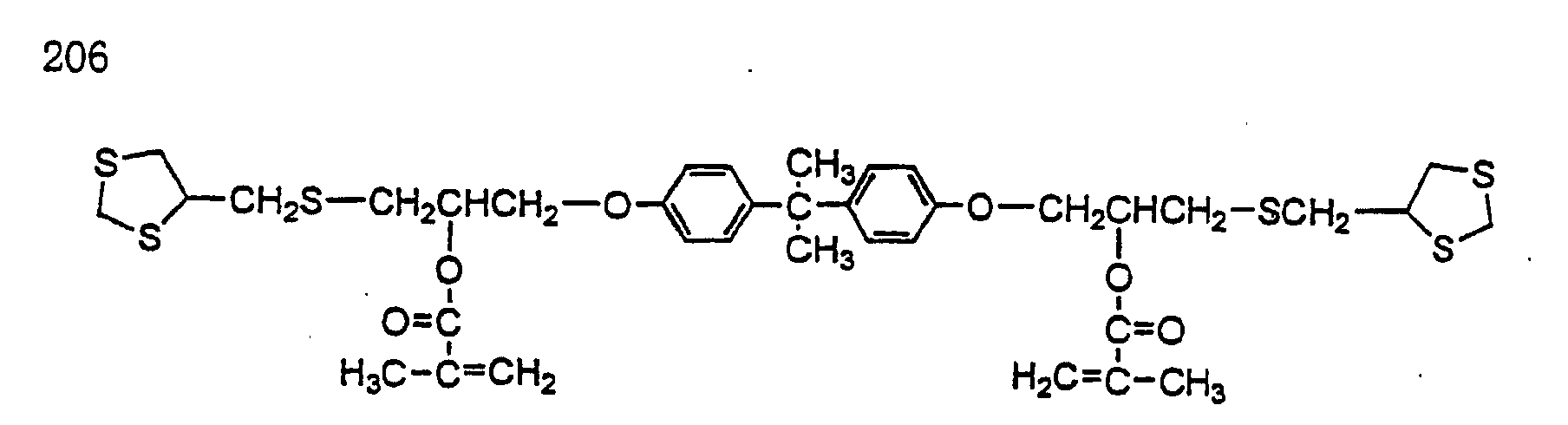
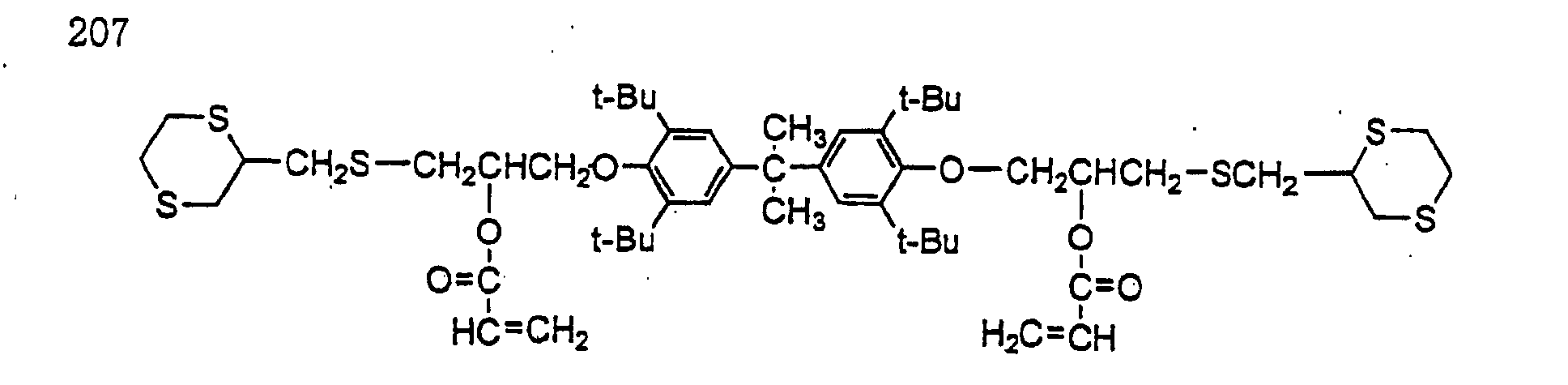


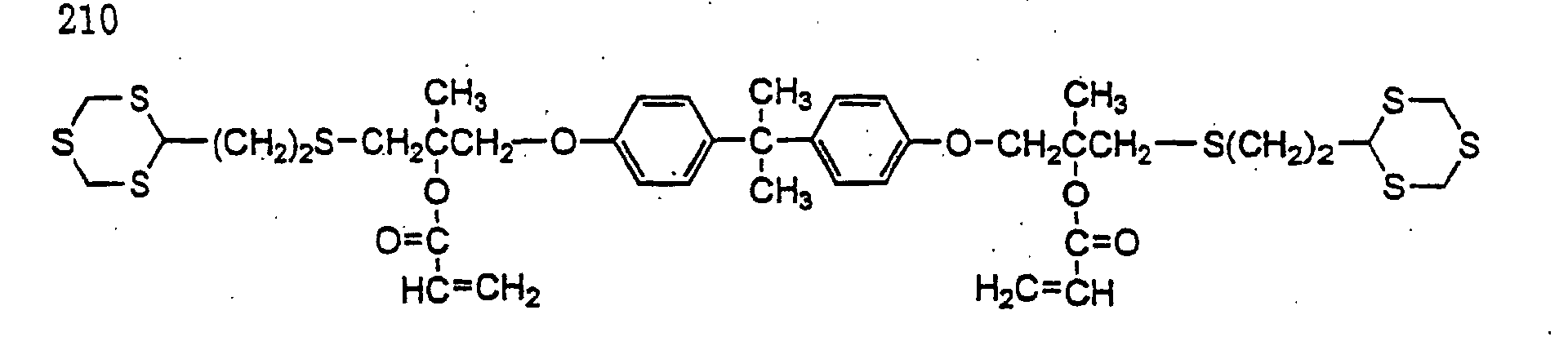


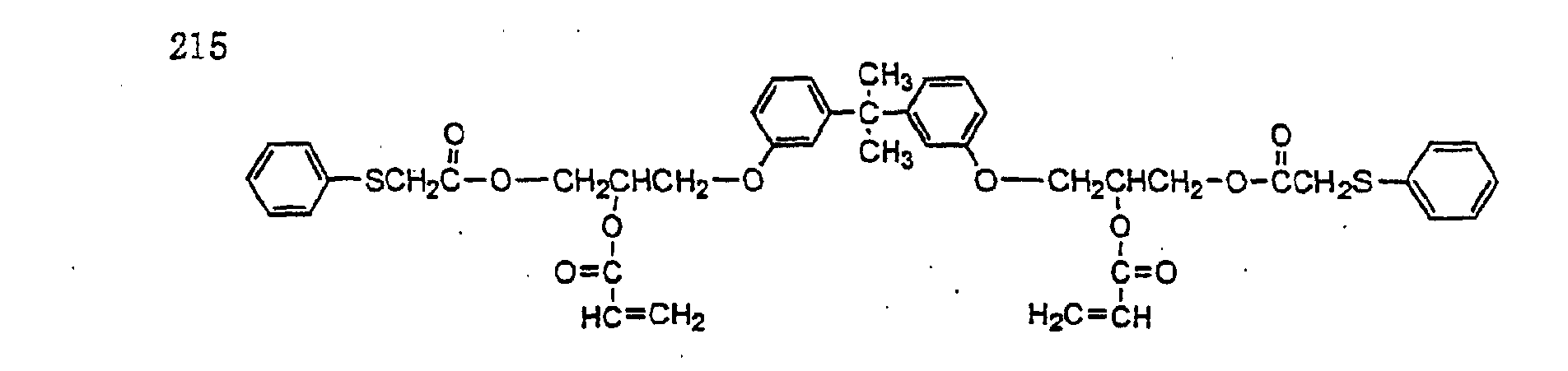
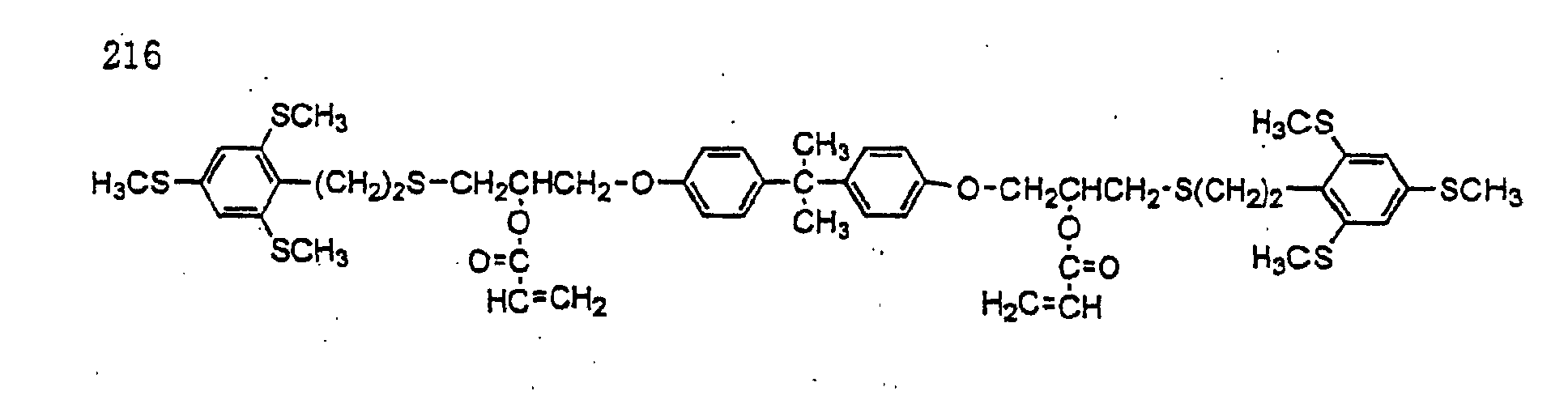
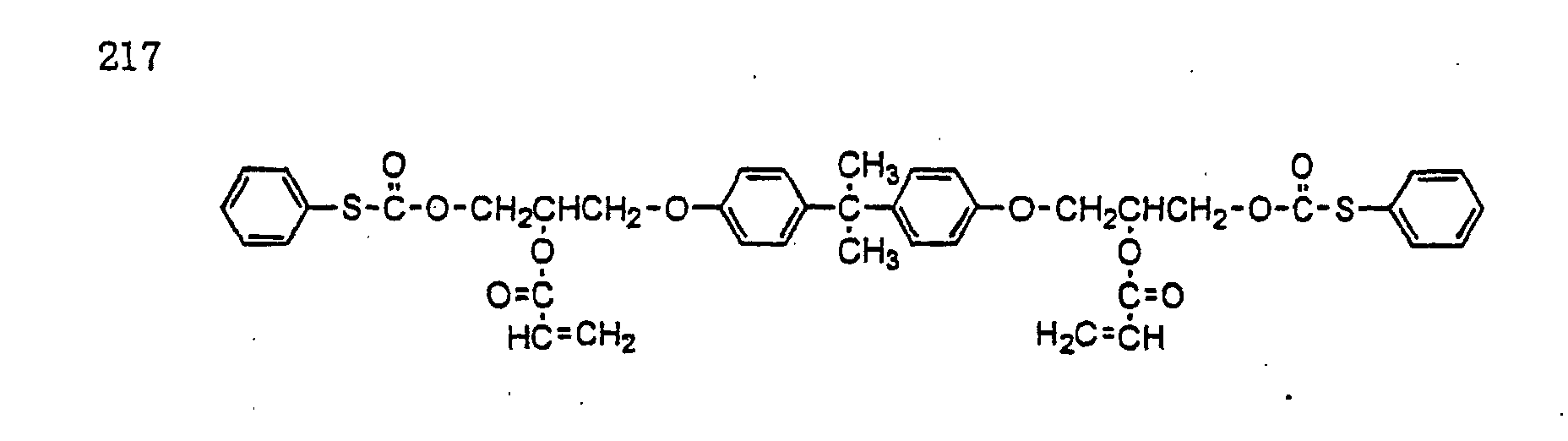

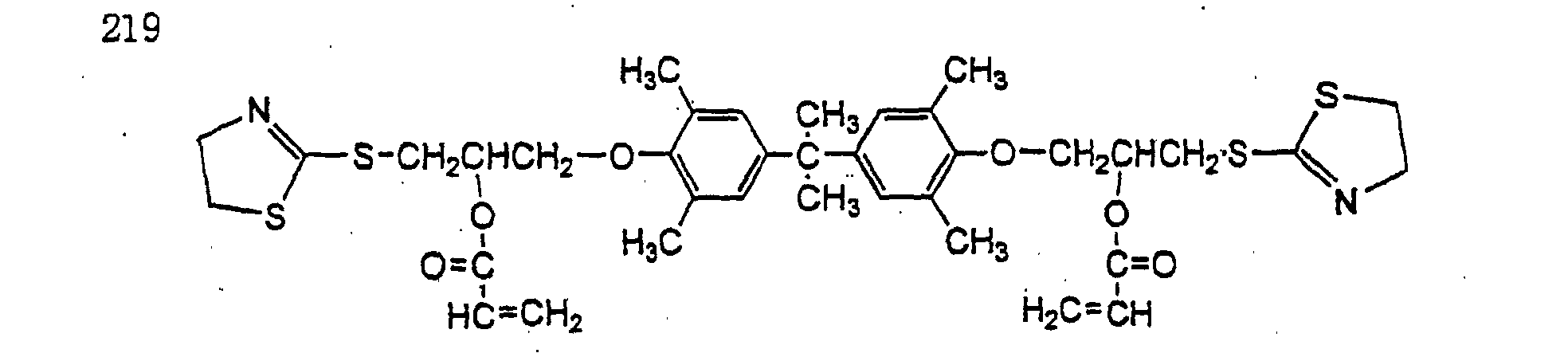
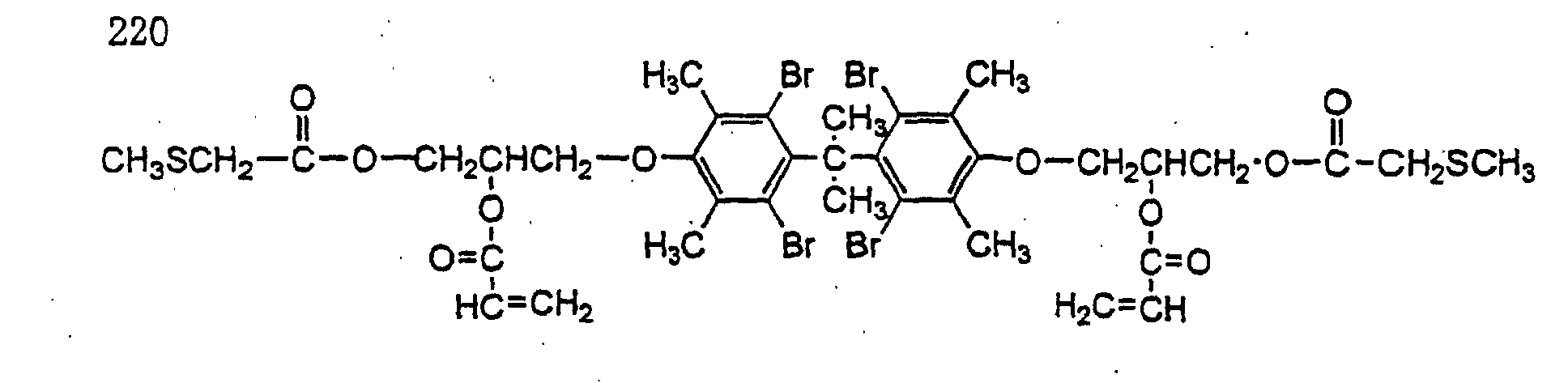
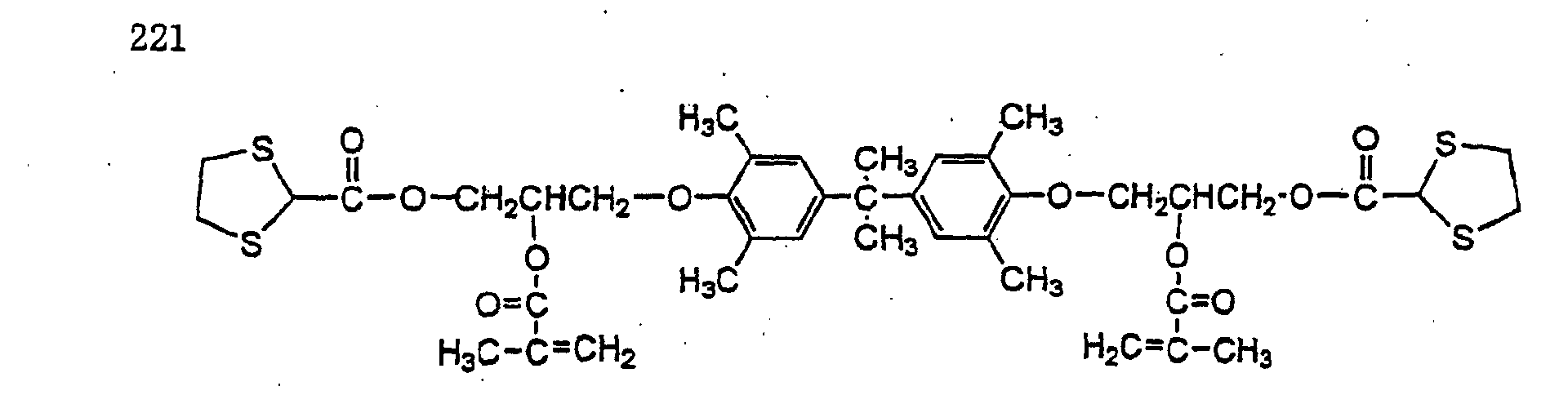
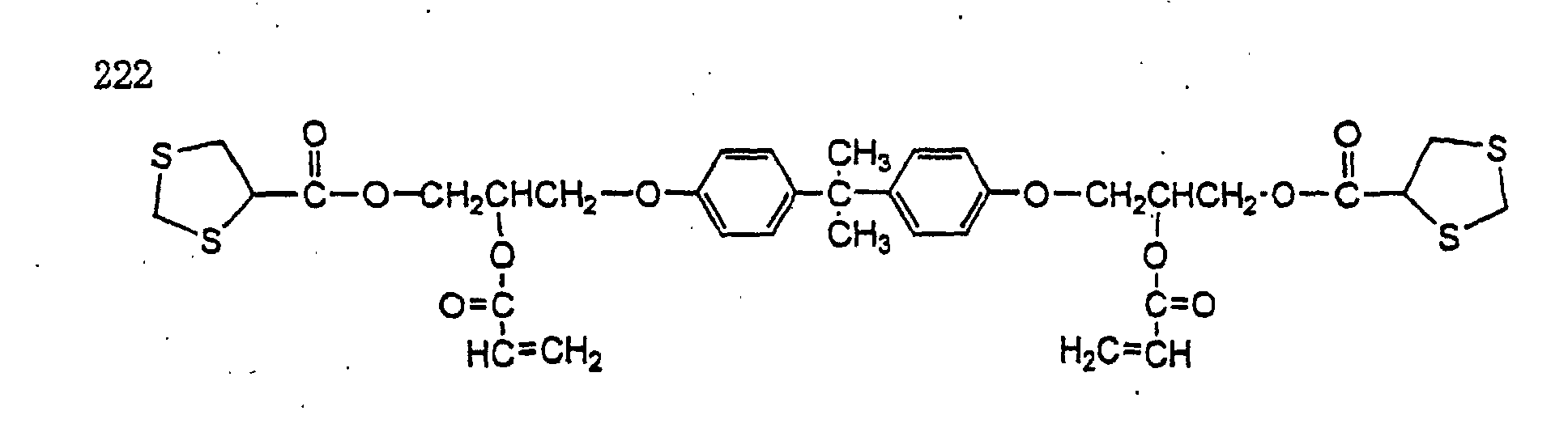


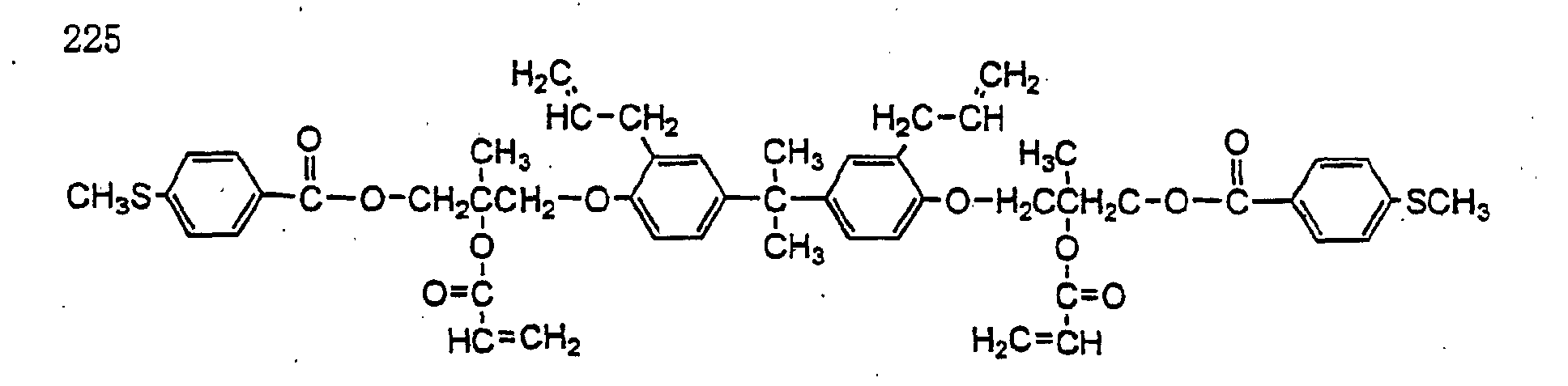
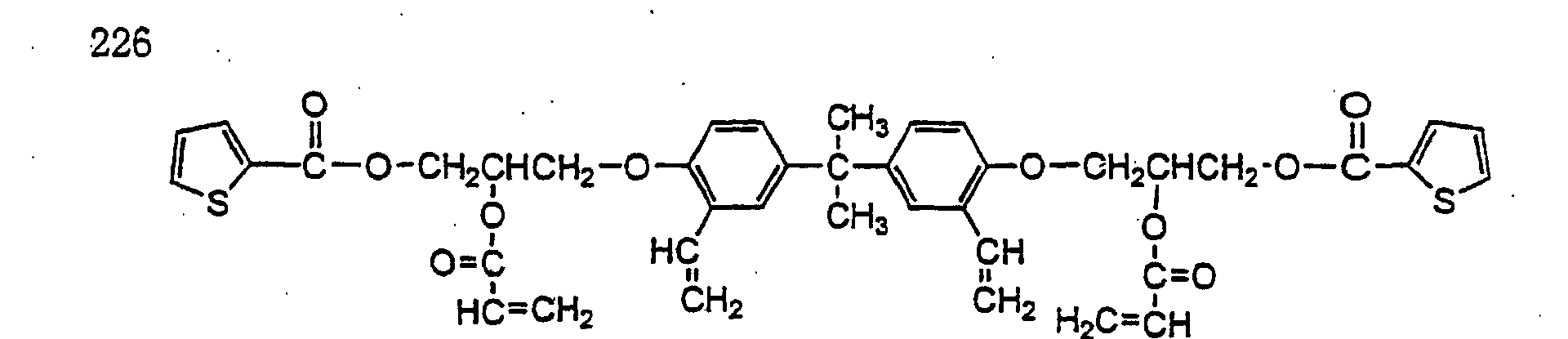


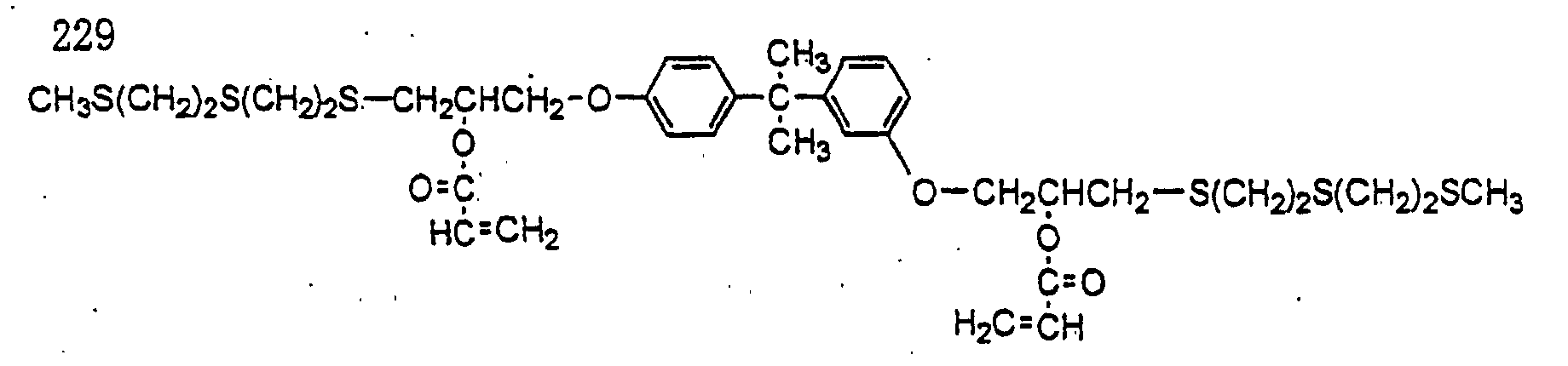



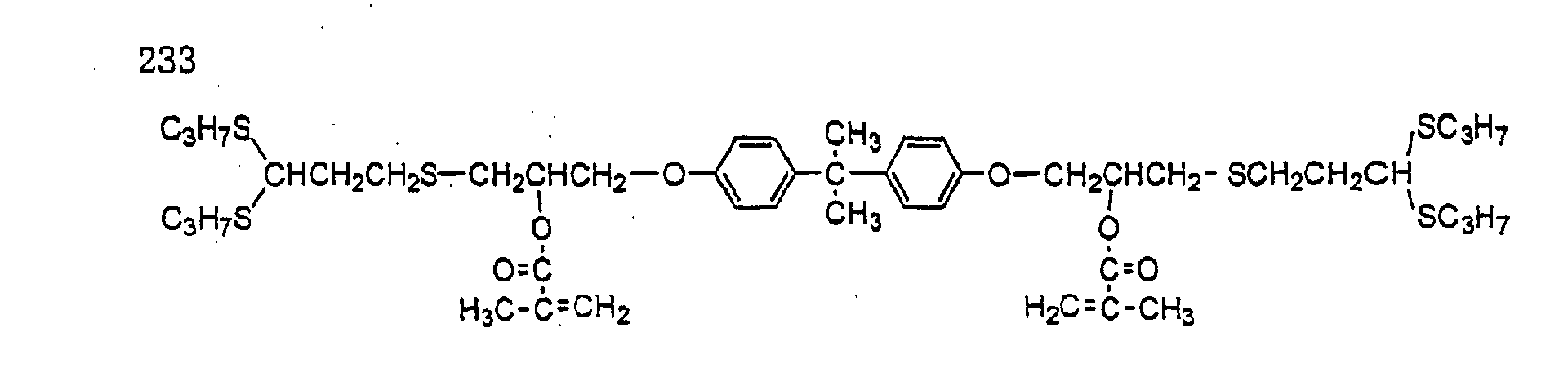
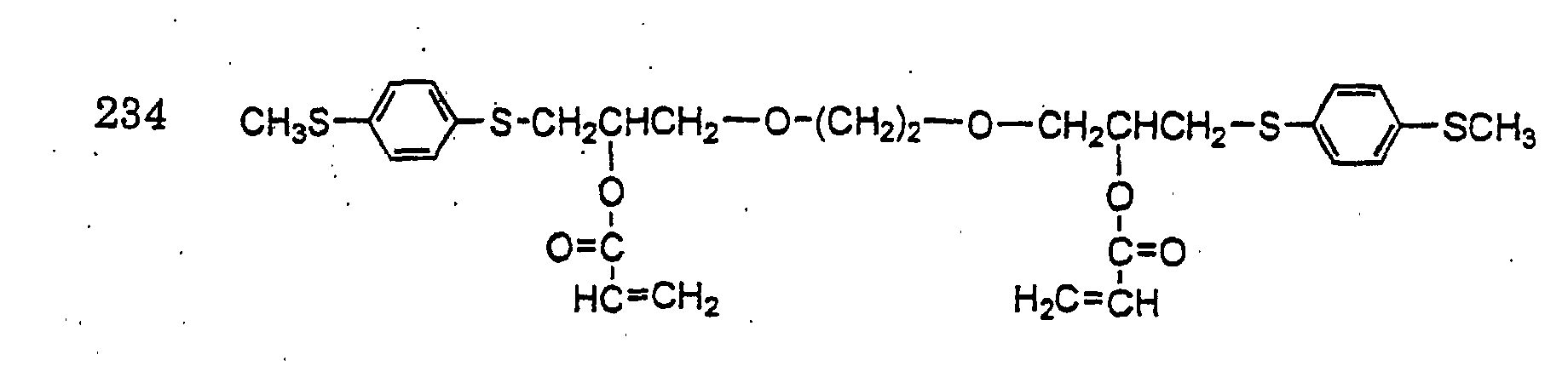


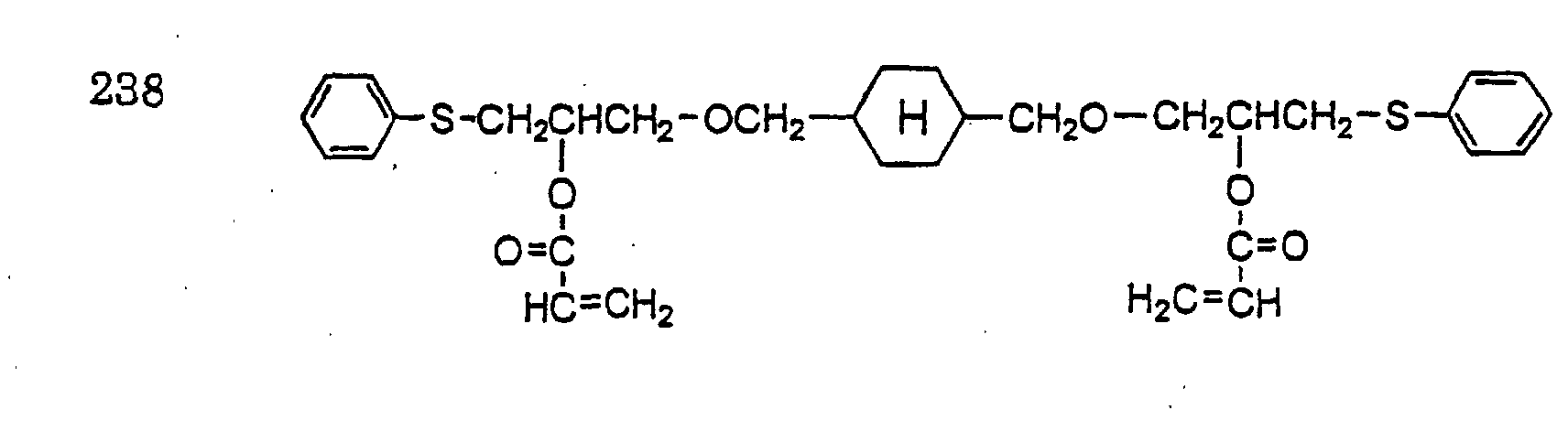
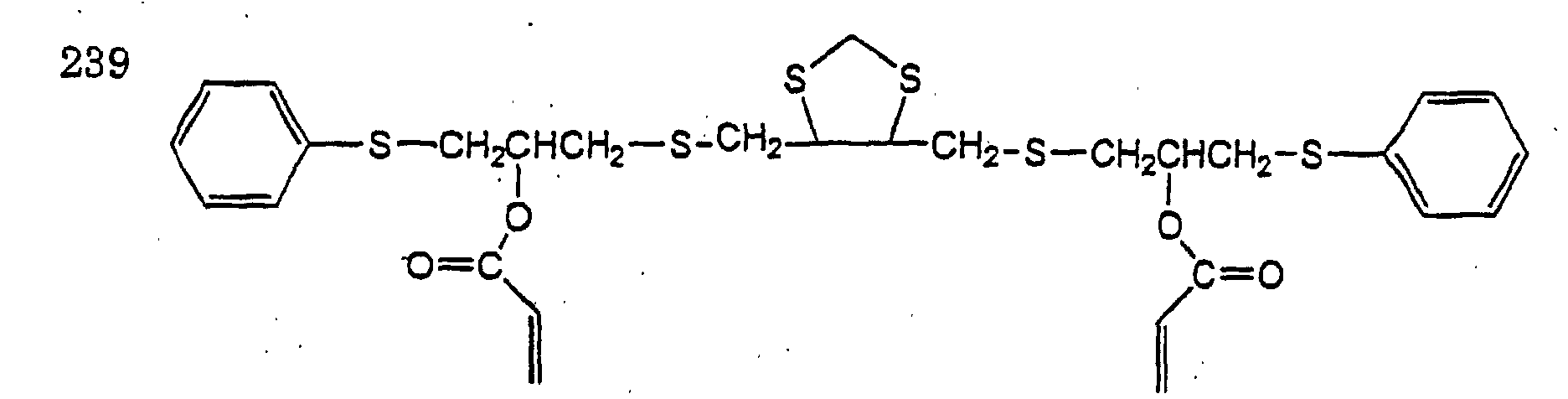
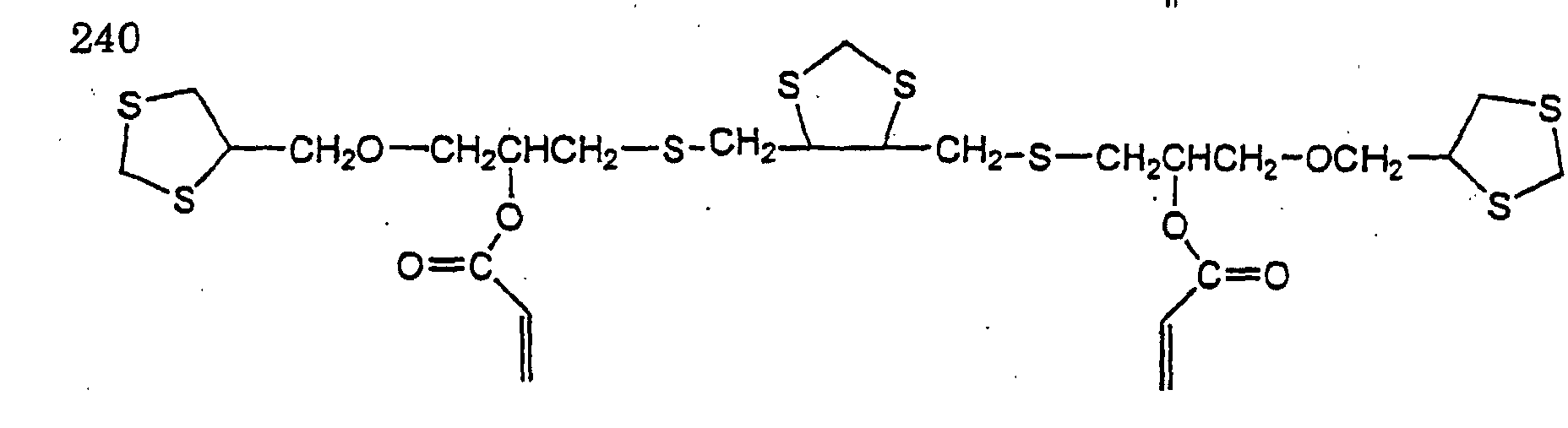
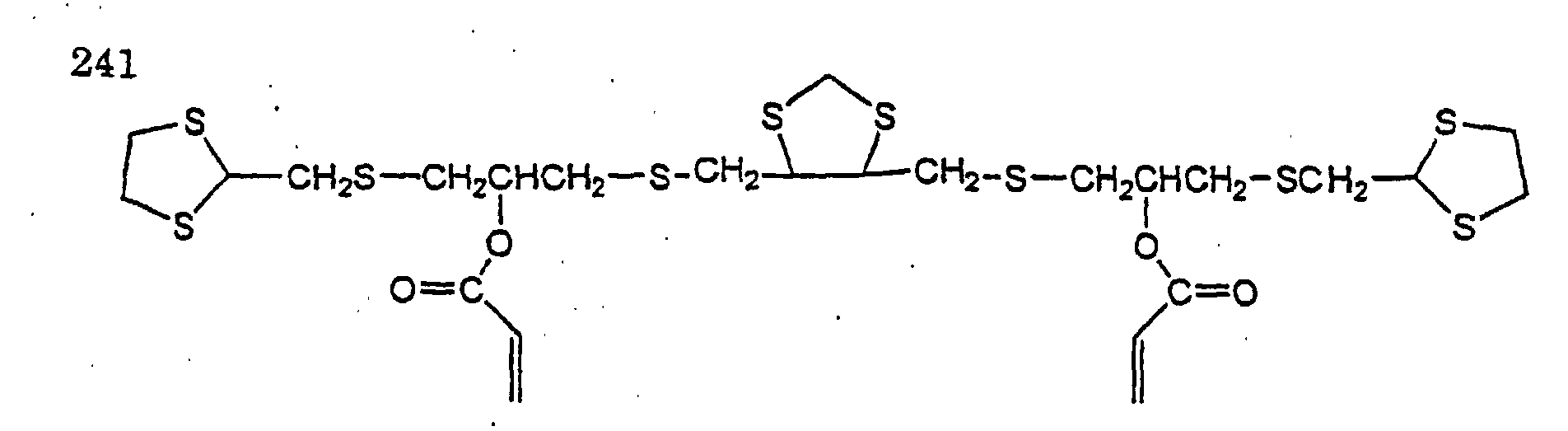
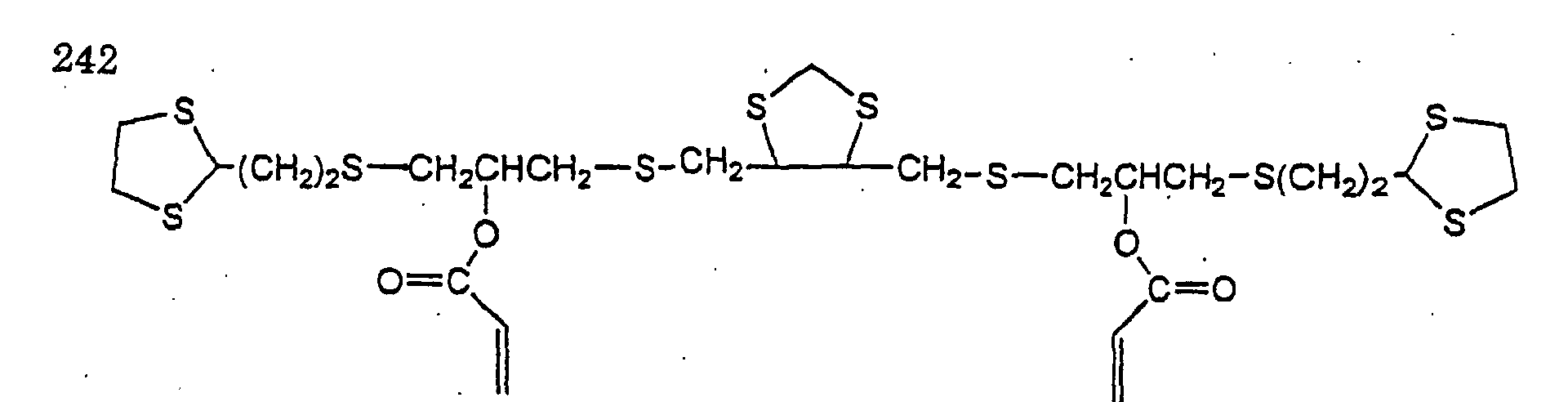

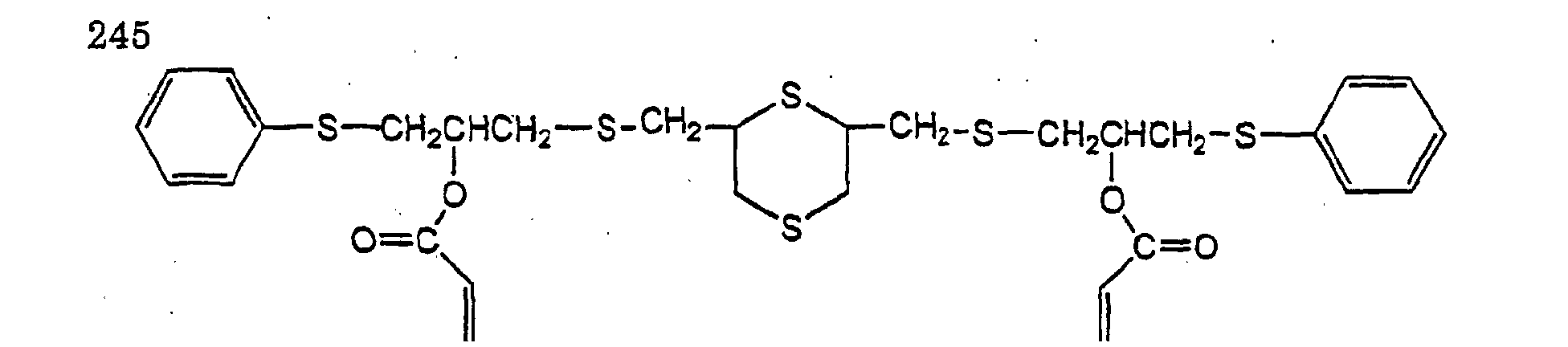


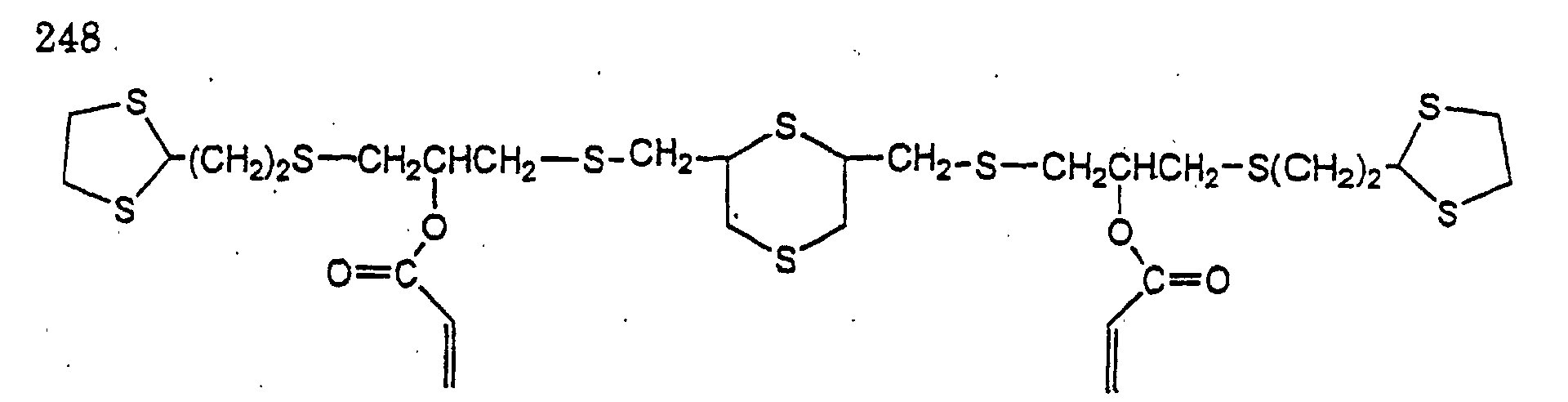


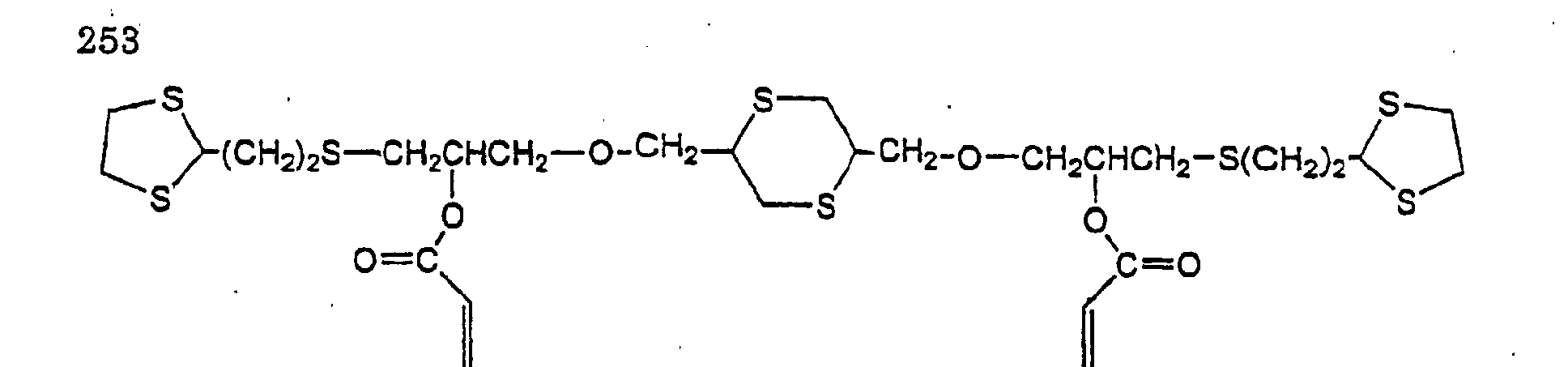
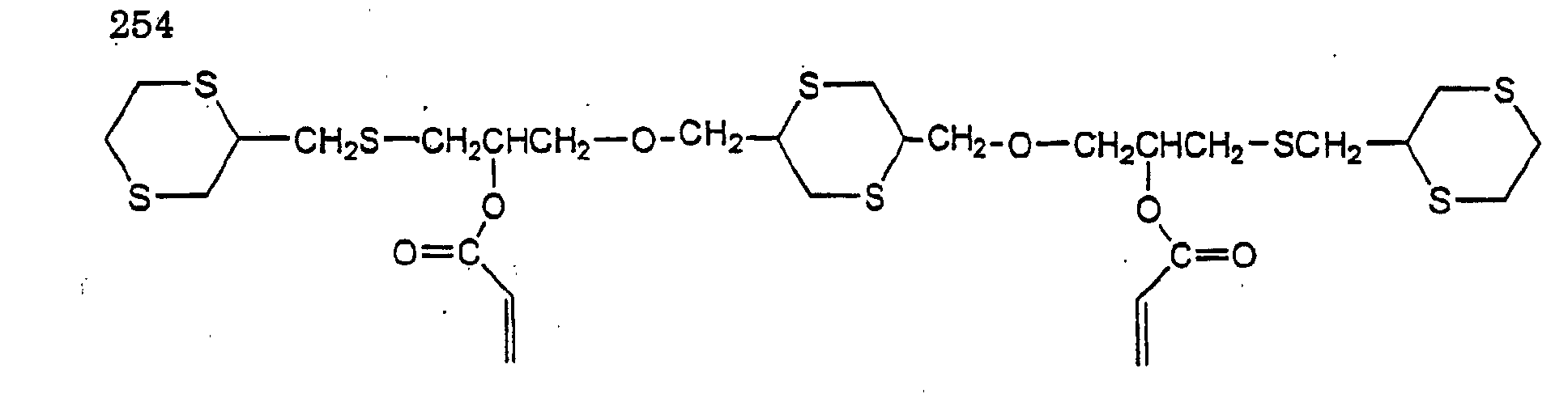


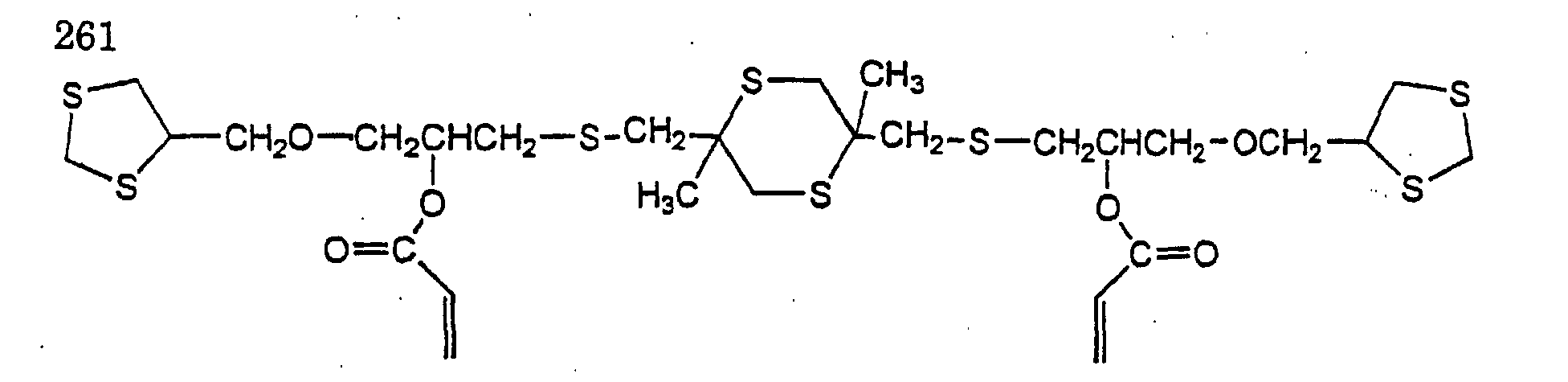

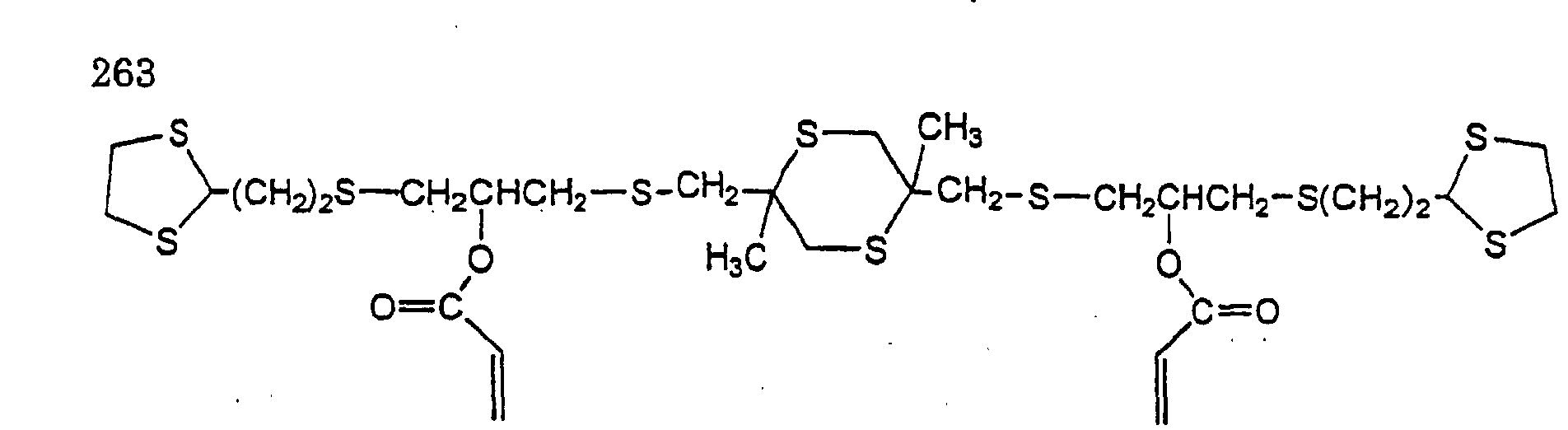
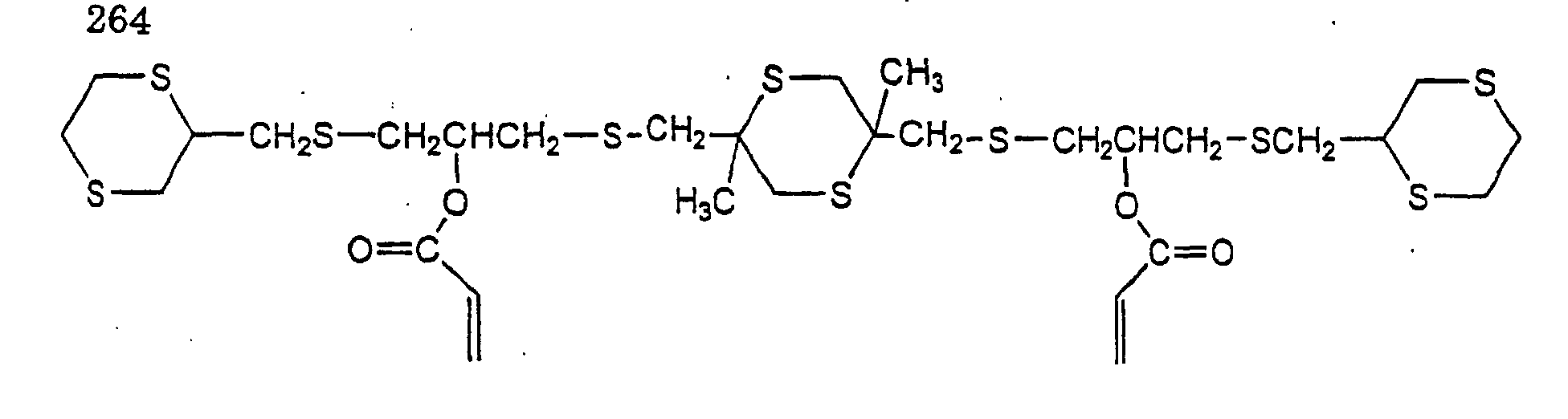

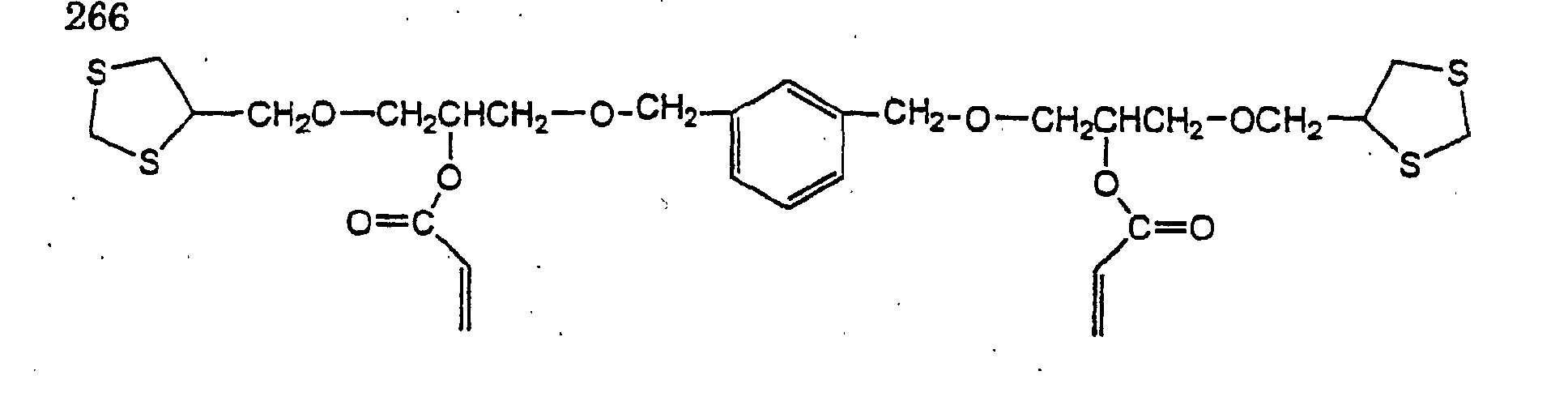

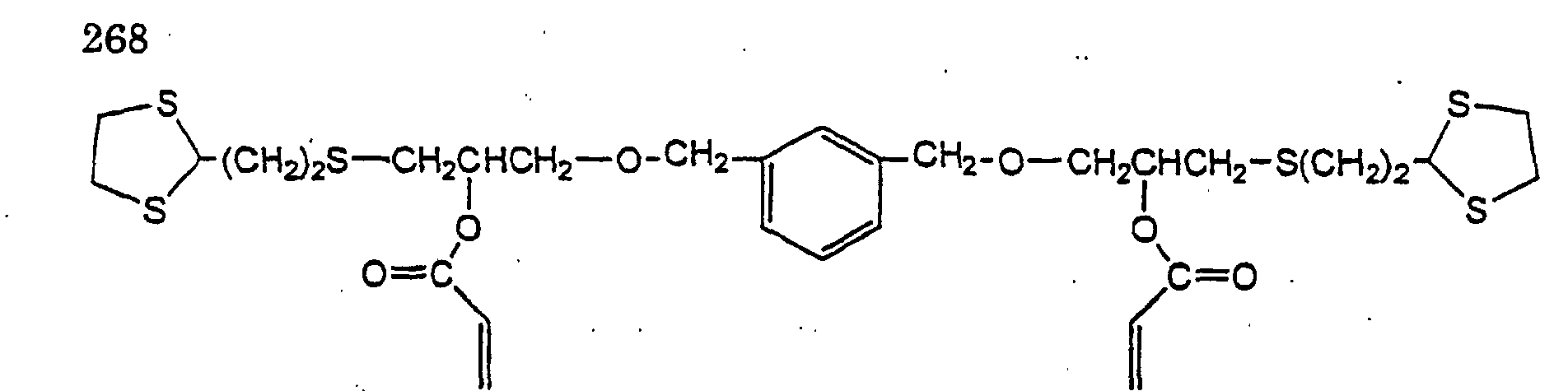
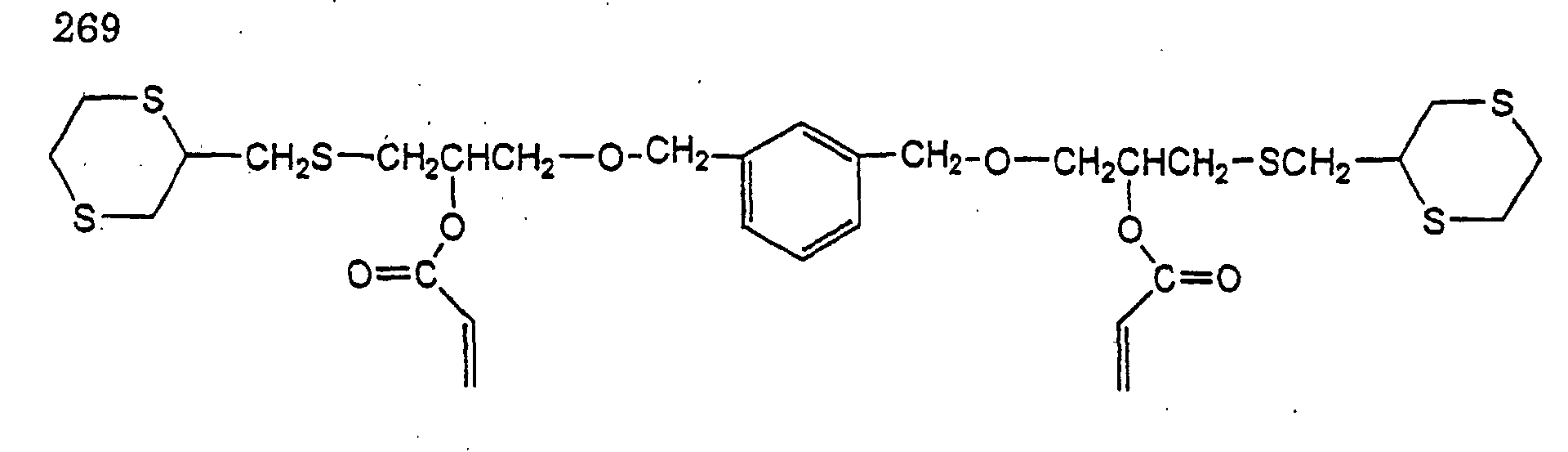
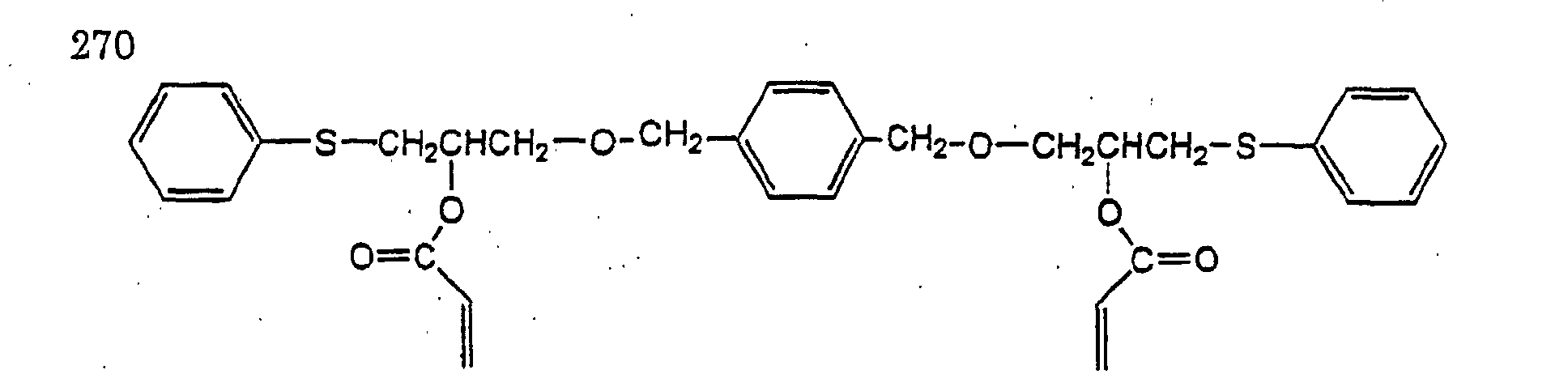
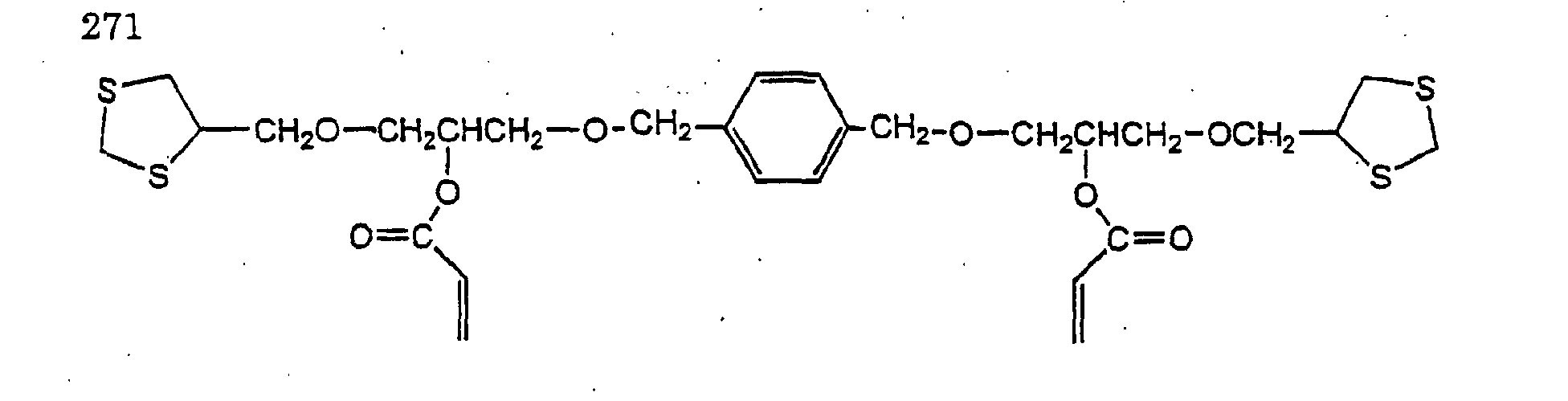

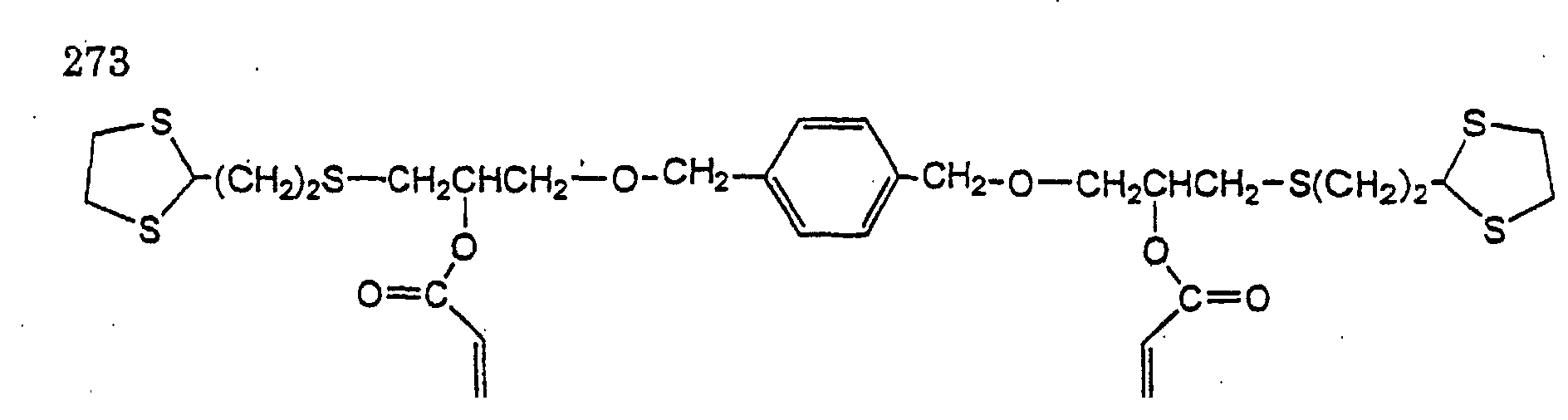
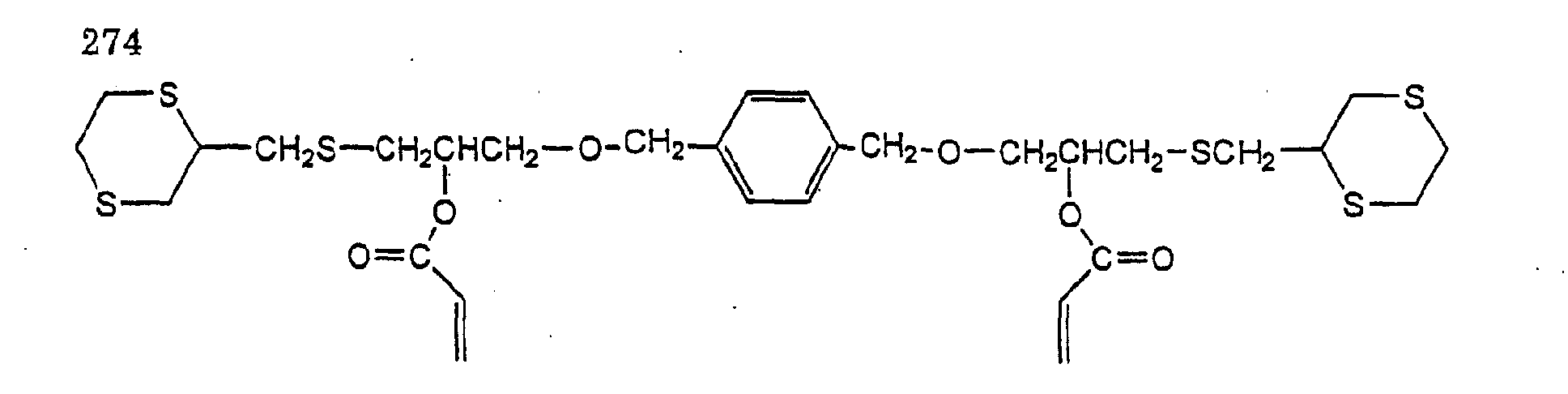

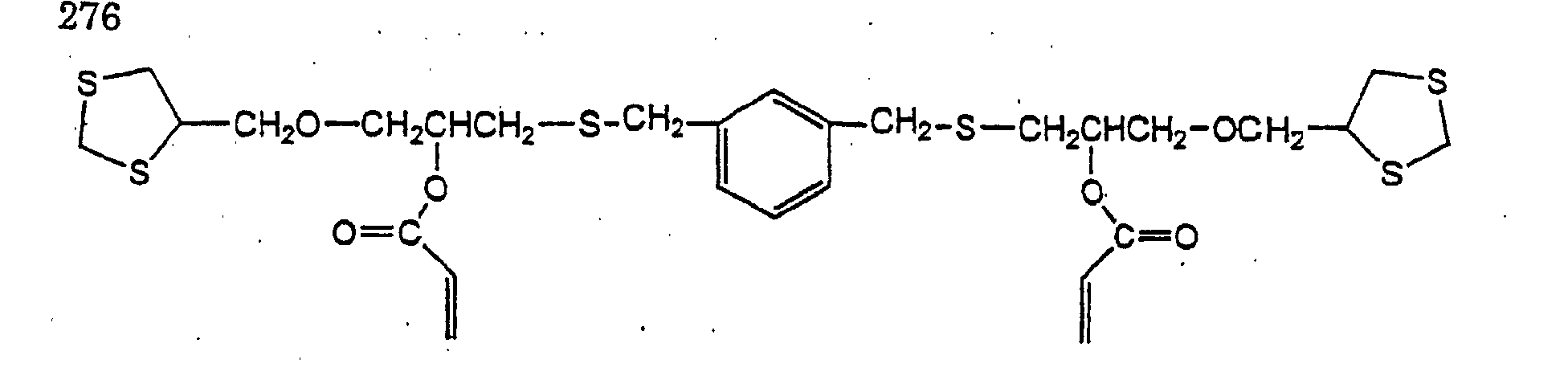
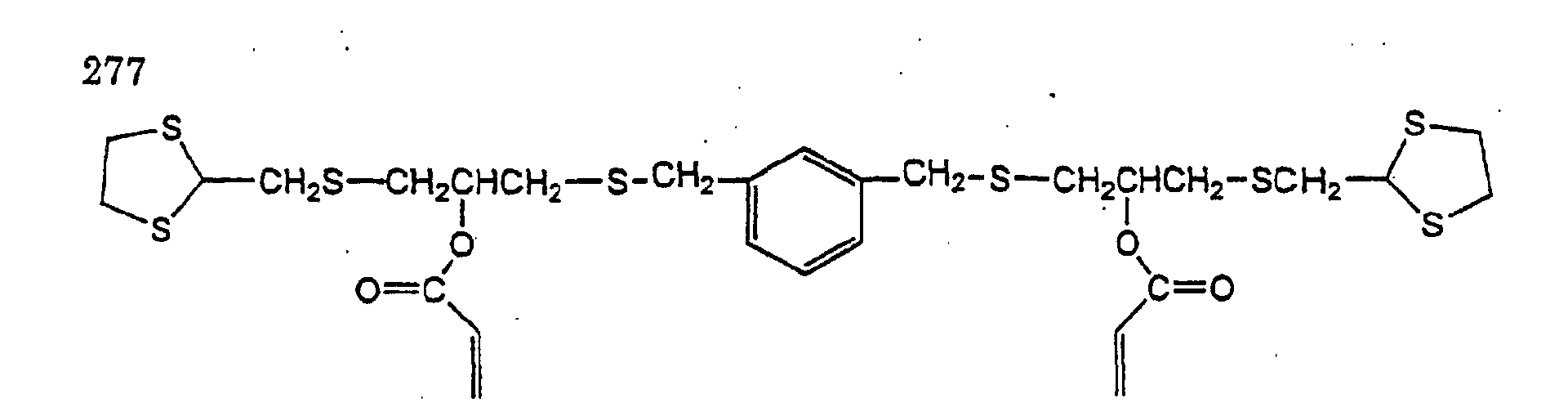

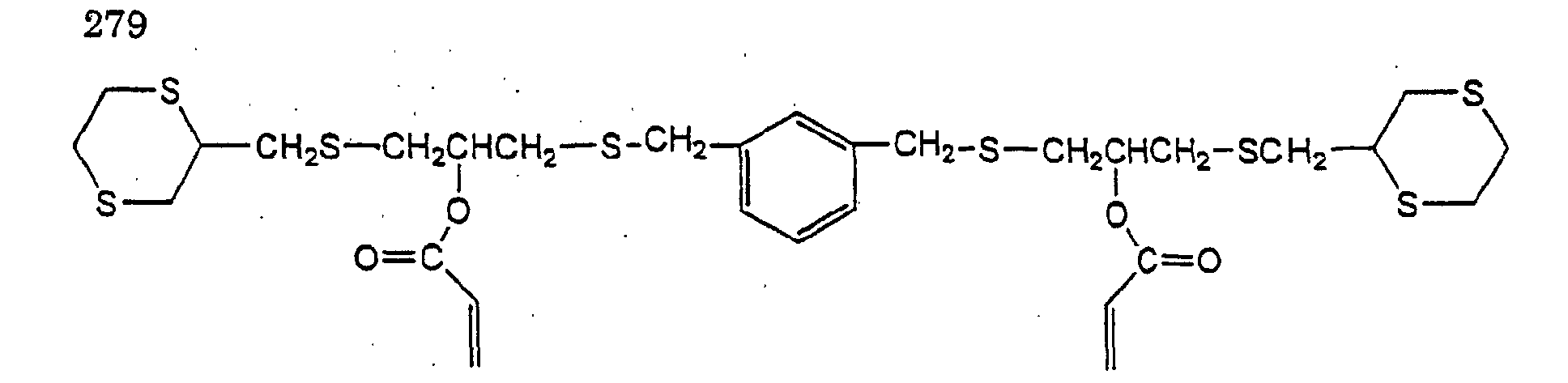

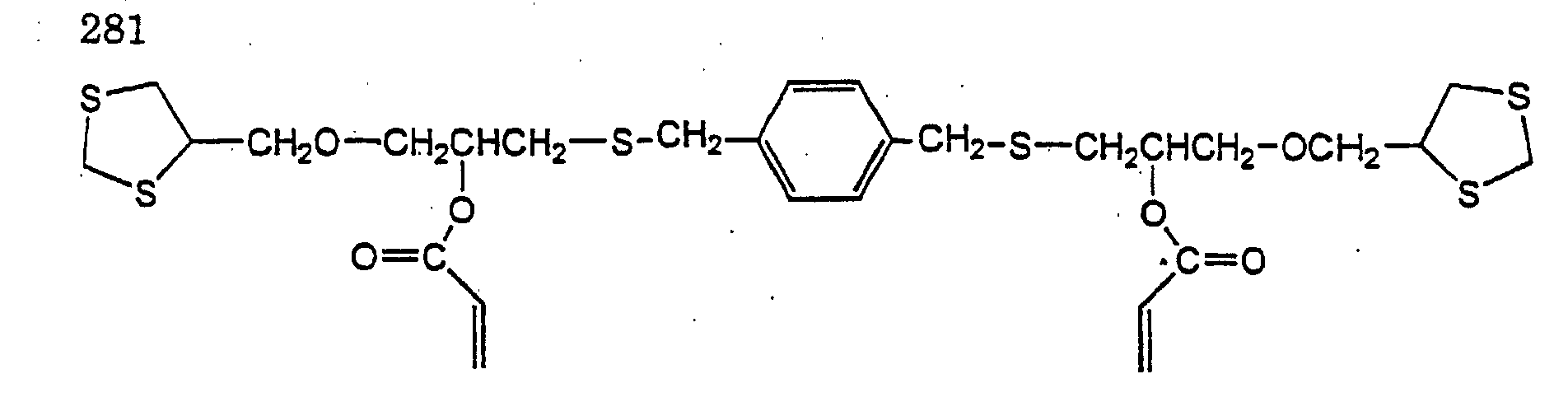


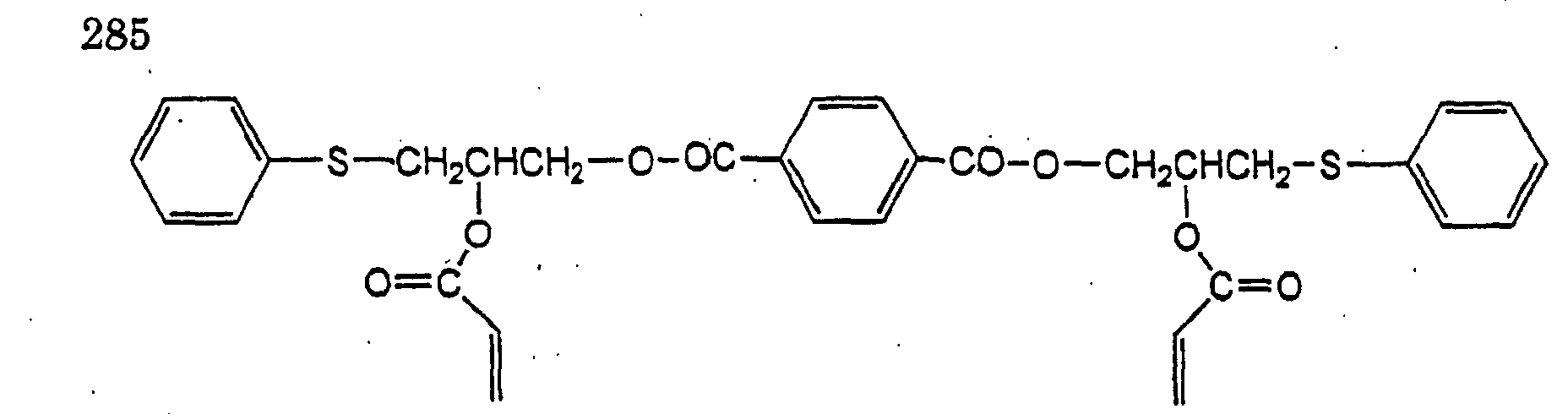
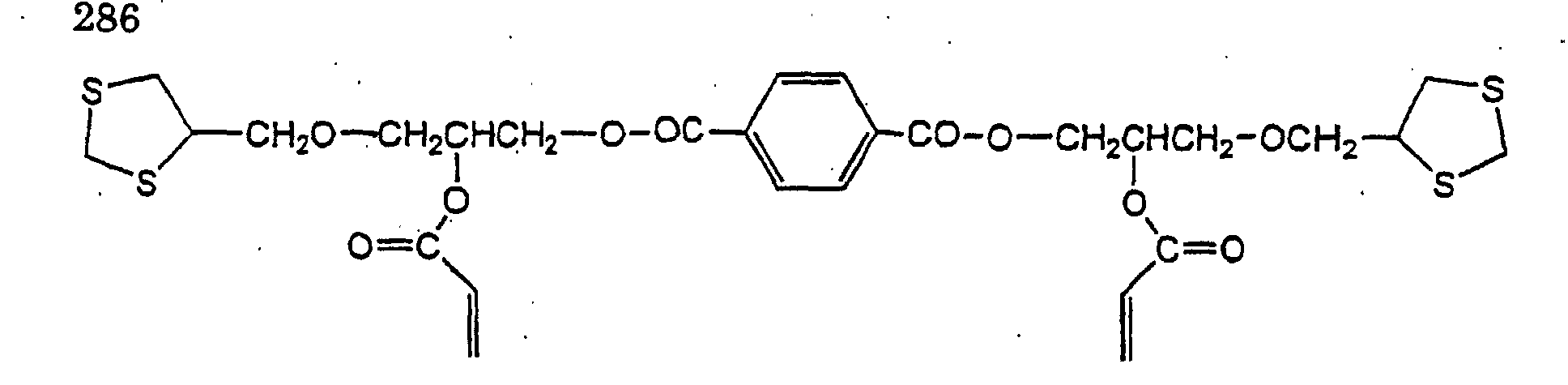
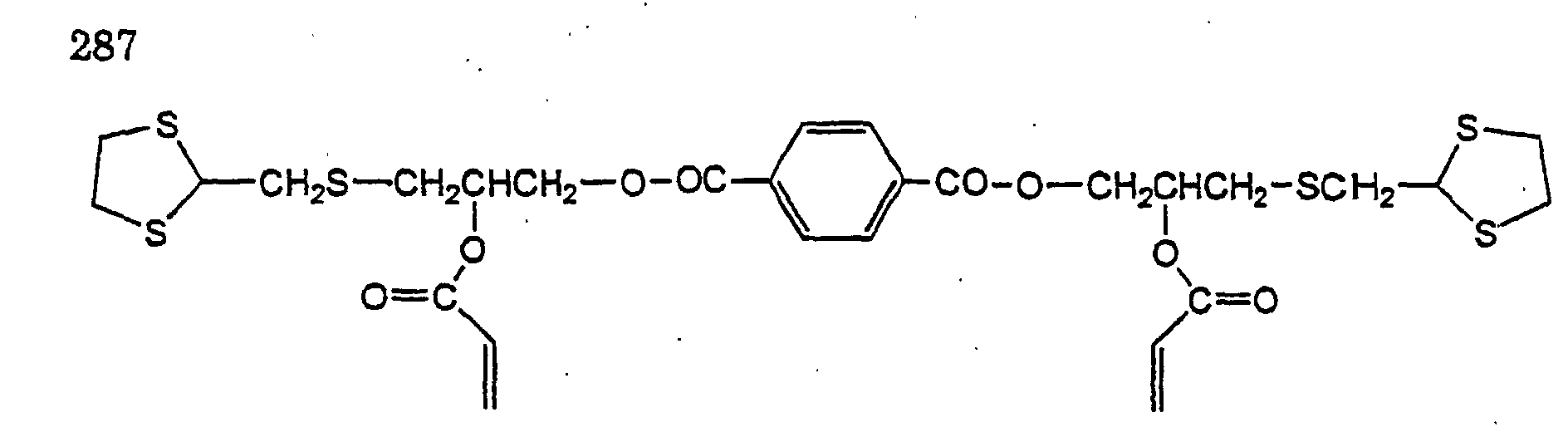

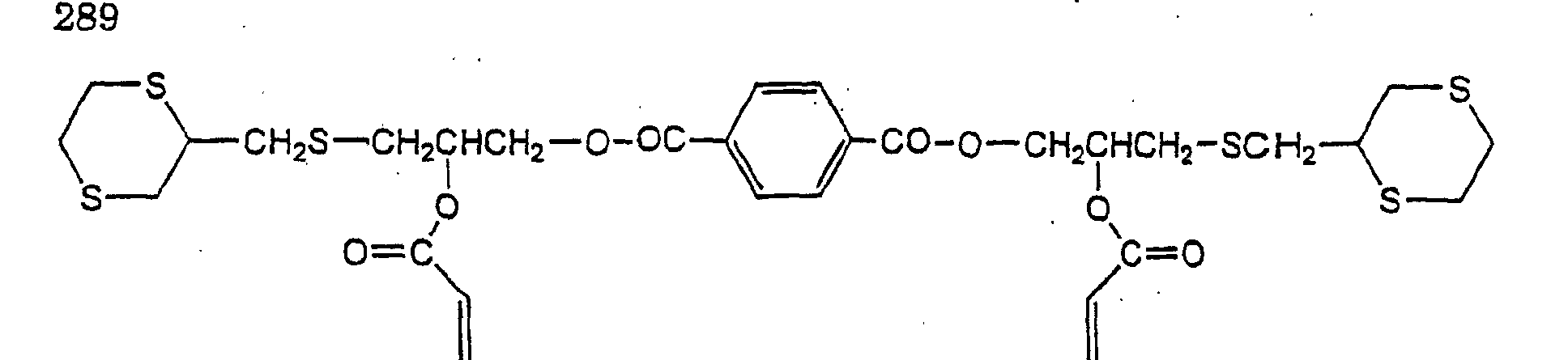
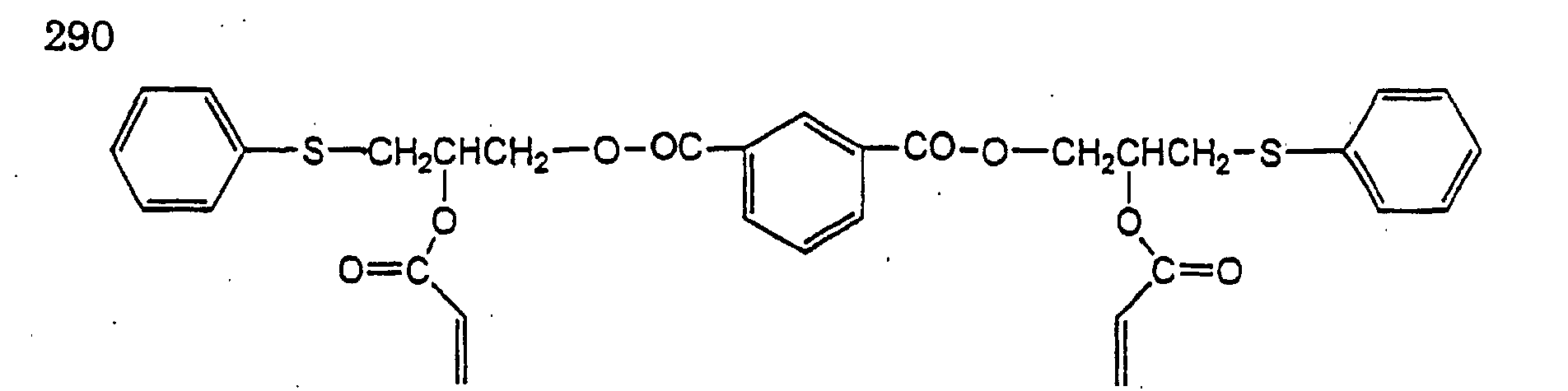
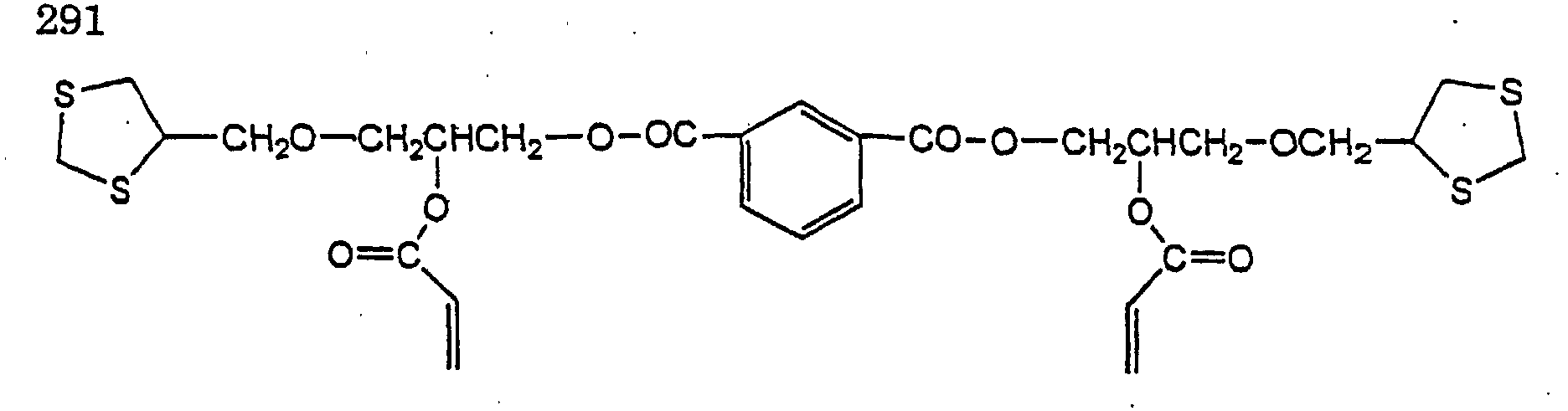
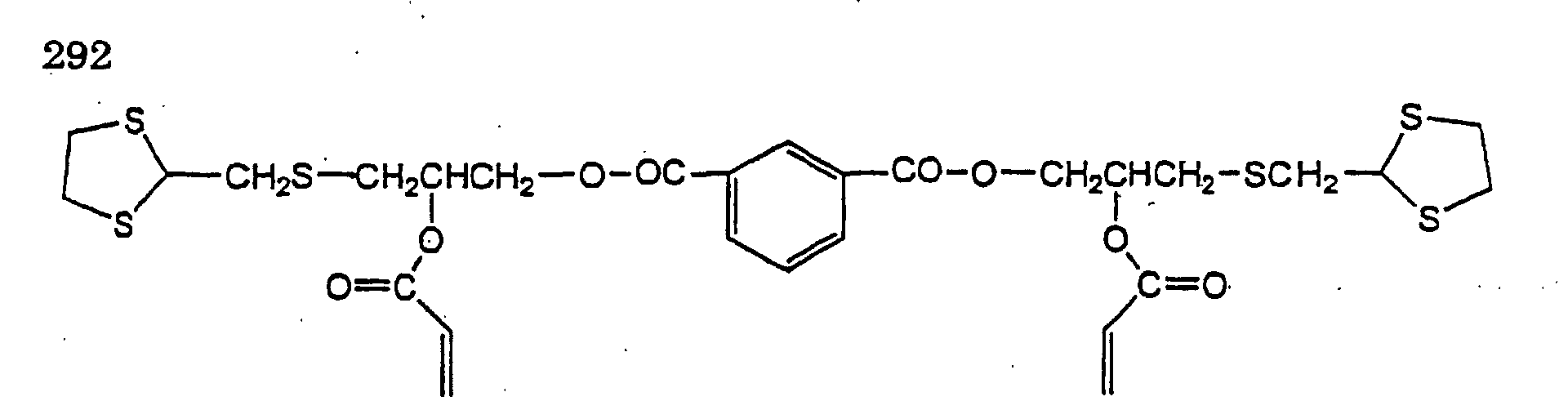
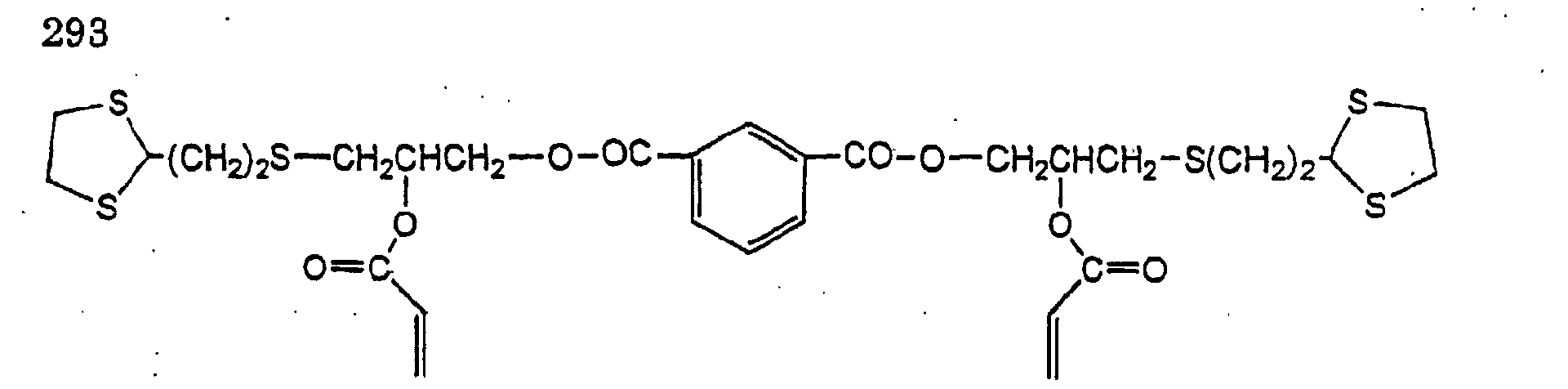
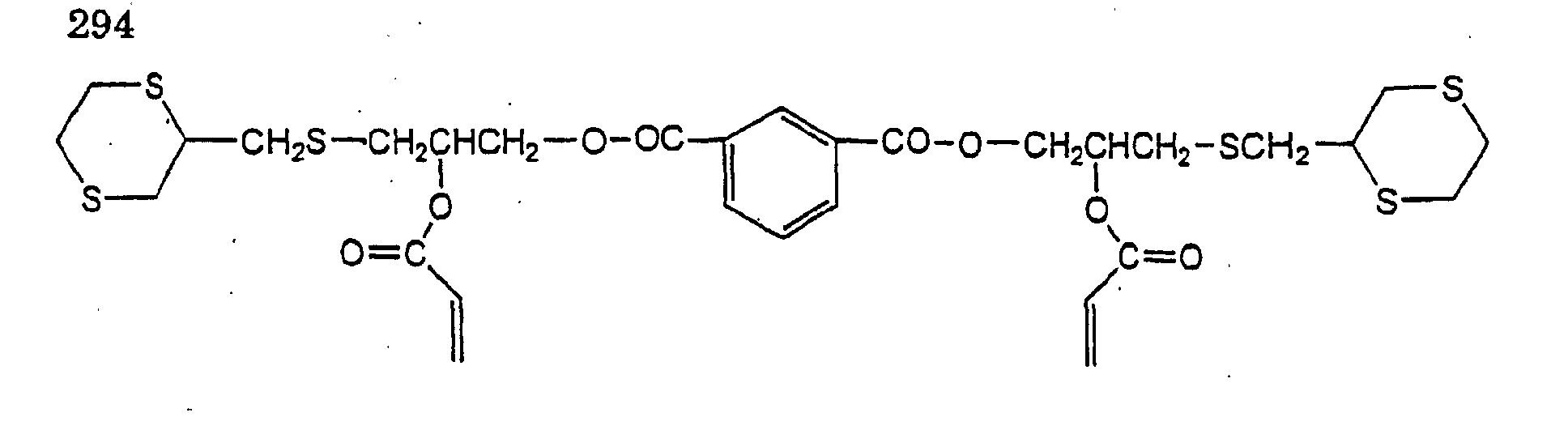
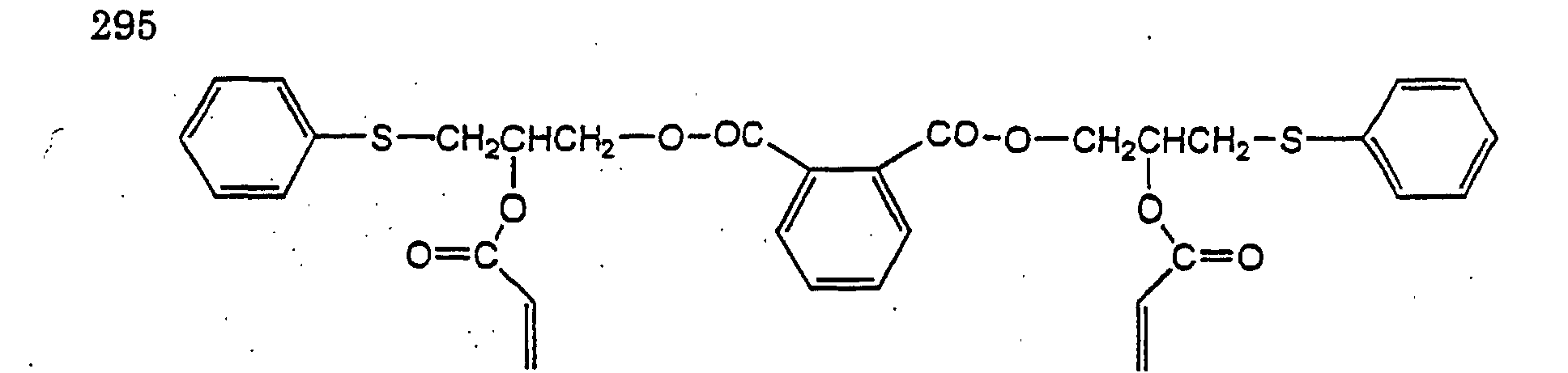

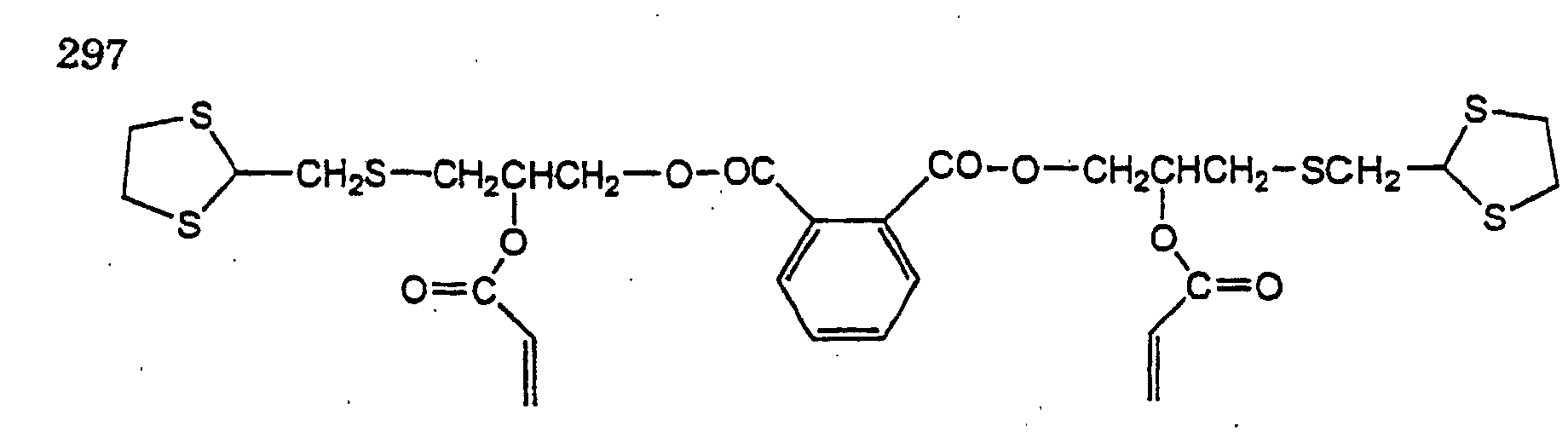

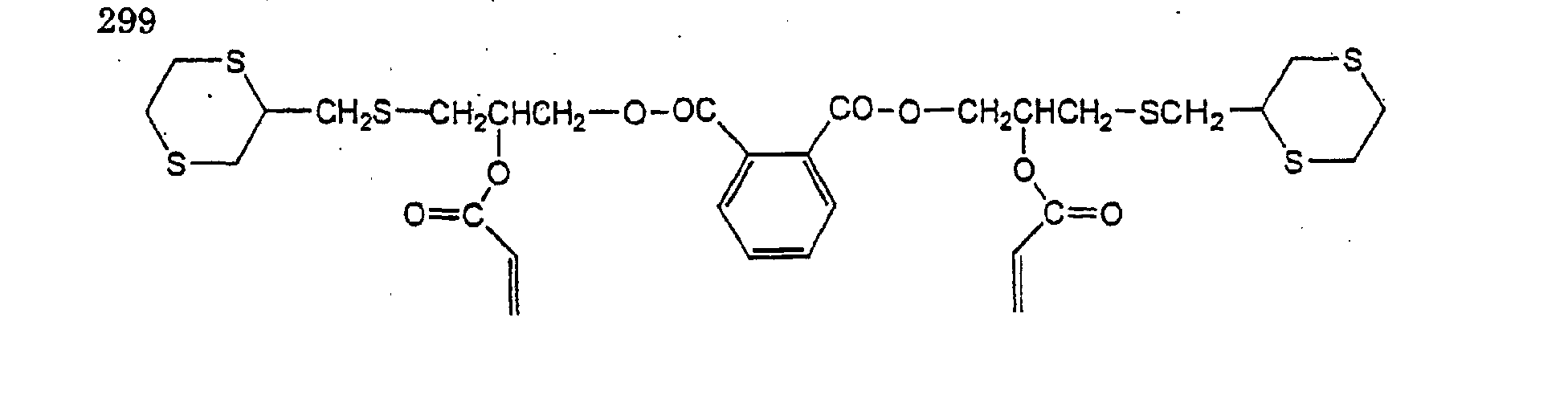
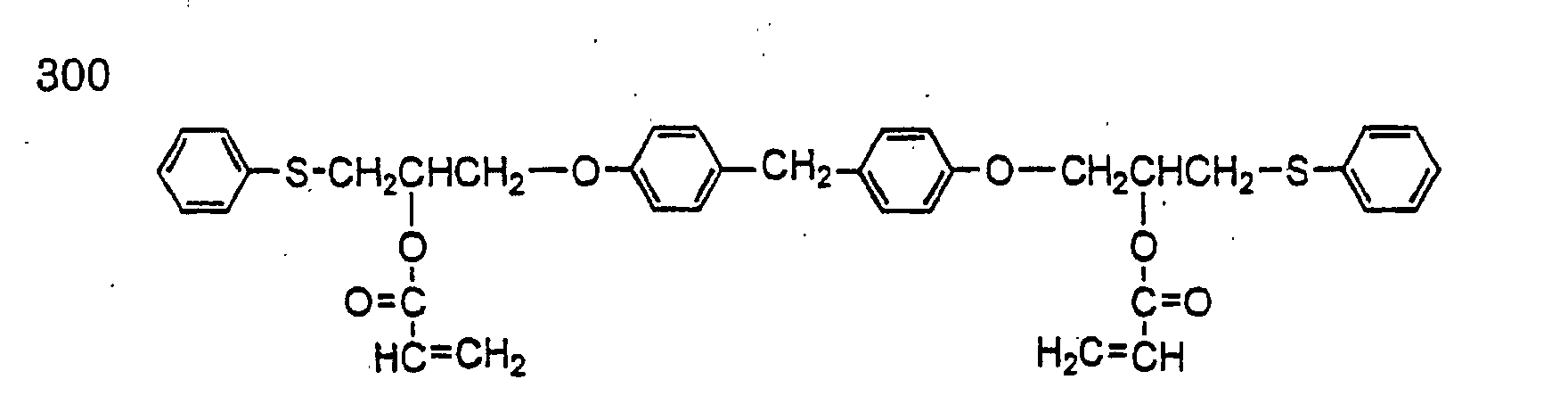

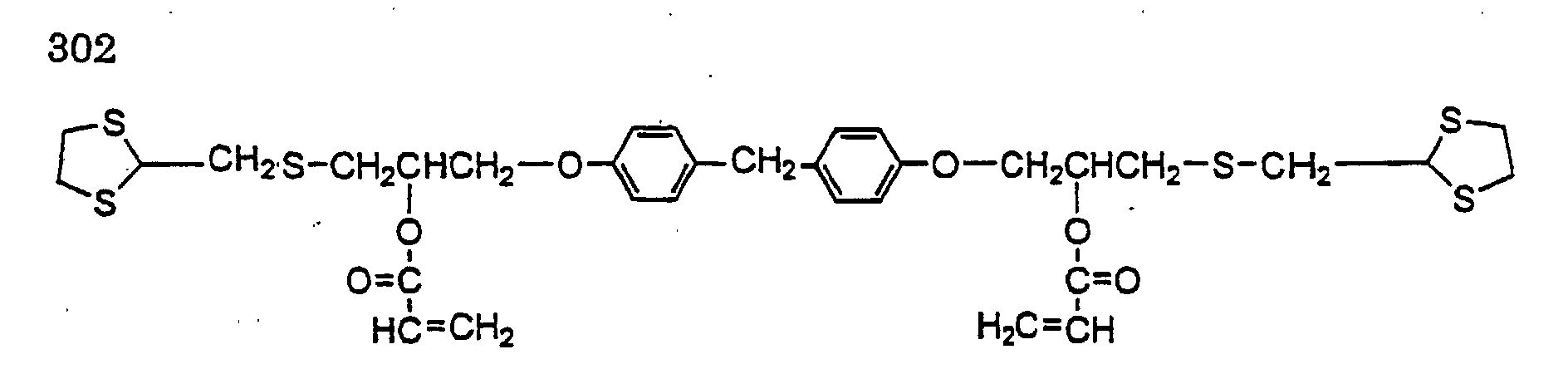
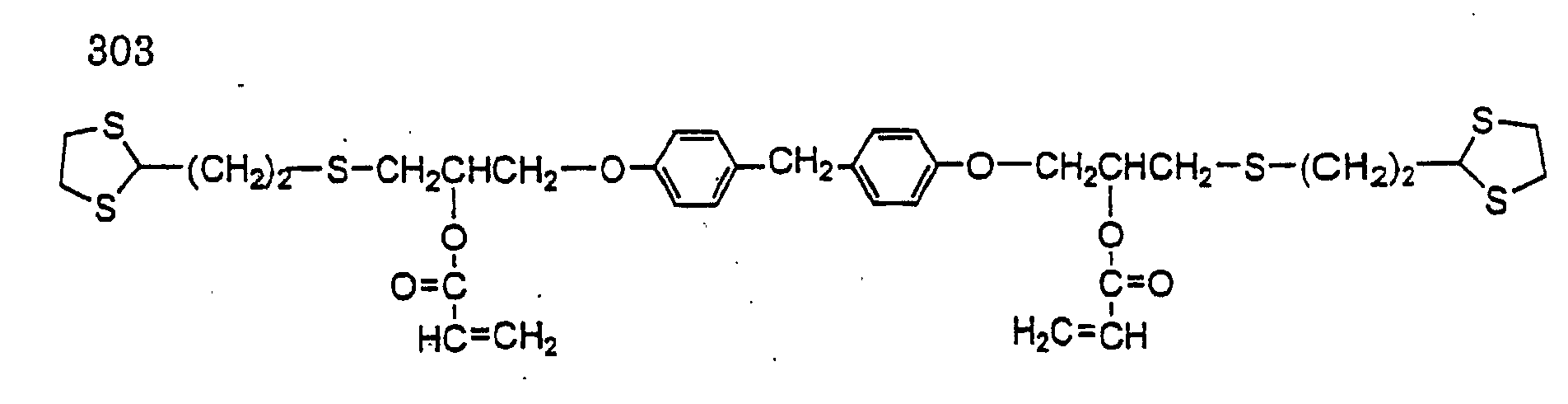

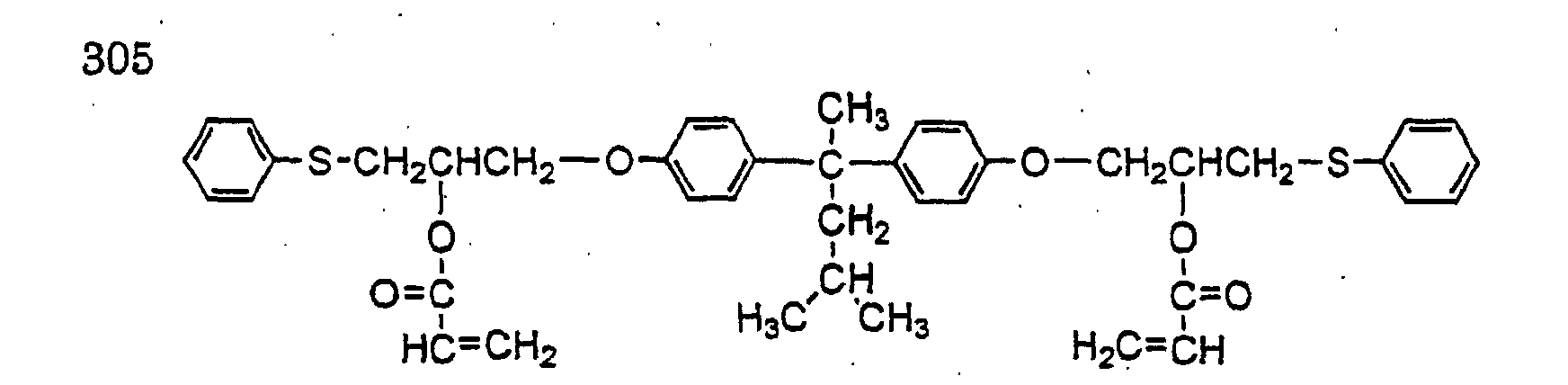
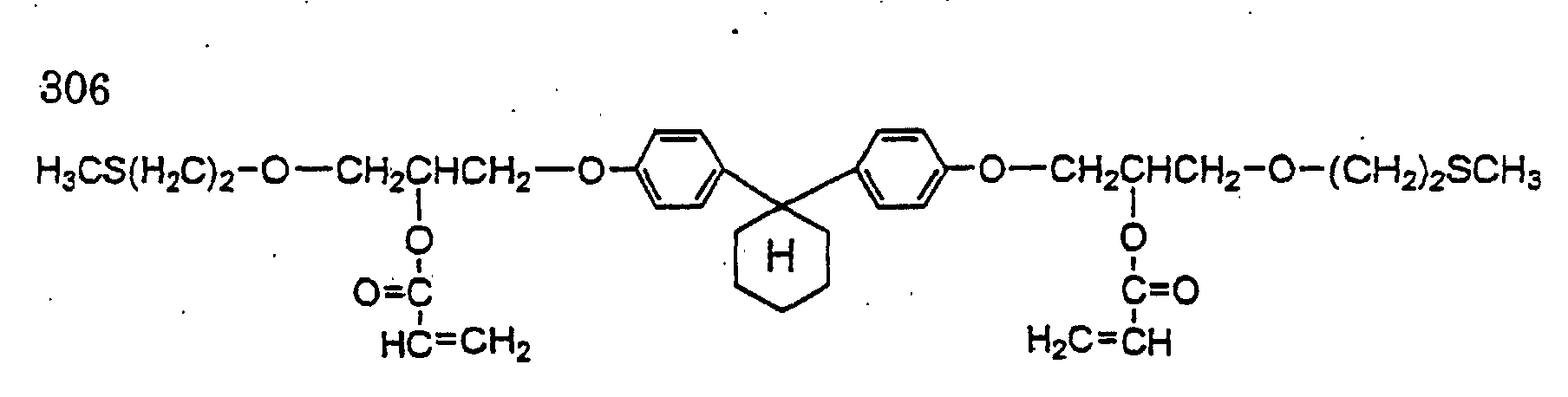
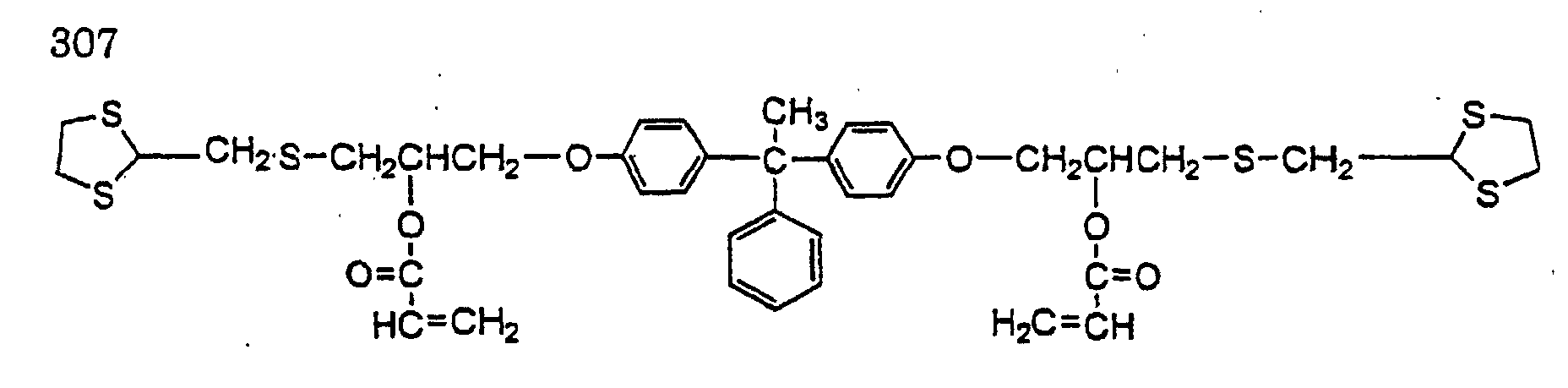
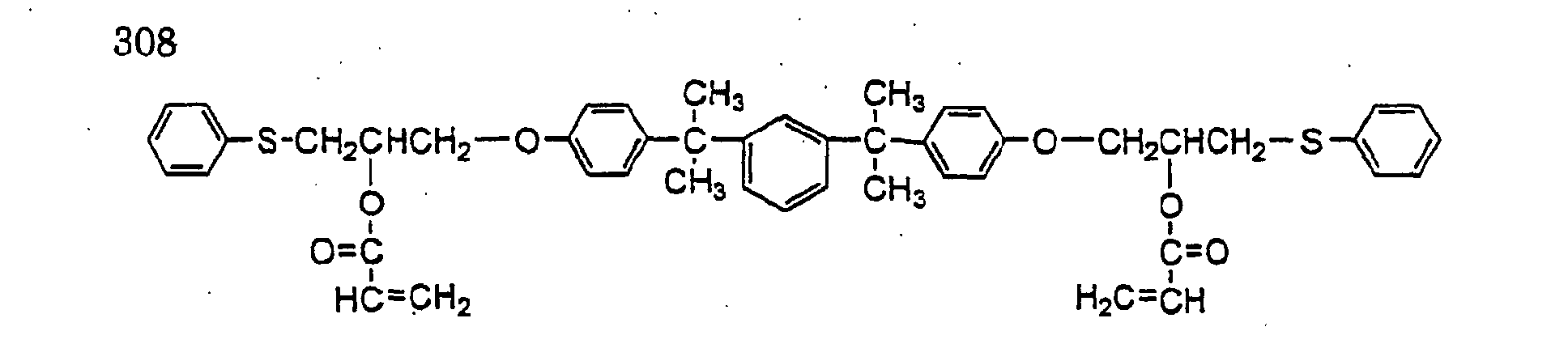
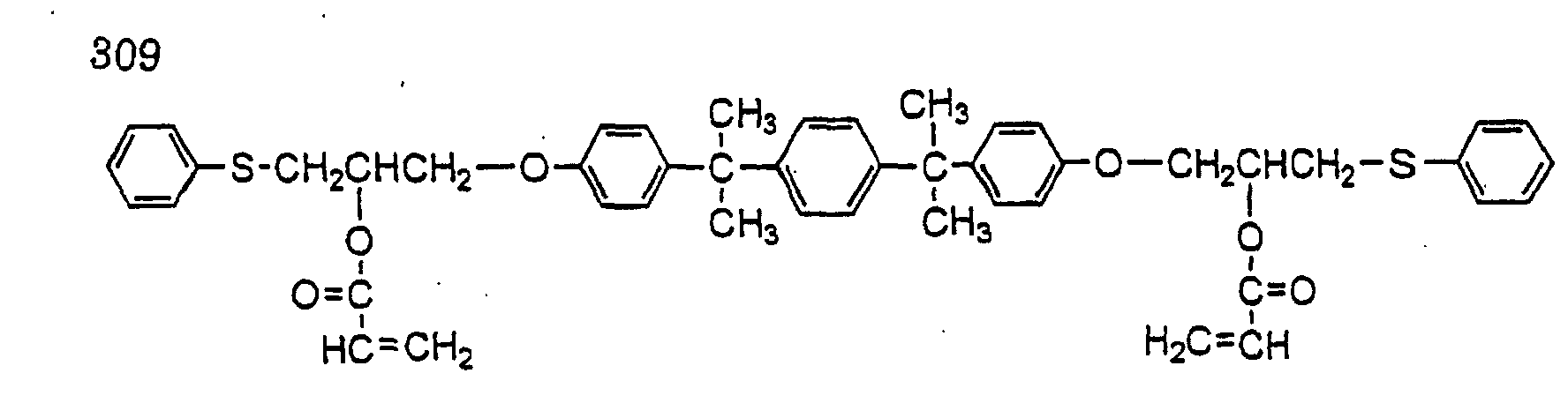
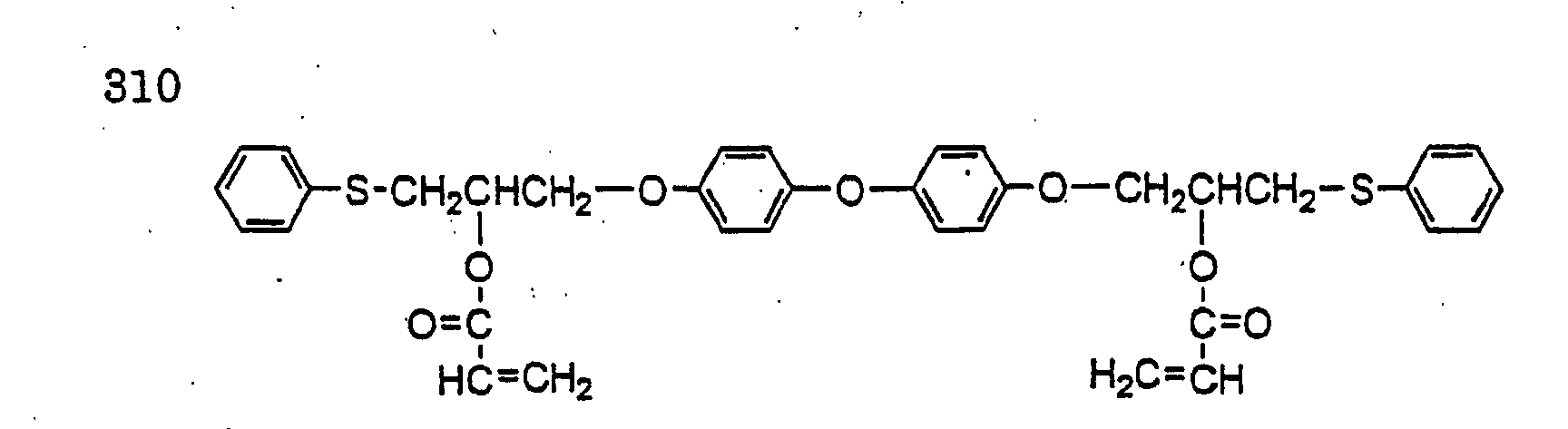


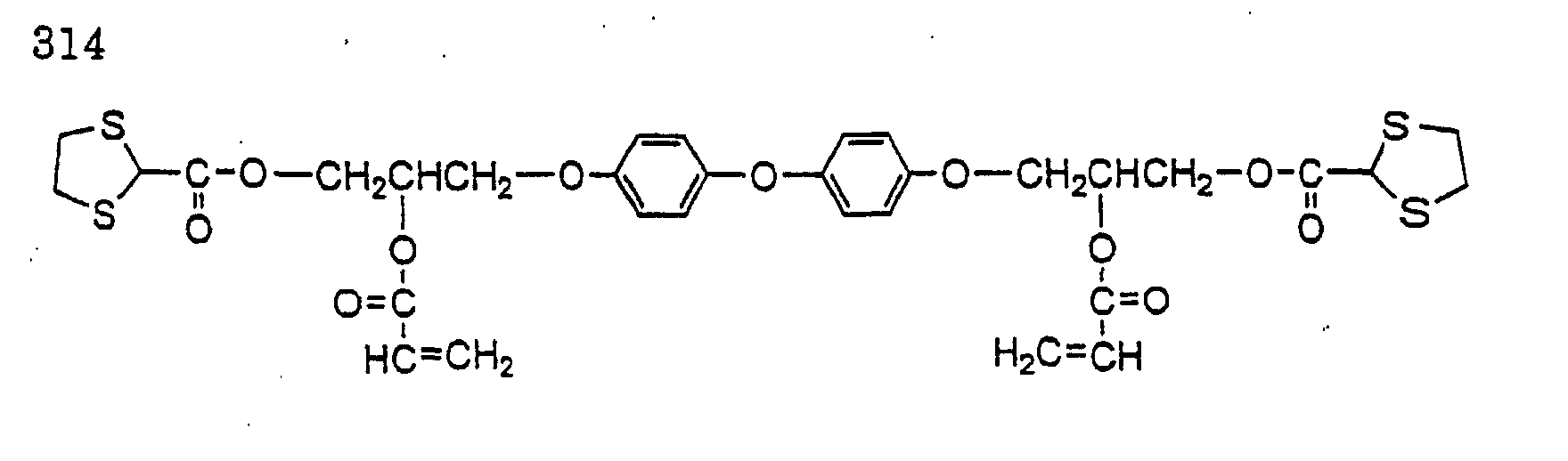

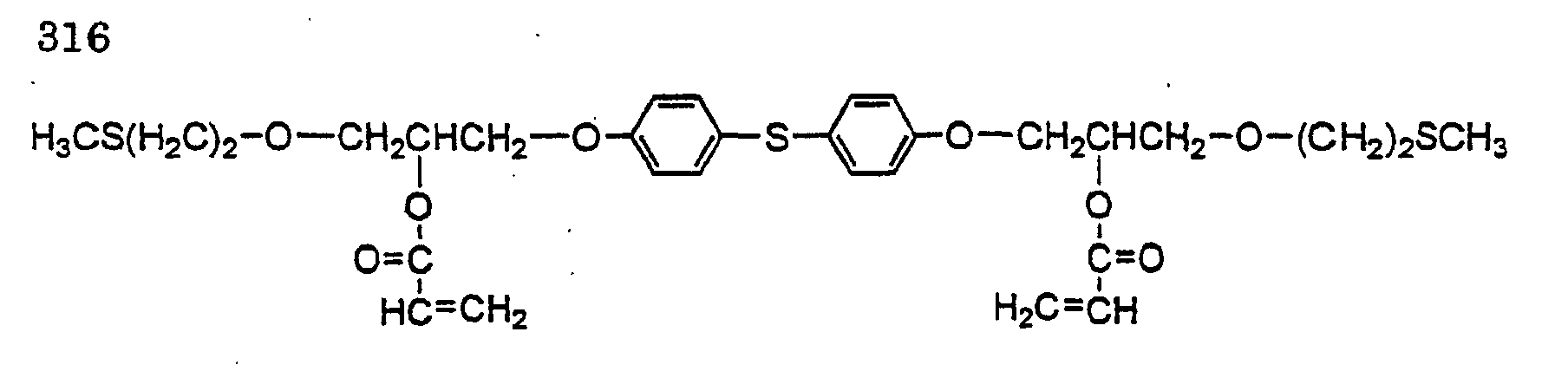
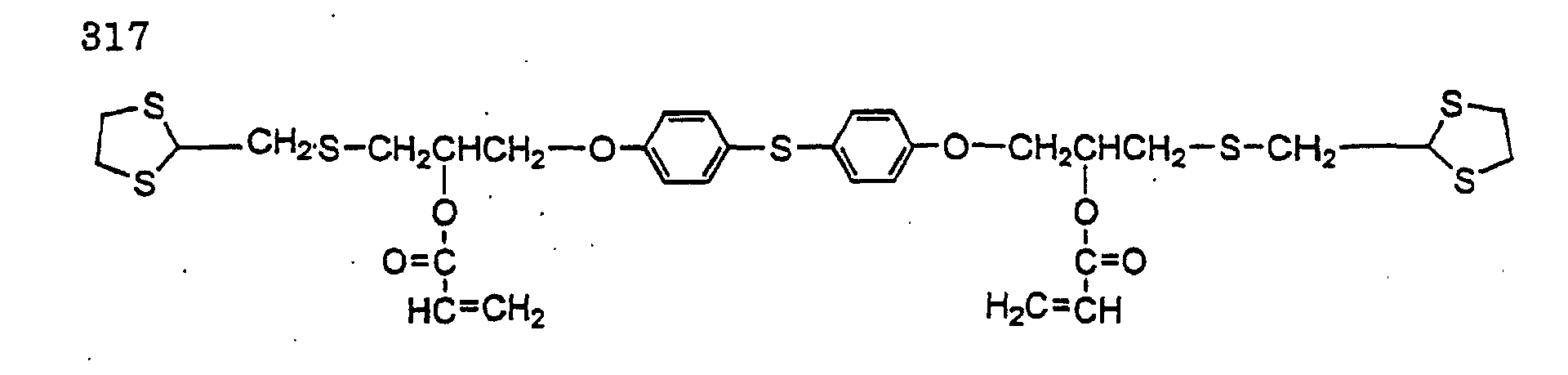

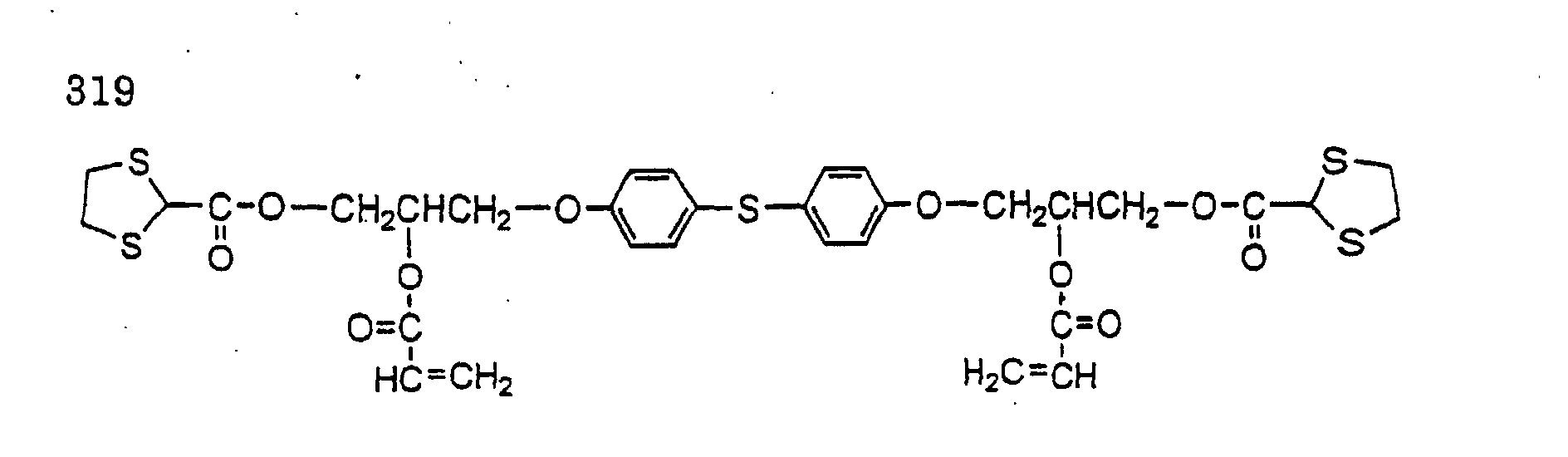

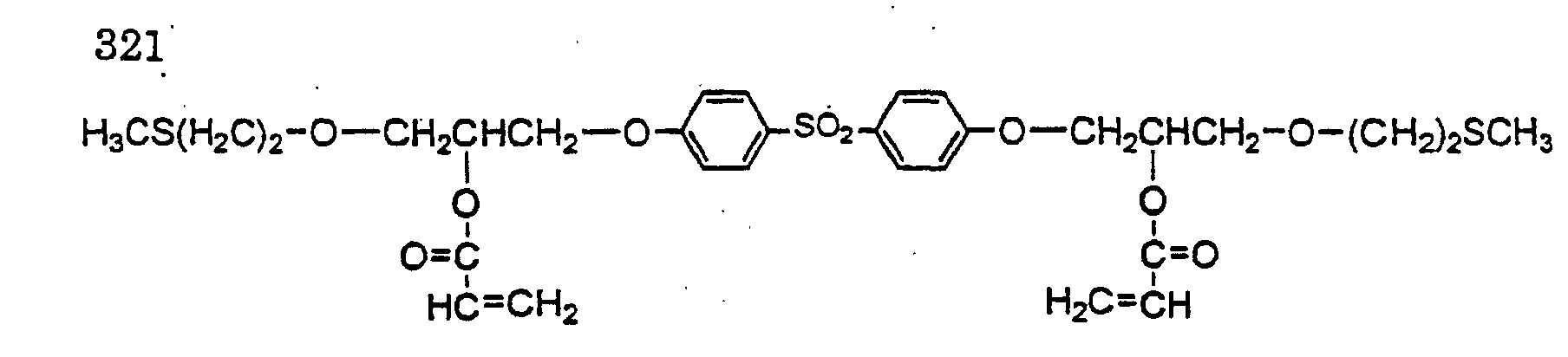
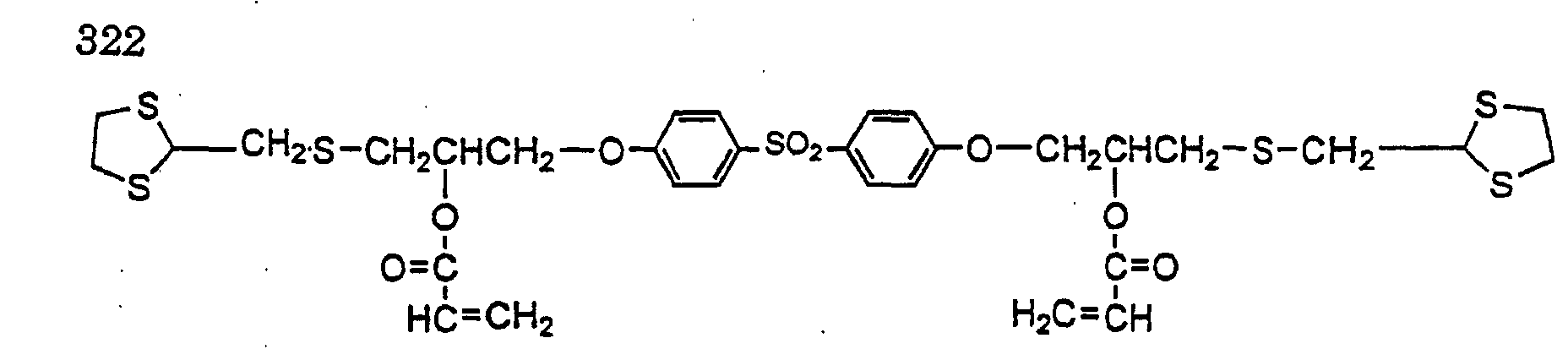
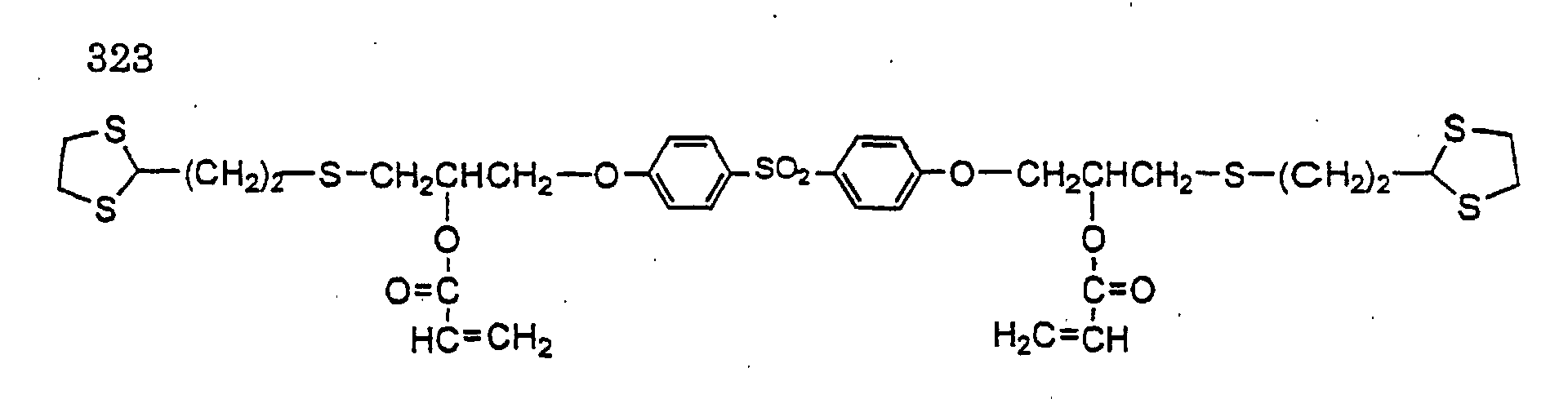


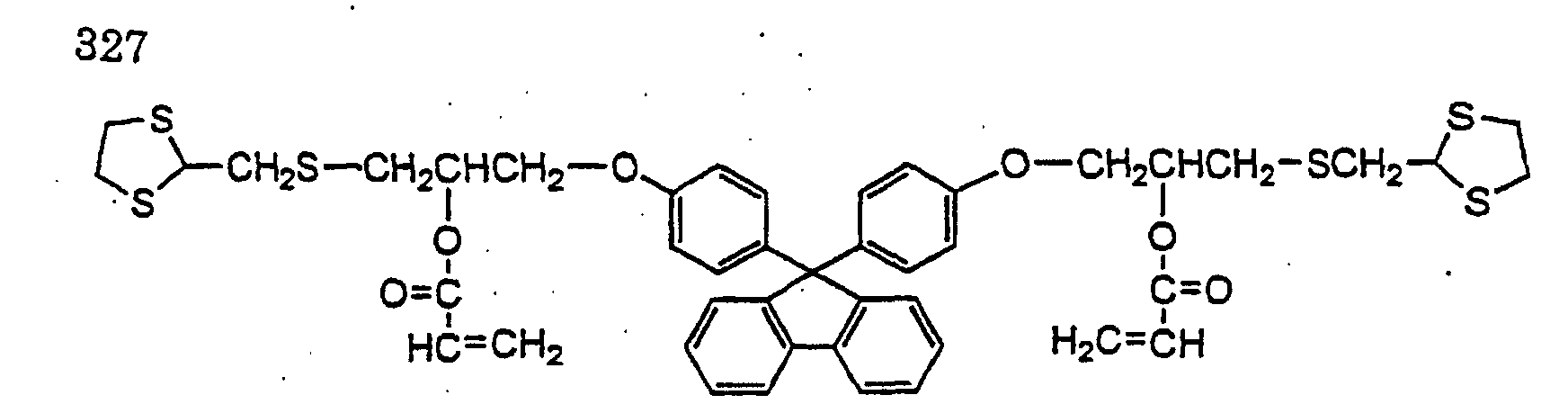

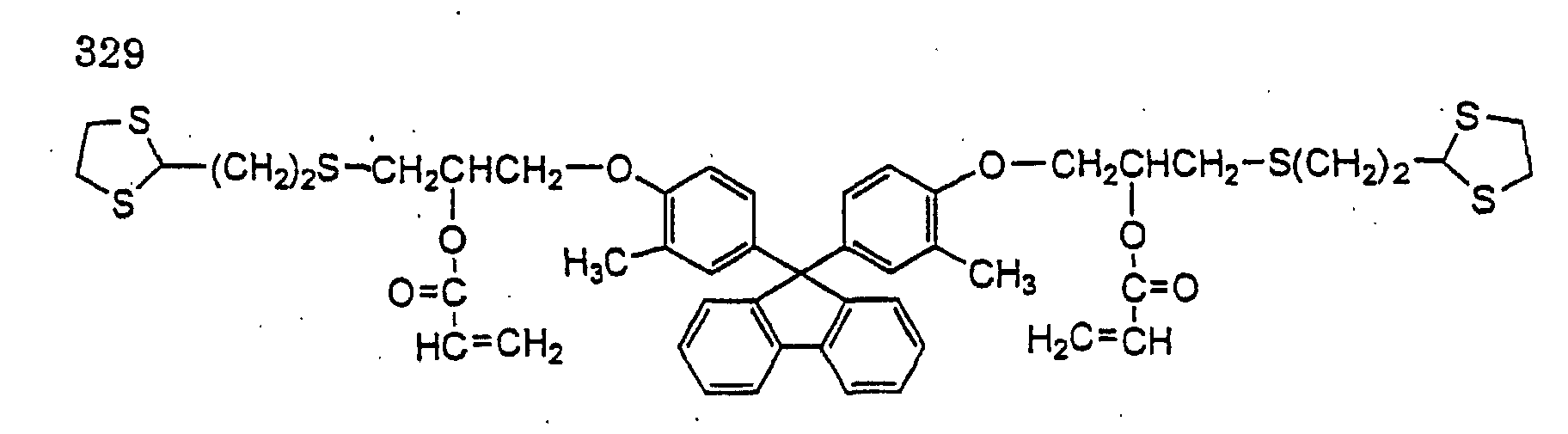
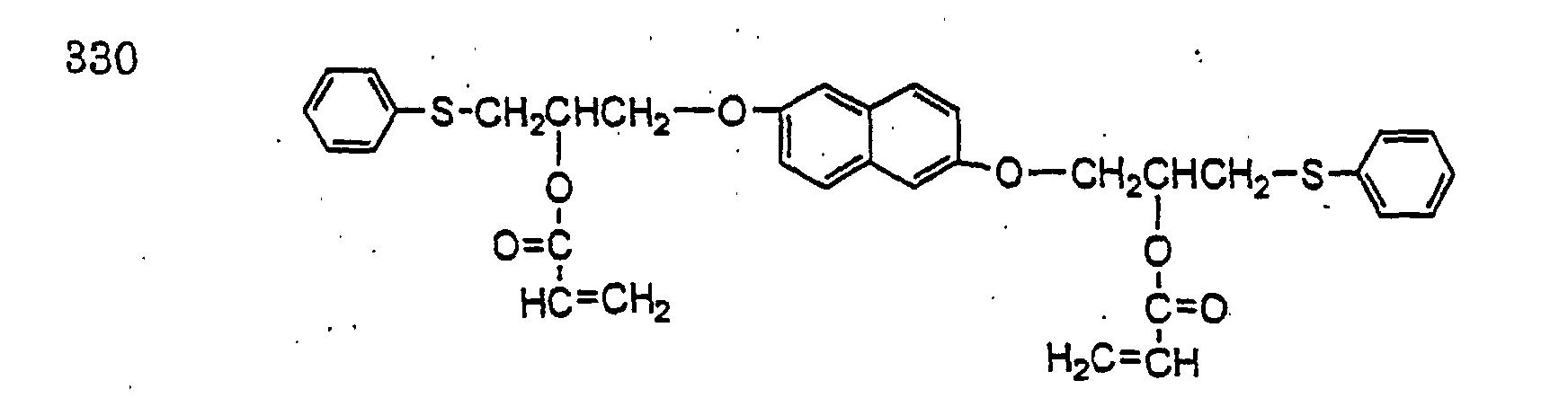
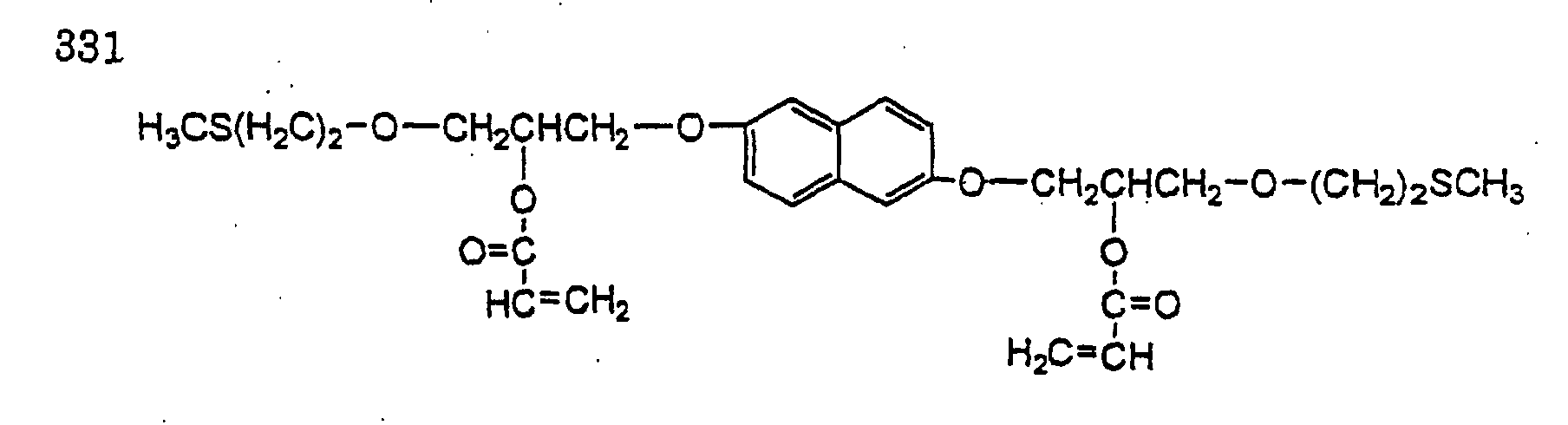
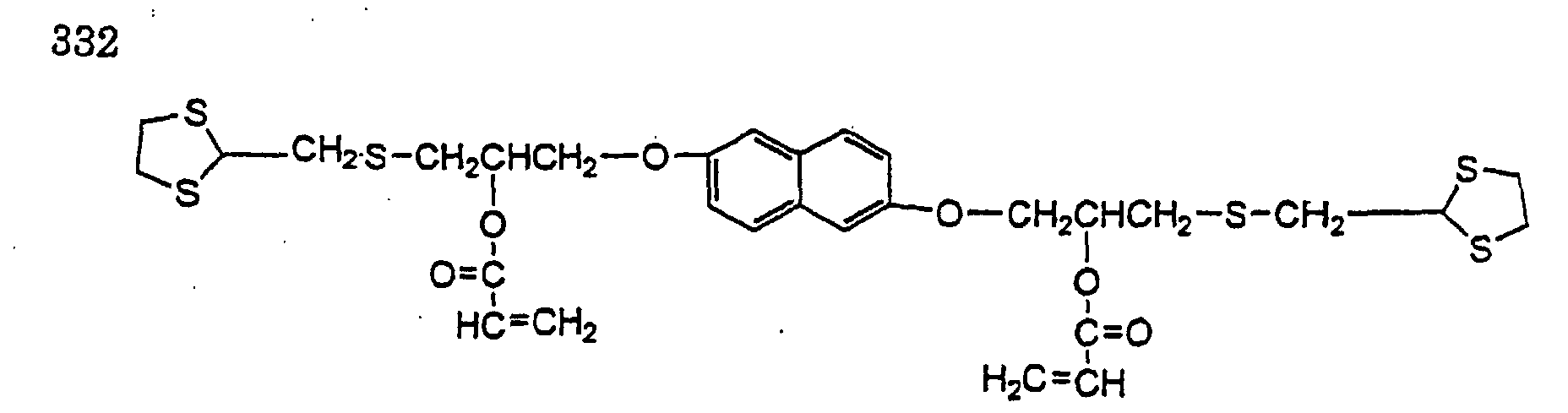
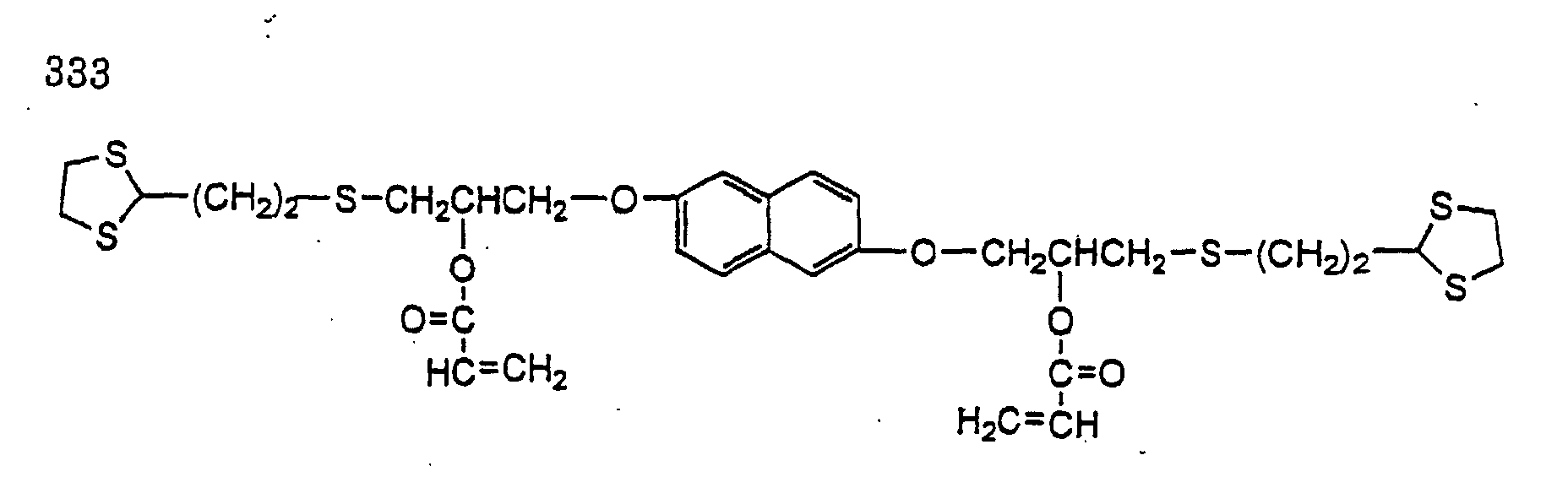

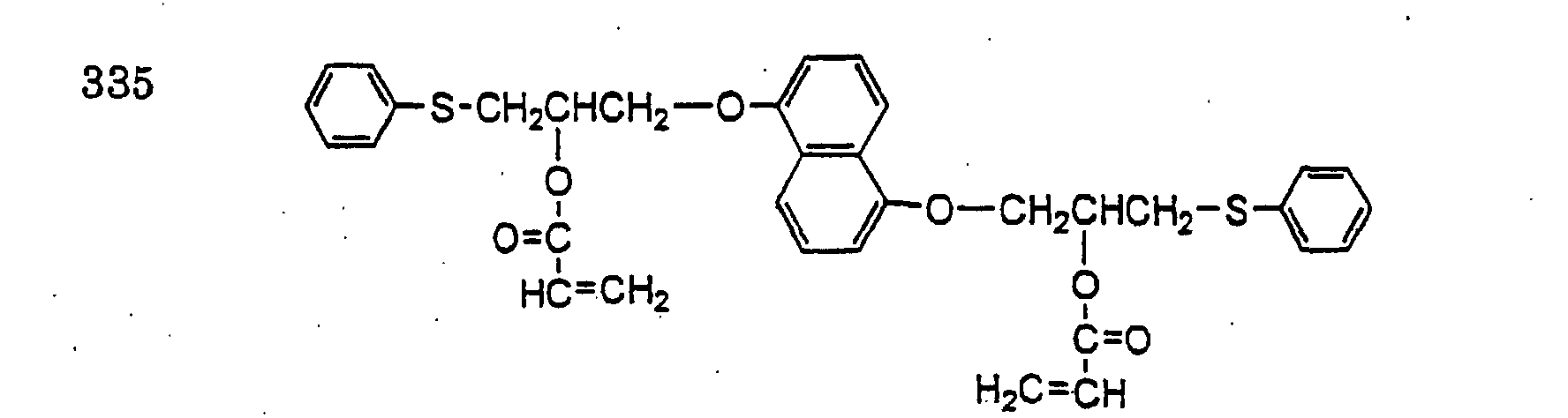
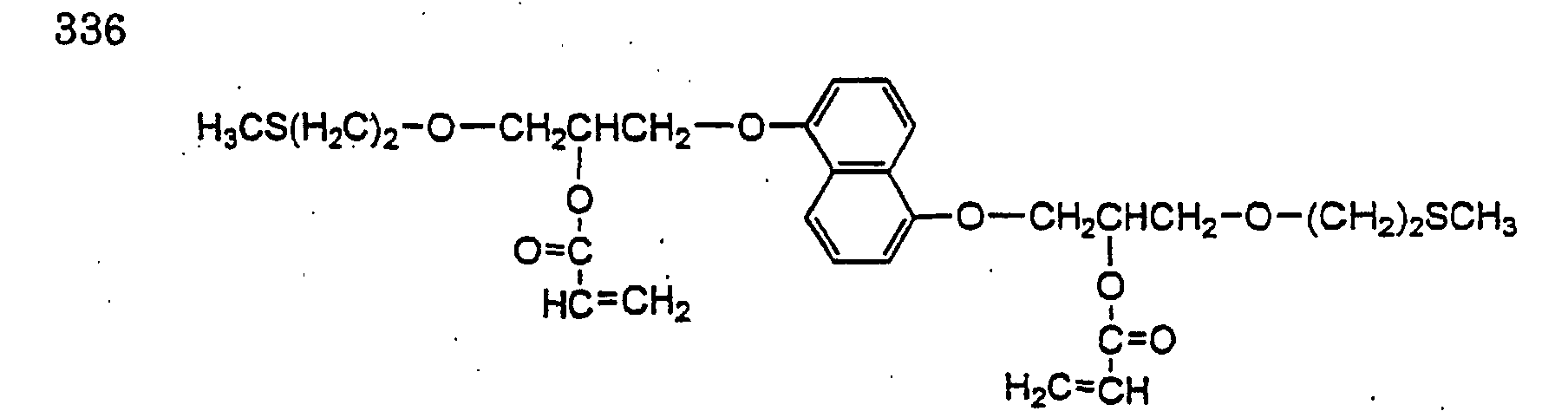

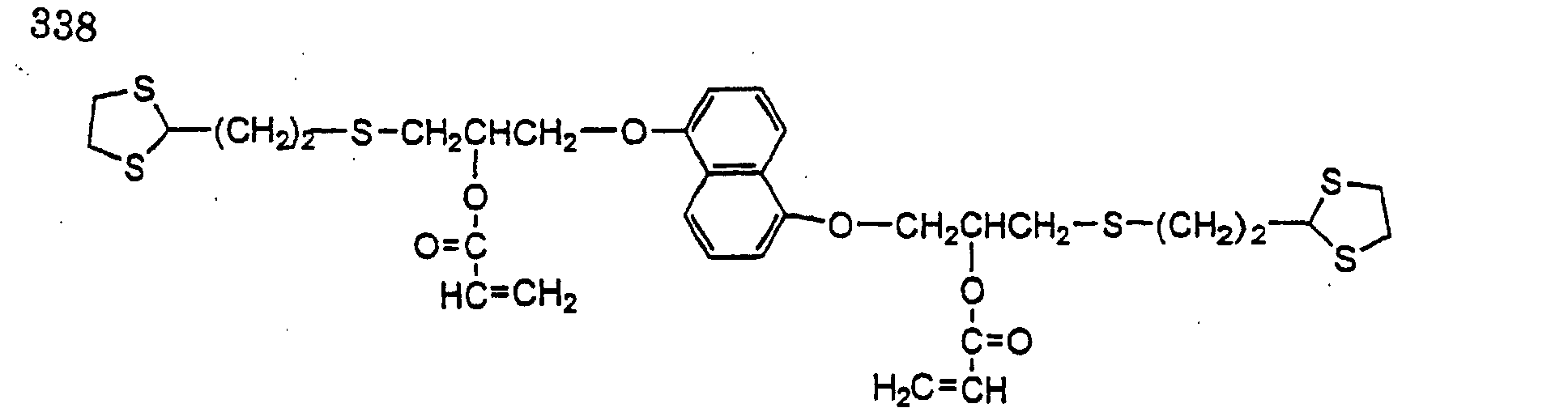
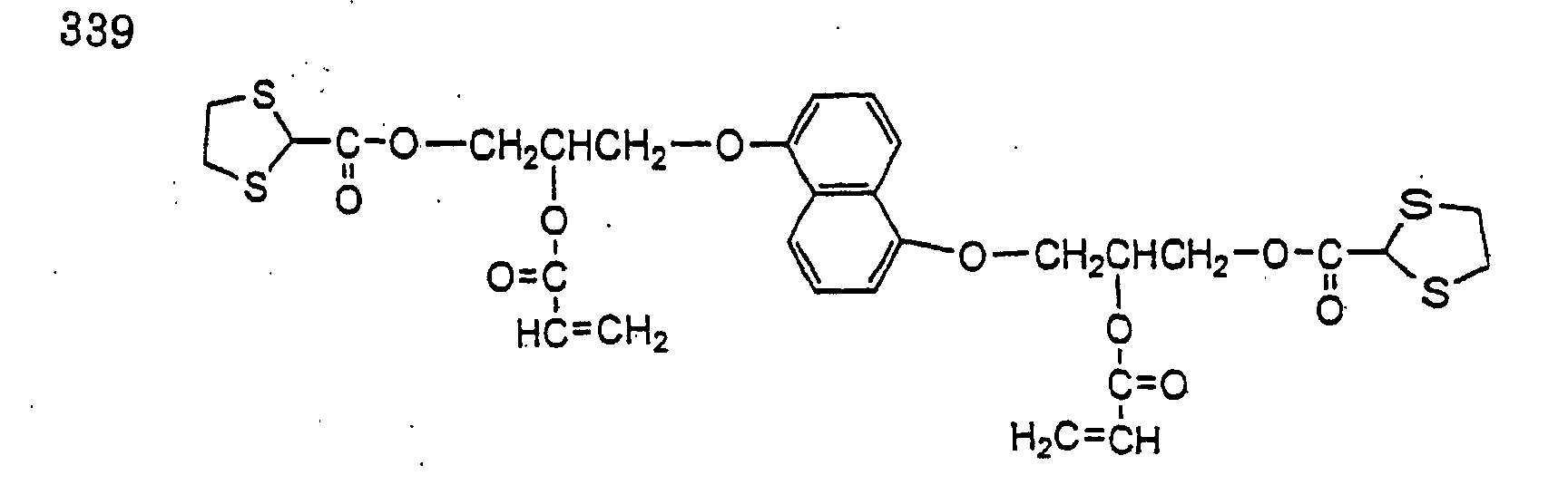
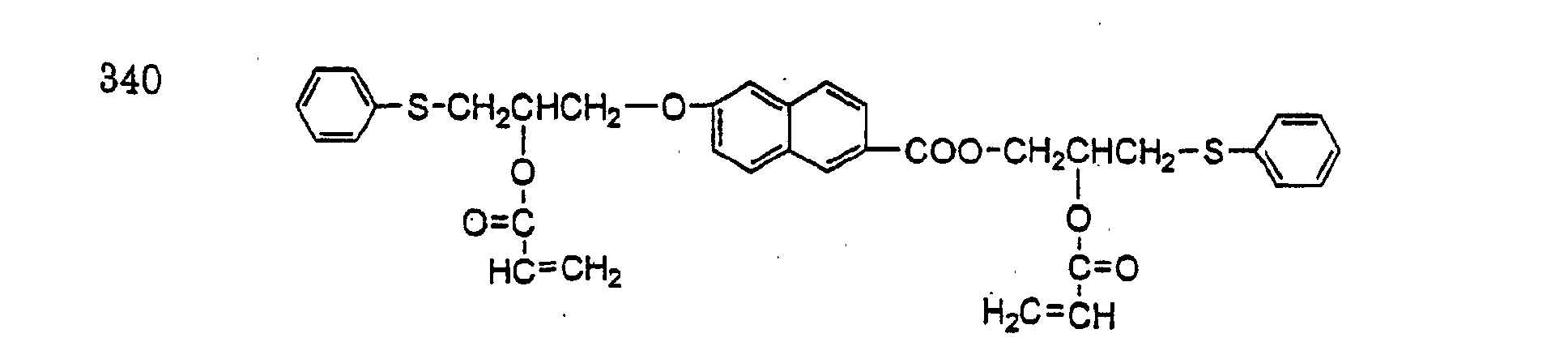
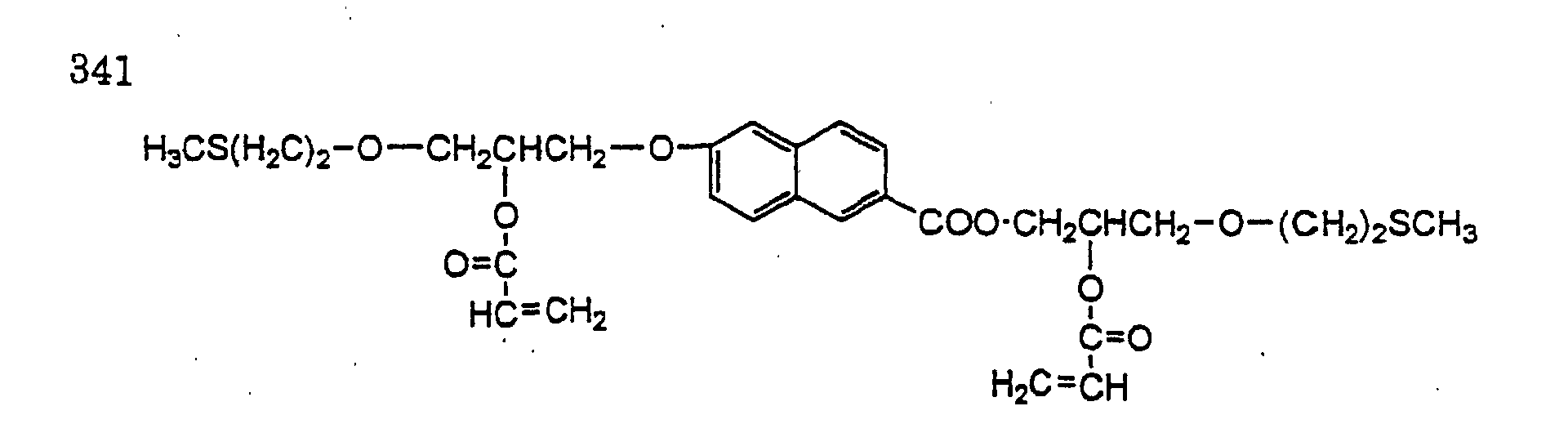


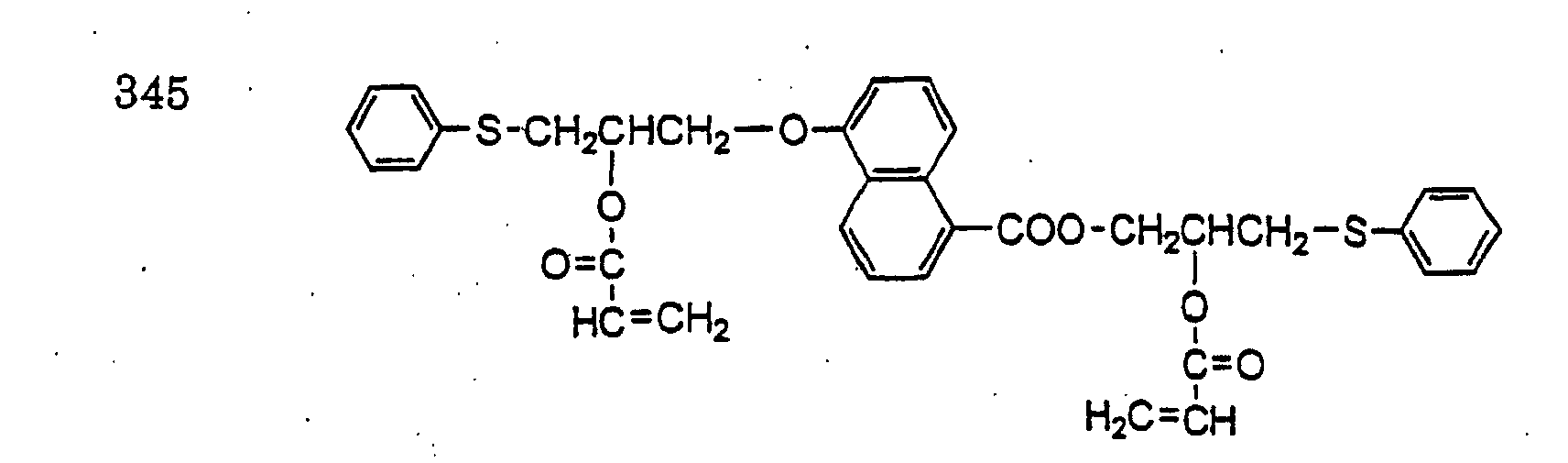


- The term "dental material" used in this specification means a material widely used in the dental field, which includes the following dental composition.
- The term "dental composition" means a mixture of a polymerizable monomer, a polymerization initiator, a filler, etc., and the dental composition includes an uncured composition and a composition having been cured by polymerization.
- The state of the polymerizable monomer represented by the formula (1) that is used in the invention is not specifically restricted. In the use of the polymerizable monomer as a dental material, however, the monomer is preferably liquid at ordinary temperature (20°C in the invention) and preferably has a viscosity of 100 to 1,000,000 cps at ordinary temperature. The polymerizable monomer which is liquid at ordinary temperature and has the above viscosity can be favorably used as a dental material as it is without being polymerized. If the viscosity is lower than the above value, the polymerizable monomer hardly has the desired properties. If the viscosity is higher than the above value, it tends be difficult to homogeneously incorporate a sufficient amount of the later-described filler, particularly an inorganic filler such as a glass powder, into the dental composition. Moreover, mixing with other components takes time, and the polymerization reaction is not completed in a short period of time in some cases. The viscosity of the polymerizable monomer is particularly preferably in the range of 1,000 to 100,000 cps. That the monomer is liquid at ordinary temperature is advantageous from the viewpoint of ease of use, for example, the monomer can be easily used as a dental material or the monomer can easily dissolve other components and additives in the preparation of a cured product from the composition.
- In the use for a dental composition, the polymerizable monomer represented by the formula (1) is not limited to a liquid and may be a solid.
- The polymerizable monomer represented by the formula (1) for use in the invention exhibits a liquid refractive index, at room temperature (20°C), of preferably 1.55 to 1.65, more preferably 1.57 to 1.63. A cured product of the polymerizable monomer exhibits a refractive index, at room temperature, of preferably 1.57 to 1.65, more preferably 1.58 to 1.65. Owing to such refractive indexes, transparency of the cured composition in which the polymerizable monomer exists together with a filler, etc. can be ensured, as described later.
- The polymerizable monomer represented by the formula (1) may be used singly, or may be used in combination with other monomers of the formula (1).
- The dental composition of the invention further contains a polymerization initiator (B) in addition to the component (A).
- As the polymerization initiator added to the dental composition or the dental material of the invention, known compounds are employable without any restriction. For example, a photopolymerization initiator, an organic peroxide, a diazo compound and a redox compound are employable.
- In case of the photopolymerization initiator, a photosensitizer only or a combination of a photosensitizer and a photopolymerization accelerator is employable.
- Examples of the photosensitizers include known α-diketone compounds and phosphorus compounds, which are excited by irradiation with visible rays or ultraviolet rays to initiate polymerization, such as benzyl, camphorquinone, α-naphthyl, p,p'-dimethoxybenzyl, pentadione, 1,4-phenanthrenequinone, naphthoquinone and trimethylbenzoyldiphenylphosphine oxide. These compounds can be used singly or in combination of two or more kinds. Of these compounds, preferably used are camphorquinone and/or trimethylbenzoyldiphenylphosphine oxide.
- Examples of the photopolymerization accelerators include:
- tertiary amines, such as N,N-dimethylaniline, N,N-diethylaniline, N,N-dibenzylaniline, N,N-dimethyl-p-toluidine, N,N-diethyl-p-toluidine, N,N-dihydroxyethyl-p-toluidine, p-N,N-dimethylaminobenzoic acid, p-N,N-diethylaminobenzoic acid, ethyl p-N,N-dimethylaminobenzoate, ethyl p-N,N-diethylaminobenzoate, methyl p-N,N-dimethylaminobenzoate, methyl p-N,N-diethylaminobenzoate, p-N,N-dimethylaminobenzaldehyde, 2-n-butoxyethyl p-N,N-dimethylaminobenzoate, 2-n-butoxyethyl p-N,N-diethylaminobenzoate, p-N,N-dimethylaminobenzonitrile, p-N,N-diethylaminobenzonitrile, p-N,N-dihydroxyethylaniline, p-dimethylaminophenetyl alcohol, N,N-dimethylaminoethyl methacrylate, triethylamine, tributylamine, tripropylamine and N-ethyl ethanolamine;
- combinations of the above tertiary amines and citric acid, malic acid or 2-hydroxypropanoic acid;
- barbituric acids, such as 5-butylaminobarbituric acid and 1-benzyl-5-phenylbarbituric acid; and
- organic peroxides, such as benzoyl peroxide and di-tert-butyl peroxide.
-
- The above compounds can be used singly or in combination. Of these, preferably used are tertiary aromatic amines wherein a nitrogen atom is directly bonded to an aromatic ring and tertiary aliphatic amines having a polymerizable group, such as ethyl p-N,N-dimethylaminobenzoate, methyl p-N,N-dimethylaminobenzoate, 2-n-butoxyethyl p-N,N-dimethylaminobenzoate and N,N-dimethylaminoethyl methacrylate.
- In order to promote curing without delay, a combination of a photosensitizer and a photopolymerization accelerator is preferable, and preferably used is a combination of camphorquinone or trimethylbenzoyldiphenylphosphine oxide and an ester compound of a tertiary aromatic amine wherein a nitrogen atom is directly bonded to an aromatic ring, such as ethyl p-N,N-dimethylaminobenzoate or 2-n-butoxyethyl p-N,N-dimethylaminobenzoate.
- The type of the organic peroxide or the diazo compound used as the polymerization initiator is not specifically restricted, but in order to complete the polymerization in a short period of time, a compound whose decomposition half-life at 80°C is not more than 10 hours is preferable.
- Examples of the organic peroxides include:
- diacyl peroxides, such as acetyl peroxide, isobutyl peroxide, decanoyl peroxide, benzoyl peroxide and succinic acid peroxide;
- peroxydicarbonates, such as diisopropyl peroxydicarbonate, di-2-ethylhexyl peroxydicarbonate and diallyl peroxydicarbonate;
- peroxy esters, such as tert-butyl peroxyisobutyrate, tert-butyl neodecanate and cumene peroxyneodecanate; and
- sulfonyl peroxides, such as acetylcyclohexylsulfonyl peroxide.
-
- Examples of the diazo compounds include 2,2'-azobisisobutyronitrile, 4,4'-azobis(4-cyanovaleric acid), 2,2'-azobis(4-methoxy-2,4-dimethoxyvaleronitrile) and 2,2'-azobis(2-cyclopropylpropionitrile).
- Of the above compounds, preferably used are benzoyl peroxide and 2,2'-azobisbutyronitrile.
- The type of the redox initiator used as the polymerization initiator is not specifically restricted. For example, there can be mentioned a combination of the organic peroxide and the tertiary amine; a combination of the organic peroxide/sulfinic acid or its alkali metal salt/the tertiary amine; and a combination of an inorganic peroxide and an inorganic reducing agent, such as a combination of an inorganic peroxide (e.g., potassium persulfate) and sodium sulfite or a combination of an inorganic peroxide and sodium hydrogensulfite.
- Of these, preferably used are a combination of benzoyl peroxide and N,N-dimethyl-p-toluidine and a combination of benzoyl peroxide and N,N-dihydroxyethyl-p-toluidine.
- The polymerization initiator is used in an amount of preferably 0.001 to 10 % by weight based on 100 parts by weight of the (meth)acrylate monomer.
- The dental composition of the invention contains a filler. The filler is added for the purposes of ensuring mechanical strength, enhancing light transmittance, imparting X-ray opacity and decreasing polymerization shrinkage. In the present invention, the filler (C) is the following glass powder or the following composite filler consisting of the glass powder and a polymer, and usually, the filler (C) does not include a filler composed of an organic compound only.
- An inorganic compound used as the filler in the invention is generally a glass powder, and the glass powder has an average particle diameter of usually not more than 2 µm, preferably 0.1 to 1.5 µm. When the particle diameter is in this range, the specific surface area of the filler is not increased markedly. Hence, the relative proportion of the filler to the polymerizable monomer is greatly increased, and therefore the polymerization shrinkage can be effectively decreased. The refractive index of the glass powder is preferably not less than 1.55, particularly preferably 1.57 to 1.65. The difference between the refractive index of the glass powder for use in the invention and the refractive index of a cured product (resin matrix) of the polymerizable monomer in the dental composition containing this glass powder is preferably not more than 0.05, particularly preferably not more than 0.02. That is to say, the glass powder for use in the invention has a refractive index very approximate to that of a cured product of the polymerizable monomer. By the use of such a glass powder, the light transmittance of a cured product of the dental composition of the invention can be enhanced. By the use of such a glass powder, further, the strength of the cured product can be enhanced.
- In general, it is clinically important that the presence of the filling material can be clearly confirmed by X-ray photograph, so that the glass powder for use in the invention is preferably one having X-ray opacity. In order to impart X-ray opacity to the glass powder, an element having X-ray opacity (heavy metal element), such as barium, strontium, zirconium, bismuth, tungsten, germanium, molybdenum or lanthanide, is usually added as a glass-constituting element.
- With increase of the amount of the heavy metal element that is added in order to impart X-ray opacity to the glass powder, the refractive index of the glass powder becomes higher. Accordingly, the heavy metal element of the glass powder in the dental composition of the invention has a function of imparting X-ray opacity to the glass powder and a function of controlling the refractive index of the glass powder.
- If the difference between the refractive index of the cured product of the monomer such as (meth)acrylate and the refractive index of the glass powder is larger than 0.05, the transparency of the cured composition is lowered, and lowering of the photo-curability results in decrease of the curing depth or insufficient curing reaction, whereby properties of the cured product are sometimes lowered. When the refractive index of the glass powder is controlled, it is preferable to adjust the refractive index between the refractive index of the monomer in the uncured state and the refractive index of the cured product of the monomer. This is advantageous in that there is no change between the transparency of the composition before curing and the transparency of the composition after curing. Further, by allowing the refractive index of the cured product of the monomer and the refractive index of the glass powder to agree with each other, the transparency of the composition after curing becomes the highest. The methods to control the refractive index can be properly used according to the requirements for the clinical site.
- In case of the dental composition of the invention containing not less than about 60 % by weight of a glass powder of X-ray opacity having an average particle diameter of about sub micron to several µm, if the refractive index of the glass powder contained in the composition is not less than 1.50, the cured product of the composition becomes transparent, and the presence of the cured product can be clearly confirmed by X-rays. The glass powder used herein may be one kind of a glass powder or a mixture of two or more kinds of glass powders having different formulations. When plural kinds of glass powders having different formulations are used, the refractive indexes of the glass powders are approximated to each other, and thereby high transparency of a cured product of the dental composition of the invention can be ensured.
- The glass powder is used in an amount of usually 5 to 2000 parts by weight, preferably 100 to 700 parts by weight, based on 100 parts by weight of the polymerizable monomer.
- In the dental composition of the invention, a composite filler may be used as the filler.
- The composite filler for use in the invention can be prepared by, for example, mixing a polymerizable monomer, a glass powder and a thermal polymerization initiator such as benzoyl peroxide, then thermally polymerizing the mixture and pulverizing the resulting polymer.
- By the use of the composite filler, polymerization shrinkage of the dental composition of the invention can be effectively reduced in the curing stage. Since the composite filler is prepared by polymerizing the polymerizable monomer under such conditions (e.g., thermal polymerization conditions) as are capable of raising the degree of polymerization higher than that in the photopolymerization conditions, the cured product exhibits higher mechanical properties than a cured product obtained by photopolymerization. Accordingly, by the incorporation of such a composite filler, mechanical properties and abrasion resistance of the cured product of the dental composition of the invention are improved. Moreover, by allowing the refractive index of a cured product of a mixture of the glass powder used for the composite filler and a polymerizable monomer for constituting the composite filler to agree with the refractive index of the aforesaid polymerizable monomer cured product and the refractive index of the glass powder, higher transparency can be obtained. To the composite filler, fine particle silica, a filler other than the glass powder, such as metallic oxide, a pigment, etc. may be added when needed. The average particle diameter of the composite filler is in the range of usually 1 to 100 µm, preferably 5 to 20 µm.
- The composite filler is used in an amount of usually 1 to 2000 parts by weight, preferably 5 to 2000 parts by weight, more preferably 50 to 700 parts by weight, based on 100 parts by weight of the polymerizable monomer.
- In the present invention, fine particle silica can be used as the filler in addition to the glass powder.
- The fine particle silica employable herein is usually high-purity colloidal silica prepared by a gas phase process, and has no X-ray opacity. Although the fine particle silica has no X-ray opacity, it is sometimes added for the purpose of controlling viscosity or tackiness of a paste. As the fine particle silica, high-purity colloidal silica prepared by, for example, a gas phase process may be used as it is, or high-purity colloidal silica may be used after hydrophobic treatment with a silane compound such as dimethyldichlorosilane. It is preferable to subject the fine particle silica to methacryloxysilane treatment or aminosilane treatment to increase affinity of the fine particle silica for the resin matrix, prior to use. The fine particle silica has a low refractive index of 1.45, and this refractive index is widely different from that of the filler used. However, the average particle diameter of the fine particle silica is usually not more than 0.05 µm and is considerably smaller than 0.3 to 0.7 µm that is a wavelength of visible ray, so that the fine particle silica does not greatly hinder the transparency. Fine particle silica of smaller size can maintain transparency high, and hence it is preferable to use fine particle silica having an average particle diameter of not more than 0.01 µm from the viewpoint of maintenance of high transparency.
- The fine particle silica is used in an amount of usually 5 to 250 parts by weight, preferably 10 to 200 parts by weight, particularly preferably 20 to 150 parts by weight, based on 100 parts by weight of the (meth)acrylate monomer contained in the dental composition of the invention.
- The polymerizable monomer used in combination with the polymerizable monomer represented by the formula (1) is usually a (meth)acrylate monomer or a (meth)acrylamide monomer.
- The polymerizable monomer is, for example, a monofunctional monomer, a polyfunctional monomer which forms a crosslinked structure to effectively enhance physical properties after polymerization, or an acid group-containing monomer which is added for the purpose of imparting, to the composition, properties of adhesion to dentin or the like.
- Examples of the monofunctional monomers for use in the invention include:
- alkyl esters of (meth)acrylic acid, such as methyl (meth)acrylate, ethyl (meth)acrylate, butyl (meth)acrylate, hexyl (meth)acrylate, 2-ethylhexyl (meth)acrylate, dodecyl (meth)acrylate, lauryl (meth)acrylate, cyclohexyl (meth)acrylate, benzyl (meth)acrylate, isobornyl (meth)acrylate and adamantyl (meth)acrylate;
- hydroxyalkyl esters of (meth)acrylic acid, such as 2-hydroxyethyl (meth)acrylate, 2- or 3-hydroxypropyl (meth)acrylate, 4-hydroxybutyl (meth)acrylate, 5-hydroxypentyl (meth)acrylate, 6-hydroxyhexyl (meth)acrylate, 1,2- or 1,3-dihydroxypropyl mono(meth)acrylate and erythritol mono(meth)acrylate;
- polyalkylene glycol mono(meth)acrylates, such as diethylene glycol mono(meth)acrylate, triethylene glycol mono(meth)acrylate, polyethylene glycol mono(meth)acrylate and polypropylene glycol mono(meth)acrylate;
- (poly)glycol monoalkyl ether (meth)acrylates, such as ethylene glycol monomethyl ether (meth)acrylate, ethylene glycol monoethyl ether (meth)acrylate, diethylene glycol monomethyl ether (meth)acrylate, triethylene glycol monomethyl ether (meth)acrylate, polyethylene glycol monomethyl ether (meth)acrylate and polypropylene glycol monoalkyl ether (meth)acrylate;
- fluoroalkyl esters of (meth)acrylic acid, such as perfluorooctyl (meth)acrylate and hexafluorobutyl (meth)acrylate;
- silane compounds having (meth)acryloxyalkyl group, such as γ-(meth)acryloxypropyltrimethoxysilane and γ-(meth)acryloxypropyltri(trimethylsiloxy)silane;
- carboxylic acid-containing (meth)acrylates, such as β-methacryloyloxyethyl hydrogenphthalate, β-methacryloyloxyethyl hydrogensuccinate and β-methacryloyloxyethyl maleate;
- halogen-containing (meth)acrylates, such as 3-chloro-2-hydroxypropyl methacrylate; and
- (meth)acrylates having heterocyclic ring, such as tetrafurfuryl (meth)acrylate.
-
- Examples of the polyfunctional monomers include:
- poly(meth)acrylates of alkanepolyols, such as ethylene glycol di(meth)acrylate, propylene glycol di(meth)acrylate, butylene glycol di(meth)acrylate, neopentyl glycol di(meth)acrylate, hexylene glycol di(meth)acrylate, trimethylolpropane tri(meth)acrylate and pentaerythritol tetra(meth)acrylate;
- polyoxyalkanepolyol poly(meth)acrylates, such as diethylene glycol di(meth)acrylate, triethylene glycol di(meth)acrylate, polyethylene glycol di(meth)acrylate, dipropylene glycol di(meth)acrylate, polypropylene glycol di(meth)acrylate, dibutylene glycol di(meth)acrylate and dipentaerythritol hexa(meth)acrylate; and
- aliphatic, alicyclic or aromatic (meth)acrylates
represented by the following formula:
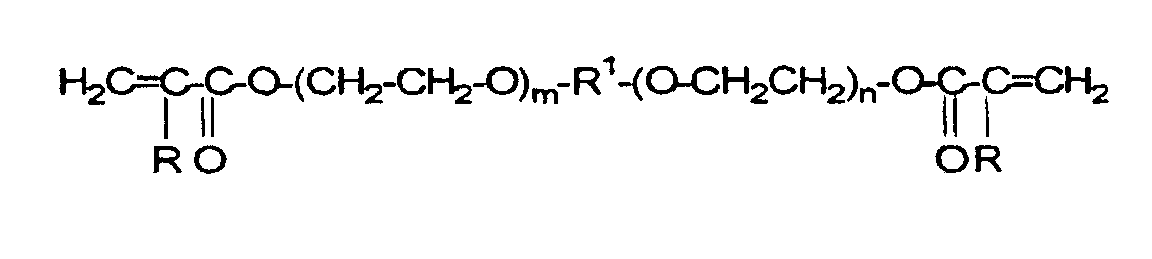 wherein R is a hydrogen atom or a methyl group, m and n
are each 0 or a positive integer, and R1 is any one of
the following aromatic groups.
wherein R is a hydrogen atom or a methyl group, m and n
are each 0 or a positive integer, and R1 is any one of
the following aromatic groups.
-
- Also available are alicyclic or aromatic epoxy di(meth)acrylates represented by the following formula:wherein R is a hydrogen atom or a methyl group, n is 0 or a positive integer, and R1 is -(CH2)2-, -(CH2)4- or any one of the following aromatic groups.



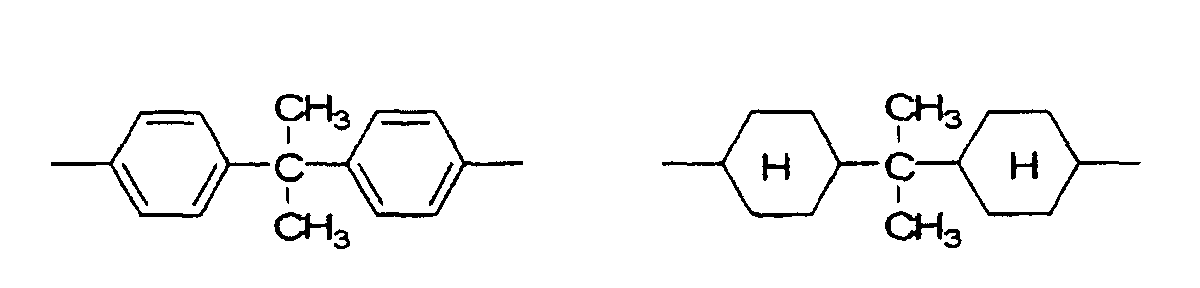


- Also available are polyfunctional (meth)acrylates having an urethane bond in the molecule, which are represented by the following formula:wherein R is a hydrogen atom or a methyl group, and R1 is -(CH2)2-, -(CH2)4-, -(CH2)6- or any one of the following groups.



- Examples of the acid group-containing monomers for use in the invention are described below. As monomers having at least one carboxyl group in one molecule, there can be mentioned monocarboxylic acids, dicarboxylic acids, tricarboxylic acids, tetracarboxylic acids, and their derivatives. Examples of such acids and derivatives include (meth)acrylic acid, maleic acid, p-vinylbenzoic acid, 11-(meth)acryloyloxy-1,1-undecanedicarboxylic acid (MAC-10), 1,4-di(meth)acryloyloxyethylpyromellitic acid, 6-(meth)acryloyloxyethylnaphthalene-1,2,6-tricarboxylic acid, 4-(meth)acryloyloxymethyltrimellitic acid and anhydride thereof, 4-(meth)acryloyloxyethyltrimellitic acid and anhydride thereof, 4-(meth)acryloyloxybutyltrimellitic acid and anhydride thereof, 4-[2-hydroxy-3-(meth)acryloyloxy]butyltrimellitic acid and anhydride thereof, 2,3-bis(3,4-dicarboxybenzoyloxy)propyl (meth)acrylate, N-o-di(meth)acryloyloxytyrosine, o-(meth)acryloyloxytyrosine, N-(meth)acryloyloxytyrosine, N-(meth)acryloyloxyphenylalanine, N-(meth)acryloyl-p-aminobenzoic acid, N-(meth)acryloyl-o-aminobenzoic acid, N-(meth)acryloyl-5-aminosalicylic acid, N-(meth)acryloyl-4-aminosalicylic acid, 2-, 3- or 4-(meth)acryloyloxybenzoic acid, an addition product (PMDM) of 2-hydroxyethyl (meth)acrylate with pyromellitic dianhydride, an addition product of 2-hydroxyethyl (meth)acrylate with maleic anhydride, an addition product (BTDA) of 2-hydroxyethyl (meth)acrylate with 3,3',4,4'-benzophenonetetracarboxylic dianhydride, an addition product of 2-hydroxyethyl (meth)acrylate with 3,3',4,4'-biphenyltetracarboxylic dianhydride, 2-(3,4-dicarboxybenzoyloxy)-1,3-di(meth)acryloyloxypropane, an addition product of N-phenylglycine or N-tolylglycine with glycidyl (meth)acrylate, 4-[(2-hydroxy-3-(meth)acryloyloxypropyl)amino]phthalic acid, and 3- or 4-[N-methyl-N-(2-hydroxy-3-(meth)acryloyloxypropyl)amino]phthalic acid.
- As monomers having at least one phosphoric acid group in one molecule, there can be mentioned, for example, 2-(meth)acryloyloxyethyl acid phosphate, 2- or 3-(meth)acryloyloxypropyl acid phosphate, 4-(meth)acryloyloxybutyl acid phosphate, 6-(meth)acryloyloxyhexyl acid phosphate, 8-(meth)acryloyloxyoctyl acid phosphate, 10-(meth)acryloyloxydecyl acid phosphate, 12-(meth)acryloyloxydodecyl acid phosphate, bis{2-(meth)acryloyloxyethyl}acid phosphate, bis{2- or 3-(meth)acryloyloxypropyl}acid phosphate, 2-(meth)acryloyloxyethylphenyl acid phosphate and 2-(meth)acryloyloxyethyl-p-methoxyphenyl acid phosphate. In these compounds, the phosphoric acid group can be replaced with a thiophosphoric acid group.
- As monomers having at least one sulfonic acid group in one molecule, there can be mentioned, for example, 2-sulfoethyl (meth)acrylate, 2- or 1-sulfo-1- or -2-propyl (meth)acrylate, 1- or 3-sulfo-2-butyl (meth)acrylate, 3-bromo-2-sulfo-2-propyl (meth)acrylate, 3-methoxy-1-sulfo-2-propyl (meth)acrylate and 1,1-dimethyl-2-sulfoethyl (meth)acrylamide.
- Of the above compounds, particularly preferable are (meth)acrylic acid esters, which are low-poisonous, can be rapidly polymerized, hardly undergo hydrolysis and are readily prepared. As the monofunctional polymerizable (meth)acrylic acid esters, particularly preferably used are, for example, alkyl methacrylates, such as methyl methacrylate (refractive index: 1.42) and ethyl methacrylate (refractive index: 1.42); hydroxyl group-containing (meth)acrylates, such as 2-hydroxyethyl methacrylate (refractive index: 1.45); and (meth)acrylates having ethylene glycol chain in the molecule, such as diethylene glycol monomethyl ether methacrylate (refractive index: 1.44) and tetraethylene glycol monomethyl ether methacrylate (refractive index: 1.45).
- As the polyfunctional polymerizable (meth)acrylic acid esters, particularly preferably used are, for example, di(meth)acrylates having ethylene glycol chain in the molecule, such as ethylene glycol dimethacrylate (refractive index: 1.45) and triethylene glycol dimethacrylate (refractive index: 1.46); and compounds represented by the following formulas:wherein R is a methyl group and m+n is 2.6 on the average (refractive index: 1.54),
 wherein R is a methyl group (refractive index: 1.54),
 wherein R is a methyl group (refractive index: 1.48).
- As the acid group-containing monomers, particularly preferably used are, for example, 11-methacryloyloxy-1,1-undecanedicarboxylic acid, 4-methacryloyloxyethyltrimellitic anhydride, N-methacryloyl-5-aminosalicylic acid, 2-(meth)acryloyloxyethylphenyl acid phosphate, 10-(meth)acryloyloxydecyl acid phosphate and 2-methyl-2-(meth)acrylamidopropanesulfonic acid.
- The acid group-containing monomer is used in an amount of usually 0.1 to 50 parts by weight, preferably 0.5 to 20 parts by weight, particularly preferably 1 to 10 parts by weight, based on 100 parts by weight of the (meth)acrylate monomer contained in the dental composition of the invention.
- In the dental composition of the invention, it is desirable to select and use the (meth)acrylate monomer in such a manner that the difference between the refractive index of a cured product of a mixture of the polymerizable monomer represented by the formula (1) and this monomer and the refractive index of the glass powder added as a filler should become not more than 0.05, particularly 0 to 0.02.
- By the polymerization of the (meth)acrylate monomer, the refractive index of a cured product of the monomer usually becomes higher than the refractive index of the monomer by about 0.02 to 0.03. Further, when a polar group (e.g., hydroxyl group, carboxylic acid group), an aromatic ring, a heavy element (e.g., halogen atom) or a sulfur element is incorporated into the (meth)acrylate monomer, the refractive index of the (meth)acrylate monomer generally tends to become higher than that of the monomer not containing such a group or an element. The refractive index of the monomer containing such a group or a heavy element is in the range of usually 1.48 to 1.54. On the other hand, the refractive index of a monomer having only an alkyl group as its structure or a (meth)acrylic monomer having a fluoroalkyl group tends to become lower that that of a monomer not having such a group, and the refractive index of the (meth)acrylic monomer is in the range of usually 1.40 to 1.48.
- The content of other polymerizable monomers in the dental composition of the invention is in the range of preferably 5 to 50 % by weight, particularly preferably 10 to 30 % by weight.
- The dental composition of the invention contains at least the polymerizable monomer represented by the formula (1), the filler and the polymerization initiator, and to the composition, other components, such as pigment, dye, stabilizer, polymer powder and ultraviolet light absorber, may be added when needed, within limits not detrimental to the desired effects.
- In the process for preparing the composition of the invention, the polymerizable monomer (A) represented by the formula (1), the polymerization initiator (B), the filler (C), and if desired, the polymerizable monomer (D) other than the polymerizable monomer (A) are mixed to carry out polymerization reaction. Since it is necessary that the polymerizable composition should not be contaminated with insoluble matters or foreign matters, the composition may be filtered to remove them prior to polymerization. It is more preferable to sufficiently defoam the composition under reduced pressure prior to polymerization curing, because introduction of bubbles into the cured product can be prevented.
- The dental composition of the invention can undergo polymerization reaction by irradiation with ultraviolet rays, visible rays or the like, similarly to the conventional photopolymerizable materials. Examples of light sources employable for the irradiation include fluorescent lamp, various mercury lamps, xenon lamp, tungsten lamp, halogen lamp and sunlight. The light irradiation time is in the range of 1 second to 5 minutes. The temperature for the photopolymerization is in the range of usually 0 to 100°C, preferably 5 to 60°C. It is preferable to complete the polymerization curing in the shortest time at ordinary temperature in consideration of particularity of the circumstances where the composition is used, such as situation of the dental treatment and a burden on the patient, and the formulation of the composition may be adjusted so as to complete the polymerization curing in a period of 1 to 30 minutes.
- The dental composition of the invention satisfies requirements for dental materials or compositions, such as mechanical strength, abrasion resistance, water resistance, curability and stain resistance, and has excellent and well-balanced transparency and X-ray opacity though the transparency and the X-ray opacity are hardly compatible with each other. The light transmittance (transparency) of a cured product of the dental composition is preferably not less than 1 %, more preferably not less than 5 %. The X-ray opaque value of the dental composition is in the range of preferably 100 to 1000 % (based on aluminum), more preferably 200 to 800 % (based on aluminum), still more preferably more than 300 % and not more than 800 % (based on aluminum), particularly preferably 400 to 800 % (based on aluminum). The composition of the invention further has a property of small polymerization shrinkage in addition to the above properties. On this account, the composition of the invention can be used for restoration of a defected part or filling of a cavity drilled, and besides the composition can be widely used for joining or adhesion of dentin of front tooth or the like, preparation of temporary tooth, bonding of bridge, adhesion of facing crown, etc.
- For the dental material of the invention, the polymerizable monomer (A) represented by the formula (1) can be used singly or in combination with plural different polymerizable monomers.
- The polymerizable monomer is preferably liquid at ordinary temperature and desirably has a viscosity of 100 to 1,000,000 cps, preferably 1,000 to 100,000 cps. This monomer is used as, for example, a primer that is used for undercoating before application of a resin adhesive. To the polymerizable monomer, additives, such as germicide, disinfectant, stabilizer and preservative, may be added when needed, within limits not detrimental to the effects of the invention.
- The present invention includes a dental material containing, together with the polymerizable monomer, a polymerization initiator that is used for curing, and such a dental material can be used as, for example, a bonding agent, a resin type adhesive or a temporary adhesive. As the polymerization initiator, the same substance as used for the aforesaid curable composition is employable.
- The sulfur-containing unsaturated carboxylic acid ester compound having a substituent containing a sulfur atom and at least two (meth)acrylic acid residues through an oxygen atom bonded to a secondary or tertiary carbon atom, specifically the polymerizable monomer represented by the formula (1), can be widely used singly or in combination with a polymerization initiator and a filler to serve as a dental material or a dental composition. The dental composition containing at least the polymerizable monomer represented by the formula (1), the filler and the polymerization initiator satisfies requirements for dental compositions, such as mechanical strength, abrasion resistance and water resistance, is excellent in X-ray opacity, transparency, curability (particularly photo-curability) and stain resistance, and provides a cured product having small polymerizable shrinkage (especially when a composite filler is contained).
- Since the dental composition of the invention has X-ray opacity superior to that of the conventional compositions, the dental treatment can be made with confirming the position of the composition used.
- The present invention is further described with reference to the following examples and comparative examples, but it should be construed that the invention is in no way limited to those examples.
- The materials used in the following examples are described below.
- MNA-10: 1,3-bis(3-phenylthio-2-acryloyloxypropyloxy)benzene (refractive index of cured product of the compound only: 1.62)
- MNA-12: 1,3-{2'-acryloyloxy-3'-[2-(1,3-dithiolan-2-yl)ethylthio]propyloxy}benzene (refractive index of cured product of the compound only: 1.61, high-viscosity liquid)
- MNA-13: 1,3-bis(3-phenylthio-2-methacryloyloxypropyloxy)benzene (refractive index of cured product of the compound only: 1.61, high-viscosity liquid)
- MNA-30: 4,4'-bis(3-phenylthio-2-acryloyloxypropyloxy)biphenyl (refractive index of cured product of the compound only: 1.61, high-viscosity liquid)
- Bis-GMA: 2,2-bis[4-(2-hydroxy-3-methacryloxypropoxy)phenyl]propane (refractive index: 1.54, high-viscosity liquid)
- TEGDMA: triethylene glycol dimethacrylate (refractive index: 1.46)
- UDMA: 1,6-bis(methacryloxyethyloxycarbonylamino)-2,2,4-(or -2,4,4-)trimethylhexane (refractive index: 1.48)
- Bis-MPEPP: 2,2-bis(4-methacryloxypolyethoxyphenyl)propane (refractive index: 1.54)
- A glass: obtained by treating a glass (refractive index: 1.60, average particle diameter: 5 µm) comprising 40 % by weight of silicon dioxide, 40 % by weight of barium oxide, 10 % by weight of boron oxide and 10 % by weight of aluminum oxide, with 1 % by weight of [3-(methacryloyloxy)propyl]trimethoxysilane in a conventional manner
- B glass: obtained by treating a glass (refractive index: 1.60, average particle diameter: 1 µm) comprising 40 % by weight of silicon dioxide, 40 % by weight of barium oxide, 10 % by weight of boron oxide and 10 % by weight of aluminum oxide, with 3 % by weight of [3-(methacryloyloxy)propyl]trimethoxysilane in a conventional manner
- C glass: obtained by treating a glass (refractive index: 1.55, average particle diameter: 1 µm) comprising 50 % by weight of silicon dioxide, 30 % by weight of barium oxide, 10 % by weight of boron oxide and 10 % by weight of aluminum oxide, with 3 % by weight of [3-(methacryloyloxy)propyl]trimethoxysilane in a conventional manner
- R-812: obtained by hydrophobic treatment of colloidal silica (average particle diameter: 0.007 µm) with dimethyldichlorosilane (proportion of particles having particle diameters of not less than 0.01 µm: about 10 %, available from Nippon Aerozil K.K.)
- The refractive index was measured at 20°C in a conventional manner by the use of an Abbe's refractometer (IT model manufactured by Atago K.K.).
- A dental composition (composite resin) experimentally prepared was filled in a mold of desired shape and irradiated with visible rays for 60 seconds by the use of a visible ray irradiation apparatus (Translux CL manufactured by Kulzer Co.) to cure the composition.
- Tests were carried out in accordance with 7.8 (flexural strength) and 7.11 (X-ray opacity) of ISO-4049 (1988).
- The flexural strength was measured by the use of an autograph AGS-2000G manufactured by Shimadzu Seisakusho K.K. at a crosshead speed of 1 mm/min. The X-ray opacity was measured by X-ray photographing a circular cured product having a thickness of 2.0 mm by the use of an X-ray control apparatus (PCX-100 manufactured by Asahi Roentgen Kogyo K.K.) and then calculating the density of the photographed image as an Al equivalent (%) by a densitometer (PDA15 manufactured by Konica K.K.) based on the density of a photographed image of an Al plate of the same thickness.
- A Teflon mold of 1 mm thickness having a rectangular hole of 10 mm (width) × 25 mm (length) was filled with a dental composition (composite resin), then sandwiched between a polyester film and a glass plate and irradiated with visible rays for 60 seconds per spot by the use of a visible ray irradiation apparatus (Translux CL manufactured by Kulzer Co.) to cure the composition. Making reference to the description of 7.8.2.2 of ISO4049 (1988), irradiation with visible rays was carried out so that the whole sample should be irradiated with the rays uniformly and sufficiently. The light transmittance of the sample at a wavelength of 480 nm was measured by the use of an ultraviolet-visible spectrophotometer (UV-160A manufactured by Shimadzu Seisakusho K.K.).
- As shown in Fig. 1, an alumina ceramic tube having an inner diameter of 6 mm and a height of 5 mm was filled with a dental composition (composite resin). In order to prevent disconnection of the polymerized dental composition from the tube due to shrinkage, the tube was sufficiently filled with the composition so that the composition came out of one end of the tube and covered the tube. Then, the dental composition (composite resin) filled in the tube was irradiated with a light for 180 seconds from the upper surface side of the tube by the use of a visible ray irradiation apparatus (Translux CL manufactured by Kulzer) to cure the dental composition (composite resin) in the tube. Thereafter, the tube with the dental composition was placed in an industrial visible ray irradiation apparatus (α-Light II manufactured by Morita Seisakusho K.K.) and irradiated with visible rays around the tube for 300 seconds to completely cure the dental composition (composite resin) present inside and outside the tube.
- After the curing, the alumina tube was cut at the position of 2 mm from the top of the tube. The cut surface was subjected to mirror polishing and cleaned by an ultrasonic cleaner. Then, the gap formed between the cured product and the tube was measured at 8 spots, and the total of widths of the gaps at the facing two measuring spots was taken as a width of gap due to polymerization shrinkage.
- In a monomer mixture (refractive index: 1.58) consisting of 50 parts by weight of MNA-10 and 50 parts by weight of Bis-MPEPP, 0.5 part by weight of camphorquinone and 0.5 part by weight of ethyl N,N-dimethylaminobenzoate were dissolved. The resulting component was mixed with 400 parts by weight of the A glass and 20 parts by weight of R-812 to prepare a dental composition as a homogeneous paste. The polymerization shrinkage of a cured product of the dental composition was extremely small, as shown as a gap width in Table 1. The refractive index of the cured product of the dental composition was 1.60.
- The flexural strength, light transmittance and X-ray opacity of the cured product of the dental composition are set forth in Table 1.
- In a monomer mixture (refractive index: 1.58) consisting of 75 parts by weight of MNA-10 and 25 parts by weight of TEGDMA, 0.5 part by weight of benzoyl peroxide was dissolved. The resulting component and 400 parts by weight of the B glass were sufficiently mixed to prepare a homogeneous paste. The paste was heated at 120°C for 15 minutes by a compression molding machine with application of pressure to cure the paste. The cured product of the paste was pulverized by a ball mill and sieved to prepare a composite filler A having an average particle diameter of about 20 µm.
- In a monomer mixture (refractive index: 1.58) consisting of 75 parts by weight of MNA-10 and 25 parts by weight of TEGDMA, 0.5 part by weight of camphorquinone and 0.5 part by weight of ethyl N,N-dimethylaminobenzoate were dissolved. The resulting component was mixed with 350 parts by weight of the A glass, 50 parts by weight of the composite filler A and 30 parts by weight of R-812 to prepare a dental composition as a homogeneous paste. The polymerization shrinkage of a cured product of the dental composition was extremely small, as shown as a gap width in Table 1. The refractive index of the cured product of the dental composition was 1.60.
- The flexural strength, light transmittance and X-ray opacity of the cured product of the dental composition are set forth in Table 1.
- In a monomer mixture (refractive index: 1.58) consisting of 60 parts by weight of MNA-12 and 40 parts by weight of Bis-MPEPP, 0.5 part by weight of camphorquinone and 0.5 part by weight of ethyl N,N-dimethylaminobenzoate were dissolved. The resulting component was mixed with 400 parts by weight of the A glass and 20 parts by weight of R-812 to prepare a dental composition as a homogeneous paste. The polymerization shrinkage of a cured product of the dental composition was extremely small, as shown as a gap width in Table 1. The refractive index of the cured product of the dental composition was 1.60.
- The flexural strength, light transmittance and X-ray opacity of the cured product of the dental composition are set forth in Table 1.
- In a monomer mixture (refractive index: 1.58) consisting of 60 parts by weight of MNA-13 and 40 parts by weight of Bis-MPEPP, 0.5 part by weight of camphorquinone and 0.5 part by weight of ethyl N,N-dimethylaminobenzoate were dissolved. The resulting component was mixed with 350 parts by weight of the B glass and 25 parts by weight of R-812 to prepare a dental composition as a homogeneous paste. The polymerization shrinkage of a cured product of the dental composition was extremely small, as shown as a gap width in Table 1. The refractive index of the cured product of the dental composition was 1.60.
- The flexural strength, light transmittance and X-ray opacity of the cured product of the dental composition are set forth in Table 1.
- In a monomer mixture (refractive index: 1.58) consisting of 60 parts by weight of MNA-30 and 40 parts by weight of Bis-MPEPP, 0.5 part by weight of camphorquinone and 0.5 part by weight of ethyl N,N-dimethylaminobenzoate were dissolved. The resulting component was mixed with 400 parts by weight of the A glass and 20 parts by weight of R-812 to prepare a dental composition as a homogeneous paste. The polymerization shrinkage of a cured product of the dental composition was extremely small, as shown as a gap width in Table 1. The refractive index of the cured product of the dental composition was 1.60.
- The flexural strength, light transmittance and X-ray opacity of the cured product of the dental composition are set forth in Table 1.
- In a monomer mixture (refractive index: 1.52) consisting of 70 parts by weight of Bis-GMA and 30 parts by weight of TEGDMA, 0.5 part by weight of camphorquinone and 0.5 part by weight of ethyl N,N-dimethylaminobenzoate were dissolved. The resulting component was mixed with 400 parts by weight of the A glass and 25 parts by weight of R-812 to prepare a dental composition as a homogeneous paste. The polymerization shrinkage of the dental composition is set forth as a gap width in Table 1. The refractive index of a cured product of the dental composition was 1.54.
- The flexural strength, light transmittance and X-ray opacity of the cured product of the dental composition are set forth in Table 1.
- In a monomer mixture (refractive index: 1.52) consisting of 70 parts by weight of Bis-GMA and 30 parts by weight of TEGDMA, 0.5 part by weight of camphorquinone and 0.5 part by weight of ethyl N,N-dimethylaminobenzoate were dissolved. The resulting component was mixed with 350 parts by weight of the C glass and 20 parts by weight of R-812 to prepare a dental composition as a homogeneous paste. The polymerization shrinkage of the dental composition is set forth as a gap width in Table 1. The refractive index of a cured product of the dental composition was 1.55.
- The flexural strength, light transmittance and X-ray opacity of the cured product of the dental composition are set forth in Table 1.
- In a monomer mixture (refractive index: 1.52) consisting of 35 parts by weight of Bis-GMA, 35 parts by weight of Bis-MPEPP and 30 parts by weight of TEGDMA, 0.5 part by weight of camphorquinone and 0.5 part by weight of ethyl N,N-dimethylaminobenzoate were dissolved. The resulting component was mixed with 400 parts by weight of the A glass and 20 parts by weight of R-812 to prepare a dental composition as a homogeneous paste. The polymerization shrinkage of the dental composition is set forth as a gap width in Table 1. The refractive index of a cured product of the dental composition was 1.54.
- The flexural strength, light transmittance and X-ray opacity of the cured product of the dental composition are set forth in Table 1.
- In a monomer mixture (refractive index: 1.52) consisting of 35 parts by weight of Bis-GMA, 35 parts by weight of Bis-MPEPP, 15 parts by weight of TEGDMA and 15 parts by weight of UDMA, 0.5 part by weight of camphorquinone and 0.5 part by weight of ethyl N,N-dimethylaminobenzoate were dissolved. The resulting component was mixed with 400 parts by weight of the A glass and 20 parts by weight of R-812 to prepare a dental composition as a homogeneous paste. The refractive index of a cured product of the dental composition was 1.54.
- The flexural strength, light transmittance and X-ray opacity of the cured product of the dental composition are set forth in Table 1.
- In 100 parts by weight of Bis-MPEPP (refractive index: 1.54), 0.5 part by weight of camphorquinone and 0.5 part by weight of ethyl N,N-dimethylaminobenzoate were dissolved. The resulting component was mixed with 400 parts by weight of the A glass and 20 parts by weight of R-812 to prepare a dental composition as a homogeneous paste. The refractive index of a cured product of the dental composition was 1.56.
- The flexural strength, light transmittance and X-ray opacity of the cured product of the dental composition are set forth in Table 1.
- An attempt to mix Bis-GMA (refractive index: 1.54) with the A glass was made, but they could not be mixed because the viscosity of the BIS-GMA was too high.
(Flexural strength, light transmittance, X-ray opacity and polymerization shrinkage of composite resin) Flexural strength (MPa) Light transmittance (T %) X-ray opacity (%, aluminum base) Gap width (µm) Ex. 1 124 13.4 580 27.6 Ex. 2 102 7.3 530 22.8 Ex. 3 117 14.1 580 24.3 Ex. 4 128 10.1 500 25.5 Ex. 5 103 13.3 570 23.2 Comp. Ex.1 122 0.6 580 41.5 Comp. Ex.2 106 11.8 220 46.4 Comp. Ex.3 121 0.6 570 45.2 Comp. Ex.4 129 0.5 580 - Comp. Ex.5 103 0.8 580 - - As can be seen from Table 1, with regard to the mechanical strength of the composite resin that is indicated by the flexural strength, there was no large difference between the examples and the comparative examples, and they had sufficient strengths nearly equal to one another. On the other hand, with regard to both the light transmittance indicating transparency and the X-ray opacity, the composite resins of the examples exhibited excellent results. Comparative Example 2 showed light transmittance of good value but was inferior to the examples and other comparative examples in the X-ray opacity. The composite resins of other comparative examples were all equal to the composite resins of the examples in the X-ray opacity, but they showed light transmittance of much lower values than the composite resins of the examples.




Claims (10)
- A dental material comprising a sulfur-containing unsaturated carboxylic acid ester compound having a substituent containing a sulfur atom and at least two (meth)acrylic acid residues through an oxygen atom bonded to a secondary or tertiary carbon atom.
- The dental material as claimed in claim 1, comprising at least one polymerizable monomer (A) represented by the following formula (I):wherein R11 is a divalent organic group, each X11 is independently an oxygen atom, a sulfur atom, -COO- group or -(CH2)qX12- group (X12 is an oxygen atom or a sulfur atom, and q is an integer of 1 to 3), each R12 is independently a hydrogen atom or an alkyl group, each R13 is independently a substituent containing a sulfur atom, and each R14 is independently a hydrogen atom or a methyl group.
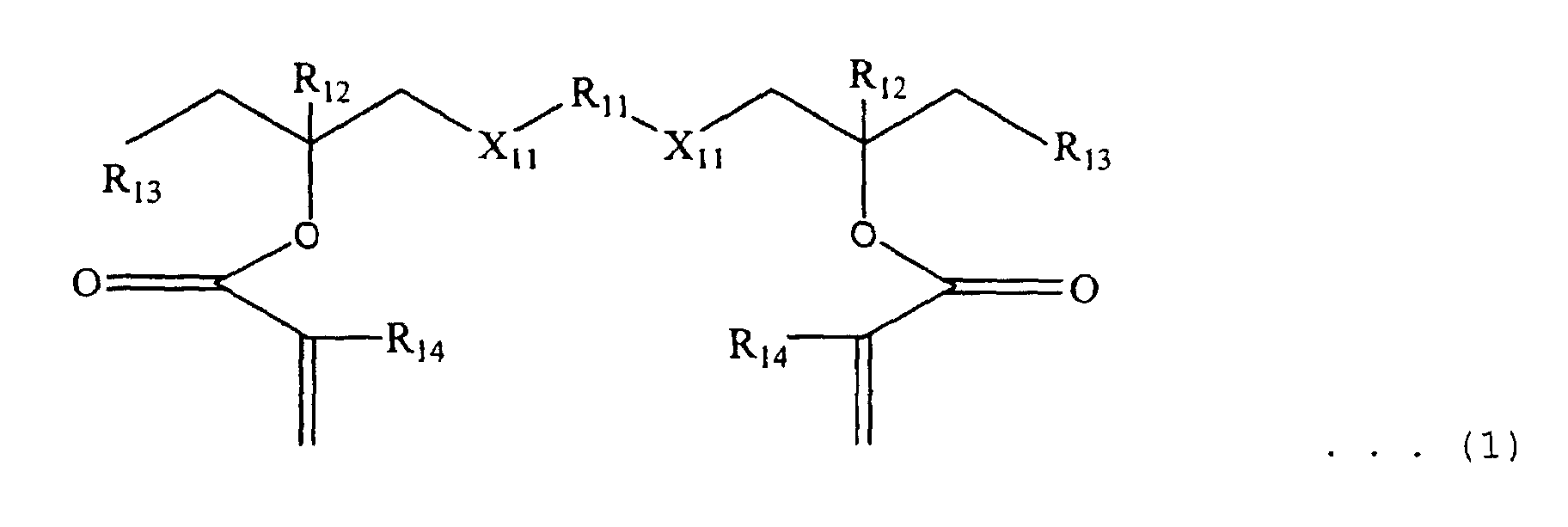
- The dental material as claimed in claim 2, wherein R11 in the formula (1) is a group represented by any one of the following formulas (2) to (4):wherein R21, R22, R23 and R24 are each independently a hydrogen atom, an alkyl group, an alkoxyl group, a nitro group or a halogen atom,
 wherein Y31 is a single bond, -C(R31)2- group (each R31 is independently a hydrogen atom or a methyl group), -O- group, -S- group or -SO2- group, R32 and R33 are each independently an alkyl group, an alkenyl group, an aralkyl group, an aryl group, an alkoxyl group, an alkylthio group, a nitro group or a halogen atom, and m and n are each independently 0 or an integer of 1 to 4,
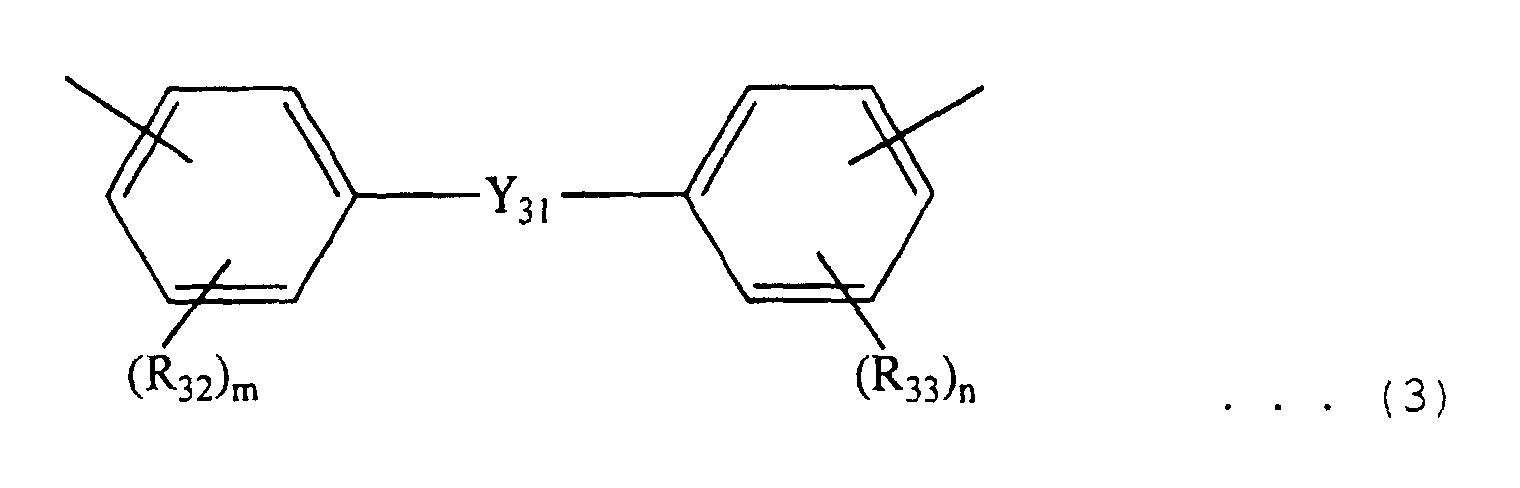 wherein each R41 is independently a hydrogen atom or an alkyl group.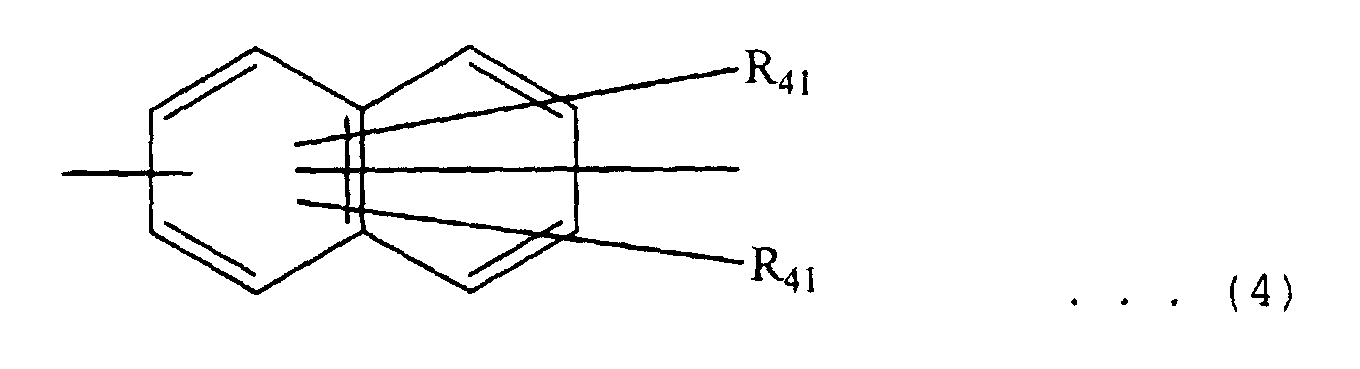
- A dental composition comprising:(A) at least one polymerizable monomer represented by the formula (1),(B) a polymerization initiator, and(C) a filler.
- The dental composition as claimed in claim 4, further comprising (D) another polymerizable monomer in addition to the polymerizable monomer (A) represented by the formula (1).
- The dental composition as claimed in claim 4 or 5, wherein the filler (C) has an X-ray opaque value of 100 to 1000 % based on the X-ray opaque value of aluminum.
- The dental composition as claimed in claim 4 or 5, wherein the light transmittance of a cured product of said dental composition having a thickness of 1 mm, at a wavelength of 480 nm, is not less than 1 %.
- The dental composition as claimed in claim 4 or 5, wherein the refractive index of a cured product of the polymerizable monomer (A) represented by the formula (1) or a cured product of a mixture of the polymerizable monomer (A) and the polymerizable monomer (D) is not less than 1.55, and the difference between said refractive index and a refractive index of the filler (C) is not more than 0.05.
- The dental composition as claimed in claim 4, wherein the refractive index of the filler (C) is not less than 1.55.
- The dental composition as claimed in claim 4, wherein a part or all of the filler (C) is contained as a composite filler formed from a polymerizable monomer and an inorganic compound.
Applications Claiming Priority (3)
| Application Number | Priority Date | Filing Date | Title |
|---|---|---|---|
| JP2000323144 | 2000-10-23 | ||
| JP2000323144 | 2000-10-23 | ||
| PCT/JP2001/009281 WO2002034207A1 (en) | 2000-10-23 | 2001-10-23 | Dental material and composition |
Publications (1)
| Publication Number | Publication Date |
|---|---|
| EP1334711A1 true EP1334711A1 (en) | 2003-08-13 |
Family
ID=18800885
Family Applications (1)
| Application Number | Title | Priority Date | Filing Date |
|---|---|---|---|
| EP01974898A Withdrawn EP1334711A1 (en) | 2000-10-23 | 2001-10-23 | Dental material and composition |
Country Status (5)
| Country | Link |
|---|---|
| US (1) | US20040039080A1 (en) |
| EP (1) | EP1334711A1 (en) |
| JP (1) | JPWO2002034207A1 (en) |
| KR (1) | KR20030042029A (en) |
| WO (1) | WO2002034207A1 (en) |
Families Citing this family (9)
| Publication number | Priority date | Publication date | Assignee | Title |
|---|---|---|---|---|
| US7442749B2 (en) * | 2002-08-29 | 2008-10-28 | Nippon Shokubai Co., Ltd. | Sulfur-containing poly (unsaturated carboxylic acid) and its uses and production process |
| US7534909B2 (en) * | 2003-05-23 | 2009-05-19 | Mitsui Chemicals, Inc. | (Meth) acrylic ester compound and use thereof |
| US20090298966A1 (en) * | 2005-09-22 | 2009-12-03 | Gdf Gesellschaft Fur Dentale Forschung Und Innovationen Gmbh | Dental material |
| JP6294785B2 (en) * | 2014-08-01 | 2018-03-14 | 株式会社松風 | Dental curable composition |
| JP2017132727A (en) * | 2016-01-29 | 2017-08-03 | 株式会社トクヤマデンタル | Visible light polymerizable composition |
| JP6925601B2 (en) * | 2016-01-29 | 2021-08-25 | 株式会社トクヤマデンタル | Dental visible light polymerizable composition |
| JP2018145097A (en) * | 2017-03-01 | 2018-09-20 | 株式会社トクヤマデンタル | Dental curable composition |
| CN112533963B (en) * | 2018-08-21 | 2023-07-25 | 三井化学株式会社 | (meth) acrylate, monomer composition for dental material, molded article, composition for dental material, and method for producing (meth) acrylate |
| US10898415B2 (en) | 2019-01-02 | 2021-01-26 | Kerr Corporation | Fillers for dental restorative materials |
Family Cites Families (7)
| Publication number | Priority date | Publication date | Assignee | Title |
|---|---|---|---|---|
| US532140A (en) * | 1895-01-08 | Jto-utho | ||
| US4001299A (en) * | 1974-12-12 | 1977-01-04 | Ciba-Geigy Corporation | Hindered hydroxyphenylalkanoates of substituted isopropanols |
| US5254198A (en) * | 1988-06-20 | 1993-10-19 | Kuraray Co., Ltd. | Method of bonding a metal or alloy utilizing a polymerizable thiocarboxylic acid or a derivative thereof |
| JPH1067614A (en) * | 1996-08-26 | 1998-03-10 | San Medical Kk | Metal-resin composite restorative dental material |
| JP4342035B2 (en) * | 1998-05-28 | 2009-10-14 | サンメディカル株式会社 | Dental adhesive composition |
| US6458908B1 (en) * | 1999-06-01 | 2002-10-01 | Mitsui Chemicals, Inc. | Sulfur-containing unsaturated carboxylate compound and its cured products |
| US6570025B1 (en) * | 2000-05-31 | 2003-05-27 | Mitsui Chemicals, Inc. | Sulfur compound and use thereof |
-
2001
- 2001-10-23 US US10/399,767 patent/US20040039080A1/en not_active Abandoned
- 2001-10-23 KR KR10-2003-7005644A patent/KR20030042029A/en not_active Ceased
- 2001-10-23 WO PCT/JP2001/009281 patent/WO2002034207A1/en not_active Ceased
- 2001-10-23 EP EP01974898A patent/EP1334711A1/en not_active Withdrawn
- 2001-10-23 JP JP2002537261A patent/JPWO2002034207A1/en active Pending
Non-Patent Citations (1)
| Title |
|---|
| See references of WO0234207A1 * |
Also Published As
| Publication number | Publication date |
|---|---|
| WO2002034207A1 (en) | 2002-05-02 |
| KR20030042029A (en) | 2003-05-27 |
| JPWO2002034207A1 (en) | 2004-03-04 |
| US20040039080A1 (en) | 2004-02-26 |
Similar Documents
| Publication | Publication Date | Title |
|---|---|---|
| EP0323521B1 (en) | Curable composition | |
| US5444104A (en) | Dental resin materials | |
| EP1627867B1 (en) | (meth)acrylic ester compound and use thereof | |
| US6787629B2 (en) | Dental resin materials, method of manufacture, and uses thereof | |
| US6221931B1 (en) | Dental restorative composition | |
| JP4851454B2 (en) | Dental composition containing nano-zirconia filler | |
| JPH10298021A (en) | Dental resin composition and dental repairing material | |
| JPS631281B2 (en) | ||
| US11767411B2 (en) | Curable composition containing transition metal adsorbent | |
| CA2032773A1 (en) | Dental compositions, a method of making shaped dental articles via photoiniferter polymerization of the dental compositions, and shaped dental articles produced thereby | |
| JPH06305929A (en) | Dental composition and use thereof | |
| KR101164302B1 (en) | Phosphate ester compound, metal salt thereof, dental material, and dental composition | |
| JP5074402B2 (en) | Curable composition containing dithian monomer | |
| JP3468833B2 (en) | Product kit of dental curable composition | |
| EP2156817A1 (en) | Reaction-setting adhesive composition, and adhesive material kit for dental applications | |
| US4579904A (en) | Diacrylic and dimethacrylic esters and their use | |
| US7589132B2 (en) | Dental resins, dental composite materials, and method of manufacture thereof | |
| US20040039080A1 (en) | Dental material and composition | |
| JP7493534B2 (en) | Dental Composition | |
| JP3549427B2 (en) | Vinylcyclopropane- (meth) acrylate and uses thereof | |
| KR101373086B1 (en) | Dental curable composition and kit for such dental curable composition | |
| JP2004300066A (en) | Dental material and dental composition | |
| JP7686554B2 (en) | Dental Adhesive Kit | |
| JPH0748219A (en) | Curable composition closely bondable to hard biotissue | |
| WO2005055960A2 (en) | Branched highly-functional monomers exhibiting low polymerization shrinkage |
Legal Events
| Date | Code | Title | Description |
|---|---|---|---|
| PUAI | Public reference made under article 153(3) epc to a published international application that has entered the european phase |
Free format text: ORIGINAL CODE: 0009012 |
|
| 17P | Request for examination filed |
Effective date: 20030512 |
|
| AK | Designated contracting states |
Designated state(s): DE FR GB |
|
| STAA | Information on the status of an ep patent application or granted ep patent |
Free format text: STATUS: THE APPLICATION IS DEEMED TO BE WITHDRAWN |
|
| RAP1 | Party data changed (applicant data changed or rights of an application transferred) |
Owner name: SUN MEDICAL CO., LTD. Owner name: MITSUI CHEMICALS, INC. |
|
| 18D | Application deemed to be withdrawn |
Effective date: 20040501 |