EP1333649A1 - Mobile communication device with a retractable headset kit and automatic call control - Google Patents
Mobile communication device with a retractable headset kit and automatic call control Download PDFInfo
- Publication number
- EP1333649A1 EP1333649A1 EP02002280A EP02002280A EP1333649A1 EP 1333649 A1 EP1333649 A1 EP 1333649A1 EP 02002280 A EP02002280 A EP 02002280A EP 02002280 A EP02002280 A EP 02002280A EP 1333649 A1 EP1333649 A1 EP 1333649A1
- Authority
- EP
- European Patent Office
- Prior art keywords
- headset
- mobile communication
- communication device
- encasement
- cord
- Prior art date
- Legal status (The legal status is an assumption and is not a legal conclusion. Google has not performed a legal analysis and makes no representation as to the accuracy of the status listed.)
- Withdrawn
Links
Images


Classifications
-
- H—ELECTRICITY
- H04—ELECTRIC COMMUNICATION TECHNIQUE
- H04M—TELEPHONIC COMMUNICATION
- H04M1/00—Substation equipment, e.g. for use by subscribers
- H04M1/60—Substation equipment, e.g. for use by subscribers including speech amplifiers
- H04M1/6033—Substation equipment, e.g. for use by subscribers including speech amplifiers for providing handsfree use or a loudspeaker mode in telephone sets
- H04M1/6041—Portable telephones adapted for handsfree use
- H04M1/6058—Portable telephones adapted for handsfree use involving the use of a headset accessory device connected to the portable telephone
-
- H—ELECTRICITY
- H04—ELECTRIC COMMUNICATION TECHNIQUE
- H04M—TELEPHONIC COMMUNICATION
- H04M1/00—Substation equipment, e.g. for use by subscribers
- H04M1/02—Constructional features of telephone sets
- H04M1/15—Protecting or guiding telephone cords
-
- H—ELECTRICITY
- H04—ELECTRIC COMMUNICATION TECHNIQUE
- H04M—TELEPHONIC COMMUNICATION
- H04M1/00—Substation equipment, e.g. for use by subscribers
- H04M1/60—Substation equipment, e.g. for use by subscribers including speech amplifiers
- H04M1/6033—Substation equipment, e.g. for use by subscribers including speech amplifiers for providing handsfree use or a loudspeaker mode in telephone sets
- H04M1/6041—Portable telephones adapted for handsfree use
- H04M1/6058—Portable telephones adapted for handsfree use involving the use of a headset accessory device connected to the portable telephone
- H04M1/6066—Portable telephones adapted for handsfree use involving the use of a headset accessory device connected to the portable telephone including a wireless connection
Definitions
- the present invention relates to a mobile communication device, in particular to a mobile communication device which is suited for hands-free operations.
- a mobile communication device held in close proximity to a user's ear exposes its brain directly to the radio frequency radiation emitted by the mobile device.
- the use of a headset for communicating with a mobile device reduces this unwelcome exposure to radiation and became therefore very popular.
- Headsets are usually available as an accessory for mobile communication devices and have to be plugged into the mobile device manually. But still, a driver receiving a call enroute will have to take out the headset from his pocket, plug it into a small hole of the mobile device and push the reception key. For one, this is very inconvenient for a driver, and often the procedure is not completed before the caller hangs up. On the other hand, a driver is put at a high risk of causing an accident.
- JP 10303806 proposes a hand-free device for use in a car which is suited to avoid a distraction of a driver caused by a sudden call tone.
- the hand-free device comprises a control means for detecting if a car is currently in motion and if so, a control means automatically answers an incoming call with an inquiry from a message transmission means requesting to declare if there is an emergency.
- a control means automatically answers an incoming call with an inquiry from a message transmission means requesting to declare if there is an emergency.
- a notice means In case of an emergency the driver of the car is informed by a notice means.
- a recording means records a message from the caller to prevent the driver from being distracted by a sudden call tone.
- a mobile communication device with a headset kit wherein the headset is an integral part of the mobile communication device or an integral part of an accessory device adapted to transfer signals between the headset and the mobile communication device, and wherein the headset is connected to the encasement of the respective device, whereby a retracting means for actively retracting at least the cord of the headset into the encasement is provided.
- an accessory device for a mobile communication device with a headset connected to the encasement of the accessory device, and with a signal transmission means for the transfer of signals between the headset and the mobile communication device, whereby a retracting means is provided for actively retracting at least the cord of the headset into the encasement.
- the proposed mobile communication device with a retractable headset allows a user to operate it without being disturbed in his concentration on his current activity.
- the retracting means are carried out as a mechanical mechanism or as an electro-mechanical mechanism allowing to automatically retract the cord of a headset.
- An operating status of the mobile communication device is further advantageously controlled by the state of the retraction of the headset so that a user can control functions of the mobile communication device in that he simply pulls the headset from the encasement or in that he retracts the headset.
- the mobile device preferably answers an incoming call automatically and/or places a call automatically according to a number entered by a user, and/or places a call automatically according to an entry selected by a user from a phone book means on the mobile communication device if the cord of the headset is at least partly pulled from its encasement. In this way, a user has to pay less attention for operating his mobile communication device.
- a current call is further advantageously terminated upon the cord of the headset going to be retracted in the encasement or when it is retracted to its limit into the encasement so that the user's attention will not be distracted from his current activity.
- electro-acoustic transducers which are accessible by the mobile communication device and which are different from the headset, are utilised by the mobile communication device when the cord of the headset is going to be retracted in the encasement or when it is retracted to its limit into the encasement, and these electro-acoustic transducers are not utilised by the mobile communication device, when the cord of the headset is at least partly pulled from the encasement.
- This allows an automatic switching between electro-acoustic transducers of the headset and those of the mobile communication device itself or external electro-acoustic transducers like those of a conference telephone facility or an audio system in a car.
- an accessory device is releasably attachable to the mobile communication device, so that the headset will form one single unit together with the mobile communication device.
- the signal transmission means for transferring signals between the headset and the mobile communication device are advantageously formed by a plug-in connector and/or a transceiving means for a transmission and a reception of optical or electro-magnetical signals, allowing a secure transfer of audio signals based on a electro-mechanical link or a radio communication link for the accessory device being used in an attached or remote condition to the mobile communication device.
- the mobile communication device like for instance a mobile phone can e.g. be used in situations where a hands-free operation of the mobile device is mandatory or recommendable and a quick response to an incoming call is desirable.
- Fig. 1 shows the main components of a retractable headset system 10 according to the present invention.
- the headset itself comprises at least one speaker in form of an earphone 12, a microphone 13, and at least one cord 18.
- the cord 18 is fixed the system 10 and thus to the encasement 11.
- the headset is shown in a state retracted in the encasement 11 of the retractable headset system 10.
- the encasement 11 is either the casing of the mobile communication device itself, so that the retractable headset system 10 will be integrated into the mobile device, or is designed as a separate accessory-like encasement like shown in the example of figure 1.
- the encasement 11 When carried out as a separate device, the encasement 11 is adapted to be attached to a mobile communication device.
- a lock mechanism 17 may be provided on the accessory encasement 11 to enable a secure attachment of the two encasements and to allow detaching them.
- the audio signals are transmitted between the headset and mobile device either by means of a mechanical plug-in connection or a transceiver means which allows the headset accessory to be operated remotely.
- the plug-in connector may be adapted for an automatic connection, when the headset accessory is attached to the body of the mobile communication device and may also provide a cable when both devices are operated in a detached configuration.
- a transceiver based on the transmission of optical or electro-magnetical signals is preferred.
- the transceiver based transmission of audio signals is also possible for the accessory attached to the mobile device.
- the transceiver based option for transmitting audio signals is used in the remote mode while the plug-in connector based option is used in the attached mode.
- a retracting mechanism for controlling the retractation of the cord 18 and thereby the retractation of the headset itself is formed by a pulling device 15 and, if necessary an additional control element 16.
- the retracting device 15 is able to retract a pulled out headset back into the encasement such that the speaker 12 and microphone 13 are placed into their respective recesses.
- the pulling device 15 may either be operated manually or by a mechanical or electro-mechanical actuation.
- the pulling device 15 is formed by a reel around which the cord 18 is wound up when retracted in the headset.
- the cord 18 is unwound from the reel 15. This can be used to wind up a spring loaded mechanical actuation in the reel which will thus later be able to rewind the reel when the headset has to be retracted back in the encasement 11.
- an electric motor drive can be used to drive the reel in both directions.
- the control element 16 prevents the headset from being pulled out or retracted unintendedly.
- the control element 16 is preferably formed by a clamping device or the like fixing the cord 18 in a current position when no external withdrawing force is applied to it.
- the clamping mechanism can be released and the headset is retracted into its encasement 11.
- the control element 16 can simply be a switch allowing to select if the the headset has to be withdrawn from the encasement or retracted into it.
- a combination of a clamping device and an electrical switch is used, whereby the electromotor may assist automatically, when a user pulls the headset from its encasement.
- a detector 14 checks if the headset is pulled from the encasement or retracted in the encasement.
- the position of the headset can either be identified by locating the position of an element of the headset 12 or 13, by identifying the position of a marker on the cord 18 or when using a wheel 15 as in the example of Fig. 1 by identifying the rotational position of the wheel.
- a reel as a pulling device 15 is just one of many possibilities.
- the cord may alternatively be guided between two rolls and loosely stored in the encasement 11, or a guide rail may be used to retract and store the cord in the encasement. But also any other retraction and storing mechanisms like e.g. a folding mechanism or the like may be used.
- a detector 14 is used to confirm the state of retraction of the headset.
- a headset being completely retracted in the encasement means, that the cord 18 of the headset is retracted to its limit and cannot be retracted in the encasement any further.
- the electroacoustic transducers 12 and 13 not necessarily have to be pulled inside the encasement or a recession thereof.
- mechanical switches preferably micro-switches, electro-optical devices, proximity switches, sensing devices identifying an electrical characteristic of an electric motor drive like turning clock-/unclock-wise or being in an end position or the like can be used.
- Fig. 1 uses a micro switch 16 to sense if the speaker 12 of the headset is in its position of rest in the respective recess.
- the micro switch 14 comprises a switch lever 20 which can be moved between two final positions. In a first of the final positions, the micro switch provides an electrical connection between a first pair of its leads, in a second final position it provides an electrical connection between a second pair of its leads and/or an open circuit between the first pair of leads.
- These switching states are used to control functions of the mobile communication device. When no force is applied to the switch lever, it automatically returns to a defined final position, the release position.
- Fig. 2a the speaker 12 is removed from its recess so that the switch lever 20 takes in the release position. Its switching state hereby indicates to the mobile communication device that the headset is not completely retracted.
- Fig. 2b with the speaker 12 completely retracted in its recess, the switch lever 20 is moved to or close to the second final position different from the release position thereby indicating to the mobile communication the headset being retracted completely.
- micro switch 14 is just one example for a detector suited for identifying the retraction state of the headset.
- motion of the cord 18, the direction of its motion, the tension force exerted to it or the like may be identified by suitable detectors resulting in a control state adapted to control functions of the mobile communication device.
- the first scenario 300 underlying the flowchart of Fig. 3a refers to the reaction of a mobile communication device to an incoming call.
- the mobile device receives a call in step S301, it starts to query if the headset is in a retracted position in step S302, whereby in the following, the term 'retracted position' is used as a synonym for the cord 18 going to be retracted as well as for the cord 18 being retracted to its limit into the encasement 11.
- This can be achieved by e.g. querying the switching state of a micro switch like the one described above or by evaluating a signal related to a state of a respective detector 14.
- the mobile communication device answers the call automatically in step S 304, else it does not take any action in step S303 or sends a message to the effect that the callee is currently not available. As long as the line is not interrupted, the user may pull the headset from the encasement 11 to hop from step S303 to step S304.
- a user selects an entry from the phone book facility on his mobile communication device in step S311.
- telephone numbers are usually associated with a respective specification.
- the mobile device queries the status of the headset like described for the first scenario in step S312. If the headset is pulled out from the encasement 11, the mobile device places the call according to the selected entry automatically in step S314, else it take no respective action in step S313.
- the third scenario 320 represented by Fig. 3c assists a user in terminating a call.
- the status of the call is first queried in step S322.
- the mobile communication device returns to its stand by status in step S323.
- the status of the headset is checked in step S324. If it is found to be pulled from the encasement 11, the system return to step S322. If the headset has been retracted meanwhile, the call is terminated automatically by the mobile communication device.
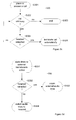
- the last scenario 330 as shown in Fig. 3d shows how a mobile communication device according to the present invention assists a user to use audio facilities like speaker and microphone of the mobile communication device or those of an external appliance alternatively to the retractable headset.
- step S331 it is assumed that the audio lines of an external appliance or the speaker and microphone internal to the mobile device are used instead of the headset.
- the device queries in step S332 if the headset is in its retracted position. As long as this is found to be true, the system will retain the currently used audio lines in step S333. Else, when the headset is being pulled from the encasement 11, the audio channels will be switched to the audio lines of the headset in step S334.
- a mobile communication device used with a retractable headset according to the present invention allows a user to enjoy mobile communication without being distracted in his concentration from occurrences relevant to security.
Landscapes
- Engineering & Computer Science (AREA)
- Signal Processing (AREA)
- Computer Networks & Wireless Communication (AREA)
- Telephone Set Structure (AREA)
Abstract
A mobile communication device with a headset kit (10) is presented, wherein the
headset (12, 13, 18) is an integral part of the mobile communication device or an
integral part of an accessory device adapted to transfer signals between the headset (12,
13, 18) and the mobile communication device, and wherein the headset (12, 13, 18) is
connected to the encasement (11) of the respective device, whereby a retracting means
(15, 16) is provided for actively retracting at least the cord (18) of the headset (12, 13,
18) into the encasement (11). Further, an operating status of the mobile communication
device is controlled by the state of retraction of the headset (12, 13, 18).
Description
The present invention relates to a mobile communication device, in particular to a
mobile communication device which is suited for hands-free operations.
For achieving a good acoustic quality for a conversation over a mobile communication
device, a user usually has to pay a considerable amount of attention on how to place the
mobile device close to his ear. Especially when driving a user is then distracted from
the traffic. The use of hands-free kits for the operation of mobile communication
devices while driving is now mandatory in many countries.
Beside the risks of using a mobile communication device while driving, a mobile
communication device held in close proximity to a user's ear exposes its brain directly
to the radio frequency radiation emitted by the mobile device. The use of a headset for
communicating with a mobile device reduces this unwelcome exposure to radiation and
became therefore very popular.
Headsets are usually available as an accessory for mobile communication devices and
have to be plugged into the mobile device manually. But still, a driver receiving a call
enroute will have to take out the headset from his pocket, plug it into a small hole of the
mobile device and push the reception key. For one, this is very inconvenient for a
driver, and often the procedure is not completed before the caller hangs up. On the
other hand, a driver is put at a high risk of causing an accident.
JP 10303806 proposes a hand-free device for use in a car which is suited to avoid a
distraction of a driver caused by a sudden call tone. The hand-free device comprises a
control means for detecting if a car is currently in motion and if so, a control means
automatically answers an incoming call with an inquiry from a message transmission
means requesting to declare if there is an emergency. In case of an emergency the driver
of the car is informed by a notice means. In case of no emergency, a recording means
records a message from the caller to prevent the driver from being distracted by a
sudden call tone. Although this solution reduces the risk of an accident for a driver of a
car, the driver is not able to respond quickly to an incoming call.
It is therefore an object of the present invention to propose a mobile communication
device and an accessory device for a mobile communication device which allows a
secure hands-free operation of a mobile communication device and a quick response to
incoming calls.
This object is achieved by the subject-matter of the independent claims.
In particular, the above object is achieved by a mobile communication device with a
headset kit, wherein the headset is an integral part of the mobile communication device
or an integral part of an accessory device adapted to transfer signals between the headset
and the mobile communication device, and wherein the headset is connected to the
encasement of the respective device, whereby a retracting means for actively retracting
at least the cord of the headset into the encasement is provided.
Further, the above object is achieved by an accessory device for a mobile
communication device with a headset connected to the encasement of the accessory
device, and with a signal transmission means for the transfer of signals between the
headset and the mobile communication device, whereby a retracting means is provided
for actively retracting at least the cord of the headset into the encasement.
The proposed mobile communication device with a retractable headset allows a user to
operate it without being disturbed in his concentration on his current activity.
Further advantageous features are claimed in the respective sub-claims.
Advantageously, the retracting means are carried out as a mechanical mechanism or as
an electro-mechanical mechanism allowing to automatically retract the cord of a
headset.
An operating status of the mobile communication device is further advantageously
controlled by the state of the retraction of the headset so that a user can control
functions of the mobile communication device in that he simply pulls the headset from
the encasement or in that he retracts the headset.
The mobile device preferably answers an incoming call automatically and/or places a
call automatically according to a number entered by a user, and/or places a call
automatically according to an entry selected by a user from a phone book means on the
mobile communication device if the cord of the headset is at least partly pulled from its
encasement. In this way, a user has to pay less attention for operating his mobile
communication device.
A current call is further advantageously terminated upon the cord of the headset going
to be retracted in the encasement or when it is retracted to its limit into the encasement
so that the user's attention will not be distracted from his current activity.
According to an advantageous development, electro-acoustic transducers which are
accessible by the mobile communication device and which are different from the
headset, are utilised by the mobile communication device when the cord of the headset
is going to be retracted in the encasement or when it is retracted to its limit into the
encasement, and these electro-acoustic transducers are not utilised by the mobile
communication device, when the cord of the headset is at least partly pulled from the
encasement. This allows an automatic switching between electro-acoustic transducers of
the headset and those of the mobile communication device itself or external electro-acoustic
transducers like those of a conference telephone facility or an audio system in a
car.
Preferably, an accessory device according to the present invention is releasably
attachable to the mobile communication device, so that the headset will form one single
unit together with the mobile communication device. The signal transmission means for
transferring signals between the headset and the mobile communication device are
advantageously formed by a plug-in connector and/or a transceiving means for a
transmission and a reception of optical or electro-magnetical signals, allowing a secure
transfer of audio signals based on a electro-mechanical link or a radio communication
link for the accessory device being used in an attached or remote condition to the mobile
communication device.
The mobile communication device according to the present invention like for instance a
mobile phone can e.g. be used in situations where a hands-free operation of the mobile
device is mandatory or recommendable and a quick response to an incoming call is
desirable.
In the following description, the present invention is explained in more detail by means
of special embodiments and in relation to the enclosed drawings, in which
Fig. 1 shows the main components of a retractable headset system 10 according to the
present invention. The headset itself comprises at least one speaker in form of an
earphone 12, a microphone 13, and at least one cord 18. The cord 18 is fixed the
system 10 and thus to the encasement 11. The headset is shown in a state retracted in
the encasement 11 of the retractable headset system 10. The encasement 11 is either the
casing of the mobile communication device itself, so that the retractable headset
system 10 will be integrated into the mobile device, or is designed as a separate
accessory-like encasement like shown in the example of figure 1. When carried out as a
separate device, the encasement 11 is adapted to be attached to a mobile communication
device. A lock mechanism 17 may be provided on the accessory encasement 11 to
enable a secure attachment of the two encasements and to allow detaching them.
When the retractable headset is carried out as an additional accessory for a mobile
communication device, the audio signals are transmitted between the headset and mobile
device either by means of a mechanical plug-in connection or a transceiver means which
allows the headset accessory to be operated remotely. The plug-in connector may be
adapted for an automatic connection, when the headset accessory is attached to the body
of the mobile communication device and may also provide a cable when both devices
are operated in a detached configuration. For the later option, a transceiver based on the
transmission of optical or electro-magnetical signals is preferred. But the transceiver
based transmission of audio signals is also possible for the accessory attached to the
mobile device. Preferably, the transceiver based option for transmitting audio signals is
used in the remote mode while the plug-in connector based option is used in the attached
mode.
A retracting mechanism for controlling the retractation of the cord 18 and thereby the
retractation of the headset itself is formed by a pulling device 15 and, if necessary an
additional control element 16. The retracting device 15 is able to retract a pulled out
headset back into the encasement such that the speaker 12 and microphone 13 are placed
into their respective recesses.
The pulling device 15 may either be operated manually or by a mechanical or electro-mechanical
actuation. In the example of Fig. 1 the pulling device 15 is formed by a reel
around which the cord 18 is wound up when retracted in the headset. When the headset
is pulled from the encasement, the cord 18 is unwound from the reel 15. This can be
used to wind up a spring loaded mechanical actuation in the reel which will thus later be
able to rewind the reel when the headset has to be retracted back in the encasement 11.
Alternatively, an electric motor drive can be used to drive the reel in both directions.
The control element 16 prevents the headset from being pulled out or retracted
unintendedly. With the pulling device 15 being carried out for manual operation or with
a mechanical actuation, the control element 16 is preferably formed by a clamping
device or the like fixing the cord 18 in a current position when no external withdrawing
force is applied to it. By pressing on the surface of the control element 16 which is
accessible at the surface of the encasement , the clamping mechanism can be released
and the headset is retracted into its encasement 11. When a electric motor drive is used
to actuate the pulling device 15, the control element 16 can simply be a switch allowing
to select if the
the headset has to be withdrawn from the encasement or retracted into it. Preferably a combination of a clamping device and an electrical switch is used, whereby the electromotor may assist automatically, when a user pulls the headset from its encasement.
the headset has to be withdrawn from the encasement or retracted into it. Preferably a combination of a clamping device and an electrical switch is used, whereby the electromotor may assist automatically, when a user pulls the headset from its encasement.
A detector 14 checks if the headset is pulled from the encasement or retracted in the
encasement. The position of the headset can either be identified by locating the position
of an element of the headset 12 or 13, by identifying the position of a marker on the
cord 18 or when using a wheel 15 as in the example of Fig. 1 by identifying the
rotational position of the wheel.
Using a reel as a pulling device 15 is just one of many possibilities. The cord may
alternatively be guided between two rolls and loosely stored in the encasement 11, or a
guide rail may be used to retract and store the cord in the encasement. But also any
other retraction and storing mechanisms like e.g. a folding mechanism or the like may
be used.
A detector 14 is used to confirm the state of retraction of the headset. There are three
main states of interest, namely the headset just going to be retracted and the headset
being retracted completely in the encasement, and the headset being partly or
completely pulled from the encasement 11. A headset being completely retracted in the
encasement means, that the cord 18 of the headset is retracted to its limit and cannot be
retracted in the encasement any further. Thereby, the electroacoustic transducers 12 and
13 not necessarily have to be pulled inside the encasement or a recession thereof.
As a detector, mechanical switches, preferably micro-switches, electro-optical devices,
proximity switches, sensing devices identifying an electrical characteristic of an electric
motor drive like turning clock-/unclock-wise or being in an end position or the like can
be used.
The example of Fig. 1 uses a micro switch 16 to sense if the speaker 12 of the headset
is in its position of rest in the respective recess. This shown in more detail in Fig. 2a
and Fig. 2b. The micro switch 14 comprises a switch lever 20 which can be moved
between two final positions. In a first of the final positions, the micro switch provides
an electrical connection between a first pair of its leads, in a second final position it
provides an electrical connection between a second pair of its leads and/or an open
circuit between the first pair of leads. These switching states are used to control
functions of the mobile communication device. When no force is applied to the switch
lever, it automatically returns to a defined final position, the release position.
In Fig. 2a the speaker 12 is removed from its recess so that the switch lever 20 takes in
the release position. Its switching state hereby indicates to the mobile communication
device that the headset is not completely retracted. In Fig. 2b with the speaker 12
completely retracted in its recess, the switch lever 20 is moved to or close to the second
final position different from the release position thereby indicating to the mobile
communication the headset being retracted completely.
How a switching state of the micro switch 14 or a state of any other detector 14 like
mentioned above can control functions of the mobile communication device is illustrated
by means of examples illustrated in the representations of Figures 3a to 3d. It is to be
noted that the micro switch 14 is just one example for a detector suited for identifying
the retraction state of the headset. Also the motion of the cord 18, the direction of its
motion, the tension force exerted to it or the like may be identified by suitable detectors
resulting in a control state adapted to control functions of the mobile communication
device.
The first scenario 300 underlying the flowchart of Fig. 3a refers to the reaction of a
mobile communication device to an incoming call. When the mobile device receives a
call in step S301, it starts to query if the headset is in a retracted position in step S302,
whereby in the following, the term 'retracted position' is used as a synonym for the
cord 18 going to be retracted as well as for the cord 18 being retracted to its limit into
the encasement 11. This can be achieved by e.g. querying the switching state of a micro
switch like the one described above or by evaluating a signal related to a state of a
respective detector 14. If the headset is pulled from the encasement 11, the mobile
communication device answers the call automatically in step S 304, else it does not take
any action in step S303 or sends a message to the effect that the callee is currently not
available. As long as the line is not interrupted, the user may pull the headset from the
encasement 11 to hop from step S303 to step S304.
In the second scenario 310 shown in Fig. 3b, a user selects an entry from the phone
book facility on his mobile communication device in step S311. In the phone book
facility telephone numbers are usually associated with a respective specification. Again
the mobile device queries the status of the headset like described for the first scenario in
step S312. If the headset is pulled out from the encasement 11, the mobile device places
the call according to the selected entry automatically in step S314, else it take no
respective action in step S313.
The third scenario 320 represented by Fig. 3c assists a user in terminating a call.
Starting in step S321 by the user either placing or answering a call, the status of the call
is first queried in step S322. When the call is found to be terminated, e.g. when the
opposite participant hung up, the mobile communication device returns to its stand by
status in step S323. Else, the status of the headset is checked in step S324. If it is found
to be pulled from the encasement 11, the system return to step S322. If the headset has
been retracted meanwhile, the call is terminated automatically by the mobile
communication device.
The last scenario 330 as shown in Fig. 3d shows how a mobile communication device
according to the present invention assists a user to use audio facilities like speaker and
microphone of the mobile communication device or those of an external appliance
alternatively to the retractable headset. In step S331 it is assumed that the audio lines of
an external appliance or the speaker and microphone internal to the mobile device are
used instead of the headset. Whenever the audio channels of the mobile device are
active, the device queries in step S332 if the headset is in its retracted position. As long
as this is found to be true, the system will retain the currently used audio lines in
step S333. Else, when the headset is being pulled from the encasement 11, the audio
channels will be switched to the audio lines of the headset in step S334.
The sequence of operation works also reversely, although not explicitly shown in
Fig. 3d: When the headset is used, the audio channels will be switched to it until it is
retracted in the encasement 11. Upon this, the other audio lines will be activated
instead.
A mobile communication device used with a retractable headset according to the present
invention allows a user to enjoy mobile communication without being distracted in his
concentration from occurrences relevant to security.
Claims (13)
- Mobile communication device with a headset kit (10), wherein the headset (12, 13, 18) is an integral part of the mobile communication device or an integral part of an accessory device adapted to transfer signals between the headset and the mobile communication device, and wherein the headset (12, 13, 18) is connected to the encasement (11) of the respective device,
characterised by
a retracting means (15 16) for actively retracting at least the cord (18) of the headset (12, 13, 18) into the encasement (11). - Mobile communication device according to claim 1,
characterised by
said retracting means (15, 16) being carried out as a mechanical mechanism. - Mobile communication device according to claim 1,
characterised by
said retracting means (15, 16) being carried out as an electro-mechanical mechanism. - Mobile communication device according to claim 1, 2 or 3,
characterised in that an operating status of the mobile communication device is controlled by the state of retraction of the headset (12, 13, 18). - Mobile communication device according to claim 4,
characterised in that with the cord (18) of the headset (12, 13, 18) being at least partly pulled from the encasement (11), the mobile device automatically answers an incoming call. - Mobile communication device according to claim 4 or 5,
characterised in that with the cord (18) of the headset (12, 13, 18) being at least partly pulled from the encasement (11), the mobile device automatically places a call according to number entered by a user. - Mobile communication device according to claim 4, 5 or 6,
characterised in that with the cord (18) of the headset (12, 13, 18) being at least partly pulled from the encasement (11), the mobile device automatically places a call according to an entry selected by a user from a phone book means on the mobile communication device. - Mobile communication device according to one of the claims 4 to 7,
characterised in that a current call is terminated upon the cord (18) of the headset going to be retracted in the encasement (11) or being retracted to its limit into the encasement (11). - Mobile communication device according to one of the claims 4 to 8,
characterised in that electroacoustic transducers which are accessible by the mobile communication device and which are different from the headset (12, 13, 18) are utilised by the mobile communication device when the cord (18) of the headset (12, 13, 18) is going to be retracted in the encasement (11) or is retracted to its limit into the encasement (11), and said electroacoustic transducers are not utilised by the mobile communication device when the cord (18) of the headset (12, 13, 18) is at least partly pulled from the encasement (11). - Accessory device for a mobile communication device with a headset (12, 13, 18) connected to the encasement (11) of the accessory device, and with a signal transmission means for the transfer of signals between the headset (12, 13, 18) and the mobile communication device,
characterised by
a retracting means (15, 16) for actively retracting at least the cord (18) of the headset (12, 13, 18) into the encasement (11). - Accessory device according to claim 10,
characterised in that the accessory device is releasably attachable to the mobile communication device. - Accessory device according to claim 10 or 11,
characterised in that said signal transmission means is formed by a plug-in connector. - Accessory device according to claim 10, 11 or 12,
characterised in that said signal transmission means is formed by a transceiving means for a transmission and a reception of optical or electro-magnetical signals.
Priority Applications (2)
| Application Number | Priority Date | Filing Date | Title |
|---|---|---|---|
| EP02002280A EP1333649A1 (en) | 2002-01-30 | 2002-01-30 | Mobile communication device with a retractable headset kit and automatic call control |
| US10/353,227 US20030224839A1 (en) | 2002-01-30 | 2003-01-28 | Mobile communication device with a retractable headset kit and automatic call control |
Applications Claiming Priority (1)
| Application Number | Priority Date | Filing Date | Title |
|---|---|---|---|
| EP02002280A EP1333649A1 (en) | 2002-01-30 | 2002-01-30 | Mobile communication device with a retractable headset kit and automatic call control |
Publications (1)
| Publication Number | Publication Date |
|---|---|
| EP1333649A1 true EP1333649A1 (en) | 2003-08-06 |
Family
ID=8185383
Family Applications (1)
| Application Number | Title | Priority Date | Filing Date |
|---|---|---|---|
| EP02002280A Withdrawn EP1333649A1 (en) | 2002-01-30 | 2002-01-30 | Mobile communication device with a retractable headset kit and automatic call control |
Country Status (2)
| Country | Link |
|---|---|
| US (1) | US20030224839A1 (en) |
| EP (1) | EP1333649A1 (en) |
Cited By (5)
| Publication number | Priority date | Publication date | Assignee | Title |
|---|---|---|---|---|
| WO2007005221A1 (en) * | 2005-07-01 | 2007-01-11 | Plantronics, Inc. | Headset with a retractable speaker portion |
| EP2012508A1 (en) | 2007-07-02 | 2009-01-07 | Pi-Fen Lin | Wi-fi phone with hands-free feature |
| EP1833275A3 (en) * | 2006-03-09 | 2009-04-08 | High Tech Computer Corp. (HTC) | An earphone storage structure |
| DE102006044827B4 (en) * | 2005-10-11 | 2010-05-12 | Mediatek Inc. | telecommunications system |
| US7936895B2 (en) | 2006-01-11 | 2011-05-03 | Htc Corporation | Earphone storage structure |
Families Citing this family (37)
| Publication number | Priority date | Publication date | Assignee | Title |
|---|---|---|---|---|
| US6873884B2 (en) * | 2002-11-26 | 2005-03-29 | Ge Medical Systems Information Technology | Computer-equipped mobility device and method of connecting to a network |
| US7086512B2 (en) * | 2003-10-06 | 2006-08-08 | Cahp, Llc | Headset cable retraction system |
| US20050148313A1 (en) * | 2004-01-06 | 2005-07-07 | Chee Bill T.C. | Headset cord retainer |
| TW200627906A (en) * | 2005-01-19 | 2006-08-01 | Inventec Appliances Corp | Mobile phone device having inbuilt earphone |
| US20060287006A1 (en) * | 2005-06-01 | 2006-12-21 | Rick Mclntyre | Hands-free audio system for a wireless communication device |
| WO2008030985A2 (en) * | 2006-09-06 | 2008-03-13 | Newton Peripherals Llc | Wireless headset |
| US20080096493A1 (en) * | 2006-10-20 | 2008-04-24 | Jason Kerwood | Communication device for rock climbing and the like |
| US20090017877A1 (en) * | 2007-07-11 | 2009-01-15 | Pi-Fen Lin | Wi-fi phone with hands-free feature |
| SG153697A1 (en) * | 2007-12-26 | 2009-07-29 | Creative Tech Ltd | An assembly for a sound reproduction apparatus included with a communications apparatus and a method for using the assembly |
| US8225465B2 (en) | 2008-06-27 | 2012-07-24 | Snik Llc | Headset cord holder |
| US10652661B2 (en) * | 2008-06-27 | 2020-05-12 | Snik, LLC | Headset cord holder |
| US8621724B2 (en) | 2008-06-27 | 2014-01-07 | Snik Llc | Headset cord holder |
| US8112132B2 (en) * | 2009-12-18 | 2012-02-07 | Yuet Ming Chan | Mobile device having cord retractor |
| US9538275B2 (en) * | 2011-10-27 | 2017-01-03 | Youngok Lee | Hands-free apparatus |
| US9769556B2 (en) * | 2012-02-22 | 2017-09-19 | Snik Llc | Magnetic earphones holder including receiving external ambient audio and transmitting to the earphones |
| US10524038B2 (en) * | 2012-02-22 | 2019-12-31 | Snik Llc | Magnetic earphones holder |
| US9167329B2 (en) * | 2012-02-22 | 2015-10-20 | Snik Llc | Magnetic earphones holder |
| US10237990B2 (en) | 2012-03-30 | 2019-03-19 | Advanced Access Technologies Llc | Retractable storage system |
| US8774446B2 (en) | 2012-03-30 | 2014-07-08 | Hybrid Skillz Inc. | Retractable storage system for handheld electronic device |
| US10225639B2 (en) | 2012-03-30 | 2019-03-05 | Advanced Access Technologies Llc | Cable retraction system |
| US11412627B2 (en) | 2012-03-30 | 2022-08-09 | Advanced Access Technologies Llc | Multipurpose accessory and storage system |
| USD748085S1 (en) | 2013-05-17 | 2016-01-26 | Hybrid Skillz Inc. | Protective cover |
| USD667823S1 (en) | 2012-03-30 | 2012-09-25 | Hybrid Skillz Inc. | Protective cover |
| US11432641B2 (en) | 2012-03-30 | 2022-09-06 | Advanced Access Technologies Llc | Retractable storage system |
| US9392349B2 (en) | 2012-03-30 | 2016-07-12 | Hybrid Skillz Inc. | Cable retraction system |
| USD768617S1 (en) | 2012-03-30 | 2016-10-11 | Hybrid Skillz Inc. | Protective cover |
| USD698772S1 (en) | 2012-03-30 | 2014-02-04 | Hybrid Skillz Inc. | Protective cover |
| USD772208S1 (en) | 2012-03-30 | 2016-11-22 | Hybrid Skillz Inc. | Protective cover |
| ITTV20120057A1 (en) | 2012-04-12 | 2013-10-13 | Manarin Srl | INTERCOM CORNET FOR CELLULAR TELEPHONES AND SMARTPHONES WITH SHIELD E.M.F. |
| US20160337494A1 (en) * | 2015-05-11 | 2016-11-17 | Chiun Mai Communication Systems, Inc. | Portable electronic device integrated with extendable and retractable headset assembly |
| US20170013100A1 (en) * | 2015-07-08 | 2017-01-12 | Barbara J. Wurden | Wireless or cellular phone device case with an air tube retractable ear bud headset |
| US10455306B2 (en) | 2016-04-19 | 2019-10-22 | Snik Llc | Magnetic earphones holder |
| US11272281B2 (en) | 2016-04-19 | 2022-03-08 | Snik Llc | Magnetic earphones holder |
| US10225640B2 (en) | 2016-04-19 | 2019-03-05 | Snik Llc | Device and system for and method of transmitting audio to a user |
| US10631074B2 (en) | 2016-04-19 | 2020-04-21 | Snik Llc | Magnetic earphones holder |
| US10951968B2 (en) | 2016-04-19 | 2021-03-16 | Snik Llc | Magnetic earphones holder |
| USD930638S1 (en) | 2019-05-15 | 2021-09-14 | Advanced Access Technologies Llc | Protective case for a mobile communication device |
Citations (6)
| Publication number | Priority date | Publication date | Assignee | Title |
|---|---|---|---|---|
| US5724667A (en) * | 1993-11-19 | 1998-03-03 | Sony Corporation | Portable telephone having removable transducer |
| WO1999060764A1 (en) * | 1998-05-18 | 1999-11-25 | Simon John White | Hands-free device for mobile telephones |
| GB2352710A (en) * | 1999-07-21 | 2001-02-07 | Damien James Clements | Cable receptacle for microphone and/or speaker cable |
| US6301487B1 (en) * | 1997-11-25 | 2001-10-09 | Nec Corporation | Information terminal unit incorporating cellular phone function and on/off-hook method |
| US20010035242A1 (en) * | 2000-03-13 | 2001-11-01 | Hughs Louis S. | Integrated headset-case for wireless phones |
| WO2002003663A2 (en) * | 2000-07-06 | 2002-01-10 | Robert James Donaldson | Retractable hands free device |
Family Cites Families (1)
| Publication number | Priority date | Publication date | Assignee | Title |
|---|---|---|---|---|
| EP1239650A1 (en) * | 2001-03-09 | 2002-09-11 | Inventec Appliances Corp. | Phone book intelligent dialing method |
-
2002
- 2002-01-30 EP EP02002280A patent/EP1333649A1/en not_active Withdrawn
-
2003
- 2003-01-28 US US10/353,227 patent/US20030224839A1/en not_active Abandoned
Patent Citations (6)
| Publication number | Priority date | Publication date | Assignee | Title |
|---|---|---|---|---|
| US5724667A (en) * | 1993-11-19 | 1998-03-03 | Sony Corporation | Portable telephone having removable transducer |
| US6301487B1 (en) * | 1997-11-25 | 2001-10-09 | Nec Corporation | Information terminal unit incorporating cellular phone function and on/off-hook method |
| WO1999060764A1 (en) * | 1998-05-18 | 1999-11-25 | Simon John White | Hands-free device for mobile telephones |
| GB2352710A (en) * | 1999-07-21 | 2001-02-07 | Damien James Clements | Cable receptacle for microphone and/or speaker cable |
| US20010035242A1 (en) * | 2000-03-13 | 2001-11-01 | Hughs Louis S. | Integrated headset-case for wireless phones |
| WO2002003663A2 (en) * | 2000-07-06 | 2002-01-10 | Robert James Donaldson | Retractable hands free device |
Cited By (6)
| Publication number | Priority date | Publication date | Assignee | Title |
|---|---|---|---|---|
| WO2007005221A1 (en) * | 2005-07-01 | 2007-01-11 | Plantronics, Inc. | Headset with a retractable speaker portion |
| US7680267B2 (en) | 2005-07-01 | 2010-03-16 | Plantronics, Inc. | Headset with a retractable speaker portion |
| DE102006044827B4 (en) * | 2005-10-11 | 2010-05-12 | Mediatek Inc. | telecommunications system |
| US7936895B2 (en) | 2006-01-11 | 2011-05-03 | Htc Corporation | Earphone storage structure |
| EP1833275A3 (en) * | 2006-03-09 | 2009-04-08 | High Tech Computer Corp. (HTC) | An earphone storage structure |
| EP2012508A1 (en) | 2007-07-02 | 2009-01-07 | Pi-Fen Lin | Wi-fi phone with hands-free feature |
Also Published As
| Publication number | Publication date |
|---|---|
| US20030224839A1 (en) | 2003-12-04 |
Similar Documents
| Publication | Publication Date | Title |
|---|---|---|
| US20030224839A1 (en) | Mobile communication device with a retractable headset kit and automatic call control | |
| US7907975B2 (en) | Bluetooth communication system for drivers of vehicles | |
| CA2772870A1 (en) | Compact wireless microphone | |
| US20140128128A1 (en) | Retrievable headset storage case for a portable electronic device | |
| KR20000059278A (en) | Hands-free device for mobile telephones | |
| KR100554565B1 (en) | Hands-free device with earphone | |
| WO2001006739A1 (en) | Cable tidy | |
| EP2553913B1 (en) | A handsfree accessory | |
| KR200149507Y1 (en) | Hands-free apparatus | |
| JPH03263957A (en) | Portable telephone set | |
| JPH03258061A (en) | Portable telephone set | |
| KR100329217B1 (en) | Hands free kit for cellular phone | |
| JP2002281136A (en) | Portable telephone set having earphone with microphone | |
| JPH0338149A (en) | Handset capable of expansion/contraction | |
| KR200249979Y1 (en) | Cellular Phone Alarm Appratus of Hands-free for Vehicles | |
| JP2002166788A (en) | Vehicular sunvisor | |
| JP3240092B2 (en) | Handset with earphone | |
| JP2001189983A (en) | Electroacoustic transducer | |
| KR200200186Y1 (en) | Device for fixed in ear phone | |
| JP2001160995A (en) | Earphone and earphone microphone | |
| KR20040037564A (en) | A mobile telecommunication terminal | |
| KR200254506Y1 (en) | Hands-free apparatus using full-duplex | |
| KR100655680B1 (en) | Control method of earphone device of portable wireless terminal | |
| JP2002057773A (en) | Hands-free communication device for mobile phones | |
| US20050181848A1 (en) | Automotive telephone system |
Legal Events
| Date | Code | Title | Description |
|---|---|---|---|
| PUAI | Public reference made under article 153(3) epc to a published international application that has entered the european phase |
Free format text: ORIGINAL CODE: 0009012 |
|
| AK | Designated contracting states |
Designated state(s): AT BE CH CY DE DK ES FI FR GB GR IE IT LI LU MC NL PT SE TR |
|
| AX | Request for extension of the european patent |
Extension state: AL LT LV MK RO SI |
|
| 17P | Request for examination filed |
Effective date: 20030925 |
|
| STAA | Information on the status of an ep patent application or granted ep patent |
Free format text: STATUS: THE APPLICATION HAS BEEN WITHDRAWN |
|
| 18W | Application withdrawn |
Effective date: 20040211 |