EP1333524A1 - Power generating method and cell - Google Patents
Power generating method and cell Download PDFInfo
- Publication number
- EP1333524A1 EP1333524A1 EP01967690A EP01967690A EP1333524A1 EP 1333524 A1 EP1333524 A1 EP 1333524A1 EP 01967690 A EP01967690 A EP 01967690A EP 01967690 A EP01967690 A EP 01967690A EP 1333524 A1 EP1333524 A1 EP 1333524A1
- Authority
- EP
- European Patent Office
- Prior art keywords
- none
- carbohydrate
- negative electrode
- nadh
- glucose
- Prior art date
- Legal status (The legal status is an assumption and is not a legal conclusion. Google has not performed a legal analysis and makes no representation as to the accuracy of the status listed.)
- Withdrawn
Links
Images


Classifications
-
- H—ELECTRICITY
- H01—ELECTRIC ELEMENTS
- H01M—PROCESSES OR MEANS, e.g. BATTERIES, FOR THE DIRECT CONVERSION OF CHEMICAL ENERGY INTO ELECTRICAL ENERGY
- H01M6/00—Primary cells; Manufacture thereof
- H01M6/30—Deferred-action cells
-
- H—ELECTRICITY
- H01—ELECTRIC ELEMENTS
- H01M—PROCESSES OR MEANS, e.g. BATTERIES, FOR THE DIRECT CONVERSION OF CHEMICAL ENERGY INTO ELECTRICAL ENERGY
- H01M14/00—Electrochemical current or voltage generators not provided for in groups H01M6/00 - H01M12/00; Manufacture thereof
-
- H—ELECTRICITY
- H01—ELECTRIC ELEMENTS
- H01M—PROCESSES OR MEANS, e.g. BATTERIES, FOR THE DIRECT CONVERSION OF CHEMICAL ENERGY INTO ELECTRICAL ENERGY
- H01M12/00—Hybrid cells; Manufacture thereof
- H01M12/04—Hybrid cells; Manufacture thereof composed of a half-cell of the fuel-cell type and of a half-cell of the primary-cell type
-
- H—ELECTRICITY
- H01—ELECTRIC ELEMENTS
- H01M—PROCESSES OR MEANS, e.g. BATTERIES, FOR THE DIRECT CONVERSION OF CHEMICAL ENERGY INTO ELECTRICAL ENERGY
- H01M4/00—Electrodes
- H01M4/02—Electrodes composed of, or comprising, active material
- H01M4/36—Selection of substances as active materials, active masses, active liquids
- H01M4/60—Selection of substances as active materials, active masses, active liquids of organic compounds
-
- H—ELECTRICITY
- H01—ELECTRIC ELEMENTS
- H01M—PROCESSES OR MEANS, e.g. BATTERIES, FOR THE DIRECT CONVERSION OF CHEMICAL ENERGY INTO ELECTRICAL ENERGY
- H01M4/00—Electrodes
- H01M4/02—Electrodes composed of, or comprising, active material
- H01M2004/026—Electrodes composed of, or comprising, active material characterised by the polarity
- H01M2004/027—Negative electrodes
-
- H—ELECTRICITY
- H01—ELECTRIC ELEMENTS
- H01M—PROCESSES OR MEANS, e.g. BATTERIES, FOR THE DIRECT CONVERSION OF CHEMICAL ENERGY INTO ELECTRICAL ENERGY
- H01M4/00—Electrodes
- H01M4/02—Electrodes composed of, or comprising, active material
- H01M2004/026—Electrodes composed of, or comprising, active material characterised by the polarity
- H01M2004/028—Positive electrodes
-
- H—ELECTRICITY
- H01—ELECTRIC ELEMENTS
- H01M—PROCESSES OR MEANS, e.g. BATTERIES, FOR THE DIRECT CONVERSION OF CHEMICAL ENERGY INTO ELECTRICAL ENERGY
- H01M4/00—Electrodes
- H01M4/02—Electrodes composed of, or comprising, active material
- H01M4/36—Selection of substances as active materials, active masses, active liquids
- H01M4/38—Selection of substances as active materials, active masses, active liquids of elements or alloys
-
- H—ELECTRICITY
- H01—ELECTRIC ELEMENTS
- H01M—PROCESSES OR MEANS, e.g. BATTERIES, FOR THE DIRECT CONVERSION OF CHEMICAL ENERGY INTO ELECTRICAL ENERGY
- H01M4/00—Electrodes
- H01M4/02—Electrodes composed of, or comprising, active material
- H01M4/36—Selection of substances as active materials, active masses, active liquids
- H01M4/38—Selection of substances as active materials, active masses, active liquids of elements or alloys
- H01M4/42—Alloys based on zinc
-
- H—ELECTRICITY
- H01—ELECTRIC ELEMENTS
- H01M—PROCESSES OR MEANS, e.g. BATTERIES, FOR THE DIRECT CONVERSION OF CHEMICAL ENERGY INTO ELECTRICAL ENERGY
- H01M4/00—Electrodes
- H01M4/02—Electrodes composed of, or comprising, active material
- H01M4/36—Selection of substances as active materials, active masses, active liquids
- H01M4/48—Selection of substances as active materials, active masses, active liquids of inorganic oxides or hydroxides
-
- H—ELECTRICITY
- H01—ELECTRIC ELEMENTS
- H01M—PROCESSES OR MEANS, e.g. BATTERIES, FOR THE DIRECT CONVERSION OF CHEMICAL ENERGY INTO ELECTRICAL ENERGY
- H01M4/00—Electrodes
- H01M4/02—Electrodes composed of, or comprising, active material
- H01M4/36—Selection of substances as active materials, active masses, active liquids
- H01M4/48—Selection of substances as active materials, active masses, active liquids of inorganic oxides or hydroxides
- H01M4/50—Selection of substances as active materials, active masses, active liquids of inorganic oxides or hydroxides of manganese
-
- H—ELECTRICITY
- H01—ELECTRIC ELEMENTS
- H01M—PROCESSES OR MEANS, e.g. BATTERIES, FOR THE DIRECT CONVERSION OF CHEMICAL ENERGY INTO ELECTRICAL ENERGY
- H01M4/00—Electrodes
- H01M4/02—Electrodes composed of, or comprising, active material
- H01M4/36—Selection of substances as active materials, active masses, active liquids
- H01M4/58—Selection of substances as active materials, active masses, active liquids of inorganic compounds other than oxides or hydroxides, e.g. sulfides, selenides, tellurides, halogenides or LiCoFy; of polyanionic structures, e.g. phosphates, silicates or borates
- H01M4/583—Carbonaceous material, e.g. graphite-intercalation compounds or CFx
-
- H—ELECTRICITY
- H01—ELECTRIC ELEMENTS
- H01M—PROCESSES OR MEANS, e.g. BATTERIES, FOR THE DIRECT CONVERSION OF CHEMICAL ENERGY INTO ELECTRICAL ENERGY
- H01M4/00—Electrodes
- H01M4/02—Electrodes composed of, or comprising, active material
- H01M4/64—Carriers or collectors
- H01M4/66—Selection of materials
- H01M4/661—Metal or alloys, e.g. alloy coatings
-
- H—ELECTRICITY
- H01—ELECTRIC ELEMENTS
- H01M—PROCESSES OR MEANS, e.g. BATTERIES, FOR THE DIRECT CONVERSION OF CHEMICAL ENERGY INTO ELECTRICAL ENERGY
- H01M50/00—Constructional details or processes of manufacture of the non-active parts of electrochemical cells other than fuel cells, e.g. hybrid cells
- H01M50/70—Arrangements for stirring or circulating the electrolyte
-
- H—ELECTRICITY
- H01—ELECTRIC ELEMENTS
- H01M—PROCESSES OR MEANS, e.g. BATTERIES, FOR THE DIRECT CONVERSION OF CHEMICAL ENERGY INTO ELECTRICAL ENERGY
- H01M8/00—Fuel cells; Manufacture thereof
- H01M8/04—Auxiliary arrangements, e.g. for control of pressure or for circulation of fluids
- H01M8/04082—Arrangements for control of reactant parameters, e.g. pressure or concentration
-
- H—ELECTRICITY
- H01—ELECTRIC ELEMENTS
- H01M—PROCESSES OR MEANS, e.g. BATTERIES, FOR THE DIRECT CONVERSION OF CHEMICAL ENERGY INTO ELECTRICAL ENERGY
- H01M8/00—Fuel cells; Manufacture thereof
- H01M8/04—Auxiliary arrangements, e.g. for control of pressure or for circulation of fluids
- H01M8/04276—Arrangements for managing the electrolyte stream, e.g. heat exchange
-
- Y—GENERAL TAGGING OF NEW TECHNOLOGICAL DEVELOPMENTS; GENERAL TAGGING OF CROSS-SECTIONAL TECHNOLOGIES SPANNING OVER SEVERAL SECTIONS OF THE IPC; TECHNICAL SUBJECTS COVERED BY FORMER USPC CROSS-REFERENCE ART COLLECTIONS [XRACs] AND DIGESTS
- Y02—TECHNOLOGIES OR APPLICATIONS FOR MITIGATION OR ADAPTATION AGAINST CLIMATE CHANGE
- Y02E—REDUCTION OF GREENHOUSE GAS [GHG] EMISSIONS, RELATED TO ENERGY GENERATION, TRANSMISSION OR DISTRIBUTION
- Y02E60/00—Enabling technologies; Technologies with a potential or indirect contribution to GHG emissions mitigation
- Y02E60/30—Hydrogen technology
- Y02E60/50—Fuel cells
-
- Y—GENERAL TAGGING OF NEW TECHNOLOGICAL DEVELOPMENTS; GENERAL TAGGING OF CROSS-SECTIONAL TECHNOLOGIES SPANNING OVER SEVERAL SECTIONS OF THE IPC; TECHNICAL SUBJECTS COVERED BY FORMER USPC CROSS-REFERENCE ART COLLECTIONS [XRACs] AND DIGESTS
- Y02—TECHNOLOGIES OR APPLICATIONS FOR MITIGATION OR ADAPTATION AGAINST CLIMATE CHANGE
- Y02P—CLIMATE CHANGE MITIGATION TECHNOLOGIES IN THE PRODUCTION OR PROCESSING OF GOODS
- Y02P70/00—Climate change mitigation technologies in the production process for final industrial or consumer products
- Y02P70/50—Manufacturing or production processes characterised by the final manufactured product
Definitions
- the present invention pertains to a battery and method for generating electricity employing an electrochemical oxidation reaction of a polysaccharide, disaccharide, monosaccharide, or other such carbohydrate.
- Carbohydrates are synthesized by plants through photosynthesis. Animals ingest carbohydrates for use as a source of energy. Besides monosaccharides, oligosaccharides, polysaccharides, and other such saccharides, carbohydrates also include saccharide analogs such as cyclic polyhydric alcohols, amino sugars, and the like.
- Glucose which is representative of carbohydrates, is expressed by the chemical formula C 6 H 12 O 6 .
- Complete oxidation of glucose results in liberation of 24 electrons per molecule of glucose, with production of carbon dioxide gas and water. These 24 electrons are utilized as a source of energy within the animal body.
- the present invention was conceived in light of the foregoing, its object being to provide a battery and a method for generating electricity allowing the chemical energy which carbohydrates possess to be utilized directly as electrical energy.
- the present invention pertains to a method for generating electricity employing a positive electrode, a negative electrode, and an electrolyte intervening between the positive electrode and the negative electrode, wherein a molecule capable of being excited due to absorption of light and electrochemically oxidizing carbohydrate is provided at at least either the negative electrode or the electrolyte, with production of electromotive force occurring between the positive electrode and the negative electrode as a result of supply of carbohydrate while the molecule is irradiated with light and oxidization of carbohydrate by the molecule at the negative electrode.
- a metal element capable of forming a complex comprising a carbohydrate hydroxyl group serving as ligand be provided at at least either the negative electrode or the electrolyte. This is because a carbohydrate forming the complex can be oxidized by the molecule with good efficiency.
- the molecule be excited as a result of absorption of light having wavelength within the range of from 300 nm to 1000 nm.
- the negative electrode have an oxide semiconductor that accepts an electron from the molecule.
- the metal element may be at least one species selected from among the group consisting of Cu, Ag, and Pt.
- an alloy comprising at least one of the metal element species may be employed.
- the present invention moreover pertains to a battery comprising a positive electrode, a negative electrode, and an electrolyte intervening between the positive electrode and the negative electrode, wherein at least either the negative electrode or the electrolyte has a molecule capable of being excited due to absorption of light and electrochemically oxidizing carbohydrate.
- At least either the negative electrode or the electrolyte have a metal element capable of forming a complex comprising a carbohydrate hydroxyl group serving as ligand.
- a reduction reaction will proceed at the positive electrode at an electric potential higher than the electric potential at which the reaction for oxidation of carbohydrate proceeds at the negative electrode.
- the positive electrode be, for example, an oxygen electrode which reduces oxygen.
- the present invention is based on the discovery that action of a molecule made active due to excitation by light permits direct and efficient extraction of energy from carbohydrates, which store large quantities of energy.
- the present invention makes it possible for the chemical energy stored in carbohydrates to be directly utilized as electrical energy.
- an oxidation reaction occurring at a negative electrode as indicated by FORMULA (1), below, permits n electrons which a carbohydrate possesses to be directly extracted and supplied to an external electric circuit.
- S represents a molecule prior to excitation
- S* represents the molecule after it has been excited due to absorption of light
- G represents a carbohydrate
- e represents electron(s) delivered to the external circuit
- G n represents a chemical species produced when the carbohydrate gives up n electrons.
- FIG. 1 shows electron energy level (electric potential) and flow of electrons from negative electrode to positive electrode. Arrow A indicates the direction of decreasing electric potential, and arrow B indicates the direction of increasing electric potential.
- a molecule S is excited due to absorption of light, generating active S* and an electron e.
- the energy (h ⁇ ) of a photon absorbed by the molecule S is characteristic of the molecule S, and corresponds to the difference in energy between S and S*.
- the electron which is generated has a lower electric potential as determined by the difference in energies, and after performing work at an external electric circuit 13, the electron arrives at the positive electrode, where it is used in a reduction reaction which occurs at that positive electrode.
- Such mechanism allows production of an electromotive force between the positive electrode and the negative electrode.
- the molecule S be excited as a result of absorption of light having wavelength within the range of from 300 nm to 1000 nm.
- the molecule S may have a single absorption peak within the wavelength domain or may have a plurality of absorption peaks therein.
- a metal complex colorant, an organic colorant, or the like may be employed as such molecule.
- a platinum complex colorant or a ruthenium complex colorant having Ru or Pt as central atom and having a biquinoline group, a bipyridyl group, a phenanthroline group, a thiocyanate group or a derivative of any of these groups as ligand may be employed.
- organic colorant a 9-phenylxanthenic colorant, a merocyaninic colorant, a polymethinic colorant, or the like may be employed.
- porphyrinic colorant combining features of both an organic colorant and a metal complex colorant in a structure having one or a plurality of porphyrin rings and having Cu, Zn, Mg, Fe, or other such metal as central atom. It is also possible to employ a colorant comprising only the porphyrin ring without presence of the metal central atom.
- the molecule S which is excited by absorption of light may be provided at the negative electrode or may be dissolved or dispersed in the electrolyte. In the event that the molecule S is dissolved or dispersed in electrolyte, it will be capable of migration to the negative electrode. Accordingly, it will be possible in either case to cause the carbohydrate oxidation reaction to proceed with good efficiency at the negative electrode.
- an electrically conductive thin film comprising an oxide semiconductor be formed at the negative electrode, and that the molecule which is excited due to absorption of light be disposed thereover. Furthermore, such semiconductor thin film efficiently will accept electrons from the molecule after it has been excited due to absorption of light and will efficiently supply electrons which have been so accepted to the external electric circuit. Accordingly, the oxidation reaction at the negative electrode will proceed smoothly. While it is preferred from the standpoint of light collection characteristics that the thin film transmit light, the thin film may be formed through molding of oxide semiconductor microgranules.
- Titanium oxide, zinc oxide, tin oxide, indium tin oxide, and so forth may be employed for the oxide semiconductor. Any one of these may be used alone, or any two or more of these may be used in combination.
- the redox pair have a redox potential that is lower than the electric potential of the molecule S when in the ground state.
- a quinone - hydroquinone pair a NAD - NADH pair ("NAD” indicating the oxidized form of nicotinamide adenine dinucleotide, and "NADH” indicating the reduced form thereof), a NADP - NADPH pair ("NADH” indicating the oxidized form of nicotinamide adenine dinucleotide phosphate, and "NADPH” indicating the reduced form thereof), an iodine - iodate ion pair, or a ferredoxin, myoglobin, or other such metalloprotein having redox capability, or another such [redox pair] may be employed.
- Carbohydrates and some metal elements form complexes wherein all or any portion of the carbohydrate hydroxyl groups serve as ligand(s).
- a temporary chemical bond is formed between a carbohydrate and a metal element by way of a hydroxyl group.
- carbon-carbon bonds of the carbohydrate are weakened.
- oxidation of carbohydrate by the molecule S* in its excited state is facilitated.
- presence of this intervening complex permits increase in the efficiency of the carbohydrate oxidation reaction.
- a metal element capable of forming a complex comprising a carbohydrate hydroxyl group serving as ligand be provided in the neighborhood of the molecule S.
- the metal element may for example be provided in the electrolyte, in the electrically conductive thin film comprising oxide semiconductor, or on the negative electrode.
- the metal element is dissolved or dispersed in the electrolyte, it will be capable of migration to the negative electrode. Accordingly, it will be possible in either case to increase the efficiency of the carbohydrate oxidation reaction at the negative electrode.
- the complex may for example form at the negative electrode - electrolyte interface, in electrolyte, and so forth.
- complex refers to an intermediate substance formed at any point during the sequence of chemical reactions from reactant to product.
- Such intermediates include mononuclear complexes comprising a single central atom and one or more ligands, and polynuclear complexes comprising one or more central atoms and one or more ligands.
- such metal element capable of forming a complex comprising a carbohydrate hydroxyl group serving as ligand be a metal element which forms an amphoteric hydroxide.
- Cu, Ag, Pt, Fe, Ni, Zn, In, Sn, Pb, Sb, Ti, and Mg may be cited as examples of such metal element. Any one of these may be used alone, or any two or more of these may be used in combination. Furthermore, an alloy comprising at least one of these may also be employed.
- Cu, Ag, and Pt in particular lend themselves to formation of complexes with carbohydrate by way of hydroxyl group.
- carbohydrate While there is no particular limitation with regard to the carbohydrate, it is possible to employ glucose, mannose, galactose, fructose, glyceraldehyde, dihydroxyacetone, erythrose, ribulose, xylulose, sedoheptulose, ribose, deoxyribose, sorbose, glucosamine, galactosamine, and other such monosaccharides; isomaltose, maltose, cellobiose, lactose, raffinose, sucrose, and other such disaccharides; oligosaccharides; and starch, glycogen, cellulose, glycoprotein, glycosaminoglycan, glycolipid, and other such polysaccharides.
- foods, food residue, plant and animal remains, liquids extracted from plants and animals, and other such substances which contain carbohydrates may also be employed. Any one of these may be used alone, or any two or more of these may be used in combination
- the electrolyte used in the present invention serves to permit migration of anions and cations from positive electrode to negative electrode and/or from negative electrode to positive electrode, and to allow redox reactions to proceed in continuous fashion at the positive electrode and the negative electrode.
- aqueous electrolytes and non-aqueous electrolytes may be applied to the present invention.
- liquid electrolytes, solid electrolytes, and gel electrolytes may all be applied to the present invention.
- aqueous solutions containing dissolved metallic salts such as KCl, NaCl, MgCl 2 , ZnCl 2 , or NH 4 Cl; alkalies such as NH 4 OH, KOH, or NaOH; acids such as H 3 PO 4 or H 2 SO 4 ; or the like may for example be employed.
- solvent mixtures of ethylene carbonate and propylene carbonate containing dissolved metallic salts such as LiBF 4 or LiPF 6 may for example be employed.
- solvents such as acetonitrile, methoxyacetonyl, or methoxypropionitrile containing dissolved quaternary ammonium salts such as pyridinium iodide, lithium salts such as lithium iodide, imidazolium salts such as imidazolinium iodide, amines such as t-butylpyridine, or the like may also be employed.
- polyvinyl alcohol, polyvinylidene fluoride, polyacrylonitrile, polyethylene oxide, or polypropylene oxide retaining a salt such as (C 4 H 9 ) 4 NBF 4 , LiCl 4 , LiBF 4 , or fluororesin having a pyridinium group, ammonium group, amide group, sulfonic group, or other such group, or another such substance may for example be employed.
- the reduction reaction at the positive electrode will proceed at an electric potential higher than the electric potential of the electron(s) removed from carbohydrate by the molecule S at the negative electrode.
- reduction reaction of water or oxygen reduction reaction of hydroxides or oxides such as LiNiO 2 , LiMn 2 O 4 , LiCoO 2 , Ag 2 O, MnO 2 , PbO, Pb(OH) 2 , MnOOH, or NiOOH
- reduction reaction of sulfides such as Ag 2 S, FeS, MoS 2 , or TiS 2
- reduction reaction of metal halides such as CuCl 2 , PbI 2 , or AgI
- reduction reaction of quinones or organic sulfur compounds such as organic disulfide compounds
- reduction reaction of electrically conductive polymers such as polythiophene or polyaniline; and the like may be cited.
- the positive electrode be an oxygen electrode which reduces oxygen. If the positive electrode is an oxygen electrode, this will permit a gas containing oxygen such as air or the like to be used as a positive electrode active material. Accordingly, this will make it unnecessary for a positive electrode active material to be retained within the battery, permitting constitution of a battery having high energy density.
- Such an oxygen electrode comprises a substance capable of reducing oxygen.
- a substance capable of reducing oxygen activated charcoal; manganese oxides such as MnO 2 , Mn 3 O 4 , Mn 2 O 3 , or Mn 5 O 8 ; platinum; palladium; iridium oxide; platinum ammine complexes; cobalt phenylenediamine complexes; metalloporphyrins possessing a central atom such as Co, Mn, Zn, or Mg; perovskite oxides such as La(Ca)CoO 3 or La(Sr)MnO 3 ; and the like may be cited.
- Test electrodes were prepared using colorants D1 through D6, below, as a colorant molecule excited by absorption of light.
- D1 may be synthesized in accordance with a method described in a paper by M. K. Nazeeruddin et al. (J. Chem. Soc., Chem. Commun., p. 1075, (1997)).
- D2 may be synthesized in accordance with a method described in a paper by H. Sugihara et al. (Chem. Lett., p. 1005, (1998)).
- D3 may be synthesized in accordance with a method described in a paper by A. Islam et al. (New J. Chem., p. 343, (2000)).
- D4 may be synthesized based on methods described at "Heterocyclic Compounds-Cyanine Dyes and Related Compounds" by F. M. Harmer (John Wiley and Sons, New York and London, published 1964), United Kingdom Patent No. 1,077,611, and elsewhere.
- D5 may be synthesized in accordance with a method described in a paper by A. D. Adler et al. (J. Org. Chem., p. 476, (1967)).
- D6 may be synthesized in accordance with a method described in a paper by D. Gust et al. (Science, p. 199, (1990)).
- Colorants D1 through D6 each have either a single absorption peak or a plurality of absorption peaks in the wavelength domain of from 300 nm to 1000 nm.
- ITO indium tin oxide
- a dispersion was prepared by mixing 89 parts by weight of an acetonitrile solution containing 30 wt% of polyethylene glycol and 11 parts by weight of TiO2 granules of average grain diameter 10 nm.
- the glass plate having the ITO thin film was immersed in the foregoing dispersion to apply the dispersion over the ITO thin film, and this was dried at 80° C and fired for a further 1 hr in air at 400° C. As a result, a TiO 2 microgranule film of thickness approximately 10 ⁇ m was formed over the ITO thin film.
- Two glass substrates having the ITO thin film and TiO 2 microgranule film were then arranged such that the respective TiO 2 microgranule films faced one another, and a partitioning frame member comprising sealant material was interposed between the TiO2 microgranule films.
- the assembly was thoroughly secured such that the partitioning frame member was sandwiched between the two substrates, constituting a cell.
- Test electrodes 2A through 6A were obtained in a similar fashion as test electrode 1A using colorants D2 through D6 in place of colorant D1.
- Test electrodes 1A through 6A so obtained were respectively used as negative electrodes to assemble cells as shown at FIG. 2.
- An electrolyte 5 containing carbohydrate was introduced into the cells.
- Glucose or fructose was used as carbohydrate.
- a 0.1 M aqueous solution of KOH was used as the electrolyte. Concentration of glucose or fructose in the electrolyte was 50 mM.
- An electrolyte containing glucose or fructose but not containing a redox pair was prepared, and an electrolyte containing glucose or fructose and also containing a redox pair in a concentration 5 mM was prepared. Hydroquinone (HQ) or NADH was used as the redox pair.
- the numeral 1 denotes a glass substrate constituting a test electrode, an ITO thin film 2 being formed on one surface thereof. Furthermore, a TiO 2 microgranule thin film 3 is formed over the ITO thin film, and a colorant molecule layer 4 wherein a colorant molecule has been deposited is present at the surface of the TiO 2 microgranule thin film 3. A negative electrode lead 10 for connecting the cell to an external electric circuit is connected to the ITO thin film.
- the oxygen electrode Arranged at a location facing the colorant molecule layer 4 of the test electrode is an oxygen electrode 6.
- the oxygen electrode which serves as a positive electrode, comprises a mixture of powdered Mn 2 O 3 , powdered activated charcoal, powdered acetylene black, and polytetrafluoroethylene, and contains nickel mesh of thickness 0.2 mm as a core material.
- an oxygen permeable membrane 7 Provided on the exterior surface of the oxygen electrode 6 is an oxygen permeable membrane 7 comprising a water-repellent fluororesin.
- a positive electrode lead 11 for connecting the power cell to an external electric circuit is connected to the oxygen electrode 6.
- a partitioning frame member 12 comprising transparent silicon rubber is interposed between the test electrode and the oxygen electrode, constituting a cell.
- the partitioning frame member is provided with an inlet 8a for introduction of the electrolyte and carbohydrate into the power cell interior, and an outlet 8b for discharge of the electrolyte and surplus carbohydrate to the power cell exterior.
- Inlet 8a and outlet 8b are respectively equipped with liquid valves 9a and 9b, permitting control of electrolyte and carbohydrate flow rates.
- the TiO 2 -WO 3 microgranule film was formed using a dispersion comprising 92 parts by weight of an acetonitrile solution containing 30 wt% of polyethylene glycol and 8 parts by weight of a mixture of TiO 2 granules of average grain diameter 10 nm and WO 3 granules of average grain diameter 12 nm in a 5 : 1 ratio by weight.
- the glass plate having the ITO thin film was immersed in the foregoing dispersion, and this was dried at 80° C and fired for 1 hr in air at 400° C, to form a TiO 2 -WO 3 microgranule film of thickness approximately 8 ⁇ m over the ITO thin film.
- test electrodes 7A through 12A were prepared in the same fashion as at Working Example 1, constituting cells, the characteristics of which were evaluated. Results are shown at TABLE 2. Note however that cell discharge was at 10 ⁇ A for 200 min.
- test electrodes 13A through 18A were prepared in the same fashion as at Working Example 1, constituting cells, the characteristics of which were evaluated. Cell discharge was at 100 ⁇ A for 20 min. Results are shown at TABLE 3.
- the SnO 2 microgranule film was formed by using the spin coating method to apply over the ITO thin film a dispersion comprising 95 parts by weight of an ethanol solution containing 15 wt% of polyvinyl alcohol and 5 parts by weight of SnO 2 granules of average grain diameter 15 nm, drying at 80° C, and firing in air at 380° C for 1 hr.
- the SnO 2 microgranule film so obtained was approximately 15 ⁇ m in thickness.
- the SnO 2 -ZnO microgranule film was formed by using the doctor blade method to apply over the ITO thin film a dispersion comprising 95 parts by weight of an ethanol solution containing 15 wt% of polyvinyl alcohol and 5 parts by weight of a mixture of SnO2 granules of average grain diameter 15 nm and ZnO granules of average grain diameter 240 nm in a 5 : 1 ratio by weight, drying at 80° C, and firing in air at 380° C for 1 hr.
- the SnO 2 -ZnO microgranule film so obtained was approximately 16 ⁇ m in thickness.
- Test electrodes 1A, 6A, 7A, 12A, 13A, and 18A prepared at Working Examples 1 through 3 were respectively used, and a methoxyacetonitrile solution containing 50 mM of glucose or fructose serving as carbohydrate and 0.5 M of lithium iodide, 0.5 M of imidazolium iodide, and 5 mM of 4-tert-butylpyridine was used as the electrolyte containing carbohydrate, to assemble cells similar to those at Working Example 1, the characteristics of which were evaluated. Results are shown at TABLE 4.
- the positive electrode was such that a film coating comprising MnO 2 granules formed on an aluminum substrate was used in place of the air electrode and oxygen permeable membrane.
- This positive electrode was obtained by using the doctor blade method to apply over an aluminum substrate of thickness 0.3 mm a slurry comprising 30 parts by weight of MnO 2 granules, 5 parts by weight of acetylene black, 10 parts by weight of graphite, 5 parts by weight of polyvinylidene fluoride, and 50 parts by weight of N-methyl-2-pyrrolidone, and thereafter drying at 150° C and carrying out roll pressing to mold this so as to obtain a sheet of thickness 0.5 mm.
- test Electrode Colorant Carbohydrate Redox Pair OCV (V) Cell Voltage following Discharge (V) Irradiation with light Irradiation with light Yes No Yes No 1A D1 Glucose None 1.4 0.6 1.1 0 Fructose None 1.4 0.55 1.0 0 6A D6 Glucose None 1.0 0.4 0.8 0 Fructose None 0.9 0.4 0.75 0 7A D1 Glucose None 1.55 0.65 1.3 0 Fructose None 1.6 0.7 1.3 0 12A D6 Glucose None 1.1 0.4 0.9 0 Fructose None 1.05 0.4 0.75 0 13A D1 Glucose None 1.5 0.5 1.1 0 Fructose None 1.45
- a mixture serving as the electrolyte containing carbohydrate and comprising 12 parts by weight of polyacrylonitrile and 88 parts by weight of a methoxyacetonitrile solution containing 50 mM of glucose or fructose serving as carbohydrate and 0.5 M of lithium iodide, 0.5 M of imidazolium iodide, and 5 mM of 4-tert-butylpyridine was injected into the foregoing cells. The cells were then cooled to -20° C, causing gelation of the mixture. Upon thereafter evaluating the cells after they had been returned to room temperature, characteristics were obtained which were more or less equivalent to the results shown at TABLE 4.
- ITO indium tin oxide
- An acetonitrile solution containing 30 wt% of polyethylene glycol was prepared. 1 part by weight of Ag microgranules of average grain diameter 5 nm and 11 parts by weight of TiO 2 microgranules of average grain diameter 10 nm were suspended in 88 parts by weight of this acetonitrile solution.
- the glass plate having the ITO thin film was immersed in the dispersion so obtained, and this was dried at 80° C and fired for 1 hr in argon gas at 400° C.
- a TiO 2 microgranule film which retained Ag in a carried fashion hereinafter referred to as "Ag-TiO 2 film" and which was approximately 10 ⁇ m in thickness was formed over the ITO thin film.
- Two glass substrates having the ITO thin film and Ag-TiO 2 film were arranged such that the respective Ag-TiO 2 films faced one another, and a partitioning frame member comprising sealant material was interposed between the Ag-TiO 2 films.
- the assembly was moreover thoroughly secured such that the partitioning member was sandwiched between the two substrates, constituting a cell.
- Test electrodes 2B through 6B were obtained in similar fashion as test electrode 1B using D2 through D6 in place of colorant D1.
- test electrodes 1B through 6B so obtained were respectively used as negative electrodes.
- An electrolyte containing carbohydrate was introduced into the cells. Glucose or fructose was used as carbohydrate. Furthermore, a 0.1 M aqueous solution of KOH was used as the electrolyte. Concentration of glucose or fructose in the electrolyte was 50 mM.
- An electrolyte containing glucose or fructose but not containing a redox pair was prepared, and an electrolyte containing glucose or fructose and also containing a redox pair in a concentration 5 mM was prepared. Hydroquinone (HQ) or NADH was used as the redox pair.
- a glass plate having an ITO thin film was immersed in the dispersion so obtained, and this was dried at 80° C and fired for 1 hr in argon gas at 350° C.
- a microgranule film comprising WO 3 and TiO 2 which retained Ag in a carried fashion (hereinafter referred to as "Ag-TiO 2 -WO 3 film") and which was approximately 8 ⁇ m in thickness was formed over the ITO thin film.
- Electrodes were prepared by respectively depositing colorants D1 through D6 on the Ag-TiO 2 -WO 3 film in accordance with a method similar to that described above, and these were used to carry out evaluation in a fashion similar to that described above. Results indicated that the cells functioned in a fashion more or less similar to that observed with Ag-TiO 2 film.
- a glass plate having an ITO thin film was immersed in the dispersion so obtained, and this was dried at 80° C and fired for 1 hr in argon gas at 400° C. As a result, the Ag microgranules were retained in a carried fashion over the ITO thin film.
- Test electrodes 7B through 12B were thereafter prepared in a similar fashion as at Working Example 5 by respectively depositing colorants D1 through D6 on the ITO thin film which retained Ag microgranules in a carried fashion.
- Test electrodes 7B through 12B were respectively used to construct cells in a similar fashion as at Working Example 5, and these were evaluated. Results are shown at TABLE 6. Note however that cell discharge was at 10 ⁇ A for 200 min.
- Test Electrode Colorant Carbohydrate Redox Pair OCV (V) Cell Voltage following Discharge (V) Irradiation with light Irradiation with light Yes No Yes No 7B D1 Glucose None 1.2 0.35 0.55 0.2 HQ 0.8 0.7 0.55 0.4 NADH 1.25 1.1 0.7 0.55 Fructose None 1.2 0.35 0.5 0.2 HQ 0.8 0.7 0.55 0.35 NADH 1.25 1.05 0.7 0.5 8B D2 Glucose None 1.15 0.3 0.6 0.2 HQ 0.75 0.65 0.55 0.35 NADH 1.2 1.05 0.65 0.45 None None None 1.0 0.1 0 0 HQ 0.7 0.65 0 0 NADH 1.2 1.1 0 0 9B D3 Glucose None 1.0 0.3 0.45 0.2
- An ethanol solution containing 15 wt% of polyvinyl alcohol was prepared. 1 part by weight of Pt microgranules of average grain diameter 5 nm and 11 parts by weight of SnO 2 microgranules of average grain diameter 15 nm were suspended in 88 parts by weight of this ethanol solution.
- the spin coating method was used to apply the dispersion so obtained to an ITO substrate having an ITO thin film, and this was dried at 80° C and fired for 1 hr in air at 380° C.
- Pt-SnO 2 film an SnO 2 microgranule film which retained Pt in a carried fashion
- Test electrodes 13B through 18B were prepared by respectively depositing colorants D1 through D6 on the Pt-SnO 2 film. Furthermore, test electrodes 13B through 18B were respectively used to construct cells in a similar fashion as at Working Example 5, and these were evaluated. Note however that cell discharge was at 100 ⁇ A for 20 min. Results are shown at TABLE 7.
- the doctor blade method was used to apply the dispersion so obtained over the ITO thin film of a glass plate having an ITO thin film, and this was dried at 80° C and fired for 1 hr in air at 380° C.
- a microgranule film comprising ZnO and SnO 2 which retained Pt in a carried fashion (hereinafter referred to as "Pt-SnO 2 -ZnO film") and which was approximately 16 ⁇ m in thickness was formed over the ITO thin film.
- Electrodes were prepared by respectively depositing colorants D1 through D6 on the Pt-SnO 2 -ZnO film in accordance with a method similar to that described above, and cells were constructed and evaluated. Results indicated that the cells functioned in a fashion more or less similar to that observed with Pt-SnO 2 film.
- the spin coating method was used to apply the dispersion so obtained over the ITO thin film of a glass substrate having an ITO thin film, and this was dried at 80° C and fired for 1 hr in air at 300° C. As a result, a TiO 2 microgranule film which retained Cu in a carried fashion (hereinafter referred to as "Cu-TiO 2 film”) and which was approximately 20 ⁇ m in thickness was formed over the ITO thin film.
- Cu-TiO 2 film TiO 2 microgranule film which retained Cu in a carried fashion
- Test electrodes 19B through 24B were prepared by respectively depositing colorants D1 through D6 on the Cu-TiO 2 film. Furthermore, test electrodes 19B through 24B were respectively used to construct cells in a similar fashion as at Working Example 5, and these were evaluated. Note however that cell discharge was at 100 ⁇ A for 20 min. Results are shown at TABLE 8.
- Test Electrode Colorant Carbohydrate Redox Pair OPV (V) Cell Voltage following Discharge (V) Irradiation with light Irradiation with light Yes No Yes No 19B D1 Glucose None 1.2 0.35 0.95 0.4 HQ 0.8 0.7 0.75 0.5 NADH 1.25 1.1 1.1 0.55 Fructose None 1.2 0.35 0.9 0.35 HQ 0.8 0.7 0.7 0.45 NADH 1.25 1.05 0.95 0.55 20B D2 Glucose None 1.15 0.3 0.9 0.35 HQ 0.75 0.65 0.75 0.45 NADH 1.2 1.05 0.95 0.5 None None None 1.0 0.1 0 0 HQ 0.7 0.65 0 0 NADH 1.2 1.1 0 0 21B D3 Glucose None 1.0 0.3 0.85 0.4 HQ 0.75 0.7 0.65 0.45 NADH 1.25 1.1 0.95 0.55 Fructose None 1.1 0.35 0.95 0.45 HQ 0.75 0.7 0.7 0.45 NADH 1.2 1.15 0.95
- the doctor blade method was used to apply the dispersion so obtained over the ITO thin film of a glass substrate having an ITO thin film, and this was dried at 80° C and fired for 1 hr in air at 300° C.
- a microgranule film comprising ZnO and TiO 2 which retained Cu in a carried fashion (hereinafter referred to as "Cu-TiO 2 -ZnO film") and which was approximately 20 ⁇ m in thickness was formed over the ITO thin film.
- Electrodes were prepared by respectively depositing colorants D1 through D6 on the Cu-TiO 2 -ZnO film in accordance with a method similar to that described above, and cells were constructed and evaluated. Results indicated that the cells functioned in a fashion more or less similar to that observed with Cu-TiO 2 film.
- a methoxyacetonitrile solution containing 50 mM of glucose or fructose serving as carbohydrate and 0.5 M of lithium iodide, 0.5 M of imidazolium iodide, and 5 mM of 4-tert-butylpyridine was prepared for use as the electrolyte containing carbohydrate.
- the positive electrode was such that an MnO 2 microgranule film formed on an aluminum substrate which was identical to that used at Working Example 4 was used in place of the air electrode having an oxygen permeable membrane.
- Test electrodes 1B, 6B, 7B, 12B, 13B, 18B, 19B, and 24B prepared at Working Examples 5 through 8 were respectively used as negative electrodes.
- the present invention makes it possible for the chemical energy which carbohydrates possess to be effectively utilized directly as electrical energy.
Landscapes
- Chemical & Material Sciences (AREA)
- Chemical Kinetics & Catalysis (AREA)
- Electrochemistry (AREA)
- General Chemical & Material Sciences (AREA)
- Engineering & Computer Science (AREA)
- Manufacturing & Machinery (AREA)
- Hybrid Cells (AREA)
Abstract
A positive electrode, a negative electrode, and an
electrolyte intervening between the positive electrode and the
negative electrode are employed, and a molecule capable of
being excited due to absorption of light and electrochemically
oxidizing carbohydrate is provided at at least either the
negative electrode or the electrolyte, with production of
electromotive force occurring between the positive electrode
and the negative electrode as a result of supply of
carbohydrate while the molecule is irradiated with light and
oxidization of carbohydrate by the molecule at the negative
electrode. This method makes it possible for the chemical
energy which carbohydrates possess to be directly utilized as,
electrical energy.
Description
The present invention pertains to a battery and
method for generating electricity employing an
electrochemical oxidation reaction of a polysaccharide,
disaccharide, monosaccharide, or other such carbohydrate.
Carbohydrates are synthesized by plants through
photosynthesis. Animals ingest carbohydrates for use as a
source of energy. Besides monosaccharides,
oligosaccharides, polysaccharides, and other such
saccharides, carbohydrates also include saccharide analogs
such as cyclic polyhydric alcohols, amino sugars, and the
like.
Glucose, which is representative of carbohydrates,
is expressed by the chemical formula C6H12O6. Complete
oxidation of glucose results in liberation of 24 electrons
per molecule of glucose, with production of carbon dioxide
gas and water. These 24 electrons are utilized as a source
of energy within the animal body.
Thermodynamic calculations indicate that glucose
possesses 2872 kJ of energy per 1 mole, or 4.43 W·hr per 1
gm. This is as much or greater than the weight energy
density of 3.8 W·hr/gm of the metallic lithium employed at
the negative electrode of the lithium battery which is well
known as a high energy density battery.
There are only two methods which have been
discovered to date for utilization of the energy possessed
by carbohydrates. One is utilization of the thermal energy
produced by direct combustion of carbohydrate in air, and
the other is utilization in the form of the chemical energy
produced by action of any of some 12 or more types of
oxidase present within the body of an animal which has
consumed carbohydrate (Albert et. al., Essential Cell
Biology (Garland Publishing, Inc.), 107 (1997)).
This is to say that a method that would allow the
chemical energy which carbohydrates possess to be effectively
utilized directly as electrical energy has yet to be
discovered.
The present invention was conceived in light of
the foregoing, its object being to provide a battery and a
method for generating electricity allowing the chemical
energy which carbohydrates possess to be utilized directly
as electrical energy.
The present invention pertains to a method for
generating electricity employing a positive electrode, a
negative electrode, and an electrolyte intervening between
the positive electrode and the negative electrode, wherein
a molecule capable of being excited due to absorption of
light and electrochemically oxidizing carbohydrate is
provided at at least either the negative electrode or the
electrolyte, with production of electromotive force
occurring between the positive electrode and the negative
electrode as a result of supply of carbohydrate while the
molecule is irradiated with light and oxidization of
carbohydrate by the molecule at the negative electrode.
It is preferred that a metal element capable of
forming a complex comprising a carbohydrate hydroxyl group
serving as ligand be provided at at least either the
negative electrode or the electrolyte. This is because a
carbohydrate forming the complex can be oxidized by the
molecule with good efficiency.
It is preferred that the molecule be excited as a
result of absorption of light having wavelength within the
range of from 300 nm to 1000 nm.
It is preferred that the negative electrode have
an oxide semiconductor that accepts an electron from the
molecule.
It is preferred that reduction of oxygen take
place at the positive electrode.
Cu, Ag, Pt, Fe, Ni, Zn, In, Sn, Pb, Sb, Ti, Mg,
or the like may be employed as the metal element. Of these,
it is preferred that the metal element be at least one
species selected from among the group consisting of Cu, Ag,
and Pt. Furthermore, an alloy comprising at least one of
the metal element species may be employed.
The present invention moreover pertains to a
battery comprising a positive electrode, a negative
electrode, and an electrolyte intervening between the
positive electrode and the negative electrode, wherein at
least either the negative electrode or the electrolyte has
a molecule capable of being excited due to absorption of
light and electrochemically oxidizing carbohydrate.
It is preferred in the battery that at least
either the negative electrode or the electrolyte have a
metal element capable of forming a complex comprising a
carbohydrate hydroxyl group serving as ligand.
A reduction reaction will proceed at the positive
electrode at an electric potential higher than the electric
potential at which the reaction for oxidation of carbohydrate
proceeds at the negative electrode. It is preferred that the
positive electrode be, for example, an oxygen electrode which
reduces oxygen.
The present invention is based on the discovery
that action of a molecule made active due to excitation by
light permits direct and efficient extraction of energy
from carbohydrates, which store large quantities of energy.
The present invention makes it possible for the chemical
energy stored in carbohydrates to be directly utilized as
electrical energy.
Specifically, an oxidation reaction occurring at
a negative electrode as indicated by FORMULA (1), below,
permits n electrons which a carbohydrate possesses to be
directly extracted and supplied to an external electric
circuit.

Here, S represents a molecule prior to excitation,
S* represents the molecule after it has been excited due to
absorption of light, G represents a carbohydrate, e
represents electron(s) delivered to the external circuit,
and Gn represents a chemical species produced when the
carbohydrate gives up n electrons.
FIG. 1 shows electron energy level (electric
potential) and flow of electrons from negative electrode to
positive electrode. Arrow A indicates the direction of
decreasing electric potential, and arrow B indicates the
direction of increasing electric potential.
As shown at FIG. 1, a molecule S is excited due
to absorption of light, generating active S* and an
electron e. The energy (hυ) of a photon absorbed by the
molecule S is characteristic of the molecule S, and
corresponds to the difference in energy between S and S*.
The electron which is generated has a lower electric
potential as determined by the difference in energies, and
after performing work at an external electric circuit 13,
the electron arrives at the positive electrode, where it is
used in a reduction reaction which occurs at that positive
electrode. Such mechanism allows production of an
electromotive force between the positive electrode and the
negative electrode.
It is preferred that the molecule S be excited as
a result of absorption of light having wavelength within
the range of from 300 nm to 1000 nm. The molecule S may
have a single absorption peak within the wavelength domain
or may have a plurality of absorption peaks therein. A
metal complex colorant, an organic colorant, or the like
may be employed as such molecule.
Among the metal complex colorants, a platinum
complex colorant or a ruthenium complex colorant having Ru
or Pt as central atom and having a biquinoline group, a
bipyridyl group, a phenanthroline group, a thiocyanate
group or a derivative of any of these groups as ligand may
be employed.
As the organic colorant, a 9-phenylxanthenic
colorant, a merocyaninic colorant, a polymethinic colorant,
or the like may be employed.
It is also possible to employ a porphyrinic
colorant combining features of both an organic colorant and
a metal complex colorant in a structure having one or a
plurality of porphyrin rings and having Cu, Zn, Mg, Fe, or
other such metal as central atom. It is also possible to
employ a colorant comprising only the porphyrin ring
without presence of the metal central atom.
The molecule S which is excited by absorption of
light may be provided at the negative electrode or may be
dissolved or dispersed in the electrolyte. In the event
that the molecule S is dissolved or dispersed in
electrolyte, it will be capable of migration to the
negative electrode. Accordingly, it will be possible in
either case to cause the carbohydrate oxidation reaction to
proceed with good efficiency at the negative electrode.
It is preferred that an electrically conductive
thin film comprising an oxide semiconductor be formed at
the negative electrode, and that the molecule which is
excited due to absorption of light be disposed thereover.
Furthermore, such semiconductor thin film efficiently will
accept electrons from the molecule after it has been
excited due to absorption of light and will efficiently
supply electrons which have been so accepted to the
external electric circuit. Accordingly, the oxidation
reaction at the negative electrode will proceed smoothly.
While it is preferred from the standpoint of light
collection characteristics that the thin film transmit
light, the thin film may be formed through molding of oxide
semiconductor microgranules.
Titanium oxide, zinc oxide, tin oxide, indium tin
oxide, and so forth may be employed for the oxide
semiconductor. Any one of these may be used alone, or any
two or more of these may be used in combination.
While G through Gn and S* in the reaction formula
(1) were written with the situation in mind of a reaction
which proceeds with direct migration of electrons
therebetween, migration of electrons between G through Gn
and S* may be made to occur such that one or more redox
pairs intervene therebetween. Such a redox pair may be
provided at the negative electrode or may be dissolved or
dispersed in the electrolyte. But it will be possible in
either case to cause the carbohydrate oxidation reaction to
proceed with good efficiency at the negative electrode.
It is preferred that the redox pair have a redox
potential that is lower than the electric potential of the
molecule S when in the ground state. As such a redox pair,
a quinone - hydroquinone pair, a NAD - NADH pair ("NAD"
indicating the oxidized form of nicotinamide adenine
dinucleotide, and "NADH" indicating the reduced form
thereof), a NADP - NADPH pair ("NADH" indicating the
oxidized form of nicotinamide adenine dinucleotide
phosphate, and "NADPH" indicating the reduced form thereof),
an iodine - iodate ion pair, or a ferredoxin, myoglobin, or
other such metalloprotein having redox capability, or
another such [redox pair] may be employed.
Carbohydrates and some metal elements form
complexes wherein all or any portion of the carbohydrate
hydroxyl groups serve as ligand(s). In such a complex, a
temporary chemical bond is formed between a carbohydrate
and a metal element by way of a hydroxyl group. In concert
with formation of such temporary chemical bond, carbon-carbon
bonds of the carbohydrate are weakened. As a result,
oxidation of carbohydrate by the molecule S* in its excited
state is facilitated. In other words, presence of this
intervening complex permits increase in the efficiency of
the carbohydrate oxidation reaction.
It is therefore preferred that a metal element
capable of forming a complex comprising a carbohydrate
hydroxyl group serving as ligand be provided in the
neighborhood of the molecule S. The metal element may for
example be provided in the electrolyte, in the electrically
conductive thin film comprising oxide semiconductor, or on
the negative electrode. In the event that the metal
element is dissolved or dispersed in the electrolyte, it
will be capable of migration to the negative electrode.
Accordingly, it will be possible in either case to increase
the efficiency of the carbohydrate oxidation reaction at
the negative electrode. The complex may for example form
at the negative electrode - electrolyte interface, in
electrolyte, and so forth.
As used herein, "complex" refers to an
intermediate substance formed at any point during the
sequence of chemical reactions from reactant to product.
Such intermediates include mononuclear complexes comprising
a single central atom and one or more ligands, and
polynuclear complexes comprising one or more central atoms
and one or more ligands.
It is preferred that such metal element capable
of forming a complex comprising a carbohydrate hydroxyl
group serving as ligand be a metal element which forms an
amphoteric hydroxide. Cu, Ag, Pt, Fe, Ni, Zn, In, Sn, Pb,
Sb, Ti, and Mg may be cited as examples of such metal
element. Any one of these may be used alone, or any two or
more of these may be used in combination. Furthermore, an
alloy comprising at least one of these may also be employed.
Cu, Ag, and Pt in particular lend themselves to formation
of complexes with carbohydrate by way of hydroxyl group.
While there is no particular limitation with
regard to the carbohydrate, it is possible to employ
glucose, mannose, galactose, fructose, glyceraldehyde,
dihydroxyacetone, erythrose, ribulose, xylulose,
sedoheptulose, ribose, deoxyribose, sorbose, glucosamine,
galactosamine, and other such monosaccharides; isomaltose,
maltose, cellobiose, lactose, raffinose, sucrose, and other
such disaccharides; oligosaccharides; and starch, glycogen,
cellulose, glycoprotein, glycosaminoglycan, glycolipid, and
other such polysaccharides. Furthermore, foods, food
residue, plant and animal remains, liquids extracted from
plants and animals, and other such substances which contain
carbohydrates may also be employed. Any one of these may
be used alone, or any two or more of these may be used in
combination.
The electrolyte used in the present invention
serves to permit migration of anions and cations from
positive electrode to negative electrode and/or from
negative electrode to positive electrode, and to allow
redox reactions to proceed in continuous fashion at the
positive electrode and the negative electrode.
Both aqueous electrolytes and non-aqueous
electrolytes may be applied to the present invention.
Furthermore, liquid electrolytes, solid electrolytes, and
gel electrolytes may all be applied to the present
invention.
As the aqueous electrolyte, aqueous solutions
containing dissolved metallic salts such as KCl, NaCl,
MgCl2, ZnCl2, or NH4Cl; alkalies such as NH4OH, KOH, or
NaOH; acids such as H3PO4 or H2SO4; or the like may for
example be employed.
As the non-aqueous electrolyte, solvent mixtures
of ethylene carbonate and propylene carbonate containing
dissolved metallic salts such as LiBF4 or LiPF6 may for
example be employed. Furthermore, solvents such as
acetonitrile, methoxyacetonyl, or methoxypropionitrile
containing dissolved quaternary ammonium salts such as
pyridinium iodide, lithium salts such as lithium iodide,
imidazolium salts such as imidazolinium iodide, amines such
as t-butylpyridine, or the like may also be employed.
As the solid electrolyte, polyvinyl alcohol,
polyvinylidene fluoride, polyacrylonitrile, polyethylene
oxide, or polypropylene oxide retaining a salt such as
(C4H9) 4NBF4, LiCl4, LiBF4, or fluororesin having a
pyridinium group, ammonium group, amide group, sulfonic
group, or other such group, or another such substance may
for example be employed.
The reduction reaction at the positive electrode
will proceed at an electric potential higher than the
electric potential of the electron(s) removed from
carbohydrate by the molecule S at the negative electrode.
As examples of such reduction reactions,
reduction reaction of water or oxygen; reduction reaction
of hydroxides or oxides such as LiNiO2, LiMn2O4, LiCoO2, Ag2O,
MnO2, PbO, Pb(OH)2, MnOOH, or NiOOH; reduction reaction of
sulfides such as Ag2S, FeS, MoS2, or TiS2; reduction
reaction of metal halides such as CuCl2, PbI2, or AgI;
reduction reaction of quinones or organic sulfur compounds
such as organic disulfide compounds; reduction reaction of
electrically conductive polymers such as polythiophene or
polyaniline; and the like may be cited.
Of these, it is preferred that the positive
electrode be an oxygen electrode which reduces oxygen. If
the positive electrode is an oxygen electrode, this will
permit a gas containing oxygen such as air or the like to
be used as a positive electrode active material.
Accordingly, this will make it unnecessary for a positive
electrode active material to be retained within the battery,
permitting constitution of a battery having high energy
density.
Such an oxygen electrode comprises a substance
capable of reducing oxygen. As examples of such a
substance, activated charcoal; manganese oxides such as
MnO2, Mn3O4, Mn2O3, or Mn5O8; platinum; palladium; iridium
oxide; platinum ammine complexes; cobalt phenylenediamine
complexes; metalloporphyrins possessing a central atom such
as Co, Mn, Zn, or Mg; perovskite oxides such as La(Ca)CoO3
or La(Sr)MnO3; and the like may be cited.
Below, the present invention is described in
concretive manners based on working examples.
Test electrodes were prepared using colorants D1
through D6, below, as a colorant molecule excited by
absorption of light.

D1 may be synthesized in accordance with a method
described in a paper by M. K. Nazeeruddin et al. (J. Chem.
Soc., Chem. Commun., p. 1075, (1997)).

D2 may be synthesized in accordance with a method
described in a paper by H. Sugihara et al. (Chem. Lett., p.
1005, (1998)).
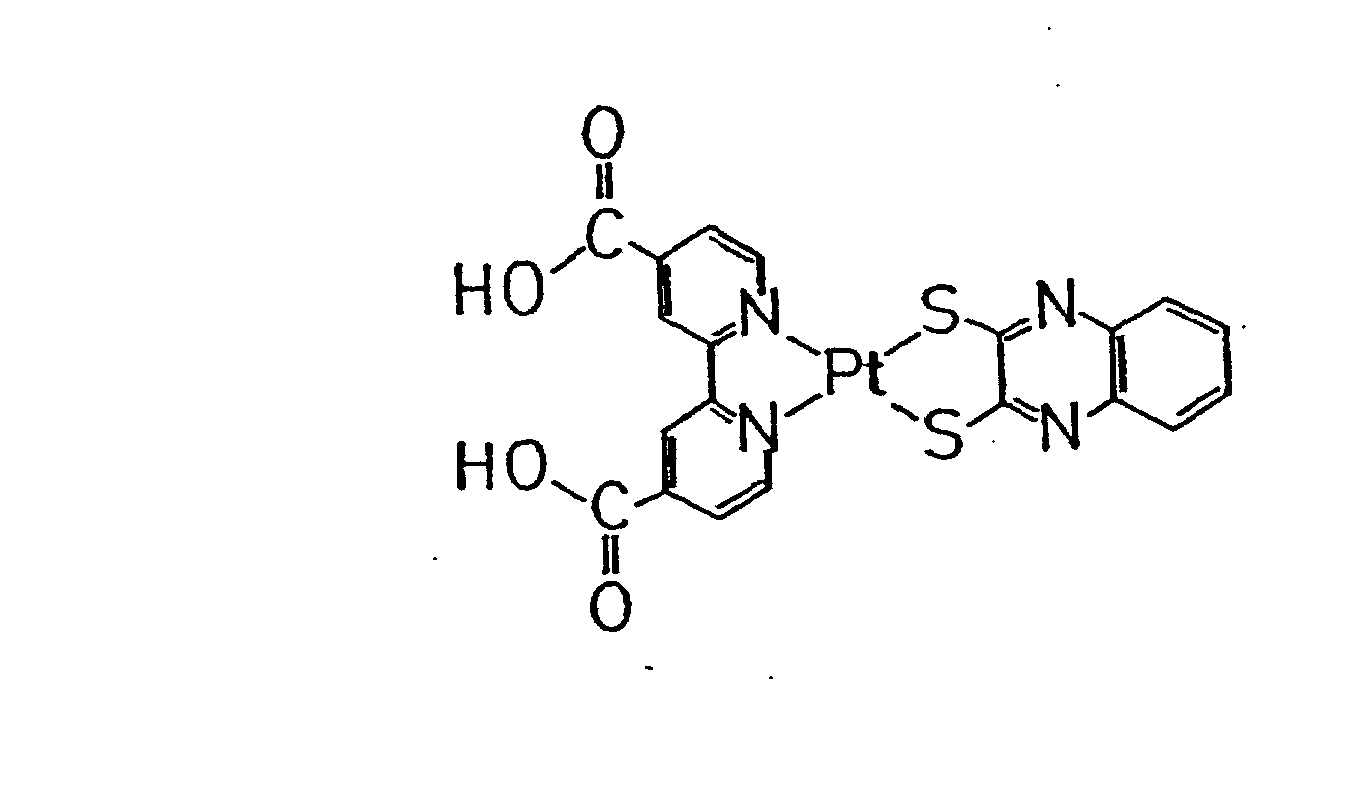
D3 may be synthesized in accordance with a method
described in a paper by A. Islam et al. (New J. Chem., p.
343, (2000)).

D4 may be synthesized based on methods described
at "Heterocyclic Compounds-Cyanine Dyes and Related
Compounds" by F. M. Harmer (John Wiley and Sons, New York
and London, published 1964), United Kingdom Patent No.
1,077,611, and elsewhere.

D5 may be synthesized in accordance with a method
described in a paper by A. D. Adler et al. (J. Org. Chem.,
p. 476, (1967)).

D6 may be synthesized in accordance with a method
described in a paper by D. Gust et al. (Science, p. 199,
(1990)).
Colorants D1 through D6 each have either a single
absorption peak or a plurality of absorption peaks in the
wavelength domain of from 300 nm to 1000 nm.
Cells as shown in FIG. 2 were assembled using the
foregoing test electrodes as negative electrodes.
An indium tin oxide (ITO) thin film of surface
resistance 10 ohms/cm2 was formed on a glass substrate of
thickness 1 mm.
A dispersion was prepared by mixing 89 parts by
weight of an acetonitrile solution containing 30 wt% of
polyethylene glycol and 11 parts by weight of TiO2 granules
of average grain diameter 10 nm.
The glass plate having the ITO thin film was
immersed in the foregoing dispersion to apply the
dispersion over the ITO thin film, and this was dried at
80° C and fired for a further 1 hr in air at 400° C. As a
result, a TiO2 microgranule film of thickness approximately
10 µm was formed over the ITO thin film.
Two glass substrates having the ITO thin film and
TiO2 microgranule film were then arranged such that the
respective TiO2 microgranule films faced one another, and a
partitioning frame member comprising sealant material was
interposed between the TiO2 microgranule films. The
assembly was thoroughly secured such that the partitioning
frame member was sandwiched between the two substrates,
constituting a cell.
An ethanol solution containing colorant D1 in a
concentration 10 mM (M = moles/liter) was injected into the
cell, filling the interior of the cell with the ethanol
solution, and this was allowed to stand. One hour
thereafter the ethanol solution was discharged from the
cell and dry warm air was allowed to pass through the cell
interior continuously for 1 hr, resulting in deposition of
colorant D1 on the TiO2 microgranule thin films. The
interior of the cell was then filled with 4-tert-butylpyridine,
and this was discharged therefrom. Next,
the interior of the cell was washed with acetonitrile, and
the cell interior was dried with warm air. The cell was
thereafter disassembled to obtain test electrode(s) 1A
having colorant D1 deposited on the TiO2 microgranule thin
film.
Test electrodes 2A through 6A were obtained in a
similar fashion as test electrode 1A using colorants D2
through D6 in place of colorant D1.
Test electrodes 1A through 6A so obtained were
respectively used as negative electrodes to assemble cells
as shown at FIG. 2. An electrolyte 5 containing
carbohydrate was introduced into the cells. Glucose or
fructose was used as carbohydrate. A 0.1 M aqueous
solution of KOH was used as the electrolyte. Concentration
of glucose or fructose in the electrolyte was 50 mM.
An electrolyte containing glucose or fructose but
not containing a redox pair was prepared, and an
electrolyte containing glucose or fructose and also
containing a redox pair in a concentration 5 mM was
prepared. Hydroquinone (HQ) or NADH was used as the redox
pair.
At FIG. 2, the numeral 1 denotes a glass
substrate constituting a test electrode, an ITO thin film 2
being formed on one surface thereof. Furthermore, a TiO2
microgranule thin film 3 is formed over the ITO thin film,
and a colorant molecule layer 4 wherein a colorant molecule
has been deposited is present at the surface of the TiO2
microgranule thin film 3. A negative electrode lead 10 for
connecting the cell to an external electric circuit is
connected to the ITO thin film.
Arranged at a location facing the colorant
molecule layer 4 of the test electrode is an oxygen
electrode 6. The oxygen electrode, which serves as a
positive electrode, comprises a mixture of powdered Mn2O3,
powdered activated charcoal, powdered acetylene black, and
polytetrafluoroethylene, and contains nickel mesh of
thickness 0.2 mm as a core material. Provided on the
exterior surface of the oxygen electrode 6 is an oxygen
permeable membrane 7 comprising a water-repellent
fluororesin. Furthermore, a positive electrode lead 11 for
connecting the power cell to an external electric circuit
is connected to the oxygen electrode 6.
A partitioning frame member 12 comprising
transparent silicon rubber is interposed between the test
electrode and the oxygen electrode, constituting a cell.
The partitioning frame member is provided with an inlet 8a
for introduction of the electrolyte and carbohydrate into
the power cell interior, and an outlet 8b for discharge of
the electrolyte and surplus carbohydrate to the power cell
exterior. Inlet 8a and outlet 8b are respectively equipped
with liquid valves 9a and 9b, permitting control of
electrolyte and carbohydrate flow rates.
After filling the interior of the cell with the
electrolyte containing carbohydrate, light from a sunlight
simulator (AM 1.5, 100 mW/cm2) was irradiated from the
glass substrate side and the electromotive force (OCV) at
the cell was measured. Furthermore, voltage at the cell
was measured at a time when the cell had been discharged
for 20 min at a constant current of 100 µA. Results are
shown at TABLE 1.
| Test Electrode | Colorant | Carbohydrate | Redox Pair | OCV (V) | Cell Voltage following Discharge (V) | ||
| Irradiation with light | Irradiation with light | ||||||
| Yes | No | Yes | No | ||||
| 1A | D1 | Glucose | None | 1.1 | 0.2 | 0.8 | 0 |
| HQ | 0.7 | 0.65 | 0.65 | 0.2 | |||
| NADH | 1.2 | 1.05 | 1.0 | 0.3 | |||
| Fructose | None | 1.1 | 0.1 | 0.8 | 0 | ||
| HQ | 0.65 | 0.6 | 0.5 | 0.1 | |||
| NADH | 1.2 | 1.1 | 0.9 | 0.3 | |||
| 2A | D2 | Glucose | None | 1.1 | 0.2 | 0.7 | 0 |
| HQ | 0.65 | 0.6 | 0.55 | 0.1 | |||
| NADH | 1.15 | 1.1 | 0.9 | 0.1 | |||
| None | None | 1.0 | 0.1 | 0 | 0 | ||
| HQ | 0.7 | 0.65 | 0 | 0 | |||
| NADH | 1.2 | 1.1 | 0 | 0 | |||
| 3A | D3 | Glucose | None | 0.9 | 0.1 | 0.65 | 0 |
| HQ | 0.7 | 0.55 | 0.55 | 0.1 | |||
| NADH | 1.2 | 1.15 | 0.9 | 0.1 | |||
| Fructose | None | 1.0 | 0.2 | 0.7 | 0 | ||
| HQ | 0.65 | 0.5 | 0.5 | 0.1 | |||
| NADH | 1.15 | 1.1 | 0.85 | 0.2 | |||
| 4A | D4 | None | None | 0.9 | 0.05 | 0 | 0 |
| HQ | 0.65 | 0.55 | 0 | 0 | |||
| NADH | 1.2 | 1.05 | 0 | 0 | |||
| Fructose | None | 1.0 | 0.2 | 0.65 | 0 | ||
| HQ | 0.7 | 0.65 | 0.6 | 0.2 | |||
| NADH | 1.2 | 1.0 | 0.9 | 0.2 | |||
| 5A | D5 | Glucose | None | 1.1 | 0.25 | 0.65 | 0 |
| HQ | 0.7 | 0.65 | 0.6 | 0.1 | |||
| NADH | 1.2 | 1.1 | 0.85 | 0.3 | |||
| Fructose | None | 1.0 | 0.1 | 0.7 | 0 | ||
| HQ | 0.65 | 0.6 | 0.55 | 0.2 | |||
| NADH | 1.15 | 1.1 | 0.95 | 0.2 | |||
| 6A | D6 | Glucose | None | 0.7 | 0.2 | 0.55 | 0 |
| HQ | 0.65 | 0.6 | 0.55 | 0.2 | |||
| NADH | 1.2 | 1.15 | 1.0 | 0.3 | |||
| Fructose | None | 0.7 | 0.2 | 0.6 | 0 | ||
| HQ | 0.65 | 0.6 | 0.6 | 0.2 | |||
| NADH | 1.15 | 1.1 | 1.05 | 0.1 |
From the results at TABLE 1, it is clear that
irradiation of light allows a high discharge voltage to be
maintained for all test electrodes used in the power cells,
and that these cells permit efficient generation of
electricity.
Upon using liquid chromatography to analyze the
electrolyte containing carbohydrate following testing,
gluconic acid, oxalic acid, and formic acid-[these] being
products of oxidation of glucose or fructose-were detected.
Next, the monosaccharides galactose, mannose, and
sorbose; the disaccharides maltose, sucrose, lactose, and
raffinose; and the polysaccharide starch were used in place
of glucose and fructose, and test electrodes 1A through 6A
were evaluated in the same fashion as described above. As
a result, oxidation of carbohydrate was observed to occur
as had been the case with glucose and fructose.
Upon carrying out similar evaluation with TiO2-WO3
microgranule film in place of the TiO2 microgranule film,
more or less similar cell characteristics were obtained.
Here, the TiO2-WO3 microgranule film was formed using a
dispersion comprising 92 parts by weight of an acetonitrile
solution containing 30 wt% of polyethylene glycol and 8
parts by weight of a mixture of TiO2 granules of average
grain diameter 10 nm and WO3 granules of average grain
diameter 12 nm in a 5 : 1 ratio by weight. The glass plate
having the ITO thin film was immersed in the foregoing
dispersion, and this was dried at 80° C and fired for 1 hr
in air at 400° C, to form a TiO2-WO3 microgranule film of
thickness approximately 8 µm over the ITO thin film.
Except for the fact that a TiO2 microgranule film
was not formed over the ITO thin film and colorants D1
through D6 were instead deposited directly on the ITO thin
film, test electrodes 7A through 12A were prepared in the
same fashion as at Working Example 1, constituting cells,
the characteristics of which were evaluated. Results are
shown at TABLE 2. Note however that cell discharge was at
10 µA for 200 min.
| Test Electrode | Colorant | Carbohydrate | Redox Pair | OGV (V) | Cell Voltage following Discharge (V) | ||
| Irradiation with light | Irradiation with light | ||||||
| Yes | No | Yes | No | ||||
| 7A | D1 | Glucose | None | 1.25 | 0 | 0.95 | 0 |
| HQ | 0.7 | 0.65 | 0.65 | 0.2 | |||
| NADH | 1.2 | 1.05 | 1.0 | 0.3 | |||
| Fructose | None | 1.25 | 0 | 0.9 | 0 | ||
| HQ | 0.65 | 0.6 | 0.5 | 0.1 | |||
| NADH | 1.2 | 1.1 | 0.9 | 0.3 | |||
| 8A | D2 | Glucose | None | 1.2 | 0 | 0.8 | 0 |
| HQ | 0.65 | 0.6 | 0.55 | 0.1 | |||
| NADH | 1.15 | 1.1 | 0.9 | 0.1 | |||
| None | None | 1.15 | 0 | 0 | 0 | ||
| HQ | 0.7 | 0.65 | 0 | 0 | |||
| NADH | 1.2 | 1.1 | 0 | 0 | |||
| 9A | D3 | Glucose | None | 0.95 | 0 | 0.65 | 0 |
| HQ | 0.7 | 0.55 | 0.55 | 0.1 | |||
| NADH | 1.2 | 1.15 | 0.9 | 0.1 | |||
| Fructose | None | 1.05 | 0 | 0.75 | 0 | ||
| HQ | 0.65 | 0.5 | 0.5 | 0.1 | |||
| NADH | 1.15 | 1.1 | 0.85 | 0.2 | |||
| 10A | D4 | None | None | 1.0 | 0 | 0 | 0 |
| HQ | 0.65 | 0.55 | 0 | 0 | |||
| NADH | 1.2 | 1.05 | 0 | 0 | |||
| Fructose | None | 1.1 | 0 | 0.65 | 0 | ||
| HQ | 0.7 | 0.65 | 0.6 | 0.2 | |||
| NADH | 1.2 | 1.0 | 0.9 | 0.2 | |||
| 11A | D5 | Glucose | None | 1.25 | 0 | 0.7 | 0 |
| HQ | 0.7 | 0.65 | 0.6 | 0.1 | |||
| NADH | 1.2 | 1.1 | 0.85 | 0.3 | |||
| Fructose | None | 1.2 | 0 | 0.75 | 0 | ||
| HQ | 0.65 | 0.6 | 0.55 | 0.2 | |||
| NADH | 1.15 | 1.1 | 0.95 | 0.2 | |||
| 12A | D6 | Glucose | None | 0.7 | 0 | 0.65 | 0 |
| HQ | 0.65 | 0.6 | 0.55 | 0.2 | |||
| NADH | 1.2 | 1.15 | 1.0 | 0.3 | |||
| Fructose | None | 0.7 | 0 | 0.65 | 0 | ||
| HQ | 0.65 | 0.6 | 0.6 | 0.2 | |||
| NADH | 1.15 | 1.1 | 1.05 | 0.1 |
From the results at TABLE 2, it is clear that
irradiation of light allows a high discharge voltage to be
maintained for all test electrodes used in the cells, and
that these cells permit efficient generation of
electricity.
Upon using liquid chromatography to analyze the
electrolyte containing carbohydrate following testing,
gluconic acid, oxalic acid, and formic acid-these being
products of oxidation of glucose or fructose-were detected.
Subsequently, the monosaccharides galactose,
mannose, and sorbose; the disaccharides maltose, sucrose,
lactose, and raffinose; and the polysaccharide starch were
used in place of glucose and fructose, and test electrodes
7A through 12A were evaluated in the same fashion as
described above. As a result, oxidation of carbohydrate
was observed to occur as had been the case with glucose and
fructose.
Except for the fact that an SnO2 microgranule film
was formed over the ITO thin film in place of the TiO2
microgranule film, test electrodes 13A through 18A were
prepared in the same fashion as at Working Example 1,
constituting cells, the characteristics of which were
evaluated. Cell discharge was at 100 µA for 20 min.
Results are shown at TABLE 3.
Here, the SnO2 microgranule film was formed by
using the spin coating method to apply over the ITO thin
film a dispersion comprising 95 parts by weight of an
ethanol solution containing 15 wt% of polyvinyl alcohol and
5 parts by weight of SnO2 granules of average grain
diameter 15 nm, drying at 80° C, and firing in air at 380°
C for 1 hr. The SnO2 microgranule film so obtained was
approximately 15 µm in thickness.
| Test Electrode | Colorant | Carbohydrate | Redox Pair | OCV (V) | Cell Voltage following Discharge (V) | ||
| Irradiation with light | Irradiation with light | ||||||
| Yes | No | Yes | No | ||||
| 13A | D1 | Glucose | None | 1.1 | 0.2 | 0.7 | 0 |
| HQ | 0.7 | 0.65 | 0.55 | 0.1 | |||
| NADH | 1.2 | 1.05 | 0.9 | 0.15 | |||
| Fructose | None | 1.1 | 0.1 | 0.65 | 0 | ||
| HQ | 0.65 | 0.6 | 0.45 | 0.05 | |||
| NADH | 1.2 | 1.1 | 0.7 | 0.15 | |||
| 14A | D2 | Glucose | None | 1.1 | 0.2 | 0.7 | 0 |
| HQ | 0.65 | 0.6 | 0.55 | 0.1 | |||
| NADH | 1.15 | 1.1 | 0.9 | 0.1 | |||
| None | None | 1.0 | 0.1 | 0 | 0 | ||
| HQ | 0.7 | 0.65 | 0 | 0 | |||
| NADH | 1.2 | 1.1 | 0 | 0 | |||
| 15A | D3 | Glucose | None | 0.9 | 0.1 | 0.45 | 0 |
| HQ | 0.7 | 0.55 | 0.35 | 0.1 | |||
| NADH | 1.2 | 1.15 | 0.65 | 0.1 | |||
| Fructose | None | 1.0 | 0.2 | 0.5 | 0 | ||
| HQ | 0.65 | 0.5 | 0.45 | 0.05 | |||
| NADH | 1.15 | 1.1 | 0.6 | 0.1 | |||
| 16A | D4 | None | None | 0.9 | 0.05 | 0 | 0 |
| HQ | 0.65 | 0.55 | 0 | 0 | |||
| NADH | 1.2 | 1.05 | 0 | 0 | |||
| Fructose | None | 1.0 | 0.2 | 0.35 | 0 | ||
| HQ | 0.7 | 0.65 | 0.4 | 0.1 | |||
| NADH | 1.2 | 1.0 | 0.6 | 0.15 | |||
| 17A | D5 | Glucose | None | 1.1 | 0.25 | 0.5 | 0 |
| HQ | 0.7 | 0.65 | 0.55 | 0.05 | |||
| NADH | 1.2 | 1.1 | 0.8 | 0.2 | |||
| Fructose | None | 1.0 | 0.1 | 0.6 | 0 | ||
| HQ | 0.65 | 0.6 | 0.5 | 0.1 | |||
| NADH | 1.15 | 1.1 | 0.85 | 0.2 | |||
| 18A | D6 | Glucose | None | 0.7 | 0.2 | 0.45 | 0 |
| HQ | 0.65 | 0.6 | 0.5 | 0.2 | |||
| NADH | 1.2 | 1.15 | 0.85 | 0.2 | |||
| Fructose | None | 0.7 | 0.2 | 0.5 | 0 | ||
| HQ | 0.65 | 0.6 | 0.55 | 0.1 | |||
| NADH | 1.15 | 1.1 | 0.8 | 0.1 |
From the results at TABLE 3, it is clear that
irradiation of light allows a high discharge voltage to be
maintained for all test electrodes used in the cells, and
that these cells permit efficient generation of electricity.
Upon using liquid chromatography to analyze the
electrolyte containing carbohydrate following testing,
gluconic acid, oxalic acid, and formic acid-these being
products of oxidation of glucose or fructose-were detected.
Subsequently, the monosaccharides galactose,
mannose, and sorbose; the disaccharides maltose, sucrose,
lactose, and raffinose; and the polysaccharide starch were
used in place of glucose and fructose, and test electrodes
13A through 18A were evaluated in the same fashion as
described above. As a result, oxidation of carbohydrate
was observed to occur as had been the case with glucose and
fructose.
Upon carrying out similar evaluation with a SnO2-ZnO
microgranule film in place of the SnO2 microgranule
film, more or less similar cell characteristics were
obtained. Here, the SnO2-ZnO microgranule film was formed
by using the doctor blade method to apply over the ITO thin
film a dispersion comprising 95 parts by weight of an
ethanol solution containing 15 wt% of polyvinyl alcohol and
5 parts by weight of a mixture of SnO2 granules of average
grain diameter 15 nm and ZnO granules of average grain
diameter 240 nm in a 5 : 1 ratio by weight, drying at 80° C,
and firing in air at 380° C for 1 hr. The SnO2-ZnO
microgranule film so obtained was approximately 16 µm in
thickness.
Test electrodes 1A, 6A, 7A, 12A, 13A, and 18A
prepared at Working Examples 1 through 3 were respectively
used, and a methoxyacetonitrile solution containing 50 mM
of glucose or fructose serving as carbohydrate and 0.5 M of
lithium iodide, 0.5 M of imidazolium iodide, and 5 mM of 4-tert-butylpyridine
was used as the electrolyte containing
carbohydrate, to assemble cells similar to those at Working
Example 1, the characteristics of which were evaluated.
Results are shown at TABLE 4.
Note however that the positive electrode was such
that a film coating comprising MnO2 granules formed on an
aluminum substrate was used in place of the air electrode
and oxygen permeable membrane. This positive electrode was
obtained by using the doctor blade method to apply over an
aluminum substrate of thickness 0.3 mm a slurry comprising
30 parts by weight of MnO2 granules, 5 parts by weight of
acetylene black, 10 parts by weight of graphite, 5 parts by
weight of polyvinylidene fluoride, and 50 parts by weight
of N-methyl-2-pyrrolidone, and thereafter drying at 150° C
and carrying out roll pressing to mold this so as to obtain
a sheet of thickness 0.5 mm.
Moreover, cell discharge was at 100 µA for 20 min
for the cells employing test electrodes 1A, 6A, 13A, and
18A, and was at 10 µA for 200 min for the cells employing
test electrodes 7A and 12A.
| Test Electrode | Colorant | Carbohydrate | Redox Pair | OCV (V) | Cell Voltage following Discharge (V) | ||
| Irradiation with light | Irradiation with light | ||||||
| Yes | No | Yes | No | ||||
| 1A | D1 | Glucose | None | 1.4 | 0.6 | 1.1 | 0 |
| Fructose | None | 1.4 | 0.55 | 1.0 | 0 | ||
| 6A | D6 | Glucose | None | 1.0 | 0.4 | 0.8 | 0 |
| Fructose | None | 0.9 | 0.4 | 0.75 | 0 | ||
| 7A | D1 | Glucose | None | 1.55 | 0.65 | 1.3 | 0 |
| Fructose | None | 1.6 | 0.7 | 1.3 | 0 | ||
| 12A | D6 | Glucose | None | 1.1 | 0.4 | 0.9 | 0 |
| Fructose | None | 1.05 | 0.4 | 0.75 | 0 | ||
| 13A | D1 | Glucose | None | 1.5 | 0.5 | 1.1 | 0 |
| Fructose | None | 1.45 | 0.5 | 0.9 | 0 | ||
| 18A | D6 | Glucose | None | 0.9 | 0.3 | 0.75 | 0 |
| Fructose | None | 0.95 | 0.35 | 0.7 | 0 |
From the results at TABLE 4, it is clear that
irradiation of light allows a high discharge voltage to be
maintained for all test electrodes used in the cells, and
that these cells permit efficient generation of electricity.
Upon using liquid chromatography to analyze the
electrolyte containing carbohydrate following testing,
gluconic acid, oxalic acid, and formic acid-these being
products of oxidation of glucose or fructose-were detected.
Subsequently, the monosaccharides galactose,
mannose, and sorbose; the disaccharides maltose, sucrose,
lactose, and raffinose; and the polysaccharide starch were
used in place of glucose and fructose, and the foregoing
test electrodes were evaluated in the same fashion as
described above. As a result, oxidation of carbohydrate
was observed to occur as had been the case with glucose and
fructose.
In addition, a mixture serving as the electrolyte
containing carbohydrate and comprising 12 parts by weight
of polyacrylonitrile and 88 parts by weight of a
methoxyacetonitrile solution containing 50 mM of glucose or
fructose serving as carbohydrate and 0.5 M of lithium
iodide, 0.5 M of imidazolium iodide, and 5 mM of 4-tert-butylpyridine
was injected into the foregoing cells. The
cells were then cooled to -20° C, causing gelation of the
mixture. Upon thereafter evaluating the cells after they
had been returned to room temperature, characteristics were
obtained which were more or less equivalent to the results
shown at TABLE 4.
An indium tin oxide (ITO) thin film of surface
resistance 10 ohms/cm2 was formed on a glass substrate of
thickness 1 mm.
An acetonitrile solution containing 30 wt% of
polyethylene glycol was prepared. 1 part by weight of Ag
microgranules of average grain diameter 5 nm and 11 parts
by weight of TiO2 microgranules of average grain diameter
10 nm were suspended in 88 parts by weight of this
acetonitrile solution.
The glass plate having the ITO thin film was
immersed in the dispersion so obtained, and this was dried
at 80° C and fired for 1 hr in argon gas at 400° C. As a
result, a TiO2 microgranule film which retained Ag in a
carried fashion (hereinafter referred to as "Ag-TiO2 film")
and which was approximately 10 µm in thickness was formed
over the ITO thin film.
Two glass substrates having the ITO thin film and
Ag-TiO2 film were arranged such that the respective Ag-TiO2
films faced one another, and a partitioning frame member
comprising sealant material was interposed between the Ag-TiO2
films. The assembly was moreover thoroughly secured
such that the partitioning member was sandwiched between
the two substrates, constituting a cell.
An ethanol solution containing colorant D1 in a
concentration 10 mM was injected into the cell, filling the
interior of the cell with the ethanol solution, and this
was allowed to stand. One hour thereafter the ethanol
solution was discharged from the cell and dry warm air was
allowed to pass through the cell interior continuously for
1 hr, resulting in deposition of colorant D1 on the Ag-TiO2
films. The interior of the cell was then filled with 4-tert-butylpyridine,
and this was discharged therefrom.
Next, the interior of the cell was washed with acetonitrile,
and the cell interior was dried with warm air. The cell
was thereafter disassembled to obtain test electrode(s) 1B
having colorant D1 deposited on the Ag-TiO2 film.
Test electrodes 2B through 6B were obtained in
similar fashion as test electrode 1B using D2 through D6 in
place of colorant D1.
Cells as shown at FIG. 2 were assembled in the
same fashion as at Working Example 1 except for the fact
that test electrodes 1B through 6B so obtained were
respectively used as negative electrodes.
An electrolyte containing carbohydrate was
introduced into the cells. Glucose or fructose was used as
carbohydrate. Furthermore, a 0.1 M aqueous solution of KOH
was used as the electrolyte. Concentration of glucose or
fructose in the electrolyte was 50 mM.
An electrolyte containing glucose or fructose but
not containing a redox pair was prepared, and an
electrolyte containing glucose or fructose and also
containing a redox pair in a concentration 5 mM was
prepared. Hydroquinone (HQ) or NADH was used as the redox
pair.
After filling the interior of the cell with the
electrolyte containing carbohydrate, evaluation was carried
out in the same fashion as at Working Example 1. Results
are shown at TABLE 5.
| Test Electrode | Colorant | Carbohydrate | Redox Pair | OCV (V) | Cell Voltage following Discharge (V) | ||
| Irradiation with light | Irradiation with light | ||||||
| Yes | No | Yes | No | ||||
| 1B | D1 | Glucose | None | 1.2 | 0.35 | 0.95 | 0.2 |
| HQ | 0.8 | 0.7 | 0.75 | 0.45 | |||
| NADH | 1.25 | 1.1 | 1.1 | 0.55 | |||
| Fructose | None | 1.2 | 0.35 | 0.9 | 0.2 | ||
| HQ | 0.8 | 0.7 | 0.7 | 0.4 | |||
| NADH | 1.25 | 1.05 | 0.95 | 0.5 | |||
| 2B | D2 | Glucose | None | 1.15 | 0.3 | 0.9 | 0.2 |
| HQ | 0.75 | 0.65 | 0.75 | 0.45 | |||
| NADH | 1.2 | 1.05 | 0.95 | 0.55 | |||
| None | None | 1.0 | 0.1 | 0 | 0 | ||
| HQ | 0.7 | 0.65 | 0 | 0 | |||
| NADH | 1.2 | 1.1 | 0 | 0 | |||
| 3B | D3 | Glucose | None | 1.0 | 0.3 | 0.85 | 0.2 |
| HQ | 0.75 | 0.7 | 0.65 | 0.45 | |||
| NADH | 1.25 | 1.1 | 0.95 | 0.55 | |||
| Fructose | None | 1.1 | 0.35 | 0.95 | 0.2 | ||
| HQ | 0.75 | 0.7 | 0.7 | 0.45 | |||
| NADH | 1.2 | 1.15 | 0.95 | 0.55 | |||
| 4B | D4 | None | None | 1.05 | 0.25 | 0 | 0 |
| HQ | 0.7 | 0.6 | 0 | 0 | |||
| NADH | 1.2 | 1.0 | 0 | 0 | |||
| Fructose | None | 1.2 | 0.35 | 0.95 | 0.2 | ||
| HQ | 0.85 | 0.75 | 0.75 | 0.4 | |||
| NADH | 1.25 | 1.15 | 1.05 | 0.5 | |||
| 5B | D5 | Glucose | None | 1.15 | 0.35 | 0.7 | 0.2 |
| HQ | 0.8 | 0.7 | 0.65 | 0.35 | |||
| NADH | 1.2 | 0.95 | 0.9 | 0.5 | |||
| Fructose | None | 1.1 | 0.35 | 0.85 | 0.2 | ||
| HQ | 0.75 | 0.7 | 0.65 | 0.4 | |||
| NADH | 1.2 | 1.0 | 0.9 | 0.45 | |||
| 6B | D6 | Glucose | None | 0.80 | 0.3 | 0.65 | 0.2 |
| HQ | 0.70 | 0.65 | 0.65 | 0.25 | |||
| NADH | 1.2 | 1.05 | 1.0 | 0.4 | |||
| Fructose | None | 0.8 | 0.3 | 0.7 | 0.2 | ||
| HQ | 0.65 | 0.7 | 0.65 | 0.3 | |||
| NADH | 1.15 | 1.1 | 1.05 | 0.35 |
From the results at TABLE 5, it is clear that
irradiation of light allows a high discharge voltage to be
maintained for all test electrodes used in the cells, and
that these cells permit efficient generation of electricity.
Upon using liquid chromatography to analyze the
electrolyte containing carbohydrate following testing,
gluconic acid, oxalic acid, and formic acid-these being
products of oxidation of glucose or fructose-were detected.
Subsequently, the monosaccharides galactose,
mannose, and sorbose; the disaccharides maltose, sucrose,
lactose, and raffinose; and the polysaccharide starch were
used in place of glucose and fructose, and test electrodes
1B through 6B were evaluated in the same fashion as
described above. As a result, oxidation of carbohydrate
was observed to occur as had been the case with glucose and
fructose.
Next, 8 parts by weight of a mixture containing
Ag microgranules of average grain diameter 5 nm, TiO2
microgranules of average grain diameter 10 nm, and WO3
microgranules of average grain diameter 12 nm in a 0.6 :
5 : 1 ratio by weight were suspended in 92 parts by weight
of an acetonitrile solution containing 30 wt% of
polyethylene glycol.
A glass plate having an ITO thin film was
immersed in the dispersion so obtained, and this was dried
at 80° C and fired for 1 hr in argon gas at 350° C. As a
result, a microgranule film comprising WO3 and TiO2 which
retained Ag in a carried fashion (hereinafter referred to
as "Ag-TiO2-WO3 film") and which was approximately 8 µm in
thickness was formed over the ITO thin film.
Electrodes were prepared by respectively
depositing colorants D1 through D6 on the Ag-TiO2-WO3 film
in accordance with a method similar to that described above,
and these were used to carry out evaluation in a fashion
similar to that described above. Results indicated that
the cells functioned in a fashion more or less similar to
that observed with Ag-TiO2 film.
1 part by weight of Ag microgranules of average
grain diameter 5 nm was suspended in 99 parts by weight of
an acetonitrile solution containing 30 wt% of polyethylene
glycol.
A glass plate having an ITO thin film was
immersed in the dispersion so obtained, and this was dried
at 80° C and fired for 1 hr in argon gas at 400° C. As a
result, the Ag microgranules were retained in a carried
fashion over the ITO thin film.
Test electrodes 7B through 12B were thereafter
prepared in a similar fashion as at Working Example 5 by
respectively depositing colorants D1 through D6 on the ITO
thin film which retained Ag microgranules in a carried
fashion.
Test electrodes 7B through 12B were respectively
used to construct cells in a similar fashion as at Working
Example 5, and these were evaluated. Results are shown at
TABLE 6. Note however that cell discharge was at 10 µA
for 200 min.
| Test Electrode | Colorant | Carbohydrate | Redox Pair | OCV (V) | Cell Voltage following Discharge (V) | ||
| Irradiation with light | Irradiation with light | ||||||
| Yes | No | Yes | No | ||||
| 7B | D1 | Glucose | None | 1.2 | 0.35 | 0.55 | 0.2 |
| HQ | 0.8 | 0.7 | 0.55 | 0.4 | |||
| NADH | 1.25 | 1.1 | 0.7 | 0.55 | |||
| Fructose | None | 1.2 | 0.35 | 0.5 | 0.2 | ||
| HQ | 0.8 | 0.7 | 0.55 | 0.35 | |||
| NADH | 1.25 | 1.05 | 0.7 | 0.5 | |||
| 8B | D2 | Glucose | None | 1.15 | 0.3 | 0.6 | 0.2 |
| HQ | 0.75 | 0.65 | 0.55 | 0.35 | |||
| NADH | 1.2 | 1.05 | 0.65 | 0.45 | |||
| None | None | 1.0 | 0.1 | 0 | 0 | ||
| HQ | 0.7 | 0.65 | 0 | 0 | |||
| NADH | 1.2 | 1.1 | 0 | 0 | |||
| 9B | D3 | Glucose | None | 1.0 | 0.3 | 0.45 | 0.2 |
| HQ | 0.75 | 0.7 | 0.55 | 0.35 | |||
| NADH | 1.25 | 1.1 | 0.7 | 0.45 | |||
| Fructose | None | 1.1 | 0.35 | 0.35 | 0.2 | ||
| HQ | 0.75 | 0.7 | 0.5 | 0.35 | |||
| NADH | 1.2 | 1.15 | 0.6 | 0.45 | |||
| 10B | D4 | None | None | 1.05 | 0.25 | 0 | 0 |
| HQ | 0.7 | 0.6 | 0 | 0 | |||
| NADH | 1.2 | 1.0 | 0 | 0 | |||
| Fructose | None | 1.2 | 0.35 | 0.45 | 0.2 | ||
| HQ | 0.85 | 0.75 | 0.55 | 0.35 | |||
| NADH | 1.25 | 1.15 | 0.6 | 0.45 | |||
| 11B | D5 | Glucose | None | 1.15 | 0.35 | 0.35 | 0.2 |
| HQ | 0.8 | 0.7 | 0.45 | 0.35 | |||
| NADH | 1.2 | 0.95 | 0.55 | 0.45 | |||
| Fructose | None | 1.1 | 0.35 | 0.4 | 0.2 | ||
| HQ | 0.75 | 0.7 | 0.55 | 0.35 | |||
| NADH | 1.2 | 1.0 | 0.6 | 0.4 | |||
| 12B | D6 | Glucose | None | 0.8 | 0.3 | 0.35 | 0.2 |
| HQ | 0.7 | 0.65 | 0.4 | 0.25 | |||
| NADH | 1.2 | 1.05 | 0.45 | 0.35 | |||
| Fructose | None | 0.8 | 0.3 | 0.35 | 0.2 | ||
| HQ | 0.65 | 0.7 | 0.45 | 0.3 | |||
| NADH | 1.15 | 1.1 | 0.45 | 0.35 |
From the results at TABLE 6, it is clear that
irradiation of light allows a high discharge voltage to be
maintained for all test electrodes used in the cells, and
that these cells permit efficient generation of electricity.
Upon using liquid chromatography to analyze the
electrolyte containing carbohydrate following testing,
gluconic acid, oxalic acid, and formic acid-these being
products of oxidation of glucose or fructose-were detected.
Subsequently, the monosaccharides galactose,
mannose, and sorbose; the disaccharides maltose, sucrose,
lactose, and raffinose; and the polysaccharide starch were
used in place of glucose and fructose, and test electrodes
7B through 12B were evaluated in the same fashion as
described above. As a result, oxidation of carbohydrate
was observed to occur as had been the case with glucose and
fructose.
An ethanol solution containing 15 wt% of
polyvinyl alcohol was prepared. 1 part by weight of Pt
microgranules of average grain diameter 5 nm and 11 parts
by weight of SnO2 microgranules of average grain diameter
15 nm were suspended in 88 parts by weight of this ethanol
solution.
The spin coating method was used to apply the
dispersion so obtained to an ITO substrate having an ITO
thin film, and this was dried at 80° C and fired for 1 hr
in air at 380° C. As a result, an SnO2 microgranule film
which retained Pt in a carried fashion (hereinafter
referred to as "Pt-SnO2 film") and which was approximately
15 µm in thickness was formed over the ITO thin film.
Test electrodes 13B through 18B were prepared by
respectively depositing colorants D1 through D6 on the Pt-SnO2
film. Furthermore, test electrodes 13B through 18B
were respectively used to construct cells in a similar
fashion as at Working Example 5, and these were evaluated.
Note however that cell discharge was at 100 µA for 20 min.
Results are shown at TABLE 7.
| Test Electrode | Colorant | Carbohydrate | Redox Pair | OCV (V) | Cell Voltage following Discharge (V) | ||
| Irradiation with light | Irradiation with light | ||||||
| Yes | No | Yes | No | ||||
| 13B | D1 | Glucose | None | 1.25 | 0.55 | 0.95 | 0.5 |
| HQ | 0.8 | 0.75 | 0.75 | 0.55 | |||
| NADH | 1.25 | 1.05 | 1.2 | 0.6 | |||
| Fructose | None | 1.25 | 0.5 | 0.95 | 0.5 | ||
| HQ | 0.8 | 0.7 | 0.7 | 0.5 | |||
| NADH | 1.2 | 1.05 | 1.15 | 0.6 | |||
| 14B | D2 | Glucose | None | 1.15 | 0.5 | 0.9 | 0.45 |
| HQ | 0.75 | 0.65 | 0.75 | 0.5 | |||
| NADH | 1.15 | 1.0 | 0.9 | 0.5 | |||
| None | None | 1.0 | 0.45 | 0 | 0 | ||
| HQ | 0.7 | 0.65 | 0 | 0 | |||
| NADH | 1.1 | 1.0 | 0 | 0 | |||
| 15B | D3 | Glucose | None | 1.1 | 0.45 | 0.9 | 0.45 |
| HQ | 0.75 | 0.55 | 0.65 | 0.45 | |||
| NADH | 1.25 | 0.9 | 0.9 | 0.5 | |||
| Fructose | None | 1.05 | 0.45 | 0.85 | 0.5 | ||
| HQ | 0.75 | 0.55 | 0.65 | 0.55 | |||
| NADH | 1.2 | 0.95 | 0.7 | 0.55 | |||
| 16B | D4 | None | None | 1.1 | 0.45 | 0 | 0 |
| HQ | 0.8 | 0.65 | 0 | 0 | |||
| NADH | 1.2 | 0.95 | 0 | 0 | |||
| Fructose | None | 1.1 | 0.5 | 1.0 | 0.5 | ||
| HQ | 0.75 | 0.6 | 0.65 | 0.55 | |||
| NADH | 1.25 | 1.0 | 1.05 | 0.6 | |||
| 17B | D5 | Glucose | None | 1.1 | 0.4 | 0.85 | 0.5 |
| HQ | 0.7 | 0.65 | 0.65 | 0.55 | |||
| NADH | 1.15 | 1.05 | 0.95 | 0.55 | |||
| Fructose | None | 1.1 | 0.5 | 0.75 | 0.55 | ||
| HQ | 0.65 | 0.6 | 0.7 | 0.6 | |||
| NADH | 1.15 | 1.1 | 0.95 | 0.65 | |||
| 18B | D6 | Glucose | None | 0.8 | 0.45 | 0.9 | 0.5 |
| HQ | 0.65 | 0.6 | 0.65 | 0.5 | |||
| NADH | 1.2 | 1.1 | 1.05 | 0.6 | |||
| Fructose | None | 0.8 | 0.45 | 0.85 | 0.45 | ||
| HQ | 0.65 | 0.6 | 0.8 | 0.5 | |||
| NADH | 1.15 | 1.05 | 0.95 | 0.55 |
From the results at TABLE 7, it is clear that
irradiation of light allows a high discharge voltage to be
maintained for all test electrodes used in the cells, and
that these cells permit efficient generation of electricity.
Upon using liquid chromatography to analyze the
electrolyte containing carbohydrate following testing,
gluconic acid, oxalic acid, and formic acid-these being
products of oxidation of glucose or fructose-were detected.
Subsequently, the monosaccharides galactose,
mannose, and sorbose; the disaccharides maltose, sucrose,
lactose, and raffinose; and the polysaccharide starch were
used in place of glucose and fructose, and test electrodes
13B through 18B were evaluated in the same fashion as
described above. As a result, oxidation of carbohydrate
was observed to occur as had been the case with glucose and
fructose.
Next, 5 parts by weight of a mixture containing
Pt microgranules of average grain diameter 5 nm, SnO2
microgranules of average grain diameter 15 nm, and ZnO
microgranules of average grain diameter 240 nm in a 0.5 :
5 : 1 ratio by weight were suspended in 95 parts by weight
of an ethanol solution containing 15 wt% of polyvinyl
alcohol.
The doctor blade method was used to apply the
dispersion so obtained over the ITO thin film of a glass
plate having an ITO thin film, and this was dried at 80° C
and fired for 1 hr in air at 380° C. As a result, a
microgranule film comprising ZnO and SnO2 which retained Pt
in a carried fashion (hereinafter referred to as "Pt-SnO2-ZnO
film") and which was approximately 16 µm in thickness
was formed over the ITO thin film.
Electrodes were prepared by respectively
depositing colorants D1 through D6 on the Pt-SnO2-ZnO film
in accordance with a method similar to that described above,
and cells were constructed and evaluated. Results
indicated that the cells functioned in a fashion more or
less similar to that observed with Pt-SnO2 film.
1 part by weight of Cu microgranules of average
grain diameter 10 nm and 11 parts by weight of TiO2
microgranules of average grain diameter 20 nm were
suspended in 88 parts by weight of an ethanol solution
containing 15 wt% of polyvinyl alcohol.
The spin coating method was used to apply the
dispersion so obtained over the ITO thin film of a glass
substrate having an ITO thin film, and this was dried at
80° C and fired for 1 hr in air at 300° C. As a result, a
TiO2 microgranule film which retained Cu in a carried
fashion (hereinafter referred to as "Cu-TiO2 film") and
which was approximately 20 µm in thickness was formed over
the ITO thin film.
Test electrodes 19B through 24B were prepared by
respectively depositing colorants D1 through D6 on the Cu-TiO2
film. Furthermore, test electrodes 19B through 24B
were respectively used to construct cells in a similar
fashion as at Working Example 5, and these were evaluated.
Note however that cell discharge was at 100 µA for 20 min.
Results are shown at TABLE 8.
| Test Electrode | Colorant | Carbohydrate | Redox Pair | OPV (V) | Cell Voltage following Discharge (V) | ||
| Irradiation with light | Irradiation with light | ||||||
| Yes | No | Yes | No | ||||
| 19B | D1 | Glucose | None | 1.2 | 0.35 | 0.95 | 0.4 |
| HQ | 0.8 | 0.7 | 0.75 | 0.5 | |||
| NADH | 1.25 | 1.1 | 1.1 | 0.55 | |||
| Fructose | None | 1.2 | 0.35 | 0.9 | 0.35 | ||
| HQ | 0.8 | 0.7 | 0.7 | 0.45 | |||
| NADH | 1.25 | 1.05 | 0.95 | 0.55 | |||
| 20B | D2 | Glucose | None | 1.15 | 0.3 | 0.9 | 0.35 |
| HQ | 0.75 | 0.65 | 0.75 | 0.45 | |||
| NADH | 1.2 | 1.05 | 0.95 | 0.5 | |||
| None | None | 1.0 | 0.1 | 0 | 0 | ||
| HQ | 0.7 | 0.65 | 0 | 0 | |||
| NADH | 1.2 | 1.1 | 0 | 0 | |||
| 21B | D3 | Glucose | None | 1.0 | 0.3 | 0.85 | 0.4 |
| HQ | 0.75 | 0.7 | 0.65 | 0.45 | |||
| NADH | 1.25 | 1.1 | 0.95 | 0.55 | |||
| Fructose | None | 1.1 | 0.35 | 0.95 | 0.45 | ||
| HQ | 0.75 | 0.7 | 0.7 | 0.45 | |||
| NADH | 1.2 | 1.15 | 0.95 | 0.5 | |||
| 22B | D4 | None | None | 1.05 | 0.25 | 0 | 0 |
| HQ | 0.7 | 0.6 | 0 | 0 | |||
| NADH | 1.2 | 1.0 | 0 | 0 | |||
| Fructose | None | 1.2 | 0.35 | 0.95 | 0.4 | ||
| HQ | 0.85 | 0.75 | 0.75 | 0.45 | |||
| NADH | 1.25 | 1.15 | 1.05 | 0.55 | |||
| 23B | D5 | Glucose | None | 1.15 | 0.35 | 0.7 | 0.35 |
| HQ | 0.8 | 0.7 | 0.65 | 0.45 | |||
| NADH | 1.2 | 0.95 | 0.9 | 0.55 | |||
| Fructose | None | 1.1 | 0.35 | 0.85 | 0.35 | ||
| HQ | 0.75 | 0.7 | 0.65 | 0.45 | |||
| NADH | 1.2 | 1.0 | 0.9 | 0.5 | |||
| 24B | D6 | Glucose | None | 0.8 | 0.3 | 0.65 | 0.4 |
| HQ | 0.7 | 0.65 | 0.65 | 0.35 | |||
| NADH | 1.2 | 1.05 | 1.0 | 0.5 | |||
| Fructose | None | 0.8 | 0.3 | 0.7 | 0.35 | ||
| HQ | 0.65 | 0.7 | 0.65 | 0.4 | |||
| NADH | 1.15 | 1.1 | 1.05 | 0.45 |
From the results at TABLE 8, it is clear that
irradiation of light allows a high discharge voltage to be
maintained for all test electrodes used in the cells, and
that these cells permit efficient generation of electricity.
Upon using liquid chromatography to analyze the
electrolyte containing carbohydrate following testing,
gluconic acid, oxalic acid, and formic acid-these being
products of oxidation of glucose or fructose-were detected.
Subsequently, the monosaccharides galactose,
mannose, and sorbose; the disaccharides maltose, sucrose,
lactose, and raffinose; and the polysaccharide starch were
used in place of glucose and fructose, and test electrodes
19B through 24B were evaluated in the same fashion as
described above. As a result, oxidation of carbohydrate
was observed to occur as had been the case with glucose and
fructose.
Next, 5 parts by weight of a mixture containing
Cu microgranules of average grain diameter 10 nm, TiO2
microgranules of average grain diameter 20 nm, and ZnO
microgranules of average grain diameter 240 nm in a 0.5 :
5 : 1 ratio by weight were suspended in 95 parts by weight
of an ethanol solution containing 15 wt% of polyvinyl
alcohol.
The doctor blade method was used to apply the
dispersion so obtained over the ITO thin film of a glass
substrate having an ITO thin film, and this was dried at
80° C and fired for 1 hr in air at 300° C. As a result, a
microgranule film comprising ZnO and TiO2 which retained Cu
in a carried fashion (hereinafter referred to as "Cu-TiO2-ZnO
film") and which was approximately 20 µm in thickness
was formed over the ITO thin film.
Electrodes were prepared by respectively
depositing colorants D1 through D6 on the Cu-TiO2-ZnO film
in accordance with a method similar to that described above,
and cells were constructed and evaluated. Results
indicated that the cells functioned in a fashion more or
less similar to that observed with Cu-TiO2 film.
A methoxyacetonitrile solution containing 50 mM
of glucose or fructose serving as carbohydrate and 0.5 M of
lithium iodide, 0.5 M of imidazolium iodide, and 5 mM of 4-tert-butylpyridine
was prepared for use as the electrolyte
containing carbohydrate.
The positive electrode was such that an MnO2
microgranule film formed on an aluminum substrate which was
identical to that used at Working Example 4 was used in
place of the air electrode having an oxygen permeable
membrane.
Test electrodes 1B, 6B, 7B, 12B, 13B, 18B, 19B,
and 24B prepared at Working Examples 5 through 8 were
respectively used as negative electrodes.
The foregoing electrolyte, positive electrode,
and prescribed negative electrodes were used to assemble
cells similar to that of Working Example 5, and the
characteristics of those cells were evaluated. Note
however that cell discharge was at 100 µA for 20 min for
the cells employing test electrodes 1B, 6B, 13B, 18B, 19B,
and 24B, and was at 10 µA for 200 min for the cells
employing test electrodes 7B and 12B. Results are shown at
TABLE 9.
| Test Electrode | Colorant | Carbohydrate | Redox Pair | OCV (V) | Cell Voltage following Discharge (V) | ||
| Irradiation with light | Irradiation with light | ||||||
| Yes | No | Yes | No | ||||
| 1B | D1 | Glucose | None | 1.4 | 0.6 | 1.1 | 0.2 |
| Fructose | None | 1.4 | 0.55 | 1.0 | 0.15 | ||
| 6B | D6 | Glucose | None | 1.0 | 0.4 | 0.8 | 0.15 |
| Fructose | None | 0.9 | 0.4 | 0.75 | 0.15 | ||
| 7B | D1 | Glucose | None | 1.55 | 0.65 | 1.3 | 0.15 |
| Fructose | None | 1.6 | 0.7 | 1.3 | 0.1 | ||
| 12B | D6 | Glucose | None | 1.1 | 0.4 | 0.9 | 0.2 |
| Fructose | None | 1.05 | 0.4 | 0.75 | 0.15 | ||
| 13B | D1 | Glucose | None | 1.5 | 0.5 | 1.1 | 0.35 |
| Fructose | None | 1.45 | 0.5 | 0.9 | 0.3 | ||
| 18B | D6 | Glucose | None | 0.9 | 0.3 | 0.75 | 0.3 |
| Fructose | None | 0.95 | 0.35 | 0.7 | 0.3 | ||
| 19B | D1 | Glucose | None | 1.4 | 0.5 | 1.2 | 0.25 |
| Fntctose | None | 1.4 | 0.5 | 1.15 | 0.2 | ||
| 24B | D6 | Glucose | None | 1.1 | 0.45 | 1.1 | 0.25 |
| Fructose | None | 1.0 | 0.45 | 1.05 | 0.25 |
From the results at TABLE 9, it is clear that
irradiation of light allows a high discharge voltage to be
maintained for all test electrodes used in the cells, and
that these cells permit efficient generation of electricity.
Upon using liquid chromatography to analyze the
electrolyte containing carbohydrate following testing,
gluconic acid, oxalic acid, and formic acid-these being
products of oxidation of glucose or fructose-were detected.
Subsequently, the monosaccharides galactose,
mannose, and sorbose; the disaccharides maltose, sucrose,
lactose, and raffinose; and the polysaccharide starch were
used in place of glucose and fructose, and test electrodes
19B through 24B were evaluated in the same fashion as
described above. As a result, oxidation of carbohydrate
was observed to occur as had been the case with glucose and
fructose.
Next, 12 parts by weight of polyacrylonitrile was
mixed with 88 parts by weight of the foregoing electrolyte,
and the mixture so obtained was injected into the cells as
an electrolyte. Moreover, the cells were cooled to -20° C,
causing gelation of the mixture. The temperature of the
cells was thereafter returned to room temperature, and the
characteristics of the cells were evaluated. As a result,
characteristics were obtained which were more or less
equivalent to the results shown at TABLE 8.
Because it utilizes a molecule capable of being
excited due to absorption of light and electrochemically
oxidizing carbohydrate, the present invention makes it
possible for the chemical energy which carbohydrates possess
to be effectively utilized directly as electrical energy.
Claims (9)
- A method for generating electricity employing a positive electrode, a negative electrode, and an electrolyte intervening between said positive electrode and said negative electrode,
wherein a molecule capable of being excited due to absorption of light and electrochemically oxidizing carbohydrate is provided at at least either said negative electrode or said electrolyte;
with production of electromotive force occurring between said positive electrode and said negative electrode as a result of supply of carbohydrate while said molecule is irradiated with light and oxidization of carbohydrate by said molecule at said negative electrode. - The method for generating electricity in accordance with claim 1, wherein a metal element capable of forming a complex comprising a carbohydrate hydroxyl group serving as ligand is provided at at least either said negative electrode or said electrolyte, and carbohydrate forming said complex is oxidized by said molecule.
- The method for generating electricity in accordance with claim 1, wherein said molecule is excited as a result of absorption of light having wavelength within the range of from 300 nm to 1000 nm.
- The method for generating electricity in accordance with claim 1, wherein said negative electrode has an oxide semiconductor that accepts an electron from said molecule.
- The method for generating electricity in accordance with claim 1, wherein reduction of oxygen takes place at said positive electrode.
- The method for generating electricity in accordance with claim 2 wherein said metal element is at least one species selected from among the group consisting of Cu, Ag, and Pt.
- A battery comprising a positive electrode, a negative electrode, and an electrolyte intervening between said positive electrode and said negative electrode,
wherein at least either said negative electrode or said electrolyte has a molecule capable of being excited due to absorption of light and electrochemically oxidizing carbohydrate. - The method for generating electricity in accordance with claim 7, wherein at least either said negative electrode or said electrolyte has a metal element capable of forming a complex comprising a carbohydrate hydroxyl group serving as ligand.
- The method for generating electricity in accordance with claim 7, wherein said positive electrode is an oxygen electrode which reduces oxygen.
Applications Claiming Priority (5)
| Application Number | Priority Date | Filing Date | Title |
|---|---|---|---|
| JP2000316459 | 2000-10-17 | ||
| JP2000316459 | 2000-10-17 | ||
| JP2001156641 | 2001-05-25 | ||
| JP2001156641 | 2001-05-25 | ||
| PCT/JP2001/008029 WO2002033775A1 (en) | 2000-10-17 | 2001-09-14 | Power generating method and cell |
Publications (2)
| Publication Number | Publication Date |
|---|---|
| EP1333524A1 true EP1333524A1 (en) | 2003-08-06 |
| EP1333524A4 EP1333524A4 (en) | 2007-10-03 |
Family
ID=26602224
Family Applications (1)
| Application Number | Title | Priority Date | Filing Date |
|---|---|---|---|
| EP01967690A Withdrawn EP1333524A4 (en) | 2000-10-17 | 2001-09-14 | POWER GENERATION METHOD AND CELL |
Country Status (6)
| Country | Link |
|---|---|
| US (2) | US6916576B2 (en) |
| EP (1) | EP1333524A4 (en) |
| JP (1) | JP3690681B2 (en) |
| KR (1) | KR100814572B1 (en) |
| CN (1) | CN1207813C (en) |
| WO (1) | WO2002033775A1 (en) |
Families Citing this family (26)
| Publication number | Priority date | Publication date | Assignee | Title |
|---|---|---|---|---|
| US7683098B2 (en) * | 1996-09-03 | 2010-03-23 | Ppg Industries Ohio, Inc. | Manufacturing methods for nanomaterial dispersions and products thereof |
| WO2002033775A1 (en) * | 2000-10-17 | 2002-04-25 | Matsushita Electric Industrial Co., Ltd. | Power generating method and cell |
| KR20030065957A (en) * | 2002-02-02 | 2003-08-09 | 한국전자통신연구원 | Dye-sensitized solar cells including polymer electrolyte gel containing poly(vinylidene fluoride) |
| US8722235B2 (en) | 2004-04-21 | 2014-05-13 | Blue Spark Technologies, Inc. | Thin printable flexible electrochemical cell and method of making the same |
| JP2005310716A (en) * | 2004-04-26 | 2005-11-04 | Sekisui Jushi Co Ltd | Dye sensitization solar cell |
| US7611803B2 (en) * | 2004-12-03 | 2009-11-03 | Eveready Battery Co., Inc. | Electrochemical cell |
| US8029927B2 (en) | 2005-03-22 | 2011-10-04 | Blue Spark Technologies, Inc. | Thin printable electrochemical cell utilizing a “picture frame” and methods of making the same |
| US8722233B2 (en) | 2005-05-06 | 2014-05-13 | Blue Spark Technologies, Inc. | RFID antenna-battery assembly and the method to make the same |
| US8115282B2 (en) * | 2006-07-25 | 2012-02-14 | Adesto Technology Corporation | Memory cell device and method of manufacture |
| US8038853B2 (en) * | 2007-06-18 | 2011-10-18 | E.I. Du Pont De Nemours And Company | Photo-induced reduction-oxidation chemistry of carbon nanotubes |
| CN101802848A (en) | 2007-07-18 | 2010-08-11 | 蓝色火花科技有限公司 | Integrated electronic device and methods of making the same |
| US8574754B2 (en) | 2007-12-19 | 2013-11-05 | Blue Spark Technologies, Inc. | High current thin electrochemical cell and methods of making the same |
| KR101120723B1 (en) * | 2009-02-27 | 2012-03-23 | 성균관대학교산학협력단 | A method to Fabricate thermomolecular power cell |
| JP5589770B2 (en) * | 2010-10-29 | 2014-09-17 | 日本精工株式会社 | Photoelectric conversion element |
| JP5655591B2 (en) * | 2011-01-26 | 2015-01-21 | 日本精工株式会社 | Photoelectric conversion element |
| WO2013044224A2 (en) | 2011-09-22 | 2013-03-28 | Blue Spark Technologies, Inc. | Cell attachment method |
| US8765284B2 (en) | 2012-05-21 | 2014-07-01 | Blue Spark Technologies, Inc. | Multi-cell battery |
| WO2014070254A1 (en) | 2012-11-01 | 2014-05-08 | Blue Spark Technologies, Inc. | Body temperature logging patch |
| WO2014085604A1 (en) | 2012-11-27 | 2014-06-05 | Blue Spark Technologies, Inc. | Battery cell construction |
| WO2014148016A1 (en) | 2013-03-22 | 2014-09-25 | パナソニック株式会社 | Photoelectric conversion element |
| US9693689B2 (en) | 2014-12-31 | 2017-07-04 | Blue Spark Technologies, Inc. | Body temperature logging patch |
| US10531555B1 (en) * | 2016-03-22 | 2020-01-07 | The United States Of America As Represented By The Secretary Of The Army | Tungsten oxide thermal shield |
| US10849501B2 (en) | 2017-08-09 | 2020-12-01 | Blue Spark Technologies, Inc. | Body temperature logging patch |
| WO2020214604A1 (en) * | 2019-04-18 | 2020-10-22 | The Board Of Trustees Of The Leland Stanford Junior University | Membrane-free zn/mno2 flow battery for large-scale energy storage |
| KR102236438B1 (en) * | 2019-08-13 | 2021-04-05 | 조성호 | Robot bee for artificial insemination of pollen |
| KR102604353B1 (en) * | 2021-07-02 | 2023-11-21 | 이화여자대학교 산학협력단 | Energy storage devices and method of manufacturing the same |
Family Cites Families (12)
| Publication number | Priority date | Publication date | Assignee | Title |
|---|---|---|---|---|
| DE1447579A1 (en) | 1964-04-21 | 1969-02-06 | Agfa Ag | Spectral sensitization by polymethine dyes containing sulphonic acid groups |
| US3477879A (en) * | 1966-12-28 | 1969-11-11 | Frederick D Sisler | Biochemical fuel cell |
| US3989542A (en) * | 1974-04-22 | 1976-11-02 | Exxon Research And Engineering Company | Photogalvanic device |
| US4037029A (en) * | 1975-07-06 | 1977-07-19 | John Harland Anderson | Photoelectrogenerative cell |
| US4578323A (en) * | 1983-10-21 | 1986-03-25 | Corning Glass Works | Fuel cell using quinones to oxidize hydroxylic compounds |
| WO1987002715A1 (en) * | 1985-10-29 | 1987-05-07 | Commonwealth Scientific And Industrial Research Or | Composite electrodes for use in solid electrolyte devices |
| US5252694A (en) * | 1992-01-22 | 1993-10-12 | Minnesota Mining And Manufacturing Company | Energy-polymerization adhesive, coating, film and process for making the same |
| US6596431B1 (en) | 2000-01-20 | 2003-07-22 | Matsushita Electric Industrial Co., Ltd. | Battery and method for generating an electric power |
| JP3518461B2 (en) | 2000-01-20 | 2004-04-12 | 松下電器産業株式会社 | Power generation method and battery |
| JP2001203007A (en) | 2000-01-20 | 2001-07-27 | Matsushita Electric Ind Co Ltd | Electrode, method for manufacturing the same, and battery using the same |
| WO2002033775A1 (en) * | 2000-10-17 | 2002-04-25 | Matsushita Electric Industrial Co., Ltd. | Power generating method and cell |
| WO2003079480A1 (en) * | 2002-03-14 | 2003-09-25 | Arizona Board Of Regents | Enzyme-based photoelectrochemical cell for electric current generation |
-
2001
- 2001-09-14 WO PCT/JP2001/008029 patent/WO2002033775A1/en not_active Ceased
- 2001-09-14 EP EP01967690A patent/EP1333524A4/en not_active Withdrawn
- 2001-09-14 US US10/130,829 patent/US6916576B2/en not_active Expired - Lifetime
- 2001-09-14 JP JP2002536665A patent/JP3690681B2/en not_active Expired - Lifetime
- 2001-09-14 KR KR1020027005844A patent/KR100814572B1/en not_active Expired - Lifetime
- 2001-09-14 CN CNB018031617A patent/CN1207813C/en not_active Expired - Lifetime
-
2005
- 2005-05-24 US US11/135,283 patent/US7115338B2/en not_active Expired - Lifetime
Also Published As
| Publication number | Publication date |
|---|---|
| US6916576B2 (en) | 2005-07-12 |
| JPWO2002033775A1 (en) | 2004-02-26 |
| CN1207813C (en) | 2005-06-22 |
| KR100814572B1 (en) | 2008-03-17 |
| US20030082437A1 (en) | 2003-05-01 |
| KR20030036128A (en) | 2003-05-09 |
| CN1394369A (en) | 2003-01-29 |
| EP1333524A4 (en) | 2007-10-03 |
| US20050221169A1 (en) | 2005-10-06 |
| US7115338B2 (en) | 2006-10-03 |
| JP3690681B2 (en) | 2005-08-31 |
| WO2002033775A1 (en) | 2002-04-25 |
Similar Documents
| Publication | Publication Date | Title |
|---|---|---|
| US7115338B2 (en) | Battery and method for generating electricity | |
| Du et al. | Photoelectrochemistry of oxygen in rechargeable Li–O 2 batteries | |
| US9893382B2 (en) | Cosolvent electrolytes for electrochemical devices | |
| Fan et al. | Redox targeting of prussian blue: Toward low-cost and high energy density redox flow battery and solar rechargeable battery | |
| EP2254192A1 (en) | Air electrode | |
| EP3016199A1 (en) | Electrolytic solution and battery | |
| KR102182496B1 (en) | Electrochemical device electrode including cobalt oxyhydroxide | |
| Mahmoudzadeh et al. | A high energy density solar rechargeable redox battery | |
| WO2008001488A1 (en) | Dye-sensitized solar cell and process for manufacturing the same | |
| EP4078708B1 (en) | Quasi-solid zinc-iron redox battery | |
| CN108028392B (en) | Positive electrode for lithium-air battery having side reaction preventing layer partially incorporating metal catalyst, lithium-air battery having the same, and method for manufacturing the same | |
| Syrrokostas et al. | Novel photoelectrochromic devices incorporating carbon-based perovskite solar cells | |
| EP3329543B1 (en) | Semi-solid flow li/o2 battery | |
| KR101245006B1 (en) | Dye-sensitized photoelectric transducer and process for producing the same, eletronic apparatus and process for producing the same, and electronic equipment | |
| JP4574897B2 (en) | Dye-sensitized solar cell and method for producing the same | |
| CN103531866A (en) | Ionic liquid for air batteries, liquid electrolyte for lithium air batteries comprising the ionic liquid, and air battery | |
| US20050123823A1 (en) | Enzyme-based photoelectrochemical cell for electric current generation | |
| EP1975952A2 (en) | Photoelectric conversion electrode, manufacturing method of the same, and dye-sensitized solar cell | |
| WO2012041010A1 (en) | Solar cell electrolyte and application thereof | |
| Wang et al. | X‐ray photoelectron spectroscopy analysis of the stability of platinized catalytic electrodes in dye‐sensitized solar cells | |
| JP2001345124A (en) | Chemically modified semiconductor electrode, method of manufacturing it, and photocell using it | |
| JP4329302B2 (en) | Photoelectric conversion element | |
| JP2005056856A (en) | battery | |
| JP4200265B2 (en) | Electrode for electrolytic oxidation of sugar, method for producing the same, and battery using the same | |
| KR100941148B1 (en) | Carbon coating method of metal oxide |
Legal Events
| Date | Code | Title | Description |
|---|---|---|---|
| PUAI | Public reference made under article 153(3) epc to a published international application that has entered the european phase |
Free format text: ORIGINAL CODE: 0009012 |
|
| 17P | Request for examination filed |
Effective date: 20020425 |
|
| AK | Designated contracting states |
Designated state(s): AT BE CH CY DE DK ES FI FR GB GR IE IT LI LU MC NL PT SE TR |
|
| RBV | Designated contracting states (corrected) |
Designated state(s): AT BE CH DE FR GB LI |
|
| A4 | Supplementary search report drawn up and despatched |
Effective date: 20070830 |
|
| STAA | Information on the status of an ep patent application or granted ep patent |
Free format text: STATUS: THE APPLICATION HAS BEEN WITHDRAWN |
|
| 18W | Application withdrawn |
Effective date: 20071015 |