EP1333112A1 - Single crystal of nitride containing metal element of group iii or iv and method for preparing the same - Google Patents
Single crystal of nitride containing metal element of group iii or iv and method for preparing the same Download PDFInfo
- Publication number
- EP1333112A1 EP1333112A1 EP01974783A EP01974783A EP1333112A1 EP 1333112 A1 EP1333112 A1 EP 1333112A1 EP 01974783 A EP01974783 A EP 01974783A EP 01974783 A EP01974783 A EP 01974783A EP 1333112 A1 EP1333112 A1 EP 1333112A1
- Authority
- EP
- European Patent Office
- Prior art keywords
- single crystal
- nitride single
- preparing
- nitride
- mixture
- Prior art date
- Legal status (The legal status is an assumption and is not a legal conclusion. Google has not performed a legal analysis and makes no representation as to the accuracy of the status listed.)
- Withdrawn
Links
Images
Classifications
-
- B—PERFORMING OPERATIONS; TRANSPORTING
- B01—PHYSICAL OR CHEMICAL PROCESSES OR APPARATUS IN GENERAL
- B01J—CHEMICAL OR PHYSICAL PROCESSES, e.g. CATALYSIS OR COLLOID CHEMISTRY; THEIR RELEVANT APPARATUS
- B01J3/00—Processes of utilising sub-atmospheric or super-atmospheric pressure to effect chemical or physical change of matter; Apparatus therefor
- B01J3/06—Processes using ultra-high pressure, e.g. for the formation of diamonds; Apparatus therefor, e.g. moulds or dies
- B01J3/062—Processes using ultra-high pressure, e.g. for the formation of diamonds; Apparatus therefor, e.g. moulds or dies characterised by the composition of the materials to be processed
-
- B—PERFORMING OPERATIONS; TRANSPORTING
- B01—PHYSICAL OR CHEMICAL PROCESSES OR APPARATUS IN GENERAL
- B01J—CHEMICAL OR PHYSICAL PROCESSES, e.g. CATALYSIS OR COLLOID CHEMISTRY; THEIR RELEVANT APPARATUS
- B01J2203/00—Processes utilising sub- or super atmospheric pressure
- B01J2203/06—High pressure synthesis
- B01J2203/0675—Structural or physico-chemical features of the materials processed
-
- B—PERFORMING OPERATIONS; TRANSPORTING
- B01—PHYSICAL OR CHEMICAL PROCESSES OR APPARATUS IN GENERAL
- B01J—CHEMICAL OR PHYSICAL PROCESSES, e.g. CATALYSIS OR COLLOID CHEMISTRY; THEIR RELEVANT APPARATUS
- B01J2203/00—Processes utilising sub- or super atmospheric pressure
- B01J2203/06—High pressure synthesis
- B01J2203/0675—Structural or physico-chemical features of the materials processed
- B01J2203/068—Crystal growth
Definitions
- the present invention relates to nitride production, specifically nitride single crystals, which can be useful as superconducting materials, semiconducting materials, optoelectronic materials, ultrahard ceramic materials, or solid lubricants, and to methods for preparing the same.
- Group III or IV metal-containing nitrides such as GaN, AIN, TiN, HfN, Si 3 N 4 , and BN can be useful as superconducting materials, semiconducting materials, optoelectronic materials, ultrahard ceramic materials, or solid lubricants, and have widely been used as industrial materials.
- nitrides are prepared as powder materials by direct nitrization of metals or by pyrolysis of precursor compounds. Most of such nitrides are therefore formed into sintered products for use in a variety of industrial materials. Recently, the nitrides have also been prepared as thin films or oriented films close to single crystal by chemical vapor deposition or physical vapor deposition such as sputtering in order to perform their useful functions as optoelectronic materials or coating materials.
- Group IV metal-containing nitrides form specific layer structured crystals, which are used as solid lubricants and useful intermediates for ZrN or HfN nitride ceramics.
- the ⁇ form has the FeOCl-type layer structure, and the ⁇ form has a SmSI-type layer structure.
- the ⁇ form of the MNX is an important nitride, because it becomes a superconductor with a relatively high critical temperature ( Tc ) when alkali metal is intercalated (inserted) between its crystal layers, and electrons are doped into its nitride layer.
- Tc critical temperature
- ⁇ -ZrNCl and ⁇ -HfNCl intercalated with lithium become superconductors with Tc s of about 14 K and 25.5 K, respectively, which have been noted as new high- Tc superconductors.
- Ohashi et al. have also succeeded in obtaining a well crystallized sample by a chemical transport of the as-prepared powder sample in a vacuum-sealed quartz tube (J. Solid State Chem., 77, 342 (1988)).
- a chemical transport method a small amount of ammonium halide such as ammonium chloride as a transporting agent is added into the quartz tube for the chemical transportation of ⁇ -MNX.
- Ohashi et al. have provided a breakthrough for the ⁇ -MNX research by developing such a chemical transport method for purification and crystallization of ⁇ -MNX layer structured crystal.
- a chemical transport method for purification and crystallization of ⁇ -MNX layer structured crystal can only produce thin plate-shaped polycrystalline samples.
- the ⁇ -form powder sample was converted into the ⁇ -form by compressing it under a high pressure of 1 to 5 GPa.
- the resulting crystal was not a single crystal but a polycrystalline powder.
- the ⁇ -MNX layer structured nitrides are semiconductors with a wide band gap, which are not only potential host materials for superconductors but also potential optoelectronic materials.
- the Group III or IV metal-containing nitrides are potential materials for semiconductors, optoelectronics, or superconductors. Such nitrides are, however, mostly prepared as powder materials; even the chemical transport method can only provide very thin and soft polycrystals. These nitrides should be prepared as well developed single crystals in order for practical use as industrial materials. However, the production of such single crystals has been considered to be very difficult, and no method has been reported on such production yet.
- the present invention is directed to a nitride single crystal itself which includes a Group III or IV metal element such as B, Al, Ga, In, Sc, Y, La, Si, Ge, Ti, Zr, and Hf.
- a Group III or IV metal element such as B, Al, Ga, In, Sc, Y, La, Si, Ge, Ti, Zr, and Hf.
- the present invention is directed to present a method to prepare nitride single crystals, which includes heating the constituent metal of the corresponding metal nitride, or a compound containing the constituent metal of the metal nitride with ammonium halide under conditions of a pressure of 0.01 GPa or higher and a temperature of 400 °C or higher.
- the ammonium halide is decomposed into ammonia and hydrogen halide, which react with the coexisting metal or metal compounds to grow nitride single crystals.
- a high pressure is generated as the ammonium halide is decomposed. Therefore, the process needs a high pressure to encapsulate the decomposition products and the nitrides at high temperatures.
- Group III or IV metal-containing metal nitride single crystals specifically ⁇ -MNX layer structured nitride single crystals are produced, which can be useful as superconducting materials, semiconducting materials, optoelectronic materials, ultrahard ceramic materials, or solid lubricants.
- such nitride single crystals are prepared by allowing a metal that is a component of the nitride to be prepared or a compound containing the constituent metal of the nitrides to react with ammonium halide under conditions of a pressure of 0.01 GPa or higher and a temperature of 400 °C or higher.
- the ⁇ -form of the MNX layer structured single crystals can selectively be grown by the application of a pressure of 0.01 GPa or higher, although the nitride represented by the formula MNX has two polymorphic forms, namely ⁇ - and ⁇ -forms.
- the pressure has no upper limit but is appropriately up to about 10 GPa in consideration of the pressure available and the withstanding pressure of the reaction apparatus.
- Examples of the metal or the metal compound used as a starting materials include Groups III and IV metal elements such as B, Al, Ga, In, Sc, Y, La, Si, Ge, Ti, Zr, and Hf, or hydrides, nitrides, halides, or nitride halides of these metals.
- Examples of the metal nitride halides include TiNCI, ZrNCI, and HfNCl.
- ammonium halides allowed to coexist include NH 4 F, NH 4 Cl, NH 4 Br, NH 4 I, and any combination thereof.
- Different types of high pressure-generating apparatuses can be used to provide the reactants a desired temperature and a desired pressure, such as a cubic-pressing apparatus as used in the examples below, piston-cylinder type, and belt type pressure-generating apparatuses.
- Desired materials for the reaction vessel include h-BN (hexagonal boron nitride), Au (gold), Pt (platinum), Ta (tantalum), Mo (molybdenum), W (tungsten), and Nb (niobium).
- a pressure of 0.01 GPa or so can be achieved in a Ta or Nb tube that is heat-sealed and heated in an inert atmosphere.
- a hot isostatic press (HIP) apparatus may also be used, in which a glass tube is sealed and a gas such as argon is used.
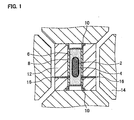
- Reference numeral 2 represents a reaction vessel used in the shape of a capsule, in which a sample 4 including nitride, metal, and ammonium halide as a flux is encapsulated.
- the reaction vessel 2 is enclosed in an electrically insulating pressure medium 6 such as NaCl and h-BN and placed in a carbon tube 8 that serves as a heater.
- the carbon tube 8 is contacted with copper caps 10 at both ends, through which an electric current is applied to the carbon tube 8.
- a pyrophyllite 12 is provided to serve as a pressure-transmitting medium.
- a pressing anvil 14 made of a refractory metal such as tungsten is provided on each of the six sides including upper and lower sides and four lateral sides.
- Reference numeral 16 represents a thermocouple for measuring the temperature, which is placed in the pressure medium 6 to detect the sample temperature via the pressure medium 6.
- the pressing anvil 14 provided on each of the upper and lower sides is in contact with each copper cap 10 and transmit an electric current to the carbon tube 8.
- ⁇ -ZrNCl polycrystalline powder prepared by chemical transport method and NH 4 Cl were mixed in a molar ratio of 1:2.
- the mixture was encapsulated in a Au capsule (6 mm in inner diameter and 6 mm in depth) of the reaction vessel 2, which was then enclosed in a highly thermal conductive sodium chloride block as an electrically insulating pressure medium 6.
- the mixture held in the sodium chloride block was placed in the carbon tube 8 for serving as a heater.
- the mixture was heated at a temperature of 900 °C for 2 hours under an applied pressure of 3 GPa.
- the mixture was gradually heated to 900 °C and then held at this temperature for 1 hour, and then cooled down to 500 °C at a rate of 67 °C/h and allowed to stand until it was cooled to room temperature.
- the Au capsule was taken out and pale green ⁇ -ZrNCl single crystals were obtained.
- the yield was about 40%.
- a large single crystal among them showed a hexagonal plate-like habit reflecting the crystal structure and was transparent
- the dimensions were about 2 mm in diameter, and 0.3 mm in thickness.
- Example 1 ZrN and NH 4 Cl were mixed in a molar ratio of 1:2.
- the mixture was encapsulated in a Au capsule (6 mm in inner diameter and 6 mm in depth) as the reaction vessel 2 and treated under the same conditions as Example 1.
- the Au capsule was taken out and pale green ⁇ -ZrNCl single crystals were obtained.
- the yield was about 40%.
- a large single crystal among them showed a hexagonal plate-like habit reflecting the crystal structure and was transparent
- the dimensions were about 2 mm in diameter, and 0.3 mm in thickness.
- ⁇ -HfNCl polycrystalline powder prepared by chemical transport method and NH 4 Cl were mixed in a molar ratio of 1:2.1.
- the mixture was encapsulated in a Pt capsule (0.1 mm in thickness, 6 mm in inner diameter, and 6 mm in depth) as the reaction vessel 2, which was then enclosed in a high heat-resistance h-BN block as the electrically insulating pressure medium 6.
- Example 2 In the same manner as Example 1, the block was placed in the carbon tube 8 for serving as a heater. In the cubic-pressing apparatus as shown in Fig. 1 using the pyrophyllite 12 as the pressure-transmitting medium, the mixture was heated at a temperature of 1200 °C for 2 hours under an applied pressure of 3 GPa.
- the mixture was then cooled down to 900 °C at a rate of 100 °C/h and allowed to stand until it was cooled to room temperature.
- the Pt capsule was taken out and colorless transparent ⁇ -HfNCl single crystals were obtained.
- the yield was about 30%.
- a large single crystal among them had a hexagonal plate-like habit with dimensions of about 3 mm in diameter and 0.3 mm in thickness.
- Example 2 the block was placed in the carbon tube 8 for serving as a heater.
- the mixture was heated at a temperature of 1100 °C for 1 hour under an applied pressure of 3 GPa. According to the temperature profile, the mixture was heated to 1100 °C at a heat-up rate of 48 °C/min and held at 1100 °C for 1 hour, and then cooled down to 800 °C at a cooling rate of 100 °C/h.
- the yield was about 30%.
- the single crystals had a hexagonal plate-like habit with dimensions of diameters of 0.1 to 1.0 mm and thicknesses of several hundred m.
- the starting material composition ratio of ZrN:NH 4 Br (molar ratio) was determined to be preferably from 1:2 to 1:5, more preferably 1:3.2, and the reaction temperature was preferably from 950 to 1200 °C, more preferably 1100 °C.
- the conditions of the mixing ZrN:NH 4 Br ratios lower than 1:5 with NH4Br in excess and reaction temperatures higher than 1200 °C provided a lower yield of the ⁇ -ZrNBr single crystal.
- Example 2 the block was placed in the carbon tube 8 for serving as a heater.
- the cubic-pressing apparatus as shown in Fig. 1 using the pyrophyllite 12 as the pressure-transmitting medium, the mixture was heated at a temperature of 1000 °C for 1.5 hours under an applied pressure of 3 GPa and then cooled down to 850 °C at a cooling rate of 100 °C/h and allowed to stand until it was cooled to room temperature.
- the Au capsule was taken out and brown transparent ⁇ -ZrNI single crystals were obtained.
- the yield was about 40%.
- the conditions of the same starting material composition and a reaction temperature of 950 °C under pressures higher than 5 GPa gave similar results, but under pressures lower than 1.5 GPa gave ⁇ -ZrNI.
- the ⁇ -ZrNI can be converted into ⁇ -ZrNI by the high-pressure and high-temperature process as shown in this example.
- NH 4 Br was allowed to react with Hf metal powder at 650 °C to form ⁇ -HfNBr powder.
- the resulting powder was purified by a chemical transport method in the temperature gradient of 750 °C to 850 °C.
- the ⁇ -HfNBr powder prepared by the chemical transport method and NH 4 Br were mixed in a molar ratio of 1:2.3.
- the mixture was encapsulated in a Pt capsule (0.1 mm in thickness, 6 mm in inner diameter, and 4 mm in depth) of the reaction vessel 2, which was then enclosed in a high heat-resistance h-BN block as the electrically insulating pressure medium 6.
- Example 2 In the same manner as Example 1, the block was placed in the carbon tube 8 for serving as a heater. In the cubic-pressing apparatus as shown in Fig. 1 using the pyrophyllite 12 as the pressure-transmitting medium, the mixture was heated at a reaction temperature of 1100 °C for 1 hour under an applied pressure of 3 GPa.
- the reaction temperature is preferably maintained at 1100 °C in order to form a large single crystal.
- the reaction temperature lower than 950 °C no crystal larger than 0.1 mm was obtained.
- the ⁇ -HfNBr was decomposed into an amorphous phase even under a pressure higher than 3 GPa.
- ⁇ -HfNI Single Crystals were obtained using the process of Example 6, except that the applied pressure was 5 GPa, and the reaction temperature was 1050 °C. This reaction also provided a yield of about 30%.
- Table 1 shows a summary of the synthesis conditions in the above examples.
- Tables 2 and 3 show crystallographic parameters determined by using the single crystals obtained in the examples on a four-circle X-ray diffractometer.
- a powdered sample of h-BN was encapsulated in a h-BN capsule (6 mm in inner diameter and 6 mm in depth) as the reaction vessel 2, which was then enclosed in a high heat-resistance h-BN block as the electrically insulating pressure medium 6.
- the block was then placed in the carbon tube 8 for serving as a heater.
- the sample was heated at a temperature of 1200 °C for 2 hours under an applied pressure of 5 GPa.
- the sample was allowed to stand until it was cooled down to room temperature, the BN capsule was taken out and colorless transparent h-BN single crystals were obtained.
- the single crystals were about 1 mm in diameter, 0.2 mm in thickness, and in the shape of a regular hexagonal plate.
- the resulting nitride single crystals can be used as superconducting materials, semiconducting materials, optoelectronic materials, ultrahard ceramic materials, or solid lubricants.
Landscapes
- Chemical & Material Sciences (AREA)
- Organic Chemistry (AREA)
- Chemical Kinetics & Catalysis (AREA)
- Crystals, And After-Treatments Of Crystals (AREA)
Abstract
β-ZrNCl polycrystalline powder prepared by chemical transport method
and NH4Cl are mixed in a molar ratio of 1:2. The mixture is encapsulated in a
Au capsule (6 mm in inner diameter and 6 mm in depth) of a reaction vessel 2,
which is then enclosed in a highly heat-conductivitive sodium chloride block as
an electrically insulating pressure medium 6. The mixture held in the sodium
chloride block is placed in a carbon tube 8 for serving as a heater. In a
cubic-pressing apparatus using a pyrophyllite 12 as a pressure-transmitting
medium, the mixture is heated at 900 °C for 2 hours under an applied pressure
of 3 GPa. After the mixture is allowed to stand until it is cooled down to room
temperature, the Au capsule is taken out and light green β-ZrNCl single crystals
are obtained. A large single crystal among them had a hexagonal plate-like
habit and is transparent with dimensions about 2 mm in diameter, and 0.3 mm in
thickness.
Description
- The present invention relates to nitride production, specifically nitride single crystals, which can be useful as superconducting materials, semiconducting materials, optoelectronic materials, ultrahard ceramic materials, or solid lubricants, and to methods for preparing the same.
- Some Group III or IV metal-containing nitrides such as GaN, AIN, TiN, HfN, Si3N4, and BN can be useful as superconducting materials, semiconducting materials, optoelectronic materials, ultrahard ceramic materials, or solid lubricants, and have widely been used as industrial materials.
- These nitrides are prepared as powder materials by direct nitrization of metals or by pyrolysis of precursor compounds. Most of such nitrides are therefore formed into sintered products for use in a variety of industrial materials. Recently, the nitrides have also been prepared as thin films or oriented films close to single crystal by chemical vapor deposition or physical vapor deposition such as sputtering in order to perform their useful functions as optoelectronic materials or coating materials.
- Many of the Group IV metal-containing nitrides form specific layer structured crystals, which are used as solid lubricants and useful intermediates for ZrN or HfN nitride ceramics.
- The Group IV metal-containing nitrides also include ternary transition metal nitride halides having a chemical composition represented by the formula: MNX (M = Zr, Hf; X= Cl, Br, I). Such metal nitride halides are known to have two polymorphic forms called α and β forms.
- The α form has the FeOCl-type layer structure, and the β form has a SmSI-type layer structure. In particular, the β form of the MNX is an important nitride, because it becomes a superconductor with a relatively high critical temperature (Tc) when alkali metal is intercalated (inserted) between its crystal layers, and electrons are doped into its nitride layer. For example, β-ZrNCl and β-HfNCl intercalated with lithium become superconductors with Tcs of about 14 K and 25.5 K, respectively, which have been noted as new high-Tc superconductors.
- Ohashi et al. have succeeded in synthesizing β-ZrNCl powder in high yield by the reaction of metallic zirconium or zirconium hydride with ammonium chloride vapor at high temperature (J. Solid State Chem., 75, 99 (1988)).
- Ohashi et al. have also succeeded in obtaining a well crystallized sample by a chemical transport of the as-prepared powder sample in a vacuum-sealed quartz tube (J. Solid State Chem., 77, 342 (1988)). In the chemical transport method, a small amount of ammonium halide such as ammonium chloride as a transporting agent is added into the quartz tube for the chemical transportation of β-MNX.
- Ohashi et al. have provided a breakthrough for the β-MNX research by developing such a chemical transport method for purification and crystallization of β-MNX layer structured crystal. However, such a method can only produce thin plate-shaped polycrystalline samples.
- Yamanaka et al. have succeeded in synthesizing the β-form crystal phase of all the compositions of the MNX (M = Zr, Hf; X = Cl, Br, I) and reported that all the compositions can show superconductivity by intercalation of alkali metal (Inorg. Chem., 39, 806 (2000)). In the reported process, the α-form powder sample was converted into the β-form by compressing it under a high pressure of 1 to 5 GPa. However, the resulting crystal was not a single crystal but a polycrystalline powder.
- The β-MNX layer structured nitrides are semiconductors with a wide band gap, which are not only potential host materials for superconductors but also potential optoelectronic materials.
- The Group III or IV metal-containing nitrides are potential materials for semiconductors, optoelectronics, or superconductors. Such nitrides are, however, mostly prepared as powder materials; even the chemical transport method can only provide very thin and soft polycrystals. These nitrides should be prepared as well developed single crystals in order for practical use as industrial materials. However, the production of such single crystals has been considered to be very difficult, and no method has been reported on such production yet.
- It is therefore an object of the present invention to provide such nitride single crystals and the methods for preparing the same.
- In an aspect, the present invention is directed to a nitride single crystal itself which includes a Group III or IV metal element such as B, Al, Ga, In, Sc, Y, La, Si, Ge, Ti, Zr, and Hf.
- In a preferred manner, the nitride single crystal is a layer structured nitride having a chemical composition represented by the formula: MNX (M = Zr, Hf; X=CI, Br, I), and having the β-form layer structure.
- In another aspect, the present invention is directed to present a method to prepare nitride single crystals, which includes heating the constituent metal of the corresponding metal nitride, or a compound containing the constituent metal of the metal nitride with ammonium halide under conditions of a pressure of 0.01 GPa or higher and a temperature of 400 °C or higher.
- In the process of the present invention, under the condition of a temperature of 400 °C or higher, the ammonium halide is decomposed into ammonia and hydrogen halide, which react with the coexisting metal or metal compounds to grow nitride single crystals. A high pressure is generated as the ammonium halide is decomposed. Therefore, the process needs a high pressure to encapsulate the decomposition products and the nitrides at high temperatures.
- According to the present invention, Group III or IV metal-containing metal nitride single crystals, specifically β-MNX layer structured nitride single crystals are produced, which can be useful as superconducting materials, semiconducting materials, optoelectronic materials, ultrahard ceramic materials, or solid lubricants.
- According to the process of the present invention, such nitride single crystals are prepared by allowing a metal that is a component of the nitride to be prepared or a compound containing the constituent metal of the nitrides to react with ammonium halide under conditions of a pressure of 0.01 GPa or higher and a temperature of 400 °C or higher.
-
- Fig. 1 is a cross-sectional front view showing a main unit of a cubic pressing apparatus used in Examples.
-
- It is necessary to set a temperature at which the ammonium halide can be decomposed. In such a temperature range for decomposition, a higher temperature can increase the reaction rate and therefore is preferred. However, from the consideration of the withstanding pressure of the reaction apparatus, the appropriate temperature range used should be below about 1500 °C.
- It is necessary to set a pressure under which the decomposition products of ammonium halide can be held or encapsulated together with the nitride or the starting materials thereof, and a desired form of crystals of the nitride can selectively be grown. For example, the β-form of the MNX layer structured single crystals can selectively be grown by the application of a pressure of 0.01 GPa or higher, although the nitride represented by the formula MNX has two polymorphic forms, namely α- and β-forms. The pressure has no upper limit but is appropriately up to about 10 GPa in consideration of the pressure available and the withstanding pressure of the reaction apparatus.
- Examples of the metal or the metal compound used as a starting materials include Groups III and IV metal elements such as B, Al, Ga, In, Sc, Y, La, Si, Ge, Ti, Zr, and Hf, or hydrides, nitrides, halides, or nitride halides of these metals. Examples of the metal nitride halides include TiNCI, ZrNCI, and HfNCl.
- Examples of the ammonium halides allowed to coexist include NH4F, NH4Cl, NH4Br, NH4I, and any combination thereof.
- Different types of high pressure-generating apparatuses can be used to provide the reactants a desired temperature and a desired pressure, such as a cubic-pressing apparatus as used in the examples below, piston-cylinder type, and belt type pressure-generating apparatuses.
- Desired materials for the reaction vessel include h-BN (hexagonal boron nitride), Au (gold), Pt (platinum), Ta (tantalum), Mo (molybdenum), W (tungsten), and Nb (niobium). A pressure of 0.01 GPa or so can be achieved in a Ta or Nb tube that is heat-sealed and heated in an inert atmosphere. A hot isostatic press (HIP) apparatus may also be used, in which a glass tube is sealed and a gas such as argon is used.
- The present invention is more specifically described by showing examples and comparative examples in the followings, but such examples are not intended to limit the scope of the invention.
- First, a cubic-pressing apparatus used in the examples is described by referring to Fig. 1.
-
Reference numeral 2 represents a reaction vessel used in the shape of a capsule, in which asample 4 including nitride, metal, and ammonium halide as a flux is encapsulated. Thereaction vessel 2 is enclosed in an electrically insulatingpressure medium 6 such as NaCl and h-BN and placed in acarbon tube 8 that serves as a heater. Thecarbon tube 8 is contacted withcopper caps 10 at both ends, through which an electric current is applied to thecarbon tube 8. On the side of thecarbon tube 8 and thecopper caps 10, apyrophyllite 12 is provided to serve as a pressure-transmitting medium. In such a state, apressing anvil 14 made of a refractory metal such as tungsten is provided on each of the six sides including upper and lower sides and four lateral sides.Reference numeral 16 represents a thermocouple for measuring the temperature, which is placed in thepressure medium 6 to detect the sample temperature via thepressure medium 6. Thepressing anvil 14 provided on each of the upper and lower sides is in contact with eachcopper cap 10 and transmit an electric current to thecarbon tube 8. - The pressing anvils 14 on the six sides, which are not in contact with each other, each equally press the
sample 4, which is placed at the center, through thepyrophyllite 12 and thecopper caps 10 from the outer side to the center. - β-ZrNCl polycrystalline powder prepared by chemical transport method and NH4Cl were mixed in a molar ratio of 1:2. The mixture was encapsulated in a Au capsule (6 mm in inner diameter and 6 mm in depth) of the
reaction vessel 2, which was then enclosed in a highly thermal conductive sodium chloride block as an electrically insulatingpressure medium 6. The mixture held in the sodium chloride block was placed in thecarbon tube 8 for serving as a heater. In the cubic-pressing apparatus as shown in Fig. 1 using thepyrophyllite 12 as the pressure-transmitting medium, the mixture was heated at a temperature of 900 °C for 2 hours under an applied pressure of 3 GPa. According to the temperature program for this process, the mixture was gradually heated to 900 °C and then held at this temperature for 1 hour, and then cooled down to 500 °C at a rate of 67 °C/h and allowed to stand until it was cooled to room temperature. - After the cooling to room temperature, the Au capsule was taken out and pale green β-ZrNCl single crystals were obtained. The yield was about 40%. A large single crystal among them showed a hexagonal plate-like habit reflecting the crystal structure and was transparent The dimensions were about 2 mm in diameter, and 0.3 mm in thickness.
- In this example, another reaction was carried out under the same conditions, except that the molar ratio of the β-ZrNCl polycrystalline powder to the NH4Cl was 1:3.5. Similarly, pale green β-ZrNCl single crystals were obtained.
- ZrN and NH4Cl were mixed in a molar ratio of 1:2. The mixture was encapsulated in a Au capsule (6 mm in inner diameter and 6 mm in depth) as the
reaction vessel 2 and treated under the same conditions as Example 1. - After the cooling to room temperature, the Au capsule was taken out and pale green β-ZrNCl single crystals were obtained. The yield was about 40%. A large single crystal among them showed a hexagonal plate-like habit reflecting the crystal structure and was transparent The dimensions were about 2 mm in diameter, and 0.3 mm in thickness.
- β-HfNCl polycrystalline powder prepared by chemical transport method and NH4Cl were mixed in a molar ratio of 1:2.1. The mixture was encapsulated in a Pt capsule (0.1 mm in thickness, 6 mm in inner diameter, and 6 mm in depth) as the
reaction vessel 2, which was then enclosed in a high heat-resistance h-BN block as the electrically insulatingpressure medium 6. - In the same manner as Example 1, the block was placed in the
carbon tube 8 for serving as a heater. In the cubic-pressing apparatus as shown in Fig. 1 using thepyrophyllite 12 as the pressure-transmitting medium, the mixture was heated at a temperature of 1200 °C for 2 hours under an applied pressure of 3 GPa. - The mixture was then cooled down to 900 °C at a rate of 100 °C/h and allowed to stand until it was cooled to room temperature. The Pt capsule was taken out and colorless transparent β-HfNCl single crystals were obtained. The yield was about 30%. A large single crystal among them had a hexagonal plate-like habit with dimensions of about 3 mm in diameter and 0.3 mm in thickness.
- ZrN (0.060 g) and NH4Br (0.180 g) were mixed in a molar ratio of 1:3.2. The mixture was encapsulated in a Pt capsule (0.1 mm in thickness, 6 mm in inner diameter, and 4 mm in depth) as the
reaction vessel 2, which was then enclosed in a high heat-resistance h-BN block as the electrically insulatingpressure medium 6. - In the same manner as Example 1, the block was placed in the
carbon tube 8 for serving as a heater. In the cubic-pressing apparatus as shown in Fig. 1 using thepyrophyllite 12 as the pressure-transmitting medium, the mixture was heated at a temperature of 1100 °C for 1 hour under an applied pressure of 3 GPa. According to the temperature profile, the mixture was heated to 1100 °C at a heat-up rate of 48 °C/min and held at 1100 °C for 1 hour, and then cooled down to 800 °C at a cooling rate of 100 °C/h. - After the mixture was allowed to stand under the increased pressure until it was cooled to room temperature, the Pt capsule was taken out and dark green β-ZrNBr single crystals were obtained. The yield was about 30%. The single crystals had a hexagonal plate-like habit with dimensions of diameters of 0.1 to 1.0 mm and thicknesses of several hundred m.
- As a result of the investigation for optimum reaction conditions, the starting material composition ratio of ZrN:NH4Br (molar ratio) was determined to be preferably from 1:2 to 1:5, more preferably 1:3.2, and the reaction temperature was preferably from 950 to 1200 °C, more preferably 1100 °C. The conditions of the ZrN:NH4Br mixing ratios higher than 1:2 with ZrN in excess and reaction temperatures lower than 950 °C provided almost homogeneous β-ZrNBr powder. On the other hand, the conditions of the mixing ZrN:NH4Br ratios lower than 1:5 with NH4Br in excess and reaction temperatures higher than 1200 °C provided a lower yield of the β-ZrNBr single crystal.
- ZrN (0.050 g) and NH4I (0.200 g) were mixed in a molar ratio of 1:2.9. The mixture was encapsulated in a Au capsule (0.1 mm in thickness, 6 mm in inner diameter, and 4 mm in depth) as the
reaction vessel 2, which was then enclosed in a high heat-resistance h-BN block as the electrically insulatingpressure medium 6. - In the same manner as Example 1, the block was placed in the
carbon tube 8 for serving as a heater. In the cubic-pressing apparatus as shown in Fig. 1 using thepyrophyllite 12 as the pressure-transmitting medium, the mixture was heated at a temperature of 1000 °C for 1.5 hours under an applied pressure of 3 GPa and then cooled down to 850 °C at a cooling rate of 100 °C/h and allowed to stand until it was cooled to room temperature. - The Au capsule was taken out and brown transparent β-ZrNI single crystals were obtained. The yield was about 40%.
- In this example, the conditions of the same starting material composition and a reaction temperature of 950 °C under pressures higher than 5 GPa gave similar results, but under pressures lower than 1.5 GPa gave α-ZrNI. The α-ZrNI can be converted into β-ZrNI by the high-pressure and high-temperature process as shown in this example.
- First, NH4Br was allowed to react with Hf metal powder at 650 °C to form α-HfNBr powder. The resulting powder was purified by a chemical transport method in the temperature gradient of 750 °C to 850 °C.
- The α-HfNBr powder prepared by the chemical transport method and NH4Br were mixed in a molar ratio of 1:2.3. The mixture was encapsulated in a Pt capsule (0.1 mm in thickness, 6 mm in inner diameter, and 4 mm in depth) of the
reaction vessel 2, which was then enclosed in a high heat-resistance h-BN block as the electrically insulatingpressure medium 6. - In the same manner as Example 1, the block was placed in the
carbon tube 8 for serving as a heater. In the cubic-pressing apparatus as shown in Fig. 1 using thepyrophyllite 12 as the pressure-transmitting medium, the mixture was heated at a reaction temperature of 1100 °C for 1 hour under an applied pressure of 3 GPa. - After the mixture was allowed to stand until it was cooled down to room temperature, the Pt capsule was taken out and pale yellow-green β-HfNBr single crystals were obtained. The yield was about 30%.
- In the process for the β-HfNBr single crystals, the reaction temperature is preferably maintained at 1100 °C in order to form a large single crystal. At a reaction temperature lower than 950 °C, no crystal larger than 0.1 mm was obtained. At a reaction temperature higher than 1200 °C, the β-HfNBr was decomposed into an amorphous phase even under a pressure higher than 3 GPa.
- β-HfNI Single Crystals were obtained using the process of Example 6, except that the applied pressure was 5 GPa, and the reaction temperature was 1050 °C. This reaction also provided a yield of about 30%.
- Table 1 shows a summary of the synthesis conditions in the above examples. Tables 2 and 3 show crystallographic parameters determined by using the single crystals obtained in the examples on a four-circle X-ray diffractometer.
Synthesis Conditions of β-MNX (M = Zr, Hf; X = Cl, Br, I) Single Crystals Single Starting materials Temperature Pressure Color crystals (molar ratio) °C GPa β-ZrNCl β-ZrNCl/NH4Cl
(1:3.5)900 3 Pale yellow-green β-ZrNBr ZrN/NH4Br
(1:3.2)1100 3 Dark green β-ZrNI ZrN/NH4I
(1:2.9)1000 3 Brown β-HfNCl β-HfNCl/NH4Cl
(1:2.1)1200 3 Colorless β-HfNBr α-HfNBr/NH4Br
(1:2.3)1100 3 Light yellow-green β-HfNI α-HfNI/NH4I
(1:2.3)1050 5 Brown Crystallographic Data for β-MNX (M = Zr, Hf; X = Br, I) Formula ZrNCl ZrNBr ZrNI Crystal size, mm 0.20×0.10×0.03 0.26×0.16×0.04 0.30×0.30×0.02 Space group R-3m (No.166) R-3m (No.166) R-3m (No.166) a, Å 3.6046(4) 3.6403(6) 3.718(2) c, Å 27.672(4) 29.270(5) 31.381(9) V, Å3, Z 311.38(7), 6 335.9(1), 6 375.7(3),6 d calc, g/cm3 4.501 5.491 6.156 2max ,deg 100 100 100 Total reflections 2085 1848 2108 Unique reflection 473 401 454 Observed [I ≥ 2σ(I)] 447 337 418 No. of variables 11 10 11 GOF on Fo 2 1.143 1.147 1.171 R indices [I ≥ 2σ(I)] R1 0.0270 0.0540 0.0603 wR2 0.0751 0.1552 0.1885 R indices (all data) R1 0.0291 0.0647 0.0630 wR2 0.0760 0.1602 0.1904 Formula HfNCl HfNBr HfNI Crystal size, mm 0.14×0.12×0.03 0.18×0.10×0.03 0.06×0.06×0.02 Space group R-3m (No.166) R-3m (No.166) R-3m (No.166) a, Å 3.5767(8) 3.610(1) 3.689(1) c, Å 27.711(7) 29.294(6) 31.329(6) V, Å3, Z 307.01(12), 6 330.6(2), 6 369.2(2), 6 d calc, g/cm3 7.398 8.209 8.619 2max , deg 100 100 50.6 Total reflections 2143 1520 574 Unique reflection 471 506 116 Observed[I ≥ 2σ(I)] 454 412 113 No. of variables 11 11 11 GOFa on Fo 2 1.153 1.103 1.274 R indices [I ≥ 2σ(I)] 0.0372 0.0653 0.0544 0.0979 0.1464 0.1583 R indices (all data) 0.0391 0.0851 0.0556 0.0991 0.1549 0.1593 Atomic Coordinates Temperature Factors for β-MNX (M = Zr, Hf; X = Cl, Br, I) Atoms x y z U11=U22 U33 U23=U13 U12 Ueq ZrNCl* Zr 0 0 0.11924(1) 0.0106(1) 0.0108(1) 0 0.0053(1) 0.0107(1) Cl 0 0 0.38780(3) 0.0164(2) 0.0124(2) 0 0.0082(1) 0.0151(1) N 0 0 0.19771(8) 0.0130(4) 0.0108(6) 0 0.0065(2) 0.0123(3) ZrNBr Zr 0 0 0.12217(3) 0.0048(2) 0.0058(3) 0 0.0024(1) 0.0051(2) Br 0 0 0.38836(3) 0.0097(3) 0.0084(3) 0 0.0048(1) 0.0093(2) N 0 0 0.1963(2) 0.006(1) 0.006(2) 0 0.0032(6) 0.0062(9) ZrNI Zr 0 0 0.20740(4) 0.0053(3) 0.0072(4) 0 0.0027(1) 0.0060(2) I 0 0 0.38952(2) 0.0089(2) 0.0090(3) 0 0.0045(1) 0.0090(2) N 0 0 0.1393(3) 0.005(2) 0.007(2) 0 0.0026(8) 0.006(1) HfNCl* Hf 0 0 0.11950(1) 0.0089(1) 0.0090(1) 0 0.0044(1) 0.0089(1) Cl 0 0 0.38795(8) 0.0127(5) 0.0111(5) 0 0.0064(2) 0.0122(3) N 0 0 0.1976(2) 0.014(2) 0.008(2) 0 0.0067(8) 0.012(1) HfNBr Hf 0 0 0.21096(3) 0.0105(2) 0.0110(3) 0 0.0053(1) 0.0107(2) Br 0 0 0.38850(7) 0.0150(4) 0.0132(7) 0 0.0075(2) 0.0144(3) N 0 0 0.1371(5) 0.019(4) 0.006(3) 0 0.009(2) 0.015(2) HfNI Hf 0 0 0.20714(6) 0.010(1) 0.018(2) 0 0.0050(7) 0.013(1) I 0 0 0.38960(9) 0.012(1) 0.018(2) 0 0.0060(7) 0.014(1) N 0 0 0.1392(11) 0.011(9) 0.02(2) 0 0.005(4) 0.014(6) Ueq is Isotopic Temperature Factor Uij is Anisotropic Temperature Factor - The structure of HfNCl had been analyzed, and the results were reported by other research groups. However, such results were obtained using polycrystalline samples and therefore were less precise and less reliable.
- According to the present invention, the β-MNX (M = Zr, Hf; X = Cl, Br, I) single crystals can be obtained in a size suitable for structural analysis, and the obtained results of the structural analysis are highly reliable and useful for . clarification of superconducting mechanisms and other properties.
- A powdered sample of h-BN was encapsulated in a h-BN capsule (6 mm in inner diameter and 6 mm in depth) as the
reaction vessel 2, which was then enclosed in a high heat-resistance h-BN block as the electrically insulatingpressure medium 6. - The block was then placed in the
carbon tube 8 for serving as a heater. In the cubic-pressing apparatus as shown in Fig. 1 using thepyrophyllite 12 as the pressure-transmitting medium, the sample was heated at a temperature of 1200 °C for 2 hours under an applied pressure of 5 GPa. - After the sample was allowed to stand until it was cooled down to room temperature, the BN capsule was taken out and colorless transparent h-BN single crystals were obtained. The single crystals were about 1 mm in diameter, 0.2 mm in thickness, and in the shape of a regular hexagonal plate.
- According to the present invention, all the compositions of the β-MNX (M = Zr, Hf; X = Cl, Br, I) layer structured nitrides can be prepared in the β-form single crystals, and h-BN single crystals can also be prepared.
- The resulting nitride single crystals can be used as superconducting materials, semiconducting materials, optoelectronic materials, ultrahard ceramic materials, or solid lubricants.
Claims (12)
- A nitride single crystal comprising a metal element of Group III or IV.
- The nitride single crystal according to Claim 1, wherein the nitride single crystal is a layer structured nitride having a chemical composition represented by the formula: MNX, wherein M=Zr, Hf; N is nitrogen; and X=Cl, Br, I, and having the β-form of the layer structure.
- The nitride single crystal according to Claim 1, wherein the nitride single crystal is an h-BN single crystal.
- A method for preparing a nitride single crystal, which allows a metal that is a component of the nitride single crystal to be prepared or a compound containing the metal to coexist to react with ammonium halide under the conditions of a pressure higher than or equal to 0.01 GPa and a temperature higher than or equal to 400 °C.
- The method for preparing a nitride single crystal according to Claim 4, wherein the nitride single crystal to be prepared comprises a metal element of Group III or IV.
- The method for preparing a nitride single crystal according to Claim 4 or 5, wherein the nitride single crystal to be prepared has a chemical composition represented by the formula: MNX, wherein M=Zr, Hf; N is nitrogen; and X=Cl, Br, I.
- The method for preparing a nitride single crystal according to Claim 6, wherein the metal compound allowed to coexist with the ammonium halide is represented by MN.
- The method for preparing a nitride single crystal according to Claim 7, wherein the method uses a starting material composition with a molar MN:NH4X ratio of 1:2 to 1:5 and a reaction temperature of 850 °C to 1300 °C.
- The method for preparing a nitride single crystal according to Claim 8, wherein the nitride single crystal to be prepared is ZrNBr and the reaction temperature is from 950 to 1200 °C.
- The method for preparing a nitride single crystal according to Claim 6, wherein the metal compound allowed to coexist with the ammonium halide is MNX powder.
- The method for preparing a nitride single crystal according to Claim 10, wherein the method uses a starting material composition with a molar MNX:NH4X ratio of 1:2 to 1:5 and a reaction temperature of 850 °C to 1300 °C.
- The method for preparing a nitride single crystal according to Claim 11, wherein the nitride single crystal to be prepared is HfNBr and the reaction temperature is from 950 to 1200 °C.
Applications Claiming Priority (3)
| Application Number | Priority Date | Filing Date | Title |
|---|---|---|---|
| JP2000313480 | 2000-10-13 | ||
| JP2000313480 | 2000-10-13 | ||
| PCT/JP2001/008925 WO2002034972A1 (en) | 2000-10-13 | 2001-10-11 | Single crystal of nitride containing metal element of group iii or iv and method for preparing the same |
Publications (2)
| Publication Number | Publication Date |
|---|---|
| EP1333112A1 true EP1333112A1 (en) | 2003-08-06 |
| EP1333112A4 EP1333112A4 (en) | 2004-05-19 |
Family
ID=18792890
Family Applications (1)
| Application Number | Title | Priority Date | Filing Date |
|---|---|---|---|
| EP01974783A Withdrawn EP1333112A4 (en) | 2000-10-13 | 2001-10-11 | NITRIDE MONOCRYSTAL CONTAINING A GROUP III OR IV METAL ELEMENT AND PROCESS FOR PRODUCING THE SAME |
Country Status (4)
| Country | Link |
|---|---|
| US (1) | US7115165B2 (en) |
| EP (1) | EP1333112A4 (en) |
| JP (1) | JP3898127B2 (en) |
| WO (1) | WO2002034972A1 (en) |
Families Citing this family (10)
| Publication number | Priority date | Publication date | Assignee | Title |
|---|---|---|---|---|
| US7125453B2 (en) | 2002-01-31 | 2006-10-24 | General Electric Company | High temperature high pressure capsule for processing materials in supercritical fluids |
| US20030140845A1 (en) * | 2002-01-31 | 2003-07-31 | General Electric Company | Pressure vessel |
| US7063741B2 (en) | 2002-03-27 | 2006-06-20 | General Electric Company | High pressure high temperature growth of crystalline group III metal nitrides |
| US9279193B2 (en) | 2002-12-27 | 2016-03-08 | Momentive Performance Materials Inc. | Method of making a gallium nitride crystalline composition having a low dislocation density |
| KR101200722B1 (en) * | 2003-11-18 | 2012-11-13 | 도쿠리츠교세이호징 붓시쯔 자이료 겐큐키코 | Single crystal of hexagonal boron nitride capable of far ultraviolet high-luminance light emission, process for producing the same, far ultraviolet high-luminance light emitting device including the single crystal, and utilizing the device, solid laser and solid light emitting unit |
| US7704324B2 (en) | 2005-01-25 | 2010-04-27 | General Electric Company | Apparatus for processing materials in supercritical fluids and methods thereof |
| US7942970B2 (en) | 2005-12-20 | 2011-05-17 | Momentive Performance Materials Inc. | Apparatus for making crystalline composition |
| CN103341340B (en) * | 2013-06-25 | 2015-12-23 | 河南飞孟金刚石工业有限公司 | A kind of production technology of pyrophyllite formula |
| CN107620122B (en) * | 2016-07-13 | 2020-11-06 | 清华大学 | A kind of semi-metallic compound of metallic platinum and preparation method thereof |
| CN117899907A (en) * | 2022-10-19 | 2024-04-19 | 中国科学院大连化学物理研究所 | Synthesis and photocatalytic application of nitrogen halide powder photocatalyst |
Family Cites Families (1)
| Publication number | Priority date | Publication date | Assignee | Title |
|---|---|---|---|---|
| JP2001072499A (en) * | 1999-06-29 | 2001-03-21 | Japan Science & Technology Corp | Method for growing hexagonal boron nitride single crystal |
-
2001
- 2001-10-11 US US10/398,219 patent/US7115165B2/en not_active Expired - Fee Related
- 2001-10-11 EP EP01974783A patent/EP1333112A4/en not_active Withdrawn
- 2001-10-11 WO PCT/JP2001/008925 patent/WO2002034972A1/en not_active Ceased
- 2001-10-11 JP JP2002537936A patent/JP3898127B2/en not_active Expired - Fee Related
Non-Patent Citations (3)
| Title |
|---|
| KAWAJI H ET AL: "SUPERCONDUCTIVITY OF ALKALI METAL INTERCALATED BETA-ZIRCONIUM NITRIDE CHLORIDE, A2ZRNCI (A=LI, NA, K)" CHEMISTRY OF MATERIALS, AMERICAN CHEMICAL SOCIETY, WASHINGTON, US, vol. 9, no. 10, 1 October 1997 (1997-10-01), pages 2127-2130, XP000703419 ISSN: 0897-4756 * |
| See also references of WO0234972A1 * |
| YAMANAKA S ET AL: "A NEW LAYER-STRUCTURED NITRIDE SUPERCONDUCTOR. LITHIUM-INTERCALATEDBETA-ZIRCONIUM NITRIDE CHLORIDE, LIXZRNCI" ADVANCED MATERIALS, VCH VERLAGSGESELLSCHAFT, WEINHEIM, DE, vol. 8, no. 9, 1 September 1996 (1996-09-01), pages 771-774, XP000621879 ISSN: 0935-9648 * |
Also Published As
| Publication number | Publication date |
|---|---|
| US7115165B2 (en) | 2006-10-03 |
| JPWO2002034972A1 (en) | 2004-03-04 |
| WO2002034972A1 (en) | 2002-05-02 |
| JP3898127B2 (en) | 2007-03-28 |
| EP1333112A4 (en) | 2004-05-19 |
| US20040040490A1 (en) | 2004-03-04 |
Similar Documents
| Publication | Publication Date | Title |
|---|---|---|
| Purdy | Ammonothermal synthesis of cubic gallium nitride | |
| US7063741B2 (en) | High pressure high temperature growth of crystalline group III metal nitrides | |
| US4545968A (en) | Methods for preparing cubic boron nitride sintered body and cubic boron nitride, and method for preparing boron nitride for use in the same | |
| JP2723099B2 (en) | Clathrate compound and method for producing the same | |
| US7115165B2 (en) | Single crystal of nitride containing metal element of group III or IV and method for preparing the same | |
| Schuisky et al. | Epitaxial growth of Bi2O2. 33 by halide Cvd | |
| CN114180969B (en) | Preparation method and application of nitrogen-containing high-entropy MAX phase material and two-dimensional material | |
| US20110224085A1 (en) | Magnesium diboride | |
| US8414858B1 (en) | Method for solid state crystal growth | |
| US4772304A (en) | Transparent BN-type ceramic material and method of producing the same | |
| JPS6255896B2 (en) | ||
| Singhal et al. | Synthesis of cubic boron nitride from amorphous boron nitride containing oxide impurity using Mg–Al alloy catalyst solvent | |
| Nakano et al. | Synthesis of cubic boron nitride using Li3BN2, Sr3B2N4 and Ca3B2N4 as solvent-catalysts | |
| KR100863619B1 (en) | Superconducting material containing MgB2 single crystals, a manufacturing method thereof, and MgB2 single crystals | |
| US4620968A (en) | Monoclinic phosphorus formed from vapor in the presence of an alkali metal | |
| US4287164A (en) | Process for producing cubic system boron nitride | |
| US4913887A (en) | Production of boron nitride | |
| Maury et al. | Epitaxial growth of cobalt-gallium on gallium arsenide by organometallic chemical vapor deposition | |
| US6096282A (en) | Instantaneous synthesis of refractory nitrides from solid precursors | |
| JP4009713B2 (en) | Method for producing magnesium boride | |
| Meng et al. | Synthesis, structure and bonding of Gd6MTe2 (M= Co, Ni), Er6RuTe2 | |
| JPH0688866B2 (en) | Boron nitride coated crucible and method of manufacturing the same | |
| JP2679798B2 (en) | Manufacturing method of aluminum nitride | |
| JPS6059166B2 (en) | Manufacturing method of boron nitride | |
| EP0162137B1 (en) | Method for preparing boron nitride |
Legal Events
| Date | Code | Title | Description |
|---|---|---|---|
| PUAI | Public reference made under article 153(3) epc to a published international application that has entered the european phase |
Free format text: ORIGINAL CODE: 0009012 |
|
| 17P | Request for examination filed |
Effective date: 20030401 |
|
| AK | Designated contracting states |
Designated state(s): DE FR GB |
|
| AX | Request for extension of the european patent |
Extension state: AL LT LV MK RO SI |
|
| RIN1 | Information on inventor provided before grant (corrected) |
Inventor name: CHEN, XUEAN Inventor name: YAMANAKA, SHOJI |
|
| A4 | Supplementary search report drawn up and despatched |
Effective date: 20040402 |
|
| 17Q | First examination report despatched |
Effective date: 20090924 |
|
| STAA | Information on the status of an ep patent application or granted ep patent |
Free format text: STATUS: THE APPLICATION IS DEEMED TO BE WITHDRAWN |
|
| 18D | Application deemed to be withdrawn |
Effective date: 20100205 |