EP1333069A1 - Ink-jet images with a metallized dye and methods of making same - Google Patents
Ink-jet images with a metallized dye and methods of making same Download PDFInfo
- Publication number
- EP1333069A1 EP1333069A1 EP03250240A EP03250240A EP1333069A1 EP 1333069 A1 EP1333069 A1 EP 1333069A1 EP 03250240 A EP03250240 A EP 03250240A EP 03250240 A EP03250240 A EP 03250240A EP 1333069 A1 EP1333069 A1 EP 1333069A1
- Authority
- EP
- European Patent Office
- Prior art keywords
- ink
- image
- dye
- present
- transition metal
- Prior art date
- Legal status (The legal status is an assumption and is not a legal conclusion. Google has not performed a legal analysis and makes no representation as to the accuracy of the status listed.)
- Granted
Links
- 238000000034 method Methods 0.000 title claims description 9
- IJGRMHOSHXDMSA-UHFFFAOYSA-N Atomic nitrogen Chemical compound N#N IJGRMHOSHXDMSA-UHFFFAOYSA-N 0.000 claims abstract description 26
- 229910052723 transition metal Inorganic materials 0.000 claims abstract description 21
- 150000003624 transition metals Chemical class 0.000 claims abstract description 18
- 125000000623 heterocyclic group Chemical group 0.000 claims abstract description 16
- 229910052757 nitrogen Inorganic materials 0.000 claims abstract description 14
- 239000003446 ligand Substances 0.000 claims description 16
- -1 azo nitrogen Chemical compound 0.000 claims description 15
- XEEYBQQBJWHFJM-UHFFFAOYSA-N Iron Chemical compound [Fe] XEEYBQQBJWHFJM-UHFFFAOYSA-N 0.000 claims description 8
- PXHVJJICTQNCMI-UHFFFAOYSA-N Nickel Chemical compound [Ni] PXHVJJICTQNCMI-UHFFFAOYSA-N 0.000 claims description 8
- JUJWROOIHBZHMG-UHFFFAOYSA-N Pyridine Chemical group C1=CC=NC=C1 JUJWROOIHBZHMG-UHFFFAOYSA-N 0.000 claims description 8
- 239000000758 substrate Substances 0.000 claims description 7
- RYGMFSIKBFXOCR-UHFFFAOYSA-N Copper Chemical compound [Cu] RYGMFSIKBFXOCR-UHFFFAOYSA-N 0.000 claims description 4
- 229910052802 copper Inorganic materials 0.000 claims description 4
- 239000010949 copper Substances 0.000 claims description 4
- 229910052742 iron Inorganic materials 0.000 claims description 4
- 125000001624 naphthyl group Chemical group 0.000 claims description 4
- 229910052759 nickel Inorganic materials 0.000 claims description 4
- LISFMEBWQUVKPJ-UHFFFAOYSA-N quinolin-2-ol Chemical group C1=CC=C2NC(=O)C=CC2=C1 LISFMEBWQUVKPJ-UHFFFAOYSA-N 0.000 claims description 4
- 229910017052 cobalt Inorganic materials 0.000 claims description 3
- 239000010941 cobalt Substances 0.000 claims description 3
- GUTLYIVDDKVIGB-UHFFFAOYSA-N cobalt atom Chemical compound [Co] GUTLYIVDDKVIGB-UHFFFAOYSA-N 0.000 claims description 3
- VYZAMTAEIAYCRO-UHFFFAOYSA-N Chromium Chemical compound [Cr] VYZAMTAEIAYCRO-UHFFFAOYSA-N 0.000 claims description 2
- 229910052804 chromium Inorganic materials 0.000 claims description 2
- 239000011651 chromium Substances 0.000 claims description 2
- 230000003287 optical effect Effects 0.000 abstract description 12
- 230000000007 visual effect Effects 0.000 abstract description 10
- QJGQUHMNIGDVPM-UHFFFAOYSA-N nitrogen group Chemical group [N] QJGQUHMNIGDVPM-UHFFFAOYSA-N 0.000 abstract description 9
- 239000000976 ink Substances 0.000 description 84
- 239000000975 dye Substances 0.000 description 44
- 239000000203 mixture Substances 0.000 description 29
- 229910052751 metal Inorganic materials 0.000 description 25
- 239000002184 metal Substances 0.000 description 25
- 239000002738 chelating agent Substances 0.000 description 14
- 239000004094 surface-active agent Substances 0.000 description 13
- 239000000872 buffer Substances 0.000 description 11
- 239000003139 biocide Substances 0.000 description 9
- 125000004432 carbon atom Chemical group C* 0.000 description 8
- XLYOFNOQVPJJNP-UHFFFAOYSA-N water Substances O XLYOFNOQVPJJNP-UHFFFAOYSA-N 0.000 description 8
- 239000003795 chemical substances by application Substances 0.000 description 7
- 238000009472 formulation Methods 0.000 description 7
- 125000003118 aryl group Chemical group 0.000 description 6
- DKWJRBBUVAQOAC-UHFFFAOYSA-N chembl1311879 Chemical compound C1=CC2=CC=CC=C2C(O)=C1N=NC1=CC=CC=N1 DKWJRBBUVAQOAC-UHFFFAOYSA-N 0.000 description 6
- 239000004615 ingredient Substances 0.000 description 6
- 238000007639 printing Methods 0.000 description 6
- 239000002904 solvent Substances 0.000 description 6
- 230000003115 biocidal effect Effects 0.000 description 5
- 125000000217 alkyl group Chemical group 0.000 description 4
- 150000001875 compounds Chemical class 0.000 description 4
- 229910021645 metal ion Inorganic materials 0.000 description 4
- 125000003710 aryl alkyl group Chemical group 0.000 description 3
- MTHSVFCYNBDYFN-UHFFFAOYSA-N diethylene glycol Chemical compound OCCOCCO MTHSVFCYNBDYFN-UHFFFAOYSA-N 0.000 description 3
- 238000012986 modification Methods 0.000 description 3
- 230000004048 modification Effects 0.000 description 3
- 239000002736 nonionic surfactant Substances 0.000 description 3
- 239000003960 organic solvent Substances 0.000 description 3
- 150000003839 salts Chemical class 0.000 description 3
- 150000003333 secondary alcohols Chemical class 0.000 description 3
- PUPZLCDOIYMWBV-UHFFFAOYSA-N (+/-)-1,3-Butanediol Chemical compound CC(O)CCO PUPZLCDOIYMWBV-UHFFFAOYSA-N 0.000 description 2
- NECRQCBKTGZNMH-UHFFFAOYSA-N 3,5-dimethylhex-1-yn-3-ol Chemical compound CC(C)CC(C)(O)C#C NECRQCBKTGZNMH-UHFFFAOYSA-N 0.000 description 2
- KCXVZYZYPLLWCC-UHFFFAOYSA-N EDTA Chemical compound OC(=O)CN(CC(O)=O)CCN(CC(O)=O)CC(O)=O KCXVZYZYPLLWCC-UHFFFAOYSA-N 0.000 description 2
- SXRSQZLOMIGNAQ-UHFFFAOYSA-N Glutaraldehyde Chemical compound O=CCCCC=O SXRSQZLOMIGNAQ-UHFFFAOYSA-N 0.000 description 2
- UFHFLCQGNIYNRP-UHFFFAOYSA-N Hydrogen Chemical compound [H][H] UFHFLCQGNIYNRP-UHFFFAOYSA-N 0.000 description 2
- DMSMPAJRVJJAGA-UHFFFAOYSA-N benzo[d]isothiazol-3-one Chemical compound C1=CC=C2C(=O)NSC2=C1 DMSMPAJRVJJAGA-UHFFFAOYSA-N 0.000 description 2
- WERYXYBDKMZEQL-UHFFFAOYSA-N butane-1,4-diol Chemical compound OCCCCO WERYXYBDKMZEQL-UHFFFAOYSA-N 0.000 description 2
- 239000013522 chelant Substances 0.000 description 2
- 239000008367 deionised water Substances 0.000 description 2
- DEFVIWRASFVYLL-UHFFFAOYSA-N ethylene glycol bis(2-aminoethyl)tetraacetic acid Chemical compound OC(=O)CN(CC(O)=O)CCOCCOCCN(CC(O)=O)CC(O)=O DEFVIWRASFVYLL-UHFFFAOYSA-N 0.000 description 2
- 150000002334 glycols Chemical class 0.000 description 2
- 229910052739 hydrogen Inorganic materials 0.000 description 2
- 239000001257 hydrogen Substances 0.000 description 2
- 239000000463 material Substances 0.000 description 2
- 229920001223 polyethylene glycol Polymers 0.000 description 2
- 229920001451 polypropylene glycol Polymers 0.000 description 2
- FVEFRICMTUKAML-UHFFFAOYSA-M sodium tetradecyl sulfate Chemical compound [Na+].CCCCC(CC)CCC(CC(C)C)OS([O-])(=O)=O FVEFRICMTUKAML-UHFFFAOYSA-M 0.000 description 2
- 238000012360 testing method Methods 0.000 description 2
- 239000004034 viscosity adjusting agent Substances 0.000 description 2
- DNIAPMSPPWPWGF-VKHMYHEASA-N (+)-propylene glycol Chemical compound C[C@H](O)CO DNIAPMSPPWPWGF-VKHMYHEASA-N 0.000 description 1
- DNIAPMSPPWPWGF-GSVOUGTGSA-N (R)-(-)-Propylene glycol Chemical compound C[C@@H](O)CO DNIAPMSPPWPWGF-GSVOUGTGSA-N 0.000 description 1
- 229940031723 1,2-octanediol Drugs 0.000 description 1
- BFHKYHMIVDBCPC-UHFFFAOYSA-N 1,3,5,7-tetrahydro-[1,3]oxazolo[3,4-c][1,3]oxazol-7a-ylmethanol Chemical compound C1OCN2COCC21CO BFHKYHMIVDBCPC-UHFFFAOYSA-N 0.000 description 1
- CYSGHNMQYZDMIA-UHFFFAOYSA-N 1,3-Dimethyl-2-imidazolidinon Chemical compound CN1CCN(C)C1=O CYSGHNMQYZDMIA-UHFFFAOYSA-N 0.000 description 1
- YPFDHNVEDLHUCE-UHFFFAOYSA-N 1,3-propanediol Substances OCCCO YPFDHNVEDLHUCE-UHFFFAOYSA-N 0.000 description 1
- LXOFYPKXCSULTL-UHFFFAOYSA-N 2,4,7,9-tetramethyldec-5-yne-4,7-diol Chemical compound CC(C)CC(C)(O)C#CC(C)(O)CC(C)C LXOFYPKXCSULTL-UHFFFAOYSA-N 0.000 description 1
- LCZVSXRMYJUNFX-UHFFFAOYSA-N 2-[2-(2-hydroxypropoxy)propoxy]propan-1-ol Chemical compound CC(O)COC(C)COC(C)CO LCZVSXRMYJUNFX-UHFFFAOYSA-N 0.000 description 1
- OPILSEWGCLFHQW-UHFFFAOYSA-N 2-methylbutane-1,1,1-triol Chemical compound CCC(C)C(O)(O)O OPILSEWGCLFHQW-UHFFFAOYSA-N 0.000 description 1
- IPHYGCMVLYWKLM-UHFFFAOYSA-N 2-octadec-9-enoxyethanol;phosphoric acid Chemical compound OP(O)(O)=O.CCCCCCCCC=CCCCCCCCCOCCO IPHYGCMVLYWKLM-UHFFFAOYSA-N 0.000 description 1
- QPCDCPDFJACHGM-UHFFFAOYSA-N N,N-bis{2-[bis(carboxymethyl)amino]ethyl}glycine Chemical compound OC(=O)CN(CC(O)=O)CCN(CC(=O)O)CCN(CC(O)=O)CC(O)=O QPCDCPDFJACHGM-UHFFFAOYSA-N 0.000 description 1
- SECXISVLQFMRJM-UHFFFAOYSA-N N-Methylpyrrolidone Chemical compound CN1CCCC1=O SECXISVLQFMRJM-UHFFFAOYSA-N 0.000 description 1
- WPPOGHDFAVQKLN-UHFFFAOYSA-N N-Octyl-2-pyrrolidone Chemical compound CCCCCCCCN1CCCC1=O WPPOGHDFAVQKLN-UHFFFAOYSA-N 0.000 description 1
- QVHMSMOUDQXMRS-UHFFFAOYSA-N PPG n4 Chemical compound CC(O)COC(C)COC(C)COC(C)CO QVHMSMOUDQXMRS-UHFFFAOYSA-N 0.000 description 1
- ALQSHHUCVQOPAS-UHFFFAOYSA-N Pentane-1,5-diol Chemical compound OCCCCCO ALQSHHUCVQOPAS-UHFFFAOYSA-N 0.000 description 1
- 229920000604 Polyethylene Glycol 200 Polymers 0.000 description 1
- 229920002556 Polyethylene Glycol 300 Polymers 0.000 description 1
- 229920002565 Polyethylene Glycol 400 Polymers 0.000 description 1
- ZJCCRDAZUWHFQH-UHFFFAOYSA-N Trimethylolpropane Chemical compound CCC(CO)(CO)CO ZJCCRDAZUWHFQH-UHFFFAOYSA-N 0.000 description 1
- LXEZNWWXLVSEOR-UHFFFAOYSA-N [N].C1=CC=C2NC(=O)C=CC2=C1 Chemical compound [N].C1=CC=C2NC(=O)C=CC2=C1 LXEZNWWXLVSEOR-UHFFFAOYSA-N 0.000 description 1
- 125000004442 acylamino group Chemical group 0.000 description 1
- 125000001931 aliphatic group Chemical group 0.000 description 1
- 125000003545 alkoxy group Chemical group 0.000 description 1
- 125000004453 alkoxycarbonyl group Chemical group 0.000 description 1
- 125000002947 alkylene group Chemical group 0.000 description 1
- 125000004397 aminosulfonyl group Chemical group NS(=O)(=O)* 0.000 description 1
- 125000000129 anionic group Chemical group 0.000 description 1
- 239000003945 anionic surfactant Substances 0.000 description 1
- 125000004429 atom Chemical group 0.000 description 1
- DLGYNVMUCSTYDQ-UHFFFAOYSA-N azane;pyridine Chemical compound N.C1=CC=NC=C1 DLGYNVMUCSTYDQ-UHFFFAOYSA-N 0.000 description 1
- 239000006177 biological buffer Substances 0.000 description 1
- CDQSJQSWAWPGKG-UHFFFAOYSA-N butane-1,1-diol Chemical class CCCC(O)O CDQSJQSWAWPGKG-UHFFFAOYSA-N 0.000 description 1
- BMRWNKZVCUKKSR-UHFFFAOYSA-N butane-1,2-diol Chemical compound CCC(O)CO BMRWNKZVCUKKSR-UHFFFAOYSA-N 0.000 description 1
- 125000003917 carbamoyl group Chemical group [H]N([H])C(*)=O 0.000 description 1
- 125000003178 carboxy group Chemical group [H]OC(*)=O 0.000 description 1
- 150000001732 carboxylic acid derivatives Chemical class 0.000 description 1
- 125000002091 cationic group Chemical group 0.000 description 1
- 239000003093 cationic surfactant Substances 0.000 description 1
- 150000001768 cations Chemical class 0.000 description 1
- 239000003086 colorant Substances 0.000 description 1
- 125000004093 cyano group Chemical group *C#N 0.000 description 1
- 238000002242 deionisation method Methods 0.000 description 1
- 229910021641 deionized water Inorganic materials 0.000 description 1
- 125000004663 dialkyl amino group Chemical group 0.000 description 1
- 125000005117 dialkylcarbamoyl group Chemical group 0.000 description 1
- 108700003601 dimethylglycine Proteins 0.000 description 1
- 150000002009 diols Chemical class 0.000 description 1
- SZXQTJUDPRGNJN-UHFFFAOYSA-N dipropylene glycol Chemical compound OCCCOCCCO SZXQTJUDPRGNJN-UHFFFAOYSA-N 0.000 description 1
- 229960001484 edetic acid Drugs 0.000 description 1
- 230000000694 effects Effects 0.000 description 1
- 238000005516 engineering process Methods 0.000 description 1
- AZHSSKPUVBVXLK-UHFFFAOYSA-N ethane-1,1-diol Chemical class CC(O)O AZHSSKPUVBVXLK-UHFFFAOYSA-N 0.000 description 1
- LYCAIKOWRPUZTN-UHFFFAOYSA-N ethylene glycol Natural products OCCO LYCAIKOWRPUZTN-UHFFFAOYSA-N 0.000 description 1
- 150000002314 glycerols Chemical class 0.000 description 1
- 229910052736 halogen Inorganic materials 0.000 description 1
- 150000002367 halogens Chemical class 0.000 description 1
- MHIBEGOZTWERHF-UHFFFAOYSA-N heptane-1,1-diol Chemical class CCCCCCC(O)O MHIBEGOZTWERHF-UHFFFAOYSA-N 0.000 description 1
- GCXZDAKFJKCPGK-UHFFFAOYSA-N heptane-1,2-diol Chemical compound CCCCCC(O)CO GCXZDAKFJKCPGK-UHFFFAOYSA-N 0.000 description 1
- SXCBDZAEHILGLM-UHFFFAOYSA-N heptane-1,7-diol Chemical compound OCCCCCCCO SXCBDZAEHILGLM-UHFFFAOYSA-N 0.000 description 1
- 125000001072 heteroaryl group Chemical group 0.000 description 1
- ACCCMOQWYVYDOT-UHFFFAOYSA-N hexane-1,1-diol Chemical class CCCCCC(O)O ACCCMOQWYVYDOT-UHFFFAOYSA-N 0.000 description 1
- XXMIOPMDWAUFGU-UHFFFAOYSA-N hexane-1,6-diol Chemical compound OCCCCCCO XXMIOPMDWAUFGU-UHFFFAOYSA-N 0.000 description 1
- OHMBHFSEKCCCBW-UHFFFAOYSA-N hexane-2,5-diol Chemical compound CC(O)CCC(C)O OHMBHFSEKCCCBW-UHFFFAOYSA-N 0.000 description 1
- 230000002209 hydrophobic effect Effects 0.000 description 1
- 125000002887 hydroxy group Chemical group [H]O* 0.000 description 1
- WGCNASOHLSPBMP-UHFFFAOYSA-N hydroxyacetaldehyde Natural products OCC=O WGCNASOHLSPBMP-UHFFFAOYSA-N 0.000 description 1
- 238000007641 inkjet printing Methods 0.000 description 1
- 150000002500 ions Chemical class 0.000 description 1
- 230000007774 longterm Effects 0.000 description 1
- 238000004519 manufacturing process Methods 0.000 description 1
- 150000002739 metals Chemical class 0.000 description 1
- DNIAPMSPPWPWGF-UHFFFAOYSA-N monopropylene glycol Natural products CC(O)CO DNIAPMSPPWPWGF-UHFFFAOYSA-N 0.000 description 1
- 125000000449 nitro group Chemical group [O-][N+](*)=O 0.000 description 1
- 125000004433 nitrogen atom Chemical group N* 0.000 description 1
- AEIJTFQOBWATKX-UHFFFAOYSA-N octane-1,2-diol Chemical compound CCCCCCC(O)CO AEIJTFQOBWATKX-UHFFFAOYSA-N 0.000 description 1
- 230000035515 penetration Effects 0.000 description 1
- UWJJYHHHVWZFEP-UHFFFAOYSA-N pentane-1,1-diol Chemical class CCCCC(O)O UWJJYHHHVWZFEP-UHFFFAOYSA-N 0.000 description 1
- 229960003330 pentetic acid Drugs 0.000 description 1
- 125000005496 phosphonium group Chemical group 0.000 description 1
- 229920001515 polyalkylene glycol Polymers 0.000 description 1
- 229920000166 polytrimethylene carbonate Polymers 0.000 description 1
- 230000000135 prohibitive effect Effects 0.000 description 1
- ULWHHBHJGPPBCO-UHFFFAOYSA-N propane-1,1-diol Chemical class CCC(O)O ULWHHBHJGPPBCO-UHFFFAOYSA-N 0.000 description 1
- 235000013772 propylene glycol Nutrition 0.000 description 1
- UMJSCPRVCHMLSP-UHFFFAOYSA-N pyridine Natural products COC1=CC=CN=C1 UMJSCPRVCHMLSP-UHFFFAOYSA-N 0.000 description 1
- HNJBEVLQSNELDL-UHFFFAOYSA-N pyrrolidin-2-one Chemical compound O=C1CCCN1 HNJBEVLQSNELDL-UHFFFAOYSA-N 0.000 description 1
- 125000001453 quaternary ammonium group Chemical group 0.000 description 1
- 230000003381 solubilizing effect Effects 0.000 description 1
- 239000000126 substance Substances 0.000 description 1
- 125000000020 sulfo group Chemical group O=S(=O)([*])O[H] 0.000 description 1
- 239000002352 surface water Substances 0.000 description 1
- UWHCKJMYHZGTIT-UHFFFAOYSA-N tetraethylene glycol Chemical compound OCCOCCOCCOCCO UWHCKJMYHZGTIT-UHFFFAOYSA-N 0.000 description 1
- YODZTKMDCQEPHD-UHFFFAOYSA-N thiodiglycol Chemical compound OCCSCCO YODZTKMDCQEPHD-UHFFFAOYSA-N 0.000 description 1
- 229950006389 thiodiglycol Drugs 0.000 description 1
- ZIBGPFATKBEMQZ-UHFFFAOYSA-N triethylene glycol Chemical compound OCCOCCOCCO ZIBGPFATKBEMQZ-UHFFFAOYSA-N 0.000 description 1
- 239000003021 water soluble solvent Substances 0.000 description 1
- 239000002888 zwitterionic surfactant Substances 0.000 description 1
Classifications
-
- C—CHEMISTRY; METALLURGY
- C09—DYES; PAINTS; POLISHES; NATURAL RESINS; ADHESIVES; COMPOSITIONS NOT OTHERWISE PROVIDED FOR; APPLICATIONS OF MATERIALS NOT OTHERWISE PROVIDED FOR
- C09D—COATING COMPOSITIONS, e.g. PAINTS, VARNISHES OR LACQUERS; FILLING PASTES; CHEMICAL PAINT OR INK REMOVERS; INKS; CORRECTING FLUIDS; WOODSTAINS; PASTES OR SOLIDS FOR COLOURING OR PRINTING; USE OF MATERIALS THEREFOR
- C09D11/00—Inks
- C09D11/30—Inkjet printing inks
- C09D11/32—Inkjet printing inks characterised by colouring agents
-
- C—CHEMISTRY; METALLURGY
- C09—DYES; PAINTS; POLISHES; NATURAL RESINS; ADHESIVES; COMPOSITIONS NOT OTHERWISE PROVIDED FOR; APPLICATIONS OF MATERIALS NOT OTHERWISE PROVIDED FOR
- C09D—COATING COMPOSITIONS, e.g. PAINTS, VARNISHES OR LACQUERS; FILLING PASTES; CHEMICAL PAINT OR INK REMOVERS; INKS; CORRECTING FLUIDS; WOODSTAINS; PASTES OR SOLIDS FOR COLOURING OR PRINTING; USE OF MATERIALS THEREFOR
- C09D11/00—Inks
- C09D11/30—Inkjet printing inks
- C09D11/32—Inkjet printing inks characterised by colouring agents
- C09D11/328—Inkjet printing inks characterised by colouring agents characterised by dyes
Definitions
- the present invention is drawn to inkjet images having improved visual properties. More particularly, the present invention is drawn to high quality images produced using small volume ink drops which display improved visual characteristics, such as lightfastness and optical density.
- image characteristics determine overall image quality and may be manipulated in order to achieve desired results suitable to specific applications. Such characteristics include 1) edge acuity; 2) lightfastness; 3)optical density; 4) ink dry time; and 5) waterfastness, among others, and are determined by the specific ink formulations and printing equipment used.
- the present invention provides an image on a substrate which includes, or is made using a plurality of small volume inkjet ink drops, said ink having an ink vehicle and a metalized dye having a heterocyclic nitrogen and a diazo bond wherein the heterocyclic nitrogen is chelated or complexed to a transition metal.
- the ink drop volume may be less than about 8 pl. In another aspect, the ink drop volume may be less than about 5 pl.
- the metalized dyes of the inks used in the present invention may include a pyridine group bonded to a quinolinol group through an azo bond.
- the metalized dye may include a pyridine group bonded to a naphthalene group through an azo bond.
- the PAQ metalized dye may be in a dicarboxylate form.
- the metal may be a transition metal selected from the group consisting of nickel, copper, iron, cobalt, chromium, iron, including di and tri-valent forms thereof, as well as other di and tri-valent metal ions, and combinations thereof.
- the metal may be nickel.
- the metal may be copper.
- the amount ligand and metal contained in each dye may vary according to the knowledge of one skilled in the art in order to achieve a desired result.
- the ligand and transition metal may be present in a molar ratio of 2:1.
- the ligand to transition metal molar ratio may be 1:1.
- the amount of metalized dye which is included in the inks used in the present invention may be an effective amount which is determined by one ordinarily skilled in the art to be sufficient to achieve a particularly desired result.
- the metalized dye may be present in an amount of from about 0.2% w/w to about 8% w/w of the ink.
- the metalized dye may be present in an amount of from about 1.1% w/w to about 6% w/w of the ink.
- the present invention additionally encompasses a method for producing such an image.
- a method for creating an inkjet image may include the step of jetting small volume drops of an inkjet ink onto a substrate, wherein the ink has an ink vehicle and an effective amount of a metalized dye with at least one heterocyclic nitrogen ring and a diazo bond, and wherein the heterocyclic nitrogen is chelated or complexed to a transition metal. Additional inks containing various dyes as disclosed herein may also be utilized in such a method.
- an effective amount refers to the minimal amount of a substance or agent, which is sufficient to achieve a desire effect.
- an effective amount of an "ink vehicle” is the minimum amount required in order to create ink, which will meet the specified performance and characteristic standards. Additionally, the minimum amount of a “dye” would be the minimum amount, which can still achieve the specified performance and characteristic standards.
- ink vehicle refers to the vehicle in which a dye is placed to form ink.
- Ink vehicles are well known in the art, and a wide variety of ink vehicles may be used to form ink compositions which are useful in the present invention.
- Such ink vehicles may include a mixture of a variety of different agents, including without limitation, surfactants, solvents, co-solvents, buffers, biocides, viscosity modifiers, surface- active agents, and water.
- print media may be used interchangeably herein, and refer to a surface to which ink is applied in order to form an image.
- small volume refers to ink drops having an approximate size of less than about 10 picoliters (pl), when applied to a print surface.
- chroma refers to the brightness of a color exhibited by the inkjet ink once printed on the substrate. See, R.W.G. Hunt, The Reproduction of Colour, 5 th Ed., Chap. 8.
- lightfastness refers to the ability of the ink-jet ink to retain its chroma and/or optical density as well as other hue properties over time.
- optical density refers to the fullness and intensity characteristics of an inkjet ink after application to a print medium. These visual effects are generally a measure of the concentration of ink at a given point on a print medium. Optical density may in one aspect be calculated as the negative log of the ratio of the light reflected off of the print media divided by the amount of light incident on the print media.
- a concentration range of "about 0.2% w/w to about 8% w/w” should be interpreted to include not only the explicitly recited concentration of about 0.2% to about 8% w/w, but also include individual concentrations and the sub-ranges within the indicated range. Thus, included in this numerical range are individual concentrations such as 2% w/w, 5% w/w, and 6% w/w, and sub-ranges such as from 1% w/w to 3% w/w, from 2% w/w to 6% w/w, etc. The same principle applies to ranges reciting only one numerical value.
- the present invention relates to images made from small volume inkjet ink drops using inks that produce visual quality characteristics similar to images made with large volume ink drops.
- Such images achieve a level resolution and detail that greatly surpasses large volume drop images, while maintaining visual quality characteristics such as lightfastness, optical density, and chroma. Images of this type may be used in a wide variety of high quality applications, such as photo printing, etc.
- the ink drop volume of images made in accordance with the present invention include small volumes of about 10 pl and below. In one aspect, the ink drop volume may be less than about 8 pl. In another aspect, the ink drop volume may be less than about 5 pl.
- the inkjet inks useful in the present invention generally include one or more metalized dyes having heterocyclic nitrogens and diazo bonds.
- the heterocyclic nitrogens may further act to complex or chelate a transition metal.
- suitable transition metals include without limitation nickel, copper, iron, and/or cobalt.
- the metalized dyes may include a pyridine group bonded to a quinolinol group through an azo bond.
- the metallized dye may include a pyridine group bonded to a naphthalene group through an azo bond.
- metalized dyes of these types may be at least a tridentate dye, wherein the metal ion is chelated with a heterocyclic nitrogen and an azo nitrogen.
- the metal in the dye may be chelated or complexed to any one or more of the nitrogens in the dye.
- metal chelates or complexes may be formed with the heterocyclic nitrogens, nitrogens of the diazo bond, and nitrogens of groups bonded to the heterocyclic nitrogen ring through the diazo bond, e.g., a naphthalene group or quinolinol group.
- the first class of dyes includes metallized pyridylazoquinolinol (PAQ) dyes, and the second class includes metallized pyridylazonaphthol (PAN) dyes.
- PAQ metallized pyridylazoquinolinol
- PAN metallized pyridylazonaphthol
- Me represents a transition metal cation that is complexed or chelated to the heterocyclic nitrogen and/or a diazo bond nitrogen by means of ionic, coordinate covalent, or covalent bonding.
- bonds have not been specifically represented in the structures because the exact nature of the bonding, e.g., covalent, ionic, ⁇ -bond, coordinate covalent, etc., between the electron rich ligand and the electrophilic transition metal cannot be drawn by conventional metal to ligand bonding lines.
- U.S. Patent 6,001,161 teaches that any of the aromatic rings can be modified at appropriate sites by unsubstituted alkyl group of 1-6 carbon atoms, a substituted or unsubstituted aryl group of 6-10 carbon atoms, a substituted or unsubstituted heteroaryl group of 5-10 atoms, halogen, cyano, nitro, a substituted or unsubstituted alkoxycarbonyl group of 1-6 carbon atoms, a substituted or unsubstituted alkoxy group of 1-6 carbon atoms, hydroxy, a polyoxyalkylene group of 2-20 alkylene oxide residues, carboxy or a salt thereof, sulfo or a salt thereof, phospho or a salt thereof, carbamoyl, a substituted or unsubstituted alkyl-, aralkyl-, aryl-, diaryl- or dialkyl-carbamoyl group of 1-20 carbon atoms
- U.S. Patent 5,980,622 teaches that one of the aromatic structures can be modified with SO 3 M wherein M is a positively charged moiety, or SO 2 NR 4 R 5 where R 4 and R 5 are independently selected from the group consisting of hydrogen and hydrophobic oil-solubilizing moieties, or R 4 is selected from the group consisting of hydrogen and hydrophilic water-solubilizing moieties and R 5 is selected from the group consisting of hydrophilic water solubilizing moieties.
- PAQ pyridylazoquinolinol
- PAN pyridylazonaphthol
- the Me group represents a transition metal which is chelated or complexed to the ligand structure.
- the ligand/Me ratios specified indicate the typical ligand to metal ratio which is achieved by the particular dye. Those skilled in the art will readily recognize that the actual ligand/Me ratio may vary depending on the properties of the specific metal used. Further, the it is believed that the Me ion coordinates or complexes with three or more nitrogen atoms present on each ligand structure, i.e., one of the azo nitrogens, a pyridine nitrogen, and a quinolinol nitrogen (PAQ). With respect to the 1:1 ligand/Me complexes, only one ligand is bound to the metal ion.
- pyridine e.g., about 1% by weight
- other factors may be adjusted to achieve desired solubility, such as pH.
- the ink used in the present invention may include an effective amount of one or more metalized dyes having at least one heterocyclic nitrogen ring and a diazo bond wherein the heterocyclic nitrogen is chelated or complexed to a transition metal.
- the amount of dye may be from about 0.2% w/w to about 8.0 % w/w of the ink. In yet another aspect, the amount of dye may be from about 1.1% w/w to about 6% w/w of the ink.
- the inks used in the present invention generally include an ink vehicle in order to form the ink, or ink formulation.
- an ink vehicle in order to form the ink, or ink formulation.
- Many well-known ink vehicles may be used in combination with the dyes disclosed herein to produce the ink composition of the present invention.
- a variety of ingredients in varying amounts may be included in the ink vehicle of the present composition, such as water, organic solvents, surface-active agents, buffers, viscosity modifiers, biocides, surfactants, and metal chelators.
- Water may make up a large percentage of the overall ink vehicle of the present invention.
- the water may be deionized water in an amount of from about 51 to 90 percent by weight of the ink composition.
- Various deionization techniques and states for water are known.
- the water may be deionized at 18 Mohm.
- Organic solvents, or co-solvents may be included as a component of the ink vehicle, and are generally watersoluble solvents. In one aspect, the amount of organic solvent component may be from about 10 to about 49 percent by weight of the ink vehicle.
- One or more solvents may be used to achieve the amount specified above. Further, when a mixture of solvents is used, the combination may be included in a variety of ratios when necessary to achieve a specific result.
- suitable solvents include without limitation: nitrogen-containing heterocyclic ketones, such as 2-pyrrolidone, N-methyl-pyrrolid-2-one, 1,3-dimethylimidazolid-2-one, and octyl-pyrrolidone; diols such as ethanediols, (e.g., 1-2-ethandiol), propanediols (e.g., 1,2-propanediol, 1,3-propanediol, 2-ethyl-2-hydroxy-methyl-1,3-propanediol, ethylhydroxy-propanediol), butanediols (e.g., 1,2-butanediol, 1,3-butanediol, 1,4-butanediol), pentanediols (e.g., 1,5-pentanediol), hexanediols (e.g.
- the surfactant ingredient may be added in an amount of up to about 5 percent by weight of the ink composition. In one aspect, the surfactant may be present in an amount of from about 0.01 to about 4%. Such amounts may be achieved using a single surfactant ingredient, or a mixture of surfactant ingredients.
- surfactants are used in order to increase the penetration of the ink into the print medium.
- a wide variety of surfactant classes may be used including without limitation, cationic, anionic, zwitterionic or non-ionic surfactants.
- nonionic surfactants is secondary alcohol ethoxylates.
- Such compounds are commercially available, for example, from Union Carbide Co. (Houston, Tex.) and other producers as the Tergitol, Surfynol, and Dowfax series, such as TERGITOL 15-S-5, TERGITOL 15-S-7, SURFYNOL 104E, SURFYNOL 440, and DOWFAX 8390.
- the secondary alcohol ethoxylates contain (a) an aliphatic chain having a prescribed number of carbon atoms in the chain, and (b) a prescribed number of ethoxylated units. These ethoxylates are commercially available as mixtures of ethoxylates, and so are described in terms of the predominance of a given compound. Examples of other classes of surfactants those skilled in the art will readily recognize specific examples of the other classes of surfactants recited above, as well as any other suitable surfactants for use with the present invention.
- the ink vehicle of the present ink composition may optionally include up to about 5 percent by weight of a biocide.
- the biocide may be present in an amount of up to about 1 percent by weight of the ink composition.
- the biocide may be present in an amount of up to 0.2 percent by weight of the ink composition. Such amounts may be the result of a single biocide ingredient, or a mixture of two or more biocides.
- biocides commonly employed in inkjet inks may be used in the practice of the present invention, such as NUOSEPT 95, available from Hals America (Piscataway, N.J.); PROXEL GXL, available from Zeneca (Wilmington, Del.); and glutaraldehyde, available from Union Carbide Company (Bound Brook, N.J.) under the trade designation UCARCIDE 250.
- the biocide is PROXEL GXL.
- the present inkjet ink composition may include a buffer agent.
- the buffer agent may be present in an amount of up to about 5 percent by weight of the ink composition. In another aspect, the buffer may be present in an amount of up to about 1 percent by weight of the ink composition. These amounts may be achieved using a single buffer agent, or a combination of buffer agents.
- the buffers in the ink vehicle are primarily used to modulate pH.
- Such buffers can be organic-based biological buffers, or inorganic buffers.
- the specific type and amount of buffer may be readily selected by one of ordinary skill in the art in order to achieve a specific result.
- Metal chelator agents may be included in the ink vehicle of the present ink composition. In one aspect, the metal chelator may be present in an amount of up to about 2 percent by weight. In another aspect, the metal chelator may be present in an amount of up to about 1 percent by weight of the ink composition. In a further aspect, the metal chelator may be present in an amount of up to about 0.1 percent of the ink composition. In yet another aspect, the metal chelator may be present in an amount of up to about 0.01 percent by weight of the ink composition. One or more metal chelators may be used to achieve these amounts.
- metal chelators may be employed in the practice of the invention to bind transition metal cations that may be present in the ink. However, care must be taken to ensure that such metal chelators are used sparingly, as excessive amounts may reduce, rather than increase, the ability of the metal cation to chelate with the nitrogens on the dye.
- a variety of metal chelators may be used in connection with the present invention as will be recognized by those skilled in the art.
- suitable metal chelators include without limitation, Ethylenediaminetetra acetic acid, Diethylenetriaminepentaacetic acid, trans-1,2-diaminocyclohexanetetraacetic acid, (ethylenedioxy) diethylenedinitrilotetraacetic acid (EGTA), and other chelators that bind transition metal cations.
- the metal chelator is EDTA.
- Ink Formulations 1 and 2 as enumerated in Table 1 below were prepared for testing in both the small and large drop volume images.
- the ink dye PAQ 98 of Formulation 2 is a metalized dye having at least one heterocyclic nitrogen ring and a diazo bond wherein the heterocyclic nitrogen is chelated or complexed to a transition metal in accordance with the present invention.
- the images of the present invention achieve visual qualities which are significantly superior to other small volume drop images.
- Such images present an exceptional level of detail and acuity, while retaining desired lightfastness and optical density properties to produce truly ultra-high quality images.
Landscapes
- Chemical & Material Sciences (AREA)
- Life Sciences & Earth Sciences (AREA)
- Engineering & Computer Science (AREA)
- Materials Engineering (AREA)
- Wood Science & Technology (AREA)
- Organic Chemistry (AREA)
- Inks, Pencil-Leads, Or Crayons (AREA)
- Ink Jet Recording Methods And Recording Media Thereof (AREA)
- Ink Jet (AREA)
Abstract
Description
- The present invention is drawn to inkjet images having improved visual properties. More particularly, the present invention is drawn to high quality images produced using small volume ink drops which display improved visual characteristics, such as lightfastness and optical density.
- In recent years, computer printer technology has evolved to a point where high-resolution images can be transferred to various media. Many of such images, are created using inkjet printers which place or "jet" ink drops onto a print surface. A number of reasons may account for the current popularity of inkjet printing, such as reduced noise, high speed recording capacity, and multi-color printing.
- Various image characteristics determine overall image quality and may be manipulated in order to achieve desired results suitable to specific applications. Such characteristics include 1) edge acuity; 2) lightfastness; 3)optical density; 4) ink dry time; and 5) waterfastness, among others, and are determined by the specific ink formulations and printing equipment used.
- In addition to image quality, printer equipment performance and reliability are major considerations in designing inkjet printer systems which are economically viable. Performance considerations such as consistent print accuracy, speed, durability, and long term reliability must be realized.
- Though the above list of characteristics provides a worthy goal to achieve, there are difficulties associated with satisfying all of the above characteristics. Often, the inclusion of an ink component meant to satisfy one of the above characteristics can prevent another characteristic from being met. Thus, most commercial inks for use in inkjet printers represent a compromise in an attempt to achieve at least an adequate response in meeting all of the above listed requirements.
- One particular printing application which has recently received much attention by inkjet printer manufactures is the printing of high quality images, such as photo images. In order to attain enhanced print quality and image quality as in a photograph, a variety of special print media have been developed to work with aqueous inks. However, such media is often cost prohibitive and is limited in its realistic use. Alternatively, images have been created using ink drops of relatively small volume in an effort to increase sharpness and achieve a photo print quality level of detail. Unfortunately, it has been found that images produced using small volume ink drops, such as those less than 5 pl, suffer from unusually low performance with respect to several visual characteristics, such as lightfastness and optical density. Particularly, the visual characteristic performance of small volume drops has been shown to be well below expected results based on comparatively larger ink volume drops.
- Therefore, methods and systems which are capable of achieving photo quality print resolution while maximizing performance of various print quality characteristics, such as optical density and lightfastness are currently the focus of much research.
- Accordingly, the present invention provides an image on a substrate which includes, or is made using a plurality of small volume inkjet ink drops, said ink having an ink vehicle and a metalized dye having a heterocyclic nitrogen and a diazo bond wherein the heterocyclic nitrogen is chelated or complexed to a transition metal. In one aspect, the ink drop volume may be less than about 8 pl. In another aspect, the ink drop volume may be less than about 5 pl.
- In one aspect, the metalized dyes of the inks used in the present invention may include a pyridine group bonded to a quinolinol group through an azo bond. In another aspect, the metalized dye may include a pyridine group bonded to a naphthalene group through an azo bond. In yet another aspect, the PAQ metalized dye may be in a dicarboxylate form.
- A wide variety of metals, including transition metals may be used in the metalized dye of the present inks. In one aspect, the metal may be a transition metal selected from the group consisting of nickel, copper, iron, cobalt, chromium, iron, including di and tri-valent forms thereof, as well as other di and tri-valent metal ions, and combinations thereof. In one aspect, the metal may be nickel. In anther aspect, the metal may be copper.
- The amount ligand and metal contained in each dye may vary according to the knowledge of one skilled in the art in order to achieve a desired result. In one aspect, the ligand and transition metal, may be present in a molar ratio of 2:1. In another aspect, the ligand to transition metal molar ratio may be 1:1.
- The amount of metalized dye which is included in the inks used in the present invention may be an effective amount which is determined by one ordinarily skilled in the art to be sufficient to achieve a particularly desired result. However, in one aspect, the metalized dye may be present in an amount of from about 0.2% w/w to about 8% w/w of the ink. In another aspect, the metalized dye may be present in an amount of from about 1.1% w/w to about 6% w/w of the ink. In addition to the image recited herein, the present invention additionally encompasses a method for producing such an image. In one aspect, a method for creating an inkjet image may include the step of jetting small volume drops of an inkjet ink onto a substrate, wherein the ink has an ink vehicle and an effective amount of a metalized dye with at least one heterocyclic nitrogen ring and a diazo bond, and wherein the heterocyclic nitrogen is chelated or complexed to a transition metal. Additional inks containing various dyes as disclosed herein may also be utilized in such a method.
- There has thus been outlined, rather broadly, the more important features of the invention so that the detailed description thereof that follows may be better understood, and so that the present contribution to the art may be better appreciated. Other features of the present invention will become clearer from the following detailed description of the invention, taken with the accompanying claims, or may be learned by the practice of the invention.
- Before the present images and methods are disclosed and described, it is to be understood that the present invention is not limited to the particular process steps and materials disclosed herein, but is extended to equivalents thereof as would be recognized by those ordinarily skilled in the relevant arts. It should also be understood that terminology employed herein is used for the purpose of describing particular embodiments only and is not intended to be limiting.
- In describing and claiming the present invention, the following terminology will be used.
- The singular forms "a," "an," and, "the" include plural referents unless the context clearly dictates otherwise. Thus, for example, reference to "a dye" includes reference to one or more of such dyes, reference to "an ink" includes reference to one or more of such inks, and reference to "the color" includes reference to a mixture of one or more of such colors.
- As used herein, "effective amount" refers to the minimal amount of a substance or agent, which is sufficient to achieve a desire effect. For example, an effective amount of an "ink vehicle" is the minimum amount required in order to create ink, which will meet the specified performance and characteristic standards. Additionally, the minimum amount of a "dye" would be the minimum amount, which can still achieve the specified performance and characteristic standards.
- As used herein, "ink vehicle," refers to the vehicle in which a dye is placed to form ink. Ink vehicles are well known in the art, and a wide variety of ink vehicles may be used to form ink compositions which are useful in the present invention. Such ink vehicles may include a mixture of a variety of different agents, including without limitation, surfactants, solvents, co-solvents, buffers, biocides, viscosity modifiers, surface- active agents, and water.
- The terms "formulation" and "composition" may be used interchangeably herein.
- The terms "print media," "print surface," and "substrate" may be used interchangeably herein, and refer to a surface to which ink is applied in order to form an image.
- As used herein, the phrase "small volume" as applied to ink drops refers to ink drops having an approximate size of less than about 10 picoliters (pl), when applied to a print surface.
- As used herein, "chroma" refers to the brightness of a color exhibited by the inkjet ink once printed on the substrate. See, R.W.G. Hunt, The Reproduction of Colour, 5th Ed., Chap. 8.
- As used herein, "lightfastness" refers to the ability of the ink-jet ink to retain its chroma and/or optical density as well as other hue properties over time.
- As used herein, "optical density" refers to the fullness and intensity characteristics of an inkjet ink after application to a print medium. These visual effects are generally a measure of the concentration of ink at a given point on a print medium. Optical density may in one aspect be calculated as the negative log of the ratio of the light reflected off of the print media divided by the amount of light incident on the print media.
- Concentrations, amounts, and other numerical data may be expressed or presented herein in a range format. It is to be understood that such a range format is used merely for convenience and brevity and thus should be interpreted flexibly to include not only the numerical values explicitly recited as the limits of the range, but also to include all the individual numerical values or sub-ranges encompassed within that range as if each numerical value and sub-range is explicitly recited.
- As an illustration, a concentration range of "about 0.2% w/w to about 8% w/w" should be interpreted to include not only the explicitly recited concentration of about 0.2% to about 8% w/w, but also include individual concentrations and the sub-ranges within the indicated range. Thus, included in this numerical range are individual concentrations such as 2% w/w, 5% w/w, and 6% w/w, and sub-ranges such as from 1% w/w to 3% w/w, from 2% w/w to 6% w/w, etc. The same principle applies to ranges reciting only one numerical value.
- Similarly, a range recited as "less than about 8% w/w" should be interpreted to include all of the values and ranges as elaborated above for the range of "from about 0.2% w/w to about 8% w/w." Furthermore, such an interpretation should apply regardless of the breadth of the range or the characteristics being described.
- Accordingly, the present invention relates to images made from small volume inkjet ink drops using inks that produce visual quality characteristics similar to images made with large volume ink drops. Such images achieve a level resolution and detail that greatly surpasses large volume drop images, while maintaining visual quality characteristics such as lightfastness, optical density, and chroma. Images of this type may be used in a wide variety of high quality applications, such as photo printing, etc.
- The ink drop volume of images made in accordance with the present invention include small volumes of about 10 pl and below. In one aspect, the ink drop volume may be less than about 8 pl. In another aspect, the ink drop volume may be less than about 5 pl.
- The inkjet inks useful in the present invention generally include one or more metalized dyes having heterocyclic nitrogens and diazo bonds. The heterocyclic nitrogens may further act to complex or chelate a transition metal. Examples of suitable transition metals include without limitation nickel, copper, iron, and/or cobalt.
- In one aspect the metalized dyes may include a pyridine group bonded to a quinolinol group through an azo bond. In another aspect, the metallized dye may include a pyridine group bonded to a naphthalene group through an azo bond. In yet another aspect, metalized dyes of these types may be at least a tridentate dye, wherein the metal ion is chelated with a heterocyclic nitrogen and an azo nitrogen.
- The metal in the dye may be chelated or complexed to any one or more of the nitrogens in the dye. For example, metal chelates or complexes may be formed with the heterocyclic nitrogens, nitrogens of the diazo bond, and nitrogens of groups bonded to the heterocyclic nitrogen ring through the diazo bond, e.g., a naphthalene group or quinolinol group.
- Among others, two general classes of metallized dyes have been found to be particularly useful with the present invention. The first class of dyes includes metallized pyridylazoquinolinol (PAQ) dyes, and the second class includes metallized pyridylazonaphthol (PAN) dyes.
Representative class structures are depicted as follows:
- In the above compounds, Me represents a transition metal cation that is complexed or chelated to the heterocyclic nitrogen and/or a diazo bond nitrogen by means of ionic, coordinate covalent, or covalent bonding. Such bonds have not been specifically represented in the structures because the exact nature of the bonding, e.g., covalent, ionic, π-bond, coordinate covalent, etc., between the electron rich ligand and the electrophilic transition metal cannot be drawn by conventional metal to ligand bonding lines.
- Additionally, a variety of structural variations to the ligand can be implemented in order to modify the functionality of the dye in accordance with the present invention. U.S. Patents 4,147,544 4,165,238, 4,357,410, 4,357,411, 4,357,412, 5,980,622, 5,997,622, and 6,001,161, each of which are incorporated herein in their entirety, disclose such structural variations to the above-represented PAN and PAQ compounds.
- For example, U.S. Patent 6,001,161 teaches that any of the aromatic rings can be modified at appropriate sites by unsubstituted alkyl group of 1-6 carbon atoms, a substituted or unsubstituted aryl group of 6-10 carbon atoms, a substituted or unsubstituted heteroaryl group of 5-10 atoms, halogen, cyano, nitro, a substituted or unsubstituted alkoxycarbonyl group of 1-6 carbon atoms, a substituted or unsubstituted alkoxy group of 1-6 carbon atoms, hydroxy, a polyoxyalkylene group of 2-20 alkylene oxide residues, carboxy or a salt thereof, sulfo or a salt thereof, phospho or a salt thereof, carbamoyl, a substituted or unsubstituted alkyl-, aralkyl-, aryl-, diaryl- or dialkyl-carbamoyl group of 1-20 carbon atoms, sulfamoyl, a substituted or unsubstituted alkyl-, aralkyl-, aryl-, diaryl- or dialkyl-sulfamoyl group of 1-20 carbon atoms, acylamino, sulfonylamino, amino, a substituted or unsubstituted alkyl-, aralkyl-, aryl-, diaryl- or dialkyl-amino group of 1-20 carbon atoms or a quaternary ammonium or phosphonium group. Additionally, U.S. Patent 5,980,622 teaches that one of the aromatic structures can be modified with SO3M wherein M is a positively charged moiety, or SO2NR4R5 where R4 and R5 are independently selected from the group consisting of hydrogen and hydrophobic oil-solubilizing moieties, or R4 is selected from the group consisting of hydrogen and hydrophilic water-solubilizing moieties and R5 is selected from the group consisting of hydrophilic water solubilizing moieties.
- Examples of specific pyridylazoquinolinol (PAQ) dyes and pyridylazonaphthol (PAN) dyes that may be used in accordance with the present invention, and which are within the scope of the PAQ and PAN compounds delineated above include without limitation:
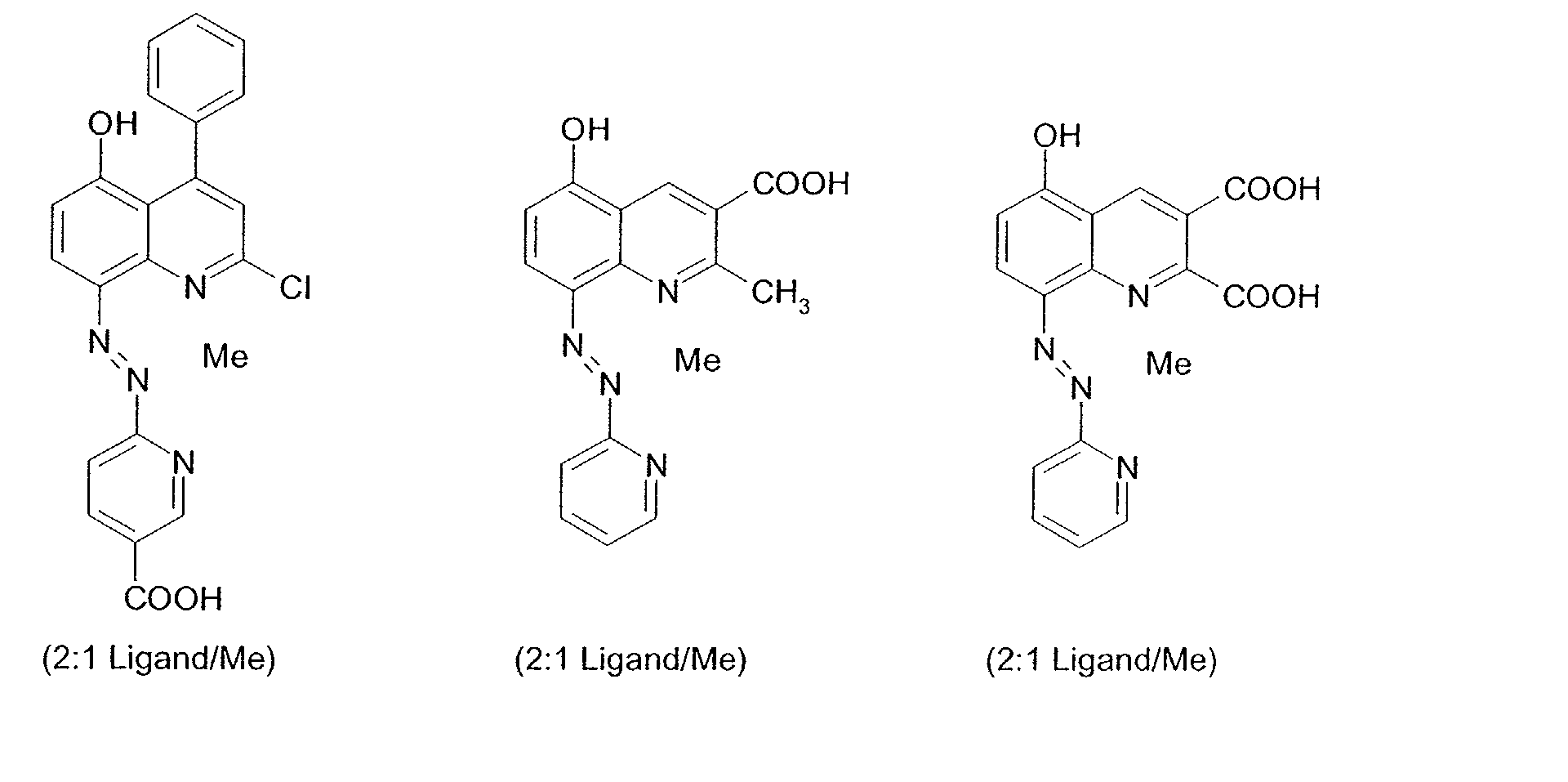

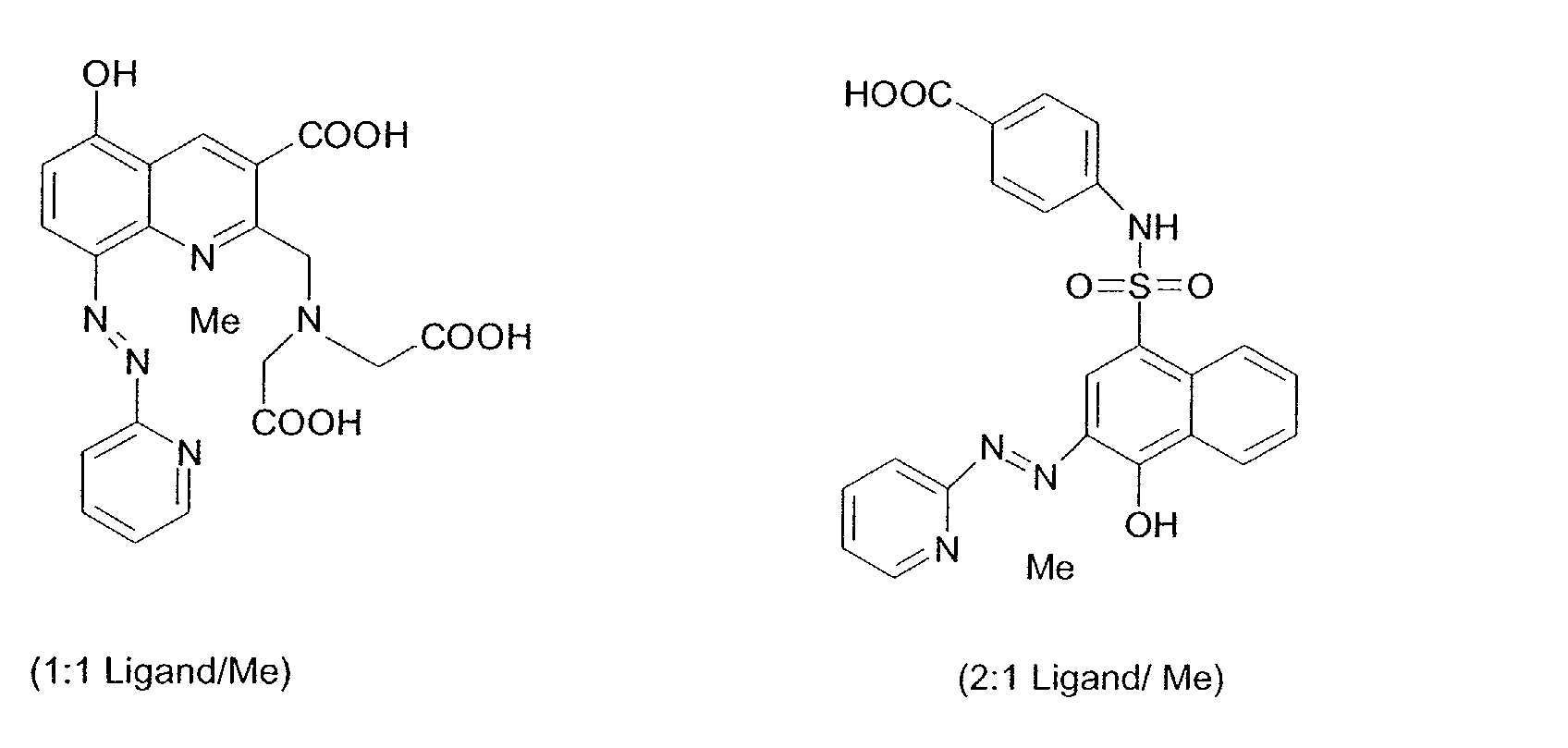
- As mentioned earlier, in the dye structures listed above, the Me group represents a transition metal which is chelated or complexed to the ligand structure. The ligand/Me ratios specified indicate the typical ligand to metal ratio which is achieved by the particular dye. Those skilled in the art will readily recognize that the actual ligand/Me ratio may vary depending on the properties of the specific metal used. Further, the it is believed that the Me ion coordinates or complexes with three or more nitrogen atoms present on each ligand structure, i.e., one of the azo nitrogens, a pyridine nitrogen, and a quinolinol nitrogen (PAQ). With respect to the 1:1 ligand/Me complexes, only one ligand is bound to the metal ion. Thus, depending upon the presence of pendant coordinating moieties, and upon the specific metal used, there are a number of additional coordination sites available on the metal. These unbound coordination sites are most likely filled by water, or as in some cases other portions of the ligand can bind to the metal ion as well.
- With several dyes, a small amount of pyridine, e.g., about 1% by weight, can be added to the ink to improve the solubility. Additionally, other factors may be adjusted to achieve desired solubility, such as pH.
- In one aspect, the ink used in the present invention may include an effective amount of one or more metalized dyes having at least one heterocyclic nitrogen ring and a diazo bond wherein the heterocyclic nitrogen is chelated or complexed to a transition metal. In another aspect, the amount of dye may be from about 0.2% w/w to about 8.0 % w/w of the ink. In yet another aspect, the amount of dye may be from about 1.1% w/w to about 6% w/w of the ink.
- In addition to the above-recited metalized dyes, the inks used in the present invention generally include an ink vehicle in order to form the ink, or ink formulation. Many well-known ink vehicles may be used in combination with the dyes disclosed herein to produce the ink composition of the present invention. A variety of ingredients in varying amounts may be included in the ink vehicle of the present composition, such as water, organic solvents, surface-active agents, buffers, viscosity modifiers, biocides, surfactants, and metal chelators.
- Water may make up a large percentage of the overall ink vehicle of the present invention. In one aspect, the water may be deionized water in an amount of from about 51 to 90 percent by weight of the ink composition. Various deionization techniques and states for water are known. In one aspect, the water may be deionized at 18 Mohm.
- Organic solvents, or co-solvents may be included as a component of the ink vehicle, and are generally watersoluble solvents. In one aspect, the amount of organic solvent component may be from about 10 to about 49 percent by weight of the ink vehicle.
- One or more solvents may be used to achieve the amount specified above. Further, when a mixture of solvents is used, the combination may be included in a variety of ratios when necessary to achieve a specific result.
- Examples of suitable solvents include without limitation: nitrogen-containing heterocyclic ketones, such as 2-pyrrolidone, N-methyl-pyrrolid-2-one, 1,3-dimethylimidazolid-2-one, and octyl-pyrrolidone; diols such as ethanediols, (e.g., 1-2-ethandiol), propanediols (e.g., 1,2-propanediol, 1,3-propanediol, 2-ethyl-2-hydroxy-methyl-1,3-propanediol, ethylhydroxy-propanediol), butanediols (e.g., 1,2-butanediol, 1,3-butanediol, 1,4-butanediol), pentanediols (e.g., 1,5-pentanediol), hexanediols (e.g., 1,6-hexanediol, 2,5-hexanediol), heptanediols (e.g., 1,2-heptanediol, 1,7-heptanediol), octanediols (e.g., 1,2-octanediol, 1,8-octainediol); and glycols, glycol ethers and thioglycol ethers, commonly employed in ink-jet inks, such as polyalkylene glycols such as polyethylene glycols (e.g., diethylene glycol, triethylene glycol, tetraethylene glycol), polypropylene glycols (e.g., dipropylene glycol, tripropylene glycol, tetrapropylene glycol), polymeric glycols (e.g., PEG 200, PEG 300, PEG 400, PPG 400), and thiodiglycol.
- When included, the surfactant ingredient may be added in an amount of up to about 5 percent by weight of the ink composition. In one aspect, the surfactant may be present in an amount of from about 0.01 to about 4%. Such amounts may be achieved using a single surfactant ingredient, or a mixture of surfactant ingredients.
- Generally, surfactants are used in order to increase the penetration of the ink into the print medium. A wide variety of surfactant classes may be used including without limitation, cationic, anionic, zwitterionic or non-ionic surfactants. One example of nonionic surfactants is secondary alcohol ethoxylates. Such compounds are commercially available, for example, from Union Carbide Co. (Houston, Tex.) and other producers as the Tergitol, Surfynol, and Dowfax series, such as TERGITOL 15-S-5, TERGITOL 15-S-7, SURFYNOL 104E, SURFYNOL 440, and DOWFAX 8390.
- The secondary alcohol ethoxylates contain (a) an aliphatic chain having a prescribed number of carbon atoms in the chain, and (b) a prescribed number of ethoxylated units. These ethoxylates are commercially available as mixtures of ethoxylates, and so are described in terms of the predominance of a given compound. Examples of other classes of surfactants those skilled in the art will readily recognize specific examples of the other classes of surfactants recited above, as well as any other suitable surfactants for use with the present invention.
- The ink vehicle of the present ink composition may optionally include up to about 5 percent by weight of a biocide. In one aspect, the biocide may be present in an amount of up to about 1 percent by weight of the ink composition. In a further aspect, the biocide may be present in an amount of up to 0.2 percent by weight of the ink composition. Such amounts may be the result of a single biocide ingredient, or a mixture of two or more biocides.
- Any of the biocides commonly employed in inkjet inks, and known to those skilled in the art may be used in the practice of the present invention, such as NUOSEPT 95, available from Hals America (Piscataway, N.J.); PROXEL GXL, available from Zeneca (Wilmington, Del.); and glutaraldehyde, available from Union Carbide Company (Bound Brook, N.J.) under the trade designation UCARCIDE 250. In one aspect, the biocide is PROXEL GXL.
- In addition to the above-recited ingredients, the present inkjet ink composition may include a buffer agent. In one aspect, the buffer agent may be present in an amount of up to about 5 percent by weight of the ink composition. In another aspect, the buffer may be present in an amount of up to about 1 percent by weight of the ink composition. These amounts may be achieved using a single buffer agent, or a combination of buffer agents.
- The buffers in the ink vehicle are primarily used to modulate pH. Such buffers can be organic-based biological buffers, or inorganic buffers. The specific type and amount of buffer may be readily selected by one of ordinary skill in the art in order to achieve a specific result.
- Metal chelator agents may be included in the ink vehicle of the present ink composition. In one aspect, the metal chelator may be present in an amount of up to about 2 percent by weight. In another aspect, the metal chelator may be present in an amount of up to about 1 percent by weight of the ink composition. In a further aspect, the metal chelator may be present in an amount of up to about 0.1 percent of the ink composition. In yet another aspect, the metal chelator may be present in an amount of up to about 0.01 percent by weight of the ink composition. One or more metal chelators may be used to achieve these amounts.
- Small and moderate quantities of metal chelators may be employed in the practice of the invention to bind transition metal cations that may be present in the ink. However, care must be taken to ensure that such metal chelators are used sparingly, as excessive amounts may reduce, rather than increase, the ability of the metal cation to chelate with the nitrogens on the dye. A variety of metal chelators may be used in connection with the present invention as will be recognized by those skilled in the art. Examples of suitable metal chelators include without limitation, Ethylenediaminetetra acetic acid, Diethylenetriaminepentaacetic acid, trans-1,2-diaminocyclohexanetetraacetic acid, (ethylenedioxy) diethylenedinitrilotetraacetic acid (EGTA), and other chelators that bind transition metal cations. In one aspect, the metal chelator is EDTA.
- In order to demonstrate the superior visual characteristics of the present images and methods, the following test was conducted. Separate small drop and large drop images were formed on a Boise Cascade Offset paper substrates using an HP Business Inkjet 2200 printer with 4.5 and 18 picoliter (pl) pens respectively. Ink Formulations 1 and 2 as enumerated in Table 1 below were prepared for testing in both the small and large drop volume images. The ink dye PAQ 98 of Formulation 2 is a metalized dye having at least one heterocyclic nitrogen ring and a diazo bond wherein the heterocyclic nitrogen is chelated or complexed to a transition metal in accordance with the present invention.
Grams of Component Component Formulation 1 Formulation 2 Di carboxylic acid 1.292 0 Octyl dimethyl glycine 1.105 1.043 Oleyl triethoxy mono diphosphate 0.13 0.106 Secondary alcohol ethoxylate 0.17 0.171 Alkyl diol 2.955 2.856 2-pyrrolidione 1.484 1.429 Ethoxylated Glycerol 0.858 0.794 Nonionic surfactant 0.13 0.12 Chelator 0.024 0.024 De-ionized water 7.766 17.507 Dye PAQ 98 0.0 0.737 AR52 as a 8.15% soln. 9.257 0.0 - Following printing, each image was faded for one day using high intensity fluorescent lights. The optical density (O.D.) of each sample was read before and after fade. The optical density performance results of each image are shown in Table 2 below.
Ink and Pen Volume Avg. Starting O.D. Avg. Ending O.D. % Remaining Small/Large Drop Diff. PAQ 98 Dye 4.5 pl pen 0.21 0.16 79.0% PAQ 98 Dye 18 pl pen 0.38 0.33 87.6% 90.2% AR452 Dye 4.5 pl pen 0.15 0.02 13.0% AR52 Dye 18 pl pen 0.50 0.13 26.2% 49.8% - As can be seen from these results, the images of the present invention achieve visual qualities which are significantly superior to other small volume drop images. Such images present an exceptional level of detail and acuity, while retaining desired lightfastness and optical density properties to produce truly ultra-high quality images.
- It is to be understood that the above-described arrangements are only illustrative of the application of the principles of the present invention. Numerous modifications and alternative arrangements may be devised by those skilled in the art without departing from the spirit and scope of the present invention and the appended claims are intended to cover such modifications and arrangements. Thus, while the present invention has been described above with particularity and detail in connection with what is presently deemed to be the most practical and preferred embodiments of the invention, it will be apparent to those of ordinary skill in the art that numerous modifications, including, but not limited to, variations in size, materials, shape, form, function and manner of operation, assembly and use may be made without departing from the principles and concepts set forth herein.
Claims (10)
- An image on a substrate comprising:a plurality of small volume inkjet ink drops, said ink having an ink vehicle and a metalized dye having a heterocyclic nitrogen and a diazo bond wherein the heterocyclic nitrogen is chelated or complexed to a transition metal.
- The image of claim 1, wherein the ink drop volume is less than about 5 pl.
- The image of claim 1, wherein the metalized dye comprises a pyridine group bonded to a quinolinol group through an azo bond.
- The image of claim 3, wherein the metalized dye is at least a tridentate dye, and the transition metal is chelated with the heterocyclic nitrogen and an azo nitrogen.
- The image of claim 1, wherein the metalized dye comprises a pyridine group bonded to a naphthalene group through an azo bond.
- The image of claim 1, wherein the transition metal is selected from the group consisting of nickel, copper, iron, cobalt, chromium, and combinations thereof.
- The image of claim 1, wherein the metalized dye has a ligand to transition metal molar ratio of 2:1.
- The image of claim 1, wherein the metalized dye has a ligand to transition metal molar ratio of 1:1.
- The image of claim 1, wherein the metalized dye is present in an amount of from about 0.2% w/w to about 8% w/w of the ink.
- A method for creating an inkjet image comprising the step of:jetting small volume drops of an inkjet ink as recited in any preceding claim onto a substrate.
Applications Claiming Priority (2)
| Application Number | Priority Date | Filing Date | Title |
|---|---|---|---|
| US66194 | 2002-01-30 | ||
| US10/066,194 US6644800B2 (en) | 2002-01-30 | 2002-01-30 | Inkjet images having improved visual properties and methods of making same |
Publications (2)
| Publication Number | Publication Date |
|---|---|
| EP1333069A1 true EP1333069A1 (en) | 2003-08-06 |
| EP1333069B1 EP1333069B1 (en) | 2006-03-29 |
Family
ID=22067870
Family Applications (1)
| Application Number | Title | Priority Date | Filing Date |
|---|---|---|---|
| EP03250240A Expired - Lifetime EP1333069B1 (en) | 2002-01-30 | 2003-01-15 | Methods of making ink-jet images with a metallized dye |
Country Status (4)
| Country | Link |
|---|---|
| US (1) | US6644800B2 (en) |
| EP (1) | EP1333069B1 (en) |
| JP (1) | JP4040483B2 (en) |
| DE (1) | DE60304287T2 (en) |
Cited By (1)
| Publication number | Priority date | Publication date | Assignee | Title |
|---|---|---|---|---|
| WO2004096550A3 (en) * | 2003-04-28 | 2005-01-13 | Du Pont | Inkjet printing method |
Families Citing this family (1)
| Publication number | Priority date | Publication date | Assignee | Title |
|---|---|---|---|---|
| US6869646B2 (en) * | 2001-08-06 | 2005-03-22 | Hewlett-Packard Company, L.P. | Fast drying images and methods for printing on inorganic porous media |
Citations (5)
| Publication number | Priority date | Publication date | Assignee | Title |
|---|---|---|---|---|
| US4824485A (en) * | 1986-04-24 | 1989-04-25 | Fuji Photo Film Co., Ltd. | Recording liquid |
| EP0902064A1 (en) * | 1997-08-29 | 1999-03-17 | Hewlett-Packard Company | Magenta dyes for ink-jet inks |
| US5997622A (en) * | 1998-12-01 | 1999-12-07 | Eastman Kodak Company | Ink jet printing with metal complex |
| US6001161A (en) * | 1998-12-01 | 1999-12-14 | Eastman Kodak Company | Metal complex for ink jet ink |
| EP1284200A2 (en) * | 2001-08-06 | 2003-02-19 | Hewlett-Packard Company | Fast drying images and methods for printing on inorganic porous media |
Family Cites Families (7)
| Publication number | Priority date | Publication date | Assignee | Title |
|---|---|---|---|---|
| US4147544A (en) | 1977-09-12 | 1979-04-03 | Eastman Kodak Company | Photographic products and processes employing novel nondiffusible pyridylazonaphthol dye-releasing compounds |
| US4165238A (en) | 1977-09-12 | 1979-08-21 | Eastman Kodak Company | Photographic products and processes employing novel nondiffusible pyridylazonaphthol dye-releasing compounds |
| US4357412A (en) | 1981-07-13 | 1982-11-02 | Eastman Kodak Company | Photographic products and processes employing novel nondiffusible bridged azoaminophenol magenta dye-releasing compounds and precursors thereof |
| US4357411A (en) | 1981-07-13 | 1982-11-02 | Eastman Kodak Company | Photographic products and processes employing novel nondiffusible 2-(2-pyridylazo)-4,5-bis(tertiary amino)phenol black dye-releasing compounds and precursors thereof |
| US4357410A (en) | 1981-07-13 | 1982-11-02 | Eastman Kodak Company | Photographic products and processes employing novel nondiffusible pyridylazo(dialkylamino) phenol magenta dye-releasing compounds and precursors thereof |
| US6467882B2 (en) * | 1991-10-28 | 2002-10-22 | Canon Kabushiki Kaisha | Liquid jet recording method and apparatus and recording head therefor |
| JP3920412B2 (en) * | 1997-07-01 | 2007-05-30 | コニカミノルタホールディングス株式会社 | Inkjet recording method |
-
2002
- 2002-01-30 US US10/066,194 patent/US6644800B2/en not_active Expired - Lifetime
-
2003
- 2003-01-15 EP EP03250240A patent/EP1333069B1/en not_active Expired - Lifetime
- 2003-01-15 DE DE60304287T patent/DE60304287T2/en not_active Expired - Lifetime
- 2003-01-29 JP JP2003019784A patent/JP4040483B2/en not_active Expired - Fee Related
Patent Citations (5)
| Publication number | Priority date | Publication date | Assignee | Title |
|---|---|---|---|---|
| US4824485A (en) * | 1986-04-24 | 1989-04-25 | Fuji Photo Film Co., Ltd. | Recording liquid |
| EP0902064A1 (en) * | 1997-08-29 | 1999-03-17 | Hewlett-Packard Company | Magenta dyes for ink-jet inks |
| US5997622A (en) * | 1998-12-01 | 1999-12-07 | Eastman Kodak Company | Ink jet printing with metal complex |
| US6001161A (en) * | 1998-12-01 | 1999-12-14 | Eastman Kodak Company | Metal complex for ink jet ink |
| EP1284200A2 (en) * | 2001-08-06 | 2003-02-19 | Hewlett-Packard Company | Fast drying images and methods for printing on inorganic porous media |
Cited By (1)
| Publication number | Priority date | Publication date | Assignee | Title |
|---|---|---|---|---|
| WO2004096550A3 (en) * | 2003-04-28 | 2005-01-13 | Du Pont | Inkjet printing method |
Also Published As
| Publication number | Publication date |
|---|---|
| US6644800B2 (en) | 2003-11-11 |
| DE60304287T2 (en) | 2006-12-07 |
| JP4040483B2 (en) | 2008-01-30 |
| JP2003231248A (en) | 2003-08-19 |
| DE60304287D1 (en) | 2006-05-18 |
| US20030146961A1 (en) | 2003-08-07 |
| EP1333069B1 (en) | 2006-03-29 |
| HK1055986A1 (en) | 2004-01-30 |
Similar Documents
| Publication | Publication Date | Title |
|---|---|---|
| EP0902064B1 (en) | Magenta dyes for ink-jet inks | |
| EP1006159B1 (en) | Ink jet printing with metal complex | |
| EP1006157A1 (en) | Metal complex for ink jet ink | |
| KR19980086633A (en) | Dye Set with Improved Quality Colors for Ink-Jet Printers | |
| EP1491594B1 (en) | Black ink-jet inks | |
| CN101765644A (en) | Ink composition and method of forming the same | |
| EP1713871B1 (en) | Black ink composition and ink jet recording method | |
| EP1550702A1 (en) | Dye composition, ink composition, and method of ink-jet recording | |
| CN101595185A (en) | Inkjet ink formulations containing magnesium sulfate | |
| EP1234860B1 (en) | Metal complex for ink jet ink | |
| US6749773B2 (en) | Phosphorescent ink for use in an ink-jet printer | |
| US6644800B2 (en) | Inkjet images having improved visual properties and methods of making same | |
| EP1284200B1 (en) | Fast drying images and methods for printing on inorganic porous media | |
| JP3932820B2 (en) | Water-based ink for inkjet recording | |
| JP2009507991A (en) | Inkjet ink and ink set | |
| JPH1046074A (en) | Recording ink and recording method using the same | |
| HK1055986B (en) | Methods of making ink-jet images with a metallized dye | |
| JP7676840B2 (en) | Precoat liquid for inkjet recording | |
| JP4323153B2 (en) | Ink composition and inkjet recording method | |
| CH696880A5 (en) | Inkjet dye. | |
| EP1239012A2 (en) | Ink jet printing method | |
| JP2003020425A (en) | Ink jet recording ink, color ink set and image forming method | |
| GB2407323A (en) | Aqueous ink set for ink jet printers | |
| JP2003335042A (en) | Color inkjet image recording apparatus, recording method, and ink set | |
| HK1046705B (en) | Phosphorescent ink for use in an ink-jet printer |
Legal Events
| Date | Code | Title | Description |
|---|---|---|---|
| PUAI | Public reference made under article 153(3) epc to a published international application that has entered the european phase |
Free format text: ORIGINAL CODE: 0009012 |
|
| AK | Designated contracting states |
Designated state(s): AT BE BG CH CY CZ DE DK EE ES FI FR GB GR HU IE IT LI LU MC NL PT SE SI SK TR |
|
| AX | Request for extension of the european patent |
Extension state: AL LT LV MK RO |
|
| AKX | Designation fees paid | ||
| 17P | Request for examination filed |
Effective date: 20040126 |
|
| RBV | Designated contracting states (corrected) |
Designated state(s): DE FR GB NL |
|
| REG | Reference to a national code |
Ref country code: DE Ref legal event code: 8566 |
|
| 17Q | First examination report despatched |
Effective date: 20040923 |
|
| GRAP | Despatch of communication of intention to grant a patent |
Free format text: ORIGINAL CODE: EPIDOSNIGR1 |
|
| RTI1 | Title (correction) |
Free format text: METHODS OF MAKING INK-JET IMAGES WITH A METALLIZED DYE |
|
| GRAS | Grant fee paid |
Free format text: ORIGINAL CODE: EPIDOSNIGR3 |
|
| GRAA | (expected) grant |
Free format text: ORIGINAL CODE: 0009210 |
|
| AK | Designated contracting states |
Kind code of ref document: B1 Designated state(s): DE FR GB NL |
|
| REG | Reference to a national code |
Ref country code: GB Ref legal event code: FG4D |
|
| REF | Corresponds to: |
Ref document number: 60304287 Country of ref document: DE Date of ref document: 20060518 Kind code of ref document: P |
|
| REG | Reference to a national code |
Ref country code: HK Ref legal event code: GR Ref document number: 1055986 Country of ref document: HK |
|
| ET | Fr: translation filed | ||
| PLBE | No opposition filed within time limit |
Free format text: ORIGINAL CODE: 0009261 |
|
| STAA | Information on the status of an ep patent application or granted ep patent |
Free format text: STATUS: NO OPPOSITION FILED WITHIN TIME LIMIT |
|
| 26N | No opposition filed |
Effective date: 20070102 |
|
| REG | Reference to a national code |
Ref country code: GB Ref legal event code: 732E Free format text: REGISTERED BETWEEN 20120329 AND 20120404 |
|
| REG | Reference to a national code |
Ref country code: NL Ref legal event code: SD Effective date: 20120731 |
|
| REG | Reference to a national code |
Ref country code: FR Ref legal event code: PLFP Year of fee payment: 14 |
|
| REG | Reference to a national code |
Ref country code: FR Ref legal event code: PLFP Year of fee payment: 15 |
|
| REG | Reference to a national code |
Ref country code: FR Ref legal event code: PLFP Year of fee payment: 16 |
|
| PGFP | Annual fee paid to national office [announced via postgrant information from national office to epo] |
Ref country code: NL Payment date: 20181221 Year of fee payment: 17 |
|
| PGFP | Annual fee paid to national office [announced via postgrant information from national office to epo] |
Ref country code: FR Payment date: 20181220 Year of fee payment: 17 Ref country code: GB Payment date: 20181219 Year of fee payment: 17 |
|
| PGFP | Annual fee paid to national office [announced via postgrant information from national office to epo] |
Ref country code: DE Payment date: 20181218 Year of fee payment: 17 |
|
| REG | Reference to a national code |
Ref country code: DE Ref legal event code: R119 Ref document number: 60304287 Country of ref document: DE |
|
| REG | Reference to a national code |
Ref country code: NL Ref legal event code: MM Effective date: 20200201 |
|
| GBPC | Gb: european patent ceased through non-payment of renewal fee |
Effective date: 20200115 |
|
| PG25 | Lapsed in a contracting state [announced via postgrant information from national office to epo] |
Ref country code: GB Free format text: LAPSE BECAUSE OF NON-PAYMENT OF DUE FEES Effective date: 20200115 Ref country code: NL Free format text: LAPSE BECAUSE OF NON-PAYMENT OF DUE FEES Effective date: 20200201 Ref country code: DE Free format text: LAPSE BECAUSE OF NON-PAYMENT OF DUE FEES Effective date: 20200801 Ref country code: FR Free format text: LAPSE BECAUSE OF NON-PAYMENT OF DUE FEES Effective date: 20200131 |