EP1331649A1 - Method and apparatus for producing keystone type superconducting formed strand - Google Patents
Method and apparatus for producing keystone type superconducting formed strand Download PDFInfo
- Publication number
- EP1331649A1 EP1331649A1 EP01948013A EP01948013A EP1331649A1 EP 1331649 A1 EP1331649 A1 EP 1331649A1 EP 01948013 A EP01948013 A EP 01948013A EP 01948013 A EP01948013 A EP 01948013A EP 1331649 A1 EP1331649 A1 EP 1331649A1
- Authority
- EP
- European Patent Office
- Prior art keywords
- stranded wires
- roll
- superconducting
- flat
- rolls
- Prior art date
- Legal status (The legal status is an assumption and is not a legal conclusion. Google has not performed a legal analysis and makes no representation as to the accuracy of the status listed.)
- Granted
Links
Images




Classifications
-
- H—ELECTRICITY
- H01—ELECTRIC ELEMENTS
- H01F—MAGNETS; INDUCTANCES; TRANSFORMERS; SELECTION OF MATERIALS FOR THEIR MAGNETIC PROPERTIES
- H01F41/00—Apparatus or processes specially adapted for manufacturing or assembling magnets, inductances or transformers; Apparatus or processes specially adapted for manufacturing materials characterised by their magnetic properties
- H01F41/02—Apparatus or processes specially adapted for manufacturing or assembling magnets, inductances or transformers; Apparatus or processes specially adapted for manufacturing materials characterised by their magnetic properties for manufacturing cores, coils, or magnets
- H01F41/04—Apparatus or processes specially adapted for manufacturing or assembling magnets, inductances or transformers; Apparatus or processes specially adapted for manufacturing materials characterised by their magnetic properties for manufacturing cores, coils, or magnets for manufacturing coils
- H01F41/048—Superconductive coils
-
- B—PERFORMING OPERATIONS; TRANSPORTING
- B21—MECHANICAL METAL-WORKING WITHOUT ESSENTIALLY REMOVING MATERIAL; PUNCHING METAL
- B21C—MANUFACTURE OF METAL SHEETS, WIRE, RODS, TUBES, PROFILES OR LIKE SEMI-MANUFACTURED PRODUCTS OTHERWISE THAN BY ROLLING; AUXILIARY OPERATIONS USED IN CONNECTION WITH METAL-WORKING WITHOUT ESSENTIALLY REMOVING MATERIAL
- B21C3/00—Profiling tools for metal drawing; Combinations of dies and mandrels for metal drawing
- B21C3/02—Dies; Selection of material therefor; Cleaning thereof
- B21C3/08—Dies; Selection of material therefor; Cleaning thereof with section defined by rollers, balls, or the like
-
- B—PERFORMING OPERATIONS; TRANSPORTING
- B21—MECHANICAL METAL-WORKING WITHOUT ESSENTIALLY REMOVING MATERIAL; PUNCHING METAL
- B21C—MANUFACTURE OF METAL SHEETS, WIRE, RODS, TUBES, PROFILES OR LIKE SEMI-MANUFACTURED PRODUCTS OTHERWISE THAN BY ROLLING; AUXILIARY OPERATIONS USED IN CONNECTION WITH METAL-WORKING WITHOUT ESSENTIALLY REMOVING MATERIAL
- B21C37/00—Manufacture of metal sheets, rods, wire, tubes, profiles or like semi-manufactured products, not otherwise provided for; Manufacture of tubes of special shape
- B21C37/04—Manufacture of metal sheets, rods, wire, tubes, profiles or like semi-manufactured products, not otherwise provided for; Manufacture of tubes of special shape of rods or wire
- B21C37/045—Manufacture of wire or rods with particular section or properties
-
- H—ELECTRICITY
- H01—ELECTRIC ELEMENTS
- H01B—CABLES; CONDUCTORS; INSULATORS; SELECTION OF MATERIALS FOR THEIR CONDUCTIVE, INSULATING OR DIELECTRIC PROPERTIES
- H01B12/00—Superconductive or hyperconductive conductors, cables, or transmission lines
- H01B12/02—Superconductive or hyperconductive conductors, cables, or transmission lines characterised by their form
- H01B12/08—Stranded or braided wires
-
- H—ELECTRICITY
- H01—ELECTRIC ELEMENTS
- H01B—CABLES; CONDUCTORS; INSULATORS; SELECTION OF MATERIALS FOR THEIR CONDUCTIVE, INSULATING OR DIELECTRIC PROPERTIES
- H01B13/00—Apparatus or processes specially adapted for manufacturing conductors or cables
- H01B13/0006—Apparatus or processes specially adapted for manufacturing conductors or cables for reducing the size of conductors or cables
-
- H—ELECTRICITY
- H01—ELECTRIC ELEMENTS
- H01F—MAGNETS; INDUCTANCES; TRANSFORMERS; SELECTION OF MATERIALS FOR THEIR MAGNETIC PROPERTIES
- H01F6/00—Superconducting magnets; Superconducting coils
- H01F6/06—Coils, e.g. winding, insulating, terminating or casing arrangements therefor
-
- B—PERFORMING OPERATIONS; TRANSPORTING
- B21—MECHANICAL METAL-WORKING WITHOUT ESSENTIALLY REMOVING MATERIAL; PUNCHING METAL
- B21B—ROLLING OF METAL
- B21B1/00—Metal-rolling methods or mills for making semi-finished products of solid or profiled cross-section; Sequence of operations in milling trains; Layout of rolling-mill plant, e.g. grouping of stands; Succession of passes or of sectional pass alternations
- B21B1/16—Metal-rolling methods or mills for making semi-finished products of solid or profiled cross-section; Sequence of operations in milling trains; Layout of rolling-mill plant, e.g. grouping of stands; Succession of passes or of sectional pass alternations for rolling wire rods, bars, merchant bars, rounds wire or material of like small cross-section
-
- B—PERFORMING OPERATIONS; TRANSPORTING
- B21—MECHANICAL METAL-WORKING WITHOUT ESSENTIALLY REMOVING MATERIAL; PUNCHING METAL
- B21B—ROLLING OF METAL
- B21B13/00—Metal-rolling stands, i.e. an assembly composed of a stand frame, rolls, and accessories
- B21B13/08—Metal-rolling stands, i.e. an assembly composed of a stand frame, rolls, and accessories with differently-directed roll axes, e.g. for the so-called "universal" rolling process
- B21B13/10—Metal-rolling stands, i.e. an assembly composed of a stand frame, rolls, and accessories with differently-directed roll axes, e.g. for the so-called "universal" rolling process all axes being arranged in one plane
- B21B13/103—Metal-rolling stands, i.e. an assembly composed of a stand frame, rolls, and accessories with differently-directed roll axes, e.g. for the so-called "universal" rolling process all axes being arranged in one plane for rolling bars, rods or wire
-
- B—PERFORMING OPERATIONS; TRANSPORTING
- B21—MECHANICAL METAL-WORKING WITHOUT ESSENTIALLY REMOVING MATERIAL; PUNCHING METAL
- B21B—ROLLING OF METAL
- B21B13/00—Metal-rolling stands, i.e. an assembly composed of a stand frame, rolls, and accessories
- B21B13/08—Metal-rolling stands, i.e. an assembly composed of a stand frame, rolls, and accessories with differently-directed roll axes, e.g. for the so-called "universal" rolling process
- B21B13/12—Metal-rolling stands, i.e. an assembly composed of a stand frame, rolls, and accessories with differently-directed roll axes, e.g. for the so-called "universal" rolling process axes being arranged in different planes
Definitions
- the present invention relates to a method and an apparatus for manufacturing superconducting compacted stranded wires with keystone angles.
- a dipole magnet which is disposed in an accelerator ring of a circular particle accelerator, is required to generate magnetic field of higher intensity and generate dipole magnetic field in the long distance.
- a saddle coil is frequently used as the dipole magnet for the accelerator.
- the saddle coil has a structure in which compacted stranded wires are placed along the axis of the coil and turned at both coil ends in sequence so as to form an arch shape as a whole, so that a cross section in the straight portion of the coil is shaped into a sector form.
- the keystone type superconducting compacted stranded wires 1' formed from stranded wires comprising superconducting wires 2', as shown in Fig. 7, is formed to have a trapezoidal-shaped cross-section which has two side ends of different heights, one side end 3' shorter than the other side end 4' , as shown in Fig. 7.
- the keystone type compacted stranded wires are produced through procedures described in detail hereunder.
- a plurality of superconducting wires are stranded into stranded wires (hereinafter referred to as superconducting stranded wires).
- the superconducting wires are press-formed in four directions by four rolls, as shown in Figs. 5A and 5B, thus producing compacted stranded wires of which cross section is trapezoidal.
- the four rolls are made up of, rolls 5' and 6' (hereinafter referred to as tapered rolls) and cylindrical rolls (hereinafter referred to as flat rolls) 7' and 8'.
- the tapered rolls 5 and 6 have rotation axes parallel with each other and are tapered on the outer surface thereof, while the flat rolls 7' and 8' have rotation axes orthogonal to those of the tapered rolls 5' and 6'.
- the packing rate in the compacted stranded wires is set to be a high value so as to increase the current density in the coil.
- This setting causes the superconducting wires to locally receive higher compressive force and tension during being stranded.
- edge portions of the compacted stranded wires receive bending force, in addition to the above-mentioned compressive force and tension, so that the superconducting wires deform in such manner that the original shape thereof hardly remains.
- the keystone angle is specified as being less than one degree.
- Burrs produced on the edge portions in one side end of the superconducting compacted stranded wires, which is thinner than the other side in the cross section, may be removed by grinding. Removing the burrs on the edge portions in such a way leads to partial removal of a normal conducting matrix disposed for stabilization. Therefore, there is a problem in which the stability in the superconducting property in the portion with the burrs removed is locally lowered. Furthermore, when the portion removed by grinding extends to superconducting filament portions, there occurs a problem in which the current to be transported is reduced in large extent.
- An object of the present invention is therefore to provide a method and an apparatus for manufacturing stable and reliable superconducting compacted stranded wires by means of improved fabrication conditions of the stranded wires.
- a first embodiment of a method of manufacturing keystone type superconducting compacted stranded wires according to the present invention is to roll-form superconducting stranded wires into keystone type superconducting compacted stranded wires by using a pair of tapered rolls of which outer surfaces are tapered and of which rotation axes are parallel with each other and a pair of flat rolls of which rotation axes are perpendicular to those of the tapered rolls and parallel with each other, one side of said superconducting stranded wires, which becomes thinner than other side of said superconducting stranded wires after being roll-formed, being contacted with one of said pair of flat rolls before said other side of said superconducting stranded wires is contacted with other of said pair of flat rolls.
- a second embodiment of the present invention is a method of manufacturing keystone type superconducting compacted stranded wires, wherein a diameter of said one flat roll in said pair of flat rolls to contact with said one side end of the superconducting stranded wires, which is thinner than said other side end after being roll-formed, is larger than that of said other flat roll in said pair of flat rolls, thus said one side end of the superconducting stranded wires, which is thinner than said other side end after being roll-formed, is contacted with said one flat roll prior to said other side end of the superconducting stranded wires is contacted with said other flat roll.
- a third embodiment of the present invention is a method of manufacturing keystone type superconducting compacted stranded wires, wherein said other flat roll in said pair of flat rolls to contact with said other side end of the superconducting stranded wires, which is thicker than said one side end after being roll-formed, is located backward compared to said one flat roll in relation to a direction in which the superconducting stranded wires are moved, thus said one side end of the superconducting stranded wires, which is thinner than said other side end after being roll-formed, is contacted with said one flat roll prior to said other side end of the superconducting stranded wires is contacted with said other flat roll.
- a first embodiment of an apparatus for manufacturing keystone type superconducting compacted stranded wires according to the present invention includes a group of forming rolls comprising a pair of tapered rolls of which rotation axes are parallel with each other and a pair of flat rolls of which rotation axes are parallel with each other and are orthogonal to the rotation axes of the tapered rolls, in which a diameter of one flat roll in said pair of flat rolls to contact with the one side of the superconducting stranded wires, which is thinner than the other side after being roll-formed, is larger than that of the other roll in said pair of flat rolls.
- a second embodiment of an apparatus of the invention for manufacturing keystone type superconducting compacted stranded wires includes a group of forming rolls comprising a pair of tapered rolls of which rotation axes are parallel with each other and a pair of flat rolls of which rotation axes are parallel with each other and are orthogonal to the rotation axes of the tapered rolls, in which a rotation axis of one flat roll in said pair of flat rolls to contact with one side end of the superconducting stranded wires, which is thicker than other side end after being roll-formed, is located backward compared to that of other flat roll in relation to a direction in which the superconducting stranded wires are moved.
- Superconducting stranded wires to be roll-formed according to the present invention includes superconducting stranded wires which are preformed as required.
- a first embodiment of the present invention is a method of manufacturing keystone type superconducting compacted stranded wires, wherein superconducting stranded wires are roll-formed into keystone type superconducting compacted stranded wires by using a group of rolls comprising a pair of tapered rolls of which outer surfaces are tapered and of which rotation axes are parallel with each other and a pair of flat rolls of which rotation axes are perpendicular to those of the tapered rolls and parallel with each other, and one side end of said superconducting stranded wires, which becomes thinner than other side end of said superconducting stranded wires after being roll-formed, is contacted with one flat roll of said pair of flat rolls before said other side end of said superconducting stranded wires is contacted with other flat roll of said pair of flat rolls.
- a second embodiment of the present invention is a method of manufacturing keystone type superconducting compacted stranded wires, wherein a diameter of said one flat roll in said pair of flat rolls to contact with said one side end of the superconducting stranded wires, which is thinner than said other side end after being roll-formed, is larger than that of said other flat roll in said pair of flat rolls, thus said one side end of the superconducting stranded wires, which is thinner than said other side end after being roll-formed, is contacted with said one flat roll prior to said other side end of the superconducting stranded wires is contacted with said other flat roll.
- a third embodiment of the present invention is a method of manufacturing keystone type superconducting compacted stranded wires, wherein said other flat roll in said pair of flat rolls to contact with said other side end of the superconducting stranded wires, which is thicker than said one side end after being roll-formed, is located backward compared to said one flat roll in relation to a direction in which the superconducting stranded wires are moved, thus said one side end of the superconducting stranded wires, which is thinner than said other side end after being roll-formed, is contacted with said one flat roll prior to said other side end of the superconducting stranded wires is contacted with said other flat roll.
- a first embodiment of an apparatus of the invention for manufacturing keystone type superconducting compacted stranded wires includes a group of forming rolls comprising a pair of tapered rolls of which rotation axes are parallel with each other and a pair of flat rolls of which rotation axes are parallel with each other and are orthogonal to the rotation axes of the tapered rolls, in which a diameter of one flat roll in said pair of flat rolls to contact with one side end of the superconducting stranded wires, which is thinner than other side end after being roll-formed, is larger than that of other roll in said pair of flat rolls.
- a second embodiment of an apparatus of the invention for manufacturing keystone type superconducting compacted stranded wires includes a group of forming rolls comprising a pair of tapered rolls of which rotation axes are parallel with each other and a pair of flat rolls of which rotation axes are parallel with each other and are orthogonal to the rotation axes of the tapered rolls, in which a rotation axis of one flat roll in said pair of flat rolls to contact with one side end of the superconducting stranded wires, which is thicker than other side end after being roll-formed, is located backward compared to that of other flat roll in relation to a direction in which the superconducting stranded wires are moved.
- the keystone type superconducting compacted stranded wires of the invention prepared from stranded wires comprising superconducting wires 2, as shown in Fig. 1A, is roll-formed so as to have a trapezoidal-shaped cross-section which has one side end 3 shorter than the other side end 4, as shown in Fig. 1B.
- the angle 12 shown in Fig. 1B is called a keystone angle.
- the packing rate is defined as a value which can be obtained by dividing an area occupying the superconducting compacted stranded wires by an area of a portion enclosed by a trapezoidal circumscribed line of the keystone type superconducting compacted stranded wires, and is about 90 percents.
- Keystone type superconducting compacted stranded wires 1 shown in Fig. 1A are manufactured in such a way that a plurality of superconducting wires are stranded into stranded wires and the thus prepared stranded wires are press-formed by means of rolls from four directions.
- one side end of the wires, which is smaller in thickness and designated by reference numeral 3 is hereinafter referred to as x
- the other side end of the wires, which is larger in thickness and designated by reference numeral 4 is hereinafter referred to as y.
- the roll 5 is hereinafter referred to as a tapered roll A
- the other roll 6 is hereinafter referred to as a tapered roll B.
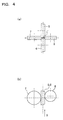
- Figs. 2A and 2B to Fig. 4A and 4B show that the superconducting stranded wires are moved in a direction shown by an arrow 9, namely, from the bottom to the top in the drawings. Therefore, the wires are pinched between the tapered rolls A and B as well as between the flat rolls X and Y so as to be roll-formed.
- the present invention is described with reference to Figs. 2A and 2B.
- the roll-forming of the stranded wires is started, one side end of the stranded wires to be made smaller in thickness is pressed at first.
- the reason thereof resides in that since the rolls A and B are tapered, the corresponding surface portions of the tapered rolls A and B which are located closer to the side end portion of the stranded wires come into contact with the stranded wires, at first.
- the superconducting stranded wires to be roll-formed by the tapered rolls A and B reduces in thickness in such manner that the superconducting stranded wires extend in the width direction, the side x of the rolled stranded wires is arrested by the flat roll X.
- the superconducting stranded wires thus compressed and deformed push adjacent superconducting stranded wires, which are located opposite to the side x, in the direction toward the thicker side y.
- the stranded wires thus pushed are then pressed by the tapered rolls A and B to push further adjacent superconducting stranded wires in the direction toward the thicker side y.
- the pushing process described above is executed in sequence, resulting in that a portion having a less packing rate is formed at the side end portion of the superconducting compacted stranded wires, i.e., the thicker side y, eventually.
- the portion of the superconducting compacted stranded wires which has the highest packing rate and is placed under the severe fabrication conditions is press-formed at first. This permits adjacent superconducting stranded wires to be pushed in the direction toward the side y which has a lower packing rate, so that the above-mentioned severe fabrication conditions can be moderated.
- the pair of tapered rolls 5' and 6' each of which has a tapered surface portion corresponding to a specified keystone angle, as shown in Fig. 5A, as well as the pair of flat rolls 7' and 8' are used to pinch the stranded wires, so that the stranded wires are pressed from the four directions. More specifically, according to the conventional method, i.e., in cases that the diameters of the flat rolls X' and Y' are equal to each other, since the both sides of the stranded wires in the lateral direction come into contact with the flat rolls X' and Y' at the same time, the compressions from the right and left sides start simultaneously.
- each of the superconducting wires residing in the region of the highest packing rate (the side portion of the compacted stranded wires which has smaller thickness) is arrested within a closed space enclosed by the tapered rolls A', B', the flat roll X', and adjacent wires. Therefore, various problems are apt to occur. For example, an excessive compression causes breakage of superconducting filaments.
- portions in the stranded wires are excessively extended in the axial direction of the wires, cross-sections thereof are locally reduced. Furthermore, burrs (i.e., overhangs produced at edge portions) are generated, since parts of the superconducting stranded wires escape into the portions in which the tapered roll A' or B' and the flat roll X' are contacted (i.e., edges of the compacted stranded wires).
- embodiments of the invention as shown in Figs. 3A and 3B, and 4A and 4B provide other effective configurations for delaying the contact of the side y of the stranded wires with the flat roll Y.
- the position of axis of the flat roll Y is located backward compared to that of the flat roll X with regard to the moving direction of the stranded wires.
- An amount of the above-mentioned backward arrangement of the axis position of the flat roll Y (hereinafter referred to as an offset length) is directly related to a delay distance in the contact of the side y of the stranded wires with the flat roll Y.
- Roll-forming was executed with the use of the tapered rolls A and B each of which is 136 mm in outer diameter and 0.5 degrees in tapered angle, as well as the flat roll X having an outer diameter of 136 mm, and the flat roll Y having an outer diameter of 125 mm.
- a flat roll of which outer diameter is 115 mm was used as the flat roll Y, and the remaining fabrication conditions were set to be the same as those of the example 1.
- keystone type superconducting compacted stranded wires having the same circumscribed dimensions as those in the example 1 were manufactured.
- a flat roll of which outer diameter is 105 mm was used as the flat roll Y, and the remaining fabrication conditions were set to be the same as those of the example 1.
- keystone type superconducting compacted stranded wires having the same circumscribed dimensions as those in the example 1 were manufactured.
- keystone type superconducting compacted stranded wires having the same circumscribed dimensions as those in the example 1 were manufactured.
- a flat roll of which outer diameter is 105 mm was adopted as the flat roll Y, and then the flat roll Y was disposed backward by 1 mm in axial position to the roll X with regard to the moving direction of the stranded wires, and the remaining fabrication conditions were set to be the same as those of the example 1.
- keystone type superconducting compacted stranded wires having the same circumscribed dimensions as those in the example 1 were manufactured.
- keystone type superconducting compacted stranded wires having the same circumscribed dimensions as those in the example 1 were manufactured.
- each of the superconducting compacted stranded wires manufactured in the examples 1 to 5 and the example for comparison 1 were observed with the use of a microscope from the perpendicular directions thereto in order to measure respective transit lengths.
- the results are shown in Table 1.
- the transit length is defined as the length of each portion 10 in the edges of the side end of the superconducting compacted stranded wires as depicted in the circle, of which curved surface is kept as it is without being contacted with any roll during the roll-forming of the stranded wires.
- the compacted stranded wires manufactured in the examples 1 to 5 and the example for comparison 1 were un-stranded and the superconducting wire samples were picked up, and then, the superconducting wire samples were immersed in liquid helium to measure critical current based on the four-terminal method.
- the critical current measurements of the un-stranded wire samples were executed in such a manner that a portion located at the thinner-side end (i.e., curved portion) of each compacted stranded wire was set at a center between voltage taps.
- the transit portion (i.e., having transit length) exists in the edges of thinner-side end of the compacted stranded wires in the examples 1 to 3 in which the flat roll Y is smaller in diameter than the flat roll X, the example 4 in which the flat roll Y is located backward compared to the flat roll X, and the example 5 in which the flat roll Y is smaller in diameter than the flat roll X and in addition the flat roll Y is located backward compared to the flat roll X.
- burrs 11 occurred at edges of compacted stranded wires as depicted in the circle in Fig. 7.
- the reduced rate of critical current during roll-forming the stranded wires is about 1 percent. Therefore, according to the method of the present invention for manufacturing the superconducting compacted stranded wires, keystone type superconducting compacted stranded wires can be obtained with superior superconducting properties and shapes. In consequence, a remarkable contribution can be given to industry.
Landscapes
- Engineering & Computer Science (AREA)
- Power Engineering (AREA)
- Mechanical Engineering (AREA)
- Manufacturing & Machinery (AREA)
- Superconductors And Manufacturing Methods Therefor (AREA)
- Wire Processing (AREA)
Abstract
Description


Claims (5)
- A method of manufacturing keystone type superconducting compacted stranded wires, wherein superconducting stranded wires are roll-formed into keystone type superconducting compacted stranded wires by using a group of rolls comprising a pair of tapered rolls of which outer surfaces are tapered and of which rotation axes are parallel with each other and a pair of flat rolls of which rotation axes are perpendicular to those of the tapered rolls and parallel with each other, and one side end of said superconducting stranded wires, which becomes thinner than other side end of said superconducting stranded wires after being roll-formed, is contacted with one flat roll of said pair of flat rolls before said other side end of said superconducting stranded wires is contacted with other flat roll of said pair of flat rolls.
- The manufacturing method as claimed in claim 1, wherein a diameter of said one flat roll in said pair of flat rolls to contact with said one side end of the superconducting stranded wires, which is thinner than said other side end after being roll-formed, is larger than that of said other flat roll in said pair of flat rolls, thus said one side end of the superconducting stranded wires, which is thinner than said other side end after being roll-formed, is contacted with said one flat roll prior to said other side end of the superconducting stranded wires is contacted with said other flat roll.
- The manufacturing method as claimed in claim 1 or 2, wherein said other flat roll in said pair of flat rolls to contact with said other side end of the superconducting stranded wires, which is thicker than said one side end after being roll-formed, is located backward compared to said one flat roll in relation to a direction in which the superconducting stranded wires are moved, thus said one side end of the superconducting stranded wires, which is thinner than said other side end after being roll-formed, is contacted with said one flat roll prior to said other side end of the superconducting stranded wires is contacted with said other flat roll.
- An apparatus for manufacturing keystone type superconducting compacted stranded wires, which includes a group of forming rolls comprising a pair of tapered rolls of which rotation axes are parallel with each other and a pair of flat rolls of which rotation axes are parallel with each other and are orthogonal to the rotation axes of the tapered rolls, in which a diameter of one flat roll in said pair of flat rolls to contact with one side end of the superconducting stranded wires, which is thinner than other side end after being roll-formed, is larger than that of other roll in said pair of flat rolls.
- An apparatus for manufacturing keystone type superconducting compacted stranded wires,which includes a group of forming rolls comprising a pair of tapered rolls of which rotation axes are parallel with each other and a pair of flat rolls of which rotation axes are parallel with each other and are orthogonal to the rotation axes of the tapered rolls, in which a rotation axis of one flat roll in said pair of flat rolls to contact with one side end of the superconducting stranded wires, which is thicker than other side end after being roll-formed, is located backward compared to that of other flat roll in relation to a direction in which the superconducting stranded wires are moved.
Applications Claiming Priority (1)
| Application Number | Priority Date | Filing Date | Title |
|---|---|---|---|
| PCT/JP2001/006101 WO2003009309A1 (en) | 2001-07-13 | 2001-07-13 | Method and apparatus for producing keystone type superconducting formed strand |
Publications (3)
| Publication Number | Publication Date |
|---|---|
| EP1331649A1 true EP1331649A1 (en) | 2003-07-30 |
| EP1331649A4 EP1331649A4 (en) | 2004-06-23 |
| EP1331649B1 EP1331649B1 (en) | 2005-04-06 |
Family
ID=11737548
Family Applications (1)
| Application Number | Title | Priority Date | Filing Date |
|---|---|---|---|
| EP01948013A Expired - Lifetime EP1331649B1 (en) | 2001-07-13 | 2001-07-13 | Method and apparatus for producing keystone type superconducting formed strand |
Country Status (3)
| Country | Link |
|---|---|
| EP (1) | EP1331649B1 (en) |
| JP (1) | JP5078049B2 (en) |
| WO (1) | WO2003009309A1 (en) |
Family Cites Families (5)
| Publication number | Priority date | Publication date | Assignee | Title |
|---|---|---|---|---|
| JPS616578Y2 (en) * | 1981-06-18 | 1986-02-27 | ||
| JPS63190213A (en) * | 1987-01-30 | 1988-08-05 | Furukawa Electric Co Ltd:The | Manufacture of superconductive molded strand |
| JPH05114317A (en) * | 1991-10-18 | 1993-05-07 | Furukawa Electric Co Ltd:The | Manufacture of superconducting moulded stranded wire with keystone angle |
| JPH08171827A (en) * | 1994-12-19 | 1996-07-02 | Hitachi Cable Ltd | Keystone type superconducting stranded wire manufacturing method |
| JPH1064349A (en) * | 1996-08-26 | 1998-03-06 | Hitachi Cable Ltd | Method and apparatus for producing keystone type superconducting stranded wire |
-
2001
- 2001-07-13 EP EP01948013A patent/EP1331649B1/en not_active Expired - Lifetime
- 2001-07-13 WO PCT/JP2001/006101 patent/WO2003009309A1/en not_active Ceased
- 2001-07-13 JP JP2002524283A patent/JP5078049B2/en not_active Expired - Lifetime
Also Published As
| Publication number | Publication date |
|---|---|
| JP5078049B2 (en) | 2012-11-21 |
| EP1331649A4 (en) | 2004-06-23 |
| EP1331649B1 (en) | 2005-04-06 |
| JPWO2003009309A1 (en) | 2004-11-11 |
| WO2003009309A1 (en) | 2003-01-30 |
Similar Documents
| Publication | Publication Date | Title |
|---|---|---|
| CN101517660B (en) | NbTi superconducting wire | |
| JP7024855B2 (en) | Manufacturing methods for wire conductors, covered wires, wire harnesses, and wire conductors | |
| JPH06338228A (en) | Compound superconducting wire and its manufacturing method | |
| US6675623B2 (en) | Method and apparatus for manufacturing keystone type superconducting compacted stranded wires | |
| EP1331649B1 (en) | Method and apparatus for producing keystone type superconducting formed strand | |
| JPH07119059A (en) | Superconducting molded stranded wire manufacturing method | |
| US3940964A (en) | Method for making a clad wire for an electric contact | |
| JP2007128686A (en) | Internal diffusion method Nb3Sn superconducting wire | |
| US20220157515A1 (en) | Winding structure for inductor and method for manufacturing the same, winding inductor and method for manufacturing the same | |
| JP3248202B2 (en) | Manufacturing method of lead frame material with heat sink | |
| US6289576B1 (en) | Method for drawing elongated superconductive wires | |
| JP3058077U (en) | Wire for wire saw | |
| JP4699200B2 (en) | Precursor for producing Nb3Sn superconducting wire and method for producing the same | |
| JPS63190213A (en) | Manufacture of superconductive molded strand | |
| WO2020095734A1 (en) | Precursor used for manufacturing superconductive wire rod, method for manufacturing precursor, and superconductive wire rod | |
| US3253894A (en) | Composite wire and wire coil adapted for use in fabricating multiply-coiled electrodes | |
| JP4697240B2 (en) | Manufacturing method of Nb3Sn superconducting wire | |
| JPH0523004B2 (en) | ||
| EP0718898B1 (en) | Compound superconducting wire | |
| JPH09129051A (en) | Superconducting stranded wire manufacturing method | |
| WO2024070941A1 (en) | Conducting wire, electric wire, and method for manufacturing conducting wire | |
| WO2024090477A1 (en) | Aluminum etching foil for electrolytic capacitor | |
| JPH07118232B2 (en) | Superconducting wire manufacturing method | |
| JPH09171727A (en) | Method for manufacturing metal-based superconducting wire | |
| JP2000243157A (en) | Sectoral wire for stranded wire, stranded wire using the same, and method of manufacturing the same |
Legal Events
| Date | Code | Title | Description |
|---|---|---|---|
| PUAI | Public reference made under article 153(3) epc to a published international application that has entered the european phase |
Free format text: ORIGINAL CODE: 0009012 |
|
| 17P | Request for examination filed |
Effective date: 20011008 |
|
| AK | Designated contracting states |
Designated state(s): AT BE CH CY DE DK ES FI FR GB GR IE IT LI LU MC NL PT SE TR |
|
| A4 | Supplementary search report drawn up and despatched |
Effective date: 20040510 |
|
| GRAP | Despatch of communication of intention to grant a patent |
Free format text: ORIGINAL CODE: EPIDOSNIGR1 |
|
| GRAS | Grant fee paid |
Free format text: ORIGINAL CODE: EPIDOSNIGR3 |
|
| GRAA | (expected) grant |
Free format text: ORIGINAL CODE: 0009210 |
|
| AK | Designated contracting states |
Kind code of ref document: B1 Designated state(s): CH FR LI |
|
| REG | Reference to a national code |
Ref country code: CH Ref legal event code: NV Representative=s name: TROESCH SCHEIDEGGER WERNER AG Ref country code: CH Ref legal event code: EP |
|
| REG | Reference to a national code |
Ref country code: IE Ref legal event code: FG4D |
|
| PLBE | No opposition filed within time limit |
Free format text: ORIGINAL CODE: 0009261 |
|
| STAA | Information on the status of an ep patent application or granted ep patent |
Free format text: STATUS: NO OPPOSITION FILED WITHIN TIME LIMIT |
|
| ET | Fr: translation filed | ||
| 26N | No opposition filed |
Effective date: 20060110 |
|
| PGFP | Annual fee paid to national office [announced via postgrant information from national office to epo] |
Ref country code: CH Payment date: 20140714 Year of fee payment: 14 |
|
| PGFP | Annual fee paid to national office [announced via postgrant information from national office to epo] |
Ref country code: FR Payment date: 20140708 Year of fee payment: 14 |
|
| REG | Reference to a national code |
Ref country code: CH Ref legal event code: PL |
|
| PG25 | Lapsed in a contracting state [announced via postgrant information from national office to epo] |
Ref country code: CH Free format text: LAPSE BECAUSE OF NON-PAYMENT OF DUE FEES Effective date: 20150731 Ref country code: LI Free format text: LAPSE BECAUSE OF NON-PAYMENT OF DUE FEES Effective date: 20150731 |
|
| REG | Reference to a national code |
Ref country code: FR Ref legal event code: ST Effective date: 20160331 |
|
| PG25 | Lapsed in a contracting state [announced via postgrant information from national office to epo] |
Ref country code: FR Free format text: LAPSE BECAUSE OF NON-PAYMENT OF DUE FEES Effective date: 20150731 |