EP1330135A2 - Mobile communication system - Google Patents
Mobile communication system Download PDFInfo
- Publication number
- EP1330135A2 EP1330135A2 EP03000761A EP03000761A EP1330135A2 EP 1330135 A2 EP1330135 A2 EP 1330135A2 EP 03000761 A EP03000761 A EP 03000761A EP 03000761 A EP03000761 A EP 03000761A EP 1330135 A2 EP1330135 A2 EP 1330135A2
- Authority
- EP
- European Patent Office
- Prior art keywords
- program
- section
- mobile communication
- terminal device
- execution
- Prior art date
- Legal status (The legal status is an assumption and is not a legal conclusion. Google has not performed a legal analysis and makes no representation as to the accuracy of the status listed.)
- Withdrawn
Links
Images








Classifications
-
- H—ELECTRICITY
- H04—ELECTRIC COMMUNICATION TECHNIQUE
- H04W—WIRELESS COMMUNICATION NETWORKS
- H04W8/00—Network data management
- H04W8/22—Processing or transfer of terminal data, e.g. status or physical capabilities
Definitions
- the present invention relates to a mobile communication system, and more particularly to a mobile communication system which allows a mobile communication terminal device to download a computer program from a distributing station.
- program distribution is defined as the distribution, by a distributing station, of a computer program (hereinafter simply referred to as a "program” in the present specification) to a mobile communication terminal device (hereinafter simply referred to as a "terminal device” in the present specification), such as a cellular phone or a PHS (Personal Handy-phone System) phone.
- a terminal device downloads a program from the distributing station and executes the program.
- the terminal device it becomes possible for the terminal device to realize various additional functions other than the originally-provided functions, such additional functions arbitrarily selected by the user.
- JAVA (R) provides a virtual machine mechanism, and is capable of allowing application software (hereinafter simply referred to as an "application(s)" in the present specification) to operate irrespectively of the hardware or the OS (Operating System) of the device which incorporates JAVA (R) . Therefore, JAVA (R) is considered as a promising software architecture, not only in the field of computing, e.g., workstations and personal computers (hereinafter abbreviated as "PCs”), but also in terms of realizing program distribution for home appliance.
- PCs personal computers
- Some terminal devices are equipped not only with wireless communication equipment for realizing voice calls over medium to long distances, but also with short-distance transmission/reception equipment which is based on infrared or radiowaves. Services which employ terminal devices equipped with such short-distance transmission/reception equipment as controllers for predetermined target devices have been promoted on an extension of the aforementioned program distribution.
- the aforementioned service may involve using a terminal device as: i) a remote control for a home appliance such as a television or an air conditioner; ii) a device, used in a restaurant, with which a user selects and orders an item from a menu, iii) a device used in a library, with which a user searches for or reserves books or magazines, iv) a device used in a shop such as a bookstore, a compact disk shop, or a department store, with which a user searches for a location to look for a desired item or an item which is present in the shop, or makes a reservation for an item to be purchased.
- a program for controlling a target device is required which is executable at the terminal device.
- FIG. 20 is a schematic diagram illustrating an overall structure of a mobile communication system which realizes a service in category i) above.
- a terminal device 101 downloads a program Pctrl for controlling a television 103 from an external distributing station 102. Thereafter, in response to a user operation, the terminal device 101 executes the downloaded program Pctrl and displays a screen 1011 which is necessary for remote-controlling the television 103. While referring to the displayed screen 1011, the user operates an input device 1012 of the terminal device 101. In response to this operation, the terminal device 101 generates a command Cctrl and transmits it to the television 103 by means of short-distance transmission/reception equipment within the terminal device 101.
- the television 103 performs a process designated by the received command Cctrl. Representative examples of the process performed by the television 103 are channel switching or sound volume adjustment. In this manner, the terminal device 102 can be employed as a controller for remote-controlling the television 103.
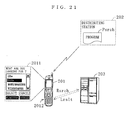
- FIG. 21 is a schematic diagram illustrating an overall structure of a mobile communication system which realizes a service in category iv) above. For conciseness, the following description will be directed to an item search, while disregarding ordering of items.
- the terminal device 201 downloads a program Psrch for an item search. Thereafter, in response to a user operation, the terminal device 201 executes the downloaded program Psrch and displays a screen 2011 which is necessary for the item search. Referring to the displayed screen 2011, the user operates an input device 2012 of the terminal device 201 to select a desired item.
- the terminal device 201 In response to this operation, the terminal device 201 generates a search request Rsrch and sends it to an item search server (hereinafter abbreviated as a "server") 203.
- the server 203 In response to the received search request Rsrch, the server 203 performs an item search, and returns a search result (e.g., a list of items which have been found) Lrslt to the terminal device 201.
- the terminal device 201 displays the received search result Lrslt on the screen 2011, thereby letting the user know an inventory of items or where the desired item can be found.
- the user needs to operate the terminal device 101 or 201 to select and download an appropriate program Pctrl or Psrch.
- Such an operation is cumbersome to the user, and is inconvenient.
- downloading involves complicated user operations to be performed on the input device 1012 or 2012, e.g., designating a place to store the program Pctrl or Psrch (e.g., a URL (Uniform Resource Locator), or making a selection on a menu screen. Therefore, as such services increase in number in the future and as programs for adding various functions to the terminal device 101 or 201 become more prevalent, the complexity of the operation required for user to downloads such programs will presumably increase.
- One aspect of the present invention is directed to a mobile communication system comprising a mobile communication terminal device and a distributing station which distributes a program previously stored in the distributing station to the mobile communication terminal device when the mobile communication terminal device is in a service area.
- the distributing station includes a service start notification section for at least transmitting identification information concerning a program which the distributing station is capable of distributing to the mobile communication terminal device having entered the service area.
- the mobile communication terminal device includes a download processing section for generating a distribution request for the program corresponding to the program identification information received from the service start notification section, the generated distribution request being transmitted from the mobile communication terminal device to the distributing station.
- the distributing station further includes a program distribution section for distributing the program to the mobile communication terminal device in response to the received distribution request.
- the mobile communication terminal device further includes: a program storage section for storing the program transmitted from the program distribution section, a program execution instructing section for generating and transmitting an execution instruction for the program stored in the program storage section, and a program execution section for executing the program stored in the program storage section in response to the execution instruction from the program execution instructing section.
- the mobile communication terminal device when the mobile communication terminal device enters a service area, the mobile communication terminal device automatically downloads a program from the distributing station and executes the downloaded program. The user does not need to perform any operation for the downloading.
- a mobile communication system which is more convenient than a conventional mobile communication system is provided.
- FIG. 1 is a schematic diagram illustrating the structure of a mobile communication system Sa according to one embodiment of the present invention.
- the present mobile communication system Sa is constructed so as to be capable of providing a program distribution service (hereinafter abbreviated as a "service") which is specific to the present embodiment, and comprises at least one distributing station 1, at least one exchange station 2, at least one mobile communication terminal device (hereinafter abbreviated as a "terminal device”)3, and at least one target device 4 (only one of each is shown in FIG. 1).
- a program distribution service hereinafter abbreviated as a "service”
- terminal device mobile communication terminal device
- target device 4 only one of each is shown in FIG. 1
- the distributing station 1 is preferably incorporated in a common type of base station which is accommodated within the mobile communication system Sa.
- the distributing station 1 receives a control signal which is periodically transmitted from the terminal device 3, and performs a known location registration technique based on the received control signal.
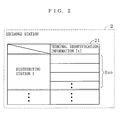
- a location information database hereinafter referred to as a "location information DB"21 of the exchange station 2
- identification information hereinafter referred to as "terminal identification information”
- the exchange station 2 identifies any distributing station 1 mediating the communication with the terminal device 3 with reference to such an entry Esn.
- the distributing station 1 includes a program distribution section 11, a service start notification section 12, and a service completion notification section 13.
- the program distribution section 11 distributes at least one computer program (hereinafter abbreviated as "program") P stored in the distributing station 1 to terminal devices 3 which are located within a service area (hereinafter abbreviated as an "area")Asr.
- the program P is written in a language which is executable by the terminal devices 3, e.g., JAVA (R) .
- JAVA JAVA
- each terminal device 3 is a device capable of mobile communications, e.g., a cellular phone, a simplified type of cellular phone (so-called PHS (Personal Handy-phone System)).
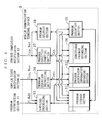
- each terminal device 3 includes a program storage section 31, a program identification information recording section 32, a download processing section 33, a program execution instructing section 34, a program execution section 35, an executable program recording section 36, a program execution stopping section 37, and a program deletion section 38.
- the program storage section 31 is typically implemented as a memory which is mounted in the terminal device 3, e.g., a RAM (Random Access Memory) or an SRAM (Static RAM) .
- the program storage section 31 may be implemented as a memory which is detachable from the terminal device 3, e.g., an SD(Secure Digital) card.
- the program storage section 31 stores a program P which is transmitted from the program distribution section 11.
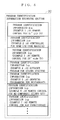
- the program identification information recording section 32 which is composed by a memory within the terminal device 3, records associated program identification information Icp.
- the download processing section 33 is typically realized by a processor which is mounted in the terminal device 3, e.g., an MPU (Micro Processing Unit).
- the download processing section 33 performs a process which involves writing in the program storage section 31 a program P which is sent from the program distribution section 11, as will be specifically described later with reference to FIG. 8.
- the program execution instructing section 34 is also implemented as a processor within the terminal device 3.
- the program execution instructing section 34 performs a process which involves, in response to the service start notice Nss from the service start notification section 12, instructing the program execution section 35 as to which program P is to be currently executed, as will be specifically described later with reference to FIG. 9.
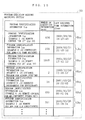
- the executable program recording section 36 which is composed by a memory within the terminal device 3, records as many entries Ecp as there are units of program identification information Icp (see FIG. 5) in the program identification information recording section 32.
- Each entry Ecp is a combination of a unit of program identification information Icp as described above and a tag Texe.
- Each tag Texe is a piece of information which indicates whether the relevant program P corresponding to the program identification information Icp that is associated with the tag Texe is under execution (i.e., being executed) or not.
- a tag Texe is expressed in the form of a 1 byte value. More specifically, a tag Texe having the 1 byte value "0x00" indicates that the relevant program P is not under execution, whereas a tag Texe having the 1 byte value "0x01" indicates that the relevant program P is under execution.
- the program execution stopping section 37 is implemented as a processor within the terminal device 3. In summary, the program execution stopping section 37 performs a process which involves, in response to a service completion notice Nst from the service completion notification section 13, instructing the program execution section 35 as to which program P is to be closed, as will be specifically described later with reference to FIG. 11.
- the program deletion section 38 is implemented as a processor within the terminal device 3.
- the program deletion section 38 performs a process which involves, in response to the aforementioned service completion notice Nst, deleting a program P which is no longer needed from the program storage section 31, as will be specifically described later with reference to FIG. 12.
- the target device 4 is a device, e.g., a television television, which is remote-controlled by the terminal device 3 executing the program P.
- the distributing station 1 When a terminal device 3 enters the area Asr, the distributing station 1 performs the aforementioned location registration process, whereby terminal identification information Itl is registered in an entry Esn for the distributing station 1 (see FIG. 2) in the exchange station 2. After the terminal identification information Itl is registered, the service start notification section 12 of the distributing station 1 performs a service start notification process which comprises a procedure shown in FIG. 7. In FIG. 7, the service start notification section 12 first accesses the exchange station 2 (step S11). Next, the service start notification section 12 determines whether any new terminal identification information Itl has been added to the entry Esn for the distributing station 1 (see FIG. 2) or not (step S12).
- the service start notification section 12 If no terminal identification information Itl has been added, the service start notification section 12 returns to step S11. On the other hand, if some new terminal identification information Itl has been added, the service start notification section 12 transmits the aforementioned service start notice Nss and program identification information Icp to the new terminal device(s) 3 (step S13).
- the service start notice Nss and program identification information Icp are received by a receiver (not shown) in the terminal device 3, and the receiver passes these to the download processing section 33.
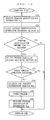
- the download processing section 33 performs a download process which comprises a procedure shown in FIG. 8.
- the download processing section 33 first receives the program identification information Icp (step S21).
- the download processing section 33 accesses the program identification information recording section 32 (see FIG. 5) (step S22).
- the download processing section 33 determines whether the currently-received program identification information Icp is recorded in the program identification information recording section 32 or not (step S23). If such is determined to have been recorded, it means that the relevant program P is stored in the program storage section 31, so that it is unnecessary to newly download the relevant program P. Therefore, the download processing section 33 ends the process of FIG. 8.
- the download processing section 33 determines whether the currently-received program identification information Icp is determined not to have been recorded. If the currently-received program identification information Icp is determined not to have been recorded, the download processing section 33 generates a distribution request Rdt for the relevant program P, and sends it to the distributing station 1 via a transmitter (not shown) in the terminal device 3 (step S24). At the distributing station 1, the program distribution section 11 transmits the relevant program P to the terminal device 3, in response to the received distribution request Rdt. The relevant program P as such is received by the aforementioned receiver, and transferred to the download processing section 33. The download processing section 33 stores the received relevant program P into the program storage section 31 (step S25). Furthermore, the download processing section 33 newly registers the program identification information Icp received at step S21, in the program identification information recording section 32 (step S26).
- the aforementioned receiver also passes the received service start notice Nss and program identification information Icp to the program execution instructing section 34.
- the program execution instructing section 34 performs a program execution instructing process which comprises a procedure shown in FIG. 9.
- the program execution instructing section 34 receives the program identification information Icp, and thereafter accesses the program identification information recording section 32 (see FIG. 5) (step S31, S32). Then, the program execution instructing section 34 determines whether the currently-received program identification information Icp is recorded in the program identification information recording section 32 or not (step S33). If such is determined to have been recorded, the program execution instructing section 34 accesses the executable program recording section 36 (step S34).
- the program execution instructing section 34 determines whether an entry Ecp of the relevant program P (hereinafter referred to as " relevant entry ”) has been recorded in the executable program recording section 36 or not (step S35). If such is not determined to have been recorded, the program execution instructing section 34 generates an execution instruction Cexe for executing the relevant program P, and sends the generated execution instruction Cexe to the program execution section 35 together with the program identification information Icp (step 336). In response to the received execution instruction Cexe, the program execution section 35 accesses the program storage section 31, and thereafter begins executing the relevant program P which is identified by the received program identification information Icp.
- the program execution instructing section 34 determines whether the value of the tag (hereinafter referred to as the "relevant tag ”) Texe which is set in association therewith is "0x01" or not (step S38). If the relevant tag Texe is not "0x01", the program execution instructing section 34 performs a process similar to that of step S36 (step S39), so that the program execution section 35 begins executing the relevant program P. Furthermore, the program execution instructing section 34 changes the relevant tag Texe to "0x01" after step S39 (step S310).
- the user can use the terminal device 3 as a remote control for the target device 4 .
- the terminal device 3 automatically downloads the program P from the distributing station 1 and executes the program P. Therefore, the user is not required to operate the terminal device 3 in order to download the program P.
- a mobile communication system Sa which is more convenient than a conventional mobile communication system is provided.
- step S38 If it is determined at step S38 that the relevant tag Texe is "0x01", the relevant program P is under execution. Therefore, the program execution instructing section 34 determines that it is not necessary to further execute the relevant program P, and the process of FIG. 9 is over.
- the program execution instructing section 34 preferably performs step S311. Specifically, the program execution instructing section 34 generates a downloading instruction Cdl for downloading the relevant program P, and passes the downloading instruction Cdl and the associated program identification information Icp to the download processing section 33 (step S311). In response to the received downloading instruction Cdl, the download processing section 33 begins a process similar to that illustrated in FIG. 8. Alternatively, if it is determined at step S33 that the program identification information Icp has not been recorded, the program execution instructing section 34 may end the process of FIG. 9 without performing the process of step S311.
- a distributing station (not shown) in the newly entered area performs the aforementioned location registration process.
- the terminal identification information Itl is deleted from the entry Esn (see FIG. 2) for the distributing station 1 in the area Asr which the terminal device 3 was previously in, and instead the terminal identification information Itl is added to an entry for the distributing station (not shown) in the newly entered area.
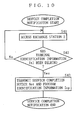
- the service completion notification section 13 of the distributing station 1 performs a service completion notification process which comprises a procedure shown in FIG. 10.
- the service completion notification section 13 first accesses the exchange station 2 with a predetermined timing (step S41).
- the service completion notification section 13 determines whether or not the terminal identification information Itl has been deleted from the entry Esn for the distributing station 1 in the exchange station 2 (step S42). If the terminal identification information Itl has not been deleted, the service completion notification section 13 returns to step S41. On the other hand, if the terminal identification information Itl has been deleted, the service completion notification section 13 transmits the aforementioned service completion notice Nst and the program identification information Icp to the terminal device 3 (step S43).
- the service completion notice Nst and the program identification information Icp as described above are received by a receiver (not shown) in the terminal device 3, and the receiver passes these to the program execution stopping section 37.
- the program execution stopping section 37 performs an execution stopping process which comprises a procedure shown in FIG. 11.
- the program execution stopping section 37 first receives the program identification information Icp (step S51).
- the program execution stopping section 37 accesses the executable program recording section 36 (step S52).
- the program execution stopping section 37 determines whether the relevant program P corresponding to the currently-received program identification information Icp is under execution or not (step S53). More specifically, if an entry Ecp (see FIG.
- step S54 the program execution stopping section 37 generates an execution stopping instruction Cqt for stopping the execution of the relevant program P, and passes it to the program execution section 35 (step S54).
- the program execution section 35 stops execution of the relevant program P.
- the program execution stopping section 37 changes the tag Texe of the entry Ecp for the relevant program P from "0x01" to "0x00" (step S55).
- the aforementioned receiver passes these also to the program deletion section 38.
- the program deletion section 38 performs a program deletion process which comprises a procedure shown in FIG. 12.
- the program deletion section 38 first receives the program identification information Icp (step S61).
- the program deletion section 38 accesses the program identification information recording section 32 (step S62).
- the program deletion section 38 checks whether the currently-received program identification information Icp is recorded or not (step S63), and if it is not recorded, ends the process of FIG. 12 because there is no program P to be deleted.
- the program deletion section 38 accesses the executable program recording section 36 (step S64). Then, in a manner similar to step S53, the program deletion section 38 determines whether the relevant program P is under execution or not (step S65). If the relevant program P is not under execution, the program deletion section 38 deletes the entry Ecp for the relevant program P from the executable program recording section 36 (step S66). Furthermore, the program deletion section 38 accesses the program storage section 31 to delete the relevant program P therefrom (step S67). The program deletion section 38 also accesses the program identification information recording section 32 to delete the currently-received program identification information Icp therefrom (step S68).
- the terminal device 3 automatically ends the execution of any program P under execution, and deletes the program P from the program storage section 31. Furthermore, if the user exits the area Asr, the terminal device 3 automatically deletes the program P which has been distributed from the distributing station 1. As a result, the user is not required to operate the terminal device 3 in order to delete the program P which is no longer needed. Thus, a mobile communication system Sa which is more convenient than a conventional mobile communication system is provided. Furthermore, since the no-longer-needed program P is deleted, the memory within the terminal device 3 can be efficiently utilized.
- the mobile communication system can be used in a facility such as a restaurant, for the purpose of distributing a program P which enables the terminal device 3 to be used as a device with which a user selects and orders an item from a menu.
- the target device 4 is a server which is installed at the facility for collecting orders, and the terminal device 3 remote-controls such a server.
- the mobile communication system can be used in a facility such as a library, for the purpose of distributing a program P which enables the terminal device 3 to be used as a device with which a user obtains guidance within the facility, searches for books/magazines, or makes reservations for books/magazines.
- the target device 4 is a server which is installed at the facility for enabling guidance within the facility, searches for books/magazines, or reservations for books/magazines, and the terminal device 3 remote-controls such a server.
- the mobile communication system can be used in a shop such as a bookstore, a compact disk shop, or a department store, for the purpose of distributing a program P which enables the terminal device 3 to be used as a device with which a user searches for a place to look for a desired item or an item which is present in the shop, or makes a reservation for an item to be purchased.
- the target device 4 is a server which is installed at the shop for enabling shop guidance, item search or reservations for items to be purchased, and the terminal device 3 remote-controls such a server.
- the area Asr is determined depending on the extent of the facility or shop.
- FIG. 13 is a schematic diagram illustrating the structure of a mobile communication system Sb as a variant of the mobile communication system Sa shown in FIG. 1.
- the present mobile communication system Sb differs from the mobile communication system Sa in that, instead of the terminal device 3, at least one mobile communication terminal device (hereinafter abbreviated as a "terminal device") 5 is comprised. Since there are no other structural differences between the systems Sb and Sa, those component elements in FIG. 13 which have their counterparts in FIG. 1 are denoted by like numerals, and the descriptions thereof are omitted.
- the history-dependent download processing section 51 is typically realized by a processor which is mounted in the terminal device 5, e.g., an MPU (Micro Processing Unit).
- the history-dependent download processing section 51 performs a process which involves, while referring to the program execution history recording section 53, downloading a program P which is transmitted from the program distribution section 11 and writing the downloaded program P to the program storage section 31, as will be specifically described later with reference to FIG. 16.
- the history-dependent program execution instructing section 52 is also implemented as a processor within the terminal device 5.
- the history-dependent program execution instructing section 52 performs a process which involves operating in response to a service start notice Nss from the service start notification section 12, and instructing the program execution section 35 as to which program P is to be currently executed while referring to the program execution history recording section 53, as will be specifically described later with reference to FIG. 17.
- the program execution history recording section 53 is typically implemented as a memory which is mounted in the terminal device 5, e.g., a RAM (Random Access Memory) or an SRAM (Static RAM). Alternatively, the program execution history recording section 53 may be implemented as a memory which is detachable from the terminal device 5, e.g., an SD(Secure Digital) card. As shown in FIG. 15, in the program execution history recording section 53, an entry Ehy is recorded for every program P that has been executed by the program execution section 35. Each entry Ehy comprises a combination of program identification information Icp, number of executions information Inexe, and last-executed time information Ilexe. The program identification information Icp concerns a program P which has been executed by the program execution history recording section 53.
- the number of executions information Inexe indicates the number of times (e.g., in a decimal representation) the relevant program P corresponding to the associated program identification information Icp has been executed.
- the last-executed time information Ilexe indicates a date and time on which the relevant program P was last executed.
- the program execution history editing section 54 is implemented as a processor within the terminal device 5.
- the program execution history editing section 54 performs a process which involves, based on the current state of execution of the program P by the program execution section 35, newly generating an entry Ehy in the program execution history recording section 53 or updating an already-existing entry Ehy, as will be specifically described later with reference to FIG. 18.
- the history-dependent program deletion section 55 is implemented as a processor within the terminal device 5.
- the history-dependent program deletion section 55 performs a process which involves operating in response to the aforementioned service completion notice Nst, and by referring to the program execution history recording section 53, deleting a program P which is no longer needed from the program storage section 31, as will be specifically described later with reference to FIG. 19.
- the distributing station 1 performs the aforementioned location registration process. Thereafter, the service start notification section 12 of the distributing station 1 performs the service start notification process which has been described with reference to FIG. 7.
- the service start notice Nss and the program identification information Icp transmitted from the service start notification section 12 are received by a receiver (not shown) in the terminal device 5, and the receiver passes these to the history-dependent download processing section 51.
- the history-dependent download processing section 51 performs a download process which comprises a procedure shown in FIG. 16.
- FIG. 16 differs from FIG. 8 in that steps S71 and S72 are comprised. Since there are no other differences between the two flowcharts, those steps in FIG. 16 which have their counterparts in FIG. 8 are denoted by like numerals, and the descriptions thereof are omitted.
- the history-dependent download processing section 51 performs steps S21 to S23. If it is determined at step S23 that the currently-received program identification information Icp is recorded in the program identification information recording section 32, the history-dependent download processing section 51 ends the process of FIG. 16.
- the history-dependent download processing section 51 accesses the program execution history recording section 53 (see FIG. 15) in order to determine whether or not to download the relevant program P (step S71). Then, the history-dependent download processing section 51 determines whether the entry Ehy for the relevant program P satisfies a predetermined condition or not (step S72).
- step S72 If it is determined at step S72 that the predetermined condition is satisfied, the history-dependent download processing section 51 performs the process beginning from step S24. On the other hand, if the predetermined condition is not satisfied, the history-dependent download processing section 51 ends the process of FIG. 16.
- the aforementioned receiver passes the received service start notice Nss and program identification information Icp also to the history-dependent program execution instructing section 52.
- the history-dependent program execution instructing section 52 performs a program execution instructing process which comprises a procedure shown in FIG. 17.
- FIG. 17 differs from FIG. 9 in that steps S81 and S82 are further comprised. Since there are no other differences between the two flowcharts, those steps in FIG. 17 which have their counterparts in FIG. 9 are denoted by like numerals, and the descriptions thereof are omitted.
- the history-dependent program execution instructing section 52 performs steps S31 to S33. If it is determined at step S33 that the currently-received program identification information Icp is recorded, the history-dependent program execution instructing section 52 accesses the program execution history recording section 53 (see FIG. 15) in order to determine whether or not to execute the relevant program P (step S81). Then, the history-dependent program execution instructing section 52 (see FIG. 15) determines whether the entry Ehy for the relevant program P satisfies a predetermined condition or not (step S82). It is assumed herein that the condition examined at step S82 is the same as that examined at step S72.
- step S82 If it is determined at step S82 that the predetermined condition is satisfied, the history-dependent program execution instructing section 52 performs the process beginning from step S34. On the other hand, if the predetermined condition is not satisfied, the history-dependent program execution instructing section 52 ends the process of FIG. 17.
- the terminal device 5 when the terminal device 5 enters the area Asr, the terminal device 5 automatically downloads from the distributing station 1 a program P which satisfies the aforementioned predetermined condition and executes the downloaded program P. Therefore, the user is not required to operate the terminal device 5 for downloading. If the aforementioned predetermined condition is not satisfied, i.e., if it is determined that the relevant program P is not often executed, the program P is not downloaded or executed. As a result, an even more convenient mobile communication system Sb can be provided.
- the present variant is characterized in that the program identification information Icp received from the history-dependent program execution instructing section 52 is passed to the program execution history editing section 54.
- the program execution history editing section 54 performs a program execution history editing section process which comprises a procedure shown in FIG. 18.
- the program execution history editing section 54 first detects the time and date of receiving the program identification information Icp (step S91). Next, the program execution history editing section 54 accesses the program execution history recording section 53 (see FIG.
- step S92 to determine whether or not an entry Ehy containing the currently-received program identification information Icp (hereinafter referred to as the "relevant entry") is recorded therein (step S93). If the relevant entry Ehy is not found recorded, the program execution history editing section 54 newly generates an entry Ehy for the relevant program P (step S94).
- the newly-generated entry Ehy comprises the currently-received program identification information Icp, number of executions information Inexe which is set to an initial value "1", and last-executed time information Ilexe, which indicates the time and date detected at step S91.
- the program execution history editing section 54 records such an entry Ehy in the program execution history recording section 53 (step S95).
- the program execution history editing section 54 increments its number of executions information Inexe by one (step S96), and updates the last-executed time information Ilexe from the current value to the time and date detected at step S91 (step S97).
- a distributing station (not shown) in the newly entered area performs the aforementioned location registration process.
- the terminal identification information Itl is deleted from the entry Esn (see FIG. 2) for the distributing station 1 in the area Asr which the terminal device 5 was previously in, and instead the terminal identification information Itl is added to an entry for the distributing station (not shown) in the newly entered area.
- the service completion notification section 13 of the distributing station 1 performs the service completion notification process which has been described with reference to FIG. 10.
- the terminal device 5 performs the execution stopping process which has been described with reference to FIG. 11.
- the service completion notice Nst and the program identification information Icp which have been sent to the terminal device 5 are also passed to the history-dependent program deletion section 55.
- the history-dependent program deletion section 55 performs a program deletion process which comprises a procedure shown in FIG. 19.
- FIG. 19 differs from FIG. 12 in that steps S101 and S102 are further comprised. Since there are no other differences between the two flowcharts, those steps in FIG. 19 which have their counterparts in FIG. 12 are denoted by like numerals, and the descriptions thereof are omitted.
- the history-dependent program deletion section 55 executes the process from steps S61 to S63. If it is determined at step S63 that the currently-received program identification information Icp is recorded in the program identification information recording section 32, the history-dependent program deletion section 55 accesses the program execution history recording section 53(see FIG. 15) in order to determine whether or not to delete the relevant program P (step S101). Then, the history-dependent program deletion section 55 determines whether the entry Ehy for the relevant program P satisfies a predetermined condition or not (step S102).
- step S102 it may be determined whether the number of executions information Inexe for the relevant program P is the smallest of all; however, the present invention is not limited thereto. Alternatively, it may be determined whether the last-executed time information Ilexe for the relevant program P is the oldest or not.
- the terminal device 5 automatically deletes a program P which is not often executed from the program storage section 31 by referring to the program execution history recording section 53. As a result, the user does not need to operate the terminal device 5 in order to delete an unimportant program P. Furthermore, even after the user exits the area Asr, important programs P are retained in the program storage section 31. Thus, an even more convenient mobile communication system Sb can be provided.
- the history-dependent program deletion section 55 is illustrated as executing the process of FIG. 19 in response to a service completion notice Nst; however, the present invention is not limited thereto.
- the process of FIG. 19 may be executed when a preset time/date is reached, or the storage capacity of the program storage section 31 reaches a predetermined value.
- the history-dependent program deletion section 55 is illustrated as deleting one program P; however, the present invention is not limited thereto. Alternatively, a plurality of programs P may be deleted. In this case, at step S102, the history-dependent program deletion section 55 may determine whether or not any program P exists that has not been executed for a predetermined period of time by referring to the last-executed time information Ilexe, and delete any program P that satisfies this condition, for example.
Landscapes
- Engineering & Computer Science (AREA)
- Databases & Information Systems (AREA)
- Computer Networks & Wireless Communication (AREA)
- Signal Processing (AREA)
- Mobile Radio Communication Systems (AREA)
- Information Transfer Between Computers (AREA)
- Telephonic Communication Services (AREA)
- Telephone Function (AREA)
- Stored Programmes (AREA)
Abstract
Description
Claims (12)
- A mobile communication system (Sa ,Sb) comprising a mobile communication terminal device (3,5) and a distributing station (1) which distributes a program previously stored in the distributing station to the mobile communication terminal device when the mobile communication terminal device is in a service area,
wherein,
the distributing station includes a service start notification section (12) for at least transmitting identification information concerning a program which the distributing station is capable of distributing to the mobile communication terminal device having entered the service area,
the mobile communication terminal device includes a download processing section (33,51) for generating a distribution request for the program corresponding to the program identification information received from the service start notification section, the generated distribution request being transmitted from the mobile communication terminal device to the distributing station,
the distributing station further includes a program distribution section (11) for distributing the program to the mobile communication terminal device in response to the received distribution request, and
the mobile communication terminal device further includes:a program storage section (31) for storing the program transmitted from the program distribution section,a program execution instructing section (34,52) for generating and transmitting an execution instruction for the program stored in the program storage section, anda program execution section (35) for executing the program stored in the program storage section in response to the execution instruction from the program execution instructing section. - The mobile communication system according to claim 1, wherein,
when the program to be executed is not stored in the program storage section, the program execution instructing section generates a downloading instruction and transmits the downloading instruction to the download processing section, and
the download processing section generates a distribution request for the program in response to the downloading instruction from the program execution instructing section. - The mobile communication system according to claim 1, wherein
the distributing station further includes a service completion notification section (13) for at least transmitting identification information concerning the program having been distributed by the distributing station to the mobile communication terminal device having exited the service area,
the mobile communication terminal device further includes a program execution stopping section (37,52) for generating an execution stopping instruction for the program corresponding to the identification information received from the service completion notification section, and
the program execution section stops execution of the program in response to the execution stopping instruction from the program execution stopping section. - The mobile communication system according to claim 3, wherein the program execution stopping section generates the execution stopping instruction when the program corresponding to the received program identification information is under execution.
- The mobile communication system according to claim 3, wherein the mobile communication terminal device further includes a program deletion section (38,55) for deleting the program whose execution has been stopped by the program execution section.
- The mobile communication system according to claim 1, wherein
the mobile communication terminal device further includes a program execution history recording section (53) for recording an execution history of programs having been executed by the program execution section, and
the download processing section generates the distribution request by referring to the execution history recorded in the program execution history recording section. - The mobile communication system according to claim 1, wherein
the mobile communication terminal device further includes a program execution history recording section (53) for recording an execution history of programs having been executed by the program execution section, and
the program execution instructing section generates the execution instruction by referring to the execution history recorded in the program execution history recording section. - The mobile communication system according to claim 5, wherein
the mobile communication terminal device further includes a program execution history recording section (53) for recording an execution history of programs having been executed by the program execution section, and
the program deletion section deletes the program whose execution has been stopped by the program execution section by referring to the execution history recorded in the program execution history recording section. - The mobile communication system according to claim 1, wherein the program is written in JAVA(R).
- A mobile communication terminal device (3,5), accommodated in a mobile communication system, for acquiring a program from a distributing station within a service area, wherein
the distributing station at least transmits identification information concerning a program which the distributing station is capable of transmitting to the mobile communication terminal device having entered the service area,
the mobile communication terminal device includes a download processing section (33,51) for generating a distribution request for the program corresponding to the program identification information received from the distributing station, the generated distribution request being transmitted from the mobile communication terminal device to the distributing station,
the distributing station distributes the program to the mobile communication terminal device in response to the received distribution request, and
the mobile communication terminal device further includes:a program storage section for storing the program transmitted from the distributing station,a program execution instructing section (34,52) for generating an execution instruction for the program stored in the program storage section, anda program execution section (35) for executing the program stored in the program storage section in response to the execution instruction from the program execution instructing section. - A distributing station (1), accommodated in a mobile communication system, for distributing program to a mobile communication terminal device located in a service area, comprising:a service start notification section (12) for at least transmitting identification information concerning a program which the distributing station is capable of transmitting to the mobile communication terminal device having entered the service area, whereinthe mobile communication terminal device generates a distribution request for the program corresponding to the program identification information received from the service start notification section, andthe distributing station further comprises a program distribution section (11) for distributing the program to the mobile communication terminal device in response to the distribution request generated by and transmitted from the mobile communication terminal device.
- A program distribution method for causing a distributing station to distribute a program previously stored in the distributing station to a mobile communication terminal device when the mobile communication terminal device is in a service area, comprising:a service start notification step (12), performed by the distributing station, of at least transmitting identification information concerning a program which the distributing station is capable of transmitting to the mobile communication terminal device having entered the service area,a download step (33,51), performed by the mobile communication terminal device, of generating a distribution request for the program corresponding to the program identification information transmitted by the service start notification step,a program distribution step (11), performed by the distributing station, of distributing the program to the mobile communication terminal device in response to the received distribution request,a program storage step (31), performed by the mobile communication terminal device, of storing the program transmitted by the program distribution step,a program execution instructing step (34,52), performed by the mobile communication terminal device, of generating and transmitting an execution instruction for the program stored by the program storage step, anda program execution step (35), performed by the mobile communication terminal device, of executing the program stored by the program storage step in response to the execution instruction generated by the program execution instructing step.
Applications Claiming Priority (2)
| Application Number | Priority Date | Filing Date | Title |
|---|---|---|---|
| JP2002008823A JP2003219465A (en) | 2002-01-17 | 2002-01-17 | Mobile communication system |
| JP2002008823 | 2002-01-17 |
Publications (2)
| Publication Number | Publication Date |
|---|---|
| EP1330135A2 true EP1330135A2 (en) | 2003-07-23 |
| EP1330135A3 EP1330135A3 (en) | 2004-01-02 |
Family
ID=19191457
Family Applications (1)
| Application Number | Title | Priority Date | Filing Date |
|---|---|---|---|
| EP03000761A Withdrawn EP1330135A3 (en) | 2002-01-17 | 2003-01-14 | Mobile communication system |
Country Status (4)
| Country | Link |
|---|---|
| US (1) | US20030134623A1 (en) |
| EP (1) | EP1330135A3 (en) |
| JP (1) | JP2003219465A (en) |
| CN (1) | CN1433232A (en) |
Families Citing this family (22)
| Publication number | Priority date | Publication date | Assignee | Title |
|---|---|---|---|---|
| JP4402370B2 (en) * | 2003-05-14 | 2010-01-20 | キヤノン株式会社 | Service providing apparatus and information processing method |
| WO2005072002A1 (en) * | 2004-01-26 | 2005-08-04 | Matsushita Electric Industrial Co., Ltd. | Terminal device, method, and system capable of automatic execution of process in accordance with event |
| FR2866455B1 (en) * | 2004-02-17 | 2006-05-26 | Eastman Kodak Co | METHOD FOR COMMUNICATING MULTIMEDIA MESSAGES BETWEEN REMOTE TERMINALS WITH A PROGRAMMING AGENT |
| US6990335B1 (en) * | 2004-11-18 | 2006-01-24 | Charles G. Shamoon | Ubiquitous connectivity and control system for remote locations |
| US7627341B2 (en) * | 2005-01-31 | 2009-12-01 | Microsoft Corporation | User authentication via a mobile telephone |
| JP4777725B2 (en) | 2005-08-31 | 2011-09-21 | フェリカネットワークス株式会社 | Portable terminal device, server device, application providing method, and computer program |
| EP2115611A4 (en) * | 2007-01-26 | 2010-02-03 | Fusionone Inc | System for and method of backing up content for use on a mobile device |
| JPWO2010013609A1 (en) * | 2008-07-30 | 2012-01-12 | 株式会社Access | Execution environment software, client device, and server device |
| US8681700B2 (en) * | 2008-09-30 | 2014-03-25 | Nec Corporation | System and method for executed function management and program for mobile terminal |
| JP4871373B2 (en) | 2009-06-19 | 2012-02-08 | 任天堂株式会社 | Information processing system and information processing apparatus |
| JP5674296B2 (en) | 2009-09-09 | 2015-02-25 | 任天堂株式会社 | Information processing system and information processing apparatus |
| JP2011250874A (en) | 2010-05-31 | 2011-12-15 | Nintendo Co Ltd | Information processing program, information processing apparatus, information processing system, and information processing method |
| JP5593566B2 (en) | 2010-06-10 | 2014-09-24 | 任天堂株式会社 | Information processing system, information processing apparatus, information processing apparatus control method, and information processing apparatus control program |
| JP5677811B2 (en) * | 2010-06-11 | 2015-02-25 | 任天堂株式会社 | Portable information terminal, portable information system, portable information terminal control program |
| JP2012018657A (en) | 2010-06-11 | 2012-01-26 | Nintendo Co Ltd | Information processing terminal, information processing system, and information processing program |
| JP4999213B2 (en) | 2010-09-17 | 2012-08-15 | 任天堂株式会社 | Information processing program, portable terminal device, system, information processing method, and communication system |
| JP4882022B1 (en) | 2010-12-28 | 2012-02-22 | 任天堂株式会社 | Communication system, information processing program, information processing method, information processing apparatus, information processing system |
| JP5180331B2 (en) * | 2011-02-01 | 2013-04-10 | フェリカネットワークス株式会社 | Communication terminal, server device, communication method, and program |
| US20120302219A1 (en) * | 2011-05-24 | 2012-11-29 | Vang Vang | Monitoring and automating a network of independent wireless remote devices based on a mobile device location |
| KR101350692B1 (en) * | 2012-04-25 | 2014-01-10 | 손용석 | Mobile terminal and direct service providing method thereof |
| US8566203B1 (en) * | 2012-11-30 | 2013-10-22 | Bank Of America Corporation | User identification using mobile device |
| US11109339B2 (en) * | 2019-02-21 | 2021-08-31 | At&T Intellectual Property I, L.P. | Pre-provisioned access management containers for wireless services |
Family Cites Families (5)
| Publication number | Priority date | Publication date | Assignee | Title |
|---|---|---|---|---|
| US6199076B1 (en) * | 1996-10-02 | 2001-03-06 | James Logan | Audio program player including a dynamic program selection controller |
| JP2000023251A (en) * | 1998-06-26 | 2000-01-21 | Kokusai Electric Co Ltd | Mobile communication device and mobile communication system |
| WO2001065876A1 (en) * | 2000-02-29 | 2001-09-07 | Qualcomm Incorporated | Programmable mobile communications terminal with randomized off-peak transmissions |
| KR20030082548A (en) * | 2000-11-28 | 2003-10-22 | 시체인지 인터내셔널, 인코포레이티드 | Content/service handling and delivery |
| US6973576B2 (en) * | 2000-12-27 | 2005-12-06 | Margent Development, Llc | Digital content security system |
-
2002
- 2002-01-17 JP JP2002008823A patent/JP2003219465A/en not_active Withdrawn
-
2003
- 2003-01-14 EP EP03000761A patent/EP1330135A3/en not_active Withdrawn
- 2003-01-16 US US10/345,314 patent/US20030134623A1/en not_active Abandoned
- 2003-01-17 CN CN03102717.2A patent/CN1433232A/en active Pending
Non-Patent Citations (1)
| Title |
|---|
| None * |
Also Published As
| Publication number | Publication date |
|---|---|
| EP1330135A3 (en) | 2004-01-02 |
| CN1433232A (en) | 2003-07-30 |
| JP2003219465A (en) | 2003-07-31 |
| US20030134623A1 (en) | 2003-07-17 |
Similar Documents
| Publication | Publication Date | Title |
|---|---|---|
| EP1330135A2 (en) | Mobile communication system | |
| US6529728B1 (en) | Method and apparatus in a wireless communication system for selectively providing information specific to a location | |
| CN1613100B (en) | User interface to remotely control an application | |
| US20030100962A1 (en) | Appliance control system and method using mobile communications terminal, and home gateway | |
| US20040013246A1 (en) | System and method for modifying display formation of mobile phone | |
| US20060253592A1 (en) | Terminal device, method, and system capable of automatic execution of process in accordance with event | |
| US8655329B2 (en) | Downloadable profiles for mobile terminals | |
| JP2005235050A (en) | Access control management method, access control management system and terminal device with access control management function | |
| US6898424B2 (en) | Remote control method and system, server, data processing device, and storage medium | |
| JP2002532920A (en) | Electronic device remote control method | |
| CN101835137A (en) | Method for transmitting and receiving file based on mobile terminals and mobile terminal | |
| US20130007728A1 (en) | Apparatus and method for providing application service based on area | |
| CN100512354C (en) | Communication system, device ,apparatus and method for coping with multi-language management | |
| KR20090072071A (en) | Apparatus and method for providing a SIM application toolkit in a mobile communication system | |
| KR101943430B1 (en) | User Device, Driving Method of User Device, Apparatus for Providing Service and Driving Method of Apparatus for Providing Service | |
| JP2002290416A (en) | Radio communication terminal, and selection method for connection devices in radio network system | |
| JP4337142B2 (en) | Content sharing method and content management apparatus | |
| KR100809395B1 (en) | Method for remote control and apparatus thereof | |
| JPH1098757A (en) | Shared radio tenant service system | |
| JP2006165886A (en) | Information acquisition system, user terminal and communications equipment used for the system | |
| EP1304006B1 (en) | Managing control data in mobile station | |
| JP2001211485A (en) | Mobile device and remote control method for electronic device | |
| US5890157A (en) | Information communication system | |
| JP2002176403A (en) | Mobile terminal for collecting contents distributed in a broadcast manner and system including the terminal | |
| KR101079461B1 (en) | Resource installation and management system and resource installation and management method |
Legal Events
| Date | Code | Title | Description |
|---|---|---|---|
| PUAI | Public reference made under article 153(3) epc to a published international application that has entered the european phase |
Free format text: ORIGINAL CODE: 0009012 |
|
| AK | Designated contracting states |
Designated state(s): AT BE BG CH CY CZ DE DK EE ES FI FR GB GR HU IE IT LI LU MC NL PT SE SI SK TR |
|
| AX | Request for extension of the european patent |
Extension state: AL LT LV MK RO |
|
| PUAL | Search report despatched |
Free format text: ORIGINAL CODE: 0009013 |
|
| AK | Designated contracting states |
Kind code of ref document: A3 Designated state(s): AT BE BG CH CY CZ DE DK EE ES FI FR GB GR HU IE IT LI LU MC NL PT SE SI SK TR |
|
| AX | Request for extension of the european patent |
Extension state: AL LT LV MK RO |
|
| 17P | Request for examination filed |
Effective date: 20040116 |
|
| 17Q | First examination report despatched |
Effective date: 20040315 |
|
| AKX | Designation fees paid |
Designated state(s): DE FR GB |
|
| 17Q | First examination report despatched |
Effective date: 20040315 |
|
| STAA | Information on the status of an ep patent application or granted ep patent |
Free format text: STATUS: THE APPLICATION IS DEEMED TO BE WITHDRAWN |
|
| 18D | Application deemed to be withdrawn |
Effective date: 20070411 |