EP1329523A1 - Method of detecting norwalk-like virus (gii) - Google Patents
Method of detecting norwalk-like virus (gii) Download PDFInfo
- Publication number
- EP1329523A1 EP1329523A1 EP01917525A EP01917525A EP1329523A1 EP 1329523 A1 EP1329523 A1 EP 1329523A1 EP 01917525 A EP01917525 A EP 01917525A EP 01917525 A EP01917525 A EP 01917525A EP 1329523 A1 EP1329523 A1 EP 1329523A1
- Authority
- EP
- European Patent Office
- Prior art keywords
- nucleotide sequence
- virus
- gii
- norwalk
- detecting
- Prior art date
- Legal status (The legal status is an assumption and is not a legal conclusion. Google has not performed a legal analysis and makes no representation as to the accuracy of the status listed.)
- Granted
Links
Images












Classifications
-
- C—CHEMISTRY; METALLURGY
- C12—BIOCHEMISTRY; BEER; SPIRITS; WINE; VINEGAR; MICROBIOLOGY; ENZYMOLOGY; MUTATION OR GENETIC ENGINEERING
- C12Q—MEASURING OR TESTING PROCESSES INVOLVING ENZYMES, NUCLEIC ACIDS OR MICROORGANISMS; COMPOSITIONS OR TEST PAPERS THEREFOR; PROCESSES OF PREPARING SUCH COMPOSITIONS; CONDITION-RESPONSIVE CONTROL IN MICROBIOLOGICAL OR ENZYMOLOGICAL PROCESSES
- C12Q1/00—Measuring or testing processes involving enzymes, nucleic acids or microorganisms; Compositions therefor; Processes of preparing such compositions
- C12Q1/70—Measuring or testing processes involving enzymes, nucleic acids or microorganisms; Compositions therefor; Processes of preparing such compositions involving virus or bacteriophage
- C12Q1/701—Specific hybridization probes
Definitions
- the present invention relates to a method of detecting a virus.
- the term "food poisoning” generally brings to mind bacterial food poisoning caused by bacteria such as Salmonella, Vibrio parahaemolyticus, and pathogenic E. coli, or natural toxin food poisoning caused by natural toxins contained in, for example, globefish or mushrooms.
- bacteria such as Salmonella, Vibrio parahaemolyticus, and pathogenic E. coli
- natural toxin food poisoning caused by natural toxins contained in, for example, globefish or mushrooms.
- viruses such as Norwalk-like viruses (hereinafter referred to as NLVs), rotavirus, astrovirus, enterovirus, adenovirus, and hepatitis A virus.
- NLVs Norwalk-like viruses
- rotavirus rotavirus
- astrovirus enterovirus
- adenovirus hepatitis A virus.
- Recent epidemiological research has revealed that, among other viruses, Norwalk-like viruses are typical food-poisoning viruses.
- Norwalk virus was first identified in 1972 after an outbreak of gastrointestinal illness in the U.S.A. Under an electron microscope, the virus is observed as a small spherical virus of about 30 nm in diameter having an unclear surface structure, and since then viruses having similar shapes have been collectively called "small round structured viruses” (SRSVs).
- SRSVs small round structured viruses
- calicivirus which had been well known in veterinary medicine and which measures about 30 nm in diameter and assumes a unique surface structure resembling a "Star of David," was first identified in a human patient; specifically, in a patient suffering winter vomiting disease, which was at that time epidemic in Britain. Since then, viruses having a shape similar to the above have been called classical human caliciviruses.
- NLVs Norwalk-like viruses
- SLVs classical human caliciviruses
- GI genogroup I
- GII genogroup II
- NLV infections in humans primarily occur by the mediation of foods (fish, shellfish, and water). Most of the viral food-poisoning cases that frequently occur during winter are believed to be caused by ingestion of shellfish such as oysters, and in fact, in a great number of study reports, oysters are identified as the source of infection with NLVs. Some reports describe that ingestion of a sandwich contaminated with NLVs caused infection. Thus, presumably, NLV infection readily spreads through feces from an infected patient. (This virus is known to have strong infectivity and to cause infection even in a case where several to about one hundred viruses are present in a food product).
- the following are required: detection and identification of the pathogenic microorganism that caused the illness (i.e., identification of the cause of the food poisoning); and identification of the food and the food manufacturing facility that caused the food poisoning, on the basis of, for example, the diet history of the patient suffering food poisoning (identification of the contamination source of the food poisoning).
- an electron microscope has been employed to detect the above-mentioned NLVs.
- methods employing an electron microscope require an intricate procedure, and in addition, rapid and accurate detection of viruses is difficult in cases where the quantity of the viruses is small.
- rapid and accurate detection of NLVs in, for example, contaminated foods is keenly desired, and yet, realization has been difficult.
- detection methods employing an electron microscope require a large facility for accommodating the electron microscope, and thus, detection through electron microscopy has been possible in only a limited number of facilities.
- gene amplification primers primers for amplifying a specific region of the gene
- detection primers primers used in the process of detecting a gene amplification product of interest on the basis of the presence of the specific region serving as an index
- design of such primers encounters a problem which is very difficult to solve.
- an object of the present invention is to identify a highly conserved region in genes of NLVs, and, on the basis of the information thus obtained, to provide rapid, accurate means for detecting NLVs.
- the present inventors have conducted careful studies and have successfully identified a highly conserved region (bridging the vicinity of the C-terminus of the ORF 1 region and the vicinity of the N-terminus of the ORF 2 region) in a gene of NLV genogroup II, and, on the basis of this finding, have devised rapid, accurate means for detecting viruses belonging to genogroup II of NLVs, among other NLVs, leading to completion of the present invention.
- NLVs Norwalk-like viruses
- GAI Norwalk-like viruses
- GIS Gene analysis of NLVs was performed on stool specimens collected from 44 cases of non-bacterial gastroenteritis from which NLV particles were detected through electron microscopy in the Saitama Institute of Public Health during 1998-2000.
- each of the stool specimens was suspended in sterilized distilled water so as to attain a concentration of about 10% (W/V), and the suspension was subjected to centrifugation at 3000 ⁇ g for 5 minutes. From the supernatant (140 ⁇ L), nucleic acid was extracted in accordance with the manufacturer's protocol of an RNA extraction kit (QIA Viral RNA, Qiagen), and suspended in 50 ⁇ L sterilized distilled water, whereby an RNA sample was obtained.
- QIA Viral RNA, Qiagen RNA extraction kit
- cDNA was synthesized from each of the thus-prepared RNA samples by use of an oligo dT primer, and amplified through LongRT-PCR.
- the nucleotide sequence of each of the gene amplification products was determined through direct sequencing by use of the primer walking method (Nucleic Acids Res. 1989 17(15): 6087-6102). Sequencing of the genomic 5'-terminus was performed using three types of RACE (rapid amplification of cDNA ends).
- Genome diversity was investigated by use of the nucleotide sequences of a number of NLV variants, including these new variants, a prototype (standard strain; AF145896/Camberwell), and known NLV (GII) variants which had already been registered in Genbank (X86557/Lorsdale, X81879-2/Melksham, U07611-2/Hawaii, U02030-2/Tronto(TV24), L23830-2/OTH-25/89/J, AF190817-2/Arg320, X76716-1/Bristol, U22498-2/MK, U46039 Auckland, U75682-1/Snow Mountain Strain, AB032758 Chitta virus, AF080549-1/1996/SC, AF080550-1/345-2/96002737/1996/, AF080551-1/004/95M-14/1995/AU,AF080552-1/358/96015107/1996/FL, AF080553-1/364
- the reference employed as a basis for describing a gene region is the nucleotide sequence (cDNA sequence) of a gene of the above-mentioned prototype (standard strain), AF145896/Camberwell.
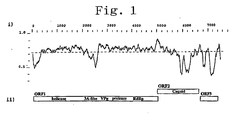
- Fig. 1 shows the results of the investigation of genome diversity. In chart i) of Fig.
- the X-axis represents the base number ⁇ as counted from the 5'-terminus ⁇ of the gene (cDNA) of the above-mentioned prototype of NVLs (GII)
- the Y-axis represents the degree of conservation (the greater the Y-axis value, the more analogous the nucleotide sequences of respective strains, meaning that the gene is highly conserved, and conversely, the smaller the Y-axis value, the more varied the nucleotide sequences of respective strains, meaning that the gene is less conserved).
- Chart ii) of Fig. 1 shows functions, in NLVs (GII), of the gene having the above-described nucleotide sequences.
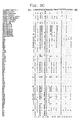
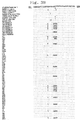
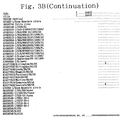
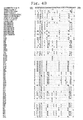
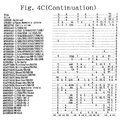
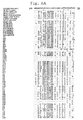
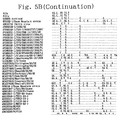
- Figs. 2 to 5 show, in an orderly arranged form for the purpose of comparison, nucleotide sequences of the respective strains of NLVs (GII), spanning from the vicinity of the C-terminus of ORF1 (Figs. 2A to 2C) to the vicinity of the N-terminus of ORF2 (Figs. 4A and 4D, and 5A to 5C; Note that Figs. 3A to 3C show nucleotide sequences of a region that bridges ORF1 and ORF2).
- the names of the respective strains of NLVs (GII) employed are shown in the left column, and the nucleotide sequence of the prototype (standard strain) is shown in the uppermost row.
- the base number of the prototype shown in the uppermost row is employed as a reference.
- the symbol ".” represents that the base at that position is the same as that of the prototype (standard strain), and the vacancies indicate that the bases found at the corresponding positions in the prototype are absent.
- the symbol "*" in the lowermost row indicates that the base at that position is in common throughout the strains, and the symbol ".” in the lowermost row indicates the presence of any difference in base among the strains.
- the nucleotide sequence region exhibiting gene conservation of such a degree that enables use of that region in detection of NLVs is a region corresponding to the 4851- to 5450-positions of the nucleotide sequence of the cDNA of the prototype (standard strain) of NLVs (GII); that a region corresponding to the 4919- to 5389-positions of the nucleotide sequence exhibits a particularly high level of conservation, and a region corresponding to the 4988- to 5107-positions of the nucleotide sequence exhibits an exceptionally high conservation (in particular, a region corresponding to the 5042- to 5067-positions exhibits the highest conservation (hereinafter this region may be referred to as the significantly highly conserved region).
- the expression “corresponding to” is used to describe a relation between two corresponding nucleotide sequence regions, one being from the cDNA of the above-mentioned prototype and the other being from a variant, which relation is elucidated through gene analysis of NLVs (GII), including variants.
- the expression “corresponding to” is used to refer to the incidence in which the nucleotide sequence in question can hybridize with nucleic acids of the aforementioned nucleotide sequence of the cDNA of the prototype under stringent conditions (56 to 68°C, in the presence of 50mM or more sodium ions).
- Specific examples include nucleotide sequences of NLVs (GII) shown in Figs. 2 to 5, which correspond to the gene region represented by the above-mentioned nucleotide sequence of the cDNA of the prototype.
- the present invention is directed to means for rapidly and accurately detecting NLVs (GII) by making use of the nucleotide sequence of a nucleic acid in a highly conserved gene region (i.e., the region corresponding to the 4851- to 5450-positions of the nucleotide sequence of the cDNA of the prototype (standard strain) of NLVs (GII), hereinafter such a gene region is also referred to as a "conserved region”), which is determined through gene analysis regarding gene conservation of NLVs (GII).
- a highly conserved gene region i.e., the region corresponding to the 4851- to 5450-positions of the nucleotide sequence of the cDNA of the prototype (standard strain) of NLVs (GII), hereinafter such a gene region is also referred to as a "conserved region”
- the present invention provides a viral detection method for Norwalk-like viruses (GII) in a specimen (hereinafter also referred to as “the present detection method”) by use of, as an index, the nucleic acid fragment of a complementary nucleotide sequence or complementary nucleotide sequences (hereinafter collectively called "a complementary nucleotide sequence") corresponding to the 4851- to 5450-positions (preferably 4919- to 5389-positions (hereinafter also referred to as the highly conserved region), more preferably 4988- to 5107-positions (hereinafter also referred to as the special conserved region)) of the nucleotide sequence of the cDNA of the prototype (standard strain) of NLVs (GII).
- a complementary nucleotide sequence corresponding to the 4851- to 5450-positions (preferably 4919- to 5389-positions (hereinafter also referred to as the highly conserved region), more preferably 4988- to 5107-positions (hereinafter also referred to as
- the word “complementary” is used to describe a relation where a nucleic acid fragment having a certain nucleotide sequence exhibits such a degree of complementation that enables hybridization with another nucleic acid fragment under stringent conditions (56 to 68°C, in the presence of 50 mM or more sodium ions), and the expression “complementary nucleotide sequence” encompasses the following incidences:
- the “complementary nucleotide sequence” is minus-stranded with respect to a plus-stranded fragment of the nucleotide sequence;
- the “complementary nucleotide sequence” is plus-stranded with respect to a minus-stranded fragment of the nucleotide sequence;
- one “complementary nucleotide sequence” is minus-stranded with respect to a plus-stranded fragment of the nucleotide sequence and the other "complementary nucleotide sequence” is plus-stranded with respect to a minus-stranded
- any of the mentioned conserved regions (hereinafter collectively referred to as "Conserved Regions"; including the "highly conserved region,” “special conserved region,” and “significantly highly conserved region”; the convention applies hereafter) must be amplified through a nucleic acid amplification method, to thereby produce gene amplification products of the conserveed Regions.
- Examples of such an amplification method include PCR and other methods, such as RT-PCR, NASBA (nucleic acid sequence based amplification), and SDA (strand displacement amplification).
- gene amplification primers must be designed and prepared so as to be adapted to the method.
- gene amplification primers are designed such that a gene region is amplified in both directions of forward (5' ⁇ 3') and reverse, with the gene region being sandwiched by +/- primers. Since the gene amplification primers must properly bind to the intended regions of the gene serving as a template for attaining complementary binding, it is necessary that any of such primers contain at least a minimum number of bases forming a nucleotide sequence complementary only to characteristic nucleotide sequence(s).
- Such a gene amplification primer has at least 10 bases, preferably about 15 to 30 bases.
- the primer is preferably designed to be as precisely complementary as possible.
- a preferred gene amplification primer comprises a complementary nucleotide sequence corresponding to consecutive 10 or more bases, preferably consecutive 15 to 30 bases, of a nucleotide sequence selected, as a benchmark, from the group consisting of nucleotide sequences of the 4988- to 5028-positions of the nucleotide sequence of the cDNA of the prototype (standard strain) of NLVs (GII), the 5080- to 5107-positions thereof, the 4919- to 4941-positions thereof, and the 5367- to 5389-positions thereof.
- GTI NLVs
- the gene amplification products include a region corresponding to the 4942- to 5366-positions of the nucleotide sequence of the cDNA of the prototype of NLVs (GII), which is a highly conserved region within the aforementioned conserved regions.
- the nucleotide sequence to be included in the gene amplification products obtained from the highly conserved region is a segment corresponding to the 5042- to 5067-positions of the complementary nucleotide sequence of the cDNA of the prototype of NLVs (GII), which is the significantly highly conserved region.
- the resultant gene amplification products originating from NLVs(GII) will contain at least a nucleotide sequence corresponding to the 5042- to 5067-positions of the nucleotide sequence of the cDNA of the prototype of NLVs (GII).
- the at least two nucleotide sequences based on which gene amplification primers are established, each nucleotide sequence being composed of 10 or more consecutive bases are preferably selected from the cDNA nucleotide sequence set of 4988- to 5028-positions and 5080- to 5107-positions of the nucleotide sequence of the cDNA of the prototype (standard strain) of Norwalk-like viruses (GII).
- the resultant gene amplification products originating from NLVs(GII) will contain a nucleotide sequence corresponding to the 5042- to 5067-positions of the nucleotide sequence of the cDNA of the prototype of NLVs (GII).
- Each of the above-described gene amplification primers may be employed as a component of the detection kit of the present invention described hereinbelow.
- the present detection method can be applied to any specimen in which NLVs (GII) are to be detected.
- NLVs GII
- stool of the patient is typically employed as a specimen, and depending on the case, vomitus, blood, etc. may be employed.
- NLVs (GII) are to be detected in food or a food production facility, the food itself, deposits collected from the food production facility, clothing of food production workers, etc. may be employed as a specimen.
- the specimen may be obtained from watery sources, such as various types of sewage or discharging water, seawater, river water, and lake water.
- RNA is extracted, through a conventional method such as the acid phenol method (e.g., the acid guanidinum-phenol-chloroform (AGPC) method).
- AGPC acid guanidinum-phenol-chloroform
- the thus-obtained viral RNA is processed through a suitably selected gene amplification method. For example, through preparation of cDNA having a nucleotide sequence complementary to the nucleotide sequence of the viral RNA using a reverse transcriptase ⁇ to thereby obtain a nucleic acid sample.
- the nucleic acid sample is then subjected to gene amplification by use of the aforementioned gene amplification primers, whereby a gene amplification product of interest can be obtained (generally, the presence of the product of interest can be confirmed through electrophoresis on the basis of size of the target product).
- nucleic acid probes for detection for example, nucleic acid fragments which have been labeled with a fluorophore or a radioisotope
- the presence or absence of the nucleotide sequence of the gene amplification product can be confirmed by hybridization or a similar method (as a negative result or positive result).
- detection means is performed on the amplification product after the gene amplification process has completed.
- the detection method by use of a molecular beacon probe makes use of a hair-pin shaped hybridization probe (molecular beacon probe) for allowing fluorescent monitoring of a gene amplification product obtained by PCR during or after an amplification procedure (Nature Biotechnology, 1998, 16: 49-53).
- Terminal sequences of the nucleic acid fragment constituting the molecular beacon probe are complementary to each other.
- the terminal portions are bonded to each other, whereby a "stem-loop structure" is formed.
- the loop portion of the stem-loop structure is designed so as to be complementary to a region of interest (i.e., conserveed Regions) of the gene amplification product.
- a fluorophore is bound, and to the other end of the nucleic acid of the probe, a non-fluorescent quencher dye is bound.
- the probe When the probe is present in a solution in a free state, the probe has a hairpin structure, whereby the fluorophore and the quencher interact each other, and fluorescence is not detected.
- the solution contains the gene amplification product having a nucleotide sequence complementary to the nucleotide sequence of the probe, the loop portion is bound to the complementary nucleotide sequence portion.
- the overall structure of the probe varies, resulting in a separation of the fluorophore and the quencher from each other, and thus quenching effect of the quencher for the fluorophore is canceled. Therefore, fluorescence emitted from the fluorophore can be observed.
- Increase in fluorescence intensity caused by canceling of the quenching effect is proportional to the increment in the amount of the gene amplification product having the nucleotide sequence complementary to the sequence of the nucleic acid that forms the probe.
- the target nucleotide sequences e.g., sequences of conserveed Regions
- NLVs (GII) in a specimen can be detected through use of the results of the aforementioned increase in fluorescence intensity as an index.
- Labeling of a molecular beacon probe through use of the aforementioned fluorophore and the quencher is typically performed as follows.
- the 5'-terminus of the nucleic acid probe is labeled with a fluorescein fluorophore (such as 6-carboxyfluorescein (6-FAM) or 6-carboxy-4,7,2',7'-tetrachlorofluorescein (TET)) or a rhodamine fluorophore (such as 5-carboxytetramethylrhodamine (TAMARA)), and the 3'-terminus of the probe is labeled with a quencher (such as 4-(4'-dimethylaminophenylazo)benzoic acid (DABCYL)) (see, for example, Nature Biotechnology, 1996, 14: 303-308).
- a quencher such as 4-(4'-dimethylaminophenylazo)benzoic acid (DABCYL)
- the detection method by use of a Taq-Man probe makes use of a hybridization probe (Taq-Man probe) for allowing fluorescent monitoring of a gene amplification product obtained by PCR during the amplification procedure (see, for example, Experimental Medicine, Vol. 15, No. 7 (extra issue), pp. 46-51, 1997).
- the Taq-Man probe is a nucleic acid fragment bearing a fluorescein fluorophore label (reporter dye) and a rhodamine fluorophore label (quencher dye) at the 5'-terminus and 3'-terminus of the fragment, respectively.
- the quencher dye inhibits fluorescence emission of the reporter dye.
- hydrolysis occurs from the 5'-terminus of the Taq-Man probe under 5' ⁇ 3' endonuclease activity of Taq DNA polymerase.
- the 5'-terminal reporter dye is released from the 3'-terminal quencher dye, resulting in an increase in fluorescence intensity of the reporter dye which has been suppressed.
- the increase in fluorescence intensity caused by the reporter dye is proportional to the increase in the amount of the gene amplification product having the nucleotide sequence complementary to the sequence of the nucleic acid that forms the probe.
- the presence of the nucleotide sequence of interest e.g., conserveed Regions
- NLVs (GII) in a detection specimen can be detected through use of the results of the aforementioned increase in fluorescence intensity as an index.
- Labeling of a Taq-Man probe with the aforementioned fluorophore is typically performed in accordance with a conventional method by labeling the 5'-terminus of the probe with a fluorescein fluorophore (such as 6-FAM or TET), and the 3'-terminus of the probe with a rhodamine fluorophore (such as TAMARA) (see, for example, Nucleic Acids Research, 1993, 21 (16): 3761-3776).
- a fluorescein fluorophore such as 6-FAM or TET
- TAMARA rhodamine fluorophore
- nucleic acid probes for detection may be employed as components of the detection kit of the present invention which will be described below.
- NLVs In relation to the detection of NLVs (GII) according to the present detection method, detection of a gene amplification product or a similar product having a nucleotide sequence of interest may be performed by way of quantitation of the nucleic acid fragment of interest through use of the aforementioned means. Alternatively, instead of quantitation, NLVs (GII) may be detected in the form of qualitative (e.g., positive or negative) information. By use of the detection results of the gene amplification products (quantitative value or qualitative information) as an index, and by correlating the index to the presence/absence or the amounts of the NLVs (GII) in the specimen, the NLVs (GII) of interest can be detected.
- quantitative value or qualitative information e.g., positive or negative
- the present invention also provides a kit for detecting NLVs (GII) (hereinafter, the kit will be referred to as the present detection kit) for performing the present detection method.
- a kit for detecting NLVs hereinafter, the kit will be referred to as the present detection kit
- the present detection kit typically contains primers for amplifying ⁇ by RT-PCR or any other suitable methoda ⁇ a nucleic acid fragment having any of conserveed Regions of NLVs (GII), and/or one or more probes for detecting the conserveed Regions of a gene amplification product.
- the kit contains both; primers and probes.
- the gene amplification primers are nucleic acid fragments capable of producing gene amplification products through amplification of a conserveed Region of an NLV (GII) gene by use of gene amplification means such as RT-PCR.
- the nucleic acid probes for detection contain nucleic acid fragments having nucleotide sequences complementary to sequences corresponding to the nucleotide sequences of a conserveed Region. As described above, one may employ nucleic acid probes for detection of a basic mode comprising complementary nucleotide sequences labeled with a fluorophore or a radioisotope.
- NLVs when NLVs (GII) are detected in the course of gene amplification, preferably, there may be employed such nucleic acid probes for detection produced by incorporating nucleic acids of a complementary nucleotide sequence into the aforementioned molecular beacon probe or Taq-Man probe.
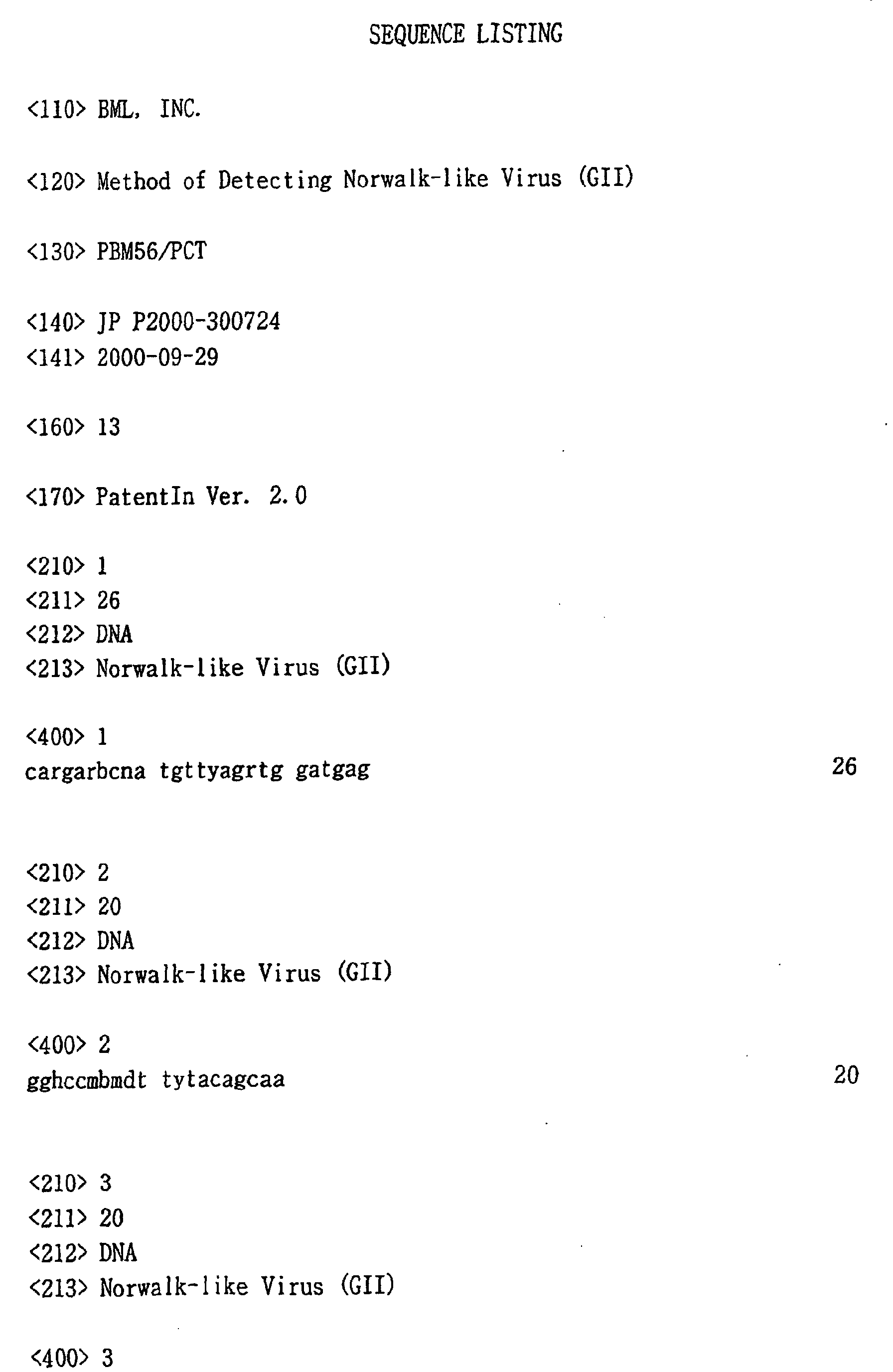
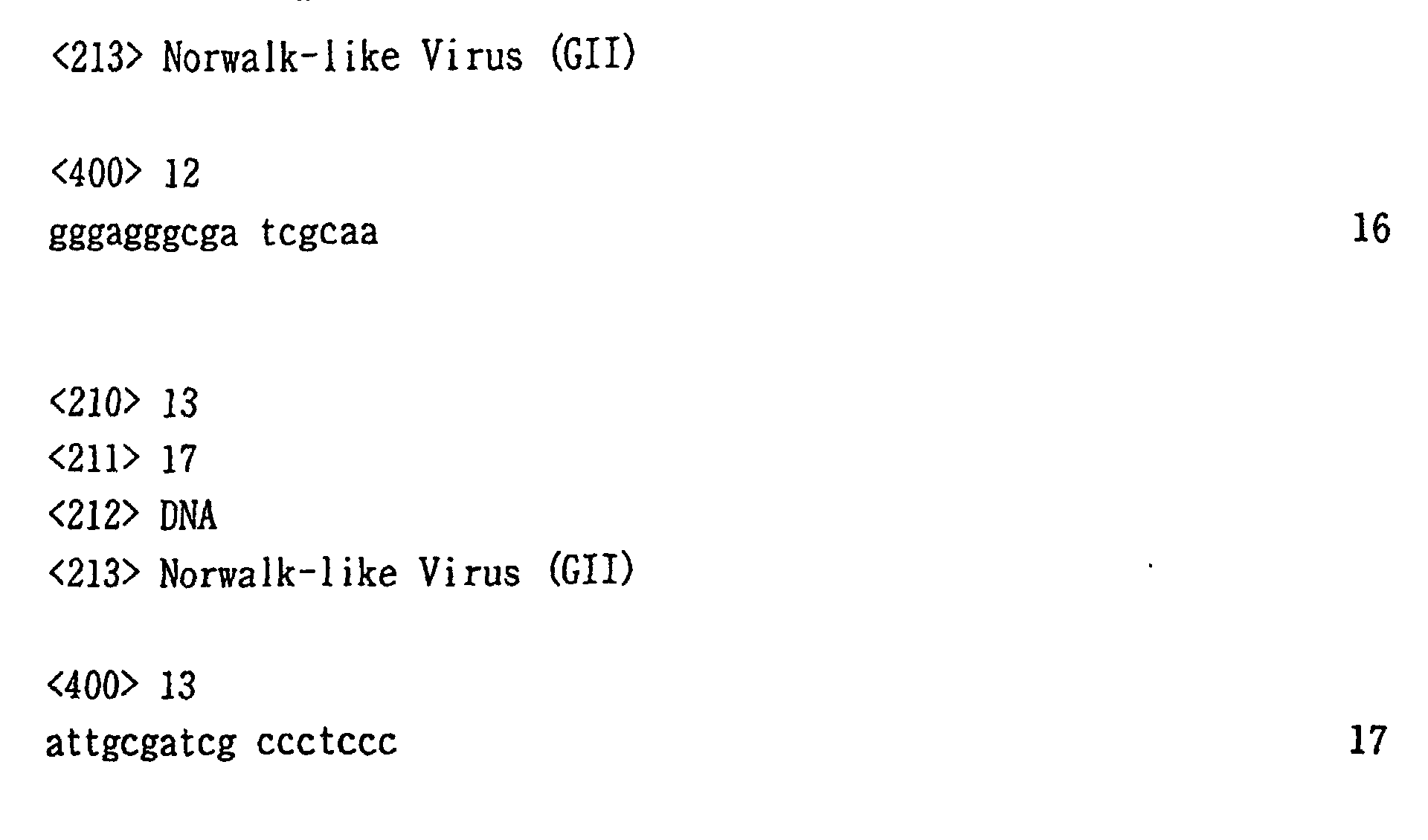
- Detection of NLVs in the present example was performed by use of the following nucleic acid primers for gene amplification and nucleic acid probes for gene detection.
- the nucleic acids described below were chemically synthesized by use of a full-automated ABI 3948 Nucleic Acid Synthesis and Purification System (Applied Biosystems).
- nucleotide sequence of the prototype corresponding to a nucleotide sequence that is complementary to the 5048- to 5067-positions of the nucleotide sequence of the prototype
- the 5'-terminus and the 3'-terminus of all the Taq-Man probes used in the present example were labeled with TET and TAMARA, respectively (labeling was performed in accordance with the method described in Nucleic Acids Research (1993, 21 (16): 3761-3766)).
- nucleotide sequence of the prototype corresponding to the 5048- to 5067-positions of the nucleotide sequence of the prototype) corresponding to the 5049- to 5064-positions of the nucleotide sequence of the prototype) corresponding to a nucleotide sequence that is complementary to the 5048- to 5067-positions of the nucleotide sequence of the prototype) corresponding to a nucleotide sequence that is complementary to the 5050- to 5067-positions of the nucleotide sequence of the prototype) corresponding to a nucleotide sequence that is complementary to the 5048- to 5066-positions of the nucleotide sequence of the prototype) corresponding to a nucleotide sequence that is complementary to the 5048- to 5066-positions of the nucleotide sequence of the prototype) corresponding to a nucleotide sequence that is complementary to the 5048- to 5066-positions of the nucleotide sequence of the prototype) corresponding to a nucleotide
- the 5'-terminus and the 3'-terminus of all the molecular beacon probes used in the present example were labeled with TET and DABCYL, respectively (labeling was performed in accordance with the method described in Nature Biotechnology (1996, 14: 303-308)).
- the detection method of the present invention was performed on the RNA samples extracted from stool specimens collected from 44 cases of non-bacterial gastroenteritis from which NLV particles were detected through electron microscopy performed in the Saitama Institute of Public Health during the period from 1998 to 2000, the specimens being the same as those employed in the above-described test to investigate highly conserved regions of NLV (GII) genes.
- each of the RNA samples was subjected to reverse transcription reaction. Briefly, each of the RNA samples (8 ⁇ L) was mixed with a 12 ⁇ L solution for reverse transcription reaction.
- the solution was prepared as follows: A dNTP solution (10 mM, 1 ⁇ L), random hexamer (75 pmol), RNasin (30 units, Promega, USA), Superscript II RNaseH (-) Reverse Transcriptase (200 units, Gibco BRL, USA), DTT (100 mM, 1 ⁇ L), and a 5-fold diluted reverse transcription buffer (250 mM, Tris-HCl (pH 8.3), 375 mM KC1, 15 mM MgCl 2 ) were mixed, and the mixture was diluted with sterilized distilled water to attain a total volume of 12 ⁇ L.) The mixture was allowed to react at 42°C for one hour or more.
- RNA samples RNA samples
- a reaction mixture was prepared as follows: A buffer (25 ⁇ L), RT products (5 ⁇ L), primer (50 nM each), and fluorescent probe (Taq-Man probe G2TM1, 5-20 pmol) were mixed, and the mixture was diluted with sterilized distilled water to attain a total volume of 50 ⁇ L.
- the reaction mixture was subjected to PCR reaction by use of a nucleic acid obtained through mixing G2FA, G2RA1, and G2RA2 (gene amplification primers) as a primer set for gene amplification, and a Taq-Man universal buffer Kit (ABI, USA) (PCR cycle: 50°C for two minutes ⁇ 95°C for 10 minutes ⁇ (95°Csec ⁇ 56°C for three minutes) ⁇ 50 cycles)).
- the fluorescence intensity was monitored over time during the reaction by use of ABI7700 (ABI, USA).
- a cDNA fragment of SzuGII strain was subjected to cloning by use of pT7blue vector (Novagen, USA) through a conventional method.
- the fragment has a nucleotide sequence corresponding to the 5207- to 5696-positions of the nucleotide sequence of the cDNA of the prototype (standard strain) of NLVs (GII).
- NLV (GII) gene detection was performed in accordance with the aforementioned procedure.
- the gene detection probe was a Taq-Man probe G2TM2 (instead of G2TM1), or a molecular beacon probe G2MB1 to 7, analogous results were obtained.
- the method was performed through use of fresh oysters instead of the aforementioned stool specimens as test specimens.
- the midgut gland was removed, and sterilized distilled water was added thereto. Subsequently, the midgut gland was subjected to three cycles of freezing and thawing, whereby the tissues of the midgut gland were lyzed. The lyzed tissues were subjected to centrifugation at 10,000 ⁇ g for 20 minutes. From the supernatant (140 ⁇ L) obtained through the centrifugation, nucleic acid was extracted through use of QIA Viral RNA (QIAGEN, USA) in accordance with the manufacturer's protocol. The extract was suspended in sterilized distilled water (50 ⁇ L). Through use of the suspension as an RNA sample of each fresh oyster, the detection method of the present invention was carried out by use of a molecular beacon probe G2MB1 as a gene detection probe in accordance with the procedure described in (1) above.
- NLVs (GII) were detected in two fresh oyster individuals.
- the detection method of the present invention enables rapid, accurate detection of NLVs (GII). Moreover, as described above, through use of a nucleic acid probe specific to NLVs (GII) as a primer for gene detection, by monitoring the gene amplification process, the detection method of the present invention enables quantitative detection of NLVs (GII). In conclusion, the present invention provides a virus detection method of very high sensitivity and efficiency.
- the present invention has identified a highly conserved gene region in the genes of NLVs (GII), and on the basis of this finding, a rapid, accurate means for detecting NLVs is provided.
Landscapes
- Chemical & Material Sciences (AREA)
- Life Sciences & Earth Sciences (AREA)
- Health & Medical Sciences (AREA)
- Organic Chemistry (AREA)
- Zoology (AREA)
- Engineering & Computer Science (AREA)
- Immunology (AREA)
- Wood Science & Technology (AREA)
- Proteomics, Peptides & Aminoacids (AREA)
- Virology (AREA)
- Biochemistry (AREA)
- Microbiology (AREA)
- Molecular Biology (AREA)
- Physics & Mathematics (AREA)
- Biophysics (AREA)
- Analytical Chemistry (AREA)
- Biotechnology (AREA)
- Bioinformatics & Cheminformatics (AREA)
- General Engineering & Computer Science (AREA)
- General Health & Medical Sciences (AREA)
- Genetics & Genomics (AREA)
- Measuring Or Testing Involving Enzymes Or Micro-Organisms (AREA)
- Micro-Organisms Or Cultivation Processes Thereof (AREA)
Abstract
Description
- For amplification of a special conserved region:
corresponding to the 5003- to 5028-positions of the nucleotide sequence of the prototype)

- For amplification of a highly conserved region:
corresponding to the 4922- to 4941-positions of the nucleotide sequence of the prototype)
 corresponding to the 4922- to 4941-positions of the nucleotide sequence of the prototype)
 corresponding to the 4922- to 4941-positions of the nucleotide sequence of the prototype)
- For amplification of a special conserved region:
corresponding to a nucleotide sequence that is complementary to the 5080- to 5100-positions of the nucleotide sequence of the prototype)
 corresponding to a nucleotide sequence that is complementary to the 5085- to 5104-positions of the nucleotide sequence of the prototype)
- For amplification of a highly conserved region:
corresponding to a nucleotide sequence that is complementary to the 5367- to 5389-positions of the nucleotide sequence of the prototype)
 corresponding to a nucleotide sequence that is complementary to the 5367- to 5389-positions of the nucleotide sequence of the prototype)
 corresponding to a nucleotide sequence that is complementary to the 5367- to 5389-positions of the nucleotide sequence of the prototype)






(2) In order to demonstrate that the detection method of the present invention can be carried out on food, the method was performed through use of fresh oysters instead of the aforementioned stool specimens as test specimens.


Claims (20)
- A method of detecting a virus in a specimen, whereby a Norwalk-like virus (GII) is detected by using as an index the nucleic acids of a complementary nucleotide sequence corresponding to the 4851- to 5450-positions of the nucleotide sequence of the cDNA of the prototype (standard strain) of the Norwalk-like virus (GII).
- A method of detecting a virus in a specimen, whereby a Norwalk-like virus (GII) is detected by using as an index the nucleic acids of a complementary nucleotide sequence corresponding to the 4919- to 5389-positions of the nucleotide sequence of the cDNA of the prototype (standard strain) of the Norwalk-like virus (GII).
- A method of detecting a virus in a specimen, whereby a Norwalk-like virus (GII) is detected by using as an index the nucleic acids of a complementary nucleotide sequence corresponding to the 4988- to 5107-positions of the nucleotide sequence of the cDNA of the prototype (standard strain) of the Norwalk-like virus (GII).
- The method of detecting a virus as described in any of claims 1 through 3, wherein the nucleic acids of the complementary nucleotide sequence serving as a detection index and corresponding to a region of the nucleotide sequence of the cDNA of the prototype (standard strain) of the Norwalk-like virus (GII) is a gene amplification product obtained by applying, for attaining gene amplification, gene amplification means to genes obtained from the specimen,
wherein the gene amplification means comprises gene amplification primers engineered on the basis of at least two nucleotide sequences each having consecutive 10 or more bases which are selected from the complementary nucleotide sequence. - The method of detecting a virus as described in claim 4, wherein the at least two complementary nucleotide sequences of consecutive 10 or more bases and serving as a basis for the engineering of gene amplification primers have 15 to 30 consecutive bases.
- The method of detecting a virus as described in claim 4 or 5, wherein the at least two complementary nucleotide sequences of consecutive 10 or more bases and serving as a basis for the engineering of gene amplification primers are nucleotide sequences of consecutive 10 or more bases selected, as a benchmark, from the group consisting of nucleotide sequences of the 4988- to 5028-positions of the nucleotide sequence of the cDNA of the prototype (standard strain) of the Norwalk-like virus (GII), the 5080- to 5107-positions thereof, the 4919- to 4941-positions thereof, and the 5367- to 5389-positions thereof.
- The method of detecting a virus as described in claim 4 or 5, wherein the at least two nucleotide sequences of consecutive 10 or more bases, the nucleotide sequences serving as a basis for the engineering of gene amplification primers, are the 4988- to 5028-positions and the 5080- to 5107-positions of the nucleotide sequence of the cDNA of the prototype (standard strain) of the Norwalk-like virus (GII).
- The method of detecting a virus as described in claim 7, wherein the nucleotide sequences of the gene amplification primers are complementary nucleotide sequences constituting the following combinations <1> or <2>:<1> A nucleotide sequence set composed of a nucleotide sequence selected from the group consisting of SEQ ID NO: 2, 3 and 4, and one or more sequences selected from among SEQ ID NOs: 7, 8, and 9;<2> A nucleotide sequence set composed of a nucleotide sequence of SEQ ID NO: 1, and nucleotide sequence(s) of SEQ ID NO: 5 and/or 6.
- The method of detecting a virus as described in any of claims 6 through 8, wherein the gene amplification product to be obtained corresponding to the Norwalk-like virus (GII) contains at least a complementary nucleotide sequence corresponding to the 4942- to 5366-positions of the nucleotide sequence of the cDNA of the prototype of the Norwalk-like virus (GII), and the complementary nucleotide sequence is detected as an indication of the presence of the Norwalk-like virus (GII).
- The method of detecting a virus as described in any of claims 6 through 8, wherein the gene amplification product to be obtained corresponding to the Norwalk-like virus (GII) contains at least a complementary nucleotide sequence corresponding to the 5042- to 5067-positions of the nucleotide sequence of the cDNA of the prototype of the Norwalk-like virus (GII), and the complementary nucleotide sequence is detected as an indication of the presence of the Norwalk-like virus (GII).
- The method of detecting a virus as described in any of claims 6 through 10, wherein the detection of gene amplification product with respect to the Norwalk-like virus (GII) is detection of a specific region of the gene amplification product, the detection being performed through at least using a nucleic acid probe for gene detection containing a nucleotide sequence complementary to a complementary nucleotide sequence corresponding to the 5042- to 5067-positions of the nucleotide sequence of the cDNA of the prototype (standard strain) of the Norwalk-like virus (GII).
- The method of detecting a virus as described in any of claims 6 through 11, wherein the nucleic acid probe for gene detection comprises nucleotide sequences of one or more complementary nucleotide sequences selected from the group consisting of SEQ ID NOs: 10, 11, and 12.
- The method of detecting a virus as described in claim 12, wherein the nucleic acid probe for gene detection is a molecular beacon probe or a Taq-Man probe.
- The method of detecting a virus as described in any of claims 1 through 13, which quantitatively detects the Norwalk-like virus (GII).
- A kit for detecting a virus, which is used for performing a method of detecting a virus as recited in any of claims 1 through 14 and containing the following gene amplification primers and/or a nucleic acid probe for gene detection:<1> gene amplification primers, comprising at least two nucleotide sequences of consecutive 10 or more bases falling within the nucleotide sequence of the complementary nucleotide sequence corresponding to the 4919- to 5389-positions of the nucleotide sequence of the cDNA of the prototype (standard strain) of the Norwalk-like virus (GII); and<2> a nucleic acid probe for gene detection which is to be used together with the above-described gene amplification primers, which has a nucleotide sequence complementary to a gene amplification product obtained from the gene of the Norwalk-like virus (GII), and which is labeled with a labeling substance to be detected.
- The kit for detecting a virus as described in claim 15, wherein the nucleotide sequences on the basis of which the gene amplification primers are engineered are complementary nucleotide sequences, one being selected from the 4988- to 5028-positions and another being selected from the 5080- to 5107-positions of the nucleotide sequence of the cDNA of the prototype (standard strain) of the Norwalk-like virus (GII).
- The kit for detecting a virus as described in claim 16, wherein the nucleotide sequences of the gene amplification primers are complementary nucleotide sequences which constitute either of the following sets <1> or <2>:<1> A nucleotide sequence set composed of a nucleotide sequence selected from the group consisting of SEQ ID NO: 2, 3 and 4, and one or more sequences selected from among SEQ ID NOs: 7, 8, and 9;<2> A nucleotide sequence set composed of a nucleotide sequence of SEQ ID NO: 1, and nucleotide sequence(s) of SEQ ID NO: 5 and/or 6.
- The kit for detecting a virus as described in any of claims 15 to 17, wherein the nucleic acid probe for gene detection comprises a nucleotide sequence complementary to a complementary nucleotide sequence corresponding to the 5042- to 5067-positions of the nucleotide sequence of the cDNA of the prototype (standard strain) of the Norwalk-like virus (GII).
- The method of detecting a virus as described in any of claims 15 through 18, wherein the nucleic acid probe for gene detection comprises the nucleotide sequence of one or more complementary nucleotide sequences selected from the group consisting of SEQ ID NOs: 10, 11, and 12.
- The kit for detecting a virus as described in any of claims 15 to 19, wherein the nucleic acid probe for gene detection is a molecular beacon probe or a Taq-Man probe.
Applications Claiming Priority (3)
| Application Number | Priority Date | Filing Date | Title |
|---|---|---|---|
| JP2000300724 | 2000-09-29 | ||
| JP2000300724 | 2000-09-29 | ||
| PCT/JP2001/002542 WO2002029120A1 (en) | 2000-09-29 | 2001-03-28 | Method of detecting norwalk-like virus (gii) |
Publications (4)
| Publication Number | Publication Date |
|---|---|
| EP1329523A1 true EP1329523A1 (en) | 2003-07-23 |
| EP1329523A4 EP1329523A4 (en) | 2006-06-07 |
| EP1329523B1 EP1329523B1 (en) | 2009-07-22 |
| EP1329523B2 EP1329523B2 (en) | 2016-09-07 |
Family
ID=18782362
Family Applications (1)
| Application Number | Title | Priority Date | Filing Date |
|---|---|---|---|
| EP01917525.6A Expired - Lifetime EP1329523B2 (en) | 2000-09-29 | 2001-03-28 | Method of detecting norwalk-like virus (gii) |
Country Status (8)
| Country | Link |
|---|---|
| US (1) | US7351819B2 (en) |
| EP (1) | EP1329523B2 (en) |
| JP (1) | JP4414648B2 (en) |
| AT (1) | ATE437243T1 (en) |
| AU (1) | AU2001244578A1 (en) |
| CA (1) | CA2424333C (en) |
| DE (1) | DE60139333D1 (en) |
| WO (1) | WO2002029120A1 (en) |
Cited By (2)
| Publication number | Priority date | Publication date | Assignee | Title |
|---|---|---|---|---|
| EP1561824A1 (en) | 2004-02-04 | 2005-08-10 | Tosoh Corporation | Norovirus detection reagent |
| CN111748552A (en) * | 2019-12-24 | 2020-10-09 | 深圳市人民医院 | Kits for serial virus detection of five types of diarrheal diseases in children and their applications |
Families Citing this family (5)
| Publication number | Priority date | Publication date | Assignee | Title |
|---|---|---|---|---|
| US20060110724A1 (en) | 2004-11-19 | 2006-05-25 | Burkhardt William Iii | Quantitative real-time assay for noroviruses and enteroviruses with built in quality control standard |
| WO2013074785A1 (en) * | 2011-11-15 | 2013-05-23 | The Government Of The United States Of America As Represented By The Secretary Of The Department Of Health And Human Services, Centers For Disease Control And Prevention | Selective detection of norovirus |
| JP6569238B2 (en) * | 2015-02-24 | 2019-09-04 | 東洋紡株式会社 | Method for detecting norovirus GII group |
| RU2610434C1 (en) * | 2015-11-05 | 2017-02-10 | Федеральное бюджетное учреждение науки "Государственный научный центр вирусологии и биотехнологии "Вектор" (ФБУН ГНЦ ВБ "Вектор") | Set of oligodeoxyribonucleotide primers and fluorescent-marked dna probes for identification of rna enteroviruses, rotoviruses, hepatitis a and e viruses, adenoviruses, noroviruses and astroviruses from an aqueous medium by multiplex polymerase chain reaction |
| JP7555179B2 (en) | 2018-11-30 | 2024-09-24 | 株式会社島津製作所 | How to detect norovirus |
Family Cites Families (5)
| Publication number | Priority date | Publication date | Assignee | Title |
|---|---|---|---|---|
| US6800744B1 (en) * | 1997-07-02 | 2004-10-05 | Genome Therapeutics Corporation | Nucleic acid and amino acid sequences relating to Streptococcus pneumoniae for diagnostics and therapeutics |
| US6380370B1 (en) * | 1997-08-14 | 2002-04-30 | Genome Therapeutics Corporation | Nucleic acid and amino acid sequences relating to Staphylococcus epidermidis for diagnostics and therapeutics |
| US7026454B1 (en) * | 1998-02-17 | 2006-04-11 | University Of Kansas Medical Center | Neuroendocrine marker of prostate cancer and method for producing same |
| US6783961B1 (en) * | 1999-02-26 | 2004-08-31 | Genset S.A. | Expressed sequence tags and encoded human proteins |
| US6812339B1 (en) * | 2000-09-08 | 2004-11-02 | Applera Corporation | Polymorphisms in known genes associated with human disease, methods of detection and uses thereof |
-
2001
- 2001-03-28 JP JP2002532688A patent/JP4414648B2/en not_active Expired - Lifetime
- 2001-03-28 WO PCT/JP2001/002542 patent/WO2002029120A1/en not_active Ceased
- 2001-03-28 CA CA2424333A patent/CA2424333C/en not_active Expired - Lifetime
- 2001-03-28 DE DE60139333T patent/DE60139333D1/en not_active Expired - Lifetime
- 2001-03-28 AU AU2001244578A patent/AU2001244578A1/en not_active Abandoned
- 2001-03-28 EP EP01917525.6A patent/EP1329523B2/en not_active Expired - Lifetime
- 2001-03-28 AT AT01917525T patent/ATE437243T1/en not_active IP Right Cessation
- 2001-03-28 US US10/381,813 patent/US7351819B2/en not_active Expired - Lifetime
Non-Patent Citations (4)
| Title |
|---|
| DATABASE GENBANK [Online] 19 November 1999 (1999-11-19), SEAH,E.L., MARSHALL,J.A. AND WRIGHT,P.J.: "Camberwell virus polyprotein and capsid genes, complete cds; and unknown gene." XP002374637 retrieved from NCBI Database accession no. AF145896 * |
| KOBAYASHI S ET AL: "Molecular cloning, expression, and antigenicity of Seto virus belonging to genogroup I Norwalk-like viruses" JOURNAL OF CLINICAL MICROBIOLOGY, WASHINGTON, DC, US, vol. 38, no. 9, September 2000 (2000-09), pages 3492-3494, XP002325487 ISSN: 0095-1137 * |
| See also references of WO0229120A1 * |
| WRIGHT PETER J ET AL: "Small round-structured (norwalk-like) viruses and classical human caliciviruses in southeastern Australia, 1980-1996" August 1998 (1998-08), JOURNAL OF MEDICAL VIROLOGY, VOL. 55, NR. 4, PAGE(S) 312-320 , XP002374634 ISSN: 0146-6615 * page 313, column 2, paragraph 1 * * |
Cited By (3)
| Publication number | Priority date | Publication date | Assignee | Title |
|---|---|---|---|---|
| EP1561824A1 (en) | 2004-02-04 | 2005-08-10 | Tosoh Corporation | Norovirus detection reagent |
| EP1892305A1 (en) * | 2004-02-04 | 2008-02-27 | Tosoh Corporation | Norovirus detection reagent |
| CN111748552A (en) * | 2019-12-24 | 2020-10-09 | 深圳市人民医院 | Kits for serial virus detection of five types of diarrheal diseases in children and their applications |
Also Published As
| Publication number | Publication date |
|---|---|
| EP1329523B1 (en) | 2009-07-22 |
| EP1329523A4 (en) | 2006-06-07 |
| CA2424333A1 (en) | 2003-03-28 |
| CA2424333C (en) | 2011-02-08 |
| JPWO2002029120A1 (en) | 2004-02-12 |
| EP1329523B2 (en) | 2016-09-07 |
| WO2002029120A1 (en) | 2002-04-11 |
| AU2001244578A1 (en) | 2002-04-15 |
| JP4414648B2 (en) | 2010-02-10 |
| ATE437243T1 (en) | 2009-08-15 |
| US20040072145A1 (en) | 2004-04-15 |
| DE60139333D1 (en) | 2009-09-03 |
| US7351819B2 (en) | 2008-04-01 |
Similar Documents
| Publication | Publication Date | Title |
|---|---|---|
| US7563577B2 (en) | Materials and methods for detection of enterovirus and norovirus | |
| Nunan et al. | Use of polymerase chain reaction for the detection of infectious hypodermal and hematopoietic necrosis virus in penaeid shrimp | |
| CN108330210B (en) | Zika virus, dengue virus and chikungunya virus nucleic acid detection kit and its use | |
| CN108384899B (en) | Fluorescent quantitative PCR kit for detecting novel goose astrovirus and application thereof | |
| EP2780477B1 (en) | Selective detection of norovirus | |
| US20090226895A1 (en) | Method of detecting vibrio parahaemolyticus via real-time PCR-hybridization | |
| EP1329523B1 (en) | Method of detecting norwalk-like virus (gii) | |
| EP1329522B1 (en) | Method of detecting norwalk-like virus (gi) | |
| WO2000026414A1 (en) | METHODS AND KITS FOR DETECTION OF $i(CRYPTOSPORIDIUM PARVUM) | |
| WO1999034020A1 (en) | Isothermal transcription based assay for the detection and genotyping of dengue virus | |
| KR20120094155A (en) | Nucleic acid detection | |
| KR102726864B1 (en) | Composition For Detecting White Spot Syndrom Virus and Method of Detecting White Spot Syndrom Virus Using the Same | |
| JP4898210B2 (en) | How to detect sapovirus | |
| EP1466019A2 (en) | Detection of human papillomavirus e6 mrna | |
| KR20090095751A (en) | Method for rapid detection infectious microorganisms of unknown sample | |
| CN106929601B (en) | High-sensitivity human papilloma virus 6,11 type nucleic acid detection kit | |
| JP2006254750A (en) | Koi herpesvirus (KHV) detection method | |
| CN116179761A (en) | A visual detection kit for fish rhabdovirus and its detection method | |
| JPWO2006009260A1 (en) | Method for detecting hepatitis E virus | |
| EP1859062A2 (en) | Detection of very virulent infectious bursal disease virus | |
| Sahu | Tools and Techniques for Recovery, Detection, and Inactivation of Foodborne Viruses | |
| CN120989300A (en) | A rapid detection method, composition, and kit for GII norovirus based on RPA-CRISPR/Cas13 and its applications. | |
| Jiang et al. | in Stools by RT-PCR | |
| JP2002153289A (en) | Nucleotide Sequence Characterizing Genogroup Type II Small Spherical Virus and Oligonucleotides for Detection | |
| EP1347064A2 (en) | Base sequence characteristic of small round-structured viruses |
Legal Events
| Date | Code | Title | Description |
|---|---|---|---|
| PUAI | Public reference made under article 153(3) epc to a published international application that has entered the european phase |
Free format text: ORIGINAL CODE: 0009012 |
|
| 17P | Request for examination filed |
Effective date: 20030428 |
|
| AK | Designated contracting states |
Designated state(s): AT BE CH CY DE DK ES FI FR GB GR IE IT LI LU MC NL PT SE TR |
|
| AX | Request for extension of the european patent |
Extension state: AL LT LV MK RO SI |
|
| A4 | Supplementary search report drawn up and despatched |
Effective date: 20060511 |
|
| 17Q | First examination report despatched |
Effective date: 20060816 |
|
| GRAP | Despatch of communication of intention to grant a patent |
Free format text: ORIGINAL CODE: EPIDOSNIGR1 |
|
| GRAS | Grant fee paid |
Free format text: ORIGINAL CODE: EPIDOSNIGR3 |
|
| GRAA | (expected) grant |
Free format text: ORIGINAL CODE: 0009210 |
|
| AK | Designated contracting states |
Kind code of ref document: B1 Designated state(s): AT BE CH CY DE DK ES FI FR GB GR IE IT LI LU MC NL PT SE TR |
|
| REG | Reference to a national code |
Ref country code: GB Ref legal event code: FG4D |
|
| REG | Reference to a national code |
Ref country code: CH Ref legal event code: EP |
|
| REG | Reference to a national code |
Ref country code: IE Ref legal event code: FG4D |
|
| REF | Corresponds to: |
Ref document number: 60139333 Country of ref document: DE Date of ref document: 20090903 Kind code of ref document: P |
|
| NLV1 | Nl: lapsed or annulled due to failure to fulfill the requirements of art. 29p and 29m of the patents act | ||
| PG25 | Lapsed in a contracting state [announced via postgrant information from national office to epo] |
Ref country code: FI Free format text: LAPSE BECAUSE OF FAILURE TO SUBMIT A TRANSLATION OF THE DESCRIPTION OR TO PAY THE FEE WITHIN THE PRESCRIBED TIME-LIMIT Effective date: 20090722 Ref country code: ES Free format text: LAPSE BECAUSE OF FAILURE TO SUBMIT A TRANSLATION OF THE DESCRIPTION OR TO PAY THE FEE WITHIN THE PRESCRIBED TIME-LIMIT Effective date: 20091102 Ref country code: SE Free format text: LAPSE BECAUSE OF FAILURE TO SUBMIT A TRANSLATION OF THE DESCRIPTION OR TO PAY THE FEE WITHIN THE PRESCRIBED TIME-LIMIT Effective date: 20090722 Ref country code: AT Free format text: LAPSE BECAUSE OF FAILURE TO SUBMIT A TRANSLATION OF THE DESCRIPTION OR TO PAY THE FEE WITHIN THE PRESCRIBED TIME-LIMIT Effective date: 20090722 |
|
| PG25 | Lapsed in a contracting state [announced via postgrant information from national office to epo] |
Ref country code: NL Free format text: LAPSE BECAUSE OF FAILURE TO SUBMIT A TRANSLATION OF THE DESCRIPTION OR TO PAY THE FEE WITHIN THE PRESCRIBED TIME-LIMIT Effective date: 20090722 |
|
| PG25 | Lapsed in a contracting state [announced via postgrant information from national office to epo] |
Ref country code: PT Free format text: LAPSE BECAUSE OF FAILURE TO SUBMIT A TRANSLATION OF THE DESCRIPTION OR TO PAY THE FEE WITHIN THE PRESCRIBED TIME-LIMIT Effective date: 20091122 |
|
| PG25 | Lapsed in a contracting state [announced via postgrant information from national office to epo] |
Ref country code: DK Free format text: LAPSE BECAUSE OF FAILURE TO SUBMIT A TRANSLATION OF THE DESCRIPTION OR TO PAY THE FEE WITHIN THE PRESCRIBED TIME-LIMIT Effective date: 20090722 |
|
| PLBI | Opposition filed |
Free format text: ORIGINAL CODE: 0009260 |
|
| PLAX | Notice of opposition and request to file observation + time limit sent |
Free format text: ORIGINAL CODE: EPIDOSNOBS2 |
|
| PG25 | Lapsed in a contracting state [announced via postgrant information from national office to epo] |
Ref country code: BE Free format text: LAPSE BECAUSE OF FAILURE TO SUBMIT A TRANSLATION OF THE DESCRIPTION OR TO PAY THE FEE WITHIN THE PRESCRIBED TIME-LIMIT Effective date: 20090722 |
|
| 26 | Opposition filed |
Opponent name: ZWICKER, JOERK Effective date: 20100422 |
|
| PLAF | Information modified related to communication of a notice of opposition and request to file observations + time limit |
Free format text: ORIGINAL CODE: EPIDOSCOBS2 |
|
| PG25 | Lapsed in a contracting state [announced via postgrant information from national office to epo] |
Ref country code: MC Free format text: LAPSE BECAUSE OF NON-PAYMENT OF DUE FEES Effective date: 20100331 Ref country code: GR Free format text: LAPSE BECAUSE OF FAILURE TO SUBMIT A TRANSLATION OF THE DESCRIPTION OR TO PAY THE FEE WITHIN THE PRESCRIBED TIME-LIMIT Effective date: 20091023 |
|
| REG | Reference to a national code |
Ref country code: CH Ref legal event code: PL |
|
| PLAF | Information modified related to communication of a notice of opposition and request to file observations + time limit |
Free format text: ORIGINAL CODE: EPIDOSCOBS2 |
|
| PG25 | Lapsed in a contracting state [announced via postgrant information from national office to epo] |
Ref country code: IE Free format text: LAPSE BECAUSE OF NON-PAYMENT OF DUE FEES Effective date: 20100328 |
|
| PG25 | Lapsed in a contracting state [announced via postgrant information from national office to epo] |
Ref country code: CH Free format text: LAPSE BECAUSE OF NON-PAYMENT OF DUE FEES Effective date: 20100331 Ref country code: LI Free format text: LAPSE BECAUSE OF NON-PAYMENT OF DUE FEES Effective date: 20100331 |
|
| PG25 | Lapsed in a contracting state [announced via postgrant information from national office to epo] |
Ref country code: IT Free format text: LAPSE BECAUSE OF FAILURE TO SUBMIT A TRANSLATION OF THE DESCRIPTION OR TO PAY THE FEE WITHIN THE PRESCRIBED TIME-LIMIT Effective date: 20090722 |
|
| REG | Reference to a national code |
Ref country code: DE Ref legal event code: R082 Ref document number: 60139333 Country of ref document: DE Representative=s name: BOEHMERT & BOEHMERT ANWALTSPARTNERSCHAFT MBB -, DE Ref country code: DE Ref legal event code: R082 Ref document number: 60139333 Country of ref document: DE Representative=s name: BOEHMERT & BOEHMERT, DE |
|
| PLBB | Reply of patent proprietor to notice(s) of opposition received |
Free format text: ORIGINAL CODE: EPIDOSNOBS3 |
|
| PG25 | Lapsed in a contracting state [announced via postgrant information from national office to epo] |
Ref country code: CY Free format text: LAPSE BECAUSE OF FAILURE TO SUBMIT A TRANSLATION OF THE DESCRIPTION OR TO PAY THE FEE WITHIN THE PRESCRIBED TIME-LIMIT Effective date: 20090722 |
|
| APBM | Appeal reference recorded |
Free format text: ORIGINAL CODE: EPIDOSNREFNO |
|
| APBP | Date of receipt of notice of appeal recorded |
Free format text: ORIGINAL CODE: EPIDOSNNOA2O |
|
| APAH | Appeal reference modified |
Free format text: ORIGINAL CODE: EPIDOSCREFNO |
|
| PG25 | Lapsed in a contracting state [announced via postgrant information from national office to epo] |
Ref country code: LU Free format text: LAPSE BECAUSE OF NON-PAYMENT OF DUE FEES Effective date: 20100328 |
|
| PG25 | Lapsed in a contracting state [announced via postgrant information from national office to epo] |
Ref country code: TR Free format text: LAPSE BECAUSE OF FAILURE TO SUBMIT A TRANSLATION OF THE DESCRIPTION OR TO PAY THE FEE WITHIN THE PRESCRIBED TIME-LIMIT Effective date: 20090722 |
|
| APBQ | Date of receipt of statement of grounds of appeal recorded |
Free format text: ORIGINAL CODE: EPIDOSNNOA3O |
|
| REG | Reference to a national code |
Ref country code: FR Ref legal event code: PLFP Year of fee payment: 16 |
|
| APBU | Appeal procedure closed |
Free format text: ORIGINAL CODE: EPIDOSNNOA9O |
|
| PUAH | Patent maintained in amended form |
Free format text: ORIGINAL CODE: 0009272 |
|
| STAA | Information on the status of an ep patent application or granted ep patent |
Free format text: STATUS: PATENT MAINTAINED AS AMENDED |
|
| 27A | Patent maintained in amended form |
Effective date: 20160907 |
|
| AK | Designated contracting states |
Kind code of ref document: B2 Designated state(s): AT BE CH CY DE DK ES FI FR GB GR IE IT LI LU MC NL PT SE TR |
|
| REG | Reference to a national code |
Ref country code: DE Ref legal event code: R102 Ref document number: 60139333 Country of ref document: DE |
|
| REG | Reference to a national code |
Ref country code: FR Ref legal event code: PLFP Year of fee payment: 17 |
|
| REG | Reference to a national code |
Ref country code: FR Ref legal event code: PLFP Year of fee payment: 18 |
|
| PGFP | Annual fee paid to national office [announced via postgrant information from national office to epo] |
Ref country code: DE Payment date: 20200317 Year of fee payment: 20 Ref country code: GB Payment date: 20200318 Year of fee payment: 20 |
|
| PGFP | Annual fee paid to national office [announced via postgrant information from national office to epo] |
Ref country code: FR Payment date: 20200214 Year of fee payment: 20 |
|
| REG | Reference to a national code |
Ref country code: DE Ref legal event code: R071 Ref document number: 60139333 Country of ref document: DE |
|
| REG | Reference to a national code |
Ref country code: GB Ref legal event code: PE20 Expiry date: 20210327 |
|
| PG25 | Lapsed in a contracting state [announced via postgrant information from national office to epo] |
Ref country code: GB Free format text: LAPSE BECAUSE OF EXPIRATION OF PROTECTION Effective date: 20210327 |