EP1329454A1 - Thienopyrimidine compounds and their salts and process for preparation of both - Google Patents
Thienopyrimidine compounds and their salts and process for preparation of both Download PDFInfo
- Publication number
- EP1329454A1 EP1329454A1 EP01970282A EP01970282A EP1329454A1 EP 1329454 A1 EP1329454 A1 EP 1329454A1 EP 01970282 A EP01970282 A EP 01970282A EP 01970282 A EP01970282 A EP 01970282A EP 1329454 A1 EP1329454 A1 EP 1329454A1
- Authority
- EP
- European Patent Office
- Prior art keywords
- optionally substituted
- alkyl
- formula
- alkoxy
- saturated
- Prior art date
- Legal status (The legal status is an assumption and is not a legal conclusion. Google has not performed a legal analysis and makes no representation as to the accuracy of the status listed.)
- Withdrawn
Links
- 238000000034 method Methods 0.000 title claims description 28
- 238000002360 preparation method Methods 0.000 title claims description 16
- 150000003839 salts Chemical class 0.000 title claims description 11
- RBNBDIMXFJYDLQ-UHFFFAOYSA-N thieno[3,2-d]pyrimidine Chemical class C1=NC=C2SC=CC2=N1 RBNBDIMXFJYDLQ-UHFFFAOYSA-N 0.000 title abstract description 3
- 125000004169 (C1-C6) alkyl group Chemical group 0.000 claims abstract description 43
- 125000004191 (C1-C6) alkoxy group Chemical group 0.000 claims abstract description 28
- 229920006395 saturated elastomer Polymers 0.000 claims abstract description 27
- 125000000623 heterocyclic group Chemical group 0.000 claims abstract description 26
- 125000005842 heteroatom Chemical group 0.000 claims abstract description 21
- 229910052760 oxygen Inorganic materials 0.000 claims abstract description 21
- 229910052739 hydrogen Inorganic materials 0.000 claims abstract description 19
- 239000001257 hydrogen Substances 0.000 claims abstract description 19
- 125000004435 hydrogen atom Chemical group [H]* 0.000 claims abstract description 17
- 229910052717 sulfur Inorganic materials 0.000 claims abstract description 17
- 125000001997 phenyl group Chemical group [H]C1=C([H])C([H])=C(*)C([H])=C1[H] 0.000 claims abstract description 16
- 125000000171 (C1-C6) haloalkyl group Chemical group 0.000 claims abstract description 14
- 125000002887 hydroxy group Chemical group [H]O* 0.000 claims abstract description 10
- 125000004093 cyano group Chemical group *C#N 0.000 claims abstract description 6
- 125000006552 (C3-C8) cycloalkyl group Chemical group 0.000 claims abstract description 5
- 125000000449 nitro group Chemical group [O-][N+](*)=O 0.000 claims abstract description 5
- 125000005843 halogen group Chemical group 0.000 claims abstract 2
- 150000001875 compounds Chemical class 0.000 claims description 59
- 229910052736 halogen Inorganic materials 0.000 claims description 27
- 150000002367 halogens Chemical group 0.000 claims description 26
- -1 thienopyrimidine compound Chemical class 0.000 claims description 20
- 125000004454 (C1-C6) alkoxycarbonyl group Chemical group 0.000 claims description 12
- 125000004076 pyridyl group Chemical group 0.000 claims description 9
- 125000001797 benzyl group Chemical group [H]C1=C([H])C([H])=C(C([H])=C1[H])C([H])([H])* 0.000 claims description 7
- 125000001424 substituent group Chemical group 0.000 claims description 5
- 229910004679 ONO2 Chemical group 0.000 claims description 3
- 125000005530 alkylenedioxy group Chemical group 0.000 claims description 3
- 125000000051 benzyloxy group Chemical group [H]C1=C([H])C([H])=C(C([H])=C1[H])C([H])([H])O* 0.000 claims description 3
- 125000000753 cycloalkyl group Chemical group 0.000 claims description 3
- 125000001893 nitrooxy group Chemical group [O-][N+](=O)O* 0.000 claims description 3
- 125000000951 phenoxy group Chemical group [H]C1=C([H])C([H])=C(O*)C([H])=C1[H] 0.000 claims description 3
- 125000005913 (C3-C6) cycloalkyl group Chemical group 0.000 claims description 2
- ZOOGRGPOEVQQDX-UUOKFMHZSA-N 3',5'-cyclic GMP Chemical compound C([C@H]1O2)OP(O)(=O)O[C@H]1[C@@H](O)[C@@H]2N1C(N=C(NC2=O)N)=C2N=C1 ZOOGRGPOEVQQDX-UUOKFMHZSA-N 0.000 abstract description 9
- 230000002401 inhibitory effect Effects 0.000 abstract description 6
- 102000004861 Phosphoric Diester Hydrolases Human genes 0.000 abstract description 5
- 108090001050 Phosphoric Diester Hydrolases Proteins 0.000 abstract description 5
- DDWBRNXDKNIQDY-UHFFFAOYSA-N thieno[2,3-d]pyrimidine Chemical class N1=CN=C2SC=CC2=C1 DDWBRNXDKNIQDY-UHFFFAOYSA-N 0.000 abstract description 2
- 239000003814 drug Substances 0.000 abstract 1
- 229940079593 drug Drugs 0.000 abstract 1
- 238000004519 manufacturing process Methods 0.000 abstract 1
- 238000006243 chemical reaction Methods 0.000 description 46
- 239000002904 solvent Substances 0.000 description 34
- ZMXDDKWLCZADIW-UHFFFAOYSA-N N,N-Dimethylformamide Chemical compound CN(C)C=O ZMXDDKWLCZADIW-UHFFFAOYSA-N 0.000 description 33
- YMWUJEATGCHHMB-UHFFFAOYSA-N Dichloromethane Chemical compound ClCCl YMWUJEATGCHHMB-UHFFFAOYSA-N 0.000 description 31
- HEDRZPFGACZZDS-UHFFFAOYSA-N Chloroform Chemical compound ClC(Cl)Cl HEDRZPFGACZZDS-UHFFFAOYSA-N 0.000 description 28
- RTZKZFJDLAIYFH-UHFFFAOYSA-N Diethyl ether Chemical compound CCOCC RTZKZFJDLAIYFH-UHFFFAOYSA-N 0.000 description 28
- IAZDPXIOMUYVGZ-UHFFFAOYSA-N Dimethylsulphoxide Chemical compound CS(C)=O IAZDPXIOMUYVGZ-UHFFFAOYSA-N 0.000 description 26
- WEVYAHXRMPXWCK-UHFFFAOYSA-N Acetonitrile Chemical compound CC#N WEVYAHXRMPXWCK-UHFFFAOYSA-N 0.000 description 24
- UHOVQNZJYSORNB-UHFFFAOYSA-N Benzene Chemical compound C1=CC=CC=C1 UHOVQNZJYSORNB-UHFFFAOYSA-N 0.000 description 24
- YXFVVABEGXRONW-UHFFFAOYSA-N Toluene Chemical compound CC1=CC=CC=C1 YXFVVABEGXRONW-UHFFFAOYSA-N 0.000 description 24
- 125000001495 ethyl group Chemical group [H]C([H])([H])C([H])([H])* 0.000 description 24
- 125000002496 methyl group Chemical group [H]C([H])([H])* 0.000 description 24
- XLYOFNOQVPJJNP-UHFFFAOYSA-N water Substances O XLYOFNOQVPJJNP-UHFFFAOYSA-N 0.000 description 21
- XHXFXVLFKHQFAL-UHFFFAOYSA-N phosphoryl trichloride Chemical compound ClP(Cl)(Cl)=O XHXFXVLFKHQFAL-UHFFFAOYSA-N 0.000 description 20
- 125000000440 benzylamino group Chemical group [H]N(*)C([H])([H])C1=C([H])C([H])=C([H])C([H])=C1[H] 0.000 description 19
- WYURNTSHIVDZCO-UHFFFAOYSA-N Tetrahydrofuran Chemical compound C1CCOC1 WYURNTSHIVDZCO-UHFFFAOYSA-N 0.000 description 18
- ZAMOUSCENKQFHK-UHFFFAOYSA-N Chlorine atom Chemical compound [Cl] ZAMOUSCENKQFHK-UHFFFAOYSA-N 0.000 description 17
- LFQSCWFLJHTTHZ-UHFFFAOYSA-N Ethanol Chemical compound CCO LFQSCWFLJHTTHZ-UHFFFAOYSA-N 0.000 description 17
- 229910052801 chlorine Inorganic materials 0.000 description 17
- 239000000460 chlorine Substances 0.000 description 17
- 125000001301 ethoxy group Chemical group [H]C([H])([H])C([H])([H])O* 0.000 description 17
- 125000000956 methoxy group Chemical group [H]C([H])([H])O* 0.000 description 17
- 239000000243 solution Substances 0.000 description 17
- 229910052731 fluorine Inorganic materials 0.000 description 16
- 239000011737 fluorine Substances 0.000 description 16
- CSNNHWWHGAXBCP-UHFFFAOYSA-L Magnesium sulfate Chemical compound [Mg+2].[O-][S+2]([O-])([O-])[O-] CSNNHWWHGAXBCP-UHFFFAOYSA-L 0.000 description 15
- ZMANZCXQSJIPKH-UHFFFAOYSA-N Triethylamine Chemical compound CCN(CC)CC ZMANZCXQSJIPKH-UHFFFAOYSA-N 0.000 description 15
- WKBOTKDWSSQWDR-UHFFFAOYSA-N Bromine atom Chemical compound [Br] WKBOTKDWSSQWDR-UHFFFAOYSA-N 0.000 description 14
- GDTBXPJZTBHREO-UHFFFAOYSA-N bromine Substances BrBr GDTBXPJZTBHREO-UHFFFAOYSA-N 0.000 description 14
- 229910052794 bromium Inorganic materials 0.000 description 14
- PXGOKWXKJXAPGV-UHFFFAOYSA-N Fluorine Chemical compound FF PXGOKWXKJXAPGV-UHFFFAOYSA-N 0.000 description 13
- VEXZGXHMUGYJMC-UHFFFAOYSA-N Hydrochloric acid Chemical compound Cl VEXZGXHMUGYJMC-UHFFFAOYSA-N 0.000 description 10
- 239000013078 crystal Substances 0.000 description 10
- 150000008282 halocarbons Chemical class 0.000 description 10
- 125000002883 imidazolyl group Chemical group 0.000 description 10
- WSLDOOZREJYCGB-UHFFFAOYSA-N 1,2-Dichloroethane Chemical compound ClCCCl WSLDOOZREJYCGB-UHFFFAOYSA-N 0.000 description 9
- HEMHJVSKTPXQMS-UHFFFAOYSA-M Sodium hydroxide Chemical compound [OH-].[Na+] HEMHJVSKTPXQMS-UHFFFAOYSA-M 0.000 description 9
- 238000009835 boiling Methods 0.000 description 9
- 125000004218 chloromethyl group Chemical group [H]C([H])(Cl)* 0.000 description 9
- 125000004772 dichloromethyl group Chemical group [H]C(Cl)(Cl)* 0.000 description 9
- 125000001028 difluoromethyl group Chemical group [H]C(F)(F)* 0.000 description 9
- 125000004216 fluoromethyl group Chemical group [H]C([H])(F)* 0.000 description 9
- YLQBMQCUIZJEEH-UHFFFAOYSA-N tetrahydrofuran Natural products C=1C=COC=1 YLQBMQCUIZJEEH-UHFFFAOYSA-N 0.000 description 9
- 125000003866 trichloromethyl group Chemical group ClC(Cl)(Cl)* 0.000 description 9
- 125000002023 trifluoromethyl group Chemical group FC(F)(F)* 0.000 description 9
- CTQNGGLPUBDAKN-UHFFFAOYSA-N O-Xylene Chemical compound CC1=CC=CC=C1C CTQNGGLPUBDAKN-UHFFFAOYSA-N 0.000 description 8
- JUJWROOIHBZHMG-UHFFFAOYSA-N Pyridine Chemical compound C1=CC=NC=C1 JUJWROOIHBZHMG-UHFFFAOYSA-N 0.000 description 8
- 150000004945 aromatic hydrocarbons Chemical class 0.000 description 8
- 125000003754 ethoxycarbonyl group Chemical group C(=O)(OCC)* 0.000 description 8
- 125000001160 methoxycarbonyl group Chemical group [H]C([H])([H])OC(*)=O 0.000 description 8
- 239000008096 xylene Substances 0.000 description 8
- 239000002253 acid Substances 0.000 description 7
- 238000001914 filtration Methods 0.000 description 7
- RYHBNJHYFVUHQT-UHFFFAOYSA-N 1,4-Dioxane Chemical compound C1COCCO1 RYHBNJHYFVUHQT-UHFFFAOYSA-N 0.000 description 6
- QTBSBXVTEAMEQO-UHFFFAOYSA-N Acetic acid Chemical compound CC(O)=O QTBSBXVTEAMEQO-UHFFFAOYSA-N 0.000 description 6
- XEKOWRVHYACXOJ-UHFFFAOYSA-N Ethyl acetate Chemical compound CCOC(C)=O XEKOWRVHYACXOJ-UHFFFAOYSA-N 0.000 description 6
- OKKJLVBELUTLKV-UHFFFAOYSA-N Methanol Chemical compound OC OKKJLVBELUTLKV-UHFFFAOYSA-N 0.000 description 6
- UIIMBOGNXHQVGW-UHFFFAOYSA-M Sodium bicarbonate Chemical compound [Na+].OC([O-])=O UIIMBOGNXHQVGW-UHFFFAOYSA-M 0.000 description 6
- KRKNYBCHXYNGOX-UHFFFAOYSA-N citric acid Chemical compound OC(=O)CC(O)(C(O)=O)CC(O)=O KRKNYBCHXYNGOX-UHFFFAOYSA-N 0.000 description 6
- 238000006297 dehydration reaction Methods 0.000 description 6
- 150000002170 ethers Chemical class 0.000 description 6
- 125000001436 propyl group Chemical group [H]C([*])([H])C([H])([H])C([H])([H])[H] 0.000 description 6
- FYSNRJHAOHDILO-UHFFFAOYSA-N thionyl chloride Chemical compound ClS(Cl)=O FYSNRJHAOHDILO-UHFFFAOYSA-N 0.000 description 6
- 125000000484 butyl group Chemical group [H]C([*])([H])C([H])([H])C([H])([H])C([H])([H])[H] 0.000 description 5
- 239000000706 filtrate Substances 0.000 description 5
- 125000002541 furyl group Chemical group 0.000 description 5
- 125000001449 isopropyl group Chemical group [H]C([H])([H])C([H])(*)C([H])([H])[H] 0.000 description 5
- 125000001786 isothiazolyl group Chemical group 0.000 description 5
- 125000000842 isoxazolyl group Chemical group 0.000 description 5
- 229910052943 magnesium sulfate Inorganic materials 0.000 description 5
- 235000019341 magnesium sulphate Nutrition 0.000 description 5
- 239000012044 organic layer Substances 0.000 description 5
- 125000001715 oxadiazolyl group Chemical group 0.000 description 5
- 125000002971 oxazolyl group Chemical group 0.000 description 5
- 125000003226 pyrazolyl group Chemical group 0.000 description 5
- 125000002098 pyridazinyl group Chemical group 0.000 description 5
- 125000000714 pyrimidinyl group Chemical group 0.000 description 5
- 125000000168 pyrrolyl group Chemical group 0.000 description 5
- 125000000335 thiazolyl group Chemical group 0.000 description 5
- 125000001544 thienyl group Chemical group 0.000 description 5
- 125000001425 triazolyl group Chemical group 0.000 description 5
- NGNBDVOYPDDBFK-UHFFFAOYSA-N 2-[2,4-di(pentan-2-yl)phenoxy]acetyl chloride Chemical compound CCCC(C)C1=CC=C(OCC(Cl)=O)C(C(C)CCC)=C1 NGNBDVOYPDDBFK-UHFFFAOYSA-N 0.000 description 4
- PAYRUJLWNCNPSJ-UHFFFAOYSA-N Aniline Chemical compound NC1=CC=CC=C1 PAYRUJLWNCNPSJ-UHFFFAOYSA-N 0.000 description 4
- NYHBQMYGNKIUIF-UUOKFMHZSA-N Guanosine Chemical compound C1=NC=2C(=O)NC(N)=NC=2N1[C@@H]1O[C@H](CO)[C@@H](O)[C@H]1O NYHBQMYGNKIUIF-UUOKFMHZSA-N 0.000 description 4
- PVNIIMVLHYAWGP-UHFFFAOYSA-N Niacin Chemical compound OC(=O)C1=CC=CN=C1 PVNIIMVLHYAWGP-UHFFFAOYSA-N 0.000 description 4
- 206010030113 Oedema Diseases 0.000 description 4
- NBIIXXVUZAFLBC-UHFFFAOYSA-N Phosphoric acid Chemical compound OP(O)(O)=O NBIIXXVUZAFLBC-UHFFFAOYSA-N 0.000 description 4
- QAOWNCQODCNURD-UHFFFAOYSA-N Sulfuric acid Chemical compound OS(O)(=O)=O QAOWNCQODCNURD-UHFFFAOYSA-N 0.000 description 4
- OIRDTQYFTABQOQ-KQYNXXCUSA-N adenosine Chemical compound C1=NC=2C(N)=NC=NC=2N1[C@@H]1O[C@H](CO)[C@@H](O)[C@H]1O OIRDTQYFTABQOQ-KQYNXXCUSA-N 0.000 description 4
- 150000001408 amides Chemical class 0.000 description 4
- WPYMKLBDIGXBTP-UHFFFAOYSA-N benzoic acid Chemical compound OC(=O)C1=CC=CC=C1 WPYMKLBDIGXBTP-UHFFFAOYSA-N 0.000 description 4
- 239000003795 chemical substances by application Substances 0.000 description 4
- 238000001816 cooling Methods 0.000 description 4
- 230000018044 dehydration Effects 0.000 description 4
- XBDQKXXYIPTUBI-UHFFFAOYSA-N dimethylselenoniopropionate Natural products CCC(O)=O XBDQKXXYIPTUBI-UHFFFAOYSA-N 0.000 description 4
- 125000000959 isobutyl group Chemical group [H]C([H])([H])C([H])(C([H])([H])[H])C([H])([H])* 0.000 description 4
- JVTAAEKCZFNVCJ-UHFFFAOYSA-N lactic acid Chemical compound CC(O)C(O)=O JVTAAEKCZFNVCJ-UHFFFAOYSA-N 0.000 description 4
- UMJSCPRVCHMLSP-UHFFFAOYSA-N pyridine Natural products COC1=CC=CN=C1 UMJSCPRVCHMLSP-UHFFFAOYSA-N 0.000 description 4
- 238000010992 reflux Methods 0.000 description 4
- YGSDEFSMJLZEOE-UHFFFAOYSA-N salicylic acid Chemical compound OC(=O)C1=CC=CC=C1O YGSDEFSMJLZEOE-UHFFFAOYSA-N 0.000 description 4
- 125000002914 sec-butyl group Chemical group [H]C([H])([H])C([H])([H])C([H])(*)C([H])([H])[H] 0.000 description 4
- 125000000999 tert-butyl group Chemical group [H]C([H])([H])C(*)(C([H])([H])[H])C([H])([H])[H] 0.000 description 4
- OCNMSDZALRAYEX-UHFFFAOYSA-N (3-chloro-4-methoxyphenyl)methanamine Chemical compound COC1=CC=C(CN)C=C1Cl OCNMSDZALRAYEX-UHFFFAOYSA-N 0.000 description 3
- 0 *C1(CC1)C1CCCC1 Chemical compound *C1(CC1)C1CCCC1 0.000 description 3
- 239000012141 concentrate Substances 0.000 description 3
- 125000001153 fluoro group Chemical group F* 0.000 description 3
- 239000003112 inhibitor Substances 0.000 description 3
- UHZYTMXLRWXGPK-UHFFFAOYSA-N phosphorus pentachloride Chemical compound ClP(Cl)(Cl)(Cl)Cl UHZYTMXLRWXGPK-UHFFFAOYSA-N 0.000 description 3
- 239000012047 saturated solution Substances 0.000 description 3
- 235000017557 sodium bicarbonate Nutrition 0.000 description 3
- 229910000030 sodium bicarbonate Inorganic materials 0.000 description 3
- 238000003756 stirring Methods 0.000 description 3
- 238000011282 treatment Methods 0.000 description 3
- 125000004890 (C1-C6) alkylamino group Chemical group 0.000 description 2
- ASOKPJOREAFHNY-UHFFFAOYSA-N 1-Hydroxybenzotriazole Chemical compound C1=CC=C2N(O)N=NC2=C1 ASOKPJOREAFHNY-UHFFFAOYSA-N 0.000 description 2
- LMDZBCPBFSXMTL-UHFFFAOYSA-N 1-ethyl-3-(3-dimethylaminopropyl)carbodiimide Chemical compound CCN=C=NCCCN(C)C LMDZBCPBFSXMTL-UHFFFAOYSA-N 0.000 description 2
- WSNFKVVZSAMWRX-UHFFFAOYSA-N 1-hydroxybenzotriazole;hydrochloride Chemical compound Cl.C1=CC=C2N(O)N=NC2=C1 WSNFKVVZSAMWRX-UHFFFAOYSA-N 0.000 description 2
- FPQQSJJWHUJYPU-UHFFFAOYSA-N 3-(dimethylamino)propyliminomethylidene-ethylazanium;chloride Chemical compound Cl.CCN=C=NCCCN(C)C FPQQSJJWHUJYPU-UHFFFAOYSA-N 0.000 description 2
- HJBLUNHMOKFZQX-UHFFFAOYSA-N 3-hydroxy-1,2,3-benzotriazin-4-one Chemical compound C1=CC=C2C(=O)N(O)N=NC2=C1 HJBLUNHMOKFZQX-UHFFFAOYSA-N 0.000 description 2
- WWDJHOGFQYFUOI-UHFFFAOYSA-N 4-chloro-5-methyl-2-pyridin-3-yl-6-pyridin-4-ylthieno[2,3-d]pyrimidine Chemical compound N=1C(Cl)=C2C(C)=C(C=3C=CN=CC=3)SC2=NC=1C1=CC=CN=C1 WWDJHOGFQYFUOI-UHFFFAOYSA-N 0.000 description 2
- 206010002383 Angina Pectoris Diseases 0.000 description 2
- 206010003210 Arteriosclerosis Diseases 0.000 description 2
- 239000005711 Benzoic acid Substances 0.000 description 2
- 239000002126 C01EB10 - Adenosine Substances 0.000 description 2
- 208000009447 Cardiac Edema Diseases 0.000 description 2
- MIKUYHXYGGJMLM-GIMIYPNGSA-N Crotonoside Natural products C1=NC2=C(N)NC(=O)N=C2N1[C@H]1O[C@@H](CO)[C@H](O)[C@@H]1O MIKUYHXYGGJMLM-GIMIYPNGSA-N 0.000 description 2
- NYHBQMYGNKIUIF-UHFFFAOYSA-N D-guanosine Natural products C1=2NC(N)=NC(=O)C=2N=CN1C1OC(CO)C(O)C1O NYHBQMYGNKIUIF-UHFFFAOYSA-N 0.000 description 2
- 206010012289 Dementia Diseases 0.000 description 2
- FEWJPZIEWOKRBE-JCYAYHJZSA-N Dextrotartaric acid Chemical compound OC(=O)[C@H](O)[C@@H](O)C(O)=O FEWJPZIEWOKRBE-JCYAYHJZSA-N 0.000 description 2
- QOSSAOTZNIDXMA-UHFFFAOYSA-N Dicylcohexylcarbodiimide Chemical compound C1CCCCC1N=C=NC1CCCCC1 QOSSAOTZNIDXMA-UHFFFAOYSA-N 0.000 description 2
- GKQLYSROISKDLL-UHFFFAOYSA-N EEDQ Chemical compound C1=CC=C2N(C(=O)OCC)C(OCC)C=CC2=C1 GKQLYSROISKDLL-UHFFFAOYSA-N 0.000 description 2
- 208000010412 Glaucoma Diseases 0.000 description 2
- 206010019280 Heart failures Diseases 0.000 description 2
- UFHFLCQGNIYNRP-UHFFFAOYSA-N Hydrogen Chemical compound [H][H] UFHFLCQGNIYNRP-UHFFFAOYSA-N 0.000 description 2
- 206010020772 Hypertension Diseases 0.000 description 2
- 206010061598 Immunodeficiency Diseases 0.000 description 2
- 208000029462 Immunodeficiency disease Diseases 0.000 description 2
- 206010061216 Infarction Diseases 0.000 description 2
- 238000005481 NMR spectroscopy Methods 0.000 description 2
- GRYLNZFGIOXLOG-UHFFFAOYSA-N Nitric acid Chemical compound O[N+]([O-])=O GRYLNZFGIOXLOG-UHFFFAOYSA-N 0.000 description 2
- 208000001647 Renal Insufficiency Diseases 0.000 description 2
- KDYFGRWQOYBRFD-UHFFFAOYSA-N Succinic acid Natural products OC(=O)CCC(O)=O KDYFGRWQOYBRFD-UHFFFAOYSA-N 0.000 description 2
- FEWJPZIEWOKRBE-UHFFFAOYSA-N Tartaric acid Natural products [H+].[H+].[O-]C(=O)C(O)C(O)C([O-])=O FEWJPZIEWOKRBE-UHFFFAOYSA-N 0.000 description 2
- 235000011054 acetic acid Nutrition 0.000 description 2
- 229960005305 adenosine Drugs 0.000 description 2
- 125000005115 alkyl carbamoyl group Chemical group 0.000 description 2
- 229910000147 aluminium phosphate Inorganic materials 0.000 description 2
- 208000011775 arteriosclerosis disease Diseases 0.000 description 2
- 208000006673 asthma Diseases 0.000 description 2
- 235000010233 benzoic acid Nutrition 0.000 description 2
- 206010006451 bronchitis Diseases 0.000 description 2
- KDYFGRWQOYBRFD-NUQCWPJISA-N butanedioic acid Chemical compound O[14C](=O)CC[14C](O)=O KDYFGRWQOYBRFD-NUQCWPJISA-N 0.000 description 2
- 230000000747 cardiac effect Effects 0.000 description 2
- 239000012320 chlorinating reagent Substances 0.000 description 2
- 238000005660 chlorination reaction Methods 0.000 description 2
- 235000015165 citric acid Nutrition 0.000 description 2
- 238000009833 condensation Methods 0.000 description 2
- 230000005494 condensation Effects 0.000 description 2
- 238000006482 condensation reaction Methods 0.000 description 2
- 238000007887 coronary angioplasty Methods 0.000 description 2
- 230000000694 effects Effects 0.000 description 2
- NDONDUPXECAUBU-UHFFFAOYSA-N ethyl 4-chloro-5-methyl-2-pyridin-3-ylthieno[2,3-d]pyrimidine-6-carboxylate Chemical compound N=1C(Cl)=C2C(C)=C(C(=O)OCC)SC2=NC=1C1=CC=CN=C1 NDONDUPXECAUBU-UHFFFAOYSA-N 0.000 description 2
- JFPHVHYOWSOBNM-UHFFFAOYSA-N ethyl 4-chloro-5-methyl-6-pyridin-3-ylthieno[2,3-d]pyrimidine-2-carboxylate Chemical compound S1C2=NC(C(=O)OCC)=NC(Cl)=C2C(C)=C1C1=CC=CN=C1 JFPHVHYOWSOBNM-UHFFFAOYSA-N 0.000 description 2
- MMEIUUAMLVSESW-UHFFFAOYSA-N ethyl 5-methyl-4-oxo-6-pyridin-3-yl-3h-thieno[2,3-d]pyrimidine-2-carboxylate Chemical compound CC=1C=2C(=O)NC(C(=O)OCC)=NC=2SC=1C1=CC=CN=C1 MMEIUUAMLVSESW-UHFFFAOYSA-N 0.000 description 2
- 229940029575 guanosine Drugs 0.000 description 2
- 150000004820 halides Chemical class 0.000 description 2
- 238000005658 halogenation reaction Methods 0.000 description 2
- 230000002440 hepatic effect Effects 0.000 description 2
- 230000007813 immunodeficiency Effects 0.000 description 2
- 230000007574 infarction Effects 0.000 description 2
- 210000003734 kidney Anatomy 0.000 description 2
- 201000006370 kidney failure Diseases 0.000 description 2
- 239000004310 lactic acid Substances 0.000 description 2
- 235000014655 lactic acid Nutrition 0.000 description 2
- 150000007522 mineralic acids Chemical class 0.000 description 2
- 229960003512 nicotinic acid Drugs 0.000 description 2
- 235000001968 nicotinic acid Nutrition 0.000 description 2
- 239000011664 nicotinic acid Substances 0.000 description 2
- 229910017604 nitric acid Inorganic materials 0.000 description 2
- 150000007524 organic acids Chemical class 0.000 description 2
- 235000005985 organic acids Nutrition 0.000 description 2
- FJKROLUGYXJWQN-UHFFFAOYSA-N papa-hydroxy-benzoic acid Natural products OC(=O)C1=CC=C(O)C=C1 FJKROLUGYXJWQN-UHFFFAOYSA-N 0.000 description 2
- 230000000144 pharmacologic effect Effects 0.000 description 2
- 125000004193 piperazinyl group Chemical group 0.000 description 2
- 230000002265 prevention Effects 0.000 description 2
- BDERNNFJNOPAEC-UHFFFAOYSA-N propan-1-ol Chemical compound CCCO BDERNNFJNOPAEC-UHFFFAOYSA-N 0.000 description 2
- 235000019260 propionic acid Nutrition 0.000 description 2
- 208000002815 pulmonary hypertension Diseases 0.000 description 2
- IUVKMZGDUIUOCP-BTNSXGMBSA-N quinbolone Chemical compound O([C@H]1CC[C@H]2[C@H]3[C@@H]([C@]4(C=CC(=O)C=C4CC3)C)CC[C@@]21C)C1=CCCC1 IUVKMZGDUIUOCP-BTNSXGMBSA-N 0.000 description 2
- 208000037803 restenosis Diseases 0.000 description 2
- 229960004889 salicylic acid Drugs 0.000 description 2
- BNRNXUUZRGQAQC-UHFFFAOYSA-N sildenafil Chemical compound CCCC1=NN(C)C(C(N2)=O)=C1N=C2C(C(=CC=1)OCC)=CC=1S(=O)(=O)N1CCN(C)CC1 BNRNXUUZRGQAQC-UHFFFAOYSA-N 0.000 description 2
- 239000007858 starting material Substances 0.000 description 2
- 239000011975 tartaric acid Substances 0.000 description 2
- 235000002906 tartaric acid Nutrition 0.000 description 2
- GFZLEUSLQORNJJ-UHFFFAOYSA-N thieno[3,2-d]pyrimidine 5-oxide Chemical compound C1=NC=C2S(=O)C=CC2=N1 GFZLEUSLQORNJJ-UHFFFAOYSA-N 0.000 description 2
- 125000006624 (C1-C6) alkoxycarbonylamino group Chemical group 0.000 description 1
- RQFCJASXJCIDSX-UHFFFAOYSA-N 14C-Guanosin-5'-monophosphat Natural products C1=2NC(N)=NC(=O)C=2N=CN1C1OC(COP(O)(O)=O)C(O)C1O RQFCJASXJCIDSX-UHFFFAOYSA-N 0.000 description 1
- 238000005160 1H NMR spectroscopy Methods 0.000 description 1
- YJAQBHFGMFOPFF-UHFFFAOYSA-N 5-methyl-2-pyridin-3-yl-6-pyridin-4-yl-3h-thieno[2,3-d]pyrimidin-4-one Chemical compound N1C(=O)C=2C(C)=C(C=3C=CN=CC=3)SC=2N=C1C1=CC=CN=C1 YJAQBHFGMFOPFF-UHFFFAOYSA-N 0.000 description 1
- AEOBEOJCBAYXBA-UHFFFAOYSA-N A2P5P Natural products C1=NC=2C(N)=NC=NC=2N1C1OC(COP(O)(O)=O)C(O)C1OP(O)(O)=O AEOBEOJCBAYXBA-UHFFFAOYSA-N 0.000 description 1
- VHUUQVKOLVNVRT-UHFFFAOYSA-N Ammonium hydroxide Chemical compound [NH4+].[OH-] VHUUQVKOLVNVRT-UHFFFAOYSA-N 0.000 description 1
- RCMDXWZQKBIUSE-UHFFFAOYSA-N CCOC(c1nc(NCc(cc2Cl)ccc2OC)c(c(C)c(-c2cccnc2)[s]2)c2n1)=O Chemical compound CCOC(c1nc(NCc(cc2Cl)ccc2OC)c(c(C)c(-c2cccnc2)[s]2)c2n1)=O RCMDXWZQKBIUSE-UHFFFAOYSA-N 0.000 description 1
- 101100243082 Caenorhabditis elegans pde-1 gene Proteins 0.000 description 1
- 101100135858 Caenorhabditis elegans pde-2 gene Proteins 0.000 description 1
- 101100135867 Caenorhabditis elegans pde-3 gene Proteins 0.000 description 1
- 101100296719 Caenorhabditis elegans pde-4 gene Proteins 0.000 description 1
- 101100296726 Caenorhabditis elegans pde-5 gene Proteins 0.000 description 1
- IVOMOUWHDPKRLL-KQYNXXCUSA-N Cyclic adenosine monophosphate Chemical compound C([C@H]1O2)OP(O)(=O)O[C@H]1[C@@H](O)[C@@H]2N1C(N=CN=C2N)=C2N=C1 IVOMOUWHDPKRLL-KQYNXXCUSA-N 0.000 description 1
- GUBGYTABKSRVRQ-WFVLMXAXSA-N DEAE-cellulose Chemical compound OC1C(O)C(O)C(CO)O[C@H]1O[C@@H]1C(CO)OC(O)C(O)C1O GUBGYTABKSRVRQ-WFVLMXAXSA-N 0.000 description 1
- 101100296720 Dictyostelium discoideum Pde4 gene Proteins 0.000 description 1
- 101100135868 Dictyostelium discoideum pde3 gene Proteins 0.000 description 1
- 101100189582 Dictyostelium discoideum pdeD gene Proteins 0.000 description 1
- 101100135859 Dictyostelium discoideum regA gene Proteins 0.000 description 1
- 101001117089 Drosophila melanogaster Calcium/calmodulin-dependent 3',5'-cyclic nucleotide phosphodiesterase 1 Proteins 0.000 description 1
- 108090000790 Enzymes Proteins 0.000 description 1
- 102000004190 Enzymes Human genes 0.000 description 1
- 102000004157 Hydrolases Human genes 0.000 description 1
- 108090000604 Hydrolases Proteins 0.000 description 1
- 108010044467 Isoenzymes Proteins 0.000 description 1
- 101000909851 Mycobacterium tuberculosis (strain ATCC 25618 / H37Rv) cAMP/cGMP dual specificity phosphodiesterase Rv0805 Proteins 0.000 description 1
- NQTADLQHYWFPDB-UHFFFAOYSA-N N-Hydroxysuccinimide Chemical compound ON1C(=O)CCC1=O NQTADLQHYWFPDB-UHFFFAOYSA-N 0.000 description 1
- 101150098694 PDE5A gene Proteins 0.000 description 1
- 101100082606 Plasmodium falciparum (isolate 3D7) PDEbeta gene Proteins 0.000 description 1
- 101100082610 Plasmodium falciparum (isolate 3D7) PDEdelta gene Proteins 0.000 description 1
- 101100135860 Saccharomyces cerevisiae (strain ATCC 204508 / S288c) PDE2 gene Proteins 0.000 description 1
- VMHLLURERBWHNL-UHFFFAOYSA-M Sodium acetate Chemical compound [Na+].CC([O-])=O VMHLLURERBWHNL-UHFFFAOYSA-M 0.000 description 1
- 150000007513 acids Chemical class 0.000 description 1
- UDMBCSSLTHHNCD-KQYNXXCUSA-N adenosine 5'-monophosphate Chemical compound C1=NC=2C(N)=NC=NC=2N1[C@@H]1O[C@H](COP(O)(O)=O)[C@@H](O)[C@H]1O UDMBCSSLTHHNCD-KQYNXXCUSA-N 0.000 description 1
- 125000000217 alkyl group Chemical group 0.000 description 1
- 125000002947 alkylene group Chemical group 0.000 description 1
- QGZKDVFQNNGYKY-UHFFFAOYSA-N ammonia Natural products N QGZKDVFQNNGYKY-UHFFFAOYSA-N 0.000 description 1
- 239000003957 anion exchange resin Substances 0.000 description 1
- 239000007864 aqueous solution Substances 0.000 description 1
- FFBHFFJDDLITSX-UHFFFAOYSA-N benzyl N-[2-hydroxy-4-(3-oxomorpholin-4-yl)phenyl]carbamate Chemical compound OC1=C(NC(=O)OCC2=CC=CC=C2)C=CC(=C1)N1CCOCC1=O FFBHFFJDDLITSX-UHFFFAOYSA-N 0.000 description 1
- 230000015572 biosynthetic process Effects 0.000 description 1
- 102100029175 cGMP-specific 3',5'-cyclic phosphodiesterase Human genes 0.000 description 1
- 150000001732 carboxylic acid derivatives Chemical class 0.000 description 1
- 150000001735 carboxylic acids Chemical class 0.000 description 1
- 238000004440 column chromatography Methods 0.000 description 1
- 125000004122 cyclic group Chemical group 0.000 description 1
- 125000001995 cyclobutyl group Chemical group [H]C1([H])C([H])([H])C([H])(*)C1([H])[H] 0.000 description 1
- 125000000113 cyclohexyl group Chemical group [H]C1([H])C([H])([H])C([H])([H])C([H])(*)C([H])([H])C1([H])[H] 0.000 description 1
- 125000001511 cyclopentyl group Chemical group [H]C1([H])C([H])([H])C([H])([H])C([H])(*)C1([H])[H] 0.000 description 1
- 125000001559 cyclopropyl group Chemical group [H]C1([H])C([H])([H])C1([H])* 0.000 description 1
- 230000001419 dependent effect Effects 0.000 description 1
- 125000001664 diethylamino group Chemical group [H]C([H])([H])C([H])([H])N(*)C([H])([H])C([H])([H])[H] 0.000 description 1
- QSXIZVJLYXBCLA-UHFFFAOYSA-N ethyl 5-methyl-4-oxo-2-pyridin-3-yl-3h-thieno[2,3-d]pyrimidine-6-carboxylate Chemical compound N1C(=O)C=2C(C)=C(C(=O)OCC)SC=2N=C1C1=CC=CN=C1 QSXIZVJLYXBCLA-UHFFFAOYSA-N 0.000 description 1
- 239000007789 gas Substances 0.000 description 1
- RQFCJASXJCIDSX-UUOKFMHZSA-N guanosine 5'-monophosphate Chemical compound C1=2NC(N)=NC(=O)C=2N=CN1[C@@H]1O[C@H](COP(O)(O)=O)[C@@H](O)[C@H]1O RQFCJASXJCIDSX-UUOKFMHZSA-N 0.000 description 1
- 230000026030 halogenation Effects 0.000 description 1
- IXCSERBJSXMMFS-UHFFFAOYSA-N hydrogen chloride Substances Cl.Cl IXCSERBJSXMMFS-UHFFFAOYSA-N 0.000 description 1
- 229910000041 hydrogen chloride Inorganic materials 0.000 description 1
- 238000001727 in vivo Methods 0.000 description 1
- 230000005764 inhibitory process Effects 0.000 description 1
- 150000007529 inorganic bases Chemical class 0.000 description 1
- 239000000543 intermediate Substances 0.000 description 1
- 239000007788 liquid Substances 0.000 description 1
- 230000003287 optical effect Effects 0.000 description 1
- 150000007530 organic bases Chemical class 0.000 description 1
- 125000003395 phenylethylamino group Chemical group [H]N(*)C([H])([H])C([H])([H])C1=C([H])C([H])=C([H])C([H])=C1[H] 0.000 description 1
- 125000002924 primary amino group Chemical group [H]N([H])* 0.000 description 1
- 239000000047 product Substances 0.000 description 1
- 125000000719 pyrrolidinyl group Chemical group 0.000 description 1
- 230000019491 signal transduction Effects 0.000 description 1
- 229960003310 sildenafil Drugs 0.000 description 1
- 239000003998 snake venom Substances 0.000 description 1
- 239000001632 sodium acetate Substances 0.000 description 1
- 235000017281 sodium acetate Nutrition 0.000 description 1
- 239000000126 substance Substances 0.000 description 1
- 125000005346 substituted cycloalkyl group Chemical group 0.000 description 1
- 238000006467 substitution reaction Methods 0.000 description 1
- 238000003786 synthesis reaction Methods 0.000 description 1
- 125000004213 tert-butoxy group Chemical group [H]C([H])([H])C(O*)(C([H])([H])[H])C([H])([H])[H] 0.000 description 1
- 125000006633 tert-butoxycarbonylamino group Chemical group 0.000 description 1
- 125000003718 tetrahydrofuranyl group Chemical group 0.000 description 1
- 230000000304 vasodilatating effect Effects 0.000 description 1
Classifications
-
- C—CHEMISTRY; METALLURGY
- C07—ORGANIC CHEMISTRY
- C07D—HETEROCYCLIC COMPOUNDS
- C07D495/00—Heterocyclic compounds containing in the condensed system at least one hetero ring having sulfur atoms as the only ring hetero atoms
- C07D495/02—Heterocyclic compounds containing in the condensed system at least one hetero ring having sulfur atoms as the only ring hetero atoms in which the condensed system contains two hetero rings
- C07D495/04—Ortho-condensed systems
-
- A—HUMAN NECESSITIES
- A61—MEDICAL OR VETERINARY SCIENCE; HYGIENE
- A61P—SPECIFIC THERAPEUTIC ACTIVITY OF CHEMICAL COMPOUNDS OR MEDICINAL PREPARATIONS
- A61P1/00—Drugs for disorders of the alimentary tract or the digestive system
- A61P1/16—Drugs for disorders of the alimentary tract or the digestive system for liver or gallbladder disorders, e.g. hepatoprotective agents, cholagogues, litholytics
-
- A—HUMAN NECESSITIES
- A61—MEDICAL OR VETERINARY SCIENCE; HYGIENE
- A61P—SPECIFIC THERAPEUTIC ACTIVITY OF CHEMICAL COMPOUNDS OR MEDICINAL PREPARATIONS
- A61P11/00—Drugs for disorders of the respiratory system
-
- A—HUMAN NECESSITIES
- A61—MEDICAL OR VETERINARY SCIENCE; HYGIENE
- A61P—SPECIFIC THERAPEUTIC ACTIVITY OF CHEMICAL COMPOUNDS OR MEDICINAL PREPARATIONS
- A61P11/00—Drugs for disorders of the respiratory system
- A61P11/06—Antiasthmatics
-
- A—HUMAN NECESSITIES
- A61—MEDICAL OR VETERINARY SCIENCE; HYGIENE
- A61P—SPECIFIC THERAPEUTIC ACTIVITY OF CHEMICAL COMPOUNDS OR MEDICINAL PREPARATIONS
- A61P13/00—Drugs for disorders of the urinary system
- A61P13/12—Drugs for disorders of the urinary system of the kidneys
-
- A—HUMAN NECESSITIES
- A61—MEDICAL OR VETERINARY SCIENCE; HYGIENE
- A61P—SPECIFIC THERAPEUTIC ACTIVITY OF CHEMICAL COMPOUNDS OR MEDICINAL PREPARATIONS
- A61P15/00—Drugs for genital or sexual disorders; Contraceptives
- A61P15/10—Drugs for genital or sexual disorders; Contraceptives for impotence
-
- A—HUMAN NECESSITIES
- A61—MEDICAL OR VETERINARY SCIENCE; HYGIENE
- A61P—SPECIFIC THERAPEUTIC ACTIVITY OF CHEMICAL COMPOUNDS OR MEDICINAL PREPARATIONS
- A61P25/00—Drugs for disorders of the nervous system
- A61P25/28—Drugs for disorders of the nervous system for treating neurodegenerative disorders of the central nervous system, e.g. nootropic agents, cognition enhancers, drugs for treating Alzheimer's disease or other forms of dementia
-
- A—HUMAN NECESSITIES
- A61—MEDICAL OR VETERINARY SCIENCE; HYGIENE
- A61P—SPECIFIC THERAPEUTIC ACTIVITY OF CHEMICAL COMPOUNDS OR MEDICINAL PREPARATIONS
- A61P27/00—Drugs for disorders of the senses
- A61P27/02—Ophthalmic agents
- A61P27/06—Antiglaucoma agents or miotics
-
- A—HUMAN NECESSITIES
- A61—MEDICAL OR VETERINARY SCIENCE; HYGIENE
- A61P—SPECIFIC THERAPEUTIC ACTIVITY OF CHEMICAL COMPOUNDS OR MEDICINAL PREPARATIONS
- A61P37/00—Drugs for immunological or allergic disorders
- A61P37/02—Immunomodulators
-
- A—HUMAN NECESSITIES
- A61—MEDICAL OR VETERINARY SCIENCE; HYGIENE
- A61P—SPECIFIC THERAPEUTIC ACTIVITY OF CHEMICAL COMPOUNDS OR MEDICINAL PREPARATIONS
- A61P43/00—Drugs for specific purposes, not provided for in groups A61P1/00-A61P41/00
-
- A—HUMAN NECESSITIES
- A61—MEDICAL OR VETERINARY SCIENCE; HYGIENE
- A61P—SPECIFIC THERAPEUTIC ACTIVITY OF CHEMICAL COMPOUNDS OR MEDICINAL PREPARATIONS
- A61P9/00—Drugs for disorders of the cardiovascular system
- A61P9/04—Inotropic agents, i.e. stimulants of cardiac contraction; Drugs for heart failure
-
- A—HUMAN NECESSITIES
- A61—MEDICAL OR VETERINARY SCIENCE; HYGIENE
- A61P—SPECIFIC THERAPEUTIC ACTIVITY OF CHEMICAL COMPOUNDS OR MEDICINAL PREPARATIONS
- A61P9/00—Drugs for disorders of the cardiovascular system
- A61P9/08—Vasodilators for multiple indications
-
- A—HUMAN NECESSITIES
- A61—MEDICAL OR VETERINARY SCIENCE; HYGIENE
- A61P—SPECIFIC THERAPEUTIC ACTIVITY OF CHEMICAL COMPOUNDS OR MEDICINAL PREPARATIONS
- A61P9/00—Drugs for disorders of the cardiovascular system
- A61P9/10—Drugs for disorders of the cardiovascular system for treating ischaemic or atherosclerotic diseases, e.g. antianginal drugs, coronary vasodilators, drugs for myocardial infarction, retinopathy, cerebrovascula insufficiency, renal arteriosclerosis
-
- A—HUMAN NECESSITIES
- A61—MEDICAL OR VETERINARY SCIENCE; HYGIENE
- A61P—SPECIFIC THERAPEUTIC ACTIVITY OF CHEMICAL COMPOUNDS OR MEDICINAL PREPARATIONS
- A61P9/00—Drugs for disorders of the cardiovascular system
- A61P9/12—Antihypertensives
Definitions
- the present invention relates to pyridothienopyrimidine compounds useful as cGMP-specific phosphodiesterase (cGMP-PDE) inhibitors and salts thereof, and processes for the preparation of the same.
- cGMP-PDE cGMP-specific phosphodiesterase
- cGMP is a substance playing an important role as a second messenger in the signal transduction system in vivo.
- Inhibitors of cGMP-PDE which is a hydrolase of cGMP, raise cGMP levels in cells and are useful for the prevention and/or treatment of, for example, hypertension, heart failure, cardiac infarction, angina pectoris, arteriosclerosis, restenosis after PTCA (percutaneous transluminal coronary angioplasty), cardiac edema, pulmonary hypertension, renal failure, renal edema, hepatic edema, asthma, bronchitis, dementia, immunodeficiency, glaucoma or impotentia.
- PTCA percutaneous transluminal coronary angioplasty
- cGMP-PDE inhibitors having thieno[2,3-d]pyrimidine skeletons in WO 98/06722, EP 728759, WO 98/17668, WO 99/28325 and WO 99/55708 wherein, X is an optionally substituted cycloalkyl, phenyl or heterocyclic group, or alkylene or cycloalkyl substituted by a carboxylic acid, carboxylic amide or the like, and R 1 and R 2 are alkyl, nitro or halogen.
- R 1 and R 2 in the above formula are substituents such as heterocyclic groups, carboxylic acids and carboxylic amides.
- the present invention is directed to a thienopyrimidine compound represented by Formula (1) [wherein, R 1 is hydrogen or C 1-6 alkyl;
- the present invention is directed particularly to a compound of Formula (1-2) (wherein, R 1 , R 2 , R 4 , R 5 and R 6 are as defined above).
- the substituents may be the same or different, if the said phenyl, benzyl and heterocyclic groups have two or more of them.
- Examples of pharmaceutically acceptable salts include salts of inorganic acids such as hydrochloric acid, sulfuric acid, nitric acid and phosphoric acid and of organic acids such as acetic acid, propionic acid, lactic acid, succinic acid, tartaric acid, citric acid, benzoic acid, salicylic acid, nicotinic acid and heptagluconic acid, of compounds of Formula (1).
- inorganic acids such as hydrochloric acid, sulfuric acid, nitric acid and phosphoric acid
- organic acids such as acetic acid, propionic acid, lactic acid, succinic acid, tartaric acid, citric acid, benzoic acid, salicylic acid, nicotinic acid and heptagluconic acid, of compounds of Formula (1).
- the compounds of the present invention may have asymmetric carbons, depending on groups represented by R 1 , R 2 , R 3 , R 4 and R 5 .
- the present invention covers optically active compounds as well as racemic ones.
- Target compound (1) is obtained by a substitution reaction of Compounds (2) and (3) in a solvent according to an ordinary method.
- solvents used, if inert to the reaction.
- solvents include ethers such as diethyl ether, tetrahydrofuran (THF) and 1,4-dioxane; aromatic hydrocarbons such as benzene, toluene and xylene; halogenated hydrocarbons such as dichloromethane, chloroform and 1,2-dichloroethane; and pyridine, acetonitrile, dimethylformamide (DMF) and dimethyl sulfoxide (DMSO).
- ethers such as diethyl ether, tetrahydrofuran (THF) and 1,4-dioxane
- aromatic hydrocarbons such as benzene, toluene and xylene
- halogenated hydrocarbons such as dichloromethane, chloroform and 1,2-dichloroethane
- pyridine acetonitrile, dimethylformamide (DMF) and dimethyl sulfoxide
- Reaction temperature is about -15°C to the boiling point of a solvent used, preferably 0 to 80°C.
- Halogenation of thienopyrimidone of Compound (4) gives Compound (2).
- Examples of halogen X include chlorine and bromine.
- the halogenation reaction is carried out by an ordinary method.
- a method is applied of using phosphorus oxychloride, phosphorus pentachloride, thionyl chloride or the like as a chlorinating agent.
- solvents used, if inert to the reaction.
- solvents include aromatic hydrocarbons such as benzene, toluene and xylene; halogenated hydrocarbons such as dichloromethane, chloroform and 1,2-dichloroethane; acetonitrile, DMF and DMSO.
- Reaction temperature is about -15°C to the boiling point of a solvent used, preferably 20°C to the boiling point of a solvent.
- a starting material, thienopyrimidone of Compound (2) can be prepared according to known methods disclosed in papers, for example, J. Het. Chem., 21 , 375-380 (1984) or Indian J. Chem., 28 B (12) 1039-1047 (1989).
- a starting material, Compound (3), is also prepared according to known methods disclosed in papers, for example, J. Med. Chem., 41 , 3367-3372 (1998).
- condensing agents examples include 1,3-dicyclohexylcarbodiimide, 1-(3-dimethylaminopropyl)-3-ethylcarbodiimide and 2-ethoxy-1-ethoxycarbonyl-1,2-dihydroquinoline.
- solvents used, if inert to the reaction.
- solvents include ethers such as diethyl ether, THF and 1,4-dioxane; aromatic hydrocarbons such as benzene, toluene and xylene; halogenated hydrocarbons such as dichloromethane, chloroform and 1,2-dichloroethane; pyridine, acetonitrile, DMF and DMSO.
- Reaction temperature is about -15°C to the boiling point of a solvent used, preferably 0 to 80°C.
- An amide derivative of Formula (1c) can also be prepared from Compound (1b).
- the reaction is carried out in a solvent including an alcohol such as methanol, ethanol or propanol; halogenated hydrocarbon such as dichloromethane, chloroform or 1,2-dichloroethane; acetonitrile, DMF or DMSO, at a reaction temperature from -15 to 200°C, preferably 0 to 150°C.
- a solvent including an alcohol such as methanol, ethanol or propanol; halogenated hydrocarbon such as dichloromethane, chloroform or 1,2-dichloroethane; acetonitrile, DMF or DMSO, at a reaction temperature from -15 to 200°C, preferably 0 to 150°C.
- R 1 , R 2 , R 3 , R 4 , r 1 and r 2 are as defined above, and X is halogen.
- condensing agents examples include 1,3-dicyclohexylcarbodiimide, 1-(3-dimethylaminopropyl)-3-ethylcarbodiimide and 2-ethoxy-1-ethoxycarbonyl-1,2-dihydroquinoline.
- solvents used, if inert to the reaction.
- solvents include ethers such as diethyl ether, THF and 1,4-dioxane; aromatic hydrocarbons such as benzene, toluene and xylene; halogenated hydrocarbons such as dichloromethane, chloroform and 1,2-dichloroethane; pyridine, acetonitrile, DMF and DMSO.
- Reaction temperature is about -15°C to the boiling point of a solvent used, preferably 0 to 80°C.
- Compound (1g) can also be prepared by that an acid halide (1e) synthesized from Compound (1d) is reacted with Compound (5).
- the reaction is carried out using phosphorus oxychloride, phosphorus pentachloride, thionyl chloride or the like as a chlorinating agent.
- solvents used if inert to the reaction.
- the reaction can be carried out without using a solvent.
- solvents include aromatic hydrocarbons such as benzene, toluene and xylene; and halogenated hydrocarbons such as dichloromethane, chloroform and 1,2-dichloromethane.
- Reaction temperature is about 0°C to the boiling point of a solvent used, preferably 0 to 80°C.
- solvents used if inert to the reaction.
- the reaction can be carried out without using a solvent.
- solvents include ethers such as diethyl ether, THF and 1,4-dioxane; aromatic hydrocarbons such as benzene, toluene and xylene; and halogenated hydrocarbons such as dichloromethane, chloroform and 1,2-dichloroethane.
- Reaction temperature is about 0°C to the boiling point of a solvent used, preferably 0 to 30°C.
- An amide derivative of Formula (1g) can also be prepared from Compound (1f).
- the reaction is carried out in a solvent including an alcohol such as methanol, ethanol or propanol; halogenated hydrocarbon such as dichloromethane, chloroform or 1,2-dichloroethane; acetonitrile, DMF or DMSO, at a reaction temperature from -15 to 200°C, preferably 0 to 150°C.
- a solvent including an alcohol such as methanol, ethanol or propanol; halogenated hydrocarbon such as dichloromethane, chloroform or 1,2-dichloroethane; acetonitrile, DMF or DMSO, at a reaction temperature from -15 to 200°C, preferably 0 to 150°C.
- the reaction is carried out, for example, using phosphorus oxychloride, phosphorus pentachloride or the like.
- solvents used, if inert to the reaction.
- the reaction can be carried out without using a solvent.
- solvents include ethers such as diethyl ether, tetrahydrofuran (THF) and 1,4-dioxane; aromatic hydrocarbons such as benzene, toluene and xylene; halogenated hydrocarbons such as dichloromethane, chloroform and 1,2-dichloroethane; acetonitrile, DMF and DMSO.
- Reaction temperature is about -15°C to the boiling point of a solvent used, preferably 0 to 80°C.
- Target Compound (1j) can be prepared by reacting Compound (1) with an acid.
- acids used include inorganic acids such as hydrochloric acid, sulfuric acid, nitric acid and phosphoric acid; and organic acids such as acetic acid, propionic acid, lactic acid, succinic acid, tartaric acid, citric acid, benzoic acid, salicylic acid, nicotinic acid and heptagluconic acid.
- inorganic acids such as hydrochloric acid, sulfuric acid, nitric acid and phosphoric acid
- organic acids such as acetic acid, propionic acid, lactic acid, succinic acid, tartaric acid, citric acid, benzoic acid, salicylic acid, nicotinic acid and heptagluconic acid.
- solvents used, if inert to the reaction.
- solvents include ethers such as diethyl ether, THF and 1,4-dioxane; aromatic hydrocarbons such as benzene, toluene and xylene; halogenated hydrocarbons such as dichloromethane, chloroform and 1,2-dichloroethane; acetonitrile, DMF and DMSO.
- Reaction temperature is about -15°C to the boiling point of a solvent used, preferably 0 to 30°C.
- Compound (1) of the present invention may have asymmetric carbons in Formula (1) so that optical isomers exist. It goes without saying that the present invention covers these isomers.
- Cyclic nucleotide phosphodiesterases from human platelets and from the heart and kidney of a dog were eluted by the concentration gradient method with 70 to 1000 mM of sodium acetate on DEAE-cellulose column chromatography (Whatman Co. Ltd., DE-52, ⁇ 3.2 x 13 cm) according to the method of Thompson and others (Thompson W. J., et al., Advances in Cyclic Nucleotide Research: 10 , 69-92, 1979), and separated into isozymes.
- PDE 5 cGMP specific PDE
- PDE 3 cGMP inhibited PDE
- PDE 2 cGMP stimulated PDE
- PDE 1 Ca-calmodulin dependent PDE
- PDE 4 cAMP specific PDE
- the method of Thompson, et al was partially modified to measure phosphodiesterase activities: li M of [3H]-cAMP or [3H]-cGMP was decomposed with phosphodiesterase.
- the produced 5'-AMP or 5'-GMP was decomposed to adenosine or guanosine with a snake venom (Sigma V7000).
- the reaction solution was added to anion exchange resin (Bio-Rad Co.
- PDE inhibiting activity IC50(nM) PDE1 PDE2 PDE3 PDE4 PDE5 1 7100 - - 1200 3.0 3 - - - 2.3 4 - - - - 4.5 5 >10000 - - 1400 3.7 6 >10000 - - 1.5 7 >10000 - - 1700 3.5 9 - - - 6.1 10 >10000 - - 3.3 13 - - - 0.32 14 - - - 2.1 17 - - - 2.8 18 - - - 2.8 19 >10000 - - 4400 0.74 20 >10000 - - >10000 3.2 23 >10000 - - 1600 1.6 24 - - - 0.46 25 - - - 0.52 26 - - - - 0.50 27 >10000 - - 3700 0.53 28 >10000 - - 1600 0.50 29 >10000 - - 6900 0.52 32 >10000 - -
- the compounds of the present invention have powerful inhibiting activities, highly selective cGMP-specific PDE inhibiting effects and vasodilating effects, and are useful for the prevention and/or treatment of, for example, hypertension, heart failure, cardiac infarction, angina pectoris, arteriosclerosis, restenosis after PTCA (percutaneous transluminal coronary angioplasty), cardiac edema, pulmonary hypertension, renal failure, renal edema, hepatic edema, asthma, bronchitis, dementia, immunodeficiency, glaucoma or impotentia.
- PTCA percutaneous transluminal coronary angioplasty
Landscapes
- Health & Medical Sciences (AREA)
- Organic Chemistry (AREA)
- Chemical & Material Sciences (AREA)
- Engineering & Computer Science (AREA)
- Bioinformatics & Cheminformatics (AREA)
- Nuclear Medicine, Radiotherapy & Molecular Imaging (AREA)
- General Chemical & Material Sciences (AREA)
- Medicinal Chemistry (AREA)
- Chemical Kinetics & Catalysis (AREA)
- Pharmacology & Pharmacy (AREA)
- Life Sciences & Earth Sciences (AREA)
- Animal Behavior & Ethology (AREA)
- General Health & Medical Sciences (AREA)
- Public Health (AREA)
- Veterinary Medicine (AREA)
- Cardiology (AREA)
- Heart & Thoracic Surgery (AREA)
- Pulmonology (AREA)
- Biomedical Technology (AREA)
- Hospice & Palliative Care (AREA)
- Ophthalmology & Optometry (AREA)
- Neurosurgery (AREA)
- Immunology (AREA)
- Urology & Nephrology (AREA)
- Neurology (AREA)
- Reproductive Health (AREA)
- Gynecology & Obstetrics (AREA)
- Gastroenterology & Hepatology (AREA)
- Psychiatry (AREA)
- Endocrinology (AREA)
- Vascular Medicine (AREA)
- Heterocyclic Carbon Compounds Containing A Hetero Ring Having Oxygen Or Sulfur (AREA)
Abstract
The invention relates to novel thienopyrimidine compounds useful as drugs having a
cGMP-specific phosphodiesterase inhibiting effect or the like, specifically thieno[2,3-d]-pyrimidine
compounds of the general formula (1), and a process for preparing the same:
 wherein R1 is hydrogen or C1-6 alkyl; R2 is optionally substituted C3-8 cycloalkyl,
optionally substituted phenyl, or an optionally substituted saturated or unsaturated
heterocyclic group containing one to four heteroatoms selected from among N, O and S;
R3 is an optionally substituted saturated or unsaturated heterocyclic group containing
one to four heteroatoms selected from among N, O and S, (CH2)KC(=O)R6, or
CH=CHC(=O)R6; R4 is hydrogen, C1-6 alkyl, hydroxyl, C1-6 alkoxy, halogeno, C1-6
haloalkyl, nitro, or cyano; and R5 is cyano, optionally substituted phenyl, an optionally
substituted saturated or unsaturated heterocyclic group containing one to four
heteroatoms selected from among N, O and S, or the like.
wherein R1 is hydrogen or C1-6 alkyl; R2 is optionally substituted C3-8 cycloalkyl,
optionally substituted phenyl, or an optionally substituted saturated or unsaturated
heterocyclic group containing one to four heteroatoms selected from among N, O and S;
R3 is an optionally substituted saturated or unsaturated heterocyclic group containing
one to four heteroatoms selected from among N, O and S, (CH2)KC(=O)R6, or
CH=CHC(=O)R6; R4 is hydrogen, C1-6 alkyl, hydroxyl, C1-6 alkoxy, halogeno, C1-6
haloalkyl, nitro, or cyano; and R5 is cyano, optionally substituted phenyl, an optionally
substituted saturated or unsaturated heterocyclic group containing one to four
heteroatoms selected from among N, O and S, or the like.
Description
- The present invention relates to pyridothienopyrimidine compounds useful as cGMP-specific phosphodiesterase (cGMP-PDE) inhibitors and salts thereof, and processes for the preparation of the same.
- cGMP is a substance playing an important role as a second messenger in the signal transduction system in vivo. Inhibitors of cGMP-PDE, which is a hydrolase of cGMP, raise cGMP levels in cells and are useful for the prevention and/or treatment of, for example, hypertension, heart failure, cardiac infarction, angina pectoris, arteriosclerosis, restenosis after PTCA (percutaneous transluminal coronary angioplasty), cardiac edema, pulmonary hypertension, renal failure, renal edema, hepatic edema, asthma, bronchitis, dementia, immunodeficiency, glaucoma or impotentia.
- Compounds represented by the following formula are reported as cGMP-PDE inhibitors having thieno[2,3-d]pyrimidine skeletons in WO 98/06722, EP 728759, WO 98/17668, WO 99/28325 and WO 99/55708wherein, X is an optionally substituted cycloalkyl, phenyl or heterocyclic group, or alkylene or cycloalkyl substituted by a carboxylic acid, carboxylic amide or the like, and R1 and R2 are alkyl, nitro or halogen.

- However, there are no descriptions about compounds where R1 and R2 in the above formula are substituents such as heterocyclic groups, carboxylic acids and carboxylic amides.
- It is an object of the present invention to provide novel thienopyrimidine compounds having cGMP-PDE inhibiting activities, and industrially advantageous processes for the preparation of them.
- The present invention is directed to a thienopyrimidine compound represented by Formula (1)[wherein, R1 is hydrogen or C1-6 alkyl;

- R2 is C3-6 cycloalkyl optionally substituted with G1, phenyl optionally substituted with G2, or a saturated or unsaturated heterocyclic group containing 1 to 4 heteroatoms selected from among N, O and S and optionally substituted with G3;
- R3 is a saturated or unsaturated heterocyclic group containing 1 to 4 heteroatoms selected from among N, O and S and optionally substituted with G3, or a group represented by Formula (CH2)kC(=O)R6 or CH=CHC(=O)R6;
- R4 is hydrogen, C1-6 alkyl, hydroxyl, C1-6 alkoxy, halogen, C1-6 haloalkyl, nitro or cyano;
- R5 is cyano, phenyl optionally substituted with G2, a saturated or unsaturated heterocyclic group containing 1 to 4 heteroatoms selected from among N, O and S and optionally substituted with G3, or a group represented by Formula (CH2)kC(=O)R6 or CH=CHC(=O)R6;
- R6 is hydrogen, hydroxyl, C1-6 alkoxy, phenoxy optionally substituted with G2, benzyloxy optionally substituted with G2, or a group represented by Formula Nr1r2 or NHNr3r4;
- r1 and r3 are hydrogen, or C1-6 alkyl optionally substituted with hydroxyl or a ONO2 group;
- r2 and r4 are hydrogen, C1-6 alkyl, C3-8 cycloalkyl, C1-6 alkoxycarbonyl, C1-6 alkyl optionally substituted with a saturated or unsaturated heterocyclic group containing 1 to 4 heteroatoms selected from among N, O and S and optionally substituted with G3, phenyl optionally substituted with G2, benzyl optionally substituted with G2, or a saturated or unsaturated heterocyclic group containing 1 to 4 heteroatoms selected from among N, O and S and optionally substituted with G3;
- r1 and r2 may join, together with N, to form a ring represented by the following formula and
optionally substituted with r5
(wherein, Y is O, CH2 or NH);
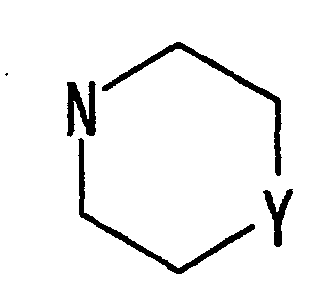
- r5 is C1-6 alkyl optionally substituted with G2, phenyl optionally substituted with G2, benzyl optionally substituted with G2, pyridyl optionally substituted with G2, or -Z-Q (wherein, Z is CO, CS or SO2, and Q is hydrogen, C1-6 alkyl, C1-6 alkoxy, di-C1-6 alkylamino, phenyl-C1-6 alkylamino, or a saturated or unsaturated heterocyclic group containing 1 to 4 heteroatoms selected from among N, O and S);
- k is 0, 1 or 2;
- G1 is halogen, C1-6 alkyl or C1-6 alkoxy;
- G2 is halogen, C1-6 alkyl, C1-6 alkoxy, C1-2 alkylenedioxy, C1-6 alkylamino or C1-6 alkylcarbamoyl;
- G3 is halogen, C1-6 alkyl, C1-6 haloalkyl, C1-6 alkoxy or C1-6 alkoxycarbonyl; and
- a benzene ring, cycloalkyl group or heterocyclic ring may have two or more substituents of G1, G2, G3 and r5, which may be the same or different when two or more], and pharmaceutically acceptable salts thereof.
-
- The present invention is directed particularly to a compound of Formula (1-2)(wherein, R1, R2, R4, R5 and R6 are as defined above).
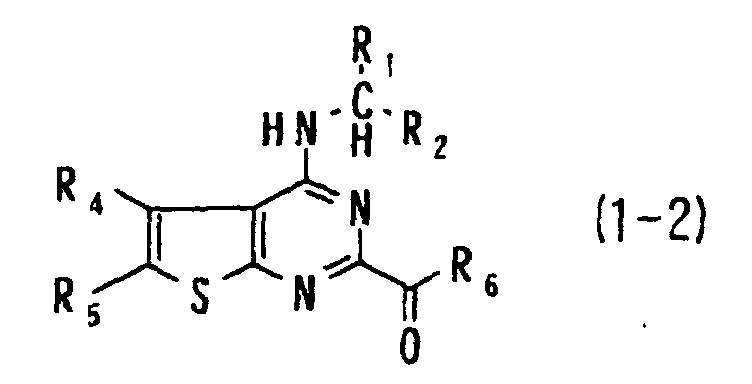
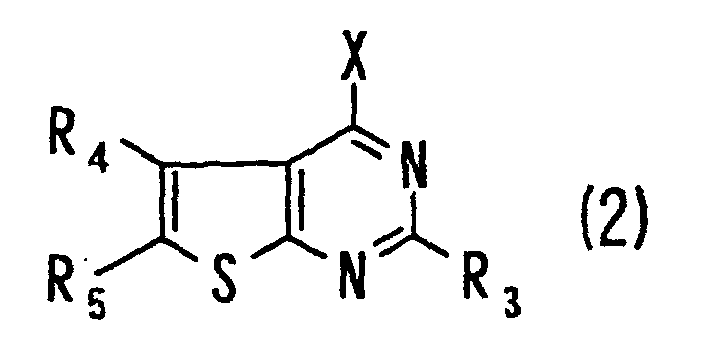
- Furthermore, it is directed to a process for the preparation of a compound of Formula (1), characterized in that a compound of Formula (2)(wherein, R3, R4 and R5 are as defined above and X is halogen), is reacted with a compound of Formula (3)
 (wherein, R1 and R2 are as defined above).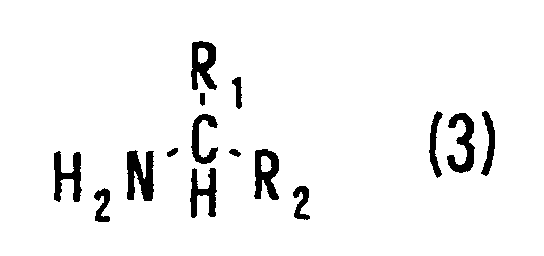
- In the compounds of the present invention, represented by Formula (1),
- R1 is hydrogen; or C1-6 alkyl such as methyl, ethyl, propyl, isopropyl, butyl, isobutyl, sec-butyl or tert-butyl.
- R2 is C3-8 cycloalkyl (optionally substituted at arbitrary positions with halogen such as fluorine, chlorine or bromine; C1-6 alkyl such as methyl or ethyl; or C1-6 alkoxy such as methoxy or ethoxy); phenyl (optionally substituted at arbitrary positions with halogen such as fluorine, chlorine or bromine; C1-6 alkyl such as methyl or ethyl; C1-6 alkoxy such as methoxy or ethoxy; or C1-2 alkylenedioxy such as methylenedioxy or ethylenedioxy), or a saturated or unsaturated heterocyclic group containing 1 to 4 heteroatoms selected from among N, O and S (optionally substituted at arbitrary positions with halogen such as fluorine, chlorine or bromine; C1-6 alkyl such as methyl or ethyl; C1-6 haloalkyl such as chloromethyl, dichloromethyl, trichloromethyl, fluoromethyl, difluoromethyl or trifluoromethyl; C1-6 alkoxy such as methoxy or ethoxy; or C1-6 alkoxycarbonyl such as methoxycarbonyl or ethoxycarbonyl) such as furyl, thienyl, pyrrolyl, imidazolyl, pyrazolyl, oxazolyl, isoxazolyl, thiazolyl, isothiazolyl, imidazolyl, triazolyl, oxadiazolyl, pyridyl, pyrimidyl or pyridazinyl.
- R3 is a saturated or unsaturated heterocyclic group containing 1 to 4 heteroatoms selected from among N, O and S (optionally substituted at arbitrary positions with halogen such as fluorine, chlorine or bromine; C1-6 alkyl such as methyl or ethyl; C1-6 haloalkyl such as chloromethyl, dichloromethyl, trichloromethyl, fluoromethyl, difluoromethyl or trifluoromethyl; C1-6 alkoxy such as methoxy or ethoxy; or C1-6 alkoxycarbonyl such as methoxycarbonyl or ethoxycarbonyl) such as furyl, thienyl, pyrrolyl, imidazolyl, pyrazolyl, oxazolyl, isoxazolyl, thiazolyl, isothiazolyl, imidazolyl, triazolyl, oxadiazolyl, pyridyl, pyrimidyl or pyridazinyl, or a group represented by Formula (CH2)kC(=O)R6 or CH=CHC(=O)R6.
- R4 is hydrogen; C1-6 alkyl such as methyl, ethyl, propyl, isopropyl, butyl, isobutyl, sec-butyl or tert-butyl; hydroxyl; C1-6 alkoxy such as methoxy or ethoxy; halogen such as fluorine, chlorine or bromine; C1-6 alkyl such as methyl or ethyl; C1-6 haloalkyl such as chloromethyl, dichloromethyl, trichloromethyl, fluoromethyl, difluoromethyl or trifluoromethyl; nitro or cyano.
- R5 is cyano; phenyl (optionally substituted at arbitrary positions with halogen such as fluorine, chlorine or bromine; C1-6 alkyl such as methyl or ethyl; C1-6 alkoxy such as methoxy or ethoxy; C1-6 alkoxycarbonyl such as methoxycarbonyl or ethoxycarbonyl; or C1-6 haloalkyl such as chloromethyl, dichloromethyl, trichloromethyl, fluoromethyl, difluoromethyl or trifluoromethyl); or a saturated or unsaturated heterocyclic group containing 1 to 4 heteroatoms selected from among N, O and S (optionally substituted at arbitrary positions with halogen such as fluorine, chlorine or bromine; C1-6 alkyl such as methyl or ethyl; C1-6 haloalkyl such as chloromethyl, dichloromethyl, trichloromethyl, fluoromethyl, difluoromethyl or trifluoromethyl; C1-6 alkoxy such as methoxy or ethoxy; or C1-6 alkoxycarbonyl such as methoxycarbonyl or ethoxycarbonyl), such as furyl, thienyl, pyrrolyl, imidazolyl, pyrazolyl, oxazolyl, isoxazolyl, thiazolyl, isothiazolyl, imidazolyl, triazolyl, oxadiazolyl, pyridyl, pyrimidyl or pyridazinyl; or a group represented by Formula (CH2)kC(=O)R6 or CH=CHC(=O)R6.
- R6 is hydroxyl; C1-6 alkoxy such as methoxy or ethoxy; phenoxy (optionally substituted at arbitrary positions with halogen such as fluorine, chlorine or bromine; C1-6 alkyl such as methyl or ethyl; C1-6 alkoxy such as methoxy or ethoxy; C1-6 alkoxycarbonyl such as methoxycarbonyl or ethoxycarbonyl; or C1-6 haloalkyl such as chloromethyl, dichloromethyl, trichloromethyl, fluoromethyl, difluoromethyl or trifluoromethyl); benzyloxy (optionally substituted at arbitrary positions with halogen such as fluorine, chlorine or bromine; C1-6 alkyl such as methyl or ethyl; C1-6 alkoxy such as methoxy or ethoxy; C1-6 alkoxycarbonyl such as methoxycarbonyl or ethoxycarbonyl; or C1-6 haloalkyl such as chloromethyl, dichloromethyl, trichloromethyl, fluoromethyl, difluoromethyl or trifluoromethyl), or a group represented by Formula Nr1r2 or NHNr3r4.
- r1 and r3 are hydrogen or C1-6 alkyl (optionally substituted with hydroxyl or a ONO2 group) such as methyl or ethyl.
- r2 and r4 are hydrogen; C3-8 cycloalkyl such as cyclopropyl, cyclobutyl, cyclopentyl or cyclohexyl; C1-6 alkyl such as methyl, ethyl, propyl, isopropyl or butyl; C1-6 alkoxycarbonyl C1-6 alkyl such as methoxycarbonylmethyl, ethoxycarbonylmethyl, methoxycarbonylethyl or ethoxycarbonylethyl; C1-6 alkyl optionally substituted with a saturated or unsaturated heterocyclic group containing 1 to 4 heteroatoms selected from among N, O and S (which is optionally substituted at arbitrary positions with halogen such as fluorine, chlorine or bromine; C1-6 alkyl such as methyl or ethyl; C1-6 haloalkyl such as chloromethyl, dichloromethyl, trichloromethyl, fluoromethyl, difluoromethyl or trifluoromethyl; C1-6 alkoxy such as methoxy or ethoxy; or C1-6 alkoxycarbonyl such as methoxycarbonyl or ethoxycarbonyl), such as furyl, thienyl, pyrrolyl, imidazolyl, pyrazolyl, oxazolyl, isoxazolyl, thiazolyl, isothiazolyl, imidazolyl, triazolyl, oxadiazolyl, pyridyl, pyrimidyl or pyridazinyl; phenyl (optionally substituted at arbitrary positions with halogen such as fluorine, chlorine or bromine; C1-6 alkyl such as methyl or ethyl; C1-6 alkoxy such as methoxy or ethoxy; amino; or C1-6 alkoxycarbonylamino such as tert-butoxycarbonylamino); benzyl (optionally substituted at arbitrary positions with halogen such as fluorine, chlorine or bromine; C1-6 alkyl such as methyl or ethyl; or C1-6 alkoxy such as methoxy or ethoxy); or a saturated or unsaturated heterocyclic group containing 1 to 4 heteroatoms selected from among N, O and S (optionally substituted at arbitrary positions with halogen such as fluorine, chlorine or bromine; C1-6 alkyl such as methyl or ethyl; C1-6 haloalkyl such as chloromethyl, dichloromethyl, trichloromethyl, fluoromethyl, difluoromethyl or trifluoromethyl; C1-6 alkoxy such as methoxy or ethoxy; or C1-6 alkoxycarbonyl such as methoxycarbonyl or ethoxycarbonyl), such as furyl, thienyl, pyrrolyl, imidazolyl, pyrazolyl, oxazolyl, isoxazolyl, thiazolyl, isothiazolyl, imidazolyl, triazolyl, oxadiazolyl, pyridyl, pyrimidyl or pyridazinyl.
- r1 and r2 may join, together with N, to form a morpholino, piperidino or piperazinyl group.
- r5, a substituent on these, is C1-6 alkyl (optionally substituted with C1-6 alkylamino such as methylamino, ethylamino, dimethylamino or diethylamino; or C1-6 alkylcarbamoyl such as methylcarbamoyl, dimethylcarbamoyl or diethylcarbamoyl) such as methyl, ethyl, propyl, isopropyl, butyl, isobutyl, sec-butyl or tert-butyl; phenyl (optionally substituted with fluorine, chlorine, methyl, ethyl, methoxy or ethoxy); benzyl (optionally substituted with fluorine, chlorine, methyl, ethyl, methoxy or ethoxy); pyridyl (optionally substituted with fluorine, chlorine, methyl, ethyl, methoxy or ethoxy); or a group represented by Formula -Z-Q (wherein, Z is CO, CS or SO2, and Q is hydrogen, C1-6 alkyl such as methyl, ethyl, propyl, isopropyl, butyl, isobutyl, sec-butyl or tert-butyl; C1-6 alkoxy such as methoxy, ethoxy, propoxy, isopropoxy, butoxy, isobutoxy, sec-butoxy or tert-butoxy, di-C1-6 alkylamino such as dimethylamino, diethylamino or methylethylamino; phenyl-C1-6 alkylamino such as phenylmethylamino or phenylethylamino; or a saturated or unsaturated heterocyclic group containing 1 to 4 heteroatoms selected from among N, O and S (optionally substituted with C1-6 alkyl such as methyl, ethyl or propyl), such as pyridyl, pyrrolidinyl, tetrahydrofuranyl, morpholino, piperidino or piperazinyl).
- k is 0, 1 or 2.
-
- The substituents may be the same or different, if the said phenyl, benzyl and heterocyclic groups have two or more of them.
- Examples of pharmaceutically acceptable salts include salts of inorganic acids such as hydrochloric acid, sulfuric acid, nitric acid and phosphoric acid and of organic acids such as acetic acid, propionic acid, lactic acid, succinic acid, tartaric acid, citric acid, benzoic acid, salicylic acid, nicotinic acid and heptagluconic acid, of compounds of Formula (1).
- The compounds of the present invention may have asymmetric carbons, depending on groups represented by R1, R2, R3, R4 and R5. The present invention covers optically active compounds as well as racemic ones.
- Processes of the present invention and processes for the preparation of novel compounds to be used as intermediates or others are described below.
- (In the above equation, R1, R2, R3, R4 and R5 are as defined above and X is halogen.)
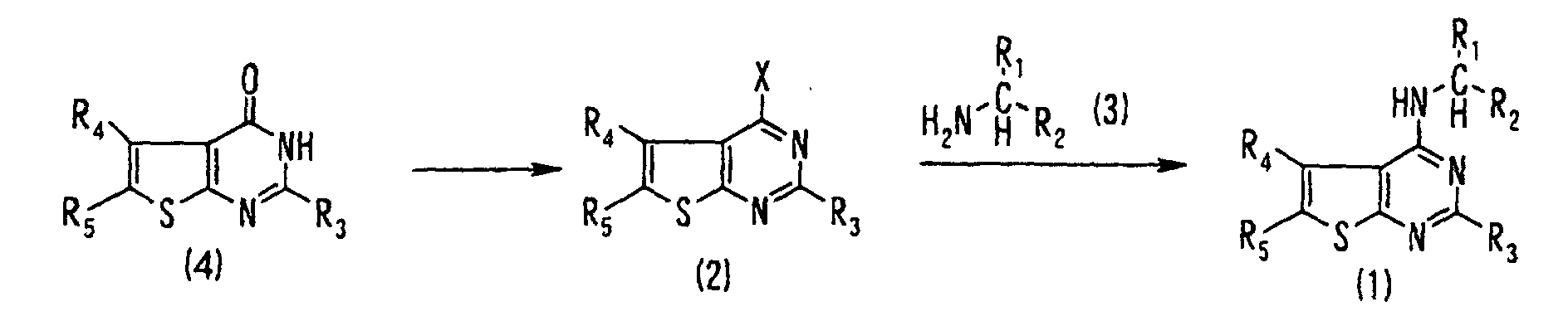
- Target compound (1) is obtained by a substitution reaction of Compounds (2) and (3) in a solvent according to an ordinary method.
- There are no particular restrictions on solvents used, if inert to the reaction. Examples of solvents include ethers such as diethyl ether, tetrahydrofuran (THF) and 1,4-dioxane; aromatic hydrocarbons such as benzene, toluene and xylene; halogenated hydrocarbons such as dichloromethane, chloroform and 1,2-dichloroethane; and pyridine, acetonitrile, dimethylformamide (DMF) and dimethyl sulfoxide (DMSO).
- Reaction temperature is about -15°C to the boiling point of a solvent used, preferably 0 to 80°C.
- Halogenation of thienopyrimidone of Compound (4) gives Compound (2). Examples of halogen X include chlorine and bromine.
- The halogenation reaction is carried out by an ordinary method. For example, in the case of chlorination, a method is applied of using phosphorus oxychloride, phosphorus pentachloride, thionyl chloride or the like as a chlorinating agent.
- There are no particular restrictions on solvents used, if inert to the reaction. Examples of solvents include aromatic hydrocarbons such as benzene, toluene and xylene; halogenated hydrocarbons such as dichloromethane, chloroform and 1,2-dichloroethane; acetonitrile, DMF and DMSO.
- Reaction temperature is about -15°C to the boiling point of a solvent used, preferably 20°C to the boiling point of a solvent.
- A starting material, thienopyrimidone of Compound (2), can be prepared according to known methods disclosed in papers, for example, J. Het. Chem., 21, 375-380 (1984) or Indian J. Chem., 28B (12) 1039-1047 (1989).
- A starting material, Compound (3), is also prepared according to known methods disclosed in papers, for example, J. Med. Chem., 41, 3367-3372 (1998).
- (In the above reaction scheme, R1, R2, R4, R5, r1 and r2 are as defined above.)
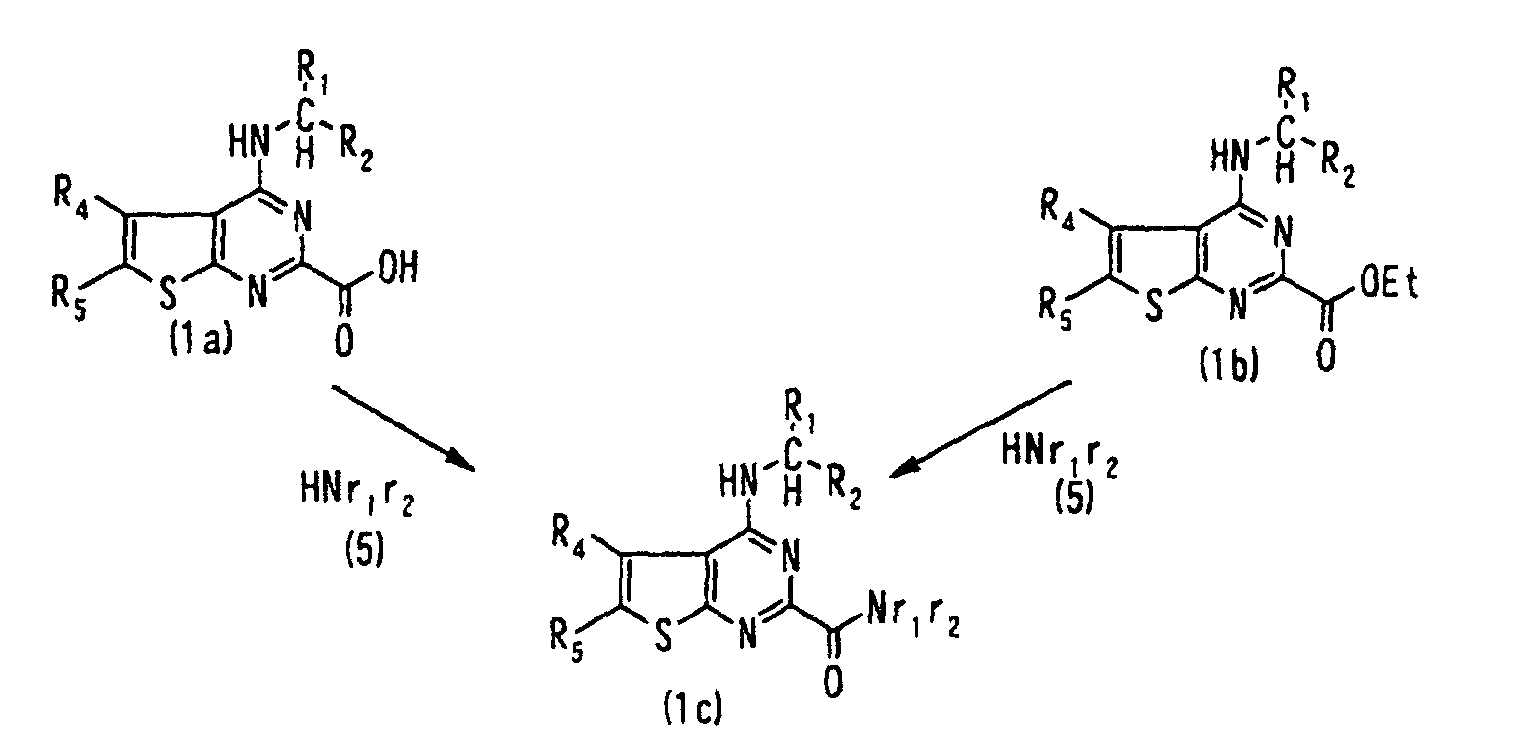
- Dehydration condensation of Compound (la) and Compound (5) in a solvent by an ordinary method gives Compound (1c).
- There are no particular restrictions on the dehydration condensation reaction, if an ordinary method is applied. A method of using a condensing agent is preferred.
- Examples of condensing agents include 1,3-dicyclohexylcarbodiimide, 1-(3-dimethylaminopropyl)-3-ethylcarbodiimide and 2-ethoxy-1-ethoxycarbonyl-1,2-dihydroquinoline.
- This reaction proceeds more promptly if N-hydroxysuccinimide, 1-hydroxybenzotriazole or 3,4-dihydro-3-hydroxy-4-oxo-1,2,3-benzotriazine coexists.
- There are no particular restrictions on solvents used, if inert to the reaction. Examples of solvents include ethers such as diethyl ether, THF and 1,4-dioxane; aromatic hydrocarbons such as benzene, toluene and xylene; halogenated hydrocarbons such as dichloromethane, chloroform and 1,2-dichloroethane; pyridine, acetonitrile, DMF and DMSO.
- Reaction temperature is about -15°C to the boiling point of a solvent used, preferably 0 to 80°C.
- An amide derivative of Formula (1c) can also be prepared from Compound (1b).
- The reaction is carried out in a solvent including an alcohol such as methanol, ethanol or propanol; halogenated hydrocarbon such as dichloromethane, chloroform or 1,2-dichloroethane; acetonitrile, DMF or DMSO, at a reaction temperature from -15 to 200°C, preferably 0 to 150°C.
- (In the above reaction scheme, R1, R2, R3, R4, r1 and r2 are as defined above, and X is halogen.)

- Dehydration condensation of Compound (1d) and Compound (5) in a solvent by an ordinary method gives Compound (1g).
- There are no particular restrictions on the dehydration condensation reaction, if an ordinary method is applied. A method of using a condensing agent is preferred.
- Examples of condensing agents include 1,3-dicyclohexylcarbodiimide, 1-(3-dimethylaminopropyl)-3-ethylcarbodiimide and 2-ethoxy-1-ethoxycarbonyl-1,2-dihydroquinoline.
- This reaction proceeds more promptly ifN-hydroxysuccinimide, 1-hydroxybenzotriazole or 3,4-dihydro-3-hydroxy-4-oxo-1,2,3-benzotriazine coexists.
- There are no particular restrictions on solvents used, if inert to the reaction. Examples of solvents include ethers such as diethyl ether, THF and 1,4-dioxane; aromatic hydrocarbons such as benzene, toluene and xylene; halogenated hydrocarbons such as dichloromethane, chloroform and 1,2-dichloroethane; pyridine, acetonitrile, DMF and DMSO.
- Reaction temperature is about -15°C to the boiling point of a solvent used, preferably 0 to 80°C.
- Compound (1g) can also be prepared by that an acid halide (1e) synthesized from Compound (1d) is reacted with Compound (5).
- There are no particular restrictions on the synthesis of the acid halide, if an ordinary method is applied. For example, in the case of chlorination, the reaction is carried out using phosphorus oxychloride, phosphorus pentachloride, thionyl chloride or the like as a chlorinating agent.
- There are no particular restrictions on solvents used, if inert to the reaction. The reaction can be carried out without using a solvent. Examples of solvents, if used, include aromatic hydrocarbons such as benzene, toluene and xylene; and halogenated hydrocarbons such as dichloromethane, chloroform and 1,2-dichloromethane.
- Reaction temperature is about 0°C to the boiling point of a solvent used, preferably 0 to 80°C.
- There are no particular restrictions on the reaction of an acid chloride (1e) and Compound (5), if an ordinary method is applied. The reaction of (1e) is carried out using an excessive amount of Compound (5) or Compound (1e) is reacted with Compound (5) in the presence of an organic or inorganic base.
- There are no particular restrictions on solvents used, if inert to the reaction. The reaction can be carried out without using a solvent. Examples of solvents, if used, include ethers such as diethyl ether, THF and 1,4-dioxane; aromatic hydrocarbons such as benzene, toluene and xylene; and halogenated hydrocarbons such as dichloromethane, chloroform and 1,2-dichloroethane.
- Reaction temperature is about 0°C to the boiling point of a solvent used, preferably 0 to 30°C.
- An amide derivative of Formula (1g) can also be prepared from Compound (1f).
- The reaction is carried out in a solvent including an alcohol such as methanol, ethanol or propanol; halogenated hydrocarbon such as dichloromethane, chloroform or 1,2-dichloroethane; acetonitrile, DMF or DMSO, at a reaction temperature from -15 to 200°C, preferably 0 to 150°C.
- (In the above equation, R1, R2, R3 and R4 are as defined above.)
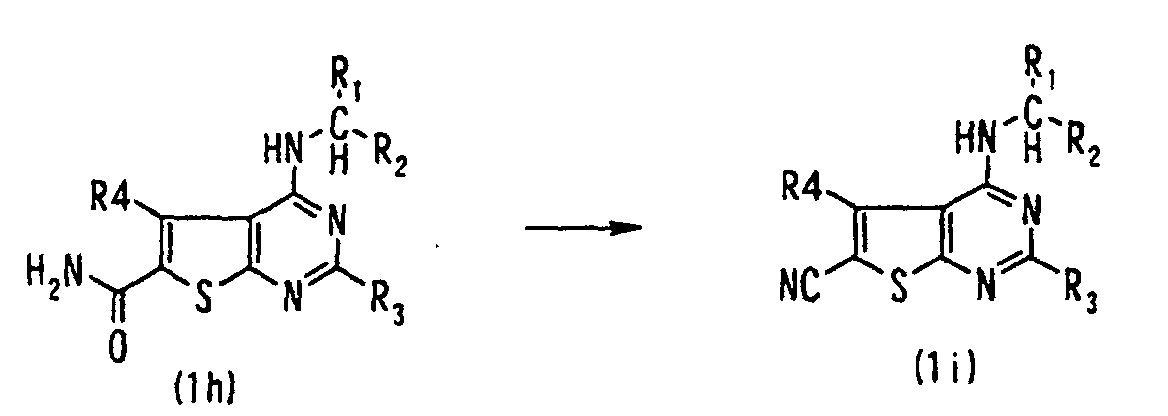
- A dehydration reaction of Compound (1h) gives Compound (1i).
- There are no particular restrictions on the dehydration reaction if an ordinary method is applied. The reaction is carried out, for example, using phosphorus oxychloride, phosphorus pentachloride or the like.
- There are no particular restrictions on solvents used, if inert to the reaction. The reaction can be carried out without using a solvent. Examples of solvents, if used, include ethers such as diethyl ether, tetrahydrofuran (THF) and 1,4-dioxane; aromatic hydrocarbons such as benzene, toluene and xylene; halogenated hydrocarbons such as dichloromethane, chloroform and 1,2-dichloroethane; acetonitrile, DMF and DMSO.
- Reaction temperature is about -15°C to the boiling point of a solvent used, preferably 0 to 80°C.
- (In the above equation, R1, R2, R3, R4 and R5 are as defined above and HA is an acid.)
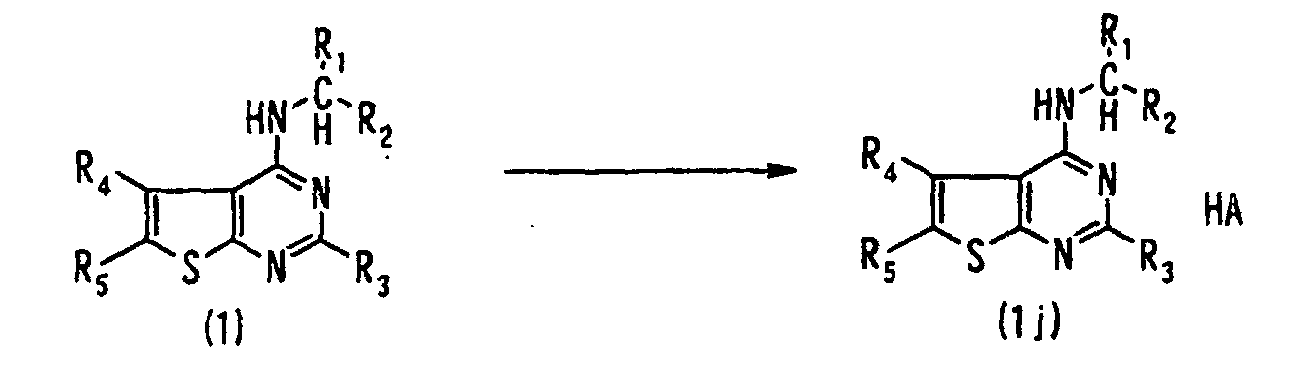
- Target Compound (1j) can be prepared by reacting Compound (1) with an acid.
- Examples of acids used include inorganic acids such as hydrochloric acid, sulfuric acid, nitric acid and phosphoric acid; and organic acids such as acetic acid, propionic acid, lactic acid, succinic acid, tartaric acid, citric acid, benzoic acid, salicylic acid, nicotinic acid and heptagluconic acid.
- There are no particular restrictions on solvents used, if inert to the reaction. Examples of solvents include ethers such as diethyl ether, THF and 1,4-dioxane; aromatic hydrocarbons such as benzene, toluene and xylene; halogenated hydrocarbons such as dichloromethane, chloroform and 1,2-dichloroethane; acetonitrile, DMF and DMSO.
- Reaction temperature is about -15°C to the boiling point of a solvent used, preferably 0 to 30°C.
- Compound (1) of the present invention may have asymmetric carbons in Formula (1) so that optical isomers exist. It goes without saying that the present invention covers these isomers.
- In the present invention, usual post-treatments give target compounds after the completion of the reactions.
- The structures of the compounds of the present invention were determined by IR, NMR, MS and other means.
- The present invention is described in more detail in reference to Examples.
- Preparation of 4-[(3-chloro-4-methoxy)benzylamino]-6-ethoxycarbonyl-5-methyl-2-(3-pyridyl)-thieno[2,3-d]pyrimidine

- 7.3g of 4-oxo-6-ethoxycarbonyl-5-methyl-2-(3-pyridyl)-thieno[2,3-d]pyrimidine was added to 60 ml of phosphorus oxychloride, and stirred at 80 to 100°C for 3 hours. After phosphorus oxychloride was distilled off under reduced pressure, 100 ml of water was added to the resulting concentrate. The reaction solution was made alkaline with an aqueous saturated solution of sodium hydrogen carbonate while cooling, and extracted with chloroform. The organic layer was washed with saturated salt water and dried over anhydrous magnesium sulfate. Magnesium sulfate was filtered off. The filtrate was concentrated under reduced pressure to give 7.4g of 4-chloro-6-ethoxycarbonyl-5-methyl-2-(3-pyridyl)-thieno[2,3-d]pyrimidine.
- To 7.4g of 4-chloro-6-ethoxycarbonyl-5-methyl-2-(3-pyridyl)-thieno[2,3-d]pyrimidine were added 60 ml of DMSO, 4.2g of 3-chloro-4-methoxybenzylamine and 2.9g of triethylamine, and heated with stirring at 80°C for 3 hours. The reaction solution was poured into water. The deposited crystals were separated by filtration and dried to give 5.4g of the title compound. m.p. 216-218°C
- Preparation of 4-[(3-chloro-4-methoxy)benzylamino]-5-methyl-2-(3-pyridyl)-thieno[2,3-d]pyrimidine-6-carboxylic acid
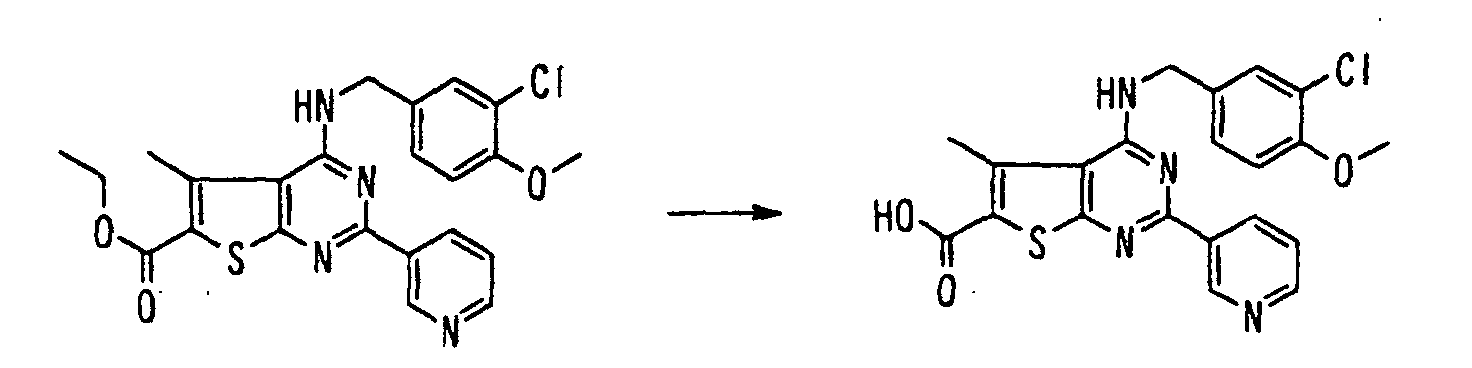
- To 3.1 g of 4-[(3-chloro-4-methoxy)benzylamino]-6-ethoxycarbonyl-5-methyl-2-(3-pyridyl)-thieno[2,3-d]pyrimidine were added 60 ml of ethanol, 30 ml of water and 1.5g of sodium hydroxide, and heated at reflux for 2 hours. The reaction solution was concentrated under reduced pressure and poured into water. The resulting solution was made pH 6 with 2N hydrochloric acid. The deposited crystals were separated by filtration and dried to give 2.9g of the title compound. m.p. 185-186°C
- Preparation of 4-[(3-chloro-4-methoxy)benzylamino]-5-methyl-2-(3-pyridyl)-thieno[2,3-d]pyrimidine-6-N-phenylcarboxamide

- To 0.3g of 4-[(3-chloro-4-methoxy)benzylamino]-5-methyl-2-(3-pyridyl)-thieno[2,3-d]pyrimidine-6-carboxylic acid were added 0.16g of 1-(3-dimethylaminopropyl)-3-ethylcarbodiimide hydrochloride, 0.11 g of 1-hydroxybenzotriazole hydrochloride, 0.1 of triethylamine and 0.07g of aniline, dissolved in 20ml of DMF and stirred at room temperature for 20 hours. The reaction solution was poured into water. The deposited crystals were separated by filtration, washed with water and ether, and dried to give 0.23g of the title compound. m.p. 212-213°C
- Preparation of 4-[(3-chloro-4-methoxy)benzylamino]-5-methyl-2-(3-pyridyl)-thieno[2,3-d]pyrimidine-6-carboxamide

- To 0.63g of 4-[(3-chloro-4-methoxy)benzylamino]-5-methyl-2-(3-pyridyl)-thieno[2,3-d]pyrimidine-6-carboxylic acid were added 8 ml of thionyl chloride and a drop of pyridine, and heated at reflux for 2 hours. The reaction solution was concentrated to give 0.7g of 4-[(3-chloro-4-methoxy)benzylamino]-5-methyl-2-(3-pyridyl)-thieno[2,3-d]pyrimidine-6-carboxylic acid chloride.
- To 0.7g of 4-[(3-chloro-4-methoxy)benzylamino]-5-methyl-2-(3-pyridyl)-thieno[2,3-d]pyrimidine-6-carboxylic acid chloride were added 10 ml of tetrahydrofuran and 10 ml of aqueous ammonia, and stirred at room temperature for 2 hours. The reaction solution was poured into water and extracted with ethyl acetate. The organic layer was washed with saturated salt water and dried over anhydrous magnesium sulfate. Magnesium sulfate was filtered off. The filtrate was concentrated under reduced pressure. The obtained crystals were washed with ether to give 0.6g of the title compound. m.p. 220-222°C
- Preparation of 4-[(3-chloro-4-methoxy)benzylamino]-6-cyano-5-methyl-2-(3-pyridyl)-thieno[2,3-d]pyrimidine

- To 0.45g of 4-[(3-chloro-4-methoxy)benzylamino]-5-methyl-2-(3-pyridyl)-thieno[2,3-d]pyrimidine-6-carboxamide was added 5 ml of phosphorus oxychloride, and heated at reflux for 30 minutes. The reaction solution was poured into water, neutralized with a 2N aqueous solution of sodium hydroxide and extracted with ethyl acetate. The organic layer was washed with saturated salt water and dried over anhydrous magnesium sulfate. Magnesium sulfate was filtered off. The filtrate was concentrated under reduced pressure. The obtained crystals were washed with ether to give 0.2g of the title compound. m.p. 182-185°C
- Preparation of 4-[(3-chloro-4-methoxy)benzylamino]-2-ethoxycarbonyl-5-methyl-6-(3-pyridyl)-thieno[2,3-d]pyrimidine

- 4.5g of 4-oxo-2-ethoxycarbonyl-5-methyl-6-(3-pyridyl)-thieno[2,3-d]pyrimidine was added to 40 ml of phosphorus oxychloride, and stirred at 80 to 100°C for 3 hours. After phosphorus oxychloride was distilled off under reduced pressure, 80 ml of water was added to the resulting concentrate. The reaction solution was made alkaline with an aqueous saturated solution of sodium hydrogen carbonate while cooling, and extracted with chloroform. The organic layer was washed with saturated salt water and dried over anhydrous magnesium sulfate. After magnesium sulfate was filtered off, the filtrate was concentrated under reduced pressure to give 4.1g of 4-chloro-2-ethoxycarbonyl-5-methyl-6-(3-pyridyl)-thieno[2,3-d]pyrimidine.
- To 4.1 g of 4-chloro-2-ethoxycarbonyl-5-methyl-6-(3-pyridyl)-thieno[2,3-d]pyrimidine were added 30 ml of DMSO, 2.3g of 3-chloro-4-methoxybenzylamine and 1.6g of triethylamine, and heated with stirring at 80°C for 3 hours. The reaction solution was poured into water. The deposited crystals were separated by filtration and dried to give 5.1g of the title compound. m.p. 172-174°C
- Preparation of 4-[(3-chloro-4-methoxy)benzylamino]-5-methyl-6-(3-pyridyl)-thieno[2,3-d]pyrimidine-2-carboxylic acid
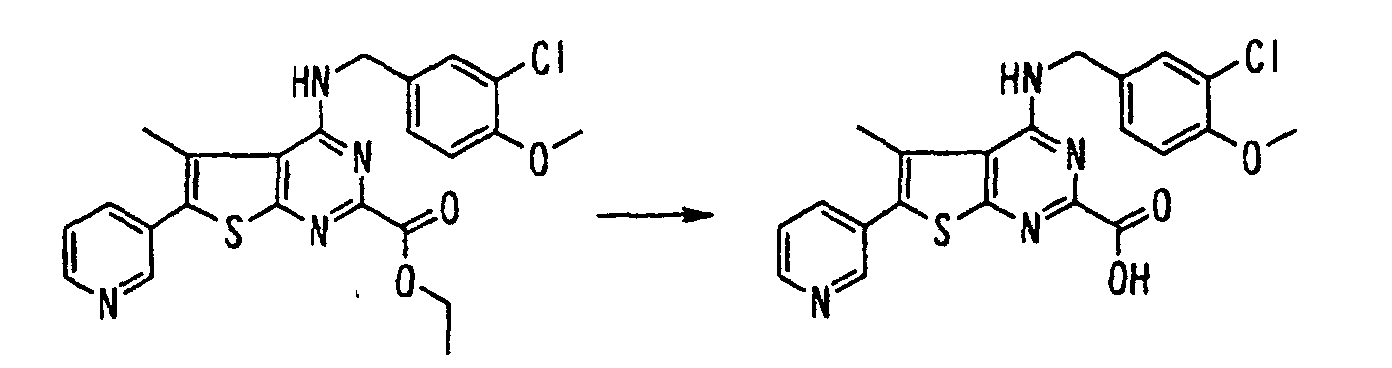
- To 2.5g of 4-[(3-chloro-4-methoxy)benzylamino]-2-ethoxycarbonyl-5-methyl-6-(3-pyridyl)-thieno[2,3-d]pyrimidine were added 20 ml of ethanol, 10 ml of water and 0.43g of sodium hydroxide, and heated at reflux for 2 hours. The reaction solution was concentrated under reduced pressure and poured into water. The resulting solution was made pH 4 with 2N hydrochloric acid. The deposited crystals were separated by filtration and dried to give 2.3g of the title compound. m.p. 222-224°C
- Preparation of 4-[(3-chloro-4-methoxy)benzylamino]-5-methyl-6-(3-pyridyl)-thieno[2,3-d]pyrimidine-2-N-phenylcarboxamide
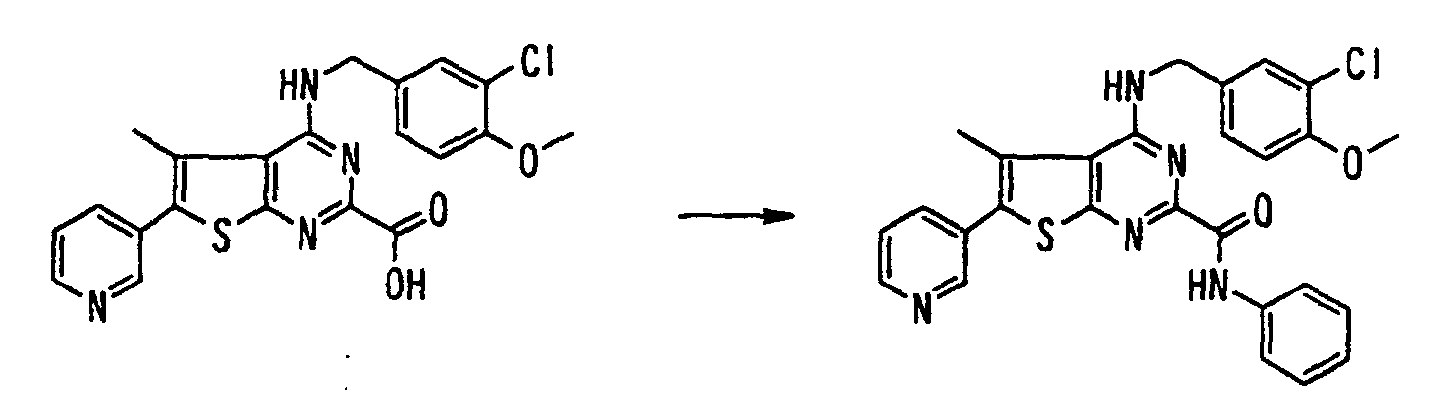
- To 0.3g of 4-[(3-chloro-4-methoxy)benzylamino]-5-methyl-6-(3-pyridyl)-thieno[2,3-d]pyrimidine-2-carboxylic acid were added 0.16g of 1-(3-dimethylaminopropyl)-3-ethylcarbodiimide hydrochloride, 0.11g of 1-hydroxybenzotriazole hydrochloride, 0.1g of triethylamine and 0.07g of aniline, dissolved in 20ml of DMF and stirred at room temperattue for 20 hours. The reaction solution was poured into water. The deposited crystals were separated by filtration, washed with water and ether, and dried to give 0.32g of the title compound. m.p. 190-193°C
- Preparation of 4-[(3-chloro-4-methoxy)benzylamino]-5-methyl-2-(3-pyridyl)-6-(4-pyridyl)-thieno[2,3-d]pyrimidine

- 0.38g of 4-oxo-5-methyl-2-(3-pyridyl)-6-(4-pyridyl)-thieno[2,3-d]pyrimidine was added to 5 ml of phosphorus oxychloride, and stirred at 80 to 100°C for 3 hours. After phosphorus oxychloride was distilled off under reduced pressure, 30 ml of water was added to the resulting concentrate. The reaction solution was made alkaline with an aqueous saturated solution of sodium hydrogen carbonate while cooling, and extracted with chloroform. The organic layer was washed with saturated salt water and dried over anhydrous magnesium sulfate. After magnesium sulfate was filtered off, the filtrate was concentrated under reduced pressure to give 0.25g of 4-chloro-5-methyl-2-(3-pyridyl)-6-(4-pyridyl)-thieno[2,3-d]pyrimidine.
- To 0.25g of 4-chloro-5-methyl-2-(3-pyridyl)-6-(4-pyridyl)-thieno[2,3-d]pyrimidine were added 5 ml of DMSO, 0.14g of 3-chloro-4-methoxybenzylamine and 0.1g of triethylamine, and heated with stirring at 80°C for 3 hours. The reaction solution was poured into water. The deposited crystals were separated by filtration and dried to give 0.32g of the title compound. m.p. 234-236°C
- Preparation of 4-[(3-chloro-4-methoxy)benzylamino]-5-methyl-6-(3-pyridyl)-thieno[2,3-d]pyrimidine-2-N-phenylcarboxamide hydrochloride

- 0.22g of 4-[(3-chloro-4-methoxy)benzylamino]-5-methyl-6-(3-pyridyl)-thieno[2,3-d]pyrimidine-2- N-phenylcarboxamide was dissolved in 15 ml of chloroform, and, while cooling with ice, 5 ml of ethanol saturated with hydrogen chloride gas was added. The resulting solution was stirred at room temperature for an hour. The solvent was distilled off under reduced pressure. The obtained crude crystals were washed with ether and dried to give 0.17g of the title compound. m.p. 170-175°C
- Representative examples of the compounds of the present invention, including those of the above examples, are shown in Table 1. The NMR data of oily products are shown in Table 2.
- Abbreviations in the table have the following meanings:
- Me: methyl, Et: ethyl
-
- Pharmacological activities of the compounds of the present invention are described in the following.
- Cyclic nucleotide phosphodiesterases from human platelets and from the heart and kidney of a dog were eluted by the concentration gradient method with 70 to 1000 mM of sodium acetate on DEAE-cellulose column chromatography (Whatman Co. Ltd., DE-52, 3.2 x 13 cm) according to the method of Thompson and others (Thompson W. J., et al., Advances in Cyclic Nucleotide Research: 10, 69-92, 1979), and separated into isozymes. PDE 5 (cGMP specific PDE), PDE 3 (cGMP inhibited PDE) and PDE 2 (cGMP stimulated PDE) were separated from the platelets, PDE 1 (Ca-calmodulin dependent PDE) and PDE 4 (cAMP specific PDE) were separated from the heart and the kidney respectively. The method of Thompson, et al was partially modified to measure phosphodiesterase activities: li M of [3H]-cAMP or [3H]-cGMP was decomposed with phosphodiesterase. The produced 5'-AMP or 5'-GMP was decomposed to adenosine or guanosine with a snake venom (Sigma V7000). The reaction solution was added to anion exchange resin (Bio-Rad Co. Ltd., AG1-X8). Non-adsorbed adenosine or guanosine was counted by a liquid scintillation counter. A concentration to control 50% of the enzyme activity (IC50) was calculated from concentration inhibition curves. The results are shown in Table 3.
Compound No. PDE inhibiting activity : IC50(nM) PDE1 PDE2 PDE3 PDE4 PDE5 1 7100 - - 1200 3.0 3 - - - 2.3 4 - - - 4.5 5 >10000 - - 1400 3.7 6 >10000 - - 1.5 7 >10000 - - 1700 3.5 9 - - - 6.1 10 >10000 - - 3.3 13 - - - 0.32 14 - - - 2.1 17 - - - 2.8 18 - - - 2.8 19 >10000 - - 4400 0.74 20 >10000 - - >10000 3.2 23 >10000 - - 1600 1.6 24 - - - 0.46 25 - - - - 0.52 26 - - - - 0.50 27 >10000 - - 3700 0.53 28 >10000 - - 1600 0.50 29 >10000 - - 6900 0.52 32 >10000 - - 240 0.68 33 - - - - 0.095 38 - - - - 0.65 44 >10000 - - - 6.4 50 - - - - 2.3 51 - - - - 7.2 57 - - - - 0.29 68 >10000 - 2400 10000 0.27 87 - - - - 0.27 90 >10000 - > 10000 8400 0.43 91 >10000 - >10000 3400 2.5 93 >10000 - >10000 >10000 2.9 94 >10000 - >10000 5600 0.71 Control 2000 30000 53000 >1000 14 (Note) Control : Sildenafil - The compounds of the present invention have powerful inhibiting activities, highly selective cGMP-specific PDE inhibiting effects and vasodilating effects, and are useful for the prevention and/or treatment of, for example, hypertension, heart failure, cardiac infarction, angina pectoris, arteriosclerosis, restenosis after PTCA (percutaneous transluminal coronary angioplasty), cardiac edema, pulmonary hypertension, renal failure, renal edema, hepatic edema, asthma, bronchitis, dementia, immunodeficiency, glaucoma or impotentia.


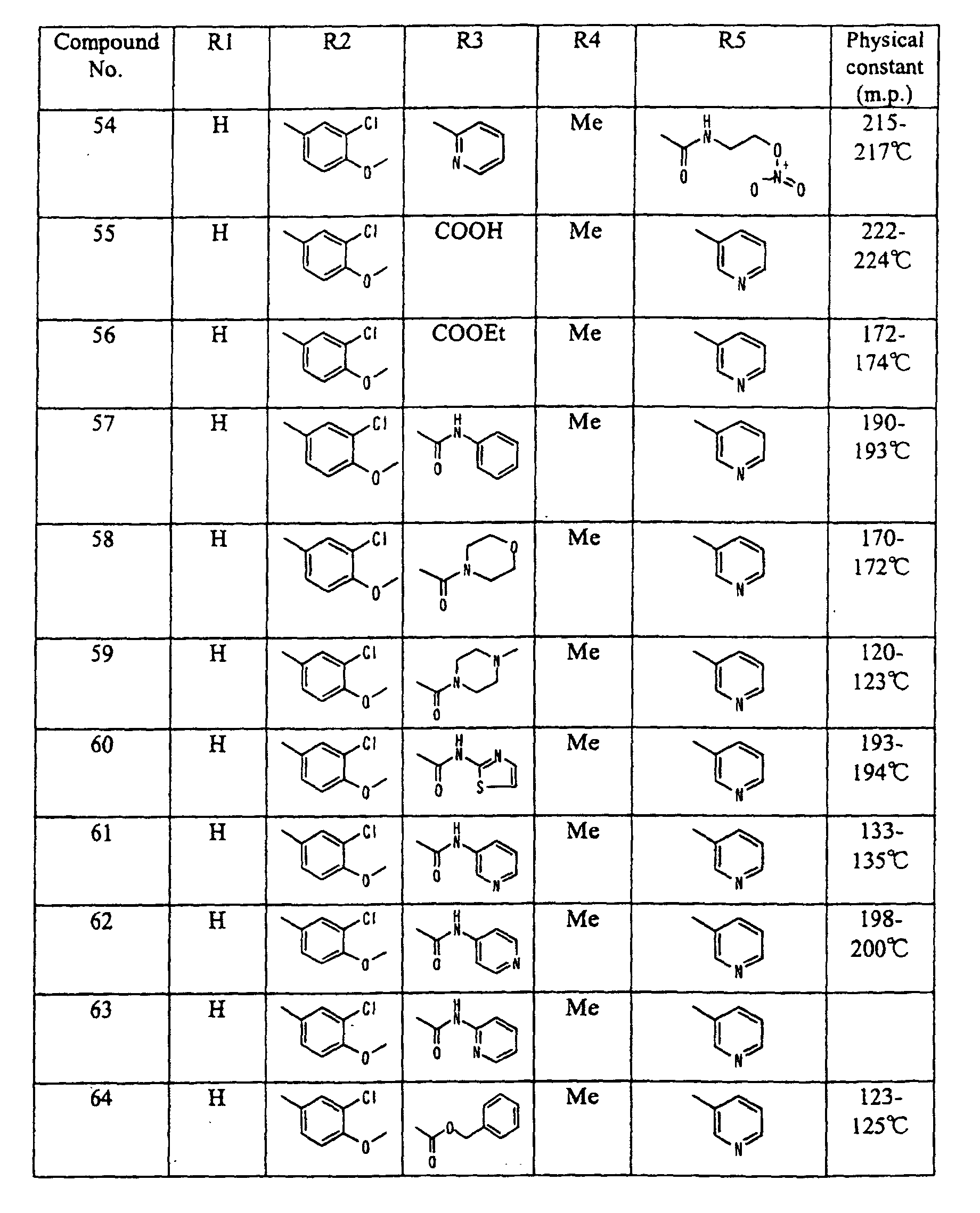
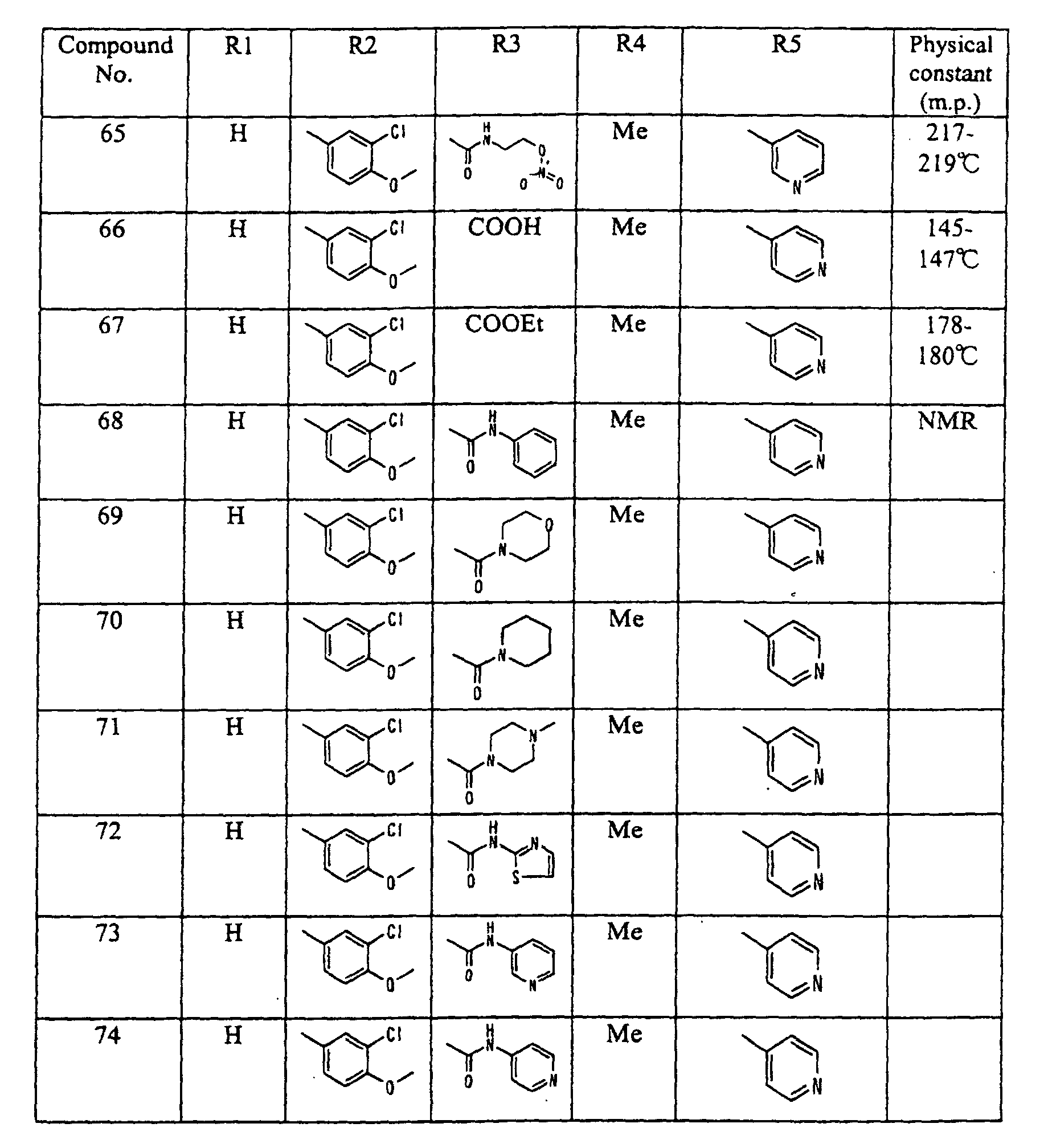

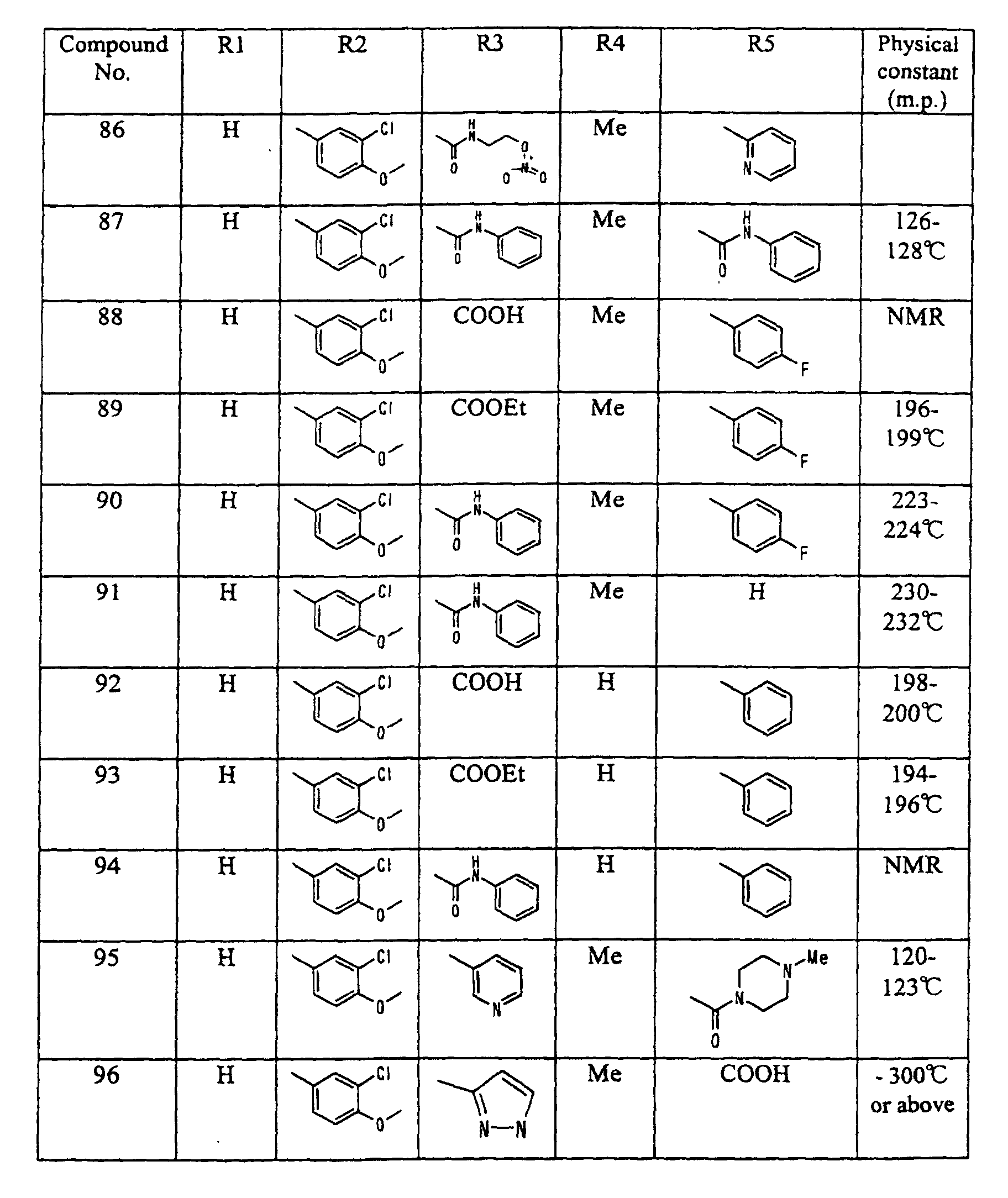

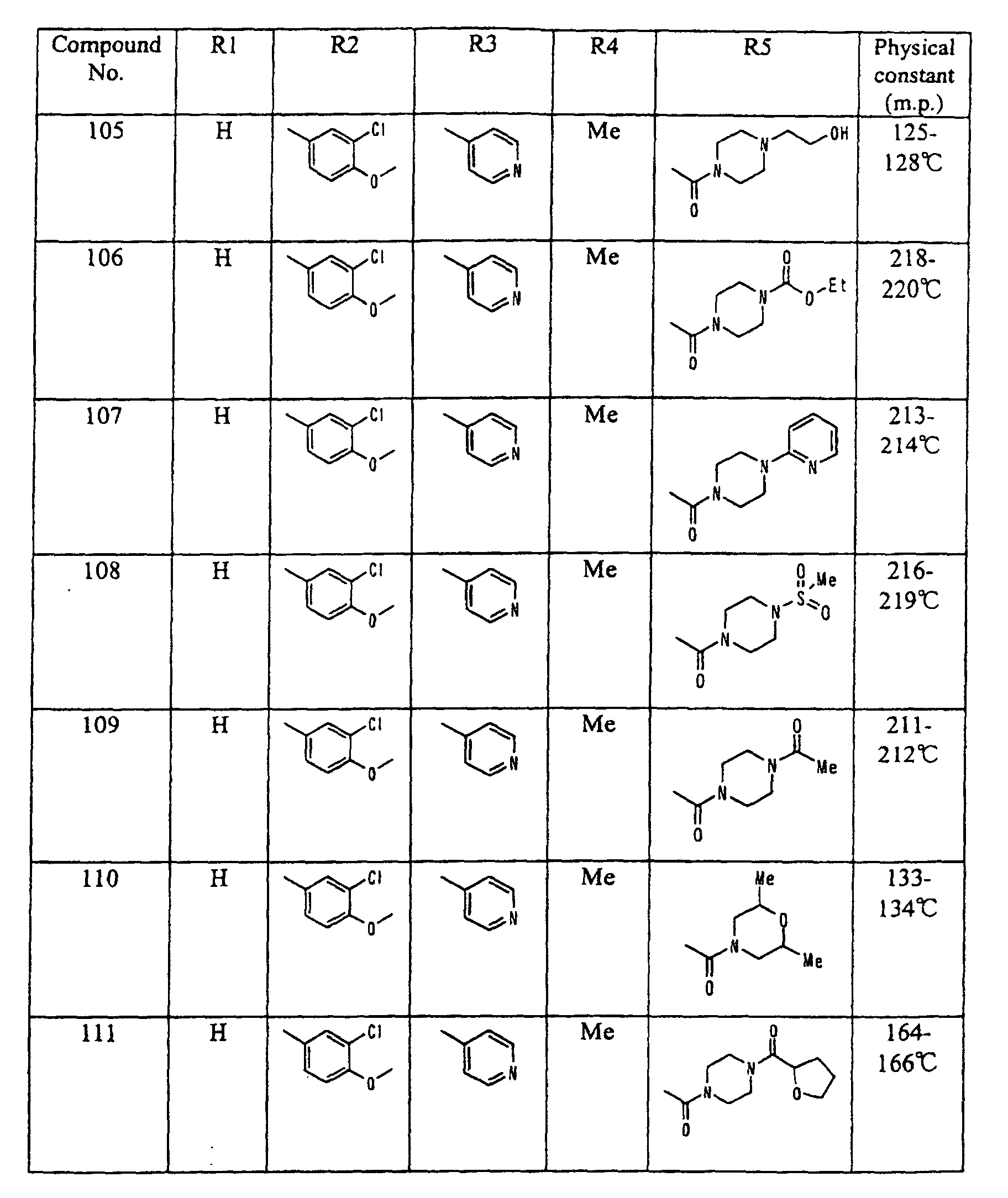


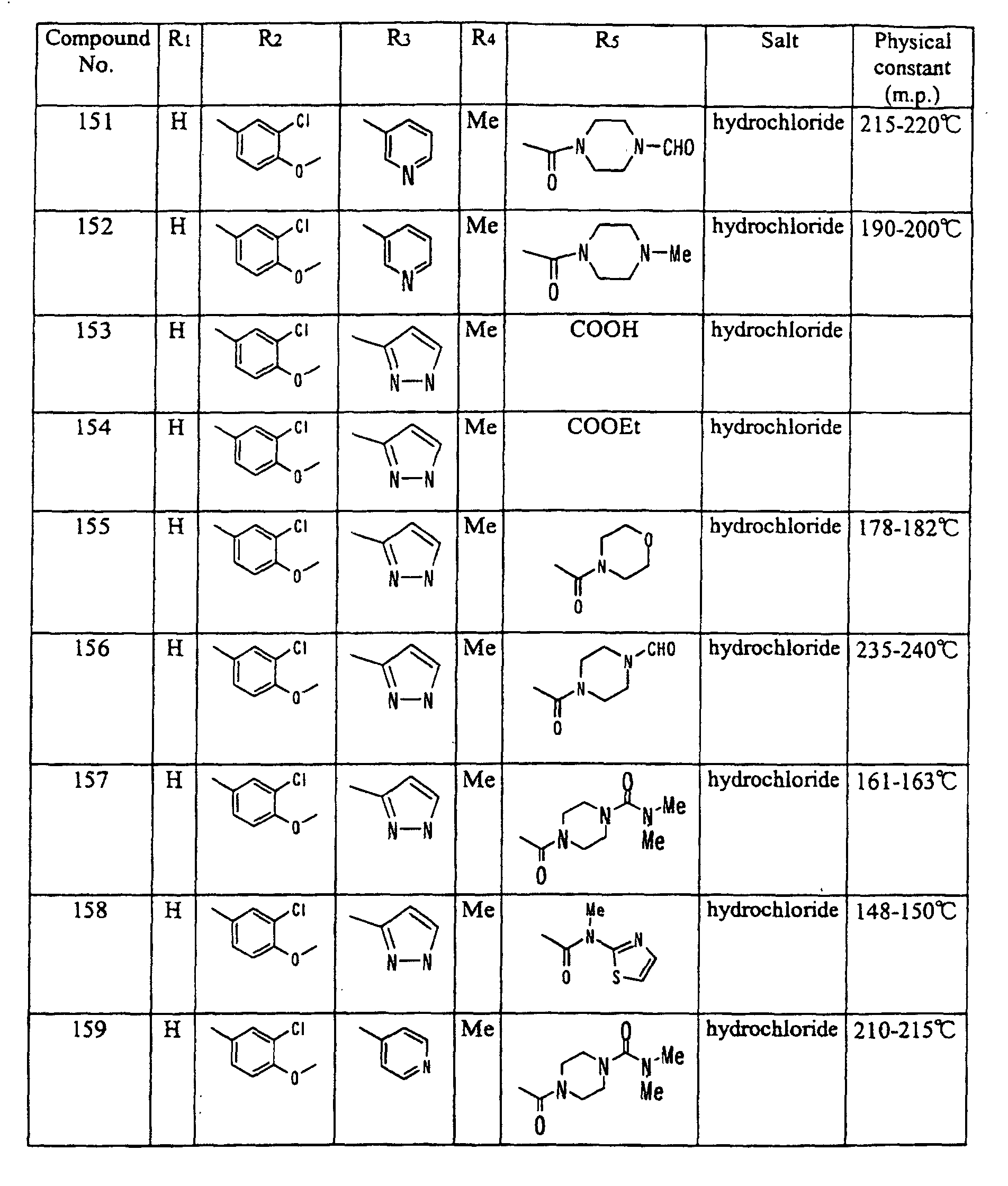
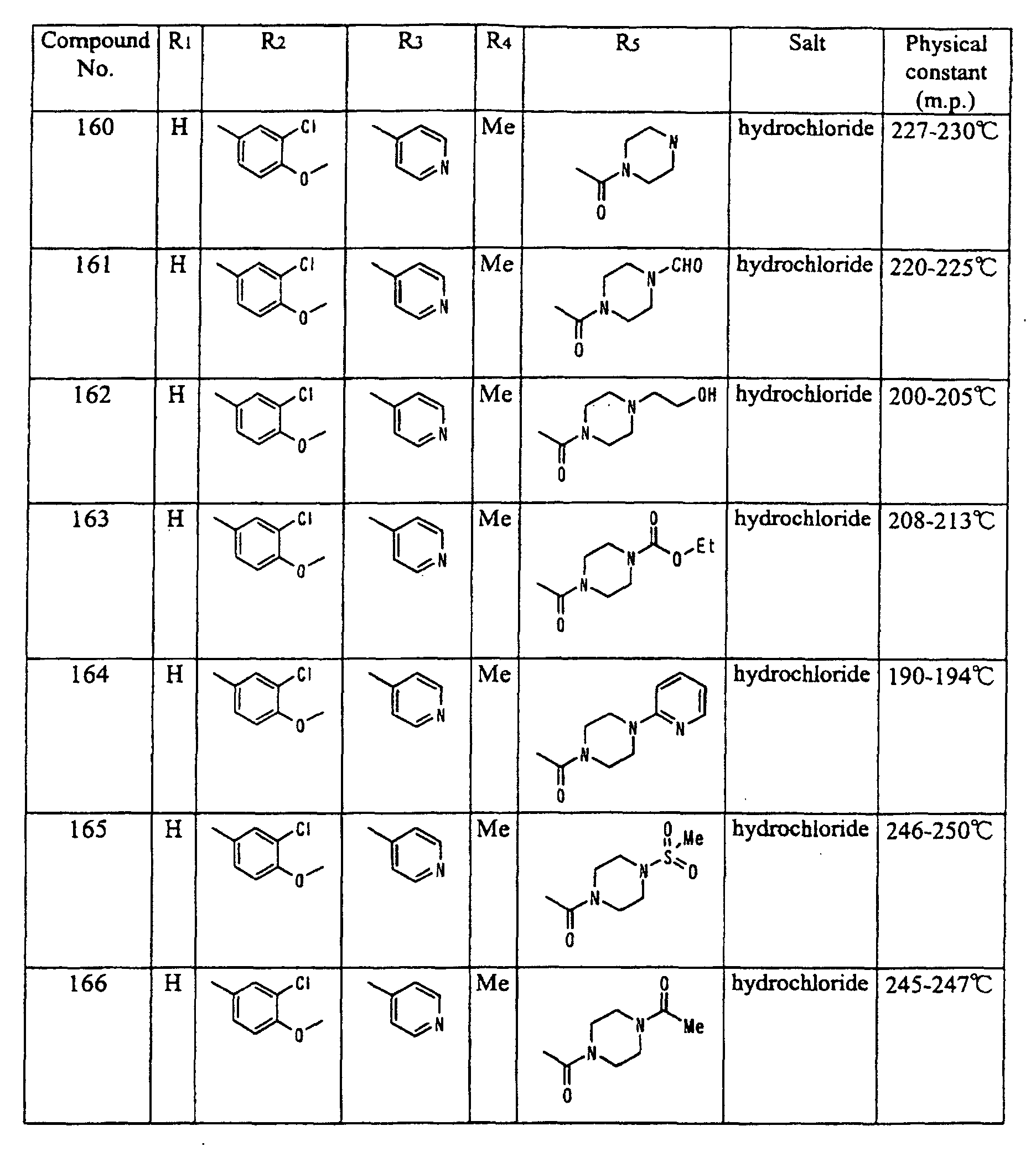
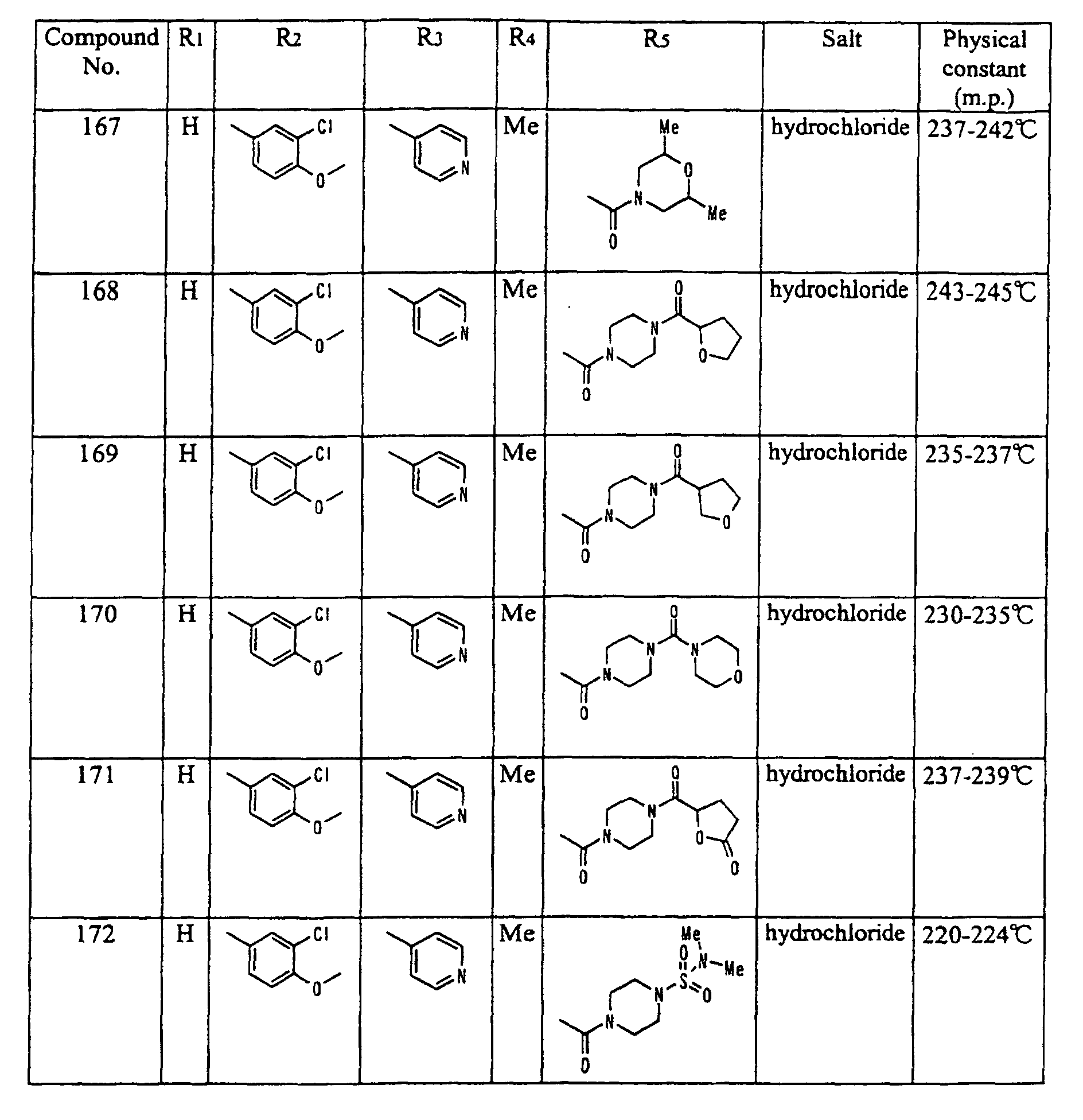

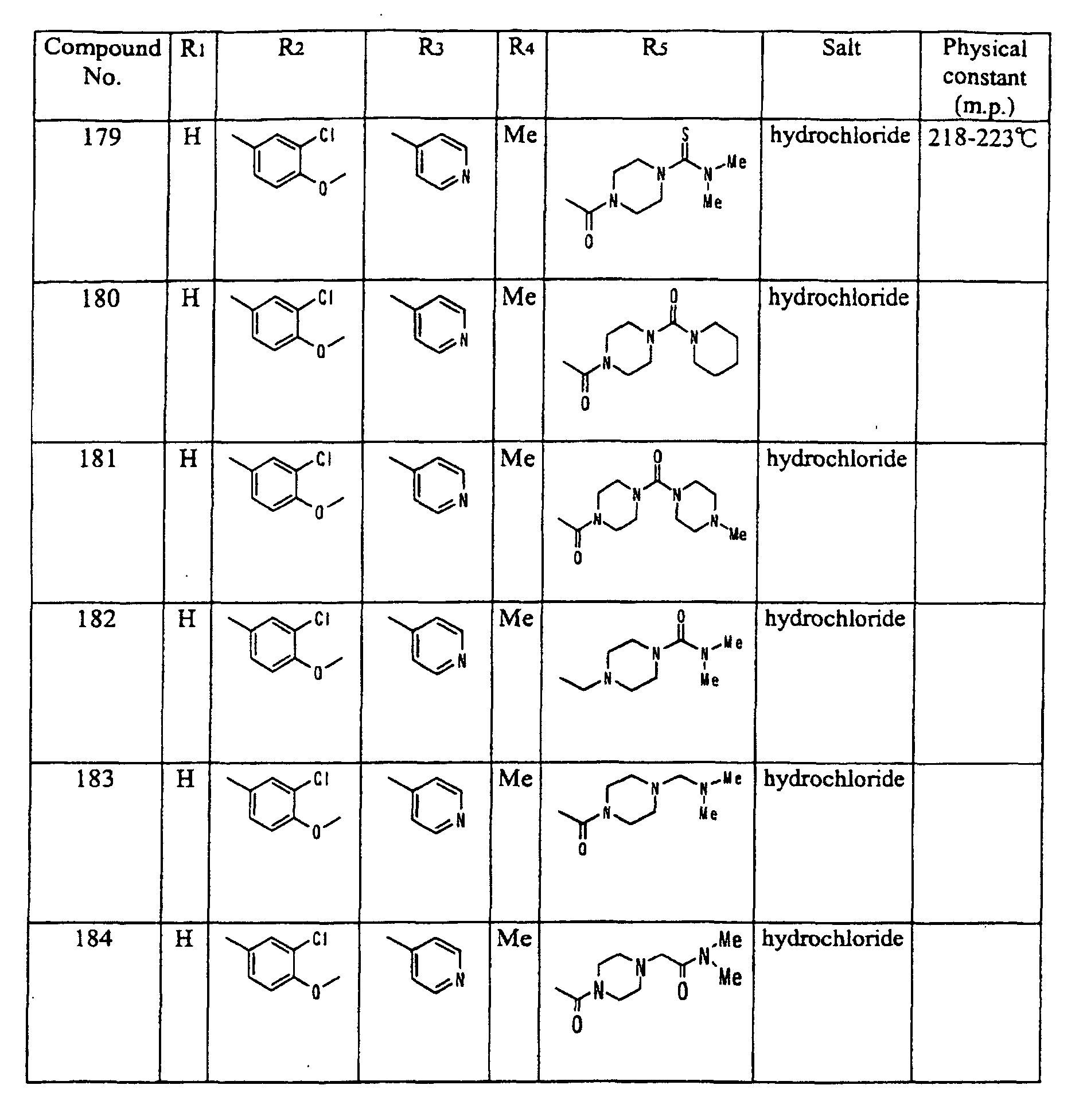

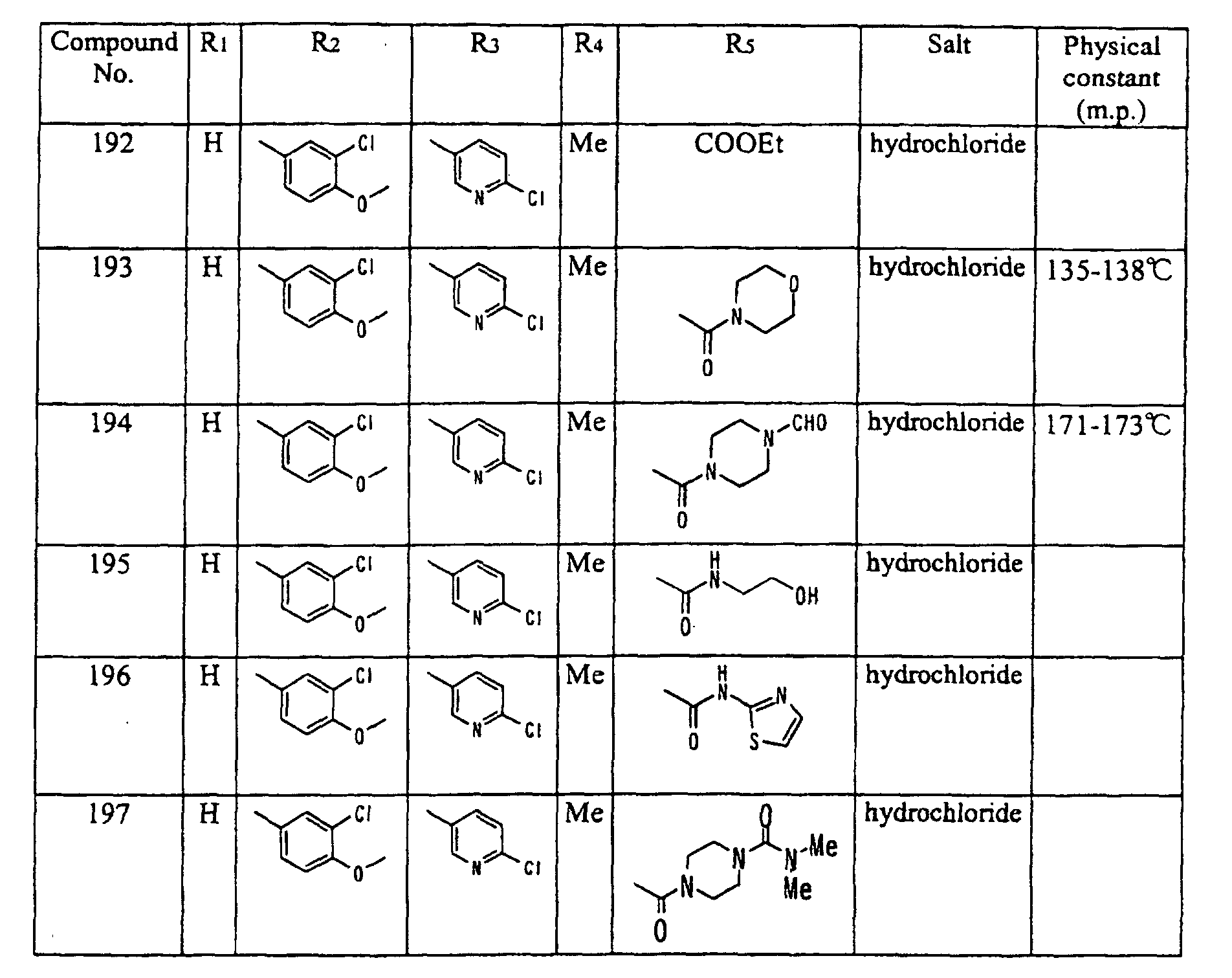
| Compound No. | H-NMR (DMSO, ä ppm) |
| 68 | 10.3 (1H, s), 8.7 (2H, d), 7.9 (1H, t), 7.8 (2H, d), 7.7 (1H, s), 7.6 (2H, d), 7.5 (1H, d), 7.35 (2H, t), 7.2-7.0 (2H, m), 4.8 (2H, d), 3.8 (3H, s), 2.7 (3H, s) |
| 88 | 10.3 (1H, s), 7.8 (3H, m), 7.6 (3H, m), 7.5-7.3 (5H, m), 7.0-7.2 (2H, m), 4.8 (2H, d), 3.8 (3H, s), 2.6 (3H, s) |
| 94 | 10.4 (1H, s), 8.8 (1H, t), 82 (1H, s), 7.9 (2H, d), 7.7 (2H, d), 7.6-7.3 (7H, m), 7.2 (2H, t), 4.9 (2H, d), 3.8 (3H, s) |
Claims (3)
- A thienopyrimidine compound represented by Formula (1)[wherein, R1 is hydrogen or C1-6 alkyl;
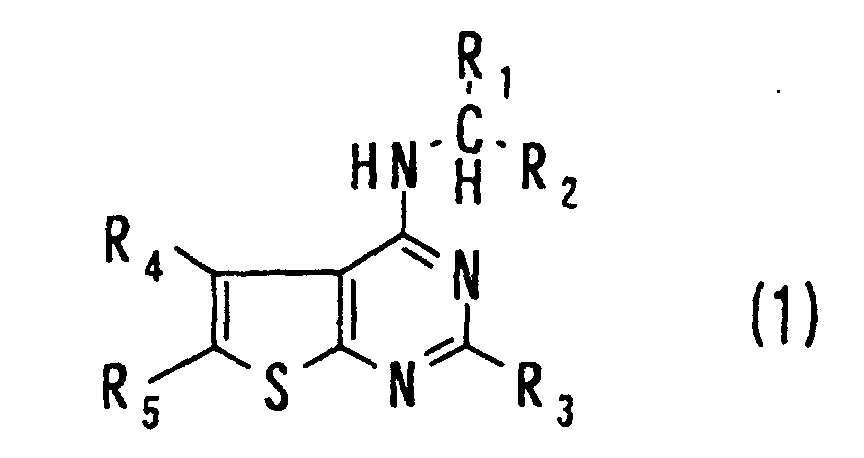 R2 is C3-6 cycloalkyl optionally substituted with G1, phenyl optionally substituted with G2, or a saturated or unsaturated heterocyclic group containing 1 to 4 heteroatoms selected from among N, O and S and optionally substituted with G3;R3 is a saturated or unsaturated heterocyclic group containing 1 to 4 heteroatoms selected from among N, O and S and optionally substituted with G3, or a group represented by Formula (CH2)kC(=O)R6 or CH=CHC(=O)R6;R4 is hydrogen, C1-6 alkyl, hydroxyl, C1-6 alkoxy, halogen, C1-6 haloalkyl, nitro or cyano;R5 is cyano, phenyl optionally substituted with G2, a saturated or unsaturated heterocyclic group containing 1 to 4 heteroatoms selected from among N, O and S and optionally substituted with G3, or a group represented by Formula (CH2)kC(=O)R6 or CH=CHC(=O)R6;R6 is hydrogen, hydroxyl, C1-6 alkoxy, phenoxy optionally substituted with G2, benzyloxy optionally substituted with G2, or a group represented by Formula Nr1r2 or NHNr3r4;r1 and r3 are hydrogen, or C1-6 alkyl optionally substituted with hydroxyl or a ONO2 group;r2 and r4 are hydrogen, C1-6 alkyl, C3-8 cycloalkyl, C1-6 alkoxycarbonyl, C1-6 alkyl optionally substituted with a saturated or unsaturated heterocyclic group containing 1 to 4 heteroatoms selected from among N, O and S and optionally substituted with G3, phenyl optionally substituted with G2, benzyl optionally substituted with G2, or a saturated or unsaturated heterocyclic group containing 1 to 4 heteroatoms selected from among N, O and S and optionally substituted with G3;or r1 and r2 may join, together with N, to form a ring shown below and optionally substituted with r5(wherein, Y is O, CH2 or NH);
 r5 is C1-6 alkyl optionally substituted with G2, phenyl optionally substituted with G2, benzyl optionally substituted with G2, pyridyl optionally substituted with G2, or -Z-Q (wherein, Z is CO, CS or SO2, and Q is hydrogen, C1-6 alkyl, C1-6 alkoxy, di-C1-6 alkylamino, phenyl-C1-6 alkylamino, or a saturated or unsaturated heterocyclic group containing 1 to 4 heteroatoms selected from among N, O and S);k is 0, 1 or 2;G1 is halogen, C1-6 alkyl or C1-6 alkoxy;G2 is halogen, C1-6 alkyl, C1-6 alkoxy or C1-2 alkylenedioxy;G3 is halogen, C1-6 alkyl, C1-6 haloalkyl, C1-6 alkoxy or C1-6 alkoxycarbonyl;a benzene ring, cycloalkyl group or heterocyclic ring may have two or more substituents of G1, G2, G3 and r5, which may be the same or different when two or more], and pharmaceutically acceptable salts thereof.
 - A compound represented by Formula (1-2)(wherein, R1, R2, R4, R5 and R6 are as defined in Claim 1).

- A process for the preparation of a compound of Formula (1),(wherein, R1, R2, R3, R4 and R5 are as defined in Claim 1), characterized in that a compound of Formula (2)
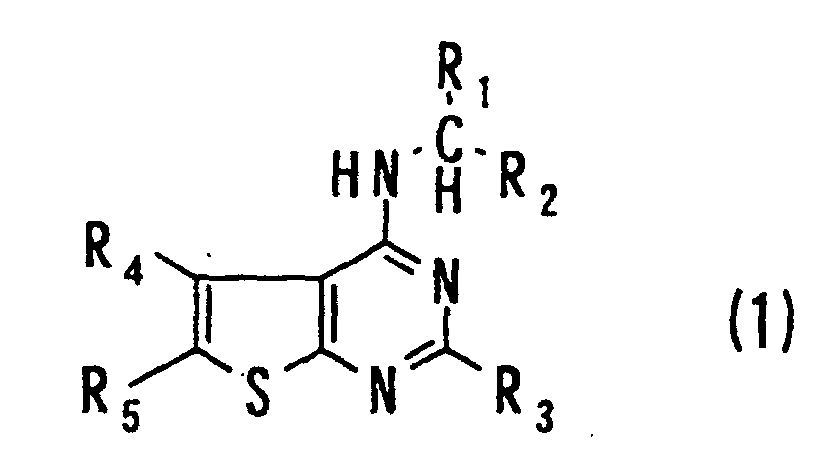 (wherein, R3, R4 and R5 are as defined in Claim 1, and X is halogen), is reacted with a compound of Formula (3)
 (wherein, R1 and R2 are as defined in Claim 1).
Applications Claiming Priority (3)
| Application Number | Priority Date | Filing Date | Title |
|---|---|---|---|
| JP2000299872 | 2000-09-29 | ||
| JP2000299872 | 2000-09-29 | ||
| PCT/JP2001/008530 WO2002026745A1 (en) | 2000-09-29 | 2001-09-28 | Thienopyrimidine compounds and their salts and process for preparation of both |
Publications (1)
| Publication Number | Publication Date |
|---|---|
| EP1329454A1 true EP1329454A1 (en) | 2003-07-23 |
Family
ID=18781622
Family Applications (1)
| Application Number | Title | Priority Date | Filing Date |
|---|---|---|---|
| EP01970282A Withdrawn EP1329454A1 (en) | 2000-09-29 | 2001-09-28 | Thienopyrimidine compounds and their salts and process for preparation of both |
Country Status (7)
| Country | Link |
|---|---|
| EP (1) | EP1329454A1 (en) |
| JP (1) | JPWO2002026745A1 (en) |
| KR (1) | KR20030034232A (en) |
| CN (1) | CN1458933A (en) |
| AU (1) | AU2001290311A1 (en) |
| CA (1) | CA2423981A1 (en) |
| WO (1) | WO2002026745A1 (en) |
Cited By (6)
| Publication number | Priority date | Publication date | Assignee | Title |
|---|---|---|---|---|
| ES2217956A1 (en) * | 2003-01-23 | 2004-11-01 | Almirall Prodesfarma, S.A. | 4-AMINOTHIENO [2,3-d] PYRIMIDINE-6-CARBONITRILE DERIVATIVES AS PDE7 INHIBITORS |
| WO2010045008A1 (en) * | 2008-10-13 | 2010-04-22 | Janssen Pharmaceutica Nv | AMIDES OF THIENO[2,3-d]PYRIMIDINE AND THEIR USE AS ADENOSINE A2a RECEPTOR ANTAGONISTS |
| CN101198614B (en) * | 2005-06-14 | 2011-07-06 | Aska制药株式会社 | Thienopyrimidine derivative |
| US8722660B2 (en) | 2010-02-17 | 2014-05-13 | Takeda Pharmaceutical Company Limited | Heterocyclic compound |
| US9701691B2 (en) | 2012-01-10 | 2017-07-11 | Hoffman-La Roche Inc. | Thienopyrimidine compounds |
| WO2019023651A3 (en) * | 2017-07-28 | 2019-03-28 | Massachusetts Institute Of Technology | Small molecule modulators of the androgen receptor |
Families Citing this family (12)
| Publication number | Priority date | Publication date | Assignee | Title |
|---|---|---|---|---|
| TW200621257A (en) * | 2004-10-20 | 2006-07-01 | Astellas Pharma Inc | Pyrimidine derivative fused with nonaromatic ring |
| US7674822B2 (en) | 2004-11-24 | 2010-03-09 | Wyeth | PTP1b inhibitors |
| JP5500990B2 (en) * | 2006-12-07 | 2014-05-21 | エフ・ホフマン−ラ・ロシュ・アクチェンゲゼルシャフト | Phosphoinositide 3-kinase inhibitor compounds and methods of use |
| CA2855446C (en) | 2011-11-23 | 2021-04-20 | Cancer Research Technology Limited | Thienopyrimidine inhibitors of atypical protein kinase c |
| CN103664991B (en) * | 2012-09-19 | 2016-12-28 | 中国科学院福建物质结构研究所 | Thiophene [2,3 d] pyrimidine derivatives, Its Preparation Method And Use |
| HRP20191860T1 (en) | 2013-03-13 | 2019-12-27 | Forma Therapeutics, Inc. | 2-hydroxy-1-{4-[(4-phenylphenyl)carbonyl]piperazin-1-yl}ethan-1-one derivatives and related compounds as fatty acid synthase (fasn) inhibitors for the treatment of cancer |
| JP7114076B2 (en) | 2015-12-22 | 2022-08-08 | シャイ・セラピューティクス・エルエルシー | Compounds for the treatment of cancer and inflammatory diseases |
| CA3066939A1 (en) | 2017-06-21 | 2018-12-27 | SHY Therapeutics LLC | Compounds that interact with the ras superfamily for the treatment of cancers, inflammatory diseases, rasopathies, and fibrotic disease |
| TWI767148B (en) | 2018-10-10 | 2022-06-11 | 美商弗瑪治療公司 | Inhibiting fatty acid synthase (fasn) |
| WO2020092395A1 (en) | 2018-10-29 | 2020-05-07 | Forma Therapeutics, Inc. | SOLID FORMS OF (4-(2-FLUORO-4-(1-METHYL-1 H-BENZO[d]IMIDAZOL-5-YL)BENZOYL) PIPERAZIN-1-YL)(1-HYDROXYCYCLOPROPYL)METHANONE |
| EP3898609A1 (en) | 2018-12-19 | 2021-10-27 | Shy Therapeutics LLC | Compounds that interact with the ras superfamily for the treatment of cancers, inflammatory diseases, rasopathies, and fibrotic disease |
| JP2022522777A (en) * | 2019-03-01 | 2022-04-20 | レボリューション メディシンズ インコーポレイテッド | Bicyclic heteroaryl compounds and their use |
Family Cites Families (4)
| Publication number | Priority date | Publication date | Assignee | Title |
|---|---|---|---|---|
| US5869486A (en) * | 1995-02-24 | 1999-02-09 | Ono Pharmaceutical Co., Ltd. | Fused pyrimidines and pyriazines as pharmaceutical compounds |
| DE19632423A1 (en) * | 1996-08-12 | 1998-02-19 | Merck Patent Gmbh | Thienopyrimidines |
| DE19644228A1 (en) * | 1996-10-24 | 1998-04-30 | Merck Patent Gmbh | Thienopyrimidines |
| DE19752952A1 (en) * | 1997-11-28 | 1999-06-02 | Merck Patent Gmbh | Thienopyrimidines |
-
2001
- 2001-09-28 EP EP01970282A patent/EP1329454A1/en not_active Withdrawn
- 2001-09-28 JP JP2002531129A patent/JPWO2002026745A1/en not_active Withdrawn
- 2001-09-28 CN CN01815848A patent/CN1458933A/en active Pending
- 2001-09-28 WO PCT/JP2001/008530 patent/WO2002026745A1/en not_active Ceased
- 2001-09-28 AU AU2001290311A patent/AU2001290311A1/en not_active Abandoned
- 2001-09-28 KR KR10-2003-7004523A patent/KR20030034232A/en not_active Ceased
- 2001-09-28 CA CA002423981A patent/CA2423981A1/en not_active Abandoned
Non-Patent Citations (1)
| Title |
|---|
| See references of WO0226745A1 * |
Cited By (13)
| Publication number | Priority date | Publication date | Assignee | Title |
|---|---|---|---|---|
| ES2217956A1 (en) * | 2003-01-23 | 2004-11-01 | Almirall Prodesfarma, S.A. | 4-AMINOTHIENO [2,3-d] PYRIMIDINE-6-CARBONITRILE DERIVATIVES AS PDE7 INHIBITORS |
| ES2217956B1 (en) * | 2003-01-23 | 2006-04-01 | Almirall Prodesfarma, S.A. | NEW DERIVATIVES OF 4-AMINOTIENE (2,3-D) PIRIMIDIN-6-CARBONITRILE. |
| US7662814B2 (en) | 2003-01-23 | 2010-02-16 | Laboratorios Almirall, S.A. | 4-aminothieno[2,3-d]pyrimidine-6-carbonitrile derivatives as PDE7 inhibitors |
| CN101198614B (en) * | 2005-06-14 | 2011-07-06 | Aska制药株式会社 | Thienopyrimidine derivative |
| WO2010045008A1 (en) * | 2008-10-13 | 2010-04-22 | Janssen Pharmaceutica Nv | AMIDES OF THIENO[2,3-d]PYRIMIDINE AND THEIR USE AS ADENOSINE A2a RECEPTOR ANTAGONISTS |
| US8921354B2 (en) | 2010-02-17 | 2014-12-30 | Takeda Pharmaceutical Company Limited | Heterocyclic compound |
| US8722660B2 (en) | 2010-02-17 | 2014-05-13 | Takeda Pharmaceutical Company Limited | Heterocyclic compound |
| US8933069B2 (en) | 2010-02-17 | 2015-01-13 | Takeda Pharmaceutical Company Limited | Heterocyclic compound |
| US9388195B2 (en) | 2010-02-17 | 2016-07-12 | Takeda Pharmaceutical Company Limited | Heterocyclic compound |
| US9655900B2 (en) | 2010-02-17 | 2017-05-23 | Takeda Pharmaceutical Company Limited | Heterocyclic compound |
| US9701691B2 (en) | 2012-01-10 | 2017-07-11 | Hoffman-La Roche Inc. | Thienopyrimidine compounds |
| WO2019023651A3 (en) * | 2017-07-28 | 2019-03-28 | Massachusetts Institute Of Technology | Small molecule modulators of the androgen receptor |
| US10961216B2 (en) | 2017-07-28 | 2021-03-30 | Massachusetts Institute Of Technology | Small molecule modulators of the androgen receptor |
Also Published As
| Publication number | Publication date |
|---|---|
| CN1458933A (en) | 2003-11-26 |
| JPWO2002026745A1 (en) | 2004-02-05 |
| AU2001290311A1 (en) | 2002-04-08 |
| CA2423981A1 (en) | 2003-03-28 |
| WO2002026745A1 (en) | 2002-04-04 |
| KR20030034232A (en) | 2003-05-01 |
Similar Documents
| Publication | Publication Date | Title |
|---|---|---|
| US6423716B1 (en) | Nitrogenous heterocyclic compounds | |
| US8716319B2 (en) | Substituted heterocyclic compounds | |
| EP1167367A1 (en) | Thienopyrimidine compounds and salts thereof and process for the preparation of the same | |
| CA2138298C (en) | Pyridopyrimidinone antianginal agents | |
| KR20030034232A (en) | Thienopyrimidine compounds and their salts and process for preparation of both | |
| CA2283211A1 (en) | 1,5-dihydro-pyrazolo[3,4-d]-pyrimidinone derivatives | |
| WO1998014449A1 (en) | Fused pyrazole derivatives and processes for their preparation | |
| JP2002533465A (en) | Heterobicycles containing nitrogen as factor Xa inhibitors | |
| CA3064938A1 (en) | Pyrazolopyrimidine pde9 inhibitors | |
| IE862575L (en) | e-FUSED-(1,2,4) TRIAZOLO (1,5-c) PYRIMIDINES | |
| Al-Thebeiti | Synthesis of some new thiazolo [3, 2-a] pyridines and related heterocyclic systems | |
| JP4917428B2 (en) | 2-substituted phenyl-5,7-dialkyl-3,7-dihydropyrrolo [2,3-d] pyrimidin-4-one derivatives, process for producing the same and pharmaceutical use thereof | |
| JP4721452B2 (en) | Pyridinylpyrazolopyrimidinone derivatives having PDE7 inhibitory action | |
| JP2008501618A6 (en) | Pyridinylpyrazolopyrimidinone derivatives having PDE7 inhibitory action | |
| CA2455298C (en) | Condensed polycyclic compounds | |
| JP2001139556A (en) | Indenopyridine and indenopyrimidine compound and method for producing the same | |
| JP2002105082A (en) | Condensed thienopyrimidine compound, its salt and method of preparing the same | |
| NO328848B1 (en) | Variolin derivatives and their use as antitumor agents | |
| JP2002308877A (en) | Pyrroloquinoline compound and its production method | |
| JPWO2001012608A1 (en) | Quinoline compounds and methods for producing them | |
| KR100282153B1 (en) | 3-alkyl pyrrolo [3,2-c] quinoline derivatives | |
| TW202246261A (en) | Compounds as anticancer agents | |
| JPWO2000059912A1 (en) | Thienopyrimidine compounds and their salts, and methods for producing them | |
| Arava et al. | New reagents from “N, N-Dimethylaminomethoxy methylenium methyl sulphate”-Synthesis of 3-Amino-4-cyano pyrazole | |
| 大橋知洋 | Discovery of Novel Hedgehog Signaling Inhibitor |
Legal Events
| Date | Code | Title | Description |
|---|---|---|---|
| PUAI | Public reference made under article 153(3) epc to a published international application that has entered the european phase |
Free format text: ORIGINAL CODE: 0009012 |
|
| 17P | Request for examination filed |
Effective date: 20030415 |
|
| AK | Designated contracting states |
Designated state(s): AT BE CH CY DE DK ES FI FR GB GR IE IT LI LU MC NL PT SE TR |
|
| AX | Request for extension of the european patent |
Extension state: AL LT LV MK RO SI |
|
| STAA | Information on the status of an ep patent application or granted ep patent |
Free format text: STATUS: THE APPLICATION HAS BEEN WITHDRAWN |
|
| 18W | Application withdrawn |
Effective date: 20031120 |