EP1327959A2 - Neuronales Netz zur Modellierung eines physikalischen Systems sowie Verfahren zur Bildung eines solchen neuronalen Netzes - Google Patents
Neuronales Netz zur Modellierung eines physikalischen Systems sowie Verfahren zur Bildung eines solchen neuronalen Netzes Download PDFInfo
- Publication number
- EP1327959A2 EP1327959A2 EP03000228A EP03000228A EP1327959A2 EP 1327959 A2 EP1327959 A2 EP 1327959A2 EP 03000228 A EP03000228 A EP 03000228A EP 03000228 A EP03000228 A EP 03000228A EP 1327959 A2 EP1327959 A2 EP 1327959A2
- Authority
- EP
- European Patent Office
- Prior art keywords
- neural network
- input
- output
- neurons
- layer
- Prior art date
- Legal status (The legal status is an assumption and is not a legal conclusion. Google has not performed a legal analysis and makes no representation as to the accuracy of the status listed.)
- Granted
Links
Images

Classifications
-
- G—PHYSICS
- G06—COMPUTING OR CALCULATING; COUNTING
- G06N—COMPUTING ARRANGEMENTS BASED ON SPECIFIC COMPUTATIONAL MODELS
- G06N3/00—Computing arrangements based on biological models
- G06N3/02—Neural networks
- G06N3/04—Architecture, e.g. interconnection topology
- G06N3/045—Combinations of networks
-
- G—PHYSICS
- G06—COMPUTING OR CALCULATING; COUNTING
- G06N—COMPUTING ARRANGEMENTS BASED ON SPECIFIC COMPUTATIONAL MODELS
- G06N3/00—Computing arrangements based on biological models
- G06N3/02—Neural networks
- G06N3/04—Architecture, e.g. interconnection topology
- G06N3/0499—Feedforward networks
-
- G—PHYSICS
- G06—COMPUTING OR CALCULATING; COUNTING
- G06N—COMPUTING ARRANGEMENTS BASED ON SPECIFIC COMPUTATIONAL MODELS
- G06N3/00—Computing arrangements based on biological models
- G06N3/02—Neural networks
- G06N3/08—Learning methods
- G06N3/09—Supervised learning
Definitions
- the invention relates to a neural network for modeling a physical Systems using a computer program system for system identification and a method for forming such a neural network, the invention is applicable to physical systems that are dynamically changeable are.
- moving objects such as vehicles come as systems and especially aircraft and systems with dynamic processes such as reactors or power plants or chemical processes.
- the invention is particularly applicable in the modeling of vehicles and in particular Aircraft using aerodynamic coefficients.
- neural networks for system modeling have not previously been used.
- the multi-layered forward facing used Networks maintain the network due to the relatively high degree Networking of the neurons has a black box character, creating a characteristic value of the modeled system is not localizable. That means that internal sizes of the Network can not be assigned to certain physical effects, which these cannot be analyzed in detail either. Such analyzes are important, however, to make statements about the general validity of the overall model to be able to meet. Because of this black box character are neural Networks for system identification have not previously been used.
- a neural network for mapping one is a physical one System descriptive output function from functionally interconnected Neurons are provided, each of which is assigned a transition function, by the initial value determined from this in the longitudinal direction of the Functionally as the next connected neuron as input value, the functional relationships linking neurons only within one of at least two in the transverse direction and between an input layer and an output layer arranged groups of neurons are, the groups at least two in the longitudinal direction one behind the other have arranged intermediate layers with at least one neuron.
- the partial function coefficients in the form of untrainable connections between a group of neurons and the output neurons of the whole Neural network is considered and are considered connections between the Input layer and each group provided untrainable input connections.
- a neural network is provided, the dynamic and physical Connections of the system are represented by a network structure.
- the system output is a sum of several parts (at least two) composed of the input variables be calculated.
- a physical effect e.g. the Damping of a system
- the method according to the invention has the following advantages: Using neural networks will be robust against noisy Measurement data reached and the analytical model is not limited to linear relationships to the system description, since output values for all input values non-linear inter- or within a specified value range be extrapolated.
- the neural network according to the invention can also be generalized, i.e. from faulty General trends can be derived from measurement data.
- the neural network according to the invention can also certain expert knowledge of the modeled physical system through a network structure and predefined value ranges.
- Neuron with a non-linear transition function Neuron with a linear transition function
- the basis of the neural network according to the invention are analytical equations for describing the system behavior depending on input values. This Equations have factors and functions of different dimensions. These functions can be linear or non-linear. To describe the system according to the inventive method using a neural network these functions and their parameters must be determined, taking neurons with nonlinear or linear transition function.
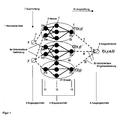
- FIG. 1 An embodiment of a neural network provided according to the invention is in Fig. 1 for an aerodynamic model to describe the longitudinal movement of an airplane.
- multilayered Feedforward networks Multi Layer Perceptron
- Network structure and through the modified optimization process finds one Separation of the physical effects and an assignment of these effects in the provided Groups instead.
- Each group represents a physical effect, and can be analyzed in isolation after the entire network has been trained. Because a group can also be detached from the overall network, and there it also has inputs and outputs for any input values Output values of the group can be calculated.
- FIG. 2 a neural network according to the general state of the art with neurons with a nonlinear transition function for emulating a function f with four input variables x, y, a, b is shown in FIG. 2.
- the neural network 100 shown there has an input layer 101 with input neurons 101a, 101b, 101x, 101y, an output neuron 104, and a first 111 and a second 112 intermediate layer.
- the number of intermediate layers and neurons usually used is based on empirical values and depends on the complexity of the system to be simulated.
- the neurons are linked to one another completely or in layers.
- the input neurons are on the left and at least one output neuron is on the right.
- neurons can have a nonlinear, for example formed with the tangent hyperbolic function, or a linear transition function.
- the neurons used in the representations are shown below with the corresponding representation symbols. Due to its networked structure, these parts cannot determine or solve the system equation according to the parameters.
- a neural network with a specific architecture is used (see Fig. 1).
- group layer 4 additionally at least two groups of neurons arranged in the transverse direction 7 are formed.
- the formation of groups can respective sub-functions are considered in isolation.
- the neuron groups used according to the invention have at least one Input layer 3 with at least one input neuron (reference symbols x and y; the designations x and y are also used for the corresponding variables or Input variables used), and at least one output layer 5 with at least an output neuron 9.
- the number of neuron groups to be formed according to the invention is preferred equal to the number of subfunctions of the system describing the replica Functional equation.
- the partial function coefficients are advantageous in the architecture according to the invention in the form of untrainable input connections behind the Group layer integrated. This increases the number of connections and thus also reduced the time to train and calculate. In neural networks according to the prior art, however, these sub-function coefficients would be used design in the form of input neurons (Fig. 2).
- the input and output neurons of the neural network are preferred linear to pass the input values unchanged to the groups, and to to sum up the expenditure of the groups only.
- a group of neurons is connected to the input neurons with untrainable connections and to the output neurons of the entire neural network with untrainable input connections. With the untrainable input connection, the output of a neuron group can still be multiplied by a factor (e.g. f2 (x, y) multiplied by a ).
- the untrainable input connections are advantageously used for assignment from physical effects to provided groups.
- This Connections enable the during the optimization process (training) Splitting the calculated total error at the network output into the individual ones Shares from the groups. For example, with an input connection with the value zero this group did not contribute to the total error. consequently is considered a back propagated error according to the back propagation algorithm the value zero is calculated. The error-dependent adjustment of the weights within this group is thus avoided. Only the groups their non-trainable non-zero input connections are adjusted.
- the coefficients in the representation of equation (1) are the functions f1, f2 and f3 , and in the representation of equation (2) the designations C M0 , C M ⁇ , C Mq . These individual coefficients are generally non-linearly dependent on the angle of attack ⁇ and possibly on the Mach number Ma.
- FIG. 1 shows an output equation (1) used as an example Neurons 2 formed neural network 1 with an input layer 3 and one Starting layer 5 and with several, at least two groups in the group layer 4. Within a group is a first 11, a second 12 and a third 13 intermediate layer - each as part of the group layer 4 - arranged.
- the number of intermediate layers used depends on the order of the approximations Function with which the system to be simulated is described mathematically becomes. One to three intermediate layers are usually used.
- groups of neurons arranged in the transverse direction 7 of the network 1 are formed, the number of neuron groups to be formed according to the invention preferably being equal to the number of subfunctions of the functional equation describing the system to be simulated. In equation (1) or equation (2) as their specialization, these are three sub-functions. Accordingly, three neuron groups 21, 22, 23 are provided in the embodiment of FIG. 1. In this way, by forming groups arranged in the transverse direction, the respective partial functions, that is to say functions f1, f2 and f3 in the example of equation (1), can be viewed in isolation. For this purpose, the first intermediate layer 11 is used as the input layer and the last intermediate layer 13 as the output layer.
- the partial function coefficients are in the neural formed for equation (1) 1 the coefficients 1, a and b and are in the form of untrainable Input connections 8b integrated into the overall network; i.e. the connections between the last intermediate layer 13 of a group and the starting layer 5 are applied with the function coefficients. This will the number of connections and thus also the time to train and calculate reduced.
- the input and output neurons of the groups i.e. the input 3 and the output layer 5 should preferably be linear around the input values to pass unchanged to the neurons of the intermediate layers 11, 12, 13, and just to sum the output values of the neuron groups.
- the neuron groups 21, 22, 23 used according to the invention have a first one Intermediate layer or input intermediate layer 11 of the group layer 4 with at least one input neuron 31a or 32a, 32b or 33a, 33b.
- One last Intermediate layer or intermediate output layer 13 has at least one Output neuron 31c or 32b or 33c.
- the due to the functional relationships in the transverse direction 7 functionally independent neuron groups 21, 22, 23 are isolated from each other, i.e. the neurons of a group of neurons are not directly connected to the neurons of another group of neurons. This does not apply to the functional connection to input layer 3 and the starting layer 5. Any number can be within a neuron group Intermediate layers may be included. In the embodiment of FIG. 1 there are three Intermediate layer 12 arranged.
- each group 21, 22, 23 has at least two in a row 6 in the longitudinal direction arranged intermediate layers 11, 12, 13 with at least one neuron on.
- a neuron in an intermediate layer is therefore only with one neuron in another neighboring intermediate layer over functional in the longitudinal direction 6 of the network 1 ongoing relationships when these neurons are one of several Groups of at least one neuron each arranged in the transverse direction 7 belong.
- the internal terms f1, f2, f3 of the equation (1) or C M0 ( ⁇ , Ma), C M ⁇ ( ⁇ , Ma), C Mq (Ma ) of the more specific equation (2) can be determined in order to check the model for its correct behavior with untrained input values.
- the term C Mq (Ma) should always be negative because it represents the damping of the system.
- equations are used to describe the system behavior depending on input values.
- An example of such an equation is formulated above in equation (1). These equations have factors and functions of different dimensions. These functions can be linear or non-linear.
- these functions and their parameters must be determined to describe the system to be modeled. Then the structure of the neural network is created according to the criteria described above.
- An exemplary embodiment of a neural network used according to the invention is shown in FIG. 1 for an aerodynamic model for describing the longitudinal movement of an aircraft.
- the architecture of the neural network 1 is designed analogously to the mathematical function f (x, y, a, b) , with untrainable connections 8a between the input layer and the first group layer 11 and untrainable input connections 8b between the last group layer 13 and the Output layer 5 are provided.
- a training phase is then carried out to adapt the network to the system to be simulated.
- the input and output sizes of the system here: aircraft
- the flight mechanical quantities ⁇ , Ma, ⁇ , q and C M are measured or calculated using flight mechanical formulas.
- a training data record for the neural network is created from the measurement data, consisting of several pairs of values, each with four input values ( ⁇ , Ma, ⁇ , q ) and an output value ( C M ). Iterative methods can be used in the learning process, for example the method of gradient descent (back propagation).
- the trainable connection weights w ij (shown as arrows) are usually adjusted such that the neural network delivers the best possible suitable output for all measurement data.
- connection weights can be set to random values, preferably in the interval [-1.0; +1.0]. If there are default values for terms f1, f2 and f3 , the groups can also be individually trained. To do this, a group must be regarded as a closed neural network and the optimization algorithm applied to this group alone.
- each group f1, f2 and f3 can be analyzed by considering one group in isolation. Because each group can be viewed as a closed neural network. Accordingly, an input value y can be selected for the neuron 31a and then this group can be calculated up to its output neuron 31c. The output neuron 31c of group 21 then contains the function value f3 (y) .
- the internal components C M0 ( ⁇ , Ma), C M ⁇ ( ⁇ , Ma) and C Mq (Ma) can be read from the output neurons 31c, 32c, 33c of the three neuron groups after calculating the neural network 1.
- the described methods in particular the methods for training and for Optimization of the neural network according to the invention are in particular for Implementation provided on a computer program system.
Landscapes
- Engineering & Computer Science (AREA)
- Theoretical Computer Science (AREA)
- Physics & Mathematics (AREA)
- General Health & Medical Sciences (AREA)
- Computing Systems (AREA)
- Biomedical Technology (AREA)
- Biophysics (AREA)
- Computational Linguistics (AREA)
- Data Mining & Analysis (AREA)
- Evolutionary Computation (AREA)
- Life Sciences & Earth Sciences (AREA)
- Molecular Biology (AREA)
- Artificial Intelligence (AREA)
- General Engineering & Computer Science (AREA)
- General Physics & Mathematics (AREA)
- Mathematical Physics (AREA)
- Software Systems (AREA)
- Health & Medical Sciences (AREA)
- Feedback Control In General (AREA)
- Complex Calculations (AREA)
- Electrotherapy Devices (AREA)
- Selective Calling Equipment (AREA)
- Data Exchanges In Wide-Area Networks (AREA)
Abstract
Description
- Messwertepaare der Ein- und Ausgänge,
- eine Modellstruktur,
- ein Verfahren zur Kennwertermittlung,
- bei einigen Verfahren geschätzte Anfangswerte für die Kennwerte.
- Es wird üblicherweise ein lineares Verhalten um einen Anfangszustand vorausgesetzt. Konsequenterweise fällt es schwer, ein hochdynamisches Verhalten eines Systems korrekt nachzubilden, da zustandsabhängige Kennwerte nicht mehr mit dem Anfangszustand in einem linearen Zusammenhang stehen.
- Es können nur für einzelne Abschnitte der Messwerte (z.B. Flugzeugmanöver) die relevanten Kennwerte identifiziert werden. Dadurch entsteht ein hoher Aufwand in der Datenverarbeitung.
- Ein Konvergieren der Verfahren kann durch die Empfindlichkeit auf verrauschte Messdaten behindert werden.
- Fig. 1
- ein Ausführungsbeispiel eines neuronalen Netzes, das zur erfindungsgemäßen Bildung eines analytischen Modells eines nachzubildenden physikalischen Systems verwendet wird,
- Fig. 2
- eine Darstellung eines neuronalen Netzes nach dem allgemeinen Stand der Technik.
- oi
- Ausgabe eines Neurons der vorhergehenden Schicht i,
- wij
- trainierbares Verbindungsgewicht zwischen zwei Schichten i und j,
- fj
- Übergangsfunktion eines Neurons der nachfolgenden Schicht j.

- CM
- Nickmomentenbeiwert;
- CM0(α,Ma)
- Nullmomentenbeiwert, abhängig vom Anstellwinkel α und der Machzahl Ma;
- CMη(α,Ma)
- Derivativ für den Nickmomentenanstieg infolge Höhenruderausschlag η; es ist abhängig vom Anstellwinkel α und der Machzahl Ma, und muß mit η multipliziert werden;
- CMq (Ma)
- Derivativ für die Nickdämpfung; es ist abhängig von der Machzahl Ma, und muss mit der Nickrate q multipliziert werden.
- Die Werte für die Eingänge des Netzwerks werden aus dem Trainingsdatensatz übernommen. Im Schritt 1 müssen nun neben den Neuronen in der Eingangsschicht 3 zusätzlich die Eingabeverbindungen 8b auf die Eingabewerte aus dem Trainingsdatensatz gesetzt werden.
- Das Netzwerk wird beginnend von der Eingangsschicht bis zur Ausgangsschicht berechnet. Dazu wird die Aktivierung jedes Neurons abhängig von den Vorgängerneuronen und den Verbindungen berechnet.
- Die Aktivierung des Ausgabeneurons wird mit dem Sollwert aus dem Trainingsdatensatz verglichen. Aus der Differenz wird der Netzwerkfehler berechnet.
- Aus dem Netzwerkfehler wird schichtweise von hinten nach vorne der Fehler an jedem Neuron berechnet, wobei die Verbindungen auch als Eingänge fungieren können.
- Abhängig von dem Fehler eines Neurons und dessen Aktivierung wird eine Gewichtsänderung der Verbindungen zu den benachbarten Neuronen berechnet, wobei die Verbindungen auch als Eingänge fungieren können.
- Abschließend werden die Gewichtsänderungen zu den jeweiligen Verbindungsgewichten addiert, wobei die Gewichtsänderungen auf die untrainierbaren Verbindungen 8a und die untrainierbaren Eingabeverbindungen 8b nicht addiert werden.
Claims (17)
- Neuronales Netz zur Nachbildung eines physikalischen Systems mit einer Eingangsschicht (3) und einer Ausgangsschicht (5) sowie mit einer Gruppenschicht (4), die aus zumindest zwei Gruppen besteht, wobei die Anzahl der verwendeten Gruppen von der Zahl der Summationsterme der Funktion abhängt, mit der das nachzubildende System mathematisch beschrieben wird,
dadurch gekennzeichnet, dass
Gruppen von Neuronen gebildet werden, wobei die Anzahl der Gruppen gleich der Anzahl der Teilfunktionen der das nachzubildende System beschreibenden Funktionsgleichung ist und wobei die Teilfunktionskoeffizienten in Form von untrainierbaren Eingabeverbindungen hinter dem Ausgabeneuron einer Gruppe angeordnet ist. - Neuronales Netz nach dem Anspruch 1, dadurch gekennzeichnet, dass die Eingabe- und Ausgabeneuronen des Neuronalen Netzes, also der Eingangs- (3) und der Ausgangsschicht (5) sind linear, um die Eingabewerte unverändert an die Neuronen der ersten Schicht (11) einer Gruppe weiterzugeben, und um den Wertebereich der Ausgabe des Neuronalen Netzes nicht zu limitieren.
- Neuronales Netz nach einem der voranstehenden Ansprüche, dadurch gekennzeichnet, dass die untrainierbaren Verbindungen (8a) zwischen den Neuronen der Eingangsschicht (3) und der ersten Schicht (11) einer Gruppe haben einen festen Wert, wobei dieser Wert während des Trainings des Neuronalen Netzes nicht modifiziert wird.
- Neuronales Netz nach einem der voranstehenden Ansprüche, dadurch gekennzeichnet, dass zur Multiplikation der Ausgabe einer Gruppe mit einem Faktor, eine untrainierbare Eingabeverbindung (8b) vorgesehen ist.
- Neuronales Netz nach einem der voranstehenden Ansprüche, dadurch gekennzeichnet, dass das neuronale Netz zur Erstellung eines Simulationsmodells verwendet wird.
- Neuronales Netz nach einem der voranstehenden Ansprüche, dadurch gekennzeichnet, dass das Neuronale Netz analysiert wird, indem eine Gruppe als isoliertes neuronales Netz betrachtet wird, wobei die erste Zwischenschicht (11) dann zur Eingangsschicht, und die letzte Zwischenschicht (13) zur Ausgangsschicht wird.
- Neuronales Netz nach einem der voranstehenden Ansprüche, dadurch gekennzeichnet, dass eine Gruppe isoliert trainiert werden kann, indem mit Hilfe eines Trainingsdatensatzes und einem Optimierungsverfahren nur die Verbindungsgewichte einer Gruppe modifiziert werden.
- Neuronales Netz nach einem der voranstehenden Ansprüche, dadurch gekennzeichnet, dass der Wertebereich einer Gruppe durch eine geeignete Wahl der Übergangsfunktion des Ausgabeneurons (z.B. 31c) einer Gruppe definiert werden kann.
- Neuronales Netz zur Abbildung einer ein physikalisches System beschreibenden Ausgangsfunktion aus funktional miteinander verbundenen Neuronen (2), denen jeweils eine Übergangsfunktion zugeordnet ist, um den aus dieser jeweils ermittelten Ausgangswert dem in Längsrichtung (6) des Netzes (1) funktional als nächsten verbundenen Neuron (2) als Eingangswert zu übertragen,
dadurch gekennzeichnet, dass
die funktionalen Beziehungen zur Verknüpfung der Neuronen nur innerhalb einer von zumindest zwei in Querrichtung (7) und zwischen einer Eingangsschicht (3) und einer Ausgangsschicht (5) angeordneten Gruppen (21, 22, 23) von Neuronen vorgesehen sind, wobei die Gruppen (21, 22, 23) zumindest zwei in Längsrichtung (6) hintereinander angeordnete Zwischenschichten (11, 12, 13) mit zumindest einem Neuron aufweisen,
wobei die Teilfunktions-Koeffizienten in Form von untrainierbaren Verbindungen zwischen einer Neuronengruppe und den Ausgabeneuronen des gesamten Neuronalen Netzes berücksichtigt sind und als Verbindungen zwischen der Eingangsschicht (3) und jeder Gruppe untrainierbare Eingabeverbindungen vorgesehen sind. - Neuronales Netz zur Abbildung einer ein physikalisches System beschreibenden Ausgangsfunktion nach dem Anspruch 9, dadurch gekennzeichnet, dass die Zahl der Neuronengruppen gleich ist der Anzahl der Teilfunktionen der das nachzubildende System beschreibenden Funktionsgleichung.
- Neuronales Netz zur Abbildung einer ein physikalisches System beschreibenden Ausgangsfunktion nach dem Anspruch 9 oder 10, dadurch gekennzeichnet, dass die Eingabe-Neu-ronen (x, y) und Ausgabe-Neuronen (9) des neuronalen Netzes linear sind.
- Verfahren zur Aufstellung eines Neuronalen Netzes nach einem der voranstehenden Ansprüche mit den folgenden Schritten:wobei eine die untrainierbaren Eingabeverbindungen (8b) und die untrainierbaren Verbindungen (8a) ausgenommen sind,Übernahme der Werte für die Eingänge des Netzwerks aus einem Trainingsdatensatz,Überschreiben der Eingabeneuronen und der Eingabeverbindungen mit diesen Werten,Berechnung des neuronalen Netzes von der Eingangsschicht bis zur Ausgangsschicht berechnet, wobei die Aktivierung jedes Neurons abhängig von den Vorgängerneuronen und den Verbindungen berechnet wird,zur Aktivierung des Ausgabeneurons Vergleich desselben mit dem Sollwert aus dem Trainingsdatensatz und Berechnung des Netzwerkfehlers aus der Differenz, wobei der Fehler an jedem Neuron aus dem Netzwerkfehler schichtweise von hinten nach vorne berechnet wird,Berechnung der Gewichtsänderung der Verbindungen zu den benachbarten Neuronen abhängig von dem Fehler eines Neurons und dessen Aktivierung,wobei die untrainierbaren Eingabeverbindungen (8b) und die untrainierbaren Verbindungen (8a) ausgenommen sind.Addition der Gewichtsänderungen zu den jeweiligen Verbindungsgewichten,
- Verfahren zum Training eines neuronalen Netzes nach einem der Ansprüche 9 bis 11 zur Implementierung auf einem Computer-Programmsystem, gekennzeichnet dadurch, dass eine Messung der Ein- und Ausgabegrößen des Systems und Erstellung ein Trainingsdatensatzes für das neuronale Netz aus den Messdaten erfolgt, wobei diese aus mehreren Wertepaaren mit jeweils vier Eingabewerten (α, Ma,η, q) und einem Ausgabewert (CM ) gebildet werden.
- Verfahren zum Training nach dem Anspruch 13 für ein neuronales Netz nach einem der Ansprüche 9 bis 11 zur Implementierung auf einem Computer-Programmsystem, gekennzeichnet dadurch, dass die Methode des Gradientenabstiegs (Backpropagation) angewendet wird.
- Optimierungsverfahren zur Einstellung der Verbindungsgewichte eines neuronalen Netzes nach einem der Ansprüche 9 bis 11 zur Implementierung auf einem Computer-Programm-system, wobei die trainierbaren Verbindungsgewichte wij (dargestellt als Pfeile) derart angepasst werden, dass das neuronale Netz für alle Messdaten eine optimale Ausgabe liefert, wobei die Werte für die Eingänge des Netzwerks aus dem Trainingsdatensatz übernommen werden, gekennzeichnet durch folgende Schritte:x Setzen der Verbindungsgewichte auf Zufallswertewobei die Gewichtsänderungen auf die untrainierbaren Verbindungen (8a) und die untrainierbaren Eingabeverbindungen (8b) nicht addiert werden.Setzen der Eingabeverbindungen (8b) auf die Eingabewerte aus dem Trainingsdatensatz,Berechnung des Netzes von der Eingangsschicht bis zur Ausgangsschicht, wobei die Aktivierung jedes Neurons abhängig von den Vorgängerneuronen und den Verbindungen berechnet wird,Vergleich der Aktivierung des Ausgabeneurons mit dem Sollwert aus dem Trainingsdatensatz und Berechnung des Netzwerkfehlers aus der Differenz,schichtweise Berechnung des Fehlers an jedem Neuron aus dem Netzwerkfehler entgegen der Längsrichtung (6), wobei die Verbindungen auch als Eingänge fungieren können,Berechnung der Gewichtsänderung der Verbindungen zu den benachbarten Neuronen abhängig von dem Fehler eines Neurons und dessen Aktivierung,Addition der Gewichtsänderungen zu den jeweiligen Verbindungsgewichten,
- Optimierungsverfahren zur Einstellung der Verbindungsgewichte eines neuronalen Netzes nach dem Anspruch 15, dadurch gekennzeichnet, dass die Verbindungsgewichte auf Zufallswerte im Intervall [-1.0;+1.0], gesetzt werden.
- Optimierungsverfahren zur Einstellung der Verbindungsgewichte eines neuronalen Netzes nach dem Anspruch 15 oder 16, dadurch gekennzeichnet, dass das Optimierungsverfahren nur für eine Gruppe des neuronalen Netzes durchgeführt wird.
Applications Claiming Priority (2)
| Application Number | Priority Date | Filing Date | Title |
|---|---|---|---|
| DE10201018 | 2002-01-11 | ||
| DE10201018A DE10201018B4 (de) | 2002-01-11 | 2002-01-11 | Neuronales Netz, Opimierungsverfahren zur Einstellung der Verbindungsgewichte eines neuronalen Netzes sowie Analyseverfahren zur Überwachung eines Optimierungsverfahrens |
Publications (3)
| Publication Number | Publication Date |
|---|---|
| EP1327959A2 true EP1327959A2 (de) | 2003-07-16 |
| EP1327959A3 EP1327959A3 (de) | 2004-02-25 |
| EP1327959B1 EP1327959B1 (de) | 2006-09-27 |
Family
ID=7712023
Family Applications (1)
| Application Number | Title | Priority Date | Filing Date |
|---|---|---|---|
| EP03000228A Expired - Lifetime EP1327959B1 (de) | 2002-01-11 | 2003-01-08 | Neuronales Netz zur Modellierung eines physikalischen Systems sowie Verfahren zur Bildung eines solchen neuronalen Netzes |
Country Status (5)
| Country | Link |
|---|---|
| US (1) | US20030163436A1 (de) |
| EP (1) | EP1327959B1 (de) |
| AT (1) | ATE341039T1 (de) |
| CA (1) | CA2415720C (de) |
| DE (2) | DE10201018B4 (de) |
Cited By (5)
| Publication number | Priority date | Publication date | Assignee | Title |
|---|---|---|---|---|
| DE102004013924B3 (de) * | 2004-03-22 | 2005-09-01 | Siemens Ag | Vorrichtung zur kontextabhängigen Datenanalyse |
| WO2006005665A3 (de) * | 2004-07-09 | 2006-12-07 | Siemens Ag | Verfahren zur reaktion auf kontextänderungen mit einem neuronalen netz und neuronales netz zur reaktion auf kontextänderungen |
| CN102361588A (zh) * | 2009-02-17 | 2012-02-22 | 神经芯片公司 | 用于产生认知节律的系统和方法 |
| RU2530270C2 (ru) * | 2012-10-23 | 2014-10-10 | Федеральное государственное автономное образовательное учреждение высшего профессионального образования "Национальный исследовательский ядерный университет "МИФИ" (НИЯУ МИФИ) | Виртуальная потоковая вычислительная система, основанная на информационной модели искусственной нейросети и нейрона |
| DE102023205425A1 (de) | 2022-06-13 | 2023-12-14 | Hochschule Heilbronn, Körperschaft des öffentlichen Rechts | Computer-implementiertes Verfahren zum Erstellen eines Feedforward Neural Network |
Families Citing this family (10)
| Publication number | Priority date | Publication date | Assignee | Title |
|---|---|---|---|---|
| MY138544A (en) * | 2003-06-26 | 2009-06-30 | Neuramatix Sdn Bhd | Neural networks with learning and expression capability |
| US7831416B2 (en) * | 2007-07-17 | 2010-11-09 | Caterpillar Inc | Probabilistic modeling system for product design |
| DE102018210894A1 (de) * | 2018-07-03 | 2020-01-09 | Siemens Aktiengesellschaft | Entwurf und Herstellung einer Strömungsmaschinenschaufel |
| JP6702390B2 (ja) * | 2018-10-09 | 2020-06-03 | トヨタ自動車株式会社 | 車両用駆動装置の制御装置、車載電子制御ユニット、学習済みモデル、機械学習システム、車両用駆動装置の制御方法、電子制御ユニットの製造方法及び出力パラメータ算出装置 |
| DE102019205080A1 (de) * | 2019-04-09 | 2020-10-15 | Robert Bosch Gmbh | Künstliches neuronales Netzwerk mit verbesserter Ermittlung der Zuverlässigkeit der gelieferten Aussage |
| CN112216399B (zh) * | 2020-10-10 | 2024-07-02 | 黑龙江省疾病预防控制中心 | 基于bp神经网络的食源性疾病致病因子预测的方法和系统 |
| CN112446098B (zh) * | 2020-12-03 | 2023-08-25 | 武汉第二船舶设计研究所(中国船舶重工集团公司第七一九研究所) | 海洋装备中推进器的极限性能模拟方法 |
| CN114563952A (zh) * | 2022-01-26 | 2022-05-31 | 重庆大学 | 一种基于浅层神经网络的舵机非线性特性角度控制系统 |
| CN114755711B (zh) * | 2022-03-03 | 2024-06-25 | 清华大学 | 一种基于自编码器的α、β脉冲甄别方法和装置 |
| CN120579488B (zh) * | 2025-08-05 | 2025-09-26 | 南航科技(广东横琴)有限公司 | 飞机空气动力学仿真建模方法、系统、设备及存储介质 |
Family Cites Families (14)
| Publication number | Priority date | Publication date | Assignee | Title |
|---|---|---|---|---|
| US5095443A (en) * | 1988-10-07 | 1992-03-10 | Ricoh Company, Ltd. | Plural neural network system having a successive approximation learning method |
| US4941122A (en) * | 1989-01-12 | 1990-07-10 | Recognition Equipment Incorp. | Neural network image processing system |
| US5107442A (en) * | 1989-01-12 | 1992-04-21 | Recognition Equipment Incorporated | Adaptive neural network image processing system |
| US5822742A (en) * | 1989-05-17 | 1998-10-13 | The United States Of America As Represented By The Secretary Of Health & Human Services | Dynamically stable associative learning neural network system |
| DE69130656T2 (de) * | 1990-06-14 | 1999-06-17 | Canon K.K., Tokio/Tokyo | Neuronale Netzwerke |
| US5627941A (en) * | 1992-08-28 | 1997-05-06 | Hitachi, Ltd. | Method of configuring a neural network and a diagnosis/control system using the neural network |
| DE4338615B4 (de) * | 1993-11-11 | 2005-10-13 | Siemens Ag | Verfahren und Vorrichtung zur Führung eines Prozesses in einem geregelten System |
| DE4443193A1 (de) * | 1994-12-05 | 1996-06-13 | Siemens Ag | Verfahren zum Betrieb neuronaler Netze in Industrieanlagen |
| DE19509186A1 (de) * | 1995-03-14 | 1996-09-19 | Siemens Ag | Einrichtung zum Entwurf eines neuronalen Netzes sowie neuronales Netz |
| WO1998017989A2 (en) * | 1996-10-23 | 1998-04-30 | Ford Global Technologies, Inc. | Automotive engine misfire detection system including a bit-serial based recurrent neuroprocessor |
| KR100257155B1 (ko) * | 1997-06-27 | 2000-05-15 | 김영환 | 반도체 공정장치의 매칭 네트워크의 최적화방법 |
| US6405122B1 (en) * | 1997-10-14 | 2002-06-11 | Yamaha Hatsudoki Kabushiki Kaisha | Method and apparatus for estimating data for engine control |
| US6473746B1 (en) * | 1999-12-16 | 2002-10-29 | Simmonds Precision Products, Inc. | Method of verifying pretrained neural net mapping for use in safety-critical software |
| NZ503882A (en) * | 2000-04-10 | 2002-11-26 | Univ Otago | Artificial intelligence system comprising a neural network with an adaptive component arranged to aggregate rule nodes |
-
2002
- 2002-01-11 DE DE10201018A patent/DE10201018B4/de not_active Expired - Fee Related
-
2003
- 2003-01-07 CA CA2415720A patent/CA2415720C/en not_active Expired - Fee Related
- 2003-01-08 EP EP03000228A patent/EP1327959B1/de not_active Expired - Lifetime
- 2003-01-08 DE DE50305147T patent/DE50305147D1/de not_active Expired - Fee Related
- 2003-01-08 AT AT03000228T patent/ATE341039T1/de not_active IP Right Cessation
- 2003-01-13 US US10/340,847 patent/US20030163436A1/en not_active Abandoned
Cited By (7)
| Publication number | Priority date | Publication date | Assignee | Title |
|---|---|---|---|---|
| DE102004013924B3 (de) * | 2004-03-22 | 2005-09-01 | Siemens Ag | Vorrichtung zur kontextabhängigen Datenanalyse |
| WO2006005665A3 (de) * | 2004-07-09 | 2006-12-07 | Siemens Ag | Verfahren zur reaktion auf kontextänderungen mit einem neuronalen netz und neuronales netz zur reaktion auf kontextänderungen |
| CN102361588A (zh) * | 2009-02-17 | 2012-02-22 | 神经芯片公司 | 用于产生认知节律的系统和方法 |
| CN102361588B (zh) * | 2009-02-17 | 2015-02-18 | 神经芯片公司 | 用于产生认知节律的系统和方法 |
| RU2530270C2 (ru) * | 2012-10-23 | 2014-10-10 | Федеральное государственное автономное образовательное учреждение высшего профессионального образования "Национальный исследовательский ядерный университет "МИФИ" (НИЯУ МИФИ) | Виртуальная потоковая вычислительная система, основанная на информационной модели искусственной нейросети и нейрона |
| DE102023205425A1 (de) | 2022-06-13 | 2023-12-14 | Hochschule Heilbronn, Körperschaft des öffentlichen Rechts | Computer-implementiertes Verfahren zum Erstellen eines Feedforward Neural Network |
| DE102023205425B4 (de) | 2022-06-13 | 2026-03-19 | Hochschule Heilbronn, Körperschaft des öffentlichen Rechts | Computer-implementiertes Verfahren zum Erstellen eines Feedforward Neural Network |
Also Published As
| Publication number | Publication date |
|---|---|
| CA2415720A1 (en) | 2003-07-11 |
| DE10201018B4 (de) | 2004-08-05 |
| EP1327959B1 (de) | 2006-09-27 |
| DE50305147D1 (de) | 2006-11-09 |
| DE10201018A1 (de) | 2003-08-14 |
| US20030163436A1 (en) | 2003-08-28 |
| EP1327959A3 (de) | 2004-02-25 |
| ATE341039T1 (de) | 2006-10-15 |
| CA2415720C (en) | 2012-11-27 |
Similar Documents
| Publication | Publication Date | Title |
|---|---|---|
| EP2649567B1 (de) | Verfahren zur rechnergestützten modellierung eines technischen systems | |
| EP1327959B1 (de) | Neuronales Netz zur Modellierung eines physikalischen Systems sowie Verfahren zur Bildung eines solchen neuronalen Netzes | |
| DE202017102235U1 (de) | Trainingssystem | |
| DE202017102238U1 (de) | Aktorsteuerungssystem | |
| DE102007001025A1 (de) | Verfahren zur rechnergestützten Steuerung und/oder Regelung eines technischen Systems | |
| DE102018200724A1 (de) | Verfahren und Vorrichtung zum Verbessern der Robustheit gegen "Adversarial Examples" | |
| DE112011101370T5 (de) | Neuronales Netz mit kanonischen gepulsten Neuronen für einen raumzeitlichen Assoziativspeicher | |
| DE112020002186B4 (de) | Dnn-training mit asymmetrischen rpu-einheiten | |
| WO2019206775A1 (de) | Verfahren und vorrichtung zum ermitteln einer netzkonfiguration eines neurona-len netzes | |
| DE102007001026B4 (de) | Verfahren zur rechnergestützten Steuerung und/oder Regelung eines technischen Systems | |
| EP3398092A1 (de) | Verfahren zum konfigurieren einer co-simulation für ein gesamtsystem | |
| DE102019216973A1 (de) | Lernverfahren für neuronale netze basierend auf evolutionären algorithmen | |
| WO2000008599A2 (de) | Anordnung miteinander verbundener rechenelemente, verfahren zur rechnergestützten ermittlung einer dynamik, die einem dynamischen prozess zugrunde liegt und verfahren zum rechnergestützten trainieren einer anordnung miteinander verbundener rechenelemente | |
| DE19504664C2 (de) | Chaotisches rekurrentes neuronales Netz und Lernverfahren dafür | |
| DE102020213238A1 (de) | Erzeugung von vereinfachten computer-implementierten neuronalen netzwerken | |
| EP3139221B1 (de) | Autonomer l1-adaptiver regler mit exakter polvorgabe | |
| DE112020005613T5 (de) | Neuromorphe Einheit mit Kreuzschienen-Array-Struktur | |
| DE102013206291A1 (de) | Verfahren und Vorrichtung zum Erstellen eines nicht parametrischen, datenbasierten Funktionsmodells | |
| DE19611732C1 (de) | Verfahren zur Ermittlung von zur Entfernung geeigneten Gewichten eines neuronalen Netzes mit Hilfe eines Rechners | |
| DE19703964C1 (de) | Verfahren zur Transformation einer zur Nachbildung eines technischen Prozesses dienenden Fuzzy-Logik in ein neuronales Netz | |
| DE102018129871A1 (de) | Trainieren eins tiefen konvolutionellen neuronalen Netzwerks zum Verarbeiten von Sensordaten zur Anwendung in einem Fahrunterstützungssystem | |
| EP0978052B1 (de) | Rechnergestütztes verfahren zur auswahl von trainingsdaten für ein neuronales netz | |
| WO2005081076A2 (de) | Verfahren, zur prognose eines brennkammerzustandes unter verwendung eines rekurrenten, neuronalen netzes | |
| DE102021132025A1 (de) | Verfahren zum Bestimmen ähnlicher Szenarien, Trainingsverfahren und Trainingssteuergerät | |
| DE102022201853A1 (de) | Erkennung kritischer Verkehrssituationen mit Petri-Netzen |
Legal Events
| Date | Code | Title | Description |
|---|---|---|---|
| PUAI | Public reference made under article 153(3) epc to a published international application that has entered the european phase |
Free format text: ORIGINAL CODE: 0009012 |
|
| AK | Designated contracting states |
Designated state(s): AT BE BG CH CY CZ DE DK EE ES FI FR GB GR HU IE IT LI LU MC NL PT SE SI SK TR |
|
| AX | Request for extension of the european patent |
Extension state: AL LT LV MK RO |
|
| PUAL | Search report despatched |
Free format text: ORIGINAL CODE: 0009013 |
|
| AK | Designated contracting states |
Kind code of ref document: A3 Designated state(s): AT BE BG CH CY CZ DE DK EE ES FI FR GB GR HU IE IT LI LU MC NL PT SE SI SK TR |
|
| AX | Request for extension of the european patent |
Extension state: AL LT LV MK RO |
|
| 17P | Request for examination filed |
Effective date: 20040819 |
|
| AKX | Designation fees paid |
Designated state(s): AT BE BG CH CY CZ DE DK EE ES FI FR GB GR HU IE IT LI LU MC NL PT SE SI SK TR |
|
| 17Q | First examination report despatched |
Effective date: 20050504 |
|
| GRAP | Despatch of communication of intention to grant a patent |
Free format text: ORIGINAL CODE: EPIDOSNIGR1 |
|
| GRAS | Grant fee paid |
Free format text: ORIGINAL CODE: EPIDOSNIGR3 |
|
| GRAA | (expected) grant |
Free format text: ORIGINAL CODE: 0009210 |
|
| AK | Designated contracting states |
Kind code of ref document: B1 Designated state(s): AT BE BG CH CY CZ DE DK EE ES FI FR GB GR HU IE IT LI LU MC NL PT SE SI SK TR |
|
| PG25 | Lapsed in a contracting state [announced via postgrant information from national office to epo] |
Ref country code: FI Free format text: LAPSE BECAUSE OF FAILURE TO SUBMIT A TRANSLATION OF THE DESCRIPTION OR TO PAY THE FEE WITHIN THE PRESCRIBED TIME-LIMIT Effective date: 20060927 Ref country code: IT Free format text: LAPSE BECAUSE OF FAILURE TO SUBMIT A TRANSLATION OF THE DESCRIPTION OR TO PAY THE FEE WITHIN THE PRESCRIBED TIME-LIMIT;WARNING: LAPSES OF ITALIAN PATENTS WITH EFFECTIVE DATE BEFORE 2007 MAY HAVE OCCURRED AT ANY TIME BEFORE 2007. THE CORRECT EFFECTIVE DATE MAY BE DIFFERENT FROM THE ONE RECORDED. Effective date: 20060927 Ref country code: CZ Free format text: LAPSE BECAUSE OF FAILURE TO SUBMIT A TRANSLATION OF THE DESCRIPTION OR TO PAY THE FEE WITHIN THE PRESCRIBED TIME-LIMIT Effective date: 20060927 Ref country code: SK Free format text: LAPSE BECAUSE OF FAILURE TO SUBMIT A TRANSLATION OF THE DESCRIPTION OR TO PAY THE FEE WITHIN THE PRESCRIBED TIME-LIMIT Effective date: 20060927 Ref country code: NL Free format text: LAPSE BECAUSE OF FAILURE TO SUBMIT A TRANSLATION OF THE DESCRIPTION OR TO PAY THE FEE WITHIN THE PRESCRIBED TIME-LIMIT Effective date: 20060927 Ref country code: SI Free format text: LAPSE BECAUSE OF FAILURE TO SUBMIT A TRANSLATION OF THE DESCRIPTION OR TO PAY THE FEE WITHIN THE PRESCRIBED TIME-LIMIT Effective date: 20060927 Ref country code: IE Free format text: LAPSE BECAUSE OF FAILURE TO SUBMIT A TRANSLATION OF THE DESCRIPTION OR TO PAY THE FEE WITHIN THE PRESCRIBED TIME-LIMIT Effective date: 20060927 |
|
| REG | Reference to a national code |
Ref country code: GB Ref legal event code: FG4D Free format text: NOT ENGLISH |
|
| GBT | Gb: translation of ep patent filed (gb section 77(6)(a)/1977) |
Effective date: 20061003 |
|
| REG | Reference to a national code |
Ref country code: CH Ref legal event code: EP |
|
| REG | Reference to a national code |
Ref country code: IE Ref legal event code: FG4D Free format text: LANGUAGE OF EP DOCUMENT: GERMAN |
|
| REF | Corresponds to: |
Ref document number: 50305147 Country of ref document: DE Date of ref document: 20061109 Kind code of ref document: P |
|
| PG25 | Lapsed in a contracting state [announced via postgrant information from national office to epo] |
Ref country code: DK Free format text: LAPSE BECAUSE OF FAILURE TO SUBMIT A TRANSLATION OF THE DESCRIPTION OR TO PAY THE FEE WITHIN THE PRESCRIBED TIME-LIMIT Effective date: 20061227 Ref country code: BG Free format text: LAPSE BECAUSE OF FAILURE TO SUBMIT A TRANSLATION OF THE DESCRIPTION OR TO PAY THE FEE WITHIN THE PRESCRIBED TIME-LIMIT Effective date: 20061227 |
|
| PG25 | Lapsed in a contracting state [announced via postgrant information from national office to epo] |
Ref country code: ES Free format text: LAPSE BECAUSE OF FAILURE TO SUBMIT A TRANSLATION OF THE DESCRIPTION OR TO PAY THE FEE WITHIN THE PRESCRIBED TIME-LIMIT Effective date: 20070107 |
|
| REG | Reference to a national code |
Ref country code: SE Ref legal event code: TRGR |
|
| PG25 | Lapsed in a contracting state [announced via postgrant information from national office to epo] |
Ref country code: MC Free format text: LAPSE BECAUSE OF NON-PAYMENT OF DUE FEES Effective date: 20070131 Ref country code: CH Free format text: LAPSE BECAUSE OF NON-PAYMENT OF DUE FEES Effective date: 20070131 Ref country code: LI Free format text: LAPSE BECAUSE OF NON-PAYMENT OF DUE FEES Effective date: 20070131 |
|
| ET | Fr: translation filed | ||
| NLV1 | Nl: lapsed or annulled due to failure to fulfill the requirements of art. 29p and 29m of the patents act | ||
| PG25 | Lapsed in a contracting state [announced via postgrant information from national office to epo] |
Ref country code: PT Free format text: LAPSE BECAUSE OF FAILURE TO SUBMIT A TRANSLATION OF THE DESCRIPTION OR TO PAY THE FEE WITHIN THE PRESCRIBED TIME-LIMIT Effective date: 20070313 |
|
| REG | Reference to a national code |
Ref country code: IE Ref legal event code: FD4D |
|
| PG25 | Lapsed in a contracting state [announced via postgrant information from national office to epo] |
Ref country code: DE Free format text: LAPSE BECAUSE OF NON-PAYMENT OF DUE FEES Effective date: 20070801 |
|
| PLBE | No opposition filed within time limit |
Free format text: ORIGINAL CODE: 0009261 |
|
| STAA | Information on the status of an ep patent application or granted ep patent |
Free format text: STATUS: NO OPPOSITION FILED WITHIN TIME LIMIT |
|
| REG | Reference to a national code |
Ref country code: CH Ref legal event code: PL |
|
| 26N | No opposition filed |
Effective date: 20070628 |
|
| BERE | Be: lapsed |
Owner name: EADS DEUTSCHLAND G.M.B.H. Effective date: 20070131 |
|
| PG25 | Lapsed in a contracting state [announced via postgrant information from national office to epo] |
Ref country code: BE Free format text: LAPSE BECAUSE OF NON-PAYMENT OF DUE FEES Effective date: 20070131 |
|
| PG25 | Lapsed in a contracting state [announced via postgrant information from national office to epo] |
Ref country code: GR Free format text: LAPSE BECAUSE OF FAILURE TO SUBMIT A TRANSLATION OF THE DESCRIPTION OR TO PAY THE FEE WITHIN THE PRESCRIBED TIME-LIMIT Effective date: 20061228 |
|
| PG25 | Lapsed in a contracting state [announced via postgrant information from national office to epo] |
Ref country code: AT Free format text: LAPSE BECAUSE OF NON-PAYMENT OF DUE FEES Effective date: 20070108 |
|
| PG25 | Lapsed in a contracting state [announced via postgrant information from national office to epo] |
Ref country code: EE Free format text: LAPSE BECAUSE OF FAILURE TO SUBMIT A TRANSLATION OF THE DESCRIPTION OR TO PAY THE FEE WITHIN THE PRESCRIBED TIME-LIMIT Effective date: 20060927 |
|
| PG25 | Lapsed in a contracting state [announced via postgrant information from national office to epo] |
Ref country code: LU Free format text: LAPSE BECAUSE OF NON-PAYMENT OF DUE FEES Effective date: 20070108 Ref country code: CY Free format text: LAPSE BECAUSE OF FAILURE TO SUBMIT A TRANSLATION OF THE DESCRIPTION OR TO PAY THE FEE WITHIN THE PRESCRIBED TIME-LIMIT Effective date: 20060927 |
|
| PG25 | Lapsed in a contracting state [announced via postgrant information from national office to epo] |
Ref country code: HU Free format text: LAPSE BECAUSE OF FAILURE TO SUBMIT A TRANSLATION OF THE DESCRIPTION OR TO PAY THE FEE WITHIN THE PRESCRIBED TIME-LIMIT Effective date: 20070328 Ref country code: TR Free format text: LAPSE BECAUSE OF FAILURE TO SUBMIT A TRANSLATION OF THE DESCRIPTION OR TO PAY THE FEE WITHIN THE PRESCRIBED TIME-LIMIT Effective date: 20060927 |
|
| REG | Reference to a national code |
Ref country code: FR Ref legal event code: PLFP Year of fee payment: 14 |
|
| REG | Reference to a national code |
Ref country code: FR Ref legal event code: PLFP Year of fee payment: 15 |
|
| PGFP | Annual fee paid to national office [announced via postgrant information from national office to epo] |
Ref country code: SE Payment date: 20170119 Year of fee payment: 15 Ref country code: FR Payment date: 20170120 Year of fee payment: 15 |
|
| PGFP | Annual fee paid to national office [announced via postgrant information from national office to epo] |
Ref country code: GB Payment date: 20170119 Year of fee payment: 15 |
|
| PGFP | Annual fee paid to national office [announced via postgrant information from national office to epo] |
Ref country code: IT Payment date: 20170124 Year of fee payment: 15 |
|
| REG | Reference to a national code |
Ref country code: SE Ref legal event code: EUG |
|
| GBPC | Gb: european patent ceased through non-payment of renewal fee |
Effective date: 20180108 |
|
| PG25 | Lapsed in a contracting state [announced via postgrant information from national office to epo] |
Ref country code: FR Free format text: LAPSE BECAUSE OF NON-PAYMENT OF DUE FEES Effective date: 20180131 Ref country code: SE Free format text: LAPSE BECAUSE OF NON-PAYMENT OF DUE FEES Effective date: 20180109 |
|
| REG | Reference to a national code |
Ref country code: FR Ref legal event code: ST Effective date: 20180928 |
|
| PG25 | Lapsed in a contracting state [announced via postgrant information from national office to epo] |
Ref country code: GB Free format text: LAPSE BECAUSE OF NON-PAYMENT OF DUE FEES Effective date: 20180108 |
|
| PG25 | Lapsed in a contracting state [announced via postgrant information from national office to epo] |
Ref country code: IT Free format text: LAPSE BECAUSE OF NON-PAYMENT OF DUE FEES Effective date: 20180108 |