EP1327935A2 - Electronic control unit with task return processing - Google Patents
Electronic control unit with task return processing Download PDFInfo
- Publication number
- EP1327935A2 EP1327935A2 EP03000336A EP03000336A EP1327935A2 EP 1327935 A2 EP1327935 A2 EP 1327935A2 EP 03000336 A EP03000336 A EP 03000336A EP 03000336 A EP03000336 A EP 03000336A EP 1327935 A2 EP1327935 A2 EP 1327935A2
- Authority
- EP
- European Patent Office
- Prior art keywords
- interrupt
- task
- tasks
- level
- mask
- Prior art date
- Legal status (The legal status is an assumption and is not a legal conclusion. Google has not performed a legal analysis and makes no representation as to the accuracy of the status listed.)
- Granted
Links
Images




Classifications
-
- G—PHYSICS
- G06—COMPUTING OR CALCULATING; COUNTING
- G06F—ELECTRIC DIGITAL DATA PROCESSING
- G06F9/00—Arrangements for program control, e.g. control units
- G06F9/06—Arrangements for program control, e.g. control units using stored programs, i.e. using an internal store of processing equipment to receive or retain programs
- G06F9/46—Multiprogramming arrangements
- G06F9/48—Program initiating; Program switching, e.g. by interrupt
- G06F9/4806—Task transfer initiation or dispatching
- G06F9/4812—Task transfer initiation or dispatching by interrupt, e.g. masked
Definitions
- the present invention relates to a task switching technology that uses a real-time operating system.
- control program used for an electronic control unit (ECU) mounted on a vehicle, for instance, it is required to execute predetermined processing in real-time for ensuring control responsiveness and safety. Therefore, the control program is defined in units of tasks which are assigned with respective priorities of execution. The tasks are switched by a real-time operating system (ROTS), and interrupt processing having a higher execution priority than tasks is executed with priority over the tasks.
- ROTS real-time operating system
- the interrupt process is executed in the course of the task.
- the interrupted task is executed.
- the RTOS executes task scheduling processing to determine the order of execution of processes and tasks. This task scheduling processing is executed not only at the time of termination of the interrupt process but also at the end of the task.
- an interrupt prohibition interval is set within the task in some cases, the task scheduling processing is executed at the end of each interrupt prohibition interval as well. However, the task scheduling processing becomes useless at the end of the interrupt prohibition interval in some cases.
- the interrupt prohibition interval is assigned with the mask level which is higher than any other interrupt levels, no interrupt processes is allowed to interrupt in the interrupt prohibition interval. Therefore, in this instance, the task scheduling is useless and not desirable, because it takes time to be executed and lowers overall speed of execution of the processes and tasks.
- the present invention has been made to overcome the above problem, and has an object to optimize a task scheduling process executed at the end of an interrupt prohibition interval.
- an electronic control unit has a control program.
- This control program includes tasks, interrupt processes and a real-time operating system (RTOS).
- the tasks have respective execution priorities and executed by switching.
- RTOS switches tasks based on activation requests of the tasks and the task levels.
- Interrupt processes are executed by interrupting the tasks and are assigned respective interrupt levels.
- An interrupt prohibition interval is set in predetermined tasks of the control program.
- the interrupt prohibition interval designates the interrupt level as a mask level so that an interrupt of the interrupt process of the lower interrupt level and switching of the tasks are prohibited.
- the control program is coded so that a task scheduling process that switches the tasks at the end of the interrupt prohibition interval is not executed under a predetermined condition in which it is clear that the tasks are not switched at the end of the interrupt prohibition interval.
- the predetermined condition may be one of the following cases.
- the highest or much higher interrupt level among the interrupt levels of the interrupt processes that requests activation of the tasks in the interrupt prohibition interval is designated as the mask level. No task activation request is made in the interrupt prohibition interval, and it is only necessary that at least the interrupt of the interrupt processes which requests the activation is prohibited.
- the task level of the predetermined task having the interrupt prohibition interval has the highest task level.
- an electronic control unit for engines (engine ECU) 1 is for controlling an internal combustion engine.
- the engine ECU 1 is equipped with an input circuit 21, a microcomputer 10 and an output circuit 22.
- the input circuit 21 receives signals from various sensors 30 and performs waveform shaping and A/D-conversion.
- the sensors 30 are for detecting engine operating conditions and includes a rotation angle sensor for generating a pulse signal each time the crankshaft of the engine rotates a predetermined angular rotation, a reference position sensor for generating a pulse signal each time the piston of a specified cylinder of the engine reaches a predetermined position (for instance, top dead center: TDC), a coolant temperature sensor for detecting the temperature of coolant of the engine, an oxygen concentration sensor for detecting oxygen concentration, and the like.
- a rotation angle sensor for generating a pulse signal each time the crankshaft of the engine rotates a predetermined angular rotation
- a reference position sensor for generating a pulse signal each time the piston of a specified cylinder of the engine reaches a predetermined position (for instance, top dead center: TDC)
- TDC top dead center
- a coolant temperature sensor for detecting the temperature of coolant of the engine
- an oxygen concentration sensor for detecting oxygen concentration
- the microcomputer 10 executes various processing for controlling the engine based on sensor signals applied through the input circuit 21.
- the output circuit 22 drives actuators 40 such as injectors (fuel injection device) and an igniter (ignition device) mounted on the engine based on control data applied from the microcomputer 10.
- the microcomputer 10 includes a known CPU 11 for executing various programs including an engine control program, ROM 12 for storing the programs executed by the CPU 11, RAM 13 for storing calculation results and the like produced by the CPU 11, I/O 14 for exchanging signals between the input circuit 21 and the output circuit 22, various registers, free-run counters and the like (not shown).
- the ECU 1 executes engine control processing in which the actuators 40 connected to the output circuit 22 are driven based on the signals input from the various sensors 30 through the input circuit 21.
- the engine control program includes, as shown in Fig. 2, at least interrupt processes 51, a real-time operating system (RTOS) 52 and tasks 53.
- RTOS real-time operating system
- the interrupt processes 51 that is, A-interrupt process to D-interrupt process, are executed in response to interrupt requests.
- the execution priorities of the A-interrupt process to D-interrupt process 51 are defined in the order of A, B, C and D.
- the execution priorities of these processes 51 are referred to as interrupt levels.
- the interrupt requests to the interrupt processes 51 may be made based on the signals from the sensors 30, may be made at predetermined time intervals by an internal free-run counter of the microcomputer 10, or may be made based on network information of an in-vehicle LAN, etc.
- the tasks 53 that is, a-task to c-task, are executed in response to a task activation request.
- the execution priorities of the a-task to c-task are defined in the order of a, b and c.
- the execution priorities of these tasks 53 are referred to as task levels hereunder.
- the task activation requests to the tasks 53 are made by the interrupt processes 51 or tasks 53.
- interrupt levels and task levels are assigned as shown in Fig. 3A.
- the execution priority becomes higher as the numerical value of level increases with respect to each of the interrupt level and the task level.
- the A-interrupt process has the highest priority due to its interrupt level "4."
- the D-interrupt process has the lowest priority due to its interrupt level "1.”
- the relation of priority is defined so that the a-task 53 has the highest execution priority due to its task level "3," and the c-task 53 has the lowest execution priority due to its task level "1.”
- the interrupt levels relative to the A-interrupt process to D-interrupt process 51 are "0.” Therefore, each interrupt process 51 is executed with priority over the tasks 53.
- the information indicating the b-task 53 is stored in the queue provided in the RTOS 52.
- the RTOS 52 queues are provided for task levels, respectively. Therefore, the information indicating the b-task 53 is stored in the queue of the corresponding task level 2.
- the queues are searched in order from the queue of the task level 3 having high priority followed by the queue of the task level 2 and the queue of the task level 1. If an activation request is issued to the task 53 having the higher priority than the task 53 which is now being executed, the execution is switched to the high priority task 53. That is, when the task scheduling processing is executed after the termination of the B-interrupt process 51, the b-task 53 is executed with priority of the c-task 53. The interrupted c-task 53 is executed after the termination of the b-task 53.
- an interrupt prohibition process is executed in the task 53 so that the interrupt process 51 that will affect the shared resource is prohibited.
- the interrupt level is designated as a "mask level" so that the interrupt by the interrupt process 51 having the interrupt level lower than the mask level is prohibited.
- prohibition of interrupt does not necessarily mean that all the interrupt processes 51 are prohibited without limitation. Therefore, it is possible that the interrupt process 51 of higher interrupt level than the designated mask level is executed during an interval (interrupt prohibition interval) after the interrupt is prohibited until the interrupt is permitted. Since this interrupt process 51 is likely to request the activation of the task 53, the above task scheduling process is normally executed at the end of the interrupt prohibition interval.
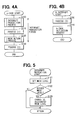
- a process (1) at S110 and a process (2) at S130 are the main parts. Since the interference occurs with some interrupt processes 51 in the process (1), the interrupt prohibition process (S100) and a mask return process (S120) are executed before and after the process (1), respectively.
- the interrupt prohibition process first stores the mask level (S101).
- the mask level at the time of permission of interrupt is "0.” Therefore, unless interrupt is prohibited, this mask level "0" is stored.
- the mask level is stored because it is likely that an interval of a higher mask level such as mask level "2" is set in the interrupt prohibition interval of mask level "1.”
- the mask level is changed to the previous level (S121), and it is determined (S122) whether the mask level is "0.” If the mask level is "0" (S122: YES), the task scheduling process is executed (S123).
- next mask level is the mask level which has been stored at S101 in the immediately preceding interrupt prohibition process (Fig. 5). It is possible that an interval of higher mask level is set in an interrupt prohibition interval. Therefore, following the process of S121, it is determined (S121) whether the mask level has become "0" and the task scheduling is executed (S123). Until the mask level becomes "0,” the execution of tasks 53 is prohibited, because the task scheduling need not be executed.
- Fig. 4B is a flowchart exemplifying the B-interrupt process .
- activation of the b-task is requested at S210 following the process (3) at S200.
- the interrupt level of the B-interrupt process is "3" as shown in Fig. 3A. Therefore it is not possible that the B-interrupt process 51 interrupts in the interrupt prohibition interval of the c-task so long as the mask level designated by the interrupt prohibition process in execution of the c-task is "3" or larger. On the contrary, if the mask level is "2" or smaller, it is possible that the B-interrupt process interrupts in the interrupt prohibition interval of the c-task.
- the mask level is assumed to be "2" when the interrupt prohibition process (S100 in Fig. 4A) is executed at time t1 after execution of the c-task 53 is started.
- the B-interrupt process 51 interrupts the c-task 53 because the interrupt level of the B-interrupt process 51 is "3" and higher than the mask level "2.”
- the activation request to the b-task 53 is assumed to be issued in the B-interrupt process (S210 in Fig. 4B) as indicated with a mark ⁇ .
- This task activation request is stored in the queue of RTOS 52 shown in Fig. 3B. Since the task level of the b-task 53 is "2,” the information indicating the b-task 53 is stored in the queue of the task level "2.”
- the B-interrupt process 51 is terminated and the c-task 53 which has been interrupted is executed again.
- the mask return process is executed (S120 in Fig. 4A), and the mask level returns to "0.”
- the task scheduling process (S123 in Fig. 6A) is executed.
- the RTOS 52 since information indicating the b-task 53 is stored in the queue of RTOS 52, the RTOS 52 switches from the c-task 53 to the b-task 53, so that the b-task is executed with priority over the c-task 53.
- the interrupted c-task is executed again.
- the mask return process is executed (S120 in Fig. 4A) at time u3, and the B-interrupt process 51 is executed only after the mask level become "0."
- the activation request to the b-task 53 is issued (S210 in Fig. 4B in the B-interrupt process as indicated with the mark ⁇ .
- This information based on the task activation request is stored in the queue of RTOS 52 shown in Fig. 3B as described above.
- the b-task 53 is executed. Further, when the b-task 53 is terminated at time u6, the interrupted c-task 53 is executed again. This switching of the task 53 is realized by the task scheduling executed at the end of the interrupt process 51 and the termination of the task 53.
- the task scheduling process is necessarily executed at time u3 in Fig. 7B. That is, even if it is not possible that the task activation request is issued, the task scheduling process is executed at the end of the interrupt prohibition interval and hence time required for executing the task scheduling is unnecessarily wasted.
- the mask return process shown in Fig. 6B is executed.
- the task is coded so that the mask return process shown in Fig. 6A is executed at S120 in Fig. 4A in the case that an interrupt is prohibited with the mask level "2" as shown in Fig. 7A.
- the mask return process shown in Fig. 6B is executed at S120 in Fig. 4A in the case that an interrupt is prohibited with the mask level "4" as shown in Fig. 7B.
- the tasks 53 will not possibly be switched in the following two cases (1) and (2).
- the interrupt prohibition interval of the c-task is considered.
- the task scheduling becomes unnecessary at the end of the interrupt prohibition interval of the a-task 53. Because the task level of the a-task 53 is "3" and the highest among the tasks 53, it is not likely that the tasks 53 are switched even if the activation request to the tasks 53 is issued.
- the programmers performs coding of an engine control program by defining the tasks 53 so that the mask return process shown in Fig. 6B is executed.
- unnecessary task scheduling process that is executed at the end of the interrupt prohibition interval can be eliminated and program execution speed can be enhanced, thereby ensuring the real-time processing characteristics.
- the program may be so constructed that the A-interrupt process to D-interrupt process are executed by way of the RTOS as shown in Fig. 8.
- the control program may be any control programs other than the engine control programs.
- a control program for an electronic control unit (1) includes interrupt processes (51), tasks (53) and a real-time operating system (52) which controls switching of tasks based on execution priorities.
- the control program designates the interrupt level as a mask level in a predetermined task, and has an interrupt prohibition interval in which an interrupt of the interrupt process of the lower interrupt level and switching of the tasks are prohibited.
- the control program is programmed not to execute a task scheduling process of the real-time operating system (52) at an end of the interrupt prohibition interval under a predetermined condition in which it is not likely that the tasks are switched at the end of the interrupt prohibition interval.
Landscapes
- Engineering & Computer Science (AREA)
- Software Systems (AREA)
- Theoretical Computer Science (AREA)
- Physics & Mathematics (AREA)
- General Engineering & Computer Science (AREA)
- General Physics & Mathematics (AREA)
- Combined Controls Of Internal Combustion Engines (AREA)
- Debugging And Monitoring (AREA)
- Executing Machine-Instructions (AREA)
- Programmable Controllers (AREA)
Abstract
Description
Claims (4)
- An electronic control unit (1) having a control program that comprises tasks (53) having respective execution priorities, a real-time operating system (52) that requests activation of the tasks and switches the tasks based on the task levels, and interrupt processes (51) that are assigned respective interrupt levels indicating execution priorities and executed by interrupting the tasks, characterized in that
the control program designates the interrupt level as a mask level in a predetermined task, and has an interrupt prohibition interval in which an interrupt of the interrupt process of the lower interrupt level and switching of the tasks are prohibited, and
the control program is programmed not to execute a task scheduling process of the real-time operating system (52) that switches the tasks at an end of the interrupt prohibition interval under a predetermined condition in which it is not likely that the tasks are switched at the end of the interrupt prohibition interval. - An electronic control unit as in claim 1, further characterized in that
the predetermined condition includes a case in which a highest or much higher interrupt level among the interrupt levels of the interrupt processes that requests activation of the tasks in the interrupt prohibition interval is designated as the mask level. - An electronic control unit as in claim 1 or 2, further characterized in that
the predetermined condition includes a case in which the task level of a predetermined task for which the interrupt prohibition interval is set is a highest one. - An electronic control unit as in any one of claims 1 to 3, further characterized in that
the control program has different mask return processes that are executed at the end of the interrupt prohibition interval, one of the mask return processes being for eliminating the task scheduling process under the predetermined condition and another of the mask return processes being for executing the task scheduling process under other conditions.
Applications Claiming Priority (2)
| Application Number | Priority Date | Filing Date | Title |
|---|---|---|---|
| JP2002004755A JP3879514B2 (en) | 2002-01-11 | 2002-01-11 | Electronic control device and program |
| JP2002004755 | 2002-01-11 |
Publications (3)
| Publication Number | Publication Date |
|---|---|
| EP1327935A2 true EP1327935A2 (en) | 2003-07-16 |
| EP1327935A3 EP1327935A3 (en) | 2006-10-04 |
| EP1327935B1 EP1327935B1 (en) | 2012-02-22 |
Family
ID=19191029
Family Applications (1)
| Application Number | Title | Priority Date | Filing Date |
|---|---|---|---|
| EP03000336A Expired - Lifetime EP1327935B1 (en) | 2002-01-11 | 2003-01-09 | Electronic control unit with task return processing |
Country Status (3)
| Country | Link |
|---|---|
| US (1) | US6754576B2 (en) |
| EP (1) | EP1327935B1 (en) |
| JP (1) | JP3879514B2 (en) |
Cited By (2)
| Publication number | Priority date | Publication date | Assignee | Title |
|---|---|---|---|---|
| US7912623B2 (en) | 2007-09-25 | 2011-03-22 | Denso Corporation | Engine control system designed to manage schedule of engine control tasks |
| EP2495656A1 (en) * | 2011-03-02 | 2012-09-05 | Research In Motion Limited | Enhanced prioritising and unifying interrupt controller |
Families Citing this family (7)
| Publication number | Priority date | Publication date | Assignee | Title |
|---|---|---|---|---|
| JP3578082B2 (en) * | 2000-12-20 | 2004-10-20 | 株式会社デンソー | Processing execution device and recording medium |
| DE10228064B4 (en) * | 2002-06-17 | 2005-08-11 | Robert Bosch Gmbh | Method, real-time computing device and initialization program for Teilinitialisierung a run on the computing device computer program |
| JP3953449B2 (en) * | 2003-08-26 | 2007-08-08 | 富士通株式会社 | Task management program and task control device |
| JP4033215B2 (en) * | 2006-01-31 | 2008-01-16 | セイコーエプソン株式会社 | Multiprocessor system and program for causing computer to execute control method of multiprocessor system |
| JP5053109B2 (en) * | 2008-01-23 | 2012-10-17 | 株式会社日立製作所 | Control device |
| US10552774B2 (en) | 2013-02-11 | 2020-02-04 | Amazon Technologies, Inc. | Cost-minimizing task scheduler |
| RU2758418C1 (en) * | 2019-12-30 | 2021-10-28 | федеральное государственное бюджетное образовательное учреждение высшего образования "Московский государственный технический университет имени Н.Э. Баумана (национальный исследовательский университет)" (МГТУ им. Н.Э. Баумана) | Stand for the study of the digital control system of a combined power plant |
Family Cites Families (7)
| Publication number | Priority date | Publication date | Assignee | Title |
|---|---|---|---|---|
| JPS56138438A (en) * | 1980-03-28 | 1981-10-29 | Nippon Denso Co Ltd | Control method of air-fuel ratio |
| JPH064320A (en) | 1992-06-24 | 1994-01-14 | Nec Corp | Timer control system |
| JPH08328615A (en) | 1995-05-31 | 1996-12-13 | Hitachi Ltd | Automotive control device |
| JP2968739B2 (en) | 1996-11-26 | 1999-11-02 | 米沢日本電気株式会社 | Time queue management method |
| JP4241953B2 (en) * | 1998-01-19 | 2009-03-18 | 株式会社デンソー | Diagnostic equipment for vehicles |
| JP2001229036A (en) | 2000-02-18 | 2001-08-24 | Toshiba Corp | Mechanism control method |
| JP3578082B2 (en) | 2000-12-20 | 2004-10-20 | 株式会社デンソー | Processing execution device and recording medium |
-
2002
- 2002-01-11 JP JP2002004755A patent/JP3879514B2/en not_active Expired - Fee Related
- 2002-12-31 US US10/331,906 patent/US6754576B2/en not_active Expired - Lifetime
-
2003
- 2003-01-09 EP EP03000336A patent/EP1327935B1/en not_active Expired - Lifetime
Non-Patent Citations (3)
| Title |
|---|
| FUJITSU: "F2MC-16L/16LX/16/16H/16F ITRON 2.01 SPECIFICATIONS COMPLIANT SOFTUNE REALOS/907 KERNEL MANUAL", INTERNET CITATION, 1998, XP007904531, Retrieved from the Internet: URL:http://www.fulcrum.ru/Read/CDROMs/FUJI TSU/MICROCONTROLLERS_V3.3/FuMCS ite/pdf/reso16ke-cm42-00324-1e.pdf [retrieved on 2008-04-15] * |
| HIROSHI TAKEYAMA ET AL: "DESIGN CONCEPT AND IMPLEMENTATION OF ITRON SPECIFICATION FOR THE H8/500 SERIES" INTELLECTUAL LEVERAGE. SAN FRANCISCO, FEB. 27 - MAR. 3, 1989, COMPUTER SOCIETY INTERNATIONAL CONFERENCE (COMPCON), WASHINGTON, IEEE COMP. SOC. PRESS, US, vol. CONF. 34, 27 February 1989 (1989-02-27), pages 48-53, XP000212996 ISBN: 0-8186-1909-0 * |
| TAKEYAMA HIROSHI ET AL: "DESIGN AND IMPLEMENTATION OF THE ITRON SPECIFICATION - AN EMBEDDED INDUSTRIAL REALTIME OS" MICROPROCESSORS AND MICROSYSTEMS, IPC BUSINESS PRESS LTD. LONDON, GB, vol. 13, no. 8, October 1989 (1989-10), pages 514-524, XP000081349 ISSN: 0141-9331 * |
Cited By (2)
| Publication number | Priority date | Publication date | Assignee | Title |
|---|---|---|---|---|
| US7912623B2 (en) | 2007-09-25 | 2011-03-22 | Denso Corporation | Engine control system designed to manage schedule of engine control tasks |
| EP2495656A1 (en) * | 2011-03-02 | 2012-09-05 | Research In Motion Limited | Enhanced prioritising and unifying interrupt controller |
Also Published As
| Publication number | Publication date |
|---|---|
| JP3879514B2 (en) | 2007-02-14 |
| JP2003208320A (en) | 2003-07-25 |
| EP1327935B1 (en) | 2012-02-22 |
| US20030135319A1 (en) | 2003-07-17 |
| US6754576B2 (en) | 2004-06-22 |
| EP1327935A3 (en) | 2006-10-04 |
Similar Documents
| Publication | Publication Date | Title |
|---|---|---|
| US6968552B2 (en) | Processor unit for executing event process in real time in response to occurrence of event | |
| US20100262971A1 (en) | Multi core system, vehicular electronic control unit, and task switching method | |
| JP3610915B2 (en) | Processing execution apparatus and program | |
| JPH10502751A (en) | How to control a technical process or process | |
| JP4241462B2 (en) | Control unit and microcomputer | |
| EP1327935B1 (en) | Electronic control unit with task return processing | |
| JP2020135214A (en) | Task management apparatus | |
| JP3791139B2 (en) | Vehicle control device | |
| JP5533789B2 (en) | In-vehicle electronic control unit | |
| JP2002049498A (en) | Task activation control method | |
| JP2004252574A (en) | Inter-task communication method, program, recording medium, electronic device | |
| JP3783553B2 (en) | Information processing device | |
| EP1248192B1 (en) | Processing execution apparatus having data reference limiting function | |
| JP4419943B2 (en) | Data transfer device between CPUs | |
| WO2005013130A1 (en) | Real time control system | |
| JP3350950B2 (en) | Automotive electronic control unit | |
| JP7070108B2 (en) | Electronic control device equipped with a multi-core microcomputer | |
| JP2001256063A (en) | Control device and engine control device | |
| JP3617445B2 (en) | Information processing device | |
| JP2019135656A (en) | Electronic control device and method of using stack | |
| JP2006048241A (en) | Embedded control device | |
| JPH06249051A (en) | Engine digital controller | |
| JPH06249052A (en) | Engine digital controller | |
| JP2000034947A (en) | Electronic control unit | |
| JP2003308217A (en) | Processing program and electronic control device |
Legal Events
| Date | Code | Title | Description |
|---|---|---|---|
| PUAI | Public reference made under article 153(3) epc to a published international application that has entered the european phase |
Free format text: ORIGINAL CODE: 0009012 |
|
| AK | Designated contracting states |
Designated state(s): AT BE BG CH CY CZ DE DK EE ES FI FR GB GR HU IE IT LI LU MC NL PT SE SI SK TR |
|
| AX | Request for extension of the european patent |
Extension state: AL LT LV MK RO |
|
| PUAL | Search report despatched |
Free format text: ORIGINAL CODE: 0009013 |
|
| AK | Designated contracting states |
Kind code of ref document: A3 Designated state(s): AT BE BG CH CY CZ DE DK EE ES FI FR GB GR HU IE IT LI LU MC NL PT SE SI SK TR |
|
| AX | Request for extension of the european patent |
Extension state: AL LT LV MK RO |
|
| 17P | Request for examination filed |
Effective date: 20061108 |
|
| AKX | Designation fees paid |
Designated state(s): DE FR GB SE |
|
| 17Q | First examination report despatched |
Effective date: 20070731 |
|
| GRAP | Despatch of communication of intention to grant a patent |
Free format text: ORIGINAL CODE: EPIDOSNIGR1 |
|
| GRAS | Grant fee paid |
Free format text: ORIGINAL CODE: EPIDOSNIGR3 |
|
| GRAA | (expected) grant |
Free format text: ORIGINAL CODE: 0009210 |
|
| AK | Designated contracting states |
Kind code of ref document: B1 Designated state(s): DE FR GB SE |
|
| REG | Reference to a national code |
Ref country code: GB Ref legal event code: FG4D |
|
| REG | Reference to a national code |
Ref country code: DE Ref legal event code: R096 Ref document number: 60340038 Country of ref document: DE Effective date: 20120419 |
|
| REG | Reference to a national code |
Ref country code: SE Ref legal event code: TRGR |
|
| PLBE | No opposition filed within time limit |
Free format text: ORIGINAL CODE: 0009261 |
|
| STAA | Information on the status of an ep patent application or granted ep patent |
Free format text: STATUS: NO OPPOSITION FILED WITHIN TIME LIMIT |
|
| REG | Reference to a national code |
Ref country code: GB Ref legal event code: 746 Effective date: 20121206 |
|
| REG | Reference to a national code |
Ref country code: DE Ref legal event code: R084 Ref document number: 60340038 Country of ref document: DE Effective date: 20121129 |
|
| 26N | No opposition filed |
Effective date: 20121123 |
|
| REG | Reference to a national code |
Ref country code: DE Ref legal event code: R097 Ref document number: 60340038 Country of ref document: DE Effective date: 20121123 |
|
| REG | Reference to a national code |
Ref country code: FR Ref legal event code: PLFP Year of fee payment: 13 |
|
| PGFP | Annual fee paid to national office [announced via postgrant information from national office to epo] |
Ref country code: GB Payment date: 20150121 Year of fee payment: 13 Ref country code: SE Payment date: 20150121 Year of fee payment: 13 Ref country code: FR Payment date: 20150122 Year of fee payment: 13 |
|
| GBPC | Gb: european patent ceased through non-payment of renewal fee |
Effective date: 20160109 |
|
| REG | Reference to a national code |
Ref country code: FR Ref legal event code: ST Effective date: 20160930 |
|
| PG25 | Lapsed in a contracting state [announced via postgrant information from national office to epo] |
Ref country code: GB Free format text: LAPSE BECAUSE OF NON-PAYMENT OF DUE FEES Effective date: 20160109 |
|
| PG25 | Lapsed in a contracting state [announced via postgrant information from national office to epo] |
Ref country code: SE Free format text: LAPSE BECAUSE OF NON-PAYMENT OF DUE FEES Effective date: 20160110 Ref country code: FR Free format text: LAPSE BECAUSE OF NON-PAYMENT OF DUE FEES Effective date: 20160201 |
|
| PGFP | Annual fee paid to national office [announced via postgrant information from national office to epo] |
Ref country code: DE Payment date: 20200121 Year of fee payment: 18 |
|
| REG | Reference to a national code |
Ref country code: DE Ref legal event code: R119 Ref document number: 60340038 Country of ref document: DE |
|
| PG25 | Lapsed in a contracting state [announced via postgrant information from national office to epo] |
Ref country code: DE Free format text: LAPSE BECAUSE OF NON-PAYMENT OF DUE FEES Effective date: 20210803 |