EP1327623A2 - Process for the production of dichloro hydroquinone ethers - Google Patents
Process for the production of dichloro hydroquinone ethers Download PDFInfo
- Publication number
- EP1327623A2 EP1327623A2 EP03000143A EP03000143A EP1327623A2 EP 1327623 A2 EP1327623 A2 EP 1327623A2 EP 03000143 A EP03000143 A EP 03000143A EP 03000143 A EP03000143 A EP 03000143A EP 1327623 A2 EP1327623 A2 EP 1327623A2
- Authority
- EP
- European Patent Office
- Prior art keywords
- formula
- dichloro
- production method
- weight
- reaction
- Prior art date
- Legal status (The legal status is an assumption and is not a legal conclusion. Google has not performed a legal analysis and makes no representation as to the accuracy of the status listed.)
- Granted
Links
- 0 *CCCOc(c(Cl)cc(O*)c1)c1Cl Chemical compound *CCCOc(c(Cl)cc(O*)c1)c1Cl 0.000 description 3
Classifications
-
- C—CHEMISTRY; METALLURGY
- C07—ORGANIC CHEMISTRY
- C07C—ACYCLIC OR CARBOCYCLIC COMPOUNDS
- C07C69/00—Esters of carboxylic acids; Esters of carbonic or haloformic acids
- C07C69/62—Halogen-containing esters
- C07C69/63—Halogen-containing esters of saturated acids
-
- C—CHEMISTRY; METALLURGY
- C07—ORGANIC CHEMISTRY
- C07C—ACYCLIC OR CARBOCYCLIC COMPOUNDS
- C07C41/00—Preparation of ethers; Preparation of compounds having groups, groups or groups
- C07C41/01—Preparation of ethers
- C07C41/18—Preparation of ethers by reactions not forming ether-oxygen bonds
- C07C41/26—Preparation of ethers by reactions not forming ether-oxygen bonds by introduction of hydroxy or O-metal groups
-
- C—CHEMISTRY; METALLURGY
- C07—ORGANIC CHEMISTRY
- C07C—ACYCLIC OR CARBOCYCLIC COMPOUNDS
- C07C67/00—Preparation of carboxylic acid esters
- C07C67/10—Preparation of carboxylic acid esters by reacting carboxylic acids or symmetrical anhydrides with ester groups or with a carbon-halogen bond
- C07C67/11—Preparation of carboxylic acid esters by reacting carboxylic acids or symmetrical anhydrides with ester groups or with a carbon-halogen bond being mineral ester groups
Definitions
- the present invention relates to production methods of 3,5-dichloro-4-(3-hydroxypropoxy)-1-substituted-benzenes and 3,5-dichloro-4-(3-acetyloxypropoxy)-1-substituted-benzenes.
- the first step that is the reaction of the 3,5-dichloro-4-(3-bromopropoxy)-1-substituted-benzene compound with benzoic acid and potassium carbonate needs N,N-dimethylformamide, which is desired to avoid the use of a large amount in an industrial production, as a solvent.
- N,N-dimethylformamide which is desired to avoid the use of a large amount in an industrial production, as a solvent.
- the object of the present invention is to provide industrially advantageous methods for producing 3,5-dichloro-4-(3-hydroxypropoxy)-1-substituted-benzenes which are useful as intermediates for producing an insecticidal/acaricidal compounds and for producing 3,5-dichloro-4-(3-acetyloxypropoxy)-1-substituted-benzenes which are their precursors.
- the advantageous method for producing 3,5-dichloro-4-(3-hydroxypropoxy)-1-substituted-benzenes in an industrial production was studied and found that 3,5-dichloro-4-(3-acetyloxypropoxy)-1-substituted-benzenes can be produced by making 3,5-dichloro-4-(3-halopropoxy)-1-substituted-benzenes react with an alkali metal salt of acetic acid in the presence of an aromatic hydrocarbon and that the 3,5-dichloro-4-(3-acetyloxypropoxy)-1-substituted-benzenes can be lead to 3,5-dichloro-4-(3-hydroxypropoxy)-1-substituted-benzenes.
- the method does not need N,N-dimethylformamide as a solvent or a large amount of solvent.
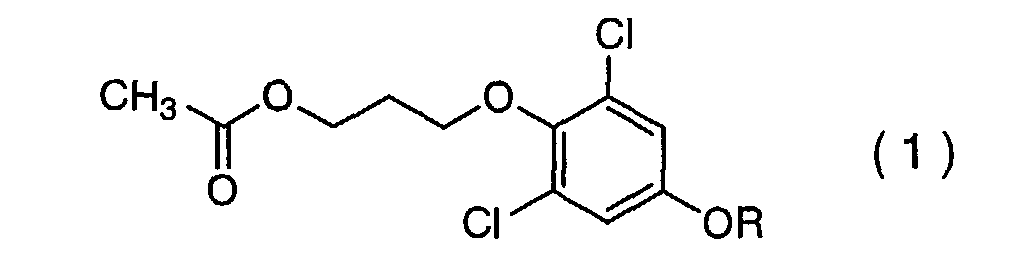
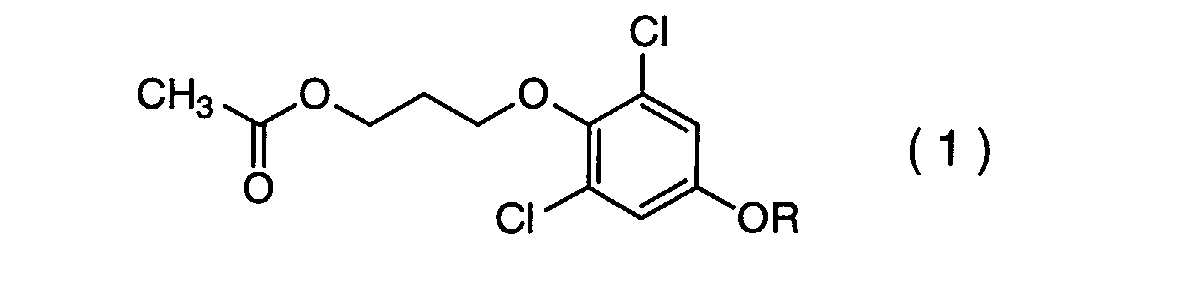
- the present invention provides a production method of an ester compound given by formula (1): wherein R represents a 3,3-dihalo-2-propenyl group or a benzyl group optionally substituted by halogen atom(s), which comprises making a compound given by formula (2): wherein X represents a chlorine atom or bromine atom and R means as described below react with an alkali metal salt of acetic acid in the presence of an aromatic hydrocarbon (hereinafter, referred to as the production method 1 of the present invention).
- the present invention also provides a production method of a 3-phenoxypropanol compound given by formula (3): wherein R means as defined below, which comprises making a compound given by formula (2): wherein X represents a chlorine atom or bromine atom and R represents a 3,3-dihalo-2-propenyl group or a benzyl group optionally substituted by halogen atom(s), react with an alkali metal salt of acetic acid in the presence of an aromatic hydrocarbon, and then making the product react with an alkali metal hydroxide and water (hereinafter, referred to as the production method 2 of the present invention, further the combination of the method 1 of the present invention together with the method 2 of the present invention is referred to as the production methods of the present invention).
- the present invention provides an ester compound given by formula (1): wherein R represents a 3,3-dihalo-2-propenyl group or a benzyl group optionally substituted by halogen atom(s).
- ester compounds given by formula (1) are hydrolyzed in alkali water to give the 3-phenoxypropanol compounds given by formula (3) those are useful as intermediates for producing the above-mentioned insecticidal/acaricidal compounds.
- examples of the 3,3-dihalo-2-propenyl group include 3,3-dichloro-2-propenyl group and 3,3-dibromo-2-propenyl group.
- the benzyl group optionally substituted by halogen atom(s) is exemplified by a benzyl groups whose hydrogen atom(s) on its benzene ring may be substituted by at least one halogen atom, and the typical examples are benzyl group and 4-chlorobenzyl group.
- the production method 1 of the present invention is explained at first.
- the production method 1 of the present invention is characterized by making the compound given by formula (2) react with an alkali metal salt of acetic acid in the presence of an aromatic hydrocarbon.
- Examples of the aromatic hydrocarbon used for the reaction include toluene, xylene, mesitylene and ethylbenzene.
- the amount of the aromatic hydrocarbon used for the reaction is usually in the range of 0.1 to 10 parts by weight based on 1 part by weight of the compound given by formula (2), preferably 0.1 to 1 part by weight, more preferably 0.1 to 0.25 part by weight, and furthermore preferably 0.1 to 0.2 part by weight based on 1 part by weight of the compound given by formula (2) in the view of the reaction rate.
- alkali metal salt of acetic acid used for the reaction examples include sodium acetate and potassium acetate.
- the alkali metal salt of acetic acid can also be prepared by mixing acetic acid with an alkali metal hydroxide in the reaction mixture.
- the amount of the alkali metal salt of acetic acid used for the reaction is usually in the range of is usually in the ratio of 1 to 2 mols based on 1 mol of the compound given by formula (2), preferably 1.3 mols or more in the view of the reaction rate, and preferably 1.7 mols or less in the view of the economical reason.
- phase transfer catalysts used for the reaction include tertiary ammonium salts such as tetra-n-butylammonium bromide, tetra-n-butylammonium chloride and so on.
- the amount of the phase transfer catalyst used for the reaction is usually in the ratio of 0.01 to 0.1 mol based on 1 mol of the compound given by formula (2).
- the reaction temperature is usually in the range of 20 to 120°C. Among them, it is preferably 100°C or more in the view of the reaction rate.
- the reaction can be, for example, carried out by mixing the compound given by formula (2) with the aromatic hydrocarbon, adding the alkali metal salt of acetic acid and optionally the phase transfer catalyst thereto, and stirring. In that case, the alkali metal salt of acetic acid can be added at once or portionwise.
- the reaction can also be carried out by adding acetic acid and an alkali metal hydroxide to a mixture of the compound given by formula (2) and the aromatic hydrocarbon, and stirring.
- the proceeding status of the reaction can be confirmed by means for analyzing the reaction product such as high performance liquid chromatography and the like.
- the ester compound given by formula (1) can be isolated by work-up procedures, for example, obtaining an organic layer by water-organic solvent phase separation of the reaction mixture, and concentrating the organic layer.
- reaction mixture can be provided for the next steps without performing the work-up procedures.
- the production method 2 of the present invention is characterized by making the compound given by formula (2) react with an alkali salt of acetic acid in the presence of an aromatic hydrocarbon, followed by making the product react with an alkali metal hydroxide and water.
- the method 2 of the present invention comprises the first step of making the compound given by formula (2) react with an alkali salt of acetic acid in the presence of an aromatic hydrocarbon solvent, and the second step of making the product in the first step react with an alkali metal hydroxide and water.
- the reaction of the first step in the production method 2 of the present invention can be performed in the same condition as the production method 1 of the present invention.
- work-up procedures are performed to be isolated the ester compound given by formula (1).
- the isolated ester compound given by formula (1) can be provided for the second step.
- the reaction mixture in the first step can also be provided to the second step without the work-up procedures.
- the reaction of second step is usually performed in the presence of a solvent or in the absence of a solvent.
- solvent used for the reaction examples include aromatic hydrocarbons such as toluene, xylene, mesitylene, ethylbenzene and so on; alcohols such as methanol, ethanol, propanol and so on; and mixtures thereof.
- alkali metal hydroxide used for the reaction examples include sodium hydroxide and potassium hydroxide.
- the amount of the alkali metal hydroxide used for the reaction is usually 1 to 1.25 mols based on 1 mol of the ester compound given by formula (1), or is usually 1 to 1.25 mols based on 1 mol of the ester compound given by formula (2) in case that the second step is carried out without isolating the product after the first step.
- the amount of water used for the reaction is usually 1 or more mols based on 1 mol of the ester compound given by formula (1), or is usually 1 or more mols based on 1 mol of the ester compound given by formula (2) in case that the second step is carried out without isolating the product after the first step.
- an alcohol e.g. methanol, ethanol, propanol
- an alcohol e.g. methanol, ethanol, propanol
- the reaction temperature is usually in the range of 0 to 40°C, and the reaction period is usually in the range of 0.5 to 24 hours.
- the reaction is, for example, carried out as follows.
- the concentration of the aqueous solution of an alkali metal hydroxide used for the method (1) or (2) is usually 5 to 49% by weight.
- the proceeding status of the reaction can be confirmed by means for analyzing the reaction mixture such as high performance liquid chromatography, gas chromatography and the like.
- the compound given by formula (3) can be isolated by work-up procedures, for example, obtaining an organic layer by water-organic solvent phase separation of the reaction mixture, optionally washing the organic layer with aqueous acid, and concentrating the organic layer.
- the crystals consisting of by-products i.e. sodium benzoate and inorganic salt
- the production method 2 of the present invention does not give the crystals to make the operation more difficult or does not need a large amount of water in the phase-separation during the work-up procedures. It is beneficial concerning dealing waste water.
- the 3-phenoxypropanol compound given by formula (3) produced by the production method 2 of the present invention can be lead to the dihalopropene compounds having insecticidal/acaricidal activity by the methods described in USP-5,827,137 and USP-5,922,880.
- the compounds given by formula (2) are the compounds described in USP-5,827,137 and USP-5,922,880 or can be prepared according to their descriptions.
- 3,5-dichloro-4-(3-hydroxypropoxy)-1-substituted-benzenes which are useful as intermediates for insecticide/acaricide can be beneficially produced in industry.
Landscapes
- Chemical & Material Sciences (AREA)
- Organic Chemistry (AREA)
- Chemical Kinetics & Catalysis (AREA)
- Organic Low-Molecular-Weight Compounds And Preparation Thereof (AREA)
- Low-Molecular Organic Synthesis Reactions Using Catalysts (AREA)
Abstract
Description

which comprises making a compound given by formula (2):
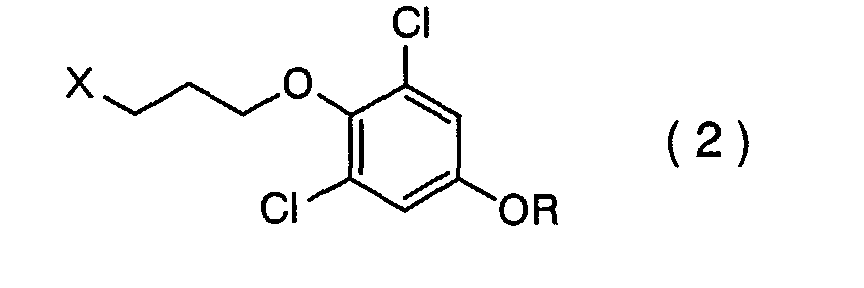
react with an alkali metal salt of acetic acid in the presence of an aromatic hydrocarbon (hereinafter, referred to as the production method 1 of the present invention).

which comprises making a compound given by formula (2):
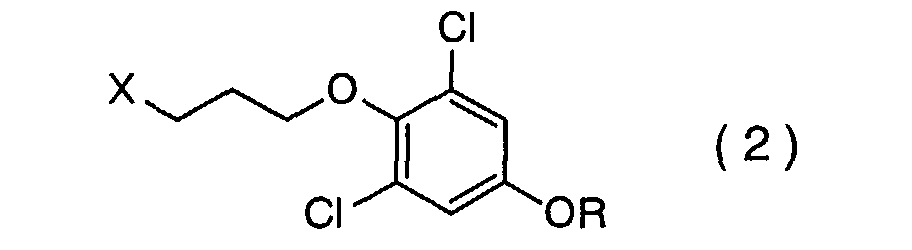
react with an alkali metal salt of acetic acid in the presence of an aromatic hydrocarbon, and then making the product react with an alkali metal hydroxide and water (hereinafter, referred to as the production method 2 of the present invention, further the combination of the method 1 of the present invention together with the method 2 of the present invention is referred to as the production methods of the present invention).
Among them, it is preferably 100°C or more in the view of the reaction rate.

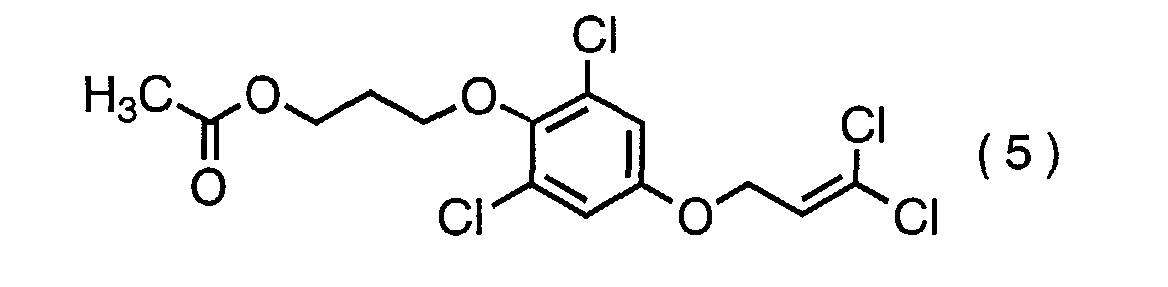
The melting point of 3,5-dichloro-4-(3-acetyloxypropoxy)-1-(3,3-dichloro-2-propenyloxy)benzene was 33°C.


Used apparatus: L-6000 or L-7000 manufactured by Hitachi Corp. Column: L-column ODS (4.6 × 150mm, manufactured by Chemicals
Detector: UV (Detected wave length: 290nm)
Mobile phase: 0.1% phosphoric acid/water (hereinafter referred to as Solution
Internal standard: isoamyl benzoate
Used apparatus: L-6000 or L-7000 manufactured by Hitachi Corp. Column: L-column ODS (4.6 × 150mm, manufactured by manufactured by
Detector: UV (Detected wave length: 290nm)
Mobile phase: 0.1% phosphoric acid/water (hereinafter referred to as Solution
Used apparatus: L-6000 or L-7000 manufactured by Hitachi Corp. Column: L-column ODS (4.6 X 150mm, manufactured by manufactured by
Detector: UV (Detected wave length 290nm)
Mobile phase: 0.1% phosphoric acid/water (hereinafter referred to as Solution
Claims (8)
- A production method of an ester compound given by formula (1):wherein R represents a 3,3-dihalo-2-propenyl group or a benzyl group optionally substituted by at least one halogen atom,

which comprises making a compound given by formula (2):wherein X represents a chlorine atom or bromine atom and R means as described below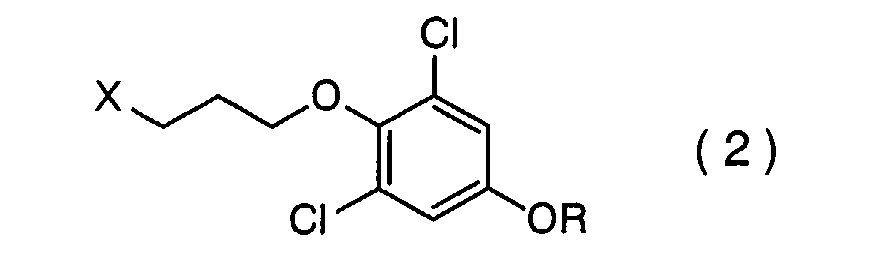
react with an alkali metal salt of acetic acid in the presence of an aromatic hydrocarbon. - A production method of an ester compound according to claim 1, wherein R represents a 3,3-dihalo-2-propenyl group.
- A production method of an ester compound according to claim 1, wherein R represents a 3,3-dichloro-2-propenyl group.
- A production method of an ester compound according to claim 1, wherein R represents a benzyl group optionally substituted by at least one halogen atom.
- A production method of an ester compound according to claim 1, wherein R represents a benzyl group or 4-chlorobenzyl group.
- A production method of an ester compound according to claim 1, which makes the reaction in the presence of a phase transfer catalyst as well as aromatic hydrocarbon.
- A production method of a 3-phenoxypropanol compound given by formula (3):wherein R means as described below,

which comprises making a compound given by formula (2):wherein X represents a chlorine atom or bromine atom and R represents a 3,3-dihalo-2-propenyl group or a benzyl group optionally substituted by at least one halogen atom,
react with an alkali metal salt of acetic acid in the presence of an aromatic hydrocarbon, and then making the product react with an alkali metal hydroxide and water. - An ester compound given by formula (1):wherein R represents a 3,3-dihalo-2-propenyl group or a benzyl group optionally substituted by at least one halogen atom.
Priority Applications (1)
| Application Number | Priority Date | Filing Date | Title |
|---|---|---|---|
| SI200331871T SI1327623T1 (en) | 2002-01-10 | 2003-01-03 | Process for the production of dichloro hydroquinone ethers |
Applications Claiming Priority (2)
| Application Number | Priority Date | Filing Date | Title |
|---|---|---|---|
| JP2002003180A JP3960048B2 (en) | 2002-01-10 | 2002-01-10 | Process for producing substituted benzenes |
| JP2002003180 | 2002-01-10 |
Publications (3)
| Publication Number | Publication Date |
|---|---|
| EP1327623A2 true EP1327623A2 (en) | 2003-07-16 |
| EP1327623A3 EP1327623A3 (en) | 2003-12-10 |
| EP1327623B1 EP1327623B1 (en) | 2010-07-21 |
Family
ID=19190848
Family Applications (1)
| Application Number | Title | Priority Date | Filing Date |
|---|---|---|---|
| EP03000143A Expired - Lifetime EP1327623B1 (en) | 2002-01-10 | 2003-01-03 | Process for the production of dichloro hydroquinone ethers |
Country Status (12)
| Country | Link |
|---|---|
| US (1) | US6787665B2 (en) |
| EP (1) | EP1327623B1 (en) |
| JP (1) | JP3960048B2 (en) |
| CN (1) | CN1239465C (en) |
| AT (1) | ATE474826T1 (en) |
| BR (1) | BR0300009B1 (en) |
| DE (1) | DE60333411D1 (en) |
| DK (1) | DK1327623T3 (en) |
| ES (1) | ES2348257T3 (en) |
| IL (1) | IL153495A (en) |
| PT (1) | PT1327623E (en) |
| SI (1) | SI1327623T1 (en) |
Families Citing this family (2)
| Publication number | Priority date | Publication date | Assignee | Title |
|---|---|---|---|---|
| US20060001064A1 (en) * | 2000-04-28 | 2006-01-05 | Hill Ross H | Methods for the lithographic deposition of ferroelectric materials |
| US20040191423A1 (en) * | 2000-04-28 | 2004-09-30 | Ruan Hai Xiong | Methods for the deposition of silver and silver oxide films and patterned films |
Citations (3)
| Publication number | Priority date | Publication date | Assignee | Title |
|---|---|---|---|---|
| EP0272674A2 (en) | 1986-12-27 | 1988-06-29 | Hodogaya Chemical Co., Ltd. | Process for producing 2,6-dichlorobenzyl alcohol |
| US5872137A (en) | 1994-08-04 | 1999-02-16 | Sumitomo Chemical Company, Limited | Dihalopropene compounds, insecticidal/acaricidal agents containing same, and intermediates for their production |
| US5922880A (en) | 1994-10-14 | 1999-07-13 | Sumitomo Chemical Company, Limited | Dihalopropene compounds, insecticidal/acaricidal agents containing same, and intermediates for their production |
-
2002
- 2002-01-10 JP JP2002003180A patent/JP3960048B2/en not_active Expired - Fee Related
- 2002-12-17 IL IL153495A patent/IL153495A/en active IP Right Grant
-
2003
- 2003-01-03 DE DE60333411T patent/DE60333411D1/en not_active Expired - Lifetime
- 2003-01-03 ES ES03000143T patent/ES2348257T3/en not_active Expired - Lifetime
- 2003-01-03 AT AT03000143T patent/ATE474826T1/en active
- 2003-01-03 DK DK03000143.2T patent/DK1327623T3/en active
- 2003-01-03 PT PT03000143T patent/PT1327623E/en unknown
- 2003-01-03 EP EP03000143A patent/EP1327623B1/en not_active Expired - Lifetime
- 2003-01-03 SI SI200331871T patent/SI1327623T1/en unknown
- 2003-01-07 US US10/337,533 patent/US6787665B2/en not_active Expired - Lifetime
- 2003-01-08 BR BRPI0300009-5B1A patent/BR0300009B1/en not_active IP Right Cessation
- 2003-01-08 CN CNB03101030XA patent/CN1239465C/en not_active Expired - Lifetime
Patent Citations (3)
| Publication number | Priority date | Publication date | Assignee | Title |
|---|---|---|---|---|
| EP0272674A2 (en) | 1986-12-27 | 1988-06-29 | Hodogaya Chemical Co., Ltd. | Process for producing 2,6-dichlorobenzyl alcohol |
| US5872137A (en) | 1994-08-04 | 1999-02-16 | Sumitomo Chemical Company, Limited | Dihalopropene compounds, insecticidal/acaricidal agents containing same, and intermediates for their production |
| US5922880A (en) | 1994-10-14 | 1999-07-13 | Sumitomo Chemical Company, Limited | Dihalopropene compounds, insecticidal/acaricidal agents containing same, and intermediates for their production |
Also Published As
| Publication number | Publication date |
|---|---|
| EP1327623A3 (en) | 2003-12-10 |
| IL153495A (en) | 2008-03-20 |
| DK1327623T3 (en) | 2010-10-25 |
| ES2348257T3 (en) | 2010-12-02 |
| BR0300009A (en) | 2003-09-09 |
| BR0300009B1 (en) | 2013-06-18 |
| US6787665B2 (en) | 2004-09-07 |
| JP3960048B2 (en) | 2007-08-15 |
| DE60333411D1 (en) | 2010-09-02 |
| PT1327623E (en) | 2010-10-19 |
| JP2003206263A (en) | 2003-07-22 |
| US20030130538A1 (en) | 2003-07-10 |
| EP1327623B1 (en) | 2010-07-21 |
| CN1239465C (en) | 2006-02-01 |
| IL153495A0 (en) | 2003-07-06 |
| SI1327623T1 (en) | 2010-11-30 |
| ATE474826T1 (en) | 2010-08-15 |
| CN1432555A (en) | 2003-07-30 |
Similar Documents
| Publication | Publication Date | Title |
|---|---|---|
| US6376712B2 (en) | Process for producing trifluoromethylbenzylamines | |
| US20160251316A1 (en) | Process for the preparation of enzalutamide | |
| US6787665B2 (en) | Production method of substituted benzenes | |
| JP5593164B2 (en) | Method for producing primary alkyl halide | |
| CN113286783B (en) | Method for producing chlorobenzene compounds | |
| SK29099A3 (en) | Process for the preparation of fluoxetine | |
| US6331649B1 (en) | Process for producing trifluoromethylbenzylamines | |
| JPWO2007139182A1 (en) | Fluoroamine having perfluoroalkyl group, method for producing the same, fluorination method using the same, and method for recovering amide having perfluoroalkyl group | |
| JP3799637B2 (en) | Method for producing methanesulfonic acid esters | |
| CN113755864A (en) | Method for synthesizing aryl trifluoromethoxy compound under electrochemical condition | |
| JP7628505B2 (en) | Method for producing 4-(aminomethyl)cyclohexanecarboxylic acid | |
| JP4423494B2 (en) | Method for producing 2-hydroxycarboxylic acid | |
| JP5000031B2 (en) | Method for producing aromatic-o-dialdehyde compound | |
| EP1961730A1 (en) | Method for producing polymerizable hydroxydiamantyl ester compound | |
| JP4551533B2 (en) | Novel fluorinating agent and method for producing fluorine-containing compound | |
| CN100509737C (en) | Process for producing 2,6-chlorophenesic compound | |
| JP2005518440A (en) | Method for producing 2- (chloromethyl) phenylacetic acid derivative | |
| JP2003104951A (en) | Method for producing perfluoroalkylsulfonyl halide | |
| JPH05345738A (en) | Halogenoresorcin derivative | |
| US6417407B1 (en) | Method of making 2-bromo-4-chloro substituted phenols | |
| US7253303B2 (en) | Fluorination of dicarbonyl compounds | |
| JP2009079024A (en) | Method for producing 2-naphthol derivative | |
| JP4565457B2 (en) | Method for producing primary phosphine | |
| JP3273671B2 (en) | Method for producing 4,4 ""-dihydroxyquarterphenyl or derivative thereof | |
| JP2004224751A (en) | Method for producing dihydroxybenzene mono (hydroxyethyl) ether |
Legal Events
| Date | Code | Title | Description |
|---|---|---|---|
| PUAI | Public reference made under article 153(3) epc to a published international application that has entered the european phase |
Free format text: ORIGINAL CODE: 0009012 |
|
| AK | Designated contracting states |
Designated state(s): AT BE BG CH CY CZ DE DK EE ES FI FR GB GR HU IE IT LI LU MC NL PT SE SI SK TR |
|
| AX | Request for extension of the european patent |
Extension state: AL LT LV MK RO |
|
| PUAL | Search report despatched |
Free format text: ORIGINAL CODE: 0009013 |
|
| AK | Designated contracting states |
Kind code of ref document: A3 Designated state(s): AT BE BG CH CY CZ DE DK EE ES FI FR GB GR HU IE IT LI LU MC NL PT SE SI SK TR |
|
| AX | Request for extension of the european patent |
Extension state: AL LT LV MK RO |
|
| 17P | Request for examination filed |
Effective date: 20040602 |
|
| AKX | Designation fees paid |
Designated state(s): AT BE BG CH CY CZ DE DK EE ES FI FR GB GR HU IE IT LI LU MC NL PT SE SI SK TR |
|
| RAP1 | Party data changed (applicant data changed or rights of an application transferred) |
Owner name: SUMITOMO CHEMICAL COMPANY, LIMITED |
|
| 17Q | First examination report despatched |
Effective date: 20070620 |
|
| GRAP | Despatch of communication of intention to grant a patent |
Free format text: ORIGINAL CODE: EPIDOSNIGR1 |
|
| GRAS | Grant fee paid |
Free format text: ORIGINAL CODE: EPIDOSNIGR3 |
|
| GRAA | (expected) grant |
Free format text: ORIGINAL CODE: 0009210 |
|
| AK | Designated contracting states |
Kind code of ref document: B1 Designated state(s): AT BE BG CH CY CZ DE DK EE ES FI FR GB GR HU IE IT LI LU MC NL PT SE SI SK TR |
|
| REG | Reference to a national code |
Ref country code: GB Ref legal event code: FG4D |
|
| REG | Reference to a national code |
Ref country code: CH Ref legal event code: EP |
|
| REG | Reference to a national code |
Ref country code: CH Ref legal event code: NV Representative=s name: NOVAGRAAF INTERNATIONAL SA |
|
| REG | Reference to a national code |
Ref country code: IE Ref legal event code: FG4D |
|
| REF | Corresponds to: |
Ref document number: 60333411 Country of ref document: DE Date of ref document: 20100902 Kind code of ref document: P |
|
| REG | Reference to a national code |
Ref country code: DK Ref legal event code: T3 |
|
| REG | Reference to a national code |
Ref country code: NL Ref legal event code: T3 |
|
| REG | Reference to a national code |
Ref country code: ES Ref legal event code: FG2A Effective date: 20101122 |
|
| REG | Reference to a national code |
Ref country code: SK Ref legal event code: T3 Ref document number: E 7916 Country of ref document: SK |
|
| PG25 | Lapsed in a contracting state [announced via postgrant information from national office to epo] |
Ref country code: FI Free format text: LAPSE BECAUSE OF FAILURE TO SUBMIT A TRANSLATION OF THE DESCRIPTION OR TO PAY THE FEE WITHIN THE PRESCRIBED TIME-LIMIT Effective date: 20100721 |
|
| PG25 | Lapsed in a contracting state [announced via postgrant information from national office to epo] |
Ref country code: CY Free format text: LAPSE BECAUSE OF FAILURE TO SUBMIT A TRANSLATION OF THE DESCRIPTION OR TO PAY THE FEE WITHIN THE PRESCRIBED TIME-LIMIT Effective date: 20100721 Ref country code: BG Free format text: LAPSE BECAUSE OF FAILURE TO SUBMIT A TRANSLATION OF THE DESCRIPTION OR TO PAY THE FEE WITHIN THE PRESCRIBED TIME-LIMIT Effective date: 20101021 |
|
| REG | Reference to a national code |
Ref country code: HU Ref legal event code: AG4A Ref document number: E009226 Country of ref document: HU |
|
| PG25 | Lapsed in a contracting state [announced via postgrant information from national office to epo] |
Ref country code: SE Free format text: LAPSE BECAUSE OF FAILURE TO SUBMIT A TRANSLATION OF THE DESCRIPTION OR TO PAY THE FEE WITHIN THE PRESCRIBED TIME-LIMIT Effective date: 20100721 Ref country code: GR Free format text: LAPSE BECAUSE OF FAILURE TO SUBMIT A TRANSLATION OF THE DESCRIPTION OR TO PAY THE FEE WITHIN THE PRESCRIBED TIME-LIMIT Effective date: 20101022 |
|
| PLBE | No opposition filed within time limit |
Free format text: ORIGINAL CODE: 0009261 |
|
| STAA | Information on the status of an ep patent application or granted ep patent |
Free format text: STATUS: NO OPPOSITION FILED WITHIN TIME LIMIT |
|
| PG25 | Lapsed in a contracting state [announced via postgrant information from national office to epo] |
Ref country code: EE Free format text: LAPSE BECAUSE OF FAILURE TO SUBMIT A TRANSLATION OF THE DESCRIPTION OR TO PAY THE FEE WITHIN THE PRESCRIBED TIME-LIMIT Effective date: 20100721 |
|
| REG | Reference to a national code |
Ref country code: CH Ref legal event code: PFA Owner name: SUMITOMO CHEMICAL COMPANY, LIMITED Free format text: SUMITOMO CHEMICAL COMPANY, LIMITED#27-1, SHINKAWA 2-CHOME, CHUO-KU#TOKYO 104-8260 (JP) -TRANSFER TO- SUMITOMO CHEMICAL COMPANY, LIMITED#27-1, SHINKAWA 2-CHOME, CHUO-KU#TOKYO 104-8260 (JP) |
|
| 26N | No opposition filed |
Effective date: 20110426 |
|
| REG | Reference to a national code |
Ref country code: DE Ref legal event code: R097 Ref document number: 60333411 Country of ref document: DE Effective date: 20110426 |
|
| PG25 | Lapsed in a contracting state [announced via postgrant information from national office to epo] |
Ref country code: MC Free format text: LAPSE BECAUSE OF NON-PAYMENT OF DUE FEES Effective date: 20110131 |
|
| PG25 | Lapsed in a contracting state [announced via postgrant information from national office to epo] |
Ref country code: LU Free format text: LAPSE BECAUSE OF NON-PAYMENT OF DUE FEES Effective date: 20110103 |
|
| PGFP | Annual fee paid to national office [announced via postgrant information from national office to epo] |
Ref country code: SK Payment date: 20141205 Year of fee payment: 13 Ref country code: CZ Payment date: 20141211 Year of fee payment: 13 |
|
| PGFP | Annual fee paid to national office [announced via postgrant information from national office to epo] |
Ref country code: NL Payment date: 20150110 Year of fee payment: 13 |
|
| PGFP | Annual fee paid to national office [announced via postgrant information from national office to epo] |
Ref country code: DK Payment date: 20150112 Year of fee payment: 13 Ref country code: HU Payment date: 20141216 Year of fee payment: 13 Ref country code: PT Payment date: 20150102 Year of fee payment: 13 Ref country code: IE Payment date: 20150112 Year of fee payment: 13 |
|
| PGFP | Annual fee paid to national office [announced via postgrant information from national office to epo] |
Ref country code: TR Payment date: 20150102 Year of fee payment: 13 Ref country code: AT Payment date: 20141222 Year of fee payment: 13 Ref country code: SI Payment date: 20141210 Year of fee payment: 13 |
|
| PGFP | Annual fee paid to national office [announced via postgrant information from national office to epo] |
Ref country code: BE Payment date: 20150112 Year of fee payment: 13 |
|
| REG | Reference to a national code |
Ref country code: FR Ref legal event code: PLFP Year of fee payment: 14 |
|
| PG25 | Lapsed in a contracting state [announced via postgrant information from national office to epo] |
Ref country code: BE Free format text: LAPSE BECAUSE OF NON-PAYMENT OF DUE FEES Effective date: 20160131 |
|
| PG25 | Lapsed in a contracting state [announced via postgrant information from national office to epo] |
Ref country code: CZ Free format text: LAPSE BECAUSE OF NON-PAYMENT OF DUE FEES Effective date: 20160103 |
|
| REG | Reference to a national code |
Ref country code: DK Ref legal event code: EBP Effective date: 20160131 |
|
| REG | Reference to a national code |
Ref country code: AT Ref legal event code: MM01 Ref document number: 474826 Country of ref document: AT Kind code of ref document: T Effective date: 20160103 |
|
| REG | Reference to a national code |
Ref country code: SI Ref legal event code: KO00 Effective date: 20160829 |
|
| REG | Reference to a national code |
Ref country code: SK Ref legal event code: MM4A Ref document number: E 7916 Country of ref document: SK Effective date: 20160103 |
|
| REG | Reference to a national code |
Ref country code: NL Ref legal event code: MM Effective date: 20160201 |
|
| PG25 | Lapsed in a contracting state [announced via postgrant information from national office to epo] |
Ref country code: HU Free format text: LAPSE BECAUSE OF NON-PAYMENT OF DUE FEES Effective date: 20160104 |
|
| REG | Reference to a national code |
Ref country code: IE Ref legal event code: MM4A |
|
| PG25 | Lapsed in a contracting state [announced via postgrant information from national office to epo] |
Ref country code: SK Free format text: LAPSE BECAUSE OF NON-PAYMENT OF DUE FEES Effective date: 20160103 Ref country code: NL Free format text: LAPSE BECAUSE OF NON-PAYMENT OF DUE FEES Effective date: 20160201 Ref country code: AT Free format text: LAPSE BECAUSE OF NON-PAYMENT OF DUE FEES Effective date: 20160103 Ref country code: PT Free format text: LAPSE BECAUSE OF NON-PAYMENT OF DUE FEES Effective date: 20160704 Ref country code: SI Free format text: LAPSE BECAUSE OF NON-PAYMENT OF DUE FEES Effective date: 20160104 |
|
| REG | Reference to a national code |
Ref country code: FR Ref legal event code: PLFP Year of fee payment: 15 |
|
| PG25 | Lapsed in a contracting state [announced via postgrant information from national office to epo] |
Ref country code: DK Free format text: LAPSE BECAUSE OF NON-PAYMENT OF DUE FEES Effective date: 20160131 Ref country code: IE Free format text: LAPSE BECAUSE OF NON-PAYMENT OF DUE FEES Effective date: 20160103 |
|
| REG | Reference to a national code |
Ref country code: FR Ref legal event code: PLFP Year of fee payment: 16 |
|
| PGFP | Annual fee paid to national office [announced via postgrant information from national office to epo] |
Ref country code: IT Payment date: 20190121 Year of fee payment: 17 Ref country code: ES Payment date: 20190201 Year of fee payment: 17 |
|
| PGFP | Annual fee paid to national office [announced via postgrant information from national office to epo] |
Ref country code: FR Payment date: 20191216 Year of fee payment: 18 |
|
| PGFP | Annual fee paid to national office [announced via postgrant information from national office to epo] |
Ref country code: DE Payment date: 20191224 Year of fee payment: 18 Ref country code: GB Payment date: 20191230 Year of fee payment: 18 |
|
| REG | Reference to a national code |
Ref country code: CH Ref legal event code: PL |
|
| PG25 | Lapsed in a contracting state [announced via postgrant information from national office to epo] |
Ref country code: CH Free format text: LAPSE BECAUSE OF NON-PAYMENT OF DUE FEES Effective date: 20200131 Ref country code: LI Free format text: LAPSE BECAUSE OF NON-PAYMENT OF DUE FEES Effective date: 20200131 |
|
| PG25 | Lapsed in a contracting state [announced via postgrant information from national office to epo] |
Ref country code: IT Free format text: LAPSE BECAUSE OF NON-PAYMENT OF DUE FEES Effective date: 20200103 |
|
| REG | Reference to a national code |
Ref country code: ES Ref legal event code: FD2A Effective date: 20210602 |
|
| REG | Reference to a national code |
Ref country code: DE Ref legal event code: R119 Ref document number: 60333411 Country of ref document: DE |
|
| PG25 | Lapsed in a contracting state [announced via postgrant information from national office to epo] |
Ref country code: ES Free format text: LAPSE BECAUSE OF NON-PAYMENT OF DUE FEES Effective date: 20200104 |
|
| GBPC | Gb: european patent ceased through non-payment of renewal fee |
Effective date: 20210103 |
|
| PG25 | Lapsed in a contracting state [announced via postgrant information from national office to epo] |
Ref country code: FR Free format text: LAPSE BECAUSE OF NON-PAYMENT OF DUE FEES Effective date: 20210131 |
|
| PG25 | Lapsed in a contracting state [announced via postgrant information from national office to epo] |
Ref country code: GB Free format text: LAPSE BECAUSE OF NON-PAYMENT OF DUE FEES Effective date: 20210103 Ref country code: DE Free format text: LAPSE BECAUSE OF NON-PAYMENT OF DUE FEES Effective date: 20210803 |
|
| PG25 | Lapsed in a contracting state [announced via postgrant information from national office to epo] |
Ref country code: TR Free format text: LAPSE BECAUSE OF NON-PAYMENT OF DUE FEES Effective date: 20160103 |