EP1327000B1 - Transposon mediated multiplex sequencing - Google Patents
Transposon mediated multiplex sequencing Download PDFInfo
- Publication number
- EP1327000B1 EP1327000B1 EP01952433A EP01952433A EP1327000B1 EP 1327000 B1 EP1327000 B1 EP 1327000B1 EP 01952433 A EP01952433 A EP 01952433A EP 01952433 A EP01952433 A EP 01952433A EP 1327000 B1 EP1327000 B1 EP 1327000B1
- Authority
- EP
- European Patent Office
- Prior art keywords
- transposon
- vector
- dna
- pcr
- target dna
- Prior art date
- Legal status (The legal status is an assumption and is not a legal conclusion. Google has not performed a legal analysis and makes no representation as to the accuracy of the status listed.)
- Expired - Lifetime
Links
- 238000012163 sequencing technique Methods 0.000 title claims abstract description 47
- 230000001404 mediated effect Effects 0.000 title claims abstract description 11
- 239000013598 vector Substances 0.000 claims abstract description 116
- 238000000034 method Methods 0.000 claims abstract description 57
- 238000006243 chemical reaction Methods 0.000 claims abstract description 54
- 108020004414 DNA Proteins 0.000 claims description 90
- 108091028043 Nucleic acid sequence Proteins 0.000 claims description 39
- 230000008569 process Effects 0.000 claims description 30
- 102000053602 DNA Human genes 0.000 claims description 24
- ZYFVNVRFVHJEIU-UHFFFAOYSA-N PicoGreen Chemical compound CN(C)CCCN(CCCN(C)C)C1=CC(=CC2=[N+](C3=CC=CC=C3S2)C)C2=CC=CC=C2N1C1=CC=CC=C1 ZYFVNVRFVHJEIU-UHFFFAOYSA-N 0.000 claims description 21
- 238000003780 insertion Methods 0.000 claims description 16
- 230000037431 insertion Effects 0.000 claims description 14
- 238000003752 polymerase chain reaction Methods 0.000 claims description 7
- 230000000295 complement effect Effects 0.000 claims description 6
- 239000000975 dye Substances 0.000 claims description 5
- 239000007850 fluorescent dye Substances 0.000 claims description 5
- 238000011176 pooling Methods 0.000 claims description 3
- PRDFBSVERLRRMY-UHFFFAOYSA-N 2'-(4-ethoxyphenyl)-5-(4-methylpiperazin-1-yl)-2,5'-bibenzimidazole Chemical compound C1=CC(OCC)=CC=C1C1=NC2=CC=C(C=3NC4=CC(=CC=C4N=3)N3CCN(C)CC3)C=C2N1 PRDFBSVERLRRMY-UHFFFAOYSA-N 0.000 claims description 2
- 230000001131 transforming effect Effects 0.000 claims 1
- 239000012634 fragment Substances 0.000 abstract description 15
- 238000012216 screening Methods 0.000 abstract description 10
- 239000002699 waste material Substances 0.000 abstract description 2
- PEDCQBHIVMGVHV-UHFFFAOYSA-N Glycerine Chemical compound OCC(O)CO PEDCQBHIVMGVHV-UHFFFAOYSA-N 0.000 description 18
- 239000000499 gel Substances 0.000 description 12
- 239000013612 plasmid Substances 0.000 description 10
- 238000001962 electrophoresis Methods 0.000 description 9
- 238000005457 optimization Methods 0.000 description 9
- 108090000623 proteins and genes Proteins 0.000 description 9
- 229940059720 apra Drugs 0.000 description 8
- 239000003153 chemical reaction reagent Substances 0.000 description 8
- 238000002474 experimental method Methods 0.000 description 7
- 238000011160 research Methods 0.000 description 7
- FAPWRFPIFSIZLT-UHFFFAOYSA-M Sodium chloride Chemical compound [Na+].[Cl-] FAPWRFPIFSIZLT-UHFFFAOYSA-M 0.000 description 6
- HEMHJVSKTPXQMS-UHFFFAOYSA-M Sodium hydroxide Chemical compound [OH-].[Na+] HEMHJVSKTPXQMS-UHFFFAOYSA-M 0.000 description 6
- 239000003242 anti bacterial agent Substances 0.000 description 6
- 229940088710 antibiotic agent Drugs 0.000 description 6
- 239000000872 buffer Substances 0.000 description 6
- 239000003550 marker Substances 0.000 description 6
- 239000000203 mixture Substances 0.000 description 6
- 238000000137 annealing Methods 0.000 description 5
- 239000002299 complementary DNA Substances 0.000 description 5
- 238000010790 dilution Methods 0.000 description 5
- 239000012895 dilution Substances 0.000 description 5
- 241000243251 Hydra Species 0.000 description 4
- 230000003321 amplification Effects 0.000 description 4
- XZNUGFQTQHRASN-XQENGBIVSA-N apramycin Chemical compound O([C@H]1O[C@@H]2[C@H](O)[C@@H]([C@H](O[C@H]2C[C@H]1N)O[C@@H]1[C@@H]([C@@H](O)[C@H](N)[C@@H](CO)O1)O)NC)[C@@H]1[C@@H](N)C[C@@H](N)[C@H](O)[C@H]1O XZNUGFQTQHRASN-XQENGBIVSA-N 0.000 description 4
- 229950006334 apramycin Drugs 0.000 description 4
- 238000003556 assay Methods 0.000 description 4
- 238000010367 cloning Methods 0.000 description 4
- 238000000338 in vitro Methods 0.000 description 4
- QRXWMOHMRWLFEY-UHFFFAOYSA-N isoniazide Chemical compound NNC(=O)C1=CC=NC=C1 QRXWMOHMRWLFEY-UHFFFAOYSA-N 0.000 description 4
- 238000003199 nucleic acid amplification method Methods 0.000 description 4
- 230000017105 transposition Effects 0.000 description 4
- 102100031629 COP9 signalosome complex subunit 1 Human genes 0.000 description 3
- 108010014303 DNA-directed DNA polymerase Proteins 0.000 description 3
- 102000016928 DNA-directed DNA polymerase Human genes 0.000 description 3
- 108090000790 Enzymes Proteins 0.000 description 3
- 102000004190 Enzymes Human genes 0.000 description 3
- 240000004808 Saccharomyces cerevisiae Species 0.000 description 3
- 238000004458 analytical method Methods 0.000 description 3
- 230000008901 benefit Effects 0.000 description 3
- 229940041514 candida albicans extract Drugs 0.000 description 3
- 238000001502 gel electrophoresis Methods 0.000 description 3
- 238000006713 insertion reaction Methods 0.000 description 3
- 229930027917 kanamycin Natural products 0.000 description 3
- 229960000318 kanamycin Drugs 0.000 description 3
- SBUJHOSQTJFQJX-NOAMYHISSA-N kanamycin Chemical compound O[C@@H]1[C@@H](O)[C@H](O)[C@@H](CN)O[C@@H]1O[C@H]1[C@H](O)[C@@H](O[C@@H]2[C@@H]([C@@H](N)[C@H](O)[C@@H](CO)O2)O)[C@H](N)C[C@@H]1N SBUJHOSQTJFQJX-NOAMYHISSA-N 0.000 description 3
- 229930182823 kanamycin A Natural products 0.000 description 3
- 230000037452 priming Effects 0.000 description 3
- 239000011780 sodium chloride Substances 0.000 description 3
- 239000012137 tryptone Substances 0.000 description 3
- 239000012138 yeast extract Substances 0.000 description 3
- 238000001712 DNA sequencing Methods 0.000 description 2
- LFQSCWFLJHTTHZ-UHFFFAOYSA-N Ethanol Chemical compound CCO LFQSCWFLJHTTHZ-UHFFFAOYSA-N 0.000 description 2
- 108091060211 Expressed sequence tag Proteins 0.000 description 2
- 101000940485 Homo sapiens COP9 signalosome complex subunit 1 Proteins 0.000 description 2
- 108700026244 Open Reading Frames Proteins 0.000 description 2
- 238000009004 PCR Kit Methods 0.000 description 2
- 241001304230 Progne cryptoleuca Species 0.000 description 2
- 238000012300 Sequence Analysis Methods 0.000 description 2
- 239000011543 agarose gel Substances 0.000 description 2
- 238000013459 approach Methods 0.000 description 2
- 230000003115 biocidal effect Effects 0.000 description 2
- 230000001351 cycling effect Effects 0.000 description 2
- 238000001514 detection method Methods 0.000 description 2
- 238000011161 development Methods 0.000 description 2
- 238000011331 genomic analysis Methods 0.000 description 2
- 210000004349 growth plate Anatomy 0.000 description 2
- 102000039446 nucleic acids Human genes 0.000 description 2
- 108020004707 nucleic acids Proteins 0.000 description 2
- 150000007523 nucleic acids Chemical class 0.000 description 2
- 239000002773 nucleotide Substances 0.000 description 2
- 125000003729 nucleotide group Chemical group 0.000 description 2
- 238000003860 storage Methods 0.000 description 2
- 230000009466 transformation Effects 0.000 description 2
- 229920001817 Agar Polymers 0.000 description 1
- 108050003510 COP9 signalosome complex subunit 1 Proteins 0.000 description 1
- 108091026890 Coding region Proteins 0.000 description 1
- 108020004635 Complementary DNA Proteins 0.000 description 1
- KCXVZYZYPLLWCC-UHFFFAOYSA-N EDTA Chemical compound OC(=O)CN(CC(O)=O)CCN(CC(O)=O)CC(O)=O KCXVZYZYPLLWCC-UHFFFAOYSA-N 0.000 description 1
- 241000588724 Escherichia coli Species 0.000 description 1
- 108060002716 Exonuclease Proteins 0.000 description 1
- 108010010803 Gelatin Proteins 0.000 description 1
- 238000012408 PCR amplification Methods 0.000 description 1
- 238000002944 PCR assay Methods 0.000 description 1
- 239000012807 PCR reagent Substances 0.000 description 1
- 108020005091 Replication Origin Proteins 0.000 description 1
- 108010006785 Taq Polymerase Proteins 0.000 description 1
- 239000007984 Tris EDTA buffer Substances 0.000 description 1
- 101150050575 URA3 gene Proteins 0.000 description 1
- 239000008272 agar Substances 0.000 description 1
- 230000004075 alteration Effects 0.000 description 1
- 230000003466 anti-cipated effect Effects 0.000 description 1
- 230000001580 bacterial effect Effects 0.000 description 1
- 230000008859 change Effects 0.000 description 1
- 229960005091 chloramphenicol Drugs 0.000 description 1
- WIIZWVCIJKGZOK-RKDXNWHRSA-N chloramphenicol Chemical compound ClC(Cl)C(=O)N[C@H](CO)[C@H](O)C1=CC=C([N+]([O-])=O)C=C1 WIIZWVCIJKGZOK-RKDXNWHRSA-N 0.000 description 1
- 238000012790 confirmation Methods 0.000 description 1
- 238000010586 diagram Methods 0.000 description 1
- 230000029087 digestion Effects 0.000 description 1
- 238000009826 distribution Methods 0.000 description 1
- 238000007876 drug discovery Methods 0.000 description 1
- 230000009977 dual effect Effects 0.000 description 1
- 230000000694 effects Effects 0.000 description 1
- 238000004520 electroporation Methods 0.000 description 1
- 230000008030 elimination Effects 0.000 description 1
- 238000003379 elimination reaction Methods 0.000 description 1
- 238000005516 engineering process Methods 0.000 description 1
- 238000011156 evaluation Methods 0.000 description 1
- 238000001704 evaporation Methods 0.000 description 1
- 230000008020 evaporation Effects 0.000 description 1
- 230000007717 exclusion Effects 0.000 description 1
- 102000013165 exonuclease Human genes 0.000 description 1
- 230000037433 frameshift Effects 0.000 description 1
- 239000008273 gelatin Substances 0.000 description 1
- 229920000159 gelatin Polymers 0.000 description 1
- 235000019322 gelatine Nutrition 0.000 description 1
- 235000011852 gelatine desserts Nutrition 0.000 description 1
- 238000012252 genetic analysis Methods 0.000 description 1
- 238000013537 high throughput screening Methods 0.000 description 1
- 238000012165 high-throughput sequencing Methods 0.000 description 1
- 230000008676 import Effects 0.000 description 1
- 238000001727 in vivo Methods 0.000 description 1
- 239000004615 ingredient Substances 0.000 description 1
- 238000013383 initial experiment Methods 0.000 description 1
- 230000010354 integration Effects 0.000 description 1
- 230000002452 interceptive effect Effects 0.000 description 1
- 238000002955 isolation Methods 0.000 description 1
- 239000007788 liquid Substances 0.000 description 1
- 238000013507 mapping Methods 0.000 description 1
- 238000005259 measurement Methods 0.000 description 1
- 108020004999 messenger RNA Proteins 0.000 description 1
- MYWUZJCMWCOHBA-VIFPVBQESA-N methamphetamine Chemical compound CN[C@@H](C)CC1=CC=CC=C1 MYWUZJCMWCOHBA-VIFPVBQESA-N 0.000 description 1
- 238000000329 molecular dynamics simulation Methods 0.000 description 1
- 239000003068 molecular probe Substances 0.000 description 1
- 230000035772 mutation Effects 0.000 description 1
- 239000013642 negative control Substances 0.000 description 1
- 230000003287 optical effect Effects 0.000 description 1
- 239000013641 positive control Substances 0.000 description 1
- 238000002360 preparation method Methods 0.000 description 1
- 238000012545 processing Methods 0.000 description 1
- 102000004169 proteins and genes Human genes 0.000 description 1
- 239000000523 sample Substances 0.000 description 1
- 230000035945 sensitivity Effects 0.000 description 1
- 241000894007 species Species 0.000 description 1
- 238000012360 testing method Methods 0.000 description 1
- ANRHNWWPFJCPAZ-UHFFFAOYSA-M thionine Chemical compound [Cl-].C1=CC(N)=CC2=[S+]C3=CC(N)=CC=C3N=C21 ANRHNWWPFJCPAZ-UHFFFAOYSA-M 0.000 description 1
- 238000009966 trimming Methods 0.000 description 1
- PIEPQKCYPFFYMG-UHFFFAOYSA-N tris acetate Chemical compound CC(O)=O.OCC(N)(CO)CO PIEPQKCYPFFYMG-UHFFFAOYSA-N 0.000 description 1
- 238000010200 validation analysis Methods 0.000 description 1
Images


Classifications
-
- C—CHEMISTRY; METALLURGY
- C12—BIOCHEMISTRY; BEER; SPIRITS; WINE; VINEGAR; MICROBIOLOGY; ENZYMOLOGY; MUTATION OR GENETIC ENGINEERING
- C12Q—MEASURING OR TESTING PROCESSES INVOLVING ENZYMES, NUCLEIC ACIDS OR MICROORGANISMS; COMPOSITIONS OR TEST PAPERS THEREFOR; PROCESSES OF PREPARING SUCH COMPOSITIONS; CONDITION-RESPONSIVE CONTROL IN MICROBIOLOGICAL OR ENZYMOLOGICAL PROCESSES
- C12Q1/00—Measuring or testing processes involving enzymes, nucleic acids or microorganisms; Compositions therefor; Processes of preparing such compositions
- C12Q1/68—Measuring or testing processes involving enzymes, nucleic acids or microorganisms; Compositions therefor; Processes of preparing such compositions involving nucleic acids
-
- C—CHEMISTRY; METALLURGY
- C12—BIOCHEMISTRY; BEER; SPIRITS; WINE; VINEGAR; MICROBIOLOGY; ENZYMOLOGY; MUTATION OR GENETIC ENGINEERING
- C12Q—MEASURING OR TESTING PROCESSES INVOLVING ENZYMES, NUCLEIC ACIDS OR MICROORGANISMS; COMPOSITIONS OR TEST PAPERS THEREFOR; PROCESSES OF PREPARING SUCH COMPOSITIONS; CONDITION-RESPONSIVE CONTROL IN MICROBIOLOGICAL OR ENZYMOLOGICAL PROCESSES
- C12Q1/00—Measuring or testing processes involving enzymes, nucleic acids or microorganisms; Compositions therefor; Processes of preparing such compositions
- C12Q1/68—Measuring or testing processes involving enzymes, nucleic acids or microorganisms; Compositions therefor; Processes of preparing such compositions involving nucleic acids
- C12Q1/6806—Preparing nucleic acids for analysis, e.g. for polymerase chain reaction [PCR] assay
-
- C—CHEMISTRY; METALLURGY
- C12—BIOCHEMISTRY; BEER; SPIRITS; WINE; VINEGAR; MICROBIOLOGY; ENZYMOLOGY; MUTATION OR GENETIC ENGINEERING
- C12Q—MEASURING OR TESTING PROCESSES INVOLVING ENZYMES, NUCLEIC ACIDS OR MICROORGANISMS; COMPOSITIONS OR TEST PAPERS THEREFOR; PROCESSES OF PREPARING SUCH COMPOSITIONS; CONDITION-RESPONSIVE CONTROL IN MICROBIOLOGICAL OR ENZYMOLOGICAL PROCESSES
- C12Q1/00—Measuring or testing processes involving enzymes, nucleic acids or microorganisms; Compositions therefor; Processes of preparing such compositions
- C12Q1/68—Measuring or testing processes involving enzymes, nucleic acids or microorganisms; Compositions therefor; Processes of preparing such compositions involving nucleic acids
- C12Q1/6869—Methods for sequencing
Definitions
- the present invention relates to an automated method of transposon-mediated multiplex sequencing of DNA fragments inserted into a vector. It relates more particularly to an increased efficiency in such automated methods, where the increased efficiency is obtained by screening out before the sequencing those constructs in which the transposon inserted into the vector sequence. This prevents a waste of time and resources in performing reactions sequencing the vector instead of the DNA fragments of interest.
- genomic sequencing projects from human and mouse will be completed in the near future, the transcriptome of these species will remain ambiguous for some time.
- the complexities involved in predicting, with complete certainty, the splicing program of mRNAs from genomic sequences have compelled additional genomic research focused on obtaining the sequences of full-length cDNAs.
- full-length cDNA sequencing efforts are also required for the confirmation of cDNA sequences after methods that involve amplification of the cDNA have been employed for cloning. This scenario is particularly prevalent in genomic centers that are focused on validating gene targets for drug discovery efforts.
- transposon expedited multiplex sequencing (TEMS).
- Shotgun sequencing of clones is a higher-throughput method, however it requires isolating the insert from each clone and then recloning smaller fragments generated by a wide variety of methods. Additionally, shotgun libraries that utilize restriction digests result in a cloning bias and subsequently a non-random distribution of DNA sequence data.
- Transposon-mediated sequencing can be done by pooling a large number of vectors containing target DNA sequences and randomly inserting a transposon with sequencing primers on each end into the constructs.
- Efficient integration of artificial transposons into plasmid targets in vitro a useful tool for DNA mapping, sequencing and genetic analysis, Nucleic Acids Research, pp. 3765-3772; or Kimmel, B., M.J. Palazzola, C. Martin, J.D. Boeke, and S.E. Devine, 1997, Transposon-mediated DNA sequencing.
- Genomic Analysis A laboratory manual (ed. E Green, B. Birren, R. Myers, and P.
- transposon insertions cannot be directed exclusively to the target DNA of interest and appear in the vector with a high frequency.
- Applicants have developed a unique, high-throughput procedure called transposon expedited multiplex sequencing (TEMS).
- the present invention meets the above objects by providing the following method, which may be automated for further convenience.
- Multiple DNA target sequences, each cloned into a vector, are pooled and selectable transposons with sequencing primers on each end are inserted randomly into the DNA target-containing vectors.
- Selected, transposon- and DNA target sequence-containing vectors are then individually screened using a PCR reaction to identify those vectors which have transposons located in the DNA target sequence.
- the PCR reaction uses primers located at each end of the vector sequence and is optimized to provide sufficient extension time for the PCR polymerase to efficiently produce a product the length of the vector, but insufficient extension time for the PCR polymerase to efficiently produce a product the length of the vector plus the transposon.
- PCR product will only be produced for vectors containing the transposon in the DNA target sequence and not the vector.
- the presence or absence of a significant amount of PCR product for each PCR reaction can be quickly determined by the use of a quantitative fluorescent dye selective for double stranded DNA ("dsDNA").
- Vectors identified by a significant PCR product in the prescreen are then individually sequenced using the sequencing primers on each end of the transposon to read out into each DNA target sequence.
- the raw DNA target sequences of individual sequencing reactions can be combined to determine the full sequence of each of the DNA targets in the pool.
- the parallel processing of clones greatly increases the speed in which reactions can be set up and sequenced. Additionally, the process does not rely on any particular vector and does not require any recloning steps. Most important for overall efficiency, sequencing of the vector backbone is minimized or eliminated with the screening step. Automation of each of the steps of the instant process can be readily achieved using equipment available to those in the art of automated DNA sequencing.
- the present invention provides a method that can be efficiently automated for sequencing multiple target DNAs in parallel.
- each target DNA sequence is inserted into a selectable vector, preferably a plasmid, at identical insertion points in the vector sequence. It is important that all target DNAs are inserted into the same vector or, if different vectors are used, that each vector is substantially the same size and has identical sequences around the insertion point so that one set of primers can be used to amplify all the vectors by PCR reaction.
- the vectors containing each of the multiple target DNA sequences are pooled in ratios based on the length of each target DNA sequence, so the pool contains substantially equal amounts of each kb of each target DNA sequence.
- the ratios for each vector to be included in the pool can be determined by determining the lengths of each target DNA sequence (for instance, by electrophoresis against standards size markers on an agarose gel), and adding to the pool a set amount of each vector for every kb in length of the target DNA sequence in that vector.
- a transposon-insertion reaction is then performed on the pool to randomly insert a selectable transposon into the target-DNA containing vectors.
- This step could be performed by traditional, in vivo, transposon insertion, that would require moving a plasmid through more than one cell type. In vitro transposon-insertion reactions are much simpler and faster.
- the transposon must carry a selectable marker and must be of sufficient size to enable PCR conditions to be established that efficiently multiply a dsDNA fragment the size of the vector, but do not significantly multiply a dsDNA fragment the size of the vector plus the transposon.
- the transposon is about equal to or greater than the vector in length. Most preferably, the transposon is equal to or greater than 5/4 the length of the vector.
- the transposon is equal to or greater than 5/3 the length of the vector.
- the transposon is preferably at least about 3 kb, most preferably at least about 4 kb and particularly preferably greater than or equal to about 5 kb.
- the pool of vectors from the transposon-insertion reaction is then used to transform cells and the transformants are grown under conditions which select for the transposon.
- Selected transformants are isolated and grown into cultures.
- the number of isolated transformants grown into cultures depends on the number and size of target DNA sequences in the pool. Enough transformants must be isolated and grown to ensure that for each target DNA sequence, the isolated transformants will include enough individual insertions of the transposon into that particular target DNA sequence to provide several fold independent sequence determinations of each and every base in that target DNA sequence. To ensure against errors, those of skill in the art often seek to obtain a 6-fold coverage of sequence data, although they may opt for more or less, as the situation merits.
- a number of transformants to be isolated is equal to: the length of the target DNA sequence in kb times 18, times the ratio (size of vector)/(size of DNA target sequence).
- Each culture from a selected transformant then has a PCR reaction performed on its DNA.
- the PCR reaction uses primers complementary to the 3' ends of the vector sequence at the insertion point, which allow PCR multiplication of a fragment the size of the entire vector sequence.
- the reaction conditions of the PCR reaction are optimized to efficiently produce a fragment the length of the vector, but not to efficiently produce a fragment the length of the vector plus the transposon.
- the optimization of PCR conditions for any particular vector and transposon combination according to this invention can be determined by one of skill in the art through routine experimentation, as guided by such reference works as Kimmel, B., M.J. Palazzola, C. Martin, J.D. Boeke, and S.E.
- the amount of product produced in each PCR reaction is then measured, preferably optically.
- Optical measurement could be made by any method which distinguishes dsDNA from nucleotides, but is preferably made using a fluorescent dye specific for dsDNA.
- dsDNA specific dyes include the bis-benzimide dye Hoechst 33528 and the cyanine dyes of Molecular Probes, Inc, Eugene, Oregon, including PICOGREEN®. PICOGREEN® is preferred, due to its sensitivity and selectivity for dsDNA.
- the measured value of fluorescence is compared to a predetermined threshold level for determining whether a significant amount of dsDNA PCR product is present.
- the threshold level of fluorescence is set experimentally using positive and negative control PCR templates of the size of the vector alone and the vector plus the transposon, under the same PCR conditions that will be used to screen the isolated transformants.
- Transformants corresponding to PCR reactions which did not produce substantial amounts of dsDNA are not sequenced, because they contain the transposon in the vector sequence.
- Transformants corresponding to PCR reactions which produce substantial amounts of dsDNA contain the transposon in the target DNA sequence and are sequenced. Two sequencing reactions are performed for each transformant, using primers from each end of the transposon to read the sequence of the target DNA sequence surrounding the transposon. The sequencing reactions can be performed by any of the known methods of the art.
- sequence data Once sequence data has been collected from all the transformants which passed the PCR screen, the sequences must be assembled into all the individual members of the pool of target DNA sequences. This can be accomplished by methods of computer sequence analysis known in the art, and the exact manner is not limiting on this invention.
- the advantages of the instant method include speed, efficiency and an ability to automate the process.
- the instant method provides a quick PCR screen that allows for elimination of those unproductive transformants which have the transposon inserted into the vector sequence and would yield mainly vector sequences if sequenced.
- the PCR screen is fast, can be automated and does not require any isolation of the PCR product, such as running an agarose gel to determine its size.
- the use of a pool of target DNAs allows a single transposon reaction and a single transformation to be performed, instead of requiring one for each target DNA sequence.
- the Genome Priming System Kit from New England Biolabs, 32 Tozer Road, Beverly, MA 01915 (“NEB”) was used to initially prove that a transposon inserted randomly into DNA targets could be an efficient way to completely sequence the targets with a great degree of accuracy.
- Supplied with the kit was one of two transposons that contained the kanamycin resistance gene.
- kanamycin is a fairly common resistance marker, and if a target DNA sequence was already cloned into a kanamycin-selectable vector, then either a different transposon or recloning of the target DNA sequence would be required.
- the kit provided another transposon that contained the chloramphenicol resistance marker, but that, too, is fairly common.
- the transposon should be modified to contain an uncommon resistance marker, such as apramycin, to avoid additional cloning steps and reduce human error in choosing the correct transposon for each DNA target.
- the GPS-Apra transposon ( Figure 2) was constructed by modifying the NEB pGPS1 transposon.
- a 4.7 kb PCR product indicates a vector (3.0 kb) containing the transposon (1.7 kb). Therefore, clones containing the transposon in the target DNA sequence could be identified by the presence of 3.0 kb PCR products on the gel.
- colonies were selected from the transformation following the transposon reaction and inoculated into media containing both antibiotics for selection, apramycin and the plasmid antibiotic.
- the culture was grown up overnight and PCR was done the following day by kerplunking approximately 1 ul of culture into a PCR cocktail in a 96 well plate.
- the PCR cocktail included the Amplitaq enzyme and reagents from PE Corporation, PE Corporation, 761 Main Avenue, Norwalk, CT 06859.
- the conditions for PCR were standard ⁇ 95 C for 5 min, (95 C for 30 sec, 54 C for 1 min, 72 C for 6 min, 30 cycles), 72 C 1 min, 4 C forever ⁇ .
- a GPS-Apra-2um-URA3 transposon plasmid ( Figure 3) was constructed having a total size of 6.1 kb, including the transposon of ⁇ 5.0 kb.
- the PCR conditions were altered successfully to drop out the clones with the transposon in the vector and the transposition reaction was not affected. See Example 2.
- This screen is based on PCR cycling conditions that have been specifically optimized to amplify a 3.9 kbp fragment of the entire vector DNA.
- the vector was PCR4Blunt-TOPO from Invitrogen, 1600 Faraday Ave, Carlsbad, CA 92008. If the vector has the 5 kbp transposon inserted into it, its size will be increased to 8.9 kbp, which is too large to be amplified under the optimized PCR conditions.
- the primer sequences selected to amplify the vector portion of the clones are the complement sequences of the universal primers M13F(-20) and M13R.
- the sequences are as follows: 5'-ACTGGCCGTCGTTTTAC-3' and '-CATGGTCATAGCTGTT-3'. This amplification is illustrated in Figure 1.
- Table 2 shown below, summarizes the various experiments that were done to test the amount by which each of the various reagents could be lowered without compromising the results. Table 2. Table summarizing the various PCR cocktail ingredients that were tested during the optimization process. Variable Tested Condition Tested Optimal Result Z- Z-Taq polymerase 0.625, 0.313, 0.156 Units 0.313 Units 10X Z-Taq Buffer 1 x, O.Sx 1 x Primers 2.5, 5, 10 pmol 5 pmol Primers cM13f & cM13r cM13f & cM13r cT3 & cT7 dNTP's. 100,150,200 ⁇ M 150 ⁇ M
- an annealing temperature gradient between 48 ° C and 68 ° C was tested to confirm that 52 ° C was indeed the optimal temperature to use for this PCR.
- the number of cycles was also tested. 30, 35, 40, and 45 cycles were tested. From the results of that experiment it was determined that the number of cycles need to remain low to avoid background noise. From the 48 ° C and 68 ° C gradient the 52 ° C annealing temperature was reconfirmed as being optimal. The temperature is not too low that it becomes non-specific and not too high that it risks approaching the 56 °C temperature at which the PCR begins to fail.
- thermocycling conditions were determined to perform optimally using the following cycle.
- Table 3 shown below, provides a summary of the various PCR thermocycling conditions tested during the optimization process. Table 3. Summary of the PCR thermocycling conditions that were tested during the optimization. Variable Tested Condition Tested Optimal Result Annealing Temperature 38° C -68° C 52° C PCR cycle 30, 35, 40, 45 35
- the TEMS PCR screen utilizes the dsDNA quantitation reagent, PICOGREEN®.
- the PICOGREEN® is diluted to a working dilution of 1:150 in 1x TE buffer. This dilution was found to be optimal, although it is slightly more concentrated than the 1:200 dilution recommended in the manufacturer's protocol.
- PCR product amounts of 1.3, 2.5, 5, and 10 ⁇ L were tested to determine the greatest assay range of positive signal to background. Results showing that 5 ⁇ L of PCR product into 25 ⁇ L of PICOGREEN® is the optimal condition to use is shown in Table 4. Table 4. Fluorescence signal detected using the PICOGREEN® assay with various amounts of PCR product.
- the 24 PCR products are from samples representing a pool of 11 DNA targets with a sizes up to 4.5 kb cloned into the vector PCR4Blunt-TOPO.
- the transposon used was pGPS-Apra-2uM-URA3.
- the signal output generated by the fluorescence reader is then exported to a histogram display, and a cutoff value for positive clones is assigned from the histogram. Using the current conditions, the cutoff generally falls between 1000-1500
- a Genesis RSP 150 TECAN robotics station (TECAN U.S. INC., P.O. Box 13953, Research Triangle Park, NC 27709) was used to generate 96-deep-well plates containing cells from the clones identified by the screen as having the transposon in the target DNA sequence. Cells from each positive clone are placed in Superbroth and the appropriate antibiotics (dual selection) in one of the wells. These plates are grown and then the cultures are submitted for automated sequencing.
- the transposon reaction was performed using the Genome Priming System (GPS) kit from New England BioLabs. All of the components provided in the kit were used with the exception of the transposon GPS1.
- the transposon utilized was a modified version of GPS1. Two variations were generated.
- pGPS-Apra the existing resistance marker has been replaced by the apramycin resistant gene. This was performed to ensure that the vector could be used to sequence any vector regardless of resistance marker.
- pGPS-Apra-Y2um a "stuffer" region containing the yeast 2um replication origin was cloned into the transposon thus increasing its size to 5 kb ( Figure 6).
- This alteration was created in order to improve the efficiency of the process by screening out transpositions into the vector backbone.
- the reaction was transformed by electroporation into DH10B E.coli competent cells and plated on Luria-Bertani (1.0% bacto-tryptone, 0.5% bacto-yeast extract, 1.0% NaCl, pH 7.0) agar plates containing the appropriate antibiotics (apramycin (100 ⁇ g/ml)/kanamycin (50 ⁇ g/ml)) for selection of clones harboring the transposon.
- the growth period is 20-22 hours.
- the size of all target DNA sequences subjected to TEMS was evaluated by restriction digest of the target DNA-containing vectors with Notl. Plasmid sets containing target DNA sequences of various sizes contained in the same vector backbone were pooled. Equimolar concentrations were calculated for each target DNA sequence prior to pooling. The transposon reaction was performed treating the pooled DNA template as a single template. For six-fold coverage of each base of each target DNA sequence, the total size of each target DNA sequence was multiplied by our standard factor of 18 clones per 1 kb of sequence to determine the number of randomly selected clones to sequence. Based on the total size of the vector and the total size of the target DNA sequence, a probability of the location of the transposon insertion was calculated. Multiplying this factor with the number of clones for six-fold coverage determines how many clones to randomly select and subject to the PCR screen.
- the calculated number of colonies were selected and inoculated into Superbroth (bacto-tryptone, yeast extract, NaCl, NaOH) media containing the appropriate antibiotics on 96 or 384 well culture plates. These culture plates were grown overnight without shaking for 18-22 hours depending on the format of the growth plate (96/384 well). Glycerol stocks were made for temporary storage of the plate. 50% glycerol was added directly to the plate and mixed. This allowed indefinite storage in -80 C.
- the primer sequence selected to amplify the vector portion of the clones for screening were the complement sequences of the universal primers M13F(-20) and M13R.
- the sequence is as follows: 5'-ACTGGCCGTCGTTTTAC-3' and 5'-CATGGTCATAGCTGTT-3'.
- Culture PCR was assembled with the following conditions: the template was deposited into the PCR reaction reagent preparation using a pin replicator tool which aliquoted approximately 1 ⁇ L.
- the 10x PCR buffer composition was 100mM Tris-HCI pH 8.3; 500mM KC1; 15mM MgC12; 0.01% w/v gelatin.
- the dNTP concentration in the reaction was 2.5 mM final concentration.
- the quantity of Taq polymerase added to each reaction was 0.1 units. All reactions were carried out in a total volume of 50 ul.
- the 384-well format PCR was done in a total volume of 25 ⁇ L using the TaKaRa Z-Taq kit obtained from Panvera Corporation, 545 Science Drive, Madison, WI 53711. This kit consists of Z-taq polymerase (2.5 units/ ⁇ L), 10x Z-Taq buffer containing a 30 mM concentration of Mg2+, and a dNTP mixture (2.5 mM each).
- Thermocyclers were run with a heated lid (MJ Research). This PCR cycle was designed to amplify only the vector without the transposon due to the short elongation time. Black PCR plates were used so that the fluorescent analysis could later be performed directly in the plates.
- PICOGREEN® Upon completion of the PCR, 25 ul of PICOGREEN® was added the PCR plate. A dilution of PICOGREEN® stock 1:200 in 1x TE (tris-acetate, EDTA) buffer at 50 ul volume was mixed with 10 ul of PCR reaction. The plate was read in a spectrofluorometer where the molecules are excited at 480 nm and the signal is emitted at 540 nm. The PCR products fluorescing above a predetermined threshold were the positive clones to be sequenced. The threshold was experimentally determined using known constructs containing the transposon either in the vector or in an insert to the vector. The positive clones were sorted and compressed into a format suitable for array by the TECAN robotic arm.
- Glycerol stocks were inoculated into the 96 deep well plate containing 1.5 ml of Superbroth (bacto-tryptone, yeast extract, NaCl, 5N NaOH) and appropriate antibiotics. These cultures were grown for a 24 hour time period and then the DNA targets from the cultures are sequenced using the primers at either end of the transposon.
- Superbroth bacto-tryptone, yeast extract, NaCl, 5N NaOH
- primers are selected along with templates for primer walking sequencing of the error-prone section of target DNA sequence.
- the primer walking sequencing is done on either the ABI 310 sequencer or through high-throughput sequencing using the ABI 3700 depending on volume of sequencing needed, and those sequences are subsequently added to the assembly.
- BLAST analysis is done for comparison especially to known genes. (See: Altschul, S.F., Gish, W., Miller, W., Myers, E.W. & Lipman, D.J. (1990) "Basic local alignment search tool.” J. Mol. Biol. 215:403-410; Gish, W. & States, D.J.
Landscapes
- Chemical & Material Sciences (AREA)
- Life Sciences & Earth Sciences (AREA)
- Organic Chemistry (AREA)
- Proteomics, Peptides & Aminoacids (AREA)
- Zoology (AREA)
- Wood Science & Technology (AREA)
- Health & Medical Sciences (AREA)
- Engineering & Computer Science (AREA)
- Analytical Chemistry (AREA)
- Biophysics (AREA)
- Biochemistry (AREA)
- Microbiology (AREA)
- Molecular Biology (AREA)
- Biotechnology (AREA)
- Physics & Mathematics (AREA)
- Genetics & Genomics (AREA)
- Immunology (AREA)
- Bioinformatics & Cheminformatics (AREA)
- General Engineering & Computer Science (AREA)
- General Health & Medical Sciences (AREA)
- Chemical Kinetics & Catalysis (AREA)
- Measuring Or Testing Involving Enzymes Or Micro-Organisms (AREA)
- Saccharide Compounds (AREA)
Abstract
Description
- The present invention relates to an automated method of transposon-mediated multiplex sequencing of DNA fragments inserted into a vector. It relates more particularly to an increased efficiency in such automated methods, where the increased efficiency is obtained by screening out before the sequencing those constructs in which the transposon inserted into the vector sequence. This prevents a waste of time and resources in performing reactions sequencing the vector instead of the DNA fragments of interest.
- The enormous wealth of information that has been acquired from genomic and expressed sequence tag (EST) sequencing in the last 10 years has contributed significantly to efforts to clone full-length cDNA representatives. Although it is anticipated that genomic sequencing projects from human and mouse will be completed in the near future, the transcriptome of these species will remain ambiguous for some time. The complexities involved in predicting, with complete certainty, the splicing program of mRNAs from genomic sequences have compelled additional genomic research focused on obtaining the sequences of full-length cDNAs. In addition, full-length cDNA sequencing efforts are also required for the confirmation of cDNA sequences after methods that involve amplification of the cDNA have been employed for cloning. This scenario is particularly prevalent in genomic centers that are focused on validating gene targets for drug discovery efforts. Clearly, after great expense and effort has been expended, it would be senseless for a putative target to fail the validation process simply because the coding sequence of the target gene was incorrect. Therefore, approaches are required at genomic centers to sequence large numbers of full-length clones quickly, inexpensively, and accurately. For this purpose, Applicants have created a new, integrated high-throughput process called transposon expedited multiplex sequencing (TEMS).
- In the last 20 years, many methods have been developed for sequencing large inserts to plasmids. However, many of these methods were cumbersome and could not be transferred to high-throughput, automated systems. Sequencing by primer walking is slow, expensive, and often fails since primers are designed to the sequence in a poorly characterized region. Similarly, sequencing by creating a collection of clones by exonuclease digestion from the ends of the target clone is slow, clone specific, and extremely sensitive to the purity and integrity of the template DNA. In addition, the success rate using this approach is quite variable. Shotgun sequencing of clones is a higher-throughput method, however it requires isolating the insert from each clone and then recloning smaller fragments generated by a wide variety of methods. Additionally, shotgun libraries that utilize restriction digests result in a cloning bias and subsequently a non-random distribution of DNA sequence data.
- Transposon-mediated sequencing can be done by pooling a large number of vectors containing target DNA sequences and randomly inserting a transposon with sequencing primers on each end into the constructs. See Devine, S.E., Boeke, J.E. (1994) Efficient integration of artificial transposons into plasmid targets in vitro: a useful tool for DNA mapping, sequencing and genetic analysis, Nucleic Acids Research, pp. 3765-3772; or Kimmel, B., M.J. Palazzola, C. Martin, J.D. Boeke, and S.E. Devine, 1997, Transposon-mediated DNA sequencing. In Genomic Analysis: A laboratory manual (ed. E Green, B. Birren, R. Myers, and P. Hieter), Cold Spring Harbor Laboratory Press, Cold Spring Harbor, N.Y., for a description of the method. Traditionally, this method was cumbersome since it required moving plasmids through different host strains for the cloning and transposon-insertion steps. Recently however, several commercial molecular biology vendors have developed in vitro transposition systems to take advantage of the random insertion of a modified transposon (ie. Tn5 etc.). Unfortunately, some of these systems result in a high background of false positives, and are difficult to use with methods to screen positive clones by polymerase chain reaction ("PCR"). Applicants have utilized several of these transposon based sequencing methods and have not experienced any of these difficulties with a modified version of the in vitro GPS-1 transposition system from New England Biolabs. Nevertheless, transposon insertions cannot be directed exclusively to the target DNA of interest and appear in the vector with a high frequency. In an effort to solve this problem and increase the efficiency of transposon facilitated sequencing, Applicants have developed a unique, high-throughput procedure called transposon expedited multiplex sequencing (TEMS).
- Accordingly, it is an object of this invention to provide a high-throughput, efficient, and inexpensive process for the sequencing of DNA fragments.
- It is a further object of this invention to provide a high-throughput, efficient and inexpensive process for transposon-mediated sequencing of target DNA fragments which minimizes the amount of non-target DNA sequence generated.
- It is yet another object of this invention to provide a PCR-based screen to distinguish between the desired constructs with transposons inserted into the target DNA sequence and the undesired constructs with transposons inserted elsewhere.
- The present invention meets the above objects by providing the following method, which may be automated for further convenience. Multiple DNA target sequences, each cloned into a vector, are pooled and selectable transposons with sequencing primers on each end are inserted randomly into the DNA target-containing vectors. Selected, transposon- and DNA target sequence-containing vectors are then individually screened using a PCR reaction to identify those vectors which have transposons located in the DNA target sequence. The PCR reaction uses primers located at each end of the vector sequence and is optimized to provide sufficient extension time for the PCR polymerase to efficiently produce a product the length of the vector, but insufficient extension time for the PCR polymerase to efficiently produce a product the length of the vector plus the transposon. Therefore, significant amounts of PCR product will only be produced for vectors containing the transposon in the DNA target sequence and not the vector. The presence or absence of a significant amount of PCR product for each PCR reaction can be quickly determined by the use of a quantitative fluorescent dye selective for double stranded DNA ("dsDNA"). Vectors identified by a significant PCR product in the prescreen are then individually sequenced using the sequencing primers on each end of the transposon to read out into each DNA target sequence. The raw DNA target sequences of individual sequencing reactions can be combined to determine the full sequence of each of the DNA targets in the pool.
- The parallel processing of clones greatly increases the speed in which reactions can be set up and sequenced. Additionally, the process does not rely on any particular vector and does not require any recloning steps. Most important for overall efficiency, sequencing of the vector backbone is minimized or eliminated with the screening step. Automation of each of the steps of the instant process can be readily achieved using equipment available to those in the art of automated DNA sequencing.
-
- Figure 1
- is a diagram of the steps of TEMS.
- Figure 2
- shows the sequence of GPS-Apra transposon vector.
- Figure 3
- shows the sequence of GPS-Apra-2µm-URA3 transposon vector.
- Figure 4
- is a picture of an electrophoresis gel stained to show the products of PCR reactions using various polymerases to multiply the vector portions of the transposon- and target-DNA-containing vectors.
- Figure 5
- is a picture of an electrophoresis gel stained to show the products of PCR reactions having too great an extension time to eliminate an approximately 9 kb product.
- Figure 6
- is a picture of an electrophoresis gel stained to show the products of PCR reactions at a variety of extension temperatures and having different numbers of cycles.
- Figure 7
- is a picture of an electrophoresis gel stained to show the products of PCR reactions and a table of the PICOGREEN® results for the same PCR reactions.
- As used herein:
- A "vector" is any DNA construct which replicates in a cell and has an insertion site at which unknown DNA sequences can be inserted.
- "Selectable", in reference to a vector or transposon, means that the vector or transposon carries a phenotype that can be used to identify cells transformed with the vector or transposon. Preferably, the phenotype allows the transformed cells to survive in conditions in which non-transformed cells cannot.
- A "target DNA" or "target DNA sequence" is a DNA molecule of known or unknown sequence which the operator of the method desires to sequence.
- A "representative number of individual transformants" is a minimum number of individual transformants which ensures that for each target DNA in the pool there will be a sufficient number of transformants containing insertions of the transposon into that target DNA to provide a desired number of independent sequencing determinations of each base in that target DNA.
- "Substantial amounts of dsDNA" in regard to PCR products is an amount of dsDNA that exceeds a predetermined threshold. The predetermined threshold can be identified by evaluating the variability of PCR products found within PCR reactions with several constructs which are known to contain the transposon inside or outside the vector sequence.
- The present invention provides a method that can be efficiently automated for sequencing multiple target DNAs in parallel. In the method, each target DNA sequence is inserted into a selectable vector, preferably a plasmid, at identical insertion points in the vector sequence. It is important that all target DNAs are inserted into the same vector or, if different vectors are used, that each vector is substantially the same size and has identical sequences around the insertion point so that one set of primers can be used to amplify all the vectors by PCR reaction.
- The vectors containing each of the multiple target DNA sequences are pooled in ratios based on the length of each target DNA sequence, so the pool contains substantially equal amounts of each kb of each target DNA sequence. The ratios for each vector to be included in the pool can be determined by determining the lengths of each target DNA sequence (for instance, by electrophoresis against standards size markers on an agarose gel), and adding to the pool a set amount of each vector for every kb in length of the target DNA sequence in that vector.
- A transposon-insertion reaction is then performed on the pool to randomly insert a selectable transposon into the target-DNA containing vectors. Although this step could be performed by traditional, in vivo, transposon insertion, that would require moving a plasmid through more than one cell type. In vitro transposon-insertion reactions are much simpler and faster. The transposon must carry a selectable marker and must be of sufficient size to enable PCR conditions to be established that efficiently multiply a dsDNA fragment the size of the vector, but do not significantly multiply a dsDNA fragment the size of the vector plus the transposon. Preferably, the transposon is about equal to or greater than the vector in length. Most preferably, the transposon is equal to or greater than 5/4 the length of the vector. Particularly preferably, the transposon is equal to or greater than 5/3 the length of the vector. Where the vector is a bacterial plasmid, the transposon is preferably at least about 3 kb, most preferably at least about 4 kb and particularly preferably greater than or equal to about 5 kb.
- The pool of vectors from the transposon-insertion reaction is then used to transform cells and the transformants are grown under conditions which select for the transposon. Selected transformants are isolated and grown into cultures. The number of isolated transformants grown into cultures depends on the number and size of target DNA sequences in the pool. Enough transformants must be isolated and grown to ensure that for each target DNA sequence, the isolated transformants will include enough individual insertions of the transposon into that particular target DNA sequence to provide several fold independent sequence determinations of each and every base in that target DNA sequence. To ensure against errors, those of skill in the art often seek to obtain a 6-fold coverage of sequence data, although they may opt for more or less, as the situation merits. When attempting to obtain 6-fold coverage, as a general rule of thumb, 18 clones will need to be actually sequenced per 1 kb of nucleotides to obtain this coverage. However to actually sequence 18 clones, a greater number of transformants will have to isolated and grown, because the transposon will not have integrated into the target DNA in every case, but will have randomly inserted over the whole target DNA-containing vector. Therefore, the number 18 is multiplied by the likelihood that the transposon inserted into the target DNA sequence. So, to obtain 6-fold sequencing coverage, for each target DNA sequence in the pool, a number of transformants to be isolated is equal to: the length of the target DNA sequence in kb times 18, times the ratio (size of vector)/(size of DNA target sequence).
- Each culture from a selected transformant then has a PCR reaction performed on its DNA. The PCR reaction uses primers complementary to the 3' ends of the vector sequence at the insertion point, which allow PCR multiplication of a fragment the size of the entire vector sequence. The reaction conditions of the PCR reaction are optimized to efficiently produce a fragment the length of the vector, but not to efficiently produce a fragment the length of the vector plus the transposon. The optimization of PCR conditions for any particular vector and transposon combination according to this invention can be determined by one of skill in the art through routine experimentation, as guided by such reference works as Kimmel, B., M.J. Palazzola, C. Martin, J.D. Boeke, and S.E. Devine, 1997, Optimizing PCR Assays, Methods for Improving PCR, Detecting and Characterizing PCR products, Protocols for Detecting and Characterizing PCR Products. In Genomic Analysis: A laboratory manual (ed. E Green, B. Birren, R. Myers, and P. Hieter), Cold Spring Harbor Laboratory Press, Cold Spring Harbor, N.Y.; and Cha, R.S. and Thilly, W.G. (1995) in: PCR Primer, Dieffenbach, C.W. and Dveksler, G.S. (eds.), CSH Press, New York. The particular DNA polymerase used for PCR should not be limiting for the method, although the choice of polymerase may help to optimize the reaction. Generally, the elongation temperature and/or time of the PCR are varied to achieve the desired exclusion of the vector plus transposon sized product. For a demonstration of optimization, see Example 2.
- The amount of product produced in each PCR reaction is then measured, preferably optically. Optical measurement could be made by any method which distinguishes dsDNA from nucleotides, but is preferably made using a fluorescent dye specific for dsDNA. dsDNA specific dyes include the bis-benzimide dye Hoechst 33528 and the cyanine dyes of Molecular Probes, Inc, Eugene, Oregon, including PICOGREEN®. PICOGREEN® is preferred, due to its sensitivity and selectivity for dsDNA. The measured value of fluorescence is compared to a predetermined threshold level for determining whether a significant amount of dsDNA PCR product is present. The threshold level of fluorescence is set experimentally using positive and negative control PCR templates of the size of the vector alone and the vector plus the transposon, under the same PCR conditions that will be used to screen the isolated transformants.
- Those transformants corresponding to PCR reactions which did not produce substantial amounts of dsDNA are not sequenced, because they contain the transposon in the vector sequence. Transformants corresponding to PCR reactions which produce substantial amounts of dsDNA contain the transposon in the target DNA sequence and are sequenced. Two sequencing reactions are performed for each transformant, using primers from each end of the transposon to read the sequence of the target DNA sequence surrounding the transposon. The sequencing reactions can be performed by any of the known methods of the art.
- Once sequence data has been collected from all the transformants which passed the PCR screen, the sequences must be assembled into all the individual members of the pool of target DNA sequences. This can be accomplished by methods of computer sequence analysis known in the art, and the exact manner is not limiting on this invention.
- The advantages of the instant method include speed, efficiency and an ability to automate the process. Particularly, the instant method provides a quick PCR screen that allows for elimination of those unproductive transformants which have the transposon inserted into the vector sequence and would yield mainly vector sequences if sequenced. The PCR screen is fast, can be automated and does not require any isolation of the PCR product, such as running an agarose gel to determine its size. The use of a pool of target DNAs allows a single transposon reaction and a single transformation to be performed, instead of requiring one for each target DNA sequence.
- The Genome Priming System Kit from New England Biolabs, 32 Tozer Road, Beverly, MA 01915 ("NEB") was used to initially prove that a transposon inserted randomly into DNA targets could be an efficient way to completely sequence the targets with a great degree of accuracy. Supplied with the kit was one of two transposons that contained the kanamycin resistance gene. However, kanamycin is a fairly common resistance marker, and if a target DNA sequence was already cloned into a kanamycin-selectable vector, then either a different transposon or recloning of the target DNA sequence would be required. The kit provided another transposon that contained the chloramphenicol resistance marker, but that, too, is fairly common. Therefore, the transposon should be modified to contain an uncommon resistance marker, such as apramycin, to avoid additional cloning steps and reduce human error in choosing the correct transposon for each DNA target. The GPS-Apra transposon (Figure 2) was constructed by modifying the NEB pGPS1 transposon.
- Initial experiments showed that a screening process could identify from transformants selected for the transposon those transformants containing the transposon in the target DNA sequence and not the vector. This reduces costs by eliminating unproductive sequencing of the vector sequence. The original NEB pGPS1 transposon was 2.614 kb with ~1.7 kb of that, with priming sites at each end, being randomly inserted into the target DNA. By PCR amplification of the 3.0 kb vector using complement M13F and complement M13R primers, two distinct PCR products could be visualized on a slab gel. A 3.0 kb PCR product indicates that the transposon must be in the target DNA sequence, since the vector is 3.0 kb. A 4.7 kb PCR product indicates a vector (3.0 kb) containing the transposon (1.7 kb). Therefore, clones containing the transposon in the target DNA sequence could be identified by the presence of 3.0 kb PCR products on the gel.
- To demonstrate identification of clones containing the transposon in the insert, colonies were selected from the transformation following the transposon reaction and inoculated into media containing both antibiotics for selection, apramycin and the plasmid antibiotic. The culture was grown up overnight and PCR was done the following day by kerplunking approximately 1 ul of culture into a PCR cocktail in a 96 well plate. The PCR cocktail included the Amplitaq enzyme and reagents from PE Corporation, PE Corporation, 761 Main Avenue, Norwalk, CT 06859. The conditions for PCR were standard {95 C for 5 min, (95 C for 30 sec, 54 C for 1 min, 72 C for 6 min, 30 cycles), 72
C 1 min, 4 C forever}. After completion of the cycle (approximately 2.5 hr), gel electrophoresis was done using 8 ul of the 50 ul PCR reaction on a standard size gel. There was a clearly detectable size distinction between the PCR products from vector sequence without the transposon and vector sequence including the transposon. - To maintain a high-throughput for the sequencing reactions, however, electrophoresis would have to occur on large gels that could hold hundreds of samples at one time. On these large gels, the difference between a 3 kb and a 4.7 kb fragment would be difficult to reproducibly detect with an automated system. Also, gel electrophoresis was very time consuming and would interfere with performing the screen in a high-throughput manner.
- In a search for other, high-throughput methods, fluorescent detection of dsDNA was settled on as reproducible and less time consuming. The PICOGREEN® assay seemed particularly convenient. However, fluorescent detection of dsDNA cannot distinguish between different size fragments, so the PCR reaction had to be altered so that the presence or absence of any PCR product indicates the position of the transposon in the target DNA containing vector. If only clones with the transposon in the target DNA sequence produced a dsDNA PCR product, then the PICOGREEN® dsDNA dye would fluoresce at a high level for only the desired clones. The wells that contain the transposon in the vector would not amplify a significant dsDNA product and would result in a low level of fluorescence. A cutoff level of fluorescence between desired and undesired clones can be determined by the use of known samples.
- A variety of PCR conditions were tested by lowering the elongation temperature, but the 4.7 kb band would not consistently drop out, without having an increase of false positives. It was decided that if the transposon could be modified again to greatly increase its size, then PCR conditions could be developed that would consistently drop out the upper, transposon-containing band, thereby lowering the false positive rate. A large "stuffer" gene that would not effect the transposon reaction in a negative way was sought. A yeast 2um plasmid with the URA3 gene met the size criteria and could also be used in yeast experiments in the future. Therefore, a GPS-Apra-2um-URA3 transposon plasmid (Figure 3) was constructed having a total size of 6.1 kb, including the transposon of~5.0 kb. The PCR conditions were altered successfully to drop out the clones with the transposon in the vector and the transposition reaction was not affected. See Example 2.
- This screen is based on PCR cycling conditions that have been specifically optimized to amplify a 3.9 kbp fragment of the entire vector DNA. In this case, the vector was PCR4Blunt-TOPO from Invitrogen, 1600 Faraday Ave, Carlsbad, CA 92008. If the vector has the 5 kbp transposon inserted into it, its size will be increased to 8.9 kbp, which is too large to be amplified under the optimized PCR conditions.
- The primer sequences selected to amplify the vector portion of the clones are the complement sequences of the universal primers M13F(-20) and M13R. The sequences are as follows: 5'-ACTGGCCGTCGTTTTAC-3' and '-CATGGTCATAGCTGTT-3'. This amplification is illustrated in Figure 1.
- In order to screen transposon reactions from pools containing multiple clones it was necessary to develop a screen that was both quick and cost efficient. Initial development attempts were based on the 96-well protocol. To change to a 384-well plate, all reagent volumes were halved to accommodate the smaller well volume. However, these conditions proved to be less than ideal due to the high number of PCR failures that were being observed. A search for PCR reagents and conditions that were more robust for this format was undertaken. The results of experiments that tested a wide range of enzymes and thermocycling conditions will be described in the following sections.
- A quick screening of a variety of PCR kits from several vendors was done to determine a 384-well replacement for the PE Corporation AmpliTaq polymerase that had been used in the 96-well format. The following pcr kits were tested: Clontech's Advantage cDNA PCR kit, Epicentre's Failsafe PCR system, and three kits from Takara; LA Taq, Ex Taq, and Z Taq. (Clontech Laboratories Inc. is located at 1020 East Meadow Circle Palo Alto, CA 94303-4230; Epicentre Technologies is located at 1402 Emil Street, Madison, WI 53713 ; and Takara Shuzo Co., LTD has a business address of Biomedical Group Seta 3-4-1, Otsu, Shiga, 520-2193, Japan.) Samples tested represented 30 pooled DNA targets. They were cloned into pBluescript SK- (3.0 kb) from Stratagene, 11011 North Torrey Pines Road, La Jolla, CA 92037. The growth time was 20 hr in 384 well format. Based on preliminary data the Z-taq system was chosen as the enzyme to pursue due to properties it possessed which made it ideal for use in a high-throughput system like TEMS. See Figure 4, which shows a stained electrophoresis gel on which the PCR products of the samples have been run.
- It was also desirable to decrease the cost per reaction of the PCR screen. Table 2, shown below, summarizes the various experiments that were done to test the amount by which each of the various reagents could be lowered without compromising the results.
Table 2. Table summarizing the various PCR cocktail ingredients that were tested during the optimization process. Variable Tested Condition Tested Optimal Result Z- Z-Taq polymerase 0.625, 0.313, 0.156 Units 0.313 Units 10X Z-Taq Buffer 1 x, O.Sx 1 x Primers 2.5, 5, 10 pmol 5 pmol Primers cM13f & cM13r cM13f & cM13r cT3 & cT7 dNTP's. 100,150,200 µ M 150 µ M - Based on the above experiments the following optimized reaction cocktail mix (per sample) was determined:
- ddH20: 17.875 µL
- 10x Z-Taq buffer: 2.5 µL
- dNTP mixture: 1.5 µL
- template DNA: 1 µL (deposited using a Kerplunker # 96/384, manufactured by Nalge Nunc International, 75 Panorama Creek Drive, Rochester, NY 14625, and Pin Replicator # 250520/250393)
- Z-Taq DNA polymerase: 0.125 µL (0.3125 Units)
- cM13f (5 pmol/µ L): 1 µL
- cM13r (5 pmol/µ L): 1 µL
- Initial thermocycling conditions used were based on recommendations found in the Takara literature. These conditions were:
- 1. denature: 98 °C for 5 seconds
- 2. anneal: 55 °C for 10 seconds
- 3. extension: 72 °C for 60 seconds (15.4 seconds/kb)
- 4. go to 1, 30 times
- 5.4 ° C until the PCR reaction is evaluated.
- The results of using these conditions are shown in Figure 2. From that data, it was decided that the annealing temperature should be lowered so as to try and decrease the reaction specificity and thus increase the number of positives that are amplified. In the next experiment the annealing temperature was lowered to 52 ° C. Although this helped with the overall reaction results, it was discovered that using an extension time of 15.4 seconds per kbp resulted in the amplification of vector containing the transposon insertion. See Figure 5, which shows a stained electrophoresis gel on which PCR products from 47 transformants selected after transposon insertion in target DNA-containing pBluescript SK- and grown for 20 hours in wells of a 384 well plate were run. The appearance of a 9 kbp band, believed to be the amplified product of vector containing the transposon, is the result of an excessive extension time.
- Additionally, an annealing temperature gradient between 48 ° C and 68 ° C was tested to confirm that 52 ° C was indeed the optimal temperature to use for this PCR. In the same experiment the number of cycles was also tested. 30, 35, 40, and 45 cycles were tested. From the results of that experiment it was determined that the number of cycles need to remain low to avoid background noise. From the 48 ° C and 68 ° C gradient the 52 ° C annealing temperature was reconfirmed as being optimal. The temperature is not too low that it becomes non-specific and not too high that it risks approaching the 56 °C temperature at which the PCR begins to fail. These results are shown in Figure 6, a picture of a stained electrophoresis gel, where each depicted product represents amplification of the control pBluescript SK- vector at 2.5 ng per well, in a 384 well format with 25 ul PCR cocktail volume. Based on the above data, the thermocycling conditions were determined to perform optimally using the following cycle.
- 1. denature: 98 ° C for 5 seconds
- 2. anneal: 52 °C for 10 seconds
- 3. extension: 72 ° C for 30 seconds (7.7 seconds/kb)
- 4. go to 1, 35 times
- 5. 4 ° C until evaluation of the PCR reaction.
- Since evaporation was found to be a problem in the 384-well plates, rubber 'P' seals from MJ Research, 590 Lincoln Street, Waltham, MA 02451, are placed over sealed plates before thermocycling begins. Along with this, and as recommended by the manufacturer, the lid temperature is set to 85 ° C.
- Table 3, shown below, provides a summary of the various PCR thermocycling conditions tested during the optimization process.
Table 3. Summary of the PCR thermocycling conditions that were tested during the optimization. Variable Tested Condition Tested Optimal Result Annealing Temperature 38° C -68° C 52° C PCR cycle 30, 35, 40, 45 35 - To bypass the labor-intensive task of gel electrophoresis, the TEMS PCR screen utilizes the dsDNA quantitation reagent, PICOGREEN®. The PICOGREEN® is diluted to a working dilution of 1:150 in 1x TE buffer. This dilution was found to be optimal, although it is slightly more concentrated than the 1:200 dilution recommended in the manufacturer's protocol.
- 25 µ L per well of 1:150 PICOGREEN® is aliquoted into black 384-well plates using a Robbins Hydra 96 Dispenser from Robbins Scientific, 1250 Elko Drive, Sunnyvale, CA 94089-2213.5 µL per well of each PCR reaction is then added to the PICOGREEN®, again using the Hydra Dispenser. The plate is then immediately placed into a Molecular Dynamics Gemini Fluorescence Plate Reader and the plate is then mixed for 10 seconds before its fluorescence signal is measured.
- For the assay to function as a screen, there must be a clear difference in the fluorescence signal between positive and negative wells. PCR product amounts of 1.3, 2.5, 5, and 10 µ L were tested to determine the greatest assay range of positive signal to background. Results showing that 5 µ L of PCR product into 25 µL of PICOGREEN® is the optimal condition to use is shown in Table 4.
Table 4. Fluorescence signal detected using the PICOGREEN® assay with various amounts of PCR product. The 24 PCR products are from samples representing a pool of 11 DNA targets with a sizes up to 4.5 kb cloned into the vector PCR4Blunt-TOPO. The transposon used was pGPS-Apra-2uM-URA3. 1 2 3 4 5 6 7 8 9 10 11 12 13 14 15 16 17 18 19 20 21 22 23 24 high-low uL PCR 1.3 353 287 206 987 180 345 1734 351 171 312 309 237 1102 308 202 245 843 134 126 318 223 308 635 223 1608 2.5 839 827 495 1924 412 751 2941 694 397 710 711 413 2129 541 456 549 1713 313 217 634 407 690 1434 552 2724 5 1489 1503 835 2769 635 1450 3703 1640 813 1220 1447 882 2991 1198 934 1003 2560 624 552 1259 1112 873 2341 1116 3151 10 1806 2234 1775 3023 1354 2099 3870 2112 1378 2095 1909 1746 3401 1882 1681 1574 2902 1197 983 1637 1642 1580 2967 1333 2887 - The signal output generated by the fluorescence reader is then exported to a histogram display, and a cutoff value for positive clones is assigned from the histogram. Using the current conditions, the cutoff generally falls between 1000-1500
- A Genesis RSP 150 TECAN robotics station (TECAN U.S. INC., P.O. Box 13953, Research Triangle Park, NC 27709) was used to generate 96-deep-well plates containing cells from the clones identified by the screen as having the transposon in the target DNA sequence. Cells from each positive clone are placed in Superbroth and the appropriate antibiotics (dual selection) in one of the wells. These plates are grown and then the cultures are submitted for automated sequencing.
- Use Q-Bot to pick colonies of the transposon containing clones into Genetix 384-well shallow-well plates containing 65 µ L per well of Superbroth plus appropriate antibiotic. Place plates into a humidified 37°C incubator for 19-22 hours. Aliquot 25 µ L per well of sterile 50% glycerol into the growth plates using a Multidrop 384 115V liquid dispenser (Labsystems Inc., 8 East Forge Parkway, Franklin MA 02038). Using the glycerol plate as the template, set-up PCR using the following recipe:
- ddH20: 17.875 µL
- 10x Z-Taq buffer: 2.5 µL
- dNTP mixture: 1.5 µL
- template DNA*: 1 µL (using the Kerplunker, pin-tool)
- Z-Taq DNA polymerase: 0.125 µL (0.3125 Units)
- cM13f (5 pmol/µL): 1 µL
- cM13r (5 pmol/µ L): 1 µL
- Placed the PCR reaction plate into a thermocycler and start the following cycle:
- 1. denature: 98 °C for 5 seconds
- 2. anneal: 52 ° C for 10 seconds
- 3. extension: 72 ° C for 30 seconds (7.7 seconds/kb)
- 4. go to 1, 35 times
- 5.4 ° C until the PCR reaction is evaluated.
- While the reaction is underway, thaw the PICOGREEN® reagent at room temperature.
- Prepare a 1:150 dilution of PICOGREEN® in 1x TE Buffer. Prepare 10 mL per 384-well plate. Use the Robbins Hydra to aliquot 25 µL per well to an entire 384-well black plate. Use the Robbins Hydra to dispense 5 µL per well of the PCR reaction into the PICOGREEN® plate. Immediately place the plate into the fluorescence plate reader and mix by shaking for 10 seconds. Export the fluorescence signal data to a floppy disk. Import data into an Excel macro and generate a rearray list of positive clones using 1500 as the threshold. See Figure 7 for an example of final PICOGREEN® data obtained from a PCR screen. Open the rearray list in the TECAN robot and rearray clones from the glycerol stock plate into a 96-well deep-well plate containing Superbroth and appropriate antibiotics. After the plates have been incubated, the cultures in them are sequenced in an automated process.
- The transposon reaction was performed using the Genome Priming System (GPS) kit from New England BioLabs. All of the components provided in the kit were used with the exception of the transposon GPS1. The transposon utilized was a modified version of GPS1. Two variations were generated. In one variant, pGPS-Apra, the existing resistance marker has been replaced by the apramycin resistant gene. This was performed to ensure that the vector could be used to sequence any vector regardless of resistance marker. In another variant, pGPS-Apra-Y2um a "stuffer" region containing the yeast 2um replication origin was cloned into the transposon thus increasing its size to 5 kb (Figure 6). This alteration was created in order to improve the efficiency of the process by screening out transpositions into the vector backbone. The reaction was transformed by electroporation into DH10B E.coli competent cells and plated on Luria-Bertani (1.0% bacto-tryptone, 0.5% bacto-yeast extract, 1.0% NaCl, pH 7.0) agar plates containing the appropriate antibiotics (apramycin (100 µg/ml)/kanamycin (50 µg/ml)) for selection of clones harboring the transposon. The growth period is 20-22 hours.
- The size of all target DNA sequences subjected to TEMS was evaluated by restriction digest of the target DNA-containing vectors with Notl. Plasmid sets containing target DNA sequences of various sizes contained in the same vector backbone were pooled. Equimolar concentrations were calculated for each target DNA sequence prior to pooling. The transposon reaction was performed treating the pooled DNA template as a single template. For six-fold coverage of each base of each target DNA sequence, the total size of each target DNA sequence was multiplied by our standard factor of 18 clones per 1 kb of sequence to determine the number of randomly selected clones to sequence. Based on the total size of the vector and the total size of the target DNA sequence, a probability of the location of the transposon insertion was calculated. Multiplying this factor with the number of clones for six-fold coverage determines how many clones to randomly select and subject to the PCR screen.
- The calculated number of colonies were selected and inoculated into Superbroth (bacto-tryptone, yeast extract, NaCl, NaOH) media containing the appropriate antibiotics on 96 or 384 well culture plates. These culture plates were grown overnight without shaking for 18-22 hours depending on the format of the growth plate (96/384 well). Glycerol stocks were made for temporary storage of the plate. 50% glycerol was added directly to the plate and mixed. This allowed indefinite storage in -80 C.
- The primer sequence selected to amplify the vector portion of the clones for screening were the complement sequences of the universal primers M13F(-20) and M13R. The sequence is as follows: 5'-ACTGGCCGTCGTTTTAC-3' and 5'-CATGGTCATAGCTGTT-3'. Culture PCR was assembled with the following conditions: the template was deposited into the PCR reaction reagent preparation using a pin replicator tool which aliquoted approximately 1 µL. For the 96-well format, the 10x PCR buffer composition was 100mM Tris-HCI pH 8.3; 500mM KC1; 15mM MgC12; 0.01% w/v gelatin. Five picomoles of the forward primer and five pmoles of the reverse primer were used in each reaction. The dNTP concentration in the reaction was 2.5 mM final concentration. The quantity of Taq polymerase added to each reaction was 0.1 units. All reactions were carried out in a total volume of 50 ul. The 384-well format PCR was done in a total volume of 25 µL using the TaKaRa Z-Taq kit obtained from Panvera Corporation, 545 Science Drive, Madison, WI 53711. This kit consists of Z-taq polymerase (2.5 units/ µL), 10x Z-Taq buffer containing a 30 mM concentration of Mg2+, and a dNTP mixture (2.5 mM each). Thermocyclers were run with a heated lid (MJ Research). This PCR cycle was designed to amplify only the vector without the transposon due to the short elongation time. Black PCR plates were used so that the fluorescent analysis could later be performed directly in the plates.
- Upon completion of the PCR, 25 ul of PICOGREEN® was added the PCR plate. A dilution of PICOGREEN® stock 1:200 in 1x TE (tris-acetate, EDTA) buffer at 50 ul volume was mixed with 10 ul of PCR reaction. The plate was read in a spectrofluorometer where the molecules are excited at 480 nm and the signal is emitted at 540 nm. The PCR products fluorescing above a predetermined threshold were the positive clones to be sequenced. The threshold was experimentally determined using known constructs containing the transposon either in the vector or in an insert to the vector. The positive clones were sorted and compressed into a format suitable for array by the TECAN robotic arm. Glycerol stocks were inoculated into the 96 deep well plate containing 1.5 ml of Superbroth (bacto-tryptone, yeast extract, NaCl, 5N NaOH) and appropriate antibiotics. These cultures were grown for a 24 hour time period and then the DNA targets from the cultures are sequenced using the primers at either end of the transposon.
- After vector trimming and base calling of the raw sequences using Phred software, the sequences are assembled using Phrap software (see Brent Ewing, LaDeana Hillier, Michael C. Wendl, and Phil Green. Base-calling of automated sequencer traces using phred. I. Accuracy assessment. 1998. Genome Research 8:175-185. and Brent Ewing and Phil Green Base-calling of automated sequencer traces using phred. II. Error probabilities. 1998. Genome Research 8:186-194). The assembly is reviewed using consed software. (See Consed: A Graphical Tool for Sequence Finishing Gordon et al 1998.) Criteria for completion are high quality, six-fold coverage of the entire full-length gene. The expected error rate per 10 kb of sequence should be < 0.1. If these criteria are not met, primers are selected along with templates for primer walking sequencing of the error-prone section of target DNA sequence. The primer walking sequencing is done on either the ABI 310 sequencer or through high-throughput sequencing using the ABI 3700 depending on volume of sequencing needed, and those sequences are subsequently added to the assembly. BLAST analysis is done for comparison especially to known genes. (See: Altschul, S.F., Gish, W., Miller, W., Myers, E.W. & Lipman, D.J. (1990) "Basic local alignment search tool." J. Mol. Biol. 215:403-410; Gish, W. & States, D.J. (1993) "Identification of protein coding regions by database similarity search." Nature Genet. 3:266-272; Madden, T.L., Tatusov, R.L. & Zhang, J. (1996) "Applications of network BLAST server" Meth. Enzymol. 266:131-141; Altschul, S.F., Madden, T.L., Schäffer, A.A., Zhang, J., Zhang, Z., Miller, W. & Lipman, D.J. (1997) "Gapped BLAST and PSI-BLAST: a new generation of protein database search programs." Nucleic Acids Res. 25:3389-3402; and Zhang, J. & Madden, T.L. (1997) "PowerBLAST: A new network BLAST application for interactive or automated sequence analysis and annotation." Genome Res. 7:649-656.) The generated full-length sequence is imported into another assembly program called Sequencher. (See Cash, H., Clark, B., Galt, J., Garb, C., Goebel III, C.J., & Singer, J. Sequencher User Guide "The complete Software Solution for Sequencing DNA ". Gene Codes Corporation. 1999.) With this program, it is easy to view the open reading frame to be sure mutations, if any, have not caused a frame shift.
- It is to be understood that the foregoing examples are exemplary and explanatory only and are not restrictive of the invention. Various changes may be made to the embodiments described above by one of skill in the art without departing from the scope of the invention, as defined by the following claims.
-
- <110> August, Paul
Keagle, Pamela
Call, Katherine
Long, Henry
Wiencis, Anna - <120> TRANSPOSON MEDIATED MULTIPLEX SEQUENCING
- <130> A3932 WO PCT
- <140> PCT/US01/21269
<141> 2001-07-05 - <150> US 60/216,381
<151> 2000-07-07 - <160> 4
- <170> PatentIn version 3.0
- <210> 1
<211> 2613
<212> DNA
<213> Artificial - <220>
<223> GPS-Apra transposon vector - <400> 1


- <210> 2
<211> 6114
<212> DNA
<213> Artificial - <220>
<223> GPS-Apra-2um-URA3 transposon vector - <400> 2


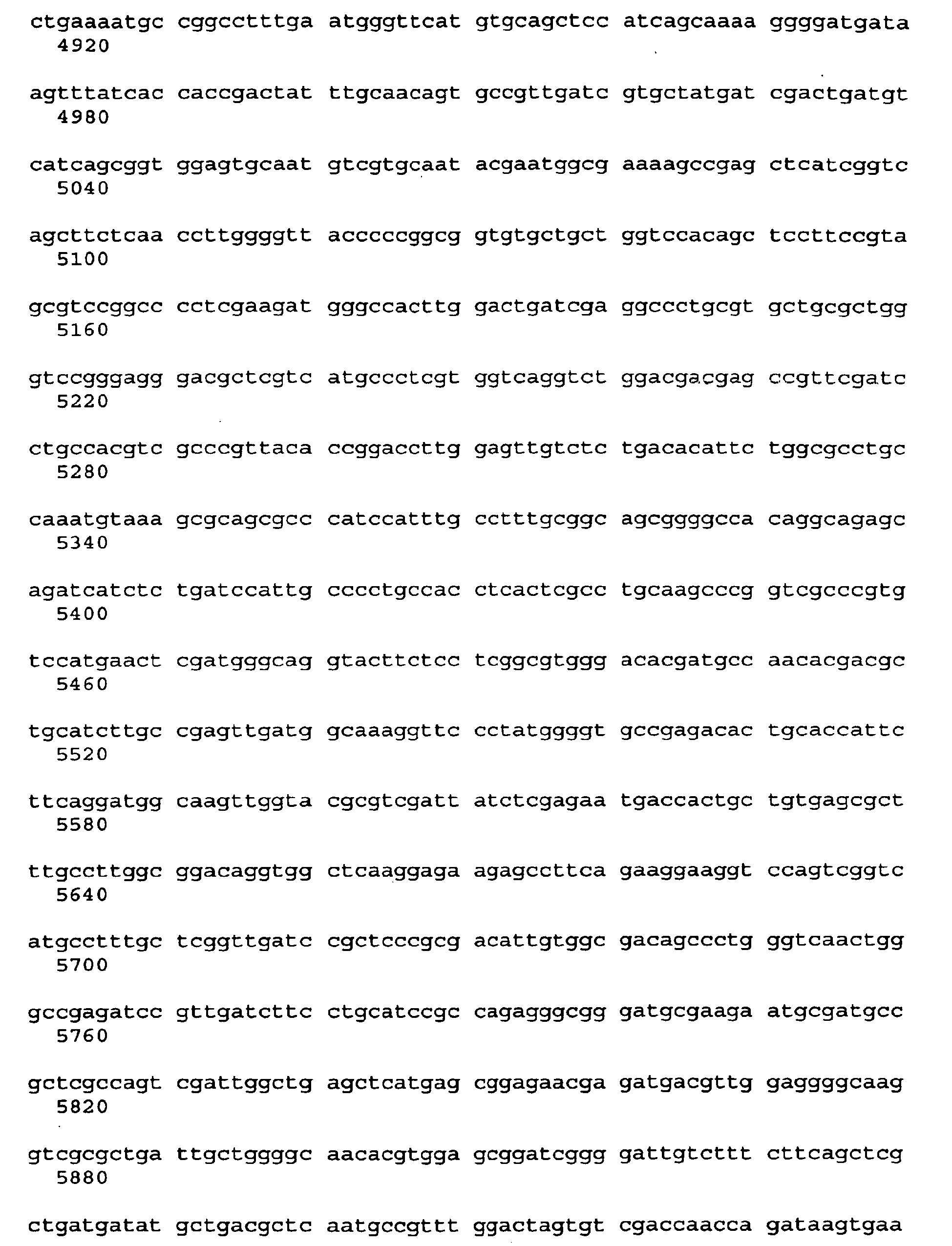

- <210> 3
<211> 16
<212> DNA
<213> Artificial - <220>
<223> primer - <400> 3

- <210> 4
<211> 16
<212> DNA
<213> Artificial - <220>
<223> primer - <400> 4

-
- <110> August, Paul
Keagle, Pamela
Call, Katherine
Long, Henry
Wiencis, Anna - <120> TRANSPOSON MEDIATED MULTIPLEX SEQUENCING
- <130> A3932 WO PCT
- <140> PCT/US01/21269
<141> 2001-07-05 - <150> US 60/216,381
<151> 2000-07-07 - <160> 4
- <170> PatentIn version 3.0
- <210> 1
<211> 2613
<212> DNA
<213> Artificial - <220>
<223> GPS-Apra transposon vector - <400> 1


- <210> 2
<211> 6114
<212> DNA
<213> Artificial - <220>
<223> GPS-Apra-2um-URA3 transposon vector - <400> 2


- <210> 3
<211> 16
<212> DNA
<213> Artificial - <220>
<223> primer - <400> 3

- <210> 4
<211> 16
<212> DNA
<213> Artificial - <220>
<223> primer - <400> 4

-
- <110> August, Paul
Keagle, Pamela
Call, Katherine
Long , Henry
Wiencis, Anna - <120> TRANSPOSON MEDIATED MULTIPLEX SEQUENCING
- <130> A3932 WO PCT
- <140> PCT/US01/21269
<141> 2001-07-05 - <150> US 60/216,381
<151> 2000-07-07 - <160> 4
- <170> PatentIn version 3.0
- <210> 1
<211> 2613
<212> DNA
<213> Artificial - <220>
<223> GPS-Apra transposon vector - <400> 1



- <210> 2
<211> 6114
<212> DNA
<213> Artificial - <220>
<223> GPS-Apra-2um-URA3 transposon vector - <400> 2


- <210> 3
<211> 16
<212> DNA
<213> Art if icial - <220>
<223> primer - <400> 3

- <210> 4
<211> 16
<212> DNA
<213> Artificial - <220>
<223> primer - <400> 4

-
- <110> August, Paul
Keagle, Pamela
Call, Katherine
Long, Henry
Wiencis, Anna - <120> TRANSPOSON MEDIATED MULTIPLEX SEQUENCING
- <130> A3932 WO PCT
- <140> PCT/US01/21269
<141> 2001-07-05 - <150> US 60/216,381
<151> 2000-07-07 - <160> 4
- <170> Patent In version 3.0
- <210> 1
<211> 2613
<212> DNA
<213> Artificial - <220>
<223> GPS-Apra transposon vector - <400> 1


- <210> 2
<211> 6114
<212> DNA
<213> Artificial - <220>
<223> GPS-Apra-2um-URA3 transposon vector - <400> 2

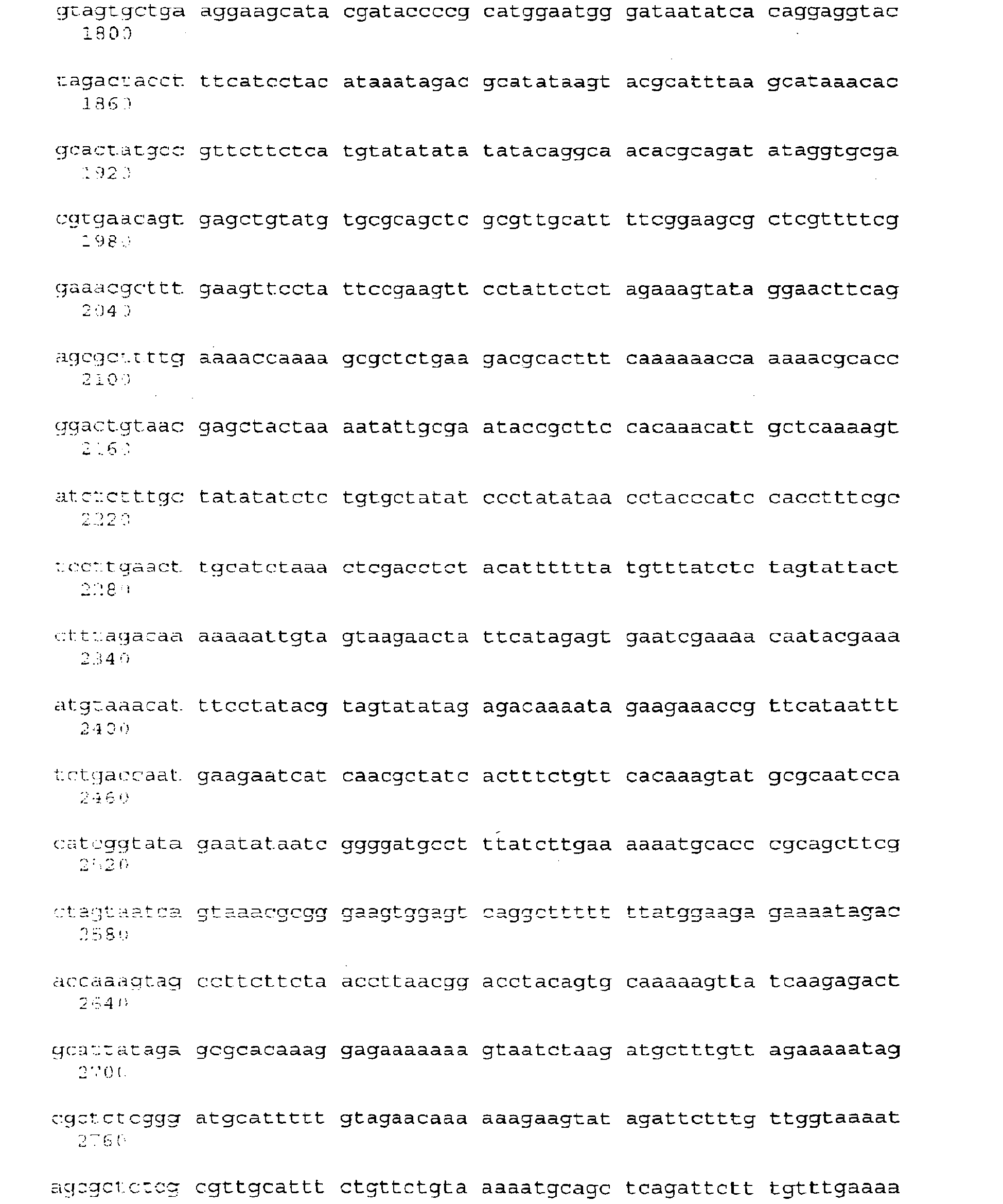


- <210> 3
<211> 16
<212> DNA
<213> Artificial - <220>
<223> primer - <400> 3

- <210> 4
<211> 16
<212> DNA
<213> Artificial
<220>
<221> primer - <402> 4

Claims (16)
- A process for parallel, transposon-mediated sequencing of DNA, the process comprising:i) providing one or more target DNA sequences, each inserted into a vector at an insertion site;ii) amplifying each target DNA-containing vector and pooling them, wherein each target DNA sequence is represented in the pool in an substantially equal amount per kb;iii) exposing the pool of target DNA-containing vectors to a selectable transposon, wherein the selectable transposon integrates into the target DNA-containing vectors at substantially random sites to form a pool of target DNA- and transposon-containing vectors;iv) transforming cells with the pool of target DNA- and transposon-containing vectors and isolating and growing a representative number of individual transformants into cultures under selection conditions;v) performing a polymerase chain reaction on DNA from each culture, wherein the polymerase chain reaction uses a pair of primers complementary to the 3' ends of the vector sequence at the insertion site and has an extension time during each reaction cycle sufficient to efficiently produce a full-length copy of the vector sequence but too short to efficiently produce a full-length copy of the vector sequence with the transposon inserted;vi) measuring the amount of DNA produced in each polymerase chain reaction; andvii) sequencing the transposon flanking regions of the target DNA-containing vectors from those cultures corresponding to polymerase chain reactions which produced substantial amounts of DNA.
- The process of claim 1, wherein one or more of steps i) to vii) are automated.
- The process of claim 1, wherein the step of measuring the amount of DNA produced in each polymerase chain reaction comprises adding a fluorescent stain selective for dsDNA to the finished polymerase chain reaction and measuring the resulting amount of fluorescence.
- The process of claim 3, wherein one or more of steps i) to vii) are automated.
- The process of claim 3, wherein the fluorescent stain selective for dsDNA is selected from the group consisting of PICOGREEN® and bisbenzimide dyes.
- The process of claim 3, wherein the fluorescent stain selective for dsDNA is PICOGREEN®.
- The process of claim 1, wherein the vector and transposon carry different selectable markers.
- The process of claim 1, wherein the transposon is at least 3 kb.
- The process of claim 8, wherein the transposon is at least 4 kb.
- The process of claim 9, wherein the transposon is GPS-Apra-2um-URA3 as depicted in figure 3.
- The process of claim 8, wherein the transposon is at least 5 kb.
- The process of claim 1, wherein the transposon is equal to or greater than the vector in length.
- The process of claim 12, wherein the transposon is at least about 5/4 the length of the vector.
- The process of claim 13, wherein the transposon is about 5 kb and the vector is about 4 kb.
- The process of claim 12, wherein the transposon is at least about 5/3 the length of the vector.
- The process of claim 15, wherein the transposon is about 5 kb and the vector is about 3 kb.
Applications Claiming Priority (3)
| Application Number | Priority Date | Filing Date | Title |
|---|---|---|---|
| US21638100P | 2000-07-07 | 2000-07-07 | |
| US216381P | 2000-07-07 | ||
| PCT/US2001/021269 WO2002004674A2 (en) | 2000-07-07 | 2001-07-05 | Transposon mediated multiplex sequencing |
Publications (2)
| Publication Number | Publication Date |
|---|---|
| EP1327000A2 EP1327000A2 (en) | 2003-07-16 |
| EP1327000B1 true EP1327000B1 (en) | 2007-05-09 |
Family
ID=22806831
Family Applications (1)
| Application Number | Title | Priority Date | Filing Date |
|---|---|---|---|
| EP01952433A Expired - Lifetime EP1327000B1 (en) | 2000-07-07 | 2001-07-05 | Transposon mediated multiplex sequencing |
Country Status (17)
| Country | Link |
|---|---|
| US (1) | US7229798B2 (en) |
| EP (1) | EP1327000B1 (en) |
| JP (1) | JP4807921B2 (en) |
| KR (1) | KR100823857B1 (en) |
| AR (1) | AR029582A1 (en) |
| AT (1) | ATE361994T1 (en) |
| AU (2) | AU7318501A (en) |
| BR (1) | BR0112261B1 (en) |
| CA (1) | CA2415786C (en) |
| DE (1) | DE60128379T2 (en) |
| IL (2) | IL153797A0 (en) |
| MX (1) | MXPA03000038A (en) |
| NO (1) | NO329791B1 (en) |
| NZ (1) | NZ523507A (en) |
| TW (1) | TWI235180B (en) |
| WO (1) | WO2002004674A2 (en) |
| ZA (1) | ZA200300035B (en) |
Families Citing this family (1)
| Publication number | Priority date | Publication date | Assignee | Title |
|---|---|---|---|---|
| WO2010126356A1 (en) * | 2009-04-29 | 2010-11-04 | Hendrix Genetics B.V. | Method of pooling samples for performing a biological assay |
Family Cites Families (3)
| Publication number | Priority date | Publication date | Assignee | Title |
|---|---|---|---|---|
| ATE428801T1 (en) * | 1996-06-04 | 2009-05-15 | Univ Utah Res Found | MONITORING HYBRIDIZATION DURING PCR |
| EP1036183B1 (en) | 1997-02-20 | 2007-10-03 | The Johns Hopkins University School Of Medicine | Mutations in atp-dependent transposition proteins that reduce target-site specificity |
| JP2003521873A (en) | 1998-10-29 | 2003-07-22 | インサイト・ファーマスーティカルズ・インコーポレイテッド | Four transmembrane proteins |
-
2001
- 2001-07-05 EP EP01952433A patent/EP1327000B1/en not_active Expired - Lifetime
- 2001-07-05 KR KR1020037000251A patent/KR100823857B1/en not_active Expired - Fee Related
- 2001-07-05 JP JP2002509527A patent/JP4807921B2/en not_active Expired - Fee Related
- 2001-07-05 CA CA002415786A patent/CA2415786C/en not_active Expired - Fee Related
- 2001-07-05 AT AT01952433T patent/ATE361994T1/en not_active IP Right Cessation
- 2001-07-05 DE DE60128379T patent/DE60128379T2/en not_active Expired - Lifetime
- 2001-07-05 MX MXPA03000038A patent/MXPA03000038A/en active IP Right Grant
- 2001-07-05 AU AU7318501A patent/AU7318501A/en active Pending
- 2001-07-05 NZ NZ523507A patent/NZ523507A/en not_active IP Right Cessation
- 2001-07-05 IL IL15379701A patent/IL153797A0/en active IP Right Grant
- 2001-07-05 US US10/332,834 patent/US7229798B2/en not_active Expired - Lifetime
- 2001-07-05 BR BRPI0112261-4A patent/BR0112261B1/en not_active IP Right Cessation
- 2001-07-05 WO PCT/US2001/021269 patent/WO2002004674A2/en not_active Ceased
- 2001-07-05 AU AU2001273185A patent/AU2001273185B2/en not_active Ceased
- 2001-07-06 TW TW090116787A patent/TWI235180B/en not_active IP Right Cessation
- 2001-07-06 AR ARP010103238A patent/AR029582A1/en active IP Right Grant
-
2002
- 2002-12-23 NO NO20026206A patent/NO329791B1/en not_active IP Right Cessation
-
2003
- 2003-01-02 ZA ZA200300035A patent/ZA200300035B/en unknown
- 2003-01-05 IL IL153797A patent/IL153797A/en not_active IP Right Cessation
Also Published As
| Publication number | Publication date |
|---|---|
| WO2002004674A2 (en) | 2002-01-17 |
| KR20030021244A (en) | 2003-03-12 |
| AU2001273185B2 (en) | 2006-05-18 |
| EP1327000A2 (en) | 2003-07-16 |
| JP2004502467A (en) | 2004-01-29 |
| NO20026206D0 (en) | 2002-12-23 |
| NZ523507A (en) | 2005-01-28 |
| MXPA03000038A (en) | 2003-08-19 |
| CA2415786C (en) | 2007-09-25 |
| KR100823857B1 (en) | 2008-04-21 |
| BR0112261B1 (en) | 2012-10-02 |
| IL153797A (en) | 2008-06-05 |
| US20030219779A1 (en) | 2003-11-27 |
| AU7318501A (en) | 2002-01-21 |
| DE60128379D1 (en) | 2007-06-21 |
| DE60128379T2 (en) | 2008-01-10 |
| ZA200300035B (en) | 2004-03-15 |
| JP4807921B2 (en) | 2011-11-02 |
| TWI235180B (en) | 2005-07-01 |
| IL153797A0 (en) | 2003-07-31 |
| AR029582A1 (en) | 2003-07-02 |
| BR0112261A (en) | 2003-09-02 |
| NO329791B1 (en) | 2010-12-20 |
| NO20026206L (en) | 2003-02-25 |
| ATE361994T1 (en) | 2007-06-15 |
| WO2002004674A3 (en) | 2003-04-17 |
| US7229798B2 (en) | 2007-06-12 |
| CA2415786A1 (en) | 2002-01-17 |
Similar Documents
| Publication | Publication Date | Title |
|---|---|---|
| AU2015294354B2 (en) | Polynucleotide enrichment using CRISPR-Cas systems | |
| CA2956925C (en) | Tagging nucleic acids for sequence assembly | |
| AU2014212152B2 (en) | Methods for genome assembly and haplotype phasing | |
| EP3990920B1 (en) | Methods and compositions for proximity ligation | |
| US20240301515A1 (en) | Dendrimers for genomic analysis methods and compositions | |
| WO2023004058A1 (en) | Spatial nucleic acid analysis | |
| WO2020259303A1 (en) | Method for rapid construction of rna 3'-end gene expression library | |
| US20250066839A1 (en) | Methods and compositions for sequencing library preparation | |
| AU2001273185B2 (en) | Transposon mediated multiplex sequencing | |
| AU2001273185A1 (en) | Transposon mediated multiplex sequencing | |
| Tagu et al. | Techniques for molecular biology | |
| Rapley | Molecular cloning and DNA sequencing | |
| CN121780740A (en) | Compositions, kits and their applications for the specific detection of *Polydinium globulus* in Poland | |
| HK1236561A1 (en) | Polynucleotide enrichment using crispr-cas systems | |
| HK1236561B (en) | Polynucleotide enrichment using crispr-cas systems |
Legal Events
| Date | Code | Title | Description |
|---|---|---|---|
| PUAI | Public reference made under article 153(3) epc to a published international application that has entered the european phase |
Free format text: ORIGINAL CODE: 0009012 |
|
| 17P | Request for examination filed |
Effective date: 20030206 |
|
| AK | Designated contracting states |
Designated state(s): AT BE CH CY DE DK ES FI FR GB GR IE IT LI LU MC NL PT SE TR |
|
| AX | Request for extension of the european patent |
Extension state: AL LT LV MK RO SI |
|
| RAP1 | Party data changed (applicant data changed or rights of an application transferred) |
Owner name: AVENTIS PHARMACEUTICALS, INC. |
|
| GRAP | Despatch of communication of intention to grant a patent |
Free format text: ORIGINAL CODE: EPIDOSNIGR1 |
|
| GRAS | Grant fee paid |
Free format text: ORIGINAL CODE: EPIDOSNIGR3 |
|
| GRAA | (expected) grant |
Free format text: ORIGINAL CODE: 0009210 |
|
| AK | Designated contracting states |
Kind code of ref document: B1 Designated state(s): AT BE CH CY DE DK ES FI FR GB GR IE IT LI LU MC NL PT SE TR |
|
| AX | Request for extension of the european patent |
Extension state: AL LT LV MK RO SI |
|
| PG25 | Lapsed in a contracting state [announced via postgrant information from national office to epo] |
Ref country code: FI Free format text: LAPSE BECAUSE OF FAILURE TO SUBMIT A TRANSLATION OF THE DESCRIPTION OR TO PAY THE FEE WITHIN THE PRESCRIBED TIME-LIMIT Effective date: 20070509 |
|
| REG | Reference to a national code |
Ref country code: GB Ref legal event code: FG4D |
|
| REG | Reference to a national code |
Ref country code: CH Ref legal event code: EP |
|
| REG | Reference to a national code |
Ref country code: IE Ref legal event code: FG4D |
|
| REF | Corresponds to: |
Ref document number: 60128379 Country of ref document: DE Date of ref document: 20070621 Kind code of ref document: P |
|
| PG25 | Lapsed in a contracting state [announced via postgrant information from national office to epo] |
Ref country code: SE Free format text: LAPSE BECAUSE OF FAILURE TO SUBMIT A TRANSLATION OF THE DESCRIPTION OR TO PAY THE FEE WITHIN THE PRESCRIBED TIME-LIMIT Effective date: 20070809 |
|
| PG25 | Lapsed in a contracting state [announced via postgrant information from national office to epo] |
Ref country code: ES Free format text: LAPSE BECAUSE OF FAILURE TO SUBMIT A TRANSLATION OF THE DESCRIPTION OR TO PAY THE FEE WITHIN THE PRESCRIBED TIME-LIMIT Effective date: 20070820 |
|
| LTIE | Lt: invalidation of european patent or patent extension |
Effective date: 20070509 |
|
| NLV1 | Nl: lapsed or annulled due to failure to fulfill the requirements of art. 29p and 29m of the patents act | ||
| ET | Fr: translation filed | ||
| PG25 | Lapsed in a contracting state [announced via postgrant information from national office to epo] |
Ref country code: AT Free format text: LAPSE BECAUSE OF FAILURE TO SUBMIT A TRANSLATION OF THE DESCRIPTION OR TO PAY THE FEE WITHIN THE PRESCRIBED TIME-LIMIT Effective date: 20070509 |
|
| PG25 | Lapsed in a contracting state [announced via postgrant information from national office to epo] |
Ref country code: BE Free format text: LAPSE BECAUSE OF FAILURE TO SUBMIT A TRANSLATION OF THE DESCRIPTION OR TO PAY THE FEE WITHIN THE PRESCRIBED TIME-LIMIT Effective date: 20070509 |
|
| PG25 | Lapsed in a contracting state [announced via postgrant information from national office to epo] |
Ref country code: NL Free format text: LAPSE BECAUSE OF FAILURE TO SUBMIT A TRANSLATION OF THE DESCRIPTION OR TO PAY THE FEE WITHIN THE PRESCRIBED TIME-LIMIT Effective date: 20070509 Ref country code: PT Free format text: LAPSE BECAUSE OF FAILURE TO SUBMIT A TRANSLATION OF THE DESCRIPTION OR TO PAY THE FEE WITHIN THE PRESCRIBED TIME-LIMIT Effective date: 20071009 Ref country code: DK Free format text: LAPSE BECAUSE OF FAILURE TO SUBMIT A TRANSLATION OF THE DESCRIPTION OR TO PAY THE FEE WITHIN THE PRESCRIBED TIME-LIMIT Effective date: 20070509 |
|
| PLBE | No opposition filed within time limit |
Free format text: ORIGINAL CODE: 0009261 |
|
| STAA | Information on the status of an ep patent application or granted ep patent |
Free format text: STATUS: NO OPPOSITION FILED WITHIN TIME LIMIT |
|
| 26N | No opposition filed |
Effective date: 20080212 |
|
| PG25 | Lapsed in a contracting state [announced via postgrant information from national office to epo] |
Ref country code: MC Free format text: LAPSE BECAUSE OF NON-PAYMENT OF DUE FEES Effective date: 20070731 Ref country code: GR Free format text: LAPSE BECAUSE OF FAILURE TO SUBMIT A TRANSLATION OF THE DESCRIPTION OR TO PAY THE FEE WITHIN THE PRESCRIBED TIME-LIMIT Effective date: 20070810 Ref country code: IT Free format text: LAPSE BECAUSE OF FAILURE TO SUBMIT A TRANSLATION OF THE DESCRIPTION OR TO PAY THE FEE WITHIN THE PRESCRIBED TIME-LIMIT Effective date: 20070509 |
|
| PG25 | Lapsed in a contracting state [announced via postgrant information from national office to epo] |
Ref country code: IE Free format text: LAPSE BECAUSE OF NON-PAYMENT OF DUE FEES Effective date: 20070705 |
|
| PG25 | Lapsed in a contracting state [announced via postgrant information from national office to epo] |
Ref country code: CY Free format text: LAPSE BECAUSE OF FAILURE TO SUBMIT A TRANSLATION OF THE DESCRIPTION OR TO PAY THE FEE WITHIN THE PRESCRIBED TIME-LIMIT Effective date: 20070509 |
|
| PG25 | Lapsed in a contracting state [announced via postgrant information from national office to epo] |
Ref country code: LU Free format text: LAPSE BECAUSE OF NON-PAYMENT OF DUE FEES Effective date: 20070705 |
|
| PG25 | Lapsed in a contracting state [announced via postgrant information from national office to epo] |
Ref country code: TR Free format text: LAPSE BECAUSE OF FAILURE TO SUBMIT A TRANSLATION OF THE DESCRIPTION OR TO PAY THE FEE WITHIN THE PRESCRIBED TIME-LIMIT Effective date: 20070509 |
|
| REG | Reference to a national code |
Ref country code: FR Ref legal event code: CA Effective date: 20130125 |
|
| REG | Reference to a national code |
Ref country code: CH Ref legal event code: PCOW Free format text: NEW ADDRESS: 55 CORPORATE DRIVE, BRIDGEWATER NEW JERSEY 08807 (US) |
|
| PGFP | Annual fee paid to national office [announced via postgrant information from national office to epo] |
Ref country code: CH Payment date: 20140714 Year of fee payment: 14 Ref country code: DE Payment date: 20140702 Year of fee payment: 14 |
|
| PGFP | Annual fee paid to national office [announced via postgrant information from national office to epo] |
Ref country code: GB Payment date: 20140702 Year of fee payment: 14 Ref country code: FR Payment date: 20140708 Year of fee payment: 14 |
|
| REG | Reference to a national code |
Ref country code: DE Ref legal event code: R119 Ref document number: 60128379 Country of ref document: DE |
|
| REG | Reference to a national code |
Ref country code: CH Ref legal event code: PL |
|
| GBPC | Gb: european patent ceased through non-payment of renewal fee |
Effective date: 20150705 |
|
| PG25 | Lapsed in a contracting state [announced via postgrant information from national office to epo] |
Ref country code: DE Free format text: LAPSE BECAUSE OF NON-PAYMENT OF DUE FEES Effective date: 20160202 Ref country code: GB Free format text: LAPSE BECAUSE OF NON-PAYMENT OF DUE FEES Effective date: 20150705 Ref country code: CH Free format text: LAPSE BECAUSE OF NON-PAYMENT OF DUE FEES Effective date: 20150731 Ref country code: LI Free format text: LAPSE BECAUSE OF NON-PAYMENT OF DUE FEES Effective date: 20150731 |
|
| REG | Reference to a national code |
Ref country code: FR Ref legal event code: ST Effective date: 20160331 |
|
| PG25 | Lapsed in a contracting state [announced via postgrant information from national office to epo] |
Ref country code: FR Free format text: LAPSE BECAUSE OF NON-PAYMENT OF DUE FEES Effective date: 20150731 |