EP1326025A2 - Coupling device - Google Patents
Coupling device Download PDFInfo
- Publication number
- EP1326025A2 EP1326025A2 EP03251795A EP03251795A EP1326025A2 EP 1326025 A2 EP1326025 A2 EP 1326025A2 EP 03251795 A EP03251795 A EP 03251795A EP 03251795 A EP03251795 A EP 03251795A EP 1326025 A2 EP1326025 A2 EP 1326025A2
- Authority
- EP
- European Patent Office
- Prior art keywords
- rib
- rod body
- coupling device
- plate member
- ribs
- Prior art date
- Legal status (The legal status is an assumption and is not a legal conclusion. Google has not performed a legal analysis and makes no representation as to the accuracy of the status listed.)
- Granted
Links
- 230000008878 coupling Effects 0.000 title claims abstract description 30
- 238000010168 coupling process Methods 0.000 title claims abstract description 30
- 238000005859 coupling reaction Methods 0.000 title claims abstract description 30
- 230000013011 mating Effects 0.000 claims abstract description 6
- 238000001746 injection moulding Methods 0.000 claims description 3
- 229920003002 synthetic resin Polymers 0.000 description 4
- 239000000057 synthetic resin Substances 0.000 description 4
- 238000002347 injection Methods 0.000 description 3
- 239000007924 injection Substances 0.000 description 3
- 229920005989 resin Polymers 0.000 description 3
- 239000011347 resin Substances 0.000 description 3
- 239000004575 stone Substances 0.000 description 3
- 239000000463 material Substances 0.000 description 2
- 239000000725 suspension Substances 0.000 description 2
- 230000000712 assembly Effects 0.000 description 1
- 238000000429 assembly Methods 0.000 description 1
- 238000009434 installation Methods 0.000 description 1
- 230000002093 peripheral effect Effects 0.000 description 1
- 230000000087 stabilizing effect Effects 0.000 description 1
- 238000004073 vulcanization Methods 0.000 description 1
Images




Classifications
-
- F—MECHANICAL ENGINEERING; LIGHTING; HEATING; WEAPONS; BLASTING
- F16—ENGINEERING ELEMENTS AND UNITS; GENERAL MEASURES FOR PRODUCING AND MAINTAINING EFFECTIVE FUNCTIONING OF MACHINES OR INSTALLATIONS; THERMAL INSULATION IN GENERAL
- F16C—SHAFTS; FLEXIBLE SHAFTS; ELEMENTS OR CRANKSHAFT MECHANISMS; ROTARY BODIES OTHER THAN GEARING ELEMENTS; BEARINGS
- F16C7/00—Connecting-rods or like links pivoted at both ends; Construction of connecting-rod heads
- F16C7/02—Constructions of connecting-rods with constant length
- F16C7/026—Constructions of connecting-rods with constant length made of fibre reinforced resin
-
- B—PERFORMING OPERATIONS; TRANSPORTING
- B60—VEHICLES IN GENERAL
- B60G—VEHICLE SUSPENSION ARRANGEMENTS
- B60G7/00—Pivoted suspension arms; Accessories thereof
- B60G7/001—Suspension arms, e.g. constructional features
-
- F—MECHANICAL ENGINEERING; LIGHTING; HEATING; WEAPONS; BLASTING
- F16—ENGINEERING ELEMENTS AND UNITS; GENERAL MEASURES FOR PRODUCING AND MAINTAINING EFFECTIVE FUNCTIONING OF MACHINES OR INSTALLATIONS; THERMAL INSULATION IN GENERAL
- F16C—SHAFTS; FLEXIBLE SHAFTS; ELEMENTS OR CRANKSHAFT MECHANISMS; ROTARY BODIES OTHER THAN GEARING ELEMENTS; BEARINGS
- F16C7/00—Connecting-rods or like links pivoted at both ends; Construction of connecting-rod heads
- F16C7/02—Constructions of connecting-rods with constant length
-
- B—PERFORMING OPERATIONS; TRANSPORTING
- B60—VEHICLES IN GENERAL
- B60G—VEHICLE SUSPENSION ARRANGEMENTS
- B60G2204/00—Indexing codes related to suspensions per se or to auxiliary parts
- B60G2204/10—Mounting of suspension elements
- B60G2204/18—Mounting of vehicle engines
-
- B—PERFORMING OPERATIONS; TRANSPORTING
- B60—VEHICLES IN GENERAL
- B60G—VEHICLE SUSPENSION ARRANGEMENTS
- B60G2204/00—Indexing codes related to suspensions per se or to auxiliary parts
- B60G2204/40—Auxiliary suspension parts; Adjustment of suspensions
- B60G2204/422—Links for mounting suspension elements
-
- B—PERFORMING OPERATIONS; TRANSPORTING
- B60—VEHICLES IN GENERAL
- B60G—VEHICLE SUSPENSION ARRANGEMENTS
- B60G2206/00—Indexing codes related to the manufacturing of suspensions: constructional features, the materials used, procedures or tools
- B60G2206/01—Constructional features of suspension elements, e.g. arms, dampers, springs
- B60G2206/10—Constructional features of arms
- B60G2206/11—Constructional features of arms the arm being a radius or track or torque or steering rod or stabiliser end link
-
- B—PERFORMING OPERATIONS; TRANSPORTING
- B60—VEHICLES IN GENERAL
- B60G—VEHICLE SUSPENSION ARRANGEMENTS
- B60G2206/00—Indexing codes related to the manufacturing of suspensions: constructional features, the materials used, procedures or tools
- B60G2206/01—Constructional features of suspension elements, e.g. arms, dampers, springs
- B60G2206/70—Materials used in suspensions
- B60G2206/71—Light weight materials
-
- B—PERFORMING OPERATIONS; TRANSPORTING
- B60—VEHICLES IN GENERAL
- B60G—VEHICLE SUSPENSION ARRANGEMENTS
- B60G2206/00—Indexing codes related to the manufacturing of suspensions: constructional features, the materials used, procedures or tools
- B60G2206/01—Constructional features of suspension elements, e.g. arms, dampers, springs
- B60G2206/70—Materials used in suspensions
- B60G2206/71—Light weight materials
- B60G2206/7101—Fiber-reinforced plastics [FRP]
-
- B—PERFORMING OPERATIONS; TRANSPORTING
- B60—VEHICLES IN GENERAL
- B60G—VEHICLE SUSPENSION ARRANGEMENTS
- B60G2206/00—Indexing codes related to the manufacturing of suspensions: constructional features, the materials used, procedures or tools
- B60G2206/01—Constructional features of suspension elements, e.g. arms, dampers, springs
- B60G2206/70—Materials used in suspensions
- B60G2206/71—Light weight materials
- B60G2206/7104—Thermoplastics
-
- B—PERFORMING OPERATIONS; TRANSPORTING
- B60—VEHICLES IN GENERAL
- B60G—VEHICLE SUSPENSION ARRANGEMENTS
- B60G2206/00—Indexing codes related to the manufacturing of suspensions: constructional features, the materials used, procedures or tools
- B60G2206/01—Constructional features of suspension elements, e.g. arms, dampers, springs
- B60G2206/80—Manufacturing procedures
- B60G2206/81—Shaping
- B60G2206/8101—Shaping by casting
-
- B—PERFORMING OPERATIONS; TRANSPORTING
- B60—VEHICLES IN GENERAL
- B60G—VEHICLE SUSPENSION ARRANGEMENTS
- B60G2206/00—Indexing codes related to the manufacturing of suspensions: constructional features, the materials used, procedures or tools
- B60G2206/01—Constructional features of suspension elements, e.g. arms, dampers, springs
- B60G2206/80—Manufacturing procedures
- B60G2206/81—Shaping
- B60G2206/8101—Shaping by casting
- B60G2206/81012—Shaping by casting by injection moulding
-
- F—MECHANICAL ENGINEERING; LIGHTING; HEATING; WEAPONS; BLASTING
- F16—ENGINEERING ELEMENTS AND UNITS; GENERAL MEASURES FOR PRODUCING AND MAINTAINING EFFECTIVE FUNCTIONING OF MACHINES OR INSTALLATIONS; THERMAL INSULATION IN GENERAL
- F16C—SHAFTS; FLEXIBLE SHAFTS; ELEMENTS OR CRANKSHAFT MECHANISMS; ROTARY BODIES OTHER THAN GEARING ELEMENTS; BEARINGS
- F16C2326/00—Articles relating to transporting
- F16C2326/01—Parts of vehicles in general
- F16C2326/05—Vehicle suspensions, e.g. bearings, pivots or connecting rods used therein
Definitions
- the present invention relates to a coupling device such as a link rod used as a suspension link for automobiles, an engine mount which couples an automobile engine and a chassis, or the like.
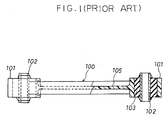
- the well-known coupling devices include a link rod shown by way of example in FIGS. 1 to 3.
- the link rod comprises an elongated plate-like rod body 100 made of a synthetic resin.
- the rod body 100 has a cylindrical end portion 101 formed integrally at each end thereof.
- Each cylindrical portion 101 has a cylindrical joint piece 102 disposed therein.
- a rubber-made elastic joint piece 103 is formed between the cylindrical portion 101 and joint piece 102.
- the rod body 100 consists of a plate member 105 ribbed as indicated with a reference numeral 104 to reinforce the plate member 105 and hence the rod body 100 as a whole.
- the ribs 104 are formed in two pairs, upper and lower, on the plate member 105.
- the ribs 104 in each pair extrude in opposite directions orthogonal to the plate member 105. They extend along the longitudinal perimeters, upper and lower, respectively, of the plate member 105 as well as between the cylindrical portions 101.
- the rod body 100 or any other synthetic resin-made portion thereof is likely to be broken by a stone or the like bounded from the road surface by the wheel of the running automobile or by a curb with which the rod body 100 will possibly collide when the automobile comes too close to the sidewalk. If the rod body or cylindrical end portion is cracked or injured, the link rod itself will be damaged or loose the strength due to a stress concentration to such a cracked or injured portion.
- the present invention has an object to overcome the above-mentioned drawbacks of the prior art by providing a coupling device of which a synthetic resin-made portion likely to collide with such a leaping stone or other object is improved in strength.
- a coupling device comprising an elongated plate-shaped synthetic resin-made rod body, a synthetic resin-made cylindrical portion formed integrally at at least one end of the rod body, and a joint piece provided inside the cylindrical portion and which is to be coupled to a mating object; the rod body consisting of a plate member ribbed orthogonally, and along each longitudinal perimeter, thereof; each rib being recessed in an opposite direction to the projecting direction thereof and along at least a portion of the length thereof to provide a pair of outer and inner ribs which form together a double structure.
- the cylindrical portion is recessed concentrically in either axial end face thereof, or in one of the axial end faces thereof, along at least a portion of the concentric circle to have a double structure in at least a portion thereof.
- the above object can also be accomplished by providing a coupling device comprising an elongated plate-shaped synthetic resin-made rod body, a synthetic resin-made cylindrical portion formed integrally at at least one end of the rod body, a joint piece provided inside the cylindrical portion and which is to be coupled to a mating object, and a rubber-made elastic member provided between the cylindrical portion and joint piece; the cylindrical portion being recessed concentrically in each axial end face thereof, or in one of the axial end faces thereof, along at least a portion of the concentric circle to have a double structure in at least a portion thereof.
- the outer rib will protect the inner one. Even if the outer rib or the perimeter is injured by a stone or the like as mentioned above, the inner rib can be protected by the outer rib so that the coupling device can be kept against a sudden attenuation of its strength.
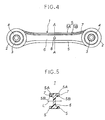
- FIG. 4 illustrates the first embodiment. As shown, it is comprised of an elongated plate-like synthetic resin-made rod body 1, a synthetic resin-made cylindrical portion 2 formed integrally on either end of the rod body 1, a joint piece 3 disposed within the cylindrical portion 2 and which is to be connected to a mating object, and a rubber-made elastic member 4 disposed between the cylindrical portion 2 and joint piece 3.
- the joint piece 3 is a metallic cylinder through which a bolt is penetrated.
- the rod body 1 is formed from a plate member 6 ribbed as indicated with a reference numeral 5 along the perimeter thereof defining the profile thereof. The ribs 5 protrude in opposite directions orthogonal to the plate member 6. That is, the rod body 1 has an "H-shaped" cross section.
- one of the upper and lower pairs of ribs 5 is recessed as indicated with a reference numeral 7 longitudinally thereof.
- the rib 5 consists of an outer rib portion 5A and inner rib portion 5B which form together a double structure.
- FIG. 5 is a sectional view taken along the line A-A in FIG. 4.
- FIG. 5 best shows the above-mentioned double structure of the rib 5.
- the rod body 1 is formed so that upper and lower halves thereof divided by a horizontal line L passing through the vertical mid point thereof are generally equal in area to each other.
- the recess 7 is formed to extend to either cylindrical portion 2.
- the double structure of the rod body 1 may be formed to extend along an appropriate length of the rod body 1 as necessary.
- FIG. 6 is a front view, from below, of the coupling device according to the present invention on the assumption that FIG. 4 is a plan view.
- the coupling device according to the first embodiment shown in FIGS. 4 to 6 is produced by setting the joint piece 3 made of a metallic cylinder in a vulcanization injection mold, injecting and vulcanizing a rubber material about the joint piece 3, and then fitting the rubber-made elastic member 4 onto the joint piece 3.
- two assemblies thus made of the joint piece 3 and rubber-made elastic member 4 are set in an injection mold, and a molten resin is injected from the gate 8 into a cavity defined between the two rubber-made elastic members 4 thus set while the resin is fed to around the respective rubber-made elastic members 4.
- the cylindrical portions 2 made of the synthetic resin is formed about the rubber-made elastic member 4, and the synthetic resin-made rod body 1 is thus molded between the cylindrical portions 2.
- the rubber-made elastic member 4 is compressed under the injection pressure of the molten resin.
- the link rod for vehicles is 10 to 100 cm long.
- the link rod 1 in the above-mentioned embodiment is 60 cm in total length, the width of the portion connecting the two cylindrical portions 2, namely, the length along the line A-A in FIG. 4, is 40 mm, the width of the recess 7 is 3 mm, the width of each of the outer and inner ribs 5A and 5B is also 3 mm, and the width of the rib 5 in which the recess 7 is not formed is 6 mm.
- the width of the recess 7 is a minimum of 2 mm because of the mold's geometry. If this recess width is too large, the intended purpose of the present invention cannot be attained.
- FIG. 7 shows the second embodiment of the present invention in which a similar recess to the recess 7 in the first embodiment is formed in each rib 5 in one pair of the opposite ribs 5 as well as in the other pair.
- a recess 72 is formed in a part of the cylindrical portion 2 as well.
- the part of the cylindrical portion 2 has a double structure.
- the recesses 7 are formed in the ribs, except for a part thereof, which are joined to the rod body 1.
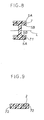
- FIG. 8 is a sectional view taken along the line B-B in FIG. 6. As shown, the rod body 1 is so formed that upper and lower halves thereof divided by a line L passing through the vertical mid point thereof are generally equal in area to each other.
- FIG. 9 is a sectional view taken along the line C-C in FIG. 7.
- the cylindrical portion 1 has the recesses 72 formed in an opposite direction to the projecting direction thereof and concentrically from either end thereof.
- a peripheral part of the cylindrical portion 2 has a double structure.
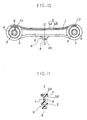
- FIG. 10 is a plan view of a third embodiment in which the recess 7 is formed only in one pair of the ribs 1 to form a similar double structure to that shown in FIG. 7. Also, the recess 72 is formed in a part of the cylindrical portion 2 in a same direction as that of the recess 7 in the rod body 1 (upper rib in the plane of the drawing). Thus the cylindrical portion 2 has a double structure.
- a projection 9 is provided to position a gate therein for use during an injection molding. A gate is located in either of the two positions indicated with the reference numeral 8.
- the rod body 1 has a double structure formed only along one longitudinal perimeter thereof as seen from FIG. 11. As shown in FIG.
- FIG. 13 is a front view of the coupling device shown in FIG. 10.
- the present invention has been described concerning a coupling device using the joint piece 3 made of a metallic cylinder.
- a ball joint may be used in place of the cylindrical joint piece 3 as in a stabilizing link rod.
- the rubber-made elastic member 4 is not formed but the ball joint will be enclosed directly by the synthetic resin-made cylindrical portion 2.
- FIG. 14 shows the fourth embodiment of the present invention.
- This embodiment is not used as a coupling device but as a bush used in an engine mount to connect an automobile engine and a chassis as well as in various links.
- This coupling device comprises a cylindrical member 2 made of a synthetic resin in which a joint piece 3 is disposed. Arubber-made elastic member 4 is provided between the joint piece 3 and cylindrical member 2.
- the cylindrical member 2 has formed axially therein a recess 73 from both end thereof.
- the recess 73 may be provided at only one end of the cylindrical member 2.
- the cylindrical member 2 has a double structure as shown in FIG. 15.
- the upper half above a horizontal line L and the lower half below the line L are generally equal in sectional area to each other.
- FIG. 15 Of this coupling device, the upper half above a horizontal line L and the lower half below the line L are generally equal in sectional area to each other.
- FIG. 16 is a front view of the coupling device shown in FIG. 14. This is a bottom view of the coupling device. It should be noted that a pair of fixtures 10 is formed integrally on the cylindrical member 2 for installation to any other equipment. Owing to a hole 11 formed in the fixture 10, the coupling device can be fixed to any other unit than an one to which the joint piece 3 is fixed.
- the ribs 5 may be formed to provide a triple or multiple structure of the coupling device. Also, only the right or left half of each of the embodiments of the coupling device shown in FIGS. 5, 11, 12 and 15, respectively, may be formed to have a double structure. Furthermore, the outer and inner ribs 5A and 6B may be different in height from each other.
Landscapes
- Engineering & Computer Science (AREA)
- General Engineering & Computer Science (AREA)
- Mechanical Engineering (AREA)
- Springs (AREA)
- Vehicle Body Suspensions (AREA)
- Mutual Connection Of Rods And Tubes (AREA)
Abstract
Description
Claims (7)
- A coupling device, comprising:an elongated plate-shaped synthetic resin-made rod body (1), a synthetic resin-made cylindrical portion (2) formed integrally at at least one end of the rod body, and a joint piece (3) provided inside the cylindrical portion and which is to be coupled to a mating object;the rod body (1) including a plate member (6) having a longitudinally extending rib along each perimeter of said plate member, each of said ribs projecting in opposite directions orthogonal to the plate member; characterized in thaton at least one of opposite faces of said plate member (6) at least a portion of the length of the rib comprises a pair of outer and inner ribs (5A,5B) spaced-apart from one another over said length portion and positioned within said rib, said outer rib (5A) being located proximal an outermost edge of said plate member (6); andsaid rib being laterally spaced apart from a longitudinal central axis of said plate member (6), said inner rib (5B) being located between said longitudinal central axis and said outer rib (5A), and positioned substantially closer to said outer rib than to said longitudinal central axis, wherein said pair of outer and inner ribs (5A,5B) form together a double structure.
- A coupling device as claimed in claim 1, characterized in that a gate (8) for injection molding is positioned at one of the longitudinally extending ribs.
- A coupling device as claimed in claim 2, characterized in that a projection (9) is formed laterally of the rod body for positioning the gate (8).
- A coupling device as claimed in claims 1 to 3, characterized in that only the longitudinally extending rib along one of the perimeters of the plate member (6) is recessed.
- A coupling device as claimed in claim 5, characterized in that both the inner and outer ribs (5B,5A) of the longitudinally extending rib which is recessed are smaller in thickness than the longitudinally extending rib on a remaining one of said perimeters which is not recessed.
- A coupling device as claimed in any of claims 1 to 3, characterized in that all portions of said longitudinally extending ribs are recessed to present inner and outer ribs (5B,5A).
- A coupling device comprising an elongated plate-shaped synthetic resin-made rod body (1), a synthetic resin-made cylindrical portion (2) formed integrally at at least one end of the rod body, and a joint piece (3) provided inside the cylindrical portion and which is to be coupled to a mating object;the rod body (1) consisting of a plate member (6) ribbed orthogonally, and along each longitudinal perimeter, thereof;each rib being recessed in an opposite direction to the projecting direction thereof and along at least a portion of the length thereof to provide a pair of outer and inner ribs (5A,5B) which form together a double structure.
Applications Claiming Priority (3)
| Application Number | Priority Date | Filing Date | Title |
|---|---|---|---|
| JP9117608A JPH10299805A (en) | 1997-04-21 | 1997-04-21 | Coupling device |
| JP11760897 | 1997-04-21 | ||
| EP98303066A EP0874170B1 (en) | 1997-04-21 | 1998-04-21 | Coupling device |
Related Parent Applications (1)
| Application Number | Title | Priority Date | Filing Date |
|---|---|---|---|
| EP98303066A Division EP0874170B1 (en) | 1997-04-21 | 1998-04-21 | Coupling device |
Publications (3)
| Publication Number | Publication Date |
|---|---|
| EP1326025A2 true EP1326025A2 (en) | 2003-07-09 |
| EP1326025A3 EP1326025A3 (en) | 2004-01-07 |
| EP1326025B1 EP1326025B1 (en) | 2005-11-02 |
Family
ID=14715985
Family Applications (2)
| Application Number | Title | Priority Date | Filing Date |
|---|---|---|---|
| EP98303066A Expired - Lifetime EP0874170B1 (en) | 1997-04-21 | 1998-04-21 | Coupling device |
| EP03251795A Expired - Lifetime EP1326025B1 (en) | 1997-04-21 | 1998-04-21 | Coupling device |
Family Applications Before (1)
| Application Number | Title | Priority Date | Filing Date |
|---|---|---|---|
| EP98303066A Expired - Lifetime EP0874170B1 (en) | 1997-04-21 | 1998-04-21 | Coupling device |
Country Status (4)
| Country | Link |
|---|---|
| US (1) | US6113058A (en) |
| EP (2) | EP0874170B1 (en) |
| JP (1) | JPH10299805A (en) |
| DE (2) | DE69832213T2 (en) |
Cited By (1)
| Publication number | Priority date | Publication date | Assignee | Title |
|---|---|---|---|---|
| FR2946712A1 (en) * | 2009-06-16 | 2010-12-17 | Skf Aerospace France | ROD FOR AERONAUTICAL CONSTRUCTION AND METHOD FOR MANUFACTURING SUCH ROD |
Families Citing this family (22)
| Publication number | Priority date | Publication date | Assignee | Title |
|---|---|---|---|---|
| FR2855478B1 (en) * | 2003-06-02 | 2005-08-19 | Valeo Systemes Dessuyage | AUTOMOTIVE VEHICLE EQUIPMENT COMPONENT WITH VIBRATION DAMPER FASTENING POINTS |
| JP4589612B2 (en) * | 2003-09-05 | 2010-12-01 | 株式会社ブリヂストン | Vibration isolator |
| DE10342032B3 (en) * | 2003-09-08 | 2005-05-25 | Trelleborg Automotive Technical Centre Gmbh | Stabilizer |
| JP4046094B2 (en) | 2004-03-19 | 2008-02-13 | 東海ゴム工業株式会社 | Torque rod |
| US7551049B2 (en) | 2004-11-08 | 2009-06-23 | Denso Corporation | Structure of electromagnetic switch for starter |
| JP4607938B2 (en) * | 2007-11-01 | 2011-01-05 | 東洋ゴム工業株式会社 | Anti-vibration connecting rod |
| US8337113B2 (en) * | 2009-06-10 | 2012-12-25 | Radar Industries, Inc. | Stamped link for supporting an engine |
| GB2492099B8 (en) * | 2011-06-21 | 2015-09-09 | Jaguar Land Rover Ltd | Vehicle components |
| EP2578473A1 (en) * | 2011-10-06 | 2013-04-10 | SMP Deutschland GmbH | Subframe for motor vehicle |
| KR102023463B1 (en) | 2012-05-17 | 2019-09-20 | 보르그워너 인코퍼레이티드 | Heat isolating vtg lever and linkage |
| DE112013002035T5 (en) * | 2012-05-17 | 2015-03-12 | Borgwarner Inc. | Heat insulating actuator linkage |
| EP2759423B1 (en) * | 2013-01-28 | 2015-04-22 | Gestamp Umformtechnik GmbH | Suspension arm made of fibre-reinforced plastic for a wheel suspension of a vehicle |
| CN103317296B (en) * | 2013-06-06 | 2016-01-20 | 潍柴动力(潍坊)再制造有限公司 | The reproducing method of engine link |
| DE102014213111B4 (en) * | 2013-07-15 | 2020-06-18 | Ford Global Technologies, Llc | Device for stabilizing a motor vehicle against roll movements |
| JP5771320B2 (en) * | 2013-12-19 | 2015-08-26 | 株式会社神戸製鋼所 | Automobile undercarriage parts |
| CN104696401B (en) * | 2014-12-06 | 2016-09-14 | 宁海建新自动化设备有限公司 | Automobile hanging pull bar lining process equipment |
| MX2017017004A (en) * | 2015-06-22 | 2018-04-10 | Hendrickson Usa Llc | COMPOUND SUSPENSION COMPONENTS. |
| US10202013B2 (en) * | 2016-03-01 | 2019-02-12 | Dura Operating, Llc | Extruded suspension linkage |
| KR102018137B1 (en) * | 2018-07-31 | 2019-09-04 | 주식회사 티앤지 | Torque rod structure adapted to suspension for commercial vehicle |
| DE102018126732A1 (en) * | 2018-10-26 | 2020-04-30 | Dr. Ing. H.C. F. Porsche Aktiengesellschaft | Handlebar for a handlebar system for connecting a wheel carrier to a body of a vehicle |
| USD1029882S1 (en) * | 2020-01-23 | 2024-06-04 | SpeedyRacing, LLC | Motor vehicle suspension stabilizer link |
| US12214665B2 (en) * | 2021-11-30 | 2025-02-04 | Nissan North America, Inc. | Vibration dampening engine mount and modular vibration dampening engine mount system |
Family Cites Families (13)
| Publication number | Priority date | Publication date | Assignee | Title |
|---|---|---|---|---|
| US1380659A (en) * | 1916-04-26 | 1921-06-07 | Layman Pressed Rod Company Inc | Link, lever, and the like |
| US3244435A (en) * | 1963-08-19 | 1966-04-05 | Dewey S Weiss | Vehicle drawbar structure |
| US4240517A (en) * | 1979-04-13 | 1980-12-23 | General Motors Corporation | Powertrain and independent suspension mounting arrangement for front-wheel-drive vehicle |
| DE3204093C2 (en) * | 1982-02-06 | 1983-12-08 | Deutsche Forschungs- und Versuchsanstalt für Luft- und Raumfahrt e.V., 5300 Bonn | Connecting rod for an internal combustion piston engine |
| IT1178570B (en) * | 1984-10-04 | 1987-09-09 | Pirelli | ANCHOR CONNECTING ROD IN A MOTOR SUSPENSION |
| US4779834A (en) * | 1987-08-07 | 1988-10-25 | General Motors Corporation | Engine displacement limiter |
| JPH01126413A (en) * | 1987-11-09 | 1989-05-18 | Tokai Rubber Ind Ltd | Connecting rod made of resin |
| US5114178A (en) * | 1989-03-13 | 1992-05-19 | Baxter David A | Suspension apparatus |
| DE3928855A1 (en) * | 1989-08-31 | 1991-03-07 | Fichtel & Sachs Ag | Fibre reinforced plastic connecting rod - has optimised section framework with two eyes sepd. by two long members and brace between them |
| JPH0747975B2 (en) * | 1989-12-19 | 1995-05-24 | 東海ゴム工業株式会社 | Cylindrical mounting device with damper |
| JP3004745B2 (en) * | 1991-02-14 | 2000-01-31 | オイレス工業株式会社 | Ball joint for stabilizer |
| US5398907A (en) * | 1992-06-12 | 1995-03-21 | Chemcast Corporation | Hanger for vehicle exhaust systems and the like |
| JP3653106B2 (en) * | 1993-12-29 | 2005-05-25 | 株式会社ブリヂストン | Manufacturing method of resin connecting rod |
-
1997
- 1997-04-21 JP JP9117608A patent/JPH10299805A/en active Pending
-
1998
- 1998-04-16 US US09/061,368 patent/US6113058A/en not_active Expired - Lifetime
- 1998-04-21 EP EP98303066A patent/EP0874170B1/en not_active Expired - Lifetime
- 1998-04-21 DE DE69832213T patent/DE69832213T2/en not_active Expired - Lifetime
- 1998-04-21 DE DE69824474T patent/DE69824474T2/en not_active Expired - Lifetime
- 1998-04-21 EP EP03251795A patent/EP1326025B1/en not_active Expired - Lifetime
Cited By (2)
| Publication number | Priority date | Publication date | Assignee | Title |
|---|---|---|---|---|
| FR2946712A1 (en) * | 2009-06-16 | 2010-12-17 | Skf Aerospace France | ROD FOR AERONAUTICAL CONSTRUCTION AND METHOD FOR MANUFACTURING SUCH ROD |
| EP2264324A1 (en) * | 2009-06-16 | 2010-12-22 | SKF Aerospace France | Method of manufacture of a linkage for aeronautical construction |
Also Published As
| Publication number | Publication date |
|---|---|
| JPH10299805A (en) | 1998-11-13 |
| DE69824474D1 (en) | 2004-07-22 |
| EP1326025A3 (en) | 2004-01-07 |
| DE69832213D1 (en) | 2005-12-08 |
| EP1326025B1 (en) | 2005-11-02 |
| DE69832213T2 (en) | 2006-07-27 |
| EP0874170A1 (en) | 1998-10-28 |
| EP0874170B1 (en) | 2004-06-16 |
| US6113058A (en) | 2000-09-05 |
| DE69824474T2 (en) | 2005-06-09 |
Similar Documents
| Publication | Publication Date | Title |
|---|---|---|
| EP1326025B1 (en) | Coupling device | |
| EP0722401B1 (en) | End section of frame member | |
| US5078454A (en) | Wheel or endless track | |
| EP3061624B1 (en) | Non-pneumatic tire | |
| DE112014001576B4 (en) | dust cover assembly | |
| DE112016003651B4 (en) | Double ring insulator with micro sheer hub | |
| KR20050102110A (en) | Tire/wheel assembly body and interior body for noise reduction | |
| US20030155698A1 (en) | Resilient joint for vehicle suspension | |
| US6213573B1 (en) | Rubber pads | |
| KR20230150082A (en) | Bushing for trailing arm | |
| DE10024323A1 (en) | Anti-vibration device | |
| JP2602727Y2 (en) | Upper support for vehicle suspension | |
| JP2648076B2 (en) | Elastic ring for holding tire core | |
| EP0091816A2 (en) | Track shoe grouser assembly | |
| JP3653106B2 (en) | Manufacturing method of resin connecting rod | |
| KR102664095B1 (en) | Transmission mount | |
| JPH0357153Y2 (en) | ||
| CA1128587A (en) | Track-link connector for tracked vehicles | |
| EP4588690A1 (en) | Non-pneumatic tire | |
| EP1811195A1 (en) | Pivot bearing, especially for the axle pivot steering of a motor vehicle | |
| JP3413320B2 (en) | Crawler rubber shoe | |
| JPS6132734Y2 (en) | ||
| US4888236A (en) | Torque rod of composite material | |
| KR20170089706A (en) | Upper-cup Integrated Type Insulator | |
| JP3131611B2 (en) | Torque rod |
Legal Events
| Date | Code | Title | Description |
|---|---|---|---|
| PUAI | Public reference made under article 153(3) epc to a published international application that has entered the european phase |
Free format text: ORIGINAL CODE: 0009012 |
|
| 17P | Request for examination filed |
Effective date: 20030422 |
|
| AC | Divisional application: reference to earlier application |
Ref document number: 0874170 Country of ref document: EP Kind code of ref document: P |
|
| AK | Designated contracting states |
Designated state(s): DE FR GB |
|
| PUAL | Search report despatched |
Free format text: ORIGINAL CODE: 0009013 |
|
| AK | Designated contracting states |
Kind code of ref document: A3 Designated state(s): DE FR GB |
|
| RIC1 | Information provided on ipc code assigned before grant |
Ipc: 7F 16C 7/02 A |
|
| 17Q | First examination report despatched |
Effective date: 20040506 |
|
| AKX | Designation fees paid |
Designated state(s): DE FR GB |
|
| GRAP | Despatch of communication of intention to grant a patent |
Free format text: ORIGINAL CODE: EPIDOSNIGR1 |
|
| RIN1 | Information on inventor provided before grant (corrected) |
Inventor name: IWASAKI, KENICHIRO |
|
| GRAS | Grant fee paid |
Free format text: ORIGINAL CODE: EPIDOSNIGR3 |
|
| GRAA | (expected) grant |
Free format text: ORIGINAL CODE: 0009210 |
|
| AC | Divisional application: reference to earlier application |
Ref document number: 0874170 Country of ref document: EP Kind code of ref document: P |
|
| AK | Designated contracting states |
Kind code of ref document: B1 Designated state(s): DE FR GB |
|
| REG | Reference to a national code |
Ref country code: GB Ref legal event code: FG4D |
|
| REF | Corresponds to: |
Ref document number: 69832213 Country of ref document: DE Date of ref document: 20051208 Kind code of ref document: P |
|
| ET | Fr: translation filed | ||
| PLBE | No opposition filed within time limit |
Free format text: ORIGINAL CODE: 0009261 |
|
| STAA | Information on the status of an ep patent application or granted ep patent |
Free format text: STATUS: NO OPPOSITION FILED WITHIN TIME LIMIT |
|
| 26N | No opposition filed |
Effective date: 20060803 |
|
| REG | Reference to a national code |
Ref country code: FR Ref legal event code: CA Effective date: 20140812 |
|
| REG | Reference to a national code |
Ref country code: DE Ref legal event code: R081 Ref document number: 69832213 Country of ref document: DE Owner name: BRIDGESTONE CORPORATION, JP Free format text: FORMER OWNER: BRIDGESTONE CORP., TOKIO/TOKYO, JP Effective date: 20140828 |
|
| REG | Reference to a national code |
Ref country code: FR Ref legal event code: PLFP Year of fee payment: 19 |
|
| REG | Reference to a national code |
Ref country code: FR Ref legal event code: PLFP Year of fee payment: 20 |
|
| PGFP | Annual fee paid to national office [announced via postgrant information from national office to epo] |
Ref country code: DE Payment date: 20170419 Year of fee payment: 20 Ref country code: FR Payment date: 20170419 Year of fee payment: 20 Ref country code: GB Payment date: 20170419 Year of fee payment: 20 |
|
| REG | Reference to a national code |
Ref country code: DE Ref legal event code: R071 Ref document number: 69832213 Country of ref document: DE |
|
| REG | Reference to a national code |
Ref country code: GB Ref legal event code: PE20 Expiry date: 20180420 |
|
| PG25 | Lapsed in a contracting state [announced via postgrant information from national office to epo] |
Ref country code: GB Free format text: LAPSE BECAUSE OF EXPIRATION OF PROTECTION Effective date: 20180420 |