EP1325854A2 - Verin pneumatique pour le test d'un servomoteur - Google Patents
Verin pneumatique pour le test d'un servomoteur Download PDFInfo
- Publication number
- EP1325854A2 EP1325854A2 EP02028927A EP02028927A EP1325854A2 EP 1325854 A2 EP1325854 A2 EP 1325854A2 EP 02028927 A EP02028927 A EP 02028927A EP 02028927 A EP02028927 A EP 02028927A EP 1325854 A2 EP1325854 A2 EP 1325854A2
- Authority
- EP
- European Patent Office
- Prior art keywords
- piston
- bore
- valve
- pneumatic cylinder
- plug
- Prior art date
- Legal status (The legal status is an assumption and is not a legal conclusion. Google has not performed a legal analysis and makes no representation as to the accuracy of the status listed.)
- Withdrawn
Links
Images


Classifications
-
- B—PERFORMING OPERATIONS; TRANSPORTING
- B60—VEHICLES IN GENERAL
- B60T—VEHICLE BRAKE CONTROL SYSTEMS OR PARTS THEREOF; BRAKE CONTROL SYSTEMS OR PARTS THEREOF, IN GENERAL; ARRANGEMENT OF BRAKING ELEMENTS ON VEHICLES IN GENERAL; PORTABLE DEVICES FOR PREVENTING UNWANTED MOVEMENT OF VEHICLES; VEHICLE MODIFICATIONS TO FACILITATE COOLING OF BRAKES
- B60T13/00—Transmitting braking action from initiating means to ultimate brake actuator with power assistance or drive; Brake systems incorporating such transmitting means, e.g. air-pressure brake systems
- B60T13/10—Transmitting braking action from initiating means to ultimate brake actuator with power assistance or drive; Brake systems incorporating such transmitting means, e.g. air-pressure brake systems with fluid assistance, drive, or release
- B60T13/24—Transmitting braking action from initiating means to ultimate brake actuator with power assistance or drive; Brake systems incorporating such transmitting means, e.g. air-pressure brake systems with fluid assistance, drive, or release the fluid being gaseous
- B60T13/46—Vacuum systems
- B60T13/52—Vacuum systems indirect, i.e. vacuum booster units
-
- B—PERFORMING OPERATIONS; TRANSPORTING
- B60—VEHICLES IN GENERAL
- B60T—VEHICLE BRAKE CONTROL SYSTEMS OR PARTS THEREOF; BRAKE CONTROL SYSTEMS OR PARTS THEREOF, IN GENERAL; ARRANGEMENT OF BRAKING ELEMENTS ON VEHICLES IN GENERAL; PORTABLE DEVICES FOR PREVENTING UNWANTED MOVEMENT OF VEHICLES; VEHICLE MODIFICATIONS TO FACILITATE COOLING OF BRAKES
- B60T17/00—Component parts, details, or accessories of power brake systems not covered by groups B60T8/00, B60T13/00 or B60T15/00, or presenting other characteristic features
- B60T17/18—Safety devices; Monitoring
- B60T17/22—Devices for monitoring or checking brake systems; Signal devices
- B60T17/221—Procedure or apparatus for checking or keeping in a correct functioning condition of brake systems
Definitions
- the invention relates to a pneumatic cylinder for testing a vehicle brake booster automobile.
- the invention relates more particularly to a jack pneumatic for testing a booster motor vehicle braking, of the type comprising a body substantially axial inside inside which is mounted sliding piston, of the type in which a first end of the piston defines a pressure chamber in the body subject to a determined air pressure, and of the type in which a second opposite end of the piston is linked to a rod actuation of the actuator to be tested.
- the invention proposes a single-acting test cylinder with regulating means of the force exerted on the actuator rod.
- the invention provides a type of test cylinder described above, characterized in that the jack comprises a pneumatic valve, controlled by the actuating rod of the servomotor, which is capable, beyond a determined value limit of a reaction force of the servomotor acting on the actuator rod, to port the cylinder pressure with the external environment, to regulate the force exerted by the piston on the actuator actuator rod according to a constant value.
- front and rear denote respectively oriented elements or positions to the left and right of the figures respectively.
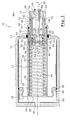
- pneumatic cylinder 10 for testing a booster (not shown) for assistance motor vehicle braking.
- the jack 10 comprises a body 12 substantially axial and tubular inside which is mounted sliding a piston 14.
- the piston 14 is mounted in body 12 with interposition of sealing means, in particular a rear seal 13 and a seal before which will be described later in this description.
- a first end 16 of the piston delimits in the body tubular 12 a pressure chamber 18 which is intended to be subjected to a determined air pressure.
- a second end 20 of the piston 14, opposite the first end 16 is intended to be linked to a rod 22 for actuating the booster to be tested.
- the rod 22 has been shown in phantom view.
- the jack 10 comprises a valve 24 pneumatic, controlled by rod 22 for actuating the servomotor, which is capable, beyond a determined value limit of a reaction force of the servomotor acting on the rod 22 of the servomotor, to port the chamber pressure 18 of cylinder 10 with, the external medium "Me", for regulate the force exerted by the piston 14 on the rod 22 actuator actuation according to a constant value.
- valve 24 is integrated into piston 14. This arrangement is not limiting of the invention, and the valve 24 could be outside the piston, or even be partially outside the cylinder. for example, the valve could be mechanically connected to the second end 20 or to the actuating rod 22 of the servomotor, and be pneumatically connected to the pressure chamber 18 for the put in communication with the external environment beyond a determined value of the reaction force which applies to the rod 22 for actuating the servomotor.
- a first bore 26 arranged at the front of the piston 14 opens into its first end 16
- a second bore 28 arranged at the rear of the piston 14 opens into a third end 30 of the piston 14 which protrudes from the cylinder 10 in the external environment "Me”
- the valve 24 is interposed in the piston 14 between the first and second bores 26, 28.
- the piston 14 comprises a body tubular 32 which receives a first tubular front socket 34, which has the first bore 26, and a second rear bush tubular 36.
- the front 34 and rear 36 tubular sockets are screwed into the tubular body 32 by means of respective threads 38 and 40.
- a seal 35 is interposed between the second bush 36 and the tubular body 32.
- the second tubular rear socket 36 receives an element 42 intermediate tubular, which includes the valve 24, the second bore 28 and the second and third ends 20, 30.
- first and second bores 26, 28, the valve 24, and the ends 16, 20, 30 of the piston 14 are coaxial.
- valve 24, the second bore 28, and the second and third ends 20, 30 could be arranged directly in the body 32 of piston 14, or else be arranged directly in the second tubular rear socket 36. They may also not be not coaxial.
- the intermediate tubular element 42 is for example fixed in the second tubular rear bush 36 via screwing means 44 such as threads formed at its periphery and in the second tubular rear bush 36.
- a seal 43 is interposed between the intermediate tubular element and the second socket 36.
- the valve 24 which is arranged in the tubular element 42 intermediate comprises at least one fixed seat 46, which is integral with the piston 14 since the intermediate tubular element 42 and the second bush 36 are rigidly linked to the piston 14, and it comprises a movable seat 48, which, as will be seen later, may be requested by the second end 20 of the piston, and which is resiliently biased against the seat 46 by means of elastic means which are tared according to the determined value of the reaction force of the booster.
- the seat fixed 46 is carried by a bell 51 of substantially shape frustoconical which is fixed to the intermediate tubular element 42 by means of screws 50 which pass through a bottom wall 52 of the second tubular rear bush 36.
- the bell 51 in a front bore 64 complementary to the intermediate tubular element 42, which is of a diameter corresponding to the largest diameter of the bell 51.
- the bell 51 has an axial bore 54 whose front edge circular forms the fixed seat 46.
- the bell 51 is therefore removable for allow adapting fixed seats 46 of different sizes.
- the movable seat 48 is carried by the periphery of a floating tubular element 60 of substantially frustoconical shape.
- the seat 48 is therefore substantially frustoconical and it extends in rear of a bottom wall 56 of a bore 58 of the element tubular floating 60.
- a cylindrical bearing 62 of the element floating tube 60 is slidably mounted in bore 64 of the intermediate tubular element 42, and it is likely to come in abutment on the frustoconical periphery of the bell 51.
- the bottom wall 56 of the floating tubular element 60 has an axial hole 66, arranged at the base of the movable seat 48, which is intended to allow the passage of air from the bore front 26 to the rear bore 28 through the valve 24.
- the bell 51 has a cavity 68 which communicates with the rear bore 28 by through a groove 70.
- the second bore 26, arranged in the tubular element intermediate, is closed by a plug 72 which comprises the third end 30 of piston 14.
- the plug 72 has a section tubular 74 which is received in the tubular element intermediate 42 and which comprises the second bore 26, and a rear section forming the third end 30 of the piston 14.
- plug 72 At its rear end forming the third end 30 of piston 14, plug 72 includes at least one axial bore 76 which is intended to guide in sliding a pusher 78 actuating the movable seat 48 including the free end, which passes through the plug 72, forms the second end 20 of the piston 14.
- the pusher 78 has an end face front 80 which is intended to urge an end face 82 of the movable seat 48 which is arranged opposite the axial bore 54 of bell 51.
- the pusher 78 At its rear end forming the second end 20, the pusher 78 has a tapped hole 84 which is intended to receive the actuator actuator rod 22.
- the plug 72 comprises, in its third end 30, at least one eccentric bore 85 which is intended for connect the second bore 26 with the medium outside "Me”.
- the plug has a plurality of holes 85 distributed angularly in a regular manner around the axis of the piston 14.
- the piston 14 has a plug 86 which closes the first bore 26. More particularly, the plug 86 comprises a front section which forms the first end 16 of the piston 14 and a rear section 88 which advantageously forms the first tubular front socket 34 in which the first is arranged bore 26.
- the first tubular front socket 34 of the plug 86 comprises the threading means 38 already mentioned, which therefore allow to fix both to fix the first tubular front socket 34 and the first end 16.
- first end 16 of the plug 86 has a hole 88 which connects the pressure 18 of the jack with the first bore 26 of the piston 14 for allow air to flow to valve 24.
- the first end 16 of the plug 86 is shaped substantially bell-shaped, and it is for example produced during the manufacture of plug 86 by a stamping process.
- the first end 16 is preferably made with a high diametral dimension, so as to form a wall mobile which can be subjected to air pressure in the pressure chamber 18 along a sufficiently large area important to cause the advance of the piston 14.
- the first bell-shaped end 16 comprises an external annular flange 90 which carries sealing means of the piston 14 in the pressure chamber 18, in particular a front seal 92.
- first bore 26 receives a spring 94 of compression, which is interposed between the first end of the plug 86 and the floating tubular element 60 which comprises the seat movable 48 of the valve 24, to form the elastic means of valve 24 reminder.
- the spring 94 to form the elastic return means of the valve 24, could be interposed between any point of the cap 86 and the movable seat 48, without changing the nature of the invention.
- the spring 94 could be mounted to bear on a washer received in a groove in the first bush 34.
- the stiffness of the spring 94 determines the calibration of valve 24, i.e. the force value corresponding to the determined limit value of an effort of servomotor reaction on the actuator stem which causes the valve 24 to open to regulate the pressure in the pressure chamber 24.
- the jack 10 is movable between several positions, shown in Figures 1 to 3.
- the pressure in the pressure chamber 18 decreases immediately, which has the effect of imperceptibly relaxing the effort exerted on the control rod 22 and therefore decrease the value of the reaction force which passes through the actuating rod 22. Therefore, the pusher 78 releases the valve 24 which closes at new.
- the pressure in the pressure chamber 18, and consequently the force exerted on the actuating rod 22, are therefore regulated by constantly by a succession of very brief openings of the valve 24.
- the invention therefore provides a single-acting test cylinder allowing to test a servomotor according to a regulated force, and this, at a lower cost.
Landscapes
- Engineering & Computer Science (AREA)
- Transportation (AREA)
- Mechanical Engineering (AREA)
- Actuator (AREA)
- Braking Systems And Boosters (AREA)
Abstract
Description
- le clapet est intégré au piston.
- un premier alésage du piston débouche dans sa première extrémité, un second alésage du piston débouche dans une troisième extrémité du piston qui fait saillie hors du vérin dans le milieu extérieur, et le clapet est interposé entre les premier et second alésages.
- le clapet comporte au moins un siège fixe et un siège mobile, qui est susceptible d'être sollicité par la deuxième extrémité du piston et qui est rappelé élastiquement contre le siège par l'intermédiaire de moyens élastiques tarés selon la valeur déterminée de l'effort de réaction du servomoteur,
- les premier et second alésages, le clapet, et les extrémités du piston sont coaxiaux,
- le piston comporte un corps tubulaire qui reçoit :
- une douille tubulaire, qui comporte le premier alésage,
- un élément tubulaire intermédiaire, qui comporte le clapet, le second alésage et les deuxième et troisième extrémités,
- le siège fixe du clapet est porté par l'élément tubulaire intermédiaire et il est tourné vers le premier alésage,
- le second alésage, agencé dans l'élément tubulaire intermédiaire, est fermé par un bouchon comportant la troisième extrémité du piston,
- le bouchon comportant la troisième extrémité du piston comporte au moins un perçage axial destiné à guider en coulissement un poussoir d'actionnement du siège mobile dont l'extrémité libre, qui traverse le bouchon, forme la deuxième extrémité du piston,
- le bouchon comportant la troisième extrémité du piston comporte au moins un perçage excentré destiné à mettre en communication le second alésage avec le milieu extérieur,
- le premier alésage du piston est fermé par un bouchon comportant la première extrémité dont un perçage met en communication le premier alésage avec la chambre de pression et dont une collerette annulaire externe porte des moyens d'étanchéité du piston dans la chambre de pression.
- le premier alésage reçoit un ressort de compression, qui est interposé entre le bouchon comportant la première extrémité et le siège mobile du clapet, pour former les moyens élastiques de rappel du clapet.
- la figure 1 est une vue en coupe d'un vérin de test selon l'invention représenté en position de repos,
- la figure 2 est une vue en coupe du vérin de la figure 1 représenté en position d'actionnement de la tige du servomoteur, le clapet pneumatique étant fermé,
- la figure 3 est une vue en coupe du vérin de la figure 1 représenté en position d'actionnement de la tige du servomoteur, le clapet pneumatique étant ouvert.
Claims (12)
- Vérin (10) pneumatique pour le test d'un servomoteur d'assistance de freinage de véhicule automobile, du type qui comporte un corps (12) sensiblement axial à l'intérieur duquel est monté coulissant un piston (14), du type dans lequel une première extrémité (16) du piston (14) délimite dans le corps (12) une chambre (18) de pression soumise à une pression (P) d'air déterminée, et du type dans lequel une deuxième extrémité (20) opposée du piston est liée à une tige (22) d'actionnement du servomoteur à tester,
caractérisé en ce que le vérin (10) comporte un clapet (24) pneumatique, commandé par la tige (22) d'actionnement du servomoteur, qui est susceptible, au delà d'une valeur déterminée de limite d'un effort de réaction du servomoteur s'exerçant sur la tige (22) du servomoteur, de mettre en communication la chambre (18) de pression du vérin (10) avec le milieu extérieur (Me), pour réguler l'effort exercé par le piston (14) sur la tige (22) d'actionnement du servomoteur suivant une valeur constante. - Vérin (10) pneumatique selon la revendication précédente, caractérisé en ce que le clapet (24) est intégré au piston (14).
- Vérin (10) pneumatique selon la revendication précédente, caractérisé en ce qu'un premier alésage (26) du piston (14) débouche dans sa première extrémité (16), en ce qu'un second alésage (28) du piston (14) débouche dans une troisième extrémité (30) du piston (14) qui fait saillie hors du vérin (10) dans le milieu extérieur (Me), et en ce que le clapet (24) est interposé entre les premier et second alésages (26, 28).
- Vérin (10) pneumatique selon la revendication précédente, caractérisé en ce que le clapet (24) comporte au moins un siège fixe (46) et un siège mobile (48), qui est susceptible d'être sollicité par la deuxième extrémité (20) du piston (14) et qui est rappelé élastiquement contre le siège par l'intermédiaire de moyens élastiques (94) tarés selon la valeur déterminée de l'effort de réaction du servomoteur.
- Vérin (10) pneumatique selon la revendication précédente, caractérisé en ce que les premier (26) et second alésages (28), le clapet (24), et les extrémités (16, 20, 30) du piston (14)sont coaxiaux.
- Vérin (10) pneumatique selon la revendication précédente, caractérisé en ce que le piston (14) comporte un corps (32) tubulaire qui reçoit :une douille tubulaire (34), qui comporte le premier alésage (26),un élément (42) tubulaire intermédiaire, qui comporte le clapet (24), le second alésage (28) et les deuxième et troisième extrémités (20, 30).
- Vérin (10) pneumatique selon la revendication précédente, caractérisé en ce que le siège (46) fixe du clapet (24) est porté par l'élément (42) tubulaire intermédiaire et en ce qu'il est tourné vers le premier alésage (26).
- Vérin (10) pneumatique selon l'une des revendications 6 ou 7, caractérisé en ce que le second alésage (28), agencé dans l'élément (42) tubulaire intermédiaire, est fermé par un bouchon (72) comportant le troisième extrémité (30) du piston (14).
- Vérin (10) pneumatique selon la revendication précédente, caractérisé en ce que le bouchon (72) comportant la troisième extrémité (30) du piston (14) comporte au moins un perçage (76) axial destiné à guider en coulissement un poussoir (78) d'actionnement du siège (48) mobile dont l'extrémité libre, qui traverse le bouchon (72), forme la deuxième extrémité (20) du piston (14).
- Vérin (10) pneumatique selon l'une des revendications 8 ou 9, caractérisé en ce que le bouchon (72) comportant la troisième extrémité (30) du piston (14) comporte au moins un perçage (85) excentré destiné à mettre en communication le second alésage (28) avec le milieu extérieur (Me).
- Vérin (10) pneumatique selon l'une des revendications 3 à 10, caractérisé en ce que le premier alésage (26) du piston (14) est fermé par un bouchon (86) comportant la première extrémité (16) dont un perçage (88) met en communication le premier alésage (26) avec la chambre (18) de pression et dont une collerette (90) annulaire externe porte des moyens (92) d'étanchéité du piston (14) dans la chambre (18) de pression.
- Vérin (10) pneumatique selon la revendication précédente prise en combinaison avec la revendication 7, caractérisé en ce que le premier alésage (26) reçoit un ressort (94) de compression, qui est interposé entre le bouchon (86) comportant la première extrémité (16) et le siège (48) mobile du clapet (24), pour former les moyens élastiques de rappel du clapet (24).
Applications Claiming Priority (2)
| Application Number | Priority Date | Filing Date | Title |
|---|---|---|---|
| FR0117109A FR2834339B1 (fr) | 2001-12-31 | 2001-12-31 | Verin pneumatique pour le test d'un servomoteur |
| FR0117109 | 2001-12-31 |
Publications (2)
| Publication Number | Publication Date |
|---|---|
| EP1325854A2 true EP1325854A2 (fr) | 2003-07-09 |
| EP1325854A3 EP1325854A3 (fr) | 2010-06-30 |
Family
ID=8871113
Family Applications (1)
| Application Number | Title | Priority Date | Filing Date |
|---|---|---|---|
| EP02028927A Withdrawn EP1325854A3 (fr) | 2001-12-31 | 2002-12-23 | Verin pneumatique pour le test d'un servomoteur |
Country Status (2)
| Country | Link |
|---|---|
| EP (1) | EP1325854A3 (fr) |
| FR (1) | FR2834339B1 (fr) |
Family Cites Families (10)
| Publication number | Priority date | Publication date | Assignee | Title |
|---|---|---|---|---|
| GB485617A (en) * | 1936-11-14 | 1938-05-16 | John Henry Onions | Improvements in or relating to jacks, more particularly for retractable undercarriages for aircraft |
| GB533667A (en) * | 1939-11-08 | 1941-02-18 | Automotive Prod Co Ltd | Improvements in or relating to fluid pressure remote control systems |
| GB689383A (en) * | 1949-09-20 | 1953-03-25 | Dunlop Rubber Co | Hydraulic control valve |
| FR1382214A (fr) * | 1963-10-23 | 1964-12-18 | Snecma | Limiteur de charge de post-combustion |
| US3564849A (en) * | 1967-05-30 | 1971-02-23 | Aisin Seiki | Pneumatic booster assembly for brake system |
| FR2029119A5 (fr) * | 1969-01-10 | 1970-10-16 | Messier Fa | |
| US3807810A (en) * | 1971-07-07 | 1974-04-30 | Yarber A | Brake control valve system |
| FR2415752A1 (fr) * | 1978-01-25 | 1979-08-24 | Sirven Jacques | Amortisseur hydraulique de suspension de vehicule |
| FR2702537A1 (fr) * | 1993-03-09 | 1994-09-16 | Eurobinox | Vanne à clapet. |
| DE19611555A1 (de) * | 1996-03-23 | 1997-09-25 | Teves Gmbh Alfred | Pneumatischer Bremskraftverstärker |
-
2001
- 2001-12-31 FR FR0117109A patent/FR2834339B1/fr not_active Expired - Fee Related
-
2002
- 2002-12-23 EP EP02028927A patent/EP1325854A3/fr not_active Withdrawn
Also Published As
| Publication number | Publication date |
|---|---|
| FR2834339A1 (fr) | 2003-07-04 |
| EP1325854A3 (fr) | 2010-06-30 |
| FR2834339B1 (fr) | 2004-02-27 |
Similar Documents
| Publication | Publication Date | Title |
|---|---|---|
| EP0075505B1 (fr) | Procédé et appareil de réglage de course morte d'un maître-cylindre et unité de commande de freinage ajustée par la mise en oeuvre de ce procédé | |
| EP3002499B1 (fr) | Dispositif de fermeture de vanne par actionnement du clapet de détente | |
| EP0340059A1 (fr) | Servomoteur d'assistance au freinage à saut réglable | |
| EP1325854A2 (fr) | Verin pneumatique pour le test d'un servomoteur | |
| EP1346895B1 (fr) | Servomoteur pneumatique comportant des sièges décalés, des clapets d'admission et de rééquilibrage | |
| FR2666552A1 (fr) | Procede de reglage de la valeur du saut d'un servomoteur pneumatique d'assistance au freinage et servomoteur pour la mise en óoeuvre de ce procede. | |
| WO1999022976A1 (fr) | Maitre-cylindre a clapets a course morte reduite | |
| EP1361127B1 (fr) | Servomoteur pneumatique comportant des clapets tubulaires d'admission et de rééquilibrage | |
| EP1507692B1 (fr) | Servomoteur comportant un element flottant porteur de sieges de clapet decales | |
| FR2663598A1 (fr) | Servomoteur d'assistance a depression. | |
| FR2641354A1 (fr) | Robinet de commande de la pression de gonflage d'un pneu pour un dispositif de reglage de la pression des pneus d'un vehicule pendant la marche | |
| EP1688332B1 (fr) | Servomoteur pneumatique à sièges décalés portés par deux douilles coulissantes | |
| FR2481213A1 (fr) | Maitre-cylindre du type tandem avec soupape de regulation de pression pour un systeme de freins de vehicule automobile | |
| EP1688331B1 (fr) | Ensemble maitre cylindre | |
| WO2003024759A1 (fr) | Maître-cylindre tandem pour systeme de freinage electrohydraulique. | |
| WO2003024757A1 (fr) | Maitre-cylindre tandem pour systemes de freinage electrohydraulique | |
| EP1077853B1 (fr) | Maitre-cylindre a reaction hydraulique independante de la viscosite | |
| WO2004067346A1 (fr) | Servofrein comportant un piston de decompression integre au piston primaire du maître cylindre. | |
| FR2926769A1 (fr) | Maitre-cylindre pour servomoteur d'assistance pneumatique au freinage et servomoteur d'assistance pneumatique au freinage muni d'un tel maitre-cylindre | |
| FR2665409A1 (fr) | Procede de reglage de la valeur du saut d'un servomoteur pneumatique d'assistance au freinage et servomoteur pour la mise en óoeuvre de ce procede. | |
| FR2484564A1 (fr) | Amplificateur de pression hydraulique | |
| EP1437280B1 (fr) | Servomoteur pneumatique à phase de rééquilibrage de durée réduite | |
| FR2858958A1 (fr) | Ensemble maitre cylindrique de commande hydraulique et procede de reglage de la course morte d'un piston primaire | |
| FR2825056A1 (fr) | Servomoteur d'assistance pneumatique au freinage a hauteur de saut variable | |
| FR2872762A1 (fr) | Disque de reaction possedant une surepaisseur d'etancheite pour servomoteur d'assistance de freinage |
Legal Events
| Date | Code | Title | Description |
|---|---|---|---|
| PUAI | Public reference made under article 153(3) epc to a published international application that has entered the european phase |
Free format text: ORIGINAL CODE: 0009012 |
|
| AK | Designated contracting states |
Designated state(s): AT BE BG CH CY CZ DE DK EE ES FI FR GB GR IE IT LI LU MC NL PT SE SI SK TR |
|
| AX | Request for extension of the european patent |
Extension state: AL LT LV MK RO |
|
| PUAL | Search report despatched |
Free format text: ORIGINAL CODE: 0009013 |
|
| AK | Designated contracting states |
Kind code of ref document: A3 Designated state(s): AT BE BG CH CY CZ DE DK EE ES FI FR GB GR IE IT LI LU MC NL PT SE SI SK TR |
|
| AX | Request for extension of the european patent |
Extension state: AL LT LV MK RO |
|
| 17P | Request for examination filed |
Effective date: 20101230 |
|
| AKX | Designation fees paid |
Designated state(s): AT BE BG CH CY CZ DE DK EE ES FI FR GB GR IE IT LI LU MC NL PT SE SI SK TR |
|
| 17Q | First examination report despatched |
Effective date: 20110325 |
|
| STAA | Information on the status of an ep patent application or granted ep patent |
Free format text: STATUS: THE APPLICATION IS DEEMED TO BE WITHDRAWN |
|
| 18D | Application deemed to be withdrawn |
Effective date: 20150701 |