EP1324440A2 - Diode-pumped solid-state laser oscillator - Google Patents
Diode-pumped solid-state laser oscillator Download PDFInfo
- Publication number
- EP1324440A2 EP1324440A2 EP02259001A EP02259001A EP1324440A2 EP 1324440 A2 EP1324440 A2 EP 1324440A2 EP 02259001 A EP02259001 A EP 02259001A EP 02259001 A EP02259001 A EP 02259001A EP 1324440 A2 EP1324440 A2 EP 1324440A2
- Authority
- EP
- European Patent Office
- Prior art keywords
- temperature
- wavelength
- light
- diode
- light sources
- Prior art date
- Legal status (The legal status is an assumption and is not a legal conclusion. Google has not performed a legal analysis and makes no representation as to the accuracy of the status listed.)
- Withdrawn
Links
Images



Classifications
-
- H—ELECTRICITY
- H01—ELECTRIC ELEMENTS
- H01S—DEVICES USING THE PROCESS OF LIGHT AMPLIFICATION BY STIMULATED EMISSION OF RADIATION [LASER] TO AMPLIFY OR GENERATE LIGHT; DEVICES USING STIMULATED EMISSION OF ELECTROMAGNETIC RADIATION IN WAVE RANGES OTHER THAN OPTICAL
- H01S3/00—Lasers, i.e. devices using stimulated emission of electromagnetic radiation in the infrared, visible or ultraviolet wave range
- H01S3/02—Constructional details
- H01S3/04—Arrangements for thermal management
- H01S3/042—Arrangements for thermal management for solid state lasers
-
- H—ELECTRICITY
- H01—ELECTRIC ELEMENTS
- H01S—DEVICES USING THE PROCESS OF LIGHT AMPLIFICATION BY STIMULATED EMISSION OF RADIATION [LASER] TO AMPLIFY OR GENERATE LIGHT; DEVICES USING STIMULATED EMISSION OF ELECTROMAGNETIC RADIATION IN WAVE RANGES OTHER THAN OPTICAL
- H01S3/00—Lasers, i.e. devices using stimulated emission of electromagnetic radiation in the infrared, visible or ultraviolet wave range
- H01S3/09—Processes or apparatus for excitation, e.g. pumping
- H01S3/091—Processes or apparatus for excitation, e.g. pumping using optical pumping
- H01S3/094—Processes or apparatus for excitation, e.g. pumping using optical pumping by coherent light
- H01S3/0941—Processes or apparatus for excitation, e.g. pumping using optical pumping by coherent light of a laser diode
-
- H—ELECTRICITY
- H01—ELECTRIC ELEMENTS
- H01S—DEVICES USING THE PROCESS OF LIGHT AMPLIFICATION BY STIMULATED EMISSION OF RADIATION [LASER] TO AMPLIFY OR GENERATE LIGHT; DEVICES USING STIMULATED EMISSION OF ELECTROMAGNETIC RADIATION IN WAVE RANGES OTHER THAN OPTICAL
- H01S3/00—Lasers, i.e. devices using stimulated emission of electromagnetic radiation in the infrared, visible or ultraviolet wave range
- H01S3/10—Controlling the intensity, frequency, phase, polarisation or direction of the emitted radiation, e.g. switching, gating, modulating or demodulating
- H01S3/13—Stabilisation of laser output parameters, e.g. frequency or amplitude
- H01S3/131—Stabilisation of laser output parameters, e.g. frequency or amplitude by controlling the active medium, e.g. by controlling the processes or apparatus for excitation
- H01S3/1312—Stabilisation of laser output parameters, e.g. frequency or amplitude by controlling the active medium, e.g. by controlling the processes or apparatus for excitation by controlling the optical pumping
-
- H—ELECTRICITY
- H01—ELECTRIC ELEMENTS
- H01S—DEVICES USING THE PROCESS OF LIGHT AMPLIFICATION BY STIMULATED EMISSION OF RADIATION [LASER] TO AMPLIFY OR GENERATE LIGHT; DEVICES USING STIMULATED EMISSION OF ELECTROMAGNETIC RADIATION IN WAVE RANGES OTHER THAN OPTICAL
- H01S3/00—Lasers, i.e. devices using stimulated emission of electromagnetic radiation in the infrared, visible or ultraviolet wave range
- H01S3/02—Constructional details
- H01S3/025—Constructional details of solid state lasers, e.g. housings or mountings
-
- H—ELECTRICITY
- H01—ELECTRIC ELEMENTS
- H01S—DEVICES USING THE PROCESS OF LIGHT AMPLIFICATION BY STIMULATED EMISSION OF RADIATION [LASER] TO AMPLIFY OR GENERATE LIGHT; DEVICES USING STIMULATED EMISSION OF ELECTROMAGNETIC RADIATION IN WAVE RANGES OTHER THAN OPTICAL
- H01S3/00—Lasers, i.e. devices using stimulated emission of electromagnetic radiation in the infrared, visible or ultraviolet wave range
- H01S3/02—Constructional details
- H01S3/04—Arrangements for thermal management
- H01S3/0404—Air- or gas cooling, e.g. by dry nitrogen
-
- H—ELECTRICITY
- H01—ELECTRIC ELEMENTS
- H01S—DEVICES USING THE PROCESS OF LIGHT AMPLIFICATION BY STIMULATED EMISSION OF RADIATION [LASER] TO AMPLIFY OR GENERATE LIGHT; DEVICES USING STIMULATED EMISSION OF ELECTROMAGNETIC RADIATION IN WAVE RANGES OTHER THAN OPTICAL
- H01S3/00—Lasers, i.e. devices using stimulated emission of electromagnetic radiation in the infrared, visible or ultraviolet wave range
- H01S3/05—Construction or shape of optical resonators; Accommodation of active medium therein; Shape of active medium
- H01S3/06—Construction or shape of active medium
- H01S3/07—Construction or shape of active medium consisting of a plurality of parts, e.g. segments
-
- H—ELECTRICITY
- H01—ELECTRIC ELEMENTS
- H01S—DEVICES USING THE PROCESS OF LIGHT AMPLIFICATION BY STIMULATED EMISSION OF RADIATION [LASER] TO AMPLIFY OR GENERATE LIGHT; DEVICES USING STIMULATED EMISSION OF ELECTROMAGNETIC RADIATION IN WAVE RANGES OTHER THAN OPTICAL
- H01S3/00—Lasers, i.e. devices using stimulated emission of electromagnetic radiation in the infrared, visible or ultraviolet wave range
- H01S3/09—Processes or apparatus for excitation, e.g. pumping
- H01S3/091—Processes or apparatus for excitation, e.g. pumping using optical pumping
- H01S3/094—Processes or apparatus for excitation, e.g. pumping using optical pumping by coherent light
- H01S3/09408—Pump redundancy
-
- H—ELECTRICITY
- H01—ELECTRIC ELEMENTS
- H01S—DEVICES USING THE PROCESS OF LIGHT AMPLIFICATION BY STIMULATED EMISSION OF RADIATION [LASER] TO AMPLIFY OR GENERATE LIGHT; DEVICES USING STIMULATED EMISSION OF ELECTROMAGNETIC RADIATION IN WAVE RANGES OTHER THAN OPTICAL
- H01S3/00—Lasers, i.e. devices using stimulated emission of electromagnetic radiation in the infrared, visible or ultraviolet wave range
- H01S3/09—Processes or apparatus for excitation, e.g. pumping
- H01S3/091—Processes or apparatus for excitation, e.g. pumping using optical pumping
- H01S3/094—Processes or apparatus for excitation, e.g. pumping using optical pumping by coherent light
- H01S3/094096—Multi-wavelength pumping
-
- H—ELECTRICITY
- H01—ELECTRIC ELEMENTS
- H01S—DEVICES USING THE PROCESS OF LIGHT AMPLIFICATION BY STIMULATED EMISSION OF RADIATION [LASER] TO AMPLIFY OR GENERATE LIGHT; DEVICES USING STIMULATED EMISSION OF ELECTROMAGNETIC RADIATION IN WAVE RANGES OTHER THAN OPTICAL
- H01S3/00—Lasers, i.e. devices using stimulated emission of electromagnetic radiation in the infrared, visible or ultraviolet wave range
- H01S3/10—Controlling the intensity, frequency, phase, polarisation or direction of the emitted radiation, e.g. switching, gating, modulating or demodulating
- H01S3/102—Controlling the intensity, frequency, phase, polarisation or direction of the emitted radiation, e.g. switching, gating, modulating or demodulating by controlling the active medium, e.g. by controlling the processes or apparatus for excitation
- H01S3/1022—Controlling the intensity, frequency, phase, polarisation or direction of the emitted radiation, e.g. switching, gating, modulating or demodulating by controlling the active medium, e.g. by controlling the processes or apparatus for excitation by controlling the optical pumping
-
- H—ELECTRICITY
- H01—ELECTRIC ELEMENTS
- H01S—DEVICES USING THE PROCESS OF LIGHT AMPLIFICATION BY STIMULATED EMISSION OF RADIATION [LASER] TO AMPLIFY OR GENERATE LIGHT; DEVICES USING STIMULATED EMISSION OF ELECTROMAGNETIC RADIATION IN WAVE RANGES OTHER THAN OPTICAL
- H01S3/00—Lasers, i.e. devices using stimulated emission of electromagnetic radiation in the infrared, visible or ultraviolet wave range
- H01S3/14—Lasers, i.e. devices using stimulated emission of electromagnetic radiation in the infrared, visible or ultraviolet wave range characterised by the material used as the active medium
- H01S3/16—Solid materials
- H01S3/1601—Solid materials characterised by an active (lasing) ion
- H01S3/1603—Solid materials characterised by an active (lasing) ion rare earth
- H01S3/1611—Solid materials characterised by an active (lasing) ion rare earth neodymium
-
- H—ELECTRICITY
- H01—ELECTRIC ELEMENTS
- H01S—DEVICES USING THE PROCESS OF LIGHT AMPLIFICATION BY STIMULATED EMISSION OF RADIATION [LASER] TO AMPLIFY OR GENERATE LIGHT; DEVICES USING STIMULATED EMISSION OF ELECTROMAGNETIC RADIATION IN WAVE RANGES OTHER THAN OPTICAL
- H01S3/00—Lasers, i.e. devices using stimulated emission of electromagnetic radiation in the infrared, visible or ultraviolet wave range
- H01S3/14—Lasers, i.e. devices using stimulated emission of electromagnetic radiation in the infrared, visible or ultraviolet wave range characterised by the material used as the active medium
- H01S3/16—Solid materials
- H01S3/163—Solid materials characterised by a crystal matrix
- H01S3/164—Solid materials characterised by a crystal matrix garnet
- H01S3/1643—YAG
-
- H—ELECTRICITY
- H01—ELECTRIC ELEMENTS
- H01S—DEVICES USING THE PROCESS OF LIGHT AMPLIFICATION BY STIMULATED EMISSION OF RADIATION [LASER] TO AMPLIFY OR GENERATE LIGHT; DEVICES USING STIMULATED EMISSION OF ELECTROMAGNETIC RADIATION IN WAVE RANGES OTHER THAN OPTICAL
- H01S5/00—Semiconductor lasers
- H01S5/02—Structural details or components not essential to laser action
- H01S5/024—Arrangements for thermal management
- H01S5/02407—Active cooling, e.g. the laser temperature is controlled by a thermo-electric cooler or water cooling
- H01S5/02415—Active cooling, e.g. the laser temperature is controlled by a thermo-electric cooler or water cooling by using a thermo-electric cooler [TEC], e.g. Peltier element
-
- H—ELECTRICITY
- H01—ELECTRIC ELEMENTS
- H01S—DEVICES USING THE PROCESS OF LIGHT AMPLIFICATION BY STIMULATED EMISSION OF RADIATION [LASER] TO AMPLIFY OR GENERATE LIGHT; DEVICES USING STIMULATED EMISSION OF ELECTROMAGNETIC RADIATION IN WAVE RANGES OTHER THAN OPTICAL
- H01S5/00—Semiconductor lasers
- H01S5/40—Arrangement of two or more semiconductor lasers, not provided for in groups H01S5/02 - H01S5/30
- H01S5/4025—Array arrangements, e.g. constituted by discrete laser diodes or laser bar
- H01S5/4087—Array arrangements, e.g. constituted by discrete laser diodes or laser bar emitting more than one wavelength
Definitions
- the present invention relates to an optically pumped solid-state laser oscillator, and more particularly to a diode-pumped solid-state laser oscillator in which the output-power dependency on the temperature of the pumping laser diodes and the laser medium can be decreased.
- the output power of such diode-pumped solid-state lasers varies due to the temperature dependency of the emission wavelength of the laser diodes. Changes in the temperature can change the pump-light absorption index of the laser rod used, altering the laser output power.
- the normal temperature dependence of the wavelength of a pumping LD is 0.27 nm per degree centigrade. This means that in the case of an LD that has an operating temperature range of 50°C, the emission wavelength can change by 14 nm.
- the absorption spectrum of a laser rod used in a diode-pumped solid-state laser consists of narrow spectral lines corresponding to the distribution of the excited energy levels of the Nd ion or other such laser active element used.
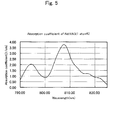
- Figure 5 shows the absorption spectrum of a Nd:YAG laser crystal plotted with the resolution of 4 nm which is the same as the usual wavelength width of LD arrays.
- the absorption coefficient changes from 3.8 cm -1 to 1.2 cm -1 . If the propagation length of the pump light in the Nd:YAG crystal is 8 mm, the absorption index will vary from 95% to 62% within these wavelengths, as shown in Figure 6.
- lasers are designed to obtain optimal laser oscillation, for example, taking the pumping center wavelength to 808 nm at the absorption peak of the laser crystal. Therefore, wavelength deviation of LDs arising from the changes in temperature results in a decrease in pump-light absorption, reducing the output power. In order to prevent such reduction, it has been necessary to maintain the LDs at a constant temperature, for which controlling mechanism needs to be installed However, it consumes a relatively large amount of electrical power compared to the pumping power in controlling the temperature of a pump-light source or laser medium, so when electrical power is limited, it is difficult to accomplish such a control.
- the cooling airflow at the radiation fins is controlled to stabilize the temperature of the LDs.
- electrical power is necessary to cool and to stabilize the temperature of the cooling fins.
- vibrations and noises generated by a cooling fan perturb the laser resonator, reducing the stability of the output power.
- the temperature control has a high time constant that makes it difficult for the system to respond quickly to the temperature changes.
- cooling water controlled to a designed temperature is circulated to maintain the temperature of the LDs.
- This cooling apparatus is bulky and consumes a lot of electrical power.
- vibrations from the pumps used in the cooler and circulator are large and result in a loss of output power stability.
- the LDs are cooled using a Peltier cooling element. Since the cooling efficiency of the Peltier element is not high, in an environment where there is limited electrical power, such an element can be used only in small power lasers.
- the diode-pumped Nd:YAG laser oscillator for use in the laser altimeter installed in NASA's Mars Observer spacecraft has a partial resemblance to the present invention.
- This laser oscillator is described in a paper (Robert Afzal, "Mars Observer Laser Altimeter,” Applied Optics vol. 33, No. 15, pp 3184-3188 (1994)) that also includes a graph showing the relationship between the laser oscillator output power and the operating temperature.
- the pumping source is four diode-laser stacks of 11 diode bars having a narrow wavelength width of 6 nm. The result is a range of operating temperatures that is wider than that obtained using pumping at just one wavelength.
- this laser oscillator differs from that of the present invention in that it does not use the optical absorption characteristics of the laser medium and the temperature characteristics of the pumping source.
- an object of the present invention is to provide a diode-pumped solid-state laser oscillator that is able to provide a stable laser output power without using electrical power for temperature control.
- the present invention provides a diode-pumped solid-state laser oscillator comprising at least one pumping light source that emits light in a predetermined wavelength band, and a laser medium that absorbs light in the band; the laser medium having characteristics whereby, in the band, an optical absorption index of the laser medium increases with an increase in wavelength, and the pumping diodes having characteristics whereby, in the band, optical radiation energy of the pumping diodes decreases with an increase in wavelength.
- an increase in the optical absorption index is cancelled out by a decrease in the radiation energy.
- a diode-pumped solid-state laser oscillator in which a laser medium is pumped in a plurality of wavelength bands, comprising a first pumping laser diodes that emits light in a predetermined first wavelength band, a second pumping laser diodes that emits light in a predetermined second wavelength band, and a laser medium that absorbs light in the two bands, the laser medium having characteristics whereby, in the first wavelength band, an optical absorption index of the laser medium decreases with an increase in wavelength, and in the second wavelength band. the optical absorption index of the laser medium increases with an increase in wavelength. This cancels out the wavelength dependency of the pumping energy received by the laser medium.
- a diode-pumped solid-state laser oscillator in which a laser medium is pumped in an extended plurality of wavelength bands, comprising a plurality of pumping laser diodes that each emit light in a plurality of predetermined wavelength bands having different center wavelengths, and a laser medium that absorbs light of each wavelength band, wherein a temperature dependency of a wavelength integration of a product of spectrum intensity of the pumping laser diodes and an optical absorption index of the laser medium is lower than a temperature dependency of a wavelength integration of a product of spectrum intensity of a single pumping laser diode and the optical absorption index of the laser medium.
- the pumping light source is switched in accordance with changes in the temperature of the operating environment. This makes it possible to expand the range of temperatures in which the laser oscillator can be used.
- temperature of the pumping light source can be adjusted in response to changes in temperature of the operating environment by modifying the thermal resistance between the pumping light source and the environment, making it possible to expand the range of temperatures in which the laser oscillator can be used.
- the present invention relates to a laser oscillator that enables constant absorbed optical energy by the laser rod, even if the LD temperature changes. Details of the invention are explained below with reference to the drawings. In the drawings, parts having the same or similar functions have been given the same reference numerals.
- the optical energy that a laser medium absorbs is the product of the spectrum intensity of the pumping source and the absorption index of the laser medium.
- the optical energy that a laser medium absorbs is the product of the spectrum intensity of the pumping source and the absorption index of the laser medium.
- these are wavelength-dependent, in respect of wavelength, it is an integrated value of the product that constitutes the optical energy absorbed by the laser medium.
- Figure 6 is a graph showing the wavelength dependency of the optical absorption index of a laser medium.
- the temperature dependency of the optical output power of an LD is usually in the order of -0.24%/deg. Therefore, with respect to changes in LD temperature, a constant absorbed energy can be obtained by imparting to the absorption index of the laser medium, a temperature dependency of +0.24%/deg.
- a Nd:YAG rod is used, the temperature dependency of the absorption index is negligible, so the above described change in the absorption index can be achieved by changing the wavelength.
- This Example corresponds mainly to the first aspect of the invention.
- the temperature dependency of the absorption index (0.24%/deg)/(0.27 nm/deg) comes out to 0.9%/nm, in which case it can be seen that it is possible to maintain a constant absorbed energy in the face of changes in LD temperature.
- Figure 1 shows an example of a configuration for doing this.
- a solid-state laser rod 3 located in an optical resonator formed by an output mirror 1 and an end mirror 2 is optically excited by pumping LD 6 and pumping LD 7.
- Reference numeral 4 denotes an LD mount and numeral 5 a heat-dissipation laser baseplate.
- Figure 7 shows that with the extinction of the 800-nm absorption trough, an average wavelength dependency of 1.5%/nm was obtained over the range 793 nm to 810 nm.
- Increased effectiveness can be obtained using a combination of a plurality of LDs operating at three different wavelengths.
- a smooth change in absorption index is obtained over a wider range of wavelengths than the above two-wavelength configuration, by using the same numbers of pumping LDs having center wavelength separations of -5 nm and +5 nm (for example, two 800-nm LDs, two 805-nm LDs and two 810-nm LDs, at 25°C).
- Figure 8 shows the absorption index. An absorption index of more or less 0.9%/nm was obtained over the range 798 nm to 810 nm, for a constant pump-light absorbed energy, while the laser output was also constant.
- the operating temperature range in this case was 40 degrees, so it is possible to readily obtain an operating temperature zone in an indoor operating environment. It can be readily understood that an even more gradual change in absorption index can be obtained over a wider range of wavelengths by using larger numbers of LDs with different operating wavelengths.
- Lasers mounted on space satellites can undergo unforeseeable changes in the space environment, such as changes in solar orientation, and major changes in the temperature of their environments arising from changes that take place over time in satellite heat-control mechanisms and the like.
- the permissible operating temperature range of device circuitry is usually set over a wide range of -20 to 55°C. This is about twice the operating temperature range achieved using the configuration of the first embodiment.
- the operating temperature range of the laser oscillator can be increased when using the technology described below.
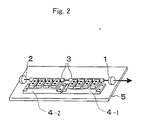
- the laser oscillator is configured as shown in Figure 2.
- a solid-state laser rod 3 is located in an optical resonator formed by an output mirror 1 and an end mirror 2.
- the LDs on LD mount 4-1 are used for high-temperature pumping, and the LDs on LD mount 4-2 are used for low-temperature pumping.
- Heat generated by the LDs is transmitted via the LD mount to the laser base-plate 5, where it is cooled by air, water, or heat sink.
- Different LDs are used for high temperature and low-temperature pumping. Which array of LDs is used depends on the ambient temperature. The same LDs can be used for the low-temperature array and the high-temperature array, by using material having low thermal conductivity for the low-temperature LD mount. In accordance with this configuration, the pumping source wavelength range is not changed, but the solid-state-laser operating temperature range can be increased by switching between the two LD arrays.
- each LD array is set to emit light at a different wavelength.
- the emission wavelength of the high-temperature LDs at a high temperature is the same as the emission wavelength of the low-temperature LDs at a low temperature.
- the solid-state-laser operating temperature range can be increased when switching the LD arrays according to the temperature of the operating environment.
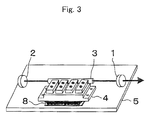
- a Peltier thermal-insulation element 8 is disposed between the LD mount 4 and the heat-dissipation laser base-plate 5 of Example 1.
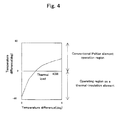
- the thermal conductivity of the Peltier thermal-insulation element 8 is set to be high (low) in a high-temperature (low-temperature) environment. In a low-temperature environment, this prevents the LD operating temperature from decreasing, thereby increasing the operating temperature range in which a constant laser output can be obtained.
- a conventional Peltier element used for cooling electronic devices can be used for the Peltier thermal-insulation element 8, making it possible to effect control using less electrical power compared to where cooling and heating is used to keep the temperature constant.
- a current is passed through the Peltier element to set the thermal conductivity high. As the temperature decreases, the current is reduced, which reduces the thermal conductivity, preventing the LD temperature from decreasing.
- a Peltier element DuraTec DT12-8
- the temperatures on each side of the element can be changed as shown in Figure 4. This characteristic can be regarded as using an electrical current to change the thermal resistance.
- the wavelength dependency of the optical absorption index of the laser medium is used to maintain the total amount of pumping light absorbed by the laser medium at a constant level, thereby achieving a constant laser output, even when changes in the laser operating temperature change the emission energy of the LDs and cause a shift in emission wavelength.
- the LDs do not have to be maintained at a constant temperature to achieve a constant laser output, and there is also no need for temperature stabilization mechanisms and circuits, making it possible to simplify the structure of the laser oscillator and power supply sections.
- Example 4 uses an additional plurality of light sources able to cover a plurality of wavelength bands, thereby enabling stable laser output over a wider range of temperatures.
- Example 4 also achieves this with a configuration for changing the pumping source temperature in response to changes in the temperature of the operating environment, which is done by changing the thermal resistance.
Landscapes
- Physics & Mathematics (AREA)
- Electromagnetism (AREA)
- Engineering & Computer Science (AREA)
- Plasma & Fusion (AREA)
- Optics & Photonics (AREA)
- Lasers (AREA)
Abstract
Description
Claims (9)
- A diode-pumped solid-state laser oscillator comprising at least one pumping light source that emits light in a predetermined wavelength band and a laser medium that absorbs light in said band; the laser medium having characteristics whereby, in said band, an optical absorption index of the laser medium increases with an increase in wavelength, and the pumping light source having characteristics whereby, in said band, optical output power of the pumping light source decreases and a wavelength of the light source increases with an increase in temperature.
- A diode-pumped solid-state laser oscillator comprising at least one pair of light sources emitting light in a pair of wavelength bands, comprising a first pumping light source that emits light in a predetermined first wavelength band, a second pumping light source that emits light in a predetermined second wavelength band, and a laser medium that absorbs light in said two bands, the laser medium having characteristics whereby, in the first wavelength band, an optical absorption index of the laser medium decreases with an increase in wavelength, and in the second wavelength band, an optical absorption index of the laser medium increases with an increase in wavelength.
- A diode-pumped solid-state laser oscillator comprising at least one set of light sources each of which emits light in a plurality of predetermined wavelengths, and a laser medium that absorbs light of each wavelength, wherein a temperature dependency of a summation of products of spectrum intensity of the pumping light sources and an optical absorption index of the laser medium is lower than a temperature dependency of a summation of products of spectrum intensity of a single pumping light source and the optical absorption index of the laser medium.
- The diode-pumped solid-state laser oscillator described in claim 1, wherein said at least one pumping light source comprises a set of pumping light sources, each of said set of pumping light sources emits light in a predetermined wavelength band at different temperature ranges, respectively, and said set of light sources are switched to another one in accordance with changes in temperature of an operating environment.
- The diode-pumped solid-state laser oscillator described in claim 2, wherein said at least one pair of light sources comprises a plurality of pairs of light sources, said plurality of pairs of light sources emitting light in the predetermined first and second wavelength bands at different temperature ranges, and each pair is switched to another pair in accordance with changes in temperature of an operating environment.
- The diode-pumped solid-state laser oscillator described in claim 3, wherein said at least one set of light sources comprises a plurality of sets of the light sources, wherein each of the light sources emits light in the plurality of predetermined wavelength bands at different temperature ranges, and each set of light sources is switched to another set of light sources in accordance with changes in temperature of an operating environment.
- The diode-pumped solid-state laser oscillator described in claim 1, further comprising a Peltier thermal-insulation element and wherein with respect to removal of heat from said at least one pumping light source, a light-source temperature is controlled in response to environment temperature by means of a thermal conductivity adjustment.
- The diode-pumped solid-state laser oscillator described in claim 2, further comprising a Peltier thermal-insulation element and wherein with respect to removal of heat from said at least one pair of pumping light sources, a light-source temperature is controlled in response to environment temperature by means of a thermal conductivity adjustment.
- The diode-pumped solid-state laser oscillator described in claim 3, further comprising a Pettier thermal-insulation element and wherein with respect to removal of heat from said at least one set of pumping light sources, a light-source temperature is controlled in response to environment temperature by means of a thermal conductivity adjustment.
Applications Claiming Priority (2)
| Application Number | Priority Date | Filing Date | Title |
|---|---|---|---|
| JP2001400097 | 2001-12-28 | ||
| JP2001400097A JP2003198018A (en) | 2001-12-28 | 2001-12-28 | Optically pumped solid-state laser oscillator |
Publications (2)
| Publication Number | Publication Date |
|---|---|
| EP1324440A2 true EP1324440A2 (en) | 2003-07-02 |
| EP1324440A3 EP1324440A3 (en) | 2005-04-13 |
Family
ID=19189568
Family Applications (1)
| Application Number | Title | Priority Date | Filing Date |
|---|---|---|---|
| EP02259001A Withdrawn EP1324440A3 (en) | 2001-12-28 | 2002-12-27 | Diode-pumped solid-state laser oscillator |
Country Status (3)
| Country | Link |
|---|---|
| US (2) | US6917634B2 (en) |
| EP (1) | EP1324440A3 (en) |
| JP (1) | JP2003198018A (en) |
Cited By (6)
| Publication number | Priority date | Publication date | Assignee | Title |
|---|---|---|---|---|
| EP2003744A1 (en) * | 2007-06-14 | 2008-12-17 | Trumpf Laser Marking Systems AG | Gas cooled laser device for highly compact laser beam sources |
| EP1744413A3 (en) * | 2005-06-28 | 2013-01-16 | Northrop Grumman Systems Corporation | Laser system with multiple wavelength diode pump head and associated method |
| GB2497107A (en) * | 2011-11-30 | 2013-06-05 | Thales Holdings Uk Plc | A laser pumping system with a plurality of emitters |
| CN106253050A (en) * | 2015-06-11 | 2016-12-21 | 发那科株式会社 | By common cooling water cooling laser oscillating part, air cooling machine and the laser aid of dehumidifier |
| WO2019086833A1 (en) * | 2017-10-30 | 2019-05-09 | Bae Systems Plc | Laser diode array |
| CN113631943A (en) * | 2019-03-27 | 2021-11-09 | 欧司朗光电半导体有限公司 | Optoelectronics and lidar systems |
Families Citing this family (13)
| Publication number | Priority date | Publication date | Assignee | Title |
|---|---|---|---|---|
| JP4352871B2 (en) * | 2003-11-20 | 2009-10-28 | オムロン株式会社 | Pulse-driven laser diode-pumped Q-switched solid-state laser oscillator and its oscillation control method |
| FR2908933B1 (en) * | 2006-11-17 | 2010-01-15 | Astrium Sas | LASER AMPLIFIER WITH SEVERAL SUBASSEMBLIES OF PUMPING DEVICES |
| JP5125570B2 (en) * | 2008-02-08 | 2013-01-23 | 株式会社島津製作所 | Solid state laser equipment |
| JP4968149B2 (en) * | 2008-04-04 | 2012-07-04 | 株式会社島津製作所 | Solid state laser equipment |
| WO2010028346A1 (en) * | 2008-09-05 | 2010-03-11 | Ams Research Corporation | Laser system having swithchable power modes |
| CN102638002A (en) * | 2012-03-29 | 2012-08-15 | 长春理工大学 | Solid laser with low power consumption |
| US8958452B2 (en) * | 2012-09-19 | 2015-02-17 | The United States Of America As Represented By The Administrator Of The National Aeronautics And Space Administration | System, apparatus and method employing a dual head laser |
| JP6245629B2 (en) * | 2013-03-26 | 2017-12-13 | 大学共同利用機関法人自然科学研究機構 | In-vehicle ignition system using semiconductor laser pumped solid-state laser device |
| JP7362409B2 (en) * | 2019-10-17 | 2023-10-17 | キヤノン株式会社 | Lighting equipment and camera systems |
| US11394227B2 (en) * | 2020-05-01 | 2022-07-19 | Lenovo (Singapore) Pte. Ltd. | Power management during system startup at low temperatures |
| CN112821174A (en) * | 2020-12-28 | 2021-05-18 | 西南技术物理研究所 | Double-temperature working all-solid-state Nd-YAG laser |
| CN114552335B (en) * | 2021-12-27 | 2023-10-24 | 西南技术物理研究所 | Multi-temperature-point working temperature control method for semiconductor pumping Nd-YAG laser |
| KR102679924B1 (en) * | 2023-02-23 | 2024-07-01 | (주)카네비모빌리티 | Laser beam amplification structure having heat barrier structure |
Family Cites Families (10)
| Publication number | Priority date | Publication date | Assignee | Title |
|---|---|---|---|---|
| JPH01230277A (en) | 1988-03-10 | 1989-09-13 | Brother Ind Ltd | Semiconductor laser pumped solid-state laser device |
| US4901330A (en) * | 1988-07-20 | 1990-02-13 | Amoco Corporation | Optically pumped laser |
| FR2678648A1 (en) * | 1991-07-04 | 1993-01-08 | Centre Nat Rech Scient | Neodymium-doped gehlenite crystal and laser employing this crystal |
| JPH09181376A (en) | 1995-12-26 | 1997-07-11 | Mitsubishi Heavy Ind Ltd | Semiconductor laser for pumping solid state laser and fabrication thereof |
| US5867305A (en) * | 1996-01-19 | 1999-02-02 | Sdl, Inc. | Optical amplifier with high energy levels systems providing high peak powers |
| US6268956B1 (en) | 1998-07-07 | 2001-07-31 | Trw Inc. | End pumped zig-zag slab laser gain medium |
| US6552255B1 (en) * | 1998-09-03 | 2003-04-22 | Clemson University | Thermoelectric composition |
| JP2000277839A (en) * | 1999-03-26 | 2000-10-06 | Fuji Photo Film Co Ltd | Driving method for semiconductor laser pumped solid- state laser |
| US6363095B1 (en) * | 1999-05-06 | 2002-03-26 | Northrop Grumman Corporation | Solid-state laser system using high-temperature semiconductor diode laser as an optical pump source |
| US6456637B1 (en) * | 2000-05-30 | 2002-09-24 | Lucent Technologies Inc. | Waveguide lasers and optical amplifiers having enhanced thermal stability |
-
2001
- 2001-12-28 JP JP2001400097A patent/JP2003198018A/en active Pending
-
2002
- 2002-12-27 US US10/329,372 patent/US6917634B2/en not_active Expired - Fee Related
- 2002-12-27 EP EP02259001A patent/EP1324440A3/en not_active Withdrawn
-
2005
- 2005-02-07 US US11/050,678 patent/US7075964B2/en not_active Expired - Fee Related
Cited By (11)
| Publication number | Priority date | Publication date | Assignee | Title |
|---|---|---|---|---|
| EP1744413A3 (en) * | 2005-06-28 | 2013-01-16 | Northrop Grumman Systems Corporation | Laser system with multiple wavelength diode pump head and associated method |
| EP2003744A1 (en) * | 2007-06-14 | 2008-12-17 | Trumpf Laser Marking Systems AG | Gas cooled laser device for highly compact laser beam sources |
| US8179936B2 (en) | 2007-06-14 | 2012-05-15 | Trumpf Laser Marking Systems Ag | Gas-cooled laser device |
| GB2497107A (en) * | 2011-11-30 | 2013-06-05 | Thales Holdings Uk Plc | A laser pumping system with a plurality of emitters |
| WO2013079941A1 (en) * | 2011-11-30 | 2013-06-06 | Thales Holdings Uk Plc | Laser pumping system |
| GB2497107B (en) * | 2011-11-30 | 2014-01-08 | Thales Holdings Uk Plc | Laser pumping system |
| CN106253050A (en) * | 2015-06-11 | 2016-12-21 | 发那科株式会社 | By common cooling water cooling laser oscillating part, air cooling machine and the laser aid of dehumidifier |
| CN106253050B (en) * | 2015-06-11 | 2019-11-01 | 发那科株式会社 | Pass through the laser aid of the cooling laser oscillating part of common cooling water, air cooling machine and dehumidifier |
| WO2019086833A1 (en) * | 2017-10-30 | 2019-05-09 | Bae Systems Plc | Laser diode array |
| US11355898B2 (en) | 2017-10-30 | 2022-06-07 | Bae Systems Plc | Laser diode array |
| CN113631943A (en) * | 2019-03-27 | 2021-11-09 | 欧司朗光电半导体有限公司 | Optoelectronics and lidar systems |
Also Published As
| Publication number | Publication date |
|---|---|
| US6917634B2 (en) | 2005-07-12 |
| US20030185264A1 (en) | 2003-10-02 |
| US20050135452A1 (en) | 2005-06-23 |
| JP2003198018A (en) | 2003-07-11 |
| EP1324440A3 (en) | 2005-04-13 |
| US7075964B2 (en) | 2006-07-11 |
Similar Documents
| Publication | Publication Date | Title |
|---|---|---|
| US6917634B2 (en) | Diode-pumped solid-state laser oscillator | |
| JP6245629B2 (en) | In-vehicle ignition system using semiconductor laser pumped solid-state laser device | |
| US5084886A (en) | Side-pumped laser system with independent heat controls | |
| US5029335A (en) | Heat dissipating device for laser diodes | |
| US5187714A (en) | Laser-diode-pumped solid-state laser | |
| US5561684A (en) | Laser diode pumped solid state laser construction | |
| US20120155498A1 (en) | Fiber laser device | |
| US8964800B2 (en) | Microcrystal laser for generating laser pulses | |
| EP0352059B1 (en) | An optically pumped laser | |
| US5623510A (en) | Tunable, diode side-pumped Er: YAG laser | |
| US20100195679A1 (en) | Solid-state laser comprising a resonator with a monolithic structure | |
| JP4014885B2 (en) | Excitation light source for Raman | |
| US20160141825A1 (en) | Air cooled laser systems using oscillating heat pipes | |
| US20160118769A1 (en) | Optical resonator | |
| US20070116069A1 (en) | Uncooled external cavity laser operating over an extended temperature range | |
| US5982792A (en) | Solid-state laser device | |
| US20070230519A1 (en) | Green optical module | |
| JP2013197371A (en) | Drive circuit, light source device, light amplifier, and driving method | |
| US5675604A (en) | Portable pumped laser system | |
| CN109378685B (en) | Pumping device | |
| Crawford et al. | Advancements of ultra-high peak power laser diode arrays | |
| US20100054286A1 (en) | Semiconductor Diode Pumped Laser Using Heating-Only Power Stabilization | |
| Van Leeuwen et al. | VCSEL-pumped passively Q-switched monolithic solid-state lasers | |
| Hou et al. | High power multiple wavelength diode laser stack for DPSSL application without temperature control | |
| US20250329984A1 (en) | Tunable laser diode assembly for heat dissipation and collimation |
Legal Events
| Date | Code | Title | Description |
|---|---|---|---|
| PUAI | Public reference made under article 153(3) epc to a published international application that has entered the european phase |
Free format text: ORIGINAL CODE: 0009012 |
|
| AK | Designated contracting states |
Designated state(s): AT BE BG CH CY CZ DE DK EE ES FI FR GB GR IE IT LI LU MC NL PT SE SI SK TR |
|
| AX | Request for extension of the european patent |
Extension state: AL LT LV MK RO |
|
| RAP1 | Party data changed (applicant data changed or rights of an application transferred) |
Owner name: NATIONAL INSTITUTE OF INFORMATION AND COMMUNICATIO |
|
| PUAL | Search report despatched |
Free format text: ORIGINAL CODE: 0009013 |
|
| AK | Designated contracting states |
Kind code of ref document: A3 Designated state(s): AT BE BG CH CY CZ DE DK EE ES FI FR GB GR IE IT LI LU MC NL PT SE SI SK TR |
|
| AX | Request for extension of the european patent |
Extension state: AL LT LV MK RO |
|
| 17P | Request for examination filed |
Effective date: 20051011 |
|
| RAP1 | Party data changed (applicant data changed or rights of an application transferred) |
Owner name: NATIONAL INSTITUTE OF INFORMATION ANDCOMMUNICATION |
|
| AKX | Designation fees paid |
Designated state(s): AT BE BG CH CY CZ DE DK EE ES FI FR GB GR IE IT LI LU MC NL PT SE SI SK TR |
|
| RAP1 | Party data changed (applicant data changed or rights of an application transferred) |
Owner name: NATIONAL INSTITUTE OF INFORMATION AND C |
|
| 17Q | First examination report despatched |
Effective date: 20051117 |
|
| STAA | Information on the status of an ep patent application or granted ep patent |
Free format text: STATUS: THE APPLICATION IS DEEMED TO BE WITHDRAWN |
|
| 18D | Application deemed to be withdrawn |
Effective date: 20071212 |