EP1323761A1 - Polyphenol resin, process for its production, epoxy resin composition and its use - Google Patents
Polyphenol resin, process for its production, epoxy resin composition and its use Download PDFInfo
- Publication number
- EP1323761A1 EP1323761A1 EP01972665A EP01972665A EP1323761A1 EP 1323761 A1 EP1323761 A1 EP 1323761A1 EP 01972665 A EP01972665 A EP 01972665A EP 01972665 A EP01972665 A EP 01972665A EP 1323761 A1 EP1323761 A1 EP 1323761A1
- Authority
- EP
- European Patent Office
- Prior art keywords
- epoxy resin
- polyphenol
- resin composition
- formula
- present
- Prior art date
- Legal status (The legal status is an assumption and is not a legal conclusion. Google has not performed a legal analysis and makes no representation as to the accuracy of the status listed.)
- Granted
Links
Classifications
-
- C—CHEMISTRY; METALLURGY
- C08—ORGANIC MACROMOLECULAR COMPOUNDS; THEIR PREPARATION OR CHEMICAL WORKING-UP; COMPOSITIONS BASED THEREON
- C08G—MACROMOLECULAR COMPOUNDS OBTAINED OTHERWISE THAN BY REACTIONS ONLY INVOLVING UNSATURATED CARBON-TO-CARBON BONDS
- C08G8/00—Condensation polymers of aldehydes or ketones with phenols only
- C08G8/04—Condensation polymers of aldehydes or ketones with phenols only of aldehydes
- C08G8/08—Condensation polymers of aldehydes or ketones with phenols only of aldehydes of formaldehyde, e.g. of formaldehyde formed in situ
- C08G8/10—Condensation polymers of aldehydes or ketones with phenols only of aldehydes of formaldehyde, e.g. of formaldehyde formed in situ with phenol
-
- H—ELECTRICITY
- H10—SEMICONDUCTOR DEVICES; ELECTRIC SOLID-STATE DEVICES NOT OTHERWISE PROVIDED FOR
- H10W—GENERIC PACKAGES, INTERCONNECTIONS, CONNECTORS OR OTHER CONSTRUCTIONAL DETAILS OF DEVICES COVERED BY CLASS H10
- H10W70/00—Package substrates; Interposers; Redistribution layers [RDL]
- H10W70/60—Insulating or insulated package substrates; Interposers; Redistribution layers
- H10W70/67—Insulating or insulated package substrates; Interposers; Redistribution layers characterised by their insulating layers or insulating parts
- H10W70/69—Insulating materials thereof
- H10W70/695—Organic materials
-
- C—CHEMISTRY; METALLURGY
- C08—ORGANIC MACROMOLECULAR COMPOUNDS; THEIR PREPARATION OR CHEMICAL WORKING-UP; COMPOSITIONS BASED THEREON
- C08G—MACROMOLECULAR COMPOUNDS OBTAINED OTHERWISE THAN BY REACTIONS ONLY INVOLVING UNSATURATED CARBON-TO-CARBON BONDS
- C08G61/00—Macromolecular compounds obtained by reactions forming a carbon-to-carbon link in the main chain of the macromolecule
- C08G61/02—Macromolecular compounds containing only carbon atoms in the main chain of the macromolecule, e.g. polyxylylenes
-
- C—CHEMISTRY; METALLURGY
- C08—ORGANIC MACROMOLECULAR COMPOUNDS; THEIR PREPARATION OR CHEMICAL WORKING-UP; COMPOSITIONS BASED THEREON
- C08L—COMPOSITIONS OF MACROMOLECULAR COMPOUNDS
- C08L63/00—Compositions of epoxy resins; Compositions of derivatives of epoxy resins
-
- Y—GENERAL TAGGING OF NEW TECHNOLOGICAL DEVELOPMENTS; GENERAL TAGGING OF CROSS-SECTIONAL TECHNOLOGIES SPANNING OVER SEVERAL SECTIONS OF THE IPC; TECHNICAL SUBJECTS COVERED BY FORMER USPC CROSS-REFERENCE ART COLLECTIONS [XRACs] AND DIGESTS
- Y10—TECHNICAL SUBJECTS COVERED BY FORMER USPC
- Y10T—TECHNICAL SUBJECTS COVERED BY FORMER US CLASSIFICATION
- Y10T428/00—Stock material or miscellaneous articles
- Y10T428/31504—Composite [nonstructural laminate]
- Y10T428/31511—Of epoxy ether
Definitions
- the present invention relates to a polyphenol resin which can provide an excellently noninflammable cured product and has flexibility enough to form a film; an epoxy resin; and the cured product, though it does not contain a halogenide flame-retardant or an antimony compound.
- An epoxy resin can be cured by various curing agents to provide a cured product and it is generally excellent in mechanical properties, water proofing, chemicals resistance, heat resistance and electric properties . Therefore it has been widely utilized in the fields of adhesive, paint, laminate, molding material and casting material for example.
- the most popular epoxy resin which has been used includes a bisphenol A type epoxy resin.
- Other, tetrabromobisphenol A and the epoxylated product thereof, or the compound produced by reacting a bisphenol A type epoxy resin with tetrabromobisphenol A are generally known as a flame-retardant.
- As a curing agent for an epoxy resin an acid anhydride or an amine compound is known, but a phenol novolac has been more often used in the field of electric and electronic parts because of the high reliability.
- the present inventors have studied diligently to find out an epoxy resin composition that can provide an excellently non-inflammable cured product and can be molded to a shape of sheet without losing the flexibility. As the result, the present invention has been completed.
- a halogen includes chlorine, bromine and iodine; and a C1-3 alkoxy group includes methoxy group, ethoxy group, n-propoxy group and i-propoxy group.
- the substituent XCH 2 - on each phenyl group substitutes at any position of the positions 2, 3, and 4 or the positions 2', 3' and 4'.
- the bridging group (-CH 2 -) corresponding to this substituent is also same as mentioned above.
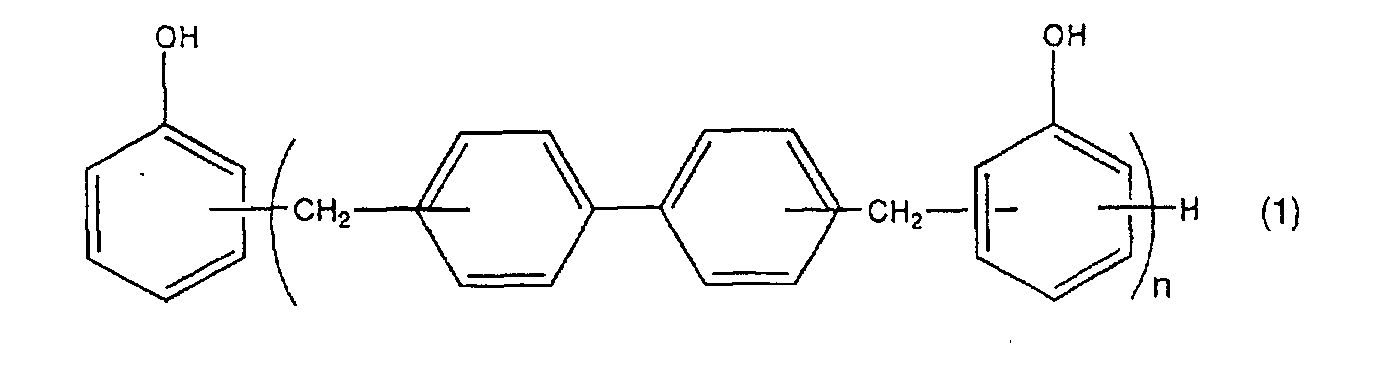
- the polyphenol resin of the present invention having a structure represented by the formula (1) and having a weight-average molecular weight of 3,000 or more as determined by GPC can be obtained for example by reacting to condense a polyphenol compound represented by the above formula (1') with a biphenyl compound represented by the formula (2) in the absence or presence of a solvent generally in amount of 0.01 mol or more and less than 0.5 mol, preferably 0.01-0.45 mol, and more preferably 0.05-0.4 mol relative to 1 equivalent of phenolic hydroxyl group of the polyphenol compound.
- an acid catalyst may be used if necessary.
- An acid catalyst if the X is a halogen in the biphenyl compound of the formula (2), is not necessary, but if the X is an alkoxy group or hydroxyl group, it is necessary.
- the polyphenol resin of the present invention may be obtained by synthesizing a polyphenol compound represented by the formula (1') by a method as described later (the first condensation reaction) and then without isolation of the polyphenol compound reacting to condense the polyphenol compound with a biphenyl compound of the formula (2) (the second condensation reaction).
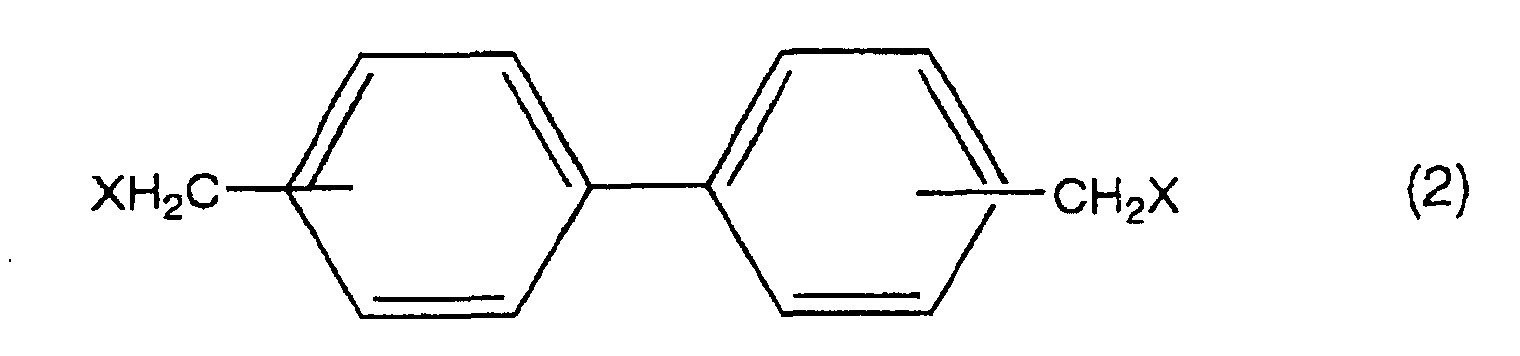
- the biphenyl compound of the formula (2) includes 2,2'-, 3,3'- or 4,4'-bismethoxymethyl biphenyl, 2,2'-, 3,3'- or 4,4'-bisethoxymethyl biphenyl, 2,2'-, 3,3'- or 4,4'-bispropoxymethyl biphenyl, 2,2'-, 3,3'- or 4,4'-bischloromethyl biphenyl, 2,2'-, 3,3'- or 4,4'-bisbromomethyl biphenyl, and 2,2'-, 3,3'- or 4,4'-bihydroxymethyl biphenyl.
- the preferable compound of the formula (2) includes a compound where X is a halogen, preferably chlorine or an alkoxy group, preferably methoxy group.
- X is a halogen, preferably chlorine or an alkoxy group, preferably methoxy group.
- a compound of the formula (2) a mixture of 2,2'product, 3,3'product, 4,4' product and the others is available on the market. A mixture containing 4,4'product as the main component is preferable.
- the preferable biphenyl compound represented by the formula (2) to use in the condensation reaction of the present invention includes a compound where X is a halogen, preferably chlorine.
- the biphenyl compound of the above formula (2) in the condensation reaction of the present invention is used generally in an amount of 0.01 mol or more and less than 0.5 mol, preferably 0.01-0.45 mol, and more preferably 0.05-0.4 mol relative to 1 equivalent of phenolic hydroxyl group of the compound of the formula (1').
- the condensation reaction of the present invention can be carried out in the absence or presence of a solvent, but it is preferable to use the solvent in the reaction because the viscosity of the reaction solution increases with increasing the molecular weight. Any solvent may be used if it has no bad influence on the reaction.
- the preferable solvent includes a lower alkylene glycol mono- or di-lower alkyl ether. The preferable carbon number in the lower alkylene and the lower alkyl is 1-5.
- the preferable solvent includes propylene glycol monomethyl ether, propylene glycol monobutyl ether, propylene glycol dimethyl ether, methyl cellosolve and ethyl cellosolve.
- the amount of the solvent to use is generally 5-500%, preferably 10-400% relative to the mass of a reaction product.
- the compound where X is an alkoxy group, preferably methoxy group is used as a biphenyl compound represented by the formula (2)
- an acid catalyst such as hydrochloric acid, sulfuric acid and para-toluene sulfonic acid in the condensation reaction of the present invention.
- para-toluene sulfonic acid is the most preferable.
- the reaction is made until a biphenyl compound represented by the formula (2) disappears completely.
- the reaction temperature is generally 60-140°C.
- the reaction time is generally 1-20 hours.
- a polyphenol compound represented by the formula (1') can be obtained by reacting to condense a biphenyl compound represented by the formula (2) with a phenol at such a rate that amount of the phenol is generally 1.5-10 mol, preferably 2-8 mol relative to 1 mol of the biphenyl compound and then removing an unreacted phenol.
- an acid catalyst is used if necessary.
- the acid catalyst if X is a halogen atom in the biphenyl compound of the formula (2), is not necessary, but if X is an alkoxy group or hydroxyl group, the acid catalyst is used.
- the preferable biphenyl compound of the formula (2) used in this reaction includes a compound where X is an alkoxy group, preferably methoxy group.
- the acid catalyst in the first condensation reaction includes hydrochloric acid, sulfuric acid and para-toluene sulfonic acid. Para-toluene sulfonic acid is especially preferable.
- An amount of the acid catalyst is 0.001-0.1 parts, preferably 0.005-0.05 parts relative to 1 mol of a compound represented by the formula (2).
- the first condensation reaction can be carried out in the absence or presence of a solvent. When the solvent is used, any solvent may be used if it has no bad influence on the reaction.
- the preferable solvent includes a lower alcohol such as methanol, ethanol and isopropanol and a lower alkyl lower alkyl ketone such as methyl ethyl ketone and methyl isobutyl ketone.
- the solvent is used generally in an amount of 10-300%, preferably 20-250% relative to the total mass of a compound represented by the formula (2) and the phenol. The reaction is made until the compound represented by the formula (2) disappears completely.
- the reaction temperature is generally 40-150°C.
- the reaction time is generally 1-10 hours.
- the acid catalyst is removed by neutralizing and washing, and then the solvent and the unreacted phenol are removed by heating under reduced pressure.
- the condensate thus obtained is represented by the formula (1'), and has a structure that a biphenyl molecule is bonded with a phenol molecule through the methylene bond.
- the weight-average molecular weight thereof is about 500-1,500.
- the softening point is about 50-100°C, though it cannot be specified because it varies according to the average molecular weight.
- the hydrogen halogenide generated as the side reaction product is removed from the reaction system.
- the method is not limited to a particular one, as long as it can remove the hydrogen halogenide from the system.
- nitrogen gas is blown into through the one side of a reaction vessel while the hydrogen chloride gas generated as the side reaction product is removed through another side by a tube and then bubbled to trap into an aqueous alkaline solution such as an aqueous sodium hydrogen solution.
- the condensation reaction of the present invention is preferably carried out in the presence of a solvent.
- a solvent usually, a couple of thousands ppm of hydrogen chloride which cannot be removed even by the above removing method remain in the solvent. The remaining hydrogen chloride is undesirable when the polyphenol resin solution as obtained above is directly used for a varnish of the present invention as described later.
- the hydrogen chloride is removed as follows. After the reaction terminates, the solution is cooled down to 100°C or less. Water is added to the solution followed by stirring to make a suspension in order to transfer the hydrogen chloride into water and heating to distill the hydrogen chloride-containing water and the solvent simultaneously by an azeotropic dehydration process. The distilled solvent is then returned back to the system.
- the hydrogen chloride dissolved in the solvent can be almost removed by repeating the above method.
- the condensation reaction of the present invention if the X is hydroxyl group or an alkoxy group, needs an acid catalyst.
- the acid catalyst may be same kind and amount as in the first condensation reaction. Water and the alcohol generated as the reaction by-product are removed from the system by a fractionating column.
- the polyphenol resin of the present invention has a high molecular weight. Therefore, no or a part of solvent may be removed from the resin so that the resin have a suitable viscosity and have good workability according to an using object.
- the polyphenol resin represented by the formula (1) thus obtained has generally an average degree of polymerization (n) of 4 or more, preferably 4-20, and more preferably 4.5-15.
- the average degree of polymerization is a value calculated from the number-average molecular weight as determined by GPC.
- the weight-average molecular weight (GPC) is 3,000 or more and preferably 3,000-20,000.
- the softening point is generally 110-150°C and, in the preferable embodiment, about 115-145°C.
- the hydroxyl equivalent is 210-300g/eq, preferably 215-290g/eq.
- the polyphenol resin composition of the present invention thus obtained can be used suitably as a curing agent for an epoxy resin and a membrane-forming component of a varnish.
- the epoxy resin composition of the present invention is characterized by comprising a polyphenol resin composition of the present invention and an epoxy resin having two or more epoxy groups in the molecule, and can be obtained generally by mixing homogeneously the above both and the other ingredients to add if necessary.
- the epoxy resin is not limited to a particular one, as long as it has two or more epoxy groups in the molecule. It concretely includes a novolac type epoxy resin or a triphenylmethane type epoxy resin, a dicyclopentadiene phenol condensation type epoxy resin, a xylylene structure-containing phenol novolac type epoxy resin, a biphenyl structure- containing novolac type epoxy resin, a bisphenol A type epoxy resin, a bisphenol F type epoxy resin and a tetramethyl biphenol type epoxy resin, though not limited to these epoxy resins. These epoxy resins may be used alone or in combination of the two or more.
- curing agent in the epoxy resin composition of the present invention other curing agents may be used in combination with a polyphenol resin of the present invention. Any other curing agent may be used as long as it can be used as an curing agent for an epoxy resin.
- the other curing agents include diamino diphenyl methane, diethylene triamine, triethylene tetramine, diamino diphenyl sulfone, isophorone diamine, dicyan diamide, a polyamide resin synthesized from linolenic acid dimer and ethylene diamine, phthalic anhydride, trimellitic anhydride, pyromellitic anhydride, maleic anhydride, tetrahydrophthalic anhydride, methyltetrahydrophthalic anhydride, methylnadic anhydride, hexahydrophthalic anhydride, methylhexahydrophthalic anhydride, phenol novolac, triphenylmethane and these denatured products, imidazole
- the curing agent in an epoxy resin composition of the present invention is used preferably in an amount of 0.7-1.2 equivalent relative to 1 equivalent of epoxy group of the epoxy resin.
- a curing accelerator may be used in combination with the above curing agent in an epoxy resin composition of the present invention.
- the curing accelerator includes, for example, an imidazole such as 2-methylimidazole, 2-ethylimidazole, and 2-ethyl-4-methylimidazole; a tertiary amine such as 2-(dimethylaminomethyl)phenol,and1,8-diaza-bicyclo(5,4,0) undecene-7; a phosphine such as triphenylphosphine; and a metal compound such as stannum octylate.
- the curing accelerator is used if necessary in an amount of 0.1-5.0 parts relative to 100 parts of an epoxy resin and may have been mixed as one component in the epoxy resin composition of the present invention or may be mixed when the epoxy resin is used.
- An epoxy resin composition of the present invention may contain an inorganic filler if necessary.
- the inorganic filler includes, for example, silica, alumina and talc.
- the inorganic filler to use has a share of 0-90% in the epoxy resin composition of the present invention.
- An epoxy resin composition of the present invention may contain various ingredients including a silane coupling agent, a releasing agent such as stearic acid, palmitic acid, zinc stearate and calcium stearate and a pigment if necessary.
- An epoxy resin composition of the present invention can be obtained by mixing homogeneously the above components in their respective rates and can be used in various fields as a conventional epoxy resin composition has been used.
- a polyphenol resin of the present invention which has a structure of the biphenyl group bonded with phenol through methylene group, has a high refractive index.
- the epoxy resin composition of the present invention which contains the polyphenol resin, has also a high refractive index and hence can be suitably used as an optical material for optical lens, lens for spectacles, a substrate for optical disc and plastic optical fiber.
- a biphenyl structure-containing novolac type epoxy resin for example, NC-3000S or NC-3000S-H made by NIPPON KAYAKY
- NC-3000S or NC-3000S-H made by NIPPON KAYAKY
- An epoxy resin composition of the present invention may contain a solvent in some cases.
- the epoxy resin composition containing the solvent can be infiltrated into a base material such as glass fiber, carbon fiber, polyester fiber, polyamide fiber, alumina fiber and paper, followed by heating to dry to get a prepreg. The prepreg can then be pressed and molded under heating to obtain the cured product of an epoxy resin composition of the present invention.
- the content of solvent in the epoxy resin composition is generally 10-70%, preferably 15-70% relative to the total amount of the epoxy resin composition of the present invention and the solvent.
- the epoxy resin composition containing the solvent can be used as a varnish as described below.
- the solvent includes toluene, xylene, acetone, methyl ethyl ketone and methyl isobuthyl ketone, as will be shown in the below paragraph of varnish.
- a varnish of the present invention comprises a polyphenol resin of the present invention and a solvent
- the other components are not limited.
- the varnish of the present invention is a liquid composition in which the polyphenol resin, the solvent and if necessary additional optional components are mixed homogeneously
- a method for producing the liquid composition is not limited to any - particular one.
- the reaction solution as obtained in the process for producing the polyphenol resin of the present invention, which contains the polyphenol resin and the solvent can be used directly as a varnish of the present invention.
- One or more selected from the group consisting of the other optional component, the polyphenol resin and a solvent, if necessary, can be added to the reaction solution to get a varnish of the present invention.
- reaction solution may be concentrated to make a concentrate, to which the other optional component and/or the polyphenol resin are added if necessary to get a varnish of the present invention.
- An isolated polyphenol resin may be mixed homogeneously with the other optional component if necessary in a solvent to get a varnish of the present invention.
- the optional component added into a varnish of the present invention is not limited to any particular one as long as it does not block the membrane formation or the adhesive property of a polyphenol resin of the present invention.
- the preferable one includes a polymer, an epoxy compound and their accompanying additive that are able to form a membrane together with the polyphenol resin.
- the polymer is preferably soluble in a solvent used in a varnish of the present invention.
- One of the preferable varnishes includes a varnish containing the epoxy compound.
- the varnish containing both an epoxy resin composition of the present invention and a polyphenol resin of the present invention is specifically preferable.
- a solvent used in a varnish of the present invention includes ⁇ -butyrolactones, an amide solvent such as N-methyl pyrrolidone(NMP), N,N-dimethyl formamide(DMF), N,N-dimethyl acetamide and N,N-dimethyl imidazolidinone; a solfone such as tetramethylene sulfone; an ether solvent such as diethylene glycol dimethyl ether, diethylene glycol diethyl ether, propylene glycol, propylene glycol monomethyl ether, propylene glycol monomethyl ether monoacetate, propylene glycol monobutyl ether, preferably a lower alkylene glycol mono or di-lower alkyl ether; a ketone solvent such as methyl ethyl ketone and methyl isobutyl ketone, preferably a di-lower alkyl ketone where the two alkyl groups may be same or not; and an aromatic solvent such as tol
- the solid part in the varnish thus obtained is generally a concentration of 10-90%, preferably 20-80%, more preferably 25-70%. The remainder is the solvent.
- the content of the polyphenol resin of the present invention in the varnish is generally content of 10-60%, preferably 20-50% relative to the total amount of the varnish.
- the content of the epoxy resin is content of 10-40%, preferably 15-35%.
- the other additive is content of 0-20%.
- a sheet of the present invention can be obtained by coating the above varnish on a base material, preferably on the surface of a flat supporting substrate by a known coating method such as gravure coating, screen process printing, metal masking and spin coating followed by drying.
- the sheet thus obtained has a thickness (a thickness after drying) of 5-300 ⁇ m, preferably 5-200 ⁇ m, more preferably 10-160 ⁇ m.
- the varnish may be coated on the one side surface, the both side surfaces or the partial surface of a flat supporting substrate if necessary.
- the coating method to use is suitably chosen according to the kind, shape, scale of a base material and the thickness of a membrane.
- the base material includes a film made of polymer and/or copolymer such as polyamide, polyamidimide, polyarylate, polyethylene terephthalate, polybutylene terephthalate, poly(ether ether ketone), poly(etherimide), poly(ether ketone), polyketone, polyethylene and polypropylene; and a metal foil such as a copper foil.
- a film made of polyimide or a metal foil is preferable.
- the sheet having a membrane formed with the varnish of the present invention thus obtained is useful as a substrate for electric/electronic parts.
- a sheet shape of adhesive agent can be produced by coating the varnish of the present invention on a release film and then heating to remove the solvent and to bring the resin into the B stage.
- the sheet shape of adhesive agent thus obtained can be used for the interlayer dielectric layer in a multiplayer board.
- Compound A represented by the formula (1') was obtained.
- Compound A thus obtained had a softening point of 68°C, a melt viscosity of 0.08 Pa s at 150°C, a hydroxyl equivalent of 204g/eq, and a weight-average molecular weight of 940 as determined by GPC.
- the reaction was carried out for 6 hours followed by cooling the reaction system down to 140°C , adding further 72.0 parts of another propylene glycol monobutyl ether and then cooling furthermore down to 80°C. 120 parts of 80°C hot water was added to make a suspension, which was stirred for 30 minutes and heated to distill water and propylene glycol monobutyl ether away from the system with an azeotropic dehydration. Only the propylene glycol monobutyl ether was returned back in the system by the fractionating column. The procedure, starting with adding hot water and ending with returning only propylene glycol monobutyl ether back in the system by the fractionating column, was repeated thrice.
- the solution was cooled to 70°C, and 144 parts of methyl ethyl ketone was added to obtain 480 parts of a 50% varnish of the polyphenol resin of the present invention.
- the polyphenol resin thus obtained had a weight-average molecular weight of 12,800 as determined by GPC, a hydroxyl equivalent of 248g/eq and n in the formula (1) was 7(averaged).
- the solution was cooled down to room temperature to get a varnish of the present invention.
- the varnish was coated on a polyimide film by an applicator so that a membrane after drying could have a thickness of 25 ⁇ m.
- the test piece obtained was heated for 3 hours at 150°C to get a cured product.
- the cured product obtained on the polyimide had satisfactory film-forming performance, because it was free from cracking while the polyimide was rounded to bend.
- the cured product was tested in respect to noninflammability according to UL94-VTM. It was confirmed to clear VTM-0.
- Composition of mixture Example 1 EPPN-502H 100 50% solution of polyphenol resin 291 triphenyl phosphine 1
- the varnish thus obtained was coated on a polyimide film by an applicator so that a membrane after drying could have a thickness of 25 ⁇ m.
- the test piece obtained was heated for 3 hours at 180°C to get a cured product.
- the cured product thus obtained on the polyimide film had satisfactory film-forming performance, because it was free from cracking while the polyimide film was rounded to bend.
- the cured product was tested in respect to noninflammability according to UL94-VTM. It was confirmed to clear VTM-0.
- the varnish was coated on a 30 ⁇ m thick copper foil by an applicator so that a membrane could have a thickness of 150 ⁇ m after drying.
- the test piece thus obtained was heated for 3 hours at 180°C followed by dissolving the copper foil in an etching solution to get a cured product.
- the cured product had a glass transition point of 208°C as determined by DMA (Dynamic viscoelasticity measurement apparatus).
- a polyphenol resin of the present invention if used as a curing agent for an epoxy resin, can provide a cured product which has high flexibility, can be molded to a thin membrane and has excellent noninflammability, compared with a conventionally used epoxy resin composition.
- An epoxy resin composition of the present invention is very useful for the wide application to molding material, casting material, laminating material, paint, adhesive and resist.
Landscapes
- Chemical & Material Sciences (AREA)
- Health & Medical Sciences (AREA)
- Chemical Kinetics & Catalysis (AREA)
- Medicinal Chemistry (AREA)
- Polymers & Plastics (AREA)
- Organic Chemistry (AREA)
- Epoxy Resins (AREA)
- Paints Or Removers (AREA)
Abstract
Description

and having a weight-average molecular weight of 3,000 or more as determined by gel permeation chromatography (GPC, hereinafter same ).
and having a weight-average molecular weight of 1,500 or less as determined by GPC
with a biphenyl compound represented by formula (2):

is used because it can provide a cured product having excellent heat resistance.


| Composition of mixture | Example 1 |
| EPPN-502H | 100 |
| 50% solution of polyphenol resin | 291 |
| triphenyl phosphine | 1 |
Claims (13)
- A polyphenol resin represented by formula (1):wherein, n is an average degree of polymerization calculated from the average molecular weight,

and having a weight-average molecular weight of 3,000 or more as determined by gel permeation chromatography (GPC, hereinafter same ). - A method for producing a polyphenol resin having a weight-average molecular weight of 3,000 or more as determined by GPC, comprising reacting to condense a polyphenol compound represented by formula (1'):wherein, n' is an average degree of polymerization as specified by the average molecular weight,

and having a weight-average molecular weight of 1,500 or less as determined by GPC with a biphenyl compound represented by formula (2):wherein, X is a halogen, a C1-3 alkoxy group or hydroxyl group, in an amount of 0.01 mol or more and less than 0.5 mol relative to 1 equivalent of the phenolic hydroxyl group of said polyphenol compound.
- An epoxy resin composition comprising (a) an epoxy resin having at least two epoxy groups in the molecule and (b) the polyphenol resin according to Claim 1.
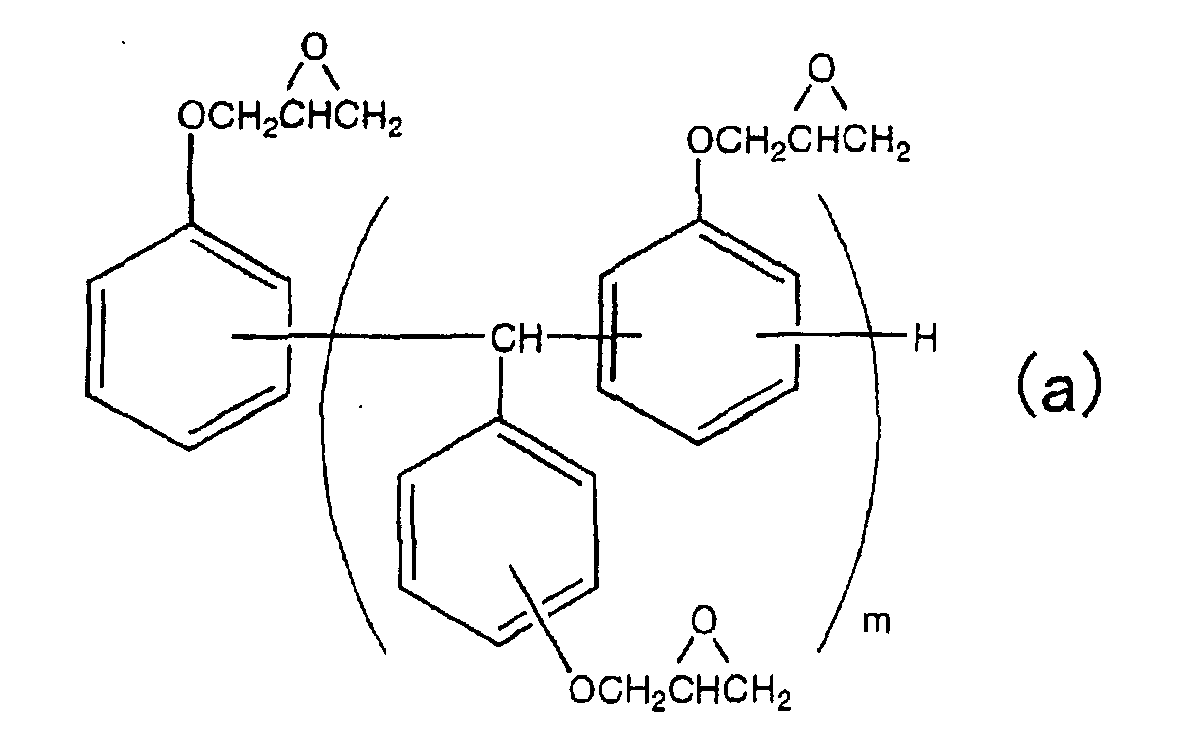
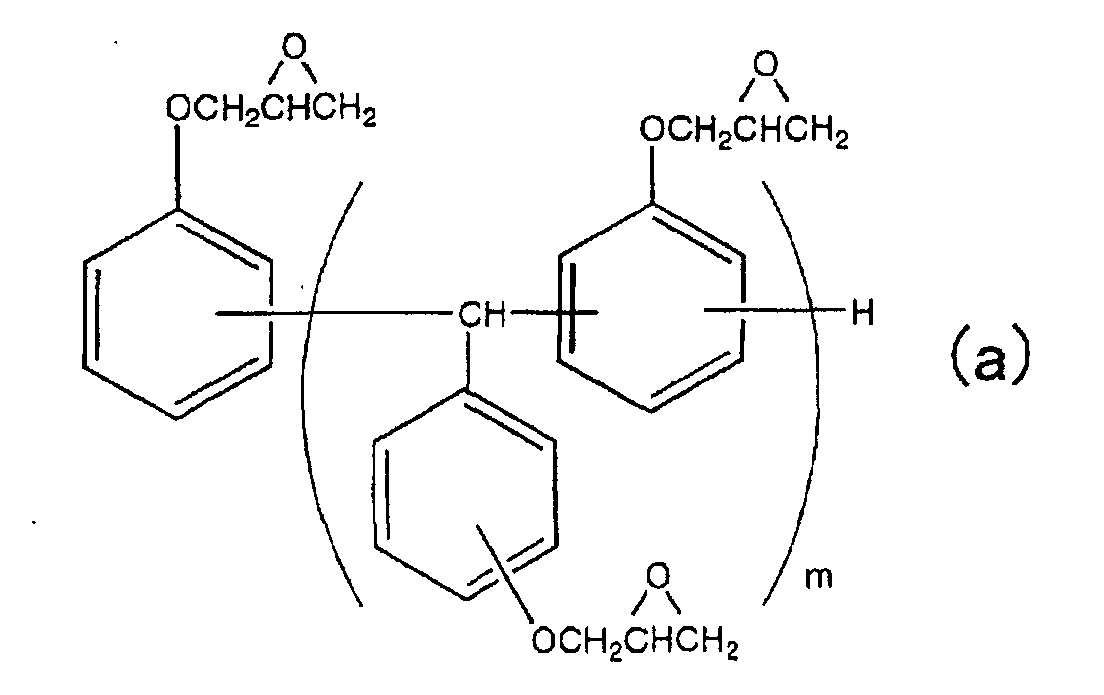
- The epoxy resin composition according to Claim 3, wherein said epoxy resin is represented by formula (a):wherein, m is an average degree of polymerization and a positive number.
- The epoxy resin composition according to Claim 3 or 4 further comprising a curing accelerator .
- A varnish comprising the polyphenol resin according to Claim 1 and a solvent.
- The varnish comprising the epoxy resin composition according to any one of Claims 3-5 containing a solvent.
- A sheet comprising a layer formed by drying the varnish according to Claim 6 or 7 on the surface of a flat supporting substrate.
- The sheet according to Claim 8, wherein said flat supporting substrate is a polyimide film.
- The sheet according to Claim 8, wherein said flat supporting substrate is a metallic foil.
- The sheet according to Claim 8, wherein said flat supporting substrate is a release film.
- A cured product obtained by curing the epoxy resin composition according to any one of Claims 3-5.
- A curing agent for an epoxy resin comprising the polyphenol resin according to Claim 1.
Applications Claiming Priority (5)
| Application Number | Priority Date | Filing Date | Title |
|---|---|---|---|
| JP2000305854 | 2000-10-05 | ||
| JP2000305854 | 2000-10-05 | ||
| JP2000377920 | 2000-12-12 | ||
| JP2000377920 | 2000-12-12 | ||
| PCT/JP2001/008693 WO2002028940A1 (en) | 2000-10-05 | 2001-10-03 | Polyphenol resin, process for its production, epoxy resin composition and its use |
Publications (3)
| Publication Number | Publication Date |
|---|---|
| EP1323761A1 true EP1323761A1 (en) | 2003-07-02 |
| EP1323761A4 EP1323761A4 (en) | 2005-02-09 |
| EP1323761B1 EP1323761B1 (en) | 2007-04-25 |
Family
ID=26601592
Family Applications (1)
| Application Number | Title | Priority Date | Filing Date |
|---|---|---|---|
| EP20010972665 Expired - Lifetime EP1323761B1 (en) | 2000-10-05 | 2001-10-03 | Polyphenol resin, process for its production, epoxy resin composition and its use |
Country Status (6)
| Country | Link |
|---|---|
| US (2) | US6723801B2 (en) |
| EP (1) | EP1323761B1 (en) |
| KR (1) | KR100750998B1 (en) |
| DE (1) | DE60128118T2 (en) |
| TW (2) | TWI287554B (en) |
| WO (1) | WO2002028940A1 (en) |
Cited By (1)
| Publication number | Priority date | Publication date | Assignee | Title |
|---|---|---|---|---|
| CN101722694A (en) * | 2009-11-17 | 2010-06-09 | 丹阳市永和电器科技有限公司 | High-Tg high-thermal conductivity aluminium-based copper-clad laminate |
Families Citing this family (14)
| Publication number | Priority date | Publication date | Assignee | Title |
|---|---|---|---|---|
| EP1323761B1 (en) * | 2000-10-05 | 2007-04-25 | Nippon Kayaku Kabushiki Kaisha | Polyphenol resin, process for its production, epoxy resin composition and its use |
| JP4240448B2 (en) * | 2002-08-22 | 2009-03-18 | 三井金属鉱業株式会社 | Method for producing multilayer printed wiring board using copper foil with resin layer |
| TW200415197A (en) * | 2002-10-03 | 2004-08-16 | Nippon Kayaku Kk | Epoxy resin composition for optical semiconductor package |
| US20070098718A1 (en) * | 2003-11-04 | 2007-05-03 | Chiron | Methods of therapy for b cell-related cancers |
| US20080200636A1 (en) * | 2005-02-25 | 2008-08-21 | Masataka Nakanishi | Epoxy Resin, Hardenable Resin Composition Containing the Same and Use Thereof |
| WO2007063894A1 (en) * | 2005-11-30 | 2007-06-07 | Nippon Kayaku Kabushiki Kaisha | Phenolic resin, process for production thereof, epoxy resin, and use thereof |
| MY148755A (en) * | 2007-03-23 | 2013-05-31 | Sumitomo Bakelite Co | Semiconductor-encapsulating resin composition and semiconductor device |
| TW200842135A (en) * | 2007-04-23 | 2008-11-01 | Chang Chun Plastics Co Ltd | Flame retardant resin composition |
| AU2009233793A1 (en) * | 2008-04-10 | 2009-10-15 | Karl Christopher Hansen | Simple-to-use optical wireless remote control |
| KR100995683B1 (en) | 2008-06-30 | 2010-11-22 | 주식회사 코오롱 | Epoxy Resin, Manufacturing Method and Uses thereof |
| CN102598895B (en) * | 2009-11-06 | 2016-06-08 | 3M创新有限公司 | There is the dielectric substance of non-halogenated firming agent |
| KR101669716B1 (en) * | 2009-12-21 | 2016-10-27 | 바스프 에스이 | Composite pavement structure |
| CN103717635B (en) * | 2011-07-19 | 2016-01-20 | 松下知识产权经营株式会社 | Resin combination, resinous varnish, prepreg, metal-coated laminated board and printed-wiring board (PWB) |
| KR102497115B1 (en) * | 2020-11-06 | 2023-02-07 | 송원산업 주식회사 | Phenolin novolac resin and process for production thereof |
Family Cites Families (17)
| Publication number | Priority date | Publication date | Assignee | Title |
|---|---|---|---|---|
| US3042655A (en) * | 1960-01-22 | 1962-07-03 | American Viscose Corp | Novolak and method of manufacture thereof |
| US4492730A (en) * | 1982-03-26 | 1985-01-08 | Showa Denko Kabushiki Kaisha | Substrate of printed circuit |
| JP2866747B2 (en) * | 1990-12-21 | 1999-03-08 | 三井化学株式会社 | Method for producing phenolic polymer |
| ATE148908T1 (en) * | 1991-03-29 | 1997-02-15 | Dainippon Ink & Chemicals | EPOXY RESIN HARDENER AND EPOXY RESIN COMPOSITION |
| JP3479812B2 (en) * | 1994-01-25 | 2003-12-15 | 信越化学工業株式会社 | Epoxy resin composition and semiconductor device |
| JP3122834B2 (en) * | 1994-09-20 | 2001-01-09 | 明和化成株式会社 | New phenol novolak condensate |
| TW350857B (en) * | 1994-09-20 | 1999-01-21 | Ube Industries | Phenol novolak condensate and the uses thereof |
| WO1996031574A1 (en) * | 1995-04-04 | 1996-10-10 | Hitachi Chemical Company, Ltd. | Adhesive, adhesive film and adhesive-backed metal foil |
| JPH09143345A (en) * | 1995-11-27 | 1997-06-03 | Sumitomo Bakelite Co Ltd | Epoxy resin composition |
| JP3622937B2 (en) * | 1995-12-28 | 2005-02-23 | 住友ベークライト株式会社 | Resin composition for semiconductor encapsulation |
| JPH10251362A (en) * | 1997-03-11 | 1998-09-22 | Nippon Kayaku Co Ltd | Novolak type resin, epoxy resin, epoxy resin composition and cured product thereof |
| JP3604866B2 (en) * | 1997-05-13 | 2004-12-22 | 明和化成株式会社 | Method for producing phenol-novolak condensate |
| JPH11147998A (en) * | 1997-11-19 | 1999-06-02 | Sumitomo Bakelite Co Ltd | Epoxy resin composition and semiconductor device |
| JP3414340B2 (en) * | 1998-12-15 | 2003-06-09 | 日本電気株式会社 | Flame retardant resin material and flame retardant resin composition |
| JP2001055431A (en) * | 1999-08-19 | 2001-02-27 | Shin Etsu Chem Co Ltd | Epoxy resin composition for semiconductor encapsulation and semiconductor device |
| JP3460820B2 (en) * | 1999-12-08 | 2003-10-27 | 日本電気株式会社 | Flame retardant epoxy resin composition |
| EP1323761B1 (en) * | 2000-10-05 | 2007-04-25 | Nippon Kayaku Kabushiki Kaisha | Polyphenol resin, process for its production, epoxy resin composition and its use |
-
2001
- 2001-10-03 EP EP20010972665 patent/EP1323761B1/en not_active Expired - Lifetime
- 2001-10-03 TW TW94133905A patent/TWI287554B/en not_active IP Right Cessation
- 2001-10-03 KR KR1020027007086A patent/KR100750998B1/en not_active Expired - Fee Related
- 2001-10-03 TW TW90124241A patent/TWI287553B/en not_active IP Right Cessation
- 2001-10-03 WO PCT/JP2001/008693 patent/WO2002028940A1/en not_active Ceased
- 2001-10-03 US US10/148,701 patent/US6723801B2/en not_active Expired - Fee Related
- 2001-10-03 DE DE2001628118 patent/DE60128118T2/en not_active Expired - Fee Related
-
2004
- 2004-02-26 US US10/787,781 patent/US20040166326A1/en not_active Abandoned
Cited By (1)
| Publication number | Priority date | Publication date | Assignee | Title |
|---|---|---|---|---|
| CN101722694A (en) * | 2009-11-17 | 2010-06-09 | 丹阳市永和电器科技有限公司 | High-Tg high-thermal conductivity aluminium-based copper-clad laminate |
Also Published As
| Publication number | Publication date |
|---|---|
| US6723801B2 (en) | 2004-04-20 |
| TWI287553B (en) | 2007-10-01 |
| DE60128118T2 (en) | 2007-08-30 |
| US20040166326A1 (en) | 2004-08-26 |
| US20030009001A1 (en) | 2003-01-09 |
| EP1323761A4 (en) | 2005-02-09 |
| DE60128118D1 (en) | 2007-06-06 |
| WO2002028940A1 (en) | 2002-04-11 |
| TWI287554B (en) | 2007-10-01 |
| KR20020063199A (en) | 2002-08-01 |
| KR100750998B1 (en) | 2007-08-22 |
| EP1323761B1 (en) | 2007-04-25 |
Similar Documents
| Publication | Publication Date | Title |
|---|---|---|
| EP1323761B1 (en) | Polyphenol resin, process for its production, epoxy resin composition and its use | |
| TWI923774B (en) | Resin compositions and prepregs using the same, resin-coated films, resin-coated metal foils, metal-clad laminates and wiring boards | |
| KR100709149B1 (en) | Epoxy Resin Composition | |
| CN115819458B (en) | Phosphorus-containing epoxy resin, resin composition and application of resin composition | |
| US20190203045A1 (en) | Resin composition, method for producing resin composition, prepreg, film with resin, metal foil with resin, metal-clad laminate, and wiring board | |
| WO2019130735A1 (en) | Polyphenylene ether resin composition, prepreg using same, film with resin, metal foil with resin, metal-clad laminate and wiring board | |
| JP4104107B2 (en) | Epoxy resin composition and use thereof | |
| EP1063262A1 (en) | Thermosetting polyphenylene ether resin composition, cured resin composition obtained therefrom, and laminated structure | |
| CN103724596B (en) | Epoxy resin composition and cured product | |
| EP1566395B1 (en) | Flame-retardant epoxy resin composition and cured object obtained therefrom | |
| JP2020513448A (en) | Active ester curing agent compounds for thermosetting resins, flame retardant compositions containing the compounds, and articles of manufacture from the compositions | |
| KR101314785B1 (en) | Polyamide resin, epoxy resin compositions, and cured articles thereof | |
| KR20090087479A (en) | Polyamide Resin, Epoxy Resin Composition Using the Same and Uses thereof | |
| JP7545880B2 (en) | Epoxy resin, its manufacturing method, epoxy resin composition, cured product, and laminate for electric/electronic circuits | |
| KR101353825B1 (en) | Adhesive Composition and Substrate for Flexible Print Wiring Board | |
| KR101399258B1 (en) | Novolak epoxy resin, method for preparing the same, and epoxy resin composition containing the novolak epoxy resin | |
| JP4605681B2 (en) | Polycresol resin, epoxy resin composition and cured product thereof | |
| JP7645186B2 (en) | CURABLE RESIN COMPOSITION, DRY FILM AND CURED PRODUCT THEREOF, AND ELECTRONIC COMPONENTS COMPRISING THE CURED PRODUCT | |
| CN103554441A (en) | Halogen-free flame-retardant high-glass-transition-temperature phenolic resin hardener and preparation method thereof | |
| JP4509539B2 (en) | Epoxy resin composition sheet | |
| WO2023008231A1 (en) | Epoxy resin, curable resin composition, and cured products thereof | |
| JP2005089616A (en) | Thermosetting resin composition and cured product thereof | |
| EP4053214A1 (en) | Composition, curable composition, and cured product | |
| JP4702764B2 (en) | Epoxy resin composition and cured product thereof | |
| JP4198935B2 (en) | Bifunctional epoxy resin and epoxy resin composition |
Legal Events
| Date | Code | Title | Description |
|---|---|---|---|
| PUAI | Public reference made under article 153(3) epc to a published international application that has entered the european phase |
Free format text: ORIGINAL CODE: 0009012 |
|
| 17P | Request for examination filed |
Effective date: 20020603 |
|
| AK | Designated contracting states |
Designated state(s): AT BE CH CY DE DK ES FI FR GB GR IE IT LI LU MC NL PT SE TR |
|
| RIN1 | Information on inventor provided before grant (corrected) |
Inventor name: IMAIZUMI, MASAHIRO Inventor name: OSHIMI, KATSUHIKO Inventor name: AKATSUKA, YASUMASA Inventor name: TOMIDA, SYOUICHI Inventor name: ASANO, TOYOFUMI |
|
| RBV | Designated contracting states (corrected) |
Designated state(s): DE FR GB |
|
| RIC1 | Information provided on ipc code assigned before grant |
Ipc: 7H 01L 23/14 B Ipc: 7C 08G 59/62 B Ipc: 7C 08L 63/00 B Ipc: 7C 09D 165/00 B Ipc: 7C 08G 61/02 A |
|
| A4 | Supplementary search report drawn up and despatched |
Effective date: 20041230 |
|
| 17Q | First examination report despatched |
Effective date: 20050315 |
|
| 17Q | First examination report despatched |
Effective date: 20050315 |
|
| GRAP | Despatch of communication of intention to grant a patent |
Free format text: ORIGINAL CODE: EPIDOSNIGR1 |
|
| GRAS | Grant fee paid |
Free format text: ORIGINAL CODE: EPIDOSNIGR3 |
|
| 17Q | First examination report despatched |
Effective date: 20050315 |
|
| GRAA | (expected) grant |
Free format text: ORIGINAL CODE: 0009210 |
|
| AK | Designated contracting states |
Kind code of ref document: B1 Designated state(s): DE FR GB |
|
| REG | Reference to a national code |
Ref country code: GB Ref legal event code: FG4D |
|
| REF | Corresponds to: |
Ref document number: 60128118 Country of ref document: DE Date of ref document: 20070606 Kind code of ref document: P |
|
| ET | Fr: translation filed | ||
| PLBE | No opposition filed within time limit |
Free format text: ORIGINAL CODE: 0009261 |
|
| STAA | Information on the status of an ep patent application or granted ep patent |
Free format text: STATUS: NO OPPOSITION FILED WITHIN TIME LIMIT |
|
| 26N | No opposition filed |
Effective date: 20080128 |
|
| PGFP | Annual fee paid to national office [announced via postgrant information from national office to epo] |
Ref country code: DE Payment date: 20071218 Year of fee payment: 7 |
|
| GBPC | Gb: european patent ceased through non-payment of renewal fee |
Effective date: 20071003 |
|
| REG | Reference to a national code |
Ref country code: FR Ref legal event code: ST Effective date: 20080630 |
|
| PG25 | Lapsed in a contracting state [announced via postgrant information from national office to epo] |
Ref country code: GB Free format text: LAPSE BECAUSE OF NON-PAYMENT OF DUE FEES Effective date: 20071003 |
|
| PG25 | Lapsed in a contracting state [announced via postgrant information from national office to epo] |
Ref country code: FR Free format text: LAPSE BECAUSE OF NON-PAYMENT OF DUE FEES Effective date: 20071031 |
|
| PG25 | Lapsed in a contracting state [announced via postgrant information from national office to epo] |
Ref country code: DE Free format text: LAPSE BECAUSE OF NON-PAYMENT OF DUE FEES Effective date: 20090501 |