EP1323702A1 - Process for producing acyl fluoride and carboxylic acid salt - Google Patents
Process for producing acyl fluoride and carboxylic acid salt Download PDFInfo
- Publication number
- EP1323702A1 EP1323702A1 EP01970216A EP01970216A EP1323702A1 EP 1323702 A1 EP1323702 A1 EP 1323702A1 EP 01970216 A EP01970216 A EP 01970216A EP 01970216 A EP01970216 A EP 01970216A EP 1323702 A1 EP1323702 A1 EP 1323702A1
- Authority
- EP
- European Patent Office
- Prior art keywords
- compound
- reaction
- ocf
- group
- fluorination
- Prior art date
- Legal status (The legal status is an assumption and is not a legal conclusion. Google has not performed a legal analysis and makes no representation as to the accuracy of the status listed.)
- Withdrawn
Links
Classifications
-
- C—CHEMISTRY; METALLURGY
- C07—ORGANIC CHEMISTRY
- C07C—ACYCLIC OR CARBOCYCLIC COMPOUNDS
- C07C69/00—Esters of carboxylic acids; Esters of carbonic or haloformic acids
- C07C69/66—Esters of carboxylic acids having esterified carboxylic groups bound to acyclic carbon atoms and having any of the groups OH, O—metal, —CHO, keto, ether, acyloxy, groups, groups, or in the acid moiety
- C07C69/67—Esters of carboxylic acids having esterified carboxylic groups bound to acyclic carbon atoms and having any of the groups OH, O—metal, —CHO, keto, ether, acyloxy, groups, groups, or in the acid moiety of saturated acids
- C07C69/708—Ethers
-
- C—CHEMISTRY; METALLURGY
- C07—ORGANIC CHEMISTRY
- C07C—ACYCLIC OR CARBOCYCLIC COMPOUNDS
- C07C51/00—Preparation of carboxylic acids or their salts, halides or anhydrides
- C07C51/04—Preparation of carboxylic acids or their salts, halides or anhydrides from carboxylic acid halides
-
- C—CHEMISTRY; METALLURGY
- C07—ORGANIC CHEMISTRY
- C07C—ACYCLIC OR CARBOCYCLIC COMPOUNDS
- C07C51/00—Preparation of carboxylic acids or their salts, halides or anhydrides
- C07C51/41—Preparation of salts of carboxylic acids
- C07C51/412—Preparation of salts of carboxylic acids by conversion of the acids, their salts, esters or anhydrides with the same carboxylic acid part
-
- C—CHEMISTRY; METALLURGY
- C07—ORGANIC CHEMISTRY
- C07C—ACYCLIC OR CARBOCYCLIC COMPOUNDS
- C07C51/00—Preparation of carboxylic acids or their salts, halides or anhydrides
- C07C51/58—Preparation of carboxylic acid halides
- C07C51/60—Preparation of carboxylic acid halides by conversion of carboxylic acids or their anhydrides or esters, lactones, salts into halides with the same carboxylic acid part
-
- C—CHEMISTRY; METALLURGY
- C07—ORGANIC CHEMISTRY
- C07C—ACYCLIC OR CARBOCYCLIC COMPOUNDS
- C07C59/00—Compounds having carboxyl groups bound to acyclic carbon atoms and containing any of the groups OH, O—metal, —CHO, keto, ether, groups, groups, or groups
- C07C59/125—Saturated compounds having only one carboxyl group and containing ether groups, groups, groups, or groups
- C07C59/135—Saturated compounds having only one carboxyl group and containing ether groups, groups, groups, or groups containing halogen
-
- C—CHEMISTRY; METALLURGY
- C07—ORGANIC CHEMISTRY
- C07C—ACYCLIC OR CARBOCYCLIC COMPOUNDS
- C07C67/00—Preparation of carboxylic acid esters
- C07C67/14—Preparation of carboxylic acid esters from carboxylic acid halides
-
- C—CHEMISTRY; METALLURGY
- C07—ORGANIC CHEMISTRY
- C07C—ACYCLIC OR CARBOCYCLIC COMPOUNDS
- C07C67/00—Preparation of carboxylic acid esters
- C07C67/28—Preparation of carboxylic acid esters by modifying the hydroxylic moiety of the ester, such modification not being an introduction of an ester group
- C07C67/287—Preparation of carboxylic acid esters by modifying the hydroxylic moiety of the ester, such modification not being an introduction of an ester group by introduction of halogen; by substitution of halogen atoms by other halogen atoms
-
- C—CHEMISTRY; METALLURGY
- C09—DYES; PAINTS; POLISHES; NATURAL RESINS; ADHESIVES; COMPOSITIONS NOT OTHERWISE PROVIDED FOR; APPLICATIONS OF MATERIALS NOT OTHERWISE PROVIDED FOR
- C09K—MATERIALS FOR MISCELLANEOUS APPLICATIONS, NOT PROVIDED FOR ELSEWHERE
- C09K23/00—Use of substances as emulsifying, wetting, dispersing, or foam-producing agents
- C09K23/007—Organic compounds containing halogen
Definitions
- the present invention relates to a process for producing an acyl fluoride and a carboxylic acid salt, which are industrially useful. Further, the present invention relates to a novel compound which is useful as a fluororesin monomer or an emulsifier, or as a raw material therefor.
- a method for fluorinating a C-H portion in a C-H containing compound to C-F a method of employing cobalt trifluoride, a method of electrolyzing hydrogen fluoride in an electrolytic cell to carry out a fluorination reaction (an electrochemical fluorination method (hereinafter referred to as ECF method)), or a method of employing fluorine gas for fluorination, has been known.
- ECF method electrochemical fluorination method
- a method of employing fluorine gas for fluorination has been known.
- a gas phase method and a liquid phase method are known as the method of employing fluorine gas to carry out a fluorination reaction.
- the present invention provides the following invention whereby the above object can be accomplished.
- R A in the compound (1) is a group which becomes R AF upon fluorination, i.e. a group which becomes a perfluoroalkyl group.
- the structure of R A in the compound (1) will determine the basic carbon skeleton of R AF in the compound (5). Accordingly, the liquid phase fluorination reaction is carried out by using the compound (1) having a group (R A ) which corresponds to such R AF .
- R A may be a partially fluorinated alkyl group having some of fluorine atoms in the desired perfluoroalkyl group (R AF ) substituted by hydrogen atoms, an alkyl group having all of fluorine atoms in the desired R AF substituted by hydrogen atoms, or a group having a carbon-carbon single bond in R AF , or in said partially fluorinated alkyl group or said alkyl group, substituted by a carbon-carbon unsaturated bond (such as a double bond or a triple bond).
- the structure of R A may be optionally changed taking into consideration the availability of the compound (1) or the economical efficiency.
- R A is preferably an alkyl group, more preferably a C 1-16 alkyl group, particularly preferably a C 1-8 alkyl group.
- n is an integer of from 1 to 10. From the viewpoint of the usefulness of the compound, n is preferably 1 or 2, and particularly preferably, n is 2.
- the structure of the alkyl group may be a linear structure, a branched structure, a cyclic structure or a structure partially having a cyclic structure.
- the alkyl group having a linear structure may be H(CH 2 ) m - (wherein m is an integer of from 1 to 16).
- the alkyl group having a branched structure may, for example, be an isopropyl group, an isobutyl group, a sec-butyl group or a tert-butyl group.
- the alkyl group having a cyclic structure i.e.
- the cycloalkyl group may, for example, be a cyclopropyl group, a cyclobutyl group, a cyclopentyl group, a cyclohexyl group or a group having an alkyl group of a linear structure or a branched structure bonded to a carbon atom constituting the ring of such a group.
- the alkyl group partially having a cyclic structure may be an alkyl group of a linear structure having a cycloalkyl group substituted thereon, or an alkyl group of a branched structure having a cycloalkyl group substituted thereon, and a cyclohexyl methyl group, a cyclohexyl methyl group, a cyclohexyl ethyl group or the like, is preferred.
- R A is preferably an alkyl group, more preferably an alkyl group of a linear structure. Further preferably, R A is a C 4-10 alkyl group, particularly preferably H(CH 2 ) m - (m is an integer of from 4 to 10), especially preferably such a group wherein m is from 1 to 6.
- the compound (1) is a compound which is readily available or which can easily be synthesized by a known method.
- 2-alkoxyalcohols can easily be synthesized by methods disclosed in J. Am. Chem. Soc., 49, 1080 (1927), Bull. Soc. Chim. Fr., 1813 (1960), Can. J. Chem., 43, 1030 (1965), Synthesis, 280 (1981), etc.
- the compound (1) is reacted with the compound (2).
- the halogen atom represented by X in the compound (2) is a fluorine atom, a chlorine atom, a bromine atom or an iodine atom, preferably a fluorine atom, a chlorine atom or a bromine atom. Further, in a case where the after-mentioned continuous process is carried out, it is preferably a fluorine atom.
- -CH 2 OH in the compound (1) will react with XCO- (X is a halogen atom) in the compound (2) to form a bond (-CH 2 OCO-).
- R B is a monovalent organic group which undergoes no change by the fluorination reaction.
- a monovalent organic group is a monovalent organic group having no structure which can be fluorinated.
- R B is a perhalogenated monovalent organic group such as a perfluoroalkyl group
- such a group is a monovalent organic group which undergoes no change by a fluorination reaction.
- the compound (2) in the present invention is preferably a compound wherein R B is a monovalent organic group containing fluorine atoms, for such a reason that in the subsequent liquid phase fluorination reaction, the compound (3) will be readily soluble in the liquid phase.
- R B in the compound (2) is preferably a perfluorinated monovalent organic group, particularly preferably a perfluoroalkyl group having substantially all hydrogen atoms in an alkyl group substituted by fluorine atoms, or a perfluoro(etheric oxygen atom-containing alkyl) group containing an etheric oxygen atom and having substantially all hydrogen atoms in an alkyl group substituted by fluorine atoms.
- Preferred examples of the perfluorinated monovalent organic group include a C 1-20 perfluoroalkyl group and a C 1-20 perfluoro(etheric oxygen atom-containing alkyl) group.
- the C 1-20 perfluoroalkyl group is a group having all hydrogen atoms in a C 1-20 alkyl group substituted by fluorine atoms, and a C 1-10 perfluoroalkyl group is preferred.
- Specific examples of the perfluoroalkyl group may be groups shown in the specific examples of the compound (4) given hereinafter. In a case where the perfluoroalkyl group is of a linear structure, -CF 3 , -CF 2 CF 3 , -CF 2 CF 2 CF 3 , and -CF 2 CF 2 CF 2 CF 3 are, for example preferred.
- -CF(CF 3 ) 2 , -CF 2 CF(CF 3 ) 2 , -CF(CF 3 )CF 2 CF 3 and -C(CF 3 ) 3 are, for example, preferred.
- the C 1-20 perfluoro(etheric oxygen atom-containing alkyl) group is a group having all hydrogen atoms in the above mentioned etheric oxygen atom-containing alkyl group substituted by fluorine atoms, and a C 1-10 perfluoro(etheric oxygen atom-containing alkyl) group is preferred.
- the perfluoro(etheric oxygen atom-containing alkyl) group is preferably a perfluoroalkoxyl group, perfluoro(alkoxyalkyl) group or a perfluoro(alkoxyalkoxyalkyl) group.
- R B is preferably the same monovalent organic group as R BF , specifically the group described as a preferred group for R BF .
- k is an integer of from 1 to 20, preferably an integer of from 1 to 10
- p is an integer of from 0 to 9, preferably 1
- q is an integer of from 1 to 16, preferably an integer from 1 to 8
- Cy F represents a perfluorocyclohexyl group.
- the compound (2) may be a commercial product or the compound (5) which will be formed by the process of the present invention, which will be described hereinafter. Further, the compound (2) is a compound which is readily available, for example, as an intermediate for a perfluoro(alkyl vinyl ether).
- R B is preferably R AF [OCF(CF 3 )CF 2 ] n-1 OCF(CF 3 )- or a group which becomes such a group upon a fluorination reaction. Particularly preferred is such a group wherein n is 2 (i.e. R AF OCF(CF 3 )CF 2 OCF(CF 3 )-), since it is thereby possible to obtain an emulsifier having a particularly excellent performance.
- the reaction of the compound (1) and the compound (2) can be carried out under reaction conditions of a known esterification reaction. Such a reaction may be carried out in the presence of a solvent (hereinafter referred to as an esterification solvent), but it is preferably carried out in the absence of an esterification solvent from the viewpoint of the volume efficiency. It is particularly preferred to carry out the reaction in the presence of an excess amount of the compound (2) relative to the compound (1).
- an esterification solvent is to be used, dichloromethane, chloroform, triethylamine or a mixed solvent of triethylamine and tetrahydrofuran, is preferred.
- the amount of the esterification solvent to be used is preferably from 50 to 500 mass%, based on the total amount of the compound (1) and the compound (2).
- an acid represented by HX By the reaction of the compound (1) and the compound (2), an acid represented by HX will be formed.
- a compound wherein X is a fluorine atom is used as the compound (2), HF will be formed.
- an alkali metal fluoride preferably NaF or KF
- a trialkylamine may be present in the reaction system. It is advisable to use a HF scavenger, in a case where the compound (1) or the compound (2) is a compound instable to an acid.
- HF scavenger it is preferred to carry out the reaction at a reaction temperature where HF can be vaporized, and HF is discharged out of the reaction system, as carried by a nitrogen stream. It is preferred that the HF scavenger is from 1 to 10 times by mol to the compound (2).
- the amount of the compound (2) to the compound (1) is preferably from 0.75 to 5 times by mol, more preferably from 1 to 2.5 times by mol, particularly preferably from 1.5 to 2.5 times by mol.
- the temperature for the reaction of the compound (1) and the compound (2) is, in a usual case, preferably at least -50°C and at most +100°C or at most the boiling point of the solvent.
- reaction time for the reaction may be optionally changed depending upon the supply rates of the feed materials and the amounts of the compounds to be used for the reaction.
- the pressure for the reaction (gauge pressure, the same applies hereinafter) is preferably from 0 to 2 MPa.
- the compound (3) By the reaction of the compound (1) and the compound (2), the compound (3) will be formed.
- the crude product containing the compound formed by the reaction of the compound (1) and the compound (2) may be purified depending upon the particular purpose, or may be used for the next reaction, etc. as it is. However, it is advisable to purify the crude product, so that the fluorination reaction in the next step can be carried out constantly.
- the method for purifying the crude product may, for example, be a method of distilling the crude product as it is, a method of treating the crude product with a dilute alkaline aqueous solution, followed by liquid separation, a method of extracting the crude product with a suitable organic solvent, followed by distillation, or silica gel column chromatography.
- R A in the compound (3) is the same group as R A in the compound (1).
- R B is the same group as R B in the compound (2).
- the lower limit of the fluorine content in the compound (3) is preferably adjusted to be 30 mass%, particularly preferably 50 mass%, by adjusting the structures of R A and R B in the compound (3).
- the upper limit of the fluorine content is preferably 86 mass%, particularly preferably 70 mass%.
- the molecular weight of the compound (3) is preferably from 200 to 1000, from such a viewpoint that the fluorination reaction in a liquid phase can be carried out smoothly.
- the compound (3) tends to be readily vaporized, whereby a decomposition reaction is likely to take place in the gas phase during the fluorination reaction. On the other hand, if the molecular weight is too large, purification of the compound (3) is likely to be difficult.
- the compound (3B) is preferred from the viewpoint such that a continuous production process can be carried out, and the product is useful. Particularly preferred is the following compound (3B-1) wherein m and q have the same value, and p has the same value as (n-1). (3B-1) H (CH 2 ) m [OCH (CH 3 ) CH 2 ] n OCOCF (CF 3 ) O [CF 2 CF (CF 3 ) O] n-1 (CF 2 ) m F
- the compound (3) is fluorinated in a liquid phase to form the compound (4).
- R AF in the compound (4) is a perfluoroalkyl group, preferably a C 1-16 perfluoroalkyl group, particularly preferably a C 1-8 perfluoroalkyl group, especially preferably F(CF 2 ) m - (m is as defined above), further preferably a CF 3 CF 2 CF 2 - group.
- R BF in the compound (4) is a monovalent organic group.
- R B is a monovalent organic group having no structure to be fluorinated
- R BF is the same group as R B
- R B is a monovalent organic group having a structure to be fluorinated (such as a hydrogen atom)
- R B is a monovalent organic group having a structure to be fluorinated (such as a hydrogen atom)
- it is a group having substantially all of such a structure fluorinated (i.e. a perfluorinated group).
- R BF is preferably a perfluorinated monovalent organic group, more preferably a perfluoroalkyl group or a perfluoro(etheric oxygen atom-containing alkyl) group, particularly preferably R AF [OCF(CF 3 )CF 2 ] n-1 OCF (CF 3 )-(wherein n is as defined above).
- R BF is such a group, the compounds (5) and (6) to be formed by the subsequent cleavage reaction of the ester bond, will be the same, whereby post treatment can be simplified, such being more preferred.
- compound (4B), compound (4C) and compound (4D) are preferred in that a continuous production method can be carried out, and the product is useful.
- Particularly preferred is the following compound (4B-1), wherein m and q in the compound (4B) have the same value, and p has the same value as (n-1).
- (4B-1) F (CF 2 ) m [OCF (CF 3 ) CF 2 ] n OCOCF (CF 3 ) O [CF 2 CF (CF 3 ) O] n-1 (CF 2 ) m F
- the compound (3) is fluorinated in a liquid phase by means of fluorine (elemental fluorine) for perfluorination.
- the compound (3) may be fluorinated by a gas-solid reaction at a high temperature by means of cobalt fluoride.
- isomerization or cleavage of the C-O bond is likely to take place, thus leading to a problem that by-products of many types will be formed.
- the compound (3) may be fluorinated by the ECF method, but by such a method, cleavage of the C-O bond is likely to take place, thus leading to a problem that the product of the fluorination reaction cannot be obtained in good yield.
- the liquid phase fluorination method is an extremely advantageous method for industrial operation, since the yield is high and the operation of the reaction is easy as compared with the method of employing cobalt trifluoride or the ECF method.
- fluorine gas may be used as it is, or fluorine gas diluted with an inert gas, may be employed.
- an inert gas nitrogen gas or helium gas is preferred, and from an economical reason, nitrogen gas is particularly preferred.
- the amount of fluorine gas in the nitrogen gas is not particularly limited, and it is preferably at least 10 vol%, from the viewpoint of the efficiency, particularly preferably at least 20 vol%.
- the liquid phase in the fluorination reaction may be the substrate or the product of the fluorination reaction, but it is usually preferred to employ a solvent.
- a solvent hereinafter referred to as a fluorination solvent
- a fluorination solvent is preferably a solvent which essentially contains a C-F bond without containing a C-H bond. It is further preferably a perfluoroalkane or an organic solvent obtained by perfluorinating a known organic solvent having at least one type of atom selected from a chlorine atom, a nitrogen atom and an oxygen atom in its structure. Further, it is preferred to use a solvent wherein the solubility of the compound (3) is high, as the fluorination solvent. It is particularly preferred to employ a solvent capable of dissolving at least 1 mass% of the compound (3), especially a solvent capable of dissolving at least 5 mass% thereof.
- fluorination solvent examples include the compound (2), the compound (4), the compound (5), the compound (6), a perfluoroalkane (such as FC-72, trade name), a perfluoroether (such as FC-75 or FC-77, trade name), a perfluoropolyether (such as KRYTOX, FOMBLIN, GALDEN or DEMNUM, trade name), a chlorofluorocarbon (Flon Lube, trade name), a chlorofluoropolyether, a perfluoroalkylamine (such as a perfluorotrialkylamine), and an inert fluid (FRORINART, trade name).
- a perfluoroalkane such as FC-72, trade name
- a perfluoroether such as FC-75 or FC-77, trade name
- a perfluoropolyether such as KRYTOX, FOMBLIN, GALDEN or DEMNUM, trade name
- a chlorofluorocarbon Flon Lube
- reaction system for the fluorination reaction a batch system or a continuous system is preferred. Especially from the viewpoint of the yield and selectivity in the reaction, the following method (2) is preferred. Further, fluorine gas is preferably used as diluted with an inert gas such as nitrogen gas, whether the reaction is carried out by a batch system or by a continuous system.
- inert gas such as nitrogen gas
- the compound (3) when the compound (3) is supplied, it may or may not be diluted with the fluorination solvent. Further, in the method (2), when the compound (3) is diluted with the solvent, the amount of the fluorination solvent to the compound (3) is preferably at least 5 times by mass, particularly preferably at least 10 times by mass.
- the amount of fluorine to be used for the fluorination reaction it is preferred to carry out the reaction in such a state that fluorine is present so that the amount of fluorine is always in an excess equivalent to hydrogen atoms in the compound (3) whether the reaction is carried out by a batch system or by a continuous system.
- fluorine it is preferred that fluorine is present so that it will be at least 1.5 times by equivalent (i.e. at least 1.5 times by mol). It is preferred that the amount of fluorine is always kept to be in an excess amount from the initiation to the completion of the fluorination reaction.
- the reaction temperature for the fluorination reaction is usually at least -60°C and at most the boiling point of the compound (3). From the viewpoint of the yield in reaction, the selectivity and easy industrial operation, it is particularly preferably from -50°C to +100°C, especially preferably from -20°C to +50°C.
- the reaction pressure for the fluorination reaction is not particularly limited, and it is particularly preferably from atmospheric pressure to 2 MPa from the viewpoint of the yield in reaction, the selectivity and efficient industrial operation.
- the C-H bond containing compound may preferably be an organic compound other than the compound (3), particularly preferably an organic hydrocarbon, especially preferably benzene, toluene or the like.
- the amount of such a C-H bond containing compound is preferably from 0.1 to 10 mol%, particularly preferably from 0.1 to 5 mol%, based on the hydrogen atoms in the compound (3).
- the C-H bond containing compound is preferably added into a reaction system where fluorine is present. Further, in a case where a C-H bond containing compound is added, it is preferred to pressurize the reaction system.
- the pressure for the pressurizing is preferably from 0.01 to 5 MPa.
- a reaction to substitute a hydrogen atom by a fluorine atom will take place, whereby HF will be formed as a by-product.
- a HF scavenger be present in the reaction system or to let the discharge gas contact with a HF scavenger at the gas outlet of the reactor.
- a HF scavenger the same one as described above may be employed, and NaF is preferred.
- a HF scavenger is set at the gas outlet of the reactor, it is preferred that (a) a cooler (preferably maintained at a temperature of from 10°C to room temperature, particularly preferably at about 20°C), (b) a layer packed with NaF pellets and (c) a cooler (preferably maintained at a temperature of from -78°C to +10°C, more preferably from -30°C to 0°C) are set in series in the order of (a)-(b)-(c). Further, a liquid returning line to return a condensed liquid from the cooler of (c) to the reactor, may be installed.
- the crude product containing the compound (4) obtained by the fluorination reaction may be used as it is for the next step, or may be purified to one having a high purity.
- the purification method may, for example, be a method of distilling the crude product as it is under atmospheric pressure or reduced pressure.
- ester bond in the compound (4) will further be cleaved.
- the cleavage reaction of an ester bond is a reaction to cleave -CF 2 OCO- in the compound (4) to form -COF.
- the method and conditions of the reaction may suitably be changed depending upon the structure of the compound (4).
- the reaction to cleave the ester bond is preferably carried out by heating or by reacting it with a nucleophilic agent or an electrophilic agent in a liquid phase.
- a gas phase reaction or a liquid phase reaction may be mentioned, and it is preferably selected depending upon the boiling point and the stability of the compound (4).
- a gas phase reaction is carried out, and the discharge gas containing the formed compound (5) is condensed and continuously recovered.
- the reaction temperature for the gas phase reaction is preferably from 50 to 350°C, particularly preferably from 50 to 300°C, especially preferably from 150 to 250°C.
- an inert gas which is inert to the reaction may be present in the reaction system.
- Such an inert gas may, for example, be nitrogen gas or carbon dioxide gas.
- an inert gas is permitted to be present, it is preferably in an amount of from 0.01 to 50 vol% to the compound (4). If the amount of the inert gas added is large, the recovery rate of the product may sometimes decrease.
- the compound (4) is a compound having a high boiling point
- the reaction pressure for the liquid phase reaction is not limited.
- the compound (5) or the compound (6) to be formed by the cleavage reaction of the ester bond usually has a boiling point lower than the compound (4), and it is preferred to carry out the reaction by means of a reaction apparatus having a reflux column and to carry out the reaction while continuously withdrawing the compound (5) from the reaction system by distillation. Further, in such a liquid phase reaction, after the reaction, the product may be withdrawn all at once from the reactor.
- the reaction temperature for such a liquid phase reaction is preferably from 50 to 300°C, particularly preferably from 100 to 250°C.
- the liquid phase reaction may be carried out in the absence of a solvent or in the presence of a solvent (hereinafter referred to as a cleavage reaction solvent).
- a solvent hereinafter referred to as a cleavage reaction solvent.
- the compound (4) itself will serve as a solvent.
- the cleavage reaction solvent is not particularly limited so long as it will not react with the compound (4), and it has compatibility with the compound (4) and will not react with the compounds (5) and (6) to be formed. Further, as such a solvent, it is preferred to select one which can easily be separated at the time of purification of the compound (5).
- cleavage reaction solvent examples include inert solvents such as a perfluorotrialkylamine and perfluoronaphthalene, and chlorofluorocarbons. Particularly preferred among the chlorofluorocarbons is a chlorotrifluoroethylene oligomer having a high boiling point (such as Flon Lube, trade name). Further, the amount of the cleavage reaction solvent is preferably from 10 to 1000 mass%, based on the compound (4).
- the nucleophilic agent is preferably F - , particularly preferably F - derived from a fluoride of an alkali metal.
- an alkali metal fluoride NaF, NaHF 2 , KF or CsF is preferred.
- NaF is particularly preferred from the viewpoint of economical efficiency.
- the nucleophilic agent to be used at the initial stage of the reaction may be in a catalytic amount or in an excess amount.
- the amount of the nucleophilic agent such as F - is preferably from 1 to 500 mol%, particularly preferably from 1 to 100 mol%, especially preferably from 5 to 50 mol%, based on the compound (4).
- the cleavage reaction of the compound (4) is carried out in the presence of a nucleophilic agent or an electrophilic agent in a liquid phase, it may be carried out in the absence of a solvent or in the presence of a cleavage reaction solvent.
- the reaction temperature is preferably from -30°C to the boiling point of the solvent or the boiling point of the compound (4), particularly preferably from -20°C to 250°C. In this method, it is preferred to carry out the reaction by means of a reaction apparatus having a reflux column.
- the above-mentioned compound (6) will be present together with the compound (5).
- the compound (5) may be obtained from such a reaction product, or the compound (6) may be obtained as well as the compound (5).
- the compound (5) and the compound (6) are different from each other, it is preferred to separate the compound (5) and the compound (6), as the case requires. In a case where the compound (5) and the compound (6) are the same compound, they may be used without separating them.
- R BF in the compound (4) is R AF [OCF(CF 3 )CF 2 ] n-1 OCF(CF 3 )-
- only the compound (5) will be formed by the cleavage reaction of the ester bond.
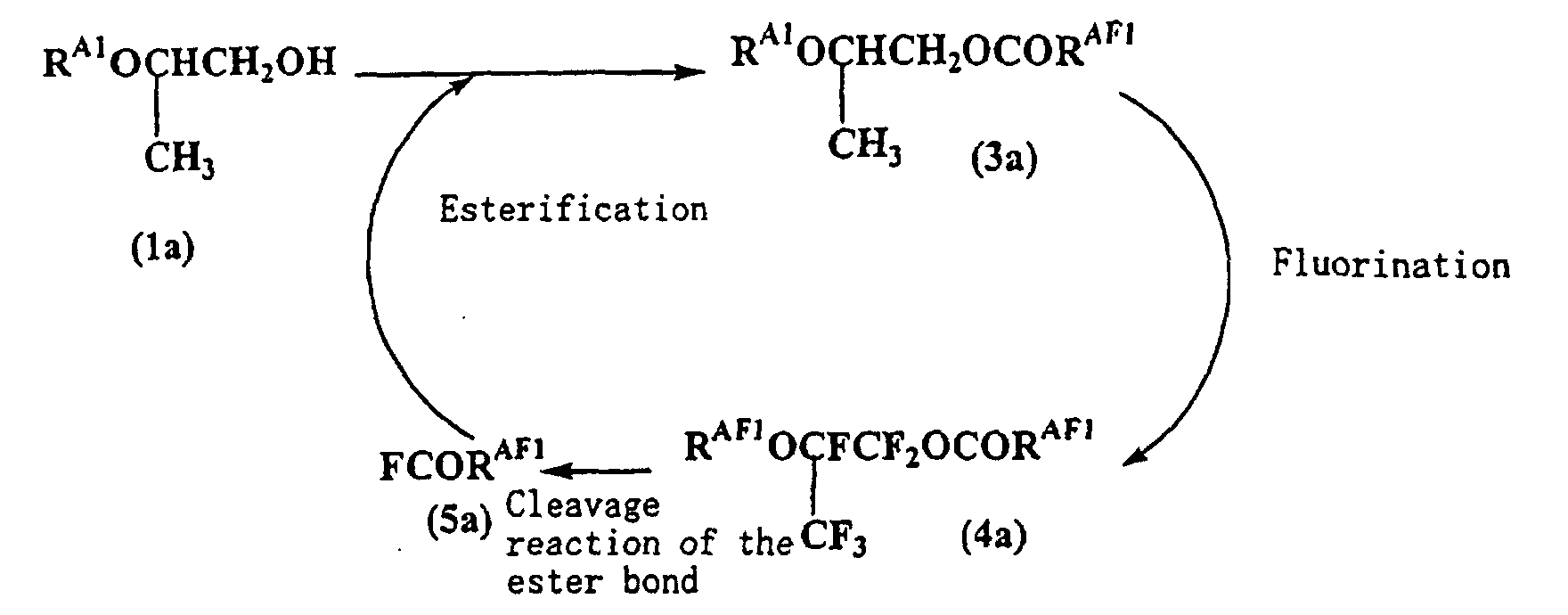
- the compound (5) and/or the compound (6) obtained by the cleavage reaction of the ester bond may be reacted as the compound (2) with the compound (1).
- the process of the present invention can be carried out as a continuous process simply by supplying the compound (1) to the reaction system.
- a known pyrolytic reaction e.g. Methods of Organic Chemistry, 4, Vol. 10b, Part 1, p. 703
- the compound (5) to be produced by the present invention is useful also as a raw material for an emulsifier.
- the terminal group -COF of the compound (5) is hydrolyzed to -COOH and then reacted with aqueous ammonia or an alkali metal hydroxide, whereby it can be led to -COO - M + (wherein M + is NH 4 + or an alkali metal cation).
- the hydrolysis can be carried out by a known method. It is preferred to carry out the hydrolysis by using at least 1 time by mol of water to the compound (5). Such a hydrolysis can be carried out also by contacting excess water to the compound (5).
- the hydrolysis may be carried out in the presence of an organic solvent. Further, the hydrolysis may be carried out in a homogeneous reaction system or in a heterogeneous system comprising an organic layer and an aqueous layer. If the reaction is carried out in a heterogeneous system, a surfactant, a phase-transfer catalyst or the like may be present in the reaction system.
- the reaction temperature for the hydrolysis is not particularly limited and is usually preferably from 0 to 50°C.
- the reaction pressure is not particularly limited and is usually preferably atmospheric pressure.
- the reaction time is preferably from 0.1 to 5 hours, particularly preferably from 0.5 to 3 hours.
- HF will be formed.
- a basic scavenger such as an alkali metal hydroxide may be added.
- an alkali metal hydroxide may be added.
- a carboxylic acid compound having the terminal -COF or the compound (5) converted to -COOH will be formed.
- the crude product is used as it is in the subsequent step.
- such a carboxylic acid component may be isolated and purified by a method such as recrystallization, distillation or sublimation.
- the carboxylic acid compound thus obtained is reacted with ammonia or an alkali metal hydroxide to form the compound (7).
- This reaction may be carried out in the presence of an organic solvent.
- the hydrolysis may be carried out in a homogeneous reaction system or in a heterogeneous system comprising an organic layer and an aqueous layer.
- a surfactant, a phase-transfer catalyst or the like may also be present in the reaction system.
- the ammonia or the alkali metal hydroxide is preferably used in the form of its aqueous solution for the reaction with the carboxylic acid compound.
- the amount of the ammonia or the alkali metal hydroxide is preferably from 1 to 2 times by mol, particularly preferably an equal time by mol to the carboxylic acid compound. Further, in a case where ammonia is used in excess, non-reacted ammonia can easily be removed under reduced pressure, such being preferred.
- the reaction temperature for the reaction is not particularly limited, and it is usually preferably from 0°C to 50°C.
- the reaction pressure is not particularly limited, and it is usually preferably atmospheric pressure.
- the reaction time is preferably from 0.1 to 5 hours, particularly preferably from 0.5 to 3 hours.
- the solvent and excess moisture may be distilled off as the case requires, to obtain the desired compound (7). Further, if necessary, the compound (7) may be purified by a method such as recrystallization or sublimation.
- novel compounds (7A) will be provided.
- R AF1 is a C 4-10 perfluoroalkyl group, and n is an integer of from 1 to 10.
- M + is NH 4 + or an alkali metal cation.
- R AF1 is preferably a C 6 -perfluoroalkyl group (i.e. C 6 F 13 -). Especially from the viewpoint of the performance as an emulsifier, R AF1 is particularly preferably F(CF 2 ) m - (m is an integer of from 4 to 10), especially preferably such a group wherein m is 6 (i.e. F(CF 2 ) 6 -). Further, n is preferably 1.
- the compound (7) thus prepared is useful as a fluorinated surfactant or as an emulsifier.
- the compound (7) is useful as an emulsifier in emulsion polymerization, particularly useful as an emulsifier to be used for emulsion polymerization of a fluorinated polymerizable monomer.
- the fluorinated polymerizable monomer which can be polymerized by emulsion polymerization by means of the compound (7) of the present invention may, for example, be a fluorinated olefin such as tetrafluoroethylene, hexafluoropropylene, trifluoroethylene, chlorotrifluoroethylene, vinylidene fluoride, vinyl fluoride, perfluoro(methyl vinyl ether), perfluoro(propyl vinyl ether), perfluoro(butenyl vinyl ether) or perfluoro(2,2-dimethyldioxolane) or a fluorinated monomer such as an acrylate or methacrylate having a polyfluoroalkyl group.
- fluorinated polymerizable monomers may be polymerized alone or in combination as a mixture of two or more of them.
- one or more fluorinated polymerizable monomers may be polymerized with at least one polymerizable monomer containing no fluorine and being polymerizable therewith.
- a known method may be employed.
- a method may be mentioned wherein the compound (7) of the present invention, the polymerizable monomer and a polymerization initiator are added to an aqueous medium, and polymerization is carried out with stirring.
- the amount of the compound (7) is preferably from about 0.01 to 2 wt%, based on the aqueous medium.
- the compound (7) may be added all at once at the initial stage of the polymerization reaction, or a part of the amount is added at the initial stage of the polymerization reaction, and the rest may be added as the polymerization reaction proceeds.
- the polymerization initiator to be used for the emulsion polymerization it is usually preferred to employ a water-soluble radical generator such as an inorganic peroxide such as ammonium persulfate or potassium persulfate, or an organic peroxide such as disuccinic peroxide. Further; a redox type polymerization initiator by a combination with a reducing agent, may also be employed.
- a water-soluble radical generator such as an inorganic peroxide such as ammonium persulfate or potassium persulfate, or an organic peroxide such as disuccinic peroxide.
- a redox type polymerization initiator by a combination with a reducing agent may also be employed.
- the polymerization temperature for the emulsion polymerization is usually preferably from 20 to 120°C, particularly preferably from 25 to 80°C. Further, the pressure for the polymerization reaction is preferably at most 3 MPa.
- the compound (7) of the present invention has an ether structure at the ⁇ -position and thus is a compound which can be present sufficiently stably under the polymerization conditions for the emulsion polymerization.
- the compound (7) has a nature such that it tends to undergo pyrolysis at a relatively low temperature and thus is a useful compound, of which the influence to the environment such as accumulation, can be minimized. Namely, with the fluororesin emulsion obtained by the emulsion polymerization employing the compound (7) of the present invention, the safety can be improved over the one obtained by using a conventional emulsifier.
- a perfluoroacyl fluoride can be produced in a short process and in high yield by using the compound (1) and the compound (2) which are materials available at low costs. Further, by employing the process of the present invention, a low molecular weight acyl fluoride and a carboxylic acid salt which used to be difficult to obtain by conventional methods, can be produced efficiently. Further, by selecting the structures of R A and R B , the process of the present invention can be made to be a continuous process.
- acyl fluoride and the carboxylic acid salt obtainable by the process of the present invention are compounds useful as emulsifiers or fluororesin monomers.
- gas chromatography is represented by GC
- gas chromatographic mass spectrometry by GC-MS
- infrared absorption spectrum by IR spectrum.
- the purity determined by the peak area ratio of GC is represented by GC purity
- the yield by GC yield is represented by R-113.
- Example 1 Example for the preparation of CF 3 CF 2 CF 2 OCF(CF 3 )CF 2 OCF(CF 3 )COF(5a)
- R A1 in the following formula represents CH 3 CH 2 CH 2 OCH(CH 3 )CH 2 -
- R AF1 represents -CF(CF 3 )OCF 2 CF(CF 3 )OCF 2 CF 2 CF 3 .
- Example 1-1 Example for the preparation of CH 3 CH 2 CH 2 [OCH(CH 3 )CH 2 ] 2 OCO[CF(CF 3 )OCF 2 ] 2 CF 2 CF 3 (3a) by an esterification reaction
- Example 1-2 Example for the preparation of CF 3 CF 2 CF 2 [OCF(CF 3 )CF 2 ] 2 OCO[CF(CF 3 )OCF 2 ] 2 CF 2 CF 3 (4a) by a fluorination reaction
- Example 1-3 Example for the preparation of CF 3 CF 2 CF 2 OCF(CF 3 )CF 2 OCF(CF 3 )COF (5a) by a liquid phase ester cleavage reaction
- Example 1-2 The compound (4a) (8.5 g) obtained in Example 1-2 was charged together with NaF powder (0.1 g) into a flask and heated for 9.5 hours at 190°C in an oil bath, while stirring vigorously. At an upper portion of the flask, a reflux condenser adjusted to a temperature of 20°C was installed. After cooling, 8.3 g of a liquid sample was recovered. As a result of an analysis by GC-MS, the compound (5a) was confirmed to be the main product. Further, in the IR spectrum of the main product, an absorption attributable to -COF was observed in the vicinity of 1880 cm -1 . the GC yield was 85%.
- Example 1-4 Example for the preparation of CF 3 CF 2 CF 2 OCF(CF 3 )CF 2 OCF(CF 3 )COO - NH 4 +
- the compound (5a) (6662.9 g) obtained in the method of Example 1-3, as diluted with R-225, was added, and pure water (234.8 g) was dropwise added while stirring vigorously. While removing HF formed, by nitrogen blowing, stirring was continued for 22 hours, and the reaction was terminated at a stage where disappearance of the compound (5a) was confirmed by GC. By bubbling nitrogen for further 5 hours with stirring, HF was removed until the F - concentration became 15 ppm, to obtain CF 3 CF 2 CF 2 OCF(CF 3 )CF 2 OCF(CF 3 )COOH.
- the solution was transferred to a 20 L round bottomed flask, and then NH 3 gas was fed at a flow rate of 80 NL/hr while stirring vigorously under cooling with ice bath for conversion to an ammonium salt. After confirming the neutralization by measuring the pH, nitrogen bubbling was carried out to remove excess ammonia.
- the obtained solution was evaporated to remove excess water azeotropically with R-225, to obtain a highly viscous ammonium salt solution. Thereafter, R-225 was added again and dissolved and left to stand still under cooling at -1 to 3°C to carry out purification by reprecipitation.
- the obtained white gelled precipitate was subjected to evaporation to distill off R-225. As a result, the above identified compound was obtained in an amount of 5189.7 g (yield: 75.6%) as slightly viscous white solid. The concentration of R-225 remaining in this white solid was less than 100 ppb.
- Example 2 Example for the preparation of F(CF 2 ) 6 OCF(CF 3 )COF (5b)
- F(CF 2 ) 6 OCF(CF 3 )COF (2.0 g) obtained in Example 2 and deionized water (30 mL) were added. While removing HF generated, by nitrogen blowing, stirring was continued for 3 hours. At the initial stage of the reaction, the reaction system was separated in two layers, but as the time passed, the reaction system became one layer. When it became one layer, the reaction was terminated. Then, water and the HF content were distilled off under reduced pressure, to obtain F(CF 2 ) 6 OCF(CF 3 )COOH as a viscous liquid.
- Example 3 After expiration of 45 minutes from the initiation of the polymerization, the temperature was raised to 90°C at a rate of 6°C/hr. Further, when the amount of TFE supplied became 6.6 kg, the compound (7a) obtained in Example 3 (1 L of a 6.2 mass% aqueous solution) was added.
- a sodium formaldehyde sulfoxylate/sodium hydroxide mixed aqueous solution wherein the concentration of sodium formaldehyde sulfoxylate was 20%, and the concentration of sodium hydroxide was 2.4%, was continuously added to the polymerization vessel to initiate the polymerization.
- the obtained polymer was a polymer wherein from the analysis of the fluorine content, the composition of TFE/propylene was 56.1/43.9 mol%, and from the thermal analysis, the glass transition temperature was 2°C. Further, the Mooney viscosity of this polymer was measured in accordance with the method for the Mooney viscosity test as described in JIS K6300, whereby it was 92.2 ML (1+4) 100°C, and 93.6 ML (1+10) 100°C.
- an acyl fluoride and a carboxylic acid salt useful as a raw material for a fluororesin monomer or an emulsifier, with efficient productivity while preventing side reactions.
- the process of the present invention can be carried out without using CsF and thus is a process which is economically more advantageous than a conventional process. Further, according to the process of the present invention, as is different from the process for production by an addition reaction, a product corresponding to the structure of the starting material can be produced, and it is possible to obtain a product having the carbon number of the group controlled. Further, it is possible to obtain a desired compound containing little impurities.
- an emulsifier having a desired carbon number can be produced. Further, production of emulsifiers having various structures is easy. Namely, according to the present invention, it is possible to produce an emulsifier of a structure which corresponds to the desired performance. Accordingly, various emulsifiers will be available which satisfy the stability of the emulsifiers and the required performance, etc. when used for polymerization reactions.
Landscapes
- Chemical & Material Sciences (AREA)
- Organic Chemistry (AREA)
- Engineering & Computer Science (AREA)
- Oil, Petroleum & Natural Gas (AREA)
- Materials Engineering (AREA)
- Organic Low-Molecular-Weight Compounds And Preparation Thereof (AREA)
Abstract
Description

19F-NMR (376.0 MHz, solvent: D2O, standard: CFCl3) δ (ppm):-83.6(2F), -83.7(3F), -84.0(3F), -123.9(2F), -124.6(2F), -127.2(2F), -127.4(1F), -128.2(2F)
1H-NMR (399.0 MHz, solvent: D2O, standard: TMS) δ (ppm): 7.2 (4H)
Claims (9)
- A process for producing a compound of the following formula (5), or a compound of the following formula (5) and a compound of the following formula (6), which comprises reacting a compound of the following formula (1) and a compound of the following formula (2) to form a compound of the following formula (3), fluorinating in a liquid phase the compound of the formula (3) thus formed, to obtain a compound of the following formula (4), and then cleaving an ester bond in the compound of the formula (4):wherein RA is a group which becomes RAF upon fluorination, RAF is a perfluoroalkyl group, RB is the same monovalent organic group as RBF or a monovalent organic group which becomes RBF upon fluorination, RBF is a monovalent organic group, X is a halogen atom, and n is an integer of from 1 to 10.(1) RA [OCH(CH3)CH2] n OH(2) XCORB(3) RA [OCH(CH3)CH2] n OCORB(4) RAF [OCF(CF3)CF2] n OCORBF(5) RAF [OCF(CF3)CF2] n-1 OCF(CF3)COF(6) FCORBF
- The process according to Claim 1, wherein each of RB and RBF is RAF[OCF(CF3)CF2]n-1OCF(CF3)-, wherein n is as defined above.
- The process according to Claim 1 or 2, wherein n is 2.
- A process for producing a compound of the following formula (7), which comprises hydrolyzing the compound of the formula (5) obtained by the process of any one of Claims 1 to 3, followed by a reaction with ammonia or an alkali metal hydroxide:wherein RAF and n are as defined above, M+ is NH4 + or an alkali metal cation.(7) RAF [OCF(CF3)CF2]n-1OCF (CF3)COO-M+
- A compound of the following formula (4A):wherein RAF is a perfluoroalkyl group, and n is an integer of from 1 to 10.

- A compound of the following formula (7A):wherein RAF1 is a C4-10 perfluoroalkyl group, n is an integer of from 1 to 10, and M+ is NH4 + or an alkali metal cation.(7A) RAF1 [OCF (CF3) CF2] n-1 OCF (CF3) COO-M+
- The compound of the formula (7A) according to Claim 6, wherein n is 1.
- The compound of the formula (7A) according to Claim 6 or 7, wherein RAF1 is C6F13-.
- An emulsifier comprising the compound of the formula (7A) as defined in any one of Claims 6 to 8.
Applications Claiming Priority (5)
| Application Number | Priority Date | Filing Date | Title |
|---|---|---|---|
| JP2000294977 | 2000-09-27 | ||
| JP2000294977 | 2000-09-27 | ||
| JP2001057131 | 2001-03-01 | ||
| JP2001057131 | 2001-03-01 | ||
| PCT/JP2001/008368 WO2002026686A1 (en) | 2000-09-27 | 2001-09-26 | Process for producing acyl fluoride and carboxylic acid salt |
Publications (2)
| Publication Number | Publication Date |
|---|---|
| EP1323702A1 true EP1323702A1 (en) | 2003-07-02 |
| EP1323702A4 EP1323702A4 (en) | 2005-12-07 |
Family
ID=26600880
Family Applications (1)
| Application Number | Title | Priority Date | Filing Date |
|---|---|---|---|
| EP01970216A Withdrawn EP1323702A4 (en) | 2000-09-27 | 2001-09-26 | PROCESS FOR THE PRODUCTION OF ACYL FLUORIDE AND CARBOXYLIC ACID SALT |
Country Status (7)
| Country | Link |
|---|---|
| US (1) | US20030171616A1 (en) |
| EP (1) | EP1323702A4 (en) |
| JP (1) | JPWO2002026686A1 (en) |
| CN (1) | CN1466562A (en) |
| AU (1) | AU2001290272A1 (en) |
| RU (1) | RU2003112232A (en) |
| WO (1) | WO2002026686A1 (en) |
Families Citing this family (10)
| Publication number | Priority date | Publication date | Assignee | Title |
|---|---|---|---|---|
| JP4802367B2 (en) | 1999-03-23 | 2011-10-26 | 旭硝子株式会社 | Method for producing fluorine-containing compound by liquid phase fluorination |
| KR20030009503A (en) | 2000-06-02 | 2003-01-29 | 아사히 가라스 가부시키가이샤 | Process for preparing unsaturated compounds by pyrolysis |
| EP1300386B1 (en) | 2000-07-11 | 2007-09-19 | Asahi Glass Company, Limited | Method for producing fluorine-containing compound |
| KR100758163B1 (en) | 2000-07-28 | 2007-09-12 | 아사히 가라스 가부시키가이샤 | Method for producing fluorine-containing acyl fluoride and method for producing fluorine-containing vinyl ether |
| WO2002026689A1 (en) * | 2000-09-27 | 2002-04-04 | Asahi Glass Company, Limited | Process for producing fluorinated polyvalent carbonyl compound |
| EP1542957B9 (en) * | 2002-09-25 | 2009-10-28 | E.I. Du Pont De Nemours And Company | Process for preparing fluorocarboxylic acids |
| JP5375095B2 (en) * | 2006-08-31 | 2013-12-25 | 旭硝子株式会社 | Method for producing perfluorocarboxylate, method for producing perfluorocarboxylate aqueous solution, method for producing homopolymer or copolymer of tetrafluoroethylene |
| SI3715345T1 (en) * | 2012-07-25 | 2024-07-31 | Bausch + Lomb Ireland Limited | PREPARATION OF THE LFA-1 INHIBITOR |
| EP4029898B1 (en) * | 2019-09-13 | 2025-08-06 | Daikin Industries, Ltd. | Fluoropolyether group containing compound and method for producing same |
| CN111116347A (en) * | 2019-12-30 | 2020-05-08 | 天津市长芦化工新材料有限公司 | Perfluoropolyether carboxylic acids with low HF content and process for their preparation |
Family Cites Families (11)
| Publication number | Priority date | Publication date | Assignee | Title |
|---|---|---|---|---|
| US3271341A (en) * | 1961-08-07 | 1966-09-06 | Du Pont | Aqueous colloidal dispersions of polymer |
| US3250808A (en) * | 1963-10-31 | 1966-05-10 | Du Pont | Fluorocarbon ethers derived from hexafluoropropylene epoxide |
| US3367868A (en) * | 1966-04-01 | 1968-02-06 | Du Pont | Rust inhibited poly(hexafluoropropylene oxide) oil compositions |
| JPS6039176A (en) * | 1983-08-10 | 1985-02-28 | Daikin Ind Ltd | Etching agent composition |
| JPS61223007A (en) * | 1985-03-28 | 1986-10-03 | Daikin Ind Ltd | Emulsion polymerization of fluoroelastomer |
| US4889656A (en) * | 1987-10-30 | 1989-12-26 | Minnesota Mining And Manufacturing Company | Perfluoro(cycloaliphatic methyleneoxyalkylene) carbonyl fluorides and derivatives thereof |
| US5093432A (en) * | 1988-09-28 | 1992-03-03 | Exfluor Research Corporation | Liquid phase fluorination |
| US5118494A (en) * | 1990-03-23 | 1992-06-02 | Minnesota Mining And Manufacturing Company | Use of soluble fluorosurfactants for the preparation of metered-dose aerosol formulations |
| JP2838352B2 (en) * | 1993-09-21 | 1998-12-16 | 信越化学工業株式会社 | Method for producing linear organopolysiloxane |
| US5466877A (en) * | 1994-03-15 | 1995-11-14 | Minnesota Mining And Manufacturing Company | Process for converting perfluorinated esters to perfluorinated acyl fluorides and/or ketones |
| JP4802367B2 (en) * | 1999-03-23 | 2011-10-26 | 旭硝子株式会社 | Method for producing fluorine-containing compound by liquid phase fluorination |
-
2001
- 2001-09-26 JP JP2002531073A patent/JPWO2002026686A1/en active Pending
- 2001-09-26 EP EP01970216A patent/EP1323702A4/en not_active Withdrawn
- 2001-09-26 AU AU2001290272A patent/AU2001290272A1/en not_active Abandoned
- 2001-09-26 RU RU2003112232/04A patent/RU2003112232A/en not_active Application Discontinuation
- 2001-09-26 CN CNA018162975A patent/CN1466562A/en active Pending
- 2001-09-26 WO PCT/JP2001/008368 patent/WO2002026686A1/en not_active Ceased
-
2003
- 2003-03-27 US US10/397,423 patent/US20030171616A1/en not_active Abandoned
Also Published As
| Publication number | Publication date |
|---|---|
| RU2003112232A (en) | 2004-09-20 |
| US20030171616A1 (en) | 2003-09-11 |
| WO2002026686A1 (en) | 2002-04-04 |
| CN1466562A (en) | 2004-01-07 |
| EP1323702A4 (en) | 2005-12-07 |
| JPWO2002026686A1 (en) | 2004-02-05 |
| AU2001290272A1 (en) | 2002-04-08 |
Similar Documents
| Publication | Publication Date | Title |
|---|---|---|
| USRE41184E1 (en) | Process for producing a fluorine atom-containing sulfonyl fluoride compound | |
| US7053237B2 (en) | Process for producing a fluorinated ester, a fluorinated acyl fluoride and a fluorinated vinyl ether | |
| US6969776B2 (en) | Process for producing fluorinated ketone | |
| CA2362695C (en) | Process for producing a fluorine-containing compound by liquid phase fluorination | |
| KR20030043973A (en) | Process for producing fluorinated ester compound | |
| US20030171616A1 (en) | Process for producing acyl fluoride and carboxylic acid salt | |
| KR100758163B1 (en) | Method for producing fluorine-containing acyl fluoride and method for producing fluorine-containing vinyl ether | |
| JP4961656B2 (en) | Process for producing perfluoroacyl fluorides | |
| JP2001139509A (en) | Method for production of unsaturated compound by thermal decomposition reaction | |
| US7053238B2 (en) | Process for producing fluorinated polyvalent carbonyl compound | |
| RU2281280C2 (en) | Method for preparing fluorinated derivatives of ethylene-unsaturated compounds | |
| JPWO2001094285A1 (en) | Method for producing unsaturated compounds by thermal decomposition | |
| JPWO2002010107A1 (en) | Method for producing perfluoroacyl fluorides | |
| HK1053457A (en) | Process for producing acyl fluoride and carboxylic acid salt | |
| JP5092192B2 (en) | Process for producing perfluoro compounds and derivatives thereof | |
| JPWO2002026693A1 (en) | Method for producing fluorine-containing amine compound | |
| JPWO2002026682A1 (en) | Method for producing fluorine-containing vinyl ether compound | |
| JPWO2002020445A1 (en) | Method for producing fluorine-containing unsaturated compounds and method for producing fluorine-containing polymers | |
| JP2003238461A (en) | Process for producing perfluoroolefins |
Legal Events
| Date | Code | Title | Description |
|---|---|---|---|
| PUAI | Public reference made under article 153(3) epc to a published international application that has entered the european phase |
Free format text: ORIGINAL CODE: 0009012 |
|
| 17P | Request for examination filed |
Effective date: 20030320 |
|
| AK | Designated contracting states |
Designated state(s): AT BE CH CY DE DK ES FI FR GB GR IE IT LI LU MC NL PT SE TR |
|
| AX | Request for extension of the european patent |
Extension state: AL LT LV MK RO SI |
|
| STAA | Information on the status of an ep patent application or granted ep patent |
Free format text: STATUS: THE APPLICATION IS DEEMED TO BE WITHDRAWN |
|
| 18D | Application deemed to be withdrawn |
Effective date: 20050401 |
|
| A4 | Supplementary search report drawn up and despatched |
Effective date: 20051020 |
|
| REG | Reference to a national code |
Ref country code: HK Ref legal event code: WD Ref document number: 1053457 Country of ref document: HK |