EP1323416A1 - Process for producing medicinal solid dispersion - Google Patents
Process for producing medicinal solid dispersion Download PDFInfo
- Publication number
- EP1323416A1 EP1323416A1 EP01967818A EP01967818A EP1323416A1 EP 1323416 A1 EP1323416 A1 EP 1323416A1 EP 01967818 A EP01967818 A EP 01967818A EP 01967818 A EP01967818 A EP 01967818A EP 1323416 A1 EP1323416 A1 EP 1323416A1
- Authority
- EP
- European Patent Office
- Prior art keywords
- solid dispersion
- pharmaceutical
- twin
- producing
- hydrochloride
- Prior art date
- Legal status (The legal status is an assumption and is not a legal conclusion. Google has not performed a legal analysis and makes no representation as to the accuracy of the status listed.)
- Granted
Links
Images

Classifications
-
- A—HUMAN NECESSITIES
- A61—MEDICAL OR VETERINARY SCIENCE; HYGIENE
- A61K—PREPARATIONS FOR MEDICAL, DENTAL OR TOILETRY PURPOSES
- A61K9/00—Medicinal preparations characterised by special physical form
- A61K9/14—Particulate form, e.g. powders, Processes for size reducing of pure drugs or the resulting products, Pure drug nanoparticles
- A61K9/16—Agglomerates; Granulates; Microbeadlets ; Microspheres; Pellets; Solid products obtained by spray drying, spray freeze drying, spray congealing,(multiple) emulsion solvent evaporation or extraction
- A61K9/1605—Excipients; Inactive ingredients
- A61K9/1617—Organic compounds, e.g. phospholipids, fats
- A61K9/1623—Sugars or sugar alcohols, e.g. lactose; Derivatives thereof; Homeopathic globules
-
- A—HUMAN NECESSITIES
- A61—MEDICAL OR VETERINARY SCIENCE; HYGIENE
- A61K—PREPARATIONS FOR MEDICAL, DENTAL OR TOILETRY PURPOSES
- A61K9/00—Medicinal preparations characterised by special physical form
- A61K9/14—Particulate form, e.g. powders, Processes for size reducing of pure drugs or the resulting products, Pure drug nanoparticles
- A61K9/16—Agglomerates; Granulates; Microbeadlets ; Microspheres; Pellets; Solid products obtained by spray drying, spray freeze drying, spray congealing,(multiple) emulsion solvent evaporation or extraction
- A61K9/1605—Excipients; Inactive ingredients
- A61K9/1629—Organic macromolecular compounds
- A61K9/1652—Polysaccharides, e.g. alginate, cellulose derivatives; Cyclodextrin
Definitions
- the present invention relates to a process for producing a pharmaceutical solid dispersion which is useful as bulk substance of pharmaceutical preparations.
- the pharmaceutical solid dispersion is well-known among persons skilled in the art and is considered as such a state that a pharmaceutical ingredient in unimolecular form is dispersed in an inert carrier while being dissolved therein or in the solid state, as can be recognized from the fact that when such a pharmaceutical solid dispersion is analyzed using an X-ray diffraction apparatus, a crystalline peak of the pharmaceutical ingredient will not appear.
- the pharmaceutical solid dispersion is recognized as one of the useful devices for improving the solubility of pharmaceutical ingredients, in particular, water-insoluble pharmaceutical ingredients in living body, thereby improving the bioavailability.
- water-soluble polymers such as methylcellulose, ethylcellulose, hydroxyethylcellulose, hydroxypropylcellulose, hydroxypropyl methylcellulose, carboxymetylcellulose, polyvinylpyrrolidone, polyvinyl alcohol, gum arabic, dextrin and gelatin are usually used.
- hydroxypropyl methylcellulose is known as an excellent carrier for solid dispersion since it is superior from the view points of elution property and bioavailability of pharmaceutical ingredient, as well as it is stable toward moisture and the like (Chem. Pharm. Bull., 30, 4479 (1982); J.Pharm.Sci.Technol.,Jpn., 44, 31 (1984)).
- the method of producing the solid dispersion by executing kneading and extruding processes using the twin-screw compounding extruder will not cause a problem of residual solvent as is often occurring in the solvent method, while providing many advantages such that it can be applied to many kinds of water-soluble polymer carriers and pharmaceutical ingredients, and a homogeneous and excellent solid dispersion can be continuously produced.
- the solid dispersion is produced using hydroxypropyl methylcellulose which is superior in elution property of pharmaceutical ingredient and stability as a carrier while using the above-mentioned twin-screw compounding extruder, the obtainable solid dispersion is very hard, so that it is difficult to directly subject the solid dispersion to the subsequent preparation processes such as grinding and filling which follow the extruding. Granted that grinding is executed after extrusion, it will result in production of plenty of fibrous materials.
- the inventors of the present invention found that the above-mentioned object can be achieved by using a sugar alcohol, as well as a pharmaceutical ingredient and hydroxypropyl methylcellulose which is a carrier, as essential components of a solid dispersion, to finally accomplish the present invention.
- the present invention therefore, provides a process for producing a pharmaceutical solid dispersion including hydroxypropyl methylcellulose as a carrier with the use of a twin-screw compounding extruder, characterized in that a sugar alcohol is added as one of processing materials and kneading and extruding processes are performed for the processing materials with the use of the twin-screw compounding extruder.
- Sugar alcohols used in the present invention include, but not limited to, erythritol, mannitol, xylitol, sorbitol, inositol, maltitol, arabitol and dulcitol. Among these, erythritol, xylitol and mannitol are preferred, and erythritol is more preferred.
- Pharmaceutical ingredients used in the present invention are not particularly limited, but water-insoluble pharmaceutical ingredients having a solubility at 25°C of 500 ⁇ g/mL or less with respect to the first liquid and the second liquid defined by the Japanese Pharmacopoeia, thirteenth edition, are suited, and water-insoluble pharmaceutical ingredients having a solubility at 25°C of 100 ⁇ g/mL or less with respect to the first fluid and the second fluid defined by the Japanese Pharmacopoeia, thirteenth edition, are preferred. In addition, water-insoluble pharmaceutical ingredients having such solubility and having a melting point or a decomposition temperature of not less than 50°C are more preferred. Concrete examples of such pharmaceutical ingredients are as follows.
- Nifedipine isosorbide dinitrate, diltiazem hydrochloride, trapidil, dipyridamole, dilazep hydrochloride, methyl 2,6-dimethyl-4-(2-nitrophenyl)-5-(2-oxo-1,3,2-dioxaphosphorinane-2-yl)-1,4-dihydropyridine-3-carboxylate, verapamil, nicardipine, nicardipine hydrochloride, and verapamil hydrochloride.
- Diprophylline salbutamol sulfate, clorprenaline hydrochloride, formoterol fumarate, orciprenaline sulfate, pirbuterol hydrochloride, hexoprenaline sulfate, bitolterol mesylate, clenbuterol hydrochloride, terbutaline sulfate, mabuterol hydrochloride, fenoterol hydrobromide, and methoxyphenamine hydrochloride.
- Procainamide hydrochloride disopyramide, ajmaline, quinidine sulfate, aprindine hydrochloride, propafenone hydrochloride, and mexiletine hydrochloride.
- Allopurinol, probenecid, colchicine, sulfinpyrazone, benzbromarone, and bucolome Allopurinol, probenecid, colchicine, sulfinpyrazone, benzbromarone, and bucolome.
- Ticlopidine hydrochloride dicumarol, and warfarin potassium.
- Phenytoin, sodium valproate, metharbital, and carbamazepine Phenytoin, sodium valproate, metharbital, and carbamazepine.
- Chlorpheniramine maleate clemastine fumarate, mequitazine, alimemazine tartrate, cycloheptadine hydrochloride, and ebastin.
- Difenidol hydrochloride metoclopramide, domperidone, betahistine mesylate, and trimebutine maleate.
- Dihydroergotamine mesylate, isoproterenol hydrochloride, and etilefrine hydrochloride Dihydroergotamine mesylate, isoproterenol hydrochloride, and etilefrine hydrochloride.
- Glibenclamide tolbutamide, glymidine sodium, troglitazone, rosiglitazone, pioglitazone hydrochloride, and epalrestat.
- Vitamin B 1 Vitamin B 2 , vitamin B 6 , vitamin B 12 , vitamin C, and folacin.
- Compound A (3 ⁇ ,4 ⁇ )-3,23-dihydroxy-N-(2-methoxyethyl)-18 ⁇ -olean-12-ene-28-amide (hereinafter referred to as "Compound A”.
- Paclitaxel docetaxel and bicalutamide.
- the present invention can be carried out by introducing each predetermined amount of a pharmaceutical ingredient, hydroxypropyl methylcellulose and a sugar alcohol in a mixture with an appropriate additive as desired, or simultaneously in separate conditions into a twin-screw compounding extruder according to a conventional method, executing processes such as kneading in the barrel of the twin-screw compounding extruder and extruding the processed object from the die. Some of processing materials may be introduced via an auxiliary feeding port on the extruder depending on the model of the extruder.
- the twin-screw compounding extruder which may be used in the present invention is not particularly limited insofar as it comprises two screw shafts which allow temperature control of the barrel and the outlet die. Those having screw elements called kneading elements (also called kneading disc or paddle) along parts of the two screw shafts so as to oppose to each other are preferred, and a co-rotating intermeshing twin-screw compounding extruder having such screw elements is more preferred.
- the mixing can be achieved either mechanically by means of a kneader mixer, a V-shape mixing machine, a double cone mixing machine, a cubic mixing machine, a ribbon-shape mixing machine and the like or manually in accordance with a conventional method.
- Introduction of the processing materials into the barrel may be executed manually or by means of a material supplier generally provided in the extruder in use, however it can be executed without causing any restriction by an apparatus which are able to feed processing materials at a constant speed.
- an apparatus which are able to feed processing materials at a constant speed. Examples of such an apparatus include a screw feeder, a table feeder, a belt-conveyer type volumetric feeder, an electromagnetic feeder and the like.
- Setting temperatures of the barrels and the die of the extruder are not particularly limited insofar as under that temperatures the processed object can be extruded and a solid dispersion is formed. Concretely, temperatures in the range of 130 to 250°C, preferably temperatures in the range of 170 to 200°C are suited. If the setting temperature is too high, the processed object may be discharged in a liquid form, which is undesirable from the view point of the posttreatment, and possibly leads decomposition of pharmaceutical ingredient. While on the other hand, if the setting temperature is too low, it is impossible to extrude the processed object, leading the fear that a solid dispersion cannot be produced.
- the revolution of the screw can be appropriately set depending on the model or type of the extruder, as well as on the materials and the shape of the screw, and can be set within the tolerance of the extruder in use.
- the discharge pressure is suitably in the range of 10 to 200 kg/cm 2 and preferably in the range of 30 to 150 kg/cm 2 .
- the shape and combination of the screw elements which can be used in the present invention may be selected without particular limitation. However, it is preferred to use one or more set (s) of kneading elements (kneading disc, paddle) providing strong kneading action and shearing action.
- kneading elements kneading disc, paddle
- the outlet die can be appropriately changed depending on the objective solid dispersion.
- Concrete examples of the outlet die include circular dies having various nozzle sizes for obtaining cylindrical processed objects, and flat dies for obtaining sheet-like processed objects.
- the processed object that has been subjected to the processes such as kneading in the barrel of the twin-screw compounding extruder is then extruded continuously from a fine-sized nozzle of the die.
- This extruded object may be cut into a desired length by means of appropriate cutting machines such as a roller-type cracking machine, a cutter mill and a pin mill.
- This cut object may be directly or after dried, prepared into a granular pharmaceutical preparation.
- a rotary cutter for example, a rotary cutter for KEXN-30, available from Kurimoto, Ltd.
- a rotary cutter for example, a rotary cutter for KEXN-30, available from Kurimoto, Ltd.
- the above granular object may be rendered a capsule preparation by capsulation, or may be rendered a tablet preparation by compression molding.
- the weight ratio of hydroxypropyl methylcellulose and sugar alcohol is suitably in the range of 3 to 100, and preferably in the range of 5 to 20.
- the blending ratio of the pharmaceutical ingredient is suitably in the range of 1 to 50% by weight in solid dispersion though it depends on the kind of the pharmaceutical ingredient, as well as on the blending ratio of hydroxypropyl methylcellulose and sugar alcohol, the kinds and amounts of other additives and the like.
- the weight ratio of hydroxypropyl methylcellulose and pharmaceutical ingredient is suitably in the range of 1 to 100, and preferably in the range of 3 to 10.
- additives may be added as necessary to the solid dispersion produced by the process of the present invention.
- examples of such additives include excipients (e.g., lactose, corn starch, crystalline cellulose, D-mannitol, calcium hydrogenphosphate), disintegrates (e.g., hydroxypropylcellulose of low substitution degree, carmellose, croscarmellose sodium, carmellose calcium), lubricants (e.g., magnesium stearate, calcium stearate, talc), colorants (e.g., iron sesquioxide, yellow iron sesquioxide, titanium oxide, tar dye), fragrant materials (e.g., 1-menthol, orange extract), surfactants (e.g., sucrose fatty acid ester, sodium lauryl sulfate, glycerine monostearate, polyoxyethylene hardened castor oil), and stabilizers (e.g., ascorbic acid, benzoic acid).
- excipients e.g., lactose,
- Some quantity of pharmaceutically acceptable polymer compounds other than hydroxypropyl methylcellulose may be added as necessary as an additive for the purpose of adjusting release or the like rather than serving as a carrier. In principle, it is not necessary to contain other polymer compounds.
- Such polymers include cellulose derivatives such as methylcellulose, ethylcellulose, hydroxyethylcellulose, hydroxypropylcellulose, carboxymetylcellulose, carboxyethylcellulose, hydroxypropyl methylcellulose acetate succinate (AQOAT (registered trademark) L, AQOAT M, AQOAT H), hydroxypropyl methylcellulose phthalate (HP-55, HP-55S, HP-50), cellulose acetate phthalate, carboxymethyl ethylcellulose; acrylic acid derivatives such as polyacrylic acid, polymethacrylic acid and alkali salts of polymethacrylic acid, and copolymers of methacrylic acid (Eudragit (registered trademark) L30D55, Eudragit L
- the mixture was then subjected to kneading and extruding processes using a twin-screw compounding extruder (Model KEXN-30, available from KURIMOTO, LTD.) which includes kneading elements having a twist angle of 60° wherein the screw revolution is 50 rpm, the nozzle diameter of the die is 2 mm, and the temperature of the entire barrel and the die is set at 170°C, to thereby produce a pharmaceutical solid dispersion.
- a twin-screw compounding extruder Model KEXN-30, available from KURIMOTO, LTD.
- a solid dispersion was produced in the same manner as Example 1 except that mannitol was used as the sugar alcohol and the temperature of the twin-screw compounding extruder was set at 170°C.
- a solid dispersion was produced in the same manner as Example 1 except that xylitol was used as the sugar alcohol and the temperature of the twin-screw compounding extruder was set at 170°C.
- a solid dispersion was produced in the same manner as Example 1 except that Compound A was used as the pharmaceutical ingredient and the temperature of the twin-screw compounding extruder was set at 190°C.
- a solid dispersion was produced in the same manner as Example 1 except that griseofulvin was used as the pharmaceutical ingredient and the temperature of the twin-screw compounding extruder was set at 190°C.
- a solid dispersion was produced in the same manner as Example 1 except that phenytoin was used as the pharmaceutical ingredient and the temperature of the twin-screw compounding extruder was set at 190°C.
- a solid dispersion was produced in the same manner as Comparative example 1 except that the blending amount of HPMC 2910 was 1800 g.
- a solid dispersion was produced in the same manner as Comparative example 1 except that Compound A was used as the pharmaceutical ingredient and the temperature of the twin-screw compounding extruder was set at 200°C.
- a solid dispersion was produced in the same manner as Comparative example 1 except that the blending amount of HPMC 2910 was 1800 g, Compound A was used as the pharmaceutical ingredient, and the temperature of the twin-screw com pounding extruder was set at 200°C.
- a solid dispersion was produced in the same manner as Comparative example 1 using griseofulvin as the pharmaceutical ingredient.
- a solid dispersion was produced in the same manner as Comparative example 1 except that griseofulvin was used as the pharmaceutical ingredient and the blending amount of HPMC 2910 was 1800 g.
- a solid dispersion was produced in the same manner as Comparative example 1 except that phenytoin was used as the pharmaceutical ingredient and the temperature of the twin-screw compounding extruder was set at 200°C.
- a solid dispersion was produced in the same manner as Comparative example 1 except that the blending amount of HPMC 2910 was 1800 g, phenytoin was used as the pharmaceutical ingredient, and the temperature of the twin-screw compounding extruder was set at 200°C.
- Example 1 The solid dispersions (extrudates) obtained by Example 1 and Comparative example 1 were pulverized using a sample mill (Model AP-S, available from HOSOKAWAMICRON CORPORATION.) A punch screen having a pore size of 1 mm was used.
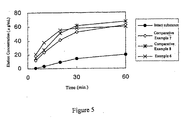
- elution amount (dissolution amount) of the pharmaceutical ingredient from the solid dispersion or dissolution concentration of the intact pharmaceutical ingredient was determined in accordance with the Method 2 of Dissolution Test (paddle method) defined in the Japanese Pharmacopoeia, 13 th edition.
- the test was carried out using 500 mL of purified water as a test solution and puddle rotation of 100 rpm. After starting the test, 2.5 mL of eluate was sampled at predetermined intervals, and filtered by a membrane filter. 1 mL of internal standard solution was added to each 1 mL of filtrate and the elution concentration or the dissolution concentration was determined by the HPLC method.
- the elution amounts (the dissolution amounts) of pharmaceutical ingredients from the solid dispersions containing a sugar alcohol were not inferior to those of the solid dispersions not containing a sugar alcohol.
Landscapes
- Health & Medical Sciences (AREA)
- Engineering & Computer Science (AREA)
- Bioinformatics & Cheminformatics (AREA)
- Life Sciences & Earth Sciences (AREA)
- Pharmacology & Pharmacy (AREA)
- Chemical & Material Sciences (AREA)
- Medicinal Chemistry (AREA)
- Epidemiology (AREA)
- Animal Behavior & Ethology (AREA)
- General Health & Medical Sciences (AREA)
- Public Health (AREA)
- Veterinary Medicine (AREA)
- Molecular Biology (AREA)
- Biophysics (AREA)
- Medicinal Preparation (AREA)
- Pharmaceuticals Containing Other Organic And Inorganic Compounds (AREA)
Abstract
Description
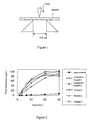
X: distance between supporting point and loading point (0.4 cm)
r: radius of sample- (1 mm)
| Nif.: HPMC: erythritol | 1:8:0 | 1:9:0 | 1:8:1 |
| Strength (N) ± S.D. | 61.7 ± 1.4 | 59.8 ± 1.0 | 31.9 ± 4.7 |
| Tensile strength (N/cm2) | 31.5 | 30.5 | 16.3 |
| Nif.: nifedipine |
Claims (11)
- A process for producing a pharmaceutical solid dispersion including hydroxypropyl methylcellulose as a carrier with the use of a twin-screw compounding extruder, characterized in that a sugar alcohol is added as one of processing materials and kneading and extruding processes are performed for the processing materials with the use of the twin-screw compounding extruder.
- The process for producing a pharmaceutical solid dispersion according to claim 1, wherein the sugar alcohol is at least one selected from the group consisting of erythritol, mannitol, xylitol, sorbitol, inositol, maltitol, arabitol and dulcitol.
- The process for producing a pharmaceutical solid dispersion according to claim 1 or 2, wherein the pharmaceutical ingredient is a water-insoluble pharmaceutical ingredient having a solubility at 25°C of 500 µg/mL or less with respect to the first fluid and the second fluid defined by the Japanese Pharmacopoeia, thirteenth edition.
- The process for producing a pharmaceutical solid dispersion according to claim 3, wherein the pharmaceutical ingredient is a water-insoluble pharmaceutical ingredient having a melting point or a decomposition temperature of not less than 50°C.
- The process for producing a pharmaceutical solid dispersion according to claim 1, wherein a weight ratio between hydroxypropyl methylcellulose and pharmaceutical ingredient (hydroxypropyl methylcellulose/pharmaceutical ingredient) is in the range of 1 to 100.
- The process for producing a pharmaceutical solid dispersion according to claim 1, wherein a weight ratio between hydroxypropyl methylcellulose and sugar alcohol (hydroxypropyl methylcellulose/sugar alcohol) is in the range of 3 to 100.
- The process for producing a pharmaceutical solid dispersion according to claim 1, wherein the twin-screw compounding extruder is a co-rotating intermeshing twin-screw compounding extruder.
- The process for producing a pharmaceutical solid dispersion according to claim 1 or 7, wherein the setting temperatures of each barrel and die of the twin-screw compounding extruder which are the same or different, fall within the range of 130°C to 250°C.
- A pharmaceutical solid dispersion produced by the process according to any one of claims 1 to 8.
- A pharmaceutical preparation containing the pharmaceutical solid dispersion according to claim 9.
- The pharmaceutical preparation according to claim 10, wherein the pharmaceutical preparation is a tablet preparation, a granule preparation, a capsule preparation, a subtle granule preparation or a powdery preparation.
Applications Claiming Priority (3)
| Application Number | Priority Date | Filing Date | Title |
|---|---|---|---|
| JP2000289760 | 2000-09-25 | ||
| JP2000289760 | 2000-09-25 | ||
| PCT/JP2001/008288 WO2002024168A1 (en) | 2000-09-25 | 2001-09-25 | Process for producing medicinal solid dispersion |
Publications (3)
| Publication Number | Publication Date |
|---|---|
| EP1323416A1 true EP1323416A1 (en) | 2003-07-02 |
| EP1323416A4 EP1323416A4 (en) | 2005-09-21 |
| EP1323416B1 EP1323416B1 (en) | 2010-12-22 |
Family
ID=18773098
Family Applications (1)
| Application Number | Title | Priority Date | Filing Date |
|---|---|---|---|
| EP01967818A Expired - Lifetime EP1323416B1 (en) | 2000-09-25 | 2001-09-25 | Process for producing medicinal solid dispersion |
Country Status (5)
| Country | Link |
|---|---|
| US (1) | US20040013736A1 (en) |
| EP (1) | EP1323416B1 (en) |
| JP (1) | JP4997683B2 (en) |
| DE (1) | DE60143704D1 (en) |
| WO (1) | WO2002024168A1 (en) |
Cited By (2)
| Publication number | Priority date | Publication date | Assignee | Title |
|---|---|---|---|---|
| WO2007017249A1 (en) * | 2005-08-08 | 2007-02-15 | Abbott Gmbh & Co. Kg | Dosage forms with improved bioavailability |
| WO2007017248A3 (en) * | 2005-08-08 | 2007-05-31 | Abbott Gmbh & Co Kg | Itraconazole compositions with improved bioavailability |
Families Citing this family (8)
| Publication number | Priority date | Publication date | Assignee | Title |
|---|---|---|---|---|
| DE10026698A1 (en) | 2000-05-30 | 2001-12-06 | Basf Ag | Self-emulsifying active ingredient formulation and use of this formulation |
| CN101091695B (en) * | 2003-02-03 | 2011-01-19 | 诺瓦提斯公司 | Pharmaceutical formulation |
| US8377952B2 (en) * | 2003-08-28 | 2013-02-19 | Abbott Laboratories | Solid pharmaceutical dosage formulation |
| US8025899B2 (en) * | 2003-08-28 | 2011-09-27 | Abbott Laboratories | Solid pharmaceutical dosage form |
| US20100016378A1 (en) * | 2005-04-28 | 2010-01-21 | Toshio Suzuki | Method of preventing dihydropyridine compound from degradation |
| JP6150518B2 (en) | 2012-12-27 | 2017-06-21 | 花王株式会社 | Method for producing polyphenol composition |
| AU2019225516A1 (en) * | 2018-02-21 | 2020-10-08 | Nippon Shinyaku Co., Ltd. | Granular composition, production method for granular composition, and dissolution property improvement method for granular composition |
| CN114652690B (en) * | 2022-03-31 | 2023-03-21 | 山东新时代药业有限公司 | New metoclopramide preparation for intestinal obstruction and process thereof |
Family Cites Families (9)
| Publication number | Priority date | Publication date | Assignee | Title |
|---|---|---|---|---|
| US4301146A (en) * | 1980-07-29 | 1981-11-17 | G. D. Searle & Co. | Stabilization of 16-oxygenated prostanoic acid derivatives |
| AU1537292A (en) * | 1991-04-16 | 1992-11-17 | Nippon Shinyaku Co. Ltd. | Method of manufacturing solid dispersion |
| US5843347A (en) * | 1993-03-23 | 1998-12-01 | Laboratoire L. Lafon | Extrusion and freeze-drying method for preparing particles containing an active ingredient |
| FR2702968B1 (en) * | 1993-03-23 | 1995-06-23 | Lafon Labor | Process for the preparation of particles containing an active ingredient by extrusion and lyophilization. |
| DE4316537A1 (en) * | 1993-05-18 | 1994-11-24 | Basf Ag | Preparations in the form of solid solutions |
| JPH07291854A (en) * | 1994-04-26 | 1995-11-07 | Tanabe Seiyaku Co Ltd | Pharmaceutical formulations with improved solubility |
| TW487582B (en) * | 1995-08-11 | 2002-05-21 | Nissan Chemical Ind Ltd | Method for converting sparingly water-soluble medical substance to amorphous state |
| HN1998000115A (en) * | 1997-08-21 | 1999-06-02 | Warner Lambert Co | SOLID PHARMACEUTICAL DOSAGE FORMS |
| DE19913692A1 (en) * | 1999-03-25 | 2000-09-28 | Basf Ag | Mechanically stable pharmaceutical dosage forms containing liquid or semi-solid surface-active substances |
-
2001
- 2001-09-25 DE DE60143704T patent/DE60143704D1/en not_active Expired - Lifetime
- 2001-09-25 WO PCT/JP2001/008288 patent/WO2002024168A1/en not_active Ceased
- 2001-09-25 US US10/381,173 patent/US20040013736A1/en not_active Abandoned
- 2001-09-25 EP EP01967818A patent/EP1323416B1/en not_active Expired - Lifetime
- 2001-09-25 JP JP2002528204A patent/JP4997683B2/en not_active Expired - Lifetime
Cited By (5)
| Publication number | Priority date | Publication date | Assignee | Title |
|---|---|---|---|---|
| WO2007017249A1 (en) * | 2005-08-08 | 2007-02-15 | Abbott Gmbh & Co. Kg | Dosage forms with improved bioavailability |
| WO2007017248A3 (en) * | 2005-08-08 | 2007-05-31 | Abbott Gmbh & Co Kg | Itraconazole compositions with improved bioavailability |
| US8486456B2 (en) | 2005-08-08 | 2013-07-16 | Abbott Gmbh & Co., Kg | Itraconazole compositions with improved bioavailability |
| US9060936B2 (en) | 2005-08-08 | 2015-06-23 | AbbVie Deutschland GmbH & Co. KG | Dosage forms with improved bioavailability |
| US9149431B2 (en) | 2005-08-08 | 2015-10-06 | Abbvie Deutschland Gmbh & Co Kg | Itraconazole compositions with improved bioavailability |
Also Published As
| Publication number | Publication date |
|---|---|
| DE60143704D1 (en) | 2011-02-03 |
| EP1323416B1 (en) | 2010-12-22 |
| WO2002024168A1 (en) | 2002-03-28 |
| EP1323416A4 (en) | 2005-09-21 |
| US20040013736A1 (en) | 2004-01-22 |
| JPWO2002024168A1 (en) | 2004-01-29 |
| JP4997683B2 (en) | 2012-08-08 |
Similar Documents
| Publication | Publication Date | Title |
|---|---|---|
| JP2527107B2 (en) | Method for producing solid dispersion | |
| US5700410A (en) | Method of manufacturing wax matrices | |
| US6692769B1 (en) | Sustained-release particles | |
| US5837285A (en) | Fast soluble tablet | |
| JPWO1992018106A1 (en) | Method for producing solid dispersion | |
| DE69226950T2 (en) | Long-term capsule for adhesion in the gastrointestinal tract | |
| US20060134199A1 (en) | Tablet quickly melting in oral cavity | |
| DE69428707T2 (en) | PREPARATION IN THE STOMACH, SOURCING MOLDED BODY AND PRODUCTION PROCESS | |
| US6692768B1 (en) | Preparation method of drug-containing spherical fine particles | |
| WO2008002529A2 (en) | Orally disintegrating layered compositions | |
| WO2000033820A2 (en) | Nanoparticulate core-shell systems and use thereof in pharmaceutical and cosmetic preparations | |
| EP1323416B1 (en) | Process for producing medicinal solid dispersion | |
| JPWO2003077827A1 (en) | Method for producing pharmaceutical solid dispersion | |
| JP4806885B2 (en) | Solid dispersions and drugs | |
| JP2011184378A (en) | Intraoral disintegrating preparation | |
| JPWO2001095941A1 (en) | Solid dispersions and drugs | |
| JPWO2002069932A1 (en) | Foamable composition | |
| JP2000198747A (en) | Sustained release particles | |
| JP2650493B2 (en) | Quick dissolving tablets | |
| JP2004024686A (en) | Manufacturing method for pharmaceutical wax matrix | |
| JP2811963B2 (en) | Gastric retentive preparation, puffed molded product and manufacturing method | |
| JP2003119123A (en) | Preparation for oral administration | |
| JPWO1995005809A1 (en) | Gastric retention preparation, expanded molded body and manufacturing method |
Legal Events
| Date | Code | Title | Description |
|---|---|---|---|
| PUAI | Public reference made under article 153(3) epc to a published international application that has entered the european phase |
Free format text: ORIGINAL CODE: 0009012 |
|
| 17P | Request for examination filed |
Effective date: 20030312 |
|
| AK | Designated contracting states |
Designated state(s): AT BE CH CY DE DK ES FI FR GB GR IE IT LI LU MC NL PT SE TR |
|
| RBV | Designated contracting states (corrected) |
Designated state(s): DE FR GB IT |
|
| A4 | Supplementary search report drawn up and despatched |
Effective date: 20050808 |
|
| 17Q | First examination report despatched |
Effective date: 20081217 |
|
| GRAP | Despatch of communication of intention to grant a patent |
Free format text: ORIGINAL CODE: EPIDOSNIGR1 |
|
| GRAS | Grant fee paid |
Free format text: ORIGINAL CODE: EPIDOSNIGR3 |
|
| GRAA | (expected) grant |
Free format text: ORIGINAL CODE: 0009210 |
|
| AK | Designated contracting states |
Kind code of ref document: B1 Designated state(s): DE FR GB IT |
|
| REG | Reference to a national code |
Ref country code: GB Ref legal event code: FG4D |
|
| REF | Corresponds to: |
Ref document number: 60143704 Country of ref document: DE Date of ref document: 20110203 Kind code of ref document: P |
|
| REG | Reference to a national code |
Ref country code: DE Ref legal event code: R096 Ref document number: 60143704 Country of ref document: DE Effective date: 20110203 |
|
| PLBE | No opposition filed within time limit |
Free format text: ORIGINAL CODE: 0009261 |
|
| STAA | Information on the status of an ep patent application or granted ep patent |
Free format text: STATUS: NO OPPOSITION FILED WITHIN TIME LIMIT |
|
| 26N | No opposition filed |
Effective date: 20110923 |
|
| REG | Reference to a national code |
Ref country code: DE Ref legal event code: R097 Ref document number: 60143704 Country of ref document: DE Effective date: 20110923 |
|
| REG | Reference to a national code |
Ref country code: FR Ref legal event code: PLFP Year of fee payment: 16 |
|
| REG | Reference to a national code |
Ref country code: FR Ref legal event code: PLFP Year of fee payment: 17 |
|
| REG | Reference to a national code |
Ref country code: FR Ref legal event code: PLFP Year of fee payment: 18 |
|
| PGFP | Annual fee paid to national office [announced via postgrant information from national office to epo] |
Ref country code: GB Payment date: 20200916 Year of fee payment: 20 Ref country code: DE Payment date: 20200916 Year of fee payment: 20 Ref country code: FR Payment date: 20200812 Year of fee payment: 20 |
|
| PGFP | Annual fee paid to national office [announced via postgrant information from national office to epo] |
Ref country code: IT Payment date: 20200812 Year of fee payment: 20 |
|
| REG | Reference to a national code |
Ref country code: DE Ref legal event code: R071 Ref document number: 60143704 Country of ref document: DE |
|
| REG | Reference to a national code |
Ref country code: GB Ref legal event code: PE20 Expiry date: 20210924 |
|
| PG25 | Lapsed in a contracting state [announced via postgrant information from national office to epo] |
Ref country code: GB Free format text: LAPSE BECAUSE OF EXPIRATION OF PROTECTION Effective date: 20210924 |