EP1321283A1 - Method for the production of a laminate and bent product consisting of laminate - Google Patents
Method for the production of a laminate and bent product consisting of laminate Download PDFInfo
- Publication number
- EP1321283A1 EP1321283A1 EP02080341A EP02080341A EP1321283A1 EP 1321283 A1 EP1321283 A1 EP 1321283A1 EP 02080341 A EP02080341 A EP 02080341A EP 02080341 A EP02080341 A EP 02080341A EP 1321283 A1 EP1321283 A1 EP 1321283A1
- Authority
- EP
- European Patent Office
- Prior art keywords
- fibre
- resin
- sheets
- product
- laminate
- Prior art date
- Legal status (The legal status is an assumption and is not a legal conclusion. Google has not performed a legal analysis and makes no representation as to the accuracy of the status listed.)
- Granted
Links
- 238000000034 method Methods 0.000 title claims abstract description 25
- 238000004519 manufacturing process Methods 0.000 title claims abstract description 7
- 229920005989 resin Polymers 0.000 claims abstract description 72
- 239000011347 resin Substances 0.000 claims abstract description 72
- 239000000463 material Substances 0.000 claims abstract description 67
- 239000000835 fiber Substances 0.000 claims abstract description 48
- 239000007769 metal material Substances 0.000 claims abstract description 33
- 239000002184 metal Substances 0.000 claims description 17
- 229910052751 metal Inorganic materials 0.000 claims description 17
- 230000002093 peripheral effect Effects 0.000 claims description 2
- 239000000047 product Substances 0.000 claims 10
- 239000011265 semifinished product Substances 0.000 claims 1
- 238000002347 injection Methods 0.000 abstract description 8
- 239000007924 injection Substances 0.000 abstract description 8
- 239000012530 fluid Substances 0.000 abstract description 2
- 238000009877 rendering Methods 0.000 abstract 1
- 239000004411 aluminium Substances 0.000 description 4
- 229910052782 aluminium Inorganic materials 0.000 description 4
- XAGFODPZIPBFFR-UHFFFAOYSA-N aluminium Chemical compound [Al] XAGFODPZIPBFFR-UHFFFAOYSA-N 0.000 description 4
- 125000006850 spacer group Chemical group 0.000 description 3
- 108010085603 SFLLRNPND Proteins 0.000 description 2
- 238000010276 construction Methods 0.000 description 2
- 238000011109 contamination Methods 0.000 description 2
- 230000000694 effects Effects 0.000 description 2
- 238000012986 modification Methods 0.000 description 2
- 230000004048 modification Effects 0.000 description 2
- 239000007787 solid Substances 0.000 description 2
- 238000011282 treatment Methods 0.000 description 2
- OKTJSMMVPCPJKN-UHFFFAOYSA-N Carbon Chemical compound [C] OKTJSMMVPCPJKN-UHFFFAOYSA-N 0.000 description 1
- 239000004593 Epoxy Substances 0.000 description 1
- RTAQQCXQSZGOHL-UHFFFAOYSA-N Titanium Chemical compound [Ti] RTAQQCXQSZGOHL-UHFFFAOYSA-N 0.000 description 1
- 238000007743 anodising Methods 0.000 description 1
- 229910052799 carbon Inorganic materials 0.000 description 1
- 238000004140 cleaning Methods 0.000 description 1
- 230000003247 decreasing effect Effects 0.000 description 1
- 230000001419 dependent effect Effects 0.000 description 1
- 238000009826 distribution Methods 0.000 description 1
- 238000005516 engineering process Methods 0.000 description 1
- 239000003822 epoxy resin Substances 0.000 description 1
- 238000005530 etching Methods 0.000 description 1
- 239000004744 fabric Substances 0.000 description 1
- 239000011521 glass Substances 0.000 description 1
- 238000005470 impregnation Methods 0.000 description 1
- 238000011065 in-situ storage Methods 0.000 description 1
- 230000000977 initiatory effect Effects 0.000 description 1
- 239000000203 mixture Substances 0.000 description 1
- 229920000647 polyepoxide Polymers 0.000 description 1
- 229920000728 polyester Polymers 0.000 description 1
- 229920001225 polyester resin Polymers 0.000 description 1
- 239000004645 polyester resin Substances 0.000 description 1
- 238000007789 sealing Methods 0.000 description 1
- 239000010936 titanium Substances 0.000 description 1
- 229910052719 titanium Inorganic materials 0.000 description 1
- 239000002759 woven fabric Substances 0.000 description 1
Images

Classifications
-
- B—PERFORMING OPERATIONS; TRANSPORTING
- B32—LAYERED PRODUCTS
- B32B—LAYERED PRODUCTS, i.e. PRODUCTS BUILT-UP OF STRATA OF FLAT OR NON-FLAT, e.g. CELLULAR OR HONEYCOMB, FORM
- B32B3/00—Layered products comprising a layer with external or internal discontinuities or unevennesses, or a layer of non-planar shape; Layered products comprising a layer having particular features of form
- B32B3/26—Layered products comprising a layer with external or internal discontinuities or unevennesses, or a layer of non-planar shape; Layered products comprising a layer having particular features of form characterised by a particular shape of the outline of the cross-section of a continuous layer; characterised by a layer with cavities or internal voids ; characterised by an apertured layer
- B32B3/30—Layered products comprising a layer with external or internal discontinuities or unevennesses, or a layer of non-planar shape; Layered products comprising a layer having particular features of form characterised by a particular shape of the outline of the cross-section of a continuous layer; characterised by a layer with cavities or internal voids ; characterised by an apertured layer characterised by a layer formed with recesses or projections, e.g. hollows, grooves, protuberances, ribs
-
- B—PERFORMING OPERATIONS; TRANSPORTING
- B29—WORKING OF PLASTICS; WORKING OF SUBSTANCES IN A PLASTIC STATE IN GENERAL
- B29C—SHAPING OR JOINING OF PLASTICS; SHAPING OF MATERIAL IN A PLASTIC STATE, NOT OTHERWISE PROVIDED FOR; AFTER-TREATMENT OF THE SHAPED PRODUCTS, e.g. REPAIRING
- B29C70/00—Shaping composites, i.e. plastics material comprising reinforcements, fillers or preformed parts, e.g. inserts
- B29C70/04—Shaping composites, i.e. plastics material comprising reinforcements, fillers or preformed parts, e.g. inserts comprising reinforcements only, e.g. self-reinforcing plastics
- B29C70/06—Fibrous reinforcements only
- B29C70/08—Fibrous reinforcements only comprising combinations of different forms of fibrous reinforcements incorporated in matrix material, forming one or more layers, and with or without non-reinforced layers
- B29C70/088—Fibrous reinforcements only comprising combinations of different forms of fibrous reinforcements incorporated in matrix material, forming one or more layers, and with or without non-reinforced layers and with one or more layers of non-plastics material or non-specified material, e.g. supports
-
- B—PERFORMING OPERATIONS; TRANSPORTING
- B29—WORKING OF PLASTICS; WORKING OF SUBSTANCES IN A PLASTIC STATE IN GENERAL
- B29C—SHAPING OR JOINING OF PLASTICS; SHAPING OF MATERIAL IN A PLASTIC STATE, NOT OTHERWISE PROVIDED FOR; AFTER-TREATMENT OF THE SHAPED PRODUCTS, e.g. REPAIRING
- B29C70/00—Shaping composites, i.e. plastics material comprising reinforcements, fillers or preformed parts, e.g. inserts
- B29C70/88—Shaping composites, i.e. plastics material comprising reinforcements, fillers or preformed parts, e.g. inserts characterised primarily by possessing specific properties, e.g. electrically conductive or locally reinforced
- B29C70/882—Shaping composites, i.e. plastics material comprising reinforcements, fillers or preformed parts, e.g. inserts characterised primarily by possessing specific properties, e.g. electrically conductive or locally reinforced partly or totally electrically conductive, e.g. for EMI shielding
- B29C70/885—Shaping composites, i.e. plastics material comprising reinforcements, fillers or preformed parts, e.g. inserts characterised primarily by possessing specific properties, e.g. electrically conductive or locally reinforced partly or totally electrically conductive, e.g. for EMI shielding with incorporated metallic wires, nets, films or plates
-
- B—PERFORMING OPERATIONS; TRANSPORTING
- B32—LAYERED PRODUCTS
- B32B—LAYERED PRODUCTS, i.e. PRODUCTS BUILT-UP OF STRATA OF FLAT OR NON-FLAT, e.g. CELLULAR OR HONEYCOMB, FORM
- B32B15/00—Layered products comprising a layer of metal
- B32B15/04—Layered products comprising a layer of metal comprising metal as the main or only constituent of a layer, which is next to another layer of the same or of a different material
- B32B15/08—Layered products comprising a layer of metal comprising metal as the main or only constituent of a layer, which is next to another layer of the same or of a different material of synthetic resin
-
- B—PERFORMING OPERATIONS; TRANSPORTING
- B32—LAYERED PRODUCTS
- B32B—LAYERED PRODUCTS, i.e. PRODUCTS BUILT-UP OF STRATA OF FLAT OR NON-FLAT, e.g. CELLULAR OR HONEYCOMB, FORM
- B32B15/00—Layered products comprising a layer of metal
- B32B15/14—Layered products comprising a layer of metal next to a fibrous or filamentary layer
-
- Y—GENERAL TAGGING OF NEW TECHNOLOGICAL DEVELOPMENTS; GENERAL TAGGING OF CROSS-SECTIONAL TECHNOLOGIES SPANNING OVER SEVERAL SECTIONS OF THE IPC; TECHNICAL SUBJECTS COVERED BY FORMER USPC CROSS-REFERENCE ART COLLECTIONS [XRACs] AND DIGESTS
- Y10—TECHNICAL SUBJECTS COVERED BY FORMER USPC
- Y10T—TECHNICAL SUBJECTS COVERED BY FORMER US CLASSIFICATION
- Y10T428/00—Stock material or miscellaneous articles
- Y10T428/24—Structurally defined web or sheet [e.g., overall dimension, etc.]
- Y10T428/24942—Structurally defined web or sheet [e.g., overall dimension, etc.] including components having same physical characteristic in differing degree
- Y10T428/2495—Thickness [relative or absolute]
-
- Y—GENERAL TAGGING OF NEW TECHNOLOGICAL DEVELOPMENTS; GENERAL TAGGING OF CROSS-SECTIONAL TECHNOLOGIES SPANNING OVER SEVERAL SECTIONS OF THE IPC; TECHNICAL SUBJECTS COVERED BY FORMER USPC CROSS-REFERENCE ART COLLECTIONS [XRACs] AND DIGESTS
- Y10—TECHNICAL SUBJECTS COVERED BY FORMER USPC
- Y10T—TECHNICAL SUBJECTS COVERED BY FORMER US CLASSIFICATION
- Y10T428/00—Stock material or miscellaneous articles
- Y10T428/249921—Web or sheet containing structurally defined element or component
- Y10T428/249924—Noninterengaged fiber-containing paper-free web or sheet which is not of specified porosity
-
- Y—GENERAL TAGGING OF NEW TECHNOLOGICAL DEVELOPMENTS; GENERAL TAGGING OF CROSS-SECTIONAL TECHNOLOGIES SPANNING OVER SEVERAL SECTIONS OF THE IPC; TECHNICAL SUBJECTS COVERED BY FORMER USPC CROSS-REFERENCE ART COLLECTIONS [XRACs] AND DIGESTS
- Y10—TECHNICAL SUBJECTS COVERED BY FORMER USPC
- Y10T—TECHNICAL SUBJECTS COVERED BY FORMER US CLASSIFICATION
- Y10T428/00—Stock material or miscellaneous articles
- Y10T428/31504—Composite [nonstructural laminate]
- Y10T428/31678—Of metal
Definitions
- the present invention relates to a method for the production of a laminate comprising at least two outer metal sheets and a fibre-reinforced resin located between them.
- a laminate as described above is produced by placing a socalled unidirectional prepreg material between the outer metal sheets.
- a prepreg is a preproduced combination of a resin in the uncured viscous state and fibre material.
- An intended construction is then placed in a vacuum bag and this assembly is placed in an autoclave where an increased pressure of up to 6 bar is applied at elevated temperature.
- the two sheets of metal material are drawn towards one another, which effect is further enhanced by the pressure applied in the autoclave.
- This complex action is necessary in order to be certain that the resin material is pressed out as far as possible, that is to say to ensure that the fibres are in fact the spacers between adjacent sheets of metal material.
- the vacuum acts both as a compressive force for this stacking and for driving force for the impregnation of the dry fibres with resin, optionally in combination with an increase in temperature.
- the aim of the present invention is to avoid the disadvantages described above and to provide a method with which it is easily possible to produce laminates which, moreover, can be bent on all sides without the mechanical properties thereof decreasing.
- this aim is achieved with a method for the production of a laminate comprising at least two outer metal sheets and a fibre-reinforced resin located between them, wherein one of said metal sheets is provided, fibre material is applied on top of this, followed by the application of the following metal sheet, after which vacuum is applied to the pre-product obtained in this way while impregnating the resin in said fibre, said applying of vacuum in the interior of the pre-product is realised under atmospheric conditions acting externally on the pre-product.
- the fibre material is applied in the dry state, that is to say without it being mixed with resin material as is the case with a prepreg, between the sheets of metal material. Only then is the resin material impregnated into the fibre under vacuum conditions. If necessary, the temperature is increased to achieve curing of the resin.
- the fibres used can be any type of fibres known in the state of the art. This applies both in respect of the fibre material (glass, carbon) and in respect of the orientation. The latter can be arbitrary, balanced in two mutually different directions in the form of a woven fabric or unidirectional, although with a small fraction in the other direction to hold the fibres together while placing between the layers of metal material. In general, the latter will be used to hold the fibre material together when placing between the layers of metal material.
- the introduction of the resin material can be carried out in any way known in the art.
- vacuum injection is preferably used. That is to say when drawing the sheets of metal material together under suction, with the fibre material between them, resin material such as epoxy or polyester is introduced from a point that preferably is remote from the vacuum suction point. The force generated by the vacuum is still sufficient to hold the layers of metal material together.
- such channel systems can be dispensed with in the case of larger products if the resin material is applied to the fibres as a separate layer. That is to say, when combining the laminate a resin layer in the more or less solid state is applied to one or both sides of the fibre layer. Under vacuum conditions, when the temperature is raised the resin material becomes more fluid and disseminates between the fibres. In this way relatively large surfaces can be provided with the resin material in a guaranteed manner.
- the fibre material extends a little beyond the sheets of metal material at the location where vacuum is applied, so that it is possible easily to make a connection by means of which it is guaranteed that all air present in the fibre material and between fibre layers and the metal layers can be removed by applying vacuum.
- This is in contrast to the prior art where a prepreg is used and air can remain occluded between the prepreg layers and the metal layers.
- the laminate can consist of a large number of sheets of metal material with fibre-reinforced resin arranged between every two sheets.
- a bent laminate can be produced in various ways. According to a first variant it is possible first to combine the assembly making up the laminate in the dry state. That is to say, the two outer sheets of metal material with the dry fibre material between them, optionally bordered by one or more layers of resin material, are stacked on top of one another and the assembly is then deformed. Vacuum is then applied at elevated temperature in the manner described above so that the resin (after injection if necessary) is able to cure.
- the sheets of metal material are deformed before combining with the dry fibre and the dry fibre material is applied only after deformation.
- the curing temperature is selected depending on the resin material used, the desired mechanical properties and the desired curing time. A value of approximately 120 °C is mentioned as an example.
- the invention also relates to a bent product comprising a laminate consisting of at least two sheets of metal material located some distance apart, between which a layer of fibre-reinforced resin has been arranged, wherein the space for said fibre-reinforced resin in a bend in said product has unintentionally larger dimensions than at a non-bent location in the product and the resin/fibre ratio in said bend is greater than at a non-bent location in said product.
- the properties of the laminate obtained can be easily influenced by arranging various layers of unidirectional fibres in a specific position with respect to one another, either directly on top of one another or separated by a sheet of metal material.
- optimise the fibre/resin ratio and a value of 55 % is mentioned as an example.
- the sheets of metal material described above can be any material known in the prior art, such as aluminium, titanium and the like.
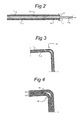
- Fig. 1 two sheets of metallic material, such as sheets of aluminium material, are indicated by 1 and 2.
- a layer of (dry) fibre material 3 is placed between these.
- This material can be any type of fibre material that is oriented in any desired direction.
- an optional pretreatment such as cleaning, etching or anodising, or provided with a primer.
- a tape 4 is applied around the periphery to provide a peripheral seal.
- a gap is left on opposite sides.
- a gap is left for inserting hose 5 from a resin reservoir 6, whilst on the other side a protruding piece of fibre material 7 is connected to a hose 8 that leads to a trap 9 that is connected to a vacuum source 10.
- vacuum is applied to the assembly comprising the two sheets of metallic material placed on top of one another with the dry fibre placed between them. Because the fibre is dry, air that is present will be sucked out rapidly and it is not necessary to take particular measures to prevent air inclusions. After all air has been sucked out, vacuum will be produced in hose 5, as a result of which resin is introduced. The resin front moves from left to right in Fig. 1 and any excess resin is collected in trap 9. The temperature is then raised. It is optionally possible already to work at elevated temperature when applying vacuum or introducing resin. In any event the various conditions are such that the resin cures and the laminate as shown in Fig. 1 is produced.
- FIG. 2 A variant of the method shown in Fig. 1 is shown in Fig. 2. With this method use is no longer made of the vacuum injection technique, but a layer of resin material 11 in the form of a resin film is applied between the sheets 1 and 2 and laid on the fibre material 3. In this variant as well the fibre material 3 is dry, as a result of which air can be removed in a simple manner. After combining, a tape 4 is applied around the periphery to provide a seal, as in the variant described above. A film bag can optionally be used. Vacuum is applied to the protruding part 7 via hose 8 and at the same time the temperature is raised so that the layer of resin material becomes less viscous and is able to penetrate into the fibre material. Here again excess material is trapped. Layers of resin material can optionally be present on either side of the layer of fibre material.
- a bent product is shown in Fig. 3.
- This consists of the laminate according to the invention.
- the two sheets of metallic material are not a constant distance apart close to the bend 12. According to the invention the variation in distance is taken up by the resin material. After all, the fibre material no longer serves as a spacer in the bend. The air that was present in the radius has been completely removed previously and it will be possible for the space to be completely filled with resin. This is in contrast to the state of the art where a prepreg is used and the air that is present at such a location will remain occluded.
- FIG. 4 A further embodiment of the laminate according to the invention in the bent state is shown in Fig. 4.
- This laminate consists of two part laminates 13 and 14 which consist of essentially parallel sheets of metal material with fibre material placed between them.
- a further layer of fibre material 15 has been placed between these two part laminates 13 and 14, which further layer of fibre material 15 is provided with resin in the manner described above, either by injection or with the aid of a layer of resin material.
- the resin used can be any resin known in the state of the art, such as a polyester or epoxy resin.
- a resin of low viscosity will be used for injection and any resin channels will be made in either the fibre material or the sheets of metallic material. If resin film is used, more viscous resins can be used because the distance over which the resin has to flow is very much shorter.
Landscapes
- Chemical & Material Sciences (AREA)
- Engineering & Computer Science (AREA)
- Composite Materials (AREA)
- Mechanical Engineering (AREA)
- Laminated Bodies (AREA)
- Moulding By Coating Moulds (AREA)
- Casting Or Compression Moulding Of Plastics Or The Like (AREA)
Abstract
Description
Claims (12)
- Method for the production of a laminate comprising at least two outer metal sheets and a fibre-reinforced resin located between them, wherein one of said metal sheets is provided, fibre material is applied on top of this, followed by the application of the following metal sheet, after which vacuum is applied to the pre-product obtained in this way while impregnating the resin material into said fibre and wherein the internal application of vacuum in the pre-product takes place under external atmospheric conditions.
- Method according to Claim 1, wherein said vacuum is applied between said sheets and the peripheral edge between said sheets is sealed.
- Method according to one of the preceding claims, wherein some of said fibres extend beyond said sheets and said vacuum is applied thereto.
- Method according to one of the preceding claims, wherein a film of resin material is applied adjoining said fibre material, the viscosity of which film of resin material becomes so low at elevated temperature that the fibres are wetted by said material.
- Method according to one of the preceding claims, wherein resin is injected into the gap between the sheets while applying vacuum.
- Method according to one of the preceding claims, comprising the provision of at least two metal sheets bent in essentially the same way, which metal sheets are placed on top of one another with fibre material inserted between them.
- Method according to one of the preceding claims, wherein the assembly comprising the two metal sheets and the fibre material is subjected to plastic deformation before impregnating resin material and applying vacuum.
- Bent product comprising a laminate consisting of at least two sheets of metal material located some distance apart, between which a layer of fibre-reinforced resin has been placed, wherein in a bend of said product the space for said fibre-reinforced resin has larger dimensions than at a non-bent location in the product and the resin/fibre ratio in said bend is greater than at a non-bent location in said product.
- Bent product according to Claim 8, wherein said space is completely filled with fibre-reinforced resin.
- Bent product according to one of Claims 8 or 9, wherein each sheet of metal material comprises a part laminate consisting of two sheets of metal some distance apart and a layer of fibre-reinforced resin between them.
- Bent product according to one of Claims 8 - 10, wherein the product is bent in two mutually perpendicular directions.
- Semi-finished product comprising at least two sheets of metal material with a layer of fibre material that contains no resin between them.
Applications Claiming Priority (2)
| Application Number | Priority Date | Filing Date | Title |
|---|---|---|---|
| NL1019601 | 2001-12-18 | ||
| NL1019601A NL1019601C2 (en) | 2001-12-18 | 2001-12-18 | Method for manufacturing a laminate as well as curved product consisting of laminate. |
Publications (2)
| Publication Number | Publication Date |
|---|---|
| EP1321283A1 true EP1321283A1 (en) | 2003-06-25 |
| EP1321283B1 EP1321283B1 (en) | 2006-09-27 |
Family
ID=19774407
Family Applications (1)
| Application Number | Title | Priority Date | Filing Date |
|---|---|---|---|
| EP20020080341 Expired - Lifetime EP1321283B1 (en) | 2001-12-18 | 2002-12-18 | Method for the production of a laminate and bent product consisting of laminate |
Country Status (4)
| Country | Link |
|---|---|
| US (1) | US6875501B2 (en) |
| EP (1) | EP1321283B1 (en) |
| DE (1) | DE60214962T2 (en) |
| NL (1) | NL1019601C2 (en) |
Cited By (2)
| Publication number | Priority date | Publication date | Assignee | Title |
|---|---|---|---|---|
| EP1344640B1 (en) * | 2002-03-15 | 2005-07-13 | Euramax Coated Products B.V. | Method and apparatus for manufacturing a sheeting |
| EP4512604A1 (en) * | 2023-08-24 | 2025-02-26 | The Boeing Company | Methods of making a reinforcement part and reinforcing a vehicle |
Families Citing this family (10)
| Publication number | Priority date | Publication date | Assignee | Title |
|---|---|---|---|---|
| US20050236736A1 (en) * | 2004-04-23 | 2005-10-27 | Formella Stephen C | Composite product and forming system |
| US20050255311A1 (en) * | 2004-04-23 | 2005-11-17 | Formella Stephen C | Hybrid composite product and system |
| DE102010025068B4 (en) * | 2010-06-25 | 2016-07-28 | Airbus Defence and Space GmbH | Apparatus and process for the production of fiber reinforced components |
| KR101093224B1 (en) * | 2010-12-14 | 2011-12-13 | 주식회사 신영 | Multibonding Material |
| DE102011054909A1 (en) * | 2011-10-28 | 2013-05-02 | Benteler Automobiltechnik Gmbh | Method for producing a motor vehicle component and motor vehicle component produced by the method |
| CN103895315B (en) * | 2014-02-19 | 2016-03-02 | 南京航空航天大学 | Glare component prepare manufacturing process |
| US10240012B2 (en) | 2015-08-11 | 2019-03-26 | University Of South Carolina | Thermoplastic/thermoset grafted composites |
| US10724994B2 (en) | 2015-12-15 | 2020-07-28 | University Of South Carolina | Structural health monitoring method and system |
| WO2017210504A1 (en) | 2016-06-03 | 2017-12-07 | University Of South Carolina | Welding head and method for use with polymeric components |
| US11022561B2 (en) | 2018-10-08 | 2021-06-01 | University Of South Carolina | Integrated and automated video/structural health monitoring system |
Citations (2)
| Publication number | Priority date | Publication date | Assignee | Title |
|---|---|---|---|---|
| EP0743174A2 (en) * | 1995-05-17 | 1996-11-20 | Ykk Corporation | Laminated plate material and loom harness frame manufactured therefrom |
| EP1103370A1 (en) * | 1999-11-24 | 2001-05-30 | EADS Airbus GmbH | Method for manufacturing a profile from hybrid material |
Family Cites Families (3)
| Publication number | Priority date | Publication date | Assignee | Title |
|---|---|---|---|---|
| US3697319A (en) * | 1970-12-09 | 1972-10-10 | Rca Corp | Method of metallizing an electrically insulating surface |
| US4110147A (en) * | 1976-03-24 | 1978-08-29 | Macdermid Incorporated | Process of preparing thermoset resin substrates to improve adherence of electrolessly plated metal deposits |
| EP0312151B1 (en) * | 1987-10-14 | 1991-03-27 | Akzo N.V. | Laminate of metal sheets and continuous glass filaments-reinforced synthetic material |
-
2001
- 2001-12-18 NL NL1019601A patent/NL1019601C2/en not_active IP Right Cessation
-
2002
- 2002-12-18 EP EP20020080341 patent/EP1321283B1/en not_active Expired - Lifetime
- 2002-12-18 US US10/321,583 patent/US6875501B2/en not_active Expired - Fee Related
- 2002-12-18 DE DE2002614962 patent/DE60214962T2/en not_active Expired - Fee Related
Patent Citations (2)
| Publication number | Priority date | Publication date | Assignee | Title |
|---|---|---|---|---|
| EP0743174A2 (en) * | 1995-05-17 | 1996-11-20 | Ykk Corporation | Laminated plate material and loom harness frame manufactured therefrom |
| EP1103370A1 (en) * | 1999-11-24 | 2001-05-30 | EADS Airbus GmbH | Method for manufacturing a profile from hybrid material |
Cited By (3)
| Publication number | Priority date | Publication date | Assignee | Title |
|---|---|---|---|---|
| EP1344640B1 (en) * | 2002-03-15 | 2005-07-13 | Euramax Coated Products B.V. | Method and apparatus for manufacturing a sheeting |
| EP4512604A1 (en) * | 2023-08-24 | 2025-02-26 | The Boeing Company | Methods of making a reinforcement part and reinforcing a vehicle |
| US12358273B2 (en) | 2023-08-24 | 2025-07-15 | The Boeing Company | Methods of making a reinforcement part and reinforcing a vehicle |
Also Published As
| Publication number | Publication date |
|---|---|
| DE60214962T2 (en) | 2007-09-06 |
| NL1019601C2 (en) | 2003-06-30 |
| EP1321283B1 (en) | 2006-09-27 |
| DE60214962D1 (en) | 2006-11-09 |
| NL1019601A1 (en) | 2003-06-19 |
| US20040053027A1 (en) | 2004-03-18 |
| US6875501B2 (en) | 2005-04-05 |
Similar Documents
| Publication | Publication Date | Title |
|---|---|---|
| EP1321283B1 (en) | Method for the production of a laminate and bent product consisting of laminate | |
| RU2516508C2 (en) | Method of sandwiched panel assembly and shaping | |
| US5624728A (en) | Composite panel | |
| JP3403201B2 (en) | Manufacturing method of honeycomb core composite product | |
| WO2012039409A1 (en) | Method for producing fiber-reinforced plastic | |
| US4702376A (en) | Composite vacuum bag material having breather surface | |
| US20110195230A1 (en) | Apparatuses, Systems, and Methods for Manufacturing Composite Parts | |
| US12083750B2 (en) | Method and device for producing a component from a fiber composite material | |
| CA2803229C (en) | Mold for production of fiber-reinforced components | |
| KR20050106493A (en) | Method of resin transfer molding | |
| JPH06210640A (en) | Breathable pad | |
| JP4016013B2 (en) | Method for producing laminated molded product | |
| US20050194724A1 (en) | Method of forming a composite structure | |
| DE102008017381A1 (en) | Method for producing e.g. preform, from fiber-reinforced composite in molding tool, involves pressing vacuum foil against fiber scrim by pressure distribution applied by support structure, during evacuation of mold cavity | |
| JPWO2018198934A1 (en) | Composite material molding method and composite material molding apparatus | |
| RU2018143309A (en) | LAYERED COMPOSITE STRUCTURES WITH INTERLAYER CORNERS TO IMPROVE RESISTANCE TO SHOCK LOADS AND SYSTEM AND METHOD FOR THEIR FORMATION | |
| FI66963C (en) | FOERFARANDE FOER FRAMSTAELLNING AV ETT BYGGELEMENT | |
| DE3145698A1 (en) | Apparatus for producing components from fibre-reinforced materials | |
| JPH09131788A (en) | Honeycomb panel processing method | |
| US4655473A (en) | Process of manufacturing a ski | |
| CN106851523A (en) | Carbon fiber braiding top dome, diaphragm structure and preparation method | |
| US20200391455A1 (en) | Method for producing composite material, fiber base material, and shaping mold for fiber base material | |
| JPH05237954A (en) | Method for manufacturing curved honeycomb panel | |
| US8097198B2 (en) | Manufacturing method with vacuum bag | |
| KR102908993B1 (en) | Coating method of carbon fiber reinforced plastics material and intermediate laminate |
Legal Events
| Date | Code | Title | Description |
|---|---|---|---|
| PUAI | Public reference made under article 153(3) epc to a published international application that has entered the european phase |
Free format text: ORIGINAL CODE: 0009012 |
|
| AK | Designated contracting states |
Designated state(s): AT BE BG CH CY CZ DE DK EE ES FI FR GB GR IE IT LI LU MC NL PT SE SI SK TR |
|
| AX | Request for extension of the european patent |
Extension state: AL LT LV MK RO |
|
| 17P | Request for examination filed |
Effective date: 20031222 |
|
| AKX | Designation fees paid |
Designated state(s): DE FR IT NL |
|
| GRAP | Despatch of communication of intention to grant a patent |
Free format text: ORIGINAL CODE: EPIDOSNIGR1 |
|
| RAP1 | Party data changed (applicant data changed or rights of an application transferred) |
Owner name: STORK FOKKER AESP B.V. |
|
| GRAS | Grant fee paid |
Free format text: ORIGINAL CODE: EPIDOSNIGR3 |
|
| GRAA | (expected) grant |
Free format text: ORIGINAL CODE: 0009210 |
|
| AK | Designated contracting states |
Kind code of ref document: B1 Designated state(s): DE FR IT NL |
|
| PG25 | Lapsed in a contracting state [announced via postgrant information from national office to epo] |
Ref country code: NL Free format text: LAPSE BECAUSE OF FAILURE TO SUBMIT A TRANSLATION OF THE DESCRIPTION OR TO PAY THE FEE WITHIN THE PRESCRIBED TIME-LIMIT Effective date: 20060927 |
|
| REF | Corresponds to: |
Ref document number: 60214962 Country of ref document: DE Date of ref document: 20061109 Kind code of ref document: P |
|
| NLV1 | Nl: lapsed or annulled due to failure to fulfill the requirements of art. 29p and 29m of the patents act | ||
| ET | Fr: translation filed | ||
| PLBE | No opposition filed within time limit |
Free format text: ORIGINAL CODE: 0009261 |
|
| STAA | Information on the status of an ep patent application or granted ep patent |
Free format text: STATUS: NO OPPOSITION FILED WITHIN TIME LIMIT |
|
| 26N | No opposition filed |
Effective date: 20070628 |
|
| PGFP | Annual fee paid to national office [announced via postgrant information from national office to epo] |
Ref country code: IT Payment date: 20081219 Year of fee payment: 7 |
|
| PGFP | Annual fee paid to national office [announced via postgrant information from national office to epo] |
Ref country code: FR Payment date: 20081211 Year of fee payment: 7 |
|
| PGFP | Annual fee paid to national office [announced via postgrant information from national office to epo] |
Ref country code: DE Payment date: 20081230 Year of fee payment: 7 |
|
| REG | Reference to a national code |
Ref country code: FR Ref legal event code: ST Effective date: 20100831 |
|
| PG25 | Lapsed in a contracting state [announced via postgrant information from national office to epo] |
Ref country code: FR Free format text: LAPSE BECAUSE OF NON-PAYMENT OF DUE FEES Effective date: 20091231 |
|
| PG25 | Lapsed in a contracting state [announced via postgrant information from national office to epo] |
Ref country code: DE Free format text: LAPSE BECAUSE OF NON-PAYMENT OF DUE FEES Effective date: 20100701 |
|
| PG25 | Lapsed in a contracting state [announced via postgrant information from national office to epo] |
Ref country code: IT Free format text: LAPSE BECAUSE OF NON-PAYMENT OF DUE FEES Effective date: 20091218 |