EP1321266A1 - Process for removing bubbles from viscous polymer solutions - Google Patents
Process for removing bubbles from viscous polymer solutions Download PDFInfo
- Publication number
- EP1321266A1 EP1321266A1 EP02028139A EP02028139A EP1321266A1 EP 1321266 A1 EP1321266 A1 EP 1321266A1 EP 02028139 A EP02028139 A EP 02028139A EP 02028139 A EP02028139 A EP 02028139A EP 1321266 A1 EP1321266 A1 EP 1321266A1
- Authority
- EP
- European Patent Office
- Prior art keywords
- polymer solution
- pressure
- bubbles
- superatmospheric pressure
- gas
- Prior art date
- Legal status (The legal status is an assumption and is not a legal conclusion. Google has not performed a legal analysis and makes no representation as to the accuracy of the status listed.)
- Granted
Links
- 229920000642 polymer Polymers 0.000 title claims abstract description 77
- 238000000034 method Methods 0.000 title claims abstract description 21
- 239000007789 gas Substances 0.000 claims abstract description 67
- 239000000203 mixture Substances 0.000 claims description 18
- IJGRMHOSHXDMSA-UHFFFAOYSA-N Atomic nitrogen Chemical compound N#N IJGRMHOSHXDMSA-UHFFFAOYSA-N 0.000 claims description 14
- 229910052757 nitrogen Inorganic materials 0.000 claims description 7
- 239000012071 phase Substances 0.000 description 6
- 239000007858 starting material Substances 0.000 description 5
- 239000004372 Polyvinyl alcohol Substances 0.000 description 4
- 238000004519 manufacturing process Methods 0.000 description 4
- 229920002451 polyvinyl alcohol Polymers 0.000 description 4
- 238000005266 casting Methods 0.000 description 2
- 238000004090 dissolution Methods 0.000 description 2
- 238000001879 gelation Methods 0.000 description 2
- 239000001307 helium Substances 0.000 description 2
- 229910052734 helium Inorganic materials 0.000 description 2
- SWQJXJOGLNCZEY-UHFFFAOYSA-N helium atom Chemical compound [He] SWQJXJOGLNCZEY-UHFFFAOYSA-N 0.000 description 2
- 239000000463 material Substances 0.000 description 2
- 238000003860 storage Methods 0.000 description 2
- 230000003750 conditioning effect Effects 0.000 description 1
- 230000001419 dependent effect Effects 0.000 description 1
- 239000007791 liquid phase Substances 0.000 description 1
- 230000003287 optical effect Effects 0.000 description 1
- 238000003908 quality control method Methods 0.000 description 1
- 229920006395 saturated elastomer Polymers 0.000 description 1
- 229910001220 stainless steel Inorganic materials 0.000 description 1
- 239000010935 stainless steel Substances 0.000 description 1
- 238000003756 stirring Methods 0.000 description 1
Images
Classifications
-
- B—PERFORMING OPERATIONS; TRANSPORTING
- B29—WORKING OF PLASTICS; WORKING OF SUBSTANCES IN A PLASTIC STATE IN GENERAL
- B29B—PREPARATION OR PRETREATMENT OF THE MATERIAL TO BE SHAPED; MAKING GRANULES OR PREFORMS; RECOVERY OF PLASTICS OR OTHER CONSTITUENTS OF WASTE MATERIAL CONTAINING PLASTICS
- B29B13/00—Conditioning or physical treatment of the material to be shaped
-
- B—PERFORMING OPERATIONS; TRANSPORTING
- B29—WORKING OF PLASTICS; WORKING OF SUBSTANCES IN A PLASTIC STATE IN GENERAL
- B29L—INDEXING SCHEME ASSOCIATED WITH SUBCLASS B29C, RELATING TO PARTICULAR ARTICLES
- B29L2011/00—Optical elements, e.g. lenses, prisms
- B29L2011/0016—Lenses
Definitions
- the invention relates to a process for removing bubbles from viscous polymer solutions.
- Viscous polymer solutions are used, for example, as starting material in the production of contact lenses.
- These can, for example, be polymer solutions based on polyvinyl alcohol, as are described in EP-A-641806.
- the polymer solution is therefore heated and stirred, by which means gelated starting material is converted back to viscous polymer solution and further gelation of the starting material is counteracted.
- (gas) bubbles for example air bubbles in an atmospheric environment, to get into the polymer solution. Bubbles can also form in the polymer solution when said polymer solution is transferred from large storage containers into containers such as are used in the production of contact lenses.
- the object of the present invention is to provide a process by which any bubbles present in the polymer solution, in particular small bubbles, can be removed from said polymer solution, and consequently to reduce the amount of rejected material occasioned by these bubbles in the production of contact lenses.
- the viscous polymer solution is subjected to a superatmospheric pressure which is such that the gases contained in the bubbles of the polymer solution dissolve.
- a precondition for this is that the content of dissolved gases in the polymer solution lies below the saturation limit, in other words the polymer solution must be able to take up more gases into solution, namely the gases contained in the bubbles.
- the gases contained in the bubbles are dissolved in this way and, as a result, are also no longer present in the contact lenses.
- the superatmospheric pressure is reduced again to ambient pressure after the gases contained in the bubbles have dissolved, which ambient pressure can in particular be atmospheric pressure.
- ambient pressure can in particular be atmospheric pressure.
- the viscous polymer solution can be subjected to a mechanically generated superatmospheric pressure, for example the superatmospheric pressure can be applied with the aid of a plunger which mechanically subjects the polymer solution to pressure.
- This variant has the advantage that there is no danger of the polymer solution taking up gas from the surrounding atmosphere, because, in the case of the plunger, the pressure face of the plunger bears directly on the surface of the polymer solution.
- the viscous polymer solution is subjected to a superatmospheric pressure generated by gas pressure.
- This variant is less costly because no plunger is required, and a superatmospheric gas pressure can instead be built up inside a container, the result being that the gases contained in the bubbles dissolve.
- the gas or gas mixture used to generate the superatmospheric pressure is substantially insoluble in the polymer solution.
- this gas could possibly be helium, or another gas which is substantially insoluble. If such insoluble gases are used to generate the superatmospheric pressure, there is no danger that, on account of the saturation limit of the polymer solution being increased by the superatmospheric pressure, the gas used to generate the superatmospheric pressure, or components of the gas mixture, will be dissolved in the polymer solution, which gas or gas components, after subsequent reduction of the superatmospheric pressure, would have to escape from the solution or form bubbles, because the saturation limit drops again upon reduction of the superatmospheric pressure.
- the components of the gas mixture which are soluble in the polymer solution are preferably present only in a certain proportion, the latter being such that the partial pressure of the soluble components of the gas mixture at the respectively applied superatmospheric pressure is only so great that it corresponds at maximum to the partial pressure of the soluble components at ambient pressure. In this way, it is ensured that in no circumstances during the superatmospheric pressure phase is a quantity of soluble components taken up in the polymer solution which exceeds the saturation limit of the polymer solution at ambient pressure.
- nitrogen (or air) is used to generate the superatmospheric pressure.
- Nitrogen (or air) can be very easily made available.
- This surprisingly very efficient variant is based on the fact that the speed of the gas uptake of the liquid phase (polymer solution) can be controlled by the apparatus geometry via the size of the interface between polymer solution and nitrogen (or air) and is limited from the outset on account of the viscosity of the solution. A (gas) saturation of the polymer solution can therefore only be reached, if at all, near the interface between polymer solution and nitrogen (or air).
- the pressure vessel 1 (e.g. a stainless steel vessel) is provided with a lid 2 with which the interior of the vessel 1 can be closed off in a pressure-tight manner.
- a pressure attachment 3 is also provided through which a gas or gas mixture is delivered in order to generate a superatmospheric pressure in the interior of the vessel 1.
- a manometer 4 is also shown which indicates the pressure in the interior of the vessel 1.
- the figure also shows a level indicator 5 and a pressure relief valve 6.
- the vessel 1 contains a viscous polymer solution P (indicated by a dashed line), for example based on polyvinyl alcohol.
- this polymer solution P comprises small air bubbles which, because of the viscosity of the polymer solution P, do not escape from the solution.
- the content of dissolved gases in this polymer solution P lies below the saturation limit, that is to say the polymer solution P can in principle take up more gases into solution.
- the pressure in the interior of the vessel is atmospheric pressure.
- a gas or gas mixture is now introduced into the interior of the vessel 1 via the pressure attachment, and the polymer solution P is subjected to a superatmospheric pressure, which in this case is generated by the gas or gas mixture introduced into the interior.
- the manometer 4 in this case indicates the pressure prevailing in the interior of the vessel 1.
- the gas used is preferably nitrogen, although it is also possible to use a gas (or gas mixture) which is substantially insoluble in the polymer solution, for example helium.
- the bubbles contained in the polymer solution P are removed as a result of the bubbles being broken up by the pressure and as a result of the gases contained in the bubbles being dissolved in the polymer solution. If a gas (or gas mixture) used to generate the superatmospheric pressure is substantially insoluble in the polymer solution P, it cannot dissolve in the polymer solution P, although in principle the saturation limit of the polymer solution P is increased in the superatmospheric pressure phase and this would be made possible, in the superatmospheric pressure phase, by the "receptivity" of the polymer solution P.
- the superatmospheric pressure in the interior of the vessel 1 is again reduced to ambient pressure, in this case atmospheric pressure.
- the pressure relief valve 6 can be opened, for example, so that the superatmospheric pressure can escape.
- the gas or gas mixture used to generate the superatmospheric pressure can be collected.
- the content of dissolved gases in the polymer solution P must lie below the saturation limit before the superatmospheric pressure is applied, so that the gases released during dissolution of the bubbles can in fact also pass into solution in the polymer solution P (the polymer solution P must therefore still have a certain "receptivity" for those gases and must not already be saturated).
- the difference between the maximum solubility (saturation limit) and the actual concentration of dissolved gases in the polymer solution tells the skilled person how much gas can be dissolved in the polymer solution, by application of pressure, without new gas bubbles forming through oversaturation when the pressure is returned to normal pressure.
- the size and number of the gas bubbles present in the solution before the pressure is applied determine the total volume to be dissolved.
- the concentration of dissolved gases actually contained in the polymer solution can also be determined before and after the application of pressure.
- the superatmospheric pressure using a gas mixture comprising components which are soluble in the polymer solution.
- the soluble components are present in the gas mixture only in a certain proportion, the latter being such that the partial pressure of the soluble components of the gas mixture is reduced at superatmospheric pressure such that it corresponds at maximum to the partial pressure of the soluble components at ambient pressure, in this case atmospheric pressure.
- a quantity of ca. 10 litres of a polymer solution based on polyvinyl alcohol is introduced at atmospheric pressure into a pressure vessel with a volume of ca. 12 litres.
- the polymer solution based on polyvinyl alcohol is Nelfilcon A.
- the vessel is closed off with the lid, and a superatmospheric pressure of ca. 4 bar is generated in the interior of the vessel, the polymer solution being subjected to this pressure.
- the superatmospheric pressure is generated by means of gas pressure, the gas used being nitrogen.
- the polymer solution is subjected to the superatmospheric pressure for a period of ca. 4 hours.
- the pressure in the vessel is then reduced again to atmospheric pressure.
- the polymer solution thus treated is substantially free of bubbles.
Landscapes
- Engineering & Computer Science (AREA)
- Mechanical Engineering (AREA)
- Processes Of Treating Macromolecular Substances (AREA)
- Manufacture Of Porous Articles, And Recovery And Treatment Of Waste Products (AREA)
Abstract
Description
- The invention relates to a process for removing bubbles from viscous polymer solutions.
- Viscous polymer solutions are used, for example, as starting material in the production of contact lenses. These can, for example, be polymer solutions based on polyvinyl alcohol, as are described in EP-A-641806. During storage, such polymer solutions may show a tendency to increased viscosity and to gelation, but gelated starting material is unsuitable for the production of contact lenses. For conditioning purposes, the polymer solution is therefore heated and stirred, by which means gelated starting material is converted back to viscous polymer solution and further gelation of the starting material is counteracted. However, as a result of the stirring, it is also possible for (gas) bubbles, for example air bubbles in an atmospheric environment, to get into the polymer solution. Bubbles can also form in the polymer solution when said polymer solution is transferred from large storage containers into containers such as are used in the production of contact lenses.
- Whereas large bubbles can rise rapidly and escape from the polymer solution, small bubbles do this only slowly, because of the viscosity of the polymer solution. These small bubbles therefore remain in the polymer solution which is used as starting material for the contact lenses, the latter then typically being produced in a casting process. However, the small bubbles are critical because these small bubbles are then also present in the finished contact lens, enclosed within the material of the contact lens. The optical quality of a contact lens must be absolutely perfect before it can be released, however, and for this reason bubbles cannot be tolerated. If a contact lens does have such bubbles, it is rejected during quality control of the contact lenses.
- The object of the present invention is to provide a process by which any bubbles present in the polymer solution, in particular small bubbles, can be removed from said polymer solution, and consequently to reduce the amount of rejected material occasioned by these bubbles in the production of contact lenses.
- This object is achieved by the process according to the invention, as characterized by the features of the independent patent claim. Particularly advantageous variants of the process according to the invention will become evident from the features of the dependent patent claims.
- In particular, the viscous polymer solution is subjected to a superatmospheric pressure which is such that the gases contained in the bubbles of the polymer solution dissolve. A precondition for this, however, is that the content of dissolved gases in the polymer solution lies below the saturation limit, in other words the polymer solution must be able to take up more gases into solution, namely the gases contained in the bubbles. The gases contained in the bubbles are dissolved in this way and, as a result, are also no longer present in the contact lenses.
- In an advantageous variant of the process according to the invention, the superatmospheric pressure is reduced again to ambient pressure after the gases contained in the bubbles have dissolved, which ambient pressure can in particular be atmospheric pressure. This is advantageous especially for the conventional casting processes for contact lenses, in which the contact lenses are produced at atmospheric pressure as the ambient pressure.
- There are various possibilities for applying the superatmospheric pressure. Thus, in one variant of the process according to the invention, the viscous polymer solution can be subjected to a mechanically generated superatmospheric pressure, for example the superatmospheric pressure can be applied with the aid of a plunger which mechanically subjects the polymer solution to pressure. This variant has the advantage that there is no danger of the polymer solution taking up gas from the surrounding atmosphere, because, in the case of the plunger, the pressure face of the plunger bears directly on the surface of the polymer solution.
- In another variant of the process, the viscous polymer solution is subjected to a superatmospheric pressure generated by gas pressure. This variant is less costly because no plunger is required, and a superatmospheric gas pressure can instead be built up inside a container, the result being that the gases contained in the bubbles dissolve.
- In this variant, it can be advantageous if the gas or gas mixture used to generate the superatmospheric pressure is substantially insoluble in the polymer solution.
- For example, this gas could possibly be helium, or another gas which is substantially insoluble. If such insoluble gases are used to generate the superatmospheric pressure, there is no danger that, on account of the saturation limit of the polymer solution being increased by the superatmospheric pressure, the gas used to generate the superatmospheric pressure, or components of the gas mixture, will be dissolved in the polymer solution, which gas or gas components, after subsequent reduction of the superatmospheric pressure, would have to escape from the solution or form bubbles, because the saturation limit drops again upon reduction of the superatmospheric pressure.
- To generate the superatmospheric pressure, it is also possible, however, to use a gas mixture comprising components which are soluble in the polymer solution. In this case, however, the components of the gas mixture which are soluble in the polymer solution are preferably present only in a certain proportion, the latter being such that the partial pressure of the soluble components of the gas mixture at the respectively applied superatmospheric pressure is only so great that it corresponds at maximum to the partial pressure of the soluble components at ambient pressure. In this way, it is ensured that in no circumstances during the superatmospheric pressure phase is a quantity of soluble components taken up in the polymer solution which exceeds the saturation limit of the polymer solution at ambient pressure.
- In a further, simple variant, nitrogen (or air) is used to generate the superatmospheric pressure. Nitrogen (or air) can be very easily made available. This surprisingly very efficient variant is based on the fact that the speed of the gas uptake of the liquid phase (polymer solution) can be controlled by the apparatus geometry via the size of the interface between polymer solution and nitrogen (or air) and is limited from the outset on account of the viscosity of the solution. A (gas) saturation of the polymer solution can therefore only be reached, if at all, near the interface between polymer solution and nitrogen (or air).
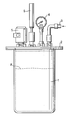
- Further advantageous aspects of the process according to the invention will become evident from the following description of an illustrative embodiment of the process according to the invention, with reference to the drawing. The single figure in the drawing shows an illustrative embodiment of a pressure vessel in which the process according to the invention can be carried out.
- The pressure vessel 1 (e.g. a stainless steel vessel) is provided with a lid 2 with which the interior of the vessel 1 can be closed off in a pressure-tight manner. A pressure attachment 3 is also provided through which a gas or gas mixture is delivered in order to generate a superatmospheric pressure in the interior of the vessel 1. A manometer 4 is also shown which indicates the pressure in the interior of the vessel 1. Finally, the figure also shows a level indicator 5 and a
pressure relief valve 6. - The vessel 1 contains a viscous polymer solution P (indicated by a dashed line), for example based on polyvinyl alcohol. In explaining the process according to the invention, it is assumed that this polymer solution P comprises small air bubbles which, because of the viscosity of the polymer solution P, do not escape from the solution. The content of dissolved gases in this polymer solution P lies below the saturation limit, that is to say the polymer solution P can in principle take up more gases into solution. At the start of the process, the pressure in the interior of the vessel is atmospheric pressure.
- To remove the bubbles from the polymer solution P, a gas or gas mixture is now introduced into the interior of the vessel 1 via the pressure attachment, and the polymer solution P is subjected to a superatmospheric pressure, which in this case is generated by the gas or gas mixture introduced into the interior. The manometer 4 in this case indicates the pressure prevailing in the interior of the vessel 1. The gas used is preferably nitrogen, although it is also possible to use a gas (or gas mixture) which is substantially insoluble in the polymer solution, for example helium.
- By means of the superatmospheric pressure in the interior of the vessel 1, the bubbles contained in the polymer solution P are removed as a result of the bubbles being broken up by the pressure and as a result of the gases contained in the bubbles being dissolved in the polymer solution. If a gas (or gas mixture) used to generate the superatmospheric pressure is substantially insoluble in the polymer solution P, it cannot dissolve in the polymer solution P, although in principle the saturation limit of the polymer solution P is increased in the superatmospheric pressure phase and this would be made possible, in the superatmospheric pressure phase, by the "receptivity" of the polymer solution P.
- After the polymer solution P has been subjected to superatmospheric pressure, and therefore after the resulting dissolution of the bubbles, the superatmospheric pressure in the interior of the vessel 1 is again reduced to ambient pressure, in this case atmospheric pressure. For this purpose, the
pressure relief valve 6 can be opened, for example, so that the superatmospheric pressure can escape. In this case, the gas or gas mixture used to generate the superatmospheric pressure can be collected. To ensure that the gases which were contained in the bubbles, and which have passed into solution in the polymer solution P in the superatmospheric pressure phase, also remain in solution after reduction of the pressure in the interior of the vessel 1, the content of dissolved gases in the polymer solution P must lie below the saturation limit before the superatmospheric pressure is applied, so that the gases released during dissolution of the bubbles can in fact also pass into solution in the polymer solution P (the polymer solution P must therefore still have a certain "receptivity" for those gases and must not already be saturated). - The difference between the maximum solubility (saturation limit) and the actual concentration of dissolved gases in the polymer solution tells the skilled person how much gas can be dissolved in the polymer solution, by application of pressure, without new gas bubbles forming through oversaturation when the pressure is returned to normal pressure. The size and number of the gas bubbles present in the solution before the pressure is applied determine the total volume to be dissolved. However, as this is not so easy to determine in practice, the concentration of dissolved gases actually contained in the polymer solution can also be determined before and after the application of pressure.
- It is also possible in principle to generate the superatmospheric pressure using a gas mixture comprising components which are soluble in the polymer solution. In this case, it is preferable to ensure that the soluble components are present in the gas mixture only in a certain proportion, the latter being such that the partial pressure of the soluble components of the gas mixture is reduced at superatmospheric pressure such that it corresponds at maximum to the partial pressure of the soluble components at ambient pressure, in this case atmospheric pressure. This means, for example, that if the pressure is increased by a factor of five, the proportion of the components of the gas mixture which are soluble in the polymer solution P is reduced so that the corresponding partial pressure of the soluble components in the superatmospheric pressure phase is reduced by at least this factor of five and thus corresponds at maximum to the partial pressure of the soluble components at ambient pressure, in this case atmospheric pressure.
- In this way, it is ensured that, in the superatmospheric pressure phase in which the saturation limit of the polymer solution P is increased, gases do not dissolve in the polymer solution P in a quantity which, upon subsequent reduction of the pressure to the ambient pressure (in this case atmospheric pressure) and the corresponding lowering of the saturation limit, cannot then remain dissolved in the polymer solution, because this amount dissolved at superatmospheric pressure lies above the saturation limit at ambient pressure (in this case atmospheric pressure).
- A quantity of ca. 10 litres of a polymer solution based on polyvinyl alcohol is introduced at atmospheric pressure into a pressure vessel with a volume of ca. 12 litres. The polymer solution based on polyvinyl alcohol is Nelfilcon A.
- The vessel is closed off with the lid, and a superatmospheric pressure of ca. 4 bar is generated in the interior of the vessel, the polymer solution being subjected to this pressure. The superatmospheric pressure is generated by means of gas pressure, the gas used being nitrogen. The polymer solution is subjected to the superatmospheric pressure for a period of ca. 4 hours. The pressure in the vessel is then reduced again to atmospheric pressure.
- The polymer solution thus treated is substantially free of bubbles.
Claims (7)
- A process for removing bubbles from a viscous polymer solution (P) in which the content of dissolved gases lies below the saturation limit, wherein the viscous polymer solution (P) is subjected to a superatmospheric pressure which is such that the gases contained in the bubbles of the polymer solution (P) dissolve.
- A process according to claim 1, in which the superatmospheric pressure is reduced again to ambient pressure after the gases contained in the bubbles have dissolved.
- A process according to either claim 1 or claim 2, in which the viscous polymer solution (P) is subjected to a mechanically generated superatmospheric pressure, for example with the aid of a plunger.
- A process according to either claim 1 or claim 2, in which the viscous polymer solution (P) is subjected to a superatmospheric pressure generated by gas pressure.
- A process according to claim 4, in which the gas or gas mixture used to generate the superatmospheric pressure is substantially insoluble in the polymer solution (P).
- A process according to claim 4, in which the superatmospheric pressure is generated using a gas mixture comprising components which are soluble in the polymer solution (P), but only in a proportion which is such that the partial pressure of the soluble components of the gas mixture is reduced at superatmospheric pressure such that it corresponds at maximum to the partial pressure of the soluble components at ambient pressure.
- A process according to claim 4, in which nitrogen or air is used to generate the superatmospheric pressure.
Priority Applications (1)
| Application Number | Priority Date | Filing Date | Title |
|---|---|---|---|
| EP02028139A EP1321266B1 (en) | 2001-12-19 | 2002-12-18 | Process for removing bubbles from viscous polymer solutions |
Applications Claiming Priority (3)
| Application Number | Priority Date | Filing Date | Title |
|---|---|---|---|
| EP01130186 | 2001-12-19 | ||
| EP01130186 | 2001-12-19 | ||
| EP02028139A EP1321266B1 (en) | 2001-12-19 | 2002-12-18 | Process for removing bubbles from viscous polymer solutions |
Publications (2)
| Publication Number | Publication Date |
|---|---|
| EP1321266A1 true EP1321266A1 (en) | 2003-06-25 |
| EP1321266B1 EP1321266B1 (en) | 2008-01-23 |
Family
ID=8179598
Family Applications (1)
| Application Number | Title | Priority Date | Filing Date |
|---|---|---|---|
| EP02028139A Expired - Lifetime EP1321266B1 (en) | 2001-12-19 | 2002-12-18 | Process for removing bubbles from viscous polymer solutions |
Country Status (5)
| Country | Link |
|---|---|
| US (1) | US6884283B2 (en) |
| EP (1) | EP1321266B1 (en) |
| JP (1) | JP2004035875A (en) |
| AT (1) | ATE384606T1 (en) |
| DE (1) | DE60224768T2 (en) |
Families Citing this family (1)
| Publication number | Priority date | Publication date | Assignee | Title |
|---|---|---|---|---|
| CN115212610B (en) * | 2022-06-28 | 2024-08-30 | 北京康宇建医疗器械有限公司 | Method for degassing bubbles in polymer film forming liquid |
Citations (3)
| Publication number | Priority date | Publication date | Assignee | Title |
|---|---|---|---|---|
| DE2550236A1 (en) * | 1975-11-08 | 1977-05-12 | Geb Djuric Ljiljana Huebner | Degasifying a fluid mass of synthetic resin - esp. a small quantity, by subjecting it to a pressurised gas or gas mixt. |
| US4146696A (en) * | 1976-08-11 | 1979-03-27 | Buckbee-Mears Company | Industrial production of cast plastic lenses |
| US4652596A (en) * | 1985-09-09 | 1987-03-24 | Formica Corporation | Thermosetting resin casting process, product and device |
Family Cites Families (3)
| Publication number | Priority date | Publication date | Assignee | Title |
|---|---|---|---|---|
| US4088811A (en) * | 1976-10-29 | 1978-05-09 | Monsanto Company | 1,4-Cyclohexadiene compounds used as chain transfer agents in nitrile polymerization |
| US4681718A (en) * | 1984-05-09 | 1987-07-21 | Hughes Aircraft Company | Method of fabricating composite or encapsulated articles |
| US6364934B1 (en) * | 2000-07-31 | 2002-04-02 | Bausch & Lomb Incorporated | Method of making ocular devices |
-
2002
- 2002-12-13 US US10/318,622 patent/US6884283B2/en not_active Expired - Lifetime
- 2002-12-18 AT AT02028139T patent/ATE384606T1/en not_active IP Right Cessation
- 2002-12-18 DE DE60224768T patent/DE60224768T2/en not_active Expired - Lifetime
- 2002-12-18 EP EP02028139A patent/EP1321266B1/en not_active Expired - Lifetime
- 2002-12-19 JP JP2002367825A patent/JP2004035875A/en active Pending
Patent Citations (3)
| Publication number | Priority date | Publication date | Assignee | Title |
|---|---|---|---|---|
| DE2550236A1 (en) * | 1975-11-08 | 1977-05-12 | Geb Djuric Ljiljana Huebner | Degasifying a fluid mass of synthetic resin - esp. a small quantity, by subjecting it to a pressurised gas or gas mixt. |
| US4146696A (en) * | 1976-08-11 | 1979-03-27 | Buckbee-Mears Company | Industrial production of cast plastic lenses |
| US4652596A (en) * | 1985-09-09 | 1987-03-24 | Formica Corporation | Thermosetting resin casting process, product and device |
Also Published As
| Publication number | Publication date |
|---|---|
| US20030136268A1 (en) | 2003-07-24 |
| EP1321266B1 (en) | 2008-01-23 |
| DE60224768D1 (en) | 2008-03-13 |
| JP2004035875A (en) | 2004-02-05 |
| ATE384606T1 (en) | 2008-02-15 |
| DE60224768T2 (en) | 2009-01-22 |
| US6884283B2 (en) | 2005-04-26 |
Similar Documents
| Publication | Publication Date | Title |
|---|---|---|
| JP6581381B2 (en) | Method and apparatus for filling filling container | |
| DE1936337B2 (en) | METHOD OF REMOVING A CORE OF SILICON MATERIALS FROM A METAL CASTING | |
| US1703739A (en) | Method of casting with the aid of gaseous pressure mediums | |
| DK0382043T3 (en) | Process and container for releasing a content | |
| AU1053192A (en) | Method and apparatus for expanding cellular materials | |
| US8091610B2 (en) | Method and apparatus for removing core material | |
| EP1321266B1 (en) | Process for removing bubbles from viscous polymer solutions | |
| Asmussen | Penetration of restorative resins into acid etched enamel. II: dissolution of entrapped air in restorative resin monomers | |
| ATE43281T1 (en) | METHOD OF WOOD IMPREGNATION AND DEVICE FOR CARRYING OUT IT. | |
| US8651774B2 (en) | Method and device for removing a contact lens from a container | |
| ATE188767T1 (en) | METHOD AND DEVICE FOR DEGASING A LIQUID IN AN ESSENTIALLY CLOSED SYSTEM | |
| US3683978A (en) | Fluid transfer apparatus | |
| JP3159501B2 (en) | Defoaming method | |
| JPH0511260A (en) | Liquid crystal cell manufacturing method and liquid crystal injection device | |
| JPH09122993A (en) | Dry process isostatic pressure molding device and dry process isostatic pressure molding method | |
| JP2827694B2 (en) | Differential pressure casting equipment | |
| RU2080957C1 (en) | Method of treating steel in ladle | |
| SU1030095A1 (en) | Apparatus for hot isostatic pressing of articles by low boiling liquid | |
| JPH09248401A (en) | Liquid degassing method | |
| JPH05289036A (en) | Liquid crystal supply device incorporating deaeration device and its operating method | |
| GB1577010A (en) | Process gas solidification system | |
| JPS6060951A (en) | Method for coating optical fiber | |
| JPS61268130A (en) | Method of removing astringency of persimmons | |
| DE3619501A1 (en) | Apparatus for keeping fermented beverages fresh | |
| JPH0511259A (en) | Production of liquid crystal cell |
Legal Events
| Date | Code | Title | Description |
|---|---|---|---|
| PUAI | Public reference made under article 153(3) epc to a published international application that has entered the european phase |
Free format text: ORIGINAL CODE: 0009012 |
|
| AK | Designated contracting states |
Designated state(s): AT BE BG CH CY CZ DE DK EE ES FI FR GB GR IE IT LI LU MC NL PT SE SI SK TR |
|
| AX | Request for extension of the european patent |
Extension state: AL LT LV MK RO |
|
| 17P | Request for examination filed |
Effective date: 20031229 |
|
| AKX | Designation fees paid |
Designated state(s): AT BE BG CH CY CZ DE DK EE ES FI FR GB GR IE IT LI LU MC NL PT SE SI SK TR |
|
| GRAP | Despatch of communication of intention to grant a patent |
Free format text: ORIGINAL CODE: EPIDOSNIGR1 |
|
| GRAS | Grant fee paid |
Free format text: ORIGINAL CODE: EPIDOSNIGR3 |
|
| GRAA | (expected) grant |
Free format text: ORIGINAL CODE: 0009210 |
|
| RAP1 | Party data changed (applicant data changed or rights of an application transferred) |
Owner name: NOVARTIS AG |
|
| AK | Designated contracting states |
Kind code of ref document: B1 Designated state(s): AT BE BG CH CY CZ DE DK EE ES FI FR GB GR IE IT LI LU MC NL PT SE SI SK TR |
|
| REG | Reference to a national code |
Ref country code: GB Ref legal event code: FG4D |
|
| REG | Reference to a national code |
Ref country code: CH Ref legal event code: EP |
|
| REG | Reference to a national code |
Ref country code: IE Ref legal event code: FG4D |
|
| REF | Corresponds to: |
Ref document number: 60224768 Country of ref document: DE Date of ref document: 20080313 Kind code of ref document: P |
|
| NLV1 | Nl: lapsed or annulled due to failure to fulfill the requirements of art. 29p and 29m of the patents act | ||
| PG25 | Lapsed in a contracting state [announced via postgrant information from national office to epo] |
Ref country code: CH Free format text: LAPSE BECAUSE OF FAILURE TO SUBMIT A TRANSLATION OF THE DESCRIPTION OR TO PAY THE FEE WITHIN THE PRESCRIBED TIME-LIMIT Effective date: 20080123 Ref country code: LI Free format text: LAPSE BECAUSE OF FAILURE TO SUBMIT A TRANSLATION OF THE DESCRIPTION OR TO PAY THE FEE WITHIN THE PRESCRIBED TIME-LIMIT Effective date: 20080123 Ref country code: FI Free format text: LAPSE BECAUSE OF FAILURE TO SUBMIT A TRANSLATION OF THE DESCRIPTION OR TO PAY THE FEE WITHIN THE PRESCRIBED TIME-LIMIT Effective date: 20080123 Ref country code: ES Free format text: LAPSE BECAUSE OF FAILURE TO SUBMIT A TRANSLATION OF THE DESCRIPTION OR TO PAY THE FEE WITHIN THE PRESCRIBED TIME-LIMIT Effective date: 20080504 |
|
| REG | Reference to a national code |
Ref country code: CH Ref legal event code: PL |
|
| PG25 | Lapsed in a contracting state [announced via postgrant information from national office to epo] |
Ref country code: BG Free format text: LAPSE BECAUSE OF FAILURE TO SUBMIT A TRANSLATION OF THE DESCRIPTION OR TO PAY THE FEE WITHIN THE PRESCRIBED TIME-LIMIT Effective date: 20080423 Ref country code: AT Free format text: LAPSE BECAUSE OF FAILURE TO SUBMIT A TRANSLATION OF THE DESCRIPTION OR TO PAY THE FEE WITHIN THE PRESCRIBED TIME-LIMIT Effective date: 20080123 |
|
| PG25 | Lapsed in a contracting state [announced via postgrant information from national office to epo] |
Ref country code: BE Free format text: LAPSE BECAUSE OF FAILURE TO SUBMIT A TRANSLATION OF THE DESCRIPTION OR TO PAY THE FEE WITHIN THE PRESCRIBED TIME-LIMIT Effective date: 20080123 Ref country code: SI Free format text: LAPSE BECAUSE OF FAILURE TO SUBMIT A TRANSLATION OF THE DESCRIPTION OR TO PAY THE FEE WITHIN THE PRESCRIBED TIME-LIMIT Effective date: 20080123 Ref country code: PT Free format text: LAPSE BECAUSE OF FAILURE TO SUBMIT A TRANSLATION OF THE DESCRIPTION OR TO PAY THE FEE WITHIN THE PRESCRIBED TIME-LIMIT Effective date: 20080623 |
|
| PG25 | Lapsed in a contracting state [announced via postgrant information from national office to epo] |
Ref country code: CZ Free format text: LAPSE BECAUSE OF FAILURE TO SUBMIT A TRANSLATION OF THE DESCRIPTION OR TO PAY THE FEE WITHIN THE PRESCRIBED TIME-LIMIT Effective date: 20080123 Ref country code: DK Free format text: LAPSE BECAUSE OF FAILURE TO SUBMIT A TRANSLATION OF THE DESCRIPTION OR TO PAY THE FEE WITHIN THE PRESCRIBED TIME-LIMIT Effective date: 20080123 Ref country code: NL Free format text: LAPSE BECAUSE OF FAILURE TO SUBMIT A TRANSLATION OF THE DESCRIPTION OR TO PAY THE FEE WITHIN THE PRESCRIBED TIME-LIMIT Effective date: 20080123 Ref country code: SE Free format text: LAPSE BECAUSE OF FAILURE TO SUBMIT A TRANSLATION OF THE DESCRIPTION OR TO PAY THE FEE WITHIN THE PRESCRIBED TIME-LIMIT Effective date: 20080423 Ref country code: SK Free format text: LAPSE BECAUSE OF FAILURE TO SUBMIT A TRANSLATION OF THE DESCRIPTION OR TO PAY THE FEE WITHIN THE PRESCRIBED TIME-LIMIT Effective date: 20080123 |
|
| EN | Fr: translation not filed | ||
| PLBE | No opposition filed within time limit |
Free format text: ORIGINAL CODE: 0009261 |
|
| STAA | Information on the status of an ep patent application or granted ep patent |
Free format text: STATUS: NO OPPOSITION FILED WITHIN TIME LIMIT |
|
| 26N | No opposition filed |
Effective date: 20081024 |
|
| PG25 | Lapsed in a contracting state [announced via postgrant information from national office to epo] |
Ref country code: EE Free format text: LAPSE BECAUSE OF FAILURE TO SUBMIT A TRANSLATION OF THE DESCRIPTION OR TO PAY THE FEE WITHIN THE PRESCRIBED TIME-LIMIT Effective date: 20080123 Ref country code: FR Free format text: LAPSE BECAUSE OF FAILURE TO SUBMIT A TRANSLATION OF THE DESCRIPTION OR TO PAY THE FEE WITHIN THE PRESCRIBED TIME-LIMIT Effective date: 20081114 |
|
| PG25 | Lapsed in a contracting state [announced via postgrant information from national office to epo] |
Ref country code: CY Free format text: LAPSE BECAUSE OF FAILURE TO SUBMIT A TRANSLATION OF THE DESCRIPTION OR TO PAY THE FEE WITHIN THE PRESCRIBED TIME-LIMIT Effective date: 20080123 Ref country code: MC Free format text: LAPSE BECAUSE OF NON-PAYMENT OF DUE FEES Effective date: 20081231 |
|
| PG25 | Lapsed in a contracting state [announced via postgrant information from national office to epo] |
Ref country code: IT Free format text: LAPSE BECAUSE OF FAILURE TO SUBMIT A TRANSLATION OF THE DESCRIPTION OR TO PAY THE FEE WITHIN THE PRESCRIBED TIME-LIMIT Effective date: 20080123 |
|
| PG25 | Lapsed in a contracting state [announced via postgrant information from national office to epo] |
Ref country code: LU Free format text: LAPSE BECAUSE OF NON-PAYMENT OF DUE FEES Effective date: 20081218 |
|
| PG25 | Lapsed in a contracting state [announced via postgrant information from national office to epo] |
Ref country code: TR Free format text: LAPSE BECAUSE OF FAILURE TO SUBMIT A TRANSLATION OF THE DESCRIPTION OR TO PAY THE FEE WITHIN THE PRESCRIBED TIME-LIMIT Effective date: 20080123 |
|
| PG25 | Lapsed in a contracting state [announced via postgrant information from national office to epo] |
Ref country code: GR Free format text: LAPSE BECAUSE OF FAILURE TO SUBMIT A TRANSLATION OF THE DESCRIPTION OR TO PAY THE FEE WITHIN THE PRESCRIBED TIME-LIMIT Effective date: 20080424 |
|
| REG | Reference to a national code |
Ref country code: DE Ref legal event code: R082 Ref document number: 60224768 Country of ref document: DE Representative=s name: PFENNING, MEINIG & PARTNER MBB PATENTANWAELTE, DE Ref country code: DE Ref legal event code: R081 Ref document number: 60224768 Country of ref document: DE Owner name: ALCON INC., CH Free format text: FORMER OWNER: NOVARTIS AG, 4056 BASEL, CH |
|
| REG | Reference to a national code |
Ref country code: GB Ref legal event code: 732E Free format text: REGISTERED BETWEEN 20200123 AND 20200129 |
|
| PGFP | Annual fee paid to national office [announced via postgrant information from national office to epo] |
Ref country code: DE Payment date: 20211116 Year of fee payment: 20 Ref country code: IE Payment date: 20211123 Year of fee payment: 20 Ref country code: GB Payment date: 20211118 Year of fee payment: 20 |
|
| REG | Reference to a national code |
Ref country code: DE Ref legal event code: R071 Ref document number: 60224768 Country of ref document: DE |
|
| REG | Reference to a national code |
Ref country code: GB Ref legal event code: PE20 Expiry date: 20221217 |
|
| PG25 | Lapsed in a contracting state [announced via postgrant information from national office to epo] |
Ref country code: GB Free format text: LAPSE BECAUSE OF EXPIRATION OF PROTECTION Effective date: 20221217 |
|
| REG | Reference to a national code |
Ref country code: IE Ref legal event code: MK9A |
|
| PG25 | Lapsed in a contracting state [announced via postgrant information from national office to epo] |
Ref country code: IE Free format text: LAPSE BECAUSE OF EXPIRATION OF PROTECTION Effective date: 20221218 |