EP1320068A2 - Method and system of continuously scaling video images - Google Patents
Method and system of continuously scaling video images Download PDFInfo
- Publication number
- EP1320068A2 EP1320068A2 EP02258373A EP02258373A EP1320068A2 EP 1320068 A2 EP1320068 A2 EP 1320068A2 EP 02258373 A EP02258373 A EP 02258373A EP 02258373 A EP02258373 A EP 02258373A EP 1320068 A2 EP1320068 A2 EP 1320068A2
- Authority
- EP
- European Patent Office
- Prior art keywords
- video
- height
- displayed
- video display
- video data
- Prior art date
- Legal status (The legal status is an assumption and is not a legal conclusion. Google has not performed a legal analysis and makes no representation as to the accuracy of the status listed.)
- Withdrawn
Links
Images


Classifications
-
- G—PHYSICS
- G06—COMPUTING OR CALCULATING; COUNTING
- G06T—IMAGE DATA PROCESSING OR GENERATION, IN GENERAL
- G06T3/00—Geometric image transformations in the plane of the image
- G06T3/40—Scaling of whole images or parts thereof, e.g. expanding or contracting
Definitions
- This invention relates to the field of video displays, and more particularly, this invention relates to scaling video images on a video display.
- Increasing numbers of video game systems have built-in three-dimensional audio processors, a three-dimensional graphics processor unit (GPU), a high speed central processing unit (CPU) with high speed bus transfer rates, built-in hard drives, and a large megabyte unified memory.
- GPU three-dimensional graphics processor unit
- CPU central processing unit
- Typical included in these video game systems are various types of removable memory cards, custom game controller ports, HDTV ports, expansion card ports, and often, a built-in DVD (digital versatile/video disc) player with the appropriate DVD software drivers for drawing the apparatus. Examples of such systems include various video games from Sony Corporation, such as the Play Station 2, the Nintendo Game Cube, and the XBox game system from Microsoft Corporation.
- the XBox game system includes a front loading DVD tray operative with the DVD player and software drivers, four game controller ports to allow multi-player gaming and ports for allowing connection of other peripherals, including game pads and voice-activated headsets.
- This system also includes an Ethernet port for broadband connection, a NVIDIA graphics processing unit (GPU), an Intel 733 MHz processor, and an internal hard drive.
- GPU NVIDIA graphics processing unit
- Intel 733 MHz processor an internal hard drive.
- any scaling or zooming of images has been provided as a "stepped" zoom functionality that is typically accomplished by pressing a zoom button.
- zoom button Once the zoom button is pressed, several different zooming functions can follow. For example, in a first zooming function, the current view is magnified twice or by some other arbitrary resolution. For example, if one is viewing 720x480 pixels of source content on a 720x480 display, and a viewer hits "zoom," the viewer then views 360x240 pixels of source content, scaled to fit on a 720x480 video display. Any sequential pressing of the zoom button increments the zoom level by the same arbitrary magnification level.
- a pan-able bracket [] is displayed on the monitor screen or other video display and designates an area that will be zoomed to full screen upon the next "ENTER" button depression.
- This type of “zooming” method and function also increases the magnification level by a fixed arbitrary amount.
- One of the drawbacks of this type of prior art system is that it does not allow a user to pan a zoomed image in "real-time” and does not provide a user with the means to increase or decrease the zoom level in a perceptibly continuous fashion.
- the present invention advantageously provides a method of scaling images continuously on a display for continuous zooming functions.
- video data is generated as a video data stream and displayed on a video display at a predetermined aspect ratio.
- video source values of pixel width and pixel height to be displayed are obtained.
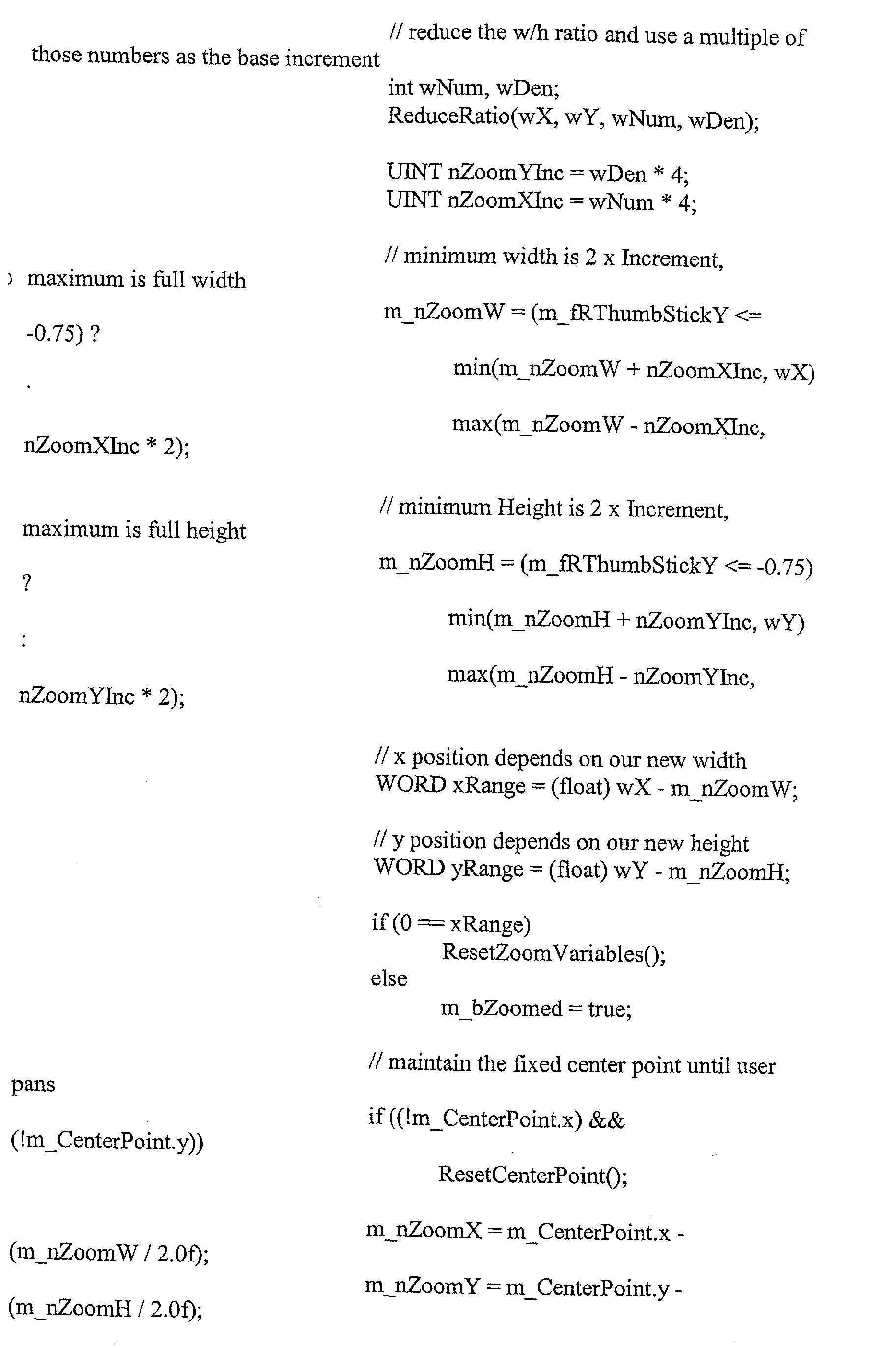
- the smallest integer increment on the x/y axis that will maintain the desired aspect ratio is determined by using a greatest common denominator to reduce the ratio to the lowest integer.
- the video data stream can be generated from a DVD (digital versatile/video disc) player or as a high definition television (HDTV) signal. It is possible to manipulate a joystick for initiating the zooming function and scale images on the video display.
- the joystick could be moved up to increase zoom magnification by a predetermined number of pixels or moved down to decrease zoom magnification by a predetermined number of pixels until fully zoomed out.
- a second joystick could be manipulated to vary the x/y position of the zoomed region in a continuous fashion.
- the video data could be displayed on a video display that is operatively connected to a game port of a video game box containing a DVD player or similar optical disc reader, a central processing unit, and a graphics processor unit.
- a method of operating a video game is also set forth and comprises the steps of processing a video data stream as generated from an optical disc player and displaying video data on a video display at a predetermined aspect ratio.
- a game controller is manipulated for continuously scaling images on the video display by obtaining video source values of pixel width and height to be displayed and determining the smallest integer increment on the x/y axis that will maintain the desired aspect ratio by using a greatest common denominator to reduce the ratio to the lowest integer in response to a predetermined manipulation of the game controller.
- a video display system is also set forth and includes a central processing unit and associated graphics processor unit for processing a video data stream and generating video data to be displayed.
- a video display receives video data and displays a video image at a predetermined aspect ratio.
- a user manipulable controller is operative with the graphics processor unit for scaling images on the video display by obtaining video source values of pixel width and height to be displayed and determining the smallest integer increment on the x/y axis that will maintain the desired aspect ratio using a greatest common denominator to reduce the ratio to the lowest integer.
- the video display comprises a television.
- An optical disc reader such as a DVD (digital versatile/video disc) player, is included as part of a video game system for producing the video data stream.
- the video data stream can also comprise a high definition television (HDTV) signal.
- a user manipulable controller can include one or more joysticks.
- the present invention advantageously provides an advantage over prior art "stepped" scaling and zoom functionality common with consumer DVD players, video game systems using optical disc players such as DVD players, and similar video systems that receive a video data stream resulting from a DVD or optical disc player, high definition TV (HDTV) signal, or other similar video production system.
- Many prior art systems were limited and operative by pressing a zoom button on a game controller or other system that would magnify by twice or by some other arbitrary resolution the current view displayed on an LCD or video display screen. For example, if a viewer is viewing 720x480 pixels of source content on a 720x480 display, when the viewer hits the zoom button, the viewer would then view 360x240 pixels of source content, scaled to fit on the 720x480 display.
- the present invention advantageously allows a continuous zoom feature for use with a displayed video image, such as displayed video data as from a processed video data stream resulting from a DVD or HDTV viewer driven by a multi-directional controller, for example, a pair of joysticks of a game pad controller or other similar controller.
- Scaling can be accomplished on a graphics processor unit (GPU).
- GPU graphics processor unit
- a zoom function occurs, such as by manipulating a game controller or joystick
- the coordinates of the source data one wishes to display is set and a destination area for display is designated, for example, on a full screen 640x480 pixel display. If the area of the source data does not correspond one-to-one with the area of the designation region, the graphics processor unit can scale the data in hardware.
- software scaling it is more CPU intensive, as in the use of other common prior art software scaling systems that make intensive use of software algorithms and CPU resources.
- the present invention is also applicable for maintaining an aspect ratio in some given regions, which does not need to be fractionally scaled, giving visibly better results in these instances.
- the scaling is used in a continuous fashion and can be zoomed and panned simultaneously and optimized for stability.
- the present invention can first be operable by viewing a display that displays DVD or HDTV video data at a normal source resolution, as a non-limiting example.
- DVD or HDTV video data can be used, including, data generated from a hard disc, optical disc, Internet, or other source known to those skilled in the art.
- source video data can be used, including, data generated from a hard disc, optical disc, Internet, or other source known to those skilled in the art.
- the description proceeds with a description relative to a DVD or HDTV viewer because these video data streams are presently encompassed in the use of many video game systems.
- the DVD or HDTV viewer software can be driven by a multi-directional controller, such as a pair of joysticks on a game pad controller.
- a controller with X/Y coordinates is moved to vary continuously the current zoom magnification. For instance, moving a joystick up could increase the zoom magnification by a very small number of pixels, while moving a joystick down could decrease the zoom magnification until it is fully zoomed out. If a second joystick is available on the game controller or in a game pad, this control could vary the X/Y position of the zoomed region in a continuous fashion.
- the present invention also provides a novel and unobvious zoom feature in a consumer DVD or HDTV playback device and provides a smooth centering algorithm that ensures a zoomed rectangle always retains its perspective with relation to the entire source and minimizes jitter or "bob" effects.
- HDTV high definition television
- FIG. 1 there is shown a video display system 10 as part of a video game system 12 using the method and system of scaling images continuously on a video display 14 in accordance with the present invention.
- CPU central processing units
- GPU graphic processing units
- chip sets memory devices, bridges, slots, frame buffer circuits, and other game and video display and system architectures
- FIG. 1 the present invention is described relative to the video game system architecture shown in FIG. 1.
- the video game system 12 includes a central processing unit 16 and a chip set 18 with associated support circuits that provide signals for the microprocessor and link the various systems and peripherals.
- a main memory 20 is operatively connected to the chip set 18 .
- Various slots 22 known to those skilled in the art, such as PCI slots and ISA slots, are connected into a bridge 24 , such as a PCI bridge, as illustrated.
- a graphics processing unit (GPU) 26 such as an NVIDIA graphics processing unit, is operatively connected to the chip set 18 and includes in the illustrated embodiment an advanced graphic port 28 and a frame buffer 30 , as known to those skilled in the art.
- the advanced graphic port 28 incorporates dedicated, pipeline access to main memory via the chip set 18 or other means known to those skilled in the art. It can move data between a dedicated frame buffer 30 and main system memory 20 .
- Various expansion cards can be included as requested by a user or those skilled in the art.
- a controller 32 e.g., a game controller, is operatively connected to the CPU 16 and graphics processing unit 26 via the slots 22 , PCI bridge 24 or game port 34 , as illustrated.
- the controller 32 includes a joystick, and in the illustrated embodiment, two joysticks 36, 36a .
- a DVD player 38 is part of the overall system and typically included in one video game housing 40 that contains most or all system components. The DVD player 38 is driven by appropriate DVD software drivers, as known to those skilled in the art.
- An ethernet port 42 is included and a high definition television (HDTV) port 44 for receiving HDTV signals or generating HDTV signals with the graphics processing unit 26, as known to those skilled in the art.
- HDMI high definition television
- the video display 14 could be incorporated integral with the system or be connected via wireless or wireline connection through a video output port 46 to a television, HDTV, LCD or other video display, as known to those skilled in the art.
- FIG. 2 illustrates a basic high level flow chart illustrating the method and system of the present invention. The system is described relative to operating a video game.
- a video data stream is generated from an optical disc player such as the illustrated DVD player (FIG. 1) and processed (Block 100).
- Video data is displayed on a video display at a predetermined aspect ratio (Block 102).
- a game controller such as a joystick, is manipulated (Block 104).
- Video x/y source values of pixel width and height to be displayed are obtained (Block 106).
- a destination region on the video display is designated for displaying the video source values to be displayed (Block 108).
- the smallest integer increment on the x/y axis that will maintain the desired aspect ratio is determined by using a greatest common denominator to reduce the ratio to the lowest integer (Block 110). If the area of video source data does not correspond one-to-one with the area of the destination region, the video source data in the graphics processor unit is scaled (Block 112).
- Scaling can occur by calculating a new width and height as in current pixel width and height and width and height increment to be displayed and fixing an x and y position as fixed x and y center points minus or plus any respective new width and height divided by two (Block 114).
- the system zooms to the newly calculated coordinates of source content (Block 116).
Landscapes
- Physics & Mathematics (AREA)
- General Physics & Mathematics (AREA)
- Engineering & Computer Science (AREA)
- Theoretical Computer Science (AREA)
- Controls And Circuits For Display Device (AREA)
- Position Input By Displaying (AREA)
Abstract
Description



Claims (20)
- A method of scaling images continuously on a display comprising the steps of:displaying video data generated as a video data stream on a video display at a predetermined aspect ratio;during playback or in a pause mode, obtaining video source values of pixel width and pixel height to be displayed;determining the smallest integer increment on the x/y axis that will maintain the desired aspect ratio by using a greatest common denominator to reduce the ratio to the lowest integer.
- A method of scaling images continuously on a display comprising the steps of:displaying video data generated as a video data stream on a video display at a predetermined aspect ratio;during playback or in a pause mode, obtaining video x,y source values of pixel width and pixel height to be displayed;designating a destination region on the display for displaying the video source values to be displayed;determining the smallest integer increment on the x/y axis that will maintain the desired aspect ratio by using a greatest common denominator to reduce the ratio to the lowest integer; andif the area of video source data does not correspond one-to-one with the area of the destination region, scaling the video source data in a graphics processor unit.
- A method according to Claim 1 or 2, and further comprising the step of generating a video data stream from an optical disc player.
- A method according to Claim 1, 2 or 3, and further comprising the step of generating a video data stream as a High Definition Television (HDTV) signal.
- A method according to any preceding claim, and further comprising the step of manipulating a joystick for initiating a zoom function to scale images of the video display.
- A method of operating a video game comprising the steps of:processing a video data stream as generated from an optical disc player and displaying video data on a video display at a predetermined aspect ratio;manipulating a game controller for continuously scaling images on the video display byobtaining video source values of pixel width and height to be displayed and determining the smallest integer increment on the x/y axis that will maintain the desired aspect ratio by using a greatest common denominator to reduce the ratio to the lowest integer in response to a predetermined manipulation of the game controller.
- A method of operating a video game comprising the steps of:processing a video data stream as generated from a DVD (digital versatile/video disc) player apparatus and displaying video data on a video display at a predetermined aspect ratio;manipulating a game controller for continuously scaling images on the video display by the steps of
obtaining video x,y source values of pixel width and height to be displayed;
designating a destination region on the video display for displaying the video source values to be displayed;
determining the smallest integer increment on the x/y axis that will maintain the desired aspect ratio by using a greatest common denominator to reduce the ratio to the lowest integer; and
if the area of video source data does not correspond one-to-one with the area ofthe destination region, scaling the video source data in a graphics processor unit. - A method according to Claim 6 or 7, and further comprising the step of manipulating the game controller by manipulating a joystick.
- A method according to Claim 5 or 8, and further comprising the step of moving the joystick up to increase zoom magnification by a predetermined number of pixels and moving the joystick down to decrease zoom magnification by a predetermined number of pixels until fully zoomed out.
- A method according to Claim 5, 8 or 9, and further comprising the step of manipulating a second joystick to vary the x/y position of the zoomed region in a continuous fashion.
- A method according to any preceding claim, and further comprising the step of displaying the video data on a video display that is operatively connected to a video game box containing the DVD or an optical disc player, a central processing unit, a graphics processor unit, and game port.
- A method according to any preceding claim, and further comprising the step of processing the video data such a zoomed rectangle retains its perspective in relation to the entire source or the video source values to minimize jitter/"bob" effects.
- A method according to any preceding claim, wherein if zooming out an image on the video display, if a current pixel width and height and width and height increment to be added are less than the maximum width and height that can be displayed, then calculating a new width and height as the current pixel width and height and width and height increment to be displayed and fixing an x and y position as fixed x and y center points minus any respective new width and height divided by two.
- A method according to any preceding claim, wherein if zooming in an image on the video display, if a current pixel width and height and width and height increment to be added are greater than the minimum width and height that can be displayed, then calculating a new width and height as the current pixel width and height and width and height increment to be displayed and fixing an x and y position as fixed x and y center points minus any respective new width and height divided by two.
- A video display system comprising:a central processing unit and associated graphics processor unit for processing a video data stream and generating video data to be displayed;a video display for receiving video data and displaying a video image at a predetermined aspect ratio;a user manipulable controller operative with said graphics processor unit for scaling images on the video display by obtaining video source values of pixel width and height to be displayed and determining the smallest integer increment on the x/y axis that will maintain the desired aspect ratio using a greatest common denominator to reduce the ratio to the lowest integer.
- A video display system comprising:a central processing unit and associated graphics processor unit for processing a video data stream and generating video data to be displayed;a video display for receiving video data and displaying a video image at a predetermined aspect ratio;a user manipulable controller operative with said graphics processor unit for scaling images on the video display by obtaining video x,y source values of pixel width and height to be displayed;designating a destination region on the display for displaying the video source values to be displayed;determining the smallest integer increment on the x/y axis that will maintain the desired aspect ratio by using a greatest common denominator to reduce the ratio to the lowest integer; andif the area of video source data does not correspond one-to-one with the area of the destination region, scaling the video source data in a graphics processor unit.
- A video display system according to Claim 15 or 16, wherein said video display comprises a television.
- A video display system according to any of Claims 15 to 17, and further comprising an optical disc reader, including a DVD (digital versatile/video disc) player, for producing said video data stream.
- A video display system according to any of Claims 15 to 18, wherein said video data stream comprises a high definition television (HDTV) signal.
- A video display system according to any of Claims 15 to 19, wherein said user manipulable controller comprises a joystick.
Applications Claiming Priority (2)
| Application Number | Priority Date | Filing Date | Title |
|---|---|---|---|
| US10/021,283 US6954219B2 (en) | 2001-12-12 | 2001-12-12 | Method and system of continuously scaling video images |
| US21283 | 2001-12-12 |
Publications (2)
| Publication Number | Publication Date |
|---|---|
| EP1320068A2 true EP1320068A2 (en) | 2003-06-18 |
| EP1320068A3 EP1320068A3 (en) | 2005-03-16 |
Family
ID=21803340
Family Applications (1)
| Application Number | Title | Priority Date | Filing Date |
|---|---|---|---|
| EP02258373A Withdrawn EP1320068A3 (en) | 2001-12-12 | 2002-12-04 | Method and system of continuously scaling video images |
Country Status (3)
| Country | Link |
|---|---|
| US (1) | US6954219B2 (en) |
| EP (1) | EP1320068A3 (en) |
| JP (1) | JP2003280632A (en) |
Cited By (1)
| Publication number | Priority date | Publication date | Assignee | Title |
|---|---|---|---|---|
| CN102750667A (en) * | 2011-11-21 | 2012-10-24 | 新奥特(北京)视频技术有限公司 | Method and device for image fast magnifying and reducing |
Families Citing this family (20)
| Publication number | Priority date | Publication date | Assignee | Title |
|---|---|---|---|---|
| US6943783B1 (en) * | 2001-12-05 | 2005-09-13 | Etron Technology Inc. | LCD controller which supports a no-scaling image without a frame buffer |
| JP4075039B2 (en) * | 2002-02-19 | 2008-04-16 | 株式会社セガ | Texture mapping method, program and apparatus |
| US7009600B2 (en) * | 2002-09-19 | 2006-03-07 | International Business Machines Corporation | Data processing system display screen including an image alteration area |
| US7194697B2 (en) | 2002-09-24 | 2007-03-20 | Microsoft Corporation | Magnification engine |
| US20050162445A1 (en) * | 2004-01-22 | 2005-07-28 | Lumapix | Method and system for interactive cropping of a graphical object within a containing region |
| US20060050089A1 (en) * | 2004-09-09 | 2006-03-09 | Atousa Soroushi | Method and apparatus for selecting pixels to write to a buffer when creating an enlarged image |
| US20070011625A1 (en) * | 2005-07-08 | 2007-01-11 | Jiunn-Sheng Yan | Method and apparatus for authoring and storing media objects in optical storage medium |
| US8032004B2 (en) * | 2006-08-14 | 2011-10-04 | Vmedia Research, Inc. | Multimedia presentation format |
| JP2009094712A (en) * | 2007-10-05 | 2009-04-30 | Funai Electric Co Ltd | Output device |
| GB2463103A (en) * | 2008-09-05 | 2010-03-10 | Skype Ltd | Video telephone call using a television receiver |
| GB2463105A (en) * | 2008-09-05 | 2010-03-10 | Skype Ltd | Viewer activity dependent video telephone call ringing |
| GB2463110B (en) * | 2008-09-05 | 2013-01-16 | Skype | Communication system and method |
| GB2463104A (en) | 2008-09-05 | 2010-03-10 | Skype Ltd | Thumbnail selection of telephone contact using zooming |
| GB2463109B (en) * | 2008-09-05 | 2013-03-13 | Skype | Communication system and method |
| GB2463108B (en) * | 2008-09-05 | 2012-08-29 | Skype | Communication system and method |
| GB2463124B (en) | 2008-09-05 | 2012-06-20 | Skype Ltd | A peripheral device for communication over a communications sytem |
| GB2463107A (en) * | 2008-09-05 | 2010-03-10 | Skype Ltd | A remote control unit of a media device for placing/receiving calls, comprising activating one of the two wireless transceivers when needed. |
| US9195317B2 (en) * | 2009-02-05 | 2015-11-24 | Opentv, Inc. | System and method for generating a user interface for text and item selection |
| US20110055888A1 (en) * | 2009-08-31 | 2011-03-03 | Dell Products L.P. | Configurable television broadcast receiving system |
| CN105898615A (en) * | 2015-12-25 | 2016-08-24 | 乐视网信息技术(北京)股份有限公司 | Video display window switching method and device |
Family Cites Families (18)
| Publication number | Priority date | Publication date | Assignee | Title |
|---|---|---|---|---|
| US4546349A (en) * | 1981-09-29 | 1985-10-08 | Sperry Corporation | Local zoom for raster scan displays |
| US4988984A (en) | 1988-10-31 | 1991-01-29 | International Business Machines Corporation | Image interpolator for an image display system |
| GB8908612D0 (en) * | 1989-04-17 | 1989-06-01 | Quantel Ltd | Video graphics system |
| US5214519A (en) * | 1991-04-29 | 1993-05-25 | E. I. Du Pont De Nemours And Company | Method and apparatus for producing a specified format output image from an arbitrary format source image |
| US5453846A (en) * | 1992-01-31 | 1995-09-26 | Matsushita Graphic Communication Systems | Image convertion method |
| US5374995A (en) * | 1993-03-22 | 1994-12-20 | Eastman Kodak Company | Method and apparatus for enhancing sharpness of a sequence of images subject to continuous zoom |
| US5774110A (en) * | 1994-01-04 | 1998-06-30 | Edelson; Steven D. | Filter RAMDAC with hardware 11/2-D zoom function |
| IL108922A0 (en) | 1994-03-10 | 1995-03-15 | Israel State | Method and apparatus for smoothing out stepwise changes of field of view |
| US5828575A (en) * | 1996-05-06 | 1998-10-27 | Amadasoft America, Inc. | Apparatus and method for managing and distributing design and manufacturing information throughout a sheet metal production facility |
| US5960126A (en) * | 1996-05-22 | 1999-09-28 | Sun Microsystems, Inc. | Method and system for providing relevance-enhanced image reduction in computer systems |
| US6313828B1 (en) * | 1996-11-12 | 2001-11-06 | Carlos Landetta Chombo | Electronic book |
| US6313822B1 (en) * | 1998-03-27 | 2001-11-06 | Sony Corporation | Method and apparatus for modifying screen resolution based on available memory |
| US6456745B1 (en) | 1998-09-16 | 2002-09-24 | Push Entertaiment Inc. | Method and apparatus for re-sizing and zooming images by operating directly on their digital transforms |
| US6178272B1 (en) * | 1999-02-02 | 2001-01-23 | Oplus Technologies Ltd. | Non-linear and linear method of scale-up or scale-down image resolution conversion |
| US6437787B1 (en) * | 1999-03-30 | 2002-08-20 | Sony Corporation | Display master control |
| US6456329B1 (en) * | 1999-04-19 | 2002-09-24 | Sarnoff Corporation | De-interlacing of video signals |
| JP3797838B2 (en) * | 1999-12-15 | 2006-07-19 | 三菱電機株式会社 | Image display device |
| JP2002042126A (en) * | 2000-05-19 | 2002-02-08 | Sony Computer Entertainment Inc | Storage medium storing display control program, entertainment device, and display control program |
-
2001
- 2001-12-12 US US10/021,283 patent/US6954219B2/en not_active Expired - Lifetime
-
2002
- 2002-12-04 EP EP02258373A patent/EP1320068A3/en not_active Withdrawn
- 2002-12-12 JP JP2002361094A patent/JP2003280632A/en active Pending
Cited By (1)
| Publication number | Priority date | Publication date | Assignee | Title |
|---|---|---|---|---|
| CN102750667A (en) * | 2011-11-21 | 2012-10-24 | 新奥特(北京)视频技术有限公司 | Method and device for image fast magnifying and reducing |
Also Published As
| Publication number | Publication date |
|---|---|
| US6954219B2 (en) | 2005-10-11 |
| JP2003280632A (en) | 2003-10-02 |
| EP1320068A3 (en) | 2005-03-16 |
| US20030117419A1 (en) | 2003-06-26 |
Similar Documents
| Publication | Publication Date | Title |
|---|---|---|
| US6954219B2 (en) | Method and system of continuously scaling video images | |
| US6149520A (en) | Video game method and apparatus for effecting character movement and ball control determination | |
| EP0867807B1 (en) | Information processing, computer readable media, and authoring systems | |
| AU2005242447B2 (en) | Image frame processing method and device for displaying moving images to a variety of displays | |
| US8754959B2 (en) | Image processing device, dynamic image reproduction device, and processing method and program in them | |
| US6388638B2 (en) | Display apparatus and its control method | |
| US5889529A (en) | System and method for generating and displaying complex graphic images at a constant frame rate | |
| JPH08331411A (en) | System and method for television viewer to divert oneself | |
| US6535232B1 (en) | Device for controlling quality of reproduction of motion picture and method for controlling the same | |
| US20230353717A1 (en) | Image processing system, image processing method, and storage medium | |
| US8212822B2 (en) | Program execution system, program execution device and recording medium and computer executable program therefor | |
| JP7791226B2 (en) | Image processing device, image processing method, and program | |
| US6842183B2 (en) | Three-dimensional image processing unit and computer readable recording medium storing three-dimensional image processing program | |
| JP3496205B2 (en) | Method of changing viewpoint in ball game on game machine | |
| JP2003135851A (en) | Game device, method for controlling computer game system, and program | |
| JP4165983B2 (en) | GAME DEVICE AND INFORMATION STORAGE MEDIUM | |
| CN100593188C (en) | Image frame processing method and apparatus for displaying moving image to various displays | |
| US6982717B2 (en) | Game apparatus, storage medium and computer program | |
| EP0992945B1 (en) | Video game apparatus, model display and readable recording medium therefor | |
| JP2000070549A (en) | Game system, method for preserving image and recording medium recording game program | |
| JP3348152B2 (en) | Game system | |
| JP3594915B2 (en) | PROGRAM, INFORMATION STORAGE MEDIUM, AND GAME DEVICE | |
| JP2002092627A (en) | Game device and information storage medium | |
| JP2003051032A (en) | GAME INFORMATION, INFORMATION STORAGE MEDIUM, AND GAME DEVICE | |
| KR100878640B1 (en) | Image frame processing method and apparatus for displaying moving images on various display devices |
Legal Events
| Date | Code | Title | Description |
|---|---|---|---|
| PUAI | Public reference made under article 153(3) epc to a published international application that has entered the european phase |
Free format text: ORIGINAL CODE: 0009012 |
|
| AK | Designated contracting states |
Designated state(s): AT BE BG CH CY CZ DE DK EE ES FI FR GB GR IE IT LI LU MC NL PT SE SI SK TR |
|
| AX | Request for extension of the european patent |
Extension state: AL LT LV MK RO |
|
| PUAL | Search report despatched |
Free format text: ORIGINAL CODE: 0009013 |
|
| AK | Designated contracting states |
Kind code of ref document: A3 Designated state(s): AT BE BG CH CY CZ DE DK EE ES FI FR GB GR IE IT LI LU MC NL PT SE SI SK TR |
|
| AX | Request for extension of the european patent |
Extension state: AL LT LV MK RO |
|
| 17P | Request for examination filed |
Effective date: 20050902 |
|
| AKX | Designation fees paid |
Designated state(s): DE FR GB IT |
|
| 18D | Application deemed to be withdrawn |
Effective date: 20070701 |
|
| STAA | Information on the status of an ep patent application or granted ep patent |
Free format text: STATUS: THE APPLICATION IS DEEMED TO BE WITHDRAWN |
|
| R18D | Application deemed to be withdrawn (corrected) |
Effective date: 20070702 |