EP1317186B1 - Improved bioactive whey protein hydrolysate - Google Patents
Improved bioactive whey protein hydrolysate Download PDFInfo
- Publication number
- EP1317186B1 EP1317186B1 EP01970375A EP01970375A EP1317186B1 EP 1317186 B1 EP1317186 B1 EP 1317186B1 EP 01970375 A EP01970375 A EP 01970375A EP 01970375 A EP01970375 A EP 01970375A EP 1317186 B1 EP1317186 B1 EP 1317186B1
- Authority
- EP
- European Patent Office
- Prior art keywords
- seq
- hydrolysate
- product
- hydrolysis
- wpi
- Prior art date
- Legal status (The legal status is an assumption and is not a legal conclusion. Google has not performed a legal analysis and makes no representation as to the accuracy of the status listed.)
- Expired - Lifetime
Links
- 108010046377 Whey Proteins Proteins 0.000 title claims abstract description 45
- 235000021119 whey protein Nutrition 0.000 title claims abstract description 41
- 102000007544 Whey Proteins Human genes 0.000 title claims abstract description 36
- 239000003531 protein hydrolysate Substances 0.000 title claims abstract description 20
- 230000000975 bioactive effect Effects 0.000 title claims description 39
- 238000000034 method Methods 0.000 claims abstract description 42
- 230000008569 process Effects 0.000 claims abstract description 29
- 239000000758 substrate Substances 0.000 claims abstract description 15
- 108090000765 processed proteins & peptides Proteins 0.000 claims description 77
- 239000000413 hydrolysate Substances 0.000 claims description 51
- 238000006460 hydrolysis reaction Methods 0.000 claims description 50
- 239000000047 product Substances 0.000 claims description 50
- 230000007062 hydrolysis Effects 0.000 claims description 47
- 102000004196 processed proteins & peptides Human genes 0.000 claims description 42
- 102000004190 Enzymes Human genes 0.000 claims description 30
- 108090000790 Enzymes Proteins 0.000 claims description 30
- 108091005804 Peptidases Proteins 0.000 claims description 13
- FWMNVWWHGCHHJJ-SKKKGAJSSA-N 4-amino-1-[(2r)-6-amino-2-[[(2r)-2-[[(2r)-2-[[(2r)-2-amino-3-phenylpropanoyl]amino]-3-phenylpropanoyl]amino]-4-methylpentanoyl]amino]hexanoyl]piperidine-4-carboxylic acid Chemical compound C([C@H](C(=O)N[C@H](CC(C)C)C(=O)N[C@H](CCCCN)C(=O)N1CCC(N)(CC1)C(O)=O)NC(=O)[C@H](N)CC=1C=CC=CC=1)C1=CC=CC=C1 FWMNVWWHGCHHJJ-SKKKGAJSSA-N 0.000 claims description 10
- 239000004365 Protease Substances 0.000 claims description 10
- 239000002245 particle Substances 0.000 claims description 10
- 235000019419 proteases Nutrition 0.000 claims description 10
- 102000035195 Peptidases Human genes 0.000 claims description 9
- 108010009736 Protein Hydrolysates Proteins 0.000 claims description 9
- 230000009849 deactivation Effects 0.000 claims description 9
- 239000003937 drug carrier Substances 0.000 claims description 8
- 239000008194 pharmaceutical composition Substances 0.000 claims description 8
- 235000018102 proteins Nutrition 0.000 claims description 8
- 102000004169 proteins and genes Human genes 0.000 claims description 8
- 108090000623 proteins and genes Proteins 0.000 claims description 8
- 238000000108 ultra-filtration Methods 0.000 claims description 8
- 230000003301 hydrolyzing effect Effects 0.000 claims description 7
- 238000004519 manufacturing process Methods 0.000 claims description 7
- 239000012528 membrane Substances 0.000 claims description 6
- 238000011282 treatment Methods 0.000 claims description 6
- 206010020772 Hypertension Diseases 0.000 claims description 5
- 239000003814 drug Substances 0.000 claims description 5
- 108010009355 microbial metalloproteinases Proteins 0.000 claims description 5
- -1 Validase Proteins 0.000 claims description 4
- 238000010438 heat treatment Methods 0.000 claims description 4
- 101001091385 Homo sapiens Kallikrein-6 Proteins 0.000 claims description 3
- 102100034866 Kallikrein-6 Human genes 0.000 claims description 3
- 101710180012 Protease 7 Proteins 0.000 claims description 3
- 238000004925 denaturation Methods 0.000 claims description 3
- 230000036425 denaturation Effects 0.000 claims description 3
- 235000013305 food Nutrition 0.000 claims description 3
- 239000000463 material Substances 0.000 claims description 3
- 239000000203 mixture Substances 0.000 claims description 3
- 235000019833 protease Nutrition 0.000 claims description 3
- 108091005508 Acid proteases Proteins 0.000 claims description 2
- 108090000145 Bacillolysin Proteins 0.000 claims description 2
- 229920001661 Chitosan Polymers 0.000 claims description 2
- 108091005507 Neutral proteases Proteins 0.000 claims description 2
- 102000035092 Neutral proteases Human genes 0.000 claims description 2
- 229920001525 carrageenan Polymers 0.000 claims description 2
- 235000010418 carrageenan Nutrition 0.000 claims description 2
- 229940113118 carrageenan Drugs 0.000 claims description 2
- 239000000679 carrageenan Substances 0.000 claims description 2
- 229920001002 functional polymer Polymers 0.000 claims description 2
- CERQOIWHTDAKMF-UHFFFAOYSA-M methacrylate group Chemical group C(C(=C)C)(=O)[O-] CERQOIWHTDAKMF-UHFFFAOYSA-M 0.000 claims description 2
- UHVMMEOXYDMDKI-JKYCWFKZSA-L zinc;1-(5-cyanopyridin-2-yl)-3-[(1s,2s)-2-(6-fluoro-2-hydroxy-3-propanoylphenyl)cyclopropyl]urea;diacetate Chemical compound [Zn+2].CC([O-])=O.CC([O-])=O.CCC(=O)C1=CC=C(F)C([C@H]2[C@H](C2)NC(=O)NC=2N=CC(=CC=2)C#N)=C1O UHVMMEOXYDMDKI-JKYCWFKZSA-L 0.000 claims description 2
- 102100037486 Reverse transcriptase/ribonuclease H Human genes 0.000 claims 4
- 239000000796 flavoring agent Substances 0.000 abstract description 18
- 235000019634 flavors Nutrition 0.000 abstract description 17
- 230000002401 inhibitory effect Effects 0.000 abstract description 2
- 230000000694 effects Effects 0.000 description 25
- 229940088598 enzyme Drugs 0.000 description 23
- 235000019658 bitter taste Nutrition 0.000 description 15
- 238000011699 spontaneously hypertensive rat Methods 0.000 description 11
- 230000036772 blood pressure Effects 0.000 description 10
- 239000000243 solution Substances 0.000 description 10
- 102000014171 Milk Proteins Human genes 0.000 description 9
- 108010011756 Milk Proteins Proteins 0.000 description 9
- 238000005187 foaming Methods 0.000 description 9
- 235000021239 milk protein Nutrition 0.000 description 9
- 230000037396 body weight Effects 0.000 description 7
- 239000007787 solid Substances 0.000 description 7
- 101000929923 Caenorhabditis elegans Acetylcholinesterase 1 Proteins 0.000 description 6
- 241001465754 Metazoa Species 0.000 description 6
- 230000003276 anti-hypertensive effect Effects 0.000 description 6
- 239000012141 concentrate Substances 0.000 description 6
- 239000012467 final product Substances 0.000 description 6
- 238000000338 in vitro Methods 0.000 description 6
- UDIODXADSSQKTM-GUHNCMMLSA-N (5ar,8ar,9r)-5-[[(2r,4ar,6r,7r,8r,8as)-7,8-dihydroxy-2-methyl-4,4a,6,7,8,8a-hexahydropyrano[3,2-d][1,3]dioxin-6-yl]oxy]-9-(4-hydroxy-3,5-dimethoxyphenyl)-5a,6,8a,9-tetrahydro-5h-[2]benzofuro[6,5-f][1,3]benzodioxol-8-one;(7s,9s)-7-[(2r,4s,5s,6s)-4-amino-5- Chemical compound ClCCN(CCCl)P1(=O)NCCCO1.O([C@H]1C[C@@](O)(CC=2C(O)=C3C(=O)C=4C=CC=C(C=4C(=O)C3=C(O)C=21)OC)C(=O)CO)[C@H]1C[C@H](N)[C@H](O)[C@H](C)O1.COC1=C(O)C(OC)=CC([C@@H]2C3=CC=4OCOC=4C=C3C(O[C@H]3[C@@H]([C@@H](O)[C@@H]4O[C@H](C)OC[C@H]4O3)O)[C@@H]3[C@@H]2C(OC3)=O)=C1 UDIODXADSSQKTM-GUHNCMMLSA-N 0.000 description 5
- 239000005905 Hydrolysed protein Substances 0.000 description 5
- 230000001953 sensory effect Effects 0.000 description 5
- 102000011632 Caseins Human genes 0.000 description 4
- 108010076119 Caseins Proteins 0.000 description 4
- 241000700159 Rattus Species 0.000 description 4
- 239000005862 Whey Substances 0.000 description 4
- 230000001154 acute effect Effects 0.000 description 4
- 235000019636 bitter flavor Nutrition 0.000 description 4
- 238000000855 fermentation Methods 0.000 description 4
- 230000004151 fermentation Effects 0.000 description 4
- 239000006041 probiotic Substances 0.000 description 4
- 230000000529 probiotic effect Effects 0.000 description 4
- 235000018291 probiotics Nutrition 0.000 description 4
- 239000005541 ACE inhibitor Substances 0.000 description 3
- 108050008461 Beta-lactoglobulin Proteins 0.000 description 3
- 150000001413 amino acids Chemical class 0.000 description 3
- 229940044094 angiotensin-converting-enzyme inhibitor Drugs 0.000 description 3
- 235000019606 astringent taste Nutrition 0.000 description 3
- BECPQYXYKAMYBN-UHFFFAOYSA-N casein, tech. Chemical compound NCCCCC(C(O)=O)N=C(O)C(CC(O)=O)N=C(O)C(CCC(O)=N)N=C(O)C(CC(C)C)N=C(O)C(CCC(O)=O)N=C(O)C(CC(O)=O)N=C(O)C(CCC(O)=O)N=C(O)C(C(C)O)N=C(O)C(CCC(O)=N)N=C(O)C(CCC(O)=N)N=C(O)C(CCC(O)=N)N=C(O)C(CCC(O)=O)N=C(O)C(CCC(O)=O)N=C(O)C(COP(O)(O)=O)N=C(O)C(CCC(O)=N)N=C(O)C(N)CC1=CC=CC=C1 BECPQYXYKAMYBN-UHFFFAOYSA-N 0.000 description 3
- 235000021240 caseins Nutrition 0.000 description 3
- 238000006243 chemical reaction Methods 0.000 description 3
- 239000003795 chemical substances by application Substances 0.000 description 3
- 235000009508 confectionery Nutrition 0.000 description 3
- 235000013365 dairy product Nutrition 0.000 description 3
- 239000000499 gel Substances 0.000 description 3
- 230000006872 improvement Effects 0.000 description 3
- 235000013336 milk Nutrition 0.000 description 3
- 239000008267 milk Substances 0.000 description 3
- 210000004080 milk Anatomy 0.000 description 3
- 235000019629 palatability Nutrition 0.000 description 3
- 230000007065 protein hydrolysis Effects 0.000 description 3
- 230000009467 reduction Effects 0.000 description 3
- 230000035488 systolic blood pressure Effects 0.000 description 3
- 235000019640 taste Nutrition 0.000 description 3
- 235000013618 yogurt Nutrition 0.000 description 3
- 101000993347 Gallus gallus Ciliary neurotrophic factor Proteins 0.000 description 2
- GUBGYTABKSRVRQ-QKKXKWKRSA-N Lactose Natural products OC[C@H]1O[C@@H](O[C@H]2[C@H](O)[C@@H](O)C(O)O[C@@H]2CO)[C@H](O)[C@@H](O)[C@H]1O GUBGYTABKSRVRQ-QKKXKWKRSA-N 0.000 description 2
- 230000001133 acceleration Effects 0.000 description 2
- 239000005018 casein Substances 0.000 description 2
- 238000005119 centrifugation Methods 0.000 description 2
- 235000013351 cheese Nutrition 0.000 description 2
- 238000001816 cooling Methods 0.000 description 2
- 235000021185 dessert Nutrition 0.000 description 2
- 238000005516 engineering process Methods 0.000 description 2
- 235000012041 food component Nutrition 0.000 description 2
- 239000005417 food ingredient Substances 0.000 description 2
- 230000002779 inactivation Effects 0.000 description 2
- 239000004615 ingredient Substances 0.000 description 2
- 238000005342 ion exchange Methods 0.000 description 2
- 239000008101 lactose Substances 0.000 description 2
- 230000004044 response Effects 0.000 description 2
- 239000012465 retentate Substances 0.000 description 2
- 239000000126 substance Substances 0.000 description 2
- 235000000346 sugar Nutrition 0.000 description 2
- 150000008163 sugars Chemical class 0.000 description 2
- 239000006228 supernatant Substances 0.000 description 2
- 235000019605 sweet taste sensations Nutrition 0.000 description 2
- XLYOFNOQVPJJNP-UHFFFAOYSA-N water Substances O XLYOFNOQVPJJNP-UHFFFAOYSA-N 0.000 description 2
- ZDLZKMDMBBMJLI-FDMDGMSGSA-N 2-[[2-[[(2s)-2-[[(e)-3-(furan-2-yl)prop-2-enoyl]amino]-3-phenylpropanoyl]amino]acetyl]amino]acetic acid Chemical compound C([C@@H](C(=O)NCC(=O)NCC(=O)O)NC(=O)\C=C\C=1OC=CC=1)C1=CC=CC=C1 ZDLZKMDMBBMJLI-FDMDGMSGSA-N 0.000 description 1
- 108010048632 2-furanacryloyl-phenylalanyl-glycyl-glycine Proteins 0.000 description 1
- 102100030988 Angiotensin-converting enzyme Human genes 0.000 description 1
- 240000006439 Aspergillus oryzae Species 0.000 description 1
- 235000002247 Aspergillus oryzae Nutrition 0.000 description 1
- 102100026189 Beta-galactosidase Human genes 0.000 description 1
- 101000984728 Chiropsoides quadrigatus Angiotensin-converting enzyme inhibitory peptide Proteins 0.000 description 1
- 206010012735 Diarrhoea Diseases 0.000 description 1
- 208000001860 Eye Infections Diseases 0.000 description 1
- 108010059881 Lactase Proteins 0.000 description 1
- 241000254697 Lactobacillus rhamnosus HN001 Species 0.000 description 1
- 101800004361 Lactoferricin-B Proteins 0.000 description 1
- 108010063045 Lactoferrin Proteins 0.000 description 1
- 102000010445 Lactoferrin Human genes 0.000 description 1
- 108010060630 Lactoglobulins Proteins 0.000 description 1
- 102000008192 Lactoglobulins Human genes 0.000 description 1
- 241000031670 Saccharopolyspora thermophila Species 0.000 description 1
- 238000012300 Sequence Analysis Methods 0.000 description 1
- 238000010793 Steam injection (oil industry) Methods 0.000 description 1
- 239000002253 acid Substances 0.000 description 1
- 230000002009 allergenic effect Effects 0.000 description 1
- 125000003275 alpha amino acid group Chemical group 0.000 description 1
- 239000004599 antimicrobial Substances 0.000 description 1
- 238000013459 approach Methods 0.000 description 1
- 230000009286 beneficial effect Effects 0.000 description 1
- 108010005774 beta-Galactosidase Proteins 0.000 description 1
- 230000004071 biological effect Effects 0.000 description 1
- 230000015572 biosynthetic process Effects 0.000 description 1
- 238000009530 blood pressure measurement Methods 0.000 description 1
- 229940021722 caseins Drugs 0.000 description 1
- 150000001768 cations Chemical class 0.000 description 1
- 239000013065 commercial product Substances 0.000 description 1
- 230000000052 comparative effect Effects 0.000 description 1
- 238000010276 construction Methods 0.000 description 1
- 235000021245 dietary protein Nutrition 0.000 description 1
- 235000019621 digestibility Nutrition 0.000 description 1
- 208000010643 digestive system disease Diseases 0.000 description 1
- 230000002255 enzymatic effect Effects 0.000 description 1
- 238000011156 evaluation Methods 0.000 description 1
- 208000011323 eye infectious disease Diseases 0.000 description 1
- 239000006260 foam Substances 0.000 description 1
- 230000005714 functional activity Effects 0.000 description 1
- 235000013376 functional food Nutrition 0.000 description 1
- 230000036541 health Effects 0.000 description 1
- 230000002209 hydrophobic effect Effects 0.000 description 1
- 230000001631 hypertensive effect Effects 0.000 description 1
- 238000001727 in vivo Methods 0.000 description 1
- 238000010348 incorporation Methods 0.000 description 1
- 239000002198 insoluble material Substances 0.000 description 1
- 230000002427 irreversible effect Effects 0.000 description 1
- 238000002955 isolation Methods 0.000 description 1
- 235000015110 jellies Nutrition 0.000 description 1
- 239000008274 jelly Substances 0.000 description 1
- 229940116108 lactase Drugs 0.000 description 1
- CFFMZOZGXDAXHP-HOKBLYKWSA-N lactoferricin Chemical compound C([C@H](NC(=O)[C@H](C)NC(=O)[C@H](CCCNC(N)=N)NC(=O)[C@H](C(C)C)NC(=O)[C@@H]1CSSC[C@@H](C(=O)N[C@@H](CCCNC(N)=N)C(=O)N[C@@H](CCCNC(N)=N)C(=O)N[C@@H](CC=2C3=CC=CC=C3NC=2)C(=O)N[C@@H](CCC(N)=O)C(=O)N[C@@H](CC=2C3=CC=CC=C3NC=2)C(=O)N[C@@H](CCCNC(N)=N)C(=O)N[C@@H](CCSC)C(=O)N[C@@H](CCCCN)N[C@@H](CCCCN)C(=O)N[C@@H](CC(C)C)C(=O)NCC(=O)N[C@@H](C)C(=O)N2CCC[C@H]2C(=O)N[C@@H](CO)C(=O)N[C@H](C(N[C@H](C(=O)N1)[C@@H](C)O)=O)[C@@H](C)CC)NC(=O)[C@H](CCCCN)NC(=O)[C@@H](N)CC=1C=CC=CC=1)C(O)=O)C1=CC=CC=C1 CFFMZOZGXDAXHP-HOKBLYKWSA-N 0.000 description 1
- 238000004949 mass spectrometry Methods 0.000 description 1
- 208000004396 mastitis Diseases 0.000 description 1
- 244000005700 microbiome Species 0.000 description 1
- 230000007935 neutral effect Effects 0.000 description 1
- 230000036961 partial effect Effects 0.000 description 1
- 239000012466 permeate Substances 0.000 description 1
- ZWLUXSQADUDCSB-UHFFFAOYSA-N phthalaldehyde Chemical class O=CC1=CC=CC=C1C=O ZWLUXSQADUDCSB-UHFFFAOYSA-N 0.000 description 1
- 230000001766 physiological effect Effects 0.000 description 1
- 239000002244 precipitate Substances 0.000 description 1
- 238000004321 preservation Methods 0.000 description 1
- 230000002829 reductive effect Effects 0.000 description 1
- 230000000717 retained effect Effects 0.000 description 1
- 238000004007 reversed phase HPLC Methods 0.000 description 1
- 235000021262 sour milk Nutrition 0.000 description 1
- 230000002269 spontaneous effect Effects 0.000 description 1
- 238000010561 standard procedure Methods 0.000 description 1
- 239000007858 starting material Substances 0.000 description 1
- BWMISRWJRUSYEX-SZKNIZGXSA-N terbinafine hydrochloride Chemical compound Cl.C1=CC=C2C(CN(C\C=C\C#CC(C)(C)C)C)=CC=CC2=C1 BWMISRWJRUSYEX-SZKNIZGXSA-N 0.000 description 1
- 238000012360 testing method Methods 0.000 description 1
- 201000004647 tinea pedis Diseases 0.000 description 1
- 230000000007 visual effect Effects 0.000 description 1
- 235000021247 β-casein Nutrition 0.000 description 1
Images

Classifications
-
- C—CHEMISTRY; METALLURGY
- C12—BIOCHEMISTRY; BEER; SPIRITS; WINE; VINEGAR; MICROBIOLOGY; ENZYMOLOGY; MUTATION OR GENETIC ENGINEERING
- C12P—FERMENTATION OR ENZYME-USING PROCESSES TO SYNTHESISE A DESIRED CHEMICAL COMPOUND OR COMPOSITION OR TO SEPARATE OPTICAL ISOMERS FROM A RACEMIC MIXTURE
- C12P21/00—Preparation of peptides or proteins
-
- A—HUMAN NECESSITIES
- A61—MEDICAL OR VETERINARY SCIENCE; HYGIENE
- A61K—PREPARATIONS FOR MEDICAL, DENTAL OR TOILETRY PURPOSES
- A61K38/00—Medicinal preparations containing peptides
- A61K38/04—Peptides having up to 20 amino acids in a fully defined sequence; Derivatives thereof
- A61K38/08—Peptides having 5 to 11 amino acids
-
- A—HUMAN NECESSITIES
- A61—MEDICAL OR VETERINARY SCIENCE; HYGIENE
- A61K—PREPARATIONS FOR MEDICAL, DENTAL OR TOILETRY PURPOSES
- A61K38/00—Medicinal preparations containing peptides
- A61K38/04—Peptides having up to 20 amino acids in a fully defined sequence; Derivatives thereof
- A61K38/10—Peptides having 12 to 20 amino acids
-
- A—HUMAN NECESSITIES
- A23—FOODS OR FOODSTUFFS; TREATMENT THEREOF, NOT COVERED BY OTHER CLASSES
- A23J—PROTEIN COMPOSITIONS FOR FOODSTUFFS; WORKING-UP PROTEINS FOR FOODSTUFFS; PHOSPHATIDE COMPOSITIONS FOR FOODSTUFFS
- A23J3/00—Working-up of proteins for foodstuffs
- A23J3/30—Working-up of proteins for foodstuffs by hydrolysis
- A23J3/32—Working-up of proteins for foodstuffs by hydrolysis using chemical agents
- A23J3/34—Working-up of proteins for foodstuffs by hydrolysis using chemical agents using enzymes
- A23J3/341—Working-up of proteins for foodstuffs by hydrolysis using chemical agents using enzymes of animal proteins
- A23J3/343—Working-up of proteins for foodstuffs by hydrolysis using chemical agents using enzymes of animal proteins of dairy proteins
-
- A—HUMAN NECESSITIES
- A23—FOODS OR FOODSTUFFS; TREATMENT THEREOF, NOT COVERED BY OTHER CLASSES
- A23L—FOODS, FOODSTUFFS OR NON-ALCOHOLIC BEVERAGES, NOT OTHERWISE PROVIDED FOR; PREPARATION OR TREATMENT THEREOF
- A23L33/00—Modifying nutritive qualities of foods; Dietetic products; Preparation or treatment thereof
- A23L33/10—Modifying nutritive qualities of foods; Dietetic products; Preparation or treatment thereof using additives
- A23L33/17—Amino acids, peptides or proteins
- A23L33/18—Peptides; Protein hydrolysates
-
- A—HUMAN NECESSITIES
- A61—MEDICAL OR VETERINARY SCIENCE; HYGIENE
- A61K—PREPARATIONS FOR MEDICAL, DENTAL OR TOILETRY PURPOSES
- A61K38/00—Medicinal preparations containing peptides
- A61K38/01—Hydrolysed proteins; Derivatives thereof
- A61K38/012—Hydrolysed proteins; Derivatives thereof from animals
- A61K38/018—Hydrolysed proteins; Derivatives thereof from animals from milk
-
- A—HUMAN NECESSITIES
- A61—MEDICAL OR VETERINARY SCIENCE; HYGIENE
- A61K—PREPARATIONS FOR MEDICAL, DENTAL OR TOILETRY PURPOSES
- A61K38/00—Medicinal preparations containing peptides
- A61K38/04—Peptides having up to 20 amino acids in a fully defined sequence; Derivatives thereof
- A61K38/06—Tripeptides
-
- A—HUMAN NECESSITIES
- A61—MEDICAL OR VETERINARY SCIENCE; HYGIENE
- A61P—SPECIFIC THERAPEUTIC ACTIVITY OF CHEMICAL COMPOUNDS OR MEDICINAL PREPARATIONS
- A61P9/00—Drugs for disorders of the cardiovascular system
- A61P9/12—Antihypertensives
-
- A—HUMAN NECESSITIES
- A23—FOODS OR FOODSTUFFS; TREATMENT THEREOF, NOT COVERED BY OTHER CLASSES
- A23V—INDEXING SCHEME RELATING TO FOODS, FOODSTUFFS OR NON-ALCOHOLIC BEVERAGES AND LACTIC OR PROPIONIC ACID BACTERIA USED IN FOODSTUFFS OR FOOD PREPARATION
- A23V2002/00—Food compositions, function of food ingredients or processes for food or foodstuffs
-
- Y—GENERAL TAGGING OF NEW TECHNOLOGICAL DEVELOPMENTS; GENERAL TAGGING OF CROSS-SECTIONAL TECHNOLOGIES SPANNING OVER SEVERAL SECTIONS OF THE IPC; TECHNICAL SUBJECTS COVERED BY FORMER USPC CROSS-REFERENCE ART COLLECTIONS [XRACs] AND DIGESTS
- Y02—TECHNOLOGIES OR APPLICATIONS FOR MITIGATION OR ADAPTATION AGAINST CLIMATE CHANGE
- Y02A—TECHNOLOGIES FOR ADAPTATION TO CLIMATE CHANGE
- Y02A50/00—TECHNOLOGIES FOR ADAPTATION TO CLIMATE CHANGE in human health protection, e.g. against extreme weather
- Y02A50/30—Against vector-borne diseases, e.g. mosquito-borne, fly-borne, tick-borne or waterborne diseases whose impact is exacerbated by climate change
Definitions
- This invention relates to a process for producing improved hydrolysed whey protein products which are substantially free of bitter flavours and which contain bioactive peptides.
- the products of the process have high digestibility and good organoleptic properties.
- the products have a bland taste and are free of soapy or brothy flavours.
- the improved hydrolysed whey protein products are useful sources of bioactive peptides for incorporation into functional foods.
- a number of food ingredients and foodstuffs have been produced from the hydrolysis of a protein source such as the milk proteins, casein and whey proteins.
- Hydrolysed protein foodstuffs may have advantages over non-hydrolysed protein foodstuffs in a number of areas of health care. For example, it is known that enzymatically hydrolysed proteins are less allergenic. They are also more rapidly digested and absorbed than whole proteins. Foodstuffs containing hydrolysed proteins are also useful in the alimentation of hospital patients with digestive diseases for example.
- EP 4745506 discloses the hydrolysis of the milk protein lactoferrin in whey to release lactoferricin which acts as an antimicrobial agent useful for treating diarrhoea, athlete's foot, eye infections, mastitis etc in humans and animals.
- a second common method for the control of bitterness in protein hydrolysates is to use debittering enzymes, in particular those sourced from Aspergillus oryzae.
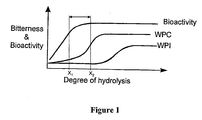
- bioactive peptides - in particular the antihypertensive peptides - are relatively stable during protein hydrolysis and are released very early during the hydrolysis of the milk protein substrate as shown in Figure 1 .
- the bitter flavours of milk protein hydrolysates can be improved by adding sugars or by hydrolysing natural sugars, such as lactose, already present in the milk protein substrate (Bernal and Jelen, 1989).
- natural sugars such as lactose
- sour wheys and cheese wheys are made more palatable when they have been sweetened by ⁇ -galactosidease and lactase hydrolysis of lactose ( FR 2309154 ; US 4358464 ; JP 8056568 ).
- a common method of termination of hydrolysis is by deactivation of the enzymes, usually by thermal deactivation at high temperatures, typically> 90-100°C for an extended period of time.
- this method cannot be used to stop the hydrolysis of whey proteins as any intact unhydrolysed whey proteins remaining in the mixture would denature and precipitate making the final product less soluble and less acceptable for the use as a food ingredient.
- the present invention uses a different whey protein-containing substrate to that used in WO 99/65326 although a similar hydrolysing process is used. Surprisingly, the use of this different substrate results in a hydrolysate which shows dramatic improvements in the above mentioned properties of the whey hydrolysates, particularly in the antihypertensive ACE-1 activity, flavour and functionality of the product.
- the present invention provides a process for preparing an improved whey protein hydrolysate containing bioactive peptides comprising hydrolysing a whey protein isolate (WPI) with one or more enzymes characterised in that :
- WPI is meant a whey protein isolate produced by any method known in the art.
- the WPI is produced by a method of ion exchange from a whey protein concentrate, such as a cheese, acid, or lactic whey protein concentrate, as would be appreciated by a person skilled in the art.
- heat labile is meant that the enzyme is susceptible to irreversible deactivation at relatively moderate temperatures as would be appreciated by a person skilled in the art.
- the enzyme is selected from the group consisting of Protease P6, Protease A, Protease M, Peptidase, Neutrase, Validase, AFP 2000, and any other heat labile protease.
- the enzyme hydrolysis step may be carried out under conditions which are suitable for the particular enzyme used as would be understood by a person skilled in the art.
- said ultrafiltration membrane has a nominal molecular weight cut off in the range of about 10-200 kDa.
- said enzyme is immobilised on an inert support during said hydrolysis step ii).
- the inert support is a methacrylate-based functional polymer, carrageenan particles, chitosan particles or any other suitable inert support material.
- the degree of hydrolysis is from about 3% to about 10%.
- the degree of hydroysis is from about 3% to about 5%.
- the whey protein hydrolysate so produced comprises one or more bioactive peptides selected from the group consisting of SAP (SEQ ID NO: 1), VSLPEW (SEQ ID NO: 5), INYWL (SEQ ID NO: 6), LKPTPEGDLEIL (SEQ ID NO: 7) and LKGYGGVSLPEW (SEQ ID NO: 8).
- the whey protein hydrolysate so prepared comprises at least one bioactive peptide selected from the group consisting of LIVTQ (SEQ ID NO: 4), MKG (SEQ ID NO: 2) and ALPMH (SEQ ID NO: 3), in combination with at least one bioactive peptide selected from the group comprising SAP (SEQ ID NO: 1), VSLPEW (SEQ ID NO: 5), INYWL (SEQ ID NO: 6), LKPTPEGDLEIL (SEQ ID NO: 7) and LKGYGGVSLPEW (SEQ ID NO: 8).
- SAP SEQ ID NO: 1
- VSLPEW VSLPEW
- INYWL SEQ ID NO: 6
- LKPTPEGDLEIL SEQ ID NO: 7
- LKGYGGVSLPEW SEQ ID NO: 8
- the present invention also provides a pharmaceutical composition
- a pharmaceutical composition comprising at least one bioactive peptide selected from the group consisting of SAP (SEQ ID NO: 1), VSLPEW (SEQ ID NO: 5), INYWL (SEQ ID NO: 6), LKPTPEGDLEIL (SEQ ID NO: 7) and LKGYGGVSLPEW (SEQ ID NO: 8) in combination with the bioactive peptide MKG (SEQ ID NO: 2) together with a pharmaceutically acceptable carrier.
- the invention provides a non-bitter, highly soluble WPI hydrolysate product containing bioactive peptides, prepared by the process of claim 8 or 9.
- the degree of hydrolysis of the WPI is about 3% to about 5%.
- the main particle size of whey proteins in the product is less than about 30 microns.
- the main particle size is less than about 3 microns.
- a product is clear or white in solution.
- one or more of said bioactive peptides is selected from the group consisting of SAP (SEQ ID NO: 1), VSLPEW (SEQ ID NO: 5), INYWL (SEQ ID NO: 6), LKPTPEGDLEIL (SEQ ID NO: 7) and LKGYGGVSLPEW (SEQ ID NO: 8).
- SAP SEQ ID NO: 1
- VSLPEW SEQ ID NO: 5
- INYWL SEQ ID NO: 6
- LKPTPEGDLEIL SEQ ID NO: 7
- LKGYGGVSLPEW SEQ ID NO: 8
- the invention also provides a food product containing a WPI hydrolysate product according to the invention.
- the invention provides a pharmaceutical composition
- a pharmaceutical composition comprising the product the invention together with a pharmaceutically acceptable carrier.
- the invention provides a hydrolysate comprising one or more peptides selected from SAP (SEQ ID NO: 1), VSLPEW (SEQ ID NO: 5), INYWL (SEQ ID NO: 6), LKPTPEGDLEIL (SEQ ID NO: 7) and LKGYGGVSLPEW (SEQ ID NO: 8).
- the invention provides a hydrolysate comprising a mixture of at least one first peptide and at least one second peptide, wherein the first peptide is selected from the group consisting of LIVTQ (SEQ ID NO: 4), MKG (SEQ ID NO: 2) and ALPMH (SEQ ID NO: 3), and wherein the second peptide is selected from the group consisting of LIVTQ (SEQ ID NO: 4), MKG (SEQ ID NO: 2) and ALPMH (SEQ ID NO: 3), and wherein the second peptide is selected from the group consisting of LIVTQ (SEQ ID NO: 4), MKG (SEQ ID NO: 2) and ALPMH (SEQ ID NO: 3), and wherein the second peptide is selected from the group consisting of LIVTQ (SEQ ID NO: 4), MKG (SEQ ID NO: 2) and ALPMH (SEQ ID NO: 3), and wherein the second peptide is selected from the group consisting of LIVTQ (SEQ ID NO: 4), MKG (SEQ
- SAP SEQ ID NO: 1
- VSLPEW SEQ ID NO: 5
- INYWL SEQ ID NO: 6
- LKPTPEGDLEIL SEQ ID NO: 7
- LKGYGGVSLPEW SEQ ID NO: 8
- the invention also provides a pharmaceutical composition
- a pharmaceutical composition comprising the hydrolysate according to the invention together with a pharmaceutically acceptable carrier.
- the invention provides a use of the hydrolysate of the invention for the manufacturer of a medicament for treating or preventing hypertension in a patient in need of such treatment.
- the invention further comprises the step of combining a pharmaceutically acceptable carrier to produce a pharmaceutical composition.
- the hydrolysed WPI product of the invention has one or more of the following features:
- WPI whey protein isolates
- the present invention provides a process for producing a hydrolysed WPI product containing bioactive peptides, whereby the hydrolysis is carried out under a high degree of control to prevent undesirable flavours developing during hydrolysis (e.g. bitter, soapy and brothy).
- the hydrolysis is terminated within the "opportunity window", i.e. before the emergence of substantial bitterness - as shown in Figure 1 - to provide hydrolysates having good organoleptic properties and maximum bioactive peptides.
- the degree of hydrolysis is represented qualitatively on the x axis.
- the window of opportunity is between the points x 1 and x 2 which will vary depending on the enzyme which is used.
- the optimum conditions sought are a maximum bioactivity with an acceptable level of bitterness.
- the enzyme which hydrolyses the WPI is heat labile and is selected from the group consisting of Protease P6, Protease A, Protease M, Peptidase, Neutrase, Validase and AFP 2000 (all as herein defined) and the hydrolysis of the WPI is terminated by heat treatment for a short time at a high temperature (about 85-100°C for about 1-10 seconds).
- the above enzymes (1) are able to produce a whey protein hydrolysate containing a good level of bioactive peptides, and (2) can be inactivated by a short time, high temperature treatment which causes only partial denaturation of the whey proteins in the hydrolysate, and surprisingly improves the organoleptic properties of the whey proteins, in terms of providing a product which is substantially white or clear in appearance.
- Whey protein isolate produced by cation ion exchange technology (ALACENTM 895) with a protein content ⁇ 90% w/w was reconstituted at 20% total solids in water (50°C)
- Reconstituted ALACEN TM 895 was transferred to a 150L tank at 50°C. Water (50°C) was added to the tank to make final total solids of 4%. The solution was stirred and Neutrase (E:S 0.9%) was added.
- the hydrolysate was subsequently evaporated and dried.
- a hydrolysate made following the process of Example 1 had the following features:
- the solubility, heat stability, foaming, and appearance of the WPI hydrolysate were measured by standard methods familiar to those skilled in the art.
- the solubility of 5% total solids (TS) solution was determined by centrifugation at 3000 g for 10mins (at room temperature).
- the heat stability of 5% TS solutions was determined by heating to 120°C for 10mins, quick cooling, then centrifugation at 700 g for 10mins.
- the TS contained in the supernatant and the original solution was determined.
- the solubility was defined as the TS(supernatant)/TS(original solution).
- Foaming of 10% TS solutions at pH 7.0 was determined by whisking with a Hobart mixer (Model N-50G, Hobart Corporation) for 15 mins.
- the percentage overrun was used to compare the sample as would be understood by a person skill in the art.
- the appearance of 5% TS was determined by visual observation and the particle size was measured using a Malvern MasterSizer (Model MSE00SM, Malvern Instruments Ltd).
- ACE-1 activity ( in vitro ) in the dried product was determined using FAPGG as a substrate (Product 305-10 ex Sigma Chemical Corporation, St Louis, MO, USA) according of the method of D W Cushman & H S Cheung (1971). ACE-1 activities are expressed as the amount of material (mg/L) needed to reduce the activity of the ACE-1 enzyme by 50%.
- the flavour was assessed subjectively with reference to the bitterness and astringency of the hydrolysates, in particular, the sensory profile was assessed by a formal sensory panel. 5% w/w samples were tasted at 24°C using multi-dimensional scaling.
- Samples were evaluated and scored on a 150mm anchored line (absent (0) to intense (150)).
- Example 1 The hydrolysis reaction was repeated as outlined above for Example 1 (10% total solids, E:S 0.9%, 150L). After inactivation the hydrolysate was immediately evaporated and dried
- a hydrolysate made by this method had the following features which were measured as disclosed above for Example 1:
- Example 1 The hydrolysis reaction of Example 1 was repeated as outlined above (4% total solids, E:S 0.9%, 150 L). Four hours after enzyme addition the first hydrolysate was pumped through the UHT plant using the same conditions as in Example 1.
- a hydrolysate made by this method had the following features which were measured as disclosed above for Example 1:
- a 2% solution of ALACENTM 894 (micro-filtered WPI) was altered to pH 3.0 before undergoing ultrafiltration at 10°C with a 3,000 Dalton nominal molecular weight cutoff membrane (CDUF001LB, Millipore Corporation, Bedford).
- the pH of the retentate was altered to 7.0 and diluted to 2% total solids before ultrafiltration at 10°C with the same membrane used previously.
- the total solids of the retentate were adjusted to 5.0% before being hydrolysed with E:S 0.9% w/w Neutrase (Novo Nordisk, Denmark) at 50°C. After 4h the sample was inactivated at 88°C for 3 seconds and subsequently freeze-dried.
- the ACE-1 activity was determined to be 227 mg/L.
- Mildly hydrolysed WPI from Example 3 was shown to promote the growth of a probiotic microorganism when added to half fat milk at an addition rate of 1.5%.
- the milk was heat treated @ 90°C for 10 minutes. After cooling to 37°C the milk was inoculated with 0.1% S. thermophilus and 2% L. rhamnosus HN001(DR20TM).
- the fermentation time of the control was 20h to reach the required pH of 4.4.
- the WPI hydrolysate addition reduced the fermentation time to 13h.
- the objective of this example was to isolate and identify ACE-inhibitor peptides present in the WPI hydrolysates
- WPI was hydrolysed as set out above in Example 1.
- WPC was hydrolysed as set out in Example 1 of WO 99/65326 .
- ALATAL TM 819 is a commercial product of the New Zealand Dairy Board; the summary of the product specification of which is attached in Appendix I.
- a taste panel scored the bitterness and astringency of the products scored on a 150mm anchored line (absent (0) to intense (150)).
- Degree of Hydrolysis was determined using the Modified O-phthaldialdehyde (MOPA) method as described by Frister et al. (1988). Table 2 Mean score (/150) for WPI and hydrolysate samples evaluated by a formal sensory panel, degree of hydrolysis, and ACE-I activity of standard WPI and hydrolysed whey protein. Product tested Sensory Evaluation Degree of Hydrolysis (%) ACE-I activity (mg/L) Bitter Astringent ALACEN TM 895 (WPI) 36.2 24 0 ⁇ 2000 Mildly hydrolysed WPC 78 67.1 4.5 440 Mildly hydrolysed WPI 55.1 41.6 4.3 230 ALATAL TM 819 93.1 53.3 10 -
- Mildly hydrolysed WPI products gave more acceptable flavoured products and had significantly higher ACE-I activity, compared to the mildly hydrolysed WPC (described in WO 99/65326 ). The results also showed that the mildly hydrolysed WPI was significantly less bitter and astringent than the equivalent WPC product, although the degree of hydrolysis for both was similar. As well as having a more acceptable flavour profile, the ACE-I activity of the mildly hydrolysed WPI was almost twice that of the mildly hydrolysed WPC.
- Blood pressure was measured using a tail cuff monitor and a purpose designed apparatus for measuring the blood pressure of small animals [IITC Inc, 239 Victory Blvd., Woodland Hills, CA 91367, USA]. Each time point was the average of 3-5 readings taken within approximately 5-10 minutes.
- Spontaneously hypertensive rats were sourced from the Animal Resource Centre, Western Australia.
- test substances were given to each rat on a per kg body weight basis unless otherwise stated.
- the individual dose for each animal was incorporated into a flavoured jelly, which was readily consumed by the animals.
- the three samples evaluated for short term blood pressure response were a mildly hydrolysed whey protein concentrate ( Figure 2 ), a mildly hydrolysed whey protein isolate (see Figure 3 ) and a synthesised peptide from Table 1, namely MKG (SEQ ID NO: 2) (see Figure 4 ).
- the WPC was prepared according to the methodology set out in example 1 of WO 99/65326 .
- Acute or short term effects of agents were determined by treating adult SHRs with the agent and then studying their blood pressure responses over the following hours. The study detects if an agent lowers blood pressure that is already elevated.
- the process of mildly hydrolysing WPI provides useful WPI hydrolysates which show significant functional improvement over the WPC hydrolysates of WO 99/65326 .
- the present WPI hydrolysates comprise more active peptides with significantly less WPI hydrolysate required to decrease blood pressure in vivo to the same degree as a WPC hydrolysate.
- WPI can be hydrolysed for longer without losing acceptable flavour characteristics and whilst maintaining the increased ACE-I activity.
- the process of the present invention provides a bioactive whey protein hydrolysate which is improved in flavour, ACE-I activity and functionality compared to that of WO 99/65326 .
- the process of the present invention is useful to produce the novel whey protein hydrolysate which has surprising beneficial properties and can be used as a food or medicine as an anti-hypertensive.
Landscapes
- Health & Medical Sciences (AREA)
- Life Sciences & Earth Sciences (AREA)
- Chemical & Material Sciences (AREA)
- Engineering & Computer Science (AREA)
- Bioinformatics & Cheminformatics (AREA)
- General Health & Medical Sciences (AREA)
- Proteomics, Peptides & Aminoacids (AREA)
- Veterinary Medicine (AREA)
- Public Health (AREA)
- Medicinal Chemistry (AREA)
- Animal Behavior & Ethology (AREA)
- Pharmacology & Pharmacy (AREA)
- Immunology (AREA)
- Epidemiology (AREA)
- Organic Chemistry (AREA)
- Gastroenterology & Hepatology (AREA)
- Zoology (AREA)
- General Chemical & Material Sciences (AREA)
- Chemical Kinetics & Catalysis (AREA)
- Molecular Biology (AREA)
- Polymers & Plastics (AREA)
- Wood Science & Technology (AREA)
- Nutrition Science (AREA)
- Biochemistry (AREA)
- Food Science & Technology (AREA)
- Nuclear Medicine, Radiotherapy & Molecular Imaging (AREA)
- Genetics & Genomics (AREA)
- Mycology (AREA)
- Biotechnology (AREA)
- Microbiology (AREA)
- Cardiology (AREA)
- General Engineering & Computer Science (AREA)
- Heart & Thoracic Surgery (AREA)
- Medicines That Contain Protein Lipid Enzymes And Other Medicines (AREA)
- Peptides Or Proteins (AREA)
- Dairy Products (AREA)
- Preparation Of Compounds By Using Micro-Organisms (AREA)
- Coloring Foods And Improving Nutritive Qualities (AREA)
- Medicines Containing Material From Animals Or Micro-Organisms (AREA)
Abstract
Description
- This invention relates to a process for producing improved hydrolysed whey protein products which are substantially free of bitter flavours and which contain bioactive peptides. The products of the process have high digestibility and good organoleptic properties. The products have a bland taste and are free of soapy or brothy flavours. The improved hydrolysed whey protein products are useful sources of bioactive peptides for incorporation into functional foods.
- A number of food ingredients and foodstuffs have been produced from the hydrolysis of a protein source such as the milk proteins, casein and whey proteins.
- Hydrolysed protein foodstuffs may have advantages over non-hydrolysed protein foodstuffs in a number of areas of health care. For example, it is known that enzymatically hydrolysed proteins are less allergenic. They are also more rapidly digested and absorbed than whole proteins. Foodstuffs containing hydrolysed proteins are also useful in the alimentation of hospital patients with digestive diseases for example.
- Hydrolysis of whey proteins and caseins is known to release bioactive peptides that can exhibit a number of physiological effects (
Maubois et al, 1991; EP 4745506 ). A number of publications describe such bioactive peptides, for example, ACE inhibiting peptides which have antihypertensive properties have been released through an enzymatic treatment of β-lactoglobulin and whey protein concentrates (Mullally et al, 1997). ACE inhibitory peptides are also found in sour milk and in hydrolysates of αs and β casein (JP 4282400 -
EP 4745506 discloses the hydrolysis of the milk protein lactoferrin in whey to release lactoferricin which acts as an antimicrobial agent useful for treating diarrhoea, athlete's foot, eye infections, mastitis etc in humans and animals. - However, the hydrolysis of most food proteins, especially the hydrolysis of whey and casein containing products, is known to generate bitterness. This causes palatability problems particularly when attempting to formulate orally ingestible products incorporating milk protein hydrolysates as a source of bioactive peptides.
- In the field of protein hydrolysis one or both of two approaches are commonly used for controlling or removing bitterness in protein hydrolysates to increase palatability of the products.
- The extensive hydrolysis of the protein substrate is known to reduce bitterness in milk protein hydrolysates (
EP 065663 EP 0117047 ;US 3970520 ). Less bitter products are produced relatively easily and cheaply in this way. However, extensive hydrolysis reduces the chain lengths of all peptides, including the bioactive peptides of interest. Extensive hydrolysis of the protein substrate destroys the functional and biological activity of the peptide of interest. In addition soapy and brothy off-flavours often develop, with the consequence that the palatability of the final product remains poor compared to the original bland tasting protein substrate. A final disadvantage is that for some hydrolysates the bitterness is only partially removed (Roy 1992 and 1997). - A second common method for the control of bitterness in protein hydrolysates is to use debittering enzymes, in particular those sourced from Aspergillus oryzae.
- "Bitterness" generation in protein hydrolysis is thought to be due to the presence of large hydrophobic 'bitter' peptides. Debittering enzymes selectively hydrolyse bitter peptides present in the protein hydrolysates. A worker skilled in the art can - by the judicious selection of debittering enzymes and the conditions of treatment - effectively debitter milk protein hydrolysates leaving intact the particular bioactive peptides of interest. However, use of debittering enzymes makes the process more expensive, and preservation of some of the bioactive peptide is not easily or successfully achieved. A further disadvantage is that debittering enzymes treatments have a tendency to release free amino acids into the final product and, as a consequence, the hydrolysates develop unpleasant brothy or soapy flavours (Roy 1992 and 1997).
- The various methods of debittering the protein hydrolysates result in additional process steps and add costs to the manufacture of the final product. In addition the final product also becomes overbalanced in its supply of free amino acids.
- It would be most advantageous if a process for hydrolysing protein could be developed which releases bioactive peptides of interest and which limits the formation of bitter peptides and free amino acids, thereby allowing the original bland taste of the milk protein substrates to be retained.
- Some bioactive peptides - in particular the antihypertensive peptides - are relatively stable during protein hydrolysis and are released very early during the hydrolysis of the milk protein substrate as shown in
Figure 1 . - The bitter flavours of milk protein hydrolysates can be improved by adding sugars or by hydrolysing natural sugars, such as lactose, already present in the milk protein substrate (Bernal and Jelen, 1989). For example sour wheys and cheese wheys are made more palatable when they have been sweetened by β-galactosidease and lactase hydrolysis of lactose (
FR 2309154 US 4358464 ;JP 8056568 - In order to achieve a high flavour acceptability for a hydrolysed protein product which contains bioactive peptides, precise control of hydrolysis is required to prevent bitterness occurring.
- A common method of termination of hydrolysis is by deactivation of the enzymes, usually by thermal deactivation at high temperatures, typically> 90-100°C for an extended period of time. However, this method cannot be used to stop the hydrolysis of whey proteins as any intact unhydrolysed whey proteins remaining in the mixture would denature and precipitate making the final product less soluble and less acceptable for the use as a food ingredient.
- Such a problem was overcome in
WO 99/65326 - antihypertensive ACE-I activity
- bifidus growth promoting activity
- non-gluey, non-bitter flavour
- pleasant to slightly sweet taste
- good organoleptic properties.
- The present invention uses a different whey protein-containing substrate to that used in
WO 99/65326 - It is broadly to the process of hydrolysing a different whey protein containing substrate and the novel hydrolysate produced by this process that the present invention is directed.
- The present invention provides a process for preparing an improved whey protein hydrolysate containing bioactive peptides comprising hydrolysing a whey protein isolate (WPI) with one or more enzymes characterised in that:
- i) the enzyme is a heat labile protease;
- ii) the hydrolysis is conducted at a temperature of between about 30°C and 65°C at a pH of about 3.5 to about 9.0 when said enzyme is a neutral protease, at a pH of about 2.5 to about 6.0 where said enzyme is an acid protease;
- iii) the hydrolysis is terminated when a degree of hydrolysis of no greater than about 10% has been reached; and
- iv) the hydrolysis is terminated by deactivating said one or more enzymes under conditions to avoid substantial denaturation of peptides or residual proteins in said hydrolysate, wherein said deactivation conditions are selected from the group consisting of; heat deactivation comprising heating said hydrolysate for up to ten seconds to a temperature up to about 100°C;
- By WPI is meant a whey protein isolate produced by any method known in the art. Preferably the WPI is produced by a method of ion exchange from a whey protein concentrate, such as a cheese, acid, or lactic whey protein concentrate, as would be appreciated by a person skilled in the art.
- By heat labile is meant that the enzyme is susceptible to irreversible deactivation at relatively moderate temperatures as would be appreciated by a person skilled in the art.
- Preferably the enzyme is selected from the group consisting of Protease P6, Protease A, Protease M, Peptidase, Neutrase, Validase, AFP 2000, and any other heat labile protease.
- The enzyme hydrolysis step may be carried out under conditions which are suitable for the particular enzyme used as would be understood by a person skilled in the art.
- Preferably, said ultrafiltration membrane has a nominal molecular weight cut off in the range of about 10-200 kDa.
- Advantageously, said enzyme is immobilised on an inert support during said hydrolysis step ii).
- Conveniently, the inert support is a methacrylate-based functional polymer, carrageenan particles, chitosan particles or any other suitable inert support material.
- Preferably, the degree of hydrolysis is from about 3% to about 10%.
- Advantageously, the degree of hydroysis is from about 3% to about 5%.
- Conveniently, the whey protein hydrolysate so produced comprises one or more bioactive peptides selected from the group consisting of SAP (SEQ ID NO: 1), VSLPEW (SEQ ID NO: 5), INYWL (SEQ ID NO: 6), LKPTPEGDLEIL (SEQ ID NO: 7) and LKGYGGVSLPEW (SEQ ID NO: 8).
- Preferably, the whey protein hydrolysate so prepared comprises at least one bioactive peptide selected from the group consisting of LIVTQ (SEQ ID NO: 4), MKG (SEQ ID NO: 2) and ALPMH (SEQ ID NO: 3), in combination with at least one bioactive peptide selected from the group comprising SAP (SEQ ID NO: 1), VSLPEW (SEQ ID NO: 5), INYWL (SEQ ID NO: 6), LKPTPEGDLEIL (SEQ ID NO: 7) and LKGYGGVSLPEW (SEQ ID NO: 8).
- The present invention also provides a pharmaceutical composition comprising at least one bioactive peptide selected from the group consisting of SAP (SEQ ID NO: 1), VSLPEW (SEQ ID NO: 5), INYWL (SEQ ID NO: 6), LKPTPEGDLEIL (SEQ ID NO: 7) and LKGYGGVSLPEW (SEQ ID NO: 8) in combination with the bioactive peptide MKG (SEQ ID NO: 2) together with a pharmaceutically acceptable carrier.
- Furthermore, the invention provides a non-bitter, highly soluble WPI hydrolysate product containing bioactive peptides, prepared by the process of
claim 8 or 9. - Advantageously, the degree of hydrolysis of the WPI is about 3% to about 5%.
- Conveniently, the main particle size of whey proteins in the product is less than about 30 microns.
- Preferably, the main particle size is less than about 3 microns.
- Advantageously, a product is clear or white in solution.
- Conveniently, one or more of said bioactive peptides is selected from the group consisting of SAP (SEQ ID NO: 1), VSLPEW (SEQ ID NO: 5), INYWL (SEQ ID NO: 6), LKPTPEGDLEIL (SEQ ID NO: 7) and LKGYGGVSLPEW (SEQ ID NO: 8).
- Preferably, at least one bioactive peptide selected from the group consisting of LIVTQ (SEQ ID NO: 4), MKG (SEQ ID NO: 2) and ALPMH (SEQ ID NO: 3), in combination with at least one bioactive peptide selected from the group comprising SAP (SEQ ID NO: 1), VSLPEW (SEQ ID NO: 5), INYWL (SEQ ID NO: 6), LKPTPEGDLEIL (SEQ ID NO: 7) and LKGYGGVSLPEW (SEQ ID NO: 8).
- The invention also provides a food product containing a WPI hydrolysate product according to the invention.
- There is also provided the use of a product prepared by the invention in the manufacture of a medicament for treating or preventing hypertension in a patient in need thereof.
- Furthermore, the invention provides a pharmaceutical composition comprising the product the invention together with a pharmaceutically acceptable carrier.
- In addition, the invention provides a hydrolysate comprising one or more peptides selected from SAP (SEQ ID NO: 1), VSLPEW (SEQ ID NO: 5), INYWL (SEQ ID NO: 6), LKPTPEGDLEIL (SEQ ID NO: 7) and LKGYGGVSLPEW (SEQ ID NO: 8).
- Furthermore, the invention provides a hydrolysate comprising a mixture of at least one first peptide and at least one second peptide, wherein the first peptide is selected from the group consisting of LIVTQ (SEQ ID NO: 4), MKG (SEQ ID NO: 2) and ALPMH (SEQ ID NO: 3), and wherein the second peptide is selected from the
- group comprising SAP (SEQ ID NO: 1), VSLPEW (SEQ ID NO: 5), INYWL (SEQ ID NO: 6), LKPTPEGDLEIL (SEQ ID NO: 7) and LKGYGGVSLPEW (SEQ ID NO: 8).
- The invention also provides a pharmaceutical composition comprising the hydrolysate according to the invention together with a pharmaceutically acceptable carrier.
- In addition the invention provides a use of the hydrolysate of the invention for the manufacturer of a medicament for treating or preventing hypertension in a patient in need of such treatment.
- The invention further comprises the step of combining a pharmaceutically acceptable carrier to produce a pharmaceutical composition.
- The hydrolysed WPI product of the invention has one or more of the following features:
- antihypertensive ACE-I activity
- probiotic growth promoting activity
- non-gluey, non-bitter flavour
- pleasant to slightly sweet taste
- good organoleptic properties
- high solubility
- very good foaming properties
- very good gelling properties
- improved heat stability
- The application of the mild hydrolysis technology to the substrate of whey protein isolates (WPI) revealed some dramatic improvements of the final product in comparison to sweet whey protein concentrate (WPC) as a whey-protein containing substrate as disclosed in
WO 99/65326 - Solubility
Although the WPI still denatures slightly on the heat conditions to stop the protease reaction, it does not produce any insoluble material. The solubility remains around 96% which is greater than the corresponding WPC hydrolysate. - Heat stability
The hydrolysed WPI was significantly more heat stable than the hydrolysed WPC. After 120°C for 10 min @ 5% TS the solubility remains 95%. - Appearance
Proper selection of reaction conditions can determine whether the final hydrolysate will look white or clear in solution. Example 1, below, produces an opaque product, whilst Examples 2 and 3 (below) result in clear product in solution at neutral pH. Hydrolysates of WPC were all substantially white in appearance. - Foaming ability and stability
The hydrolysed WPI shows about double the foaming ability and about four times the foam stability of non-hydrolysed WPI. This makes the product very suitable as an ingredient for yoghurt and dessert applications. The hydrolysed WPI also showed improved foaming ability and stability compared to a WPC hydrolysate. - Gel strength
The mildly hydrolysed WPI shows a markedly increased gel strength compared to non-hydrolysed WPI. This makes the product very suitable as an ingredient for yoghurt and dessert applications. The hydrolysed WPI also showed improved gel strength compared to a WPC hydrolysate. - Flavour
The hydrolysed WPI shows significantly less bitterness compared to mildly hydrolysed WPC products. The bitterness shows no tendency to increase over time of hydrolysis, making the control of the process much easier in comparison to WPC hydrolysis. - ACE-I activity in vitro
The hydrolysed WPI shows about double the ACE-I activity in vitro of mildly hydrolysed WPC, given comparable reaction conditions and enzyme addition. - Acceleration of probiotic fermentation
The hydrolysed WPI shows an acceleration in the rate of probiotic yoghurt fermentation time of about 40% at an addition rate of 1.5%. - The invention consists in the foregoing and also envisages constructions of which the following gives examples.
- The present invention will now be described with reference to the accompanying drawings in which:
- Figure 1
- is a plot of bitterness and bioactivity on the ordinant against the degree of hydrolysis on the abscissa. The 'opportunity window' of obtaining a product according to the present invention containing bioactive peptides and having acceptable flavours before the hydrolysis reaction produces bitter peptides is between the lines x1 and x2.
- Figure 2
- shows the Acute Short Term Effect of Systolic Blood Pressure of dosing mature spontaneously hypertensive rates (SHRs) with 6.0g WPC hydrolysate/kg body weight.
- Figure 3
- shows the Acute Short Term Effect of Systolic Blood Pressure of dosing mature spontaneously hypertensive rates (SHRs) with 3.6g WPI hydrolysate/kg body weight.
- Figure 4
- shows the Acute Short Term Effect of Systolic Blood Pressure of dosing mature spontaneous hypertensive rates (SHRs) with 165mg peptide MKG (SEQ ID NO: 2)/kg body weight.
- As discussed above, the present invention provides a process for producing a hydrolysed WPI product containing bioactive peptides, whereby the hydrolysis is carried out under a high degree of control to prevent undesirable flavours developing during hydrolysis (e.g. bitter, soapy and brothy). The hydrolysis is terminated within the "opportunity window", i.e. before the emergence of substantial bitterness - as shown in
Figure 1 - to provide hydrolysates having good organoleptic properties and maximum bioactive peptides. InFigure 1 the degree of hydrolysis is represented qualitatively on the x axis. The window of opportunity is between the points x1 and x2 which will vary depending on the enzyme which is used. The optimum conditions sought are a maximum bioactivity with an acceptable level of bitterness. - In particularly preferred embodiments of the process of the invention, the enzyme which hydrolyses the WPI is heat labile and is selected from the group consisting of Protease P6, Protease A, Protease M, Peptidase, Neutrase, Validase and AFP 2000 (all as herein defined) and the hydrolysis of the WPI is terminated by heat treatment for a short time at a high temperature (about 85-100°C for about 1-10 seconds). The applicants have surprisingly found that the above enzymes (1) are able to produce a whey protein hydrolysate containing a good level of bioactive peptides, and (2) can be inactivated by a short time, high temperature treatment which causes only partial denaturation of the whey proteins in the hydrolysate, and surprisingly improves the organoleptic properties of the whey proteins, in terms of providing a product which is substantially white or clear in appearance.
- The present invention is now exemplified by the following examples using ALACEN™ 895 or ALACEN™ 894 (whey protein isolates, commercially available from NZDB), the product specifications for which are attached in Appendix I:
- Whey protein isolate produced by cation ion exchange technology (ALACEN™ 895) with a protein content ≥ 90% w/w was reconstituted at 20% total solids in water (50°C) Reconstituted ALACEN™ 895 was transferred to a 150L tank at 50°C. Water (50°C) was added to the tank to make final total solids of 4%. The solution was stirred and Neutrase (E:S 0.9%) was added.
- Two hours after enzyme addition the first hydrolysate was pumped through the UHT plant. Enzyme inactivation was achieved using direct steam injection to heat the hydrolysate to 88°C and the hydrolysate was held it at this temperature for 1.5 seconds. The hydrolysate was flash cooled and passed through shell and tube heat exchanges to cool to ambient temperature.
- The hydrolysate was subsequently evaporated and dried.
- A hydrolysate made following the process of Example 1 had the following features:
- Solubility: 95%
- Heat stability: 120°C for 10 min @ 5% TS solubility 95%
- ACE-I in vitro activity: 289 mg/L IC50
- Foaming: Markedly increased over non-hydrolysed WPI
- Flavour: Markedly improved over WPC based mild hydrolysates
- Appearance: opaque white, particle size ∼ 0.1 µm
- The solubility, heat stability, foaming, and appearance of the WPI hydrolysate were measured by standard methods familiar to those skilled in the art. The solubility of 5% total solids (TS) solution was determined by centrifugation at 3000 g for 10mins (at room temperature). The heat stability of 5% TS solutions was determined by heating to 120°C for 10mins, quick cooling, then centrifugation at 700 g for 10mins. The TS contained in the supernatant and the original solution was determined. The solubility was defined as the TS(supernatant)/TS(original solution). Foaming of 10% TS solutions at pH 7.0 was determined by whisking with a Hobart mixer (Model N-50G, Hobart Corporation) for 15 mins. The percentage overrun was used to compare the sample as would be understood by a person skill in the art. The appearance of 5% TS was determined by visual observation and the particle size was measured using a Malvern MasterSizer (Model MSE00SM, Malvern Instruments Ltd).
- ACE-1 activity (in vitro) in the dried product was determined using FAPGG as a substrate (Product 305-10 ex Sigma Chemical Corporation, St Louis, MO, USA) according of the method of D W Cushman & H S Cheung (1971). ACE-1 activities are expressed as the amount of material (mg/L) needed to reduce the activity of the ACE-1 enzyme by 50%.
- The flavour was assessed subjectively with reference to the bitterness and astringency of the hydrolysates, in particular, the sensory profile was assessed by a formal sensory panel. 5% w/w samples were tasted at 24°C using multi-dimensional scaling.
- Samples were evaluated and scored on a 150mm anchored line (absent (0) to intense (150)).
- The hydrolysis reaction was repeated as outlined above for Example 1 (10% total solids, E:S 0.9%, 150L). After inactivation the hydrolysate was immediately evaporated and dried
- A hydrolysate made by this method had the following features which were measured as disclosed above for Example 1:
- Solubility: 97%
- Heat stability: 120°C for 10 min @ 5% TS solubility 96%
- ACE-1 in vitro activity: 503 mg/L IC50
- Foaming: Markedly increased over non-hydrolysed WPI
- Gelling: Markedly increased over non-hydrolysed WPI
- Flavour: Markedly improved over WPC based mild hydrolysates
- Appearance: clear yellowish
- The hydrolysis reaction of Example 1 was repeated as outlined above (4% total solids, E:S 0.9%, 150 L). Four hours after enzyme addition the first hydrolysate was pumped through the UHT plant using the same conditions as in Example 1.
- A hydrolysate made by this method had the following features which were measured as disclosed above for Example 1:
- ACE-I in vitro activity: 230 mg/L IC50
- Foaming: Markedly increased over non-hydrolysed WPI
- Gelling: Markedly increased over non-hydrolysed WPI
- Flavour: Markedly improved over WPC based mild hydrolysates
- Appearance: clear yellowish
- A 2% solution of ALACEN™ 894 (micro-filtered WPI) was altered to pH 3.0 before undergoing ultrafiltration at 10°C with a 3,000 Dalton nominal molecular weight cutoff membrane (CDUF001LB, Millipore Corporation, Bedford). The pH of the retentate was altered to 7.0 and diluted to 2% total solids before ultrafiltration at 10°C with the same membrane used previously. The total solids of the retentate were adjusted to 5.0% before being hydrolysed with E:S 0.9% w/w Neutrase (Novo Nordisk, Denmark) at 50°C. After 4h the sample was inactivated at 88°C for 3 seconds and subsequently freeze-dried. The ACE-1 activity was determined to be 227 mg/L.
- Mildly hydrolysed WPI from Example 3 was shown to promote the growth of a probiotic microorganism when added to half fat milk at an addition rate of 1.5%. The milk was heat treated @ 90°C for 10 minutes. After cooling to 37°C the milk was inoculated with 0.1% S. thermophilus and 2% L. rhamnosus HN001(DR20™). The fermentation time of the control was 20h to reach the required pH of 4.4. In contrast, the WPI hydrolysate addition reduced the fermentation time to 13h.
- The objective of this example was to isolate and identify ACE-inhibitor peptides present in the WPI hydrolysates
-
- The starting material for ACE-I peptide isolation was a UF permeate (10 kDa) obtained from the original hydrolysate of Example 1;
- Peptides present in the hydrolysate were separated using reverse-phase HPLC;
- Purified peptides were assayed individually for ACE-inhibitor activity as described in Example 1;
- The amino acid sequence of each active peptide was identified by a combination of mass spectrometry and N-terminal sequence analysis;
- The origin of the active peptides was determined by comparing their sequences with the known sequences of the milk proteins.
- The peptides, their origins, activities and known similarities are set out in Table 1 below:

- Three of the active peptides from the WPI hydrolysate were previously identified in the WPC hydrolysate i.e. β-LG(7-9), β-LG(142-146) and β-LG(1-5).
- WPI was hydrolysed as set out above in Example 1.
- WPC was hydrolysed as set out in Example 1 of
WO 99/65326 ALACEN ™ 392, 10%, hydrolysed and inactivated after 2 hours). - ALATAL™ 819 is a commercial product of the New Zealand Dairy Board; the summary of the product specification of which is attached in Appendix I.
- A taste panel scored the bitterness and astringency of the products scored on a 150mm anchored line (absent (0) to intense (150)).
- Degree of Hydrolysis was determined using the Modified O-phthaldialdehyde (MOPA) method as described by Frister et al. (1988).
Table 2 Mean score (/150) for WPI and hydrolysate samples evaluated by a formal sensory panel, degree of hydrolysis, and ACE-I activity of standard WPI and hydrolysed whey protein. Product tested Sensory Evaluation Degree of Hydrolysis (%) ACE-I activity (mg/L) Bitter Astringent ALACEN™ 895 (WPI) 36.2 24 0 ∼2000 Mildly hydrolysed WPC 78 67.1 4.5 440 Mildly hydrolysed WPI 55.1 41.6 4.3 230 ALATAL™ 819 93.1 53.3 10 - - Both mildly hydrolysed WPI and mildly hydrolysed WPC were more bitter and astringent than the non-hydrolysed WPI product as expected. However, these products were significantly less bitter and astringent than a more vigorously hydrolysed ALATAL™ 819 (a product of the New Zealand Dairy Board, NZ).
- Mildly hydrolysed WPI products gave more acceptable flavoured products and had significantly higher ACE-I activity, compared to the mildly hydrolysed WPC (described in
WO 99/65326 - Although further hydrolysis of WPC may result in an increased ACE-I activity, a significant decrease in the flavour profile compared to the mildly hydrolysed WPI is observed, compromising the flavour profile due to increased bitterness and astringency.
- Blood pressure was measured using a tail cuff monitor and a purpose designed apparatus for measuring the blood pressure of small animals [IITC Inc, 239 Victory Blvd., Woodland Hills, CA 91367, USA]. Each time point was the average of 3-5 readings taken within approximately 5-10 minutes.
- Spontaneously hypertensive rats (SHRs) were sourced from the Animal Resource Centre, Western Australia.
- The test substances were given to each rat on a per kg body weight basis unless otherwise stated. The individual dose for each animal was incorporated into a flavoured jelly, which was readily consumed by the animals.
- The three samples evaluated for short term blood pressure response were a mildly hydrolysed whey protein concentrate (
Figure 2 ), a mildly hydrolysed whey protein isolate (seeFigure 3 ) and a synthesised peptide from Table 1, namely MKG (SEQ ID NO: 2) (seeFigure 4 ). The WPC was prepared according to the methodology set out in example 1 ofWO 99/65326 - Acute or short term effects of agents were determined by treating adult SHRs with the agent and then studying their blood pressure responses over the following hours. The study detects if an agent lowers blood pressure that is already elevated.
- Short term dosing of SHRs with 3.6g/kg body weight of WPI hydrolysate (
Figure 3 ) resulted in a significant reduction in blood pressure compared to controls rats (p=0.0378). The reduction in blood pressure was similar to that achieved in rats dosed with 6.0g/kg body weight WPC hydrolysate (Figure 2 ). Thus, the WPI hydrolysate appears to be more active than the comparative WPC hydrolysate so that approximately 50% less of the WPI hydrolysate is required to give a similar decrease in blood pressure (systolic) in mature SHRs. - Short term dosing of SHRs with 165mg/kg body weight peptide MKG (
Figure 4 ) showed a much greater reduction in blood pressure compared to control rats (p=0.0021 after 4 hours; p<0.0001 after 8 hours) as well as compared to the mild WPI hydrolysate and mild WPC hydrolysate. - The process of mildly hydrolysing WPI according to the present invention provides useful WPI hydrolysates which show significant functional improvement over the WPC hydrolysates of
WO 99/65326 WO 99/65326 - The process of the present invention is useful to produce the novel whey protein hydrolysate which has surprising beneficial properties and can be used as a food or medicine as an anti-hypertensive.
- It will be appreciated that it is not intended to limit the invention to the aforementioned examples only, many variations, such as might readily occur to a person skilled in the art, being possible, without departing from the scope of the appended claims.
-
- Bernal V & Jelen P (1989). Effectiveness of lactose hydrolysis in Cottage cheese whey for the development of whey drinks. Milchwissenchqft 44: 222-225
-
FR 2309154, 30 December 1976 -
US 3970520, 20 July 1976 -
EP0117047, 29 August 1984 , General Foods Corporation, USA. - Maubois J L, Léonil J, Trouvé R & Bouhallab S (1991) Les peptides du lait A activité physiologique III. Peptides du lait A effect cardiovasculaire: activites antithrombotique et antihypertensive. Lait, 71, 249-255.
-
JP 4282400, 7 October 1992 -
EP065663, 1 December 1982 -
JP 8056568, 17 August 1994 -
EP4745506, 11 March 1992 , Morinaga Milk Co Ltd, Japan. - Mullally M M, Meisel H & FitzGerald R J (1997) Identification of a novel angiotensin-I-converting enzyme inhibitory peptide corresponding to a tryptic fragment of bovine β-lactoglobulin. Federation of European Biochemical Societies Letters, 402, 99-101.
- Nakamura Y, Yamamoto N, Sakai K & Takano T (1994) Antihypertensive effect of the peptides derived from casein by an extracellular proteinase from Lactobacillus helveticus CP790. Journal of Dairy Science, 77, 917-922.
- Roy G (1992). Bitterness: reduction and inhibition. Trends in Food Science and Technology 3: 85-91
- Roy G (1997). Modifying bitterness: Mechanism, ingredients and applications. Technomic Publishers, Lancaster, UK.
-
US 4358464, 9 September 1982 , Superior Dairy Company, USA. - Yamamoto N (1997). Antihypertensive peptides derived from food proteins. Biopolymers 43: 129-134.
- Frister H, Meisel H & Schlimme E (1988). OPA method modified by use of N,N-dimethyl-2-mercaptoethylammoniumchloride as thiol component. Freesenius Z Anal Chem. 330, 631-633
- Cushman D W & Cheung H S (1971). Spectrophotometric assay and properties of the angiotension converting enzyme in rabbit lung. Biochem Pharmacol 20: 1637-1648.
-
WO 9965326, 23rd December, 1991 -
- <110> NEW ZEALAND DAIRY BOARD
- <120> Improved Bioactive Whey Protein Hydrolysate
- <130> P425133 CJE
- <140>
<141> - <150>
NZ 506866
<151> 2000-09-11 - <160> 8
- <170> PatentIn Ver. 2.1
- <210> 1
<211> 3
<212> PRT
<213> Peptide - <400> 1

- <210> 2
<211> 3
<212> PRT
<213> Peptide - <400> 2

- <210> 3
<211> 5
<212> PRT
<213> Peptide - <400> 3

- <210> 4
<211> 5
<212> PRT
<213> Peptide - <400> 4

- <210> 5
<211> 6
<212> PRT
<213> Peptide - <400> 5


- <210> 6
<211> 5
<212> PRT
<213> Peptide - <400> 6

- <210> 7
<211> 12
<212> PRT
<213> Peptide - <400> 7

- <210> 8
<211> 12
<212> PRT
<213> Peptide - <400> 8

or by altering the pH of said whey-protein containing substrate to a pH at which said protease is not active; or by subjecting said hydrolysate to ultrafiltration with an ultrafiltration membrane having a nominal molecular weight cutoff in the range of about 10-500 kDa, wherein the product of the process is highly soluble.
Claims (25)
- A process for preparing an improved whey protein hydrolysate containing bioactive peptides comprising hydrolysing a whey protein isolate (WPI) with one or more enzymes characterised in that:i) the enzyme is a heat labile protease;ii) the hydrolysis is conducted at a temperature of between about 30°C and 65°C at a pH of about 3.5 to about 9.0 when said enzyme is a neutral protease, at a pH of about 2.5 to about 6.0 where said enzyme is an acid protease;iii) the hydrolysis is terminated when a degree of hydrolysis of no greater than about 10% has been reached; andiv) the hydrolysis is terminated by deactivating said one or more enzymes under conditions to avoid substantial denaturation of peptides or residual proteins in said hydrolysate, wherein said deactivation conditions are selected from the group consisting of; heat deactivation comprising heating said hydrolysate for up to ten seconds to a temperature up to about 100°C;or when said hydrolysis is conducted at a temperature of below about 65°C, said heat deactivating step is conducted at about 65°C to about 70°C for from about 10 seconds to about 15 minutes;
or when said hydrolysis is conducted at a temperature below about 60°C, said heat deactivation is conducted at about 60°C to about 65°C for from about 10 seconds up to about 30 minutes;
or by altering the pH of said whey-protein containing substrate to a pH at which said protease is not active;
or by subjecting said hydrolysate to ultrafiltration with an ultrafiltration membrane having a nominal molecular weight cutoff in the range of about 10-500 kDa,
wherein the product of the process is highly soluble. - A process according to claim 1, wherein the enzyme is selected from the group consisting or Protease P6, Protease A, Protease M, Peptidase, Neutrase, Validase, AFP 2000, and any other heat labile protease.
- A process as claimed in claim 1, wherein said ultrafiltration membrane has a nominal molecular weight cut off in the range of about 10-200 kDa.
- A process as claimed in any one of the preceding claims, wherein said enzyme is immobilised on an inert support during said hydrolysis step ii).
- A process as claimed in claim 4, wherein said inert support is a methacrylate-based functional polymer, carrageenan particles, chitosan particles or any other suitable inert support material.
- A process as claimed in any one of the preceding claims, wherein the degree of hydrolysis is from about 3% to about 10%.
- A process as claimed in claim 6, wherein the degree of hydroysis is from about 3% to about 5%.
- A process as claimed in any one of the preceding claims, wherein the whey protein hydrolysate so produced comprises one or more bioactive peptides selected from the group consisting of SAP (SEQ ID NO: 1), VSLPEW (SEQ ID NO: 5), INYWL (SEQ ID NO: 6), LKPTPEGDLEIL (SEQ ID NO: 7) and LKGYGGVSLPEW (SEQ ID NO: 8).
- A process as claimed in any one of the preceding claims, wherein the whey protein hydrolysate so prepared comprises at least one bioactive peptide selected from the group consisting of LIVTQ (SEQ ID NO: 4), MKG (SEQ ID NO: 2) and ALPMH (SEQ ID NO: 3), in combination with at least one bioactive peptide selected from the group comprising SAP (SEQ ID NO: 1), VSLPEW (SEQ ID NO: 5), INYWL (SEQ ID NO: 6), LKPTPEGDLEIL (SEQ ID NO: 7) and LKGYGGVSLPEW (SEQ ID NO: 8).
- A pharmaceutical composition comprising at least one bioactive peptide selected from the group consisting of SAP (SEQ ID NO: 1), VSLPEW (SEQ ID NO: 5), INYWL (SEQ ID NO: 6), LKPTPEGDLEIL (SEQ ID NO: 7) and LKGYGGVSLPEW (SEQ ID NO: 8) in combination with the bioactive peptide MKG (SEQ ID NO: 2) together with a pharmaceutically acceptable carrier.
- A non-bitter, highly soluble WPI hydrolysate product containing bioactive peptides, prepared by the process of claim 8 or 9.
- A product as claimed in claim 11 wherein the degree of hydrolysis of the WPI is about 3% to about 5%.
- A product as claimed in claim 12, wherein the main particle size of whey proteins in the product is less than about 30 microns.
- A product as claimed in claim 13, wherein the main particle size is less than about 3 microns.
- A product as claimed in any one of claims 11 to 14 which is clear or white in solution.
- A product as claimed in any one of claims 11 to 15 wherein one or more of said bioactive peptides is selected from the group consisting of SAP (SEQ ID NO: 1), VSLPEW (SEQ ID NO: 5), INYWL (SEQ ID NO: 6), LKPTPEGDLEIL (SEQ ID NO: 7) and LKGYGGVSLPEW (SEQ ID NO: 8).
- A product as claimed in any one of claims 11 to 15 comprising at least one bioactive peptide selected from the group consisting of LIVTQ (SEQ ID NO: 4), MKG (SEQ ID NO: 2) and ALPMH (SEQ ID NO: 3), in combination with at least one bioactive peptide selected from the group comprising SAP (SEQ ID NO: 1), VSLPEW (SEQ ID NO: 5), INYWL (SEQ ID NO: 6), LKPTPEGDLEIL (SEQ ID NO: 7) and LKGYGGVSLPEW (SEQ ID NO: 8).
- A food product containing a WPI hydrolysate product as claimed in any one of claims 11 to 17.
- A use of a product as claimed in any one of claims 11 to 17 in the manufacture of a medicament for treating or preventing hypertension in a patient in need thereof.
- A pharmaceutical composition comprising the product of any one of claims 11 to 17 together with a pharmaceutically acceptable carrier.
- A hydrolysate comprising one or more peptides selected from SAP (SEQ ID NO: 1), VSLPEW (SEQ ID NO: 5), INYWL (SEQ ID NO: 6), LKPTPEGDLEIL (SEQ ID NO: 7) and LKGYGGVSLPEW (SEQ ID NO: 8).
- A hydrolysate comprising a mixture of at least one first peptide and at least one second peptide, wherein the first peptide is selected from the group consisting of LIVTQ (SEQ ID NO: 4), MKG (SEQ ID NO: 2) and ALPMH (SEQ ID NO: 3), and wherein the second peptide is selected from the group comprising SAP (SEQ ID NO: 1), VSLPEW (SEQ ID NO: 5), INYWL (SEQ ID NO: 6), LKPTPEGDLEIL (SEQ ID NO: 7) and LKGYGGVSLPEW (SEQ ID NO: 8).
- A pharmaceutical composition comprising the hydrolysate as claimed in claim 21 or 22 together with a pharmaceutically acceptable carrier.
- A use of a hydrolysate as claimed in claim 21 or 22 for the manufacture of a medicament for treating or preventing hypertension in a patient in need of such treatment.
- A process according to claim 8 or claim 9 further comprising a step of combining a pharmaceutically acceptable carrier to produce a pharmaceutical composition.
Applications Claiming Priority (3)
| Application Number | Priority Date | Filing Date | Title |
|---|---|---|---|
| NZ50686600 | 2000-09-11 | ||
| NZ506866A NZ506866A (en) | 2000-09-11 | 2000-09-11 | Bioactive whey protein hydrolysate free of bitter flavours wherein the enzyme used is a heat labile protease |
| PCT/NZ2001/000188 WO2002019837A1 (en) | 2000-09-11 | 2001-09-11 | Improved bioactive whey protein hydrolysate |
Publications (3)
| Publication Number | Publication Date |
|---|---|
| EP1317186A1 EP1317186A1 (en) | 2003-06-11 |
| EP1317186A4 EP1317186A4 (en) | 2006-04-19 |
| EP1317186B1 true EP1317186B1 (en) | 2011-01-12 |
Family
ID=19928101
Family Applications (1)
| Application Number | Title | Priority Date | Filing Date |
|---|---|---|---|
| EP01970375A Expired - Lifetime EP1317186B1 (en) | 2000-09-11 | 2001-09-11 | Improved bioactive whey protein hydrolysate |
Country Status (18)
| Country | Link |
|---|---|
| EP (1) | EP1317186B1 (en) |
| JP (1) | JP2004508025A (en) |
| KR (1) | KR100845362B1 (en) |
| CN (1) | CN1229031C (en) |
| AT (1) | ATE494795T1 (en) |
| AU (2) | AU2001290376B2 (en) |
| BR (1) | BR0113812A (en) |
| CA (1) | CA2421714A1 (en) |
| DE (1) | DE60143846D1 (en) |
| DK (1) | DK1317186T3 (en) |
| ES (1) | ES2359789T3 (en) |
| HU (1) | HUP0302370A2 (en) |
| MX (1) | MXPA03002109A (en) |
| NO (1) | NO326072B1 (en) |
| NZ (1) | NZ506866A (en) |
| PE (1) | PE20030289A1 (en) |
| WO (1) | WO2002019837A1 (en) |
| ZA (1) | ZA200301982B (en) |
Cited By (1)
| Publication number | Priority date | Publication date | Assignee | Title |
|---|---|---|---|---|
| CN107136295A (en) * | 2016-03-01 | 2017-09-08 | 内蒙古伊利实业集团股份有限公司 | A kind of partially hydrolyzed whey protein powder and preparation method thereof |
Families Citing this family (34)
| Publication number | Priority date | Publication date | Assignee | Title |
|---|---|---|---|---|
| CN100399930C (en) | 2002-07-29 | 2008-07-09 | 安敏诺技术公司 | Method for producing peptide/amino acid, peptide/amino acid produced by said method and use thereof |
| TWI317636B (en) * | 2002-11-22 | 2009-12-01 | Meiji Dairies Corp | Nutritional compositions for liver disease patients or for patients underhigh levels of invasive stress |
| US7399496B2 (en) * | 2003-02-07 | 2008-07-15 | Glanbia Nutritionals (Ireland) Limited | Hydrolyzed whey protein compositions |
| EP1568707A1 (en) * | 2004-02-26 | 2005-08-31 | Puleva Biotech, S.A. | Antihypertensive peptides from casein hydrolysates |
| CN100415768C (en) * | 2004-11-29 | 2008-09-03 | 中国农业大学 | Method for producing angiotensin-converting enzyme (ACE) inhibitory peptide by whey protease method |
| WO2007004876A2 (en) * | 2005-06-30 | 2007-01-11 | Campina Nederland Holding B.V. | Peptides inhibiting angiotensin-converting enzyme |
| AU2007229604A1 (en) * | 2006-03-24 | 2007-10-04 | Unilever Plc | Healthy food product |
| NZ572802A (en) * | 2006-06-15 | 2012-02-24 | Murray Goulburn Coop Co Ltd | Formulation comprising whey protein and hydrolysates for improving muscle recovery |
| EP1967524A1 (en) * | 2007-03-06 | 2008-09-10 | Friesland Brands B.V. | Methods for producing ACE-inhibitory peptides from whey and peptides obtained thereby |
| US20090196973A1 (en) * | 2008-02-01 | 2009-08-06 | Rich Products Corporation | Foam Compositions |
| DE102008032828A1 (en) * | 2008-07-02 | 2010-01-07 | Technische Universität Dresden | Tryptophan-containing peptides from alpha-lactalbumin with hypotensive and vasoprotective action for biofunctional foods |
| US9055752B2 (en) | 2008-11-06 | 2015-06-16 | Intercontinental Great Brands Llc | Shelf-stable concentrated dairy liquids and methods of forming thereof |
| CN101736067B (en) * | 2010-01-08 | 2012-04-18 | 中国农业大学 | Whey protein antihypertensive peptide, and preparation method and application thereof |
| CN101829316B (en) * | 2010-04-30 | 2012-07-11 | 中国人民解放军总医院 | Lactalbumin hydrolysate and application thereof in preparing glucose-lowering medicament |
| UA112972C2 (en) | 2010-09-08 | 2016-11-25 | Інтерконтінентал Грейт Брендс ЛЛС | LIQUID DAIRY CONCENTRATE WITH A HIGH CONTENT OF DRY SUBSTANCES |
| WO2012075570A1 (en) * | 2010-12-09 | 2012-06-14 | Mcgill University | Bioactive peptides and proteins containing bioactive peptides, their uses and processes for making the same |
| JP5892687B2 (en) | 2011-07-07 | 2016-03-23 | 高砂香料工業株式会社 | Flavor improving peptide |
| CN103695518B (en) * | 2013-12-30 | 2016-04-06 | 东北农业大学 | Whey protein peptide is utilized to reduce product and the preparation method of serum cholesterol level |
| US10639334B2 (en) * | 2014-01-07 | 2020-05-05 | Mead Johnson Nutrition Company | Pediatric nutritional composition with milk peptides for healthy growth and development |
| CN103805664B (en) * | 2014-03-06 | 2017-04-05 | 渤海大学 | A kind of subsensitivety glycated milk albumin hydrolysate and preparation method thereof |
| WO2015169928A1 (en) * | 2014-05-07 | 2015-11-12 | Nestec S.A. | Foamable dairy product |
| BR112016027871A2 (en) | 2014-06-16 | 2017-10-24 | Kirin Kk | composition to improve memory, learning function and / or cognitive function |
| JP6262694B2 (en) * | 2014-08-18 | 2018-01-17 | 森永乳業株式会社 | Prolyl oligopeptidase inhibitor |
| AU2016255966B2 (en) | 2015-10-01 | 2020-04-16 | Frieslandcampina Nederland B.V. | Liquid nutritional composition comprising micellar casein and hydrolysed whey protein |
| JPWO2017086303A1 (en) * | 2015-11-16 | 2018-09-20 | キリン株式会社 | Peptide composition and method for producing the same |
| US10820618B2 (en) | 2015-12-18 | 2020-11-03 | Societe Des Produits Nestle S.A. | Heat sterilized high protein compositions with hydrolyzed protein from a continuous process with at least one endopeptidase |
| CN107814836A (en) * | 2017-12-01 | 2018-03-20 | 浙江熊猫乳业集团股份有限公司 | A kind of biologically active polypeptide FPGPIPNS and its preparation method and application |
| CN107858394B (en) * | 2017-12-25 | 2021-09-07 | 内蒙古蒙牛乳业(集团)股份有限公司 | Method for preparing lactalbumin hydrolysate |
| WO2020239998A1 (en) | 2019-05-29 | 2020-12-03 | Arla Foods Amba | Palatable extensively hydrolysed whey protein hydrolysates |
| CN113061175B (en) * | 2020-12-17 | 2023-04-21 | 西北民族大学 | Calcium coprecipitation protein prepared from qula as raw material and preparation method thereof |
| CN114457137B (en) * | 2022-01-12 | 2024-05-24 | 广州舜康生物科技有限公司 | Preparation method of deep hydrolyzed whey protein through continuous cyclic hydrolysis and accurate screening of peptide molecular weight |
| CN115669945B (en) * | 2022-10-24 | 2024-03-08 | 上海艾斯顿医疗科技有限公司 | Liposome-coated polypeptide with neurotrophic effect, and preparation method and application thereof |
| WO2024171492A1 (en) * | 2023-02-14 | 2024-08-22 | 森永乳業株式会社 | Anti-obesity composition |
| KR102740503B1 (en) * | 2024-02-14 | 2024-12-11 | (주)네오크레마 | Compositions for the treatment of neurodegenerative diseases, comprising a whey protein hydrolysate or a whey protein hydrolysate-derived peptide |
Family Cites Families (12)
| Publication number | Priority date | Publication date | Assignee | Title |
|---|---|---|---|---|
| DK589785A (en) * | 1985-12-18 | 1987-06-19 | Samuelsson Ernst Gunnar | PEPTIDE PREPARATION, METHOD OF PREPARING THEREOF AND USE OF THE PEPTIDE PREPARATION |
| SE459140B (en) * | 1986-11-25 | 1989-06-12 | Albuglobe Ab | HYDROLYSIS OF WHEAT PROTEIN TO PROVIDE SEPARATE SEPARATION OF FAT |
| ES2077220T3 (en) * | 1990-03-09 | 1995-11-16 | Novo Nordisk As | PROTEIN HYDROLYZES. |
| KR100237147B1 (en) * | 1991-05-31 | 2000-01-15 | 버크백 플레밍 | Method for production of a whey protein hydrolyzate |
| AU2468292A (en) * | 1991-08-30 | 1993-04-05 | Teagasc, The Agriculture And Food Development Authority | Hypoallergenic whey protein hydrolysate |
| DK71292D0 (en) * | 1992-05-27 | 1992-05-27 | Novo Nordisk As | |
| JP3059595B2 (en) * | 1992-11-20 | 2000-07-04 | 森永乳業株式会社 | Method for producing whey protein hydrolyzate without precipitation |
| US5952193A (en) * | 1994-10-14 | 1999-09-14 | Morinaga Milk Industry Co., Ltd. | Peptide mixture and products thereof |
| NZ311633A (en) * | 1995-06-30 | 1999-04-29 | Md Foods Amba | Peptides derived from whey protein with a molecular weight of 200-2,000 daltons |
| JPH1033115A (en) * | 1996-07-24 | 1998-02-10 | Nouchikusangiyou Shinko Jigyodan | Whey beverages and their production |
| DE69920219T2 (en) * | 1998-06-17 | 2005-09-22 | New Zealand Dairy Board | BIOACTIVE WHEY BULB HYDROLYSATES |
| MY129566A (en) * | 1999-01-19 | 2007-04-30 | Nestle Sa | A hypoallergenic composition containing tolerogenic peptides inducing oral tolerance |
-
2000
- 2000-09-11 NZ NZ506866A patent/NZ506866A/en unknown
-
2001
- 2001-09-11 BR BR0113812-0A patent/BR0113812A/en not_active IP Right Cessation
- 2001-09-11 MX MXPA03002109A patent/MXPA03002109A/en not_active Application Discontinuation
- 2001-09-11 HU HU0302370A patent/HUP0302370A2/en unknown
- 2001-09-11 WO PCT/NZ2001/000188 patent/WO2002019837A1/en not_active Ceased
- 2001-09-11 AU AU2001290376A patent/AU2001290376B2/en not_active Ceased
- 2001-09-11 DK DK01970375.0T patent/DK1317186T3/en active
- 2001-09-11 JP JP2002524329A patent/JP2004508025A/en active Pending
- 2001-09-11 CA CA002421714A patent/CA2421714A1/en not_active Abandoned
- 2001-09-11 EP EP01970375A patent/EP1317186B1/en not_active Expired - Lifetime
- 2001-09-11 ES ES01970375T patent/ES2359789T3/en not_active Expired - Lifetime
- 2001-09-11 AT AT01970375T patent/ATE494795T1/en not_active IP Right Cessation
- 2001-09-11 CN CNB018187250A patent/CN1229031C/en not_active Expired - Fee Related
- 2001-09-11 KR KR1020037003596A patent/KR100845362B1/en not_active Expired - Fee Related
- 2001-09-11 AU AU9037601A patent/AU9037601A/en active Pending
- 2001-09-11 DE DE60143846T patent/DE60143846D1/en not_active Expired - Lifetime
- 2001-09-20 PE PE2001000942A patent/PE20030289A1/en not_active Application Discontinuation
-
2003
- 2003-03-10 NO NO20031096A patent/NO326072B1/en not_active IP Right Cessation
- 2003-03-11 ZA ZA200301982A patent/ZA200301982B/en unknown
Cited By (2)
| Publication number | Priority date | Publication date | Assignee | Title |
|---|---|---|---|---|
| CN107136295A (en) * | 2016-03-01 | 2017-09-08 | 内蒙古伊利实业集团股份有限公司 | A kind of partially hydrolyzed whey protein powder and preparation method thereof |
| CN107136295B (en) * | 2016-03-01 | 2021-07-27 | 内蒙古伊利实业集团股份有限公司 | A kind of partially hydrolyzed whey protein powder and preparation method thereof |
Also Published As
| Publication number | Publication date |
|---|---|
| EP1317186A1 (en) | 2003-06-11 |
| WO2002019837A1 (en) | 2002-03-14 |
| HK1063132A1 (en) | 2004-12-17 |
| DE60143846D1 (en) | 2011-02-24 |
| AU9037601A (en) | 2002-03-22 |
| NO20031096D0 (en) | 2003-03-10 |
| JP2004508025A (en) | 2004-03-18 |
| CN1474656A (en) | 2004-02-11 |
| PE20030289A1 (en) | 2003-03-25 |
| DK1317186T3 (en) | 2011-05-02 |
| ES2359789T3 (en) | 2011-05-26 |
| CA2421714A1 (en) | 2002-03-14 |
| NZ506866A (en) | 2003-05-30 |
| BR0113812A (en) | 2005-02-01 |
| NO20031096L (en) | 2003-05-07 |
| NO326072B1 (en) | 2008-09-15 |
| KR100845362B1 (en) | 2008-07-09 |
| KR20030046442A (en) | 2003-06-12 |
| CN1229031C (en) | 2005-11-30 |
| AU2001290376B2 (en) | 2005-08-25 |
| ZA200301982B (en) | 2004-06-25 |
| MXPA03002109A (en) | 2004-05-24 |
| EP1317186A4 (en) | 2006-04-19 |
| HUP0302370A2 (en) | 2003-10-28 |
| ATE494795T1 (en) | 2011-01-15 |
Similar Documents
| Publication | Publication Date | Title |
|---|---|---|
| US7148034B2 (en) | Bioactive whey protein hydrolysate | |
| ES2359789T3 (en) | PROTEIN HYDROLYZED IMPROVED BIOACTIVE SUERO. | |
| AU2001290376A1 (en) | Improved bioactive whey protein hydrolysate | |
| AU2002325890B2 (en) | Process for the hydrolysis of milk proteins | |
| AU2002325890A1 (en) | Process for the hydrolysis of milk proteins | |
| WO2011108692A1 (en) | Agent for preventing muscular atrophy | |
| KR20060082015A (en) | Ovary derived bone strengthening composition | |
| JP3575724B2 (en) | Calcium absorption promoter | |
| JP5695326B2 (en) | Protein synthesis promoter | |
| AU2003204321B2 (en) | Bioactive Whey Protein Hydrolysate | |
| WO2011046101A1 (en) | Fat accumulation suppressor | |
| JP3481931B2 (en) | Anti-ulcer fermented milk and method for producing anti-ulcer fermented milk |
Legal Events
| Date | Code | Title | Description |
|---|---|---|---|
| PUAI | Public reference made under article 153(3) epc to a published international application that has entered the european phase |
Free format text: ORIGINAL CODE: 0009012 |
|
| 17P | Request for examination filed |
Effective date: 20030311 |
|
| AK | Designated contracting states |
Designated state(s): AT BE CH CY DE DK ES FI FR GB GR IE IT LI LU MC NL PT SE TR |
|
| AX | Request for extension of the european patent |
Extension state: AL LT LV MK RO SI |
|
| A4 | Supplementary search report drawn up and despatched |
Effective date: 20060303 |
|
| 17Q | First examination report despatched |
Effective date: 20060728 |
|
| GRAP | Despatch of communication of intention to grant a patent |
Free format text: ORIGINAL CODE: EPIDOSNIGR1 |
|
| GRAS | Grant fee paid |
Free format text: ORIGINAL CODE: EPIDOSNIGR3 |
|
| GRAA | (expected) grant |
Free format text: ORIGINAL CODE: 0009210 |
|
| AK | Designated contracting states |
Kind code of ref document: B1 Designated state(s): AT BE CH CY DE DK ES FI FR GB GR IE IT LI LU MC NL PT SE TR |
|
| REG | Reference to a national code |
Ref country code: GB Ref legal event code: FG4D |
|
| REG | Reference to a national code |
Ref country code: CH Ref legal event code: EP |
|
| REG | Reference to a national code |
Ref country code: IE Ref legal event code: FG4D |
|
| REF | Corresponds to: |
Ref document number: 60143846 Country of ref document: DE Date of ref document: 20110224 Kind code of ref document: P |
|
| REG | Reference to a national code |
Ref country code: DE Ref legal event code: R096 Ref document number: 60143846 Country of ref document: DE Effective date: 20110224 |
|
| REG | Reference to a national code |
Ref country code: NL Ref legal event code: T3 |
|
| REG | Reference to a national code |
Ref country code: DK Ref legal event code: T3 |
|
| REG | Reference to a national code |
Ref country code: SE Ref legal event code: TRGR |
|
| REG | Reference to a national code |
Ref country code: ES Ref legal event code: FG2A Ref document number: 2359789 Country of ref document: ES Kind code of ref document: T3 Effective date: 20110526 |
|
| PG25 | Lapsed in a contracting state [announced via postgrant information from national office to epo] |
Ref country code: PT Free format text: LAPSE BECAUSE OF FAILURE TO SUBMIT A TRANSLATION OF THE DESCRIPTION OR TO PAY THE FEE WITHIN THE PRESCRIBED TIME-LIMIT Effective date: 20110512 Ref country code: GR Free format text: LAPSE BECAUSE OF FAILURE TO SUBMIT A TRANSLATION OF THE DESCRIPTION OR TO PAY THE FEE WITHIN THE PRESCRIBED TIME-LIMIT Effective date: 20110413 |
|
| PG25 | Lapsed in a contracting state [announced via postgrant information from national office to epo] |
Ref country code: BE Free format text: LAPSE BECAUSE OF FAILURE TO SUBMIT A TRANSLATION OF THE DESCRIPTION OR TO PAY THE FEE WITHIN THE PRESCRIBED TIME-LIMIT Effective date: 20110112 Ref country code: CY Free format text: LAPSE BECAUSE OF FAILURE TO SUBMIT A TRANSLATION OF THE DESCRIPTION OR TO PAY THE FEE WITHIN THE PRESCRIBED TIME-LIMIT Effective date: 20110112 Ref country code: AT Free format text: LAPSE BECAUSE OF FAILURE TO SUBMIT A TRANSLATION OF THE DESCRIPTION OR TO PAY THE FEE WITHIN THE PRESCRIBED TIME-LIMIT Effective date: 20110112 Ref country code: FI Free format text: LAPSE BECAUSE OF FAILURE TO SUBMIT A TRANSLATION OF THE DESCRIPTION OR TO PAY THE FEE WITHIN THE PRESCRIBED TIME-LIMIT Effective date: 20110112 |
|
| PLBE | No opposition filed within time limit |
Free format text: ORIGINAL CODE: 0009261 |
|
| STAA | Information on the status of an ep patent application or granted ep patent |
Free format text: STATUS: NO OPPOSITION FILED WITHIN TIME LIMIT |
|
| 26N | No opposition filed |
Effective date: 20111013 |
|
| REG | Reference to a national code |
Ref country code: DE Ref legal event code: R097 Ref document number: 60143846 Country of ref document: DE Effective date: 20111013 |
|
| REG | Reference to a national code |
Ref country code: NL Ref legal event code: V1 Effective date: 20120401 |
|
| PG25 | Lapsed in a contracting state [announced via postgrant information from national office to epo] |
Ref country code: MC Free format text: LAPSE BECAUSE OF NON-PAYMENT OF DUE FEES Effective date: 20110930 |
|
| REG | Reference to a national code |
Ref country code: DK Ref legal event code: EBP Ref country code: CH Ref legal event code: PL |
|
| GBPC | Gb: european patent ceased through non-payment of renewal fee |
Effective date: 20110911 |
|
| PG25 | Lapsed in a contracting state [announced via postgrant information from national office to epo] |
Ref country code: IT Free format text: LAPSE BECAUSE OF NON-PAYMENT OF DUE FEES Effective date: 20110911 |
|
| REG | Reference to a national code |
Ref country code: IE Ref legal event code: MM4A |
|
| REG | Reference to a national code |
Ref country code: FR Ref legal event code: ST Effective date: 20120531 |
|
| REG | Reference to a national code |
Ref country code: SE Ref legal event code: EUG |
|
| REG | Reference to a national code |
Ref country code: DE Ref legal event code: R119 Ref document number: 60143846 Country of ref document: DE Effective date: 20120403 |
|
| PG25 | Lapsed in a contracting state [announced via postgrant information from national office to epo] |
Ref country code: NL Free format text: LAPSE BECAUSE OF NON-PAYMENT OF DUE FEES Effective date: 20120401 Ref country code: CH Free format text: LAPSE BECAUSE OF NON-PAYMENT OF DUE FEES Effective date: 20110930 Ref country code: IE Free format text: LAPSE BECAUSE OF NON-PAYMENT OF DUE FEES Effective date: 20110911 Ref country code: DE Free format text: LAPSE BECAUSE OF NON-PAYMENT OF DUE FEES Effective date: 20120403 Ref country code: LI Free format text: LAPSE BECAUSE OF NON-PAYMENT OF DUE FEES Effective date: 20110930 |
|
| PG25 | Lapsed in a contracting state [announced via postgrant information from national office to epo] |
Ref country code: GB Free format text: LAPSE BECAUSE OF NON-PAYMENT OF DUE FEES Effective date: 20110911 Ref country code: FR Free format text: LAPSE BECAUSE OF NON-PAYMENT OF DUE FEES Effective date: 20110930 |
|
| PG25 | Lapsed in a contracting state [announced via postgrant information from national office to epo] |
Ref country code: DK Free format text: LAPSE BECAUSE OF NON-PAYMENT OF DUE FEES Effective date: 20110930 |
|
| PG25 | Lapsed in a contracting state [announced via postgrant information from national office to epo] |
Ref country code: SE Free format text: LAPSE BECAUSE OF NON-PAYMENT OF DUE FEES Effective date: 20110912 |
|
| PG25 | Lapsed in a contracting state [announced via postgrant information from national office to epo] |
Ref country code: LU Free format text: LAPSE BECAUSE OF NON-PAYMENT OF DUE FEES Effective date: 20110911 |
|
| REG | Reference to a national code |
Ref country code: ES Ref legal event code: FD2A Effective date: 20130606 |
|
| PG25 | Lapsed in a contracting state [announced via postgrant information from national office to epo] |
Ref country code: ES Free format text: LAPSE BECAUSE OF NON-PAYMENT OF DUE FEES Effective date: 20110912 |
|
| PG25 | Lapsed in a contracting state [announced via postgrant information from national office to epo] |
Ref country code: TR Free format text: LAPSE BECAUSE OF FAILURE TO SUBMIT A TRANSLATION OF THE DESCRIPTION OR TO PAY THE FEE WITHIN THE PRESCRIBED TIME-LIMIT Effective date: 20110112 |