EP1317147A2 - A method of MPEG-2 video variable length decoding in software - Google Patents
A method of MPEG-2 video variable length decoding in software Download PDFInfo
- Publication number
- EP1317147A2 EP1317147A2 EP02026563A EP02026563A EP1317147A2 EP 1317147 A2 EP1317147 A2 EP 1317147A2 EP 02026563 A EP02026563 A EP 02026563A EP 02026563 A EP02026563 A EP 02026563A EP 1317147 A2 EP1317147 A2 EP 1317147A2
- Authority
- EP
- European Patent Office
- Prior art keywords
- decoding
- bits
- variable length
- video
- mpeg
- Prior art date
- Legal status (The legal status is an assumption and is not a legal conclusion. Google has not performed a legal analysis and makes no representation as to the accuracy of the status listed.)
- Withdrawn
Links
Images






Classifications
-
- H—ELECTRICITY
- H04—ELECTRIC COMMUNICATION TECHNIQUE
- H04N—PICTORIAL COMMUNICATION, e.g. TELEVISION
- H04N19/00—Methods or arrangements for coding, decoding, compressing or decompressing digital video signals
- H04N19/90—Methods or arrangements for coding, decoding, compressing or decompressing digital video signals using coding techniques not provided for in groups H04N19/10-H04N19/85, e.g. fractals
-
- H—ELECTRICITY
- H04—ELECTRIC COMMUNICATION TECHNIQUE
- H04N—PICTORIAL COMMUNICATION, e.g. TELEVISION
- H04N19/00—Methods or arrangements for coding, decoding, compressing or decompressing digital video signals
- H04N19/42—Methods or arrangements for coding, decoding, compressing or decompressing digital video signals characterised by implementation details or hardware specially adapted for video compression or decompression, e.g. dedicated software implementation
- H04N19/423—Methods or arrangements for coding, decoding, compressing or decompressing digital video signals characterised by implementation details or hardware specially adapted for video compression or decompression, e.g. dedicated software implementation characterised by memory arrangements
-
- H—ELECTRICITY
- H04—ELECTRIC COMMUNICATION TECHNIQUE
- H04N—PICTORIAL COMMUNICATION, e.g. TELEVISION
- H04N19/00—Methods or arrangements for coding, decoding, compressing or decompressing digital video signals
- H04N19/44—Decoders specially adapted therefor, e.g. video decoders which are asymmetric with respect to the encoder
-
- H—ELECTRICITY
- H04—ELECTRIC COMMUNICATION TECHNIQUE
- H04N—PICTORIAL COMMUNICATION, e.g. TELEVISION
- H04N19/00—Methods or arrangements for coding, decoding, compressing or decompressing digital video signals
- H04N19/60—Methods or arrangements for coding, decoding, compressing or decompressing digital video signals using transform coding
- H04N19/61—Methods or arrangements for coding, decoding, compressing or decompressing digital video signals using transform coding in combination with predictive coding
Definitions
- the invention is very useful in MPEG-2 applications, especially in PC HDTV receiver applications where a large number of bits have to be parsed and decoded fast enough so as to receive HDTV program on a PC in real time.
- the method introduced in the invention presents a very efficient way to parse and decode MPEG-2 video stream that is continuously received on a PC.
- Digital TV becomes more and more important and favorable because of its good aspects, such as high quality pictures, robustness to channel noise, multi-channel capability, interactivity, editing capabilities and less transmitting power with equal quality in whole service area.
- Digital TV programs have been broadcasted by experimental stations in some countries, such as UK, Germany, U.S., Japan and Singapore. In the near future, the commercial and public digital TV stations will be launched on air in most of countries. Household receive the Digital TV program using SDTV set, HDTV set or set-top-box that are very expensive for a lot of families.
- PC-DTV receiver is a cheaper solution to watch DTV program besides it has better picture quality than TV screen. Adding in the feature of receiving DTV program on a PCs is also helpful to stimulate PC market.
- MPEG-2 video and system standards are the main components for DTV broadcasting, used for all different DTV standards.
- MPEG-2 transport stream standard is adopted for multiplexing
- MPEG-2 video MP@ML is adopted for SDTV program
- MPEG-2 video MP@HL is adopted for HDTV program.
- AC-3, MPEG layer 2 audio, and AAC are the audio standards used in DTV broadcasting for USA, Europe, and Japan respectively.
- Real time video and audio decoders as well as transport stream demultiplexer are the main development items. Among these items, real time video decoding is the most difficult part, especially for HDTV video decoding.
- Video decoding process involves main steps of parsing bits, variable length decoding, inverse discrete cosine transform (IDCT), and motion compensation(MC).
- every step should be considered to be optimized further. Upgrading CPU power can speed up the whole processing, however, not only does it increase the whole PC price but it sometimes can not achieve real time video decoding by upgrading CPU power alone.
- There are graphic card manufacture providing display card that can implement motion compensation to accelerate the decoding process. Some display cards have already supported for both MC and IDCT. Hence, parsing bits and variable length decoding become very important in terms of speeding up the video decoding process, especially HDTV video because of its large number of bits.
- the start code prefix is a string of twenty-three bits with the value zero followed by a single bit with the value one.
- the start code prefix is thus the bit string '0000 0000 0000 0000 0001' .
- the sequence start code is a string of 32 bits with the hexadecimal value 0x1 B3.
- the string '0000 1011' in variable length code for motion code stands for the value -5.
- a decoder that parses bits using byte by byte method does not utilize the 32-bit operation; a decoder that parse bits using two 32-bit integers 32-bit by 32-bit method does not utilize MMX instructions; a decoder that parse bits using field structure to get the value of certain bits from decoding buffer will involve a lot of computation from assembly point of view. Hence they are slow.
- a decoder that decodes macroblock address increment by first checking macroblock escape code is slower than that by first checking the increment value one for I-picture decoding, since all macroblock address increment have the increment value one in I-picture.
- a method according to the present invention includes the followings:
- Both video and audio are presented synchronously and respectively to display device and sound device.
- the method presented in the invention is very useful in MPEG-2 video variable length decoding, especially for MP@HL video sequence.
- the method achieves very fast decoding speed in term of variable length decoding.
- the video decoder can achieve real time decoding of HDTV sequence with hardware assisted IDCT and MC under Intel® Pentium® 3 733MHz CPU.
- PC-DTV receiver application Having the decoding software installed on the PC, one can enjoy the high quality DTV program.
- PC-DTV is a cheaper solution to watch digital TV program and has better picture quality because of PC monitor.
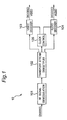
- Fig. 1 shows a block diagram of a PC-DTV receiver 10 as one of MPEG-2 applications.
- a PC-DTV receiver 10 receives digital TV program (channel).
- Demodulator 101 demodulates RF signal into MPEG-2 Transport Stream (TS).
- Demultiplexer 102 demultiplexes TS into MPEG-2 video and audio.
- Video decoder 103 decodes the video into uncompressed video frames.
- Audio decoder 104 decodes the audio into uncompressed audio frames. Because video decoder 103 and audio decoder 104 receives a clock signal from clock control 105, both decoded video and audio are presented synchronously and respectively to display device and sound device.
- Fig. 2 shows a typical MPEG-2 video decoding process.
- a video decoder 103 reads and temporarily stores bitstream in buffer 201.
- the video decoder 103 performs variable length decoding (VLD) in block 202, inverse scanning in block 203, inverse quantizing in block 204, inverse DCT in block 205, and motion compensation in block 206.
- VLD variable length decoding
- the video decoder 103 performs display re-ordering in block 207.
- VLD 202 parses bits, decodes Huffman codeword, such as DCT coefficients, and generates motion vectors (MVs).
- Inverse scan 203 converts the decoded DCT coefficients from one dimension into two dimension by 8x8 blocks.
- Inverse quantizer 204 is to recover the quantized DCT coefficients by using quantiser matrix Inverse DCT 205 transforms the DCT coefficients in frequency domain into pixel values in time domain.
- Motion compensation 206 compensates motion in pictures based on future picture (predictions) in block 207, previously decoded pictures (previous pictures) in block 208, and MV. In other words, future pictures and previous pictures are combined in block 206 with the coefficient data from the output of the IDCT 205 in order to recover final decoded samples.
- Display re-ordering 209 outputs frames to display device in display order.
- the input to the decoding process of video decoder 103 is the coded video bitstream, while the output is a series of frames that are normally the input to a display process.
- the order in which frames are output by the decoding process is called display order.
- the display process is responsible for the action of displaying the decoded frames on a display device.
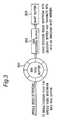
- Video decoder 103 (Fig. 2) reads data from ring buffer 301 and store the data into decoding buffer 302, the parsing bits functions get bits from decoding buffer 302 into 64-bit buffer 303.
- Video decoder 103 calls the parsing bits functions to do variable length decoding, that is, to decode variable length Huffmam codeword, and extract header information.
- Video decoder 103 does IDCT and MC to construct frames by using the output of VLD and outputs the frames in display order to display device.
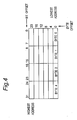
- FIG. 4 illustrates data structure in memory, smaller addresses appear toward the bottom of the figure; address increase toward the top. Bit positions are numbered from right to left. A numerical value of a set bit is equal to two raised to the power of the bit position. The bytes of a word are numbered starting from the least significant byte.
- Fig. 5 illustrates fundamental data types of the Intel Architecture (IA) that are bytes, words, doublewords, and quadwords.
- IA Intel Architecture
- a byte is eight bits
- a word is 16 bits
- a doubleword is 32 bits
- a quadword is 64 bits.
- Fig. 6 illustrates a example of bytes, words, doublewords, and quadwords in memory. Words, doublewords, and quadwords do not need to be aligned in memory on natural boundaries.
- the natural boundaries for words, double words, and quadwords are even-numbered addresses, addresses evenly divisible by four, and addresses evenly divisible by eight, respectively.
- the video decoder 103 (Fig. 2) reads data from 3MB ring buffer 301, stores them into decoding buffer 302, and transmits bits from decoding buffer 302 into 64-bit buffer 303. Parsing bits functions obtains the value of certain bits through 64-bit buffer 303.
- Fig. 7 illustrates an initialization of 64-bit buffer 303 (Fig. 3).
- Video decoder 103 first fills decoding buffer 302 by using bitstream data from 3MB ring buffer 301 and fills 32 bits into 64-bit buffer 303.
- memory address N presents the address of the decoding buffer 302, 32 bits are moved into a 32-bit General-Purpose Register EAX, the byte order of the register EAX is exchanged by the bswap instruction: bits 0 through 7 are swapped with bits 24 through 31, and bits 8 through 15 are swapped with bits 16 through 32.
- the new value in EAX is stored in the high doubleword in said 64-bit buffer.
- the 64-bit buffer contains 32 bits valid.
- Video decoder 103 may peeks certain bits, for example, twenty-four bits to look for the start code prefix; if the value of the twenty-four bits is not equal to 0x000001 in hexadecimal, the decoder discards 8 bits and continue to look for the start code prefix. For more example, to decode macroblock address increment, the decoder may peeks 11 bits, and if the value of the 11 bits is either greater than or equal to 1024, the decoder flushes 1 bit and get the macroblock address increment value one.
- video decoder 301 peeks the integer value of N bits.
- the high double word of the said 64-bit buffer 303 is moved into a 32-bit General-Purpose Register EAX, shift right EAX 32-N bits, EAX then contains the value of N bits.
- MOV stores the EAX value to an unsigned integer memory variable.
- the decoder may flushes bits after peeking the value of certain bits.
- the sequence header code is the bit string '000001B3' in hexadecimal; it is a 32 bits string in binary.
- the next 12 bits is the horizontal size value that forms the 12 least significant bits of horizontal size of the picture.
- the video decoder 103 first flushes bits that ranges from 1 to 7 if the current position is not byte aligned.
- the decoder 103 then flushes 8 bits by 8 bits until the sequence start code is found.
- the decoder 103 flushes 32 bits in order to decoder the value of the next 12 bits that is horizontal size value.
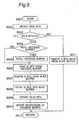
- Fig. 9 illustrates a flowchart of the flushing bits function that discards the bits that have been peeked in the said 64-buffer.
- module 9001 is a normal begin point.
- Module 9002 updates the number of valid bits.
- the number of the updated valid bits M is equal to the number of the previous valid bits minus the number of bits N to be flushed.
- Module 9003 checks if the number of updated bit M is either less than or equal to 32. If yes, goes to module 9004 since refilling 32 bits into the 64-bit buffer is required, otherwise, goes to module 9012.
- Module 9004 checks if the decoding buffer needs to be refilled. If yes, goes to module 9005, otherwise, goes to module 9006.
- Module 9005 refills the decoding buffer and updates the reading pointer of the decoding buffer.
- Module 9006 reads 32 bits from the decoding buffer.
- Module 9007 removes N bits from the 64-bit buffer.
- Module 9008 refills 32 bits into the 64-bit buffer.
- Module 9009 updates the number of valid bits that is equal to M plus 32.
- Module 9010 updates the reading pointer of the decoding buffer.
- Module 9011 removes N bits from the 64-bit buffer, in this case, the N is less than 32.
- Module 9012 is normal function return without return value.
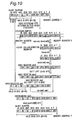
- Fig. 10 further illustrates modules 9006, 9007, 9008, and 9009 in Fig. 9.
- a value in 64-bit buffer 303 is moved into MMX register mm1 and shift left N bits, and the number of updated valid bits is M.
- 32 bits from decoding buffer 302 are moved into a 32-bit General-Purpose Register EAX.
- the bswap instruction exchanges the byte order.
- the instruction movd moves EAX value to MMX register mm0.
- the mm0 and mm1 are merged into mm0.
- the instruction movq stores mm0 value into the 64-bit buffer. Now the number of valid bits is M+32.
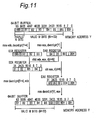
- Fig. 11 further illustrates module 9011 in Fig. 9.
- the high double word is moved into EDX register and the low double word is moved into EAX register.
- the SHLD instruction is applied to move out the most significant N bits from EDX meanwhile the most significant N bits from EAX is moved into the least significant N bits in EDX.
- the instruction SHL is applied to shift left N bits from EAX as to move out the most significant N bits.
- N bits is to peek the integer value of N bits and flush N bits.
- video decoder 103 decodes the picture coding type in picture header that is presented by 3 bits according to the specification ISO/IEC 13818-2 6.2.3. The decoder first peeks the integer value of 3 bits and stores the value to the picture coding type variable in memory, then flush 3 bits.
- the high performance method of parsing bits is introduced.
- the method in the invention is the fastest to parse bits of MPEG-2 video bitstream.
- Decoding macroblock address increment by first checking the increment value one
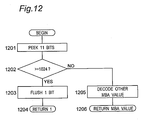
- Fig. 12 illustrates a flowchart of decoding macroblock address increment.
- the decoder first peeks 11 bits in module 1201. This means peeking the value of 11 bits without flushing bits.
- MBA has an increment value one and the function flushes 1 bit in module 1203 and return 1 in module 1204. If the peeked value is less than 1024 in module 1202, the function decode other macroblock address increment value in module 1205 and return the decoded value in module 1206 accordingly.
- This method can speed up I-picture decoding process since all macroblocks in I-picture has the macroblock address increment value one. Checking the macroblock address increment value one first is to avoid unnecessary checking in case of I-picture.
- variable length code 11 bits and the minimum length is 1 bit.
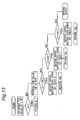
- the flow starts by obtaining the value of 1 bit in module 1301. If the most significant bit is determined to be '1' in module 1302, motion code has value zero in module 1303.
- bits from '001 0' to '11' have values ranging between 3 to 1 and -3 to -1; bits from '000 0110' to '000 111' have values ranging between 7 to 4 and -7 to -4; bits from '000 0011 000' to '000 0101 11' have values ranging between 16 to 8 and -16 to -8.
- three new designed variable length motion code tables including sign bit are established as follows in C language:
- the decoding flow shown in Fig. 13 is designed to decode motion code. As shown in Fig. 11, if the first 1 bit value is equal to 1, the function returns zero; otherwise, the function peeks the value of next 10 bits and decides which motion code table is going to be used to decode motion code.
- Table B-12 and Table B-13 are variable length codes for DCT DC coefficients.
- Table B-14 is for both intra macroblocks with non-vlc format and non-intra macroblocks.
- Table B-15 is for intra macroblocks with vlc format.
- DCT coefficient variable length code tables including sign bit are established according to the above characteristics.
- Fig. 14 illustrates a flowchart of decoding macroblocks. It includes clearing macroblock module, cecoding intra blocks with intra vlc format module, decoding intra blocks with non-intra vlc format module, and decoding non-intra blocks module.
- a macroblock is defined as 'short block[6][64]' in C language for decoding 4:2:0 format video, so the total number of bytes is 768 (2x6x64).
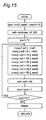
- Fig. 15 illustrates a flowchart of clearing a macroblock using MMX technology. As shown in the Figure, there are 12 iterations managed by argument "ecx" and each iteration clears 64 bytes. This is very fast way to clear macroblocks.
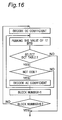
- Fig. 16 illustrates a flowchart of decoding the intra macroblocks.
- Fig. 17 further illustrates a flowchart of selecting DCT tables. If peeking the value of 17 bits is either greater than or equal to 2048, the decoder selects the table 'DCT Table DualCode' and tries to decode two codes at one iteration as possible as it can, at least one code can be decoded at the iteration. Otherwise, comparing the smaller value to select DCT tables to decode DCT coefficients. If there is no DCT table suitable for the value of 17 bits, the decoder returns error.
- 'DCT table DualCode' and 'DCT table 1as' in Fig. 17 are established using ISO/IEC 13818-2 Table-15, and other tables are established using Table-14.
- Fig. 16 shows a flowchart of selecting DCT tables for decoding DCT coefficients for intra macroblock with non-intra vlc format. All DCT tables are established using ISO/IEC 13818-2 Table-14. 'DCT table nexts' is established using variable length codes '10', '1s', '11s', '011s', '0100s', and '0101s' that include End of Block.
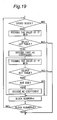
- Fig. 19 illustrates a flowchart of decoding DCT coefficients for non-intra macroblocks.
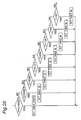
- Fig. 20 shows a flowchart of selecting DCT tables for the first DCT coefficient of blocks in non-intra macroblocks.
- Fig. 18 also shows a flowchart of selecting DCT tables for decoding DCT coefficients for non-intra macroblock. All DCT tables are established using ISO/IEC 13818-2 Table-14. The 'DCT table firsts' is established using variable length codes '1s', '11s', '011s', '0100s', and '0101s' that do not include End of Block.
Landscapes
- Engineering & Computer Science (AREA)
- Multimedia (AREA)
- Signal Processing (AREA)
- Compression, Expansion, Code Conversion, And Decoders (AREA)
- Compression Or Coding Systems Of Tv Signals (AREA)
Abstract
Description


Claims (3)
- A method of MPEG-2 video variable length decoding in software, comprising steps of:parsing bits using embedded assembly instructions and MMX technology;decoding macroblock address increment by first checking the increment value one;decoding motion code using a new designed variable length code tables including sign bit; anddecoding DCT coefficients of macroblock using said new designed variable length code tables including sign bit.
- A method of MPEG-2 video variable length decoding in software according to claim 1,
wherein said parsing bits using embedded assembly instructions and MMX technology comprises steps of:initializing a 64-bit buffer using the embedded assembly instructions;peeking the value of certain bits from said 64-bit buffer using embedded assembly instructions;flushing certain bits from said 64-bit buffer; andobtaining the value of certain bits from said 64-bit buffer. - A method of MPEG-2 video variable length decoding in software according to claim 1,
wherein said decoding DCT coefficients of macroblock using the new designed variable length code tables of DCT coefficient including the sign bit comprises steps of:clearing macroblock using MMX technology;decoding DCT coefficients for an intra macroblock with intra vlc format;decoding DCT coefficients for an intra macroblock with non-intra vlc format; anddecoding DCT coefficients for a non-intra macroblock.
Applications Claiming Priority (2)
| Application Number | Priority Date | Filing Date | Title |
|---|---|---|---|
| JP2001366286 | 2001-11-30 | ||
| JP2001366286A JP2003169327A (en) | 2001-11-30 | 2001-11-30 | MPEG-2 video variable length decoding method in software |
Publications (2)
| Publication Number | Publication Date |
|---|---|
| EP1317147A2 true EP1317147A2 (en) | 2003-06-04 |
| EP1317147A3 EP1317147A3 (en) | 2004-09-08 |
Family
ID=19176203
Family Applications (1)
| Application Number | Title | Priority Date | Filing Date |
|---|---|---|---|
| EP20020026563 Withdrawn EP1317147A3 (en) | 2001-11-30 | 2002-11-28 | A method of MPEG-2 video variable length decoding in software |
Country Status (5)
| Country | Link |
|---|---|
| US (1) | US6928119B2 (en) |
| EP (1) | EP1317147A3 (en) |
| JP (1) | JP2003169327A (en) |
| SG (1) | SG98500A1 (en) |
| TW (1) | TWI289023B (en) |
Families Citing this family (5)
| Publication number | Priority date | Publication date | Assignee | Title |
|---|---|---|---|---|
| JP2005223631A (en) * | 2004-02-05 | 2005-08-18 | Sony Corp | Data processing apparatus and method, encoding apparatus, and decoding apparatus |
| WO2010022023A1 (en) * | 2008-08-18 | 2010-02-25 | Augusta Technology Usa, Inc. | Combining transform coefficient decoding with variable length decoding |
| CN102045559B (en) * | 2009-10-22 | 2013-03-20 | 鸿富锦精密工业(深圳)有限公司 | Video decoding device and method |
| CN103581688B (en) * | 2012-08-02 | 2017-09-12 | 北京大学 | The coding and decoding methods and device of a kind of video image |
| TWI666930B (en) * | 2016-07-12 | 2019-07-21 | 聯發科技股份有限公司 | Video processing system using ring buffer and racing-mode ring buffer access control scheme |
Family Cites Families (14)
| Publication number | Priority date | Publication date | Assignee | Title |
|---|---|---|---|---|
| US15513A (en) * | 1856-08-12 | Improvement in manufacture of sheet-metal ware | ||
| US5220325A (en) * | 1991-03-28 | 1993-06-15 | At&T Bell Laboratories | Hierarchical variable length decoder for digital video data |
| US5623423A (en) * | 1994-12-12 | 1997-04-22 | Univ. Of Texas | Apparatus and method for video decoding |
| KR0182026B1 (en) * | 1995-12-21 | 1999-05-01 | 김광호 | Syntax analyser for mpeg video decoder |
| KR100215439B1 (en) | 1996-02-08 | 1999-08-16 | 윤종용 | High speed data parsing control circuit |
| WO1998041026A1 (en) * | 1997-03-12 | 1998-09-17 | Matsushita Electric Industrial Co., Ltd. | Encoding method, encoder and recording medium, and decoding method, decoder and recording medium |
| US5963260A (en) * | 1997-03-18 | 1999-10-05 | U.S. Philips Electronics North America Corporation | Macroblock-level partitioned HDTV video decoder and related method |
| CN1156171C (en) * | 1997-04-07 | 2004-06-30 | 松下电器产业株式会社 | Image and sound processing device with improved processing efficiency |
| WO1999011071A1 (en) | 1997-08-29 | 1999-03-04 | Thomson Consumer Electronics, Inc. | Partially parallel decoder for compressed hdtv video data |
| US6704361B2 (en) | 1998-05-18 | 2004-03-09 | Sony Corporation | Variable length decoder for decoding digitally encoded video signals |
| JP2000050278A (en) | 1998-07-28 | 2000-02-18 | Sony Corp | Motion vector calculation method and recording medium storing motion vector calculation program |
| US20020015513A1 (en) | 1998-07-15 | 2002-02-07 | Sony Corporation | Motion vector detecting method, record medium on which motion vector calculating program has been recorded, motion detecting apparatus, motion detecting method, picture encoding apparatus, picture encoding method, motion vector calculating method, record medium on which motion vector calculating program has been recorded |
| US6263019B1 (en) | 1998-10-09 | 2001-07-17 | Matsushita Electric Industrial Co., Ltd. | Variable rate MPEG-2 video syntax processor |
| US7298785B2 (en) * | 2001-07-04 | 2007-11-20 | Kabushiki Kaisha Toyota Chuo Kenkyusho | Multicarrier demodulation method and apparatus, and multicarrier modulation method and apparatus |
-
2001
- 2001-11-30 JP JP2001366286A patent/JP2003169327A/en not_active Withdrawn
-
2002
- 2002-11-26 US US10/303,749 patent/US6928119B2/en not_active Expired - Fee Related
- 2002-11-28 SG SG200207348A patent/SG98500A1/en unknown
- 2002-11-28 EP EP20020026563 patent/EP1317147A3/en not_active Withdrawn
- 2002-11-29 TW TW091134881A patent/TWI289023B/en active
Also Published As
| Publication number | Publication date |
|---|---|
| EP1317147A3 (en) | 2004-09-08 |
| SG98500A1 (en) | 2003-09-19 |
| TW200301062A (en) | 2003-06-16 |
| US20030118115A1 (en) | 2003-06-26 |
| US6928119B2 (en) | 2005-08-09 |
| JP2003169327A (en) | 2003-06-13 |
| TWI289023B (en) | 2007-10-21 |
Similar Documents
| Publication | Publication Date | Title |
|---|---|---|
| US6842124B2 (en) | Variable length decoder | |
| US10489426B2 (en) | Category-prefixed data batching of coded media data in multiple categories | |
| CN1615653B (en) | System and method for multi-channel video decoding | |
| US9838703B2 (en) | Method and apparatus for multi-threaded video decoding | |
| US8532192B2 (en) | Video processing apparatus and a method of processing video data | |
| US20080317134A1 (en) | Video Coding | |
| US7557740B1 (en) | Context-based adaptive binary arithmetic coding (CABAC) decoding apparatus and decoding method thereof | |
| KR20220127367A (en) | Method and apparatus for video encoding and decoding of binary sets using adaptive tree selection | |
| CN1394445A (en) | Method of converting data streams | |
| US7286066B1 (en) | Acceleration of bitstream decoding | |
| US10250912B2 (en) | Method and apparatus for entropy decoding with arithmetic decoding decoupled from variable-length decoding | |
| US6529554B1 (en) | Low branch-mispredict technique for MPEG run length encoding | |
| US6928119B2 (en) | Method of MPEG-2 video variable length decoding in software | |
| US20060133507A1 (en) | Picture information decoding method and picture information encoding method | |
| US7463781B2 (en) | Low overhead context intializations for arithmetic video codecs | |
| US20140092987A1 (en) | Entropy coding techniques and protocol to support parallel processing with low latency | |
| US20170064321A1 (en) | System and method for decoding a video digital data stream using a table of range values and probable symbols | |
| CN119110096B (en) | Signaling generic constraint information for video coding | |
| CN105847801A (en) | Multi-standard video decoder with novel binary element coding | |
| US6856264B2 (en) | Method for decoding reversible variable length code using leading-zeros variable length decoding techniques | |
| Jo et al. | Bitstream decoding processor for fast entropy decoding of variable length coding–based multiformat videos | |
| Bystrom et al. | Dynamic replacement of video coding elements | |
| WO2024079334A1 (en) | Video encoder and video decoder | |
| KR100987252B1 (en) | Interface device and method for bit stream data processing | |
| Nolte et al. | Memory efficient programmable processor for bitstream processing and entropy decoding of multiple-standard high-bitrate HDTV video bitstreams |
Legal Events
| Date | Code | Title | Description |
|---|---|---|---|
| PUAI | Public reference made under article 153(3) epc to a published international application that has entered the european phase |
Free format text: ORIGINAL CODE: 0009012 |
|
| AK | Designated contracting states |
Designated state(s): AT BE BG CH CY CZ DE DK EE ES FI FR GB GR IE IT LI LU MC NL PT SE SK TR |
|
| AX | Request for extension of the european patent |
Extension state: AL LT LV MK RO SI |
|
| PUAL | Search report despatched |
Free format text: ORIGINAL CODE: 0009013 |
|
| AK | Designated contracting states |
Kind code of ref document: A3 Designated state(s): AT BE BG CH CY CZ DE DK EE ES FI FR GB GR IE IT LI LU MC NL PT SE SK TR |
|
| AX | Request for extension of the european patent |
Extension state: AL LT LV MK RO SI |
|
| RIC1 | Information provided on ipc code assigned before grant |
Ipc: 7H 04N 7/26 B Ipc: 7H 04N 7/50 A |
|
| 17P | Request for examination filed |
Effective date: 20050308 |
|
| AKX | Designation fees paid |
Designated state(s): DE FR GB |
|
| 17Q | First examination report despatched |
Effective date: 20060919 |
|
| STAA | Information on the status of an ep patent application or granted ep patent |
Free format text: STATUS: THE APPLICATION HAS BEEN WITHDRAWN |
|
| 18W | Application withdrawn |
Effective date: 20061229 |