EP1317005A2 - Organic electroluminescent device - Google Patents
Organic electroluminescent device Download PDFInfo
- Publication number
- EP1317005A2 EP1317005A2 EP02023135A EP02023135A EP1317005A2 EP 1317005 A2 EP1317005 A2 EP 1317005A2 EP 02023135 A EP02023135 A EP 02023135A EP 02023135 A EP02023135 A EP 02023135A EP 1317005 A2 EP1317005 A2 EP 1317005A2
- Authority
- EP
- European Patent Office
- Prior art keywords
- group
- substituted
- organic electroluminescent
- electroluminescent device
- hydrocarbon group
- Prior art date
- Legal status (The legal status is an assumption and is not a legal conclusion. Google has not performed a legal analysis and makes no representation as to the accuracy of the status listed.)
- Granted
Links
- 0 *(C(c1c(CC2)cccc1)c1c2cccc1)c(cc1)ccc1-c(cc1)c(cccc2-c(cc3)c45)c2c1-c4cccc5c3-c(cc1)ccc1N(c1c(CC2)cccc1)c1c2cccc1 Chemical compound *(C(c1c(CC2)cccc1)c1c2cccc1)c(cc1)ccc1-c(cc1)c(cccc2-c(cc3)c45)c2c1-c4cccc5c3-c(cc1)ccc1N(c1c(CC2)cccc1)c1c2cccc1 0.000 description 4
- GPBMCEWKAPSTOU-UHFFFAOYSA-N Brc1ccc-2c3c1cccc3-c1cccc3c1c-2ccc3 Chemical compound Brc1ccc-2c3c1cccc3-c1cccc3c1c-2ccc3 GPBMCEWKAPSTOU-UHFFFAOYSA-N 0.000 description 2
- VGYBDOWRQFFUIJ-UHFFFAOYSA-N CC(C)(C=CC=C1)C=C1Cl Chemical compound CC(C)(C=CC=C1)C=C1Cl VGYBDOWRQFFUIJ-UHFFFAOYSA-N 0.000 description 1
- NYOXYLDGAZRGHT-UHFFFAOYSA-N CC(C)(C=CC=C1)C=C1[F]c1ccc(C)cc1 Chemical compound CC(C)(C=CC=C1)C=C1[F]c1ccc(C)cc1 NYOXYLDGAZRGHT-UHFFFAOYSA-N 0.000 description 1
- IXJNPHFJCRYOND-CVKYGVBHSA-N CC/C=C(\C=C=C=CCC)/N(C)C Chemical compound CC/C=C(\C=C=C=CCC)/N(C)C IXJNPHFJCRYOND-CVKYGVBHSA-N 0.000 description 1
Images


Classifications
-
- C—CHEMISTRY; METALLURGY
- C09—DYES; PAINTS; POLISHES; NATURAL RESINS; ADHESIVES; COMPOSITIONS NOT OTHERWISE PROVIDED FOR; APPLICATIONS OF MATERIALS NOT OTHERWISE PROVIDED FOR
- C09B—ORGANIC DYES OR CLOSELY-RELATED COMPOUNDS FOR PRODUCING DYES, e.g. PIGMENTS; MORDANTS; LAKES
- C09B15/00—Acridine dyes
-
- H—ELECTRICITY
- H05—ELECTRIC TECHNIQUES NOT OTHERWISE PROVIDED FOR
- H05B—ELECTRIC HEATING; ELECTRIC LIGHT SOURCES NOT OTHERWISE PROVIDED FOR; CIRCUIT ARRANGEMENTS FOR ELECTRIC LIGHT SOURCES, IN GENERAL
- H05B33/00—Electroluminescent light sources
- H05B33/12—Light sources with substantially two-dimensional [2D] radiating surfaces
- H05B33/14—Light sources with substantially two-dimensional [2D] radiating surfaces characterised by the chemical or physical composition or the arrangement of the electroluminescent material, or by the simultaneous addition of the electroluminescent material in or onto the light source
-
- H—ELECTRICITY
- H10—SEMICONDUCTOR DEVICES; ELECTRIC SOLID-STATE DEVICES NOT OTHERWISE PROVIDED FOR
- H10K—ORGANIC ELECTRIC SOLID-STATE DEVICES
- H10K50/00—Organic light-emitting devices
- H10K50/10—OLEDs or polymer light-emitting diodes [PLED]
- H10K50/11—OLEDs or polymer light-emitting diodes [PLED] characterised by the electroluminescent [EL] layers
-
- C—CHEMISTRY; METALLURGY
- C09—DYES; PAINTS; POLISHES; NATURAL RESINS; ADHESIVES; COMPOSITIONS NOT OTHERWISE PROVIDED FOR; APPLICATIONS OF MATERIALS NOT OTHERWISE PROVIDED FOR
- C09B—ORGANIC DYES OR CLOSELY-RELATED COMPOUNDS FOR PRODUCING DYES, e.g. PIGMENTS; MORDANTS; LAKES
- C09B1/00—Dyes with anthracene nucleus not condensed with any other ring
-
- C—CHEMISTRY; METALLURGY
- C09—DYES; PAINTS; POLISHES; NATURAL RESINS; ADHESIVES; COMPOSITIONS NOT OTHERWISE PROVIDED FOR; APPLICATIONS OF MATERIALS NOT OTHERWISE PROVIDED FOR
- C09B—ORGANIC DYES OR CLOSELY-RELATED COMPOUNDS FOR PRODUCING DYES, e.g. PIGMENTS; MORDANTS; LAKES
- C09B23/00—Methine or polymethine dyes, e.g. cyanine dyes
- C09B23/14—Styryl dyes
- C09B23/148—Stilbene dyes containing the moiety -C6H5-CH=CH-C6H5
-
- C—CHEMISTRY; METALLURGY
- C09—DYES; PAINTS; POLISHES; NATURAL RESINS; ADHESIVES; COMPOSITIONS NOT OTHERWISE PROVIDED FOR; APPLICATIONS OF MATERIALS NOT OTHERWISE PROVIDED FOR
- C09B—ORGANIC DYES OR CLOSELY-RELATED COMPOUNDS FOR PRODUCING DYES, e.g. PIGMENTS; MORDANTS; LAKES
- C09B3/00—Dyes with an anthracene nucleus condensed with one or more carbocyclic rings
- C09B3/14—Perylene derivatives
-
- C—CHEMISTRY; METALLURGY
- C09—DYES; PAINTS; POLISHES; NATURAL RESINS; ADHESIVES; COMPOSITIONS NOT OTHERWISE PROVIDED FOR; APPLICATIONS OF MATERIALS NOT OTHERWISE PROVIDED FOR
- C09B—ORGANIC DYES OR CLOSELY-RELATED COMPOUNDS FOR PRODUCING DYES, e.g. PIGMENTS; MORDANTS; LAKES
- C09B57/00—Other synthetic dyes of known constitution
- C09B57/001—Pyrene dyes
-
- C—CHEMISTRY; METALLURGY
- C09—DYES; PAINTS; POLISHES; NATURAL RESINS; ADHESIVES; COMPOSITIONS NOT OTHERWISE PROVIDED FOR; APPLICATIONS OF MATERIALS NOT OTHERWISE PROVIDED FOR
- C09B—ORGANIC DYES OR CLOSELY-RELATED COMPOUNDS FOR PRODUCING DYES, e.g. PIGMENTS; MORDANTS; LAKES
- C09B57/00—Other synthetic dyes of known constitution
- C09B57/007—Squaraine dyes
-
- C—CHEMISTRY; METALLURGY
- C09—DYES; PAINTS; POLISHES; NATURAL RESINS; ADHESIVES; COMPOSITIONS NOT OTHERWISE PROVIDED FOR; APPLICATIONS OF MATERIALS NOT OTHERWISE PROVIDED FOR
- C09B—ORGANIC DYES OR CLOSELY-RELATED COMPOUNDS FOR PRODUCING DYES, e.g. PIGMENTS; MORDANTS; LAKES
- C09B69/00—Dyes not provided for by a single group of this subclass
- C09B69/008—Dyes containing a substituent, which contains a silicium atom
-
- H—ELECTRICITY
- H10—SEMICONDUCTOR DEVICES; ELECTRIC SOLID-STATE DEVICES NOT OTHERWISE PROVIDED FOR
- H10K—ORGANIC ELECTRIC SOLID-STATE DEVICES
- H10K85/00—Organic materials used in the body or electrodes of devices covered by this subclass
- H10K85/40—Organosilicon compounds, e.g. TIPS pentacene
-
- H—ELECTRICITY
- H10—SEMICONDUCTOR DEVICES; ELECTRIC SOLID-STATE DEVICES NOT OTHERWISE PROVIDED FOR
- H10K—ORGANIC ELECTRIC SOLID-STATE DEVICES
- H10K85/00—Organic materials used in the body or electrodes of devices covered by this subclass
- H10K85/60—Organic compounds having low molecular weight
- H10K85/615—Polycyclic condensed aromatic hydrocarbons, e.g. anthracene
- H10K85/626—Polycyclic condensed aromatic hydrocarbons, e.g. anthracene containing more than one polycyclic condensed aromatic rings, e.g. bis-anthracene
-
- H—ELECTRICITY
- H10—SEMICONDUCTOR DEVICES; ELECTRIC SOLID-STATE DEVICES NOT OTHERWISE PROVIDED FOR
- H10K—ORGANIC ELECTRIC SOLID-STATE DEVICES
- H10K85/00—Organic materials used in the body or electrodes of devices covered by this subclass
- H10K85/60—Organic compounds having low molecular weight
- H10K85/631—Amine compounds having at least two aryl rest on at least one amine-nitrogen atom, e.g. triphenylamine
- H10K85/633—Amine compounds having at least two aryl rest on at least one amine-nitrogen atom, e.g. triphenylamine comprising polycyclic condensed aromatic hydrocarbons as substituents on the nitrogen atom
-
- H—ELECTRICITY
- H10—SEMICONDUCTOR DEVICES; ELECTRIC SOLID-STATE DEVICES NOT OTHERWISE PROVIDED FOR
- H10K—ORGANIC ELECTRIC SOLID-STATE DEVICES
- H10K85/00—Organic materials used in the body or electrodes of devices covered by this subclass
- H10K85/60—Organic compounds having low molecular weight
- H10K85/631—Amine compounds having at least two aryl rest on at least one amine-nitrogen atom, e.g. triphenylamine
- H10K85/636—Amine compounds having at least two aryl rest on at least one amine-nitrogen atom, e.g. triphenylamine comprising heteroaromatic hydrocarbons as substituents on the nitrogen atom
-
- H—ELECTRICITY
- H10—SEMICONDUCTOR DEVICES; ELECTRIC SOLID-STATE DEVICES NOT OTHERWISE PROVIDED FOR
- H10K—ORGANIC ELECTRIC SOLID-STATE DEVICES
- H10K2101/00—Properties of the organic materials covered by group H10K85/00
- H10K2101/90—Multiple hosts in the emissive layer
-
- H—ELECTRICITY
- H10—SEMICONDUCTOR DEVICES; ELECTRIC SOLID-STATE DEVICES NOT OTHERWISE PROVIDED FOR
- H10K—ORGANIC ELECTRIC SOLID-STATE DEVICES
- H10K85/00—Organic materials used in the body or electrodes of devices covered by this subclass
- H10K85/30—Coordination compounds
- H10K85/311—Phthalocyanine
-
- H—ELECTRICITY
- H10—SEMICONDUCTOR DEVICES; ELECTRIC SOLID-STATE DEVICES NOT OTHERWISE PROVIDED FOR
- H10K—ORGANIC ELECTRIC SOLID-STATE DEVICES
- H10K85/00—Organic materials used in the body or electrodes of devices covered by this subclass
- H10K85/30—Coordination compounds
- H10K85/321—Metal complexes comprising a group IIIA element, e.g. Tris (8-hydroxyquinoline) gallium [Gaq3]
- H10K85/324—Metal complexes comprising a group IIIA element, e.g. Tris (8-hydroxyquinoline) gallium [Gaq3] comprising aluminium, e.g. Alq3
-
- H—ELECTRICITY
- H10—SEMICONDUCTOR DEVICES; ELECTRIC SOLID-STATE DEVICES NOT OTHERWISE PROVIDED FOR
- H10K—ORGANIC ELECTRIC SOLID-STATE DEVICES
- H10K85/00—Organic materials used in the body or electrodes of devices covered by this subclass
- H10K85/60—Organic compounds having low molecular weight
- H10K85/615—Polycyclic condensed aromatic hydrocarbons, e.g. anthracene
- H10K85/623—Polycyclic condensed aromatic hydrocarbons, e.g. anthracene containing five rings, e.g. pentacene
-
- H—ELECTRICITY
- H10—SEMICONDUCTOR DEVICES; ELECTRIC SOLID-STATE DEVICES NOT OTHERWISE PROVIDED FOR
- H10K—ORGANIC ELECTRIC SOLID-STATE DEVICES
- H10K85/00—Organic materials used in the body or electrodes of devices covered by this subclass
- H10K85/60—Organic compounds having low molecular weight
- H10K85/649—Aromatic compounds comprising a hetero atom
- H10K85/653—Aromatic compounds comprising a hetero atom comprising only oxygen as heteroatom
-
- H—ELECTRICITY
- H10—SEMICONDUCTOR DEVICES; ELECTRIC SOLID-STATE DEVICES NOT OTHERWISE PROVIDED FOR
- H10K—ORGANIC ELECTRIC SOLID-STATE DEVICES
- H10K85/00—Organic materials used in the body or electrodes of devices covered by this subclass
- H10K85/60—Organic compounds having low molecular weight
- H10K85/649—Aromatic compounds comprising a hetero atom
- H10K85/657—Polycyclic condensed heteroaromatic hydrocarbons
-
- Y—GENERAL TAGGING OF NEW TECHNOLOGICAL DEVELOPMENTS; GENERAL TAGGING OF CROSS-SECTIONAL TECHNOLOGIES SPANNING OVER SEVERAL SECTIONS OF THE IPC; TECHNICAL SUBJECTS COVERED BY FORMER USPC CROSS-REFERENCE ART COLLECTIONS [XRACs] AND DIGESTS
- Y10—TECHNICAL SUBJECTS COVERED BY FORMER USPC
- Y10S—TECHNICAL SUBJECTS COVERED BY FORMER USPC CROSS-REFERENCE ART COLLECTIONS [XRACs] AND DIGESTS
- Y10S428/00—Stock material or miscellaneous articles
- Y10S428/917—Electroluminescent
Definitions
- the present invention relates to an organic electroluminescent device, and more particularly, to an organic electroluminescent device having a red luminescent layer of which luminescent efficiency is greatly improved.
- OLED organic light emitting diode
- organic electroluminescent display technology for the organic electroluminescent display is developed rapidly, whereby various prototypes have been in market already.
- the organic electroluminescent device emits light in a manner that electric charges are injected in an organic layer formed between a hole injection electrode(anode) and an electron injection electrode(cathode) so as to form a pair of electron and hole to generate an exciton and an excited state of the exciton falls to a ground state so as to emit light.
- the organic electroluminescent device has excellent characteristics of wide viewing angle, fast. response, high contrast, and the like, thereby being applicable to a pixel of a graphic display, a television video display, a pixel of a surface light source, and the like.
- the organic electroluminescent device can be formed on a flexible transparent substrate such as a plastic substrate and made to be thin and light as well as shows an excellent color tone.
- a flexible transparent substrate such as a plastic substrate
- such an organic electroluminescent device is suitable for the next generation flat panel display(FPD).
- the organic electroluminescent device enables to express three colors including green, blue, and red, needs no backlight of a well-known liquid crystal display(LCD) so as to show less power consumption, and has the excellent color tone. Therefore, many concerns are focused on the organic electroluminescent device as the next generation full color display.
- LCD liquid crystal display
- each of blue, green, and red luminescent devices can be realized in accordance with how the organic light-emitting layer is formed. Yet, red luminescence of high efficiency has difficulty in being realized.
- CuPC having excellent hole injection capability and thermal stability is used as a hole injection layer in OELD(organic electroluminescent display).
- red wavelength is absorbed so as to reduce an efficiency of red greatly.
- the present invention is directed to an organic electroluminescent device that substantially obviates one or more problems due to limitations and disadvantages of the related art.
- An object of the present invention is to provide an organic electroluminescent device enabling to increase a red luminescence efficiency by developing a host system transferring energy to a red luminescent material efficiently.
- an organic electroluminescent device includes a first electrode, a second electrode, and a light-emitting layer having a guest material of a red luminescent material and at least two host materials so as to be formed between the first and second electrodes.
- a composition of the light-emitting layer includes 0.01 ⁇ 30wt/% of the guest material and 0.05 ⁇ 99.9wt/% of the host materials.
- the guest material is selected from the group consisting of a DCM derivative, a Nile red derivative, a Coumarine derivative, a Phodamine derivative, a pyrromethene derivative, and a benzothioxanphene derivative.
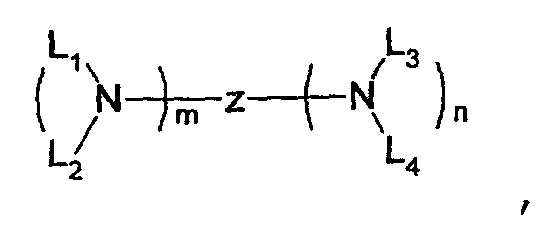
- one of the host materials is a composite including the following structural formula: wherein (m+n) is an integer of 1 to 8; z is A 1 or -A 2 -Q-A 3 -, A1 is selected from the group consisting of a substituted or non-substituted aromatic hydrocarbon group, a heterocycle group, or an aliphatic hydrocarbon group wherein a bond between A 1 and nitrogen(N) is connected to an aliphatic hydrocarbon group or an amide or imine bond if A 1 is the aromatic hydrocarbon or heterocycle group, A 2 and A 3 are aromatic hydrocarbon groups or heterocycle groups substituted or non-substituted independently, respectively, a bond of A 2 , A 3 and nitrogen(N) can be connected to the aromatic hydrocarbon group or the amide or imine bond, Q is a substituted or non-substituted aromatic hydrocarbon group, a heterocycle group, or an aliphatic hydrocarbon group, or an element of groups IIIB, IVB, VB, and VIB where
- one of the host materials is a substituted or non-substituted quinoline derivative.
- an organic electroluminescent device in another aspect of the present invention, includes a first electrode, a second electrode, a light-emitting layer having a guest material of a red luminescent material and at least two host materials so as to be formed between the first and second electrodes, and a hole injection/transport layer formed between the first electrode and light-emitting layer.
- a maximum PL luminescent peak is at least 550nm and maximum PL luminescent peaks of the first and second host materials are 500 ⁇ 600nm.
- An organic electroluminescent device includes a first electrode, a second electrode, and a light-emitting layer consisting of a guest material of a red luminescent material and at least two host materials so as to be formed between the first and second electrodes.
- a composition of the light-emitting layer includes 0.01 ⁇ 30wt/% of the guest material and 0.05 ⁇ 99.9wt/% of the host materials.
- the guest material is selected from the group consisting of a DCM derivative, a Nile red derivative, a Coumarine derivative, a Phodamine derivative, a pyrromethene derivative, and a benzothioxanphene derivative.
- one of the host materials is a composite including the following structural formula.
- (m+n) is an integer of 1 to 8;
- z is A 1 or -A 2 -Q-A 3 -,
- A1 is selected from the group consisting of a substituted or non-substituted aromatic hydrocarbon group, a heterocycle group, or an aliphatic hydrocarbon group wherein a bond between A 1 and nitrogen(N) is connected to an aliphatic hydrocarbon group or an amide or imine bond if A 1 is the aromatic hydrocarbon or heterocycle group,
- a 2 and A 3 are aromatic hydrocarbon groups or heterocycle groups substituted or non-substituted independently, respectively, a bond of A 2 , A 3 and nitrogen(N) can be connected to the aromatic hydrocarbon group or the amide or imine bond
- Q is a substituted or non-substituted aromatic hydrocarbon group, a heterocycle group, or an aliphatic hydrocarbon group, or an element of groups IIIB, IVB, VB,
- one of the host materials can be a substituted or non-substituted quinoline derivative.
- An organic electroluminescent device includes a first electrode, a second electrode, a light-emitting layer consisting of a guest material of a red luminescent material and at least two host materials so as to be formed between the first and second electrodes, and a hole injection/transport layer formed between the first electrode and light-emitting layer, wherein an electron injection/transport layer can be formed between the second electrode and light-emitting layer.
- a maximum PL luminescent peak is at least 550nm and maximum PL luminescent peaks of the first and second host materials are 500 ⁇ 600nm.
- the "PL(photoluminescence) peak” is a peak of a liquid state after dissolution in a solvent of THF(tetrahydrofuran), chloroform, acetacidethyl, etc.
- the light-emitting layer of the present invention has a composition of 0.01 ⁇ 30wt/% of the guest, 0.05 ⁇ 99.9wt/% of the first host, and 0.05 ⁇ 99.9wt/% of the second host.
- the first host used in the present invention is a compound having the following structural formula. where (m+n) is an integer of 1 to 8; z is A 1 or -A 2 -Q-A 3 -, A1 is selected from the group consisting of a substituted or non-substituted aromatic hydrocarbon group, a heterocycle group, or an aliphatic hydrocarbon group wherein a bond between A 1 and nitrogen(N) is connected to an aliphatic hydrocarbon group or an amide or imine bond if A 1 is the aromatic hydrocarbon or heterocycle group, A 2 and A 3 are aromatic hydrocarbon groups or heterocycle groups substituted or non-substituted independently, respectively, a bond of A 2 , A 3 and nitrogen(N) can be connected to the aromatic hydrocarbon group or the amide or imine bond, Q is a substituted or non-substituted aromatic hydrocarbon group, a heterocycle group, or an aliphatic hydrocarbon group, or an element of groups IIIB, IVB, VB, and VIB wherein
- the element of the groups IIIB, IVB, VB, and VIB is selected from the group consisting of B, C, Si, N, O, S, and Se.
- Each of the aliphatic hydrocarbon groups connecting the A 1 /A 2 /A 3 /N, A 2 /Q, and A 3 /Q, respectively has 1 to 12 carbon atoms.
- the aliphatic hydrocarbon group is selected from the group consisting of methylene, ethylene, trimethylene, cyclohexanediyl, adamanthanediyl, and vinylene groups.
- a substituent of the A 1 , A 2 , A 3 , or Q is selected from the group consisting of aryloxy, arylcarbonyl, aryloxycarbonyl, arylcarboxy, aralkyl, arylaminocarbonyl, arylcarbonylamino, arylsilyl, alkyl, alkoxy, alkoxycarbonyl, acyl, acyloxy, acylamino, alkylamino, alkylaminocarbonyl, alkylsulfanyl, alkylsilyl, carbamoyl, hydroxy, amino, cyano, nitro, and thiol groups and halogen atoms.
- the substituent is selected from the group consisting of phenoxy, naphthyloxy, phenylcarbonyl, naphthyloxycarbonyl, phenylcarboxy, benzyl, styryl, vinyl, anilinocarbonyl, benzoylamino, tri-phenylsilyl, methyl, ethyl, propyl, i-propyl, t-butyl, cyclohexyl, methoxy, ethoxy, propoxy, butoxy, methoxycarbonyl, ethoxycarbonyl, formyl, propionyl, acetyloxy, propionylamino, dimethylamino, di-I-propylamino, ethylsulfanyl, and trimethylsilyl groups, F, and Cl.
- Each of the A 1 , A 2 , A 3 , and Q can have at least two of the substituents.
- at least two of the substituents are boned to each other so as to form a saturated or unsaturated ring.
- the aliphatic hydrocarbon group of the A 1 or Q is selected from the group consisting of methylene, ethylene, cyclohexanediyl, and adamanthanediyl groups.
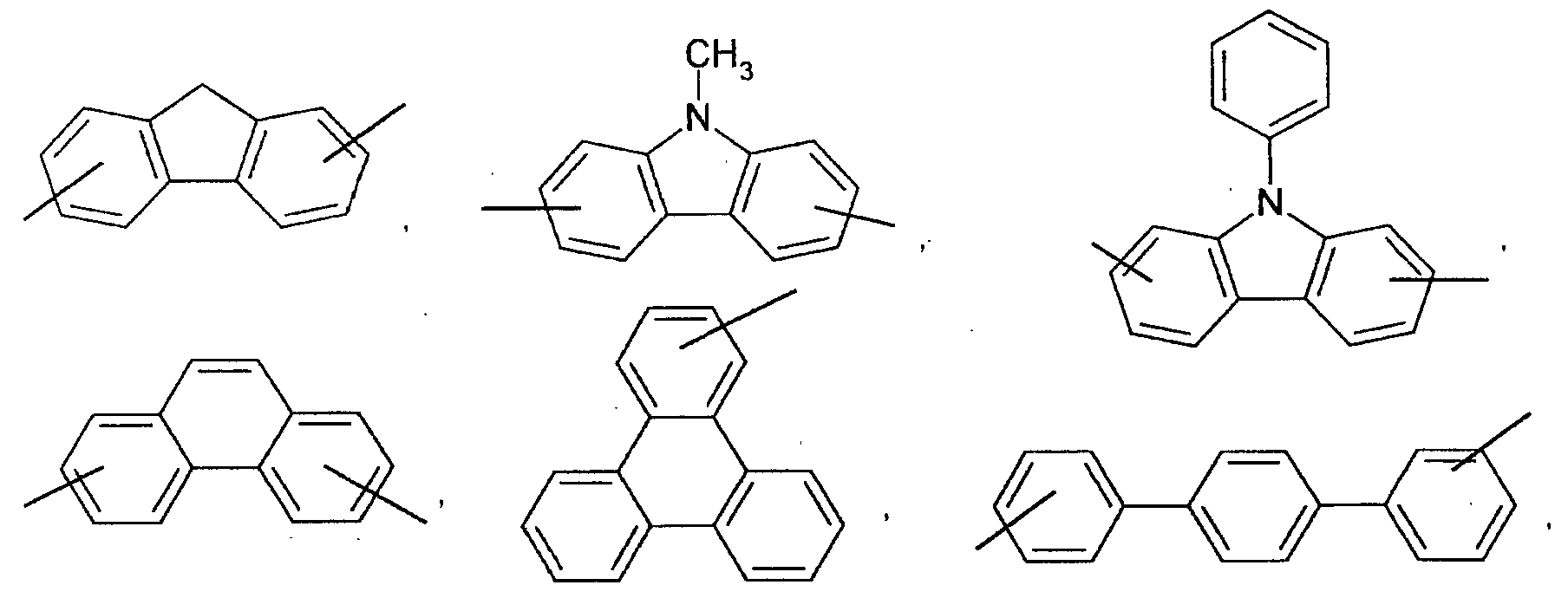
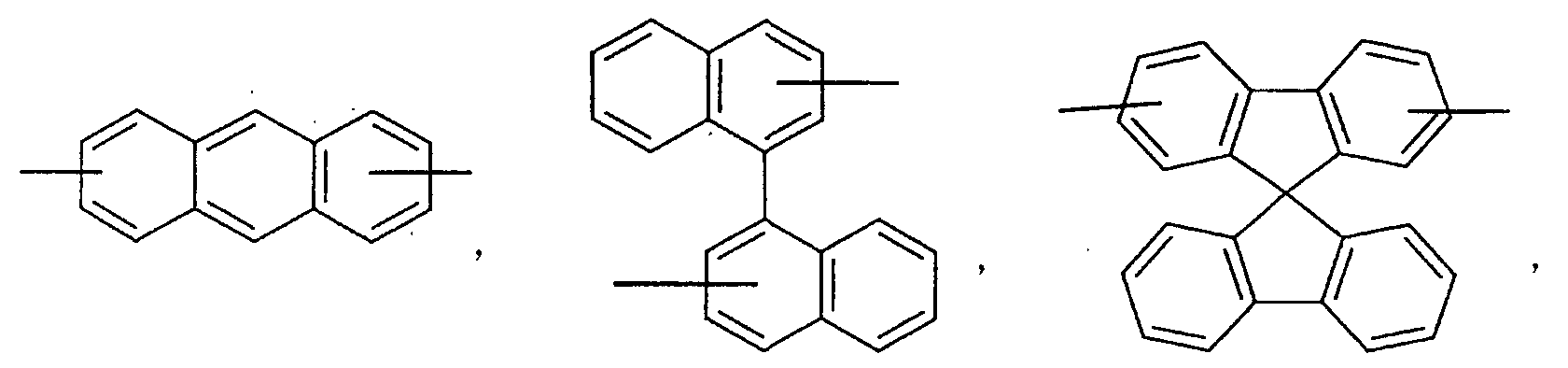
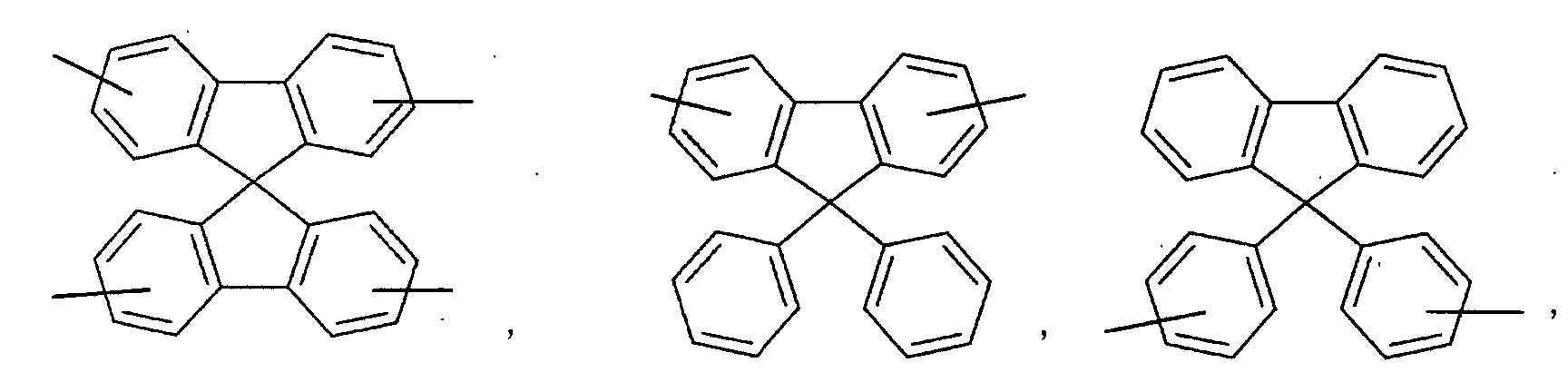
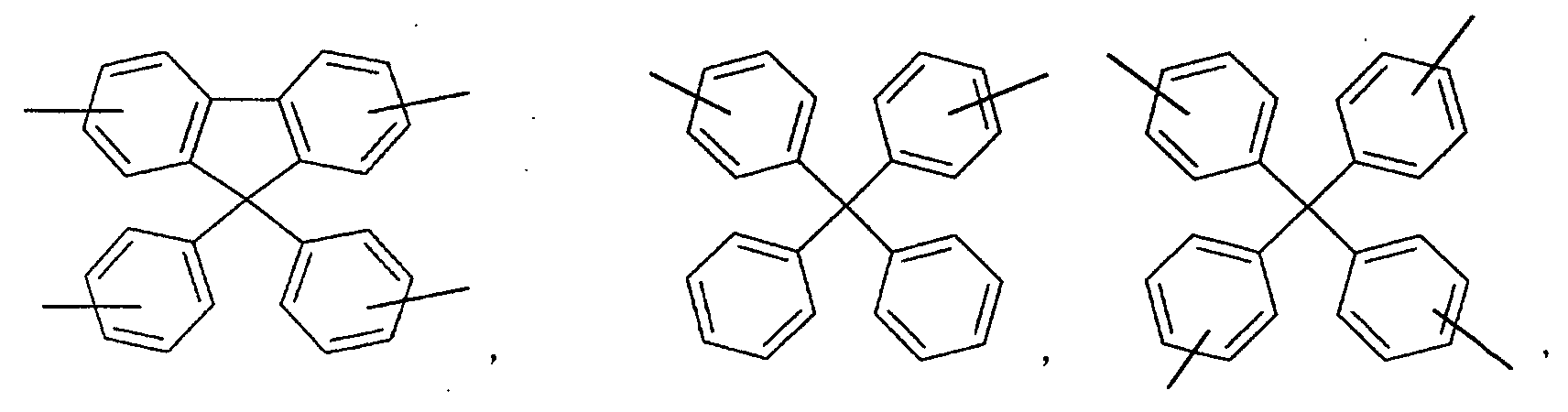
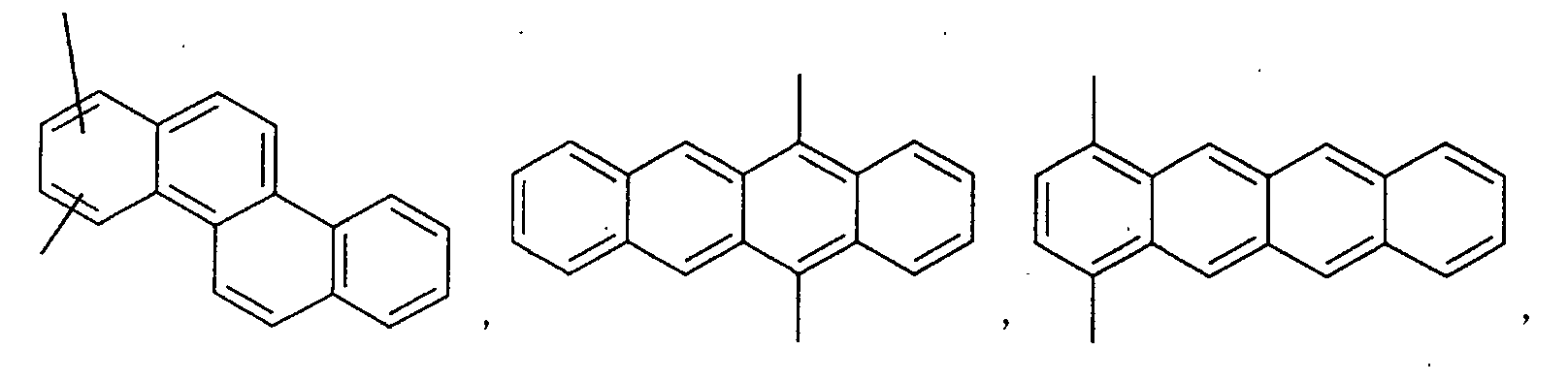
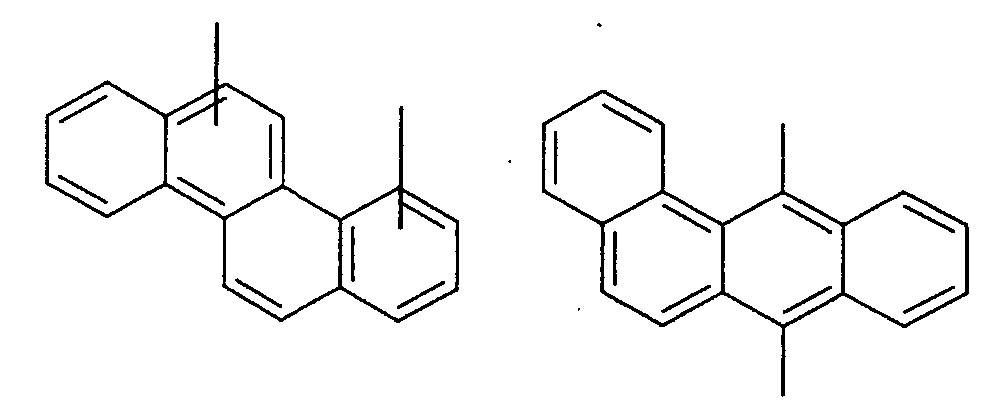
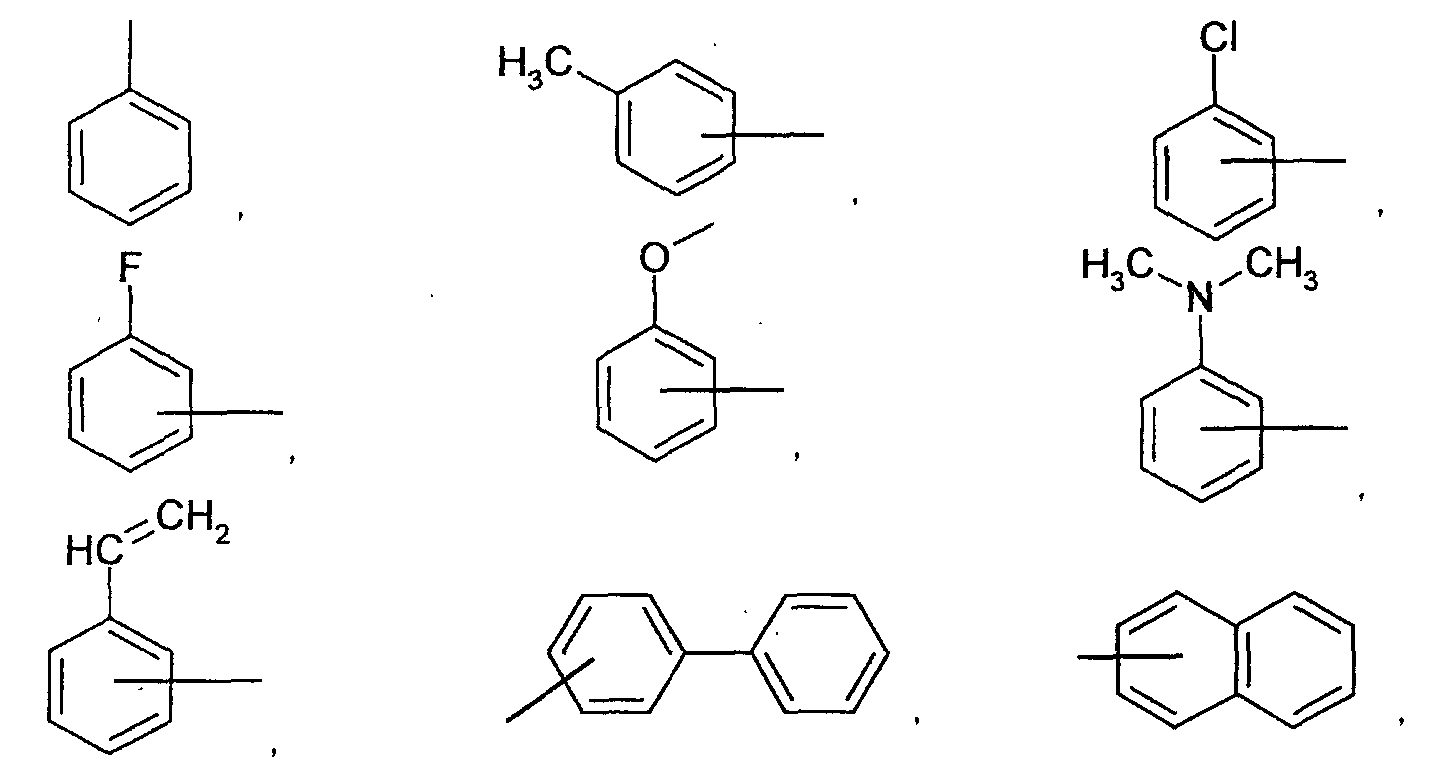
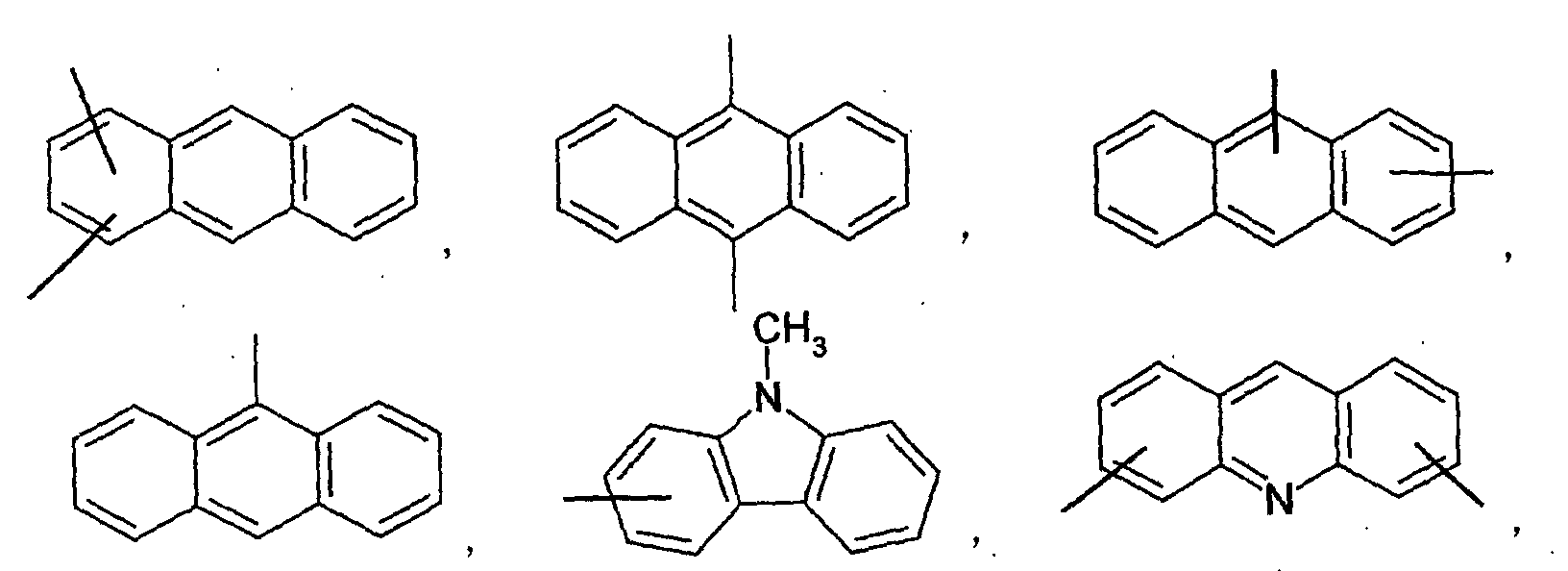
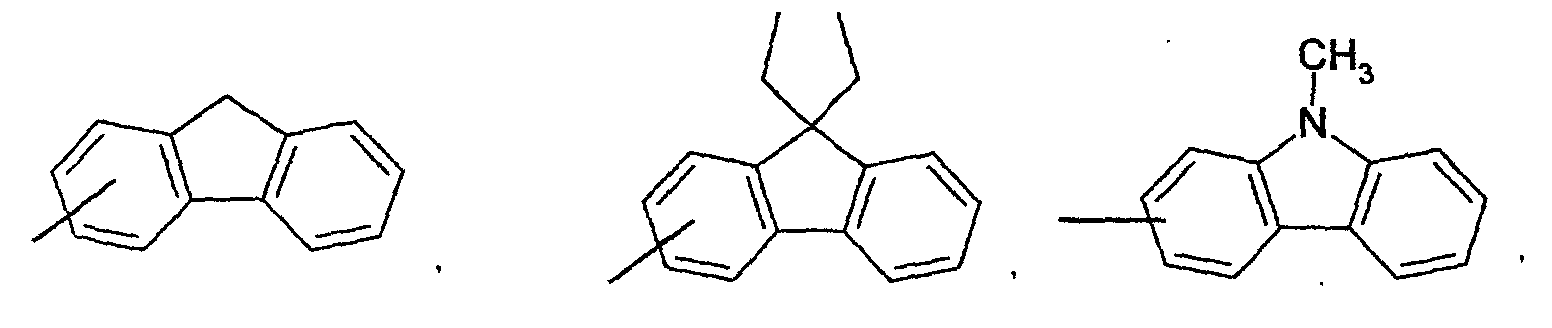
- an aromatic hydrocarbon or heterocyclic group of each of the A 1 , A 2 , A 3 , and Q is selected from the group consisting of compounds having the following structural formulas.
- Each of the L1, L2, L3, and L4 is selected from the group consisting of compounds having the following structural formulas.
- each substituent of the L 1 , L 2 , L 3 , and L 4 is selected from the group consisting of aryloxy, arylamino, alkoxy, alkyl, alkylamino, hydroxy, amino, carbonyl, amide, and carboxy groups and halogen atoms. More preferably, the substituent is selected from the group consisting of phenoxy, tolyloxy, vinyl, aldehyde, methyl, ethyl, propyl, i-propyl, t-butyl, cyclohexyl, diphenylamino, methoxy, ethoxy, propoxy, butoxy, dimethylamino, and carboxylic acid groups, F, and Cl.
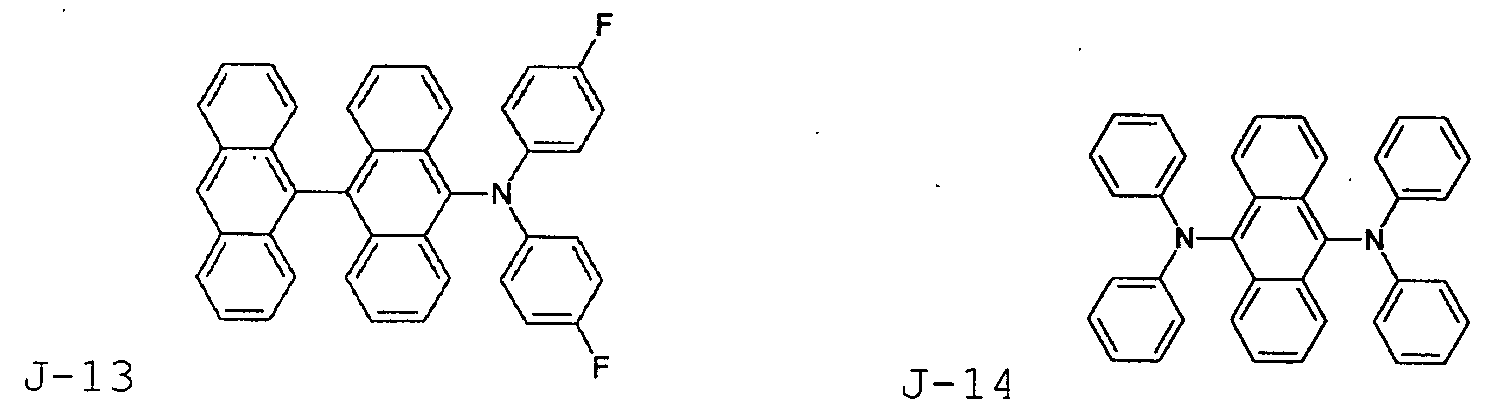
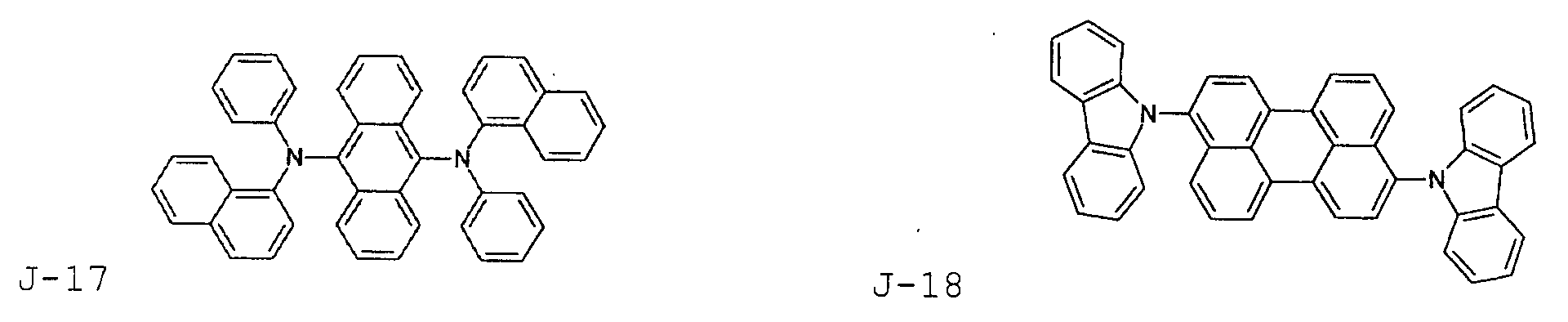
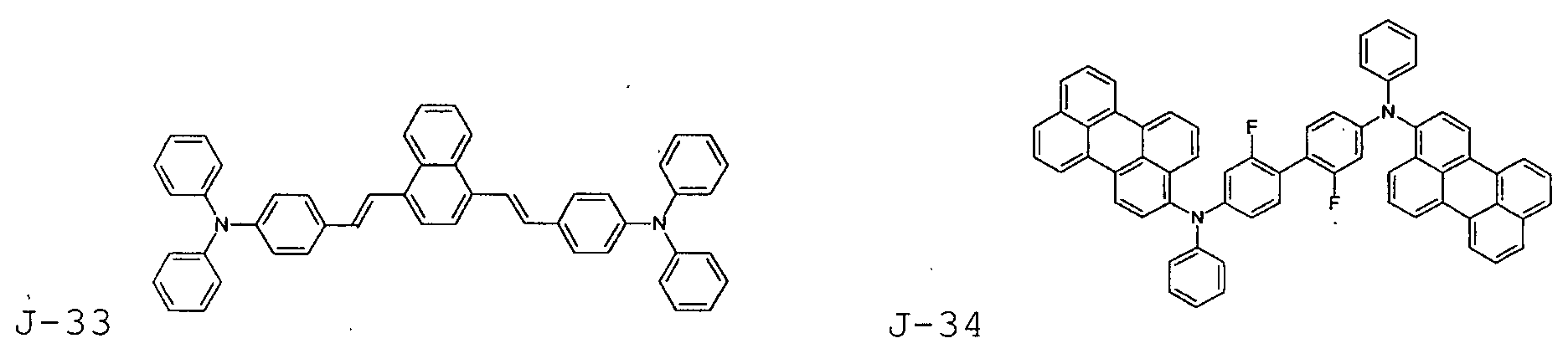
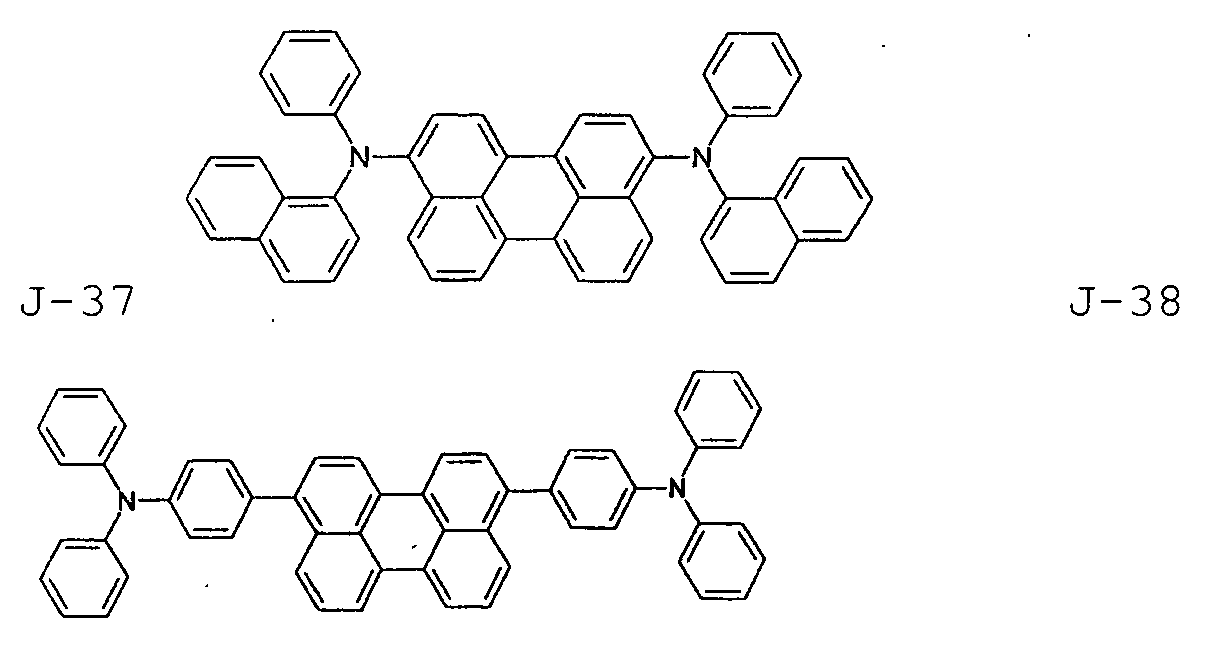
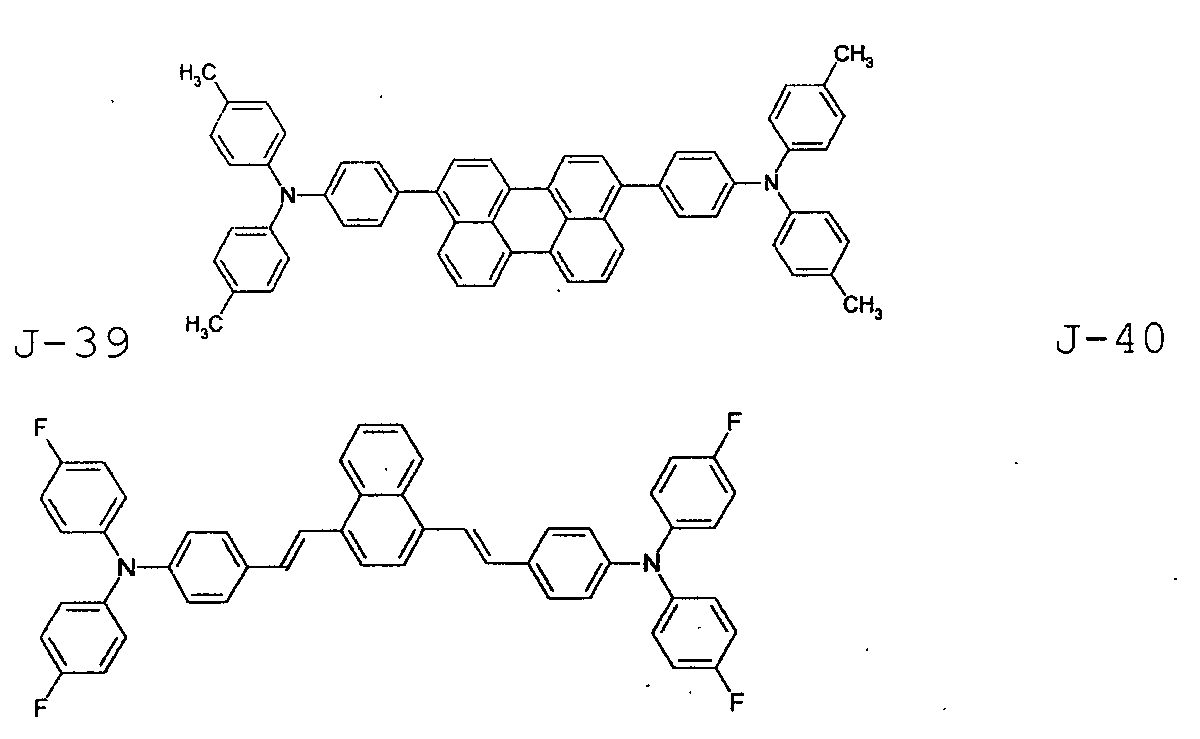
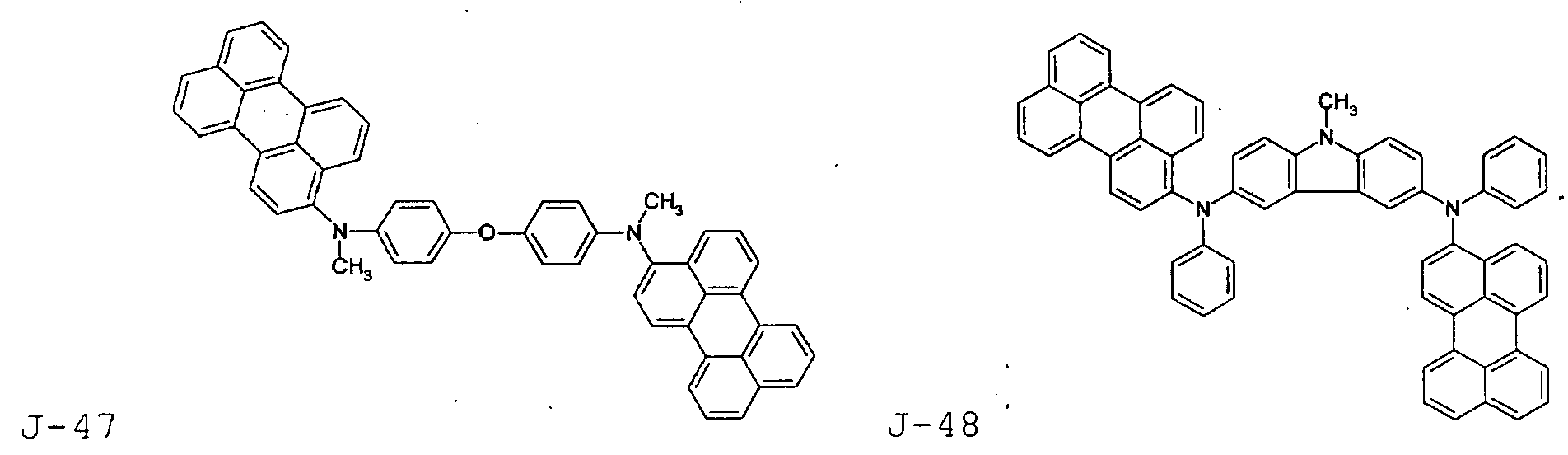
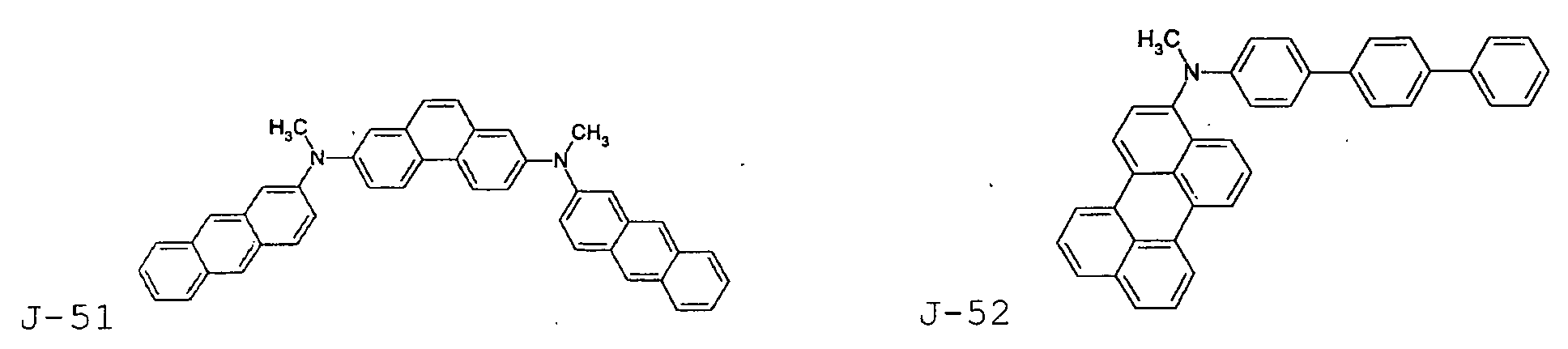
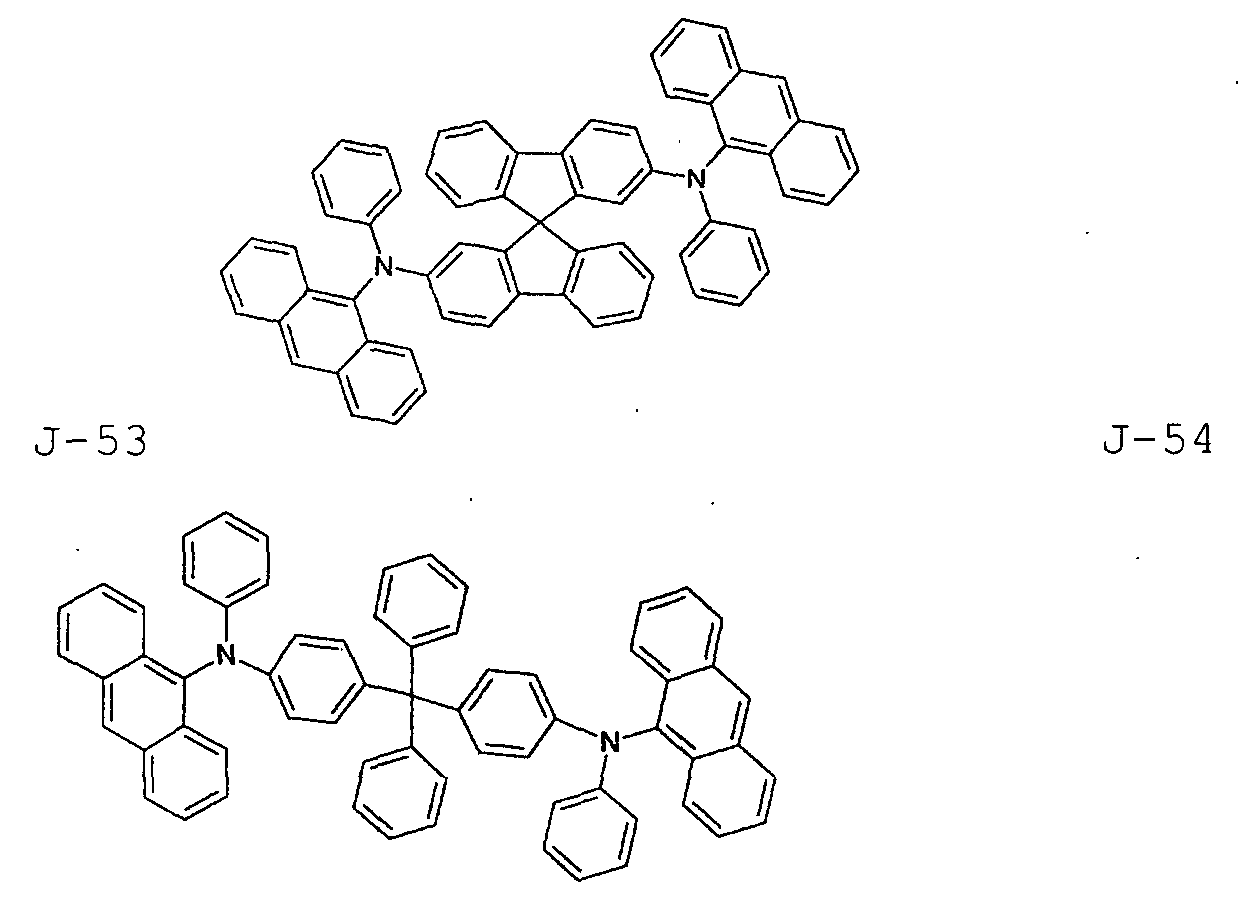
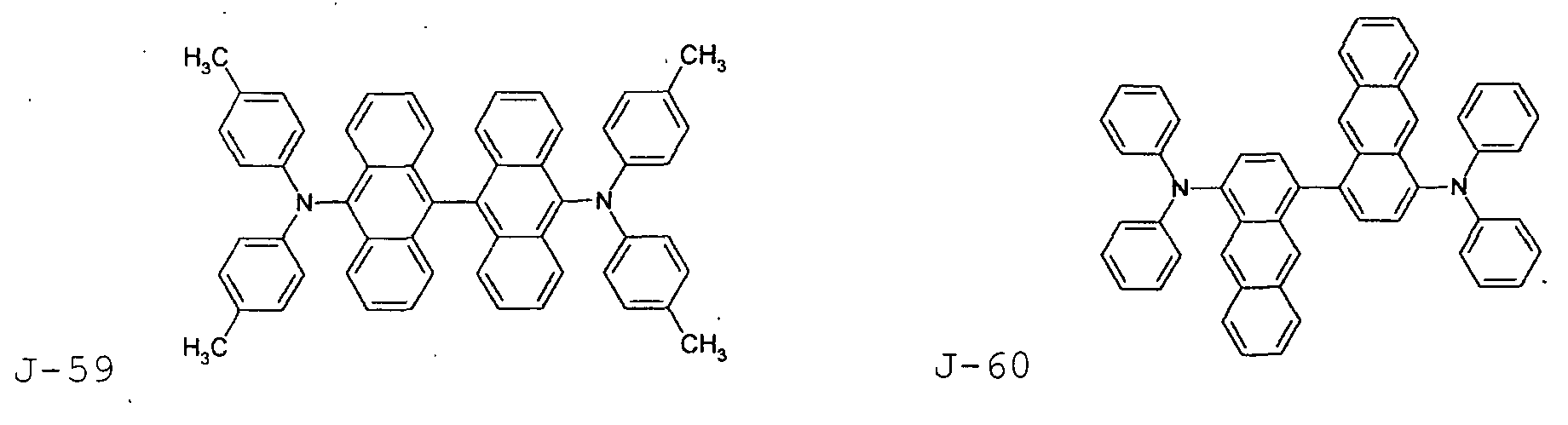
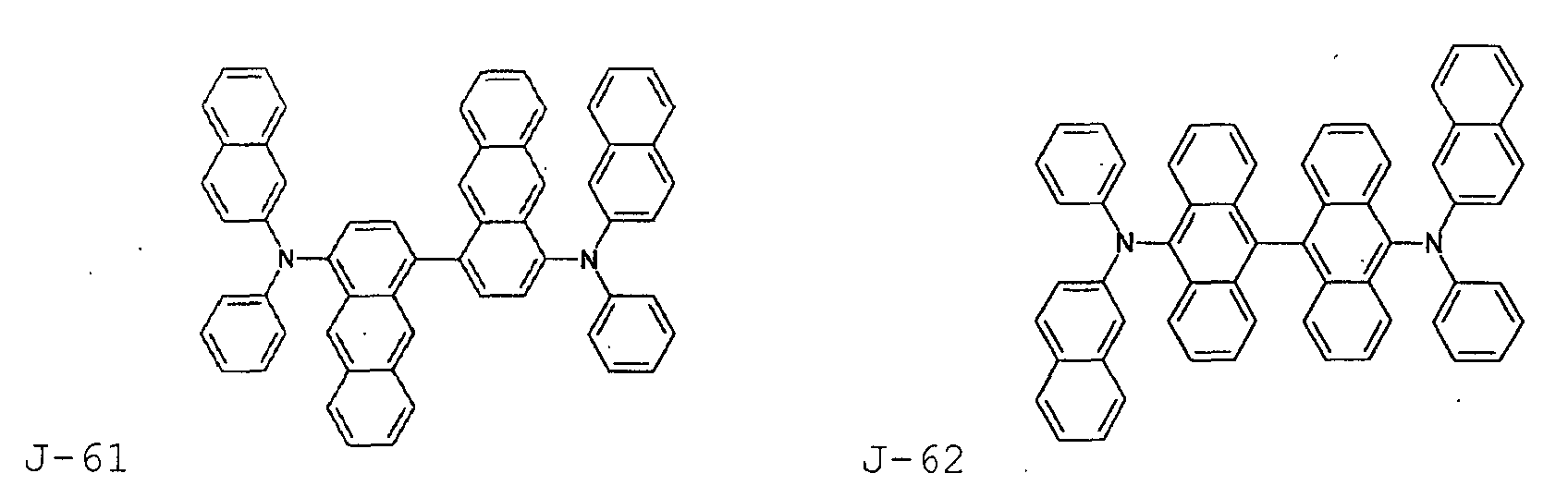
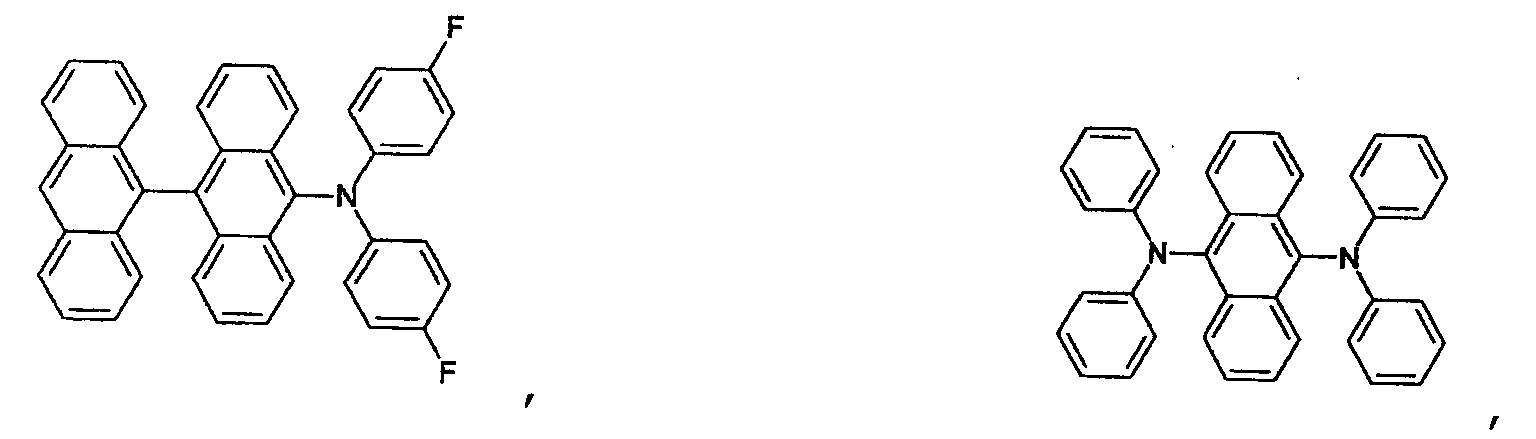
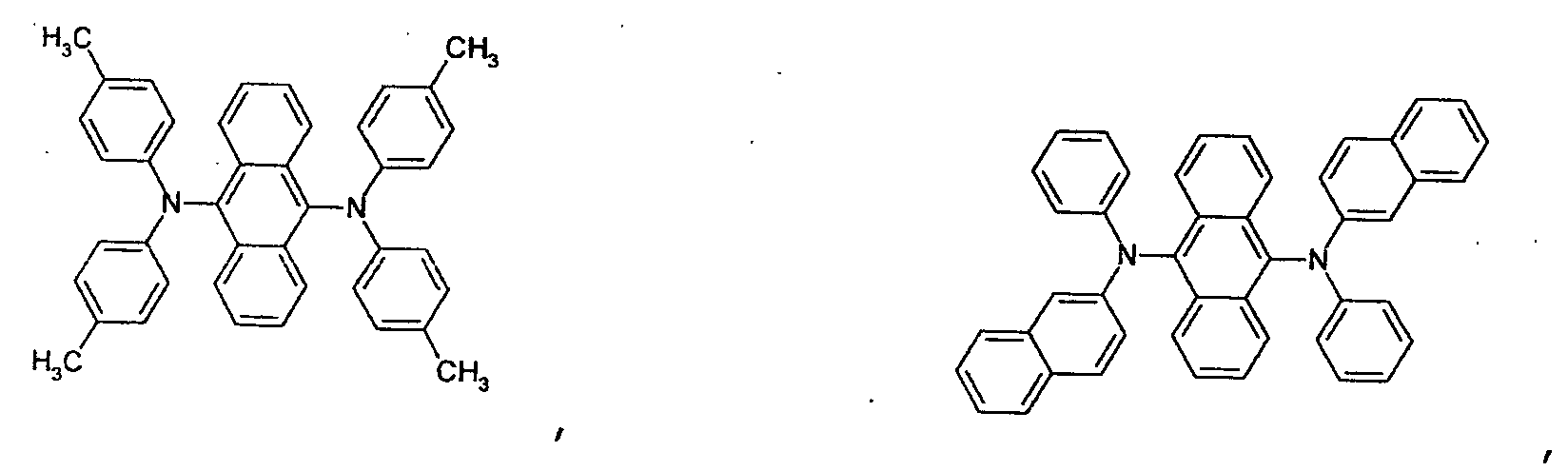
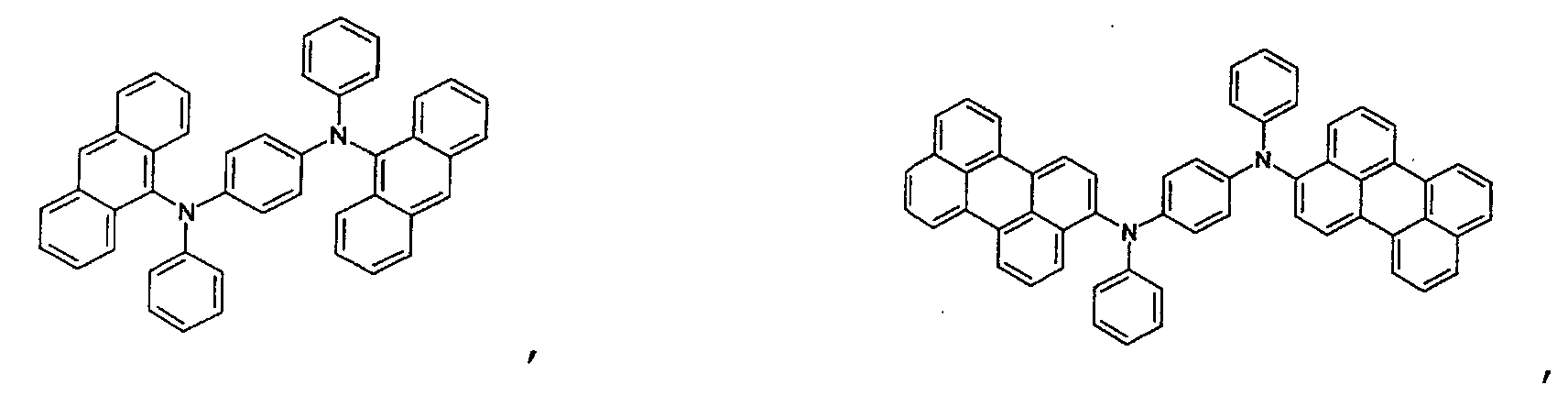
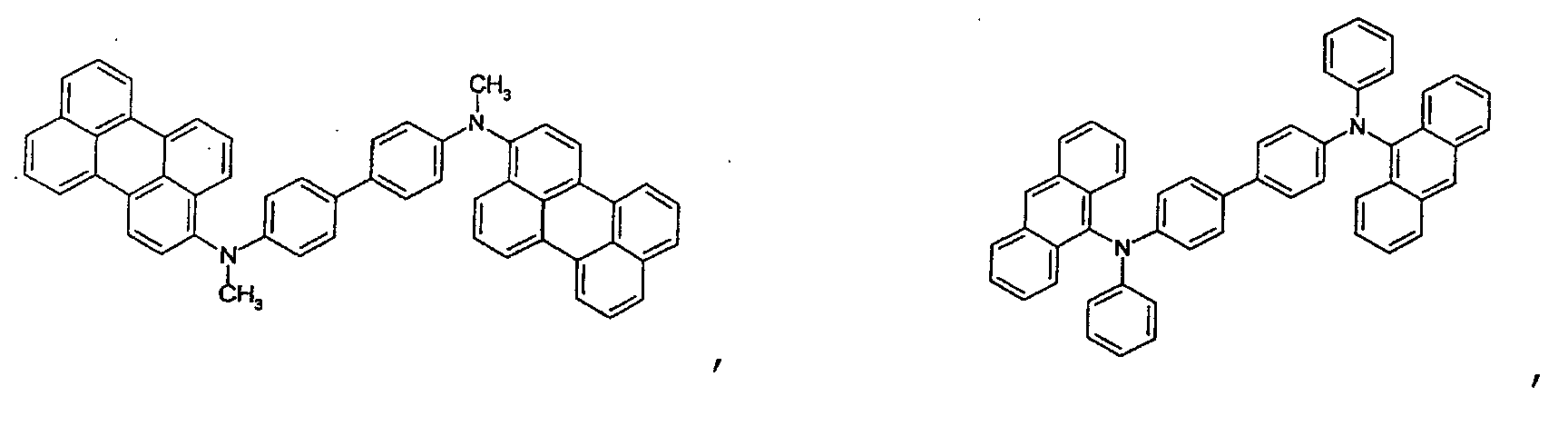
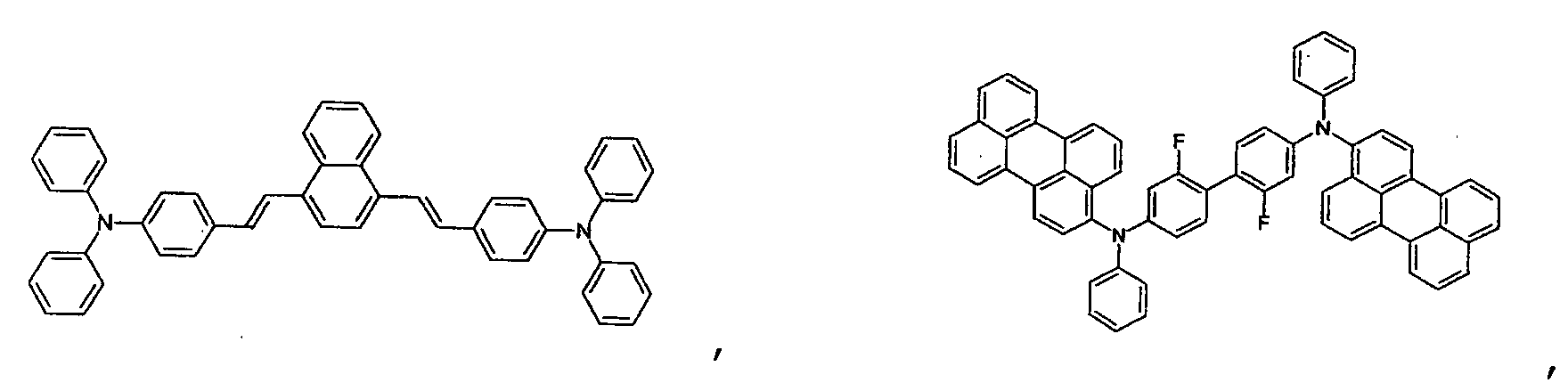
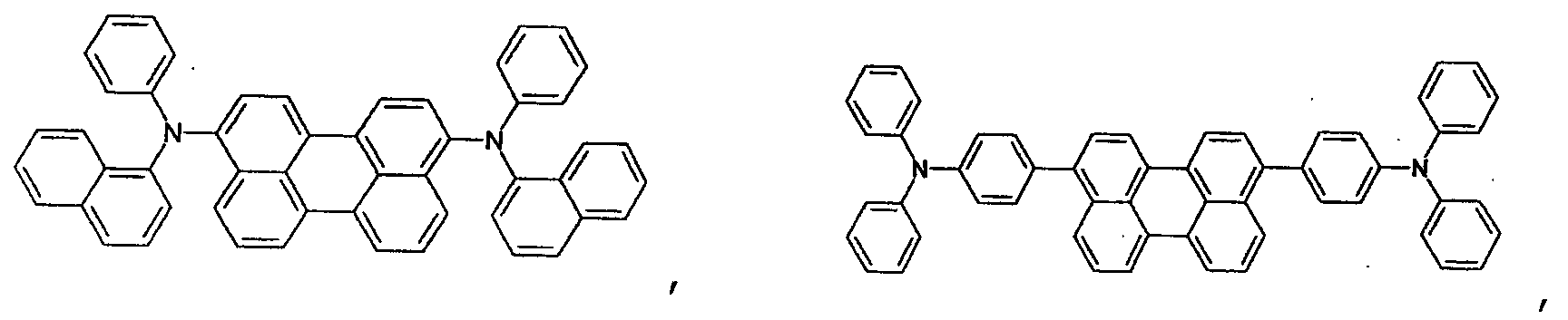
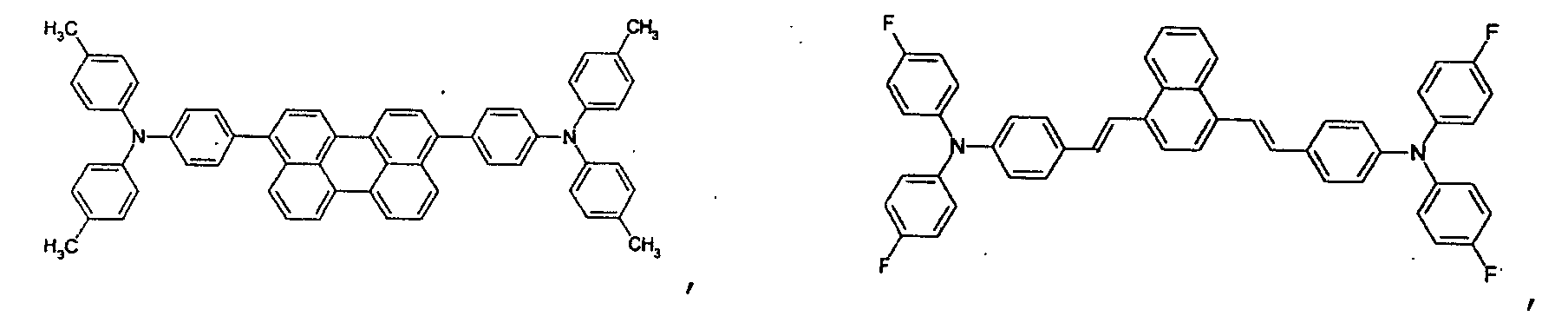
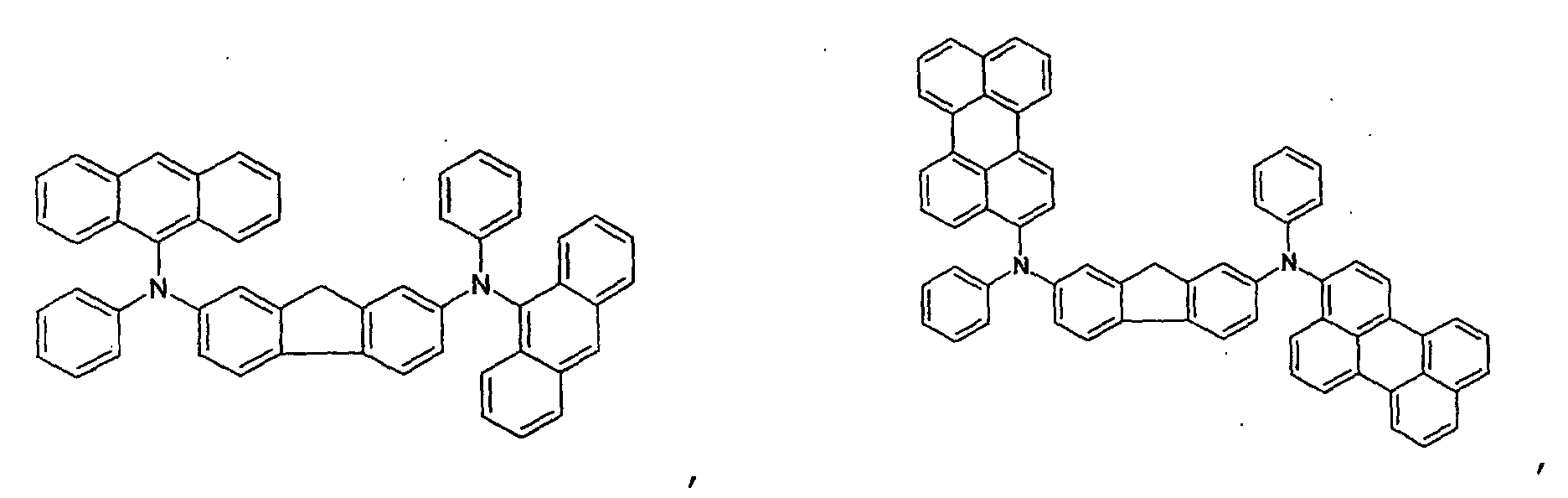
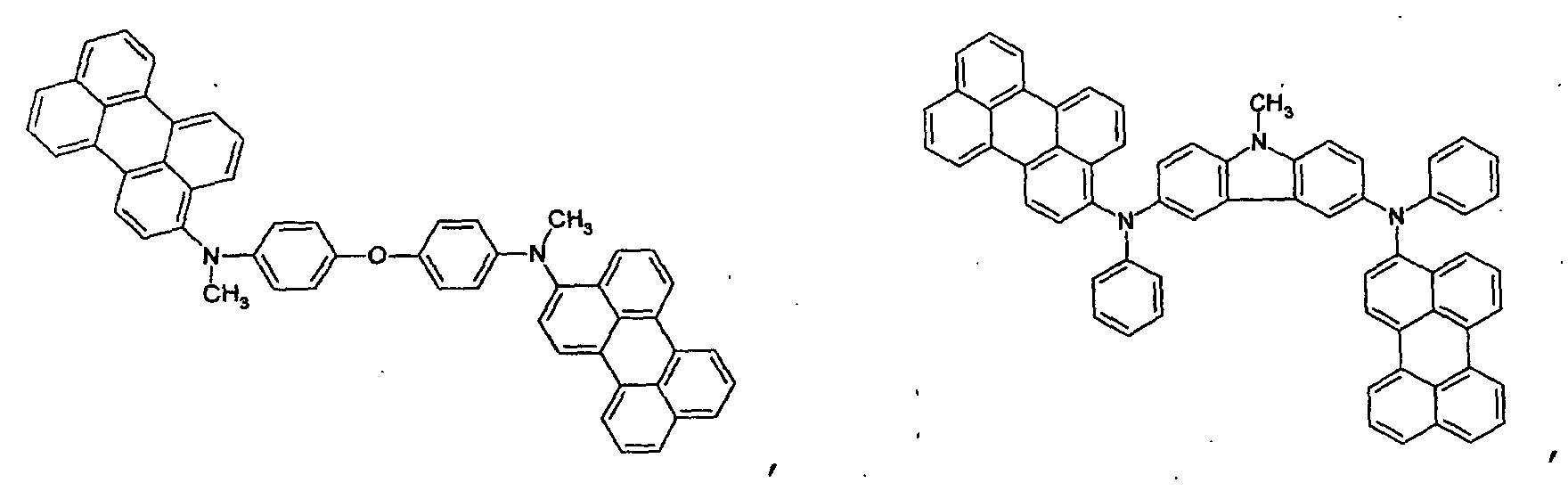
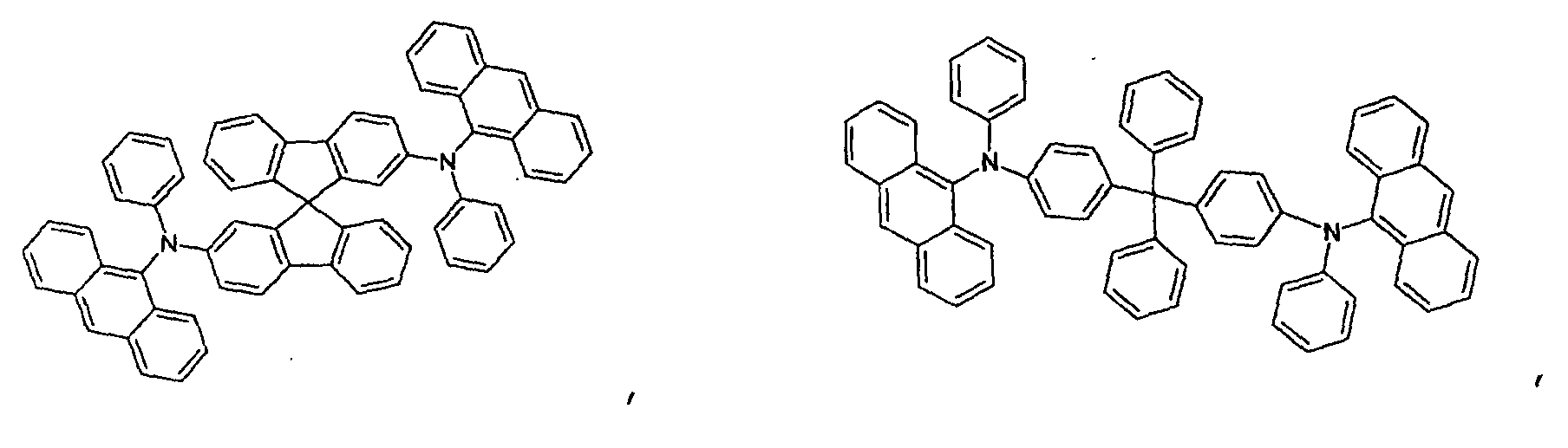
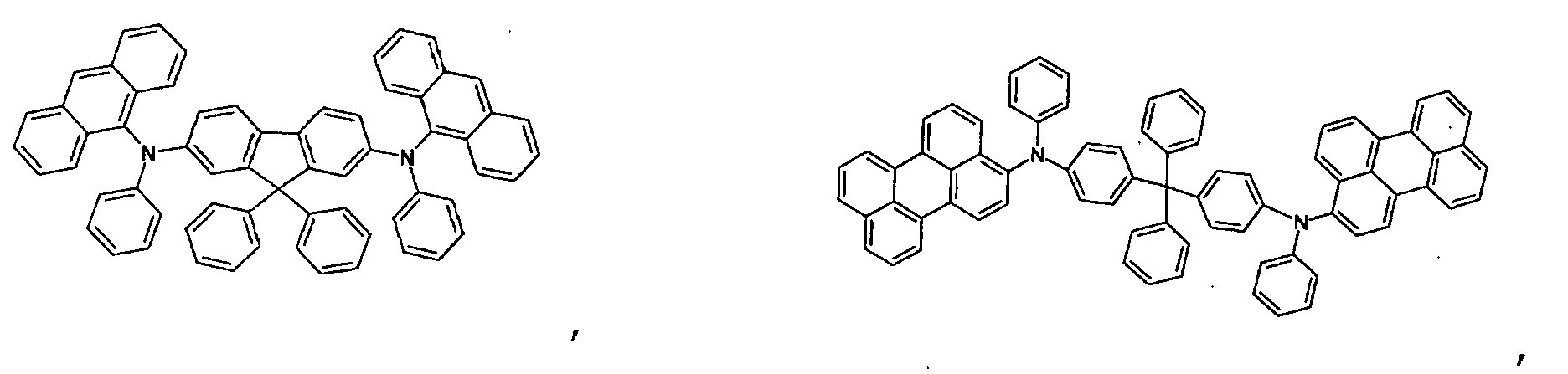
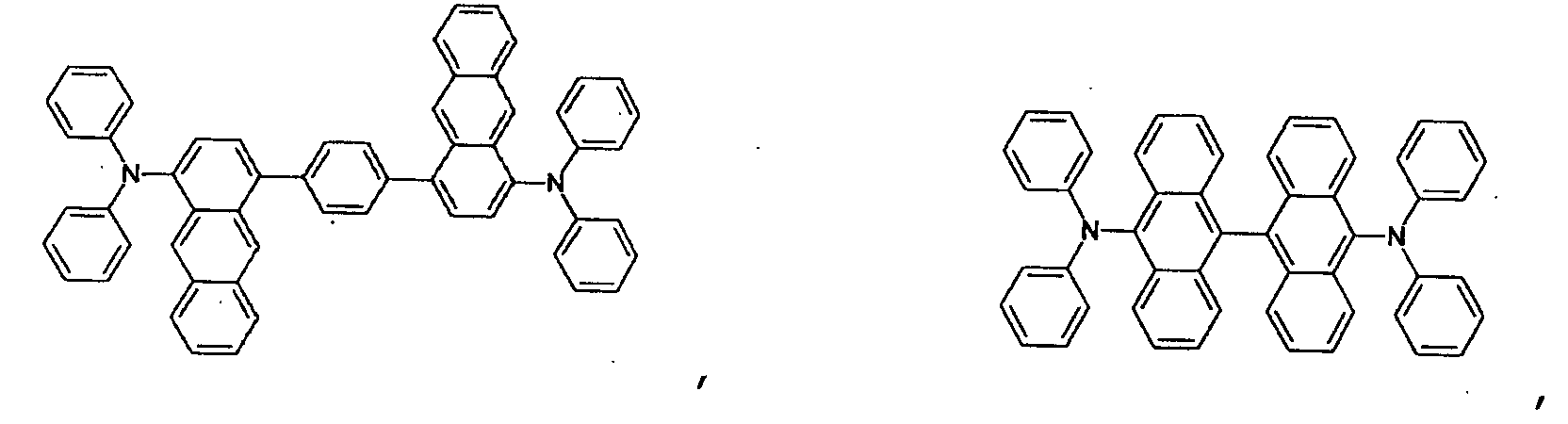
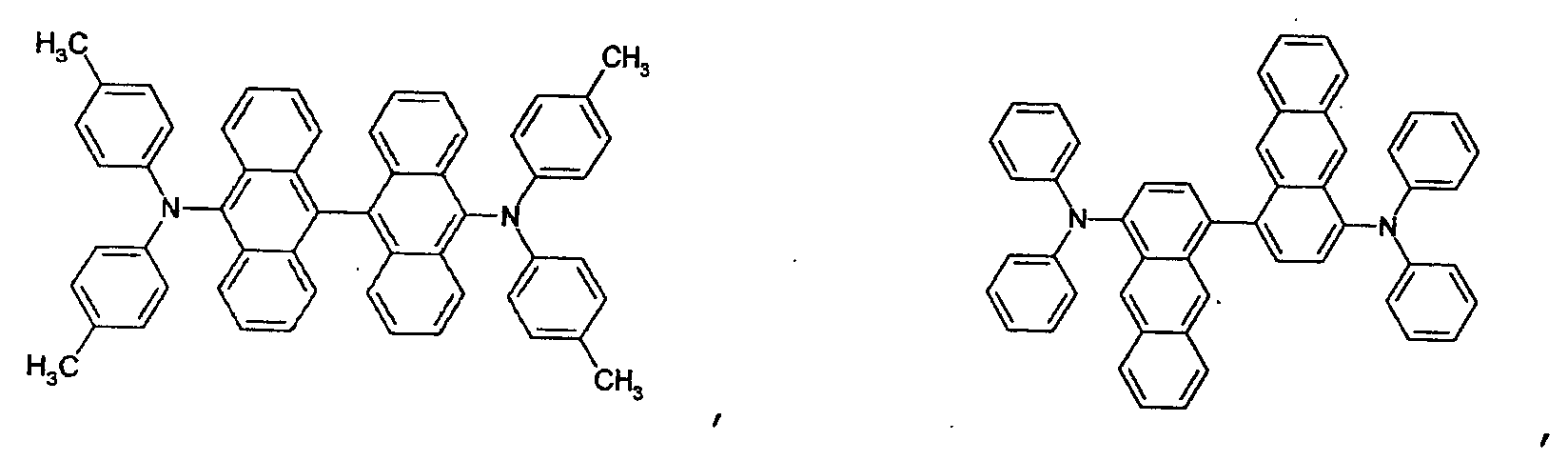
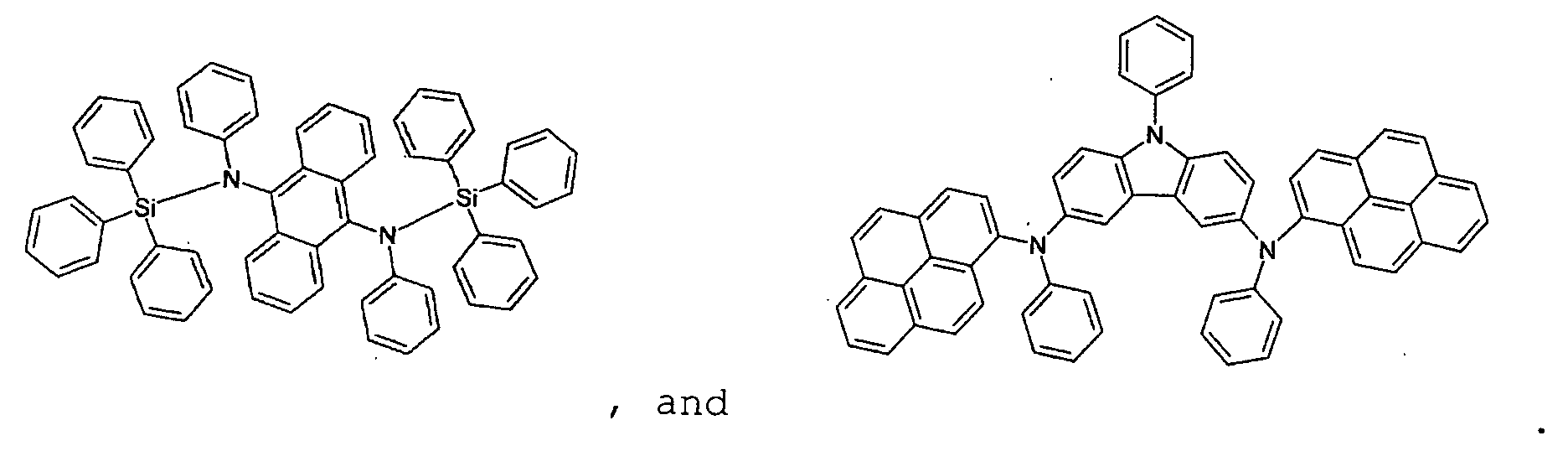
- the first host according to the present invention can be selected from the group consisting of the following structural compounds.
- the second host used in the present invention can be a substituted or non-substituted quinoline derivative.
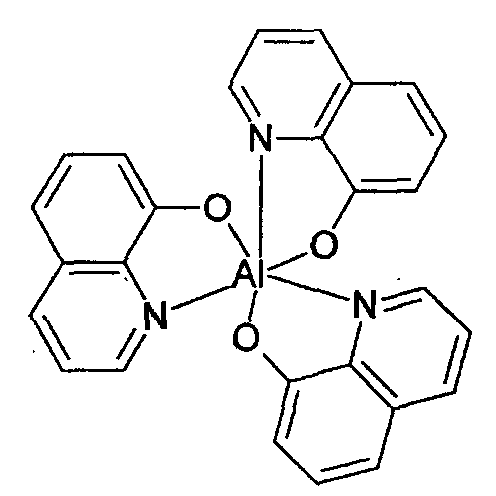
- the second host is 8-hydroxyquinoline metal complex including the metal selected from the group consisting of Al, Zn, Mg, and Li, and more preferably, tris(8-quinolinolate) aluminum having the following structural formula.
- a maximum PL luminescence peak of the guest of the present invention is equal to or greater than 550nm.
- the guest is selected from the group consisting of DCM, Nile red, Coumarine, Rhodamine, pyrromethene, and benzothioxanphene derivatives.
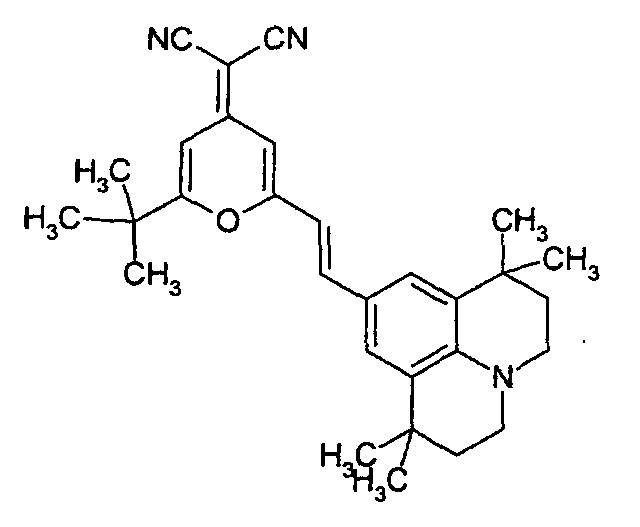
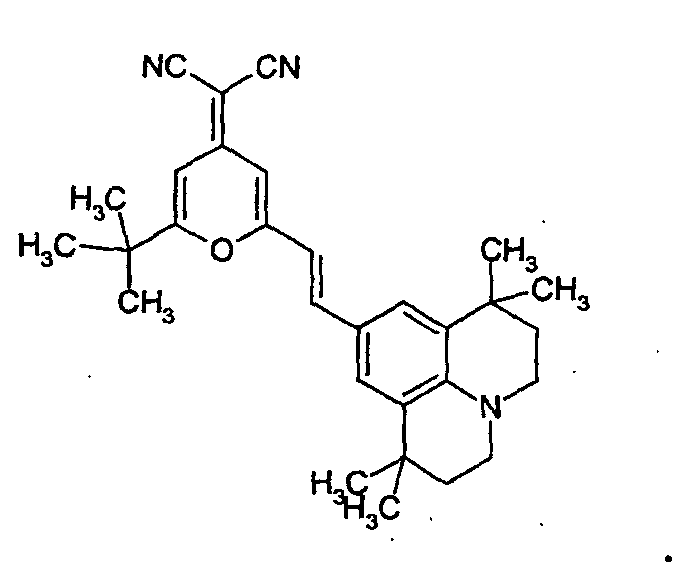
- the DCM derivative has the following structural formula.
- FIG. 2A and FIG. 2B are graphs showing the characteristics of the present invention.
- FIG. 2A illustrates a graph of an EL peak 1 of a device ⁇ NPB(600 ⁇ )/first host(200 ⁇ )/Alq 3 (300 ⁇ )/LiF/Al ⁇ having a light-emitting layer including a first host only and an EL peak 2 of a device ⁇ NPB(600 ⁇ )/Alq 3 (200 ⁇ )/Alq 3 (300 ⁇ )/LiF/Al ⁇ having a light-emitting layer including a second host only.
- a vertical axis in FIG. 2A indicates a normalized EL intensity.
- FIG. 2B illustrates a graph of an EL peak 3 of a device ⁇ NPB(600 ⁇ )/first host + Alq 3 (200 ⁇ )/Alq 3 (300 ⁇ )/LiF/Al ⁇ when first and second host materials are mixed with each other so as to be used for a light-emitting layer.
- an EL peak of the device using first and second host materials together lies between the EL peak of the device using the first host material only and the other peak of the device using the second host only.
- the EL(electroluminescent) peak value of the present invention is between 520 ⁇ 600nm so as to lie between the Alq 3 and first host.
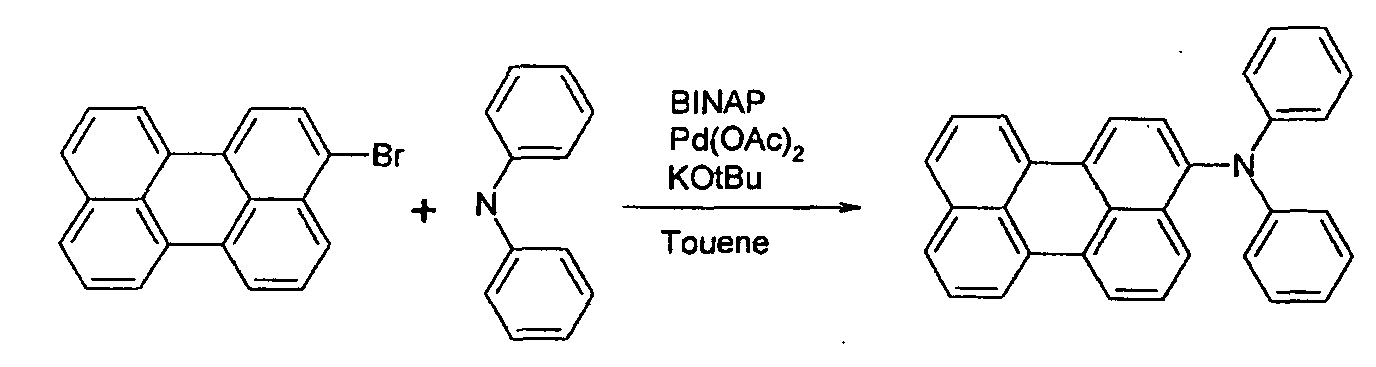
- the reactant is added to methanol for precipitation, whereby precipitate is obtained.
- the precipitate is then filtered, whereby 2g(75%) of 3-bromoperylene is extracted.
- Toluene is removed from the reaction solution by decompressed distillation.
- the reaction solution is washed with water, washed again with methanol, and filtered. And, recrystallization is carried out using THF/methanol.
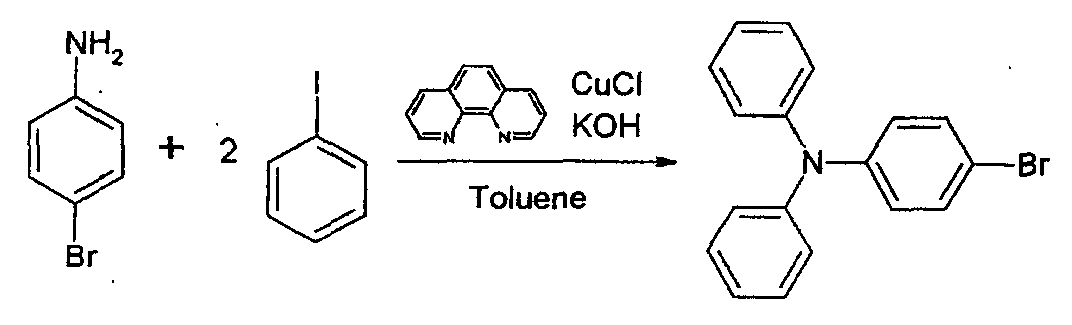
- Toluene is removed from the reaction solution by decompressed distillation.
- the reaction solution is washed with water, and then recrystallized with methylene chloride/methanol, whereby 15.3g(81%) of (4-bromopheny)diphenylamine is obtained.
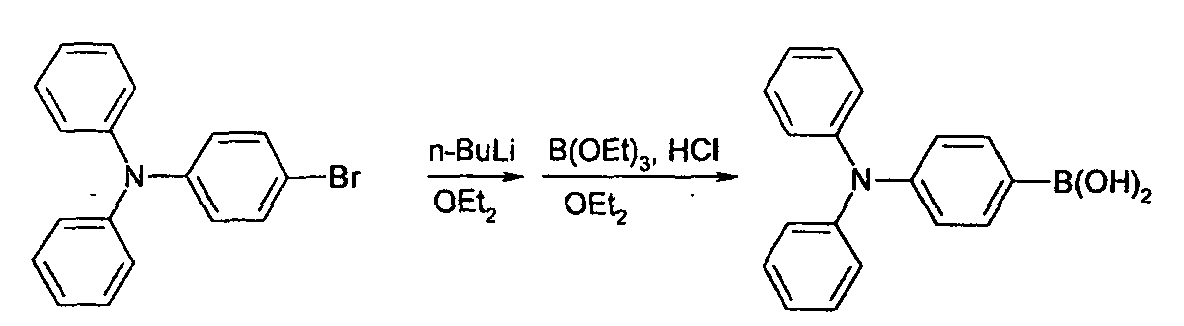
- Decompressed distillation is carried out, washing is carried out using a small quantity of petroleum ether, and then filtering is carried out so as to obtain 1.51g(60%) of compound.
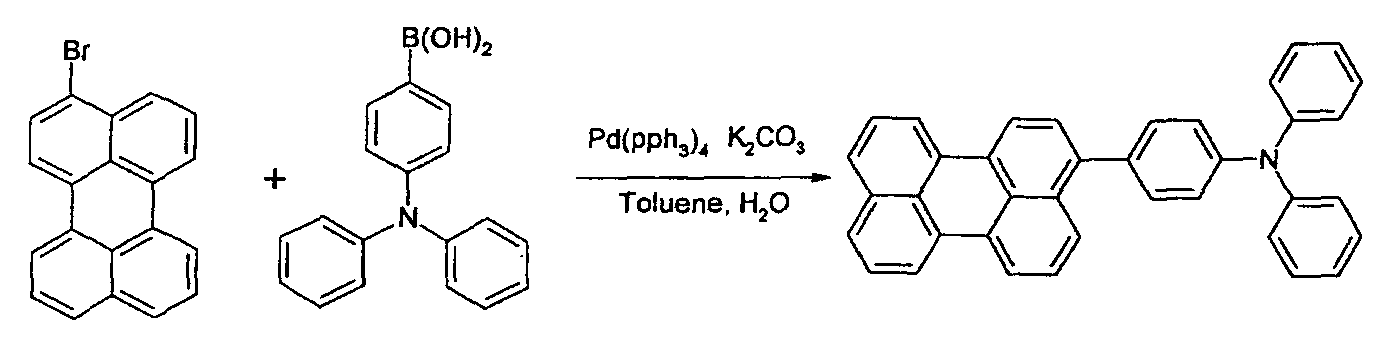
- Nitrogen gas is blown in for about 30 minutes, PD(pph 3 ) 4 amounting to 5mol% of 3-bromoperylene) is added thereto, and then refluxing and stirring are carried out for 24 hours.
- the reactant After toluene has been removed from the reaction solution by decompressed distillation, the reactant is dissolved in THF so as to obtain precipitate from methanol.
- Toluene is removed by decompressed distillation, and the toluene-free reaction solution is washed twice.
- Recrystallization is carried out thereon using THF and methanol.
- a PL peak ⁇ max is 520nm.
- two species of host materials are deposited on an organic light-emitting layer together with a red luminescent material for the fabrication of the organic EL device.
- an ITO glass is patterned so as to have a size of 3mm x 3mm.
- the patterned ITO glass is then cleaned.
- a substrate is loaded on a vacuum chamber of which basic pressure is set up as 1x10 -6 torr, CuPC(60 ⁇ ), NPB(350 ⁇ ), a light-emitting layer(first host : second host : red luminescent material)(200 ⁇ ), Alq 3 (500 ⁇ ), LiF(5 ⁇ ), and Al(1,000 ⁇ ) are deposited successively on the ITO.
- J-5 compound, Alq 3 , and dcjtb are used as the first host, second host, and red luminescent material of the light-emitting layer, respectively.
- a mixture ratio between the first host, second host, and red luminescent material is 1:1:0.02.
- the second embodiment of the present invention is carried out by the same method of the first embodiment of the present invention except that J-17 compound is used.
- an ITO glass is patterned so as to have a size of 3mm x 3mm.
- the patterned ITO glass is then cleaned.
- a substrate is loaded on a vacuum chamber of which basic pressure is set up as 1x10 -6 torr, CuPC(60 ⁇ ), NPB(350 ⁇ ), a light-emitting layer(200 ⁇ ), Alq 3 (500 ⁇ ), LiF(5 ⁇ ), and Al(1,000 ⁇ ) are deposited successively on the ITO.
- the light-emitting layer includes Alq 3 and a red luminescent material only, and a mixture ratio thereof is 1:0.01.
- the organic electroluminescent device transfers energy efficiently using the red luminescent material, thereby enabling to enhance a red luminescence efficiency.
- the present invention uses such a light-emitting layer, thereby enabling to realize a red luminescent device having a high efficiency despite a low driving voltage.
Landscapes
- Chemical & Material Sciences (AREA)
- Organic Chemistry (AREA)
- Physics & Mathematics (AREA)
- Engineering & Computer Science (AREA)
- Materials Engineering (AREA)
- Spectroscopy & Molecular Physics (AREA)
- Optics & Photonics (AREA)
- Electroluminescent Light Sources (AREA)
Abstract
Description
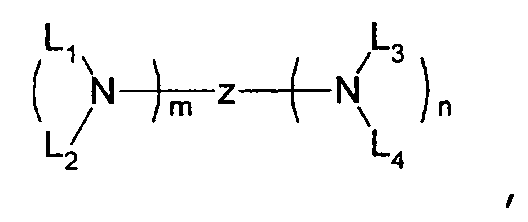
z is A1 or -A2-Q-A3-,
A1 is selected from the group consisting of a substituted or non-substituted aromatic hydrocarbon group, a heterocycle group, or an aliphatic hydrocarbon group wherein a bond between A1 and nitrogen(N) is connected to an aliphatic hydrocarbon group or an amide or imine bond if A1 is the aromatic hydrocarbon or heterocycle group,
A2 and A3 are aromatic hydrocarbon groups or heterocycle groups substituted or non-substituted independently, respectively, a bond of A2, A3 and nitrogen(N) can be connected to the aromatic hydrocarbon group or the amide or imine bond,
Q is a substituted or non-substituted aromatic hydrocarbon group, a heterocycle group, or an aliphatic hydrocarbon group, or an element of groups IIIB, IVB, VB, and VIB wherein a bond of Q-A2, Q-A3, or Q-A2-A3 is connected to the aliphatic hydrocarbon group, an element of groups IIIB, IVB, VB, and VIB, a substituted or non-substituted aliphatic hydrocarbon group, or a bond of amide, ester, carbonyl, azo, and imine if Q is a substituted or non-substituted aromatic hydrocarbon group or a heterocycle group; and
L1, L2, L3, and L4 are selected from the group consisting of a substituted or non-substituted aromatic hydrocarbon group, a heterocycle group, an aliphatic hydrocarbon group, a silyl group, and a hydrogen atom, respectively wherein L1, L2, L3, and L4 can be bonded to each other chemically, equal to each other, or different from each other.

z is A1 or -A2-Q-A3-,
A1 is selected from the group consisting of a substituted or non-substituted aromatic hydrocarbon group, a heterocycle group, or an aliphatic hydrocarbon group wherein a bond between A1 and nitrogen(N) is connected to an aliphatic hydrocarbon group or an amide or imine bond if A1 is the aromatic hydrocarbon or heterocycle group,
A2 and A3 are aromatic hydrocarbon groups or heterocycle groups substituted or non-substituted independently, respectively, a bond of A2, A3 and nitrogen(N) can be connected to the aromatic hydrocarbon group or the amide or imine bond,
Q is a substituted or non-substituted aromatic hydrocarbon group, a heterocycle group, or an aliphatic hydrocarbon group, or an element of groups IIIB, IVB, VB, and VIB wherein a bond of Q-A2, Q-A3, or Q-A2-A3 is connected to the aliphatic hydrocarbon group, an element of groups IIIB, IVB, VB, and VIB, a substituted or non-substituted aliphatic hydrocarbon group, or a bond of amide, ester, carbonyl, azo, and imine if Q is a substituted or non-substituted aromatic hydrocarbon group or a heterocycle group; and
L1, L2, L3, and L4 are selected from the group consisting of a substituted or non-substituted aromatic hydrocarbon group, a heterocycle group, an aliphatic hydrocarbon group, a silyl group, and a hydrogen atom, respectively wherein L1, L2, L3, and L4 can be bonded to each other chemically, equal to each other, or different from each other.

z is A1 or -A2-Q-A3-,
A1 is selected from the group consisting of a substituted or non-substituted aromatic hydrocarbon group, a heterocycle group, or an aliphatic hydrocarbon group wherein a bond between A1 and nitrogen(N) is connected to an aliphatic hydrocarbon group or an amide or imine bond if A1 is the aromatic hydrocarbon or heterocycle group,
A2 and A3 are aromatic hydrocarbon groups or heterocycle groups substituted or non-substituted independently, respectively, a bond of A2, A3 and nitrogen(N) can be connected to the aromatic hydrocarbon group or the amide or imine bond,
Q is a substituted or non-substituted aromatic hydrocarbon group, a heterocycle group, or an aliphatic hydrocarbon group, or an element of groups IIIB, IVB, VB, and VIB wherein a bond of Q-A2, Q-A3, or Q-A2-A3 is connected to the aliphatic hydrocarbon group, an element of groups IIIB, IVB, VB, and VIB, a substituted or non-substituted aliphatic hydrocarbon group, or a bond of amide, ester, carbonyl, azo, and imine if Q is a substituted or non-substituted aromatic hydrocarbon group or a heterocycle group; and
L1, L2, L3, and L4 are selected from the group consisting of a substituted or non-substituted aromatic hydrocarbon group, a heterocycle group, an aliphatic hydrocarbon group, a silyl group, and a hydrogen atom, respectively wherein L1, L2, L3, and L4 can be bonded to each other chemically, equal to each other, or different from each other.























Claims (27)
- An organic electroluminescent device comprising:a first electrode;a second electrode; anda light-emitting layer having a guest material of a red luminescent material and at least two host materials so as to be formed between the first and second electrodes.
- The organic electroluminescent device of claim 1, wherein a composition of the light-emitting layer includes 0.01∼30wt/% of the guest material and 0.05∼99.9wt/% of the host materials.
- The organic electroluminescent device of claim 1 or 2, wherein the guest material is selected from the group consisting of a DCM derivative, a Nile red derivative, a Coumarine derivative, a Phodamine derivative, a pyrromethene derivative, and a benzothioxanphene derivative.
- The organic electroluminescent device of at least one of the preceding claims, wherein one of the host materials is a composite including the following structural formula:wherein (m+n) is an integer of 1 to 8;
z is A1 or -A2-Q-A3-,
A1 is selected from the group consisting of a substituted or non-substituted aromatic hydrocarbon group, a heterocycle group, or an aliphatic hydrocarbon group wherein a bond between A1 and nitrogen(N) is connected to an aliphatic hydrocarbon group or an amide or imine bond if A1 is the aromatic hydrocarbon or heterocycle group,
A2 and A3 are aromatic hydrocarbon groups or heterocycle groups substituted or non-substituted independently, respectively, a bond of A2, A3 and nitrogen(N) can be connected to the aromatic hydrocarbon group or the amide or imine bond,
Q is a substituted or non-substituted aromatic hydrocarbon group, a heterocycle group, or an aliphatic hydrocarbon group, or an element of groups IIIB, IVB, VB, and VIB wherein a bond of Q-A2, Q-A3, or Q-A2-A3 is connected to the aliphatic hydrocarbon group, an element of groups IIIB, IVB, VB, and VIB, a substituted or non-substituted aliphatic hydrocarbon group, or a bond of amide, ester, carbonyl, azo, and imine if Q is a substituted or non-substituted aromatic hydrocarbon group or a heterocycle group; and
L1, L2, L3, and L4 are selected from the group consisting of a substituted or non-substituted aromatic hydrocarbon group, a heterocycle group, an aliphatic hydrocarbon group, a silyl group, and a hydrogen atom, respectively wherein L1, L2, L3, and L4 can be bonded to each other chemically, equal to each other, or different from each other. - The organic electroluminescent device of at least one of the preceding claims, wherein one of the host materials is a substituted or non-substituted quinoline derivative.
- An organic electroluminescent device comprising:a first electrode;a second electrode;a light-emitting layer having a guest material of a red luminescent material and at least two host materials so as to be formed between the first and second electrodes; anda hole injection/transport layer formed between the first electrode and light-emitting layer.
- The organic electroluminescent device of claim 6, wherein an electron injection/transport layer is formed between the second electrode and light-emitting layer.
- The organic electroluminescent device of claim 6 or 7, wherein the light-emitting layer has a composition of 0.01∼30wt/% of the guest, 0.05∼99.9wt/% of the first host, and 0.05∼99.9wt/% of the second host.
- The organic electroluminescent device of at least one of claims 6 to 8, wherein the first host is a compound having the following structural formula:where (m+n) is an integer of 1 to 8;

z is A1 or -A2-Q-A3-,
A1 is selected from the group consisting of a substituted or non-substituted aromatic hydrocarbon group, a heterocycle group, or an aliphatic hydrocarbon group wherein a bond between A1 and nitrogen(N) is connected to an aliphatic hydrocarbon group or an amide or imine bond if A1 is the aromatic hydrocarbon or heterocycle group,
A2 and A3 are aromatic hydrocarbon groups or heterocycle groups substituted or non-substituted independently, respectively, a bond of A2, A3 and nitrogen(N) can be connected to the aromatic hydrocarbon group or the amide or imine bond,
Q is a substituted or non-substituted aromatic hydrocarbon group, a heterocycle group, or an aliphatic hydrocarbon group, or an element of groups IIIB, IVB, VB, and VIB wherein a bond of Q-A2, Q-A3, or Q-A2-A3 is connected to the aliphatic hydrocarbon group, an element of groups IIIB, IVB, VB, and VIB, a substituted or non-substituted aliphatic hydrocarbon group, or a bond of amide, ester, carbonyl, azo, and imine if Q is a substituted or non-substituted aromatic hydrocarbon group or a heterocycle group; and
L1, L2, L3, and L4 are selected from the group consisting of a substituted or non-substituted aromatic hydrocarbon group, a heterocycle group, an aliphatic hydrocarbon group, a silyl group, and a hydrogen atom, respectively wherein L1, L2, L3, and L4 can be bonded to each other chemically, equal to each other, or different from each other. - The organic electroluminescent device of claim 9, wherein the element of the groups IIIB, IVB, VB, and VIB is selected from the group consisting of B, C, Si, N, O, S, and Se.
- The organic electroluminescent device of claim 9 or 10, wherein each of the aliphatic hydrocarbon groups connecting the A1/A2/A3/N, A2/Q, and A3/Q, respectively has 1 to 12 carbon atoms.
- The organic electroluminescent device of claim 11, wherein the aliphatic hydrocarbon group is selected from the group consisting of methylene, ethylene, trimethylene, cyclohexanediyl, adamanthanediyl, and vinylene groups.
- The organic electroluminescent device of at least one of claims 9 to 12, wherein a substituent of the A1, A2, A3, or Q is selected from the group consisting of aryloxy, arylcarbonyl, aryloxycarbonyl, arylcarboxy, aralkyl, arylaminocarbonyl, arylcarbonylamino, arylsilyl, alkyl, alkoxy, alkoxycarbonyl, acyl, acyloxy, acylamino, alkylamino, alkylaminocarbonyl, alkylsulfanyl, alkylsilyl, carbamoyl, hydroxy, amino, cyano, nitro, and thiol groups and halogen atoms.
- The organic electroluminescent device of claim 13, wherein the substituent is selected from the group consisting of phenoxy, naphthyloxy, phenylcarbonyl, naphthyloxycarbonyl, phenylcarboxy, benzyl, styryl, vinyl, anilinocarbonyl, benzoylamino, tri-phenylsilyl, methyl, ethyl, propyl, i-propyl, t-butyl, cyclohexyl, methoxy, ethoxy, propoxy, butoxy, methoxycarbonyl, ethoxycarbonyl, formyl, propionyl, acetyloxy, propionylamino, dimethylamino, di-I-propylamino, ethylsulfanyl, and trimethylsilyl groups, F, and Cl.
- The organic electroluminescent device of at least one of claims 9 to 14, wherein each of the A1, A2, A3, and Q has at least two of the substituents and wherein at least two of the substituents are boned to each other so as to form a saturated or unsaturated ring.
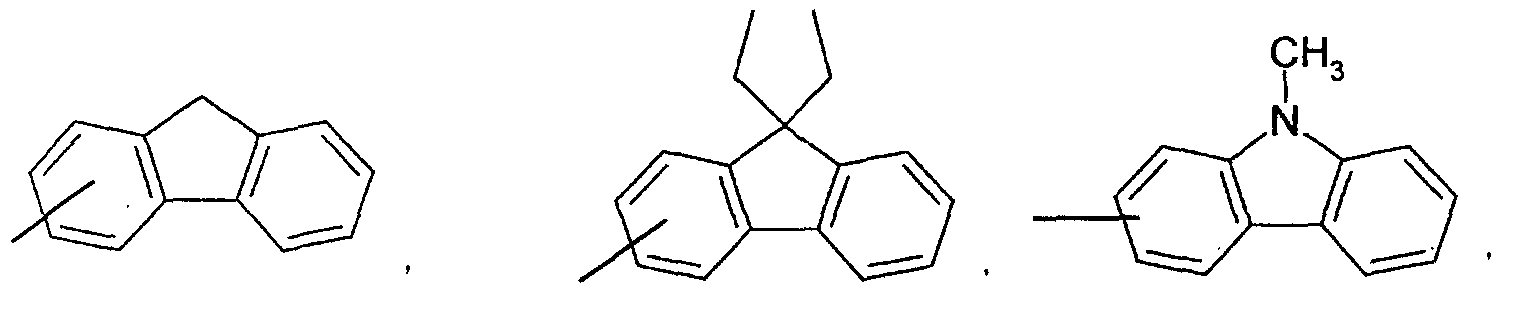
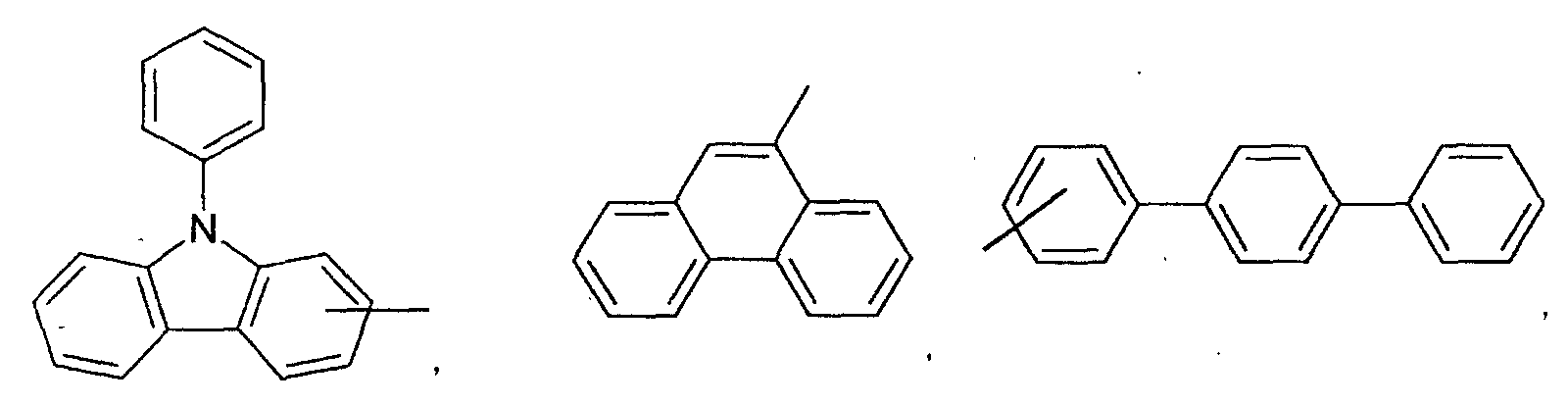
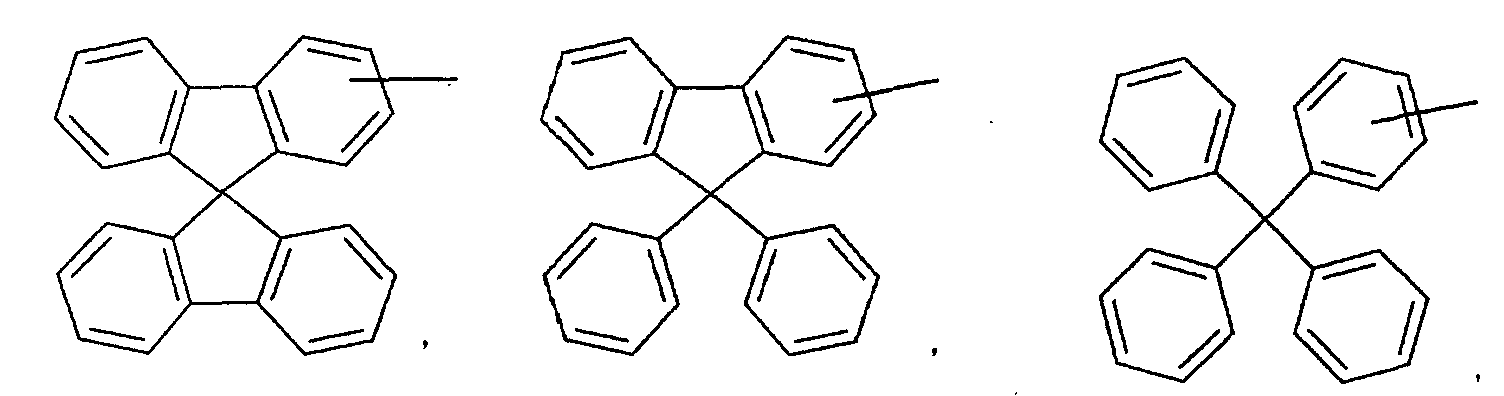
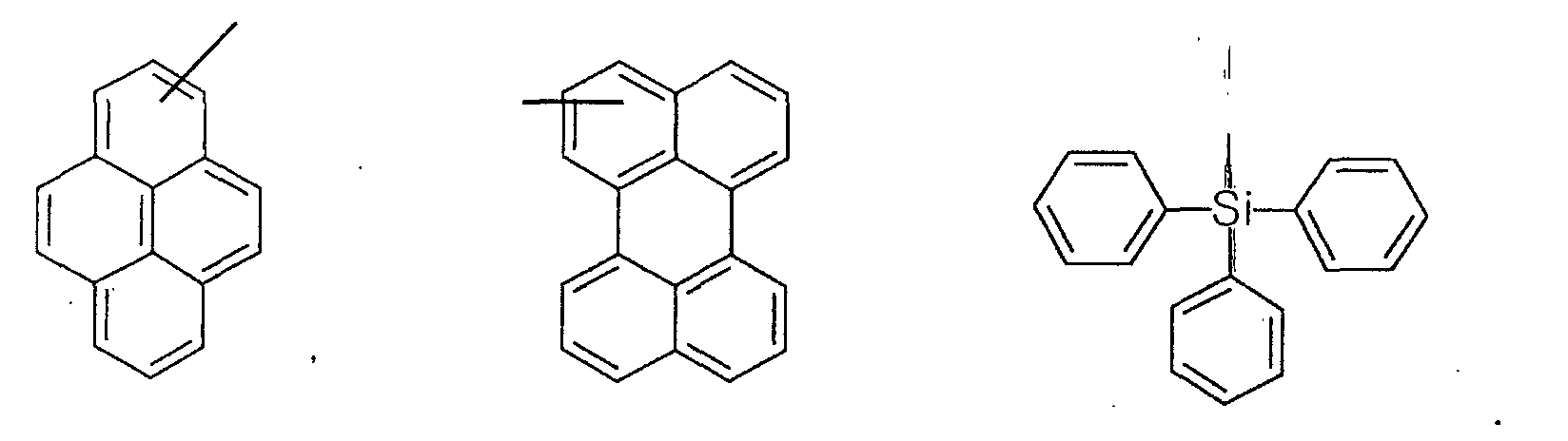
- The organic electroluminescent device of at least one of claims 9 to 15, wherein the aliphatic hydrocarbon group of the A1 or Q is selected from the group consisting of methylene, ethylene, cyclohexanediyl, and adamanthanediyl groups and wherein an aromatic hydrocarbon or heterocyclic group of each of the A1, A2, A3, and Q is selected from the group consisting of compounds having the following structural formulas:



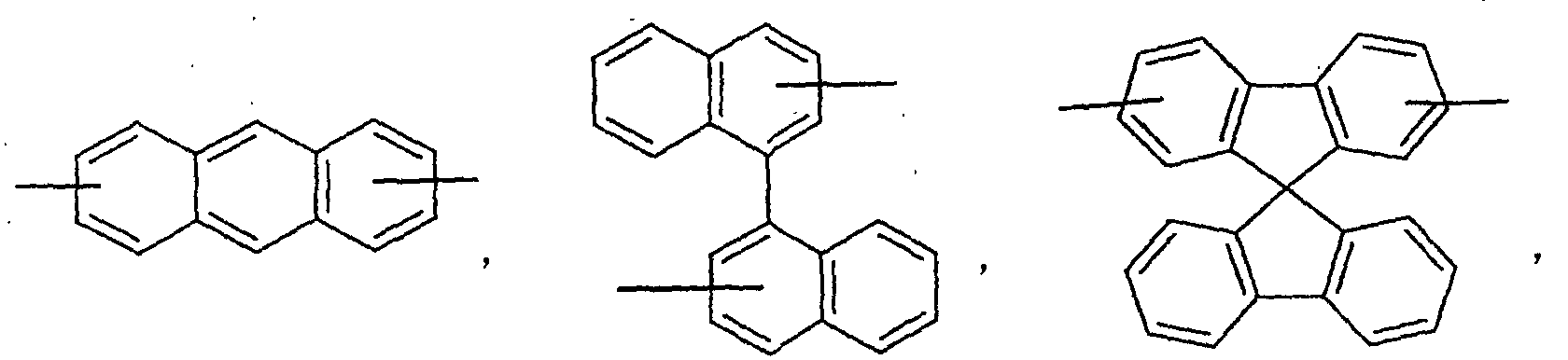
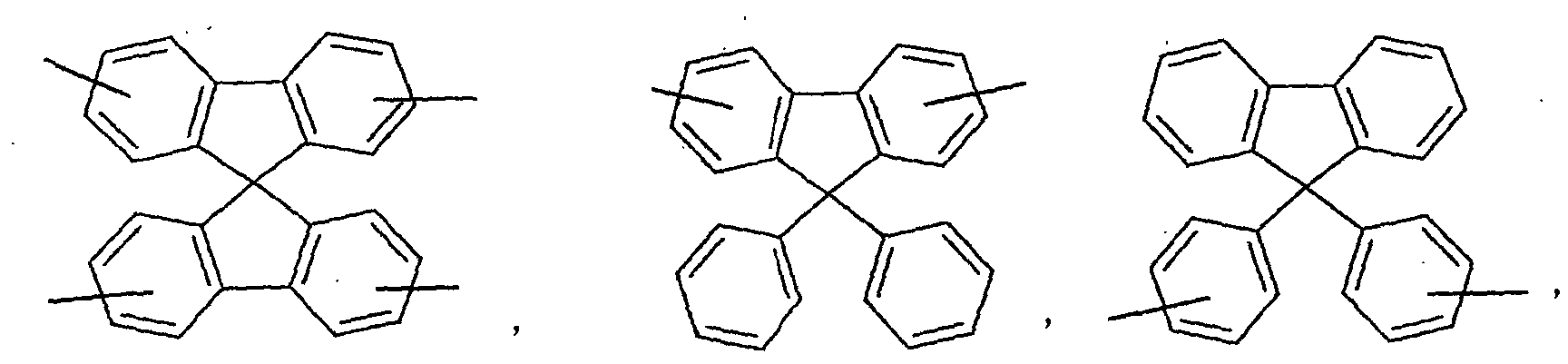
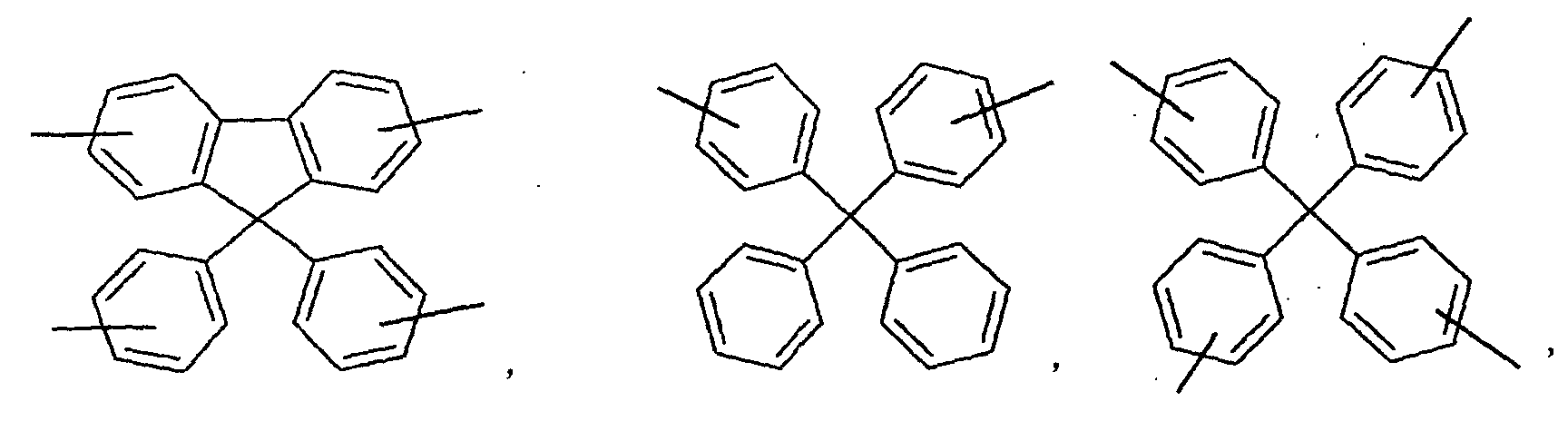
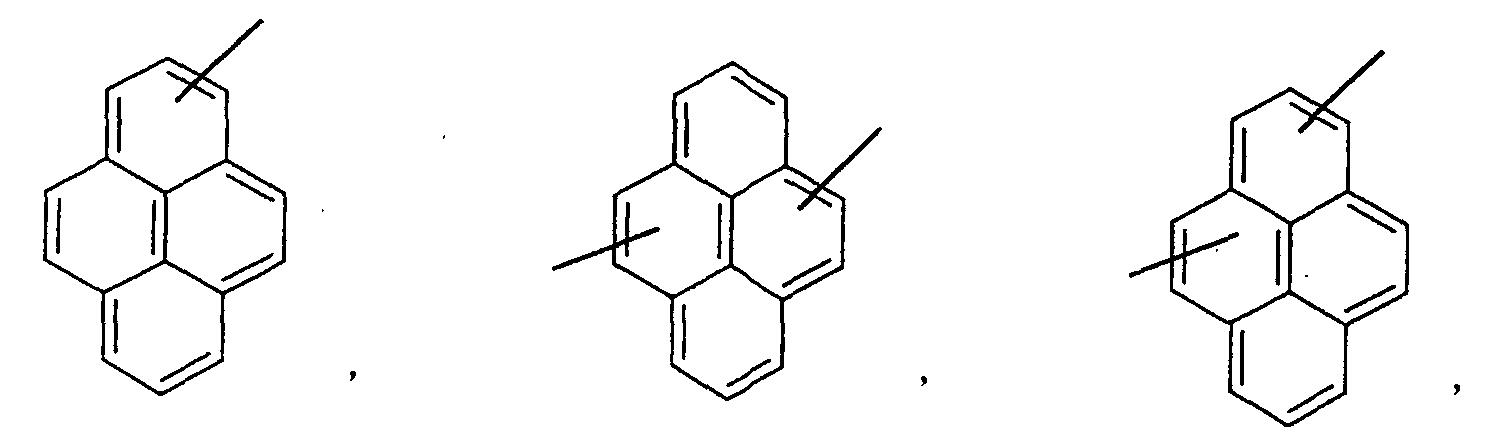
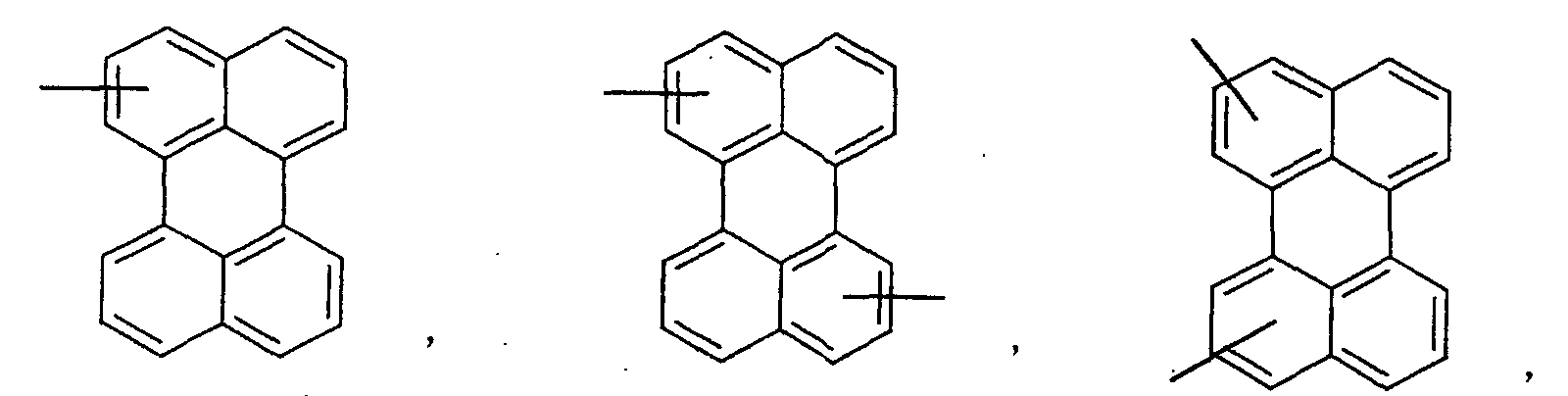
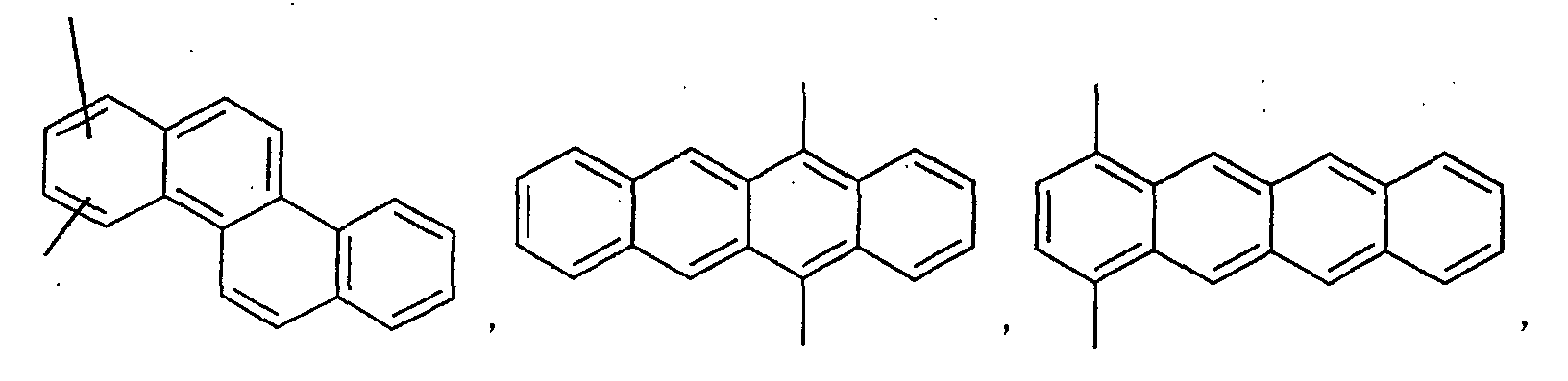
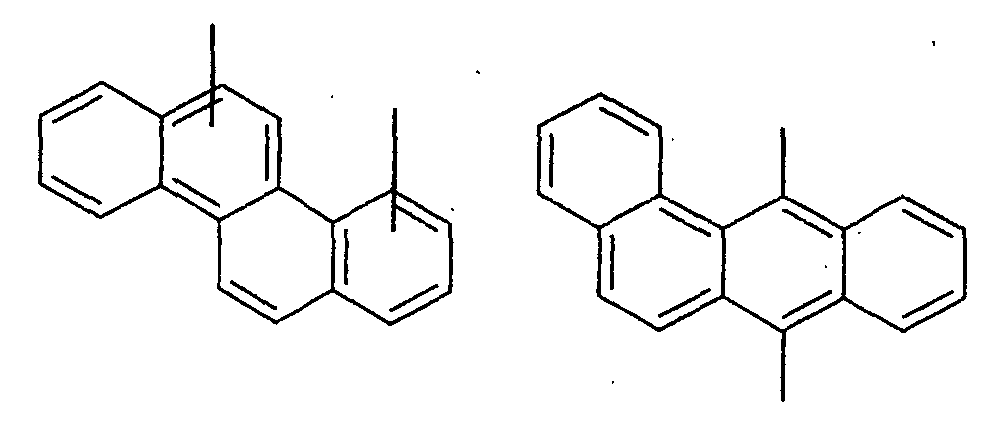
- The organic electroluminescent device of at least one of claims 9 to 16, wherein each of the L1, L2, L3, and L4 is independently selected from the group consisting of compounds having the following structural formulas:

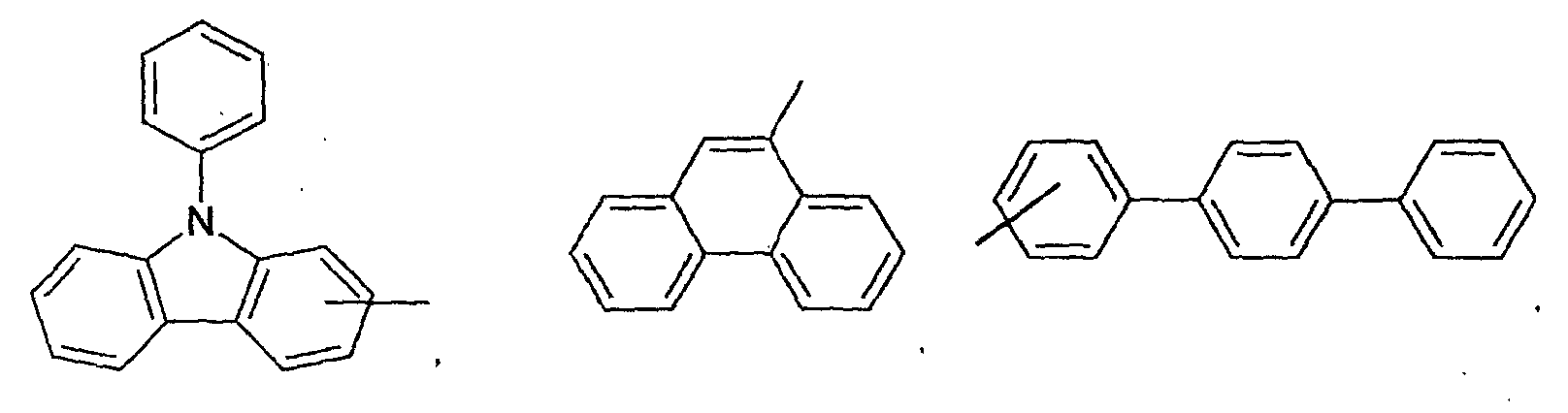

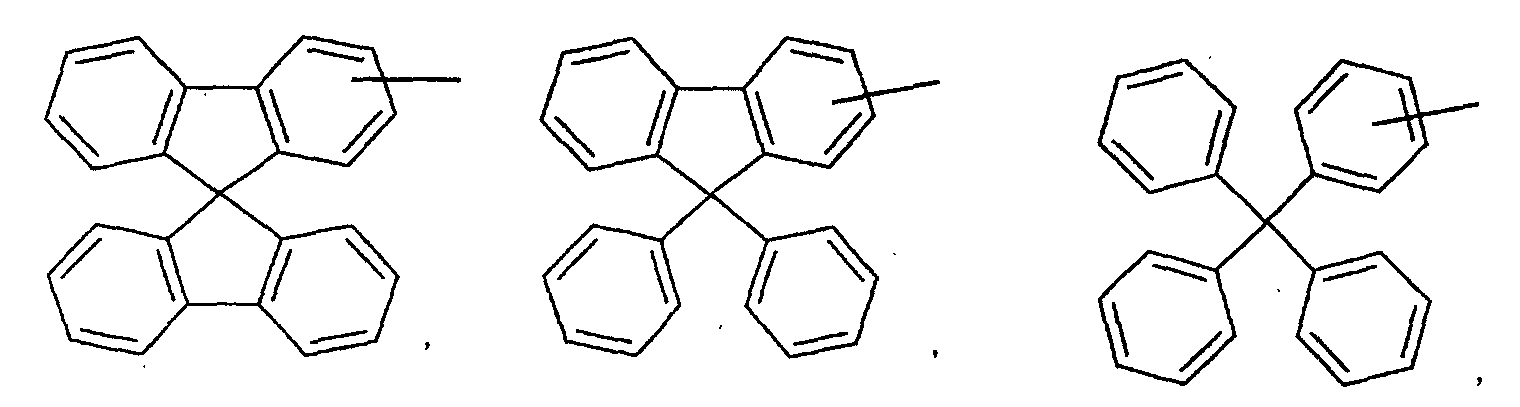

- The organic electroluminescent device of at least one of claims 9 to 17, wherein each substituent of the L1, L2, L3, and L4 is selected from the group consisting of aryloxy, arylamino, alkoxy, alkyl, alkylamino, hydroxy, amino, carbonyl, amide, and carboxy groups and halogen atoms.
- The organic electroluminescent device of claim 18, wherein the substituent is selected from the group consisting of phenoxy, tolyloxy, vinyl, aldehyde, methyl, ethyl, propyl, i-propyl, t-butyl, cyclohexyl, diphenylamino, methoxy, ethoxy, propoxy, butoxy, dimethylamino, and carboxylic acid groups, F, and Cl.
- The organic electroluminescent device of at least one of claims 6 to 19, wherein the first host is selected from the group consisting of the following structural compounds:
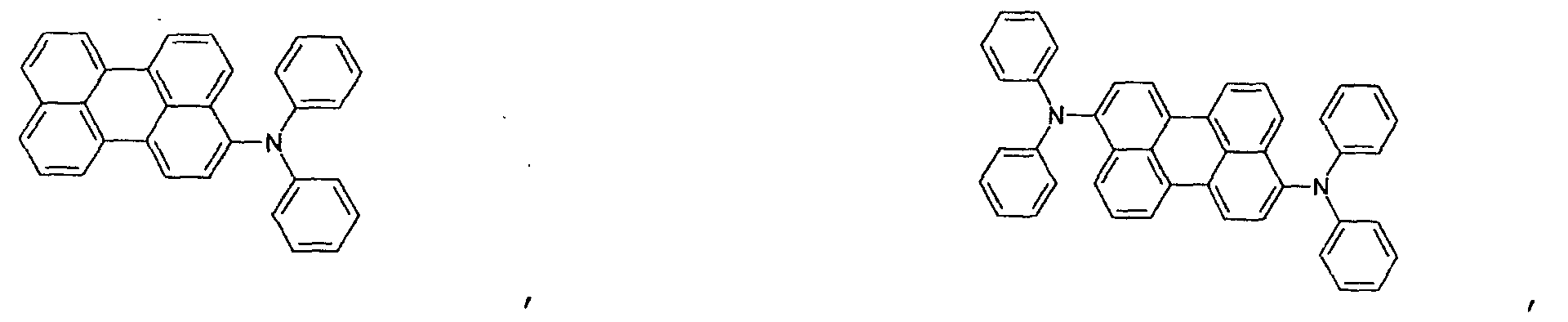


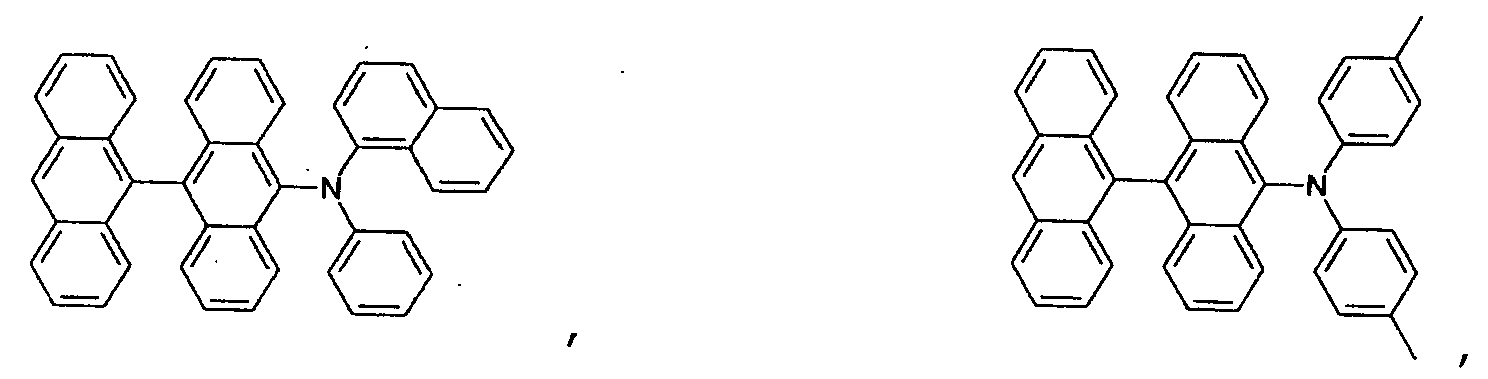









- The organic electroluminescent device of at least one of claims 6 to 20, wherein second host is a substituted or non-substituted quinoline derivative.
- The organic electroluminescent device of claim 21, wherein the second host is 8-hydroxyquinoline metal complex including the metal selected from the group consisting of Al, Zn, Mg, and Li.
- The organic electroluminescent device of claim 22, wherein the second host is tris(8-quinolinolate)aluminum.
- The organic electroluminescent device of at least one of claims 6 to 23, wherein a maximum PL luminescence peak of the guest is equal to or greater than 550nm.
- The organic electroluminescent device of claim 24, wherein the guest is selected from the group consisting of DCM, Nile red, Coumarine, Rhodamine, pyrromethene, and benzothioxanphene derivatives.
- The organic electroluminescent device of claim 25, wherein the DCM derivative has the following structural formula:
- The organic electroluminescent device of at least one of claims 6 to 26, wherein the first and second host materials have maximum PL luminescent peaks of 500∼600nm, respectively.
Applications Claiming Priority (2)
| Application Number | Priority Date | Filing Date | Title |
|---|---|---|---|
| KR2001067267 | 2001-10-30 | ||
| KR1020010067267A KR100577179B1 (en) | 2001-10-30 | 2001-10-30 | Organic electroluminescent element |
Publications (3)
| Publication Number | Publication Date |
|---|---|
| EP1317005A2 true EP1317005A2 (en) | 2003-06-04 |
| EP1317005A3 EP1317005A3 (en) | 2007-09-26 |
| EP1317005B1 EP1317005B1 (en) | 2012-12-05 |
Family
ID=19715539
Family Applications (1)
| Application Number | Title | Priority Date | Filing Date |
|---|---|---|---|
| EP02023135A Expired - Lifetime EP1317005B1 (en) | 2001-10-30 | 2002-10-15 | Organic electroluminescent device |
Country Status (5)
| Country | Link |
|---|---|
| US (1) | US7507485B2 (en) |
| EP (1) | EP1317005B1 (en) |
| JP (1) | JP4129558B2 (en) |
| KR (1) | KR100577179B1 (en) |
| CN (1) | CN1231096C (en) |
Cited By (27)
| Publication number | Priority date | Publication date | Assignee | Title |
|---|---|---|---|---|
| WO2005029923A1 (en) | 2003-09-24 | 2005-03-31 | Fuji Photo Film Co., Ltd. | Electroluminescent device |
| WO2005040303A1 (en) * | 2003-10-22 | 2005-05-06 | Eastman Kodak Company | Aggregate organic light emitting diode devices |
| EP1577364A1 (en) * | 2004-03-19 | 2005-09-21 | Lg Electronics Inc. | Organic electroluminescence device |
| EP1580249A1 (en) * | 2004-03-22 | 2005-09-28 | Lg Electronics Inc. | Organic electroluminescence device |
| WO2006048635A1 (en) * | 2004-11-03 | 2006-05-11 | Oled-T Limited | Buffer layer |
| US7880019B2 (en) | 2006-09-28 | 2011-02-01 | Semiconductor Energy Laboratory Co., Ltd. | Anthracene derivative, and light emitting element, light emitting device, and electronic device using the anthracene derivative |
| US7898168B2 (en) | 2003-10-27 | 2011-03-01 | Semiconductor Energy Laboratory Co., Ltd. | Organic electroluminescent device having light-emitting layer with guest dopant |
| EP2305769A3 (en) * | 2005-11-18 | 2011-04-27 | LG Chem, Ltd. | Emitting material and organic light emitting diode using the same |
| EP1981951A4 (en) * | 2006-01-27 | 2011-04-27 | Gracel Display Inc | Electroluminescent compounds comprising fluorene group and organic electroluminescent device using the same |
| WO2012082743A1 (en) * | 2010-12-13 | 2012-06-21 | E. I. Du Pont De Nemours And Company | Electroactive materials |
| US8263973B2 (en) | 2008-12-19 | 2012-09-11 | E I Du Pont De Nemours And Company | Anthracene compounds for luminescent applications |
| US8273468B2 (en) | 2007-06-01 | 2012-09-25 | E I Du Pont De Nemours And Company | Green luminescent materials |
| EP2376593A4 (en) * | 2008-12-12 | 2013-03-06 | Du Pont | Photoactive composition and electronic device made with the composition |
| US8431245B2 (en) | 2009-09-29 | 2013-04-30 | E. I. Du Pont De Nemours And Company | Deuterated compounds for luminescent applications |
| US8497495B2 (en) | 2009-04-03 | 2013-07-30 | E I Du Pont De Nemours And Company | Electroactive materials |
| US8513372B2 (en) | 2008-11-05 | 2013-08-20 | Nitto Denko Corporation | Asymmetric photo-patternable sol-gel precursors and their methods of preparation |
| US8518559B2 (en) | 2006-12-08 | 2013-08-27 | Agency For Science, Technology And Research | Arylamine compounds and electronic devices |
| US8531100B2 (en) | 2008-12-22 | 2013-09-10 | E I Du Pont De Nemours And Company | Deuterated compounds for luminescent applications |
| US8604247B2 (en) | 2007-06-01 | 2013-12-10 | E I Du Pont De Nemours And Company | Chrysenes for deep blue luminescent applications |
| US8617720B2 (en) | 2009-12-21 | 2013-12-31 | E I Du Pont De Nemours And Company | Electroactive composition and electronic device made with the composition |
| US8642190B2 (en) | 2009-10-22 | 2014-02-04 | Semiconductor Energy Laboratory Co., Ltd. | Fluorene derivative, light-emitting element, light-emitting device, electronic device, and lighting device |
| US8759818B2 (en) | 2009-02-27 | 2014-06-24 | E I Du Pont De Nemours And Company | Deuterated compounds for electronic applications |
| US8968883B2 (en) | 2009-08-13 | 2015-03-03 | E I Du Pont De Nemours And Company | Chrysene derivative materials |
| WO2015150120A3 (en) * | 2014-03-31 | 2015-12-23 | Sony Corporation | Perylene-based materials for organic photoelectric conversion layers |
| US9293716B2 (en) | 2010-12-20 | 2016-03-22 | Ei Du Pont De Nemours And Company | Compositions for electronic applications |
| US9496506B2 (en) | 2009-10-29 | 2016-11-15 | E I Du Pont De Nemours And Company | Deuterated compounds for electronic applications |
| EP2665342A4 (en) * | 2011-01-11 | 2017-09-13 | Mitsubishi Chemical Corporation | Composition for organic electroluminescent element, organic electroluminescent element, display device, and illuminator |
Families Citing this family (134)
| Publication number | Priority date | Publication date | Assignee | Title |
|---|---|---|---|---|
| CN1978586A (en) * | 2002-11-12 | 2007-06-13 | 出光兴产株式会社 | Material for organic electroluminescent device and organic electroluminescent device using same |
| JP4078961B2 (en) * | 2002-11-21 | 2008-04-23 | 三菱化学株式会社 | Bisaminophenylmethane compounds and charge transport materials, organic electroluminescent device materials and organic electroluminescent devices using the same |
| JP4267623B2 (en) * | 2003-03-20 | 2009-05-27 | 出光興産株式会社 | Aromatic amine derivative and organic electroluminescence device using the same |
| JP2005158715A (en) * | 2003-10-27 | 2005-06-16 | Semiconductor Energy Lab Co Ltd | Light-emitting element, light-emitting device using it, and electric apparatus using the device |
| JP2006096964A (en) * | 2003-11-07 | 2006-04-13 | Sony Corp | Organic light emitting material and method for producing organic material |
| JP2006100756A (en) * | 2003-11-07 | 2006-04-13 | Sony Corp | Organic electroluminescence device and display device |
| US20050136289A1 (en) * | 2003-12-22 | 2005-06-23 | Chu Hye Y. | White organic light emitting device |
| TWI238677B (en) * | 2003-12-25 | 2005-08-21 | Fujitsu Ltd | Organic EL element, organic EL display, process for fabricating organic EL element, and device for fabricating organic EL element |
| US7368178B2 (en) * | 2004-01-08 | 2008-05-06 | Eastman Kodak Company | Stable organic light-emitting devices using aminoanthracenes |
| US7365230B2 (en) | 2004-02-20 | 2008-04-29 | E.I. Du Pont De Nemours And Company | Cross-linkable polymers and electronic devices made with such polymers |
| JP5214237B2 (en) * | 2004-03-31 | 2013-06-19 | イー・アイ・デュポン・ドウ・ヌムール・アンド・カンパニー | Triarylamine compounds used as charge transport materials |
| KR101192519B1 (en) * | 2004-05-12 | 2012-10-17 | 이데미쓰 고산 가부시키가이샤 | Aromatic amine derivative, organic electroluminescent element employing the same, and process for producing aromatic amine derivative |
| WO2005112519A1 (en) * | 2004-05-14 | 2005-11-24 | Idemitsu Kosan Co., Ltd. | Organic electroluminescent device |
| US7504163B2 (en) * | 2004-07-12 | 2009-03-17 | Eastman Kodak Company | Hole-trapping materials for improved OLED efficiency |
| EP1645610A1 (en) * | 2004-10-11 | 2006-04-12 | Covion Organic Semiconductors GmbH | Phenanthrene derivatives |
| KR100721565B1 (en) * | 2004-11-17 | 2007-05-23 | 삼성에스디아이 주식회사 | Low molecular organic electroluminescent device and manufacturing method thereof |
| KR100669790B1 (en) * | 2004-11-27 | 2007-01-16 | 삼성에스디아이 주식회사 | Organic electroluminescent element |
| US8034466B2 (en) * | 2004-12-06 | 2011-10-11 | Semiconductor Energy Laboratory Co., Ltd. | Light-emitting element and light-emitting device using the same |
| GB0426674D0 (en) * | 2004-12-06 | 2005-01-05 | Elam T Ltd | Electroluminescent materials and devices |
| US20060182994A1 (en) * | 2005-01-18 | 2006-08-17 | Yukinari Sakamoto | Anthracene derivative, organic electroluminescent device, and display unit |
| JP4358884B2 (en) * | 2005-03-18 | 2009-11-04 | 出光興産株式会社 | Aromatic amine derivative and organic electroluminescence device using the same |
| JP2006282533A (en) * | 2005-03-31 | 2006-10-19 | Sony Corp | Bianthracene derivative, organic electroluminescent element, and display device |
| JP4848134B2 (en) * | 2005-04-18 | 2011-12-28 | 出光興産株式会社 | Aromatic amine derivative and organic electroluminescence device using the same |
| DE102005026651A1 (en) * | 2005-06-09 | 2006-12-14 | Merck Patent Gmbh | New materials for organic electroluminescent devices |
| US20070003785A1 (en) * | 2005-06-30 | 2007-01-04 | Eastman Kodak Company | Electroluminescent devices containing benzidine derivatives |
| TWI304087B (en) * | 2005-07-07 | 2008-12-11 | Chi Mei Optoelectronics Corp | Organic electroluminescent device and host material of luminescent and hole-blocking material thereof |
| KR100786292B1 (en) * | 2005-07-15 | 2007-12-18 | 삼성에스디아이 주식회사 | Organic electroluminescent element |
| JP5089947B2 (en) * | 2005-09-23 | 2012-12-05 | 三星モバイルディスプレイ株式會社 | ORGANIC LIGHT-EMITTING COMPOUND AND ORGANIC LIGHT-EMITTING DEVICE HAVING THE SAME |
| US8647753B2 (en) * | 2005-10-12 | 2014-02-11 | Lg Display Co., Ltd. | Organic electroluminescence device |
| US7645524B2 (en) * | 2005-10-19 | 2010-01-12 | Eastman Kodak Company | OLED device with improved high temperature operation |
| US8623522B2 (en) | 2006-04-26 | 2014-01-07 | Idemitsu Kosan Co., Ltd. | Aromatic amine derivative and electroluminescence device using the same |
| KR101320382B1 (en) * | 2006-05-22 | 2013-10-29 | 삼성디스플레이 주식회사 | Organic light emitting compound and organic light emitting device comprising the same |
| CN101473464B (en) | 2006-06-22 | 2014-04-23 | 出光兴产株式会社 | Organic electroluminescent element using heterocyclic aromatic amine derivative |
| KR100730221B1 (en) * | 2006-07-11 | 2007-06-19 | 삼성에스디아이 주식회사 | Organic light emitting device and flat panel display device having the same |
| JP5233228B2 (en) | 2006-10-05 | 2013-07-10 | Jnc株式会社 | Benzofluorene compound, light emitting layer material and organic electroluminescent device using the compound |
| US8257836B2 (en) * | 2006-12-29 | 2012-09-04 | E I Du Pont De Nemours And Company | Di-substituted pyrenes for luminescent applications |
| US8465848B2 (en) * | 2006-12-29 | 2013-06-18 | E I Du Pont De Nemours And Company | Benzofluorenes for luminescent applications |
| WO2008133459A1 (en) * | 2007-04-26 | 2008-11-06 | Lg Chem, Ltd. | New diamine derivatives and organic electronic device using the same |
| US8512878B2 (en) * | 2007-05-08 | 2013-08-20 | Idemitsu Kosan Co., Ltd. | Diaminopyrene derivative and organic EL device using the same |
| KR101453872B1 (en) * | 2007-07-24 | 2014-10-23 | 삼성디스플레이 주식회사 | Organic light emitting device having an aromatic compound and an organic film containing the same |
| KR100882911B1 (en) * | 2007-08-16 | 2009-02-10 | 삼성모바일디스플레이주식회사 | Organic electroluminescent device and manufacturing method thereof |
| KR20090024998A (en) * | 2007-09-05 | 2009-03-10 | 제일모직주식회사 | Organic photoelectric device material including bipolar organic compound having hole transporter and electron transporter in a molecule and organic photoelectric device using the same |
| EP2213693A4 (en) * | 2007-11-20 | 2011-11-09 | Idemitsu Kosan Co | POLYMERIC COMPOUND AND ORGANIC ELECTROLUMINESCENT ELEMENT COMPRISING SAME |
| JP2009130142A (en) * | 2007-11-22 | 2009-06-11 | Idemitsu Kosan Co Ltd | Organic EL device and organic EL material-containing solution |
| WO2009084512A1 (en) | 2007-12-28 | 2009-07-09 | Idemitsu Kosan Co., Ltd. | Aromatic amine derivative and organic electroluminescent device using the same |
| US8192848B2 (en) | 2008-01-11 | 2012-06-05 | E I Du Pont De Nemours And Company | Substituted pyrenes and associated production methods for luminescent applications |
| KR101242270B1 (en) | 2008-02-25 | 2013-03-11 | 쇼와 덴코 가부시키가이샤 | Organic electroluminescent element, and manufacturing method and uses therefor |
| KR101379133B1 (en) | 2008-05-29 | 2014-03-28 | 이데미쓰 고산 가부시키가이샤 | Aromatic amine derivative and organic electroluminescent device using the same |
| DE102008033943A1 (en) * | 2008-07-18 | 2010-01-21 | Merck Patent Gmbh | New materials for organic electroluminescent devices |
| JPWO2010018843A1 (en) * | 2008-08-12 | 2012-01-26 | 出光興産株式会社 | Aromatic amine derivative and organic electroluminescence device using the same |
| KR20100028168A (en) * | 2008-09-04 | 2010-03-12 | 다우어드밴스드디스플레이머티리얼 유한회사 | Novel organic electroluminescent compounds and organic electroluminescent device using the same |
| EP2350230A4 (en) * | 2008-11-19 | 2012-08-22 | Du Pont | Chrysene compounds for blue or green luminescent applications |
| KR101564129B1 (en) * | 2008-12-01 | 2015-10-28 | 이 아이 듀폰 디 네모아 앤드 캄파니 | Electroactive materials |
| KR101326668B1 (en) * | 2008-12-16 | 2013-11-07 | 엘지디스플레이 주식회사 | Electron transporting-injection material and Organic electroluminescent device using the same |
| US20120091438A1 (en) * | 2009-04-01 | 2012-04-19 | Idemitsu Kosan Co., Ltd. | Organic electroluminescent element |
| EP2423206B1 (en) | 2009-04-24 | 2014-01-08 | Idemitsu Kosan Co., Ltd. | Aromatic amine derivative, and organic electroluminescent element comprising same |
| KR101294236B1 (en) * | 2009-07-10 | 2013-08-07 | 엘지디스플레이 주식회사 | Blue color fluorescent material and Organic electroluminescent device using the same |
| US8592239B2 (en) * | 2009-07-27 | 2013-11-26 | E I Du Pont De Nemours And Company | Process and materials for making contained layers and devices made with same |
| KR101732289B1 (en) * | 2009-08-19 | 2017-05-02 | 이데미쓰 고산 가부시키가이샤 | Aromatic amine derivatives and organic electroluminescent elements using same |
| KR20120068881A (en) * | 2009-08-24 | 2012-06-27 | 이 아이 듀폰 디 네모아 앤드 캄파니 | Organic light-emitting diode luminaires |
| KR20120066025A (en) * | 2009-08-24 | 2012-06-21 | 이 아이 듀폰 디 네모아 앤드 캄파니 | Organic light-emitting diode luminaires |
| EP2471122A4 (en) * | 2009-08-24 | 2013-11-06 | Du Pont | ORGANIC LIGHT EMITTING DIODE LUMINAIRES |
| US9331285B2 (en) | 2009-12-16 | 2016-05-03 | Idemitsu Kosan Co., Ltd. | Aromatic amine derivative and organic electroluminescent element using same |
| KR101419246B1 (en) * | 2009-12-29 | 2014-07-16 | 엘지디스플레이 주식회사 | Organic Electroluminescence Device using Blue Fluorescence Compound |
| US10570113B2 (en) | 2010-04-09 | 2020-02-25 | Semiconductor Energy Laboratory Co., Ltd. | Aromatic amine derivative, light-emitting element, light-emitting device, electronic device, and lighting device |
| US8771843B2 (en) | 2010-08-27 | 2014-07-08 | Semiconductor Energy Laboratory Co., Ltd. | Fluorene derivative, organic compound, and light-emitting element, light-emitting device, and electronic device using the compound |
| DE102010048607A1 (en) * | 2010-10-15 | 2012-04-19 | Merck Patent Gmbh | Connections for electronic devices |
| JP5844820B2 (en) * | 2010-12-20 | 2016-01-20 | イー・アイ・デュポン・ドウ・ヌムール・アンド・カンパニーE.I.Du Pont De Nemours And Company | Electroactive materials |
| JP5871949B2 (en) * | 2010-12-20 | 2016-03-01 | イー・アイ・デュポン・ドウ・ヌムール・アンド・カンパニーE.I.Du Pont De Nemours And Company | Confinement layer and methods and materials for manufacturing devices manufactured using the same |
| US10147888B2 (en) | 2011-02-07 | 2018-12-04 | Idemitsu Kosan Co., Ltd. | Biscarbazole derivative and organic electroluminescent element using same |
| JP5417378B2 (en) * | 2011-05-31 | 2014-02-12 | 京セラドキュメントソリューションズ株式会社 | Triarylamine derivative, electrophotographic photosensitive member, and image forming apparatus |
| WO2013039221A1 (en) * | 2011-09-16 | 2013-03-21 | 出光興産株式会社 | Aromatic amine derivative and organic electroluminescence element using same |
| JP2015013806A (en) * | 2011-09-22 | 2015-01-22 | 出光興産株式会社 | Aromatic amine derivative and organic electroluminescent element using the same |
| JP2013084732A (en) | 2011-10-07 | 2013-05-09 | Udc Ireland Ltd | Organic field light-emitting element and light-emitting material for the same, and light-emitting device, display device and illuminating device |
| KR101891773B1 (en) * | 2011-10-18 | 2018-08-27 | 삼성디스플레이 주식회사 | Novel heterocyclic compound and organic light emitting device containing same |
| KR20140084051A (en) * | 2011-10-24 | 2014-07-04 | 호도가야 가가쿠 고교 가부시키가이샤 | New triphenylene derivative and organic electroluminescent element using said derivative |
| JP6005925B2 (en) * | 2011-11-18 | 2016-10-12 | ユー・ディー・シー アイルランド リミテッド | ORGANIC ELECTROLUMINESCENT ELEMENT, COMPOUND USED FOR THE ELEMENT, LIGHT EMITTING DEVICE, DISPLAY DEVICE AND LIGHTING DEVICE USING THE ELEMENT |
| JP2015051925A (en) * | 2011-11-25 | 2015-03-19 | 出光興産株式会社 | Aromatic amine derivative and organic electroluminescent element using the same |
| KR101535824B1 (en) * | 2011-12-16 | 2015-07-13 | 엘지디스플레이 주식회사 | Organic Light Emitting Device |
| JP6118034B2 (en) * | 2012-02-06 | 2017-04-19 | ユー・ディー・シー アイルランド リミテッド | ORGANIC ELECTROLUMINESCENT ELEMENT, COMPOUND USABLE FOR THE SAME, ORGANIC ELECTROLUMINESCENT ELEMENT MATERIAL, AND LIGHT EMITTING DEVICE, DISPLAY DEVICE AND LIGHTING DEVICE USING THE ELEMENT |
| KR101918953B1 (en) * | 2012-03-06 | 2018-11-16 | 삼성디스플레이 주식회사 | Amine-based compound, organic light emitting diode comprising the same and organic light emitting apparatus comprising the same |
| US9748492B2 (en) | 2012-11-02 | 2017-08-29 | Idemitsu Kosan Co., Ltd. | Organic electroluminescent device |
| JP6371304B2 (en) | 2012-12-13 | 2018-08-08 | イー・アイ・デュポン・ドウ・ヌムール・アンド・カンパニーE.I.Du Pont De Nemours And Company | Confinement layer and methods and materials for manufacturing devices manufactured using the same |
| TWI556486B (en) | 2012-12-20 | 2016-11-01 | 財團法人工業技術研究院 | White organic light-emitting diodes |
| KR102253439B1 (en) * | 2013-07-30 | 2021-05-20 | 삼성디스플레이 주식회사 | Heterocyclic compound and organic light emitting device comprising same |
| KR102115477B1 (en) * | 2013-08-14 | 2020-05-27 | 삼성디스플레이 주식회사 | Organic compound and organic light emitting diode device including the same |
| KR102167041B1 (en) * | 2013-08-14 | 2020-10-19 | 삼성디스플레이 주식회사 | Heterocyclic compound and organic light emitting device comprising same |
| KR102181234B1 (en) * | 2013-08-28 | 2020-11-23 | 삼성디스플레이 주식회사 | Compound and organic light emitting device comprising the same |
| US10644251B2 (en) * | 2013-12-04 | 2020-05-05 | Universal Display Corporation | Organic electroluminescent materials and devices |
| CN110698351B (en) * | 2014-03-07 | 2023-06-09 | 默克专利有限公司 | Material for electronic devices |
| KR20150105584A (en) * | 2014-03-07 | 2015-09-17 | 삼성디스플레이 주식회사 | Compound and organic light emitting device comprising same |
| JP5752828B1 (en) * | 2014-03-31 | 2015-07-22 | 川田工業株式会社 | Welding equipment for large structures |
| KR102253440B1 (en) * | 2014-06-02 | 2021-05-20 | 삼성디스플레이 주식회사 | Amine-based compounds and organic light- emitting device including the same |
| JP6601627B2 (en) | 2014-07-11 | 2019-11-06 | 出光興産株式会社 | COMPOUND, MATERIAL FOR ORGANIC ELECTROLUMINESCENT ELEMENT, ORGANIC ELECTROLUMINESCENT ELEMENT, AND ELECTRONIC DEVICE |
| US9902687B2 (en) | 2014-09-19 | 2018-02-27 | Idemitsu Kosan Co., Ltd. | Compound |
| WO2016056640A1 (en) * | 2014-10-09 | 2016-04-14 | 出光興産株式会社 | Compound, organic electroluminescent element material, organic electroluminescent element, and electronic apparatus |
| KR102339080B1 (en) * | 2014-11-19 | 2021-12-14 | 엘지디스플레이 주식회사 | Organic light emitting device |
| US10020458B2 (en) * | 2014-12-18 | 2018-07-10 | Lg Display Co., Ltd. | White organic light-emitting display device |
| KR102388727B1 (en) * | 2015-03-30 | 2022-04-21 | 삼성디스플레이 주식회사 | Compound and Organic light emitting device comprising same |
| WO2016172496A1 (en) | 2015-04-23 | 2016-10-27 | Constellation Pharmaceuticals, Inc. | Lsd1 inhibitors and uses thereof |
| CN106397223B (en) * | 2015-08-01 | 2019-04-19 | 南京高光半导体材料有限公司 | An organic compound, an organic electroluminescent device material comprising the compound, and an organic electroluminescent device comprising the material |
| US10439146B2 (en) * | 2015-08-07 | 2019-10-08 | Semiconductor Energy Laboratory Co., Ltd. | Organic compound, light-emitting element, light-emitting device, electronic device, and lighting device |
| US10396289B2 (en) | 2015-10-30 | 2019-08-27 | Nanjing Topto Materials Co., Ltd. | Spiro organic compounds, material comprising the same for organic electroluminescence devices, and organic electroluminescence device comprising the material |
| US10573819B2 (en) * | 2016-04-01 | 2020-02-25 | Duk San Neolux Co., Ltd. | Compound for organic electronic element, organic electronic element comprising the same, and electronic device thereof |
| EP3523273B1 (en) * | 2016-10-06 | 2021-11-24 | Merck Patent GmbH | Materials for organic electroluminescent devices |
| DK3532459T3 (en) | 2016-10-26 | 2023-10-30 | Constellation Pharmaceuticals Inc | LSD1 INHIBITORS AND MEDICAL USES THEREOF |
| CN106810456B (en) * | 2016-12-28 | 2019-12-10 | 上海天马有机发光显示技术有限公司 | Hole transport material, OLED display panel comprising hole transport material and electronic equipment |
| KR102358637B1 (en) * | 2017-03-16 | 2022-02-07 | 덕산네오룩스 주식회사 | Compound for organic electric element, organic electric element comprising the same and electronic device thereof |
| KR102080288B1 (en) * | 2017-05-22 | 2020-02-21 | 주식회사 엘지화학 | Novel compound and organic light emitting device comprising the same |
| US11177446B2 (en) * | 2017-09-14 | 2021-11-16 | Beijing Summer Sprout Technology Co., Ltd. | Silicon containing organic fluorescent materials |
| KR102512719B1 (en) * | 2017-11-07 | 2023-03-23 | 삼성디스플레이 주식회사 | Condensed-cyclic compound and organic light emitting device comprising the same |
| KR102134382B1 (en) * | 2017-11-10 | 2020-07-15 | 주식회사 엘지화학 | Novel compound and organic light emitting device comprising the same |
| CN109928885B (en) * | 2017-12-19 | 2022-11-29 | 北京夏禾科技有限公司 | Tetraortho-phenylene triarylamine compounds |
| EP3518303B1 (en) * | 2018-01-26 | 2021-10-06 | Samsung Display Co., Ltd. | N-(4-(8-(phenyl)naphthalen-2-yl)phenyl)-n,n'-di(phenyl)-amine derivatives and related compounds for use in organic electroluminescence devices |
| US20200235297A1 (en) * | 2018-01-26 | 2020-07-23 | Samsung Display Co., Ltd. | Organic electroluminescence device and monoamine compound for organic electroluminescence device |
| JP7465062B2 (en) | 2018-01-26 | 2024-04-10 | 三星ディスプレイ株式會社 | Organic electroluminescent device and monoamine compound for organic electroluminescent device |
| KR102630639B1 (en) * | 2018-06-20 | 2024-01-30 | 삼성디스플레이 주식회사 | Organic light-emitting device including diamine compound and diamine compound |
| KR102608414B1 (en) * | 2018-06-22 | 2023-12-01 | 삼성디스플레이 주식회사 | Condensed compound and organic light emitting device comprising the same |
| KR102628848B1 (en) * | 2018-08-10 | 2024-01-25 | 삼성디스플레이 주식회사 | Condensed compound and organic light-emitting device including the same |
| KR102777743B1 (en) | 2018-08-10 | 2025-03-11 | 삼성디스플레이 주식회사 | Organic electroluminescence device and condensed cyclic compound for organic electroluminescence device |
| US12145898B2 (en) | 2018-09-21 | 2024-11-19 | Lg Chem, Ltd. | Compound, composition comprising same, and organic light emitting diode comprising same |
| KR102714929B1 (en) * | 2018-09-27 | 2024-10-10 | 삼성디스플레이 주식회사 | Amine-based compound and organic light-emitting device including the same |
| KR102867205B1 (en) | 2019-03-20 | 2025-10-01 | 삼성디스플레이 주식회사 | AMINE-BASED compound and organic light emitting device comprising the same |
| CN111892614B (en) * | 2019-05-06 | 2023-10-10 | 香港科技大学 | Donor-acceptor type aggregation-induced emission luminescent agent with multi-stimulus response property |
| CN111635323B (en) * | 2019-06-14 | 2021-04-13 | 陕西莱特光电材料股份有限公司 | Nitrogen-containing compound, electronic component, and electronic device |
| JP7403912B2 (en) * | 2020-01-08 | 2023-12-25 | エルジー・ケム・リミテッド | Fluorene compound, organic light-emitting device using the same, and method for producing the same |
| CN113461549B (en) * | 2020-03-31 | 2024-04-12 | 阜阳欣奕华材料科技有限公司 | Compound and intermediate thereof and application of compound and intermediate thereof in organic electroluminescent device |
| CN113461550B (en) * | 2020-03-31 | 2024-04-12 | 阜阳欣奕华材料科技有限公司 | Compound and intermediate thereof and application of compound and intermediate thereof in organic electroluminescent device |
| KR102916201B1 (en) * | 2020-11-13 | 2026-01-23 | 삼성디스플레이 주식회사 | Light emitting diode and amine compound for the same |
| CN112409194A (en) * | 2020-11-26 | 2021-02-26 | 阜阳欣奕华材料科技有限公司 | Compound, organic electroluminescent device and display device |
| CN112521329B (en) * | 2020-12-01 | 2023-11-14 | 阜阳欣奕华材料科技有限公司 | Compounds and organic electroluminescent devices and display devices |
| IL305165A (en) | 2021-02-19 | 2023-10-01 | Sudo Biosciences Ltd | TYK2 inhibitors and their uses |
| US12600721B2 (en) | 2021-02-19 | 2026-04-14 | Sudo Biosciences Limited | TYK2 inhibitors and uses thereof |
| CA3207819A1 (en) | 2021-02-19 | 2022-08-25 | Anjali Pandey | Tyk2 inhibitors and uses thereof |
Family Cites Families (22)
| Publication number | Priority date | Publication date | Assignee | Title |
|---|---|---|---|---|
| JPH01140359A (en) | 1987-11-27 | 1989-06-01 | Nec Corp | Main storage device |
| JPH01140357A (en) | 1987-11-27 | 1989-06-01 | Nec Corp | Memory access controller |
| EP0765106B1 (en) * | 1995-09-25 | 2002-11-27 | Toyo Ink Manufacturing Co., Ltd. | Light-emitting material for organic electroluminescence device, and organic electroluminescence device for which the light-emitting material is adapted |
| US6285039B1 (en) * | 1996-08-19 | 2001-09-04 | Tdk Corporation | Organic electroluminescent device |
| US6013383A (en) * | 1997-02-18 | 2000-01-11 | Motorola, Inc. | Organic electroluminescence device with improved hole transporting material |
| US5935720A (en) | 1997-04-07 | 1999-08-10 | Eastman Kodak Company | Red organic electroluminescent devices |
| JP2930056B2 (en) * | 1997-05-30 | 1999-08-03 | 日本電気株式会社 | Organic electroluminescent device material and organic electroluminescent device using the same |
| JPH11111458A (en) | 1997-09-29 | 1999-04-23 | Toyo Ink Mfg Co Ltd | Organic electroluminescent device material and organic electroluminescent device using the same |
| JPH11135261A (en) | 1997-10-27 | 1999-05-21 | Toyo Ink Mfg Co Ltd | Organic electroluminescent device material and organic electroluminescent device using the same |
| JP3092584B2 (en) * | 1998-03-23 | 2000-09-25 | 日本電気株式会社 | Organic electroluminescence device |
| JP3092583B2 (en) * | 1998-03-23 | 2000-09-25 | 日本電気株式会社 | Organic electroluminescent device material and organic electroluminescent device using the same |
| JP3370011B2 (en) | 1998-05-19 | 2003-01-27 | 三洋電機株式会社 | Organic electroluminescence device |
| JP2001011031A (en) | 1998-06-15 | 2001-01-16 | Toyo Ink Mfg Co Ltd | Compound for organic electroluminescence device and light emitting material for organic electroluminescence device using the same |
| JP3287344B2 (en) | 1998-10-09 | 2002-06-04 | 株式会社デンソー | Organic EL device |
| JP3389888B2 (en) * | 1998-11-09 | 2003-03-24 | 東レ株式会社 | Light emitting element |
| JP2000150161A (en) | 1998-11-16 | 2000-05-30 | Toyo Ink Mfg Co Ltd | Organic electroluminescence display device |
| TW480896B (en) * | 1999-07-30 | 2002-03-21 | Sony Corp | Organic electroluminescent device |
| JP3589960B2 (en) | 1999-09-16 | 2004-11-17 | 株式会社デンソー | Organic EL device |
| KR100329571B1 (en) * | 2000-03-27 | 2002-03-23 | 김순택 | Organic electroluminescent device |
| US6720090B2 (en) * | 2001-01-02 | 2004-04-13 | Eastman Kodak Company | Organic light emitting diode devices with improved luminance efficiency |
| US6614175B2 (en) * | 2001-01-26 | 2003-09-02 | Xerox Corporation | Organic light emitting devices |
| US6565996B2 (en) * | 2001-06-06 | 2003-05-20 | Eastman Kodak Company | Organic light-emitting device having a color-neutral dopant in a hole-transport layer and/or in an electron-transport layer |
-
2001
- 2001-10-30 KR KR1020010067267A patent/KR100577179B1/en not_active Expired - Lifetime
-
2002
- 2002-09-26 US US10/254,999 patent/US7507485B2/en not_active Expired - Lifetime
- 2002-10-07 JP JP2002293373A patent/JP4129558B2/en not_active Expired - Lifetime
- 2002-10-15 EP EP02023135A patent/EP1317005B1/en not_active Expired - Lifetime
- 2002-10-30 CN CNB021481253A patent/CN1231096C/en not_active Expired - Lifetime
Non-Patent Citations (1)
| Title |
|---|
| None |
Cited By (41)
| Publication number | Priority date | Publication date | Assignee | Title |
|---|---|---|---|---|
| EP1665897A4 (en) * | 2003-09-24 | 2010-07-14 | Fujifilm Corp | Electroluminescent device |
| WO2005029923A1 (en) | 2003-09-24 | 2005-03-31 | Fuji Photo Film Co., Ltd. | Electroluminescent device |
| US8048535B2 (en) | 2003-09-24 | 2011-11-01 | Fujifiilm Corporation | Electroluminescent device |
| US7175922B2 (en) | 2003-10-22 | 2007-02-13 | Eastman Kodak Company | Aggregate organic light emitting diode devices with improved operational stability |
| WO2005040303A1 (en) * | 2003-10-22 | 2005-05-06 | Eastman Kodak Company | Aggregate organic light emitting diode devices |
| US7898168B2 (en) | 2003-10-27 | 2011-03-01 | Semiconductor Energy Laboratory Co., Ltd. | Organic electroluminescent device having light-emitting layer with guest dopant |
| EP1577364A1 (en) * | 2004-03-19 | 2005-09-21 | Lg Electronics Inc. | Organic electroluminescence device |
| US7615777B2 (en) | 2004-03-19 | 2009-11-10 | Lg Display Co., Ltd. | Organic electroluminescence device including at least one of a hole injection layer and a hole transport layer |
| US7442449B2 (en) | 2004-03-22 | 2008-10-28 | Lg Display Co., Ltd. | Organic electroluminescence device |
| EP1580249A1 (en) * | 2004-03-22 | 2005-09-28 | Lg Electronics Inc. | Organic electroluminescence device |
| WO2006048635A1 (en) * | 2004-11-03 | 2006-05-11 | Oled-T Limited | Buffer layer |
| US8197951B2 (en) | 2005-11-18 | 2012-06-12 | Lg Chem, Ltd. | Emitting material and organic light emitting diode using the same |
| EP2305769A3 (en) * | 2005-11-18 | 2011-04-27 | LG Chem, Ltd. | Emitting material and organic light emitting diode using the same |
| EP1981951A4 (en) * | 2006-01-27 | 2011-04-27 | Gracel Display Inc | Electroluminescent compounds comprising fluorene group and organic electroluminescent device using the same |
| US7880019B2 (en) | 2006-09-28 | 2011-02-01 | Semiconductor Energy Laboratory Co., Ltd. | Anthracene derivative, and light emitting element, light emitting device, and electronic device using the anthracene derivative |
| US8546792B2 (en) | 2006-09-28 | 2013-10-01 | Semiconductor Energy Laboratory Co., Ltd. | Anthracene derivative, and light emitting element, light emitting device, and electronic device using the anthracene derivative |
| US8518559B2 (en) | 2006-12-08 | 2013-08-27 | Agency For Science, Technology And Research | Arylamine compounds and electronic devices |
| US8273468B2 (en) | 2007-06-01 | 2012-09-25 | E I Du Pont De Nemours And Company | Green luminescent materials |
| US8604247B2 (en) | 2007-06-01 | 2013-12-10 | E I Du Pont De Nemours And Company | Chrysenes for deep blue luminescent applications |
| US8513372B2 (en) | 2008-11-05 | 2013-08-20 | Nitto Denko Corporation | Asymmetric photo-patternable sol-gel precursors and their methods of preparation |
| EP2376593A4 (en) * | 2008-12-12 | 2013-03-06 | Du Pont | Photoactive composition and electronic device made with the composition |
| US8263973B2 (en) | 2008-12-19 | 2012-09-11 | E I Du Pont De Nemours And Company | Anthracene compounds for luminescent applications |
| US8531100B2 (en) | 2008-12-22 | 2013-09-10 | E I Du Pont De Nemours And Company | Deuterated compounds for luminescent applications |
| US8890131B2 (en) | 2009-02-27 | 2014-11-18 | E I Du Pont De Nemours And Company | Deuterated compounds for electronic applications |
| US8759818B2 (en) | 2009-02-27 | 2014-06-24 | E I Du Pont De Nemours And Company | Deuterated compounds for electronic applications |
| US8497495B2 (en) | 2009-04-03 | 2013-07-30 | E I Du Pont De Nemours And Company | Electroactive materials |
| US8968883B2 (en) | 2009-08-13 | 2015-03-03 | E I Du Pont De Nemours And Company | Chrysene derivative materials |
| US8431245B2 (en) | 2009-09-29 | 2013-04-30 | E. I. Du Pont De Nemours And Company | Deuterated compounds for luminescent applications |
| US9553273B2 (en) | 2009-10-22 | 2017-01-24 | Semiconductor Energy Laboratory Co., Ltd. | Fluorene derivative, light-emitting element, light-emitting device, electronic device, and lighting device |
| US8642190B2 (en) | 2009-10-22 | 2014-02-04 | Semiconductor Energy Laboratory Co., Ltd. | Fluorene derivative, light-emitting element, light-emitting device, electronic device, and lighting device |
| US10050207B2 (en) | 2009-10-22 | 2018-08-14 | Semiconductor Energy Laboratory Co., Ltd. | Fluorene derivative, light-emitting element, light-emitting device, electronic device, and lighting device |
| US9496506B2 (en) | 2009-10-29 | 2016-11-15 | E I Du Pont De Nemours And Company | Deuterated compounds for electronic applications |
| US8617720B2 (en) | 2009-12-21 | 2013-12-31 | E I Du Pont De Nemours And Company | Electroactive composition and electronic device made with the composition |
| WO2012082743A1 (en) * | 2010-12-13 | 2012-06-21 | E. I. Du Pont De Nemours And Company | Electroactive materials |
| US9276217B2 (en) * | 2010-12-13 | 2016-03-01 | E I Du Pont De Nemours And Company | Electroactive materials |
| US20130240865A1 (en) * | 2010-12-13 | 2013-09-19 | E I Du Pont De Nemours And Company | Electroactive materials |
| US9293716B2 (en) | 2010-12-20 | 2016-03-22 | Ei Du Pont De Nemours And Company | Compositions for electronic applications |
| EP2665342A4 (en) * | 2011-01-11 | 2017-09-13 | Mitsubishi Chemical Corporation | Composition for organic electroluminescent element, organic electroluminescent element, display device, and illuminator |
| US9899606B2 (en) | 2011-01-11 | 2018-02-20 | Mitsubishi Chemical Corporation | Composition for organic electroluminescent element, organic electroluminescent element, display and lighting |
| WO2015150120A3 (en) * | 2014-03-31 | 2015-12-23 | Sony Corporation | Perylene-based materials for organic photoelectric conversion layers |
| US9978951B2 (en) | 2014-03-31 | 2018-05-22 | Sony Corporation | Perylene-based materials for organic photoelectric conversion layers |
Also Published As
| Publication number | Publication date |
|---|---|
| CN1231096C (en) | 2005-12-07 |
| EP1317005B1 (en) | 2012-12-05 |
| KR20030035283A (en) | 2003-05-09 |
| US7507485B2 (en) | 2009-03-24 |
| US20030118866A1 (en) | 2003-06-26 |
| JP4129558B2 (en) | 2008-08-06 |
| KR100577179B1 (en) | 2006-05-10 |
| CN1416301A (en) | 2003-05-07 |
| EP1317005A3 (en) | 2007-09-26 |
| JP2003142269A (en) | 2003-05-16 |
Similar Documents
| Publication | Publication Date | Title |
|---|---|---|
| EP1317005A2 (en) | Organic electroluminescent device | |
| KR101554860B1 (en) | Novel organic electroluminescent compounds and organic electroluminescent device using the same | |
| KR100577262B1 (en) | Organic light emitting diode | |
| KR100671862B1 (en) | New organic light emitting device material and organic light emitting device using same (1) | |
| JP2004185967A (en) | Organic electroluminescence element, method of manufacturing the same, display device, lighting device, and light source | |
| CN101805266A (en) | Novel organic electroluminescent compounds and organic electroluminescent device using the same | |
| KR101720079B1 (en) | Quinoxaline derivative compound and organic electroluminescent device using the same | |
| KR101694496B1 (en) | Dibenzothiophene derivative compound and organic electroluminescent device using the same | |
| CN102617456A (en) | Electron transporting-injection compound and organic electroluminescent device using the same | |
| EP1586616B1 (en) | Organic electroluminescence device | |
| KR20040079803A (en) | organic electroluminescence device | |
| KR20090072152A (en) | Pyrene Derivatives and Organic Electroluminescent Devices Using the Same | |
| KR100525415B1 (en) | organic electroluminescence device | |
| KR101996647B1 (en) | New condensed aryl compounds and organic light-emitting diode including the same | |
| US7037600B2 (en) | Red-emitting organic electroluminescent elements | |
| KR101879716B1 (en) | Phosphorescent host transporting material and Organic electroluminescent device using the same | |
| KR20090078283A (en) | Anthracene Derivative Compound and Organic Electroluminescent Device Comprising the Same | |
| HK1055881A (en) | Organic electroluminescent device | |
| KR20090072168A (en) | Tetrahydropyrene Derivatives and Organic Electroluminescent Devices Using the Same | |
| CN110746962A (en) | Phosphorescent compound and organic light emitting diode device using the same |
Legal Events
| Date | Code | Title | Description |
|---|---|---|---|
| PUAI | Public reference made under article 153(3) epc to a published international application that has entered the european phase |
Free format text: ORIGINAL CODE: 0009012 |
|
| AK | Designated contracting states |
Designated state(s): AT BE BG CH CY CZ DE DK EE ES FI FR GB GR IE IT LI LU MC NL PT SE SK TR |
|
| AX | Request for extension of the european patent |
Extension state: AL LT LV MK RO SI |
|
| 17P | Request for examination filed |
Effective date: 20040521 |
|
| PUAL | Search report despatched |
Free format text: ORIGINAL CODE: 0009013 |
|
| AK | Designated contracting states |
Kind code of ref document: A3 Designated state(s): AT BE BG CH CY CZ DE DK EE ES FI FR GB GR IE IT LI LU MC NL PT SE SK TR |
|
| AX | Request for extension of the european patent |
Extension state: AL LT LV MK RO SI |
|
| 17Q | First examination report despatched |
Effective date: 20080306 |
|
| AKX | Designation fees paid |
Designated state(s): DE FR GB NL |
|
| RAP1 | Party data changed (applicant data changed or rights of an application transferred) |
Owner name: LG DISPLAY CO., LTD. |
|
| REG | Reference to a national code |
Ref country code: DE Ref legal event code: R079 Ref document number: 60244149 Country of ref document: DE Free format text: PREVIOUS MAIN CLASS: H01L0051200000 Ipc: H01L0051540000 |
|
| GRAP | Despatch of communication of intention to grant a patent |
Free format text: ORIGINAL CODE: EPIDOSNIGR1 |
|
| RIC1 | Information provided on ipc code assigned before grant |
Ipc: H01L 51/50 20060101ALI20120531BHEP Ipc: H01L 51/54 20060101AFI20120531BHEP |
|
| GRAS | Grant fee paid |
Free format text: ORIGINAL CODE: EPIDOSNIGR3 |
|
| GRAA | (expected) grant |
Free format text: ORIGINAL CODE: 0009210 |
|
| AK | Designated contracting states |
Kind code of ref document: B1 Designated state(s): DE FR GB NL |
|
| REG | Reference to a national code |
Ref country code: GB Ref legal event code: FG4D |
|
| REG | Reference to a national code |
Ref country code: DE Ref legal event code: R096 Ref document number: 60244149 Country of ref document: DE Effective date: 20130131 |
|
| REG | Reference to a national code |
Ref country code: NL Ref legal event code: T3 |
|
| PLBE | No opposition filed within time limit |
Free format text: ORIGINAL CODE: 0009261 |
|
| STAA | Information on the status of an ep patent application or granted ep patent |
Free format text: STATUS: NO OPPOSITION FILED WITHIN TIME LIMIT |
|
| 26N | No opposition filed |
Effective date: 20130906 |
|
| REG | Reference to a national code |
Ref country code: DE Ref legal event code: R097 Ref document number: 60244149 Country of ref document: DE Effective date: 20130906 |
|
| REG | Reference to a national code |
Ref country code: FR Ref legal event code: PLFP Year of fee payment: 15 |
|
| REG | Reference to a national code |
Ref country code: FR Ref legal event code: PLFP Year of fee payment: 16 |
|
| REG | Reference to a national code |
Ref country code: FR Ref legal event code: PLFP Year of fee payment: 17 |
|
| PGFP | Annual fee paid to national office [announced via postgrant information from national office to epo] |
Ref country code: NL Payment date: 20210820 Year of fee payment: 20 |
|
| PGFP | Annual fee paid to national office [announced via postgrant information from national office to epo] |
Ref country code: FR Payment date: 20210824 Year of fee payment: 20 |
|
| PGFP | Annual fee paid to national office [announced via postgrant information from national office to epo] |
Ref country code: GB Payment date: 20210824 Year of fee payment: 20 |
|
| PGFP | Annual fee paid to national office [announced via postgrant information from national office to epo] |
Ref country code: DE Payment date: 20210820 Year of fee payment: 20 |
|
| REG | Reference to a national code |
Ref country code: DE Ref legal event code: R071 Ref document number: 60244149 Country of ref document: DE |
|
| REG | Reference to a national code |
Ref country code: NL Ref legal event code: MK Effective date: 20221014 |
|
| REG | Reference to a national code |
Ref country code: GB Ref legal event code: PE20 Expiry date: 20221014 |
|
| PG25 | Lapsed in a contracting state [announced via postgrant information from national office to epo] |
Ref country code: GB Free format text: LAPSE BECAUSE OF EXPIRATION OF PROTECTION Effective date: 20221014 |