EP1316556A1 - Thiol compound, method for producing the same and optical product comprising the same - Google Patents
Thiol compound, method for producing the same and optical product comprising the same Download PDFInfo
- Publication number
- EP1316556A1 EP1316556A1 EP02021346A EP02021346A EP1316556A1 EP 1316556 A1 EP1316556 A1 EP 1316556A1 EP 02021346 A EP02021346 A EP 02021346A EP 02021346 A EP02021346 A EP 02021346A EP 1316556 A1 EP1316556 A1 EP 1316556A1
- Authority
- EP
- European Patent Office
- Prior art keywords
- compound
- thio
- bis
- group
- epithiopropylthio
- Prior art date
- Legal status (The legal status is an assumption and is not a legal conclusion. Google has not performed a legal analysis and makes no representation as to the accuracy of the status listed.)
- Granted
Links
- 0 C*CCC1SC(*C)SC(C)S1 Chemical compound C*CCC1SC(*C)SC(C)S1 0.000 description 1
Classifications
-
- C—CHEMISTRY; METALLURGY
- C07—ORGANIC CHEMISTRY
- C07D—HETEROCYCLIC COMPOUNDS
- C07D341/00—Heterocyclic compounds containing rings having three or more sulfur atoms as the only ring hetero atoms
-
- C—CHEMISTRY; METALLURGY
- C08—ORGANIC MACROMOLECULAR COMPOUNDS; THEIR PREPARATION OR CHEMICAL WORKING-UP; COMPOSITIONS BASED THEREON
- C08G—MACROMOLECULAR COMPOUNDS OBTAINED OTHERWISE THAN BY REACTIONS ONLY INVOLVING UNSATURATED CARBON-TO-CARBON BONDS
- C08G75/00—Macromolecular compounds obtained by reactions forming a linkage containing sulfur with or without nitrogen, oxygen, or carbon in the main chain of the macromolecule
- C08G75/02—Polythioethers
- C08G75/04—Polythioethers from mercapto compounds or metallic derivatives thereof
-
- C—CHEMISTRY; METALLURGY
- C08—ORGANIC MACROMOLECULAR COMPOUNDS; THEIR PREPARATION OR CHEMICAL WORKING-UP; COMPOSITIONS BASED THEREON
- C08G—MACROMOLECULAR COMPOUNDS OBTAINED OTHERWISE THAN BY REACTIONS ONLY INVOLVING UNSATURATED CARBON-TO-CARBON BONDS
- C08G75/00—Macromolecular compounds obtained by reactions forming a linkage containing sulfur with or without nitrogen, oxygen, or carbon in the main chain of the macromolecule
- C08G75/02—Polythioethers
- C08G75/06—Polythioethers from cyclic thioethers
Definitions
- the present invention relates to a novel thiol compound, to a method for producing the same and to an optical product comprising the same. More precisely, the invention relates to a novel thiol compound that may give optical materials having a high refractive index and a high Abbe's number and having excellent heat resistance and transparency, also to a method for efficiently producing the same and to an optical product comprising the same.
- Plastics are used for various optical applications these days, for example, for lenses and others, as being lightweight, hardly broken and easily colored when compared with glass.
- optical plastic materials are generally used poly(diethylene glycol bisallylcarbonate) (CR-39) and poly(methyl methacrylate) .
- these plastics have a refractive index of 1.50 or less. Therefore, for example, when they are used for lens materials, the lenses produced shall be thicker with the increase in their power, and they lose the advantage of plastics that are lightweight.
- powerful concave lenses are thick at their periphery, and are therefore unfavorable as causing birefringence and chromatic aberration.
- such thick lenses are often not aesthetic.
- the refractive index of the materials For obtaining thin lenses, it is effective to increase the refractive index of the materials.
- the Abbe's number of glass and plastics decreases with the increase in their refractive index, and, as a result, their chromatic aberration increases. Accordingly, are desired plastic materials having a high refractive index and a high Abbe's number.
- plastic materials having such properties for example, are proposed (1) polyurethanes obtained through addition-polymerization of a polythiol having bromine in the molecule and a polyisocyanate (Japanese Patent Laid-Open No. 164615/1983); and (2) polythiourethanes obtained through addition-polymerization of a polythiol and a polyisocyanate (Japanese Patent Publication No. 58489/1992 and Japanese Patent Laid-Open 148340/1993).
- polythiol for the polythiourethanes of above (2) are specifically proposed branched polythiols having an increased sulfur content (Japanese Patent Laid-Open Nos.
- polythiourethanes (2) those for which the starting polythiol used has a high sulfur content have an increased refractive index of from about 1.60 to 1.68, but their Abbe's number is lower than that of optical inorganic glass having a refractive index on the same level. Therefore, they still have a problem in that their Abbe's number must be increased more.
- the alkyl sulfide polymers (3) having an Abbe's number of 36 has an increased refractive index of 1.70.
- the lenses obtained by using this polymer can be extremely thin and lightweight. However, are still desired plastic materials of which both the Abbe's number and the refractive index are more increased simultaneously.
- the present invention has been made to solve the problems noted above, and its object is to provide a novel thiol compound that may give optical materials having a high refractive index and a high Abbe's number and having excellent heat resistance and transparency, to provide a method for efficiently producing the same and to provide an optical product comprising the same.
- the present inventors assiduously studied to attain the object as above. As a result, it has been found that novel thiol compounds with mercaptomethyl or mercaptoethyl groups bonded to a 1,3,5-trithiane ring meet the object as above and that the compounds are efficiently produced in a specific method. On the basis of these findings, the present invention has been completed.
- the invention provides a thiol compound represented by the general formula (1): wherein n is 1 or 2, and a method for producing a thiol compound represented by the general formula (1) comprising the use of 1,3,5-trithiane having a methylene or vinyl group simultaneously at the 2,4,6-positions thereof as an intermediate.
- novel thiol compound of the invention is represented by the general formula (1) mentioned below, from which it is seen that the compound has three identical mercaptoalkyl groups bonded to the trithiane ring thereof. wherein n is 1 or 2.
- the trithiane ring of the thiol compound represented by the general formula (1) has a high sulfur content, in which the atomic refraction is high and which therefore significantly increases the refractive index of the polymers obtained by using the novel thiol compound of the invention.
- the polymerization-functional, terminal thiol groups in the thiol compound contribute toward introducing sulfur atoms into the main chain of the polymers of the compound, and therefore, the refractive index of the polymers obtained by using the novel thiol compound of the invention is further increased.
- the Abbe's number of amorphous materials is apt to decrease with the increase in the refractive index thereof.
- n must be 1 or 2.
- Tg glass transition temperature
- the novel thiol compound represented by the general formula (1) of the invention includes 2,4,6-tris(mercaptomethyl)-1,3,5-trithiane and 2,4,6-tris(mercaptoethyl)-1,3,5-trithiane.
- the method for producing a thiol compound represented by the general formula (1) comprises the following steps:
- the acid solvent is also usable any of 60/40 (v/v) 95 wt.% sulfuric acid-acetic acid, or hydrogen sulfide-saturated acetic acid, ether or 95 wt.% ethanol, in place of sulfuric acid.
- potassium hydroxide with which the chlorine compound is processed at -10 to 40°C for 0.5 to 10 hours for removal of hydrogen chloride from it to give 2,4,6-trimethylene-1,3,5-trithiane.
- optical materials obtained by the use of the novel thiol compound of the invention a polymer obtained by polymerizing a polymerizable composition that contains a component A containing at least the novel thiol compound (a1) represented by the general formula (1), and a component B containing at least one compound selected from the group consisting of a compound (b1) having at least two vinyl groups in one molecule, a compound (b2) having at least two iso(thio)cyanate groups in one molecule, and a compound (b3) having at least one vinyl group and at least one iso(thio)cyanate group in one molecule.
- the iso(thio)cyanate is meant to indicate both an isocyanate and an isothiocyanate.
- the component A may additionally contain one or two or more different types of compounds (a2) having a mercapto group and/or a hydroxyl group in one molecule, with the total number of the mercapto group and the hydroxyl group in one molecule being 2 or more, for suitably improving the physical properties of the polymer.
- the compound (a2) includes trimethylolpropane, 1,2-ethanedithiol, 1,3-propanedithiol, tetrakismercaptomethylmethane, pentaerythritol tetrakismercaptopropionate, pentaerythritol tetrakismercaptoacetate, 2-mercaptoethanol, 2,3-dimercaptopropanol, 1,2-dihydroxy-3-mercaptopropane, 4-mercaptophenol, 1,2-benzenedithiol, 1,3-benzenedithiol, 1,4-benzenedithiol, 1,3,5-benzenetrithiol, 1,2-dimercaptomethylbenzene, 1,3-dimercaptomethylbenzene, 1,4-dimercaptomethylbenzene, 1,3,5-trimercaptomethylbenzene, toluene-3,4-dithiol, and 4,4'-dihydroxyphenyl sulf
- the vinyl group-having compound (b1) for the component B includes divinylbenzene, ethylene glycol di(meth)acrylate, trimethylolpropane tri(meth)acrylate, as well as urethane-modified (meth)acrylates, epoxy-modified (meth)acrylates and polyester-modified (meth)acrylates each having at least two (meth) acryloxy groups in one molecule.
- the (meth)acrylate is meant to indicate both acrylate and methacrylate; and (meth)acryloxy group is meant to indicate both an acryloxy group and a methacryloxy group.
- the iso(thio)cyanate group-having compound (b2) for the component B includes xylylene diiso (thio) cyanate, 3,3'-dichlorodiphenyl-4,4'-diiso(thio) cyanate, 4,4'-diphenylmethane diiso(thio)cyanate, hexamethylene diiso(thio)cyanate, 2,2',5,5'-tetrachlorodiphenyl-4,4'-diiso(thio)cyanate, and tolylene diiso(thio)cyanate.
- compound (b2) having at least one cyclohexyl ring are bis(iso(thio)cyanatomethyl)cyclohexane, bis(4-iso(thio)cyanatocyclohexyl)methane, bis(4-iso(thio)cyanatomethyl)cyclohexyl)methane, cyclohexane diiso(thio)cyanate, isophorone diiso(thio)cyanate, 2,5-bis(iso(thio)cyanatomethyl)bicyclo[2.2.2]octane, 2,5-bis(iso(thio)cyanatomethyl)bicycle[2.2.1]heptane, 2-iso(thio)cyanatomethyl-3-(3-iso(thio)cyanatopropyl)-5-iso (thio)cyanatomethyl-bicyclo[2.2.1]heptane, 2-iso(thio)cyanatomethyl-3-(3-iso(thio)cyana
- the compound (b3) having both vinyl and iso(thio)cyanate groups for the component B includes 2-(meth)acryloxyethyl iso(thio)cyanate and (meth)acryloyl iso(thio)cyanate.
- the component B has a vinyl group
- the polymerization-functional groups in the component A are all mercapto groups.
- the degree of polymerization does not increase, whereby the mechanical properties of the polymers produced may be reduced.
- the episulfide compound includes, for example, linear organic compounds such as bis( ⁇ -epithiopropylthio)methane, 1,2-bis( ⁇ -epithiopropylthio)ethane, 1,3-bis( ⁇ -epithiopropylthio)propane, 1,2-bis( ⁇ -epithiopropylthio)propane, 1-( ⁇ -epithiopropylthio)-2-( ⁇ -epithiopropylthiomethyl)propane, 1,4-bis( ⁇ -epithiopropylthio)butane, 1,3-bis( ⁇ -epithiopropylthio)butane, 1-( ⁇ -epithiopropylthio)-3-( ⁇ -epithiopropylthiomethyl)butane, 1,5-bis( ⁇ -epithiopropylthio)
- the optical materials may contain some additives such as UV absorbent, antioxidant, discoloration inhibitor, and fluorescent dye for improving their weather resistance.
- catalysts may be used for improving the polymerization reactivity.
- organic peroxides, azo compounds and basic catalysts are effective for improving the reactivity between the mercapto group and the vinyl group.
- Organotin compounds and amine compounds are effective for improving the reactivity between the mercapto group or the hydroxyl group and the iso(thio)cyanate group.
- optical materials can be produced, for example, according to the method mentioned below.
- a uniform composition containing the above-mentioned polymerizable composition and other optional additives is first prepared, and this is cast into a glass or metal mold combined with a resin gasket, and heated and cured therein, according to a known method of casting polymerization.
- the mold may be subjected to mold release or a mold releasing agent such an acid phosphate ester may be added to the composition, for facilitating good release of the molded resin from the mold.
- the polymerization temperature varies depending on the compounds to be used, but is generally from -20°C to +150°C; and the polymerization time is from about 0.5 to 72 hours.
- the polymer After having been thus polymerized and released from the mold, the polymer may be readily colored with an ordinary disperse dye in water or in an organic solvent.
- a carrier may be added to the dye dispersion, or the dyeing bath may be heated.
- the thus-obtained optical materials are especially favorable for optical products such as plastic lenses.
- the refractive index (n D ) and the Abbe's number ( ⁇ D ) were measured at 25°C with an Abbe's refractometer, DR-M4 manufactured by Atago Co., Ltd.
- the reaction mixture was diluted with water (30 ml), and extracted with dichloromethane (20 ml ⁇ 5 times), and the resulting extract was dried over anhydrous magnesium sulfate and filtered. The solvent was evaporated away from the filtrate, and an yellow oily residue, 2,4,6-trimethylene-1,3,5-trithiane (150 mg) was thus obtained.
- a benzene (1 ml) solution of this compound (0.47 g) were added thioacetic acid (0.68 g) and azobisbutyronitrile (0.2 mg), and the mixture was stirred in an argon atmosphere at 60°C for 2 hours. The solvent was evaporated away from the reaction mixture to obtain a crude product of an S-acetylated derivative.
- IR (KBr tablet) : 662, 740, 800, 860, 922, 1025, 1190, 1250, 1420, 2540 cm -1 .
- a liquid product, 2,4,6-tris(mercaptoethyl)-1,3,5-trithiane was obtained in the same manner as in Example 1, for which, however, was used chloropropanal in place of chloroacetaldehyde. Its refractive index (n D ) was 1.684, and its Abbe's number ( ⁇ D ) was 32.4.
- IR (KBr tablet) : 664, 742, 808, 865, 925, 1036, 1197, 1255, 1422, 2536 cm -1 .
- Example 1 A mixture of T1 (0.2 moles) obtained in Example 1, m-xylylene diisocyanate (XDI) (0.3 moles) and dibutyltin dilaurate (DBTDL) (1 ⁇ 10 -3 moles) was uniformly stirred at 50°C, and cast into a mold of two glass sheets for lens production. In the mold, the mixture was polymerized under heat at 60°C for 10 hours, then at 90°C for 5 hours and then at 120°C for 3 hours to obtain a lens-shaped polymer.
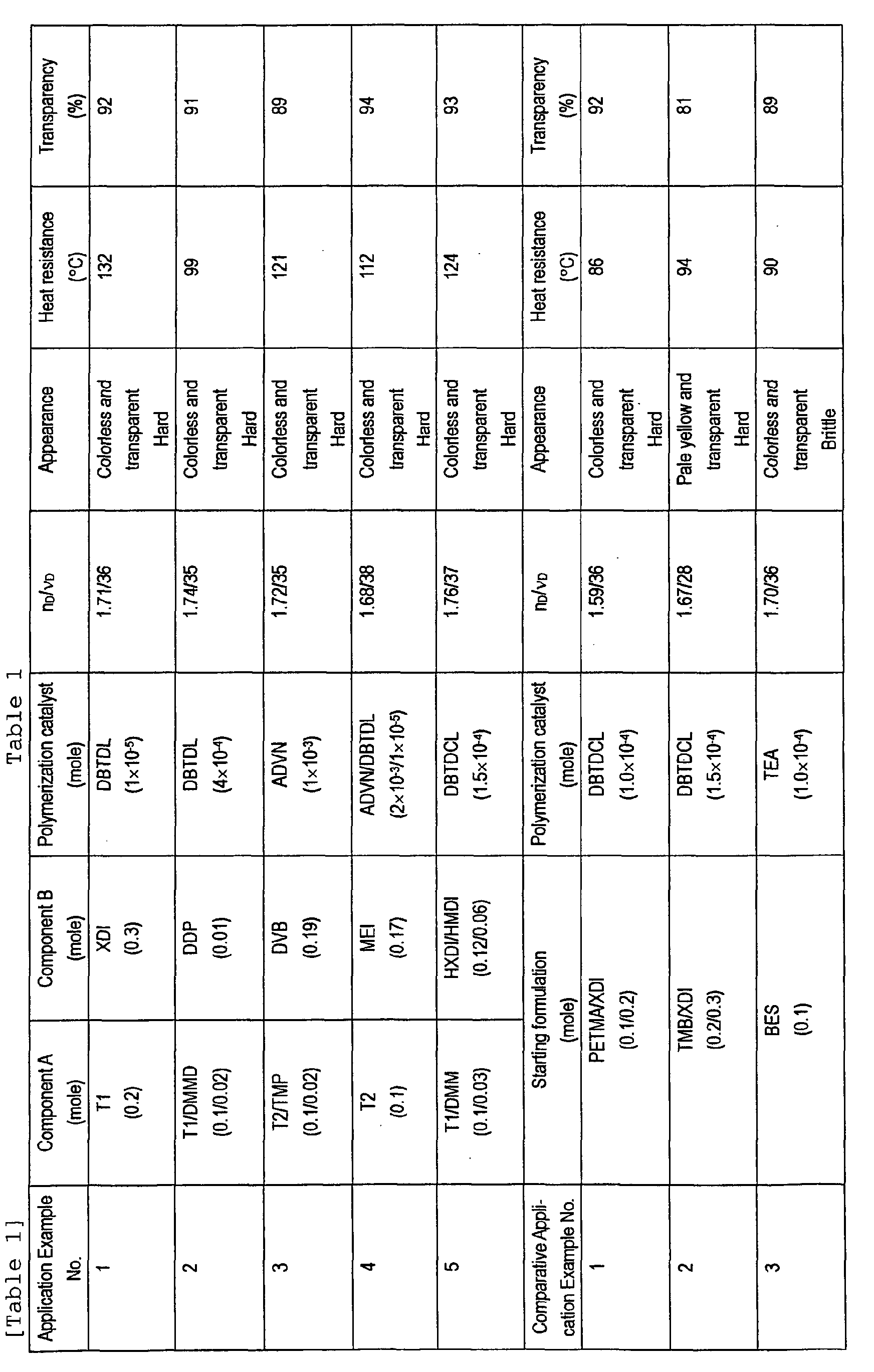
- the physical properties of the thus-obtained polymer are given in Table 1. As in Table 1, the polymer obtained in this Application Example 1 was colorless and transparent.
- Lens-shaped polymers were produced in the same manner as in Application Example 1, for which, however, were used the component A containing the novel thiol compound of the invention, the component B having iso(thio)cyanate and/or vinyl groups, and the polymerization catalyst as in Table 1, and the polymerization condition was suitably varied.
- Their physical properties are given in Table 1.
- the polymers obtained in Application Examples 2 to 5 are also colorless and transparent.
- Their refractive index (n D ) was extremely high as from 1.68 to 1.76; their Abbe's number ( ⁇ D ) was also high as from 35 to 38; and their heat resistance (99 to 124°C) and transparency (89 to 94 %) were excellent.
- the polymer obtained in this Comparative Application Example 1 was colorless and transparent (92 %), but its n D / ⁇ D was 1.59/36, or that is, its refractive index was low. In addition, its heat resistance (86°C) was inferior.
- Lens-shaped polymers were produced in the same manner as in Comparative Application Example 1, for which, however, were used the materials as in Table 1. Their physical properties are given in Table 1.
- the polymer of Comparative Application Example 2 had n D / ⁇ D of 1.67/28, or that is, its n D and ⁇ D were both low. Though its heat resistance (94°C) was relatively good, it was discolored, and its transparency (81 %) was low.
- the polymer of Comparative Application Example 3 had a relatively high ⁇ D of 36, it had good weather resistance, and it was colorless and transparent (89 %). However, its heat resistance (90°C) was not good, its n D was not so high as 1.70, and it was brittle.
- the thiol compounds of the invention are novel compounds that have three mercaptoalkyl groups bonded to the center trithiane ring, and are favorable for starting materials for optical materials.
- the optical materials obtained by using the novel thiol compounds of the invention have a high refractive index and a high Abbe's number, and have excellent heat resistance and transparency. Therefore, they are suitable for materials for optical products, for example, for lenses such as those for spectacles and cameras, and also for prisms, optical fibers, substrates for recording media such as optical discs and magnetic discs, as well as for color filters, IR-absorbing filters, etc.
Landscapes
- Chemical & Material Sciences (AREA)
- Organic Chemistry (AREA)
- Health & Medical Sciences (AREA)
- Chemical Kinetics & Catalysis (AREA)
- Medicinal Chemistry (AREA)
- Polymers & Plastics (AREA)
- Polyurethanes Or Polyureas (AREA)
- Organic Low-Molecular-Weight Compounds And Preparation Thereof (AREA)
- Polymers With Sulfur, Phosphorus Or Metals In The Main Chain (AREA)
Abstract

and the method for producing a thiol compound represented by the general formula (1) comprises the use of 1,3,5-trithiane having a methylene or vinyl group simultaneously at the 2,4,6-positions thereof as an intermediate.
Description
- The present invention relates to a novel thiol compound, to a method for producing the same and to an optical product comprising the same. More precisely, the invention relates to a novel thiol compound that may give optical materials having a high refractive index and a high Abbe's number and having excellent heat resistance and transparency, also to a method for efficiently producing the same and to an optical product comprising the same.
- Plastics are used for various optical applications these days, for example, for lenses and others, as being lightweight, hardly broken and easily colored when compared with glass. For optical plastic materials are generally used poly(diethylene glycol bisallylcarbonate) (CR-39) and poly(methyl methacrylate) . However, these plastics have a refractive index of 1.50 or less. Therefore, for example, when they are used for lens materials, the lenses produced shall be thicker with the increase in their power, and they lose the advantage of plastics that are lightweight. In particular, powerful concave lenses are thick at their periphery, and are therefore unfavorable as causing birefringence and chromatic aberration. For spectacles, in addition, such thick lenses are often not aesthetic. For obtaining thin lenses, it is effective to increase the refractive index of the materials. In general, the Abbe's number of glass and plastics decreases with the increase in their refractive index, and, as a result, their chromatic aberration increases. Accordingly, are desired plastic materials having a high refractive index and a high Abbe's number.
- For plastic materials having such properties, for example, are proposed (1) polyurethanes obtained through addition-polymerization of a polythiol having bromine in the molecule and a polyisocyanate (Japanese Patent Laid-Open No. 164615/1983); and (2) polythiourethanes obtained through addition-polymerization of a polythiol and a polyisocyanate (Japanese Patent Publication No. 58489/1992 and Japanese Patent Laid-Open 148340/1993). For the starting material, polythiol for the polythiourethanes of above (2), are specifically proposed branched polythiols having an increased sulfur content (Japanese Patent Laid-Open Nos. 270859/1990 and 148340/1993), and polythiols into which is introduced a dithiane structure for increasing their sulfur content (Japanese Patent Publication No. 5323/1994 and Japanese Patent Laid-Open No. 118390/1995). Further, are proposed (3) polymers of an alkyl sulfide having a polymerization-functional group, episulfide (Japanese Patent Laid-Open Nos. 71580/1997 and 110979/1997). However, though their refractive index is increased a little, the polyurethanes of above (1) still have a low Abbe's number and have some other drawbacks in that their lightfastness is poor, their specific gravity is high and therefore, they are not lightweight. Of the polythiourethanes (2), those for which the starting polythiol used has a high sulfur content have an increased refractive index of from about 1.60 to 1.68, but their Abbe's number is lower than that of optical inorganic glass having a refractive index on the same level. Therefore, they still have a problem in that their Abbe's number must be increased more. On the other hand, one example of the alkyl sulfide polymers (3) having an Abbe's number of 36 has an increased refractive index of 1.70. The lenses obtained by using this polymer can be extremely thin and lightweight. However, are still desired plastic materials of which both the Abbe's number and the refractive index are more increased simultaneously.
- The present invention has been made to solve the problems noted above, and its object is to provide a novel thiol compound that may give optical materials having a high refractive index and a high Abbe's number and having excellent heat resistance and transparency, to provide a method for efficiently producing the same and to provide an optical product comprising the same.
- The present inventors assiduously studied to attain the object as above. As a result, it has been found that novel thiol compounds with mercaptomethyl or mercaptoethyl groups bonded to a 1,3,5-trithiane ring meet the object as above and that the compounds are efficiently produced in a specific method. On the basis of these findings, the present invention has been completed.
- Specifically, the invention provides a thiol compound represented by the general formula (1):wherein n is 1 or 2,

and a method for producing a thiol compound represented by the general formula (1) comprising the use of 1,3,5-trithiane having a methylene or vinyl group simultaneously at the 2,4,6-positions thereof as an intermediate. - The novel thiol compound of the invention is represented by the general formula (1) mentioned below, from which it is seen that the compound has three identical mercaptoalkyl groups bonded to the trithiane ring thereof.wherein n is 1 or 2.
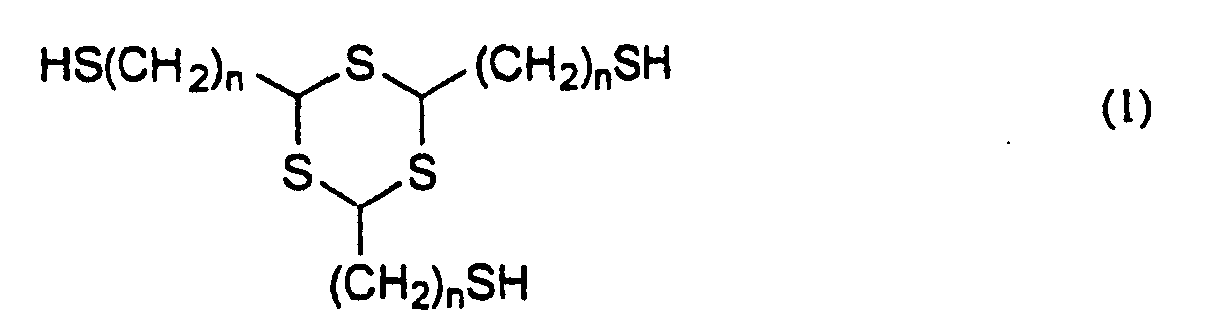
- The trithiane ring of the thiol compound represented by the general formula (1) has a high sulfur content, in which the atomic refraction is high and which therefore significantly increases the refractive index of the polymers obtained by using the novel thiol compound of the invention. In addition, the polymerization-functional, terminal thiol groups in the thiol compound contribute toward introducing sulfur atoms into the main chain of the polymers of the compound, and therefore, the refractive index of the polymers obtained by using the novel thiol compound of the invention is further increased. In general, the Abbe's number of amorphous materials is apt to decrease with the increase in the refractive index thereof. One problem with polymers having high sulfur content is that the electron resonance of sulfur is remarkable, therefore often significantly reducing the Abbe's number. However, the novel thiol compounds of the invention are free from the problem. Another cause of the increase in the refractive index is the decrease in the molar volume thereof, and it is often seen in polymers having a high crosslinking density and a strong intermolecular force. The novel thiol compound of the invention has three polymerization-functional groups, and the refractive index of its polymers is increased especially by the former effect. In the general formula (1), the increase in the number n lowers the sulfur content and the crosslinking density, therefore giving polymers having a reduced refractive index. Accordingly, n must be 1 or 2. In addition, since the glass transition temperature (Tg) of the polymers obtained by using the novel thiol compound of the invention lowers with the increase in n in the general formula (1), n must be 1 or 2 in order to obtain polymers having good heat resistance.
- Concretely, the novel thiol compound represented by the general formula (1) of the invention includes 2,4,6-tris(mercaptomethyl)-1,3,5-trithiane and 2,4,6-tris(mercaptoethyl)-1,3,5-trithiane.
- The method for producing a thiol compound represented by the general formula (1) comprises the following steps:
- (a) reacting chloroacetaldehyde/3-chloropropanal with hydrogen sulfide to obtain 2,4,6-tris(chloromethyl)-1,3,5-trithiane/2,4,6-tris(chloroethyl)-1,3,5-trithiane,
- (b) adding a base to remove hydrogen chloride from the compound obtained in step (a) to obtain 2,4,6-trimethylene-1,3,5-trithiane/2,4,6-triethylene-1,3,5-trithiane,
- (c) adding thioacetic acid in the presence of a radical generator,
- (d) reducing the S-acetylated compound obtained in step (c) to give 2,4,6-tris(mercaptomethyl)-1,3,5-trithiane/ 2,4,6-tris(mercaptoethyl)-1,3,5-trithiane.
-
- As a typical example of the method for producing the novel thiol compound of the invention, synthesis of 2,4,6-tris(mercaptomethyl)-1,3,5-trithiane (a compound of the general formula (1) wherein n is 1) is shown as Scheme 1 mentioned below. Concretely, an aqueous 40 wt.% chloroacetaldehyde solution is dissolved in 70 wt.% sulfuric acid, and hydrogen sulfide is introduced thereinto at -20 to 40°C for 2 to 100 hours to give 2,4,6-tris(chloromethyl)-1,3,5-trithiane. As the acid solvent is also usable any of 60/40 (v/v) 95 wt.% sulfuric acid-acetic acid, or hydrogen sulfide-saturated acetic acid, ether or 95 wt.% ethanol, in place of sulfuric acid. To the resulting methanol solution of the thus-formed chlorine compound is added potassium hydroxide with which the chlorine compound is processed at -10 to 40°C for 0.5 to 10 hours for removal of hydrogen chloride from it to give 2,4,6-trimethylene-1,3,5-trithiane. To this compound is added thioacetic acid at 0 to 100°C for 6 to 100 hours in the presence of a radical generator, and the resulting S-acetylated compound is then reduced with lithiumaluminum hydride at -10 to 50°C for 0.5 to 6 hours to give 2,4,6-tris(mercaptomethyl) -1,3, 5-trithiane (a compound of the general formula (1) wherein n is 1). 2,4,6-Tris(mercaptoethyl)-1,3,5-trithiane (a compound of the general formula (1) wherein n is 2) is obtained in the same manner as above, for which, however, 3-chloropropanal is used in place of chloroacetaldehyde.wherein Me is a methyl group.

- Next, are described optical materials obtained by the use of the novel thiol compound of the invention. As the optical materials is used a polymer obtained by polymerizing a polymerizable composition that contains a component A containing at least the novel thiol compound (a1) represented by the general formula (1), and a component B containing at least one compound selected from the group consisting of a compound (b1) having at least two vinyl groups in one molecule, a compound (b2) having at least two iso(thio)cyanate groups in one molecule, and a compound (b3) having at least one vinyl group and at least one iso(thio)cyanate group in one molecule. The iso(thio)cyanate is meant to indicate both an isocyanate and an isothiocyanate.
- In addition to the compound (a1) represented by the general formula (1) therein, the component A may additionally contain one or two or more different types of compounds (a2) having a mercapto group and/or a hydroxyl group in one molecule, with the total number of the mercapto group and the hydroxyl group in one molecule being 2 or more, for suitably improving the physical properties of the polymer. Concretely, the compound (a2) includes trimethylolpropane, 1,2-ethanedithiol, 1,3-propanedithiol, tetrakismercaptomethylmethane, pentaerythritol tetrakismercaptopropionate, pentaerythritol tetrakismercaptoacetate, 2-mercaptoethanol, 2,3-dimercaptopropanol, 1,2-dihydroxy-3-mercaptopropane, 4-mercaptophenol, 1,2-benzenedithiol, 1,3-benzenedithiol, 1,4-benzenedithiol, 1,3,5-benzenetrithiol, 1,2-dimercaptomethylbenzene, 1,3-dimercaptomethylbenzene, 1,4-dimercaptomethylbenzene, 1,3,5-trimercaptomethylbenzene, toluene-3,4-dithiol, and 4,4'-dihydroxyphenyl sulfide. The amount of the compound (a1) represented by the general formula (1) is from 0.1 to 100 mole%, and preferably from 10 to 100 mole% relative to the total amount of the component A.
- Concretely, the vinyl group-having compound (b1) for the component B includes divinylbenzene, ethylene glycol di(meth)acrylate, trimethylolpropane tri(meth)acrylate, as well as urethane-modified (meth)acrylates, epoxy-modified (meth)acrylates and polyester-modified (meth)acrylates each having at least two (meth) acryloxy groups in one molecule. The (meth)acrylate is meant to indicate both acrylate and methacrylate; and (meth)acryloxy group is meant to indicate both an acryloxy group and a methacryloxy group.
- Concretely, the iso(thio)cyanate group-having compound (b2) for the component B includes xylylene diiso (thio) cyanate, 3,3'-dichlorodiphenyl-4,4'-diiso(thio) cyanate, 4,4'-diphenylmethane diiso(thio)cyanate, hexamethylene diiso(thio)cyanate, 2,2',5,5'-tetrachlorodiphenyl-4,4'-diiso(thio)cyanate, and tolylene diiso(thio)cyanate. Other examples of the compound (b2) having at least one cyclohexyl ring are bis(iso(thio)cyanatomethyl)cyclohexane, bis(4-iso(thio)cyanatocyclohexyl)methane, bis(4-iso(thio)cyanatomethyl)cyclohexyl)methane, cyclohexane diiso(thio)cyanate, isophorone diiso(thio)cyanate, 2,5-bis(iso(thio)cyanatomethyl)bicyclo[2.2.2]octane, 2,5-bis(iso(thio)cyanatomethyl)bicycle[2.2.1]heptane, 2-iso(thio)cyanatomethyl-3-(3-iso(thio)cyanatopropyl)-5-iso (thio)cyanatomethyl-bicyclo[2.2.1]heptane, 2-iso(thio)cyanatomethyl-3-(3-iso(thio)cyanatopropyl)-6-iso(thio)cyanatomethyl-bicyclo[2.2.1]heptane, 2-iso(thio)cyanatomethyl-2-[3-iso(thio)cyanatopropyl]-5-iso(thio)cyanatomethyl-bicyclo[2.2.1]heptane, 2-iso(thio)cyanatomethyl-2-(3-iso(thio)cyanatopropyl)-6-iso(thio)cyanatomethyl-bicyclo[2.2.1]heptane, 2-iso(thio)cyanatomethyl-3-(3-iso(thio)cyanatopropyl)-6(2-iso(thio)cyanatoethyl)-bicyclo[2.2.1]heptane, 2-iso(thio)cyanatomethyl-3-(3-iso(thio)cyanatopropyl)-6(2-iso(thio)cyanatoethyl)-bicyclo[2.2.1]heptane, 2-iso(thio)cyanatomethyl-2-(3-iso(thio)cyanatopropyl)-5-(2-iso(thio)cyanatoethyl)-bicyclo[2.2.1]heptane, and 2-iso(thio)cyanatomethyl-2-(3-iso(thio)cyanatopropyl)-6-(2-iso(thio)cyanatoethyl)-bicyclo[2.2.1]heptane.
- Concretely, the compound (b3) having both vinyl and iso(thio)cyanate groups for the component B includes 2-(meth)acryloxyethyl iso(thio)cyanate and (meth)acryloyl iso(thio)cyanate. In case where the component B has a vinyl group, it is desirable that the polymerization-functional groups in the component A are all mercapto groups. In that case, when the component A has a hydroxyl group, the degree of polymerization does not increase, whereby the mechanical properties of the polymers produced may be reduced.
- [0016-01]
- If desired, an episulfide compound may be added to these components to fabricate the optical products. The episulfide compound includes, for example, linear organic compounds such as bis(β-epithiopropylthio)methane, 1,2-bis(β-epithiopropylthio)ethane, 1,3-bis(β-epithiopropylthio)propane, 1,2-bis(β-epithiopropylthio)propane, 1-(β-epithiopropylthio)-2-(β-epithiopropylthiomethyl)propane, 1,4-bis(β-epithiopropylthio)butane, 1,3-bis(β-epithiopropylthio)butane, 1-(β-epithiopropylthio)-3-(β-epithiopropylthiomethyl)butane, 1,5-bis(β-epithiopropylthio)pentane, 1-(β-epithiopropylthio)-4-(β-epithiopropylthiomethyl)pentane, 1,6-bis(β-epithiopropylthio) hexane, 1-(β-epithiopropylthio)-5-(β-epithiopropylthiomethyl)hexane, 1-(β-epithiopropylthio) -2-[(2-β-epithiopropylthioethyl)thio]ethane, 1-(β-epithiopropylthio)-2-[(2-(2-β-epithiopropylthioethyl)thioethyl)thio]ethane and compounds derived from them by substituting at least one hydrogen of the episulfide group therein with a methyl group; branched organic compounds such as tetrakis(β-epithiopropylthiomethyl)methane, 1,1,1-tris(β-epithiopropylthiomethyl)propane, 1,5-bis(β-epithiopropylthio)-2-(β-epithiopropylthiomethyl)-3-thiapentane, 1,5-bis(β-epithiopropylthio)-2,4-bis(β-epithiopropylthiomethyl)-3-thiapentane, 1-(β-epithiopropylthio)-2,2-bis(β-epithiopropylthiomethyl)-4-thiahexane, 1,5,6-tris(β-epithiopropylthio)-4-(β-epithiopropylthiomethyl)-3-thiahexane, 1,8-bis (β-epithiopropylthio)-4-(β-epithiopropylthiomethyl)3,6-dithiaoctane, 1,8-bis (β-epithiopropylthio)-4,5-bis (β-epithiopropylthiomethyl)-3,6-dithiaoctane, 1,8-bis (β-epithiopropylthio)-4,4-bis (β-epithiopropylthiomethyl)-3,6-dithiaoctane, 1,8-bis(β-epithiopropylthio)-2,4,5-tris (β-epithiopropylthiomethyl)-3,6-dithiaoctane, 1,8-bis(β-epithiopropylthio)-2,5-bis (β-epithiopropylthiomethyl)-3,6-dithiaoctane, 1,9-bis(β-epithiopropylthio)-5-(β-epithiopropylthiomethyl)-5-[(2-β-epithiopropylthioethyl)thiomethyl]-3,7-dithianonane, 1,10-bis(β-epithiopropylthio)-5,6-bis [(2-β-epithiopropylthioethyl)thio]-3,6,9-trithiadecane, 1,11-bis(β-epithiopropylthio)-4,8-bis (β-epithiopropylthiomethyl)-3,6,9-trithiaundecane, 1,11-bis(β-epithiopropylthio)-5,7-bis(β-epithiopropylthiomethyl)-3,6,9-trithiaundecane, 1,11-bis(β-epithiopropylthio)-5,7-[(2-β-epithiopropylthioethyl)thiomethyl]-3,6,9-trithiaundecane, 1,11-bis(β-epithiopropylthio)-4,7-bis(β-epithiopropylthiomethyl)-3,6,9-trithiaundecane, and compounds derived from them by substituting at least one hydrogen of the episulfide group therein with a methyl group; cycloaliphatic organic compounds such as 1,3 and 1,4-bis(β-epithiopropylthio)cyclohexane, 1,3 and 1,4-bis(β-epithiopropylthiomethyl)cyclohexane, bis[4-(β-epithiopropylthio)cyclohexyl]methane, 2,2-bis[4-(β-epithiopropylthio)cyclohexyl]propane, bis[4-(β-epithiopropylthio)cyclohexyl] sulfide, 2,5-bis(β-epithiopropylthiomethyl)-1,4-dithian, 2,5-bis(β-epithiopropylthioethylthiomethyl)-1,4-dithian, and compounds derived from them by substituting at least one hydrogen of the episulfide group therein with a methyl group; aromatic organic compounds such as 1,3 and 1,4-bis(β-epithiopropylthio)benzene, 1,3 and 1,4-bis(β-epithiopropylthiomethyl)benzene, bis[4-(β-epithiopropylthio)phenyl]methane, 2,2-bis[4-(β-epithiopropylthio)phenyl]propane, bis[4-(β-epithiopropylthio)phenyl] sulfide, bis[4-(β-epithiopropylthio)phenyl] sulfone, 4,4'-bis(β-epithiopropylthio)biphenyl, and compounds derived from them by substituting at least one hydrogen of the episulfide group therein with a methyl group. One or more of these may be used herein either singly or as combined.
- If desired, the optical materials may contain some additives such as UV absorbent, antioxidant, discoloration inhibitor, and fluorescent dye for improving their weather resistance. Also if desired, catalysts may be used for improving the polymerization reactivity. For example, organic peroxides, azo compounds and basic catalysts are effective for improving the reactivity between the mercapto group and the vinyl group. Organotin compounds and amine compounds are effective for improving the reactivity between the mercapto group or the hydroxyl group and the iso(thio)cyanate group.
- Using the novel thiol compounds of the invention, optical materials can be produced, for example, according to the method mentioned below.
- A uniform composition containing the above-mentioned polymerizable composition and other optional additives is first prepared, and this is cast into a glass or metal mold combined with a resin gasket, and heated and cured therein, according to a known method of casting polymerization. If desired, the mold may be subjected to mold release or a mold releasing agent such an acid phosphate ester may be added to the composition, for facilitating good release of the molded resin from the mold. The polymerization temperature varies depending on the compounds to be used, but is generally from -20°C to +150°C; and the polymerization time is from about 0.5 to 72 hours. After having been thus polymerized and released from the mold, the polymer may be readily colored with an ordinary disperse dye in water or in an organic solvent. For facilitating the dyeing, a carrier may be added to the dye dispersion, or the dyeing bath may be heated. Though not limited thereto, the thus-obtained optical materials are especially favorable for optical products such as plastic lenses.
- The invention is described more concretely with reference to the following Examples, which, however, are not intended to restrict the scope of the invention. The physical properties of the novel thiol compounds obtained in the Examples, and those of the polymers obtained in the following Application Examples and Comparative Application Examples were measured according to the methods mentioned below.
- The refractive index (nD) and the Abbe's number (νD) were measured at 25°C with an Abbe's refractometer, DR-M4 manufactured by Atago Co., Ltd.
-
- 1) Refractive index (nD) and Abbe's number (νD): Measured in the same manner as above.
- 2) Appearance: Visually checked.
- 3) Heat resistance: Measured with a TMA analyzer manufactured by Rigaku International Corporation. Concretely, using a pin having a diameter of 0.5 mm, TMA of each sample was measured under a load of 98 mN (10 gf) at a heating rate of 10°C/min. From the peak temperature appearing in the chart, the heat resistance was evaluated.
- 4) Transparency: Using a UV spectrometer, UV-330 manufactured by Hitachi, Ltd., the 550 nm UV transmittance was measured, from which the transparency was evaluated.
-
- 70 wt.% (v/v) sulfuric acid (100 ml) was bubbled with hydrogen sulfide for 30 minutes at 0°C, to which was dropwise added 40 wt.% chloroacetaldehyde (17.5 ml) at 0°C over 7.5 hours. Still at the temperature, this was further bubbled with hydrogen sulfide for 24 hours. The aqueous solution of the upper layer was removed through decantation, and the residue soluble in dichloromethane (150 ml) was washed with water (25 ml × 3 times), dried over anhydrous magnesium sulfate, and filtered. The solvent was evaporated away, and a pale yellow crude product (9.5 g) was obtained. The crude product was washed with hexane (40 ml x 4 times), hexane/ether (6/1) (50 ml x 2 times) and hot hexane (30 ml × 2 times), and dried in vacuum to obtain a white crystal, 2,4,6-tris(chloromethyl)-1,3,5-trithiane (2.50 g). To a methanol (25 ml) solution of this compound (0.3 g, 1.06 mmoles) was added a methanol solution (5 ml) of potassium hydroxide (0.62 g, 11 mmoles) all at a time with vigorously stirring at room temperature, and this was further stirred at room temperature for 75 minutes. The reaction mixture was diluted with water (30 ml), and extracted with dichloromethane (20 ml × 5 times), and the resulting extract was dried over anhydrous magnesium sulfate and filtered. The solvent was evaporated away from the filtrate, and an yellow oily residue, 2,4,6-trimethylene-1,3,5-trithiane (150 mg) was thus obtained. To a benzene (1 ml) solution of this compound (0.47 g) were added thioacetic acid (0.68 g) and azobisbutyronitrile (0.2 mg), and the mixture was stirred in an argon atmosphere at 60°C for 2 hours. The solvent was evaporated away from the reaction mixture to obtain a crude product of an S-acetylated derivative. To a THF (10 ml) solution of the crude product (4.02 g) was added dropwise an ether solution (12 ml) of 1.0 M lithiumaluminum hydride at 0°C. Then, this was stirred at room temperature for 2 hours. The reaction mixture was acidified with 1 N hydrochloric acid, and extracted with benzene, and the resulting extract was washed with water until it became neutral, followed by drying over anhydrous magnesium sulfate. the benzene was evaporated away from the extract, and the resulting residue was recrystallized from chloroform/methanol to obtain a crystal of 2,4,6-tris(mercaptomethyl)-1,3,5-trithiane (1.73 g) (m.p. = 42 to 46°C).
- For identifying its structure, the compound was analyzed and its data are shown below.
- 1H-NMR (solvent, CDCl3; internal standard substance, TMS): δ1.7 (t, 3H), δ2.82 (m, 6H), δ4.37-4.63 (t,t,m, 3H).
- IR (KBr tablet) : 662, 740, 800, 860, 922, 1025, 1190, 1250, 1420, 2540 cm-1.
- A liquid product, 2,4,6-tris(mercaptoethyl)-1,3,5-trithiane was obtained in the same manner as in Example 1, for which, however, was used chloropropanal in place of chloroacetaldehyde. Its refractive index (nD) was 1.684, and its Abbe's number (νD) was 32.4.
- For identifying its structure, the compound was analyzed and its data are shown below.
- 1H-NMR (solvent, CDCl3; internal standard substance, TMS): δ1.8 (t, 3H), δ2.54 (m, 6H), δ2.78 (m, 6H), δ4.33-4.54 (t,t,m, 3H).
- IR (KBr tablet) : 664, 742, 808, 865, 925, 1036, 1197, 1255, 1422, 2536 cm-1.
- A mixture of T1 (0.2 moles) obtained in Example 1, m-xylylene diisocyanate (XDI) (0.3 moles) and dibutyltin dilaurate (DBTDL) (1 × 10⁻³ moles) was uniformly stirred at 50°C, and cast into a mold of two glass sheets for lens production. In the mold, the mixture was polymerized under heat at 60°C for 10 hours, then at 90°C for 5 hours and then at 120°C for 3 hours to obtain a lens-shaped polymer. The physical properties of the thus-obtained polymer are given in Table 1. As in Table 1, the polymer obtained in this Application Example 1 was colorless and transparent. Its refractive index (nD) was extremely high as 1.71; its Abbe's number (νD) was also high as 36; and its heat resistance (132°C) and transparency (92 %) were excellent. Accordingly, the polymer obtained was favorable to optical materials.
- Lens-shaped polymers were produced in the same manner as in Application Example 1, for which, however, were used the component A containing the novel thiol compound of the invention, the component B having iso(thio)cyanate and/or vinyl groups, and the polymerization catalyst as in Table 1, and the polymerization condition was suitably varied. Their physical properties are given in Table 1. As in Table 1, the polymers obtained in Application Examples 2 to 5 are also colorless and transparent. Their refractive index (nD) was extremely high as from 1.68 to 1.76; their Abbe's number (νD) was also high as from 35 to 38; and their heat resistance (99 to 124°C) and transparency (89 to 94 %) were excellent.
- As in Table 1, a mixture of 0.1 moles of pentaerythritol tetrakismercaptopropionate (PETMA), 0.2 moles of m-xylylene diisocyanate (XDI) and 1.0 × 10⁻⁴ moles of dibutyltin dichloride (DBTDCL) was uniformly stirred, and cast into a mold of two glass sheets for lens production. In the mold, the mixture was polymerized under heat at 50°C for 10 hours, then at 60°C for 5 hours and then at 120°C for 3 hours to obtain a lens-shaped polymer. The physical properties of the thus-obtained polymer are given in Table 1. As in Table 1, the polymer obtained in this Comparative Application Example 1 was colorless and transparent (92 %), but its nD/νD was 1.59/36, or that is, its refractive index was low. In addition, its heat resistance (86°C) was inferior.
- Lens-shaped polymers were produced in the same manner as in Comparative Application Example 1, for which, however, were used the materials as in Table 1. Their physical properties are given in Table 1. As in Table 1, the polymer of Comparative Application Example 2 had nD/νD of 1.67/28, or that is, its nD and νD were both low. Though its heat resistance (94°C) was relatively good, it was discolored, and its transparency (81 %) was low. The polymer of Comparative Application Example 3 had a relatively high νD of 36, it had good weather resistance, and it was colorless and transparent (89 %). However, its heat resistance (90°C) was not good, its nD was not so high as 1.70, and it was brittle.

- The thiol compounds of the invention are novel compounds that have three mercaptoalkyl groups bonded to the center trithiane ring, and are favorable for starting materials for optical materials. The optical materials obtained by using the novel thiol compounds of the invention have a high refractive index and a high Abbe's number, and have excellent heat resistance and transparency. Therefore, they are suitable for materials for optical products, for example, for lenses such as those for spectacles and cameras, and also for prisms, optical fibers, substrates for recording media such as optical discs and magnetic discs, as well as for color filters, IR-absorbing filters, etc.
Claims (6)
- A thiol compound represented by the general formula (1) :wherein n is 1 or 2.

- A method for producing a thiol compound represented by the general formula (1):wherein n is 1 or 2,
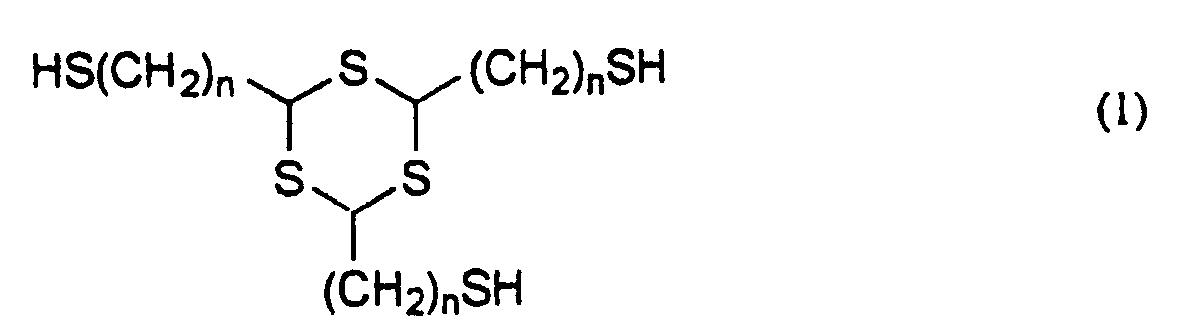
comprising the use of 1,3,5-trithiane having a methylene or vinyl group simultaneously at the 2,4,6-positions thereof as an intermediate. - An optical product comprising a polymer obtained by using a component A containing at least a thiol compound (a1) presented by the general formula (1):wherein n is 1 or 2,
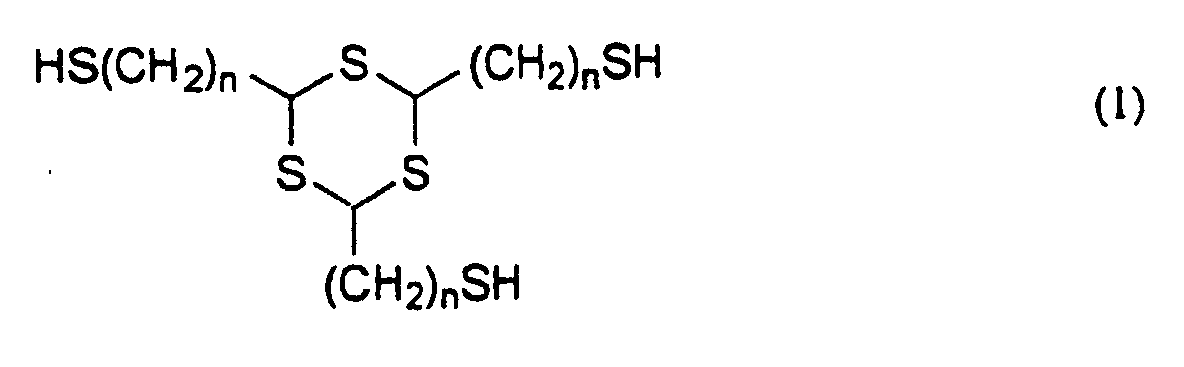
and a component B containing at least one compound selected from the group consisting of a compound (b1) having at least two vinyl groups in one molecule, a compound (b2) having at least two isocyanate groups and/or isothiocyanate groups in one molecule, and a compound (b3) having at least one vinyl group and at least one isocyanate group and/or isothiocyanate group in one molecule. - The optical product according to claim 3, wherein the component A further contains a compound (a2) having a mercapto group and/or a hydroxyl group in one molecule, with the total number of the mercapto group and the hydroxyl group in one molecule being 2 or more.
- The optical product according to claim 3, wherein the polymer is a polymer comprising the component A and the component B and having an episulfide compound further added thereto.
- The optical product according to any one of claims 3 to 5, wherein the optical product is a plastic lens.
Applications Claiming Priority (2)
| Application Number | Priority Date | Filing Date | Title |
|---|---|---|---|
| JP2001362377A JP2003160581A (en) | 2001-11-28 | 2001-11-28 | Thiol compound and production method thereof |
| JP2001362377 | 2001-11-28 |
Publications (2)
| Publication Number | Publication Date |
|---|---|
| EP1316556A1 true EP1316556A1 (en) | 2003-06-04 |
| EP1316556B1 EP1316556B1 (en) | 2006-06-21 |
Family
ID=19172883
Family Applications (1)
| Application Number | Title | Priority Date | Filing Date |
|---|---|---|---|
| EP02021346A Expired - Lifetime EP1316556B1 (en) | 2001-11-28 | 2002-09-23 | Opical product comprising a thiol compound |
Country Status (9)
| Country | Link |
|---|---|
| US (1) | US6706894B2 (en) |
| EP (1) | EP1316556B1 (en) |
| JP (1) | JP2003160581A (en) |
| KR (1) | KR100543220B1 (en) |
| CN (1) | CN1214024C (en) |
| AT (1) | ATE330951T1 (en) |
| AU (1) | AU2002301988B2 (en) |
| CA (1) | CA2406468C (en) |
| DE (1) | DE60212550T2 (en) |
Families Citing this family (19)
| Publication number | Priority date | Publication date | Assignee | Title |
|---|---|---|---|---|
| US7258437B2 (en) * | 2005-09-07 | 2007-08-21 | Transitions Optical, Inc. | Photochromic multifocal optical article |
| KR101187975B1 (en) * | 2006-02-23 | 2012-10-08 | 미쓰이 가가쿠 가부시키가이샤 | Internal mold release agent for production of polythiourethane optical material |
| TWI367900B (en) * | 2007-10-09 | 2012-07-11 | Ind Tech Res Inst | Encapsulant composition for a light-emitting diode |
| KR101074450B1 (en) * | 2008-12-29 | 2011-10-17 | 주식회사 케이오씨솔루션 | Resin Composition Using New Thiol Compound for Optical Lens Having Light Weight and High Refractive Index, and the Optical Lens Using It |
| TWI565732B (en) | 2012-06-13 | 2017-01-11 | 財團法人工業技術研究院 | Organic-inorganic hybrid resin, method for forming the same, and transparent resin composition formed therefrom |
| CN105837554B (en) * | 2016-05-06 | 2018-05-15 | 河北科技大学 | The synthetic method of 1,3,5- trithian derivatives |
| CN109503549B (en) * | 2018-11-27 | 2020-09-22 | 山东益丰生化环保股份有限公司 | Preparation method and application of polythiol compound containing 1,3, 5-trithiane structure |
| CN109666113A (en) * | 2018-12-17 | 2019-04-23 | 山东益丰生化环保股份有限公司 | A kind of high dioptrics polymerizable composition, polymerizable composition and application |
| CN111333803B (en) * | 2018-12-19 | 2022-02-18 | 万华化学集团股份有限公司 | Optical resin composition, optical resin material and application thereof |
| US11564839B2 (en) | 2019-04-05 | 2023-01-31 | Amo Groningen B.V. | Systems and methods for vergence matching of an intraocular lens with refractive index writing |
| US11583388B2 (en) | 2019-04-05 | 2023-02-21 | Amo Groningen B.V. | Systems and methods for spectacle independence using refractive index writing with an intraocular lens |
| US11529230B2 (en) | 2019-04-05 | 2022-12-20 | Amo Groningen B.V. | Systems and methods for correcting power of an intraocular lens using refractive index writing |
| US11944574B2 (en) | 2019-04-05 | 2024-04-02 | Amo Groningen B.V. | Systems and methods for multiple layer intraocular lens and using refractive index writing |
| US11583389B2 (en) | 2019-04-05 | 2023-02-21 | Amo Groningen B.V. | Systems and methods for correcting photic phenomenon from an intraocular lens and using refractive index writing |
| US12357509B2 (en) | 2019-04-05 | 2025-07-15 | Amo Groningen B.V. | Systems and methods for improving vision from an intraocular lens in an incorrect position and using refractive index writing |
| US11678975B2 (en) | 2019-04-05 | 2023-06-20 | Amo Groningen B.V. | Systems and methods for treating ocular disease with an intraocular lens and refractive index writing |
| US12377622B2 (en) | 2019-04-05 | 2025-08-05 | Amo Groningen B.V. | Systems and methods for vergence matching with an optical profile and using refractive index writing |
| CN116970209A (en) * | 2023-07-31 | 2023-10-31 | 浙江东尼电子股份有限公司 | A solid-state chemically modified ultra-thin PET film and its preparation method |
| CN120483958A (en) * | 2025-07-08 | 2025-08-15 | 江苏视科新材料股份有限公司 | Cyclotrimeric sulfur-tri (2-mercaptoethyl) mercaptan composition and preparation method thereof |
Citations (2)
| Publication number | Priority date | Publication date | Assignee | Title |
|---|---|---|---|---|
| US3410869A (en) * | 1963-05-31 | 1968-11-12 | Shell Oil Co | Tris-mercapto-s-trioxanes and trithanes |
| WO2002023230A1 (en) * | 2000-09-14 | 2002-03-21 | Mitsubishi Gas Chemical Company, Inc. | Composition for optical material |
Family Cites Families (15)
| Publication number | Priority date | Publication date | Assignee | Title |
|---|---|---|---|---|
| US3492313A (en) * | 1967-01-16 | 1970-01-27 | Pfizer & Co C | Novel derivatives of 1,3,5-trithiane |
| US3982034A (en) * | 1971-07-28 | 1976-09-21 | International Flavors & Fragrances Inc. | Flavoring with 2,4,6-trimethyl-s-trithiane |
| JPS5724382A (en) * | 1980-07-17 | 1982-02-08 | Nissan Chem Ind Ltd | Trithiane derivative and its preparation |
| JPS58164615A (en) | 1982-03-25 | 1983-09-29 | Toray Ind Inc | Resin for plastic lens |
| JPS60199016A (en) | 1984-03-23 | 1985-10-08 | Mitsui Toatsu Chem Inc | Thiocarbomic acid s-alkyl ester resin for lens |
| JP2621991B2 (en) | 1988-12-22 | 1997-06-18 | 三井東圧化学株式会社 | Mercapto compound and method for producing the same |
| JPH0335000A (en) * | 1989-06-30 | 1991-02-14 | Koken Co Ltd | Production of crosslinked collagen or crosslinked gelatin |
| JPH065323B2 (en) | 1989-12-28 | 1994-01-19 | ホーヤ株式会社 | Optical material and optical product obtained by using polythiol compound |
| JP3115371B2 (en) | 1991-09-03 | 2000-12-04 | ホーヤ株式会社 | Polymer for optical material and method for producing the same |
| JP2813535B2 (en) | 1993-10-19 | 1998-10-22 | ホーヤ株式会社 | Optical material and method for manufacturing the same |
| JP3491660B2 (en) | 1995-08-16 | 2004-01-26 | 三菱瓦斯化学株式会社 | Novel linear alkyl sulfide type episulfide compound |
| JP3864998B2 (en) | 1995-09-08 | 2007-01-10 | 三菱瓦斯化学株式会社 | Novel branched alkyl sulfide type episulfide compounds |
| US6458908B1 (en) * | 1999-06-01 | 2002-10-01 | Mitsui Chemicals, Inc. | Sulfur-containing unsaturated carboxylate compound and its cured products |
| JP2001064278A (en) * | 1999-08-26 | 2001-03-13 | Tokuyama Corp | Sulfur-containing (meth) acrylate polymerizable monomer |
| DE60110967T2 (en) * | 2000-03-27 | 2005-10-27 | Mitsui Chemicals, Inc. | Polythiol, polymerizable composition, resin and lens and process for the preparation of the thiol compound |
-
2001
- 2001-11-28 JP JP2001362377A patent/JP2003160581A/en active Pending
-
2002
- 2002-09-23 EP EP02021346A patent/EP1316556B1/en not_active Expired - Lifetime
- 2002-09-23 DE DE60212550T patent/DE60212550T2/en not_active Expired - Lifetime
- 2002-09-23 AT AT02021346T patent/ATE330951T1/en not_active IP Right Cessation
- 2002-10-03 CA CA002406468A patent/CA2406468C/en not_active Expired - Fee Related
- 2002-11-13 KR KR1020020070365A patent/KR100543220B1/en not_active Expired - Fee Related
- 2002-11-14 AU AU2002301988A patent/AU2002301988B2/en not_active Ceased
- 2002-11-22 US US10/301,780 patent/US6706894B2/en not_active Expired - Lifetime
- 2002-11-26 CN CNB021528810A patent/CN1214024C/en not_active Expired - Fee Related
Patent Citations (2)
| Publication number | Priority date | Publication date | Assignee | Title |
|---|---|---|---|---|
| US3410869A (en) * | 1963-05-31 | 1968-11-12 | Shell Oil Co | Tris-mercapto-s-trioxanes and trithanes |
| WO2002023230A1 (en) * | 2000-09-14 | 2002-03-21 | Mitsubishi Gas Chemical Company, Inc. | Composition for optical material |
Non-Patent Citations (1)
| Title |
|---|
| DATABASE CA [online] CHEMICAL ABSTRACTS SERVICE, COLUMBUS, OHIO, US; YOSHIMURA, YUICHI ET AL: "Composite optical material", XP002220583, retrieved from STN Database accession no. 136:254375 * |
Also Published As
| Publication number | Publication date |
|---|---|
| JP2003160581A (en) | 2003-06-03 |
| DE60212550D1 (en) | 2006-08-03 |
| CA2406468A1 (en) | 2003-05-28 |
| US20030114630A1 (en) | 2003-06-19 |
| ATE330951T1 (en) | 2006-07-15 |
| EP1316556B1 (en) | 2006-06-21 |
| DE60212550T2 (en) | 2007-06-28 |
| CN1421444A (en) | 2003-06-04 |
| CN1214024C (en) | 2005-08-10 |
| KR20030043651A (en) | 2003-06-02 |
| AU2002301988B2 (en) | 2004-04-22 |
| CA2406468C (en) | 2006-08-08 |
| US6706894B2 (en) | 2004-03-16 |
| KR100543220B1 (en) | 2006-01-20 |
Similar Documents
| Publication | Publication Date | Title |
|---|---|---|
| US6706894B2 (en) | Thiol compound, method for producing the same and optical product made with the same | |
| US5403938A (en) | Polythiol compound, and optical material and product produced therefrom | |
| KR0133656B1 (en) | Polythiol compound and optical material and products | |
| EP0972772B1 (en) | Polyisocyanate compounds, process for producing the same and optical materials using the same | |
| CA2406303A1 (en) | Episulfide compound, method for producing the same and optical product comprising same | |
| EP1211276B1 (en) | Optical product, asymmetric disulfide compound used therefor and method for producing the asymmetric disulfide compound | |
| JP3953791B2 (en) | Optical products using thiol compounds | |
| EP0976728B1 (en) | Polyisocyanate compound, process for the production thereof and optical resin material comprising the same | |
| JP4326855B2 (en) | Thiol compound, production method thereof, and intermediate thereof | |
| JP2004354959A (en) | Optical product made of thiol compound | |
| EP1608704B1 (en) | Thiophosphine compounds and method of making polymerisable compositions containing them and their use for making ophtalmic lenses | |
| JP3174760B2 (en) | Optical products | |
| JP2007269649A (en) | Organic germanium compound and method for producing the same | |
| JP2006199657A (en) | Metal-containing thiol compound and method for producing the same | |
| JP2007269648A (en) | Organic germanium compound and method for producing the same | |
| JP2898119B2 (en) | Polyisocyanate compound, optical material and optical product obtained using the same |
Legal Events
| Date | Code | Title | Description |
|---|---|---|---|
| PUAI | Public reference made under article 153(3) epc to a published international application that has entered the european phase |
Free format text: ORIGINAL CODE: 0009012 |
|
| AK | Designated contracting states |
Designated state(s): AT BE BG CH CY CZ DE DK EE ES FI FR GB GR IE IT LI LU MC NL PT SE SK TR |
|
| AX | Request for extension of the european patent |
Extension state: AL LT LV MK RO SI |
|
| 17P | Request for examination filed |
Effective date: 20031113 |
|
| AKX | Designation fees paid |
Designated state(s): AT BE BG CH CY CZ DE DK EE ES FI FR GB GR IE IT LI LU MC NL PT SE SK TR |
|
| 17Q | First examination report despatched |
Effective date: 20040810 |
|
| GRAP | Despatch of communication of intention to grant a patent |
Free format text: ORIGINAL CODE: EPIDOSNIGR1 |
|
| RTI1 | Title (correction) |
Free format text: OPICAL PRODUCT COMPRISING A THIOL COMPOUND |
|
| GRAS | Grant fee paid |
Free format text: ORIGINAL CODE: EPIDOSNIGR3 |
|
| GRAA | (expected) grant |
Free format text: ORIGINAL CODE: 0009210 |
|
| AK | Designated contracting states |
Kind code of ref document: B1 Designated state(s): AT BE BG CH CY CZ DE DK EE ES FI FR GB GR IE IT LI LU MC NL PT SE SK TR |
|
| PG25 | Lapsed in a contracting state [announced via postgrant information from national office to epo] |
Ref country code: IT Free format text: LAPSE BECAUSE OF FAILURE TO SUBMIT A TRANSLATION OF THE DESCRIPTION OR TO PAY THE FEE WITHIN THE PRESCRIBED TIME-LIMIT;WARNING: LAPSES OF ITALIAN PATENTS WITH EFFECTIVE DATE BEFORE 2007 MAY HAVE OCCURRED AT ANY TIME BEFORE 2007. THE CORRECT EFFECTIVE DATE MAY BE DIFFERENT FROM THE ONE RECORDED. Effective date: 20060621 Ref country code: NL Free format text: LAPSE BECAUSE OF FAILURE TO SUBMIT A TRANSLATION OF THE DESCRIPTION OR TO PAY THE FEE WITHIN THE PRESCRIBED TIME-LIMIT Effective date: 20060621 Ref country code: AT Free format text: LAPSE BECAUSE OF FAILURE TO SUBMIT A TRANSLATION OF THE DESCRIPTION OR TO PAY THE FEE WITHIN THE PRESCRIBED TIME-LIMIT Effective date: 20060621 Ref country code: FI Free format text: LAPSE BECAUSE OF FAILURE TO SUBMIT A TRANSLATION OF THE DESCRIPTION OR TO PAY THE FEE WITHIN THE PRESCRIBED TIME-LIMIT Effective date: 20060621 Ref country code: CZ Free format text: LAPSE BECAUSE OF FAILURE TO SUBMIT A TRANSLATION OF THE DESCRIPTION OR TO PAY THE FEE WITHIN THE PRESCRIBED TIME-LIMIT Effective date: 20060621 Ref country code: LI Free format text: LAPSE BECAUSE OF FAILURE TO SUBMIT A TRANSLATION OF THE DESCRIPTION OR TO PAY THE FEE WITHIN THE PRESCRIBED TIME-LIMIT Effective date: 20060621 Ref country code: CH Free format text: LAPSE BECAUSE OF FAILURE TO SUBMIT A TRANSLATION OF THE DESCRIPTION OR TO PAY THE FEE WITHIN THE PRESCRIBED TIME-LIMIT Effective date: 20060621 Ref country code: BE Free format text: LAPSE BECAUSE OF FAILURE TO SUBMIT A TRANSLATION OF THE DESCRIPTION OR TO PAY THE FEE WITHIN THE PRESCRIBED TIME-LIMIT Effective date: 20060621 Ref country code: SK Free format text: LAPSE BECAUSE OF FAILURE TO SUBMIT A TRANSLATION OF THE DESCRIPTION OR TO PAY THE FEE WITHIN THE PRESCRIBED TIME-LIMIT Effective date: 20060621 |
|
| REG | Reference to a national code |
Ref country code: GB Ref legal event code: FG4D |
|
| REG | Reference to a national code |
Ref country code: CH Ref legal event code: EP |
|
| REG | Reference to a national code |
Ref country code: IE Ref legal event code: FG4D |
|
| REF | Corresponds to: |
Ref document number: 60212550 Country of ref document: DE Date of ref document: 20060803 Kind code of ref document: P |
|
| PG25 | Lapsed in a contracting state [announced via postgrant information from national office to epo] |
Ref country code: SE Free format text: LAPSE BECAUSE OF FAILURE TO SUBMIT A TRANSLATION OF THE DESCRIPTION OR TO PAY THE FEE WITHIN THE PRESCRIBED TIME-LIMIT Effective date: 20060921 Ref country code: DK Free format text: LAPSE BECAUSE OF FAILURE TO SUBMIT A TRANSLATION OF THE DESCRIPTION OR TO PAY THE FEE WITHIN THE PRESCRIBED TIME-LIMIT Effective date: 20060921 |
|
| PG25 | Lapsed in a contracting state [announced via postgrant information from national office to epo] |
Ref country code: IE Free format text: LAPSE BECAUSE OF NON-PAYMENT OF DUE FEES Effective date: 20060925 |
|
| PG25 | Lapsed in a contracting state [announced via postgrant information from national office to epo] |
Ref country code: MC Free format text: LAPSE BECAUSE OF NON-PAYMENT OF DUE FEES Effective date: 20060930 |
|
| PG25 | Lapsed in a contracting state [announced via postgrant information from national office to epo] |
Ref country code: ES Free format text: LAPSE BECAUSE OF FAILURE TO SUBMIT A TRANSLATION OF THE DESCRIPTION OR TO PAY THE FEE WITHIN THE PRESCRIBED TIME-LIMIT Effective date: 20061002 |
|
| PG25 | Lapsed in a contracting state [announced via postgrant information from national office to epo] |
Ref country code: PT Free format text: LAPSE BECAUSE OF FAILURE TO SUBMIT A TRANSLATION OF THE DESCRIPTION OR TO PAY THE FEE WITHIN THE PRESCRIBED TIME-LIMIT Effective date: 20061121 |
|
| NLV1 | Nl: lapsed or annulled due to failure to fulfill the requirements of art. 29p and 29m of the patents act | ||
| REG | Reference to a national code |
Ref country code: CH Ref legal event code: PL |
|
| ET | Fr: translation filed | ||
| PLBE | No opposition filed within time limit |
Free format text: ORIGINAL CODE: 0009261 |
|
| STAA | Information on the status of an ep patent application or granted ep patent |
Free format text: STATUS: NO OPPOSITION FILED WITHIN TIME LIMIT |
|
| 26N | No opposition filed |
Effective date: 20070322 |
|
| PG25 | Lapsed in a contracting state [announced via postgrant information from national office to epo] |
Ref country code: GR Free format text: LAPSE BECAUSE OF FAILURE TO SUBMIT A TRANSLATION OF THE DESCRIPTION OR TO PAY THE FEE WITHIN THE PRESCRIBED TIME-LIMIT Effective date: 20060922 |
|
| PG25 | Lapsed in a contracting state [announced via postgrant information from national office to epo] |
Ref country code: BG Free format text: LAPSE BECAUSE OF FAILURE TO SUBMIT A TRANSLATION OF THE DESCRIPTION OR TO PAY THE FEE WITHIN THE PRESCRIBED TIME-LIMIT Effective date: 20060921 Ref country code: EE Free format text: LAPSE BECAUSE OF FAILURE TO SUBMIT A TRANSLATION OF THE DESCRIPTION OR TO PAY THE FEE WITHIN THE PRESCRIBED TIME-LIMIT Effective date: 20060621 |
|
| PG25 | Lapsed in a contracting state [announced via postgrant information from national office to epo] |
Ref country code: LU Free format text: LAPSE BECAUSE OF NON-PAYMENT OF DUE FEES Effective date: 20060923 Ref country code: TR Free format text: LAPSE BECAUSE OF FAILURE TO SUBMIT A TRANSLATION OF THE DESCRIPTION OR TO PAY THE FEE WITHIN THE PRESCRIBED TIME-LIMIT Effective date: 20060621 |
|
| PG25 | Lapsed in a contracting state [announced via postgrant information from national office to epo] |
Ref country code: CY Free format text: LAPSE BECAUSE OF FAILURE TO SUBMIT A TRANSLATION OF THE DESCRIPTION OR TO PAY THE FEE WITHIN THE PRESCRIBED TIME-LIMIT Effective date: 20060621 |
|
| REG | Reference to a national code |
Ref country code: FR Ref legal event code: PLFP Year of fee payment: 15 |
|
| REG | Reference to a national code |
Ref country code: FR Ref legal event code: PLFP Year of fee payment: 16 |
|
| PGFP | Annual fee paid to national office [announced via postgrant information from national office to epo] |
Ref country code: GB Payment date: 20170920 Year of fee payment: 16 Ref country code: DE Payment date: 20170920 Year of fee payment: 16 Ref country code: FR Payment date: 20170810 Year of fee payment: 16 |
|
| REG | Reference to a national code |
Ref country code: DE Ref legal event code: R119 Ref document number: 60212550 Country of ref document: DE |
|
| GBPC | Gb: european patent ceased through non-payment of renewal fee |
Effective date: 20180923 |
|
| PG25 | Lapsed in a contracting state [announced via postgrant information from national office to epo] |
Ref country code: DE Free format text: LAPSE BECAUSE OF NON-PAYMENT OF DUE FEES Effective date: 20190402 |
|
| PG25 | Lapsed in a contracting state [announced via postgrant information from national office to epo] |
Ref country code: FR Free format text: LAPSE BECAUSE OF NON-PAYMENT OF DUE FEES Effective date: 20180930 |
|
| PG25 | Lapsed in a contracting state [announced via postgrant information from national office to epo] |
Ref country code: GB Free format text: LAPSE BECAUSE OF NON-PAYMENT OF DUE FEES Effective date: 20180923 |