EP1316555A1 - Episulfide compound, method for producing the same and optical product comprising the same - Google Patents
Episulfide compound, method for producing the same and optical product comprising the same Download PDFInfo
- Publication number
- EP1316555A1 EP1316555A1 EP02021210A EP02021210A EP1316555A1 EP 1316555 A1 EP1316555 A1 EP 1316555A1 EP 02021210 A EP02021210 A EP 02021210A EP 02021210 A EP02021210 A EP 02021210A EP 1316555 A1 EP1316555 A1 EP 1316555A1
- Authority
- EP
- European Patent Office
- Prior art keywords
- episulfide compound
- trithiane
- general formula
- bis
- tris
- Prior art date
- Legal status (The legal status is an assumption and is not a legal conclusion. Google has not performed a legal analysis and makes no representation as to the accuracy of the status listed.)
- Granted
Links
- -1 Episulfide compound Chemical class 0.000 title claims abstract description 70
- 230000003287 optical effect Effects 0.000 title claims abstract description 32
- 238000004519 manufacturing process Methods 0.000 title claims abstract description 17
- LUMQOUCDESMXGC-UHFFFAOYSA-N 2,4,6-trimethylidene-1,3,5-trithiane Chemical compound C=C1SC(=C)SC(=C)S1 LUMQOUCDESMXGC-UHFFFAOYSA-N 0.000 claims abstract description 7
- PXQLVRUNWNTZOS-UHFFFAOYSA-N sulfanyl Chemical group [SH] PXQLVRUNWNTZOS-UHFFFAOYSA-N 0.000 claims abstract description 7
- 229920000642 polymer Polymers 0.000 claims description 39
- 150000001875 compounds Chemical class 0.000 claims description 31
- 239000007983 Tris buffer Substances 0.000 claims description 23
- 239000004593 Epoxy Substances 0.000 claims description 10
- 229920003023 plastic Polymers 0.000 claims description 10
- 239000004033 plastic Substances 0.000 claims description 10
- 150000003553 thiiranes Chemical class 0.000 claims description 8
- 229920006295 polythiol Polymers 0.000 claims description 7
- 239000000178 monomer Substances 0.000 claims description 5
- 125000000391 vinyl group Chemical group [H]C([*])=C([H])[H] 0.000 claims description 5
- DQENFQAQOZDAEG-UHFFFAOYSA-N 3-(thiiran-2-yl)propane-1-thiol Chemical compound SCCCC1CS1 DQENFQAQOZDAEG-UHFFFAOYSA-N 0.000 claims description 4
- 229920002554 vinyl polymer Polymers 0.000 claims description 4
- 229920001228 polyisocyanate Polymers 0.000 claims description 3
- 239000005056 polyisocyanate Substances 0.000 claims description 3
- 239000000463 material Substances 0.000 abstract description 22
- 238000000034 method Methods 0.000 abstract description 9
- 239000007858 starting material Substances 0.000 abstract description 3
- ATUOYWHBWRKTHZ-UHFFFAOYSA-N Propane Chemical compound CCC ATUOYWHBWRKTHZ-UHFFFAOYSA-N 0.000 description 22
- VLKZOEOYAKHREP-UHFFFAOYSA-N n-Hexane Chemical compound CCCCCC VLKZOEOYAKHREP-UHFFFAOYSA-N 0.000 description 15
- OKKJLVBELUTLKV-UHFFFAOYSA-N Methanol Chemical compound OC OKKJLVBELUTLKV-UHFFFAOYSA-N 0.000 description 12
- 239000001294 propane Substances 0.000 description 11
- 239000000203 mixture Substances 0.000 description 9
- VNWKTOKETHGBQD-UHFFFAOYSA-N methane Chemical compound C VNWKTOKETHGBQD-UHFFFAOYSA-N 0.000 description 8
- 125000001997 phenyl group Chemical group [H]C1=C([H])C([H])=C(*)C([H])=C1[H] 0.000 description 8
- NINIDFKCEFEMDL-UHFFFAOYSA-N Sulfur Chemical compound [S] NINIDFKCEFEMDL-UHFFFAOYSA-N 0.000 description 7
- 230000000052 comparative effect Effects 0.000 description 7
- OFBQJSOFQDEBGM-UHFFFAOYSA-N n-pentane Natural products CCCCC OFBQJSOFQDEBGM-UHFFFAOYSA-N 0.000 description 7
- 230000000704 physical effect Effects 0.000 description 7
- 239000000047 product Substances 0.000 description 7
- 239000011593 sulfur Substances 0.000 description 7
- 229910052717 sulfur Inorganic materials 0.000 description 7
- YMWUJEATGCHHMB-UHFFFAOYSA-N Dichloromethane Chemical compound ClCCl YMWUJEATGCHHMB-UHFFFAOYSA-N 0.000 description 6
- RTZKZFJDLAIYFH-UHFFFAOYSA-N Diethyl ether Chemical compound CCOCC RTZKZFJDLAIYFH-UHFFFAOYSA-N 0.000 description 6
- KWYUFKZDYYNOTN-UHFFFAOYSA-M Potassium hydroxide Chemical compound [OH-].[K+] KWYUFKZDYYNOTN-UHFFFAOYSA-M 0.000 description 6
- QAOWNCQODCNURD-UHFFFAOYSA-N Sulfuric acid Chemical compound OS(O)(=O)=O QAOWNCQODCNURD-UHFFFAOYSA-N 0.000 description 6
- UCKMPCXJQFINFW-UHFFFAOYSA-N Sulphide Chemical compound [S-2] UCKMPCXJQFINFW-UHFFFAOYSA-N 0.000 description 6
- IISBACLAFKSPIT-UHFFFAOYSA-N bisphenol A Chemical compound C=1C=C(O)C=CC=1C(C)(C)C1=CC=C(O)C=C1 IISBACLAFKSPIT-UHFFFAOYSA-N 0.000 description 6
- 239000011521 glass Substances 0.000 description 6
- 238000006116 polymerization reaction Methods 0.000 description 6
- 239000002904 solvent Substances 0.000 description 6
- CVHLOUDPCBXUES-UHFFFAOYSA-N thiiran-2-ylmethanethiol Chemical compound SCC1CS1 CVHLOUDPCBXUES-UHFFFAOYSA-N 0.000 description 6
- BVOMRRWJQOJMPA-UHFFFAOYSA-N 1,2,3-trithiane Chemical compound C1CSSSC1 BVOMRRWJQOJMPA-UHFFFAOYSA-N 0.000 description 5
- LYCAIKOWRPUZTN-UHFFFAOYSA-N Ethylene glycol Chemical compound OCCO LYCAIKOWRPUZTN-UHFFFAOYSA-N 0.000 description 5
- 239000002253 acid Substances 0.000 description 5
- 239000000243 solution Substances 0.000 description 5
- RWSOTUBLDIXVET-UHFFFAOYSA-N Dihydrogen sulfide Chemical compound S RWSOTUBLDIXVET-UHFFFAOYSA-N 0.000 description 4
- HEDRZPFGACZZDS-MICDWDOJSA-N Trichloro(2H)methane Chemical compound [2H]C(Cl)(Cl)Cl HEDRZPFGACZZDS-MICDWDOJSA-N 0.000 description 4
- 238000009833 condensation Methods 0.000 description 4
- 230000005494 condensation Effects 0.000 description 4
- 239000001257 hydrogen Substances 0.000 description 4
- 229910052739 hydrogen Inorganic materials 0.000 description 4
- 229910000037 hydrogen sulfide Inorganic materials 0.000 description 4
- 125000002496 methyl group Chemical group [H]C([H])([H])* 0.000 description 4
- ZJDIPQQCIUNYNT-UHFFFAOYSA-N 2,4,6-tris(chloromethyl)-1,3,5-trithiane Chemical compound ClCC1SC(CCl)SC(CCl)S1 ZJDIPQQCIUNYNT-UHFFFAOYSA-N 0.000 description 3
- QSKPIOLLBIHNAC-UHFFFAOYSA-N 2-chloro-acetaldehyde Chemical compound ClCC=O QSKPIOLLBIHNAC-UHFFFAOYSA-N 0.000 description 3
- YCIGYTFKOXGYTA-UHFFFAOYSA-N 4-(3-cyanopropyldiazenyl)butanenitrile Chemical compound N#CCCCN=NCCCC#N YCIGYTFKOXGYTA-UHFFFAOYSA-N 0.000 description 3
- UHOVQNZJYSORNB-UHFFFAOYSA-N Benzene Chemical compound C1=CC=CC=C1 UHOVQNZJYSORNB-UHFFFAOYSA-N 0.000 description 3
- 229930185605 Bisphenol Natural products 0.000 description 3
- UFHFLCQGNIYNRP-UHFFFAOYSA-N Hydrogen Chemical compound [H][H] UFHFLCQGNIYNRP-UHFFFAOYSA-N 0.000 description 3
- 239000002202 Polyethylene glycol Substances 0.000 description 3
- DNIAPMSPPWPWGF-UHFFFAOYSA-N Propylene glycol Chemical compound CC(O)CO DNIAPMSPPWPWGF-UHFFFAOYSA-N 0.000 description 3
- 239000001273 butane Substances 0.000 description 3
- 125000000113 cyclohexyl group Chemical group [H]C1([H])C([H])([H])C([H])([H])C([H])(*)C([H])([H])C1([H])[H] 0.000 description 3
- 230000007423 decrease Effects 0.000 description 3
- MTHSVFCYNBDYFN-UHFFFAOYSA-N diethylene glycol Chemical compound OCCOCCO MTHSVFCYNBDYFN-UHFFFAOYSA-N 0.000 description 3
- 230000002349 favourable effect Effects 0.000 description 3
- IJDNQMDRQITEOD-UHFFFAOYSA-N n-butane Chemical compound CCCC IJDNQMDRQITEOD-UHFFFAOYSA-N 0.000 description 3
- 229920001223 polyethylene glycol Polymers 0.000 description 3
- 229920002578 polythiourethane polymer Polymers 0.000 description 3
- 239000011347 resin Substances 0.000 description 3
- 229920005989 resin Polymers 0.000 description 3
- CXMXRPHRNRROMY-UHFFFAOYSA-N sebacic acid Chemical compound OC(=O)CCCCCCCCC(O)=O CXMXRPHRNRROMY-UHFFFAOYSA-N 0.000 description 3
- 239000000126 substance Substances 0.000 description 3
- 150000005846 sugar alcohols Polymers 0.000 description 3
- 125000000446 sulfanediyl group Chemical group *S* 0.000 description 3
- XLYOFNOQVPJJNP-UHFFFAOYSA-N water Substances O XLYOFNOQVPJJNP-UHFFFAOYSA-N 0.000 description 3
- RTTZISZSHSCFRH-UHFFFAOYSA-N 1,3-bis(isocyanatomethyl)benzene Chemical compound O=C=NCC1=CC=CC(CN=C=O)=C1 RTTZISZSHSCFRH-UHFFFAOYSA-N 0.000 description 2
- 238000005160 1H NMR spectroscopy Methods 0.000 description 2
- LEJBBGNFPAFPKQ-UHFFFAOYSA-N 2-(2-prop-2-enoyloxyethoxy)ethyl prop-2-enoate Chemical compound C=CC(=O)OCCOCCOC(=O)C=C LEJBBGNFPAFPKQ-UHFFFAOYSA-N 0.000 description 2
- SFUJHDSWKGWPCE-UHFFFAOYSA-N 2-(thiiran-2-yl)ethanethiol Chemical compound SCCC1CS1 SFUJHDSWKGWPCE-UHFFFAOYSA-N 0.000 description 2
- XFCMNSHQOZQILR-UHFFFAOYSA-N 2-[2-(2-methylprop-2-enoyloxy)ethoxy]ethyl 2-methylprop-2-enoate Chemical compound CC(=C)C(=O)OCCOCCOC(=O)C(C)=C XFCMNSHQOZQILR-UHFFFAOYSA-N 0.000 description 2
- INQDDHNZXOAFFD-UHFFFAOYSA-N 2-[2-(2-prop-2-enoyloxyethoxy)ethoxy]ethyl prop-2-enoate Chemical compound C=CC(=O)OCCOCCOCCOC(=O)C=C INQDDHNZXOAFFD-UHFFFAOYSA-N 0.000 description 2
- KUDUQBURMYMBIJ-UHFFFAOYSA-N 2-prop-2-enoyloxyethyl prop-2-enoate Chemical compound C=CC(=O)OCCOC(=O)C=C KUDUQBURMYMBIJ-UHFFFAOYSA-N 0.000 description 2
- YBRVSVVVWCFQMG-UHFFFAOYSA-N 4,4'-diaminodiphenylmethane Chemical class C1=CC(N)=CC=C1CC1=CC=C(N)C=C1 YBRVSVVVWCFQMG-UHFFFAOYSA-N 0.000 description 2
- HGINCPLSRVDWNT-UHFFFAOYSA-N Acrolein Chemical compound C=CC=O HGINCPLSRVDWNT-UHFFFAOYSA-N 0.000 description 2
- HEDRZPFGACZZDS-UHFFFAOYSA-N Chloroform Chemical compound ClC(Cl)Cl HEDRZPFGACZZDS-UHFFFAOYSA-N 0.000 description 2
- OTMSDBZUPAUEDD-UHFFFAOYSA-N Ethane Chemical compound CC OTMSDBZUPAUEDD-UHFFFAOYSA-N 0.000 description 2
- LFQSCWFLJHTTHZ-UHFFFAOYSA-N Ethanol Chemical compound CCO LFQSCWFLJHTTHZ-UHFFFAOYSA-N 0.000 description 2
- VZCYOOQTPOCHFL-OWOJBTEDSA-N Fumaric acid Chemical compound OC(=O)\C=C\C(O)=O VZCYOOQTPOCHFL-OWOJBTEDSA-N 0.000 description 2
- PEDCQBHIVMGVHV-UHFFFAOYSA-N Glycerine Chemical compound OCC(O)CO PEDCQBHIVMGVHV-UHFFFAOYSA-N 0.000 description 2
- VEXZGXHMUGYJMC-UHFFFAOYSA-N Hydrochloric acid Chemical compound Cl VEXZGXHMUGYJMC-UHFFFAOYSA-N 0.000 description 2
- QIGBRXMKCJKVMJ-UHFFFAOYSA-N Hydroquinone Chemical compound OC1=CC=C(O)C=C1 QIGBRXMKCJKVMJ-UHFFFAOYSA-N 0.000 description 2
- CSNNHWWHGAXBCP-UHFFFAOYSA-L Magnesium sulfate Chemical compound [Mg+2].[O-][S+2]([O-])([O-])[O-] CSNNHWWHGAXBCP-UHFFFAOYSA-L 0.000 description 2
- BAPJBEWLBFYGME-UHFFFAOYSA-N Methyl acrylate Chemical compound COC(=O)C=C BAPJBEWLBFYGME-UHFFFAOYSA-N 0.000 description 2
- GLUUGHFHXGJENI-UHFFFAOYSA-N Piperazine Chemical compound C1CNCCN1 GLUUGHFHXGJENI-UHFFFAOYSA-N 0.000 description 2
- PPBRXRYQALVLMV-UHFFFAOYSA-N Styrene Chemical compound C=CC1=CC=CC=C1 PPBRXRYQALVLMV-UHFFFAOYSA-N 0.000 description 2
- KKEYFWRCBNTPAC-UHFFFAOYSA-N Terephthalic acid Chemical compound OC(=O)C1=CC=C(C(O)=O)C=C1 KKEYFWRCBNTPAC-UHFFFAOYSA-N 0.000 description 2
- OKKRPWIIYQTPQF-UHFFFAOYSA-N Trimethylolpropane trimethacrylate Chemical compound CC(=C)C(=O)OCC(CC)(COC(=O)C(C)=C)COC(=O)C(C)=C OKKRPWIIYQTPQF-UHFFFAOYSA-N 0.000 description 2
- 150000007513 acids Chemical class 0.000 description 2
- 238000012644 addition polymerization Methods 0.000 description 2
- 239000000654 additive Substances 0.000 description 2
- WNLRTRBMVRJNCN-UHFFFAOYSA-N adipic acid Chemical compound OC(=O)CCCCC(O)=O WNLRTRBMVRJNCN-UHFFFAOYSA-N 0.000 description 2
- 230000004075 alteration Effects 0.000 description 2
- GCAIEATUVJFSMC-UHFFFAOYSA-N benzene-1,2,3,4-tetracarboxylic acid Chemical compound OC(=O)C1=CC=C(C(O)=O)C(C(O)=O)=C1C(O)=O GCAIEATUVJFSMC-UHFFFAOYSA-N 0.000 description 2
- 150000001555 benzenes Chemical class 0.000 description 2
- PXKLMJQFEQBVLD-UHFFFAOYSA-N bisphenol F Chemical compound C1=CC(O)=CC=C1CC1=CC=C(O)C=C1 PXKLMJQFEQBVLD-UHFFFAOYSA-N 0.000 description 2
- WERYXYBDKMZEQL-UHFFFAOYSA-N butane-1,4-diol Chemical compound OCCCCO WERYXYBDKMZEQL-UHFFFAOYSA-N 0.000 description 2
- VHRGRCVQAFMJIZ-UHFFFAOYSA-N cadaverine Chemical compound NCCCCCN VHRGRCVQAFMJIZ-UHFFFAOYSA-N 0.000 description 2
- 239000003054 catalyst Substances 0.000 description 2
- YCIMNLLNPGFGHC-UHFFFAOYSA-N catechol Chemical compound OC1=CC=CC=C1O YCIMNLLNPGFGHC-UHFFFAOYSA-N 0.000 description 2
- 150000001805 chlorine compounds Chemical class 0.000 description 2
- 238000004132 cross linking Methods 0.000 description 2
- 239000012043 crude product Substances 0.000 description 2
- 239000013078 crystal Substances 0.000 description 2
- 150000001934 cyclohexanes Chemical class 0.000 description 2
- RJGHQTVXGKYATR-UHFFFAOYSA-L dibutyl(dichloro)stannane Chemical compound CCCC[Sn](Cl)(Cl)CCCC RJGHQTVXGKYATR-UHFFFAOYSA-L 0.000 description 2
- ZUOUZKKEUPVFJK-UHFFFAOYSA-N diphenyl Chemical compound C1=CC=CC=C1C1=CC=CC=C1 ZUOUZKKEUPVFJK-UHFFFAOYSA-N 0.000 description 2
- 238000004043 dyeing Methods 0.000 description 2
- STVZJERGLQHEKB-UHFFFAOYSA-N ethylene glycol dimethacrylate Substances CC(=C)C(=O)OCCOC(=O)C(C)=C STVZJERGLQHEKB-UHFFFAOYSA-N 0.000 description 2
- IXCSERBJSXMMFS-UHFFFAOYSA-N hydrogen chloride Substances Cl.Cl IXCSERBJSXMMFS-UHFFFAOYSA-N 0.000 description 2
- 229910000041 hydrogen chloride Inorganic materials 0.000 description 2
- QQVIHTHCMHWDBS-UHFFFAOYSA-N isophthalic acid Chemical compound OC(=O)C1=CC=CC(C(O)=O)=C1 QQVIHTHCMHWDBS-UHFFFAOYSA-N 0.000 description 2
- 125000001570 methylene group Chemical group [H]C([H])([*:1])[*:2] 0.000 description 2
- 150000002894 organic compounds Chemical class 0.000 description 2
- 150000002989 phenols Chemical class 0.000 description 2
- XNGIFLGASWRNHJ-UHFFFAOYSA-N phthalic acid Chemical compound OC(=O)C1=CC=CC=C1C(O)=O XNGIFLGASWRNHJ-UHFFFAOYSA-N 0.000 description 2
- 239000002685 polymerization catalyst Substances 0.000 description 2
- 239000004814 polyurethane Substances 0.000 description 2
- 229920002635 polyurethane Polymers 0.000 description 2
- AOHJOMMDDJHIJH-UHFFFAOYSA-N propylenediamine Chemical compound CC(N)CN AOHJOMMDDJHIJH-UHFFFAOYSA-N 0.000 description 2
- KIDHWZJUCRJVML-UHFFFAOYSA-N putrescine Chemical compound NCCCCN KIDHWZJUCRJVML-UHFFFAOYSA-N 0.000 description 2
- 239000011541 reaction mixture Substances 0.000 description 2
- GHMLBKRAJCXXBS-UHFFFAOYSA-N resorcinol Chemical compound OC1=CC=CC(O)=C1 GHMLBKRAJCXXBS-UHFFFAOYSA-N 0.000 description 2
- 125000001424 substituent group Chemical group 0.000 description 2
- 125000004055 thiomethyl group Chemical group [H]SC([H])([H])* 0.000 description 2
- VZCYOOQTPOCHFL-UHFFFAOYSA-N trans-butenedioic acid Natural products OC(=O)C=CC(O)=O VZCYOOQTPOCHFL-UHFFFAOYSA-N 0.000 description 2
- ARCGXLSVLAOJQL-UHFFFAOYSA-N trimellitic acid Chemical compound OC(=O)C1=CC=C(C(O)=O)C(C(O)=O)=C1 ARCGXLSVLAOJQL-UHFFFAOYSA-N 0.000 description 2
- XFNJVJPLKCPIBV-UHFFFAOYSA-N trimethylenediamine Chemical compound NCCCN XFNJVJPLKCPIBV-UHFFFAOYSA-N 0.000 description 2
- UIYCHXAGWOYNNA-UHFFFAOYSA-N vinyl sulfide Chemical compound C=CSC=C UIYCHXAGWOYNNA-UHFFFAOYSA-N 0.000 description 2
- DNIAPMSPPWPWGF-VKHMYHEASA-N (+)-propylene glycol Chemical compound C[C@H](O)CO DNIAPMSPPWPWGF-VKHMYHEASA-N 0.000 description 1
- 0 *C1SC(*)SC(*)S1 Chemical compound *C1SC(*)SC(*)S1 0.000 description 1
- MYWOJODOMFBVCB-UHFFFAOYSA-N 1,2,6-trimethylphenanthrene Chemical compound CC1=CC=C2C3=CC(C)=CC=C3C=CC2=C1C MYWOJODOMFBVCB-UHFFFAOYSA-N 0.000 description 1
- CXWGKAYMVASWDQ-UHFFFAOYSA-N 1,2-dithiane Chemical group C1CCSSC1 CXWGKAYMVASWDQ-UHFFFAOYSA-N 0.000 description 1
- LORRLQMLLQLPSJ-UHFFFAOYSA-N 1,3,5-trithiane Chemical compound C1SCSCS1 LORRLQMLLQLPSJ-UHFFFAOYSA-N 0.000 description 1
- VDYWHVQKENANGY-UHFFFAOYSA-N 1,3-Butyleneglycol dimethacrylate Chemical compound CC(=C)C(=O)OC(C)CCOC(=O)C(C)=C VDYWHVQKENANGY-UHFFFAOYSA-N 0.000 description 1
- YPFDHNVEDLHUCE-UHFFFAOYSA-N 1,3-propanediol Substances OCCCO YPFDHNVEDLHUCE-UHFFFAOYSA-N 0.000 description 1
- WEERVPDNCOGWJF-UHFFFAOYSA-N 1,4-bis(ethenyl)benzene Chemical compound C=CC1=CC=C(C=C)C=C1 WEERVPDNCOGWJF-UHFFFAOYSA-N 0.000 description 1
- PXGZQGDTEZPERC-UHFFFAOYSA-N 1,4-cyclohexanedicarboxylic acid Chemical compound OC(=O)C1CCC(C(O)=O)CC1 PXGZQGDTEZPERC-UHFFFAOYSA-N 0.000 description 1
- FQUYSHZXSKYCSY-UHFFFAOYSA-N 1,4-diazepane Chemical compound C1CNCCNC1 FQUYSHZXSKYCSY-UHFFFAOYSA-N 0.000 description 1
- PWGJDPKCLMLPJW-UHFFFAOYSA-N 1,8-diaminooctane Chemical compound NCCCCCCCCN PWGJDPKCLMLPJW-UHFFFAOYSA-N 0.000 description 1
- XHAFIUUYXQFJEW-UHFFFAOYSA-N 1-chloroethenylbenzene Chemical compound ClC(=C)C1=CC=CC=C1 XHAFIUUYXQFJEW-UHFFFAOYSA-N 0.000 description 1
- SLBOQBILGNEPEB-UHFFFAOYSA-N 1-chloroprop-2-enylbenzene Chemical compound C=CC(Cl)C1=CC=CC=C1 SLBOQBILGNEPEB-UHFFFAOYSA-N 0.000 description 1
- ZYZXXEKBDWCGED-UHFFFAOYSA-N 1-n,2-n-diethylbutane-1,2-diamine Chemical compound CCNCC(CC)NCC ZYZXXEKBDWCGED-UHFFFAOYSA-N 0.000 description 1
- VECZPMZNUKYYOJ-UHFFFAOYSA-N 1-n,2-n-diethylpropane-1,2-diamine Chemical compound CCNCC(C)NCC VECZPMZNUKYYOJ-UHFFFAOYSA-N 0.000 description 1
- WLZRPMGWZLCLGV-UHFFFAOYSA-N 1-n,2-n-dimethylbutane-1,2-diamine Chemical compound CCC(NC)CNC WLZRPMGWZLCLGV-UHFFFAOYSA-N 0.000 description 1
- XCFLRKJSDRTWON-UHFFFAOYSA-N 1-n,3-n-diethylbutane-1,3-diamine Chemical compound CCNCCC(C)NCC XCFLRKJSDRTWON-UHFFFAOYSA-N 0.000 description 1
- DKZBLXUAJDHZQQ-UHFFFAOYSA-N 1-n,3-n-dimethylbutane-1,3-diamine Chemical compound CNCCC(C)NC DKZBLXUAJDHZQQ-UHFFFAOYSA-N 0.000 description 1
- XQVYLDFSPBXACS-UHFFFAOYSA-N 2,4,6-Trimethyl-1,3,5-trithiane Chemical compound CC1SC(C)SC(C)S1 XQVYLDFSPBXACS-UHFFFAOYSA-N 0.000 description 1
- SDMYZIQYGCCLHR-UHFFFAOYSA-N 2,5-bis(thiiran-2-ylmethylsulfanylmethyl)-1,4-dithiane Chemical compound C1SC1CSCC(SC1)CSC1CSCC1CS1 SDMYZIQYGCCLHR-UHFFFAOYSA-N 0.000 description 1
- RLYCRLGLCUXUPO-UHFFFAOYSA-N 2,6-diaminotoluene Chemical compound CC1=C(N)C=CC=C1N RLYCRLGLCUXUPO-UHFFFAOYSA-N 0.000 description 1
- IFNWESYYDINUHV-UHFFFAOYSA-N 2,6-dimethylpiperazine Chemical class CC1CNCC(C)N1 IFNWESYYDINUHV-UHFFFAOYSA-N 0.000 description 1
- SMZOUWXMTYCWNB-UHFFFAOYSA-N 2-(2-methoxy-5-methylphenyl)ethanamine Chemical compound COC1=CC=C(C)C=C1CCN SMZOUWXMTYCWNB-UHFFFAOYSA-N 0.000 description 1
- SLQDZZGEPQYECP-UHFFFAOYSA-N 2-[2-(thiiran-2-ylmethylsulfanyl)ethylsulfanylmethyl]thiirane Chemical compound C1SC1CSCCSCC1CS1 SLQDZZGEPQYECP-UHFFFAOYSA-N 0.000 description 1
- HWSSEYVMGDIFMH-UHFFFAOYSA-N 2-[2-[2-(2-methylprop-2-enoyloxy)ethoxy]ethoxy]ethyl 2-methylprop-2-enoate Chemical compound CC(=C)C(=O)OCCOCCOCCOC(=O)C(C)=C HWSSEYVMGDIFMH-UHFFFAOYSA-N 0.000 description 1
- XUXZELZSNNYLRE-UHFFFAOYSA-N 2-[4-(2-aminoethyl)cyclohexyl]ethanamine Chemical class NCCC1CCC(CCN)CC1 XUXZELZSNNYLRE-UHFFFAOYSA-N 0.000 description 1
- VIYWVRIBDZTTMH-UHFFFAOYSA-N 2-[4-[2-[4-[2-(2-methylprop-2-enoyloxy)ethoxy]phenyl]propan-2-yl]phenoxy]ethyl 2-methylprop-2-enoate Chemical compound C1=CC(OCCOC(=O)C(=C)C)=CC=C1C(C)(C)C1=CC=C(OCCOC(=O)C(C)=C)C=C1 VIYWVRIBDZTTMH-UHFFFAOYSA-N 0.000 description 1
- FXGSRIVSWWSWMU-UHFFFAOYSA-N 2-[[3-hydroxy-2,2-bis(hydroxymethyl)propoxy]methyl]-2-(hydroxymethyl)propane-1,3-diol;prop-2-enoic acid Chemical compound OC(=O)C=C.OC(=O)C=C.OC(=O)C=C.OC(=O)C=C.OC(=O)C=C.OC(=O)C=C.OCC(CO)(CO)COCC(CO)(CO)CO FXGSRIVSWWSWMU-UHFFFAOYSA-N 0.000 description 1
- FZZMTSNZRBFGGU-UHFFFAOYSA-N 2-chloro-7-fluoroquinazolin-4-amine Chemical compound FC1=CC=C2C(N)=NC(Cl)=NC2=C1 FZZMTSNZRBFGGU-UHFFFAOYSA-N 0.000 description 1
- ISRGONDNXBCDBM-UHFFFAOYSA-N 2-chlorostyrene Chemical compound ClC1=CC=CC=C1C=C ISRGONDNXBCDBM-UHFFFAOYSA-N 0.000 description 1
- ODGCZQFTJDEYNI-UHFFFAOYSA-N 2-methylcyclohex-3-ene-1,2-dicarboxylic acid Chemical compound OC(=O)C1(C)C=CCCC1C(O)=O ODGCZQFTJDEYNI-UHFFFAOYSA-N 0.000 description 1
- JOMNTHCQHJPVAZ-UHFFFAOYSA-N 2-methylpiperazine Chemical compound CC1CNCCN1 JOMNTHCQHJPVAZ-UHFFFAOYSA-N 0.000 description 1
- 125000003903 2-propenyl group Chemical group [H]C([*])([H])C([H])=C([H])[H] 0.000 description 1
- KRPRVQWGKLEFKN-UHFFFAOYSA-N 3-(3-aminopropoxy)propan-1-amine Chemical compound NCCCOCCCN KRPRVQWGKLEFKN-UHFFFAOYSA-N 0.000 description 1
- RNLHGQLZWXBQNY-UHFFFAOYSA-N 3-(aminomethyl)-3,5,5-trimethylcyclohexan-1-amine Chemical compound CC1(C)CC(N)CC(C)(CN)C1 RNLHGQLZWXBQNY-UHFFFAOYSA-N 0.000 description 1
- POTQBGGWSWSMCX-UHFFFAOYSA-N 3-[2-(3-aminopropoxy)ethoxy]propan-1-amine Chemical compound NCCCOCCOCCCN POTQBGGWSWSMCX-UHFFFAOYSA-N 0.000 description 1
- JZPGWKJWVYMINX-UHFFFAOYSA-N 3-[4-(3-aminopropyl)cyclohexyl]propan-1-amine Chemical class NCCCC1CCC(CCCN)CC1 JZPGWKJWVYMINX-UHFFFAOYSA-N 0.000 description 1
- XUSNPFGLKGCWGN-UHFFFAOYSA-N 3-[4-(3-aminopropyl)piperazin-1-yl]propan-1-amine Chemical compound NCCCN1CCN(CCCN)CC1 XUSNPFGLKGCWGN-UHFFFAOYSA-N 0.000 description 1
- FQMIAEWUVYWVNB-UHFFFAOYSA-N 3-prop-2-enoyloxybutyl prop-2-enoate Chemical compound C=CC(=O)OC(C)CCOC(=O)C=C FQMIAEWUVYWVNB-UHFFFAOYSA-N 0.000 description 1
- ZILQRIKYRNQQDE-UHFFFAOYSA-N 4-(2-piperidin-4-ylethyl)piperidine Chemical compound C1CNCCC1CCC1CCNCC1 ZILQRIKYRNQQDE-UHFFFAOYSA-N 0.000 description 1
- UITKHKNFVCYWNG-UHFFFAOYSA-N 4-(3,4-dicarboxybenzoyl)phthalic acid Chemical compound C1=C(C(O)=O)C(C(=O)O)=CC=C1C(=O)C1=CC=C(C(O)=O)C(C(O)=O)=C1 UITKHKNFVCYWNG-UHFFFAOYSA-N 0.000 description 1
- OXEZLYIDQPBCBB-UHFFFAOYSA-N 4-(3-piperidin-4-ylpropyl)piperidine Chemical compound C1CNCCC1CCCC1CCNCC1 OXEZLYIDQPBCBB-UHFFFAOYSA-N 0.000 description 1
- YGIWTLULBLUFRJ-UHFFFAOYSA-N 4-(4-piperidin-4-ylbutyl)piperidine Chemical compound C1CNCCC1CCCCC1CCNCC1 YGIWTLULBLUFRJ-UHFFFAOYSA-N 0.000 description 1
- XUTHRJJZMHXMFR-UHFFFAOYSA-N 4-(piperidin-4-ylmethyl)piperidine Chemical compound C1CNCCC1CC1CCNCC1 XUTHRJJZMHXMFR-UHFFFAOYSA-N 0.000 description 1
- HLBLWEWZXPIGSM-UHFFFAOYSA-N 4-Aminophenyl ether Chemical compound C1=CC(N)=CC=C1OC1=CC=C(N)C=C1 HLBLWEWZXPIGSM-UHFFFAOYSA-N 0.000 description 1
- VNGLVZLEUDIDQH-UHFFFAOYSA-N 4-[2-(4-hydroxyphenyl)propan-2-yl]phenol;2-methyloxirane Chemical compound CC1CO1.C=1C=C(O)C=CC=1C(C)(C)C1=CC=C(O)C=C1 VNGLVZLEUDIDQH-UHFFFAOYSA-N 0.000 description 1
- WPSWDCBWMRJJED-UHFFFAOYSA-N 4-[2-(4-hydroxyphenyl)propan-2-yl]phenol;oxirane Chemical compound C1CO1.C=1C=C(O)C=CC=1C(C)(C)C1=CC=C(O)C=C1 WPSWDCBWMRJJED-UHFFFAOYSA-N 0.000 description 1
- DBCAQXHNJOFNGC-UHFFFAOYSA-N 4-bromo-1,1,1-trifluorobutane Chemical compound FC(F)(F)CCCBr DBCAQXHNJOFNGC-UHFFFAOYSA-N 0.000 description 1
- CNPURSDMOWDNOQ-UHFFFAOYSA-N 4-methoxy-7h-pyrrolo[2,3-d]pyrimidin-2-amine Chemical compound COC1=NC(N)=NC2=C1C=CN2 CNPURSDMOWDNOQ-UHFFFAOYSA-N 0.000 description 1
- VNFYMAPAENTMMO-UHFFFAOYSA-N 5-chloro-2-methylquinoline Chemical compound ClC1=CC=CC2=NC(C)=CC=C21 VNFYMAPAENTMMO-UHFFFAOYSA-N 0.000 description 1
- SAPGBCWOQLHKKZ-UHFFFAOYSA-N 6-(2-methylprop-2-enoyloxy)hexyl 2-methylprop-2-enoate Chemical compound CC(=C)C(=O)OCCCCCCOC(=O)C(C)=C SAPGBCWOQLHKKZ-UHFFFAOYSA-N 0.000 description 1
- FIHBHSQYSYVZQE-UHFFFAOYSA-N 6-prop-2-enoyloxyhexyl prop-2-enoate Chemical compound C=CC(=O)OCCCCCCOC(=O)C=C FIHBHSQYSYVZQE-UHFFFAOYSA-N 0.000 description 1
- LHFIAMMRYGQCJH-UHFFFAOYSA-N 7-oxabicyclo[4.1.0]heptan-4-yl 7-oxabicyclo[4.1.0]heptane-4-carboxylate Chemical compound C1CC2OC2CC1C(=O)OC1CC2OC2CC1 LHFIAMMRYGQCJH-UHFFFAOYSA-N 0.000 description 1
- NLHHRLWOUZZQLW-UHFFFAOYSA-N Acrylonitrile Chemical compound C=CC#N NLHHRLWOUZZQLW-UHFFFAOYSA-N 0.000 description 1
- 239000004342 Benzoyl peroxide Substances 0.000 description 1
- OMPJBNCRMGITSC-UHFFFAOYSA-N Benzoylperoxide Chemical compound C=1C=CC=CC=1C(=O)OOC(=O)C1=CC=CC=C1 OMPJBNCRMGITSC-UHFFFAOYSA-N 0.000 description 1
- XWUNIDGEMNBBAQ-UHFFFAOYSA-N Bisphenol A ethoxylate diacrylate Chemical compound C=1C=C(OCCOC(=O)C=C)C=CC=1C(C)(C)C1=CC=C(OCCOC(=O)C=C)C=C1 XWUNIDGEMNBBAQ-UHFFFAOYSA-N 0.000 description 1
- WKBOTKDWSSQWDR-UHFFFAOYSA-N Bromine atom Chemical compound [Br] WKBOTKDWSSQWDR-UHFFFAOYSA-N 0.000 description 1
- JPIQOMSEHZQBNA-UHFFFAOYSA-N C(C(=C)C)(=O)O.C(C(=C)C)(=O)O.C(C(=C)C)(=O)O.C(C(=C)C)(=O)O.C(C(=C)C)(=O)O.C(C(=C)C)(=O)O.C(O)C(COCC(CO)(CO)CO)(CO)CO Chemical compound C(C(=C)C)(=O)O.C(C(=C)C)(=O)O.C(C(=C)C)(=O)O.C(C(=C)C)(=O)O.C(C(=C)C)(=O)O.C(C(=C)C)(=O)O.C(O)C(COCC(CO)(CO)CO)(CO)CO JPIQOMSEHZQBNA-UHFFFAOYSA-N 0.000 description 1
- NIZDEWUSFWFEAB-UHFFFAOYSA-N CN(CC1C(C2)N2C1)N Chemical compound CN(CC1C(C2)N2C1)N NIZDEWUSFWFEAB-UHFFFAOYSA-N 0.000 description 1
- 239000004641 Diallyl-phthalate Substances 0.000 description 1
- XEKOWRVHYACXOJ-UHFFFAOYSA-N Ethyl acetate Natural products CCOC(C)=O XEKOWRVHYACXOJ-UHFFFAOYSA-N 0.000 description 1
- JIGUQPWFLRLWPJ-UHFFFAOYSA-N Ethyl acrylate Chemical compound CCOC(=O)C=C JIGUQPWFLRLWPJ-UHFFFAOYSA-N 0.000 description 1
- JOYRKODLDBILNP-UHFFFAOYSA-N Ethyl urethane Chemical compound CCOC(N)=O JOYRKODLDBILNP-UHFFFAOYSA-N 0.000 description 1
- PIICEJLVQHRZGT-UHFFFAOYSA-N Ethylenediamine Chemical compound NCCN PIICEJLVQHRZGT-UHFFFAOYSA-N 0.000 description 1
- 239000002841 Lewis acid Substances 0.000 description 1
- CERQOIWHTDAKMF-UHFFFAOYSA-N Methacrylic acid Chemical compound CC(=C)C(O)=O CERQOIWHTDAKMF-UHFFFAOYSA-N 0.000 description 1
- VVQNEPGJFQJSBK-UHFFFAOYSA-N Methyl methacrylate Chemical compound COC(=O)C(C)=C VVQNEPGJFQJSBK-UHFFFAOYSA-N 0.000 description 1
- CJKRXEBLWJVYJD-UHFFFAOYSA-N N,N'-diethylethylenediamine Chemical compound CCNCCNCC CJKRXEBLWJVYJD-UHFFFAOYSA-N 0.000 description 1
- 239000005062 Polybutadiene Substances 0.000 description 1
- OFOBLEOULBTSOW-UHFFFAOYSA-N Propanedioic acid Natural products OC(=O)CC(O)=O OFOBLEOULBTSOW-UHFFFAOYSA-N 0.000 description 1
- 239000005700 Putrescine Substances 0.000 description 1
- KDYFGRWQOYBRFD-UHFFFAOYSA-N Succinic acid Natural products OC(=O)CCC(O)=O KDYFGRWQOYBRFD-UHFFFAOYSA-N 0.000 description 1
- DAKWPKUUDNSNPN-UHFFFAOYSA-N Trimethylolpropane triacrylate Chemical compound C=CC(=O)OCC(CC)(COC(=O)C=C)COC(=O)C=C DAKWPKUUDNSNPN-UHFFFAOYSA-N 0.000 description 1
- ULQMPOIOSDXIGC-UHFFFAOYSA-N [2,2-dimethyl-3-(2-methylprop-2-enoyloxy)propyl] 2-methylprop-2-enoate Chemical compound CC(=C)C(=O)OCC(C)(C)COC(=O)C(C)=C ULQMPOIOSDXIGC-UHFFFAOYSA-N 0.000 description 1
- VLCCKNLIFIJYOQ-UHFFFAOYSA-N [3-hydroxy-2,2-bis(hydroxymethyl)propyl] 2,2,3,3-tetrakis(sulfanyl)propanoate Chemical compound OCC(CO)(CO)COC(=O)C(S)(S)C(S)S VLCCKNLIFIJYOQ-UHFFFAOYSA-N 0.000 description 1
- OXIKYYJDTWKERT-UHFFFAOYSA-N [4-(aminomethyl)cyclohexyl]methanamine Chemical class NCC1CCC(CN)CC1 OXIKYYJDTWKERT-UHFFFAOYSA-N 0.000 description 1
- ISKQADXMHQSTHK-UHFFFAOYSA-N [4-(aminomethyl)phenyl]methanamine Chemical class NCC1=CC=C(CN)C=C1 ISKQADXMHQSTHK-UHFFFAOYSA-N 0.000 description 1
- YIMQCDZDWXUDCA-UHFFFAOYSA-N [4-(hydroxymethyl)cyclohexyl]methanol Chemical class OCC1CCC(CO)CC1 YIMQCDZDWXUDCA-UHFFFAOYSA-N 0.000 description 1
- 239000002250 absorbent Substances 0.000 description 1
- 230000002745 absorbent Effects 0.000 description 1
- PZAGQUOSOTUKEC-UHFFFAOYSA-N acetic acid;sulfuric acid Chemical compound CC(O)=O.OS(O)(=O)=O PZAGQUOSOTUKEC-UHFFFAOYSA-N 0.000 description 1
- 230000002378 acidificating effect Effects 0.000 description 1
- 230000000996 additive effect Effects 0.000 description 1
- 239000001361 adipic acid Substances 0.000 description 1
- 235000011037 adipic acid Nutrition 0.000 description 1
- 230000001476 alcoholic effect Effects 0.000 description 1
- 125000002723 alicyclic group Chemical group 0.000 description 1
- 229940008075 allyl sulfide Drugs 0.000 description 1
- XYLMUPLGERFSHI-UHFFFAOYSA-N alpha-Methylstyrene Chemical compound CC(=C)C1=CC=CC=C1 XYLMUPLGERFSHI-UHFFFAOYSA-N 0.000 description 1
- 150000001412 amines Chemical class 0.000 description 1
- 239000003963 antioxidant agent Substances 0.000 description 1
- 230000003078 antioxidant effect Effects 0.000 description 1
- 239000007864 aqueous solution Substances 0.000 description 1
- 239000012300 argon atmosphere Substances 0.000 description 1
- 235000019400 benzoyl peroxide Nutrition 0.000 description 1
- NIDNOXCRFUCAKQ-UHFFFAOYSA-N bicyclo[2.2.1]hept-5-ene-2,3-dicarboxylic acid Chemical compound C1C2C=CC1C(C(=O)O)C2C(O)=O NIDNOXCRFUCAKQ-UHFFFAOYSA-N 0.000 description 1
- 239000004305 biphenyl Substances 0.000 description 1
- 235000010290 biphenyl Nutrition 0.000 description 1
- IDSLNGDJQFVDPQ-UHFFFAOYSA-N bis(7-oxabicyclo[4.1.0]heptan-4-yl) hexanedioate Chemical class C1CC2OC2CC1OC(=O)CCCCC(=O)OC1CC2OC2CC1 IDSLNGDJQFVDPQ-UHFFFAOYSA-N 0.000 description 1
- QUDWYFHPNIMBFC-UHFFFAOYSA-N bis(prop-2-enyl) benzene-1,2-dicarboxylate Chemical compound C=CCOC(=O)C1=CC=CC=C1C(=O)OCC=C QUDWYFHPNIMBFC-UHFFFAOYSA-N 0.000 description 1
- GDTBXPJZTBHREO-UHFFFAOYSA-N bromine Substances BrBr GDTBXPJZTBHREO-UHFFFAOYSA-N 0.000 description 1
- 229910052794 bromium Inorganic materials 0.000 description 1
- MPMBRWOOISTHJV-UHFFFAOYSA-N but-1-enylbenzene Chemical compound CCC=CC1=CC=CC=C1 MPMBRWOOISTHJV-UHFFFAOYSA-N 0.000 description 1
- ULEAQRIQMIQDPJ-UHFFFAOYSA-N butane-1,2-diamine Chemical compound CCC(N)CN ULEAQRIQMIQDPJ-UHFFFAOYSA-N 0.000 description 1
- RGTXVXDNHPWPHH-UHFFFAOYSA-N butane-1,3-diamine Chemical compound CC(N)CCN RGTXVXDNHPWPHH-UHFFFAOYSA-N 0.000 description 1
- KDYFGRWQOYBRFD-NUQCWPJISA-N butanedioic acid Chemical compound O[14C](=O)CC[14C](O)=O KDYFGRWQOYBRFD-NUQCWPJISA-N 0.000 description 1
- 238000005266 casting Methods 0.000 description 1
- 238000006243 chemical reaction Methods 0.000 description 1
- 239000003795 chemical substances by application Substances 0.000 description 1
- DJKGDNKYTKCJKD-UHFFFAOYSA-N chlorendic acid Chemical compound ClC1=C(Cl)C2(Cl)C(C(=O)O)C(C(O)=O)C1(Cl)C2(Cl)Cl DJKGDNKYTKCJKD-UHFFFAOYSA-N 0.000 description 1
- IFDVQVHZEKPUSC-UHFFFAOYSA-N cyclohex-3-ene-1,2-dicarboxylic acid Chemical compound OC(=O)C1CCC=CC1C(O)=O IFDVQVHZEKPUSC-UHFFFAOYSA-N 0.000 description 1
- QSAWQNUELGIYBC-UHFFFAOYSA-N cyclohexane-1,2-dicarboxylic acid Chemical compound OC(=O)C1CCCCC1C(O)=O QSAWQNUELGIYBC-UHFFFAOYSA-N 0.000 description 1
- VKIRRGRTJUUZHS-UHFFFAOYSA-N cyclohexane-1,4-diamine Chemical class NC1CCC(N)CC1 VKIRRGRTJUUZHS-UHFFFAOYSA-N 0.000 description 1
- VKONPUDBRVKQLM-UHFFFAOYSA-N cyclohexane-1,4-diol Chemical class OC1CCC(O)CC1 VKONPUDBRVKQLM-UHFFFAOYSA-N 0.000 description 1
- PKMGFABZWDMZHC-UHFFFAOYSA-N cyclohexanecarbonyl cyclohexanecarboperoxoate Chemical compound C1CCCCC1C(=O)OOC(=O)C1CCCCC1 PKMGFABZWDMZHC-UHFFFAOYSA-N 0.000 description 1
- 238000010908 decantation Methods 0.000 description 1
- 125000004386 diacrylate group Chemical group 0.000 description 1
- 125000005442 diisocyanate group Chemical group 0.000 description 1
- 239000000539 dimer Substances 0.000 description 1
- SZXQTJUDPRGNJN-UHFFFAOYSA-N dipropylene glycol Chemical compound OCCCOCCCO SZXQTJUDPRGNJN-UHFFFAOYSA-N 0.000 description 1
- 238000002845 discoloration Methods 0.000 description 1
- 239000000986 disperse dye Substances 0.000 description 1
- 239000006185 dispersion Substances 0.000 description 1
- 239000000975 dye Substances 0.000 description 1
- 230000000694 effects Effects 0.000 description 1
- ZSWFCLXCOIISFI-UHFFFAOYSA-N endo-cyclopentadiene Natural products C1C=CC=C1 ZSWFCLXCOIISFI-UHFFFAOYSA-N 0.000 description 1
- 150000002148 esters Chemical group 0.000 description 1
- LDLDYFCCDKENPD-UHFFFAOYSA-N ethenylcyclohexane Chemical compound C=CC1CCCCC1 LDLDYFCCDKENPD-UHFFFAOYSA-N 0.000 description 1
- SUPCQIBBMFXVTL-UHFFFAOYSA-N ethyl 2-methylprop-2-enoate Chemical compound CCOC(=O)C(C)=C SUPCQIBBMFXVTL-UHFFFAOYSA-N 0.000 description 1
- 235000019439 ethyl acetate Nutrition 0.000 description 1
- 239000000706 filtrate Substances 0.000 description 1
- 239000007850 fluorescent dye Substances 0.000 description 1
- 239000001530 fumaric acid Substances 0.000 description 1
- 230000009477 glass transition Effects 0.000 description 1
- 235000011187 glycerol Nutrition 0.000 description 1
- 230000005484 gravity Effects 0.000 description 1
- 238000010438 heat treatment Methods 0.000 description 1
- PWSKHLMYTZNYKO-UHFFFAOYSA-N heptane-1,7-diamine Chemical compound NCCCCCCCN PWSKHLMYTZNYKO-UHFFFAOYSA-N 0.000 description 1
- NAQMVNRVTILPCV-UHFFFAOYSA-N hexane-1,6-diamine Chemical compound NCCCCCCN NAQMVNRVTILPCV-UHFFFAOYSA-N 0.000 description 1
- XXMIOPMDWAUFGU-UHFFFAOYSA-N hexane-1,6-diol Chemical compound OCCCCCCO XXMIOPMDWAUFGU-UHFFFAOYSA-N 0.000 description 1
- XMBWDFGMSWQBCA-UHFFFAOYSA-N hydrogen iodide Chemical class I XMBWDFGMSWQBCA-UHFFFAOYSA-N 0.000 description 1
- WGCNASOHLSPBMP-UHFFFAOYSA-N hydroxyacetaldehyde Natural products OCC=O WGCNASOHLSPBMP-UHFFFAOYSA-N 0.000 description 1
- 239000003112 inhibitor Substances 0.000 description 1
- 229910052500 inorganic mineral Inorganic materials 0.000 description 1
- 150000007517 lewis acids Chemical class 0.000 description 1
- CDOSHBSSFJOMGT-UHFFFAOYSA-N linalool Chemical compound CC(C)=CCCC(C)(O)C=C CDOSHBSSFJOMGT-UHFFFAOYSA-N 0.000 description 1
- 150000004988 m-phenylenediamines Chemical class 0.000 description 1
- VZCYOOQTPOCHFL-UPHRSURJSA-N maleic acid Chemical compound OC(=O)\C=C/C(O)=O VZCYOOQTPOCHFL-UPHRSURJSA-N 0.000 description 1
- 239000011976 maleic acid Substances 0.000 description 1
- 229910052751 metal Inorganic materials 0.000 description 1
- 239000002184 metal Substances 0.000 description 1
- YDKNBNOOCSNPNS-UHFFFAOYSA-N methyl 1,3-benzoxazole-2-carboxylate Chemical compound C1=CC=C2OC(C(=O)OC)=NC2=C1 YDKNBNOOCSNPNS-UHFFFAOYSA-N 0.000 description 1
- 239000011707 mineral Chemical class 0.000 description 1
- 235000010755 mineral Nutrition 0.000 description 1
- WHDUKLPCKZTPFY-UHFFFAOYSA-N n,n'-diethylbutane-1,4-diamine Chemical compound CCNCCCCNCC WHDUKLPCKZTPFY-UHFFFAOYSA-N 0.000 description 1
- LDQWVRMGQLAWMN-UHFFFAOYSA-N n,n'-diethylhexane-1,6-diamine Chemical compound CCNCCCCCCNCC LDQWVRMGQLAWMN-UHFFFAOYSA-N 0.000 description 1
- BEPGHZIEOVULBU-UHFFFAOYSA-N n,n'-diethylpropane-1,3-diamine Chemical compound CCNCCCNCC BEPGHZIEOVULBU-UHFFFAOYSA-N 0.000 description 1
- CZPRYVBLOUZRGD-UHFFFAOYSA-N n,n'-dimethylbutane-1,4-diamine Chemical compound CNCCCCNC CZPRYVBLOUZRGD-UHFFFAOYSA-N 0.000 description 1
- KVKFRMCSXWQSNT-UHFFFAOYSA-N n,n'-dimethylethane-1,2-diamine Chemical compound CNCCNC KVKFRMCSXWQSNT-UHFFFAOYSA-N 0.000 description 1
- LFBJWQBNKOIOMJ-UHFFFAOYSA-N n,n'-dimethylheptane-1,7-diamine Chemical compound CNCCCCCCCNC LFBJWQBNKOIOMJ-UHFFFAOYSA-N 0.000 description 1
- MDKQJOKKKZNQDG-UHFFFAOYSA-N n,n'-dimethylhexane-1,6-diamine Chemical compound CNCCCCCCNC MDKQJOKKKZNQDG-UHFFFAOYSA-N 0.000 description 1
- BESLVGXJZXNIJE-UHFFFAOYSA-N n,n'-dimethylpentane-1,5-diamine Chemical compound CNCCCCCNC BESLVGXJZXNIJE-UHFFFAOYSA-N 0.000 description 1
- UQUPIHHYKUEXQD-UHFFFAOYSA-N n,n′-dimethyl-1,3-propanediamine Chemical compound CNCCCNC UQUPIHHYKUEXQD-UHFFFAOYSA-N 0.000 description 1
- KYTZHLUVELPASH-UHFFFAOYSA-N naphthalene-1,2-dicarboxylic acid Chemical compound C1=CC=CC2=C(C(O)=O)C(C(=O)O)=CC=C21 KYTZHLUVELPASH-UHFFFAOYSA-N 0.000 description 1
- GOGZBMRXLADNEV-UHFFFAOYSA-N naphthalene-2,6-diamine Chemical class C1=C(N)C=CC2=CC(N)=CC=C21 GOGZBMRXLADNEV-UHFFFAOYSA-N 0.000 description 1
- SLCVBVWXLSEKPL-UHFFFAOYSA-N neopentyl glycol Chemical compound OCC(C)(C)CO SLCVBVWXLSEKPL-UHFFFAOYSA-N 0.000 description 1
- 229920003986 novolac Polymers 0.000 description 1
- 239000013307 optical fiber Substances 0.000 description 1
- 150000007524 organic acids Chemical class 0.000 description 1
- 235000005985 organic acids Nutrition 0.000 description 1
- 239000003960 organic solvent Substances 0.000 description 1
- 150000004989 p-phenylenediamines Chemical class 0.000 description 1
- NFHFRUOZVGFOOS-UHFFFAOYSA-N palladium;triphenylphosphane Chemical compound [Pd].C1=CC=CC=C1P(C=1C=CC=CC=1)C1=CC=CC=C1.C1=CC=CC=C1P(C=1C=CC=CC=1)C1=CC=CC=C1.C1=CC=CC=C1P(C=1C=CC=CC=1)C1=CC=CC=C1.C1=CC=CC=C1P(C=1C=CC=CC=1)C1=CC=CC=C1 NFHFRUOZVGFOOS-UHFFFAOYSA-N 0.000 description 1
- WXZMFSXDPGVJKK-UHFFFAOYSA-N pentaerythritol Chemical compound OCC(CO)(CO)CO WXZMFSXDPGVJKK-UHFFFAOYSA-N 0.000 description 1
- PNJWIWWMYCMZRO-UHFFFAOYSA-N pent‐4‐en‐2‐one Natural products CC(=O)CC=C PNJWIWWMYCMZRO-UHFFFAOYSA-N 0.000 description 1
- ISWSIDIOOBJBQZ-UHFFFAOYSA-N phenol group Chemical group C1(=CC=CC=C1)O ISWSIDIOOBJBQZ-UHFFFAOYSA-N 0.000 description 1
- 150000003003 phosphines Chemical class 0.000 description 1
- 150000004714 phosphonium salts Chemical group 0.000 description 1
- 229920003229 poly(methyl methacrylate) Polymers 0.000 description 1
- 229920002857 polybutadiene Polymers 0.000 description 1
- 239000004926 polymethyl methacrylate Substances 0.000 description 1
- 229920001451 polypropylene glycol Polymers 0.000 description 1
- 229920005650 polypropylene glycol diacrylate Polymers 0.000 description 1
- 229920005651 polypropylene glycol dimethacrylate Polymers 0.000 description 1
- 229920000166 polytrimethylene carbonate Polymers 0.000 description 1
- 150000003141 primary amines Chemical class 0.000 description 1
- QROGIFZRVHSFLM-UHFFFAOYSA-N prop-1-enylbenzene Chemical compound CC=CC1=CC=CC=C1 QROGIFZRVHSFLM-UHFFFAOYSA-N 0.000 description 1
- 150000003242 quaternary ammonium salts Chemical class 0.000 description 1
- 230000009257 reactivity Effects 0.000 description 1
- 238000003385 ring cleavage reaction Methods 0.000 description 1
- 150000003335 secondary amines Chemical class 0.000 description 1
- 125000005624 silicic acid group Chemical class 0.000 description 1
- 235000012239 silicon dioxide Nutrition 0.000 description 1
- 235000012424 soybean oil Nutrition 0.000 description 1
- 239000003549 soybean oil Substances 0.000 description 1
- 238000003756 stirring Methods 0.000 description 1
- 239000000758 substrate Substances 0.000 description 1
- 150000003457 sulfones Chemical class 0.000 description 1
- RWSOTUBLDIXVET-UHFFFAOYSA-O sulfonium group Chemical group [SH3+] RWSOTUBLDIXVET-UHFFFAOYSA-O 0.000 description 1
- RKHXQBLJXBGEKF-UHFFFAOYSA-M tetrabutylphosphanium;bromide Chemical compound [Br-].CCCC[P+](CCCC)(CCCC)CCCC RKHXQBLJXBGEKF-UHFFFAOYSA-M 0.000 description 1
- UFDHBDMSHIXOKF-UHFFFAOYSA-N tetrahydrophthalic acid Natural products OC(=O)C1=C(C(O)=O)CCCC1 UFDHBDMSHIXOKF-UHFFFAOYSA-N 0.000 description 1
- VOVUARRWDCVURC-UHFFFAOYSA-N thiirane Chemical group C1CS1 VOVUARRWDCVURC-UHFFFAOYSA-N 0.000 description 1
- 125000004014 thioethyl group Chemical group [H]SC([H])([H])C([H])([H])* 0.000 description 1
- 238000002834 transmittance Methods 0.000 description 1
- ZIBGPFATKBEMQZ-UHFFFAOYSA-N triethylene glycol Chemical compound OCCOCCOCCO ZIBGPFATKBEMQZ-UHFFFAOYSA-N 0.000 description 1
Classifications
-
- C—CHEMISTRY; METALLURGY
- C08—ORGANIC MACROMOLECULAR COMPOUNDS; THEIR PREPARATION OR CHEMICAL WORKING-UP; COMPOSITIONS BASED THEREON
- C08G—MACROMOLECULAR COMPOUNDS OBTAINED OTHERWISE THAN BY REACTIONS ONLY INVOLVING UNSATURATED CARBON-TO-CARBON BONDS
- C08G75/00—Macromolecular compounds obtained by reactions forming a linkage containing sulfur with or without nitrogen, oxygen, or carbon in the main chain of the macromolecule
- C08G75/02—Polythioethers
- C08G75/06—Polythioethers from cyclic thioethers
- C08G75/08—Polythioethers from cyclic thioethers from thiiranes
-
- C—CHEMISTRY; METALLURGY
- C07—ORGANIC CHEMISTRY
- C07D—HETEROCYCLIC COMPOUNDS
- C07D409/00—Heterocyclic compounds containing two or more hetero rings, at least one ring having sulfur atoms as the only ring hetero atoms
- C07D409/14—Heterocyclic compounds containing two or more hetero rings, at least one ring having sulfur atoms as the only ring hetero atoms containing three or more hetero rings
Definitions
- the present invention relates to a novel episulfide compound, to a method for producing the same and an optical product comprising the same. More precisely, the invention relates to a novel episulfide compound that may give optical materials having a high refractive index and a high Abbe's number and having excellent heat resistance and transparency, to a method for efficiently producing the same and to an optical product comprising the same.
- Plastics are used for various optical applications these days, for example, for lenses and others, as being lightweight, hardly broken and easily colored when compared with glass.
- optical plastic materials are generally used poly(diethylene glycol bisallylcarbonate) (CR-39) and poly(methyl methacrylate) .
- these plastics have a refractive index of 1.50 or less. Therefore, for example, when they are used for lens materials, the lenses produced shall be thicker with the increase in their power, and they lose the advantage of plastics that are lightweight.
- powerful concave lenses are thick at their periphery, and are therefore unfavorable as causing birefringence and chromatic aberration.
- such thick lenses are often not aesthetic.
- the refractive index of the materials For obtaining thin lenses, it is effective to increase the refractive index of the materials.
- the Abbe's number of glass and plastics decreases with the increase in their refractive index, and, as a result, their chromatic aberration increases. Accordingly, are desired plastic materials having a high refractive index and a high Abbe's number.
- plastic materials having such properties for example, are proposed (1) polyurethanes obtained through addition-polymerization of a polythiol having bromine in the molecule and a polyisocyanate (Japanese Patent Laid-Open No. 164615/1983); and (2) polythiourethanes obtained through addition-polymerization of a polythiol and a polyisocyanate (Japanese Patent Publication No. 58489/1992 and Japanese Patent Laid-Open No.148340/1993).
- polythiol for the polythiourethanes of above (2) are specifically proposed branched polythiols having an increased sulfur content (Japanese Patent Laid-Open Nos.
- the polyurethanes of above (1) still have a low Abbe's number and have some other drawbacks in that their lightfastness is poor, their specific gravity is high and therefore, they are not lightweight.
- those for which the starting polythiol used has a high sulfur content have an increased refractive index of from about 1.60 to 1.68, but their Abbe's number is lower than that of optical inorganic glass having a refractive index on the same level. Therefore, they still have a problem in that their Abbe's number must be increased more.
- one example of the alkyl sulfide polymers (3) having an Abbe's number of 36 has an increased refractive index of 1.70.
- the lenses obtained by using this polymer can be extremely thin and lightweight.
- the present invention has been made to solve the problems noted above, and its object is to provide a novel compound that may give optical materials having a high refractive index and a high Abbe's number and having excellent heat resistance and transparency, to provide a method for efficiently producing the same and to provide an optical product comprising the same.
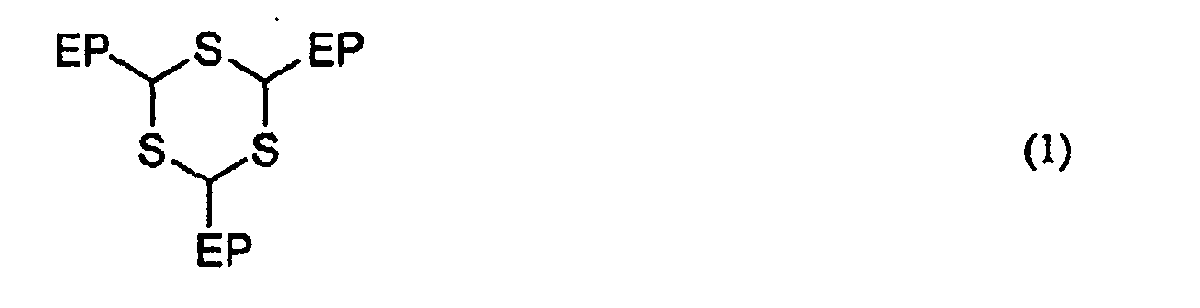
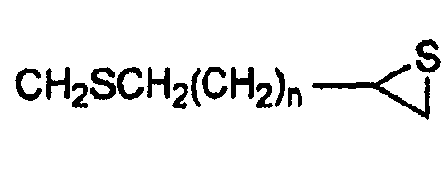
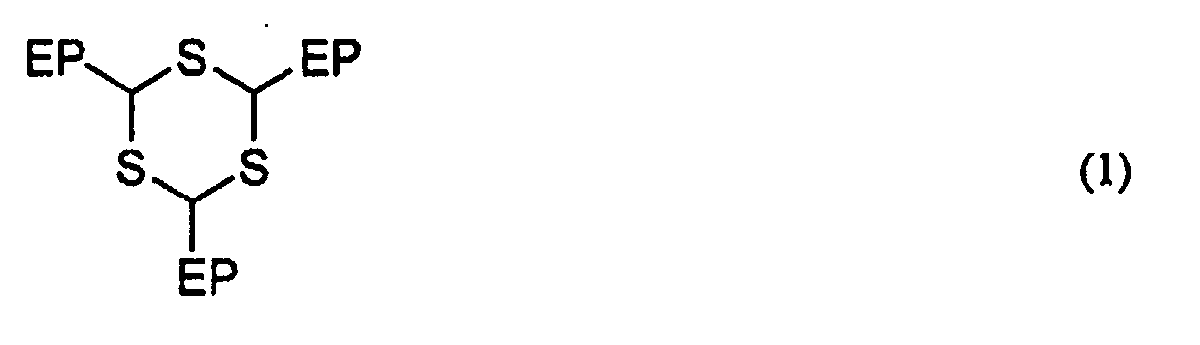
- the invention provides a novel episulfide compound represented by the general formula (1): wherein EP represents and n is an integer of from 0 to 2, and provides a method for producing a novel episulfide compound represented by the general formula (1) by reacting a mercapto group-having episulfide compound with 2,4,6-tri-methylene-1,3,5-trithiane.
- novel episulfide compound of the invention is represented by the general formula (1) mentioned below, from which it is seen that the compounds have three identical episulfide-containing substituents bonded to the trithiane ring thereof.
- EP represents and n is an integer of from 0 to 2.
- the trithiane ring of the episulfide compound represented by the general formula (1) has a high sulfur content, in which the atomic refraction is high and which therefore significantly increases the refractive index of the polymers obtained by using the novel episulfide compound of the invention.
- the ethylene sulfide chain to be formed through ring-cleavage polymerization of the episulfide compound also contributes toward increasing the refractive index of the polymers.
- the Abbe's number of amorphous materials is apt to decrease with the increase in the refractive index thereof.
- One problem with polymers having high sulfur content is that the electron resonance of sulfur is remarkable, therefore often significantly reducing the Abbe's number.
- novel episulfide compounds of the invention are free from the problem.
- Another cause of the increase in the refractive index is the decrease in the molar volume thereof, and it is often seen in polymers having a high crosslinking density and a strong intermolecular force.
- the novel episulfide compound of the invention has three polymerization-functional groups, and the refractive index of its polymers is increased especially by the former effect.
- the increase in the number n lowers the sulfur content and the crosslinking density, therefore giving polymers having a reduced refractive index. Accordingly, n must be in a range of from 0 to 2.
- n must be in a range of from 0 to 2 in order to obtain polymers having good heat resistance.
- the novel episulfide compound represented by the general formula (1) of the invention includes 2,4,6-tris(epithiomethylthiomethyl)-1,3,5-trithiane, 2,4,6-tris(epithioethylthiomethyl)-1,3,5-trithiane, and 2,4,6-tris(epithiopropylthiomethyl)-1,3,5-trithiane.
- novel episulfide compounds of the invention may be efficiently produced according to the method of the invention of reacting 2,4,6-trimethylene-1,3,5-trithiane having a methylene group introduced into its 2,4,6-positions, with a mercapto group-having episulfide compound at the methylene group of the trithiane through ene-thiol reaction.
- the mercapto group-having episulfide compound includes 3-mercaptopropene sulfide, 4-mercaptobutene sulfide, and 5-mercaptopentene sulfide.
- 3-mercaptopropene sulfide may be prepared according to the method described in F.P. Doyle et al., Journal of Chemical Society, p. 2660 (1960).
- the method for producing the novel episulfide compound of the invention comprises the following steps:
- 2,4,6-tris(epithiomethylthiomethyl)-1,3,5-trithiane (a compound of the general formula (1) wherein n is 0) is shown as Scheme 1 mentioned below.
- An aqueous 40 wt.% chloroacetaldehyde solution is dissolved in 70 wt.% sulfuric acid, and hydrogen sulfide is introduced thereinto at -20 to 40°C for 2 to 100 hours to give 2,4,6-tris(chloromethyl)-1,3,5-trithiane.
- the acidic solvent is also usable any of 60/40 (v/v) 95 wt.% sulfuric acid-acetic acid, or hydrogen sulfide-saturated acetic acid, ether or 95 wt.% ethanol, in place of sulfuric acid.
- potassium hydroxide with which the chlorine compound is processed at -10 to 40°C for 0.5 to 10 hours for removal of hydrogen chloride from it to give 2,4,6-trimethylene-1,3,5-trithiane.
- radical generator is usable any of azobisbutyronitrile, benzoyl peroxide, or bis(cyclohexylcarbonyl) peroxide.
- mercapto group-having episulfide compound are also usable 4-mercaptobutene sulfide and 5-mercaptopentene sulfide, in place of 3-merpcaptopropene sulfide, and these give 2,4,6-tris(epithioethylthiomethyl)-1,3,5-trithiane and 2,4,6-tris(epithiopropylthiomethyl)-1,3,5-trithiane, respectively.
- EP represents and Me is a methyl group.
- novel episulfide compound represented by the general formula (1) is an indispensable component, and it may be used either singly or in admixture of two or more thereof. Further, the novel episulfide compound may contain any other optional component including other episulfide compounds, epoxy compounds and homopolymerizable vinyl monomers, for suitably improving the properties of the polymers to be obtained.
- Examples of the optional episulfide compounds are linear organic compounds such as bis( ⁇ -epithiopropylthio)methane, 1,2-bis( ⁇ -epithiopropylthio)ethane, 1,3-bis( ⁇ -epithiopropylthio)propane, 1,2-bis( ⁇ -epithiopropylthio)propane, 1-( ⁇ -epithiopropylthio)-2-( ⁇ -epithiopropylthiomethyl)propane, 1,4-bis( ⁇ -epithiopropylthio)butane, 1,3-bis( ⁇ -epithiopropylthio)butane, 1-( ⁇ -epithiopropylthio)-3-( ⁇ -epithiopropylthiomethyl)butane, 1,5-bis( ⁇ -epithiopropylthio)pentane, 1-( ⁇ -epithiopropylthio)-4-
- the optional epoxy compounds are phenolic epoxy compounds produced through condensation of polyhydric phenol compounds, such as hydroquinone, catechol, resorcinol, bisphenol A, bisphenol F, bisphenol sulfone, bisphenol ether, bisphenol sulfide, bisphenol A halides, and novolak resin, with epihalohydrins; alcoholic epoxy compounds produced through condensation of polyhydric alcohol compounds, such as ethylene glycol, diethylene glycol, triethylene glycol, polyethylene glycol, propylene glycol, dipropylene glycol, polypropylene glycol, 1,3-propanediol, 1,4-butanediol, 1,6-hexanediol, neopentyl glycol, glycerin, trimethylolpropane trimethacrylate, pentaerythritol, 1,3- and 1,4-cyclohexanediols, 1,3- and 1,4-cyclohexanedimethanols
- Examples of the optional, homopolymerizable vinyl monomers are compounds having an ester structure of acrylic or methacrylic acid with a monohydric or polyhydric alcohol, such as methyl acrylate, methyl methacrylate, ethyl acrylate, ethyl methacrylate, ethylene glycol diacrylate, ethylene glycol dimethacrylate, diethylene glycol diacrylate, diethylene glycol dimethacrylate, triethylene glycol diacrylate, triethylene glycol dimethacrylate, polyethylene glycol diacrylate, polyethylene glycol dimethacrylate, 1,3-butylene glycol diacrylate, 1,3-butylene glycol dimethacrylate, 1,6-hexanediol diacrylate, 1,6-hexanediol dimethacrylate, neopentyl glycol diacrylate, neopentyl glycol dimethacrylate, polypropylene glycol diacrylate, polypropylene glycol dimethacrylate
- any other additive such as UV absorbent, antioxidant, discoloration inhibitor, and fluorescent dye for improving the weather resistance of the resulting polymers, so far as the object of the invention is not hindered.
- catalysts may be used for improving the polymerization reactivity.
- amines, phosphines, quaternary ammonium salts, quaternary phosphonium salts, tertiary sulfonium salts, secondary iodonium salts, mineral acids, Lewis acids, organic acids, silicic acids, and tetrafluoroboric acid are effective.
- optical materials can be produced, for example, according to the method mentioned below.
- a uniform composition containing the above-mentioned polymerizable composition and other optional additives is first prepared, and this is cast into a glass or metal mold combined with a resin gasket, and heated and cured therein, according to a known method of casting polymerization.
- the mold may be subjected to mold release or a mold releasing agent may be added to the composition, for facilitating good release of the molded resin from the mold.
- the polymerization temperature varies depending on the compounds to be used, but is generally from -20°C to +150°C; and the polymerization time is from about 0.5 to 72 hours.
- the polymer may be readily colored with an ordinary disperse dye in water or in an organic solvent.
- a carrier may be added to the dye dispersion, or the dyeing bath may be heated. Though not limited thereto, the thus-obtained optical materials are especially favorable for optical products such as plastic lenses.
- the refractive index (n D ) and the Abbe's number ( ⁇ D ) were measured at 25°C with an Abbe's refractometer, DR-M4 manufactured by Atago Co., Ltd.
- T1 2,4,6-tris(epithiomethylthiomethyl)-1,3,5-trithiane (T1) (the general formula (1) wherein n is 0)
- IR (KBr tablet) : 620, 660, 710, 740, 800, 860, 920, 1060, 1095, 1190, 1250, 1420, 1440 cm -1 .
- T3 2,4,6-Tris(epithiopropylthiomethyl)-1,3,5-trithiane (T3) (481 mg) was obtained in the same manner as in Example 1, for which, however, were used 5-mercaptopentene sulfide (1.45 mg) and cyclohexylcarbonyl peroxide (0.3 mg) in place of 3-mercaptopropene sulfide and azobisbutyronitrile, respectively. Its refractive index (n D ) was 1.696, and its Abbe's number ( ⁇ D ) was 30.1.
- IR (KBr tablet): 620, 658, 714, 738, 803, 861, 918, 1064, 1099, 1185, 1244, 1444, 1446 cm -1 .
- T1 0.05 moles
- 2 ⁇ 10 -5 moles of a polymerization catalyst, tetra (n-butyl)phosphonium bromide (CT1) was uniformly stirred at 60°C, and cast into a mold of two glass sheets for lens production.
- CT1 tetra (n-butyl)phosphonium bromide
- the mixture was polymerized under heat at 70°C for 10 hours, then at 80°C for 5 hours and then at 100°C for 3 hours to obtain a lens-shaped polymer.
- Table 1 the polymer obtained in this Application Example 1 was colorless and transparent.
- Lens-shaped polymers were produced in the same manner as in Application Example 1, for which, however, were used the novel episulfide compound (C1 component) of the invention, other episulfide compound, epoxy compound and/or vinyl monomer (C2 component) and the polymerization catalyst as in Table 1, and the polymerization condition was suitably varied.
- Their physical properties are given in Table 1.
- the polymers obtained in Application Examples 2 to 5 were also colorless and transparent.
- Their refractive index (n D ) was extremely high as from 1.709 to 1.778; their Abbe's number ( ⁇ D ) was also high as from 31 to 36 (this means low dispersiveness of the polymers); and their heat resistance (111 to 141°C) and transparency (89 to 96 %) were excellent.
- the polymer obtained in this Comparative Application Example 1 was colorless and transparent (92 %), but its n D / ⁇ D was 1.59/36, or that is, its refractive index was low. Inaddition, its heat resistance (86°C) was inferior.
- Lens-shaped polymers were produced in the same manner as in Comparative Application Example 1, for which, however, were used the materials as in Table 1. Their physical properties are given in Table 1.
- the polymer of Comparative Application Example 2 had n D / ⁇ D of 1.67/28, or that is, its n D and ⁇ D were both low. Though its heat resistance (94°C) was relatively good, it was discolored and its transparency (81 %) was low.
- the polymer of Comparative Application Example 3 had a relatively high ⁇ D of 36, it had good weather resistance, and it was colorless and transparent (89 %). However, its heat resistance (90°C) was not good, its n D was not so high as 1.70, and it was brittle.
- the episulfide compounds of the invention are novel compounds that have three, episulfide group-having reactive substituents bonded to the center trithiane ring, and are favorable for starting materials for optical materials.
- the optical materials obtained by using the novel episulfide compounds of the invention have a high refractive index and a high Abbe's number, and have excellent heat resistance and transparency. Therefore, they are suitable for materials for optical products, for example, for lenses such as those for spectacles and cameras, and also for prisms, optical fibers, substrates for recording media such as optical discs and magnetic discs, as well as for color filters, IR-absorbing filters, etc.
Landscapes
- Chemical & Material Sciences (AREA)
- Organic Chemistry (AREA)
- Health & Medical Sciences (AREA)
- Chemical Kinetics & Catalysis (AREA)
- Medicinal Chemistry (AREA)
- Polymers & Plastics (AREA)
- Polymers With Sulfur, Phosphorus Or Metals In The Main Chain (AREA)
- Organic Low-Molecular-Weight Compounds And Preparation Thereof (AREA)
- Plural Heterocyclic Compounds (AREA)
Abstract
and the method for producing the episulfide compound represented by the general formula (1) comprises reacting a mercapto group-having episulfide compound with 2,4,6-trimethylene-1,3,5-trithiane.
Description
- The present invention relates to a novel episulfide compound, to a method for producing the same and an optical product comprising the same. More precisely, the invention relates to a novel episulfide compound that may give optical materials having a high refractive index and a high Abbe's number and having excellent heat resistance and transparency, to a method for efficiently producing the same and to an optical product comprising the same.
- Plastics are used for various optical applications these days, for example, for lenses and others, as being lightweight, hardly broken and easily colored when compared with glass. For optical plastic materials are generally used poly(diethylene glycol bisallylcarbonate) (CR-39) and poly(methyl methacrylate) . However, these plastics have a refractive index of 1.50 or less. Therefore, for example, when they are used for lens materials, the lenses produced shall be thicker with the increase in their power, and they lose the advantage of plastics that are lightweight. In particular, powerful concave lenses are thick at their periphery, and are therefore unfavorable as causing birefringence and chromatic aberration. For spectacles, inaddition, such thick lenses are often not aesthetic. For obtaining thin lenses, it is effective to increase the refractive index of the materials. In general, the Abbe's number of glass and plastics decreases with the increase in their refractive index, and, as a result, their chromatic aberration increases. Accordingly, are desired plastic materials having a high refractive index and a high Abbe's number.
- For plastic materials having such properties, for example, are proposed (1) polyurethanes obtained through addition-polymerization of a polythiol having bromine in the molecule and a polyisocyanate (Japanese Patent Laid-Open No. 164615/1983); and (2) polythiourethanes obtained through addition-polymerization of a polythiol and a polyisocyanate (Japanese Patent Publication No. 58489/1992 and Japanese Patent Laid-Open No.148340/1993). For the starting material, polythiol for the polythiourethanes of above (2), are specifically proposed branched polythiols having an increased sulfur content (Japanese Patent Laid-Open Nos. 270859/1990 and 148340/1993), and polythiols into which is introduced a dithiane structure for increasing their sulfur content (Japanese Patent Publication No. 5323/1994 and Japanese Patent Laid-Open No. 118390/1995). Further, are proposed (3) polymers of an alkyl sulfide having a polymerization-functional group, episulfide (Japanese Patent Laid-Open Nos. 71580/1997 and 110979/1997).
- However, though their refractive index is increased a little, the polyurethanes of above (1) still have a low Abbe's number and have some other drawbacks in that their lightfastness is poor, their specific gravity is high and therefore, they are not lightweight. Of the polythiourethanes (2), those for which the starting polythiol used has a high sulfur content have an increased refractive index of from about 1.60 to 1.68, but their Abbe's number is lower than that of optical inorganic glass having a refractive index on the same level. Therefore, they still have a problem in that their Abbe's number must be increased more. On the other hand, one example of the alkyl sulfide polymers (3) having an Abbe's number of 36 has an increased refractive index of 1.70. The lenses obtained by using this polymer can be extremely thin and lightweight. However, are still desired plastic materials of which both the Abbe's number and the refractive index are more increased simultaneously.
- The present invention has been made to solve the problems noted above, and its object is to provide a novel compound that may give optical materials having a high refractive index and a high Abbe's number and having excellent heat resistance and transparency, to provide a method for efficiently producing the same and to provide an optical product comprising the same.
- The present inventors assiduously studied to attain the object as above. As a result, it has been found that compounds of 1,3,5-trithiane (hereinafter abbreviated as trithiane) with an episulfide derivative bonded thereto are novel and meet the object as above and that the compounds are efficiently produced in a specific method. On the basis of these findings, the present invention has been completed.
- Specifically, the invention provides a novel episulfide compound represented by the general formula (1):wherein EP represents
 and n is an integer of from 0 to 2,
and provides a method for producing a novel episulfide compound represented by the general formula (1) by reacting a mercapto group-having episulfide compound with 2,4,6-tri-methylene-1,3,5-trithiane. - The novel episulfide compound of the invention is represented by the general formula (1) mentioned below, from which it is seen that the compounds have three identical episulfide-containing substituents bonded to the trithiane ring thereof.wherein EP represents
 and n is an integer of from 0 to 2.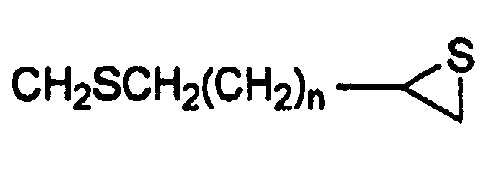
- The trithiane ring of the episulfide compound represented by the general formula (1) has a high sulfur content, in which the atomic refraction is high and which therefore significantly increases the refractive index of the polymers obtained by using the novel episulfide compound of the invention. In addition, the ethylene sulfide chain to be formed through ring-cleavage polymerization of the episulfide compound also contributes toward increasing the refractive index of the polymers. In general, the Abbe's number of amorphous materials is apt to decrease with the increase in the refractive index thereof. One problem with polymers having high sulfur content is that the electron resonance of sulfur is remarkable, therefore often significantly reducing the Abbe's number. However, the novel episulfide compounds of the invention are free from the problem. Another cause of the increase in the refractive index is the decrease in the molar volume thereof, and it is often seen in polymers having a high crosslinking density and a strong intermolecular force. The novel episulfide compound of the invention has three polymerization-functional groups, and the refractive index of its polymers is increased especially by the former effect. In the general formula (1), the increase in the number n lowers the sulfur content and the crosslinking density, therefore giving polymers having a reduced refractive index. Accordingly, n must be in a range of from 0 to 2. In addition, since the glass transition temperature (Tg) of the polymers obtained by using the novel episulfide compound of the invention lowers with the increase in n in the general formula (1), n must be in a range of from 0 to 2 in order to obtain polymers having good heat resistance.
- Concretely, for example, the novel episulfide compound represented by the general formula (1) of the invention includes 2,4,6-tris(epithiomethylthiomethyl)-1,3,5-trithiane, 2,4,6-tris(epithioethylthiomethyl)-1,3,5-trithiane, and 2,4,6-tris(epithiopropylthiomethyl)-1,3,5-trithiane.
- These novel episulfide compounds of the invention may be efficiently produced according to the method of the invention of reacting 2,4,6-trimethylene-1,3,5-trithiane having a methylene group introduced into its 2,4,6-positions, with a mercapto group-having episulfide compound at the methylene group of the trithiane through ene-thiol reaction.
- The mercapto group-having episulfide compound includes 3-mercaptopropene sulfide, 4-mercaptobutene sulfide, and 5-mercaptopentene sulfide.
- For example, 3-mercaptopropene sulfide may be prepared according to the method described in F.P. Doyle et al., Journal of Chemical Society, p. 2660 (1960).
- The method for producing the novel episulfide compound of the invention comprises the following steps:
- (a) reacting chloroacetaldehyde with hydrogen sulfide to obtain 2,4,6-tris(chloromethyl)-1,3,5-trithiane,
- (b) adding a base to the product obtained in step (a) to remove hydrogen chloride to obtain 2,4,6-trimethylene-1,3,5-trithiane,
- (c) reacting said 2,4,6-trimethyl-1,3,5-trithiane with 3-mercaptopropene sulfide/4-mercaptobutene sulfide/5-mercaptopentene sulfide in the presence of a radical generator to obtain said episulfide compounds.
-
- One typical example of the method for producing the novel episulfide compound of the invention, 2,4,6-tris(epithiomethylthiomethyl)-1,3,5-trithiane (a compound of the general formula (1) wherein n is 0) is shown as Scheme 1 mentioned below. An aqueous 40 wt.% chloroacetaldehyde solution is dissolved in 70 wt.% sulfuric acid, and hydrogen sulfide is introduced thereinto at -20 to 40°C for 2 to 100 hours to give 2,4,6-tris(chloromethyl)-1,3,5-trithiane. As the acidic solvent is also usable any of 60/40 (v/v) 95 wt.% sulfuric acid-acetic acid, or hydrogen sulfide-saturated acetic acid, ether or 95 wt.% ethanol, in place of sulfuric acid. To the resulting methanol solution of the thus-formed chlorine compound is added potassium hydroxide with which the chlorine compound is processed at -10 to 40°C for 0.5 to 10 hours for removal of hydrogen chloride from it to give 2,4,6-trimethylene-1,3,5-trithiane. This is thermally reacted with 3-mercaptopropene sulfide at 0 to 100°C for 6 to 100 hours in the presence of a radical generator, to obtain the intended product, 2,4,6-tris(epithiomethylthiomethyl)-1,3,5-trithiane.
- As the radical generator is usable any of azobisbutyronitrile, benzoyl peroxide, or bis(cyclohexylcarbonyl) peroxide.
- As the mercapto group-having episulfide compound are also usable 4-mercaptobutene sulfide and 5-mercaptopentene sulfide, in place of 3-merpcaptopropene sulfide, and these give 2,4,6-tris(epithioethylthiomethyl)-1,3,5-trithiane and 2,4,6-tris(epithiopropylthiomethyl)-1,3,5-trithiane, respectively.wherein EP represents
 and Me is a methyl group.
- Next, are described optical materials obtained by using the novel episulfide compound of the invention. The novel episulfide compound represented by the general formula (1) is an indispensable component, and it may be used either singly or in admixture of two or more thereof. Further, the novel episulfide compound may contain any other optional component including other episulfide compounds, epoxy compounds and homopolymerizable vinyl monomers, for suitably improving the properties of the polymers to be obtained.
- Examples of the optional episulfide compounds are linear organic compounds such as bis(β-epithiopropylthio)methane, 1,2-bis(β-epithiopropylthio)ethane, 1,3-bis(β-epithiopropylthio)propane, 1,2-bis(β-epithiopropylthio)propane, 1-(β-epithiopropylthio)-2-(β-epithiopropylthiomethyl)propane, 1,4-bis(β-epithiopropylthio)butane, 1,3-bis(β-epithiopropylthio)butane, 1-(β-epithiopropylthio)-3-(β-epithiopropylthiomethyl)butane, 1,5-bis(β-epithiopropylthio)pentane, 1-(β-epithiopropylthio)-4-(β-epithiopropylthiomethyl)pentane, 1,6-bis(β-epithiopropylthio)hexane, 1-(β-epithiopropylthio)-5-(β-epithiopropylthiomethyl)hexane,
1-(β-epithiopropylthio)-2-[(2-β-epithiopropylthioethyl)thio]ethane, and 1- (β-epithiopropylthio)-2-[[2-(2-β-epithiopropylthioethyl)thioethyl]thio]ethane; branched organic compounds such as tetrakis(β-epithiopropylthiomethyl)methane, 1,1,1-tris(β-epithiopropylthiomethyl)propane, 1,5-bis(β-epithiopropylthio)-2-(β-epithiopropylthiomethyl)-3-thiapentane, 1,5-bis(β-epithiopropylthio)-2,4-bis(β-epithiopropylthiomethyl)-3-thiapentane, 1-(β-epithiopropylthio)-2,2-bis(β-epithiopropylthiomethyl)-4-thiahexane, 1,5,6-tris(β-epithiopropylthio)-4-(β-epithiopropylthiomethyl)-3-thiahexane, 1,8-bis(β-epithiopropylthio)-4-(β-epithiopropylthiomethyl)-3,6-dithiaoctane, 1,8-bis(β-epithiopropylthio)-4,5-bis(β-epithiopropylthiomethyl)-3,6-dithiaoctane, 1,8-bis(β-epithiopropylthio)-4,4-bis(β-epithiopropylthiomethyl)-3,6-dithiaoctane, 1,8-bis(β-epithiopropylthio)-2,4,5-tris(β-epithiopropylthiomethyl)-3,6-dithiaoctane, 1,8-bis(β-epithiopropylthio)-2,5-bis(β-epithiopropylthiomethyl)-3,6-dithiaoctane, 1,9-bis(β-epithiopropylthio)-5-(β-epithiopropylthiomethyl)-5-[(2-β-epithiopropylthioethyl)thiomethyl]-3,7-dithianonane, 1,10-bis(β-epithiopropylthio)-5,6-bis[(2-β-epithiopropylthioethyl)thio]-3,6,9-trithiadecane, 1,11-bis(β-epithiopropylthio)-4,8-bis(β-epithiopropylthiomethyl)-3,6,9-trithiaundecane, 1,11-bis(β-epithiopropylthio)-5,7-bis(β-epithiopropylthiomethyl)-3,6,9-trithiaundecane, and 1,11-bis(β-epithiopropylthio)-5,7-[(2-β-epithiopropylthioethyl)thiomethyl]-3,6,9-trithiaundecane, 1,11-bis(β-epithiopropylthio)-4,7-bis(β-epithiopropylthiomethyl)-3,6,9-trithiaundecane, and compounds derived therefrom by substituting at least one hydrogen of the episulfide group with a methyl group; alicyclic organic compounds such as 1,3-and 1,4-bis(β-epithiopropylthio)cyclohexanes, 1,3- and 1,4-bis(β-epithiopropylthiomethyl)cyclohexanes, bis [4-(β-epithiopropylthio)cyclohexyl]methane, 2,2-bis[4-(β-epithiopropylthio)cyclohexyl]propane, bis [4-(β-epithiopropylthio)cyclohexyl] sulfide, 2,5-bis(β-epithiopropylthiomethyl)-1,4-dithiane, and 2,5-bis(β-epithiopropylthioethylthiomethyl)-1,4-dithiane, and compounds derived therefrom by substituting at least one hydrogen of the episulfide group therein with a methyl group; and aromatic organic compounds such as 1,3- and 1,4-bis(β-epithiopropylthio)benzenes, 1,3- and 1,4-bis(β-epithiopropylthiomethyl)benzenes, bis [4-(β-epithiopropylthio)phenyl]methane, 2,2-bis[4-(β-epithiopropylthio)phenyl]propane, bis[4-(β-epithiopropylthio)phenyl] sulfide, bis [4-(β-epithiopropylthio)phenyl] sulfone, and 4,4'-bis(β-epithiopropylthio)biphenyl, and compounds derived therefrom by substituting at least one hydrogen of the episulfide group with a methyl group. They may be used herein either singly or in admixture of two or more thereof. The amount to be used is preferably from 0.01 to 50 mole% of the total amount of the novel episulfide compound represented by the general formula (1). - Examples of the optional epoxy compounds are phenolic epoxy compounds produced through condensation of polyhydric phenol compounds, such as hydroquinone, catechol, resorcinol, bisphenol A, bisphenol F, bisphenol sulfone, bisphenol ether, bisphenol sulfide, bisphenol A halides, and novolak resin, with epihalohydrins; alcoholic epoxy compounds produced through condensation of polyhydric alcohol compounds, such as ethylene glycol, diethylene glycol, triethylene glycol, polyethylene glycol, propylene glycol, dipropylene glycol, polypropylene glycol, 1,3-propanediol, 1,4-butanediol, 1,6-hexanediol, neopentyl glycol, glycerin, trimethylolpropane trimethacrylate, pentaerythritol, 1,3- and 1,4-cyclohexanediols, 1,3- and 1,4-cyclohexanedimethanols, hydrogenated bisphenol A, bisphenol A-ethylene oxide adduct, and bisphenol A-propylene oxide adduct, with epihalohydrins; glycidyl ester-based epoxy compounds produced through condensation of polyhydric carboxylic acid compounds, such as adipic acid, sebacic acid, decanedicarboxylic acid, dimer acids, phthalic acid, isophthalic acid, terephthalic acid, tetrahydrophthalic acid, methyltetrahydrophthalic acid, hexahydrophthalic acid, hexahydroisophtalic acid, hexahydroterephthalic acid, HET acid, nadic acid, maleic acid, succinic acid, fumaric acid, trimellitic acid, benzenetetracarboxylic acid, benzophenonetetracarboxylic acid, naphthalenedicarboxylic acid, and diphenyldicarboxylic acid, with epihalohydrins;
amine-basedepoxy compounds produced through condensation of primary amines, such as ethylenediamine, 1,2-diaminopropane, 1,3-diaminopropane, 1,2-diaminobutane, 1,3-diaminobutane, 1,4-diaminobutane, 1,5-diaminopentane, 1,6-diaminohexane, 1,7-diaminoheptane, 1,8-diaminooctane, bis(3-aminopropyl) ether, 1,2-bis(3-aminopropoxy)ethane, 1,3-bis(3-aminopropoxy)-2,2'-dimethylpropane, 1,2-, 1,3- and
1,4-bisaminocyclohexanes, 1,3- and
1,4-bisaminomethylcyclohexanes, 1,3- and
1,4-bisaminoethylcyclohexanes, 1,3- and
1,4-bisaminopropylcyclohexanes, hydrogenated
4,4'-diaminodiphenylmethane, isophoronediamine,
1,4-bisaminopropylpiperazine, m- and p-phenylenediamines, 2,4-and 2,6-tolylenediamine, m- and p-xylylenediamines, 1,5- and 2,6-naphthalenediamines, 4,4'-diaminodiphenylmethane,
4,4'-diaminodiphenyl ether, and
2,2-(4,4'-diaminodiphenyl)propane, or secondary amines, such as N,N'-dimethylethylenediamine,
N,N'-dimethyl-1,2-diaminopropane,
N,N'-dimethyl-1,3-diaminopropane,
N,N'-dimethyl-1,2-diaminobutane,
N,N'-dimethyl-1,3-diaminobutane, N,N'-dimethyl-1,4-diaminobutane, N,N'-dimethyl-1,5-diaminopentane, N,N'-dimethyl-1,6-diaminohexane, N,N'-dimethyl-1,7-diaminoheptane, N,N'-diethylethylenediamine, N,N'-diethyl-1,2-diaminopropane, N,N'-diethyl-1,3-diaminopropane, N,N'-diethyl-1,2-diaminobutane, N,N'-diethyl-1,3-diaminobutane, N,N'-diethyl-1,4-diaminobutane, N,N'-diethyl-1,6-diaminohexane, piperazine, 2-methylpiperazine, 2,5- and 2,6-dimethylpiperazines, homopiperazine, 1,1-di(4-piperidyl)methane, 1,2-di(4-piperidyl)ethane, 1,3-di(4-piperidyl)propane, and 1,4-di(4-piperidyl)butane, with epihalohydrins; alicyclic epoxy compounds such as 3,4-epoxycyclohexyl 3,4-epoxycyclohexanecarboxylate, vinylcyclohexane dioxide,
2-(3,4-epoxycyclohexyl)-5,5-spiro-3,4-epoxycyclohexanemetad ioxane, and bis(3,4-epoxycyclohexyl) adipate; epoxy compounds produced through epoxydation of unsaturated compounds, such as cyclopentadiene epoxide, epoxidated soybean oil, epoxydated polybutadiene, and vinylcyclohexene epoxide; and urethane-based epoxy compounds obtained from the above-mentioned polyhydric alcohols or phenolic compounds with diisocyanates and glycidols. They may be used herein either singly or in admixture of two or more thereof. The amount to be used is preferably from 0.01 to 50 mole% of the total amount of the novel episulfide compound represented by the general formula (1). - Examples of the optional, homopolymerizable vinyl monomers are compounds having an ester structure of acrylic or methacrylic acid with a monohydric or polyhydric alcohol, such as methyl acrylate, methyl methacrylate, ethyl acrylate, ethyl methacrylate, ethylene glycol diacrylate, ethylene glycol dimethacrylate, diethylene glycol diacrylate, diethylene glycol dimethacrylate, triethylene glycol diacrylate, triethylene glycol dimethacrylate, polyethylene glycol diacrylate, polyethylene glycol dimethacrylate, 1,3-butylene glycol diacrylate, 1,3-butylene glycol dimethacrylate, 1,6-hexanediol diacrylate, 1,6-hexanediol dimethacrylate, neopentyl glycol diacrylate, neopentyl glycol dimethacrylate, polypropylene glycol diacrylate, polypropylene glycol dimethacrylate, 2,2-bis[4-(acryloxyethoxy)phenyl]propane, 2,2-bis[4-(methacryloxyethoxy)phenyl]propane, 2,2-bis[4-(acryloxydiethoxy)phenyl]propane, 2,2-bis[4-(methacryloxydiethoxy)phenyl]propane, 2,2-bis[4-(acryloxypolyethoxy)phenyl]propane, 2,2-bis[4-(methacryloxypolyethoxy)phenyl]propane, trimethylolpropane triacrylate, trimethylolpropane trimethacrylate, pentaerythritol tetraacrylate, pentaerythritol tetramethacrylate, bis(2,2,2-trimethylolethyl) ether hexaacrylate, and bis(2,2,2-trimethylolethyl) ether hexamethacrylate; allyl compounds such as allyl sulfide, diallylphthalate, anddiethylene glycol bisallylcarbonate; vinyl compounds such as acrolein, acrylonitrile, and vinyl sulfide; and aromatic vinyl compounds such as styrene, α-methylstyrene, methylvinylbenzene,
ethylvinylbenzene, α-chlorostyrene, chlorovinylbenzene, vinylbenzyl chloride, paradivinylbenzene, and metadivinylbenzene. They may be used herein either singly or in admixture of two or more thereof. The amount to be used is preferably from 0.01 to 20 mole% of the total amount of the novel episulfide compound represented by the general formula (1). - To the polymerizable composition that comprises the above-mentioned indispensable component and optional components, if desired, is optionally added any other additive, such as UV absorbent, antioxidant, discoloration inhibitor, and fluorescent dye for improving the weather resistance of the resulting polymers, so far as the object of the invention is not hindered. Also if desired, catalysts may be used for improving the polymerization reactivity. For the catalysts, for example, amines, phosphines, quaternary ammonium salts, quaternary phosphonium salts, tertiary sulfonium salts, secondary iodonium salts, mineral acids, Lewis acids, organic acids, silicic acids, and tetrafluoroboric acid are effective.
- Using the novel episulfide compounds of the invention, optical materials can be produced, for example, according to the method mentioned below.
- A uniform composition containing the above-mentioned polymerizable composition and other optional additives is first prepared, and this is cast into a glass or metal mold combined with a resin gasket, and heated and cured therein, according to a known method of casting polymerization. If desired, the mold may be subjected to mold release or a mold releasing agent may be added to the composition, for facilitating good release of the molded resin from the mold. The polymerization temperature varies depending on the compounds to be used, but is generally from -20°C to +150°C; and the polymerization time is from about 0.5 to 72 hours. After having been thus polymerized and released from the mold, the polymer may be readily colored with an ordinary disperse dye in water or in an organic solvent. For facilitating the dyeing, a carrier may be added to the dye dispersion, or the dyeing bath may be heated. Though not limited thereto, the thus-obtained optical materials are especially favorable for optical products such as plastic lenses.
- The invention is described more concretely with reference to the following Examples, which, however, are not intended to restrict the scope of the invention. The physical properties of the novel episulfide compounds obtained in the Examples, and those of the polymers obtained in the following Application Examples and Comparative Application Examples were measured according to the methods mentioned below.
- The refractive index (nD) and the Abbe's number (νD) were measured at 25°C with an Abbe's refractometer, DR-M4 manufactured by Atago Co., Ltd.
-
- 1) Refractive index (nD) and Abbe's number (νD): Measured in the same manner as above.
- 2) Appearance: Visually checked.
- 3) Heat resistance: Measured with a TMA analyzer manufactured by Rigaku International Corporation. Concretely, using a pin having a diameter of 0.5 mm, TMA of each sample was measured under a load of 98 mN (10 gf) at a heating rate of 10°C/min. From the peak temperature appearing in the chart, the heat resistance of the sample was evaluated.
- 4) Transparency: Using a UV spectrometer, UV-330 manufactured by Hitachi, Ltd., the 550 nm UV transmittance was measured, from which the transparency was evaluated.
-
- 70 wt.% (v/v) sulfuric acid (100 ml) was bubbled with hydrogen sulfide for 30 minutes at 0°C, to which was dropwise added 40 wt.% chloroacetaldehyde (17.5 ml) at 0°C over 7.5 hours. Still at the temperature, this was further bubbled with hydrogen sulfide for 24 hours. The aqueous solution of the upper layer was removed through decantation, and the residue soluble in dichloromethane (150 ml) was washed with water (25 ml × 3 times), dried over anhydrous magnesium sulfate, and filtered. The solvent was evaporated away, and a pale yellow crude product (9.5 g) was obtained. The crude product was washed with hexane (40 ml × 4 times), hexane/ether (6/1) (50 ml × 2 times) and hot hexane (30 ml × 2 times), and dried in vacuum to obtain a white crystal, 2,4,6-tris(chloromethyl)-1,3,5-trithiane (2.50 g). To a methanol (25 ml) solution of this compound (0.3 g, 1.06 mmoles) was added a methanol solution (5 ml) of potassium hydroxide (0.62 g, 11 mmoles) all at a time with vigorously stirring at room temperature, and this was further stirred at room temperature for 75 minutes. The reaction mixture was diluted with water (30 ml), and extracted with dichloromethane (20 ml × 5 times), and the resulting extract was dried over anhydrous magnesium sulfate and filtered. The solvent was evaporated away from the filtrate, and an yellow oily residue, 2,4,6-trimethylene-1,3,5-trithiane (150 mg) was thus obtained. To a benzene (1 ml) solution of this compound (0.47 g) were added 3-mercaptopropene sulfide (1.14g) and azobisbutyronitrile (0.2 mg), and the mixture was stirred in an argon atmosphere at 40°C for 2 hours. The solvent was evaporated away from the reaction mixture, and the resulting residue was recrystallized from chloroform/methanol to obtain a crystal of 2,4,6-tris(epithiomethylthiomethyl)-1,3,5-trithiane (411 mg) (m.p. = 55 to 56°C).
- For identifying its structure, the compound was analyzed and its data are shown below.
- 1H-NMR (solvent, CDCl3; internal standard substance, TMS): δ2.27 (d, 3H), δ2.59 (d, 3H), δ2.76 (m, 3H), δ3.19-3.29 (m, 12H), δ4.37-4.63 (t,t,m, 3H).
- IR (KBr tablet) : 620, 660, 710, 740, 800, 860, 920, 1060, 1095, 1190, 1250, 1420, 1440 cm-1.
- 2,4,6-Tris(epithiopropylthiomethyl)-1,3,5-trithiane (T3) (481 mg) was obtained in the same manner as in Example 1, for which, however, were used 5-mercaptopentene sulfide (1.45 mg) and cyclohexylcarbonyl peroxide (0.3 mg) in place of 3-mercaptopropene sulfide and azobisbutyronitrile, respectively. Its refractive index (nD) was 1.696, and its Abbe's number (νD) was 30.1.
- For identifying its structure, the compound was analyzed and its data are shown below.
- 1H-NMR (solvent, CDCl3; internal standard substance, TMS) :
- δ2.29 (d, 3H), δ2.44-2.52 (m, 12H), δ2.58 (d, 3H), δ2.74 (m, 3H), δ3.12-3.16 (m, 6H), δ3.25-3.31 (m, 6H), δ4.39-4.66 (t,t,m, 3H).
- IR (KBr tablet): 620, 658, 714, 738, 803, 861, 918, 1064, 1099, 1185, 1244, 1444, 1446 cm-1.
- A mixture of T1 (0.05 moles) obtained in Example 1 and 2 × 10⁻⁵ moles of a polymerization catalyst, tetra (n-butyl)phosphonium bromide (CT1) was uniformly stirred at 60°C, and cast into a mold of two glass sheets for lens production. In the mold, the mixture was polymerized under heat at 70°C for 10 hours, then at 80°C for 5 hours and then at 100°C for 3 hours to obtain a lens-shaped polymer. The physical properties of the thus-obtained polymer are given in Table 1. As in Table 1, the polymer obtained in this Application Example 1 was colorless and transparent. Its refractive index (nD) was extremely high as 1.796; its Abbe's number (νD) was also high as 30 (this means low dispersiveness of the polymer); and its heat resistance (135°C) and transparency (92 %) were excellent. Accordingly, the polymer obtained was favorable to optical materials.
- Lens-shaped polymers were produced in the same manner as in Application Example 1, for which, however, were used the novel episulfide compound (C1 component) of the invention, other episulfide compound, epoxy compound and/or vinyl monomer (C2 component) and the polymerization catalyst as in Table 1, and the polymerization condition was suitably varied. Their physical properties are given in Table 1. As in Table 1, the polymers obtained in Application Examples 2 to 5 were also colorless and transparent. Their refractive index (nD) was extremely high as from 1.709 to 1.778; their Abbe's number (νD) was also high as from 31 to 36 (this means low dispersiveness of the polymers); and their heat resistance (111 to 141°C) and transparency (89 to 96 %) were excellent.
- As in Table 1, a mixture of 0.1 moles of pentaerythritol tetrakismercaptopropionate (CE5), 0.2 moles of m-xylylene diisocyanate (CE6) and 1.0 × 10⁻⁴ moles of dibutyltin dichloride (CT5) was uniformly stirred, and cast into a mold of two glass sheets for lens production. In the mold, the mixture was polymerized under heat at 50°C for 10 hours, then at 60°C for 5 hours and then at 120°C for 3 hours to obtain a lens-shaped polymer. The physical properties of the thus-obtained polymer are given in Table 1. As in Table 1, the polymer obtained in this Comparative Application Example 1 was colorless and transparent (92 %), but its nD/νD was 1.59/36, or that is, its refractive index was low. Inaddition, its heat resistance (86°C) was inferior.
- Lens-shaped polymers were produced in the same manner as in Comparative Application Example 1, for which, however, were used the materials as in Table 1. Their physical properties are given in Table 1. As in Table 1, the polymer of Comparative Application Example 2 had nD/νD of 1.67/28, or that is, its nD and νD were both low. Though its heat resistance (94°C) was relatively good, it was discolored and its transparency (81 %) was low. The polymer of Comparative Application Example 3 had a relatively high νD of 36, it had good weather resistance, and it was colorless and transparent (89 %). However, its heat resistance (90°C) was not good, its nD was not so high as 1.70, and it was brittle.


- The episulfide compounds of the invention are novel compounds that have three, episulfide group-having reactive substituents bonded to the center trithiane ring, and are favorable for starting materials for optical materials. The optical materials obtained by using the novel episulfide compounds of the invention have a high refractive index and a high Abbe's number, and have excellent heat resistance and transparency. Therefore, they are suitable for materials for optical products, for example, for lenses such as those for spectacles and cameras, and also for prisms, optical fibers, substrates for recording media such as optical discs and magnetic discs, as well as for color filters, IR-absorbing filters, etc.
Claims (12)
- An episulfide compound represented by the general formula (1):wherein EP represents
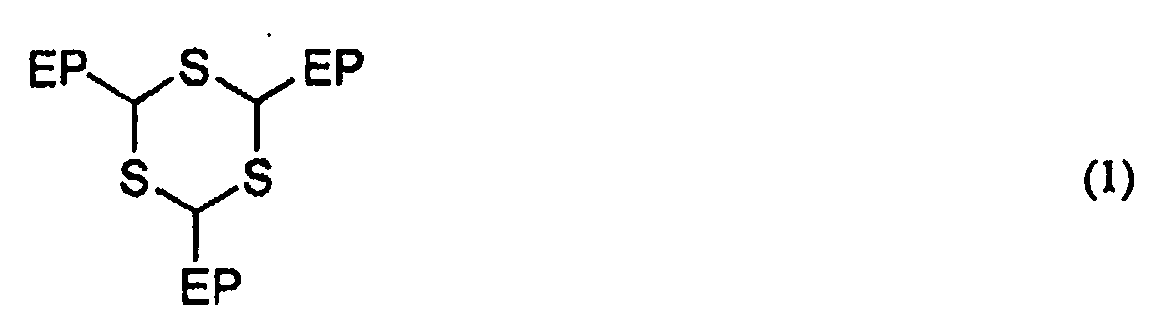 and n is an integer of from 0 to 2.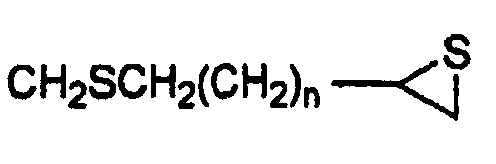
- The episulfide compound according to claim 1, wherein the episulfide compound represented by the general formula (1) is 2,4,6-tris(epithiomethylthiomethyl)-1,3,5-trithiane, 2,4,6-tris(epithioethylthiomethyl)-1,3,5-trithiane, or 2,4,6-tris(epithiopropylthiomethyl)-1,3,5-trithiane.
- A method for producing an episulfide compound represented by the general formula (1):wherein EP represents
 and n is an integer of from 0 to 2,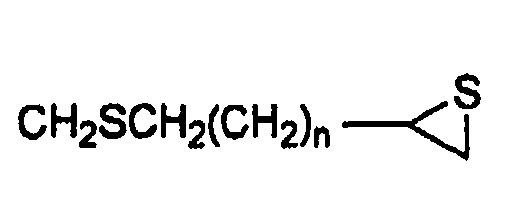
which comprises reacting a mercapto group-having episulfide compound with 2,4,6-trimethylene-1,3,5-trithiane. - The method for producing an episulfide compound according to claim 3, wherein the mercapto group-having episulfide compoundis3-mercaptopropenesulfide,4-mercaptobutenesulfide, or 5-mercaptopentene sulfide.
- The method for producing an episulfide compound according to claim 3 , wherein the episulfide compound represented by the general formula (1) is 2,4,6-tris(epithiomethylthiomethyl)-1,3,5-trithiane, 2,4,6-tris(epithioethylthiomethyl)-1,3,5-trithiane, or 2,4,6-tris(epithiopropylthiomethyl)-1,3,5-trithiane.
- An optical product comprising a polymer obtained by using, as an indispensable monomer component, at least an episulfide compound represented by the general formula (1):wherein EP represents
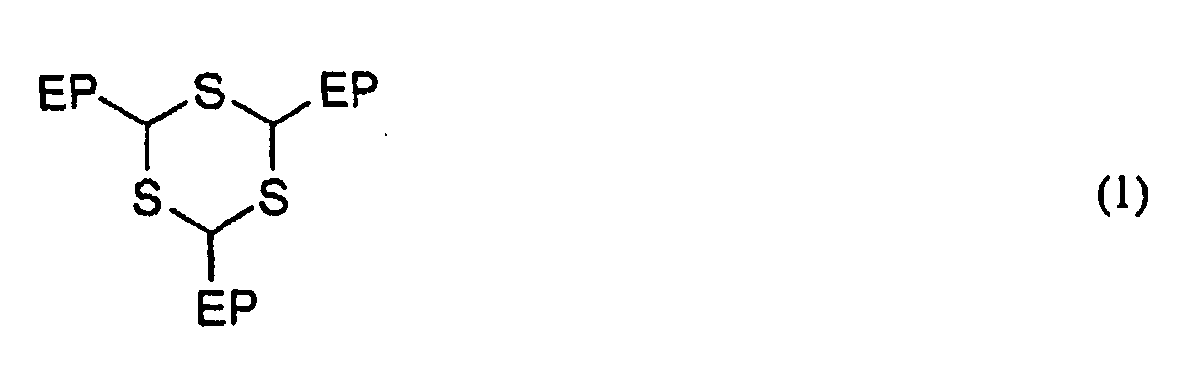 and n is an integer of from 0 to 2.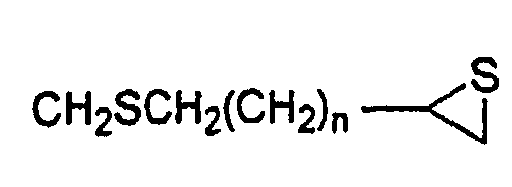
- The optical product according to claim 6, wherein the episulfide compound represented by the general formula (1) is 2,4,6-tris(epithiomethylthiomethyl)-1,3,5-trithiane, 2,4,6-tris(epithioethylthiomethyl)-1,3,5-trithiane, or 2,4,6-tris(epithiopropylthiomethyl)-1,3,5-trithiane.
- The optical product according to claim 6, wherein the polymer comprises the episulfide compound represented by the general formula (1) and another episulfide compound.
- The optical product according to claim 6, wherein the polymer comprises the episulfide compound represented by the general formula (1) and an epoxy compound.
- The optical product according to claim 6, wherein the polymer comprises the episulfide compound represented by the general formula (1) and a homopolymerizable vinyl monomer.
- The optical product according to claim 6, wherein the polymer comprises the episulfide compound represented by the general formula (1), a polyisocyanate compound and/or a polyisothiocyanate compound, and a polythiol compound.
- The optical product according to any one of claims 6 to 11, wherein the optical product is a plastic lens.
Applications Claiming Priority (2)
| Application Number | Priority Date | Filing Date | Title |
|---|---|---|---|
| JP2001362375A JP4076760B2 (en) | 2001-11-28 | 2001-11-28 | Episulfide compound and method for producing the same |
| JP2001362375 | 2001-11-28 |
Publications (2)
| Publication Number | Publication Date |
|---|---|
| EP1316555A1 true EP1316555A1 (en) | 2003-06-04 |
| EP1316555B1 EP1316555B1 (en) | 2005-02-02 |
Family
ID=19172881
Family Applications (1)
| Application Number | Title | Priority Date | Filing Date |
|---|---|---|---|
| EP02021210A Expired - Lifetime EP1316555B1 (en) | 2001-11-28 | 2002-09-18 | Episulfide compound, method for producing the same and optical product comprising the same |
Country Status (9)
| Country | Link |
|---|---|
| US (1) | US6696540B2 (en) |
| EP (1) | EP1316555B1 (en) |
| JP (1) | JP4076760B2 (en) |
| KR (2) | KR100538015B1 (en) |
| CN (1) | CN1239499C (en) |
| AT (1) | ATE288429T1 (en) |
| AU (1) | AU2002301989B2 (en) |
| CA (1) | CA2406303A1 (en) |
| DE (1) | DE60202832T2 (en) |
Cited By (2)
| Publication number | Priority date | Publication date | Assignee | Title |
|---|---|---|---|---|
| EP1484352A4 (en) * | 2002-03-12 | 2005-11-16 | Mitsui Chemicals Inc | Thioepoxy based polymerizable composition and method for production thereof |
| US12588406B2 (en) | 2021-09-29 | 2026-03-24 | Beijing Boe Technology Development Co., Ltd. | Quantum dot ligand, quantum dot-ligand system and quantum dot material |
Families Citing this family (12)
| Publication number | Priority date | Publication date | Assignee | Title |
|---|---|---|---|---|
| WO2006033406A1 (en) * | 2004-09-24 | 2006-03-30 | Hoya Corporation | Method for producing cyclic sulfide compound and intermediate thereof |
| WO2006033405A1 (en) * | 2004-09-24 | 2006-03-30 | Hoya Corporation | Cyclic sulfide compound and optical article using same |
| JP4806538B2 (en) * | 2005-04-28 | 2011-11-02 | Hoya株式会社 | Method for producing acyloxy compound |
| US7258437B2 (en) * | 2005-09-07 | 2007-08-21 | Transitions Optical, Inc. | Photochromic multifocal optical article |
| JP4965838B2 (en) * | 2005-09-27 | 2012-07-04 | Hoya株式会社 | Sulfide compound and method for producing the same |
| US20090032088A1 (en) * | 2007-08-03 | 2009-02-05 | Mario Rabinowitz | Sealants for Solar Energy Concentrators and Similar Equipment |
| KR100960464B1 (en) * | 2007-08-09 | 2010-05-28 | 주식회사 하이닉스반도체 | Anti-reflective polymer, anti-reflective composition comprising same and pattern forming method using same |
| KR101113663B1 (en) * | 2011-01-25 | 2012-02-14 | 이채영 | Mirror-based light emitting display device |
| CN104098541B (en) * | 2014-06-20 | 2016-05-11 | 黄河三角洲京博化工研究院有限公司 | A kind of 2,4,6-trichloromethyl-1, the preparation method of 3,5-trithiane and homologue thereof |
| WO2020050013A1 (en) * | 2018-09-07 | 2020-03-12 | 三菱瓦斯化学株式会社 | Composition for optical material and optical material |
| CN116745350A (en) * | 2021-03-10 | 2023-09-12 | 株式会社Lg化学 | Curable compositions and optical materials containing the same |
| CN116125749B (en) * | 2022-12-19 | 2026-01-30 | 杭州光粒科技有限公司 | A photopolymer composition for holographic recording and a grating |
Citations (2)
| Publication number | Priority date | Publication date | Assignee | Title |
|---|---|---|---|---|
| EP0785194A1 (en) * | 1996-01-17 | 1997-07-23 | Mitsubishi Gas Chemical Company, Inc. | Episulfide compound |
| WO2002023230A1 (en) * | 2000-09-14 | 2002-03-21 | Mitsubishi Gas Chemical Company, Inc. | Composition for optical material |
Family Cites Families (9)
| Publication number | Priority date | Publication date | Assignee | Title |
|---|---|---|---|---|
| JPS58164615A (en) | 1982-03-25 | 1983-09-29 | Toray Ind Inc | Resin for plastic lens |
| JPS60199016A (en) | 1984-03-23 | 1985-10-08 | Mitsui Toatsu Chem Inc | Thiocarbomic acid s-alkyl ester resin for lens |
| JP2621991B2 (en) | 1988-12-22 | 1997-06-18 | 三井東圧化学株式会社 | Mercapto compound and method for producing the same |
| JPH065323B2 (en) | 1989-12-28 | 1994-01-19 | ホーヤ株式会社 | Optical material and optical product obtained by using polythiol compound |
| JP3115371B2 (en) | 1991-09-03 | 2000-12-04 | ホーヤ株式会社 | Polymer for optical material and method for producing the same |
| JP2813535B2 (en) | 1993-10-19 | 1998-10-22 | ホーヤ株式会社 | Optical material and method for manufacturing the same |
| JP3491660B2 (en) | 1995-08-16 | 2004-01-26 | 三菱瓦斯化学株式会社 | Novel linear alkyl sulfide type episulfide compound |
| JPH0971590A (en) | 1995-09-06 | 1997-03-18 | Sumitomo Chem Co Ltd | Optically active amino alcohols, method for producing the same, asymmetric reducing agent using the same, method for producing optically active alcohols using the asymmetric reducing agent |
| WO2000023230A1 (en) * | 1998-10-19 | 2000-04-27 | Speedfam-Ipec Corporation | Catastrophic error recovery apparatus and associated methods |
-
2001
- 2001-11-28 JP JP2001362375A patent/JP4076760B2/en not_active Expired - Fee Related
-
2002
- 2002-09-18 EP EP02021210A patent/EP1316555B1/en not_active Expired - Lifetime
- 2002-09-18 DE DE60202832T patent/DE60202832T2/en not_active Expired - Lifetime
- 2002-09-18 AT AT02021210T patent/ATE288429T1/en not_active IP Right Cessation
- 2002-10-02 CA CA002406303A patent/CA2406303A1/en not_active Abandoned
- 2002-11-14 AU AU2002301989A patent/AU2002301989B2/en not_active Ceased
- 2002-11-15 KR KR10-2002-0071104A patent/KR100538015B1/en not_active Expired - Fee Related
- 2002-11-20 US US10/299,685 patent/US6696540B2/en not_active Expired - Lifetime
- 2002-11-28 CN CNB021524645A patent/CN1239499C/en not_active Expired - Fee Related
-
2005
- 2005-02-18 KR KR10-2005-0013686A patent/KR100495111B1/en not_active Expired - Fee Related
Patent Citations (2)
| Publication number | Priority date | Publication date | Assignee | Title |
|---|---|---|---|---|
| EP0785194A1 (en) * | 1996-01-17 | 1997-07-23 | Mitsubishi Gas Chemical Company, Inc. | Episulfide compound |
| WO2002023230A1 (en) * | 2000-09-14 | 2002-03-21 | Mitsubishi Gas Chemical Company, Inc. | Composition for optical material |
Non-Patent Citations (3)
| Title |
|---|
| DATABASE CA CHEMICAL ABSTRACTS SERVICE, COLUMBUS, OHIO, US; YOSHIMURA, Y.; TAKEUCHI, M.: "Composite Optical Material", XP002220583 * |
| MATLACK, A. S.; CHIEN, J. C. W.; BRESLOW, D. S.: "Alkyl-Substituted s-Trithianes Containing Functional Groups in the Side Chain", J. ORG. CHEM., vol. 26, 1961, pages 1455 - 1460, XP001121551 * |
| RINZEMA, L. C.;STOFFELSMA, J.; ARENS, J. F.: "Othothioesters and 1,1-Bis-(ethylthio)-1-alkenes (Thioacetals of Ketenes)", RECL. TRAV. CHIM. PAYS-BAS, no. 78, 1959, pages 354 - 363, XP009003092 * |
Cited By (3)
| Publication number | Priority date | Publication date | Assignee | Title |
|---|---|---|---|---|
| EP1484352A4 (en) * | 2002-03-12 | 2005-11-16 | Mitsui Chemicals Inc | Thioepoxy based polymerizable composition and method for production thereof |
| US7354989B2 (en) | 2002-03-12 | 2008-04-08 | Mitsui Chemicals, Inc. | Thioepoxy based polymerizable composition and method for production thereof |
| US12588406B2 (en) | 2021-09-29 | 2026-03-24 | Beijing Boe Technology Development Co., Ltd. | Quantum dot ligand, quantum dot-ligand system and quantum dot material |
Also Published As
| Publication number | Publication date |
|---|---|
| KR20050026455A (en) | 2005-03-15 |
| JP4076760B2 (en) | 2008-04-16 |
| KR100538015B1 (en) | 2005-12-21 |
| CA2406303A1 (en) | 2003-05-28 |
| CN1421445A (en) | 2003-06-04 |
| JP2003160582A (en) | 2003-06-03 |
| KR100495111B1 (en) | 2005-06-14 |
| AU2002301989B2 (en) | 2004-04-22 |
| DE60202832T2 (en) | 2006-01-19 |
| CN1239499C (en) | 2006-02-01 |
| US20030144431A1 (en) | 2003-07-31 |
| DE60202832D1 (en) | 2005-03-10 |
| ATE288429T1 (en) | 2005-02-15 |
| KR20030043661A (en) | 2003-06-02 |
| US6696540B2 (en) | 2004-02-24 |
| EP1316555B1 (en) | 2005-02-02 |
Similar Documents
| Publication | Publication Date | Title |
|---|---|---|
| EP1316555B1 (en) | Episulfide compound, method for producing the same and optical product comprising the same | |
| EP1316556B1 (en) | Opical product comprising a thiol compound | |
| EP1270566A1 (en) | Episulfide compound and process for producing the same | |
| KR100754955B1 (en) | Optics containing cyclic disulfide compounds | |
| JP3730107B2 (en) | Manufacturing method of plastic lens | |
| JP3400406B2 (en) | Optical products | |
| EP1211276B1 (en) | Optical product, asymmetric disulfide compound used therefor and method for producing the asymmetric disulfide compound | |
| JP3768397B2 (en) | Asymmetric disulfide compound and method for producing the same | |
| JP3366606B2 (en) | Thioepoxy compounds | |
| JP4965838B2 (en) | Sulfide compound and method for producing the same | |
| JP3705993B2 (en) | Metal-containing episulfide compound and method for producing the same | |
| JP2003161921A (en) | Optical product fabricated by using episulfide compound | |
| JP4751044B2 (en) | Optical products | |
| JP2003233036A (en) | Optical products using cyclic disulfide compounds | |
| JP2004307459A (en) | Disulfide, method for producing the same, and precursor thereof | |
| JP2007271744A (en) | Optical product | |
| WO2006033405A1 (en) | Cyclic sulfide compound and optical article using same |
Legal Events
| Date | Code | Title | Description |
|---|---|---|---|
| PUAI | Public reference made under article 153(3) epc to a published international application that has entered the european phase |
Free format text: ORIGINAL CODE: 0009012 |
|
| AK | Designated contracting states |
Designated state(s): AT BE BG CH CY CZ DE DK EE ES FI FR GB GR IE IT LI LU MC NL PT SE SK TR |
|
| AX | Request for extension of the european patent |
Extension state: AL LT LV MK RO SI |
|
| 17P | Request for examination filed |
Effective date: 20031110 |
|
| AKX | Designation fees paid |
Designated state(s): AT BE BG CH CY CZ DE DK EE ES FI FR GB GR IE IT LI LU MC NL PT SE SK TR |
|
| GRAP | Despatch of communication of intention to grant a patent |
Free format text: ORIGINAL CODE: EPIDOSNIGR1 |
|
| GRAS | Grant fee paid |
Free format text: ORIGINAL CODE: EPIDOSNIGR3 |
|
| GRAA | (expected) grant |
Free format text: ORIGINAL CODE: 0009210 |
|
| AK | Designated contracting states |
Kind code of ref document: B1 Designated state(s): AT BE BG CH CY CZ DE DK EE ES FI FR GB GR IE IT LI LU MC NL PT SE SK TR |
|
| PG25 | Lapsed in a contracting state [announced via postgrant information from national office to epo] |
Ref country code: IT Free format text: LAPSE BECAUSE OF FAILURE TO SUBMIT A TRANSLATION OF THE DESCRIPTION OR TO PAY THE FEE WITHIN THE PRESCRIBED TIME-LIMIT;WARNING: LAPSES OF ITALIAN PATENTS WITH EFFECTIVE DATE BEFORE 2007 MAY HAVE OCCURRED AT ANY TIME BEFORE 2007. THE CORRECT EFFECTIVE DATE MAY BE DIFFERENT FROM THE ONE RECORDED. Effective date: 20050202 Ref country code: CZ Free format text: LAPSE BECAUSE OF FAILURE TO SUBMIT A TRANSLATION OF THE DESCRIPTION OR TO PAY THE FEE WITHIN THE PRESCRIBED TIME-LIMIT Effective date: 20050202 Ref country code: EE Free format text: LAPSE BECAUSE OF FAILURE TO SUBMIT A TRANSLATION OF THE DESCRIPTION OR TO PAY THE FEE WITHIN THE PRESCRIBED TIME-LIMIT Effective date: 20050202 Ref country code: FI Free format text: LAPSE BECAUSE OF FAILURE TO SUBMIT A TRANSLATION OF THE DESCRIPTION OR TO PAY THE FEE WITHIN THE PRESCRIBED TIME-LIMIT Effective date: 20050202 Ref country code: AT Free format text: LAPSE BECAUSE OF FAILURE TO SUBMIT A TRANSLATION OF THE DESCRIPTION OR TO PAY THE FEE WITHIN THE PRESCRIBED TIME-LIMIT Effective date: 20050202 Ref country code: BE Free format text: LAPSE BECAUSE OF FAILURE TO SUBMIT A TRANSLATION OF THE DESCRIPTION OR TO PAY THE FEE WITHIN THE PRESCRIBED TIME-LIMIT Effective date: 20050202 Ref country code: LI Free format text: LAPSE BECAUSE OF FAILURE TO SUBMIT A TRANSLATION OF THE DESCRIPTION OR TO PAY THE FEE WITHIN THE PRESCRIBED TIME-LIMIT Effective date: 20050202 Ref country code: TR Free format text: LAPSE BECAUSE OF FAILURE TO SUBMIT A TRANSLATION OF THE DESCRIPTION OR TO PAY THE FEE WITHIN THE PRESCRIBED TIME-LIMIT Effective date: 20050202 Ref country code: SK Free format text: LAPSE BECAUSE OF FAILURE TO SUBMIT A TRANSLATION OF THE DESCRIPTION OR TO PAY THE FEE WITHIN THE PRESCRIBED TIME-LIMIT Effective date: 20050202 Ref country code: CH Free format text: LAPSE BECAUSE OF FAILURE TO SUBMIT A TRANSLATION OF THE DESCRIPTION OR TO PAY THE FEE WITHIN THE PRESCRIBED TIME-LIMIT Effective date: 20050202 Ref country code: BG Free format text: LAPSE BECAUSE OF FAILURE TO SUBMIT A TRANSLATION OF THE DESCRIPTION OR TO PAY THE FEE WITHIN THE PRESCRIBED TIME-LIMIT Effective date: 20050202 |
|
| REG | Reference to a national code |
Ref country code: GB Ref legal event code: FG4D |
|
| REG | Reference to a national code |
Ref country code: CH Ref legal event code: EP |
|
| REG | Reference to a national code |
Ref country code: IE Ref legal event code: FG4D |
|
| REF | Corresponds to: |
Ref document number: 60202832 Country of ref document: DE Date of ref document: 20050310 Kind code of ref document: P |
|
| PG25 | Lapsed in a contracting state [announced via postgrant information from national office to epo] |
Ref country code: GR Free format text: LAPSE BECAUSE OF FAILURE TO SUBMIT A TRANSLATION OF THE DESCRIPTION OR TO PAY THE FEE WITHIN THE PRESCRIBED TIME-LIMIT Effective date: 20050502 Ref country code: DK Free format text: LAPSE BECAUSE OF FAILURE TO SUBMIT A TRANSLATION OF THE DESCRIPTION OR TO PAY THE FEE WITHIN THE PRESCRIBED TIME-LIMIT Effective date: 20050502 Ref country code: SE Free format text: LAPSE BECAUSE OF FAILURE TO SUBMIT A TRANSLATION OF THE DESCRIPTION OR TO PAY THE FEE WITHIN THE PRESCRIBED TIME-LIMIT Effective date: 20050502 |
|
| PG25 | Lapsed in a contracting state [announced via postgrant information from national office to epo] |
Ref country code: ES Free format text: LAPSE BECAUSE OF FAILURE TO SUBMIT A TRANSLATION OF THE DESCRIPTION OR TO PAY THE FEE WITHIN THE PRESCRIBED TIME-LIMIT Effective date: 20050513 |
|
| REG | Reference to a national code |
Ref country code: CH Ref legal event code: PL |
|
| PG25 | Lapsed in a contracting state [announced via postgrant information from national office to epo] |
Ref country code: CY Free format text: LAPSE BECAUSE OF FAILURE TO SUBMIT A TRANSLATION OF THE DESCRIPTION OR TO PAY THE FEE WITHIN THE PRESCRIBED TIME-LIMIT Effective date: 20050918 |
|
| PG25 | Lapsed in a contracting state [announced via postgrant information from national office to epo] |
Ref country code: IE Free format text: LAPSE BECAUSE OF NON-PAYMENT OF DUE FEES Effective date: 20050919 |
|
| PG25 | Lapsed in a contracting state [announced via postgrant information from national office to epo] |
Ref country code: LU Free format text: LAPSE BECAUSE OF NON-PAYMENT OF DUE FEES Effective date: 20050930 Ref country code: MC Free format text: LAPSE BECAUSE OF NON-PAYMENT OF DUE FEES Effective date: 20050930 |
|
| PLBE | No opposition filed within time limit |
Free format text: ORIGINAL CODE: 0009261 |
|
| STAA | Information on the status of an ep patent application or granted ep patent |
Free format text: STATUS: NO OPPOSITION FILED WITHIN TIME LIMIT |
|
| 26N | No opposition filed |
Effective date: 20051103 |
|
| ET | Fr: translation filed | ||
| REG | Reference to a national code |
Ref country code: IE Ref legal event code: MM4A |
|
| PGFP | Annual fee paid to national office [announced via postgrant information from national office to epo] |
Ref country code: FR Payment date: 20060908 Year of fee payment: 5 |
|
| PGFP | Annual fee paid to national office [announced via postgrant information from national office to epo] |
Ref country code: GB Payment date: 20060913 Year of fee payment: 5 |
|
| PGFP | Annual fee paid to national office [announced via postgrant information from national office to epo] |
Ref country code: NL Payment date: 20060917 Year of fee payment: 5 |
|
| PG25 | Lapsed in a contracting state [announced via postgrant information from national office to epo] |
Ref country code: PT Free format text: LAPSE BECAUSE OF NON-PAYMENT OF DUE FEES Effective date: 20050702 |
|
| GBPC | Gb: european patent ceased through non-payment of renewal fee |
Effective date: 20070918 |
|
| PG25 | Lapsed in a contracting state [announced via postgrant information from national office to epo] |
Ref country code: NL Free format text: LAPSE BECAUSE OF NON-PAYMENT OF DUE FEES Effective date: 20080401 |
|
| NLV4 | Nl: lapsed or anulled due to non-payment of the annual fee |
Effective date: 20080401 |
|
| REG | Reference to a national code |
Ref country code: FR Ref legal event code: ST Effective date: 20080531 |
|
| PG25 | Lapsed in a contracting state [announced via postgrant information from national office to epo] |
Ref country code: FR Free format text: LAPSE BECAUSE OF NON-PAYMENT OF DUE FEES Effective date: 20071001 |
|
| PG25 | Lapsed in a contracting state [announced via postgrant information from national office to epo] |
Ref country code: GB Free format text: LAPSE BECAUSE OF NON-PAYMENT OF DUE FEES Effective date: 20070918 |
|
| PGFP | Annual fee paid to national office [announced via postgrant information from national office to epo] |
Ref country code: DE Payment date: 20170912 Year of fee payment: 16 |
|
| REG | Reference to a national code |
Ref country code: DE Ref legal event code: R119 Ref document number: 60202832 Country of ref document: DE |
|
| PG25 | Lapsed in a contracting state [announced via postgrant information from national office to epo] |
Ref country code: DE Free format text: LAPSE BECAUSE OF NON-PAYMENT OF DUE FEES Effective date: 20190402 |