EP1316436A1 - Optical information recording medium - Google Patents
Optical information recording medium Download PDFInfo
- Publication number
- EP1316436A1 EP1316436A1 EP01958393A EP01958393A EP1316436A1 EP 1316436 A1 EP1316436 A1 EP 1316436A1 EP 01958393 A EP01958393 A EP 01958393A EP 01958393 A EP01958393 A EP 01958393A EP 1316436 A1 EP1316436 A1 EP 1316436A1
- Authority
- EP
- European Patent Office
- Prior art keywords
- group
- substituted
- unsubstituted
- layer
- recording
- Prior art date
- Legal status (The legal status is an assumption and is not a legal conclusion. Google has not performed a legal analysis and makes no representation as to the accuracy of the status listed.)
- Withdrawn
Links
- 230000003287 optical effect Effects 0.000 title claims abstract description 22
- 239000000758 substrate Substances 0.000 claims abstract description 32
- -1 porphyrin compound Chemical class 0.000 claims abstract description 26
- 239000010410 layer Substances 0.000 claims description 87
- 239000011241 protective layer Substances 0.000 claims description 19
- 229910052751 metal Inorganic materials 0.000 claims description 14
- 239000002184 metal Substances 0.000 claims description 14
- 150000004032 porphyrins Chemical group 0.000 claims description 14
- 150000002739 metals Chemical class 0.000 claims description 7
- 125000000217 alkyl group Chemical group 0.000 claims description 4
- 125000003118 aryl group Chemical group 0.000 claims description 4
- 229910052736 halogen Inorganic materials 0.000 claims description 4
- 150000002367 halogens Chemical class 0.000 claims description 4
- 229910052759 nickel Inorganic materials 0.000 claims description 4
- 229910052697 platinum Inorganic materials 0.000 claims description 4
- 229910052709 silver Inorganic materials 0.000 claims description 4
- 229910052684 Cerium Inorganic materials 0.000 claims description 3
- 229910052692 Dysprosium Inorganic materials 0.000 claims description 3
- 229910052691 Erbium Inorganic materials 0.000 claims description 3
- 229910052693 Europium Inorganic materials 0.000 claims description 3
- 229910052688 Gadolinium Inorganic materials 0.000 claims description 3
- 229910052689 Holmium Inorganic materials 0.000 claims description 3
- 229910052779 Neodymium Inorganic materials 0.000 claims description 3
- 229910052777 Praseodymium Inorganic materials 0.000 claims description 3
- 229910052772 Samarium Inorganic materials 0.000 claims description 3
- 229910052771 Terbium Inorganic materials 0.000 claims description 3
- 229910052776 Thorium Inorganic materials 0.000 claims description 3
- 229910052775 Thulium Inorganic materials 0.000 claims description 3
- 229910052770 Uranium Inorganic materials 0.000 claims description 3
- 229910052769 Ytterbium Inorganic materials 0.000 claims description 3
- 125000003545 alkoxy group Chemical group 0.000 claims description 3
- 125000003282 alkyl amino group Chemical group 0.000 claims description 3
- 125000004414 alkyl thio group Chemical group 0.000 claims description 3
- 125000003277 amino group Chemical group 0.000 claims description 3
- 150000001450 anions Chemical class 0.000 claims description 3
- 229910052787 antimony Inorganic materials 0.000 claims description 3
- 125000001769 aryl amino group Chemical group 0.000 claims description 3
- 125000004104 aryloxy group Chemical group 0.000 claims description 3
- 125000004429 atom Chemical group 0.000 claims description 3
- 229910052797 bismuth Inorganic materials 0.000 claims description 3
- 229910052791 calcium Inorganic materials 0.000 claims description 3
- 125000002915 carbonyl group Chemical group [*:2]C([*:1])=O 0.000 claims description 3
- 125000003262 carboxylic acid ester group Chemical group [H]C([H])([*:2])OC(=O)C([H])([H])[*:1] 0.000 claims description 3
- 229910052804 chromium Inorganic materials 0.000 claims description 3
- 229910052802 copper Inorganic materials 0.000 claims description 3
- 125000004093 cyano group Chemical group *C#N 0.000 claims description 3
- 229910052733 gallium Inorganic materials 0.000 claims description 3
- 229910052732 germanium Inorganic materials 0.000 claims description 3
- 229910052735 hafnium Inorganic materials 0.000 claims description 3
- 239000001257 hydrogen Substances 0.000 claims description 3
- 229910052739 hydrogen Inorganic materials 0.000 claims description 3
- 125000004435 hydrogen atom Chemical group [H]* 0.000 claims description 3
- 125000002887 hydroxy group Chemical group [H]O* 0.000 claims description 3
- 229910052738 indium Inorganic materials 0.000 claims description 3
- 229910052741 iridium Inorganic materials 0.000 claims description 3
- 229910052742 iron Inorganic materials 0.000 claims description 3
- 229910052746 lanthanum Inorganic materials 0.000 claims description 3
- 229910052745 lead Inorganic materials 0.000 claims description 3
- 229910052749 magnesium Inorganic materials 0.000 claims description 3
- 229910052748 manganese Inorganic materials 0.000 claims description 3
- 150000002736 metal compounds Chemical class 0.000 claims description 3
- 229910052750 molybdenum Inorganic materials 0.000 claims description 3
- 230000007935 neutral effect Effects 0.000 claims description 3
- 229910052758 niobium Inorganic materials 0.000 claims description 3
- 125000000449 nitro group Chemical group [O-][N+](*)=O 0.000 claims description 3
- 229910052762 osmium Inorganic materials 0.000 claims description 3
- 229910052763 palladium Inorganic materials 0.000 claims description 3
- 229910052702 rhenium Inorganic materials 0.000 claims description 3
- 229910052703 rhodium Inorganic materials 0.000 claims description 3
- 229910052707 ruthenium Inorganic materials 0.000 claims description 3
- 229910052710 silicon Inorganic materials 0.000 claims description 3
- 125000004469 siloxy group Chemical group [SiH3]O* 0.000 claims description 3
- 125000003808 silyl group Chemical group [H][Si]([H])([H])[*] 0.000 claims description 3
- 229910052712 strontium Inorganic materials 0.000 claims description 3
- 125000000565 sulfonamide group Chemical group 0.000 claims description 3
- 125000000542 sulfonic acid group Chemical group 0.000 claims description 3
- 229910052715 tantalum Inorganic materials 0.000 claims description 3
- 229910052713 technetium Inorganic materials 0.000 claims description 3
- 229910052716 thallium Inorganic materials 0.000 claims description 3
- 125000003396 thiol group Chemical group [H]S* 0.000 claims description 3
- 229910052718 tin Inorganic materials 0.000 claims description 3
- 229910052721 tungsten Inorganic materials 0.000 claims description 3
- 229910052720 vanadium Inorganic materials 0.000 claims description 3
- 229910052727 yttrium Inorganic materials 0.000 claims description 3
- 229910052726 zirconium Inorganic materials 0.000 claims description 3
- MOFINMJRLYEONQ-UHFFFAOYSA-N [N].C=1C=CNC=1 Chemical group [N].C=1C=CNC=1 MOFINMJRLYEONQ-UHFFFAOYSA-N 0.000 claims description 2
- 239000012790 adhesive layer Substances 0.000 claims description 2
- 125000005110 aryl thio group Chemical group 0.000 claims description 2
- 125000003178 carboxy group Chemical group [H]OC(*)=O 0.000 claims description 2
- 125000002130 sulfonic acid ester group Chemical group 0.000 claims description 2
- 229910052725 zinc Inorganic materials 0.000 claims description 2
- 239000000975 dye Substances 0.000 description 49
- 125000001424 substituent group Chemical group 0.000 description 16
- 150000001875 compounds Chemical class 0.000 description 12
- 229920005989 resin Polymers 0.000 description 11
- 239000011347 resin Substances 0.000 description 11
- 238000000034 method Methods 0.000 description 10
- 239000002904 solvent Substances 0.000 description 10
- 239000011248 coating agent Substances 0.000 description 8
- 238000000576 coating method Methods 0.000 description 8
- KAESVJOAVNADME-UHFFFAOYSA-N Pyrrole Chemical group C=1C=CNC=1 KAESVJOAVNADME-UHFFFAOYSA-N 0.000 description 6
- VYPSYNLAJGMNEJ-UHFFFAOYSA-N Silicium dioxide Chemical compound O=[Si]=O VYPSYNLAJGMNEJ-UHFFFAOYSA-N 0.000 description 6
- 238000001723 curing Methods 0.000 description 6
- 229920000515 polycarbonate Polymers 0.000 description 6
- 239000004417 polycarbonate Substances 0.000 description 6
- 238000004528 spin coating Methods 0.000 description 6
- 238000010521 absorption reaction Methods 0.000 description 5
- 229910010272 inorganic material Inorganic materials 0.000 description 5
- 239000011147 inorganic material Substances 0.000 description 5
- 239000000463 material Substances 0.000 description 5
- 239000000203 mixture Substances 0.000 description 5
- ANRHNWWPFJCPAZ-UHFFFAOYSA-M thionine Chemical compound [Cl-].C1=CC(N)=CC2=[S+]C3=CC(N)=CC=C3N=C21 ANRHNWWPFJCPAZ-UHFFFAOYSA-M 0.000 description 5
- HEDRZPFGACZZDS-UHFFFAOYSA-N Chloroform Chemical compound ClC(Cl)Cl HEDRZPFGACZZDS-UHFFFAOYSA-N 0.000 description 4
- 230000008033 biological extinction Effects 0.000 description 4
- 239000010408 film Substances 0.000 description 4
- 239000012530 fluid Substances 0.000 description 4
- 239000011368 organic material Substances 0.000 description 4
- 239000002861 polymer material Substances 0.000 description 4
- 125000000168 pyrrolyl group Chemical group 0.000 description 4
- 239000000243 solution Substances 0.000 description 4
- 239000000126 substance Substances 0.000 description 4
- 238000002211 ultraviolet spectrum Methods 0.000 description 4
- NIXOWILDQLNWCW-UHFFFAOYSA-M Acrylate Chemical compound [O-]C(=O)C=C NIXOWILDQLNWCW-UHFFFAOYSA-M 0.000 description 3
- YMWUJEATGCHHMB-UHFFFAOYSA-N Dichloromethane Chemical compound ClCCl YMWUJEATGCHHMB-UHFFFAOYSA-N 0.000 description 3
- RTZKZFJDLAIYFH-UHFFFAOYSA-N Diethyl ether Chemical compound CCOCC RTZKZFJDLAIYFH-UHFFFAOYSA-N 0.000 description 3
- LFQSCWFLJHTTHZ-UHFFFAOYSA-N Ethanol Chemical compound CCO LFQSCWFLJHTTHZ-UHFFFAOYSA-N 0.000 description 3
- OKKJLVBELUTLKV-UHFFFAOYSA-N Methanol Chemical compound OC OKKJLVBELUTLKV-UHFFFAOYSA-N 0.000 description 3
- YXFVVABEGXRONW-UHFFFAOYSA-N Toluene Chemical compound CC1=CC=CC=C1 YXFVVABEGXRONW-UHFFFAOYSA-N 0.000 description 3
- QVGXLLKOCUKJST-UHFFFAOYSA-N atomic oxygen Chemical compound [O] QVGXLLKOCUKJST-UHFFFAOYSA-N 0.000 description 3
- AAMATCKFMHVIDO-UHFFFAOYSA-N azane;1h-pyrrole Chemical compound N.C=1C=CNC=1 AAMATCKFMHVIDO-UHFFFAOYSA-N 0.000 description 3
- 239000011521 glass Substances 0.000 description 3
- VLKZOEOYAKHREP-UHFFFAOYSA-N n-Hexane Chemical compound CCCCCC VLKZOEOYAKHREP-UHFFFAOYSA-N 0.000 description 3
- 239000001301 oxygen Substances 0.000 description 3
- 229910052760 oxygen Inorganic materials 0.000 description 3
- 239000001007 phthalocyanine dye Substances 0.000 description 3
- 229920000642 polymer Polymers 0.000 description 3
- 239000000377 silicon dioxide Substances 0.000 description 3
- 238000001228 spectrum Methods 0.000 description 3
- 238000004544 sputter deposition Methods 0.000 description 3
- 229920001187 thermosetting polymer Polymers 0.000 description 3
- 239000010409 thin film Substances 0.000 description 3
- 238000007740 vapor deposition Methods 0.000 description 3
- 0 CC1=C([*+])C(C(*)(*)/C(/*)=C2/N=C(/C(/*)=C(\C(*)=C3*)/N/C3=C(\*)/C(C(*)=C3*)=N/C3=C(\*)/C3=C(*)C(*)=C[N+]3)C(*)=C2*)=N/C1=C1/SCC1 Chemical compound CC1=C([*+])C(C(*)(*)/C(/*)=C2/N=C(/C(/*)=C(\C(*)=C3*)/N/C3=C(\*)/C(C(*)=C3*)=N/C3=C(\*)/C3=C(*)C(*)=C[N+]3)C(*)=C2*)=N/C1=C1/SCC1 0.000 description 2
- XDTMQSROBMDMFD-UHFFFAOYSA-N Cyclohexane Chemical compound C1CCCCC1 XDTMQSROBMDMFD-UHFFFAOYSA-N 0.000 description 2
- KFZMGEQAYNKOFK-UHFFFAOYSA-N Isopropanol Chemical compound CC(C)O KFZMGEQAYNKOFK-UHFFFAOYSA-N 0.000 description 2
- IMNFDUFMRHMDMM-UHFFFAOYSA-N N-Heptane Chemical compound CCCCCCC IMNFDUFMRHMDMM-UHFFFAOYSA-N 0.000 description 2
- 239000004793 Polystyrene Substances 0.000 description 2
- WYURNTSHIVDZCO-UHFFFAOYSA-N Tetrahydrofuran Chemical compound C1CCOC1 WYURNTSHIVDZCO-UHFFFAOYSA-N 0.000 description 2
- 238000003848 UV Light-Curing Methods 0.000 description 2
- 238000002835 absorbance Methods 0.000 description 2
- 150000001299 aldehydes Chemical class 0.000 description 2
- 239000001000 anthraquinone dye Substances 0.000 description 2
- QGKVXWDADKTZHW-UHFFFAOYSA-N azaporphyrin Chemical compound C1=C(N=2)C=CC=2C=C(N=2)C=CC=2C=C(N2)C=CC2=CC2=CNC1=N2 QGKVXWDADKTZHW-UHFFFAOYSA-N 0.000 description 2
- 239000000987 azo dye Substances 0.000 description 2
- 229910052681 coesite Inorganic materials 0.000 description 2
- 229910052906 cristobalite Inorganic materials 0.000 description 2
- DIOQZVSQGTUSAI-UHFFFAOYSA-N decane Chemical compound CCCCCCCCCC DIOQZVSQGTUSAI-UHFFFAOYSA-N 0.000 description 2
- 238000003618 dip coating Methods 0.000 description 2
- 238000004821 distillation Methods 0.000 description 2
- 125000000623 heterocyclic group Chemical group 0.000 description 2
- 230000014759 maintenance of location Effects 0.000 description 2
- 238000004519 manufacturing process Methods 0.000 description 2
- DZVCFNFOPIZQKX-LTHRDKTGSA-M merocyanine Chemical compound [Na+].O=C1N(CCCC)C(=O)N(CCCC)C(=O)C1=C\C=C\C=C/1N(CCCS([O-])(=O)=O)C2=CC=CC=C2O\1 DZVCFNFOPIZQKX-LTHRDKTGSA-M 0.000 description 2
- LKKPNUDVOYAOBB-UHFFFAOYSA-N naphthalocyanine Chemical compound N1C(N=C2C3=CC4=CC=CC=C4C=C3C(N=C3C4=CC5=CC=CC=C5C=C4C(=N4)N3)=N2)=C(C=C2C(C=CC=C2)=C2)C2=C1N=C1C2=CC3=CC=CC=C3C=C2C4=N1 LKKPNUDVOYAOBB-UHFFFAOYSA-N 0.000 description 2
- 125000004433 nitrogen atom Chemical group N* 0.000 description 2
- 229920000728 polyester Polymers 0.000 description 2
- 229920000193 polymethacrylate Polymers 0.000 description 2
- 229920000098 polyolefin Polymers 0.000 description 2
- 229920002223 polystyrene Polymers 0.000 description 2
- 150000003233 pyrroles Chemical class 0.000 description 2
- 229910052682 stishovite Inorganic materials 0.000 description 2
- 238000001308 synthesis method Methods 0.000 description 2
- XOLBLPGZBRYERU-UHFFFAOYSA-N tin dioxide Chemical compound O=[Sn]=O XOLBLPGZBRYERU-UHFFFAOYSA-N 0.000 description 2
- 229910052905 tridymite Inorganic materials 0.000 description 2
- XLYOFNOQVPJJNP-UHFFFAOYSA-N water Substances O XLYOFNOQVPJJNP-UHFFFAOYSA-N 0.000 description 2
- CSUFEOXMCRPQBB-UHFFFAOYSA-N 1,1,2,2-tetrafluoropropan-1-ol Chemical compound CC(F)(F)C(O)(F)F CSUFEOXMCRPQBB-UHFFFAOYSA-N 0.000 description 1
- WSLDOOZREJYCGB-UHFFFAOYSA-N 1,2-Dichloroethane Chemical compound ClCCCl WSLDOOZREJYCGB-UHFFFAOYSA-N 0.000 description 1
- DURPTKYDGMDSBL-UHFFFAOYSA-N 1-butoxybutane Chemical compound CCCCOCCCC DURPTKYDGMDSBL-UHFFFAOYSA-N 0.000 description 1
- QJXCFMJTJYCLFG-UHFFFAOYSA-N 2,3,4,5,6-pentafluorobenzaldehyde Chemical compound FC1=C(F)C(F)=C(C=O)C(F)=C1F QJXCFMJTJYCLFG-UHFFFAOYSA-N 0.000 description 1
- XNWFRZJHXBZDAG-UHFFFAOYSA-N 2-METHOXYETHANOL Chemical compound COCCO XNWFRZJHXBZDAG-UHFFFAOYSA-N 0.000 description 1
- ZCYVEMRRCGMTRW-UHFFFAOYSA-N 7553-56-2 Chemical compound [I] ZCYVEMRRCGMTRW-UHFFFAOYSA-N 0.000 description 1
- 229910017083 AlN Inorganic materials 0.000 description 1
- KHBQMWCZKVMBLN-UHFFFAOYSA-N Benzenesulfonamide Chemical group NS(=O)(=O)C1=CC=CC=C1 KHBQMWCZKVMBLN-UHFFFAOYSA-N 0.000 description 1
- LSNNMFCWUKXFEE-UHFFFAOYSA-M Bisulfite Chemical group OS([O-])=O LSNNMFCWUKXFEE-UHFFFAOYSA-M 0.000 description 1
- WKBOTKDWSSQWDR-UHFFFAOYSA-N Bromine atom Chemical compound [Br] WKBOTKDWSSQWDR-UHFFFAOYSA-N 0.000 description 1
- OKTJSMMVPCPJKN-UHFFFAOYSA-N Carbon Chemical compound [C] OKTJSMMVPCPJKN-UHFFFAOYSA-N 0.000 description 1
- ZAMOUSCENKQFHK-UHFFFAOYSA-N Chlorine atom Chemical compound [Cl] ZAMOUSCENKQFHK-UHFFFAOYSA-N 0.000 description 1
- SNRUBQQJIBEYMU-UHFFFAOYSA-N Dodecane Natural products CCCCCCCCCCCC SNRUBQQJIBEYMU-UHFFFAOYSA-N 0.000 description 1
- 239000004593 Epoxy Substances 0.000 description 1
- PXGOKWXKJXAPGV-UHFFFAOYSA-N Fluorine Chemical compound FF PXGOKWXKJXAPGV-UHFFFAOYSA-N 0.000 description 1
- CERQOIWHTDAKMF-UHFFFAOYSA-M Methacrylate Chemical compound CC(=C)C([O-])=O CERQOIWHTDAKMF-UHFFFAOYSA-M 0.000 description 1
- AFVFQIVMOAPDHO-UHFFFAOYSA-N Methanesulfonic acid Chemical compound CS(O)(=O)=O AFVFQIVMOAPDHO-UHFFFAOYSA-N 0.000 description 1
- CTQNGGLPUBDAKN-UHFFFAOYSA-N O-Xylene Chemical compound CC1=CC=CC=C1C CTQNGGLPUBDAKN-UHFFFAOYSA-N 0.000 description 1
- 239000004823 Reactive adhesive Substances 0.000 description 1
- 206010070834 Sensitisation Diseases 0.000 description 1
- 229910052581 Si3N4 Inorganic materials 0.000 description 1
- 238000000862 absorption spectrum Methods 0.000 description 1
- YEKKYNMBVXLDCB-UHFFFAOYSA-N acetic acid;nitrobenzene Chemical compound CC(O)=O.[O-][N+](=O)C1=CC=CC=C1 YEKKYNMBVXLDCB-UHFFFAOYSA-N 0.000 description 1
- 125000002777 acetyl group Chemical group [H]C([H])([H])C(*)=O 0.000 description 1
- 239000000853 adhesive Substances 0.000 description 1
- 230000001070 adhesive effect Effects 0.000 description 1
- 230000002411 adverse Effects 0.000 description 1
- 150000001298 alcohols Chemical class 0.000 description 1
- 125000001931 aliphatic group Chemical group 0.000 description 1
- 239000000956 alloy Substances 0.000 description 1
- 229910045601 alloy Inorganic materials 0.000 description 1
- HSFWRNGVRCDJHI-UHFFFAOYSA-N alpha-acetylene Natural products C#C HSFWRNGVRCDJHI-UHFFFAOYSA-N 0.000 description 1
- 229910052782 aluminium Inorganic materials 0.000 description 1
- 125000002490 anilino group Chemical group [H]N(*)C1=C([H])C([H])=C([H])C([H])=C1[H] 0.000 description 1
- 150000004945 aromatic hydrocarbons Chemical class 0.000 description 1
- SRSXLGNVWSONIS-UHFFFAOYSA-N benzenesulfonic acid Chemical compound OS(=O)(=O)C1=CC=CC=C1 SRSXLGNVWSONIS-UHFFFAOYSA-N 0.000 description 1
- 229940092714 benzenesulfonic acid Drugs 0.000 description 1
- WPYMKLBDIGXBTP-UHFFFAOYSA-N benzoic acid Chemical group OC(=O)C1=CC=CC=C1 WPYMKLBDIGXBTP-UHFFFAOYSA-N 0.000 description 1
- 125000003236 benzoyl group Chemical group [H]C1=C([H])C([H])=C(C([H])=C1[H])C(*)=O 0.000 description 1
- 125000001797 benzyl group Chemical group [H]C1=C([H])C([H])=C(C([H])=C1[H])C([H])([H])* 0.000 description 1
- 239000011230 binding agent Substances 0.000 description 1
- GDTBXPJZTBHREO-UHFFFAOYSA-N bromine Substances BrBr GDTBXPJZTBHREO-UHFFFAOYSA-N 0.000 description 1
- 229910052794 bromium Inorganic materials 0.000 description 1
- 125000006309 butyl amino group Chemical group 0.000 description 1
- 125000006251 butylcarbonyl group Chemical group 0.000 description 1
- 229910052799 carbon Inorganic materials 0.000 description 1
- 238000005266 casting Methods 0.000 description 1
- 238000010538 cationic polymerization reaction Methods 0.000 description 1
- 238000006243 chemical reaction Methods 0.000 description 1
- 229910052801 chlorine Inorganic materials 0.000 description 1
- 239000000460 chlorine Substances 0.000 description 1
- 238000004587 chromatography analysis Methods 0.000 description 1
- 238000006482 condensation reaction Methods 0.000 description 1
- 230000021615 conjugation Effects 0.000 description 1
- 150000004696 coordination complex Chemical class 0.000 description 1
- 238000007334 copolymerization reaction Methods 0.000 description 1
- 125000004122 cyclic group Chemical group 0.000 description 1
- 125000006841 cyclic skeleton Chemical group 0.000 description 1
- 125000000113 cyclohexyl group Chemical group [H]C1([H])C([H])([H])C([H])([H])C([H])(*)C([H])([H])C1([H])[H] 0.000 description 1
- 238000000354 decomposition reaction Methods 0.000 description 1
- 125000002704 decyl group Chemical group [H]C([H])([H])C([H])([H])C([H])([H])C([H])([H])C([H])([H])C([H])([H])C([H])([H])C([H])([H])C([H])([H])C([H])([H])* 0.000 description 1
- 230000006866 deterioration Effects 0.000 description 1
- 125000003438 dodecyl group Chemical group [H]C([H])([H])C([H])([H])C([H])([H])C([H])([H])C([H])([H])C([H])([H])C([H])([H])C([H])([H])C([H])([H])C([H])([H])C([H])([H])C([H])([H])* 0.000 description 1
- 238000001035 drying Methods 0.000 description 1
- 238000001227 electron beam curing Methods 0.000 description 1
- 239000003822 epoxy resin Substances 0.000 description 1
- 125000004185 ester group Chemical group 0.000 description 1
- ZCRZCMUDOWDGOB-UHFFFAOYSA-N ethanesulfonimidic acid Chemical group CCS(N)(=O)=O ZCRZCMUDOWDGOB-UHFFFAOYSA-N 0.000 description 1
- 150000002170 ethers Chemical class 0.000 description 1
- UHESRSKEBRADOO-UHFFFAOYSA-N ethyl carbamate;prop-2-enoic acid Chemical compound OC(=O)C=C.CCOC(N)=O UHESRSKEBRADOO-UHFFFAOYSA-N 0.000 description 1
- 125000001495 ethyl group Chemical group [H]C([H])([H])C([H])([H])* 0.000 description 1
- 125000000031 ethylamino group Chemical group [H]C([H])([H])C([H])([H])N([H])[*] 0.000 description 1
- 125000004672 ethylcarbonyl group Chemical group [H]C([H])([H])C([H])([H])C(*)=O 0.000 description 1
- 125000002534 ethynyl group Chemical group [H]C#C* 0.000 description 1
- 229910052731 fluorine Inorganic materials 0.000 description 1
- 239000011737 fluorine Substances 0.000 description 1
- 229910052737 gold Inorganic materials 0.000 description 1
- 150000002366 halogen compounds Chemical class 0.000 description 1
- 239000012943 hotmelt Substances 0.000 description 1
- 229930195733 hydrocarbon Natural products 0.000 description 1
- 125000002768 hydroxyalkyl group Chemical group 0.000 description 1
- 125000005027 hydroxyaryl group Chemical group 0.000 description 1
- 238000001746 injection moulding Methods 0.000 description 1
- 229910052740 iodine Inorganic materials 0.000 description 1
- 239000011630 iodine Substances 0.000 description 1
- 238000007733 ion plating Methods 0.000 description 1
- 125000001449 isopropyl group Chemical group [H]C([H])([H])C([H])(*)C([H])([H])[H] 0.000 description 1
- 238000003698 laser cutting Methods 0.000 description 1
- 229910001635 magnesium fluoride Inorganic materials 0.000 description 1
- 238000005259 measurement Methods 0.000 description 1
- 125000001434 methanylylidene group Chemical group [H]C#[*] 0.000 description 1
- 125000002496 methyl group Chemical group [H]C([H])([H])* 0.000 description 1
- 125000000250 methylamino group Chemical group [H]N(*)C([H])([H])[H] 0.000 description 1
- 239000000178 monomer Substances 0.000 description 1
- 238000000465 moulding Methods 0.000 description 1
- 125000004108 n-butyl group Chemical group [H]C([H])([H])C([H])([H])C([H])([H])C([H])([H])* 0.000 description 1
- 125000003136 n-heptyl group Chemical group [H]C([H])([H])C([H])([H])C([H])([H])C([H])([H])C([H])([H])C([H])([H])C([H])([H])* 0.000 description 1
- 125000001280 n-hexyl group Chemical group C(CCCCC)* 0.000 description 1
- 125000000740 n-pentyl group Chemical group [H]C([H])([H])C([H])([H])C([H])([H])C([H])([H])C([H])([H])* 0.000 description 1
- 125000004123 n-propyl group Chemical group [H]C([H])([H])C([H])([H])C([H])([H])* 0.000 description 1
- 125000001400 nonyl group Chemical group [H]C([*])([H])C([H])([H])C([H])([H])C([H])([H])C([H])([H])C([H])([H])C([H])([H])C([H])([H])C([H])([H])[H] 0.000 description 1
- TVMXDCGIABBOFY-UHFFFAOYSA-N octane Chemical compound CCCCCCCC TVMXDCGIABBOFY-UHFFFAOYSA-N 0.000 description 1
- 229920000620 organic polymer Polymers 0.000 description 1
- 125000004894 pentylamino group Chemical group C(CCCC)N* 0.000 description 1
- 125000000951 phenoxy group Chemical group [H]C1=C([H])C([H])=C(O*)C([H])=C1[H] 0.000 description 1
- 125000001997 phenyl group Chemical group [H]C1=C([H])C([H])=C(*)C([H])=C1[H] 0.000 description 1
- ABOYDMHGKWRPFD-UHFFFAOYSA-N phenylmethanesulfonamide Chemical group NS(=O)(=O)CC1=CC=CC=C1 ABOYDMHGKWRPFD-UHFFFAOYSA-N 0.000 description 1
- 229920000058 polyacrylate Polymers 0.000 description 1
- 229920005668 polycarbonate resin Polymers 0.000 description 1
- 239000004431 polycarbonate resin Substances 0.000 description 1
- 229920000647 polyepoxide Polymers 0.000 description 1
- 229920000915 polyvinyl chloride Polymers 0.000 description 1
- 239000004800 polyvinyl chloride Substances 0.000 description 1
- 230000002265 prevention Effects 0.000 description 1
- KCTAWXVAICEBSD-UHFFFAOYSA-N prop-2-enoyloxy prop-2-eneperoxoate Chemical compound C=CC(=O)OOOC(=O)C=C KCTAWXVAICEBSD-UHFFFAOYSA-N 0.000 description 1
- 125000004368 propenyl group Chemical group C(=CC)* 0.000 description 1
- 238000000746 purification Methods 0.000 description 1
- 238000010526 radical polymerization reaction Methods 0.000 description 1
- 238000007650 screen-printing Methods 0.000 description 1
- 125000002914 sec-butyl group Chemical group [H]C([H])([H])C([H])([H])C([H])(*)C([H])([H])[H] 0.000 description 1
- 238000000926 separation method Methods 0.000 description 1
- 239000002356 single layer Substances 0.000 description 1
- 238000007711 solidification Methods 0.000 description 1
- 238000005507 spraying Methods 0.000 description 1
- 125000000547 substituted alkyl group Chemical group 0.000 description 1
- 125000000999 tert-butyl group Chemical group [H]C([H])([H])C(*)(C([H])([H])[H])C([H])([H])[H] 0.000 description 1
- YLQBMQCUIZJEEH-UHFFFAOYSA-N tetrahydrofuran Natural products C=1C=COC=1 YLQBMQCUIZJEEH-UHFFFAOYSA-N 0.000 description 1
- 125000005425 toluyl group Chemical group 0.000 description 1
- 238000002834 transmittance Methods 0.000 description 1
- 239000012780 transparent material Substances 0.000 description 1
- 125000002306 tributylsilyl group Chemical group C(CCC)[Si](CCCC)(CCCC)* 0.000 description 1
- PZJJKWKADRNWSW-UHFFFAOYSA-N trimethoxysilicon Chemical group CO[Si](OC)OC PZJJKWKADRNWSW-UHFFFAOYSA-N 0.000 description 1
- 125000000026 trimethylsilyl group Chemical group [H]C([H])([H])[Si]([*])(C([H])([H])[H])C([H])([H])[H] 0.000 description 1
- 238000001771 vacuum deposition Methods 0.000 description 1
- 238000009834 vaporization Methods 0.000 description 1
- 230000008016 vaporization Effects 0.000 description 1
- 239000008096 xylene Substances 0.000 description 1
- 125000005023 xylyl group Chemical group 0.000 description 1
Images

Classifications
-
- C—CHEMISTRY; METALLURGY
- C07—ORGANIC CHEMISTRY
- C07D—HETEROCYCLIC COMPOUNDS
- C07D487/00—Heterocyclic compounds containing nitrogen atoms as the only ring hetero atoms in the condensed system, not provided for by groups C07D451/00 - C07D477/00
- C07D487/22—Heterocyclic compounds containing nitrogen atoms as the only ring hetero atoms in the condensed system, not provided for by groups C07D451/00 - C07D477/00 in which the condensed system contains four or more hetero rings
-
- C—CHEMISTRY; METALLURGY
- C09—DYES; PAINTS; POLISHES; NATURAL RESINS; ADHESIVES; COMPOSITIONS NOT OTHERWISE PROVIDED FOR; APPLICATIONS OF MATERIALS NOT OTHERWISE PROVIDED FOR
- C09B—ORGANIC DYES OR CLOSELY-RELATED COMPOUNDS FOR PRODUCING DYES, e.g. PIGMENTS; MORDANTS; LAKES
- C09B47/00—Porphines; Azaporphines
-
- G—PHYSICS
- G11—INFORMATION STORAGE
- G11B—INFORMATION STORAGE BASED ON RELATIVE MOVEMENT BETWEEN RECORD CARRIER AND TRANSDUCER
- G11B7/00—Recording or reproducing by optical means, e.g. recording using a thermal beam of optical radiation by modifying optical properties or the physical structure, reproducing using an optical beam at lower power by sensing optical properties; Record carriers therefor
- G11B7/24—Record carriers characterised by shape, structure or physical properties, or by the selection of the material
- G11B7/241—Record carriers characterised by shape, structure or physical properties, or by the selection of the material characterised by the selection of the material
- G11B7/242—Record carriers characterised by shape, structure or physical properties, or by the selection of the material characterised by the selection of the material of recording layers
- G11B7/244—Record carriers characterised by shape, structure or physical properties, or by the selection of the material characterised by the selection of the material of recording layers comprising organic materials only
- G11B7/246—Record carriers characterised by shape, structure or physical properties, or by the selection of the material characterised by the selection of the material of recording layers comprising organic materials only containing dyes
- G11B7/248—Record carriers characterised by shape, structure or physical properties, or by the selection of the material characterised by the selection of the material of recording layers comprising organic materials only containing dyes porphines; azaporphines, e.g. phthalocyanines
Definitions
- the present invention relates to an optical information recording medium, particularly an optical information recording medium of recordable type capable of conducting recording and reproduction using a red and/or blue laser.
- CD-R compact disc of recordable type
- DVD-R digital versatile disc
- an organic dye is used in a recording layer; and the dye, when irradiated with a laser beam, is heated locally at the irradiated portion of the recording layer and causes chemical or physical changes such as decomposition, vaporization, melting-solidification and the like, whereby pits are formed and information recording is made possible.
- the organic dye used in the recording layer is required to have a high reflectance before recording so as to give a large modulation factor; therefore, the organic dye is desired to have an absorption peak of large absorption coefficient at about a reproduction wavelength and a high refractive index.
- cyanine dyes As an organic dye having a high absorption coefficient and a high refractive index, cyanine dyes are mentioned. However, these cyanine dyes are known to generate singlet state oxygen owing to the self-sensitization and easily undergo photo-deterioration. Hence, a metal complex typified by nickel-dithiolate complex has often been mixed, as an oxygen quencher, into the cyanine dye; this has given improved light resistance but has incurred lower recording characteristic and a higher cost. Therefore, the dye used in the recording layer is desired to have by itself both light resistance and a high refractive index.
- the present inventors made a study in order to solve the above problems. As a result, the present inventors found out that when an extended porphyrin compound is used in the recording layer of an optical recording medium, the compound shows both good light resistance and a high refractive index. The present invention has been completed based on the above finding.
- the present invention lies in the followings.
- the heterocyclic rings possessed by the extended porphyrin compound contained in the recording layer, desirably have substituents introduced for improvements in solubility, coatability and durability.
- the heterocyclic rings may not have substituents.
- halogens such as fluorine, chlorine, bromine and iodine
- hydroxyl group mercapto group
- nitro group cyano group
- amino group sulfonic acid group
- unsubstituted alkyl groups such as methyl, ethyl, n-propyl, i-propyl, n-butyl, sec-butyl, tert-butyl, n-pentyl, i-pentyl, n-hexyl, n-heptyl, n-octyl, nonyl, decyl, dodecyl and cyclohexyl
- substituted alkyl groups such as methylcyclohexyl, ethynyl, propenyl and benzyl
- aryl groups such as phenyl, toluyl and x
- methylsulfonic acid or benzenesulfonic acid) ester groups ; carboxylic acid amide groups such as ethylaminocarboxy and phenylaminocarboxy; sulfonamide groups such as ethylsulfonamide, phenylsulfonamide and benzylsulfonamide; carbonyl groups such as acetyl, ethylcarbonyl, butylcarbonyl and phenylcarbonyl; silyl groups such as trimethylsilyl, triethylsilyl, tripropylsilyl, tributylsilyl and triphenylsilyl; siloxy groups such as trimethoxysilyl; and so forth.
- carboxylic acid amide groups such as ethylaminocarboxy and phenylaminocarboxy
- sulfonamide groups such as ethylsulfonamide, phenylsulfonamide
- the substituents are not restricted thereto.
- the substituents also include those substituents in which other substituent is added to some of the above-mentioned substituents, for example, halogenated alkyls, halogenated aryls, hydroxyalkyls and hydroxyaryls.
- adjacent substituents for example, two substituents on a pyrrole ring, or a substituent on a pyrrole ring and a substituent on a methine group connecting two pyrrole rings, may bond to each other to form a new ring.
- Such an extended porphyrin compound can be obtained by subjecting a substituted or unsubstituted pyrrole and an appropriate aldehyde to a condensation reaction using, for example, the method described in a literature "M. Neves et al., Chem. Comm., 1999, p. 385". (wherein Ra, Rb and Rc have the same definitions as given for R 1 to R 15 , and n is an integer of 1 or more).
- introduction of different substituents into each pyrrole ring and meso position can be performed by conducting a reaction using a plurality of pyrroles and/or a plurality of aldehydes.
- the conformation of the extended porphyrin may be any of a state in which each pyrrole nitrogen is directed to the inside of the porphyrin ring and each meso position substituent is directed to the outside of the porphyrin ring as shown in formula (1), and a state in which each pyrrole nitrogen is directed to the outside of the porphyrin ring and each meso position substituent is directed to the inside of the porphyrin ring.
- the position of NH proton may be at any pyrrole nitrogen of the porphyrin ring owing to conjugation.
- the extended porphyrin represented by the general formula (1), used in the present invention may be in a neutral state or may form, as a bivalent anion, a complex with one or more metals or with one or more metal compounds.
- the metals there are mentioned Zn, Mg, Ca, Sr, Ba, Sc, Y, La, Ce, Pr, Nd, Sm, Eu, Gd, Tb, Dy, Ho, Er, Tm, Yb, Lu, Ti, Zr, Hf, V, Nb, Ta, Th, U, Cr, Mo, W, Mn, Tc, Re, Fe, Ru, Os, Co, Rh, Ir, Ni, Pd, Pt, Cu, Ag, Au, Cd, Hg, Al, Ga, In, Tl, Si, Ge, Sn, Pb, Sb, Bi, etc.
- the metals may each coordinate to one or more pyrrole nitrogens of the extended porphyrin ring; further, other atom (e.g. halogen) or atomic group
- a single-substrate type ordinarily consists of a transparent substrate, a recording layer, a metal reflecting layer and a protective layer, and may further have a foundation layer and a protective layer for improved properties.
- the substrate used in the present invention may be any transparent material because recording and reproduction are conducted optically.
- organic polymer materials such as polycarbonate, polyacrylate, polymethacrylate, polystyrene, polyvinyl chloride, polyester, polyolefin, epoxy resin and the like; and inorganic materials such as glass and the like.
- a polycarbonate resin which is well balanced between light transmittance and heat resistance and allows easy molding, is preferred particularly.
- a polyolefin having a cyclic skeleton is also desirable because it has low anisotropy and shows low water absorption.
- the substrate may have, on the surface, guide grooves or pits indicating recording positions, or some of the pits for information, etc. exclusively used for reproduction.
- These grooves, pits, etc. are ordinarily formed at the time of substrate production conducted by injection molding or casting, but may be formed by a laser cutting method or a photo-polymer method.
- the recording layer of the optical information recording medium of the present invention contains a compound represented by the general formula (1), and can conduct recording by applying a laser beam thereto to decompose the compound to form pits.
- a compound represented by the general formula (1) In the recording layer, one or more kinds of other dyes may be mixed into the dye represented by the general formula (1).
- light-non-absorbing substances may be added to the dye represented by the general formula (1) or its mixture with other dye(s) for improved recording characteristic and durability.
- the dyes other than the dye represented by the general formula (1), used in the recording layer are large ring azaanulene dyes (for example, phthalocyanine dyes, naphthalocyanine dyes and azaporphyrin dyes having 1 to 4 meso-position nitrogen atoms); polymethine dyes (for example, cyanine dyes, merocyanine dyes, and squarylium dyes); anthraquinone dyes; azulenium dyes; azo dyes; and indoaniline dyes.
- phthalocyanine dyes having high durability and light resistance are desired particularly.
- the dye-containing recording layer may be a laminated layer consisting of two or more layers.
- the dye represented by the general formula (1) may be used only in one layer or in two or more layers.
- the recording layer in a laminated structure consisting of two or more layers and allows one of the layers to contain a dye represented by the general formula (1) and other layer(s) to contain a dye(s) other than the dye represented by the general formula (1) so as to allow for multi-wavelength recording.
- the dye(s) used in the recording layer(s) other than the layer containing the dye represented by the general formula (1) there are mentioned large ring azaanulene dyes (for example, phthalocyanine dyes, naphthalocyanine dyes and azaporphyrin dyes having 1 to 4 meso-position nitrogen atoms); polymethine dyes (for example, cyanine dyes, merocyanine dyes, and squarylium dyes); anthraquinone dyes; azulenium dyes; azo dyes; indoaniline dyes; and so forth.
- a dye(s) different in optical characteristic from the dye of the general formula (1) is (are) selected.
- the recording layer containing such a dye(s) can be formed ordinarily by spin coating, spray coating, dip coating, roll coating, etc.
- substances constituting the recording layer such as dye, resinous binder and the like are dissolved in a solvent giving no damage to the substrate used, to prepare a coating solution; and the solution is coated on the substrate and dried to form a recording layer.
- the solvent there are preferably used aliphatic or alicyclic hydrocarbons such as hexane, heptane, octane, decane and cyclohexane; aromatic hydrocarbons such as toluene and xylene; ethers such as diethyl ether, dibutyl ether and tetrahydrofuran; alcohols such as methanol, ethanol, isopropanol, tetrafluoropropanol and methyl cellosolve; halogen compounds such as chloroform, dichloromethane and 1,2-dichloroethane; and so forth. These solvents may be used singly or in admixture of two or more kinds. When the recording layer is formed in a laminated structure consisting of two or more layers, it is desired to use a solvent which does not adversely affect the layer formed earlier.
- the recording layer may also be formed by vacuum deposition. This method is effective when the substances to constitute the recording layer have low solubility in solvents or when it is impossible to select a solvent which gives no damage to the substrate used.
- the recording layer has a thickness of 10 to 300 nm, preferably 50 to 200 nm.
- a foundation layer may be formed between the substrate and the recording layer for the purposes of, for example, prevention of recording layer from deterioration. It is possible to use, for example, a layer composed of an organic material (e.g. a polystyrene or a polymethacrylate) or an inorganic material (e.g. SiO 2 ). These materials may be used singly or in admixture of two or more kinds of organic materials or two or more kinds of inorganic materials.
- an organic material e.g. a polystyrene or a polymethacrylate
- an inorganic material e.g. SiO 2
- two or more kinds of these materials may be used in laminated layers; that is, laminated layers each containing a different organic material, laminated layers each containing a different inorganic material, or laminated layers consisting of a layer containing an organic material and a layer containing an inorganic material may be formed.
- a reflecting layer using a metal such as Au, Al, Pt, Ag and Ni, or an alloy thereof.
- Au is desirable because it is stable to oxygen and water.
- a reflecting layer is formed by vapor deposition, sputtering, ion plating, etc.
- the reflecting layer has a thickness of 10 to 300 nm, desirably 30 to 150 nm.
- the reflecting layer is formed at a side opposite to the side of light incidence; therefore, when light incidence is made from the protective layer or dummy substrate (both described later) side, the reflecting layer is formed at the substrate side relative to the recording layer.
- an intermediate layer may be formed in order to achieve, for example, an increased adhesivity or an increased reflectance.
- a protective layer may be formed on the reflecting layer or the recording layer.
- the protective layer there is no particular restriction as to the protective layer as long as the layer protects the reflecting layer or the recording layer from an external force.
- polymer materials such as acrylate or methacrylate polymer obtained by general radical polymerization or epoxy polymer obtained by photo-induced cationic polymerization. These polymer materials may be obtained by homopolymerization or copolymerization with other monomer, oligomer or the like. These materials may also be diluted with a solvent and coated.
- ultraviolet curing resins for example, acrylate resins such as urethane acrylate, epoxy acrylate and polyester acrylate are desired for the workability.
- the protective layer is formed by spin coating, dip coating, bar coating, screen printing, etc. Spin coating is employed in many cases for the workability.
- the protective layer has a thickness of generally 1 to 100 ⁇ m. In the present invention, a thickness of 1 to 20 ⁇ m is preferred.
- the thus-formed protective layer protects the recording layer or the reflecting layer.
- a strong protective layer is required depending upon the use condition of the resulting recording medium, it is possible to form an inorganic or organic protective layer on the protective layer made of the above-mentioned polymer material.
- the inorganic protective layer there are mentioned SiO 2 , Si 3 N 4 , MgF 2 , AlN, SnO 2 , etc.
- the organic protective layer there are mentioned a thermosetting resin, an electron beam curing resin, an ultraviolet curing resin, etc.
- the thermosetting resin is dissolved in an appropriate solvent to prepare a coating fluid, followed by coating of the fluid and subsequent drying and curing.
- an organic protective layer is formed using an ultraviolet-curing resin
- a coating fluid is prepared from the ultraviolet-curing resin per se or by dissolving the resin in an appropriate solvent, the coating fluid is coated, and an ultraviolet light is applied to cure the resin.
- An inorganic protective layer can be formed by vapor deposition, etc. These materials may be used singly or in admixture.
- the protective layer may be formed not only in a single layer but also in a plurality of layers for increased adhesivity with other layer and other purpose.
- a substrate having a recording layer formed thereon may be laminated with another substrate.
- the another substrate may be a dummy substrate having no layer (e.g. recording layer) formed thereon; or, a substrate having a recording layer formed thereon may be laminated with another substrate having a recording layer, a reflecting layer, etc. formed thereon, in such a state that the sides of the two substrates having respective recording layers face each other.
- the adhesion method employed in this case there are mentioned, for example, a hot melt method, a method using an ultraviolet curing adhesive, and a method using a one-pack or two-pack type reactive adhesive.
- hexaphyrin of formula (E) was dissolved in chloroform so as to give a concentration of 10 g/l.
- the resulting solution was coated on a glass chip by spin coating, to form a film of 120 nm in thickness.
- the thin film was measured for UV spectrum. The UV spectrum is shown in Fig. 1.
- the hexaphyrin of formula (E) was vapor-deposited on a glass substrate-in 8 different thicknesses between 45 nm and 120 nm, to prepare samples. Each sample was measured for absorption spectrum and reflection spectrum, from which refractive indexes and extinction coefficients at various wavelengths were calculated.
- the dye of formula (E) was coated on a polycarbonate substrate by spin coating, then exposed to a light from a carbon arc, and measured for UV spectrum. A ratio of ⁇ max absorbance after light exposure to ⁇ max absorbance before light exposure was determined and taken as retention. A high retention of 99% was obtained after 40 hours of a light exposure test.
- Fig. 1 is shown the thin-film spectrum after the light durability test, together with that before the test.
- a film (thickness: about 80 nm) of the dye of formula (E) was formed, by vapor deposition, on a polycarbonate substrate of 0.6 mm in thickness and 120 mm in diameter (pitch between grooves: 0.74 ⁇ m, groove width: 0.3 ⁇ m, groove depth: 100 nm). Thereon was formed an Au layer in a thickness of 80 nm by sputtering, and further SD-17 of UV-curing type was laminated. Thereon was laminated a dummy substrate of 0.6 mm in thickness, made of a polycarbonate, whereby a trial optical recording medium was produced.
- a dye of the formula (G) was dissolved in cyclohexane so as to give a concentration of 10 g/l.
- the resulting solution was coated, by spin coating, on a polycarbonate substrate of 0.6 mm in thickness and 120 mm in diameter (pitch between grooves: 0.74 m, groove width: 0.3 ⁇ m, groove depth: 100 nm) to form a film of about 60 nm in thickness.
- an Au reflecting layer in a thickness of 80 nm by sputtering, and further SD-17 of UV-curing type was laminated.
- the extended porphyrin of the general formula (1) used in the present invention as a recording layer dye has by itself durability against light, a high refractive index and an appropriate extinction coefficient; therefore, the present invention can provide an optical information recording medium having good recording characteristic and excellent light durability.
Landscapes
- Chemical & Material Sciences (AREA)
- Organic Chemistry (AREA)
- Optical Record Carriers And Manufacture Thereof (AREA)
- Thermal Transfer Or Thermal Recording In General (AREA)
Abstract
An optical information recording medium
comprising a transparent substrate and a recording
layer formed thereon, wherein the recording layer
contains an extended porphyrin compound represented by
the following general formula (1):
 (wherein R1 to R15 are each a group described in the
specification, and n is an integer of 1 or more).
(wherein R1 to R15 are each a group described in the
specification, and n is an integer of 1 or more).
Description
- The present invention relates to an optical information recording medium, particularly an optical information recording medium of recordable type capable of conducting recording and reproduction using a red and/or blue laser.
- Of recording media conducting recording using a light, a compact disc of recordable type (CD-R) is capable of conducting recording only once and has compatibility with an ordinary CD-ROM; therefore, is being used by many users. Recording media recordable also as a digital versatile disc (DVD) having a higher recording density and capacity than those of CD are being developed; of them, a DVD of recordable type (DVD-R) is expected to spread for its compatibility with DVD-ROM. In these recordable media, an organic dye is used in a recording layer; and the dye, when irradiated with a laser beam, is heated locally at the irradiated portion of the recording layer and causes chemical or physical changes such as decomposition, vaporization, melting-solidification and the like, whereby pits are formed and information recording is made possible.
- The organic dye used in the recording layer is required to have a high reflectance before recording so as to give a large modulation factor; therefore, the organic dye is desired to have an absorption peak of large absorption coefficient at about a reproduction wavelength and a high refractive index.
- As an organic dye having a high absorption coefficient and a high refractive index, cyanine dyes are mentioned. However, these cyanine dyes are known to generate singlet state oxygen owing to the self-sensitization and easily undergo photo-deterioration. Hence, a metal complex typified by nickel-dithiolate complex has often been mixed, as an oxygen quencher, into the cyanine dye; this has given improved light resistance but has incurred lower recording characteristic and a higher cost. Therefore, the dye used in the recording layer is desired to have by itself both light resistance and a high refractive index.
- The present inventors made a study in order to solve the above problems. As a result, the present inventors found out that when an extended porphyrin compound is used in the recording layer of an optical recording medium, the compound shows both good light resistance and a high refractive index. The present invention has been completed based on the above finding.
- That is, the present invention lies in the followings.
- <1> An optical information recording medium
comprising a transparent substrate and a recording
layer formed thereon, wherein the recording layer
contains an extended porphyrin compound represented by
the following general formula (1):
(wherein R1 to R15 are each independently hydrogen, a halogen, a hydroxyl group, a mercapto group, an amino group, a nitro group, a cyano group, a carboxyl group, a sulfonic acid group, a substituted or unsubstituted alkyl group, a substituted or unsubstituted aryl group, a substituted or unsubstituted alkoxy group, a substituted or unsubstituted aryloxy group, a substituted or unsubstituted alkylthio group, a substituted or unsubstituted arylthio group, a substituted or unsubstituted alkylamino group, a substituted or unsubstituted arylamino group, a substituted or unsubstituted carboxylic acid ester group, a substituted or unsubstituted carboxylic acid amide group, a substituted or unsubstituted sulfonic acid ester group, a substituted or unsubstituted sulfonamide group, a substituted or unsubstituted carbonyl group, a substituted or unsubstituted silyl group or a substituted or unsubstituted siloxy group; n is an integer of 1 to 8; and metal atoms may coordinate to pyrrole nitrogen atoms of the porphyrin ring to form a complex).

- <2> The optical information recording medium
according to <1>, wherein the extended porphyrin
represented by the general formula (1) is in a neutral
state or forms, as a bivalent anion, a complex with one
or more metals selected from the following metals or
with one or more metal compounds thereof:
- Zn, Mg, Ca, Sr, Ba, Sc, Y, La, Ce, Pr, Nd, Sm, Eu, Gd, Tb, Dy, Ho, Er, Tm, Yb, Lu, Ti, Zr, Hf, V, Nb, Ta, Th, U, Cr, Mo, W, Mn, Tc, Re, Fe, Ru, Os, Co, Rh, Ir, Ni, Pd, Pt, Cu, Ag, Au, Cd, Hg, Al, Ga, In, Tl, Si, Ge, Sn, Pb, Sb and Bi.
- <3> The optical information recording medium according to <1> or <2>, which has, on a transparent substrate, one or more recording layers, a metal reflecting layer and one or more protective layers and wherein at least one of the recording layers contains an extended porphyrin compound represented by the general formula (1).
- <4> The optical information recording medium according to <1> or <2>, which is constituted by a transparent substrate, one or more recording layers formed thereon, and a substrate adhered onto the recording layers via an adhesive layer and wherein at least one of the recording layers contains an extended porphyrin compound represented by the general formula (1).
-
-
- Fig. 1 shows the thin film spectra before and after light resistance test, of the compound shown in Example 1.
-
- In the present recording medium, the heterocyclic rings (pyrrole rings) possessed by the extended porphyrin compound contained in the recording layer, desirably have substituents introduced for improvements in solubility, coatability and durability. However, the heterocyclic rings may not have substituents.
- As the substituents other than hydrogen, introduced into R1 to R15 of the extended porphyrin compound, there are specifically mentioned halogens such as fluorine, chlorine, bromine and iodine; hydroxyl group; mercapto group; nitro group; cyano group; amino group; sulfonic acid group; unsubstituted alkyl groups such as methyl, ethyl, n-propyl, i-propyl, n-butyl, sec-butyl, tert-butyl, n-pentyl, i-pentyl, n-hexyl, n-heptyl, n-octyl, nonyl, decyl, dodecyl and cyclohexyl; substituted alkyl groups such as methylcyclohexyl, ethynyl, propenyl and benzyl; aryl groups such as phenyl, toluyl and xylyl; alkoxy groups such as methoxy, ethoxy, propoxy, butoxy and heptoxy; aryloxy groups such as phenoxy; alkylthio groups such as methylthio, ethylthio, butylthio, heptylthio and hexylthio; alkylamino groups such as (mono or di)methylamino, (mono or di)ethylamino, (mono or di)butylamino and (mono or di)pentylamino; arylamino groups such as (mono or di)phenylamino; carboxylic acid ester groups such as methylcarboxy, ethylcarboxy, butylcarboxy and phenylcarboxy; sulfonic acid (e.g. methylsulfonic acid or benzenesulfonic acid) ester groups; carboxylic acid amide groups such as ethylaminocarboxy and phenylaminocarboxy; sulfonamide groups such as ethylsulfonamide, phenylsulfonamide and benzylsulfonamide; carbonyl groups such as acetyl, ethylcarbonyl, butylcarbonyl and phenylcarbonyl; silyl groups such as trimethylsilyl, triethylsilyl, tripropylsilyl, tributylsilyl and triphenylsilyl; siloxy groups such as trimethoxysilyl; and so forth. The substituents are not restricted thereto. The substituents also include those substituents in which other substituent is added to some of the above-mentioned substituents, for example, halogenated alkyls, halogenated aryls, hydroxyalkyls and hydroxyaryls.
- Of these substituents, adjacent substituents, for example, two substituents on a pyrrole ring, or a substituent on a pyrrole ring and a substituent on a methine group connecting two pyrrole rings, may bond to each other to form a new ring.
- Such an extended porphyrin compound can be obtained by subjecting a substituted or unsubstituted pyrrole and an appropriate aldehyde to a condensation reaction using, for example, the method described in a literature "M. Neves et al., Chem. Comm., 1999, p. 385".(wherein Ra, Rb and Rc have the same definitions as given for R1 to R15, and n is an integer of 1 or more).
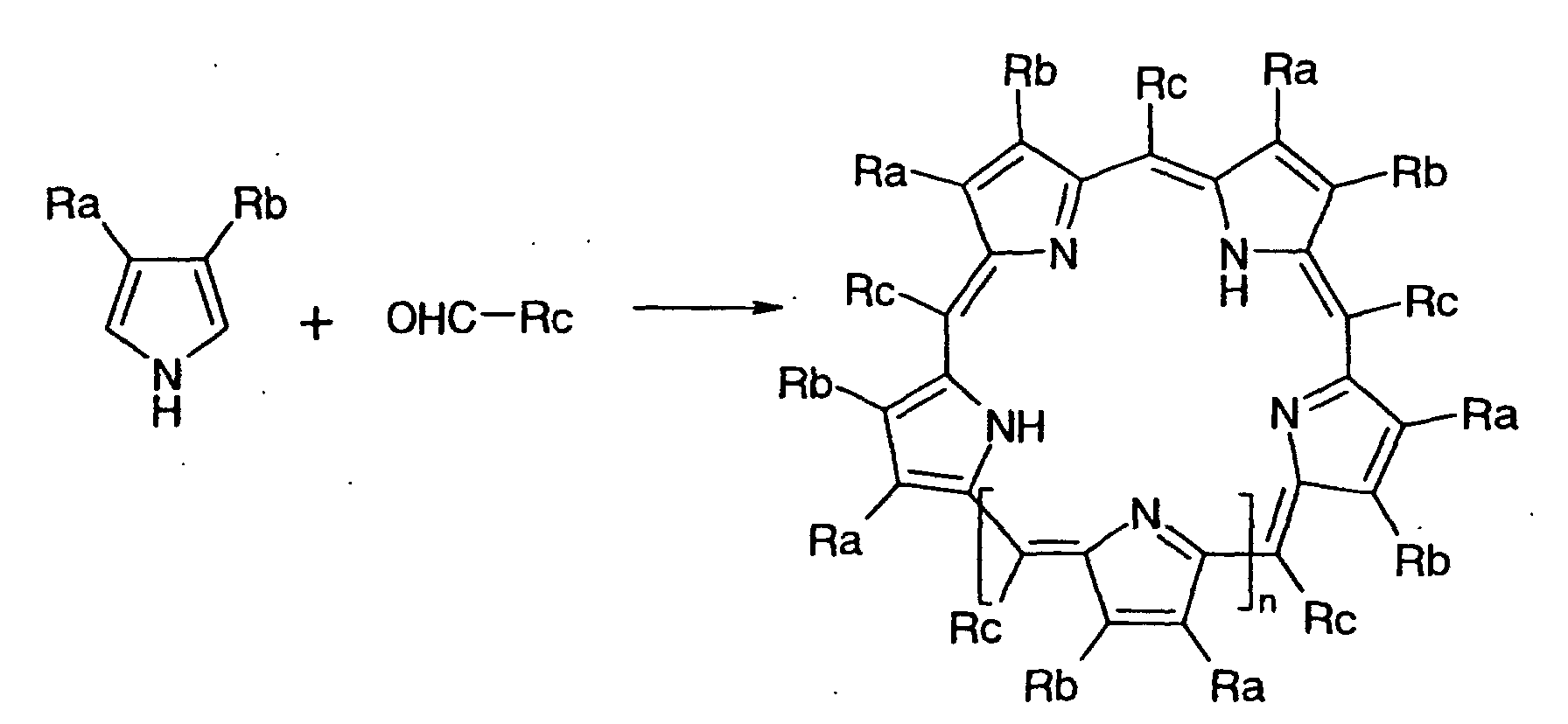
- Then, purification by a cyclic distillation, etc. are conducted for separation from unreacted materials, whereby a mixture of compounds having different n's is obtained. The mixture is further subjected to chromatography or the like, whereby a compound having an intended n can be separated. This compound has a tendency that, with an increase in the n, the absorption wavelength shifts to a longer wavelength; therefore, a compound having a desired wavelength characteristic may be selected and used. A mixture of compounds having different n's may also be used. Incidentally, pentaphyrin of n=1 or hexaphyrin of n=2 is preferred.
- In the general formula (1), introduction of different substituents into each pyrrole ring and meso position can be performed by conducting a reaction using a plurality of pyrroles and/or a plurality of aldehydes. Incidentally, the conformation of the extended porphyrin may be any of a state in which each pyrrole nitrogen is directed to the inside of the porphyrin ring and each meso position substituent is directed to the outside of the porphyrin ring as shown in formula (1), and a state in which each pyrrole nitrogen is directed to the outside of the porphyrin ring and each meso position substituent is directed to the inside of the porphyrin ring. Further, the position of NH proton may be at any pyrrole nitrogen of the porphyrin ring owing to conjugation.
- The extended porphyrin represented by the general formula (1), used in the present invention may be in a neutral state or may form, as a bivalent anion, a complex with one or more metals or with one or more metal compounds. As the metals, there are mentioned Zn, Mg, Ca, Sr, Ba, Sc, Y, La, Ce, Pr, Nd, Sm, Eu, Gd, Tb, Dy, Ho, Er, Tm, Yb, Lu, Ti, Zr, Hf, V, Nb, Ta, Th, U, Cr, Mo, W, Mn, Tc, Re, Fe, Ru, Os, Co, Rh, Ir, Ni, Pd, Pt, Cu, Ag, Au, Cd, Hg, Al, Ga, In, Tl, Si, Ge, Sn, Pb, Sb, Bi, etc. The metals may each coordinate to one or more pyrrole nitrogens of the extended porphyrin ring; further, other atom (e.g. halogen) or atomic group may coordinate to each metal.
- Representative examples of the extended porphyrin according to the present invention are shown below; however, the present compound is not restricted thereto.

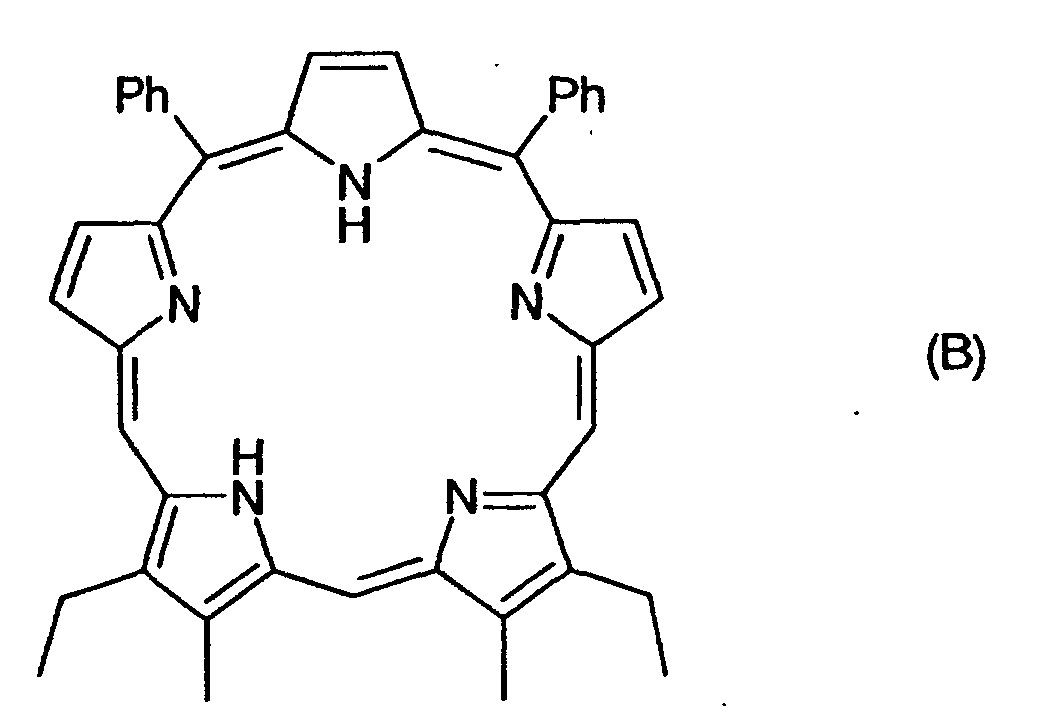


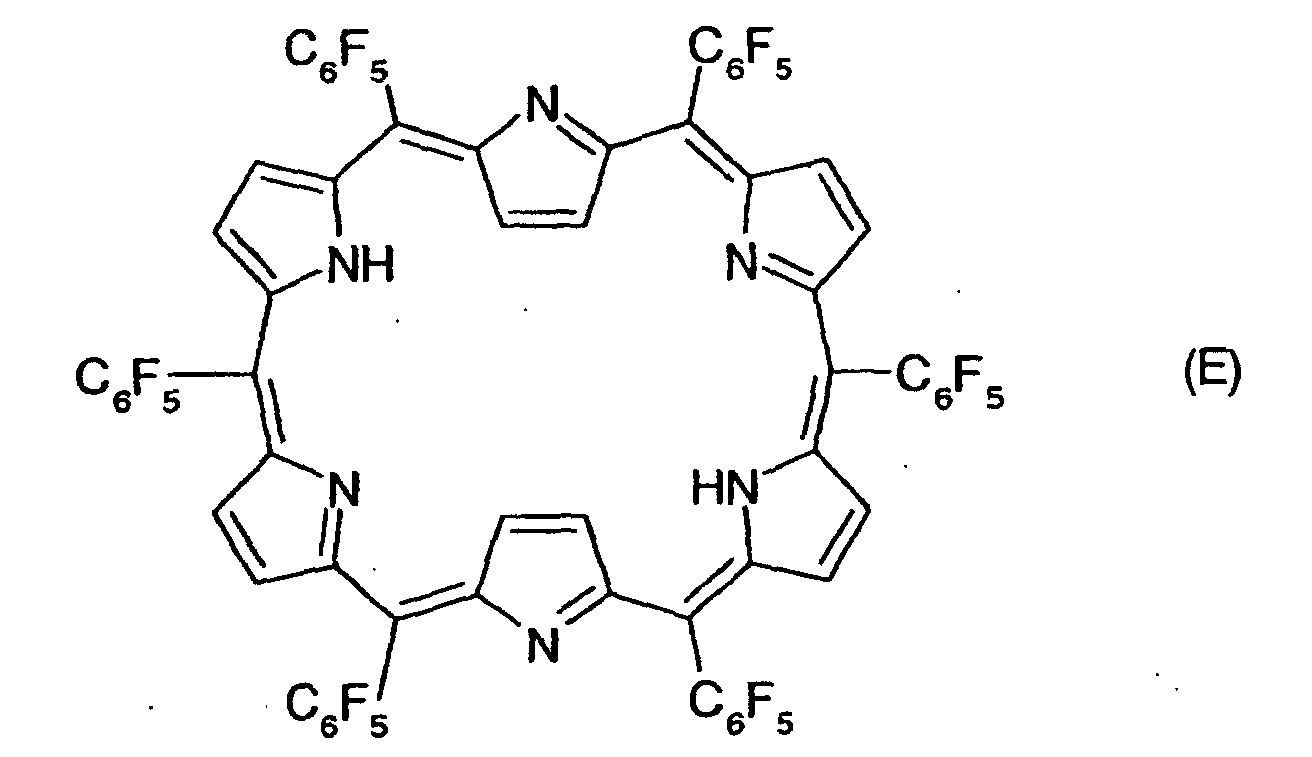

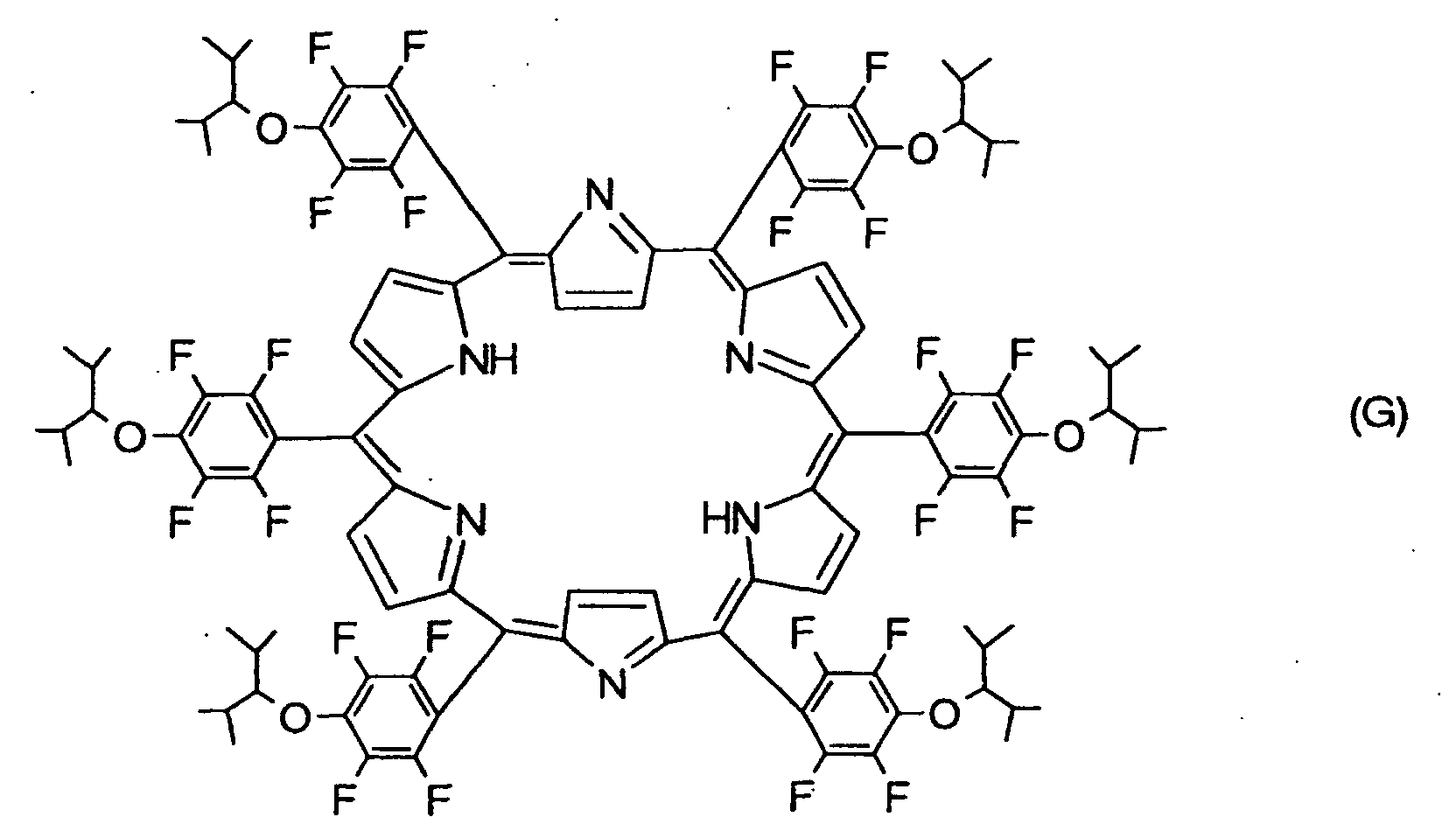
- In the optical information recording medium of the present invention, a single-substrate type ordinarily consists of a transparent substrate, a recording layer, a metal reflecting layer and a protective layer, and may further have a foundation layer and a protective layer for improved properties.
- The substrate used in the present invention may be any transparent material because recording and reproduction are conducted optically. There can be used, for example, organic polymer materials such as polycarbonate, polyacrylate, polymethacrylate, polystyrene, polyvinyl chloride, polyester, polyolefin, epoxy resin and the like; and inorganic materials such as glass and the like. A polycarbonate resin, which is well balanced between light transmittance and heat resistance and allows easy molding, is preferred particularly. A polyolefin having a cyclic skeleton is also desirable because it has low anisotropy and shows low water absorption.
- The substrate may have, on the surface, guide grooves or pits indicating recording positions, or some of the pits for information, etc. exclusively used for reproduction. These grooves, pits, etc. are ordinarily formed at the time of substrate production conducted by injection molding or casting, but may be formed by a laser cutting method or a photo-polymer method.
- The recording layer of the optical information recording medium of the present invention contains a compound represented by the general formula (1), and can conduct recording by applying a laser beam thereto to decompose the compound to form pits. In the recording layer, one or more kinds of other dyes may be mixed into the dye represented by the general formula (1).
- Further, light-non-absorbing substances may be added to the dye represented by the general formula (1) or its mixture with other dye(s) for improved recording characteristic and durability.
- Specific examples of the dyes other than the dye represented by the general formula (1), used in the recording layer are large ring azaanulene dyes (for example, phthalocyanine dyes, naphthalocyanine dyes and azaporphyrin dyes having 1 to 4 meso-position nitrogen atoms); polymethine dyes (for example, cyanine dyes, merocyanine dyes, and squarylium dyes); anthraquinone dyes; azulenium dyes; azo dyes; and indoaniline dyes. Of these dyes, phthalocyanine dyes having high durability and light resistance are desired particularly.
- The dye-containing recording layer may be a laminated layer consisting of two or more layers. In this case, the dye represented by the general formula (1) may be used only in one layer or in two or more layers.
- It is also possible to form the recording layer in a laminated structure consisting of two or more layers and allows one of the layers to contain a dye represented by the general formula (1) and other layer(s) to contain a dye(s) other than the dye represented by the general formula (1) so as to allow for multi-wavelength recording. As the dye(s) used in the recording layer(s) other than the layer containing the dye represented by the general formula (1), there are mentioned large ring azaanulene dyes (for example, phthalocyanine dyes, naphthalocyanine dyes and azaporphyrin dyes having 1 to 4 meso-position nitrogen atoms); polymethine dyes (for example, cyanine dyes, merocyanine dyes, and squarylium dyes); anthraquinone dyes; azulenium dyes; azo dyes; indoaniline dyes; and so forth. However, a dye(s) different in optical characteristic from the dye of the general formula (1) is (are) selected.
- The recording layer containing such a dye(s) can be formed ordinarily by spin coating, spray coating, dip coating, roll coating, etc. In the coating, substances constituting the recording layer, such as dye, resinous binder and the like are dissolved in a solvent giving no damage to the substrate used, to prepare a coating solution; and the solution is coated on the substrate and dried to form a recording layer. As the solvent, there are preferably used aliphatic or alicyclic hydrocarbons such as hexane, heptane, octane, decane and cyclohexane; aromatic hydrocarbons such as toluene and xylene; ethers such as diethyl ether, dibutyl ether and tetrahydrofuran; alcohols such as methanol, ethanol, isopropanol, tetrafluoropropanol and methyl cellosolve; halogen compounds such as chloroform, dichloromethane and 1,2-dichloroethane; and so forth. These solvents may be used singly or in admixture of two or more kinds. When the recording layer is formed in a laminated structure consisting of two or more layers, it is desired to use a solvent which does not adversely affect the layer formed earlier.
- The recording layer may also be formed by vacuum deposition. This method is effective when the substances to constitute the recording layer have low solubility in solvents or when it is impossible to select a solvent which gives no damage to the substrate used.
- The recording layer has a thickness of 10 to 300 nm, preferably 50 to 200 nm.
- A foundation layer may be formed between the substrate and the recording layer for the purposes of, for example, prevention of recording layer from deterioration. It is possible to use, for example, a layer composed of an organic material (e.g. a polystyrene or a polymethacrylate) or an inorganic material (e.g. SiO2). These materials may be used singly or in admixture of two or more kinds of organic materials or two or more kinds of inorganic materials. Or, two or more kinds of these materials may be used in laminated layers; that is, laminated layers each containing a different organic material, laminated layers each containing a different inorganic material, or laminated layers consisting of a layer containing an organic material and a layer containing an inorganic material may be formed.
- On the recording layer may be formed a reflecting layer using a metal such as Au, Al, Pt, Ag and Ni, or an alloy thereof. In particular, Au is desirable because it is stable to oxygen and water. Such a reflecting layer is formed by vapor deposition, sputtering, ion plating, etc. The reflecting layer has a thickness of 10 to 300 nm, desirably 30 to 150 nm. Incidentally, the reflecting layer is formed at a side opposite to the side of light incidence; therefore, when light incidence is made from the protective layer or dummy substrate (both described later) side, the reflecting layer is formed at the substrate side relative to the recording layer.
- Between the recording layer and the reflecting layer, an intermediate layer may be formed in order to achieve, for example, an increased adhesivity or an increased reflectance.
- A protective layer may be formed on the reflecting layer or the recording layer. There is no particular restriction as to the protective layer as long as the layer protects the reflecting layer or the recording layer from an external force. There are ordinarily mentioned polymer materials such as acrylate or methacrylate polymer obtained by general radical polymerization or epoxy polymer obtained by photo-induced cationic polymerization. These polymer materials may be obtained by homopolymerization or copolymerization with other monomer, oligomer or the like. These materials may also be diluted with a solvent and coated. Among them, ultraviolet curing resins, for example, acrylate resins such as urethane acrylate, epoxy acrylate and polyester acrylate are desired for the workability.
- The protective layer is formed by spin coating, dip coating, bar coating, screen printing, etc. Spin coating is employed in many cases for the workability.
- The protective layer has a thickness of generally 1 to 100 µm. In the present invention, a thickness of 1 to 20 µm is preferred.
- The thus-formed protective layer protects the recording layer or the reflecting layer. When a strong protective layer is required depending upon the use condition of the resulting recording medium, it is possible to form an inorganic or organic protective layer on the protective layer made of the above-mentioned polymer material. As the inorganic protective layer, there are mentioned SiO2, Si3N4, MgF2, AlN, SnO2, etc. As the organic protective layer, there are mentioned a thermosetting resin, an electron beam curing resin, an ultraviolet curing resin, etc. When an organic protective layer is formed using a thermosetting resin, the thermosetting resin is dissolved in an appropriate solvent to prepare a coating fluid, followed by coating of the fluid and subsequent drying and curing. When an organic protective layer is formed using an ultraviolet-curing resin, a coating fluid is prepared from the ultraviolet-curing resin per se or by dissolving the resin in an appropriate solvent, the coating fluid is coated, and an ultraviolet light is applied to cure the resin. An inorganic protective layer can be formed by vapor deposition, etc. These materials may be used singly or in admixture. The protective layer may be formed not only in a single layer but also in a plurality of layers for increased adhesivity with other layer and other purpose.
- In other constitution of the present recording medium, a substrate having a recording layer formed thereon may be laminated with another substrate. In this case, the another substrate may be a dummy substrate having no layer (e.g. recording layer) formed thereon; or, a substrate having a recording layer formed thereon may be laminated with another substrate having a recording layer, a reflecting layer, etc. formed thereon, in such a state that the sides of the two substrates having respective recording layers face each other. As the adhesion method employed in this case, there are mentioned, for example, a hot melt method, a method using an ultraviolet curing adhesive, and a method using a one-pack or two-pack type reactive adhesive.
- The present invention is specifically described below with reference to Examples. However, the present invention is in no way restricted to these Examples.
- Synthesis method and characteristic values are shown below on a representative compound of the present invention, i.e. meso-hexa(pentafluorophenyl)hexaphyrin which is a n=2 derivative of formula (1) [the illustrative compound (E) shown previously].
- Pyrrole was dropwise added to pentafluorobenzaldehyde which was being refluxed in glacial acetic acid-nitrobenzene. The resulting mixture was refluxed for a further 45 minutes and then subjected to distillation to remove the solvent. The residue was purified using a silica-filled column to obtain an intended product.
- The above-obtained hexaphyrin of formula (E) was dissolved in chloroform so as to give a concentration of 10 g/l. The resulting solution was coated on a glass chip by spin coating, to form a film of 120 nm in thickness. The thin film was measured for UV spectrum. The UV spectrum is shown in Fig. 1.
- The hexaphyrin of formula (E) was vapor-deposited on a glass substrate-in 8 different thicknesses between 45 nm and 120 nm, to prepare samples. Each sample was measured for absorption spectrum and reflection spectrum, from which refractive indexes and extinction coefficients at various wavelengths were calculated.
- A balance between high refractive index and proper extinction coefficient was obtained in a wavelength range of 630 to 670 nm which is used in ordinary DVD's. The results are shown in the following Table 1.
Wavelength Refractive index Extinction coefficient 630 nm 2.45 0.28 640 nm 2.29 0.17 650 nm 2.09 0.13 660 nm 2.02 0.13 670 nm 1.97 0.14 - The dye of formula (E) was coated on a polycarbonate substrate by spin coating, then exposed to a light from a carbon arc, and measured for UV spectrum. A ratio of λmax absorbance after light exposure to λmax absorbance before light exposure was determined and taken as retention. A high retention of 99% was obtained after 40 hours of a light exposure test. In Fig. 1 is shown the thin-film spectrum after the light durability test, together with that before the test.
- A film (thickness: about 80 nm) of the dye of formula (E) was formed, by vapor deposition, on a polycarbonate substrate of 0.6 mm in thickness and 120 mm in diameter (pitch between grooves: 0.74 µm, groove width: 0.3 µm, groove depth: 100 nm). Thereon was formed an Au layer in a thickness of 80 nm by sputtering, and further SD-17 of UV-curing type was laminated. Thereon was laminated a dummy substrate of 0.6 mm in thickness, made of a polycarbonate, whereby a trial optical recording medium was produced.
- Recording was made for the optical recording medium based on the method specified for DVD, using a DDU tester, a product of Pulstec Industrial Co., Ltd. A good recording characteristic of jitter = 8% was confirmed at a recording power of 10 mW.
- A dye of the formula (G) was dissolved in cyclohexane so as to give a concentration of 10 g/l. The resulting solution was coated, by spin coating, on a polycarbonate substrate of 0.6 mm in thickness and 120 mm in diameter (pitch between grooves: 0.74 m, groove width: 0.3 µm, groove depth: 100 nm) to form a film of about 60 nm in thickness. Thereon was formed an Au reflecting layer in a thickness of 80 nm by sputtering, and further SD-17 of UV-curing type was laminated. Thereon was laminated a dummy substrate of 0.6 mm in thickness, made of a polycarbonate, whereby a trial optical recording medium was produced.
- Recording was made for the optical recording medium based on the method specified for DVD, using a DDU tester, a product of Pulstec Industrial Co., Ltd. A recording characteristic of jitter = 12% was confirmed at a recording power of 20 mW.
- The extended porphyrin of the general formula (1) used in the present invention as a recording layer dye has by itself durability against light, a high refractive index and an appropriate extinction coefficient; therefore, the present invention can provide an optical information recording medium having good recording characteristic and excellent light durability.
Claims (4)
- An optical information recording medium comprising a transparent substrate and a recording layer formed thereon, wherein the recording layer contains an extended porphyrin compound represented by the following general formula (1):(wherein R1 to R15 are each independently hydrogen, a halogen, a hydroxyl group, a mercapto group, an amino group, a nitro group, a cyano group, a carboxyl group, a sulfonic acid group, a substituted or unsubstituted alkyl group, a substituted or unsubstituted aryl group, a substituted or unsubstituted alkoxy group, a substituted or unsubstituted aryloxy group, a substituted or unsubstituted alkylthio group, a substituted or unsubstituted arylthio group, a substituted or unsubstituted alkylamino group, a substituted or unsubstituted arylamino group, a substituted or unsubstituted carboxylic acid ester group, a substituted or unsubstituted carboxylic acid amide group, a substituted or unsubstituted sulfonic acid ester group, a substituted or unsubstituted sulfonamide group, a substituted or unsubstituted carbonyl group, a substituted or unsubstituted silyl group or a substituted or unsubstituted siloxy group; n is an integer of 1 to 8; and metal atoms may coordinate to pyrrole nitrogen atoms of the porphyrin ring to form a complex).

- The optical information recording medium according to Claim 1, wherein the extended porphyrin represented by the general formula (1) is in a neutral state or forms, as a bivalent anion, a complex with one or more metals selected from the following metals or with one or more metal compounds thereof:Zn, Mg, Ca, Sr, Ba, Sc, Y, La, Ce, Pr, Nd, Sm, Eu, Gd, Tb, Dy, Ho, Er, Tm, Yb, Lu, Ti, Zr, Hf, V, Nb, Ta, Th, U, Cr, Mo, W, Mn, Tc, Re, Fe, Ru, Os, Co, Rh, Ir, Ni, Pd, Pt, Cu, Ag, Au, Cd, Hg, Al, Ga, In, Tl, Si, Ge, Sn, Pb, Sb and Bi.
- The optical information recording medium according to Claim 1 or 2, which has, on a transparent substrate, one or more recording layers, a metal reflecting layer and one or more protective layers and wherein at least one of the recording layers contains an extended porphyrin compound represented by the general formula (1).
- The optical information recording medium according to Claim 1 or 2, which is constituted by a transparent substrate, one or more recording layers formed thereon, and a substrate adhered onto the recording layers via an adhesive layer and wherein at least one of the recording layers contains an extended porphyrin compound represented by the general formula (1).
Applications Claiming Priority (3)
| Application Number | Priority Date | Filing Date | Title |
|---|---|---|---|
| JP2000252323 | 2000-08-23 | ||
| JP2000252323 | 2000-08-23 | ||
| PCT/JP2001/007178 WO2002016144A1 (en) | 2000-08-23 | 2001-08-22 | Optical information recording medium |
Publications (1)
| Publication Number | Publication Date |
|---|---|
| EP1316436A1 true EP1316436A1 (en) | 2003-06-04 |
Family
ID=18741581
Family Applications (1)
| Application Number | Title | Priority Date | Filing Date |
|---|---|---|---|
| EP01958393A Withdrawn EP1316436A1 (en) | 2000-08-23 | 2001-08-22 | Optical information recording medium |
Country Status (4)
| Country | Link |
|---|---|
| US (1) | US20030118937A1 (en) |
| EP (1) | EP1316436A1 (en) |
| TW (1) | TW544674B (en) |
| WO (1) | WO2002016144A1 (en) |
Cited By (2)
| Publication number | Priority date | Publication date | Assignee | Title |
|---|---|---|---|---|
| WO2006015714A1 (en) * | 2004-08-06 | 2006-02-16 | Lanxess Deutschland Gmbh | Optical data carrier containing porphyrine sulfonamides in the information layer |
| ITUD20130075A1 (en) * | 2013-05-27 | 2014-11-28 | Univ Degli Studi Udine | NEW PENTAFIRINE |
Families Citing this family (6)
| Publication number | Priority date | Publication date | Assignee | Title |
|---|---|---|---|---|
| JP4282292B2 (en) * | 2002-09-10 | 2009-06-17 | 独立行政法人科学技術振興機構 | Hexane-soluble hexaphylline |
| JP2004160742A (en) * | 2002-11-11 | 2004-06-10 | Tdk Corp | Optical recording disc, its manufacturing method and optical data recording/ reproducing method for optical recording disc |
| TWI675907B (en) | 2015-01-21 | 2019-11-01 | 日商Jsr股份有限公司 | Solid imaging device |
| JP2016162946A (en) * | 2015-03-04 | 2016-09-05 | Jsr株式会社 | Solid state image sensor |
| CN107037096B (en) * | 2017-04-01 | 2019-04-16 | 南京师范大学 | An electrochemical sensor based on CoCuCdTCPP coordination polymer modification and its preparation method and application |
| CN112047821B (en) * | 2020-08-05 | 2022-05-03 | 中山大学 | A kind of preparation method of methyl ethyl ketone |
Family Cites Families (6)
| Publication number | Priority date | Publication date | Assignee | Title |
|---|---|---|---|---|
| US5159065A (en) * | 1989-12-21 | 1992-10-27 | Board Of Regents, The University Of Texas System | Sapphyrins, derivatives and syntheses |
| US5486437A (en) * | 1993-04-08 | 1996-01-23 | Sony Corporation | Optical recording method |
| US5658707A (en) * | 1994-10-18 | 1997-08-19 | Mitsui Toatsu Chemicals, Inc. | Optical recording media |
| US5883246A (en) * | 1996-03-07 | 1999-03-16 | Qlt Phototherapeutics, Inc. | Synthesis of polypyrrolic macrocycles from meso-substituted tripyrrane compounds |
| JPH11138993A (en) * | 1997-11-11 | 1999-05-25 | Matsushita Electric Ind Co Ltd | Optical recording medium and optical recording / reproducing method |
| JP3685368B2 (en) * | 1998-08-18 | 2005-08-17 | 株式会社リコー | Optical recording medium |
-
2001
- 2001-08-22 EP EP01958393A patent/EP1316436A1/en not_active Withdrawn
- 2001-08-22 US US10/110,840 patent/US20030118937A1/en not_active Abandoned
- 2001-08-22 WO PCT/JP2001/007178 patent/WO2002016144A1/en not_active Ceased
- 2001-08-23 TW TW090120723A patent/TW544674B/en active
Non-Patent Citations (1)
| Title |
|---|
| See references of WO0216144A1 * |
Cited By (3)
| Publication number | Priority date | Publication date | Assignee | Title |
|---|---|---|---|---|
| WO2006015714A1 (en) * | 2004-08-06 | 2006-02-16 | Lanxess Deutschland Gmbh | Optical data carrier containing porphyrine sulfonamides in the information layer |
| ITUD20130075A1 (en) * | 2013-05-27 | 2014-11-28 | Univ Degli Studi Udine | NEW PENTAFIRINE |
| EP2808328A1 (en) * | 2013-05-27 | 2014-12-03 | Universita' Degli Studi di Udine | Pentaphyrins useful in the biomedical field |
Also Published As
| Publication number | Publication date |
|---|---|
| US20030118937A1 (en) | 2003-06-26 |
| WO2002016144A1 (en) | 2002-02-28 |
| TW544674B (en) | 2003-08-01 |
Similar Documents
| Publication | Publication Date | Title |
|---|---|---|
| US5962657A (en) | Complex polymethine dyes and their use | |
| EP0811506B1 (en) | Optical recording material and optical recording medium | |
| KR20010105735A (en) | Hemicyanine dyes and optical recording medium using the same | |
| JP2007290401A (en) | Optical recording material with high memory density | |
| JP2670616B2 (en) | Squarylium compound and optical information recording medium using the same | |
| US20030118937A1 (en) | Optical information recording medium | |
| US6576321B2 (en) | Optical recording information medium | |
| JP2003196881A (en) | Fullerene dyestuff and its application | |
| EP0838463B1 (en) | Squarylium compound and optical information recording medium using the same | |
| US5658707A (en) | Optical recording media | |
| US5510229A (en) | Optical information recording medium using squarylium compounds | |
| JP2005515914A (en) | Optical recording material having high storage density | |
| US20080130474A1 (en) | Optical Recording Materials Having High Stroage Density | |
| KR20010103190A (en) | Hemicyanine dyes and optical recording medium using the same | |
| JPH0785499A (en) | Optical recording medium | |
| JP3742507B2 (en) | Optical recording medium | |
| JPWO2002016144A1 (en) | Optical information recording medium | |
| JP3167785B2 (en) | Squarylium compound and optical information recording medium using the same | |
| JPH08300814A (en) | Optical recording medium | |
| US20080095967A1 (en) | Optical Recording Materials Having High Storage Density | |
| JPH1076752A (en) | Optical information recording medium | |
| JP2002187360A (en) | Optical degradation prevention for optical information recording medium | |
| JP2002166654A (en) | Optical recording data medium | |
| JP2005053987A (en) | Phthalocyanine compound and optical recording medium obtained using the same | |
| JPH0386584A (en) | Optical data recording medium |
Legal Events
| Date | Code | Title | Description |
|---|---|---|---|
| PUAI | Public reference made under article 153(3) epc to a published international application that has entered the european phase |
Free format text: ORIGINAL CODE: 0009012 |
|
| 17P | Request for examination filed |
Effective date: 20020528 |
|
| AK | Designated contracting states |
Designated state(s): AT BE CH CY DE DK ES FI FR GB GR IE IT LI LU MC NL PT SE TR |
|
| STAA | Information on the status of an ep patent application or granted ep patent |
Free format text: STATUS: THE APPLICATION HAS BEEN WITHDRAWN |
|
| 18W | Application withdrawn |
Effective date: 20031022 |
|
| RBV | Designated contracting states (corrected) |
Designated state(s): DE FR GB NL |