EP1316314A1 - Vaccine preparation containing fatty acid as component - Google Patents
Vaccine preparation containing fatty acid as component Download PDFInfo
- Publication number
- EP1316314A1 EP1316314A1 EP01958570A EP01958570A EP1316314A1 EP 1316314 A1 EP1316314 A1 EP 1316314A1 EP 01958570 A EP01958570 A EP 01958570A EP 01958570 A EP01958570 A EP 01958570A EP 1316314 A1 EP1316314 A1 EP 1316314A1
- Authority
- EP
- European Patent Office
- Prior art keywords
- vaccine
- trihydroxy
- adjuvant
- acid
- vaccine preparation
- Prior art date
- Legal status (The legal status is an assumption and is not a legal conclusion. Google has not performed a legal analysis and makes no representation as to the accuracy of the status listed.)
- Withdrawn
Links
- OVIYAWRZYASPQM-MFDVASPDSA-N CCCCCC/C=C/C=C/C1SCCCS1 Chemical compound CCCCCC/C=C/C=C/C1SCCCS1 OVIYAWRZYASPQM-MFDVASPDSA-N 0.000 description 1
Images



Classifications
-
- A—HUMAN NECESSITIES
- A61—MEDICAL OR VETERINARY SCIENCE; HYGIENE
- A61K—PREPARATIONS FOR MEDICAL, DENTAL OR TOILETRY PURPOSES
- A61K39/00—Medicinal preparations containing antigens or antibodies
- A61K39/02—Bacterial antigens
- A61K39/0241—Mollicutes, e.g. Mycoplasma, Erysipelothrix
-
- A—HUMAN NECESSITIES
- A61—MEDICAL OR VETERINARY SCIENCE; HYGIENE
- A61K—PREPARATIONS FOR MEDICAL, DENTAL OR TOILETRY PURPOSES
- A61K39/00—Medicinal preparations containing antigens or antibodies
- A61K39/0015—Combination vaccines based on measles-mumps-rubella
-
- A—HUMAN NECESSITIES
- A61—MEDICAL OR VETERINARY SCIENCE; HYGIENE
- A61K—PREPARATIONS FOR MEDICAL, DENTAL OR TOILETRY PURPOSES
- A61K39/00—Medicinal preparations containing antigens or antibodies
- A61K39/0016—Combination vaccines based on diphtheria-tetanus-pertussis
-
- A—HUMAN NECESSITIES
- A61—MEDICAL OR VETERINARY SCIENCE; HYGIENE
- A61K—PREPARATIONS FOR MEDICAL, DENTAL OR TOILETRY PURPOSES
- A61K39/00—Medicinal preparations containing antigens or antibodies
- A61K39/02—Bacterial antigens
- A61K39/05—Actinobacteria, e.g. Actinomyces, Streptomyces, Nocardia, Bifidobacterium, Gardnerella, Corynebacterium; Propionibacterium
-
- A—HUMAN NECESSITIES
- A61—MEDICAL OR VETERINARY SCIENCE; HYGIENE
- A61K—PREPARATIONS FOR MEDICAL, DENTAL OR TOILETRY PURPOSES
- A61K39/00—Medicinal preparations containing antigens or antibodies
- A61K39/02—Bacterial antigens
- A61K39/08—Clostridium, e.g. Clostridium tetani
-
- A—HUMAN NECESSITIES
- A61—MEDICAL OR VETERINARY SCIENCE; HYGIENE
- A61K—PREPARATIONS FOR MEDICAL, DENTAL OR TOILETRY PURPOSES
- A61K39/00—Medicinal preparations containing antigens or antibodies
- A61K39/02—Bacterial antigens
- A61K39/099—Bordetella
-
- A—HUMAN NECESSITIES
- A61—MEDICAL OR VETERINARY SCIENCE; HYGIENE
- A61K—PREPARATIONS FOR MEDICAL, DENTAL OR TOILETRY PURPOSES
- A61K39/00—Medicinal preparations containing antigens or antibodies
- A61K39/12—Viral antigens
-
- A—HUMAN NECESSITIES
- A61—MEDICAL OR VETERINARY SCIENCE; HYGIENE
- A61K—PREPARATIONS FOR MEDICAL, DENTAL OR TOILETRY PURPOSES
- A61K39/00—Medicinal preparations containing antigens or antibodies
- A61K39/12—Viral antigens
- A61K39/145—Orthomyxoviridae, e.g. influenza virus
-
- A—HUMAN NECESSITIES
- A61—MEDICAL OR VETERINARY SCIENCE; HYGIENE
- A61K—PREPARATIONS FOR MEDICAL, DENTAL OR TOILETRY PURPOSES
- A61K39/00—Medicinal preparations containing antigens or antibodies
- A61K39/12—Viral antigens
- A61K39/15—Reoviridae, e.g. calf diarrhea virus
-
- A—HUMAN NECESSITIES
- A61—MEDICAL OR VETERINARY SCIENCE; HYGIENE
- A61K—PREPARATIONS FOR MEDICAL, DENTAL OR TOILETRY PURPOSES
- A61K39/00—Medicinal preparations containing antigens or antibodies
- A61K39/39—Medicinal preparations containing antigens or antibodies characterised by the immunostimulating additives, e.g. chemical adjuvants
-
- A—HUMAN NECESSITIES
- A61—MEDICAL OR VETERINARY SCIENCE; HYGIENE
- A61P—SPECIFIC THERAPEUTIC ACTIVITY OF CHEMICAL COMPOUNDS OR MEDICINAL PREPARATIONS
- A61P37/00—Drugs for immunological or allergic disorders
- A61P37/02—Immunomodulators
- A61P37/04—Immunostimulants
-
- A—HUMAN NECESSITIES
- A61—MEDICAL OR VETERINARY SCIENCE; HYGIENE
- A61K—PREPARATIONS FOR MEDICAL, DENTAL OR TOILETRY PURPOSES
- A61K39/00—Medicinal preparations containing antigens or antibodies
- A61K2039/54—Medicinal preparations containing antigens or antibodies characterised by the route of administration
- A61K2039/541—Mucosal route
- A61K2039/542—Mucosal route oral/gastrointestinal
-
- A—HUMAN NECESSITIES
- A61—MEDICAL OR VETERINARY SCIENCE; HYGIENE
- A61K—PREPARATIONS FOR MEDICAL, DENTAL OR TOILETRY PURPOSES
- A61K39/00—Medicinal preparations containing antigens or antibodies
- A61K2039/54—Medicinal preparations containing antigens or antibodies characterised by the route of administration
- A61K2039/541—Mucosal route
- A61K2039/543—Mucosal route intranasal
-
- A—HUMAN NECESSITIES
- A61—MEDICAL OR VETERINARY SCIENCE; HYGIENE
- A61K—PREPARATIONS FOR MEDICAL, DENTAL OR TOILETRY PURPOSES
- A61K39/00—Medicinal preparations containing antigens or antibodies
- A61K2039/555—Medicinal preparations containing antigens or antibodies characterised by a specific combination antigen/adjuvant
- A61K2039/55511—Organic adjuvants
-
- A—HUMAN NECESSITIES
- A61—MEDICAL OR VETERINARY SCIENCE; HYGIENE
- A61K—PREPARATIONS FOR MEDICAL, DENTAL OR TOILETRY PURPOSES
- A61K39/00—Medicinal preparations containing antigens or antibodies
- A61K2039/70—Multivalent vaccine
-
- C—CHEMISTRY; METALLURGY
- C12—BIOCHEMISTRY; BEER; SPIRITS; WINE; VINEGAR; MICROBIOLOGY; ENZYMOLOGY; MUTATION OR GENETIC ENGINEERING
- C12N—MICROORGANISMS OR ENZYMES; COMPOSITIONS THEREOF; PROPAGATING, PRESERVING, OR MAINTAINING MICROORGANISMS; MUTATION OR GENETIC ENGINEERING; CULTURE MEDIA
- C12N2720/00—MICROORGANISMS OR ENZYMES; COMPOSITIONS THEREOF; PROPAGATING, PRESERVING, OR MAINTAINING MICROORGANISMS; MUTATION OR GENETIC ENGINEERING; CULTURE MEDIA dsRNA viruses
- C12N2720/00011—Details
- C12N2720/12011—Reoviridae
- C12N2720/12311—Rotavirus, e.g. rotavirus A
- C12N2720/12334—Use of virus or viral component as vaccine, e.g. live-attenuated or inactivated virus, VLP, viral protein
-
- C—CHEMISTRY; METALLURGY
- C12—BIOCHEMISTRY; BEER; SPIRITS; WINE; VINEGAR; MICROBIOLOGY; ENZYMOLOGY; MUTATION OR GENETIC ENGINEERING
- C12N—MICROORGANISMS OR ENZYMES; COMPOSITIONS THEREOF; PROPAGATING, PRESERVING, OR MAINTAINING MICROORGANISMS; MUTATION OR GENETIC ENGINEERING; CULTURE MEDIA
- C12N2760/00—MICROORGANISMS OR ENZYMES; COMPOSITIONS THEREOF; PROPAGATING, PRESERVING, OR MAINTAINING MICROORGANISMS; MUTATION OR GENETIC ENGINEERING; CULTURE MEDIA ssRNA viruses negative-sense
- C12N2760/00011—Details
- C12N2760/16011—Orthomyxoviridae
- C12N2760/16111—Influenzavirus A, i.e. influenza A virus
- C12N2760/16134—Use of virus or viral component as vaccine, e.g. live-attenuated or inactivated virus, VLP, viral protein
-
- C—CHEMISTRY; METALLURGY
- C12—BIOCHEMISTRY; BEER; SPIRITS; WINE; VINEGAR; MICROBIOLOGY; ENZYMOLOGY; MUTATION OR GENETIC ENGINEERING
- C12N—MICROORGANISMS OR ENZYMES; COMPOSITIONS THEREOF; PROPAGATING, PRESERVING, OR MAINTAINING MICROORGANISMS; MUTATION OR GENETIC ENGINEERING; CULTURE MEDIA
- C12N2760/00—MICROORGANISMS OR ENZYMES; COMPOSITIONS THEREOF; PROPAGATING, PRESERVING, OR MAINTAINING MICROORGANISMS; MUTATION OR GENETIC ENGINEERING; CULTURE MEDIA ssRNA viruses negative-sense
- C12N2760/00011—Details
- C12N2760/18011—Paramyxoviridae
- C12N2760/18411—Morbillivirus, e.g. Measles virus, canine distemper
- C12N2760/18434—Use of virus or viral component as vaccine, e.g. live-attenuated or inactivated virus, VLP, viral protein
-
- C—CHEMISTRY; METALLURGY
- C12—BIOCHEMISTRY; BEER; SPIRITS; WINE; VINEGAR; MICROBIOLOGY; ENZYMOLOGY; MUTATION OR GENETIC ENGINEERING
- C12N—MICROORGANISMS OR ENZYMES; COMPOSITIONS THEREOF; PROPAGATING, PRESERVING, OR MAINTAINING MICROORGANISMS; MUTATION OR GENETIC ENGINEERING; CULTURE MEDIA
- C12N2760/00—MICROORGANISMS OR ENZYMES; COMPOSITIONS THEREOF; PROPAGATING, PRESERVING, OR MAINTAINING MICROORGANISMS; MUTATION OR GENETIC ENGINEERING; CULTURE MEDIA ssRNA viruses negative-sense
- C12N2760/00011—Details
- C12N2760/18011—Paramyxoviridae
- C12N2760/18711—Rubulavirus, e.g. mumps virus, parainfluenza 2,4
- C12N2760/18734—Use of virus or viral component as vaccine, e.g. live-attenuated or inactivated virus, VLP, viral protein
-
- C—CHEMISTRY; METALLURGY
- C12—BIOCHEMISTRY; BEER; SPIRITS; WINE; VINEGAR; MICROBIOLOGY; ENZYMOLOGY; MUTATION OR GENETIC ENGINEERING
- C12N—MICROORGANISMS OR ENZYMES; COMPOSITIONS THEREOF; PROPAGATING, PRESERVING, OR MAINTAINING MICROORGANISMS; MUTATION OR GENETIC ENGINEERING; CULTURE MEDIA
- C12N2770/00—MICROORGANISMS OR ENZYMES; COMPOSITIONS THEREOF; PROPAGATING, PRESERVING, OR MAINTAINING MICROORGANISMS; MUTATION OR GENETIC ENGINEERING; CULTURE MEDIA ssRNA viruses positive-sense
- C12N2770/00011—Details
- C12N2770/36011—Togaviridae
- C12N2770/36211—Rubivirus, e.g. rubella virus
- C12N2770/36234—Use of virus or viral component as vaccine, e.g. live-attenuated or inactivated virus, VLP, viral protein
-
- Y—GENERAL TAGGING OF NEW TECHNOLOGICAL DEVELOPMENTS; GENERAL TAGGING OF CROSS-SECTIONAL TECHNOLOGIES SPANNING OVER SEVERAL SECTIONS OF THE IPC; TECHNICAL SUBJECTS COVERED BY FORMER USPC CROSS-REFERENCE ART COLLECTIONS [XRACs] AND DIGESTS
- Y02—TECHNOLOGIES OR APPLICATIONS FOR MITIGATION OR ADAPTATION AGAINST CLIMATE CHANGE
- Y02A—TECHNOLOGIES FOR ADAPTATION TO CLIMATE CHANGE
- Y02A50/00—TECHNOLOGIES FOR ADAPTATION TO CLIMATE CHANGE in human health protection, e.g. against extreme weather
- Y02A50/30—Against vector-borne diseases, e.g. mosquito-borne, fly-borne, tick-borne or waterborne diseases whose impact is exacerbated by climate change
Definitions
- the present invention relates to an adjuvant that contains a hydroxy unsaturated fatty acid as an active ingredient and to vaccine preparations containing the adjuvant as a constituent, such vaccine preparations being useful to prevent or treat diseases of human, animals, and other organisms.
- Vaccines have been used to prevent various diseases, and have provided tremendous and excellent results in the prevention of specific diseases such as smallpox. Nonetheless, vaccines also have side effects and there are many cases in which vaccines are less effective. Thus there is much room for improvement in the field of vaccines.
- many types of vaccines used for human or other animals are prepared by using pathogenic organisms, or parts thereof, as antigenic materials for vaccine production. This means that there is no denying the possibility that vaccines are contaminated with constituents of pathogenic organisms or ingredients of growth medium for pathogenic organisms. These contaminants can cause adverse side effects upon vaccination.
- antigenic sites associated with immunization themselves can induce side effects when inoculated in large quantity.
- a pathogenic microorganism such as influenza virus infects via mucous membranes.
- vaccines capable of significantly enhancing local immunity on the mucous membrane rather than systemic immunity in the blood are preferred.
- an adjuvant capable of contributing to the enhancement of local immunity.
- oral, transdermal, or intranasal inoculation is noteworthy as a vaccination route.
- the injection must be performed by medical technicians and is, therefore, problematic when it is necessary to vaccinate many people under a condition with no or only poor medical facilities.
- an important challenge for the development of vaccines is to develop an excellent adjuvant that is effective and safe and that helps the enhancement of required immunity at the desired site.
- the present inventors have found that certain extracts of Chinese and Japanese traditional (Kampo) medicine, consisting of several crude drugs, exhibit adjuvant activity and increase the antibody titer against influenza virus in the nasal irrigation liquid and in the serum when used as an ingredient of influenza vaccine to be inoculated intranasally (H. Yamada and T. Nagai, Methods and Findings in Experimental and Clinical Pharmacology, 20(3), 185-192, 1998). However, exactly which component(s) of the extract has the adjuvant activity remains to be clarified.
- An objective of the present invention is to provide a novel method for enhancing the immunological activity of vaccine in order to produce vaccines whose immunological activity is not reduced when dosage is lowered or vaccination route is altered. More specifically, the objective is to screen for an effective and safe compound having a simpler structure among crude drug and to thereby develop a novel adjuvant.
- Chinese and Japanese traditional (Kampo) medicines have long been used clinically in China, Japan, and other Asian countries, and its effectiveness and safety have been already established. Thus, the medicines are excellent and suitable as the material to be utilized for the present objective.
- an objective of the present invention is to provide a hydroxy unsaturated fatty acid and derivatives thereof as novel, effective, and safe vaccine adjuvants, to provide vaccines composed of these, and to contribute to the manufacture of effective and safe vaccines.
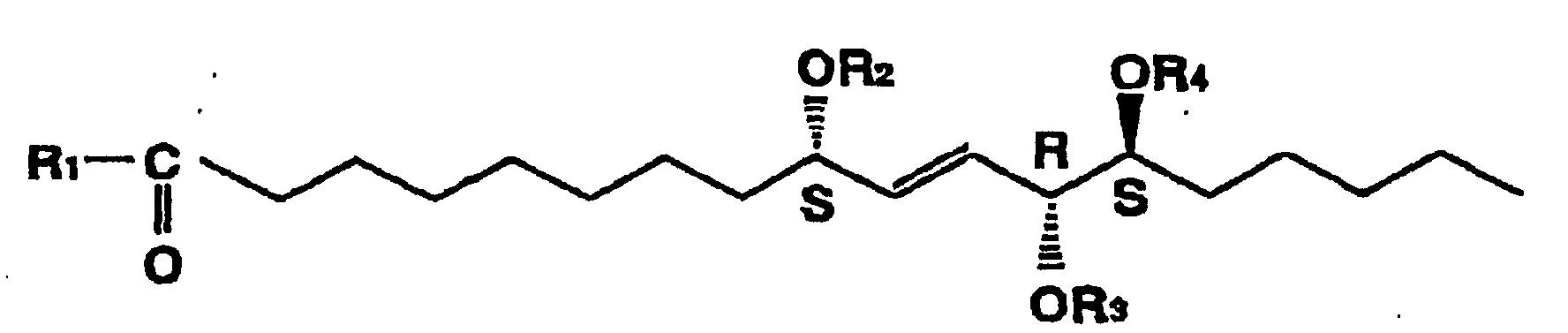
- the present invention provides an adjuvant that contains 9S, 12S, 13S-trihydroxy-10E-octadecenoic acid, 9S,12R,13S-trihydroxy-10E-octadecenoic acid, or 9R,12R,13S-trihydroxy-10E-octadecenoic acid, or a derivative thereof.
- the inventors have previously revealed that a hot-water extract from a Chinese and Japanese traditional medicine "Sho-seiryu-to (Xiao-Qing-Long-Tang in Chinese)", which consists of 8 kinds of medicinal plants, has an adjuvant activity, and that the extract elevates the antibody titer against influenza virus in the nasal irrigation liquid as well as in the serum when orally administered in combination with intranasal inoculation of influenza vaccine (H. Yamada and T. Nagai, Methods and Findings in Experimental and Clinical Pharmacology, 20 (3), 185-192, 1998).
- the inventors used hot-water extracts from the respective 8-kind medicinal plants, which are components of Sho-seiryu-to, as adjuvants to orally administer them in order to determine which component(s) exhibits the adjuvant activity to influenza vaccine upon nasal vaccination.
- the result showed that the hot-water extract from a medicinal plant "Pinelliae Tuber" had the highest adjuvant activity.
- the present inventors separated and purified an active ingredient from the hot-water extract of Pinelliae Tuber and analyzed its structure, and found a fatty acid (9S,12S,13S-trihydroxy-10E-octadecenoic acid) having a particular structure exhibited strong activity of enhancing immunity.
- the present inventors synthesized a homologous fatty acid having a different absolute structure from that of 9S,12S,13S-trihydroxy-10E-octadecenoic acid derived from Pinelliae Tuber, and found 9S,12R,13S-trihydroxy-10E-octadecenoic acid and 9R,12R,13S-trihydroxy-10E-octadecenoic acid which have the strong immunopotentiating activity like 9S,12S,13S-trihydroxy-10E-octadecenoic acid, thereby completing the present invention.
- a means for solving the above-mentioned objective can be established by the following inventive adjuvant and a vaccine preparation using this adjuvant:
- adjuvant in the present invention refers to a substance capable of stimulating the immune system and thereby enhancing the immune response to an antigen.
- such a phrase "vaccine preparation comprising an adjuvant as a constituent" in the present invention encompasses not only the embodiment wherein the adjuvant is mixed with other constituents that can be components of a vaccine preparation, such as immunogenic constituents, but also the embodiment wherein the adjuvant is separated from other constituents that can be components of a vaccine preparation, such as immunogenic constituents.
- the two together are referred to as a vaccine preparation.
- the adjuvant of the present invention is characterized by being a hydroxy unsaturated fatty acid or derivative thereof.
- the hydroxy unsaturated fatty acid to be used as an adjuvant belongs to a class of compounds comprising 18 carbons and preferably having three hydroxyl groups and a double bond (more particularly, having a trihydroxy-monoene structure).
- Such a compound is novel as a fatty acid adjuvant, in terms of containing hydroxyl groups and a double bond on the chain of fatty acid thereof.
- the hydroxyl groups and the double bond on the chain of fatty acid can be positioned on any carbons except those of the carboxylic acid.
- each hydroxyl group when each hydroxyl group is separately linked to a different carbon, the hydroxyl group can be in a R- or S-configuration, and both configurations are allowable in the present invention. Further, the existence of two modes of linkage between the double bond and the substituent results in two configurations represented by E and Z; in this case, both configurations are also allowable.
- hydroxyl groups are preferably at the positions of 9,12, and 13 ; and position and configuration of the double bond are preferably 10 and E, respectively.
- Such compounds includes, for example, 9,12,13-trihydroxy-10E-octadecenoic acid.
- a particularly desirable position of a hydroxy group and its configuration are such that a hydroxyl group has its position and an absolute configuration of 9S,12S,13S, 9S,12R,13S, or 9R,12R,13S, and a double bond has its position and configuration of 10E.
- 9S, 12S 13S-trihydroxy-10E-octadecenoic acid is described as 10-octadecenoic acid, 9,12,13-trihydroxy-[9S-(9R*,10E,12R*,13R*)], 9S,12R,13S-trihydroxy-10E-octadecenoic acid as 10-octadecenoic acid, 9,12,13-trihydroxy-[9S-(9R*,10E,12S*,13R*)], 9R,12R,13S-trihydrbxy-10E-octadecenoic acid as 10-octadecenoic acid, 9,12,13-trihydroxy-[9R-(9R*,10E,12R*,13S*)] in the CAS nomenclature.
- the adjuvant of the present invention includes derivatives in which various substituents are linked to the hydroxyl groups of the above-mentioned fatty acid and the carbonyl group of the carboxylate moiety thereof.
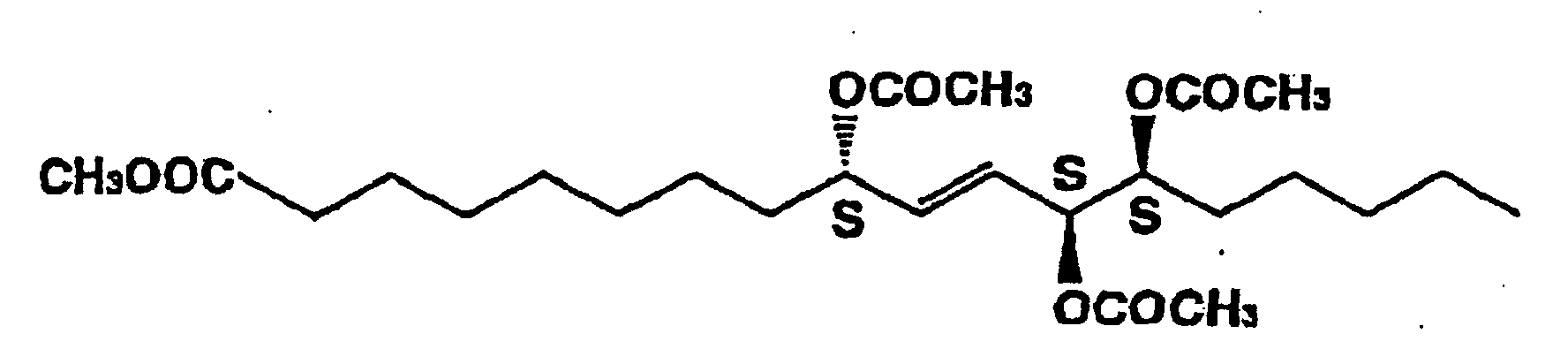
- Such derivatives include, for example, ester derivatives, in which an acyl group, such as acetyl group, benzoyl group, pyruvate group, or succinate group, is linked to the hydroxyl group; as well as ether derivatives, in which an alkyl group, such as ethyl group or methyl group, is linked to it.
- substituents linked to the carbonyl group of carboxylate include: alkyloxy groups, such as hydroxyl group, ethyloxy group; aryloxy groups, such as benzyloxy group; thioalkyl groups, such as thioethyl group, or thioaryl group, amino group, primary amine, or secondary amine, etc.
- Specifically such compounds include, for example, and
- Known fatty acid compounds having adjuvant activity include linoleic acid and arachidonic acid (H.K. Parmentier, M.G.B. Nieuwland, M.W. Bardorf, R.P. Kwakkel and J.W. Schrama, Poultry Science, 76 (8), 1164-1171, 1997; D.S. Kelley, P.C. Taylor, G.J. Nelson, P.C. Schmidt, B.E. Mackey and D. Kyle, Lipids, 32 (4), 449-456, 1997).
- linoleic acid is different from the compound of the present invention in that it is a dienoic acid, which contains two double bonds; moreover, it is clearly distinct from the inventive compound in that it has no hydroxyl group.
- Arachidonic acid is a fatty acid having 20 carbons, four double bonds, and no hydroxyl group, and thus this compound is different from the inventive fatty acid.
- the fatty acids to be used in the present invention can be extracted, separated, purified, and manufactured from natural products, for example, animal tissues, medicinal plants, marine plants, and cultures of microorganisms used as a raw material, by the combined use of known methods. They can also be manufactured by chemical synthesis. Examples of the production methods are as follows:
- the resulting residue is dissolved in water-containing methanol and extracted with a low polar solvent such as n-hexane or petroleum ether. The solvent is distilled off from the water-containing methanol layer.
- the resulting residue is fractionated, once or several times, by column chromatography using a carrier, for example, Sephadex such as Sephadex LH-20, a porous polymer such as DIAION HP-20, alumina, or silica gel and using at least one eluent selected from the group consisting of water, methanol, ethanol, chloroform, ether, n-hexane, benzene, and ethyl acetate.
- a carrier for example, Sephadex such as Sephadex LH-20, a porous polymer such as DIAION HP-20, alumina, or silica gel
- eluent selected from the group consisting of water, methanol, ethanol, chloroform, ether, n-hexane, benzene, and ethyl acetate.
- the constituent of interest is monitored by thin-layer chromatography.
- the fatty acid can be obtained.
- the fatty acid can be purified from the resulting water extract by ethanol precipitation, fractionation using a porous polymer such as DIAION HP-20, or a silica gel column chromatography. Alternatively, in some cases, it can be purified by recrystallization from an appropriate solvent such as acetone, methanol, and ethanol.
- various derivatives can be prepared from the compound obtained as described above through methylation, ethylation, or benzoylation, by properly combining known chemical, biochemical, and genetic techniques.
- the structure of the compounds of the present invention can be analyzed by known methods (W. Herz and P . Kulanthaivel, Phytochemistry, 24 (1), 89-91, 1985; S. Ohnuma, T. Uehara, T. Namai, M. Kodama, Y. Shiobara, Chemistry Letters, 577-580, 1986; M. Hamberg, Lipids, 26, 407-415, 1991; I. Ohtani, T. Kusumi, Y. Kashman, and H. Kakisawa, Journal of American Chemical Society, 113, 4092-4096, 1991; K. Kouda, T. Ooi, K. Kaya, and T. Kusumi, Tetrahedron Letters, 37, 6347-6350, 1996; M.
- the vaccine preparations of the present invention include vaccines in both narrow and broad senses. Specifically, the vaccines include:
- the vaccines include various vaccines that are categorized based on the types of methods for their production.
- the vaccines include attenuated live vaccines, inactivated vaccines, component vaccines, and DNA-based vaccine.
- the DNA-based vaccines include vaccines containing a DNA fragment in a carrier such as plasmid, and vaccines used in combination with ribozymes or antisense oligonucleotides. These vaccines can be used for prevention and/or treatment.
- the vaccines also include recombinant vaccines containing, as their active ingredient, an antigen effective for vaccination, which is genetically produced in recombinant cells. These vaccines may be single vaccines or combined vaccines. Examples of their production methods and usage forms are described below.
- Influenza vaccine- a split vaccine containing hemagglutinin (HA) neuraminidase (NA), nuclear protein (NP), matrix protein (M), or a part of these, which is obtained by proliferating the viruses in embryonated eggs or in Vero cells by using animal cell culture techniques, degrading the viruses with an agent such as ether and detergent, followed by purification, or by gene recombination techniques or chemical synthesis; or a DNA vaccine for intranasal inoculation comprising DNA fragments containing genes encoding these proteins.
- HA hemagglutinin
- NA nuclear protein
- M matrix protein
- Pertussis vaccine- an inactivated vaccine that is obtained by culturing Bordetella pertussis, treating the culture supernatant or bacteria by salting-out, ultracentrifugation to extract constituents of interest, and detoxicating the constituents with formalin; or a vaccine containing pertussis toxin (PT), filamentous hemagglutinin (FHA), 69 K membrane protein, or a partial peptide of these, derived from an artificial mutant strain that is prepared by gene recombination techniques or treatment with a mutagenizing agent.
- PT pertussis toxin
- FHA filamentous hemagglutinin
- 69 K membrane protein or a partial peptide of these, derived from an artificial mutant strain that is prepared by gene recombination techniques or treatment with a mutagenizing agent.
- DT diphtheria toxoid
- TT tetanus toxoid
- Japanese encephalitis vaccine an inactivated vaccine that is obtained by proliferating the viruses in mouse brain or in Vero cells using animal cell culture techniques, purifying the virus particles by ultracentrifugation or with ethyl alcohol, and inactivating the virus with formalin; or a vaccine containing antigen proteins obtained by gene recombination techniques or chemical synthesis.
- Hepatitis B vaccine - a plasma vaccine that is obtained by separating and purifying HBs antigen, by salting-out and ultracentrifugation, from blood collected from hepatitis B carriers as a raw material; or a recombinant vaccine containing the antigen portions obtained by gene recombination techniques or chemical synthesis.
- Measles vaccine - a live vaccine of an attenuated virus that is prepared by proliferating the virus in culture cells such as chicken embryonic cells or in Vero cells using cell line culture techniques; a recombinant vaccine containing a part of the virus; or a recombinant vaccine containing a protective antigen prepared by gene recombination techniques or chemical synthesis.
- Rubella vaccine - a vaccine containing the viruses grown in culture cells such as animal cells or human fetal cells or in Vero cells using cell line culture techniques; a part of the virus; or a protective antigen prepared by gene recombination techniques or chemical synthesis.
- Mumps vaccine - an attenuated live vaccine containing the viruses grown in culture cells such as rabbit cells or in embryonated eggs; a part of the virus; or a protective antigen prepared by gene recombination techniques or chemical synthesis.
- Measles-rubella combined vaccine - a dual vaccine that is obtained by mixing the above-described measles and rubella vaccines.
- Measles-rubella-mumps combined vaccine - a triple vaccine that is obtained by mixing the above-described measles vaccine, rubella vaccine, and mumps vaccine.
- Rotavirus vaccine - a vaccine containing the viruses grown in culture cells such as MA104 cell; the viruses collected from patient's feces; a part of the viruses; or a protective antigen prepared by gene recombination techniques or chemical synthesis.
- AIDS vaccine - a vaccine containing the viruses grown in culture cells; the viruses obtained from patients; a part of these; a protective antigen prepared by gene recombination techniques or chemical synthesis; or a DNA vaccine containing effective DNA fragments.
- H. pylori vaccine a vaccine containing, as antigens, lysate of cultured Helicobacter pylori, or urease, heat shock protein, toxin, and others separated from cultured Helicobacter pylori ; or a vaccine for injection, oral inoculation, or intranasal inoculation, which comprises these antigen proteins produced by gene recombination techniques.
- the adjuvants of the present invention can be used with various known appropriate usage patterns.
- the adjuvant may be part of a physically mixed preparation or a complex chemically linked with an antigen protein.
- the adjuvant can be incorporated together with a vaccine in a carrier such as liposome.
- the adjuvants of the invention can be used concurrently together with one or more conventional adjuvants.
- a preferable combination of the adjuvants of the present invention and conventional adjuvants can be empirically determined according to conditions to be considered, such as the type of antigens used as immunogens, the species of animals subjected to inoculation, and safety. The combination use can reduce adverse side reactions and enhance desired immunoreactivity, for example, by reducing the amount of antigen or the other adjuvant.
- the inventive vaccine preparation can be prepared by mixing the above-mentioned immunogen with the inventive adjuvant at an adequate mixing ratio.
- the inventive vaccine preparation can be effective even when the vaccine antigen (antigen constituent) and the inventive adjuvant are separately prepared as pharmaceutical preparations and then, as shown in the Examples, the two are separately inoculated, or the two are mixed with each other at the time of inoculation.
- the preparation must be done under strictly sterile conditions. Each of raw materials must be completely sterile.
- contaminants that are unnecessary for vaccination including those that act as pyrogens or allergens, should be eliminated. Methods to achieve this objective are known to those skilled in the art.
- the volume ratio between the vaccine antigen (antigen constituent) and the adjuvant in the vaccine preparation of the present invention can range, for example, from 1:0.0001 to 1:10,000 (weight ratio).
- the above range is merely a typical example.
- a suitable ratio is selected depending on the type of vaccine. Methods required for the selection are known to those skilled in the art.
- the vaccines are provided as liquid forms or powdered forms. If a powdered form is desired, the vaccines can be prepared as pharmaceutical preparations by a conventional method, including freeze-drying. Liquid forms of the pharmaceutical preparations are often suitable for the intranasal inoculation (intranasal spray, intranasal instillation, spread, etc.), oral administration, and injection. Alternatively, a powder spray can be provided for intranasal inoculation.
- the inventive vaccine preparation can also be formulated with publicly known stabilizers or preservatives . Such stabilizers include about 0.1 to 0.2% gelatin or dextran, 0.5 to 1% sodium glutamate, about 5% lactose, and about 2% sorbitol. Known preservatives include about 0.01% thimerosal, about 0.1% ⁇ -propionolactone, and about 0.5% 2-phenoxyethanol.
- the vaccine preparation of the present invention can be utilized by any known method.
- the inventive vaccine preparation can be used for inoculation as a mixture of a vaccine antigen (antigen constituent) and the adjuvant constituent.
- each constituent can be inoculated separately.
- the inoculation is preferably performed orally or intranasally.
- the effect of enhancing immunity can be achieved, even when the respective constituents are inoculated separately, for example, even when the vaccine antigen (antigen constituent) is intranasally inoculated and the adjuvant constituent is orally administered.
- the dose to mouse is preferably 5 to 50 ⁇ l for intranasal inoculation or 0.05 to 0.5 ml for oral administration.
- the dose to human preferably ranges from about 0.1 to 1.0 ml for intranasal administration or about 1 to 100 ml for oral administration.
- the dose is changeable when desired.
- immunological antigens of pathogenic microorganism are advantageously inoculated intranasally, orally, or transdermally in terms of their vaccination effect or ease of inoculation:influenza virus, rotavirus, measles virus, rubella virus, mumps virus, human immunodeficiency virus, Bordetella pertussis, diphtheria bacillus, H. pylori, enterohaemorrhagic Escherichia coli (EHEC), Chlamydia, Mycoplasma, Malaria Plasmodium, coccidium, and schistosome.
- influenza virus rotavirus
- measles virus rubella virus
- mumps virus human immunodeficiency virus
- Bordetella pertussis diphtheria bacillus
- H. pylori enterohaemorrhagic Escherichia coli (EHEC)
- Chlamydia Mycoplasma
- vaccine antigens antigen constituent
- adjuvants can be inoculated singly or concurrently, for example, like pertussis-diphtheria-tetanus triple vaccine or measles-rubella dual vaccine.
- the intranasal and oral inoculations are preferable because mucous membranes of organs such as the respiratory tract and digestive tract can be infection routes.
- a suitable adjuvant with strong inducing activity of immune response is preferable in order to induce immune response in local mucous membranes that can be primary infection routes.
- some vaccinations such as vaccination against Malaria Plasmodium, are performed in most cases in regions without sufficient medical facilities. In such occasions, it is advantageous to select a vaccination route such as intranasal, oral, or transdermal inoculation route, thereby allowing a person who is not a technician such as physician or nurse, to perform the vaccination.
- 9S,12S,13S-Trihydroxy-10E-octadecenoic acid was manufactured according to the method as described in Unexamined Published Japanese Patent Application (JP-A) No. Hei 3-258775 entitled "Fatty acid compound and antihypertensive agent comprising as an active ingredient the fatty acid compound.”, the contents of which are herein incorporated by reference.
- Pinelliae Tuber (1 kg) was extracted with methanol by heating, and the solvent was distilled off from the extract under reduced pressure to give 21.2 g of the methanol-extract.
- the methanol-extract was dissolved in 100 mL of a 90% (v/v) methanol-water mixed solution and transferred into a separatory funnel. After 50 mL of n-hexane was added, the funnel was shaken gently and then allowed to stand. The lower layer was recovered and concentrated up to half of the initial volume. The resulting concentrate was subjected to hydrophobic chromatography using a DIAION HP-20 (Mitsubishi Chemical) column.
- the elution was performed firstly with water, then with a 50%(v/v) methanol-water mixed solution, and finally with methanol.
- the methanol eluate fraction (530 mg) was subjected to column chromatography using Sephadex LH-20 (Amersham-Pharmacia Biotech), then to normal phase silica gel column chromatography, and finally to reverse phase high performance liquid chromatography using ⁇ -Bondapak C18 (Millipore Waters) column to give 9S,12S,13S-trihydroxy-10E-octadecenoic acid as a colorless oily substance.
- the yield was 10 mg.
- TMSCHN 2 (2.0 M in hexane, 29 mL, 58 mmol) was added dropwise to a benzene-methanol solution (10:1) (2.2 mL) of 9S,12S,13S-trihydroxy-10E-octadecenoic acid (9.6 mg, 29 ⁇ mol) at room temperature, and the mixture was stirred for 2.5 hours.
- reaction solution was evaporated under reduced pressure, the resulting colorless oily crude product (10 mg) was dissolved in a dimethylformamide solution (0.6 mL) at room temperature under the argon gas atmosphere, and 2,2-dimethoxypropane (14 ⁇ L, 0.12 mmol) and PPTS (7.3 mg, 29 mmol) were added thereto, and the mixture was stirred at 60°C for 48 hours.
- the temperature of the reaction solution was returned to room temperature, water (500 ⁇ L) was added to the reaction solution, and the mixture was extracted with chloroform (5 mL) three times. The organic layer was washed with saturated brine (3 mL), dried over anhydrous sodium sulfate, and concentrated.
- This Example describes the preparation of 9S,12S,13S-trihydroxy-10E-octadecenoic acid of the present invention from a hot-water extract of Pinelliae Tuber.
- Pinelliae Tuber 500 g was decocted with 10 L water until the volume of the solution was reduced to half of the initial one, and then the resulting extract was filtered. The residue was further decocted in the same manner. Both extracts were combined together and subjected to freeze-drying to yield a hot-water extract (yield: 19.8%).
- the hot-water extract was refluxed in 2.5 L of methanol to give methanol-soluble and methanol-insoluble fractions.
- the methanol-insoluble fraction was subjected to the same procedure two other times. After the methanol-insoluble fraction was again dissolved in water, four times as much volume as ethanol was added thereto and the resulting mixture was stirred overnight.
- the precipitate and supernatant were separated from each other. Further, the precipitate was dialyzed against distilled water by using a cellulose membrane with molecular-weight exclusion limit of 10,000, and then the inner dialysate was subjected to freeze-drying to give a non-dialyzable fraction (yield: 0.6%). The non-dialyzable fraction was dissolved in water and stirred together with DIAION HP-20. Then, the unabsorbed fraction was removed by washing the DIAION HP-20 with water.
- the adsorbed fraction was eluted with methanol to give a methanol-eluate fraction (yield: 0.06%).
- the methanol-eluate fraction was repeatedly purified by silica gel column chromatography to give the inventive 9S,12S,13S-trihydroxy-10E-octadecenoic acid. The yield was 0.35mg.
- the methanol-soluble fraction (45.4 g) obtained from a hot-water extract of Pinelliae Tuber by reflux in methanol was dissolved in 200 mL of a methanol-water mixed solution (9:1) then extracted with an equal volume of n-hexane while being shaken to obtain the lower layer.
- the solvent was distilled off from the lower layer under reduced pressure, and the resulting residue was stirred with DIAION HP-20 in an 80% methanol-water mixed solution.
- the unabsorbed fraction was removed by washing DIAION HP-20 with the same solvent.
- the adsorbed fraction was obtained by eluting it from DIAION HP-20 with methanol.
- the adsorbed fraction was fractionated several times by silica gel column chromatography to give the inventive 9S,12S,13S-trihydroxy-10E-octadecenoic acid (1.2 mg).
- Di-tert-butyl dicarboxylate (9.58 mL, 41.7 mmol) and 4-dimethylaminopyridine (1.02 g, 0.34 mmol) were successively added to a tert-butanol solution (56 mL) of 7-methoxycarbonylheptanoic acid (1) (5.00 mL, 5.24 g, 27.8 mmol) at room temperature under the argon atmosphere, and the mixture was stirred at room temperature for 1 hour.
- a 0.2 N hydrochloric acid solution (20 mL) was added to the reaction solution to make the mixture weakly acidic, and the reaction solution was concentrated to about 1/3 volume, and extracted with chloroform (50 mL) three times.
- t-Butyl-7-methoxycarbonylheptanoate (2) (5.51 g, 22.6 mmol) was added to a methanol-water-tetrahydrofuran (3:1:1) solution (113 mL) of 1.5 N sodium hydroxide at room temperature, and the mixture was stirred at room temperature for 28 hours.
- a 1.0 N hydrochloric acid solution (50 mL) was added to the reaction solution to make the mixture weakly acidic, the reaction solution was concentrated to about 1/3 volume, and extracted with chloroform (50 mL) three times. The organic layer was washed with saturated brine (50 mL), dried over sodium sulfate and concentrated.
- 1,3-Propanedithiol (18.3 g, 17.0 mL, 169 mmol) and boron trifluoride-diethyl ether complex (3.92 g, 3.40 mL, 27.6 mmol) were added to a dichloromethane solution (140 mL) of 2,4-decadienal (6) (21.4 g, 25.0 mL, 141 mmol) at 0°C under the argon atmosphere, and the temperature of the reaction solution was raised to room temperature, followed by stirring at room temperature for 12 hours. An aqueous saturated sodium hydrogen carbonate solution (200 mL) was added to stop the reaction, and the mixture was extracted with chloroform (100 mL) three times.
- N-butyllithium (1.53 M hexane solution, 612 ⁇ L, 0.936 mmol) was added dropwise to a tetrahydrofuran solution (8.5 mL) of (E,E)-1-(1,3-dithian)-2,4-decadiene (7) (200 ⁇ L, 206 mg, 0.851 mmol) at -78°C over 15 minutes under the argon atmosphere, and the mixture was stirred at -78°C for 1 hour. Thereafter, t-butyl-8-iodooctanoate (5) (327 ⁇ L, 416 mg, 1.28 mmol) was added to the reaction solution at once, and the mixture was stirred at -78°C for 1 hour.
- AD mix-alpha (1.60 g) was added to a tert-butanol-water solution (1:1) (11.5 mL) at room temperature, the mixture was stirred until it became clear orange, methanesulfonamide (109 mg, 1.15 mmol) was added thereto, and the mixture was stirred until it became uniform.
- This reaction solution was cooled to 0°C, and stirred vigorously. After the reaction solution became the orange ununiform two-layered solution, (E,E)-9-(1,3-dithian)-10,12-octadecadienoic acid t-butyl ester (8) (528 mg, 1.20 mmol) was added thereto, and the mixture was stirred vigorously at 0°C for 168 hours.
- 2,6-Lutidine (916 ⁇ L, 7.87 mmol) was added dropwise to a dichloromethane solution (7.9 mL) of (12S,13S)-(E)-12,13-dihydroxy-9-(1,3-dithian)-10-octadecaenoic acid t-butyl ester (9) (373 mg, 0.787 mmol) at -78°C under the argon atmosphere and, subsequently, tert-butyldimethylsilyl trifluoromethanesulfonate (901 ⁇ L, 0.723 mmol) was added dropwise over 5 minutes, and the mixture was stirred at -78°C for 10 minutes.
- Tetrabutylammonium fluoride (1.0 M tetrahydrofuran solution, 420 ⁇ L, 0.416 mmol) was added to a tetrahydrofuran solution (500 ⁇ L) of (9S,12S,13S)-(E)-12,13-di-tert-butyldimethylsiloxy-9-hydroxy-10-octadecaenoic acid t-butyl ester (12) (11.6 mg, 0.189 mmol) at room temperature, and the mixture was stirred for 3 hours and 25 minutes. The temperature of the reaction solution was raised to 70°C, and the solution was stirred for 1 hour and 30 minutes.
- AD mix-beta (1.68 g) was added to a tert-butanol-water solution (1:1) (12 mL) at room temperature, the mixture was stirred until it became clear orange, methanesulfonamide (114 mg, 1.20 mmol) was added, and the mixture was stirred until it became uniform. The reaction solution was cooled to 0°C and stirred vigorously.
- 2,6-Lutidine 160 ⁇ L, 1.38 mmol was added dropwise to a dichloromethane solution (14 mL) of (12R, 13R)-(E)-12, 13-dihydroxy-9-(1, 3-dithian)-10-octadecaenoic acid t-butyl ester (15) (326 mg, 0.689 mmol) at -78°C under the argon atmosphere.
- triisopropylsilyl trifluoromethanesulfonate (194 ⁇ L, 0.723 mmol was added dropwise over 20 minutes, and the mixture was stirred at -78°C for 8 hours.
- Monochloromethanesulfonyl chloride (3.9 ⁇ L, 0.030 mmol) was added dropwise to a pyridine solution (0.5 mL) of (12R,13R)-(E)-9-(1,3-dithian)-13-hydroxy-12-triisopropylsiloxy-10-octadecaenoic acid t-butyl ester (16) (13.0. mg, 0.021 mmol) at 0°C under the argon atmosphere, and the mixture was stirred at 0°C for 2 hours. Water (0.5 mL) was added to the reaction solution, the mixture was extracted with chloroform (5 mL) three times.
- the reaction solution was cooled to 0°C, a 1.0 N hydrochloric acid solution (500 ⁇ L) was added to the reaction solution to make it weakly acidic, the mixture was extracted with chloroform (5 mL) three times, and the organic layer was washed with saturated sodium hydrogen carbonate (5 mL), dried over sodium sulfate, and concentrated.
- the resulting colorless oily crude product (15.2 mg) was dissolved in a tetrahydrofuran (1.0 mL), tetrabutylammonium fluoride (1.0 M tetrahydrofuran solution, 30 ⁇ L, 29.8 ⁇ mol) was added to the solution at 0°C, and the temperature of the mixture was raised to room temperature, followed by stirring for 52 hours.
- the reaction solution was cooled to 0°C, a 1.0 N hydrochloric acid solution (0.5 mL) was added to the reaction solution to make it weakly acidic, the mixture was extracted with chloroform (5 mL) three times, and the organic layer was washed with saturated sodium hydrogen carbonate (5 mL), dried over sodium sulfate, and concentrated.
- the resulting colorless oily crude product (30 mg) was dissolved in a tetrahydrofuran (0.5 mL), tetrabutylammonium fluoride (1.0 M tetrahydrofuran solution, 45.4 ⁇ L, 0.0454 mmol) was added to the solution at 0°C, and the temperature of the mixture was raised to room temperature, followed by stirring for 45 hours.
- hydroxy unsaturated fatty acids 9S,12S,13S-trihydroxy-10E-octadecenoic acid, 9S,12R,13S-trihydroxy-10E-octadecenoic acid, or 9R,12R,13S-trihydroxy-10E-octadecenoic acid (hereinafter, these are referred to as hydroxy unsaturated fatty acids) is effective as an adjuvant.
- hydroxy unsaturated fatty acids have the activity of enhancing antibody production against various vaccines and are effective as an adjuvant.
- HA vaccine protein concentration, 50 ⁇ g/mL
- Aqueous solutions of 9S,12S,13S-trihydroxy-10E-octadecenoic acid, 9S,12R,13S-trihydroxy-10E-octadecenoic acid, or 9R, 12R, 13S-trihydroxy-10E-octadecenoic acid, synthesized by the method described in Examples 3 to 5 were prepared to give sample solutions.
- Each hydroxy unsaturated fatty acid solution was given to BALB/c mice (7-week old female) at a dose of 50 ⁇ g/kg weight of mouse by forced intragastric administration through an oral probe.
- mice On the day of oral administration, the mice were anesthetized with sodium amobarbital and 10 ⁇ L (1 ⁇ g/mouse) of the vaccine was dropped into both left and right nasal cavities with a micro-pipette. After three weeks, each hydroxyl unsaturated fatty acid solution was given again to mice at a dose of 50 ⁇ g/kg by forced intragastric administration, and secondary immunization was performed by dropping 10 ⁇ L of a vaccine with a micro-pipette into both left and right nasal cavities on the day of oral administration. One week after the secondary immunization, blood was collected from the heart of the mice to prepare sera.
- nasal irrigation liquids were prepared by perfusing 2 mL of a phosphate buffered physiological saline (PBS) containing 0.1% bovine serum albumin (BSA) into left and right nasal cavities of the mice.
- PBS phosphate buffered physiological saline
- BSA bovine serum albumin
- the titers of anti-influenza virus IgA antibody in the sera and nasal irrigation liquids were determined by enzyme-linked immunosorbent assay (ELISA).
- each well of the 96-well EIA plate Prior to the assay for anti-influenza virus IgA antibody, each well of the 96-well EIA plate (Immulon 4; Dynex Technologies, Inc.) was first coated with 100 ⁇ L of anti-mouse IgA monoclonal antibody (mAb) (Pharmingen) (1 ⁇ g/mL) diluted with a coating buffer (10 mM sodium carbonate bicarbonate buffer (pH 9.6) containing 10 ⁇ g/mL BSA) . The plate was allowed to stand at 37 °C for 3 hours, and then the solution in each well was discarded. Each well was coated with 300 ⁇ L of a blocking solution (PBS containing 1% skimmed milk) to avoid non-specific binding.
- mAb monoclonal antibody
- a coating buffer 10 mM sodium carbonate bicarbonate buffer (pH 9.6) containing 10 ⁇ g/mL BSA
- ELISA for quantificating anti-influenza virus IgG 1 antibody was performed according to the same manner as that for quantificating anti-influenza virus IgA antibody except that anti-mouse IgG 1 mAb (manufactured by Pharmingen) was used as a capture antibody.
- Fig. 2 shows the influence of oral administration of 9S,12S,13S-trihydroxy-10E-octadecenoic acid, 9S,12R,13S-trihydroxy-10E-octadecenoic acid, and 9R,12R,13S-trihydroxy-10E-octadecenoic acid on the titers of anti-influenza virus antibody in nasal irrigation liquids from the mice.
- the vaccine was nasally inoculated and an aqueous solvent containing no adjuvant was orally administered, only low levels of the antibodies were detected.
- Fig. 3 shows the influence of oral administration of 95, 12S, 13S-trihydroxy-10E-octadecenoic acid on production of anti-influenza virus IgA and IgG 1 antibodies in the sera.
- 9S, 12S, 13S-trihydroxy-10E-octadecenoic acid was orally administered at a dose of 50 ⁇ g/kg weight of mouse, the titers of the anti-influenza virus IgA and IgG 1 antibodies in the sera were significantly increased compared to the inoculation of the HA vaccine alone.
- the results demonstrate that production of antibodies in the sera induced by the nasally inoculated influenza HA vaccine is enhanced by oral administration of 9S,12S,13S-trihydroxy-10E-octadecenoic acid.
- a complex of the hydroxy unsaturated fatty acid and BSA that is a carrier protein was prepared.
- Each well of the 96-well EIA plate was first coated with a 100 ⁇ L aliquot of a solution containing the complex (1 ⁇ g/mL).
- Each well of the plate was coated with 300 ⁇ L aliquot of a blocking solution (PBS containing 5% skimmed milk) for 1 hour to avoid non-specific reactions.
- 100 ⁇ L samples (nasal irrigation liquid) diluted to various concentrations were added into each well for antigen-antibody reaction, and the reaction was continued for 1 hour.
- the plate was then washed three times with PBS-0.05% Tween-20, 100 ⁇ L of peroxidase-conjugated anti-mouse IgG, IgA or IgE antibody (1:1000) as a secondary antibody was added thereto, and the reaction was continued for one hour.
- 100 ⁇ L of a substrate solution 0.1 M citrate buffer (pH 4) containing 0.003% hydrogen peroxide and ABTS of 0.3 mg/mL
- the plate was incubated for 15 minutes for color development. The O.D. at 405 nm was measured by a micro-plate reader.
- An influenza HA vaccine and an aqueous solution of 9S,12S,13S-trihydroxy-10E-octadecenoic acid were prepared according to the same manner as in Example 6.
- a sample solution was given orally to BALB/c mice (7-week old female) at a dose of 50 ⁇ g/kg weight of mouse by forced intragastric administration with an oral probe.
- the mice were anesthetized with sodium amobarbital and 10 ⁇ L (1 ⁇ g/mouse) of the vaccine was inoculated nasally by dropping into both left and right nasal cavities with a micro-pipette.
- a sample solution was orally administered again to the mice, and the vaccine was given by secondary nasal inoculation.
- a bronchoalveolar irrigation liquid was prepared.
- the bronchoalveolar irrigation liquid was recovered by injecting 2 mL of PBS containing 0.1% BSA into the trachea of the mice after bloodletting and perfusing the lung with the PBS twice.
- the titer of anti-influenza vaccine IgE antibody in the bronchoalveolar irrigation liquid was measured by ELISA.
- Fig. 4 shows the influence of oral administration of 9S,12S,13S-trihydroxy-10E-octadecenoic acid on the titer of anti-influenza vaccine IgE antibody in the bronchoalveolar irrigation liquid.
- IgE antibody to the influenza vaccine was detected in the bronchoalveolar irrigation liquid, although at an extremely low level.
- 9S,12S,13S-trihydroxy-10E-octadecenoic acid was orally administered, the titer of the anti-influenza vaccine IgE antibody in the bronchoalveolar irrigation liquid was significantly decreased.
- Acute toxicity was studied by administering to mice the hydroxy unsaturated fatty acid (9S,12S,13S-trihydroxy-10E-octadecenoic acid) synthesized in Example 3 and its methyl ester derivative (methyl 9S,12S,13S-trihydroxy-10E-octadecenoate), triacetyl derivative (9S,12S,13S-triacetoxy-10E-octadecenoic acid), and triacetyl methyl ester derivative (methyl 9S,12S,13S-triacetoxy-10E-octadecenoate) prepared from the fatty acid.
- Methyl 9S,12S,13S-trihydroxy-10E-octadecenoate was obtained as follows: 9S,12S,13S-Trihydroxy-10E-octadecenoic acid was dissolved in ether. An excess amount of diazomethane ether solution was added and the mixture was incubated at room temperature for several minutes. The solvent was distilled off from the reaction solution.
- 9S,12S,13S-Triacetoxy-10E-octadecenoic acid was obtained as follows: 9S,12S,13S-Trihydroxy-10E-octadecenoic acid was refluxed in the presence of sodium acetate in acetic anhydride for about 1 hour, and then the reaction product was subjected to two-phase extraction with chloroform and water to obtain the desired compound from the chloroform layer.
- Methyl 9S,12S,13S-trihydroxy-10E-octadecenoate synthesized from 9S,12S,13S-trihydroxy-10E-octadecenoic acid was converted to methyl 9S,12S,13S-triacetoxy-10E-octadecenoate by the same method as for synthesizing 9S,12S,13S-triacetoxy-10E-octadecenoic acid.
- Solution of pertussis-diphtheria-tetanus combined vaccine was prepared to contain 50 ⁇ g of protein nitrogen in 20 ⁇ L.
- 9S,12S,13S-Trihydroxy-10E-octadecenoic acid was dissolved in PBS at a concentration of 10 ⁇ g in 0.5 mL and filter sterilized.
- a preservative (0.005% thimerosal) was added to these solutions.
- the resulting mixtures were dispensed into containers, which were used as pertussis-diphtheria-tetanus combined vaccine (intranasal)-hydroxy unsaturated fatty acid (oral) inoculum preparations. These preparations were stored at a temperature of not more than 10°C in a cool and dark place.
- the pertussis-diphtheria-tetanus combined vaccine as prepared above was intranasally inoculated into mice, and 9S,12S,13S-trihydroxy-10E-octadecenoic acid was orally administered before and after the inoculation. After 4 weeks, the same amount of the vaccine was further inoculated, and the antibody production was tested.
- the test result showed that in the blood from control mice that had been inoculated with only pertussis-diphtheria-tetanus combined vaccine, the level of anti-pertussis toxin (PT) -IgG antibody was 156 ELISA units; the level of anti-diphtheria toxoid (DT)-IgG antibody was 11 ELISA units; and the level of anti-tetanus toxoid (TT) -IgG antibody was 13 ELISA units, while in the case of the combined use of orally administered 9S,12S,13S-trihydroxy-10E-octadecenoic acid, the level of anti-PT-IgG antibody was 442 ELISA units; the level of anti-DT-IgG antibody was 70 ELISA units; and the level of anti-TT-IgG antibody was 75 ELISA units.
- PT pertussis toxin
- DT anti-diphtheria toxoid
- TT anti-te
- the level of anti-PT-IgA antibody was 6 ELISA units; the level of anti-DT-IgA antibody was 3 ELISA units; and the level of anti-TT-IgA antibody was 4 ELISA units, the level of anti-PT-IgA antibody was 14 ELISA units; the level of anti-DT-IgA antibody was 11 ELISA units; and the level of anti-TT-IgA antibody was 11 ELISA units, in the nasal irrigation liquid in the case of vaccination combined with the administration of 9S,12S,13S-trihydroxy-10E-octadecenoic acid.
- a measles-rubella vaccine preparation was prepared to contain virus particles of each vaccine in an amount of 7 ⁇ g in 20 ⁇ L.
- 9S,12S,13S-Trihydroxy-10E-octadecenoic acid was dissolved in PBS at a concentration of 2.5 ⁇ g in 0.5 mL and filter sterilized.
- a stabilizer (0.2% porcine gelatin, 0.1% sodium glutamate; 5% lactose) was added to these preparations.
- the resulting mixtures were dispensed into containers, which were used as measles-rubella combined vaccine (nasal)-hydroxy unsaturated fatty acid (oral) inoculum. These preparations were stored at a temperature of not more than 10°C in a cool and dark place.
- the measles-rubella vaccine as prepared above was nasally inoculated into mice twice at 3-week intervals, and 9S, 12S, 13S-trihydroxy-10E-octadecenoic acid was orally administered only before and after the first inoculation. Then, the antibody production in the blood was evaluated. The test result showed that the ELISA titer of antibody produced was 0.14 for measles and 0.09 for rubella when the vaccine alone had been inoculated, while the titer was 0.30 for measles and 0.29 for rubella in the case of the combined use of 9S,12S,13S-trihydroxy-10E-octadecenoic acid with the vaccine.
- a rotavirus vaccine preparation was prepared to contain virus particles in an amount of 3.3 ⁇ g in 20 ⁇ L.
- the methyl ester derivative (methyl 9S,12S,13S-trihydroxy-10E-octadecenoate) as used in Example 8 was dissolved in PBS and prepared at a concentration of 10 ⁇ g in 0.5 mL.
- the resulting preparation was filter sterilized and dispensed into containers, which were used as rotavirus vaccine-hydroxy unsaturated fatty acid ester oral preparations or nasal drops. These preparations were stored at a temperature of not more than 10°C in a cool and dark place.
- the rotavirus vaccine as prepared above was nasally inoculated into mice twice at 3-week intervals, and the methyl ester derivative was orally administered only before and after the first inoculation. Then, the antibody production in the blood was evaluated. The test result showed that the ELISA titer of antibody produced was 0.089 in the inoculation of nasal vaccine drop when the vaccine alone was inoculated, while the titer was 0.38 in the case of the combined use of the methyl ester derivative with the vaccine.
- the titer was 0.018 in the mice of the control group without adjuvant inoculation when the vaccine had been inoculated orally, while the titer was 0.27 in the group to which the vaccine together with the methyl ester derivative had been inoculated.
- a mycoplasma vaccine was prepared to contain mycoplasma bacteria in an amount of 2.0 ⁇ 10 10 CFU (colony forming unit) in 20 ⁇ L.
- 9S,12S,13S-Trihydroxy-10E-octadecenoic acid was dissolved in PBS at a concentration of 10 ⁇ g in 0.5 mL and filter sterilized. These were dispensed into containers, which were used as mycoplasma vaccine-hydroxy unsaturated fatty acids preparation nasal drops or oral preparations. These preparations were stored at a temperature of not more than 10°C in a cool and dark place.
- the mycoplasma vaccine as prepared above was intranasally inoculated into mice three times at 2-week intervals, and then 9S, 12S, 13S-trihydroxy-10E-octadecenoic acid was orally administered only before and after the first inoculation. Then, the lesions associated with Mycoplasma infection were observed.
- the test result showed that the lesions were recognized in all of 10 control mice to which the vaccine alone had been inoculated, while the lesions were found in only 3 of 10 mice to which 9S, 12S, 13S-trihydroxy-10E-octadecenoic acid had been given together with the vaccine. While the average number of lesions was 302 in the case of the vaccine alone, the number was 178 in the case of the combined use of 9S,12S,13S-trihydroxy-10E-octadecenoic acid with the vaccine.
- vaccine preparations containing as a constituent the adjuvant in accordance with the present invention would be effective drugs that prevent or treat virus and bacterial infections by vaccination.
Landscapes
- Health & Medical Sciences (AREA)
- Life Sciences & Earth Sciences (AREA)
- Immunology (AREA)
- Chemical & Material Sciences (AREA)
- Mycology (AREA)
- Animal Behavior & Ethology (AREA)
- Veterinary Medicine (AREA)
- Public Health (AREA)
- Medicinal Chemistry (AREA)
- General Health & Medical Sciences (AREA)
- Pharmacology & Pharmacy (AREA)
- Epidemiology (AREA)
- Microbiology (AREA)
- Virology (AREA)
- General Chemical & Material Sciences (AREA)
- Chemical Kinetics & Catalysis (AREA)
- Pulmonology (AREA)
- Engineering & Computer Science (AREA)
- Bioinformatics & Cheminformatics (AREA)
- Nuclear Medicine, Radiotherapy & Molecular Imaging (AREA)
- Organic Chemistry (AREA)
- Medicines Containing Antibodies Or Antigens For Use As Internal Diagnostic Agents (AREA)
- Medicinal Preparation (AREA)
Abstract
The present invention provides an adjuvant that is a hydroxy
unsaturated fatty acid or a derivative thereof, as well as a vaccine
preparation containing the adjuvant as a constituent. For example,
a vaccine shows sufficient activity to enhance the immunity when a
hydroxy unsaturated fatty acid having the following structure is
administered:


Description
The present invention relates to an adjuvant that contains a
hydroxy unsaturated fatty acid as an active ingredient and to vaccine
preparations containing the adjuvant as a constituent, such vaccine
preparations being useful to prevent or treat diseases of human,
animals, and other organisms.
Vaccines have been used to prevent various diseases, and have
provided tremendous and excellent results in the prevention of
specific diseases such as smallpox. Nonetheless, vaccines also have
side effects and there are many cases in which vaccines are less
effective. Thus there is much room for improvement in the field of
vaccines. Currently, many types of vaccines used for human or other
animals are prepared by using pathogenic organisms, or parts thereof,
as antigenic materials for vaccine production. This means that there
is no denying the possibility that vaccines are contaminated with
constituents of pathogenic organisms or ingredients of growth medium
for pathogenic organisms. These contaminants can cause adverse side
effects upon vaccination. In addition, antigenic sites associated
with immunization themselves can induce side effects when inoculated
in large quantity.
Attempts have been made to avoid such side effects as much as
possible and to manufacture safe vaccines. Such attempts include the
reduction of inoculum dose of vaccine, the use of high-purity
preparations of antigen for vaccine, and the alteration of vaccination
routes. However, these revisions have a general problem -the
immunological activity of such revised vaccines tends to be reduced.
Accordingly, adjuvants have been used to prevent such a decline of
immunological activity. In such cases, there remain some problems
to be solved, such as improvement in effectiveness and safety of
adjuvants.
For example, a pathogenic microorganism such as influenza virus
infects via mucous membranes. To prevent such diseases at early
stages of infection, vaccines capable of significantly enhancing
local immunity on the mucous membrane rather than systemic immunity
in the blood are preferred. In this context, it is also preferable
to have an adjuvant capable of contributing to the enhancement of
local immunity. At the same time, instead of injection, oral,
transdermal, or intranasal inoculation is noteworthy as a vaccination
route. The injection must be performed by medical technicians and
is, therefore, problematic when it is necessary to vaccinate many
people under a condition with no or only poor medical facilities.
In contrast, oral, transdermal, and intranasal inoculation can be
performed without direct practices by medically skilled staffs, so
long as vaccine preparations are available. In general, when
vaccinated with an injectable vaccine, via alternate vaccination
route, sufficient immunological stimulation is difficult to attain
and, therefore, certain adjuvants suitable for alternate vaccination
routes are needed.
In other words, an important challenge for the development of
vaccines is to develop an excellent adjuvant that is effective and
safe and that helps the enhancement of required immunity at the desired
site.
Previously, aluminum compounds (aluminum sulfate, aluminum
hydroxide, etc.) and phosphate compounds (calcium phosphate, aluminum
phosphate, etc.) have widely been used as adjuvants for vaccination.
Currently, the gel of these compounds is almost the only adjuvant
that is used for human vaccination. However, there are some problems
in regard to these adjuvants, and thus the adjuvants are in need of
improvement. Some illustrations are as follows:
Studies and development of new types of adjuvants, such as
saponin, are proceeding in order to overcome the drawbacks. Some
illustrations are as follows (See J. C. Cox et al., Vaccine 15, 248-256,
1997):
The present inventors have found that certain extracts of Chinese
and Japanese traditional (Kampo) medicine, consisting of several
crude drugs, exhibit adjuvant activity and increase the antibody titer
against influenza virus in the nasal irrigation liquid and in the
serum when used as an ingredient of influenza vaccine to be inoculated
intranasally (H. Yamada and T. Nagai, Methods and Findings in
Experimental and Clinical Pharmacology, 20(3), 185-192, 1998).
However, exactly which component(s) of the extract has the adjuvant
activity remains to be clarified.
An objective of the present invention is to provide a novel method
for enhancing the immunological activity of vaccine in order to
produce vaccines whose immunological activity is not reduced when
dosage is lowered or vaccination route is altered. More specifically,
the objective is to screen for an effective and safe compound having
a simpler structure among crude drug and to thereby develop a novel
adjuvant. Chinese and Japanese traditional (Kampo) medicines have
long been used clinically in China, Japan, and other Asian countries,
and its effectiveness and safety have been already established. Thus,
the medicines are excellent and suitable as the material to be utilized
for the present objective.
In other words, an objective of the present invention is to
provide a hydroxy unsaturated fatty acid and derivatives thereof as
novel, effective, and safe vaccine adjuvants, to provide vaccines
composed of these, and to contribute to the manufacture of effective
and safe vaccines.
In a preferred embodiment, the present invention provides an
adjuvant that contains 9S, 12S, 13S-trihydroxy-10E-octadecenoic acid,
9S,12R,13S-trihydroxy-10E-octadecenoic acid, or
9R,12R,13S-trihydroxy-10E-octadecenoic acid, or a derivative
thereof.
The inventors have previously revealed that a hot-water extract
from a Chinese and Japanese traditional medicine "Sho-seiryu-to
(Xiao-Qing-Long-Tang in Chinese)", which consists of 8 kinds of
medicinal plants, has an adjuvant activity, and that the extract
elevates the antibody titer against influenza virus in the nasal
irrigation liquid as well as in the serum when orally administered
in combination with intranasal inoculation of influenza vaccine (H.
Yamada and T. Nagai, Methods and Findings in Experimental and Clinical
Pharmacology, 20 (3), 185-192, 1998).
Thus, for the purpose of achievement of the above-mentioned
objective, the inventors used hot-water extracts from the respective
8-kind medicinal plants, which are components of Sho-seiryu-to, as
adjuvants to orally administer them in order to determine which
component(s) exhibits the adjuvant activity to influenza vaccine upon
nasal vaccination. The result showed that the hot-water extract from
a medicinal plant "Pinelliae Tuber" had the highest adjuvant activity.
Further, the present inventors separated and purified an active
ingredient from the hot-water extract of Pinelliae Tuber and analyzed
its structure, and found a fatty acid
(9S,12S,13S-trihydroxy-10E-octadecenoic acid) having a particular
structure exhibited strong activity of enhancing immunity. In
addition, the present inventors synthesized a homologous fatty acid
having a different absolute structure from that of
9S,12S,13S-trihydroxy-10E-octadecenoic acid derived from Pinelliae
Tuber, and found 9S,12R,13S-trihydroxy-10E-octadecenoic acid and
9R,12R,13S-trihydroxy-10E-octadecenoic acid which have the strong
immunopotentiating activity like
9S,12S,13S-trihydroxy-10E-octadecenoic acid, thereby completing the
present invention. Specifically, a means for solving the
above-mentioned objective can be established by the following
inventive adjuvant and a vaccine preparation using this adjuvant:


The term "adjuvant" in the present invention refers to a
substance capable of stimulating the immune system and thereby
enhancing the immune response to an antigen.
Also, such a phrase "vaccine preparation comprising an adjuvant
as a constituent" in the present invention encompasses not only the
embodiment wherein the adjuvant is mixed with other constituents that
can be components of a vaccine preparation, such as immunogenic
constituents, but also the embodiment wherein the adjuvant is
separated from other constituents that can be components of a vaccine
preparation, such as immunogenic constituents. For example, even
when an antigen constituent and an adjuvant are prepared separately
and administered into a living body through an independent route,
the two together are referred to as a vaccine preparation.
The adjuvant of the present invention is characterized by being
a hydroxy unsaturated fatty acid or derivative thereof. The hydroxy
unsaturated fatty acid to be used as an adjuvant belongs to a class
of compounds comprising 18 carbons and preferably having three
hydroxyl groups and a double bond (more particularly, having a
trihydroxy-monoene structure). Such a compound is novel as a fatty
acid adjuvant, in terms of containing hydroxyl groups and a double
bond on the chain of fatty acid thereof. The hydroxyl groups and the
double bond on the chain of fatty acid can be positioned on any carbons
except those of the carboxylic acid. Also, when each hydroxyl group
is separately linked to a different carbon, the hydroxyl group can
be in a R- or S-configuration, and both configurations are allowable
in the present invention. Further, the existence of two modes of
linkage between the double bond and the substituent results in two
configurations represented by E and Z; in this case, both
configurations are also allowable.
In the context of maintaining or improving adjuvant activity,
preferable positions of the hydroxyl groups and the double bond are
exemplified as follows: hydroxyl groups are preferably at the
positions of 9,12, and 13 ; and position and configuration of the double
bond are preferably 10 and E, respectively. Such compounds includes,
for example, 9,12,13-trihydroxy-10E-octadecenoic acid.
A particularly desirable position of a hydroxy group and its
configuration are such that a hydroxyl group has its position and
an absolute configuration of 9S,12S,13S, 9S,12R,13S, or 9R,12R,13S,
and a double bond has its position and configuration of 10E. Among
these fatty acids, 9S, 12S 13S-trihydroxy-10E-octadecenoic acid is
described as 10-octadecenoic acid,
9,12,13-trihydroxy-[9S-(9R*,10E,12R*,13R*)],
9S,12R,13S-trihydroxy-10E-octadecenoic acid as 10-octadecenoic acid,
9,12,13-trihydroxy-[9S-(9R*,10E,12S*,13R*)],
9R,12R,13S-trihydrbxy-10E-octadecenoic acid as 10-octadecenoic acid,
9,12,13-trihydroxy-[9R-(9R*,10E,12R*,13S*)] in the CAS
nomenclature.
In the published literature,
9S,12S,13S-trihydroxy-10E-octadecenoic acid is described as
phytoalexins of rice, and purification from a vegetable crude drug
of Umbelliferae has been reported, but the adjuvant activity in a
vaccine has not been reported (M. Kobayashi, T. Tawara, T. Tsuchida
and H. Mitsuhashi, Chemical and Pharmaceutical Bulletin, 38,
3169-3171, 1990; T. Kato, Y. Yamaguchi, N. Abe, T. Uyehara, T. Namai,
M. Kodama and Y. Shiobara, Tetrahedron Letters, 26, 2357-2360, 1985).
In addition, 9S,12R,13S-trihydroxy-10E-octadecenoic acid and
9R, 12R, 13S-trihydroxy-10E-octadecenoic acid have been found in beer,
and its production by synthesis has been reported, but no
physiological activities of these fatty acids have been reported (M.
Hamberg, Chemistry and Physics of Lipids, 43, 55-67, 1987; M. Hamberg,
Journal of Agricultural and Food Chemistry, 39, 1568-1572, 1991).
The adjuvant of the present invention includes derivatives in
which various substituents are linked to the hydroxyl groups of the
above-mentioned fatty acid and the carbonyl group of the carboxylate
moiety thereof. Such derivatives include, for example, ester
derivatives, in which an acyl group, such as acetyl group, benzoyl
group, pyruvate group, or succinate group, is linked to the hydroxyl
group; as well as ether derivatives, in which an alkyl group, such
as ethyl group or methyl group, is linked to it. Further examples
of substituents linked to the carbonyl group of carboxylate include:
alkyloxy groups, such as hydroxyl group, ethyloxy group; aryloxy
groups, such as benzyloxy group; thioalkyl groups, such as thioethyl
group, or thioaryl group, amino group, primary amine, or secondary
amine, etc.
Specifically such compounds include, for example,

 and
and
There are no reports on the strong adjuvant activity of a hydroxy
unsaturated fatty acid having a trihydroxy-monoene structure
including 9S,12S,13S -trihydroxy-10E-octadecenoic acid,
9S,12R,13S-trihydroxy-10E-octadecenoic acid,
9R,12R,13S-trihydroxy-10E-octadecenoic acid, and derivatives
thereof in previously published literatures. The finding is novel
and was first revealed by the present inventors based on their studies
for long years. As described below, it is impossible to predict it,
even based on descriptions in previous reports.
Known fatty acid compounds having adjuvant activity, of which
structures have already been clarified, include linoleic acid and
arachidonic acid (H.K. Parmentier, M.G.B. Nieuwland, M.W. Barwegen,
R.P. Kwakkel and J.W. Schrama, Poultry Science, 76 (8), 1164-1171,
1997; D.S. Kelley, P.C. Taylor, G.J. Nelson, P.C. Schmidt, B.E. Mackey
and D. Kyle, Lipids, 32 (4), 449-456, 1997). Although having 18
carbons, linoleic acid is different from the compound of the present
invention in that it is a dienoic acid, which contains two double
bonds; moreover, it is clearly distinct from the inventive compound
in that it has no hydroxyl group. Arachidonic acid is a fatty acid
having 20 carbons, four double bonds, and no hydroxyl group, and thus
this compound is different from the inventive fatty acid.
So far it still remains to be clarified what mechanism underlies
the strong adjuvant activity of the inventive hydroxy unsaturated
fatty acid. However, the inventors have revealed that orally
administered Chinese and Japanese traditional medicine
"Sho-seiryu-to" exhibits the adjuvant activity of increasing the
titer of anti-influenza virus IgA antibody in the nasal cavity when
influenza vaccine is intranasally inoculated (T. Nagai, M. Urata and
H. Yamada, Immunopharmacology and Immunotoxicology 18(2), 193-208,
1996). Further, the inventors have also found that oral
administration of "Sho-seiryu-to" activates T lymphocytes in Peyer's
patches, a tissue associated with induction of the mucosal immune
system in the intestinal tract, as well as increases the number of
cells producing influenza virus-specific IgA antibody among
lymphocytes located in the nasal cavity (H. Yamada and T. Nagai,
Methods and Findings in Experimental and Clinical Pharmacology 20 (3),
185-192; 1998; T. Nagai and H. Yamada, Immunopharmacology and
Immunotoxicology 20(2), 267-281, 1998). There exists a common
mucosal immune system in the mucosal immunity, and thus activation
of any one of mucosal immune systems in the body results in the
activation of other mucosal immune systems in other body areas,
through distant immunity. Because
9S,12S,13S-trihydroxy-10E-octadecenoic acid among the adjuvants of
the present invention has been identified as an essential substance
exhibiting the adjuvant activity contained in Pinelliae Tuber that
is medicinal plant constituting "Sho-seiryu-to," the fatty acid, like
"Sho-seiryu-to", may activate the mucosal immune system in the
intestinal tract to enhance the production of anti-influenza virus
IgA antibody in the nasal cavity and thereby exhibiting the adjuvant
activity.
The fatty acids to be used in the present invention can be
extracted, separated, purified, and manufactured from natural
products, for example, animal tissues, medicinal plants, marine
plants, and cultures of microorganisms used as a raw material, by
the combined use of known methods. They can also be manufactured by
chemical synthesis. Examples of the production methods are as
follows:
A medicinal plant containing the fatty acid, Pinelliae Tuber
(tuber of Pinellia ternata Breit. except for the cork layer), is
subjected to extraction with an organic solvent such as methanol or
acetone, and the solvent is distilled off from the extract. The
resulting residue is dissolved in water-containing methanol and
extracted with a low polar solvent such as n-hexane or petroleum ether.
The solvent is distilled off from the water-containing methanol layer.
The resulting residue is fractionated, once or several times, by
column chromatography using a carrier, for example, Sephadex such
as Sephadex LH-20, a porous polymer such as DIAION HP-20, alumina,
or silica gel and using at least one eluent selected from the group
consisting of water, methanol, ethanol, chloroform, ether, n-hexane,
benzene, and ethyl acetate. The constituent of interest is monitored
by thin-layer chromatography. Thus, the fatty acid can be obtained.
After the extraction of Pinelliae Tuber with water or the like, the
fatty acid can be purified from the resulting water extract by ethanol
precipitation, fractionation using a porous polymer such as DIAION
HP-20, or a silica gel column chromatography. Alternatively, in some
cases, it can be purified by recrystallization from an appropriate
solvent such as acetone, methanol, and ethanol.
A known synthetic production by hydrolysis with epoxy alcohol
has been reported (T. Kato, Y. Yamaguchi, N. Abe, T. Uyehara, T. Namai,
M. Kodama, and Y. Shiobara, Tetrahedron Letters, 26, 2357-2360, 1985;
M. Hamberg, Chemistry and Physics of Lipids, 43, 55-67, 1987).
Further, if desired, various derivatives can be prepared from
the compound obtained as described above through methylation,
ethylation, or benzoylation, by properly combining known chemical,
biochemical, and genetic techniques.
The structure of the compounds of the present invention can be
analyzed by known methods (W. Herz and P . Kulanthaivel, Phytochemistry,
24 (1), 89-91, 1985; S. Ohnuma, T. Uehara, T. Namai, M. Kodama, Y.
Shiobara, Chemistry Letters, 577-580, 1986; M. Hamberg, Lipids, 26,
407-415, 1991; I. Ohtani, T. Kusumi, Y. Kashman, and H. Kakisawa,
Journal of American Chemical Society, 113, 4092-4096, 1991; K. Kouda,
T. Ooi, K. Kaya, and T. Kusumi, Tetrahedron Letters, 37, 6347-6350,
1996; M. Kobayashi, T. Tawara, T.Tsuchida, and H. Mitsuhashi, Chemical
and Pharmaceutical Bulletin, 38, 3169-3171, 1990; K. Harada and K.
Nakanishi, Accounts of Chemical Research, 5(8), 257-263, 1972).
New vaccine preparations, utilizing the inventive adjuvant, are
also provided. The vaccine preparations of the present invention
include vaccines in both narrow and broad senses. Specifically, the
vaccines include:
These vaccines include various vaccines that are categorized
based on the types of methods for their production. Specifically,
the vaccines include attenuated live vaccines, inactivated vaccines,
component vaccines, and DNA-based vaccine. The DNA-based vaccines
include vaccines containing a DNA fragment in a carrier such as plasmid,
and vaccines used in combination with ribozymes or antisense
oligonucleotides. These vaccines can be used for prevention and/or
treatment. The vaccines also include recombinant vaccines
containing, as their active ingredient, an antigen effective for
vaccination, which is genetically produced in recombinant cells.
These vaccines may be single vaccines or combined vaccines. Examples
of their production methods and usage forms are described below.
Influenza vaccine- a split vaccine containing hemagglutinin (HA)
neuraminidase (NA), nuclear protein (NP), matrix protein (M), or a
part of these, which is obtained by proliferating the viruses in
embryonated eggs or in Vero cells by using animal cell culture
techniques, degrading the viruses with an agent such as ether and
detergent, followed by purification, or by gene recombination
techniques or chemical synthesis; or a DNA vaccine for intranasal
inoculation comprising DNA fragments containing genes encoding these
proteins.
Pertussis vaccine- an inactivated vaccine that is obtained by
culturing Bordetella pertussis, treating the culture supernatant or
bacteria by salting-out, ultracentrifugation to extract constituents
of interest, and detoxicating the constituents with formalin; or a
vaccine containing pertussis toxin (PT), filamentous hemagglutinin
(FHA), 69 K membrane protein, or a partial peptide of these, derived
from an artificial mutant strain that is prepared by gene
recombination techniques or treatment with a mutagenizing agent.
Pertussis-diphtheria-tetanus combined vaccine - a triple
vaccine prepared by mixing the above-described pertussis vaccine with
diphtheria toxoid (DT) and tetanus toxoid (TT).
Japanese encephalitis vaccine - an inactivated vaccine that is
obtained by proliferating the viruses in mouse brain or in Vero cells
using animal cell culture techniques, purifying the virus particles
by ultracentrifugation or with ethyl alcohol, and inactivating the
virus with formalin; or a vaccine containing antigen proteins obtained
by gene recombination techniques or chemical synthesis.
Hepatitis B vaccine - a plasma vaccine that is obtained by
separating and purifying HBs antigen, by salting-out and
ultracentrifugation, from blood collected from hepatitis B carriers
as a raw material; or a recombinant vaccine containing the antigen
portions obtained by gene recombination techniques or chemical
synthesis.
Measles vaccine - a live vaccine of an attenuated virus that
is prepared by proliferating the virus in culture cells such as chicken
embryonic cells or in Vero cells using cell line culture techniques;
a recombinant vaccine containing a part of the virus; or a recombinant
vaccine containing a protective antigen prepared by gene
recombination techniques or chemical synthesis.
Rubella vaccine - a vaccine containing the viruses grown in
culture cells such as animal cells or human fetal cells or in Vero
cells using cell line culture techniques; a part of the virus; or
a protective antigen prepared by gene recombination techniques or
chemical synthesis.
Mumps vaccine - an attenuated live vaccine containing the viruses
grown in culture cells such as rabbit cells or in embryonated eggs;
a part of the virus; or a protective antigen prepared by gene
recombination techniques or chemical synthesis.
Measles-rubella combined vaccine - a dual vaccine that is
obtained by mixing the above-described measles and rubella vaccines.
Measles-rubella-mumps combined vaccine - a triple vaccine that
is obtained by mixing the above-described measles vaccine, rubella
vaccine, and mumps vaccine.
Rotavirus vaccine - a vaccine containing the viruses grown in
culture cells such as MA104 cell; the viruses collected from patient's
feces; a part of the viruses; or a protective antigen prepared by
gene recombination techniques or chemical synthesis.
AIDS vaccine - a vaccine containing the viruses grown in culture
cells; the viruses obtained from patients; a part of these; a
protective antigen prepared by gene recombination techniques or
chemical synthesis; or a DNA vaccine containing effective DNA
fragments.
H. pylori vaccine - a vaccine containing, as antigens, lysate
of cultured Helicobacter pylori, or urease, heat shock protein, toxin,
and others separated from cultured Helicobacter pylori; or a vaccine
for injection, oral inoculation, or intranasal inoculation, which
comprises these antigen proteins produced by gene recombination
techniques.
There is no particular limitation on the usage forms for the
adjuvants of the present invention as an active ingredient in a vaccine.
In other words, the adjuvant can be used with various known appropriate
usage patterns. For example, the adjuvant may be part of a physically
mixed preparation or a complex chemically linked with an antigen
protein. In addition, the adjuvant can be incorporated together with
a vaccine in a carrier such as liposome.
The adjuvants of the invention can be used concurrently together
with one or more conventional adjuvants. A preferable combination
of the adjuvants of the present invention and conventional adjuvants
can be empirically determined according to conditions to be considered,
such as the type of antigens used as immunogens, the species of animals
subjected to inoculation, and safety. The combination use can reduce
adverse side reactions and enhance desired immunoreactivity, for
example, by reducing the amount of antigen or the other adjuvant.
The inventive vaccine preparation can be prepared by mixing the
above-mentioned immunogen with the inventive adjuvant at an adequate
mixing ratio. The inventive vaccine preparation can be effective
even when the vaccine antigen (antigen constituent) and the inventive
adjuvant are separately prepared as pharmaceutical preparations and
then, as shown in the Examples, the two are separately inoculated,
or the two are mixed with each other at the time of inoculation. The
preparation must be done under strictly sterile conditions. Each of
raw materials must be completely sterile. As a matter of course, to
the extent possible, it is preferable that contaminants that are
unnecessary for vaccination, including those that act as pyrogens
or allergens, should be eliminated. Methods to achieve this
objective are known to those skilled in the art.
The volume ratio between the vaccine antigen (antigen
constituent) and the adjuvant in the vaccine preparation of the
present invention can range, for example, from 1:0.0001 to 1:10,000
(weight ratio). The above range is merely a typical example. A
suitable ratio is selected depending on the type of vaccine. Methods
required for the selection are known to those skilled in the art.
The above vaccines are provided as liquid forms or powdered forms.
If a powdered form is desired, the vaccines can be prepared as
pharmaceutical preparations by a conventional method, including
freeze-drying. Liquid forms of the pharmaceutical preparations are
often suitable for the intranasal inoculation (intranasal spray,
intranasal instillation, spread, etc.), oral administration, and
injection. Alternatively, a powder spray can be provided for
intranasal inoculation. The inventive vaccine preparation can also
be formulated with publicly known stabilizers or preservatives . Such
stabilizers include about 0.1 to 0.2% gelatin or dextran, 0.5 to 1%
sodium glutamate, about 5% lactose, and about 2% sorbitol. Known
preservatives include about 0.01% thimerosal, about 0.1%
β-propionolactone, and about 0.5% 2-phenoxyethanol.
The vaccine preparation of the present invention can be utilized
by any known method.
The inventive vaccine preparation can be used for inoculation
as a mixture of a vaccine antigen (antigen constituent) and the
adjuvant constituent. Alternatively, each constituent can be
inoculated separately. The inoculation is preferably performed
orally or intranasally. The effect of enhancing immunity can be
achieved, even when the respective constituents are inoculated
separately, for example, even when the vaccine antigen (antigen
constituent) is intranasally inoculated and the adjuvant constituent
is orally administered.
The dose to mouse is preferably 5 to 50 µl for intranasal
inoculation or 0.05 to 0.5 ml for oral administration. The dose to
human preferably ranges from about 0.1 to 1.0 ml for intranasal
administration or about 1 to 100 ml for oral administration. The dose
is changeable when desired. When combined with immunological antigen,
for example, it has been believed that the following immunological
antigens of pathogenic microorganism are advantageously inoculated
intranasally, orally, or transdermally in terms of their vaccination
effect or ease of inoculation:influenza virus, rotavirus, measles
virus, rubella virus, mumps virus, human immunodeficiency virus,
Bordetella pertussis, diphtheria bacillus, H. pylori,
enterohaemorrhagic Escherichia coli (EHEC), Chlamydia, Mycoplasma,
Malaria Plasmodium, coccidium, and schistosome.
These vaccine antigens (antigen constituent) and adjuvants can
be inoculated singly or concurrently, for example, like
pertussis-diphtheria-tetanus triple vaccine or measles-rubella dual
vaccine. The intranasal and oral inoculations are preferable because
mucous membranes of organs such as the respiratory tract and digestive
tract can be infection routes. A suitable adjuvant with strong
inducing activity of immune response is preferable in order to induce
immune response in local mucous membranes that can be primary
infection routes. Further, some vaccinations, such as vaccination
against Malaria Plasmodium, are performed in most cases in regions
without sufficient medical facilities. In such occasions, it is
advantageous to select a vaccination route such as intranasal, oral,
or transdermal inoculation route, thereby allowing a person who is
not a technician such as physician or nurse, to perform the
vaccination.
Herein below, the present invention will be specifically
described with reference to Examples, but is not to be construed as
being limited thereto.
9S,12S,13S-Trihydroxy-10E-octadecenoic acid was manufactured
according to the method as described in Unexamined Published Japanese
Patent Application (JP-A) No. Hei 3-258775 entitled "Fatty acid
compound and antihypertensive agent comprising as an active
ingredient the fatty acid compound.", the contents of which are herein
incorporated by reference.
Pinelliae Tuber (1 kg) was extracted with methanol by heating,
and the solvent was distilled off from the extract under reduced
pressure to give 21.2 g of the methanol-extract. The
methanol-extract was dissolved in 100 mL of a 90% (v/v) methanol-water
mixed solution and transferred into a separatory funnel. After 50
mL of n-hexane was added, the funnel was shaken gently and then allowed
to stand. The lower layer was recovered and concentrated up to half
of the initial volume. The resulting concentrate was subjected to
hydrophobic chromatography using a DIAION HP-20 (Mitsubishi Chemical)
column. The elution was performed firstly with water, then with a
50%(v/v) methanol-water mixed solution, and finally with methanol.
The methanol eluate fraction (530 mg) was subjected to column
chromatography using Sephadex LH-20 (Amersham-Pharmacia Biotech),
then to normal phase silica gel column chromatography, and finally
to reverse phase high performance liquid chromatography using
µ-Bondapak C18 (Millipore Waters) column to give
9S,12S,13S-trihydroxy-10E-octadecenoic acid as a colorless oily
substance. The yield was 10 mg. The structure of this oily substance
was determined by mass spectrum, nuclear magnetic resonance spectrum,
specific rotation angle, and circular dichroism polarization spectrum
of an original compound and its derivative.
Rf = 0.24 (silica gel plate, chloroform:methanol:acetic acid = 10:1:0.1)
[α]D 28 -8.1°(c 0.32, methanol)
IR (KBr) ν cm-1: 3430 (-OH), 1697 (-C=O), 1629 (-C=C-)
1H-NMR (400 MHz, CD3OD)
5.72 (1H, dd, J = 15.9, 5.7 Hz, 10-H), 5.67 (1H, dd, J = 15.9, 5.3 Hz, 11-H), 4.05 (1H, ddd, J = 6.0, 5.7, 5.0 Hz, 9-H), 3.91 (1H, dd, J = 5.7, 5.3 Hz, 12-H), 3.41 (1H, ddd, J = 8.1, 5.7, 2.1 Hz, 13-H), 2.28 (2H, t, J = 7.6 Hz, 2-H2), 1.60 (2H, dt, J = 7.6, 6.9 Hz, 3-H2), 1.57-1.44 (2H, m, 8-H2), 1.24-1.54 (16H, m, 4-, 5-, 6-, 7-, 14-, 15-, 16-, 17-H2), 0.91 (3H, t, J = 6.3 Hz, 18-H3)
13C-NMR (100 MHz, CD3OD)
177.7 (C-1), 136.5 (C-11), 131.1 (C-10), 76.5 (C-12), 75.8 (C-13), 73.0 (C-9), 38.3 (C-8), 35.0 (C-2), 33.6 (C-14), 33.1 (C-16), 30.5*, 30.4*(*: C-4 or C-5), 30.2 (C-6), 26.6 (C-15), 26.4 (C-7), 26.1 (C-3), 23.7 (C-17), 14.4 (C-18)
High resolution mass spectrum (FAB, matrix: NBA)
found: m/z 353.2300 [M+Na]+, calc.: m/z 353.2304 [M+Na] (C18H34O5Na)
Rf = 0.24 (silica gel plate, chloroform:methanol:acetic acid = 10:1:0.1)
[α]D 28 -8.1°(c 0.32, methanol)
IR (KBr) ν cm-1: 3430 (-OH), 1697 (-C=O), 1629 (-C=C-)
1H-NMR (400 MHz, CD3OD)
5.72 (1H, dd, J = 15.9, 5.7 Hz, 10-H), 5.67 (1H, dd, J = 15.9, 5.3 Hz, 11-H), 4.05 (1H, ddd, J = 6.0, 5.7, 5.0 Hz, 9-H), 3.91 (1H, dd, J = 5.7, 5.3 Hz, 12-H), 3.41 (1H, ddd, J = 8.1, 5.7, 2.1 Hz, 13-H), 2.28 (2H, t, J = 7.6 Hz, 2-H2), 1.60 (2H, dt, J = 7.6, 6.9 Hz, 3-H2), 1.57-1.44 (2H, m, 8-H2), 1.24-1.54 (16H, m, 4-, 5-, 6-, 7-, 14-, 15-, 16-, 17-H2), 0.91 (3H, t, J = 6.3 Hz, 18-H3)
13C-NMR (100 MHz, CD3OD)
177.7 (C-1), 136.5 (C-11), 131.1 (C-10), 76.5 (C-12), 75.8 (C-13), 73.0 (C-9), 38.3 (C-8), 35.0 (C-2), 33.6 (C-14), 33.1 (C-16), 30.5*, 30.4*(*: C-4 or C-5), 30.2 (C-6), 26.6 (C-15), 26.4 (C-7), 26.1 (C-3), 23.7 (C-17), 14.4 (C-18)
High resolution mass spectrum (FAB, matrix: NBA)
found: m/z 353.2300 [M+Na]+, calc.: m/z 353.2304 [M+Na] (C18H34O5Na)
In addition, a derivative of
9S,12S,13S-trihydroxy-10E-octadecenoic acid was synthesized as
follows and its structure was confirmed:
Under the argon gas atmosphere, TMSCHN2 (2.0 M in hexane, 29
mL, 58 mmol) was added dropwise to a benzene-methanol solution (10:1)
(2.2 mL) of 9S,12S,13S-trihydroxy-10E-octadecenoic acid (9.6 mg, 29
µmol) at room temperature, and the mixture was stirred for 2.5 hours.
Thereafter, the reaction solution was evaporated under reduced
pressure, the resulting colorless oily crude product (10 mg) was
dissolved in a dimethylformamide solution (0.6 mL) at room temperature
under the argon gas atmosphere, and 2,2-dimethoxypropane (14 µL, 0.12
mmol) and PPTS (7.3 mg, 29 mmol) were added thereto, and the mixture
was stirred at 60°C for 48 hours. The temperature of the reaction
solution was returned to room temperature, water (500 µL) was added
to the reaction solution, and the mixture was extracted with
chloroform (5 mL) three times. The organic layer was washed with
saturated brine (3 mL), dried over anhydrous sodium sulfate, and
concentrated. The resulting brown oily crude product (12 mg) was
separated and purified by silica gel column chromatography
(hexane:ethyl acetate = 7:1) to obtain a colorless oily substance
(12,13-O-isopropylidene-9,12,13-trihydroxy-10E-octadecenoic acid
methyl ester) (11 mg, yield 100%).
P-bromobenzoyl chloride (5.5 mg, 26 mmol) and DMAP (0.3 mg, 26
mmol) were added to a pyridine solution (500 µL) of the oily substance
(1.0 mg, 2.6 mmol) obtained in 1) at room temperature under the argon
gas atmosphere, and the mixture was stirred for 10 hours. Thereafter,
water (0.5 mL) was added to the reaction solution, and the mixture
was extracted with chloroform (3 mL) three times. The organic layer
was washed with saturated brine (2 mL), dried over anhydrous sodium
sulfate and concentrated. The resulting brown oily crude product (5
mg) was separated and purified by silica gel column chromatography
(hexane:ethyl acetate = 15:1) to obtain a colorless liquid substance
(9-(4-bromobenzoyloxy)-12; 13-O-isopropylidene-12, 13-dihydroxy-10
E-otcadecenoic acid methyl ester) (1.0 mg, yield: 68%).
The physicochemical properties of this compound are as follows:
Rf = 0.60 (silica gel plate, hexane:ethyl acetate = 1:1)
[α]D 22 10.0°(c 0.06, chloroform)
CD (c = 5.3 × 10⁻⁵, methanol) λmax (Δε) : 244.8 (+6.97), 220.8 (+2.13), 209.1 (+5.97)
IR (KBr) ν cm-1 : 1724 (-C=O), 1633 (-C=C-)
1H-NMR (400 MHz, CDCl3)
7.89 (2H, d, J = 8.9 Hz, 2-H, 6-H), 7.58 (2H, d, J = 8.9 Hz, 3-H, 5-H), 5.84 (1H, dd, J = 15.2, 7.0 Hz, 10-H), 5.76 (1H, dd, J = 15.2, 6.8 Hz, 11-H), 5.50 (1H, dt, J = 7.0, 6.0 Hz, 9-H), 3.99 (1H, dd, J = 8.5, 6.8 Hz, 12-H), 3.67 (1H, m, 13-H), 3.66 (3H, s, -OCH3), 2.29 (2H, t, J = 7.9 Hz, 2-CH2), 1.21-1.79 (20H, m, 3-, 4-, 5-, 6-, 7-, 8-, 14-, 15-, 16-, 17-CH2), 1.41, 1.40 (3H each, s, C(CH3)2, 0.88 (3H, t, J = 6.2 Hz, 18-CH3)
13C-NMR (100 MHz, CDCl3)
137.9 (C-11), 131.7 (2C, Ar), 131.1 (2C, Ar), 130.7 (C-10), 81.6 (C-12), 80.8 (C-13), 74.7 (C-9), 51.4 (-OCH3), 34.3 (C-8), 34.0 (C-2), 31.9 (C-14), 31.9 (C-16), 29.3 (C-6), 29.2*, 29.2*(*: C-4 and C-5), 27.3, 27.0 (-C(CH3)2 ), 25.6 (C-7), 25.0 (C-15), 24.9 (C-3), 22.5 (C-17), 14.0 (C-18)
Rf = 0.60 (silica gel plate, hexane:ethyl acetate = 1:1)
[α]D 22 10.0°(c 0.06, chloroform)
CD (c = 5.3 × 10⁻⁵, methanol) λmax (Δε) : 244.8 (+6.97), 220.8 (+2.13), 209.1 (+5.97)
IR (KBr) ν cm-1 : 1724 (-C=O), 1633 (-C=C-)
1H-NMR (400 MHz, CDCl3)
7.89 (2H, d, J = 8.9 Hz, 2-H, 6-H), 7.58 (2H, d, J = 8.9 Hz, 3-H, 5-H), 5.84 (1H, dd, J = 15.2, 7.0 Hz, 10-H), 5.76 (1H, dd, J = 15.2, 6.8 Hz, 11-H), 5.50 (1H, dt, J = 7.0, 6.0 Hz, 9-H), 3.99 (1H, dd, J = 8.5, 6.8 Hz, 12-H), 3.67 (1H, m, 13-H), 3.66 (3H, s, -OCH3), 2.29 (2H, t, J = 7.9 Hz, 2-CH2), 1.21-1.79 (20H, m, 3-, 4-, 5-, 6-, 7-, 8-, 14-, 15-, 16-, 17-CH2), 1.41, 1.40 (3H each, s, C(CH3)2, 0.88 (3H, t, J = 6.2 Hz, 18-CH3)
13C-NMR (100 MHz, CDCl3)
137.9 (C-11), 131.7 (2C, Ar), 131.1 (2C, Ar), 130.7 (C-10), 81.6 (C-12), 80.8 (C-13), 74.7 (C-9), 51.4 (-OCH3), 34.3 (C-8), 34.0 (C-2), 31.9 (C-14), 31.9 (C-16), 29.3 (C-6), 29.2*, 29.2*(*: C-4 and C-5), 27.3, 27.0 (-C(CH3)2 ), 25.6 (C-7), 25.0 (C-15), 24.9 (C-3), 22.5 (C-17), 14.0 (C-18)
High resolution mass spectrum (FAB, matrix: NBA)
found: m/z 589.2149 [M+Na]+, calc.: m/z 589.2141 [M+Na] (C29H43O6BrNa)
This Example describes the preparation of
9S,12S,13S-trihydroxy-10E-octadecenoic acid of the present
invention from a hot-water extract of Pinelliae Tuber.
Pinelliae Tuber (500 g) was decocted with 10 L water until the
volume of the solution was reduced to half of the initial one, and
then the resulting extract was filtered. The residue was further
decocted in the same manner. Both extracts were combined together
and subjected to freeze-drying to yield a hot-water extract (yield:
19.8%). The hot-water extract was refluxed in 2.5 L of methanol to
give methanol-soluble and methanol-insoluble fractions. The
methanol-insoluble fraction was subjected to the same procedure two
other times. After the methanol-insoluble fraction was again
dissolved in water, four times as much volume as ethanol was added
thereto and the resulting mixture was stirred overnight. The
precipitate and supernatant were separated from each other. Further,
the precipitate was dialyzed against distilled water by using a
cellulose membrane with molecular-weight exclusion limit of 10,000,
and then the inner dialysate was subjected to freeze-drying to give
a non-dialyzable fraction (yield: 0.6%). The non-dialyzable
fraction was dissolved in water and stirred together with DIAION HP-20.
Then, the unabsorbed fraction was removed by washing the DIAION HP-20
with water. After the adsorbed substances were eluted by further
washing with DIAION HP-20 with a 20%(v/v) and then with a 80%(v/v)
methanol-water mixed solution, the adsorbed fraction was eluted with
methanol to give a methanol-eluate fraction (yield: 0.06%). The
methanol-eluate fraction was repeatedly purified by silica gel column
chromatography to give the inventive
9S,12S,13S-trihydroxy-10E-octadecenoic acid. The yield was 0.35mg.
In addition, the methanol-soluble fraction (45.4 g) obtained
from a hot-water extract of Pinelliae Tuber by reflux in methanol
was dissolved in 200 mL of a methanol-water mixed solution (9:1) then
extracted with an equal volume of n-hexane while being shaken to obtain
the lower layer. The solvent was distilled off from the lower layer
under reduced pressure, and the resulting residue was stirred with
DIAION HP-20 in an 80% methanol-water mixed solution. The unabsorbed
fraction was removed by washing DIAION HP-20 with the same solvent.
Further, the adsorbed fraction was obtained by eluting it from DIAION
HP-20 with methanol. The adsorbed fraction was fractionated several
times by silica gel column chromatography to give the inventive
9S,12S,13S-trihydroxy-10E-octadecenoic acid (1.2 mg).
Outline of a process for synthesizing
9S,12S,13S-trihydroxy-10E-octadecenoic acid is shown in schemes 1
and 2.


Di-tert-butyl dicarboxylate (9.58 mL, 41.7 mmol) and
4-dimethylaminopyridine (1.02 g, 0.34 mmol) were successively added
to a tert-butanol solution (56 mL) of 7-methoxycarbonylheptanoic acid
(1) (5.00 mL, 5.24 g, 27.8 mmol) at room temperature under the argon
atmosphere, and the mixture was stirred at room temperature for 1
hour. A 0.2 N hydrochloric acid solution (20 mL) was added to the
reaction solution to make the mixture weakly acidic, and the reaction
solution was concentrated to about 1/3 volume, and extracted with
chloroform (50 mL) three times. The organic layer was washed with
saturated brine (50 mL), dried over sodium sulfate, and concentrated.
The resulting brown oily crude product (6.5 g) was separated and
purified by silica gel column chromatography (hexane:ethyl acetate
= 10:1) to obtain t-butyl-7-methoxycarbonylheptanoate (2) as a
colorless liquid substance (5.58 g, 82%).
Rf = 0.41 (silica gel plate, hexane:ethyl acetate = 5:1)
IR (KBr) ν cm-1: 1734 (-C=O)
1H-NMR (270 MHz, CDCl3)
δ: 3.62 (3H, s, -OCH3), 2.26 (2H, t, J =7.3 Hz, 7-H2), 2.16 (2H, t, J =7.3 Hz, 2-H2), 1.51-1.61 (4H, complex m, 3-, 6-H2), 1.40 (9H, s, -C(CH3)3), 1.31-1.21 (4H, complex m, 4-, 5-H2)
13C-NMR (67.5 MHz, CDCl3)
δ: 174.1 (C-8), 173.0 (C-1), 79.8 (-C(CH3)3), 51.3 (-OCH3), 35.4 (C-2), 33.9 (C-7), 28.7 (C-6), 28.6 (C-3), 28.0 (3C, -C(CH3)3), 24.8 (C-5), 24.7 (C-4)
High resolution mass spectrum (FAB, matrix: NBA)
found: m/z: 245.1750 [M+H]+, calc.: 245.1753 [M+H] (C13H25O4)
Rf = 0.41 (silica gel plate, hexane:ethyl acetate = 5:1)
IR (KBr) ν cm-1: 1734 (-C=O)
1H-NMR (270 MHz, CDCl3)
δ: 3.62 (3H, s, -OCH3), 2.26 (2H, t, J =7.3 Hz, 7-H2), 2.16 (2H, t, J =7.3 Hz, 2-H2), 1.51-1.61 (4H, complex m, 3-, 6-H2), 1.40 (9H, s, -C(CH3)3), 1.31-1.21 (4H, complex m, 4-, 5-H2)
13C-NMR (67.5 MHz, CDCl3)
δ: 174.1 (C-8), 173.0 (C-1), 79.8 (-C(CH3)3), 51.3 (-OCH3), 35.4 (C-2), 33.9 (C-7), 28.7 (C-6), 28.6 (C-3), 28.0 (3C, -C(CH3)3), 24.8 (C-5), 24.7 (C-4)
High resolution mass spectrum (FAB, matrix: NBA)
found: m/z: 245.1750 [M+H]+, calc.: 245.1753 [M+H] (C13H25O4)
t-Butyl-7-methoxycarbonylheptanoate (2) (5.51 g, 22.6 mmol)
was added to a methanol-water-tetrahydrofuran (3:1:1) solution (113
mL) of 1.5 N sodium hydroxide at room temperature, and the mixture
was stirred at room temperature for 28 hours. A 1.0 N hydrochloric
acid solution (50 mL) was added to the reaction solution to make the
mixture weakly acidic, the reaction solution was concentrated to about
1/3 volume, and extracted with chloroform (50 mL) three times. The
organic layer was washed with saturated brine (50 mL), dried over
sodium sulfate and concentrated. The resulting colorless liquid
substance 7-t-butoxycarbonylheptanoic acid (3) (4.78 g, 92%) was used
in the subsequent reaction without separation and purification.
Rf = 0.52 (silica gel plate, chloroform:methanol = 10:1)
IR (KBr) ν cm-1: 1732(-C=O)
1H-NMR (270 MHz, CDCl3)
δ: 2.35 (2H, t, J = 7.59 Hz, 7-H2), 2.20 (2H, t, J =7.59 Hz, 2-H2), 1.56-1.69 (4H, complex m, 3-, 6-H2), 1.44 (9H, s, -C(CH3)3), 1.20-1.41 (4H, complex m, 4-, 5-H2)
13C-NMR (67.5 MHz, CDCl3)
δ: 179.9 (C-8), 173.2 (C-1), 80.0 (-C(CH3)3), 35.4 (C-2), 33.9 (C-7), 28.6 (C-6), 28.6 (C-3), 28.0 (3C, -C(CH3)3), 24.8 (C-5), 24.4 (C-4)
High resolution mass spectrum (FAB, matrix: NaI)
found: m/z: 253.1402 [M+Na]+, calc.: 253.1416 [M+Na] (C12H22O4Na)
Rf = 0.52 (silica gel plate, chloroform:methanol = 10:1)
IR (KBr) ν cm-1: 1732(-C=O)
1H-NMR (270 MHz, CDCl3)
δ: 2.35 (2H, t, J = 7.59 Hz, 7-H2), 2.20 (2H, t, J =7.59 Hz, 2-H2), 1.56-1.69 (4H, complex m, 3-, 6-H2), 1.44 (9H, s, -C(CH3)3), 1.20-1.41 (4H, complex m, 4-, 5-H2)
13C-NMR (67.5 MHz, CDCl3)
δ: 179.9 (C-8), 173.2 (C-1), 80.0 (-C(CH3)3), 35.4 (C-2), 33.9 (C-7), 28.6 (C-6), 28.6 (C-3), 28.0 (3C, -C(CH3)3), 24.8 (C-5), 24.4 (C-4)
High resolution mass spectrum (FAB, matrix: NaI)
found: m/z: 253.1402 [M+Na]+, calc.: 253.1416 [M+Na] (C12H22O4Na)
Boran tetrahydrofuran complex (1.0 M, 20.8 mL) was added
dropwise to a tetrahydrofuran solution (41.6 6 mL) of
7-t-butoxycarbonylheptanoic acid (3) (4.78 g, 20.8 mmol) at 0°C under
the argon atmosphere. After the addition, the temperature of the
reaction solution was raised to room temperature, and the solution
was stirred at room temperature for 12 hours. Thereafter, saturated
NaHCO3 (50 mL) was added to the reaction solution, and the mixture
was extracted with chloroform (50 mL) three times. The organic layer
was washed with saturated brine (50 mL), dried over anhydrous sodium
sulfate, and concentrated. The resulting colorless liquid substance
t-butyl-8-hydroxyoctanoate (4) (4.45 g, 99%) was used in the
subsequent reaction without separation and purification.
Rf = 0.53 (silica gel plate, chloroform:methanol = 10:1)
IR (KBr) ν cm-1: 3430(-OH), 1732 (-C=O)
1H-NMR (270 MHz, CDCl3)
δ: 3.26 (2H, t, J=6.6 Hz, 8-H2), 1.81 (2H, t, J=7.6 Hz, 2-H2), 1.12-1.22 (4H, complex m, 3-, 7-H2), 1.05 (9H, s, -C(CH3)3), 0.88-0.99 (6H, complex m, 4-, 5-, 6-H2)
13C-NMR (67.5 MHz, CDCl3)
δ: 173.3 (C-1), 79.9 (-C(CH3)3), 62.7 (C-8), 35.5 (C-2), 32.5 (C-7), 29.0 (C-4), 28.9 (C-5), 28.0 (3C, -C(CH3)3), 25.5 (C-6), 24.9 (C-3)
High resolution mass spectrum (FAB, matrix: NaI)
found: m/z: 239.1630 [M+Na]+, calc.: 239.1623 [M+Na] (C12H24O3Na)
Rf = 0.53 (silica gel plate, chloroform:methanol = 10:1)
IR (KBr) ν cm-1: 3430(-OH), 1732 (-C=O)
1H-NMR (270 MHz, CDCl3)
δ: 3.26 (2H, t, J=6.6 Hz, 8-H2), 1.81 (2H, t, J=7.6 Hz, 2-H2), 1.12-1.22 (4H, complex m, 3-, 7-H2), 1.05 (9H, s, -C(CH3)3), 0.88-0.99 (6H, complex m, 4-, 5-, 6-H2)
13C-NMR (67.5 MHz, CDCl3)
δ: 173.3 (C-1), 79.9 (-C(CH3)3), 62.7 (C-8), 35.5 (C-2), 32.5 (C-7), 29.0 (C-4), 28.9 (C-5), 28.0 (3C, -C(CH3)3), 25.5 (C-6), 24.9 (C-3)
High resolution mass spectrum (FAB, matrix: NaI)
found: m/z: 239.1630 [M+Na]+, calc.: 239.1623 [M+Na] (C12H24O3Na)
Imidazole (2.10g, 30.9mmol), triphenylphosphine (8.10 g, 30.9
mmol), and iodine (6.27 g, 24.7 mmol) were successively added to a
dichloromethane solution (100 mL) of t-butyl-8-hydroxyoctanoate (4)
(4.45 g, 20.6 mmol) at 0°C under the argon atmosphere, and the
temperature of the reaction solution was raised to room temperature,
followed by stirring for 2 hours. Thereafter, water (5 mL) was added
to the reaction solution, and the mixture was washed successively
with a 0.1 N aqueous sodium periodate solution (50 mL), 30% aqueous
hydrogen peroxide (50 mL), and saturated brine (50 mL), dried over
magnesium sulfate, and concentrated. The resulting brown oily crude
product (21 g) was separated and purified by silica gel column
chromatography (hexane:ethyl acetate = 50:1) to obtain
t-butyl-8-iodooctanoate (5) as a colorless liquid substance (5.53
g, 77%).
Rf = 0.47 (silica gel plate, hexane:ethyl acetate = 4:1)
IR (KBr) ν cm-1: 1730 (-C=O)
1H-NMR (270 MHz, CDCl3)
δ: 3:18 (2H, t, J=7.3 Hz, 8-H2), 2.20 (2H, t, J=7.6 Hz, 2-H2), 1.76-1.87 (2H, complex m, 7-H2), 1.53-1.60(2H, complex m, 3-H2), 1.44 (9H, s, -C(CH3)3), 1.26-1.41 (6H, complex m, 4-, 5-, 6-H2),
13C-NMR (67.5 MHz, CDCl3)
δ: 173.0 (C-1), 79.8 (-C(CH3)3), 35.4 (C-2), 33.3 (C-7), 30.2 (C-8), 29.0 (C-4), 28.7 (C-5), 28.1 (C-6), 28.0 (3C, -C(CH3)3), 24.9 (C-3)
High resolution mass spectrum (EI)
found: m/z: 326.0763 [M]+, calc.: 326.0743 [M], C12H23O2I
Rf = 0.47 (silica gel plate, hexane:ethyl acetate = 4:1)
IR (KBr) ν cm-1: 1730 (-C=O)
1H-NMR (270 MHz, CDCl3)
δ: 3:18 (2H, t, J=7.3 Hz, 8-H2), 2.20 (2H, t, J=7.6 Hz, 2-H2), 1.76-1.87 (2H, complex m, 7-H2), 1.53-1.60(2H, complex m, 3-H2), 1.44 (9H, s, -C(CH3)3), 1.26-1.41 (6H, complex m, 4-, 5-, 6-H2),
13C-NMR (67.5 MHz, CDCl3)
δ: 173.0 (C-1), 79.8 (-C(CH3)3), 35.4 (C-2), 33.3 (C-7), 30.2 (C-8), 29.0 (C-4), 28.7 (C-5), 28.1 (C-6), 28.0 (3C, -C(CH3)3), 24.9 (C-3)
High resolution mass spectrum (EI)
found: m/z: 326.0763 [M]+, calc.: 326.0743 [M], C12H23O2I
1,3-Propanedithiol (18.3 g, 17.0 mL, 169 mmol) and boron
trifluoride-diethyl ether complex (3.92 g, 3.40 mL, 27.6 mmol) were
added to a dichloromethane solution (140 mL) of 2,4-decadienal (6)
(21.4 g, 25.0 mL, 141 mmol) at 0°C under the argon atmosphere, and
the temperature of the reaction solution was raised to room
temperature, followed by stirring at room temperature for 12 hours.
An aqueous saturated sodium hydrogen carbonate solution (200 mL) was
added to stop the reaction, and the mixture was extracted with
chloroform (100 mL) three times. The organic layer was washed with
saturated brine (100 mL), dried over magnesium sulfate, and
concentrated. The resulting brown oily crude product (40 g) was
separated and purified by silica gel column chromatography
(hexane:ethyl acetate = 100:1) to obtain
(E,E)-1-(1,3-dithian)-2,4-decadiene (7) as a colorless liquid
substance (32.7 g, 96%).
Rf = 0.52 (silica gel plate, hexane:ethyl acetate = 5:1)
IR (KBr) ν cm-1: 1653 (-CH=CH-)
1H-NMR (270 MHz, CDCl3)
δ: 6.34 (1H, dd, J =15.2 Hz, 10.6 Hz, 3-H), 5.99 (1H, dd, J =15.2 Hz, 10.6 Hz, 4-H), 5.73 (1H, dt, J =15.2 Hz, 7.2 Hz, 5-H), 5.59 (1H, dd, J =15.2 Hz, 7.9 Hz, 2-H), 4.66 (1H, d, J =7.9 Hz, 1-H), 2.96-2.79 (4H, complex m, 4'-, 6 '-H2), 2.23-2.02 (3H, complex m, 2'-H, 6-H2), 1.91-1.77 (1H, m, 2' -H), 1.39-1.19 (6H, complex m, 7-, 8-, 9-H2), 0.87 (3H, t, J=6.9 Hz, 10-H3)
13C-NMR (67.5 MHz, CDCl3)
δ: 137.3 (C-S), 133.9 (C-3), 128.8 (C-4), 126.8 (C-2), 47.6 (C-1), 32.8 (C-6), 31.3 (C-7), 30.2 (C-4', C-6'), 29.0 (C-5'), 25.1 (C-8), 22.5 (C-9), 14.0 (C-10)
High resolution mass spectrum (EI)
Found: m/z: 242.1169 [M]+, calc.: 242.1163 [M] (C13H22O2S2)
Rf = 0.52 (silica gel plate, hexane:ethyl acetate = 5:1)
IR (KBr) ν cm-1: 1653 (-CH=CH-)
1H-NMR (270 MHz, CDCl3)
δ: 6.34 (1H, dd, J =15.2 Hz, 10.6 Hz, 3-H), 5.99 (1H, dd, J =15.2 Hz, 10.6 Hz, 4-H), 5.73 (1H, dt, J =15.2 Hz, 7.2 Hz, 5-H), 5.59 (1H, dd, J =15.2 Hz, 7.9 Hz, 2-H), 4.66 (1H, d, J =7.9 Hz, 1-H), 2.96-2.79 (4H, complex m, 4'-, 6 '-H2), 2.23-2.02 (3H, complex m, 2'-H, 6-H2), 1.91-1.77 (1H, m, 2' -H), 1.39-1.19 (6H, complex m, 7-, 8-, 9-H2), 0.87 (3H, t, J=6.9 Hz, 10-H3)
13C-NMR (67.5 MHz, CDCl3)
δ: 137.3 (C-S), 133.9 (C-3), 128.8 (C-4), 126.8 (C-2), 47.6 (C-1), 32.8 (C-6), 31.3 (C-7), 30.2 (C-4', C-6'), 29.0 (C-5'), 25.1 (C-8), 22.5 (C-9), 14.0 (C-10)
High resolution mass spectrum (EI)
Found: m/z: 242.1169 [M]+, calc.: 242.1163 [M] (C13H22O2S2)
N-butyllithium (1.53 M hexane solution, 612 µL, 0.936 mmol) was
added dropwise to a tetrahydrofuran solution (8.5 mL) of
(E,E)-1-(1,3-dithian)-2,4-decadiene (7) (200 µL, 206 mg, 0.851 mmol)
at -78°C over 15 minutes under the argon atmosphere, and the mixture
was stirred at -78°C for 1 hour. Thereafter, t-butyl-8-iodooctanoate
(5) (327 µL, 416 mg, 1.28 mmol) was added to the reaction solution
at once, and the mixture was stirred at -78°C for 1 hour. An aqueous
saturated ammonium chloride solution (10 mL) was added to the reaction
solution, the mixture was extracted with ethyl acetate (10 mL) three
times, and the organic layer was washed with saturated brine (10 mL),
dried over magnesium sulfate, and concentrated. The resulting yellow
oily crude product (600 mg) was separated and purified by silica gel
column chromatography (hexane:ethyl acetate = 100:1) to obtain
(E,E)-9-(1,3-dithian)-10,12-octadecadienoic acid t-butyl ester (8)
as a yellow oily substance (318 mg, 85%).
Rf = 0.36 (silica gel plate, hexane:ethyl acetate = 20:1, developed twice)
IR (KBr) ν cm-1: 1730 (-C=O), 1695 (C=C)
1H-NMR (400 MHz, CDCl3)
δ: 6.39 (1H, dd, J =15.2, 10.4 Hz, 11-H), 6.12 (1H, dd, J =14.9, 10.4 Hz, 12-H), 5.76 (1H, dt, J =14.9, 7.2 Hz, 13-H), 5.54 (1H, d, J =15.2 Hz, 10-H), 2.28 (2H, ddd, J =14.0, 11.2, 2.5 Hz, 4' α, 6 'α-H or 4 'β-, 6' β-H), 2.64 (2H, ddd, J =14.0, 5.2, 3.0 Hz, 4' α-, 6 ' α-H or 4 'β-, 6' β-H), 2.18 (2H, t, J=7.2 Hz, 2-H2), 2.12-2.06 (2H, m, 14-H2), 2.05-1.98, 1.93-1.91 (1H each, m, 5 '-H2), 1.82-1.78 (2H, m, 8-H2), 1.59-1.52 (2H, m, 3-H2), 1.47-1.36 (4H, complex m, 7-, 15-H2), 1.44 (9H, s, -C(CH3)3), 1.34-1.19 (10H, complex m, 4-, 5-, 6-, 16-, 17-H2), 0.89 (3H, t, J=7.1 Hz, 18-H3)
13C-NMR (100.6 MHz, CDCl3)
δ: 173.2 (C-1), 135.5 (C-13), 133.8 (C-10), 133.6 (C-11), 129.0 (C-12), 79.8 (-C(CH3)3), 54.9 (C-9), 42.3 (C-8), 35.5 (C-2), 32.6 (C-14), 31.4 (C-16), 29.5 (C-6), 29.0*, 29.0*(*: C-4 and C-5), 28;9 (C-15), 28.1 (3C, -C(CH3)3), 27.2 (3'-C, 6'-C), 25.5 (5'-C), 25.0 (C-3), 23.7 (C-7), 22.5 (C-17), 14.0 (C-18)
High resolution mass spectrum (EI)
Found: m/z: 440.2779 [M]+, calc.: 440.2783 [M] (C25H44O2S2)
Rf = 0.36 (silica gel plate, hexane:ethyl acetate = 20:1, developed twice)
IR (KBr) ν cm-1: 1730 (-C=O), 1695 (C=C)
1H-NMR (400 MHz, CDCl3)
δ: 6.39 (1H, dd, J =15.2, 10.4 Hz, 11-H), 6.12 (1H, dd, J =14.9, 10.4 Hz, 12-H), 5.76 (1H, dt, J =14.9, 7.2 Hz, 13-H), 5.54 (1H, d, J =15.2 Hz, 10-H), 2.28 (2H, ddd, J =14.0, 11.2, 2.5 Hz, 4' α, 6 'α-H or 4 'β-, 6' β-H), 2.64 (2H, ddd, J =14.0, 5.2, 3.0 Hz, 4' α-, 6 ' α-H or 4 'β-, 6' β-H), 2.18 (2H, t, J=7.2 Hz, 2-H2), 2.12-2.06 (2H, m, 14-H2), 2.05-1.98, 1.93-1.91 (1H each, m, 5 '-H2), 1.82-1.78 (2H, m, 8-H2), 1.59-1.52 (2H, m, 3-H2), 1.47-1.36 (4H, complex m, 7-, 15-H2), 1.44 (9H, s, -C(CH3)3), 1.34-1.19 (10H, complex m, 4-, 5-, 6-, 16-, 17-H2), 0.89 (3H, t, J=7.1 Hz, 18-H3)
13C-NMR (100.6 MHz, CDCl3)
δ: 173.2 (C-1), 135.5 (C-13), 133.8 (C-10), 133.6 (C-11), 129.0 (C-12), 79.8 (-C(CH3)3), 54.9 (C-9), 42.3 (C-8), 35.5 (C-2), 32.6 (C-14), 31.4 (C-16), 29.5 (C-6), 29.0*, 29.0*(*: C-4 and C-5), 28;9 (C-15), 28.1 (3C, -C(CH3)3), 27.2 (3'-C, 6'-C), 25.5 (5'-C), 25.0 (C-3), 23.7 (C-7), 22.5 (C-17), 14.0 (C-18)
High resolution mass spectrum (EI)
Found: m/z: 440.2779 [M]+, calc.: 440.2783 [M] (C25H44O2S2)
AD mix-alpha (1.60 g) was added to a tert-butanol-water solution
(1:1) (11.5 mL) at room temperature, the mixture was stirred until
it became clear orange, methanesulfonamide (109 mg, 1.15 mmol) was
added thereto, and the mixture was stirred until it became uniform.
This reaction solution was cooled to 0°C, and stirred vigorously. After
the reaction solution became the orange ununiform two-layered
solution, (E,E)-9-(1,3-dithian)-10,12-octadecadienoic acid t-butyl
ester (8) (528 mg, 1.20 mmol) was added thereto, and the mixture was
stirred vigorously at 0°C for 168 hours. Thereafter, sodium sulfite
(500 mg) was added to the reaction solution, the temperature of the
mixture was raised to room temperature, the mixture was stirred for
30 minutes and extracted with chloroform (20 mL) three times. The
organic layers were combined, washed with saturated brine (20 mL),
dried over sodium sulfate, and concentrated. The resulting gray oily
crude product (1 g) was separated and purified by silica gel column
chromatography (hexane:ethyl acetate = 1:1) to obtain
(12S,13S)-(E)-12,13-dihydroxy-9-(1,3-dithian)-10-octadecaenoic
acid t-butyl ester (9) as a colorless oily substance (237 mg, 55%
in view of starting material recovery). In addition, unreacted
starting materials were recovered (105 mg, 21%).
Rf = 0.38 (silica gel plate, hexane:ethyl acetate = 1:1)
[α]D 22 -4.5°(c 1.60, chloroform)
IR(KBr) ν cm-1 :3421 (-OH), 1730 (-C=O), 1628 (-C=C-)
1H-NMR (270 MHz, CDCl3)
δ: 5.91 (1H, dd, J=15.5, 6.6 Hz, 11-H), 5.75 (1H, d, J=15.5 Hz, 10-H), 4.04 (1H, dd, J=6.6, 5.3 Hz, 12-H), 4.01-3.00 (1H, m, 13-H), 2.87 (2H, ddd, J=14.2, 11.5, 2.64 Hz, 4' α-, 6' α-H, or 4 'β-, 6' β-H), 2.68-2.63 (2H, m, 4' β-, 6 'β-H, or 4' α-, 6 'α-H), 2.35 (1H, brs, 12-OH), 2.26 (1H, brs, 13-OH), 2.19 (2H, t, J=7.3 Hz, 2-H2), 2.06-2.01 (2H; m, 5 '-H2), 1.93-1.88 (2H, m, 8-H2), 1.67-1.28 (18H, complex m, 3-, 4-, 5-, 6-, 7-, 14-, 15-, 16-, 17-H2), 1.44(9H, s, -C (CH3)3), 0.89 (3H, t, J=6.6 Hz, 18-H3)
13C-NMR (67.5 MHz, CDCl3)
δ: 173.8 (C-1), 136.5 (C-10), 133.6 (C-11), 80.4 (-C(CH3)3), 75.9 (C-12), 75.1 (C-13), 54.7 (C-9), 42.4 (C-8), 35.9 (C-2), 33.5 (C-6), 32.3 (C-14), 29.8 (C-16), 29.4 (C-4 or C-5), 29.3 (C-5 or C-4), 28.5 (3C, -C (CH3)3), 27.5 (C-4', C-6'), 25.8 (C-15), 25.6 (C-5'), 25.4 (C-3), 24.0 (C-7), 22.9 (C-17), 14.4 (C-18)
High resolution mass spectrum (FAB, matrix: NaI)
Found: m/z: 497.2743 [M+Na]+, calc.: 497.2735 [M+Na] (C25H46O4S2Na)
Rf = 0.38 (silica gel plate, hexane:ethyl acetate = 1:1)
[α]D 22 -4.5°(c 1.60, chloroform)
IR(KBr) ν cm-1 :3421 (-OH), 1730 (-C=O), 1628 (-C=C-)
1H-NMR (270 MHz, CDCl3)
δ: 5.91 (1H, dd, J=15.5, 6.6 Hz, 11-H), 5.75 (1H, d, J=15.5 Hz, 10-H), 4.04 (1H, dd, J=6.6, 5.3 Hz, 12-H), 4.01-3.00 (1H, m, 13-H), 2.87 (2H, ddd, J=14.2, 11.5, 2.64 Hz, 4' α-, 6' α-H, or 4 'β-, 6' β-H), 2.68-2.63 (2H, m, 4' β-, 6 'β-H, or 4' α-, 6 'α-H), 2.35 (1H, brs, 12-OH), 2.26 (1H, brs, 13-OH), 2.19 (2H, t, J=7.3 Hz, 2-H2), 2.06-2.01 (2H; m, 5 '-H2), 1.93-1.88 (2H, m, 8-H2), 1.67-1.28 (18H, complex m, 3-, 4-, 5-, 6-, 7-, 14-, 15-, 16-, 17-H2), 1.44(9H, s, -C (CH3)3), 0.89 (3H, t, J=6.6 Hz, 18-H3)
13C-NMR (67.5 MHz, CDCl3)
δ: 173.8 (C-1), 136.5 (C-10), 133.6 (C-11), 80.4 (-C(CH3)3), 75.9 (C-12), 75.1 (C-13), 54.7 (C-9), 42.4 (C-8), 35.9 (C-2), 33.5 (C-6), 32.3 (C-14), 29.8 (C-16), 29.4 (C-4 or C-5), 29.3 (C-5 or C-4), 28.5 (3C, -C (CH3)3), 27.5 (C-4', C-6'), 25.8 (C-15), 25.6 (C-5'), 25.4 (C-3), 24.0 (C-7), 22.9 (C-17), 14.4 (C-18)
High resolution mass spectrum (FAB, matrix: NaI)
Found: m/z: 497.2743 [M+Na]+, calc.: 497.2735 [M+Na] (C25H46O4S2Na)
2,6-Lutidine (916 µL, 7.87 mmol) was added dropwise to a
dichloromethane solution (7.9 mL) of
(12S,13S)-(E)-12,13-dihydroxy-9-(1,3-dithian)-10-octadecaenoic
acid t-butyl ester (9) (373 mg, 0.787 mmol) at -78°C under the argon
atmosphere and, subsequently, tert-butyldimethylsilyl
trifluoromethanesulfonate (901 µL, 0.723 mmol) was added dropwise
over 5 minutes, and the mixture was stirred at -78°C for 10 minutes.
Water (1 mL) was added to the reaction solution, the organic layer
was taken and extracted with chloroform (10 mL) three times, and the
organic layers were combined, washed with saturated brine (10 mL),
dried over magnesium sulfate, and concentrated. The resulting brown
oily crude product (700 mg) was separated and purified by silica gel
column chromatography (hexane:ethyl acetate = 100:1) to obtain
(12S,13S)-(E)-12,13-di-tert-butyldimethylsiloxy-9-(1,3-dithian)-10-octadecaenoic
acid t-butyl ester (10) as a colorless oily substance
(489 mg, 89%).
Rf = 0.74 (silica gel plate, hexane:ethyl acetate = 10:1)
1H-NMR (270 MHz, CDCl3)
δ: 5.97 (1H, dd, J=15.5, 5.0 Hz, 11-H), 5.59 (1H, d, J=15.5 Hz, 10-H), 4.23 (1H, m, 12-H), 3.59 (1H, m, 13-H), 2.98-2.86 (2H, m, 4 ' α-, 6'.α-H, or 4'β-, 6'β-H), 2.67-2.53 (2H, m, 4'β-, 6'β-H, or 4' α-, 6' α-H), 2.18 (2H, t, J=7.6 Hz, 2-H2), 2.05-1.87 (2H, m, 5'-H2), 1.72 (2H, m, 8-H2) 1.70-1.11 (18H, complex m, 3-, 4-, 5-, 6-, 7-, 14-, 15-, 16-, 17-H2), 1.43 (9H, s, -C(CH3)3), 0.91-0.85 (21H, complex m, 18-H3, SiC(CH3)3) 0.11-0.02 (12H, m, -Si(CH3)2)
Rf = 0.74 (silica gel plate, hexane:ethyl acetate = 10:1)
1H-NMR (270 MHz, CDCl3)
δ: 5.97 (1H, dd, J=15.5, 5.0 Hz, 11-H), 5.59 (1H, d, J=15.5 Hz, 10-H), 4.23 (1H, m, 12-H), 3.59 (1H, m, 13-H), 2.98-2.86 (2H, m, 4 ' α-, 6'.α-H, or 4'β-, 6'β-H), 2.67-2.53 (2H, m, 4'β-, 6'β-H, or 4' α-, 6' α-H), 2.18 (2H, t, J=7.6 Hz, 2-H2), 2.05-1.87 (2H, m, 5'-H2), 1.72 (2H, m, 8-H2) 1.70-1.11 (18H, complex m, 3-, 4-, 5-, 6-, 7-, 14-, 15-, 16-, 17-H2), 1.43 (9H, s, -C(CH3)3), 0.91-0.85 (21H, complex m, 18-H3, SiC(CH3)3) 0.11-0.02 (12H, m, -Si(CH3)2)
Calcium carbonate (26.7 mg, 0.168 mmol) was added to a
tetrahydrofuran (2.6 mL) solution of
(12S,13S)-(E)-12,13-di-tert-butyldimethylsiloxy-9-(1,3-dithian)-10-octadecaenoic
acid t-butyl ester (10) (93.8 mg, 0.134 mmol) at
room temperature, an aqueous solution (520 µL) of mercury (II)
perchlorate trihydrate (121 mg, 0.138 mmol) was added dropwise, and
the mixture was stirred for 5 minutes. The reaction solution was
diluted with ether (1 mL), and suction filtered through a glass filter
covered with Celite. The filtrate was concentrated, and the
resulting concentrate was dissolved in chloroform (10 mL), washed
with saturated brine (5 mL), dried over sodium sulfate, and
concentrated. The resulting black oily crude product (85 mg) was
separated and purified by silica gel column chromatography
(hexane:ethyl acetate = 50:1) to obtain (12S,13S) -(E)
-12,13-di-tert-butyldimethylsiloxy- 9-oxo-10-octadecaenoic acid
t-butyl ester (11) as a colorless oily substance (67.4 mg, 83%).
Rf = 0.56 (silica gel plate, hexane:ethyl acetate = 10:1)
1H-NMR (270 MHz, CDCl3)
δ: 6.96 (1H, dd, J=16.2, 3.6 Hz, 11-H), 6.29 (1H, d, J=16.2 Hz, 10-H), 4.27 (1H, m, 12-H), 3.65 (1H, m, 13-H), 2.54 (2H, t, J=7.3 Hz, 8-H2), 2.19 (2H, t, J=7.6 Hz, 2-H2), 1.66-1.11 (18H, complex m, 3-, 4-, 5-, 6-, 7-, 14-, 15-, 16-, 17-H2), 1.44 (9H, s, -C(CH3)3), 0.96 - 0.84 (21H, complex m, 18-H3, SiC(CH3)3), 0.11 - 0.02 (12H, m, -Si(CH3)2)
Rf = 0.56 (silica gel plate, hexane:ethyl acetate = 10:1)
1H-NMR (270 MHz, CDCl3)
δ: 6.96 (1H, dd, J=16.2, 3.6 Hz, 11-H), 6.29 (1H, d, J=16.2 Hz, 10-H), 4.27 (1H, m, 12-H), 3.65 (1H, m, 13-H), 2.54 (2H, t, J=7.3 Hz, 8-H2), 2.19 (2H, t, J=7.6 Hz, 2-H2), 1.66-1.11 (18H, complex m, 3-, 4-, 5-, 6-, 7-, 14-, 15-, 16-, 17-H2), 1.44 (9H, s, -C(CH3)3), 0.96 - 0.84 (21H, complex m, 18-H3, SiC(CH3)3), 0.11 - 0.02 (12H, m, -Si(CH3)2)
(S)-binal-H (0.5 M tetrahydrofuran solution, 335 µL, 0.167
mmol) was added dropwise to a tetrahydrofuran solution (500 µL) of
(12S, 13S)-(E)-12, 13-di-tert-butyldimethylsiloxy-9-oxo-10-octadecaenoic
acid t-butyl ester (11) (31.1 mg, 0.0508 mmol) at -78°C
over 5 minutes under the argon atmosphere, and the mixture was stirred
at -78°C for 1 hour. Hydrochloric acid (1.0 N, 1 mL) was added to
the reaction solution, the mixture was extracted with chloroform (5
mL) three times, and the organic layer was washed successively with
1.0 N sodium hydroxide (5 mL × 3), and saturated brine (5 mL), dried
over magnesium sulfate, and concentrated. The resulting colorless
oily crude product (32 mg) was separated and purified by silica gel
column chromatography (hexane:ethyl acetate = 10:1) to obtain
(9S,12S,13S)-(E)-12,13-di-tert-butyldimethylsiloxy-9-hydroxy-10-octadecaenoic
acid t-butyl ester (12) as a colorless oily substance
(31.0 mg, 99%).
Rf = 0.29 (silica gel plate, hexane:ethyl acetate = 10:1)
1H-NMR (270 MHz, CDCl3)
δ: 5.71 (1H, dd, J=16.2, 4.0 Hz, 11-H), 5.65 (1H, dd, J=15.5, 6.6 Hz, 10-H), 4.16-4.05 (2H, complex m, 9-, 12-H), 3.56-3.53 (1H, m, 13-H), 2.19 (2H, t, J=7.3 Hz, 2-H2), 1.66-1.12 (18H, complex m, 3-, 4-, 5-, 6-, 7-, 14-, 15-, 16-, 17-H2), 1.44 (9H, s, -C(CH3)3), 0.94 - 0.85 (21H, complex m, 18-H3, SiC(CH3)3), 0.06 - 0.03 (12H, m, -Si (CH3) 2)
Rf = 0.29 (silica gel plate, hexane:ethyl acetate = 10:1)
1H-NMR (270 MHz, CDCl3)
δ: 5.71 (1H, dd, J=16.2, 4.0 Hz, 11-H), 5.65 (1H, dd, J=15.5, 6.6 Hz, 10-H), 4.16-4.05 (2H, complex m, 9-, 12-H), 3.56-3.53 (1H, m, 13-H), 2.19 (2H, t, J=7.3 Hz, 2-H2), 1.66-1.12 (18H, complex m, 3-, 4-, 5-, 6-, 7-, 14-, 15-, 16-, 17-H2), 1.44 (9H, s, -C(CH3)3), 0.94 - 0.85 (21H, complex m, 18-H3, SiC(CH3)3), 0.06 - 0.03 (12H, m, -Si (CH3) 2)
Tetrabutylammonium fluoride (1.0 M tetrahydrofuran solution,
420 µL, 0.416 mmol) was added to a tetrahydrofuran solution (500 µL)
of
(9S,12S,13S)-(E)-12,13-di-tert-butyldimethylsiloxy-9-hydroxy-10-octadecaenoic acid t-butyl ester (12) (11.6 mg, 0.189 mmol) at room temperature, and the mixture was stirred for 3 hours and 25 minutes. The temperature of the reaction solution was raised to 70°C, and the solution was stirred for 1 hour and 30 minutes. The temperature of the reaction solution was returned to room temperature, water (1 mL) was added, the mixture was extracted with chloroform (5 mL) three times, and the organic layer was washed with saturated brine (5 mL), dried over sodium sulfate, and concentrated. The resulting colorless oily crude product (20 mg) was separated and purified by silica gel column chromatography (toluene:ethyl acetate = 1:2) to obtain (9S,12S,13S)-(E)-9,12,13-trihydroxy-10-octadecaenoic acid t-butyl ester (13) as a colorless oily substance (6.5 mg, 89%).
Rf = 0.32 (silica gel plate, toluene:ethyl acetate = 1:2)
1H-NMR (270 MHz, CDCl3)
δ: 5.83 (1H, dd, J=15.8, 5.6 Hz, 10-H), 5.70 (1H, dd, J=15.5, 5.9 Hz, 11-H), 4.15 (1H, m, 9-H), 3.95 (dd, J=6.3, 5.9 Hz, 12-H), 3.55 - 3.42 (1H, m, 13-H), 2.20 (2H, t, J=7.6 Hz, 2-H2), 1.67-1.18 (18H, complex m, 3-, 4-, 5-, 6-, 7-, 14-, 15-, 16-, 17-H2), 1.44 (9H, s, -C (CH3)3), 0.89 (t, J=6.6 Hz, 18-H2)
(9S,12S,13S)-(E)-12,13-di-tert-butyldimethylsiloxy-9-hydroxy-10-octadecaenoic acid t-butyl ester (12) (11.6 mg, 0.189 mmol) at room temperature, and the mixture was stirred for 3 hours and 25 minutes. The temperature of the reaction solution was raised to 70°C, and the solution was stirred for 1 hour and 30 minutes. The temperature of the reaction solution was returned to room temperature, water (1 mL) was added, the mixture was extracted with chloroform (5 mL) three times, and the organic layer was washed with saturated brine (5 mL), dried over sodium sulfate, and concentrated. The resulting colorless oily crude product (20 mg) was separated and purified by silica gel column chromatography (toluene:ethyl acetate = 1:2) to obtain (9S,12S,13S)-(E)-9,12,13-trihydroxy-10-octadecaenoic acid t-butyl ester (13) as a colorless oily substance (6.5 mg, 89%).
Rf = 0.32 (silica gel plate, toluene:ethyl acetate = 1:2)
1H-NMR (270 MHz, CDCl3)
δ: 5.83 (1H, dd, J=15.8, 5.6 Hz, 10-H), 5.70 (1H, dd, J=15.5, 5.9 Hz, 11-H), 4.15 (1H, m, 9-H), 3.95 (dd, J=6.3, 5.9 Hz, 12-H), 3.55 - 3.42 (1H, m, 13-H), 2.20 (2H, t, J=7.6 Hz, 2-H2), 1.67-1.18 (18H, complex m, 3-, 4-, 5-, 6-, 7-, 14-, 15-, 16-, 17-H2), 1.44 (9H, s, -C (CH3)3), 0.89 (t, J=6.6 Hz, 18-H2)
(9S,12S,13S)-(E)-9,12,13-trihydroxy-10-octadecaenoic acid
t-butyl ester (13) (6.5 mg, 0.0168 mmol) was added to an ethanol-water
(4:1) solution (500 µL) of 2.0 N potassium hydroxide at room
temperature, and the mixture was stirred at room temperature for 46
hours. The reaction solution was cooled to 0°C, 1.0 N hydrochloric
acid solution (500 µL) was added to the reaction solution to make
it weakly acidic, and the mixture was extracted with chloroform (5
mL) three times. The organic layer was washed with an aqueous
saturated sodium hydrogen carbonate solution (5 mL), dried over sodium
sulfate, and concentrated. The resulting colorless oily crude
product (10 mg) was separated and purified by silica gel column
chromatography (chloroform:methanol = 10:1) to obtain
9S,12S,13S-trihydroxy-10E-octadecenoic acid (14) as a while solid
(4.5 mg, 82%).
Rf = 0.24 (silica gel plate, chloroform:methanol:acetic acid = 10:1:0.1)
[α] D 25 -8.0°(c 0.30, methanol)
1H-NMR (400 MHz, CD3OD)
δ: 5.72 (1H, dd, J = 15.9, 5.7 Hz, 10-H), 5.67 (1H, dd, J = 15.9, 5.3 Hz, 11-H), 4.05 (1H, m, 9-H), 3.91 (1H, dd, J = 5.7, 5.3 Hz, 12-H), 3.41 (1H, ddd, J = 8.1, 5.7, 2.1 Hz, 13-H), 2.28 (2H, t, J = 7.6 Hz, 2-H2), 1.60 (2H, dt, J = 7.6, 6.9 Hz, 3-H2), 1.57-1.44 (2H, m, 8-H2), 1.24-1.54 (16H, m, 4-, 5-, 6-, 7-, 14-, 15-, 16-, 17-H2), 0.91 (3H, t, J = 6.3 Hz, 18-H3)
13C-NMR (100 MHz, CD3OD)
δ: 177.7 (C-1), 136.5 (C-11), 131.1 (C-10), 76.5 (C-12), 75.8 (C-13), 73.0 (C-9), 38.3 (C-8), 35.0 (C-2), 33.6 (C-14), 33.1 (C-16), 30.5*, 30.4*, 30.2*(*: C-4 or C-5 or C-6),26.6 (C-15), 26.4 (C-7), 26.1 (C-3), 23.7 (C-17), 14.4 (C-18)
Rf = 0.24 (silica gel plate, chloroform:methanol:acetic acid = 10:1:0.1)
[α] D 25 -8.0°(c 0.30, methanol)
1H-NMR (400 MHz, CD3OD)
δ: 5.72 (1H, dd, J = 15.9, 5.7 Hz, 10-H), 5.67 (1H, dd, J = 15.9, 5.3 Hz, 11-H), 4.05 (1H, m, 9-H), 3.91 (1H, dd, J = 5.7, 5.3 Hz, 12-H), 3.41 (1H, ddd, J = 8.1, 5.7, 2.1 Hz, 13-H), 2.28 (2H, t, J = 7.6 Hz, 2-H2), 1.60 (2H, dt, J = 7.6, 6.9 Hz, 3-H2), 1.57-1.44 (2H, m, 8-H2), 1.24-1.54 (16H, m, 4-, 5-, 6-, 7-, 14-, 15-, 16-, 17-H2), 0.91 (3H, t, J = 6.3 Hz, 18-H3)
13C-NMR (100 MHz, CD3OD)
δ: 177.7 (C-1), 136.5 (C-11), 131.1 (C-10), 76.5 (C-12), 75.8 (C-13), 73.0 (C-9), 38.3 (C-8), 35.0 (C-2), 33.6 (C-14), 33.1 (C-16), 30.5*, 30.4*, 30.2*(*: C-4 or C-5 or C-6),26.6 (C-15), 26.4 (C-7), 26.1 (C-3), 23.7 (C-17), 14.4 (C-18)
Outline of a process for synthesizing
9S,12R,13S-trihydroxy-10E-octadecenoic acid is shown in Scheme 3.

AD mix-beta (1.68 g) was added to a tert-butanol-water solution
(1:1) (12 mL) at room temperature, the mixture was stirred until it
became clear orange, methanesulfonamide (114 mg, 1.20 mmol) was added,
and the mixture was stirred until it became uniform. The reaction
solution was cooled to 0°C and stirred vigorously. After the reaction
solution became the orange ununiform two-layered solution,
(E,E)-9-(1,3-dithian)-10,12-octadecadienoic acid t-butyl ester (8)
(528 mg, 1.20 mmol) synthesized in Example 3-6) was added, and the
mixture was stirred vigorously at 0°C for 73 hours. Thereafter,
sodium sulfite (500 mg) was added to the reaction solution, and the
temperature of the solution was raised to room temperature. The
mixture was stirred for 30 minutes and extracted with chloroform (20
mL) three times. The organic layers were combined, washed with
saturated brine (20 mL), dried over magnesium sulfate, and
concentrated. The resulting gray oily crude product (1 g) was
separated and purified by silica gel column chromatography
(hexane:ethyl acetate = 1:1) to obtain
(12R,13R)-(E)-12,13-dihydroxy-9-(1,3-dithian)-10-octadecaenoic
acid t-butyl ester (15) as a colorless oily substance (388 mg, 90%
in view of starting material recovery). In addition, unreacted
starting materials were recovered (127 mg, 24%).
Rf = 0.38 (silica gel plate, hexane:ethyl acetate = 1:1)
[α]D 24 +5.2° (c 1.08, chloroform)
IR(KBr) ν cm-1 : 3421 (-OH), 1730 (-C=O), 1628 (-C=C-)
1H-NNR (270 MHz, CDCl3)
δ: 5.91 (1H, dd, J=15.5, 6.6 Hz, 11-H), 5.75 (1H, d, J=15.5 Hz, 10-H), 4.04 (1H, dd, J=6.6, 5.3 Hz, 12-H), 4.01-3.00 (1H, m, 13-H), 2.87 (2H, ddd, J=14.2, 11.5, 2.64 Hz, 4' α-, 6 'α-H, or 4 'β-, 6 'β-H), 2.68-2.63 (2H, m, 4' β-, 6 'β-H, or 4 'α-, 6 'α-H), 2.35 (1H, brs, 12-OH), 2.26 (1H, brs, 13-OH), 2.19 (2H, t, J=7.3 Hz, 2-H2), 2.06-2.01 (2H, m, 5'-H2), 1.93-1.88 (2H, m, 8-H2), 1.67-1.28 (18H, complex m, 3-, 4-, 5-, 6-, 7-, 14-, 15-, 16-, 17-H2), 1.44 (9H, s, -C(CH3)3), 0.89 (3H, t, J=6.6 Hz, 18-H3)
13C-NMR (67.5 MHz, CDCl3)
δ: 173.8 (C-1), 136.5 (C-10), 133.6 (C-11), 80.4 (-C(CH3)3), 75.9 (C-12), 75.1 (C-13), 54.7 (C-9), 42.4 (C-8), 35.9 (C-2), 33.5 (C-6), 32.3 (C-14), 29.8 (C-16), 29.4 (C-4 or C-5), 29.3 (C-5 or C-4), 28.5 (3C, -C(CH3)3), 27.5 (C-4', C-6' ), 25.8 (C-15), 25.6 (C-5'), 25.4 (C-3), 24.0 (C-7), 22.9 (C-17), 14.4 (C-18)
High resolution mass spectrum (FAB, matrix: NaI)
Found: m/z: 497.2740 [M+Na]+, calc.: 497.2735 [M+Na] (C25H46O4S2Na)
Rf = 0.38 (silica gel plate, hexane:ethyl acetate = 1:1)
[α]D 24 +5.2° (c 1.08, chloroform)
IR(KBr) ν cm-1 : 3421 (-OH), 1730 (-C=O), 1628 (-C=C-)
1H-NNR (270 MHz, CDCl3)
δ: 5.91 (1H, dd, J=15.5, 6.6 Hz, 11-H), 5.75 (1H, d, J=15.5 Hz, 10-H), 4.04 (1H, dd, J=6.6, 5.3 Hz, 12-H), 4.01-3.00 (1H, m, 13-H), 2.87 (2H, ddd, J=14.2, 11.5, 2.64 Hz, 4' α-, 6 'α-H, or 4 'β-, 6 'β-H), 2.68-2.63 (2H, m, 4' β-, 6 'β-H, or 4 'α-, 6 'α-H), 2.35 (1H, brs, 12-OH), 2.26 (1H, brs, 13-OH), 2.19 (2H, t, J=7.3 Hz, 2-H2), 2.06-2.01 (2H, m, 5'-H2), 1.93-1.88 (2H, m, 8-H2), 1.67-1.28 (18H, complex m, 3-, 4-, 5-, 6-, 7-, 14-, 15-, 16-, 17-H2), 1.44 (9H, s, -C(CH3)3), 0.89 (3H, t, J=6.6 Hz, 18-H3)
13C-NMR (67.5 MHz, CDCl3)
δ: 173.8 (C-1), 136.5 (C-10), 133.6 (C-11), 80.4 (-C(CH3)3), 75.9 (C-12), 75.1 (C-13), 54.7 (C-9), 42.4 (C-8), 35.9 (C-2), 33.5 (C-6), 32.3 (C-14), 29.8 (C-16), 29.4 (C-4 or C-5), 29.3 (C-5 or C-4), 28.5 (3C, -C(CH3)3), 27.5 (C-4', C-6' ), 25.8 (C-15), 25.6 (C-5'), 25.4 (C-3), 24.0 (C-7), 22.9 (C-17), 14.4 (C-18)
High resolution mass spectrum (FAB, matrix: NaI)
Found: m/z: 497.2740 [M+Na]+, calc.: 497.2735 [M+Na] (C25H46O4S2Na)
2,6-Lutidine (160 µL, 1.38 mmol) was added dropwise to a
dichloromethane solution (14 mL) of
(12R, 13R)-(E)-12, 13-dihydroxy-9-(1, 3-dithian)-10-octadecaenoic
acid t-butyl ester (15) (326 mg, 0.689 mmol) at -78°C under the argon
atmosphere. Subsequently, triisopropylsilyl
trifluoromethanesulfonate (194 µL, 0.723 mmol) was added dropwise
over 20 minutes, and the mixture was stirred at -78°C for 8 hours.
After water (1 mL) was added to the reaction solution, the organic
layer was taken and extracted with chloroform (10 mL) three times.
The organic layers were combined, washed with saturated brine (10
mL), dried over magnesium sulfate, and concentrated. The resulting
green oily crude product (500 mg) was separated and purified by silica
gel column chromatography (hexane:ethyl acetate = 50:1) to obtain
(12R, 13R)-(E)-9-(1,3-dithian)-13-hydroxy-12-triisopropylsiloxy-10-octadecaenoic
acid t-butyl ester (16) as a colorless oily substance
(391 mg, 90%).
Rf = 0.44 (silica gel plate, hexane:ethyl acetate = 5:1)
[α] D 24 -4.8° (c 1.01, chloroform)
IR (KBr) ν cm-1: 3442 (-OH), 1731 (-C=O), 1630 (-C=C-)
1H-NMR (270 MHz, CDCl3)
δ: 5.91 (1H, dd, J=15.5, 7.6 Hz, 11-H), 5.68 (1H, d, J=15.5 Hz, 10-H), 4.16 (1H, dd, J=7.6, 6.9 Hz, 12-H), 4.01-3.00 (1H, m, 13-H), 2.92-2.77 (2H, m, 4 'α-, 6' α-H, or 4' β-, 6' β-H), 2.69-2.63 (2H, m, 4 'β-, 6' β-H, or 4 'α-, 6 'α-H), 2.18 (2H, t, J=7.3 Hz, 2-H2), 2.11-1.87 (2H, m, 5'-H2), 1.83-1.67 (2H, m, 8-H2), 1.67-1.58 (18H, complex m, 3-, 4-, 5-, 6-, 7-, 14-, 15-, 16-, 17-H2), 1.42 (9H, s, -C(CH3)3), 1.15-1.02 (21H, m, -Si(CH(CH 3)2)3), 0.89 (3H, t, J=6.6 Hz, 18-H3)
13C-NMR (67.5 MHz, CDCl3)
δ: 173.2 (C-1), 135.7 (C-10), 133.7 (C-11), 79.9 (-C(CH3)3), 77.3 (C-12), 75.5 (C-13), 54.2 (C-9), 42.2 (C-8), 35.5 (C-2), 32.6 (C-6), 31.9 (C-14), 29.7 (C-16), 29.6 (C-15), 29.1 (C-4 or C-5), 29.0 (C-5 or C-4), 28.0 (-C(CH3)3), 27.0 (C-4' or C-6'), 26.9 (C-4' or C-6'), 25.7 (C-5'), 25.5 (C-3), 23.9 (C-7), 22.6 (C-17), 18.1 (-Si(CH(CH3)2)3), 14.0 (C-18), 12.5 (-Si(CH(CH3)2)3)
High resolution mass spectrum (FAB, matrix: NaI)
Found: m/z: 653.4061 [M+Na]+, calc.: 653.4070 [M+Na] (C34H66O4SiS2Na)
Rf = 0.44 (silica gel plate, hexane:ethyl acetate = 5:1)
[α] D 24 -4.8° (c 1.01, chloroform)
IR (KBr) ν cm-1: 3442 (-OH), 1731 (-C=O), 1630 (-C=C-)
1H-NMR (270 MHz, CDCl3)
δ: 5.91 (1H, dd, J=15.5, 7.6 Hz, 11-H), 5.68 (1H, d, J=15.5 Hz, 10-H), 4.16 (1H, dd, J=7.6, 6.9 Hz, 12-H), 4.01-3.00 (1H, m, 13-H), 2.92-2.77 (2H, m, 4 'α-, 6' α-H, or 4' β-, 6' β-H), 2.69-2.63 (2H, m, 4 'β-, 6' β-H, or 4 'α-, 6 'α-H), 2.18 (2H, t, J=7.3 Hz, 2-H2), 2.11-1.87 (2H, m, 5'-H2), 1.83-1.67 (2H, m, 8-H2), 1.67-1.58 (18H, complex m, 3-, 4-, 5-, 6-, 7-, 14-, 15-, 16-, 17-H2), 1.42 (9H, s, -C(CH3)3), 1.15-1.02 (21H, m, -Si(CH(CH 3)2)3), 0.89 (3H, t, J=6.6 Hz, 18-H3)
13C-NMR (67.5 MHz, CDCl3)
δ: 173.2 (C-1), 135.7 (C-10), 133.7 (C-11), 79.9 (-C(CH3)3), 77.3 (C-12), 75.5 (C-13), 54.2 (C-9), 42.2 (C-8), 35.5 (C-2), 32.6 (C-6), 31.9 (C-14), 29.7 (C-16), 29.6 (C-15), 29.1 (C-4 or C-5), 29.0 (C-5 or C-4), 28.0 (-C(CH3)3), 27.0 (C-4' or C-6'), 26.9 (C-4' or C-6'), 25.7 (C-5'), 25.5 (C-3), 23.9 (C-7), 22.6 (C-17), 18.1 (-Si(CH(CH3)2)3), 14.0 (C-18), 12.5 (-Si(CH(CH3)2)3)
High resolution mass spectrum (FAB, matrix: NaI)
Found: m/z: 653.4061 [M+Na]+, calc.: 653.4070 [M+Na] (C34H66O4SiS2Na)
Monochloromethanesulfonyl chloride (3.9 µL, 0.030 mmol) was
added dropwise to a pyridine solution (0.5 mL) of
(12R,13R)-(E)-9-(1,3-dithian)-13-hydroxy-12-triisopropylsiloxy-10-octadecaenoic
acid t-butyl ester (16) (13.0. mg, 0.021 mmol) at
0°C under the argon atmosphere, and the mixture was stirred at 0°C
for 2 hours. Water (0.5 mL) was added to the reaction solution, the
mixture was extracted with chloroform (5 mL) three times. The organic
layers were combined, washed with saturated brine (5 mL), dried over
magnesium sulfate, and concentrated. The resulting black oily crude
product (15.2 mg) was dissolved in a benzene solution (1.0 mL) at
room temperature under the argon atmosphere, cesium acetate (19.8
mg, 0.10 mmol) and 18-crown-6 (4.1 mg, 0.021 mmol) were successively
added to the solution, and the mixture was heated under reflux at
80°C for 20 hours. The temperature of the reaction solution was
returned to room temperature, water (500 µL) was added, and the mixture
was extracted with chloroform (5 mL) three times. The organic layer
was washed with saturated brine (5 mL), dried over magnesium sulfate,
and concentrated. The resulting black oily crude product (30 mg) was
separated and purified by silica gel column chromatography
(hexane:ethyl acetate = 50:1) to obtain
(12R,13S)-(E)-13-acetoxy-9-(1,3-dithian)-12-triisopropylsiloxy-10-octadecaenoic
acid t-butyl ester (17) as a colorless oily substance
(11.5 mg, 83%).
Rf = 0.50 (silica gel plate, hexane:ethyl acetate = 8:1)
[α] D 24 -21.8°(c 0.87, chloroform)
IR (KBr) ν cm-1: 1734 (-C=O), 1635 (-C=C-)
1H-NMR (270 MHz, CDCl3)
δ: 5.89 (1H, dd, J=15.5, 6.3 Hz, 11-H), 5.69 (1H, d, J=15.5 Hz, 10-H), 4.95-4.89 (1H, m, 13-H), 4.47 (1H, dd, J=6.3, 2.6 Hz, 12-H), 2.93-2.79 (2H; m, 4' α-, 6 'α-H, or 4'β-, 6'β-H), 2.69-2.61 (2H, m, 4 'β-, 6 'β-H, or 4 'α-, 6' α-H), 2.18 (2H, t, J=7.3 Hz, 2-H2), 2.05 (3H, s, -COCH3), 2.02-1.87 (2H, m, 5'-H2), 1.83-1.66 (2H, m,8-H2), 1.47-1.15 (18H, complex m, 3-, 4-, 5-, 6-, 7-, 14-, 15-, 16-, 17-H2), 1.43 (9H, s, -C(CH3)3), 1.10-0.95 (21H, m, -Si(CH(CH3)2)3), 0.87 (3H, t, J=6.9 Hz, 18-H3)
13C-NMR (67.5 MHz, CDCl3)
δ: 173.2 (C-1), 170.8 (-COCH3), 135.0 (C-10), 133.1 (C-11), 79.9 (-C(CH3)3), 77.4 (C-12), 77.2 (C-13), 54.3 (C-9), 42.2 (C-8), 35.5 (C-2), 31.7 (C-14), 29.6 (C-16), 29.1*, 29.0*, 29.0*(*: C-4 or C-5 or C-6), 28.1 (-C(CH3)3), 27.0 (C-4' or C-6 '), 26.9 (C-4' or C-6'), 25.5 (C-5'), 25.3 (C-3), 25.0 (C-15), 23.8 (C-7), 22.4 (C-17), 21.2 (-COCH3), 18.0 (-Si(CH(CH3)2)3), 14.0 (C-18), 12.5(-Si(CH(CH3)2)3)
High resolution mass spectrum (FAB, matrix: NaI)
Found: m/z: 695.4162 [M+Na]+, calc.: 695.4175 [M+Na] (C36H68O5SiS2Na)
Rf = 0.50 (silica gel plate, hexane:ethyl acetate = 8:1)
[α] D 24 -21.8°(c 0.87, chloroform)
IR (KBr) ν cm-1: 1734 (-C=O), 1635 (-C=C-)
1H-NMR (270 MHz, CDCl3)
δ: 5.89 (1H, dd, J=15.5, 6.3 Hz, 11-H), 5.69 (1H, d, J=15.5 Hz, 10-H), 4.95-4.89 (1H, m, 13-H), 4.47 (1H, dd, J=6.3, 2.6 Hz, 12-H), 2.93-2.79 (2H; m, 4' α-, 6 'α-H, or 4'β-, 6'β-H), 2.69-2.61 (2H, m, 4 'β-, 6 'β-H, or 4 'α-, 6' α-H), 2.18 (2H, t, J=7.3 Hz, 2-H2), 2.05 (3H, s, -COCH3), 2.02-1.87 (2H, m, 5'-H2), 1.83-1.66 (2H, m,8-H2), 1.47-1.15 (18H, complex m, 3-, 4-, 5-, 6-, 7-, 14-, 15-, 16-, 17-H2), 1.43 (9H, s, -C(CH3)3), 1.10-0.95 (21H, m, -Si(CH(CH3)2)3), 0.87 (3H, t, J=6.9 Hz, 18-H3)
13C-NMR (67.5 MHz, CDCl3)
δ: 173.2 (C-1), 170.8 (-COCH3), 135.0 (C-10), 133.1 (C-11), 79.9 (-C(CH3)3), 77.4 (C-12), 77.2 (C-13), 54.3 (C-9), 42.2 (C-8), 35.5 (C-2), 31.7 (C-14), 29.6 (C-16), 29.1*, 29.0*, 29.0*(*: C-4 or C-5 or C-6), 28.1 (-C(CH3)3), 27.0 (C-4' or C-6 '), 26.9 (C-4' or C-6'), 25.5 (C-5'), 25.3 (C-3), 25.0 (C-15), 23.8 (C-7), 22.4 (C-17), 21.2 (-COCH3), 18.0 (-Si(CH(CH3)2)3), 14.0 (C-18), 12.5(-Si(CH(CH3)2)3)
High resolution mass spectrum (FAB, matrix: NaI)
Found: m/z: 695.4162 [M+Na]+, calc.: 695.4175 [M+Na] (C36H68O5SiS2Na)
Calcium carbonate (90.4 mg, 0.904 mmol) was added to a
tetrahydrofuran solution (4.5 mL) of
(12R, 13S)-(E)-13-acetoxy-9-(1, 3-dithian)-12-triisopropylsiloxy-10-octadecaenoic
acid t-butyl ester (17) (304 mg, 0.452 mmol) at room
temperature, and an aqueous solution (900 µL) of mercury (II)
perchlorate trihydrate, (410 mg, 0.904 mmol) was added dropwise to
the mixture, followed by stirring for 5 minutes. The reaction
solution was diluted with ether (2 mL), and suction filtered through
a glass filter covered with Celite. The filtrate was concentrated,
the resulting concentrate was dissolved in chloroform (15 mL), and
the solution was washed with saturated brine (5 mL), dried over sodium
sulfate, and concentrated. The resulting black oily crude product
(300 mg) was separated and purified by silica gel column
chromatography (hexane:ethyl acetate = 10:1) to obtain (12R,
13S)-(E)-13-acetoxy-9-oxo-12-triisopropylsiloxy-10-octadecaenoic
acid t-butyl ester (18) as a colorless oily substance (250 mg, 97%) .
Rf = 0.55 (silica gel plate, hexane: ethyl acetate = 6:1)
[α]D 24 -22.0° (c 0.98, chloroform)
IR (KBr) ν cm-1: 1735 (-C=O, ester), 1680 (-C=O, ketone), 1633 (-C=C-) 1H-NMR (270 MHz, CDCl3)
δ: 6.71 (1H, dd, J=15.8, 5.9 Hz, 11-H), 6.24 (1H, d, J=15.8 Hz, 10-H), 4.93 (1H, m, 13-H), 4.48 (1H, dd, J= 5.9, 3.6 Hz, 12-H), 2.55 (2H, t, J= 7.6 Hz, 8-H2), 2.19 (2H, t, J= 7.3 Hz, 2-H2), 2.04 (3H, s, -COCH3), 1.73-1.17 (18H, complex m, 3-, 4-, 5-, 6-, 7-, 14-, 15-, 16-, 17-H2), 1.44 (9H, s, -C(CH3)3), 1.12-0.98 (21H, m, -Si(CH(CH 3)2)3), 0.87 (3H, t, J=6.3 Hz, 18-H3)
13C-NMR (67.5 MHz, CDCl3)
δ: 200.3 (C-9), 173.2 (C-1), 170.6 (-COCH3), 144.6 (C-11), 130.5 (C-10), 79.8 (-C(CH3)3), 76.4 (C-12), 74.2 (C-13), 40.2 (C-8), 35.5 (C-2), 31.4 (C-6), 31.5 (C-14), 29.0*, 29.0*, 28.9*, 28.9*(*: C-4 or C-5 or C-6 or C-16), 28.0 (-C(CH3)3), 25.2 (C-3), 24.9 (C-15), 24.1 (C-7), 22.4 4 (C-17), 21.0 (-COCH3), 17.9 (-Si (CH(CH3 2)3), 13.9 (C-18), 12.3 (-Si(CH(CH3)2)3)
High resolution mass spectrum (FAB, matrix: NaI)
Found: m/z: 605.4202. [M+Na]+, calc. : 605.4213 [M+Na] (C33H62O6SiNa)
[α]D 24 -22.0° (c 0.98, chloroform)
IR (KBr) ν cm-1: 1735 (-C=O, ester), 1680 (-C=O, ketone), 1633 (-C=C-) 1H-NMR (270 MHz, CDCl3)
δ: 6.71 (1H, dd, J=15.8, 5.9 Hz, 11-H), 6.24 (1H, d, J=15.8 Hz, 10-H), 4.93 (1H, m, 13-H), 4.48 (1H, dd, J= 5.9, 3.6 Hz, 12-H), 2.55 (2H, t, J= 7.6 Hz, 8-H2), 2.19 (2H, t, J= 7.3 Hz, 2-H2), 2.04 (3H, s, -COCH3), 1.73-1.17 (18H, complex m, 3-, 4-, 5-, 6-, 7-, 14-, 15-, 16-, 17-H2), 1.44 (9H, s, -C(CH3)3), 1.12-0.98 (21H, m, -Si(CH(CH 3)2)3), 0.87 (3H, t, J=6.3 Hz, 18-H3)
13C-NMR (67.5 MHz, CDCl3)
δ: 200.3 (C-9), 173.2 (C-1), 170.6 (-COCH3), 144.6 (C-11), 130.5 (C-10), 79.8 (-C(CH3)3), 76.4 (C-12), 74.2 (C-13), 40.2 (C-8), 35.5 (C-2), 31.4 (C-6), 31.5 (C-14), 29.0*, 29.0*, 28.9*, 28.9*(*: C-4 or C-5 or C-6 or C-16), 28.0 (-C(CH3)3), 25.2 (C-3), 24.9 (C-15), 24.1 (C-7), 22.4 4 (C-17), 21.0 (-COCH3), 17.9 (-Si (CH(CH3 2)3), 13.9 (C-18), 12.3 (-Si(CH(CH3)2)3)
High resolution mass spectrum (FAB, matrix: NaI)
Found: m/z: 605.4202. [M+Na]+, calc. : 605.4213 [M+Na] (C33H62O6SiNa)
(S)-binal-H (0.5 M tetrahydrofuran solution, 215 µl, 0.107
mmol) was added dropwise to a tetrahydrofuran solution (300 µl) of
(12R,13S)-(E)-13-acetoxy-9-oxo-12-triisopropylsiloxy-10-octadecaenoic
acid t-butyl ester (18) (18.7 mg, 0.033 mmol) at
- 78°C over 5 minutes under the argon atmosphere, and the mixture was
stirred at -78°C for 1 hour and 30 minutes. Hydrochloric acid (1.0
N, 1 mL) was added to the reaction solution, and the mixture was
extracted with chloroform (5 mL) three times. The organic layer was
washed successively with 1.0 N sodium hydroxide (5 mL) and saturated
brine (5 mL), dried over sodium sulfate, and concentrated. The
resulting colorless oily crude product (20 mg) was separated and
purified by silica gel column chromatography (hexane:ethyl acetate
= 10:1) to obtain
(9S,12R,13S)-(E)-13-acetoxy-9-hydroxy-12-triisopropylsiloxy-10-octadecaenoic
acid t-butyl ester (19) as a colorless oily substance
(18.6 mg, 99%).
Rf = 0.44 (silica gel plate, hexane:ethyl acetate = 4:1)
[α]D 25 -18.9° (c 1.40, chloroform)
IR(KBr) ν cm-1: 1733 (-C=O), 1630 (-C=C-)
1H-NMR (270 MHz, CDCl3)
δ: 5.69 (1H, dd, J=15.8, 5.6 Hz, 10-H), 5.62 (1H, dd, J=15.8, 5.9 Hz, 11-H), 4.93 (1H, m, 13-H), 4.29 (1H, dd, J= 5.9, 3.0 Hz, 12-H), 4.11-4.07 (1H, m, 9-H), 2.19 (2H, t, J= 7.3 Hz, 2-H2), 2.03 (3H, s, - COCH3), 1.79-1.20 (20H, complex m, 3-, 4-, 5-, 6-, 7-, 8-, 14-, 15-, 16-, 17-H2), 1.44 (9H, s, -C(CH3)3), 1.10-0.98 (21H, m, -Si (CH(CH 3)2)3), 0.87 (3H, t, J=6.3 Hz, 18-H3)
13C-NMR (67.5 MHz, CDCl3)
δ: 173.2 (C-1), 170.8 (-COCH3), 135.2 (C-11), 130.2 (C-10), 79.9 (-C(CH3)3), 77.1 (C-13), 74.8 (C-12), 72.2 (C-9), 37.1 (C-8), 35.5 (C-2), 31.5 (C-14), 29.3*, 29.2*(*: C-4 or C-5), 29.0**, 28.9** (**: C-6 or C-16), 28.1 (-C(CH3)3), 25.3 (C-3), 25.2 (C-15), 25.0 (C-7), 22.5 (C-17), 21.2 (-COCH3), 18.0 (-Si(CH(CH3)2)3), 14.0 (C-18), 12.4 (-Si(CH(CH3)2)3)
High resolution mass spectrum (FAB, matrix: NaI)
Found: m/z: 607.4372 [M+Na]+, calc.: 607.4370 [M+Na] (C33H64O6SiNa)
Rf = 0.44 (silica gel plate, hexane:ethyl acetate = 4:1)
[α]D 25 -18.9° (c 1.40, chloroform)
IR(KBr) ν cm-1: 1733 (-C=O), 1630 (-C=C-)
1H-NMR (270 MHz, CDCl3)
δ: 5.69 (1H, dd, J=15.8, 5.6 Hz, 10-H), 5.62 (1H, dd, J=15.8, 5.9 Hz, 11-H), 4.93 (1H, m, 13-H), 4.29 (1H, dd, J= 5.9, 3.0 Hz, 12-H), 4.11-4.07 (1H, m, 9-H), 2.19 (2H, t, J= 7.3 Hz, 2-H2), 2.03 (3H, s, - COCH3), 1.79-1.20 (20H, complex m, 3-, 4-, 5-, 6-, 7-, 8-, 14-, 15-, 16-, 17-H2), 1.44 (9H, s, -C(CH3)3), 1.10-0.98 (21H, m, -Si (CH(CH 3)2)3), 0.87 (3H, t, J=6.3 Hz, 18-H3)
13C-NMR (67.5 MHz, CDCl3)
δ: 173.2 (C-1), 170.8 (-COCH3), 135.2 (C-11), 130.2 (C-10), 79.9 (-C(CH3)3), 77.1 (C-13), 74.8 (C-12), 72.2 (C-9), 37.1 (C-8), 35.5 (C-2), 31.5 (C-14), 29.3*, 29.2*(*: C-4 or C-5), 29.0**, 28.9** (**: C-6 or C-16), 28.1 (-C(CH3)3), 25.3 (C-3), 25.2 (C-15), 25.0 (C-7), 22.5 (C-17), 21.2 (-COCH3), 18.0 (-Si(CH(CH3)2)3), 14.0 (C-18), 12.4 (-Si(CH(CH3)2)3)
High resolution mass spectrum (FAB, matrix: NaI)
Found: m/z: 607.4372 [M+Na]+, calc.: 607.4370 [M+Na] (C33H64O6SiNa)
(9S,12R,13S)-(E)-13-acetoxy-9-hydroxy-12-triisopropylsiloxy
-10-octadecaenoic acid t-butyl ester (19) (17.2 mg, 29.8 µmol) was
added to an ethanol-water (4:1) solution (500 µL) of 0.1 N potassium
hydroxide at room temperature, and the mixture was stirred at room
temperature for 120 hours. The reaction solution was cooled to 0°C,
a 1.0 N hydrochloric acid solution (500 µL) was added to the reaction
solution to make it weakly acidic, the mixture was extracted with
chloroform (5 mL) three times, and the organic layer was washed with
saturated sodium hydrogen carbonate (5 mL), dried over sodium sulfate,
and concentrated. The resulting colorless oily crude product (15.2
mg) was dissolved in a tetrahydrofuran (1.0 mL), tetrabutylammonium
fluoride (1.0 M tetrahydrofuran solution, 30 µL, 29.8 µmol) was added
to the solution at 0°C, and the temperature of the mixture was raised
to room temperature, followed by stirring for 52 hours. An aqueous
saturated ammonium chloride solution (500 µL) was added, the mixture
was extracted with ethyl acetate (5 mL) three times, and the organic
layer was washed with saturated brine (5 mL), dried over sodium sulfate,
and concentrated. The resulting black oily crude product (25 mg) was
separated and purified by silica gel column chromatography (ethyl
acetate) to obtain 9S,12R,13S-trihydroxy-10E-octadecenoic acid (20)
as a white solid (9.3 mg, 94%).
Rf = 0.23 (silica gel plate, chloroform:methanol:acetic acid = 10:1:0.1)
mp: 67 - 70°C (methanol)
[α]D 28 +7.8c(c 0.18, methanol)
IR (KBr) ν cm-1: 3421 (-OH), 1699 (-C=O), 1637 (-C=C-)
1H-NMR (400 MHz, CD3OD)
δ: 5.66 (1H, dd, J = 15.8, 6.0 Hz, 10-H), 5.72 (1H, dd, J = 15.8, 5.5 Hz, 11-H), 4.04 (1H, ddd, J = 6.5, 6.0, 5.0 Hz, 9-H), 3.91 (1H, dd, J = 5.5, 4.5 Hz, 12-H), 3.49 (1H, ddd, J = 7.5, 4.5, 2.0 Hz, 13-H), 2.27 (2H, t, J = 7.5 Hz, 2-H2), 1.60 (2H, dt, J = 7.6, 6.9 Hz, 3-H2), 1.57-1.44 (2H, m, 8-H2), 1.24-1.54 (16H, m, 4-, 5-, 6-, 7-, 14-, 15-, 16-, 17-H2), 0.91 (3H, t, J = 6.3 Hz, 18-H3)
13C-NMR (100 MHz, CU3OD)
δ: 177.8 (C-1), 136.7 (C-11), 130.9 (C-10), 76.6 (C-12), 75.7 (C-13), 73.3, (C-9), 38.4 (C-8), 35.1 (C-2), 33.7 (C-14), 33.1 (C-16), 30.6*, 30.4*(*:C-4 or C-5), 30.2 (C-6), 26.7 (C-15), 26.5 (C-7), 26.1 (C-3), 23.7 (C-17), 14.4 (C-18)
High resolution mass spectrum (FAB, matrix: NBA)
Found: m/z: 353.2307 [M+Na]+, calc.: 353.2304 [M+Na] (C18H34O5Na)
Rf = 0.23 (silica gel plate, chloroform:methanol:acetic acid = 10:1:0.1)
mp: 67 - 70°C (methanol)
[α]D 28 +7.8c(c 0.18, methanol)
IR (KBr) ν cm-1: 3421 (-OH), 1699 (-C=O), 1637 (-C=C-)
1H-NMR (400 MHz, CD3OD)
δ: 5.66 (1H, dd, J = 15.8, 6.0 Hz, 10-H), 5.72 (1H, dd, J = 15.8, 5.5 Hz, 11-H), 4.04 (1H, ddd, J = 6.5, 6.0, 5.0 Hz, 9-H), 3.91 (1H, dd, J = 5.5, 4.5 Hz, 12-H), 3.49 (1H, ddd, J = 7.5, 4.5, 2.0 Hz, 13-H), 2.27 (2H, t, J = 7.5 Hz, 2-H2), 1.60 (2H, dt, J = 7.6, 6.9 Hz, 3-H2), 1.57-1.44 (2H, m, 8-H2), 1.24-1.54 (16H, m, 4-, 5-, 6-, 7-, 14-, 15-, 16-, 17-H2), 0.91 (3H, t, J = 6.3 Hz, 18-H3)
13C-NMR (100 MHz, CU3OD)
δ: 177.8 (C-1), 136.7 (C-11), 130.9 (C-10), 76.6 (C-12), 75.7 (C-13), 73.3, (C-9), 38.4 (C-8), 35.1 (C-2), 33.7 (C-14), 33.1 (C-16), 30.6*, 30.4*(*:C-4 or C-5), 30.2 (C-6), 26.7 (C-15), 26.5 (C-7), 26.1 (C-3), 23.7 (C-17), 14.4 (C-18)
High resolution mass spectrum (FAB, matrix: NBA)
Found: m/z: 353.2307 [M+Na]+, calc.: 353.2304 [M+Na] (C18H34O5Na)
Outline of a process for synthesizing
9R,12R,13S-trihydroxy-10E-octadecenoic acid is shown in Scheme 3.
(R)-binal-H (0.5 M tetrahydrofuran solution, 232 µL, 0.116
mmol) was added dropwise to a tetrahydrofuran solution (0.35 mL) of
(12R, 13S)-(E)-13-acetoxy-9-oxo-12-triisopropylsiloxy
-10-octadecaenoic acid t-butyl ester (18) (20.5 mg, 0.0352 mmol)
synthesized in Example 4-4) at -78°C over 5 minutes under the argon
atmosphere, and the mixture was stirred at -78°C for 1 hour.
Hydrochloric acid (1.0 N, 1 mL) was added to the reaction solution,
and the mixture was extracted with chloroform (5 mL) three times.
The organic layers were combined, washed successively with 1.0 N
sodium hydroxide (5 mL × 3) and saturated brine (5 mL), dried over
sodium sulfate, and concentrated. The resulting colorless oily crude
product (21 mg) was separated and purified by silica gel column
chromatography (hexane:ethyl acetate = 10:1) to obtain
(9R,12R,13S)-(E)-13-acetoxy-9-hydroxy-12-triisopropylsiloxy-10-octadecaenoic
acid t-butyl ester (21) (20.3 mg, 99%)
Rf = 0.43 (silica gel plate, hexane:ethyl acetate = 4:1)
IR(KBr) ν cm-1: 3439 (-OH), 1734 (-C=O), 1640 (-C=C-)
1H-NMR (270 MHz, CDCl3)
δ: 5.71 (2H, m, 10, 11-H), 4.86 (1H, m, 13-H), 4.28 (1H, dd, J= 5.3, 4.0 Hz, 12-H), 4.13-4.07 (1H, m, 9-H), 2.19 (2H, t, J= 7.3 Hz, 2-H2), 2.04 (3H, s, -COCH3), 1.79-1.20 (18H, complex m, 3-, 4-, 5-, 6-, 7-, 14-, 15-, 16-, 17-H2), 1.44 (9H, s, -C(CH3)3), 1.10-0.98 (21H, m, -Si(CH(CH 3)2)3), 0.87 (3H, t, J=6.3 Hz, 18-H3)
13C-NMR (67.5 MHz, CDCl3)
δ: 173.3 (C-1), 170.9 (-COCH3), 135.2 (C-11), 130.5 (C-10), 79.9 (-C(CH3)3), 77.2 (C-13), 74.8 (C-12), 72.2 (C-9), 37.1 (C-8), 35.5 (C-2), 31.7 (C-14), 29.4*, 29.3*(*: C-4 or C-5), 29.0**, 29.0**(**: C-6 or C-16), 28.0 (-C(CH3)3), 25.3 (C-3, C-15), 25.0 (C-7), 21.2 (C-17), 21.2 (-COCH3), 18.0 (-Si(CH(CH3)2)3), 14.0 (C-18), 12.4 (-Si(CH(CH3)2)3)
Rf = 0.43 (silica gel plate, hexane:ethyl acetate = 4:1)
IR(KBr) ν cm-1: 3439 (-OH), 1734 (-C=O), 1640 (-C=C-)
1H-NMR (270 MHz, CDCl3)
δ: 5.71 (2H, m, 10, 11-H), 4.86 (1H, m, 13-H), 4.28 (1H, dd, J= 5.3, 4.0 Hz, 12-H), 4.13-4.07 (1H, m, 9-H), 2.19 (2H, t, J= 7.3 Hz, 2-H2), 2.04 (3H, s, -COCH3), 1.79-1.20 (18H, complex m, 3-, 4-, 5-, 6-, 7-, 14-, 15-, 16-, 17-H2), 1.44 (9H, s, -C(CH3)3), 1.10-0.98 (21H, m, -Si(CH(CH 3)2)3), 0.87 (3H, t, J=6.3 Hz, 18-H3)
13C-NMR (67.5 MHz, CDCl3)
δ: 173.3 (C-1), 170.9 (-COCH3), 135.2 (C-11), 130.5 (C-10), 79.9 (-C(CH3)3), 77.2 (C-13), 74.8 (C-12), 72.2 (C-9), 37.1 (C-8), 35.5 (C-2), 31.7 (C-14), 29.4*, 29.3*(*: C-4 or C-5), 29.0**, 29.0**(**: C-6 or C-16), 28.0 (-C(CH3)3), 25.3 (C-3, C-15), 25.0 (C-7), 21.2 (C-17), 21.2 (-COCH3), 18.0 (-Si(CH(CH3)2)3), 14.0 (C-18), 12.4 (-Si(CH(CH3)2)3)
(9R,12R,13S)-(E)-13-acetoxy-9-hydroxy-12-triisopropylsiloxy
-10-octadecaenoic acid t-butyl ester (21) (26.5 mg, 0.0454 mmol) was
added to an ethanol-water (4:1) solution (0.5 mL) of 0.1 N potassium
hydroxide at room temperature, and the mixture was stirred at room
temperature for 120 hours. The reaction solution was cooled to 0°C,
a 1.0 N hydrochloric acid solution (0.5 mL) was added to the reaction
solution to make it weakly acidic, the mixture was extracted with
chloroform (5 mL) three times, and the organic layer was washed with
saturated sodium hydrogen carbonate (5 mL), dried over sodium sulfate,
and concentrated. The resulting colorless oily crude product (30 mg)
was dissolved in a tetrahydrofuran (0.5 mL), tetrabutylammonium
fluoride (1.0 M tetrahydrofuran solution, 45.4 µL, 0.0454 mmol) was
added to the solution at 0°C, and the temperature of the mixture was
raised to room temperature, followed by stirring for 45 hours. An
aqueous saturated ammonium chloride solution (1.0 mL) was added, the
mixture was extracted with ethyl acetate (10 mL) three times, and
the organic layer was washed with saturated brine (5 mL), dried over
sodium sulfate, and concentrated. The resulting colorless oily crude
product (40 mg) was separated and purified by silica gel column
chromatography (ethyl acetate) to obtain
9R,12R,13S-trihydroxy-10E-octadecenoic acid (22) as a white solid
(14.0 mg, 94%).
Rf = 0.24 (silica gel plate, chloroform:methanol:acetic acid = 10:1:0.1)
[α]D 29 -5.3 (c 0.15, methanol)
IR (KBr) ν cm-1: 3420 (-OH), 1701 (-C=O), 1637 (-C=C-)
1H-NMR (400 MHz, CD3OD)
δ: 5.68 (1H, dd, J = 15.9, 5.5 Hz, 10-H), 5.73 (1H, dd, J = 15.9, 5.0 Hz, 11-H), 4.05 (1H, ddd, J = 6.0, 5.5, 5.0 Hz, 9-H), 3.93 (1H, dd, J = 5.0, 4.5 Hz, 12-H), 3.47 (1H, ddd, J = 8.5, 4.5, 2.1 Hz, 13-H), 2.27 (2H, t, J = 7.5 Hz, 2-H2), 1.60 (2H, dt, J = 7.6, 7.0 Hz, 3-H2), 1.57-1.44 (2H, m, 8-H2), 1.24-1.54 (16H, m, 4-, 5-, 6-, 7-, 14-, 15-, 16-, 17-H2), 0.91 (3H, t, J = 6.3 Hz, 18-H3)
13C-NMR (100 MHz, CD3OD)
δ: 177.7 (C-1), 136.5 (C-11), 130.5 (C-10), 76.5 (C-12), 75.7 (C-13), 73.0 (C-9), 38.3 (C-8), 34.9 (C-2), 33.5 (C-14), 33.1 (C-16), 30.5*, 30.3*(*: C-4 or C-5), 30.2 (C-6), 26.7 (C-15), 26.4 (C-7) 26.1 (C-3), 23.7 (C-17), 14.4 (C-18)
Rf = 0.24 (silica gel plate, chloroform:methanol:acetic acid = 10:1:0.1)
[α]D 29 -5.3 (c 0.15, methanol)
IR (KBr) ν cm-1: 3420 (-OH), 1701 (-C=O), 1637 (-C=C-)
1H-NMR (400 MHz, CD3OD)
δ: 5.68 (1H, dd, J = 15.9, 5.5 Hz, 10-H), 5.73 (1H, dd, J = 15.9, 5.0 Hz, 11-H), 4.05 (1H, ddd, J = 6.0, 5.5, 5.0 Hz, 9-H), 3.93 (1H, dd, J = 5.0, 4.5 Hz, 12-H), 3.47 (1H, ddd, J = 8.5, 4.5, 2.1 Hz, 13-H), 2.27 (2H, t, J = 7.5 Hz, 2-H2), 1.60 (2H, dt, J = 7.6, 7.0 Hz, 3-H2), 1.57-1.44 (2H, m, 8-H2), 1.24-1.54 (16H, m, 4-, 5-, 6-, 7-, 14-, 15-, 16-, 17-H2), 0.91 (3H, t, J = 6.3 Hz, 18-H3)
13C-NMR (100 MHz, CD3OD)
δ: 177.7 (C-1), 136.5 (C-11), 130.5 (C-10), 76.5 (C-12), 75.7 (C-13), 73.0 (C-9), 38.3 (C-8), 34.9 (C-2), 33.5 (C-14), 33.1 (C-16), 30.5*, 30.3*(*: C-4 or C-5), 30.2 (C-6), 26.7 (C-15), 26.4 (C-7) 26.1 (C-3), 23.7 (C-17), 14.4 (C-18)
1H-NMRs for these synthesized three kinds of hydroxy unsaturated
fatty acids and hydroxy unsaturated fatty acid of the present
invention purified from Pinelliae Tuber are shown in Fig. 1. These
hydroxy unsaturated fatty acids can be clearly distinguished from
each other by the shape of a coupling signal of the protons at 10-and
11-positions and chemical shift of the proton at 13-position.
Retention times in high performance liquid chromatography of
these synthesized three kinds of hydroxy unsaturated fatty acids and
hydroxy unsaturated fatty acid of the present invention purified from
Pinelliae Tuber are shown in Table 1.
9S,12R,13S-trihydroxy-10E-octadecenoic acid was eluted at a
retention time clearly distinguishable from other two kinds of hydroxy
unsaturated fatty acids, 9S, 12S, 13S-trihydroxy-10E-octadecenoic
acid and 9R,12R,133-trihydroxy-10E-octadecenoic acid, while
9S,12S,13S-trihydroxy-10E-octadecenoic acid and
9R,12R,13S-trihydroxy-10E-octadecenoic acid were eluted at close
retention times.
High performance liquid chromatography conditions:
Column: Pegasil (4.6 mm i.d. x 150 mm, Senshu Scientific Co., Ltd.) Solvent: 0.01% acetic acid-containing 70% methanol
Flow rate: 1 mL/min
Detector: ultraviolet detector (210 nm)
| Retention time of hydroxy unsaturated fatty acid from high performance liquid chromatography | |
| Hydroxy unsaturated fatty acid | Retention time (min) |
| 9S,12S,13S-trihydroxy-10E-octadecenoic acid | 4.101 |
| 9S,12R,13S-trihydroxy-10E-octadecenoic acid | 4.356 |
| 9R,12R,13S-trihydroxy-10E-octadecenoic acid | 4.006 |
Column: Pegasil (4.6 mm i.d. x 150 mm, Senshu Scientific Co., Ltd.) Solvent: 0.01% acetic acid-containing 70% methanol
Flow rate: 1 mL/min
Detector: ultraviolet detector (210 nm)
It was confirmed by the known biological method that the
above-mentioned 9S,12S,13S-trihydroxy-10E-octadecenoic acid,
9S,12R,13S-trihydroxy-10E-octadecenoic acid, or
9R,12R,13S-trihydroxy-10E-octadecenoic acid (hereinafter, these are
referred to as hydroxy unsaturated fatty acids) is effective as an
adjuvant. The following examples confirmed that hydroxy unsaturated
fatty acids have the activity of enhancing antibody production against
various vaccines and are effective as an adjuvant.
Purified influenza virus (A/PR/8/34) was defatted by ether
treatment to prepare HA vaccine (protein concentration, 50 µg/mL)
Aqueous solutions of 9S,12S,13S-trihydroxy-10E-octadecenoic acid,
9S,12R,13S-trihydroxy-10E-octadecenoic acid, or
9R, 12R, 13S-trihydroxy-10E-octadecenoic acid, synthesized by the
method described in Examples 3 to 5 were prepared to give sample
solutions. Each hydroxy unsaturated fatty acid solution was given
to BALB/c mice (7-week old female) at a dose of 50 µg/kg weight of
mouse by forced intragastric administration through an oral probe.
On the day of oral administration, the mice were anesthetized with
sodium amobarbital and 10 µL (1 µg/mouse) of the vaccine was dropped
into both left and right nasal cavities with a micro-pipette. After
three weeks, each hydroxyl unsaturated fatty acid solution was given
again to mice at a dose of 50 µg/kg by forced intragastric
administration, and secondary immunization was performed by dropping
10 µL of a vaccine with a micro-pipette into both left and right nasal
cavities on the day of oral administration. One week after the
secondary immunization, blood was collected from the heart of the
mice to prepare sera. In addition, nasal irrigation liquids were
prepared by perfusing 2 mL of a phosphate buffered physiological
saline (PBS) containing 0.1% bovine serum albumin (BSA) into left
and right nasal cavities of the mice. The titers of anti-influenza
virus IgA antibody in the sera and nasal irrigation liquids were
determined by enzyme-linked immunosorbent assay (ELISA).
Prior to the assay for anti-influenza virus IgA antibody, each
well of the 96-well EIA plate (Immulon 4; Dynex Technologies, Inc.)
was first coated with 100 µL of anti-mouse IgA monoclonal antibody
(mAb) (Pharmingen) (1 µg/mL) diluted with a coating buffer (10 mM
sodium carbonate bicarbonate buffer (pH 9.6) containing 10 µg/mL BSA) .
The plate was allowed to stand at 37 °C for 3 hours, and then the solution
in each well was discarded. Each well was coated with 300 µL of a
blocking solution (PBS containing 1% skimmed milk) to avoid
non-specific binding. After allowed to stand at 37 °C for 1 hour, the
plate was washed with PBS-0.05% Tween-20. An aliquot of the test
sample diluted with the Superblock blocking buffer solution (Pierce
Chemical) was added to each well. After allowed to stand at room
temperature overnight, the plate was washed with PBS-Tween-20 . A 100
µL aliquot of biotin-labeled HA vaccine (1 µg/mL) diluted with the
blocking solution was added to each well. After allowed to stand while
being shaken at room temperature for an hour, the plate was washed
with PBS-Tween-20. A 100 µL aliquot of streptavidin-β-galactosidase
(Life Technologies) diluted with the blocking solution was added to
each well. After allowed to stand while being shaken at room
temperature for an hour, the plate was washed with PBS-Tween-20.
Further, 100 µL of 0.1 mM 4-methylumbelliferyl-β-galactoside (Sigma)
dissolved in 10 mM sodium phosphate buffer (pH 7.0) containing 0.1
M NaC1, 1 mM MgCl2, 0.1% BSA and 0.1% NaN3 was added to each well and
then allowed to stand at 37°C for 2 hours. Finally, 100 µL of 0.1
M glycine-NaOH buffer (pH 10.3) was added to each well and the reaction
was monitored in a fluorescence plate reader (FLOW LABORATORIES) (Ex.
355 nm, Em. 460 nm). ELISA for quantificating anti-influenza virus
IgG1 antibody was performed according to the same manner as that for
quantificating anti-influenza virus IgA antibody except that
anti-mouse IgG1 mAb (manufactured by Pharmingen) was used as a capture
antibody.
Fig. 2 shows the influence of oral administration of
9S,12S,13S-trihydroxy-10E-octadecenoic acid,
9S,12R,13S-trihydroxy-10E-octadecenoic acid, and
9R,12R,13S-trihydroxy-10E-octadecenoic acid on the titers of
anti-influenza virus antibody in nasal irrigation liquids from the
mice. When the vaccine was nasally inoculated and an aqueous solvent
containing no adjuvant was orally administered, only low levels of
the antibodies were detected. However, when
9S,12S,13S-trihydroxy-10E-octadecenoic acid,
9S,12R,13S-trihydroxy-10E-octadecenoic acid, or
9R, 12R, 13SD-trihydroxy-10E-octadecenoic acid is orally administered,
the titers of the anti-influenza virus IgA and IgG1 antibodies in the
nasal irrigation liquids were strongly enhanced. The results
demonstrate that antibody production in nasal cavities induced by
the nasally inoculated influenza HA vaccine is enhanced by oral
administration of 9S,12S,13S-trihydroxy-10E-octadecenoic acid,
9S,12R,13S-trihydroxy-10E-octadecenoic acid, or
9R, 12R, 13S-trihydroxy-10E-octadecenoic acid.
Fig. 3 shows the influence of oral administration of
95, 12S, 13S-trihydroxy-10E-octadecenoic acid on production of
anti-influenza virus IgA and IgG1 antibodies in the sera. When
9S, 12S, 13S-trihydroxy-10E-octadecenoic acid was orally administered
at a dose of 50 µg/kg weight of mouse, the titers of the anti-influenza
virus IgA and IgG1 antibodies in the sera were significantly increased
compared to the inoculation of the HA vaccine alone. The results
demonstrate that production of antibodies in the sera induced by the
nasally inoculated influenza HA vaccine is enhanced by oral
administration of 9S,12S,13S-trihydroxy-10E-octadecenoic acid.
Next, the presence of antibodies (IgG and IgA) specific to the
adjuvant and IgE was detected. A complex of the hydroxy unsaturated
fatty acid and BSA that is a carrier protein was prepared. Each well
of the 96-well EIA plate was first coated with a 100 µL aliquot of
a solution containing the complex (1 µg/mL). Each well of the plate
was coated with 300 µL aliquot of a blocking solution (PBS containing
5% skimmed milk) for 1 hour to avoid non-specific reactions. Then,
100 µL samples (nasal irrigation liquid) diluted to various
concentrations were added into each well for antigen-antibody
reaction, and the reaction was continued for 1 hour. The plate was
then washed three times with PBS-0.05% Tween-20, 100 µL of
peroxidase-conjugated anti-mouse IgG, IgA or IgE antibody (1:1000)
as a secondary antibody was added thereto, and the reaction was
continued for one hour. After the plate was washed three times with
PBS-Tween-20, 100 µL of a substrate solution (0.1 M citrate buffer
(pH 4) containing 0.003% hydrogen peroxide and ABTS of 0.3 mg/mL)
was added thereto. The plate was incubated for 15 minutes for color
development. The O.D. at 405 nm was measured by a micro-plate reader.
The result showed that no differences in the absorbance of nasal
irrigation liquids were recognized between the group of mice to which
the hydroxy unsaturated fatty acid had been orally administered and
the group of control mice without its administration. According to
this result, neither antibodies (IgG, IgA) specific to the adjuvant
nor IgE was detected.
As described above, the result that the titers of anti-influenza
virus IgA and IgG1 antibodies were elevated by the presence of
9S,12S,13S-trihydroxy-10E-octadecenoic acid,
9S,12R,13S-trihydroxy-10E-octadecenoic acid, and
9R,12R,13S-trihydroxy-10E-octadecenoic acid shows that these
compounds orally administered at the time of primary inoculation of
the vaccine has the strong effect of inducing the production of
antibodies in the respiratory tract at the time of the secondary
inoculation of the vaccine. In other words, this means that
9S,12S,13S-trihydroxy-10E-octadecenoic acid,
9S,12R,13S-trihydroxy-10E-octadecenoic acid, and
9R, 12R, 13S-trihydroxy-10E-octadecenoic, acid strongly induce the
memory effect on the HA vaccine. As can be predicted from the fact
that the hydroxy unsaturated fatty acid used is a low-molecular-weight
compound, the result suggests that the compound has only low
antigenicity and thus hardly induces side effects.
An influenza HA vaccine and an aqueous solution of
9S,12S,13S-trihydroxy-10E-octadecenoic acid were prepared according
to the same manner as in Example 6. A sample solution was given orally
to BALB/c mice (7-week old female) at a dose of 50 µg/kg weight of
mouse by forced intragastric administration with an oral probe. On
the day of oral administration, the mice were anesthetized with sodium
amobarbital and 10 µL (1 µg/mouse) of the vaccine was inoculated
nasally by dropping into both left and right nasal cavities with a
micro-pipette. After breeding the mice for three weeks, a sample
solution was orally administered again to the mice, and the vaccine
was given by secondary nasal inoculation. After further breeding for
1 week, a bronchoalveolar irrigation liquid was prepared. The
bronchoalveolar irrigation liquid was recovered by injecting 2 mL
of PBS containing 0.1% BSA into the trachea of the mice after
bloodletting and perfusing the lung with the PBS twice. The titer
of anti-influenza vaccine IgE antibody in the bronchoalveolar
irrigation liquid was measured by ELISA.
Fig. 4 shows the influence of oral administration of
9S,12S,13S-trihydroxy-10E-octadecenoic acid on the titer of
anti-influenza vaccine IgE antibody in the bronchoalveolar irrigation
liquid. When the vaccine was nasally inoculated and an aqueous
solvent containing no adjuvant was orally administered, IgE antibody
to the influenza vaccine was detected in the bronchoalveolar
irrigation liquid, although at an extremely low level. In contrast,
when 9S,12S,13S-trihydroxy-10E-octadecenoic acid was orally
administered, the titer of the anti-influenza vaccine IgE antibody
in the bronchoalveolar irrigation liquid was significantly decreased.
The results demonstrate that production of IgE antibody in the lung
induced by the nasally inoculated influenza HA vaccine is inhibited
by oral administration of 9S,12S,13S-trihydroxy-10E-octadecenoic
acid. Since production of IgE antibody to a vaccine is responsible
for vaccine side effects such as vaccine allergy and inflammatory
response, it' is demonstrated that
9S,12S,13S-trihydroxy-10E-octadecenoic acid alleviates vaccine side
effects.
Acute toxicity was studied by administering to mice the hydroxy
unsaturated fatty acid (9S,12S,13S-trihydroxy-10E-octadecenoic
acid) synthesized in Example 3 and its methyl ester derivative ( methyl
9S,12S,13S-trihydroxy-10E-octadecenoate), triacetyl derivative
(9S,12S,13S-triacetoxy-10E-octadecenoic acid), and triacetyl methyl
ester derivative ( methyl 9S,12S,13S-triacetoxy-10E-octadecenoate)
prepared from the fatty acid. Structural formulae for
9S,12S,13S-trihydroxy-10E-octadecenoic acid, methyl
9S,12S,13S-trihydroxy-10E-octadecenoate,
9S,12S,13S-triacetoxy-10E-octadecenoic acid, and methyl
9S,12S,13S-triacetoxy-10E-octadecenoate are shown below:

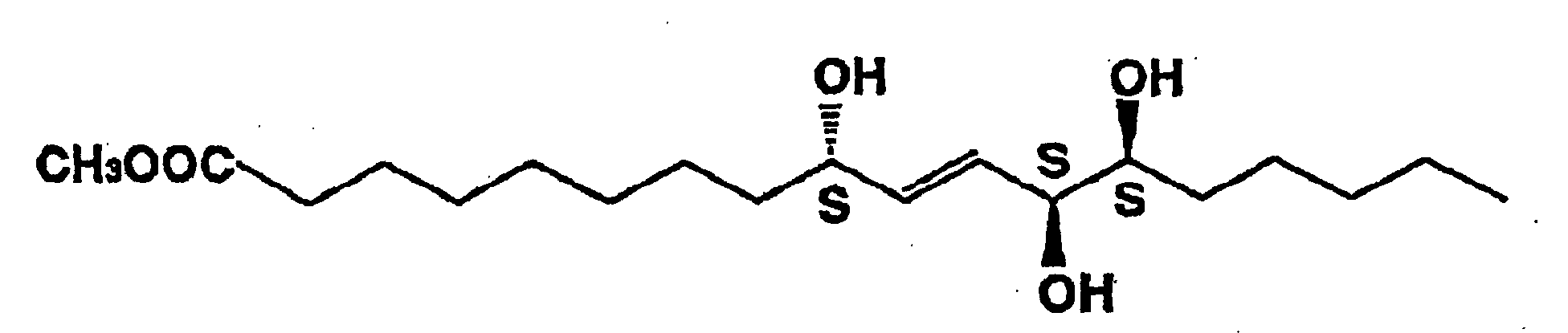
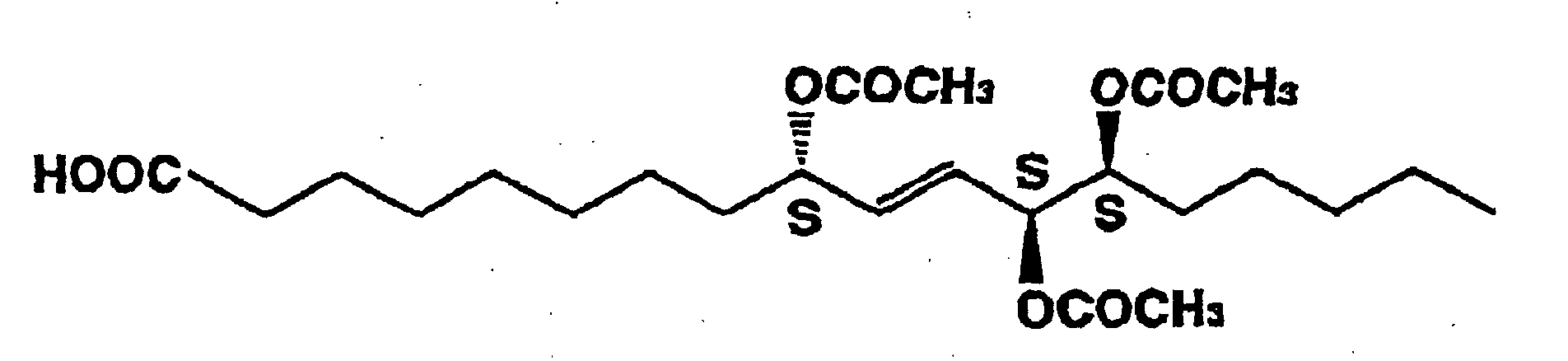

9S,12S,13S-Triacetoxy-10E-octadecenoic acid was obtained as
follows: 9S,12S,13S-Trihydroxy-10E-octadecenoic acid was refluxed
in the presence of sodium acetate in acetic anhydride for about 1
hour, and then the reaction product was subjected to two-phase
extraction with chloroform and water to obtain the desired compound
from the chloroform layer.
These compounds (the purities were 95% or higher) showed no sign
of toxicity when intraperitoneally administered at a dose of 30 mg/kg
or orally administered at a dose of 100 mg/kg.
Solution of pertussis-diphtheria-tetanus combined vaccine was
prepared to contain 50 µg of protein nitrogen in 20 µL.
9S,12S,13S-Trihydroxy-10E-octadecenoic acid was dissolved in PBS at
a concentration of 10 µg in 0.5 mL and filter sterilized. A
preservative (0.005% thimerosal) was added to these solutions. The
resulting mixtures were dispensed into containers, which were used
as pertussis-diphtheria-tetanus combined vaccine
(intranasal)-hydroxy unsaturated fatty acid (oral) inoculum
preparations. These preparations were stored at a temperature of not
more than 10°C in a cool and dark place.
The pertussis-diphtheria-tetanus combined vaccine as prepared
above was intranasally inoculated into mice, and
9S,12S,13S-trihydroxy-10E-octadecenoic acid was orally administered
before and after the inoculation. After 4 weeks, the same amount of
the vaccine was further inoculated, and the antibody production was
tested. The test result showed that in the blood from control mice
that had been inoculated with only pertussis-diphtheria-tetanus
combined vaccine, the level of anti-pertussis toxin (PT) -IgG antibody
was 156 ELISA units; the level of anti-diphtheria toxoid (DT)-IgG
antibody was 11 ELISA units; and the level of anti-tetanus toxoid
(TT) -IgG antibody was 13 ELISA units, while in the case of the combined
use of orally administered 9S,12S,13S-trihydroxy-10E-octadecenoic
acid, the level of anti-PT-IgG antibody was 442 ELISA units; the level
of anti-DT-IgG antibody was 70 ELISA units; and the level of
anti-TT-IgG antibody was 75 ELISA units. Further, while in the nasal
irrigation liquid in control mice that had been inoculated only
pertussis-diphtheria-tetanus combined vaccine, the level of
anti-PT-IgA antibody was 6 ELISA units; the level of anti-DT-IgA
antibody was 3 ELISA units; and the level of anti-TT-IgA antibody
was 4 ELISA units, the level of anti-PT-IgA antibody was 14 ELISA
units; the level of anti-DT-IgA antibody was 11 ELISA units; and the
level of anti-TT-IgA antibody was 11 ELISA units, in the nasal
irrigation liquid in the case of vaccination combined with the
administration of 9S,12S,13S-trihydroxy-10E-octadecenoic acid.
A measles-rubella vaccine preparation was prepared to contain
virus particles of each vaccine in an amount of 7 µg in 20 µL.
9S,12S,13S-Trihydroxy-10E-octadecenoic acid was dissolved in PBS at
a concentration of 2.5 µg in 0.5 mL and filter sterilized. A
stabilizer (0.2% porcine gelatin, 0.1% sodium glutamate; 5% lactose)
was added to these preparations. The resulting mixtures were
dispensed into containers, which were used as measles-rubella
combined vaccine (nasal)-hydroxy unsaturated fatty acid (oral)
inoculum. These preparations were stored at a temperature of not more
than 10°C in a cool and dark place.
The measles-rubella vaccine as prepared above was nasally
inoculated into mice twice at 3-week intervals, and
9S, 12S, 13S-trihydroxy-10E-octadecenoic acid was orally administered
only before and after the first inoculation. Then, the antibody
production in the blood was evaluated. The test result showed that
the ELISA titer of antibody produced was 0.14 for measles and 0.09
for rubella when the vaccine alone had been inoculated, while the
titer was 0.30 for measles and 0.29 for rubella in the case of the
combined use of 9S,12S,13S-trihydroxy-10E-octadecenoic acid with the
vaccine.
A rotavirus vaccine preparation was prepared to contain virus
particles in an amount of 3.3 µg in 20 µL. The methyl ester derivative
( methyl 9S,12S,13S-trihydroxy-10E-octadecenoate) as used in Example
8 was dissolved in PBS and prepared at a concentration of 10 µg in
0.5 mL. The resulting preparation was filter sterilized and
dispensed into containers, which were used as rotavirus
vaccine-hydroxy unsaturated fatty acid ester oral preparations or
nasal drops. These preparations were stored at a temperature of not
more than 10°C in a cool and dark place.
The rotavirus vaccine as prepared above was nasally inoculated
into mice twice at 3-week intervals, and the methyl ester derivative
was orally administered only before and after the first inoculation.
Then, the antibody production in the blood was evaluated. The test
result showed that the ELISA titer of antibody produced was 0.089
in the inoculation of nasal vaccine drop when the vaccine alone was
inoculated, while the titer was 0.38 in the case of the combined use
of the methyl ester derivative with the vaccine. Furthermore, the
titer was 0.018 in the mice of the control group without adjuvant
inoculation when the vaccine had been inoculated orally, while the
titer was 0.27 in the group to which the vaccine together with the
methyl ester derivative had been inoculated.
A mycoplasma vaccine was prepared to contain mycoplasma
bacteria in an amount of 2.0× 10¹⁰ CFU (colony forming unit) in 20
µL. 9S,12S,13S-Trihydroxy-10E-octadecenoic acid was dissolved in
PBS at a concentration of 10 µg in 0.5 mL and filter sterilized. These
were dispensed into containers, which were used as mycoplasma
vaccine-hydroxy unsaturated fatty acids preparation nasal drops or
oral preparations. These preparations were stored at a temperature
of not more than 10°C in a cool and dark place.
The mycoplasma vaccine as prepared above was intranasally
inoculated into mice three times at 2-week intervals, and then
9S, 12S, 13S-trihydroxy-10E-octadecenoic acid was orally administered
only before and after the first inoculation. Then, the lesions
associated with Mycoplasma infection were observed. The test result
showed that the lesions were recognized in all of 10 control mice
to which the vaccine alone had been inoculated, while the lesions
were found in only 3 of 10 mice to which
9S, 12S, 13S-trihydroxy-10E-octadecenoic acid had been given together
with the vaccine. While the average number of lesions was 302 in the
case of the vaccine alone, the number was 178 in the case of the combined
use of 9S,12S,13S-trihydroxy-10E-octadecenoic acid with the vaccine.
The Examples shown above clearly indicate the following effect
of the present invention.
As discussed above, vaccine preparations containing as a
constituent the adjuvant in accordance with the present invention
would be effective drugs that prevent or treat virus and bacterial
infections by vaccination.
Claims (10)
- An adjuvant comprising a hydroxy unsaturated fatty acid or a derivative thereof.
- The adjuvant of claim 1, wherein the hydroxy unsaturated fatty acid or the derivative thereof is an unsaturated fatty acid with 18 carbon atoms that has a trihydroxy-monoene structure or a derivative thereof.
- The adjuvant of claim 2, wherein the unsaturated fatty acid with 18 carbon atoms that has a trihydroxy-monoene structure or the derivative thereof is 9,12,13-trihydroxy-10E-octadecenoic acid or a derivative thereof represented by the formula:wherein R1 is a hydroxyl group, or an oxygen, sulfur, or nitrogen atom substituted with one or two alkyl or aryl groups; and R2, R3, and R4 may be identical or different and each represents hydrogen, an alkyl group, or an acyl group.

- The adjuvant of claim 3, wherein 9,12,13-trihydroxy-10E-octadecenoic acid or a derivative thereof is represented by any one of the formulae (I) to (III);wherein R1 is a hydroxyl group, or an oxygen, sulfur, or nitrogen atom substituted with one or two alkyl or aryl groups; and R2, R3, and R4 may be identical or different and each represents hydrogen, an alkyl group, or an acyl group;
 wherein R1 is a hydroxyl group, or an oxygen, sulfur, or nitrogen atom substituted with one or two alkyl or aryl groups; and R2, R3, and R4 may be identical or different and each represents hydrogen, an alkyl group, or an acyl group;
 wherein R1 is a hydroxyl group, or an oxygen, sulfur, or nitrogen atom substituted with one or two alkyl or aryl groups; and R2, R3, and R4 may be identical or different and each represents hydrogen, an alkyl group, or an acyl group.
- A vaccine preparation comprising the adjuvant of any one of claims 1 to 4 as a constituent.
- The vaccine preparation of claim 5, wherein the adjuvant in the vaccine preparation is orally or transdermally administered independently of an antigen constituent.
- The vaccine preparation of claim 5 or 6, wherein an antigen constituent in the vaccine preparation is inoculated intranasally, subcutaneously, orally, transdermally, intramuscularly, or through mucosa by the other route.
- The vaccine preparation of any one of claims 5 to 7, wherein the vaccine preparation comprises, as an antigen constituent, one or more antigens from pathogenic microorganisms selected from the group consisting of influenza virus, rotavirus, measles virus, rubella virus, mumps virus, AIDS virus, Bordetella pertussis, diphtheria bacillus, Helicobacter pylori, enterohaemorrhagic Escherichia coli (EHEC), Chlamydia, Mycoplasma, Malaria Plasmodium, coccidium, and schistosome.
- A method for administering the vaccine preparation of any one of claims 5 to 8, wherein the method comprises orally or transdermally administering the adjuvant in the vaccine preparation independently of the antigen constituent.
- A method for administering the vaccine preparation of any one of claims 5 to 8, wherein the antigen constituent is inoculated intranasally, subcutaneously, orally, transdermally, or intramuscularly, or through mucosa by the other route.
Applications Claiming Priority (3)
| Application Number | Priority Date | Filing Date | Title |
|---|---|---|---|
| JP2000268390 | 2000-08-31 | ||
| JP2000268390 | 2000-08-31 | ||
| PCT/JP2001/007379 WO2002017961A1 (en) | 2000-08-31 | 2001-08-28 | Vaccine preparation containing fatty acid as component |
Publications (2)
| Publication Number | Publication Date |
|---|---|
| EP1316314A1 true EP1316314A1 (en) | 2003-06-04 |
| EP1316314A4 EP1316314A4 (en) | 2004-12-29 |
Family
ID=18755175
Family Applications (1)
| Application Number | Title | Priority Date | Filing Date |
|---|---|---|---|
| EP01958570A Withdrawn EP1316314A4 (en) | 2000-08-31 | 2001-08-28 | PREPARATION OF A VACCINE CONTAINING FATTY ACID AS A COMPOUND |
Country Status (6)
| Country | Link |
|---|---|
| US (1) | US7560484B2 (en) |
| EP (1) | EP1316314A4 (en) |
| AU (1) | AU2001280208A1 (en) |
| CA (1) | CA2420601A1 (en) |
| TW (1) | TWI247607B (en) |
| WO (1) | WO2002017961A1 (en) |
Cited By (1)
| Publication number | Priority date | Publication date | Assignee | Title |
|---|---|---|---|---|
| EP3530270A4 (en) * | 2016-10-20 | 2020-06-24 | Yamada Bee Company, Inc. | MUCOUS IMMUNOMODULATOR |
Families Citing this family (8)
| Publication number | Priority date | Publication date | Assignee | Title |
|---|---|---|---|---|
| TWI350174B (en) * | 2003-03-12 | 2011-10-11 | Wyeth Corp | Adjuvanted bovine vaccines |
| JP4046708B2 (en) * | 2004-06-04 | 2008-02-13 | 明治製菓株式会社 | Method for producing 3-alkenylcephem compound |
| EP1917976B1 (en) | 2005-08-01 | 2011-03-16 | Hisamitsu Pharmaceutical Co. Inc. | Adjuvant or pharmaceutical preparation for transdermal or transmucosal administration |
| JP5275047B2 (en) * | 2007-01-31 | 2013-08-28 | 久光製薬株式会社 | Adjuvant for transdermal or transmucosal administration and pharmaceutical preparation containing the same |
| CN102176907A (en) * | 2008-10-08 | 2011-09-07 | 免疫解决方案有限公司 | Oral vaccines for producing mucosal immunity |
| CN102686227B (en) * | 2009-12-30 | 2014-12-03 | 李海寿 | Composition for treating obesity by using wheat bran extract or active ingredient isolated therefrom |
| ES2744454T3 (en) | 2013-10-31 | 2020-02-25 | Hisamitsu Pharmaceutical Co | Adjuvant composition |
| JP2023100385A (en) * | 2022-01-06 | 2023-07-19 | 株式会社植物育種研究所 | PPAR activation composition and its use |
Family Cites Families (7)
| Publication number | Priority date | Publication date | Assignee | Title |
|---|---|---|---|---|
| JPH059130A (en) * | 1990-09-21 | 1993-01-19 | Takeda Chem Ind Ltd | Vaccine preparation containing immunoglobulin |
| JPH07173069A (en) * | 1993-12-17 | 1995-07-11 | Tsumura & Co | Adjuvant agent |
| US6019982A (en) | 1994-08-26 | 2000-02-01 | The Administrators Of The Tulane Educational Fund | Mutant enterotoxin effective as a non-toxic oral adjuvant |
| FR2733151B1 (en) | 1995-04-20 | 1997-05-23 | Seppic Sa | THERAPEUTIC COMPOSITION COMPRISING AN ANTIGEN OR AN IN VIVO GENERATOR OF A COMPOUND COMPRISING AN AMINO ACID SEQUENCE |
| TW586935B (en) | 1998-09-14 | 2004-05-11 | Kitasato Inst | Saponin-containing vaccine preparation |
| DE69939943D1 (en) | 1998-10-21 | 2009-01-02 | Kitasato Inst | Attenuated toxins as adjuvants |
| JP4551001B2 (en) * | 1999-03-03 | 2010-09-22 | 学校法人北里研究所 | Vaccine preparations containing fatty acids as constituents |
-
2001
- 2001-08-28 EP EP01958570A patent/EP1316314A4/en not_active Withdrawn
- 2001-08-28 WO PCT/JP2001/007379 patent/WO2002017961A1/en not_active Ceased
- 2001-08-28 AU AU2001280208A patent/AU2001280208A1/en not_active Abandoned
- 2001-08-28 US US10/363,484 patent/US7560484B2/en not_active Expired - Fee Related
- 2001-08-28 CA CA002420601A patent/CA2420601A1/en not_active Abandoned
- 2001-08-29 TW TW090121273A patent/TWI247607B/en not_active IP Right Cessation
Cited By (2)
| Publication number | Priority date | Publication date | Assignee | Title |
|---|---|---|---|---|
| EP3530270A4 (en) * | 2016-10-20 | 2020-06-24 | Yamada Bee Company, Inc. | MUCOUS IMMUNOMODULATOR |
| US11089805B2 (en) | 2016-10-20 | 2021-08-17 | Yamada Bee Company, Inc. | Mucosal immunomodulator |
Also Published As
| Publication number | Publication date |
|---|---|
| US20040024058A1 (en) | 2004-02-05 |
| EP1316314A4 (en) | 2004-12-29 |
| US7560484B2 (en) | 2009-07-14 |
| AU2001280208A1 (en) | 2002-03-13 |
| CA2420601A1 (en) | 2003-02-26 |
| WO2002017961A1 (en) | 2002-03-07 |
| TWI247607B (en) | 2006-01-21 |
Similar Documents
| Publication | Publication Date | Title |
|---|---|---|
| JP6770596B2 (en) | Saponin, a triterpene, its synthesis and use | |
| US6262029B1 (en) | Chemically modified saponins and the use thereof as adjuvants | |
| KR102706661B1 (en) | Triterpene saponin analogues | |
| KR20010012802A (en) | Triterpene saponin analogs having adjuvant and immunostimulatory activity | |
| CN110730666A (en) | Triterpene saponin analogues | |
| US7560484B2 (en) | Vaccine preparation containing fatty acid as a constituent | |
| CN110869025A (en) | Triterpene saponin synthesis, intermediates and adjuvant combinations | |
| US9884801B2 (en) | Compounds from antrodia camphorata, method for preparing the same and use thereof | |
| AU781316B2 (en) | Vaccine preparation containing fatty acid as a constituent | |
| AU2020241955B2 (en) | Saponin-based vaccine adjuvants | |
| EP1123711B9 (en) | Attenuated toxins as adjuvants | |
| JPWO2002017961A1 (en) | Vaccine preparations containing fatty acids as components | |
| Kumar et al. | Development of novel lipidated analogs of picroside as vaccine adjuvants: acylated analogs of picroside-II elicit strong Th1 and Th2 response to ovalbumin in mice | |
| JPWO2000051634A1 (en) | Vaccine preparations containing fatty acids as components | |
| CN107722096B (en) | A kind of steroid natural medicine with anti-tumor effect and its preparation method and use | |
| EP1121937A1 (en) | Vaccine preparations containing saponins | |
| JPH09104693A (en) | Glycosides, sugar-free degradation products of glycosides and their derivatives | |
| RU2166325C2 (en) | Vegetable immunostimulating agent | |
| JP2002179577A (en) | Antitumor substance and antitumor agent | |
| HK40061148A (en) | Saponin-based vaccine adjuvants | |
| HK40016652A (en) | Triterpene saponin analogues | |
| WO2013147439A1 (en) | Systemic immunity or gut immunity adjuvant comprising cheonggukjang extracts as active ingredient | |
| Lim JongHwan et al. | In vivo metabolism of Talosin A, new isoflavonol glycoside from Kitasatospora kifunensis, in rats. |
Legal Events
| Date | Code | Title | Description |
|---|---|---|---|
| PUAI | Public reference made under article 153(3) epc to a published international application that has entered the european phase |
Free format text: ORIGINAL CODE: 0009012 |
|
| 17P | Request for examination filed |
Effective date: 20030326 |
|
| AK | Designated contracting states |
Designated state(s): BE DE FR GB IT |
|
| A4 | Supplementary search report drawn up and despatched |
Effective date: 20041111 |
|
| STAA | Information on the status of an ep patent application or granted ep patent |
Free format text: STATUS: THE APPLICATION IS DEEMED TO BE WITHDRAWN |
|
| 18D | Application deemed to be withdrawn |
Effective date: 20060427 |