EP1316263A1 - Method of dyeing artificial hair - Google Patents
Method of dyeing artificial hair Download PDFInfo
- Publication number
- EP1316263A1 EP1316263A1 EP01984394A EP01984394A EP1316263A1 EP 1316263 A1 EP1316263 A1 EP 1316263A1 EP 01984394 A EP01984394 A EP 01984394A EP 01984394 A EP01984394 A EP 01984394A EP 1316263 A1 EP1316263 A1 EP 1316263A1
- Authority
- EP
- European Patent Office
- Prior art keywords
- fiber
- dyeing
- solvent
- carrier
- synthetic
- Prior art date
- Legal status (The legal status is an assumption and is not a legal conclusion. Google has not performed a legal analysis and makes no representation as to the accuracy of the status listed.)
- Granted
Links
Images


Classifications
-
- A—HUMAN NECESSITIES
- A41—WEARING APPAREL
- A41G—ARTIFICIAL FLOWERS; WIGS; MASKS; FEATHERS
- A41G3/00—Wigs
-
- D—TEXTILES; PAPER
- D06—TREATMENT OF TEXTILES OR THE LIKE; LAUNDERING; FLEXIBLE MATERIALS NOT OTHERWISE PROVIDED FOR
- D06P—DYEING OR PRINTING TEXTILES; DYEING LEATHER, FURS OR SOLID MACROMOLECULAR SUBSTANCES IN ANY FORM
- D06P1/00—General processes of dyeing or printing textiles, or general processes of dyeing leather, furs, or solid macromolecular substances in any form, classified according to the dyes, pigments, or auxiliary substances employed
- D06P1/90—General processes of dyeing or printing textiles, or general processes of dyeing leather, furs, or solid macromolecular substances in any form, classified according to the dyes, pigments, or auxiliary substances employed using dyes dissolved in organic solvents or aqueous emulsions thereof
- D06P1/92—General processes of dyeing or printing textiles, or general processes of dyeing leather, furs, or solid macromolecular substances in any form, classified according to the dyes, pigments, or auxiliary substances employed using dyes dissolved in organic solvents or aqueous emulsions thereof in organic solvents
- D06P1/928—Solvents other than hydrocarbons
-
- D—TEXTILES; PAPER
- D06—TREATMENT OF TEXTILES OR THE LIKE; LAUNDERING; FLEXIBLE MATERIALS NOT OTHERWISE PROVIDED FOR
- D06P—DYEING OR PRINTING TEXTILES; DYEING LEATHER, FURS OR SOLID MACROMOLECULAR SUBSTANCES IN ANY FORM
- D06P1/00—General processes of dyeing or printing textiles, or general processes of dyeing leather, furs, or solid macromolecular substances in any form, classified according to the dyes, pigments, or auxiliary substances employed
- D06P1/90—General processes of dyeing or printing textiles, or general processes of dyeing leather, furs, or solid macromolecular substances in any form, classified according to the dyes, pigments, or auxiliary substances employed using dyes dissolved in organic solvents or aqueous emulsions thereof
-
- D—TEXTILES; PAPER
- D06—TREATMENT OF TEXTILES OR THE LIKE; LAUNDERING; FLEXIBLE MATERIALS NOT OTHERWISE PROVIDED FOR
- D06P—DYEING OR PRINTING TEXTILES; DYEING LEATHER, FURS OR SOLID MACROMOLECULAR SUBSTANCES IN ANY FORM
- D06P3/00—Special processes of dyeing or printing textiles, or dyeing leather, furs, or solid macromolecular substances in any form, classified according to the material treated
- D06P3/70—Material containing nitrile groups
- D06P3/76—Material containing nitrile groups using basic dyes
-
- D—TEXTILES; PAPER
- D06—TREATMENT OF TEXTILES OR THE LIKE; LAUNDERING; FLEXIBLE MATERIALS NOT OTHERWISE PROVIDED FOR
- D06P—DYEING OR PRINTING TEXTILES; DYEING LEATHER, FURS OR SOLID MACROMOLECULAR SUBSTANCES IN ANY FORM
- D06P3/00—Special processes of dyeing or printing textiles, or dyeing leather, furs, or solid macromolecular substances in any form, classified according to the material treated
- D06P3/79—Polyolefins
- D06P3/794—Polyolefins using dispersed dyes
Definitions
- the present invention relates to a process for preparing synthetic hair fiber used in hair goods such as wigs, hair accessories, weavings and braids.
- halogen-containing synthetic fibers such as modacrylic fiber and poly(vinyl chloride) fiber with excellent flame retardancy are widely used.
- these halogen-containing synthetic fibers have low heat resistance, by dyeing at high temperatures and for long hours, damage by heat such as frizz and shrinking of the ends tends to occur. Multi-color dyeing especially tends to damage fibers as it repeats dyeing.
- methods to evenly dye at a low temperature or in a short period have been considered. For example, in JP-A-57-16981, a method of using a carrier (accelerating agent) has been disclosed, and in JP-A-10-121385, a method of using a solvent such as acetone has been disclosed.
- JP-A-01-174683 a method for multi-color dyeing of synthetic hair fiber is disclosed, but because the fiber is dipped multiple times into the dyeing solution of a temperature of 80° to 90°C which is lower than usual, there is the problem of the dyeing process taking a long time.
- the present invention solves the problems of the prior arts. That is, the present invention provides a process for preparing synthetic hair fiber, in which the fiber can evenly be dyed at a low temperature in a short period, maintaining excellent fastness without abnormal shrinking (frizzing) or embrittlement of the fiber due to swelling.
- fiber can be dyed evenly with an extremely small amount of solvent by using a carrier and a solvent for synthetic fiber together, compared to prior arts using each of them independently. It was also found that because. a small amount of solvent is used, abnormal shrinking (frizzing) .and embrittlement of the fiber due to swelling does not occur easily and thus the present invention has been accomplished.
- the present invention relates to a process for dyeing synthetic hair fiber, which comprises dyeing a bundle of synthetic hair fiber made of halogen-containing synthetic fiber by using a dyeing solution containing a dye, a carrier and a solvent for the synthetic fiber at 60° to 90°C.
- the carrier is used in an amount of 0.05 to 1.2 % by weight based on the dyeing solution and the solvent is used in an amount of 0.05 to 5 % by weight based on the dyeing solution.
- the halogen-containing synthetic fiber is selected from the group consisting of halogen-containing vinyl fiber and modacrylic fiber.
- a synthetic fiber bundle which is dyed is further dyed partially to dye in multiple colors.
- the carrier is preferably at least one member selected from the group consisting of aromatic ether type, aromatic ester type, methyl naphthalene type and N-alkylphthalimide type.
- the solvent is preferably at least one member selected from the group consisting of acetone, ethylene carbonate, tetrahydrofuran, dimethylformamide (DMF), dimethylacetamide (DMAc) dimethyl sulfoxide (DMSO).
- the halogen-containing synthetic fiber which can be used in the present invention is not particularly limited, but preferably poly(vinyl chloride) fiber or modacrylic fiber which is widely used as synthetic hair fiber.
- the modacrylic fiber mentioned here refers to a copolymer of 30 to 80 % by weight of acrylonitrile, 70 to 30 % by weight of a halogen-containing monomer and 0 to 5 % by weight of another vinyl monomer.
- the halogen-containing monomer is copolymerizable with the acrylonitrile, and examples thereof are vinyl halides such as vinyl chloride and vinyl bromide, and vinylidene halides such as vinylidene chloride and vinylidene bromide.
- One kind or at least two kinds of these may be used and copolymerized.
- vinyl chloride and vinylidene chloride are preferred.
- the other vinyl monomer mentioned above is copolymerizable with the acrylonitrile.
- Examples thereof are unsaturated carboxylic acids such as acrylic acid and methacrylic acid, and salts thereof;-acrylic esters such as methyl acrylate; methacrylic esters such as methyl methacrylate; unsaturated carboxylic esters such as glycidyl methacrylate; vinyl esters such as vinyl acetate and vinyl butyrate; vinyl amides such as acrylamide and methacylamide; sulfonic acid-group containing vinyl monomers such as allyl sulfonic acid, methallyl sulfonic acid, isoprene sulfonic acid, styrene sulfonic acid and 2-acrylamide-2-methyl propane sulfonic acid, or sodium salts, potassium salts and ammonium salts thereof; and in addition, known vinyl compounds such as vinyl pyridine, methyl vinyl ether and methacrylonitrile.
- unsaturated carboxylic acids such as acrylic acid and methacrylic acid, and salts thereof
- One kind or at least two kinds of these may be used and copolymerized.
- a sulfonic group containing vinyl monomer or a salt thereof is preferred.
- the fineness of the fiber is not particularly limited.
- the dye used in the present invention is preferably a cation dye and/or dispersion dye, which have been used conventionally for halogen-containing synthetic fiber.
- dispersion dye can be applied to halogen-containing vinyl fiber such as poly(vinyl chloride) fiber and cation dye can be applied to modacrylic fiber.
- the carrier (accelerating agent) used in the present invention is an organic compound hardly soluble in water, and is applied to the fiber after being evenly dispersed in water by emulsifying with an emulsifier.
- the carrier is not particularly limited but is preferably at least one member selected from the group consisting of aromatic ether type, aromatic ester type, methyl naphthalene type and N-alkylphthalimide type.
- aromatic ether type aromatic ester type
- methyl naphthalene type methyl naphthalene type
- N-alkylphthalimide type cyanobenzylether compound, acetophenone and N-butylphtalmide used for halogen-containing synthetic fiber is more preferable.
- the amount of the carrier to be used is preferably 0.05 to 1.2 % by weight, more preferably 0.08 to 1.0 % by weight based on the dyeing solution. In the case that the amount of the carrier to be used is less than 0.05 % by weight based on the dyeing solution, dyeing evenly at a low temperature in a short period tends to become difficult. In the case that the amount of the carrier used exceeds 1.2 % by weight based on the dyeing solution, abnormal shrinking and embrittlement of the fiber due to swelling tend to occur.
- the solvent to be used together with the carrier is a water soluble organic compound and is applied to the fiber after dissolving in water. It is preferable that the solvent easily dissolves halogen-containing synthetic fiber and is at least one member selected from the group consisting of acetone, ethylene carbonate, tetrahydrofuran, dimethylformamide (DMF), dimethylacetamide (DMAc) and dimethyl sulfoxide (DMSO).
- the amount of the solvent to be used is preferably 0.05 to 5 % by weight based on the dyeing solution, more preferably 0.1 to 5 % by weight based on the dyeing solution.
- the amount of the solvent to be used is less than 0.05 % by weight based on the dyeing solution, the effects of using together with a carrier, in other words evenly dyeing at a low temperature in a short period and improving fastness, tend to become difficult.
- the amount of the solvent used exceeds 5 % by weight based on the dyeing solution, abnormal shrinking and embrittlement of the fiber due to swelling tend to occur.
- the temperature of the dyeing solution is 60° to 90°C, preferably 70° to 85°C. In the case that the temperature of the dyeing solution is lower than 60°C, dyeing to the predetermined color becomes difficult. In the case that the temperature of the dyeing solution exceeds 90°C, abnormal shrinking and embrittlement of the fiber occur.
- the pH of the dyeing solution is preferably adjusted to pH 3 to 6 by using a known acid as usual.
- the dyeing process of the present invention is especially useful when the synthetic fiber bundle which has been dyed once is partially dyed further to dye in multiple colors, for example, in the case that the end part of the fiber and the rest of the fiber are to be dyed in different colors (two-tone), as dyeing can be conducted in an extremely short period.
- synthetic hair fiber made of halogen-containing synthetic fiber was bundled to create a hair bundle of 5 to 50 mm in diameter (10,000 to 1,000,000 fibers) and then cut to a uniform size of 10 to 100 cm in length.
- One end of this bundle is tied together with a cord or rubber band 2 to make bundle 1.
- the diameter of bundle 1 is preferably set to the diameter of the tow of the synthetic fiber maker. This allows simplifying of the production steps as the fiber can be taken out of the carton box, cut just as it is and made into a hair bundle. Furthermore, in determining the length of hair bundle 1, the length of hair of the hair product to be produced should be taken into consideration.
- Fig. 1 synthetic hair fiber made of halogen-containing synthetic fiber was bundled to create a hair bundle of 5 to 50 mm in diameter (10,000 to 1,000,000 fibers) and then cut to a uniform size of 10 to 100 cm in length.
- One end of this bundle is tied together with a cord or rubber band 2 to make bundle 1.
- the diameter of bundle 1 is preferably set to the
- the concentration of the dye solution before dyeing which was adjusted according to the dye recipe of the targeted color was set to 100 %, and solutions of this, diluted by water, for example, to 50 %, 25 %, and 10 % were made and used as a standard.
- the remaining solution after dyeing and the standard solution were visually compared to judge the concentration of the remaining solution.
- the shrinking condition of the fiber bundle after dyeing was evaluated in the following 3 levels. ⁇ : no frizz ⁇ : some frizz, but texture is not bad and usable ⁇ : great deal of frizz, rough texture
- the lightfastness was evaluated in accordance with JIS L0843.
- hair bundle 1 of a hair length of 30 cm and weight of 400 g (25,000 fibers) was made.
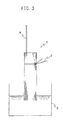
- One end of the hair bundle was tied and fixed with cord 2 as illustrated in Fig. 2, and then the hair bundle was hung in the upper part of the dyeing bath 3 by the hanging part 4.
- a dyeing solution comprising 0.282 owf of MAXILON Golden Yellow, 0.090 owf of MAXILON Red GRL and 0.228 owf of MAXILON Blue GRL which are cation dye (all available from Ciba-Geigy Corporation), totaling 0.6 % owf, 0.24 g of Teonol AT (available from Meisei Kagaku Kabushiki Kaisha, aromatic ether type) which is a carrier, 2.4 g of ethylene carbonate which is a solvent for modacrylic fiber and 797 g of water, based on 20 g of the hair bundle to be dyed, was produced in dyeing bath 3. The pH was adjusted to pH 4 using acetic acid. This solution was then heated to 84°C.
- hair bundle 1 which was hung was gradually lowered and dipped 15 cm into the aforesaid dyeing solution.
- the dipped hair bundle 1 was then dyed for 30 minutes, while applying vibration in an amplitude of 28 mm at a rate of 120 times / minute.
- hair bundle 1 was taken out of dyeing bath 3 and washed for 1 minute with warm water of 60° to 70°C.
- hair bundle 1 was washed-with water and dehydrated. Then, the hair bundle was dried for 40 minutes in an oven (made by Tabai Espec Corporation) of 80°C.
- Example 2 The experiment was conducted in the same manner as in Example 1 except that a dyeing solution comprising 11.2 g of Teonol AT (available from Meisei Kagaku Kabushiki Kaisha, aromatic ether type) which is a carrier, 2.4 g of ethylene carbonate which is a solvent for modacrylic fiber and 786 g of water was prepared. The results are shown in Table 1.
- Teonol AT available from Meisei Kagaku Kabushiki Kaisha, aromatic ether type
- hair bundle 1 of a hair length of 30 cm and weight of 40 g (17,150 fibers) was made.
- One end of the hair bundle was tied and fixed with cord 2 as illustrated in Fig.2, and then the hair bundle was hung in the upper part of the dyeing bath 3 by the hanging part 4.
- a dyeing solution comprising 0.473 owf of Dianix Yellow UN-SE, 0.543 owf of Dianix Red UN-SE and 0.753 owf of Dianix Blue UN-SE which are dispersion dye (all available from Dystar Corporation), totaling 1.75 % owf, 0.16 g of Levegar PEW (available from Bayer Ltd., N-alkylphthalimide type) which is a carrier, 10.0 g of dimethylacetamide which is a solvent for poly(vinyl chloride) fiber and 789 g of water, based on 20 g of the hair bundle to be dyed, was produced. This solution was then heated to 74°C. As indicated in Fig.
- hair bundle 1 which was hung was gradually lowered and dipped 15 cm into the aforesaid dyeing solution.
- the dipped hair bundle 1 was then dyed for 30 minutes, while applying vibration in an amplitude of 28 mm at a rate of 120 times / minute.
- hair bundle 1 was taken out of dyeing bath 3 and washed for 1 minute with warm water of 50° to 60°C.
- hair bundle 1 was washed with water and dehydrated. Then, the hair bundle was dried for 40 minutes in an oven (made by Tabai Espec Corporation) of 80°C.
- Example 7 The experiment was conducted in the same manner as in Example 7 except that a dyeing solution comprising 0.64 g of Levegar PEW (available from Bayer Ltd., N-alkylphthalimide type) which is a carrier, 10.0 g of dimethylacetamide which is a solvent for poly(vinyl chloride) fiber and 789 g of water was prepared. The results are shown in Table 2.
- Levegar PEW available from Bayer Ltd., N-alkylphthalimide type
- Example 7 The experiment was conducted in the same manner as in Example 7 except that a dyeing solution comprising 1.12 g of Levegar PEW (available from Bayer Ltd., N-alkylphthalimide type) which is a carrier, 10.0 g of dimethylacetamide which is a solvent for poly(vinyl chloride) fiber and 788 g of water was prepared. The results are shown in Table 2.
- Levegar PEW available from Bayer Ltd., N-alkylphthalimide type
- Example 7 The experiment was conducted in the same manner as in Example 7 except that a dyeing solution comprising 1.60 g of Levegar PEW (available from Bayer Ltd., N-alkylphthalimide type) which is a carrier, 10.0 g of dimethylacetamide which is a solvent for poly(vinyl chloride) fiber and 788 g of water was prepared. The results are shown in Table 2.
- Levegar PEW available from Bayer Ltd., N-alkylphthalimide type
- Example 7 The experiment was conducted in the same manner as in Example 7 except that a dyeing solution comprising 11.2 g of Levegar PEW (available from Bayer Ltd., N-alkylphthalimide type) which is a carrier, 10.0 g of dimethylacetamide which is a solvent for poly(vinyl chloride) fiber and 778 g of water was prepared. The results are shown in Table 2.
- Levegar PEW available from Bayer Ltd., N-alkylphthalimide type
- Example 7 The experiment was conducted in the same manner as in Example 7 except that a dyeing solution comprising 1.12 g of Levegar PEW (available from Bayer Ltd., N-alkylphthalimide type) which is a carrier, 60.0 g of dimethylacetamide which is a solvent for poly(vinyl chloride) fiber and 738 g of water was prepared. The results are shown in Table 2.
- Levegar PEW available from Bayer Ltd., N-alkylphthalimide type
- Example 1 The experiment was conducted in the same manner as in Example 1 except that a dyeing solution comprising 240 g of ethylene carbonate which is a solvent for modacrylic fiber and 560 g of water was prepared without using Teonol AT (available from Meisei Kagaku Kabushiki Kaisha, aromatic ether type) which is a carrier. The results are shown in Table 1.
- Example 1 The experiment was conducted in the same manner as in Example 1 except that a dyeing solution comprising 5.6 g of Teonol AT (available from Meisei Kagaku Kabushiki Kaisha, aromatic ether type) which is a carrier and 794 g of water was prepared without using ethylene carbonate which is a solvent for modacrylic fiber. The results are shown in Table 1.
- Teonol AT available from Meisei Kagaku Kabushiki Kaisha, aromatic ether type
- Example 7 The experiment was conducted in the same manner as in Example 7 except that a dyeing solution comprising 200 g of dimethylacetamide which is a solvent for poly(vinyl chloride) fiber and 600 g of water was prepared without using Levegar PEW (available from Bayer Ltd., N-alkylphthalimide type) which is a carrier. The results are shown in Table 2.
- Example 7 The experiment was conducted in the same manner as in Example 7 except that a dyeing solution comprising 1.12 g of Levegar PEW (available from Bayer Ltd., N-alkylphthalimide type) which is a carrier and 798 g of water was prepared without using dimethylacetamide which is a solvent for poly(vinyl chloride) fiber. The results are shown in Table 2.
- Levegar PEW available from Bayer Ltd., N-alkylphthalimide type
- Example 2 The experiment was conducted in the same manner as in Example 1 except that a dyeing solution comprising 2.4 g of ethylene carbonate which is a solvent for modacrylic fiber and 798 g of water was prepared without using a carrier. The result was that the fiber was hardly dyed at all.
- Example 7 The experiment was conducted in the same manner as in Example 7 except that a dyeing solution comprising 10 g of dimethylacetamide which is a solvent for poly(vinyl chloride) fiber and 790 g of water was prepared without using a carrier. The result was that the fiber was hardly dyed at all.
- a synthetic hair fiber bundle of halogen-containing synthetic fiber can be evenly dyed at a low temperature in a short period.
- synthetic hair fiber excellent in fastness, without abnormal shrinking (frizzing) and embrittlement of the fiber due to swelling can be obtained in an efficient manner.
- the dyeing process of the present invention is especially useful when the synthetic fiber bundle which has been dyed once is partially dyed further to dye in multiple colors, for example, in the case that the end part of the fiber and the rest of the fiber are to be dyed in different colors (two-tone), as dyeing can be conducted in an extremely short period.
Landscapes
- Engineering & Computer Science (AREA)
- Textile Engineering (AREA)
- Coloring (AREA)
Abstract
Description
○: no frizz
Δ: some frizz, but texture is not bad and usable
×: great deal of frizz, rough texture


Claims (6)
- A process for dyeing synthetic hair fiber, which comprises dyeing a bundle of synthetic hair fiber made of halogen-containing synthetic fiber by using a dyeing solution containing a dye, a carrier and a solvent for said synthetic fiber at 60° to 90°C.
- The process of Claim 1, wherein said carrier is used in an amount of 0.05 to 1.2 % by weight based on said dyeing solution and said solvent is used in an amount of 0.05 to 5 % by weight based on said dyeing solution.
- The process of Claim 1, wherein said halogen-containing synthetic fiber is selected from the group consisting of halogen-containing vinyl fiber and modacrylic fiber.
- The process of Claim 1, wherein a synthetic fiber bundle which is dyed is further dyed partially to dye in multiple colors.
- The process of Claim 1, wherein said carrier is at least one member selected from the group consisting of aromatic ether type, aromatic ester type, methyl naphthalene type and N-alkylphthalimide type.
- The process of Claim 1, wherein said solvent is at least one member selected from the group consisting of acetone, ethylene carbonate, tetrahydrofuran, dimethylformamide, dimethylacetamide and dimethyl sulfoxide.
Applications Claiming Priority (3)
| Application Number | Priority Date | Filing Date | Title |
|---|---|---|---|
| JP2000231943 | 2000-07-31 | ||
| JP2000231943 | 2000-07-31 | ||
| PCT/JP2001/006493 WO2002009543A1 (en) | 2000-07-31 | 2001-07-27 | Method of dyeing artificial hair |
Publications (3)
| Publication Number | Publication Date |
|---|---|
| EP1316263A1 true EP1316263A1 (en) | 2003-06-04 |
| EP1316263A4 EP1316263A4 (en) | 2007-09-19 |
| EP1316263B1 EP1316263B1 (en) | 2009-03-25 |
Family
ID=18724700
Family Applications (1)
| Application Number | Title | Priority Date | Filing Date |
|---|---|---|---|
| EP01984394A Expired - Lifetime EP1316263B1 (en) | 2000-07-31 | 2001-07-27 | Method of dyeing artificial hair |
Country Status (6)
| Country | Link |
|---|---|
| US (1) | US7018421B2 (en) |
| EP (1) | EP1316263B1 (en) |
| JP (1) | JP4979175B2 (en) |
| KR (1) | KR100758682B1 (en) |
| CN (1) | CN1256902C (en) |
| WO (1) | WO2002009543A1 (en) |
Families Citing this family (12)
| Publication number | Priority date | Publication date | Assignee | Title |
|---|---|---|---|---|
| CN101669692B (en) * | 2009-09-30 | 2011-12-14 | 许昌恒源发制品股份有限公司 | Computer numerical control hair fully automatic dyeing machine |
| CN103114403B (en) * | 2013-02-26 | 2015-02-18 | 张天兴 | Method for processing hair |
| US9974362B2 (en) | 2013-03-08 | 2018-05-22 | NIKE, Inc.. | Assembly for coloring articles and method of coloring |
| US9668538B2 (en) | 2013-03-08 | 2017-06-06 | Nike, Inc. | System and method for coloring articles |
| EP3065831A1 (en) * | 2013-11-08 | 2016-09-14 | Lubrizol Advanced Materials, Inc. | Semi-permanent hair straightening composition and method |
| WO2017002771A1 (en) * | 2015-06-29 | 2017-01-05 | 株式会社カネカ | Acrylic fiber for artificial hair, method for manufacturing said fiber, and headdress product containing said fiber |
| EP3425093B1 (en) * | 2016-03-04 | 2023-04-26 | Kaneka Corporation | Fabric for electric-arc protective clothing, and electric-arc protective clothing |
| CN112391853A (en) * | 2019-08-14 | 2021-02-23 | 许昌奥蕴实业有限公司 | Dyeing method of chemical fiber filaments and application of dyed chemical fiber filaments produced by dyeing method |
| KR102140541B1 (en) * | 2020-01-06 | 2020-08-04 | (주)태일잉크화학 | Liquid pigment colorant composition for artificial hair by modacrylic fiber and method for manufacturing the same |
| KR20210142860A (en) * | 2020-05-19 | 2021-11-26 | 태광산업주식회사 | Fiber for artificial hair with improved dyeability and method for manufacturing the same |
| CN118087179A (en) * | 2024-03-28 | 2024-05-28 | 青岛华利泰发制品有限公司 | A kind of hair fiber automatic dyeing device |
| WO2025200951A1 (en) * | 2024-03-28 | 2025-10-02 | 青岛华利泰发制品有限公司 | Automatic hair fiber dyeing device |
Family Cites Families (16)
| Publication number | Priority date | Publication date | Assignee | Title |
|---|---|---|---|---|
| JPS5021595B1 (en) * | 1966-01-22 | 1975-07-24 | ||
| JPS4415200B1 (en) | 1966-02-04 | 1969-07-05 | ||
| AU2345770A (en) * | 1970-12-16 | 1972-06-22 | Commonwealth Scientific And Industrial Research Organization | A process for dyeing textile fibres |
| US4131424A (en) * | 1977-07-21 | 1978-12-26 | Milliken Research Corporation | Method of dyeing using the combination of certain halogenated hydrocarbons and aromatic solvents in an aqueous dye admixture |
| CH623447B (en) * | 1978-03-06 | Sandoz Ag | PROCESS FOR COLORING ACETALIZED PVC / PVA TEXTILES WITH DISPERSION DYES. | |
| US4252534A (en) * | 1978-10-19 | 1981-02-24 | Ciba-Geigy Corporation | Dyeing assistants and their use in dyeing synthetic fibre material |
| CH637432A5 (en) * | 1978-10-19 | 1983-07-29 | Ciba Geigy Ag | Dyeing assistant suitable for use in the dyeing of synthetic fibre materials |
| JPS5716981A (en) | 1980-07-03 | 1982-01-28 | Tokai Seiyu Ind Co Ltd | Low temperature dyeing of modacrylic fiber |
| JPH01201587A (en) * | 1988-01-30 | 1989-08-14 | Aderansu Kogei Kk | Dyeing of artificial hair |
| JPH0194420U (en) * | 1987-12-09 | 1989-06-21 | ||
| JPH01106521U (en) * | 1987-12-29 | 1989-07-18 | ||
| JPH01106520U (en) * | 1987-12-29 | 1989-07-18 | ||
| WO1989005104A1 (en) * | 1987-12-09 | 1989-06-15 | Aderans Kogei Co., Ltd. | Wig, hair accessory and dyeing method for artificial hair |
| JPH01174683A (en) * | 1987-12-29 | 1989-07-11 | Aderansu Kogei Kk | Dyeing of artificial hair |
| JPH0931842A (en) | 1995-07-10 | 1997-02-04 | Toyobo Co Ltd | Woven and knit processing method |
| JPH10121385A (en) | 1996-10-17 | 1998-05-12 | Kanegafuchi Chem Ind Co Ltd | Short-time dyeing method for modacrylic fiber |
-
2001
- 2001-07-27 US US10/343,589 patent/US7018421B2/en not_active Expired - Lifetime
- 2001-07-27 JP JP2002515104A patent/JP4979175B2/en not_active Expired - Fee Related
- 2001-07-27 EP EP01984394A patent/EP1316263B1/en not_active Expired - Lifetime
- 2001-07-27 CN CNB018137091A patent/CN1256902C/en not_active Expired - Fee Related
- 2001-07-27 WO PCT/JP2001/006493 patent/WO2002009543A1/en not_active Ceased
- 2001-07-27 KR KR1020037000534A patent/KR100758682B1/en not_active Expired - Fee Related
Also Published As
| Publication number | Publication date |
|---|---|
| EP1316263B1 (en) | 2009-03-25 |
| CN1256902C (en) | 2006-05-24 |
| EP1316263A4 (en) | 2007-09-19 |
| JP4979175B2 (en) | 2012-07-18 |
| KR20030036607A (en) | 2003-05-09 |
| US20030154564A1 (en) | 2003-08-21 |
| CN1446056A (en) | 2003-10-01 |
| KR100758682B1 (en) | 2007-09-13 |
| US7018421B2 (en) | 2006-03-28 |
| WO2002009543A1 (en) | 2002-02-07 |
Similar Documents
| Publication | Publication Date | Title |
|---|---|---|
| EP1316263B1 (en) | Method of dyeing artificial hair | |
| US4898596A (en) | Exhaust process for simultaneously dyeing and improving the flame resistance of aramid fibers | |
| JP4713481B2 (en) | Acrylic shrinkable fiber and method for producing the same | |
| JP4603486B2 (en) | Acrylic shrinkable fiber and method for producing the same | |
| JPWO2002009543A1 (en) | How to dye artificial hair | |
| EP0084422B1 (en) | Dyeing of polyolefins | |
| WO2005064057A1 (en) | Step pile fabric and process for producing the same | |
| US5662716A (en) | Process for increasing stain-resistance of cationic-dyeable modified polyamide fibers | |
| US20070155901A1 (en) | Acrylic shrinkable fiber | |
| US3296341A (en) | Method for impregnating acrylonitrile polymer fibers to improve dyeability | |
| Aspland | The Application of Basic Dye Cations to Anionic Fibers: Dyeing Acrylic and Other Fibers with Basic Dyes. | |
| US3061398A (en) | Aftertreatment of wet spun acrylonitrile polymer filaments with aqueous zinc oxide solution | |
| US3931120A (en) | Flameproof modacrylic fibers | |
| JP4745194B2 (en) | Acrylic fiber and method for producing the same | |
| US9702061B2 (en) | Method for manufacturing pile fabric | |
| WO1989006292A1 (en) | Simultaneously dyeing and flame-retardant treating aramids | |
| JPH0368149B2 (en) | ||
| JP2008007909A (en) | Acrylic fiber and its production method | |
| CN114539156A (en) | Preparation method of heterocyclic quaternary ammonium salt cationic leveling agent | |
| JP3403982B2 (en) | Acrylic synthetic fiber and method for producing the same | |
| JPH07216640A (en) | Acrylic synthetic yarn having excellent yellowing resistance | |
| KR890005271B1 (en) | Process for producing five retardancy acrylic fiber | |
| JPWO2006118175A1 (en) | Acrylic shrinkable fiber | |
| JPS6336367B2 (en) | ||
| JPH02182915A (en) | Flame-retardant modacrylic conjugate yarn |
Legal Events
| Date | Code | Title | Description |
|---|---|---|---|
| PUAI | Public reference made under article 153(3) epc to a published international application that has entered the european phase |
Free format text: ORIGINAL CODE: 0009012 |
|
| 17P | Request for examination filed |
Effective date: 20030204 |
|
| AK | Designated contracting states |
Designated state(s): FR GB |
|
| RIN1 | Information on inventor provided before grant (corrected) |
Inventor name: NAKASHIMA, HIROYUKI |
|
| A4 | Supplementary search report drawn up and despatched |
Effective date: 20070820 |
|
| 17Q | First examination report despatched |
Effective date: 20080121 |
|
| GRAP | Despatch of communication of intention to grant a patent |
Free format text: ORIGINAL CODE: EPIDOSNIGR1 |
|
| GRAS | Grant fee paid |
Free format text: ORIGINAL CODE: EPIDOSNIGR3 |
|
| GRAA | (expected) grant |
Free format text: ORIGINAL CODE: 0009210 |
|
| AK | Designated contracting states |
Kind code of ref document: B1 Designated state(s): FR GB |
|
| REG | Reference to a national code |
Ref country code: GB Ref legal event code: FG4D |
|
| PGFP | Annual fee paid to national office [announced via postgrant information from national office to epo] |
Ref country code: FR Payment date: 20090722 Year of fee payment: 9 |
|
| PGFP | Annual fee paid to national office [announced via postgrant information from national office to epo] |
Ref country code: GB Payment date: 20090722 Year of fee payment: 9 |
|
| PLBE | No opposition filed within time limit |
Free format text: ORIGINAL CODE: 0009261 |
|
| STAA | Information on the status of an ep patent application or granted ep patent |
Free format text: STATUS: NO OPPOSITION FILED WITHIN TIME LIMIT |
|
| 26N | No opposition filed |
Effective date: 20091229 |
|
| GBPC | Gb: european patent ceased through non-payment of renewal fee |
Effective date: 20100727 |
|
| REG | Reference to a national code |
Ref country code: FR Ref legal event code: ST Effective date: 20110331 |
|
| PG25 | Lapsed in a contracting state [announced via postgrant information from national office to epo] |
Ref country code: FR Free format text: LAPSE BECAUSE OF NON-PAYMENT OF DUE FEES Effective date: 20100802 |
|
| PG25 | Lapsed in a contracting state [announced via postgrant information from national office to epo] |
Ref country code: GB Free format text: LAPSE BECAUSE OF NON-PAYMENT OF DUE FEES Effective date: 20100727 |