EP1316262A1 - Arrangement in a garment for fastening and detaching at least one pocket - Google Patents
Arrangement in a garment for fastening and detaching at least one pocket Download PDFInfo
- Publication number
- EP1316262A1 EP1316262A1 EP02102652A EP02102652A EP1316262A1 EP 1316262 A1 EP1316262 A1 EP 1316262A1 EP 02102652 A EP02102652 A EP 02102652A EP 02102652 A EP02102652 A EP 02102652A EP 1316262 A1 EP1316262 A1 EP 1316262A1
- Authority
- EP
- European Patent Office
- Prior art keywords
- arrangement according
- garment
- attachment
- zip
- Prior art date
- Legal status (The legal status is an assumption and is not a legal conclusion. Google has not performed a legal analysis and makes no representation as to the accuracy of the status listed.)
- Granted
Links
Images



Classifications
-
- A—HUMAN NECESSITIES
- A41—WEARING APPAREL
- A41D—OUTERWEAR; PROTECTIVE GARMENTS; ACCESSORIES
- A41D1/00—Garments
- A41D1/06—Trousers
- A41D1/067—Trousers with reinforcement patches
-
- A—HUMAN NECESSITIES
- A41—WEARING APPAREL
- A41D—OUTERWEAR; PROTECTIVE GARMENTS; ACCESSORIES
- A41D13/00—Professional, industrial or sporting protective garments, e.g. surgeons' gowns or garments protecting against blows or punches
- A41D13/05—Professional, industrial or sporting protective garments, e.g. surgeons' gowns or garments protecting against blows or punches protecting only a particular body part
- A41D13/055—Protector fastening, e.g. on the human body
- A41D13/0556—Protector fastening, e.g. on the human body with releasable fastening means
- A41D13/0575—Protector fastening, e.g. on the human body with releasable fastening means in an openable pocket
-
- A—HUMAN NECESSITIES
- A41—WEARING APPAREL
- A41D—OUTERWEAR; PROTECTIVE GARMENTS; ACCESSORIES
- A41D27/00—Details of garments or of their making
- A41D27/20—Pockets; Making or setting-in pockets
- A41D27/205—Pockets adapted to receive a mobile phone or other electronic equipment
-
- A—HUMAN NECESSITIES
- A45—HAND OR TRAVELLING ARTICLES
- A45F—TRAVELLING OR CAMP EQUIPMENT: SACKS OR PACKS CARRIED ON THE BODY
- A45F5/00—Holders or carriers for hand articles; Holders or carriers for use while travelling or camping
- A45F5/02—Fastening articles to the garment
-
- A—HUMAN NECESSITIES
- A45—HAND OR TRAVELLING ARTICLES
- A45F—TRAVELLING OR CAMP EQUIPMENT: SACKS OR PACKS CARRIED ON THE BODY
- A45F5/00—Holders or carriers for hand articles; Holders or carriers for use while travelling or camping
- A45F5/1508—Holders or carriers for portable audio devices, e.g. headphones or digital music players
-
- A—HUMAN NECESSITIES
- A45—HAND OR TRAVELLING ARTICLES
- A45F—TRAVELLING OR CAMP EQUIPMENT: SACKS OR PACKS CARRIED ON THE BODY
- A45F5/00—Holders or carriers for hand articles; Holders or carriers for use while travelling or camping
- A45F5/1516—Holders or carriers for portable handheld communication devices, e.g. pagers or smart phones
-
- A—HUMAN NECESSITIES
- A45—HAND OR TRAVELLING ARTICLES
- A45C—PURSES; LUGGAGE; HAND CARRIED BAGS
- A45C1/00—Purses; Money-bags; Wallets
- A45C1/02—Purses
- A45C2001/022—Purses releasably fitted to a button or clothing item
Definitions
- the present invention relates to an arrangement in a garment for fastening and detaching at least one pocket, in which the pocket comprises a storage space, knee protector, knee padding, or a suspension device, and in which the pocket includes an attachment member and an attachment counter piece in the garment.
- the term "pocket” refers not only to a piece forming an actual storage space, but also to other detachable pieces, such as a suspension member, for example, for tools or a mobile radio station, or, for example, knee or elbow padding or protectors.
- Pockets account for a significant part of the manufacturing costs of garments. In general, more than half of the manufacturing costs of a garment are due to making the pockets.
- the Velcro attachment of a separate pocket is disclosed in US patent publication 4,266,300 (Partridge).
- Partridge refers to a general-purpose pocket, which can be placed on the wearer's garment almost independently of the location of the attachment.
- its carrying capacity is too small for carrying, for example, heavy objects.
- the Velcro attachment arranged directly on the same side of the garment as the pocket is unreliable, as the adhesion of the Velcro attachment become unreliable when the pocket is fastened and detached.
- a force greater than the tearing strength of the Velcro attachment acts on the pocket, it will detach from the garment.
- the aforementioned known carrying devices do not satisfy all groups of users. Particularly when used in work garments, the pocket solutions of the kind described above and their methods of attachment are especially unsatisfactory. Further, when used at work, it is difficult to take objects from a pocket that is permanently attached to a garment over the whole depth of the pocket. The openings of permanent pockets are also often quite tight, making it difficult to use them effectively. Often, the capacity of the volume of the pocket remains small, because changes in shape caused by the filling of the pocket are limited by the inflexible garment forming the rear face of the pocket and by the wearer's body.
- the present invention is intended to create a new type of arrangement for use in garments for fastening and detaching pockets.
- the characteristic features of the invention are stated in the accompanying Claims.
- pockets in general which is essentially used to refer also to other corresponding types of suspended elements, which are not necessarily closed at their lower edge.
- These include, for example, tube-like storage spaces arranged in garments for pens or various tools, such as loop attachments for tape measures or hammers.
- the term also includes various protectors.
- the fastening of a pocket to a garment is particularly secure and easy.
- the attachment of the pocket to the garment is arranged with the aid of a zip fastener, in which case one of the toothed strips of the zip fastener member is attached to the rear face of the pocket, preferably to an extension of it.
- the opposite toothed strip to this is attached similarly to the garment, for example, outside a fold in it, such as the waistband fold, or in connection with pockets permanently attached to the garment.
- various seams in the garment, to which the toothed strip can be advantageously attached can be used as attachment points for the opposite toothed strip.
- an additional attachment is used at the lower edge of the pocket.
- a Velcro attachment or a press-stud attachment can be used as the additional attachment.
- the pocket's attachment zip fastener is of the plastic spiral type, which, as is known, will carry a large load.
- the zip fastener is arranged beneath a flap.
- Using the arrangement according to the invention achieves several significant advantages over the state of the art. Cost savings accrue through the significant reduction in the manufacturing costs of garments, as the same pockets can be used in several garments. At the same time, the pockets can be also made from better and more durable material. Further, the costs of garment care are reduced, as the pockets can be removed and thus do not increase the weight of garments, for example, when they are sent for laundering.
- the apparel needed by a wearer can comprise, for example, only one piece of full equipment, which includes both the garments of the apparel and detachable pockets manufactured for different uses, as well as sets of basic apparel, which are otherwise similar, but are without the said pockets.
- the wearer can move the pockets to a similar basic garment.
- the detachable pocket arrangement can be formed in a nearly arbitrary garment, of which the examples in this case are trousers 12 and vests 13.
- the detachable pockets are marked with the reference number 10 and the corresponding knee protector with the reference number 10'.
- the pocket is normally formed of a front face and a rear face, with the front face being connected to the rear face, for example, at its side edges and lower edge.
- the front and rear faces joined together then form a bag-like storage space, open at its upper edge, for carrying objects (not shown) with the garment 12, 13.
- the pocket can also be part of a series of pockets, in which case they are arranged for several different purposes.
- the pocket can also be understood as being, not the storage spaces described above, closed at their side and lower edges, but various suspension elements, in which various tools, for example can be suspended.
- the front face can be formed so that it is an upwards and downwards opening loop attached to the rear face, through which the hammer can be slipped shaft first, or in which a tape measure with an attachment clip can be placed.
- the front face can be arranged in connection with the rear face in such a way that it is suitable for carrying pens (not shown).
- FIG. 1 shows a pair of trousers 12, with several pockets 10 arranged in them, each suspended with the aid of a horizontal zip fastener 14.
- the trousers 12 have special knee protectors 10', the attachment of which is described later in greater detail. It is particularly advantageous for a worker to be able to put on the knee protectors or padding only when needed.
- FIGS 2 and 3 show vests 13 with several pocket arrangements according to the invention.
- pockets 10 In front, there are two pockets 10 arranged to be suspended from their upper parts beneath the pockets permanently attached to the vest.
- Figures 4 - 6 show in greater detail the attachment arrangement of the knee protector 10' shown in Figure 1.
- the knee protector is not being used, so that the half 14.1 of the zip fastener used to attach it remains unseen under the flap 15 arranged in the leg of the trousers 10.
- the press-stud counter piece 16.1 which is visible below, does not hinder other work.
- Figure 5 shows the knee protector 10' separately. In this case, it actually comprises a special pocket, with a suitable padding sheet placed inside it.
- a half 14.2 of a zip fastener is stitched to the upper part of the knee protector 10'.
- the zip fastener is operated by a zipper slide 14.3, which remains on one half or the other, in this case on the half 14.2.
- the start of the zip also requires stops (not shown), into which the end of the half is pushed.
- the lower part of the knee protector 10' has male press-stud members 16, which are arranged to fasten to the press-stud counter pieces 16.1 ( Figure 4) in the trousers.
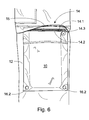
- FIG. 6 shows the attachment of the knee protector 10' in detail.
- the flap 15 covering the zip fastener 14 is shown slightly turned, allowing the closed zip fastener 14 to be seen.
- the press-stud fasteners (16, 16.1) of the lower part are closed, so that the knee protector 10' is firmly in place.
- hook-and-loop tape which is as such known, one example of which is VelcroTM.
- the attachment zip fasteners of the pocket 10 can also be covered with a normal pocket flap 12.3, as shown in Figure 1.
- the zip fasteners used can be, for example, either cast-tooth zip fasteners (plastic or metal), or plastic-coil tooth zip fasteners, such as 05 CF CHAIN P12 DYED HANK200, manufacturer YKK, Japan.
- the essential property of the zip fastener is its lateral strength, which in some plastic-coil types, for instance, can be as much as 40 kg / 2,5 cm.
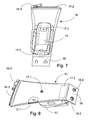
- One application of the invention is the suspension of a mobile radio station, utilizing a "pocket", in this case a holder arrangement 10, according to Figures 7 and 8.
- a mobile radio station utilizing a "pocket", in this case a holder arrangement 10, according to Figures 7 and 8.
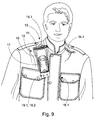
- This is equipped with a half 14.2 of a zip fastener and lower press-stud fasteners 16.2, 16.2, for attaching the holder arrangement 10 to the upper half 14.1 of zip fastener and a press-stud counter piece 16.1, Figure 9, in a jacket or similar.
- the outline of the mobile radio station placed in the holder 17 is shown by broken lines in the figure.
- the jacket or other garment requires only small additional pieces to receive the mobile station holder arrangement 10. These are the half 14.1 of the zip fastener and the press-stud counter pieces 16.1 (Velcro can also be used).
- the holder arrangement 10 includes a support component, provided with a stiffener plate 10.1 (e.g. polycarbonate), which support component is manufactured from waterproof fabric.
- the actual mobile station holder 17 is attached to this with a screw 17.1 and Velcro 17.2.
- the plate 10.1 does not extend fully to the bottom, the bottom part 18 being instead flexible, to facilitate the attachment of the press-stud fasteners.
- the bottom part 18 has two press-stud fasteners 16.2, allowing the holder arrangement 10 to be put on either the left-hand or the right-hand side.
- the zip fastener used is a large-size cast-tooth zip fastener, with halves that are easily slid into each other, without seeing them, when the jacket is being worn.
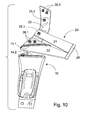
- the jacket does not have a zip-fastener counter piece, this can be made with the aid of a detachable zip-fastener counter piece 20, as shown in Figures 10 - 13.
- This comprises a counter-piece component 22, an arm component 21, a connector 24, and a band 23.
- the counter-piece component 22 has the upper half 14.1 of the zip fastener and, at one end, the connector linking the arm component 21 and, at the other end, the band 23.
- These basic components are made of waterproof fabric and have reinforcements, preferably pieces of artificial leather, inside them.
- Figure 14 shows the shoulder part of a jacket used by many officials, in which there is an epaulet channel 30 and a loop 31.
- Insignia of rank (not shown) are placed on a special epaulet band 32, one half of which is slipped through the epaulet channel 30 and the other half is folded over the epaulet channel, after which the ends are attached to each other.
- the loop 31 is for other attachment purposes.
- the epaulet channel 30 and the loop 31 are used to attach a separate zip-fastener counter piece 20.
- the attachment of the separate zip-fastener counter piece 20 starts with the arm component 21 being pushed through the epaulet channel 30 (as well as through the epaulet band 32).
- the band 23 is slipped through the loop 31 from beneath the visible end of the arm component 21 and pulled onto the arm component 21 near to the counter-piece component 22.
- two detachable parts which can be attached to each other with a zip fastener, are disclosed, i.e. the holder arrangement 10 and the zip-fastener counter piece 20. From this invention, it is easy to derive a permanent combination of them without a zip fastener, which combination, is not, however, an object of the Claims of this application.
Landscapes
- Engineering & Computer Science (AREA)
- Textile Engineering (AREA)
- Health & Medical Sciences (AREA)
- General Health & Medical Sciences (AREA)
- Physical Education & Sports Medicine (AREA)
- Outer Garments And Coats (AREA)
- Details Of Garments (AREA)
Abstract
Description
- The present invention relates to an arrangement in a garment for fastening and detaching at least one pocket, in which the pocket comprises a storage space, knee protector, knee padding, or a suspension device, and in which the pocket includes an attachment member and an attachment counter piece in the garment. Here, the term "pocket" refers not only to a piece forming an actual storage space, but also to other detachable pieces, such as a suspension member, for example, for tools or a mobile radio station, or, for example, knee or elbow padding or protectors.
- Pockets account for a significant part of the manufacturing costs of garments. In general, more than half of the manufacturing costs of a garment are due to making the pockets.
- When garments are used, they usually wear only at specific places. Often, when garments are finally thrown away because, for example, they are worn through, their pockets are still completely intact.
- Nowadays, billing for the care of garments is based on the weight of the garments involved. When large numbers of garments are handled, their pockets form a quite significant share of this weight.
- Attempts have been made to solve these problems, among others, by means of several known pocket models, which are intended to be fastened to and detached from the wearer's garments. In known solutions, the attachment is arranged to take place using, for example, strips of Velcro or a safety pin. The US publications 3,840,901, 4,266,300, 5,054,127, and 6,233,747 B1 disclose comprehensively various kinds of pocket-attachment solutions according to the state of the art.
- For example, the Velcro attachment of a separate pocket is disclosed in US patent publication 4,266,300 (Partridge). This refers to a general-purpose pocket, which can be placed on the wearer's garment almost independently of the location of the attachment. However, its carrying capacity is too small for carrying, for example, heavy objects. In addition, the Velcro attachment arranged directly on the same side of the garment as the pocket is unreliable, as the adhesion of the Velcro attachment become unreliable when the pocket is fastened and detached. In addition, if a force greater than the tearing strength of the Velcro attachment acts on the pocket, it will detach from the garment.
- The aforementioned known carrying devices do not satisfy all groups of users. Particularly when used in work garments, the pocket solutions of the kind described above and their methods of attachment are especially unsatisfactory. Further, when used at work, it is difficult to take objects from a pocket that is permanently attached to a garment over the whole depth of the pocket. The openings of permanent pockets are also often quite tight, making it difficult to use them effectively. Often, the capacity of the volume of the pocket remains small, because changes in shape caused by the filling of the pocket are limited by the inflexible garment forming the rear face of the pocket and by the wearer's body.
- The present invention is intended to create a new type of arrangement for use in garments for fastening and detaching pockets. The characteristic features of the invention are stated in the accompanying Claims. In the following, reference will be made to pockets in general, which is essentially used to refer also to other corresponding types of suspended elements, which are not necessarily closed at their lower edge. These include, for example, tube-like storage spaces arranged in garments for pens or various tools, such as loop attachments for tape measures or hammers. The term also includes various protectors.
- When using the arrangement according to the invention, the fastening of a pocket to a garment is particularly secure and easy. The attachment of the pocket to the garment is arranged with the aid of a zip fastener, in which case one of the toothed strips of the zip fastener member is attached to the rear face of the pocket, preferably to an extension of it. The opposite toothed strip to this is attached similarly to the garment, for example, outside a fold in it, such as the waistband fold, or in connection with pockets permanently attached to the garment. Further, various seams in the garment, to which the toothed strip can be advantageously attached, can be used as attachment points for the opposite toothed strip.
- In one preferred embodiment of the invention, an additional attachment is used at the lower edge of the pocket. A Velcro attachment or a press-stud attachment can be used as the additional attachment.
- According to a second preferred embodiment, the pocket's attachment zip fastener is of the plastic spiral type, which, as is known, will carry a large load.
- According to a third embodiment, the zip fastener is arranged beneath a flap.
- Using the arrangement according to the invention achieves several significant advantages over the state of the art. Cost savings accrue through the significant reduction in the manufacturing costs of garments, as the same pockets can be used in several garments. At the same time, the pockets can be also made from better and more durable material. Further, the costs of garment care are reduced, as the pockets can be removed and thus do not increase the weight of garments, for example, when they are sent for laundering.
- When using the arrangement according to the invention, the apparel needed by a wearer can comprise, for example, only one piece of full equipment, which includes both the garments of the apparel and detachable pockets manufactured for different uses, as well as sets of basic apparel, which are otherwise similar, but are without the said pockets. Thus, when one set of apparel requires care, the wearer can move the pockets to a similar basic garment.
- An additional benefit to the above is that pockets appropriate to the tasks of the wearer can be added to the same basic set of apparel.
- Other preferred embodiments and advantages of the invention will become apparent in connection with the later examples of embodiments. In the following, the invention is described with reference to the accompanying drawings, in which
- Figure 1
- shows the arrangement according to the invention attached to trousers being worn by the wearer,
- Figure 2
- shows the arrangement according to the invention in a vest,
- Figure 3
- shows a rear view of the vest shown in Figure 2,
- Figure 4
- shows the knee portion of the trousers shown in Figure 1, without the knee protector attached to it,
- Figure 5
- shows the detachable knee portion,
- Figure 6
- shows the knee protector of Figure 5 attached to the trousers,
- Figure 7
- shows a "pocket", i.e. suspension component, used to suspend a mobile radio station,
- Figure 8
- shows a rear view of the suspension component of Figure 7,
- Figure 9
- shows the suspension component of Figure 7 attached to a jacket,
- Figure 10
- shows an epaulet attachment component used to attach the suspension component of Figure 7,
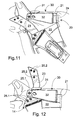
- Figures 11 - 13
- show the stages of attaching the epaulet,
- Figure 12
- shows the attachment counter pieces required in the jacket for attaching the epaulet.
- Referring to Figures 1 and 2, it should be stated that the detachable pocket arrangement can be formed in a nearly arbitrary garment, of which the examples in this case are
trousers 12 andvests 13. In the figures, the detachable pockets are marked with thereference number 10 and the corresponding knee protector with the reference number 10'. - The pocket is normally formed of a front face and a rear face, with the front face being connected to the rear face, for example, at its side edges and lower edge. The front and rear faces joined together then form a bag-like storage space, open at its upper edge, for carrying objects (not shown) with the
garment - In connection with the arrangement according to the invention, the pocket can also be understood as being, not the storage spaces described above, closed at their side and lower edges, but various suspension elements, in which various tools, for example can be suspended. Generally it is possible to create series of pockets for different purposes, with each pocket being equipped with the same fastening arrangement. For example, in the case of tape measures and hammers, the front face can be formed so that it is an upwards and downwards opening loop attached to the rear face, through which the hammer can be slipped shaft first, or in which a tape measure with an attachment clip can be placed. Further, the front face can be arranged in connection with the rear face in such a way that it is suitable for carrying pens (not shown).
- Figure 1 shows a pair of
trousers 12, withseveral pockets 10 arranged in them, each suspended with the aid of ahorizontal zip fastener 14. At the knees, thetrousers 12 have special knee protectors 10', the attachment of which is described later in greater detail. It is particularly advantageous for a worker to be able to put on the knee protectors or padding only when needed. - Figures 2 and 3
show vests 13 with several pocket arrangements according to the invention. In front, there are twopockets 10 arranged to be suspended from their upper parts beneath the pockets permanently attached to the vest. In addition, there is anotherdetachable pocket 10 at the back. - It should be noted, that the
garments pockets 10, 10' according to the invention are in no way restricted to thegarments - Figures 4 - 6 show in greater detail the attachment arrangement of the knee protector 10' shown in Figure 1. In Figure 4, the knee protector is not being used, so that the half 14.1 of the zip fastener used to attach it remains unseen under the
flap 15 arranged in the leg of thetrousers 10. The press-stud counter piece 16.1, which is visible below, does not hinder other work. - Figure 5 shows the knee protector 10' separately. In this case, it actually comprises a special pocket, with a suitable padding sheet placed inside it. A half 14.2 of a zip fastener is stitched to the upper part of the knee protector 10'. The zip fastener is operated by a zipper slide 14.3, which remains on one half or the other, in this case on the half 14.2. The start of the zip also requires stops (not shown), into which the end of the half is pushed. As such, the construction of the zip fastener is conventional. The lower part of the knee protector 10' has male press-
stud members 16, which are arranged to fasten to the press-stud counter pieces 16.1 (Figure 4) in the trousers. - Figure 6 shows the attachment of the knee protector 10' in detail. Here, the
flap 15 covering thezip fastener 14 is shown slightly turned, allowing theclosed zip fastener 14 to be seen. The press-stud fasteners (16, 16.1) of the lower part are closed, so that the knee protector 10' is firmly in place. - In place of stud fasteners, it is possible to use hook-and-loop tape, which is as such known, one example of which is Velcro™.
- The attachment zip fasteners of the
pocket 10 can also be covered with a normal pocket flap 12.3, as shown in Figure 1. - The zip fasteners used can be, for example, either cast-tooth zip fasteners (plastic or metal), or plastic-coil tooth zip fasteners, such as 05 CF CHAIN P12 DYED HANK200, manufacturer YKK, Japan. The essential property of the zip fastener is its lateral strength, which in some plastic-coil types, for instance, can be as much as 40 kg / 2,5 cm.
- By using one or several zip fasteners, it is also possible to attach pockets to a garment in series, for example, so that a pocket attached to the garment, using the zip-fastener attachment described above, can have arranged in it, for example, a toothed strip at its lower edge, to which a second zip-fastener attached pocket, in which there is a counter toothed strip for this purpose, can be connected.
- One application of the invention is the suspension of a mobile radio station, utilizing a "pocket", in this case a
holder arrangement 10, according to Figures 7 and 8. This is equipped with a half 14.2 of a zip fastener and lower press-stud fasteners 16.2, 16.2, for attaching theholder arrangement 10 to the upper half 14.1 of zip fastener and a press-stud counter piece 16.1, Figure 9, in a jacket or similar. The outline of the mobile radio station placed in theholder 17 is shown by broken lines in the figure. The jacket or other garment requires only small additional pieces to receive the mobilestation holder arrangement 10. These are the half 14.1 of the zip fastener and the press-stud counter pieces 16.1 (Velcro can also be used). - The
holder arrangement 10 includes a support component, provided with a stiffener plate 10.1 (e.g. polycarbonate), which support component is manufactured from waterproof fabric. The actualmobile station holder 17 is attached to this with a screw 17.1 and Velcro 17.2. The plate 10.1 does not extend fully to the bottom, thebottom part 18 being instead flexible, to facilitate the attachment of the press-stud fasteners. Thebottom part 18 has two press-stud fasteners 16.2, allowing theholder arrangement 10 to be put on either the left-hand or the right-hand side. The zip fastener used is a large-size cast-tooth zip fastener, with halves that are easily slid into each other, without seeing them, when the jacket is being worn. - If the jacket does not have a zip-fastener counter piece, this can be made with the aid of a detachable zip-
fastener counter piece 20, as shown in Figures 10 - 13. This comprises acounter-piece component 22, anarm component 21, aconnector 24, and aband 23. Thecounter-piece component 22 has the upper half 14.1 of the zip fastener and, at one end, the connector linking thearm component 21 and, at the other end, theband 23. These basic components are made of waterproof fabric and have reinforcements, preferably pieces of artificial leather, inside them. - Figure 14 shows the shoulder part of a jacket used by many officials, in which there is an
epaulet channel 30 and aloop 31. Insignia of rank (not shown) are placed on aspecial epaulet band 32, one half of which is slipped through theepaulet channel 30 and the other half is folded over the epaulet channel, after which the ends are attached to each other. Theloop 31 is for other attachment purposes. In this case, theepaulet channel 30 and theloop 31 are used to attach a separate zip-fastener counter piece 20. - According to Figure 11, the attachment of the separate zip-
fastener counter piece 20 starts with thearm component 21 being pushed through the epaulet channel 30 (as well as through the epaulet band 32). In the next stage (Figure 12), theband 23 is slipped through theloop 31 from beneath the visible end of thearm component 21 and pulled onto thearm component 21 near to thecounter-piece component 22. - Finally, the press studs 25.2 and 26.2 of the band are pressed into the press-stud counter pieces 25.1 (at the end of the arm component) and 26.1 (in the counter-piece component), resulting in the arrangement of Figure 13. Figures 11 - 13, show the
holder arrangement 10 as being included, but naturally it can be attached afterwards using thezip fastener 14. - In this case, two detachable parts, which can be attached to each other with a zip fastener, are disclosed, i.e. the
holder arrangement 10 and the zip-fastener counter piece 20. From this invention, it is easy to derive a permanent combination of them without a zip fastener, which combination, is not, however, an object of the Claims of this application. - It must be understood that the above description and the related figures are only intended to illustrate the present invention. Thus, the invention is not restricted to only the embodiments disclosed above or those defined in the Claims, instead various variations and adaptations of the invention, which are possible within the scope of the inventive idea defined in the accompanying Claims, will be obvious to one versed in the art.
Claims (11)
- An arrangement in a garment (12, 13) for fastening and detaching at least one pocket (10, 10'), in which the pocket (10, 10') comprises a storage space, knee protector, knee padding, or a suspension device, and in which the pocket (10, 10') includes an attachment member and an attachment counter piece in the garment, characterized in that the attachment member (14.2) and the attachment counter piece (14.1) are formed of a zip fastener (14), one half of which is attached to the garment (12, 13) and the other half to the upper edge of the pocket (10, 10'), so that the pocket can be completely detached by opening the zip fastener (14).
- An arrangement according to Claim 1, characterized in that other attachment means (16.2) are arranged in the lower edge of the pocket (10, 10') and a corresponding counter piece (16.1) is arranged in the garment.
- An arrangement according to Claim 2, characterized in that the said other attachment means (16.2) and counter piece (16.1) are formed of press-stud attachment devices, one of which is a male press-stud member and the other is a female press-stud counter piece.
- An arrangement according to any of Claims 1 - 3, characterized in that the zip fastener (14) is of the so-called plastic-coil type.
- An arrangement according to any of Claims 1 - 4, characterized in that the garment (12, 13) half (14.1) of the zip fastener (14) is arranged under a flap (15).
- An arrangement according to any of Claims 1 - 5, characterized in that the pocket (10) is a suspension device for a mobile radio station.
- An arrangement according to Claim 6, characterized in that the pocket (10) includes a support component reinforced with a plate (10.1) and a flexible lower part (18), and in which the mobile station holder is attached to this plate (10.1).
- An arrangement according to any of Claims 6 - 7 for use with apparel equipped with an epaulet channel (30), characterized in that the arrangement includes a detachably attached zip-fastener counter piece (20), which includes an arm component (21) that fits into the epaulet channel.
- An arrangement according to Claim 8 for use with apparel equipped with an epaulet channel (30) and a shoulder loop (31), characterized in that the suspension of the zip-fastener counter piece (20) takes place not only with the arm component (21), but also with the aid of a band (23) that is slipped through the shoulder loop (31), which is secured by attachment means (25.1, 25.2, 26.1, 26.2) to form a suspension loop.
- An arrangement according to Claim 9, characterized in that at least some of the attachment means (25.1, 25.2, 26.1, 26.2) are press studs.
- An arrangement according to any of Claims 8 - 10, characterized in that at least one of the supporting components (21, 23) of the zip-fastener counter piece (20) is reinforced with the aid of a piece of artificial leather sewn inside it.
Priority Applications (1)
| Application Number | Priority Date | Filing Date | Title |
|---|---|---|---|
| FI20060016U FI7023U1 (en) | 2002-11-27 | 2006-01-13 | Apparel comprising a hanging device for a mobile telephony and a device for attaching and detaching said hanging device |
Applications Claiming Priority (4)
| Application Number | Priority Date | Filing Date | Title |
|---|---|---|---|
| FI20010455U FI5257U1 (en) | 2001-11-29 | 2001-11-29 | Device in a crease containing garments for attaching and removing at least one pocket |
| FI20010455U | 2001-11-29 | ||
| FI20020027U | 2002-01-23 | ||
| FI20020027U FI5297U1 (en) | 2001-11-29 | 2002-01-23 | Arrangement in a garment for attaching and removing at least one pocket |
Publications (2)
| Publication Number | Publication Date |
|---|---|
| EP1316262A1 true EP1316262A1 (en) | 2003-06-04 |
| EP1316262B1 EP1316262B1 (en) | 2007-05-09 |
Family
ID=26161142
Family Applications (1)
| Application Number | Title | Priority Date | Filing Date |
|---|---|---|---|
| EP02102652A Expired - Lifetime EP1316262B1 (en) | 2001-11-29 | 2002-11-27 | Garment comprising a suspension device for a mobile radio station |
Country Status (2)
| Country | Link |
|---|---|
| EP (1) | EP1316262B1 (en) |
| FI (1) | FI5297U1 (en) |
Cited By (7)
| Publication number | Priority date | Publication date | Assignee | Title |
|---|---|---|---|---|
| WO2005037376A1 (en) * | 2003-10-10 | 2005-04-28 | Lion Apparel, Inc. | Protective garment with hang-down pockets |
| GB2418591A (en) * | 2004-08-11 | 2006-04-05 | Edward S Military Kit Carrier | A garment with interchangeable pockets |
| GB2421418A (en) * | 2004-12-21 | 2006-06-28 | Ajay Nalluri | A jacket with a detachable pocket |
| USD537610S1 (en) | 2005-12-30 | 2007-03-06 | Escamillo Darlene A | Detachable pocket for pants |
| WO2011081640A1 (en) * | 2009-12-14 | 2011-07-07 | Klann Jeremiah D | User interface securing assembly |
| US8607363B2 (en) | 2009-12-14 | 2013-12-17 | Jeremiah D. Klann | User object securing assembly |
| WO2021167520A1 (en) | 2020-02-18 | 2021-08-26 | Cirk-L Ab | Garment with adjustable attachment system |
Families Citing this family (2)
| Publication number | Priority date | Publication date | Assignee | Title |
|---|---|---|---|---|
| US7774864B2 (en) | 2004-11-05 | 2010-08-17 | Safari Land Ltd., Inc. | Vest and pocket fastening system |
| DE102014017380A1 (en) * | 2014-11-24 | 2016-05-25 | Pfanner Schutzbekleidung Gmbh | Garment with integrated bag |
Citations (7)
| Publication number | Priority date | Publication date | Assignee | Title |
|---|---|---|---|---|
| GB478620A (en) * | 1937-04-12 | 1938-01-21 | Joseph Siegel | Improvements in coat or the like |
| FR2392616A1 (en) * | 1977-06-03 | 1978-12-29 | Hollandia Kievit Bv | Detachable pocket for overcoat - is made of supple leather and is attached to strengthening strips |
| US4168544A (en) * | 1978-04-17 | 1979-09-25 | Kallman Research Corporation | Article holding system |
| US4642815A (en) * | 1986-01-31 | 1987-02-17 | Allen Robert E | Adjustable gun pad for a shooting garment |
| US5586704A (en) * | 1995-03-07 | 1996-12-24 | Tommy Alexander | Shoulder holster and method of carrying a portable telephone near the body of a user |
| US6015217A (en) * | 1999-02-02 | 2000-01-18 | Colangelo; David W. | Uniform epaulet-coupled emergency flashlight |
| DE20012075U1 (en) * | 2000-07-12 | 2000-11-23 | Wolfgang Beyer KG, 40724 Hilden | Clothing, in particular outer clothing |
Family Cites Families (4)
| Publication number | Priority date | Publication date | Assignee | Title |
|---|---|---|---|---|
| US4369526A (en) * | 1980-10-08 | 1983-01-25 | Clutts Earnest H | Utility vest |
| AUPP697198A0 (en) * | 1998-11-06 | 1998-12-03 | Amtel Technology Pty Ltd | Attachment device for a mobile phone |
| DE29906141U1 (en) * | 1999-04-10 | 1999-08-12 | Henze, Michael, Dipl.-Ing., 63500 Seligenstadt | Fixed and permanently integrated device for storing wireless telecommunication means in clothing |
| GB2363003B (en) * | 2000-03-11 | 2004-10-13 | Alan Abraham Deal | Anti-radiation shields |
-
2002
- 2002-01-23 FI FI20020027U patent/FI5297U1/en not_active IP Right Cessation
- 2002-11-27 EP EP02102652A patent/EP1316262B1/en not_active Expired - Lifetime
Patent Citations (7)
| Publication number | Priority date | Publication date | Assignee | Title |
|---|---|---|---|---|
| GB478620A (en) * | 1937-04-12 | 1938-01-21 | Joseph Siegel | Improvements in coat or the like |
| FR2392616A1 (en) * | 1977-06-03 | 1978-12-29 | Hollandia Kievit Bv | Detachable pocket for overcoat - is made of supple leather and is attached to strengthening strips |
| US4168544A (en) * | 1978-04-17 | 1979-09-25 | Kallman Research Corporation | Article holding system |
| US4642815A (en) * | 1986-01-31 | 1987-02-17 | Allen Robert E | Adjustable gun pad for a shooting garment |
| US5586704A (en) * | 1995-03-07 | 1996-12-24 | Tommy Alexander | Shoulder holster and method of carrying a portable telephone near the body of a user |
| US6015217A (en) * | 1999-02-02 | 2000-01-18 | Colangelo; David W. | Uniform epaulet-coupled emergency flashlight |
| DE20012075U1 (en) * | 2000-07-12 | 2000-11-23 | Wolfgang Beyer KG, 40724 Hilden | Clothing, in particular outer clothing |
Non-Patent Citations (1)
| Title |
|---|
| "Materials", 1998, SEQUEL OUTDOOR CLOTHING, XP002231052 * |
Cited By (11)
| Publication number | Priority date | Publication date | Assignee | Title |
|---|---|---|---|---|
| WO2005037376A1 (en) * | 2003-10-10 | 2005-04-28 | Lion Apparel, Inc. | Protective garment with hang-down pockets |
| AU2004281692B2 (en) * | 2003-10-10 | 2010-04-22 | Lion Apparel, Inc. | Protective garment with hang-down pockets |
| US8701218B2 (en) | 2003-10-10 | 2014-04-22 | Lion Apparel, Inc. | Protective garment with hang-down pockets |
| GB2418591A (en) * | 2004-08-11 | 2006-04-05 | Edward S Military Kit Carrier | A garment with interchangeable pockets |
| GB2421418A (en) * | 2004-12-21 | 2006-06-28 | Ajay Nalluri | A jacket with a detachable pocket |
| USD537610S1 (en) | 2005-12-30 | 2007-03-06 | Escamillo Darlene A | Detachable pocket for pants |
| WO2011081640A1 (en) * | 2009-12-14 | 2011-07-07 | Klann Jeremiah D | User interface securing assembly |
| US8607363B2 (en) | 2009-12-14 | 2013-12-17 | Jeremiah D. Klann | User object securing assembly |
| WO2021167520A1 (en) | 2020-02-18 | 2021-08-26 | Cirk-L Ab | Garment with adjustable attachment system |
| US12324470B2 (en) | 2020-02-18 | 2025-06-10 | Cirk-L Ab | Garment with adjustable attachment system |
| EP4581970A1 (en) | 2020-02-18 | 2025-07-09 | Cirk-L Ab | Garment with adjustable attachment system |
Also Published As
| Publication number | Publication date |
|---|---|
| FIU20020027U0 (en) | 2002-01-23 |
| EP1316262B1 (en) | 2007-05-09 |
| FI5297U1 (en) | 2002-03-22 |
Similar Documents
| Publication | Publication Date | Title |
|---|---|---|
| US7065792B2 (en) | Arrangement in a garment for fastening and detaching suspension member for a mobile terminal device | |
| US3994026A (en) | Garment with supported drop seat | |
| US5867836A (en) | Waist band trouser or skirt holder | |
| US7451495B2 (en) | Combined garment and safety harness | |
| US20090049584A1 (en) | Clothing systems and methods | |
| US6959455B2 (en) | Suspenders | |
| US20180168250A1 (en) | Convertible Pants | |
| US3949427A (en) | Garment with drop seat | |
| EP1245164A3 (en) | Waist expanding and contracting structure for pants or the like | |
| EP1316262A1 (en) | Arrangement in a garment for fastening and detaching at least one pocket | |
| US7735151B1 (en) | Breakaway vest | |
| EP2583571B1 (en) | Improvements relating to chaps | |
| US9750331B2 (en) | Integrated modular attachment system | |
| US20070163029A1 (en) | Carpenter pants | |
| JP3245225U (en) | work belt | |
| CN221265302U (en) | Winter standby service clothes | |
| CN215873507U (en) | Novel pregnant woman trousers with detachable abdomen supporting and waist protecting belt zipper | |
| EP0960577A1 (en) | Garment with removable accessories like pockets or the like | |
| CN203763703U (en) | Waistcoat | |
| AU2009238215B2 (en) | Protective work wear | |
| JP3060025U (en) | Gardening pants | |
| JP3052015U (en) | Water work overtrousers with a breastplate | |
| JP2003227012A (en) | Pants with suspender | |
| PL12060S2 (en) | Insulated protective working jacket | |
| KR20240101127A (en) | A vest that does not sag forward due to the load generated on the front and has expandability in use. |
Legal Events
| Date | Code | Title | Description |
|---|---|---|---|
| PUAI | Public reference made under article 153(3) epc to a published international application that has entered the european phase |
Free format text: ORIGINAL CODE: 0009012 |
|
| AK | Designated contracting states |
Designated state(s): AT BE BG CH CY CZ DE DK EE ES FI FR GB GR IE IT LI LU MC NL PT SE SK TR |
|
| AX | Request for extension of the european patent |
Extension state: AL LT LV MK RO SI |
|
| 17P | Request for examination filed |
Effective date: 20031120 |
|
| AKX | Designation fees paid |
Designated state(s): AT BE BG CH CY CZ DE DK EE ES FI FR GB GR IE IT LI LU MC NL PT SE SK TR |
|
| 17Q | First examination report despatched |
Effective date: 20040609 |
|
| RTI1 | Title (correction) |
Free format text: GARMENT COMPRISING A SUSPENSION DEVICE FOR A MOBILE RADIO STATION |
|
| RAP1 | Party data changed (applicant data changed or rights of an application transferred) |
Owner name: FANTTISET OY |
|
| GRAP | Despatch of communication of intention to grant a patent |
Free format text: ORIGINAL CODE: EPIDOSNIGR1 |
|
| GRAS | Grant fee paid |
Free format text: ORIGINAL CODE: EPIDOSNIGR3 |
|
| GRAA | (expected) grant |
Free format text: ORIGINAL CODE: 0009210 |
|
| AK | Designated contracting states |
Kind code of ref document: B1 Designated state(s): AT BE BG CH CY CZ DE DK EE ES FI FR GB GR IE IT LI LU MC NL PT SE SK TR |
|
| PG25 | Lapsed in a contracting state [announced via postgrant information from national office to epo] |
Ref country code: LI Free format text: LAPSE BECAUSE OF FAILURE TO SUBMIT A TRANSLATION OF THE DESCRIPTION OR TO PAY THE FEE WITHIN THE PRESCRIBED TIME-LIMIT Effective date: 20070509 Ref country code: CH Free format text: LAPSE BECAUSE OF FAILURE TO SUBMIT A TRANSLATION OF THE DESCRIPTION OR TO PAY THE FEE WITHIN THE PRESCRIBED TIME-LIMIT Effective date: 20070509 Ref country code: FI Free format text: LAPSE BECAUSE OF FAILURE TO SUBMIT A TRANSLATION OF THE DESCRIPTION OR TO PAY THE FEE WITHIN THE PRESCRIBED TIME-LIMIT Effective date: 20070509 |
|
| REG | Reference to a national code |
Ref country code: GB Ref legal event code: FG4D |
|
| REG | Reference to a national code |
Ref country code: CH Ref legal event code: EP |
|
| REG | Reference to a national code |
Ref country code: IE Ref legal event code: FG4D |
|
| REF | Corresponds to: |
Ref document number: 60220010 Country of ref document: DE Date of ref document: 20070621 Kind code of ref document: P |
|
| PG25 | Lapsed in a contracting state [announced via postgrant information from national office to epo] |
Ref country code: SE Free format text: LAPSE BECAUSE OF FAILURE TO SUBMIT A TRANSLATION OF THE DESCRIPTION OR TO PAY THE FEE WITHIN THE PRESCRIBED TIME-LIMIT Effective date: 20070809 |
|
| PG25 | Lapsed in a contracting state [announced via postgrant information from national office to epo] |
Ref country code: ES Free format text: LAPSE BECAUSE OF FAILURE TO SUBMIT A TRANSLATION OF THE DESCRIPTION OR TO PAY THE FEE WITHIN THE PRESCRIBED TIME-LIMIT Effective date: 20070820 |
|
| ET | Fr: translation filed | ||
| NLV1 | Nl: lapsed or annulled due to failure to fulfill the requirements of art. 29p and 29m of the patents act | ||
| REG | Reference to a national code |
Ref country code: CH Ref legal event code: PL |
|
| PG25 | Lapsed in a contracting state [announced via postgrant information from national office to epo] |
Ref country code: AT Free format text: LAPSE BECAUSE OF FAILURE TO SUBMIT A TRANSLATION OF THE DESCRIPTION OR TO PAY THE FEE WITHIN THE PRESCRIBED TIME-LIMIT Effective date: 20070509 |
|
| PG25 | Lapsed in a contracting state [announced via postgrant information from national office to epo] |
Ref country code: BE Free format text: LAPSE BECAUSE OF FAILURE TO SUBMIT A TRANSLATION OF THE DESCRIPTION OR TO PAY THE FEE WITHIN THE PRESCRIBED TIME-LIMIT Effective date: 20070509 |
|
| PG25 | Lapsed in a contracting state [announced via postgrant information from national office to epo] |
Ref country code: NL Free format text: LAPSE BECAUSE OF FAILURE TO SUBMIT A TRANSLATION OF THE DESCRIPTION OR TO PAY THE FEE WITHIN THE PRESCRIBED TIME-LIMIT Effective date: 20070509 Ref country code: DK Free format text: LAPSE BECAUSE OF FAILURE TO SUBMIT A TRANSLATION OF THE DESCRIPTION OR TO PAY THE FEE WITHIN THE PRESCRIBED TIME-LIMIT Effective date: 20070509 Ref country code: BG Free format text: LAPSE BECAUSE OF FAILURE TO SUBMIT A TRANSLATION OF THE DESCRIPTION OR TO PAY THE FEE WITHIN THE PRESCRIBED TIME-LIMIT Effective date: 20070809 Ref country code: PT Free format text: LAPSE BECAUSE OF FAILURE TO SUBMIT A TRANSLATION OF THE DESCRIPTION OR TO PAY THE FEE WITHIN THE PRESCRIBED TIME-LIMIT Effective date: 20071009 Ref country code: CZ Free format text: LAPSE BECAUSE OF FAILURE TO SUBMIT A TRANSLATION OF THE DESCRIPTION OR TO PAY THE FEE WITHIN THE PRESCRIBED TIME-LIMIT Effective date: 20070509 |
|
| PG25 | Lapsed in a contracting state [announced via postgrant information from national office to epo] |
Ref country code: SK Free format text: LAPSE BECAUSE OF FAILURE TO SUBMIT A TRANSLATION OF THE DESCRIPTION OR TO PAY THE FEE WITHIN THE PRESCRIBED TIME-LIMIT Effective date: 20070509 |
|
| PGFP | Annual fee paid to national office [announced via postgrant information from national office to epo] |
Ref country code: IT Payment date: 20071121 Year of fee payment: 6 |
|
| PLBE | No opposition filed within time limit |
Free format text: ORIGINAL CODE: 0009261 |
|
| STAA | Information on the status of an ep patent application or granted ep patent |
Free format text: STATUS: NO OPPOSITION FILED WITHIN TIME LIMIT |
|
| 26N | No opposition filed |
Effective date: 20080212 |
|
| PG25 | Lapsed in a contracting state [announced via postgrant information from national office to epo] |
Ref country code: DE Free format text: LAPSE BECAUSE OF FAILURE TO SUBMIT A TRANSLATION OF THE DESCRIPTION OR TO PAY THE FEE WITHIN THE PRESCRIBED TIME-LIMIT Effective date: 20070810 Ref country code: GR Free format text: LAPSE BECAUSE OF FAILURE TO SUBMIT A TRANSLATION OF THE DESCRIPTION OR TO PAY THE FEE WITHIN THE PRESCRIBED TIME-LIMIT Effective date: 20070810 |
|
| PG25 | Lapsed in a contracting state [announced via postgrant information from national office to epo] |
Ref country code: MC Free format text: LAPSE BECAUSE OF NON-PAYMENT OF DUE FEES Effective date: 20071130 |
|
| PG25 | Lapsed in a contracting state [announced via postgrant information from national office to epo] |
Ref country code: IE Free format text: LAPSE BECAUSE OF NON-PAYMENT OF DUE FEES Effective date: 20071127 |
|
| PG25 | Lapsed in a contracting state [announced via postgrant information from national office to epo] |
Ref country code: EE Free format text: LAPSE BECAUSE OF FAILURE TO SUBMIT A TRANSLATION OF THE DESCRIPTION OR TO PAY THE FEE WITHIN THE PRESCRIBED TIME-LIMIT Effective date: 20070509 |
|
| PG25 | Lapsed in a contracting state [announced via postgrant information from national office to epo] |
Ref country code: CY Free format text: LAPSE BECAUSE OF FAILURE TO SUBMIT A TRANSLATION OF THE DESCRIPTION OR TO PAY THE FEE WITHIN THE PRESCRIBED TIME-LIMIT Effective date: 20070509 |
|
| PG25 | Lapsed in a contracting state [announced via postgrant information from national office to epo] |
Ref country code: LU Free format text: LAPSE BECAUSE OF NON-PAYMENT OF DUE FEES Effective date: 20071127 Ref country code: IT Free format text: LAPSE BECAUSE OF NON-PAYMENT OF DUE FEES Effective date: 20081127 |
|
| PG25 | Lapsed in a contracting state [announced via postgrant information from national office to epo] |
Ref country code: TR Free format text: LAPSE BECAUSE OF FAILURE TO SUBMIT A TRANSLATION OF THE DESCRIPTION OR TO PAY THE FEE WITHIN THE PRESCRIBED TIME-LIMIT Effective date: 20070509 |
|
| PGFP | Annual fee paid to national office [announced via postgrant information from national office to epo] |
Ref country code: GB Payment date: 20101125 Year of fee payment: 9 |
|
| PGFP | Annual fee paid to national office [announced via postgrant information from national office to epo] |
Ref country code: FR Payment date: 20111214 Year of fee payment: 10 |
|
| GBPC | Gb: european patent ceased through non-payment of renewal fee |
Effective date: 20121127 |
|
| REG | Reference to a national code |
Ref country code: FR Ref legal event code: ST Effective date: 20130731 |
|
| PG25 | Lapsed in a contracting state [announced via postgrant information from national office to epo] |
Ref country code: GB Free format text: LAPSE BECAUSE OF NON-PAYMENT OF DUE FEES Effective date: 20121127 Ref country code: FR Free format text: LAPSE BECAUSE OF NON-PAYMENT OF DUE FEES Effective date: 20121130 |