EP1315099A1 - Microbe analyzing system and method, and database - Google Patents
Microbe analyzing system and method, and database Download PDFInfo
- Publication number
- EP1315099A1 EP1315099A1 EP01943854A EP01943854A EP1315099A1 EP 1315099 A1 EP1315099 A1 EP 1315099A1 EP 01943854 A EP01943854 A EP 01943854A EP 01943854 A EP01943854 A EP 01943854A EP 1315099 A1 EP1315099 A1 EP 1315099A1
- Authority
- EP
- European Patent Office
- Prior art keywords
- microbe
- data
- computer
- database
- electrophoresis
- Prior art date
- Legal status (The legal status is an assumption and is not a legal conclusion. Google has not performed a legal analysis and makes no representation as to the accuracy of the status listed.)
- Withdrawn
Links
Images






Classifications
-
- G—PHYSICS
- G16—INFORMATION AND COMMUNICATION TECHNOLOGY [ICT] SPECIALLY ADAPTED FOR SPECIFIC APPLICATION FIELDS
- G16B—BIOINFORMATICS, i.e. INFORMATION AND COMMUNICATION TECHNOLOGY [ICT] SPECIALLY ADAPTED FOR GENETIC OR PROTEIN-RELATED DATA PROCESSING IN COMPUTATIONAL MOLECULAR BIOLOGY
- G16B50/00—ICT programming tools or database systems specially adapted for bioinformatics
Definitions
- the present invention relates to a method and system for analyzing microbes such as bacteria.
- a method for obtaining information about a group of microbes for example, a group of bacteria
- a method for obtaining information about a group of microbes for example, a group of bacteria
- a method for obtaining information about a group of microbes for example, a group of bacteria
- a method for obtaining information about a group of microbes for example, a group of bacteria
- a method for obtaining information about a group of microbes for example, a group of bacteria
- PCR Polymerase Chain Reaction
- primers and thermostable DNA polymerases having base sequences which are complementary to the base sequences at the ends of the DNA to be amplified, a cycle having three stages, a thermal transformation process, an annealing process, and an extension and reaction process is repeated to enable amplification of a DNA fragment which is substantially identical to the template DNA.
- PCR allows for amplification by a factor of one hundred thousand to one million of DNA of bacteria that are present only in a minute numbers.
- PCR requires that the base sequences at the ends of one region of the template DNA be known, and therefore, DNA cannot be amplified before the types of microbes present are known.
- RAPD Random Amplified Polymorphic DNA
- SSC-PCR even when a plurality of microbes are present, it is possible to amplify, on average, one DNA from one type of microbe. Therefore, SSC-PCR is very effective for garbage processing and when examining a sample in which a plurality of strains of bacteria are mixed.
- a user collects a sample and then sends the sample to an analysis provider (a company which provides analysis services) or the like via mail, etc., and the analysis provider extracts and amplifies DNA from the received sample through PCR or the like, and provides the analysis results to the user.
- an analysis provider a company which provides analysis services
- the analysis provider extracts and amplifies DNA from the received sample through PCR or the like, and provides the analysis results to the user.
- the present invention was conceived to solve the above described problems and one object of the present invention is to provide a system and a method for analyzing a microbe sample more efficiently than possible with the conventional art.
- an analysis system comprising a first computer and a second computer connected via a communication network, wherein the first computer transmits measurement data related to the DNA of a microbe to the second computer via the communication network; the second computer matches the measurement data transmitted from the first computer and data stored in a database and transmits the matching results to the first computer via the communication network; and the first computer outputs the matching results transmitted from the second computer.
- the user transmits the data from the first computer to the second computer via the communication network.
- the second computer accesses the database, matches the received measurement data and data in the database, and transmits the matching result to the first computer which is used by the user.
- the transmission of the measurement data, matching, and reception of the matching result can be executed in a short period of time, the user can quickly and efficiently obtain the analysis result of microbes without performing complex processes such as mailing the sample to the analysis provider.
- the measurement data unlike a physical object such as a sample, can be easily converted to a form which can be transmitted, it is possible to easily transmit the measurement data to the second computer which may be physically farther away.
- the measurement data related to DNA is electrophoresis data of DNA of the microbe.
- the user can obtain information of the microbes in the sample by creating electrophoresis data and transmitting the data to the second computer.
- the measurement data related to DNA is numerically converted data of the electrophoresis data.
- the electrophoresis data indicates the presence ratio as a function of a DNA size and can unambiguously be defined by specifying the band position (DNA size) and band intensity. Because of this, by numerically converting the electrophoresis data, it is possible to reliably transmit the electrophoresis data to the second computer.
- the measurement data related to DNA is patterned data of the electrophoresis data.
- the band position and band intensity can be defined as an intensity function with the variable being the DNA size. More particularly, the band position and band intensity can be defined as an intensity waveform pattern.
- the electrophoresis data contains primer data.
- the primer which is used determines the DNA fragments to be amplified. Therefore, by transmitting electrophoresis data for each of the primers used, it is possible at the second computer to reliably search for the corresponding data.
- a plurality of primers primer set
- the second computer matches the electrophoresis data transmitted from the first computer and electrophoresis data for each microbe stored in the database, extracts a corresponding microbe, and transmits data of the corresponding microbe to the first computer as the matching results.
- electrophoresis data for each microbe it is possible to extract a microbe corresponding to the electrophoresis data transmitted from the first computer and transmit data of the corresponding microbe (that is, data for specifying a microbe such as the name of the microbe) to the first computer, that is, to the user.
- the number of corresponding microbes needs not be one, and it is possible to transmit data of a plurality of corresponding microbes.
- the first computer requests information related to the corresponding microbe to the second computer via the communication network and the second computer searches for information related to the corresponding microbe stored in the database and transmits to the first computer.
- the user wishes to obtain more detailed information on the corresponding microbe, the user can quickly obtain the information by sending a request to the second computer.
- a method for analyzing a microbes using a terminal and a database connected to each other through a communication network comprising the steps of accessing the database from the terminal using measurement data related to the DNA of a microbe as a search key; searching for data of a microbe corresponding to the measurement data; and outputting the search result to the terminal.
- the method further comprises the steps of accessing the database from the terminal using the type of microbe used in the measurement as a search key and searching for data of a microbe corresponding to the measurement data and the type of microbe.
- the type of microbes is known in advance, it is possible to efficiently perform the search according to the type of microbes.
- the method further comprises the steps of accessing the database from the terminal using a set of primers (primer set) used in the measurement as a search key, and searching for data of a microbe corresponding to the measurement data and the set of primers.
- primer set used in the measurement as a search key
- the measurement data related to DNA is electrophoresis data of the microbe.
- the electrophoresis data is electrophoresis data of a DNA fragment amplified, on average, from one DNA fragment per one type through PCR, that is, electrophoresis data obtained through SSC-PCR. In this manner, even when a plurality of types of microbes are present in the sample, each microbe can be easily identified.
- the method further comprises the steps of requesting detailed information from the terminal to the database based on the search result, and outputting, on or through the terminal, the detailed information transmitted from the database.
- a computer readable database for storing electrophoresis data of DNA fragments of microbes amplified using a plurality of primers, the stored data sorted (differentiated) according to each microbe. By accessing the database, the user can identify a microbe from the electrophoresis data of the microbe.
- the electrophoresis data are sorted or differentiated for a basic primer set and for detailed information and stored.
- the database for the basic primer set can be used for a primary search and the detailed database can be used for a secondary search, allowing for more efficient search.
- the electrophoresis data are differentiated or sorted for each type of microbe and stored. In this manner, when the user knows the type of microbes in which they are interested, the user can more efficiently conduct a search compared to a case when searching through all of the microbes.
- a method for analyzing a microbe comprising the steps of receiving data related to the DNA of a microbe transmitted via a communication network; matching the received data with data stored in a database; and transmitting the matching result via the communication network.
- the data related to DNA is electrophoresis data of the DNA of the microbe.
- electrophoresis data for each microbe is stored in the database; received electrophoresis data and data stored in the database are matched to extract a corresponding microbe; and data of the corresponding microbe is transmitted as the matching result.
- the term "computer” represents, in addition to an electronic calculator, any suitable electronic device having a data processing function, communication function, and data input/output function.
- the term "communicatio network” used herein includes any suitable wired or wireless medium through which data can be transmitted.
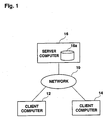
- Fig. 1 is a diagram showing a system structure according to the embodiment.
- Client computers 12 and 14 and a server computer 16 are connected to a network 10.
- the client computer 12 or 14 is a terminal used by a user when requesting an analysis.
- the server computer 16 may be owned by an analysis provider who conducts the analysis.
- the client computers 12 and 14 may be general-purpose personal computers or any suitable equipment having a CPU, an input/output section, and a communication interface.
- the server computer 16 includes a database 16a for storing data related to the DNA of microbes, and the user can access the database 16a through the network 10.
- the communication network 10 can be constructed, for example, as a portion of the Internet.
- the server computer 16 can include a WWW server having web pages described in HTML and the user can access the database by requesting a web page of the server computer 16 using a predetermined URL.
- the user For accessing the database 16a, the user may be asked to input an ID and a password. Also, the access to the database may be charged through a predetermined method.
- the communication network 10 need not be formed entirely by a wired network and a portion of the communication network 10 may be wirelessly connected.
- Fig. 2 shows a flowchart showing the overall process of microbe analysis according to the embodiment.
- a user extracts DNA of microbes from a sample such as, for example, garbage; human stool, skin, or saliva, etc. (step S101).
- the DNA fragments of the microbes are amplified through SSC-PCR using a plurality of primers (primer set) so that, on average, only one type of DNA for different microbes and having differing lengths is amplified (step S102). It is preferable that the decision on which primer set is to be used for amplifying the DNA fragments be made in advance.
- a plurality of basic primers as a basic primer set and, in addition, other sets in which several primers are combined (primer set A, primer set B, . . .).
- primer set A primer set A
- primer set B primer set B
- a user when a user amplifies DNA fragments of microbes in a sample, the user can amplify first using the basic primer set.
- the amplified DNA fragments are subjected to the gel electrophoresis to obtain an electrophoresis image (electrophoresis data) (step S103).
- Fig. 3 shows an example of an electrophoresis image obtained in the manner described above.
- P1 ⁇ P10 indicate the types of primers used in amplification.
- This set of (P1, P2, . . . P10) is, for example, determined as the basic primer set.
- the vertical axis represents the length of DNA fragments and the length of DNA fragment becomes shorter at the lower side of the figure.
- an electrophoresis image of DNA size makers be added in the direction along the vertical axis (for example, at both right and left end sections). In this manner, it is possible to easily read the size of the DNA fragment amplified by each primer.
- bands of DNA fragments amplified by each primer appear. Because it is known, for each microbe, which primer amplifies the DNA fragments by what amplification, it is possible to identify, from the electrophoresis image shown in Fig. 3, to which microbe the DNA fragment belongs.
- the user must extract, from the obtained electrophoresis data, data for using the database 16a, that is, a search key for searching through the database 16a. Because this search key is transmitted through the communication network 10, it is necessary to use a search key which has minimum amount of data while representing the electrophoresis image with sufficiently high precision.
- an electrophoresis image (electrophoresis data)
- the user analyzes the patterns in the electrophoresis image and converts the electrophoresis data into numerical data (step S104).
- This numerical conversion may be performed, for example, as follows.
- An electrophoresis image to which a DNA size marker is added is converted into image data using a scanner and is captured into a computer. After the image data is captured by the computer, the position and intensity of the band for each primer is read using appropriate software. The read data is then output in the form of numerical values.
- Fig. 4 shows an example of numerical data obtained by analyzing an electrophoresis image.
- ⁇ 1, 2500, 1.37) indicates that the primer number is 1 (P1), the band position is 2500, and the band intensity is 1.37.
- ⁇ 1, 4000, 0.18 ⁇ indicates that the primer number is 1 (P1), the band position is 4000, and the band intensity is 0.18
- ⁇ 3, 1500, 0.98 ⁇ indicates that the primer number is 3 (P3), the band position is 1500, and the band intensity is 0.98.
- the bands for all primers can be converted into numerical values.
- the obtained numerical data can further be binarized.
- the numerical data is transmitted from the computer 12 (or computer 14) to the server computer 16 (step S105).
- the database 16a is searched according to the received numerical data, and a microbe corresponding to the received electrophoresis data is extracted.
- Fig. 6 schematically shows a structure of data to be stored in the database 16a.
- the database is divided according to individual microbe (for example, E. coli, B. subtilis, S. aureus, etc.) and stores numerical data for the electrophoresis data of each microbe.
- the numerical data shown in Fig. 6 is obtained by amplifying DNA fragments using the basic primer set. It is preferable that, for each of the primer sets, numerical data is stored. It is possible to extract the corresponding microbe at the server computer 16 by executing correlation calculation between the numerical data transmitted from the computer 12 (or computer 14) and the numerical data for the microbes and finding the microbe which has the highest correlation value.
- the server computer 16 returns the extraction results to the computer 12 (or computer 14).
- the computer 12 receives the data transmitted from the server computer 16 (step S106) and generates output to a display, a printer, or other output device. By checking this results, the user can quickly recognize which microbes may be present in the sample.
- the electrophoresis image may be converted into predetermined data through other methods.
- Fig. 5 shows patterned data of an electrophoresis image.
- the electrophoresis image is read using a scanner and the captured image is input into a computer.
- brightness is continuously read along a certain line (for example, the center line) for each primer.
- the brightness level is high at positions where a band is present and is low at positions where no band is present.
- the brightness level appears as a continuous waveform data and pattern data is obtained for each primer. This pattern can be quantized.
- the pattern data thus obtained is transmitted to the server computer 16.
- the server computer 16 matches the received pattern data with the pattern data stored in the database 16a.
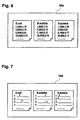
- Fig. 7 shows an example structure of data stored in the database 16a. Similar to the data shown in Fig. 6, the data in Fig. 7 is divided according to microbe and stored as pattern data for electrophoresis images obtained by amplifying DNA fragments for each microbe by predetermined primer sets. It is also preferable that the pattern data be prepared for each primer set.
- the server computer 16 compares the received pattern data and the pattern data for each microbe, executes a correlation calculation (for example, multiplication between the patterns), extracts only the microbe having the highest correlation or microbes having correlation greater than or equal to a threshold, and transmits microbe data to the computer 12 (or computer 14) . With this method as well, the user can quickly obtain information as to which microbes which may be present in the sample.
- the user further accesses the database 16a using the computer 12 (or computer 14) based on the received results, for requesting more detailed information.
- This is useful, for example, when the analysis results indicate a plurality of possible microbes and the user wishes to confirm which of the microbes are actually present in the sample.
- Fig. 8 shows a flowchart of the processes in this case. These processes correspond to the steps S104 ⁇ S106 in Fig. 2.
- a user creates electrophoresis data using the basic primer set and transmits the data to the server computer 16 (step S201) .
- the server computer 16 searches through the database based on the received data and returns the corresponding microbe data to the computer 12 (or computer 14).
- the search result is returned, for example, in the form of a list of the corresponding microbes and correspondence probability (which is equal to the correlation).
- the computer 12 (or computer 14) receives the result from the server computer 16 and displays on the display or the like (step S202) .
- the user views the result output to the computer 12 (or computer 14) and, when the user wishes, for example, to obtain more detailed information of the microbe having the highest correspondence probability, the user requests detailed information of the microbe for which the user wishes to obtain information, to the server computer 16 (step S203). More specifically, when the search result indicates E. coli 95%, B. subtilis 70%, and S. aureus 50%, the user accesses the database 16a using E. coli as a search key. The server computer 16 searches the database 16a for detailed data for the requested microbe, and returns the results to the computer 12 (or computer 14) . By checking the detailed data (step S204), the user can quickly obtain information regarding, for example, a primer set that would identify E. coli and data for electrophoresis image which would appear when the amplification is performed using that primer set. Thus, the user can efficiently proceed with additional analysis or the like.
- Fig. 9 shows another data structure in the database 16a.
- a detailed database for each microbe is stored in such a manner that will facilitate response to a user request.
- the electrophoresis data for primer sets other than the basic primer set and data of the primer sets which are most effective for each microbe can be stored in such a detailed database.
- the user analyzes the electrophoresis data of microbes and accesses the database 16a through the communication network 10 after obtaining the analysis result to identify the corresponding microbe.
- the user analyzes the electrophoresis data of microbes and accesses the database 16a through the communication network 10 after obtaining the analysis result to identify the corresponding microbe.
- the database 16a be updated frequently to store the most recent data, and it is also preferable that the database be classified so that a search can be performed according to the type of the sample to be inspected.
- the database can be divided for each of the types of microbes such as, for example, laxative bacteria, pathogenic bacteria, enterobacteria, etc., in addition to the division by microbes and by primer sets.
- Fig. 10 shows an example initial screen to be displayed on a computer 12. This screen is displayed, for example, using a WWW browser. On the web page may be displayed fields such as "search/identify bacteria", "display band patterns for bacteria”, "information search”, etc. When a user has obtained electrophoresis data using a certain primer set (normally, the basic primer set is used for the initial search), the user selects the "search/identify bacteria" item.
- a certain primer set normally, the basic primer set is used for the initial search
- Fig. 11 shows an example display of a web page transmitted from the server computer 16 when the user selects the "search/identify bacteria" item.
- This screen is created for the user to select the primer set which has been used, and displays, as a list, a plurality of primer sets in addition to the "basic primer set". The user selects and transmits the primer set which was used for amplifying the DNA fragments. .
- the server computer 16 After the user transmits the primer set, the server computer 16 transmits a web page which asks for the user to input the electrophoresis data.
- Fig. 12 is an example of such input screen. With a message of "please transmit numerically converted data of electrophoresis pattern", a description of a plurality of methods are displayed for transmitting the numerically converted data.
- a method is shown for transmitting the numerically converted data by attaching a file to which the numerically converted data are stored.
- the server computer 16 reconstructs the electrophoresis image from the received numerical data and returns to the computer 12. The user can reconfirm the transmitted numerical data by viewing the reconstructed electrophoresis image.
- Fig. 13 shows an example screen transmitted from the server computer 16 after the numerically converted data is transmitted.
- This screen asks the user for the type of database to be used in the search.
- the database is divided according to each type of microbes, for example, "laxative bacteria”, “pathogenic bacteria”, “enterobacteria”, “oral bacteria”, “food”, “waste water processing”, etc.
- laxative bacteria for a stool sample obtained from a patient having diarrhea symptoms, the user can select "laxative bacteria”.
- the user can select "garbage processor”.
- the user can transmit by pressing the "analysis” button to initiate a search through the database 16a using the designated primer set and the type of microbes.
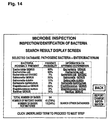
- Fig. 14 shows an example screen displaying the search result.
- the selected primer set is the basic primer set and the selected types of the microbes are pathogenic bacteria and enterobacteria.
- the names of microbes (bacteria) that may be present within (or may correspond to) the sample are displayed with the probability of presence in a form of a list.
- a button (or a tag) for requesting information on experiments for confirming the bacteria type is provided for each of the microbes that may be present, and a user who wishes more detailed information about the microbes can request detailed information from the server computer 16 by manipulating these buttons.
- the number of bands that did not match and respective percentages are also shown. When these numbers are large, the user can search through other databases.
- Fig. 15 shows an example screen transmitted from the server computer 16 when the user requests detailed information on microbes (bacteria) for which the probability of presence is high or microbes that are otherwise of interest to the user.
- microbes bacteria
- primer sets which can be used to more affirmatively confirm the presence of that microbe, and band positions that would be expected to appear after the amplification are displayed so that the user has a useful guideline for additional experiments.
- it is preferable to display as shown in the figure, a button for ordering the primer set from the analysis provider or other source.
- Fig. 16 shows an example web page which is transmitted from the server computer 16 when the user selects "display band patterns for bacteria" in the initial screen shown in Fig. 10.
- a screen for inputting the name of the desired microbe (name of bacteria) and the primer set which has been used is displayed.
- the microbe can be selected by species and strains.
- Fig. 17 shows an example screen transmitted from the server computer 16 when the user selects Bacillus genus and the basic primer set on the screen of Fig. 16.
- the database 16a stores the electrophoresis data (numerically converted data, pattern data, or image data of the image) for each microbe and each primer set.
- the server computer 16 displays electrophoresis images of microbes that are found through a search using the conditions designated by the user as the search key. The user can use these electrophoresis images as a reference for specifying the microbes.
- Fig. 18 shows an example web page transmitted from the server computer 16 when the user selects "information search" on the initial screen of Fig. 10.
- the user wishes additional data about a certain microbe (bacteria) in addition to the identification experiment information on Fig. 14, the user can obtain detailed data from this screen.
- the server computer 16 may be configured to enable charging, each user based on the number of databases employed in each search or the number of accesses, and the charge information can be added to the search result screen. It is also possible to provide a system in which the database related to the basic primer set is made public and the database storing data of other primer sets or detail information database is only accessible by affiliated members. It is also possible that the electrophoresis data transmitted from the user to the server computer 16 or the search results transmitted from the server computer 16 to the user computer be suitably encrypted and transmitted. Moreover, the number of database needs not be one, and the server computer 16 may access the databases of other analyzing companies when there is no data on the corresponding microbes in the database managed by the server computer 16, and transmit the result to the user.
- the user can quickly identify a group of microbes present in a sample.
Landscapes
- Physics & Mathematics (AREA)
- Health & Medical Sciences (AREA)
- Life Sciences & Earth Sciences (AREA)
- Engineering & Computer Science (AREA)
- Evolutionary Biology (AREA)
- General Health & Medical Sciences (AREA)
- Databases & Information Systems (AREA)
- Bioinformatics & Cheminformatics (AREA)
- Bioinformatics & Computational Biology (AREA)
- Biotechnology (AREA)
- Bioethics (AREA)
- Biophysics (AREA)
- Medical Informatics (AREA)
- Spectroscopy & Molecular Physics (AREA)
- Theoretical Computer Science (AREA)
- Information Retrieval, Db Structures And Fs Structures Therefor (AREA)
- Apparatus Associated With Microorganisms And Enzymes (AREA)
- Measuring Or Testing Involving Enzymes Or Micro-Organisms (AREA)
- Investigating Or Analysing Biological Materials (AREA)
- Arrangements For Transmission Of Measured Signals (AREA)
Abstract
A microbe analyzing system for analyzing a DNA and identifying the microbe in a sample. The user amplifies a DNA fragment of a microbe in a sample by the PCR method, creates electrophoresis data, sends the electrophoresis data from client computers (12, 14) through a communication network (10) to a server computer (16) . The server computer (16) accesses a database (16a) where electrophoresis data set of each microbe is stored, extracts the relevant microbe, and sends the result to the client computers (12, 14). The user is not required to send a sample to an analyzing company and can quickly identify the microbe on the basis of electrophoresis data. <IMAGE>
Description
The present invention relates to a method and system for
analyzing microbes such as bacteria.
Processors are currently being developed for processing
garbage discarded from residential houses or the like to produce
fertilizers. In order to produce higher quality fertilizers,
information about the microbes acting within the garbage processor
must be known. In addition to the garbage processing as described,
there also is a need for reliably and quickly analyzing a group
of microbes present in a general sample.
As a method for obtaining information about a group of microbes,
for example, a group of bacteria, a method is known in which each
of the bacteria in a group of bacteria is individually isolated
and biochemically inspected.
However, such a method is time consuming, and, in addition,
there is a problem in that bacteria that cannot be isolated cannot
be analyzed.
On the other hand, as a method for amplifying the DNA of microbes,
PCR (Polymerase Chain Reaction) is being employed. In PCR, by using
primers and thermostable DNA polymerases having base sequences which
are complementary to the base sequences at the ends of the DNA to
be amplified, a cycle having three stages, a thermal transformation
process, an annealing process, and an extension and reaction process
is repeated to enable amplification of a DNA fragment which is
substantially identical to the template DNA. PCR allows for
amplification by a factor of one hundred thousand to one million
of DNA of bacteria that are present only in a minute numbers.
However, PCR requires that the base sequences at the ends of
one region of the template DNA be known, and therefore, DNA cannot
be amplified before the types of microbes present are known.
To this end, a method known as RAPD (Random Amplified
Polymorphic DNA) is being proposed in which many types of DNA fragments
are simultaneously amplified from a single DNA fragment using a
single primer without any information of the base sequences. In
this method, by lowering the annealing temperature of the primer
during the reaction of PCR and increasing the magnesium ion
concentration in the reaction solution, the sequence specificity
of the primer during bonding is reduced and a large volume of DNA
fragments are amplified.
However, when RAPD is applied to a group of microbes including
a plurality of different types of microbes, because the number of
types of DNA fragments to be amplified is too large, it is difficult
to specify an individual microbe included in the group of microbes.
Considering the problems of the conventional art as described
above, the present inventors have proposed, in Japanese Patent
Laid-Open Publication No. Hei 11-341989, an art for statistically
amplifying one DNA fragment from one type of microbe, by adjusting
the length of the primers. More specifically, when, for example,
the length of the base of the DNA of a microbe is approximately
107 bp and a group of microbes in which 10 types of microbes are
present is to be measured, by adjusting the primer length so that
one DNA fragment is amplified every 108 bp, only one type of DNA
fragment is amplified for 10 types of microbes (this method is referred
to as "SSC-PCR" hereinafter).
As described, in SSC-PCR, even when a plurality of microbes
are present, it is possible to amplify, on average, one DNA from
one type of microbe. Therefore, SSC-PCR is very effective for garbage
processing and when examining a sample in which a plurality of strains
of bacteria are mixed.
In conventional microbe analysis, a user collects a sample
and then sends the sample to an analysis provider (a company which
provides analysis services) or the like via mail, etc., and the
analysis provider extracts and amplifies DNA from the received sample
through PCR or the like, and provides the analysis results to the
user.
However, in such a system, because there is a possibility of
alteration of the sample when the sample is sent, the sample must
be strictly managed and, therefore, there had been a problem in
that the process becomes complex. Moreover, in such a system, a
few days to a few weeks are required from the time when the sample
is sent to the analysis provider until when the analysis results
are actually be obtained.
Furthermore, even when it is found that more detailed
examination is necessary for a particular bacteria in the sample
after reviewing the analysis results, the same sample must be sent
to the analysis provider again for analysis and the analysis must
be requested again. Thus, it is not possible to efficiently and
quickly analyze the microbes in the sample.
The present invention was conceived to solve the above
described problems and one object of the present invention is to
provide a system and a method for analyzing a microbe sample more
efficiently than possible with the conventional art.
In order to achieve at least the object described above,
according to one aspect of the present invention, there is provided
an analysis system comprising a first computer and a second computer
connected via a communication network, wherein the first computer
transmits measurement data related to the DNA of a microbe to the
second computer via the communication network; the second computer
matches the measurement data transmitted from the first computer
and data stored in a database and transmits the matching results
to the first computer via the communication network; and the first
computer outputs the matching results transmitted from the second
computer. Instead of the analysis provider performing all of the
steps of reception of the sample, amplification of the DNA,
measurement of the amplified data (electrophoresis analysis or the
like), matching of the measurement data and data in a database,
and notification of the matching result (analysis result) to the
user as in the conventional art, in the system of the present invention,
after the user obtains measurement data, the user transmits the
data from the first computer to the second computer via the
communication network. The second computer accesses the database,
matches the received measurement data and data in the database,
and transmits the matching result to the first computer which is
used by the user. Because the transmission of the measurement data,
matching, and reception of the matching result can be executed in
a short period of time, the user can quickly and efficiently obtain
the analysis result of microbes without performing complex processes
such as mailing the sample to the analysis provider. Moreover,
because the measurement data, unlike a physical object such as a
sample, can be easily converted to a form which can be transmitted,
it is possible to easily transmit the measurement data to the second
computer which may be physically farther away.
According to another aspect of the present invention, it is
preferable that, in the analysis system, the measurement data related
to DNA is electrophoresis data of DNA of the microbe. The user can
obtain information of the microbes in the sample by creating
electrophoresis data and transmitting the data to the second
computer.
According to another aspect of the present invention, it is
preferable that, in the analysis system, the measurement data related
to DNA is numerically converted data of the electrophoresis data.
Normally, the electrophoresis data indicates the presence ratio
as a function of a DNA size and can unambiguously be defined by
specifying the band position (DNA size) and band intensity. Because
of this, by numerically converting the electrophoresis data, it
is possible to reliably transmit the electrophoresis data to the
second computer.
According to another aspect of the present invention, it is
preferable that, in the analysis system, the measurement data related
to DNA is patterned data of the electrophoresis data. The band
position and band intensity can be defined as an intensity function
with the variable being the DNA size. More particularly, the band
position and band intensity can be defined as an intensity waveform
pattern. By transmitting these patterns to the second computer,
the second computer can reliably receive the electrophoresis data.
The pattern can be transmitted after suitable quantization or
digitization.
According to yet another aspect of the present invention, it
is preferable that, in the analysis system, the electrophoresis
data contains primer data. When the DNA fragments are amplified
through PCR, for example, SSC-PCR, the primer which is used determines
the DNA fragments to be amplified. Therefore, by transmitting
electrophoresis data for each of the primers used, it is possible
at the second computer to reliably search for the corresponding
data. Here, when a plurality of primers (primer set) are used, it
is possible to transmit the electrophoresis data corresponding to
the primer set.
According to another aspect of the present invention, it is
preferable that, in the analysis system, the second computer matches
the electrophoresis data transmitted from the first computer and
electrophoresis data for each microbe stored in the database,
extracts a corresponding microbe, and transmits data of the
corresponding microbe to the first computer as the matching results.
By storing, in the database, electrophoresis data for each microbe,
it is possible to extract a microbe corresponding to the
electrophoresis data transmitted from the first computer and
transmit data of the corresponding microbe (that is, data for
specifying a microbe such as the name of the microbe) to the first
computer, that is, to the user. The number of corresponding microbes
needs not be one, and it is possible to transmit data of a plurality
of corresponding microbes.
According to another aspect of the present invention, it is
preferable that, in the analysis system, the first computer requests
information related to the corresponding microbe to the second
computer via the communication network and the second computer
searches for information related to the corresponding microbe stored
in the database and transmits to the first computer. When the user
wishes to obtain more detailed information on the corresponding
microbe, the user can quickly obtain the information by sending
a request to the second computer.
According to another aspect of the present invention, there
is provided a method for analyzing a microbes using a terminal and
a database connected to each other through a communication network,
the method comprising the steps of accessing the database from the
terminal using measurement data related to the DNA of a microbe
as a search key; searching for data of a microbe corresponding to
the measurement data; and outputting the search result to the
terminal.
According to another aspect of the present invention, it is
preferable that the method further comprises the steps of accessing
the database from the terminal using the type of microbe used in
the measurement as a search key and searching for data of a microbe
corresponding to the measurement data and the type of microbe. When
the type of microbes is known in advance, it is possible to efficiently
perform the search according to the type of microbes.
According to another aspect of the present invention, it is
preferable that the method further comprises the steps of accessing
the database from the terminal using a set of primers (primer set)
used in the measurement as a search key, and searching for data
of a microbe corresponding to the measurement data and the set of
primers.
According to the another aspect of the present invention, it
is preferable that, in the method for analyzing a microbe, the
measurement data related to DNA is electrophoresis data of the
microbe.
According to another aspect of the present invention, it is
preferable that in the method for analyzing a microbe, the
electrophoresis data is electrophoresis data of a DNA fragment
amplified, on average, from one DNA fragment per one type through
PCR, that is, electrophoresis data obtained through SSC-PCR. In
this manner, even when a plurality of types of microbes are present
in the sample, each microbe can be easily identified.
According to another aspect of the present invention, it is
preferable that the method further comprises the steps of requesting
detailed information from the terminal to the database based on
the search result, and outputting, on or through the terminal, the
detailed information transmitted from the database.
According to another aspect of the present invention, there
is provided a computer readable database for storing electrophoresis
data of DNA fragments of microbes amplified using a plurality of
primers, the stored data sorted (differentiated) according to each
microbe. By accessing the database, the user can identify a microbe
from the electrophoresis data of the microbe.
According to another aspect of the present invention, it is
preferable that, in the database, the electrophoresis data are sorted
or differentiated for a basic primer set and for detailed information
and stored. In this manner, for example, the database for the basic
primer set can be used for a primary search and the detailed database
can be used for a secondary search, allowing for more efficient
search.
According to another aspect of the present invention, it is
preferable that, in the database, the electrophoresis data are
differentiated or sorted for each type of microbe and stored. In
this manner, when the user knows the type of microbes in which they
are interested, the user can more efficiently conduct a search
compared to a case when searching through all of the microbes.
According to another aspect of the present invention, there
is provided a method for analyzing a microbe, comprising the steps
of receiving data related to the DNA of a microbe transmitted via
a communication network; matching the received data with data stored
in a database; and transmitting the matching result via the
communication network.
According to another aspect of the present invention, it is
preferable that, in the method for analyzing a microbe, the data
related to DNA is electrophoresis data of the DNA of the microbe.
According to another aspect of the present invention, it is preferable
that, in the method for analyzing a microbe, electrophoresis data
for each microbe is stored in the database; received electrophoresis
data and data stored in the database are matched to extract a
corresponding microbe; and data of the corresponding microbe is
transmitted as the matching result.
In the specification, the term "computer" represents, in
addition to an electronic calculator, any suitable electronic device
having a data processing function, communication function, and data
input/output function. Similarly, the term "communicatio network"
used herein includes any suitable wired or wireless medium through
which data can be transmitted.
The preferred embodiment of the present invention will now
be described with reference to the drawings.
Fig. 1 is a diagram showing a system structure according to
the embodiment. Client computers 12 and 14 and a server computer
16 are connected to a network 10. The client computer 12 or 14 is
a terminal used by a user when requesting an analysis. The server
computer 16 may be owned by an analysis provider who conducts the
analysis. The client computers 12 and 14 may be general-purpose
personal computers or any suitable equipment having a CPU, an
input/output section, and a communication interface. The server
computer 16 includes a database 16a for storing data related to
the DNA of microbes, and the user can access the database 16a through
the network 10. The communication network 10 can be constructed,
for example, as a portion of the Internet. The server computer 16
can include a WWW server having web pages described in HTML and
the user can access the database by requesting a web page of the
server computer 16 using a predetermined URL. For accessing the
database 16a, the user may be asked to input an ID and a password.
Also, the access to the database may be charged through a predetermined
method. The communication network 10 need not be formed entirely
by a wired network and a portion of the communication network 10
may be wirelessly connected.
Fig. 2 shows a flowchart showing the overall process of microbe
analysis according to the embodiment. First, a user extracts DNA
of microbes from a sample such as, for example, garbage; human stool,
skin, or saliva, etc. (step S101). Then, the DNA fragments of the
microbes are amplified through SSC-PCR using a plurality of primers
(primer set) so that, on average, only one type of DNA for different
microbes and having differing lengths is amplified (step S102).
It is preferable that the decision on which primer set is to be
used for amplifying the DNA fragments be made in advance. For example,
it is preferable to determine in advance a plurality of basic primers
as a basic primer set and, in addition, other sets in which several
primers are combined (primer set A, primer set B, . . .). In this
manner, when a user amplifies DNA fragments of microbes in a sample,
the user can amplify first using the basic primer set.
After the DNA fragments of microbes are amplified using a primer
set, the amplified DNA fragments are subjected to the gel
electrophoresis to obtain an electrophoresis image (electrophoresis
data) (step S103).
Fig. 3 shows an example of an electrophoresis image obtained
in the manner described above. In Fig. 3, P1 ∼ P10 indicate the
types of primers used in amplification. This set of (P1, P2, . . .
P10) is, for example, determined as the basic primer set. In Fig.
3, the vertical axis represents the length of DNA fragments and
the length of DNA fragment becomes shorter at the lower side of
the figure. Although not shown in the figure, it is preferable that
an electrophoresis image of DNA size makers be added in the direction
along the vertical axis (for example, at both right and left end
sections). In this manner, it is possible to easily read the size
of the DNA fragment amplified by each primer. In the figure, bands
of DNA fragments amplified by each primer appear. Because it is
known, for each microbe, which primer amplifies the DNA fragments
by what amplification, it is possible to identify, from the
electrophoresis image shown in Fig. 3, to which microbe the DNA
fragment belongs.
Conventionally, all of the processes from the creation of such
electrophoresis image to the identification of the microbe have
been performed by the analysis company, but in the embodiment the
user performs processes up through the creation of the
electrophoresis image, and the user then accesses, through the
communication network 10, a server computer of the analysis provider
which has a database related to microbe DNA, to match with their
data with that stored database so that analysis can be performed
substantially in real time.
For this purpose, the user must extract, from the obtained
electrophoresis data, data for using the database 16a, that is,
a search key for searching through the database 16a. Because this
search key is transmitted through the communication network 10,
it is necessary to use a search key which has minimum amount of
data while representing the electrophoresis image with sufficiently
high precision.
Referring back to Fig. 2, after an electrophoresis image
(electrophoresis data) is obtained, the user analyzes the patterns
in the electrophoresis image and converts the electrophoresis data
into numerical data (step S104). This numerical conversion may be
performed, for example, as follows. An electrophoresis image to
which a DNA size marker is added is converted into image data using
a scanner and is captured into a computer. After the image data
is captured by the computer, the position and intensity of the band
for each primer is read using appropriate software. The read data
is then output in the form of numerical values.
Fig. 4 shows an example of numerical data obtained by analyzing
an electrophoresis image. In Fig. 4, {1, 2500, 1.37) indicates that
the primer number is 1 (P1), the band position is 2500, and the
band intensity is 1.37. Similarly, {1, 4000, 0.18} indicates that
the primer number is 1 (P1), the band position is 4000, and the
band intensity is 0.18, while {3, 1500, 0.98} indicates that the
primer number is 3 (P3), the band position is 1500, and the band
intensity is 0.98. In this manner, by forming sets of {primer number,
band position, band intensity}, the bands for all primers can be
converted into numerical values. The obtained numerical data can
further be binarized.
After the electrophoresis image is numerically converted
through the processes as described above, the numerical data is
transmitted from the computer 12 (or computer 14) to the server
computer 16 (step S105). At the server computer 16, the database
16a is searched according to the received numerical data, and a
microbe corresponding to the received electrophoresis data is
extracted.
Fig. 6 schematically shows a structure of data to be stored
in the database 16a. The database is divided according to individual
microbe (for example, E. coli, B. subtilis, S. aureus, etc.) and
stores numerical data for the electrophoresis data of each microbe.
The numerical data shown in Fig. 6 is obtained by amplifying DNA
fragments using the basic primer set. It is preferable that, for
each of the primer sets, numerical data is stored. It is possible
to extract the corresponding microbe at the server computer 16 by
executing correlation calculation between the numerical data
transmitted from the computer 12 (or computer 14) and the numerical
data for the microbes and finding the microbe which has the highest
correlation value. As a method for extraction, in addition to
extracting only the one microbe having the highest correlation value,
it is also possible to extract all of the microbes which have a
correlation value greater than or equal to a threshold value. The
server computer 16 returns the extraction results to the computer
12 (or computer 14).
The computer 12 (or computer 14) receives the data transmitted
from the server computer 16 (step S106) and generates output to
a display, a printer, or other output device. By checking this
results, the user can quickly recognize which microbes may be present
in the sample.
It is also possible that, instead of converting the
electrophoresis image into numerical data at step S104, the
electrophoresis image may be converted into predetermined data
through other methods.
Fig. 5 shows patterned data of an electrophoresis image. The
electrophoresis image is read using a scanner and the captured image
is input into a computer. In the computer, using software, brightness
is continuously read along a certain line (for example, the center
line) for each primer. The brightness level is high at positions
where a band is present and is low at positions where no band is
present. The brightness level appears as a continuous waveform data
and pattern data is obtained for each primer. This pattern can be
quantized. The pattern data thus obtained is transmitted to the
server computer 16.
The server computer 16 matches the received pattern data with
the pattern data stored in the database 16a. Fig. 7 shows an example
structure of data stored in the database 16a. Similar to the data
shown in Fig. 6, the data in Fig. 7 is divided according to microbe
and stored as pattern data for electrophoresis images obtained by
amplifying DNA fragments for each microbe by predetermined primer
sets. It is also preferable that the pattern data be prepared for
each primer set. The server computer 16 compares the received pattern
data and the pattern data for each microbe, executes a correlation
calculation (for example, multiplication between the patterns),
extracts only the microbe having the highest correlation or microbes
having correlation greater than or equal to a threshold, and transmits
microbe data to the computer 12 (or computer 14) . With this method
as well, the user can quickly obtain information as to which microbes
which may be present in the sample.
In the embodiment, it is also preferable that, after accessing
the database 16a and receiving the results, the user further accesses
the database 16a using the computer 12 (or computer 14) based on
the received results, for requesting more detailed information.
This is useful, for example, when the analysis results indicate
a plurality of possible microbes and the user wishes to confirm
which of the microbes are actually present in the sample.
Fig. 8 shows a flowchart of the processes in this case. These
processes correspond to the steps S104 ∼ S106 in Fig. 2. First,
a user creates electrophoresis data using the basic primer set and
transmits the data to the server computer 16 (step S201) . The server
computer 16 searches through the database based on the received
data and returns the corresponding microbe data to the computer
12 (or computer 14). The search result is returned, for example,
in the form of a list of the corresponding microbes and correspondence
probability (which is equal to the correlation). The computer 12
(or computer 14) receives the result from the server computer 16
and displays on the display or the like (step S202) . The user views
the result output to the computer 12 (or computer 14) and, when
the user wishes, for example, to obtain more detailed information
of the microbe having the highest correspondence probability, the
user requests detailed information of the microbe for which the
user wishes to obtain information, to the server computer 16 (step
S203). More specifically, when the search result indicates E. coli
95%, B. subtilis 70%, and S. aureus 50%, the user accesses the database
16a using E. coli as a search key. The server computer 16 searches
the database 16a for detailed data for the requested microbe, and
returns the results to the computer 12 (or computer 14) . By checking
the detailed data (step S204), the user can quickly obtain information
regarding, for example, a primer set that would identify E. coli
and data for electrophoresis image which would appear when the
amplification is performed using that primer set. Thus, the user
can efficiently proceed with additional analysis or the like.
Fig. 9 shows another data structure in the database 16a. In
addition to the database for the basic primer set, a detailed database
for each microbe is stored in such a manner that will facilitate
response to a user request. The electrophoresis data for primer
sets other than the basic primer set and data of the primer sets
which are most effective for each microbe can be stored in such
a detailed database.
As described, in the embodiment, the user analyzes the
electrophoresis data of microbes and accesses the database 16a
through the communication network 10 after obtaining the analysis
result to identify the corresponding microbe. Thus, it is possible
to quickly obtain information of microbes that may correspond without
strictly managing the sample for an extended period of time in order
to send the sample to an analysis provider as required in the
conventional art.
Moreover, according to the embodiment, because it is possible
to obtain necessary detailed information approximately in real time
by searching through the database 16a, it is possible to reduce
the time period required for ultimately determining which microbes
are present in the sample.
For efficient search, it is necessary that the database 16a
be updated frequently to store the most recent data, and it is also
preferable that the database be classified so that a search can
be performed according to the type of the sample to be inspected.
For example, the database can be divided for each of the types of
microbes such as, for example, laxative bacteria, pathogenic
bacteria, enterobacteria, etc., in addition to the division by
microbes and by primer sets.
The operation in the embodiment will now be described using
example screens displayed on the display of a computer 12 (or computer
14).
Fig. 10 shows an example initial screen to be displayed on
a computer 12. This screen is displayed, for example, using a WWW
browser. On the web page may be displayed fields such as
"search/identify bacteria", "display band patterns for bacteria",
"information search", etc. When a user has obtained electrophoresis
data using a certain primer set (normally, the basic primer set
is used for the initial search), the user selects the "search/identify
bacteria" item.
Fig. 11 shows an example display of a web page transmitted
from the server computer 16 when the user selects the "search/identify
bacteria" item. This screen is created for the user to select the
primer set which has been used, and displays, as a list, a plurality
of primer sets in addition to the "basic primer set". The user selects
and transmits the primer set which was used for amplifying the DNA
fragments. .
After the user transmits the primer set, the server computer
16 transmits a web page which asks for the user to input the
electrophoresis data. Fig. 12 is an example of such input screen.
With a message of "please transmit numerically converted data of
electrophoresis pattern", a description of a plurality of methods
are displayed for transmitting the numerically converted data. In
Fig. 12, in addition to a method of transmitting the obtained
numerically converted data by copying and pasting, a method is shown
for transmitting the numerically converted data by attaching a file
to which the numerically converted data are stored. After the
numerically converted data is transmitted, the server computer 16
reconstructs the electrophoresis image from the received numerical
data and returns to the computer 12. The user can reconfirm the
transmitted numerical data by viewing the reconstructed
electrophoresis image.
Fig. 13 shows an example screen transmitted from the server
computer 16 after the numerically converted data is transmitted.
This screen asks the user for the type of database to be used in
the search. In the figure, the database is divided according to
each type of microbes, for example, "laxative bacteria", "pathogenic
bacteria", "enterobacteria", "oral bacteria", "food", "waste water
processing", etc. For example, for a stool sample obtained from
a patient having diarrhea symptoms, the user can select "laxative
bacteria". Similarly, when a sample was obtained from a garbage
processor, the user can select "garbage processor". After the type
of microbe or sample is selected, the user can transmit by pressing
the "analysis" button to initiate a search through the database
16a using the designated primer set and the type of microbes.
Fig. 14 shows an example screen displaying the search result.
In this example screen, a case is considered in which the selected
primer set is the basic primer set and the selected types of the
microbes are pathogenic bacteria and enterobacteria. The names of
microbes (bacteria) that may be present within (or may correspond
to) the sample are displayed with the probability of presence in
a form of a list. A button (or a tag) for requesting information
on experiments for confirming the bacteria type is provided for
each of the microbes that may be present, and a user who wishes
more detailed information about the microbes can request detailed
information from the server computer 16 by manipulating these buttons.
Moreover, in addition to the list of microbes that may be present,
the number of bands that did not match and respective percentages
are also shown. When these numbers are large, the user can search
through other databases.
Fig. 15 shows an example screen transmitted from the server
computer 16 when the user requests detailed information on microbes
(bacteria) for which the probability of presence is high or microbes
that are otherwise of interest to the user. For each microbe, primer
sets which can be used to more affirmatively confirm the presence
of that microbe, and band positions that would be expected to appear
after the amplification are displayed so that the user has a useful
guideline for additional experiments. In addition, in
consideration of cases wherein the user does not have the necessary
primer set in hand, it is preferable to display , as shown in the
figure, a button for ordering the primer set from the analysis provider
or other source.
Fig. 16 shows an example web page which is transmitted from
the server computer 16 when the user selects "display band patterns
for bacteria" in the initial screen shown in Fig. 10. A screen for
inputting the name of the desired microbe (name of bacteria) and
the primer set which has been used is displayed. The microbe can
be selected by species and strains.
Fig. 17 shows an example screen transmitted from the server
computer 16 when the user selects Bacillus genus and the basic primer
set on the screen of Fig. 16. As described above, the database 16a
stores the electrophoresis data (numerically converted data, pattern
data, or image data of the image) for each microbe and each primer
set. The server computer 16 displays electrophoresis images of
microbes that are found through a search using the conditions
designated by the user as the search key. The user can use these
electrophoresis images as a reference for specifying the microbes.
Fig. 18 shows an example web page transmitted from the server
computer 16 when the user selects "information search" on the initial
screen of Fig. 10. When the user wishes additional data about a
certain microbe (bacteria) in addition to the identification
experiment information on Fig. 14, the user can obtain detailed
data from this screen.
Although a preferred embodiment of the present invention has
been described, the present invention is not limited to the preferred
embodiment in any way and various changes may be made. For example,
the server computer 16 may be configured to enable charging, each
user based on the number of databases employed in each search or
the number of accesses, and the charge information can be added
to the search result screen. It is also possible to provide a system
in which the database related to the basic primer set is made public
and the database storing data of other primer sets or detail
information database is only accessible by affiliated members. It
is also possible that the electrophoresis data transmitted from
the user to the server computer 16 or the search results transmitted
from the server computer 16 to the user computer be suitably encrypted
and transmitted. Moreover, the number of database needs not be one,
and the server computer 16 may access the databases of other analyzing
companies when there is no data on the corresponding microbes in
the database managed by the server computer 16, and transmit the
result to the user.
As described, according to the present invention, the user
can quickly identify a group of microbes present in a sample.
In addition, because the analysis of microbes is executed in
approximately real time, feedback of the analysis results for
application to the next analysis can be facilitated, allowing for
an efficient analysis.
Claims (19)
- A system for analyzing a microbe comprising:a first computer and a second computer connected via a communication network; whereinsaid first computer transmits measurement data related to the DNA of a microbe to said second computer via said communication network;said second computer matches saidmeasurement data transmitted from said first computer and data stored in a database and transmits the matching results to said first computer via said communication network; andsaid first computer outputs said matching results transmitted from said second computer.
- A system for analyzing a microbe according to claim 1, wherein
said measurement data is electrophoresis data of the DNA of said microbe. - A system for analyzing a microbe according to claim 2, wherein
said measurement data is numerically converted data of said electrophoresis data. - A system for analyzing a microbe according to claim 2, wherein
said measurement data is patterned data of said electrophoresis data. - A system for analyzing a microbe according to claim 3, wherein
said electrophoresis data contains primer data. - A system for analyzing a microbe according to claim 2, wherein
said second computer matches said electrophoresis data transmitted from said first computer and electrophoresis data for each microbe stored in said database, extracts a corresponding microbe, and transmits data of said corresponding microbe to said first computer as said matching results. - A system for analyzing a microbe according to claim 6, wherein
said first computer sends a request for information related to said corresponding microbe to said second computer via said communication network; and
said second computer searches for information related to said corresponding microbe stored in said database and transmits a reply to said first computer. - A method for analyzing a microbe using a terminal and a database connected to each other through a communication network, said method comprising the steps of:accessing said database from said terminal using measurement data related to the DNA of a microbe as a search key;searching for data of a microbe corresponding to said measurement data; andoutputting the search result to said terminal.
- A method for analyzing a microbe according to claim 8, further comprising the steps of:accessing said database from said terminal using the type of microbe used in the measurement as a search key; andsearching for data of a microbe corresponding to said measurement data and said type of microbe.
- A method for analyzing a microbe according to claim 8, further comprising the steps of:accessing said database from said terminal using a set of primers used in the measurement as a search key; andsearching for data of a microbe corresponding to said measurement data and said set of primers.
- A method for analyzing a microbe according to claim 8, wherein said measurement data is electrophoresis data of said microbe.
- A method for analyzing a microbe according to claim 11, wherein
said electrophoresis data is electrophoresis data of a DNA fragment amplified, on average, from one DNA fragment per one type through PCR. - A method for analyzing a microbe according to claim 8, further comprising the steps of:transmitting a request for detailed information from said terminal to said database based on said search result; andoutputting, from said terminal, said detailed information transmitted from said database.
- A computer readable database for storing electrophoresis data of DNA fragments of microbes amplified using a plurality of primers, said stored data being sorted according to microbe.
- A database according to claim 14, wherein
said electrophoresis data is sorted according to basic primer set and according to detailed information and stored. - A database according to claim 14, wherein
said electrophoresis data is sorted according to species of microbe and stored. - A method for analyzing a microbe, comprising the steps of:receiving data related to the DNA of a microbe, said data transmitted via a communication network;matching the received data with data stored in a database; andtransmitting the matching result via said communication network.
- A method for analyzing a microbe according to claim 17, wherein
said data related to the DNA of a microbe is electrophoresis data of the DNA of said microbe. - A method for analyzing a microbe according to claim 18, wherein
electrophoresis data for each microbe is stored in said database;
received electrophoresis data and data stored in said database are matched to extract a corresponding microbe; and
data of the corresponding microbe is transmitted as said matching result.
Applications Claiming Priority (3)
| Application Number | Priority Date | Filing Date | Title |
|---|---|---|---|
| JP2000194331 | 2000-06-28 | ||
| JP2000194331A JP2002000271A (en) | 2000-06-28 | 2000-06-28 | Microbial analysis system and method and database |
| PCT/JP2001/005548 WO2002001412A1 (en) | 2000-06-28 | 2001-06-28 | Microbe analyzing system and method, and database |
Publications (2)
| Publication Number | Publication Date |
|---|---|
| EP1315099A1 true EP1315099A1 (en) | 2003-05-28 |
| EP1315099A4 EP1315099A4 (en) | 2005-05-25 |
Family
ID=18693180
Family Applications (1)
| Application Number | Title | Priority Date | Filing Date |
|---|---|---|---|
| EP01943854A Withdrawn EP1315099A4 (en) | 2000-06-28 | 2001-06-28 | Microbe analyzing system and method, and database |
Country Status (4)
| Country | Link |
|---|---|
| US (1) | US20030108865A1 (en) |
| EP (1) | EP1315099A4 (en) |
| JP (1) | JP2002000271A (en) |
| WO (1) | WO2002001412A1 (en) |
Cited By (7)
| Publication number | Priority date | Publication date | Assignee | Title |
|---|---|---|---|---|
| EP1953662A1 (en) * | 2007-02-02 | 2008-08-06 | Roche Diagnostics GmbH | Molecular histology |
| US8551786B2 (en) | 2007-07-09 | 2013-10-08 | Fio Corporation | Systems and methods for enhancing fluorescent detection of target molecules in a test sample |
| US8597729B2 (en) | 2007-06-22 | 2013-12-03 | Fio Corporation | Systems and methods for manufacturing quantum dot-doped polymer microbeads |
| US9695482B2 (en) | 2007-10-12 | 2017-07-04 | Fio Coporation | Flow focusing method and system for forming concentrated volumes of microbeads, and microbeads formed further thereto |
| US9792809B2 (en) | 2008-06-25 | 2017-10-17 | Fio Corporation | Bio-threat alert system |
| US9805165B2 (en) | 2009-01-13 | 2017-10-31 | Fio Corporation | Handheld diagnostic test device and method for use with an electronic device and a test cartridge in a rapid diagnostic test |
| US9945837B2 (en) | 2008-08-29 | 2018-04-17 | Fio Corporation | Single-use handheld diagnostic test device, and an associated system and method for testing biological and environmental test samples |
Families Citing this family (9)
| Publication number | Priority date | Publication date | Assignee | Title |
|---|---|---|---|---|
| BRPI0206375B1 (en) * | 2001-01-09 | 2015-08-04 | Kurita Water Ind Ltd | Method for selection of antimicrobial agent and its use |
| US20020183936A1 (en) * | 2001-01-24 | 2002-12-05 | Affymetrix, Inc. | Method, system, and computer software for providing a genomic web portal |
| WO2004003199A1 (en) * | 2002-07-01 | 2004-01-08 | Kankyo Engineering Co., Ltd. | Novel method of acquiring nucleic acid or gene |
| US7089621B2 (en) | 2002-09-20 | 2006-08-15 | Colgate-Palmolive Company | Toothbrush |
| JP5565991B2 (en) * | 2004-12-15 | 2014-08-06 | 株式会社島津製作所 | Microbe species estimation system and method |
| CA2571904A1 (en) * | 2006-02-15 | 2007-08-15 | Fio Corporation | System and method of detecting pathogens |
| CA2580589C (en) | 2006-12-19 | 2016-08-09 | Fio Corporation | Microfluidic detection system |
| US8360321B2 (en) | 2007-04-02 | 2013-01-29 | Fio Corporation | System and method of deconvolving multiplexed fluorescence spectral signals generated by quantum dot optical coding technology |
| JP6514549B2 (en) * | 2015-04-03 | 2019-05-15 | 住友化学株式会社 | Microbiota analysis system, determination system, microbiota analysis method and determination method |
Family Cites Families (6)
| Publication number | Priority date | Publication date | Assignee | Title |
|---|---|---|---|---|
| DK0610396T3 (en) * | 1991-10-23 | 2001-01-29 | Baylor College Medicine | Fingerprint identification of bacterial strains using repetitive DNA sequence amplification |
| IL103935A0 (en) * | 1991-12-04 | 1993-05-13 | Du Pont | Method for the identification of microorganisms by the utilization of directed and arbitrary dna amplification |
| US5966712A (en) * | 1996-12-12 | 1999-10-12 | Incyte Pharmaceuticals, Inc. | Database and system for storing, comparing and displaying genomic information |
| DE19914461A1 (en) * | 1998-03-16 | 1999-10-21 | Sanyo Electric Co | Novel polymerase chain reaction method, for differentiating between microorganisms and for detecting contaminants |
| JPH11341989A (en) * | 1998-03-31 | 1999-12-14 | Sanyo Electric Co Ltd | DNA fragment amplification method, DNA fragment amplification apparatus, microorganism group measurement method, microorganism group analysis method, and pollutant measurement method |
| US7217510B2 (en) * | 2001-06-26 | 2007-05-15 | Isis Pharmaceuticals, Inc. | Methods for providing bacterial bioagent characterizing information |
-
2000
- 2000-06-28 JP JP2000194331A patent/JP2002000271A/en active Pending
-
2001
- 2001-06-28 US US10/312,496 patent/US20030108865A1/en not_active Abandoned
- 2001-06-28 EP EP01943854A patent/EP1315099A4/en not_active Withdrawn
- 2001-06-28 WO PCT/JP2001/005548 patent/WO2002001412A1/en not_active Ceased
Cited By (8)
| Publication number | Priority date | Publication date | Assignee | Title |
|---|---|---|---|---|
| EP1953662A1 (en) * | 2007-02-02 | 2008-08-06 | Roche Diagnostics GmbH | Molecular histology |
| US8597729B2 (en) | 2007-06-22 | 2013-12-03 | Fio Corporation | Systems and methods for manufacturing quantum dot-doped polymer microbeads |
| US8551786B2 (en) | 2007-07-09 | 2013-10-08 | Fio Corporation | Systems and methods for enhancing fluorescent detection of target molecules in a test sample |
| US9695482B2 (en) | 2007-10-12 | 2017-07-04 | Fio Coporation | Flow focusing method and system for forming concentrated volumes of microbeads, and microbeads formed further thereto |
| US9792809B2 (en) | 2008-06-25 | 2017-10-17 | Fio Corporation | Bio-threat alert system |
| US9945837B2 (en) | 2008-08-29 | 2018-04-17 | Fio Corporation | Single-use handheld diagnostic test device, and an associated system and method for testing biological and environmental test samples |
| US9805165B2 (en) | 2009-01-13 | 2017-10-31 | Fio Corporation | Handheld diagnostic test device and method for use with an electronic device and a test cartridge in a rapid diagnostic test |
| US11385219B2 (en) | 2009-01-13 | 2022-07-12 | Fio Corporation | Handheld diagnostic test device and method for use with an electronic device and a test cartridge in a rapid diagnostic test |
Also Published As
| Publication number | Publication date |
|---|---|
| EP1315099A4 (en) | 2005-05-25 |
| US20030108865A1 (en) | 2003-06-12 |
| WO2002001412A1 (en) | 2002-01-03 |
| JP2002000271A (en) | 2002-01-08 |
Similar Documents
| Publication | Publication Date | Title |
|---|---|---|
| US20030108865A1 (en) | Microbe analyzing system and method, and database | |
| Stein et al. | Past SARS-CoV-2 infection protection against re-infection: a systematic review and meta-analysis | |
| White et al. | Quantifying error in occurrence data: Comparing the data quality of iNaturalist and digitized herbarium specimen data in flowering plant families of the southeastern United States | |
| Yeh et al. | Self-sampling for human papillomavirus (HPV) testing: a systematic review and meta-analysis | |
| Van Belkum et al. | Assessment of resolution and intercenter reproducibility of results of genotyping Staphylococcus aureus by pulsed-field gel electrophoresis of Sma I macrorestriction fragments: a multicenter study | |
| Rambaut et al. | Phylogeny and the origin of HIV-1 | |
| Lasch et al. | A MALDI-ToF mass spectrometry database for identification and classification of highly pathogenic bacteria | |
| Devulder et al. | BIBI, a bioinformatics bacterial identification tool | |
| van Soolingen et al. | Molecular epidemiology of tuberculosis in the Netherlands: a nationwide study from 1993 through 1997 | |
| Jeffreys | Genetic fingerprinting | |
| Seabolt et al. | Hidden diversity within common protozoan parasites as revealed by a novel genomotyping scheme | |
| CN111723354B (en) | Method for providing biological data, method for encrypting biological data, and method for processing biological data | |
| Hares et al. | Rapid DNA for crime scene use: Enhancements and data needed to consider use on forensic evidence for State and National DNA Databasing–An agreed position statement by ENFSI, SWGDAM and the Rapid DNA Crime Scene Technology Advancement Task Group | |
| KR101559719B1 (en) | Auto-learning system and method for derive effective marketing | |
| US20170212985A1 (en) | Computer-Implemented Method and Computer System for Identifying Organisms | |
| Galletti et al. | Applying MALDI-TOF MS to resolve morphologic and genetic similarities between two Dermacentor tick species of public health importance | |
| Simonella et al. | A survey of population-based utility scores for cervical cancer prevention | |
| KR101961438B1 (en) | Data providing apparatus, and method | |
| Nogel et al. | Forensic DNA elimination databases in Europe: A comparative analysis of data from seven countries | |
| CN112732693A (en) | Intelligent internet of things data acquisition method, device, equipment and storage medium | |
| Martino et al. | Comparison of alternative approaches to using race-and-ethnicity data in estimating differences in health care and social determinants of health | |
| US20030144879A1 (en) | System for providing medical service | |
| Ramakodi | Don’t let valuable microbiome data go to waste: Combined usage of merging and direct-joining of sequencing reads for low-quality paired-end amplicon data | |
| Ribeiro dos Santos et al. | Risk perception and vulnerabilities for HIV/AIDS among transgender women in Brazil: mixed methods approach | |
| JP2010267035A (en) | Investigation system and investigation method |
Legal Events
| Date | Code | Title | Description |
|---|---|---|---|
| PUAI | Public reference made under article 153(3) epc to a published international application that has entered the european phase |
Free format text: ORIGINAL CODE: 0009012 |
|
| 17P | Request for examination filed |
Effective date: 20030123 |
|
| AK | Designated contracting states |
Designated state(s): AT BE CH CY DE DK ES FI FR GB GR IE IT LI LU MC NL PT SE TR |
|
| RBV | Designated contracting states (corrected) |
Designated state(s): DE FR GB |
|
| A4 | Supplementary search report drawn up and despatched |
Effective date: 20050411 |
|
| STAA | Information on the status of an ep patent application or granted ep patent |
Free format text: STATUS: THE APPLICATION IS DEEMED TO BE WITHDRAWN |
|
| 18D | Application deemed to be withdrawn |
Effective date: 20070103 |