EP1315096B1 - Method and apparatus for retrieving relevant information - Google Patents
Method and apparatus for retrieving relevant information Download PDFInfo
- Publication number
- EP1315096B1 EP1315096B1 EP01127768A EP01127768A EP1315096B1 EP 1315096 B1 EP1315096 B1 EP 1315096B1 EP 01127768 A EP01127768 A EP 01127768A EP 01127768 A EP01127768 A EP 01127768A EP 1315096 B1 EP1315096 B1 EP 1315096B1
- Authority
- EP
- European Patent Office
- Prior art keywords
- document
- documents
- input
- fragments
- query
- Prior art date
- Legal status (The legal status is an assumption and is not a legal conclusion. Google has not performed a legal analysis and makes no representation as to the accuracy of the status listed.)
- Expired - Lifetime
Links
Images



Classifications
-
- G—PHYSICS
- G06—COMPUTING OR CALCULATING; COUNTING
- G06F—ELECTRIC DIGITAL DATA PROCESSING
- G06F16/00—Information retrieval; Database structures therefor; File system structures therefor
- G06F16/30—Information retrieval; Database structures therefor; File system structures therefor of unstructured textual data
- G06F16/35—Clustering; Classification
- G06F16/355—Creation or modification of classes or clusters
-
- G—PHYSICS
- G06—COMPUTING OR CALCULATING; COUNTING
- G06F—ELECTRIC DIGITAL DATA PROCESSING
- G06F16/00—Information retrieval; Database structures therefor; File system structures therefor
- G06F16/30—Information retrieval; Database structures therefor; File system structures therefor of unstructured textual data
- G06F16/33—Querying
- G06F16/3331—Query processing
- G06F16/334—Query execution
- G06F16/3347—Query execution using vector based model
Definitions
- the present invention relates to a method for retrieving from a set of electronic documents those documents which are close in content to an electronic document used as an input document.
- Databases store individual pieces of information in some ordered manner which is called “indexing”.
- Indexing means that each piece of information is labelled with at least one tag, a tag being a kind of "meta” information which describes some aspects of the content of the piece of information which actually has been stored.
- a very simple example is an address record which may comprise family name, given name, street, street number, ZIP code, and the name of a city.
- One index field then could for example be the family name which describes one aspect of the whole address record.
- each has one tag containing a family name, and those tags could then be ordered automatically and can be used for accessing the individual address records in a fast manner, as is well known in the art of database technology.
- This method is very fast for accessing the individual address records (which are called datasets in database terminology), however, it has the disadvantage that only those pieces or types of information can be searched for retrieval for which an index has been built up. This means that accessing stored information through indices necessarily does not give the user a full picture or all aspects of the information which has been stored, because only those aspects for which an index has been built are open for a user to be used as search criteria.
- a quite different approach is the storing and accessing of information by simulating a so-called associative memory.
- each document of a set of documents is represented through a corresponding so-called "feature vector" which, in fact, is a bit string.
- Each bit of the bit string calls for the presence or the absence of a certain feature in the document which it represents.
- Features can for example be the presence or absence of certain unigrams, digrams, trigrams, or the like.
- Each document stored is then represented through a bit string in which each individual bit indicates whether a certain feature is present or absent in its corresponding document. Access to and retrieval of the thus stored documents is then carried out by inputting a query document.
- This query document then is also represented through a bit string which is generated according to the same rules as the bit strings which represent the document already stored, i.e. to generate a query feature vector.
- a bit-wise logical operation is performed between the query bit string and the bit strings representing the documents already stored, e.g. a bit-wise logical AND between the query and each of the stored document vectors. Based on this bit-wise operation there is formed some kind of similarity measure between the input query bit string and the bit string representing a respective of the documents forming the database.
- Features which are present in the query and in the stored document give a logical '1' as a result of the AND operation, and the more features are present in query and the stored document the more logical '1's are resulting from the AND operation.
- the number of logical '1's can be regarded as a similarity measure between a query bitstring and the bitstring (feature vector) of a stored document.
- the (individual) similarity measures obtained in this way for the different documents of the set may be considered to be vector components of a similarity measure vector.
- ASSA Associative Access Method
- a method for retrieving from a set of electronic documents those documents which are close in content to an electronic document used as an input document which comprises:
- non-binary feature vectors are used which contain presence information, frequency counts and acustic scores of syllables and adjacent syllable pairs in a syllable lattice.
- Such generated feature vectors are stored in a feature vector database.
- By text query or speech query an input document is provided to an online retrieval subsystem.
- a corresponding feature vector is generated for the input document on basis of the same syllable lattice.
- a retrieving module effects an associative search within the feature vector database by evaluating similarity measures between the query feature vector and all document feature vectors of the database. A set of document with the highest similarity measures are selected as the retrieving output.
- a method for data retrieval from a set of electronic documents on basis of "query vector” in the form of a list of item identifiers or attribute identifiers and their corresponding values, possibly relating to the content of an electronic document used as an input document, is know from US 5,778,362 .
- a two-dimensional data matrix or "map" which is implemented as an “associative table”, can be arranged as a document-by-term matrix and accordingly can be based on a set of documents which is provided.
- a respective cell entry in the matrix gives the frequency that a corresponding term occurs in the corresponding documents. Accordingly, the matrix rows correspond to feature vectors which are generated for the documents of the set.
- US 5,778,362 further discloses the process of effecting an associative search within the feature vector database based on a query feature vector.
- the query feature vector could be based on an electronic document used as an input document, e.g. an e-mail message or a document to be compared with other documents to identify other similarities.
- EP 0 750 266 A1 discloses the use of characteristic vectors (feature vectors) of documents and input documents.
- feature vectors characteristic vectors
- conceptual identifiers which are independent from a language used
- conceptual feature vectors are generated which relate to conceptual identifiers instead of language-based or phonetic-based identifiers.
- feature vectors for classifying and ranking the similarity between individual audio files.
- the feature vectors relate to features which describe the features of the sound of the respective audio file such as pitch, brightness and rhythm.
- a classification scheme relates to the separation between respective feature vectors in a vector space formed by the n dimensions of the feature vectors, with subspaces in this vector space corresponding to a certain document class.
- the invention provides the method defined in claim 1.
- the input query document not only is split up into fragments, but the individual fragments then are shifted by a given number of units based on which the query document is composed.
- This use of a so-called sliding window then generates further fragments which can be used as input for the associative search.
- These further inputs again give further similarity measures which are also taken into account when combining them to a final similarity measure.
- the invention is based on the understanding that such document fragments obtained on basis of the input document are generally rather focused with respect to the subject or aspect dealt with, and accordingly focused with respect to features represented by respective vector components of the query feature vectors generated for the fragments.
- the similarity measures obtained for the fragments of the input document with respect to all documents of the set will allow a better judgment which documents of the set can be regarded as having a content close to the input document, so that the individual final similarity measures included as vector components in the final similarity measure vector can have a better resolution.
- the query and the documents of the set of stored documents represent texts spoken by a human voice.
- the associative search can be used to classify the input query document as belonging to one of a plurality of predefined classes. For that purpose, the documents of the set are respectively classified as belonging to one of a plurality of classes, then the associative search is performed as the hit in the individual classes are counted. The class from which the most hits have been retrieved, is then the class to which the input query document is assigned.
- a self optimizing method is used for optimizing the parameters of the associative search.
- an ideal database with two or more classes which contain no mis-classifications.
- the classification method according to an embodiment of the invention is then used to try to reproduce this ideal classification by automatically classifying all the documents contained in the database. This process is carried out repeatedly while varying systematically the parameters of the process. Those methods which do not give good results and for which the parameters apparently are not optimized are not further pursued, however, those variations of parameters which are successful are further pursued. Finally, there is achieved an optimized set of parameters which reproduces the ideal database in an optimum manner through automatic classification.
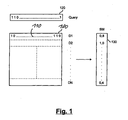
- An associative search by simulating an associative memory is, in principle, now explained in connection with Fig. 1 .
- a set of documents D1 to DN are stored.
- Each of these documents is represented through a corresponding feature vector 110 which is a sequence of a predetermined number of bits.
- Each of these bits represents or indicates the presence or the absence of a certain feature in document which it represents.
- Such a feature may e.g. be a trigram and the feature vector may then have a length in accordance with the possible number of trigrams.
- the representation of other features is also possible.
- each document is represented through a corresponding feature vector 110.
- These feature vectors together form a feature vector matrix 100 which also can be called bit attribute matrix because it consists of individual bits and each bit represents a certain attribute for a certain document.
- the query document can be represented through a bit string 120 which is formed according to the same rules which are valid for the formation of the bit attribute matrix.
- one such query bit string is generated to represent the query document.
- the query bit string 120 then is combined with bit attribute matrix 100 by performing bit-wise logical operations in such a manner that for each of the documents D1 to DN there is obtained a similarity measure which is then stored in a similarity measure vector 130.
- the most simple way to calculate the similarity measure is to perform a logical AND operation between the query bit string and each of the rows in the matrix 100. This then gives for each row in the matrix 100 a corresponding result row which has a certain number of logical "1".
- Other, more sophisticated ways of calculating the similarity measure can also be imagined, e.g. in addition to only conducting the bit operation it is also possible to take into account the actual contents of the documents D1 to DN, phonetic similarities between the query bit string and the respective documents. Those phonetic similarities can then also be taken into account when calculating the final similarity measure.
- query bit string representing the whole query document but several query bit strings are generated, each representing a respective fragment of the query document, as explained in the following.
- Fig. 2 explains how an input query can be processed in order to obtained a more efficient associative access or associative search.
- Input query 200 is at first split up into fragments S1, S2, and S3 of a given size.
- the size of the fragments is a parameter which can either be predefined or it can be selected by the user or it can be automatically set using an optimizing method which is used to find an optimized set of parameters.
- the splitting up is based on units of elements based on which the query document is comprised, such as e.g. based on words.
- the input query document may e.g. comprise 15 words, and the given size of the fragment may be five, then segments S1, S2, and S3 are each five words long. If the query would only comprise 14 words, then the last fragment S3 would contain only four words.
- the individual segments S1 to S3 are then converted into corresponding feature vectors F1 to F3, as indicated in Fig. 2 . Then for each of them an associative query is performed such as the one explained in connection with Fig. 1 .
- each of the similarity measure vectors SM1 - SM3 represents one aspect of similarity between the input query document, from which the fragments are obtained, and the set of documents being stored by a respective bit string for the associative search.
- additional input query vectors are to be obtained by generating additional fragments using a so-called “shifting”, which is explained below.
- Fig. 3 schematically illustrates the vector addition of the individual similarity measure vectors SM1 to SM3.
- the operation to obtain the final similarity measure vector FSM may also comprise a weighting in accordance with a certain weighting function.
- those vector components of the similarity measure vectors SM1 to SM3 which indicate a higher similarity may be weighted higher than those which have a lower similarity (e.g. below 50%). This gives a higher weight to those documents of the stored set for which actually a similarity has been found and in order to decrease the weight of those documents for which the similarity actually is only a kind of "noise".
- the retrieval is performed. For each component in the final similarity measure vector FSM there is a corresponding stored document in the set, and depending on the criteria set there will be retrieved either the most relevant document only, or there will be retrieved those documents whose similarity measure lies beyond a certain threshold value, or there will be retrieved the 10 most relevant documents or the like. That kind of retrieval criteria can be changed depending on the desire of the user, there will be retrieved as an output, no, one or more documents.
- the output can be such that it is similar to the input query with respect to the feature vectors.
- the features themselves represent the actual content of the input query as well as of the documents of the set, there is not only a similarity in those features but actually also a similarity in content between those retrieved documents for which there is a high similarity measure.
- a user can generate or apply an arbitrary input query which defines the field of interest for which the user wants to carry out some "associations", and the associative search will actually carry out such associations by delivering those documents which are similar in content to the input query document.
- Splitting up the input query document in some sense "increases the resolution" of the associative memory access. Moreover, since the associative memory access performs "true associations" in some sense, it is advantageous if the input query is focused on a certain subject or a certain aspect of a topic rather than containing many different aspects and lots of text. This is achieved by splitting up the input query into individual fragments. Those fragments are rather focused, and they give quite a good and focused picture of the similarity between the documents represented by bit string feature vectors in the bit attribute matrix for the associative access and the individual fragments rather than delivering an unfocussed similarity measure which contains a lot of "noise", in case of the input query being very long.
- the final similarity measure vector is calculated by using some weighting function which gives more weight to those documents for which a higher similarity value has been measured than for those documents for which a lower similarity value has been measured.
- Some weighting function is schematically illustrated in Fig. 6 .
- those documents for which the similarity measure is above 50% are assigned a higher weight, and those for which the similarity measure is below 50%, are assigned a lower weight.
- Close to 100% and close to 0% the weighting function is rather steep in order to give a high weight to those input query fragments for which the corresponding similarity measure for the respective documents has been calculated as being relatively high.
- the weighting function is taken into account in such a manner that for each of the components of the individual similarity measure vectors SM1 to SM3 the weighting value is taken from the weight function shown in Fig. 6 , and the vector component is multiplied with the corresponding weight value. Thereby a higher weight can be assigned to higher similarity measure values when calculating the final similarity measure vector FSM.
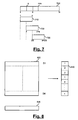
- Fig. 7 shows a query input feature vector 700 which has N individual elements, here words. Based on a fragment size n which is either predefined or selected or inputted by a user, a first fragment 710 is generated. Then, according to a further parameter which may be called a shift parameter s further fragments are generated in the following manner. A first fragment is generated by starting from word number s and extending to word number n+s. This fragment is shown as fragment 720 in Fig. 7 . A further fragment is then generated by starting at word number 2s and is extending to word number n+2s, thereby maintaining a fragment size of n.
- a further parameter which may be called a shift parameter s further fragments are generated in the following manner.
- a first fragment is generated by starting from word number s and extending to word number n+s. This fragment is shown as fragment 720 in Fig. 7 .
- a further fragment is then generated by starting at word number 2s and is extending to word number n+2s, thereby maintaining
- multiple fragments are generated by shifting the starting word for each fragment by s words to the right side of the query input document 700. This results in a plurality of fragments of the query input, and for each of these fragments there is then generated a corresponding feature vector which is used as a query input for the associative search.
- the individual parameters such as the size of the individual fragments or the value or number by which the individual fragments overlap, such as the value s in Fig. 7 , can either be predefined according to a suitable set of parameters, they can be selected or chosen by the user, or they can be optimized through some procedure which derives the parameters and finds a set of values which gives an optimum result, as also already explained before.
- the input query document is used for generating fragments, but also the documents stored in the associative memory are used to generate fragments in a manner similar to the fragmentization of the input query document. If such a measure is taken, then this results actually in multiple bit attribute matrices, which of course increases the computing power necessary to carry out an associative access. If such multiple bit attribute matrices have been generated by generating multiple fragments of the documents stored in the associative memory and calculating corresponding feature vectors, then the input query fragments are applied as queries for all of the bit attribute matrices, thereby increasing the number of similarity measures obtained. Whether such an approach is feasible in terms of computing power may depend on the computer used as well as on the number of documents which actually have to be stored and represented.
- Such a shifting can be carried out based on any of the units based on which the query document actually is composed.
- a unit may for example be a word, then this would mean that in case of Fig. 7 as explained already the first fragment contains n words, the second fragment starts with the s-th word and extends to the (n+s)-th word, and so on.
- Another unit could also be a syllable rather than a word, or even a character. Any unit can be used which is a unit based on which the query document is composed.
- the elements used for generating the fragments and for generating overlapping fragments should be elements which themselves contain some kind of meaning or at least some information in themselves, such as words or at least syllabes.
- Another such unit could be a phoneme, this will be explained in more detail in connection with a further embodiment.
- FIG. 8 there is shown the bit attribute matrix 800 representing a number N documents D 1 to D n by respective bit string feature vectors. Each of these documents is classified as belonging to one of three classification classes.
- the documents D 1 to D n can be articles, and they are classified as either being scientific articles (class 1), press articles (class 2), or other articles (class 3).
- Vector 810 shown in Fig. 8 contains the label which assigns a classification class to each of the documents D 1 to D n .
- the query is carried out for a plurality of fragments, and let us further assume that the retrieval criterion is that such that all documents for which the similarity measure is above a certain threshold are retrieved. If the similarity threshold is set such that a plurality of retrieval results are obtained, then there will be a plurality of hits (retrieved documents) for each of the different classes 1, 2, or 3. However, based on the assumption that documents which belong to a certain class are somehow self-similar, there will be a significantly larger number of documents retrieved from the class into which query document 820 actually also belongs.
- Fig. 9 illustrates the retrieval statistics which may be obtained when performing a query based on an input query document onto a set of stored documents, i.e. documents represented by a respective bit string feature vector in the bit attribute matrix, which belong to one of three classes.
- documents i.e. documents represented by a respective bit string feature vector in the bit attribute matrix
- a "hit” here means that a query result fulfills a certain criterion such as a confidentiality measure which is above a certain treshold so that it can be regarded as a "hit”.
- the particular criterion and the treshold value may be selected depending on the circumstances.
- the set of documents for which the original classification is very good is most suitable as a starting set for finding an optimized set of parameters such as the fragmentation size and the shift or overlap value explained in connection with Fig. 7 .
- an automatic classification is performed as explained before. Since the original classification is already good or in an ideal case already perfect, the retrieval statistics of Fig. 9 should always give the correct value in the sense that the resulting classification should also be correct. If this is not the case, then possibly something is wrong with the parameters, and the parameters should be varied. With the varied parameters then again a new run can be performed based on the original data set, and it can be checked whether the classification with the new parameters will now give a better result. With such a method in an optimized manner an ideal or optimum set of parameters can be found.
- any kind of input document can be used, and any kind of document can be represented by a feature vector for the associative search.
- the input query document as well as the documents represented for the associative access are voice documents.
- the set of documents to be represented for the associative search are files which represent some texts spoken by a human voice.
- Those texts may for example be radio speeches, television speeches, interviews, telephone conversations, or the like.
- Those voice documents may be converted into text documents according to a conventional speech-to-text method resulting then in a corresponding text file.
- a recording of the voice could have been performed which records the voice in some sound file, such as a wav-file. This is schematically illustrated in Fig. 10 .
- each of the text files is converted into its corresponding feature vector, and the thus resulting set of feature vectors is arranged into a matrix to obtain the bit attribute matrix as already explained in connection with Fig. 1 .
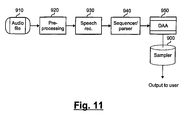
- a database 900 there are stored samples of audio files for allowing an associative access.
- the samples are converted into text files, the text files are converted into feature vectors, and the feature vectors are arranged in a bit attribute matrix as already explained.
- An audio file 910 which may e.g. take the form of a wav-file, is then inputted into the system and acoustically preprocessed in step 920.
- the problem with acoustic files sometimes is that the dynamic range is too large, the level of noise is too high, etc.
- the dynamic range is normalized, noise is filtered, etc. This assures that in the next step of speech recognition 930 the speech recognition engine is receiving an audio file which is most suitable for obtaining best results in the speech-to-text conversion process.
- Step 930 returns as an output a text into which the audio file has been converted.
- step 940 a sequencer/parser is then used to generate the fragments of the input text sample. This can be carried out according to any of the methods of generating fragments explained before.
- a result of the sequencer/parser is a plurality of text fragments of the text generated by speech recognition unit 930.
- the method explained in connection with Fig. 11 can be even more refined by having two sets of samples, one set of samples 900 as shown in Fig. 11 , and a further set of samples 905 which is not shown in Fig. 11 .
- the first set of samples 900 contains relevant samples in the sense that they are samples which can be classified as being interesting from the point of view of the user, and the other set of samples 905 contains voice samples or voice file samples which are not interesting from the point of view of the user.
- the associative memory access can be combined with a retrieval statistics as explained in connection with Fig. 9 .
- the relevant set of samples 900 delivers the higher number of hits, then the inputted audio file can be assumed to be also of relevance to the user. However, if the number of hits in the non-relevant set of samples 905 is higher, then it can be assumed that the audio file in its content is not of particular interest to the user and needs not to be outputted together with the hits found.
- classification and retrieval can be combined in order to check for an unknown input audio file whether it is relevant at all, and if it is relevant at all, to retrieve those already stored samples which are similar in content to the inputted audio file.
- speech recognition step 930 the conversion is not performed into a text file, but rather into a file the elements of which are phonemes coded in proper form, such as through ASCII character sequences.
- speech recognition mostly contains two steps, at first a conversion of the audio files into phonemes (a recognition of the phonemes of the individual spoken words), and then a conversion from the recognized phonemes into the final words of the text. It occurs relatively often in speech recognition processing that phonemes are correctly recognized, however, that the final recognition of the individual words is not performed correctly. If speech recognition step 930 is limited to perform only the conversion into phonemes, and if the sample database 900 also stores the sample in the form of phonemes rather than in the form of text, then this source of error can be avoided and a more accurate processing can be expected.
- Fig. 11 the system explained in connection with Fig. 11 can be used for two purposes. At first, in case the user has a certain imagination of which content he wants the association to have, or in other words, if he already knows what kind of content the documents which shall be retrieved should have, a user may just compose an input audio file by speaking a certain text which he considers as interesting or relevant. The process shown in Fig. 11 will then retrieve as output those documents from the stored samples which are most similar in their content to the inputted audio file generated by the user.
- Another application could be that the content and the relevance of audio file 910 itself is not yet known.
- a direct associative access as explained in connection with the two samples 900 and 905, it can at first then be checked whether the audio file is relevant from the user's point of view at all by checking whether its classification would classify it as either relevant or non-relevant, in other words as either belonging to samples 900 or to samples 905. If the inputted file is judged to be relevant, then an associative access retrieval can be performed and similar documents can be outputted to the user from the set of samples 900.
- the method described in connection with the foregoing embodiment is a very powerful tool which can be used to reduce "associations" like the human brain.
- Similar content here is quite difficult to describe in more exact terms, another attempt could be to say that the documents found have aspects under which they may be regarded similar to the inputted query document. Those aspects to some extent depend on the way how the feature vector is produced based on the query document and the documents stored for the associative access. If the feature vectors are produced based on bigrams or trigrams, then the retrieved documents represent similarities in terms of consecutive syllabes. This necessarily also reflects some similarity in content, because similar words which occur in the query document and the stored documents result in similar or identical feature vectors.
- the present invention in its embodiments therefore is capable to perform true "associations", and this is a very powerful tool for any human being who is confronted with processing the flood of information he is encountering every day.
- associations a very powerful tool for any human being who is confronted with processing the flood of information he is encountering every day.
- we have to carry out the task of performing associations i.e. we have to recall or find similar documents/events/decisions/etc., in order to put the new information into the right framework in order to be able to process it in a suitable manner.
- the human brain is very good in performing these associations, however, it is very limited in the sense that its storage contains a limited set of sample documents. This limited set of samples is limited because only those samples are stored in the human brain which the user or the human being is able to read and to hear.
- a user may be confronted with a new input which he is unable to put into the right framework because he has no "knowledge” about it.
- a user may then make use of the machine shown in Fig. 11 to retrieve samples from a repository or database 900 which can be regarded as "associations" of the unknown input document 910.
Landscapes
- Engineering & Computer Science (AREA)
- Theoretical Computer Science (AREA)
- Data Mining & Analysis (AREA)
- Databases & Information Systems (AREA)
- Physics & Mathematics (AREA)
- General Engineering & Computer Science (AREA)
- General Physics & Mathematics (AREA)
- Computational Linguistics (AREA)
- Information Retrieval, Db Structures And Fs Structures Therefor (AREA)
Priority Applications (6)
| Application Number | Priority Date | Filing Date | Title |
|---|---|---|---|
| ES01127768T ES2391261T3 (es) | 2001-11-21 | 2001-11-21 | Método y aparato para recuperar información importante |
| DK01127768.8T DK1315096T3 (da) | 2001-11-21 | 2001-11-21 | Fremgangsmåde og indretning til at hente relevant information |
| PT01127768T PT1315096E (pt) | 2001-11-21 | 2001-11-21 | Método e dispositivo para pesquisar informação relevante |
| EP01127768A EP1315096B1 (en) | 2001-11-21 | 2001-11-21 | Method and apparatus for retrieving relevant information |
| PCT/EP2002/013011 WO2003044691A1 (en) | 2001-11-21 | 2002-11-20 | Method and apparatus for retrieving relevant information |
| AU2002356697A AU2002356697A1 (en) | 2001-11-21 | 2002-11-20 | Method and apparatus for retrieving relevant information |
Applications Claiming Priority (1)
| Application Number | Priority Date | Filing Date | Title |
|---|---|---|---|
| EP01127768A EP1315096B1 (en) | 2001-11-21 | 2001-11-21 | Method and apparatus for retrieving relevant information |
Publications (2)
| Publication Number | Publication Date |
|---|---|
| EP1315096A1 EP1315096A1 (en) | 2003-05-28 |
| EP1315096B1 true EP1315096B1 (en) | 2012-07-18 |
Family
ID=8179311
Family Applications (1)
| Application Number | Title | Priority Date | Filing Date |
|---|---|---|---|
| EP01127768A Expired - Lifetime EP1315096B1 (en) | 2001-11-21 | 2001-11-21 | Method and apparatus for retrieving relevant information |
Country Status (6)
| Country | Link |
|---|---|
| EP (1) | EP1315096B1 (da) |
| AU (1) | AU2002356697A1 (da) |
| DK (1) | DK1315096T3 (da) |
| ES (1) | ES2391261T3 (da) |
| PT (1) | PT1315096E (da) |
| WO (1) | WO2003044691A1 (da) |
Cited By (6)
| Publication number | Priority date | Publication date | Assignee | Title |
|---|---|---|---|---|
| WO2015084404A1 (en) * | 2013-12-06 | 2015-06-11 | Hewlett-Packard Development Company, L.P. | Matching of an input document to documents in a document collection |
| US9141691B2 (en) | 2001-08-27 | 2015-09-22 | Alexander GOERKE | Method for automatically indexing documents |
| US9152883B2 (en) | 2009-11-02 | 2015-10-06 | Harry Urbschat | System and method for increasing the accuracy of optical character recognition (OCR) |
| US9159584B2 (en) | 2000-08-18 | 2015-10-13 | Gannady Lapir | Methods and systems of retrieving documents |
| US9158833B2 (en) | 2009-11-02 | 2015-10-13 | Harry Urbschat | System and method for obtaining document information |
| US9213756B2 (en) | 2009-11-02 | 2015-12-15 | Harry Urbschat | System and method of using dynamic variance networks |
Families Citing this family (4)
| Publication number | Priority date | Publication date | Assignee | Title |
|---|---|---|---|---|
| EP1049030A1 (en) | 1999-04-28 | 2000-11-02 | SER Systeme AG Produkte und Anwendungen der Datenverarbeitung | Classification method and apparatus |
| EP1182577A1 (en) | 2000-08-18 | 2002-02-27 | SER Systeme AG Produkte und Anwendungen der Datenverarbeitung | Associative memory |
| US7542966B2 (en) * | 2002-04-25 | 2009-06-02 | Mitsubishi Electric Research Laboratories, Inc. | Method and system for retrieving documents with spoken queries |
| US8321357B2 (en) | 2009-09-30 | 2012-11-27 | Lapir Gennady | Method and system for extraction |
Family Cites Families (4)
| Publication number | Priority date | Publication date | Assignee | Title |
|---|---|---|---|---|
| JPH096799A (ja) | 1995-06-19 | 1997-01-10 | Sharp Corp | 文書分類装置及び文書検索装置 |
| US5778362A (en) | 1996-06-21 | 1998-07-07 | Kdl Technologies Limted | Method and system for revealing information structures in collections of data items |
| US5918223A (en) | 1996-07-22 | 1999-06-29 | Muscle Fish | Method and article of manufacture for content-based analysis, storage, retrieval, and segmentation of audio information |
| EP1049030A1 (en) | 1999-04-28 | 2000-11-02 | SER Systeme AG Produkte und Anwendungen der Datenverarbeitung | Classification method and apparatus |
-
2001
- 2001-11-21 EP EP01127768A patent/EP1315096B1/en not_active Expired - Lifetime
- 2001-11-21 ES ES01127768T patent/ES2391261T3/es not_active Expired - Lifetime
- 2001-11-21 PT PT01127768T patent/PT1315096E/pt unknown
- 2001-11-21 DK DK01127768.8T patent/DK1315096T3/da active
-
2002
- 2002-11-20 AU AU2002356697A patent/AU2002356697A1/en not_active Abandoned
- 2002-11-20 WO PCT/EP2002/013011 patent/WO2003044691A1/en not_active Ceased
Cited By (8)
| Publication number | Priority date | Publication date | Assignee | Title |
|---|---|---|---|---|
| US9159584B2 (en) | 2000-08-18 | 2015-10-13 | Gannady Lapir | Methods and systems of retrieving documents |
| US9141691B2 (en) | 2001-08-27 | 2015-09-22 | Alexander GOERKE | Method for automatically indexing documents |
| US9152883B2 (en) | 2009-11-02 | 2015-10-06 | Harry Urbschat | System and method for increasing the accuracy of optical character recognition (OCR) |
| US9158833B2 (en) | 2009-11-02 | 2015-10-13 | Harry Urbschat | System and method for obtaining document information |
| US9213756B2 (en) | 2009-11-02 | 2015-12-15 | Harry Urbschat | System and method of using dynamic variance networks |
| WO2015084404A1 (en) * | 2013-12-06 | 2015-06-11 | Hewlett-Packard Development Company, L.P. | Matching of an input document to documents in a document collection |
| GB2536826A (en) * | 2013-12-06 | 2016-09-28 | Hewlett Packard Development Co Lp | Matching of an input document to documents in a document collection |
| US10740406B2 (en) | 2013-12-06 | 2020-08-11 | Hewlett-Packard Development Company, L.P. | Matching of an input document to documents in a document collection |
Also Published As
| Publication number | Publication date |
|---|---|
| ES2391261T3 (es) | 2012-11-22 |
| EP1315096A1 (en) | 2003-05-28 |
| PT1315096E (pt) | 2012-10-09 |
| WO2003044691A1 (en) | 2003-05-30 |
| DK1315096T3 (da) | 2012-09-24 |
| AU2002356697A1 (en) | 2003-06-10 |
Similar Documents
| Publication | Publication Date | Title |
|---|---|---|
| US6892189B2 (en) | Method for learning and combining global and local regularities for information extraction and classification | |
| US7542966B2 (en) | Method and system for retrieving documents with spoken queries | |
| CN102023995B (zh) | 语音检索设备和语音检索方法 | |
| KR101255405B1 (ko) | 텍스트 메타데이터를 갖는 음성문서의 인덱싱 및 검색방법, 컴퓨터 판독가능 매체 | |
| US7287012B2 (en) | Machine-learned approach to determining document relevance for search over large electronic collections of documents | |
| US6633845B1 (en) | Music summarization system and method | |
| CN101151674B (zh) | 复合新闻报导的合成 | |
| JP3488174B2 (ja) | 内容情報と話者情報を使用して音声情報を検索するための方法および装置 | |
| US20040163034A1 (en) | Systems and methods for labeling clusters of documents | |
| US20070136281A1 (en) | Training a ranking component | |
| US20070005567A1 (en) | System and method for adaptive multi-cultural searching and matching of personal names | |
| KR100756921B1 (ko) | 문서 분류방법 및 그 문서 분류방법을 컴퓨터에서 실행시키기 위한 프로그램을 포함하는 컴퓨터로 읽을 수있는 기록매체. | |
| Mendels et al. | Improving speech recognition and keyword search for low resource languages using web data | |
| WO2008055120A2 (en) | System and method for summarizing search results | |
| CA2612513A1 (en) | Speech recognition training method for audio and video files indexing on a search engine | |
| Young et al. | Acoustic indexing for multimedia retrieval and browsing | |
| EP1590798A2 (en) | Method for automatic and semi-automatic classification and clustering of non-deterministic texts | |
| EP1315096B1 (en) | Method and apparatus for retrieving relevant information | |
| CN102314876A (zh) | 语音检索的方法和系统 | |
| CN119474419A (zh) | 一种基于ai对话场景的媒体文件查询调取方法与系统 | |
| CN119045880A (zh) | 一种基于编程语言迁移的代码定位方法 | |
| EP1531405B1 (en) | Information search apparatus, information search method, and information recording medium on which information search program is recorded | |
| CN109815328A (zh) | 一种摘要生成方法及装置 | |
| Lin et al. | Enhanced BERT-based ranking models for spoken document retrieval | |
| CN101278350B (zh) | 通过分割的特征比较而自动生成播放列表的方法和设备 |
Legal Events
| Date | Code | Title | Description |
|---|---|---|---|
| PUAI | Public reference made under article 153(3) epc to a published international application that has entered the european phase |
Free format text: ORIGINAL CODE: 0009012 |
|
| AK | Designated contracting states |
Designated state(s): AT BE CH CY DE DK ES FI FR GB GR IE IT LI LU MC NL PT SE TR |
|
| AX | Request for extension of the european patent |
Extension state: AL LT LV MK RO SI |
|
| 17P | Request for examination filed |
Effective date: 20031126 |
|
| AKX | Designation fees paid |
Designated state(s): AT BE CH CY DE DK ES FI FR GB GR IE IT LI LU MC NL PT SE TR |
|
| 17Q | First examination report despatched |
Effective date: 20050908 |
|
| GRAP | Despatch of communication of intention to grant a patent |
Free format text: ORIGINAL CODE: EPIDOSNIGR1 |
|
| GRAS | Grant fee paid |
Free format text: ORIGINAL CODE: EPIDOSNIGR3 |
|
| GRAA | (expected) grant |
Free format text: ORIGINAL CODE: 0009210 |
|
| AK | Designated contracting states |
Kind code of ref document: B1 Designated state(s): AT BE CH CY DE DK ES FI FR GB GR IE IT LI LU MC NL PT SE TR |
|
| REG | Reference to a national code |
Ref country code: GB Ref legal event code: FG4D |
|
| REG | Reference to a national code |
Ref country code: CH Ref legal event code: EP |
|
| REG | Reference to a national code |
Ref country code: AT Ref legal event code: REF Ref document number: 567173 Country of ref document: AT Kind code of ref document: T Effective date: 20120815 Ref country code: IE Ref legal event code: FG4D |
|
| REG | Reference to a national code |
Ref country code: DE Ref legal event code: R096 Ref document number: 60146831 Country of ref document: DE Effective date: 20120913 |
|
| REG | Reference to a national code |
Ref country code: DK Ref legal event code: T3 |
|
| REG | Reference to a national code |
Ref country code: PT Ref legal event code: SC4A Free format text: AVAILABILITY OF NATIONAL TRANSLATION Effective date: 20120928 |
|
| REG | Reference to a national code |
Ref country code: SE Ref legal event code: TRGR |
|
| REG | Reference to a national code |
Ref country code: NL Ref legal event code: T3 |
|
| REG | Reference to a national code |
Ref country code: ES Ref legal event code: FG2A Ref document number: 2391261 Country of ref document: ES Kind code of ref document: T3 Effective date: 20121122 |
|
| PG25 | Lapsed in a contracting state [announced via postgrant information from national office to epo] |
Ref country code: CY Free format text: LAPSE BECAUSE OF FAILURE TO SUBMIT A TRANSLATION OF THE DESCRIPTION OR TO PAY THE FEE WITHIN THE PRESCRIBED TIME-LIMIT Effective date: 20120718 |
|
| PG25 | Lapsed in a contracting state [announced via postgrant information from national office to epo] |
Ref country code: GR Free format text: LAPSE BECAUSE OF FAILURE TO SUBMIT A TRANSLATION OF THE DESCRIPTION OR TO PAY THE FEE WITHIN THE PRESCRIBED TIME-LIMIT Effective date: 20121019 |
|
| PLBE | No opposition filed within time limit |
Free format text: ORIGINAL CODE: 0009261 |
|
| STAA | Information on the status of an ep patent application or granted ep patent |
Free format text: STATUS: NO OPPOSITION FILED WITHIN TIME LIMIT |
|
| 26N | No opposition filed |
Effective date: 20130419 |
|
| REG | Reference to a national code |
Ref country code: DE Ref legal event code: R097 Ref document number: 60146831 Country of ref document: DE Effective date: 20130419 |
|
| PG25 | Lapsed in a contracting state [announced via postgrant information from national office to epo] |
Ref country code: MC Free format text: LAPSE BECAUSE OF NON-PAYMENT OF DUE FEES Effective date: 20121130 Ref country code: TR Free format text: LAPSE BECAUSE OF FAILURE TO SUBMIT A TRANSLATION OF THE DESCRIPTION OR TO PAY THE FEE WITHIN THE PRESCRIBED TIME-LIMIT Effective date: 20120718 |
|
| PG25 | Lapsed in a contracting state [announced via postgrant information from national office to epo] |
Ref country code: LU Free format text: LAPSE BECAUSE OF NON-PAYMENT OF DUE FEES Effective date: 20121121 |
|
| REG | Reference to a national code |
Ref country code: FR Ref legal event code: PLFP Year of fee payment: 15 |
|
| REG | Reference to a national code |
Ref country code: FR Ref legal event code: PLFP Year of fee payment: 16 |
|
| REG | Reference to a national code |
Ref country code: FR Ref legal event code: PLFP Year of fee payment: 17 |
|
| REG | Reference to a national code |
Ref country code: DE Ref legal event code: R079 Ref document number: 60146831 Country of ref document: DE Free format text: PREVIOUS MAIN CLASS: G06F0017300000 Ipc: G06F0016000000 |
|
| PGFP | Annual fee paid to national office [announced via postgrant information from national office to epo] |
Ref country code: NL Payment date: 20201113 Year of fee payment: 20 |
|
| PGFP | Annual fee paid to national office [announced via postgrant information from national office to epo] |
Ref country code: IT Payment date: 20201013 Year of fee payment: 20 Ref country code: PT Payment date: 20201120 Year of fee payment: 20 Ref country code: FI Payment date: 20201109 Year of fee payment: 20 Ref country code: FR Payment date: 20201013 Year of fee payment: 20 Ref country code: IE Payment date: 20201110 Year of fee payment: 20 Ref country code: DE Payment date: 20201110 Year of fee payment: 20 Ref country code: DK Payment date: 20201110 Year of fee payment: 20 Ref country code: ES Payment date: 20201208 Year of fee payment: 20 Ref country code: CH Payment date: 20201117 Year of fee payment: 20 Ref country code: AT Payment date: 20201027 Year of fee payment: 20 Ref country code: GB Payment date: 20201111 Year of fee payment: 20 Ref country code: SE Payment date: 20201110 Year of fee payment: 20 |
|
| PGFP | Annual fee paid to national office [announced via postgrant information from national office to epo] |
Ref country code: BE Payment date: 20201015 Year of fee payment: 20 |
|
| REG | Reference to a national code |
Ref country code: DE Ref legal event code: R071 Ref document number: 60146831 Country of ref document: DE |
|
| REG | Reference to a national code |
Ref country code: DK Ref legal event code: EUP Expiry date: 20211121 |
|
| REG | Reference to a national code |
Ref country code: NL Ref legal event code: MK Effective date: 20211120 |
|
| REG | Reference to a national code |
Ref country code: FI Ref legal event code: MAE |
|
| REG | Reference to a national code |
Ref country code: GB Ref legal event code: PE20 Expiry date: 20211120 |
|
| REG | Reference to a national code |
Ref country code: SE Ref legal event code: EUG |
|
| REG | Reference to a national code |
Ref country code: IE Ref legal event code: MK9A |
|
| REG | Reference to a national code |
Ref country code: BE Ref legal event code: MK Effective date: 20211121 |
|
| REG | Reference to a national code |
Ref country code: AT Ref legal event code: MK07 Ref document number: 567173 Country of ref document: AT Kind code of ref document: T Effective date: 20211121 |
|
| PG25 | Lapsed in a contracting state [announced via postgrant information from national office to epo] |
Ref country code: PT Free format text: LAPSE BECAUSE OF EXPIRATION OF PROTECTION Effective date: 20211130 Ref country code: IE Free format text: LAPSE BECAUSE OF EXPIRATION OF PROTECTION Effective date: 20211121 Ref country code: GB Free format text: LAPSE BECAUSE OF EXPIRATION OF PROTECTION Effective date: 20211120 |
|
| REG | Reference to a national code |
Ref country code: ES Ref legal event code: FD2A Effective date: 20220228 |
|
| PG25 | Lapsed in a contracting state [announced via postgrant information from national office to epo] |
Ref country code: ES Free format text: LAPSE BECAUSE OF EXPIRATION OF PROTECTION Effective date: 20211122 |