EP1315001A2 - Radar system and method for merging detected targets - Google Patents
Radar system and method for merging detected targets Download PDFInfo
- Publication number
- EP1315001A2 EP1315001A2 EP02257670A EP02257670A EP1315001A2 EP 1315001 A2 EP1315001 A2 EP 1315001A2 EP 02257670 A EP02257670 A EP 02257670A EP 02257670 A EP02257670 A EP 02257670A EP 1315001 A2 EP1315001 A2 EP 1315001A2
- Authority
- EP
- European Patent Office
- Prior art keywords
- merging
- target data
- target
- targets
- continuity
- Prior art date
- Legal status (The legal status is an assumption and is not a legal conclusion. Google has not performed a legal analysis and makes no representation as to the accuracy of the status listed.)
- Granted
Links
Images


Classifications
-
- G—PHYSICS
- G01—MEASURING; TESTING
- G01S—RADIO DIRECTION-FINDING; RADIO NAVIGATION; DETERMINING DISTANCE OR VELOCITY BY USE OF RADIO WAVES; LOCATING OR PRESENCE-DETECTING BY USE OF THE REFLECTION OR RERADIATION OF RADIO WAVES; ANALOGOUS ARRANGEMENTS USING OTHER WAVES
- G01S13/00—Systems using the reflection or reradiation of radio waves, e.g. radar systems; Analogous systems using reflection or reradiation of waves whose nature or wavelength is irrelevant or unspecified
- G01S13/88—Radar or analogous systems specially adapted for specific applications
- G01S13/93—Radar or analogous systems specially adapted for specific applications for anti-collision purposes
- G01S13/931—Radar or analogous systems specially adapted for specific applications for anti-collision purposes of land vehicles
-
- G—PHYSICS
- G01—MEASURING; TESTING
- G01S—RADIO DIRECTION-FINDING; RADIO NAVIGATION; DETERMINING DISTANCE OR VELOCITY BY USE OF RADIO WAVES; LOCATING OR PRESENCE-DETECTING BY USE OF THE REFLECTION OR RERADIATION OF RADIO WAVES; ANALOGOUS ARRANGEMENTS USING OTHER WAVES
- G01S13/00—Systems using the reflection or reradiation of radio waves, e.g. radar systems; Analogous systems using reflection or reradiation of waves whose nature or wavelength is irrelevant or unspecified
- G01S13/02—Systems using reflection of radio waves, e.g. primary radar systems; Analogous systems
- G01S13/06—Systems determining position data of a target
- G01S13/08—Systems for measuring distance only
- G01S13/32—Systems for measuring distance only using transmission of continuous waves, whether amplitude-, frequency-, or phase-modulated, or unmodulated
- G01S13/34—Systems for measuring distance only using transmission of continuous waves, whether amplitude-, frequency-, or phase-modulated, or unmodulated using transmission of continuous, frequency-modulated waves while heterodyning the received signal, or a signal derived therefrom, with a locally-generated signal related to the contemporaneously transmitted signal
-
- G—PHYSICS
- G01—MEASURING; TESTING
- G01S—RADIO DIRECTION-FINDING; RADIO NAVIGATION; DETERMINING DISTANCE OR VELOCITY BY USE OF RADIO WAVES; LOCATING OR PRESENCE-DETECTING BY USE OF THE REFLECTION OR RERADIATION OF RADIO WAVES; ANALOGOUS ARRANGEMENTS USING OTHER WAVES
- G01S13/00—Systems using the reflection or reradiation of radio waves, e.g. radar systems; Analogous systems using reflection or reradiation of waves whose nature or wavelength is irrelevant or unspecified
- G01S13/02—Systems using reflection of radio waves, e.g. primary radar systems; Analogous systems
- G01S13/06—Systems determining position data of a target
- G01S13/42—Simultaneous measurement of distance and other co-ordinates
- G01S13/426—Scanning radar, e.g. 3D radar
-
- G—PHYSICS
- G01—MEASURING; TESTING
- G01S—RADIO DIRECTION-FINDING; RADIO NAVIGATION; DETERMINING DISTANCE OR VELOCITY BY USE OF RADIO WAVES; LOCATING OR PRESENCE-DETECTING BY USE OF THE REFLECTION OR RERADIATION OF RADIO WAVES; ANALOGOUS ARRANGEMENTS USING OTHER WAVES
- G01S13/00—Systems using the reflection or reradiation of radio waves, e.g. radar systems; Analogous systems using reflection or reradiation of waves whose nature or wavelength is irrelevant or unspecified
- G01S13/66—Radar-tracking systems; Analogous systems
- G01S13/72—Radar-tracking systems; Analogous systems for two-dimensional [2D] tracking, e.g. combination of angle and range tracking, track-while-scan radar
- G01S13/723—Radar-tracking systems; Analogous systems for two-dimensional [2D] tracking, e.g. combination of angle and range tracking, track-while-scan radar by using numerical data
- G01S13/726—Multiple target tracking
-
- G—PHYSICS
- G01—MEASURING; TESTING
- G01S—RADIO DIRECTION-FINDING; RADIO NAVIGATION; DETERMINING DISTANCE OR VELOCITY BY USE OF RADIO WAVES; LOCATING OR PRESENCE-DETECTING BY USE OF THE REFLECTION OR RERADIATION OF RADIO WAVES; ANALOGOUS ARRANGEMENTS USING OTHER WAVES
- G01S13/00—Systems using the reflection or reradiation of radio waves, e.g. radar systems; Analogous systems using reflection or reradiation of waves whose nature or wavelength is irrelevant or unspecified
- G01S13/88—Radar or analogous systems specially adapted for specific applications
- G01S13/93—Radar or analogous systems specially adapted for specific applications for anti-collision purposes
- G01S13/931—Radar or analogous systems specially adapted for specific applications for anti-collision purposes of land vehicles
- G01S2013/932—Radar or analogous systems specially adapted for specific applications for anti-collision purposes of land vehicles using own vehicle data, e.g. ground speed, steering wheel direction
-
- G—PHYSICS
- G01—MEASURING; TESTING
- G01S—RADIO DIRECTION-FINDING; RADIO NAVIGATION; DETERMINING DISTANCE OR VELOCITY BY USE OF RADIO WAVES; LOCATING OR PRESENCE-DETECTING BY USE OF THE REFLECTION OR RERADIATION OF RADIO WAVES; ANALOGOUS ARRANGEMENTS USING OTHER WAVES
- G01S13/00—Systems using the reflection or reradiation of radio waves, e.g. radar systems; Analogous systems using reflection or reradiation of waves whose nature or wavelength is irrelevant or unspecified
- G01S13/88—Radar or analogous systems specially adapted for specific applications
- G01S13/93—Radar or analogous systems specially adapted for specific applications for anti-collision purposes
- G01S13/931—Radar or analogous systems specially adapted for specific applications for anti-collision purposes of land vehicles
- G01S2013/9325—Radar or analogous systems specially adapted for specific applications for anti-collision purposes of land vehicles for inter-vehicle distance regulation, e.g. navigating in platoons
Definitions
- the present invention relates to a radar ranging device and, in particular, to a merging process for detected target data.
- Radar ranging devices detect the existence of targets in a forward direction by means of signal processing, which is performed by emitting waves in a forward direction and detecting waves reflected from an object in the forward direction.
- the radar ranging device may detect a plurality of target data from the one truck. In the radar ranging device, if a plurality of targets are detected, it determines that all targets satisfying predetermined conditions are one target, and performs a process whereby the plurality of targets are merged and target data for one target are output. By this means, the data processing load on devices utilizing the output data from the radar ranging device (for example, a vehicle distance control ECU) is reduced.
- a vehicle distance control ECU for example, a vehicle distance control ECU
- the radar ranging device when targets detected in a current target detection cycle exist within a predetermined limit around the position of a target detected in the previous detection cycle, it determines that there is continuity between the previously detected target and the currently detected target, and processes them as the same target.
- merging is not performed for the same target after merging.
- one target is determined to be a plurality of targets because it is outside the merging conditions, even if both positions are detected in close proximity to each other thereafter, they may not be merged. Consequently, a plurality of sets of target data are output for one target.
- a radar ranging device comprises a scanning section for emitting electrical waves; a signal processing section for calculating target data by processing reflected signals obtained from electrical waves reflecting from targets; and a target recognition section for, when a plurality of targets are detected based on target data output from the signal processing section, performing merging processing on each of the targets and outputting target data after merging processing wherein, when there is continuity in each of the detected target data and the target data satisfy predetermined conditions, the target data are merged and handled as one set of data and target data prior to the merging process being executed, and target data after the merging process has been executed, are stored in a buffer memory.
- the present invention accurately performs continuity determinations in the target merging process in a radar ranging device.
- the present invention also achieves rapid performance of new output processing when a target merged by a merging process has diverged from the merged target data.
- the present invention allows, in a radar ranging device, an additional merging process when a target is in proximity after merging.
- the target recognition section merges target data and handles the target data as one target when there is continuity between detected target data and those detected target data satisfying predetermined conditions, and stores the target data before execution of the merging process and the target data after execution of the merging process in a buffer memory.
- the continuity of each target data is determined using the target data prior to merging stored in the buffer memory, then the continuity of each of the merged target data can be determined using the target data after merging stored in the buffer memory.
- target data not merged in the current process has been merged with other target data in the previous process
- whether there is continuity between the target data not merged in the current process and the merged target data in the previous process is determined. If it is determined that there is continuity, the data is taken as being the same target that has diverged, and the target data that has not been merged in the current process is immediately output as diverged target data. As a result, when a target of a previous merging process separates, it is immediately output as new target data without delay.
- Fig. 1 shows the circuit structure of a radar ranging device 1.
- the radar ranging device 1 is an FM-CW type millimeter wave radar mounted in a vehicle, for example.
- a scanning mechanism 2 emits millimeter waves while scanning a detection field in the forward direction of the vehicle, controlled by a scanning angle control section 3.
- the millimeter waves reflected by a target existing in the forward direction of the vehicle are detected by a radar antenna 4.
- a radar signal processing section 5 FFT processes the reflected signal and calculates the detected distance to the target, transverse position, and relative speed, then transmits the data to a control subject recognition section 6.
- the control subject recognition section 6, as well as indicating the scanning angle to the scanning angle control section 3, determines the target which is the control subject and transmits this determination to a vehicle distance control ECU 7, based on the received detected distance to target, transverse position and relative speed data, and data received from the vehicle distance control ECU 7, obtained from a steering sensor 8, yaw rate sensor 9 and speed sensor 10.
- the continuity determination and extrapolation process in the control subject recognition section 6 is as follows.
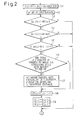
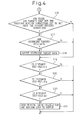
- FIG. 2 to 4 shows the merging process in the control subject recognition section 6.
- the other determination method for targets in the control subject recognition section 6 is well known in the art, an explanation thereof will be omitted here.
- the process shown in the drawings is repeated for each of the operation cycles T.
- the continuity determination of data prior to merging is performed in steps S1 to S7.
- step S1 based on data obtained from the radar signal processing section 5 or the like, a current detected distance D(i), a current detected transverse distance O(i), and a current detected relative speed R(i) are calculated for all detected targets (data prior to merging).
- a current predicted distance DF, current predicted angle AF, and current predicted transverse position OF are calculated using the prior target data stored in the buffer memory, by means of the following equations.
- Current predicted distance DF D(i-1)+R(i-1)x1000/T
- Current predicted angle AF A(i-1)xD(i-1)/DF
- Current predicted transverse position OF DFsin(AF) where D(i-1) is the previous detected distance (m), R(i-1) is the previous detected relative speed (m/s), A(i-1) is the previous detected angle (deg), and T is an operation cycle(msec).
- step S3 it is determined whether the current detected distance D(i) meets the following conditions, in step S4 it is determined whether the current detected relative speed R(i) meets the following conditions, and in step S5 it is determined whether the current detected transverse position O(i) meets the following conditions.
- X is the continuity determination distance condition (m)
- Y is the continuity determination relative speed condition (m/s)
- Z is the continuity determination transverse position condition (m).
- step S6 If all of the conditions of steps S3 to S5 are satisfied, the procedure advances to step S6. If any of the conditions of steps S3 to S5 are not satisfied, it is determined that there is no continuity, and that target is removed from the subsequent merging determination process.
- step S6 whether or not a plurality of targets exist, to which the above conditions of steps S3 to S5 apply, is determined with respect to the predicted distance DF of one target. If there is a plurality of targets, the procedure advances to step S7, where the merging process is begun on the relevant targets. If there is no plurality of targets, the merging process of step S7 is unnecessary, therefore the procedure advances to step S8.
- step S7 an order of priority is assigned to the plurality of targets that meet the conditions, the targets that possess continuity are determined, and the procedure advances to step S8.
- the order of priority is: 1. proximity in distance, 2. proximity in relative speed, and 3. proximity in transverse position.
- step S8 one is added to the previous value CT(i-1) of the continuity counter to make the current value of the continuity counter CT(i).
- step S9 each set of data for each target prior to merging D(i), O(i) and R(i) is stored in the buffer memory.
- the current target data stored here are used in the next continuity determination process as the previous detected distance D(i-1), previous detected transverse position O(i-1), and previous detected relative speed R(i-1).
- the present embodiment determines the continuity of target data prior to merging. Consequently, erroneous determination of continuity between targets due to target position shift after merging can be prevented.
- step S10 the predicted positions of the target data after merging are calculated.
- a current predicted distance DGF, a predicted angle AGF, and a predicted transverse position OGF are calculated from the previous data after merging, using the following equation. Note that step S10 can also be performed at a stage earlier than this.
- DGF DG(i-1)+RG(i-1)x1000/T
- AGF AG(i-1)xDG(i-1)/DGF
- OGF DGFsin(AGF) where DG(i-1) is the previous detected distance after merging, RG(i-1) is the previous detected relative speed after merging, AG(i-1) is the previous detected angel after merging, and T is the operation cycle (msec).
- steps S11 to S14 determination of merging conditions for the plurality of target data is performed.
- step S11 it is determined whether the current detected distance D(i) meets the following conditions, in step S12 it is determined whether the current detected relative speed R(i) meets the following conditions, and in step S13 it is determined whether the current detected transverse position O(i) meets the following conditions.
- step S14 it is determined whether or not the value of the continuity counter CT(i) for the targets that satisfy the conditions of steps S11 to S13 is equal to or more than a continuity counter merge determination value ta.
- the distance, relative speed and transverse position of the merge value in step S15 are calculated as follows.
- the minimum value among the merged plurality of target data is used as the distance value.
- An average value of the merged target data is used for the relative speed value.
- An average value of the merged target data is used as the transverse position value.
- steps S16 to S18 it is determined whether the target data not merging processed in steps S11 to S14 are divergent targets, and if so, diverged target data is output.
- step S16 if it is determined that there are targets that met the merging conditions in the previous process but do not meet the merging conditions in the current process, those targets are treated as divergent targets that have separated from the merged targets.
- step S17 it is determined whether the count value of the continuity counter CT(i) for the diverged target data is equal to or greater than a continuity counter output determination value tb.
- a continuity counter output determination value tb if the continuity of diverged targets is recognized, the diverged target data is immediately output.
- the data for the motorbike can then be immediately output as a newly appearing target.
- targets that do not satisfy any one of the conditions of steps 16 and 17 are processed normally as newly appearing targets. In other words, they are not output as newly appearing target data until they are subjected to a continuity check for several cycles thereafter and satisfy the conditions for continuity.
- steps S19 to S21 it is determined whether the merged targets require re-merging.
- step S19 whether the relationship of current distance DG1 of a merged target 1 and current distance DG2 of a merged target 2 satisfy the following conditions, in step S20, whether the relationship of current relative speed RG1 of the merged target 1 and current relative speed RG2 of the merged target 2 satisfy the following conditions, and in step S21, whether the relationship of transverse position OG1 of the merged target 1 and current transverse position OG2 of the merged target 2 satisfy the following conditions, is determined.
- step S22 the merged targets are re-merged and a merged value is calculated by the following equation.
- Relative speed the average value of the merged target data.
- Transverse position the average value of the merged target data.
- the merged value calculated here is stored in the buffer memory.
- These target data are used as the previous detected distance DG(i-1) of data after merging, the previous detected angle AG(i-1) of data after merging, and the previous detected relative speed RG(i-1) of data after merging.
Landscapes
- Engineering & Computer Science (AREA)
- Radar, Positioning & Navigation (AREA)
- Remote Sensing (AREA)
- Physics & Mathematics (AREA)
- Electromagnetism (AREA)
- Computer Networks & Wireless Communication (AREA)
- General Physics & Mathematics (AREA)
- Radar Systems Or Details Thereof (AREA)
Abstract
Description
Claims (4)
- A radar ranging device, comprising:a scanning section for emitting electrical waves;a signal processing section for calculating target data by processing reflected signals obtained from electrical waves reflecting from targets; anda target recognition section for, when a plurality of targets are detected based on target data output from the signal processing section, performing merging processing on each of the targets and outputting target data after merging processing wherein, when there is continuity in each of the detected target data and the target data satisfy predetermined conditions, the target data are merged and handled as one set of data and target data prior to the merging process being executed, and target data after the merging process has been executed, are stored in a buffer memory.
- The radar ranging device of Claim 1, wherein the target recognition section calculates a predicted position of previous merging processed target data, and executes re-merging of target data based on data after merging.
- The device of claim 1 or claim 2, wherein, when current unmerged target data are determined to have continuity with previously merged target data, the target recognition section outputs the current unmerged target data as target data which has diverged from an existing target.
- The device of any of the preceding claims, wherein the target recognition section performs merging of each set of the same detected target data and merging of the same merged target data, and merging processing for each merging is executed by means of different determination conditions.
Applications Claiming Priority (2)
| Application Number | Priority Date | Filing Date | Title |
|---|---|---|---|
| JP2001347693A JP4079623B2 (en) | 2001-11-13 | 2001-11-13 | Radar ranging device |
| JP2001347693 | 2001-11-13 |
Publications (3)
| Publication Number | Publication Date |
|---|---|
| EP1315001A2 true EP1315001A2 (en) | 2003-05-28 |
| EP1315001A3 EP1315001A3 (en) | 2004-04-14 |
| EP1315001B1 EP1315001B1 (en) | 2014-08-20 |
Family
ID=19160658
Family Applications (1)
| Application Number | Title | Priority Date | Filing Date |
|---|---|---|---|
| EP02257670.6A Expired - Lifetime EP1315001B1 (en) | 2001-11-13 | 2002-11-06 | Radar system and method for merging detected targets |
Country Status (3)
| Country | Link |
|---|---|
| US (1) | US6686868B2 (en) |
| EP (1) | EP1315001B1 (en) |
| JP (1) | JP4079623B2 (en) |
Families Citing this family (16)
| Publication number | Priority date | Publication date | Assignee | Title |
|---|---|---|---|---|
| US8812398B2 (en) * | 2001-05-08 | 2014-08-19 | Qualcomm Incorporated | Key for a wireless-enabled device |
| JP4079623B2 (en) * | 2001-11-13 | 2008-04-23 | 富士通テン株式会社 | Radar ranging device |
| US7136753B2 (en) * | 2002-12-05 | 2006-11-14 | Denso Corporation | Object recognition apparatus for vehicle, inter-vehicle control apparatus, and distance measurement apparatus |
| JP4086670B2 (en) * | 2003-01-28 | 2008-05-14 | 富士通テン株式会社 | Radar equipment |
| JP4541101B2 (en) * | 2004-10-21 | 2010-09-08 | アルパイン株式会社 | Other vehicle detector and other vehicle detection method |
| JP5023526B2 (en) | 2006-03-23 | 2012-09-12 | 株式会社Ihi | Combustor burner and combustion method |
| JP5163088B2 (en) * | 2007-12-12 | 2013-03-13 | トヨタ自動車株式会社 | Object detection device |
| GB2483684B (en) * | 2010-09-16 | 2014-05-07 | Jaguar Land Rover Ltd | Range determination apparatus and method |
| EP2826685B1 (en) | 2012-03-15 | 2021-06-30 | Toyota Jidosha Kabushiki Kaisha | Vehicle travel control apparatus |
| JP5977059B2 (en) * | 2012-03-29 | 2016-08-24 | 富士通テン株式会社 | Radar apparatus and signal processing method |
| JP6534808B2 (en) | 2014-11-28 | 2019-06-26 | 株式会社デンソーテン | Radar apparatus and signal processing method |
| JP6410178B2 (en) * | 2015-01-08 | 2018-10-24 | パナソニックIpマネジメント株式会社 | Object detection apparatus and object detection method |
| JP7020823B2 (en) * | 2017-09-01 | 2022-02-16 | 株式会社デンソーテン | Radar device and signal processing method |
| JP7018277B2 (en) | 2017-09-14 | 2022-02-10 | 株式会社デンソー | Object detection device, object detection method and vehicle control system |
| US20200241122A1 (en) * | 2019-01-28 | 2020-07-30 | Metawave Corporation | Radar system with three-dimensional beam scanning |
| KR102842139B1 (en) | 2020-02-20 | 2025-08-05 | 삼성전자주식회사 | Method and apparatus for detecting object based on radar signal |
Family Cites Families (8)
| Publication number | Priority date | Publication date | Assignee | Title |
|---|---|---|---|---|
| JPS55110973A (en) | 1979-02-21 | 1980-08-27 | Nittetsu Mining Co Ltd | Fm-cw type matter detector |
| US5341142A (en) * | 1987-07-24 | 1994-08-23 | Northrop Grumman Corporation | Target acquisition and tracking system |
| JP3401913B2 (en) * | 1994-05-26 | 2003-04-28 | 株式会社デンソー | Obstacle recognition device for vehicles |
| US5587929A (en) * | 1994-09-02 | 1996-12-24 | Caterpillar Inc. | System and method for tracking objects using a detection system |
| JP3986678B2 (en) * | 1998-08-07 | 2007-10-03 | 本田技研工業株式会社 | Object detection device |
| JP3639191B2 (en) * | 2000-07-10 | 2005-04-20 | 株式会社デンソー | Object recognition method and apparatus, and recording medium |
| JP3681620B2 (en) * | 2000-07-26 | 2005-08-10 | 株式会社デンソー | Obstacle recognition device for vehicles |
| JP4079623B2 (en) * | 2001-11-13 | 2008-04-23 | 富士通テン株式会社 | Radar ranging device |
-
2001
- 2001-11-13 JP JP2001347693A patent/JP4079623B2/en not_active Expired - Fee Related
-
2002
- 2002-11-06 EP EP02257670.6A patent/EP1315001B1/en not_active Expired - Lifetime
- 2002-11-12 US US10/292,153 patent/US6686868B2/en not_active Expired - Lifetime
Also Published As
| Publication number | Publication date |
|---|---|
| JP4079623B2 (en) | 2008-04-23 |
| JP2003149337A (en) | 2003-05-21 |
| US6686868B2 (en) | 2004-02-03 |
| EP1315001A3 (en) | 2004-04-14 |
| US20030090409A1 (en) | 2003-05-15 |
| EP1315001B1 (en) | 2014-08-20 |
Similar Documents
| Publication | Publication Date | Title |
|---|---|---|
| US6686868B2 (en) | Radar ranging device for performing merging process on a plurality of detected targets | |
| US6661370B2 (en) | Radar data processing apparatus and data processing method | |
| EP2894617B1 (en) | Collision determination device and collision determination method | |
| US9500748B2 (en) | Target recognition apparatus | |
| US10823846B2 (en) | Object detection method and object detection device | |
| US6636148B2 (en) | Periphery monitoring system | |
| US9977126B2 (en) | Radar apparatus | |
| US8514124B2 (en) | Method for operating a radar system in the event of possible concealment of the target object and radar system for performing the method | |
| JP4850898B2 (en) | Radar equipment | |
| EP4012449A1 (en) | Target detection device | |
| US12123942B2 (en) | Target detection apparatus | |
| JP2002296350A (en) | Object detection device | |
| US11142187B2 (en) | Parking assistance device | |
| JP2001091617A (en) | Target direction detection device | |
| KR101770019B1 (en) | Method, device and system for processing radar signals | |
| WO2023058559A1 (en) | Information processing device, object tracking device, tracking method, and program | |
| JP2019158787A (en) | Radar device and signal processing method | |
| US20240248201A1 (en) | Radar device for vehicle | |
| JP6818902B6 (en) | Vehicle detection system | |
| JP2002148336A (en) | Interruption prediction device | |
| JPH11167699A (en) | Vehicle object recognition device | |
| US20220026528A1 (en) | Radar device | |
| JP2000298173A (en) | Data processing method in radar device | |
| US20250306202A1 (en) | Processing apparatus, processing method, and vehicle | |
| WO2021106039A1 (en) | Object detection device |
Legal Events
| Date | Code | Title | Description |
|---|---|---|---|
| PUAI | Public reference made under article 153(3) epc to a published international application that has entered the european phase |
Free format text: ORIGINAL CODE: 0009012 |
|
| 17P | Request for examination filed |
Effective date: 20021120 |
|
| AK | Designated contracting states |
Designated state(s): AT BE BG CH CY CZ DE DK EE ES FI FR GB GR IE IT LI LU MC NL PT SE SK TR |
|
| AX | Request for extension of the european patent |
Extension state: AL LT LV MK RO SI |
|
| PUAL | Search report despatched |
Free format text: ORIGINAL CODE: 0009013 |
|
| AK | Designated contracting states |
Kind code of ref document: A3 Designated state(s): AT BE BG CH CY CZ DE DK EE ES FI FR GB GR IE IT LI LU MC NL PT SE SK TR |
|
| AX | Request for extension of the european patent |
Extension state: AL LT LV MK RO SI |
|
| AKX | Designation fees paid |
Designated state(s): DE FR GB |
|
| 17Q | First examination report despatched |
Effective date: 20050215 |
|
| RIC1 | Information provided on ipc code assigned before grant |
Ipc: G01S 13/34 20060101ALN20140130BHEP Ipc: G01S 13/93 20060101AFI20140130BHEP Ipc: G01S 13/42 20060101ALN20140130BHEP Ipc: G01S 13/72 20060101ALN20140130BHEP |
|
| GRAP | Despatch of communication of intention to grant a patent |
Free format text: ORIGINAL CODE: EPIDOSNIGR1 |
|
| INTG | Intention to grant announced |
Effective date: 20140402 |
|
| GRAS | Grant fee paid |
Free format text: ORIGINAL CODE: EPIDOSNIGR3 |
|
| GRAA | (expected) grant |
Free format text: ORIGINAL CODE: 0009210 |
|
| AK | Designated contracting states |
Kind code of ref document: B1 Designated state(s): DE FR GB |
|
| REG | Reference to a national code |
Ref country code: GB Ref legal event code: FG4D |
|
| REG | Reference to a national code |
Ref country code: DE Ref legal event code: R096 Ref document number: 60246548 Country of ref document: DE Effective date: 20140925 |
|
| REG | Reference to a national code |
Ref country code: DE Ref legal event code: R097 Ref document number: 60246548 Country of ref document: DE |
|
| PLBE | No opposition filed within time limit |
Free format text: ORIGINAL CODE: 0009261 |
|
| STAA | Information on the status of an ep patent application or granted ep patent |
Free format text: STATUS: NO OPPOSITION FILED WITHIN TIME LIMIT |
|
| 26N | No opposition filed |
Effective date: 20150521 |
|
| GBPC | Gb: european patent ceased through non-payment of renewal fee |
Effective date: 20141120 |
|
| REG | Reference to a national code |
Ref country code: FR Ref legal event code: ST Effective date: 20150731 |
|
| PG25 | Lapsed in a contracting state [announced via postgrant information from national office to epo] |
Ref country code: GB Free format text: LAPSE BECAUSE OF NON-PAYMENT OF DUE FEES Effective date: 20141120 |
|
| PG25 | Lapsed in a contracting state [announced via postgrant information from national office to epo] |
Ref country code: FR Free format text: LAPSE BECAUSE OF NON-PAYMENT OF DUE FEES Effective date: 20141201 |
|
| PGFP | Annual fee paid to national office [announced via postgrant information from national office to epo] |
Ref country code: DE Payment date: 20171031 Year of fee payment: 16 |
|
| REG | Reference to a national code |
Ref country code: DE Ref legal event code: R119 Ref document number: 60246548 Country of ref document: DE |
|
| PG25 | Lapsed in a contracting state [announced via postgrant information from national office to epo] |
Ref country code: DE Free format text: LAPSE BECAUSE OF NON-PAYMENT OF DUE FEES Effective date: 20190601 |