EP1314755A2 - Ultraviolet radiation absorbents for thermoplastic polymers and methods of producing the same - Google Patents
Ultraviolet radiation absorbents for thermoplastic polymers and methods of producing the same Download PDFInfo
- Publication number
- EP1314755A2 EP1314755A2 EP02258010A EP02258010A EP1314755A2 EP 1314755 A2 EP1314755 A2 EP 1314755A2 EP 02258010 A EP02258010 A EP 02258010A EP 02258010 A EP02258010 A EP 02258010A EP 1314755 A2 EP1314755 A2 EP 1314755A2
- Authority
- EP
- European Patent Office
- Prior art keywords
- solid component
- cyclic imino
- ultraviolet radiation
- imino ester
- acid value
- Prior art date
- Legal status (The legal status is an assumption and is not a legal conclusion. Google has not performed a legal analysis and makes no representation as to the accuracy of the status listed.)
- Granted
Links
- BBITXNWQALLODC-UHFFFAOYSA-N O=C1OC(c(cc2)ccc2C(O2)=Nc3ccccc3C2=O)=Nc2c1cccc2 Chemical compound O=C1OC(c(cc2)ccc2C(O2)=Nc3ccccc3C2=O)=Nc2c1cccc2 BBITXNWQALLODC-UHFFFAOYSA-N 0.000 description 1
Classifications
-
- C—CHEMISTRY; METALLURGY
- C08—ORGANIC MACROMOLECULAR COMPOUNDS; THEIR PREPARATION OR CHEMICAL WORKING-UP; COMPOSITIONS BASED THEREON
- C08K—Use of inorganic or non-macromolecular organic substances as compounding ingredients
- C08K5/00—Use of organic ingredients
- C08K5/16—Nitrogen-containing compounds
- C08K5/29—Compounds containing one or more carbon-to-nitrogen double bonds
-
- C—CHEMISTRY; METALLURGY
- C07—ORGANIC CHEMISTRY
- C07D—HETEROCYCLIC COMPOUNDS
- C07D265/00—Heterocyclic compounds containing six-membered rings having one nitrogen atom and one oxygen atom as the only ring hetero atoms
- C07D265/04—1,3-Oxazines; Hydrogenated 1,3-oxazines
- C07D265/12—1,3-Oxazines; Hydrogenated 1,3-oxazines condensed with carbocyclic rings or ring systems
- C07D265/14—1,3-Oxazines; Hydrogenated 1,3-oxazines condensed with carbocyclic rings or ring systems condensed with one six-membered ring
-
- C—CHEMISTRY; METALLURGY
- C08—ORGANIC MACROMOLECULAR COMPOUNDS; THEIR PREPARATION OR CHEMICAL WORKING-UP; COMPOSITIONS BASED THEREON
- C08K—Use of inorganic or non-macromolecular organic substances as compounding ingredients
- C08K5/00—Use of organic ingredients
- C08K5/16—Nitrogen-containing compounds
- C08K5/34—Heterocyclic compounds having nitrogen in the ring
- C08K5/35—Heterocyclic compounds having nitrogen in the ring having also oxygen in the ring
- C08K5/357—Six-membered rings
Definitions
- This invention relates to ultraviolet radiation absorbents for thermoplastic polymers and methods of producing such absorbents.
- Films and various kinds of molded products such as boxes made of thermoplastic polymer materials undergo quality degradation such as discoloration and fading when exposed to ultraviolet radiation.
- Different kinds of ultraviolet radiation absorbents have therefore been in use for preventing such quality degradation for thermoplastic polymers as well as products made from them.
- the present invention relates to improvement in such ultraviolet radiation absorbents and methods of producing such improved absorbents.
- Benzophenone compounds, benzotriazole compounds and salicylic acid compounds have been generally used as an ultraviolet radiation absorbent for thermoplastic polymers but it has been a problem that these absorbents are usually low in resistance against heat.
- cyclic imino ester compounds have been proposed as ultraviolet radiation absorbents with improved heat resistance (US Patent 4,446,262, Japanese Patent Publications Tokko 62-5944 and 62-31027).
- These absorbents are themselves more resistant against heat but still have the problem that, when they are added or mixed to a thermoplastic polymer material such as polyethylene terephthalate or polycarbonate, they tend to adversely affect the original material characteristics of these thermoplastic polymers such as transparency.
- thermoplastic polymer materials having high mixing and molding temperatures They also have the problem of sublimating and adversely affecting the workability and the environmental conditions during the mixing and molding processes when used for such thermoplastic polymer materials having high mixing and molding temperatures. There is also the problem that they do not store well although they may have to be stored for an extended period of time until they finally come to be used.
- the invention also relates to methods of producing such absorbents.
- the invention is based on the discovery by the present inventors as a result of their diligent investigations that absorbents containing cyclic imino ester compounds of a specified type in a specified amount and prepared with the acid value and/or the chlorine ion content maintained within a specified range satisfy the aforementioned and other objects.
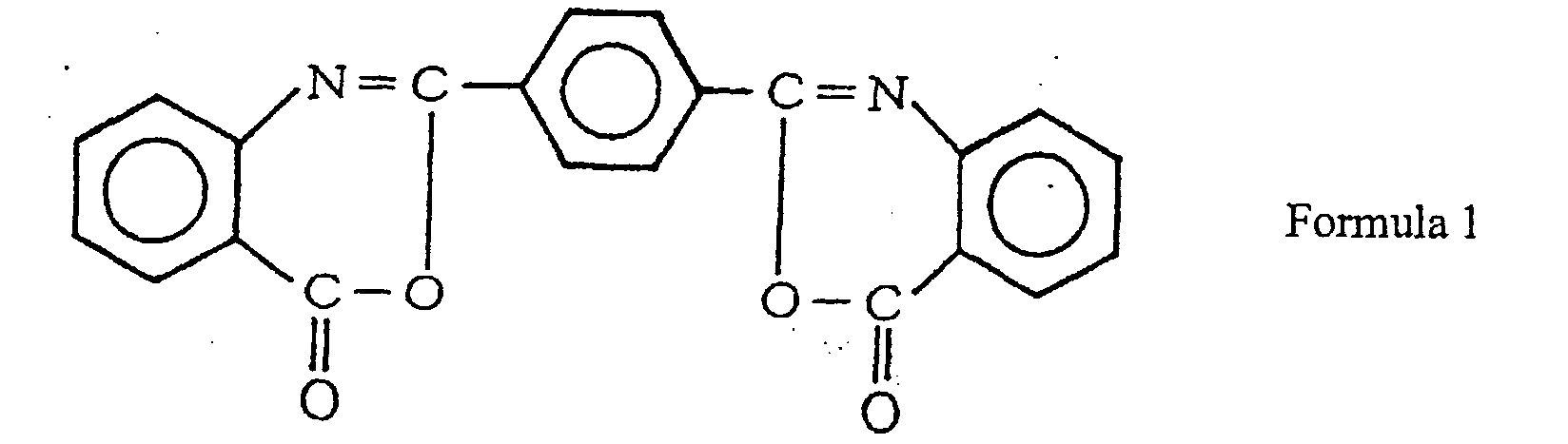
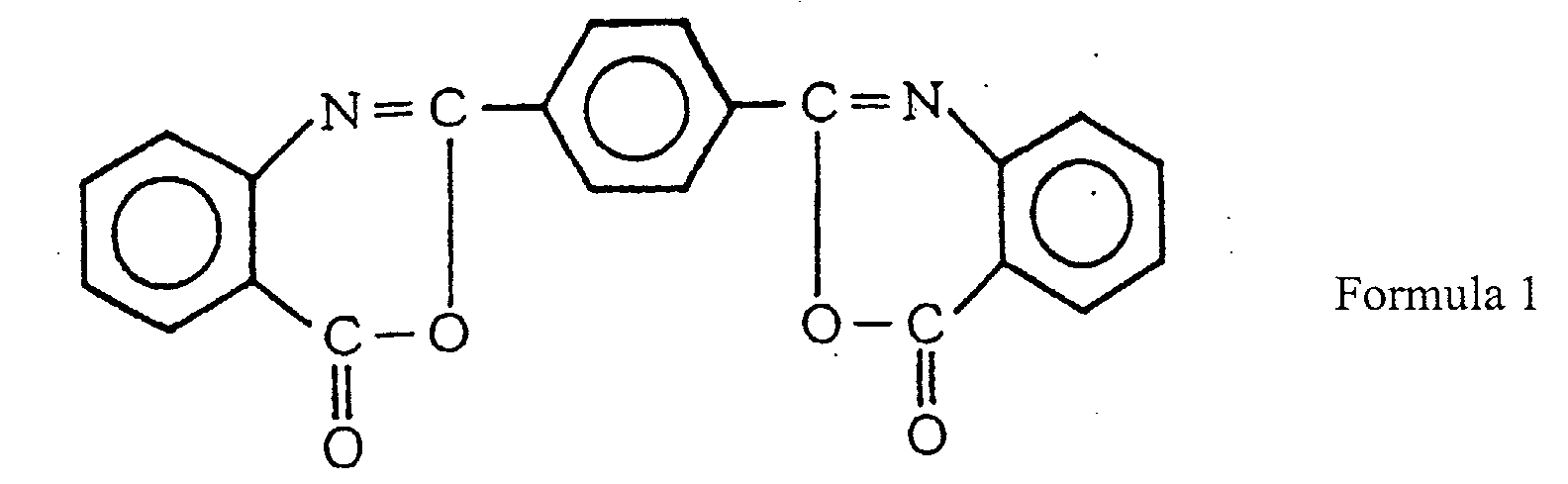
- the invention relates to an ultraviolet radiation absorbent for thermoplastic polymer materials containing cyclic imino ester compound shown by Formula 1 given below in an amount of over 99.5 weight % and less than 100 weight % and prepared such that the acid value is in the range of 1x10 -3 - 1 or the chlorine ion content is in the range of 1x10 -1 - 1x 10 3 ppm, where
- the invention also relates to a method of producing an ultraviolet radiation absorbent comprising Steps A, B and C, Step A being a process of separating a solid component containing N,N'-bis(o-carboxyphenylterephthalamid) generated by amidation of anthranilic acid and terephthaloyl dichloride in the presence of a solvent and an alkali, Step B being a process of separating a solid component containing cyclic imino ester shown by Formula 1 generated by iminoesterification of N,N'-bis(o-carboxyphenylterephthalamid) within the solid component separated in Step A and acetic anhydride in the presence of a solvent, and Step C being a process of processing the solid component separated in Step B with an alkaline solution and further washing with water to obtain an ultraviolet radiation absorbent for thermoplastic polymers containing cyclic imino ester compound shown by Formula 1 in an amount of over 99.5 weight % and less than 100 weight %t and prepared such that the
- the invention further relates to a method of producing an ultraviolet radiation absorbent comprising Steps a and b, Step a being a process of separating a solid component cyclic imino ester compound shown by Formula 1 generated by iminoesterification of isatoic anhydride and terephthaloyl dichloride in the presence of a solvent and an alkali, and Step b being a process of processing the solid component separated in Step a with an alkaline solution and further washing with water to obtain an ultraviolet radiation absorbent for thermoplastic polymers containing cyclic imino ester compound shown by Formula 1 in an amount of over 99.5 weight % and less than 100 weight % and prepared such that the acid value is in the range of 1x10 -3 - 1 or the chlorine ion content is in the range of 1x10 -1 - 1x 10 3 ppm.
- the content of cyclic imino ester compound shown by Formula 1 is the value obtained by high performance liquid chromatography, the acid value is the value as measured according to JIS-K0070 and the chlorine ion content is the value measured by the mercury thiocyanate coloring method.
- Ultraviolet radiation absorbents of this invention are not limited by the method of preparation. They may be prepared by (1) the method of adjusting the content of cyclic imino ester compound shown by Formula 1 and the acid value and/or the chlorine ion content of the product to be within the specified range in the process of producing cyclic imino ester compound shown by Formula 1 (hereinafter simply referred to as "cyclic imino ester") as it is being produced, or (2) the method of adjusting the content of cyclic imino ester and the acid value and/or the chlorine ion content by adding an organic acid such as terephthalic acid, isophthalic acid, anthranilic acid and isatoic acid as an acidic substance and/or an inorganic salt containing chlorine atom such as sodium chloride, potassium chloride and calcium chloride as a chlorine ion forming compound to the produced substantially pure cyclic imino ester such that the content of cyclic imino ester, the acid value and/or the chlorine ion content
- the first is preferable from the point of view of cost of production.
- this method of adjustment is not intended to limit the scope of the invention, but the aforementioned methods through Steps A, B and C and through Steps a and b are preferable.
- Step A is a process of amidation of anthranilic acid and terephthaloyl dichloride in the presence of a solvent and an alkali and separating a solid component containing N,N'-bis(o-carboxyphenylterephthalamid).
- a solvent and an alkali there is no particular limitation as to the ratio between anthranilic acid and terephthaloyl dichloride used for the amidation process but it is preferable to use 0.49-0.51 moles, and more preferably 0.5 moles, of terephthaloyl dichloride per one mole of anthranilic acid.
- alkali include (1) hydroxides of alkali metals such as sodium hydroxide and potassium hydroxide, (2) carbonates of alkali metals such as sodium carbonate and potassium carbonate, (3) hydrogencarbonates of alkali metals such as sodium hydrogencarbonate and potassium hydrogencarbonate and (4) organic alkalis such as pyridine, but a choice should be made depending on the solvent to be used such that it will be dissolved in the solvent.
- the amount of the alkali to be used must be sufficient for completely neutralizing the hydrochloric acid produced as by-product in the amidation reaction.
- the reaction temperature should preferably be 10-80°C and more preferably 20-50°C.
- the method of adding a solution of terephthaloyl dichloride to a liquid mixture or slurry of anthranilic acid and an alkali for the amidation is preferable.
- N,N'-bis(o-carboxyphenylterephthalamid) is obtained by an amidation reaction of anthranilic acid and terephthaloyl dichloride.
- the reaction system containing N,N'-bis(o-carboxyphenylterephthalamid) thus produced may be in the form of a slurry or a solution, depending on the kind of the solvent and the alkali which are used. If it is in the form of a slurry, a solid component containing N,N'-bis(o-carboxyphenylterephthalamid) is separated by filtering or centrifugation.
- a solid component containing N,N'-bis(o-carboxyphenylterephthalamid) is separated by distilling away the solvent.
- the solid component thus separated may be directly used in Step B or may be washed with water for removing the by-product salts to a certain extent and then dried to be used in Step B.
- the solid component separated in Step A is used in Step B for an iminoesterification reaction between N,N'-bis(o-carboxyphenylterephthalamid) in the solid component and acetic anhydride in the presence of a solvent to separate a solid component containing cyclic imino ester.
- the ratio of N,N'-bis(o-carboxyphenylterephthalamid) in the solid component and acetic anhydride used for the iminoesterification is usually 4-20 moles, and preferably 5-10 moles, of acetic acid per one mole ofN,N'-bis(o-carboxyphenylterephthalamid).
- the reaction temperature is preferably 100-180°C and more preferably 110-140°C.
- the method of the reaction it is preferable to carry out the iminoesterification with reflux by adding acetic anhydride and the solvent to the solid component separated in Step A.
- Step B cyclic imino ester is generated by the iminoesterification reaction between N,N'-bis(o-carboxyphenylterephthalamid) and acetic anhydride.
- the reaction system containing cyclic imino ester thus generated is in the form of a slurry.
- Step B a solid component containing cyclic imino ester is separated from such a slurry by filtering or centrifugation.
- Step C the solid component separated in Step B containing cyclic imino ester is processed with an alkaline solution and washed with water to obtain an ultraviolet radiation absorbent comprising a product prepared so as to contain cyclic imino ester in an amount of over 99.5 weight % and less than 100 weight % and to have its acid value within the range of 1x10 -3 - 1 and/or its chlorine ion content within the range of 1x10 -1 - 1x10 3 ppm.
- the method of adjusting the content of cyclic imino ester and the acid value of the solid component containing cyclic imino ester in Step C by an alkali treatment and washing with water will be explained next.
- the acid value of the solid component containing cyclic imino ester separated in Step B by using a filter such as a Nutsche filter, an Oliver vacuum filter or a filter press or a centrifuge such as a basket type centrifuge or a centrifugal decanter is preliminarily measured. Thereafter, water, acetone or an aqueous organic solvent such as methanol or a mixture thereof is added to this solid component such that the concentration of the solid component will be 20-30 weight % to make a slurry.
- an alkali is added such that the acid value will change from the originally measured value to a resultant value in the range of 1x10 -3 - 1 and an alkali treatment is effected at 10-40°C for 1-2 hours with stirring.
- an alkali treatment is effected at 10-40°C for 1-2 hours with stirring.
- alkali there is no particular limitation as to the kind of alkali to be used for this alkali treatment.
- alkali which may be used for this purpose include (1) alkoxides of alkali metals such as sodium methoxide, sodium ethoxide and potassium methoxide, (2) hydroxides of alkali metals such as sodium hydroxide and potassium hydroxide, (3) carbonates of alkali metals such as sodium carbonate and potassium carbonate, (4) hydrogencarbonates of alkali metals such as sodium hydrogencarbonate and potassium hydrogencarbonate, (5) ammonia water and (6) lower alkyl quaternary ammonium hydroxides such as tetramethylammonium hydroxide and tetraethylammonium hydroxide.
- inorganic salts of alkali metals such as sodium hydroxide and sodium carbonate are preferable.
- the quantity of water to be used it is preferable to use about 3-20 times the weight of the solid component and more preferably about 5-10 times.
- the water temperature should be preferably 20-80°C.
- the solid component containing cyclic imino ester is treated with an alkali and washed with water, it is separated and dried, and its content of cyclic imino ester and acid value are measured in order to ascertain that they are within the desired ranges. If the measurements show that the content of cyclic imino ester is too low or that the acid value is too high, the aforementioned alkali treatment and the process of washing with water are repeated.
- a slurry is prepared by adding water, acetone, an aqueous solvent such as methanol or their mixture to the solid component containing cyclic imino ester separated as explained above in Step B such that the concentration of the solid component becomes 20-30 weight %.
- An appropriate amount of alkali is added to this slurry in order to make it easier to remove chlorine ion and an alkali treatment is effected at 10-40°C for 1-2 hours with stirring.
- the solid component containing cyclic imino ester is separated from the slurry which has undergone this alkali treatment, it is washed with water.
- the kind of alkali to be used and the conditions for the washing process with water are as explained above.
- the solid component containing cyclic imino ester is treated with an alkali and washed with water as explained above, it is separated and dried, and the content of cyclic imino ester and the chlorine ion content are measured in order to ascertain that they are within the desired ranges. If the measurement shows that the content of cyclic imino ester is too low or that the chlorine ion content is too high, the aforementioned alkali treatment and the process of washing with water are repeated.
- a solvent for dissolving the alkali to be added such as water, acetone, an aqueous solvent such as methanol or their mixture is added to make a slurry with the concentration of the solid component equal to 20-30 weight %
- the alkali is added such that the acid value will change from the preliminarily measured value to a value within the range of 1x10 -3 - 1 after the alkali treatment at 10-40°C for 1-2 hours with stirring.
- the solid component containing cyclic imino ester is separated from the slurry which has undergone the alkali treatment and the separated solid component is washed with water such that its chlorine ion content comes to be within the range of 1x10 -1 - 1x10 3 ppm.
- the alkali treatment as explained above on the solid component containing cyclic imino ester is not only for the purpose of adjusting the content of cyclic imino ester and the acid value but is also important because it makes it easier to remove the chlorine ions after the washing process with water to be carried out subsequently.
- the kind of alkali to be used and the conditions for the washing process with water are as explained above.
- the solid component containing cyclic imino ester is treated with an alkali and washed with water as explained above, it is separated and dried, and its content of cyclic imino ester, acid value and chlorine ion content are measured in order to ascertain that they are within the desired ranges. If the measurements show that the content of cyclic imino ester is too low or the acid value and the chlorine ion content are too high, the aforementioned alkali treatment and the process of washing with water are repeated.
- an ultraviolet radiation absorbent comprising a product which contains cyclic imino ester in an amount of over 99.5 weight % and less than 100 weight % and is adjusted to have its acid value with the range 1x10 -3 - 1 and/or its chlorine ion content within the range of 1x10 -1 - 1x10 3 is obtained.
- Step C it is preferable to obtain a product containing cyclic imino ester in an amount of over 99.9 weight % and less than 100 weight % and having its acid value adjusted to 3x10 -3 - 1x10 -1 or its chlorine ion content to 1.5x10 -1 - 5x10 2 ppm, and is even more preferable to obtain a product containing cyclic imino ester in an amount of over 99.9 weight % and less than 100 weight % and having both its acid value adjusted to 3x10 -3 - 1x10 -1 and its chlorine ion content to 1.5x10 -1 - 5x10 2 ppm.
- Step a is a process of separating a solid component containing cyclic imino ester generated by iminoesterification of isatoic anhydride and terephthaloyl dichloride in the presence of a solvent and an alkali.
- a solvent and an alkali there is no particular limitation as to the ratio between isatoic anhydride and terephthaloyl dichloride used for the iminoesterification but it is preferable to use 0.95-1.05 moles of terephthaloyl dichloride per 2 moles of isatoic anhydride. Neither is there any particular limitation regarding the solvent.
- Non-protonic solvents containing nitrogen such as dimethyl formaldehyde and dimethyl acetoamide, ketone solvents such as acetone and methylethyl ketone, ether solvents such as tetrahydrofuran and dioxane, and their mixtures are examples that may be used but acetone is preferred.
- alkali examples include (1) hydroxides of alkali metals such as sodium hydroxide and potassium hydroxide, (2) lower alkyl quaternary ammonium hydroxides such as tetramethylammonium hydroxide and tetraethylammonium hydroxide and (3) organic alkalis such as pyridine, but pyridine is preferred.
- An appropriate kind of alkali should be used, depending on the selected kind of solvent, so as to be dissolved in the selected kind of solvent.
- the amount of the alkali to be used is preferably selected such that the hydrochloric acid generated as by-product in the iminoesterification will be 100% neutralized.
- the reaction temperature should preferably be 10-80°C and more preferably 20-50°C.
- Step a cyclic imino ester is generated by iminoesterification of isatoic anhydride and terephthaloyl dichloride.
- the reaction system containing cyclic imino ester thus generated is either in the form or a slurry or in the form of a solution, depending on the kinds of the solvent and the alkali which have been used. If it is in the form of a slurry, the solid component containing cyclic imino ester is separated by filtering or by centrifugation. If it is in the form of a solution, the solvent is distilled away to separate the solid component containing cyclic imino ester. The solid component thus separated may be directly used in Step b or may be washed with water in order to remove by-product salts to a certain extent and dried before being used in Step b.
- Step b the solid component containing cyclic imino ester separated in Step a is treated with an alkali and then washed with water to obtain an ultraviolet radiation absorbent comprising a product containing cyclic imino ester in an amount of over 99.5 weight % and less than 100 weight % and prepared such that its acid value is in the range of 1x10 -3 - 1 and/or that its chlorine ion content is in the range of 1x10 -1 - 1x10 3 ppm.
- Step b is the same as aforementioned Step C.
- an ultraviolet radiation absorbent comprising a product containing cyclic imino ester in an amount of over 99.5 weight % and less than 100 weight % and prepared such that its acid value is in the range of 1x10 -3 - 1 and/or that its chlorine ion content is in the range of 1x10 -1 - 1x10 3 ppm, is obtained through Steps a and b.
- Step b it is preferable to obtain a product containing cyclic imino ester in an amount of over 99.9 weight % and less than 100 weight % and having an acid value of 3x10 -3 - 1x10 -1 or a chlorine ion content of 1.5x10 -1 - 5x10 2 ppm, and it is even more preferable to obtain a product containing cyclic imino ester by over 99.9 weight % and less than 100 weight % and having both an acid value of 3x10 -3 - 1x10 -1 and a chlorine ion content of 1.5x10 -1 - 5x10 2 ppm
- thermoplastic polymers to which ultraviolet radiation absorbents as described above should be applied examples include (1) thermoplastic polyesters such as polyethylene terephthalate, polyethylene naphthalate and polybutylene terephthalate, (2) polycarbonates, (3) styrene polymers such as polystyrene, styrene-acrylnitrile-butadien copolymers and high-impact polystyrene, (4) acryl polymers, (5) amid polymers, (6) polyphenylene ether, (7) polyolefins such as polyethylene, polypropylene and vinyl polychloride, (8) polyoxymethylene, (9) polyphenylene sulfide, (10) lactic acid polymers and (11) mixtures of these thermoplastic polymers.
- Absorbents according to this invention are particularly effective when added to and mixed with polyethylene terephthalate and polycarbonates which have high transparency and require a high mixing temperature and
- Ultraviolet radiation absorbents for thermoplastic polymers embodying this invention having the content of cyclic imino ester and acid value and/or chlorine ion content adjusted within a specified range, are themselves highly resistant against heat and can be added to and mixed with thermoplastic polymers such as polyethylene terephthalate and polycarbonates requiring a high mixing temperature and a high molding temperature to produce molded products having the same high transparency originally possessed by these thermoplastic polymers.
- Those having the acid value adjusted to a specified range do not adversely affect the workability or the environmental condition in the mixing and molding processes even when added to and mixed with thermoplastic polymers such as polyethylene terephthalate and polycarbonates requiring a high mixing temperature and a high molding temperature.
- the invention does not particularly limit the amount of the absorbent to be used.
- the ratio is usually 0.1-5 weight parts to 100 weight parts of thermoplastic polymers.
- Anthranilic acid 13.7g (0.1 moles), anhydrous sodium carbonate 5.19g (0.049 moles) and water 100ml were placed in a flask with four openings provided with a thermometer, a stirrer, a reflux cooler and a dropper funnel and the mixture was dissolved with stirring for 10 minutes.
- a solution obtained by dissolving terephthaloyl dichloride 10.2g (0.05 moles) in acetone 300ml was dropped into this flask by means of the dropper funnel over one hour at room temperature, a slurry with solid component containing N,N'-bis(o-carboxyphenylterephthalamid) was obtained by amidation for one hour with reflux.
- a solid component was separated from this slurry and after it was washed with water 300ml and dried, a dried solid component 19.9g was obtained.
- the dried solid component 19.9g, acetic anhydride 102g (1 mole) and toluene 100ml were placed in the flask with four openings for iminoesterification with reflux for 6 hours, and after it was cooled down to room temperature, the solid component was filtered out. After this filtered solid component was washed with acetone 100ml and dried, a solid component 17.3g (acid value 2.1) containing cyclic imino ester was obtained.
- this solid component 17g and water 68g were placed in the flask and 1% aqueous solution of sodium hydroxide 2.50g was added with stirring and an alkali treatment was effected at 25°C for 30 minutes with stirring.
- the alkali-treated solid component was filtered out and washed with warm water 160g at 60°C.
- the washed solid component was dried for 2 hours with a hot-air drier at 100°C to obtain yellowish powder 16.6g.
- This yellowish powder was analyzed and found to contain cyclic imino ester by 99.99% , and its acid value was 1.5x10 -3 . This will be referred to as Absorbent (P-1).
- the content of cyclic imino ester was measured by high performance liquid chromatography using chloroform as the elution liquid and a UV detector for detection.
- Anthranilic acid 13.7g (0.1 moles), pyridine 7.74g (0.098 moles) and acetone 200ml were placed in a flask with four openings as in Test Example 1, and the mixture was dissolved with stirring for 10 minutes. After a solution obtained by dissolving terephthaloyl dichloride 10.2g (0.05 moles) in acetone 100ml was dropped into this flask by means of the dropper funnel over one hour at room temperature, a slurry with solid component containing N,N'-bis(o-carboxyphenylterephthalamid) was obtained by amidation for one hour with reflux.
- a solid component was separated from this slurry and after it was washed with water 300ml and dried, a dried solid component 18.0g was obtained.
- the dried solid component 18.0g, acetic anhydride 102g (1 mole) and toluene 100ml were placed in the flask with four openings for iminoesterification with reflux for 6 hours, and after it was cooled down to room temperature, the solid component was filtered out. After this filtered solid component was washed with acetone 100ml and dried, a solid component 15.0g (acid value 1.3) containing cyclic imino ester was obtained.
- this solid component 14g and methanol 68g were placed in the flask and 1% solution of sodium methoxide methanol 1.71g was added with stirring and an alkali treatment was effected at 25°C for 30 minutes with stirring.
- the alkali-treated solid component was filtered out and washed with warm water 140g at 40°C.
- the washed solid component was dried for 2 hours with a hot-air drier at 100°C to obtain yellowish powder 13.5g.
- This yellowish powder was analyzed and found to contain cyclic imino ester by 99.99%, and its acid value was 4x10 -3 . This will be referred to as Absorbent (P-2).
- Isatoic anhydride 16.3g (0.1 moles), pyridine 7.74g (0.098 moles) and acetone 200ml were placed in a flask with four openings as in Test Example 1, and the mixture was dissolved with stirring for 10 minutes. After a solution obtained by dissolving terephthaloyl dichloride 10.2g (0.05 moles) in acetone 100ml was dropped into this flask by means of the dropper funnel over one hour at room temperature, a slurry with solid component containing cyclic imino ester was obtained by iminoesterification for one hour with reflux.
- a solid component was separated from this slurry and after it was washed with water 300ml and dried, a dried solid component 15.9g (acid value 3.0) containing cyclic imino ester was obtained.
- the dried solid component 15g and water 48g were placed in the flask and 1% aqueous solution of sodium carbonate 4.16g was added with stirring and an alkali treatment was effected at 30°C for 30 minutes with stirring.
- the alkali-treated solid component was filtered out and washed with warm water 100g at 60°C.
- the washed solid component was dried for 2 hours with a hot-air drier at 100°C to obtain yellowish powder 14.5g.
- This yellowish powder was analyzed and found to contain cyclic imino ester by 99.95%, and its acid value was 8x10 -2 . This will be referred to as Absorbent (P-3).
- Anthranilic acid 13.7g (0.1 moles), potassium hydroxide 5.32g (0.095 moles) and water 100ml were placed in a flask with four openings as in Test Example 1, and the mixture was dissolved with stirring for 10 minutes. After a solution obtained by dissolving terephthaloyl dichloride 10.2g (0.05 moles) in acetone 200ml was dropped into this flask by means of the dropper funnel over one hour at room temperature, a slurry with solid component containing N,N'-bis(o-carboxyphenylterephthalamid) was obtained by amidation for one hour with reflux.
- a solid component was separated from this slurry and after it was washed with water 300ml and dried, a dried solid component 19.8g was obtained.
- the dried solid component 19.8g, acetic anhydride 102g (1 mole) and toluene 100ml were placed in the flask for iminoesterification with reflux for 6 hours, and after it was cooled down to room temperature, a solid component 15.5g (acid value 5.1) containing cyclic imino ester was obtained.
- This dried solid component 15g and water 35g were placed in the flask and 1% aqueous solution of potassium hydroxide 7.50g was added with stirring and an alkali treatment was effected at 25°C for 30 minutes with stirring.
- the alkali-treated solid component was filtered out and washed with warm water 160g at 60°C.
- the washed solid component was dried for 2 hours with a hot-air drier at 100°C to obtain yellowish powder 14.2g.
- This yellowish powder was analyzed and found to contain cyclic imino ester by 99.65%, and its acid value was 9x10 -1 . This will be referred to as Absorbent (P-4).
- Absorbent (P-1) obtained in Test Example 1 10g and 1x10 -2 % aqueous solution of sodium hydroxide 1000ml were placed in a beaker. After it was stirred for one hour with a mixer, a solid component was filtered. The filtered solid component and water 1000ml were placed in a beaker, and after it was stirred for one hour with a mixer, a solid component was filtered. This routine was repeated three times and the solid component thus obtained was dried for one hour at 100°C to obtain yellowish powder. This yellowish powder was analyzed and found to contain cyclic imino ester by 100.00%, and its acid value was 6x10 -4 . This will be referred to as Absorbent (R-1).
- Yellowish powder 16.9g was obtained in the same way as in Test Example 1 except that the alkali treatment was dispensed with. This yellowish powder was analyzed and found to contain cyclic imino ester by 99.41%, and its acid value was 1.3. This will be referred to as Absorbent (R-2).
- Anthranilic acid 13.7g (0.1 moles), anhydrous sodium carbonate 5.19g (0.049 moles) and water 100ml were placed in a flask with four openings provided with a thermometer, a stirrer, a reflux cooler and a dropper funnel and the mixture was dissolved with stirring for 10 minutes.
- a solution obtained by dissolving terephthaloyl dichloride 10.2g (0.05 moles) in acetone 300ml was dropped into this flask by means of the dropper funnel over one hour at room temperature, a slurry with solid component containing N,N'-bis(o-carboxyphenylterephthalamid) was obtained by amidation for one hour with reflux.
- a solid component was separated from this slurry and after it was washed with water 300ml and dried, a dried solid component 19.7g was obtained.
- the dried solid component 19.7g, acetic anhydride 102g (1 mole) and toluene 100ml were placed in the flask with four openings for iminoesterification with reflux for 6 hours, and after it was cooled down to room temperature, the solid component was filtered out. After this filtered solid component was washed with acetone 100ml and dried, a solid component 17.2g containing cyclic imino ester was obtained.
- this solid component 17g and water 68g were placed in the flask and 1% aqueous solution of sodium hydroxide 2.42g was added with stirring and an alkali treatment was effected at 25°C for 30 minutes with stirring.
- the alkali-treated solid component was filtered out and washed with warm water 160g at 60°C.
- the washed solid component was dried for 2 hours with a hot-air drier at 100°C to obtain yellowish powder 16.7g.
- This yellowish powder was analyzed and found to contain cyclic imino ester by 99.99%, and its chlorine ion content was 1.5x10 -1 ppm. This will be referred to as Absorbent (P-5).
- the chlorine ion content was measured as follows by the mercury thiocyanate coloring method.
- Absorbent (P-5) 10g is accurately measured and placed in a triangular flask together with ion exchange water 10ml.
- An air cooler tube is attached to this flask and it is heated for one hour at 90°C while shaking it from time to time. After it is cooled to the room temperature, a filtrate is obtained by filtering.
- the filtrate 10ml is collected in a test tube, a nitric acid solution of ferric nitrate (obtained by dissolving 200g of ferric nitrate in 500ml of 5N nitric acid) 2ml and a mercuric thiocyanate solution (obtained by dissolving 1g of mercuric thiocyanate in 250ml of methyl alcohol) are added and it is shaken together. Ten minutes after the addition of the mercuric thiocyanate solution, the absorbance at 460nm is measured by means of a spectrophotometer. Separately, a calibration line is prepared by using a standard liquid of sodium chloride of the optical grade and the chlorine ion content of Absorbent (P-5) is obtained from this calibration line.
- Anthranilic acid 13.7g (0.1 moles), pyridine 7.74g (0.098 moles) and acetone 200ml were placed in a flask with four openings as in Test Example 5, and the mixture was dissolved with stirring for 10 minutes. After a solution obtained by dissolving terephthaloyl dichloride 10.2g (0.05 moles) in acetone 100ml was dropped into this flask by means of the dropping funnel over one hour at room temperature, a slurry with solid component containing N,N'-bis(o-carboxyphenylterephthalamid) was obtained by amidation for one hour with reflux.
- a solid component was filtered out from this slurry and after it was washed with water 300ml and dried, a dried solid component 17.8g was obtained.
- the dried solid component 17.8g, acetic anhydride 102g (1 mole) and toluene 100ml were placed in the flask with four openings for iminoesterification with reflux for 6 hours, and after it was cooled down to room temperature, the solid component was filtered out. After this filtered solid component was washed with acetone 100ml and dried, a solid component 14.7g containing cyclic imino ester was obtained.
- this solid component 14g and methanol 68g were placed in the flask and 1% solution of sodium methoxide methanol 1.71g was added with stirring and an alkali treatment was effected at 25°C for 30 minutes with stirring.
- the alkali-treated solid component was filtered out and washed with warm water 140g at 40°C.
- the washed solid component was dried for 2 hours with a hot-air drier at 100°C to obtain yellowish powder 13.6g.
- This yellowish powder was analyzed and found to contain cyclic imino ester by 99.99%, and its chlorine ion content was 2x10 -1 ppm. This will be referred to as Absorbent (P-6).
- Isatoic anhydride 16.3g (0.1 moles), pyridine 7.74g (0.098 moles) and acetone 200ml were placed in a flask with four openings as in Test Example 5, and the mixture was dissolved with stirring for 10 minutes. After a solution obtained by dissolving terephthaloyl dichloride 10.2g (0.05 moles) in acetone 100ml was dropped into this flask by means of the dropping funnel over one hour at room temperature, a slurry with solid component containing cyclic imino ester was obtained by iminoesterification for one hour with reflux.
- a solid component was separated from this slurry and after it was washed with water 300ml and dried, a dried solid component 16.0g containing cyclic imino ester was obtained.
- the dried solid component 15g and water 48g were placed in the flask and 1% aqueous solution of sodium carbonate 4.24g was added with stirring and an alkali treatment was effected at 30°C for 30 minutes with stirring.
- the alkali-treated solid component was filtered out and washed with warm water 100g at 60°C.
- the washed solid component was dried for 2 hours with a hot-air drier at 100°C to obtain yellowish powder 14.7g.
- This yellowish powder was analyzed and found to contain cyclic imino ester by 99.90%, and its chlorine ion content was 4x10 2 ppm. This will be referred to as Absorbent (P-7).
- Anthranilic acid 13.7g (0.1 moles), potassium hydroxide 5.32g (0.095 moles) and water 100ml were placed in a flask with four openings as in Test Example 5, and the mixture was dissolved with stirring for 10 minutes. After a solution obtained by dissolving terephthaloyl dichloride 10.2g (0.05 moles) in acetone 200ml was dropped into this flask by means of the dropper funnel over one hour at room temperature, a slurry with solid component containing N,N'-bis(o-carboxyphenylterephthalamid) was obtained by amidation for one hour with reflux.
- a solid component was separated from this slurry and after it was washed with water 300ml and dried, a dried solid component 19.7g was obtained.
- the dried solid component 19.7g, acetic anhydride 102g (1 mole) and toluene 100ml were placed in the flask for iminoesterification with reflux for 6 hours, and after it was cooled down to room temperature, the solid component was filtered out. After this filtered solid component was washed with acetone 100ml and dried, a solid component 15.3g containing cyclic imino ester was obtained.
- This dried solid component 15g and water 35g were placed in the flask and 1% aqueous solution of potassium hydroxide 7.46g was added with stirring and an alkali treatment was effected at 25°C for 30 minutes with stirring.
- the alkali-treated solid component was filtered out and washed with warm water 160g at 60°C.
- the washed solid component was dried for 2 hours with a hot-air drier at 100°C to obtain yellowish powder 14.5g.
- This yellowish powder was analyzed and found to contain cyclic imino ester by 99.94%, and its chlorine ion content was 9.5x10 2 ppm. This will be referred to as Absorbent (P-8).
- Absorbent (P-5) obtained in Test Example 5 10g and 1x10 -2 % aqueous solution of sodium hydroxide 1000ml were placed in a beaker. After it was stirred for one hour with a mixer, a solid component was filtered. The filtered solid component and water 1000ml were placed in a beaker, and after it was stirred for one hour with a mixer, a solid component was filtered. This routine was repeated three times and the solid component thus obtained was dried for one hour at 100°C to obtain yellowish powder. This yellowish powder was analyzed and found to contain cyclic imino ester by 100.00%, and its chlorine ion content was 5x10 -2 ppm. This will be referred to as Absorbent (R-3).
- Yellowish powder 17.0g was obtained in the same way as in Test Example 5 except that the alkali treatment was dispensed with. This yellowish powder was analyzed and found to contain cyclic imino ester by 98.79%, and its chlorine ion content was 2x10 3 ppm. This will be referred to as Absorbent (R-4).
- Anthranilic acid 13.7g (0.1 moles), anhydrous sodium carbonate 5.19g (0.049 moles) and water 100ml were placed in a flask with four openings provided with a thermometer, a stirrer, a reflux cooler and a dropper funnel and the mixture was dissolved with stirring for 10 minutes.
- a solution obtained by dissolving terephthaloyl dichloride 10.2g (0.05 moles) in acetone 300ml was dropped into this flask by means of the dropper funnel over one hour at room temperature, a slurry with solid component containing N,N'-bis(o-carboxyphenylterephthalamid) was obtained by amidation for one hour with reflux.
- a solid component was separated from this slurry and after it was washed with water 300ml and dried, a dried solid component 19.7g was obtained.
- the dried solid component 19.7g, acetic anhydride 102g (1 mole) and toluene 100ml were placed in the flask with four openings for iminoesterification with reflux for 6 hours, and after it was cooled down to room temperature, the solid component was filtered out. After this filtered solid component was washed with acetone 100ml and dried, a solid component 17.4g (acid value 2.3) containing cyclic imino ester was obtained.
- this solid component 17g and water 68g were placed in the flask and 1% aqueous solution of sodium hydroxide 2.79g was added with stirring and an alkali treatment was effected at 25°C for 30 minutes with stirring.
- the alkali-treated solid component was filtered out and washed with warm water 160g at 60°C. After the washed solid component was dehydrated, it was dried for 2 hours with a hot-air drier at 100°C to obtain yellowish powder 16.5g.
- This yellowish powder was analyzed and found to contain cyclic imino ester by 99.96%. Its acid value was 3x10 -3 and its chlorine ion content was 1.5x10 -1 ppm. This will be referred to as Absorbent (P-9).
- Anthranilic acid 13.7g (0.1 moles), pyridine 7.74g (0.098 moles) and acetone 200ml were placed in a flask with four openings as in Test Example 9, and the mixture was dissolved with stirring for 10 minutes. After a solution obtained by dissolving terephthaloyl dichloride 10.2g (0.05 moles) in acetone 100ml was dropped into this flask by means of the dropper funnel over one hour at room temperature, a slurry with solid component containing N,N'-bis(o-carboxyphenylterephthalamid) was obtained by amidation for one hour with reflux.
- a solid component was filtered out from this slurry and after it was washed with water 300ml and dried, a dried solid component 17.9g was obtained.
- the dried solid component 17.9g, acetic anhydride 102g (1 mole) and toluene 100ml were placed in the flask with four openings for iminoesterification with reflux for 6 hours, and after it was cooled down to room temperature, the solid component was filtered out. After this filtered solid component was washed with acetone 100ml and dried, a solid component 15.1g (acid value 1.4) containing cyclic imino ester was obtained.
- this solid component 14g and methanol 68g were placed in the flask and 1% solution of sodium methoxide methanol 1.88g was added with stirring and an alkali treatment was effected at 25°C for 30 minutes with stirring.
- the alkali-treated solid component was filtered out and washed with warm water 140g at 40°C. After the washed solid component was dehydrated, it was dried for 2 hours with a hot-air drier at 100°C to obtain yellowish powder 13.5g.
- This yellowish powder was analyzed and found to contain cyclic imino ester by 99.94%. Its acid value was 5x10 -3 and its chlorine ion content was 3x10 -1 ppm. This will be referred to as Absorbent (P-10).
- Isatoic anhydride 16.3g (0.1 moles), pyridine 7.74g (0.098 moles) and acetone 200ml were placed in a flask with four openings as in Test Example 9, and the mixture was dissolved with stirring for 10 minutes. After a solution obtained by dissolving terephthaloyl dichloride 10.2g (0.05 moles) in acetone 100ml was dropped into this flask by means of the dropper funnel over one hour at room temperature, a slurry with solid component containing cyclic imino ester was obtained by iminoesterification for one hour with reflux.
- a solid component was separated from this slurry and after it was washed with water 300ml and dried, a dried solid component 16.2g (acid value 3.2) containing cyclic imino ester was obtained.
- the dried solid component 15g and water 48g were placed in the flask and 1% aqueous solution of sodium carbonate 4.54g was added with stirring and an alkali treatment was effected at 30°C for 30 minutes with stirring.
- the alkali-treated solid component was filtered out and washed with warm water 130g at 60°C. After the washed solid component was dehydrated, it was dried for 2 hours with a hot-air drier at 100°C to obtain yellowish powder 14.3g.
- This yellowish powder was analyzed and found to contain cyclic imino ester by 99.92%. Its acid value was 9x10 -2 and its chlorine ion content was 3x10 2 ppm. This will be referred to as Absorbent (P-11).
- Anthranilic acid 13.7g (0.1 moles), potassium hydroxide 5.32g (0.095 moles) and water 100ml were placed in a flask with four openings as in Test Example 9, and the mixture was dissolved with stirring for 10 minutes. After a solution obtained by dissolving terephthaloyl dichloride 10.2g (0.05 moles) in acetone 200ml was dropped into this flask by means of the dropper funnel over one hour at room temperature, a slurry with solid component containing N,N'-bis(o-carboxyphenylterephthalamid) was obtained by amidation for one hour with reflux.
- a solid component was separated from this slurry and after it was washed with water 300ml and dried, a dried solid component 19.8g was obtained.
- the dried solid component 19.8g, acetic anhydride 102g (1 mole) and toluene 100ml were placed in the flask for iminoesterification with reflux for 4 hours, and after it was cooled down to room temperature, a solid component was filtered. After the filtered solid component was washed with acetone 100ml, it was dried to obtain a solid component 15.6g (acid value 5.1) containing cyclic imino ester was obtained.
- This dried solid component 15g and water 35g were placed in the flask and 1% aqueous solution of potassium hydroxide 7.65g was added with stirring and an alkali treatment was effected at 25°C for 30 minutes with stirring.
- the alkali-treated solid component was filtered out and washed with warm water 100g at 60°C. After the washed solid component was dehydrated, it was dried for 2 hours with a hot-air drier at 100°C to obtain yellowish powder 14.35g.
- This yellowish powder was analyzed and found to contain cyclic imino ester by 99.71%. Its acid value was 8x10 -1 and its chlorine ion content was 9x10 2 ppm. This will be referred to as Absorbent (P-12).
- Absorbent (P-9) obtained in Test Example 9 10g and 1x10 -2 % aqueous solution of sodium hydroxide 1000ml were placed in a beaker. After it was stirred for one hour with a mixer, a solid component was filtered. The filtered solid component and water 1000ml were placed in a beaker, and after it was stirred for one hour with a mixer, a solid component was filtered. This routine was repeated three times and the solid component thus obtained was dried for one hour at 100°C to obtain yellowish powder. This yellowish powder was analyzed and found to contain cyclic imino ester by 100.00%. Its acid value was 6x10 -4 and its chlorine ion content was 5x10 -2 ppm. This will be referred to as Absorbent (R-5).
- Yellowish powder 17.0g was obtained in the same way as in Test Example 9 except that the alkali treatment was dispensed with. This yellowish powder was analyzed and found to contain cyclic imino ester by 99.20%. Its acid value was 1.4 and its chlorine ion content was 1.8x10 3 ppm. This will be referred to as Absorbent (R-6).
- Each of the ultraviolet radiation absorbents 1.0mg prepared in Parts 1, 2 and 3 was dissolved in 200ml of 1,1,2,2-tetrachlorethane of the optical grade and transparency at 350nm measured by using a UV-Vis spectrophotometer (U2000 produced by Hitachi, Ltd.) was evaluated according to the following standard.
- Ultraviolet radiation absorbents 10g prepared in Parts 2 and 3 were each placed in a receptacle and stored for six months inside a humidity controllable incubator at temperature 40°C and humidity 50%. The acid value was measured before and after the storage period and the increase was evaluated according to the following standard:
- Ultraviolet radiation absorbents prepared in Parts 1, 2 and 3 were evaluated regarding resistance against heat and transparency when added to and mixed with polyethylene terephthalate with intrinsic viscosity 0.70. Those prepared in Parts 1 and 3 were evaluated for workability in similar situations.
- Ultraviolet radiation absorbents prepared in Parts 1, 2 and 3 were evaluated regarding resistance against heat and transparency when added to and mixed with polycarbonate chips (Panlite, produced by Teijin Chemicals, Ltd). Those prepared in Parts 1 and 3 were evaluated for workability in similar situations.
- each of the absorbents of Test Examples 1-12 satisfies the requirements on the ability to absorb ultraviolet radiation, resistance against heat and transparency and each of the absorbents of Test Examples 1-4 and 9-12 also satisfy the requirement on workability.
- Each of the absorbents of Test Examples 5-12 also has a good shelf life.
- those of Test Examples 9-11 with concentration of cyclic imino ester greater than 99.9% and less than 100%, having an acid value in the range of 3x10 -3 - 1x10 -1 and a chlorine ion content within the range of 1.5x10 -1 - 5x10 2 ppm are excellent.
- Comparison Examples 1, 3 and 5 are substantially purely cyclic imino ester without hardly any acidic substance which affects the acid value or any chlorine ion, being not good in transparency and poor in either workability or shelf life.
- Comparison Examples 2, 4 and 6 contain relatively large quantities of acidic substance and chlorine ions and the content of cyclic imino ester is accordingly lower. They are inferior in the ability to absorb ultraviolet radiation and also poor in resistance against heat and transparency.
- the absorbents according to this invention are themselves superior in resistance against heat and capable of being added to and mixed with thermoplastic polymers such as polyethylene terephthalate or polycarbonate to obtain molded products with the same transparent characteristic of the thermoplastic polymers, not adversely affecting the environmental conditions during the mixing and molding processes and themselves having a good shelf life.
- thermoplastic polymers such as polyethylene terephthalate or polycarbonate
Landscapes
- Chemical & Material Sciences (AREA)
- Organic Chemistry (AREA)
- Health & Medical Sciences (AREA)
- Chemical Kinetics & Catalysis (AREA)
- Medicinal Chemistry (AREA)
- Polymers & Plastics (AREA)
- Heterocyclic Carbon Compounds Containing A Hetero Ring Having Nitrogen And Oxygen As The Only Ring Hetero Atoms (AREA)
- Compositions Of Macromolecular Compounds (AREA)
- Polyesters Or Polycarbonates (AREA)
- Indole Compounds (AREA)
- Macromolecular Compounds Obtained By Forming Nitrogen-Containing Linkages In General (AREA)
- Processes Of Treating Macromolecular Substances (AREA)
- Graft Or Block Polymers (AREA)
Abstract
Description
- A:
- Transparency less than 25%
- B:
- Transparency greater than 25% but less than 26%
- C:
- Transparency greater than 26%
- A:
- Increase in acid value less than 1x10⁻².
- B:
- Increase in acid value greater than 1x10⁻² and less than 1x10⁻¹.
- C:
- Increase in acid value greater than 1x10⁻¹ and less than 1.
- D:
- Increase in acid value greater than 1.
- A:
- No difference between B and T and no abnormalities such as burns were observed on T.
- B:
- T is somewhat more yellowish than B but no abnormalities such as burns were observed on T.
- C:
- T is clearly more yellowish than B and burns were observed on parts of T.
- A:
- As transparent as the blanks
- B:
- Very little more cloudy than the blanks
- C:
- A little more cloudy than the blanks
- D:
- Definitely more cloudy than the blanks
- A:
- Deposits not observed after 6 hours
- B:
- Deposits not observed after 3 hours but observed after 6 hours
- C:
- Deposits not observed after one hour but observed after 3 hours
- D:
- Deposits observed after one hour
| Absorbent | Evaluations | ||||||||||
| Kind/Concentration (%) | Acid value | Chlorine ion content (ppm) | AB | SL | PET | PC | |||||
| RH | WK | TR | RH | WK | TR | ||||||
| Test | |||||||||||
| 1 | P-1/99.99 | 1.5x10⁻³ | - | A | - | B | B | A | B | B | B |
| 2 | P-2/99.99 | 4x10⁻³ | - | A | - | B | A | A | B | B | A |
| 3 | P-3/99.95 | 8x10⁻² | - | A | - | B | A | A | B | A | A |
| 4 | P-4/99.65 | 9x10⁻¹ | - | B | - | B | A | B | B | A | B |
| Comp | |||||||||||
| 1 | R-1/100.00 | 6x10⁻⁴ | - | A | - | B | D | D | B | D | D |
| 2 | R-2/99.41 | 1.3 | - | C | - | D | A | D | D | A | D |
| Test | |||||||||||
| 5 | P-5/99.99 | - | 1.5x10⁻¹ | A | B | B | - | A | B | - | A |
| 6 | P-6/99.99 | - | 2x10⁻¹ | A | B | B | - | A | B | - | A |
| 7 | P-7/99.90 | - | 4x10² | A | A | B | - | A | B | - | A |
| 8 | P-8/99.94 | - | 9.5x10² | B | A | B | - | B | B | - | B |
| Comp | |||||||||||
| 3 | R-3/100.00 | - | 5x10⁻² | A | D | B | - | D | B | - | D |
| 4 | R-4/98.79 | - | 2x10³ | C | A | D | - | D | D | - | D |
| Test | |||||||||||
| 9 | P-9/99.96 | 3x10⁻³ | 1.5x10⁻¹ | A | B | B | A | B | B | A | B |
| 10 | P-10/99.94 | 5x10⁻³ | 3x10⁻¹ | A | B | B | A | A | B | A | A |
| 11 | P-11/99.92 | 9x10⁻² | 3x10² | A | A | B | B | B | B | B | A |
| 12 | P-12/99.71 | 8x10⁻¹ | 9x10² | B | A | B | B | B | B | B | B |
| Comp | |||||||||||
| 5 | R-5/100.00 | 6x10⁻⁴ | 5x10⁻² | A | D | B | D | D | B | D | D |
| 6 | R-6/99.20 | 1.4 | 1.8x10³ | C | A | D | A | D | D | A | D |
| In Table 1: Test: Test Example Comp: Comparison Example Concentration: Concentration (%) of cyclic imino ester in ultraviolet radiation absorbent for thermoplastic polymers |
- PET:
- Polyethylene terephthalate
- PC:
- Polycarbonate
- AB:
- Absorbence of ultraviolet radiation
- SL:
- Shelf life
- RH:
- Resistance against heat
- WK:
- Workability
- TR:
- Transparency
Claims (7)
- An ultraviolet radiation absorbent for thermoplastic polymer materials, said ultraviolet radiation absorbent comprising the cyclic imino ester compound shown by Formula 1 given belowcharacterised by containing over 99.5 weight % and less than 100 weight % of the compound of Formula 1 and having an acid value in the range of 1x10⁻³ - 1 or a chlorine ion content in the range of 1x10⁻¹ - 1x 10³ppm.
- The ultraviolet radiation absorbent of claim 1 containing the cyclic imino ester compound shown by Formula 1 in an amount of over 99.9 weight % and less than 100 weight % and having an acid value in the range of 3x10⁻³ -1x10⁻¹ or a chlorine ion content in the range of 1.5x10⁻¹ - 5x 10²ppm.
- The ultraviolet radiation absorbent of claim 2 containing the cyclic imino ester compound shown by Formula 1 in an amount of over 99.9 weight % and less than 100 weight % and having an acid value in the range of 3x10⁻³ - 1x10⁻¹ and a chlorine ion content in the range of 1.5x10⁻¹ - 5x 10²ppm.
- Use of the ultraviolet radiation absorbent of claim 3 in polyethylene terephthalate.
- Use of the ultraviolet radiation absorbent of claim 3 in polycarbonate.
- A method of producing an ultraviolet radiation absorbent according to any of claims 1 to 3, said method comprising Step A, Step B and Step C;
said Step A being a process of causing an amidation of anthranilic acid and terephthaloyl dichloride in the presence of a solvent and an alkali to generate N,N'- bis(o-carboxyphenylterephthalamid) and separating a solid component containing N,N'- bis(o-carboxyphenylterephthalamid) generated by said amidation;
said Step B being a process of separating a solid component containing cyclic imino ester compound shown by Formula 1 generated by iminoesterification ofN,N'- bis(o-carboxyphenylterephthalamid) within the solid component separated in said Step A and acetic anhydride in the presence of a solvent; and
said Step C being a process of processing the solid component separated in said Step B with an alkaline solution and further washing with water to obtain the ultraviolet radiation absorbent having the stated degree of purity. - A method of producing an ultraviolet radiation absorbent according to any of claims 1 to 3, said method comprising Step a and Step b;
said Step a being a process of separating a solid component cyclic imino ester compound shown by Formula 1 given belowgenerated by iminoesterification of isatoic anhydride and terephthaloyl dichloride in the presence of a solvent and an alkali; and
said Step b being a process of processing the solid component separated in said Step a with an alkaline solution and further washing with water to obtain the ultraviolet radiation absorbent at the stated level of purity.
Applications Claiming Priority (6)
| Application Number | Priority Date | Filing Date | Title |
|---|---|---|---|
| JP2001354368A JP2003155373A (en) | 2001-11-20 | 2001-11-20 | UV absorber for thermoplastic polymer |
| JP2001354368 | 2001-11-20 | ||
| JP2001354404A JP3874407B2 (en) | 2001-11-20 | 2001-11-20 | Method for producing ultraviolet absorbent for thermoplastic polymer and ultraviolet absorbent for thermoplastic polymer |
| JP2001354379A JP2003155374A (en) | 2001-11-20 | 2001-11-20 | UV absorber for thermoplastic polymer |
| JP2001354404 | 2001-11-20 | ||
| JP2001354379 | 2001-11-20 |
Publications (3)
| Publication Number | Publication Date |
|---|---|
| EP1314755A2 true EP1314755A2 (en) | 2003-05-28 |
| EP1314755A3 EP1314755A3 (en) | 2003-07-02 |
| EP1314755B1 EP1314755B1 (en) | 2010-09-08 |
Family
ID=27347845
Family Applications (1)
| Application Number | Title | Priority Date | Filing Date |
|---|---|---|---|
| EP02258010A Expired - Lifetime EP1314755B1 (en) | 2001-11-20 | 2002-11-20 | Ultraviolet radiation absorbents for thermoplastic polymers and methods of producing the same |
Country Status (7)
| Country | Link |
|---|---|
| US (3) | US6809133B2 (en) |
| EP (1) | EP1314755B1 (en) |
| KR (1) | KR100583387B1 (en) |
| CN (1) | CN1231531C (en) |
| AT (1) | ATE480584T1 (en) |
| DE (1) | DE60237575D1 (en) |
| TW (1) | TWI252860B (en) |
Cited By (2)
| Publication number | Priority date | Publication date | Assignee | Title |
|---|---|---|---|---|
| KR100583387B1 (en) * | 2001-11-20 | 2006-05-25 | 다케모토 유시 가부시키 가이샤 | Ultraviolet radiation absorbents for thermoplastic polymers and methods of producing same |
| EP2505585A4 (en) * | 2009-11-26 | 2012-10-24 | Teijin Chemicals Ltd | BIS-BENZOXAZINONE COMPOUND |
Families Citing this family (7)
| Publication number | Priority date | Publication date | Assignee | Title |
|---|---|---|---|---|
| US7057037B2 (en) * | 2001-11-20 | 2006-06-06 | Takemoto Yushi Kabushiki Kaisha | Ultraviolet radiation absorbents for thermoplastic polymers and methods of producing same |
| US7148313B2 (en) * | 2004-03-26 | 2006-12-12 | Teijin Chemicals, Ltd. | Polycarbonate resin composition and molded articles thereof |
| JP5591453B2 (en) * | 2008-03-31 | 2014-09-17 | 富士フイルム株式会社 | Ultraviolet absorber and polymer composition containing the same |
| CN103641789B (en) * | 2013-12-03 | 2015-12-02 | 沈阳化工大学 | A kind of preparation method of polymer ultraviolet absorbent |
| JP6283576B2 (en) * | 2013-12-09 | 2018-02-21 | 富士フイルム株式会社 | Imino ether compound, polyester resin composition, method for producing carboxylic acid ester, polyester film, solar cell module back sheet and solar cell module |
| CN110437171B (en) * | 2019-07-02 | 2021-11-09 | 江苏丹霞新材料有限公司 | Preparation method of bis-benzoxazinone ultraviolet absorbent |
| EP4144729A4 (en) * | 2020-06-10 | 2023-10-18 | FUJIFILM Corporation | COMPOSITION AND COMPOUND |
Family Cites Families (16)
| Publication number | Priority date | Publication date | Assignee | Title |
|---|---|---|---|---|
| US3989698A (en) * | 1975-02-20 | 1976-11-02 | The Sherwin-Williams Company | Process for preparing benzoxazines |
| US4291152A (en) * | 1979-03-27 | 1981-09-22 | Teijin Limited | Process for producing aromatic polyesters having increased degrees of polymerization |
| JPS57209979A (en) * | 1981-06-19 | 1982-12-23 | Teijin Ltd | Ultraviolet light absorber and method for using same |
| JPS58194854A (en) * | 1982-05-10 | 1983-11-12 | Teijin Ltd | Production of bisanthranylic acid derivative |
| JPS5912952A (en) * | 1982-07-15 | 1984-01-23 | Teijin Ltd | Protection from ultraviolet rays using novel ultraviolet light absorber |
| JPS61291575A (en) * | 1985-06-20 | 1986-12-22 | Nisso Yuka Kogyo Kk | Production of benzoxazines |
| JPS6211744A (en) * | 1986-07-28 | 1987-01-20 | Teijin Ltd | Protection from ultraviolet ray using novel ultraviolet absorber |
| US5234681A (en) * | 1988-08-19 | 1993-08-10 | Teijin Limited | Ultraviolet ray-absorbing cosmetic composition |
| DE4410539A1 (en) * | 1994-03-26 | 1995-09-28 | Sandoz Ag | Use of 4 H-3,1-benzoxazin-4-one compounds to improve the light fastness of textile materials |
| US5480926A (en) * | 1995-04-28 | 1996-01-02 | Eastman Chemical Company | Blends of ultraviolet absorbers and polyesters |
| JP2000264879A (en) * | 1999-03-18 | 2000-09-26 | Nippon Paper Industries Co Ltd | Method for producing bisbenzoxazinone compound |
| AU2000266214A1 (en) * | 2000-04-13 | 2001-10-30 | 3M Innovative Properties Company | Light stable articles |
| JP4641591B2 (en) * | 2000-05-24 | 2011-03-02 | 三菱エンジニアリングプラスチックス株式会社 | Aromatic polycarbonate resin composition |
| US6774232B2 (en) * | 2001-10-22 | 2004-08-10 | Cytec Technology Corp. | Low color, low sodium benzoxazinone UV absorbers and process for making same |
| US7057037B2 (en) * | 2001-11-20 | 2006-06-06 | Takemoto Yushi Kabushiki Kaisha | Ultraviolet radiation absorbents for thermoplastic polymers and methods of producing same |
| KR100583387B1 (en) * | 2001-11-20 | 2006-05-25 | 다케모토 유시 가부시키 가이샤 | Ultraviolet radiation absorbents for thermoplastic polymers and methods of producing same |
-
2002
- 2002-11-07 KR KR1020020068680A patent/KR100583387B1/en not_active Expired - Fee Related
- 2002-11-12 US US10/293,969 patent/US6809133B2/en not_active Expired - Fee Related
- 2002-11-19 TW TW091133730A patent/TWI252860B/en not_active IP Right Cessation
- 2002-11-20 EP EP02258010A patent/EP1314755B1/en not_active Expired - Lifetime
- 2002-11-20 DE DE60237575T patent/DE60237575D1/en not_active Expired - Lifetime
- 2002-11-20 CN CNB021527318A patent/CN1231531C/en not_active Expired - Fee Related
- 2002-11-20 AT AT02258010T patent/ATE480584T1/en not_active IP Right Cessation
-
2004
- 2004-06-30 US US10/882,463 patent/US6908998B2/en not_active Expired - Fee Related
-
2005
- 2005-04-05 US US11/100,193 patent/US7160936B2/en not_active Expired - Fee Related
Cited By (3)
| Publication number | Priority date | Publication date | Assignee | Title |
|---|---|---|---|---|
| KR100583387B1 (en) * | 2001-11-20 | 2006-05-25 | 다케모토 유시 가부시키 가이샤 | Ultraviolet radiation absorbents for thermoplastic polymers and methods of producing same |
| EP2505585A4 (en) * | 2009-11-26 | 2012-10-24 | Teijin Chemicals Ltd | BIS-BENZOXAZINONE COMPOUND |
| EP3056488A1 (en) * | 2009-11-26 | 2016-08-17 | Teijin Chemicals, Ltd. | Bisbenzoxazinone compound |
Also Published As
| Publication number | Publication date |
|---|---|
| ATE480584T1 (en) | 2010-09-15 |
| US6809133B2 (en) | 2004-10-26 |
| US7160936B2 (en) | 2007-01-09 |
| US20040259985A1 (en) | 2004-12-23 |
| TWI252860B (en) | 2006-04-11 |
| TW200303888A (en) | 2003-09-16 |
| EP1314755B1 (en) | 2010-09-08 |
| US6908998B2 (en) | 2005-06-21 |
| CN1420137A (en) | 2003-05-28 |
| DE60237575D1 (en) | 2010-10-21 |
| CN1231531C (en) | 2005-12-14 |
| US20050202344A1 (en) | 2005-09-15 |
| KR100583387B1 (en) | 2006-05-25 |
| EP1314755A3 (en) | 2003-07-02 |
| US20030130382A1 (en) | 2003-07-10 |
| KR20030043642A (en) | 2003-06-02 |
Similar Documents
| Publication | Publication Date | Title |
|---|---|---|
| EP1314755B1 (en) | Ultraviolet radiation absorbents for thermoplastic polymers and methods of producing the same | |
| CN101035848B (en) | Ultraviolet (UV) absorbing compounds and compositions containing UV absorbing compounds | |
| US6037393A (en) | Compound, a process for the preparation thereof, and a resin composition | |
| US7057037B2 (en) | Ultraviolet radiation absorbents for thermoplastic polymers and methods of producing same | |
| CN114957954B (en) | A thermoplastic resin composition for optical lens and its preparation method and application | |
| CN100355824C (en) | Preparation method of ultraviolet absorbent for thermoplastic polymer | |
| JP3874407B2 (en) | Method for producing ultraviolet absorbent for thermoplastic polymer and ultraviolet absorbent for thermoplastic polymer | |
| TW200303332A (en) | Thermoplastic sheet with scratch resistant surface and method of making same | |
| JP2003155373A (en) | UV absorber for thermoplastic polymer | |
| JP2003155374A (en) | UV absorber for thermoplastic polymer | |
| EP0989124B1 (en) | New polyester compounds having a benzotriazole group and a preparation method thereof | |
| JP2003155376A (en) | UV absorber for thermoplastic polymer | |
| Sun et al. | NOVEL COPOLYESTERS CONTAINING NAPHTHALENE STRUCTURES: III. POLY (ALKYLENE NAPHTHALATE TEREPHTHALATE) | |
| KR102496299B1 (en) | Amorphous thermoplastic polyester for the production of optical products | |
| KR100568697B1 (en) | A polyester, a process for the preparation thereof, the use thereof, and a resin composition | |
| KR20190018428A (en) | Amorphous thermoplastic polyester for the production of thermoformable sheets | |
| US20070088107A1 (en) | Production and use of polycarbonates with special purified, oligomeric epoxy resins | |
| JPH0920760A (en) | Triazine compound and ultraviolet absorber comprising the same | |
| CN121673277A (en) | Benzotriazole ultraviolet-blue light absorbent and preparation method and application thereof | |
| CN120059335A (en) | Highlight polypropylene composite material with excellent surface appearance and preparation method thereof | |
| JPH09194434A (en) | Benzoate compound and ultraviolet absorber comprising the same |
Legal Events
| Date | Code | Title | Description |
|---|---|---|---|
| PUAI | Public reference made under article 153(3) epc to a published international application that has entered the european phase |
Free format text: ORIGINAL CODE: 0009012 |
|
| PUAL | Search report despatched |
Free format text: ORIGINAL CODE: 0009013 |
|
| AK | Designated contracting states |
Designated state(s): AT BE BG CH CY CZ DE DK EE ES FI FR GB GR IE IT LI LU MC NL PT SE SK TR |
|
| AX | Request for extension of the european patent |
Extension state: AL LT LV MK RO SI |
|
| AK | Designated contracting states |
Designated state(s): AT BE BG CH CY CZ DE DK EE ES FI FR GB GR IE IT LI LU MC NL PT SE SK TR |
|
| AX | Request for extension of the european patent |
Extension state: AL LT LV MK RO SI |
|
| 17P | Request for examination filed |
Effective date: 20031120 |
|
| AKX | Designation fees paid |
Designated state(s): AT BE BG CH CY CZ DE DK EE ES FI FR GB GR IE IT LI LU MC NL PT SE SK TR |
|
| 17Q | First examination report despatched |
Effective date: 20040920 |
|
| 17Q | First examination report despatched |
Effective date: 20040920 |
|
| GRAP | Despatch of communication of intention to grant a patent |
Free format text: ORIGINAL CODE: EPIDOSNIGR1 |
|
| GRAS | Grant fee paid |
Free format text: ORIGINAL CODE: EPIDOSNIGR3 |
|
| GRAA | (expected) grant |
Free format text: ORIGINAL CODE: 0009210 |
|
| AK | Designated contracting states |
Kind code of ref document: B1 Designated state(s): AT BE BG CH CY CZ DE DK EE ES FI FR GB GR IE IT LI LU MC NL PT SE SK TR |
|
| REG | Reference to a national code |
Ref country code: GB Ref legal event code: FG4D |
|
| REG | Reference to a national code |
Ref country code: CH Ref legal event code: EP |
|
| REG | Reference to a national code |
Ref country code: IE Ref legal event code: FG4D |
|
| REG | Reference to a national code |
Ref country code: CH Ref legal event code: NV Representative=s name: SERVOPATENT GMBH |
|
| REF | Corresponds to: |
Ref document number: 60237575 Country of ref document: DE Date of ref document: 20101021 Kind code of ref document: P |
|
| REG | Reference to a national code |
Ref country code: NL Ref legal event code: T3 |
|
| RAP2 | Party data changed (patent owner data changed or rights of a patent transferred) |
Owner name: TAKEMOTO YUSHI KABUSHIKI KAISHA Owner name: TEIJIN DUPONT FILMS JAPAN LIMITED |
|
| REG | Reference to a national code |
Ref country code: ES Ref legal event code: FG2A Effective date: 20110110 |
|
| PG25 | Lapsed in a contracting state [announced via postgrant information from national office to epo] |
Ref country code: AT Free format text: LAPSE BECAUSE OF FAILURE TO SUBMIT A TRANSLATION OF THE DESCRIPTION OR TO PAY THE FEE WITHIN THE PRESCRIBED TIME-LIMIT Effective date: 20100908 Ref country code: FI Free format text: LAPSE BECAUSE OF FAILURE TO SUBMIT A TRANSLATION OF THE DESCRIPTION OR TO PAY THE FEE WITHIN THE PRESCRIBED TIME-LIMIT Effective date: 20100908 |
|
| PG25 | Lapsed in a contracting state [announced via postgrant information from national office to epo] |
Ref country code: CY Free format text: LAPSE BECAUSE OF FAILURE TO SUBMIT A TRANSLATION OF THE DESCRIPTION OR TO PAY THE FEE WITHIN THE PRESCRIBED TIME-LIMIT Effective date: 20100908 |
|
| PGFP | Annual fee paid to national office [announced via postgrant information from national office to epo] |
Ref country code: DE Payment date: 20101117 Year of fee payment: 9 |
|
| PG25 | Lapsed in a contracting state [announced via postgrant information from national office to epo] |
Ref country code: SE Free format text: LAPSE BECAUSE OF FAILURE TO SUBMIT A TRANSLATION OF THE DESCRIPTION OR TO PAY THE FEE WITHIN THE PRESCRIBED TIME-LIMIT Effective date: 20100908 Ref country code: GR Free format text: LAPSE BECAUSE OF FAILURE TO SUBMIT A TRANSLATION OF THE DESCRIPTION OR TO PAY THE FEE WITHIN THE PRESCRIBED TIME-LIMIT Effective date: 20101209 |
|
| PGFP | Annual fee paid to national office [announced via postgrant information from national office to epo] |
Ref country code: IT Payment date: 20101112 Year of fee payment: 9 Ref country code: GB Payment date: 20101117 Year of fee payment: 9 |
|
| PG25 | Lapsed in a contracting state [announced via postgrant information from national office to epo] |
Ref country code: PT Free format text: LAPSE BECAUSE OF FAILURE TO SUBMIT A TRANSLATION OF THE DESCRIPTION OR TO PAY THE FEE WITHIN THE PRESCRIBED TIME-LIMIT Effective date: 20110110 Ref country code: EE Free format text: LAPSE BECAUSE OF FAILURE TO SUBMIT A TRANSLATION OF THE DESCRIPTION OR TO PAY THE FEE WITHIN THE PRESCRIBED TIME-LIMIT Effective date: 20100908 Ref country code: CZ Free format text: LAPSE BECAUSE OF FAILURE TO SUBMIT A TRANSLATION OF THE DESCRIPTION OR TO PAY THE FEE WITHIN THE PRESCRIBED TIME-LIMIT Effective date: 20100908 Ref country code: SK Free format text: LAPSE BECAUSE OF FAILURE TO SUBMIT A TRANSLATION OF THE DESCRIPTION OR TO PAY THE FEE WITHIN THE PRESCRIBED TIME-LIMIT Effective date: 20100908 |
|
| PG25 | Lapsed in a contracting state [announced via postgrant information from national office to epo] |
Ref country code: MC Free format text: LAPSE BECAUSE OF NON-PAYMENT OF DUE FEES Effective date: 20101130 Ref country code: BE Free format text: LAPSE BECAUSE OF FAILURE TO SUBMIT A TRANSLATION OF THE DESCRIPTION OR TO PAY THE FEE WITHIN THE PRESCRIBED TIME-LIMIT Effective date: 20100908 |
|
| PLBE | No opposition filed within time limit |
Free format text: ORIGINAL CODE: 0009261 |
|
| STAA | Information on the status of an ep patent application or granted ep patent |
Free format text: STATUS: NO OPPOSITION FILED WITHIN TIME LIMIT |
|
| 26N | No opposition filed |
Effective date: 20110609 |
|
| PG25 | Lapsed in a contracting state [announced via postgrant information from national office to epo] |
Ref country code: DK Free format text: LAPSE BECAUSE OF FAILURE TO SUBMIT A TRANSLATION OF THE DESCRIPTION OR TO PAY THE FEE WITHIN THE PRESCRIBED TIME-LIMIT Effective date: 20100908 |
|
| REG | Reference to a national code |
Ref country code: DE Ref legal event code: R097 Ref document number: 60237575 Country of ref document: DE Effective date: 20110609 |
|
| PG25 | Lapsed in a contracting state [announced via postgrant information from national office to epo] |
Ref country code: IE Free format text: LAPSE BECAUSE OF NON-PAYMENT OF DUE FEES Effective date: 20101120 |
|
| PGFP | Annual fee paid to national office [announced via postgrant information from national office to epo] |
Ref country code: ES Payment date: 20111216 Year of fee payment: 10 Ref country code: FR Payment date: 20111118 Year of fee payment: 10 Ref country code: CH Payment date: 20111114 Year of fee payment: 10 Ref country code: NL Payment date: 20111117 Year of fee payment: 10 |
|
| PG25 | Lapsed in a contracting state [announced via postgrant information from national office to epo] |
Ref country code: BG Free format text: LAPSE BECAUSE OF FAILURE TO SUBMIT A TRANSLATION OF THE DESCRIPTION OR TO PAY THE FEE WITHIN THE PRESCRIBED TIME-LIMIT Effective date: 20100908 Ref country code: LU Free format text: LAPSE BECAUSE OF NON-PAYMENT OF DUE FEES Effective date: 20101120 |
|
| PGFP | Annual fee paid to national office [announced via postgrant information from national office to epo] |
Ref country code: TR Payment date: 20101120 Year of fee payment: 9 |
|
| REG | Reference to a national code |
Ref country code: NL Ref legal event code: V1 Effective date: 20130601 |
|
| REG | Reference to a national code |
Ref country code: CH Ref legal event code: PL |
|
| GBPC | Gb: european patent ceased through non-payment of renewal fee |
Effective date: 20121120 |
|
| PG25 | Lapsed in a contracting state [announced via postgrant information from national office to epo] |
Ref country code: LI Free format text: LAPSE BECAUSE OF NON-PAYMENT OF DUE FEES Effective date: 20121130 Ref country code: CH Free format text: LAPSE BECAUSE OF NON-PAYMENT OF DUE FEES Effective date: 20121130 |
|
| REG | Reference to a national code |
Ref country code: FR Ref legal event code: ST Effective date: 20130731 |
|
| PG25 | Lapsed in a contracting state [announced via postgrant information from national office to epo] |
Ref country code: NL Free format text: LAPSE BECAUSE OF NON-PAYMENT OF DUE FEES Effective date: 20130601 Ref country code: IT Free format text: LAPSE BECAUSE OF NON-PAYMENT OF DUE FEES Effective date: 20121120 |
|
| REG | Reference to a national code |
Ref country code: DE Ref legal event code: R119 Ref document number: 60237575 Country of ref document: DE Effective date: 20130601 |
|
| PG25 | Lapsed in a contracting state [announced via postgrant information from national office to epo] |
Ref country code: BG Free format text: LAPSE BECAUSE OF FAILURE TO SUBMIT A TRANSLATION OF THE DESCRIPTION OR TO PAY THE FEE WITHIN THE PRESCRIBED TIME-LIMIT Effective date: 20101208 |
|
| PG25 | Lapsed in a contracting state [announced via postgrant information from national office to epo] |
Ref country code: DE Free format text: LAPSE BECAUSE OF NON-PAYMENT OF DUE FEES Effective date: 20130601 |
|
| PG25 | Lapsed in a contracting state [announced via postgrant information from national office to epo] |
Ref country code: FR Free format text: LAPSE BECAUSE OF NON-PAYMENT OF DUE FEES Effective date: 20121130 Ref country code: GB Free format text: LAPSE BECAUSE OF NON-PAYMENT OF DUE FEES Effective date: 20121120 |
|
| REG | Reference to a national code |
Ref country code: ES Ref legal event code: FD2A Effective date: 20140305 |
|
| PG25 | Lapsed in a contracting state [announced via postgrant information from national office to epo] |
Ref country code: TR Free format text: LAPSE BECAUSE OF NON-PAYMENT OF DUE FEES Effective date: 20121120 Ref country code: ES Free format text: LAPSE BECAUSE OF NON-PAYMENT OF DUE FEES Effective date: 20121121 |