EP1314427A1 - Remedial agent for osteoporosis - Google Patents
Remedial agent for osteoporosis Download PDFInfo
- Publication number
- EP1314427A1 EP1314427A1 EP01956911A EP01956911A EP1314427A1 EP 1314427 A1 EP1314427 A1 EP 1314427A1 EP 01956911 A EP01956911 A EP 01956911A EP 01956911 A EP01956911 A EP 01956911A EP 1314427 A1 EP1314427 A1 EP 1314427A1
- Authority
- EP
- European Patent Office
- Prior art keywords
- compound
- formula
- osteoporosis
- ethyl acetate
- solvent
- Prior art date
- Legal status (The legal status is an assumption and is not a legal conclusion. Google has not performed a legal analysis and makes no representation as to the accuracy of the status listed.)
- Withdrawn
Links
- AMKWZQBNBJLXBR-XKCXWFTQSA-N CCC(CC)(C#CCC[C@H](C)C([C@@]1(C)CCC23)=CCC1C2=CC=C(C[C@H](C1)O)[C@]3(C)[C@H]1O)O Chemical compound CCC(CC)(C#CCC[C@H](C)C([C@@]1(C)CCC23)=CCC1C2=CC=C(C[C@H](C1)O)[C@]3(C)[C@H]1O)O AMKWZQBNBJLXBR-XKCXWFTQSA-N 0.000 description 1
Images

Classifications
-
- A—HUMAN NECESSITIES
- A61—MEDICAL OR VETERINARY SCIENCE; HYGIENE
- A61K—PREPARATIONS FOR MEDICAL, DENTAL OR TOILETRY PURPOSES
- A61K31/00—Medicinal preparations containing organic active ingredients
- A61K31/59—Compounds containing 9, 10- seco- cyclopenta[a]hydrophenanthrene ring systems
- A61K31/593—9,10-Secocholestane derivatives, e.g. cholecalciferol, i.e. vitamin D3
-
- A—HUMAN NECESSITIES
- A61—MEDICAL OR VETERINARY SCIENCE; HYGIENE
- A61P—SPECIFIC THERAPEUTIC ACTIVITY OF CHEMICAL COMPOUNDS OR MEDICINAL PREPARATIONS
- A61P19/00—Drugs for skeletal disorders
- A61P19/08—Drugs for skeletal disorders for bone diseases, e.g. rachitism, Paget's disease
- A61P19/10—Drugs for skeletal disorders for bone diseases, e.g. rachitism, Paget's disease for osteoporosis
-
- A—HUMAN NECESSITIES
- A61—MEDICAL OR VETERINARY SCIENCE; HYGIENE
- A61P—SPECIFIC THERAPEUTIC ACTIVITY OF CHEMICAL COMPOUNDS OR MEDICINAL PREPARATIONS
- A61P3/00—Drugs for disorders of the metabolism
- A61P3/02—Nutrients, e.g. vitamins, minerals
Definitions
- the present invention relates to therapeutic agents for osteoporosis which comprise, as an active ingredient, vitamin D derivatives having a reduced blood calcium-increasing effect, while retaining a useful bone mass-increasing effect.
- Active vitamin D derivatives including 1 ⁇ , 25-dihydroxyvitamin D 3 and 1 ⁇ -hydroxyvitamin D 3 are used as therapeutic agents for metabolic bone diseases such as osteoporosis. These active vitamin D derivatives are known to exhibit their physiological effects through vitamin D receptors. Vitamin D receptors are not only present in tissues such as small intestine, bone, kidney and parathyroid gland, but also found in various cells including immune system cells and malignant tumor cells. Thus, active vitamin D derivatives are known to have various physiological activities including: (1) regulation of calcium and bone metabolism; (2) proliferation inhibition of malignant tumor cells, epidermal cells and epithelial cells; and (3) regulation of immune system cells.
- hypercalcemia is known as a critical side effect caused by active vitamin D derivatives in clinical use. If the blood calcium-increasing effect can be selectively reduced or eliminated from the physiological effects of active vitamin D derivatives, excellent therapeutic agents with reduced side effects can be provided for the treatment of metabolic bone diseases and novel therapeutic agents can be designed based on various physiological activities of active vitamin D derivatives.
- An active vitamin D derivative binds to the vitamin D receptor to form a complex.
- the complex binds to VDRE present in a promoter region of a gene for a protein involved in calcium absorption in the small intestine (e.g., Calbindin-D in charge of calcium transport in intestinal epithelial cells or Ca-ATPase mediating the transfer of the absorbed calcium to blood vessels).
- the binding between the complex and VDRE promotes the transcription of the gene, which in turn induces the expression of the protein. Then, the expressed protein enhances calcium absorption from the intestinal tract.
- the inventors of the present invention focused on vitamin D derivatives having an unsaturated bond at the 16-position and a methylene group at the 22-position.
- Vitamin D derivatives having an unsaturated bond at the 16-position and a methylene group at the 22-position are disclosed in, for example, W09824762, EP808833 and EP325279.
- W09824762 simply presents osteoporosis as an example of many disorders for which the vitamin D derivatives have utility; it fails to provide any specific information showing that such derivatives are effective against osteoporosis.
- EP808833 nor EP325279 teaches that such vitamin D derivatives are effective against osteoporosis.
- the inventors of the present invention found that a specific vitamin D derivative having an unsaturated bond at the 16-position and a methylene group at the 22-position had an excellent bone mass-increasing effect and suppressed the increase of blood Ca levels in ovariectomized (OVX) rats, a model for osteoporosis, and they finally completed the invention based on this finding.
- OVX ovariectomized
- the present invention provides a therapeutic agent for osteoporosis which comprises, as an active ingredient, a compound of the following Formula (1): wherein
- the present invention also provides the use of a compound of Formula (1) for the preparation of a therapeutic agent for osteoporosis.
- the present invention provides a method for treating osteoporosis using a compound of Formula (1), for example, a method which comprises the step of administering to a patient in need of such treatment a therapeutically effective amount of a compound of Formula (1).
- the present invention provides a vitamin D derivative of the following Formula (2): wherein
- the present invention also provides a pharmaceutical composition comprising a compound of Formula (2) as an active ingredient.
- the present invention further provides the use of a compound of Formula (2) for the preparation of a therapeutic agent for osteoporosis.
- the present invention provides a method for treating osteoporosis using a compound of Formula (2), for example, a method which comprises the step of administering to a patient in need of such treatment a therapeutically effective amount of a compound of Formula (2).
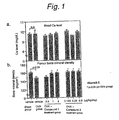
- Figure 1 shows the effects of the compounds according to the present invention on blood Ca level and femur bone mineral density in ovariectomized rats ( a : blood Ca level, b : femur bone mineral density).
- Figure 2 shows the effects of 1 ⁇ ,25-dihydroxyvitamin D 3 on urinary Ca excretion, blood Ca level and bone mineral density in ovariectomized rats ( a : urinary Ca excretion, b : blood Ca level, c : bone mineral density).
- an alkyl group in the C 1 -C 4 alkyl group which may be substituted with a fluorine atom as R 3 refers to a linear or branched C 1 -C 4 alkyl group.
- Specific examples include methyl, ethyl, n-propyl, i-propyl, n-butyl, s-butyl, i-butyl and t-butyl.
- Preferred are methyl, ethyl, n-propyl and n-butyl, more preferred are methyl, ethyl and n-propyl, and particularly preferred are methyl and ethyl.
- An alkyl group which may be substituted with a fluorine atom generally refers to a linear or branched alkyl group such as those stated above, one or more of hydrogen atoms of which may be substituted with fluorine atoms.
- Different types of alkyl groups may be substituted with different numbers of fluorine atoms, usually 1 to 9, preferably 3 to 7, and more preferably 3 to 5.
- R 1 is a hydrogen atom and R 2 is a methyl group.
- R 1 is a hydrogen atom
- R 2 is a methyl group
- R 3 represents a C 1 -C 3 alkyl group which may be substituted with a fluorine atom
- m represents an integer of 0 to 3
- R 1 is a hydrogen atom
- R 2 is a methyl group
- R 3 represents a C 1 -C 3 alkyl group
- m represents an integer of 2 or 3
- Even more preferred is 1 ⁇ ,3 ⁇ -dihydroxy-20(S)-(5-ethyl-5-hydroxy-3-heptynyl)-9,10-secopregna-5,7,10(19),16-tetraene.
- R 1 is a hydrogen atom
- R 2 is a methyl group
- R 3 represents a C 1 -C 3 alkyl group which may be substituted with a fluorine atom
- m represents an integer of 0 to 3
- A is -CH 2 -CH 2 -.
- R 1 is a hydrogen atom
- R 2 is a methyl group
- R 3 represents a C 1 -C 3 alkyl group
- m represents 0, and A is -CH 2 -CH 2 -.
- Even more preferred is 1 ⁇ , 3 ⁇ -dihydroxy-20(S)-(3-ethyl-3-hydroxypentyl)-9,10-secopregna-5,7,10(19),16-tetraene.
- R 1 is a hydrogen atom and R 2 is a methyl group.
- Particularly preferred is 1 ⁇ ,3 ⁇ -dihydroxy-20(S)-(5-ethyl-5-hydroxy-3-heptynyl)-9,10-secopregna-5,7,10(19),16-tetraene.
- the compounds of the present invention may be prepared, for example, in the following ways.
- R 3 represents a C 1 -C 4 alkyl group which may be substituted with a fluorine atom
- m represents an integer of 0 to 3
- an alkyl vinyl ether In an alkyl vinyl ether, Compound A described in JP 10-231284 A is treated with an acid catalyst to give a vinyl ether thereof.
- An alkyl vinyl ether usually available for use is ethyl vinyl ether.
- an acid catalyst include alkylsulfonic acids and divalent mercury salts, such as methanesulfonic acid, paratoluenesulfonic acid, camphorsulfonic acid, boron trifluoride-diethyl ether complex, mercury(II) chloride and mercury(II) acetate, with mercury(II) acetate being preferred.
- the reaction may be performed at any temperature as long as the reaction can proceed, usually at - 20°C to 100°C, preferably at room temperature.
- the vinyl ether thus prepared is subjected to thermal rearrangement in an appropriate solvent to give Compound B.
- Any solvent may be used for this reaction. Examples include hydrocarbon solvents, ether solvents, halogenated solvents, ketone/ester/amide solvents, sulfoxide solvents and nitrile solvents, such as hexane, benzene, toluene, diethyl ether, tetrahydrofuran, 1,4-dioxane, 1,2-dimethoxyethane, dichloromethane, 1,2-dichloroethane, chloroform, carbon tetrachloride, acetone, ethyl acetate, N,N-dimethylformamide, N,N-dimethylacetamide, 1,3-dimethyl-2-imidazolidinone.
- 1,3-dimethyl-3,4,5,6-tetrahydro-2(1H)-pyrimidinone, dimethyl sulfoxide and acetonitrile Preferred are benzene, toluene, 1,4-dioxane, N,N-dimethylformamide, 1,3-dimethyl-2-imidazolidinone and dimethyl sulfoxide, and more preferred are toluene and 1,3-dimethyl-2-imidazolidinone.
- the reaction may be performed at any temperature as long as the reaction can proceed, usually at a temperature ranging from room temperature to 200°C, preferably at 80°C to 140°C.
- This step allows the specific synthesis of the configuration at the 20-position depending on the configuration of the 16-position hydroxy group. Namely, compounds having 20R- and 20S-configurations can be specifically synthesized from 16 ⁇ - and 16 ⁇ -hydroxy forms, respectively.
- Step 2 Introduction of a side chain
- R 3 represents a C 1 -C 4 alkyl group which may be substituted with a fluorine atom and Z represents a leaving group.
- Compound B can be reduced to give Compound F according to standard procedures (Burke, S. D. and Danheiser, R. L., Handbook of Reagent for Organic Synthesis: Oxidizing and Reducing Agents, John Wiley and Sons, Chichester, UK, 1999).
- sodium borohydride is used as a reducing agent.
- Step 2-1-2 (Conversion into a leaving group)
- Z represents a leaving group, for example, a chlorine atom, a bromine atom, an iodine atom, a mesyloxy group and a tosyloxy group, with a mesyloxy group and a tosyloxy group being preferred.
- Compound F can be converted into Compound G according to standard procedures (Larock, R. C. Comprehensive Organic Transformations, 2nd Ed.; Wiley-VCH; New York, 1999).
- Step 2-1-3 Introduction of an acetylene unit
- Compound G is treated with a metal acetylide to give Compound H.
- a metal acetylide available for use include lithium acetylide, lithium acetylide-ethylenediamine complex, sodium acetylide, potassium acetylide and alkylmagnesium acetylide, with lithium acetylide and lithium acetylide-ethylenediamine complex being preferred.
- Examples of a solvent available for use include ether solvents, sulfoxide solvents and amide solvents, such as diethyl ether, tetrahydrofuran, 1,4-dioxane, 1,2-dimethoxyethane, N,N-dimethylformamide, N,N-dimethylacetamide, 1,3-dimethyl-2-imidazolidinone, 1,3-dimethyl-3,4,5,6-tetrahydro-2(1H)-pyrimidinone and dimethyl sulfoxide, with tetrahydrofuran and dimethyl sulfoxide being preferred. These solvents may also be used in combination.
- the reaction may be performed at any temperature as long as the reaction can proceed, usually at a temperature ranging from -20°C to 150°C, preferably from room temperature to 60°C.
- Compound H is treated with a base followed by (R 3 ) 2 CO to give Compound I.
- a base include metal alkyls, alkali metal hydrides, alkali metal alkoxides and metal dialkylamides; n-butyllithium, s-butyllithium.
- t-butyllithium methyllithium, phenyllithium, methylmagnesium bromide, methylmagnesium chloride, methylmagnesium iodide, ethylmagnesium bromide, ethylmagnesium iodide, isopropylmagnesium bromide, sodium hydride, potassium hydride, sodium methoxide, potassium t-butoxide, lithium amide, lithium diethylamide, lithium diisopropylamide and lithium bis(trimethylsilyl)amide are preferred, with n-butyllithium and ethylmagnesium iodide being more preferred.
- the reaction is performed in an ether solvent, preferably in diethyl ether, tetrahydrofuran, 1,4-dioxane or 1,2-dimethoxyethane, more preferably in tetrahydrofuran.
- the reaction may be performed at any temperature as long as the reaction can proceed, usually at a temperature ranging from -78°C to 60°C, preferably from -20°C to room temperature.
- R 3 represents a C 1 -C 4 alkyl group which may be substituted with a fluorine atom and Z represents a leaving group.
- Step 2-2-1 Additional one carbon atom
- Compound G from Step 2-1-2 of Introduction Example 1 is treated with a metallocyanide compound to give Compound J.
- a metallocyanide compound usually available for use is sodium cyanide or potassium cyanide.
- Examples of a solvent usually available for use include ether solvents, amide solvents and sulfoxide solvents, such as diethyl ether, tetrahydrofuran, 1,4-dioxane.
- N,N-dimethylformamide 1,2-dimethoxyethane
- N,N-dimethylformamide N.N-dimethylacetamide
- 1,3-dimethyl-2-imidazolidinone 1,3-dimethyl-3,4,5,6-tetrahydro-2(1H)-pyrimidinone and dimethyl sulfoxide.
- Preferred are N,N-dimethylformamide and dimethyl sulfoxide, and more preferred is N,N-dimethylformamide.
- the reaction may be performed at any temperature as long as the reaction can proceed, preferably at a temperature ranging from 0°C to 150°C, more preferably from room temperature to 100°C.
- Compound J can be converted into Compound K according to standard procedures (Burke, S. D. and Danheiser, R. L., Handbook of Reagent for Organic Synthesis: Oxidizing and Reducing Agents, John Wiley and Sons, Chichester, UK, 1999).
- diisobutylaluminum hydride is used as a reducing agent.
- Compound K is treated with an alkylating agent corresponding to the side chain R 3 : R 3 -M (wherein M represents lithium or a magnesium halide, and R 3 represents a C 1 -C 4 alkyl group which may be substituted with a fluorine atom) to give Compound L.
- a magnesium halide is used as a metal.
- a solvent usually available for use include ether solvents, such as diethyl ether, tetrahydrofuran, 1,4-dioxane and 1,2-dimethoxyethane, with diethyl ether and tetrahydrofuran being preferred.
- the reaction is usually performed at a temperature ranging from -20°C to 50°C, preferably from 0°C to room temperature.
- Compound L can be oxidized to give Compound M according to standard procedures (Burke, S. D. and Danheiser, R. L., Handbook of Reagent for Organic Synthesis: Oxidizing and Reducing Agents, John Wiley and Sons, Chichester, UK, 1999).
- a preferred oxidizing agent include dimethyl sulfoxide/oxalyl chloride, dimethyl sulfoxide/triphosgene, dimethyl sulfoxide/sulfur trioxide-pyridine complex, pyridinium dichromate, pyridinium chlorochromate and tetra-n-propylammonium perruthenate/4-methylmorpholine N-oxide.
- R represents a lower alkyl group.
- Step 2-3-1 Additional carbon atoms
- Compound B is treated with a reagent: (RO) 3 P(O)CH 2 CO 2 R' (wherein R and R' each represent a lower alkyl group) in the presence of a base to give Compound O.
- a base include tertiary amines, metal alkyls, alkali metal hydrides, alkali metal alkoxides and metal dialkylamide, such as triethylamine, diisopropylethylamine, pyridine, n-butyllithium, s-butyllithium, t-butyllithium, methyllithium, phenyllithium, methylmagnesium bromide, methylmagnesium chloride, methylmagnesium iodide, ethylmagnesium bromide, ethylmagnesium iodide, isopropylmagnesium bromide, sodium hydride, potassium hydride, sodium methoxide, potassium t-
- triethylamine diisopropylethylamine, n-butyllithium and sodium hydride, and more preferred is triethylamine.
- the treatment may be performed in the presence of an alkali metal chloride together with a base.
- an alkali metal chloride include lithium chloride, lithium bromide, lithium iodide, sodium chloride, sodium bromide, sodium iodide, potassium chloride, potassium bromide and potassium iodide, with lithium chloride and lithium bromide being preferred, lithium bromide being more preferred.
- a solvent usually available for use examples include ether solvents, such as diethyl ether, tetrahydrofuran, 1,4-dioxane and 1,2-dimethoxyethane, with tetrahydrofuran being preferred.
- the reaction is usually performed at a temperature ranging from - 20°C to 50°C, preferably from 0°C to room temperature.
- a nickel(II) or cobalt(II) salt examples include nickel(II) acetate tetrahydrate, nickel(II) bromide trihydrate, nickel(II) chloride hexahydrate, nickel(II) iodide hexahydrate, cobalt(II) acetate tetrahydrate, cobalt(II) bromide hexahydrate and cobalt(II) chloride hexahydrate, with nickel(II) chloride hexahydrate and cobalt(II) chloride hexahydrate being preferred.
- Examples of a solvent available for use include ether solvents and alcohol solvents, such as diethyl ether, tetrahydrofuran, 1,4-dioxane, 1,2-dimethoxyethane, methanol, ethanol, n-propanol and i-propanol, with tetrahydrofuran, 1,2-dimethoxyethane, methanol and ethanol being preferred. Further, these solvents may be used in combination.
- the reaction is usually performed at a temperature ranging from - 20°C to 50°C, preferably from 0°C to room temperature. This step allows the selective reduction of the unsaturated bond present at the side chain among four unsaturated bonds in Compound O.
- R 3 represents a C 1 -C 4 alkyl group which may be substituted with a fluorine atom and R represents a lower alkyl group.
- Examples of a deprotection reagent available for use include hydrochloric acid, sulfuric acid, acetic acid, acidic ion exchange resins, tetra-n-butylammonium fluoride, hydrogen fluoride/pyridine, hydrogen fluoride/triethylamine and hydrofluoric acid, with acidic ion exchange resins and tetra-n-butylammonium fluoride being preferred.
- the deprotection is usually performed in an ether solvent, preferably in tetrahydrofuran.
- the reaction temperature for deprotection will vary according to the type of substrate, but it is usually in the range of room temperature to 65°C.
- Steps 2, 3 and 4 may be performed in any order, provided that Step 3 does not precede Step 2.
- Steps 1 to 3 may also start with the compound as shown below (which can be found in JP 10-231284 A) instead of Compound A.
- the respective intermediates and final products can be purified by standard techniques such as silica gel column chromatography, thin layer chromatography and recrystallization.
- the compound of Formula (1) or (2) thus prepared is useful as a therapeutic agent for osteoporosis having a reduced blood calcium-increasing effect, while retaining a bone mass-increasing effect attributed to vitamin D.
- a therapeutic agent for osteoporosis comprising the compound of the present invention may be administered by oral, subcutaneous, intramuscular, intravenous or percutaneous route, preferably by oral route.
- the therapeutic agent for osteoporosis comprising the compound of the present invention may be formulated into the desired dosage form such as tablets, granules, fine granules, capsules, powders, injections, solutions, suspensions, emulsions, transdermal absorption systems or suppositories in combination with known pharmaceutically acceptable carriers, excipients, disintegrating agents, lubricants, binders, flavoring agents, coloring agents and the like.
- the dose of the therapeutic agent for osteoporosis comprising the compound of the present invention as an active ingredient can be determined as appropriate for the condition, physique, diathesis, age and sex of a patient, the intended route of administration, or the type of dosage form, etc.
- the agent is generally used in an amount as the active ingredient of 0.01 ⁇ g/day to 10,000 ⁇ g/day, preferably 0.1 ⁇ g/day to 1,000 ⁇ g/day, in one to three divided doses per day.
- tetra-n-propylammonium perruthenate (4.2 mg, 11.9 ⁇ mol) was added and stirred at room temperature for 1.5 hours. After insoluble products were filtered through Celite, the filtrate was washed with semi-saturated aqueous sodium sulfite and dried over anhydrous magnesium sulfate.
- This oil was dissolved in tetrahydrofuran (2 ml) and mixed with a 1.00 M tetrahydrofuran solution of ethylmagnesium bromide (0.32 ml, 320 ⁇ mol) at 0°C, followed by stirring at room temperature for 1 hour. Saturated aqueous ammonium chloride was poured into the reaction mixture, which was then extracted with ethyl acetate. The extracted solution was washed with saturated brine and dried over anhydrous magnesium sulfate.
- the compounds of the present invention were evaluated for their effects on bone mineral density and blood calcium (Ca) level in osteoporosis rat model.
- the following compounds were tested: 1 ⁇ ,3 ⁇ -dihydroxy-20(S)-(3-ethyl-3-hydroxypentyl)-9,10-secopregna-5,7,10(19),16-tetraene from Example 11 (hereinafter referred to as "Compound 1”) and 1 ⁇ ,3 ⁇ -dihydroxy-20(S)-(5-ethyl-5-hydroxy-3-heptyny)-9,(0-secopregna-5,7,10(19),16-tetraene from Example 6 (hereinafter referred to as "Compound 2").
- Compound 1 or Compound 2 were ovariectomized to remove both ovaries. From the following day, Compound 1 or Compound 2 was orally administered every day for 8 weeks. Compound 1 was given in an amount of 0.5 ⁇ g/kg, 1 ⁇ g/kg or 2 ⁇ g/kg per day in two divided doses, while Compound 2 was given in an amount of 0.125 ⁇ g/kg, 0.25 ⁇ g/kg or 0.5 ⁇ g/kg per day in two divided doses. Twenty-four hours after the last administration, blood was drawn from each rat under ether anesthesia. The rats were then euthanized and their femurs were isolated.
- the femur bone mineral density was measured using a dual X-ray bone mineral densitometer (DCS-600EX, ALOKA).
- the blood calcium (Ca) level was measured with a HITACHI automatic analyzer (Model 7170, Hitachi).
- HITACHI automatic analyzer Model 7170, Hitachi.
- both groups of sham operation (sham) and ovariectomy (OVX; in which rats were ovariectomized only, not followed by administration of test compounds) were similarly assayed for their blood calcium (Ca) level and bone mineral density by isolating their femurs.
- Statistical processing was carried out using a software package of Statistic Analysis System (SAS).
- SAS Statistic Analysis System
- a comparison between sham operation (sham) and ovariectomy (OVX) groups was made by an unpaired t-test, while a comparison between OVX and drug treatment groups was made by Dunnett's multiple test. A P-value less than 5% was defined as a significant difference.
- the OVX-induced decrease in bone mineral density was significantly suppressed and the level of bone mineral density remained as high as in the sham group.
- the OVX-induced decrease in bone mineral density was significantly suppressed and the level of bone mineral density remained as high as in the sham group.
- the lumbar bone mineral density was measured at the third lumbar vertebra site using a dual X-ray bone mineral densitometer (DCS-600, ALOKA).
- the blood and urinary calcium levels and the urinary creatinine level were measured with a HITACHI automatic analyzer (Model 7170, Hitachi).
- Statistical processing was carried out using a software package of Statistic Analysis System (SAS).
- SAS Statistic Analysis System
- a comparison between sham operation (sham) and ovariectomy (OVX) groups was made by an unpaired t-test, while a comparison between OVX and drug treatment groups or between sham and drug treatment groups was made by Dunnett's multiple test. A P-value less than 5% was defined as a significant difference.
- the lumbar bone mineral density decreased by about 12%.
- 1 ⁇ ,25-dihydroxyvitamin D 3 at 0.04 ⁇ g/kg By treatment with 1 ⁇ ,25-dihydroxyvitamin D 3 at 0.04 ⁇ g/kg, on the other hand, the OVX-induced decrease in bone mineral density was significantly suppressed.
- 1 ⁇ ,25-dihydroxyvitamin D 3 at 0.04 ⁇ g/kg significantly increased both the blood Ca level and the urinary Ca excretion, as compared to the sham and OVX groups.
- 1 ⁇ ,25-dihydroxyvitamin D 3 was found to have an effect on bone mineral density simultaneously with blood and urinary calcium-increasing effects. Similar results were observed in oral administration (0.1 ⁇ g/kg).
- the compounds of the present invention are useful as therapeutic agents for osteoporosis because they have an excellent bone mass-increasing effect, but almost no blood calcium-increasing effect.
Landscapes
- Health & Medical Sciences (AREA)
- Medicinal Chemistry (AREA)
- Veterinary Medicine (AREA)
- Public Health (AREA)
- General Health & Medical Sciences (AREA)
- Animal Behavior & Ethology (AREA)
- Life Sciences & Earth Sciences (AREA)
- Chemical & Material Sciences (AREA)
- Pharmacology & Pharmacy (AREA)
- Physical Education & Sports Medicine (AREA)
- Organic Chemistry (AREA)
- Orthopedic Medicine & Surgery (AREA)
- General Chemical & Material Sciences (AREA)
- Chemical Kinetics & Catalysis (AREA)
- Rheumatology (AREA)
- Nuclear Medicine, Radiotherapy & Molecular Imaging (AREA)
- Epidemiology (AREA)
- Bioinformatics & Cheminformatics (AREA)
- Engineering & Computer Science (AREA)
- Diabetes (AREA)
- Hematology (AREA)
- Nutrition Science (AREA)
- Obesity (AREA)
- Pharmaceuticals Containing Other Organic And Inorganic Compounds (AREA)
Abstract
The object of the present invention is to provide a
therapeutic agent for osteoporosis with a good bone mass-increasing
effect, but almost no blood calcium-increasing
effect.
The present invention provides a therapeutic agent
for osteoporosis which comprises, as an active ingredient,
a compound of Formula (1):
 wherein
Description
The present invention relates to therapeutic agents
for osteoporosis which comprise, as an active ingredient,
vitamin D derivatives having a reduced blood calcium-increasing
effect, while retaining a useful bone mass-increasing
effect.
Active vitamin D derivatives including 1α, 25-dihydroxyvitamin
D3 and 1α-hydroxyvitamin D3 are used as
therapeutic agents for metabolic bone diseases such as
osteoporosis. These active vitamin D derivatives are known
to exhibit their physiological effects through vitamin D
receptors. Vitamin D receptors are not only present in
tissues such as small intestine, bone, kidney and
parathyroid gland, but also found in various cells
including immune system cells and malignant tumor cells.
Thus, active vitamin D derivatives are known to have
various physiological activities including: (1) regulation
of calcium and bone metabolism; (2) proliferation
inhibition of malignant tumor cells, epidermal cells and
epithelial cells; and (3) regulation of immune system cells.
However, hypercalcemia is known as a critical side
effect caused by active vitamin D derivatives in clinical
use. If the blood calcium-increasing effect can be
selectively reduced or eliminated from the physiological
effects of active vitamin D derivatives, excellent
therapeutic agents with reduced side effects can be
provided for the treatment of metabolic bone diseases and
novel therapeutic agents can be designed based on various
physiological activities of active vitamin D derivatives.
To date, active vitamin D derivatives have been
demonstrated to exhibit their blood calcium-increasing
effect by the following mechanism. An active vitamin D
derivative binds to the vitamin D receptor to form a
complex. The complex binds to VDRE present in a promoter
region of a gene for a protein involved in calcium
absorption in the small intestine (e.g., Calbindin-D in
charge of calcium transport in intestinal epithelial cells
or Ca-ATPase mediating the transfer of the absorbed calcium
to blood vessels). The binding between the complex and
VDRE promotes the transcription of the gene, which in turn
induces the expression of the protein. Then, the expressed
protein enhances calcium absorption from the intestinal
tract.
In order to provide vitamin D derivatives with an
excellent bone mass-increasing effect and a reduced blood
calcium-increasing effect, the inventors of the present
invention focused on vitamin D derivatives having an
unsaturated bond at the 16-position and a methylene group
at the 22-position.
Vitamin D derivatives having an unsaturated bond at
the 16-position and a methylene group at the 22-position
are disclosed in, for example, W09824762, EP808833 and
EP325279. However, W09824762 simply presents osteoporosis
as an example of many disorders for which the vitamin D
derivatives have utility; it fails to provide any specific
information showing that such derivatives are effective
against osteoporosis. In addition, neither EP808833 nor
EP325279 teaches that such vitamin D derivatives are
effective against osteoporosis.
The inventors of the present invention found that a
specific vitamin D derivative having an unsaturated bond at
the 16-position and a methylene group at the 22-position
had an excellent bone mass-increasing effect and suppressed
the increase of blood Ca levels in ovariectomized (OVX)
rats, a model for osteoporosis, and they finally completed
the invention based on this finding.
Accordingly, the present invention provides a
therapeutic agent for osteoporosis which comprises, as an
active ingredient, a compound of the following Formula (1):
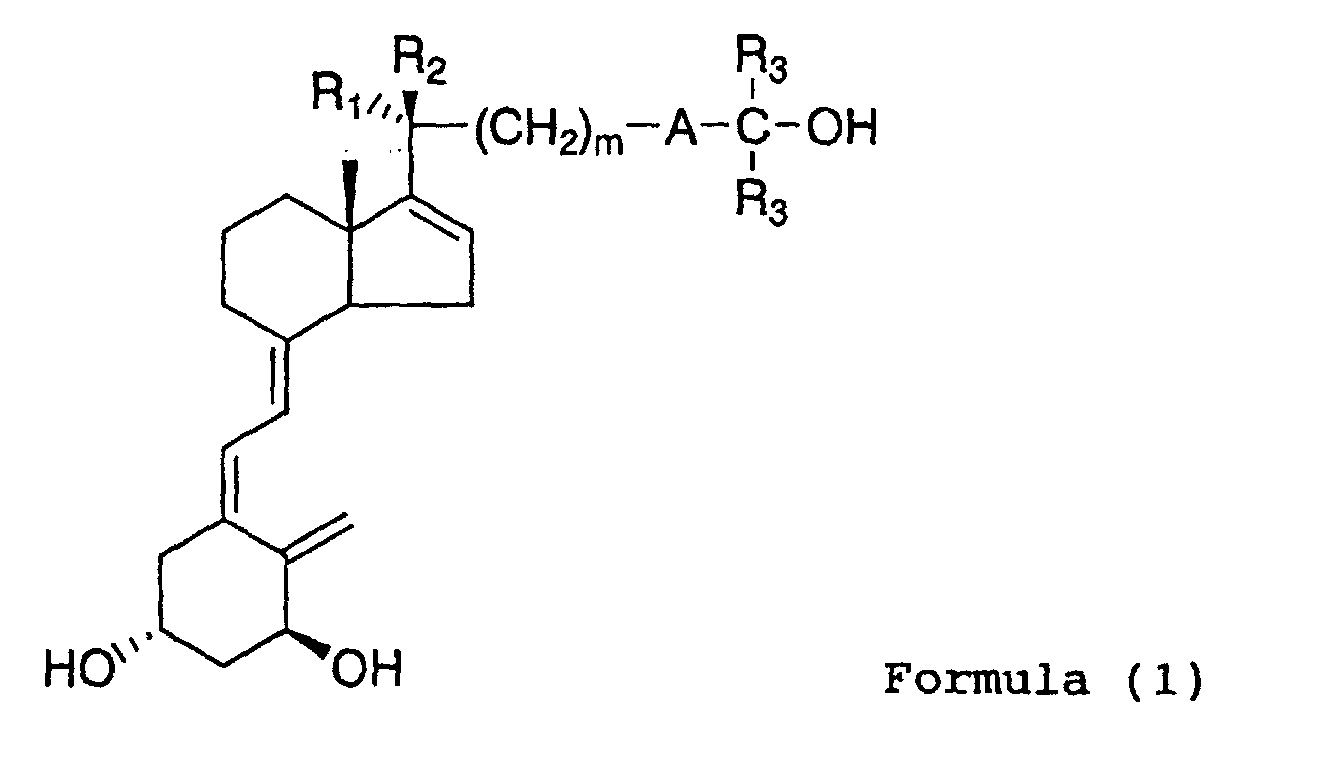 wherein
The present invention also provides the use of a
compound of Formula (1) for the preparation of a
therapeutic agent for osteoporosis.
Further, the present invention provides a method for
treating osteoporosis using a compound of Formula (1), for
example, a method which comprises the step of administering
to a patient in need of such treatment a therapeutically
effective amount of a compound of Formula (1).
In addition, the present invention provides a vitamin
D derivative of the following Formula (2):
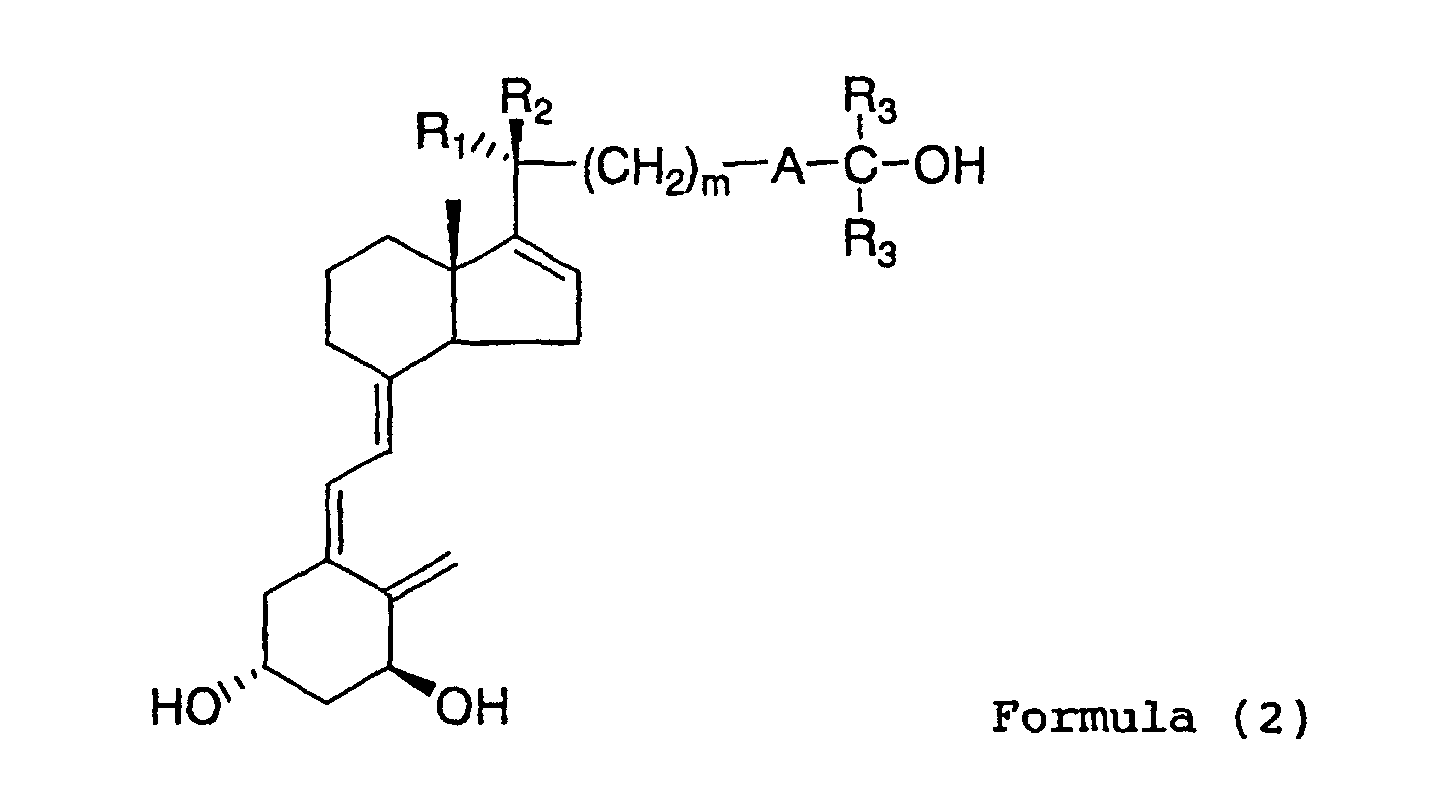 wherein
The present invention also provides a pharmaceutical
composition comprising a compound of Formula (2) as an
active ingredient.
The present invention further provides the use of a
compound of Formula (2) for the preparation of a
therapeutic agent for osteoporosis.
Furthermore, the present invention provides a method
for treating osteoporosis using a compound of Formula (2),
for example, a method which comprises the step of
administering to a patient in need of such treatment a
therapeutically effective amount of a compound of Formula
(2).
This application claims the priority of Japanese
Patent Application No. 2000-247171, the disclosure of which
is hereby incorporated by reference in their entirety.
Figure 1 shows the effects of the compounds according
to the present invention on blood Ca level and femur bone
mineral density in ovariectomized rats (a: blood Ca level,
b: femur bone mineral density).
Figure 2 shows the effects of 1α,25-dihydroxyvitamin
D3 on urinary Ca excretion, blood Ca level and bone mineral
density in ovariectomized rats (a: urinary Ca excretion, b:
blood Ca level, c: bone mineral density).
Specific modes and implementation procedures for the
present invention will be described below.
In the compound of Formula (1) or (2) according to
the present invention, an alkyl group in the C1-C4 alkyl
group which may be substituted with a fluorine atom as R3
refers to a linear or branched C1-C4 alkyl group. Specific
examples include methyl, ethyl, n-propyl, i-propyl, n-butyl,
s-butyl, i-butyl and t-butyl. Preferred are methyl, ethyl,
n-propyl and n-butyl, more preferred are methyl, ethyl and
n-propyl, and particularly preferred are methyl and ethyl.
An alkyl group which may be substituted with a
fluorine atom generally refers to a linear or branched
alkyl group such as those stated above, one or more of
hydrogen atoms of which may be substituted with fluorine
atoms. Different types of alkyl groups may be substituted
with different numbers of fluorine atoms, usually 1 to 9,
preferably 3 to 7, and more preferably 3 to 5.
In a preferred mode of the compound of Formula (1)
according to the present invention, R1 is a hydrogen atom
and R2 is a methyl group.
More preferred is a compound of Formula (1) wherein
R1 is a hydrogen atom, R2 is a methyl group, R3 represents a
C1-C3 alkyl group which may be substituted with a fluorine
atom, m represents an integer of 0 to 3, and A is -CH=CH-or
-C≡C-. Particularly preferred is a compound of Formula
(1) wherein R1 is a hydrogen atom, R2 is a methyl group, R3
represents a C1-C3 alkyl group, m represents an integer of 2
or 3, and A is -CH=CH- or -C≡C-. Even more preferred is
1α,3β-dihydroxy-20(S)-(5-ethyl-5-hydroxy-3-heptynyl)-9,10-secopregna-5,7,10(19),16-tetraene.
Also preferred is a compound of Formula (1) wherein
R1 is a hydrogen atom, R2 is a methyl group, R3 represents a
C1-C3 alkyl group which may be substituted with a fluorine
atom, m represents an integer of 0 to 3, and A is -CH2-CH2-.
Particularly preferred is a compound of Formula (1) wherein
R1 is a hydrogen atom, R2 is a methyl group, R3 represents a
C1-C3 alkyl group, m represents 0, and A is -CH2-CH2-. Even
more preferred is 1α, 3β-dihydroxy-20(S)-(3-ethyl-3-hydroxypentyl)-9,10-secopregna-5,7,10(19),16-tetraene.
In a preferred mode of the vitamin D derivative of
Formula (2) according to the present invention, R1 is a
hydrogen atom and R2 is a methyl group. Particularly
preferred is 1α,3β-dihydroxy-20(S)-(5-ethyl-5-hydroxy-3-heptynyl)-9,10-secopregna-5,7,10(19),16-tetraene.
The following Tables 1 to 3 present specific, but
non-limiting examples of the compound of Formula (1) or (2)
according to the present invention.
| R1 | R2 | m | A | R3 |
| CH3 | H | 0 | -CH2-CH2- | CH3 |
| CH3 | H | 0 | -CH2-CH2- | CH2CH3 |
| CH3 | H | 1 | -CH2-CH2- | CH3 |
| CH3 | H | 1 | -CH2-CH2- | CH2CH3 |
| CH3 | H | 1 | -CH=CH-(E) | CH3 |
| CH3 | H | 1 | -CH=CH-(E) | CH2CH3 |
| CH3 | H | 1 | -CH=CH-(Z) | CH3 |
| CH3 | H | 1 | -CH=CH-(Z) | CH2CH3 |
| CH3 | H | 1 | -C≡C- | CH3 |
| CH3 | H | 1 | -C≡C- | CH2CH3 |
| CH3 | H | 2 | -CH2-CH2- | CH3 |
| CH3 | H | 2 | -CH2-CH2- | CH2CH3 |
| CH3 | H | 2 | -CH=CH-(E) | CH3 |
| CH3 | H | 2 | -CH=CH-(E) | CH2CH3 |
| CH3 | H | 2 | -CH=CH-(Z) | CH3 |
| CH3 | H | 2 | -CH=CH-(Z) | CH2CH3 |
| CH3 | H | 2 | -C≡C- | CH3 |
| CH3 | H | 2 | -C≡C- | CH2CH3 |
| CH3 | H | 3 | -CH2-CH2- | CH3 |
| CH3 | H | 3 | -CH2-CH2- | CH2CH3 |
| CH3 | H | 3 | -CH=CH-(E) | CH3 |
| CH3 | H | 3 | -CH=CH-(E) | CH2CH3 |
| CH3 | H | 3 | -CH=CH-(Z) | CH3 |
| CH3 | H | 3 | -CH=CH-(Z) | CH2CH3 |
| CH3 | H | 3 | -C≡C- | CH3 |
| CH3 | H | 3 | -C≡C- | CH2CH3 |
| H | CH3 | 0 | -CH2-CH2- | CH3 |
| H | CH3 | 0 | -CH2-CH2- | CF3 |
| H | CH3 | 0 | -CH2-CH2- | CH2CH3 |
| H | CH3 | 0 | -CH2-CH2- | CH2CF3 |
| R1 | R2 | m | A | R3 |
| H | CH3 | 0 | -CH2-CH2- | CF2CF3 |
| H | CH3 | 1 | -CH2-CH2- | CH3 |
| H | CH3 | 1 | -CH2-CH2- | CH2CH3 |
| H | CH3 | 1 | -CH2-CH2- | CH2CH2CH3 |
| H | CH3 | 1 | -CH=CH-(E) | CH3 |
| H | CH3 | 1 | -CH=CH-(E) | CH2CH3 |
| H | CH3 | 1 | -CH=CH-(E) | CH2CH2CH3 |
| H | CH3 | 1 | -CH=CH-(Z) | CH3 |
| H | CH3 | 1 | -CH=CH-(Z) | CH2CH3 |
| H | CH3 | 1 | -CH=CH-(Z) | CH2CH2CH3 |
| H | CH3 | 1 | -C≡C- | CH3 |
| H | CH3 | 1 | -C≡C- | CH2CH3 |
| H | CH3 | 1 | -C≡C- | CH2CH2CH3 |
| H | CH3 | 2 | -CH2-CH2- | CH3 |
| H | CH3 | 2 | -CH2-CH2- | CH2CH3 |
| H | CH3 | 2 | -CH2-CH2- | CH2CH2CH3 |
| H | CH3 | 2 | -CH=CH-(E) | CH3 |
| H | CH3 | 2 | -CH=CH-(E) | CF3 |
| H | CH3 | 2 | -CH=CH-(E) | CH2CH3 |
| H | CH3 | 2 | -CH=CH-(E) | CH2CF3 |
| H | CH3 | 2 | -CH=CH-(E) | CF2CF3 |
| H | CH3 | 2 | -CH=CH-(E) | CH2CH2CH3 |
| H | CH3 | 2 | -CH=CH-(E) | CH2CH2CH2CH3 |
| H | CH3 | 2 | -CH=CH-(Z) | CH3 |
| H | CH3 | 2 | -CH=CH-(Z) | CF3 |
| H | CH3 | 2 | -CH=CH-(Z) | CH2CH3 |
| H | CH3 | 2 | -CH=CH-(Z) | CH2CF3 |
| H | CH3 | 2 | -CH=CH-(Z) | CF2CF3 |
| H | CH3 | 2 | -CH=CH-(Z) | CH2CH2CH3 |
| H | CH3 | 2 | -CH=CH-(Z) | CH2CH2CH2CH3 |
| R1 | R2 | m | A | R3 |
| H | CH3 | 2 | -C≡C- | CH3 |
| H | CH3 | 2 | -C≡C- | CF3 |
| H | CH3 | 2 | -C≡C- | CH2CH3 |
| H | CH3 | 2 | -C≡C- | CH2CF3 |
| H | CH3 | 2 | -C≡C- | CF2CF3 |
| H | CH3 | 2 | -C≡C- | CH2CH2CH3 |
| H | CH3 | 2 | -C≡C- | CH2CH2CH2 CH3 |
| H | CH3 | 3 | -CH2-CH2- | CH3 |
| H | CH3 | 3 | -CH2-CH2- | CH2CH3 |
| H | CH3 | 3 | -CH2-CH2- | CH2CH2CH3 |
| H | CH3 | 3 | -CH=CH-(E) | CH3 |
| H | CH3 | 3 | -CH=CH-(E) | CH2CH3 |
| H | CH3 | 3 | -CH=CH-(E) | CH2CH2CH3 |
| H | CH3 | 3 | -CH=CH-(Z) | CH3 |
| H | CH3 | 3 | -CH=CH-(Z) | CH2CH3 |
| H | CH3 | 3 | -CH=CH-(Z) | CH2CH2CH3 |
| H | CH3 | 3 | -C≡C- | CH3 |
| H | CH3 | 3 | -C≡C- | CH2CH3 |
| H | CH3 | 3 | -C≡C- | CH2CH2CH3 |
The compounds of the present invention may be
prepared, for example, in the following ways.
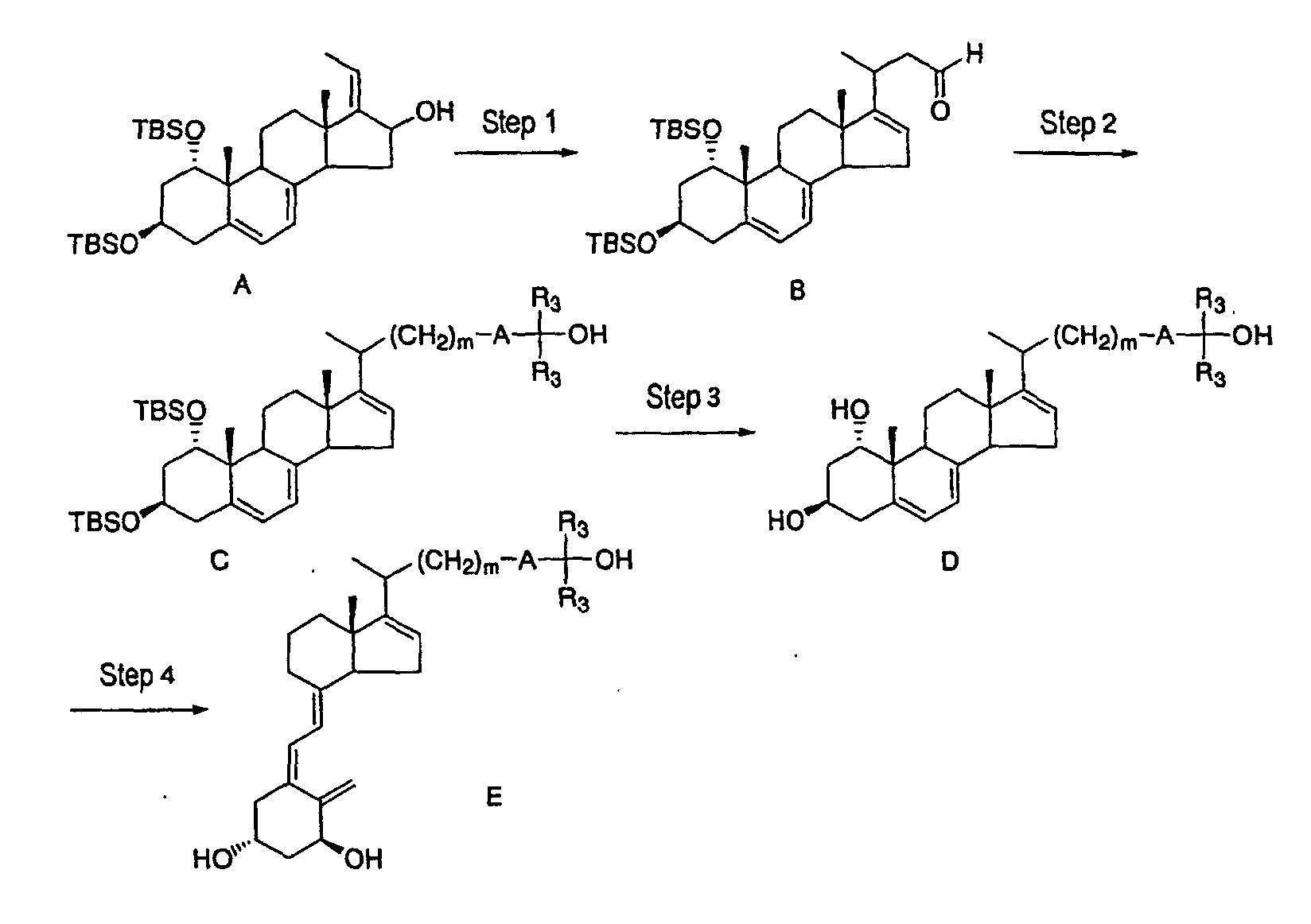
In the above reaction scheme, R3 represents a C1-C4
alkyl group which may be substituted with a fluorine atom,
m represents an integer of 0 to 3, and A represents -CH2-CH2-,
-CH=CH- or -C≡C-, provided that m represents an
integer of 2 or 3 and A represents -CH=CH- or -C≡C- if the
final compound E has Formula (2).
In an alkyl vinyl ether, Compound A described in JP
10-231284 A is treated with an acid catalyst to give a
vinyl ether thereof. An alkyl vinyl ether usually
available for use is ethyl vinyl ether. Examples of an
acid catalyst include alkylsulfonic acids and divalent
mercury salts, such as methanesulfonic acid, paratoluenesulfonic
acid, camphorsulfonic acid, boron
trifluoride-diethyl ether complex, mercury(II) chloride and
mercury(II) acetate, with mercury(II) acetate being
preferred. The reaction may be performed at any
temperature as long as the reaction can proceed, usually at
- 20°C to 100°C, preferably at room temperature.
The vinyl ether thus prepared is subjected to thermal
rearrangement in an appropriate solvent to give Compound B.
Any solvent may be used for this reaction. Examples
include hydrocarbon solvents, ether solvents, halogenated
solvents, ketone/ester/amide solvents, sulfoxide solvents
and nitrile solvents, such as hexane, benzene, toluene,
diethyl ether, tetrahydrofuran, 1,4-dioxane, 1,2-dimethoxyethane,
dichloromethane, 1,2-dichloroethane,
chloroform, carbon tetrachloride, acetone, ethyl acetate,
N,N-dimethylformamide, N,N-dimethylacetamide, 1,3-dimethyl-2-imidazolidinone.
1,3-dimethyl-3,4,5,6-tetrahydro-2(1H)-pyrimidinone,
dimethyl sulfoxide and acetonitrile.
Preferred are benzene, toluene, 1,4-dioxane, N,N-dimethylformamide,
1,3-dimethyl-2-imidazolidinone and
dimethyl sulfoxide, and more preferred are toluene and 1,3-dimethyl-2-imidazolidinone.
The reaction may be performed
at any temperature as long as the reaction can proceed,
usually at a temperature ranging from room temperature to
200°C, preferably at 80°C to 140°C.
This step allows the specific synthesis of the
configuration at the 20-position depending on the
configuration of the 16-position hydroxy group. Namely,
compounds having 20R- and 20S-configurations can be
specifically synthesized from 16α- and 16β-hydroxy forms,
respectively.
The introduction of a side chain may be accomplished
as shown in the following Introduction Examples 1 to 3.
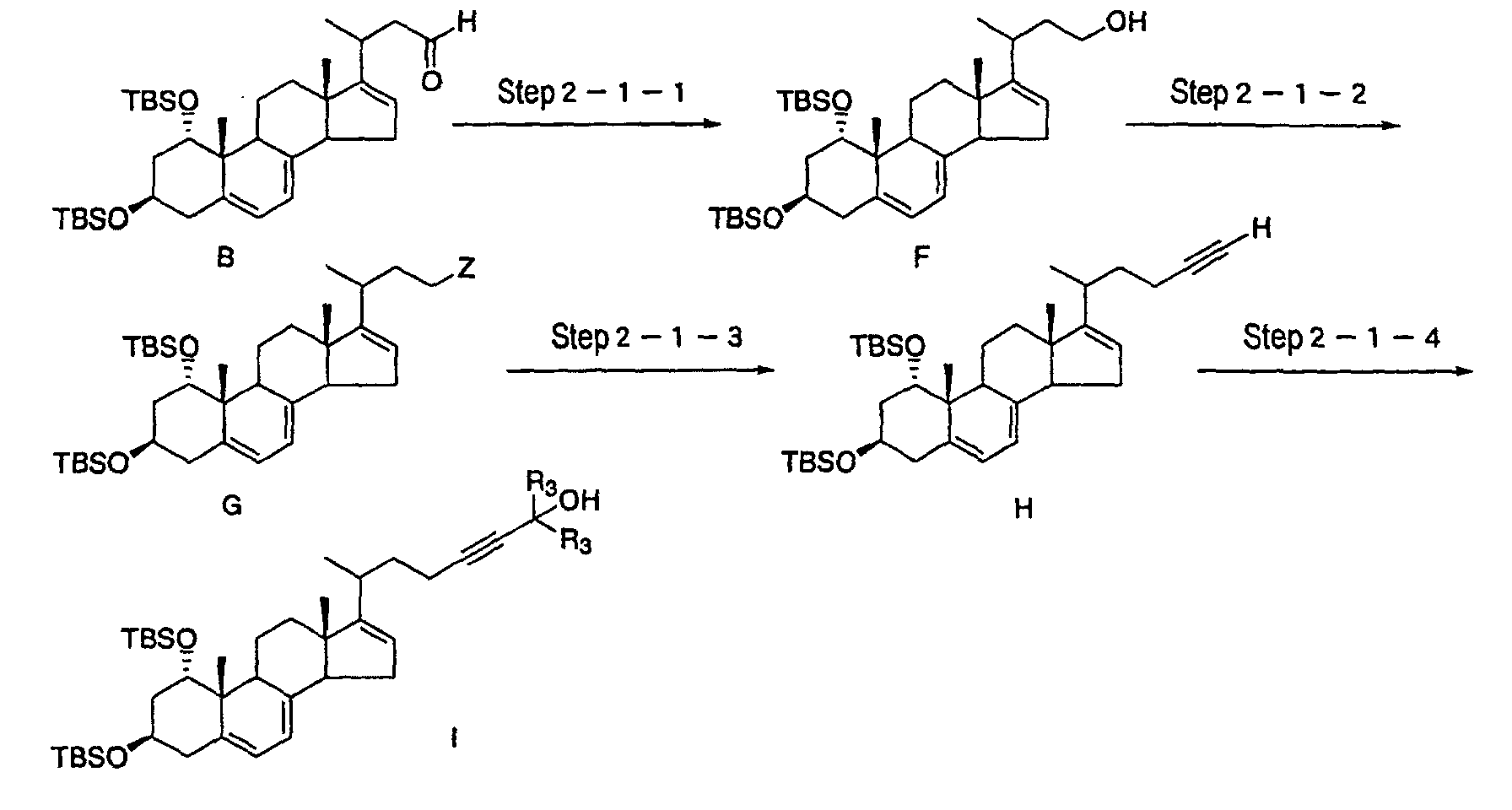
In the above reaction scheme, R3 represents a C1-C4
alkyl group which may be substituted with a fluorine atom
and Z represents a leaving group.
Compound B can be reduced to give Compound F
according to standard procedures (Burke, S. D. and
Danheiser, R. L., Handbook of Reagent for Organic
Synthesis: Oxidizing and Reducing Agents, John Wiley and
Sons, Chichester, UK, 1999). Preferably, sodium
borohydride is used as a reducing agent.
In the reaction scheme, Z represents a leaving group,
for example, a chlorine atom, a bromine atom, an iodine
atom, a mesyloxy group and a tosyloxy group, with a
mesyloxy group and a tosyloxy group being preferred.
Compound F can be converted into Compound G according to
standard procedures (Larock, R. C. Comprehensive Organic
Transformations, 2nd Ed.; Wiley-VCH; New York, 1999).
In the presence of an appropriate solvent, Compound G
is treated with a metal acetylide to give Compound H.
Examples of a metal acetylide available for use include
lithium acetylide, lithium acetylide-ethylenediamine
complex, sodium acetylide, potassium acetylide and
alkylmagnesium acetylide, with lithium acetylide and
lithium acetylide-ethylenediamine complex being preferred.
Examples of a solvent available for use include ether
solvents, sulfoxide solvents and amide solvents, such as
diethyl ether, tetrahydrofuran, 1,4-dioxane, 1,2-dimethoxyethane,
N,N-dimethylformamide, N,N-dimethylacetamide,
1,3-dimethyl-2-imidazolidinone, 1,3-dimethyl-3,4,5,6-tetrahydro-2(1H)-pyrimidinone
and dimethyl
sulfoxide, with tetrahydrofuran and dimethyl sulfoxide
being preferred. These solvents may also be used in
combination. The reaction may be performed at any
temperature as long as the reaction can proceed, usually at
a temperature ranging from -20°C to 150°C, preferably from
room temperature to 60°C.
In an appropriate solvent, Compound H is treated with
a base followed by (R3)2CO to give Compound I. Examples of
a base include metal alkyls, alkali metal hydrides, alkali
metal alkoxides and metal dialkylamides; n-butyllithium, s-butyllithium.
t-butyllithium, methyllithium, phenyllithium,
methylmagnesium bromide, methylmagnesium chloride,
methylmagnesium iodide, ethylmagnesium bromide,
ethylmagnesium iodide, isopropylmagnesium bromide, sodium
hydride, potassium hydride, sodium methoxide, potassium
t-butoxide, lithium amide, lithium diethylamide, lithium
diisopropylamide and lithium bis(trimethylsilyl)amide are
preferred, with n-butyllithium and ethylmagnesium iodide
being more preferred. The reaction is performed in an
ether solvent, preferably in diethyl ether, tetrahydrofuran,
1,4-dioxane or 1,2-dimethoxyethane, more preferably in
tetrahydrofuran. The reaction may be performed at any
temperature as long as the reaction can proceed, usually at
a temperature ranging from -78°C to 60°C, preferably from
-20°C to room temperature.
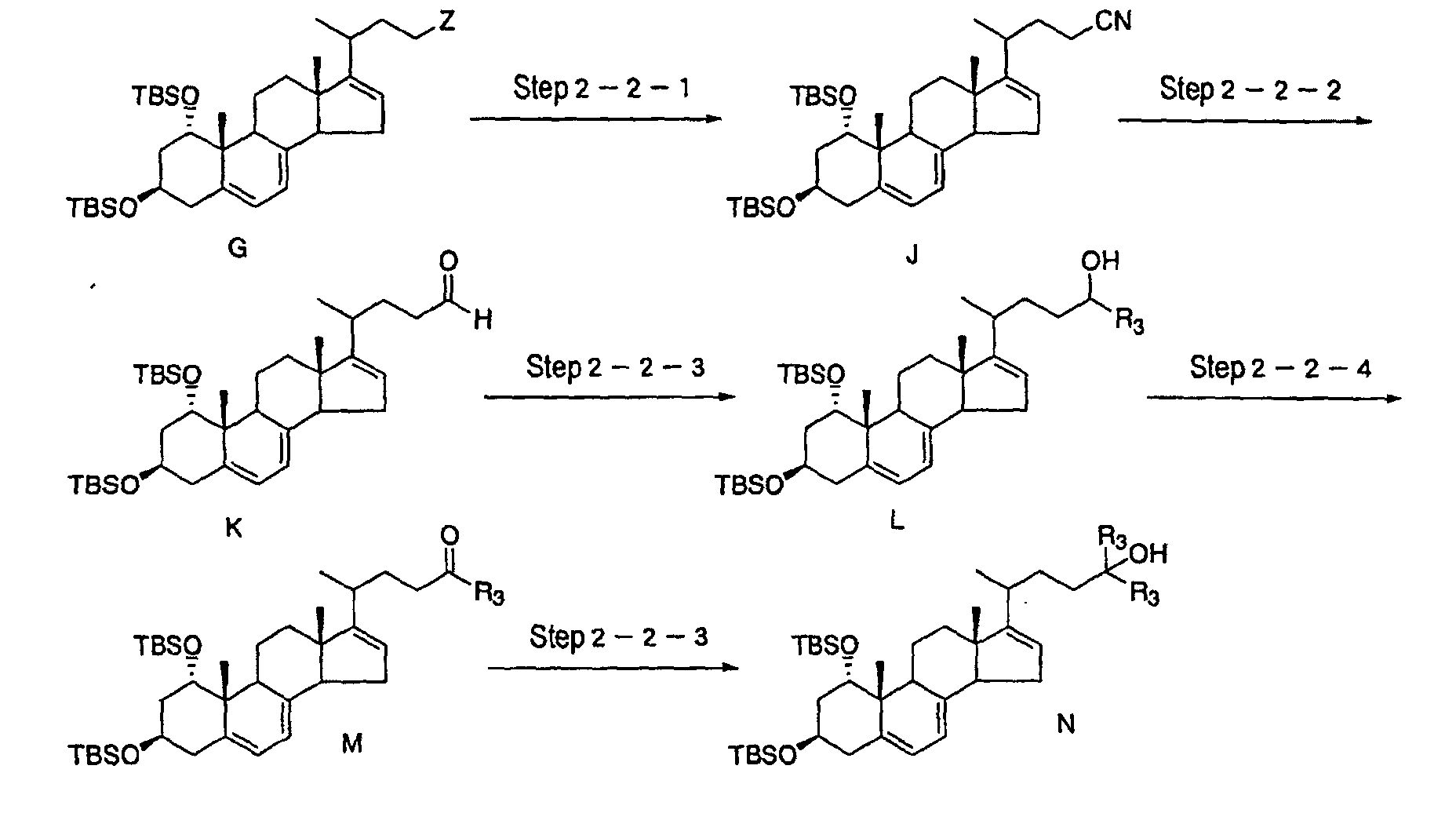
In the above reaction scheme, R3 represents a C1-C4
alkyl group which may be substituted with a fluorine atom
and Z represents a leaving group.
In an appropriate solvent, Compound G from Step 2-1-2
of Introduction Example 1 is treated with a metallocyanide
compound to give Compound J. A metallocyanide compound
usually available for use is sodium cyanide or potassium
cyanide. Examples of a solvent usually available for use
include ether solvents, amide solvents and sulfoxide
solvents, such as diethyl ether, tetrahydrofuran, 1,4-dioxane.
1,2-dimethoxyethane, N,N-dimethylformamide, N.N-dimethylacetamide,
1,3-dimethyl-2-imidazolidinone, 1,3-dimethyl-3,4,5,6-tetrahydro-2(1H)-pyrimidinone
and dimethyl
sulfoxide. Preferred are N,N-dimethylformamide and
dimethyl sulfoxide, and more preferred is N,N-dimethylformamide.
The reaction may be performed at any
temperature as long as the reaction can proceed, preferably
at a temperature ranging from 0°C to 150°C, more preferably
from room temperature to 100°C.
Compound J can be converted into Compound K according
to standard procedures (Burke, S. D. and Danheiser, R. L.,
Handbook of Reagent for Organic Synthesis: Oxidizing and
Reducing Agents, John Wiley and Sons, Chichester, UK, 1999).
Preferably, diisobutylaluminum hydride is used as a
reducing agent.
In an appropriate solvent, Compound K is treated with
an alkylating agent corresponding to the side chain R3:
R3 -M
(wherein M represents lithium or a magnesium halide, and R3
represents a C1-C4 alkyl group which may be substituted with
a fluorine atom) to give Compound L. Preferably, a
magnesium halide is used as a metal. Examples of a solvent
usually available for use include ether solvents, such as
diethyl ether, tetrahydrofuran, 1,4-dioxane and 1,2-dimethoxyethane,
with diethyl ether and tetrahydrofuran
being preferred. The reaction is usually performed at a
temperature ranging from -20°C to 50°C, preferably from 0°C
to room temperature.
Compound L can be oxidized to give Compound M
according to standard procedures (Burke, S. D. and
Danheiser, R. L., Handbook of Reagent for Organic
Synthesis: Oxidizing and Reducing Agents, John Wiley and
Sons, Chichester, UK, 1999). Examples of a preferred
oxidizing agent include dimethyl sulfoxide/oxalyl chloride,
dimethyl sulfoxide/triphosgene, dimethyl sulfoxide/sulfur
trioxide-pyridine complex, pyridinium dichromate,
pyridinium chlorochromate and tetra-n-propylammonium
perruthenate/4-methylmorpholine N-oxide.
Compound M thus prepared is further treated in the
same manner as Step 2-2-3 to give Compound N.
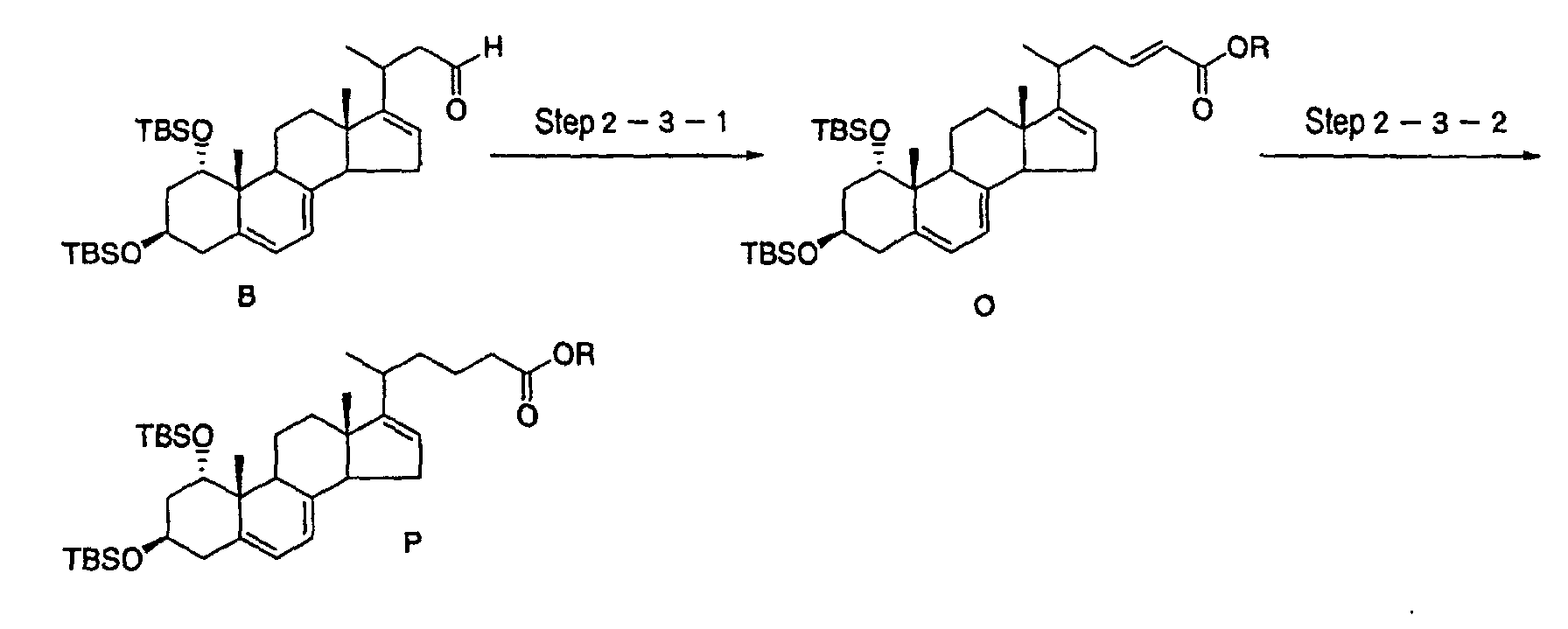
In the above reaction scheme, R represents a lower
alkyl group.
In an appropriate solvent, Compound B is treated with
a reagent:
(RO)3P(O)CH2CO2R'
(wherein R and R' each represent a lower alkyl group) in
the presence of a base to give Compound O. Examples of a
base include tertiary amines, metal alkyls, alkali metal
hydrides, alkali metal alkoxides and metal dialkylamide,
such as triethylamine, diisopropylethylamine, pyridine, n-butyllithium,
s-butyllithium, t-butyllithium, methyllithium,
phenyllithium, methylmagnesium bromide, methylmagnesium
chloride, methylmagnesium iodide, ethylmagnesium bromide,
ethylmagnesium iodide, isopropylmagnesium bromide, sodium
hydride, potassium hydride, sodium methoxide, potassium
t-butoxide, lithium amide, lithium diethylamide, lithium
diisopropylamide and lithium bis(trimethylsilyl)amide.
Preferred are triethylamine, diisopropylethylamine,
n-butyllithium and sodium hydride, and more preferred is
triethylamine. The treatment may be performed in the
presence of an alkali metal chloride together with a base.
Examples of an alkali metal chloride include lithium
chloride, lithium bromide, lithium iodide, sodium chloride,
sodium bromide, sodium iodide, potassium chloride,
potassium bromide and potassium iodide, with lithium
chloride and lithium bromide being preferred, lithium
bromide being more preferred. Examples of a solvent
usually available for use include ether solvents, such as
diethyl ether, tetrahydrofuran, 1,4-dioxane and 1,2-dimethoxyethane,
with tetrahydrofuran being preferred. The
reaction is usually performed at a temperature ranging from
- 20°C to 50°C, preferably from 0°C to room temperature.
In an ether or alcohol solvent, Compound O is reduced
with sodium borohydride in the presence of a catalytic
amount of a nickel(II) or cobalt(II) salt to give Compound
P. Examples of a nickel(II) or cobalt(II) salt include
nickel(II) acetate tetrahydrate, nickel(II) bromide
trihydrate, nickel(II) chloride hexahydrate, nickel(II)
iodide hexahydrate, cobalt(II) acetate tetrahydrate,
cobalt(II) bromide hexahydrate and cobalt(II) chloride
hexahydrate, with nickel(II) chloride hexahydrate and
cobalt(II) chloride hexahydrate being preferred. Examples
of a solvent available for use include ether solvents and
alcohol solvents, such as diethyl ether, tetrahydrofuran,
1,4-dioxane, 1,2-dimethoxyethane, methanol, ethanol, n-propanol
and i-propanol, with tetrahydrofuran, 1,2-dimethoxyethane,
methanol and ethanol being preferred.
Further, these solvents may be used in combination. The
reaction is usually performed at a temperature ranging from
- 20°C to 50°C, preferably from 0°C to room temperature.
This step allows the selective reduction of the unsaturated
bond present at the side chain among four unsaturated bonds
in Compound O.
As shown in the following reaction schemes, Compounds
O and P thus prepared can then be subjected to Step 2-2-3
mentioned above to give Compounds Q and R, respectively.

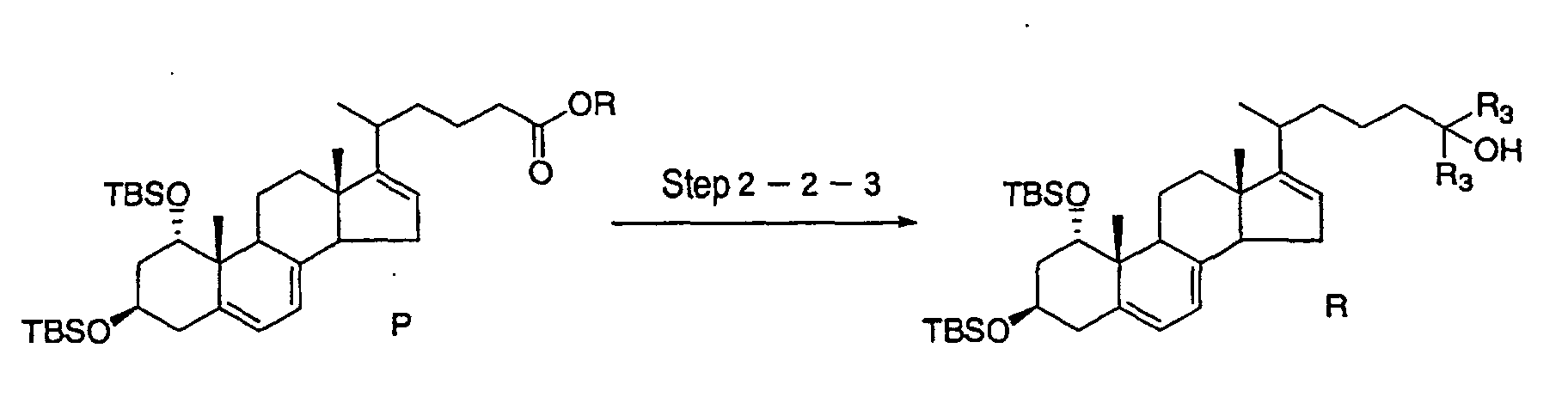
In the above reaction schemes, R3 represents a C1-C4
alkyl group which may be substituted with a fluorine atom
and R represents a lower alkyl group.
According to standard procedures, protecting groups
are removed from Compound C prepared in the above.
Examples of a deprotection reagent available for use
include hydrochloric acid, sulfuric acid, acetic acid,
acidic ion exchange resins, tetra-n-butylammonium fluoride,
hydrogen fluoride/pyridine, hydrogen fluoride/triethylamine
and hydrofluoric acid, with acidic ion exchange resins and
tetra-n-butylammonium fluoride being preferred. The
deprotection is usually performed in an ether solvent,
preferably in tetrahydrofuran. The reaction temperature
for deprotection will vary according to the type of
substrate, but it is usually in the range of room
temperature to 65°C.
According to standard procedures, Compound D is
subjected to photoreaction and thermal isomerization to
give Compound E. Steps 2, 3 and 4 may be performed in any
order, provided that Step 3 does not precede Step 2.
In addition, the above Steps 1 to 3 may also start
with the compound as shown below (which can be found in JP
10-231284 A) instead of Compound A.
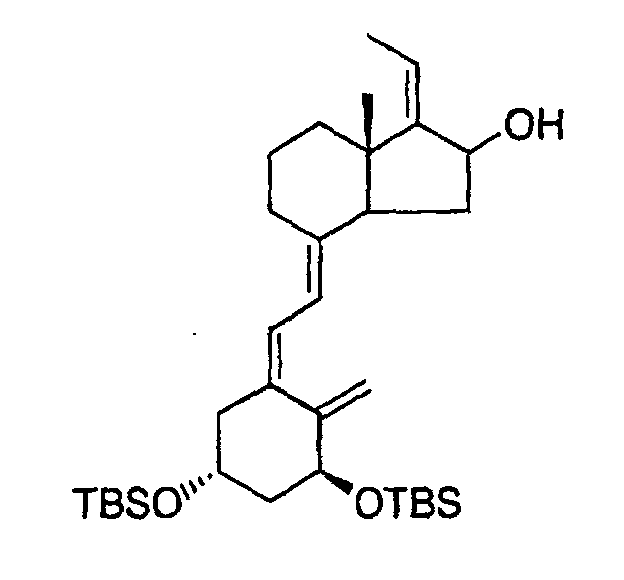
In the individual synthesis steps mentioned above,
the respective intermediates and final products can be
purified by standard techniques such as silica gel column
chromatography, thin layer chromatography and
recrystallization.
As shown in the Examples below, the compound of
Formula (1) or (2) thus prepared is useful as a therapeutic
agent for osteoporosis having a reduced blood calcium-increasing
effect, while retaining a bone mass-increasing
effect attributed to vitamin D.
A therapeutic agent for osteoporosis comprising the
compound of the present invention may be administered by
oral, subcutaneous, intramuscular, intravenous or
percutaneous route, preferably by oral route.
The therapeutic agent for osteoporosis comprising the
compound of the present invention may be formulated into
the desired dosage form such as tablets, granules, fine
granules, capsules, powders, injections, solutions,
suspensions, emulsions, transdermal absorption systems or
suppositories in combination with known pharmaceutically
acceptable carriers, excipients, disintegrating agents,
lubricants, binders, flavoring agents, coloring agents and
the like.
The dose of the therapeutic agent for osteoporosis
comprising the compound of the present invention as an
active ingredient can be determined as appropriate for the
condition, physique, diathesis, age and sex of a patient,
the intended route of administration, or the type of dosage
form, etc. For oral administration, the agent is generally
used in an amount as the active ingredient of 0.01 µg/day
to 10,000 µg/day, preferably 0.1 µg/day to 1,000 µg/day, in
one to three divided doses per day.
The present invention will be further described in
the following Examples, which are provided for illustrative
purposes only and are not intended to limit the scope of
the invention.
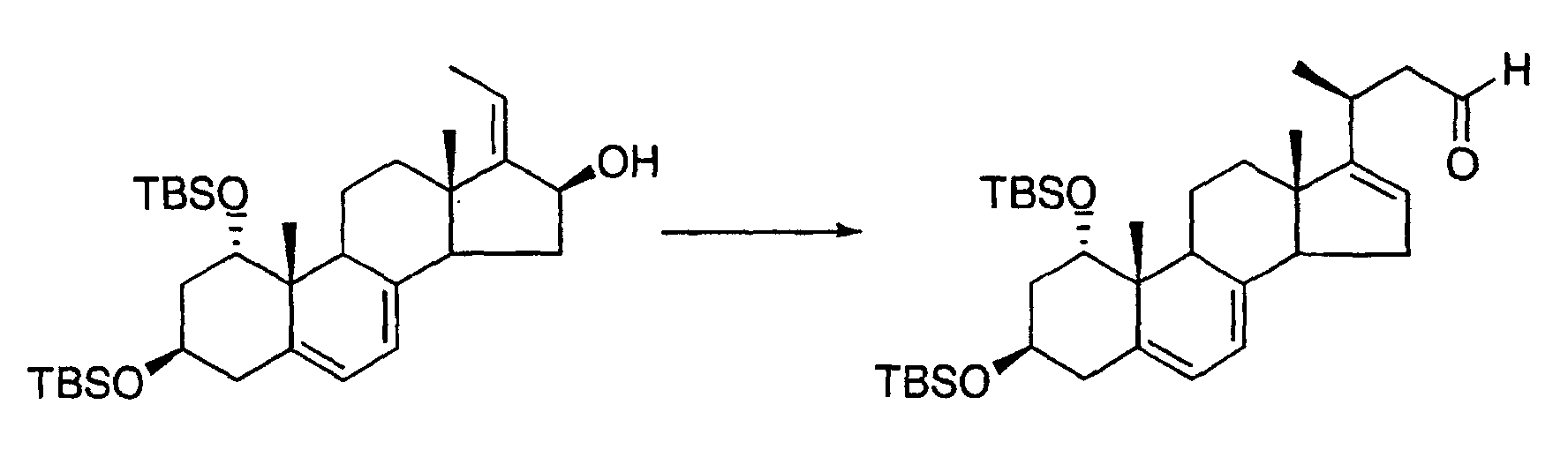
1α,3β-Bis(t-butyldimethylsilyloxy)-16β-hydroxypregna-5,7,17(E)-triene
(1.50 g, 2.68 mmol) was dissolved in ethyl
vinyl ether (35 ml), followed by addition of mercury(II)
acetate (682 mg, 2.14 mmol) and stirring at room
temperature for 38 hours. The reaction mixture was poured
into 5% aqueous potassium hydroxide and extracted with
hexane. The organic layer was washed with saturated brine,
dried over anhydrous magnesium sulfate, and then evaporated
under reduced pressure to remove the solvent. The
resulting residue was dissolved in 1,3-dimethyl-2-imidazolidinone
(50 ml) and stirred at 110°C for 4 hours.
After cooling to room temperature, the reaction mixture was
poured into water and extracted twice with ethyl acetate.
The combined organic layers were washed with water and
saturated brine, dried over anhydrous magnesium sulfate,
and then evaporated under reduced pressure to remove the
solvent. The resulting residue was purified by silica gel
column chromatography (hexane:ethyl acetate = 30:1) to give
the titled compound (1.08 g, 69%) as a white solid.
1H NMR δ: 0.05(s, 3H), 0.07(s, 6H), 0.11(s, 3H),
0.84(8, 3H), 0.88(s, 18H), 0.94(s, 3H), 1.13(d, J=6.9Hz,
3H), 2.56-2.67(m, 1H), 2.73-2.91(m, 1H). 3.69-3.74(m, 1H),
3.98-4.13(m, 1H), 5.37-5.44(m, 2H), 5.59-5.63(m, 1H).
9.72(t, J=2.1Hz, 1H).
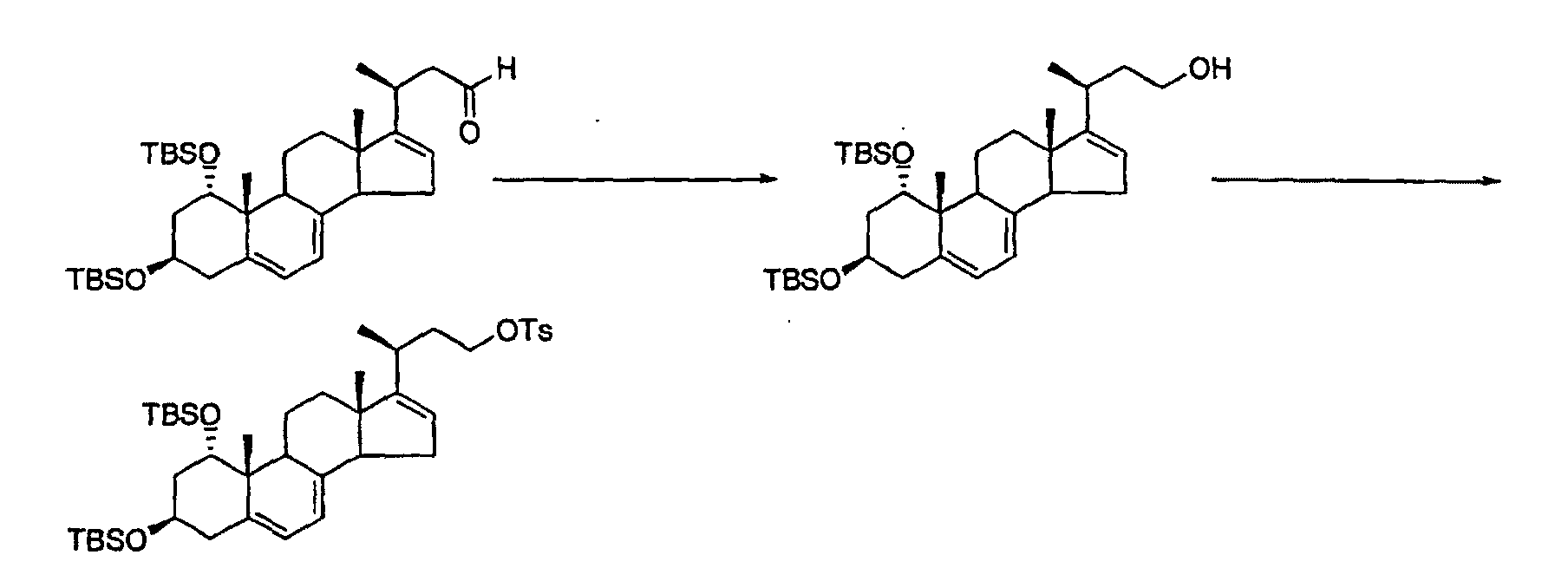
20(S)-1α,3β-Bis(t-butyldimethylsilyloxy)-24-norchola-5,7,16-trien-23-al
(763 mg, 1.30 mmol) was dissolved in a
mixed solvent of methanol (3 ml) and tetrahydrofuran (7 ml),
and sodium borohydride (98.4 mg, 2.60 mmol) was slowly
added thereto at 0°C. After stirring at room temperature
for 1 hour, the reaction mixture was poured into water and
extracted with ethyl acetate. The extracted solution was
washed with saturated brine, dried over magnesium sulfate,
and then evaporated under reduced pressure to remove the
solvent. The resulting residue was dissolved in
dichloromethane (5 ml) and cooled to 0°C after addition of
pyridine (0.51 ml, 6.35 mmol). At this temperature, p-toluenesulfonyl
chloride (364 mg, 1.91 mmol) was further
added and stirred at the same temperature for 12 hours.
The reaction mixture was diluted with ethyl acetate, washed
sequentially with ice-cold 0.5 M hydrochloric acid,
saturated aqueous sodium bicarbonate and saturated brine,
and then dried over magnesium sulfate. After evaporation
under reduced pressure to remove the solvent, the resulting
residue was purified by silica gel column chromatography
(hexane:dichloromethane = 9:1 and then 3:2) to give the
titled compound (829 mg, 88%) as a white foam.
1H NMR δ: 0.06(s, 3H), 0.07(s, 3H), 0.09(s, 3H),
0.12(s, 3H), 0.77(s, 3H), 0.89(s, 9H), 0.90(s, 9H), 0.94(s,
3H), 1.00(d, J=6.9Hz, 3H), 2.45(s, 3H), 2.78-2.90(m, 1H),
3.67-3.75(m, 1H), 3.98-4.13(m, 3H), 5.26-5.31(m, 1H), 5.34-5.41(m,
1H), 5.56-5.63(m, 1H), 7.34(d, J=8.2Hz, 2H), 7.78(d,
J=8.2Hz, 2H).

20(S)-1α,3β-Bis(t-butyldimethylsilyloxy)-23-(p-toluenesulfonyloxy)-24-norchola-5,7,16-triene
(152 mg,
0.205 mmol) was dissolved in a mixed solvent of
tetrahydrofuran (0.5 ml) and dimethyl sulfoxide (1 ml),
followed by addition of lithium acetylide-ethylenediamine
complex (62.9 mg, 0.615 mmol) and stirring at room
temperature for 3 hours. The reaction mixture was poured
into ice-cold water and extracted with hexane. The organic
layer was washed with saturated brine and dried over
magnesium sulfate. After evaporation under reduced
pressure to remove the solvent, the resulting residue was
purified by silica gel column chromatography
(hexane:dichloromethane = 5:1) to give the titled compound
(96.9 mg, 79%) as a colorless oil.
1H NMR δ: 0.06(s, 3H), 0.07(s, 3H), 0.08(s, 3H),
0.11(s, 3H), 0.81(s, 3H), 0.89(s, 18H), 0.94(s, 3H), 1.07(d,
J=6.9Hz, 3H), 2.78-2.92(m, 1H), 3.66-3.77(m, 1H), 3.95-4.15(m,
1H), 5.32-5.47(m, 2H), 5.56-5.65(m, 1H).

To a solution of 1α,3β-bis(t-butyldimethylsilyloxy)-20(S)-(3-butynyl)pregna-5,7,16-triene
(96.9 mg, 0.162 mmol)
in tetrahydrofuran (2 ml), 1.47 M n-butyllithium (221 µl,
0.325 mmol) was added dropwise at 0°C and stirred at the
same temperature for 15 minutes. To this solution, 3-pentanone
(49.1 µl, 0.486 mmol) was added and stirred at
0°C for 2 hours. Ice-cold water was added dropwise to the
reaction mixture, which was then extracted with ethyl
acetate. The extracted solution was washed with saturated
brine, dried over anhydrous magnesium sulfate, and then
evaporated under reduced pressure to remove the solvent.
The resulting residue was purified by silica gel column
chromatography (hexane:ethyl acetate = 20: 1) to give the
titled compound (50.1 mg, 45%) as a colorless oil.
1H NMR δ: 0.06(s, 3H), 0.07(s, 3H), 0.07(s, 3H),
0.11(S, 3H), 0.81(s, 3H), 0.89(s, 18H), 0.95(s, 3H), 2.80-2.93(m,
1H), 3.68-3.78(m, 1H), 3.98-4.15(m, 1H), 5.35-5.47(m,
2H), 5.57-5.66(m, 1H).
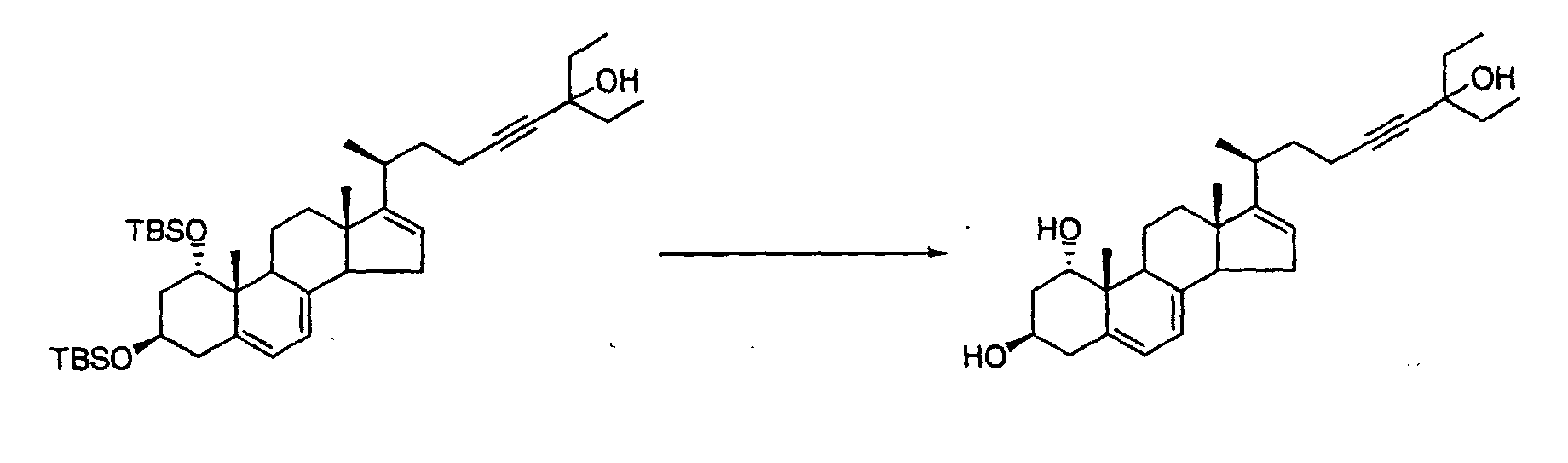
To a solution of 1α,3β-bis(t-butyldimethylsilyloxy)-20(S)-(5-ethyl-5-hydroxy-3-heptynyl)pregna-5,7,16-triene
(62.5 mg, 0.091 mmol) in tetrahydrofuran (1 ml), a 1M
tetrahydrofuran solution of tetra-n-butylammonium fluoride
(915 µl, 0.915 mmol) was added, followed by heating at
reflux for 6 hours. After cooling to room temperature, the
reaction mixture was diluted with ethyl acetate, washed
with water and saturated brine, and then dried over
anhydrous magnesium sulfate. After evaporation under
reduced pressure to remove the solvent, the resulting
residue was purified by silica gel column chromatography
(hexane:ethyl acetate = 1:1 and then 1:3) to give the
titled compound (38.0 mg, 92%) as a colorless oil.
1H NMR δ: 0.81(s, 3H), 0.98(s, 3H), 1.02(t, J=7.4Hz,
6H), 1.08(d, J=6.9Hz, 3H), 1.63(g, J=7.4Hz, 2H), 1.64(q,
J=7.4Hz, 2H), 2.50-2.61(m, 1H), 2.72-2.87(m, 1H), 3.73-3.83(br.
1H), 4.00-4.15(m, 1H), 5.39(brs, 1H), 5.41-5.50(m,
1H), 5.70-5.79(m, 1H).

1α,3β-Dihydroxy-20(S)-(5-ethyl-5-hydroxy-3-heptynyl)pregna-5,7,16-triene
(34.2 mg, 75.6 µmmol) was
dissolved in ethanol (200 ml). While bubbling with argon
at 0°C under stirring, the resulting solution was
irradiated with a 400 W high-pressure mercury lamp through
a Vycor filter for 3 minutes and 15 seconds, and then
heated at reflux for 2 hours. After cooling to room
temperature, the reaction mixture was evaporated under
reduced pressure to remove the solvent and the resulting
residue was purified by preparative thin layer
chromatography (0.5 mm × 1 plate, hexane:ethyl
acetate:ethanol = 10:10:1, developed twice; and then 0.25
mm × 1 plate, hexane:ethyl acetate:ethanol = 10:10:0.8,
developed three times) to give the titled compound (3.01 mg,
9%) as a colorless oil.
1H NMR δ: 0.71(s, 3H), 0.98-1.09(m, 8H), 1.608(q,
J=7.4Hz, 2H), 1.614(q, J=7.4Hz, 2H), 2.55-2.64(m, 1H),
2.78-2.87(m, 1H), 4.19-4.28(m, 1H), 4.39-4.48(m, 1H),
5.01(brs, 1H), 5.31-5.36(m, 2H), 6.10(d, J=11.2Hz, 1H),
6.38(d, J=11.2Hz, 1H). IR(neat): 3388, 2929, 2456, 1373,
1144, 1055 cm-1. MS m/z: 434(M+-H2O), 105(100%). UV λmax nm:
263.

To a solution of 20(S)-1α,3β-bis(t-butyldimethylsilyloxy)-23-(p-toluenesulfonyloxy)-24-norchola-5,7,16-triene
(816 mg, 1.10 mmol) in N,N-dimethylformamide
(15 ml), potassium cyanide (573 mg, 8.80
mmol) was added and stirred at 65°C for 2 hours. After
cooling to room temperature, the reaction mixture was
poured into water and extracted with ethyl acetate. The
extracted solution was washed with water and saturated
brine, and then dried over anhydrous magnesium sulfate.
After evaporation under reduced pressure to remove the
solvent, the resulting residue was purified by silica gel
column chromatography (hexane:ethyl acetate = 19:1) to give
the titled compound (641 mg, 98%) as a white foam.
1H NMR δ: 0.06(s, 3H), 0.07(s, 3H), 0.08(s, 3H),
0.12(s, 3H), 0.81(s, 3H), 0.886(s, 9H), 0.889(s, 9H),
0.94(s, 3H), 1.11(d, J=6.9Hz, 3H), 2.80-2.92(m, 1H), 3.69-3.72(m,
1H), 3.98-4.12(m, 1H), 5.36-5.45(m, 2H), 5.58-5.64(m,
1H).
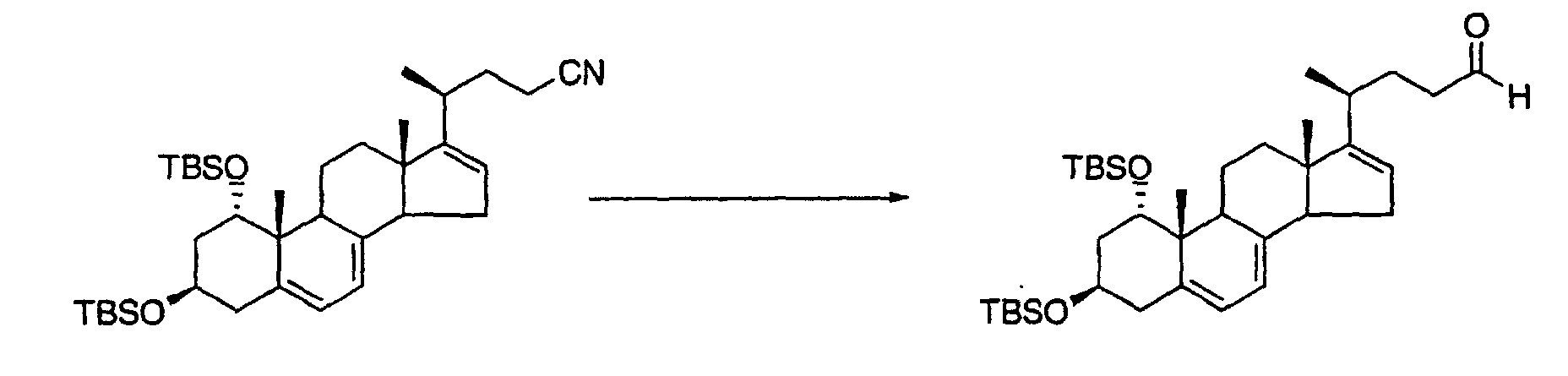
To a solution of 20(S)-1α,3β-bis(t-butyldimethylsilyloxy)-23-cyano-24-norchola-5,7,16-triene
(417 mg, 0.700 mmol) in dichloromethane (12 ml), a 1.01 M
toluene solution of diisobutylaluminum hydride (2.43 ml,
2.45 mmol) was added dropwise at -78°C and stirred at the
same temperature for 2.5 hours. Hydrochloric acid (0.5 M)
was poured into the reaction mixture, which was then
extracted with ethyl acetate. The extracted solution was
washed with saturated aqueous sodium bicarbonate and
saturated brine, and then dried over anhydrous magnesium
sulfate. After evaporation under reduced pressure to
remove the solvent, the resulting residue was purified by
silica gel column chromatography (hexane:ethyl acetate =
30:1) to give the titled compound (209 mg, 50%) as a
colorless oil.
1H NMR δ: 0.06(s, 3H), 0.068(s, 3H), 0.073(s, 3H),
0.11(s, 3H), 0.80(s, 3H), 0.89(s, 18H), 0.94(s, 3H), 1.08(d,
J=6.8Hz, 3H), 2.70-2.80(m, 1H), 3.68-3.73(m, 1H), 3.98-4.12(m,
1H), 5.36-5.44(m, 2H), 5.59-5.64(m, 1H), 9.77(br,
1H). IR(neat): 2956, 2856, 1728, 1462, 1373, 1255, 1097
cm-1. MS m/z: 598(M+), 409(100%). UV λmax nm: 270, 282, 294.
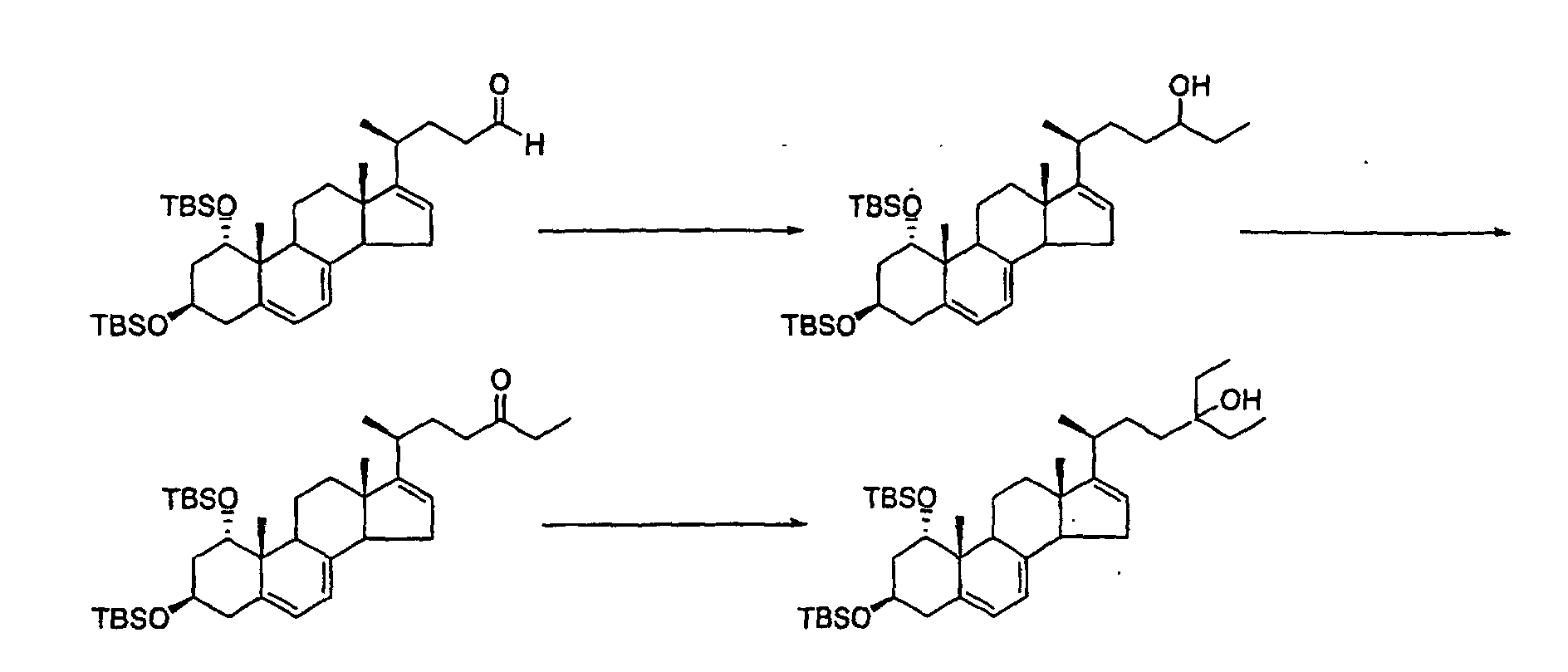
To a solution of 20(S)-1α,3β-bis(t-butyldimethylsilyloxy)chola-5,7,16-trien-24-al
(158 mg, 264
µmol) in tetrahydrofuran (2 ml), a 1.00 M tetrahydrofuran
solution of ethylmagnesium bromide (0.53 ml, 530 µmol) was
added dropwise at 0°C and stirred at room temperature for 1
hour. Saturated aqueous ammonium chloride was poured into
the reaction mixture, which was then extracted with ethyl
acetate. The extracted solution was washed with saturated
brine and dried over anhydrous magnesium sulfate. After
evaporation under reduced pressure to remove the solvent,
the resulting residue was purified by preparative thin
layer chromatography (0.5 mm × 3 plates, hexane:ethyl
acetate = 4:1, developed once) to give 1α,3β-bis(t-butyldimethyisilyloxy)-20(S)-(3-hydroxypentyl)pregna-5,7,16-triene
(150 mg, 90%) as a colorless oil. This oil
was dissolved in dichloromethane (2 ml) and mixed with 4-methylmorpholine-N-oxide
(42 mg, 35.7 µmol) and molecular
sieve 4A powder (500 mg), followed by stirring at room
temperature for 10 minutes. To this mixture, tetra-n-propylammonium
perruthenate (4.2 mg, 11.9 µmol) was added
and stirred at room temperature for 1.5 hours. After
insoluble products were filtered through Celite, the
filtrate was washed with semi-saturated aqueous sodium
sulfite and dried over anhydrous magnesium sulfate. After
evaporation under reduced pressure to remove the solvent,
the resulting residue was purified by preparative thin
layer chromatography (0.5 mm × 3 plates, hexane:ethyl
acetate = 9:1, developed once) to give 1α,3β-bis(t-butyldimethylsilyloxy)-20(S)-(3-oxopentyl)pregna-5,7,16-triene
(102 mg, 68%) as a colorless oil. This oil was
dissolved in tetrahydrofuran (2 ml) and mixed with a 1.00 M
tetrahydrofuran solution of ethylmagnesium bromide (0.32 ml,
320 µmol) at 0°C, followed by stirring at room temperature
for 1 hour. Saturated aqueous ammonium chloride was poured
into the reaction mixture, which was then extracted with
ethyl acetate. The extracted solution was washed with
saturated brine and dried over anhydrous magnesium sulfate.
After evaporation under reduced pressure to remove the
solvent, the resulting residue was purified by preparative
thin layer chromatography (0.5 mm × 2 plates, hexane:ethyl
acetate = 4:1, developed once) to give the titled compound
(73.0 mg, 69%) as a colorless oil.
1H NMR δ: 0.05(s, 3H), 0.07(s, 6H), 0.11(s, 3H),
0.80(s, 3H), 0.84(t, J=7.8Hz, 6H), 0.88(s, 9H), 0.89(s, 9H),
0.94(s, 3H), 1.07(d, J=6.7Hz, 3H), 1.45(q, J=7 .8Hz, 4H),
2.80-2.90(m, 1H), 3.68-3.73(m, 1H), 3.98-4.12(m, 1H), 5.35-5.42(m,
2H), 5.59-5.64(m, 1H). IR(neat): 2956, 2856, 1462,
1373, 1254, 1099 cm-1. MS m/z: 656(M+), 467(100%). UV λmax
nm: 270, 281, 293.
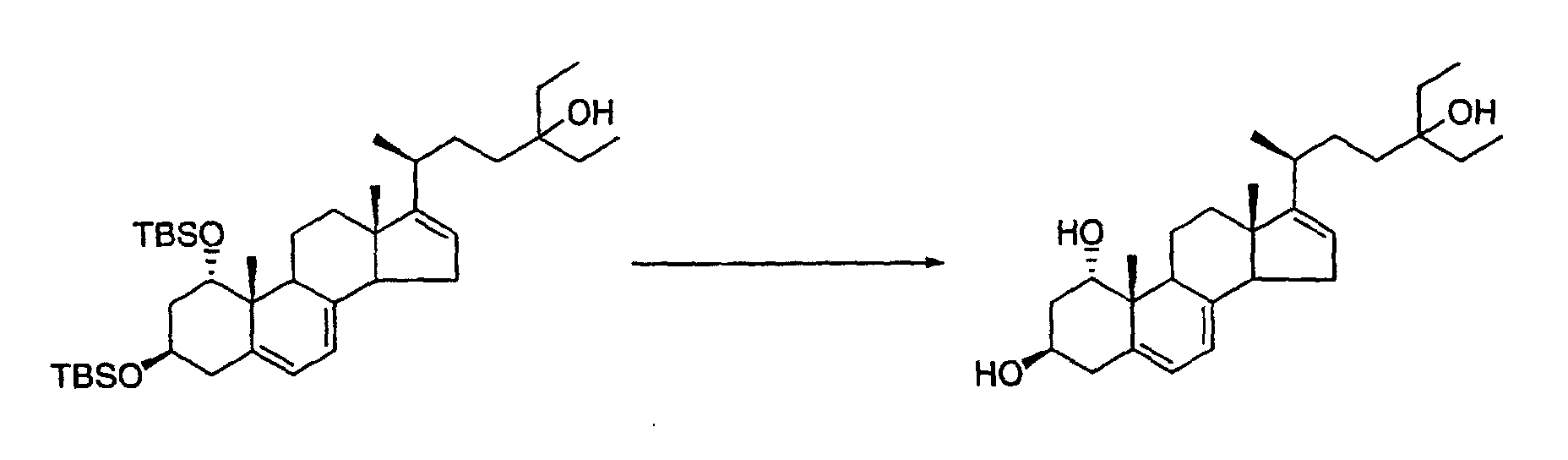
To a solution of 1α,3β-bis(t-butyldimethylsilyloxy)-20(S)-(3-ethyl-3-hydroxypentyl)pregna-5,7,16-triene
(64.0 mg, 97.4 µmol) in tetrahydrofuran (2 ml), a 1M
tetrahydrofuran solution of tetra-n-butylammonium fluoride
(0.97 ml, 970 µmol) was added and stirred at 60°C for 5.5
hours. After cooling to room temperature, the reaction
mixture was poured into water and extracted with ethyl
acetate. The extracted solution was washed with saturated
brine and dried over anhydrous magnesium sulfate. After
evaporation under reduced pressure to remove the solvent,
the resulting residue was purified by preparative thin
layer chromatography (0.5 mm × 2 plates,
dichloromethane:ethanol = 9:1; developed once) to give the
titled compound (44.6 mg, quant.) as a white solid.
1H NMR δ: 0.79(s, 3H), 0.84(t, J=7.5Hz, 3H), 0.85(t,
J=7.5Hz, 3H), 0.98(s, 3H), 1.08(d, J=6.9Hz, 3H), 1.45(q,
J=7.5Hz, 4H), 2.49-2.60(m, 1H), 2.72-2.86(m, 1H), 3.74-3.82(br,
1H), 4.00-4.16(m, 1H), 5.37(brs, 1H), 5.40-5.49(m,
1H), 5.69-5.77(m, 1H). IR(neat): 3348, 2969, 1458, 1367,
1147, 1057 cm-1. MS m/z: 428(M+), 285(100%). UV λ max nm: 270,
281, 293.

1α,3β-Dihydroxy-20(S)-(3-ethyl-3-hydroxypentyl)pregna-5,7,16-triene
(41.6 mg, 97.0 µmol) was
dissolved in ethanol (200 ml). While bubbling with argon
at 0°C under stirring, the resulting solution was
irradiated with a 400 W high-pressure mercury lamp through
a Vycor filter for 4 minutes, and then heated at reflux for
2 hours. After cooling to room temperature, the reaction
mixture was evaporated under reduced pressure to remove the
solvent and the resulting residue was purified by
preparative thin layer chromatography (0.5 mm × 2 plates.
dichloromethane:ethanol = 9:1, developed twice; and then
0.5 mm × 1 plate, hexane:ethyl acetate:ethanol = 5:5:0.3,
developed three times) to give the titled compound (3.51 mg,
8%) as a colorless oil.
1H NMR δ: 0.70(s, 3H), 0.85(t, J=7.5Hz, 6H), 1.06(d,
J=6.9Hz, 3H), 1.45(q, J=7.5Hz, 4H), 2.55-2.65(m, 1H), 2.76-2.88(m,
1H), 4.19-4.30(m, 1H), 4.40-4.50(m, 1H), 5.01(brs,
1H), 5.28-5.38(m, 2H), 6.11(d, J=11.2Hz, 1H), 6.38(d,
J=11.2Hz, 1H). IR(neat): 3367, 2931, 1456, 1373, 1288,
1146. 1055 cm-1. MS m/z: 428(M+). 134(100%). UV λmaxnm: 263.

1α,3β-Bis(t-butyldimethylsilyloxy)-16α-hydroxypregna-5,7,17(E)-triene
(511 mg, 0.914 mmol) was dissolved in
ethyl vinyl ether (11 ml), followed by addition of
mercury(II) acetate (233 mg, 0.731 mmol) and stirring at
room temperature for 40 hours. The reaction mixture was
poured into 5% aqueous potassium hydroxide and extracted
with hexane. The organic layer was washed with water and
saturated brine, dried over anhydrous sodium sulfate, and
then evaporated under reduced pressure to remove the
solvent. The resulting residue was dissolved in 1,3-dimethyl-2-imidazolidinone
(15 ml) and stirred at 110°C for
3 hours. After cooling to room temperature, the reaction
mixture was poured into water and extracted with ethyl
acetate. The organic layer was washed with water and
saturated brine, dried over anhydrous sodium sulfate, and
then evaporated under reduced pressure to remove the
solvent. The resulting residue was purified by silica gel
column chromatography (hexane:ethyl acetate = 5:1) to give
the titled compound (398 mg, 74%) as a white solid.
1H NMR δ: 0.06(s, 3H), 0.067(s, 3H), 0.074(s, 3H),
0.12(s, 3H), 0.81(s, 3H), 0.89(s, 18H), 0.94(s, 3H), 1.12(d,
J=6.6Hz, 3H), 3.70-3.75(m, 1H), 3.97-4.12(m, 1H), 5.34-5.42(m,
2H), 5.57-5.64(m, 1H), 9.68(t, J=2.1Hz, 1H).
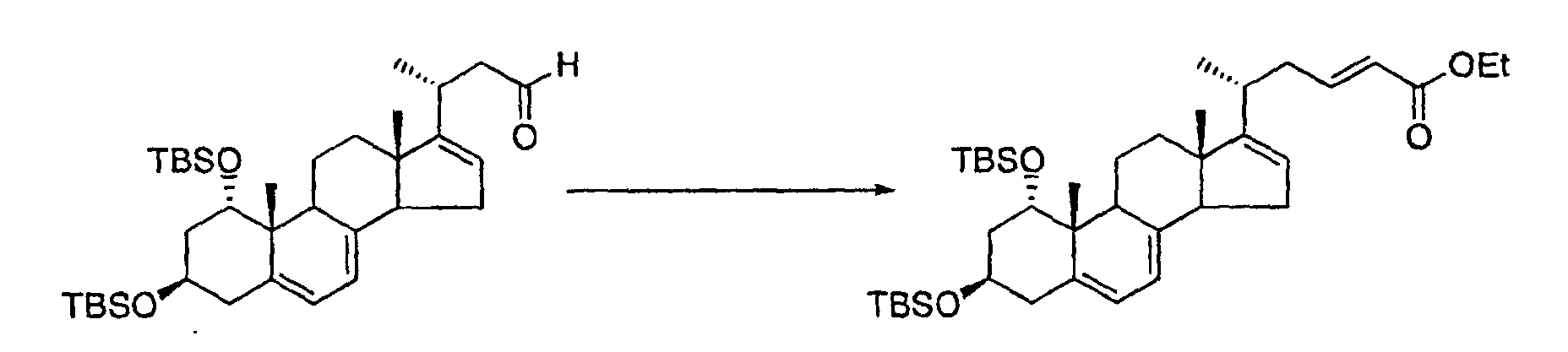
To a mixture of lithium bromide (22 mg, 0.253 mmol)
in tetrahydrofuran (0.5 ml), triethyl phosphonoacetate (52
µl, 0.260 mmol) was added and stirred at room temperature
for 5 minutes, followed by addition of triethylamine (36 µl,
0.258 mmol) and stirring at room temperature for 10 minutes.
To this reaction mixture, a solution of 20(R)-1α,3β-bis(t-butyldimethylsilyloxy)-24-norchola-5,7,16-trien-23-al
(100
mg, 0.171 mmol) in tetrahydrofuran (0.5 ml) was added and
stirred at room temperature for 3 hours. The reaction
mixture was diluted with ethyl acetate, washed with ice-cold
0.5 M hydrochloric acid, saturated aqueous sodium
bicarbonate and saturated brine, and then dried over
anhydrous sodium sulfate. After evaporation under reduced
pressure to remove the solvent, the resulting residue was
purified by silica gel column chromatography (hexane:ethyl
acetate = 10:1) to give the titled compound (113 mg,
quant.) as a colorless oil.
1H NMR δ: 0.06(s, 3H), 0.067(s, 3H), 0.072(s, 3H),
0.11(s, 3H), 0.79(s, 3H), 0.89(s, 18H), 0.94(s, 3H), 1.06(d,
J=6.3Hz, 3H), 1.28(t, J=7.2Hz, 3H), 2.81-2.91(m, 1H), 3.67-3.75(m,
1H), 3.98-4.12(m, 1H), 4.18(q, J=7.2Hz, 2H), 5.35-5.43(m,
2H), 5.57-5.65(m, 1H), 5.81(d, J=15.5Hz, 1H),
6.90(dt, J=15.5, 7.6Hz, 1H). MS m/z: 654 (M+), 465(100%).
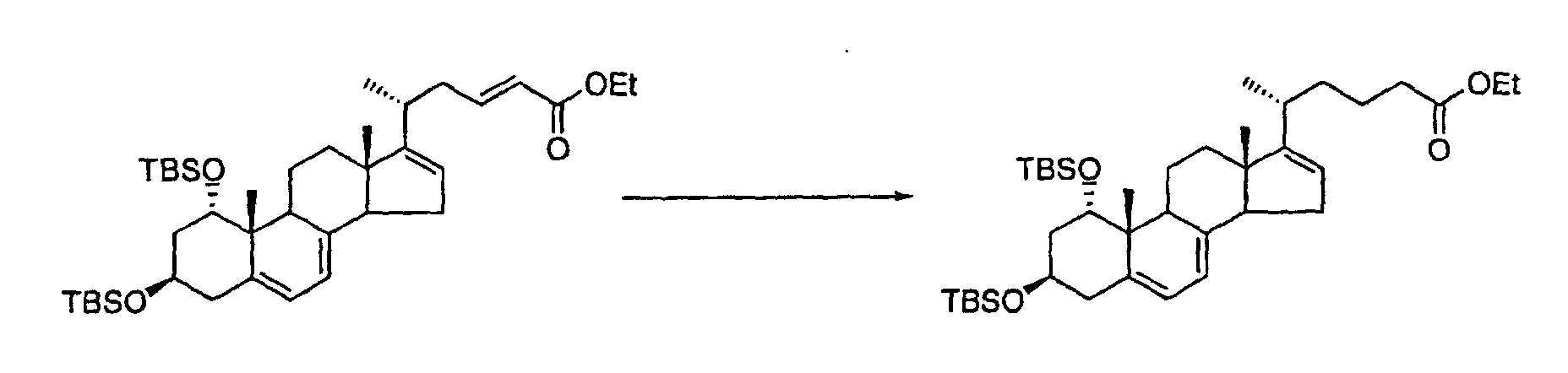
20(R)-1α,3β-Bis(t-butyldimethylsilyloxy)-24-ethoxycarbonylchola-5,7,16,23(E)-tetraene
(97.6 mg, 0.149
mmol), nickel(II) chloride hexahydrate (4 mg, 16.8 µmol),
tetrahydrofuran (1 ml) and methanol (3 ml) were mixed and
cooled to 0°C, followed by addition of sodium borohydride
(17 mg, 0.449 mmol). After stirring at room temperature
for 30 minutes, water and ethyl acetate were added to the
reaction mixture and insoluble products were filtered off.
The organic layer was washed with saturated brine and dried
over anhydrous sodium sulfate. After evaporation under
reduced pressure to remove the solvent, the resulting
residue was purified by silica gel column chromatography
(hexane:ethyl acetate = 10:1) to give the titled compound
(87.6 mg, 89%) as a colorless oil.
1H NMR δ: 0.06(s, 3H), 0.07(s, 6H), 0.11(s, 3H),
0.78(s, 3H), 0.89(s, 18H), 0.94(s, 3H), 1.03(d, J=6.9Hz,
3H), 1.25(t, J=7.2Hz, 3H), 2.80-2.91(m, 1H), 3.68-3.74(m,
1H), 3.98-4.12(m, 1H), 4.12(q, J=7.2Hz, 2H), 5.31-5.43(m,
2H), 5.55-5.64(m, 1H). MS m/z: 656(M+), 467(100%).
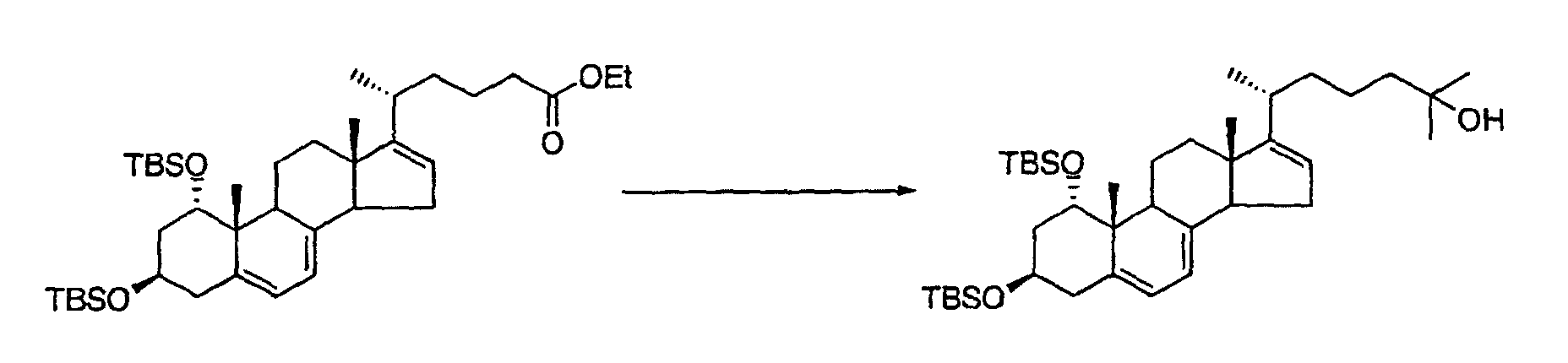
To a solution of 20(R)-1α,3β-bis(t-butyldimethylsilyloxy)-24-ethoxycarbonylchola-5,7,16-triene
(45.5 mg, 69.2 µmol) in tetrahydrofuran (1.5 ml), a 0.92 M
tetrahydrofuran solution of methylmagnesium bromide (0.8 ml,
736 µmol) was added dropwise at room temperature and
stirred at room temperature for 1 hour. After cooling to
0°C, saturated aqueous ammonium chloride was poured into
the reaction mixture, which was then extracted with ethyl
acetate. The extracted solution was washed with saturated
brine and dried over anhydrous sodium sulfate. After
evaporation under reduced pressure to remove the solvent,
the resulting residue was purified by silica gel column
chromatography (hexane:ethyl acetate = 2:1) to give the
titled compound (37.1 mg, 83%) as a colorless oil.
1H NMR δ: 0.05(s, 3H), 0.07(s, 6H), 0.11(s, 3H),
0.79(s, 3H), 0.88(s, 18H), 0.94(s, 3H), 1.03(d, J=6.6Hz,
3H), 1.20(s, 6H), 2.80-2.91(m, 1H), 3.67-3.74(m, 1H), 3.98-4.12(m,
1H), 5.30-5.42(m, 2H), 5.57-5.64(m, 1H). MS m/z:
642(M+). 453(100%).

To a solution of 20(R)-1α,3β-bis(t-butyldimethylsilyloxy)-25-hydroxycholesta-5,7,16-triene
(22.0 mg, 34.2 µmol) in tetrahydrofuran (3 ml), a 1M
tetrahydrofuran solution of tetra-n-butylammonium fluoride
(0.51 ml, 510 µmol) was added, followed by heating at
reflux for 3.5 hours. After cooling to room temperature,
the reaction mixture was diluted with ethyl acetate, washed
with saturated aqueous sodium bicarbonate and saturated
brine, and then dried over anhydrous sodium sulfate. After
evaporation under reduced pressure to remove the solvent,
the resulting residue was purified by silica gel column
chromatography (chloroform:methanol = 10:1) to give the
titled compound (15.8 mg, quant.) as a white solid.
1H NMR δ: 0.80(s, 3H), 0.98(s, 3H), 1.03(d, J=6.6Hz,
3H), 1.20(s, 6H), 2.49-2.61(m, 1H), 2.74-2.85(m, 1H), 3.75-3.83(m,
1H), 3.98-4.16(m, 1H), 5.31-5.37(br, 1H), 5.42-5.49(m,
1H), 5.71-5.79(m, 1H).

20(R)-1α,3β,25-Trihydroxycholesta-5,7,16-triene (36.4
mg, 87.8 µmol) was dissolved in ethanol (200 ml). While
bubbling with argon at 0°C under stirring, the resulting
solution was irradiated with a 400 W high-pressure mercury
lamp through a Vycor filter for 3 minutes and 15 seconds,
and then heated at reflux for 2 hours. After cooling to
room temperature, the reaction mixture was evaporated under
reduced pressure to remove the solvent and the resulting
residue was purified by preparative thin layer
chromatography (0.5 mm × 1 plate, hexane:ethyl
acetate: ethanol = 10:10:1, developed twice; and then 0.25
mm × 1 plate, dichloromethane:ethyl acetate:ethanol =
7:3:0.5, developed three times) to give the titled compound
(4.30 mg, 12%) as a colorless oil.
1H NMR δ: 0.69(s, 3H), 1.03(d, J=6.7Hz, 3H), 1.20(s,
6H), 2.57-2.65(m, 1H), 2.76-2.88(m, 1H), 4.17-4.29(m, 1H),
4.39-4.49(m, 1H), 5.02(brs, 1H), 5.29(brs, 1H), 5.34(brs,
1H), 6.11(d, J=11.2Hz, 1H), 6.38(d, J=11.2Hz, 1H).
IR(neat): 3367, 2964, 1450, 1367, 1207, 1151, 1054 cm-1. MS
m/z: 414(M+), 134(100%). UV λmax nm: 263.

To a solution of 20(R)-1α,3β-bis(t-butyldimethylsilyloxy)-24-ethoxycarbonylchola-5,7,16-triene
(30.0 mg, 45.7 µmol) in tetrahydrofuran (1.5 ml), a 1.00 M
tetrahydrofuran solution of ethylmagnesium bromide (0.46 ml,
460 µmol) was added dropwise at room temperature and
stirred at room temperature for 1 hour. After cooling to
0°C, saturated aqueous ammonium chloride was poured into
the reaction mixture, which was then extracted with ethyl
acetate. The extracted solution was washed with saturated
brine and dried over anhydrous sodium sulfate. After
evaporation under reduced pressure to remove the solvent,
the resulting residue was purified by silica gel column
chromatography (hexane:ethyl acetate = 4:1) to give the
titled compound (30.4 mg, 99%) as a colorless oil.
1H NMR δ: 0.05(s, 3H), 0.066(s, 3H), 0.070(s, 3H),
0.11(s, 3H), 0.79(s, 3H), 0.85(t, J=7.6Hz, 6H), 0.88(s,
18H), 0.94(s, 3H), 1.03(d, J=6.9Hz, 3H), 1.45(q, J=7.6Hz,
4H), 2.78-2.92(m, 1H), 3.68-3.75(br, 1H), 3.98-4.12(m, 1H),
5.33(br, 1H), 5.34-5.42(m, 1H), 5.56-5.65(m, 1H). MS m/z:
670(M+), 481(100%).
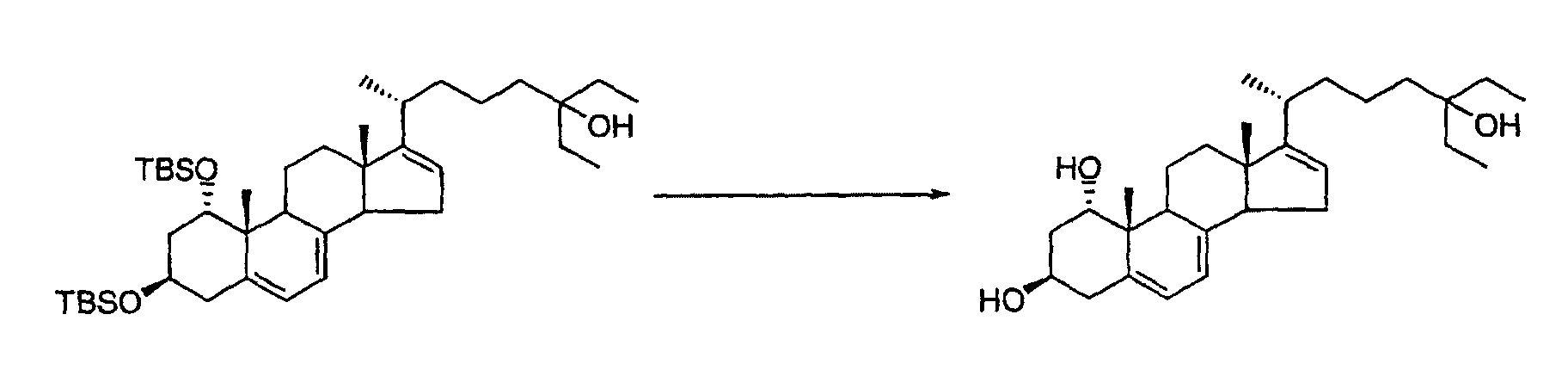
To a solution of 20(R)-1α,3β-bis(t-butyldimethylsilyloxy)-25-hydroxy-26,27-bishomocholesta-5,7,16-triene
(17.5 mg, 26.1 µmol) in tetrahydrofuran (3
ml), a 1M tetrahydrofuran solution of tetra-n-butylammonium
fluoride (0.32 ml, 320 µmol) was added, followed by heating
at reflux for 3.5 hours. After cooling to room temperature,
the reaction mixture was diluted with ethyl acetate, washed
with saturated aqueous sodium bicarbonate and saturated
brine, and then dried over anhydrous sodium sulfate. After
evaporation under reduced pressure to remove the solvent,
the resulting residue was purified by silica gel column
chromatography (chloroform:methanol = 10:1) to give the
titled compound (13.6 mg, quant.) as a colorless foam.
1H NMR δ: 0.80(s, 3H), 0.85(t, J=7.5Hz, 6H), 0.98(s,
3H), 1.02(d, J=6.9Hz, 3H), 1.44(q, J=7.5Hz, 4H), 2.49-2.61(m,
1H), 2.73-2.85(m, 1H), 3.72-3.83(br, 1H), 3.98-4.15(m,
1H), 5.33(brs, 1H), 5.42-5.51(m, 1H), 5.61-5.69(m,
1H).
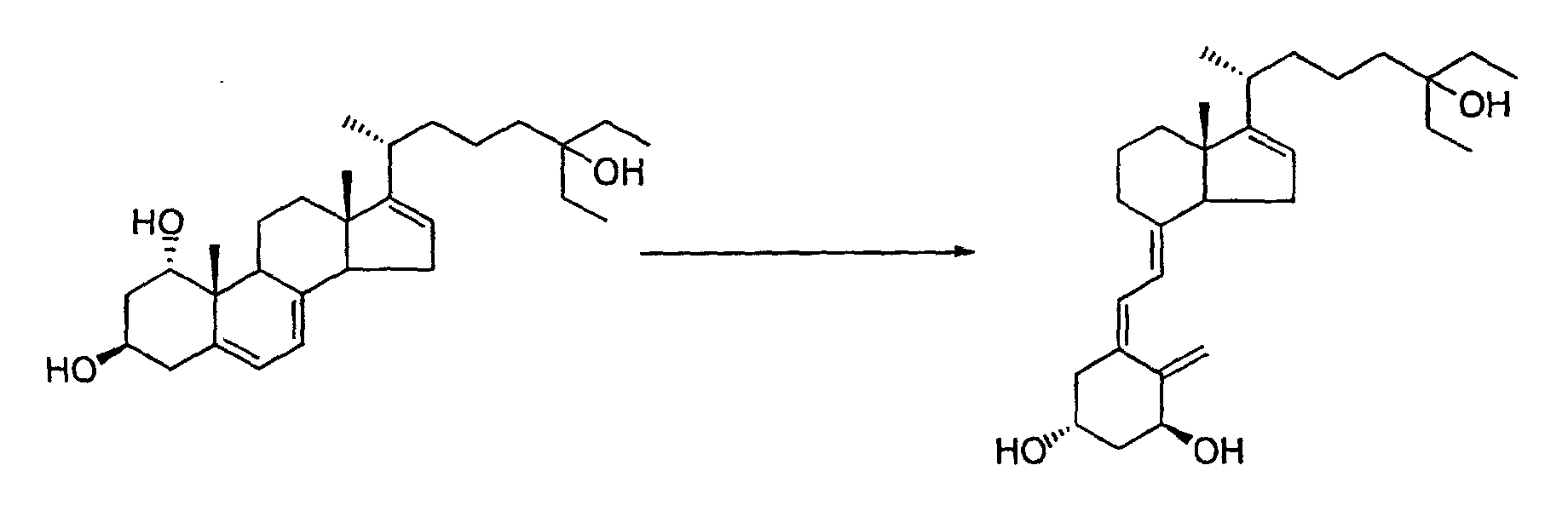
20(R)-1α,3β,25-Trihydroxy-26,27-bishomocholesta-5,7,16-triene
(45.5 mg, 103 µmol) was dissolved in ethanol
(200 ml). While bubbling with argon at 0°C under stirring,
the resulting solution was irradiated with a 400 W high-pressure
mercury lamp through a Vycor filter for 3 minutes
and 45 seconds, and then heated at reflux for 2 hours.
After cooling to room temperature, the reaction mixture was
evaporated under reduced pressure to remove the solvent and
the resulting residue was purified by preparative thin
layer chromatography (0.5 mm × 1 plate, hexane:ethyl
acetate:ethanol = 10:10:1, developed twice; and then 0.25
mm × 1 plate, dichloromethane:ethyl acetate:ethanol =
7:3:0.5, developed three times) to give the titled compound
(5.76 mg, 13%) as a colorless oil.
1H NMR δ: 0.69(s, 3H), 0.85(t, J=7.5Hz, 6H), 1.02(d,
J=6.9Hz, 3H), 1.44(q, J=7.5Hz, 4H), 2.54-2. 66(m, 1H), 2.76-2.88(m,
1H), 4.17-4.30(br, 1H), 4.38-4.50(br, 1H), 5.02(brs,
1H), 5.29(brs, 1H), 5.34(brs, 1H), 6.11(d, J=11.3Hz, 1H),
6.38(d, J=11.3Hz, 1H). IR(neat): 3381, 2962, 1460, 1369,
1146, 1055 cm-1. MS m/z: 442(M+), 134(100%). UV λmax nm: 263.

To a mixture of lithium bromide (61.3 mg, 0.707 mmol)
in tetrahydrofuran (3 ml), triethyl phosphonoacetate (113
µl, 0.566 mmol) was added at 0°C and stirred at 0°C for
5 minutes, followed by addition of triethylamine (98.9 µl,
0.707 mmol) and stirring at 0°C for 10 minutes. To this
reaction mixture, a solution of 20(S)-1α,3β-bis(t-butyldimethylsilyloxy)-24-norchola-5,7,16-trien-23-al
(276 mg, 0.471 mmol) in tetrahydrofuran (3 ml) was added
and stirred at room temperature for 3 hours. Water was
added to the reaction mixture, which was then extracted
with ethyl acetate. The extracted solution was washed with
ice-cold 0.5 M hydrochloric acid, saturated aqueous sodium
bicarbonate and saturated brine, and then dried over
anhydrous magnesium sulfate. After evaporation under
reduced pressure to remove the solvent, the resulting
residue was purified by silica gel column chromatography
(hexane:ethyl acetate = 25:1) to give the titled compound
(301 mg, 98%) as a colorless oil.
1H NMR δ: 0.06(s, 3H), 0.07(s, 3H), 0.08(s, 3H),
0.12(s, 3H), 0.81(s, 3H), 0.89(s, 18H), 0.95(s, 3H), 1.06(d,
J=5.6Hz, 3H), 1.28(t, J=7.2Hz, 3H), 2.80-2.92(m, 1H),
3.68-3.76(br, 1H), 3.98-4.12(m, 1H), 4.18(q, J=7.2Hz, 2H),
5.35-5.45(m, 2H), 5.66-5.75(m, 1H), 5.81(d, J=15.2Hz, 1H),
6.92(dt, J=15.2, 7.5Hz, 1H).

20(S)-1α,3β-Bis(t-butyldimethylsilyloxy)-24-ethoxycarbonylchola-5,7,16,23(E)-tetraene
(205 mg, 0.312
mmol), nickel(II) chloride hexahydrate (14.8 mg, 62 µmol),
tetrahydrofuran (2 ml) and methanol (6 ml) were mixed and
cooled to 0°C, followed by addition of sodium borohydride
(39.4 mg, 0.936 mmol). After stirring at room temperature
for 30 minutes, water and ethyl acetate were added to the
reaction mixture and insoluble products were filtered off.
The organic layer was washed with saturated brine and dried
over anhydrous magnesium sulfate. After evaporation under
reduced pressure to remove the solvent, the resulting
residue was purified by silica gel column chromatography
(hexane:ethyl acetate = 15:1) to give the titled compound
(197 mg, 96%) as a colorless oil.
1H NMR δ: 0.06(s, 3H), 0.067(s, 3H), 0.074(s, 3H),
0.11(s. 3H), 0.80(s, 3H), 0.89(s, 18H), 0.94(s, 3H), 1.07(d,
J=6.9Hz, 3H), 1.25(t, J=7.1Hz, 3H), 2.79-2.91(m, 1H), 3.67-3.75(br,
1H), 3.98-4.14(m, 1H), 4.12(q, J=7.1Hz, 2H), 5.31-5.42(m,
2H), 5.55-5.63(m, 1H).

To a solution of 20(S)-1α,3β-bis(t-butyldimethylsilyloxy)-24-ethoxycarbonylchola-5,7,16-triene
(115 mg, 0.175 mmol) in tetrahydrofuran (5 ml), a 0.92 M
tetrahydrofuran solution of methylmagnesium bromide (1.91
ml, 1.76 mmol) was added dropwise at 0°C and stirred at 0°C
for 30 minutes, followed by 1 hour at room temperature.
After cooling to 0°C, ice-cold water was poured into the
reaction mixture, which was then extracted with ethyl
acetate. The extracted solution was washed with saturated
brine and dried over anhydrous magnesium sulfate. After
evaporation under reduced pressure to remove the solvent,
the resulting residue was purified by silica gel column
chromatography (hexane:ethyl acetate = 12:1) to give the
titled compound (66.4 mg, 59%) as a colorless oil.
1H NMR δ: 0.06(s, 3H), 0.067(s, 3H), 0.073(s, 3H),
0.11(s, 3H), 0.80(s, 3H), 0.89(s, 18H), 0.95(s, 3H), 1.06(d,
J=6.9Hz, 3H), 1.20(s, 6H), 2.78-2.91(m, 1H), 3.68-3.75(br,
1H), 3.98-4.12(m, 1H), 5.32-5.45(m, 2H), 5.56-5.78(m, 1H).
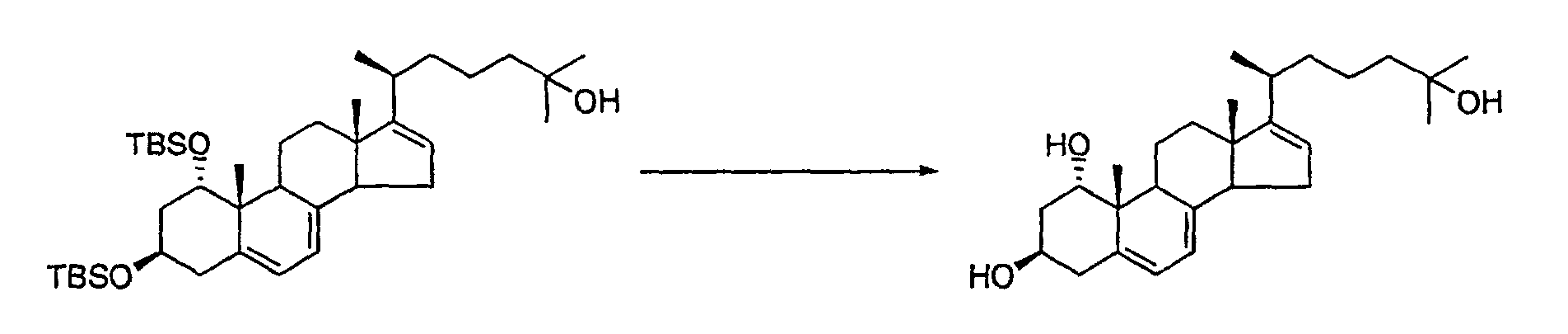
To a solution of 20(S)-1α,3β-bis(t-butyldimethylsilyloxy)-25-hydroxycholesta-5,7,16-triene
(66.4 mg, 0.103 mmol) in tetrahydrofuran (2 ml), a 1M
tetrahydrofuran solution of tetra-n-butylammonium fluoride
(1.03 ml, 1.03 mmol) was added, followed by heating at
reflux for 6 hours. After cooling to room temperature, the
reaction mixture was diluted with ethyl acetate, washed
with water and saturated brine, and then dried over
anhydrous magnesium sulfate. After evaporation under
reduced pressure to remove the solvent, the resulting
residue was purified by silica gel column chromatography
(chloroform:ethyl acetate = 2:1) to give the titled
compound (35.0 mg, 82%) as a white solid.
1H NMR δ: 0.81(s, 3H), 0.99(s, 3H), 1.07(d, J=6.9Hz,
3H), 1.21(s, 6H), 2.50-2.61(m, 1H), 2.73-2.85(m, 1H), 3.75-3.83(br,
1H), 3.98-4.16(m, 1H), 5.31-5.37(br, 1H), 5.42-5.50(m,
1H), 5.71-5.79(m, 1H).

20(s)-1α,3β,25-Trihydroxycholesta-5,7,16-triene (32.2
mg, 77.7 µmol) was dissolved in ethanol (200 ml). While
bubbling with argon at 0°C under stirring, the resulting
solution was irradiated with a 400 W high-pressure mercury
lamp through a Vycor filter for 3 minutes and 15 seconds,
and then heated at reflux for 2 hours. After cooling to
room temperature, the reaction mixture was evaporated under
reduced pressure to remove the solvent and the resulting
residue was purified by preparative thin layer
chromatography (0.5 mm × 1 plate, hexane:ethyl
acetate:ethanol = 10:10:1, developed three times; and then
0.25 mm × 1 plate, dichloromethane:ethyl acetate:ethanol =
7:3:0.5, developed twice) to give the titled compound (3.77
mg, 12%) as a colorless oil.
1H NMR δ: 0.70(s, 3H), 1.05(d, J=6.8Hz, 3H), 1.21(s,
6H), 2.55-2.66(m, 1H), 2.76-2.87(m, 1H), 4.19-4.30(m, 1H),
4.40-4.50(m, 1H), 5.01(brs. 1H), 5.30-5.39(m, 2H), 6.11(d,
J=11.2Hz, 1H), 6.38(d, J=11.2Hz, 1H). IR(neat): 3365, 2931,
1464, 1367, 1207, 1153, 1055 cm-1. MS m/z: 414(M+),
133(100%). UV λmax nm: 263.

To a solution of 20(S)-1α,3β-bis(t-butyldimethylsilyloxy)-24-ethoxycarbonylchola-5,7,16-triene
(82.1 mg, 125 µmol) in tetrahydrofuran (5 ml), a 1.04 M
tetrahydrofuran solution of ethylmagnesium bromide (1.20 ml,
1.25 mmol) was added dropwise at room temperature and
stirred at room temperature for 1 hour. The reaction
mixture was poured into ice-cold water and extracted with
ethyl acetate. The extracted solution was washed with
saturated brine and dried over anhydrous magnesium sulfate.
After evaporation under reduced pressure to remove the
solvent, the resulting residue was purified by silica gel
column chromatography (hexane:ethyl acetate = 12:1) to give
the titled compound (63.5 mg, 76%) as a colorless oil.
1H NMR δ: 0.06(s, 3H), 0.068(s, 3H), 0.073(s, 3H),
0.11(s, 3H), 0.80(s, 3H), 0.85(t, J=7.5Hz, 6H), 0.89(s,
18H), 0.95(s, 3H), 1.06(d, J=6.9Hz, 3H), 1.45(q, J=7.5Hz,
4H), 2.79-2.91(m, 1H), 3.67-3.76(br, 1H), 3.97-4.12(m, 1H),
5.28-5.44(m, 2H), 5.56-5.66(m, 1H).
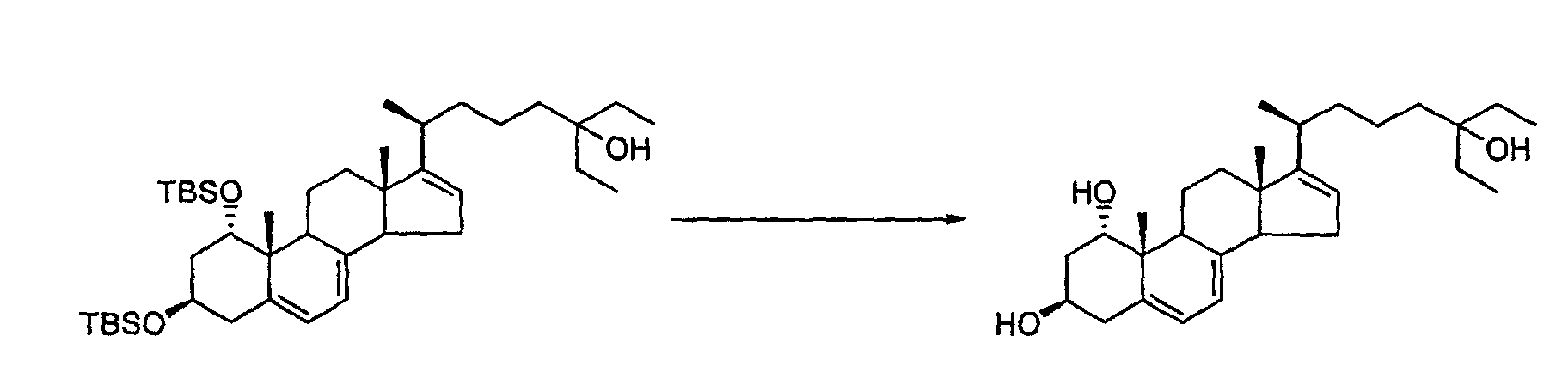
To a solution of 20(S)-1α,3β-bis(t-butyldimethylsilyloxy)-25-hydroxy-26,27-bishoniocholesta-5,7,16-triene
(63.5 mg, 94.6 µmol) in tetrahydrofuran (2
ml), a 1M tetrahydrofuran solution of tetra-n-butylammonium
fluoride (0.95 ml, 950 µmol) was added, followed by heating
at reflux for 4 hours. After cooling to room temperature,
the reaction mixture was diluted with ethyl acetate, washed
with water and saturated brine, and then dried over
anhydrous magnesium sulfate. After evaporation under
reduced pressure to remove the solvent, the resulting
residue was purified by silica gel column chromatography
(hexane:ethyl acetate = 1:1 and then 1:3) to give the
titled compound (39.6 mg, 94%) as a white solid.
1H NMR δ: 0.81(s, 3H), 0.85(t, J=7.5Hz, 6H), 0.98(s,
3H), 1.07(d, J=6.9Hz, 3H), 1.45(q, J=7.5Hz, 4H), 2.49-2.61(m,
1H), 2.71-2.85(m, 1H), 3.74-3.83(br, 1H), 3.99-4.15(m,
1H), 5.36(brs, 1H), 5.41-5.50(m, 1H), 5.70-5.80(m
1H).
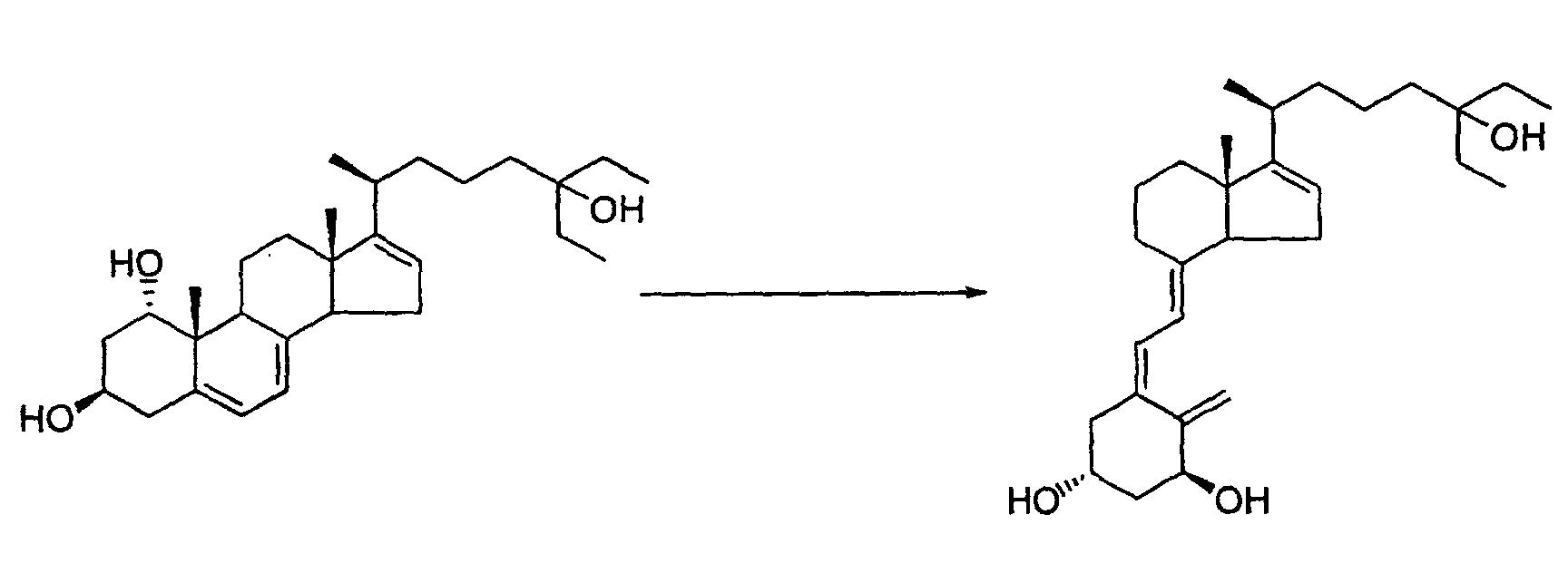
20(S)-1α,3β,25-Trihydroxy-26,27-bishomocholesta-5,7,16-triene
(32.7 mg, 73.9 µmol) was dissolved in ethanol
(200 ml). While bubbling with argon at 0°C under stirring,
the resulting solution was irradiated with a 400 W high-pressure
mercury lamp through a Vycor filter for 3 minutes
and 15 seconds, and then heated at reflux for 2 hours.
After cooling to room temperature, the reaction mixture was
evaporated under reduced pressure to remove the solvent and
the resulting residue was purified by preparative thin
layer chromatography (0.5 mm × 1 plate, hexane:ethyl
acetate:ethanol = 10:10:1, developed twice; and then 0.25
mm × 1 plate, dichloromethane:ethyl acetate:ethanol =
7:3:0.5, developed twice) to give the titled compound (4.00
mg, 12%) as a colorless oil.
1H NMR δ: 0.70(s, 3H), 0.86(t, J=7.4Hz, 6H), 1.05(d,
J=6.9Hz, 3H), 1.46(q, J=7.4Hz, 4H), 2.55-2.68(m, 1H), 2.76-2.89(m,
1H), 4.18-4.30(br, 1H), 4.39-4.50(br, 1H), 5.01(brs,
1H). 5.28-5.38(m, 2H), 6.11(d, J=11.2Hz, 1H), 6.38(d,
J=11.2Hz, 1H). IR(neat): 3373, 2933, 1458, 1373, 1146,
1055 cm-1. MS m/z: 442(M+), 133(100%). UV λmax nm: 263.
The compounds of the present invention were evaluated
for their effects on bone mineral density and blood calcium
(Ca) level in osteoporosis rat model. The following
compounds were tested: 1α,3β-dihydroxy-20(S)-(3-ethyl-3-hydroxypentyl)-9,10-secopregna-5,7,10(19),16-tetraene
from
Example 11 (hereinafter referred to as "Compound 1") and
1α,3β-dihydroxy-20(S)-(5-ethyl-5-hydroxy-3-heptyny)-9,(0-secopregna-5,7,10(19),16-tetraene
from Example 6
(hereinafter referred to as "Compound 2").
Nine-month-old W-I female rats (Imamichi Institute
for Animal Reproduction) were ovariectomized to remove both
ovaries. From the following day, Compound 1 or Compound 2
was orally administered every day for 8 weeks. Compound 1
was given in an amount of 0.5 µg/kg, 1 µg/kg or 2 µg/kg per
day in two divided doses, while Compound 2 was given in an
amount of 0.125 µg/kg, 0.25 µg/kg or 0.5 µg/kg per day in
two divided doses. Twenty-four hours after the last
administration, blood was drawn from each rat under ether
anesthesia. The rats were then euthanized and their femurs
were isolated.
The femur bone mineral density was measured using a
dual X-ray bone mineral densitometer (DCS-600EX, ALOKA).
The blood calcium (Ca) level was measured with a HITACHI
automatic analyzer (Model 7170, Hitachi). For comparison
purposes, both groups of sham operation (sham) and
ovariectomy (OVX; in which rats were ovariectomized only,
not followed by administration of test compounds) were
similarly assayed for their blood calcium (Ca) level and
bone mineral density by isolating their femurs.
Statistical processing was carried out using a
software package of Statistic Analysis System (SAS). A
comparison between sham operation (sham) and ovariectomy
(OVX) groups was made by an unpaired t-test, while a
comparison between OVX and drug treatment groups was made
by Dunnett's multiple test. A P-value less than 5% was
defined as a significant difference.
The results obtained are shown in Figures 1(a) and
1(b), which demonstrate blood Ca level and femur bone
mineral density, respectively. All values are expressed as
mean ± S.E. In the figures, * denotes a significant
difference from the OVX group at p<0.05 and N.S. denotes no
significant difference.
The femur bone mineral density significantly
decreased in the OVX group as compared to the sham group.
By treatment with Compound 1 at 1 µg/kg and 2 µg/kg, the
OVX-induced decrease in bone mineral density was
significantly suppressed and the level of bone mineral
density remained as high as in the sham group. Likewise,
by treatment with Compound 2 at 0.125 µg/kg and 0.5 µg/kg,
the OVX-induced decrease in bone mineral density was
significantly suppressed and the level of bone mineral
density remained as high as in the sham group.
In contrast, blood calcium-increasing effect was not
observed for Compounds 1 and 2 in amounts where they were
found to suppress the decrease in bone mineral density.
Seven- to nine-week-old W-I female rats (Imamichi
Institute for Animal Reproduction) were ovariectomized to
remove both ovaries. From the following day, 1α,25-dihydroxyvitamin
D3 was subcutaneously administered 5 times
a week for 6 weeks in an amount of 0.01 to 0.04 µg/kg per
dose. After the last administration, 24-hour urine was
sampled from each rat and blood was drawn under ether
anesthesia. The rats were then euthanized and their lumbar
vertebrae were isolated.
The lumbar bone mineral density was measured at the
third lumbar vertebra site using a dual X-ray bone mineral
densitometer (DCS-600, ALOKA). The blood and urinary
calcium levels and the urinary creatinine level were
measured with a HITACHI automatic analyzer (Model 7170,
Hitachi).
Statistical processing was carried out using a
software package of Statistic Analysis System (SAS). A
comparison between sham operation (sham) and ovariectomy
(OVX) groups was made by an unpaired t-test, while a
comparison between OVX and drug treatment groups or between
sham and drug treatment groups was made by Dunnett's
multiple test. A P-value less than 5% was defined as a
significant difference.
The results obtained are shown in Figures 2(a) to
2(c), which demonstrate urinary Ca excretion, blood Ca
level and bone mineral density, respectively, in treatment
experiments with 1α,25-dihydroxyvitamin D3 (1,25(OH)2D3).
The bone mineral density of each rat was calculated as
percentage (%) relative to the mean bone mineral density
for the sham group (=100%). All values are expressed as
mean ± S.E. In the figures, * denotes a significant
difference from the OVX group at p<0.05 and # denotes a
significant difference from the sham group at p<0.05. N.S.
denotes no significant difference.
In the OVX group, the lumbar bone mineral density
decreased by about 12%. By treatment with 1α,25-dihydroxyvitamin
D3 at 0.04 µg/kg, on the other hand, the
OVX-induced decrease in bone mineral density was
significantly suppressed. However, 1α,25-dihydroxyvitamin
D3 at 0.04 µg/kg significantly increased both the blood Ca
level and the urinary Ca excretion, as compared to the sham
and OVX groups. Thus, 1α,25-dihydroxyvitamin D3 was found
to have an effect on bone mineral density simultaneously
with blood and urinary calcium-increasing effects. Similar
results were observed in oral administration (0.1 µg/kg).
The compounds of the present invention are useful as
therapeutic agents for osteoporosis because they have an
excellent bone mass-increasing effect, but almost no blood
calcium-increasing effect.
Claims (13)
- A therapeutic agent for osteoporosis which comprises, as an active ingredient, a compound of Formula (1):wherein
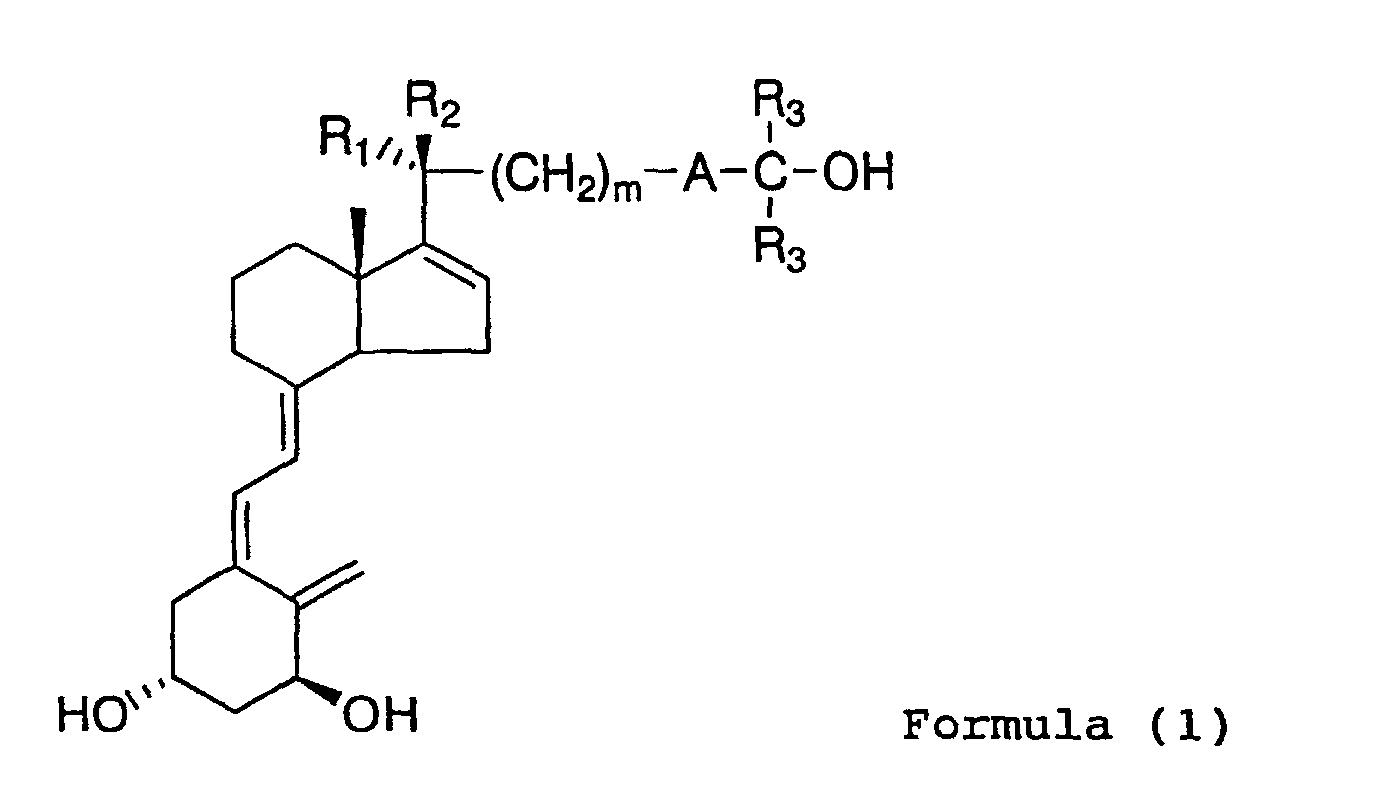 R1 and R2 each represent a hydrogen atom or a methyl group,R3 represents a C1-C4 alkyl group which may be substituted with a fluorine atom,m represents an integer of 0 to 3, andA represents -CH2-CH2-, -CH=CH- or -C≡C-.
- The therapeutic agent for osteoporosis according to claim 1, which comprises, as an active ingredient, a compound of Formula (1) wherein R1 is a hydrogen atom and R2 is a methyl group.
- The therapeutic agent for osteoporosis according to claim 1, which comprises, as an active ingredient, a compound of Formula (1) wherein R1 is a hydrogen atom, R2 is a methyl group, R3 represents a C1-C3 alkyl group which may be substituted with a fluorine atom, m represents an integer of 0 to 3, and A is -CH=CH- or -C≡C-.
- The therapeutic agent for osteoporosis according to claim 1. which comprises, as an active ingredient, a compound of Formula (1) wherein R1 is a hydrogen atom, R2 is a methyl group, R3 represents a C1-C3 alkyl group, m represents an integer of 2 or 3, and A is -CH=CH- or -C≡C-.
- The therapeutic agent for osteoporosis according to claim 1, wherein the compound of Formula (1) is 1α,3β-dihydroxy-20(S)-(5-ethyl-5-hydroxy-3-heptynyl)-9,10-secopregna-5,7,10(19),16-tetraene.
- The therapeutic agent for osteoporosis according to claim 1, which comprises, as an active ingredient, a compound of Formula (1) wherein R1 is a hydrogen atom, R2 is a methyl group, R3 represents a C1-C3 alkyl group which may be substituted with a fluorine atom, m represents an integer of 0 to 3, and A is -CH2-CH2-.
- The therapeutic agent for osteoporosis according to claim 1, which comprises, as an active ingredient, a compound of Formula (1) wherein R1 is a hydrogen atom, R2 is a methyl group, R3 represents a C1-C3 alkyl group, m represents 0, and A is -CH2-CH2-.
- The therapeutic agent for osteoporosis according to claim 1, wherein the compound of Formula (1) is 1α,3β-dihydroxy-20(S)-(3-ethyl-3-hydroxypentyl)-9,10-secopregna-5,7,10(19),16-tetraene.
- A vitamin D derivative of the following Formula (2):wherein
 R1 and R2 each represent a hydrogen atom or a methyl group,R3 represents a C1-C4 alkyl group which may be substituted with a fluorine atom,m represents an integer of 2 or 3, andA represents -CH=CH- or -C≡C-.
- The vitamin D derivative according to claim 9, wherein in Formula (2), R1 is a hydrogen atom and R2 is a methyl group.
- The vitamin D derivative according to claim 9, wherein the compound of Formula (2) is 1α,3β-dihydroxy-20(S)-(5-ethyl-5-hydroxy-3-heptynyl)-9,10-secopregna-5,7,10(19),16-tetraene.
- A pharmaceutical composition comprising the vitamin D derivative according to any one of claims 9 to 11 as an active ingredient.
- A method for treating osteoporosis, which comprises the step of administering to a patient in need of such treatment a therapeutically effective amount of a compound of Formula (1):wherein
 R1 and R2 each represent a hydrogen atom or a methyl group,R3 represents a C1-C4 alkyl group which may be substituted with a fluorine atom,m represents an integer of 0 to 3, andA represents -CH2-CH2-, -CH=CH- or -C≡C-.
Applications Claiming Priority (3)
| Application Number | Priority Date | Filing Date | Title |
|---|---|---|---|
| JP2000247171 | 2000-08-17 | ||
| JP2000247171 | 2000-08-17 | ||
| PCT/JP2001/007051 WO2002013832A1 (en) | 2000-08-17 | 2001-08-16 | Remedial agent for osteoporosis |
Publications (2)
| Publication Number | Publication Date |
|---|---|
| EP1314427A1 true EP1314427A1 (en) | 2003-05-28 |
| EP1314427A4 EP1314427A4 (en) | 2006-05-03 |
Family
ID=18737319
Family Applications (1)
| Application Number | Title | Priority Date | Filing Date |
|---|---|---|---|
| EP01956911A Withdrawn EP1314427A4 (en) | 2000-08-17 | 2001-08-16 | THERAPEUTIC AGENT FOR THE TREATMENT OF OSTEOPOROSIS |
Country Status (4)
| Country | Link |
|---|---|
| US (1) | US20030220307A1 (en) |
| EP (1) | EP1314427A4 (en) |
| AU (1) | AU2001278744A1 (en) |
| WO (1) | WO2002013832A1 (en) |
Cited By (1)
| Publication number | Priority date | Publication date | Assignee | Title |
|---|---|---|---|---|
| EP2875820A4 (en) * | 2012-04-19 | 2016-01-27 | Obshestvo S Ogranichennoj Otvetstvennostju Parafarm | PREPARATION AND METHOD FOR PROPHYLAXIS AND TREATMENT OF OSTEOPOROSIS AND BONE FRACTURES |
Family Cites Families (9)
| Publication number | Priority date | Publication date | Assignee | Title |
|---|---|---|---|---|
| US5087619A (en) * | 1988-01-20 | 1992-02-11 | Hoffman-La Roche Inc. | Vitamin D3 analogs |
| US5145846A (en) * | 1988-01-20 | 1992-09-08 | Hoffmann-La Roche Inc. | Vitamin D3 analogs |
| US4804502A (en) * | 1988-01-20 | 1989-02-14 | Hoffmann-La Roche Inc. | Vitamin D compounds |
| DE4141746A1 (en) * | 1991-12-13 | 1993-06-17 | Schering Ag | 20-METHYL-SUBSTITUTED VITAMIN D DERIVATIVES |
| DE4220757A1 (en) * | 1992-06-24 | 1994-01-05 | Schering Ag | Derivatives in the vitamin D series with modifications in the 20-position, process for their preparation, intermediates for this process, pharmaceutical preparations containing these derivatives and their use in the manufacture of medicaments |
| SG70010A1 (en) * | 1996-05-23 | 2000-01-25 | Hoffmann La Roche | Fluorinated vitamin d3 analogs |
| WO1998051663A2 (en) * | 1997-05-16 | 1998-11-19 | F. Hoffmann-La Roche Ag | 3-epi compounds of vitamin d3 and uses thereof |
| US6331642B1 (en) * | 1999-07-12 | 2001-12-18 | Hoffmann-La Roche Inc. | Vitamin D3 analogs |
| WO2001040177A2 (en) * | 1999-12-02 | 2001-06-07 | Women And Infants Hospital | Esters of vitamin d3 and uses thereof |
-
2001
- 2001-08-16 AU AU2001278744A patent/AU2001278744A1/en not_active Abandoned
- 2001-08-16 WO PCT/JP2001/007051 patent/WO2002013832A1/en not_active Ceased
- 2001-08-16 US US10/344,859 patent/US20030220307A1/en not_active Abandoned
- 2001-08-16 EP EP01956911A patent/EP1314427A4/en not_active Withdrawn
Cited By (2)
| Publication number | Priority date | Publication date | Assignee | Title |
|---|---|---|---|---|
| EP2875820A4 (en) * | 2012-04-19 | 2016-01-27 | Obshestvo S Ogranichennoj Otvetstvennostju Parafarm | PREPARATION AND METHOD FOR PROPHYLAXIS AND TREATMENT OF OSTEOPOROSIS AND BONE FRACTURES |
| AU2012377478B2 (en) * | 2012-04-19 | 2017-07-06 | Obschestvo S Organichennoj Otvetstvennost'ju "Parafarm" | Preparation and method for the prophylaxis and treatment of osteoporosis and bone fractures |
Also Published As
| Publication number | Publication date |
|---|---|
| US20030220307A1 (en) | 2003-11-27 |
| AU2001278744A1 (en) | 2002-02-25 |
| WO2002013832A1 (en) | 2002-02-21 |
| EP1314427A4 (en) | 2006-05-03 |
Similar Documents
| Publication | Publication Date | Title |
|---|---|---|
| JP2505713B2 (en) | Vitamin D-22-phenyl sulfone derivative | |
| JP3565847B2 (en) | Vitamin D-based 25-carboxylic acid derivative and pharmaceutical preparation containing the derivative | |
| US6399797B1 (en) | Vitamin D analogues | |
| JP3253425B2 (en) | 24-cyclopropane vitamin D derivative | |
| CA2544502A1 (en) | Vitamin d analogs for obesity prevention and treatment | |
| CN104211626A (en) | New vitamin d receptor activators and methods of making | |
| JP3681390B2 (en) | 26,28-methylene-1alpha, 25-dihydroxyvitamin D2 compound | |
| EP0549318B1 (en) | 26,27-Dimethylene-1 alpha, 25-dihydroxyvitamin D2 and 26,27-dihydroxyvitamin D2 and methods for preparing same | |
| CA2303248A1 (en) | 1,3-dihydroxy-20,20-dialkyl-vitamin d3 analogs | |
| JP2006523239A (en) | 2-propylidene-19-nor-vitamin D compound | |
| US20030220307A1 (en) | Remedial agent for osteoporosis | |
| AU2003273781B2 (en) | Vitamin D analogues, compositions comprising said analogues and their use | |
| JPH0457671B2 (en) | ||
| US6559138B1 (en) | 3-Desoxy-vitamin D3 analog esters | |
| KR100628586B1 (en) | 3-desoxy-vitamin di3 analogous ester | |
| CN1351589A (en) | Vitamin D analogues and their pharmaceutical use | |
| NO972257L (en) | 18-nor-vitamin D compounds | |
| AU2002338672A1 (en) | 3-desoxy-vitamin D3 analog esters | |
| JP4619360B2 (en) | 2-Methylene-19-nor-20 (S) -25-methyl-1α-hydroxycalciferol and use thereof | |
| JPWO2002013832A1 (en) | Osteoporosis medication | |
| US7491711B2 (en) | Methods of treatment using 3-desoxy vitamin D3 analogs | |
| JP4361528B2 (en) | Vitamin D3 lactone derivative | |
| JP3579209B2 (en) | 20-epi-22 (R) -lower alkyl vitamin D derivative and calcium metabolism improver containing the same as active ingredient | |
| TW200533643A (en) | 2-propylidene-19-nor-vitamin d compounds | |
| JPH11246520A (en) | 20-epi-22-ethyl-23,24-dehydro-24,24-dihomovitamin D derivative and synthetic intermediate thereof |
Legal Events
| Date | Code | Title | Description |
|---|---|---|---|
| PUAI | Public reference made under article 153(3) epc to a published international application that has entered the european phase |
Free format text: ORIGINAL CODE: 0009012 |
|
| 17P | Request for examination filed |
Effective date: 20030314 |
|
| AK | Designated contracting states |
Designated state(s): AT BE CH CY DE DK ES FI FR GB GR IE IT LI LU MC NL PT SE TR |
|
| AX | Request for extension of the european patent |
Extension state: AL LT LV MK RO SI |
|
| A4 | Supplementary search report drawn up and despatched |
Effective date: 20060320 |
|
| STAA | Information on the status of an ep patent application or granted ep patent |
Free format text: STATUS: THE APPLICATION IS DEEMED TO BE WITHDRAWN |
|
| 18D | Application deemed to be withdrawn |
Effective date: 20061027 |