EP1312942A1 - Light diffusing films - Google Patents
Light diffusing films Download PDFInfo
- Publication number
- EP1312942A1 EP1312942A1 EP01949984A EP01949984A EP1312942A1 EP 1312942 A1 EP1312942 A1 EP 1312942A1 EP 01949984 A EP01949984 A EP 01949984A EP 01949984 A EP01949984 A EP 01949984A EP 1312942 A1 EP1312942 A1 EP 1312942A1
- Authority
- EP
- European Patent Office
- Prior art keywords
- light diffusing
- light
- film
- photo
- set forth
- Prior art date
- Legal status (The legal status is an assumption and is not a legal conclusion. Google has not performed a legal analysis and makes no representation as to the accuracy of the status listed.)
- Withdrawn
Links
- 229920005989 resin Polymers 0.000 claims abstract description 78
- 239000011347 resin Substances 0.000 claims abstract description 78
- 239000000178 monomer Substances 0.000 claims abstract description 50
- 239000011342 resin composition Substances 0.000 claims abstract description 35
- 239000007788 liquid Substances 0.000 claims abstract description 33
- 150000002894 organic compounds Chemical class 0.000 claims abstract description 26
- 239000002904 solvent Substances 0.000 claims abstract description 20
- 239000004973 liquid crystal related substance Substances 0.000 claims abstract description 19
- NIXOWILDQLNWCW-UHFFFAOYSA-M Acrylate Chemical compound [O-]C(=O)C=C NIXOWILDQLNWCW-UHFFFAOYSA-M 0.000 claims description 45
- 239000002245 particle Substances 0.000 claims description 44
- 239000010419 fine particle Substances 0.000 claims description 27
- 238000000034 method Methods 0.000 claims description 26
- 239000002344 surface layer Substances 0.000 claims description 26
- 238000002834 transmittance Methods 0.000 claims description 22
- 239000000463 material Substances 0.000 claims description 18
- 239000003505 polymerization initiator Substances 0.000 claims description 17
- 239000006184 cosolvent Substances 0.000 claims description 16
- 239000011248 coating agent Substances 0.000 claims description 12
- 238000000576 coating method Methods 0.000 claims description 12
- 238000009835 boiling Methods 0.000 claims description 11
- 150000001414 amino alcohols Chemical class 0.000 claims description 9
- QVGXLLKOCUKJST-UHFFFAOYSA-N atomic oxygen Chemical compound [O] QVGXLLKOCUKJST-UHFFFAOYSA-N 0.000 claims description 9
- 229910052760 oxygen Inorganic materials 0.000 claims description 9
- 239000001301 oxygen Substances 0.000 claims description 9
- 239000000203 mixture Substances 0.000 claims description 7
- RTZKZFJDLAIYFH-UHFFFAOYSA-N Diethyl ether Chemical compound CCOCC RTZKZFJDLAIYFH-UHFFFAOYSA-N 0.000 claims description 6
- LFQSCWFLJHTTHZ-UHFFFAOYSA-N Ethanol Chemical compound CCO LFQSCWFLJHTTHZ-UHFFFAOYSA-N 0.000 claims description 6
- 238000004049 embossing Methods 0.000 claims description 3
- 238000005488 sandblasting Methods 0.000 claims description 3
- CERQOIWHTDAKMF-UHFFFAOYSA-M Methacrylate Chemical compound CC(=C)C([O-])=O CERQOIWHTDAKMF-UHFFFAOYSA-M 0.000 claims 4
- 150000002148 esters Chemical class 0.000 claims 2
- 150000002576 ketones Chemical class 0.000 claims 2
- 150000001875 compounds Chemical class 0.000 abstract description 3
- 239000012528 membrane Substances 0.000 abstract 2
- 239000003999 initiator Substances 0.000 abstract 1
- 238000000016 photochemical curing Methods 0.000 abstract 1
- 239000010408 film Substances 0.000 description 129
- -1 polyethylene terephthalate Polymers 0.000 description 38
- 239000010410 layer Substances 0.000 description 22
- 238000001723 curing Methods 0.000 description 19
- 239000003795 chemical substances by application Substances 0.000 description 14
- ZWEHNKRNPOVVGH-UHFFFAOYSA-N 2-Butanone Chemical compound CCC(C)=O ZWEHNKRNPOVVGH-UHFFFAOYSA-N 0.000 description 13
- 150000001252 acrylic acid derivatives Chemical class 0.000 description 13
- KFZMGEQAYNKOFK-UHFFFAOYSA-N Isopropanol Chemical compound CC(C)O KFZMGEQAYNKOFK-UHFFFAOYSA-N 0.000 description 11
- 238000002156 mixing Methods 0.000 description 11
- OKKJLVBELUTLKV-UHFFFAOYSA-N Methanol Chemical compound OC OKKJLVBELUTLKV-UHFFFAOYSA-N 0.000 description 9
- 238000013329 compounding Methods 0.000 description 9
- 229920000139 polyethylene terephthalate Polymers 0.000 description 9
- 239000005020 polyethylene terephthalate Substances 0.000 description 9
- 238000010023 transfer printing Methods 0.000 description 9
- 230000001678 irradiating effect Effects 0.000 description 8
- 230000003287 optical effect Effects 0.000 description 8
- 238000006116 polymerization reaction Methods 0.000 description 8
- 230000000007 visual effect Effects 0.000 description 8
- QSHDDOUJBYECFT-UHFFFAOYSA-N mercury Chemical compound [Hg] QSHDDOUJBYECFT-UHFFFAOYSA-N 0.000 description 7
- 229910052753 mercury Inorganic materials 0.000 description 7
- VTYYLEPIZMXCLO-UHFFFAOYSA-L Calcium carbonate Chemical compound [Ca+2].[O-]C([O-])=O VTYYLEPIZMXCLO-UHFFFAOYSA-L 0.000 description 6
- LYCAIKOWRPUZTN-UHFFFAOYSA-N Ethylene glycol Chemical compound OCCO LYCAIKOWRPUZTN-UHFFFAOYSA-N 0.000 description 6
- GSEJCLTVZPLZKY-UHFFFAOYSA-N Triethanolamine Chemical compound OCCN(CCO)CCO GSEJCLTVZPLZKY-UHFFFAOYSA-N 0.000 description 6
- MTHSVFCYNBDYFN-UHFFFAOYSA-N diethylene glycol Chemical compound OCCOCCO MTHSVFCYNBDYFN-UHFFFAOYSA-N 0.000 description 6
- 239000011521 glass Substances 0.000 description 6
- 229920001223 polyethylene glycol Polymers 0.000 description 6
- 238000012360 testing method Methods 0.000 description 6
- 229960004418 trolamine Drugs 0.000 description 6
- XNWFRZJHXBZDAG-UHFFFAOYSA-N 2-METHOXYETHANOL Chemical compound COCCO XNWFRZJHXBZDAG-UHFFFAOYSA-N 0.000 description 5
- XMLYCEVDHLAQEL-UHFFFAOYSA-N 2-hydroxy-2-methyl-1-phenylpropan-1-one Chemical compound CC(C)(O)C(=O)C1=CC=CC=C1 XMLYCEVDHLAQEL-UHFFFAOYSA-N 0.000 description 5
- CERQOIWHTDAKMF-UHFFFAOYSA-N Methacrylic acid Chemical compound CC(=C)C(O)=O CERQOIWHTDAKMF-UHFFFAOYSA-N 0.000 description 5
- DAKWPKUUDNSNPN-UHFFFAOYSA-N Trimethylolpropane triacrylate Chemical compound C=CC(=O)OCC(CC)(COC(=O)C=C)COC(=O)C=C DAKWPKUUDNSNPN-UHFFFAOYSA-N 0.000 description 5
- 238000000149 argon plasma sintering Methods 0.000 description 5
- 230000000052 comparative effect Effects 0.000 description 5
- 238000005516 engineering process Methods 0.000 description 5
- 229940063559 methacrylic acid Drugs 0.000 description 5
- 230000000704 physical effect Effects 0.000 description 5
- 229940096522 trimethylolpropane triacrylate Drugs 0.000 description 5
- WUGQZFFCHPXWKQ-UHFFFAOYSA-N Propanolamine Chemical compound NCCCO WUGQZFFCHPXWKQ-UHFFFAOYSA-N 0.000 description 4
- OKKRPWIIYQTPQF-UHFFFAOYSA-N Trimethylolpropane trimethacrylate Chemical compound CC(=C)C(=O)OCC(CC)(COC(=O)C(C)=C)COC(=O)C(C)=C OKKRPWIIYQTPQF-UHFFFAOYSA-N 0.000 description 4
- IAXXETNIOYFMLW-GYSYKLTISA-N [(1r,3r,4r)-4,7,7-trimethyl-3-bicyclo[2.2.1]heptanyl] 2-methylprop-2-enoate Chemical compound C1C[C@@]2(C)[C@H](OC(=O)C(=C)C)C[C@@H]1C2(C)C IAXXETNIOYFMLW-GYSYKLTISA-N 0.000 description 4
- 125000003647 acryloyl group Chemical group O=C([*])C([H])=C([H])[H] 0.000 description 4
- WNLRTRBMVRJNCN-UHFFFAOYSA-N adipic acid Chemical compound OC(=O)CCCCC(O)=O WNLRTRBMVRJNCN-UHFFFAOYSA-N 0.000 description 4
- 238000007605 air drying Methods 0.000 description 4
- WERYXYBDKMZEQL-UHFFFAOYSA-N butane-1,4-diol Chemical compound OCCCCO WERYXYBDKMZEQL-UHFFFAOYSA-N 0.000 description 4
- ZBCBWPMODOFKDW-UHFFFAOYSA-N diethanolamine Chemical compound OCCNCCO ZBCBWPMODOFKDW-UHFFFAOYSA-N 0.000 description 4
- 229940043237 diethanolamine Drugs 0.000 description 4
- 239000006185 dispersion Substances 0.000 description 4
- 238000010894 electron beam technology Methods 0.000 description 4
- XXMIOPMDWAUFGU-UHFFFAOYSA-N hexane-1,6-diol Chemical compound OCCCCCCO XXMIOPMDWAUFGU-UHFFFAOYSA-N 0.000 description 4
- WGCNASOHLSPBMP-UHFFFAOYSA-N hydroxyacetaldehyde Natural products OCC=O WGCNASOHLSPBMP-UHFFFAOYSA-N 0.000 description 4
- 229920003023 plastic Polymers 0.000 description 4
- 239000000047 product Substances 0.000 description 4
- QNODIIQQMGDSEF-UHFFFAOYSA-N (1-hydroxycyclohexyl)-phenylmethanone Chemical compound C=1C=CC=CC=1C(=O)C1(O)CCCCC1 QNODIIQQMGDSEF-UHFFFAOYSA-N 0.000 description 3
- CSCPPACGZOOCGX-UHFFFAOYSA-N Acetone Chemical compound CC(C)=O CSCPPACGZOOCGX-UHFFFAOYSA-N 0.000 description 3
- XEKOWRVHYACXOJ-UHFFFAOYSA-N Ethyl acetate Chemical compound CCOC(C)=O XEKOWRVHYACXOJ-UHFFFAOYSA-N 0.000 description 3
- 239000002202 Polyethylene glycol Substances 0.000 description 3
- 239000004721 Polyphenylene oxide Substances 0.000 description 3
- VYPSYNLAJGMNEJ-UHFFFAOYSA-N Silicium dioxide Chemical compound O=[Si]=O VYPSYNLAJGMNEJ-UHFFFAOYSA-N 0.000 description 3
- 125000003158 alcohol group Chemical group 0.000 description 3
- 239000011230 binding agent Substances 0.000 description 3
- 230000005540 biological transmission Effects 0.000 description 3
- 229910000019 calcium carbonate Inorganic materials 0.000 description 3
- 238000009826 distribution Methods 0.000 description 3
- 239000010954 inorganic particle Substances 0.000 description 3
- 229940119545 isobornyl methacrylate Drugs 0.000 description 3
- 239000004033 plastic Substances 0.000 description 3
- 239000002985 plastic film Substances 0.000 description 3
- BASFCYQUMIYNBI-UHFFFAOYSA-N platinum Substances [Pt] BASFCYQUMIYNBI-UHFFFAOYSA-N 0.000 description 3
- 229920000728 polyester Polymers 0.000 description 3
- 229920000570 polyether Polymers 0.000 description 3
- 229920000642 polymer Polymers 0.000 description 3
- 239000011148 porous material Substances 0.000 description 3
- 239000000126 substance Substances 0.000 description 3
- PUPZLCDOIYMWBV-UHFFFAOYSA-N (+/-)-1,3-Butanediol Chemical compound CC(O)CCO PUPZLCDOIYMWBV-UHFFFAOYSA-N 0.000 description 2
- QQZOPKMRPOGIEB-UHFFFAOYSA-N 2-Oxohexane Chemical compound CCCCC(C)=O QQZOPKMRPOGIEB-UHFFFAOYSA-N 0.000 description 2
- XLLIQLLCWZCATF-UHFFFAOYSA-N 2-methoxyethyl acetate Chemical compound COCCOC(C)=O XLLIQLLCWZCATF-UHFFFAOYSA-N 0.000 description 2
- KWOLFJPFCHCOCG-UHFFFAOYSA-N Acetophenone Chemical compound CC(=O)C1=CC=CC=C1 KWOLFJPFCHCOCG-UHFFFAOYSA-N 0.000 description 2
- LCFVJGUPQDGYKZ-UHFFFAOYSA-N Bisphenol A diglycidyl ether Chemical class C=1C=C(OCC2OC2)C=CC=1C(C)(C)C(C=C1)=CC=C1OCC1CO1 LCFVJGUPQDGYKZ-UHFFFAOYSA-N 0.000 description 2
- XTHFKEDIFFGKHM-UHFFFAOYSA-N Dimethoxyethane Chemical compound COCCOC XTHFKEDIFFGKHM-UHFFFAOYSA-N 0.000 description 2
- JOYRKODLDBILNP-UHFFFAOYSA-N Ethyl urethane Chemical compound CCOC(N)=O JOYRKODLDBILNP-UHFFFAOYSA-N 0.000 description 2
- LRHPLDYGYMQRHN-UHFFFAOYSA-N N-Butanol Chemical compound CCCCO LRHPLDYGYMQRHN-UHFFFAOYSA-N 0.000 description 2
- AMQJEAYHLZJPGS-UHFFFAOYSA-N N-Pentanol Chemical compound CCCCCO AMQJEAYHLZJPGS-UHFFFAOYSA-N 0.000 description 2
- 239000004793 Polystyrene Substances 0.000 description 2
- 244000028419 Styrax benzoin Species 0.000 description 2
- 235000000126 Styrax benzoin Nutrition 0.000 description 2
- 235000008411 Sumatra benzointree Nutrition 0.000 description 2
- DKGAVHZHDRPRBM-UHFFFAOYSA-N Tert-Butanol Chemical compound CC(C)(C)O DKGAVHZHDRPRBM-UHFFFAOYSA-N 0.000 description 2
- WYURNTSHIVDZCO-UHFFFAOYSA-N Tetrahydrofuran Chemical compound C1CCOC1 WYURNTSHIVDZCO-UHFFFAOYSA-N 0.000 description 2
- LFOXEOLGJPJZAA-UHFFFAOYSA-N [(2,6-dimethoxybenzoyl)-(2,4,4-trimethylpentyl)phosphoryl]-(2,6-dimethoxyphenyl)methanone Chemical compound COC1=CC=CC(OC)=C1C(=O)P(=O)(CC(C)CC(C)(C)C)C(=O)C1=C(OC)C=CC=C1OC LFOXEOLGJPJZAA-UHFFFAOYSA-N 0.000 description 2
- 235000011037 adipic acid Nutrition 0.000 description 2
- 239000001361 adipic acid Substances 0.000 description 2
- 125000002723 alicyclic group Chemical group 0.000 description 2
- 125000001931 aliphatic group Chemical group 0.000 description 2
- RDOXTESZEPMUJZ-UHFFFAOYSA-N anisole Chemical compound COC1=CC=CC=C1 RDOXTESZEPMUJZ-UHFFFAOYSA-N 0.000 description 2
- 125000003118 aryl group Chemical group 0.000 description 2
- PXKLMJQFEQBVLD-UHFFFAOYSA-N bisphenol F Chemical compound C1=CC(O)=CC=C1CC1=CC=C(O)C=C1 PXKLMJQFEQBVLD-UHFFFAOYSA-N 0.000 description 2
- KBPLFHHGFOOTCA-UHFFFAOYSA-N caprylic alcohol Natural products CCCCCCCCO KBPLFHHGFOOTCA-UHFFFAOYSA-N 0.000 description 2
- JHIVVAPYMSGYDF-UHFFFAOYSA-N cyclohexanone Chemical compound O=C1CCCCC1 JHIVVAPYMSGYDF-UHFFFAOYSA-N 0.000 description 2
- MWKFXSUHUHTGQN-UHFFFAOYSA-N decan-1-ol Chemical compound CCCCCCCCCCO MWKFXSUHUHTGQN-UHFFFAOYSA-N 0.000 description 2
- 238000010586 diagram Methods 0.000 description 2
- GYZLOYUZLJXAJU-UHFFFAOYSA-N diglycidyl ether Chemical compound C1OC1COCC1CO1 GYZLOYUZLJXAJU-UHFFFAOYSA-N 0.000 description 2
- PCHJSUWPFVWCPO-UHFFFAOYSA-N gold Chemical compound [Au] PCHJSUWPFVWCPO-UHFFFAOYSA-N 0.000 description 2
- 239000010931 gold Substances 0.000 description 2
- 229910052737 gold Inorganic materials 0.000 description 2
- 235000019382 gum benzoic Nutrition 0.000 description 2
- ZSIAUFGUXNUGDI-UHFFFAOYSA-N hexan-1-ol Chemical compound CCCCCCO ZSIAUFGUXNUGDI-UHFFFAOYSA-N 0.000 description 2
- 239000012456 homogeneous solution Substances 0.000 description 2
- 238000004519 manufacturing process Methods 0.000 description 2
- 229910001507 metal halide Inorganic materials 0.000 description 2
- 150000005309 metal halides Chemical class 0.000 description 2
- QPJVMBTYPHYUOC-UHFFFAOYSA-N methyl benzoate Chemical compound COC(=O)C1=CC=CC=C1 QPJVMBTYPHYUOC-UHFFFAOYSA-N 0.000 description 2
- 239000003960 organic solvent Substances 0.000 description 2
- 238000005191 phase separation Methods 0.000 description 2
- 229920006255 plastic film Polymers 0.000 description 2
- 229920003229 poly(methyl methacrylate) Polymers 0.000 description 2
- 229920000058 polyacrylate Polymers 0.000 description 2
- 229920005668 polycarbonate resin Polymers 0.000 description 2
- 239000004431 polycarbonate resin Substances 0.000 description 2
- 239000004926 polymethyl methacrylate Substances 0.000 description 2
- 229920002223 polystyrene Polymers 0.000 description 2
- 125000002924 primary amino group Chemical group [H]N([H])* 0.000 description 2
- YKYONYBAUNKHLG-UHFFFAOYSA-N propyl acetate Chemical compound CCCOC(C)=O YKYONYBAUNKHLG-UHFFFAOYSA-N 0.000 description 2
- 125000000467 secondary amino group Chemical group [H]N([*:1])[*:2] 0.000 description 2
- 229920002050 silicone resin Polymers 0.000 description 2
- 230000003746 surface roughness Effects 0.000 description 2
- 125000001302 tertiary amino group Chemical group 0.000 description 2
- ARCGXLSVLAOJQL-UHFFFAOYSA-N trimellitic acid Chemical compound OC(=O)C1=CC=C(C(O)=O)C(C(O)=O)=C1 ARCGXLSVLAOJQL-UHFFFAOYSA-N 0.000 description 2
- 230000008016 vaporization Effects 0.000 description 2
- DTGKSKDOIYIVQL-WEDXCCLWSA-N (+)-borneol Chemical group C1C[C@@]2(C)[C@@H](O)C[C@@H]1C2(C)C DTGKSKDOIYIVQL-WEDXCCLWSA-N 0.000 description 1
- DNIAPMSPPWPWGF-VKHMYHEASA-N (+)-propylene glycol Chemical compound C[C@H](O)CO DNIAPMSPPWPWGF-VKHMYHEASA-N 0.000 description 1
- GGEVAIVUOYYOKH-UHFFFAOYSA-N (2-hydroxycyclohexyl)-phenylmethanone Chemical compound OC1CCCCC1C(=O)C1=CC=CC=C1 GGEVAIVUOYYOKH-UHFFFAOYSA-N 0.000 description 1
- DNIAPMSPPWPWGF-GSVOUGTGSA-N (R)-(-)-Propylene glycol Chemical compound C[C@@H](O)CO DNIAPMSPPWPWGF-GSVOUGTGSA-N 0.000 description 1
- LZDKZFUFMNSQCJ-UHFFFAOYSA-N 1,2-diethoxyethane Chemical compound CCOCCOCC LZDKZFUFMNSQCJ-UHFFFAOYSA-N 0.000 description 1
- YPFDHNVEDLHUCE-UHFFFAOYSA-N 1,3-propanediol Substances OCCCO YPFDHNVEDLHUCE-UHFFFAOYSA-N 0.000 description 1
- 229940035437 1,3-propanediol Drugs 0.000 description 1
- ALVZNPYWJMLXKV-UHFFFAOYSA-N 1,9-Nonanediol Chemical compound OCCCCCCCCCO ALVZNPYWJMLXKV-UHFFFAOYSA-N 0.000 description 1
- KODLUXHSIZOKTG-UHFFFAOYSA-N 1-aminobutan-2-ol Chemical compound CCC(O)CN KODLUXHSIZOKTG-UHFFFAOYSA-N 0.000 description 1
- HXKKHQJGJAFBHI-UHFFFAOYSA-N 1-aminopropan-2-ol Chemical compound CC(O)CN HXKKHQJGJAFBHI-UHFFFAOYSA-N 0.000 description 1
- DURPTKYDGMDSBL-UHFFFAOYSA-N 1-butoxybutane Chemical compound CCCCOCCCC DURPTKYDGMDSBL-UHFFFAOYSA-N 0.000 description 1
- SMZOUWXMTYCWNB-UHFFFAOYSA-N 2-(2-methoxy-5-methylphenyl)ethanamine Chemical compound COC1=CC=C(C)C=C1CCN SMZOUWXMTYCWNB-UHFFFAOYSA-N 0.000 description 1
- SBASXUCJHJRPEV-UHFFFAOYSA-N 2-(2-methoxyethoxy)ethanol Chemical compound COCCOCCO SBASXUCJHJRPEV-UHFFFAOYSA-N 0.000 description 1
- HZAXFHJVJLSVMW-UHFFFAOYSA-N 2-Aminoethan-1-ol Chemical compound NCCO HZAXFHJVJLSVMW-UHFFFAOYSA-N 0.000 description 1
- NIXOWILDQLNWCW-UHFFFAOYSA-N 2-Propenoic acid Natural products OC(=O)C=C NIXOWILDQLNWCW-UHFFFAOYSA-N 0.000 description 1
- MIQWTCWXRZROTM-UHFFFAOYSA-N 2-[1-(oxiran-2-ylmethoxy)ethoxymethyl]oxirane Chemical compound C1OC1COC(C)OCC1CO1 MIQWTCWXRZROTM-UHFFFAOYSA-N 0.000 description 1
- HDPLHDGYGLENEI-UHFFFAOYSA-N 2-[1-(oxiran-2-ylmethoxy)propan-2-yloxymethyl]oxirane Chemical compound C1OC1COC(C)COCC1CO1 HDPLHDGYGLENEI-UHFFFAOYSA-N 0.000 description 1
- WTYYGFLRBWMFRY-UHFFFAOYSA-N 2-[6-(oxiran-2-ylmethoxy)hexoxymethyl]oxirane Chemical compound C1OC1COCCCCCCOCC1CO1 WTYYGFLRBWMFRY-UHFFFAOYSA-N 0.000 description 1
- TXBCBTDQIULDIA-UHFFFAOYSA-N 2-[[3-hydroxy-2,2-bis(hydroxymethyl)propoxy]methyl]-2-(hydroxymethyl)propane-1,3-diol Chemical compound OCC(CO)(CO)COCC(CO)(CO)CO TXBCBTDQIULDIA-UHFFFAOYSA-N 0.000 description 1
- JTXMVXSTHSMVQF-UHFFFAOYSA-N 2-acetyloxyethyl acetate Chemical compound CC(=O)OCCOC(C)=O JTXMVXSTHSMVQF-UHFFFAOYSA-N 0.000 description 1
- BKMMTJMQCTUHRP-UHFFFAOYSA-N 2-aminopropan-1-ol Chemical compound CC(N)CO BKMMTJMQCTUHRP-UHFFFAOYSA-N 0.000 description 1
- ZNQVEEAIQZEUHB-UHFFFAOYSA-N 2-ethoxyethanol Chemical compound CCOCCO ZNQVEEAIQZEUHB-UHFFFAOYSA-N 0.000 description 1
- HXDLWJWIAHWIKI-UHFFFAOYSA-N 2-hydroxyethyl acetate Chemical compound CC(=O)OCCO HXDLWJWIAHWIKI-UHFFFAOYSA-N 0.000 description 1
- KQIGMPWTAHJUMN-UHFFFAOYSA-N 3-aminopropane-1,2-diol Chemical compound NCC(O)CO KQIGMPWTAHJUMN-UHFFFAOYSA-N 0.000 description 1
- MECNWXGGNCJFQJ-UHFFFAOYSA-N 3-piperidin-1-ylpropane-1,2-diol Chemical compound OCC(O)CN1CCCCC1 MECNWXGGNCJFQJ-UHFFFAOYSA-N 0.000 description 1
- WPSWDCBWMRJJED-UHFFFAOYSA-N 4-[2-(4-hydroxyphenyl)propan-2-yl]phenol;oxirane Chemical compound C1CO1.C=1C=C(O)C=CC=1C(C)(C)C1=CC=C(O)C=C1 WPSWDCBWMRJJED-UHFFFAOYSA-N 0.000 description 1
- BLFRQYKZFKYQLO-UHFFFAOYSA-N 4-aminobutan-1-ol Chemical compound NCCCCO BLFRQYKZFKYQLO-UHFFFAOYSA-N 0.000 description 1
- HRPVXLWXLXDGHG-UHFFFAOYSA-N Acrylamide Chemical group NC(=O)C=C HRPVXLWXLXDGHG-UHFFFAOYSA-N 0.000 description 1
- 101001074560 Arabidopsis thaliana Aquaporin PIP1-2 Proteins 0.000 description 1
- OKTJSMMVPCPJKN-UHFFFAOYSA-N Carbon Chemical compound [C] OKTJSMMVPCPJKN-UHFFFAOYSA-N 0.000 description 1
- YYLLIJHXUHJATK-UHFFFAOYSA-N Cyclohexyl acetate Chemical compound CC(=O)OC1CCCCC1 YYLLIJHXUHJATK-UHFFFAOYSA-N 0.000 description 1
- UFHFLCQGNIYNRP-UHFFFAOYSA-N Hydrogen Chemical compound [H][H] UFHFLCQGNIYNRP-UHFFFAOYSA-N 0.000 description 1
- 239000005058 Isophorone diisocyanate Substances 0.000 description 1
- 229920000877 Melamine resin Polymers 0.000 description 1
- 239000004640 Melamine resin Substances 0.000 description 1
- 229920001730 Moisture cure polyurethane Polymers 0.000 description 1
- 239000004695 Polyether sulfone Substances 0.000 description 1
- 239000004698 Polyethylene Substances 0.000 description 1
- GWEVSGVZZGPLCZ-UHFFFAOYSA-N Titan oxide Chemical compound O=[Ti]=O GWEVSGVZZGPLCZ-UHFFFAOYSA-N 0.000 description 1
- ZJCCRDAZUWHFQH-UHFFFAOYSA-N Trimethylolpropane Chemical compound CCC(CO)(CO)CO ZJCCRDAZUWHFQH-UHFFFAOYSA-N 0.000 description 1
- 229920001807 Urea-formaldehyde Polymers 0.000 description 1
- QYKIQEUNHZKYBP-UHFFFAOYSA-N Vinyl ether Chemical group C=COC=C QYKIQEUNHZKYBP-UHFFFAOYSA-N 0.000 description 1
- 150000008062 acetophenones Chemical class 0.000 description 1
- 238000007259 addition reaction Methods 0.000 description 1
- 239000000654 additive Substances 0.000 description 1
- 238000013019 agitation Methods 0.000 description 1
- 239000005456 alcohol based solvent Substances 0.000 description 1
- 150000007824 aliphatic compounds Chemical class 0.000 description 1
- 125000003368 amide group Chemical group 0.000 description 1
- 125000003277 amino group Chemical group 0.000 description 1
- 230000003667 anti-reflective effect Effects 0.000 description 1
- 239000002216 antistatic agent Substances 0.000 description 1
- 239000011324 bead Substances 0.000 description 1
- WURBFLDFSFBTLW-UHFFFAOYSA-N benzil Chemical compound C=1C=CC=CC=1C(=O)C(=O)C1=CC=CC=C1 WURBFLDFSFBTLW-UHFFFAOYSA-N 0.000 description 1
- WPYMKLBDIGXBTP-UHFFFAOYSA-N benzoic acid Chemical class OC(=O)C1=CC=CC=C1 WPYMKLBDIGXBTP-UHFFFAOYSA-N 0.000 description 1
- CHIHQLCVLOXUJW-UHFFFAOYSA-N benzoic anhydride Chemical class C=1C=CC=CC=1C(=O)OC(=O)C1=CC=CC=C1 CHIHQLCVLOXUJW-UHFFFAOYSA-N 0.000 description 1
- 229960002130 benzoin Drugs 0.000 description 1
- 239000012965 benzophenone Substances 0.000 description 1
- 150000008366 benzophenones Chemical class 0.000 description 1
- 230000015572 biosynthetic process Effects 0.000 description 1
- GSEZYWGNEACOIW-UHFFFAOYSA-N bis(2-aminophenyl)methanone Chemical class NC1=CC=CC=C1C(=O)C1=CC=CC=C1N GSEZYWGNEACOIW-UHFFFAOYSA-N 0.000 description 1
- 235000019437 butane-1,3-diol Nutrition 0.000 description 1
- 229910052799 carbon Inorganic materials 0.000 description 1
- 150000001728 carbonyl compounds Chemical class 0.000 description 1
- 238000006243 chemical reaction Methods 0.000 description 1
- 239000007795 chemical reaction product Substances 0.000 description 1
- 238000005345 coagulation Methods 0.000 description 1
- 230000015271 coagulation Effects 0.000 description 1
- 239000003086 colorant Substances 0.000 description 1
- 229920006037 cross link polymer Polymers 0.000 description 1
- 210000002858 crystal cell Anatomy 0.000 description 1
- HPXRVTGHNJAIIH-UHFFFAOYSA-N cyclohexanol Chemical compound OC1CCCCC1 HPXRVTGHNJAIIH-UHFFFAOYSA-N 0.000 description 1
- 125000000113 cyclohexyl group Chemical group [H]C1([H])C([H])([H])C([H])([H])C([H])(*)C([H])([H])C1([H])[H] 0.000 description 1
- 238000000151 deposition Methods 0.000 description 1
- ISAOCJYIOMOJEB-UHFFFAOYSA-N desyl alcohol Natural products C=1C=CC=CC=1C(O)C(=O)C1=CC=CC=C1 ISAOCJYIOMOJEB-UHFFFAOYSA-N 0.000 description 1
- 125000004386 diacrylate group Chemical group 0.000 description 1
- 238000009792 diffusion process Methods 0.000 description 1
- SBZXBUIDTXKZTM-UHFFFAOYSA-N diglyme Chemical compound COCCOCCOC SBZXBUIDTXKZTM-UHFFFAOYSA-N 0.000 description 1
- 239000003085 diluting agent Substances 0.000 description 1
- 238000007598 dipping method Methods 0.000 description 1
- POLCUAVZOMRGSN-UHFFFAOYSA-N dipropyl ether Chemical compound CCCOCCC POLCUAVZOMRGSN-UHFFFAOYSA-N 0.000 description 1
- 238000001035 drying Methods 0.000 description 1
- 230000000694 effects Effects 0.000 description 1
- 230000005611 electricity Effects 0.000 description 1
- 238000000635 electron micrograph Methods 0.000 description 1
- 239000003759 ester based solvent Substances 0.000 description 1
- 229940031098 ethanolamine Drugs 0.000 description 1
- 239000004210 ether based solvent Substances 0.000 description 1
- 230000001747 exhibiting effect Effects 0.000 description 1
- 239000012760 heat stabilizer Substances 0.000 description 1
- 238000010438 heat treatment Methods 0.000 description 1
- 239000007970 homogeneous dispersion Substances 0.000 description 1
- 239000001257 hydrogen Substances 0.000 description 1
- 229910052739 hydrogen Inorganic materials 0.000 description 1
- 125000002887 hydroxy group Chemical group [H]O* 0.000 description 1
- 230000001788 irregular Effects 0.000 description 1
- 125000000959 isobutyl group Chemical group [H]C([H])([H])C([H])(C([H])([H])[H])C([H])([H])* 0.000 description 1
- 239000012948 isocyanate Substances 0.000 description 1
- NIMLQBUJDJZYEJ-UHFFFAOYSA-N isophorone diisocyanate Chemical compound CC1(C)CC(N=C=O)CC(C)(CN=C=O)C1 NIMLQBUJDJZYEJ-UHFFFAOYSA-N 0.000 description 1
- 239000005453 ketone based solvent Substances 0.000 description 1
- 239000004611 light stabiliser Substances 0.000 description 1
- 238000001459 lithography Methods 0.000 description 1
- 229920001427 mPEG Polymers 0.000 description 1
- 150000002734 metacrylic acid derivatives Chemical class 0.000 description 1
- FQPSGWSUVKBHSU-UHFFFAOYSA-N methacrylamide Chemical group CC(=C)C(N)=O FQPSGWSUVKBHSU-UHFFFAOYSA-N 0.000 description 1
- UZKWTJUDCOPSNM-UHFFFAOYSA-N methoxybenzene Substances CCCCOC=C UZKWTJUDCOPSNM-UHFFFAOYSA-N 0.000 description 1
- 229940095102 methyl benzoate Drugs 0.000 description 1
- DNIAPMSPPWPWGF-UHFFFAOYSA-N monopropylene glycol Natural products CC(O)CO DNIAPMSPPWPWGF-UHFFFAOYSA-N 0.000 description 1
- TVMXDCGIABBOFY-UHFFFAOYSA-N n-Octanol Natural products CCCCCCCC TVMXDCGIABBOFY-UHFFFAOYSA-N 0.000 description 1
- 125000004108 n-butyl group Chemical group [H]C([H])([H])C([H])([H])C([H])([H])C([H])([H])* 0.000 description 1
- SLCVBVWXLSEKPL-UHFFFAOYSA-N neopentyl glycol Chemical compound OCC(C)(C)CO SLCVBVWXLSEKPL-UHFFFAOYSA-N 0.000 description 1
- 150000002898 organic sulfur compounds Chemical class 0.000 description 1
- 150000002903 organophosphorus compounds Chemical class 0.000 description 1
- 125000001820 oxy group Chemical group [*:1]O[*:2] 0.000 description 1
- 210000003254 palate Anatomy 0.000 description 1
- WXZMFSXDPGVJKK-UHFFFAOYSA-N pentaerythritol Chemical compound OCC(CO)(CO)CO WXZMFSXDPGVJKK-UHFFFAOYSA-N 0.000 description 1
- 125000000951 phenoxy group Chemical group [H]C1=C([H])C([H])=C(O*)C([H])=C1[H] 0.000 description 1
- 125000001997 phenyl group Chemical group [H]C1=C([H])C([H])=C(*)C([H])=C1[H] 0.000 description 1
- WVDDGKGOMKODPV-ZQBYOMGUSA-N phenyl(114C)methanol Chemical compound O[14CH2]C1=CC=CC=C1 WVDDGKGOMKODPV-ZQBYOMGUSA-N 0.000 description 1
- 238000000206 photolithography Methods 0.000 description 1
- XNGIFLGASWRNHJ-UHFFFAOYSA-N phthalic acid Chemical compound OC(=O)C1=CC=CC=C1C(O)=O XNGIFLGASWRNHJ-UHFFFAOYSA-N 0.000 description 1
- 229910052697 platinum Inorganic materials 0.000 description 1
- 229920001643 poly(ether ketone) Polymers 0.000 description 1
- 229920002492 poly(sulfone) Polymers 0.000 description 1
- 229920002239 polyacrylonitrile Polymers 0.000 description 1
- 229920001515 polyalkylene glycol Polymers 0.000 description 1
- 239000004417 polycarbonate Substances 0.000 description 1
- 229920000515 polycarbonate Polymers 0.000 description 1
- 229920006289 polycarbonate film Polymers 0.000 description 1
- 229920006393 polyether sulfone Polymers 0.000 description 1
- 229920000573 polyethylene Polymers 0.000 description 1
- 229920006290 polyethylene naphthalate film Polymers 0.000 description 1
- 229920000306 polymethylpentene Polymers 0.000 description 1
- 239000011116 polymethylpentene Substances 0.000 description 1
- 229920000166 polytrimethylene carbonate Polymers 0.000 description 1
- 229920002635 polyurethane Polymers 0.000 description 1
- 239000004814 polyurethane Substances 0.000 description 1
- 239000004800 polyvinyl chloride Substances 0.000 description 1
- 229920000915 polyvinyl chloride Polymers 0.000 description 1
- 238000002360 preparation method Methods 0.000 description 1
- 238000012545 processing Methods 0.000 description 1
- BDERNNFJNOPAEC-UHFFFAOYSA-N propan-1-ol Chemical compound CCCO BDERNNFJNOPAEC-UHFFFAOYSA-N 0.000 description 1
- 229960004063 propylene glycol Drugs 0.000 description 1
- 235000013772 propylene glycol Nutrition 0.000 description 1
- 125000006850 spacer group Chemical group 0.000 description 1
- 239000007921 spray Substances 0.000 description 1
- 238000004544 sputter deposition Methods 0.000 description 1
- 230000003068 static effect Effects 0.000 description 1
- YLQBMQCUIZJEEH-UHFFFAOYSA-N tetrahydrofuran Natural products C=1C=COC=1 YLQBMQCUIZJEEH-UHFFFAOYSA-N 0.000 description 1
- 239000010409 thin film Substances 0.000 description 1
- 125000003396 thiol group Chemical group [H]S* 0.000 description 1
- 229960002447 thiram Drugs 0.000 description 1
- OGIDPMRJRNCKJF-UHFFFAOYSA-N titanium oxide Inorganic materials [Ti]=O OGIDPMRJRNCKJF-UHFFFAOYSA-N 0.000 description 1
- DVKJHBMWWAPEIU-UHFFFAOYSA-N toluene 2,4-diisocyanate Chemical compound CC1=CC=C(N=C=O)C=C1N=C=O DVKJHBMWWAPEIU-UHFFFAOYSA-N 0.000 description 1
- 238000009683 ultrasonic thickness measurement Methods 0.000 description 1
- 238000009281 ultraviolet germicidal irradiation Methods 0.000 description 1
- 238000009834 vaporization Methods 0.000 description 1
- 125000000391 vinyl group Chemical group [H]C([*])=C([H])[H] 0.000 description 1
- 229910052724 xenon Inorganic materials 0.000 description 1
- FHNFHKCVQCLJFQ-UHFFFAOYSA-N xenon atom Chemical compound [Xe] FHNFHKCVQCLJFQ-UHFFFAOYSA-N 0.000 description 1
Images

Classifications
-
- G—PHYSICS
- G02—OPTICS
- G02B—OPTICAL ELEMENTS, SYSTEMS OR APPARATUS
- G02B6/00—Light guides; Structural details of arrangements comprising light guides and other optical elements, e.g. couplings
- G02B6/0001—Light guides; Structural details of arrangements comprising light guides and other optical elements, e.g. couplings specially adapted for lighting devices or systems
- G02B6/0011—Light guides; Structural details of arrangements comprising light guides and other optical elements, e.g. couplings specially adapted for lighting devices or systems the light guides being planar or of plate-like form
- G02B6/0033—Means for improving the coupling-out of light from the light guide
- G02B6/005—Means for improving the coupling-out of light from the light guide provided by one optical element, or plurality thereof, placed on the light output side of the light guide
- G02B6/0051—Diffusing sheet or layer
-
- C—CHEMISTRY; METALLURGY
- C08—ORGANIC MACROMOLECULAR COMPOUNDS; THEIR PREPARATION OR CHEMICAL WORKING-UP; COMPOSITIONS BASED THEREON
- C08F—MACROMOLECULAR COMPOUNDS OBTAINED BY REACTIONS ONLY INVOLVING CARBON-TO-CARBON UNSATURATED BONDS
- C08F290/00—Macromolecular compounds obtained by polymerising monomers on to polymers modified by introduction of aliphatic unsaturated end or side groups
- C08F290/02—Macromolecular compounds obtained by polymerising monomers on to polymers modified by introduction of aliphatic unsaturated end or side groups on to polymers modified by introduction of unsaturated end groups
- C08F290/06—Polymers provided for in subclass C08G
-
- G—PHYSICS
- G02—OPTICS
- G02B—OPTICAL ELEMENTS, SYSTEMS OR APPARATUS
- G02B5/00—Optical elements other than lenses
- G02B5/02—Diffusing elements; Afocal elements
- G02B5/0205—Diffusing elements; Afocal elements characterised by the diffusing properties
- G02B5/021—Diffusing elements; Afocal elements characterised by the diffusing properties the diffusion taking place at the element's surface, e.g. by means of surface roughening or microprismatic structures
- G02B5/0221—Diffusing elements; Afocal elements characterised by the diffusing properties the diffusion taking place at the element's surface, e.g. by means of surface roughening or microprismatic structures the surface having an irregular structure
-
- G—PHYSICS
- G02—OPTICS
- G02B—OPTICAL ELEMENTS, SYSTEMS OR APPARATUS
- G02B5/00—Optical elements other than lenses
- G02B5/02—Diffusing elements; Afocal elements
- G02B5/0205—Diffusing elements; Afocal elements characterised by the diffusing properties
- G02B5/021—Diffusing elements; Afocal elements characterised by the diffusing properties the diffusion taking place at the element's surface, e.g. by means of surface roughening or microprismatic structures
- G02B5/0226—Diffusing elements; Afocal elements characterised by the diffusing properties the diffusion taking place at the element's surface, e.g. by means of surface roughening or microprismatic structures having particles on the surface
-
- G—PHYSICS
- G02—OPTICS
- G02B—OPTICAL ELEMENTS, SYSTEMS OR APPARATUS
- G02B5/00—Optical elements other than lenses
- G02B5/02—Diffusing elements; Afocal elements
- G02B5/0268—Diffusing elements; Afocal elements characterized by the fabrication or manufacturing method
-
- G—PHYSICS
- G02—OPTICS
- G02B—OPTICAL ELEMENTS, SYSTEMS OR APPARATUS
- G02B5/00—Optical elements other than lenses
- G02B5/02—Diffusing elements; Afocal elements
- G02B5/0273—Diffusing elements; Afocal elements characterized by the use
- G02B5/0278—Diffusing elements; Afocal elements characterized by the use used in transmission
-
- G—PHYSICS
- G02—OPTICS
- G02B—OPTICAL ELEMENTS, SYSTEMS OR APPARATUS
- G02B6/00—Light guides; Structural details of arrangements comprising light guides and other optical elements, e.g. couplings
- G02B6/0001—Light guides; Structural details of arrangements comprising light guides and other optical elements, e.g. couplings specially adapted for lighting devices or systems
- G02B6/0011—Light guides; Structural details of arrangements comprising light guides and other optical elements, e.g. couplings specially adapted for lighting devices or systems the light guides being planar or of plate-like form
- G02B6/0065—Manufacturing aspects; Material aspects
-
- Y—GENERAL TAGGING OF NEW TECHNOLOGICAL DEVELOPMENTS; GENERAL TAGGING OF CROSS-SECTIONAL TECHNOLOGIES SPANNING OVER SEVERAL SECTIONS OF THE IPC; TECHNICAL SUBJECTS COVERED BY FORMER USPC CROSS-REFERENCE ART COLLECTIONS [XRACs] AND DIGESTS
- Y10—TECHNICAL SUBJECTS COVERED BY FORMER USPC
- Y10T—TECHNICAL SUBJECTS COVERED BY FORMER US CLASSIFICATION
- Y10T428/00—Stock material or miscellaneous articles
- Y10T428/24—Structurally defined web or sheet [e.g., overall dimension, etc.]
- Y10T428/24355—Continuous and nonuniform or irregular surface on layer or component [e.g., roofing, etc.]
- Y10T428/24372—Particulate matter
- Y10T428/24405—Polymer or resin [e.g., natural or synthetic rubber, etc.]
Definitions
- the present invention relates to a light diffusing film, in detail relates to a light diffusing film that does not at all contain a light diffusing agent because a light diffusing layer is formed owing to an UV irradiation.
- a light diffusing film or sheet (it is generally called a light diffusing plate; in the present specification, hereinafter it will be typically referred to as a light diffusing film) is used.
- the most primary optical characteristics required for the light diffusing film are total light transmittance of 90% or more to a visible light and a haze of 85% or more thereto.
- the light diffusibility of the light diffusing film can be given, for instance, by giving concavities and convexities on a film surface, or by compounding and dispersing several tens % by weight of the light diffusing agent such as fine particles inside of the film or in a resin (binder) coated on a film surface.
- the light diffusibility can be given by forming the concavities and the convexities on the film surface
- light diffusing films in which the concavities and the convexities are formed on a surface of a transparent resin film made of polyethylene terephthalate resin, polymethylmethacrylate resin, or polycarbonate resin can be cited.
- a transparent resin film made of polyethylene terephthalate resin, polymethylmethacrylate resin, or polycarbonate resin
- the light diffusing agent such as fine particles is dispersed inside of a film
- a light diffusing film in which in a transparent film made of polymethylmethacrylate resin, polycarbonate resin or the like, a light diffusing agent such as calcium carbonate, titanium oxide, glass beads, silica particles, polystyrene particles, silicone resin particles, cross-linked polymer particles or the like is dispersed
- a light diffusing agent such as calcium carbonate, titanium oxide, glass beads, silica particles, polystyrene particles, silicone resin particles, cross-linked polymer particles or the like is dispersed
- a light diffusing film in which fine particles such as calcium carbonate, silica particles, acrylic polymer particles, silicone resin particles, polystyrene particles, urea resin particles, polyethylene particles, polycarbonate particles, polyvinyl chloride particles, cured melamine resin particles or the like are used can be cited. These are disclosed in JP-A-1-172801, JP-A-6-138308, JP-A-7-209502, JP-A-7-218705, JP-A-9-113708, JP-A-11-160505 and so on.
- JP-A-160505 a method in which a liquid resin composition in which plastic particles are dispersed as the light diffusing agent in a UV-curable resin is coated on a transparent film followed by curing by irradiating a UV light, and thereby a coating type light diffusing film is produced is also proposed.
- the above existing coating type light diffusing film has the following problems.
- the present invention is accomplished paying attention to such problems in the existing technology in which a light diffusing agent is compounded and dispersed.
- a light-curable liquid resin composition that can form a layer of very fine particles of cured resin by irradiating an UV light thereon is coated on a surface of a film base material followed by light-curing, and thereby an excellent light diffusing film that is excellent in the light transmission properties and light diffusing properties, and in which fine particles of cured resin that can exhibit the light diffusing function are uniformly three dimensionally dispersed can be provided.
- the present invention relates to a light diffusing resin film that can be formed by light-curing a light-curable liquid resin composition whose indispensable components are a photo-polymerizable monomer (A), an organic compound (B) that is incompatible with the photo-polymerizable monomer (A), a cosolvent (C) that is compatible commonly with the photo-polymerizable monomer (A) and the organic compound (B) that is incompatible with the photo-polymerizable monomer (A), and a photo-polymerization initiator (D), and a light diffusing film having the resin film at least on one surface of a film base material.
- a photo-polymerizable monomer A
- an organic compound (B) that is incompatible with the photo-polymerizable monomer (A)
- C cosolvent
- D photo-polymerization initiator
- the present invention relates to a light diffusing film in which a resin film that is an aggregate of fine particles of cured resin whose average particle diameter is 0.1 to 0.9 ⁇ m is formed at least on one surface of a transparent base material and that has the light transmittance of 90% or more and the haze of 85% or more.
- the present invention relates to a light diffusing film that can be formed by coating, on one surface or both surfaces of a film base material, a light-curable liquid resin composition whose indispensable components are a, photo-polymerizable monomer (A), an organic compound (B) that is incompatible with the photo-polymerizable monomer (A), a cosolvent (C) that is compatible commonly with the photo-polymerizable monomer (A) and the organic compound (B) that is incompatible with the photo-polymerizable monomer (A), and a photo-polymerization initiator (D) followed by light-curing the same.
- a light-curable liquid resin composition whose indispensable components are a, photo-polymerizable monomer (A), an organic compound (B) that is incompatible with the photo-polymerizable monomer (A), a cosolvent (C) that is compatible commonly with the photo-polymerizable monomer (A) and the organic compound (B) that is incompatible with the photo
- the present invention relates to an edge light type backlight unit that uses the light diffusing film.
- the present invention relates to a liquid crystal display device that is provided with the edge light type backlight unit.
- the photo-polymerizable monomer (A) used in the present invention denotes a monomer class that has an unsaturated bond at a molecular end and can be radical-polymerized by light. That is, the photo-polymerizable monomer (A) means a monomer class that has, as an end group, an unsaturated end group such as an acryloyloxy group, a methacryloyloxy group, an acrylic amide group, a methacrylic amide group, a vinyl ether group, or a vinyl group .
- the photo-polymerizable monomer class that has an acryloyloxy group or a methacryloyloxy group at a molecular end that is, an acrylate class and a methacrylate class (hereinafter together referred to as (meth)acrylates) are preferably used, and in particular, 2 to 6 polyfunctional (meth)acrylate classes are preferably used.
- the photo-polymerizable monomer (A) in the present invention one kind or a combination of two kinds or more of the polyfunctional (meth)acrylate classes may beused.
- the polyfunctional prepolymer based (meth)acrylate class can be preferably used together.
- the prepolymer here denotes a low molecular weight polymer that has a degree of polymerization of substantially 2 to 20 and is made of polyester, polyurethane, or polyether.
- the polyfunctional prepolymer based (meth)acrylate class denotes one that has at least two or more (meth)acryloyl groups or (meth)acryloyl oxy groups at ends of such prepolymer).
- n denotes a degree of polymerization of a low molecular weight polyester obtained from adipic acid and 1, 6-hexane diol, the polymer is a prepolymer, and hydroxyl groups at both ends thereof express ones that are (meth)acrylated; n is in the range of 2 to 20, preferably in the range of 2 to 10.
- (orthophthalic acid/1, 2- propane diol) n di(meth) acrylate, (2, 4-tolylenediisocyanate/1, 6-hexane diol) n di (meth) acrylate, (isophorone diisocyanate/diethylene glycol) n di(meth)acrylate, poly(ethylene glycol)n di(meth)acrylate, poly(1, 2-propylene glycol) n di(meth)acrylate, poly(tetramethylene glycol) n di(meth)acrylate, poly(diglycidyl bisphenol A) n (meth)acrylate, and (trimellitic acid/diethylene glycol) n tri(meth)acrylate can be cited as polyester prepolymer based, polyurethane prepolymer based, and polyether prepolymer based polyfunctional (meth)acrylate classes.
- a compounding ratio of the polyfunctional (meth)acrylate class to polyfunctional prepolymer based (meth)acrylate class is in the range of from 80 to 40 : from 20 to 60 (% by weight), preferably in the range of from 70 to 50 : from 30 to 50 (% by weight).
- the polyfunctional (meth)acrylate class exceeds 80% by weight, the physical properties of the light diffusing film cannot be necessarily sufficient, and when it is less than 20% by weight, problems in the viscosity and the hardness as the composition are caused.
- a monofunctional (meth)acrylate class and a monofunctional (meth)acrylate prepolymer based (meth)acrylate class can be used in combination.
- n-butyl (meth) acrylate, i-butyl (meth)acrylate, 2-ethyl-hexyl (meth) acrylate, cyclohexyl (meth)acrylate, isobornyl (meth)acrylate, phenyl (meth)acrylate, benzil (meth)acrylate, phenoxyethyl (meth)acrylate, poly(ethylene glycol) n (meth)acrylate (n: above-mentioned), methoxy poly(ethylene glycol) n (meth)acrylate, and phenoxy poly(ethylene glycol) n (meth)acrylate can be cited as aliphatic, alicyclic, aromatic and prepolymer-based monofunctional (meth)acrylate classes.
- One or more kinds of the monofunctional (meth)acrylateclasses and the monofunctional prepolymer based (meth) acrylate classes are selected and compounded with a mixture of the polyfunctional (meth)acrylate class and the polyfunctional prepolymer based (meth)acrylate class.
- a compounding ratio thereof is 30% by weight or less, preferably 20% by weight or less. When the compounding ratio exceeds 30% by weight, a cross-link density after the light-curing becomes insufficient, accordingly the light diffusing film excellent in the physical properties cannot be obtained.
- the organic compound (B) that is incompatible with the photo-polymerizable monomer (A) in the present invention denotes one that is incompatible with the photo-polymerizable monomer (A) in the neighborhood of room temperature, and, when these are mixed and agitated followed by leaving as it is , these separate into different phases.
- the organic compound (B) like this one that has a hydrogen containing polar group such as a carboxylic group, a sulfonic group, an amide group, a primary, secondary or tertiary amino group, an alcohol group and a thiol group, and can easily cause molecular association can be cited.
- an aliphatic compound that has a primary, secondary or tertiary amino group and an alcohol group in combination in a molecule remarkable in the molecular association that is, an amino alcohol class is preferable.
- the amino alcohol class includes a compound that has two or more amino groups and alcohol groups in one molecule. As the amino alcohol class like this, one that has a boiling point in the range of 160 to 360 degree centigrade is preferable.
- lower aliphatic amino alcohol class such as monoethanol amine, diethanol amine, triethanol amine, 3-amino-1-propanol, 1-amino-2-propanol, 2-amino-1-propanol, 3-amino-1, 2-propane diol, 1-amino-2-butanol, 4-amino-1-butanol can be cited.
- the most preferable combination can be selected.
- the cosolvent (C) that is compatible with both the photo-polymerizable monomer (A) and the organic compound (B) that is incompatible with the photo-polymerizable monomer (A) denotes an organic solvent that is completely compatible, when mixed, with the photo-polymerizable monomer (A) and the organic compound (B) in the neighborhood of room temperature.
- organic solvent (C) oxygen-containing solvents such as alcohol-, ether-, ester-, and ketone-based solvents can be cited.
- the above many kinds of oxygen containing solvents in the present invention can be used in single, or in a combination of two kinds or more of solvents of the same class, or in a combination of two kinds or more of solvents of different classes.
- a boiling temperature under a normal pressure of the oxygen containing solvent alone, or the combination of the solvents is preferable to be in the range of 50 to 250 degree centigrade, more preferable to be in the range of 60 to 200 degree centigrade, and further more preferable to be in the range of 70 to 150 degree centigrade.
- the boiling temperature is less than 50 degree centigrade, the solvent, being easily vaporized in the neighborhood of room temperature, is difficult not only in handling but also in controlling a compounding amount thereof in the light-curable liquid resin composition of the present invention.
- the boiling temperature exceeds 250 degree centigrade problems may be unfavorably caused in the formation of the light diffusing layer of the present invention.
- boiling temperatures of the amino alcohol class (B) and the oxygen containing solvent (C) used in the present invention are not close.
- the boiling temperatures of both (B and C) are too close, a film of fine particles of cured resin can be formed with difficulty.
- the amino alcohol class has a higher boiling temperature, and the difference from that of the oxygen containing solvent is preferable to be 50 degree centigrade or more, being furthermore preferable to be 100 degree centigrade or more.
- the difference of the boiling temperatures is less than 50 degree centigrade, an excellent light diffusing film can be formed with difficulty according to the present invention.
- a compounding ratio of the photo-polymerizable monomer (A), the organic compound (B) that is not compatible with the photo-polymerizable monomer (A) and the cosolvent (C) that is compatible commonly with the (A) and (B), though different depending on molecular weights and boiling temperatures of the respective components being used, is normally preferable to be in the range of from 75: 25 to 25: 75 (% by weight) in terms of (A) to [(B) + (C)], more preferable to be in the range of from 70: 30 to 30: 70 (% by weight).
- the compounding amount of the photo-polymerizable monomer (A) exceeds 75% by weight, the photo-polymerizable monomer (A) becomes too much to an amount of [(B) + ( C )] component, furthermore when it is less than 25% by weight, an amount of [(B) + (C)] component becomes too much, as a result an excellent light diffusing film can be formed with difficulty.
- a compounding ratio of the components (B) and (C) is normally in the range of from 60: 40 to 20: 80 (% by weight) in terms of (B) to (C), being more preferable to be in the range of from 50: 50 to 30: 70 (% by weight).
- the (B) component exceeds 60% by weight, or is less than 20% by weight, a light diffusing film having excellent physical properties can be formed with difficulty.
- a photo-polymerization initiator (D) used in the present invention is an indispensable component for curing the photo-polymerizable liquid resin composition of the present invention by irradiating an ultra-violet light and thereby forming a light diffusing layer.
- the photo-polymerization initiator there is no need of the photo-polymerization initiator when an electron beam irradiation is used to cure the composition.
- the electron beam irradiation method is too expensive as the curing method to be popular.
- photo-polymerization initiator (D) there is no compound to which the present invention is restricted, and, generally used photo-polymerization initiators, that is, all of carbonyl compound based photo-polymerization initiators such as acetophenones, benzophenones, diacetyls, benzils, benzoins, benzoin ethers, benzil dimethyl ketals, benzoyl benzoates, hydroxy phenyl ketones, and aminophenyl ketones; organic sulfur compounds based photo-polymerization initiators such as thiuram sulfides and thioxanthones; and organic phosphorus compound based photo-polymerization initiators such as acyl phosphine oxides can be used.
- carbonyl compound based photo-polymerization initiators such as acetophenones, benzophenones, diacetyls, benzils, benzoins, benzoin ethers, benzil dimethyl ket
- such many kinds of photo-polymerization initiators can be used in single, or in combinations of two or more kinds.
- the smaller addition amount of the photo-polymerization initiator (D) is the better, and it may be in the range of 0.1 to 3.0% by weight with respect to the photo-polymerization monomer (A), preferably in the range of 0.3 to 1.5% by weight.
- additives such as an anti-static agent, a light stabilizer, a heat stabilizer, and a coloring agent can be slightly added.
- the light-curing may be preferably applied after a surface of a coat film is covered with a releasing transparent plastic film or a glass plate.
- the light-curing process can be applied with the surface of the coat film covered with a transfer printing plate on which a desired fine concavoconvex pattern is formed.
- an UV light emitted from an ultrahigh pressure mercury lamp, a high pressure mercury lamp, a low pressure mercury lamp, a metal halide lamp, a carbon arc lamp, or a xenon lamp that is generally used for an UV light curable resin is irradiated thereon.
- the high pressure mercury lamp or metal halide lamp in which an UV light at a wavelength of around 365 nm is relatively abundant is preferably used.
- An irradiation amount of the UV light of 600 mJ/cm 2 or more can cure the resin composition and an amount in the range of 1200 to 2000 mJ/cm 2 is preferable.
- a polyethylene terephthalate film As the film base material that can be used in the invention, though a polyethylene terephthalate film is preferable, other plastic films such as a polyethylene naphthalate film, a polyacrylate film, a polyacrylnitrile based film, a polycarbonate film, a polysulfone film, a polyethersulfone film, a polyether imido film, a polyether ketone film, a polyimido film, and a polymethyl pentene film can also be used. Furthermore , as needs arise, a glass based material can be used.
- the film base material is preferable to be a transparent one or a translucent one (for instance, translucent white). Furthermore, when a film is used on one or both surfaces of which an embossing or sand blasting or matting process is applied in advance to form fine concavities and convexities, it is advantageous in that the diffusibility of a transmitting light can be further improved.
- a thickness of the film base material is in general in the range of 50 to 200 ⁇ m.
- an antireflective layer is formed at least on one surface of the light diffusing film, since a loss due to the reflection of the light can be suppressed, it is advantageous in that the light can be improved in usability thereof.
- a bar coat method As methods of coating the light-curable liquid resin composition of the present invention on a surface of a plastic film, there are a bar coat method, a knife coat method, a curtain flow coat method, a roll coat method, a dipping coat method, a spray coat method, and a spin coat method. One of these can be selected and used.
- the light-curable resin composition may be coated on one surface or both surfaces of a film base material.
- An amount of coating is enough when the light transmittance and haze in a range that is required as the light diffusing film can be obtained, and a film thickness after the curing is in the range of , for instance, 10 to 100 ⁇ m, preferably in the range of substantially 10 to 50 ⁇ m.
- the film thickness can be measured by use of, for instance, an ultrasonic thickness measurement method.
- the thinner film thickness is better. However, the thinner the film thickness becomes, the lower the haze value results .
- the film thickness is expressed as a value that is measured as an average value of the maximum film thicknesses including the convexities. It can be measured by use of, for instance, a micrometer (produced by Kabushiki Kaisha MITUTOYO).
- the light diffusing resin film or light diffusing film may be immersed in a solvent such as methanol that does not so much swell the cured film but can dissolve and elute the organic compound (B) and the cosolvent (C), or the light diffusing resin film or light diffusing film may be put under heating and under a reduced pressure, thereby the organic compound (B) and cosolvent (C) can be removed.
- a solvent such as methanol that does not so much swell the cured film but can dissolve and elute the organic compound (B) and the cosolvent (C)
- ⁇ ⁇ ⁇ D/ ⁇ (D: a particle diameter, ⁇ : an wavelength of light)
- D a particle diameter
- ⁇ an wavelength of light
- the particle diameters of the cured resin that exhibits light scattering function are in the range of 0.1 to 0.9 ⁇ m, to a visible light (wavelength: 400 to 700 nm), the parameter ⁇ of the particle scattering becomes substantially 2 to 4. Accordingly, the characteristic of the particle scattering belongs to a region of Mie scattering. In the Mie scattering, a light does not intrude inside of a particle and is reflected at a particle surface.
- the light diffusing film according to the present invention Since in the light diffusing film according to the present invention, only by irradiating an UV light for an extremely short period of time, a layer of fine particles that can exhibit a function as a light scattering agent can be formed, it is a novel technical invention in that there is no need of compounding and dispersing the light scattering agent different from the existing technology.
- the light diffusing film according to the invention by utilizing characteristics thereof, can be applied to various kinds of electro-optic display devices, it can be particularly preferably applied to liquid crystal display devices.
- a backlight unit is generally provided as a light source behind the liquid crystal display panel.
- the backlight units there are two types thereof. One type is provided with a backlight unit directly below a rear surface of the liquid crystal display panel, and the other type is provided with an edge light (or side light) type backlight unit.
- an edge light type backlight unit is generally used.
- the edge light type backlight unit as shown in Fig. 3, comprises a cold cathode tube 1, a reflective plate (or lamp reflector) 2, a light guide plate 3, a reflective plate 4, a diffusing plate (or light diffusing film) 5 and a pair of condensing plates (or prism sheet) 6.
- a dot layer 7 is formed, and downward thereof the reflective plate 4 is disposed.
- a condensing plate 6 paired with the diffusing plate 5 is overlapped.
- a light exited from a top surface of the light guide plate 3 is scattered and diffused by the diffusing plate 5, thereby homogenized in its brightness, furthermore focused into an angle of view by two condensing plates 6 to raise the brightness, and exited as a substantially vertical light from a top surface of the backlight unit.
- the diffusing plates used in the backlight unit there are one type in which the concavities and convexities on the surface thereof give light diffusibility and the other type in which inside of the diffusing plate or on a surface thereof a light diffusing agent such as inorganic or organic fine particles that are effective in light diffusion are compounded and dispersed or coated.
- an angle of visual field is demanded to be wider even only a little.
- a light that is diffused by use of the diffusing plate is improved in a front brightness by use of the condensing plate, as the front brightness is tried to be improved more.
- the angle of visual field of the liquid crystal display device becomes narrower.
- edge light type backlight units having a wider angle of visual field have been studied, in particular methods in which in addition to increasing light transmittance of a film-like light diffusing plate (light diffusing film), light diffusing efficiency that is optical characteristics contrary to the light transmittance is increased have been studied.
- a film-like light diffusing plate light diffusing film
- light diffusing efficiency that is optical characteristics contrary to the light transmittance is increased have been studied.
- fine pores are further generated in a dispersed state, and thereby excellent light transmittance and light diffusibility are tried to be successfully achieved.
- the pores are generated by vaporizing a solvent, not the pores but only through holes of various shapes and irregular dimensions are generated in the light diffusing surface layer. Furthermore, during the vaporization of the solvent, the fine particles that are the light diffusing agent tend to agglomerate and to be localized, resulting in an inhomogeneous light diffusing layer.
- the light diffusing film according to the present invention is a coating type light diffusing film that is high in the light diffusibility, excellent in the light transmittance, and does not at all contain the light diffusing agent, and enables to improve a front brightness of a surface light source device, and in particular, to enlarge an angle of visual field of a liquid crystal display device as an edge light type backlight unit of the liquid crystal display device.
- Characteristic values of the prepared light diffusing film and particle diameters of fine particles of the cured resin are measured according to methods explained in the following.
- total light transmittance total light transmittance
- JIS K7136 total light transmittance
- haze meter a product of Nippon Denshoku K. K., type No.: NDH2000
- brittleness of the light diffusing resin layer formed with the fine particles of cured resin and adhesiveness thereof to the film base material are measured and evaluated as points.
- An electron microgram is taken with a transmission electron microscope (a product of Hitachi, Ltd, type No.: H-600), an average particle diameter of 100 fine particles is measured.
- An accelerating voltage is set at 100 kV.
- An accelerating voltage is set at 5 kV, on a surface of the layer of the fine particles of cured resin, Pt (platinum) is sputtered to coat, and the surface is observed according to a direct method.
- a goniometer type photometer (a product of Murakami Shikisai Kenkyusho , type No . : GP-200)
- a light is entered with an angle of incidence of zero degree on a back surface of the light diffusing film (a film surface that does not have a light diffusing resin layer)
- a relative distribution of a light transmitted through a surface is measured over a range of zero degree to ⁇ 90 degree, and thereby an angle of visual field is judged.
- photo polymerizable monomer A
- trimethylol propane tri-acrylate manufactured by Kyoueisha Chemical Co. Ltd, trade name: Light Acrylate TMP-A
- polytetramethylene glycol degree of polymerization of substantially 3 diacrylate
- photo-polymerization initiator D
- 2-hydroxy-2-methyl-1-phenyl-propane-1-on produced by Ciba Specialty Chemicals Inc, trade name: Darocure 1173
- the obtained light-curable liquid resin composition (1) is coated on an A-4 size polyethylene terephthalate film having a thickness of 100 ⁇ m (manufactured by Teijin Limited, trade name: HS type ) by use of a bar coater coating machine so that a film thickness may be 50 ⁇ m followed by covering it with a mold releasing polyethylene terephthalate film having a film thickness of 100 ⁇ m further followed by immediately irradiating an UV light from a high pressure mercury lamp to substantially 1200 mJ/cm 2 , and thereby the light-curable liquid resin composition (1) is light-cured.
- an A-4 size polyethylene terephthalate film having a thickness of 100 ⁇ m manufactured by Teijin Limited, trade name: HS type
- a bar coater coating machine so that a film thickness may be 50 ⁇ m followed by covering it with a mold releasing polyethylene terephthalate film having a film thickness of 100 ⁇ m further followed by immediately irradiating an UV light from a high
- the mold releasing film is peeled, the light-cured resin layer is cleansed with methanol to remove tri-ethanol amine and isopropanol followed by air drying, and thereby a light diffusing film (I) having a light diffusing resin surface layer having a film thickness of 40 ⁇ m after the air drying is obtained.
- the cured resin surface layer of the obtained light diffusing film (I) is observed by use of a transmission electron microscope to measure particle diameters of fine particles of the cured resin.
- An average particle diameter thereof is substantially 0.5 ⁇ m.
- a result of the crosscut adhesion test of the cured resin surface layer is grade 10.
- optical characteristics of the light diffusing film (I) are measured, and excellent values of the total light transmittance of 91.2% and of the haze of 88.5% are obtained.
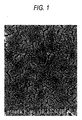
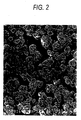
- Electron micrographs of the cured resin surface layer obtained according to the embodiment obtained by use of a ultra high resolution field emission scanning electron microscope (Hitachi S-900H) are shown in Figs. 1 (10,000 times multiplied) and 2 (40,000 times multiplied).
- Embodiment 1 Three components excluding isopropanol among four components in Embodiment 1, that is, trimethylol propane triacrylate (aforementioned), polytetramethylene glycol diacrylate (aforementioned) (both for component A), Darocure 1173 (aforementioned) (D) and triethanol amine (B) are blended with the same weight parts as in Embodiment 1 followed by thorough mixing. However, soon after leaving stand still, a phase separation is caused, resulting in incapability of obtaining a homogeneous solution.
- the resin composition (a) is tried to be light-cured according to the same procedure as that of Embodiment 1. However, only a transparent and colorless soft light cured resin layer is generated, that is, a surface layer formed of fine particles of the resin is not at all obtained.
- Particle diameters of fine particles of cured resin of a surface layer of the obtained light diffusing film (II) are measured similarly to Embodiment 1 and found to have an average particle diameter of 0.5 ⁇ m.
- a result of the crosscut adhesion test of the surface layer of the cured resin is grade 2.
- optical characteristics of the light diffusing film (II) are measured similarly to Embodiment 1, and excellent values of the total light transmittance of 91.0% and the haze of 87.9% are obtained.
- photo polymerizable monomer (A) trimethylol propane trimethacrylate (manufactured by Kyoueisha Chemical Co. Ltd, trade name: Light Ester TMP) 35 parts by weight, methacrylic acid (2 mol) adduct to polyethylene glycol (degree of polymerization of 2) diglicidel ether (manufactured by Kyoueisha Chemical Co. Ltd, trade name: Epoxyester 40EM) 15 parts by weight and as a reaction diluent, isobornyl methacrylate (manufactured by Kyoueisha Chemical Co. Ltd, trade name: Light Ester IB-X) 10 parts by weight are blended.
- a photo-polymerization initiator (D) 1-hydroxy-2-cyclohexyl phenyl ketone (manufactured by Ciba Specialty Chemicals Inc, trade name: Irgacure 184) 0.5 parts by weight is blended followed by thorough mixing.
- the organic compound (B) diethanol amine 20 parts by weight, and furthermore, as the cosolvent (C), ethylene glycol monomethyl ether 40 parts by weight are blended followed by thorough mixing until transparency is obtained, and thereby a homogeneous light-curable liquid resin composition (3) is prepared.
- the obtained light-curable liquid resin composition (3) is coated on an A-4 size polyethylene terephthalate film having a thickness of 100 ⁇ m (aforementioned) that is placed on a glass plate having a thickness of 1.0 mm and has spacers having a thickness of 40 ⁇ m placed along four sides by use of a bar coater coating machine followed by placing thereon a glass plate having a thickness of 1.0 mm to cover a coated film, and under this state, an UV light from a high pressure mercury lamp is irradiated up to substantially 1500 mJ /cm 2 .
- the polyethylene terephthalate film having a light-cured resin surface layer is taken out of two glass plates, the surface layer of the light-cured resin layer is cleansed with methanol to remove di-ethanol amine and ethylene glycol monomethyl ether followed by air drying, and thereby a light diffusing film (III) having a light diffusing resin surface layer is obtained.
- Particle diameters of fine particles of the cured resin on a surface layer of the obtained light diffusing film (III) are measured similarly to Embodiment 1. An average particle diameter thereof is found to be substantially 0.5 ⁇ m. Furthermore, a result of the crosscut adhesion test thereof is found to be grade 10.
- optical characteristics of the light diffusing film (III) are measured similarly to Embodiment 1, and excellent values of the total light transmittance of 93% and of the haze of 86.7% are obtained.
- ethylene glycol monomethyl ether (C) among four components in Embodiment 3, that is, trimethylol propane trimethacrylate (aforementioned), methacrylic acid (2 mol) adduct to polyethylene glycol (degree of polymerization is 2) diglycidyl ether (aforementioned), isobornyl methacrylate (aforementioned) (these are the component A), Irgacure 184 (aforementioned) (D) and diethanol amine (B) are blended with the same weight parts as embodiment 3 followed by thorough mixing. However, soon after leaving standing still, the phase separation occurs and a homogeneous solution cannot be obtained.
- the resin composition (b) is subjected to the light-curing process according to the same procedure as Embodiment 3. However, only a soft transparent and colorless light-cured resin layer is obtained, that is, a surface layer made of fine particles of resin cannot be at all formed.
- the obtained light-curable liquid resin composition (4) is coated on an A-4 size polyethylene terephthalate film having a thickness of 75 ⁇ m (aforementioned) by use of a bar coater coating machine so that a film thickness may be 50 ⁇ m followed by covering it with a mold releasing polyethylene terephthalate film having a film thickness of 100 ⁇ m further immediately followed by irradiating an UV light from a high pressure mercury lamp up to substantially 1500 mJ/cm 2 .
- Particle diameters of fine particles of the cured resin in the obtained light diffusing film (IV) surface layer are measured similarly to Embodiment 1, and an average particle diameter is found to be substantially 0.5 ⁇ m. Furthermore, a result of the crosscut adhesion test is grade 10.
- Embodiment 4 With three components excluding 3-amino-1-propanol (B) among four components in Embodiment 4, that is, hydroxypivalic neopentyl glycol ester diacrylate (aforementioned), urethane prepolymer containing acryloyl groups at both ends (UF-503LN) (aforementioned) (these are the component A), Irgacure 1700 (D) and ethyl methyl ketone (C), the light-curing process is applied similarly to Embodiment 4. However, only a soft gel-like light-cured resin surface layer is obtained.
- B 3-amino-1-propanol
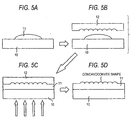
- a manufacturing method according to the embodiments will be explained with reference to Fig. 5.
- a light-curable liquid resin composition 11 according to Embodiment 1 is poured on a polyethylene terephthalate film base material 10 (Fig. 5(a)).
- a transfer printing plate 12 on which fine concavoconvex shape is patterned is placed (Fig. 5(b)), and thereby, between the base material 11 and the transfer printing palate 12, a liquid film of the light-curable liquid resin composition 11 is formed so that a film thickness after the curing may be substantially 10 ⁇ m.
- the thickness of the liquid film is controlled by adjusting a pressure applied on the transfer printing plate.
- the transfer printing plate is peeled, the cured resin layer is cleansed with ethanol to remove triethanol amine and isopropanol remaining in the resin layer followed by air drying, and thereby a light diffusing film (V)(Fig. 5(d)) having a light diffusing resin surface layer on which the fine concavoconvex pattern is transferred is obtained.
- V light diffusing film
- the transfer printing plate is prepared according to a photolithography method in which a pattern of fine concavities and convexities is formed by irradiating an UV light with a mask followed by depositing gold by means of gold sputtering, and can be formed into an arbitrary shape and size. Other than this, fine processing with a laser or EB (electron beam) lithography can be also applied.
- a laser or EB (electron beam) lithography can be also applied.
- surface roughness of the prepared transfer printing plate is measured with a surface roughness meter, it is found that the transfer printing plate has the concavities and convexities of substantially 2 to 3 ⁇ m.
- the light diffusing film obtained according to the present invention has the following advantages over the existing technology.
Landscapes
- Physics & Mathematics (AREA)
- General Physics & Mathematics (AREA)
- Optics & Photonics (AREA)
- Engineering & Computer Science (AREA)
- Chemical & Material Sciences (AREA)
- Manufacturing & Machinery (AREA)
- Health & Medical Sciences (AREA)
- Polymers & Plastics (AREA)
- Organic Chemistry (AREA)
- Medicinal Chemistry (AREA)
- Chemical Kinetics & Catalysis (AREA)
- Optical Elements Other Than Lenses (AREA)
- Coating Of Shaped Articles Made Of Macromolecular Substances (AREA)
Abstract
Description
Claims (17)
- A light diffusing resin film:wherein the light diffusing resin film is formed by light-curing a light-curable liquid resin composition whose indispensable components are a photo-polymerizable monomer (A), an organic compound (B) that is incompatible with the photo-polymerizable monomer (A), a cosolvent (C) that is compatible commonly with the photo-polymerizable monomer (A) and the organic compound (B) that is incompatible with the photo-polymerizable monomer (A), and a photo-polymerization initiator (D).
- A light diffusing resin film as set forth in claim 1:wherein the light diffusing resin film is an aggregate of fine particles of cured resin having an average particle diameter in the range of 0.1 to 0.9 µm.
- A light diffusing resin film as set forth in claim 1 or claim 2:wherein the photo-polymerizable monomer (A) is a mixture of one kind or more selected from a group of two or more poly-functional acrylate classes and methacrylate classes, and one kind or more selected from a group of poly-functional prepolymer based acrylate classes and methacrylate classes.
- A light diffusing resin film as set forth in any one of claim 1 through 3:wherein the organic compound (B) is one kind or more of amino alcohol classes, and the cosolvent (C) is one kind or more of solvents selected from alcohol-based, ether-based, ester-based and ketone-based oxygen containing solvent groups.
- A light diffusing resin film as set forth in claim 4:wherein a boiling temperature of the amino alcohol class is in the range of 160 to 360 degree centigrade and that of the oxygen containing solvents is in the range of 50 to 250 degree centigrade.
- A light diffusing resin film as set forth in any one of claims 1 through 5:wherein a surface of the light diffusing resin film is formed into a concavoconvex shape.
- A light diffusing film:wherein the light diffusing film is formed by forming a resin film that is an aggregate of fine particles of cured resin having particle diameters in the range of 0.1 to 0.9 µm on a surface layer of a transparent base material and has light transmittance of 90% or more and haze of 85% or more.
- A light diffusing film as set forth in claim 7:wherein a resin film that is an aggregate of fine particles of cured resin is the light diffusing resin film set forth in any one of claims 1 through 6.
- A light diffusing film as set forth in claim 8:wherein the organic compound (B) and the cosolvent (C) are removed from the light diffusing resin film.
- A light diffusing film:wherein the light diffusing film is formed by coating a light-curable liquid resin composition whose indispensable components are a photo-polymerizable monomer (A), an organic compound (B) that is incompatible with the photo-polymerizable monomer (A), a cosolvent (C) that is compatible commonly with the photo-polymerizable monomer (A) and the organic compound (B) that is incompatible with the photo-polymerizable monomer (A), and a photo-polymerization initiator (D) on one or both surfaces of a film base material followed by curing.
- A light diffusing film as set forth in claim 10:wherein the light-curable liquid resin composition is light-cured so as to have a concavoconvex surface shape after the curing.
- A light diffusing film as set forth in claim 10 or claim 11:wherein the photo-polymerizable monomer (A) is a mixture of one kind or more selected from a group of two or more poly-functional acrylate classes and methacrylate classes, and one kind or more selected from a group of poly-functional prepolymer based acrylate classes and methacrylate classes.
- A light diffusing film as set forth in any one of claims 10 through 12:wherein the organic compound (B) is one kind or more of amino alcohol classes, and the cosolvent (C) is one kind or more of solvents selected from alcohol-based, ether-based, ester-based and ketone-based oxygen containing solvent groups.
- A light diffusing film as set forth in claim 13:wherein a boiling temperature of the amino alcohol class is in the range of 160 to 360 degree centigrade and that of the oxygen containing solvent is in the range of 50 to 250 degree centigrade.
- A light diffusing film as set forth in any one of claims 6 through 14:wherein one or both surfaces of the film base material are subjected to any one of embossing, sand blasting or matting process.
- An edge light type backlight unit:wherein the light diffusing film set forth in any one of claims 6 through 15 is used.
- A liquid crystal display device:wherein the liquid crystal display device is provided with the edge light type backlight unit set forth in claim 16.
Applications Claiming Priority (3)
| Application Number | Priority Date | Filing Date | Title |
|---|---|---|---|
| JP2000217556 | 2000-07-18 | ||
| JP2000217556 | 2000-07-18 | ||
| PCT/JP2001/006124 WO2002006859A1 (en) | 2000-07-18 | 2001-07-16 | Light diffusing films |
Publications (2)
| Publication Number | Publication Date |
|---|---|
| EP1312942A1 true EP1312942A1 (en) | 2003-05-21 |
| EP1312942A4 EP1312942A4 (en) | 2006-10-25 |
Family
ID=18712644
Family Applications (1)
| Application Number | Title | Priority Date | Filing Date |
|---|---|---|---|
| EP01949984A Withdrawn EP1312942A4 (en) | 2000-07-18 | 2001-07-16 | Light diffusing films |
Country Status (4)
| Country | Link |
|---|---|
| US (1) | US7419715B2 (en) |
| EP (1) | EP1312942A4 (en) |
| JP (1) | JP3906802B2 (en) |
| WO (1) | WO2002006859A1 (en) |
Families Citing this family (22)
| Publication number | Priority date | Publication date | Assignee | Title |
|---|---|---|---|---|
| WO2004109379A1 (en) | 2003-06-04 | 2004-12-16 | Nippon Polyester Co.,Ltd. | Light diffusing plate for liquid crystal display and polycarbonate resin composition for light diffusing plate for liquid crystal display |
| JP4541029B2 (en) * | 2004-05-20 | 2010-09-08 | 出光興産株式会社 | Light-shielding highly reflective laminated sheet, thermoformed body and casing using the same |
| WO2006030949A1 (en) * | 2004-09-16 | 2006-03-23 | Fujifilm Corporation | Method of producing light-scattering film, polarizing plate comprising light-scattering film and liquid crystal display device comprising the polarizing plate |
| JP4771706B2 (en) * | 2005-01-26 | 2011-09-14 | 株式会社きもと | Backlight for electric signboard, and electric signboard using the same |
| US20070141284A1 (en) * | 2005-12-19 | 2007-06-21 | Saint-Gobain Performance Plastics Corporation | Smooth bore flexible fluid conduit |
| JP2007249038A (en) * | 2006-03-17 | 2007-09-27 | Toppan Printing Co Ltd | Optical element, polarizing plate and liquid crystal display device using the same |
| KR20100118855A (en) * | 2009-04-29 | 2010-11-08 | 삼성전자주식회사 | Photocurable coating composition |
| TWI414828B (en) * | 2009-12-18 | 2013-11-11 | Eternal Chemical Co Ltd | Diffusion film and manufacture process thereof |
| TWI412551B (en) * | 2010-08-25 | 2013-10-21 | Univ Nat Cheng Kung | Manufacturing method of polymer film with photonic crystal structure |
| US20120296826A1 (en) | 2011-05-18 | 2012-11-22 | Bytemark, Inc. | Method and system for distributing electronic tickets with visual display |
| US10089606B2 (en) | 2011-02-11 | 2018-10-02 | Bytemark, Inc. | System and method for trusted mobile device payment |
| US10762733B2 (en) | 2013-09-26 | 2020-09-01 | Bytemark, Inc. | Method and system for electronic ticket validation using proximity detection |
| US10453067B2 (en) | 2011-03-11 | 2019-10-22 | Bytemark, Inc. | Short range wireless translation methods and systems for hands-free fare validation |
| US10360567B2 (en) | 2011-03-11 | 2019-07-23 | Bytemark, Inc. | Method and system for distributing electronic tickets with data integrity checking |
| US8494967B2 (en) | 2011-03-11 | 2013-07-23 | Bytemark, Inc. | Method and system for distributing electronic tickets with visual display |
| WO2013080097A1 (en) * | 2011-11-29 | 2013-06-06 | Koninklijke Philips Electronics N.V. | A wave guide |
| KR101575698B1 (en) * | 2012-03-30 | 2015-12-08 | 디아이씨 가부시끼가이샤 | Method for manufacturing cured coating film, optical film, and method for manufacturing thin-film formed body |
| US12651210B2 (en) | 2015-08-17 | 2026-06-09 | Siemens Mobility, Inc. | Methods and systems for hands-free fare validation and gateless transit |
| US11803784B2 (en) | 2015-08-17 | 2023-10-31 | Siemens Mobility, Inc. | Sensor fusion for transit applications |
| WO2017030799A1 (en) | 2015-08-17 | 2017-02-23 | Bytemark, Inc. | Short range wireless translation methods and systems for hands-free fare validation |
| US11513263B2 (en) | 2019-05-15 | 2022-11-29 | Samsung Electronics Co., Ltd. | Light-diffuser, light diffusing adhesive, light diffusing hard coat member, light diffusion film, and image forming apparatus including light diffusion film |
| KR102407051B1 (en) * | 2021-01-12 | 2022-06-10 | 창원대학교 산학협력단 | Manufacturing apparatus for infrared anti-reflection film and manufacturing method |
Family Cites Families (24)
| Publication number | Priority date | Publication date | Assignee | Title |
|---|---|---|---|---|
| JPS5724816B2 (en) | 1974-05-17 | 1982-05-26 | ||
| GB1538436A (en) * | 1975-05-12 | 1979-01-17 | Ucb Sa | Halogenated photopolymerisable compositions |
| JPS5633677A (en) | 1979-08-28 | 1981-04-04 | Seiko Instr & Electronics | Liquid crystal display unit |
| JPS60175303A (en) | 1984-02-20 | 1985-09-09 | 東芝ライテック株式会社 | Panel for illuminator |
| JPS614762A (en) | 1984-06-18 | 1986-01-10 | Mitsubishi Rayon Co Ltd | light diffusing plastic |
| JPS63291002A (en) | 1987-05-25 | 1988-11-28 | Asahi Chem Ind Co Ltd | Light diffusion plate for transmission type screen |
| JPH01172801A (en) | 1987-12-28 | 1989-07-07 | Asahi Chem Ind Co Ltd | Light diffusion plate having light transmittability |
| JPH02173707A (en) | 1988-12-27 | 1990-07-05 | Toppan Printing Co Ltd | Manufacture of color filter |
| JPH0378701A (en) | 1989-08-23 | 1991-04-03 | Teijin Chem Ltd | Light diffusion sheet made of polycarbonate for backlight of liquid crystal display |
| RU2070211C1 (en) * | 1990-09-27 | 1996-12-10 | Сам Янг Ко., Лтд. | Process for preparing hydrophilic polymeric film and device for carrying it into effect |
| JP3190424B2 (en) | 1992-04-30 | 2001-07-23 | 日本写真印刷株式会社 | Light diffusion sheet |
| JPH06138308A (en) | 1992-10-28 | 1994-05-20 | Taiho Ind Co Ltd | Light diffusing plate |
| JP3545445B2 (en) | 1994-01-18 | 2004-07-21 | 大日本印刷株式会社 | Light diffusion film |
| JP3545447B2 (en) | 1994-02-04 | 2004-07-21 | 大日本印刷株式会社 | Light diffusion film |
| JPH09113708A (en) | 1995-10-19 | 1997-05-02 | Dainippon Printing Co Ltd | Light diffusion film |
| US6361925B1 (en) * | 1996-03-04 | 2002-03-26 | Ciba Specialty Chemicals Corporation | Photoinitiator mixtures and compositions with alkylphenylbisacylphosphine oxides |
| WO1997044363A1 (en) * | 1996-05-23 | 1997-11-27 | Omron Corporation | Photosensitive composition and white coating |
| JPH1160966A (en) | 1997-08-08 | 1999-03-05 | Kuraray Co Ltd | Light diffusing resin composition |
| JP4101339B2 (en) | 1997-09-25 | 2008-06-18 | 大日本印刷株式会社 | Light diffusing film, manufacturing method thereof, polarizing plate with diffusing layer, and liquid crystal display device |
| JPH11145667A (en) * | 1997-11-07 | 1999-05-28 | Omron Corp | Electrical equipment |
| JPH11199798A (en) * | 1998-01-19 | 1999-07-27 | Nikko Kagaku Kenkyusho:Kk | Multiphase structure forming coating agent, multiphase structure film forming method, and optical path changing film |
| JP3515401B2 (en) * | 1998-12-18 | 2004-04-05 | 大日本印刷株式会社 | Anti-glare film, polarizing plate and transmission type display device |
| JP3515426B2 (en) * | 1999-05-28 | 2004-04-05 | 大日本印刷株式会社 | Anti-glare film and method for producing the same |
| JP2001051105A (en) * | 1999-08-05 | 2001-02-23 | Nippon Kayaku Co Ltd | Resin solution for light scattering film and light scattering film |
-
2001
- 2001-07-16 EP EP01949984A patent/EP1312942A4/en not_active Withdrawn
- 2001-07-16 JP JP2002512713A patent/JP3906802B2/en not_active Expired - Fee Related
- 2001-07-16 US US10/333,387 patent/US7419715B2/en not_active Expired - Fee Related
- 2001-07-16 WO PCT/JP2001/006124 patent/WO2002006859A1/en not_active Ceased
Also Published As
| Publication number | Publication date |
|---|---|
| EP1312942A4 (en) | 2006-10-25 |
| JP3906802B2 (en) | 2007-04-18 |
| US20040030081A1 (en) | 2004-02-12 |
| WO2002006859A1 (en) | 2002-01-24 |
| US7419715B2 (en) | 2008-09-02 |
Similar Documents
| Publication | Publication Date | Title |
|---|---|---|
| US7419715B2 (en) | Light diffusing films | |
| JPWO2002006859A1 (en) | Light Diffusion Film | |
| JP5431679B2 (en) | Sheet-like optical member, resin composition for optical sheet, optical sheet and method for producing the same | |
| KR101154807B1 (en) | Antidazzle coating composition, antidazzle film and process for producing the same | |
| TWI301096B (en) | Anti glare hard coat film | |
| US20110003093A1 (en) | Anti-glare film and process for producing the same | |
| US7232651B2 (en) | Optical recording materials | |
| CN101246224A (en) | Anti-glare coating composition, anti-glare film and manufacturing method thereof | |
| KR101720333B1 (en) | Anti-glare coating composition, anti-glare film and method of producing the same | |
| TW201017227A (en) | Anti-glare film and process for producing the same | |
| CN104838292A (en) | Anisotropic optical film | |
| KR20160117313A (en) | Process for Production of Anisotropic Optical Film | |
| CN114929479A (en) | Anti-glare laminate | |
| JPH11199798A (en) | Multiphase structure forming coating agent, multiphase structure film forming method, and optical path changing film | |
| JP4099955B2 (en) | (Polymer / liquid crystal) composite film display device and method for manufacturing the same | |
| JP2009091477A (en) | Transparent cross-linked film | |
| JP2000167999A (en) | Film having hardened film layer of radiation curable resin composition | |
| TWI389798B (en) | Antireflection film | |
| TW202103965A (en) | Anti-glare laminate | |
| JP3956792B2 (en) | Light diffusion film and method for producing the same | |
| JP2021165338A (en) | Active energy ray-curable hard coat agent, laminate, transparent conductive film, optical member, and electronic device | |
| JP2008203839A (en) | Acrylic resin for light diffusion sheet, light diffusion sheet, lens sheet, surface light source device and liquid crystal display device | |
| CN116685627A (en) | Composition for anisotropic optical film and anisotropic optical film | |
| WO2002086623A1 (en) | Optical recording materials | |
| JP2008102516A (en) | (Polymer / Liquid Crystal) Composite Film Display Device Manufacturing Method |
Legal Events
| Date | Code | Title | Description |
|---|---|---|---|
| PUAI | Public reference made under article 153(3) epc to a published international application that has entered the european phase |
Free format text: ORIGINAL CODE: 0009012 |
|
| 17P | Request for examination filed |
Effective date: 20030214 |
|
| AK | Designated contracting states |
Designated state(s): AT BE CH CY DE DK ES FI FR GB GR IE IT LI LU MC NL PT SE TR |
|
| A4 | Supplementary search report drawn up and despatched |
Effective date: 20060922 |
|
| RIC1 | Information provided on ipc code assigned before grant |
Ipc: C08J 7/18 20060101ALI20060918BHEP Ipc: C08J 5/18 20060101ALI20060918BHEP Ipc: G02B 5/02 20060101AFI20020129BHEP Ipc: C08L 33/00 20060101ALI20060918BHEP Ipc: C08F 290/06 20060101ALI20060918BHEP |
|
| 17Q | First examination report despatched |
Effective date: 20070321 |
|
| STAA | Information on the status of an ep patent application or granted ep patent |
Free format text: STATUS: THE APPLICATION IS DEEMED TO BE WITHDRAWN |
|
| 18D | Application deemed to be withdrawn |
Effective date: 20081001 |