EP1312622A1 - Process for the preparation of linear or branched 1,4-cis polybutadiene - Google Patents
Process for the preparation of linear or branched 1,4-cis polybutadiene Download PDFInfo
- Publication number
- EP1312622A1 EP1312622A1 EP02079623A EP02079623A EP1312622A1 EP 1312622 A1 EP1312622 A1 EP 1312622A1 EP 02079623 A EP02079623 A EP 02079623A EP 02079623 A EP02079623 A EP 02079623A EP 1312622 A1 EP1312622 A1 EP 1312622A1
- Authority
- EP
- European Patent Office
- Prior art keywords
- general formula
- process according
- cobalt
- butadiene
- catalytic system
- Prior art date
- Legal status (The legal status is an assumption and is not a legal conclusion. Google has not performed a legal analysis and makes no representation as to the accuracy of the status listed.)
- Withdrawn
Links
Classifications
-
- C—CHEMISTRY; METALLURGY
- C07—ORGANIC CHEMISTRY
- C07D—HETEROCYCLIC COMPOUNDS
- C07D401/00—Heterocyclic compounds containing two or more hetero rings, having nitrogen atoms as the only ring hetero atoms, at least one ring being a six-membered ring with only one nitrogen atom
- C07D401/02—Heterocyclic compounds containing two or more hetero rings, having nitrogen atoms as the only ring hetero atoms, at least one ring being a six-membered ring with only one nitrogen atom containing two hetero rings
- C07D401/04—Heterocyclic compounds containing two or more hetero rings, having nitrogen atoms as the only ring hetero atoms, at least one ring being a six-membered ring with only one nitrogen atom containing two hetero rings directly linked by a ring-member-to-ring-member bond
-
- C—CHEMISTRY; METALLURGY
- C07—ORGANIC CHEMISTRY
- C07D—HETEROCYCLIC COMPOUNDS
- C07D405/00—Heterocyclic compounds containing both one or more hetero rings having oxygen atoms as the only ring hetero atoms, and one or more rings having nitrogen as the only ring hetero atom
- C07D405/02—Heterocyclic compounds containing both one or more hetero rings having oxygen atoms as the only ring hetero atoms, and one or more rings having nitrogen as the only ring hetero atom containing two hetero rings
- C07D405/04—Heterocyclic compounds containing both one or more hetero rings having oxygen atoms as the only ring hetero atoms, and one or more rings having nitrogen as the only ring hetero atom containing two hetero rings directly linked by a ring-member-to-ring-member bond
-
- C—CHEMISTRY; METALLURGY
- C07—ORGANIC CHEMISTRY
- C07D—HETEROCYCLIC COMPOUNDS
- C07D409/00—Heterocyclic compounds containing two or more hetero rings, at least one ring having sulfur atoms as the only ring hetero atoms
- C07D409/02—Heterocyclic compounds containing two or more hetero rings, at least one ring having sulfur atoms as the only ring hetero atoms containing two hetero rings
- C07D409/04—Heterocyclic compounds containing two or more hetero rings, at least one ring having sulfur atoms as the only ring hetero atoms containing two hetero rings directly linked by a ring-member-to-ring-member bond
-
- C—CHEMISTRY; METALLURGY
- C08—ORGANIC MACROMOLECULAR COMPOUNDS; THEIR PREPARATION OR CHEMICAL WORKING-UP; COMPOSITIONS BASED THEREON
- C08F—MACROMOLECULAR COMPOUNDS OBTAINED BY REACTIONS ONLY INVOLVING CARBON-TO-CARBON UNSATURATED BONDS
- C08F136/00—Homopolymers of compounds having one or more unsaturated aliphatic radicals, at least one having two or more carbon-to-carbon double bonds
- C08F136/02—Homopolymers of compounds having one or more unsaturated aliphatic radicals, at least one having two or more carbon-to-carbon double bonds the radical having only two carbon-to-carbon double bonds
- C08F136/04—Homopolymers of compounds having one or more unsaturated aliphatic radicals, at least one having two or more carbon-to-carbon double bonds the radical having only two carbon-to-carbon double bonds conjugated
- C08F136/06—Butadiene
-
- C—CHEMISTRY; METALLURGY
- C08—ORGANIC MACROMOLECULAR COMPOUNDS; THEIR PREPARATION OR CHEMICAL WORKING-UP; COMPOSITIONS BASED THEREON
- C08F—MACROMOLECULAR COMPOUNDS OBTAINED BY REACTIONS ONLY INVOLVING CARBON-TO-CARBON UNSATURATED BONDS
- C08F4/00—Polymerisation catalysts
- C08F4/06—Metallic compounds other than hydrides and other than metallo-organic compounds; Boron halide or aluminium halide complexes with organic compounds containing oxygen
- C08F4/26—Metallic compounds other than hydrides and other than metallo-organic compounds; Boron halide or aluminium halide complexes with organic compounds containing oxygen of manganese, iron group metals or platinum group metals
Definitions
- the present invention relates to a process for the preparation of 1,4-cis polybutadiene effected by means of the polymerization of 1,3-butadiene in the presence of a catalytic system comprising a catalyst consisting of cobalt complexed with particular ligands and a cocatalyst based on aluminum.
- a linear polybutadiene is obtained, which is particularly suitable for the preparation of tyres, whereas in the presence of halogen-derivatives (III) or (IV), a branched polybutadiene is obtained, which is particularly suitable for the preparation of HIPS high impact polystyrene.
- benzene is not desired as a solvent following the restrictions imposed by OSHA (Occupational Safety and Health Agency) on the concentration of benzene allowed in work areas.
- OSHA Occupational Safety and Health Agency
- the necessity is therefore felt for finding catalytic systems based on cobalt capable of operating with the same efficiency in aromatic solvents other than benzene and/or in solvents based on aliphatic hydrocarbons.
- W is selected from Cl and acetylacetonate (acac).
- ligands "L” are:
- 1,4-cis polybutadiene refers to polybutadiene in which at least 90% of the butadiene units is concatenated in 1,4-cis position.
- branched polybutadiene refers to a polybutadiene having a g value (defined further on in the experimental part) ⁇ 0.90, preferably ⁇ 0.85. This branched polybutadiene is particularly suitable for the preparation of HIPS (high impact polystyrene).
- linear polybutadiene refers to polybutadiene having a g value ⁇ 0.95. This linear polybutadiene is particularly suitable for the preparation of elastomeric blends for tyres.
- the complexes having general formula (I) can be synthesized according to known procedures, for example by reaction of the cobalt salt selected (for example CoCl 2 or Co(acac) 3 ) with the desired ligand in the stoichiometric ratio, in a hydrocarbon solvent or in alcohol.
- the cobalt salt selected for example CoCl 2 or Co(acac) 3
- the desired ligand in the stoichiometric ratio
- the catalytic system of the present invention also comprises, in addition to the cobalt complex having general formula (I), one or more cocatalysts selected from organo-derivatives of aluminum selected from:
- the organo-derivative of aluminum is selected from aluminoxanes and the relative derivatives (b1).
- the organo-derivative of aluminum is selected from halogen aluminum alkyls (b2), particularly from those having general formula (IV) Al 2 R n X 6-n .
- the present invention also relates to a process for obtaining linear 1,4-cis polybutadiene by means of the polymerization of 1,3-butadiene in the presence of one or more solvents and a catalytic system, characterized in that said catalytic system comprises:
- the present invention also relates to a process for obtaining branched 1,4-cis polybutadiene by means of the polymerization of 1,3-butadiene in the presence of one or more solvents and a catalytic system, characterized in that said catalytic system comprises:
- aluminoxanes (b1) are compounds containing Al-O-Al bonds, with a varying O/Al ratio, obtained by the reaction, under contolled conditions, of an aluminum alkyl, or aluminum alkyl halide, with water or other compounds containing preestablished quantities of available water, as, for example, in the case of the reaction of aluminum trimethyl with aluminum hexahydrate sulfate, copper pentahydrate sulfate or iron pentahydrate sulfate.
- Aluminoxanes preferably used for the formation of the polymerization catalyst of the present invention are cyclic and/or linear, oligo- or polymeric compounds, characterized by the presence of repetitive units having the following formula: wherein R 15 is a C 1 -C 6 alkyl group, preferably methyl.
- Each aluminoxane molecule preferably contains from 4 to 70 repetitive units which may also not be all the same, but contain different R 15 groups.
- Typical examples of compounds having general formula (III) are AlEt 2 Cl (diethyl aluminummonochloride), AlMe 2 Cl (dimethylaluminummonochloride), AlEtCl 2 (ethylaluminumdichloride), Al(i-bu) 2 Cl (diisobutylaluminummonochloride); typical examples of compounds having general formula (IV) are Al 2 Et 3 Cl 3 (ethylaluminumsesquichloride), Al 2 Me 3 Cl 3 (methylaluminumsesquichloride).
- the molar ratio between the complex having general formula (I) and the aluminum of the cocatalyst ranges from 1:5 to 1:10000, preferably from 1:10 to 1:1000.
- the cobalt complex having general formula (I) can be used in a molar ratio with respect to the 1,3-butadiene ranging from 1/10 5 to 1/10 2 , preferably from 1/2x10 4 to 1/10 3 .
- the above polymerization is preferably effected in a polymerization medium comprising an inert hydrocarbon which is a solvent of butadiene and of the catalytic system.
- inert hydrocarbons which can be used in the polymerization process comprise aliphatic hydrocarbons, olefins included, cycloaliphatic, aromatic hydrocarbons and relative mixtures. More specifically, suitable hydrocarbons are those selected within the group of C 4 to C 8 aliphatic hydrocarbons, olefins included, within the group of C 5 to C 10 cycloaliphatic hydrocarbons, and relative mixtures.
- Typical, non-limiting examples of the above hydrocarbons are butane, pentane, hexane, heptane, cyclopentane, cyclohexane, butenes.
- the use of the above aliphatic and cycloaliphatic solvents is particularly advisable as it reduces problems relating to environmental impact.
- the process of the present invention can also be carried out in the presence of aromatic solvents, particularly toluene, as such or mixed with aliphatic solvents.
- the concentration of 1,3-butadiene in the polymerization medium can vary in relation to the particular solvent medium or diluent used.
- concentration of 1,3-butadiene preferably ranges from 10 to 35% by weight with respect to the total weight of the mixture.
- the polymerization temperature of 1,3-butadiene preferably ranges from -30°C to +60°C, the lower temperature limit being determined more by the freezing point of the reaction mixture rather than by the catalytic activity. More preferably, the polymerization process is carried out at a temperature ranging from -10°C to +40°C.
- the process of the present invention can also be carried out (see the experimental part) in the absence of the usual molecular weight regulators well-known to experts in the field, for example butene-1.
- the molecular weight control can be effected by varying the type of cobalt complex and/or ratio between the aluminum compound and cobalt.
- the polymerization reaction can be stopped by the addition of one or more polymerization terminators which deactivate the catalytic system, followed by the conventional solvent-removal (desolventizing), washing and drying phases, which are normal operations in the production of polydienes.
- the terminator used for deactivating the catalytic system is typically a protic compound, which includes, but is not limited to, an alcohol, a carboxylic acid, an inorganic acid, and water or a combination thereof.
- An antioxidant such as 2,6-di-ter-butyl-4-methylphenol can be added, before, after or with the addition of the terminator.
- the quantity of antioxidant usually ranges from 0.2% to 1% by weight with respect to the polymer.
- the polybutadiene can be recovered according to the standard techniques, preferably by means of the coagulation technique. Any possible residues of the solvent can be removed from the polymer by means of evaporation, which can be facilitated by high temperatures and vacuum application.
- the process of the present invention allows polybutadiene to be produced with a reduced gel content, particularly macro gels. This is particularly important in the case of branched 1,4-cis polybutadiene as it allows the use of the latter for the preparation of HIPS impact polystyrene.
- ethyl ether 250 ml of ethyl ether are added, under nitrogen, in a three-necked flask, to 36.5 ml of CF 3 COOC 2 H 5 , and NaH. 17 ml of 2-acetylpyridine are added dropwise to 50 ml of ethyl ether, the suspension being maintained at reflux temperature, under stirring for 6 hours. 100 ml of ethyl ether are subsequently added, the mixture is left for a further hour at reflux temperature and for the whole night under stirring at room temperature. 50 ml of ethanol are added to the pink-coloured suspension, which is left under stirring for 1 hour. The suspension is poured into a mixture of water and ice (150 ml of H 2 O/150 g of ice).
- ⁇ -diketone is dissolved in ethanol, under nitrogen, in a three-necked flask. 24 ml of hydrazine hydrate in 20 ml of water are added, dropwise in about one hour. The mixture is left at reflux temperature for an hour. It is left to cool and is diluted in 500 ml of H 2 O. It is then extracted with Et 2 O (6 x 200 ml). The ether phase is washed with H 2 O (2 x 100 ml)and anhydrified on Na 2 SO 4 . The solvent is evaporated and the pink solid is dried with a mechanical pump obtaining 26 g of raw product, which is crystallized from 200 ml of hot toluene.
- ethyl ether 250 ml of ethyl ether are added, under nitrogen, in a three-necked flask, to 36.5 ml of CF 3 COOC 2 H 5 , and NaH.
- 16.5 ml of 2-acetylthiophene are added dropwise to 50 ml of ethyl ether, the suspension being maintained at reflux temperature, under stirring for 5 hours.
- 100 ml of ethyl ether are subsequently added; the mixture is left for a further hour at reflux temperature and for the whole night under stirring at room temperature.
- 50 ml of ethanol are added to the pink-coloured suspension, obtaining a yellow solution, which is left under stirring for 1 hour.
- EXAMPLE 3a Synthesis of 1-(2-benzofuranyl)-4,4,4-trifluoromethyl-butane-1,3-dione.
- Butadiene (10 ml) and subsequently toluene (90 ml) are condensed in a 200 ml reactor, maintained at a temperature of -20°C.
- the reactor is brought to the desired polymerization temperature (about 20°C); the aluminum compound is then charged (1 x 10 -2 moles of MAO or Al 2 Et 3 Cl 3 depending on the case) and finally a toluene solution of cobalt (preformed cobalt complex or toluene solution containing the non-complexed cobalt compound + ligand in the desired ratio), the quantity of cobalt being 1 x 10 -5 moles.
- the whole mixture is kept under stirring for about 60 minutes.
- the polymerization is terminated by adding methanol containing minimum quantities of hydrochloric acid; the polymer is coagulated with methanol containing small quantities of antioxidant, washed several times with methanol and then dried under vacuum at room temperature.
- the 1 H and 13 C NMR spectra were registered with a Bruker AM 270 MHz spectrophotometer. The spectra were obtained in CDCl 3 at room temperature using tetramethylsilane as internal standard or in high temperature C 2 D 2 Cl 4 (103°C; HMDS as internal standard). The concentration of the polymeric solutions is about 10% by weight.
- microstructure of the polybutadienes obtained was determined on the basis of what is already known in literature (see for example V.D. Mochel, J. Polym. Sci, A-1 10, 1009, 1972; K.F. Elgert, G. Quack, B. Stutzel, Makromol. Chem. 175, 1955, 1974; D. Morero, A. Santambrogio, L. Porri, F. Ciampelli, Chim. Ind. (Milan) 41, 758, 1958).
- the gel content is acceptable and the viscosity in styrene is equal to or lower than 100 cP, therefore allowing the polybutadiene thus obtained, to be used in the preparation of impact polystyrene (HIPS).
- HIPS impact polystyrene
- comparative example 17C absence of the ligand
- Table 1b also indicates the possibility of carrying out the process with the use of an aliphatic solvent (hexane).
- the catalytic system of the present invention allows linear or branched 1,4-cis polybutadiene to be obtained, depending on the aluminum compound used, always with molecular weight and gel values suitable for the industrial applications specified.
Landscapes
- Chemical & Material Sciences (AREA)
- Organic Chemistry (AREA)
- Health & Medical Sciences (AREA)
- Chemical Kinetics & Catalysis (AREA)
- Medicinal Chemistry (AREA)
- Polymers & Plastics (AREA)
- Engineering & Computer Science (AREA)
- Materials Engineering (AREA)
- Transition And Organic Metals Composition Catalysts For Addition Polymerization (AREA)
- Addition Polymer Or Copolymer, Post-Treatments, Or Chemical Modifications (AREA)
- Organic Low-Molecular-Weight Compounds And Preparation Thereof (AREA)
Abstract
wherein (z), the cobalt oxidation number, is 2 or 3;
b = 1, 2, 3;
m = 0, 1, 2;
W is selected from Br, Cl, acetylacetonate, carboxylate, characterized in that:

Description
- The present invention relates to a process for the preparation of 1,4-cis polybutadiene effected by means of the polymerization of 1,3-butadiene in the presence of a catalytic system comprising a catalyst consisting of cobalt complexed with particular ligands and a cocatalyst based on aluminum.
- More specifically, the present invention relates to a process for the preparation of 1,4-cis polybutadiene carried out in the presence of a catalytic system which comprises (a) a catalyst consisting of cobalt complexed with particular ligands and (b) a cocatalyst selected from (b1) aluminoxanes and (b2) halogen aluminum alkyls selected from (III) AlRnX3-n (with n = 1 or 2) and (IV) Al2RnX6-n (n = 1-5), wherein R is a C1-C20 alkyl group, X is chlorine or bromine, preferably chlorine. In the presence of aluminoxanes, a linear polybutadiene is obtained, which is particularly suitable for the preparation of tyres, whereas in the presence of halogen-derivatives (III) or (IV), a branched polybutadiene is obtained, which is particularly suitable for the preparation of HIPS high impact polystyrene.
- Various types of catalysts and processes based on cobalt for the polymerization of 1,3-butadiene, have been developed. Some of these catalysts produce a polybutadiene which contains a high percentage of 1,4-cis units and which has excellent thermal and mechanical properties. Furthermore, the polybutadiene produced with catalysis based on cobalt, when the reaction is carried out in benzene in the presence of molecular weight regulators (for example butene-1), is gel-free and contains branchings which make it ideal for the modification of polystyrene.
- Examples of catalytic systems based on cobalt carried out in benzene are described in various documents: US-A-3,135,725 describes catalysts based on cobalt salts and aluminum alkyls; US-A-3,046,265 describes catalysts based on aluminum alkyls, cobalt halides and acetyl halides; US-A-3,094,514- describes cobalt chloride-methylaluminum chloride; GB-A-916,383 describes cobalt octanoate-ethylaluminum chloride; GB-A-916,384 describes cobalt ethylhexanoateethylaluminum chloride; DE-A-1,495,935 describes cobalt octanoate-diethylaluminum chloride-water; GB-A-941,739 describes cobalt stearate-diethylaluminum chloride.
- However, due to its carcinogen nature, benzene is not desired as a solvent following the restrictions imposed by OSHA (Occupational Safety and Health Agency) on the concentration of benzene allowed in work areas. The necessity is therefore felt for finding catalytic systems based on cobalt capable of operating with the same efficiency in aromatic solvents other than benzene and/or in solvents based on aliphatic hydrocarbons.
- It has now been found that particular cobalt complexes overcome the above drawbacks.
- In accordance with this, the present invention relates to a process for the preparation of 1,4-cis polybutadiene by means of the polymerization of 1,3-butadiene, carried out in one or more solvents and in the presence of a catalytic system which comprises one or more catalysts selected from cobalt complexes, preformed or formed in situ, having general formula (I)
b = 1, 2, 3;
m = 0, 1, 2;
W is selected from Br, Cl, acetylacetonate, carboxylate, with the constraint that:
when z = 2; m = 2, b = 1; W = Cl, Br, carboxylate;
when z = 3; m = 0, 1, 2; b = 1, 2, 3; W = acetylacetonate;
characterized in that:
L is a ligand having general formula (Ia)wherein
Y is selected from N, O and S
R' and R'', the same or different, are selected from hydrogen, linear or branched alkyl groups containing from 1 to 10 carbon atoms, cycloalkyl groups and aryl groups containing from 6 to 20 carbon atoms, wherein the above groups can be optionally halogenated, preferably with fluorine;
R''', R'''', the same or different, are selected from hydrogen, halogen, linear or branched C1-C20 alkyl groups, C6-C20 aryl groups, or they jointly form a condensed benzene ring, wherein said aryl groups or said condensed benzene ring can be optionally substituted with linear or branched alkyl groups containing from 1 to 10 carbon atoms,
n is an integer having the value of 1 or 2, preferably 2. - In the preferred embodiment, W is selected from Cl and acetylacetonate (acac).
- Typical but non-limiting examples of ligands "L" are:
- 3-isopropyl-5-(2-pyridine)-pyrazole;
- 3-methyl-5-[2-(6-ter-butyl)-pyridine]-pyrazole;
- 3-trifluoromethyl-5-[2-(6-ter-butyl)-pyridine]-pyrazole;
- 3-trifluoromethyl-5-[2-(6-bromo)-pyridine]-pyrazole;
- 3-isopropyl-5-[2-(6-ter-butyl)-pyridine]-pyrazole;
- 3-perfluoropropyl-5-[2-(6-ter-butyl)-pyridine]-pyrazole;
- 3-isopropyl-5-[2-(6-(2,6-diisopropylphenyl))-pyridine]-pyrazole;
- 3-phenyl-5-[2-(6-(2,6-diisopropylphenyl))-pyridine]-pyrazole;
- 3-(2,6-diisopropyl-phenyl)-5-[2-(6-(2,6-diisopropylphenyl)-pyridine]-pyrazole;
- 3-isopropyl-4-methyl-5-[2-(4-ter-butyl-6-isopropyl)-pyridine]-pyrazole;
- 3-isopropyl-5-(2-furyl)-pyrazole;
- 3-isopropyl-5-[2-(5-ter-butyl)-furyl]-pyrazole;
- 3-isopropyl-5-[2-(5-(2,6-diisopropylphenyl))-furyl]-pyrazole;
- 3-isopropyl-5-[2-(7-ter-butyl)-benzofuryl]-pyrazole;
- 3-isopropyl-4-methyl-5-[2-(7-ter-butyl)-benzofuryl]-pyrazole;
- 3-trifluoromethyl-5-[2-(5-(2,6-diisopropyl-phenyl))-furyl]-pyrazole;
- 3-isopropyl-4-methyl-5-[2-(5-(2,6-diisopropyl-phenyl))-furyl]-pyrazole;
- 3-perfluorobutyl-4-methyl-5-[2-(5-(2,6-diisopropyl-phenyl))-furyl]-pyrazole;
- 3-phenyl-4-methyl-5-[2-(5-(2,6-diisopropyl-phenyl))-furyl]-pyrazole;
- 3-isopropyl-5-(2-thiophene)-pyrazole;
- 3-isopropyl-5-[2-(5-terbutyl)-thiophene]-pyrazole;
- 3-isopropyl-5-[2-(5-(2,6-diisopropylphenyl))-thiophene]-pyrazole;
- 3-isopropyl-5-[2-(7-ter-butyl)-benzothiophene]-pyrazole;
- 3-isopropyl-4-methyl-5-[2-(7-ter-butyl)-benzothiophene]-pyrazole;
- 3-trifluoromethyl-5-[2-(5-(2,6-diisopropyl-phenyl))-thiophene-pyrazole;
- 3-isopropyl-4-methyl-5-[2-(5-(2,6-diisopropyl-phenyl))-thiophene]-pyrazole;
- 3-perfluorobutyl-4-methyl-5-[2-(5-(2,6-diisopropyl-phenyl))-thiophene]-pyrazole;
- 3-phenyl-4-methyl-5-[2-(5-(2,6-diisopropyl-phenyl))-thiophene]-pyrazole;
-
- The structures claimed of typical ligands, subdivided for the sake of convenience, into three groups, are provided below for illustrative purposes but, however, are non-limiting.
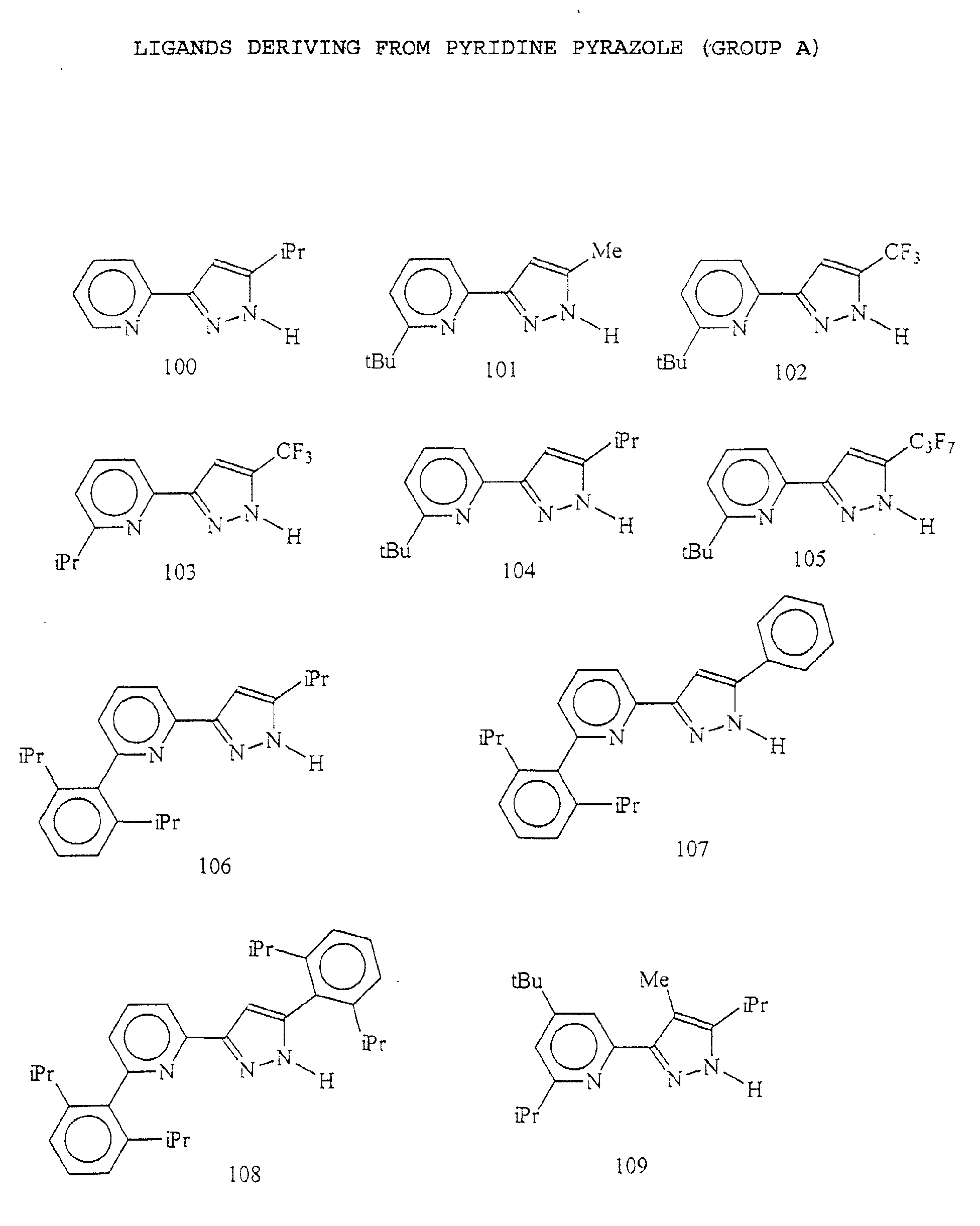
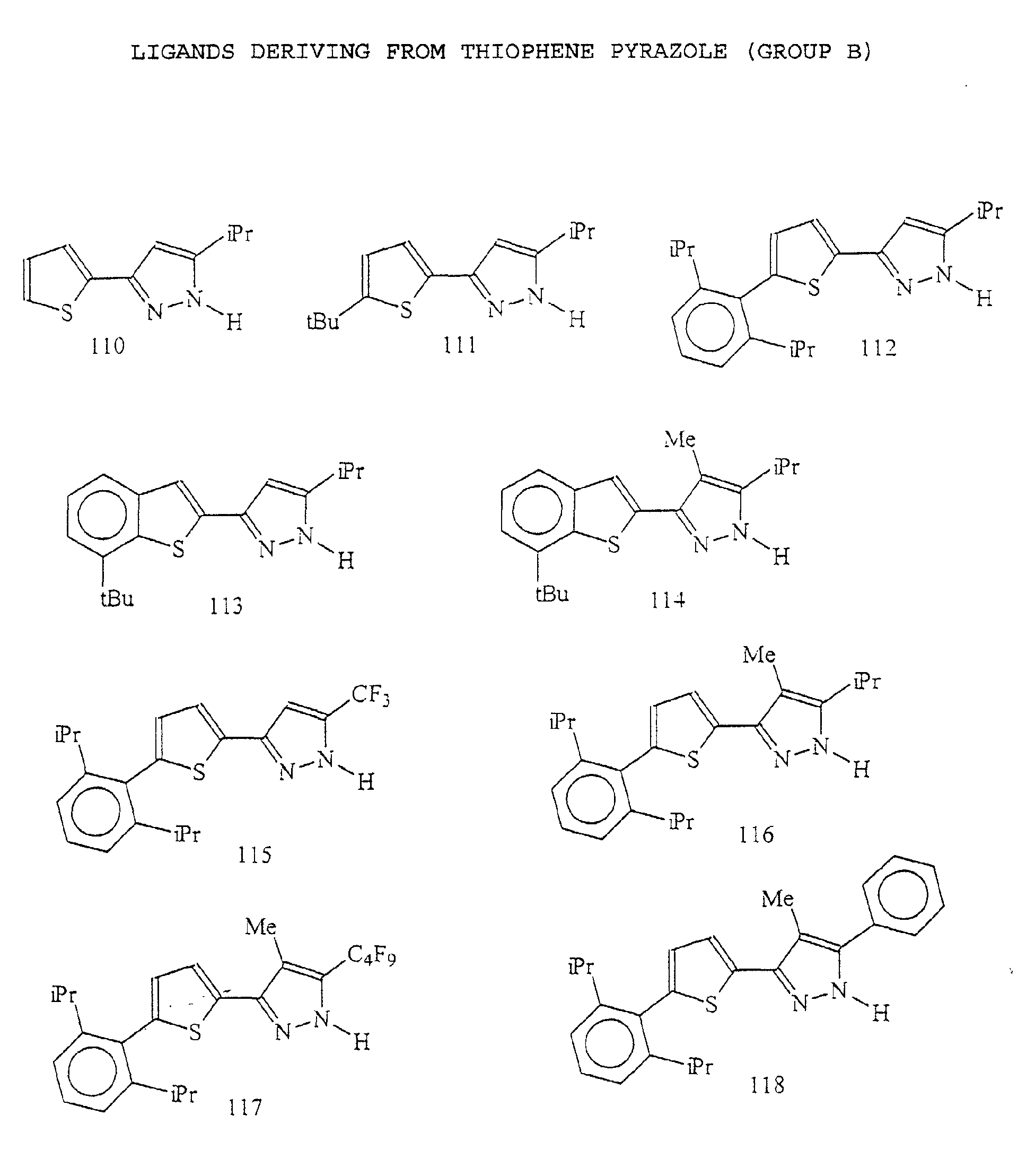

- Typical but non-limiting examples of cobalt complexes having general formula (I) are:
- Cobalt-[3-trifluoromethyl-5-[2-(6-bromo)-pyridine]-pyrazolyl] -dichloride;
- Cobalt-[3-methyl-5-[2-(6-ter-butyl)-pyridine]-pyrazolyl]-dichloride;
- Cobalt-[3-trifluoromethyl-5-[2-(6-ter-butyl)-pyridine]-pyrazolyl]-dichloride;
- Cobalt-[3-phenyl-5-[2-(6-(2,6-diisopropylphenyl)-pyridine]-pyrazolyl]-dichloride;
- Cobalt-[3-isopropyl-5-(2-furyl)-pyrazolyl]-dichloride;
- Cobalt-[3-isopropyl-5-[2-(7-ter-butyl)-benzofuryl)-pyrazolyl]-dichloride;
- Cobalt-[3-isopropyl-4-methyl-5-[2-(7-ter-butyl)-benzofuryl)-pyrazolyl]-dichloride;
- Cobalt-[3-trifluoromethyl-5-[2-(5-(2,6-diisopropyl-phenyl))-furyl]-pyrazolyl]-dichloride;
- Cobalt-[3-isopropyl-5-(2-thiophene)-pyrazolyl]-dichloride;
- Cobalt-[3-isopropyl-5-[2-(7-ter-butyl)-benzothiophene)-pyrazolyl]-dichloride;
- Cobalt-[3-isopropyl-4-methyl-5-[2-(7-ter-butyl)-benzothiophene)-pyrazolyl] -dichloride;
- Cobalt-[3-trifluoromethyl-5-[2-(5-(2,6-diisopropyl-phenyl))-thiophene-pyrazolyl]-dichloride;
- Cobalt-[3-trifluoromethyl-5-[2-(6-bromo)-pyridine]-pyrazolyl]-bis-pentan-2,4-dienoate;
- Cobalt-[3-methyl-5-[2-(6-ter-butyl)-pyridine]-pyrazolyl]-bis-pentan-2,4-dienoate;
- Cobalt-[3-phenyl-5-[2-(6-(2,6-diisopropylphenyl)-pyridine]-pyrazolyl]-bis-pentan-2,4-dienoate;
- Cobalt-tris-[3-(2-pyridine)-5-trifluoromethyl-pyrazole];
- Cobalt-bis-[3-isopropyl-5-(2-furyl)-pyrazolyl]-pentan-2,4-dienoate;
- Cobalt-[3-isopropyl-5-[2-(7-ter-butyl)-benzofuryl)-pyrazolyl]-bis-pentan-2,4-dienoate;
- Cobalt-[3-isopropyl-4-methyl-5-[2-(7-ter-butyl)-benzofuryl]-pyrazolyl]-bis-pentan-2,4-dienoate;
- Cobalt-[3-trifluoromethyl-5-[2-(5-(2,6-diisopropyl-phenyl))-furyl)]-pyrazolyl]-bis-pentan-2,4-dienoate;
- Cobalt-bis-[3-isopropyl-5-(2-thiophene)-pyrazolyl]-pentan-2,4-dienoate;
- Cobalt-[3-isopropyl-5-[2-(7-ter-butyl)-benzothiophene]-pyrazolyl]-bis-pentan-2,4-dienoate;
- Cobalt-[3-isopropyl-4-methyl-5- [2- (7-ter-butyl) -benzothiophene]-pyrazolyl]-bis-pentan-2,4-dienoate;
- Cobalt-[3-trifluoromethyl-5-[2-(5-(2,6-diisopropyl-phenyl))-thiophene)]-pyrazolyl]-bis-pentan-2,4-dienoate.
-
- Typical but non-limiting structures of cobalt complexes having general formula (I) are:



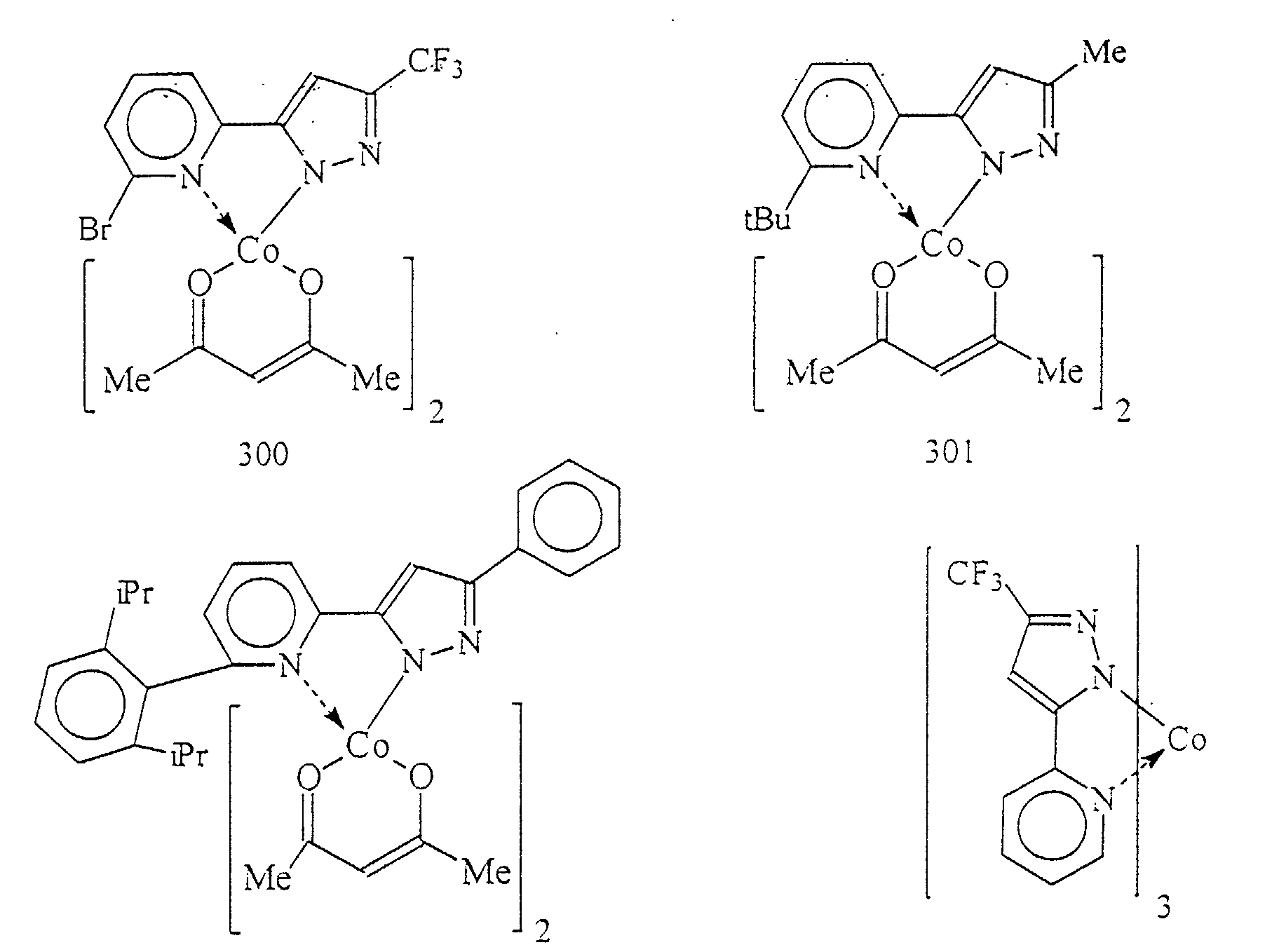


- The term "1,4-cis polybutadiene " refers to polybutadiene in which at least 90% of the butadiene units is concatenated in 1,4-cis position.
- The term "branched polybutadiene" refers to a polybutadiene having a g value (defined further on in the experimental part) ≤ 0.90, preferably ≤ 0.85. This branched polybutadiene is particularly suitable for the preparation of HIPS (high impact polystyrene).
- The term "linear polybutadiene" refers to polybutadiene having a g value ≥ 0.95. This linear polybutadiene is particularly suitable for the preparation of elastomeric blends for tyres.
- The complexes having general formula (I) can be synthesized according to known procedures, for example by reaction of the cobalt salt selected (for example CoCl2 or Co(acac)3) with the desired ligand in the stoichiometric ratio, in a hydrocarbon solvent or in alcohol.
- The catalytic system of the present invention also comprises, in addition to the cobalt complex having general formula (I), one or more cocatalysts selected from organo-derivatives of aluminum selected from:
- (b1) aluminoxanes and relative derivatives.
- (b2) halogen aluminum alkyls selected from (III) AlRnX3-n (with n = 1 or 2) and (IV) Al2RnX6-n (n = 1-5), wherein R is a C1-C20, preferably C1-C5, alkyl group, X is chlorine or bromine, preferably chlorine.
-
- When a linear 1,4-cis polybutadiene is desired, the organo-derivative of aluminum is selected from aluminoxanes and the relative derivatives (b1).
- When a branched 1,4-cis polybutadiene is desired, the organo-derivative of aluminum is selected from halogen aluminum alkyls (b2), particularly from those having general formula (IV) Al2RnX6-n.
- In accordance with this, the present invention also relates to a process for obtaining linear 1,4-cis polybutadiene by means of the polymerization of 1,3-butadiene in the presence of one or more solvents and a catalytic system, characterized in that said catalytic system comprises:
- (a) a catalyst selected from one or more cobalt complexes, preformed or formed in situ, having general formula (I) CO(z)LbWm, wherein z, b, m, L, W have the meaning defined above,
- (b) a cocatalyst selected from aluminoxanes and relative derivatives.
-
- The present invention also relates to a process for obtaining branched 1,4-cis polybutadiene by means of the polymerization of 1,3-butadiene in the presence of one or more solvents and a catalytic system, characterized in that said catalytic system comprises:
- (a) a catalyst selected from one or more cobalt complexes, preformed or formed in situ, having general formula (I) Co(z)LbWm, wherein z, b, m, L, W have the meaning defined above,
- (b) a cocatalyst selected from halogen aluminum alkyls having general formula (III) AlRnX3-n (with n = 1 or 2) or (IV) Al2RnX6-n (n = 1-5), wherein R is a C1-C20 alkyl group, X is chlorine or bromine, preferably chlorine.
-
- In the preferred embodiment, the cocatalyst (b) is selected from compounds having general formula (IV) Al2RnX6-n (n = 1-5). In an even more preferred embodiment, the cocatalyst is Al2(C2H5)3Cl3.
- As far as the aluminoxanes (b1) are concerned, it is known that these are compounds containing Al-O-Al bonds, with a varying O/Al ratio, obtained by the reaction, under contolled conditions, of an aluminum alkyl, or aluminum alkyl halide, with water or other compounds containing preestablished quantities of available water, as, for example, in the case of the reaction of aluminum trimethyl with aluminum hexahydrate sulfate, copper pentahydrate sulfate or iron pentahydrate sulfate. Aluminoxanes preferably used for the formation of the polymerization catalyst of the present invention are cyclic and/or linear, oligo- or polymeric compounds, characterized by the presence of repetitive units having the following formula:wherein R15 is a C1-C6 alkyl group, preferably methyl. Each aluminoxane molecule preferably contains from 4 to 70 repetitive units which may also not be all the same, but contain different R15 groups.

- With respect to the halogen aluminum alkyls (b2), these have general formula (III) AlRnX3-n (with n = 1 or 2) or (IV) Al2RnX6-n (n = 1-5), wherein R is a C1-C20 alkyl group, X is chlorine or bromine, preferably chlorine. Typical examples of compounds having general formula (III) are AlEt2Cl (diethyl aluminummonochloride), AlMe2Cl (dimethylaluminummonochloride), AlEtCl2 (ethylaluminumdichloride), Al(i-bu)2Cl (diisobutylaluminummonochloride); typical examples of compounds having general formula (IV) are Al2Et3Cl3 (ethylaluminumsesquichloride), Al2Me3Cl3 (methylaluminumsesquichloride).
- In the process of the present invention, for the production of both linear and branched polybutadiene, the molar ratio between the complex having general formula (I) and the aluminum of the cocatalyst ranges from 1:5 to 1:10000, preferably from 1:10 to 1:1000.
- The cobalt complex having general formula (I) can be used in a molar ratio with respect to the 1,3-butadiene ranging from 1/105 to 1/102, preferably from 1/2x104 to 1/103.
- When the preformed complex having general formula (I) is not used, but rather the formation technique in situ, it is possible to use a molar ratio between ligand (L) and cobalt salt from at least 1/1 to 3/1. It is obviously possible to operate with higher ratios.
- As far as the polymerization of butadiene is concerned, the above polymerization is preferably effected in a polymerization medium comprising an inert hydrocarbon which is a solvent of butadiene and of the catalytic system. Inert hydrocarbons which can be used in the polymerization process comprise aliphatic hydrocarbons, olefins included, cycloaliphatic, aromatic hydrocarbons and relative mixtures. More specifically, suitable hydrocarbons are those selected within the group of C4 to C8 aliphatic hydrocarbons, olefins included, within the group of C5 to C10 cycloaliphatic hydrocarbons, and relative mixtures. Typical, non-limiting examples of the above hydrocarbons are butane, pentane, hexane, heptane, cyclopentane, cyclohexane, butenes. The use of the above aliphatic and cycloaliphatic solvents is particularly advisable as it reduces problems relating to environmental impact. The process of the present invention can also be carried out in the presence of aromatic solvents, particularly toluene, as such or mixed with aliphatic solvents.
- The concentration of 1,3-butadiene in the polymerization medium can vary in relation to the particular solvent medium or diluent used. When solvents are used in which both 1,3-butadiene and also the polymeric product are soluble, the concentration of 1,3-butadiene preferably ranges from 10 to 35% by weight with respect to the total weight of the mixture.
- The polymerization temperature of 1,3-butadiene preferably ranges from -30°C to +60°C, the lower temperature limit being determined more by the freezing point of the reaction mixture rather than by the catalytic activity. More preferably, the polymerization process is carried out at a temperature ranging from -10°C to +40°C.
- The process of the present invention can also be carried out (see the experimental part) in the absence of the usual molecular weight regulators well-known to experts in the field, for example butene-1. This represents another significant advantage of the process of the present invention. In the process of the present invention, in fact, the molecular weight control can be effected by varying the type of cobalt complex and/or ratio between the aluminum compound and cobalt.
- The polymerization reaction can be stopped by the addition of one or more polymerization terminators which deactivate the catalytic system, followed by the conventional solvent-removal (desolventizing), washing and drying phases, which are normal operations in the production of polydienes. The terminator used for deactivating the catalytic system is typically a protic compound, which includes, but is not limited to, an alcohol, a carboxylic acid, an inorganic acid, and water or a combination thereof. An antioxidant such as 2,6-di-ter-butyl-4-methylphenol can be added, before, after or with the addition of the terminator. The quantity of antioxidant usually ranges from 0.2% to 1% by weight with respect to the polymer.
- At the end of the polymerization, the polybutadiene can be recovered according to the standard techniques, preferably by means of the coagulation technique. Any possible residues of the solvent can be removed from the polymer by means of evaporation, which can be facilitated by high temperatures and vacuum application.
- In addition to the above advantages, the process of the present invention allows polybutadiene to be produced with a reduced gel content, particularly macro gels. This is particularly important in the case of branched 1,4-cis polybutadiene as it allows the use of the latter for the preparation of HIPS impact polystyrene.
- The following examples are provided for a better understanding of the present invention.
-
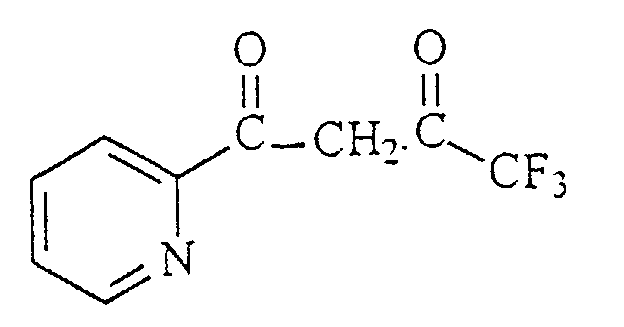
- CF3COOC2H5 42.6 g = 0.3 mol
- NaH 12 g = 0.3 mol
- 2-acetylpyridine 18.3 g = 0.15 mol
- anhydrous Et2O 300 ml
- 250 ml of ethyl ether are added, under nitrogen, in a three-necked flask, to 36.5 ml of CF3COOC2H5, and NaH. 17 ml of 2-acetylpyridine are added dropwise to 50 ml of ethyl ether, the suspension being maintained at reflux temperature, under stirring for 6 hours. 100 ml of ethyl ether are subsequently added, the mixture is left for a further hour at reflux temperature and for the whole night under stirring at room temperature. 50 ml of ethanol are added to the pink-coloured suspension, which is left under stirring for 1 hour. The suspension is poured into a mixture of water and ice (150 ml of H2O/150 g of ice). The two phases are separated and the aqueous phase is washed with Et2O (2 x 100 ml). The aqueous phase is acidified with H2SO4 at 10%, up to neutral pH, and is then extracted with Et2O. The ether phase is anhydrified with Na2SO4, the solvent is evaporated and dried with a mechanical pump. A reddish-brown oil is obtained (27.7 g = 0.13 moles). Yield 86.6%.
M.W. = 217.15 g/mol
1H NMR (CDCl3) : 8.71 (1H, m), 8.17 (1H, m) , 7.95 (1H, m) , 7.63 (1H, m), 3.55 (2H) -
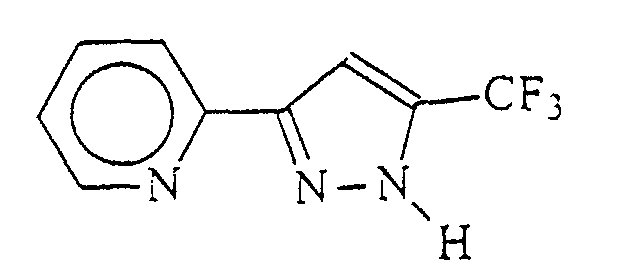
- diketone of example (1a) 27.7 g = 0.13 mol
- NH2NH2·H2O 25 g = 0.5 mol
- EtOH 500 ml
- H2O 20 ml
- β-diketone is dissolved in ethanol, under nitrogen, in a three-necked flask. 24 ml of hydrazine hydrate in 20 ml of water are added, dropwise in about one hour. The mixture is left at reflux temperature for an hour. It is left to cool and is diluted in 500 ml of H2O. It is then extracted with Et2O (6 x 200 ml). The ether phase is washed with H2O (2 x 100 ml)and anhydrified on Na2SO4. The solvent is evaporated and the pink solid is dried with a mechanical pump obtaining 26 g of raw product, which is crystallized from 200 ml of hot toluene. 12.3 g of pink solid are obtained, which is dried with a mechanical pump.
M.W. = 213.16 g/mol
1H NMR (C2D6O) : 8.50 (1H, d), 7.95 (1H, d), 7.81 (1H, m) , 7.33 (1H, m), 3.41 (2H, s).
IR spectrum (nujol) : νN-H = 3275.81 cm-1, νC-F = 1168.96 cm-1 -

- CF3COOC2H5 42.6 g = 0.3 mol
- NaH 12 g = 0.3 mol
- 2-acetylthiophene 19.3 g = 0.15 mol
- anhydrous Et2O 300 ml
- 250 ml of ethyl ether are added, under nitrogen, in a three-necked flask, to 36.5 ml of CF3COOC2H5, and NaH. 16.5 ml of 2-acetylthiophene are added dropwise to 50 ml of ethyl ether, the suspension being maintained at reflux temperature, under stirring for 5 hours. 100 ml of ethyl ether are subsequently added; the mixture is left for a further hour at reflux temperature and for the whole night under stirring at room temperature. 50 ml of ethanol are added to the pink-coloured suspension, obtaining a yellow solution, which is left under stirring for 1 hour. The solution is poured into a mixture of ice and water acidified with H2SO4 (150 ml of H2O/150 g of ice). The two phases are separated and the aqueous phase is washed with Et2O (2 x 100 ml). The aqueous phase is acidified with H2SO4 at 10%, up to neutral pH, and is then extracted with Et2O. 17.25 g of pink solid are obtained.
M.W. = 222.18 g/mol
1H NMR (ether phase, CDCl3): 7.81 (1H, d), 7.73 (1H, d), 7.16 (1H, m), 6.14 (1H, s). -
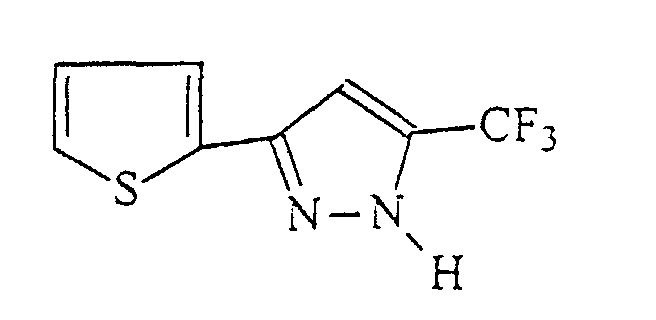
- diketone of example (2a) 17.3 g = 0.078 mol
- NH2NH2·H2O 11.7 g = 0.23 mol
- EtOH 200 ml
- H2O 20 ml
- β-diketone is dissolved in ethanol, under nitrogen, in a three-necked flask. Hydrazine hydrate in 20 ml of water are added, dropwise in about one hour. The mixture is left at reflux temperature for an hour. It is left to cool and is diluted in 200 ml of H2O. It is then extracted with Et2O (6 x 200 ml). The ether phase is washed with H2O (2 x 100 ml) and anhydrified on Na2SO4. The solvent is evaporated and the solid is dried with a mechanical pump. 16.3 g of yellow solid are obtained.
M.W. = 218.20 g/mol
1H NMR (CDCl3): 7.52 (1H, m), 7.36 (1H, m), 7.10 (1H, m), 6.68 (1H, s). - 35.7 ml of 2-acetyl benzofuran (0.30 moles) are added dropwise, in about 4 hours, to a suspension of 35.7 ml of ethyl trifluoroacetate (0.60 moles) and 24.0 g of NaH 60% (0.60 moles) in 500 ml of anhydrous ethyl ether. A further 500 ml of anhydrous ethyl ether are added to keep the reaction mass fluid. The mixture is refluxed for an hour, and after this period, 50 ml of ethanol are slowly added. The reaction mixture is poured into a 1 litre beaker containing 500 grams of ice and water, and HCl is added up to pH = 5. The two phases are then separated and the aqueous phase is washed with ethyl ether (3 x 200 ml), whereas the ether phase, after washing with NaHCO3 until neutrality, is washed again with water, dried on Na2SO4 and then evaporated from the solvent. 26.4 g of product are obtained, which upon NMR analysis proves to correspond to a mixture of keto-enolic tautomers. (Yield:42%).
1H NMR (in CD3COCD3, ppm) : 7.66 (2H, m) , 7.55 (2H, m) , 6.20 (1H, s), 3.20 (2H, s). -

- 20 g of hydrazine hydrate (0.4 moles) in water, are slowly added dropwise to a solution containing 26 ml of 1-(2-benzofuranyl)-4,4,4-trifluoromethylbutan-1,3-dione (0.128 moles) in 500 ml of ethyl ether, with a slight development of heat. At the end of the addition, the mixture is refluxed for an hour. The two phases are then separated and the aqueous phase is washed with ethyl ether (6 x 200 ml), whereas the organic phase, after being washed with NaHCO3 to neutrality and again with water, is dried on Na2SO4 and then evaporated from the solvent. 16.0 g of solid are obtained.
1H NMR (in CD3COCD3, ppm) : 7.46 (2H, q) , 7.25 (2H, q), 6.92 (1H, s), 6.32 (1H, s). mass: 252 (molecular ion). -

- CoCl2·6H2O 0.33 g = 1.4 mmol
- 3-trifluoromethyl-5-pyridinepyrazole 0.29 g = 1.4 mmol
- n-butanol 8 ml
- The CoCl2·6H2O is dissolved in n-butanol and the ligand dissolved in n-butanol is added, obtaining a greyish-blue solution. The mixture is left under stirring at T = 80°C for 1/2 hour. It is left to cool to room temperature, but no change is observed. Upon the addition of hexane, a lilac-coloured precipitate is formed. The precipitate is filtered under vacuum on a gooch 4 and is washed with Et2O. 0.37 g of product are obtained. Yield 77%.
M.W. = 343.09 g/molElemental analysis (% by weight) Theoretical Co = 17.2 Cl = 20.6 Real Co = 15.8 Cl = 18.7 - 0.19 g (0.9 mmoles) of 3-(2-pyridine)-5-trifluoromethyl-pyrazole dissolved in 10 ml of toluene are added to a solution of 0.31 g (0.9 mmoles) of Co(AcAc)3 in 10 ml of toluene. The mixture is left under stirring at 25°C for 1 hour and the solution is then concentrated to 5 ml, cooled to -10°C for 48 hours; the green solid precipitated is filtered and subsequently dried at 25°C and 10-3 mmHg. 0.20 g (47% yield) of complex are obtained.
Elemental analysis
Theoretical (%) for C19H19CoF3N3O4: Co = 12.56, C = 44.63, H = 4.08, N = 8.95.
Experimental (%): Co = 12.9; C = 45.0; H = 3.85; N = 9.01 -

- 0.384 g (1.8 mmoles) of 3-(2-pyridine)-5-trifluoromethyl-pyrazole dissolved in 10 ml of toluene are added to a solution of 0.31 g (0.9 mmoles) of Co(AcAc)3 in 10 ml of toluene. The temperature is brought to 70°C and the mixture is maintained at this value for 1 hour; it is then cooled to room temperature and the solution is concentrated to 10 ml. It is subsequently cooled to -10°C and maintained at this temperature for 48 hours; the green solid obtained is filtered and subsequently dried at 25°C and 10-3 mmHg. 0.25 g (24% yield) of complex are obtained.
Elemental analysis
Theoretical (%) for C23H17CoP6N6O2: Co = 10.12, C = 47.44, H = 2.94, N = 14.43
Experimental (%): Co = 10.9; C = 47.0; H = 3.20; N = 15.0 -

- 0.57 g (2.7 mmoles) of 3-(2-pyridine)-5-trifluoromethyl-pyrazole dissolved in 15 ml of toluene are added to a solution of 0.31 g (0.9 mmoles) of Co(AcAc)3 in 10 ml of toluene. The temperature is brought to 70°C and the mixture is maintained at this value for 2 hours; it is then cooled to room temperature and the green solid precipitated is filtered and subsequently dried at 25°C and 10-3 mmHg. 0.40 g (63% yield) of complex are obtained.
Elemental analysis
Theoretical (%) for C27H15CoF9N9: Co = 8.47, C = 46.63, H = 2.17, N = 18.13
Experimental (%): Co = 8.9; C = 46.20; H = 2.35; N = 18.7 - Butadiene (10 ml) and subsequently toluene (90 ml) are condensed in a 200 ml reactor, maintained at a temperature of -20°C. The reactor is brought to the desired polymerization temperature (about 20°C); the aluminum compound is then charged (1 x 10⁻² moles of MAO or Al2Et3Cl3 depending on the case) and finally a toluene solution of cobalt (preformed cobalt complex or toluene solution containing the non-complexed cobalt compound + ligand in the desired ratio), the quantity of cobalt being 1 x 10⁻⁵ moles. The whole mixture is kept under stirring for about 60 minutes.
- The polymerization is terminated by adding methanol containing minimum quantities of hydrochloric acid; the polymer is coagulated with methanol containing small quantities of antioxidant, washed several times with methanol and then dried under vacuum at room temperature.
- The 1H and 13C NMR spectra were registered with a Bruker AM 270 MHz spectrophotometer. The spectra were obtained in CDCl3 at room temperature using tetramethylsilane as internal standard or in high temperature C2D2Cl4 (103°C; HMDS as internal standard). The concentration of the polymeric solutions is about 10% by weight.
- The microstructure of the polybutadienes obtained was determined on the basis of what is already known in literature (see for example V.D. Mochel, J. Polym. Sci, A-1 10, 1009, 1972; K.F. Elgert, G. Quack, B. Stutzel, Makromol. Chem. 175, 1955, 1974; D. Morero, A. Santambrogio, L. Porri, F. Ciampelli, Chim. Ind. (Milan) 41, 758, 1958).
- Operating conditions:
- Agilent 1100 pump
- Agilent 1100 I.R. Detector
- PL Mixed-A Columns
- Solvent/Eluant THF
- Flow 1 ml/min
- Temperature 25°C
- Molecular mass calculation: Universal Calibration method
- Operating conditions:
- Agilent 1050 pump
- Agilent 1050 I.R. Detector
- MALLS Dawn-DSP Wyatt - Technology Detector, λ=632.8 nm
- PL 105-105-104-103 Columns
- Solvent/Eluant THF
- Flow 1 ml/min
- Temperature 25°C
- Average g branching index calculation: ratio between radius of gyration of the branched macromolecule and that of the linear macromolecule, with the same molecular weight; the ratio is effected for each point of the integrated chromatogram, after which the average on all the points is effected. A polybutadiene is defined as branched when g ≤ 0.90.
-
- Solvent : Styrene
- Concentration : 5% w/w
- Capillary: Cannon -Fenske series 200
- Calculation of the viscosity η = kt
-
- Solvent : THF
- Concentration : 0.3% w/w
- Insoluble macro: 325 mesh net;
- Insoluble micro: 0.2 µm Teflon filter.
- From table 1a (tests with MAO), it can be seen how the process of the present invention, carried out in the presence of cobalt complexes formed in situ (tests 1-6), or preformed (tests 8 and 9), produce linear 1,4-cis polybutadiene. The polybutadiene, in fact, has a content of 1,4 cis units higher than 91%, in most cases from 93% to 96%, whereas the g value (which indicates linearity) ranges from 0.97 to 1.00. Furthermore, all the tests effected according to the process of the present invention show a low gel content (both micro and macro). Comparative examples 7c and 7d, on the contrary, carried out in the absence of the ligands of the present invention, show a polybutadiene which is still linear (g = 1.00) but with an unacceptable gel content.
- All the tests from 1 to 6 provide linear 1,4-cis polybutadiene with molecular weights which are commercially acceptable for application in the tyre industry.
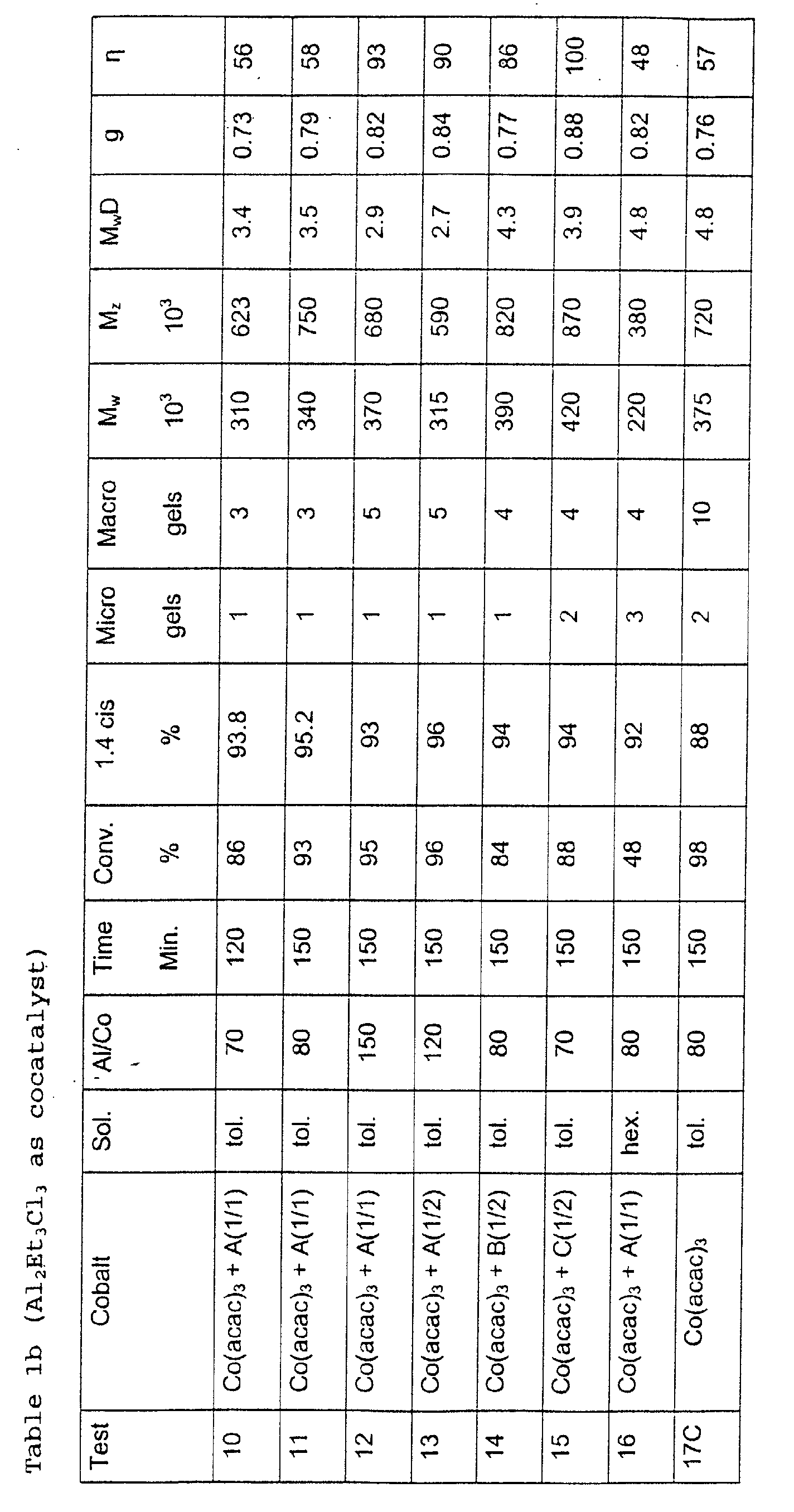
- With respect to the tests effected in the presence of Al2Et3Cl3 (table 1b), it can be observed that this cocatalyst always produces 1,4-cis polybutadienes, but branched. This is demonstrated by the "g" values which are all lower than 0.90.
- The gel content, furthermore, (micro ≤ 3, macro ≤ 5) is acceptable and the viscosity in styrene is equal to or lower than 100 cP, therefore allowing the polybutadiene thus obtained, to be used in the preparation of impact polystyrene (HIPS). It should be pointed out that comparative example 17C (absence of the ligand) has a low content of 1,4-cis units and a high content of macro gels. Table 1b also indicates the possibility of carrying out the process with the use of an aliphatic solvent (hexane).
- In conclusion, the catalytic system of the present invention allows linear or branched 1,4-cis polybutadiene to be obtained, depending on the aluminum compound used, always with molecular weight and gel values suitable for the industrial applications specified.
Viscosity values lower than or equal to 100 cP are acceptable for the modification of polystyrene.

Claims (18)
- A process for the preparation of 1,4-cis polybutadiene by means of the polymerization of 1,3-butadiene, carried out in one or more solvents and in the presence of a catalytic system which comprises one or more catalysts selected from cobalt complexes, preformed or formed in situ, having general formula (I)
b = 1, 2, 3;
m = 0, 1, 2;
W is selected from Br, Cl, acetylacetonate, carboxylate, with the constraint that:
when z = 2; m = 2, b = 1; W = Cl, Br, carboxylate;
when z = 3; m = 0, 1, 2; b = 1, 2, 3; W = acetylacetonate;
characterized in that:
L is a ligand having general formula (Ia)wherein
Y is selected from N, O and S
R' and R'', the same or different, are selected from hydrogen, linear or branched alkyl groups containing from 1 to 10 carbon atoms, cycloalkyl groups and aryl groups containing from 6 to 20 carbon atoms, wherein the above groups can be optionally halogenated, preferably with fluorine;
R''', R'''', the same or different, are selected from hydrogen, halogen, linear or branched C1-C20 alkyl groups, C6-C20 aryl groups, or they jointly form a condensed benzene ring, wherein said aryl groups or said condensed benzene ring can be optionally substituted with linear or branched alkyl groups containing from 1 to 10 carbon atoms,
n is an integer having the value of 1 or 2. - The process according to claim 1, wherein W is selected from Cl and acetylacetonate.
- The process according to claim 1, wherein R' and R'', the same or different, are selected from H, CH3, CF3.
- The process according to claim 1, wherein R'''= R''' = H.
- The process according to claim 1, wherein R''' and R'''' are jointly equal to -(-CH=CH-)2-.
- A catalytic system useful for the polymerization of 1,3 butadiene comprising:wherein R is a C1-C20 alkyl group, X is chlorine or bromine.(a) a complex preformed or formed in situ having general formula (I) CO(z)LbWm wherein z, L, b, m, W have the meanings defined above;(b) organo-derivatives of aluminum selected from:(b1) aluminoxanes and relative derivatives,(b2) halogen aluminum alkyls selected from (III) AlRnX3-n (with n = 1 or 2) and (IV) Al2RnX6-n (n = 1-5),
- The catalytic system according to claim 6, wherein R is a C1-C5 alkyl group, X is chlorine or bromine.
- A process for obtaining linear 1,4-cis polybutadiene by means of the polymerization of 1,3-butadiene in the presence of one or more solvents and a catalytic system, characterized in that the catalytic system comprises:(a) a catalyst selected from one or more cobalt complexes, preformed or formed in situ, having general formula (I) Co(z)LbWm, wherein z, b, m, L, W have the meanings defined above;(b) a cocatalyst selected from aluminoxanes and relative derivatives.
- A process for obtaining branched 1,4-cis polybutadiene by means of the polymerization of 1,3-butadiene in the presence of one or more solvents and a catalytic system, characterized in that the catalytic system comprises:(a) a catalyst selected from one or more cobalt complexes, preformed or formed in situ, having general formula (I) Co(z)LbWm, wherein z, b, m, L, W have the meanings defined above;(b) a cocatalyst selected from halogen derivatives having general formula (III) AlRnX3-n (with n = 1 or 2) or (IV) Al2RnX6-n (n = 1-5), wherein R is a C1-C20 alkyl group, X is chlorine or bromine, preferably chlorine.
- The process for the preparation of 1,4-cis polybutadiene according to claims 8 and 9, characterized in that the molar ratio between the complex having general formula (I) and the aluminum of the cocatalyst ranges from 1:5 to 1:10000.
- The process according to claim 10, wherein the molar ratio between the complex having general formula (I) and the aluminum of the cocatalyst ranges from 1:10 to 1:1000.
- The process according to claims 8 and 9, characterized in that the molar ratio between the complex having general formula (I) and 1,3-butadiene ranges from 1/105 to 1/102.
- The process according to claim 12, characterized in that the molar ratio between the complex having general formula (I) and 1,3-butadiene ranges from 1/2x104 to 1/103.
- The process according to claims 8 and 9, wherein, when the formation in situ technique of the complex having general formula (I), is used, it is possible to adopt a molar ratio between ligand (L) and cobalt salt ranging from at least 1/1 to 3/1.
- The process according to claims 8 and 9, characterized in that the solvent is selected from aliphatic hydrocarbons, olefins included, cycloaliphatic, aromatic hydrocarbons and relative mixtures.
- The process according to claim 15, characterized in that the solvent is selected from hydrocarbons selected from within the group of C4 to C8 aliphatic hydrocarbons, olefins included, within the group of C5 to C10 cycloaliphatic hydrocarbons, and relative mixtures.
- The process according to claims 8 and 9, wherein the temperature ranges from -30°C to +60°C.
- The process according to claim 17, wherein the temperature-ranges from -10°C to +40°C.
Applications Claiming Priority (2)
| Application Number | Priority Date | Filing Date | Title |
|---|---|---|---|
| IT2001MI002409A ITMI20012409A1 (en) | 2001-11-15 | 2001-11-15 | PROCEDURE FOR THE PREPARATION OF LINEAR OR-BRANCHED POLYBUTADIENE 1,4-CIS |
| ITMI20012409 | 2001-11-15 |
Publications (1)
| Publication Number | Publication Date |
|---|---|
| EP1312622A1 true EP1312622A1 (en) | 2003-05-21 |
Family
ID=11448607
Family Applications (1)
| Application Number | Title | Priority Date | Filing Date |
|---|---|---|---|
| EP02079623A Withdrawn EP1312622A1 (en) | 2001-11-15 | 2002-11-06 | Process for the preparation of linear or branched 1,4-cis polybutadiene |
Country Status (4)
| Country | Link |
|---|---|
| EP (1) | EP1312622A1 (en) |
| HU (1) | HUP0203956A3 (en) |
| IT (1) | ITMI20012409A1 (en) |
| PL (1) | PL357074A1 (en) |
Cited By (1)
| Publication number | Priority date | Publication date | Assignee | Title |
|---|---|---|---|---|
| CN1831021B (en) * | 2004-10-25 | 2011-10-05 | 波利玛利欧洲股份公司 | A process for the preparation of low branch content polybutadiene |
Citations (3)
| Publication number | Priority date | Publication date | Assignee | Title |
|---|---|---|---|---|
| GB941739A (en) * | 1960-06-07 | 1963-11-13 | Montedison Spa | Process of polymerising butadiene |
| EP0113309A1 (en) * | 1982-12-23 | 1984-07-11 | The Goodyear Tire & Rubber Company | Syndiotactic 1,2-polybutadiene synthesis process |
| WO2001074831A1 (en) * | 2000-03-31 | 2001-10-11 | Polimeri Europa S.P.A. | Complex polymerization catalysts for the homopolymerization of ethylene and for the copolymerization of ethylene |
-
2001
- 2001-11-15 IT IT2001MI002409A patent/ITMI20012409A1/en unknown
-
2002
- 2002-11-06 EP EP02079623A patent/EP1312622A1/en not_active Withdrawn
- 2002-11-12 PL PL02357074A patent/PL357074A1/en not_active Application Discontinuation
- 2002-11-14 HU HU0203956A patent/HUP0203956A3/en unknown
Patent Citations (3)
| Publication number | Priority date | Publication date | Assignee | Title |
|---|---|---|---|---|
| GB941739A (en) * | 1960-06-07 | 1963-11-13 | Montedison Spa | Process of polymerising butadiene |
| EP0113309A1 (en) * | 1982-12-23 | 1984-07-11 | The Goodyear Tire & Rubber Company | Syndiotactic 1,2-polybutadiene synthesis process |
| WO2001074831A1 (en) * | 2000-03-31 | 2001-10-11 | Polimeri Europa S.P.A. | Complex polymerization catalysts for the homopolymerization of ethylene and for the copolymerization of ethylene |
Non-Patent Citations (1)
| Title |
|---|
| TAKAHASHI, AKIO ET AL: "Organic halides in the high-cis polymerization of butadiene by a trialkylaluminum-Co compound", J. POLYM. SCI., POLYM. LETT. ED. (1967), 5(5), 415-21, XP001073845 * |
Cited By (1)
| Publication number | Priority date | Publication date | Assignee | Title |
|---|---|---|---|---|
| CN1831021B (en) * | 2004-10-25 | 2011-10-05 | 波利玛利欧洲股份公司 | A process for the preparation of low branch content polybutadiene |
Also Published As
| Publication number | Publication date |
|---|---|
| HU0203956D0 (en) | 2003-01-28 |
| PL357074A1 (en) | 2003-05-19 |
| HUP0203956A3 (en) | 2011-04-28 |
| ITMI20012409A1 (en) | 2003-05-15 |
| HUP0203956A2 (en) | 2003-06-28 |
Similar Documents
| Publication | Publication Date | Title |
|---|---|---|
| EP1379562B1 (en) | Supported olefin polymerization catalysts | |
| EP3529289B1 (en) | Process for preparing conjugated diene (co)polymers in the presence of a catalytic system comprising a pyridyl iron (iii) complex | |
| JP2001508114A (en) | Polymerization of ethylene | |
| WO1999019335A1 (en) | Novel polymerisation catalysts | |
| KR20150096645A (en) | Process for the preparation of (co)polymers of conjugated dienes in the presence of a catalytic system comprising a bis-imine complex of cobalt | |
| CN109952325B (en) | Process for preparing syndiotactic 1, 2-polybutadiene in the presence of a catalytic system comprising a pyridyliron complex | |
| KR20150099712A (en) | Process for the preparation of (co)polymers of conjugated dienes in the presence of a catalytic system comprising a bis-imino-pyridine complex of cobalt | |
| KR102735350B1 (en) | Method for producing polyisoprene having predominantly an alternating CIS-1,4-ALT-3,4 structure in the presence of a catalyst system comprising a pyridyl iron complex | |
| CN108484809B (en) | Olefin polymerization catalyst | |
| CA2845874C (en) | Bis-imine pyridine complex of lanthanides, catalytic system comprising said bis-imine pyridine complex and process for the (co)polymerization of conjugated dienes | |
| ITMI20011813A1 (en) | COBALT COMPLEX USEFUL IN THE 1,3-BUTADIENE POLYMERIZATION | |
| JPH07505672A (en) | Catalysts used in ethylene polymerization and their production methods | |
| WO2002102861A2 (en) | Process for the (co)polymerization of conjugated dienes | |
| KR20170098211A (en) | Oxo-nitrogenated vanadium complex, catalytic system comprising said oxo-nitrogenated vanadium complex and process for (co)polymerising conjugated dienes | |
| HUP0203956A2 (en) | Process for the preparation of linear or branched 1,4-cis polybutadiene | |
| CA2845871C (en) | Oxo-nitrogenated complex of lanthanides and use in the (co)polymerization of conjugated dienes | |
| CN110563771B (en) | Metal complex, intermediate, preparation method and application thereof | |
| KR20180034330A (en) | (Co) polymerization method of a catalyst system comprising a nitrogen-titanium complex, the nitrogen-titanium complex, and a conjugated diene | |
| KR20170086021A (en) | Phosphinic vanadium complex, catalytic system comprising said phosphinic vanadium complex and process for the (co) polymerization of conjugated dienes | |
| KR20020091166A (en) | Complex polymerization catalysts for the homopolymerization of ethylene and for the copolymerization of ethylene | |
| CN108456233B (en) | A kind of bis-Schiff base iron complex and its application and a kind of method for preparing conjugated diene polymer | |
| CN118791652A (en) | A late transition metal catalyst containing benzotriazole substituted pyridine, preparation method thereof and use thereof in catalyzing conjugated diene polymerization | |
| AU2002254480A1 (en) | Supported olefin polymerization catalysts | |
| EA043624B1 (en) | METHOD FOR PRODUCING POLYISOPRENE WITH PRIMARILY ALTERNATING CIS-1,4-ALT-3,4-STRUCTURE IN THE PRESENCE OF A CATALYTIC SYSTEM INCLUDING IRON PYRIDINE COMPLEX | |
| CN103833792A (en) | A pyrene-4,5-dione nickel halide metal complex and its preparation and application |
Legal Events
| Date | Code | Title | Description |
|---|---|---|---|
| PUAI | Public reference made under article 153(3) epc to a published international application that has entered the european phase |
Free format text: ORIGINAL CODE: 0009012 |
|
| AK | Designated contracting states |
Designated state(s): AT BE BG CH CY CZ DE DK EE ES FI FR GB GR IE IT LI LU MC NL PT SE SK TR |
|
| AX | Request for extension of the european patent |
Extension state: AL LT LV MK RO SI |
|
| 17P | Request for examination filed |
Effective date: 20030721 |
|
| AKX | Designation fees paid |
Designated state(s): AT BE BG CH CY CZ DE DK EE ES FI FR GB GR IE IT LI LU MC NL PT SE SK TR |
|
| AXX | Extension fees paid |
Extension state: RO Payment date: 20021106 Extension state: MK Payment date: 20021106 |
|
| 17Q | First examination report despatched |
Effective date: 20040330 |
|
| GRAP | Despatch of communication of intention to grant a patent |
Free format text: ORIGINAL CODE: EPIDOSNIGR1 |
|
| STAA | Information on the status of an ep patent application or granted ep patent |
Free format text: STATUS: THE APPLICATION IS DEEMED TO BE WITHDRAWN |
|
| 18D | Application deemed to be withdrawn |
Effective date: 20070530 |