EP1312484A2 - Adhesion promoting polymeric materials and planographic printing elements containing them - Google Patents
Adhesion promoting polymeric materials and planographic printing elements containing them Download PDFInfo
- Publication number
- EP1312484A2 EP1312484A2 EP02024863A EP02024863A EP1312484A2 EP 1312484 A2 EP1312484 A2 EP 1312484A2 EP 02024863 A EP02024863 A EP 02024863A EP 02024863 A EP02024863 A EP 02024863A EP 1312484 A2 EP1312484 A2 EP 1312484A2
- Authority
- EP
- European Patent Office
- Prior art keywords
- polymer
- planographic printing
- printing element
- layer
- hydrophilic layer
- Prior art date
- Legal status (The legal status is an assumption and is not a legal conclusion. Google has not performed a legal analysis and makes no representation as to the accuracy of the status listed.)
- Withdrawn
Links
- 239000000463 material Substances 0.000 title claims description 8
- 230000001737 promoting effect Effects 0.000 title 1
- 229920000642 polymer Polymers 0.000 claims abstract description 64
- 108010010803 Gelatin Proteins 0.000 claims abstract description 28
- 229920000159 gelatin Polymers 0.000 claims abstract description 28
- 239000008273 gelatin Substances 0.000 claims abstract description 28
- 235000019322 gelatine Nutrition 0.000 claims abstract description 28
- 235000011852 gelatine desserts Nutrition 0.000 claims abstract description 28
- 238000000576 coating method Methods 0.000 claims abstract description 27
- 239000011248 coating agent Substances 0.000 claims abstract description 18
- 239000000758 substrate Substances 0.000 claims abstract description 18
- 125000000524 functional group Chemical group 0.000 claims abstract description 16
- 239000000203 mixture Substances 0.000 claims abstract description 16
- GWEVSGVZZGPLCZ-UHFFFAOYSA-N Titan oxide Chemical compound O=[Ti]=O GWEVSGVZZGPLCZ-UHFFFAOYSA-N 0.000 claims abstract description 10
- 230000009477 glass transition Effects 0.000 claims abstract description 10
- 239000002245 particle Substances 0.000 claims abstract description 8
- PNEYBMLMFCGWSK-UHFFFAOYSA-N aluminium oxide Inorganic materials [O-2].[O-2].[O-2].[Al+3].[Al+3] PNEYBMLMFCGWSK-UHFFFAOYSA-N 0.000 claims abstract description 7
- 239000011230 binding agent Substances 0.000 claims abstract description 6
- 239000004593 Epoxy Chemical group 0.000 claims abstract description 5
- 125000005250 alkyl acrylate group Chemical group 0.000 claims abstract description 5
- 125000002887 hydroxy group Chemical group [H]O* 0.000 claims abstract description 5
- 229920001897 terpolymer Polymers 0.000 claims abstract description 4
- 239000000178 monomer Substances 0.000 claims description 20
- 238000000034 method Methods 0.000 claims description 8
- 238000002360 preparation method Methods 0.000 claims description 7
- 229920001577 copolymer Polymers 0.000 claims description 4
- 229910044991 metal oxide Inorganic materials 0.000 claims description 3
- 150000004706 metal oxides Chemical class 0.000 claims description 3
- 230000000269 nucleophilic effect Effects 0.000 claims description 2
- 239000004848 polyfunctional curative Substances 0.000 claims description 2
- BPQQTUXANYXVAA-UHFFFAOYSA-N Orthosilicate Chemical compound [O-][Si]([O-])([O-])[O-] BPQQTUXANYXVAA-UHFFFAOYSA-N 0.000 claims 2
- 238000004132 cross linking Methods 0.000 claims 1
- 239000002923 metal particle Substances 0.000 claims 1
- 239000004115 Sodium Silicate Substances 0.000 abstract description 4
- 125000003055 glycidyl group Chemical group C(C1CO1)* 0.000 abstract description 4
- NTHWMYGWWRZVTN-UHFFFAOYSA-N sodium silicate Chemical compound [Na+].[Na+].[O-][Si]([O-])=O NTHWMYGWWRZVTN-UHFFFAOYSA-N 0.000 abstract description 4
- 229910052911 sodium silicate Inorganic materials 0.000 abstract description 4
- 229920006267 polyester film Polymers 0.000 abstract description 3
- 239000010410 layer Substances 0.000 description 53
- 229920000728 polyester Polymers 0.000 description 9
- 230000000694 effects Effects 0.000 description 6
- 239000001397 quillaja saponaria molina bark Substances 0.000 description 4
- 229930182490 saponin Natural products 0.000 description 4
- 150000007949 saponins Chemical class 0.000 description 4
- -1 sulphonate ester Chemical group 0.000 description 4
- XLYOFNOQVPJJNP-UHFFFAOYSA-N water Substances O XLYOFNOQVPJJNP-UHFFFAOYSA-N 0.000 description 4
- 125000000484 butyl group Chemical group [H]C([*])([H])C([H])([H])C([H])([H])C([H])([H])[H] 0.000 description 3
- 229940044192 2-hydroxyethyl methacrylate Drugs 0.000 description 2
- 239000004816 latex Substances 0.000 description 2
- 229920000126 latex Polymers 0.000 description 2
- 239000004094 surface-active agent Substances 0.000 description 2
- IJHIIHORMWQZRQ-UHFFFAOYSA-N 1-(ethenylsulfonylmethylsulfonyl)ethene Chemical compound C=CS(=O)(=O)CS(=O)(=O)C=C IJHIIHORMWQZRQ-UHFFFAOYSA-N 0.000 description 1
- XSHISXQEKIKSGC-UHFFFAOYSA-N 2-aminoethyl 2-methylprop-2-enoate;hydron;chloride Chemical compound Cl.CC(=C)C(=O)OCCN XSHISXQEKIKSGC-UHFFFAOYSA-N 0.000 description 1
- WOBHKFSMXKNTIM-UHFFFAOYSA-N Hydroxyethyl methacrylate Chemical compound CC(=C)C(=O)OCCO WOBHKFSMXKNTIM-UHFFFAOYSA-N 0.000 description 1
- 239000004698 Polyethylene Substances 0.000 description 1
- 229910008051 Si-OH Inorganic materials 0.000 description 1
- 229910006358 Si—OH Inorganic materials 0.000 description 1
- 238000007259 addition reaction Methods 0.000 description 1
- 150000004703 alkoxides Chemical class 0.000 description 1
- 230000015572 biosynthetic process Effects 0.000 description 1
- CQEYYJKEWSMYFG-UHFFFAOYSA-N butyl acrylate Chemical compound CCCCOC(=O)C=C CQEYYJKEWSMYFG-UHFFFAOYSA-N 0.000 description 1
- 229920002301 cellulose acetate Polymers 0.000 description 1
- 238000006243 chemical reaction Methods 0.000 description 1
- 239000008199 coating composition Substances 0.000 description 1
- 239000000549 coloured material Substances 0.000 description 1
- 230000000052 comparative effect Effects 0.000 description 1
- 230000005494 condensation Effects 0.000 description 1
- 238000006482 condensation reaction Methods 0.000 description 1
- 239000004020 conductor Substances 0.000 description 1
- 239000003431 cross linking reagent Substances 0.000 description 1
- 239000004744 fabric Substances 0.000 description 1
- VOZRXNHHFUQHIL-UHFFFAOYSA-N glycidyl methacrylate Chemical compound CC(=C)C(=O)OCC1CO1 VOZRXNHHFUQHIL-UHFFFAOYSA-N 0.000 description 1
- 150000004820 halides Chemical group 0.000 description 1
- 229910052809 inorganic oxide Inorganic materials 0.000 description 1
- 238000004519 manufacturing process Methods 0.000 description 1
- 229920000573 polyethylene Polymers 0.000 description 1
- 229920000139 polyethylene terephthalate Polymers 0.000 description 1
- 239000005020 polyethylene terephthalate Substances 0.000 description 1
- 229920006254 polymer film Polymers 0.000 description 1
- 239000013047 polymeric layer Substances 0.000 description 1
- 239000011347 resin Substances 0.000 description 1
- 229920005989 resin Polymers 0.000 description 1
- 230000000717 retained effect Effects 0.000 description 1
- 239000002356 single layer Substances 0.000 description 1
- 238000004381 surface treatment Methods 0.000 description 1
- 239000004408 titanium dioxide Substances 0.000 description 1
- 238000011282 treatment Methods 0.000 description 1
- 238000009736 wetting Methods 0.000 description 1
Images


Classifications
-
- B—PERFORMING OPERATIONS; TRANSPORTING
- B41—PRINTING; LINING MACHINES; TYPEWRITERS; STAMPS
- B41N—PRINTING PLATES OR FOILS; MATERIALS FOR SURFACES USED IN PRINTING MACHINES FOR PRINTING, INKING, DAMPING, OR THE LIKE; PREPARING SUCH SURFACES FOR USE AND CONSERVING THEM
- B41N3/00—Preparing for use and conserving printing surfaces
- B41N3/03—Chemical or electrical pretreatment
- B41N3/036—Chemical or electrical pretreatment characterised by the presence of a polymeric hydrophilic coating
Definitions
- This invention relates to planographic printing elements and a method for their preparation.
- planographic printing is lithographic printing which relies on the immiscibility of oil and water, wherein the oily material or ink is preferentially retained by the image area of a lithographic printing plate.
- the background or non-image area retains the water and repels the ink while the image area accepts the ink and repels the water.
- the ink on the image area is then transferred to a surface of a material upon which the image is to be reproduced, such as paper, cloth and the like.
- a material upon which the image is to be reproduced such as paper, cloth and the like.
- the ink is transferred to an intermediate material called the blanket which in turn transfers the ink to the surface of the material upon which the image is to be reproduced.
- the production of printing elements for use in lithographic printing requires the formation of a hydrophilic layer on a substrate.
- the present invention provides a solution to this problem by providing a planographic printing element in which the hydrophilic layer is bound to the substrate by a selected polymer.
- a planographic printing element suitable to receive and bond with a subsequently applied hydrophilic layer said element comprising:
- the adhesion of the hydrophilic layer to the substrate is significantly increased and an improved printing element provided.
- Fig 1 is a schematic drawing showing a planographic printing element according to the invention.
- Figs 2 to 5 are graphs which show how the adhesion rating varies with polymer laydown for polymers A,B,C and D.
- polymer in the present specification is intended to include copolymers and terpolymers unless the context requires otherwise.
- Suitable functional groups contained in the polymer are hydroxyl, epoxy, glycidyl and groups such as halide or sulphonate ester which are capable of being displaced by a nucleophilic group.
- Typical functional groups in the hydrophilic layer are -Si-OH, hydroxyl or alkoxide.
- the polymer is conveniently obtained by the polymerisation of a monomer containing the functional groups.
- the polymers applied as the adhesion layer may comprise latex polymers prepared from monomers containing functional groups that can react with corresponding groups in the hydrophilic layer by either condensation or addition reactions.
- Examples of such functional groups include hydroxyl and epoxy, an example of epoxy being a glycidyl group.
- the polymer may contain from about 25 to 85 weight %, preferably about 35 to 55 weight % of monomers containing such units.
- Suitable polymers are those of hydroxyalkylmethacrylates such as 2-hydroxyethylmethacrylate.
- a co-monomer may be employed to assist in obtaining required glass transition temperature of less than 15°C.
- An example of such a co-monomer is an alkyl acrylate such as butyl acrylate.
- the comonomer may be present in amount from 15 to 75 weight %, preferably 45 to 65 weight %.
- a further co-monomer may be added to cross-link with gelatin by use of conventional gelatin hardeners (e.g. bis(vinylsulphonyl)methane or the like,) in 0.5-10 weight %, preferably 1 to 7 weight %.
- conventional gelatin hardeners e.g. bis(vinylsulphonyl)methane or the like,
- An example of such a comonomer is an aminoalkyl acrylate such as 2-aminoethyl methacrylate hydrochloride.
- the % by weight are based on the combined weight of the monomers present.
- a class of preferred polymers are terpolymers of (a) a hydroxyalkylacrylate, (b) an alkyl acrylate and (c) an aminoalkylmethacrylate.
- Typical relative amounts of the monomers are: (a) from about 20 to about 80 (b) about 20 to about 70 and (c) from about 2 to about 10.
- Another preferred class of polymers are copolymers of (i) glycidyl methacrylate and (ii) an alkyl acrylate.
- Typical relative amounts of monomer (i) are from 90 to about 50 of monomer, and monomer (ii) from about 10 to about 50.
- the polymers may be prepared by latex or solution polymerisation. Suitable preparations are described in United States Patent No. 4,689,359.
- This patent discloses that the adhesion of a coating composition containing gelatin to a discharge treated polyester film support can be improved by incorporating in the gelatin one or more defined polymers.
- the problem with which this patent is concerned is the bonding of a gelatin-containing composition to a polyester support used for making photographic elements.
- the problem addressed by the present invention is the bonding of the support (which may be polyester) to a hydrophilic layer employed in the preparation of planographic printing elements.
- the polymers employed in the present invention may be blended with gelatin and the composition thereby obtained applied as a coating to the substrate.
- the polymer/gelatin compositions may have a ratio of polymer to gelatin in the range 95:5 to 5:95 by weight, and more desirably between 95:5 and 40:60.
- laydown of polymer or polymer gelatin composition on the substrate is conveniently at least 50mg/square metre to 4g/square metre, preferably from 100mg/square metre to 500 mg/square metre.
- gelatin When the polymer is applied with gelatin it is preferred that gelatin provides not more than about 60% by weight of the composition of polymer and gelatin.
- Typical thicknesses of the polymer coating are from about 0.05 microns up to about 4 microns.
- Such polymer and polymer/gelatin compositions may also include surfactants to provide suitable wetting characteristics, opaque or coloured materials to provide suitable backgrounds, conducting materials to provide antistatic qualities and cross-linking agents to provide sufficient robustness.
- surfactants to provide suitable wetting characteristics
- opaque or coloured materials to provide suitable backgrounds
- conducting materials to provide antistatic qualities and cross-linking agents to provide sufficient robustness.
- materials to adjust pH, particularly to achieve specific conditions intended to facilitate a reaction with an overlying layer can also be included.
- These compositions can be coated as a single layer or as a part of multilayer structure.
- the substrate may be any one of those known in the planographic printing art.
- the substrate may comprise a polyester film such as polyethylene terephthalate, cellulose acetate film, or other polymer film such as polyethylene or paper such as resin coated paper.
- the hydrophilic layer may comprise inorganic oxide particles such as a metal oxide particles, for example aluminium oxide and titanium dioxide together with a binder such as sodium silicate.
- a metal oxide particles for example aluminium oxide and titanium dioxide
- a binder such as sodium silicate.
- a planographic printing element comprises:
- a method for the preparation of a planographic printing element suitable to receive and bond with a subsequently applied hydrophilic layer comprises:
- the polymer contains at least 25% by weight of a monomer containing a functional group
- the polymer may be applied to the substrate as a composition containing the polymer in admixture with gelatin, preferably in relative amounts of from 95:5 to 5:95 preferably from 95:5 to 40:60 by weight.
- the adhesion of the adhesion layer thereto may be improved by the provision of a layer that provides a key for the adhesion layer, or alternatively, by a surface treatment of the polyester with a corona or glow-discharge as described in United States Patent No 4,689,359.
- a subsequent step comprises applying a hydrophilic material to the adhesion layer as a coating to form the hydrophilic layer and provide a printing element that can be used in planographic printing.
- Polymers A and B shown below, were coated with a suitable coating aid, in this case saponin (which is a surfactant) at approximately 8.5 mg m -2 of saponin.
- saponin which is a surfactant
- Some coatings were composed polymer and saponin and other coatings also contained gelatin.
- the coatings were applied onto a polyester support with a pre-applied hard undercoat layer (the purpose of which was to provide a key for the adhesion layer) to give a series of adhesion layers with varying component laydowns.
- Polymer A is poly(butyl acrylate-co-2-aminoethyl methacrylate hydrochloride-co-2-hydroxyethylmethacrylate), (50:5:45).
- Polymer B is poly(butyl acrylate-co-2-aminoethyl methacrylate hydrochloride-co-2-methoxyethylmethacrylate), (50:5:45).
- a hydrophilic layer comprising of a mixture of alumina and titania particles in a sodium silicate binder, in a manner described fully in WO 97/19819, to give a total dry laydown of approximately 10 g m -2 .
- Fig 1 shows an optional hard undercoat layer (2) on the polyester support (1) which has been applied before the adhesion layer (3) to provide a key therefor.
- the hydrophilic layer (4) is coated over the adhesion layer (3).
- planographic printing elements were then evaluated for adhesion.
- the tests were performed by scoring the coatings with a razor blade in a grid pattern (five one inch lines, 0.2 inches apart and another five lines at a 45 degree angle to the first set).
- a piece of 610 scotch tape (3M company) was applied to the scored area and the tape rapidly peeled off in an effort to remove the hydrophilic layer.
- Polymer B is included for comparative purposes and does not form part of the present invention.
- Polymers C and D shown below were coated with a suitable coating aid, in this case saponin at approximately 8.5 mg m -2 , and sometimes with gelatin, onto a polyester support with a pre-applied undercoat layer (*) to give a series of adhesion layers with varying component laydowns.
- a suitable coating aid in this case saponin at approximately 8.5 mg m -2 , and sometimes with gelatin, onto a polyester support with a pre-applied undercoat layer (*) to give a series of adhesion layers with varying component laydowns.
- Polymer C is poly(butyl acrylate-co-2-aminoethyl methacrylate hydrochloride-co-3-chloro-2-hydroxypropyl methacrylate), (50:5:45).
- Polymer D is poly(glycidyl methacrylate-co-butyl acrylate), (75:25).
- the resulting layers were then overcoated with a hydrophilic layer comprised of a mixture of alumina and titania particles in a sodium silicate binder, in a manner described fully in WO 97/19819, to give a total dry laydown of approximately 10 g m -2 .
- the final coating structure is given in Figure 1 above.
- planographic elements were evaluated for adhesion.
- the tests were performed by scoring the coatings with a razor blade in a grid pattern (five one inch lines, 0.2 inches apart and another five lines at a 45 degree angle to the first set).
- a piece of 610 scotch tape (3M company) was applied to the scored area and the tape rapidly peeled off in an effort to remove the hydrophilic layer.
Landscapes
- Laminated Bodies (AREA)
- Printing Plates And Materials Therefor (AREA)
- Photosensitive Polymer And Photoresist Processing (AREA)
- Materials For Photolithography (AREA)
Abstract
Description
- This invention relates to planographic printing elements and a method for their preparation.
- One form of planographic printing is lithographic printing which relies on the immiscibility of oil and water, wherein the oily material or ink is preferentially retained by the image area of a lithographic printing plate. When a suitably prepared surface is moistened with water and an ink is then applied, the background or non-image area retains the water and repels the ink while the image area accepts the ink and repels the water.
- The ink on the image area is then transferred to a surface of a material upon which the image is to be reproduced, such as paper, cloth and the like. Commonly the ink is transferred to an intermediate material called the blanket which in turn transfers the ink to the surface of the material upon which the image is to be reproduced.
- The production of printing elements for use in lithographic printing requires the formation of a hydrophilic layer on a substrate.
- There is a continuing need to improve the adhesion between the hydrophilic layer and the substrate on which it is based. The present invention provides a solution to this problem by providing a planographic printing element in which the hydrophilic layer is bound to the substrate by a selected polymer.
- According to the present invention there is provided a planographic printing element suitable to receive and bond with a subsequently applied hydrophilic layer said element comprising:
- (i) a substrate layer having coated thereon
- (ii) an adhesion layer, said adhesion layer comprising a polymer having a glass transition temperature of less than 15°C and containing functional groups capable of bonding with a hydrophilic layer when the latter is applied as a coating.
-
- By the use of the polymeric layer containing functional groups capable of bonding with groups in the hydrophilic layer, the adhesion of the hydrophilic layer to the substrate is significantly increased and an improved printing element provided.
- Fig 1 is a schematic drawing showing a planographic printing element according to the invention.
- Figs 2 to 5 are graphs which show how the adhesion rating varies with polymer laydown for polymers A,B,C and D.
- The term polymer in the present specification is intended to include copolymers and terpolymers unless the context requires otherwise.
- Examples of suitable functional groups contained in the polymer are hydroxyl, epoxy, glycidyl and groups such as halide or sulphonate ester which are capable of being displaced by a nucleophilic group.
- Typical functional groups in the hydrophilic layer are -Si-OH, hydroxyl or alkoxide.
- The polymer is conveniently obtained by the polymerisation of a monomer containing the functional groups.
- The polymers applied as the adhesion layer may comprise latex polymers prepared from monomers containing functional groups that can react with corresponding groups in the hydrophilic layer by either condensation or addition reactions.
- Examples of such functional groups include hydroxyl and epoxy, an example of epoxy being a glycidyl group.
- The polymer may contain from about 25 to 85 weight %, preferably about 35 to 55 weight % of monomers containing such units.
- Suitable polymers are those of hydroxyalkylmethacrylates such as 2-hydroxyethylmethacrylate.
- A co-monomer may be employed to assist in obtaining required glass transition temperature of less than 15°C. An example of such a co-monomer is an alkyl acrylate such as butyl acrylate. The comonomer may be present in amount from 15 to 75 weight %, preferably 45 to 65 weight %.
- A further co-monomer may be added to cross-link with gelatin by use of conventional gelatin hardeners (e.g. bis(vinylsulphonyl)methane or the like,) in 0.5-10 weight %, preferably 1 to 7 weight %.
- An example of such a comonomer is an aminoalkyl acrylate such as 2-aminoethyl methacrylate hydrochloride.
- The % by weight are based on the combined weight of the monomers present.
- A class of preferred polymers are terpolymers of (a) a hydroxyalkylacrylate, (b) an alkyl acrylate and (c) an aminoalkylmethacrylate.
- Typical relative amounts of the monomers are: (a) from about 20 to about 80 (b) about 20 to about 70 and (c) from about 2 to about 10.
- Another preferred class of polymers are copolymers of (i) glycidyl methacrylate and (ii) an alkyl acrylate.
- Typical relative amounts of monomer (i) are from 90 to about 50 of monomer, and monomer (ii) from about 10 to about 50.
- The polymers may be prepared by latex or solution polymerisation. Suitable preparations are described in United States Patent No. 4,689,359.
- This patent discloses that the adhesion of a coating composition containing gelatin to a discharge treated polyester film support can be improved by incorporating in the gelatin one or more defined polymers. The problem with which this patent is concerned is the bonding of a gelatin-containing composition to a polyester support used for making photographic elements. In contrast, the problem addressed by the present invention is the bonding of the support (which may be polyester) to a hydrophilic layer employed in the preparation of planographic printing elements.
- The polymers employed in the present invention may be blended with gelatin and the composition thereby obtained applied as a coating to the substrate.
- The polymer/gelatin compositions may have a ratio of polymer to gelatin in the range 95:5 to 5:95 by weight, and more desirably between 95:5 and 40:60.
- The laydown of polymer or polymer gelatin composition on the substrate is conveniently at least 50mg/square metre to 4g/square metre, preferably from 100mg/square metre to 500 mg/square metre.
- When the polymer is applied with gelatin it is preferred that gelatin provides not more than about 60% by weight of the composition of polymer and gelatin.
- Typical thicknesses of the polymer coating are from about 0.05 microns up to about 4 microns.
- Such polymer and polymer/gelatin compositions may also include surfactants to provide suitable wetting characteristics, opaque or coloured materials to provide suitable backgrounds, conducting materials to provide antistatic qualities and cross-linking agents to provide sufficient robustness. In addition, materials to adjust pH, particularly to achieve specific conditions intended to facilitate a reaction with an overlying layer, can also be included. These compositions can be coated as a single layer or as a part of multilayer structure.
- Suitable polymers and their method of preparation are described in United States Patent Nos 4,695,532 and 4,689,359.
- The substrate may be any one of those known in the planographic printing art. For example the substrate may comprise a polyester film such as polyethylene terephthalate, cellulose acetate film, or other polymer film such as polyethylene or paper such as resin coated paper.
- The hydrophilic layer may comprise inorganic oxide particles such as a metal oxide particles, for example aluminium oxide and titanium dioxide together with a binder such as sodium silicate. Suitable hydrophilic layers and their preparation are described in WO 97/19819 and European Patent Application No 963859A the disclosures of which are incorporated by reference.
- According to another aspect of the invention a planographic printing element comprises:
- (i) a substrate layer having coated thereon
- (ii) an adhesion layer comprising a polymer having a glass transition temperature of less than 15°C, said adhesion layer having coated thereon and bonded thereto
- (iii) a hydrophilic layer
-
- According to a further aspect of the present invention a method for the preparation of a planographic printing element suitable to receive and bond with a subsequently applied hydrophilic layer comprises:
- applying to a substrate a coating of a polymer having a glass transition temperature of less than 15°C said polymer containing functional groups capable of reacting with corresponding groups in the hydrophilic layer.
-
- Preferably the polymer contains at least 25% by weight of a monomer containing a functional group
- The polymer may be applied to the substrate as a composition containing the polymer in admixture with gelatin, preferably in relative amounts of from 95:5 to 5:95 preferably from 95:5 to 40:60 by weight.
- In the case of a polyester or similar support, the adhesion of the adhesion layer thereto may be improved by the provision of a layer that provides a key for the adhesion layer, or alternatively, by a surface treatment of the polyester with a corona or glow-discharge as described in United States Patent No 4,689,359.
- The above described method produces a printing element to which a hydrophilic layer will be applied to give a printing element that can be used in planographic printing. Therefore, after the application of the adhesion layer a subsequent step comprises applying a hydrophilic material to the adhesion layer as a coating to form the hydrophilic layer and provide a printing element that can be used in planographic printing.
- The invention is illustrated by reference to the following Examples.
- All the polymers used in the Examples had a glass transition. temperature of less than 15°C.
- Polymers A and B, shown below, were coated with a suitable coating aid, in this case saponin (which is a surfactant) at approximately 8.5 mg m-2 of saponin.
- Some coatings were composed polymer and saponin and other coatings also contained gelatin.
- The coatings were applied onto a polyester support with a pre-applied hard undercoat layer (the purpose of which was to provide a key for the adhesion layer) to give a series of adhesion layers with varying component laydowns.
- Polymer A is poly(butyl acrylate-co-2-aminoethyl methacrylate hydrochloride-co-2-hydroxyethylmethacrylate), (50:5:45).
- Polymer B is poly(butyl acrylate-co-2-aminoethyl methacrylate hydrochloride-co-2-methoxyethylmethacrylate), (50:5:45).
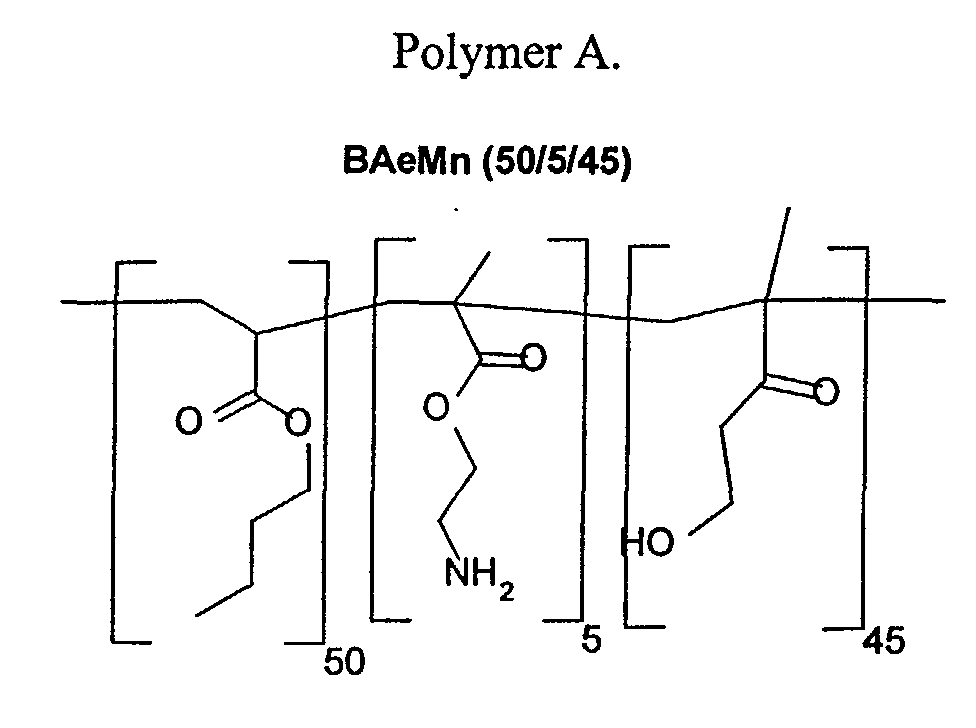

- The resulting layers were then overcoated with a hydrophilic layer comprising of a mixture of alumina and titania particles in a sodium silicate binder, in a manner described fully in WO 97/19819, to give a total dry laydown of approximately 10 g m-2.
- The final coating structure is shown in Figure 1 below.
- Fig 1 shows an optional hard undercoat layer (2) on the polyester support (1) which has been applied before the adhesion layer (3) to provide a key therefor. The hydrophilic layer (4) is coated over the adhesion layer (3).
- An alternative would be to apply the adhesion layer directly onto the bare polyester support after the latter has been treated by corona or glow-discharge as described for example in United States Patent No 4,689,359.
- These planographic printing elements were then evaluated for adhesion. The tests were performed by scoring the coatings with a razor blade in a grid pattern (five one inch lines, 0.2 inches apart and another five lines at a 45 degree angle to the first set). A piece of 610 scotch tape (3M company) was applied to the scored area and the tape rapidly peeled off in an effort to remove the hydrophilic layer. The coatings were ranked using a scale of 1 to 6 where 6 = Good (no removal of the coating) and 1 = Poor (complete removal of the coating).
- The results obtained from these tests, average values from several coatings, are given in Figures 2 and 3.
- It can be seen in Figure 2 that as the laydown of Polymer A was increased the adhesion of the hydrophilic layer increased, producing an effect superior to that obtained with gelatin alone. In addition, it was also possible to coat useful mixtures of Polymer A and gelatin. However Figure 3 shows that Polymer B (which contains no functional groups capable of bonding with the hydrophilic layer) had no useful effect and also that varying the laydown of polymer B had no discernible effect, even in combination with gelatin.
- Polymer B is included for comparative purposes and does not form part of the present invention.
- Polymers C and D shown below were coated with a suitable coating aid, in this case saponin at approximately 8.5 mg m-2, and sometimes with gelatin, onto a polyester support with a pre-applied undercoat layer (*) to give a series of adhesion layers with varying component laydowns.
- (* It would have been equally possible, but less experimentally convenient, to apply the adhesion layer directly to bare polyester support assisted by corona or glow-discharge treatments as demonstrated in the prior art noted above.)
- Polymer C is poly(butyl acrylate-co-2-aminoethyl methacrylate hydrochloride-co-3-chloro-2-hydroxypropyl methacrylate), (50:5:45). Polymer D is poly(glycidyl methacrylate-co-butyl acrylate), (75:25).


- The resulting layers were then overcoated with a hydrophilic layer comprised of a mixture of alumina and titania particles in a sodium silicate binder, in a manner described fully in WO 97/19819, to give a total dry laydown of approximately 10 g m-2. The final coating structure is given in Figure 1 above.
- These planographic elements were evaluated for adhesion. The tests were performed by scoring the coatings with a razor blade in a grid pattern (five one inch lines, 0.2 inches apart and another five lines at a 45 degree angle to the first set). A piece of 610 scotch tape (3M company) was applied to the scored area and the tape rapidly peeled off in an effort to remove the hydrophilic layer. The coatings were ranked using a scale of 1 to 6 where 6 = Good (no removal of the coating) and 1 = Poor (complete removal of the coating).
- The results obtained from these tests, average values from several coatings, are given in Figures 4 and 5 below.
- It can be seen in Figure 4 that as the laydown of Polymer C increased the adhesion of the hydrophilic layer, although the effect was inferior to that obtained with gelatin alone. In addition, it was also possible to coat useful mixtures of Polymer C and gelatin. In the same way, it can be seen in Figure 5 that as the laydown of Polymer D was increased the adhesion of the hydrophilic layer increased, again, an effect inferior to that obtained with gelatin alone.
- As with Polymer C, it was also possible to coat useful mixtures of Polymer D and gelatin.
Claims (15)
- A planographic printing element suitable to receive and bond with a subsequently applied hydrophilic layer said element comprising:(i) a substrate layer having coated thereon(ii) an adhesion layer, said adhesion layer comprising a polymer having a glass transition temperature of less than 15°C and containing functional groups capable of bonding with a hydrophilic layer when the latter is applied as a coating.
- A planographic printing element as claimed in claim 1 wherein the functional groups in the polymer are selected from hydroxyl, epoxy and groups capable of being displaced by a nucleophilic group on the hydrophilic layer.
- A planographic printing element as claimed in claim 2 wherein the polymer contains at least 25% by weight of a monomer containing a functional group.
- A planographic printing element as claimed in any one of the preceding claims wherein the polymer is a copolymer of a monomer (i) containing the functional groups and a monomer (ii) such as an alkyl acrylate in relative amounts such that the glass transition temperature of the copolymer is less than 15°C.
- A planographic printing element as claimed in claim 4 wherein the amount of monomer (ii) is from 15 to 75% by weight based on the combined weight of the two monomers.
- A planographic printing element as claimed in claim 4 or 5 wherein the polymer is a terpolymer containing a monomer (iii) to provide the capability of crosslinking with gelatin by means of conventional gelatin hardeners.
- A planographic printing element as claimed in claim 6 wherein the amount of monomer (iii) is from 0.5 to 10% by weight by weight of the combined weights of monomers (i), (ii) and (iii).
- A planographic printing element as claimed in any one of the preceding claims wherein the adhesion layer comprises the polymer and gelatin in relative amounts from 95:5 to 5:95 by weight.
- A planographic printing element as claimed in any one of the preceding claims wherein the laydown of polymer or polymer and gelatin composition is from 50 mg/square metre to 4g/square metre.
- A planographic printing element comprising:(i) a substrate layer having coated thereon(ii) an adhesion layer, said adhesion layer comprising a polymer having a glass transition temperature of less than 15°C, said adhesion layer having coated thereon and bonded thereto(iii) a hydrophilic layer.
- A planogrphic printing element as claimed in claim 10 wherein the hydrophilic layer comprises metal oxide particles and a silicate binder.
- A planographic printing element as claimed in claim 11 wherein the metal particles comprise particles of titania and/or alumina.
- A method for the preparation of a planographic printing element suitable to receive a hydrophilic layer subsequently applied thereto which method comprises
applying to a substrate a coating of a polymer to form an adhesion layer said polymer having a glass transition temperature of less than 15°C and containing functional groups capable of reacting with corresponding groups in a subsequently applied hydrophilic layer. - A method as claimed in claim 13 which further comprises applying a coating of a hydrophilic material to the adhesion layer to form a hydrophilic layer.
- A method as claimed in claim 14 wherein the hydrophilic layer comprises metal oxide particles and a silicate binder.
Applications Claiming Priority (2)
| Application Number | Priority Date | Filing Date | Title |
|---|---|---|---|
| GBGB0127713.6A GB0127713D0 (en) | 2001-11-20 | 2001-11-20 | Adhesion promoting polymeric materials and planographic printing elements containing them |
| GB0127713 | 2001-11-20 |
Publications (2)
| Publication Number | Publication Date |
|---|---|
| EP1312484A2 true EP1312484A2 (en) | 2003-05-21 |
| EP1312484A3 EP1312484A3 (en) | 2004-10-20 |
Family
ID=9926039
Family Applications (1)
| Application Number | Title | Priority Date | Filing Date |
|---|---|---|---|
| EP02024863A Withdrawn EP1312484A3 (en) | 2001-11-20 | 2002-11-08 | Adhesion promoting polymeric materials and planographic printing elements containing them |
Country Status (4)
| Country | Link |
|---|---|
| US (1) | US20030207199A1 (en) |
| EP (1) | EP1312484A3 (en) |
| JP (1) | JP2003191658A (en) |
| GB (1) | GB0127713D0 (en) |
Cited By (1)
| Publication number | Priority date | Publication date | Assignee | Title |
|---|---|---|---|---|
| EP3001249A3 (en) * | 2011-02-28 | 2016-05-04 | Fujifilm Corporation | Lithographic printing plate precursors and processes for preparing lithographic printing plates |
Families Citing this family (2)
| Publication number | Priority date | Publication date | Assignee | Title |
|---|---|---|---|---|
| JP5612510B2 (en) * | 2011-02-28 | 2014-10-22 | 富士フイルム株式会社 | Planographic printing plate precursor and lithographic printing plate preparation method |
| JP5658697B2 (en) * | 2011-02-28 | 2015-01-28 | 富士フイルム株式会社 | Planographic printing plate precursor and lithographic printing plate preparation method |
Citations (3)
| Publication number | Priority date | Publication date | Assignee | Title |
|---|---|---|---|---|
| US4689359A (en) | 1985-08-22 | 1987-08-25 | Eastman Kodak Company | Composition formed from gelatin and polymer of vinyl monomer having a primary amine addition salt group |
| WO1997019819A1 (en) | 1995-11-24 | 1997-06-05 | Horsell Graphic Industries Limited | Hydrophilized support for planographic printing plates and its preparation |
| EP0963859A1 (en) | 1998-06-12 | 1999-12-15 | Eastman Kodak Company | Method of making a durable hydrophilic layer |
Family Cites Families (6)
| Publication number | Priority date | Publication date | Assignee | Title |
|---|---|---|---|---|
| NL278078A (en) * | 1961-05-04 | |||
| US4130424A (en) * | 1976-08-06 | 1978-12-19 | Bell Telephone Laboratories, Incorporated | Process using radiation curable epoxy containing resist and resultant product |
| US5353705A (en) * | 1992-07-20 | 1994-10-11 | Presstek, Inc. | Lithographic printing members having secondary ablation layers for use with laser-discharge imaging apparatus |
| US5639586A (en) * | 1993-04-05 | 1997-06-17 | Agfa-Gevaert, N.V. | Lithographic base and a lithographic printing plate |
| DE69625105T2 (en) * | 1995-02-17 | 2003-07-17 | Eastman Kodak Co., Rochester | Photographic element and photographic film base therefor |
| US6749982B2 (en) * | 2002-09-27 | 2004-06-15 | Eastman Kodak Company | Imaging member with polyester base |
-
2001
- 2001-11-20 GB GBGB0127713.6A patent/GB0127713D0/en not_active Ceased
-
2002
- 2002-11-08 EP EP02024863A patent/EP1312484A3/en not_active Withdrawn
- 2002-11-14 JP JP2002330594A patent/JP2003191658A/en active Pending
- 2002-11-20 US US10/300,345 patent/US20030207199A1/en not_active Abandoned
Patent Citations (4)
| Publication number | Priority date | Publication date | Assignee | Title |
|---|---|---|---|---|
| US4689359A (en) | 1985-08-22 | 1987-08-25 | Eastman Kodak Company | Composition formed from gelatin and polymer of vinyl monomer having a primary amine addition salt group |
| US4695532A (en) | 1985-08-22 | 1987-09-22 | Eastman Kodak Company | Photographic silver halide element containing new adhesion promoting polymeric materials and polyester support |
| WO1997019819A1 (en) | 1995-11-24 | 1997-06-05 | Horsell Graphic Industries Limited | Hydrophilized support for planographic printing plates and its preparation |
| EP0963859A1 (en) | 1998-06-12 | 1999-12-15 | Eastman Kodak Company | Method of making a durable hydrophilic layer |
Cited By (2)
| Publication number | Priority date | Publication date | Assignee | Title |
|---|---|---|---|---|
| EP3001249A3 (en) * | 2011-02-28 | 2016-05-04 | Fujifilm Corporation | Lithographic printing plate precursors and processes for preparing lithographic printing plates |
| US9690195B2 (en) | 2011-02-28 | 2017-06-27 | Fujifilm Corporation | Lithographic printing plate precursors and processes for preparing lithographic printing plates |
Also Published As
| Publication number | Publication date |
|---|---|
| GB0127713D0 (en) | 2002-01-09 |
| EP1312484A3 (en) | 2004-10-20 |
| JP2003191658A (en) | 2003-07-09 |
| US20030207199A1 (en) | 2003-11-06 |
Similar Documents
| Publication | Publication Date | Title |
|---|---|---|
| EP0482837B1 (en) | Transparent liquid absorbent materials | |
| DE69604643T2 (en) | Receiving layer for ink jet recording | |
| EP0482835A1 (en) | Printable transparency | |
| US6171422B1 (en) | Imaging element having a conductive polymer layer | |
| JPH01158427A (en) | Polymer particle | |
| US5635331A (en) | Substrate and a color proofing article having release agent/adhesive mixture coated thereon | |
| EP1312484A2 (en) | Adhesion promoting polymeric materials and planographic printing elements containing them | |
| US7198882B2 (en) | Adhesion promoting polymeric materials and planographic printing elements containing them | |
| US6303184B1 (en) | Method of forming a discontinuous polymer overcoat for imaging elements | |
| JPH08190219A (en) | Removable nonporous opaque thin-film layer | |
| WO1994002325A1 (en) | Nonimpact printing element | |
| JP2000043398A (en) | INK JET RECORDING MEDIUM AND ITS MANUFACTURING METHOD | |
| JP4092041B2 (en) | Inkjet recording sheet | |
| JP2691179B2 (en) | Printing film | |
| JP2579233B2 (en) | recoding media | |
| JPS6255518B2 (en) | ||
| JPH0439665B2 (en) | ||
| CA1130127A (en) | Process for preparation of high opacity photosensitive images | |
| JPH10180968A (en) | Laminated polyester film for diazo | |
| JPH02245082A (en) | Adhesive sheet for electrophotography | |
| JPS62232646A (en) | Photographic support | |
| JPS63234255A (en) | Undercoating method for photographic polyester film | |
| JPH0257034B2 (en) | ||
| JPH08150774A (en) | Recording sheet and manufacturing method thereof | |
| JPS62231254A (en) | Photographic support |
Legal Events
| Date | Code | Title | Description |
|---|---|---|---|
| PUAI | Public reference made under article 153(3) epc to a published international application that has entered the european phase |
Free format text: ORIGINAL CODE: 0009012 |
|
| AK | Designated contracting states |
Designated state(s): AT BE BG CH CY CZ DE DK EE ES FI FR GB GR IE IT LI LU MC NL PT SE SK TR |
|
| AX | Request for extension of the european patent |
Extension state: AL LT LV MK RO SI |
|
| PUAL | Search report despatched |
Free format text: ORIGINAL CODE: 0009013 |
|
| AK | Designated contracting states |
Kind code of ref document: A3 Designated state(s): AT BE BG CH CY CZ DE DK EE ES FI FR GB GR IE IT LI LU MC NL PT SE SK TR |
|
| AX | Request for extension of the european patent |
Extension state: AL LT LV MK RO SI |
|
| 17P | Request for examination filed |
Effective date: 20050303 |
|
| AKX | Designation fees paid |
Designated state(s): DE |
|
| STAA | Information on the status of an ep patent application or granted ep patent |
Free format text: STATUS: THE APPLICATION HAS BEEN WITHDRAWN |
|
| 18W | Application withdrawn |
Effective date: 20081023 |