EP1310896A2 - Server, management system and management control method for promoting recycling activities by incentives - Google Patents
Server, management system and management control method for promoting recycling activities by incentives Download PDFInfo
- Publication number
- EP1310896A2 EP1310896A2 EP02257451A EP02257451A EP1310896A2 EP 1310896 A2 EP1310896 A2 EP 1310896A2 EP 02257451 A EP02257451 A EP 02257451A EP 02257451 A EP02257451 A EP 02257451A EP 1310896 A2 EP1310896 A2 EP 1310896A2
- Authority
- EP
- European Patent Office
- Prior art keywords
- collection
- information
- user
- expendables
- collected
- Prior art date
- Legal status (The legal status is an assumption and is not a legal conclusion. Google has not performed a legal analysis and makes no representation as to the accuracy of the status listed.)
- Withdrawn
Links
Images


















Classifications
-
- G—PHYSICS
- G06—COMPUTING OR CALCULATING; COUNTING
- G06Q—INFORMATION AND COMMUNICATION TECHNOLOGY [ICT] SPECIALLY ADAPTED FOR ADMINISTRATIVE, COMMERCIAL, FINANCIAL, MANAGERIAL OR SUPERVISORY PURPOSES; SYSTEMS OR METHODS SPECIALLY ADAPTED FOR ADMINISTRATIVE, COMMERCIAL, FINANCIAL, MANAGERIAL OR SUPERVISORY PURPOSES, NOT OTHERWISE PROVIDED FOR
- G06Q30/00—Commerce
- G06Q30/02—Marketing; Price estimation or determination; Fundraising
-
- G—PHYSICS
- G06—COMPUTING OR CALCULATING; COUNTING
- G06Q—INFORMATION AND COMMUNICATION TECHNOLOGY [ICT] SPECIALLY ADAPTED FOR ADMINISTRATIVE, COMMERCIAL, FINANCIAL, MANAGERIAL OR SUPERVISORY PURPOSES; SYSTEMS OR METHODS SPECIALLY ADAPTED FOR ADMINISTRATIVE, COMMERCIAL, FINANCIAL, MANAGERIAL OR SUPERVISORY PURPOSES, NOT OTHERWISE PROVIDED FOR
- G06Q30/00—Commerce
- G06Q30/02—Marketing; Price estimation or determination; Fundraising
- G06Q30/0207—Discounts or incentives, e.g. coupons or rebates
- G06Q30/0225—Avoiding frauds
-
- G—PHYSICS
- G06—COMPUTING OR CALCULATING; COUNTING
- G06Q—INFORMATION AND COMMUNICATION TECHNOLOGY [ICT] SPECIALLY ADAPTED FOR ADMINISTRATIVE, COMMERCIAL, FINANCIAL, MANAGERIAL OR SUPERVISORY PURPOSES; SYSTEMS OR METHODS SPECIALLY ADAPTED FOR ADMINISTRATIVE, COMMERCIAL, FINANCIAL, MANAGERIAL OR SUPERVISORY PURPOSES, NOT OTHERWISE PROVIDED FOR
- G06Q30/00—Commerce
- G06Q30/02—Marketing; Price estimation or determination; Fundraising
- G06Q30/0207—Discounts or incentives, e.g. coupons or rebates
- G06Q30/0226—Incentive systems for frequent usage, e.g. frequent flyer miles programs or point systems
-
- G—PHYSICS
- G06—COMPUTING OR CALCULATING; COUNTING
- G06Q—INFORMATION AND COMMUNICATION TECHNOLOGY [ICT] SPECIALLY ADAPTED FOR ADMINISTRATIVE, COMMERCIAL, FINANCIAL, MANAGERIAL OR SUPERVISORY PURPOSES; SYSTEMS OR METHODS SPECIALLY ADAPTED FOR ADMINISTRATIVE, COMMERCIAL, FINANCIAL, MANAGERIAL OR SUPERVISORY PURPOSES, NOT OTHERWISE PROVIDED FOR
- G06Q30/00—Commerce
- G06Q30/02—Marketing; Price estimation or determination; Fundraising
- G06Q30/0207—Discounts or incentives, e.g. coupons or rebates
- G06Q30/0239—Online discounts or incentives
-
- G—PHYSICS
- G06—COMPUTING OR CALCULATING; COUNTING
- G06F—ELECTRIC DIGITAL DATA PROCESSING
- G06F2219/00—Indexing scheme relating to application aspects of data processing equipment or methods
- G06F2219/10—Environmental application, e.g. waste reduction, pollution control, compliance with environmental legislation
Definitions
- the present invention relates to a server, management system, and management control method and, for example, collection of expendables such as cartridges.
- Cartridges which store toner and are used for printers of electrophotographic scheme, ink cartridges used for inkjet printers, and the like can be collected as waste parts to recycle plants and recycled. Such an activity is supposed to be very important from the viewpoint of saving resources and environment protection.
- waste expendable collection method to promote the above-described recycle activity
- a mechanism has been implemented in which a user requests a collection container by using a FAX, places waste expendables in the received collection container, and sends it to a collector such as a maker or collection agency.
- a collector such as a maker or collection agency.
- waste expendables are recycled and shipped as new products by a system installed in the recycle plant.
- Such a collection system is expected to make a further progress in the future.
- the collection container does not always store waste expendables in type/quantity that should be stored in the collection container. For example, only five waste expendables may sometimes be stored in a container for eight items. This is not effective for the collecting side in terms of transportation cost and the like.
- the present invention has been made in consideration of the above problems, and has as an aspect to provide a mechanism capable of promoting the recycle activity by optimally managing recycle cooperation of users and providing advantages based on appropriate management to the users.
- the present invention has the following arrangements.
- an information processing apparatus for managing information related to collection of waste expendables used in an office device, comprising:
- the apparatus further comprises first providing means for providing collection request window information which causes a terminal apparatus communicable through a predetermined communication line to display a collection request window, and issue means for issuing identification information based on collection request information input through the collection request window based on the collection request window information provided by the first providing means, and the management means updates the database on the basis of the identification information attached to the collected articles.
- the apparatus further comprises first discrimination means for discriminating a collection method instructed through the collection request window, and the first providing means provides to the terminal apparatus collection request window information according to the collection method discriminated by the first discrimination means.
- the apparatus further comprises second providing means for providing purchase window information which causes the terminal apparatus to display a purchase window to request purchase of merchandise including expendables, the second providing means providing the purchase window information containing the management information containing the incentives.
- the apparatus further comprises reception means for receiving an instruction of selection of a use form of the incentive sent from the terminal apparatus through the predetermined communication line, the management means stores, in the database, the use form of the incentive, which is received by the reception means, in correspondence with the specific user information, and the second providing means causes the purchase window information corresponding to the user information sent from the terminal apparatus to contain the management information based on the use form of the incentive.
- the apparatus further comprises third providing means for providing to the terminal apparatus incentive confirmation window information corresponding to a specific customer managed in the database, the third providing means providing the confirmation window information which displays the incentives determined in accordance with the type of the collection container to be discriminable from incentives determined on the basis of another information.
- the incentives determined on the basis of another information include an incentive given in accordance with a purchase result of the user and an incentive given in accordance with a collection result of the waste expendables of the user.
- the apparatus further comprises recognition means for recognizing whether the collected articles are specific articles, and warning means for notifying an address contained in the user information of a warning, the management means updates the database in accordance with recognition by the recognition means, and the warning means notifies the address of the warning information on the basis of contents of the database updated in accordance with recognition by the recognition means.
- the apparatus further comprises specifying means for specifying the user information corresponding to a login, and control means for causing the terminal apparatus to display with a priority a lump-sum collection request window to request lump-sum collection of the waste expendables, on the basis of the user information specified by the specifying means.
- the determination means determines the different incentives in accordance with a type of the collected waste expendables.
- the determination means determines the different incentives in accordance with whether the type of the collected waste expendables is a type to be recycled, which is stored in the database in advance, or a type not to be recycled.
- information representing the expendables of the type to be recycled is transmitted to the terminal apparatus communicable through the predetermined communication line.
- the incentive is a point or a discount rate which can be used to acquire merchandise.
- a management system constituted by an information processing apparatus for managing information related to collection of waste expendables used in an office device and a terminal apparatus capable of communicating with the information processing apparatus, wherein the information processing apparatus comprises:
- expendables used in an office equipment
- cartridges used in devices such as printers, copying machines, or facsimile apparatuses of electrophotographic scheme
- expendables cartridges used in devices such as printers, copying machines, or facsimile apparatuses of electrophotographic scheme
- the present invention can also be applied to any other expendables.
- toner containers, photosensitive drums and other service parts, and paper sheets or OHP sheets for copying machines, or ink containers, cartridges, and printheads for inkjet printers can be exemplified as expendables.
- collection of empty containers and the like is required.
- toners for a copying machine collection of toner containers and package cases is desired.
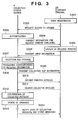
- Fig. 3 is a sequence chart showing the outline of expendable collection in the collection system of this embodiment.
- the communication network may construct either a closed system or an open system.
- a closed system is a so-called intranet system which uses a LAN, dedicated line, or public telephone network as a communication line.
- the collection center system 4 allows only terminals in the closed area to access.
- a representative open system is the Internet.
- the collection center system 4 and user system 5 are connected through the Internet. In this embodiment, to widely provide the service to general users, the latter Internet connection is used to connect the collection center system 4 and customer terminal 24. For this reason, the collection center system 4 and customer terminal 24 support protocols such as TCP/IP, HTTP, and e-mail.
- the collection center system 4 is not always a single computer.
- the collection center system 4 has not only the function of, e.g., a web server but also the functions of an e-mail server, a database server for managing transaction results of customers, and an authentication server for executing user authentication.
- the collection center system 4 may be either a server which implements these functions by a single computer or a network system in which the individual functions are implemented by separate computers that are connected through communication. In this embodiment, all these arrangements will be referred to as a collection center system.
- a Web server 13, database server 14, and application server 15 illustrated in Fig. 1 corresponds to these servers that execute the functions of the collection center system 4.
- the customer terminal 24 can be implemented by a single computer connected by a modem through, e.g., a telephone line. In this embodiment, however, the customer terminal 24 is implemented by the personal computer 24 connected to a LAN system, as shown in Fig. 1. In this embodiment, the customer terminal 24 will also be referred to as the PC 24. The customer terminal 24 will also be referred to as a user system regarded as the same as the LAN connected to the terminal 24.
- the collection center system 4 upon receiving collection request information transmitted in accordance with pressing a button on the user's customer terminal 24, stores, in the database, a user ID and the information of articles to be collected, which are contained in the received collection information.
- a user who wants to use the collection system accesses from the customer terminal 24 installed in the user's office or the like to the collection center system 4 through a Web site page (user registration page) which is published on the collection center system 4 installed in the collection center system 4 so as to do user registration in advance (S301: to be described later with reference to Figs. 4 to 6). Only users who have been registered in advance can execute subsequent procedures.
- a Web site page user registration page
- the registered user accesses the collection center system 4 through a Web site page (order page) which is also published on the collection center system 4 so as to request authentication (S303).
- the collection center system 4 authenticates the user who is accessing the system 4 as a registered user (S302) and transmits to the customer terminal 24 information for display of a merchandise/service order window (S304).
- the authentication processing executed between the customer terminal 24 and the collection center system 4 is realized by a known technique, and a detailed description thereof will be omitted.
- the user when the user executes input operation for requesting collection of waste expendables while seeing the window displayed on the basis of the information transmitted in step S304, various kinds of information are input in accordance with the input operation (S305), and the pieces of input information are transmitted (S306).
- the pieces of information input in step S304 include, in addition to information related to order of merchandise, information representing the type and number (quantity) of expendables whose collection is wanted by the user, information representing whether an incentive given for each customer is to be used, and the like.
- Information related to the expected collection date and collection region may be contained in accordance with user designation.
- the collection center system 4 receives the collection request.
- Data that associates the type and number (quantity) of expendables whose collection is wanted by the user with the user is stored in a storage device (S307), and processing is executed in accordance with the received data (S308).
- collection slip information e.g., information that allows printing of a collection slip
- S309 a requester
- step S306 If the information transmitted from the customer terminal 24 through the communication line in step S306 is not information representing a collection request, and for example, if the information is information representing an article purchase request or collection container distribution request, the collection center system 4 executes processing corresponding to the received information type in step S308 (details will be described later).
- step S310 when merchandise, packing material, or the like (to be referred to as merchandise or the like hereinafter) should be sent to the customer in accordance with the information transmitted from the customer terminal 24, the merchandize center sends them to the requester. If the merchandise or the like to be handled in the system of this embodiment is an article, the merchandise or the like is not sent by communication. This also applies to S311 indicated by a dotted arrow in Fig. 3.
- a collection slip containing at least a collection code and the like is generated on the basis of the received information, and expendables with the collection slip attached are sent to the collection center where the collection center system 4 is installed (S311).
- the collection code recorded on the collection slip attached to the received waste expendables is read to confirm whether expendables that coincide with the collection data corresponding to the collection code have been collected (S312).
- the collection result such as the collection ratio and the number of collected expendables is calculated, and an incentive corresponding to the collection result is set.
- the results are stored in the database (S313).
- the customer terminal 24 of the requester is notified of the collection ratio and incentive as needed (S314).
- the incentive is not always given in accordance with the collection ratio. It may be set in accordance with the collection quantity or sales quantity.
- the collection slip information generated in the collection center system 4 in S309 in Fig. 3 is transmitted to the customer terminal 24 through the communication line.
- the collection center system 4 may receive the collection request, then generate a collection slip containing at least a collection code, and send a collection container with the collection slip attached to a requester 6.
- the above-described collection system can also be implemented even by causing the requester who has received a collection container to pack in the collection container the expendables whose collection is being requested and to send the collection container to the collection center.
- the object of the present invention to manage the collection result for each user and manage the incentive based on the collection result for each user can be achieved.
- the type and number (quantity) of expendables to be collected which are indicated by the collection data read out from the storage device are compared with those of the actually collected expendables. If the type or number (quantity) is different, or an unrecyclable expendable such as a recycled article or a product of another maker is present, the collection data is corrected. Subsequently, on the basis of the user's collection data (already confirmed corrected) stored in the storage device and the data of order reception (sales) record from the user, the collection ratio of recyclable expendables and the collection ratio of unrecyclable expendables are calculated. An incentive is set by looking up (or calculating) a separately prepared table on the basis of the calculated collection ratios.
- the data read from the collection code may be manually compared with the actually collected articles.
- this operation may be automated using image recognition or an apparatus for automatically reading a bar code or the like which contains data such as the type of expendables and is adhered to the expendables in advance.
- the comparison and recording operation may be done by causing a person to compare the collected articles with a list on which the types of expendables are described and causing an apparatus to read a bar code attached to the list. This will be described in detail as "Processing (2) After Collection".
- Fig. 1 is a block diagram showing the network configuration and connection between the collection center system 4 and the user system 5.
- Figs. 23 to 31 are flow charts for explaining the processing of a sales/collection system that operates in the collection center system 4.
- a system which executes lump-sum management of sales and collection of expendables will be described.
- a form may also be assumed in which the sales system or collection system 5 is separated from the sales/collection system such that the individual functions are separately achieved.
- Each of the personal computer (customer terminal) 24, Web server 13, database (DB) server 14, application (AP) server (also referred to as a collection server) 15, personal computer (PC) 16, and PC 18 shown in Fig. 1 has the same arrangement as that of a general computer including at least a CPU (Central Processing Unit), memory, and communication section.
- the steps of the flow charts shown in Figs. 23 to 31 to be described later are executed by causing the CPU arranged in each apparatus to read out and execute program codes stored in the memory.
- the function of the collection center system 4 is distributed to a plurality of server apparatuses.
- Each step of the flow charts shown in Figs. 23 to 31 is executed by any one of the servers.
- Fig. 46A is a view showing a record (user table) for each user, which is used in this embodiment and stored in the database server 14.
- the user table contains the following data:
- the sales table, collection table, collection container table, and collection ratio table are tables that correspond to each user and have variable lengths because their sizes can considerably change.
- Fig. 46B shows the contents of a sales table 4620.
- the sales table 4620 is a table used to record the date of sales of expendables. When expendables are sold, a model 4621, sales quantity 4622, and sales date 4623 of the sold expendables are recorded on the sales table 4620 in correspondence with the date.
- Fig. 46C shows the contents of a collection table 4630.
- the collection table 4630 is a table used to record the date of collection of waste expendables. When waste expendables are collected, a model 4631, collection quantity 4632, and collection date 4633 of the collected products are recorded on the collection table 4630 in correspondence with the date.
- the collection table is updated not only when expendables are collected but also when the user sends a collection request to the collection center. This processing will be described later.
- Fig. 46D shows the contents of a lump-sum collection table 4640.
- the lump-sum collection table 4640 is a table used to record the date of lump-sum collection of waste expendables using a dedicated container. When waste expendables are lump-sum-collected using a collection container, a type 4641 and capacity 4642 of the collected container, and a collection date 4643 are recorded on the lump-sum collection table 4640 in correspondence with the date.
- the lump-sum collection table is updated not only when expendables are collected but also when the user sends a lump-sum collection request to the collection center. This processing will be described later.
- Fig. 46E shows the contents of a collection ratio table 4650.
- the collection ratio table 4650 is a table used to record the collection ratio of sold expendables of each product for each user.
- the collection ratio table 4650 corresponds to a table that is generated on the basis of the sales table 4620 shown in Fig. 46B and the collection table 4630 shown in Fig. 46C.
- a type 4651 of the collected expendables and a collection ratio 4652 calculated from the sold quantity and collected quantity of the expendables are recorded on the collection ratio table 4650.
- the collection ratio irrespective of the expendable type is also recorded in the collection ratio table 4650.
- the collection ratio irrespective of the expendable type corresponds to information that represents the ratio (or percentage) of the number of collected merchandise items to the total number of merchandise items sold to a predetermined user.
- the sales table, collection table, lump-sum collection table, and collection ratio table may have point columns for the respective records to record points every time the tables are updated. In this embodiment, however, the points are not recorded on the tables. Instead, the points are calculated at the time of point calculation by looking up a separately prepared point table. In addition, to employ a discount rate (%) as an incentive providing method, a discount rate table corresponding to the point table is prepared.
- Fig. 2 is a block diagram showing the arrangement of the server or personal computer shown in Fig. 1.
- a computer 3000 has a CPU 201 and executes a program stored in the program ROM of a ROM 203 or in a RAM 202.
- This program includes the communication control program for a procedure to be described later.
- the CPU 201 systematically controls devices connected to a system bus 204.
- the RAM 202 functions as the main memory and work area of the CPU 201.
- a keyboard controller (KBC) 205 controls key input from a keyboard 209 or a pointing device (not shown).
- a CRT controller (CRTC) 206 controls display on a CRT display 210.
- a disk controller (DKC) 207 controls access to an external memory 211 such as a hard disk (HD) or floppy disk (FD) which stores a boot program, various kinds of applications, font data, user files, edit files (to be described later), and the like.
- a communication control section 208 is connected to an external network to execute communication control processing with other devices connected to the network.
- Fig. 23 is a flow chart showing the processing procedure in the PC 24 when the user accesses from the PC 24 to the collection center system 4.
- the user accesses the Web server 13 serving as the window of the sales/collection system using the personal computer (PC) 24 through gateways 23 and 12 connected to a wide-area communication network 11 such as the Internet, thereby logging in to the Web server 13 (S2201 in Fig. 23).
- the Web server 13 supplies the information of the login window shown in Fig. 4 to the PC 24 operated by the user. This can be more precisely expressed as "HTML (Hyper Text Markup Language) data used to display a window is supplied to the PC 24". However, it will be described as "window information is supplied” for the descriptive convenience.
- the user input at the PC 24 is transmitted to the collection center system 4. Processing corresponding to the input is executed in the collection center system 4. Data is transmitted from the collection center system 4 to the PC 24 as needed.
- the Web server 13 requests the user to input a "customer number (user code)" 401 and "password” 402 through the PC 24.
- the Web server 13 receives the input user code and password and transfers them to the application (AP) server 15 where main software of the collection center system 4 runs.
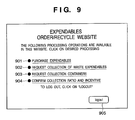
- the AP server 15 compares the input user code and password with the customer number 4601 and password 4602 contained in user data (Fig. 46A) obtained from the database (DB) server 14, thereby authenticating whether the user is a registered user (S2202 in Fig. 23). If YES in step S2202, information of a processing selection window shown in Fig. 9 is supplied to the PC 24 through the Web server 13 (S2203 in Fig. 23).
- step S305 in Fig. 3 corresponds to the display window in step S305 in Fig. 3.
- the user can select a desired menu from this window and input data corresponding to the menu to place an order for merchandise or the like or refer to various data. Processing to be described below is executed for the user record of the authenticated user.
- user registration can be performed by clicking on a [register] button 403 on the window shown in Fig. 4 (S2211 in Fig. 23).
- the AP server 15 When the user clicks on the [register] button 403 on the window shown in Fig. 4, the AP server 15 accordingly supplies information of the registration window shown in Fig. 5 to the PC 24 (S2212 in Fig. 23).
- the user inputs necessary matters such as the name of a person in charge for a corporation, postal code, address, telephone number, facsimile number, e-mail address, and use device.
- the AP server 15 supplies information of the input content confirmation window shown in Fig. 6 to the PC 24 (S2214 in Fig. 23).
- the registration window shown in Fig. 5 can be displayed again to re-input the information by clicking on a [correct part] button 601 on the window shown in Fig. 6 (S2215 in Fig. 23).
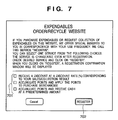
- the AP server 15 supplies to the PC 24 information of the selection window shown in Fig. 7, which makes the user to select an incentive providing method (S2216 in Fig. 23).
- the user can select a desired incentive providing method on the window.
- another window may be opened to explain each choice. For example, the following subsidiary explanation may be made. However, the explanation need not always be limited to these specific contents.
- Points for a purchase and collection are set for each product, and the points are accumulated. You can partially or totally pay the purchase amount using the points.
- As the basic amount one point equals XXX yen.
- the amount may be increased during a campaign or the like (or the basic amount may be changed in accordance with a change in environment in the future). This method can be recommended to users who have a relatively small transaction quantity or individual users.
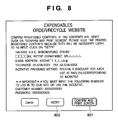
- the registration window shown in Fig. 5 can be displayed again to re-input the matters by clicking on a [retry] button 802 on the window shown in Fig. 8 (S2212 in Fig. 23).
- the issue of the user code and password to the user may be done on the final confirmation window shown in Fig. 8 or by e-mail or mail.
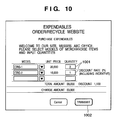
- Fig. 10 shows an example in which cartridge models "CRG-1" and “CRG-2" are input to the PC 24 and displayed on the display section.
- the AP server 15 acquires from the DB server 14 the unit price corresponding to each input model and the discount rate for the total amount in accordance with the information received from the PC 24, and transmits the acquired information to the PC 24.
- the unit prices and discount rate are displayed on the sales window in real time (S2207 in Fig. 23).
- the accumulated point is displayed in place of "discount rate 2%" in Fig. 10.
- the unit price corresponding to each input model and the discount rate corresponding to each model may be acquired from the DB server 14.
- the discount rate includes the incentive corresponding to the login user, which is registered in the AP server 15 through the above-described window shown in Fig. 7.
- the user inputs quantities 1001 of the desired merchandise items on the window shown in Fig. 10 and confirms the charge amount. If correction is necessary, the user does it and then clicks on a [transmit] button 1002 shown in Fig. 10.
- the collection center system 4 receives the [transmit] button click signal through a predetermined communication line (transmit in S2208 in Fig. 23), thus ending order for expendables (S2209 in Fig. 23).
- the AP server 15 confirms the contents of the order, sets and confirms the due date of delivery (S2209 in Fig. 23) and executes sales processing (order reception processing: S2210 in Fig. 23) including the sales result for each customer.
- step S2209 sales data containing the types and quantities of ordered merchandise items is accumulated in the database server 14 for each user.
- the database to be updated is the sales table 4620 shown in Fig. 46B.
- a new record is added to the sales table 4620.
- the current date is recorded in the sales date field 4623, and the models and quantities of the sold articles are recorded in the model field 4621 and quantity field 4622, respectively. If a single user has made a purchase of products of the same model in one day, the quantity in an existing corresponding record may be updated instead of generating a new record.
- the accumulated sales data is used to calculate the incentive by looking up conversion tables shown in Figs. 33 to 36 (to be described later).
- the processing returns to step S2203.
- the information of the processing selection window shown in Fig. 9 is supplied to the PC 24 through the Web server 13 again.
- a signal representing the instruction is transmitted to the Web server 13 through a predetermined communication line.
- the signal is supplied to the AP server 15, it recognizes the contents of the input instruction (collection request in S2205 in Fig. 23).
- the AP server 15 supplies information of the collection method selection window shown in Fig. 11 to the PC 24 through the Web server 13 (S2301 in Fig. 24). The user can select a desired method from lump-sum collection 1101 and separate collection 1102 on the window.
- a signal that designates lump-sum collection or separate collection is input to the PC 24 in accordance with the selection.
- the information representing the selection result is transmitted from the customer terminal to the AP server 15 through the Web server 13 of the collection center.
- the AP server 15 has a recognition function for recognizing whether the user has selected lump-sum collection or separate collection.
- the AP server 15 recognizes the information representing that the user has selected lump-sum collection or separate collection (S2302 in Fig. 24) and provides information of a window corresponding to the selection to the user through the Web server 13 (S2303 and S2312).
- the AP server 15 transmits to the PC 24 window information used to select a collection container (S2303).
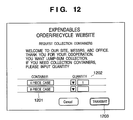
- Fig. 12 shows a window that is supplied in step S2303 and displayed on the display section of the PC 24 when the user desires lump-sum collection.
- the user who desires lump-sum collection designates a type 1201 and quantity 1202 of collection containers for storing waste expendables on the window shown in Fig. 12.
- two kinds of collection containers i.e., collection containers for four pieces or those for eight pieces can be selected.
- the input information is transmitted from the customer terminal to the AP server 15 through the Web server 13 of the collection center.
- the AP server 15 receives the information and temporarily stores it (step S2304).
- the collection center sends collection containers to the requester in accordance with the type and quantity of collection containers received at this time.
- the kind of collection containers is not limited to two kinds.
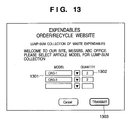
- the AP server 15 transmits window information (Fig. 13) to cause the customer terminal to designate the model and quantity of expendables to be collected (S2305).
- the requester selects a model 1301 and quantity 1302 on the display window at the customer terminal and then clicks on a "transmit" button 1303.
- the AP server 15 determines whether the pieces of information of the model and quantity of the expendables are received (S2306). If YES in step S2306, the capacity of the collection container stored in step S2304 is compared with the quantity of the expendables received in step S2306 (S2307). If they equal, the collection information, i.e., the received model and quantity of the expendables are stored in the DB server 14 in association with the user (the user is associated with, e.g., the login information) of the customer terminal 24 (S2310).
- the database to be updated at this time is the collection table 4630 shown in Fig. 46C.
- a new record is added to the collection table 4630.
- the current date is recorded in the collection date field 4633, and the models and quantities of expendables to be collected are recorded in the model field 4631 and quantity field 4632, respectively.
- the AP server 15 shown in Fig. 1 stores "CRG-1, 2" and "CRG-3, 2" in the DB server 14 shown in Fig. 1 as collection data of designated expendables in association with the user (the user is associated with, e.g., the login information) of the customer terminal 24.
- "2" corresponding to the models indicate the quantities of the expendables CRG-1 and CRG-3 that should be placed in the collection containers.
- information representing "lump-sum collection” is also stored in the database because "lump-sum collection” is handled as a condition for the incentive.
- the database to be updated at this time is the lump-sum collection table 4640 shown in Fig. 46D.
- a new record is added to the lump-sum collection table 4640.
- the current date is recorded in the collection date field 4643, and the types and quantities of designated containers are recorded in the type field 4641 and quantity field 4642, respectively.
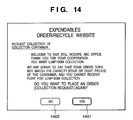
- Fig. 14 shows the warning window.
- the requester clicks on a "yes" button 1401 on the window shown in Fig. 14. In that case, information representing that the "yes" button is pressed is transmitted to the AP server 15, and the above-described processing is repeated again from step S2301.
- the requester clicks on a "no" button 1402.
- information representing that the "no" button is pressed is transmitted to the AP server 15.
- the AP server 15 stores the collection information received in step S2306 in the database server 14 in association with the user information (S2310).
- control is performed not to store information representing "lump-sum collection” in the database as information for incentive calculation because "lump-sum collection” is not handled as a condition for the incentive.
- the lump-sum collection table 4640 is not updated. However, the collection table 4630 is updated like when the lump-sum collection is recognized.
- the AP server 15 shown in Fig. 1 makes a preparation to send a collection container corresponding to the selected expendables to the user (S2311). More specifically, a printer 19 shown in Fig. 1 prints an invoice and the above-described collection slip, and a collection container to which the collection slip is attached is sent to the user in accordance with the invoice. In addition, a notification that instructs delivery in another form is transmitted to an information processing apparatus installed in a facility that is in charge of collection container delivery service (S2311). In accordance with the notification, the collection container is actually delivered to the user.
- the user stores waste expendables in the delivered collection container and requests collection of the collection center.
- the window corresponding to lump-sum collection shown in Fig. 13 may be directly displayed after the user clicks on the [request collection of waste expendables] on the window shown in Fig. 9. This reduces the load on the requester side.
- the pieces of customer information including the "customer number" and "password" corresponding to the dealer are stored in the DB server 14 in advance in correspondence with a flag (information) for direct display of the lump-sum collection request.
- the AP server 15 transmits to the PC 24 window information used to select expendables to be collected (S2312).
- Fig. 15 shows window information supplied (displayed) from the AP server 15 to the PC 24 in step S2312 when the PC 24 has notified the AP server that the user desires separate collection.
- the user selects a model 1501 of expendables for which separate collection is requested, inputs a quantity 1502 and desired collection date 1503, and then clicks on a [transmit] button 1504.
- the AP server 15 shown in Fig. 1 receives "CRG-1, 1", “CRG-1, 1", “CRG-1, 1", and “CRG-3, 1" as collection information (S2313) and stores the information in the DB server 14 shown in Fig. 1 in association with the user (S2314).
- the lump-sum collection table 4640 is not updated. However, the collection table 4630 is updated as in the case of lump-sum collection.
- the AP server 15 searches for a collectable date close to the desired collection date on the basis of data in the DB server 14. If the desired collection date does not match the collectable date, the AP server 15 executes a procedure for, e.g., transmitting a list of collectable dates close to the desired collection date to the PC 24 and causing the user to select a date, thereby determining the collection date.
- the database server 14 stores a collection schedule in which, e.g., addresses for collection are listed in the order of dates. It is determined on the basis of the collection schedule whether collection is possible at the input desired collection date. If it is impossible, it is determined when collection is possible. A detailed description of this procedure will be omitted.
- the AP server 15 shown in Fig. 1 transmits to the PC 24 collection slip data to make the user print the above-described collection slip (S2315).
- this collection slip data is formed from HTML data and GIF (Graphics Interchange Format) image, which are displayable on a browser
- the collection slip can be printed by a printer 22 or 25 using the browser that runs on the PC 24.
- the collection slip data is preferably sent to the PC 24 as, e.g., PDF (Portable Document Format) data and printed.
- PDF Portable Document Format
- the collection center system 4 can provide a selection window to the PC 24 to make the user select the collection slip acquisition method so that the user can select whether the collection slip data should be transmitted through the Internet or a collection slip prepared on the collection center side should be sent to the user by mail.
- the user's selection on the selection window is transmitted to the AP server 15.
- the AP server 15 recognizes the user's selection and causes the user to acquire the collection slip by any one of the methods in accordance with the recognition.
- step S2203 in Fig. 23 the processing returns to step S2203 in Fig. 23, and the processing selection window shown in Fig. 9 is supplied to the PC 24 through the Web server 13 again.
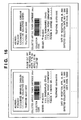
- Fig. 16 is a view showing the collection slip printed on the collection center side or on the user side in correspondence with the collection request shown in Fig. 15.
- the center is requested to collect three cartridges CRG-1 and one cartridge CRG-3.
- three collection slips for CRG-1 and one collection slip for CRG-1 are printed.
- the user side should print collection slips, it is effective for printing of the collection slips to contain A4 printing paper sheets having reverse surfaces applied with an adhesive in the package cases of expendables.
- the printing paper size is not limited to A4. Any other printing paper size such as B4 or A5 can be used as long as the printer can output it.
- the collection code contains at least information capable of specifying the registered user (user name, user code, or the like).
- the collection code may also contain pieces of information that specify the user address, collection request reception date, expected collection date, and the type and quantity of collection articles (waste expendables), and the like.
- the collection code also contains information that specifies the type and quantity of containers.
- the pieces of information indicated on the collection slip issued (generated) by the collection center system 4 are used to efficiently manage the collection result of each user when the collection articles are actually collected to the collection center or an agency that is in charge of collection service. How to use the collection slip will be described not here but later in more detail.
- the user separates the printed collection slips and appropriately sticks the separated collection slips to the expendables to be collected or their package cases. Thus, preparation for separate collection is completed.
- the contents of collection slips are determined assuming that the collection center prepares a transportation means for collection.
- the waste expendables can be collected by effectively using the transportation means which is also used to delivery expendables.
- the method of transporting the waste expendables is not limited to this, as a matter of course.
- the management server such as the DB server 14 in the collection center system 4 in advance of the expendables to be collected, the management server can make a detailed operation plan related to collection in advance.
- the user can also request delivery of collection containers independently of the collection request for waste expendables.
- "request collection containers” 903 shown in Fig. 9 is selected from the customer terminal 24, information representing it is transmitted to the AP server 15.
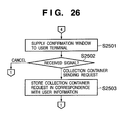
- the AP server 15 determines "container request" in step S2205 in Fig. 23 and executes the procedure shown in Fig. 26.
- the AP server 15 transmits window information for collection container order confirmation shown in Fig. 12 to the customer terminal (S2501).
- the window for order confirmation is displayed on the PC 24.
- the requester inputs the type 1201 and quantity 1202 of collection containers and clicks on the [transmit] button 1203, the input information is transmitted to the AP server 15.
- the AP server 15 determines the received data. If the received information represents the type and quantity of collection containers, collection container information containing the type and quantity of collection containers is stored in the database server 14 in correspondence with the user information of the requester in step S2502. This operation is done in accordance with the same procedure as that used to update the lump-sum collection table 4640 in the above-described lump-sum collection procedure. Then, the flow returns to step S2203 in Fig. 23. After that, the collection center sends the requested collection containers to the requester.
- the collection containers have the indicator of a collection code containing user information that specifies the requester.
- the Web server receives information representing the selection through the communication line (S2205).
- the AP server 15 shown in Fig. 1 recognizes that the [confirm collection ratio and incentive] is selected ("confirm" in step S2205).
- the AP server 15 obtains the discount amount and discount rate corresponding to the user who is logging in from collection data and sales date accumulated in the database server 14.
- the obtained data are edited into a display window, transmitted to the customer terminal, and displayed (step S2401 in Fig. 25).
- a bonus point (collection ratio bonus point) corresponding to the discount rate or collection ratio in the future is calculated for the collection ratio accumulated in the database.
- a collection point given every time expendables are collected, a sales point every time expendables are sold, and a lump-sum collection bonus point given for lump-sum collection, which are also accumulated in the database server 14, are read out from the database, and the total point is calculated as needed.
- the types and quantities of expendables or collection containers are stored in the sales table 4620, collection table 4630, and lump-sum collection table 4640.
- a point table prepared for each table is searched for each type of expendables or containers in each record of each table, thereby obtaining a point per unit quantity.
- the obtained point is multiplied by the quantity, and the results of all records are integrated to obtain the sum of points.
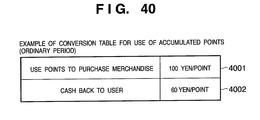
- These points are converted into an amount by looking up the tables shown in Figs. 40 and 41, and the amount is presented to the user as the discount amount.
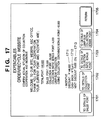
- Fig. 17 shows an example.
- the AP server 15 generates informant of the confirmation window shown in Fig. 17 on the basis of the information of the calculated point.
- the AP server 15 supplies the confirmation window shown in Fig. 17 to the PC 24 through the Web server 13 shown in Fig. 1 (S2401 in Fig. 25).
- the window shown in Fig. 17 contains (1) user identifier, (2) total point acquired by the user, (3) sales point, collection point, collection ratio bonus point, and lump-sum collection bonus point as the items of the total point, and (4) incentive obtained from the acquired point and its items.
- Fig. 18 is a view showing a window transmitted from the AP server 15 to the customer terminal 24 and displayed at the customer terminal when the [to details of sales point] button 1701 is clicked on.
- the particulars of the sales point "76,300" displayed in Fig. 17 are displayed for each type of expendables together with the sales quantity, sales date, point per unit quantity, and the like.
- "Subject of campaign” is an item representing whether expendables are the "subject of purchase campaign” shown in Fig. 36.
- the data of the display contents are obtained on the basis of the sales data accumulated in step S2209 in Fig. 23.
- a "return" button for displaying the window shown in Fig. 17 again and buttons for displaying other detail window are also displayed.
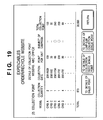
- Fig. 19 is a view showing a window transmitted from the AP server 15 to the customer terminal 24 and displayed at the customer terminal when the [to details of collection point] button 1702 is clicked on.
- the particulars of the collection point "26,320" displayed in Fig. 17 are displayed for each type of expendables together with the collection quantity, collection date, point per unit quantity, and the like.
- "Subject of campaign” is an item representing whether expendables are the "subject of collection campaign” shown in Fig. 37.
- the data of the display contents are obtained on the basis of the collection data accumulated in steps S2311 and S2314 in Fig. 24 and corrected in step S83 in Fig. 27.
- a "return" button for displaying the window shown in Fig. 17 again and buttons for displaying other detail window are also displayed.
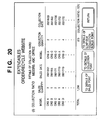
- Fig. 20 is a view showing a window transmitted from the AP server 15 to the customer terminal 24 and displayed at the customer terminal when the [to details of collection ratio bonus point] button 1703 is clicked on.
- the collection ratio (70% in Fig. 20) as the base of the collection ratio bonus point "4,000" displayed in Fig. 17 is displayed together with the particulars of collected expendables.
- the data of the display contents are obtained on the basis of the collection data accumulated in steps S2311 and S2314 in Fig. 24 and corrected in step S83 in Fig. 27.
- a "return" button for displaying the window shown in Fig. 17 again and buttons for displaying other detail window are also displayed.
- Fig. 21 is a view showing a window transmitted from the AP server 15 to the customer terminal 24 and displayed at the customer terminal when the [to details of lump-sum collection bonus point] button is clicked on.
- the particulars of the lump-sum collection bonus point "40,000" displayed in Fig. 17 are displayed for each type of collection containers of expendables together with the quantity, collection date, container point per unit quantity, and the like.
- the data of the display contents are obtained on the basis of the lump-sum collection data such as the quantity of containers, which is contained in the collection data accumulated in step S2314 in Fig. 24 and corrected in step S83 in Fig. 27.
- a "return" button for displaying the window shown in Fig. 17 again and buttons for displaying other detail window are also displayed.
- the incentives (points) displayed on the windows shown in Figs. 17 to 21 are determined on the basis of the collection data managed by the database server 14 shown in Fig. 42 (to be described later). These tables will be described later.
- the collection data is accumulated in the database server 14 in accordance with the procedure shown in Figs. 27 to 31, which is executed by the AP server 15.
- the AP server 15 also serves as a computer for executing the program for processing the collection data. For this reason, the AP server 15 will be sometimes called a collection server in the description of operation processing in the collection center.
- the points are determined on the basis of the collection result (Figs. 46B, 46C, 46D, and 46E) of each user, which is managed by the database server 14, and the tables shown in Figs. 36, 37, 38, and 39 (to be described later).
- the incentive to be actually given to the user is determined from the points on the basis of the tables shown in Figs. 40 and 41.
- the tables used to determine the points for the collection result will be described later in detail.
- the collection result is managed in accordance with the processing procedure by the AP server 15 shown in Figs. 26, 27, 28, 29, and 30.
- This embodiment may employ a procedure of directly calculating the incentive such as the discount rate using the tables shown in Figs. 32, 33, 34, and 35 instead of obtaining the points.
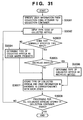
- Fig. 27 is a flow chart showing the processing of the collection server (AP server) 15 shown in Fig. 3 after waste expendables have arrived.
- the processing of each step shown in Fig. 27 is implemented by causing the CPU arranged in the collection server apparatus 15 to execute processing based on program codes stored in the nonvolatile memory in the collection server apparatus 15 installed in the collection center.
- the collection server apparatus is assumed to be the same as the AP server 15. However, one of the Web server 13, DB server 14, and PCs 16 and 18 may be used. Alternatively, a single server apparatus logically having the functions of the Web server 13, DB server 14, AP server 15, and PC 16 may be used. A server that can access the DB server 14 may be separately prepared.
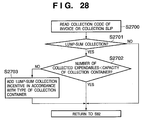
- step S81 the collection code attached to the collection container is read (S2700).
- step S2701 the collection code attached to the collection container is read (S2700).
- step S2701 processing of causing the server to recognize whether the actual number of collected expendables is smaller than the capacity of the collection container is executed in step S2702.
- step S2702 an operator in the collection center visually confirms and determines, and input YES/NO to the server from a keyboard or the like.
- an image which prompts the operator to confirm is displayed on the window of the PC 16.
- Yes/No is determined in accordance with a signal of determination result by image recognition.
- a lump-sum collection is added in accordance with the type of collection container in step S2703.
- the lump-sum collection point is added to a table, which registers a point for each collection container in correspondence with each user and is managed by the database server 15, and managed.
- the AP server 15 reads out collection data (also called collection information in this embodiment) corresponding to the input collection code from the DB server 14 and supplies the collection data to the PC 16 or 18.
- Collection data also called collection information in this embodiment
- Pieces of information represented by the collection data including the user name, request date, expected collection date, region, and the type and quantity of articles to be collected, are displayed on the screen of the PC 16 or 18.
- the operator can easily determine in step S82 whether the collection data matches the actually collected articles while seeing the screen.
- the operation of confirming the contents of collected articles may be either manually executed or by using image recognition or an apparatus for automatically reading, e.g., a bar code which sticks to the expendable to describe data related to the expendable.
- the collection data is corrected (S83). Correction is done by, e.g., input by the operator.
- the collected articles are classified into (1) recyclable expendables, (2) unrecyclable expendables, and (3) unrecyclable expendables of products of other makers.
- the expendables (1) and (2) are further classified into types. For the descriptive convenience, these expendables will be described below as (1) valid collected articles, (2) recycled articles, and (3) other maker products.
- the AP server 15 shown in Fig. 1 calculates the collection ratio for each type of collected articles (S84). That is, the cumulative collection data of the user is read out from the DB server 14 and updated in accordance with the current collection data. In addition, the sales data (sales table) of the user is read out from the DB server 14, and the collection ratio for each type of expendables is calculated on the basis of the record of delivery quantity and the cumulative collection data. More specifically, the following calculation is done for each type of expendables.
- the AP server 15 averages all the collection ratios of the respective expendable types for the user to calculate the average collection ratio of the user and stores the average collection ratio in the DB server 14 (S87).
- the database to be updated at this time is the collection ratio table 4650 shown in Fig. 46E.
- a new record is added to the collection ratio table 4650.
- the models of the collected expendables are recorded in the type field 4651, and the calculated average collection ratio for the expendables is recorded in the average collection ratio field 4652.
- the point as the base of the incentive is determined using the tables shown in Figs. 36 to 39 (S89).
- the user may be penalized by, e.g., decreasing the point.
- the determined point is converted into a discount rate or discount amount by looking up the tables shown in Figs. 40 and 41 and sent to the user by, e.g., e-mail (S90-1).
- a window shown in Fig. 17 or the like may be displayed.
- the AP server 15 calculates the average collection ratio of all users (S90-2). If the average collection ratio has a predetermined value ⁇ or more (YES in S91), the processing is ended. If the average collection ratio is less than the predetermined value ⁇ , a warning is generated (S92). A measure (to be described later) corresponding to this warning is executed (S93). The calculated average collection ratio is recorded in the average collection ratio field 4607 of the user table (Fig. 46A).
- step S85 if the average collection ratio exceeds 100% in step S85, the flow advances to exceptional processing shown in Fig. 29.
- Fig. 29 first, it is verified whether the collection data and the like stored in the DB server 14 have no error (S94). If the data have an error (YES in S95), one or both of the collection data and sales data stored in the DB server 14 are corrected (S100). Then, the processing returns to step S84.
- step S97 If a reply from the user is received in response to the mail transmitted to the user in step S96 (YES in S97), an appropriate measure is taken in accordance with the contents of the reply. For example, when the user has replied the reason (1), no problem is posed. After steps S97 and S98, the collection ratio is set to 100% in step S99, and the processing is returned to step S86. When the user has replied the reason (2) or (3), the data is corrected after talking with the user (S100), and the processing is returned to step S84.
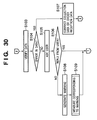
- step S88 when it is determined in step S88 that the average collection ratio of the user is less than the predetermined value ⁇ , the flow advances to exceptional processing shown in Fig. 30.
- step S106 The processing is returned from step S106 to step S89 without correcting the data.
- step S91 When it is detected in step S91 that the average collection ratio of the all user is less than the predetermined value ⁇ , it indicates that collection by the collection center does not sufficiently function.
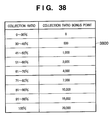
- the reason for that is investigated, and a measure corresponding to the results is executed. For example, users are asked for being cooperative for collection, or promotion for promoting collection (e.g., bonus points as shown in the table shown in Fig. 38 are given in accordance with the collection ratio) is executed to increase the average collection ratio.
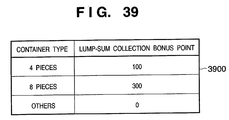
- lump-sum collection bonus points are given to users in accordance with the types of collection containers by looking up the table shown in Fig. 39. These bonus points are also stored in the database.
- the AP server 15 monitors not only the average collection ratio of all users but also the average collection ratio for each type of expendables in all users. When the average collection ratio for each type is less than a predetermined value ⁇ , a warning is similarly issued. In this case, the users are asked for being cooperative for collection of corresponding expendables, or promotion for promoting collection is executed to increase the average collection ratio.
- the collection ratio of a specific type of expendables needs to be increased not only when the collection ratio decreases but also when an increase in demand of waste expendables of a specific type is expected. In this case as well, the users are asked for being cooperative for collection of corresponding expendables, or promotion for promoting collection is executed to increase the average collection ratio.
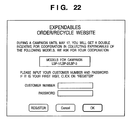
- Fig. 22 is a view showing the sales/collection system login window which is supplied from the Web server 13 to the user's terminal apparatus 24 during a promotion period to promote collection of specific expendables. To increase the total collection ratio, almost the same login window is prepared. It is also effective to display a banner for promotion not only on the login window but also on another window.
- the incentives can more flexibly be provided.
- an incentive that reflects the waste expendable collection result of each user can be provided to the user.
- the incentive is given in accordance with the collection quantity or collection ratio and also in accordance with the quantity of lump-sum collection.
- user information is specified from the collection code attached to the collection container (step S3001).
- the user information can be specified by, e.g., reading the collection code by a bar code reader or OCR reader and looking up the database in which the user information is registered.
- identification information input to the collection server is recognized (step S3002).
- the identification information is input by reading the information of the collection code attached to the collection container using an input means such as a bar code reading apparatus or causing the operator to input the information through an input means such as a keyboard on the basis of visual determination.
- an input means such as a bar code reading apparatus
- a keyboard on the basis of visual determination.
- the bar code list shown in Fig. 32 is used.
- the operator who executes the collection operation visually confirms the type of waste expendables (collected articles), finds a corresponding code from the bar code list shown in Fig. 32, and inputs the type information of the collected articles to the collection server (AP server) 15 through an input means such as a bar code reading apparatus.
- the input information is stored in the database server 14 related to the user information (customer information) input in step S3001.
- the data to be updated is the collection table 4630 shown in Fig. 46C.
- the collection date and the model and quantity of the collected expendables are recorded as new records.
- bar codes used to input information representing the collected articles are other maker products or recycled articles are also prepared in Fig. 32.
- the operator selects bar code information corresponding to the other maker products or recycled articles from Fig. 32 and inputs the information.
- the bar code information is stored in the AP server 15 or database server 14 through the reading apparatus.
- the processes in steps S3304, S3306, and S3303 are realized by inputting the bar code information shown in Fig. 32 to the AP server 15 and causing the AP server 15 to recognize the information.
- step S3003 It is determined next on the basis of the input information input in step S3002 whether the collected expendables are processible, i.e., valid collected articles (S3003). If the input information is identification information which is attached to the collected articles in advance and corresponds to the collected article stored and managed in the database in advance, the type can be recognized. On the other hand, if the collected articles are other maker products or products that should not be collected, the type of the collected articles cannot be recognized from the input identification information. In this case, an error code is input to the collection server 15. Hence, if NO in step S3003, it is determined in step S3004 that the collected articles are other maker products. The other maker product ratio in the collected articles of the user is calculated and reflected on the database server 14.
- the quantity of other maker products is added to the other maker product quantity field 4616 of the user record (Fig. 46A).
- the total number of collected expendables is obtained by adding the sum of the value in the other maker products quantity field 4616 and the value in the quantity field 4631 recorded in the collection table 4630 to the value in the recycled article quantity field 4614.
- the other maker product ratio can be obtained.
- the other maker product ratio field 4615 of the user record is updated to the value of the obtained other maker product ratio.
- step S3004 When the collected articles are recognized as other maker products, a more detailed type is visually determined by the operator in step S3004.
- the operator inputs identification information through an input means such as a keyboard.
- step S3004 the detailed type of other maker products is determined in accordance with the identification information.
- a recycled article means an article processed for recycle by a third party other than the maker of a waste expendable.
- a waste toner cartridge that is re-filled with toner corresponds to a recycled article. Since recycled articles are often difficult to further recycle, they are distinguished from expendables other than recycled articles.
- Determination about whether the collected articles are recycled articles is visually done by the operator.
- the operator determines on the basis of a signal obtained by inputting the confirmation result whether the articles are recyclable.
- it may also be determined on the basis of a read of information which is stored in a nonvolatile storage means provided in the waste expendables to identify whether the waste expendables are recyclable.
- the type of collected articles is determined as recycled articles in step S3006.
- the recycled article ratio of the collected articles of the user is calculated and reflected on the recycled article quantity field 4614 of the user record (Fig. 46A).
- the total number of collected expendables is obtained by adding the sum of the value in the other maker products quantity field 4616 and the value in the quantity field 4631 recorded in the collection table 4630 to the value in the recycled article quantity field 4614.
- the recycled article ratio can be obtained.
- the recycled article ratio field 4613 of the user record is updated to the value of the obtained recycled article ratio.
- the type of collected articles and use information are stored in the database in correspondence with each other in step S3007. At this time, a point is given to the user and stored in the database in accordance with the type and quantity of collected articles.
- This processing needs to have the same contents as in the processing in steps S84 to S93 in Fig. 26.
- step S3008 it is determined in step S3008 whether the processing from step S3002 is ended for all collected articles. If NO in step S3008, the flow returns to step S3002.
- identification information used to identify the type as shown in Fig. 32 may be attached to or recorded on each collected article in advance, and the identification information may be read by a reading means such as a bar code reading apparatus and stored and managed in the database in correspondence with user information read from the collection container.
- identification information as shown in Fig. 32 may be prepared in advance, and information representing that collected articles such as other maker products that should not be collected are collected may be managed in the database in correspondence with user information.
- information stored in a nonvolatile storage means arranged in a collected article and representing that product may be read and managed in the database in correspondence with user information. If user information and the like are also stored in the nonvolatile storage means, the collection result of each user can be unitarily managed without issuing any collection code for identifying specific user information.
- Incentive calculation executed in step S89 in Fig. 27 will be described next. This processing is executed also in generating the information of the confirmation window transmitted from the AP server 15 to the PC 24 in step S2401 in Fig. 25.
- An incentive can be given as an amount or a discount rate.
- the incentive given as an amount can be cash back or a discount in purchasing merchandise. All the incentives are presented to the user. The user uses an incentive by a method selected from those presented. This selection is done through the window shown in Fig. 7. The selected method is recorded in the incentive providing method field 4612 of the user record.
- Fig. 36 shows a sales point table which represents points given at the time of sale of expendables for the respective types of expendables.
- a sales point per unit quantity normally one item
- a sales campaign point added for expendables as a subject of sales campaign a sales campaign point added for expendables as a subject of sales campaign
- a sales campaign subject flag representing that the expendables are a subject of campaign
- a campaign period are set in correspondence with each type of expendables.
- Fig. 37 shows a collection point table which represents points given at the time of collection of waste expendables for the respective types of expendables.
- a collection point per unit quantity normally one item
- a collection campaign point added for expendables as a subject of collection campaign a collection campaign subject flag representing that the expendables are a subject of campaign
- a campaign period are set in correspondence with each type of expendables.
- Fig. 38 shows a collection ratio point table which represents the relationship between the collection ratio and the bonus point given for each collection ratio.
- Fig. 39 shows a lump-sum collection point table which represents the correspondence between the type of container and a lump-sum collection bonus point given for each type of collection containers.
- the AP server 15 can obtain points corresponding to the collection ratio, sales quantity, collection quantity, lump-sum collection quantity of expendables on the basis of the sales quantity, collection quantity, and valid collection ratio of expendables and the types and quantities of lump-sum-collected containers, which are stored in the database for each user by looking up the tables shown in Figs. 37 to 39. For example, the points for a given user of interest are calculated in the following way.
- a record of interest is extracted from the start of the sales table 4620, and a model that matches the model in the record of interest is searched for in the sales point table shown in Fig. 36. If a corresponding model is registered in the sales point table, a sales campaign subject flag 3604 corresponding to the model is tested. If this flag is not set ("-" in Fig. 36), the value of a sales point 3602 is read as a point per unit quantity.
- the sales campaign subject flag 3604 is set (" ⁇ " in Fig. 36)
- the value in the sales date field 4623 is in the period described in the campaign period 3605, the value of a campaign point 3603 is read as a point per unit quantity.
- the collection table 4630 is used in place of the sales table 4620, and the collection point table (Fig. 37) is used in place of the sales point table.
- a collection point is obtained for the user of interest.
- a collection ratio range including the value in an average collection ratio field 6007 of the user record is searched for in the collection ratio bonus point table shown in Fig. 38.
- the point in the corresponding column is the collection ratio bonus point.
- a lump-sum collection bonus point is obtained from the lump-sum collection table 4640 shown in Fig. 46D and the lump-sum collection bonus point table shown in Fig. 39.
- the value 4641 in the container type field in the record of interest is searched for in the lump-sum collection bonus point table.
- the corresponding point is multiplied by the value in the quantity field 4642 in the record of interest.
- the value thus obtained is the bonus point for the container of interest. In this way, bonus points are obtained for all container types and totalized.
- the sum value is the lump-sum collection bonus point.
- the sum of the sales point, collection point, collection ratio bonus point, and lump-sum collection bonus point obtained in the above manner is the total point given to the user of interest.
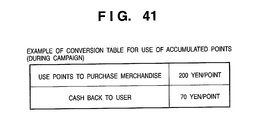
- Fig. 40 shows a conversion table that is usually used.
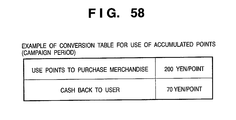
- Fig. 41 shows a conversion table used during a campaign. Whether it is a campaign period can be determined from a separately prepared flag or the like. In either table, a conversion rate for a discount in purchasing merchandise and that for cash back are described. In converting a point into an amount, both a discount amount and a cash back amount are obtained using both the conversion rate for purchase of merchandise and that for cash back.
- any point is converted into a discount amount or a cash back amount.
- a discount rate may be given in accordance with the sales quantity, collection ratio, or the like. In this case, using the set of tables shown in Figs. 33 and 34 or the set of tables shown in Figs. 35 and 34, a discount rate is calculated from the calculated collection ratio and sales quantity and used as an incentive.
- Fig. 33 shows a collection ratio - discount rate table used to determine a discount rate from the type of expendables and their collection ratio. For a given user of interest, each record is extracted from the start of the collection ratio table 4650 of the user of interest. The discount rate is obtained in the column located at the intersection between the value in the model field 4651 and the value in the collection ratio field 4652 of the record of interest in the table shown in Fig. 33.
- Fig. 34 shows a sales quantity - discount rate table used to determine a discount rate from the type and sales quantity of expendables. For a given user of interest, each record is extracted from the start of the sales table 4620 of the user of interest. The discount rate is obtained in the column located at the intersection between the value in the model field 4621 and the value in the quantity field 4622 of the record of interest in the table shown in Fig. 34.
- the sum of the discount rate obtained from Fig. 33 and that obtained from Fig. 34 is the incentive to be given to the user of interest. This discount rate is recorded in the incentive field 4617 of the user record.
- Fig. 35 shows a collection ratio - discount rate table used during a campaign. During a campaign, the table shown in Fig. 35 is used for discount rate calculation in place of the table shown in Fig. 33.
- the incentive obtained in the above way i.e., the discount amount, cash back amount, and discount rate are presented to the user by the confirmation windows shown in Figs. 17 to 21 or a notification issued in step S90-2 in Fig. 27.
- the AP server 15 can obtain points corresponding to the collection ratio, sales quantity, collection quantity, and lump-sum collection quantity of expendables on the basis of the sales quantity, collection quantity, and valid collection ratio of expendables and the types and quantities of lump-sum-collected containers, which are accumulated in the database for each user by looking up the tables shown in Figs. 33 to 41.
- a discount amount or discount rate is obtained.
- the discount rate is designated as the incentive providing method, the value of the discount rate is displayed on the purchase window shown in Fig. 10.
- a mechanism capable of providing an advantage corresponding to cooperation in collection to the customer can be provided.
- the customer's cooperation in collection can be further promoted. Since the compensation is calculated in return for a plurality of elements including the sales quantity of expendables, collection cooperation quantity, collection ratio, and lump-sum collection cooperation of the customer, a more flexible and rational incentive can be realized for both the customer side and the collection operation side. Furthermore, since inappropriate collection from a customer can be prevented, and an incentive can be provided to a user who is cooperative in lump-sum collection in a correct manner, collection of waste expendables can be further promoted.
- the point given to the user is consumed by using it.
- the user record is managed in the following way.
- the point itself is not recorded in the user record.
- the latest date when the point has been used is managed in the user record.
- Point calculation is limited to the contents of the user records obtained in transactions such as sales and collections after that date. The date is not shown in Fig. 46A. In this case, the point cannot be divisionally used. According to this method, point calculation only needs to be executed for transactions after the latest date of point use, resulting in simple processing. Since transactions before the latest date of point use are not used for point calculation, the collection table and the like can easily be rearranged.
- the value of used point may be recorded in the user record.
- the user can divisionally use the point.
- the collection table, sales table, and the like must be rearranged in accordance with the consumed point value.
- the incentive is to be presented to the user, the consumed point is presented.
- the discount amount and the like are calculated on the basis of a value obtained by subtracting the consumed point from the total point.
- the database is updated when the point is used.
- the consumed point is subtracted from the held point.
- the consumed point is subtracted from the point in the record at the oldest transaction date. If the consumed point is larger, the shortage is subtracted from the point in the second oldest record. If points for collection, lump-sum collection, and sales are recorded at the same date, the consumed point is reflected on the user record while switching the tables such that the point decreases from that given at the same date. In this case, the contents of a record with a point "0" is not presented to the user.
- the sales data and collection data are accumulated in the DB server 14 of the above-described sales/collection system for each user and for each type of expendables.
- the shipment and collection intervals for each type of expendables can be predicted from these data.
- Fig. 42 is a view for explaining the collection and shipment prediction sequence.
- a collection date 30, collection quantity 31, and collection region 32 for each type are obtained by processing in steps S81 to S83 in Fig. 26. These data are stored in the database server 14 as a collection date record 34, collection quantity record 35, and collection region record 33 independently of the above-described collection data.
- a collection interval 42 for each type such as "CRG-2s are collected every fourth day"
- a normalized collection interval 43 for each type such as "one CRG-2 is collected at an interval of 1.2 day”
- a monthly change/distribution 44 of the collection quantity for each type is obtained from the collection date record 34 and collection quantity record 35.
- the thus obtained normalized collection interval 43 for each type, monthly change/distribution 44 of the collection quantity, and the collection region record 33 are reflected on an operation plan 48 of the collection center 4.
- a shipment date 39, shipment quantity 40, and shipment region 41 for each type are obtained by processing in steps S81 to S83 in Fig. 26. These data are stored in the database server 14 as a shipment date record 37, shipment quantity record 36, and shipment region record 38 independently of the above-described shipment data.
- a shipment interval 47 for each type such as "CRG-3s are shipped every eighth day" is obtained.
- a shipment interval trend 46 for each type such as "one CRG-2 is shipped at an interval of 0.7 day" is obtained.
- a monthly change/distribution 45 of the shipment quantity for each type is obtained from the shipment date record 37 and shipment quantity record 36.
- the thus obtained shipment interval trend 46 for each type, monthly change/distribution 45 of the shipment quantity, and the shipment region record 38 are reflected on a production plan 50 of the maker of the expendables.
- the data obtained by the above analysis i.e., the collection region record 33 and shipment region record 38 are also used for an operation plan 49 of the service for delivering expendables customers and collecting waste expendables from customers, thereby efficiently operating the service.
- the service for users can also be improved by, e.g., increasing the incentives.
- any decrease in collection ratio can immediately be detected, and a measure against it can be taken. Hence, any decrease in collection ratio can be prevented. Especially, not only a decrease in collection ratio for all users or all expendables but also a decrease in collection ratio for each user and each type of expendables can be detected. Hence, the above-described measures can be taken for every case.
- Fig. 43 is a view showing a cartridge 810 used in a printer 100.
- a semiconductor memory 810a is incorporated in the cartridge 810.
- the semiconductor memory 810a is electrically connected to the controller of the printer 100 to be read- and write-accessible.
- the cartridge 810 may have a display panel for displaying a type ID representing the type of the cartridge 810, a serial number, the total number of printed pages, and the remaining toner amount.
- the type ID and serial number are determined at the time of manufacture and kept unchanged, they may be printed on the case of the cartridge 810.
- the total number of printed pages and the remaining toner amount change as the cartridge 810 is used.
- a display panel for displaying them is necessary.
- a small liquid crystal display panel including its control circuit and backup power supply can be used.
- an EEPROM or flash memory is used as the semiconductor memory 810a
- a display device capable of maintaining display even after power off such as a display panel using a ferroelectric liquid crystal
- power needs to be supplied from an external device (e.g., printer 100) only when the data in the semiconductor memory 810a is to be rewritten.
- the backup power supply can be omitted.
- the cartridge 810 When the identification information of the cartridge 810, such as the type ID or serial number, is held and displayed by the cartridge 810 itself, the cartridge 810 can easily and accurately be identified from its outer appearance or by reading out the data from the semiconductor memory 810a.
- Fig. 44 is a view showing data stored in the memory 810a.
- the memory 810a stores data 901 representing the total number of pages printed using the cartridge 810 and the total number of jammed pages, data 902 and 903 representing the number of printed pages and the number of jammed pages for the respective paper sizes, and the like. Referring to Fig. 44, the number of printed pages or the number of pages is described as a "count". These data are incremented every time one page is printed by the printer 100 to which the cartridge 810 is attached.
- the memory 810a also stores data 904 representing the remaining toner amount.
- the data 904 may be a value representing the remaining toner amount itself.
- the data 904 may be a flag representing an output, i.e., a so-called toner low output from a sensor that detects that the toner amount has decreased to a predetermined amount.
- the memory 810a also stores data 905 representing the user start and end dates and data 906 representing the use period.
- the printer 100 normally has a sensor for detecting the open/closed state of the cover of the cartridge attachment section. For example, when the open/closed state of the cover is detected, the controller of the printer 100 compares the serial number of the cartridge 810, which is stored in a nonvolatile memory, with the serial number read from the cartridge 810 after detection of the cover. If the serial numbers do not match, the controller determines that the cartridge has been exchanged. Data representing that date is written in the memory 810a as the use start date. Every power-on time or every 24 hrs, data representing that date is written in the memory 810a as a use end date. In addition, data representing the use period is written in the memory 810a.
- the memory 810a also stores data 907 representing the above-described identification information, i.e., the type ID and serial number.
- the data 907 may also contain data representing a service center that should be notified that the toner has been used up.
- Fig. 45 is a schematic view showing the arrangement of a laser beam printer (LBP) in which the expendables of this embodiment are mounted.
- LBP laser beam printer
- an image scanner 2201 reads an original image and executes digital image processing for the original image.
- a printer 2202 forms an image corresponding to the original image read by the image scanner 2201 on a printing paper sheet and outputs the image.
- reference numeral 2200 denotes an original cover; and 2203, an original glass table (platen glass).
- An original 2204 is placed with its printed surface facing down and fixed by the original cover 2200.
- Light emitted from a fluorescent lamp 2205 is reflected by the original 2204, guided to mirrors 2206, 2207, and 2208, and forms an image on a linear CCD image sensor (to be referred to as a "CCD" hereinafter) 2210 through a lens 2209.
- the lens 2209 has an infrared cut filter.
- the CCD 2210 separates the reflected light from the original 2204 into red (R), green (G), an blue (B) and read the light components. Obtained analog image signals are sent to an image processing section 2211.
- the unit having the fluorescent lamp 2205 and mirror 2206 is mechanically moved in the sub-scanning direction perpendicular to the CCD 2210 at a speed V while the unit having the mirrors 2207 and 2208 is mechanically moved in the sub-scanning direction, thereby reading the entire original 2204.
- the CCD 2210 has, e.g., three lines (1210-1 to 1210-3) of light-receiving pixels including about 7,500 pixels for each of the R, G, and B.
- the CCD 2210 can read the 297-mm short side of an A3 original at a resolution of 600 dpi.
- a linear image sensor having about 5,000 pixels for each of R, G, and B.
- the image processing section 2211 converts the analog image signals output from the CCD 2210 into digital image signals, forms yellow (Y), magenta (M), cyan (C), and black (BK) color component images corresponding to the toner colors for printing, and sends the images to the printer 2202.
- Y, M, C, and BK color component images is sent to the printer 2202 every one original scanning cycle (one sub-scanning cycle) in the image scanner 2201.
- four color components images are sequentially sent to the printer 2202 in four original scanning cycles, thus completing one print.
- the image processing section 2211 has a necessary and sufficient internal memory, image signals obtained in one original scanning cycle may be stored in that memory. In this case, the remaining three original scanning cycles can be omitted.
- the image signals of the Y, M, C, and BK color components sequentially sent from the image processing section 2211 are input to a laser driver 2212 in the printer 2202.
- the laser driver 2212 causes a laser diode 2213 to emit light in accordance with an input image signal.
- a laser beam emitted from the laser diode 2213 scans the surface of a photosensitive drum 2217 through a polygon mirror 2214, f- ⁇ lens 2215, and mirror 2216 and forms an electrostatic latent image on the photosensitive drum 2217.
- Electrostatic latent images formed on the photosensitive drum by the laser beam are developed by developing units 2219 to 2222 having yellow, magenta, cyan, and black toners. That is, the four developing units 2219 to 2222 sequentially abut against the photosensitive drum 2217 to develop the image by color toners.
- a printing paper sheet supplied from a recording paper cassette 2224 or 2225 is wound around a transfer drum 2223 by the action of static electricity.
- the toner images on the photosensitive drum 2217 are transferred onto the printing paper sheet.
- the color toners are superposed and transferred onto the printing paper sheet by rotating the transfer drum 2223 by four revolutions. After that, the printing paper sheet is separated from the transfer drum 2223.
- the toner images are fixed by a fixing unit 2226. Then, the printing paper sheet is discharged from the apparatus.
- the toners or cartridges stored in the photosensitive drum 2217 and developing units 2219 to 2222, and the printing paper sheets stored in the recording paper cassettes 2224 and 2225 are expendables.
- the laser beam printer shown in Fig. 45 has an interface to an external device such as a personal computer. Hence, an image based on image data sent from the external device can be printed on a printing medium.
- Fig. 59 is a perspective view showing the arrangement of an inkjet printer (IJRA) in which the expendables of this embodiment are mounted.
- IJRA inkjet printer
- a carriage HC engaging with a helical groove 5005 of a lead screw 5004 which rotates through driving force transmission gears 5011 and 5509 in synchronism with the forward/reverse rotation of a driving motor 5013 has a pin (not shown) and reciprocally moved in directions indicated by arrows a and b.
- An inkjet cartridge IJC is mounted in the carriage HC.
- a paper press 5002 presses a recording paper sheet P against a platen 5000 across the moving direction of the carriage HC.
- Photosensors 5007 and 5008 serve as a home position detection section which confirms whether a lever 5006 of the carriage HC is present in the sensor region to switch the direction of rotation of the motor 5013.
- a member 5016 supports a cap member 5022 that caps the front surface of a printhead IJH.
- a suction unit 5015 sucks the internal atmosphere in the cap to execute vacuum recovery of the printhead IJH through an in-cap opening 5023.
- Reference numeral 5017 denotes a cleaning blade; and 5019, a member for moving the blade back and forth. These members are supported by a main body support plate 5018.
- the cleaning blade is not limited to this form. Any other known cleaning blade can be applied to this embodiment.
- a lever 5021 is used to start suction of vacuum recovery. The lever 5021 moves as a cam 5020 engaging with the carriage HC moves. The movement of the lever 5021 is controlled by a known transmission section such as clutch switching of the driving force from the driving motor 5013.
- Desired operation is executed at a known timing.
- the inkjet cartridge IJC and ink stored in the inkjet cartridge IJC are expendables.
- data totalization in collecting expendables can easily and accurately be done.
- points that can be used for a service can be calculated and provided to customers in accordance with waste expendable collection results managed for the respective customers.
- the user can immediately grasp the collection situation, and the result of cooperation in collection can immediately be reflected.
- the expendables to be collected can be grasped in advance.
- the incentive to be given to the customer can flexibly be provided in accordance with the collected articles.
- the second embodiment will be described next.
- the basic arrangement of the second embodiment is the same as that of the first embodiment.
- the arrangement shown in Fig. 1 and the processing procedures shown in Figs. 3, 23, 24, and 26 to 31 are the same as in the first embodiment.
- the second embodiment is different from the first embodiment in how to give an incentive to a user, details of the procedures shown in Figs. 24 and 27 are different.
- the second embodiment is different from the first embodiment also in the structures of user records (Figs. 46A to 46E) held in the database.
- the second embodiment will be described mainly about the points different from the first embodiment.
- Fig. 60A is a view of the user record in this embodiment.
- a customer number 6001 to average collection ratio 6007 are the same as in Fig. 46A.
- a pointer 6008 to the sales table indicates the sales table shown in Fig. 60B.
- a pointer 6009 to the collection table indicates the collection table shown in Fig. 60C.
- a pointer 601A to the other maker product table indicates the other maker product table shown in Fig. 60D.
- a model 6011 of a sold expendable and a sales cumulative quantity 6012 of each model are recorded in a sales table 6010.
- a model 6021 of a collected expendable, a valid quantity 6023 of each model, a recycled article quantity 6024 of each model, and a valid collection ratio 6014 are recorded in a collection table 6020.
- a valid quantity 6022 is the cumulative quantity of normal unrecycled products that are collected.
- the quantity 6023 of recycled articles are the cumulative quantity of collected recycled articles.
- the collection ratio 6024 is the collection ratio for each expendable. This value is stored in the collection table 6020 in step S86 in Fig. 27.
- the sales table and collection table of this embodiment have no transaction date fields. That is, the sales or collection quantity is cumulatively recorded not for each date but for each model.
- collection management of waste expendables and incentive giving are executed in the following way using the database.
- a Web server 13 receives through a communication line information for instructing the [confirm collection ratio and incentive] via the window shown in Fig. 9, which is displayed on the display section of a customer terminal 6 ("confirm" in S2205), the flow branches to step S5101 in Fig. 51.
- Fig. 51 shows the procedure executed in this embodiment in place of Fig. 25 of the first embodiment.
- an AP server 15 supplies the confirmation window shown in Fig. 47 to a PC 24 through the Web server 13 (step S5101).
- an expendable collection ratio 4703 for the user in operation a sales quantity 4704, a valid collection quantity 4705, a sum 4706 of the numbers of collected recycled articles and other maker products, and an incentive 4707 to be given to the user are displayed.
- the value in an average collection ratio field 6007 of the user record shown in Fig. 60A is used.
- the value of the sales quantity 4704 the sum for the entire table, which is stored in the quantity field 6012 of the sales table 6010, is used.
- the value of the valid collection quantity 4705 the sum for the entire table, which is stored in the valid quantity field 6022 of the collection table 6020, is used.
- the value of the sum 4706 of the numbers of collected recycled articles and other maker products the sum of the value in a quantity field 6032 of the other maker product table and the number of recycled articles recorded in the collection table 6020 is used.
- the sum of the number of recycled articles recorded in the collection table 6020 is the sum of the values in the recycled article quantity field 6023 for the entire table.
- the value of the incentive 4707 is determined on the basis of the collection result/sales result for each user, which is managed by the database server 14, and the tables shown in Figs. 33, 34, and 35 common to the first embodiment and in Figs. 52, 53, 54, 55, and 56 unique to this embodiment.
- the tables used to determine the incentive from the collection result and the like will be described later in detail.
- Management of the collection result is realized by executing the processing procedures shown in Figs. 27, 28, 29, 30, and 31 common to the first embodiment by the AP server 15. When the above-described mechanism is provided, the user can immediately grasp the collection situation and immediately be notified of the result of cooperation in collection.
- the AP server 15 determines the type of clicked button (step S5102). As the determination result, when the AP server 15 recognizes that the [details] button is clicked on ("details" in step S5102), the AP server 15 supplies the information of the detailed window shown in Fig. 48 to the PC 24 through the Web server 13 (step S5103). The window shown in Fig. 48 is displayed on the PC 24.
- the value in the quantity field 6012 of the sales table 6010 is displayed.
- the valid collection quantity the value in the valid quantity field 6022 of the collection table 6020 is displayed.
- the recycled article quantity the value in the recycled article quantity field 6023 of the collection table 6020 is displayed.
- the valid collection ratio the value in the collection ratio field 6024 of the collection table 6020 is displayed. Note that the valid collection ratio can also be obtained from the valid quantity 6022 and the quantity 6012 in the sales table 6010.
- the recycled article ratio a value obtained by dividing the value in the recycled article field 6023 of the collection table 6020 by the sum of the value in the valid quantity field 6022 and the value in the recycled article field 6023 is displayed.
- the incentive a value obtained in accordance with the procedure to be described later is displayed.
- a [return] button 4702 when clicked on, the processing returns to step S2203 in Fig. 23, and the selection window shown in Fig. 9 is supplied to the PC 24 through the Web server 13 again.
- a [logout] button 905 that indicates the end of desired processing, the AP server 15 receives the instruction through the Web server 13 and execute logout processing (S2204).
- the average collection ratio and incentive of the user are displayed on the confirmation window shown in Fig. 47.
- the collection ratio and incentive for each expendable for which the sales result of the user is present, and an average value obtained by totalizing data related to the individual expendables are displayed on the detail window shown in Fig. 48.
- Processing in the collection center system 4 after collection of expendables is also different from the first embodiment.
- the processing procedure shown in Fig. 27 is executed, as in the first embodiment.
- steps S81 to S86 the same processing as in the first embodiment is executed.
- the processing in Figs. 28 and 29 is also common to the first embodiment.
- Processing from step S87 is different from the first embodiment, though as the flow chart, processing shown in Fig. 27 can also be applied to the second embodiment.
- the AP server 15 averages all the user's collection ratios for each type to calculate the average collection ratio of the user and store it in the DB server 14 (S87).
- the storage location is the average collection ratio field 6007 of the user record. If the average collection ratio exceeds a predetermined value a (YES in S88), the incentive is calculated using an incentive conversion table (to be described later) (S89). Even when the recycled article ratio and other maker product ratio exceed a predetermined value, the incentive is calculated using the incentive conversion table (to be described later) (S89).
- the user is notified of the calculated incentive by a means such as e-mail (S90-1).
- Figs. 49 and 50 show incentive notification by e-mail.
- Fig. 49 shows a case wherein expendables of recycled articles or other maker products are included in the collected articles.
- Fig. 50 shows a case wherein collected articles include neither recycled articles nor other maker products.
- a result obtained by totalizing the incentives for the respective valid collected articles shown in Fig. 48 is displayed in the column that notifies the user of the valid incentive in Figs. 49 and 50.
- a result obtained by totalizing the incentives for the recycled articles and other maker products shown in Fig. 48 is displayed in the column that notifies the user of another incentive in Figs. 49 and 50.
- a result obtained by totalizing all the incentives shown in Fig. 48 is displayed in the column that notifies the user of the latest incentive.
- a detailed incentive calculation method will be described later.
- the windows shown in Figs. 47 and 48 may be displayed at the terminal 24 of the user.
- the value calculated from the user record in the database is the value displayed in the row "sum/average".
- the sales quantity, the total quantity of collected articles for only newly collected expendables, and the valid quantity thereof are calculated in the procedure in steps S81 to S86 in Fig. 27 and displayed.
- the incentive is given to the user as a discount rate corresponding to the collection ratio and the like.
- Fig. 33 shows a table used to determine the discount rate from the type and collection ratio of expendables.
- Fig. 34 shows a table used to determine the discount rate from the type and sales quantity of expendables.
- Fig. 52 shows a table used to determine the discount rate from the type of collected expendables and the recycled article ratio for each type of expendables.
- Fig. 53 shows a table used to determine the discount rate from the type and ratio of collected other maker products.
- Figs. 52 and 53 are stored in the DB server 14.
- Figs. 52 and 53 predetermined values are set in the tables shown in Figs. 52 and 53 to decrease the discount rate. For example, in Fig. 52, it is defined that the incentive should be decreased by 1% for any expendable if the recycled article ratio is 30% to 50%.
- the AP server 15 obtains an incentive corresponding to the collection ratio, sales quantity, and recycled article ratio of each type of expendables by looking up the tables shown in Figs. 33, 34, and 52 and an incentive corresponding to the other maker product ratio in all the collected articles by looking up the table shown in Fig. 53. These data are totalized to determine the discount rate to be provided to the user. The determined value is displayed on the confirmation window shown in Fig. 47 or 48. As described above, according to the system of this embodiment, different incentives can be determined in accordance with whether the type of collected waste expendables is a type to be recycled (appropriate type except articles not to be recycled) which is stored in the database in advance or a type not to be recycled (recycled articles or other maker products in this embodiment).
- the AP server 15 can obtain a discount rate corresponding to the collection ratio, sales quantity, and recycled article ratio of each type of expendables and a discount rate corresponding to the other maker product ratio in all the collected articles by looking up the tables shown in Figs. 33, 34, 52, and 53. These data are totalized to determine the discount rate for the user. Then, the data of the value of the discount rate to be displayed on the sales window shown in Fig. 7 is generated.
- Discount rate calculation An example of discount rate calculation will be described below. However, the calculation scheme is not limited to this.
- the quantity of valid collected articles for each type is given by the valid quantity field 6022 in the collection table 6020.
- the quantity of recycled articles for each type is given by the recycled article quantity field 6023.
- the quantity of other maker products is given by the quantity field 6032 in the other maker product table 6030 shown in Fig. 60D.
- the sum of quantities of all collected articles is given as a value obtained by adding, for the entire table, the valid quantity field 6022 and recycled article quantity field 6023 in the collection table 6020 and the quantity field 6032 in the other maker product table 6030.
- the discount rate for the thus obtained valid collection ratio for each type is acquired from Fig. 33.
- the discount rate for the recycled article ratio for each type is acquired from Fig. 52.
- the discount rate for the other maker product ratio for each type is acquired from Fig. 53.
- a weighted mean value of these values is obtained as the incentive.
- "discount rate for valid collection ratio" ⁇ "valid collection quantity” and “discount rate for recycled article collection ratio” ⁇ "recycled article quantity” are calculated for each type of collected expendables. These calculations are executed for all types of expendables.
- “discount rate for other maker products” ⁇ "quantity of other maker products” is calculated. All values obtained in the above way are added, and the sum is divided by the sum of quantities of collected expendables. The result corresponds to the discount rate to be given to the user as the incentive.
- the value of the incentive is recorded in an incentive field 600B in the user record.
- a negative discount rate indicates a discount. For this reason, if the discount rate is obtained as a positive value, it means an extra charge. When a positive discount rate is obtained, the discount rate may be set to 0.
- the incentive to be provided to the user in this calculation example i.e., -2.5% can be obtained.
- This value has the same meaning as that of the average discount rate of 2.5%.
- the incentive and discount rate are determined in accordance with the collection ratio and transaction scale (amount and quantity) during a predetermined period.
- the incentive and discount rate may be determined in accordance with not only the collection ratio and sales quantity but also the collection quantity, cumulative collection quantity, cumulative sales quantity, model to which expendables correspond, limited collection period, collection region, and the like. That is, the incentive and discount rate only needs to be determined such that a system capable of effectively collecting expendables can be built.
- the table as shown in Fig. 35 in which a large incentive is set, is used in place of the table shown in Fig. 33.
- a discount rate is calculated and presented as the incentive for the user.
- a point may be given as the incentive for the user in accordance with the above-described items such as the sales quantity and collection ratio. An example will be described below.
- the tables shown in Figs. 54, 55, and 56 are used in place of the tables shown in Figs. 33, 52, and 53. Instead of discount rates, points are described in the columns of the tables.
- the method of searching the tables is the same as that for Figs. 33, 52, and 53.
- a value obtained as a result of search is a point given per unit quantity.
- the obtained point is multiplied by the quantity of type of expendables corresponding to the point, a point for each type is obtained.
- the points for the respective points are totalized for all types of expendables, a point to be given to the user can be obtained. This point is recorded in the incentive field 600B in the user record.
- the calculated point is converted into a corresponding amount using the table shown in Fig. 57.
- the amount can be applied to purchase merchandize or used in a form of cash back.
- the table shown in Fig. 58 in which a large incentive is set, is used in place of the table shown in Fig. 57.
- one expendable may be presented to the user as a gift.
- the service for users can also be improved by, e.g., increasing the incentives.
- any decrease in collection ratio can immediately be detected, and a measure against it can be taken. Hence, any decrease in collection ratio can be prevented. Especially, not only a decrease in collection ratio for all users or all expendables but also a decrease in collection ratio for each user and each type of expendables can be detected. Hence, the above-described measures can be taken for every case.
- the present invention may be applied to a system constituted by a plurality of devices (e.g., a host computer, an interface device, a reader, a printer, and the like) or an apparatus comprising a single device (e.g., a copying machine, a facsimile apparatus, or the like).
- a host computer e.g., a host computer, an interface device, a reader, a printer, and the like
- an apparatus comprising a single device e.g., a copying machine, a facsimile apparatus, or the like.
- the present invention may be implemented by supplying a signal or storage medium (or recording medium) which records software program codes of procedures shown in Figs. 22 to 30, which implement the functions of the above-described embodiments, to the system or apparatus and causing the computer (or a CPU or MPU) of the system or apparatus to read out and execute the program codes stored in the storage medium.
- the program codes read out from the storage medium implement the functions of the above-described embodiments by themselves, and the storage medium which stores the program codes constitutes the present invention.
- the functions of the above-described embodiments are implemented not only when the readout program codes are executed by the computer but also when the operating system (OS) running on the computer performs part or all of actual processing on the basis of the instructions of the program codes.
- OS operating system
- the storage medium stores program codes corresponding to the above-described sequence charts or flow charts.
- a service which more satisfactorily reflects the collection result of expendables of each customer can be provided to each customer.
- the service can flexibly be provided in accordance with the type of collected articles or the type of collection form.
- the recycle activity can more efficiently be done by using, e.g., the system to make a recycle plan in advance.
- a requester accesses a collection center system and requests collection of expendables.
- the collection center system confirms actually collected expendables and gives a point to the user as the requester.
- a bonus point is also given.
- the point is also given for purchase.
- the requester can receive an incentive in accordance with the point and enjoy a special service such as a discount.
Landscapes
- Business, Economics & Management (AREA)
- Strategic Management (AREA)
- Engineering & Computer Science (AREA)
- Accounting & Taxation (AREA)
- Development Economics (AREA)
- Finance (AREA)
- Economics (AREA)
- Game Theory and Decision Science (AREA)
- Entrepreneurship & Innovation (AREA)
- Marketing (AREA)
- Physics & Mathematics (AREA)
- General Business, Economics & Management (AREA)
- General Physics & Mathematics (AREA)
- Theoretical Computer Science (AREA)
- Management, Administration, Business Operations System, And Electronic Commerce (AREA)
- Control Of Vending Devices And Auxiliary Devices For Vending Devices (AREA)
Abstract
Description
first providing means for providing collection request window information which causes a terminal apparatus communicable through a predetermined communication line to display a collection request window, and
issue means for issuing identification information based on collection request information input through the collection request window based on the collection request window information provided by the first providing means, and
the management means updates the database on the basis of the identification information attached to the collected articles.
the information processing apparatus comprises:
- display means for displaying the information managed by the management means.
Reasons why the collection ratio exceeds 100%
Reasons why the collection ratio is less than the predetermined value α
In addition, inappropriate collection from the user can be prevented, and a service for the collection request can be efficiently provided to the user.
Claims (32)
- An information processing apparatus for managing information related to collection of waste expendables used in an office device, characterized by comprising:determination means for determining different incentives on the basis of a type of a collection container which stores collected articles including the waste expendables and is collected from a specific user; andmanagement means for storing, in a database, information containing the incentives determined by said determination means as management information in correspondence with user information of the specific user.
- The apparatus according to claim 1,
characterized in that
the apparatus further comprises
first providing means for providing collection request window information which causes a terminal apparatus communicable through a predetermined communication line to display a collection request window, and
issue means for issuing identification information based on collection request information input through the collection request window based on the collection request window information provided by said first providing means, and
said management means updates the database on the basis of the identification information attached to the collected articles. - The apparatus according to claim 2,
characterized in that
the apparatus further comprises first discrimination means for discriminating a collection method instructed through the collection request window, and
said first providing means provides to the terminal apparatus collection request window information according to the collection method discriminated by said first discrimination means. - The apparatus according to any one of claims 1 to 3, characterized by further comprising second providing means for providing purchase window information which causes the terminal apparatus to display a purchase window to request purchase of merchandise including expendables, said second providing means providing the purchase window information containing the management information containing the incentives.
- The apparatus according to claim 4,
characterized in that
the apparatus further comprises reception means for receiving an instruction of selection of a use form of the incentive sent from the terminal apparatus through the predetermined communication line,
said management means stores, in the database, the use form of the incentive, which is received by said reception means, in correspondence with the specific user information, and
said second providing means causes the purchase window information corresponding to the user information sent from the terminal apparatus to contain the management information based on the use form of the incentive. - The apparatus according to any one of claims 1 to 5, characterized by further comprising third providing means for providing to the terminal apparatus incentive confirmation window information corresponding to a specific customer managed in the database, said third providing means providing the confirmation window information which displays the incentives determined in accordance with the type of the collection container to be discriminable from incentives determined on the basis of another information.
- The apparatus according to claim 6, characterized in that the incentives determined on the basis of another information include an incentive given in accordance with a purchase result of the user and an incentive given in accordance with a collection result of the waste expendables of the user.
- The apparatus according to any one of claims 1 to 7, characterized in that
the apparatus further comprises
recognition means for recognizing whether the collected articles are specific articles, and
warning means for notifying an address contained in the user information of a warning,
said management means updates the database in accordance with recognition by said recognition means, and
said warning means notifies the address of the warning information on the basis of contents of the database updated in accordance with recognition by said recognition means. - The apparatus according to any one of claims 1 to 8, characterized by further comprising
specifying means for specifying the user information corresponding to a login, and
control means for causing the terminal apparatus to display with a priority a lump-sum collection request window to request lump-sum collection of the waste expendables, on the basis of the user information specified by said specifying means. - The apparatus according to any one of claims 1 to 9, characterized in that said determination means determines the different incentives in accordance with a type of the collected waste expendables.
- The apparatus according to claim 10, characterized in that said determination means determines the different incentives in accordance with whether the type of the collected waste expendables is a type to be recycled, which is stored in the database in advance, or a type not to be recycled.
- The apparatus according to claim 11, characterized in that information representing the expendables of the type to be recycled is transmitted to the terminal apparatus communicable through the predetermined communication line.
- The apparatus according to any one of claims 1 to 12, characterized in that the incentive is a point or a discount rate which can be used to acquire merchandise.
- A management system constituted by an information processing apparatus for managing information related to collection of waste expendables used in an office device and a terminal apparatus capable of communicating with the information processing apparatus, characterized in that
the information processing apparatus comprises:the terminal apparatus comprises:determination means for determining different incentives on the basis of a type of a collection container which stores the waste expendables collected from a specific user; andmanagement means for storing, in a database, information containing the incentives determined by said determination means as management information in correspondence with user information of the specific user, anddisplay means for displaying the information managed by said management means. - An information processing method of managing information related to collection of waste expendables used in an office device, characterized by comprising:the determination step of determining different incentives on the basis of a type of a collection container which stores collected articles including the waste expendables and is collected from a specific user; andthe management step of storing, in a database, information containing the incentives determined in the determination step as management information in correspondence with user information of the specific user.
- The method according to claim 15, characterized in that
the method further comprises
the first providing step of providing collection request window information which causes a terminal apparatus communicable through a predetermined communication line to display a collection request window, and
the issue step of issuing identification information based on collection request information input through the collection request window based on the collection request window information provided in the first providing step, and
in the management step, the database is updated on the basis of the identification information attached to the collected articles. - The method according to claim 16, characterized in that
the method further comprises the first discrimination step of discriminating a collection method instructed through the collection request window, and
in the first providing step, collection request window information according to the collection method discriminated in the first discrimination step is provided to the terminal apparatus. - The method according to any one of claims 15 to 17, characterized in that
the method further comprises the second providing step of providing purchase window information which causes the terminal apparatus to display a purchase window to request purchase of merchandise including expendables, and
in the second providing step, the purchase window information containing the management information containing the incentives is provided. - The method according to claim 18, characterized in that
the method further comprises the reception step of receiving an instruction of selection of a use form of the incentive sent from the terminal apparatus through the predetermined communication line,
in the management step, the use form of the incentive, which is received in the reception step, is stored in the database in correspondence with the specific user information, and
in the second providing step, the purchase window information corresponding to the user information sent from the terminal apparatus is caused to contain the management information based on the use form of the incentive. - The method according to any one of claims 15 to 19, characterized in that
the method further comprises the third providing step of providing to the terminal apparatus incentive confirmation window information corresponding to a specific customer managed in the database, and
in the third providing step, the confirmation window information which displays the incentives determined in accordance with the type of the collection container to be discriminable from incentives determined on the basis of another information is provided. - The method according to claim 20, characterized in that the incentives determined on the basis of another information include an incentive given in accordance with a purchase result of the user and an incentive given in accordance with a collection result of the waste expendables of the user.
- The method according to any one of claims 15 to 21, characterized in that
the method further comprises
the recognition step of recognizing whether the collected articles are specific articles, and
the warning step of notifying an address contained in the user information of a warning,
in the management step, the database is updated in accordance with recognition in the recognition step, and
in the warning step, the address is notified of the warning information on the basis of contents of the database updated in accordance with recognition in the recognition step. - The method according to any one of claims 15 to 22, characterized by further comprising
the specifying step of specifying the user information corresponding to a login, and
the control step of causing the terminal apparatus to display with a priority a lump-sum collection request window to request lump-sum collection of the waste expendables, on the basis of the user information specified in the specifying step. - The method according to any one of claims 15 to 23, characterized in that in the determination step, the different incentives are determined in accordance with a type of the collected waste expendables.
- The method according to claim 24, characterized in that in the determination step, the different incentives are determined in accordance with whether the type of the collected waste expendables is a type to be recycled, which is stored in the database in advance, or a type not to be recycled.
- The method according to claim 25, characterized in that information representing the expendables of the type to be recycled is transmitted to the terminal apparatus communicable through the predetermined communication line.
- The method according to any one of claims 15 to 26, characterized in that the incentive is a point or a discount rate which can be used to acquire merchandise.
- A management method of managing information related to collection of waste expendables used in an office device, characterized by comprising:the determination step of determining different incentives on the basis of a type of a collection container which stores the waste expendables collected from a specific user;the management step of storing, in a database, information containing the incentives determined in the determination step as management information in correspondence with user information of the specific user; andthe display step of displaying the information managed in the management step.
- A program for causing a computer to manage information related to collection of waste expendables used in an office device, the program causing the computer to realize:determination means for determining different incentives on the basis of a type of a collection container which stores collected articles including the waste expendables and is collected from a specific user; andmanagement means for storing, in a database, information containing the incentives determined by said determination means as management information in correspondence with user information of the specific user.
- A computer-readable recording medium which records a program for causing a computer to manage information related to collection of waste expendables used in an office device, the program causing the computer to realize:determination means for determining different incentives on the basis of a type of a collection container which stores collected articles including the waste expendables and is collected from a specific user; andmanagement means for storing, in a database, information containing the incentives determined by said determination means as management information in correspondence with user information of the specific user.
- A signal comprising processor implementable instructions for programming processor means to carry out a method in accordance with any of claims 15 to 28.
- A storage medium storing processor implementable instructions for programming processor means to carry out a method in accordance with any of claims 15 to 28.
Applications Claiming Priority (8)
| Application Number | Priority Date | Filing Date | Title |
|---|---|---|---|
| JP2001330043 | 2001-10-26 | ||
| JP2001330043 | 2001-10-26 | ||
| JP2001330044 | 2001-10-26 | ||
| JP2001330044 | 2001-10-26 | ||
| JP2002305929 | 2002-10-21 | ||
| JP2002305928 | 2002-10-21 | ||
| JP2002305929A JP2003203186A (en) | 2001-10-26 | 2002-10-21 | Collection management server |
| JP2002305928A JP2003203185A (en) | 2001-10-26 | 2002-10-21 | Collection management server |
Publications (2)
| Publication Number | Publication Date |
|---|---|
| EP1310896A2 true EP1310896A2 (en) | 2003-05-14 |
| EP1310896A3 EP1310896A3 (en) | 2003-07-30 |
Family
ID=27482643
Family Applications (1)
| Application Number | Title | Priority Date | Filing Date |
|---|---|---|---|
| EP02257451A Withdrawn EP1310896A3 (en) | 2001-10-26 | 2002-10-25 | Server, management system and management control method for promoting recycling activities by incentives |
Country Status (3)
| Country | Link |
|---|---|
| US (1) | US7313602B2 (en) |
| EP (1) | EP1310896A3 (en) |
| CN (1) | CN1414507A (en) |
Families Citing this family (64)
| Publication number | Priority date | Publication date | Assignee | Title |
|---|---|---|---|---|
| JP2002342460A (en) * | 2001-05-17 | 2002-11-29 | Mitsubishi Electric Corp | Method for collecting and selling and using semiconductor devices |
| JP2003146370A (en) * | 2001-11-12 | 2003-05-21 | Seiko Epson Corp | Consumables, packages for packaging consumables, collective packages, consumables management system, and consumables management method |
| US20030110226A1 (en) * | 2001-12-06 | 2003-06-12 | Nec Corporation | E-mail sending/receiving method, e-mail system, and e-mail communication apparatus |
| US7647428B2 (en) * | 2003-05-27 | 2010-01-12 | Fujifilm Corporation | Method and apparatus for email relay of moving image conversion and transmission, and programs therefor |
| US20060286518A1 (en) * | 2004-09-27 | 2006-12-21 | Yoder Thomas N | Product environmental information system |
| US7835941B2 (en) * | 2005-01-21 | 2010-11-16 | J2 Global Communications | Method for cross-promoting communications services |
| US8602298B2 (en) * | 2005-02-07 | 2013-12-10 | Recyclebank, Llc | Recycling system and method thereof |
| US10445756B2 (en) * | 2005-02-07 | 2019-10-15 | Recyclebank Llc | System and method for managing an incentive-based recycling program |
| US10354474B2 (en) | 2005-02-07 | 2019-07-16 | Recyclebank Llc | Incentive-based waste reduction system and method thereof |
| US20080296374A1 (en) * | 2005-02-07 | 2008-12-04 | Recyclebank Llc | Recycling kiosk system and method thereof |
| US7949557B2 (en) | 2005-02-07 | 2011-05-24 | Recyclebank, Llc | Method and system for improving recycling through the use of financial incentives |
| US20090024479A1 (en) * | 2005-02-07 | 2009-01-22 | Recyclebank Llc | Community-based recycling system and methods thereof |
| US11403602B2 (en) | 2005-02-07 | 2022-08-02 | RTS RecycleBank, LLC | Incentive-based waste reduction system and method thereof |
| US10185922B2 (en) * | 2005-02-07 | 2019-01-22 | Recyclebank Llc | Methods and system for managing recycling of recyclable material |
| US10410231B2 (en) * | 2005-02-07 | 2019-09-10 | Recyclebank Llc | Method of implementing an incentive-based recycling system |
| US20090014363A1 (en) * | 2005-02-07 | 2009-01-15 | Recyclebank Llc | Drop-off recycling system and method thereof |
| US20060271199A1 (en) * | 2005-05-20 | 2006-11-30 | Johnson Lanny L | Navigational markers in implants |
| US20080306813A1 (en) * | 2005-09-21 | 2008-12-11 | Cloudview Llc | Method for recycling consumer goods |
| US8560459B2 (en) | 2005-11-17 | 2013-10-15 | Casella Waste Systems, Inc. | Methods and facilities for a municipal solid waste management system |
| US20070219862A1 (en) * | 2006-03-20 | 2007-09-20 | Casella Waste Systems, Inc. | System and method for identifying and processing recyclables |
| US20070260466A1 (en) * | 2006-03-20 | 2007-11-08 | Casella Waste Systems, Inc. | System and methods for a recycling program |
| US20070273471A1 (en) * | 2006-05-05 | 2007-11-29 | Casella Waste Systems, Inc. | Systems and methods for controlling access to a site using a combination of identification technologies |
| US7870042B2 (en) | 2006-05-15 | 2011-01-11 | Casella Waste Systems, Inc. | Systems and methods for identifying banned waste in a municipal solid waste environment |
| US20080010197A1 (en) * | 2006-07-10 | 2008-01-10 | Scherer Christopher M | Enhanced municipal bidding model |
| US9430773B2 (en) * | 2006-07-18 | 2016-08-30 | American Express Travel Related Services Company, Inc. | Loyalty incentive program using transaction cards |
| US7501951B2 (en) | 2006-09-06 | 2009-03-10 | Casella Waste Systems, Inc. | Systems and methods for identifying and collecting banned waste |
| US20080077541A1 (en) * | 2006-09-06 | 2008-03-27 | Casella Waste Systems, Inc. | Systems and methods for using billing information to dynamically route vehicles |
| US7728730B2 (en) | 2006-09-06 | 2010-06-01 | Casella Waste Systems, Inc | Systems and methods for measuring the purity of bales of recyclable materials |
| US7561045B2 (en) * | 2006-09-06 | 2009-07-14 | Casella Waste Systems, Inc. | Systems and methods for indicating a quality of grouped items |
| US20080086411A1 (en) * | 2006-10-04 | 2008-04-10 | Olson Robert A | REC credit distribution system and method |
| US20080209031A1 (en) * | 2007-02-22 | 2008-08-28 | Inventec Corporation | Method of collecting and managing computer device information |
| US8521557B1 (en) | 2008-06-16 | 2013-08-27 | Mckesson Financial Holdings Limited | System and methods for processing rejected healthcare claim transactions for over-the-counter products |
| US20090313112A1 (en) * | 2008-06-17 | 2009-12-17 | Susanne Champ | Cookware recycling process |
| WO2010002814A2 (en) * | 2008-06-30 | 2010-01-07 | Recyclebank, Llc | Bidding system for recyclable goods and method thereof |
| US20100185506A1 (en) * | 2008-07-18 | 2010-07-22 | Wm Greenops, Llc | Systems and methods used in the operation of a recycling enterprise |
| US9721238B2 (en) | 2009-02-13 | 2017-08-01 | Visa U.S.A. Inc. | Point of interaction loyalty currency redemption in a transaction |
| US8799064B2 (en) | 2009-03-20 | 2014-08-05 | Recyclebank, Llc | System for cross-integration of consumer loyalty programs and methods thereof |
| US9626397B2 (en) * | 2013-02-13 | 2017-04-18 | Business Objects Software Limited | Discounted future value operations on a massively parallel processing system and methods thereof |
| US10417380B1 (en) | 2013-12-31 | 2019-09-17 | Mckesson Corporation | Systems and methods for determining and communicating a prescription benefit coverage denial to a prescriber |
| US10489552B2 (en) | 2014-02-14 | 2019-11-26 | Mckesson Corporation | Systems and methods for determining and communicating patient incentive information to a prescriber |
| US10157262B1 (en) | 2015-03-10 | 2018-12-18 | Mckesson Corporation | Systems and methods for determining patient financial responsibility for multiple prescription products |
| US11514137B1 (en) | 2016-03-30 | 2022-11-29 | Mckesson Corporation | Alternative therapy identification system |
| US10999224B1 (en) | 2017-02-01 | 2021-05-04 | Mckesson Corporation | Method and apparatus for parsing an electronic message and constructing multiple differently prioritized messages therefrom |
| CN107341708A (en) * | 2017-05-25 | 2017-11-10 | 安徽网加电子商务有限公司 | A kind of expired milk recovery method and system based on ecommerce |
| MX2020002239A (en) | 2017-09-01 | 2020-12-11 | Put Corp | Computerized applications for coordinating delivery data with mobile computing devices. |
| CN109859381A (en) * | 2018-06-14 | 2019-06-07 | 石棣兴 | A kind of shopping bag intelligence automatic vending recycling all-in-one machine |
| US10862832B1 (en) | 2018-07-24 | 2020-12-08 | Mckesson Corporation | Computing system and method for automatically reversing an action indicated by an electronic message |
| US11562337B2 (en) * | 2018-08-24 | 2023-01-24 | Hewlett-Packard Development Company, L.P. | Printing device functionality based on consumption and payment |
| CN110111121A (en) * | 2019-01-17 | 2019-08-09 | 成都智叟智能科技有限公司 | A kind of advertisement intelligent issuing service platform information processing system |
| US11562437B1 (en) | 2019-06-26 | 2023-01-24 | Mckesson Corporation | Method, apparatus, and computer program product for providing estimated prescription costs |
| US12469040B1 (en) | 2019-06-26 | 2025-11-11 | Mckesson Corporation | Method, apparatus, and computer program product for providing real-time pricing information |
| US12525327B1 (en) | 2019-06-26 | 2026-01-13 | Mckesson Corporation | Method, apparatus, and computer program product for providing real-time pricing information |
| US11636548B1 (en) | 2019-06-26 | 2023-04-25 | Mckesson Corporation | Method, apparatus, and computer program product for providing estimated prescription costs |
| US12229834B1 (en) | 2020-02-17 | 2025-02-18 | Mckesson Corporation | Method, apparatus, and computer program product for partitioning prescription transaction costs in an electronic prescription transaction |
| US12229833B1 (en) | 2020-02-17 | 2025-02-18 | Mckesson Corporation | Method, apparatus, and computer program product for reformatting an electronic prescription transaction |
| US11610240B1 (en) | 2020-02-17 | 2023-03-21 | Mckesson Corporation | Method, apparatus, and computer program product for partitioning prescription transaction costs in an electronic prescription transaction |
| US11587657B2 (en) | 2020-09-04 | 2023-02-21 | Mckesson Corporation | Method, apparatus, and computer program product for performing an alternative evaluation procedure in response to an electronic message |
| US12367954B1 (en) | 2021-01-08 | 2025-07-22 | Mckesson Corporation | Method, apparatus, and computer program product for estimating a target quantitative measure based upon historical electronic messages |
| US12518304B1 (en) | 2021-01-26 | 2026-01-06 | Mckesson Corporation | Method, apparatus, and computer program product for estimating a target quantitative measure based upon historical electronic messages |
| US12197972B1 (en) | 2022-03-28 | 2025-01-14 | Mckesson Corporation | Method, apparatus, and computer program product for generating alternative evaluation messages |
| JP2023176803A (en) | 2022-05-31 | 2023-12-13 | ブラザー工業株式会社 | Information management system and printing device |
| JP2023176802A (en) * | 2022-05-31 | 2023-12-13 | ブラザー工業株式会社 | Information management device and information management system |
| US20250356325A1 (en) * | 2022-07-08 | 2025-11-20 | Bridgestone Corporation | Information processing apparatus for assisting in information management for tire recycling |
| JP7841046B2 (en) * | 2023-09-21 | 2026-04-06 | ソフトバンクグループ株式会社 | system |
Family Cites Families (20)
| Publication number | Priority date | Publication date | Assignee | Title |
|---|---|---|---|---|
| WO1997020204A1 (en) * | 1995-12-01 | 1997-06-05 | System Planning Corporation | Method and apparatus for detecting recyclable items |
| EP1008948A4 (en) * | 1998-05-21 | 2006-01-11 | Axle Linkage Labo Inc | Electronic chip distributing method, electronic chip distributing server, and electronic chip distributing system |
| IT1304769B1 (en) | 1998-11-03 | 2001-03-29 | Ecoimpresa S R L | SYSTEM FOR THE COLLECTION AND DIFFERENTIATED ACCOUNTING OF WASTE, IN PARTICULAR OF URBAN WASTE, OR SIMILAR. |
| JP3872278B2 (en) * | 2000-01-19 | 2007-01-24 | セイコーエプソン株式会社 | Image forming system that provides benefits to users using cartridges |
| WO2001059638A1 (en) | 2000-02-14 | 2001-08-16 | Canon Kabushiki Kaisha | Collecting method by information processor, and ordering method or sale method |
| WO2001061599A2 (en) | 2000-02-14 | 2001-08-23 | Coovi, Inc. | Electronic incentive and promotion management system and method |
| US20020072970A1 (en) * | 2000-03-01 | 2002-06-13 | Michael Miller | Method and apparatus for linking consumer product interest with product suppliers |
| AU2001251037A1 (en) * | 2000-03-28 | 2001-10-08 | Stamps.Com, Inc. | Apparatus, systems and methods for online, multi-parcel, multi-carrier, multi-service parcel returns shipping management |
| JP3890204B2 (en) * | 2000-04-28 | 2007-03-07 | キヤノン株式会社 | Data processing apparatus, method thereof, and program thereof |
| JP2002063421A (en) * | 2000-06-06 | 2002-02-28 | Matsushita Electric Ind Co Ltd | Computer system for supporting collection of equipment and method for supporting collection of equipment using computer system |
| JP3907923B2 (en) * | 2000-07-11 | 2007-04-18 | 富士通株式会社 | Recycling management system and recycling management method |
| US7343298B2 (en) * | 2000-10-20 | 2008-03-11 | Seiko Epson Corporation | Method and system for supply of expendables |
| JP2002133513A (en) * | 2000-10-27 | 2002-05-10 | Seiko Epson Corp | Electronic data distribution device and distribution method |
| US20020052756A1 (en) * | 2000-10-31 | 2002-05-02 | Lomangino Donna M. | Method and apparatus for facilitating donations |
| US6907432B1 (en) * | 2000-11-28 | 2005-06-14 | Shipley Company, L.L.C. | Method and system for recycling materials |
| US20020107731A1 (en) * | 2001-02-07 | 2002-08-08 | Teng Patrick Chee-Wai | Purchase-based reward system and method |
| JP2002297840A (en) | 2001-04-02 | 2002-10-11 | Kawakami Yoshimitsu | System, method and program for sorting waste collection using point system |
| US6532346B2 (en) * | 2001-08-02 | 2003-03-11 | Hewlett-Packard Company | Systems and methods for printing shipping labels for recycling printing device replaceable components |
| US20030046171A1 (en) * | 2001-08-29 | 2003-03-06 | Whale Margo N. | Systems and methods for determining special pricing of components for printing device customers |
| US20030065560A1 (en) * | 2001-10-02 | 2003-04-03 | International Business Machines Corporation | Adjusting energy efficiency incentives according to current energy efficiency technology |
-
2002
- 2002-10-24 US US10/278,871 patent/US7313602B2/en not_active Expired - Fee Related
- 2002-10-25 CN CN02146067A patent/CN1414507A/en active Pending
- 2002-10-25 EP EP02257451A patent/EP1310896A3/en not_active Withdrawn
Also Published As
| Publication number | Publication date |
|---|---|
| US20030097310A1 (en) | 2003-05-22 |
| EP1310896A3 (en) | 2003-07-30 |
| CN1414507A (en) | 2003-04-30 |
| US7313602B2 (en) | 2007-12-25 |
Similar Documents
| Publication | Publication Date | Title |
|---|---|---|
| EP1310896A2 (en) | Server, management system and management control method for promoting recycling activities by incentives | |
| CN100511028C (en) | Image forming system and image forming apparatus | |
| US7154616B2 (en) | Application charging system, information processing apparatus, and control method therefor and memory medium storing program therefor | |
| EP1215611A1 (en) | Collecting method by information processor, and ordering method or sale method | |
| EP1150233A1 (en) | Apparatus and method for collecting used office supplies | |
| US7136831B2 (en) | Collection information management server and collection information management method | |
| US20120176636A1 (en) | Real-time consumables management | |
| WO2007095566A2 (en) | Method, apparatus, and system for tracking unique items | |
| US20090303525A1 (en) | Image forming apparatus that manages charging | |
| US7526212B2 (en) | Expense recovery system for multi-function device with smart data entry | |
| US6587972B1 (en) | System and methods for creating and using customized self-test pages | |
| US7464048B2 (en) | System, method, and program storage medium for managing printing apparatuses | |
| JP2003203185A (en) | Collection management server | |
| US20040215580A1 (en) | Discounted printing | |
| JP2003203186A (en) | Collection management server | |
| JP4632391B2 (en) | Management server, management system for image recording apparatus, control method therefor, and storage medium | |
| JP2004203531A (en) | Proper inventory management of products | |
| US7751727B2 (en) | Expense recovery system for multi-function device with smart data entry | |
| EP1445667B1 (en) | System and method for printing within a network labels to be used for the return of components | |
| US7416116B2 (en) | Printed user activity at digital copier or network-connected device for pay-for-print/copy customers | |
| JP2003303234A (en) | Management server and collection results management method | |
| KR20030087145A (en) | Method and System for Issuing a Simple Order for Printer Toner | |
| US20070011289A1 (en) | Apparatus and method for providing notice of expiration of a trial period | |
| JP2002236434A (en) | Consumables Collection Apparatus and Method, Information Processing Apparatus and Method, and Programs and Recording Media Thereof | |
| JP2001306685A (en) | Collection method, order method, sales method or sales system, information processing device, collection method or sales method by information processing device, and program and medium thereof |
Legal Events
| Date | Code | Title | Description |
|---|---|---|---|
| PUAI | Public reference made under article 153(3) epc to a published international application that has entered the european phase |
Free format text: ORIGINAL CODE: 0009012 |
|
| AK | Designated contracting states |
Designated state(s): AT BE BG CH CY CZ DE DK EE ES FI FR GB GR IE IT LI LU MC NL PT SE SK TR |
|
| AX | Request for extension of the european patent |
Extension state: AL LT LV MK RO SI |
|
| PUAL | Search report despatched |
Free format text: ORIGINAL CODE: 0009013 |
|
| AK | Designated contracting states |
Designated state(s): AT BE BG CH CY CZ DE DK EE ES FI FR GB GR IE IT LI LU MC NL PT SE SK TR |
|
| AX | Request for extension of the european patent |
Extension state: AL LT LV MK RO SI |
|
| 17P | Request for examination filed |
Effective date: 20031222 |
|
| 17Q | First examination report despatched |
Effective date: 20040303 |
|
| AKX | Designation fees paid |
Designated state(s): DE FR GB IT NL |
|
| STAA | Information on the status of an ep patent application or granted ep patent |
Free format text: STATUS: THE APPLICATION HAS BEEN WITHDRAWN |
|
| 18W | Application withdrawn |
Effective date: 20070118 |