EP1310553A1 - Method of estimating the genotype of fertility recovery locus to rice bt type male fertility cytoplasm - Google Patents
Method of estimating the genotype of fertility recovery locus to rice bt type male fertility cytoplasm Download PDFInfo
- Publication number
- EP1310553A1 EP1310553A1 EP01956912A EP01956912A EP1310553A1 EP 1310553 A1 EP1310553 A1 EP 1310553A1 EP 01956912 A EP01956912 A EP 01956912A EP 01956912 A EP01956912 A EP 01956912A EP 1310553 A1 EP1310553 A1 EP 1310553A1
- Authority
- EP
- European Patent Office
- Prior art keywords
- pcr
- rice
- seq
- gene
- marker
- Prior art date
- Legal status (The legal status is an assumption and is not a legal conclusion. Google has not performed a legal analysis and makes no representation as to the accuracy of the status listed.)
- Withdrawn
Links
Images

Classifications
-
- C—CHEMISTRY; METALLURGY
- C12—BIOCHEMISTRY; BEER; SPIRITS; WINE; VINEGAR; MICROBIOLOGY; ENZYMOLOGY; MUTATION OR GENETIC ENGINEERING
- C12Q—MEASURING OR TESTING PROCESSES INVOLVING ENZYMES, NUCLEIC ACIDS OR MICROORGANISMS; COMPOSITIONS OR TEST PAPERS THEREFOR; PROCESSES OF PREPARING SUCH COMPOSITIONS; CONDITION-RESPONSIVE CONTROL IN MICROBIOLOGICAL OR ENZYMOLOGICAL PROCESSES
- C12Q1/00—Measuring or testing processes involving enzymes, nucleic acids or microorganisms; Compositions therefor; Processes of preparing such compositions
- C12Q1/68—Measuring or testing processes involving enzymes, nucleic acids or microorganisms; Compositions therefor; Processes of preparing such compositions involving nucleic acids
-
- C—CHEMISTRY; METALLURGY
- C07—ORGANIC CHEMISTRY
- C07K—PEPTIDES
- C07K14/00—Peptides having more than 20 amino acids; Gastrins; Somatostatins; Melanotropins; Derivatives thereof
- C07K14/415—Peptides having more than 20 amino acids; Gastrins; Somatostatins; Melanotropins; Derivatives thereof from plants
-
- A—HUMAN NECESSITIES
- A01—AGRICULTURE; FORESTRY; ANIMAL HUSBANDRY; HUNTING; TRAPPING; FISHING
- A01H—NEW PLANTS OR NON-TRANSGENIC PROCESSES FOR OBTAINING THEM; PLANT REPRODUCTION BY TISSUE CULTURE TECHNIQUES
- A01H1/00—Processes for modifying genotypes ; Plants characterised by associated natural traits
- A01H1/02—Methods or apparatus for hybridisation; Artificial pollination ; Fertility
- A01H1/022—Genic fertility modification, e.g. apomixis
-
- A—HUMAN NECESSITIES
- A01—AGRICULTURE; FORESTRY; ANIMAL HUSBANDRY; HUNTING; TRAPPING; FISHING
- A01H—NEW PLANTS OR NON-TRANSGENIC PROCESSES FOR OBTAINING THEM; PLANT REPRODUCTION BY TISSUE CULTURE TECHNIQUES
- A01H1/00—Processes for modifying genotypes ; Plants characterised by associated natural traits
- A01H1/04—Processes of selection involving genotypic or phenotypic markers; Methods of using phenotypic markers for selection
- A01H1/045—Processes of selection involving genotypic or phenotypic markers; Methods of using phenotypic markers for selection using molecular markers
-
- C—CHEMISTRY; METALLURGY
- C12—BIOCHEMISTRY; BEER; SPIRITS; WINE; VINEGAR; MICROBIOLOGY; ENZYMOLOGY; MUTATION OR GENETIC ENGINEERING
- C12Q—MEASURING OR TESTING PROCESSES INVOLVING ENZYMES, NUCLEIC ACIDS OR MICROORGANISMS; COMPOSITIONS OR TEST PAPERS THEREFOR; PROCESSES OF PREPARING SUCH COMPOSITIONS; CONDITION-RESPONSIVE CONTROL IN MICROBIOLOGICAL OR ENZYMOLOGICAL PROCESSES
- C12Q1/00—Measuring or testing processes involving enzymes, nucleic acids or microorganisms; Compositions therefor; Processes of preparing such compositions
- C12Q1/68—Measuring or testing processes involving enzymes, nucleic acids or microorganisms; Compositions therefor; Processes of preparing such compositions involving nucleic acids
- C12Q1/6876—Nucleic acid products used in the analysis of nucleic acids, e.g. primers or probes
- C12Q1/6888—Nucleic acid products used in the analysis of nucleic acids, e.g. primers or probes for detection or identification of organisms
- C12Q1/6895—Nucleic acid products used in the analysis of nucleic acids, e.g. primers or probes for detection or identification of organisms for plants, fungi or algae
-
- C—CHEMISTRY; METALLURGY
- C12—BIOCHEMISTRY; BEER; SPIRITS; WINE; VINEGAR; MICROBIOLOGY; ENZYMOLOGY; MUTATION OR GENETIC ENGINEERING
- C12Q—MEASURING OR TESTING PROCESSES INVOLVING ENZYMES, NUCLEIC ACIDS OR MICROORGANISMS; COMPOSITIONS OR TEST PAPERS THEREFOR; PROCESSES OF PREPARING SUCH COMPOSITIONS; CONDITION-RESPONSIVE CONTROL IN MICROBIOLOGICAL OR ENZYMOLOGICAL PROCESSES
- C12Q1/00—Measuring or testing processes involving enzymes, nucleic acids or microorganisms; Compositions therefor; Processes of preparing such compositions
- C12Q1/68—Measuring or testing processes involving enzymes, nucleic acids or microorganisms; Compositions therefor; Processes of preparing such compositions involving nucleic acids
- C12Q1/6813—Hybridisation assays
- C12Q1/6827—Hybridisation assays for detection of mutation or polymorphism
- C12Q1/683—Hybridisation assays for detection of mutation or polymorphism involving restriction enzymes, e.g. restriction fragment length polymorphism [RFLP]
-
- C—CHEMISTRY; METALLURGY
- C12—BIOCHEMISTRY; BEER; SPIRITS; WINE; VINEGAR; MICROBIOLOGY; ENZYMOLOGY; MUTATION OR GENETIC ENGINEERING
- C12Q—MEASURING OR TESTING PROCESSES INVOLVING ENZYMES, NUCLEIC ACIDS OR MICROORGANISMS; COMPOSITIONS OR TEST PAPERS THEREFOR; PROCESSES OF PREPARING SUCH COMPOSITIONS; CONDITION-RESPONSIVE CONTROL IN MICROBIOLOGICAL OR ENZYMOLOGICAL PROCESSES
- C12Q1/00—Measuring or testing processes involving enzymes, nucleic acids or microorganisms; Compositions therefor; Processes of preparing such compositions
- C12Q1/68—Measuring or testing processes involving enzymes, nucleic acids or microorganisms; Compositions therefor; Processes of preparing such compositions involving nucleic acids
- C12Q1/6844—Nucleic acid amplification reactions
- C12Q1/686—Polymerase chain reaction [PCR]
-
- C—CHEMISTRY; METALLURGY
- C12—BIOCHEMISTRY; BEER; SPIRITS; WINE; VINEGAR; MICROBIOLOGY; ENZYMOLOGY; MUTATION OR GENETIC ENGINEERING
- C12Q—MEASURING OR TESTING PROCESSES INVOLVING ENZYMES, NUCLEIC ACIDS OR MICROORGANISMS; COMPOSITIONS OR TEST PAPERS THEREFOR; PROCESSES OF PREPARING SUCH COMPOSITIONS; CONDITION-RESPONSIVE CONTROL IN MICROBIOLOGICAL OR ENZYMOLOGICAL PROCESSES
- C12Q2600/00—Oligonucleotides characterized by their use
- C12Q2600/13—Plant traits
-
- C—CHEMISTRY; METALLURGY
- C12—BIOCHEMISTRY; BEER; SPIRITS; WINE; VINEGAR; MICROBIOLOGY; ENZYMOLOGY; MUTATION OR GENETIC ENGINEERING
- C12Q—MEASURING OR TESTING PROCESSES INVOLVING ENZYMES, NUCLEIC ACIDS OR MICROORGANISMS; COMPOSITIONS OR TEST PAPERS THEREFOR; PROCESSES OF PREPARING SUCH COMPOSITIONS; CONDITION-RESPONSIVE CONTROL IN MICROBIOLOGICAL OR ENZYMOLOGICAL PROCESSES
- C12Q2600/00—Oligonucleotides characterized by their use
- C12Q2600/156—Polymorphic or mutational markers
Definitions
- This invention relates to a method of detecting Rf-1 gene in rice individuals.
- Rf-1 gene restores the BT type cytoplasmic male sterility, and hence, is currently used in the breeding of japonica-japonica hybrid rice.
- the invention relates to a method which, relying on the fact that the locus of Rf-1 gene is located between DNA markers S12564 Tsp509I and C1361 MwoI on chromosome 10 of rice, detects PCR markers present in the neighborhood of Rf-1 gene, whereby investigation for the presence or absence of Rf-1 gene and selection of Rf-1 gene homozygous individuals can be performed in a convenient and accurate way.
- Rice is a self-fertilizing plant, so in order to perform crossing between varieties, self-fertilization must first be avoided by removing all stamens in a glumaceous flower just before flowering and, then fertilization is effected with pollens from the parent variety with which it is to be crossed.
- this manual crossing method is entirely unsuitable for producing a large quantity of hybrid seeds on a commercial scale.
- hybrid rice is produced by the triple-crossing system which makes use of cytoplasmic male sterility.
- the following three lines are employed, i.e., a sterile line having male sterile cytoplasm, a restorer line having Rf-1 gene and a maintainer line having the same nuclear gene as that of the sterile line but not having any sterile cytoplasm.
- hybrid seeds can be obtained through fertilization of the sterile line with the pollen of the restorer line whereas (ii) the sterile line can be maintained through its fertilization with the pollen of the maintainer line.
- F1 plants be first formed from hybrid seeds obtained by crossing the plant to be genotyped to a standard line and then self-fertilized, followed by investigating the incidence of individuals that can produce seeds at a frequency higher than a certain level (e.g. ⁇ 70 ⁇ 80%).
- the standard line refers to the maintainer line, the sterile line or a set of the two lines, and it is appropriately chosen depending upon whether the cytoplasm of the individual under test is of BT type or normal type or unknown. If the standard line is a sterile line, it is crossed to the individual under test as the female parent and if the standard line is a maintainer line, it is crossed as the male parent.
- Rf-1 gene be checked for its presence by a technique in molecular biology.
- the heart of this technique lies in checking for the presence or absence of Rf-1 gene by detecting nucleotide sequences linked to Rf-1 gene (such sequences are hereunder referred to as DNA markers). Note that it is not possible to directly detect Rf-1 gene since the DNA sequence of Rf-1 gene has not been clarified.
- Rf-1 gene in rice is present on chromosome 10 and located between DNA marker (RFLP marker) loci G291 and G127 which can be used in restriction fragment length polymorphism analysis (RFLP) (Fukuta et al., 1992, Jpn J. Breed. 42 (supl. 1) 164-165).
- RFLP restriction fragment length polymorphism analysis
- the conventional molecular biology techniques have several problems. First, they use RFLP markers which need to be detected by Southern blot analysis. In order to perform Southern blot analysis, DNA at the microgram level needs to be purified from the individual under test and, in addition, there is a need to carry out a sequence of steps comprising treatment with restriction enzymes, electrophoresis, blotting, hybridization with a probe and signal detection; this not only involves considerable labor but it also takes about one week to obtain the test results.
- the second problem is that since the gene map distance between RFLP marker loci G291 and G127 is as long as about 30 cM (corresponding to about 9000 kbp in rice DNA), the probability for the occurrence of double recombination in the region would be a few percent and hence, it is not always guaranteed that the genotype of the locus of Rf-1 gene can be estimated correctly by the markers.
- Rf-1 gene when the presence of Rf-1 gene is estimated by detecting RFLP marker loci G291 and G127, not only Rf-1 gene but also the gene region between those loci are introduced into the fertility restorer line selected as the result of breeding. As a consequence, the introduced DNA sequence will have a chromosomal region of 30 cM or longer from the Rf-1 gene donor parent, and this presents the risk of introducing a deleterious gene that may potentially be present within that region.
- the presence of Rf-1 gene can be estimated by detecting the presence of both the locus of the dominant PCR marker and that of the co-dominant PCR marker.
- the use of the co-dominant PCR marker also enables to estimate as to whether the locus of Rf-1 gene is homozygous or heterozygous.
- the co-dominant marker has a genetic distance of 3.7 ⁇ 1.1 cM from the locus of Rf-1 gene, and the problem of potentially high frequency of recombination with the locus of Rf-1 gene has not been fully dissolved.
- Correct detection can be made as to whether it is homozygous or a heterozygous.
- the genotype of Rf-1 gene locus cannot be determined correctly, particularly as to whether it is homozygous or heterozygous.
- the dominant marker is used to genotype the locus of Rf-1 gene
- the marker will detect individuals indiscriminately irrespective of whether they are homozygous (Rf-1/Rf-1) or heterozygous (Rf-1/rf-1) with respect to Rf-1 gene. Therefore, even if the co-dominant marker is used in combination with the dominant marker in order to genotype the locus of Rf-1 gene, it is not possible to correctly distinguish individuals having Rf-1 gene homozygously from those having the gene heterozygously. Further, if no amplification product is obtained in PCR using the dominant marker, one cannot deny the possibility that this is due to some problems in the experimental procedure.
- the size of the chromosomal region introduced from the Rf-1 gene donor parent cannot be limited to a sufficiently small value to prevent any concomitant introduction of a deleterious gene which may be contained in that region.
- Japanese Patent Laid-Open No. 139465/2000 describes co-dominant PCR markers that were developed on the basis of the nucleotide sequences of RFLP markers located in the neighborhood of Rf-1 gene on chromosome 10 of rice. However, most of those PCR markers are spaced from the Rf-1 gene by a genetic distance greater than about 1 cM.
- An object of the invention is to provide a method by which the locus of Rf-1 gene can be detected and genotyped (i.e., whether it is heterozygous or homozygous) in a convenient and accurate way by using a plurality of newly developed co-dominant PCR markers that are closely linked to the locus of Rf-1 gene and which are positioned on opposite sides of the Rf-1 locus.
- the present invention relates to a method of detecting Rf-1 gene, or the gene that restores the BT type cytoplasmic male sterility which is employed in hybrid rice breeding. More particularly, the present inventors found that the locus of Rf-1 gene could be limited to within a very small region on chromosome 10 of rice. Based on this result, the present inventors developed PCR markers present in the neighborhood of the locus of Rf-1 gene. The invention provides a method of detecting Rf-1 gene by making use of the fact that those PCR markers are linked to the locus of Rf-1 gene.
- the invention relying on the fact that the locus of Rf-1 gene is located between PCR markers S12564 Tsp509I and C1361 MwoI on chromosome 10 of rice, detects the novel PCR markers present in the neighborhood of Rf-1 gene, whereby investigation for the presence or absence of Rf-1 gene and selection of Rf-1 gene homozygous individuals can be performed in a convenient and accurate way.
- Primer pairs designed to be specific to particular regions near the locus of Rf-1 gene are used in PCR and the amplification products are treated with particular restriction enzymes; upon electrophoresis, rice of indica lines in some cases provide an observable band of a different size from that of rice of Japonica lines. This band which is characteristic of indica lines is herein referred to as the Rf-1 linked band.
- the locus of Rf-1 gene is located between PCR markers S12564 Tsp509I and C1361 MwoI on chromosome 10 of rice, the skilled artisan can appropriately develop and employ PCR markers that are present in the neighborhood of Rf-1 gene.
- a rice individual under test is checked to see if its genome contains at least one of the PCR markers listed below, thereby determining whether the individual under test has Rf-1 gene linked to those PCR markers:
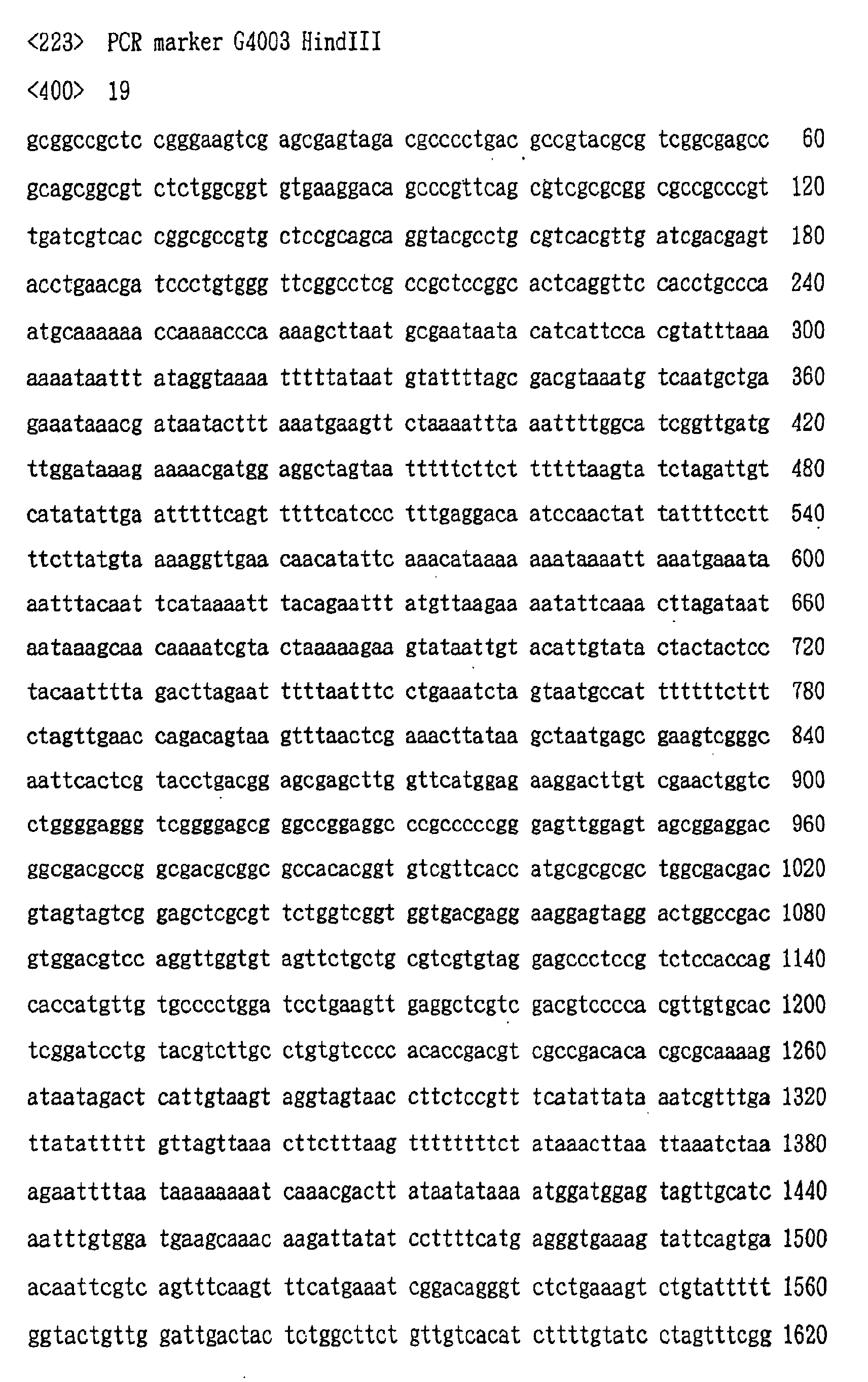
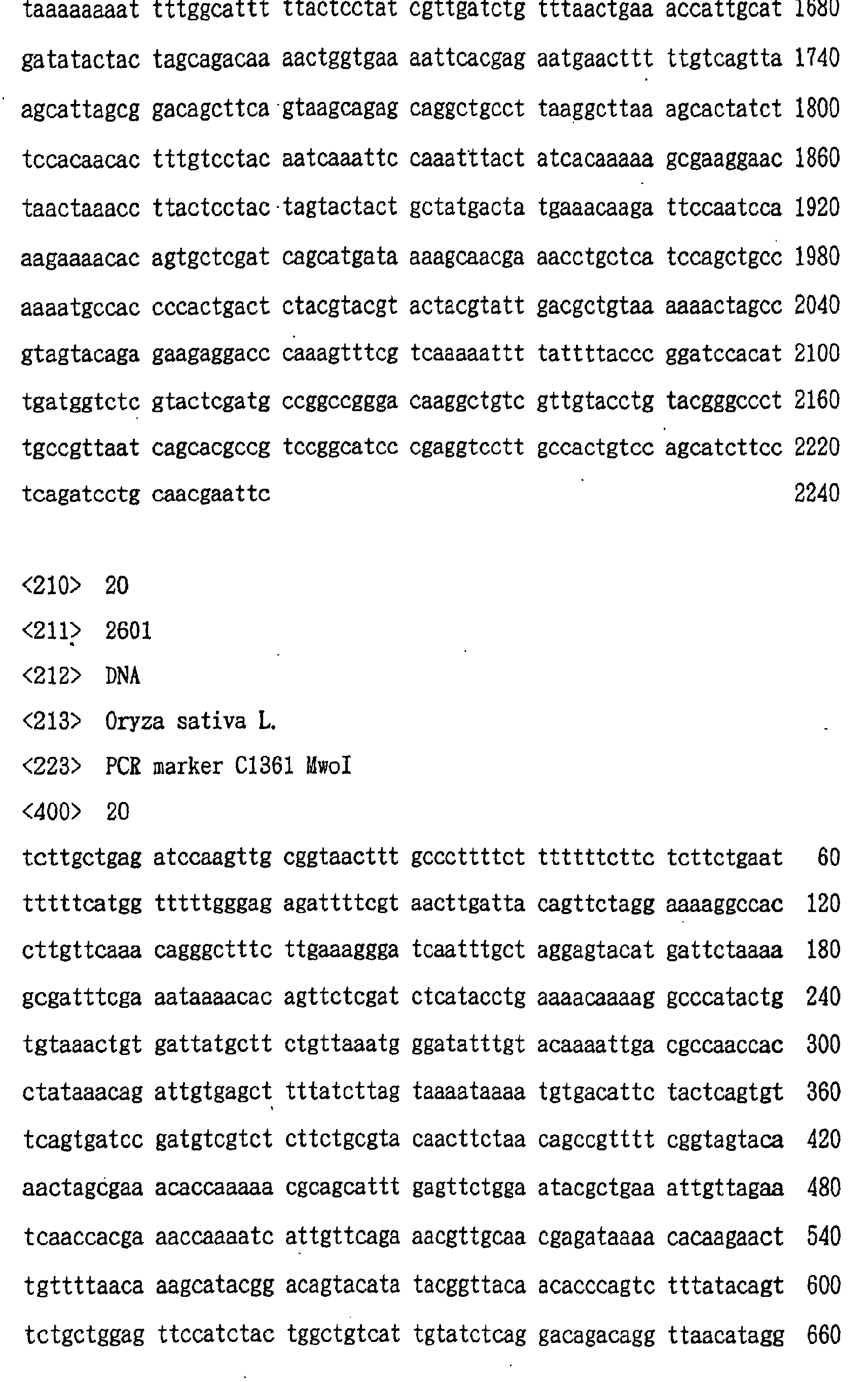
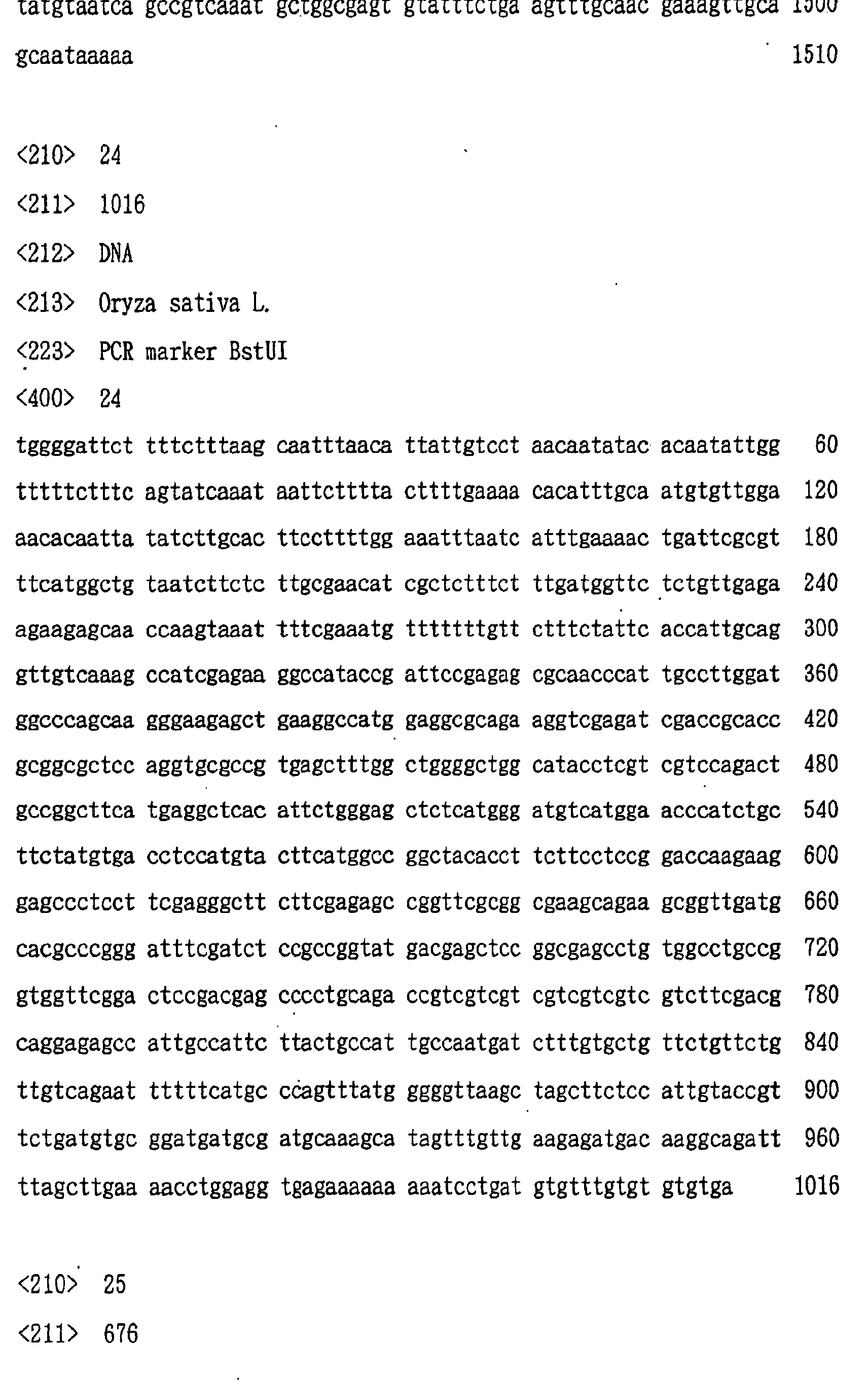
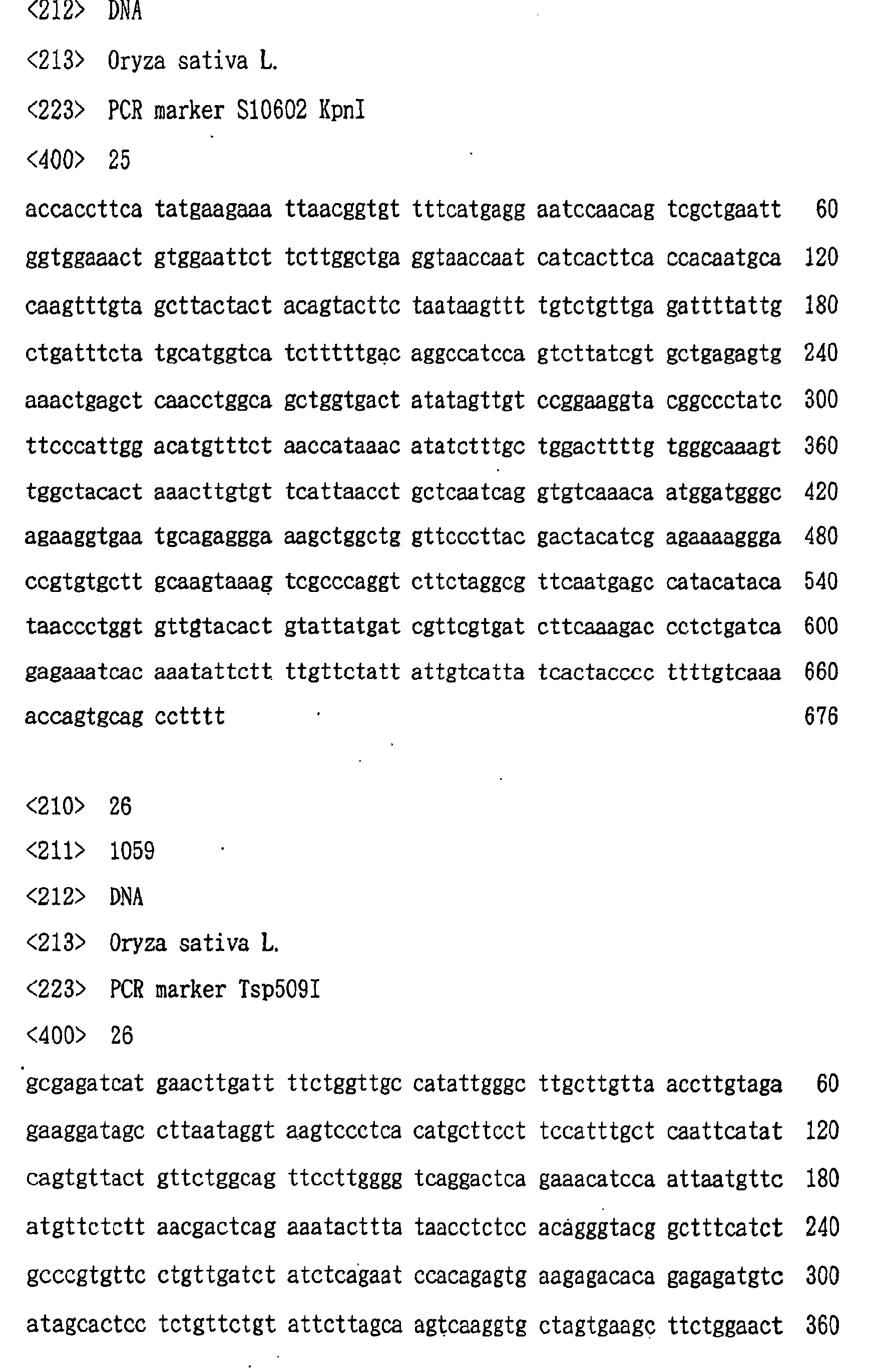
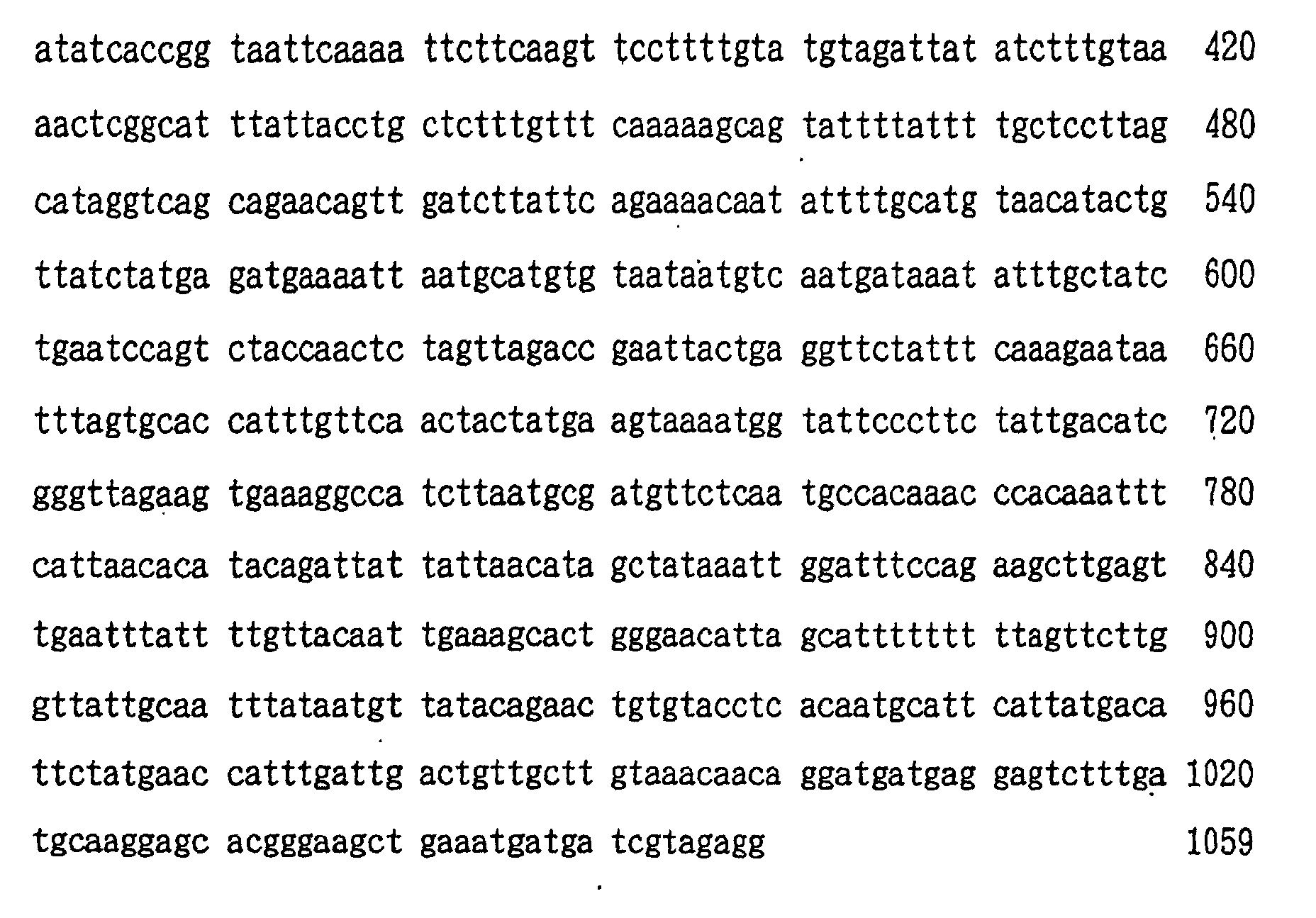
- PCR markers can be classified into two groups, one consisting of R1877 EcoRI, G291 MspI (SEQ ID NO:22), R2303 BslI (SEQ ID NO:23) and S12564 Tsp509I (SEQ ID NO:26) and the other group consisting of C1361 MwoI (SEQ ID NO:20), S10019 BstUI (SEQ ID NO:24), G4003 HindIII (SEQ ID NO:19), S10602 KpnI (SEQ ID NO:25) and G2155 MwoI (SEQ ID NO :21).
- the PCR markers of the first group and those of the second group are on opposite sides of the locus of Rf-1 gene on chromosome 10 of rice .
- At least one PCR marker selected from group (a) consisting of R1877 EcoRI, G291 MspI, R2303 BslI and S12564 Tsp509I, as well as at least one PCR marker selected from group (b) consisting of C1361 MwoI, S10019 BstUI, G4003 HindIII, S10602 KpnI and G2155 MwoI are used to detect Rf-1 linked bands, thereby detecting the presence of Rf-1 gene.
- At least S12564 Tsp509I is preferably selected from group (a) and at least C1361 MwoI from group (b) for use as PCR markers that are the closest in position to the Rf-1 gene. If the genome of the rice under test is found to contain two Rf-1 linked bands, one detected with a PCR marker of group (a) and the other with a PCR marker of group (b), it can be estimated with an extremely high probability that the rice contains Rf-1 gene.
- Rf-1 linked bands are detected using at least two PCR markers of group (a) and at least two PCR markers of group (b).
- the selected rice individual has Rf-1 gene but contains the least possible amount of unwanted gene regions.
- at least one PCR marker of group (a) is preferably S12564 Tsp509I and at least one PCR marker of group (b) is C1361 MwoI.
- PCR marker loci S12564 Tsp509I and C1361 MwoI are separated by a genetic distance of only 0.3 cM.
- the chromosomal region that is introduced from the Rf-1 gene donor parent can be narrowed down to a size of about 1 cM. This helps minimize the possibility of introducing into the restorer line a deleterious gene that may be present in the neighborhood of Rf-1 gene in the donor parent.
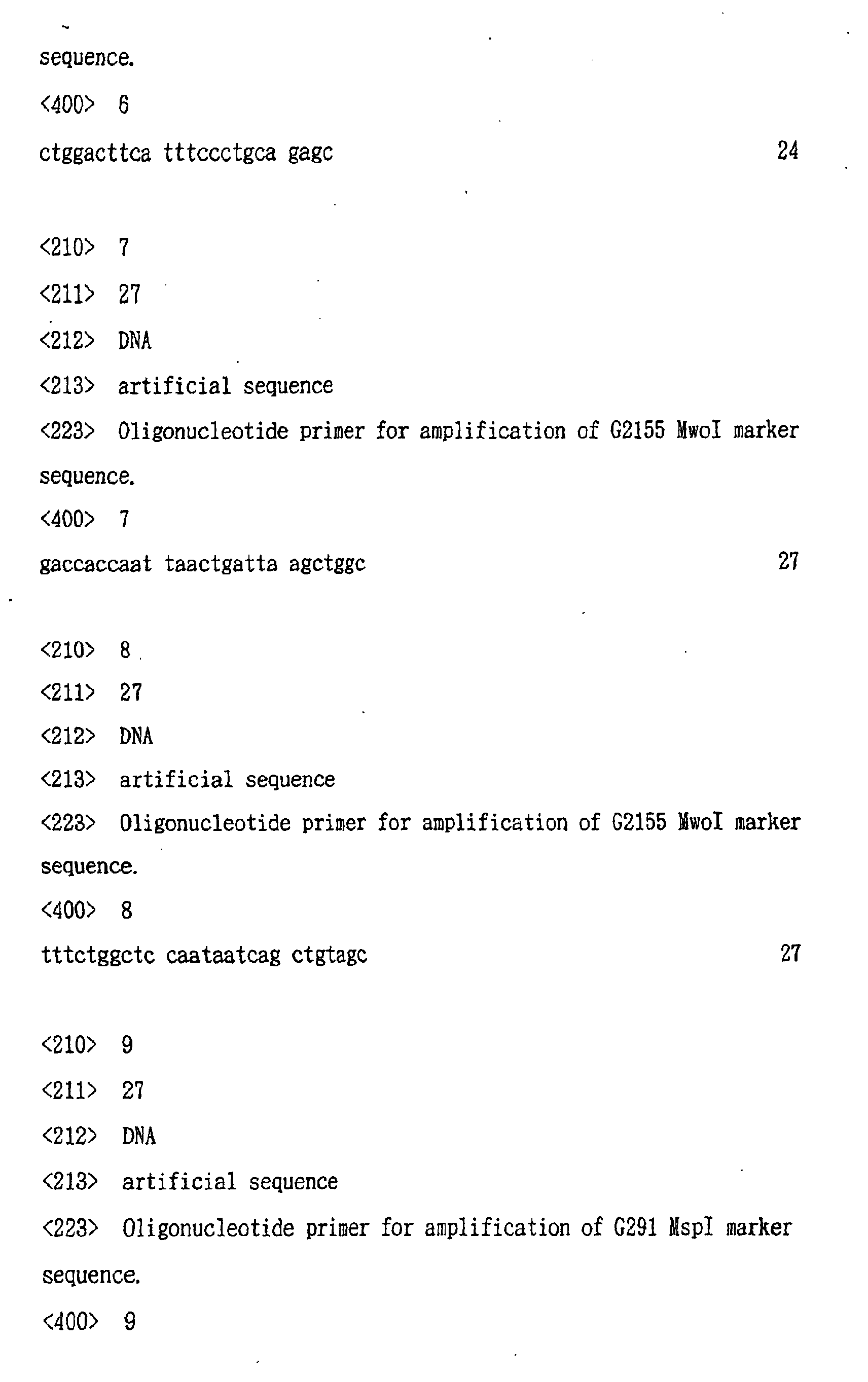
- primer pairs are provided for use in amplifying PCR markers 1 ⁇ 9. These primer pairs were also obtained according to the procedures described in Example 1.
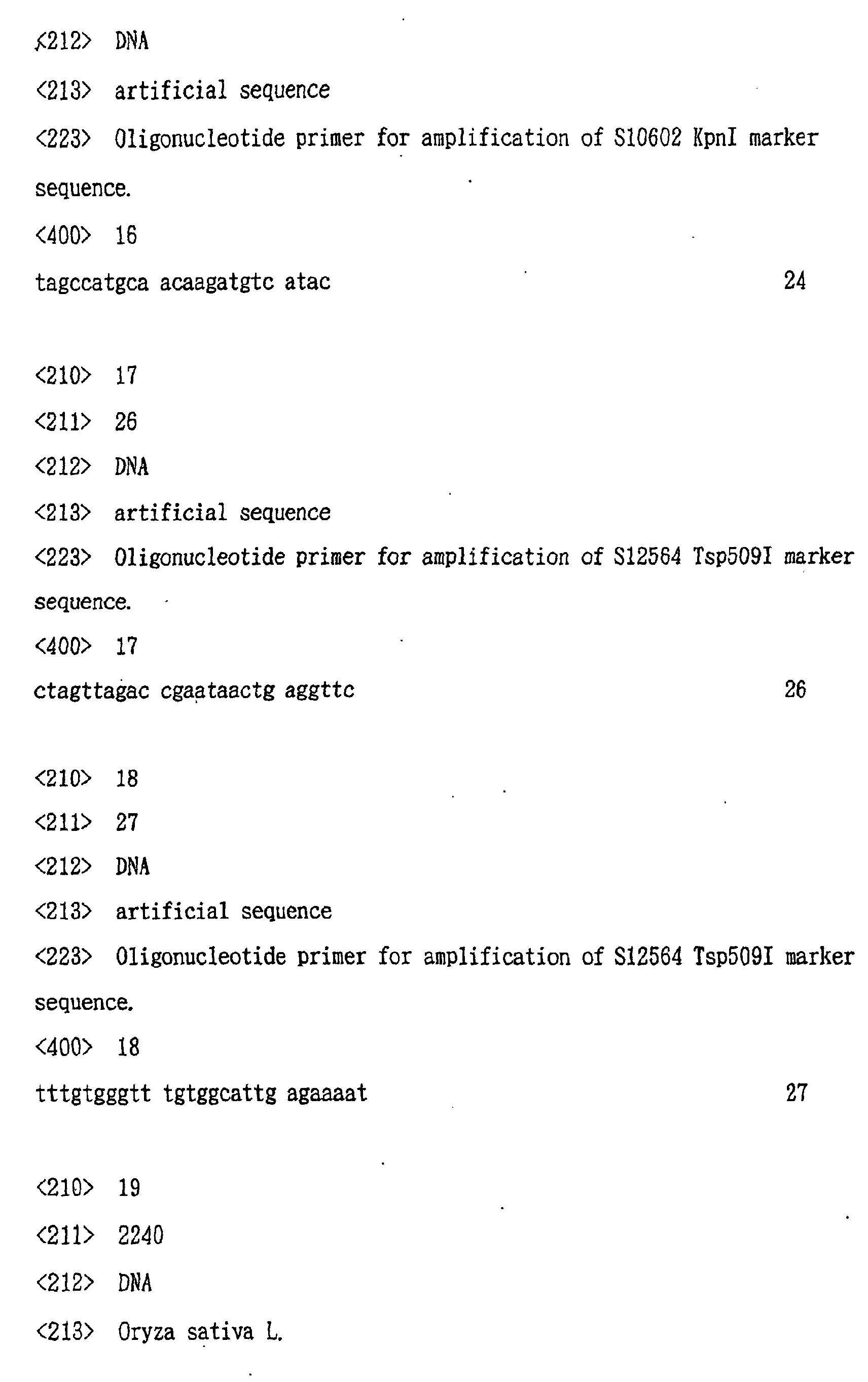
- primer pairs Using these primer pairs, one can amplify and detect the corresponding PCR markers from rice genome. It should be noted that slightly longer nucleotide sequences that contain the nucleotide sequences specified above or those which are slightly shorter can also be used as primers within the scope of the invention.
- PCR markers 1-9 is amplified from the genome of the rice by PCR using the appropriate primers of the invention and then detected by the polymerase chain reaction-restriction fragment length polymorphism method (PCR-RFLP).
- PCR-RFLP polymerase chain reaction-restriction fragment length polymorphism method
- PCR-RFLP is a method that is applicable to the case where polymorphisms exist among variety lines at recognition sites of restriction enzymes in the sequences of PCR amplified DNA fragments and by which specific polymorphisms can conveniently be identified on the basis of cleavage patterns with those restriction enzymes (D.E. Harry et al., Theor. Appl. Genet. (1998), 97:327-336).
- the genomic DNA of a rice under test that is to be used as a template in PCR can be easily extracted by the method of Edwards et al. (Nucleic Acids Res. 8(6):1349, 1991). It is more preferred to use DNA as purified by standard techniques.
- the CTAB method (Murray, M.G. et al., Nucleic Acids Res. 8(19):4321-5, 1980) is a particularly preferred method of extraction.
- the DNA to be used as a template for PCR has preferably a final concentration of 0.5 ng/ ⁇ L.
- PCR The procedures of PCR are well known in the art.
- 50 ng of template genomic DNA, 200 ⁇ M of each dNTP and 5 U of ExTaqTM may be used to perform PCR comprising one cycle of 94 °C x 2 min, 30 cycles each consisting of 94 °C x 1 min, 58 °C x 1 min and 72 °C x 2 min, and finally one cycle at 72 °C x 2 min.
- the product is cleaved with the restriction enzyme corresponding to the restriction site present in the PCR marker selected from markers 1-9.
- the amplification products were incubated for periods ranging from several to about 24 hours at the reaction temperatures recommended for the specific restriction enzymes to be used.
- the amplified PCR sample cleaved with the restriction enzyme can be analyzed by performing electrophoresis on ca. 0.7% - 2% agarose gel or a ca. 3% MetaPhorTM agarose gel. The gels may then be visualized with ethidium bromide under ultraviolet illumination.
- the DNA marker to be detected is amplified by PCR, so it can be detected in a short time and conveniently without performing Southern blot analysis.
- Another advantage is that PCR-RFLP can be performed using only a few nanograms of DNA, which is extremely smaller than the amount required in RFLP when it involves Southern blot analysis.
- the DNA to be used need not be purified to a very high level and even a crude DNA extract may be used as such.
- PCR-RFLP may be used in combination with sequencing techniques in order to ensure the detection of the markers of interest more positively.
- the PCR markers of the invention are all co-dominant markers.
- Co-dominant markers can discriminate a heterozygote from a dominant homozygote. When it is required to determine the genotypic segregation ratio of F1 individuals produced by crossing heterogenotes, a dominant marker will simply enable us to discriminate individuals having the dominant gene and those having the recessive gene at a ratio of 3:1. On the other hand, if a co-dominant marker is used, dominant homozygotes, heterozygotes and a recessive homozygotes will be detected at a ratio of 1:2:1.
- the genotype of Rf-1 to be introduced into hybrid rice can be correctly determined as to whether it is homozygous or heterozygous (i.e. whether it is Rf-1/Rf-1, Rf-1/rf-1 or rf-1/rf-1).
- PCR marker loci S12564 Tsp509I and C1361 MwoI are located on opposite sides of the locus of Rf-1 gene on chromosome 10, and the genetic distance between the loci of Rf-1 gene and S12564 Tsp509I is as short as 0.1 cM (equivalent to about 30 kbps) while the distance between Rf-1 and C1361 MwoI is about 0.2 cM short (equivalent to about 60 kbps).
- the unit of genetic distance is the centiMorgan (cM); 1 cM represents a genetic distance that provides a cross-over frequency of 1%, or a genetic distance such that 1% of all gametes undergo recombination between two genetic loci.
- the probability of recombination varies greatly with species, so the base pair number that corresponds to 1 cM also varies with species.
- 1 cM is known to be equivalent to about 300 kbps of DNA on average although the exact number depends on the position on chromosome.
- the two PCR marker loci S12564 Tsp509I and C1361 MwoI that are disclosed herein and which are closely linked to the locus of Rf-1 gene are spaced apart by a distance of only 0.3 cM.
- This character can be used to ensure that a chromosomal region introduced from the Rf-1 gene donor parent can be narrowed to the size of 1 cM or smaller.
- the possibility of introducing a deleterious gene can be reduced to less than 1/30 compared with the case of using conventional marker loci G291 and G127 which are spaced by a distance of more than 30 cM on the map.
- the PCR markers of the invention can be used to discriminate between rice varieties, japonica and indica.
- the PCR markers of the invention can distinguish between the two rice varieties by making use of polymorphisms in the nucleotide sequences of restriction enzyme sites. Distinguishing japonica from indica rice is important, because if rice seeds of one variety contaminated with another variety are cultivated, rice of the desired variety cannot be harvested.
- PCR markers can be amplified using only a few nanograms of DNA, so precise identification can be made for each grain of rice seed.
- Example 1 nine RFLP markers (i.e., R1877, G291, R2303, S12564, C1361, S10019, G4003, S10602 and G2155) around the locus of Rf-1 gene were converted to PCR markers.
- RFLP markers R1877, G291, R2303, S12564, C1361, S10019, G4003, S10602 and G2155, were purchased from the National Institute of Agrobiological Sciences, the Ministry of Agriculture, Forestry and Fisheries of Japan. After determining the nucleotide sequences of the inserts in the vectors, experiments were conducted according to the following procedures. While five rice varieties were used in the experiments, Asominori, Koshihikari and Nipponbare were japonica, and IR24 and Kasalath were indica.
- XL-1 Blue MRA (P2) was infected with 5 ⁇ L of a 50-fold dilution of the library solution, whereupon 83 plaques were formed. This corresponded to 4.15 x 10 5 pfu per library, and hence, it was calculated that the plaques covered 8.3 x 10 9 bp assuming that the average length of the inserted fragments was 20 kb. The library was therefore considered to have an adequate size for the rice genome (4 x 10 8 bp).
- plasmids containing the RFLP marker probe were isolated and subjected to restriction enzyme treatment and electrophoresis to separate the RFLP marker probe portion; the desired DNA was recovered on a DNA recovery filter (Takara SUPREC-01).
- primers were designed that were specific to both ends of the marker probe and PCR was performed with the total DNA of Asominori used as a template; the amplification products were electrophoresed and recovered by the already-described method.
- the recovered DNA was labelled with a Rediprime DNA Labelling System (Amersham Pharmacia) to prepare a probe for screening the library. PCR was performed in the usual manner (this also applies to the following description).
- Screening of the library was performed in the usual manner after blotting the plaques onto Hybond-N+ (Amersham Pharmacia). After primary screening, areas of positive plaques were individually punched out, suspended in SM buffer and subjected to the second round of screening. After the second screening, the positive plaques were punched out and subjected to the third round of screening to isolate a single plaque.
- the isolated plaque of interest was suspended in SM buffer and primary multiplication of the phage was performed by the plate lysate method.
- the resulting phage-enriched solution was subjected to secondary multiplication by shake culture and the phage DNA was purified with Lambda starter kit (QIAGEN).
- the isolated genomic clones were analyzed to identify the causative site of RFLP, or the EcoRI site that exists in IR24 but not in Asominori , thereby converting R1877 to a PCR marker.
- T3 and T7 primers were used to determine the nucleotide sequences at both ends of the insert in each clone. Then, primers extending outwardly from both ends of the marker probe were designed. They were combined with T3 and T7 primers to give a combination of four primers in total, and employed in PCR with each clone used as the template.
- each clone was digested with NotI and EcoRI and electrophoresed to estimate the insert size and the length of each EcoRI fragment.
- a primer combination (SEQ ID NO:1 x SEQ ID NO:2) that was designed to amplify the nearby region was employed to perform genomic PCR over 30 cycles, each cycle consisting of 94 °C x 1 min, 58 °C x 1 min and 72 °C x 2 min.
- the PCR product was treated with EcoRI and subjected to electrophoresis on 0.7% agarose gel. As a result, the expected polymorphisms were observed between Asominori and IR24.
- EcoRI the PCR product (-3200 bp) was cleaved to yield 1500 bp and 1700 bp fragments in IR24 but not in Asominori.
- the isolated genomic clones were analyzed to identify the causative site of RFLP, or the HindIII site that existed in Asominori but not in IR24, thereby converting G4003 to a PCR marker.
- marker probe G4003 was reported to detect a HindIII fragment of 3 kb in Nipponbare and one of 10 kb in Kasalath (ftp://ftp.staff.or.jp/pub/geneticmap98/parentsouthern/chr10/R 1877.JPG). This report, taken together with the analyses described above, led to a temporary conclusion that the HindIII site that existed in Asominori but not in IR24 would be at either one of two candidate sites.
- a primer combination that was designed to amplify the area in the neighborhood of each HindIII site was employed to perform genomic PCR over 35 cycles, each cycle consisting of 94 °C x 30 sec, 58 °C x 30 sec and 72 °C x 30 sec.
- the PCR product was treated with HindIII and subjected to electrophoresis on 2% agarose gel. As a result, the HindIII site within the marker probe was found to have polymorphisms.
- the PCR product (362 bp) was cleaved to yield a 95 bp fragment and a 267 bp fragment in Asominori but not in IR24.
- the primers used to amplify the polymorphic site were SEQ ID NO:3 and SEQ ID NO:4. Mapping of the site demonstrated the conversion of RFLP marker G4003 to a PCR marker, which was named G4003 HindIII (SEQ ID NO:19) in the present invention.
- Primers were designed on the basis of the nucleotide sequence information of the isolated genomic clones. PCR was performed with the total DNAs of Asominori , Koshihikari, Kasalath or IR24 being used as a template and the PCR product was recovered by known methods after electrophoresis. Using the recovered DNA as a template, the inventors analyzed the nucleotide sequence of each of the rice varieties with ABI Model 310 in search of mutations that would cause polymorphisms.
- PCR was performed over 35 cycles, each cycle consisting of 94 °C x 30 sec, 58 °C x 30 sec and 72 °C x 30 sec.
- the PCR product was treated with MwoI and analyzed by electrophoresis on 3% MetaPhorTM agarose gel.
- Asominori cleavage occurred at two sites to give three observable bands of about 25 bp, 50 bp and 79 bp, but in IR24 cleavage occurred at one site to give two observable bands of about 50 bp and 107 bp.
- Mapping demonstrated the conversion of RFLP marker C1361 to a PCR marker, which was named C1361 MwoI (SEQ ID NO:20) in the present invention.
- Primers specific to both ends of the marker probe were designed and PCR was performed with the total DNA of Asominori , Koshihikari, IR24 or IL216 (a line produced by introducing Rf-1 gene into Koshihikari by back crossing; its genotype was Rf-1/Rf-1) being used as a template. Purification of the PCR product and searching for a mutation that would be useful for providing restriction fragment polymorphisms were performed by the methods already described above.
- Primers specific to internal sequences of the marker probe were designed and used in various combinations to perform PCR to find a primer combination that could yield an amplification product of the expected size.
- the inventors performed PCR with the total DNA of Asominori, Koshihikari , IR24 or IL216 used as a template. Purification of the PCR product and searching for a mutation that could be utilized in providing restriction fragment polymorphisms were performed by the methods already described above.
- the inventors performed genomic PCR of each variety under test and compared the nucleotide sequences of the products. As a result, mutations were found at four sites between the variety/line having Rf-1 gene (IR24 or IL216) and the variety (Asominori or Koshihikari) not having Rf-1 gene. One of the four sites was used to create a dCAPS marker. To this end, SEQ ID NO:9 and SEQ ID NO:10 were used as primers to perform PCR over 35 cycles, each cycle consisting of 94 °C x 30 sec, 58 °C x 30 sec and 72 °C x 30 sec.
- the PCR product was treated with MspI and analyzed by electrophoresis on 3% MetaPhorTM agarose gel.
- cleavage occurred at two sites to give three observable bands of about 25 bp, 49 bp and 55 bp, but in the varieties not having Rf-1 gene, cleavage occurred at one site to give two observable bands of about 25 bp and 104 bp.
- Mapping demonstrated the conversion of RFLP marker G291 to a PCR marker, which was named G291 MspI (SEQ ID NO:22) in the present invention.
- Primers specific to internal sequences of the marker probe were designed and PCR was performed with the total DNA of Asominori, IR24 or Kasalath used as a template. Purification of the PCR product and searching for a mutation that could be used for providing restriction fragment polymorphisms were performed by the methods already described above.
- S10019 was converted to a PCR marker in accordance with the method of converting R2303 to a PCR marker.
- S10602 was converted to a PCR marker in accordance with the method of converting R2303 to a PCR marker.
- S12564 was converted to a PCR marker in accordance with the method of converting R2303 to a PCR marker.
- MS Koshihikari generation: BC10F1
- MS-FR Koshihikari was a line created by introducing Rf-1 gene from IR8 into MS Koshihikari (the locus of Rf-1 gene being heterozygous).
- each individual was investigated for the genotype at two marker loci R1877 EcoRI and G2155 MwoI that would presumably be located on opposite sides of the locus of Rf-1 gene.
- Japonica type homozygotes with respect to either locus R1877 EcRI or G2155 MwoI were regarded as recombinants between these two marker loci.
- each of such recombinants was investigated for the genotypes of G291 MspI, R2303 Bs1I, S12564 Tsp 509I, C1361 MwoI, S10019 BstUI, G4003 HindIII and S10602 KpnI loci, and the positions of recombination were identified.
- the present inventors developed nine novel co-dominant PCR markers including two novel co-dominant PCR markers S12564 Tsp509I and C1361 MwoI located on opposite sides of the locus of Rf-1 gene.
- the nine novel co-dominant PCR markers provide a convenient and accurate method for genotyping the locus of Rf-1 gene.
- investigation for the presence or absence of Rf-1 gene which restores the BT type cytoplasmic male sterility currently used in the breeding of japonica-japonica hybrid rice and selection of Rf-1 gene homozygotes could be performed in a convenient and accurate manner. Therefore, the PCR markers of the invention can be used in efficient breeding of hybrid rice.
- the method of the invention enables direct genotype estimation from DNA sequences and, hence, can genotype the locus of Rf-1 gene without being influenced by environmental factors.
Landscapes
- Life Sciences & Earth Sciences (AREA)
- Chemical & Material Sciences (AREA)
- Health & Medical Sciences (AREA)
- Genetics & Genomics (AREA)
- Organic Chemistry (AREA)
- General Health & Medical Sciences (AREA)
- Botany (AREA)
- Proteomics, Peptides & Aminoacids (AREA)
- Engineering & Computer Science (AREA)
- Analytical Chemistry (AREA)
- Physics & Mathematics (AREA)
- Environmental Sciences (AREA)
- Developmental Biology & Embryology (AREA)
- Zoology (AREA)
- Wood Science & Technology (AREA)
- Biophysics (AREA)
- Molecular Biology (AREA)
- Biotechnology (AREA)
- Biochemistry (AREA)
- Microbiology (AREA)
- General Engineering & Computer Science (AREA)
- Bioinformatics & Cheminformatics (AREA)
- Spectroscopy & Molecular Physics (AREA)
- Immunology (AREA)
- Gastroenterology & Hepatology (AREA)
- Medicinal Chemistry (AREA)
- Mycology (AREA)
- Measuring Or Testing Involving Enzymes Or Micro-Organisms (AREA)
Abstract
Description
| Approximate size (bp) of detected band | |
| Detection of marker 1 (R1877 EcoRI) with | |
| When the genome of test rice has Rf-1 gene homozygously | 1500 and 1700 |
| When the genome of test rice has Rf-1 gene heterozygously | 1500, 1700 and |
| 3200 | |
| When the genome of test rice has no Rf-1 gene | 3200 |
| Detection of marker 2 (G4003 HindIII) with primer pair 2 | |
| When the genome of test rice has Rf-1 gene homozygously | 362 |
| When the genome of test rice has Rf-1 gene heterozygously | 95, 267 and 362 |
| When the genome of test rice has no Rf-1 gene | 95 and 267 |
| Detection of marker 3 (C1361 MwoI) with primer pair 3 | |
| When the genome of test rice has Rf-1 gene homozygously | 50 and 107 |
| When the genome of test rice has Rf-1 gene heterozygously | 25, 50, 79 and 107 |
| When the genome of test rice has no Rf-1 gene | 25. 50 and 79 |
| Detection of marker 4 (G2155 MwoI) with primer pair 4 | |
| When the genome of test rice has Rf-1 gene homozygously | 25, 27 and 78 |
| When the genome of test rice has Rf-1 gene heterozygously | 25, 27, 78 and 105 |
| When the genome of test rice has no Rf-1 gene | 25 and 105 |
| Detection of marker 5 (G291 MspI) | |
| with primer pair 5 | |
| When the genome of test rice has Rf-1 gene homozygously | 25, 49 and 55 |
| When the genome of test rice has Rf-1 gene heterozygously | 25, 49, 55 and 104 |
| When the genome of test rice has no Rf-1 gene | 25 and 104 |
| Detection of marker 6 (R2303 Bs1I) with primer pair 6 | |
| When the genome of test rice has Rf-1 gene homozygously | 238, 655 and 679 |
| When the genome of test rice has Rf-1 gene heterozygously | 238, 655, 679 and 1334 |
| When the genome of test rice has no Rf-1 gene | 238 and 1334 |
| Detection of marker 7 (S10019 BstUI) with primer pair 7 | |
| When the genome of test rice has Rf-1 gene homozygously | 130, 218 and 244 |
| When the genome of test rice has Rf-1 gene heterozygously | 130, 218, 244 and 462 |
| When the genome of test rice has no Rf-1 gene | : 130 and 462 |
| Detection of marker 8 (S10602 KpnI) with primer pair 8 | |
| When the genome of test rice has | |
| Rf-1 gene homozygously | 724 |
| When the genome of test rice has Rf-1 gene heterozygously | 117, 607 and 724 |
| When the genome of test rice has no Rf-1 gene | 117 and 607 |
| Detection of marker 9 (S12564 Tsp509I) with primer pair 9 | |
| When the genome of test rice has Rf-1 gene homozygously | 41 and 117 |
| When the genome of test rice has Rf-1 gene heterozygously | 26, 41, 91 and 117 |
| When the genome of test rice has no Rf-1 gene | 26, 41 and 91 |
(ftp://ftp.staff.or.jp/pub/geneticmap98/parentsouthern/chr10/R 1877.JPG). This fact, taken together with the results of analysis described above, gave a putative position for the EcoRI site that existed in IR24 but not in Asominori. Hence, a primer combination (SEQ ID NO:1 x SEQ ID NO:2) that was designed to amplify the nearby region was employed to perform genomic PCR over 30 cycles, each cycle consisting of 94 °C x 1 min, 58 °C x 1 min and 72 °C x 2 min. The PCR product was treated with EcoRI and subjected to electrophoresis on 0.7% agarose gel. As a result, the expected polymorphisms were observed between Asominori and IR24. By treatment with EcoRI, the PCR product (-3200 bp) was cleaved to yield 1500 bp and 1700 bp fragments in IR24 but not in Asominori. Mapping of the marker was made with an RIL (recombinant inbred line) of Asominori-IR24 with the results that the PCR marker was located in the same region as that of RFLP marker locus R1877, thereby confirming the conversion of RFLP marker R1877 to a PCR marker, which was named R1877 EcoRI in the present invention.
(ftp://ftp.staff.or.jp/pub/geneticmap98/parentsouthern/chr10/R 1877.JPG). This report, taken together with the analyses described above, led to a temporary conclusion that the HindIII site that existed in Asominori but not in IR24 would be at either one of two candidate sites. Hence, a primer combination that was designed to amplify the area in the neighborhood of each HindIII site was employed to perform genomic PCR over 35 cycles, each cycle consisting of 94 °C x 30 sec, 58 °C x 30 sec and 72 °C x 30 sec. The PCR product was treated with HindIII and subjected to electrophoresis on 2% agarose gel. As a result, the HindIII site within the marker probe was found to have polymorphisms. By treatment with HindIII, the PCR product (362 bp) was cleaved to yield a 95 bp fragment and a 267 bp fragment in Asominori but not in IR24. The primers used to amplify the polymorphic site were SEQ ID NO:3 and SEQ ID NO:4. Mapping of the site demonstrated the conversion of RFLP marker G4003 to a PCR marker, which was named G4003 HindIII (SEQ ID NO:19) in the present invention.
Purification of the PCR product and searching for a mutation that would be useful for providing restriction fragment polymorphisms were performed by the methods already described above.




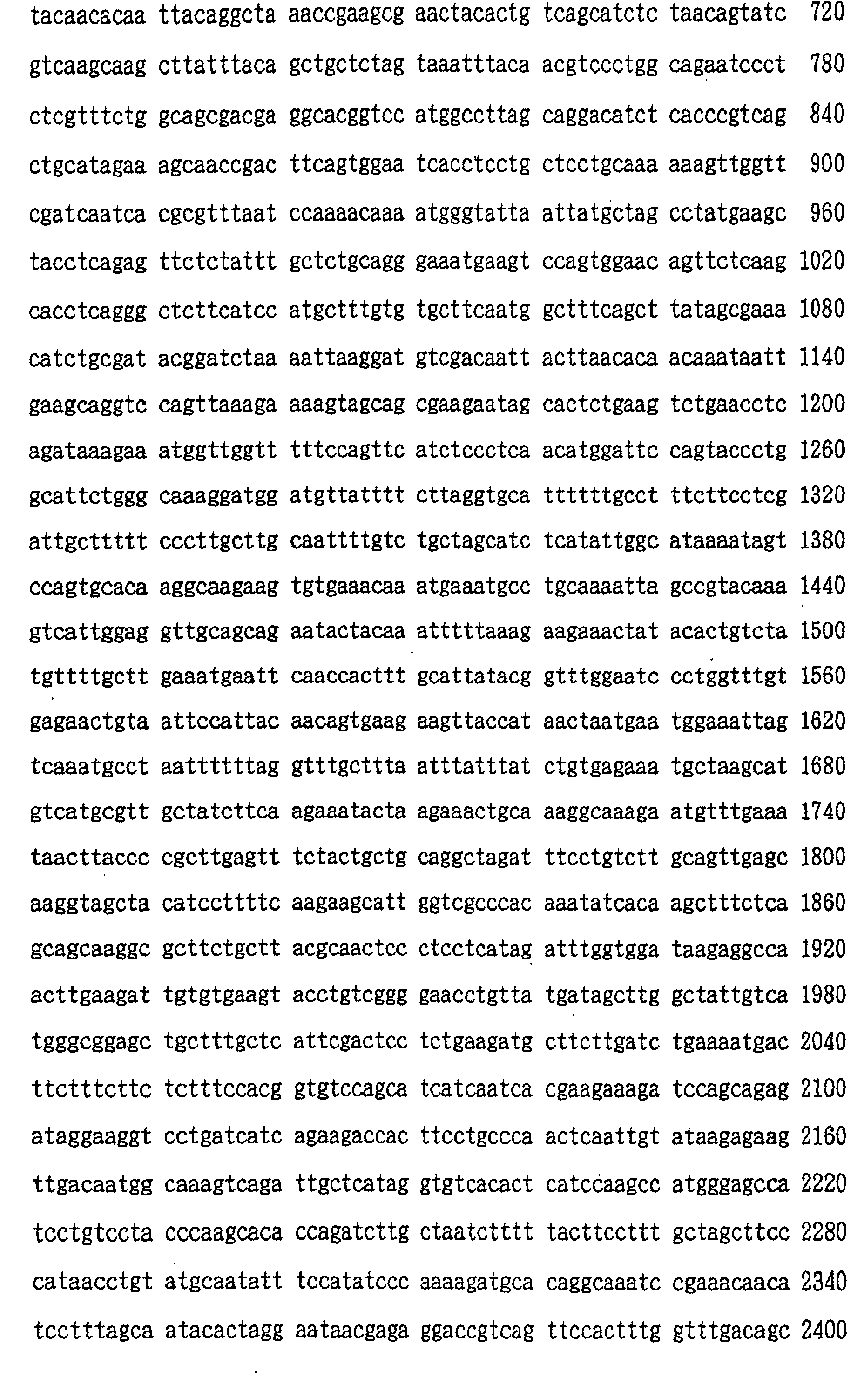
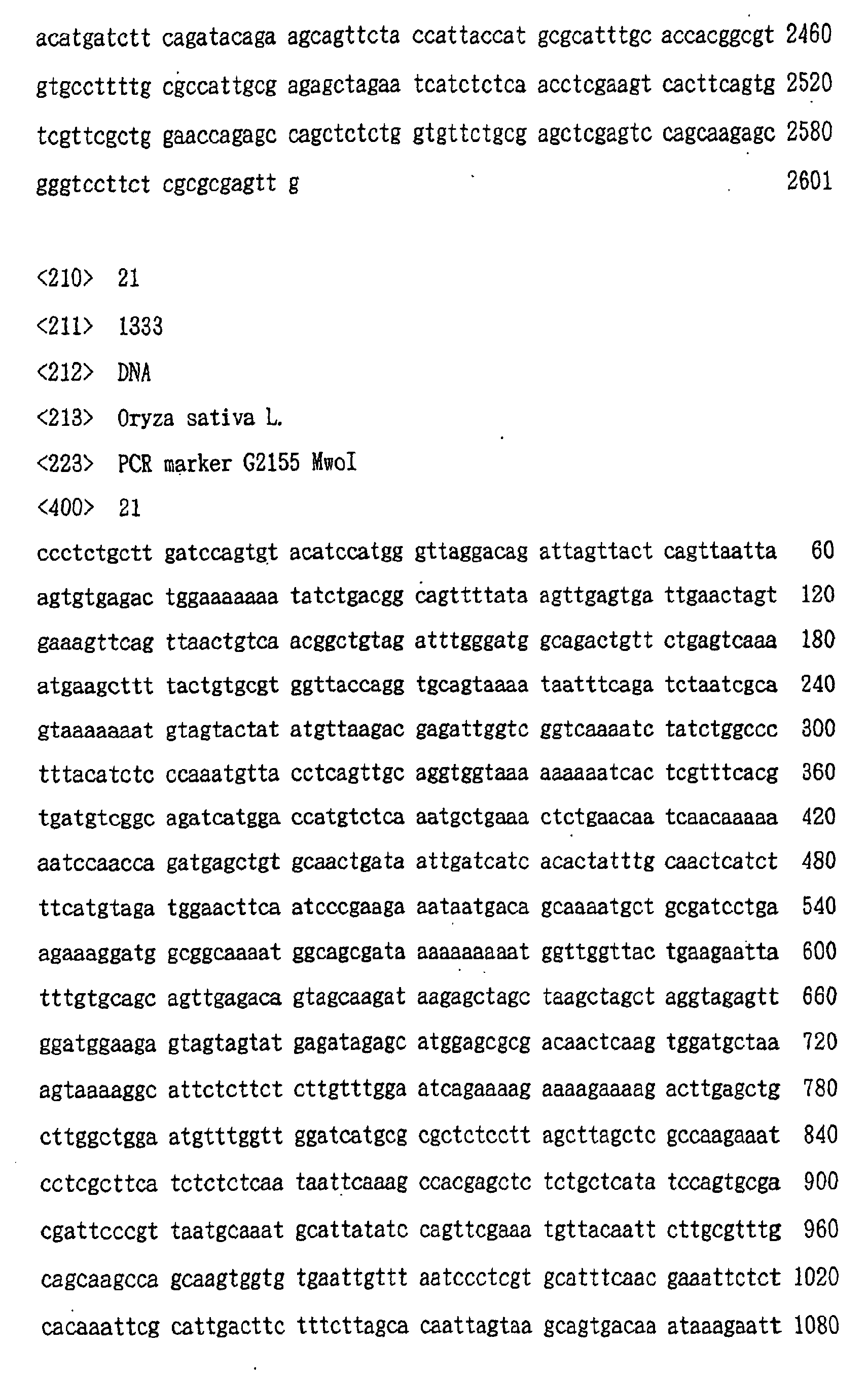
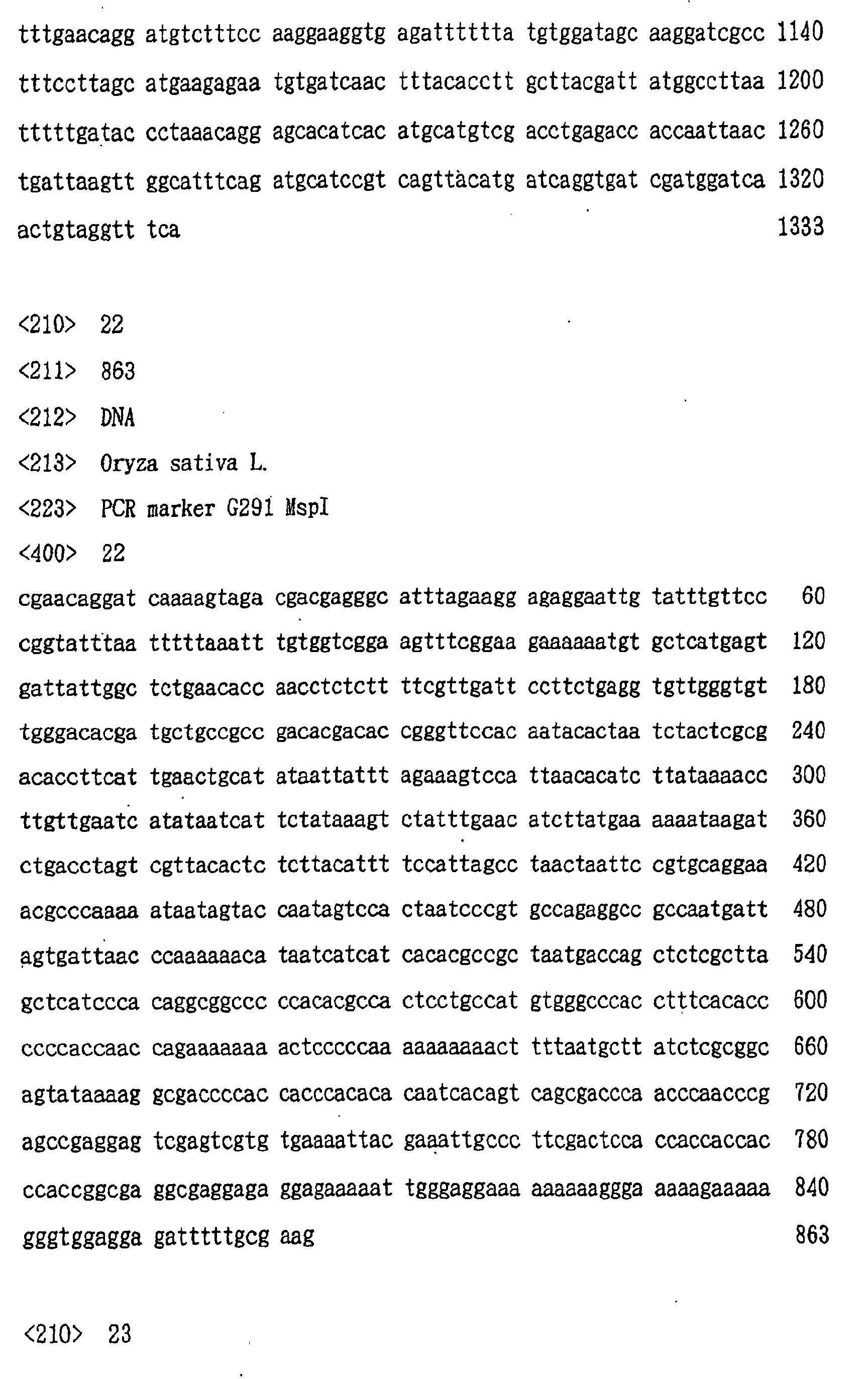
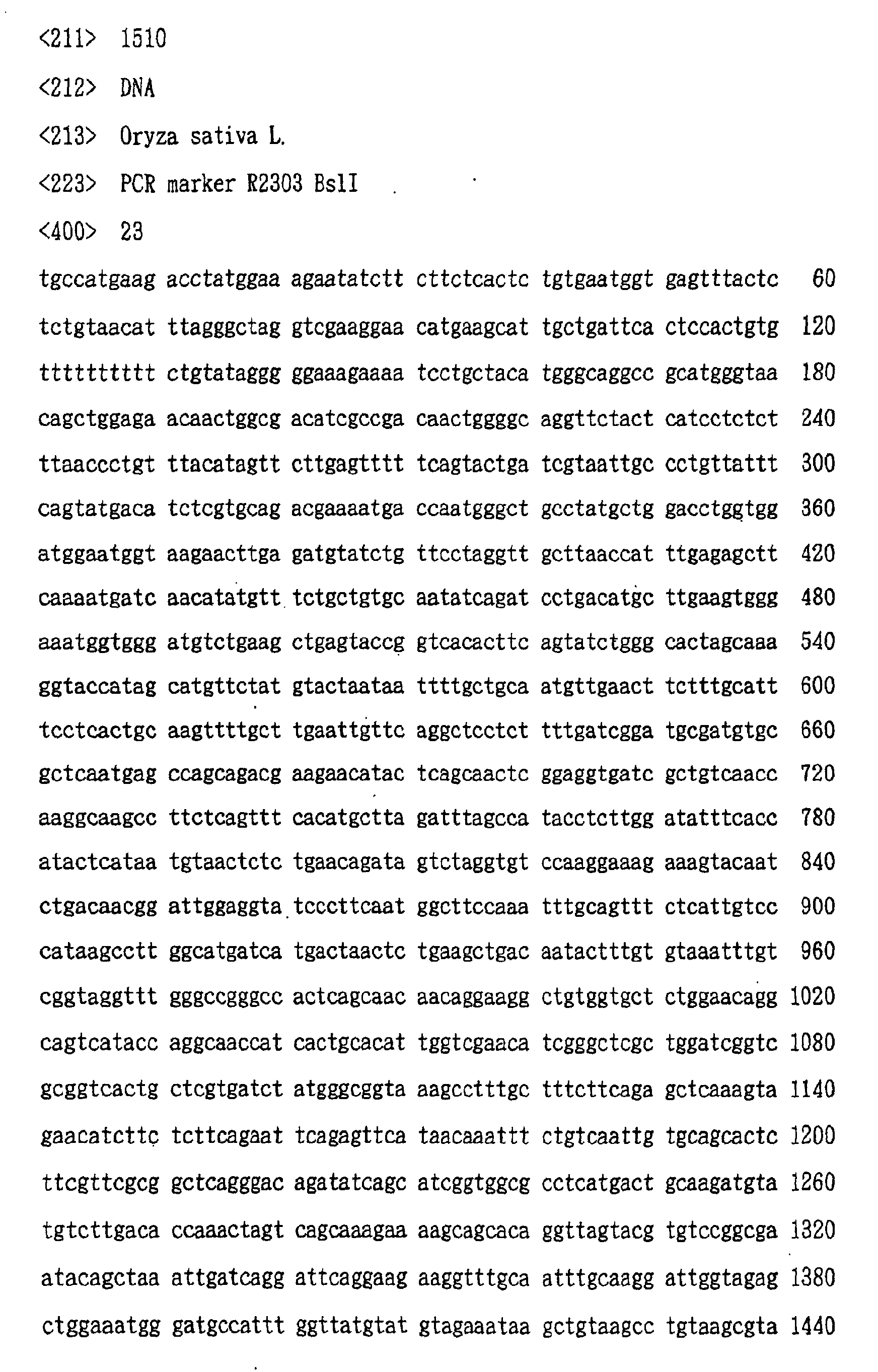
Claims (6)
- A method of determining whether a rice individual or seed under test has Rf-1 gene based on the fact that the locus of a fertility restoring gene (Rf-1 gene) is located between RFLP marker loci S12564 and C1361 on chromosome 10 of rice.
- The method according to claim 1, which detects at least one PCR marker selected from the group consisting of:(1) PCR marker R1877 EcoRI which, when rice genomic DNA is subjected to PCR with DNA primers having the sequences of SEQ ID NO:1 and SEQ ID NO:2, can detect polymorphisms between rice individuals of the japonica and indica lines depending on whether the amplification products have a recognition site for restriction enzyme EcoRI;(2) PCR marker G4003 HindIII which, when rice genomic DNA is subjected to PCR with DNA primers having the sequences of SEQ ID NO:3 and SEQ ID NO:4, can detect polymorphisms between rice individuals of the japonica and indica lines depending on whether the amplification products have a recognition site for restriction enzyme HindIII;(3) PCR marker C1361 MwoI which, when rice genomic DNA is subjected to PCR with DNA primers having the sequences of SEQ ID NO:5 and SEQ ID NO:6, can detect polymorphisms between rice individuals of the japonica and indica lines depending on whether the amplification products have a recognition site for restriction enzyme MwoI;(4) PCR marker G2155 MwoI which, when rice genomic DNA is subjected to PCR with DNA primers having the sequences of SEQ ID NO:7 and SEQ ID NO:8, can detect polymorphisms between rice individuals of the japonica and indica lines depending on whether the amplification products have a recognition site for restriction enzyme MwoI;(5) PCR marker G291 MspI which, when rice genomic DNA is subjected to PCR with DNA primers having the sequences of SEQ ID NO:9 and SEQ ID NO:10, can detect polymorphisms between rice individuals of the japonica and indica lines depending on whether the amplification products have a recognition site for restriction enzyme MspI;(6) PCR marker R2303 BslI which, when rice genomic DNA is subjected to PCR with DNA primers having the sequences of SEQ ID NO:11 and SEQ ID NO:12, can detect polymorphisms between rice individuals of the japonica and indica lines depending on whether the amplification products have a recognition site for restriction enzyme Bs1I;(7) PCR marker S10019 BstUI which, when rice genomic DNA is subjected to PCR with DNA primers having the sequences of SEQ ID NO:13 and SEQ ID NO:14, can detect polymorphisms between rice individuals of the japonica and indica lines depending on whether the amplification products have a recognition site for restriction enzyme BstUI;(8) PCR marker S10602 KpnI which, when rice genomic DNA is subjected to PCR with DNA primers having the sequences of SEQ ID NO:15 and SEQ ID NO:16, can detect polymorphisms between rice individuals of the japonica and indica lines depending on whether the amplification products have a recognition site for restriction enzyme KpnI; and(9) PCR marker S12564 Tsp509I which, when rice genomic DNA is subjected to PCR with DNA primers having the sequences of SEQ ID NO:17 and SEQ ID NO:18, can detect polymorphisms between rice individuals of the japonica and indica lines depending on whether the amplification products have a recognition site for restriction enzyme Tsp509I.
- The method according to claim 2 which concludes that the rice individual or seed under test has Rf-1 gene when at least one PCR marker selected from group (a) consisting of R1877 EcoRI, G291 MspI, R2303 BslI and S12564 Tsp509I and at least one PCR marker selected from group (b) consisting of C1361 MwoI, S10019 BstUI, G4003 HindIII, S10602 KpnI and G2155 MwoI are both present in the amplification products.
- The method according to claim 3, wherein the presence of PCR markers S12564 Tsp509I and C1361 MwoI is detected.
- A method of detecting a chromosomal region that has been introduced from an Rf-1 gene donor parent, which comprises genotyping loci around Rf-1 gene in an individual under test using at least two PCR markers in the same group of at least one of the groups (a) and (b) in claim 3.
- A primer to be used in the method according to claim 2 which has the sequence of either one of SEQ ID NO:1 to SEQ ID NO:18.
Applications Claiming Priority (3)
| Application Number | Priority Date | Filing Date | Title |
|---|---|---|---|
| JP2000247204 | 2000-08-17 | ||
| JP2000247204 | 2000-08-17 | ||
| PCT/JP2001/007052 WO2002014506A1 (en) | 2000-08-17 | 2001-08-16 | Method of estimating the genotype of fertility recovery locus to rice bt type male fertility cytoplasm |
Publications (1)
| Publication Number | Publication Date |
|---|---|
| EP1310553A1 true EP1310553A1 (en) | 2003-05-14 |
Family
ID=18737345
Family Applications (1)
| Application Number | Title | Priority Date | Filing Date |
|---|---|---|---|
| EP01956912A Withdrawn EP1310553A1 (en) | 2000-08-17 | 2001-08-16 | Method of estimating the genotype of fertility recovery locus to rice bt type male fertility cytoplasm |
Country Status (9)
| Country | Link |
|---|---|
| US (1) | US20050048482A1 (en) |
| EP (1) | EP1310553A1 (en) |
| KR (1) | KR20030040400A (en) |
| CN (1) | CN1466627A (en) |
| AU (1) | AU2001278745A1 (en) |
| BR (1) | BR0113407A (en) |
| CA (1) | CA2419460A1 (en) |
| MX (1) | MXPA03001462A (en) |
| WO (1) | WO2002014506A1 (en) |
Cited By (5)
| Publication number | Priority date | Publication date | Assignee | Title |
|---|---|---|---|---|
| EP1437409A4 (en) * | 2001-09-19 | 2005-02-16 | Japan Tobacco Inc | METHOD FOR CONFERING OR REGULATING THE FERTILITY OF MALE STERILITY CYTOPLASM OF BT RICE BY MEANS OF A FERTILITY RESTORATION GENE, AND METHOD OF ESTIMATING THE PRESENCE OF A FERTILITY RESTORATION GENE |
| EP1541687A4 (en) * | 2002-07-05 | 2006-01-04 | Japan Tobacco Inc | STERILITY RECOVERY GENES FOR MALE STERILE CYTOPLASM OF THE BT RICE TYPE |
| US7982109B2 (en) | 2003-06-18 | 2011-07-19 | Japan Tobacco Inc. | Method for improving fertility of hybrid plants comprising placing fertility restorer genes into multiple gene loci |
| CN108130329A (en) * | 2017-11-28 | 2018-06-08 | 上海交通大学 | The application of TFN genes and recovery TFN gene delections lead to the method for male sterility of rice |
| RU2673472C1 (en) * | 2017-11-30 | 2018-11-27 | Федеральное государственное бюджетное научное учреждение "Научно-исследовательский институт акушерства, гинекологии и репродуктологии имени Д.О. Отта" (ФГБНУ "НИИ АГиР им. Д.О. Отта") | Method for assessing the quality of ejaculate by the content of spermatozoa with hydroxymethylated dna |
Families Citing this family (5)
| Publication number | Priority date | Publication date | Assignee | Title |
|---|---|---|---|---|
| CN100457905C (en) * | 2006-05-24 | 2009-02-04 | 华南农业大学 | A rice hybrid fertility gene and its application |
| CN102477091B (en) * | 2010-11-30 | 2013-11-13 | 中国科学院遗传与发育生物学研究所 | Rice male sterile protein and coding gene and application thereof |
| CN106497936B (en) * | 2016-09-29 | 2019-05-14 | 北京大学 | Proteins that control male fertility in rice and their encoding genes and applications |
| CN106544429A (en) * | 2016-11-03 | 2017-03-29 | 云南农业大学 | A kind of method of one type Three-line system restorer of precise Identification Yunnan |
| CN116240234A (en) * | 2022-11-23 | 2023-06-09 | 南京农业大学 | Application of OsRNR10 Gene in Indica Rice |
Family Cites Families (3)
| Publication number | Priority date | Publication date | Assignee | Title |
|---|---|---|---|---|
| JPH07222588A (en) * | 1994-02-10 | 1995-08-22 | Mitsui Toatsu Chem Inc | Genetic diagnosis of rice cytoplasmic male sterile line |
| JPH09313187A (en) * | 1996-05-30 | 1997-12-09 | Mitsui Petrochem Ind Ltd | DNA marker located near the cytoplasmic male-sterility recovery gene of rice and DNA diagnostic method |
| JP2000139465A (en) * | 1998-11-06 | 2000-05-23 | Mitsui Chemicals Inc | Dna marker placed closely to rice cytoplasmic male sterility-restoring gene and discrimination of cytoplasmic male sterility-restoring gene by use of the same |
-
2001
- 2001-08-16 MX MXPA03001462A patent/MXPA03001462A/en unknown
- 2001-08-16 US US10/344,752 patent/US20050048482A1/en not_active Abandoned
- 2001-08-16 BR BR0113407-8A patent/BR0113407A/en not_active IP Right Cessation
- 2001-08-16 EP EP01956912A patent/EP1310553A1/en not_active Withdrawn
- 2001-08-16 WO PCT/JP2001/007052 patent/WO2002014506A1/en not_active Ceased
- 2001-08-16 KR KR10-2003-7002230A patent/KR20030040400A/en not_active Withdrawn
- 2001-08-16 AU AU2001278745A patent/AU2001278745A1/en not_active Abandoned
- 2001-08-16 CA CA002419460A patent/CA2419460A1/en not_active Abandoned
- 2001-08-16 CN CNA018165699A patent/CN1466627A/en active Pending
Non-Patent Citations (1)
| Title |
|---|
| See references of WO0214506A1 * |
Cited By (6)
| Publication number | Priority date | Publication date | Assignee | Title |
|---|---|---|---|---|
| EP1437409A4 (en) * | 2001-09-19 | 2005-02-16 | Japan Tobacco Inc | METHOD FOR CONFERING OR REGULATING THE FERTILITY OF MALE STERILITY CYTOPLASM OF BT RICE BY MEANS OF A FERTILITY RESTORATION GENE, AND METHOD OF ESTIMATING THE PRESENCE OF A FERTILITY RESTORATION GENE |
| EP1541687A4 (en) * | 2002-07-05 | 2006-01-04 | Japan Tobacco Inc | STERILITY RECOVERY GENES FOR MALE STERILE CYTOPLASM OF THE BT RICE TYPE |
| US7982109B2 (en) | 2003-06-18 | 2011-07-19 | Japan Tobacco Inc. | Method for improving fertility of hybrid plants comprising placing fertility restorer genes into multiple gene loci |
| CN108130329A (en) * | 2017-11-28 | 2018-06-08 | 上海交通大学 | The application of TFN genes and recovery TFN gene delections lead to the method for male sterility of rice |
| CN108130329B (en) * | 2017-11-28 | 2020-06-12 | 上海交通大学 | Application of TFN gene and method for recovering rice male sterility caused by TFN gene deletion |
| RU2673472C1 (en) * | 2017-11-30 | 2018-11-27 | Федеральное государственное бюджетное научное учреждение "Научно-исследовательский институт акушерства, гинекологии и репродуктологии имени Д.О. Отта" (ФГБНУ "НИИ АГиР им. Д.О. Отта") | Method for assessing the quality of ejaculate by the content of spermatozoa with hydroxymethylated dna |
Also Published As
| Publication number | Publication date |
|---|---|
| CN1466627A (en) | 2004-01-07 |
| AU2001278745A1 (en) | 2002-02-25 |
| MXPA03001462A (en) | 2003-06-06 |
| KR20030040400A (en) | 2003-05-22 |
| BR0113407A (en) | 2003-07-29 |
| US20050048482A1 (en) | 2005-03-03 |
| WO2002014506A1 (en) | 2002-02-21 |
| CA2419460A1 (en) | 2003-02-14 |
Similar Documents
| Publication | Publication Date | Title |
|---|---|---|
| Hittalmani et al. | Development of a PCR-based marker to identify rice blast resistance gene, Pi-2 (t), in a segregating population | |
| Baumann et al. | Self-incompatibility in the grasses | |
| Foolad et al. | Mapping QTLs conferring salt tolerance during germination in tomato by selective genotyping | |
| Wang et al. | A genetic map of melon (Cucumis melo L.) based on amplified fragment length polymorphism (AFLP) markers | |
| Reamon-Büttner et al. | AFLPs represent highly repetitive sequences in Asparagus officinalis L. | |
| Wise et al. | Mapping complementary genes in maize: positioning the rf1 and rf2 nuclear-fertility restorer loci of Texas (T) cytoplasm relative to RFLP and visible markers | |
| US20050048482A1 (en) | Method of estimating the genotype of fertility recovery locus to rice bt type male fertility cytoplasm | |
| US6528265B2 (en) | DNA markers for assessing seed purity and method of using DNA sequences for assessing seed purity | |
| US20060253931A1 (en) | Method of imparting or controlling fertility with the use of fertility restoring gene for rice bt-male sterility cytoplasm and method of judging the existence of fertility restoring gene | |
| KR100998142B1 (en) | Development of Molecular Markers Associated with Genetic Male Infertility Gene, ms1, and Selection and Lineage Growth Methods | |
| Shen et al. | Linkage analysis of a fertility restoring mutant generated from CMS rice | |
| CA2522653A1 (en) | Methods of identifying spike morphology and fusarium head blight resistance, and the use of these methods for improving barley and related triticeae plants | |
| EP4378305A1 (en) | Method for detecting cross-compatibility among olive trees | |
| WO2010146357A1 (en) | Oil palm and processes for producing it | |
| US7544856B2 (en) | Rice restorer gene to the rice BT type cytoplasmic male sterility | |
| Agrama et al. | Molecular mapping of the crown rust resistance gene Rpc1 in barley | |
| Abbasi | Molecular markers associated with male-sterile cytoplasms and male-fertility restorer locus in onion (Allium cepa): a review | |
| KR20180013887A (en) | Tomato plants with improved tolerability | |
| CN114763579A (en) | Molecular marker related to melon fruit shape and method and application thereof | |
| JPH09313187A (en) | DNA marker located near the cytoplasmic male-sterility recovery gene of rice and DNA diagnostic method | |
| CN117887880B (en) | A molecular marker co-segregating with the male sterility gene msc-4 in pepper nuclei and its application | |
| Norouzi et al. | Identification and confirmation of new molecular markers linked to the fertility restorer genes in sugar beet | |
| CN118109627A (en) | SNP loci and CAPS molecular markers related to CMS restoration genes in pepper and their applications | |
| Mishra et al. | Molecular mapping of a fertility restorer gene in basmati rice using microsatellite markers | |
| Repková et al. | Molecular mapping of some Arabidopsis thaliana genes determining leaf shape and chlorophyll defects |
Legal Events
| Date | Code | Title | Description |
|---|---|---|---|
| PUAI | Public reference made under article 153(3) epc to a published international application that has entered the european phase |
Free format text: ORIGINAL CODE: 0009012 |
|
| 17P | Request for examination filed |
Effective date: 20030217 |
|
| AK | Designated contracting states |
Designated state(s): AT BE CH CY DE DK ES FI FR GB GR IE IT LI LU MC NL PT SE TR |
|
| AX | Request for extension of the european patent |
Extension state: AL LT LV MK RO SI |
|
| RIN1 | Information on inventor provided before grant (corrected) |
Inventor name: TAKEMORI, NAOKI,C/O ORYNOVA K.K. Inventor name: NITTA, NAOTO,C/O JAPAN TOBACCO INC., Inventor name: YAMAMOTO, TOSHIO Inventor name: KOMORI, TOSHIYUKI,C/O JAPAN TOBACCO INC., |
|
| RIC1 | Information provided on ipc code assigned before grant |
Ipc: 7A 01H 1/00 B Ipc: 7C 12Q 1/68 B Ipc: 7C 12N 15/09 A |
|
| STAA | Information on the status of an ep patent application or granted ep patent |
Free format text: STATUS: THE APPLICATION HAS BEEN WITHDRAWN |
|
| 18W | Application withdrawn |
Effective date: 20050315 |