EP1310542A1 - Liquid crystalline compound, medium and display - Google Patents
Liquid crystalline compound, medium and display Download PDFInfo
- Publication number
- EP1310542A1 EP1310542A1 EP02023247A EP02023247A EP1310542A1 EP 1310542 A1 EP1310542 A1 EP 1310542A1 EP 02023247 A EP02023247 A EP 02023247A EP 02023247 A EP02023247 A EP 02023247A EP 1310542 A1 EP1310542 A1 EP 1310542A1
- Authority
- EP
- European Patent Office
- Prior art keywords
- compounds
- formula
- ocf
- medium according
- atoms
- Prior art date
- Legal status (The legal status is an assumption and is not a legal conclusion. Google has not performed a legal analysis and makes no representation as to the accuracy of the status listed.)
- Granted
Links
- 150000001875 compounds Chemical class 0.000 title claims abstract description 85
- 239000007788 liquid Substances 0.000 title claims abstract description 32
- 239000000203 mixture Substances 0.000 claims abstract description 42
- 125000004432 carbon atom Chemical group C* 0.000 claims description 48
- 239000004973 liquid crystal related substance Substances 0.000 claims description 42
- 125000000876 trifluoromethoxy group Chemical group FC(F)(F)O* 0.000 claims description 38
- 125000000217 alkyl group Chemical group 0.000 claims description 29
- 125000004786 difluoromethoxy group Chemical group [H]C(F)(F)O* 0.000 claims description 25
- 125000003342 alkenyl group Chemical group 0.000 claims description 23
- 125000002023 trifluoromethyl group Chemical group FC(F)(F)* 0.000 claims description 20
- 230000003287 optical effect Effects 0.000 claims description 15
- 125000003709 fluoroalkyl group Chemical group 0.000 claims description 14
- 125000003545 alkoxy group Chemical group 0.000 claims description 13
- 239000011159 matrix material Substances 0.000 claims description 11
- 239000004986 Cholesteric liquid crystals (ChLC) Substances 0.000 claims description 10
- 230000003098 cholesteric effect Effects 0.000 claims description 7
- 239000002019 doping agent Substances 0.000 claims description 7
- 125000004428 fluoroalkoxy group Chemical group 0.000 claims description 7
- JNCMHMUGTWEVOZ-UHFFFAOYSA-N F[CH]F Chemical compound F[CH]F JNCMHMUGTWEVOZ-UHFFFAOYSA-N 0.000 claims description 4
- 241000307523 Xenostegia media Species 0.000 claims 1
- 230000000694 effects Effects 0.000 abstract description 9
- -1 alkenyl radical Chemical class 0.000 description 13
- ZADPBFCGQRWHPN-UHFFFAOYSA-N boronic acid Chemical compound OBO ZADPBFCGQRWHPN-UHFFFAOYSA-N 0.000 description 8
- 0 *C(CC1)CCC1c(cc1)ccc1-c1ccc(C(CC(C2*)F)CC2F)c(F)c1 Chemical compound *C(CC1)CCC1c(cc1)ccc1-c1ccc(C(CC(C2*)F)CC2F)c(F)c1 0.000 description 7
- 125000000484 butyl group Chemical group [H]C([*])([H])C([H])([H])C([H])([H])C([H])([H])[H] 0.000 description 7
- 125000001495 ethyl group Chemical group [H]C([H])([H])C([H])([H])* 0.000 description 7
- 125000001436 propyl group Chemical group [H]C([*])([H])C([H])([H])C([H])([H])[H] 0.000 description 7
- 239000011541 reaction mixture Substances 0.000 description 7
- 230000015572 biosynthetic process Effects 0.000 description 6
- 210000004027 cell Anatomy 0.000 description 6
- 125000001147 pentyl group Chemical group C(CCCC)* 0.000 description 6
- 238000003786 synthesis reaction Methods 0.000 description 6
- TYZNCUASDJPXMP-UHFFFAOYSA-N 4-[4-(4-ethylcyclohexyl)phenyl]-1,2-difluorobenzene Chemical compound C1CC(CC)CCC1C1=CC=C(C=2C=C(F)C(F)=CC=2)C=C1 TYZNCUASDJPXMP-UHFFFAOYSA-N 0.000 description 5
- 125000003187 heptyl group Chemical group [H]C([*])([H])C([H])([H])C([H])([H])C([H])([H])C([H])([H])C([H])([H])C([H])([H])[H] 0.000 description 5
- 125000004051 hexyl group Chemical group [H]C([H])([H])C([H])([H])C([H])([H])C([H])([H])C([H])([H])C([H])([H])* 0.000 description 5
- 125000002496 methyl group Chemical group [H]C([H])([H])* 0.000 description 5
- XLYOFNOQVPJJNP-UHFFFAOYSA-N water Substances O XLYOFNOQVPJJNP-UHFFFAOYSA-N 0.000 description 5
- XUIMIQQOPSSXEZ-UHFFFAOYSA-N Silicon Chemical compound [Si] XUIMIQQOPSSXEZ-UHFFFAOYSA-N 0.000 description 4
- WCLNGBQPTVENHV-MKQVXYPISA-N cholesteryl nonanoate Chemical compound C([C@@H]12)C[C@]3(C)[C@@H]([C@H](C)CCCC(C)C)CC[C@H]3[C@@H]1CC=C1[C@]2(C)CC[C@H](OC(=O)CCCCCCCC)C1 WCLNGBQPTVENHV-MKQVXYPISA-N 0.000 description 4
- 238000000034 method Methods 0.000 description 4
- 229910052710 silicon Inorganic materials 0.000 description 4
- 239000010703 silicon Substances 0.000 description 4
- 239000000126 substance Substances 0.000 description 4
- 125000000391 vinyl group Chemical group [H]C([*])=C([H])[H] 0.000 description 4
- 229920002554 vinyl polymer Polymers 0.000 description 4
- OKKJLVBELUTLKV-UHFFFAOYSA-N Methanol Chemical compound OC OKKJLVBELUTLKV-UHFFFAOYSA-N 0.000 description 3
- 230000008901 benefit Effects 0.000 description 3
- 125000004093 cyano group Chemical group *C#N 0.000 description 3
- 230000007423 decrease Effects 0.000 description 3
- 238000005516 engineering process Methods 0.000 description 3
- 239000011521 glass Substances 0.000 description 3
- 230000005855 radiation Effects 0.000 description 3
- 230000004044 response Effects 0.000 description 3
- 239000000758 substrate Substances 0.000 description 3
- YJTKZCDBKVTVBY-UHFFFAOYSA-N 1,3-Diphenylbenzene Chemical group C1=CC=CC=C1C1=CC=CC(C=2C=CC=CC=2)=C1 YJTKZCDBKVTVBY-UHFFFAOYSA-N 0.000 description 2
- GMZABADCQVWQPS-UHFFFAOYSA-N 1-bromo-4-(4-propylcyclohexyl)benzene Chemical compound C1CC(CCC)CCC1C1=CC=C(Br)C=C1 GMZABADCQVWQPS-UHFFFAOYSA-N 0.000 description 2
- CSCPPACGZOOCGX-UHFFFAOYSA-N Acetone Chemical compound CC(C)=O CSCPPACGZOOCGX-UHFFFAOYSA-N 0.000 description 2
- HEDRZPFGACZZDS-UHFFFAOYSA-N Chloroform Chemical compound ClC(Cl)Cl HEDRZPFGACZZDS-UHFFFAOYSA-N 0.000 description 2
- LFQSCWFLJHTTHZ-UHFFFAOYSA-N Ethanol Chemical compound CCO LFQSCWFLJHTTHZ-UHFFFAOYSA-N 0.000 description 2
- MZRVEZGGRBJDDB-UHFFFAOYSA-N N-Butyllithium Chemical compound [Li]CCCC MZRVEZGGRBJDDB-UHFFFAOYSA-N 0.000 description 2
- CDBYLPFSWZWCQE-UHFFFAOYSA-L Sodium Carbonate Chemical compound [Na+].[Na+].[O-]C([O-])=O CDBYLPFSWZWCQE-UHFFFAOYSA-L 0.000 description 2
- 239000000470 constituent Substances 0.000 description 2
- 238000001816 cooling Methods 0.000 description 2
- 125000000113 cyclohexyl group Chemical group [H]C1([H])C([H])([H])C([H])([H])C([H])(*)C([H])([H])C1([H])[H] 0.000 description 2
- 239000000463 material Substances 0.000 description 2
- VLKZOEOYAKHREP-UHFFFAOYSA-N n-Hexane Chemical compound CCCCCC VLKZOEOYAKHREP-UHFFFAOYSA-N 0.000 description 2
- 125000002347 octyl group Chemical group [H]C([*])([H])C([H])([H])C([H])([H])C([H])([H])C([H])([H])C([H])([H])C([H])([H])C([H])([H])[H] 0.000 description 2
- 230000005693 optoelectronics Effects 0.000 description 2
- 125000000843 phenylene group Chemical group C1(=C(C=CC=C1)*)* 0.000 description 2
- 239000004065 semiconductor Substances 0.000 description 2
- 238000003756 stirring Methods 0.000 description 2
- 239000010409 thin film Substances 0.000 description 2
- WRECIMRULFAWHA-UHFFFAOYSA-N trimethyl borate Chemical compound COB(OC)OC WRECIMRULFAWHA-UHFFFAOYSA-N 0.000 description 2
- RIOQSEWOXXDEQQ-UHFFFAOYSA-N triphenylphosphine Chemical compound C1=CC=CC=C1P(C=1C=CC=CC=1)C1=CC=CC=C1 RIOQSEWOXXDEQQ-UHFFFAOYSA-N 0.000 description 2
- XJKSTNDFUHDPQJ-UHFFFAOYSA-N 1,4-diphenylbenzene Chemical group C1=CC=CC=C1C1=CC=C(C=2C=CC=CC=2)C=C1 XJKSTNDFUHDPQJ-UHFFFAOYSA-N 0.000 description 1
- 125000001140 1,4-phenylene group Chemical group [H]C1=C([H])C([*:2])=C([H])C([H])=C1[*:1] 0.000 description 1
- LUCHFKBTWHPREI-UHFFFAOYSA-N 1-(4-propylcyclohexyl)-4-[4-(4-propylcyclohexyl)phenyl]benzene Chemical compound C1CC(CCC)CCC1C1=CC=C(C=2C=CC(=CC=2)C2CCC(CCC)CC2)C=C1 LUCHFKBTWHPREI-UHFFFAOYSA-N 0.000 description 1
- QDFKKJYEIFBEFC-UHFFFAOYSA-N 1-bromo-3-fluorobenzene Chemical compound FC1=CC=CC(Br)=C1 QDFKKJYEIFBEFC-UHFFFAOYSA-N 0.000 description 1
- 125000004975 3-butenyl group Chemical group C(CC=C)* 0.000 description 1
- 125000006043 5-hexenyl group Chemical group 0.000 description 1
- CPELXLSAUQHCOX-UHFFFAOYSA-M Bromide Chemical compound [Br-] CPELXLSAUQHCOX-UHFFFAOYSA-M 0.000 description 1
- UPAHQAGIRLPLAP-QAQDUYKDSA-N C1C[C@@H](CCC)CC[C@@H]1C1=CC=C(C=2C=C(F)C=CC=2)C=C1 Chemical group C1C[C@@H](CCC)CC[C@@H]1C1=CC=C(C=2C=C(F)C=CC=2)C=C1 UPAHQAGIRLPLAP-QAQDUYKDSA-N 0.000 description 1
- RZXMPPFPUUCRFN-UHFFFAOYSA-N Cc(cc1)ccc1N Chemical compound Cc(cc1)ccc1N RZXMPPFPUUCRFN-UHFFFAOYSA-N 0.000 description 1
- 238000003747 Grignard reaction Methods 0.000 description 1
- DGAQECJNVWCQMB-PUAWFVPOSA-M Ilexoside XXIX Chemical compound C[C@@H]1CC[C@@]2(CC[C@@]3(C(=CC[C@H]4[C@]3(CC[C@@H]5[C@@]4(CC[C@@H](C5(C)C)OS(=O)(=O)[O-])C)C)[C@@H]2[C@]1(C)O)C)C(=O)O[C@H]6[C@@H]([C@H]([C@@H]([C@H](O6)CO)O)O)O.[Na+] DGAQECJNVWCQMB-PUAWFVPOSA-M 0.000 description 1
- BZLVMXJERCGZMT-UHFFFAOYSA-N Methyl tert-butyl ether Chemical compound COC(C)(C)C BZLVMXJERCGZMT-UHFFFAOYSA-N 0.000 description 1
- 238000005481 NMR spectroscopy Methods 0.000 description 1
- KNXQDJCZSVHEIW-UHFFFAOYSA-N OB(c1cc(F)ccc1)O Chemical compound OB(c1cc(F)ccc1)O KNXQDJCZSVHEIW-UHFFFAOYSA-N 0.000 description 1
- 239000004990 Smectic liquid crystal Substances 0.000 description 1
- 241000620457 Telestes souffia Species 0.000 description 1
- 239000000654 additive Substances 0.000 description 1
- 125000003302 alkenyloxy group Chemical group 0.000 description 1
- 125000004183 alkoxy alkyl group Chemical group 0.000 description 1
- 229910021417 amorphous silicon Inorganic materials 0.000 description 1
- 238000004458 analytical method Methods 0.000 description 1
- JRXXLCKWQFKACW-UHFFFAOYSA-N biphenylacetylene Chemical class C1=CC=CC=C1C#CC1=CC=CC=C1 JRXXLCKWQFKACW-UHFFFAOYSA-N 0.000 description 1
- 238000009835 boiling Methods 0.000 description 1
- UHYPYGJEEGLRJD-UHFFFAOYSA-N cadmium(2+);selenium(2-) Chemical compound [Se-2].[Cd+2] UHYPYGJEEGLRJD-UHFFFAOYSA-N 0.000 description 1
- 229910052799 carbon Inorganic materials 0.000 description 1
- 238000006243 chemical reaction Methods 0.000 description 1
- 229940125898 compound 5 Drugs 0.000 description 1
- 239000004020 conductor Substances 0.000 description 1
- 238000010276 construction Methods 0.000 description 1
- 239000006059 cover glass Substances 0.000 description 1
- 210000002858 crystal cell Anatomy 0.000 description 1
- YNHIGQDRGKUECZ-UHFFFAOYSA-N dichloropalladium;triphenylphosphanium Chemical compound Cl[Pd]Cl.C1=CC=CC=C1[PH+](C=1C=CC=CC=1)C1=CC=CC=C1.C1=CC=CC=C1[PH+](C=1C=CC=CC=1)C1=CC=CC=C1 YNHIGQDRGKUECZ-UHFFFAOYSA-N 0.000 description 1
- 230000004069 differentiation Effects 0.000 description 1
- 238000004821 distillation Methods 0.000 description 1
- 230000005684 electric field Effects 0.000 description 1
- 239000010408 film Substances 0.000 description 1
- IKDUDTNKRLTJSI-UHFFFAOYSA-N hydrazine hydrate Chemical compound O.NN IKDUDTNKRLTJSI-UHFFFAOYSA-N 0.000 description 1
- 238000005286 illumination Methods 0.000 description 1
- 230000003993 interaction Effects 0.000 description 1
- 238000004949 mass spectrometry Methods 0.000 description 1
- 238000002844 melting Methods 0.000 description 1
- 230000008018 melting Effects 0.000 description 1
- 229910052751 metal Inorganic materials 0.000 description 1
- 239000002184 metal Substances 0.000 description 1
- 229910044991 metal oxide Inorganic materials 0.000 description 1
- 150000004706 metal oxides Chemical class 0.000 description 1
- 125000000956 methoxy group Chemical group [H]C([H])([H])O* 0.000 description 1
- 125000004184 methoxymethyl group Chemical group [H]C([H])([H])OC([H])([H])* 0.000 description 1
- 229910021421 monocrystalline silicon Inorganic materials 0.000 description 1
- PYLWMHQQBFSUBP-UHFFFAOYSA-N monofluorobenzene Chemical compound FC1=CC=CC=C1 PYLWMHQQBFSUBP-UHFFFAOYSA-N 0.000 description 1
- 231100000989 no adverse effect Toxicity 0.000 description 1
- 239000003960 organic solvent Substances 0.000 description 1
- LXNAVEXFUKBNMK-UHFFFAOYSA-N palladium(II) acetate Substances [Pd].CC(O)=O.CC(O)=O LXNAVEXFUKBNMK-UHFFFAOYSA-N 0.000 description 1
- YJVFFLUZDVXJQI-UHFFFAOYSA-L palladium(ii) acetate Chemical compound [Pd+2].CC([O-])=O.CC([O-])=O YJVFFLUZDVXJQI-UHFFFAOYSA-L 0.000 description 1
- 230000000704 physical effect Effects 0.000 description 1
- 229910021420 polycrystalline silicon Inorganic materials 0.000 description 1
- 229920000642 polymer Polymers 0.000 description 1
- LPNYRYFBWFDTMA-UHFFFAOYSA-N potassium tert-butoxide Chemical compound [K+].CC(C)(C)[O-] LPNYRYFBWFDTMA-UHFFFAOYSA-N 0.000 description 1
- 239000000843 powder Substances 0.000 description 1
- 239000002244 precipitate Substances 0.000 description 1
- 238000002360 preparation method Methods 0.000 description 1
- 230000008569 process Effects 0.000 description 1
- 239000000047 product Substances 0.000 description 1
- 150000003254 radicals Chemical class 0.000 description 1
- 229910052708 sodium Inorganic materials 0.000 description 1
- 239000011734 sodium Substances 0.000 description 1
- 229910000029 sodium carbonate Inorganic materials 0.000 description 1
- 239000002904 solvent Substances 0.000 description 1
- 238000001228 spectrum Methods 0.000 description 1
- 125000001424 substituent group Chemical group 0.000 description 1
- WHRNULOCNSKMGB-UHFFFAOYSA-N tetrahydrofuran thf Chemical compound C1CCOC1.C1CCOC1 WHRNULOCNSKMGB-UHFFFAOYSA-N 0.000 description 1
- 125000005407 trans-1,4-cyclohexylene group Chemical group [H]C1([H])C([H])([H])[C@]([H])([*:2])C([H])([H])C([H])([H])[C@@]1([H])[*:1] 0.000 description 1
- 230000009466 transformation Effects 0.000 description 1
- 230000007704 transition Effects 0.000 description 1
- 235000012431 wafers Nutrition 0.000 description 1
- 238000010626 work up procedure Methods 0.000 description 1
Classifications
-
- C—CHEMISTRY; METALLURGY
- C09—DYES; PAINTS; POLISHES; NATURAL RESINS; ADHESIVES; COMPOSITIONS NOT OTHERWISE PROVIDED FOR; APPLICATIONS OF MATERIALS NOT OTHERWISE PROVIDED FOR
- C09K—MATERIALS FOR MISCELLANEOUS APPLICATIONS, NOT PROVIDED FOR ELSEWHERE
- C09K19/00—Liquid crystal materials
- C09K19/04—Liquid crystal materials characterised by the chemical structure of the liquid crystal components, e.g. by a specific unit
- C09K19/42—Mixtures of liquid crystal compounds covered by two or more of the preceding groups C09K19/06 - C09K19/40
- C09K19/44—Mixtures of liquid crystal compounds covered by two or more of the preceding groups C09K19/06 - C09K19/40 containing compounds with benzene rings directly linked
-
- C—CHEMISTRY; METALLURGY
- C09—DYES; PAINTS; POLISHES; NATURAL RESINS; ADHESIVES; COMPOSITIONS NOT OTHERWISE PROVIDED FOR; APPLICATIONS OF MATERIALS NOT OTHERWISE PROVIDED FOR
- C09K—MATERIALS FOR MISCELLANEOUS APPLICATIONS, NOT PROVIDED FOR ELSEWHERE
- C09K19/00—Liquid crystal materials
- C09K19/04—Liquid crystal materials characterised by the chemical structure of the liquid crystal components, e.g. by a specific unit
- C09K19/06—Non-steroidal liquid crystal compounds
- C09K19/08—Non-steroidal liquid crystal compounds containing at least two non-condensed rings
- C09K19/30—Non-steroidal liquid crystal compounds containing at least two non-condensed rings containing saturated or unsaturated non-aromatic rings, e.g. cyclohexane rings
- C09K19/3001—Cyclohexane rings
- C09K19/3003—Compounds containing at least two rings in which the different rings are directly linked (covalent bond)
-
- C—CHEMISTRY; METALLURGY
- C09—DYES; PAINTS; POLISHES; NATURAL RESINS; ADHESIVES; COMPOSITIONS NOT OTHERWISE PROVIDED FOR; APPLICATIONS OF MATERIALS NOT OTHERWISE PROVIDED FOR
- C09K—MATERIALS FOR MISCELLANEOUS APPLICATIONS, NOT PROVIDED FOR ELSEWHERE
- C09K19/00—Liquid crystal materials
- C09K19/04—Liquid crystal materials characterised by the chemical structure of the liquid crystal components, e.g. by a specific unit
- C09K19/06—Non-steroidal liquid crystal compounds
- C09K19/08—Non-steroidal liquid crystal compounds containing at least two non-condensed rings
- C09K19/30—Non-steroidal liquid crystal compounds containing at least two non-condensed rings containing saturated or unsaturated non-aromatic rings, e.g. cyclohexane rings
- C09K19/3001—Cyclohexane rings
- C09K19/3003—Compounds containing at least two rings in which the different rings are directly linked (covalent bond)
- C09K2019/3021—Cy-Ph-Ph-Cy
-
- C—CHEMISTRY; METALLURGY
- C09—DYES; PAINTS; POLISHES; NATURAL RESINS; ADHESIVES; COMPOSITIONS NOT OTHERWISE PROVIDED FOR; APPLICATIONS OF MATERIALS NOT OTHERWISE PROVIDED FOR
- C09K—MATERIALS FOR MISCELLANEOUS APPLICATIONS, NOT PROVIDED FOR ELSEWHERE
- C09K19/00—Liquid crystal materials
- C09K19/04—Liquid crystal materials characterised by the chemical structure of the liquid crystal components, e.g. by a specific unit
- C09K19/06—Non-steroidal liquid crystal compounds
- C09K19/08—Non-steroidal liquid crystal compounds containing at least two non-condensed rings
- C09K19/30—Non-steroidal liquid crystal compounds containing at least two non-condensed rings containing saturated or unsaturated non-aromatic rings, e.g. cyclohexane rings
- C09K19/3001—Cyclohexane rings
- C09K19/3003—Compounds containing at least two rings in which the different rings are directly linked (covalent bond)
- C09K2019/3025—Cy-Ph-Ph-Ph
Definitions
- the invention relates to a liquid crystalline compound, especially suitable as a component of a liquid crystalline medium with positive dielectric anisotropy and high optical anisotropy. Furthermore, the invention also relates to such a liquid crystalline medium and its use in electrooptical displays and projection systems, in particular reflective displays, LCoSTM displays and displays based on a birefringence effect, such as OCB displays.
- Displays of the OCB are based on a birefringence effect and comprise a liquid crystal layer with a bend structure.
- the bend cell also known as pi-cell
- the bend cell was first proposed by P. Bos et al., SID 83 Digest, 30 (1983) for an electrically controllable half-wave plate, whereas the OCB mode for displays was described by Y. Yamaguchi, T. Miyashita and T. Uchida, SID 93 Digest, 277 (1993), followed by papers of T. Miyashita et al. in, inter alia, Proc. Eurodisplay, 149 (1993), J.Appl.Phys.
- An OCB cell comprises a liquid crystal cell with bend alignment and a liquid crystal medium with positive ⁇ .
- OCB displays as reported in the above papers comprise one or more birefringent optical retardation films to eliminate light leakage by the bend cell in the black state.
- OCB displays bear several advantages like for example a wider viewing angle and shorter switching times than conventional displays based on twisted nematic (TN) cells.
- liquid-crystalline phases must have high values for the optical anisotropy ⁇ n and a relatively high positive value for the dielectric anisotropy ⁇ , and preferably should have rather low values for the ratio between the elastic constants K 33 /K 11 and for the viscosity, in order to be usable for high-information display elements based on the OCB effect.
- the industrial application of the OCB effect in electro-optical display elements requires LC phases which must satisfy a multiplicity of requirements. Particularly important here are chemical resistance to moisture, air and physical effects such as heat, radiation in the infra-red, visible and ultra-violet regions and direct and alternating electrical fields.
- LC phases which can be used industrially need a liquid-crystalline mesophase in a suitable temperature range, a relatively high birefringence, a positive dielectric anisotropy and a low viscosity.
- LCoSTM (Liquid Crystal on Silicon) displays are known in prior art and are available from Three-Five Systems Inc. (Tempe, Arizona, USA).
- LCoSTM microdisplays are reflective displays that typically comprise a liquid crystal layer with twisted nematic structure sandwiched by a silicon backplane and a cover glass.
- the silicon backplane is an array of pixels, each of which has a mirrored surface which is at the same time a conductor.
- Each pixel comprises a stationary mirror covered by an active liquid crystal layer with twisted nematic orientation that can be switched into homeotropic orientation by application of a voltage.
- LCoSTM microdisplays are small with a diagonal of typically less than 1.0", however, they enable high resolution from 1/4 VGA (78 thousand pixels) to UXGA+ (over 2 million pixels).
- LCoSTM displays Due to the small pixel size LCoSTM displays also have a very thin cell thickness, which is typically about 1 micron. Therefore, liquid-crystalline phases used in these displays must in particular have high values for the optical anisotropy ⁇ n, in contrast to conventional reflective type LC displays, which usually require LC phases with low ⁇ n. At the same time, high reliability against UV light is essential due to the backlight system of LCoSTM displays and projection displays in general.
- None of the series of compounds having a liquid-crystalline mesophase which have been disclosed hitherto includes a single compound which meets all these requirements. Generally, therefore, mixtures of from two to 25, preferably from three to 18, compounds are prepared to give substances which can be used as LC phases. However, ideal phases cannot easily be produced in this way, since liquid-crystal materials having at the same time high birefringence and low viscosity were hitherto not available.
- OCB mode and LCoSTM displays can be operated as matrix displays.
- Matrix liquid-crystal displays MLC displays
- Examples of nonlinear elements which can be used to individually switch the individual pixels are active elements (i.e. transistors). This is then referred to as an "active matrix", and a differentiation can be made between two types:
- the electro-optical effect used is usually dynamic scattering or the guest-host effect.
- the use of monocrystalline silicon as substrate material restricts the display size, since even the modular assembly of various part-displays results in problems at the joins.
- the electro-optical effect used is usually the TN effect.
- TFTs comprising compound semiconductors, such as, for example, CdSe, or TFTs based on polycrystalline or amorphous silicon. Intensive research efforts are being made worldwide in the latter technology.
- the TFT matrix is applied to the inside of one glass plate of the display, while the inside of the other glass plate carries the transparent counterelectrode. Compared with the size of the pixel electrode, the TFT is very small and has virtually no adverse effect on the image.
- This technology can also be extended to fully colour-compatible image displays, in which a mosaic of red, green and blue filters is arranged in such a manner that each filter element is located opposite a switchable pixel.
- the TFT displays disclosed hitherto usually operate as TN cells with crossed polarizers in transmitted light and are illuminated from the back.
- OCB mode displays In case of OCB mode displays, however, reflective displays have also been proposed by T. Uchida, T. Ishinabe and M. Suzuki in SID 96 Digest, 618 (1996).
- MLC displays of this type are particularly suitable for TV applications or for high-information displays in automobile or aircraft construction.
- difficulties occur in MLC displays due to inadequate resistivity of the liquid-crystal mixtures [TOGASHI, S., SEKIGUCHI, K., TANABE, H., YAMAMOTO, E., SORIMACHI, K., TAJIMA, E., WATANABE, H., SHIMIZU, H., Proc. Eurodisplay 84, Sept. 1984: A 210-288 Matrix LCD Controlled by Double Stage Diode Rings, p. 141 ff, Paris; STROMER, M., Proc. Eurodisplay 84, Sept.
- the disadvantage of the MLC-TN displays disclosed hitherto is due to their comparatively low contrast, the relatively high viewing angle dependence and the difficulty of producing grey shades in these displays.
- MLC displays in particular projection displays, displays based on a birefringence effect, such as OCB displays, and TFT-displays for outdoor use having very high resistivity at the same time as a wide operating temperature range, short response times and low threshold voltage, with the aid of which various grey shades can be produced.
- liquid crystalline media for these kind of displays which exhibit at the same time low viscosities, high birefringence, relatively high positive dielectric anisotropy and a high UV stability.
- the invention has a first object to provide a highly polar compound which exhibits a high optical anisotropy, a very high clearing point und UV stability and which is therefore especially suitable as a component of liquid crystalline media in MLC displays.
- a second object of the invention is a liquid crystalline medium, which overcomes the above mentioned disadvantages, at least in part, and at the same time has a high optical and dielectrical anisotropy, a high clearing temperature and shows a good UV stability.
- the invention has a third object of providing an electrooptical liquid crystal display, in particular an active matrix display, a reflective display and a display of a projection, LCoSTM or OCB mode, which do not have the above mentioned disadvantages, or do so only to a reduced extent.
- cholesteric liquid crystal media with a high optical anisotropy and with a good UV stability and a cholesteric liquid crystal display.
- the second object of the invention can be achieved with a liquid-crystalline medium based on a mixture of polar compounds of positive dielectric anisotropy containing one or more compounds of formula I.
- the liquid crystalline medium according to the present invention is characterized in that it exhibits
- the inventive liquid crystalline medium is especially suited for electrooptical displays for outdoor usage to allow a high UV radiation and a broad working temperature range, especially up to high temperatures.
- electrooptical liquid crystal displays with a strong illumination light like projection displays, e.g. of the LCoSTM mode, may benefit from the use of the liquid crystalline medium according to the invention, by a longer lifetime due to the high UV stability.
- inventive liquid crystal medium in an electrooptical display it is possible to achieve small values of the response time, a low driving voltage, a satisfying grey scale performance, a wide viewing angle and a high contrast.
- Cholesteric liquid crystal media comprising as a nematic component a liquid crystal medium according to the present invention and as optically active component one or more chiral dopants are another object of the present invention.
- the above mentioned advantageous properties of the inventive liquid crystalline medium, especially the high optical birefrigence and good UV stability, are also to the advantage for cholesteric applications.
- Yet another object of the invention are cholesteric liquid crystal displays, in particular SSCT- and PSCT-displays, comprising a cholesteric liquid crystal medium as described above.
- the invention thus relates to a liquid crystalline compound of the formula I as defined above and below.
- the invention relates to a liquid-crystalline medium based on a mixture of polar compounds having positive dielectric anisotropy, characterized in that it contains one or more compounds of formula I as defined above and below.
- JP 09-030996 describes fluorinated p-terphenyl derivatives.
- a preferred liquid crystalline medium according to the invention contains one or more of the preferred compounds of the formula I as specified below.
- Preferred compounds of formula I are those wherein R 1 is alkyl with 1 to 8 C atoms. Very preferably R 1 is a straight chain alkyl radical and thus R 1 is methyl, ethyl, propyl, butyl, pentyl, hexyl, heptyl or octyl, in particular ethyl, propyl or butyl.
- X 1 is F, CHF 2 , CF 3 , OCHF 2 or OCF 3 , in particular F, OCHF 2 or OCF 3 , most preferably OCHF 2 or OCF 3 .
- alkyl is an alkyl group with 1 to 8 C atoms.
- the compounds of the formula I are prepared using methods known to the person skilled in the art.
- the following reaction scheme illustrates an advantageous synthesis of the inventive compounds.
- Liquid crystalline mixtures with a high optical anisotropy value ⁇ n ⁇ 0.16, especially ⁇ n ⁇ 0.17, in particular ⁇ n ⁇ 0.18 are preferred. Even optical anisotropy values of ⁇ n ⁇ 0.19 can be achieved with inventive mixtures.
- the liquid crystalline medium preferably in addition comprises one or more terphenyl compounds of formula IIa wherein
- R 0 is preferably an alkyl group with 1 to 8 C-atoms.
- Preferred meanings of X 0 are F, CF 3 , OCHF 2 and OCF 3 .
- a particularly preferred liquid crystalline medium according to the invention comprises one or more of the derivatives of the formula IIa.1 wherein alkyl is an alkyl group with 1 to 8 C-atoms.
- liquid crystal mixtures with a very high dielectrical anisotropy ⁇ , especially ⁇ ⁇ 12.0, and a very high ⁇ ⁇ value are obtainable.
- liquid crystalline medium preferably comprises one or more terphenyl compounds of formula IIb wherein
- R 0 is preferably an alkyl group with 1 to 8 C-atoms.
- X 0 is very preferably Cl.
- a particularly preferred liquid crystalline medium according to the invention comprises one or more of the derivatives of the formula IIb.1 wherein alkyl is an alkyl group with 1 to 8 C-atoms.
- liquid crystal mixtures with a very high optical anisotropy ⁇ n are obtainable.
- the liquid crystal mixture preferably comprises in addition one or more polar compounds selected from the formulae III to VIII wherein
- the compounds of formula III are preferably selected from the following formulae: wherein R 0 and X 0 have the meanings given above, R 0 is preferably n-alkyl with 1 to 8 C atoms or alkenyl with 2 to 7 C atoms and X 0 is preferably F, Cl, CF 3 , OCF 3 or OCHF 2 , in particular F or OCF 3 .
- the liquid crystal mixture comprises one or more compounds of formula IIIa1 wherein alkenyl is vinyl, 1E-propenyl, 1E-butenyl, 3E-butenyl or 3E-pentenyl, in particular 3E-butenyl or 3E-pentenyl, in particular vinyl.
- the compounds of formula IV are preferably selected from the following formulae wherein R 0 and X 0 have the meanings given above, R 0 is preferably n-alkyl with 1 to 8 C atoms or alkenyl with 2 to 7 C atoms, and X 0 is preferably F, Cl, CF 3 , OCF 3 or OCHF 2 , in particular F or OCF 3 .
- R 0 and X 0 have the meanings given above, R 0 is preferably n-alkyl with 1 to 8 C atoms or alkenyl with 2 to 7 C atoms, and X 0 is preferably F, Cl, CF 3 , OCF 3 or OCHF 2 , in particular F or OCF 3 .
- the compounds of formula VII are preferably selected from the following formulae wherein R 0 and X 0 have the meanings given above, R 0 is preferably n-alkyl with 1 to 8 C atoms or alkenyl with 2 to 7 C atoms, and X 0 is preferably F, Cl, CF 3 , OCF 3 or OCHF 2 , in particular F or OCF 3 .
- the liquid crystal mixture preferably comprises in addition one or more four-ring compounds selected from the formulae IX to XVI.
- R 0 and X 0 have the meanings given above and Y 1 , Y 2 , Y 3 , Y 4 and Y 5 are independently of each other H or F with the proviso that regarding formula XVI Y 1 , Y 2 and Y 3 are not F and Y 4 and Y 5 are not H at the same time.
- the formula XVI does not encompass compounds of the formula I.
- R 0 is preferably n-alkyl with 1 to 8 C atoms or alkenyl with 2 to 7 C atoms.
- X 0 is preferably F, Cl, CF 3 , OCF 3 or OCHF 2 , in particular F or OCF 3 .
- Y 4 and Y 5 are preferably H.
- Preferred compounds of the formula IX are those of the formula IXa wherein R 0 and X 0 have the meanings given above.
- X 0 is preferably F, Cl, CF 3 , OCF 3 or OCHF 2 , in particular F or OCF 3 .
- the liquid crystal mixture preferably comprises in addition one or more compounds selected from the formulae XVII to XIX.
- R 0 , Y 1 , Y 2 and X 0 have the meanings given above, and the phenylene rings are optionally mono- or polysubstituted with F or Cl.
- R 0 is n-alkyl with 1 to 8 C atoms or alkenyl with 2 to 7 C atoms
- X 0 is F, Cl, CF 3 , OCF 3 or OCHF 2 , in particular F or Cl, and at least one phenylene ring is substituted with F.
- Preferred compounds of formula XVII are those of formula XVIIa wherein X 0 is F or Cl, in particular F.
- Preferred compounds of formula XVIII are those wherein Y 1 is F and X 0 is F or Cl, in particular F.
- the liquid crystal mixture preferably comprises in addition one or more compounds selected from the formulae XX to XXIII. wherein R 3 and R 4 have independently of each other one of the meanings of R 0 as defined above and Y 1 is H or F.
- R 3 and R 4 are preferably alkyl with 1 to 8 C atoms or alkenyl with 2 to 7 C atoms.
- R 3 and R 4 are preferably alkyl or alkoxy with 1 to 8 C atoms.
- the invention furthermore relates to an electrooptical display, preferably a display having active matrix addressing and/ or a reflective display.
- the inventive display is preferably based on the OCB effect, a projection display and/or an LCoSTM display, characterized in that it contains, as a dielectric, a liquid-crystalline medium as described above.
- the mixture essentially comprises compounds selected from the group comprising the generic formulae I, IIa, IIb and III to XXIII.
- Preferred embodiments of the present invention relate to mixtures that contain:
- liquid crystal mixtures according to the invention comprising compounds of formula llb, exhibit a very high birefringence.
- the liquid-crystal mixture preferably has a nematic phase range of at least 75 K, in particular at least 90 K, and a clearing point above 70 °C, in particular above 80 °C, especially above 90°C.
- the dielectric anisotropy is preferably greater than +8, very preferably at least +10, most preferably equal or greater than +11.
- the mixtures according to the present invention usually are based on medium polar components having the indicated core structure and other non-cyano components.
- such mixtures can also additionally contain known cyano liquid crystalline components, preferably compounds of the formula XXIV wherein R 0 , r, Y 1 and Y 2 have the meanings given above, and is trans-1,4-cyclohexylene or 1,4-phenylene, if extremely high values for the holding ratio (HR) are not needed, e.g. for TN or STN-use.
- HR holding ratio
- the resulting mixtures are important for achieving very broad nematic phase ranges including very low temperatures (outdoor use).
- the mixtures are preferably based on halogenated components of medium polarity and/or are essentially free of cyano components.
- the liquid crystal mixtures according to the present invention are also suitable as liquid crystal media for use in cholesteric liquid crystal displays, in particular in SSCT ("surface stabilized cholesteric texture") and PSCT- ("polymer stabilized cholesteric texture”) displays, as described for example in WO 92/19695, US 5,384,067, US 5,453,863, US 6,172,720 or US 5,661,533.
- Cholesteric liquid crystal displays typically comprise a cholesteric liquid crystal medium consisting of a nematic component and an optically active component and, compared to TN- and STN displays, exhibit a significantly higher helical twist and show selective reflection of circular polarised light.
- the reflection wavelength is given by the product of the pitch of the cholesteric helix and the mean refractive index of the cholesteric liquid crystal medium.
- one or more chiral dopants are added to the liquid crystal mixture according to the present invention, wherein the twisting power and concentration of the dopants are selected such that the resulting liquid crystal medium has a cholesteric phase at room temperature and a reflection wavelength that lies preferably within the visible, UV or IR range of the electromagnetic spectrum, in particular within the range from 400 to 800 nm.
- Suitable chiral dopants are known to the expert and commercially available, like for example cholesteryl nonanoate (CN), CB15, R/S-811, R/S-1011, R/S-2011, R/S-3011 or R/S-4011 (Merck KGaA, Darmstadt).
- dopants with high twisting power comprising a chiral sugar group, in particular sorbitol derivatives as disclosed in WO 98/00428.
- dopants with high twisting power comprising a chiral sugar group, in particular sorbitol derivatives as disclosed in WO 98/00428.
- they can exhibit the same or opposite twist sense and the same or opposite sign of the linear temperature coefficient of the twist.
- R 0 , R 1 , R 3 , and R 4 are preferably a straight-chained alkyl radical of 1 to 8 carbon atoms or is straight-chained methoxy alkyl.
- Preferred alkyl groups are methyl, ethyl, propyl, butyl, pentyl, hexyl, heptyl and octyl, in particular ethyl, propyl, butyl and pentyl.
- Preferred methoxy alkyl groups are methoxymethyl, methoxyethyl, methoxypropyl, methoxybutyl, methoxypentyl, methoxyhexyl, methoxyheptyl.
- alkoxy comprises straight chain and branched alkoxy groups with 1 to 8 C atoms. Straight chain alkoxy groups are preferred. Thus, preferred alkoxy groups are methoxy, ethoxy, propoxy, butoxy, pentoxy, hexoxy, heptoxy and octoxy.
- alkenyl comprises straight chain and branched alkenyl groups with 2 to 7 C atoms. Straight chain alkenyl groups are preferred. Further preferred alkenyl groups are C 2 -C 7 -1 E-alkenyl, C 4 -C 7 -3E-alkenyl, C 5 -C 7 -4-alkenyl, C 6 -C 7 -5-alkenyl and C 7 -6-alkenyl, in particular C 2 -C 7 -1E-alkenyl, C 4 -C 7 -3E-alkenyl and C 5 -C 7 -4-alkenyl.
- alkenyl groups are vinyl, 1E-propenyl, 1E-butenyl, 1E-pentenyl, 1E-hexenyl, 1E-heptenyl, 3-butenyl, 3E-pentenyl, 3E-hexenyl, 3E-heptenyl, 4-pentenyl, 4Z-hexenyl, 4E-hexenyl, 4Z-heptenyl, 5-hexenyl and 6-heptenyl.
- Alkenyl groups with up to 5 C atoms are particularly preferred.
- the preparation of the mixtures according to the invention is effected in the conventional manner.
- the desired amount of the components which is used in the smaller amount is dissolved in the components which constitutes the main constituent, preferably at elevated temperature. If this temperature is chosen to be above the clearing point of the main constituent, the completeness of the process of dissolving can be observed particularly easily.
- liquid crystal phases according to the invention can be modified in such a way that they can be used in any hitherto disclosed kind of MLC display.
- mixtures according to the invention which, besides one or more compounds of the formula I, comprise two, three or more compounds selected from Table B.
- a solution of 0.040 mol Na 2 CO 3 in 30 ml water is added to a mixture of 25 mmol of the bromide (8), 25 mmol of the boronic acid (7), 80 ml 2-propanole, 0.125 mmol palladium(II)acetate and 0.375 mmol triphenylphosphine.
- the reaction mixture is refluxed under stirring for 6-12 hours. After cooling to 20 °C, the reaction mixture is poured onto 400 ml water. The precipitate is filtered by vaccuum and washed with cold water and ethanol. The resulting powder is recrystallized.
- a NMR and mass spectroscopy analysis yields the expected signals.
- a liquid crystal mixture is prepared that comprises PGIGI-3-F 11.00 % cp 101.0°C PGU-2-F 10.00 % n e 1.6912 PGU-3-F 10.00 % ⁇ n 0.1809 PGU-5-F 9.00 % ⁇ ⁇ 19.1 BCH-2F.F 9.00 % ⁇ 14.5 BCH-3F.F 9.00 % V 0 0.95 V BCH-5F.F 9.00 % BCH-5F.F.F 4.00 % CGU-3-F 5.00 % CCGU-3-F 9.00 % CBC-53F 4.00 % CPGU-3-OT 11.00 %
- a liquid crystal mixture is prepared that comprises PGIGI-3-F 11.00 % cp 99.0 °C PGU-2-F 8.00 % n e 1.6872 PGU-3-F 10.00 % ⁇ n 0.1763 PGU-5-F 8.00 % BCH-2F.F 9.00 % BCH-3F.F 10.00 % BCH-5F.F 10.00 % BCH-5F.F.F 5.00 % CGU-3-F 6.00 % CCGU-3-F 10.00 % CBC-53F 3.00 % CPGU-3-OT 10.00 %
- a liquid crystal mixture is prepared that comprises PGIGI-3-F 11.00 % cp 103.0°C PGU-2-F 10.00 % n e 1.6930 PGU-3-F 12.00 % ⁇ n 0.1827 PGU-5-F 9.00 % BCH-2F.F 7.00 % BCH-3F.F 8.00 % BCH-5F.F 8.00 % BCH-5F.F.F 11.00 % CCGU-3-F 10.00 % CBC-53F 2.00 % CBC-33F 3.00 % CPGU-3-OT 9.00 %
- a liquid crystal mixture is prepared that comprises PGIGI-3-F 11.00 % cp 102.0 °C PGU-2-F 10.00 % n e 1.6941 PGU-3-F 12.00 % ⁇ n 0.1836 PGU-5-F 9.00 % BCH-2F.F 8.00 % BCH-3F.F 8.00 % BCH-5F.F 9.00 % BCH-5F.F.F 4.00 % CGU-3-F 4.00 % CCGU-3-F 10.00 % CBC-53F 5.00 % CPGU-3-OT 10.00 %
- a liquid crystal mixture is prepared that comprises GGP-3-CL 8.00 % cp 102.0 °C GGP-5-CL 20.00 % n e 1.7137 PGIGI-3-F 11.00 % ⁇ n 0.1992 BCH-3F.F 5.00 % ⁇ ⁇ 16.7 BCH-5F.F 5.00 % ⁇ 12.0 BCH-3F.F.F 5.00 % V 0 1.13 V BCH-5F.F.F 5.00 % CCG-V-F 12.00 % PGU-2-F 8.00 % PGU-3-F 11.00 % CBC-53F 5.00 % CPGU-3-OT 5.00 %
- a liquid crystal mixture is prepared that comprises GGP-5-CL 16.00 % cp 102.0 °C BCH-2F.F 11.00 % n e 1.6692 BCH-3F.F 11.00 % ⁇ n 0.1610 BCH-5F.F 6.00 % ⁇ ⁇ 15.3 CGU-2-F 9.00 % ⁇ 10.9 CGU-3-F 9.00 % V 0 1.14 V CGU-5-F 8.00 % BCH-3F.F.F 8.00 % CCGU-3-F 7.00 % BCH-32 10.00 % CBC-33 3.00 % CBC-53 2.00 % and exhibits a significantly lower optical anisotropy than the mixtures of examples 1 to 5 comprising a compound of formula I (CPGU-n-OT).
Landscapes
- Chemical & Material Sciences (AREA)
- Crystallography & Structural Chemistry (AREA)
- Engineering & Computer Science (AREA)
- Materials Engineering (AREA)
- Organic Chemistry (AREA)
- Liquid Crystal Substances (AREA)
Abstract

Description
- The invention relates to a liquid crystalline compound, especially suitable as a component of a liquid crystalline medium with positive dielectric anisotropy and high optical anisotropy. Furthermore, the invention also relates to such a liquid crystalline medium and its use in electrooptical displays and projection systems, in particular reflective displays, LCoS™ displays and displays based on a birefringence effect, such as OCB displays.
- Displays of the OCB (optically compensated bend) are based on a birefringence effect and comprise a liquid crystal layer with a bend structure. The bend cell, also known as pi-cell, was first proposed by P. Bos et al., SID 83 Digest, 30 (1983) for an electrically controllable half-wave plate, whereas the OCB mode for displays was described by Y. Yamaguchi, T. Miyashita and T. Uchida, SID 93 Digest, 277 (1993), followed by papers of T. Miyashita et al. in, inter alia, Proc. Eurodisplay, 149 (1993), J.Appl.Phys. 34, L177 (1995), SID 95 Digest, 797 (1995), and C.-L. Kuo et al., SID 94 Digest, 927 (1994). An OCB cell comprises a liquid crystal cell with bend alignment and a liquid crystal medium with positive Δε. Furthermore, OCB displays as reported in the above papers comprise one or more birefringent optical retardation films to eliminate light leakage by the bend cell in the black state. OCB displays bear several advantages like for example a wider viewing angle and shorter switching times than conventional displays based on twisted nematic (TN) cells.
- The above mentioned papers have shown that liquid-crystalline phases must have high values for the optical anisotropy Δn and a relatively high positive value for the dielectric anisotropy Δε, and preferably should have rather low values for the ratio between the elastic constants K33/K11 and for the viscosity, in order to be usable for high-information display elements based on the OCB effect. The industrial application of the OCB effect in electro-optical display elements requires LC phases which must satisfy a multiplicity of requirements. Particularly important here are chemical resistance to moisture, air and physical effects such as heat, radiation in the infra-red, visible and ultra-violet regions and direct and alternating electrical fields. Furthermore, LC phases which can be used industrially need a liquid-crystalline mesophase in a suitable temperature range, a relatively high birefringence, a positive dielectric anisotropy and a low viscosity.
- LCoS™ (Liquid Crystal on Silicon) displays are known in prior art and are available from Three-Five Systems Inc. (Tempe, Arizona, USA). LCoS™ microdisplays are reflective displays that typically comprise a liquid crystal layer with twisted nematic structure sandwiched by a silicon backplane and a cover glass. The silicon backplane is an array of pixels, each of which has a mirrored surface which is at the same time a conductor. Each pixel comprises a stationary mirror covered by an active liquid crystal layer with twisted nematic orientation that can be switched into homeotropic orientation by application of a voltage. LCoS™ microdisplays are small with a diagonal of typically less than 1.0", however, they enable high resolution from 1/4 VGA (78 thousand pixels) to UXGA+ (over 2 million pixels).
- Due to the small pixel size LCoS™ displays also have a very thin cell thickness, which is typically about 1 micron. Therefore, liquid-crystalline phases used in these displays must in particular have high values for the optical anisotropy Δn, in contrast to conventional reflective type LC displays, which usually require LC phases with low Δn. At the same time, high reliability against UV light is essential due to the backlight system of LCoS™ displays and projection displays in general.
- None of the series of compounds having a liquid-crystalline mesophase which have been disclosed hitherto includes a single compound which meets all these requirements. Generally, therefore, mixtures of from two to 25, preferably from three to 18, compounds are prepared to give substances which can be used as LC phases. However, ideal phases cannot easily be produced in this way, since liquid-crystal materials having at the same time high birefringence and low viscosity were hitherto not available.
- OCB mode and LCoS™ displays can be operated as matrix displays. Matrix liquid-crystal displays (MLC displays) are known. Examples of nonlinear elements which can be used to individually switch the individual pixels are active elements (i.e. transistors). This is then referred to as an "active matrix", and a differentiation can be made between two types:
- 1. MOS (metal oxide semiconductor) transistors on silicon wafers as substrate,
- 2. Thin-film transistors (TFT) on a glass plate as substrate.
-
- In the case of type 1, the electro-optical effect used is usually dynamic scattering or the guest-host effect. The use of monocrystalline silicon as substrate material restricts the display size, since even the modular assembly of various part-displays results in problems at the joins.
- In the case of the more promising type 2, which is preferred, the electro-optical effect used is usually the TN effect. A distinction is made between two technologies: TFTs comprising compound semiconductors, such as, for example, CdSe, or TFTs based on polycrystalline or amorphous silicon. Intensive research efforts are being made worldwide in the latter technology.
- The TFT matrix is applied to the inside of one glass plate of the display, while the inside of the other glass plate carries the transparent counterelectrode. Compared with the size of the pixel electrode, the TFT is very small and has virtually no adverse effect on the image. This technology can also be extended to fully colour-compatible image displays, in which a mosaic of red, green and blue filters is arranged in such a manner that each filter element is located opposite a switchable pixel.
- The TFT displays disclosed hitherto usually operate as TN cells with crossed polarizers in transmitted light and are illuminated from the back. In case of OCB mode displays, however, reflective displays have also been proposed by T. Uchida, T. Ishinabe and M. Suzuki in SID 96 Digest, 618 (1996).
- The term MLC display here covers any matrix display containing integrated nonlinear elements, i.e. in addition to the active matrix, also displays containing passive elements such as varistors or diodes (MIM = metal-insulator-metal).
- MLC displays of this type are particularly suitable for TV applications or for high-information displays in automobile or aircraft construction. In addition to problems with respect to the angle dependence of the contrast and the response times, difficulties occur in MLC displays due to inadequate resistivity of the liquid-crystal mixtures [TOGASHI, S., SEKIGUCHI, K., TANABE, H., YAMAMOTO, E., SORIMACHI, K., TAJIMA, E., WATANABE, H., SHIMIZU, H., Proc. Eurodisplay 84, Sept. 1984: A 210-288 Matrix LCD Controlled by Double Stage Diode Rings, p. 141 ff, Paris; STROMER, M., Proc. Eurodisplay 84, Sept. 1984: Design of Thin Film Transistors for Matrix Addressing of Television Liquid Crystal Displays, p. 145 ff, Paris]. As the resistivity decreases, the contrast of an MLC display worsens. Since the resistivity of the liquid-crystal mixture generally decreases over the life of an MLC display due to interaction with the internal surfaces of the display, a high (initial) resistance is very important for displays which must have acceptable resistance values over a long operating period. Furthermore MLC displays, especially for outdoor use, are exposed to UV-radiation by the sunlight, a situation similar to the influence of the backlight in projection and LCoS™ displays. Compounds of the liquid crystalline medium, especially tolane derivatives, which are used to achieve a high optical anisotropy, may decompose under intensive UV radiation, also leading to a decrease of the resistivity of the medium.
- The disadvantage of the MLC-TN displays disclosed hitherto is due to their comparatively low contrast, the relatively high viewing angle dependence and the difficulty of producing grey shades in these displays.
- Thus, there continues to be a great demand for MLC displays, in particular projection displays, displays based on a birefringence effect, such as OCB displays, and TFT-displays for outdoor use having very high resistivity at the same time as a wide operating temperature range, short response times and low threshold voltage, with the aid of which various grey shades can be produced. Furthermore, there is a great demand for liquid crystalline media for these kind of displays which exhibit at the same time low viscosities, high birefringence, relatively high positive dielectric anisotropy and a high UV stability.
- The invention has a first object to provide a highly polar compound which exhibits a high optical anisotropy, a very high clearing point und UV stability and which is therefore especially suitable as a component of liquid crystalline media in MLC displays.
- A second object of the invention is a liquid crystalline medium, which overcomes the above mentioned disadvantages, at least in part, and at the same time has a high optical and dielectrical anisotropy, a high clearing temperature and shows a good UV stability.
- Furthermore, the invention has a third object of providing an electrooptical liquid crystal display, in particular an active matrix display, a reflective display and a display of a projection, LCoS™ or OCB mode, which do not have the above mentioned disadvantages, or do so only to a reduced extent.
- Further objects of the invention are cholesteric liquid crystal media with a high optical anisotropy and with a good UV stability and a cholesteric liquid crystal display.
- It has now been found that the first object can be achieved with a liquid crystalline compound of the formula Iwherein
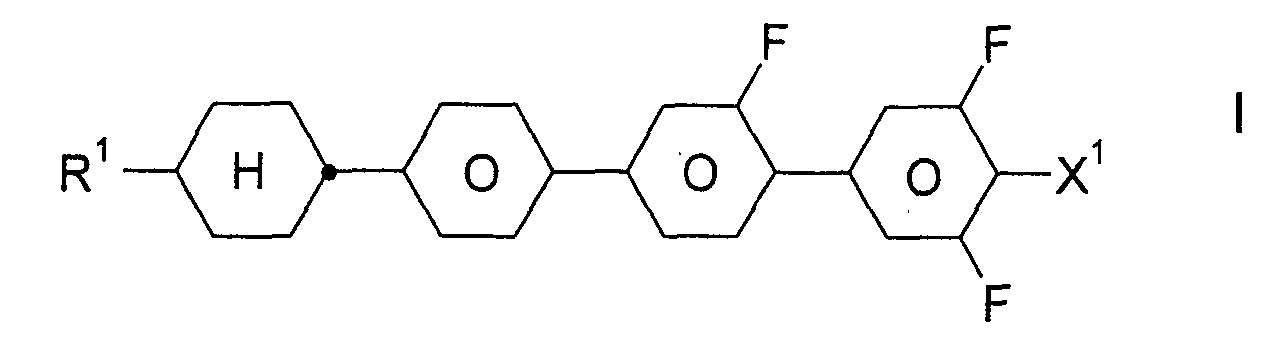
- X1
- is F, Cl, CHF2, CF3, OCHF2 or OCF3 and
- R1
- is alkyl with 1 to 20 C atoms.
- The compounds of the formula I exhibit
- a high value of the birefringence,
- a very high positive dielectric anisotropy,
- a very high clearing point,
- a low rotational viscosity,
- a good low temperature stability and
- a high UV stability.
- Furthermore, it has been found that the second object of the invention can be achieved with a liquid-crystalline medium based on a mixture of polar compounds of positive dielectric anisotropy containing one or more compounds of formula I.
- The liquid crystalline medium according to the present invention is characterized in that it exhibits
- a high value of the birefringence,
- a high positive dielectric anisotropy,
- a broad nematic phase range, especially a high clearing temperature,
- a low viscosity, and
- a high UV stability.
- Therefore, the inventive liquid crystalline medium is especially suited for electrooptical displays for outdoor usage to allow a high UV radiation and a broad working temperature range, especially up to high temperatures. Furthermore, electrooptical liquid crystal displays with a strong illumination light, like projection displays, e.g. of the LCoS™ mode, may benefit from the use of the liquid crystalline medium according to the invention, by a longer lifetime due to the high UV stability. In addition when using the inventive liquid crystal medium in an electrooptical display it is possible to achieve small values of the response time, a low driving voltage, a satisfying grey scale performance, a wide viewing angle and a high contrast.
- Cholesteric liquid crystal media comprising as a nematic component a liquid crystal medium according to the present invention and as optically active component one or more chiral dopants are another object of the present invention. The above mentioned advantageous properties of the inventive liquid crystalline medium, especially the high optical birefrigence and good UV stability, are also to the advantage for cholesteric applications. Yet another object of the invention are cholesteric liquid crystal displays, in particular SSCT- and PSCT-displays, comprising a cholesteric liquid crystal medium as described above.
- The invention thus relates to a liquid crystalline compound of the formula I as defined above and below.
- Furthermore the invention relates to a liquid-crystalline medium based on a mixture of polar compounds having positive dielectric anisotropy, characterized in that it contains one or more compounds of formula I as defined above and below.
- According to the DE 199 19 348 A1, EP 0 439 089 A1 and WO 01/12751 the generic formula I*wherein R is H, an alkyl or alkenyl radical having 1 to 15 C-atoms which may substituted and wherein one or more CH2 groups may be replaced by various groups, L is H or F and Y is F, Cl, halogenated alkyl, alkenyl, alkenyloxy, alkoxyalkyl or alkoxy, is known and compounds of this formula I* are proposed as co-components of liquid crystalline mixtures. But compounds of the formula I according to this invention are not disclosed.

- Furthermore, the JP 09-030996 describes fluorinated p-terphenyl derivatives.
- In the following preferred derivatives of the compound of the formula I which are also preferred components of the liquid crystalline medium according to the invention are given. Thus, a preferred liquid crystalline medium according to the invention contains one or more of the preferred compounds of the formula I as specified below.
- Preferred compounds of formula I are those wherein R1 is alkyl with 1 to 8 C atoms. Very preferably R1 is a straight chain alkyl radical and thus R1 is methyl, ethyl, propyl, butyl, pentyl, hexyl, heptyl or octyl, in particular ethyl, propyl or butyl.
- Further preferred compounds of formula I are those wherein X1 is F, CHF2, CF3, OCHF2 or OCF3, in particular F, OCHF2 or OCF3, most preferably OCHF2 or OCF3.
- Compounds of the formulae la and/or Ib are very preferred:
 wherein alkyl is an alkyl group with 1 to 8 C atoms.
- The compounds of the formula I are prepared using methods known to the person skilled in the art. The following reaction scheme illustrates an advantageous synthesis of the inventive compounds.

- In the following preferred liquid crystalline mixtures according to the invention are specified.
- Liquid crystalline mixtures with a high optical anisotropy value Δn ≥ 0.16, especially Δn ≥ 0.17, in particular Δn ≥ 0.18 are preferred. Even optical anisotropy values of Δn ≥ 0.19 can be achieved with inventive mixtures.
- The liquid crystalline medium preferably in addition comprises one or more terphenyl compounds of formula IIawherein

- R0
- is alkyl, alkoxy, fluoroalkyl, alkenyl or oxaalkenyl with up to 9 C atoms and
- X0
- is F, Cl, CF3, OCF3, OCHF2, fluoroalkyl or fluoroalkoxy with up to 7 carbon atoms.
- R0 is preferably an alkyl group with 1 to 8 C-atoms. Preferred meanings of X0 are F, CF3, OCHF2 and OCF3.
- Thus, a particularly preferred liquid crystalline medium according to the invention comprises one or more of the derivatives of the formula IIa.1wherein alkyl is an alkyl group with 1 to 8 C-atoms.

- Using components of the formula IIa, especially IIa.1, liquid crystal mixtures with a very high dielectrical anisotropy Δε, especially Δε ≥ 12.0, and a very high ε∥ value (dielectric constant in the parallel direction to the molecular axis) are obtainable.
- In addition the liquid crystalline medium preferably comprises one or more terphenyl compounds of formula IIbwherein
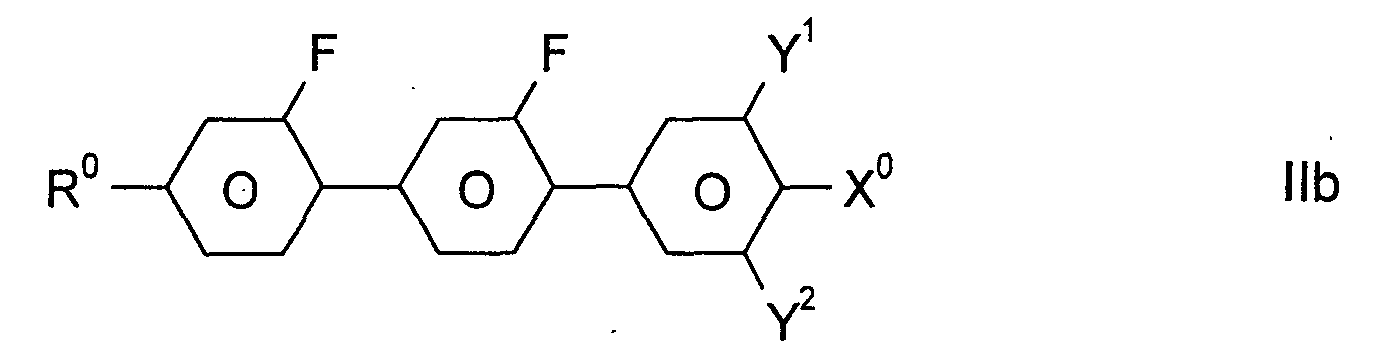
- R0
- is alkyl, alkoxy, fluoroalkyl, alkenyl or oxaalkenyl with up to 9 C atoms,
- X0
- is F, Cl, CF3, OCF3, OCHF2, fluoroalkyl or fluoroalkoxy with up to 7 carbon atoms, and
- Y1 and Y2
- are each independently of one another H or F.
- R0 is preferably an alkyl group with 1 to 8 C-atoms. X0 is very preferably Cl.
- Thus, a particularly preferred liquid crystalline medium according to the invention comprises one or more of the derivatives of the formula IIb.1wherein alkyl is an alkyl group with 1 to 8 C-atoms.

- Using components of the formula llb, especially IIb.1, liquid crystal mixtures with a very high optical anisotropy Δn, especially Δn ≥ 0.19, are obtainable.
- The liquid crystal mixture preferably comprises in addition one or more polar compounds selected from the formulae III to VIII

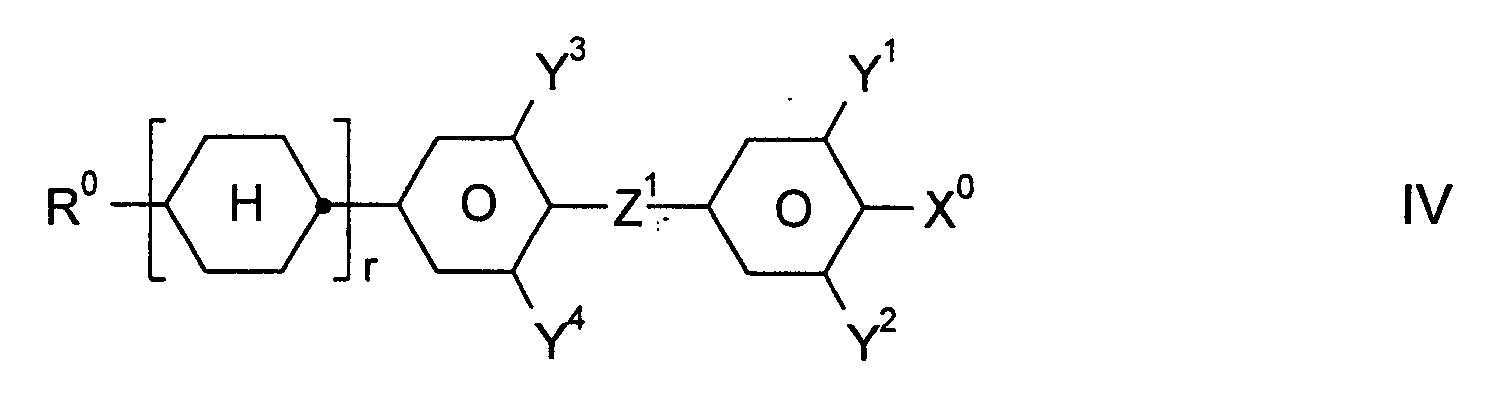


 wherein
- R0
- is alkyl, alkoxy, fluoroalkyl, alkenyl or oxaalkenyl with up to 9 C atoms,
- Z1
- is CF2O, C2F4 or a single bond,
- Z2
- is CF2O, C2F4 or C2H4,
- X0
- is F, Cl, CF3, OCF3, OCHF2, fluoroalkyl or fluoroalkoxy with up to 7 carbon atoms,
- Y1 to Y4
- are independently of each other H or F, and
- r
- is 0 or 1.
- The compounds of formula III are preferably selected from the following formulae:
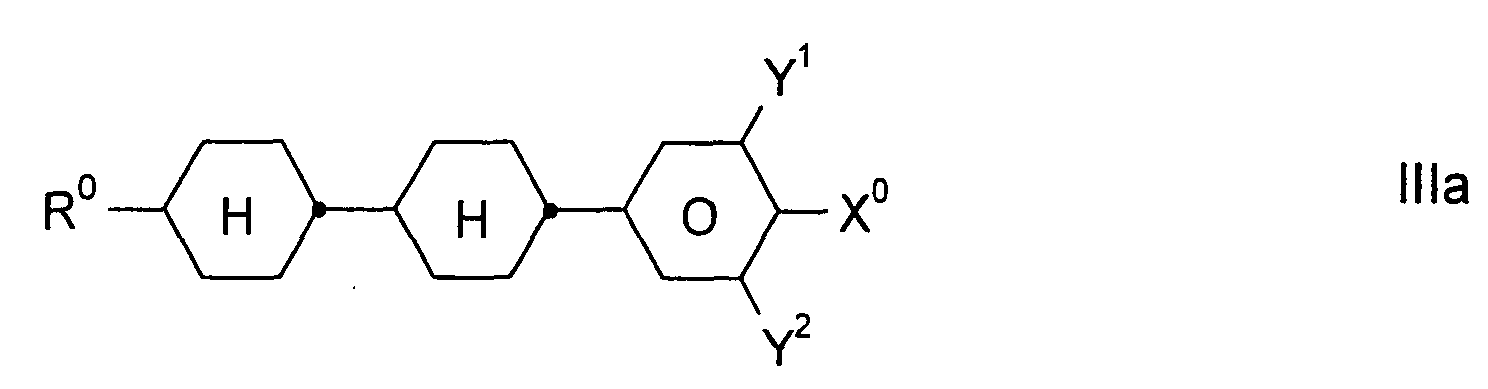 wherein R0 and X0 have the meanings given above, R0 is preferably n-alkyl with 1 to 8 C atoms or alkenyl with 2 to 7 C atoms and X0 is preferably F, Cl, CF3, OCF3 or OCHF2, in particular F or OCF3.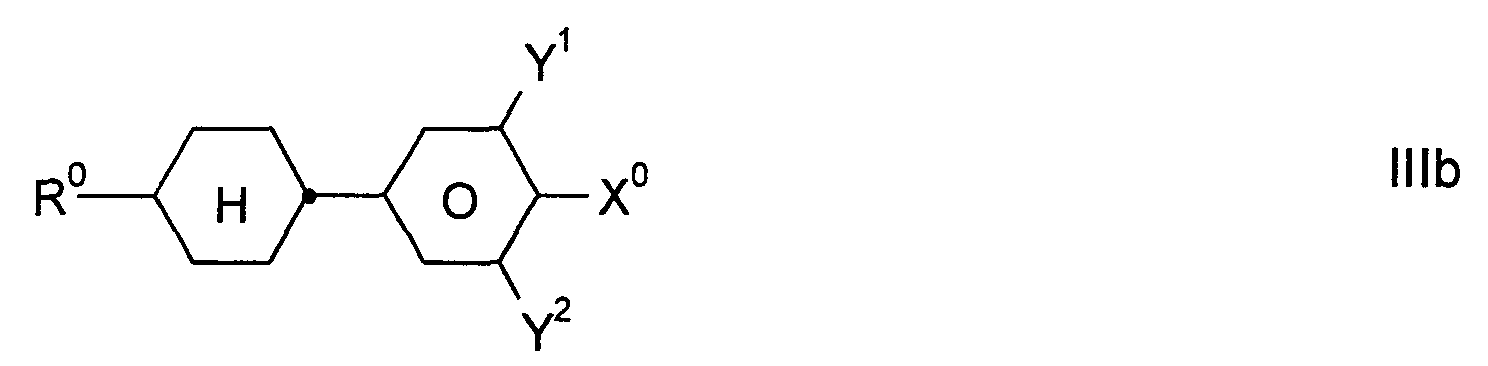
- Particularly preferably the liquid crystal mixture comprises one or more compounds of formula IIIa1wherein alkenyl is vinyl, 1E-propenyl, 1E-butenyl, 3E-butenyl or 3E-pentenyl, in particular 3E-butenyl or 3E-pentenyl, in particular vinyl.

- The compounds of formula IV are preferably selected from the following formulae

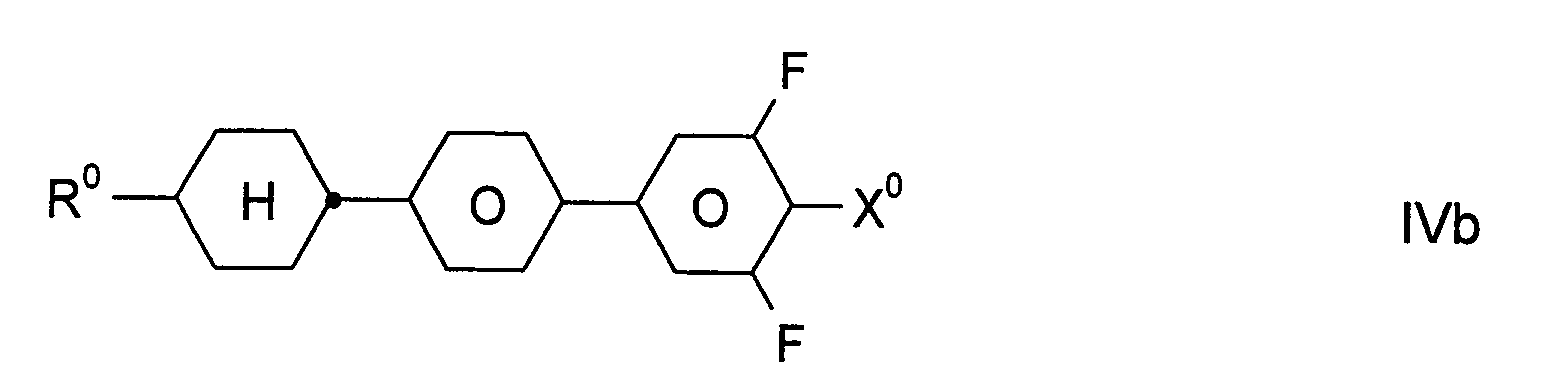



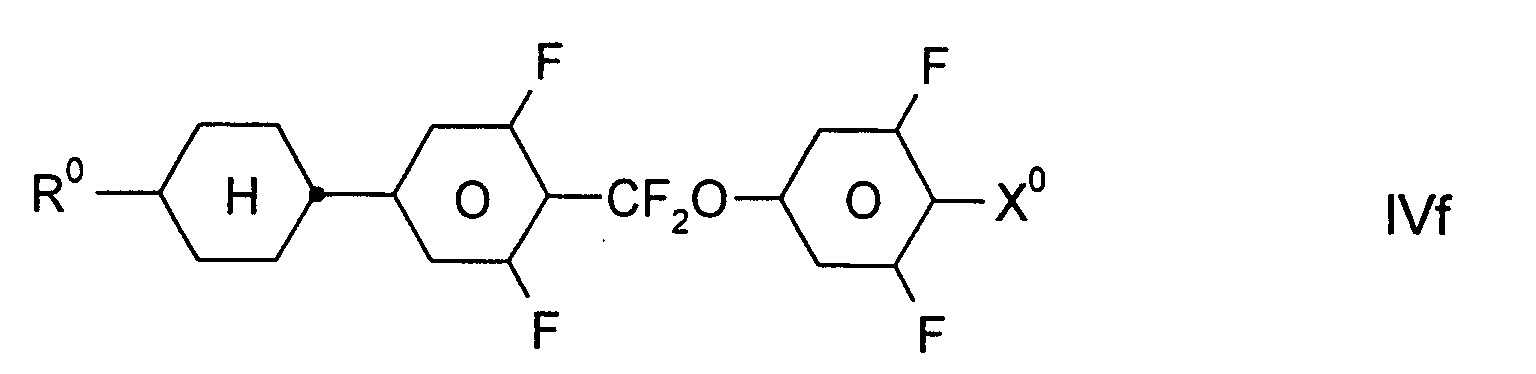

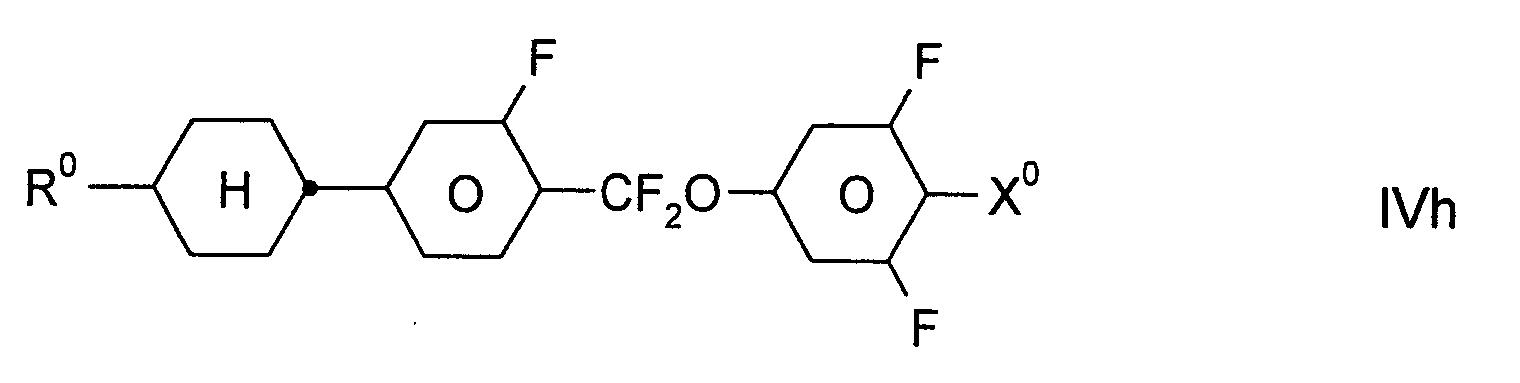



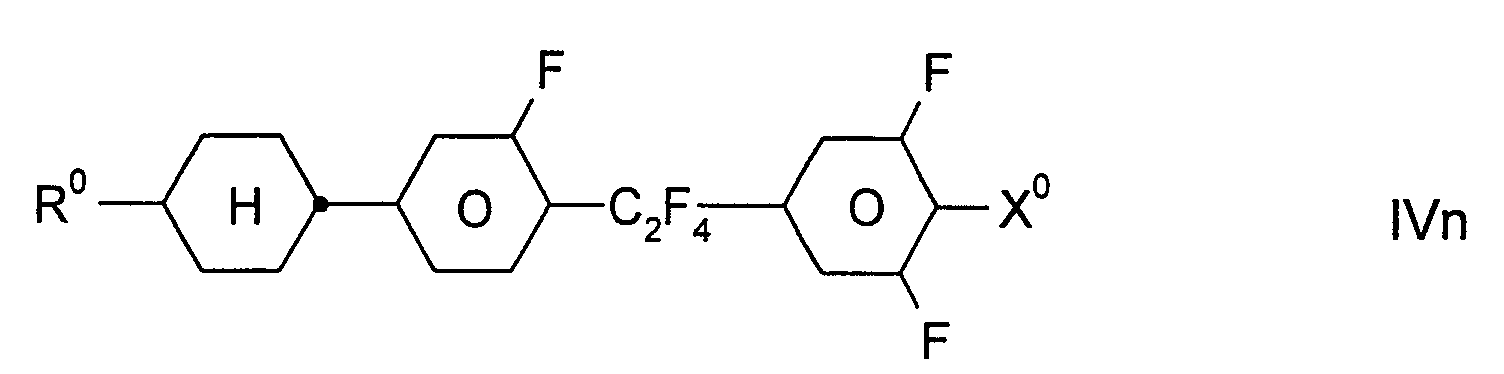 wherein R0 and X0 have the meanings given above, R0 is preferably n-alkyl with 1 to 8 C atoms or alkenyl with 2 to 7 C atoms, and X0 is preferably F, Cl, CF3, OCF3 or OCHF2, in particular F or OCF3.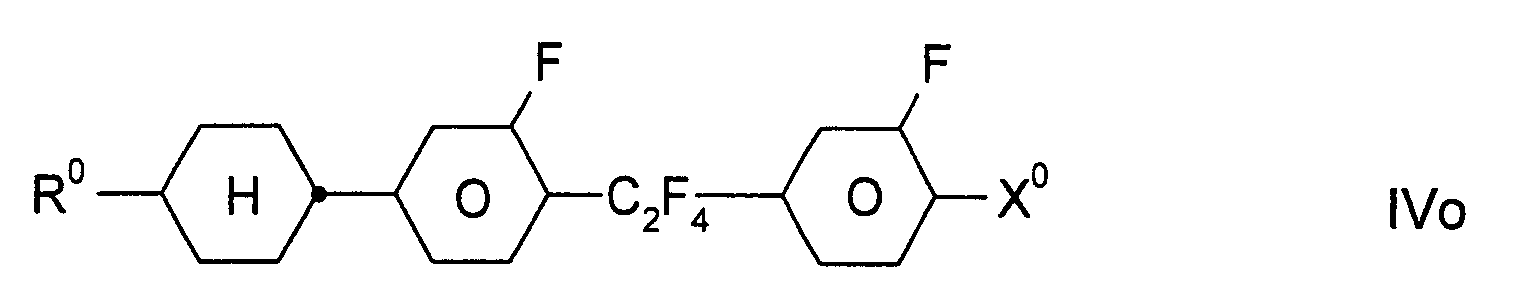
- Particularly preferred are compounds of formula IVa, IVb and IVc, in particular wherein X0 is F. Further, compounds of formula IVf are preferred.
- The compounds of formula VI are preferably selected from the following formulae

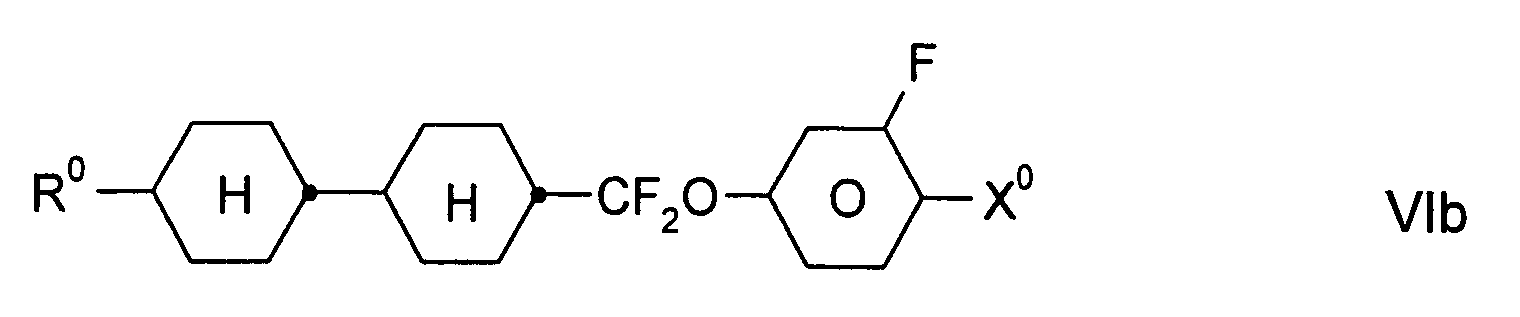


 wherein R0 and X0 have the meanings given above, R0 is preferably n-alkyl with 1 to 8 C atoms or alkenyl with 2 to 7 C atoms, and X0 is preferably F, Cl, CF3, OCF3 or OCHF2, in particular F or OCF3.
- Particularly preferred are compounds of formula VIa, VIb and VIc.
- The compounds of formula VII are preferably selected from the following formulae



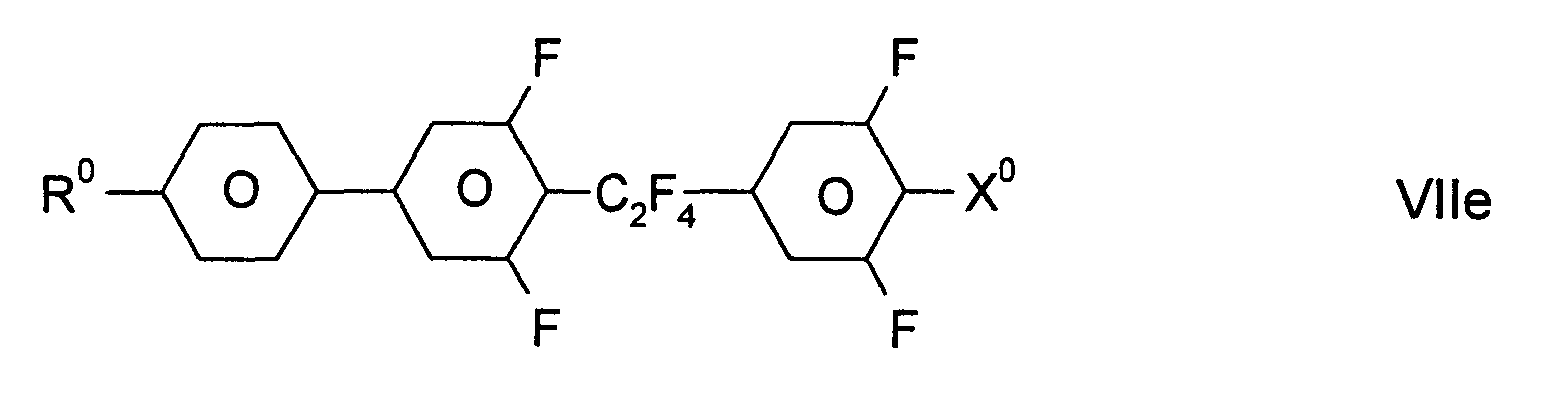


 wherein R0 and X0 have the meanings given above, R0 is preferably n-alkyl with 1 to 8 C atoms or alkenyl with 2 to 7 C atoms, and X0 is preferably F, Cl, CF3, OCF3 or OCHF2, in particular F or OCF3.
- Particularly preferred are compounds of formula VIIa and Vllb, in particular those wherein X0 is F.
- The liquid crystal mixture preferably comprises in addition one or more four-ring compounds selected from the formulae IX to XVI.
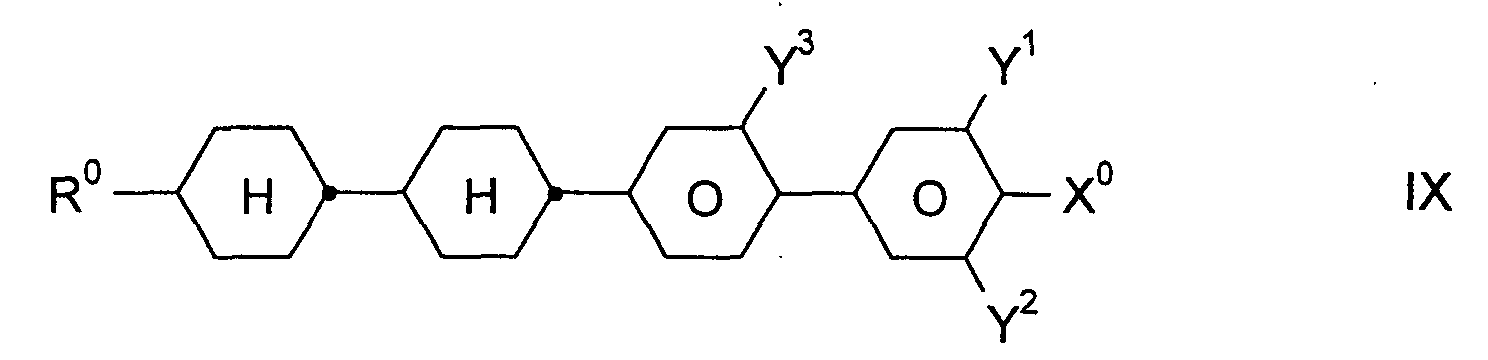




 wherein R0 and X0 have the meanings given above and Y1, Y2, Y3, Y4 and Y5 are independently of each other H or F with the proviso that regarding formula XVI Y1, Y2 and Y3 are not F and Y4 and Y5 are not H at the same time. Thus, the formula XVI does not encompass compounds of the formula I. R0 is preferably n-alkyl with 1 to 8 C atoms or alkenyl with 2 to 7 C atoms. X0 is preferably F, Cl, CF3, OCF3 or OCHF2, in particular F or OCF3. Y4 and Y5 are preferably H.
- Preferred compounds of the formula IX are those of the formula IXawherein R0 and X0 have the meanings given above. X0 is preferably F, Cl, CF3, OCF3 or OCHF2, in particular F or OCF3.
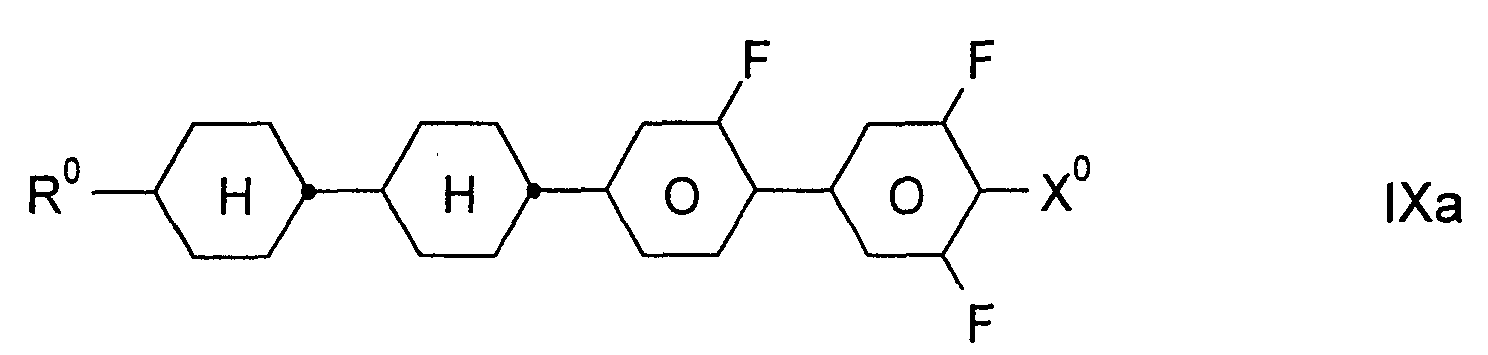
- The liquid crystal mixture preferably comprises in addition one or more compounds selected from the formulae XVII to XIX.

 wherein R0, Y1, Y2 and X0 have the meanings given above, and the phenylene rings are optionally mono- or polysubstituted with F or Cl. Preferably R0 is n-alkyl with 1 to 8 C atoms or alkenyl with 2 to 7 C atoms, X0 is F, Cl, CF3, OCF3 or OCHF2, in particular F or Cl, and at least one phenylene ring is substituted with F.
- Preferred compounds of formula XVII are those of formula XVIIawherein X0 is F or Cl, in particular F.

- Preferred compounds of formula XVIII are those wherein Y1 is F and X0 is F or Cl, in particular F.
- The liquid crystal mixture preferably comprises in addition one or more compounds selected from the formulae XX to XXIII.


 wherein R3 and R4 have independently of each other one of the meanings of R0 as defined above and Y1 is H or F.
- In the compounds of formula XX R3 and R4 are preferably alkyl with 1 to 8 C atoms or alkenyl with 2 to 7 C atoms.
- In the compounds of formula XXI, XXII and XXIII R3 and R4 are preferably alkyl or alkoxy with 1 to 8 C atoms.
- Compounds of the formula XXIII, wherein Y1 is F, are especially preferred.
- The invention furthermore relates to an electrooptical display, preferably a display having active matrix addressing and/ or a reflective display. The inventive display is preferably based on the OCB effect, a projection display and/or an LCoS™ display, characterized in that it contains, as a dielectric, a liquid-crystalline medium as described above.
- Preferably the mixture essentially comprises compounds selected from the group comprising the generic formulae I, IIa, IIb and III to XXIII.
- Preferred embodiments of the the present invention relate to mixtures that contain:
- at least 2 %, preferably at least 3 %, most preferably at least 4 %, and preferably up to 20%, most preferably up to 15 % by weight of one or more compounds of the formula I.
- at least 10 %, preferably at least 15 %, and preferably up to 45 %, most preferably up to 40% by weight of one or more compounds of the formula IIa.
- at least 3 %, preferably at least 5 %, and preferably up to 40 %, most preferably up to 30 % by weight of one or more compounds of the formula llb.
- at least 10 %, preferably at least 15 %, and preferably up to 75 %,
most preferably up to 60 % by weight of one or more compounds
of the formulae IV,
in particular at least 8 %, preferably at least 15 %, and preferably up to 50 %, most preferably up to 40 % by weight of one or more compounds of the formulae IVb and/ or IVc, and
in particular at least 1 %, preferably at least 3 %, and preferably up to 20 %, most preferably up to 15 % by weight of one or more compounds of the formula IVa. - at least one compound of formula Ia and/or Ib.
- at least one compound of formula IIa, in particular wherein X0 is F, especially wherein R0 is alkyl with 1 to 8 C-atoms.
- at least one compound of formula llb, in particular wherein X0 is Cl, especially wherein R0 is alkyl with 1 to 8 C-atoms.
- at least one compound of formula IVb and/ or IVc, in particular wherein X0 is F, especially wherein R0 is alkyl with 1 to 8 C-atoms.
- at least one compound of formula IVa, in particular wherein X0 is F, especially wherein R0 is alkyl with 1 to 8 C-atoms.
- at least one compound of formula IIIa1, in particular wherein alkenyl is vinyl.
- at least one compound of formula IXa, in particular wherein X0 is F.
- one or more compounds of formula XVIIa, in particular wherein X0 is F, OCF3 or OCHF2.
- at least one compound of formula XXIII, in particular wherein Y1 is F.
- The compounds of formula IIa, llb, and III to XXIII are known from prior art or can be prepared according to known methods.
- By using compounds of formula I it is possible to obtain inventive highly polar liquid crystalline mixtures with at the same time high birefringence and high clearing point. In addition, the use of compounds of formula IIa leads to high values of the dielectrical anisotropy in the inventive mixtures. Furthermore, liquid crystal mixtures according to the invention, comprising compounds of formula llb, exhibit a very high birefringence.
- The liquid-crystal mixture preferably has a nematic phase range of at least 75 K, in particular at least 90 K, and a clearing point above 70 °C, in particular above 80 °C, especially above 90°C.
- The dielectric anisotropy is preferably greater than +8, very preferably at least +10, most preferably equal or greater than +11.
- The mixtures according to the present invention usually are based on medium polar components having the indicated core structure and other non-cyano components. Of course, however, such mixtures can also additionally contain known cyano liquid crystalline components, preferably compounds of the formula XXIVwherein R0, r, Y1 and Y2 have the meanings given above, and
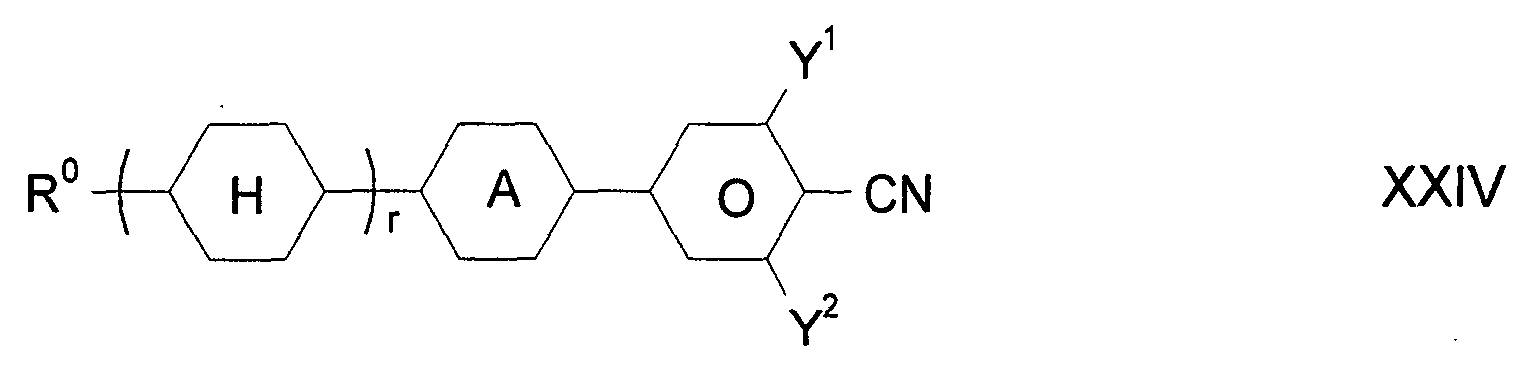 is trans-1,4-cyclohexylene or 1,4-phenylene,
if extremely high values for the holding ratio (HR) are not needed, e.g. for TN or STN-use. The resulting mixtures are important for achieving very broad nematic phase ranges including very low temperatures (outdoor use). - The mixtures are preferably based on halogenated components of medium polarity and/or are essentially free of cyano components.
- The liquid crystal mixtures according to the present invention are also suitable as liquid crystal media for use in cholesteric liquid crystal displays, in particular in SSCT ("surface stabilized cholesteric texture") and PSCT- ("polymer stabilized cholesteric texture") displays, as described for example in WO 92/19695, US 5,384,067, US 5,453,863, US 6,172,720 or US 5,661,533. Cholesteric liquid crystal displays typically comprise a cholesteric liquid crystal medium consisting of a nematic component and an optically active component and, compared to TN- and STN displays, exhibit a significantly higher helical twist and show selective reflection of circular polarised light. The reflection wavelength is given by the product of the pitch of the cholesteric helix and the mean refractive index of the cholesteric liquid crystal medium.
- For this purpose one or more chiral dopants are added to the liquid crystal mixture according to the present invention, wherein the twisting power and concentration of the dopants are selected such that the resulting liquid crystal medium has a cholesteric phase at room temperature and a reflection wavelength that lies preferably within the visible, UV or IR range of the electromagnetic spectrum, in particular within the range from 400 to 800 nm. Suitable chiral dopants are known to the expert and commercially available, like for example cholesteryl nonanoate (CN), CB15, R/S-811, R/S-1011, R/S-2011, R/S-3011 or R/S-4011 (Merck KGaA, Darmstadt). Particularly suitable are dopants with high twisting power comprising a chiral sugar group, in particular sorbitol derivatives as disclosed in WO 98/00428. In case two or more dopants are used, they can exhibit the same or opposite twist sense and the same or opposite sign of the linear temperature coefficient of the twist.
- In the components of the formulae IIa, llb and III to XXIV R0, R1, R3, and R4 are preferably a straight-chained alkyl radical of 1 to 8 carbon atoms or is straight-chained methoxy alkyl. Preferred alkyl groups are methyl, ethyl, propyl, butyl, pentyl, hexyl, heptyl and octyl, in particular ethyl, propyl, butyl and pentyl. Preferred methoxy alkyl groups are methoxymethyl, methoxyethyl, methoxypropyl, methoxybutyl, methoxypentyl, methoxyhexyl, methoxyheptyl.
- The term "alkoxy" comprises straight chain and branched alkoxy groups with 1 to 8 C atoms. Straight chain alkoxy groups are preferred. Thus, preferred alkoxy groups are methoxy, ethoxy, propoxy, butoxy, pentoxy, hexoxy, heptoxy and octoxy.
- The term "alkenyl" comprises straight chain and branched alkenyl groups with 2 to 7 C atoms. Straight chain alkenyl groups are preferred. Further preferred alkenyl groups are C2-C7-1 E-alkenyl, C4-C7-3E-alkenyl, C5-C7-4-alkenyl, C6-C7-5-alkenyl and C7-6-alkenyl, in particular C2-C7-1E-alkenyl, C4-C7-3E-alkenyl and C5-C7-4-alkenyl.
- Of these, especially preferred alkenyl groups are vinyl, 1E-propenyl, 1E-butenyl, 1E-pentenyl, 1E-hexenyl, 1E-heptenyl, 3-butenyl, 3E-pentenyl, 3E-hexenyl, 3E-heptenyl, 4-pentenyl, 4Z-hexenyl, 4E-hexenyl, 4Z-heptenyl, 5-hexenyl and 6-heptenyl. Alkenyl groups with up to 5 C atoms are particularly preferred.
- In the foregoing and in the following those compounds containing at least one cyclohexane ring are preferred wherein the cyclohexane ring is trans-substituted.
- The preparation of the mixtures according to the invention is effected in the conventional manner. In general, the desired amount of the components which is used in the smaller amount is dissolved in the components which constitutes the main constituent, preferably at elevated temperature. If this temperature is chosen to be above the clearing point of the main constituent, the completeness of the process of dissolving can be observed particularly easily.
- However, it is also possible to mix solutions of the components in a suitable organic solvent, for example acetone, chloroform or methanol, and to remove the solvent, e.g. by distillation.
- By means of suitable additives the liquid crystal phases according to the invention can be modified in such a way that they can be used in any hitherto disclosed kind of MLC display.
- In the present application and in the examples below, the structures of the liquid-crystal compounds are indicated by means of acronyms, the transformation into chemical formulae taking place in accordance with Tables A and B below. All radicals CnH2n+1, CmH2m+1 and CrH2r+1 are straight-chain alkyl radicals and -CsH2s- is a straight-chain alkylen group having n, m, r and s carbon atoms respectively. n, m, r and s are integers and are independently of each other preferably 0, 1, 2, 3, 4, 5, 6, 7, 8, 9, 10, 11 or 12. The coding in Table B is self-evident. In Table A, only the acronym for the parent structure is indicated. In individual cases, the acronym for the parent structure is followed, separated by a dash, by a code for the substituents R1, R2, L1 and L2 as follows:
Code for R1,
R2, L1, L2R1 R2 L1 L2 nm CnH2n+1 CmH2m+1 H H nOm CnH2n+1 OCmH2m+1 H H nO.m OCnH2n+1 CmH2m+1 H H n CnH2n+1 CN H H nN.F CnH2n+1 CN H F nF CnH2n+1 F H H nOF OCnH2n+1 F H H nCl CnH2n+1 Cl H H nF.F CnH2n+1 F H F nF.F.F CnH2n+1 F F F nCF3 CnH2n+1 CF3 H H nOCF3 CnH2n+1 OCF3 H H nOCF2 CnH2n+1 OCHF2 H H nS CnH2n+1 NCS H H rVsN CrH2r+1-CH=CH-CsH2s- CN H H rEsN CrH2r+1-O-CsH2s- CN H H nAm CnH2n+1 COOCmH2m+1 H H nOCCF2.F.F CnH2n+1 OCH2CF2H F F - Preferred mixture components are found in Tables A and B.
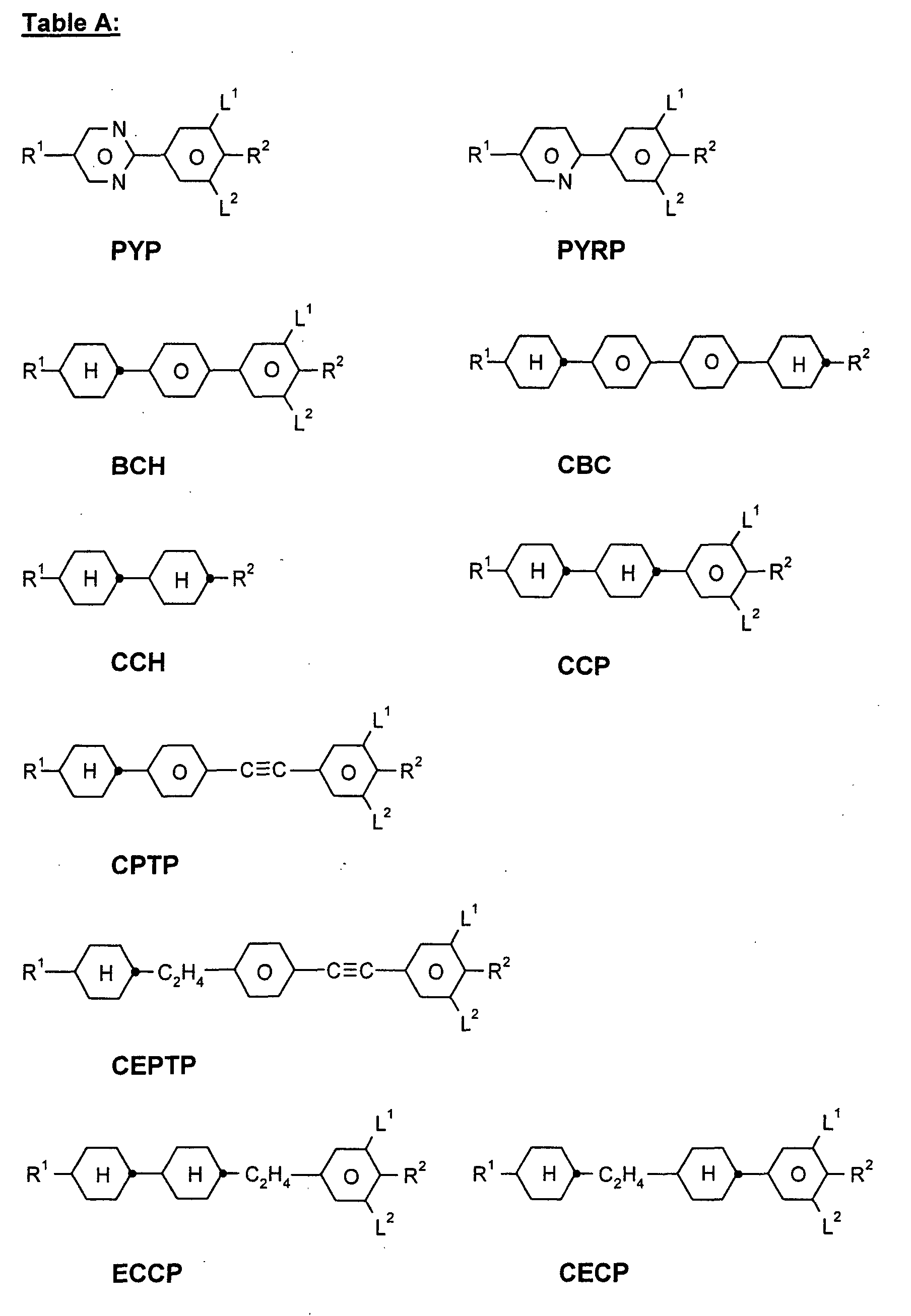
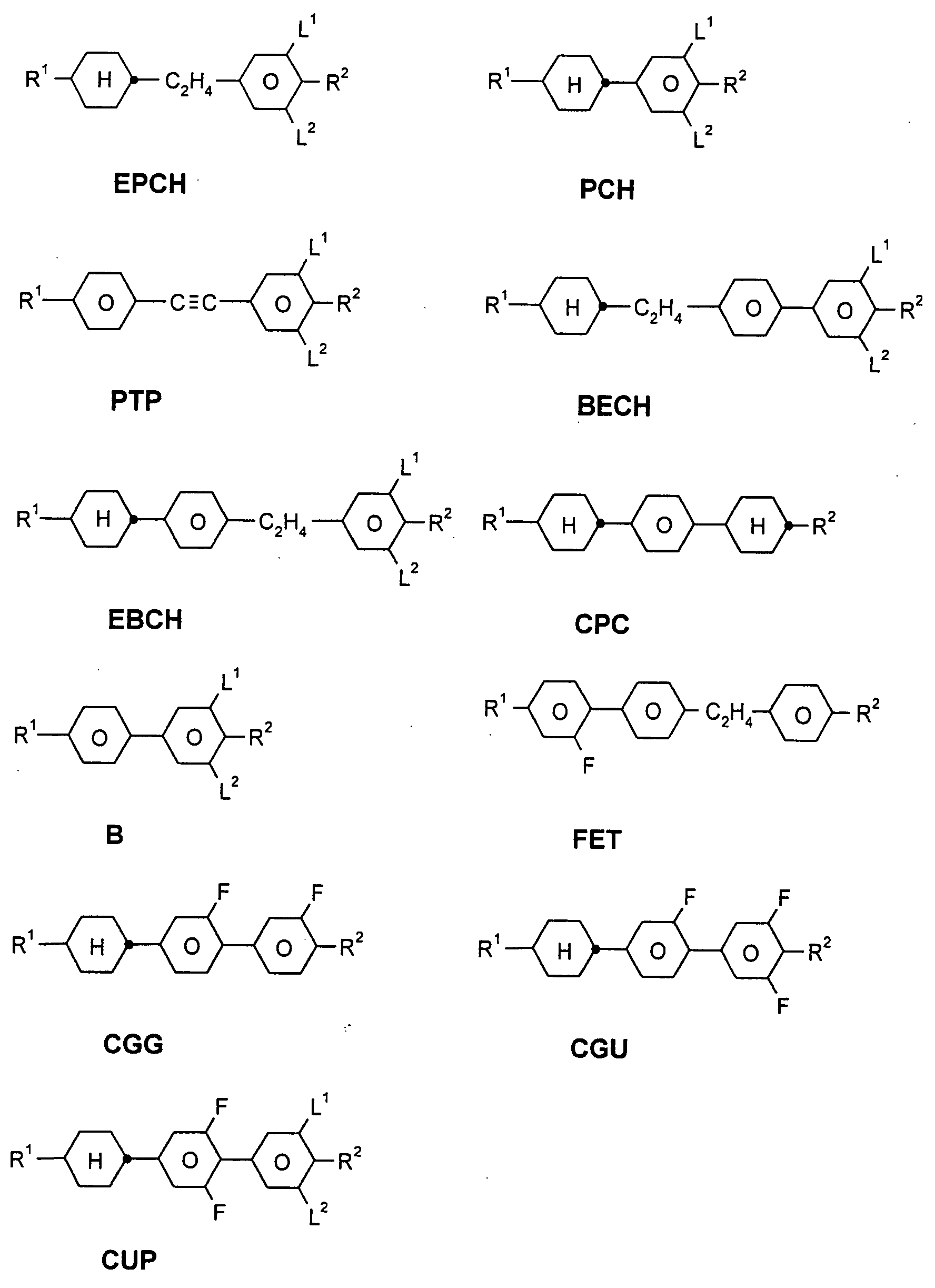
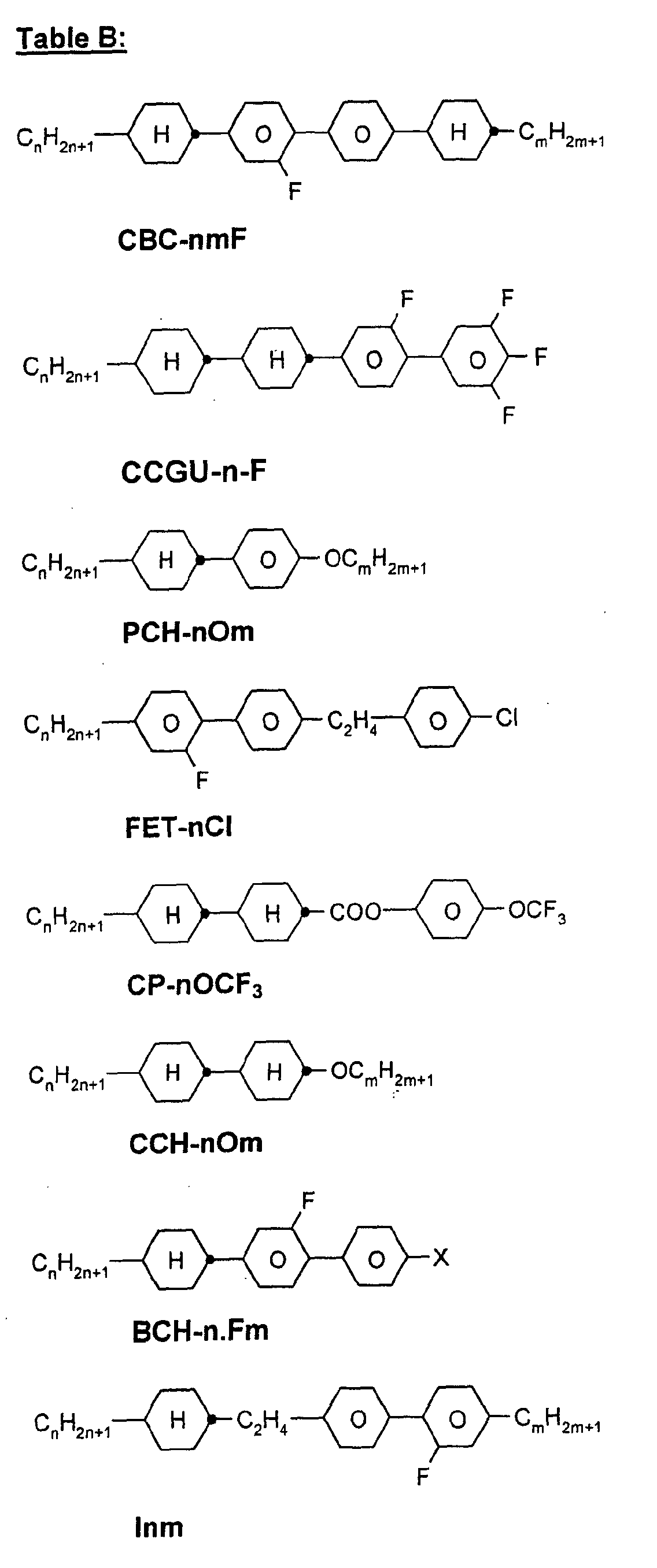
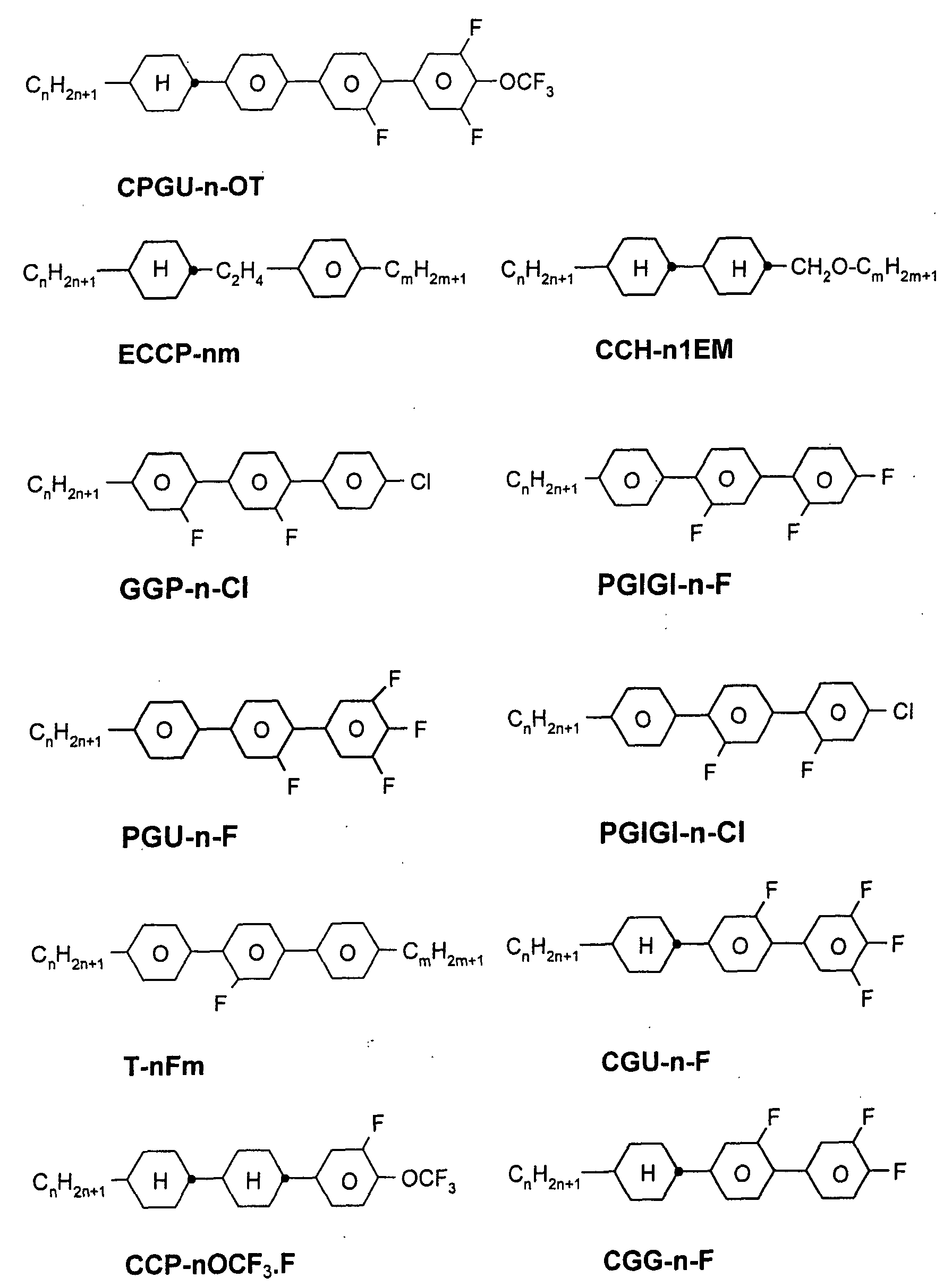
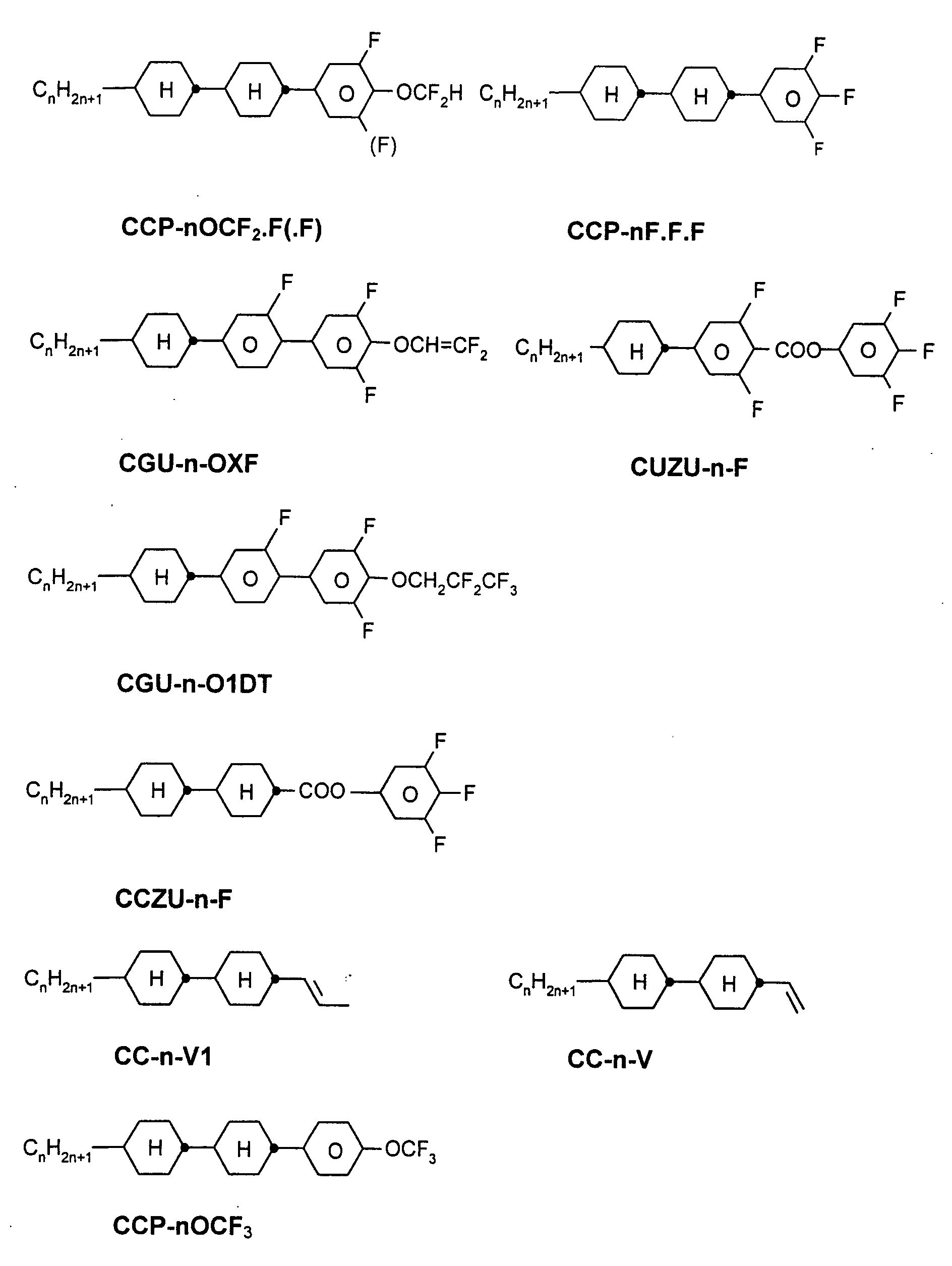
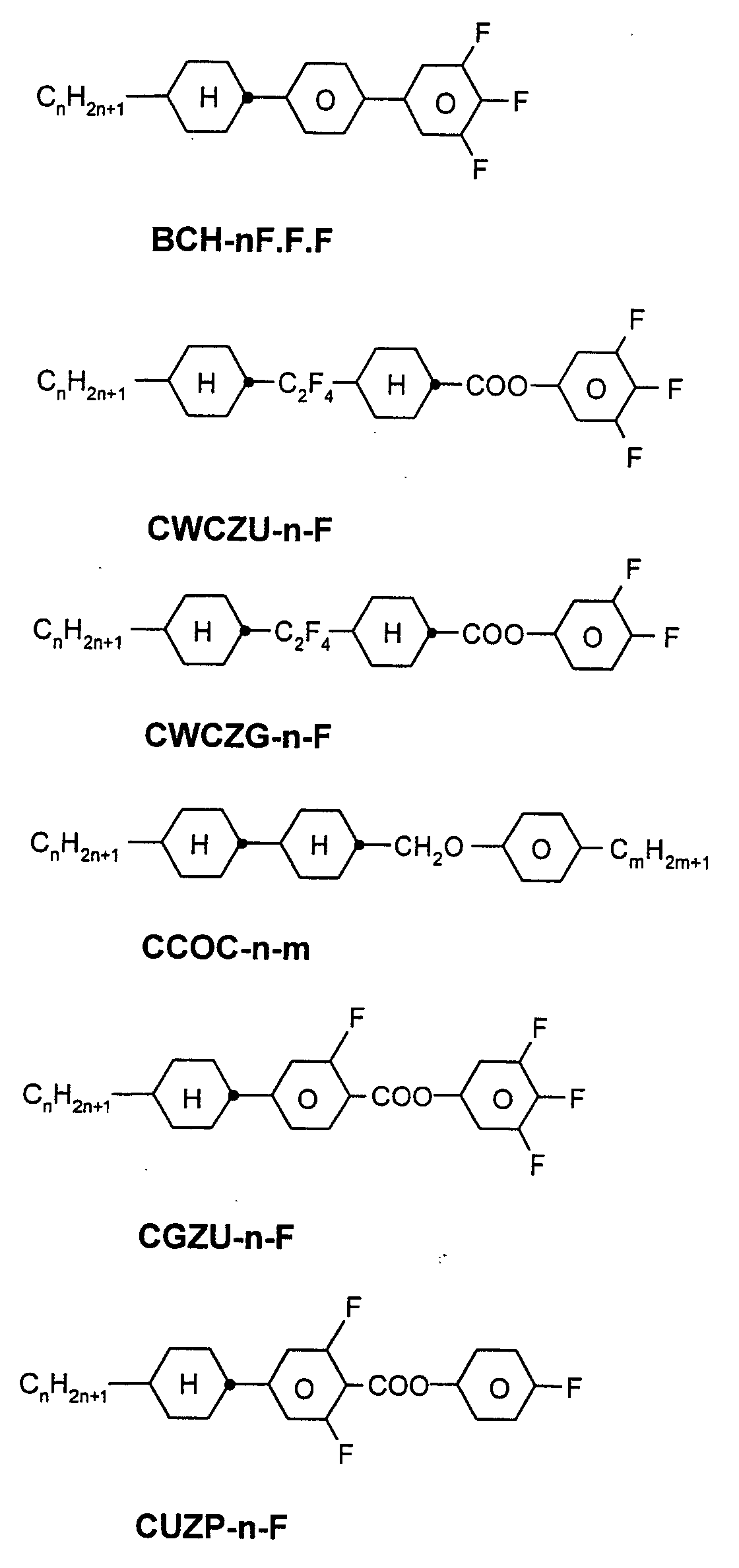

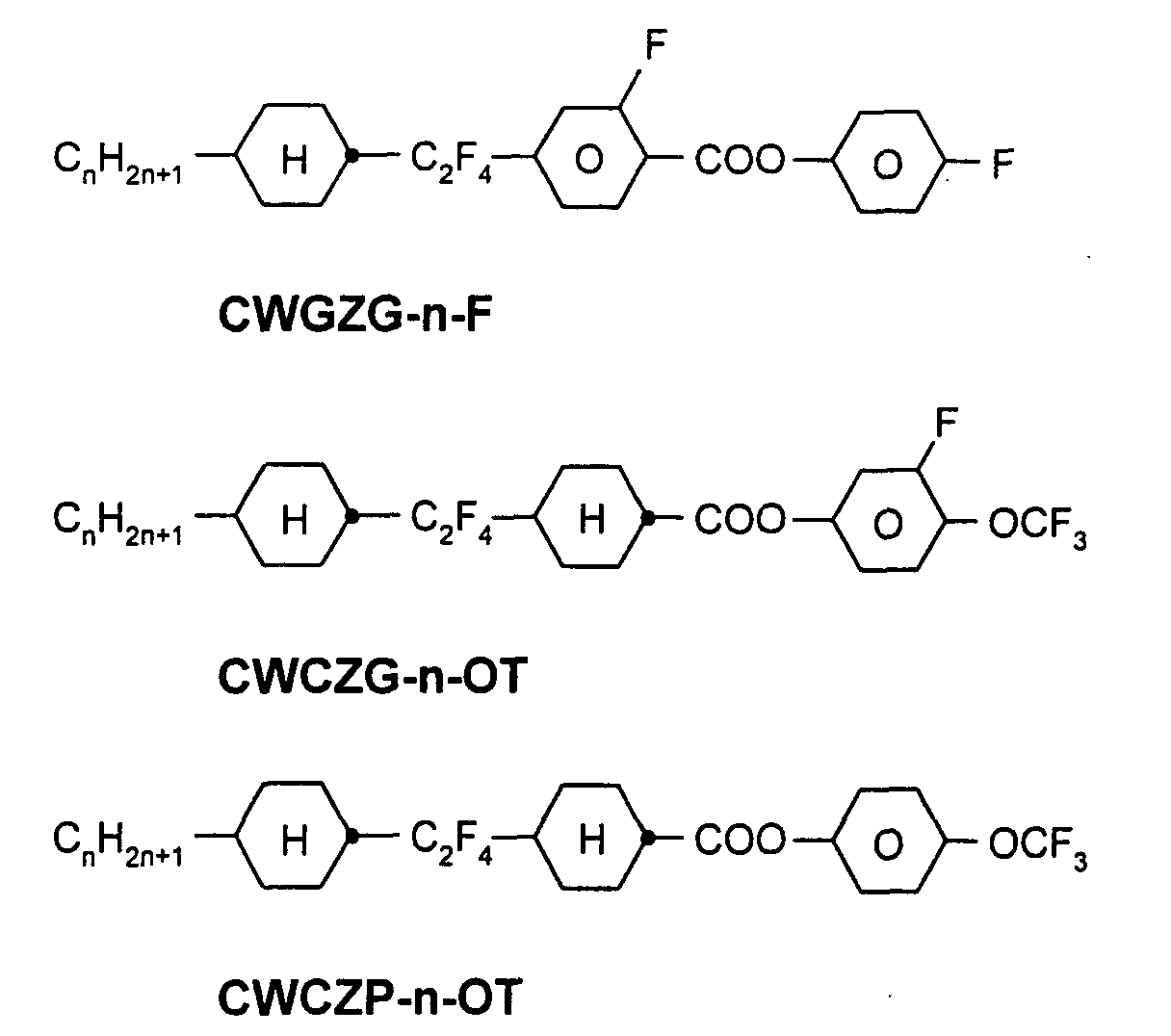


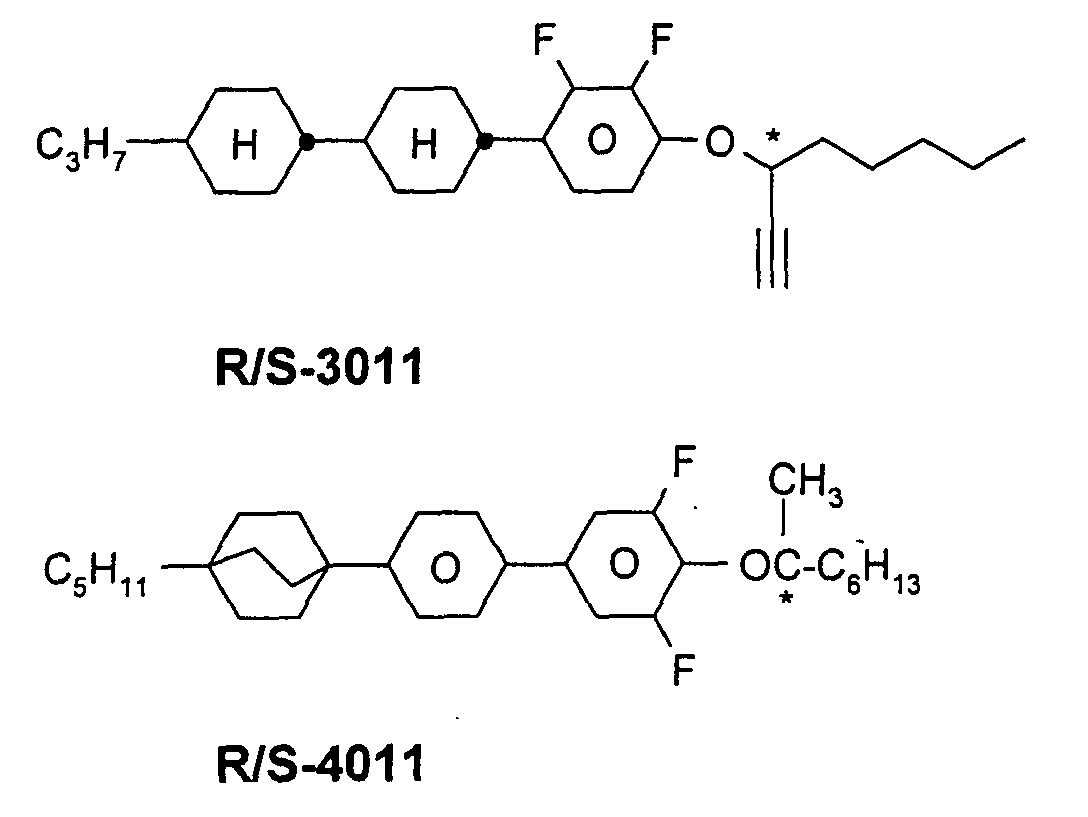


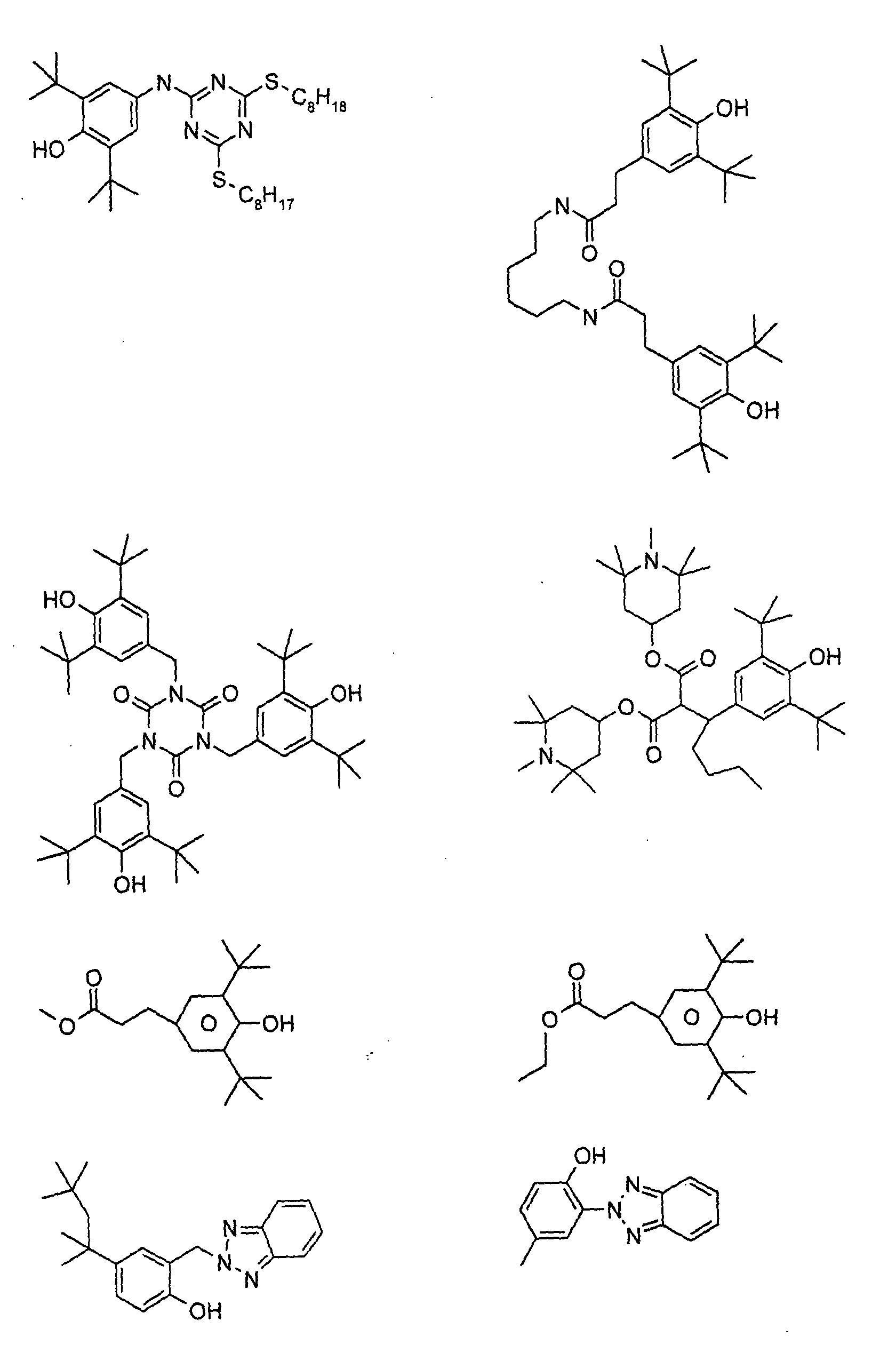
- Particular preference is given to mixtures according to the invention which, besides one or more compounds of the formula I, comprise two, three or more compounds selected from Table B.
- The examples below serve to illustrate the invention without limiting it. In the examples, the melting point and clearing point of a liquid crystal substance are given in degrees Celsius. The following abbreviations are used C = crystalline state, N = nematic phase, Sm = smectic phase and I = isotropic phase. The data between these symbols are the transition temperatures. The percentages are by weight.
- The following abbreviations are used
- Δn
- denotes the optical anisotropy measured at 20 °C and 589 nm
- ne
- denotes the extraordinary refractive index at 20 °C and 589 nm
- Δε
- denotes the dielectric anisotropy at 20 °C
- ε∥
- denotes the dielectric constant in the parallel direction to the molecular axis
- cp
- denotes the clearing point [°C]
- γ1
- denotes the rotational viscosity [mPa s]
- V0
- Fredericksz threshold [V]
- THF
- tetrahydrofurane
- MTB
- tert.-butyl-methyl-ether
-

- 1.375 mol Mg in 100 ml THF are reacted with 1.25 mol 1-brom-3-fluorobenzene (1) in 350 ml THF under the conditions of a Grignard reaction at boiling heat. After the addition of the fluorobenzene, the reaction mixture is refluxed for 30 min. Afterwards 1.375 mol trimethylborate (2) in 300ml THF are added to the reaction mixture dropwise. After one hour 500 ml MTB are added and then 200 ml concentrated HCI are added dropwise at a maximum of 20 °C, while cooling. The following working up is performed like usual.
-

- 0.004 mol bis(triphenylphosphin)-palladium(II)-chloride and 0.004 mol hydraziniumhydroxide are added to 0.100 mol sodium metaborat-octahydrate in 80 ml water. To this mixture 0.200 mol 1-bromo-4-(trans-4-propyl-cyclohexyl)benzene (4) in 150 ml THf are added dropwise. After stirring for 5 min, 0.200 mol of the boronic acid (3) in 50 ml THF are added dropwise. The reaction mixture is refluxed for 10 hours, cooled to room temperature (20 °C) and worked up conventionally.
-

- 0.093 mol of the compound 5 in 60 ml THF are added to 0.093 mol potassium-tert-butylate in 100 ml THF at -80 °C dropwise. Furthermore, at -80 °C 0.093 mol butyllithium (15 % solution in n-hexane) are added dropwise. The reaction mixture is stirred for 20 min. Afterwards 0.093 mol trimethylborate in 60 ml THF is added dropwise. After allowing the reaction mixture to warm to room temperature (20 °C), 200 ml water are added and a pH of 2 is achieved with 40 ml half concentrated HCI, followed by a conventional work-up.
-

- A solution of 0.040 mol Na2CO3 in 30 ml water is added to a mixture of 25 mmol of the bromide (8), 25 mmol of the boronic acid (7), 80 ml 2-propanole, 0.125 mmol palladium(II)acetate and 0.375 mmol triphenylphosphine. The reaction mixture is refluxed under stirring for 6-12 hours. After cooling to 20 °C, the reaction mixture is poured onto 400 ml water. The precipitate is filtered by vaccuum and washed with cold water and ethanol. The resulting powder is recrystallized. A NMR and mass spectroscopy analysis yields the expected signals.
- The following compounds of the formula I, speciefied by R1 and X1, are prepared by procedures similar to the previous example.
R 1 X 1 -CH3 -F -C2H5 -F K 120 N 197.5 I, Δn = 0.2213, Δε = 17.8 -C3H7 -F K 113 N 223.8 I, Δn = 0.2316, Δε = 17.2 -C4H9 -F K 108 N 215.1 I, Δn = 0.2219, Δε = 16.9 -C5H11 -F -C6H13 -F -C7H15 -F -CH3 -OCHF2 -C2H5 -OCHF2 K 106 N 228.0 I, Δn = 0.2158, Δε = 16.4 -C3H7 -OCHF2 -C4H9 -OCHF2 K 54 SmA 62 N 247.5 I, Δn = 0.2109, Δε = 15.5 -C5H11 -OCHF2 -C6H13 -OCHF2 -C7H15 -OCHF2 -CH3 -OCF3 -C2H5 -OCF3 K 125 N 220.5 I, Δn = 0.2090, Δε = 21.9 -C3H7 -OCF3 K 94 N 240.0 I, Δn = 0.2165, Δε = 19.7 -C4H9 -OCF3 K 76 SmA (57.5) N 235.1 I, Δn = 0.2092, Δε = 20.4 -C5H11 -OCF3 -C6H13 -OCF3 -C7H15 -OCF3 - A liquid crystal mixture is prepared that comprises
PGIGI-3-F 11.00 % cp 101.0°C PGU-2-F 10.00 % ne 1.6912 PGU-3-F 10.00 % Δn 0.1809 PGU-5-F 9.00 % ε∥ 19.1 BCH-2F.F 9.00 % Δε 14.5 BCH-3F.F 9.00 % V0 0.95 V BCH-5F.F 9.00 % BCH-5F.F.F 4.00 % CGU-3-F 5.00 % CCGU-3-F 9.00 % CBC-53F 4.00 % CPGU-3-OT 11.00 % - A liquid crystal mixture is prepared that comprises
PGIGI-3-F 11.00 % cp 99.0 °C PGU-2-F 8.00 % ne 1.6872 PGU-3-F 10.00 % Δn 0.1763 PGU-5-F 8.00 % BCH-2F.F 9.00 % BCH-3F.F 10.00 % BCH-5F.F 10.00 % BCH-5F.F.F 5.00 % CGU-3-F 6.00 % CCGU-3-F 10.00 % CBC-53F 3.00 % CPGU-3-OT 10.00 % - A liquid crystal mixture is prepared that comprises
PGIGI-3-F 11.00 % cp 103.0°C PGU-2-F 10.00 % ne 1.6930 PGU-3-F 12.00 % Δn 0.1827 PGU-5-F 9.00 % BCH-2F.F 7.00 % BCH-3F.F 8.00 % BCH-5F.F 8.00 % BCH-5F.F.F 11.00 % CCGU-3-F 10.00 % CBC-53F 2.00 % CBC-33F 3.00 % CPGU-3-OT 9.00 % - A liquid crystal mixture is prepared that comprises
PGIGI-3-F 11.00 % cp 102.0 °C PGU-2-F 10.00 % ne 1.6941 PGU-3-F 12.00 % Δn 0.1836 PGU-5-F 9.00 % BCH-2F.F 8.00 % BCH-3F.F 8.00 % BCH-5F.F 9.00 % BCH-5F.F.F 4.00 % CGU-3-F 4.00 % CCGU-3-F 10.00 % CBC-53F 5.00 % CPGU-3-OT 10.00 % - A liquid crystal mixture is prepared that comprises
GGP-3-CL 8.00 % cp 102.0 °C GGP-5-CL 20.00 % ne 1.7137 PGIGI-3-F 11.00 % Δn 0.1992 BCH-3F.F 5.00 % ε∥ 16.7 BCH-5F.F 5.00 % Δε 12.0 BCH-3F.F.F 5.00 % V0 1.13 V BCH-5F.F.F 5.00 % CCG-V-F 12.00 % PGU-2-F 8.00 % PGU-3-F 11.00 % CBC-53F 5.00 % CPGU-3-OT 5.00 % - A liquid crystal mixture is prepared that comprises
GGP-5-CL 16.00 % cp 102.0 °C BCH-2F.F 11.00 % ne 1.6692 BCH-3F.F 11.00 % Δn 0.1610 BCH-5F.F 6.00 % ε∥ 15.3 CGU-2-F 9.00 % Δε 10.9 CGU-3-F 9.00 % V0 1.14 V CGU-5-F 8.00 % BCH-3F.F.F 8.00 % CCGU-3-F 7.00 % BCH-32 10.00 % CBC-33 3.00 % CBC-53 2.00 %
(CPGU-n-OT).
Claims (19)
- A liquid crystalline compound of the formula Iwherein
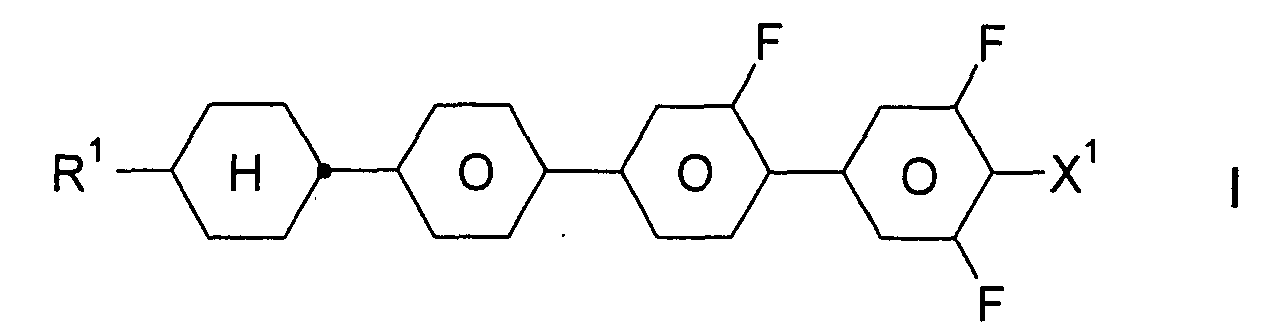
- X1
- is F, Cl, CHF2, CF3, OCHF2 or OCF3 and
- R1
- is alkyl with 1 to 20 C atoms.
- A liquid crystalline compound according to claim 1 wherein X1 is OCHF2 or OCF3.
- A liquid-crystalline medium based on a mixture of polar compounds of positive dielectric anisotropy, characterized in that it contains one or more compounds of the formula Iwherein
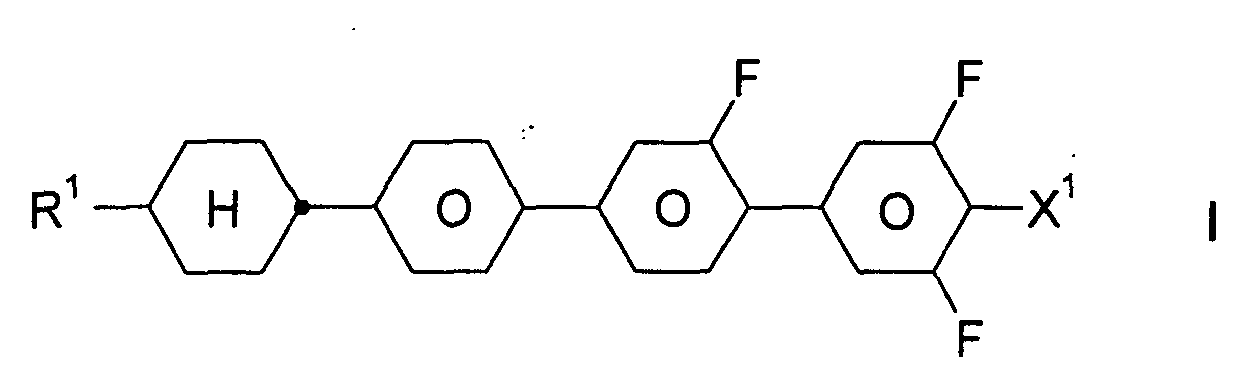
- X1
- is F, Cl, CHF2, CF3, OCHF2 or OCF3 and
- R1
- is alkyl with 1 to 20 C atoms.
- Medium according to claim 3 characterized in that X1 is OCHF2 or OCF3.
- Medium according to claim 3 or 4 characterized in that it has an optical anisotropy Δn ≥ 0.16.
- Medium according to one of the claims 3 to 5 characterized in that it additionally comprises one or more compounds of the formula IIawherein

- R0
- is alkyl, alkoxy, fluoroalkyl, alkenyl or oxaalkenyl with up to 9 C atoms and
- X0
- is F, Cl, CF3, OCF3, OCHF2, fluoroalkyl or fluoroalkoxy with up to 7 carbon atoms.
- Medium according to one of the claims 3 to 6 characterized in that it additionally comprises one or more compounds of the formula llbwherein
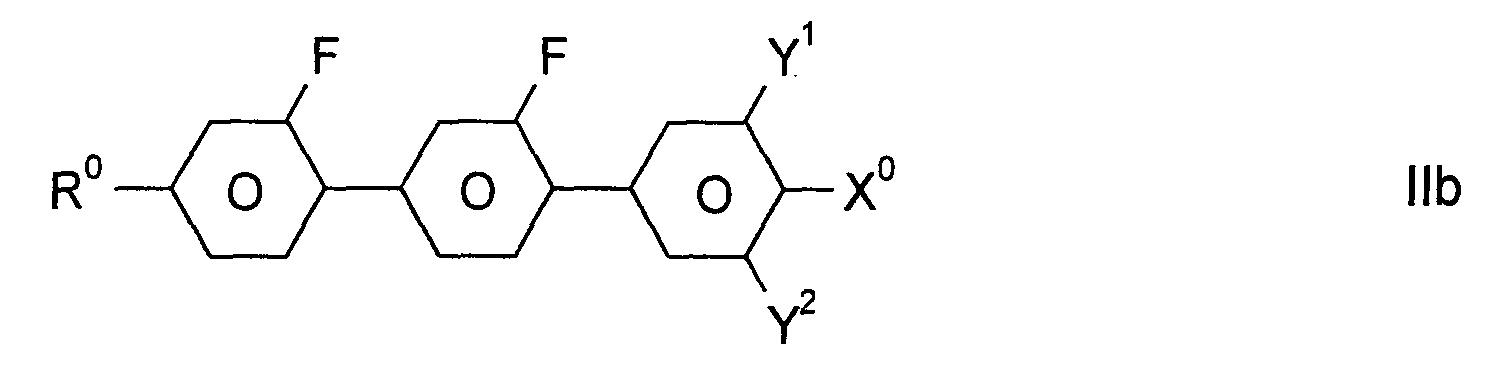
- R0
- is alkyl, alkoxy, fluoroalkyl, alkenyl or oxaalkenyl with up to 9 C atoms,
- X0
- is F, Cl, CF3, OCF3, OCHF2, fluoroalkyl or fluoroalkoxy with up to 7 carbon atoms, and
- Y1 and Y2
- are each independently of one another H or F.
- Medium according to one of the claims 3 to 7 characterized in that it additionally comprises one or more compounds of the formula IVwherein
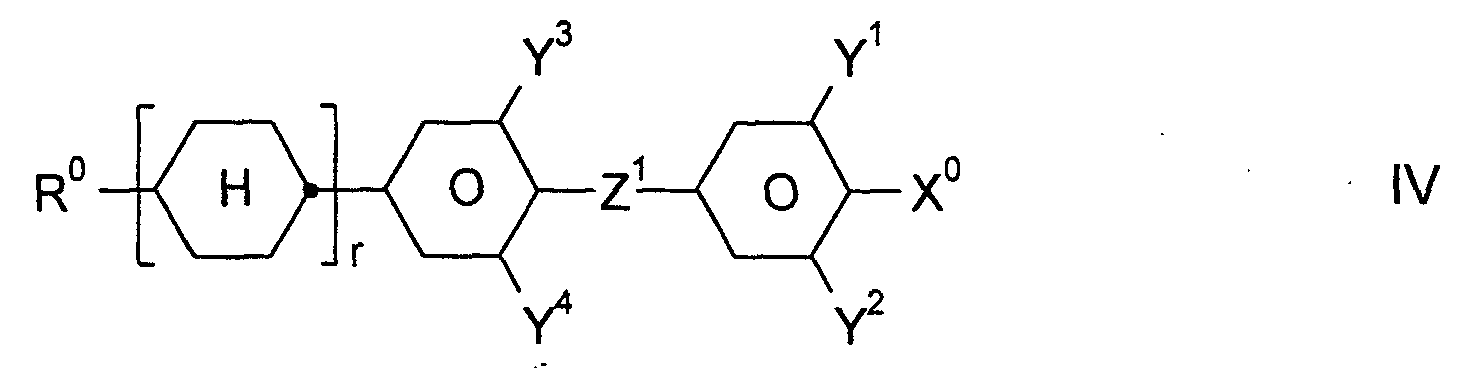
- R0
- is alkyl, alkoxy, fluoroalkyl, alkenyl or oxaalkenyl with up to 9 C atoms,
- Z1
- is CF2O, C2F4 or a single bond,
- X0
- is F, Cl, CF3, OCF3, OCHF2, fluoroalkyl or fluoroalkoxy with up to 7 carbon atoms,
- Y1 to Y4
- are independently of each other H or F, and
- r
- is 0 or 1.
- Medium according to one of the claims 3 to 8 characterized in that it additionally comprises one or more compounds selected from the formulae III, IX, XVII and/ or XXIII
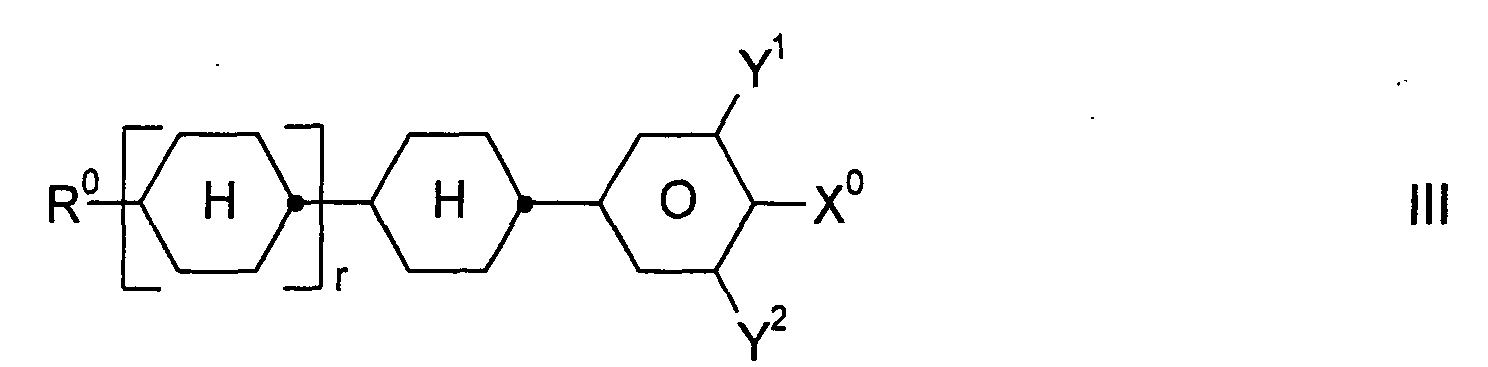
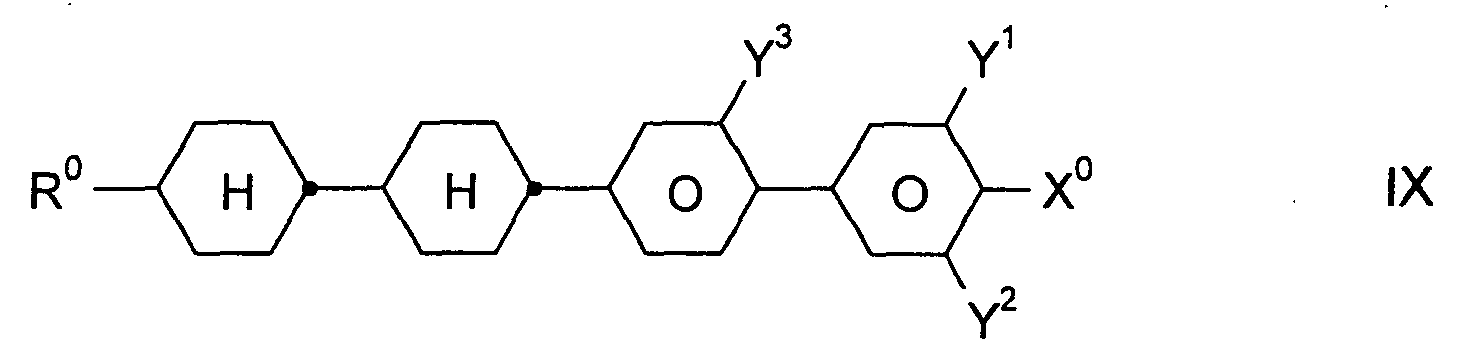
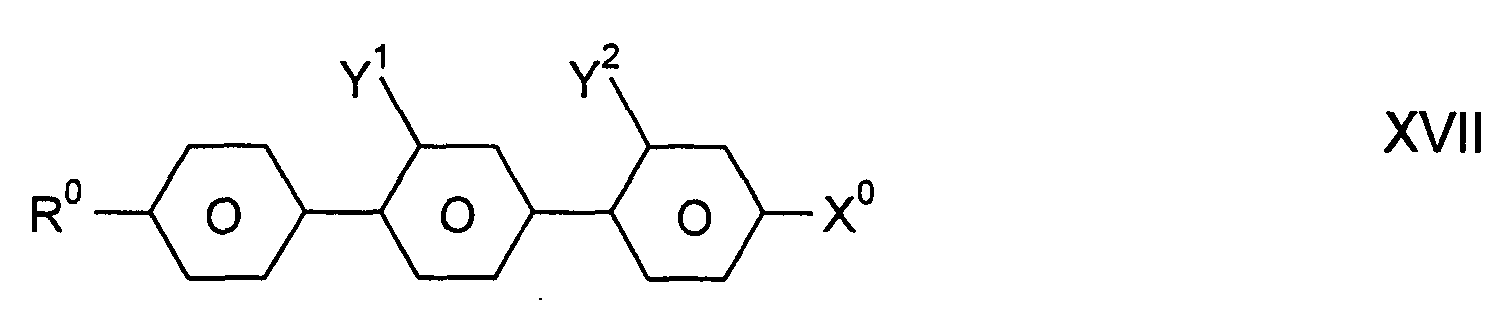 wherein
- R0, R3, R4
- are independently of each other alkyl, alkoxy, fluoroalkyl, alkenyl or oxaalkenyl with up to 9 C atoms,
- X0
- is F, Cl, CF3, OCF3, OCHF2, fluoroalkyl or fluoroalkoxy with up to 7 carbon atoms,
- Y1 to Y3
- are independently of each other H or F, and
- r
- is 0 or 1.
- Medium according to one of the claims 3 to 9 characterized in that it comprises 3 to 20 % by weight of one or more compounds of the formula I.
- Medium according to one of the claims 3 to 10 characterized in that it comprises 10 to 40 % by weight of one or more compounds of the formula IIa.
- Medium according to one of the claims 3 to 11 characterized in that it comprises 5 to 30 % by weight of one or more compounds of the formula llb.
- A cholesteric liquid crystalline medium characterized in that it comprises as a nematic component a liquid crystalline medium according to one or more of the claims 3 to 12 and as an optically active component one or more chiral dopants.
- Use of the liquid-crystalline medium according to at least one of claims 3 to 13 in electrooptical liquid crystal displays.
- Electrooptical liquid-crystal display containing a liquid-crystalline medium according to at least one of the claims 3 to 13.
- Electrooptical liquid-crystal display according to claim 15 characterized in that it is an active matrix display.
- Electrooptical liquid-crystal display according to claim 15 or 16 characterized in that it is a reflective display.
- Electrooptical liquid-crystal display according to one of the claims 15 to 17 characterized in that it is a display of a projection, LCoS™ or OCB mode.
- Cholesteric liquid crystal display, in particular a SSCT- or PSCT-display, comprising a cholesteric liquid crystalline medium according to claim 13.
Priority Applications (1)
| Application Number | Priority Date | Filing Date | Title |
|---|---|---|---|
| EP20020023247 EP1310542B1 (en) | 2001-11-07 | 2002-10-17 | Liquid crystalline compound, medium and display |
Applications Claiming Priority (3)
| Application Number | Priority Date | Filing Date | Title |
|---|---|---|---|
| EP01126409 | 2001-11-07 | ||
| EP01126409 | 2001-11-07 | ||
| EP20020023247 EP1310542B1 (en) | 2001-11-07 | 2002-10-17 | Liquid crystalline compound, medium and display |
Publications (2)
| Publication Number | Publication Date |
|---|---|
| EP1310542A1 true EP1310542A1 (en) | 2003-05-14 |
| EP1310542B1 EP1310542B1 (en) | 2007-04-18 |
Family
ID=26076761
Family Applications (1)
| Application Number | Title | Priority Date | Filing Date |
|---|---|---|---|
| EP20020023247 Expired - Lifetime EP1310542B1 (en) | 2001-11-07 | 2002-10-17 | Liquid crystalline compound, medium and display |
Country Status (1)
| Country | Link |
|---|---|
| EP (1) | EP1310542B1 (en) |
Cited By (11)
| Publication number | Priority date | Publication date | Assignee | Title |
|---|---|---|---|---|
| NL1019746C2 (en) * | 2001-01-19 | 2004-01-13 | Merck Patent Gmbh | Liquid crystalline medium and liquid crystal screen. |
| WO2004114006A1 (en) * | 2003-06-23 | 2004-12-29 | Koninklijke Philips Electronics N.V. | Reflective liquid crystal display with a porous auxiliary layer |
| EP1724324A1 (en) * | 2005-05-21 | 2006-11-22 | Merck Patent GmbH | Liquid crystalline medium |
| WO2008025533A1 (en) * | 2006-09-01 | 2008-03-06 | Merck Patent Gmbh | Liquid-crystalline medium |
| EP2085454A1 (en) | 2008-02-01 | 2009-08-05 | MERCK PATENT GmbH | Liquid crystal medium and liquid crystal display |
| CN105505404A (en) * | 2014-10-20 | 2016-04-20 | 江苏和成显示科技股份有限公司 | Liquid-crystal composition and display device thereof |
| CN105586055A (en) * | 2014-10-20 | 2016-05-18 | 江苏和成显示科技股份有限公司 | Liquid crystal composition and liquid crystal display device thereof |
| CN105586050A (en) * | 2014-10-20 | 2016-05-18 | 江苏和成显示科技股份有限公司 | Liquid crystal composition and liquid-crystal display device |
| CN105586045B (en) * | 2014-10-20 | 2018-07-24 | 江苏和成显示科技有限公司 | Liquid-crystal composition and its liquid crystal display |
| CN108690638A (en) * | 2017-04-06 | 2018-10-23 | 石家庄诚志永华显示材料有限公司 | Liquid-crystal composition |
| CN109704915A (en) * | 2018-12-24 | 2019-05-03 | 西安彩晶光电科技股份有限公司 | A kind of polyhalo biphenyl compound and preparation method |
Citations (8)
| Publication number | Priority date | Publication date | Assignee | Title |
|---|---|---|---|---|
| EP0439089A1 (en) * | 1990-01-25 | 1991-07-31 | MERCK PATENT GmbH | Halogenated terphenyls and liquid crystal medium |
| WO1991013850A1 (en) * | 1990-03-13 | 1991-09-19 | MERCK Patent Gesellschaft mit beschränkter Haftung | 4,4'-disubstituted 2',3-difluorbiphenyls and liquid crystalline medium |
| WO1992002597A1 (en) * | 1990-08-03 | 1992-02-20 | MERCK Patent Gesellschaft mit beschränkter Haftung | Liquid-crystal medium |
| DE19528085A1 (en) * | 1994-08-06 | 1996-02-08 | Merck Patent Gmbh | Liquid crystal medium for electro-optical displays |
| EP0718264A1 (en) * | 1994-12-22 | 1996-06-26 | Chisso Corporation | A liquid crystalline compound containing fluorine atom substituted alkyl group(s) and a liquid crystal composition |
| JPH0930996A (en) * | 1995-07-18 | 1997-02-04 | Dainippon Ink & Chem Inc | p-terphenyl derivative |
| DE19919348A1 (en) * | 1998-04-30 | 1999-11-04 | Merck Patent Gmbh | Liquid crystal medium used for electro-optical matrix or supertwist nematic display |
| WO2001012751A1 (en) * | 1999-08-11 | 2001-02-22 | Merck Patent Gmbh | Liquid-crystalline medium |
-
2002
- 2002-10-17 EP EP20020023247 patent/EP1310542B1/en not_active Expired - Lifetime
Patent Citations (8)
| Publication number | Priority date | Publication date | Assignee | Title |
|---|---|---|---|---|
| EP0439089A1 (en) * | 1990-01-25 | 1991-07-31 | MERCK PATENT GmbH | Halogenated terphenyls and liquid crystal medium |
| WO1991013850A1 (en) * | 1990-03-13 | 1991-09-19 | MERCK Patent Gesellschaft mit beschränkter Haftung | 4,4'-disubstituted 2',3-difluorbiphenyls and liquid crystalline medium |
| WO1992002597A1 (en) * | 1990-08-03 | 1992-02-20 | MERCK Patent Gesellschaft mit beschränkter Haftung | Liquid-crystal medium |
| DE19528085A1 (en) * | 1994-08-06 | 1996-02-08 | Merck Patent Gmbh | Liquid crystal medium for electro-optical displays |
| EP0718264A1 (en) * | 1994-12-22 | 1996-06-26 | Chisso Corporation | A liquid crystalline compound containing fluorine atom substituted alkyl group(s) and a liquid crystal composition |
| JPH0930996A (en) * | 1995-07-18 | 1997-02-04 | Dainippon Ink & Chem Inc | p-terphenyl derivative |
| DE19919348A1 (en) * | 1998-04-30 | 1999-11-04 | Merck Patent Gmbh | Liquid crystal medium used for electro-optical matrix or supertwist nematic display |
| WO2001012751A1 (en) * | 1999-08-11 | 2001-02-22 | Merck Patent Gmbh | Liquid-crystalline medium |
Non-Patent Citations (1)
| Title |
|---|
| PATENT ABSTRACTS OF JAPAN vol. 1997, no. 06 30 June 1997 (1997-06-30) * |
Cited By (21)
| Publication number | Priority date | Publication date | Assignee | Title |
|---|---|---|---|---|
| NL1019746C2 (en) * | 2001-01-19 | 2004-01-13 | Merck Patent Gmbh | Liquid crystalline medium and liquid crystal screen. |
| WO2004114006A1 (en) * | 2003-06-23 | 2004-12-29 | Koninklijke Philips Electronics N.V. | Reflective liquid crystal display with a porous auxiliary layer |
| EP1724324A1 (en) * | 2005-05-21 | 2006-11-22 | Merck Patent GmbH | Liquid crystalline medium |
| CN103725293A (en) * | 2006-09-01 | 2014-04-16 | 默克专利股份有限公司 | Liquid-crystalline medium |
| EP2189511A2 (en) | 2006-09-01 | 2010-05-26 | Merck Patent GmbH | Liquid crystalline medium |
| EP2189511A3 (en) * | 2006-09-01 | 2010-07-14 | Merck Patent GmbH | Liquid crystalline medium |
| US8486298B2 (en) | 2006-09-01 | 2013-07-16 | Merck Patent Gmbh | Liquid-crystalline medium |
| CN101511970B (en) * | 2006-09-01 | 2014-01-15 | 默克专利股份有限公司 | liquid crystal medium |
| WO2008025533A1 (en) * | 2006-09-01 | 2008-03-06 | Merck Patent Gmbh | Liquid-crystalline medium |
| CN103725293B (en) * | 2006-09-01 | 2016-06-08 | 默克专利股份有限公司 | Liquid crystal media |
| EP2085454A1 (en) | 2008-02-01 | 2009-08-05 | MERCK PATENT GmbH | Liquid crystal medium and liquid crystal display |
| US7838090B2 (en) | 2008-02-01 | 2010-11-23 | Merck Patent Gesellschaft Mit Beschrankter Haftung | Liquid-crystalline medium and liquid-crystal display |
| CN105586055A (en) * | 2014-10-20 | 2016-05-18 | 江苏和成显示科技股份有限公司 | Liquid crystal composition and liquid crystal display device thereof |
| CN105586050A (en) * | 2014-10-20 | 2016-05-18 | 江苏和成显示科技股份有限公司 | Liquid crystal composition and liquid-crystal display device |
| CN105505404A (en) * | 2014-10-20 | 2016-04-20 | 江苏和成显示科技股份有限公司 | Liquid-crystal composition and display device thereof |
| CN105505404B (en) * | 2014-10-20 | 2017-07-28 | 江苏和成显示科技股份有限公司 | Liquid-crystal composition and its display device |
| CN105586045B (en) * | 2014-10-20 | 2018-07-24 | 江苏和成显示科技有限公司 | Liquid-crystal composition and its liquid crystal display |
| CN105586055B (en) * | 2014-10-20 | 2018-07-24 | 江苏和成显示科技有限公司 | Liquid-crystal composition and its liquid crystal display device |
| CN108690638A (en) * | 2017-04-06 | 2018-10-23 | 石家庄诚志永华显示材料有限公司 | Liquid-crystal composition |
| CN108690638B (en) * | 2017-04-06 | 2021-08-31 | 石家庄诚志永华显示材料有限公司 | Liquid crystal composition |
| CN109704915A (en) * | 2018-12-24 | 2019-05-03 | 西安彩晶光电科技股份有限公司 | A kind of polyhalo biphenyl compound and preparation method |
Also Published As
| Publication number | Publication date |
|---|---|
| EP1310542B1 (en) | 2007-04-18 |
Similar Documents
| Publication | Publication Date | Title |
|---|---|---|
| US6827989B2 (en) | Liquid crystalline medium | |
| KR101243504B1 (en) | Liquid crystalline compound, medium and display | |
| KR102512438B1 (en) | Liquid crystal medium and liquid crystal display including the same | |
| US6764722B2 (en) | Liquid-crystalline medium | |
| US6066268A (en) | Liquid-crystalline medium | |
| EP2182046B1 (en) | Liquid-crystalline medium and liquid crystal display | |
| US7419706B2 (en) | Liquid crystalline medium | |
| CN103725293B (en) | Liquid crystal media | |
| JP2010242086A (en) | Liquid crystal medium and liquid crystal display | |
| KR100758087B1 (en) | Liquid-crystalline medium | |
| KR100845995B1 (en) | Liquid-crystalline medium | |
| JP2004315819A (en) | Liquid crystal medium | |
| KR20080057175A (en) | Liquid crystal medium | |
| EP1310542B1 (en) | Liquid crystalline compound, medium and display | |
| KR100851079B1 (en) | Liquid crystal medium | |
| US20040245500A1 (en) | Liquid-crystalline medium | |
| JP2001311078A (en) | Liquid crystal medium | |
| US6171665B1 (en) | Liquid-crystalline medium | |
| US6821580B2 (en) | Liquid-crystalline medium and liquid-crystal display | |
| US6436491B1 (en) | Liquid-crystalline medium | |
| EP1251160B1 (en) | Liquid-crystalline medium | |
| US6399162B1 (en) | Liquid-crystalline medium | |
| JPH1143673A (en) | Liquid crystal medium | |
| JP2004115800A (en) | Liquid crystal medium |
Legal Events
| Date | Code | Title | Description |
|---|---|---|---|
| PUAI | Public reference made under article 153(3) epc to a published international application that has entered the european phase |
Free format text: ORIGINAL CODE: 0009012 |
|
| 17P | Request for examination filed |
Effective date: 20021017 |
|
| AK | Designated contracting states |
Designated state(s): AT BE BG CH CY CZ DE DK EE ES FI FR GB GR IE IT LI LU MC NL PT SE SK TR |
|
| AX | Request for extension of the european patent |
Extension state: AL LT LV MK RO SI |
|
| AKX | Designation fees paid |
Designated state(s): AT BE BG CH CY CZ DE DK EE ES FI FR GB GR IE IT LI LU MC NL PT SE SK TR |
|
| GRAP | Despatch of communication of intention to grant a patent |
Free format text: ORIGINAL CODE: EPIDOSNIGR1 |
|
| GRAS | Grant fee paid |
Free format text: ORIGINAL CODE: EPIDOSNIGR3 |
|
| GRAA | (expected) grant |
Free format text: ORIGINAL CODE: 0009210 |
|
| AK | Designated contracting states |
Kind code of ref document: B1 Designated state(s): AT BE BG CH CY CZ DE DK EE ES FI FR GB GR IE IT LI LU MC NL PT SE SK TR |
|
| PG25 | Lapsed in a contracting state [announced via postgrant information from national office to epo] |
Ref country code: LI Free format text: LAPSE BECAUSE OF FAILURE TO SUBMIT A TRANSLATION OF THE DESCRIPTION OR TO PAY THE FEE WITHIN THE PRESCRIBED TIME-LIMIT Effective date: 20070418 Ref country code: CH Free format text: LAPSE BECAUSE OF FAILURE TO SUBMIT A TRANSLATION OF THE DESCRIPTION OR TO PAY THE FEE WITHIN THE PRESCRIBED TIME-LIMIT Effective date: 20070418 Ref country code: FI Free format text: LAPSE BECAUSE OF FAILURE TO SUBMIT A TRANSLATION OF THE DESCRIPTION OR TO PAY THE FEE WITHIN THE PRESCRIBED TIME-LIMIT Effective date: 20070418 |
|
| REG | Reference to a national code |
Ref country code: CH Ref legal event code: EP |
|
| REG | Reference to a national code |
Ref country code: IE Ref legal event code: FG4D |
|
| REF | Corresponds to: |
Ref document number: 60219569 Country of ref document: DE Date of ref document: 20070531 Kind code of ref document: P |
|
| PG25 | Lapsed in a contracting state [announced via postgrant information from national office to epo] |
Ref country code: SE Free format text: LAPSE BECAUSE OF FAILURE TO SUBMIT A TRANSLATION OF THE DESCRIPTION OR TO PAY THE FEE WITHIN THE PRESCRIBED TIME-LIMIT Effective date: 20070718 |
|
| PG25 | Lapsed in a contracting state [announced via postgrant information from national office to epo] |
Ref country code: ES Free format text: LAPSE BECAUSE OF FAILURE TO SUBMIT A TRANSLATION OF THE DESCRIPTION OR TO PAY THE FEE WITHIN THE PRESCRIBED TIME-LIMIT Effective date: 20070729 |
|
| PG25 | Lapsed in a contracting state [announced via postgrant information from national office to epo] |
Ref country code: PT Free format text: LAPSE BECAUSE OF FAILURE TO SUBMIT A TRANSLATION OF THE DESCRIPTION OR TO PAY THE FEE WITHIN THE PRESCRIBED TIME-LIMIT Effective date: 20070918 |
|
| REG | Reference to a national code |
Ref country code: CH Ref legal event code: PL |
|
| NLV1 | Nl: lapsed or annulled due to failure to fulfill the requirements of art. 29p and 29m of the patents act | ||
| PG25 | Lapsed in a contracting state [announced via postgrant information from national office to epo] |
Ref country code: AT Free format text: LAPSE BECAUSE OF FAILURE TO SUBMIT A TRANSLATION OF THE DESCRIPTION OR TO PAY THE FEE WITHIN THE PRESCRIBED TIME-LIMIT Effective date: 20070418 |
|
| EN | Fr: translation not filed | ||
| PG25 | Lapsed in a contracting state [announced via postgrant information from national office to epo] |
Ref country code: BE Free format text: LAPSE BECAUSE OF FAILURE TO SUBMIT A TRANSLATION OF THE DESCRIPTION OR TO PAY THE FEE WITHIN THE PRESCRIBED TIME-LIMIT Effective date: 20070418 |
|
| PG25 | Lapsed in a contracting state [announced via postgrant information from national office to epo] |
Ref country code: BG Free format text: LAPSE BECAUSE OF FAILURE TO SUBMIT A TRANSLATION OF THE DESCRIPTION OR TO PAY THE FEE WITHIN THE PRESCRIBED TIME-LIMIT Effective date: 20070718 Ref country code: DK Free format text: LAPSE BECAUSE OF FAILURE TO SUBMIT A TRANSLATION OF THE DESCRIPTION OR TO PAY THE FEE WITHIN THE PRESCRIBED TIME-LIMIT Effective date: 20070418 Ref country code: NL Free format text: LAPSE BECAUSE OF FAILURE TO SUBMIT A TRANSLATION OF THE DESCRIPTION OR TO PAY THE FEE WITHIN THE PRESCRIBED TIME-LIMIT Effective date: 20070418 Ref country code: CZ Free format text: LAPSE BECAUSE OF FAILURE TO SUBMIT A TRANSLATION OF THE DESCRIPTION OR TO PAY THE FEE WITHIN THE PRESCRIBED TIME-LIMIT Effective date: 20070418 |
|
| PLBE | No opposition filed within time limit |
Free format text: ORIGINAL CODE: 0009261 |
|
| STAA | Information on the status of an ep patent application or granted ep patent |
Free format text: STATUS: NO OPPOSITION FILED WITHIN TIME LIMIT |
|
| PG25 | Lapsed in a contracting state [announced via postgrant information from national office to epo] |
Ref country code: SK Free format text: LAPSE BECAUSE OF FAILURE TO SUBMIT A TRANSLATION OF THE DESCRIPTION OR TO PAY THE FEE WITHIN THE PRESCRIBED TIME-LIMIT Effective date: 20070418 |
|
| 26N | No opposition filed |
Effective date: 20080121 |
|
| PG25 | Lapsed in a contracting state [announced via postgrant information from national office to epo] |
Ref country code: GR Free format text: LAPSE BECAUSE OF FAILURE TO SUBMIT A TRANSLATION OF THE DESCRIPTION OR TO PAY THE FEE WITHIN THE PRESCRIBED TIME-LIMIT Effective date: 20070719 Ref country code: IT Free format text: LAPSE BECAUSE OF FAILURE TO SUBMIT A TRANSLATION OF THE DESCRIPTION OR TO PAY THE FEE WITHIN THE PRESCRIBED TIME-LIMIT Effective date: 20070418 Ref country code: FR Free format text: LAPSE BECAUSE OF FAILURE TO SUBMIT A TRANSLATION OF THE DESCRIPTION OR TO PAY THE FEE WITHIN THE PRESCRIBED TIME-LIMIT Effective date: 20071214 |
|
| PG25 | Lapsed in a contracting state [announced via postgrant information from national office to epo] |
Ref country code: MC Free format text: LAPSE BECAUSE OF NON-PAYMENT OF DUE FEES Effective date: 20071031 |
|
| PG25 | Lapsed in a contracting state [announced via postgrant information from national office to epo] |
Ref country code: IE Free format text: LAPSE BECAUSE OF NON-PAYMENT OF DUE FEES Effective date: 20071017 |
|
| PG25 | Lapsed in a contracting state [announced via postgrant information from national office to epo] |
Ref country code: FR Free format text: LAPSE BECAUSE OF FAILURE TO SUBMIT A TRANSLATION OF THE DESCRIPTION OR TO PAY THE FEE WITHIN THE PRESCRIBED TIME-LIMIT Effective date: 20070418 |
|
| PG25 | Lapsed in a contracting state [announced via postgrant information from national office to epo] |
Ref country code: EE Free format text: LAPSE BECAUSE OF FAILURE TO SUBMIT A TRANSLATION OF THE DESCRIPTION OR TO PAY THE FEE WITHIN THE PRESCRIBED TIME-LIMIT Effective date: 20070418 |
|
| PG25 | Lapsed in a contracting state [announced via postgrant information from national office to epo] |
Ref country code: CY Free format text: LAPSE BECAUSE OF FAILURE TO SUBMIT A TRANSLATION OF THE DESCRIPTION OR TO PAY THE FEE WITHIN THE PRESCRIBED TIME-LIMIT Effective date: 20070418 |
|
| PG25 | Lapsed in a contracting state [announced via postgrant information from national office to epo] |
Ref country code: LU Free format text: LAPSE BECAUSE OF NON-PAYMENT OF DUE FEES Effective date: 20071017 |
|
| PG25 | Lapsed in a contracting state [announced via postgrant information from national office to epo] |
Ref country code: TR Free format text: LAPSE BECAUSE OF FAILURE TO SUBMIT A TRANSLATION OF THE DESCRIPTION OR TO PAY THE FEE WITHIN THE PRESCRIBED TIME-LIMIT Effective date: 20070418 |
|
| PGFP | Annual fee paid to national office [announced via postgrant information from national office to epo] |
Ref country code: GB Payment date: 20201007 Year of fee payment: 19 |
|
| PGFP | Annual fee paid to national office [announced via postgrant information from national office to epo] |
Ref country code: DE Payment date: 20210908 Year of fee payment: 20 |
|
| GBPC | Gb: european patent ceased through non-payment of renewal fee |
Effective date: 20211017 |
|
| PG25 | Lapsed in a contracting state [announced via postgrant information from national office to epo] |
Ref country code: GB Free format text: LAPSE BECAUSE OF NON-PAYMENT OF DUE FEES Effective date: 20211017 |
|
| REG | Reference to a national code |
Ref country code: DE Ref legal event code: R071 Ref document number: 60219569 Country of ref document: DE |