EP1310502A1 - Phosphonocephem compound - Google Patents
Phosphonocephem compound Download PDFInfo
- Publication number
- EP1310502A1 EP1310502A1 EP01955659A EP01955659A EP1310502A1 EP 1310502 A1 EP1310502 A1 EP 1310502A1 EP 01955659 A EP01955659 A EP 01955659A EP 01955659 A EP01955659 A EP 01955659A EP 1310502 A1 EP1310502 A1 EP 1310502A1
- Authority
- EP
- European Patent Office
- Prior art keywords
- compound
- mixture
- added
- cephem
- carboxylate
- Prior art date
- Legal status (The legal status is an assumption and is not a legal conclusion. Google has not performed a legal analysis and makes no representation as to the accuracy of the status listed.)
- Granted
Links
Images


Classifications
-
- C—CHEMISTRY; METALLURGY
- C07—ORGANIC CHEMISTRY
- C07F—ACYCLIC, CARBOCYCLIC OR HETEROCYCLIC COMPOUNDS CONTAINING ELEMENTS OTHER THAN CARBON, HYDROGEN, HALOGEN, OXYGEN, NITROGEN, SULFUR, SELENIUM OR TELLURIUM
- C07F9/00—Compounds containing elements of Groups 5 or 15 of the Periodic Table
- C07F9/02—Phosphorus compounds
- C07F9/547—Heterocyclic compounds, e.g. containing phosphorus as a ring hetero atom
- C07F9/6561—Heterocyclic compounds, e.g. containing phosphorus as a ring hetero atom containing systems of two or more relevant hetero rings condensed among themselves or condensed with a common carbocyclic ring or ring system, with or without other non-condensed hetero rings
-
- A—HUMAN NECESSITIES
- A61—MEDICAL OR VETERINARY SCIENCE; HYGIENE
- A61K—PREPARATIONS FOR MEDICAL, DENTAL OR TOILETRY PURPOSES
- A61K31/00—Medicinal preparations containing organic active ingredients
- A61K31/66—Phosphorus compounds
- A61K31/675—Phosphorus compounds having nitrogen as a ring hetero atom, e.g. pyridoxal phosphate
-
- A—HUMAN NECESSITIES
- A61—MEDICAL OR VETERINARY SCIENCE; HYGIENE
- A61P—SPECIFIC THERAPEUTIC ACTIVITY OF CHEMICAL COMPOUNDS OR MEDICINAL PREPARATIONS
- A61P31/00—Antiinfectives, i.e. antibiotics, antiseptics, chemotherapeutics
- A61P31/04—Antibacterial agents
-
- C—CHEMISTRY; METALLURGY
- C07—ORGANIC CHEMISTRY
- C07F—ACYCLIC, CARBOCYCLIC OR HETEROCYCLIC COMPOUNDS CONTAINING ELEMENTS OTHER THAN CARBON, HYDROGEN, HALOGEN, OXYGEN, NITROGEN, SULFUR, SELENIUM OR TELLURIUM
- C07F9/00—Compounds containing elements of Groups 5 or 15 of the Periodic Table
- C07F9/02—Phosphorus compounds
- C07F9/547—Heterocyclic compounds, e.g. containing phosphorus as a ring hetero atom
- C07F9/6561—Heterocyclic compounds, e.g. containing phosphorus as a ring hetero atom containing systems of two or more relevant hetero rings condensed among themselves or condensed with a common carbocyclic ring or ring system, with or without other non-condensed hetero rings
- C07F9/65613—Heterocyclic compounds, e.g. containing phosphorus as a ring hetero atom containing systems of two or more relevant hetero rings condensed among themselves or condensed with a common carbocyclic ring or ring system, with or without other non-condensed hetero rings containing the ring system (X = CH2, O, S, NH) optionally with an additional double bond and/or substituents, e.g. cephalosporins and analogs
Definitions
- the present invention relates to a compound (particularly a crystal thereof) useful as a pharmaceutical agent of a phosphonocephem compound having a superior antibacterial activity and a production method thereof.
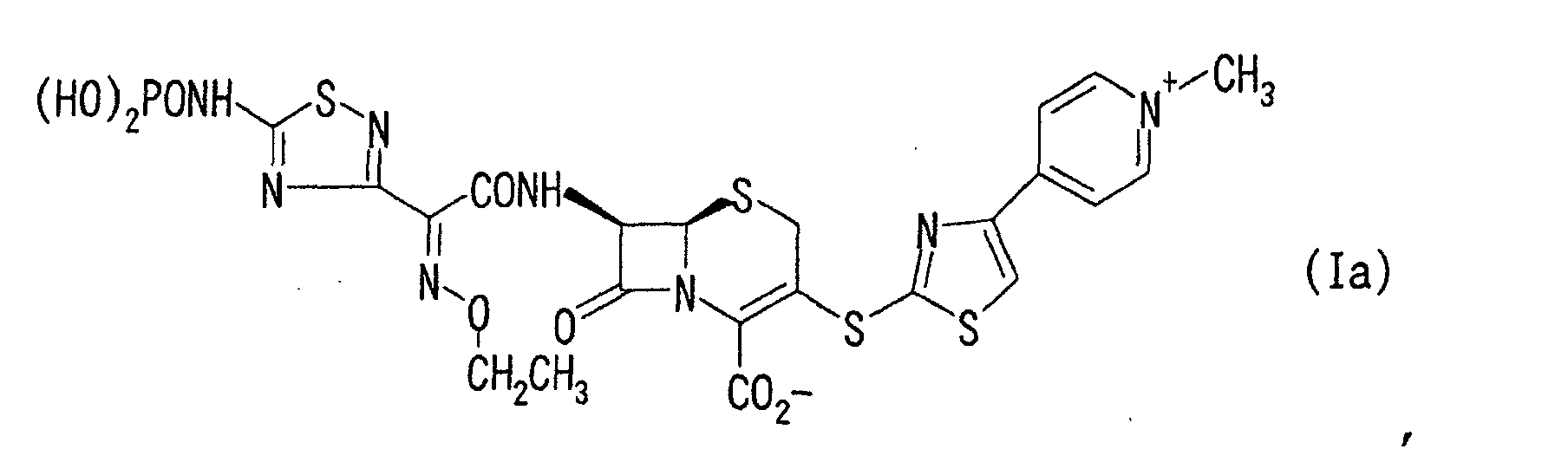
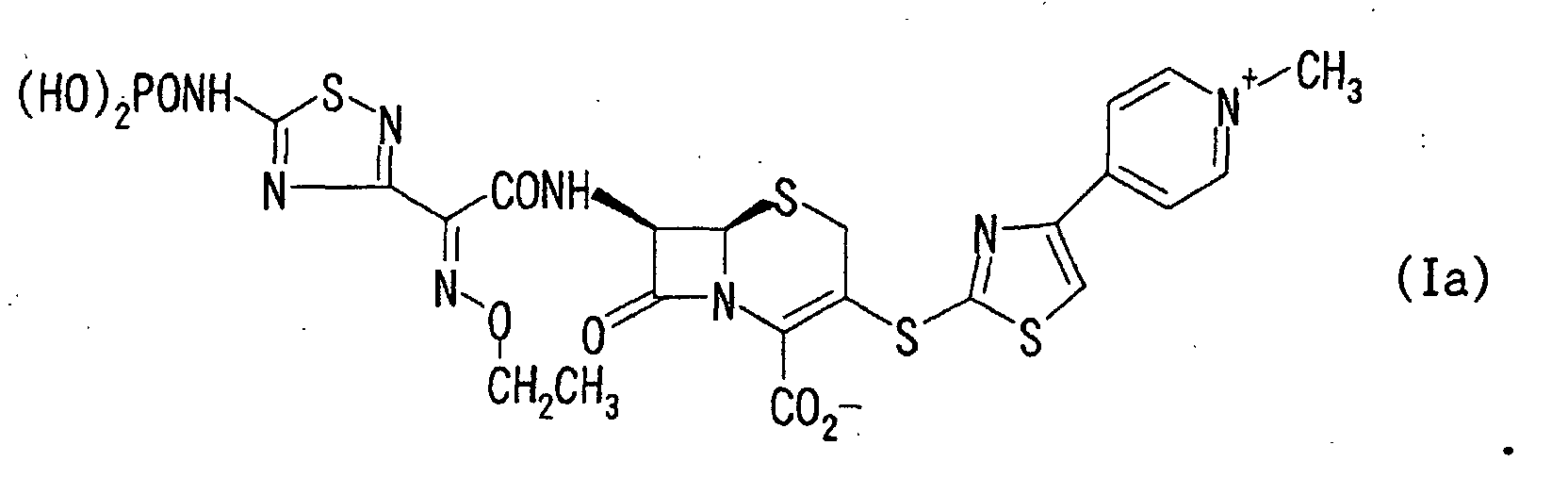
- JP-A-11-255772 discloses phosphonocephem compounds having a superior antibacterial activity, wherein a lyophilized product of 7 ⁇ -[2(Z)-ethoxyimino-2-(5-phosphonoamino-1,2,4-thiadiazol-3-yl)acetamido]-3-[4-(1-methyl-4-pyridinio)-2-thiazolylthio]-3-cephem-4-carboxylate represented by the formula: is described as one of the specific examples thereof.
- the problem of the present invention is to provide an antibacterial agent (particularly anti-MRSA agent) having such quality as sufficiently satisfactory as a pharmaceutical product.
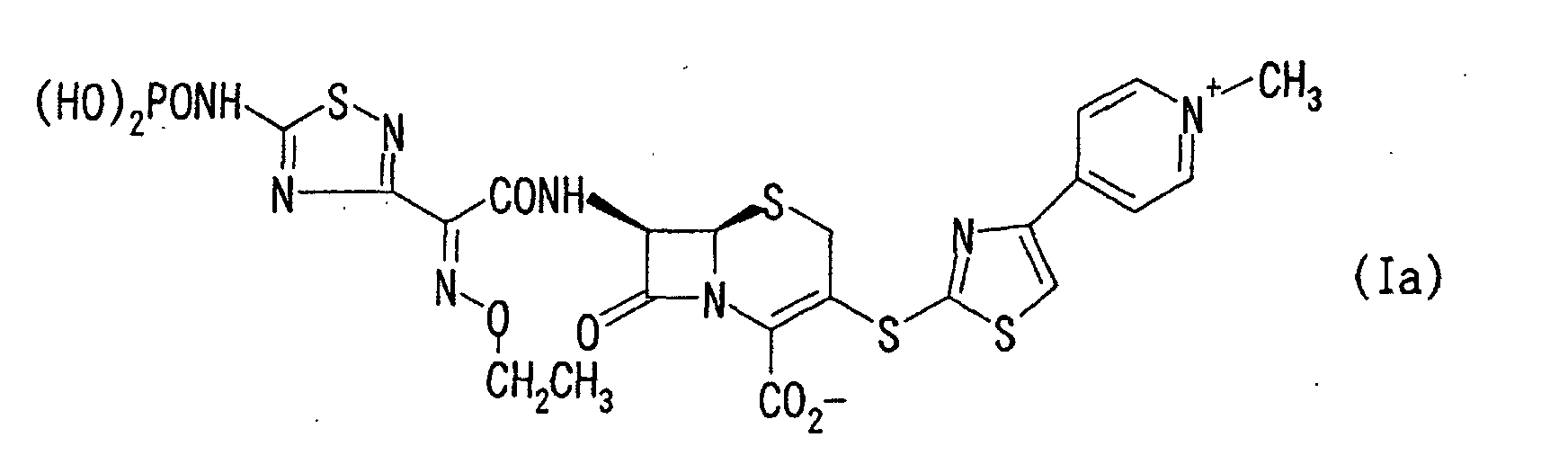
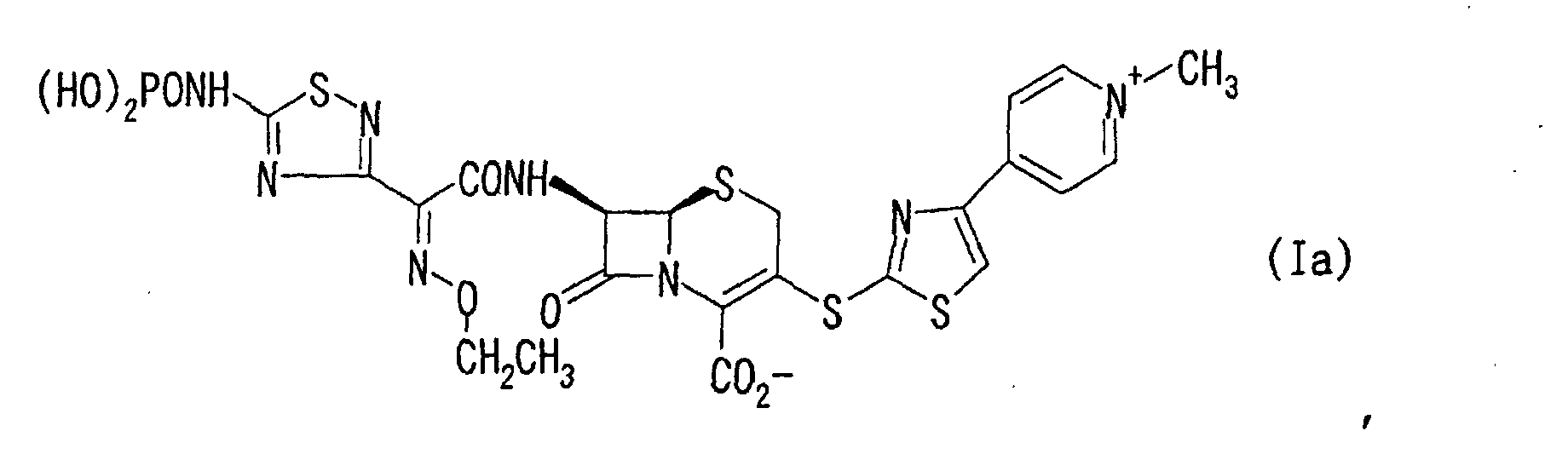
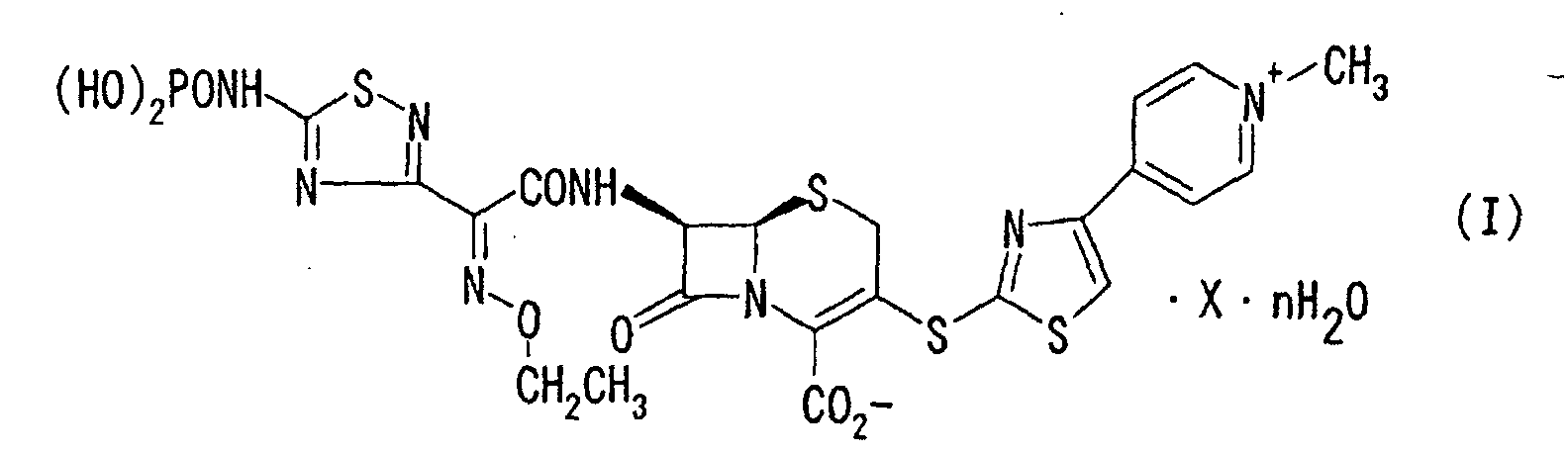
- the present inventors have intensively conducted various studies in view of the above-mentioned problem, selected, from among a number of phosphonocephem compounds, a phosphonocephem compound having a particular chemical structure represented by the above-mentioned formula (Ia) and found that, when this compound, water and a particular solvent (CH 3 COOH, CH 3 CH 2 COOH or CH 3 CN) are mixed and dissolved, a compound (particularly a crystal obtained by successful crystallization) having an antibacterial activity, which is particularly superior in quality as a pharmaceutical product, can be obtained unexpectedly, and that this compound has more than sufficient superior quality as a pharmaceutical product (e.g., having high solid stability and high purity, and the like), which resulted in the completion of the present invention.
- a particular solvent CH 3 COOH, CH 3 CH 2 COOH or CH 3 CN
- the present invention relates to
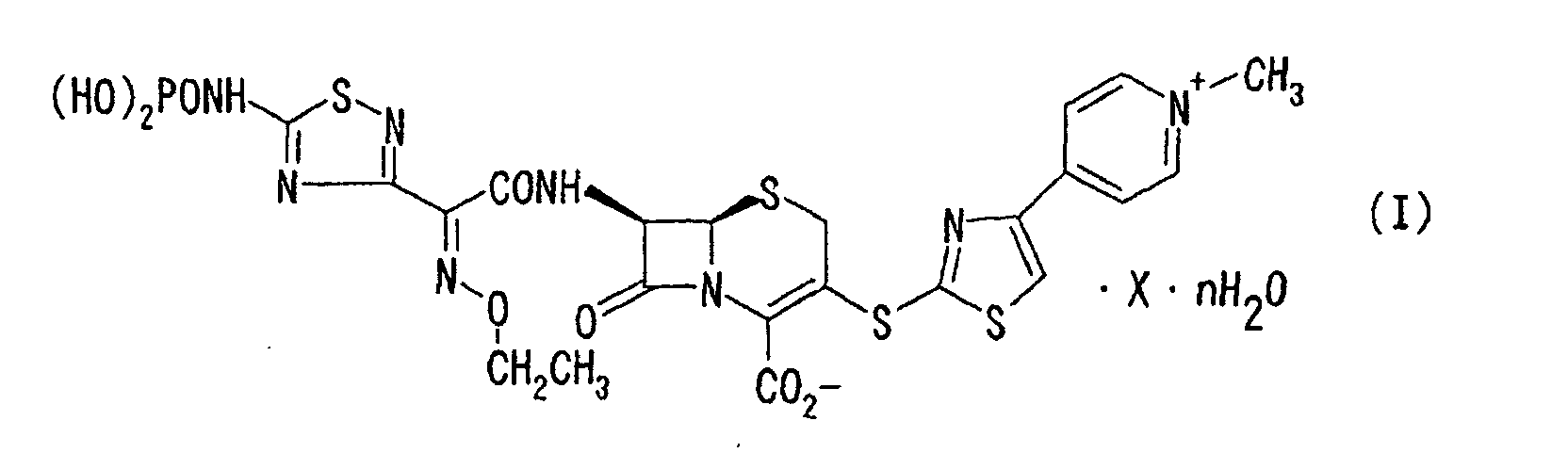
- the compound (I) consists of 1 molecule of compound (Ia), 1 molecule of acetic acid, propionic acid or acetonitrile, and 0 to 5 molecules of water.
- the compound (I) may be a salt formed by compound (Ia) and acetic acid or propionic acid, or a solvate formed by compound (Ia) and acetic acid, propionic acid or acetonitrile.
- the compound (I) may contain water, in which case water may be incorporated as crystal water or simply adhering water.
- the compound (I) preferably takes the form of a crystal in view of purity and solid stability.
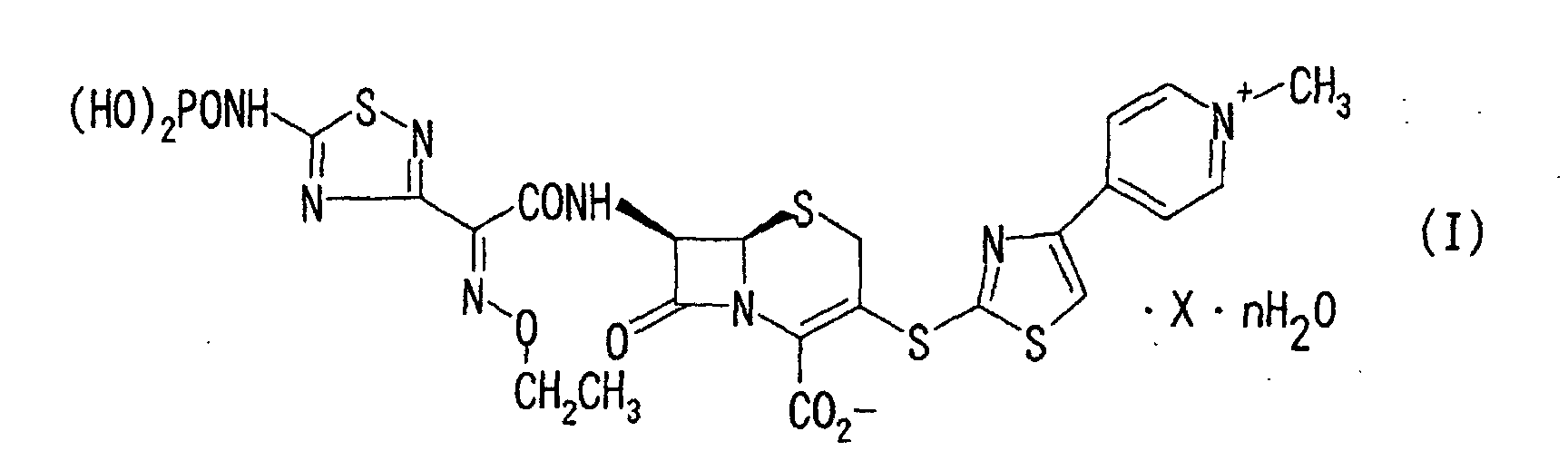
- the compound (I) can be produced from [i] compound (Ia), [ii] acetic acid, propionic acid or acetonitrile and [iii] water.
- a lyophilized product described in JP-A-11-255772 may be used, or compound (Ia) obtained by adding, for example, hydrochloric acid, sulfuric acid, nitric acid and the like to a solution containing a disodium salt, dipotassium salt or diammonium salt of compound (Ia).
- the solution containing the above-mentioned disodium salt of compound (Ia) may be a reaction mixture containing a disodium salt of compound (Ia), which is obtained as a result of various reactions for synthesizing a disodium salt of compound (Ia), or may be one wherein a crystal of disodium salt of compound (Ia) is dissolved.
- the compound (I) can be produced by mixing the above-mentioned [i], [ii] and [iii] to give a solution, and isolating from this solution by a general isolation technique such as crystallization and the like.
- the order of mixing [i], [ii] and [iii] is arbitrary.
- [i] and [ii] are first mixed and the mixture may be mixed with [iii], or [i] and [iii] are mixed and the mixture may be mixed with [ii], or [ii] and [iii] are mixed and the mixture may be mixed with [i].
- ultrasonication ultrasonic irradiation
- stirring and the like are preferably applied.
- crystals may be simultaneously produced.
- crystallization may be caused by, for example, cooling, giving stimulation such as ultrasonication, stirring and the like, adding a seed crystal, and the like.
- crystallization may be caused after adding saccharides to the mixture.
- the mixing ratio of solvent [ii] and water [iii] for crystallization in a volume ratio of [ii] : [iii] is generally 1 : 0.1 - 10, preferably 1 : 0.5 - 5, particularly preferably about 1 : 1.
- the amounts of [ii] and [iii] to be used relative to [i] for crystallization are not particularly limited as long as they are within the range that allows for crystallization.
- the total amount of [ii] and [iii] relative to 1. part by weight of [i] is generally 2 - 100 parts by weight, preferably 3 - 50 parts by weight, still preferably 5 - 30 parts by weight.
- the crystallization can be conducted by a crystallization technique such as cooling the above-mentioned solution, reducing the amounts of [ii] and [iii] in vacuo, adding a seed crystal and the like.
- the saccharides can be added to the mixed solution in an amount up to the maximum amount that can be dissolved in [iii]. It is added relative to [i] generally in 0.05-10 parts by weight, preferably 0.1-0.5 part by weight.
- saccharide is preferably dissolved in [iii] for use.
- the saccharide include glucose, mannitol, sucrose, sorbitol, xylitol, fructose, maltose and the like, particularly preferably glucose and mannitol.
- the compound (I) thus obtained can be separated from the solution by a general separation technique (e.g., filtration, centrifugation and the like) and purified by a general purification technique (e.g., washing with solvent and the like).
- a general separation technique e.g., filtration, centrifugation and the like
- a general purification technique e.g., washing with solvent and the like
- the thus-obtained compound (I) (particularly its crystal) has, for example, high purity and is superior in solid stability and the like, it can be used as a pharmaceutical preparation.
- the crystal of compound (I) can have different water content according to the degree of drying.
- One free of water is encompassed in the scope of the present invention.
- the compound (Ia) can be converted to a dialkali salt such as disodium salt, dipotassium salt, diammonium salt and the like.
- the dialkaline salt of compound (Ia) can be produced by, for example, adding, for example, sodium hydroxide, sodium carbonate, sodium acetate, sodium hydrogencarbonate, potassium hydroxide, potassium carbonate, potassium acetate, potassium bicarbonate, aqueous ammonia, ammonium carbonate, ammonium acetate and the like to alkalify a solution containing compound (Ia) [e.g., a reaction solution containing compound (Ia) immediately after production (when hydrophilic solvent is not contained, it is added), a solution of compound (Ia) dissolved in hydrophilic solvent, and the like].
- a solution containing compound (Ia) e.g., a reaction solution containing compound (Ia) immediately after production (when hydrophilic solvent is not contained, it is added
- the hydrophilic solvent is, for example, organic acids such as acetic acid, propionic acid, lactic acid, succinic acid and the like, nitriles such as acetonitrile and the like, ketones such as acetone and the like, alcohols such as methanol, ethanol and the like, ethers such as dioxane, tetrahydrofuran and the like, and the like, and hydrophilic organic solvent such as mixed solvents thereof and the like, and a mixed solvent thereof with water.
- organic acids such as acetic acid, propionic acid, lactic acid, succinic acid and the like
- nitriles such as acetonitrile and the like
- ketones such as acetone and the like
- alcohols such as methanol, ethanol and the like
- ethers such as dioxane, tetrahydrofuran and the like, and the like
- hydrophilic organic solvent such as mixed solvents thereof and the like, and a mixed solvent thereof with
- acetic acid, propionic acid, acetonitrile, methanol, ethanol, lactic acid and a mixed solvent thereof with water are preferable, particularly, acetonitrile, methanol, ethanol, acetic acid, propionic acid, and a mixed solvent thereof with water are preferable.
- the crystal of disodium salt of compound (Ia) can be produced by, for example, crystallization of disodium salt of compound (Ia) from the above-mentioned hydrophilic solvent.
- the amount of disodium salt of compound (Ia) and the solvent to be used is not particularly limited as long as crystallization can take place. It is generally 2 - 100 parts by weight, preferably 3-50 parts by weight, still preferably 5-30 parts by weight, of the solvent per part by weight of the disodium salt.
- the crystallization can be conducted by a crystallization technique such as cooling the above-mentioned solution, reducing the amounts of solvent and water in vacuo, adding a seed crystal and the like.
- the crystal obtained by such crystallization is separated from the solution by a general separation technique (e.g., filtration, centrifugation and the like) and can be purified by a general purification technique (e.g., washing with solvent and the like).
- a general separation technique e.g., filtration, centrifugation and the like
- a general purification technique e.g., washing with solvent and the like
- the thus-obtained crystal of disodium salt of compound (Ia) has high purity, it can be used for producing compound (Ia) and the like.
- the compound (Ia) when producing compound (Ia), the compound (Ia) is once crystallized as its disodium salt, the crystal is separated and dissolved in the aforementioned hydrophilic solvent, to which hydrochloric acid, sulfuric acid, nitric acid or the like is added to convert the compound to compound (Ia), whereby compound (Ia) can be obtained at high purity and in high yield.
- the compound (I) Since the compound (I) has a superior antibacterial activity and a broad-spectrum antibacterial activity and shows low toxicity, it can be used safely for the prophylaxis or treatment of various diseases in various mammals (e.g., mouse, rat, rabbit, dog, cat, cattle, pig and the like) including human, which are caused by pathogenic bacteria, such as sinopulmonary infection and urinary tract infection.
- the bacteria to be the target when compound (I) is used as an antibacterial agent are not particularly limited as long as compound (I) shows an antibacterial activity thereon, and a wide range of gram-positive bacteria and gram-negative bacteria can be the target.
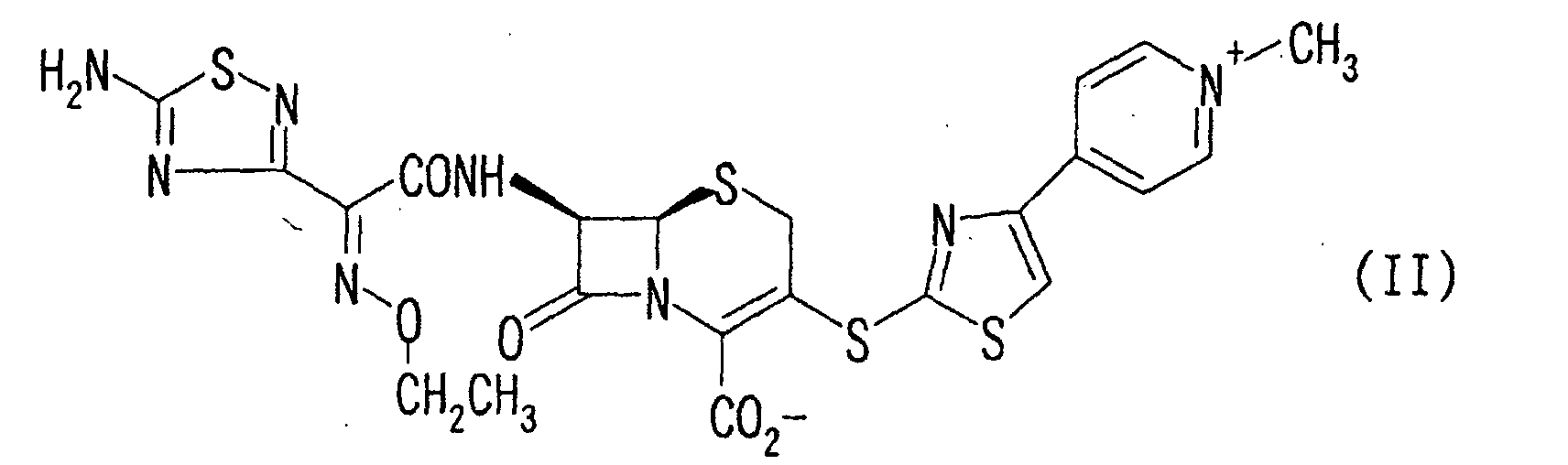
- the compound (I) particularly shows a superior antibacterial activity against staphylococcus and methicillin-resistant staphylococcus aureus (MRSA). It is considered that the compound (I) is converted to a compound represented by the formula: [hereinafter referred to simply as compound (II)] in biological organisms and shows an antibacterial activity.
- the compound (I) (particularly its crystal) shows superior stability and can be parenterally or orally administered as injection, capsule, tablet or granule, like known penicillin preparations and cephalosporin preparations, and is preferably administered particularly as an injection.
- the dose thereof as compound (I) is, for example, generally 0.5-80 mg/day, more preferably 2-40 mg/day, per 1 kg of the body weight of a human or animal infected with the aforementioned pathogenic bacteria, and is generally administered in 2 or 3 times a day in divided doses.
- the crystal of compound (I) and a solvent are generally packaged separately to provide an injection, and the crystal of compound (I) is dissolved in a solvent when in use for administration. It is also possible to administer compound (I) after mixing with a medical infusion solution such as clinical nutrition and the like.
- the injection generally contain a pH adjuster, examples of which include carbonate, phosphate, acetate and citrate of alkaline metal or alkaline earth metal (e.g., carbonates such as sodium carbonate, potassium carbonate, sodium hydrogencarbonate, potassium bicarbonate, calcium carbonate and the like, phosphates such as trisodium phosphate, sodium dihydrogen phosphate, disodium hydrogen phosphate, dipotassium hydrogen phosphate, potassium dihydrogen phosphate, calcium hydrogen phosphate, calcium dihydrogen phosphate and the like, acetates such as sodium acetate, potassium acetate, calcium acetate and the like, citrates such as disodium citrate, sodium citrate, sodium dihydrogen citrate, calcium citrate and the like), basic amino acids (e.g., L-arginine, L-lysin and the like), N-methylglucamine and the like, and of these, an injection containing carbonate of alkaline metal or alkaline earth metal and a basic amino acids (e.
- L-Arginine is particularly preferable.
- Such pH adjusters are used in an amount that makes the pH of the injection solution when in use 4 to 10, preferably 4.5 to 8.5, more preferably 5.0 to 8.0, still preferably 5.0 to 7.5.
- L-arginine is used, it is used in an amount of generally 0.1 equivalent - 5.0 equivalents, preferably 2.0-3.5 equivalents, more preferably 2.5-3.2 equivalents, relative to the active component.
- These pH adjusters are generally packaged in a state in which they are dissolved in a solvent. However, they may be mixed with the crystal of compound (I) and packaged, or may be packaged separately from the crystal of compound (I) and the solvent, and mixed when in use.
- solubilizing agents having reductability include sodium sulfite, sodium hydrosulfite, sodium hydrogen sulfite, sodium pyrosulfite, L-cysteine and the like. These reducing agents are used in an amount of generally 0.001 equivalent - 2.0 equivalents, preferably 0.01-0.5 equivalent, more preferably 0.05-0.2 equivalent, relative to the active component.
- solubilizing agents having reductability are generally packaged in a state in which they are divided in a solvent. However, they may be mixed with the crystal of compound (I), may be mixed with a pH adjuster, or may be packaged separately from the crystal of compound (I), the pH adjuster and the solvent and mixed when in use.
- the content of the crystal of compound (I) in an injection preparation, calculated as compound (Ia), is 100-2000 mg, preferably 200 - 1000 mg.
- the proportion of a solvent in an injection preparation in weight ratio is 10-500, preferably 20-300, relative to the crystal of compound (I) as 1.
- the proportion of a pH adjuster is generally 1.0-3.0 equivalents of pH adjuster relative to 1 equivalent of the crystal of compound (I), calculated as compound (Ia).
- the pharmaceutical composition of the present invention may contain only compound (I), or may contain a carrier generally used for pharmaceutical agents (e.g., solvent and the above-mentioned pH adjuster in the case of injection) and the like.
- a carrier generally used for pharmaceutical agents e.g., solvent and the above-mentioned pH adjuster in the case of injection
- a compound wherein X is CH 3 COOH or CH 3 CH 2 COOH and a crystal thereof are preferable.
- X is CH 3 COOH
- a compound having peaks near diffraction angles of 16.32, 19.06, 19.90, 20.98 and 23.24° in powder X-ray diffraction, and a compound having peaks near diffraction angles of 11.82, 17.16, 17.80, 19.32, 20.00, 21.20, 21.78, 22.94, 24.10 and 27.02° in powder X-ray diffraction are particularly preferable.
- X is CH 3 CH 2 COOH
- a compound having peaks near diffraction angles of 16.30, 18.84, 19.70, 21.80 and 23.18° in powder X-ray diffraction is particularly preferable.
- the "near" in the above-mentioned diffraction angle means ⁇ 0.2°.
- compound (III) and a compound of the formula (IV) are reacted to give a compound of the formula (V) [hereinafter referred to simply as compound (V)].
- the compound (III) is a known compound, and described in, for example, J. Org. Chem. 1989, 54, 4962-4966.
- This reaction is generally carried out in the presence of a solvent, and preferably carried out in an inert solvent such as hydrocarbons (e.g., toluene and the like), esters (e.g., ethyl acetate and the like), ketones (e.g., acetone and the like), halogenated hydrocarbons (e.g., chloroform, dichloromethane and the like), ethers (e.g., diethyl ether, tetrahydrofuran, dioxane and the like), nitriles (e.g., acetonitrile and the like), alcohols (e.g., methanol, ethanol, n-propanol and the like), amides (e.g., dimethylformamide, dimethylacetamide and the like), sulfoxides (e.g., dimethyl sulfoxide and the like), and the like.
- hydrocarbons e.g., toluene and the
- a mixture of 2 or 3 kinds of these solvents may be used as a solvent, and a mixture of the above-mentioned solvent with water can be also used as a solvent.
- tetrahydrofuran, acetonitrile, methanol and the like are preferable, particularly tetrahydrofuran, methanol and a mixture of the two are preferable.
- the amount of compound (IV) to be used is generally 1 to 3 mol, preferably 1 to 2 mol, per 1 mol of compound (III).
- the reaction temperature is from -40°C to 80°C, preferably from -20°C to 50°C.
- the reaction time is 5 min - 12 hr, preferably 30 min - 8 hr.
- a base and a salt can be added to this reaction, which can accelerate the reaction.
- base and salts include inorganic bases such as sodium hydroxide, potassium hydroxide, sodium carbonate, potassium carbonate, sodium hydride and the like, alkoxides such as sodium methoxide, t-butoxypotassium, t-butoxysodium and the like, and organic amines such as trialkylamine (e.g., triethylamine, ethyldiisopropylamine and the like).
- sodium hydroxide and sodium methoxide are preferable.
- quaternary ammonium salt such as tetrabutylammonium salt, and the like are used.
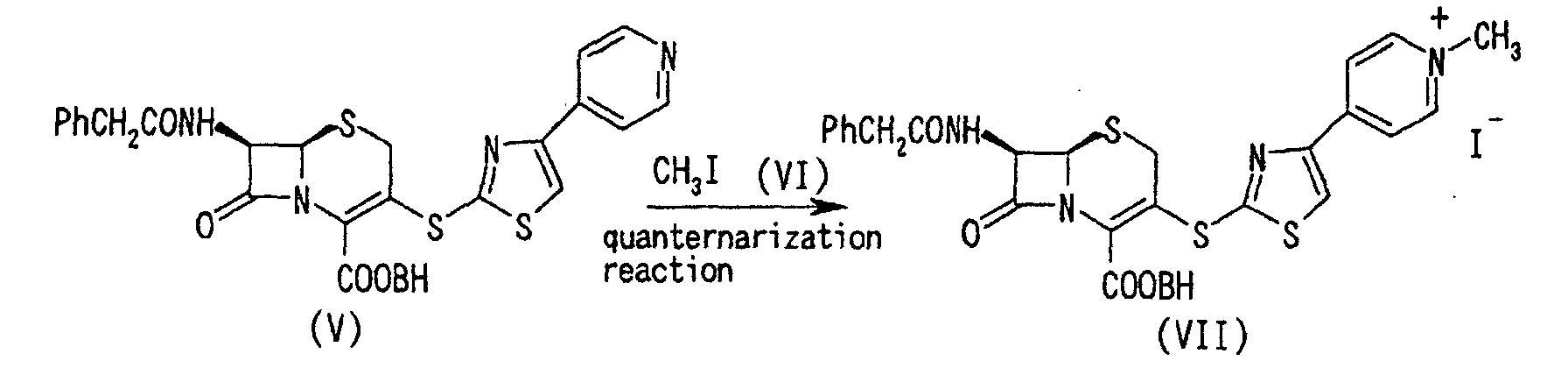
- the compound (VII) can be produced by reacting compound (V) and reagent for forming quaternary ammonium such as iodomethane represented by the formula (VI) [hereinafter referred to simply as compound (VI)] and the like. This reaction is generally carried out in the presence of a solvent.
- the solvent generally include inert solvents such as hydrocarbons (e.g., toluene and the like), ketones (e.g., acetone and the like), halogenated hydrocarbons (e.g., chloroform, dichloromethane and the like), ethers (e.g., diethyl ether, tetrahydrofuran, dioxane and the like), nitriles (e.g., acetonitrile and the like), alcohols (e.g., methanol, ethanol, n-propanol and the like), amides (e.g., dimethylformamide, dimethylacetamide and the like), sulfoxides (e.g., dimethyl sulfoxide and the like) and the like.
- inert solvents such as hydrocarbons (e.g., toluene and the like), ketones (e.g., acetone and the like), halogenated hydrocarbons (e.g.
- a mixture of 2 or 3 kinds of these solvents may be used as a solvent, and a mixture of the above-mentioned solvent with water can be also used as a solvent.
- tetrahydrofuran, dimethylformamide, acetonitrile and dimethyl sulfoxide are preferable, particularly tetrahydrofuran and dimethylformamide are preferable.
- the amount of reagent for forming quaternary ammonium to be used is generally 1-20 mol, preferably 1-10 mol, per 1 mol of compound (V).
- the reaction temperature is from-5°C to 80°C, preferably from 0°C to 50°C.
- the reaction time is 30 min - 48 hr, preferably 2 hr - 20 hr.
- a compound represented by the formula (VIII) [hereinafter referred to simply as compound (VIII)] can be produced by subjecting compound (VII) to deprotection of amino group. This reaction is carried out using 1 - 10 mol, preferably 1 - 5 mol, of phosphorus pentachloride and 1 - 10 mol, preferably 1 - 5 mol, of tertiary amine (e.g., pyridine, N,N-dimethylaniline, picoline, lutidine and the like), relative to compound (VII), which are reacted in an inert solvent and reacting with 2 - 200 mol, preferably 3 - 125 mol, of alcohols (e.g., methanol, ethanol, isobutanol, isopropyl alcohol and the like).
- tertiary amine e.g., pyridine, N,N-dimethylaniline, picoline, lutidine and the like
- Preferable tertiary amine is exemplified by pyridine and N,N-dimethylaniline, and pyridine is particularly preferable.
- Preferable alcohol is exemplified by methanol, ethanol and isobutanol, and methanol and isobutanol are particularly preferable.
- Examples of the inert solvent generally include hydrocarbons (e.g., toluene and the like), esters (e.g., ethyl acetate and the like), ketones (e.g., acetone and the like), halogenated hydrocarbons (e.g., chloroform, dichloromethane and the like), ethers (e.g., diethyl ether, tetrahydrofuran, dioxane and the like), nitriles (e.g., acetonitrile and the like), amides (e.g., dimethylformamide, dimethylacetamide and the like), and sulfoxides (e.g., dimethyl sulfoxide and the like).
- hydrocarbons e.g., toluene and the like
- esters e.g., ethyl acetate and the like
- ketones e.g., acetone and the like
- halogenated hydrocarbons
- a mixture of 2 or 3 kinds of these solvents may be used as a solvent.
- halogenated hydrocarbons such as chloroform, dichloromethane and the like are preferable, and dichloromethane is particularly preferable.
- the reaction temperature is from -40°C to 80°C, preferably from -20°C to 50°C.
- the reaction time is 30 min - 48 hr, preferably 2 hr-24 hr.
- compound (VIII) is subjected to deprotection of carboxyl group to give a compound of the formula (IX) [hereinafter referred to simply as compound (IX)].
- This reaction is generally carried out using an acid in a solvent.
- the solvent generally include inert solvents such as hydrocarbons (e.g., toluene and the like), ketones (e.g., acetone and the like), halogenated hydrocarbons (e.g., chloroform, dichloromethane and the like), ethers (e.g., diethyl ether, tetrahydrofuran, dioxane and the like), nitriles (e.g., acetonitrile and the like), esters (e.g., ethyl acetate and the like), alcohols (e.g., methanol, ethanol, n-propanol and the like), amides (e.g., dimethylformamide, dimethylacetamide
- a mixture of 2 or 3 kinds of these solvents may be used as a solvent.
- halogenated hydrocarbons such as chloroform, dichloromethane and the like, nitriles such as acetonitrile and the like, and esters such as ethyl acetate and the like are preferable, and acetonitrile, ethyl acetate and a mixture of the two are particularly preferable.
- acid hydrochloric acid or trifluoroacetic acid is preferable, and hydrochloric acid is particularly preferable.
- the amount of the acid to be used is 2 - 200 mol, preferably 3 - 50 mol, relative to compound (VIII).
- anisole, phenol and the like are preferably added as a cation scavenger to accelerate the reaction.
- the reaction temperature is from -40°C to 80°C, preferably from -20°C to 50°C.
- the reaction time is 30 min - 48 hr, preferably 2 hr-24 hr.
- the compound (IX) obtained by this production method is generally obtained as an addition salt with one or two acids, and can be taken out from an organic solvent, water or a mixture of the both as a crystal of an addition salt with one or two acids.
- an organic solvent water or a mixture of the both as a crystal of an addition salt with one or two acids.
- the acid of the addition salt with one or two acids mineral acid and organic acid are mentioned. Of these, hydrochloric acid, sulfuric acid and trifluoroacetic acid are preferable, and hydrochloric acid is particularly preferable.
- the organic solvent to be used is exemplified by the aforementioned inert solvents.
- acetonitrile, ethyl acetate, ethanol, dioxane and tetrahydrofuran are preferable, and acetonitrile, ethyl acetate and ethanol are particularly preferable.
- compound (IX) and a compound represented by the formula (X) [hereinafter referred to simply as compound (X)] are reacted to give compound (Ia).
- a crystal of an acid addition salt is preferably used.
- 1 - 5 mol, preferably 1 - 2 mol, of compound (X) is reacted with 1 mol of compound (IX) in the presence of an acid scavenger to capture the acid generated during the reaction, in a solvent that does not inhibit the reaction.
- an acid scavenger for example, tetrahydrofuran, acetonitrile, dioxane, acetone and a mixture of these solvents with water are preferable, and acetonitrile, tetrahydrofuran, a mixture of acetonitrile with water, and a mixture of tetrahydrofuran with water are particularly preferable.
- the acid scavenger examples include ones generally used such as salts (e.g., sodium hydrogencarbonate, sodium carbonate, potassium carbonate, sodium acetate, potassium acetate, sodium phosphate and the like), tertiary amines (e.g., triethylamine, tripropylamine, tributylamine, ethyldiisopropylamine, pyridine, lutidine, N,N-dimethylaniline N-methylpiperidine, N-methylpyrrolidine, N-methylmorpholine and the like), alkylene oxides (e.g., propyleneoxide, epichlorohydrin and the like) and the like. Two or three therefrom may be used in a mixture.
- salts e.g., sodium hydrogencarbonate, sodium carbonate, potassium carbonate, sodium acetate, potassium acetate, sodium phosphate and the like
- tertiary amines e.g., triethylamine, tripropyl
- a combination of sodium hydrogencarbonate, sodium carbonate, sodium acetate, triethylamine or sodium acetate with triethylamine is preferable, and particularly a combination of sodium hydrogencarbonate, sodium acetate, triethylamine or sodium acetate with triethylamine is preferable.
- a dichlorophosphoryl group is successively hydrolyzed into phosphono group.
- the reaction temperature is from -40°C to 80°C, preferably from -20°C to 50°C.
- the reaction time is 20 min - 48 hr, preferably 30 min - 24 hr.
- the compound (X) can be synthesized by the method described in JP-A-11-255772 from the corresponding compound represented by the formula (XI) [hereinafter referred to simply as compound (XI)] and phosphorus pentachloride.
- reaction 1 - 5 mol, preferably 1 to 3 mol, of phosphorus pentachloride is generally reacted with 1 mol of compound (XI) in a solvent.
- a solvent tetrahydrofuran, ethyl acetate, isopropyl ether, dioxane, toluene and a mixture of these are preferable, and tetrahydrofuran, ethyl acetate, isopropyl ether and a mixture of these are particularly preferable.
- the reaction temperature is from -40°C to 60°C, preferably from -10°C to 25°C.
- the reaction time is 10 min - 8 hr, preferably 20 min - 4 hr.
- a general method comprising extraction with water, or a method comprising directly adding a poor solvent or a poor solvent and water to the reaction mixture to obtain precipitated solid
- the poor solvent to be added is preferably toluene, isopropyl ether, n-hexane, cyclohexane or a mixture of these, particularly preferably toluene, isopropyl ether, n-hexane or a mixture of these.
- room temperature means 10-25°C.
- the melting point was measured using YANAKO MP-J3.
- the 1 H-NMR spectrum was measured using tetramethylsilane (CDCl 3 , DMSO- d 6 ) or sodium 3-trimethylsilyl-propionate-2,2,3,3-d 4 (D 2 O) as an internal standard, and using VARIAN Gemini-200 (200 MHz), and all ⁇ values are shown in ppm.
- SHARP UT-204 water bath type
- TAITEC VP-60 horn type
- silica gel for column kieselgel 60 (70-230 mesh, manufactured by Merck & Co., Inc.) was used.
- the column packing material ODS for HPLC was manufactured by YMC Co., Ltd., and Diaion HP-20SS and SP-207 were manufactured by Mitsubishi Chemical Corporation.
- Elution in the column chromatography was carried out while monitoring with TLC (Thin Layer Chromatography) or HPLC.
- TLC Thin Layer Chromatography
- 60F254 manufactured by Merck & Co., Inc. was used as the TLC plate
- the developing solvent a solvent wherein the objective compound is developed in the range of Rf value of 0.1 - 0.8 or a solvent similar thereto, and as the detection method, UV detection method was employed.
- the numeral value in the parenthesis is a mixing ratio in volume of each solvent.
- the % for a solution indicates the number of g (grams) in 100 mL of the solution.
- the symbols mean the following.
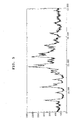
- Fig. 1 a powder X-ray diffraction spectrum (Cu, 40 kV, 50 mA) of the compound obtained in this Example is shown, wherein the transverse axis shows diffraction angle (2 ⁇ ) and the vertical axis shows peak intensity.
- a mixture (108 mL) of distilled water for injection/acetic acid (1:1) was added, the crystals were pulverized and the mixture was stirred at room temperature for 1 hr.
- a mixture (108 mL) of distilled water for injection/acetic acid (1:1) was added, the crystals were pulverized and the mixture was stirred at room temperature for 1 hr.
- the above-mentioned step was repeated, which was followed by standing in a refrigerator overnight.
- the precipitated crystals were collected by filtration, washed twice with a mixture (120 mL) of distilled water for injection/acetic acid (1:1), and 5 times with distilled water for injection (120 mL).
- Fig. 2 a powder X-ray diffraction spectrum (Cu, 40 kV, 50 mA) of the compound obtained in this Example is shown, wherein the transverse axis shows diffraction angle (2 ⁇ ) and the vertical axis shows peak intensity.
- Fig. 3 a powder X-ray diffraction spectrum (Cu, 40 kV, 50 mA) of the compound obtained in this Example is shown, wherein the transverse axis shows diffraction angle (2 ⁇ ) and the vertical axis shows peak intensity.
- Fig. 4 a powder X-ray diffraction spectrum (Cu, 40 kV, 50 mA) of the compound obtained in this Example is shown, wherein the transverse axis shows diffraction angle (2 ⁇ ) and the vertical axis shows peak intensity.
- the precipitated crystals were pulverized, and collected by filtration.
- the obtained crystals were washed 3 times with a mixture (4 mL) of distilled water for injection/acetic acid (1:1), and 5 times with distilled water for injection (4 mL).
- molecular sieves 3A (1/16) as a drying agent, the crystals were dried under reduced pressure until they reached a constant weight. yield: 1.48 g (38%) melting point: 221-223°C (decomposition)
- the precipitated crystals were collected by filtration, and the obtained crystals were washed 3 times with a mixture (4 mL) of distilled water for injection/acetic acid (1:1) and 5 times with distilled water for injection (4 mL). Using molecular sieves 3A (1/16) as a drying agent, the crystals were dried under reduced pressure until they reached a constant weight. yield: 2.01 g (52%)
- the precipitated crystals were pulverized and collected by filtration.
- the obtained crystals were washed 3 times with a mixture (10 mL) of distilled water for injection/acetic acid (1:1) and 5 times with distilled water for injection (10 mL).
- molecular sieves 3A (1/16) as a drying agent, the crystals were dried under reduced pressure until they reached a constant weight. yield: 6.90 g (71%)
- the precipitated crystals were collected by filtration.
- the obtained crystals were washed 3 times with a mixture (10 mL) of distilled water for injection/acetic acid (1:1) and 5 times with distilled water for injection (10 mL).
- molecular sieves 3A (1/16) as a drying agent, the crystals were dried under reduced pressure until they reached a constant weight. yield: 5.55 g (57%)
- the precipitated crystals were collected by filtration.
- the obtained crystals were washed 3 times with a mixture (80 mL) of distilled water for injection/acetic acid (1:1) and 5 times with distilled water for injection (160 mL).
- molecular sieves 3A (1/16) as a drying agent, the crystals were dried under reduced pressure until they reached a constant weight. yield: 50 g (64%)
- the mixture was stirred at room temperature for 30 min, and a seed crystal (0.1 g) was added.
- the mixture was further stirred for 1.5 hr.
- the obtained crystals were collected by filtration, and washed twice with a mixture (50 mL) of distilled water for injection/acetic acid (1:1), twice with a mixture (50 mL) of distilled water for injection/acetic acid (1:4), and once with a mixture (50 mL) of ethanol/acetic acid (1:1).
- the crystals were through-flow dried until they reached a constant weight. yield: 6.53 g (60%)
- the crystals were collected by filtration, and washed with a mixture (100 mL) of distilled water for injection/acetic acid (1:1) and distilled water for injection (200 mL). The crystals were dried in vacuo until they reached a constant weight. yield: 7.02 g (68.8%)
- Fig. 5 a powder X-ray diffraction spectrum (Cu, 40 kV, 50 mA) of the compound obtained in this Example is shown, wherein the transverse axis shows diffraction angle (2 ⁇ ) and the vertical axis shows peak intensity.
- Benzhydryl 7 ⁇ -phenylacetylamino-3-[4-(4-pyridyl)-2-thiazolylthio]-3-cephem-4-carboxylate (4.15 g, 6.0 mmol) was dissolved in dichloromethane (60 mL) and pyridine (0.726 mL, 9.0 mmol) and phosphorus pentachloride (1.87 g, 9.0 mmol) were successively added under ice-cooling. The mixture was stirred under ice-cooling for 1 hr. Isobutanol (8.0 mL) was added at once to the reaction mixture, and the mixture was stirred at room temperature for 1 hr.
- Isopropyl ether 300 mL was added dropwise and the mixture was stirred for 10 min. The solvent was removed by decantation. The residual oil was suspended in ethyl acetate (600 mL) and saturated aqueous sodium hydrogencarbonate solution (200 mL) was added dropwise, after which the mixture was stirred for 15 min. The organic layer was separately taken, dried over magnesium sulfate and filtrated. The solvent was evaporated off under reduced pressure. Isopropyl ether (60 mL) was added to the residue, and the precipitated powder was collected by filtration, washed with isopropyl ether (20 mL) and dried under reduced pressure.
- Benzhydryl 7 ⁇ -amino-3-[4-(4-pyridyl)-2-thiazolylthio-3-cephem-4-carboxylate (3.0 g, 5.37 mmol) was suspended in tetrahydrofuran (40 mL) and dibutyl dicarbonate (2.34 g, 10.7 mmol) was added. The mixture was stirred at room temperature for 18 hr and concentrated under reduced pressure. The residue was dissolved in ethyl acetate (30 mL) and applied to silica gel column (30 g). The fractions containing the title compound eluted with ethyl acetate were collected, and the solvent was evaporated off under reduced pressure.
- Phosphorus pentachloride (312 g, 1.44 mol) was suspended in dichloromethane (2.8 L), and pyridine (115 g, 1.44 mol) was added dropwise under ice-cooling over 10 min. The mixture was stirred for 30 min. Then, a powder (400 g, 0.48 mol) of benzhydryl 7 ⁇ -[(phenylacetyl)amino]-3-[4-(1-methyl-4-pyridinio)-2-thiazolylthio]-3-cephem-4-carboxylate iodide was added over 10 min and the mixture was stirred for 1 hr. The reaction mixture was cooled to -10°C and isobutyl alcohol (5.6 L) was added.
- Phosphorus pentachloride (31.2 g, 144 mmol) was suspended in dichloromethane (250 mL) and pyridine (11.5 g, 144 mmol) was added dropwise under ice-cooling over 10 min. The mixture was stirred for 30 min. Then, a powder (41.7 g, 48 mmol) of benzhydryl 7 ⁇ -[(phenylacetyl)amino]-3-[4-(1-methyl-4-pyridinio)-2-thiazolylthio]-3-cephem-4-carboxylate iodide was added over 10 min, and the mixture was stirred for 1 hr.
- the reaction mixture was cooled to -10°C and isobutyl alcohol (250 mL) was added. The mixture was stirred at 25°C for 3 hr. The reaction mixture was concentrated to about 100 mL and acetonitrile (250 mL) and then conc . hydrochloric acid (250 mL) were added. The mixture was stirred at 40°C for 2 hr. The precipitate was collected by filtration, washed with acetonitrile (100 mL x 2), and dried in vacuo to give the title compound (14.5 g, 0.30 mol). yield: 63%.
- Lyophilized product (5.8 g, 14.3 mmol) of 7 ⁇ -amino-3-[4-(1-methyl-4-pyridinio)-2-thiazolylthio]-3-cephem-4-carboxylate was dissolved in water (290 mL) and IN hydrochloric acid was added under ice-cooling to adjust pH to 1.3. The solution was concentrated to about 30 mL under reduced pressure, and ethanol (70 mL) was gradually added under ice-cooling with shaking. The mixture was stood under ice-cooling for 2 hr. The precipitated crystals were collected by filtration, washed with ethanol/water (5:1, 30 mL) and dried under reduced pressure.
- Phosphorus pentachloride (1.46 g, 7.0 mmol) was suspended in ethyl acetate (4.17 mL) and the mixture was stirred under ice-cooling for 5 min.
- 2-(5-Amino-1,2,4-thiadiazol-3-yl)-2(Z)-ethoxyiminoacetic acid 600 mg, 2.77 mmol was added at once with stirring under ice-cooling for dissolution.
- the mixture was stirred under ice-cooling for 30 min.
- the reaction mixture was diluted with toluene (16.8 mL) under ice-cooling for dissolution.
- Phosphorus pentachloride (78 g, 375 mmol) was suspended in ethyl acetate (225 mL) and 2-(5-amino-1,2,4-thiadiazol-3-yl)-2(Z)-ethoxyiminoacetic acid (32.4 g, 150 mmol) was added with stirring under ice-cooling. The mixture was stirred under ice-cooling for 30 min. The reaction mixture was diluted with toluene (900 mL) under ice-cooling for dissolution. To this solution was added saturated brine (600 mL) cooled to not higher than -5°C, and the mixture was stirred under ice-cooling for 10 min.
- the reaction mixture was transferred to a separating funnel and the organic layer was separately taken. The organic layer was dried over magnesium sulfate. After filtration, the mother liquor was evaporated off under reduced pressure (crystals precipitated). Diisopropyl ether (300 mL) was added and the crystals were pulverized with a spatula. The mixture was stirred under ice-cooling for 30 min and stood for 30 min. The precipitated crystals were collected by filtration, washed with diisopropyl ether (20 mL) and dried under reduced pressure.
- the precipitated crystals were collected by filtration under a nitrogen stream, washed with diisopropyl ether/n-hexane (1:2, 2.0 L) and n-hexane (2.0 L) and dried by through-flow under a nitrogen stream. yield: 876.0 g (49.7%)
- Disodium 3-[4-(1-methyl-4-pyridinio)-2-thiazolylthio]-7 ⁇ -[2-(5-phosphonateamino-1,2,4-thiadiazol-3-yl)-2(Z)-ethoxyiminoacetamido]-3-cephem-4-carboxylate (1.43 g, 1.96 mmol) was gradually dissolved in 1%(v/v) aqueous acetic acid (14 mL) at room temperature. The solution was filled in an SP-207 column (60 mL).
- Disodium 3-[4-(1-methyl-4-pyridinio)-2-thiazolylthio]-7 ⁇ -[2-(5-phosphonateamino-1,2,4-thiadiazol-3-yl)-2(Z)-ethoxyiminoacetamido]-3-cephem-4-carboxylate (128 g, 1.96 mmol) was gradually dissolved in 1%(v/v) aqueous acetic acid (1.28 L) at room temperature. The solution was filled in an SP-207 column (2.5 L).
- Activated carbon (15.3 g) was added to an aqueous solution (1.89 kg, content 16.1%, 0.419 mol) of disodium 3-[4-(1-methyl-4-pyridinio)-2-thiazolylthio]-7 ⁇ -[2-(5-phosphonateamino-1,2,4-thiadiazol-3-yl)-2(Z)-ethoxyiminoacetamido]-3-cephem-4-carboxylate and the mixture was stirred. After filtering off the activated carbon, the residue was washed with water. Water was added to the filtrate to 3.96 kg. Acetic acid (95.0 mL, 1.68 mol) was added and ethanol (4 L) was added.
- Benzhydryl 7 ⁇ -[(phenylacetyl)amino]-3-[(methylsulfonyl)oxy]-3-cephem-4-carboxylate (900 g, 1.56 mol) was dissolved in tetrahydrofuran (3.6 L) and cooled to -3°C. While maintaining the same temperature, 28% sodium methylate-methanol solution (360 g, 1.87 mol) of 4-(4-pyridyl)-1,3-thiazole-2-thiol (362.5 g, 1.87 mol) obtained in the same manner as in Reference Example 29, and tetrahydrofuran (720 mL) solution were added. The mixture was stirred for 1.5 hr.
- L-Arginine (81.4 mg, 3.2 equivalents) and sodium sulfite (1.8 mg, 0.1 equivalent) were added to 3-[4-(1-methyl-4-pyridinio)-2-thiazolylthio]-7 ⁇ -[2-(5-phosphonoamino-1,2,4-thiadiazol-3-yl)-2(Z)-ethoxyiminoacetamido]-3-cephem-4-carboxylate•acetic acid solvate (113.4 mg), and filled in a 13P vial. The space was substituted by low humidity air to give a pharmaceutical preparation.
- the obtained formulation was dissolved in a physiological saline solution (2 mL), which remained clear for 24 hr.
- the obtained pharmaceutical preparation was subjected to a stability test.
- the formulation was stable as shown by the results in Table 1.
- Preservation conditions Remaining ratio Dissolution state 60°C ⁇ 2 weeks 97.7% clear 60°C ⁇ 4 weeks 96.4% clear 40°C/75%RH ⁇ 1 month 99.6% clear 40°C/75%RH x 2 months 95.8% clear 25°C ⁇ 1 month 100.4% clear 25°C ⁇ 2 months 98.0% clear
- L-Arginine (763.3 mg, 3.0 equivalents) and sodium sulfite (18.4 mg, 0.1 equivalent) were added to 3-[4-(1-methyl-4-pyridinio)-2-thiazolylthio]-7 ⁇ -[2-(5-phosphonoamino-1,2,4-thiadiazol-3-yl)-2(Z)-ethoxyiminoacetamido]-3-cephem-4-carboxylate•acetic acid solvate (1.135 g) and filled in a 35K vial. The space was substituted by low humidity air to give a pharmaceutical preparation.
- the obtained formulation was dissolved in a physiological saline solution (10 mL), which remained clear for 24 hr.
- L-arginine 763.3 mg, 3.0 equivalents
- sodium sulfite 18.4 mg, 0.1 equivalent
- Example 14 The above-mentioned formulation was dissolved with the sole use solvent. The solution remained clear for 24 hr after dissolution, showing the same level of quality of injection as in Example 14.
- the compound (particularly crystal) of the present invention shows high solid stability and can be used as an antibacterial agent (particularly anti-MRSA agent) having superior quality, such as possible long-term stable preservation and the like.
Landscapes
- Health & Medical Sciences (AREA)
- Chemical & Material Sciences (AREA)
- Organic Chemistry (AREA)
- Life Sciences & Earth Sciences (AREA)
- General Health & Medical Sciences (AREA)
- Biochemistry (AREA)
- Medicinal Chemistry (AREA)
- Pharmacology & Pharmacy (AREA)
- Public Health (AREA)
- Veterinary Medicine (AREA)
- Molecular Biology (AREA)
- Animal Behavior & Ethology (AREA)
- Epidemiology (AREA)
- Nuclear Medicine, Radiotherapy & Molecular Imaging (AREA)
- General Chemical & Material Sciences (AREA)
- Chemical Kinetics & Catalysis (AREA)
- Oncology (AREA)
- Communicable Diseases (AREA)
- Pharmaceuticals Containing Other Organic And Inorganic Compounds (AREA)
- Cephalosporin Compounds (AREA)
- Agricultural Chemicals And Associated Chemicals (AREA)
Abstract
Description






particularly tetrahydrofuran, methanol and a mixture of the two are preferable. The amount of compound (IV) to be used is generally 1 to 3 mol, preferably 1 to 2 mol, per 1 mol of compound (III). The reaction temperature is from -40°C to 80°C, preferably from -20°C to 50°C. The reaction time is 5 min - 12 hr, preferably 30 min - 8 hr. Where necessary, a base and a salt can be added to this reaction, which can accelerate the reaction. Examples of such base and salts include inorganic bases such as sodium hydroxide, potassium hydroxide, sodium carbonate, potassium carbonate, sodium hydride and the like, alkoxides such as sodium methoxide, t-butoxypotassium, t-butoxysodium and the like, and organic amines such as trialkylamine (e.g., triethylamine, ethyldiisopropylamine and the like). Of these, sodium hydroxide and sodium methoxide are preferable. As the salt, quaternary ammonium salt such as tetrabutylammonium salt, and the like are used.

melting point: 221-223°C (decomposition)
melting point: 221-223°C (decomposition)
Anal Calcd for C24H25N8O10S4P•1.0H2O: C 37.79, H 3.57, N 14.69, P 4.06. Found: C 37.97, H 3.30, N 14.37, P 3.88.
1H-NMR (DMSO-d 6) δ: 1.24 (3H,t,J=7Hz), 1.91 (3H,s), 3.58, 3.95 (2H,ABq,J=17Hz), 4.17 (2H,q,J=7Hz), 4.34 (3H,s), 5.32 (1H,d,J=5Hz), 5.92 (1H,dd,J=5&8Hz), 8.51 (2H,d,J=6Hz), 8.99 (3H,m), 9.30 (1H,m), 9.70 (1H,d,J=8Hz).
IR (KBr) cm-1: 3202, 1755, 1668, 1645, 1537, 1392, 1273, 1039.
melting point: 221-223°C (decomposition)
Anal Calcd for C24H25N8O10S4P•1.0H2O: C 37.79, H 3.57, N 14.69, P 4.06. Found: C 37.97, H 3.30, N 14.37, P 3.88.
1H-NMR (DMSO-d 6) δ: 1.24 (3H,t,J=7Hz), 1.91 (3H,s), 3.58, 3.95 (2H,ABq,J=17Hz), 4.17 (2H,q,J=7Hz), 4.34 (3H,s), 5.32 (1H,d,J=5Hz), 5.92 (1H,dd,J=5&8Hz), 8.51 (2H,d,J=6Hz), 8.99 (3H,m), 9.30 (1H,m), 9.70 (1H,d,J=8Hz).
IR (KBr) cm-1: 3202, 1755, 1668, 1645, 1537, 1392, 1273, 1039.
melting point: 221-223°C (decomposition)
Anal Calcd for C24H25N8O10S4P•1.0H2O: C 37.79, H 3.57, N 14.69, P 4.06. Found: C 37.97, H 3.30, N 14.37, P 3.88.
1H-NMR (DMSO-d 6) δ: 1.24 (3H,t,J=7Hz), 1.91 (3H,s), 3.58, 3.95 (2H,ABq,J=17Hz), 4.17 (2H,q,J=7Hz), 4.34 (3H,s), 5.32 (1H,d,J=5Hz), 5.92 (1H,dd,J=5&8Hz), 8.51 (2H,d,J=6Hz), 8.99 (3H,m), 9.30 (1H,m), 9.70 (1H,d,J=8Hz).
IR (KBr) cm-1: 3202, 1755, 1668, 1645, 1537, 1392, 1273, 1039.
melting point: 221-223°C (decomposition)
Anal Calcd for C24H25N8O10S4P•1.0H2O: C 37.79, H 3.57, N 14.69, P 4.06. Found: C 37.97, H 3.30, N 14.37, P 3.88.
1H-NMR (DMSO-d 6) δ: 1.24 (3H,t,J=7Hz), 1.91 (3H,s), 3.58, 3.95 (2H,ABq,J=17Hz), 4.17 (2H,q,J=7Hz), 4.34 (3H,s), 5.32 (1H,d,J=5Hz), 5.92 (1H,dd,J=5&8Hz), 8.51 (2H,d,J=6Hz), 8.99 (3H,m), 9.30 (1H,m), 9.70 (1H,d,J=8Hz).
IR (KBr) cm-1: 3202, 1755, 1668, 1645, 1537, 1392, 1273, 1039.
melting point: 227-230°C (decomposition)
Anal Calcd for C25H27N8O10S4P•1.0H2O: C 38.66, H 3.76, N 14.16. Found: C 38.51, H 3.76, N 14.16.
1H-NMR (DMSO-d 6) δ: 0.99 (3H,t,J=7.6Hz), 1.24 (3H,t,J=7Hz), 2.21 (2H,q,J=7.6Hz), 3.59, 3.95 (2H,ABq,J=18Hz), 4.17 (2H,q,J=7Hz), 4.33 (3H,s), 5.31 (1H,d,J=5Hz), 5.91 (1H,dd,J=5&8Hz), 8.52, 8.98 (each 2H,d,J=6Hz), 9.00 (1H,s), 9.24 (1H,m), 9.68 (1H,d,J=8Hz).
IR (KBr) cm-1: 3088, 1757, 1668, 1537, 1392, 1234, 1190, 1043.
1H-NMR (DMSO-d 6) δ: 1.23 (3H,t,J=7Hz), 2.07 (3H,s), 3.58, 3.95 (2H,ABq,J=17Hz), 4.17 (2H,q,J=7Hz), 4.33 (3H,s), 5.32 (1H,d,J=5Hz), 5.91 (1H,dd,J=5&8Hz), 8.51 (2H,d,J=6Hz), 8.99 (3H,m), 9.34 (1H,m), 9.71 (1H,d,J=8Hz).
1H-NMR (DMSO-d6:D2O = 8:2) δ: 1.27 (3H,t,J=7Hz), 3.40, 3.89 (2H,ABq,J=17Hz), 4.24 (2H,q,J=7Hz), 4.30 (3H,s), 5.23 (1H,d,J=5Hz), 5.79 (1H,d,J=5Hz) 8.37, 8.77 (each 2H,d,J=7Hz), 8.66 (1H,s).
IR (KBr) cm-1: 3184, 1761, 1643, 1614, 1537, 1390, 1346, 1190, 1041.
melting point: 217-222°C (decomposition)
1H-NMR (DMSO-d 6:D2O = 8:2) δ: 1.27 (3H,t,J=7Hz), 3.40, 3.89 (2H,ABq,J=17Hz), 4.24 (2H,q,J=7Hz), 4.30 (3H,s), 5.23 (1H,d,J=5Hz), 5.79 (1H,d,J=5Hz), 8.37, 8.77 (each 2H,d,J=7Hz), 8.66 (1H,s).
IR (KBr) cm-1: 3184, 1761, 1643, 1614, 1537, 1390, 1346, 1190, 1041.
melting point: 221-223°C (decomposition)
Anal Calcd for C24H25N8O10S4P•1.0H2O: C 37.79, H 3.57, N 14.69, P 4.06. Found: C 37.97, H 3.30, N 14.37, P 3.88.
1H-NMR (DMSO-d 6) δ: 1.24 (3H,t,J=7Hz), 1.91 (3H,s), 3.58, 3.95 (2H,ABq,J=17Hz), 4.17 (2H,q,J=7Hz), 4.34 (3H,s), 5.32 (1H,d,J=5Hz), 5.92 (1H,dd,J=5&8Hz), 8.51 (2H,d,J=6Hz), 8.99 (3H,m), 9.30 (1H,m), 9.70 (1H,d,J=8Hz).
IR (KBr) cm-1: 3202, 1755, 1668, 1645, 1537, 1392, 1273, 1039.
1H-NMR (DMSO-d 6) δ: 3.51, 3.77 (2H,ABq,J=18Hz), 4.82 (1H,d,J=5Hz), 5.02 (1H,d,J=5Hz), 7.01 (1H,s), 7.2-7.5 (10H,m), 7.71 (1H,s), 7.73, 8.68 (each 2H,d,J=6Hz).
1H-NMR (CDCl3) δ: 1.45 (9H,s), 3.51, 3.74 (2H,ABq,J=18Hz), 5.04 (1H,d,J=5Hz), 5.40 (1H,d,J=10Hz), 5.69 (1H,dd,J=5&10Hz), 7.00 (1H,s), 7.1-7.5 (10H,m), 7.70-7.74 (3H,m), 8.67 (2H,d,J=6Hz).
1H-NMR (DMSO-d 6) δ: 1.41 (9H,s), 3.68, 3.97 (2H,ABq,J=18Hz), 4.34 (3H,s), 5.29 (1H,d,J=5Hz), 5.67 (1H,dd,J=5&8.6Hz), 6.96 (1H,s), 7.1-7.5 (10H,m), 8.16 (1H,d,J=8.6Hz), 8.53, 9.00 (each 2H,d,J=6.6Hz), 9.02 (1H,s).
1H-NMR (DMSO-d 6) δ: 3.82, 3.96 (2H,ABq,J=18Hz), 4.35 (3H,s), 5.27 (1H,d,J=5Hz), 5.40 (1H,d,J=5Hz), 8.61, 9.06 (each 2H,d,J=6Hz), 9.16 (1H,s).
melting point: 272°C (decomposition).
Anal Calcd for C8H5N2S2Na•0.75H2O: C 41.82, H 2.85, N 12.19. Found: C 41.78, H 2.98, N 12.11.
1H-NMR(DMSO-d 6)δ:7.35 (1H,s), 7.71 (2H,d,J=6.2Hz), 8.48 (2H,d,J=6.2Hz).
melting point: 157°C.
Anal Calcd for C29H26N2O7S2: C 60.19, H 4.53, N 4.84, S 11.08. Found: C 59.86, H 4.72, N 4.73, S 10.77.
1H-NMR(CDCl3)δ:2.79 (3H,s), 3.48-3.75 (4H,m), 5.02 (1H,d,J=5.2Hz), 5.90 (1H,dd,J=5.2Hz,8.8Hz), 6.24 (1H,d,J=8.8Hz), 6.93 (1H,s), 7.24-7.41 (15H,m)
Anal Calcd for C36H28N4O4S3•0.5H2O: C 63.05, H 4.11, N 8.17, S 14.02. Found: C 63.16, H 4.15, N 8.27, S 13.98.
1H-NMR(CDCl3)δ:3.41-3.73 (4H,m), 5.02 (1H,d,J=4.8Hz), 5.84 (1H,dd,J=4.8Hz,8.8Hz), 6.23 (1H,d,J=8.8Hz) 6.97 (1H,s), 7.27-7.72 (17H,m), 7.73 (1H,s), 8.67 (1H,d,J=6.2Hz).
1H-NMR(CDCl3)δ:3.58 (2H,dd,J=4.8Hz,6.6Hz), 3.74 (2H,brs), 4.35 (3H,s), 5.11 (1H,d,J=4.8Hz), 5.89 (1H,d,J=4.8Hz), 6.95 (1H,s), 7.18-7.42 (15H,m), 8.30 (2H,d,J=6.6Hz), 8.41 (1H, s), 8.75 (2H,d,J=6.6Hz).
1H-NMR(DMSO-d 6)δ:3.94 (2H,brs), 4.35 (3H,s), 5.32 (1H,d,J=5.0Hz), 5.45 (1H,d,J=5.0Hz), 6.99 (1H,s), 7.25-7.40 (10H,m), 8.59 (2H,d,J=7.0Hz), 9.07 (2H,d,J=7.0Hz), 9.19 (1H,s).
melting point: 202°C (decomposition)
Anal Calcd for C16H14N4O3S3•2HCl: C 40.08, H 3.36, N 11.69, S 20.07. Found: C 39.83, H 3.43, N 11.78, S 20.03.
1H-NMR(DMSO-d 6)δ:3.90 (2H,dd,J=17.2Hz,17.6Hz), 4.35 (3H,s), 5.26 (1H,d,J=5.0Hz), 5.42 (1H,d,J=5.0Hz), 8.61 (2H,d,J=7.0Hz), 9.05 (2H,d,J=7.0Hz), 9.17 (1H,s).
melting point: 120-140°C (decomposition)
Anal Calcd for C16H15N4O3S3Cl•3.0H2O: C 38.67, H 4.26, N 11.27, Cl 8.00. Found: C 38.58, H 3.92, N 11.26, Cl 8.18.
1H-NMR (D2O) δ: 3.64, 3.99 (2H,ABq,J=18Hz), 4.37 (3H,s), 5.23 (1H,d,J=5Hz), 5.44 (1H,d,J=5Hz), 8.31, 8.76 (each 2H,d,J=7Hz), 8.51(1H,S).
IR (KBr) cm-1: 3400, 1800, 1770, 1640, 1530, 1405, 1330, 1190, 1020.
Anal Calcd for C6H6N4O3SCl3P: C 20.50, H 1.72, N 15.94, P 8.81. Found: C 20.52, H 1.77, N 15.99, P 8.90.
1H-NMR (CDCl3) δ: 1.42 (3H,t,J=7Hz), 4.45 (2H,q,J=7Hz), 8.81 (1H,br s).
IR (KBr) cm-1: 3063, 2984, 1784, 1593, 1223, 1057.
melting point: 116-119°C
Anal Calcd for C6H6N4O3SCl3P: C 20.50, H 1.72, N 15.94, P 8.81. Found: C 20.52, H 1.77, N 15.99, P 8.90.
1H-NMR (CDCl3) δ: 1.42 (3H,t,J=7Hz), 4.45 (2H,q,J=7Hz), 8.81 (1H,br s).
IR (KBr) cm-1: 3063, 2984, 1784, 1593, 1223, 1057.
Anal Calcd for C22H21N8O8S4P•2.0H2O: C 36.66, H 3.50, N 15.55, P 4.30. Found: C 36.94, H 3.46, N 15.57, P 3.95.
1H-NMR (DMSO-d 6) δ: 1.23 (3H,t,J=7Hz), 3.58, 3.94 (2H,ABq,J=18Hz), 4.17 (2H,q,J=7Hz), 4.33 (3H,s), 5.32 (1H,d,J=5Hz), 5.90 (1H,dd,J=5&8Hz), 8.51 (2H,d,J=6Hz), 8.99 (3H,m), 9.30 (1H,m), 9.70 (1H,d,J=8Hz).
IR (KBr) cm-1: 3055, 1778, 1682, 1643, 1520, 1385, 1190, 1038.
Anal Calcd for C22H21N8O8S4P•2.0H2O: C 36.66, H 3.50, N 15.55, P 4.30. Found: C 36.94, H 3.46, N 15.57, P 3.95.
1H-NMR (DMSO-d 6) δ: 1.23 (3H,t,J=7Hz), 3.58, 3.94 (2H,ABq,J=18Hz), 4.17 (2H,q,J=7Hz), 4.33 (3H,s), 5.32 (1H,d,J=5Hz), 5.90 (1H,dd,J=5&8Hz), 8.51 (2H,d,J=6Hz), 8.99 (3H,m), 9.30 (1H,m) 9.70 (1H.d.J=8Hz).
IR (KBr) cm-1: 3055, 1778, 1682, 1643, 1520, 1385, 1190, 1038.
| Preservation conditions | Remaining ratio | Dissolution state |
| 60°C × 2 weeks | 97.7% | clear |
| 60°C × 4 weeks | 96.4% | clear |
| 40°C/75%RH × 1 month | 99.6% | clear |
| 40°C/75%RH x 2 months | 95.8% | clear |
| 25°C × 1 month | 100.4% | clear |
| 25°C × 2 months | 98.0% | clear |
| Autoclave treatment | L-Arginine | Sodium sulfite content | Dissolution state |
| applied | 100.2% | 99.8% | clear |
| none | 99.0% | 99.0% | clear |
Claims (16)
- A compound of the formula:wherein X is CH3COOH, CH3CH2COOH or CH3CN, and n is 0 to 5.
- The compound of claim 1, which is in the form of a crystal.
- The compound of claim 1, wherein n is 1.
- The compound of claim 1 or 2, wherein X is CH3COOH.
- The compound of claim 4, having peaks near diffraction angles of 16.32, 19.06, 19.90, 20.98 and 23.24° in powder X-ray diffraction.
- The compound of claim 4, having peaks near diffraction angles of 11.82, 17.16, 17.80, 19.32, 20.00, 21.20, 21.78, 22.94, 24.10 and 27.02° in powder X-ray diffraction.
- The compound of claim 1 or 2, wherein X is CH3CH2COOH.
- The compound of claim 7, having peaks near diffraction angles of 16.30, 18.84, 19.70, 21.80 and 23.18° in powder X-ray diffraction.
- A pharmaceutical composition, comprising the compound of claim 1 or 2.
- The pharmaceutical composition of claim 9, which is an antibacterial agent.
- A production method of a crystal of a compound represented by the formula:wherein X is CH3COOH, CH3CH2COOH or CH3CN, and n is 0 to 5, which comprises mixing [i] a compound represented by the formula:
 [ii] CH3COOH, CH3CH2COOH or CH3CN and [iii] water, dissolving them and allowing crystallization to take place.
- The production method of claim 11, wherein the proportion (volume ratio) to be used of CH3COOH, CH3CH2COOH or CH3CN :
water is 1 : 0.1 - 10. - A crystal obtained by mixing [i] a compound represented by the formula:[ii] CH3COOH, CH3CH2COOH or CH3CN and [iii] water, dissolving them and allowing crystallization to take place.
- A disodium salt of a compound represented by the formula:
- The disodium salt of claim 14, which is in the form of a crystal.
- The disodium salt of claim 14 or 15, having peaks near diffraction angles of 17.02, 18.94, 22.86, 23.36 and 26.48° in powder X-ray diffraction
Priority Applications (2)
| Application Number | Priority Date | Filing Date | Title |
|---|---|---|---|
| EP08075636A EP2020416A1 (en) | 2000-08-10 | 2001-08-10 | Phosphonocephem compound |
| CY20091100867T CY1109313T1 (en) | 2000-08-10 | 2009-08-12 | A PHOSPHONEKEPEMIUM UNION |
Applications Claiming Priority (5)
| Application Number | Priority Date | Filing Date | Title |
|---|---|---|---|
| JP2000247966 | 2000-08-10 | ||
| JP2000247966 | 2000-08-10 | ||
| JP2000354959 | 2000-11-21 | ||
| JP2000354959 | 2000-11-21 | ||
| PCT/JP2001/006904 WO2002014333A1 (en) | 2000-08-10 | 2001-08-10 | Phosphonocephem compound |
Related Child Applications (1)
| Application Number | Title | Priority Date | Filing Date |
|---|---|---|---|
| EP08075636A Division EP2020416A1 (en) | 2000-08-10 | 2001-08-10 | Phosphonocephem compound |
Publications (3)
| Publication Number | Publication Date |
|---|---|
| EP1310502A1 true EP1310502A1 (en) | 2003-05-14 |
| EP1310502A4 EP1310502A4 (en) | 2007-08-01 |
| EP1310502B1 EP1310502B1 (en) | 2009-05-20 |
Family
ID=26598061
Family Applications (2)
| Application Number | Title | Priority Date | Filing Date |
|---|---|---|---|
| EP08075636A Withdrawn EP2020416A1 (en) | 2000-08-10 | 2001-08-10 | Phosphonocephem compound |
| EP01955659A Expired - Lifetime EP1310502B1 (en) | 2000-08-10 | 2001-08-10 | Phosphonocephem compound |
Family Applications Before (1)
| Application Number | Title | Priority Date | Filing Date |
|---|---|---|---|
| EP08075636A Withdrawn EP2020416A1 (en) | 2000-08-10 | 2001-08-10 | Phosphonocephem compound |
Country Status (13)
| Country | Link |
|---|---|
| US (2) | US6906055B2 (en) |
| EP (2) | EP2020416A1 (en) |
| KR (1) | KR100826487B1 (en) |
| CN (1) | CN1189471C (en) |
| AT (1) | ATE431827T1 (en) |
| AU (1) | AU2001277753A1 (en) |
| CA (1) | CA2418614C (en) |
| CY (1) | CY1109313T1 (en) |
| DE (1) | DE60138760D1 (en) |
| DK (1) | DK1310502T3 (en) |
| ES (1) | ES2323759T3 (en) |
| PT (1) | PT1310502E (en) |
| WO (1) | WO2002014333A1 (en) |
Cited By (8)
| Publication number | Priority date | Publication date | Assignee | Title |
|---|---|---|---|---|
| EP2200618A1 (en) | 2007-09-21 | 2010-06-30 | AstraZeneca AB | Soluble dosage forms containing cephem derivatives suitable for parenteral administration |
| EP2328569A4 (en) * | 2008-08-28 | 2012-12-26 | Forest Lab Holdings Ltd | Compositions and methods of treatment comprising ceftaroline |
| WO2013034718A1 (en) | 2011-09-09 | 2013-03-14 | Sandoz Ag | Novel process for preparing ceftaroline fosamil |
| WO2014060202A1 (en) | 2012-10-19 | 2014-04-24 | Sandoz Ag | Novel process for preparing ceftaroline fosamil |
| WO2014096176A1 (en) * | 2012-12-20 | 2014-06-26 | Sandoz Ag | Novel crystalline forms of ceftaroline fosamil |
| WO2016066631A1 (en) | 2014-10-28 | 2016-05-06 | Sandoz Ag | Pharmaceutical composition consisting of ceftaroline fosamil acetic acid solvate particles and arginine particles, both having a specific particle size distribution |
| WO2016128580A1 (en) * | 2015-02-13 | 2016-08-18 | Fresenius Kabi Anti-Infectives Srl | Cephalosporin intermediate and process for its preparation |
| CN108440566A (en) * | 2018-01-04 | 2018-08-24 | 北京满格医药科技有限公司 | A kind of process for purification of Ceftaroline Fosamil intermediate 1 |
Families Citing this family (26)
| Publication number | Priority date | Publication date | Assignee | Title |
|---|---|---|---|---|
| PT1310502E (en) * | 2000-08-10 | 2009-07-31 | Takeda Pharmaceutical | Phosphonocephem compound |
| AT501931B1 (en) * | 2004-12-10 | 2007-08-15 | Chemiefaser Lenzing Ag | CELLULOSE STAPLE FIBER AND ITS USE |
| US20070238720A1 (en) * | 2005-05-10 | 2007-10-11 | Hopkins Scott J | Method for reducing the risk of or preventing infection due to surgical or invasive medical procedures |
| US20070249577A1 (en) * | 2005-05-10 | 2007-10-25 | Hopkins Scott J | Method for reducing the risk of or preventing infection due to surgical or invasive medical procedures |
| US20070238719A1 (en) * | 2005-05-10 | 2007-10-11 | Hopkins Scott J | Method for reducing the risk of or preventing infection due to surgical or invasive medical procedures |
| US8247400B2 (en) * | 2009-02-23 | 2012-08-21 | Dedhiya Mahendra G | Cephem compounds useful for the treatment of bacterial infections |
| WO2011035305A1 (en) * | 2009-09-21 | 2011-03-24 | Forest Laboratories Holdings Limited | Compositions and methods for treating bacterial infections using ceftaroline |
| FR2951171A1 (en) * | 2009-10-09 | 2011-04-15 | Novexel | NOVEL SODIUM SALT OF A CRYSTALLIZED ENANTIOMER AZABICYCLIC COMPOUND AND NOVEL POLYMORPHIC AND PSEUDOPOLYMORPHIC FORMS AND THEIR PREPARATION |
| US8829191B2 (en) | 2011-06-17 | 2014-09-09 | Melanie Simone Ronsheim | Processes for preparing heterocyclic compounds including trans-7-oxo-6-(sulphooxy)-1,6-diazabicyclo[3,2,1]octane-2-carboxamide and salts thereof |
| WO2013084171A1 (en) | 2011-12-07 | 2013-06-13 | Ranbaxy Laboratories Limited | Process for preparing ceftaroline salts or hydrates thereof |
| CN102977124B (en) * | 2012-12-13 | 2014-11-26 | 山东诚创医药技术开发有限公司 | Preparation method of 7beta-[(phenylacetyl) amino]-3-[4-(1-methyl-4-pyridine onium)-2-thiothiazole]-3-cephem-4-benzhydryl carboxylate |
| CN105612166B (en) | 2014-02-21 | 2019-02-19 | 上海盟科药业有限公司 | Water-soluble (O-carbonyl) phosphoramidate prodrugs for therapeutic use |
| WO2016008393A1 (en) * | 2014-07-14 | 2016-01-21 | 正大天晴药业集团股份有限公司 | Ceftaroline fosamil amino acid salt and crystal thereof |
| CN104177408B (en) * | 2014-09-12 | 2016-09-07 | 衡水衡林生物科技有限公司 | (Z) preparation method of-2-(5-dichlor-phosphoryl amino-1,2,4-thiadiazoles-3-base)-2-ethoxyimino chloroacetic chloride |
| CN104725425B (en) * | 2015-04-09 | 2017-01-04 | 山东罗欣药业集团股份有限公司 | A kind of preparation method of Ceftaroline Fosamil |
| CN104892674B (en) * | 2015-06-18 | 2017-01-18 | 河北大学 | Preparation method of ceftaroline fosamil |
| CN107216353B (en) * | 2016-03-21 | 2020-05-19 | 山东诚创医药技术开发有限公司 | Method for refining ceftaroline fosamil imidazole salt |
| CN106565784B (en) * | 2016-10-31 | 2019-02-26 | 瑞阳制药有限公司 | The purification process of Ceftaroline Fosamil disodium salt |
| CN106749410B (en) * | 2016-12-02 | 2018-06-12 | 齐鲁安替制药有限公司 | A kind of preparation method of Ceftaroline Fosamil in high yield |
| CN107325114B (en) * | 2017-07-04 | 2019-06-11 | 吉林省爱诺德生物工程有限公司 | A kind of preparation method of Ceftaroline Fosamil intermediate |
| CN110872322B (en) * | 2018-08-29 | 2022-08-02 | 上海博志研新药物技术有限公司 | Preparation method of cefaloside acetate monohydrate and intermediate thereof |
| KR102205496B1 (en) * | 2019-02-27 | 2021-01-21 | 국제약품(주) | Manufacturing method of intermediate for preparation of cephalosporin derivative and ceftaroline fosamil metal salt manufactured thereby |
| CN113214323A (en) * | 2021-04-30 | 2021-08-06 | 瑞阳制药股份有限公司 | Sectional type efficient and stable crystallization method for cefaloside |
| CN113336775A (en) * | 2021-06-21 | 2021-09-03 | 湖北凌晟药业有限公司 | Synthesis method of cefotaxime intermediate |
| CN115417886B (en) * | 2022-09-19 | 2024-06-14 | 瑞阳制药股份有限公司 | Efficient preparation method of cephalosporin medicine intermediate |
| CN120098038A (en) * | 2025-05-07 | 2025-06-06 | 广东立国制药有限公司 | A preparation method of cefuroxime |
Family Cites Families (7)
| Publication number | Priority date | Publication date | Assignee | Title |
|---|---|---|---|---|
| US4142059A (en) * | 1976-04-02 | 1979-02-27 | Eli Lilly And Company | Spray drying sodium and potassium 2-ethylhexanoate |
| AU5781396A (en) * | 1995-05-29 | 1996-12-18 | Takeda Chemical Industries Ltd. | Cephem compounds, their production and use |
| JP3927262B2 (en) | 1995-07-19 | 2007-06-06 | 武田薬品工業株式会社 | Cephem compound, production method thereof and antibacterial composition |
| TW473479B (en) * | 1997-12-19 | 2002-01-21 | Takeda Chemical Industries Ltd | Phosphonocephem derivatives, their production and use |
| JP2000247966A (en) | 1999-03-01 | 2000-09-12 | Wakunaga Pharmaceut Co Ltd | Production of 2,6-dialkyl-gamma-pyrone derivative and intermediate therefor |
| US6050882A (en) | 1999-06-10 | 2000-04-18 | Applied Materials, Inc. | Carrier head to apply pressure to and retain a substrate |
| PT1310502E (en) * | 2000-08-10 | 2009-07-31 | Takeda Pharmaceutical | Phosphonocephem compound |
-
2001
- 2001-08-10 PT PT01955659T patent/PT1310502E/en unknown
- 2001-08-10 EP EP08075636A patent/EP2020416A1/en not_active Withdrawn
- 2001-08-10 WO PCT/JP2001/006904 patent/WO2002014333A1/en not_active Ceased
- 2001-08-10 DK DK01955659T patent/DK1310502T3/en active
- 2001-08-10 US US10/343,285 patent/US6906055B2/en not_active Expired - Lifetime
- 2001-08-10 CA CA002418614A patent/CA2418614C/en not_active Expired - Lifetime
- 2001-08-10 KR KR1020037001957A patent/KR100826487B1/en not_active Expired - Lifetime
- 2001-08-10 AU AU2001277753A patent/AU2001277753A1/en not_active Abandoned
- 2001-08-10 EP EP01955659A patent/EP1310502B1/en not_active Expired - Lifetime
- 2001-08-10 ES ES01955659T patent/ES2323759T3/en not_active Expired - Lifetime
- 2001-08-10 AT AT01955659T patent/ATE431827T1/en active
- 2001-08-10 DE DE60138760T patent/DE60138760D1/en not_active Expired - Lifetime
- 2001-08-10 CN CNB018160956A patent/CN1189471C/en not_active Expired - Lifetime
-
2005
- 2005-02-23 US US11/063,715 patent/US7419973B2/en not_active Expired - Lifetime
-
2009
- 2009-08-12 CY CY20091100867T patent/CY1109313T1/en unknown
Cited By (17)
| Publication number | Priority date | Publication date | Assignee | Title |
|---|---|---|---|---|
| EP2952195A1 (en) * | 2007-09-21 | 2015-12-09 | AstraZeneca AB | Soluble dosage forms containing cephem derivatives suitable for parenteral administration |
| EP2200618A4 (en) * | 2007-09-21 | 2010-11-03 | Astrazeneca Ab | Soluble dosage forms containing cephem derivatives suitable for parenteral administration |
| EP2200618A1 (en) | 2007-09-21 | 2010-06-30 | AstraZeneca AB | Soluble dosage forms containing cephem derivatives suitable for parenteral administration |
| EP2328569A4 (en) * | 2008-08-28 | 2012-12-26 | Forest Lab Holdings Ltd | Compositions and methods of treatment comprising ceftaroline |
| EP2889034A3 (en) * | 2008-08-28 | 2015-10-14 | Astrazeneca AB | Compositions and methods of treatment comprising ceftaroline |
| WO2013034718A1 (en) | 2011-09-09 | 2013-03-14 | Sandoz Ag | Novel process for preparing ceftaroline fosamil |
| US9382278B2 (en) | 2011-09-09 | 2016-07-05 | Sandoz Ag | Process for preparing ceftaroline fosamil |
| US9169239B2 (en) | 2011-09-09 | 2015-10-27 | Sandoz Ag | Process for preparing ceftaroline fosamil |
| WO2014060202A1 (en) | 2012-10-19 | 2014-04-24 | Sandoz Ag | Novel process for preparing ceftaroline fosamil |
| US9481698B2 (en) | 2012-10-19 | 2016-11-01 | Sandoz Ag | Process for preparing ceftaroline fosamil |
| AU2013331880B2 (en) * | 2012-10-19 | 2018-08-09 | Sandoz Ag | Novel process for preparing ceftaroline fosamil |
| USRE47787E1 (en) * | 2012-10-19 | 2019-12-31 | Sandoz Ag | Process for preparing ceftaroline fosamil |
| WO2014096176A1 (en) * | 2012-12-20 | 2014-06-26 | Sandoz Ag | Novel crystalline forms of ceftaroline fosamil |
| US9534004B2 (en) * | 2012-12-20 | 2017-01-03 | Sandoz Ag | Crystalline forms of ceftaroline fosamil |
| WO2016066631A1 (en) | 2014-10-28 | 2016-05-06 | Sandoz Ag | Pharmaceutical composition consisting of ceftaroline fosamil acetic acid solvate particles and arginine particles, both having a specific particle size distribution |
| WO2016128580A1 (en) * | 2015-02-13 | 2016-08-18 | Fresenius Kabi Anti-Infectives Srl | Cephalosporin intermediate and process for its preparation |
| CN108440566A (en) * | 2018-01-04 | 2018-08-24 | 北京满格医药科技有限公司 | A kind of process for purification of Ceftaroline Fosamil intermediate 1 |
Also Published As
| Publication number | Publication date |
|---|---|
| ES2323759T3 (en) | 2009-07-24 |
| US6906055B2 (en) | 2005-06-14 |
| PT1310502E (en) | 2009-07-31 |
| DK1310502T3 (en) | 2009-09-07 |
| US7419973B2 (en) | 2008-09-02 |
| KR100826487B1 (en) | 2008-05-02 |
| CN1462275A (en) | 2003-12-17 |
| EP2020416A1 (en) | 2009-02-04 |
| WO2002014333A1 (en) | 2002-02-21 |
| EP1310502B1 (en) | 2009-05-20 |
| KR20030022891A (en) | 2003-03-17 |
| CA2418614A1 (en) | 2003-02-04 |
| CY1109313T1 (en) | 2014-07-02 |
| EP1310502A4 (en) | 2007-08-01 |
| ATE431827T1 (en) | 2009-06-15 |
| CN1189471C (en) | 2005-02-16 |
| CA2418614C (en) | 2008-06-10 |
| AU2001277753A1 (en) | 2002-02-25 |
| DE60138760D1 (en) | 2009-07-02 |
| US20050176697A1 (en) | 2005-08-11 |
| US20040023943A1 (en) | 2004-02-05 |
Similar Documents
| Publication | Publication Date | Title |
|---|---|---|
| US7419973B2 (en) | Phosphonocephem compound | |
| EP2121593B1 (en) | Transdermal delivery systems of beta-lactam antibiotics | |
| JP3467418B2 (en) | Phosphonocephem derivatives, their production and use | |
| EP0531875B1 (en) | Diastereomer of the 3-cephem-4-carboxylic acid-1-(-isopropoxycarbonyloxy)ethylester and process for its preparation | |
| EP0131147B2 (en) | Crystalline amoxycillin salt | |
| EP0329008B1 (en) | Cephalosporinderivatives and process for its preparation | |
| EP0357089A2 (en) | Novel cephem compound as an antimicrobial agent and its preparation | |
| JP3586226B2 (en) | Phosphonocephem compounds | |
| JP4656798B2 (en) | Cephem compound | |
| EP0036534B1 (en) | An orally administrable drug form comprising a beta-lactam antibiotic and an adjuvant | |
| US7737177B2 (en) | Processes for preparing crystalline and amorphous mupirocin calcium | |
| PT87564B (en) | PROCESS FOR THE PREPARATION OF UTILIZED SUBSTITUTED VINOLCEFALOSPORINAS AS MEDICINES | |
| CN105873935B (en) | Crystalline beta-lactamase inhibitor formulation | |
| EP0349340A2 (en) | Novel cephem compound, method for producing the same and anti-bacterial agent | |
| WO1996037499A1 (en) | Novel cephem derivatives | |
| US7247622B2 (en) | Pharmaceutical compositions containing oxapenem-3-carboxylic acids | |
| JP3012986B2 (en) | Cephem compound and method for producing the same | |
| EP0008884B1 (en) | Derivatives of clavulanic acid, a process for their preparation and their compositions | |
| US20030162763A1 (en) | Novel cephalosporin compounds and process for preparing the same | |
| JP2898054B2 (en) | Cephalosporin derivatives and their preparation | |
| US20070191602A1 (en) | Crystalline form of cefdinir cesium salt | |
| JP2752236B2 (en) | Method for producing lancasidine carbamate derivative | |
| JPH08504808A (en) | Cephem compound with antibacterial activity | |
| EP0128027A2 (en) | Cephalosporin esters, their production and use | |
| JPS638956B2 (en) |
Legal Events
| Date | Code | Title | Description |
|---|---|---|---|
| PUAI | Public reference made under article 153(3) epc to a published international application that has entered the european phase |
Free format text: ORIGINAL CODE: 0009012 |
|
| 17P | Request for examination filed |
Effective date: 20030213 |
|
| AK | Designated contracting states |
Designated state(s): AT BE CH CY DE DK ES FI FR GB GR IE IT LI LU MC NL PT SE TR |
|
| AX | Request for extension of the european patent |
Extension state: AL LT LV MK RO SI |
|
| RAP1 | Party data changed (applicant data changed or rights of an application transferred) |
Owner name: TAKEDA PHARMACEUTICAL COMPANY LIMITED |
|
| A4 | Supplementary search report drawn up and despatched |
Effective date: 20070703 |
|
| 17Q | First examination report despatched |
Effective date: 20080111 |
|
| GRAP | Despatch of communication of intention to grant a patent |
Free format text: ORIGINAL CODE: EPIDOSNIGR1 |
|
| GRAS | Grant fee paid |
Free format text: ORIGINAL CODE: EPIDOSNIGR3 |
|
| GRAA | (expected) grant |
Free format text: ORIGINAL CODE: 0009210 |
|
| AK | Designated contracting states |
Kind code of ref document: B1 Designated state(s): AT BE CH CY DE DK ES FI FR GB GR IE IT LI LU MC NL PT SE TR |
|
| REG | Reference to a national code |
Ref country code: GB Ref legal event code: FG4D |
|
| REG | Reference to a national code |
Ref country code: CH Ref legal event code: NV Representative=s name: BOHEST AG Ref country code: CH Ref legal event code: EP |
|
| RAP2 | Party data changed (patent owner data changed or rights of a patent transferred) |
Owner name: TAKEDA PHARMACEUTICAL COMPANY LIMITED |
|
| REG | Reference to a national code |
Ref country code: SE Ref legal event code: TRGR |
|
| REG | Reference to a national code |
Ref country code: IE Ref legal event code: FG4D |
|
| REF | Corresponds to: |
Ref document number: 60138760 Country of ref document: DE Date of ref document: 20090702 Kind code of ref document: P |
|
| REG | Reference to a national code |
Ref country code: GR Ref legal event code: EP Ref document number: 20090401624 Country of ref document: GR |
|
| REG | Reference to a national code |
Ref country code: ES Ref legal event code: FG2A Ref document number: 2323759 Country of ref document: ES Kind code of ref document: T3 |
|
| REG | Reference to a national code |
Ref country code: PT Ref legal event code: SC4A Free format text: AVAILABILITY OF NATIONAL TRANSLATION Effective date: 20090724 |
|
| NLT2 | Nl: modifications (of names), taken from the european patent patent bulletin |
Owner name: TAKEDA PHARMACEUTICAL COMPANY LIMITED Effective date: 20090617 |
|
| REG | Reference to a national code |
Ref country code: DK Ref legal event code: T3 |
|
| PLBE | No opposition filed within time limit |
Free format text: ORIGINAL CODE: 0009261 |
|
| STAA | Information on the status of an ep patent application or granted ep patent |
Free format text: STATUS: NO OPPOSITION FILED WITHIN TIME LIMIT |
|
| 26N | No opposition filed |
Effective date: 20100223 |
|
| REG | Reference to a national code |
Ref country code: CH Ref legal event code: PCAR Free format text: NEW ADDRESS: HOLBEINSTRASSE 36-38, 4051 BASEL (CH) |
|
| REG | Reference to a national code |
Ref country code: FR Ref legal event code: PLFP Year of fee payment: 15 |
|
| REG | Reference to a national code |
Ref country code: FR Ref legal event code: PLFP Year of fee payment: 16 |
|
| REG | Reference to a national code |
Ref country code: FR Ref legal event code: PLFP Year of fee payment: 17 |
|
| REG | Reference to a national code |
Ref country code: FR Ref legal event code: PLFP Year of fee payment: 18 |
|
| PGFP | Annual fee paid to national office [announced via postgrant information from national office to epo] |
Ref country code: NL Payment date: 20200715 Year of fee payment: 20 |
|
| PGFP | Annual fee paid to national office [announced via postgrant information from national office to epo] |
Ref country code: GB Payment date: 20200729 Year of fee payment: 20 Ref country code: GR Payment date: 20200715 Year of fee payment: 20 Ref country code: FI Payment date: 20200811 Year of fee payment: 20 Ref country code: LU Payment date: 20200724 Year of fee payment: 20 Ref country code: MC Payment date: 20200729 Year of fee payment: 20 Ref country code: ES Payment date: 20200901 Year of fee payment: 20 Ref country code: PT Payment date: 20200811 Year of fee payment: 20 Ref country code: FR Payment date: 20200715 Year of fee payment: 20 Ref country code: IE Payment date: 20200811 Year of fee payment: 20 Ref country code: DE Payment date: 20200729 Year of fee payment: 20 Ref country code: DK Payment date: 20200811 Year of fee payment: 20 Ref country code: TR Payment date: 20200806 Year of fee payment: 20 |
|
| PGFP | Annual fee paid to national office [announced via postgrant information from national office to epo] |
Ref country code: SE Payment date: 20200811 Year of fee payment: 20 Ref country code: IT Payment date: 20200713 Year of fee payment: 20 Ref country code: BE Payment date: 20200715 Year of fee payment: 20 Ref country code: CH Payment date: 20200814 Year of fee payment: 20 Ref country code: AT Payment date: 20200728 Year of fee payment: 20 |
|
| PGFP | Annual fee paid to national office [announced via postgrant information from national office to epo] |
Ref country code: CY Payment date: 20200805 Year of fee payment: 20 |
|
| REG | Reference to a national code |
Ref country code: DE Ref legal event code: R071 Ref document number: 60138760 Country of ref document: DE |
|
| REG | Reference to a national code |
Ref country code: NL Ref legal event code: MK Effective date: 20210809 |
|
| REG | Reference to a national code |
Ref country code: CH Ref legal event code: PL Ref country code: DK Ref legal event code: EUP Expiry date: 20210810 |
|
| REG | Reference to a national code |
Ref country code: GB Ref legal event code: PE20 Expiry date: 20210809 |
|
| REG | Reference to a national code |
Ref country code: AT Ref legal event code: MK07 Ref document number: 431827 Country of ref document: AT Kind code of ref document: T Effective date: 20210810 |
|
| REG | Reference to a national code |
Ref country code: SE Ref legal event code: EUG |
|
| REG | Reference to a national code |
Ref country code: IE Ref legal event code: MK9A |
|
| REG | Reference to a national code |
Ref country code: BE Ref legal event code: MK Effective date: 20210810 |
|
| REG | Reference to a national code |
Ref country code: FI Ref legal event code: MAE |
|
| PG25 | Lapsed in a contracting state [announced via postgrant information from national office to epo] |
Ref country code: IE Free format text: LAPSE BECAUSE OF EXPIRATION OF PROTECTION Effective date: 20210810 |
|
| PG25 | Lapsed in a contracting state [announced via postgrant information from national office to epo] |
Ref country code: PT Free format text: LAPSE BECAUSE OF EXPIRATION OF PROTECTION Effective date: 20210818 Ref country code: GB Free format text: LAPSE BECAUSE OF EXPIRATION OF PROTECTION Effective date: 20210809 |
|
| REG | Reference to a national code |
Ref country code: ES Ref legal event code: FD2A Effective date: 20220126 |
|
| PG25 | Lapsed in a contracting state [announced via postgrant information from national office to epo] |
Ref country code: ES Free format text: LAPSE BECAUSE OF EXPIRATION OF PROTECTION Effective date: 20210811 |