EP1310005B9 - Multi-component composite film method for preparing the same - Google Patents
Multi-component composite film method for preparing the same Download PDFInfo
- Publication number
- EP1310005B9 EP1310005B9 EP01958588A EP01958588A EP1310005B9 EP 1310005 B9 EP1310005 B9 EP 1310005B9 EP 01958588 A EP01958588 A EP 01958588A EP 01958588 A EP01958588 A EP 01958588A EP 1310005 B9 EP1310005 B9 EP 1310005B9
- Authority
- EP
- European Patent Office
- Prior art keywords
- support layer
- film
- component composite
- gellable polymer
- composite film
- Prior art date
- Legal status (The legal status is an assumption and is not a legal conclusion. Google has not performed a legal analysis and makes no representation as to the accuracy of the status listed.)
- Expired - Lifetime
Links
- 239000002131 composite material Substances 0.000 title claims abstract description 87
- 238000000034 method Methods 0.000 title claims abstract description 25
- 229920000642 polymer Polymers 0.000 claims abstract description 184
- 239000005518 polymer electrolyte Substances 0.000 claims abstract description 36
- -1 polypropylene Polymers 0.000 claims description 45
- 239000011148 porous material Substances 0.000 claims description 45
- 238000002360 preparation method Methods 0.000 claims description 34
- 229920001577 copolymer Polymers 0.000 claims description 32
- 239000000243 solution Substances 0.000 claims description 32
- 238000000576 coating method Methods 0.000 claims description 28
- 239000011248 coating agent Substances 0.000 claims description 24
- 239000004743 Polypropylene Substances 0.000 claims description 19
- 238000010884 ion-beam technique Methods 0.000 claims description 19
- 238000002844 melting Methods 0.000 claims description 19
- 229920001155 polypropylene Polymers 0.000 claims description 19
- 230000008018 melting Effects 0.000 claims description 17
- 239000000463 material Substances 0.000 claims description 15
- SECXISVLQFMRJM-UHFFFAOYSA-N N-Methylpyrrolidone Chemical compound CN1CCCC1=O SECXISVLQFMRJM-UHFFFAOYSA-N 0.000 claims description 14
- 230000008569 process Effects 0.000 claims description 14
- 238000001035 drying Methods 0.000 claims description 13
- 238000009998 heat setting Methods 0.000 claims description 13
- CSCPPACGZOOCGX-UHFFFAOYSA-N Acetone Chemical compound CC(C)=O CSCPPACGZOOCGX-UHFFFAOYSA-N 0.000 claims description 12
- IJGRMHOSHXDMSA-UHFFFAOYSA-N Atomic nitrogen Chemical compound N#N IJGRMHOSHXDMSA-UHFFFAOYSA-N 0.000 claims description 12
- IAZDPXIOMUYVGZ-UHFFFAOYSA-N Dimethylsulphoxide Chemical compound CS(C)=O IAZDPXIOMUYVGZ-UHFFFAOYSA-N 0.000 claims description 12
- ZMXDDKWLCZADIW-UHFFFAOYSA-N N,N-Dimethylformamide Chemical compound CN(C)C=O ZMXDDKWLCZADIW-UHFFFAOYSA-N 0.000 claims description 12
- WYURNTSHIVDZCO-UHFFFAOYSA-N Tetrahydrofuran Chemical compound C1CCOC1 WYURNTSHIVDZCO-UHFFFAOYSA-N 0.000 claims description 12
- 239000007789 gas Substances 0.000 claims description 12
- 239000002904 solvent Substances 0.000 claims description 12
- 229920000098 polyolefin Polymers 0.000 claims description 10
- 239000002033 PVDF binder Substances 0.000 claims description 9
- 230000035699 permeability Effects 0.000 claims description 9
- 229920002981 polyvinylidene fluoride Polymers 0.000 claims description 9
- CURLTUGMZLYLDI-UHFFFAOYSA-N Carbon dioxide Chemical compound O=C=O CURLTUGMZLYLDI-UHFFFAOYSA-N 0.000 claims description 8
- 239000004952 Polyamide Substances 0.000 claims description 8
- 239000004721 Polyphenylene oxide Substances 0.000 claims description 8
- 229920000554 ionomer Polymers 0.000 claims description 8
- 150000002500 ions Chemical class 0.000 claims description 8
- 239000003960 organic solvent Substances 0.000 claims description 8
- 229920002492 poly(sulfone) Polymers 0.000 claims description 8
- 229920000058 polyacrylate Polymers 0.000 claims description 8
- 229920002647 polyamide Polymers 0.000 claims description 8
- 229920000515 polycarbonate Polymers 0.000 claims description 8
- 239000004417 polycarbonate Substances 0.000 claims description 8
- 229920006380 polyphenylene oxide Polymers 0.000 claims description 8
- 229920001296 polysiloxane Polymers 0.000 claims description 8
- 229920002635 polyurethane Polymers 0.000 claims description 8
- 239000004814 polyurethane Substances 0.000 claims description 8
- 150000003839 salts Chemical class 0.000 claims description 8
- 229920001328 Polyvinylidene chloride Polymers 0.000 claims description 7
- 238000000137 annealing Methods 0.000 claims description 7
- 229920001903 high density polyethylene Polymers 0.000 claims description 7
- 239000004700 high-density polyethylene Substances 0.000 claims description 7
- 229920000728 polyester Polymers 0.000 claims description 7
- 239000005033 polyvinylidene chloride Substances 0.000 claims description 7
- QTBSBXVTEAMEQO-UHFFFAOYSA-N Acetic acid Chemical compound CC(O)=O QTBSBXVTEAMEQO-UHFFFAOYSA-N 0.000 claims description 6
- WEVYAHXRMPXWCK-UHFFFAOYSA-N Acetonitrile Chemical compound CC#N WEVYAHXRMPXWCK-UHFFFAOYSA-N 0.000 claims description 6
- UHOVQNZJYSORNB-UHFFFAOYSA-N Benzene Chemical compound C1=CC=CC=C1 UHOVQNZJYSORNB-UHFFFAOYSA-N 0.000 claims description 6
- RTZKZFJDLAIYFH-UHFFFAOYSA-N Diethyl ether Chemical compound CCOCC RTZKZFJDLAIYFH-UHFFFAOYSA-N 0.000 claims description 6
- XEKOWRVHYACXOJ-UHFFFAOYSA-N Ethyl acetate Chemical compound CCOC(C)=O XEKOWRVHYACXOJ-UHFFFAOYSA-N 0.000 claims description 6
- KMTRUDSVKNLOMY-UHFFFAOYSA-N Ethylene carbonate Chemical compound O=C1OCCO1 KMTRUDSVKNLOMY-UHFFFAOYSA-N 0.000 claims description 6
- VYPSYNLAJGMNEJ-UHFFFAOYSA-N Silicium dioxide Chemical compound O=[Si]=O VYPSYNLAJGMNEJ-UHFFFAOYSA-N 0.000 claims description 6
- GWEVSGVZZGPLCZ-UHFFFAOYSA-N Titan oxide Chemical compound O=[Ti]=O GWEVSGVZZGPLCZ-UHFFFAOYSA-N 0.000 claims description 6
- YXFVVABEGXRONW-UHFFFAOYSA-N Toluene Chemical compound CC1=CC=CC=C1 YXFVVABEGXRONW-UHFFFAOYSA-N 0.000 claims description 6
- 229910002092 carbon dioxide Inorganic materials 0.000 claims description 6
- 229910052757 nitrogen Inorganic materials 0.000 claims description 6
- YLQBMQCUIZJEEH-UHFFFAOYSA-N tetrahydrofuran Natural products C=1C=COC=1 YLQBMQCUIZJEEH-UHFFFAOYSA-N 0.000 claims description 6
- XKRFYHLGVUSROY-UHFFFAOYSA-N Argon Chemical compound [Ar] XKRFYHLGVUSROY-UHFFFAOYSA-N 0.000 claims description 5
- GQPLMRYTRLFLPF-UHFFFAOYSA-N Nitrous Oxide Chemical compound [O-][N+]#N GQPLMRYTRLFLPF-UHFFFAOYSA-N 0.000 claims description 5
- 229920003171 Poly (ethylene oxide) Polymers 0.000 claims description 5
- QVGXLLKOCUKJST-UHFFFAOYSA-N atomic oxygen Chemical compound [O] QVGXLLKOCUKJST-UHFFFAOYSA-N 0.000 claims description 5
- 238000009792 diffusion process Methods 0.000 claims description 5
- 238000009826 distribution Methods 0.000 claims description 5
- JBTWLSYIZRCDFO-UHFFFAOYSA-N ethyl methyl carbonate Chemical compound CCOC(=O)OC JBTWLSYIZRCDFO-UHFFFAOYSA-N 0.000 claims description 5
- LYCAIKOWRPUZTN-UHFFFAOYSA-N ethylene glycol Natural products OCCO LYCAIKOWRPUZTN-UHFFFAOYSA-N 0.000 claims description 5
- WGCNASOHLSPBMP-UHFFFAOYSA-N hydroxyacetaldehyde Natural products OCC=O WGCNASOHLSPBMP-UHFFFAOYSA-N 0.000 claims description 5
- 230000001678 irradiating effect Effects 0.000 claims description 5
- 229910003002 lithium salt Inorganic materials 0.000 claims description 5
- 239000001301 oxygen Substances 0.000 claims description 5
- 229910052760 oxygen Inorganic materials 0.000 claims description 5
- 229920003229 poly(methyl methacrylate) Polymers 0.000 claims description 5
- 229920002401 polyacrylamide Polymers 0.000 claims description 5
- 229920002239 polyacrylonitrile Polymers 0.000 claims description 5
- 239000004926 polymethyl methacrylate Substances 0.000 claims description 5
- 229920002689 polyvinyl acetate Polymers 0.000 claims description 5
- 239000011118 polyvinyl acetate Substances 0.000 claims description 5
- 229920000131 polyvinylidene Polymers 0.000 claims description 5
- DHKHKXVYLBGOIT-UHFFFAOYSA-N 1,1-Diethoxyethane Chemical compound CCOC(C)OCC DHKHKXVYLBGOIT-UHFFFAOYSA-N 0.000 claims description 4
- QGZKDVFQNNGYKY-UHFFFAOYSA-N Ammonia Chemical compound N QGZKDVFQNNGYKY-UHFFFAOYSA-N 0.000 claims description 4
- OIFBSDVPJOWBCH-UHFFFAOYSA-N Diethyl carbonate Chemical compound CCOC(=O)OCC OIFBSDVPJOWBCH-UHFFFAOYSA-N 0.000 claims description 4
- LFQSCWFLJHTTHZ-UHFFFAOYSA-N Ethanol Chemical compound CCO LFQSCWFLJHTTHZ-UHFFFAOYSA-N 0.000 claims description 4
- FXHOOIRPVKKKFG-UHFFFAOYSA-N N,N-Dimethylacetamide Chemical compound CN(C)C(C)=O FXHOOIRPVKKKFG-UHFFFAOYSA-N 0.000 claims description 4
- LRHPLDYGYMQRHN-UHFFFAOYSA-N N-Butanol Chemical compound CCCCO LRHPLDYGYMQRHN-UHFFFAOYSA-N 0.000 claims description 4
- 239000004793 Polystyrene Substances 0.000 claims description 4
- 229920002125 Sokalan® Polymers 0.000 claims description 4
- 239000003570 air Substances 0.000 claims description 4
- 239000003990 capacitor Substances 0.000 claims description 4
- 239000001569 carbon dioxide Substances 0.000 claims description 4
- VUPKGFBOKBGHFZ-UHFFFAOYSA-N dipropyl carbonate Chemical compound CCCOC(=O)OCCC VUPKGFBOKBGHFZ-UHFFFAOYSA-N 0.000 claims description 4
- 239000001307 helium Substances 0.000 claims description 4
- 229910052734 helium Inorganic materials 0.000 claims description 4
- SWQJXJOGLNCZEY-UHFFFAOYSA-N helium atom Chemical compound [He] SWQJXJOGLNCZEY-UHFFFAOYSA-N 0.000 claims description 4
- 239000001257 hydrogen Substances 0.000 claims description 4
- 229910052739 hydrogen Inorganic materials 0.000 claims description 4
- 125000004435 hydrogen atom Chemical class [H]* 0.000 claims description 4
- 229920000092 linear low density polyethylene Polymers 0.000 claims description 4
- 239000004707 linear low-density polyethylene Substances 0.000 claims description 4
- 159000000002 lithium salts Chemical class 0.000 claims description 4
- 229920001684 low density polyethylene Polymers 0.000 claims description 4
- 239000004702 low-density polyethylene Substances 0.000 claims description 4
- VLKZOEOYAKHREP-UHFFFAOYSA-N n-Hexane Chemical compound CCCCCC VLKZOEOYAKHREP-UHFFFAOYSA-N 0.000 claims description 4
- 229920005569 poly(vinylidene fluoride-co-hexafluoropropylene) Polymers 0.000 claims description 4
- 239000004584 polyacrylic acid Substances 0.000 claims description 4
- 229920001748 polybutylene Polymers 0.000 claims description 4
- 229920000306 polymethylpentene Polymers 0.000 claims description 4
- 239000011116 polymethylpentene Substances 0.000 claims description 4
- 229920002223 polystyrene Polymers 0.000 claims description 4
- 229920000036 polyvinylpyrrolidone Polymers 0.000 claims description 4
- 239000001267 polyvinylpyrrolidone Substances 0.000 claims description 4
- 235000013855 polyvinylpyrrolidone Nutrition 0.000 claims description 4
- BDERNNFJNOPAEC-UHFFFAOYSA-N propan-1-ol Chemical compound CCCO BDERNNFJNOPAEC-UHFFFAOYSA-N 0.000 claims description 4
- RUOJZAUFBMNUDX-UHFFFAOYSA-N propylene carbonate Chemical compound CC1COC(=O)O1 RUOJZAUFBMNUDX-UHFFFAOYSA-N 0.000 claims description 4
- 229910011255 B2O3 Inorganic materials 0.000 claims description 3
- 229910000552 LiCF3SO3 Inorganic materials 0.000 claims description 3
- CTQNGGLPUBDAKN-UHFFFAOYSA-N O-Xylene Chemical compound CC1=CC=CC=C1C CTQNGGLPUBDAKN-UHFFFAOYSA-N 0.000 claims description 3
- PNEYBMLMFCGWSK-UHFFFAOYSA-N aluminium oxide Inorganic materials [O-2].[O-2].[O-2].[Al+3].[Al+3] PNEYBMLMFCGWSK-UHFFFAOYSA-N 0.000 claims description 3
- 229910052786 argon Inorganic materials 0.000 claims description 3
- 229910052681 coesite Inorganic materials 0.000 claims description 3
- 229910052593 corundum Inorganic materials 0.000 claims description 3
- 229910052906 cristobalite Inorganic materials 0.000 claims description 3
- 238000002425 crystallisation Methods 0.000 claims description 3
- 230000008025 crystallization Effects 0.000 claims description 3
- IEJIGPNLZYLLBP-UHFFFAOYSA-N dimethyl carbonate Chemical compound COC(=O)OC IEJIGPNLZYLLBP-UHFFFAOYSA-N 0.000 claims description 3
- 239000010954 inorganic particle Substances 0.000 claims description 3
- 229910001540 lithium hexafluoroarsenate(V) Inorganic materials 0.000 claims description 3
- MHCFAGZWMAWTNR-UHFFFAOYSA-M lithium perchlorate Chemical compound [Li+].[O-]Cl(=O)(=O)=O MHCFAGZWMAWTNR-UHFFFAOYSA-M 0.000 claims description 3
- 229910001486 lithium perchlorate Inorganic materials 0.000 claims description 3
- 229910001496 lithium tetrafluoroborate Inorganic materials 0.000 claims description 3
- QSZMZKBZAYQGRS-UHFFFAOYSA-N lithium;bis(trifluoromethylsulfonyl)azanide Chemical compound [Li+].FC(F)(F)S(=O)(=O)[N-]S(=O)(=O)C(F)(F)F QSZMZKBZAYQGRS-UHFFFAOYSA-N 0.000 claims description 3
- CPLXHLVBOLITMK-UHFFFAOYSA-N magnesium oxide Inorganic materials [Mg]=O CPLXHLVBOLITMK-UHFFFAOYSA-N 0.000 claims description 3
- 239000000203 mixture Substances 0.000 claims description 3
- 239000000377 silicon dioxide Substances 0.000 claims description 3
- 229910052682 stishovite Inorganic materials 0.000 claims description 3
- 229910052905 tridymite Inorganic materials 0.000 claims description 3
- 239000008096 xylene Substances 0.000 claims description 3
- 229910001845 yogo sapphire Inorganic materials 0.000 claims description 3
- RYHBNJHYFVUHQT-UHFFFAOYSA-N 1,4-Dioxane Chemical compound C1COCCO1 RYHBNJHYFVUHQT-UHFFFAOYSA-N 0.000 claims description 2
- 229910017048 AsF6 Inorganic materials 0.000 claims description 2
- UGFAIRIUMAVXCW-UHFFFAOYSA-N Carbon monoxide Chemical compound [O+]#[C-] UGFAIRIUMAVXCW-UHFFFAOYSA-N 0.000 claims description 2
- XDTMQSROBMDMFD-UHFFFAOYSA-N Cyclohexane Chemical compound C1CCCCC1 XDTMQSROBMDMFD-UHFFFAOYSA-N 0.000 claims description 2
- XTHFKEDIFFGKHM-UHFFFAOYSA-N Dimethoxyethane Chemical compound COCCOC XTHFKEDIFFGKHM-UHFFFAOYSA-N 0.000 claims description 2
- KRHYYFGTRYWZRS-UHFFFAOYSA-M Fluoride anion Chemical compound [F-] KRHYYFGTRYWZRS-UHFFFAOYSA-M 0.000 claims description 2
- 239000003513 alkali Substances 0.000 claims description 2
- 229910021529 ammonia Inorganic materials 0.000 claims description 2
- UBAZGMLMVVQSCD-UHFFFAOYSA-N carbon dioxide;molecular oxygen Chemical compound O=O.O=C=O UBAZGMLMVVQSCD-UHFFFAOYSA-N 0.000 claims description 2
- 229910002091 carbon monoxide Inorganic materials 0.000 claims description 2
- HPXRVTGHNJAIIH-UHFFFAOYSA-N cyclohexanol Chemical compound OC1CCCCC1 HPXRVTGHNJAIIH-UHFFFAOYSA-N 0.000 claims description 2
- 238000007607 die coating method Methods 0.000 claims description 2
- 238000003618 dip coating Methods 0.000 claims description 2
- 238000005868 electrolysis reaction Methods 0.000 claims description 2
- 239000000446 fuel Substances 0.000 claims description 2
- 229910052743 krypton Inorganic materials 0.000 claims description 2
- DNNSSWSSYDEUBZ-UHFFFAOYSA-N krypton atom Chemical compound [Kr] DNNSSWSSYDEUBZ-UHFFFAOYSA-N 0.000 claims description 2
- 150000001457 metallic cations Chemical class 0.000 claims description 2
- 229910052754 neon Inorganic materials 0.000 claims description 2
- GKAOGPIIYCISHV-UHFFFAOYSA-N neon atom Chemical compound [Ne] GKAOGPIIYCISHV-UHFFFAOYSA-N 0.000 claims description 2
- 238000005507 spraying Methods 0.000 claims description 2
- XLYOFNOQVPJJNP-UHFFFAOYSA-N water Substances O XLYOFNOQVPJJNP-UHFFFAOYSA-N 0.000 claims description 2
- 229920001451 polypropylene glycol Polymers 0.000 claims 3
- VNWKTOKETHGBQD-UHFFFAOYSA-N methane Chemical compound C VNWKTOKETHGBQD-UHFFFAOYSA-N 0.000 claims 2
- 239000002245 particle Substances 0.000 claims 2
- 230000003213 activating effect Effects 0.000 claims 1
- KYKAJFCTULSVSH-UHFFFAOYSA-N chloro(fluoro)methane Chemical compound F[C]Cl KYKAJFCTULSVSH-UHFFFAOYSA-N 0.000 claims 1
- 239000008151 electrolyte solution Substances 0.000 claims 1
- 239000002243 precursor Substances 0.000 description 38
- 239000003792 electrolyte Substances 0.000 description 21
- 239000011244 liquid electrolyte Substances 0.000 description 15
- 229920006254 polymer film Polymers 0.000 description 9
- 230000007704 transition Effects 0.000 description 6
- 230000000052 comparative effect Effects 0.000 description 5
- 239000004014 plasticizer Substances 0.000 description 5
- 230000007423 decrease Effects 0.000 description 4
- 239000012528 membrane Substances 0.000 description 4
- 239000007784 solid electrolyte Substances 0.000 description 4
- 239000000853 adhesive Substances 0.000 description 3
- 230000001070 adhesive effect Effects 0.000 description 3
- 238000000605 extraction Methods 0.000 description 3
- 238000004519 manufacturing process Methods 0.000 description 3
- 238000004832 voltammetry Methods 0.000 description 3
- 238000005481 NMR spectroscopy Methods 0.000 description 2
- 230000015572 biosynthetic process Effects 0.000 description 2
- 229920000891 common polymer Polymers 0.000 description 2
- DOIRQSBPFJWKBE-UHFFFAOYSA-N dibutyl phthalate Chemical compound CCCCOC(=O)C1=CC=CC=C1C(=O)OCCCC DOIRQSBPFJWKBE-UHFFFAOYSA-N 0.000 description 2
- 238000007599 discharging Methods 0.000 description 2
- 238000004146 energy storage Methods 0.000 description 2
- 238000001125 extrusion Methods 0.000 description 2
- 239000000155 melt Substances 0.000 description 2
- 239000002861 polymer material Substances 0.000 description 2
- 229920013683 Celanese Polymers 0.000 description 1
- VEXZGXHMUGYJMC-UHFFFAOYSA-M Chloride anion Chemical compound [Cl-] VEXZGXHMUGYJMC-UHFFFAOYSA-M 0.000 description 1
- XWCDCDSDNJVCLO-UHFFFAOYSA-N Chlorofluoromethane Chemical compound FCCl XWCDCDSDNJVCLO-UHFFFAOYSA-N 0.000 description 1
- 229910001290 LiPF6 Inorganic materials 0.000 description 1
- WHXSMMKQMYFTQS-UHFFFAOYSA-N Lithium Chemical compound [Li] WHXSMMKQMYFTQS-UHFFFAOYSA-N 0.000 description 1
- HBBGRARXTFLTSG-UHFFFAOYSA-N Lithium ion Chemical compound [Li+] HBBGRARXTFLTSG-UHFFFAOYSA-N 0.000 description 1
- 239000004698 Polyethylene Substances 0.000 description 1
- 238000010521 absorption reaction Methods 0.000 description 1
- 238000004458 analytical method Methods 0.000 description 1
- 150000001450 anions Chemical class 0.000 description 1
- 230000001413 cellular effect Effects 0.000 description 1
- 238000007796 conventional method Methods 0.000 description 1
- 238000001816 cooling Methods 0.000 description 1
- 230000003247 decreasing effect Effects 0.000 description 1
- 238000011161 development Methods 0.000 description 1
- 238000004090 dissolution Methods 0.000 description 1
- 238000005516 engineering process Methods 0.000 description 1
- 229920001038 ethylene copolymer Polymers 0.000 description 1
- 238000011049 filling Methods 0.000 description 1
- 238000005470 impregnation Methods 0.000 description 1
- 150000002484 inorganic compounds Chemical class 0.000 description 1
- 229910010272 inorganic material Inorganic materials 0.000 description 1
- 238000010030 laminating Methods 0.000 description 1
- 229910052744 lithium Inorganic materials 0.000 description 1
- 229910001416 lithium ion Inorganic materials 0.000 description 1
- 238000005259 measurement Methods 0.000 description 1
- 229910052751 metal Inorganic materials 0.000 description 1
- 239000002184 metal Substances 0.000 description 1
- 238000002156 mixing Methods 0.000 description 1
- 239000011255 nonaqueous electrolyte Substances 0.000 description 1
- 239000005486 organic electrolyte Substances 0.000 description 1
- 238000005373 pervaporation Methods 0.000 description 1
- 229920003207 poly(ethylene-2,6-naphthalate) Polymers 0.000 description 1
- 229920001707 polybutylene terephthalate Polymers 0.000 description 1
- 229920000573 polyethylene Polymers 0.000 description 1
- 239000011112 polyethylene naphthalate Substances 0.000 description 1
- 229920000139 polyethylene terephthalate Polymers 0.000 description 1
- 239000005020 polyethylene terephthalate Substances 0.000 description 1
- 229920005597 polymer membrane Polymers 0.000 description 1
- 229920001343 polytetrafluoroethylene Polymers 0.000 description 1
- 239000004810 polytetrafluoroethylene Substances 0.000 description 1
- 238000012545 processing Methods 0.000 description 1
- 238000011084 recovery Methods 0.000 description 1
- 230000003252 repetitive effect Effects 0.000 description 1
- 238000001223 reverse osmosis Methods 0.000 description 1
- 238000000926 separation method Methods 0.000 description 1
- 239000007787 solid Substances 0.000 description 1
- 238000004528 spin coating Methods 0.000 description 1
- 239000000126 substance Substances 0.000 description 1
- 238000000108 ultra-filtration Methods 0.000 description 1
Images

Classifications
-
- B—PERFORMING OPERATIONS; TRANSPORTING
- B01—PHYSICAL OR CHEMICAL PROCESSES OR APPARATUS IN GENERAL
- B01D—SEPARATION
- B01D67/00—Processes specially adapted for manufacturing semi-permeable membranes for separation processes or apparatus
- B01D67/0081—After-treatment of organic or inorganic membranes
- B01D67/009—After-treatment of organic or inorganic membranes with wave-energy, particle-radiation or plasma
-
- B—PERFORMING OPERATIONS; TRANSPORTING
- B01—PHYSICAL OR CHEMICAL PROCESSES OR APPARATUS IN GENERAL
- B01D—SEPARATION
- B01D67/00—Processes specially adapted for manufacturing semi-permeable membranes for separation processes or apparatus
- B01D67/0002—Organic membrane manufacture
- B01D67/0023—Organic membrane manufacture by inducing porosity into non porous precursor membranes
- B01D67/0025—Organic membrane manufacture by inducing porosity into non porous precursor membranes by mechanical treatment, e.g. pore-stretching
- B01D67/0027—Organic membrane manufacture by inducing porosity into non porous precursor membranes by mechanical treatment, e.g. pore-stretching by stretching
-
- B—PERFORMING OPERATIONS; TRANSPORTING
- B01—PHYSICAL OR CHEMICAL PROCESSES OR APPARATUS IN GENERAL
- B01D—SEPARATION
- B01D67/00—Processes specially adapted for manufacturing semi-permeable membranes for separation processes or apparatus
- B01D67/0081—After-treatment of organic or inorganic membranes
- B01D67/0083—Thermal after-treatment
-
- B—PERFORMING OPERATIONS; TRANSPORTING
- B01—PHYSICAL OR CHEMICAL PROCESSES OR APPARATUS IN GENERAL
- B01D—SEPARATION
- B01D69/00—Semi-permeable membranes for separation processes or apparatus characterised by their form, structure or properties; Manufacturing processes specially adapted therefor
- B01D69/12—Composite membranes; Ultra-thin membranes
- B01D69/1213—Laminated layers
-
- B—PERFORMING OPERATIONS; TRANSPORTING
- B01—PHYSICAL OR CHEMICAL PROCESSES OR APPARATUS IN GENERAL
- B01D—SEPARATION
- B01D69/00—Semi-permeable membranes for separation processes or apparatus characterised by their form, structure or properties; Manufacturing processes specially adapted therefor
- B01D69/12—Composite membranes; Ultra-thin membranes
- B01D69/1214—Chemically bonded layers, e.g. cross-linking
-
- B—PERFORMING OPERATIONS; TRANSPORTING
- B01—PHYSICAL OR CHEMICAL PROCESSES OR APPARATUS IN GENERAL
- B01D—SEPARATION
- B01D69/00—Semi-permeable membranes for separation processes or apparatus characterised by their form, structure or properties; Manufacturing processes specially adapted therefor
- B01D69/12—Composite membranes; Ultra-thin membranes
- B01D69/1216—Three or more layers
-
- B—PERFORMING OPERATIONS; TRANSPORTING
- B01—PHYSICAL OR CHEMICAL PROCESSES OR APPARATUS IN GENERAL
- B01D—SEPARATION
- B01D69/00—Semi-permeable membranes for separation processes or apparatus characterised by their form, structure or properties; Manufacturing processes specially adapted therefor
- B01D69/14—Dynamic membranes
- B01D69/141—Heterogeneous membranes, e.g. containing dispersed material; Mixed matrix membranes
- B01D69/148—Organic/inorganic mixed matrix membranes
-
- B—PERFORMING OPERATIONS; TRANSPORTING
- B01—PHYSICAL OR CHEMICAL PROCESSES OR APPARATUS IN GENERAL
- B01D—SEPARATION
- B01D71/00—Semi-permeable membranes for separation processes or apparatus characterised by the material; Manufacturing processes specially adapted therefor
- B01D71/06—Organic material
- B01D71/26—Polyalkenes
- B01D71/261—Polyethylene
-
- B—PERFORMING OPERATIONS; TRANSPORTING
- B01—PHYSICAL OR CHEMICAL PROCESSES OR APPARATUS IN GENERAL
- B01D—SEPARATION
- B01D71/00—Semi-permeable membranes for separation processes or apparatus characterised by the material; Manufacturing processes specially adapted therefor
- B01D71/06—Organic material
- B01D71/26—Polyalkenes
- B01D71/262—Polypropylene
-
- B—PERFORMING OPERATIONS; TRANSPORTING
- B01—PHYSICAL OR CHEMICAL PROCESSES OR APPARATUS IN GENERAL
- B01D—SEPARATION
- B01D71/00—Semi-permeable membranes for separation processes or apparatus characterised by the material; Manufacturing processes specially adapted therefor
- B01D71/06—Organic material
- B01D71/76—Macromolecular material not specifically provided for in a single one of groups B01D71/08 - B01D71/74
-
- H—ELECTRICITY
- H01—ELECTRIC ELEMENTS
- H01M—PROCESSES OR MEANS, e.g. BATTERIES, FOR THE DIRECT CONVERSION OF CHEMICAL ENERGY INTO ELECTRICAL ENERGY
- H01M10/00—Secondary cells; Manufacture thereof
- H01M10/05—Accumulators with non-aqueous electrolyte
- H01M10/056—Accumulators with non-aqueous electrolyte characterised by the materials used as electrolytes, e.g. mixed inorganic/organic electrolytes
- H01M10/0564—Accumulators with non-aqueous electrolyte characterised by the materials used as electrolytes, e.g. mixed inorganic/organic electrolytes the electrolyte being constituted of organic materials only
- H01M10/0565—Polymeric materials, e.g. gel-type or solid-type
-
- H—ELECTRICITY
- H01—ELECTRIC ELEMENTS
- H01M—PROCESSES OR MEANS, e.g. BATTERIES, FOR THE DIRECT CONVERSION OF CHEMICAL ENERGY INTO ELECTRICAL ENERGY
- H01M50/00—Constructional details or processes of manufacture of the non-active parts of electrochemical cells other than fuel cells, e.g. hybrid cells
- H01M50/40—Separators; Membranes; Diaphragms; Spacing elements inside cells
- H01M50/403—Manufacturing processes of separators, membranes or diaphragms
-
- H—ELECTRICITY
- H01—ELECTRIC ELEMENTS
- H01M—PROCESSES OR MEANS, e.g. BATTERIES, FOR THE DIRECT CONVERSION OF CHEMICAL ENERGY INTO ELECTRICAL ENERGY
- H01M50/00—Constructional details or processes of manufacture of the non-active parts of electrochemical cells other than fuel cells, e.g. hybrid cells
- H01M50/40—Separators; Membranes; Diaphragms; Spacing elements inside cells
- H01M50/409—Separators, membranes or diaphragms characterised by the material
- H01M50/411—Organic material
- H01M50/414—Synthetic resins, e.g. thermoplastics or thermosetting resins
- H01M50/417—Polyolefins
-
- H—ELECTRICITY
- H01—ELECTRIC ELEMENTS
- H01M—PROCESSES OR MEANS, e.g. BATTERIES, FOR THE DIRECT CONVERSION OF CHEMICAL ENERGY INTO ELECTRICAL ENERGY
- H01M50/00—Constructional details or processes of manufacture of the non-active parts of electrochemical cells other than fuel cells, e.g. hybrid cells
- H01M50/40—Separators; Membranes; Diaphragms; Spacing elements inside cells
- H01M50/409—Separators, membranes or diaphragms characterised by the material
- H01M50/411—Organic material
- H01M50/414—Synthetic resins, e.g. thermoplastics or thermosetting resins
- H01M50/426—Fluorocarbon polymers
-
- H—ELECTRICITY
- H01—ELECTRIC ELEMENTS
- H01M—PROCESSES OR MEANS, e.g. BATTERIES, FOR THE DIRECT CONVERSION OF CHEMICAL ENERGY INTO ELECTRICAL ENERGY
- H01M50/00—Constructional details or processes of manufacture of the non-active parts of electrochemical cells other than fuel cells, e.g. hybrid cells
- H01M50/40—Separators; Membranes; Diaphragms; Spacing elements inside cells
- H01M50/409—Separators, membranes or diaphragms characterised by the material
- H01M50/449—Separators, membranes or diaphragms characterised by the material having a layered structure
- H01M50/451—Separators, membranes or diaphragms characterised by the material having a layered structure comprising layers of only organic material and layers containing inorganic material
-
- H—ELECTRICITY
- H01—ELECTRIC ELEMENTS
- H01M—PROCESSES OR MEANS, e.g. BATTERIES, FOR THE DIRECT CONVERSION OF CHEMICAL ENERGY INTO ELECTRICAL ENERGY
- H01M50/00—Constructional details or processes of manufacture of the non-active parts of electrochemical cells other than fuel cells, e.g. hybrid cells
- H01M50/40—Separators; Membranes; Diaphragms; Spacing elements inside cells
- H01M50/409—Separators, membranes or diaphragms characterised by the material
- H01M50/449—Separators, membranes or diaphragms characterised by the material having a layered structure
- H01M50/457—Separators, membranes or diaphragms characterised by the material having a layered structure comprising three or more layers
-
- H—ELECTRICITY
- H01—ELECTRIC ELEMENTS
- H01M—PROCESSES OR MEANS, e.g. BATTERIES, FOR THE DIRECT CONVERSION OF CHEMICAL ENERGY INTO ELECTRICAL ENERGY
- H01M50/00—Constructional details or processes of manufacture of the non-active parts of electrochemical cells other than fuel cells, e.g. hybrid cells
- H01M50/40—Separators; Membranes; Diaphragms; Spacing elements inside cells
- H01M50/489—Separators, membranes, diaphragms or spacing elements inside the cells, characterised by their physical properties, e.g. swelling degree, hydrophilicity or shut down properties
-
- H—ELECTRICITY
- H01—ELECTRIC ELEMENTS
- H01M—PROCESSES OR MEANS, e.g. BATTERIES, FOR THE DIRECT CONVERSION OF CHEMICAL ENERGY INTO ELECTRICAL ENERGY
- H01M6/00—Primary cells; Manufacture thereof
- H01M6/14—Cells with non-aqueous electrolyte
- H01M6/18—Cells with non-aqueous electrolyte with solid electrolyte
- H01M6/181—Cells with non-aqueous electrolyte with solid electrolyte with polymeric electrolytes
-
- B—PERFORMING OPERATIONS; TRANSPORTING
- B01—PHYSICAL OR CHEMICAL PROCESSES OR APPARATUS IN GENERAL
- B01D—SEPARATION
- B01D2323/00—Details relating to membrane preparation
- B01D2323/34—Use of radiation
-
- B—PERFORMING OPERATIONS; TRANSPORTING
- B01—PHYSICAL OR CHEMICAL PROCESSES OR APPARATUS IN GENERAL
- B01D—SEPARATION
- B01D2325/00—Details relating to properties of membranes
- B01D2325/20—Specific permeability or cut-off range
-
- B—PERFORMING OPERATIONS; TRANSPORTING
- B01—PHYSICAL OR CHEMICAL PROCESSES OR APPARATUS IN GENERAL
- B01D—SEPARATION
- B01D2325/00—Details relating to properties of membranes
- B01D2325/26—Electrical properties
-
- H—ELECTRICITY
- H01—ELECTRIC ELEMENTS
- H01M—PROCESSES OR MEANS, e.g. BATTERIES, FOR THE DIRECT CONVERSION OF CHEMICAL ENERGY INTO ELECTRICAL ENERGY
- H01M10/00—Secondary cells; Manufacture thereof
- H01M10/05—Accumulators with non-aqueous electrolyte
- H01M10/052—Li-accumulators
- H01M10/0525—Rocking-chair batteries, i.e. batteries with lithium insertion or intercalation in both electrodes; Lithium-ion batteries
-
- Y—GENERAL TAGGING OF NEW TECHNOLOGICAL DEVELOPMENTS; GENERAL TAGGING OF CROSS-SECTIONAL TECHNOLOGIES SPANNING OVER SEVERAL SECTIONS OF THE IPC; TECHNICAL SUBJECTS COVERED BY FORMER USPC CROSS-REFERENCE ART COLLECTIONS [XRACs] AND DIGESTS
- Y02—TECHNOLOGIES OR APPLICATIONS FOR MITIGATION OR ADAPTATION AGAINST CLIMATE CHANGE
- Y02E—REDUCTION OF GREENHOUSE GAS [GHG] EMISSIONS, RELATED TO ENERGY GENERATION, TRANSMISSION OR DISTRIBUTION
- Y02E60/00—Enabling technologies; Technologies with a potential or indirect contribution to GHG emissions mitigation
- Y02E60/10—Energy storage using batteries
Definitions
- the present invention relates to a multi-component composite film, and a method for the same, and more particularly, to a multi-component composite film used for a polymer electrolyte for electrochemical devices, a method for the same, and a polymer electrolyte system applied the same.
- Electrolytes are classified as liquid electrolyte and solid electrolyte.
- the liquid electrolyte comprises a salt dissolved and dissociated in an organic solvent, and it has high ionic conductivity.
- the liquid electrolyte is generally used together with a polymer separator, e.g. a polymer film such as a polyolefin forming pores that has ionic conductivity by filling the liquid electrolyte in the pores.
- the ionic conductivity varies depending on the porosity of the polymer separator, and the polyolefin separator generally has the ionic conductivity of about 1 mS/cm.
- the liquid electrolyte may leak out of the polymer separator due to its high fluidity.
- the liquid electrolyte is not adhesive to the polymer separator, and there is an interface between them.
- the polymer separator has high mechanical strength due to its high crystallinity, and it is neither over-swelled nor decomposed.
- the solid electrolyte has an ionic conductivity insufficient to be used in a battery.
- a gellable polymer electrolyte in which liquid electrolyte comprising a salt dissolved in an organic solvent is impregnated in a solid polymer electrolyte, e.g. a hybrid-type electrolyte as disclosed in U.S. Patent No. 5,418,091 , prepared by Bellcore Co.
- the gellable polymer electrolyte when used for an electrolyte of a battery, there are problems in battery-assembly due to its low mechanical strength, and the polymer electrolyte may be over-swelled, its thickness may increase, and energy density may decrease due to a decrease in the density of the polymer electrolyte, even though the polymer electrolyte has a thickness greater than 50 ⁇ m in order to insulate between electrodes and obtain a sufficient mechanical strength in a battery. Furthermore, a plasticizer having a low molecular weight that is harmful to the environment is used, an extraction process thereof is needed, and its mass production is difficult.
- the polymer electrolyte requires electrochemical stability in working voltage, and thermal and chemical stability.
- an ionic conductivity of the polymer electrolyte is greater than 1 mS/cm at room temperature, its wet-out rate is better than that of non-aqueous electrolyte, and it has high chemical-resistance.
- the polymer electrolyte adhesion is sufficient to decrease the interfacial resistance between the electrolyte and electrodes during a battery-assembly, and that it has enough mechanical strength during the battery-assembly.
- the ionic conductivity increases, the mechanical strength of the polymer electrolyte deteriorates, and vice versa.
- a porous polymer layer and a gellable multi-layer film are used for a separator in U.S. Patent Nos. 5639573 , 5716421 , 5631103 , and 5849443 , and in European Patent Application No. 0933824A2 .
- the porous polymer layer comprises a material that is hard to swell due to restrictive absorption of liquid electrolyte, and the exemplary material includes polyethylene, polypropylene, polytetrafluoroethylene, polyethylene terephthalate, polybutyleneterephthalate, and polyethylenenaphthalate, and a multi-layer film or bled film thereof.
- the gellable polymer comprises a self-gellable and self-swellable material when it meets liquid electrolyte
- the exemplary material includes polyvinylidenefluoride, polyurethane, polyethyleneoxide, polyacrylonitrile, polymethylmethacrylate, polyacrylamide, polyvinylacetate, polyvinylpyrrolidinone, and polytetraethylene glycol diacrylate, and a copolymer thereof.
- the mechanical properties can be improved, however the polymer electrolyte has ionic conductivity lower than those of the porous polymer and the liquid electrolyte dissolved thereof, resulting from the ionic conductivity-resistance of the gellable polymer.
- U.S. patent Nos. 5631103 , and 5849433 disclose that a plasticizer having a low molecular weight, such as dibutyl phthalate, is used in order to enhance the ionic conductivity of the separator.
- the plasticizer is harmful to the environment, and it makes mass production of a battery difficult.
- a multi-layer film prepared by the aforementioned method has a dense gellable polymer layer having no pores, its ionic conductivity-resistance increases undesirably, and an interfacial adhesion strength between the porous polymer layer and the gellable polymer layer weakens.
- the present invention provides a multi-component composite film according to claim 1 comprising:
- the conventional multi-component composite film which is used as a polymer electrolyte, is prepared by coating a polymer film having pores of a regular size with a gellable polymer solution, so that an interface between the polymer layer and the gellable polymer layer exists.
- a multi-component composite film of the present invention is prepared by coating a common polymer film with a gellable polymer material, forming gellable polymer layers on a common polymer film having no pores and high-temperature-stretching it, so that the film has pores, and so the polymer film and the gellable polymer layer are united with each other without an interface between them.
- the multi-component composite film of the present invention has an interfacial adhesive force greater than at least 100 g f (0.980 N), and preferably greater than at least 150 g f (1.47 N), when the interfacial adhesive force of the present invention is measured by the method according to JIS Z 0237.
- a polymer electrolyte system for an electrochemical device using the multi-component composite film is prepared by impregnation of the composite film with an aqueous electrolyte comprising a salt and an organic solvent.
- a gellable polymer or polymer-salt complex which is produced from a co-ordinate bond between a gellable polymer and a salt is coated on either or both sides of a support layer film, so that it can be used for an electrolyte for electrochemical devices such as a battery.
- the polymer electrolyte system may use the gellable polymer that is coated on one side or both sides of the support layer film, or a polymer-salt complex produced from the coordinate bond of the gellable polymer and a salt, for an electrolyte of the electrochemical devices.
- the support layer film is preferably prepared by blending or laminating at least one polymer selected from the group consisting of high-density polyethylene, low-density polyethylene, linear low-density polyethylene, polypropylene, high crystalline polypropylene, polyethylene-propylene copolymer, polyethylene-butylene copolymer, polyethylene-hexene copolymer, polyethylene-octene copolymer, polystyrene-butylene-styrene copolymer, polystyrene-ethylene-butylene-styrene copolymer, polystyrene, polyphenylene oxide, polysulfone, polycarbonate, polyester, polyamide, polyamide, polyurethane, polyacrylate, polyvinylidene chloride, polyvinylidene fluoride, polysiloxane, polyolefin ionomer, polymethyl pentene, hydrogenated oligocyclopentadiene (HOCP), and
- the high crystalline polypropylene preferably has at least one characteristic selected from the group consisting of a density equal to or greater than 0.905 g/cc, a melting point equal to or higher than 125°C, crystallinity equal to or greater than 50%, isotacticity (or pentad ratio) equal to or greater than 96%, and an atactic ratio of less than 5%.
- the material of the gellable polymer layer may be selected according to use of the multi-component composite film, and the gellable polymer is generally at least one selected from the group consisting of polyvinylidene fluoride, polyvinylidene fluoride-chlorotrifluoroethylene copolymer, polyvinylidene fluoride-hexafluoropropylene copolymer, polyethylene oxide, polybutylene oxide, polyurethane, polyacrylonitrile, polyacrylate, polymethyl methacrylate, polyacrylic acid, polyamide, polyacrylamide, polyvinyl acetate, polyvinylpyrrolidone, polytetraethylene glycol diacrylate, polysulfone, polyphenylene oxide, polycarbonate chloride, polysiloxane, polyolefin ionomer, and a copolymer thereof, or a derivative thereof.
- the gellable polymer is generally at least one selected from the group consisting of polyvinylidene fluoride
- the gellable polymer layer preferably comprises a polymer-lithium salt complex so that an ion transference number of the gellable polymer layer increases by anion fixation.
- the gellable polymer layer may further comprise at least one selected from the group consisting of LiSCN, LiClO 4 , LiCF 3 SO 3 , LiAsF 6 , LiN(CF 3 SO 2 ) 2 , and LiBF 4 , each having a lithium lattice energy greater than their dissolution energy, which is in accordance with the coordinate bond of an electron-donating element and a lithium ion.
- the gellable polymer layer may further include at least one porous inorganic compound selected from the group consisting of SiO 2 , TiO 2 , Al 2 O 3 , MgO, and B 2 O 3 .
- the multi-component composite film is prepared by dissolving the aforementioned gellable polymer in a solvent to prepare a coating solution, coating the support layer film with the solution to form a gellable polymer layer on either or both sides of the support layer film, and stretching it to form pores on the support layer film, so that the support layer film and the gellable polymer layer are united together without an interface between them.
- the stretching process also forms pores in the gellable polymer layer.
- the support layer film is preferably prepared by extruding the aforementioned polymer in an extruder equipped with T-die or a tubular die, and annealing it in a dry oven between a room temperature ranging and the greatest melting point in the aforementioned polymers in order to increase its crystallinity and elastic recovery.
- an ion-beam irradiation step can be added to the preparation steps of the multi-component composite film of the present invention with a reactive gas in order to increase the interfacial adhesion strength.
- the ion beam irradiation modifies the surface of the film, and it can be performed before or after annealing, depending on the properties of the multi-component composite film.
- the ion-beam irradiation is performed by placing a support layer film (11) in a high vacuum chamber at 10 -1 to 10 -6 torr, injecting at least one ion source selected from the group consisting of electrons, hydrogen, helium, oxygen, nitrogen, carbon dioxide, air, fluoride, neon, argon, krypton, and N 2 O into an ion gun, such that it has an energy ranging from 0.01 to 10 6 keV, and irradiating the ion-beam on either or both sides of the support layer film with variation of an ion-beam current.
- the irradiation amount of the ion beam preferably ranges from 10 5 to 10 20 ions/cm 2 .
- At least one reactive gas selected from the group consisting of helium, hydrogen, oxygen, nitrogen, ammonia, carbon monoxide, carbon dioxide, chlorofluoromethane, and N 2 O is added to the film at a flow rate of 0.5 to 20 ml /minute in order to modify the surface of the film.
- the gellable polymer layer is formed on either or both sides of the support layer film with use of the gellable polymer solution.
- the gellable polymer solution is prepared by dissolving the aforementioned polymer in a solvent.
- the solvent is at least one selected from the group consisting of 1-methyl-2-pyrrolidone (NMP), acetone, ethanol, n-propanol, n-butanol, n-hexane, cyclohexanol, acetic acid, ethyl acetate, diethyl ether, dimethyl formamide (DMF), dimethylacetamide (DMAc), dioxane, tetrahydrofuran (THF), dimethyl sulfoxide (DMSO), cyclohexane, benzene, toluene, xylene, and water, or a mixture thereof.
- NMP 1-methyl-2-pyrrolidone
- acetone ethanol
- n-propanol n-butanol
- n-hexane cyclohexanol
- acetic acid ethyl acetate
- diethyl ether diethyl ether
- DMF dimethyl
- the concentration and coating condition of the gellable polymer solution can be controlled depending on the material used in preparation of the multi-component composite film, and the concentration of the gellable polymer solution preferably ranges from 0.01 to 90 wt%.
- the gellable polymer solution can be prepared by adding the aforementioned lithium salt, porous inorganic particles, or a mixture thereof to the solvent.
- the gellable polymer layer is formed in two ways. First, the support layer film is coated with the gellable polymer solution, and the support layer film is dried under a preferred drying condition to form the gellable polymer layer. Secondly, a release paper or a release film is coated with the gellable polymer solution in order to form the polymer film on the release paper, the coated film is dried under the suitable drying condition, the polymer film is desorbed from the release paper, and the desorbed polymer film is heat-set on the support layer film. The heat-set process is performed at room temperature to a melting point of the support layer or the gellable polymer of the gellable polymer solution.
- the preparation of the multi-component composite film is as follows:
- the coating is performed by various techniques such as dip coating, roll coating, spray coating, spin coating, die coating, and roll coating, and the coating technique is not limited in the coating process.
- the thickness of the coated films can be controlled depending on a final use of the multi-component composite film, and if the thickness of the support layer film ranges from 1 to 50 ⁇ m, the thickness of the gellable polymer layer after coating preferably ranges from 0.01 to 25 ⁇ m.
- the coating step can be performed either before or after, or both before and after the annealing step, and the ion-beam irradiation process can be added with a reactive gas before the coating process, depending on the properties of the multi-component composite film.
- the drying process of the coated gellable polymer solution is preferably performed under a gas atmosphere which is at least one selected from the group consisting of nitrogen, oxygen, carbon dioxide, and air, at a relative humidity of 1 to 100%.
- Pores are formed on the heat-gellable polymer layer on either or both sides of the support layer film, after the gellable polymer layer is formed on either or both sides of the support layer film.
- pores are formed on a polymer film by phase transition or a dry process.
- pores can be formed through phase transition by preparation of a polymer solution, and phase transition between the polymer and the solvent with a suitable use of temperature or a non-solvent, and the properties of the prepared film are affected by the phase-transition conditions.
- pores can be formed through a dry process by orientation of the crystalline region of the polymer in a certain direction, low-temperature-stretching it, and rupturing the amorphous region which is relatively soft compared to its crystalline region, wherein the properties of the prepared film are affected by the orientation in the crystalline region, and the degree of the orientation.
- the stretching process is performed after forming the gellable polymer layer on either or both sides of the support layer film.
- Pores are formed on the support layer by the dry processes, wherein the crystalline structure of a precursor is oriented in a certain direction in preparation of a precursor film, and the oriented precursor film is stretched, thereby forming pores.
- pores are formed on the gellable polymer layer by both the phase transition and dry process, wherein micro-pores or micro-cracks of the gellable polymer layer are formed by phase transition between the gellable polymer and the solvent, and the pore size or the micro-crack size increases due to the stretching process.
- the phase transition condition causes the gellable polymer layer to have various types of structure such as a dense structure or a structure having micro-pores or micro-cracks before the stretching process.
- the pore size and its distribution of the support layer film and the gellable polymer layer are affected by the method of formation of the pores.
- the stretching process includes low-temperature-stretching and high-temperature-stretching.
- the gellable polymer layer is formed on either or both sides of the support layer film in order to prepare a multi-layer, the multi-layer is mono-axially or bi-axially stretched at a temperature ranging from 0 to 50 °C with use of a roll or other stretching machine in order to form micro-cracks, and the pores that are formed on the gellable polymer (12) increases.
- the micro-cracks that are formed by the low-temperature-stretching are mono-axially or bi-axially stretched with use of a roll or other stretching machine at between 50 °C and a melting point of the gellable polymer in order to form pores having a desired size, so the mechanical properties of the film are brought about by the high-temperature stretching.
- the multi-film that is low-temperature-stretched and high-temperature-stretched is heat-set.
- the heat-set processing is performed at a temperature ranging from 50 °C to a melting point of the support layer or the gellable polymer layer under tension for 10 seconds to an hour, and the multi-component composite film comprising the support layer film and gellable polymer layer is finally prepared.
- the multi-component composite film of the present invention has an improved interfacial adhesion strength between the support layer and the gellable polymer layer due to inter-diffusion between the polymer chains of the support layer and the gellable polymer layer after the high-temperature-stretching and the heat-setting, and the interface between the support layer film and the gellable polymer layer is not well-defined because the support layer film and the gellable polymer layer are united together.
- the interfacial adhesion strength between them improves further.
- the multi-component composite film after the high-temperature-stretching and heat-setting, comprises a support layer film having a pore size ranging from 0.001 to 10 ⁇ m with a thickness ranging from 1 to 50 ⁇ m, and a porous gellable polymer layer having a pore size of 10 ⁇ m at most with a thickness ranging from 0.01 to 25 ⁇ m, and the film of the present invention is preferably applied to a polymer electrolyte system or an electrochemical device.
- Fig. 1 shows an exemplary multi-component composite film of the present invention wherein gellable polymer layers (12) are located on a support layer film (11). It is also shown that the interface between the support layer film (11) and the gellable polymer layer (12) is not well-defined after stretching and heat-setting.
- the multi-component composite film comprising a united support layer film and a gellable polymer layer without an interface between them has good ionic conductivity, and electrochemical stability.
- the preparation steps of the present invention may not only be skipped, but steps may also be added depending on the final use of the multi-component composite film, and the sequence of each of the preparation steps may be changed.
- the multi-component composite film of the present invention is applicable to various kinds of separators such as an ultrafiltration membrane, a gas separation membrane, a pervaporation membrane, a reverse osmosis membrane, and a separator for an electrochemical device.
- the film of the present invention is preferably applicable to a polymer electrolyte system, since it brings electrochemical stability, adhesion to electrodes, and good wet-out rate of an electrolyte and stability of an electrolyte.
- the present invention provides a polymer electrolyte system comprising:
- the multi-component composite film of a) is a polymer membrane, it can be used for a separator and a solid electrolyte, and its air permeability ranges from 100 to 20,000 sec/100cc.
- the liquid electrolyte of b) fills up the pores of the support layer film, and the gellable polymer layer is swelled and gellated when the liquid electrolyte of b) meets the multi-component composite film of a).
- the thickness of the gellable polymer layer is thinner than that of the support film. The thin thickness of the gellable polymer brings low impedance that is influenced by the thickness of the polymer electrolyte.
- the liquid electrolyte of b) comprises a salt represented by Formula 1 that is dissolved and dissociated in an organic solvent of ii).
- the organic solvent of b)ii) is at least one selected from the group consisting of propylene carbonate (PC), ethylene carbonate (EC), diethyl carbonate (DEC), dimethyl carbonate (DMC), dipropyl carbonate (DPC), dimethyl sulfoxide, acetonitrile, dimethoxyethane, diethoxy ethane, tetrahydrofuran, N-methyl-2-pyrrolidone (NMP), and ethyl methyl carbonate (EMC).
- PC propylene carbonate
- EC ethylene carbonate
- DEC diethyl carbonate
- DMC dimethyl carbonate
- DPC dipropyl carbonate
- dimethyl sulfoxide acetonitrile, dimethoxyethane, diethoxy ethane, tetrahydrofuran, N-methyl-2-pyrrolidone (NMP), and ethyl methyl carbonate (EMC).
- the polymer electrolyte system is applicable to various kinds electrochemical devices such as a super capacitor, an ultra capacitor, a secondary battery, a primary battery, a fuel cell, all kinds of sensors, a machine for electrolysis, and an electrochemical reactor.
- a high crystalline polypropylene was used as a support layer film, and a polyvinylidenefluoride-chloro-tri-fluoroethylene copolymer (a product of Solvay Polymer Corp.) was used as a gellable polymer layer, in order to prepare a multi-component composite film by the following procedure.
- a high crystalline polypropylene was used for a material of a precursor film. It had a melt index of 2.0 g/10 minutes, a density of 0.91 g/cc, a melting point of 166.5°C which was measured with DSC (Differential Scanning Calorimeter), a crystallization temperature of 116.5°C, a crystallinity of 57%, an isotacticity of 98% which was measured with C 13 nuclear magnetic resonance (NMR), and an atactic fraction of about 2% which was measured after being dissolved in xylene.
- the precursor film was prepared from the high crystalline polypropylene with use of a single screw extruder equipped with a T-die and a take-up device. The extrusion temperature and cooling-roll temperature were respectively 220 °C and 80 °C . The take-up speed was 20 m/min., and the draw down rate (DDR) was 60.
- the precursor film was annealed in a dry oven at 150 °C for an hour.
- the solution that was dissolved in acetone was dip-coated on both sides of the prepared precursor film.
- the coating was performed under air while maintaining 60% relative humidity, and the acetone was vaporized at the same condition of 60% relative humidity.
- the coated precursor film was mono-axially low-temperature-stretched to 50% of the stretching ratio based on the initial length of the film at room temperature, and it was further mono-axially low-temperature-stretched to 100% of the stretching ratio based on the initial length of the film at room temperature.
- the low-temperature-stretched precursor film was heat-set at 140 °C under tension for 10 minutes, and it was cooled in order to prepare a multi-component composite film.
- the properties of the multi-component composite film were measured, and the properties are shown in Table 1.
- the air permeability and interfacial adhesion strength of the multi-component composite film were respectively measured by JIS P8117 and JIS Z 0237, its pore size was measured with a scanning electron microscope, and wet-out rate of an electrolyte was measured by measuring a time for wet-out of 2 cm 2 of the multi-component composite film in an electrolyte wherein ethylene carbonate and dimethyl carbonate are mixed together in a volume ratio of 4:6.
- a precursor film was prepared in the same manner as in Example 1.
- a release paper was dip-coated with a gellable polymer solution wherein polyvinylidenefluoride-chlorotrifluoro ethylene copolymer 32008 (a product of Solvay Polymer Corp.) was dissolved in an acetone, so that a gellable polymer layer was prepared.
- the coating was performed under air while maintaining 60% relative humidity, and the acetone was vaporized at the same condition of 60% relative humidity.
- 2 pieces of the gellable polymer layer were desorbed from the release film, 2 pieces of the gellable polymer layer were located on both sides of the precursor film, and they were placed in a heated laminator of which the temperature was 140 °C, so that the gellable polymer layer was heat-melted on both sides of the precursor film.
- the heat-melted film was mono-axially stretched to 50% of the stretching ratio based on the initial length of the film at room temperature, and it was further mono-axially high-temperature-stretched to 100% of the stretching ratio based on the initial length of the film at 140°C.
- the high-temperature-stretched film was heat-set at 140 °C under tension for 10 minutes, and it was cooled to prepare a multi-component composite film.
- the properties of the multi-component composite film were measured, and they were same as those of the multi-component composite film according to Example 1.
- a multi-component composite film was prepared in the same manner as in Example 1, except that an ion-beam was irradiated on the precursor film before coating the precursor film with the gellable polymer solution.
- the precursor film was placed in a vacuum chamber while keeping the pressure ranging from 10 -5 to 10 -6 torr, argon cations (Ar + ) were irradiated on both sides of the precursor film with an ion gun, and simultaneously oxygen used as an reactive gas was injected into the chamber in an amount of 4 ml/cm 2 in order to treat the precursor film surface.
- the energy of the ion beam was 0.5 keV, and the ion irradiation amount was 10 16 ions/cm 2 .
- Example 1 After the ion-beam irradiation, a multi-component composite film was prepared in the same manner as in Example 1, and its properties were measured in the same manner as in Example 1. Its properties are shown in Table 1.
- a multi-component composite film was prepared in the same manner as in Example 1, except that a high-density polyethylene was used for a support layer instead of high crystalline polypropylene.
- the high-density polyethylene had a melt index of 0.3 g/10min and a density of 0.964 g/cc.
- a precursor film was prepared in the same manner as in Example 1.
- the extrusion temperature and cooling-roll temperature of the take-up device were respectively 200°C and 80 °C, the take-up speed of the film was 30 m/min, and the draw-down ratio of the film was 80.
- the prepared precursor film was annealed in a dry oven at 125 °C for 1 hour. Both sides of the annealed precursor film were coated with a gellable polymer solution in the same manner as in Example 1.
- the coated precursor film was mono-axially stretched at room temperature to 50% of the stretching ratio based on the initial length of the film, and then it was immediately mono-axially high-temperature-stretched to 50% of the stretching ratio based on the initial length of the film, at 120°C.
- the high-temperature-stretched film was heat-set at 120 °C under tension for 10 minutes, and then a multi-component composite film was prepared by cooling the heat-set film. Properties of the multi-component composite film are shown in Table 1.
- a polymer electrolyte was prepared by the conventional method, wherein a porous support film was coated with a gellable polymer solution.
- Celgard2400 (a product of Celanese Co.) prepared from only polypropylene was used for the porous support film, and polyvinylidenefluoride-chlorotrifluoroethylene copolymer 32008 (a product of Solvay Polymer Corp.) was used for a gellable polymer layer as in Examle 1. After preparing a gellable polymer solution, the porous Celgard2400 was coated with the gellable polymer solution, and it was dried in order to prepare a multi-layer film. The properties of the multi-layer film were measured, and they are shown in Table 1.
- Example 1 Example 2
- Example 3 Example 4 Comparative Example 1 Thickness ( ⁇ m) Support layer 17 17 19 19 25 Gellable polymer layer 1 1 1 1 1 1 Pore size ( ⁇ m x ⁇ m) Support layer 0.3x0.1 0.3x0.1 0.3x0.1 0.4x0.1 0.3x0.1 Gellable polymer layer 0.8x0.3 0.8x0.3 0.8x0.3 0.6x0.3 Not capable of observation Air permeability (sec/100 cc) 520 520 525 600 Not capable of measurement Interfacial adhesion strength 160 g f (1.57 N) 160 g f (1.57 N) 230 g f (2.25 N) 220 g f (2.16 N) 75 g f (0.73 N) Wet-out rate of an electrolyte (sec) 9 9 7 8 42
- Example 1 In Table 1, it is shown that pores were formed on both the support layer film and gellable polymer in Example 1, compared to that pores forming on only the support layer film in Comparative Example, and the multi-component composite film of Example 1 has an improved air permeability due to the pores. In addition, it is also shown that the interfacial adhesion strength between the support film and the gellable polymer layer, and a wet-out rate of an electrolyte according to Example 1 are improved compared to those of Comparative Example 1.
- the multi-component composite film of Example 1 was impregnated in an organic electrolyte solution (EC and EMC were used in a volume ratio of 1:2) comprising 1 M LiPF 6 used for a lithium salt, and Li/ a separator comprising the multi-component composite/ SUS cell was fabricated, wherein the SUS was used as an electrode, and the U metal was used as a counter-electrode in order to measure a linear sweep voltametry of the cell at room temperature and a voltage ranging from 3 to 6V by 1 mV/sec.
- EC and EMC were used in a volume ratio of 1:2
- LiPF 6 used for a lithium salt
- Li/ a separator comprising the multi-component composite/ SUS cell was fabricated, wherein the SUS was used as an electrode, and the U metal was used as a counter-electrode in order to measure a linear sweep voltametry of the cell at room temperature and a voltage ranging from 3 to 6V by 1 mV/sec.
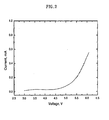
- Fig. 2 is a graph illustrating the result of the linear sweep voltametry of the cell, and it is observed that the multi-component film of Example 1 was capable of being used for a polymer electrolyte due to its electrochemical stability at a voltage equal to or less than 5V.
- the conventional multi-component composite film for a polymer electrolyte has air permeability too low to be measured, but the multi-component composite film of the present invention has an air permeability ranging from 500 to 600 sec/100cc, so that pores are formed on the gellable polymer layer as well as the support layer film having micro-pores.
- the gellable polymer layer of the multi-component composite film has as dense a structure as that of the conventional film for a separator, and pores can be formed on the gellable layer, so that the gellable polymer layer of the multi-component composite film has a highly improved permeability.
- the support layer has properties that are the same to those of the micro-porous separator prepared by the conventional dry process, and the gellable polymer has various morphologies due to preparation process conditions.
- the conventional multi-layer for a separator has an interfacial adhesion strength of 75 g f (0.73 N) and the multi-component composite film of the present invention has a high interfacial adhesion strength ranging from 150 to 250 g f (1.47 to 2.45 N). It is supposed that the high interfacial adhesion strength of the present invention results from the high-temperature-stretching and heat-setting processes, wherein the mutual bond strength between polymer chains of the support layer and the gellable polymer layer forms.
- the interfacial adhesion strength is capable of increasing further by performing ion-beam irradiation.
- the multi-component composite film has a highly enhanced wet-out rate of an electrolyte due to the improved interfacial adhesion strength and various morphologies.
- the enhanced wet-out rate of an electrolyte brings a battery to stability, since the leak-out amount of the electrolyte can be decreased, and the cycle life characteristics do not deteriorate during repetitive charging and discharging, because the leak-out amount of the electrolyte decreases due to the enhanced wet-out rate.
- the multi-component composite film of the present invention has good electrochemical stability, adhesion to an electrode, a wet-out rate of an electrolyte and stability, and even though extraction or removal processes of a plasticizer are not performed, it has both good ionic conductivity and mechanical properties, such that the film of the present invention can be used in a polymer electrolyte system, electrochemical devices, and a separator.
Landscapes
- Chemical & Material Sciences (AREA)
- Chemical Kinetics & Catalysis (AREA)
- Electrochemistry (AREA)
- General Chemical & Material Sciences (AREA)
- Engineering & Computer Science (AREA)
- Manufacturing & Machinery (AREA)
- Inorganic Chemistry (AREA)
- Physics & Mathematics (AREA)
- Dispersion Chemistry (AREA)
- Condensed Matter Physics & Semiconductors (AREA)
- Thermal Sciences (AREA)
- General Physics & Mathematics (AREA)
- Plasma & Fusion (AREA)
- Laminated Bodies (AREA)
- Cell Separators (AREA)
- Secondary Cells (AREA)
- Electric Double-Layer Capacitors Or The Like (AREA)
- Primary Cells (AREA)
- Conductive Materials (AREA)
- Manufacture Of Porous Articles, And Recovery And Treatment Of Waste Products (AREA)
- Fuel Cell (AREA)
Abstract
Description
- This application is based on applications Nos.
2000-46735 2001-11191 - The present invention relates to a multi-component composite film, and a method for the same, and more particularly, to a multi-component composite film used for a polymer electrolyte for electrochemical devices, a method for the same, and a polymer electrolyte system applied the same.
- Energy storage technology has drawn attention and has been extensively studied recently, as cellular phones, camcorders, portable computers, and electric motors are commonly use energy storage devices. In particular, a secondary battery that is capable of charging and discharging has drawn the most attention, and new electrodes and polymer electrolytes have been developed to enhance its characteristics, such as cycle life and capacity. The polymer electrolyte is important to fabrication of a stable and high-quality battery, and development of the desired polymer electrolyte is needed.
- Electrolytes are classified as liquid electrolyte and solid electrolyte. The liquid electrolyte comprises a salt dissolved and dissociated in an organic solvent, and it has high ionic conductivity. The liquid electrolyte is generally used together with a polymer separator, e.g. a polymer film such as a polyolefin forming pores that has ionic conductivity by filling the liquid electrolyte in the pores. The ionic conductivity varies depending on the porosity of the polymer separator, and the polyolefin separator generally has the ionic conductivity of about 1 mS/cm. But the liquid electrolyte may leak out of the polymer separator due to its high fluidity. In addition, the liquid electrolyte is not adhesive to the polymer separator, and there is an interface between them. The polymer separator has high mechanical strength due to its high crystallinity, and it is neither over-swelled nor decomposed.
- The solid electrolyte has an ionic conductivity insufficient to be used in a battery. In order to improve the ionic conductivity of the solid electrolyte, a gellable polymer electrolyte has been suggested, in which liquid electrolyte comprising a salt dissolved in an organic solvent is impregnated in a solid polymer electrolyte, e.g. a hybrid-type electrolyte as disclosed in
U.S. Patent No. 5,418,091 , prepared by Bellcore Co. However, when the gellable polymer electrolyte is used for an electrolyte of a battery, there are problems in battery-assembly due to its low mechanical strength, and the polymer electrolyte may be over-swelled, its thickness may increase, and energy density may decrease due to a decrease in the density of the polymer electrolyte, even though the polymer electrolyte has a thickness greater than 50 µm in order to insulate between electrodes and obtain a sufficient mechanical strength in a battery. Furthermore, a plasticizer having a low molecular weight that is harmful to the environment is used, an extraction process thereof is needed, and its mass production is difficult. - The polymer electrolyte requires electrochemical stability in working voltage, and thermal and chemical stability. Preferably, an ionic conductivity of the polymer electrolyte is greater than 1 mS/cm at room temperature, its wet-out rate is better than that of non-aqueous electrolyte, and it has high chemical-resistance. In addition, it is preferable that the polymer electrolyte adhesion is sufficient to decrease the interfacial resistance between the electrolyte and electrodes during a battery-assembly, and that it has enough mechanical strength during the battery-assembly. However, it is known that when the ionic conductivity increases, the mechanical strength of the polymer electrolyte deteriorates, and vice versa.
- To increase both the ionic conductivity and the mechanical strength, it is disclosed that a porous polymer layer and a gellable multi-layer film are used for a separator in
U.S. Patent Nos. 5639573 ,5716421 ,5631103 , and5849443 , and in European Patent Application No.0933824A2 . The porous polymer layer comprises a material that is hard to swell due to restrictive absorption of liquid electrolyte, and the exemplary material includes polyethylene, polypropylene, polytetrafluoroethylene, polyethylene terephthalate, polybutyleneterephthalate, and polyethylenenaphthalate, and a multi-layer film or bled film thereof. The gellable polymer comprises a self-gellable and self-swellable material when it meets liquid electrolyte, and the exemplary material includes polyvinylidenefluoride, polyurethane, polyethyleneoxide, polyacrylonitrile, polymethylmethacrylate, polyacrylamide, polyvinylacetate, polyvinylpyrrolidinone, and polytetraethylene glycol diacrylate, and a copolymer thereof. - When the aforementioned separator is used, the mechanical properties can be improved, however the polymer electrolyte has ionic conductivity lower than those of the porous polymer and the liquid electrolyte dissolved thereof, resulting from the ionic conductivity-resistance of the gellable polymer.
U.S. patent Nos. 5631103 , and5849433 disclose that a plasticizer having a low molecular weight, such as dibutyl phthalate, is used in order to enhance the ionic conductivity of the separator. However, the plasticizer is harmful to the environment, and it makes mass production of a battery difficult. In addition, a multi-layer film prepared by the aforementioned method has a dense gellable polymer layer having no pores, its ionic conductivity-resistance increases undesirably, and an interfacial adhesion strength between the porous polymer layer and the gellable polymer layer weakens. - It is an object of the present invention to provide a multi-component composite film having electrochemical stability, adhesion to an electrode, good wet-out rate of an electrolyte, which is prepared without extraction or a removal processe of a plasticizer, and with good ionic conductivity and mechanical properties, a preparation method of the same, and a polymer electrolyte system wherein the composite film is used.
- In order to accomplish the objects of the present invention, the present invention provides a multi-component composite film according to claim 1 comprising:
- a) a polymer support layer film; and
- b) a porous gellable polymer layer which is formed on one side or both sides of the support layer film, wherein the support layer film of a) and the porous gellable polymer layer of b) are united with each other without an interface between them.
- It also provides a preparation method of the multi-component composite film comprising the steps of:
- a) preparing a polymer support layer film;
- b) dissolving a gellable polymer in a solvent in order to prepare a gellable polymer solution;
- c) forming a gellable polymer layer on one side or both sides of the support layer film of a) by coating the support layer film with the gellable polymer solution of b) in order to prepare a multiple layer; and
- d) stretching and heat-setting the multiple layer of c).
- It also provides a polymer electrolyte system using the multi-component composite film as a separator, and an electrochemical device comprising the same.
- A more complete appreciation of the invention, and many of the attendant advantages thereof, will be readily apparent as the same becomes better understood by reference to the following detailed description when considered in conjunction with the accompanying drawings, wherein:
-
FIG. 1 is a cross-sectional view showing a multi-component composite film structure, wherein gellable polymer layers (12) are located on both sides of a support layer film (11), and the interface (13) between the layers does not appear clearly, after stretching and heat-setting the support layer film (11) coated with a gellable polymer solution; and -
FIG. 2 is a graph showing a Linear Sweep Voltametry analysis of a cell having the structure of the Li/ multi-component composite film according to Example 2 of the present invention/SUS, wherein the gellable polymer film comprises polyvinylidene fluoridechlorotrifluoroethylene, and the support layer film comprises polypropylene. - In these Figures, "11", "12", and "13" represent a support layer film, a gellable polymer layer, and an interface, respectively.
- In the following detailed description, only the preferred embodiment of the invention has been shown and described, simply by way of illustration of the best mode contemplated by the inventors of carrying out the invention. Accordingly, the drawings and description are to be regarded as illustrative in nature, and not restrictive.
- The conventional multi-component composite film, which is used as a polymer electrolyte, is prepared by coating a polymer film having pores of a regular size with a gellable polymer solution, so that an interface between the polymer layer and the gellable polymer layer exists. In contrast, a multi-component composite film of the present invention is prepared by coating a common polymer film with a gellable polymer material, forming gellable polymer layers on a common polymer film having no pores and high-temperature-stretching it, so that the film has pores, and so the polymer film and the gellable polymer layer are united with each other without an interface between them.
- Since, the polymer support layer film and the gellable polymer are united with each other without an interface between them due to inter-diffusion between them during the high-temperature-stretching process, a mutual bonding force between the support layer and the gellable polymer material increases, and the bonding force is too high for the layers to be separated. The multi-component composite film of the present invention has an interfacial adhesive force greater than at least 100 gf (0.980 N), and preferably greater than at least 150 gf (1.47 N), when the interfacial adhesive force of the present invention is measured by the method according to JIS Z 0237.
- A polymer electrolyte system for an electrochemical device using the multi-component composite film is prepared by impregnation of the composite film with an aqueous electrolyte comprising a salt and an organic solvent. In particular, a gellable polymer or polymer-salt complex which is produced from a co-ordinate bond between a gellable polymer and a salt is coated on either or both sides of a support layer film, so that it can be used for an electrolyte for electrochemical devices such as a battery. The polymer electrolyte system may use the gellable polymer that is coated on one side or both sides of the support layer film, or a polymer-salt complex produced from the coordinate bond of the gellable polymer and a salt, for an electrolyte of the electrochemical devices.
- Hereinafter, the formation of the multi-component composite film will be described.
- The support layer film is preferably prepared by blending or laminating at least one polymer selected from the group consisting of high-density polyethylene, low-density polyethylene, linear low-density polyethylene, polypropylene, high crystalline polypropylene, polyethylene-propylene copolymer, polyethylene-butylene copolymer, polyethylene-hexene copolymer, polyethylene-octene copolymer, polystyrene-butylene-styrene copolymer, polystyrene-ethylene-butylene-styrene copolymer, polystyrene, polyphenylene oxide, polysulfone, polycarbonate, polyester, polyamide, polyamide, polyurethane, polyacrylate, polyvinylidene chloride, polyvinylidene fluoride, polysiloxane, polyolefin ionomer, polymethyl pentene, hydrogenated oligocyclopentadiene (HOCP), and a copolymer thereof, or a derivative thereof.
- The high crystalline polypropylene preferably has at least one characteristic selected from the group consisting of a density equal to or greater than 0.905 g/cc, a melting point equal to or higher than 125°C, crystallinity equal to or greater than 50%, isotacticity (or pentad ratio) equal to or greater than 96%, and an atactic ratio of less than 5%.
- The material of the gellable polymer layer may be selected according to use of the multi-component composite film, and the gellable polymer is generally at least one selected from the group consisting of polyvinylidene fluoride, polyvinylidene fluoride-chlorotrifluoroethylene copolymer, polyvinylidene fluoride-hexafluoropropylene copolymer, polyethylene oxide, polybutylene oxide, polyurethane, polyacrylonitrile, polyacrylate, polymethyl methacrylate, polyacrylic acid, polyamide, polyacrylamide, polyvinyl acetate, polyvinylpyrrolidone, polytetraethylene glycol diacrylate, polysulfone, polyphenylene oxide, polycarbonate chloride, polysiloxane, polyolefin ionomer, and a copolymer thereof, or a derivative thereof.
- The gellable polymer layer preferably comprises a polymer-lithium salt complex so that an ion transference number of the gellable polymer layer increases by anion fixation. The gellable polymer layer may further comprise at least one selected from the group consisting of LiSCN, LiClO4, LiCF3SO3, LiAsF6, LiN(CF3SO2)2, and LiBF4, each having a lithium lattice energy greater than their dissolution energy, which is in accordance with the coordinate bond of an electron-donating element and a lithium ion.
- In addition, the gellable polymer layer may further include at least one porous inorganic compound selected from the group consisting of SiO2, TiO2, Al2O3, MgO, and B2O3.
- Hereinafter, the preparation method of the multi-component composite film will be described.
- The multi-component composite film is prepared by dissolving the aforementioned gellable polymer in a solvent to prepare a coating solution, coating the support layer film with the solution to form a gellable polymer layer on either or both sides of the support layer film, and stretching it to form pores on the support layer film, so that the support layer film and the gellable polymer layer are united together without an interface between them. The stretching process also forms pores in the gellable polymer layer.
- The support layer film is preferably prepared by extruding the aforementioned polymer in an extruder equipped with T-die or a tubular die, and annealing it in a dry oven between a room temperature ranging and the greatest melting point in the aforementioned polymers in order to increase its crystallinity and elastic recovery.
- In addition, an ion-beam irradiation step can be added to the preparation steps of the multi-component composite film of the present invention with a reactive gas in order to increase the interfacial adhesion strength. The ion beam irradiation modifies the surface of the film, and it can be performed before or after annealing, depending on the properties of the multi-component composite film.
- The ion-beam irradiation is performed by placing a support layer film (11) in a high vacuum chamber at 10-1 to 10-6 torr, injecting at least one ion source selected from the group consisting of electrons, hydrogen, helium, oxygen, nitrogen, carbon dioxide, air, fluoride, neon, argon, krypton, and N2O into an ion gun, such that it has an energy ranging from 0.01 to 106 keV, and irradiating the ion-beam on either or both sides of the support layer film with variation of an ion-beam current. The irradiation amount of the ion beam preferably ranges from 105 to 1020 ions/cm2. While the ion-beam is irradiating, at least one reactive gas selected from the group consisting of helium, hydrogen, oxygen, nitrogen, ammonia, carbon monoxide, carbon dioxide, chlorofluoromethane, and N2O is added to the film at a flow rate of 0.5 to 20 mℓ /minute in order to modify the surface of the film.
- The gellable polymer layer is formed on either or both sides of the support layer film with use of the gellable polymer solution. The gellable polymer solution is prepared by dissolving the aforementioned polymer in a solvent.
- The solvent is at least one selected from the group consisting of 1-methyl-2-pyrrolidone (NMP), acetone, ethanol, n-propanol, n-butanol, n-hexane, cyclohexanol, acetic acid, ethyl acetate, diethyl ether, dimethyl formamide (DMF), dimethylacetamide (DMAc), dioxane, tetrahydrofuran (THF), dimethyl sulfoxide (DMSO), cyclohexane, benzene, toluene, xylene, and water, or a mixture thereof. The concentration and coating condition of the gellable polymer solution can be controlled depending on the material used in preparation of the multi-component composite film, and the concentration of the gellable polymer solution preferably ranges from 0.01 to 90 wt%. The gellable polymer solution can be prepared by adding the aforementioned lithium salt, porous inorganic particles, or a mixture thereof to the solvent.
- The gellable polymer layer is formed in two ways. First, the support layer film is coated with the gellable polymer solution, and the support layer film is dried under a preferred drying condition to form the gellable polymer layer. Secondly, a release paper or a release film is coated with the gellable polymer solution in order to form the polymer film on the release paper, the coated film is dried under the suitable drying condition, the polymer film is desorbed from the release paper, and the desorbed polymer film is heat-set on the support layer film. The heat-set process is performed at room temperature to a melting point of the support layer or the gellable polymer of the gellable polymer solution.
- The preparation of the multi-component composite film is as follows:
- First, the first preparation method of the gellable polymer layer comprises:
- a) placing the polymer which is used for a support layer in an extruder in order to prepare the precursor film;
- b) annealing the precursor film at a temperature equal to or less than a melting point of the polymer;
- c) if needed, irradiating an ion beam on either or both sides of the annealed precursor film with a reactive gas;
- d) coating a polymer solution on either or both sides of the ion-beam-irradiated precursor film;
- e) drying the precursor film;
- f) low-temperature-stretching the precursor film at a temperature equal to or less than room temperature;
- g) high-temperature-stretching the low-temperature-stretched precursor film at a temperature equal to or less than a melting point of the polymer; and
- h) heat-setting the high-temperature-stretched precursor film at a temperature equal to or less than a melting point of the polymer.
- Another preparation method of the gellable polymer layer comprises:
- a) placing a polymer which is used for a support layer in an extruder in order to prepare a precursor film;
- b) annealing the precursor film at a temperature equal to or less than a melting point of the polymer;
- c) if needed, irradiating an ion beam on either or both sides of the precursor film with the reactive gas;
- d) coating a release film such as a release paper with the gellable polymer solution in order to form a gellable polymer layer on the release film;
- e) drying the coated film;
- f) desorbing the gellable polymer film from the release film, and heat-setting the gellable polymer layer film on either or both sides of the precursor film;
- g) low-temperature-stretching the precursor film heat-set with the gellable polymer layer film at a temperature equal to or less than room temperature;
- h) high-temperature-stretching the low-temperature-stretched precursor film at a temperature equal to or less than a melting point of the gellable polymer; and
- i) heat-setting the high-temperature-stretched precursor film at a temperature equal to or less than a melting point of the gellable polymer under tension.
- In the coating process of the gellable polymer solution on the support layer film or the release film, the coating is performed by various techniques such as dip coating, roll coating, spray coating, spin coating, die coating, and roll coating, and the coating technique is not limited in the coating process. The thickness of the coated films can be controlled depending on a final use of the multi-component composite film, and if the thickness of the support layer film ranges from 1 to 50 µm, the thickness of the gellable polymer layer after coating preferably ranges from 0.01 to 25 µm.
- The coating step can be performed either before or after, or both before and after the annealing step, and the ion-beam irradiation process can be added with a reactive gas before the coating process, depending on the properties of the multi-component composite film.
- The drying process of the coated gellable polymer solution is preferably performed under a gas atmosphere which is at least one selected from the group consisting of nitrogen, oxygen, carbon dioxide, and air, at a relative humidity of 1 to 100%.
- Pores are formed on the heat-gellable polymer layer on either or both sides of the support layer film, after the gellable polymer layer is formed on either or both sides of the support layer film.
- In general, pores are formed on a polymer film by phase transition or a dry process. For example, pores can be formed through phase transition by preparation of a polymer solution, and phase transition between the polymer and the solvent with a suitable use of temperature or a non-solvent, and the properties of the prepared film are affected by the phase-transition conditions. For another example, pores can be formed through a dry process by orientation of the crystalline region of the polymer in a certain direction, low-temperature-stretching it, and rupturing the amorphous region which is relatively soft compared to its crystalline region, wherein the properties of the prepared film are affected by the orientation in the crystalline region, and the degree of the orientation.
- In the present invention, the stretching process is performed after forming the gellable polymer layer on either or both sides of the support layer film. There are differences between the pore size and distribution of the support layer film and those of the gellable polymer layer. Pores are formed on the support layer by the dry processes, wherein the crystalline structure of a precursor is oriented in a certain direction in preparation of a precursor film, and the oriented precursor film is stretched, thereby forming pores. On other hands, pores are formed on the gellable polymer layer by both the phase transition and dry process, wherein micro-pores or micro-cracks of the gellable polymer layer are formed by phase transition between the gellable polymer and the solvent, and the pore size or the micro-crack size increases due to the stretching process. In particular, the phase transition condition causes the gellable polymer layer to have various types of structure such as a dense structure or a structure having micro-pores or micro-cracks before the stretching process.
- Therefore, the pore size and its distribution of the support layer film and the gellable polymer layer are affected by the method of formation of the pores.
- The stretching process includes low-temperature-stretching and high-temperature-stretching.
- In the low-temperature-stretching process, the gellable polymer layer is formed on either or both sides of the support layer film in order to prepare a multi-layer, the multi-layer is mono-axially or bi-axially stretched at a temperature ranging from 0 to 50 °C with use of a roll or other stretching machine in order to form micro-cracks, and the pores that are formed on the gellable polymer (12) increases.
- In the high-temperature-stretching process, the micro-cracks that are formed by the low-temperature-stretching are mono-axially or bi-axially stretched with use of a roll or other stretching machine at between 50 °C and a melting point of the gellable polymer in order to form pores having a desired size, so the mechanical properties of the film are brought about by the high-temperature stretching.
- The multi-film that is low-temperature-stretched and high-temperature-stretched is heat-set. The heat-set processing is performed at a temperature ranging from 50 °C to a melting point of the support layer or the gellable polymer layer under tension for 10 seconds to an hour, and the multi-component composite film comprising the support layer film and gellable polymer layer is finally prepared.
- The multi-component composite film of the present invention has an improved interfacial adhesion strength between the support layer and the gellable polymer layer due to inter-diffusion between the polymer chains of the support layer and the gellable polymer layer after the high-temperature-stretching and the heat-setting, and the interface between the support layer film and the gellable polymer layer is not well-defined because the support layer film and the gellable polymer layer are united together. In particular, when the ion-beam irradiation on the support layer is performed with the reactive gas, the interfacial adhesion strength between them improves further.
- The multi-component composite film, after the high-temperature-stretching and heat-setting, comprises a support layer film having a pore size ranging from 0.001 to 10 µm with a thickness ranging from 1 to 50 µm, and a porous gellable polymer layer having a pore size of 10 µm at most with a thickness ranging from 0.01 to 25 µm, and the film of the present invention is preferably applied to a polymer electrolyte system or an electrochemical device.
-
Fig. 1 shows an exemplary multi-component composite film of the present invention wherein gellable polymer layers (12) are located on a support layer film (11). It is also shown that the interface between the support layer film (11) and the gellable polymer layer (12) is not well-defined after stretching and heat-setting. The multi-component composite film comprising a united support layer film and a gellable polymer layer without an interface between them has good ionic conductivity, and electrochemical stability. - The preparation steps of the present invention may not only be skipped, but steps may also be added depending on the final use of the multi-component composite film, and the sequence of each of the preparation steps may be changed.
- The multi-component composite film of the present invention is applicable to various kinds of separators such as an ultrafiltration membrane, a gas separation membrane, a pervaporation membrane, a reverse osmosis membrane, and a separator for an electrochemical device. In particular, the film of the present invention is preferably applicable to a polymer electrolyte system, since it brings electrochemical stability, adhesion to electrodes, and good wet-out rate of an electrolyte and stability of an electrolyte.
- The present invention provides a polymer electrolyte system comprising:
- a) i) a porous support layer film; and
- ii) a multi-component composite film comprising a porous gellable polymer layer which is formed on either or both sides of the porous support layer film of a), wherein the support layer film of a) and the gellable polymer layer of b) are united together without an interface between them; and
- b) a liquid electrolyte comprising i) a salt represented by Formula 1; and
- ii) an organic solvent:
Formula 1 A+B-
wherein the A+ is at least one selected from the group consisting of an alkali metallic cation, and a derivative thereof, and B- is at least one selected from the group consisting of PF6 -, BF4 -, Cl-, Br- , I-, AsF6 -, CH3CO2 -, CF3SO3 -, N(CH3SO2)2 -, and C(CH3SO2)3 -.
- ii) an organic solvent:
- The multi-component composite film of a) is a polymer membrane, it can be used for a separator and a solid electrolyte, and its air permeability ranges from 100 to 20,000 sec/100cc.
- The liquid electrolyte of b) fills up the pores of the support layer film, and the gellable polymer layer is swelled and gellated when the liquid electrolyte of b) meets the multi-component composite film of a). In order to increase the ionic conductivity of the liquid electrolyte, it is preferable that the thickness of the gellable polymer layer is thinner than that of the support film. The thin thickness of the gellable polymer brings low impedance that is influenced by the thickness of the polymer electrolyte.
- The liquid electrolyte of b) comprises a salt represented by Formula 1 that is dissolved and dissociated in an organic solvent of ii).
- It is preferable that the organic solvent of b)ii) is at least one selected from the group consisting of propylene carbonate (PC), ethylene carbonate (EC), diethyl carbonate (DEC), dimethyl carbonate (DMC), dipropyl carbonate (DPC), dimethyl sulfoxide, acetonitrile, dimethoxyethane, diethoxy ethane, tetrahydrofuran, N-methyl-2-pyrrolidone (NMP), and ethyl methyl carbonate (EMC).
- The polymer electrolyte system is applicable to various kinds electrochemical devices such as a super capacitor, an ultra capacitor, a secondary battery, a primary battery, a fuel cell, all kinds of sensors, a machine for electrolysis, and an electrochemical reactor.
- The following Examples and Comparative Examples illustrate the present invention in further detail, but the present invention is not limited by these Examples.
- A high crystalline polypropylene was used as a support layer film, and a polyvinylidenefluoride-chloro-tri-fluoroethylene copolymer (a product of Solvay Polymer Corp.) was used as a gellable polymer layer, in order to prepare a multi-component composite film by the following procedure.
- A high crystalline polypropylene was used for a material of a precursor film. It had a melt index of 2.0 g/10 minutes, a density of 0.91 g/cc, a melting point of 166.5°C which was measured with DSC (Differential Scanning Calorimeter), a crystallization temperature of 116.5°C, a crystallinity of 57%, an isotacticity of 98% which was measured with C13 nuclear magnetic resonance (NMR), and an atactic fraction of about 2% which was measured after being dissolved in xylene. The precursor film was prepared from the high crystalline polypropylene with use of a single screw extruder equipped with a T-die and a take-up device. The extrusion temperature and cooling-roll temperature were respectively 220 °C and 80 °C . The take-up speed was 20 m/min., and the draw down rate (DDR) was 60.
- The precursor film was annealed in a dry oven at 150 °C for an hour.
- After annealing, the solution that was dissolved in acetone was dip-coated on both sides of the prepared precursor film. The coating was performed under air while maintaining 60% relative humidity, and the acetone was vaporized at the same condition of 60% relative humidity.
- The coated precursor film was mono-axially low-temperature-stretched to 50% of the stretching ratio based on the initial length of the film at room temperature, and it was further mono-axially low-temperature-stretched to 100% of the stretching ratio based on the initial length of the film at room temperature.
- After low-temperature-stretching, the low-temperature-stretched precursor film was heat-set at 140 °C under tension for 10 minutes, and it was cooled in order to prepare a multi-component composite film. The properties of the multi-component composite film were measured, and the properties are shown in Table 1.
- The air permeability and interfacial adhesion strength of the multi-component composite film were respectively measured by JIS P8117 and JIS Z 0237, its pore size was measured with a scanning electron microscope, and wet-out rate of an electrolyte was measured by measuring a time for wet-out of 2 cm2 of the multi-component composite film in an electrolyte wherein ethylene carbonate and dimethyl carbonate are mixed together in a volume ratio of 4:6.
- A precursor film was prepared in the same manner as in Example 1.
- A release paper was dip-coated with a gellable polymer solution wherein polyvinylidenefluoride-chlorotrifluoro ethylene copolymer 32008 (a product of Solvay Polymer Corp.) was dissolved in an acetone, so that a gellable polymer layer was prepared. The coating was performed under air while maintaining 60% relative humidity, and the acetone was vaporized at the same condition of 60% relative humidity.
- 2 pieces of the gellable polymer layer were desorbed from the release film, 2 pieces of the gellable polymer layer were located on both sides of the precursor film, and they were placed in a heated laminator of which the temperature was 140 °C, so that the gellable polymer layer was heat-melted on both sides of the precursor film.
- The heat-melted film was mono-axially stretched to 50% of the stretching ratio based on the initial length of the film at room temperature, and it was further mono-axially high-temperature-stretched to 100% of the stretching ratio based on the initial length of the film at 140°C.
- After high-temperature-stretching, the high-temperature-stretched film was heat-set at 140 °C under tension for 10 minutes, and it was cooled to prepare a multi-component composite film. The properties of the multi-component composite film were measured, and they were same as those of the multi-component composite film according to Example 1.
- A multi-component composite film was prepared in the same manner as in Example 1, except that an ion-beam was irradiated on the precursor film before coating the precursor film with the gellable polymer solution. The precursor film was placed in a vacuum chamber while keeping the pressure ranging from 10-5 to 10-6 torr, argon cations (Ar+) were irradiated on both sides of the precursor film with an ion gun, and simultaneously oxygen used as an reactive gas was injected into the chamber in an amount of 4 mℓ/cm2 in order to treat the precursor film surface. The energy of the ion beam was 0.5 keV, and the ion irradiation amount was 1016 ions/cm2.
- After the ion-beam irradiation, a multi-component composite film was prepared in the same manner as in Example 1, and its properties were measured in the same manner as in Example 1. Its properties are shown in Table 1.
- In Table 1, it is shown that pores were formed on both the support layer and the gellable polymer layer as in Example 1, and in particular, the interfacial adhesion strength between the support layer and the gellable polymer layer and the wet-out rate of the electrolyte were appreciably improved.
- A multi-component composite film was prepared in the same manner as in Example 1, except that a high-density polyethylene was used for a support layer instead of high crystalline polypropylene.
- The high-density polyethylene had a melt index of 0.3 g/10min and a density of 0.964 g/cc. A precursor film was prepared in the same manner as in Example 1. The extrusion temperature and cooling-roll temperature of the take-up device were respectively 200°C and 80 °C, the take-up speed of the film was 30 m/min, and the draw-down ratio of the film was 80. The prepared precursor film was annealed in a dry oven at 125 °C for 1 hour. Both sides of the annealed precursor film were coated with a gellable polymer solution in the same manner as in Example 1. The coated precursor film was mono-axially stretched at room temperature to 50% of the stretching ratio based on the initial length of the film, and then it was immediately mono-axially high-temperature-stretched to 50% of the stretching ratio based on the initial length of the film, at 120°C. The high-temperature-stretched film was heat-set at 120 °C under tension for 10 minutes, and then a multi-component composite film was prepared by cooling the heat-set film. Properties of the multi-component composite film are shown in Table 1.
- In Table 1, it is shown that pores formed on both the support layer and the gellable polymer layer as in Example 1, and the interfacial adhesion strength and wet-out rate of the electrolyte improved.
- A polymer electrolyte was prepared by the conventional method, wherein a porous support film was coated with a gellable polymer solution.
- Celgard2400 (a product of Celanese Co.) prepared from only polypropylene was used for the porous support film, and polyvinylidenefluoride-chlorotrifluoroethylene copolymer 32008 (a product of Solvay Polymer Corp.) was used for a gellable polymer layer as in Examle 1. After preparing a gellable polymer solution, the porous Celgard2400 was coated with the gellable polymer solution, and it was dried in order to prepare a multi-layer film. The properties of the multi-layer film were measured, and they are shown in Table 1.
Table 1 Example 1 Example 2 Example 3 Example 4 Comparative Example 1 Thickness (µm) Support layer 17 17 19 19 25 Gellable polymer layer 1 1 1 1 1 Pore size (µm x µm) Support layer 0.3x0.1 0.3x0.1 0.3x0.1 0.4x0.1 0.3x0.1 Gellable polymer layer 0.8x0.3 0.8x0.3 0.8x0.3 0.6x0.3 Not capable of observation Air permeability (sec/100 cc) 520 520 525 600 Not capable of measurement Interfacial adhesion strength 160 gf
(1.57 N)160 gf
(1.57 N)230 gf
(2.25 N)220 gf
(2.16 N)75 gf
(0.73 N)Wet-out rate of an electrolyte (sec) 9 9 7 8 42 - In Table 1, it is shown that pores were formed on both the support layer film and gellable polymer in Example 1, compared to that pores forming on only the support layer film in Comparative Example, and the multi-component composite film of Example 1 has an improved air permeability due to the pores. In addition, it is also shown that the interfacial adhesion strength between the support film and the gellable polymer layer, and a wet-out rate of an electrolyte according to Example 1 are improved compared to those of Comparative Example 1.
- The multi-component composite film of Example 1 was impregnated in an organic electrolyte solution (EC and EMC were used in a volume ratio of 1:2) comprising 1 M LiPF6 used for a lithium salt, and Li/ a separator comprising the multi-component composite/ SUS cell was fabricated, wherein the SUS was used as an electrode, and the U metal was used as a counter-electrode in order to measure a linear sweep voltametry of the cell at room temperature and a voltage ranging from 3 to 6V by 1 mV/sec.
-
Fig. 2 is a graph illustrating the result of the linear sweep voltametry of the cell, and it is observed that the multi-component film of Example 1 was capable of being used for a polymer electrolyte due to its electrochemical stability at a voltage equal to or less than 5V. - The conventional multi-component composite film for a polymer electrolyte has air permeability too low to be measured, but the multi-component composite film of the present invention has an air permeability ranging from 500 to 600 sec/100cc, so that pores are formed on the gellable polymer layer as well as the support layer film having micro-pores.
- The gellable polymer layer of the multi-component composite film has as dense a structure as that of the conventional film for a separator, and pores can be formed on the gellable layer, so that the gellable polymer layer of the multi-component composite film has a highly improved permeability. In addition, the support layer has properties that are the same to those of the micro-porous separator prepared by the conventional dry process, and the gellable polymer has various morphologies due to preparation process conditions.
- The conventional multi-layer for a separator has an interfacial adhesion strength of 75 gf (0.73 N) and the multi-component composite film of the present invention has a high interfacial adhesion strength ranging from 150 to 250 gf (1.47 to 2.45 N). It is supposed that the high interfacial adhesion strength of the present invention results from the high-temperature-stretching and heat-setting processes, wherein the mutual bond strength between polymer chains of the support layer and the gellable polymer layer forms. The interfacial adhesion strength is capable of increasing further by performing ion-beam irradiation. In addition, the multi-component composite film has a highly enhanced wet-out rate of an electrolyte due to the improved interfacial adhesion strength and various morphologies.
- The enhanced wet-out rate of an electrolyte brings a battery to stability, since the leak-out amount of the electrolyte can be decreased, and the cycle life characteristics do not deteriorate during repetitive charging and discharging, because the leak-out amount of the electrolyte decreases due to the enhanced wet-out rate.
- The multi-component composite film of the present invention has good electrochemical stability, adhesion to an electrode, a wet-out rate of an electrolyte and stability, and even though extraction or removal processes of a plasticizer are not performed, it has both good ionic conductivity and mechanical properties, such that the film of the present invention can be used in a polymer electrolyte system, electrochemical devices, and a separator.
Claims (26)
- A multi-component composite film comprising:a) a polymeric support layer film; andb) a porous gellable polymer layer on one side or both sides of the support layer,wherein the support layer film of a) and the porous gellable polymer layer of b) are united with each other, by inter-diffusion of the polymer chains of the support layer and gellable polymer layer,
the material of the polymeric support layer film is at least one selected from the group consisting of high-density polyethylene, low-density polyethylene, linear low-density polyethylene, polypropylene, high crystalline polypropylene, polyethylene-propylene copolymer polyethylene-butylene copolymer, polyethylene-hexene copolymer, polyethylene-octene copolymer, polystyrene-butylene-styrene copolymer, polystyrene-ethylene-butylene-styrene copolymer, polystyrene, polyphenylene oxide, polysulfone, polycarbonate, polyester, polyamide, polyarethane, polyacrylate, polyvinylidene chloride, polyvinylidene fluoride, polysiloxane, polyolefin ionomer, polymethyl pentene, hydrogenated oligocyclopentadiene (HOCP), and a copolymer thereof or a derivative thereof,
the material of the gellable polymer layer of b) is at least one selected from the group consisting of polyvinylidene fluoride, polyvinylidene fluoride-chlorotrifluomethylene copolymer, polyvinylidene fluoride-hexafluoropropylene copolymer, polyethylene oxide, polypropylene oxide, polybutylene oxide, polyurethane, polyacrylonitrile, polyacrylate, polymethyl methacrylate, polyacrylic acid, polyacrylamide, polyvinyl acetate, polyvinylpyrrolidone, polytetraethylene glycol diacrylate, polysulfone, polyphenylene oxide, polycarbonate, polyester, polyvinylidene chloride polysiloxane, polyolefin ionomer, and a copolymer thereof or a derivative thereof
a pore size of the support layer film of a) ranges from 0.001 to 10µm and its thickness ranges from 1 to 50µm, and a pore size of the porous gellable polymer layer of b) is at most 10µm and its thickness ranges from 0.01 to 25µm,
the pore size and distribution of the polymeric support layer film and those of the porous gellable polymer layer being different, and
the multi-component composite film has an air permeability in the range from 100 to 20,000 sec/100cc. - The multi-component composite film according to claim 1, wherein the material of the polymeric support layer film comprises high crystalline polypropylene having at least one property selected from the group consisting of a density equal to or greater than 0.905 g/cc, a melting point equal to or greater than 164°C, a crystallization temperature equal to or greater than 125°C, crystallinity equal to or greater than 50%, isotacticity (or a Pentad ratio) equal to or greater than 96%, and atactic ratio less than 5%.
- The multi-component composite film according to claim 1 or 2, wherein the support layer film of a) is a blended film or a laminated film.
- The multi-component composite film according to any one of the preceding claims, wherein the gellable polymer layer comprises at least one lithium salt selected from the group consisting of LiSCN, LiClO4, LiCF3SO3, LiAsF6, LiN(CF3SO2)2, and LiBF4.
- The multi-component composite film according to any one of the preceding claims, wherein the gellable polymer layer comprises at least one porous inorganic particle selected from the group consisting of SiO2, TiO2, Al2O3, MgO, and B2O3.
- A preparation method of a multi-component composite film comprising a support layer film; and a porous gellable polymer layer which is formed on one side or both sides of the support layer film, wherein the support layer film and the porous gellable polymer layer are united with each other by inter-diffusion of the polymer chains of the support layer and the gellable polymer layer, which comprises:a) providing a polymeric support layer film;b) dissolving a gellable polymer in a solvent in order to prepare a gellable polymer solution;c) forming a gellable polymer layer on one side or both sides of the support layer film of a) by coating the support layer film with the gellable polymer of b) in order to prepare a multiple layer, andd) stretching and heat-setting the multiple layer of c),wherein the gellable polymer layer of c) is prepared by(1) coating the gellable polymer solution of b) on one side or both sides of the support layer film of a), and drying the coated support layer film, or(2) coating a release film with the gellable polymer solution to form a gellable polymer layer on it, drying the coated film, desorbing the gellable polymer layer from the release film, and heat-melting the desorbed layer on one or both sides of the support layer film,
a pore size of the support layer film ranges from 0.001 to 10 µm, its thickness ranges from 1 to 50µm, and a pore size of the gellable polymer layer is at most 10µm, and its thickness ranges from 0.01 to 25µm,
the pore size and distribution of the polymeric support layer film and those of the porous gellable polymer layer being different,
wherein the material of the polymeric support layer film is at least one selected from the group consisting of high-density polyethylene, low-density polyethylene, linear low-density polyethylene, polypropylene, high crystalline polypropylene, polyethylene-propylene copolymer, polyethylene-butylene copolymer, polyethylene-hexene copolymer, polyethylene-octene copolymer, polystyrene-butylene-styrene copolymer, polystyrene-ethylene-butylene-styrene copolymer, polystyrene, polyphenylene oxide, polysulfone, polycarbonate, polyester, polyamide, polyurethane, polyacrylate, polyvinylidene chloride, polyvinylidene fluoride, polysiloxane, polyolefin ionomer, polymethyl pentene, hydrogenated oligocyclopentadiene (HOCP), and a mixture thereof or a derivative thereof, and
wherein the material of the gellable polymer layer of b) is at least one selected from the group consisting of polyvinylidene fluoride, polyvinylidene fluoride-chlorotrifluoroethylene copolymer, polyvinylidene fluoride-hexafluoropropylene copolymer, polyethylene oxide, polypropylene oxide, polybutylene oxide, polyurethane, polyacrylonitrile, polyacrylate, polymethyl methacrylate, polyacrylic acid, polyamide, polyacrylamide, polyvinyl acetate, polyvinylpyrrolidone, polytetraethylene glycol diacrylate, polysulfone, polyphenylene oxide, polycarbonate, polyester, polyvinylidene chloride polysiloxane, polyolefin ionomer, and a copolymer thereof or a derivative thereof. - The preparation method of the multi-component composite film according to claim 6, wherein the coating process is performed by a coating technique selected from the group consisting of dip coating, spray coating, die coating, and roll coating.
- The preparation method of the multi-component composite film according to claim 6 or claim 7, wherein the drying process is performed at a relative humidity ranging from 1 to 100 % under an atmosphere of at least one gas selected from the group consisting of nitrogen, oxygen, carbon dioxide, and air.
- The preparation method of the multi-component composite film according to any one of claims 6 to 8, wherein the high-temperature-stretching is performed after low-temperature-stretching of the multiple layer in the stretching process of d).
- The preparation method of the multi-component composite film according to claim 9, wherein the low-temperature-stretching is performed at a temperature ranging from 0 to 50°C in one direction in a roll or a stretching machine.
- The preparation method of the multi-component composite film according to claim 9 or 10, wherein the high-temperature-stretching is one-axially or two-axially performed in a roll or a stretching machine at a temperature in the range between 50°C and the polymer melting point of the gellable polymer layer.
- The preparation method of the multi-component composite film according to any one of claims 7 to 11, wherein the heat-setting is performed at a temperature in the range from 50 °C to the polymer melting point of the gellable polymer layer, for 10 seconds to an hour.
- The preparation method of the multi-component composite film according to claim 6, wherein the material of the support layer film of a) comprises high crystalline polypropylene having at least one property selected from the group consisting of a density equal to or greater than 0.905 g/cc, a melting point equal to or greater than 164°C, a crystallization temperature equal to or greater than 125°C, crystallinity equal to or greater than 50%, isotacticity (or a Pentad ratio) equal to or greater than 96%, and an atactic ratio of less than 5%.
- The preparation method of the multi-component composite film according to any one of claims 6 to 13, wherein the support layer film of a) is blended or laminated.
- The preparation method of the multi-component composite film according to any one of claims 6 to 14, wherein the support layer film of a) is prepared by injecting the polymer into an extruder equipped with a T-die or a tubular die in order to extrude the polymer, and annealing it in a dry oven at a temperature in the range from room temperature to a polymer melting point of the support layer.
- The preparation method of the multi-component composite film according to any one of claims 6 to 15, wherein the support layer of a) is prepared by irradiating ion beams under a reactive gas atmosphere on either or both sides of the support layer film.
- The preparation method of the multi-component composite film according to claim 16, wherein the ion beam irradiation is performed at a flow rate of 105 to 1020 ions/cm2 by injecting at least one reactive gas selected from the group consisting of helium, hydrogen, oxygen, nitrogen, ammonia, carbon monoxide, carbon dioxide, chlorofluorocarbon, and methane at a flow rate of 0.5 to 20 ml/minute in a vacuum chamber at 10-1 to 106 torr (1torr=133.3Pa), activating at least one particle selected from the group consisting of electrons, hydrogen, helium, oxygen, nitrogen, carbon dioxide, air, fluoride, neon, argon, krypton, and N2O, such that the particle has an energy ranging from 10-2 to 106 keV in order to form an ion beam.
- The preparation method of the multi-component composite film according to any one of claims 6 to 17, wherein the gellable polymer solution of b) is prepared by adding at least one lithium salt selected from the group consisting of LiSCN, LiClO4, LiCF3SO3, LiAsF6, LiN(CF3SO2)2, and LiBF4 to the solvent.
- The preparation method of the multi-component composite film according to any one of claims 6 to 18, wherein the gellable polymer solution of b) is prepared by adding at least one porous inorganic particle selected from the group consisting of SiO2, TiO2, Al2O3, MgO, and B2O3 to the solvent.
- The preparation method of the multi-component composite film according to any one of claims 6 to 19, wherein the solvent of b) is at least one selected from the group consisting of 1-methyl-2-pyrrolidone (NMP), acetone, ethanol, n-propanol, n-butanol, n-hexane, cyclohexanol, acetic acid, ethyl acetate, diethyl ether, dimethyl formamide (DMF), dimethylacetamide (DMAc), dioxane, tetrahydrofuran (THF), dimethyl sulfoxide (DMSO), cyclohexane, benzene, toluene, xylene, water, and a derivative thereof.
- The preparation method of the multi-component composite film according to any one of claims 6 to 20, wherein the concentration of the gellable polymer solution of b) ranges from 0.01 to 90wt%.
- A polymer separator comprising the multi-component composite film according to any one of claims 1 to 5.
- A polymer electrolyte system comprising:a) a multi-component composite separator comprising a multi-component composite film comprising a polymeric support layer film and a porous gellable polymer layer on one side or both sides of the support layer, andb) an electrolyte solution comprising:i) a salt represented by Formula 1; andii) an organic solvent:
Formula 1 A+B-
wherein, A+ is at least one selected from the group consisting of alkali metallic cations including Li+, Na+, and K, and a derivative thereof; and B- is at least one selected from the group consisting of PF6 -, BF4 -, Cl-, AsF6 -, CH3CO2 -, CF3SO3 -, N(CH3SO2)2 -, and C(CH3SO2)3 -
the support layer film and the porous gellable polymer layer are united with each other, by inter-diffusion of the polymer chains of the support layer and gellable polymer layer,
wherein the material of the polymeric support layer film is at least one selected from the group consisting of high-density polyethylene, low-density polyethylene, linear low-density polyethylene, polypropylene, high crystalline polypropylene, polyethylene-propylene copolymer, polyethylene-butylene copolymer, polyethylene-hexene copolymer, polyethylene-octene copolymer, polystyrene-butylene-styrene copolymer, polystyrene-ethylene-butylene-styrene copolymer, polystyrene, polyphenylene oxide, polysulfone, polycarbonate, polyester, polyamide, polyurethane, polyacrylate, polyvinylidene chloride, polyvinylidene fluoride, polysiloxane, polyolefin ionomer, polymethyl pentene, hydrogenated oligocyclopentadiene (HOCP), and a copolymer thereof or a derivative thereof,
the material of the gellable polymer layer is at least one selected from the group consisting of polyvinylidene fluoride, polyvinylidene fluoride-chlorotrifluoroethylene copolymer, polyvinylidene fluoride-hexafluoropropylene copolymer, polyethylene oxide, polypropylene oxide, polybutylene oxide, polyurethane, polyacrylonitrile, polyacrylate, polymethyl methacrylate, polyacrylic acid, polyamide, polyacrylamide, polyvinyl acetate, polyvinylpyrrolidone, polytetraethylene glycol diacrylate, polysulfone, polyphenylene oxide, polycarbonate, polyester, polyvinylidene chloride polysiloxane, polyolefin ionomer, and a copolymer thereof or a derivative thereof,
a pore size of the support layer film ranges from 0.001 to 10µm and its thickness ranges from 1 to 50µm, and a pore size of the porous gellable polymer layer is at most 10µm and its thickness ranges from 0.01 to 25µm,
the pore size and distribution of the polymeric support layer film and those of the porous gellable polymer layer being different, and
the multi-component composite film has an air permeability in the range from 100 to 20,000sec/100cc. - The polymer electrolyte system according to claim 23, wherein the organic solvent of b) ii) is at least one selected from the group consisting of propylene carbonate (PC), ethylene carbonate (EC), diethyl carbonate (DEC), dimethyl carbonate (DMC), dipropyl carbonate (DPC), dimethyl sulfoxide, acetonitrile, dimethoxyethane, diethoxy ethane, tetrahydrofuran, N-methyl-2-pyrrolidone (NMP), and ethyl methyl carbonate (EMC).
- An electrochemical device comprising the polymer electrolyte system according to claim any one of claims 23 to 24.
- A super capacitor, an ultra capacitor, a secondary battery, a primary battery, a fuel battery, a sensor, a machine for electrolysis, or an electrochemical reactor, which comprise the polymer electrolyte system according to any one of claims 23 to 24.
Applications Claiming Priority (5)
| Application Number | Priority Date | Filing Date | Title |
|---|---|---|---|
| KR10-2000-0046735A KR100373204B1 (en) | 2000-08-12 | 2000-08-12 | Multi-component composite membrane for polymer electrolyte and method of preparing the same |
| KR2000046735 | 2000-08-12 | ||
| KR2001011191 | 2001-03-05 | ||
| KR10-2001-0011191A KR100406689B1 (en) | 2001-03-05 | 2001-03-05 | Multicomponent composite film for electrochemical device and method for preparing the same |
| PCT/KR2001/001374 WO2002015299A1 (en) | 2000-08-12 | 2001-08-11 | Multi-component composite film method for preparing the same |
Publications (4)
| Publication Number | Publication Date |
|---|---|
| EP1310005A1 EP1310005A1 (en) | 2003-05-14 |
| EP1310005A4 EP1310005A4 (en) | 2006-10-25 |
| EP1310005B1 EP1310005B1 (en) | 2011-03-16 |
| EP1310005B9 true EP1310005B9 (en) | 2011-06-22 |
Family
ID=26638300
Family Applications (1)
| Application Number | Title | Priority Date | Filing Date |
|---|---|---|---|
| EP01958588A Expired - Lifetime EP1310005B9 (en) | 2000-08-12 | 2001-08-11 | Multi-component composite film method for preparing the same |
Country Status (6)
| Country | Link |
|---|---|
| US (3) | US7470488B2 (en) |
| EP (1) | EP1310005B9 (en) |
| JP (2) | JP3885100B2 (en) |
| CN (1) | CN1258234C (en) |
| DE (1) | DE60144235D1 (en) |
| WO (1) | WO2002015299A1 (en) |
Families Citing this family (125)
| Publication number | Priority date | Publication date | Assignee | Title |
|---|---|---|---|---|
| US8527026B2 (en) | 1997-03-04 | 2013-09-03 | Dexcom, Inc. | Device and method for determining analyte levels |
| US6001067A (en) | 1997-03-04 | 1999-12-14 | Shults; Mark C. | Device and method for determining analyte levels |
| KR100409017B1 (en) * | 2000-06-23 | 2003-12-06 | 주식회사 엘지화학 | Multi-component composite membrane and method for preparing the same |
| DE60144235D1 (en) * | 2000-08-12 | 2011-04-28 | Lg Chemical Ltd | COMPILED FILM WITH SEVERAL COMPONENTS AND METHOD FOR THE PRODUCTION THEREOF |
| KR100406690B1 (en) * | 2001-03-05 | 2003-11-21 | 주식회사 엘지화학 | Electrochemical device using multicomponent composite membrane film |
| US20030032874A1 (en) | 2001-07-27 | 2003-02-13 | Dexcom, Inc. | Sensor head for use with implantable devices |
| US7828728B2 (en) | 2003-07-25 | 2010-11-09 | Dexcom, Inc. | Analyte sensor |
| TW543225B (en) * | 2002-04-11 | 2003-07-21 | Ind Tech Res Inst | Manufacturing method of rechargeable polymer cell |
| JP4493287B2 (en) * | 2003-03-28 | 2010-06-30 | 住友化学株式会社 | Method and apparatus for continuous production of polymer electrolyte composite membrane |
| WO2004088678A1 (en) | 2003-03-28 | 2004-10-14 | Sumitomo Chemical Company, Limited | Continuous process for producing polymer electrolyte membrane and apparatus therefor |
| GB2402021A (en) * | 2003-05-19 | 2004-11-24 | Nec Corp | Rate control method and apparatus for data packet transmission from a mobile phone to a base station |
| US20040241550A1 (en) * | 2003-05-28 | 2004-12-02 | Wensley C. Glen | Battery separator for lithium polymer battery |
| TWI283493B (en) * | 2003-05-30 | 2007-07-01 | Lg Chemical Ltd | Rechargeable lithium battery using separator partially coated with gel polymer |
| EP1648298A4 (en) | 2003-07-25 | 2010-01-13 | Dexcom Inc | Oxygen enhancing membrane systems for implantable devices |
| US7781094B2 (en) | 2003-11-19 | 2010-08-24 | Tonen Chemical Corporation | Microporous composite membrane and its production method and use |
| JP4747492B2 (en) * | 2003-11-25 | 2011-08-17 | 富士ゼロックス株式会社 | Battery and power generation method |
| US20050202163A1 (en) * | 2004-03-09 | 2005-09-15 | Celgard Inc. | Method of making a composite microporous membrane |
| JP4974448B2 (en) * | 2004-04-07 | 2012-07-11 | 株式会社巴川製紙所 | Manufacturing method of separator for electronic parts |
| US8277713B2 (en) | 2004-05-03 | 2012-10-02 | Dexcom, Inc. | Implantable analyte sensor |
| ES3010715T3 (en) | 2004-07-07 | 2025-04-04 | Lg Energy Solution Ltd | New organic/inorganic composite porous film and electrochemical device prepared thereby |
| KR100749301B1 (en) * | 2004-07-07 | 2007-08-14 | 주식회사 엘지화학 | New organic / inorganic composite porous film and electrochemical device using same |
| TWI318018B (en) * | 2004-09-02 | 2009-12-01 | Lg Chemical Ltd | Organic/inorganic composite porous film and electrochemical device prepared thereby |
| EP1784876B1 (en) | 2004-09-02 | 2018-01-24 | LG Chem, Ltd. | Organic/inorganic composite porous film and electrochemical device prepared thereby |
| KR100775310B1 (en) | 2004-12-22 | 2007-11-08 | 주식회사 엘지화학 | Organic/inorganic composite microporous membrane and electrochemical device prepared thereby |
| FR2881275B1 (en) | 2005-01-24 | 2007-04-27 | Batscap Sa | BILOUD ELECTROLYTE FOR LTHIUM BATTERY |
| US8744546B2 (en) | 2005-05-05 | 2014-06-03 | Dexcom, Inc. | Cellulosic-based resistance domain for an analyte sensor |
| CN100401565C (en) * | 2005-04-27 | 2008-07-09 | 剩沅科技股份有限公司 | Li-polymer battery |
| KR100686848B1 (en) * | 2005-10-11 | 2007-02-26 | 삼성에스디아이 주식회사 | Lithium secondary battery |
| TWI330136B (en) * | 2005-11-28 | 2010-09-11 | Lg Chemical Ltd | Organic/inorganic composite porous membrane and electrochemical device using the same |
| WO2007066966A1 (en) * | 2005-12-06 | 2007-06-14 | Lg Chem Ltd. | Electrode with enhanced safety and electrochemical device having the same |
| US8883354B2 (en) * | 2006-02-15 | 2014-11-11 | Optodot Corporation | Separators for electrochemical cells |
| JP2008140428A (en) | 2006-11-30 | 2008-06-19 | Tanashin Denki Co | Disk guide of disk transfer unit |
| JP5657856B2 (en) * | 2007-01-29 | 2015-01-21 | 日立マクセル株式会社 | Porous membrane, battery separator and lithium secondary battery |
| KR100727248B1 (en) * | 2007-02-05 | 2007-06-11 | 주식회사 엘지화학 | Organic / inorganic composite membrane coated with porous active layer and electrochemical device |
| KR100966024B1 (en) | 2007-04-24 | 2010-06-24 | 주식회사 엘지화학 | Electrochemical device with heterogeneous separator |
| US20090047541A1 (en) * | 2007-08-15 | 2009-02-19 | Lithium Power Technologies, Inc. | Methods and Systems of Dielectric Film Materials For Use in Capacitors |
| KR101002161B1 (en) * | 2007-11-29 | 2010-12-17 | 주식회사 엘지화학 | Separator with a porous coating layer, a manufacturing method and an electrochemical device having the same |
| KR100969011B1 (en) | 2008-02-20 | 2010-07-09 | 현대자동차주식회사 | High Temperature Polymer Blend Electrolyte Membrane and Its Manufacturing Method |
| US11730407B2 (en) | 2008-03-28 | 2023-08-22 | Dexcom, Inc. | Polymer membranes for continuous analyte sensors |
| US8583204B2 (en) | 2008-03-28 | 2013-11-12 | Dexcom, Inc. | Polymer membranes for continuous analyte sensors |
| US8682408B2 (en) | 2008-03-28 | 2014-03-25 | Dexcom, Inc. | Polymer membranes for continuous analyte sensors |
| WO2009125984A2 (en) * | 2008-04-08 | 2009-10-15 | Sk Energy Co., Ltd. | Microporous polyolefin composite film with a thermally stable porous layer at high temperature |
| US8177978B2 (en) | 2008-04-15 | 2012-05-15 | Nanoh20, Inc. | Reverse osmosis membranes |
| US8567612B2 (en) | 2008-04-15 | 2013-10-29 | Nanoh2O, Inc. | Hybrid TFC RO membranes with nitrogen additives |
| DE102008040896A1 (en) | 2008-07-31 | 2010-02-04 | Evonik Degussa Gmbh | Use of ceramic or ceramic-containing cutting or punching tools as cutting or punching for ceramic-containing composites |
| CN100561787C (en) * | 2008-08-22 | 2009-11-18 | 新源动力股份有限公司 | Equipment for spray-forming composite proton exchange membrane |
| EP4549933A3 (en) | 2008-09-19 | 2025-05-21 | DexCom, Inc. | Particle-containing membrane and particulate electrode for analyte sensors |
| US20100143611A1 (en) * | 2008-12-05 | 2010-06-10 | General Electric Company | Methods for making an asymmetric composite membrane |
| US9406985B2 (en) * | 2009-01-13 | 2016-08-02 | Nokia Technologies Oy | High efficiency energy conversion and storage systems using carbon nanostructured materials |
| US20100178568A1 (en) * | 2009-01-13 | 2010-07-15 | Nokia Corporation | Process for producing carbon nanostructure on a flexible substrate, and energy storage devices comprising flexible carbon nanostructure electrodes |
| US20100216023A1 (en) * | 2009-01-13 | 2010-08-26 | Di Wei | Process for producing carbon nanostructure on a flexible substrate, and energy storage devices comprising flexible carbon nanostructure electrodes |
| JP2010245133A (en) * | 2009-04-01 | 2010-10-28 | Nippon Chemicon Corp | Gel electrolyte, method for producing the same, and electrochemical device using the gel electrolyte |
| DE102009002680A1 (en) | 2009-04-28 | 2010-11-04 | Evonik Litarion Gmbh | Production and use of ceramic composite materials based on polymer carrier film |
| RU2513988C2 (en) | 2009-05-26 | 2014-04-27 | Оптодот Корпорейшн | Battery having electrodes in form of coating deposited directly on nanoporous separators |
| WO2010144057A1 (en) * | 2009-06-10 | 2010-12-16 | National University Of Singapore | Double selective-layer membranes |
| KR101117626B1 (en) | 2009-10-07 | 2012-02-29 | 한국생산기술연구원 | Polymer membrane for battery, method of preparing same and battery including same |
| PL2596538T3 (en) | 2010-07-19 | 2019-06-28 | Optodot Corporation | Separators for electrochemical cells |
| AU2011326483B2 (en) | 2010-11-10 | 2017-02-23 | Nanoh2O, Inc. | Improved hybrid TFC RO membranes with non-metallic additives |
| CN104220255B (en) * | 2010-12-29 | 2016-06-01 | Lg化学株式会社 | Multilayer film and the photovoltaic module including this multilayer film |
| KR101351902B1 (en) | 2011-06-02 | 2014-01-22 | 주식회사 엘지화학 | Anode For Secondary Battery And Secondary Battery Having The Same |
| WO2013013132A1 (en) * | 2011-07-20 | 2013-01-24 | Novomer, Inc. | Aliphatic polycarbonate extrusion coatings |
| EP2768057B1 (en) | 2011-10-13 | 2016-08-31 | LG Chem, Ltd. | Cable-type secondary battery |
| CN103891026B (en) * | 2011-10-13 | 2016-06-29 | 株式会社Lg化学 | Cable type secondary battery |
| EP2768058B1 (en) | 2011-10-13 | 2016-05-18 | LG Chem, Ltd. | Cable-type secondary battery |
| EP2768062B1 (en) | 2011-10-13 | 2016-05-18 | LG Chem, Ltd. | Cable-type secondary battery |
| CN103891027B (en) | 2011-10-25 | 2016-10-26 | 株式会社Lg化学 | Cable type secondary battery |
| TWI455756B (en) * | 2011-12-02 | 2014-10-11 | Ind Tech Res Inst | Hybrid porous materials, manufacturing methods and use thereof |
| CN102420300A (en) * | 2011-12-07 | 2012-04-18 | 保定市山河日月实业有限公司 | Preparation method of lithium ion battery diaphragm |
| US20130189511A1 (en) * | 2012-01-24 | 2013-07-25 | Interfacial Solutions Ip, Llc | High Strength Multilayered Articles |
| WO2013181379A1 (en) | 2012-05-30 | 2013-12-05 | Interfacial Solutions Ip, Llc | Polymeric composites, resulting panels, and method for producing the same |
| KR101802892B1 (en) * | 2012-07-26 | 2017-11-30 | 아사히 가세이 이-매터리얼즈 가부시키가이샤 | Separator for energy storage device, laminated body, and porous membrane |
| KR101702986B1 (en) * | 2012-08-23 | 2017-02-06 | 삼성에스디아이 주식회사 | Separator for rechargeable lithium battery |
| CN102856588B (en) * | 2012-08-29 | 2016-01-20 | 深圳新宙邦科技股份有限公司 | Lithium ion battery nonaqueous electrolytic solution and lithium ion battery |
| US10020526B2 (en) | 2012-09-12 | 2018-07-10 | GM Global Technology Operations LLC | Reverse osmosis membranes made with PFSA ionomer and ePTFE |
| CN102964679B (en) * | 2012-10-31 | 2015-06-17 | 安徽省易达电子有限公司 | Capacitor film containing modified talc and preparation method thereof |
| CN102888599B (en) * | 2012-11-01 | 2014-06-11 | 哈尔滨工业大学 | Method for preparing high-density metal oxide membrane on porous base material |
| CN106654365A (en) * | 2013-01-23 | 2017-05-10 | 浙江地坤键新能源科技有限公司 | Solid polymer electrolyte-based composite gel polymer electrolyte and preparation method and application thereof |
| JP6093636B2 (en) * | 2013-04-24 | 2017-03-08 | 三菱樹脂株式会社 | Multilayer porous film, separator for nonaqueous electrolyte secondary battery, and nonaqueous electrolyte secondary battery |
| WO2014179355A1 (en) | 2013-04-29 | 2014-11-06 | Madico, Inc. | Nanoporous composite separators with increased thermal conductivity |
| JP6420339B2 (en) | 2013-08-01 | 2018-11-07 | エルジー・ケム・リミテッド | Polyamide-based water treatment separation membrane with excellent durability and method for producing the same |
| CN103400697B (en) * | 2013-08-15 | 2016-01-20 | 厦门大学 | A kind of all-solid-state flexible sensitization solar battery and preparation method thereof |
| CN103446680B (en) * | 2013-08-19 | 2016-08-31 | 武汉龙飞翔科技产品制造有限公司 | Five of the anti-PM2.5 of energy with polymer ultra-thin film composite membrane prevent oxygen-enriched mouth mask |
| US10056589B2 (en) | 2013-10-31 | 2018-08-21 | Lg Chem, Ltd. | Method of manufacturing separator for electrochemical device and separator for electrochemical device manufactured thereby |
| CN103753906A (en) * | 2013-12-06 | 2014-04-30 | 苏州瑞邦塑胶有限公司 | Composite plastic film and making technology thereof |
| CN103647035B (en) * | 2013-12-18 | 2016-08-17 | 深圳市慧通天下科技股份有限公司 | High porosity composite diaphragm and preparation method thereof, high-power battery |
| WO2015090571A1 (en) * | 2013-12-19 | 2015-06-25 | Treofan Germany Gmbh & Co. Kg | ION-EXCHANGE MEMBRANE MADE OF A BIAXIALLY STRETCHED β-POROUS FILM |
| US10903467B2 (en) | 2013-12-24 | 2021-01-26 | Samsung Sdi Co., Ltd. | Separator for rechargeable lithium battery and rechargeable lithium battery including same |
| JP2017516652A (en) | 2014-03-13 | 2017-06-22 | スリーエム イノベイティブ プロパティズ カンパニー | Asymmetric membranes and related methods |
| US10312502B2 (en) | 2014-06-13 | 2019-06-04 | Lg Chem, Ltd. | Lithium electrode and lithium secondary battery comprising same |
| EP3157079B1 (en) | 2014-06-13 | 2018-10-17 | LG Chem, Ltd. | Lithium electrode and lithium battery including same |
| KR101685129B1 (en) * | 2014-07-31 | 2016-12-09 | 주식회사 엘지화학 | Porous polypropylene film and method of making the same |
| CN104371230B (en) * | 2014-11-13 | 2016-08-24 | 无锡中洁能源技术有限公司 | A kind of back membrane material used for solar batteries and preparation method thereof |
| CN104497229B (en) * | 2014-12-10 | 2017-02-01 | 华东理工大学 | Stretchable flexible supercapacitor and preparation method thereof |
| US10037850B2 (en) | 2014-12-18 | 2018-07-31 | 3M Innovative Properties Company | Multilayer film capacitor |
| US10381623B2 (en) | 2015-07-09 | 2019-08-13 | Optodot Corporation | Nanoporous separators for batteries and related manufacturing methods |
| US12040506B2 (en) | 2015-04-15 | 2024-07-16 | Lg Energy Solution, Ltd. | Nanoporous separators for batteries and related manufacturing methods |
| US10573933B2 (en) * | 2015-05-15 | 2020-02-25 | Samsung Electronics Co., Ltd. | Lithium metal battery |
| CA2986417C (en) * | 2015-05-30 | 2022-11-08 | Dpoint Technologies Inc. | Supported water vapor transport membrane comprising polyethylene oxide copolymer |
| JP6553962B2 (en) * | 2015-07-06 | 2019-07-31 | 日東電工株式会社 | Sheet for Transferring Layer and Sheet Having Electrode Catalyst Layer Using the Same |
| US9861940B2 (en) | 2015-08-31 | 2018-01-09 | Lg Baboh2O, Inc. | Additives for salt rejection enhancement of a membrane |
| US10792846B2 (en) | 2015-10-07 | 2020-10-06 | Magma Flooring LLC | Method for producing composite substrates |
| US9737859B2 (en) | 2016-01-11 | 2017-08-22 | Lg Nanoh2O, Inc. | Process for improved water flux through a TFC membrane |
| US10414911B2 (en) | 2016-02-25 | 2019-09-17 | Interfacial Consultants Llc | Highly filled polymeric concentrates |
| US10155203B2 (en) | 2016-03-03 | 2018-12-18 | Lg Nanoh2O, Inc. | Methods of enhancing water flux of a TFC membrane using oxidizing and reducing agents |
| CN105826603B (en) * | 2016-04-06 | 2018-06-19 | 中国科学院青岛生物能源与过程研究所 | A kind of polymerized thylene carbonate vinyl ester lithium ion battery polymer electrolyte and its preparation method and application |
| CN108258169A (en) * | 2016-12-29 | 2018-07-06 | 东莞东阳光科研发有限公司 | Preparation method of polyvinylidene fluoride composite diaphragm for lithium battery |
| JP2018176745A (en) * | 2017-04-14 | 2018-11-15 | トヨタ紡織株式会社 | Resin molding and method for producing the same |
| CN107230803B (en) * | 2017-05-22 | 2020-02-07 | 郑州轻工业学院 | Sandwich structure multilayer gel polymer electrolyte for lithium ion battery and preparation method thereof |
| CN107230766B (en) * | 2017-06-13 | 2019-10-18 | 深圳市星源材质科技股份有限公司 | A kind of multicore-single shell structure gelatin polymer coating diaphragm and preparation method thereof |
| CN109289548A (en) * | 2017-07-24 | 2019-02-01 | 天津工业大学 | A kind of preparation method of forward osmosis membrane |
| JP7015159B2 (en) * | 2017-12-08 | 2022-02-02 | 旭化成株式会社 | Multi-layer separator, its winding body and manufacturing method |
| CN108172745B (en) * | 2018-01-05 | 2021-08-06 | 杨晓丽 | Preparation method of lithium ion battery diaphragm |
| KR102157935B1 (en) * | 2018-01-10 | 2020-09-18 | 주식회사 엘지화학 | Method for manufacturing reinforced seperarion membrane and reinforced seperarion membrane, redox flow battery prepared by thereof |
| US11476498B2 (en) | 2018-03-27 | 2022-10-18 | Lg Energy Solution, Ltd. | Complex solid electrolyte membrane for all-solid-state battery and all-solid-state battery including same |
| KR102433415B1 (en) * | 2018-03-27 | 2022-08-17 | 주식회사 엘지에너지솔루션 | Lithium metal secondary battery |
| CN108767312B (en) * | 2018-04-19 | 2021-08-27 | 中国科学院青岛生物能源与过程研究所 | Polyamide-based solid electrolyte and preparation method thereof |
| CN109346648B (en) * | 2018-10-15 | 2021-11-02 | 苏州清陶新能源科技有限公司 | A kind of flame-retardant gel ceramic diaphragm and preparation method thereof |
| CN109309186A (en) * | 2018-12-03 | 2019-02-05 | 河北金力新能源科技股份有限公司 | A kind of PVDF diaphragm and preparation method thereof |
| CN112886067B (en) * | 2021-02-01 | 2022-04-26 | 上海恩捷新材料科技有限公司 | Preparation method of synchronous substrate-supported solid composite electrolyte membrane |
| CN113381046B (en) * | 2021-03-29 | 2022-11-18 | 浙江汉丞新能源有限公司 | Preparation method of enhanced fluorine-containing composite membrane or membrane electrode |
| KR20240005710A (en) | 2021-04-29 | 2024-01-12 | 24엠 테크놀로지즈, 인크. | Electrochemical cell having multiple separators and method for producing the same |
| CN114069039A (en) * | 2021-09-30 | 2022-02-18 | 恒大新能源技术(深圳)有限公司 | Polymer electrolyte, preparation method and application thereof, solid-state battery and application thereof |
| TW202443944A (en) | 2022-12-16 | 2024-11-01 | 美商24M科技公司 | Systems and methods for minimizing and preventing dendrite formation in electrochemical cells |
| CN116598583B (en) * | 2023-05-30 | 2023-12-01 | 沧州中孚新能源材料有限公司 | Modified gel electrolyte diaphragm and preparation method and application thereof |
| US12431545B1 (en) | 2024-03-26 | 2025-09-30 | 24M Technologies, Inc. | Systems and methods for minimizing and preventing dendrite formation in electrochemical cells |
Family Cites Families (36)
| Publication number | Priority date | Publication date | Assignee | Title |
|---|---|---|---|---|
| DE82393T1 (en) * | 1981-12-18 | 1983-10-13 | AMF Inc., 10604 White Plains, N.Y. | REINFORCED MICROPOROUS MEMBRANE. |
| US4650730A (en) * | 1985-05-16 | 1987-03-17 | W. R. Grace & Co. | Battery separator |
| JPH07103260B2 (en) | 1988-02-03 | 1995-11-08 | ダイアホイルヘキスト株式会社 | Polyester film with coating layer |
| JPH01293102A (en) * | 1988-05-23 | 1989-11-27 | Tokuyama Soda Co Ltd | Microporous hollow fiber membrane and its manufacturing method |
| JPH02123141A (en) | 1988-11-02 | 1990-05-10 | Teijin Ltd | Antistatic readily bondable polyester film |
| JPH0214142A (en) | 1989-03-28 | 1990-01-18 | Diafoil Co Ltd | Surface cured polyester film |
| JPH04117436A (en) | 1990-09-05 | 1992-04-17 | Konica Corp | Production of antistatic polyester film |
| DE69218820T2 (en) | 1991-03-07 | 1997-10-02 | Minnesota Mining & Mfg | Polymer with a cross-linked area |
| JP3099416B2 (en) | 1991-05-29 | 2000-10-16 | ダイキン工業株式会社 | Method for producing polytetrafluoroethylene porous membrane with asymmetric pore size |
| JP3214006B2 (en) | 1991-12-27 | 2001-10-02 | 住友化学工業株式会社 | Manufacturing method of surface hardened resin plate |
| JPH0676808A (en) * | 1992-06-29 | 1994-03-18 | Japan Gore Tex Inc | Diaphragm for battery and battery |
| US5418091A (en) * | 1993-03-05 | 1995-05-23 | Bell Communications Research, Inc. | Polymeric electrolytic cell separator membrane |
| AU6491494A (en) * | 1993-04-07 | 1994-10-24 | Rexham Industries Corp. | Method of coating microporous membranes and resulting products |
| JPH071574A (en) | 1993-06-21 | 1995-01-06 | Teijin Ltd | Method for producing easily-adhesive high-strength polyester film |
| DE69514711T2 (en) * | 1994-05-12 | 2000-05-31 | Ube Industries, Ltd. | Porous multilayer film |
| JPH08104064A (en) | 1994-10-05 | 1996-04-23 | Diafoil Co Ltd | Sublimable thermal transfer polyester film |
| US5523179A (en) * | 1994-11-23 | 1996-06-04 | Polyplus Battery Company | Rechargeable positive electrode |
| DE69636595T2 (en) * | 1995-04-19 | 2008-02-14 | Ube Industries, Ltd., Ube | SECONDARY BATTERY WITH NON-ACID ELECTROLYTES |
| JP3212833B2 (en) | 1995-06-06 | 2001-09-25 | 帝人株式会社 | Antistatic film |
| US5658685A (en) * | 1995-08-24 | 1997-08-19 | Motorola, Inc. | Blended polymer gel electrolytes |
| JPH0976441A (en) | 1995-09-19 | 1997-03-25 | Teijin Ltd | Laminated film |
| US5631103A (en) * | 1996-09-27 | 1997-05-20 | Motorola, Inc. | Highly filled solid polymer electrolyte |
| JPH10151713A (en) | 1996-11-21 | 1998-06-09 | Unitika Ltd | Manufacture of polyamide film with gas barrier and easy tearing property |
| JPH10198641A (en) | 1996-12-28 | 1998-07-31 | Nec Corp | Method for evaluating performance of distributed processing type computer system |
| US5849433A (en) * | 1997-03-10 | 1998-12-15 | Motorola, Inc. | Polymer blend electrolyte system and electrochemical cell using same |
| JPH10249974A (en) | 1997-03-13 | 1998-09-22 | Nitto Denko Corp | Laminated porous film, its use and manufacturing method |
| US5716421A (en) * | 1997-04-14 | 1998-02-10 | Motorola, Inc. | Multilayered gel electrolyte bonded rechargeable electrochemical cell and method of making same |
| KR19990040319A (en) | 1997-11-17 | 1999-06-05 | 성재갑 | Preparation of Microporous Membrane by Irradiation of Ion Particles on Polymer Surface |
| JP4302806B2 (en) | 1998-01-16 | 2009-07-29 | 三菱樹脂株式会社 | Laminated film for thermal transfer |
| US6322923B1 (en) * | 1998-01-30 | 2001-11-27 | Celgard Inc. | Separator for gel electrolyte battery |
| JP3608944B2 (en) | 1998-06-16 | 2005-01-12 | 株式会社ユポ・コーポレーション | Surface treatment method for thermoplastic resin film |
| KR100371398B1 (en) | 1998-12-08 | 2003-05-12 | 주식회사 엘지화학 | Breathable film made of polyolefin blend, manufacturing method thereof, and separator for secondary battery |
| US6830849B2 (en) * | 2000-01-10 | 2004-12-14 | Lg Chemical Co., Ltd. | High crystalline polypropylene microporous membrane, multi-component microporous membrane and methods for preparing the same |
| KR100409017B1 (en) * | 2000-06-23 | 2003-12-06 | 주식회사 엘지화학 | Multi-component composite membrane and method for preparing the same |
| DE60144235D1 (en) * | 2000-08-12 | 2011-04-28 | Lg Chemical Ltd | COMPILED FILM WITH SEVERAL COMPONENTS AND METHOD FOR THE PRODUCTION THEREOF |
| US6881515B2 (en) * | 2001-05-08 | 2005-04-19 | Celgard Inc. | Separator for polymer battery |
-
2001
- 2001-08-11 DE DE60144235T patent/DE60144235D1/en not_active Expired - Lifetime
- 2001-08-11 JP JP2002520328A patent/JP3885100B2/en not_active Expired - Lifetime
- 2001-08-11 CN CNB018023894A patent/CN1258234C/en not_active Expired - Lifetime
- 2001-08-11 WO PCT/KR2001/001374 patent/WO2002015299A1/en not_active Ceased
- 2001-08-11 US US10/110,047 patent/US7470488B2/en not_active Expired - Lifetime
- 2001-08-11 EP EP01958588A patent/EP1310005B9/en not_active Expired - Lifetime
-
2006
- 2006-05-15 JP JP2006135816A patent/JP4624304B2/en not_active Expired - Lifetime
-
2008
- 2008-10-07 US US12/246,976 patent/US8617645B2/en not_active Expired - Fee Related
- 2008-10-07 US US12/247,014 patent/US7709153B2/en not_active Expired - Lifetime
Also Published As
| Publication number | Publication date |
|---|---|
| WO2002015299A1 (en) | 2002-02-21 |
| US20090263591A1 (en) | 2009-10-22 |
| EP1310005A1 (en) | 2003-05-14 |
| JP3885100B2 (en) | 2007-02-21 |
| US20020187401A1 (en) | 2002-12-12 |
| US8617645B2 (en) | 2013-12-31 |
| JP2004506542A (en) | 2004-03-04 |
| EP1310005A4 (en) | 2006-10-25 |
| US7709153B2 (en) | 2010-05-04 |
| JP4624304B2 (en) | 2011-02-02 |
| EP1310005B1 (en) | 2011-03-16 |
| CN1258234C (en) | 2006-05-31 |
| DE60144235D1 (en) | 2011-04-28 |
| US7470488B2 (en) | 2008-12-30 |
| JP2006289985A (en) | 2006-10-26 |
| CN1388993A (en) | 2003-01-01 |
| US20090042104A1 (en) | 2009-02-12 |
Similar Documents
| Publication | Publication Date | Title |
|---|---|---|
| EP1310005B9 (en) | Multi-component composite film method for preparing the same | |
| EP1285468B1 (en) | Electrochemical device using multicomponent composite membrane film | |
| CN100531874C (en) | Multi-component composite membrane and method for preparing same | |
| EP1294031A1 (en) | Sealing material for electrochemical element and electrochemical element containing the same | |
| KR100406689B1 (en) | Multicomponent composite film for electrochemical device and method for preparing the same | |
| JP5532430B2 (en) | Composite porous membrane, method for producing composite porous membrane, and battery separator using the same | |
| KR101611229B1 (en) | Method for manufacturing separator, the separator, and battery using the separator | |
| WO2000034384A1 (en) | Separator for secondary battery and porous film made of polyolefin blend and process for preparing the same | |
| KR102538606B1 (en) | A porous substrate for a separator and a separator for an electrochemical device comprising the same | |
| KR100373204B1 (en) | Multi-component composite membrane for polymer electrolyte and method of preparing the same | |
| KR102865418B1 (en) | Separator for lithium secondary battery and manufacturing method thereof | |
| KR102634587B1 (en) | A separator for an electrochemical device and a method of manufacturing the separator | |
| JP4307065B2 (en) | Method for producing polyolefin microporous membrane | |
| KR20150012840A (en) | Polyolefin film with improved physical properties and electrochemical device comprising the same as separator substrate |
Legal Events
| Date | Code | Title | Description |
|---|---|---|---|
| PUAI | Public reference made under article 153(3) epc to a published international application that has entered the european phase |
Free format text: ORIGINAL CODE: 0009012 |
|
| 17P | Request for examination filed |
Effective date: 20020510 |
|
| AK | Designated contracting states |
Designated state(s): AT BE CH CY DE DK ES FI FR GB GR IE IT LI LU MC NL PT SE TR |
|
| RIN1 | Information on inventor provided before grant (corrected) |
Inventor name: AHN, BYEONG-IN,LG CHEMICAL Inventor name: KYUNG, YOU-JIN Inventor name: PARK, SOON-YONG,LG CHEMICAL Inventor name: SONG, HEON-SIK,LG CHEMICAL Inventor name: LEE, SANG-YOUNG,LG CHEMICAL Inventor name: LEE, HYUNG-KEUN Inventor name: YONG, HYUN-HANG Inventor name: CHO, JIN-YEON Inventor name: AHN, SOON-HO Inventor name: LEE, HYANG-MOK,LG CHEMICAL Inventor name: LEE, SEUNG-JIN,LG CHEMICAL |
|
| RBV | Designated contracting states (corrected) |
Designated state(s): AT BE CH CY DE FR GB LI SE |
|
| A4 | Supplementary search report drawn up and despatched |
Effective date: 20060922 |
|
| 17Q | First examination report despatched |
Effective date: 20070108 |
|
| RBV | Designated contracting states (corrected) |
Designated state(s): DE FR GB SE |
|
| GRAP | Despatch of communication of intention to grant a patent |
Free format text: ORIGINAL CODE: EPIDOSNIGR1 |
|
| GRAS | Grant fee paid |
Free format text: ORIGINAL CODE: EPIDOSNIGR3 |
|
| GRAA | (expected) grant |
Free format text: ORIGINAL CODE: 0009210 |
|
| AK | Designated contracting states |
Kind code of ref document: B1 Designated state(s): DE FR GB SE |
|
| REG | Reference to a national code |
Ref country code: GB Ref legal event code: FG4D |
|
| REF | Corresponds to: |
Ref document number: 60144235 Country of ref document: DE Date of ref document: 20110428 Kind code of ref document: P |
|
| REG | Reference to a national code |
Ref country code: DE Ref legal event code: R096 Ref document number: 60144235 Country of ref document: DE Effective date: 20110428 |
|
| REG | Reference to a national code |
Ref country code: SE Ref legal event code: TRGR |
|
| PLBE | No opposition filed within time limit |
Free format text: ORIGINAL CODE: 0009261 |
|
| STAA | Information on the status of an ep patent application or granted ep patent |
Free format text: STATUS: NO OPPOSITION FILED WITHIN TIME LIMIT |
|
| 26N | No opposition filed |
Effective date: 20111219 |
|
| REG | Reference to a national code |
Ref country code: DE Ref legal event code: R097 Ref document number: 60144235 Country of ref document: DE Effective date: 20111219 |
|
| REG | Reference to a national code |
Ref country code: FR Ref legal event code: PLFP Year of fee payment: 15 |
|
| REG | Reference to a national code |
Ref country code: DE Ref legal event code: R082 Ref document number: 60144235 Country of ref document: DE Representative=s name: CASALONGA & PARTNERS, DE Ref country code: DE Ref legal event code: R081 Ref document number: 60144235 Country of ref document: DE Owner name: TORAY INDUSTRIES, INC., JP Free format text: FORMER OWNER: LG CHEMICAL CO., LTD., SEOUL/SOUL, KR Ref country code: DE Ref legal event code: R081 Ref document number: 60144235 Country of ref document: DE Owner name: LG CHEM. LTD., KR Free format text: FORMER OWNER: LG CHEMICAL CO., LTD., SEOUL/SOUL, KR Ref country code: DE Ref legal event code: R081 Ref document number: 60144235 Country of ref document: DE Owner name: LG CHEMICAL CO., LTD., KR Free format text: FORMER OWNER: LG CHEMICAL CO., LTD., SEOUL/SOUL, KR Ref country code: DE Ref legal event code: R081 Ref document number: 60144235 Country of ref document: DE Owner name: TORAY BATTERY SEPARATOR FILM CO., LTD., NASUSH, JP Free format text: FORMER OWNER: LG CHEMICAL CO., LTD., SEOUL/SOUL, KR |
|
| REG | Reference to a national code |
Ref country code: FR Ref legal event code: PLFP Year of fee payment: 16 |
|
| REG | Reference to a national code |
Ref country code: GB Ref legal event code: 732E Free format text: REGISTERED BETWEEN 20160714 AND 20160720 |
|
| REG | Reference to a national code |
Ref country code: FR Ref legal event code: TQ Owner name: TORAY BATTERY SEPARATOR FILM CO., LTD., JP Effective date: 20160715 Ref country code: FR Ref legal event code: TQ Owner name: LG CHEMICAL CO., LTD., KR Effective date: 20160715 |
|
| REG | Reference to a national code |
Ref country code: FR Ref legal event code: PLFP Year of fee payment: 17 |
|
| REG | Reference to a national code |
Ref country code: DE Ref legal event code: R082 Ref document number: 60144235 Country of ref document: DE Representative=s name: CASALONGA & PARTNERS, DE Ref country code: DE Ref legal event code: R081 Ref document number: 60144235 Country of ref document: DE Owner name: LG CHEM. LTD., KR Free format text: FORMER OWNERS: LG CHEMICAL CO., LTD., SEOUL/SOUL, KR; TORAY BATTERY SEPARATOR FILM CO., LTD., NASUSHIOBARA-SHI, TOCHIGI-KEN, JP Ref country code: DE Ref legal event code: R081 Ref document number: 60144235 Country of ref document: DE Owner name: TORAY INDUSTRIES, INC., JP Free format text: FORMER OWNERS: LG CHEMICAL CO., LTD., SEOUL/SOUL, KR; TORAY BATTERY SEPARATOR FILM CO., LTD., NASUSHIOBARA-SHI, TOCHIGI-KEN, JP |
|
| REG | Reference to a national code |
Ref country code: GB Ref legal event code: 732E Free format text: REGISTERED BETWEEN 20180111 AND 20180117 |
|
| REG | Reference to a national code |
Ref country code: FR Ref legal event code: TQ Owner name: TORAY INDUSTRIES, INC., JP Effective date: 20180619 Ref country code: FR Ref legal event code: TQ Owner name: LG CHEMICAL CO., LTD., KR Effective date: 20180619 |
|
| REG | Reference to a national code |
Ref country code: FR Ref legal event code: PLFP Year of fee payment: 18 |
|
| PGFP | Annual fee paid to national office [announced via postgrant information from national office to epo] |
Ref country code: DE Payment date: 20200721 Year of fee payment: 20 Ref country code: GB Payment date: 20200722 Year of fee payment: 20 Ref country code: FR Payment date: 20200722 Year of fee payment: 20 |
|
| REG | Reference to a national code |
Ref country code: DE Ref legal event code: R079 Ref document number: 60144235 Country of ref document: DE Free format text: PREVIOUS MAIN CLASS: H01M0002160000 Ipc: H01M0050409000 |
|
| PGFP | Annual fee paid to national office [announced via postgrant information from national office to epo] |
Ref country code: SE Payment date: 20200722 Year of fee payment: 20 |
|
| REG | Reference to a national code |
Ref country code: DE Ref legal event code: R071 Ref document number: 60144235 Country of ref document: DE |
|
| REG | Reference to a national code |
Ref country code: GB Ref legal event code: PE20 Expiry date: 20210810 |
|
| REG | Reference to a national code |
Ref country code: SE Ref legal event code: EUG |
|
| PG25 | Lapsed in a contracting state [announced via postgrant information from national office to epo] |
Ref country code: GB Free format text: LAPSE BECAUSE OF EXPIRATION OF PROTECTION Effective date: 20210810 |
|
| P01 | Opt-out of the competence of the unified patent court (upc) registered |
Effective date: 20230412 |