EP1309969B1 - Antiferromagnetically coupled magnetic recording media - Google Patents
Antiferromagnetically coupled magnetic recording media Download PDFInfo
- Publication number
- EP1309969B1 EP1309969B1 EP01951808A EP01951808A EP1309969B1 EP 1309969 B1 EP1309969 B1 EP 1309969B1 EP 01951808 A EP01951808 A EP 01951808A EP 01951808 A EP01951808 A EP 01951808A EP 1309969 B1 EP1309969 B1 EP 1309969B1
- Authority
- EP
- European Patent Office
- Prior art keywords
- disk
- film
- alloy
- ferromagnetic film
- ferromagnetic
- Prior art date
- Legal status (The legal status is an assumption and is not a legal conclusion. Google has not performed a legal analysis and makes no representation as to the accuracy of the status listed.)
- Expired - Lifetime
Links
Images

Classifications
-
- G—PHYSICS
- G11—INFORMATION STORAGE
- G11B—INFORMATION STORAGE BASED ON RELATIVE MOVEMENT BETWEEN RECORD CARRIER AND TRANSDUCER
- G11B5/00—Recording by magnetisation or demagnetisation of a record carrier; Reproducing by magnetic means; Record carriers therefor
- G11B5/62—Record carriers characterised by the selection of the material
- G11B5/64—Record carriers characterised by the selection of the material comprising only the magnetic material without bonding agent
- G11B5/66—Record carriers characterised by the selection of the material comprising only the magnetic material without bonding agent the record carriers consisting of several layers
- G11B5/676—Record carriers characterised by the selection of the material comprising only the magnetic material without bonding agent the record carriers consisting of several layers having magnetic layers separated by a nonmagnetic layer, e.g. antiferromagnetic layer, Cu layer or coupling layer
-
- G—PHYSICS
- G11—INFORMATION STORAGE
- G11B—INFORMATION STORAGE BASED ON RELATIVE MOVEMENT BETWEEN RECORD CARRIER AND TRANSDUCER
- G11B5/00—Recording by magnetisation or demagnetisation of a record carrier; Reproducing by magnetic means; Record carriers therefor
- G11B5/62—Record carriers characterised by the selection of the material
- G11B5/64—Record carriers characterised by the selection of the material comprising only the magnetic material without bonding agent
- G11B5/66—Record carriers characterised by the selection of the material comprising only the magnetic material without bonding agent the record carriers consisting of several layers
- G11B5/672—Record carriers characterised by the selection of the material comprising only the magnetic material without bonding agent the record carriers consisting of several layers having different compositions in a plurality of magnetic layers, e.g. layer compositions having differing elemental components or differing proportions of elements
-
- Y—GENERAL TAGGING OF NEW TECHNOLOGICAL DEVELOPMENTS; GENERAL TAGGING OF CROSS-SECTIONAL TECHNOLOGIES SPANNING OVER SEVERAL SECTIONS OF THE IPC; TECHNICAL SUBJECTS COVERED BY FORMER USPC CROSS-REFERENCE ART COLLECTIONS [XRACs] AND DIGESTS
- Y10—TECHNICAL SUBJECTS COVERED BY FORMER USPC
- Y10S—TECHNICAL SUBJECTS COVERED BY FORMER USPC CROSS-REFERENCE ART COLLECTIONS [XRACs] AND DIGESTS
- Y10S428/00—Stock material or miscellaneous articles
- Y10S428/90—Magnetic feature
-
- Y—GENERAL TAGGING OF NEW TECHNOLOGICAL DEVELOPMENTS; GENERAL TAGGING OF CROSS-SECTIONAL TECHNOLOGIES SPANNING OVER SEVERAL SECTIONS OF THE IPC; TECHNICAL SUBJECTS COVERED BY FORMER USPC CROSS-REFERENCE ART COLLECTIONS [XRACs] AND DIGESTS
- Y10—TECHNICAL SUBJECTS COVERED BY FORMER USPC
- Y10T—TECHNICAL SUBJECTS COVERED BY FORMER US CLASSIFICATION
- Y10T428/00—Stock material or miscellaneous articles
- Y10T428/12—All metal or with adjacent metals
- Y10T428/12465—All metal or with adjacent metals having magnetic properties, or preformed fiber orientation coordinate with shape
-
- Y—GENERAL TAGGING OF NEW TECHNOLOGICAL DEVELOPMENTS; GENERAL TAGGING OF CROSS-SECTIONAL TECHNOLOGIES SPANNING OVER SEVERAL SECTIONS OF THE IPC; TECHNICAL SUBJECTS COVERED BY FORMER USPC CROSS-REFERENCE ART COLLECTIONS [XRACs] AND DIGESTS
- Y10—TECHNICAL SUBJECTS COVERED BY FORMER USPC
- Y10T—TECHNICAL SUBJECTS COVERED BY FORMER US CLASSIFICATION
- Y10T428/00—Stock material or miscellaneous articles
- Y10T428/12—All metal or with adjacent metals
- Y10T428/12493—Composite; i.e., plural, adjacent, spatially distinct metal components [e.g., layers, joint, etc.]
- Y10T428/12771—Transition metal-base component
- Y10T428/12806—Refractory [Group IVB, VB, or VIB] metal-base component
- Y10T428/12826—Group VIB metal-base component
- Y10T428/12847—Cr-base component
- Y10T428/12854—Next to Co-, Fe-, or Ni-base component
-
- Y—GENERAL TAGGING OF NEW TECHNOLOGICAL DEVELOPMENTS; GENERAL TAGGING OF CROSS-SECTIONAL TECHNOLOGIES SPANNING OVER SEVERAL SECTIONS OF THE IPC; TECHNICAL SUBJECTS COVERED BY FORMER USPC CROSS-REFERENCE ART COLLECTIONS [XRACs] AND DIGESTS
- Y10—TECHNICAL SUBJECTS COVERED BY FORMER USPC
- Y10T—TECHNICAL SUBJECTS COVERED BY FORMER US CLASSIFICATION
- Y10T428/00—Stock material or miscellaneous articles
- Y10T428/24—Structurally defined web or sheet [e.g., overall dimension, etc.]
- Y10T428/24942—Structurally defined web or sheet [e.g., overall dimension, etc.] including components having same physical characteristic in differing degree
-
- Y—GENERAL TAGGING OF NEW TECHNOLOGICAL DEVELOPMENTS; GENERAL TAGGING OF CROSS-SECTIONAL TECHNOLOGIES SPANNING OVER SEVERAL SECTIONS OF THE IPC; TECHNICAL SUBJECTS COVERED BY FORMER USPC CROSS-REFERENCE ART COLLECTIONS [XRACs] AND DIGESTS
- Y10—TECHNICAL SUBJECTS COVERED BY FORMER USPC
- Y10T—TECHNICAL SUBJECTS COVERED BY FORMER US CLASSIFICATION
- Y10T428/00—Stock material or miscellaneous articles
- Y10T428/24—Structurally defined web or sheet [e.g., overall dimension, etc.]
- Y10T428/24942—Structurally defined web or sheet [e.g., overall dimension, etc.] including components having same physical characteristic in differing degree
- Y10T428/2495—Thickness [relative or absolute]
-
- Y—GENERAL TAGGING OF NEW TECHNOLOGICAL DEVELOPMENTS; GENERAL TAGGING OF CROSS-SECTIONAL TECHNOLOGIES SPANNING OVER SEVERAL SECTIONS OF THE IPC; TECHNICAL SUBJECTS COVERED BY FORMER USPC CROSS-REFERENCE ART COLLECTIONS [XRACs] AND DIGESTS
- Y10—TECHNICAL SUBJECTS COVERED BY FORMER USPC
- Y10T—TECHNICAL SUBJECTS COVERED BY FORMER US CLASSIFICATION
- Y10T428/00—Stock material or miscellaneous articles
- Y10T428/26—Web or sheet containing structurally defined element or component, the element or component having a specified physical dimension
- Y10T428/263—Coating layer not in excess of 5 mils thick or equivalent
- Y10T428/264—Up to 3 mils
- Y10T428/265—1 mil or less
Definitions
- This invention relates generally to magnetic recording media, and more particularly to a magnetic recording disk with an antiferromagnetically-coupled (AFC) magnetic recording layer.
- AFC antiferromagnetically-coupled
- Magnetic recording media such as the magnetic recording disks in hard disk drives, typically use a granular ferromagnetic layer, such as a sputter-deposited cobalt-platinum (CoPt) alloy, as the recording medium.
- a granular ferromagnetic layer such as a sputter-deposited cobalt-platinum (CoPt) alloy
- CoPt cobalt-platinum
- Each magnetized domain in the magnetic layer is comprised of many small magnetic grains. The transitions between magnetized domains represent the "bits" of the recorded data.
- IBM's US patents 4,789,598 and 5,523,173 describe this type of conventional rigid disk.
- the thermal stability of a magnetic grain is to a large extent determined by K u V, where K u is the magnetic anisotropy constant of the layer and V is the volume of the magnetic grain. As the layer thickness is decreased, V decreases. If the layer thickness is too thin, the stored magnetic information will no longer be stable at normal disk drive operating conditions.
- IBM's Patent Application GB 2355018 describes a magnetic recording medium wherein the magnetic recording layer is at least two ferromagnetic films antiferromagnetically coupled together across a nonferromagnetic spacer film.
- AFC media the magnetic moments of the two antiferromagnetically-coupled films are oriented antiparallel, with the result that the net remanent magnetization-thickness product (Mrt) of the recording layer is the difference in the Mrt values of the two ferromagnetic films. This reduction in Mrt is accomplished without a reduction in volume V. Therefore the thermal stability of the recording medium is not reduced.
- the ferromagnetic films are sputter deposited CoPtCrB alloy films separated by a Ru spacer film that has a thickness to maximize the antiferromagnetic coupling between the two CoPtCrB films.
- One of the ferromagnetic films is made thicker than the other, but the thicknesses are chosen so that the net moment in zero applied magnetic field is low, but nonzero.
- AFC media is to be distinguished from conventional "laminated" media, wherein two or more magnetic layers are spaced apart by an nonmagnetic spacer layer so that the magnetic layers are deliberately magnetically decoupled. It is known that substantially improved SNR can be achieved by the use of laminated media. The reduction in intrinsic media noise by lamination is believed due to a decoupling of the magnetic interaction or exchange coupling between the magnetic layers in the laminate. This discovery was made by S. E. Lambert, et al., "Reduction of Media Noise in Thin Film Metal Media by Lamination", IEEE Transactions on Magnetics, Vol. 26, No. 5, September 1990, pp. 2706-2709, and subsequently patented in IBM's U.S. patent 5,051,288. IBM's more recent U.S. patent 6,077,586 describes a laminated disk with special seed layers and magnetically decoupled boron-containing ferromagnetic layers.
- AFC media require a larger number of sputtering stations due to the larger number of layers that must be sputtered, it may be necessary to substantially modify the existing disk manufacturing line.
- a boron-containing alloy like CoPtCrB in the AFC films which is necessary for high performance media, requires the use of a special onset or nucleation layer to enhance the growth of the CoPtCrB films so that the C-axis of these films is in the plane of the films.
- the nucleation layer which is typically a nonferromagnetic CoCr alloy, requires still another sputtering station in the manufacturing line.
- the invention provides a magnetic recording disk comprising: a substrate; a nonferromagnetic underlayer selected from the group comprising Cr and alloys of Cr on the substrate; a first ferromagnetic film formed directly on and in contact with the underlayer, the first ferromagnetic film being a boron free alloy comprising cobalt (Co) and chromium (Cr), wherein Cr is between approximately 11 and 25 atomic percent in the alloy; a nonferromagnetic spacer film on the first ferromagnetic film; and a second ferromagnetic film on the spacer film, the second ferromagnetic film being an alloy comprising Co and B, the second ferromagnetic film being exchange coupled antiferromagnetically to the first ferromagnetic film across the spacer film.
- an AFC media is provided that possesses high performance magnetic properties but does not require the addition of sputtering stations to the existing manufacturing line.
- An AFC disk wherein the lower ferromagnetic film in the AFC recording layer is a boroh-free ferromagnetic CoCr alloy that does not require a nucleation layer between it and the Cr or Cr alloy underlayer.
- the ferromagnetic CoCr alloy has sufficient saturation magnetization (M s ) and grain structure to produce excellent magnetic recording performance for the AFC recording layer, while also serving as a nucleation layer to induce the in-plane C-axis growth of the top boron-containing ferromagnetic film through the spacer layer.
- the first ferromagnetic film has a thickness between approximately 1.5 and 3.5 nm.
- the underlayer is an alloy of only Cr and titanium (Ti).
- a seed layer is provided between the substrate and the underlayer and the underlayer is formed directly on and in contact with the seed layer.
- the seed layer is an alloy of only ruthenium (Ru) and aluminum (Al).
- the seed layer may be an alloy of only nickel (Ni) and aluminum (Al) .
- the first ferromagnetic film is an alloy of only Co and Cr. In another embodiment the first ferromagnetic film is an alloy further comprising one or more of platinum (Pt) and tantalum (Ta) .
- the spacer film consists essentially of ruthenium (Ru) and preferably the second ferromagnetic film is an alloy further comprising Cr and Pt.
- the substrate is glass and in one embodiment there is a protective overcoat formed over the second ferromagnetic film.
- the first ferromagnetic film has a thickness t1 and a magnetization M1
- the second ferromagnetic film has a thickness t2 and a magnetization M2
- the magnetic moments per unit area (M1 x t1) and (M2 x t2) of the first and second ferromagnetic films, respectively, are different from one another.
- the third ferromagnetic film is exchange coupled antiferromagnetically to the second ferromagnetic film across the second spacer film.
- the invention further provides a magnetic recording disk comprising: a glass substrate; an underlayer selected from the group comprising Cr, a CrV alloy and a CrTi alloy on the substrate; a magnetic recording layer on the underlayer and comprising a first ferromagnetic film of an alloy of only Co and Cr, with Cr being between approximately 11 and 25 atomic percent, formed directly on and in contact with the underlayer, a nonferromagnetic spacer film of a material selected from the group consisting of Ru, Cr, rhodium (Rh), iridium (Ir), copper (Cu), and their alloys formed on the first ferromagnetic film, and a second ferromagnetic film of an alloy comprising Co and B on the spacer film, the spacer film having a thickness sufficient to induce the second ferromagnetic film to be exchange coupled antiferromagnetically to the first ferromagnetic film across the spacer film; and a protective overcoat formed on the magnetic recording layer.
- a seed layer is provided between the substrate and the underlayer and the underlayer is an alloy of only Cr and titanium (Ti) and is formed directly on and in contact with the seed layer.
- the seed layer is selected from the group consisting of a RuAl and a NiAl alloy.
- the spacer film is ruthenium (Ru).
- the magnetic recording disk of the preferred embodiment is of the type that has a magnetic recording layer made of two or more ferromagnetic films that are coupled antiferromagnetically (AF) to their neighboring ferromagnetic films by one or more nonferromagnetic spacer films.
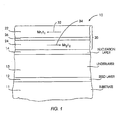
- Fig. 1 illustrates the general cross sectional structure of a disk 10 with an antiferromagnetically-coupled (AFC) magnetic layer 20.
- AFC antiferromagnetically-coupled
- the disk substrate 11 is any suitable material, such as glass, SiC/Si, ceramic, quartz, or an AlMg alloy base with a NiP surface coating.
- the seed layer 12 is an optional layer that may be used to improve the growth of the underlayer 13.
- the seed layer 12 is most commonly used when the substrate 11 is nonmetallic, such as glass.
- the seed layer 12 has a thickness in the range of approximately 1 to 50 nm and is one of the materials, such as Ta, CrTi ,NiAl or RuAl, which are useful as seed materials for promoting the growth of subsequently deposited layers in certain preferred crystalline orientations.
- a pre-seed layer (not shown) may also be used between the glass substrate 11 and the seed layer 12.
- the underlayer 13 is deposited onto the seed layer, if present, or otherwise directly onto the substrate 11, and is a nonmagnetic material such as chromium or a chromium alloy, such as CrV or CrTi.
- the underlayer 13 has a thickness in the range of 5 to 100 nm with a typical value being approximately 10 nm.
- the AFC magnetic layer 20 is made up of two ferromagnetic films 22, 24 separated by a nonferromagnetic spacer film 26.
- the nonferromagnetic spacer film 26 thickness and composition are chosen so that the magnetic moments 32, 34 of adjacent films 22, 24, respectively, are AF-coupled through the nonferromagnetic spacer film 26 and are antiparallel in zero applied field.
- the two AF-coupled films 22, 24 of layer 20 have magnetic moments that are oriented antiparallel, with the upper film 22 having a larger moment.
- the ferromagnetic films 22, 24 are made of a CoPtCrB alloy with 4 to 20 atomic percent (at.%) platinum, 10 to 23 at.% chromium and 2 to 20 at.% boron.
- the nonferromagnetic spacer film 26 is ruthenium (Ru).
- the first ferromagnetic film 24 of the AFC magnetic layer 20 is a boron-containing CoPtCrB alloy
- a very thin (typically 1 to 5 nm) Co alloy onset or nucleation layer 14 is deposited on the underlayer 13.
- the nucleation layer 14 has a composition selected to enhance the growth of the hexagonal close-packed (HCP) CoPtCrB alloy of film 24 so that its C-axis is oriented in the plane of the film.
- the proper crystalline structure of the first CoPtCrB film 24 in turn enhances the growth of the second CoPtCrB film 22, through the Ru spacer film 26, to also have its C-axis in-plane.
- the nucleation layer 14 allows use of boron-containing alloys as the recording layer.
- the material combinations include ferromagnetic films made of Co, Fe, Ni, and their alloys, such as Ni-Fe, Ni-Co, and Fe-Co, and nonferromagnetic spacer films such as Ru, chromium (Cr), rhodium (Rh), iridium (Ir), copper (Cu), and their alloys.
- the oscillatory exchange coupling relationship is determined, if not already known, so that the thickness of the nonferromagnetic spacer film is selected to assure antiferromagnetic coupling between the two ferromagnetic films.
- the period of oscillation depends on the nonferromagnetic spacer material, but the strength and phase of the oscillatory coupling also depends on the ferromagnetic material and interfacial quality.
- the orientations of the magnetic moments 32, 34 of adjacent films 22, 24, respectively, are aligned antiparallel and thus add destructively.
- the arrows 32, 34 represent the moment orientations of individual magnetic domains that are directly above. and below one another across the AF coupling film 26.
- Fig. 1 is shown for an AFC magnetic layer 20 with a two-film structure and a single spacer film
- the AFC disk may have additional ferromagnetic films with AF-coupling spacer films between the ferromagnetic films.
- High performance commercially available disks using glass substrates and CoPtCrB single-layer magnetic layers can require of six layers. These layers are a pre-seed layer on the glass substrate (not shown in Fig. 1), the seed layer, the underlayer, the nonferromagnetic (or slightly ferromagnetic) CoCr nucleation layer, the CoPtCrB magnetic layer, and the protective overcoat.
- Common manufacturing sputtering tools such as the Circulus M12, currently have only seven stations available for actual sputter deposition, assuming the use of two heating stations and one cooling station. Since the AFC magnetic layer replaces the single magnetic layer with three layers, the total number of sputtering cathodes needed to create an AFC disk is eight. This number is larger than is currently available on the Circulus M12 configured as described above. Other types of manufacturing sputter tools may also have a limited number of sputtering cathodes, which makes implementation of AFC media difficult.
- the present invention shows that certain materials can serve the dual purpose of acting as the lower ferromagnetic film in the AFC layer as well as facilitating the in-plane C-axis growth of the second CoPtCrB film through the Ru spacer layer.
- This allows a combination of the nucleation layer and the lower ferromagnetic film of the AFC layer into one layer and therefore only one sputtering cathode is preferably required. This reduces the total number of sputtered layers in the AFC disk structure, thereby overcoming potential manufacturability problems.
- a material is preferably needed which is a Co-alloy, is able to grow epitaxially on an oriented Cr alloy with its C-axis in the plane of the film, and can perform well as the lower ferromagnetic film in the AFC magnetic recording layer.
- ferromagnetic Co 78 Cr 22 which has a saturation magnetization (M s ) of 425 emu/cc.
- the CoCr x alloys with 14 ⁇ x ⁇ 22 produce excellent magnetic properties when used as the bottom ferromagnetic film in an AFC recording layer. This was not expected since it is known that a minimum concentration of Cr (usually at least 18 at.%) is needed for grain boundary segregation, which in turn is needed to enable independent switching of the magnetization of the grains. Because these CoCr alloys have a high moment, thinner bottom ferromagnetic films can be used to achieve the desired Mrt. It has been discovered that the thickness of the first ferromagnetic film has a significant effect on the SNR of the resulting AFC structure.
- the isolated pulse width (PW50) for these two disks was 122 nm and 116 nm, respectively. This data shows that the AFC disk with Co 78 Cr 22 as the first ferromagnetic film grown directly on the Cr alloy underlayer has high magnetic recording performance.
- Fig. 2 shows the preferred structure of the AFC disk 10' according to the invention.
- the thicknesses and compositions for the various layers in this preferred embodiment are as follows:
- the ferromagnetic CoCr alloy that serves as the bottom AFC film without the need for a special nucleation layer has a composition with Cr between approximately 11 and 25 atomic percent.
- the Cr concentration is determined primarily by the thickness and Mrt desired for the bottom AFC film. Since the concentration of Cr determines the M s of the CoCr alloy, it determines the Mrt of the CoCr film for a given thickness.
- the desired thickness of the CoCr film is determined by optimum film growth and recording performance. The upper limit is the amount around which the M s of the CoCr alloy is insufficient for high performance recording.
- the lower ferromagnetic film may also be a ternary or quarternary alloy of CoCr with one or more of platinum (Pt) and tantalum (Ta).
- Pt platinum
- Ta tantalum
- the Pt may be a desired additive if more anisotropy is desired in the lower film and the Ta may be a desired additive if more grain isolation is desired.
- concentrations of 0 ⁇ Pt ⁇ 15 and 2 ⁇ Ta ⁇ 6 have been determined to be the typical ranges which have successfully achieved these purposes.
Landscapes
- Magnetic Record Carriers (AREA)
- Thin Magnetic Films (AREA)
Description
- This invention relates generally to magnetic recording media, and more particularly to a magnetic recording disk with an antiferromagnetically-coupled (AFC) magnetic recording layer.
- Conventional magnetic recording media, such as the magnetic recording disks in hard disk drives, typically use a granular ferromagnetic layer, such as a sputter-deposited cobalt-platinum (CoPt) alloy, as the recording medium. Each magnetized domain in the magnetic layer is comprised of many small magnetic grains. The transitions between magnetized domains represent the "bits" of the recorded data. IBM's US patents 4,789,598 and 5,523,173 describe this type of conventional rigid disk.
- As the storage density of magnetic recording disks has increased, the product of the remanent magnetization Mr (where Mr is measured in units of magnetic moment per unit volume of ferromagnetic material) and the magnetic layer thickness t has decreased. Similarly, the coercive field or coercivity (Hc) of the magnetic layer has increased. This has led to a decrease in the ratio Mrt/Hc. To achieve the reduction in Mrt, the thickness t of the magnetic layer can be reduced, but only to a limit because the stored magnetic information in the layer will be more likely to decay. This decay of the magnetization has been attributed to thermal activation of small magnetic grains (the superparamagnetic effect). The thermal stability of a magnetic grain is to a large extent determined by KuV, where Ku is the magnetic anisotropy constant of the layer and V is the volume of the magnetic grain. As the layer thickness is decreased, V decreases. If the layer thickness is too thin, the stored magnetic information will no longer be stable at normal disk drive operating conditions.
- One approach to the solution of this problem is to move to a higher anisotropy material (higher Ku ). However, the increase in Ku is limited by the point where the coercivity Hc , which is approximately equal to Ku/Ms (Ms = saturation magnetization), becomes too great to be written by a conventional recording head. A similar approach is to reduce the Ms of the magnetic layer for a fixed layer thickness, which will reduce Mr since Mr is related to Ms, but this is also limited by the coercivity that can be written. Another solution is to increase the intergranular exchange, so that the effective magnetic volume V of the magnetic grains is increased. However, this approach has been shown to be deleterious to the intrinsic signal-to-noise ratio (SNR) of the magnetic layer.
- IBM's Patent Application GB 2355018 describes a magnetic recording medium wherein the magnetic recording layer is at least two ferromagnetic films antiferromagnetically coupled together across a nonferromagnetic spacer film. In this type of magnetic media, referred to as AFC media, the magnetic moments of the two antiferromagnetically-coupled films are oriented antiparallel, with the result that the net remanent magnetization-thickness product (Mrt) of the recording layer is the difference in the Mrt values of the two ferromagnetic films. This reduction in Mrt is accomplished without a reduction in volume V. Therefore the thermal stability of the recording medium is not reduced. In one embodiment of the AFC medium the ferromagnetic films are sputter deposited CoPtCrB alloy films separated by a Ru spacer film that has a thickness to maximize the antiferromagnetic coupling between the two CoPtCrB films. One of the ferromagnetic films is made thicker than the other, but the thicknesses are chosen so that the net moment in zero applied magnetic field is low, but nonzero.
- AFC media is to be distinguished from conventional "laminated" media, wherein two or more magnetic layers are spaced apart by an nonmagnetic spacer layer so that the magnetic layers are deliberately magnetically decoupled. It is known that substantially improved SNR can be achieved by the use of laminated media. The reduction in intrinsic media noise by lamination is believed due to a decoupling of the magnetic interaction or exchange coupling between the magnetic layers in the laminate. This discovery was made by S. E. Lambert, et al., "Reduction of Media Noise in Thin Film Metal Media by Lamination", IEEE Transactions on Magnetics, Vol. 26, No. 5, September 1990, pp. 2706-2709, and subsequently patented in IBM's U.S. patent 5,051,288. IBM's more recent U.S. patent 6,077,586 describes a laminated disk with special seed layers and magnetically decoupled boron-containing ferromagnetic layers.
- In general, adding more layers to a disk structure adds complexity to the manufacturing process. Because AFC media require a larger number of sputtering stations due to the larger number of layers that must be sputtered, it may be necessary to substantially modify the existing disk manufacturing line. In addition, the use of a boron-containing alloy like CoPtCrB in the AFC films, which is necessary for high performance media, requires the use of a special onset or nucleation layer to enhance the growth of the CoPtCrB films so that the C-axis of these films is in the plane of the films. The nucleation layer, which is typically a nonferromagnetic CoCr alloy, requires still another sputtering station in the manufacturing line.
- Accordingly, the invention provides a magnetic recording disk comprising: a substrate; a nonferromagnetic underlayer selected from the group comprising Cr and alloys of Cr on the substrate; a first ferromagnetic film formed directly on and in contact with the underlayer, the first ferromagnetic film being a boron free alloy comprising cobalt (Co) and chromium (Cr), wherein Cr is between approximately 11 and 25 atomic percent in the alloy; a nonferromagnetic spacer film on the first ferromagnetic film; and a second ferromagnetic film on the spacer film, the second ferromagnetic film being an alloy comprising Co and B, the second ferromagnetic film being exchange coupled antiferromagnetically to the first ferromagnetic film across the spacer film.
- According to a preferred embodiment an AFC media is provided that possesses high performance magnetic properties but does not require the addition of sputtering stations to the existing manufacturing line.
- An AFC disk is provided wherein the lower ferromagnetic film in the AFC recording layer is a boroh-free ferromagnetic CoCr alloy that does not require a nucleation layer between it and the Cr or Cr alloy underlayer. The ferromagnetic CoCr alloy has sufficient saturation magnetization (Ms) and grain structure to produce excellent magnetic recording performance for the AFC recording layer, while also serving as a nucleation layer to induce the in-plane C-axis growth of the top boron-containing ferromagnetic film through the spacer layer.
- In one embodiment the first ferromagnetic film has a thickness between approximately 1.5 and 3.5 nm.
- In one embodiment the underlayer is an alloy of only Cr and titanium (Ti).
- In one embodiment a seed layer is provided between the substrate and the underlayer and the underlayer is formed directly on and in contact with the seed layer. By way of example, the seed layer is an alloy of only ruthenium (Ru) and aluminum (Al). Alternatively, the seed layer may be an alloy of only nickel (Ni) and aluminum (Al) .
- In a preferred embodiment the first ferromagnetic film is an alloy of only Co and Cr. In another embodiment the first ferromagnetic film is an alloy further comprising one or more of platinum (Pt) and tantalum (Ta) .
- In one embodiment the spacer film consists essentially of ruthenium (Ru) and preferably the second ferromagnetic film is an alloy further comprising Cr and Pt.
- By way of example the substrate is glass and in one embodiment there is a protective overcoat formed over the second ferromagnetic film.
- In one embodiment the first ferromagnetic film has a thickness t1 and a magnetization M1, the second ferromagnetic film has a thickness t2 and a magnetization M2, and the magnetic moments per unit area (M1 x t1) and (M2 x t2) of the first and second ferromagnetic films, respectively, are different from one another.
- In one embodiment there is a second nonferromagnetic spacer film on the second ferromagnetic film and a third ferromagnetic film on the second spacer film. The third ferromagnetic film is exchange coupled antiferromagnetically to the second ferromagnetic film across the second spacer film.
- The invention further provides a magnetic recording disk comprising: a glass substrate; an underlayer selected from the group comprising Cr, a CrV alloy and a CrTi alloy on the substrate; a magnetic recording layer on the underlayer and comprising a first ferromagnetic film of an alloy of only Co and Cr, with Cr being between approximately 11 and 25 atomic percent, formed directly on and in contact with the underlayer, a nonferromagnetic spacer film of a material selected from the group consisting of Ru, Cr, rhodium (Rh), iridium (Ir), copper (Cu), and their alloys formed on the first ferromagnetic film, and a second ferromagnetic film of an alloy comprising Co and B on the spacer film, the spacer film having a thickness sufficient to induce the second ferromagnetic film to be exchange coupled antiferromagnetically to the first ferromagnetic film across the spacer film; and a protective overcoat formed on the magnetic recording layer.
- In one embodiment a seed layer is provided between the substrate and the underlayer and the underlayer is an alloy of only Cr and titanium (Ti) and is formed directly on and in contact with the seed layer. By way of example, the seed layer is selected from the group consisting of a RuAl and a NiAl alloy.
- In one embodiment the spacer film is ruthenium (Ru).
- A preferred embodiment of the present invention will now be described by way of example only and with reference to the following drawings:
- Fig. 1 is a schematic sectional view of an AFC magnetic recording disk according to the prior art.
- Fig. 2 is a schematic sectional view of an AFC magnetic recording disk according to a preferred embodiment of the present invention.
- The magnetic recording disk of the preferred embodiment is of the type that has a magnetic recording layer made of two or more ferromagnetic films that are coupled antiferromagnetically (AF) to their neighboring ferromagnetic films by one or more nonferromagnetic spacer films. Fig. 1 illustrates the general cross sectional structure of a
disk 10 with an antiferromagnetically-coupled (AFC)magnetic layer 20. - The
disk substrate 11 is any suitable material, such as glass, SiC/Si, ceramic, quartz, or an AlMg alloy base with a NiP surface coating. Theseed layer 12 is an optional layer that may be used to improve the growth of theunderlayer 13. Theseed layer 12 is most commonly used when thesubstrate 11 is nonmetallic, such as glass. Theseed layer 12 has a thickness in the range of approximately 1 to 50 nm and is one of the materials, such as Ta, CrTi ,NiAl or RuAl, which are useful as seed materials for promoting the growth of subsequently deposited layers in certain preferred crystalline orientations. A pre-seed layer (not shown) may also be used between theglass substrate 11 and theseed layer 12. Theunderlayer 13 is deposited onto the seed layer, if present, or otherwise directly onto thesubstrate 11, and is a nonmagnetic material such as chromium or a chromium alloy, such as CrV or CrTi. Theunderlayer 13 has a thickness in the range of 5 to 100 nm with a typical value being approximately 10 nm. - The AFC
magnetic layer 20 is made up of twoferromagnetic films nonferromagnetic spacer film 26. Thenonferromagnetic spacer film 26 thickness and composition are chosen so that themagnetic moments adjacent films nonferromagnetic spacer film 26 and are antiparallel in zero applied field. The two AF-coupledfilms layer 20 have magnetic moments that are oriented antiparallel, with theupper film 22 having a larger moment. Theferromagnetic films nonferromagnetic spacer film 26 is ruthenium (Ru). - Because the first
ferromagnetic film 24 of the AFCmagnetic layer 20 is a boron-containing CoPtCrB alloy, a very thin (typically 1 to 5 nm) Co alloy onset ornucleation layer 14 is deposited on theunderlayer 13. Thenucleation layer 14 has a composition selected to enhance the growth of the hexagonal close-packed (HCP) CoPtCrB alloy offilm 24 so that its C-axis is oriented in the plane of the film. The proper crystalline structure of thefirst CoPtCrB film 24 in turn enhances the growth of thesecond CoPtCrB film 22, through theRu spacer film 26, to also have its C-axis in-plane. If theCoPtCrB film 24 were grown directly on theCr alloy underlayer 13 without a nucleation layer, then it would not grow with its C-axis in the plane of the film, which would result in poor recording performance. It is well known that the presence of boron is important for achieving small grains in the recording layer, which is necessary for high performance media. Therefore, thenucleation layer 14 allows use of boron-containing alloys as the recording layer. Thenucleation layer 14 typically is a nonferromagnetic Co alloy, and in the preferred embodiment is a CoCr alloy with Cr >= 31 atomic percent (at%). This CoCr composition produces a phase which is nonferromagnetic or slightly ferromagnetic. - The AF coupling of ferromagnetic films via a nonferromagnetic transition metal spacer film, like the structure of
layer 20 in Fig. 1, has been extensively studied and described in the literature. In general, the exchange coupling oscillates from ferromagnetic to antiferromagnetic with increasing spacer film thickness. This oscillatory coupling relationship for selected material combinations is described by Parkin et al. in "Oscillations in Exchange Coupling and Magnetoresistance in Metallic Superlattice Structures: Co/Ru, Co/Cr and Fe/Cr", Phys. Rev. Lett., Vol. 64, p. 2034 (1990). The material combinations include ferromagnetic films made of Co, Fe, Ni, and their alloys, such as Ni-Fe, Ni-Co, and Fe-Co, and nonferromagnetic spacer films such as Ru, chromium (Cr), rhodium (Rh), iridium (Ir), copper (Cu), and their alloys. For each such material combination, the oscillatory exchange coupling relationship is determined, if not already known, so that the thickness of the nonferromagnetic spacer film is selected to assure antiferromagnetic coupling between the two ferromagnetic films. The period of oscillation depends on the nonferromagnetic spacer material, but the strength and phase of the oscillatory coupling also depends on the ferromagnetic material and interfacial quality. - For this AFC structure of
layer 20 the orientations of themagnetic moments adjacent films arrows AF coupling film 26. - While Fig. 1 is shown for an AFC
magnetic layer 20 with a two-film structure and a single spacer film, the AFC disk may have additional ferromagnetic films with AF-coupling spacer films between the ferromagnetic films. - High performance commercially available disks using glass substrates and CoPtCrB single-layer magnetic layers can require of six layers. These layers are a pre-seed layer on the glass substrate (not shown in Fig. 1), the seed layer, the underlayer, the nonferromagnetic (or slightly ferromagnetic) CoCr nucleation layer, the CoPtCrB magnetic layer, and the protective overcoat. Common manufacturing sputtering tools, such as the Circulus M12, currently have only seven stations available for actual sputter deposition, assuming the use of two heating stations and one cooling station. Since the AFC magnetic layer replaces the single magnetic layer with three layers, the total number of sputtering cathodes needed to create an AFC disk is eight. This number is larger than is currently available on the Circulus M12 configured as described above. Other types of manufacturing sputter tools may also have a limited number of sputtering cathodes, which makes implementation of AFC media difficult.
- The present invention shows that certain materials can serve the dual purpose of acting as the lower ferromagnetic film in the AFC layer as well as facilitating the in-plane C-axis growth of the second CoPtCrB film through the Ru spacer layer. This allows a combination of the nucleation layer and the lower ferromagnetic film of the AFC layer into one layer and therefore only one sputtering cathode is preferably required. This reduces the total number of sputtered layers in the AFC disk structure, thereby overcoming potential manufacturability problems.
- To have a layer that acts as both an onset or nucleation layer and the lower layer in the AFC structure, a material is preferably needed which is a Co-alloy, is able to grow epitaxially on an oriented Cr alloy with its C-axis in the plane of the film, and can perform well as the lower ferromagnetic film in the AFC magnetic recording layer. In the preferred embodiment it has been demonstrated that such a material is ferromagnetic Co78Cr22, which has a saturation magnetization (Ms) of 425 emu/cc. X-ray diffraction results showed that for an AFC structure grown on a conventional underlayer, using a Co78Cr22 ferromagnetic film directly on the underlayer, a Ru spacer layer directly on the Co78Cr22 film , and a CoPtCrB film directly on the Ru spacer layer, the C-axis of the CoPtCrB was in the plane of the film. When a single CoPtCrB film with an Mrt of 0.32 memu/cm2 was grown directly on a Co78Cr22 film with an Mrt of 0.1 memu/cm2, the measured Mrt was 0.43 memu/cm2, which is very close to the sum of the Mrt of the two layers. When the same type of CoPtCrB film was grown on a Ru layer of the thickness needed to obtain AF coupling, which in turn was grown directly on the same type of Co78Cr22 film, the resulting structure had a Mrt of 0.22 memu/cm2 This value is the difference of the Mrt values of the two films and shows that AF coupling is present.
- It has also been found that the CoCrx alloys with 14≤x≤22 produce excellent magnetic properties when used as the bottom ferromagnetic film in an AFC recording layer. This was not expected since it is known that a minimum concentration of Cr (usually at least 18 at.%) is needed for grain boundary segregation, which in turn is needed to enable independent switching of the magnetization of the grains. Because these CoCr alloys have a high moment, thinner bottom ferromagnetic films can be used to achieve the desired Mrt. It has been discovered that the thickness of the first ferromagnetic film has a significant effect on the SNR of the resulting AFC structure. Measured SNR for AFC media, all of which had a top ferromagnetic film of CoPt12Cr18B8, but in which the lower CoCr ferromagnetic films were of various thicknesses and Cr compositions (Cr between 14 and 20 at.%) have shown that the lower film of CoCr should have a thickness between 1.5 and 3.5 nm to optimize SNR of the AFC media.
- In addition, the ratio of the isolated signal pulse to noise (SoNR) at 15000 flux reversals/millimeter of recorded transitions in a single layer film, using a conventional nonferromagnetic Co69Cr31 nucleation layer, was 29.8 dB, while the SoNR of an AFC disk using Co78Cr22 as the first ferromagnetic film and the same type of CoPtCrB material as the second ferromagnetic film, was 31.3 dB. The isolated pulse width (PW50) for these two disks was 122 nm and 116 nm, respectively. This data shows that the AFC disk with Co78Cr22 as the first ferromagnetic film grown directly on the Cr alloy underlayer has high magnetic recording performance.
- Fig. 2 shows the preferred structure of the AFC disk 10' according to the invention. The thicknesses and compositions for the various layers in this preferred embodiment are as follows:
- Pre-seed layer: Al50Ti50 (20-50 nm)
- Seed Layer 12: Ru50Al50 (8-20 nm)
- Underlayer 13: Cr90Ti10 (6-20 nm)
- Lower AFC Film 24' directly on underlayer 13:
- Co(100-x)Crx with 11<x<25, or
- CO(100-y-x)PtyCrx, with 0<y<15 and 11<x<25, or
- Co(100-y-x-z)PtyCrxTaz with 0<y<20, 11<x<22 and 2<z<6
- Spacer Layer 26: Ru or Cr (0.4 - 1.0 nm)
- Top AFC Film 22: Co(100-y-x-z)PtyCrxBz with 6<y<25, 10<x<25, 6<z<15.
- In the preferred embodiment the ferromagnetic CoCr alloy that serves as the bottom AFC film without the need for a special nucleation layer has a composition with Cr between approximately 11 and 25 atomic percent. The Cr concentration is determined primarily by the thickness and Mrt desired for the bottom AFC film. Since the concentration of Cr determines the Ms of the CoCr alloy, it determines the Mrt of the CoCr film for a given thickness. The desired thickness of the CoCr film is determined by optimum film growth and recording performance. The upper limit is the amount around which the Ms of the CoCr alloy is insufficient for high performance recording.
- In addition to this preferred binary alloy of only Co and Cr, the lower ferromagnetic film may also be a ternary or quarternary alloy of CoCr with one or more of platinum (Pt) and tantalum (Ta). The Pt may be a desired additive if more anisotropy is desired in the lower film and the Ta may be a desired additive if more grain isolation is desired. The concentrations of 0<Pt<15 and 2<Ta<6 have been determined to be the typical ranges which have successfully achieved these purposes.
Claims (20)
- A magnetic recording disk comprising:a substrate;a nonferromagnetic underlayer selected from the group comprising Cr and alloys of Cr on the substrate;a first ferromagnetic film formed directly on and in contact with the underlayer, the first ferromagnetic film being a boron free alloy comprising cobalt (Co) and chromium (Cr), wherein Cr is between approximately 11 and 25 atomic percent in the alloy;a nonferromagnetic spacer film on the first ferromagnetic film; anda second ferromagnetic film on the spacer film, the second ferromagnetic film being an alloy comprising Co and B, the second ferromagnetic film being exchange coupled antiferromagnetically to the first ferromagnetic film across the spacer film.
- The disk of claim 1 wherein the first ferromagnetic film has a thickness between approximately 1.5 and 3.5 nm.
- The disk of claim 1 or 2 wherein the underlayer is an alloy of only Cr and titanium (Ti).
- The disk of any preceding claim further comprising a seed layer between the substrate and the underlayer and wherein the underlayer is formed directly on and in contact with the seed layer.
- The disk of claim 4 wherein the seed layer is an alloy of only ruthenium (Ru) and aluminum (Al) .
- The disk of claim 4 wherein the seed layer is an alloy of only nickel (Ni) and aluminum (Al).
- The disk of any preceding claim wherein the first ferromagnetic film is an alloy further comprising platinum (Pt).
- The disk of any preceding claim wherein the first ferromagnetic film is an alloy further comprising tantalum (Ta).
- The disk of any of claims 1 to 6 wherein the first ferromagnetic film is an alloy of only Co and Cr.
- The disk of any preceding claim wherein the spacer film consists essentially of ruthenium (Ru).
- The disk of any preceding claim wherein the second ferromagnetic film is an alloy further comprising Cr and Pt.
- The disk of any preceding claim wherein the substrate is glass.
- The disk of any preceding claim further comprising a protective overcoat formed over the second ferromagnetic film.
- The disk of any preceding claim wherein the first ferromagnetic film has a thickness t1 and a magnetization M1, the second ferromagnetic film has a thickness t2 and a magnetization M2, and wherein the magnetic moments per unit area (M1 x t1) and (M2 x t2) of the first and second ferromagnetic films, respectively, are different from one another.
- The disk of any preceding claim further comprising a second nonferromagnetic spacer film on the second ferromagnetic film and a third ferromagnetic film on the second spacer film, the third ferromagnetic film being exchange coupled antiferromagnetically to the second ferromagnetic film across the second spacer film.
- A magnetic recording disk according to claim 1, wherein:said substrate is a glass substrate;said underlayer is selected from the group comprising Cr, a CrV alloy and a CrTi alloy ;said first ferromagnetic film is of an alloy of only Co and Cr, with Cr being between approximately 11 and 25 atomic percent, formed directly on and in contact with the underlayer, said nonferromagnetic spacer film is of a material selected from the group consisting of Ru, Cr, rhodium (Rh), iridium (Ir), copper (Cu), and their alloys and wherein the disk further comprisesa protective overcoat formed on the magnetic recording layer.
- The disk of claim 16 wherein the first ferromagnetic film has a thickness between approximately 1.5 and 3.5 nm.
- The disk of claim 16 or 17 further comprising a seed layer between the substrate and the underlayer and wherein the underlayer is an alloy of only Cr and titanium (Ti) and is formed directly on and in contact with the seed layer.
- The disk of claim 18 wherein the seed layer is selected from the group consisting of a RuAl and a NiAl alloy.
- The disk of claim 16, 17, 18 or 19 wherein the spacer film is ruthenium (Ru).
Applications Claiming Priority (3)
| Application Number | Priority Date | Filing Date | Title |
|---|---|---|---|
| US09/631,908 US6537684B1 (en) | 2000-08-04 | 2000-08-04 | Antiferromagnetically coupled magnetic recording media with boron-free first ferromagnetic film as nucleation layer |
| US631908 | 2000-08-04 | ||
| PCT/GB2001/003302 WO2002013190A1 (en) | 2000-08-04 | 2001-07-23 | Antiferromagnetically coupled magnetic recording media |
Publications (2)
| Publication Number | Publication Date |
|---|---|
| EP1309969A1 EP1309969A1 (en) | 2003-05-14 |
| EP1309969B1 true EP1309969B1 (en) | 2007-02-28 |
Family
ID=24533273
Family Applications (1)
| Application Number | Title | Priority Date | Filing Date |
|---|---|---|---|
| EP01951808A Expired - Lifetime EP1309969B1 (en) | 2000-08-04 | 2001-07-23 | Antiferromagnetically coupled magnetic recording media |
Country Status (10)
| Country | Link |
|---|---|
| US (1) | US6537684B1 (en) |
| EP (1) | EP1309969B1 (en) |
| JP (1) | JP2004506289A (en) |
| KR (1) | KR100611088B1 (en) |
| CN (1) | CN1240056C (en) |
| AU (1) | AU2001272657A1 (en) |
| DE (1) | DE60126953T2 (en) |
| MY (1) | MY127245A (en) |
| TW (1) | TW540034B (en) |
| WO (1) | WO2002013190A1 (en) |
Families Citing this family (28)
| Publication number | Priority date | Publication date | Assignee | Title |
|---|---|---|---|---|
| DE60037041T2 (en) * | 2000-11-29 | 2008-08-14 | Fujitsu Ltd., Kawasaki | MAGNETIC RECORDING MEDIUM AND MAGNETIC STORAGE DEVICE |
| KR20030051876A (en) * | 2000-11-29 | 2003-06-25 | 후지쯔 가부시끼가이샤 | Magnetic recording medium and magnetic storage device |
| US6689497B1 (en) * | 2001-01-08 | 2004-02-10 | Seagate Technology Llc | Stabilized AFC magnetic recording media with reduced lattice mismatch between spacer layer(s) and magnetic layers |
| JP4746778B2 (en) * | 2001-06-28 | 2011-08-10 | 株式会社日立グローバルストレージテクノロジーズ | Magnetic recording medium and magnetic storage device using the same |
| US6828036B1 (en) * | 2001-08-21 | 2004-12-07 | Seagate Technology Llc | Anti-ferromagnetically coupled magnetic media with combined interlayer + first magnetic layer |
| JP3749460B2 (en) | 2001-09-07 | 2006-03-01 | 富士通株式会社 | Magnetic recording medium and magnetic storage device using the same |
| US20030108774A1 (en) * | 2001-09-28 | 2003-06-12 | Hoya Corporation | Magnetic recording medium |
| JP2003162813A (en) * | 2001-11-28 | 2003-06-06 | Hitachi Ltd | Magnetic recording medium and magnetic storage device |
| US7842409B2 (en) | 2001-11-30 | 2010-11-30 | Seagate Technology Llc | Anti-ferromagnetically coupled perpendicular magnetic recording media with oxide |
| US6815082B2 (en) * | 2001-11-30 | 2004-11-09 | Seagate Technology Llc | Anti-ferromagnetically coupled perpendicular magnetic recording media |
| US6899959B2 (en) * | 2002-02-12 | 2005-05-31 | Komag, Inc. | Magnetic media with improved exchange coupling |
| JP2003263714A (en) | 2002-03-06 | 2003-09-19 | Fujitsu Ltd | Magnetic recording medium and magnetic storage device |
| AU2002334408A1 (en) * | 2002-09-06 | 2004-04-08 | Fujitsu Limited | Magnetic recording medium and magnetic storage apparatus |
| JP2004110941A (en) * | 2002-09-19 | 2004-04-08 | Hitachi Ltd | Magnetic recording medium and magnetic storage device |
| US6835476B2 (en) * | 2003-03-11 | 2004-12-28 | Hitachi Global Storage Technologies Netherlands B.V. | Antiferromagnetically coupled magnetic recording media with CoCrFe alloy first ferromagnetic film |
| JP3862088B2 (en) * | 2003-05-07 | 2006-12-27 | 学校法人明治大学 | Spinel ferrimagnetic powder and magnetic recording medium |
| JP2005032353A (en) * | 2003-07-14 | 2005-02-03 | Fujitsu Ltd | Magnetic recording medium, magnetic storage device, and recording method of magnetic recording medium |
| US7427446B2 (en) * | 2004-02-02 | 2008-09-23 | Fujitsu Limited | Magnetic recording medium with antiparallel magnetic layers and CrN based underlayer, magnetic storage apparatus and method of producing magnetic recording medium |
| JP2005251373A (en) * | 2004-02-02 | 2005-09-15 | Fujitsu Ltd | Magnetic recording medium, manufacturing method thereof, and magnetic storage device |
| US9117476B1 (en) * | 2004-05-27 | 2015-08-25 | Seagate Technology, Llc | Magnetic media on a plastic substrate |
| JP2005353236A (en) * | 2004-06-14 | 2005-12-22 | Fujitsu Ltd | Magnetic recording medium, method for manufacturing the same, and magnetic storage device |
| JP2006024261A (en) * | 2004-07-07 | 2006-01-26 | Fujitsu Ltd | Magnetic recording medium, method for manufacturing the same, and magnetic disk drive |
| JP2006134533A (en) * | 2004-11-09 | 2006-05-25 | Fujitsu Ltd | Magnetic recording medium and magnetic storage device |
| JP2006185489A (en) * | 2004-12-27 | 2006-07-13 | Fujitsu Ltd | Magnetic recording medium and magnetic storage device |
| US20140272470A1 (en) | 2013-03-15 | 2014-09-18 | Seagate Technology Llc | Energy Assisted Segregation Material |
| US12272392B2 (en) | 2022-08-25 | 2025-04-08 | Western Digital Technologies, Inc. | Media structure with selected segregants configured to improve heat-assisted magnetic recording |
| US12412598B2 (en) | 2023-09-01 | 2025-09-09 | Western Digital Technologies, Inc. | Media underlayer structure for heat-assisted magnetic recording and media fabrication methods therefor |
| US12308056B2 (en) | 2023-10-12 | 2025-05-20 | Western Digital Technologies, Inc. | Magnetic recording medium with magnesium-titanium oxide (MTO) layer formed using pulsed direct current sputter deposition |
Family Cites Families (10)
| Publication number | Priority date | Publication date | Assignee | Title |
|---|---|---|---|---|
| US5147732A (en) * | 1988-09-28 | 1992-09-15 | Hitachi, Ltd. | Longitudinal magnetic recording media and magnetic memory units |
| US5180640A (en) * | 1990-10-01 | 1993-01-19 | Komag, Inc. | Magnetic recording medium comprising a magnetic alloy layer of cobalt nickel, platinum and chromium formed directly on a nickel alloy amorphous underlayer |
| KR0148842B1 (en) * | 1993-07-22 | 1998-10-15 | 가나이 쯔또무 | Magnetic recording medium, process for producing the same and magnetic recording system |
| US6156404A (en) * | 1996-10-18 | 2000-12-05 | Komag, Inc. | Method of making high performance, low noise isotropic magnetic media including a chromium underlayer |
| JP2911783B2 (en) * | 1995-06-28 | 1999-06-23 | ホーヤ株式会社 | Magnetic recording medium and method of manufacturing the same |
| US5900324A (en) * | 1994-10-27 | 1999-05-04 | Hoya Corporation | Magnetic recording media, methods for producing the same and magnetic recorders |
| US5523173A (en) * | 1994-12-27 | 1996-06-04 | International Business Machines Corporation | Magnetic recording medium with a CoPtCrB alloy thin film with a 1120 crystallographic orientation deposited on an underlayer with 100 orientation |
| US6077586A (en) | 1997-07-15 | 2000-06-20 | International Business Machines Corporation | Laminated thin film disk for longitudinal recording |
| US6403241B1 (en) * | 1999-04-14 | 2002-06-11 | Seagate Technology, Inc. | CoCrPtB medium with a 1010 crystallographic orientation |
| US6280813B1 (en) * | 1999-10-08 | 2001-08-28 | International Business Machines Corporation | Magnetic recording media with antiferromagnetically coupled ferromagnetic films as the recording layer |
-
2000
- 2000-08-04 US US09/631,908 patent/US6537684B1/en not_active Expired - Lifetime
-
2001
- 2001-07-23 WO PCT/GB2001/003302 patent/WO2002013190A1/en not_active Ceased
- 2001-07-23 AU AU2001272657A patent/AU2001272657A1/en not_active Abandoned
- 2001-07-23 EP EP01951808A patent/EP1309969B1/en not_active Expired - Lifetime
- 2001-07-23 DE DE60126953T patent/DE60126953T2/en not_active Expired - Fee Related
- 2001-07-23 JP JP2002518461A patent/JP2004506289A/en active Pending
- 2001-07-23 CN CNB018136966A patent/CN1240056C/en not_active Expired - Fee Related
- 2001-07-23 KR KR1020037001344A patent/KR100611088B1/en not_active Expired - Fee Related
- 2001-07-30 MY MYPI20013587 patent/MY127245A/en unknown
- 2001-08-01 TW TW090118786A patent/TW540034B/en not_active IP Right Cessation
Also Published As
| Publication number | Publication date |
|---|---|
| MY127245A (en) | 2006-11-30 |
| JP2004506289A (en) | 2004-02-26 |
| TW540034B (en) | 2003-07-01 |
| WO2002013190A1 (en) | 2002-02-14 |
| DE60126953D1 (en) | 2007-04-12 |
| US6537684B1 (en) | 2003-03-25 |
| EP1309969A1 (en) | 2003-05-14 |
| KR100611088B1 (en) | 2006-08-10 |
| CN1240056C (en) | 2006-02-01 |
| AU2001272657A1 (en) | 2002-02-18 |
| DE60126953T2 (en) | 2007-11-22 |
| KR20030024815A (en) | 2003-03-26 |
| CN1446354A (en) | 2003-10-01 |
Similar Documents
| Publication | Publication Date | Title |
|---|---|---|
| US6537684B1 (en) | Antiferromagnetically coupled magnetic recording media with boron-free first ferromagnetic film as nucleation layer | |
| US6773834B2 (en) | Laminated magnetic recording media with antiferromagnetically coupled layer as one of the individual magnetic layers in the laminate | |
| EP1305796B1 (en) | Laminated magnetic recording media | |
| EP1275110B1 (en) | Magnetic recording medium | |
| US6594100B2 (en) | Method for recording magnetic transitions on recording layer having antiferromagnetically coupled ferromagnetic films | |
| US6468670B1 (en) | Magnetic recording disk with composite perpendicular recording layer | |
| US6567236B1 (en) | Antiferromagnetically coupled thin films for magnetic recording | |
| US20030180577A1 (en) | Magnetic recording medium with antiparallel coupled ferromagnetic films as the recording layer | |
| US7081309B2 (en) | Magnetic recording disk with antiferromagnetically-coupled magnetic layer having multiple ferromagnetically-coupled lower layers | |
| US7556870B2 (en) | Antiferromagnetically coupled media for magnetic recording with weak coupling layer | |
| US6872478B2 (en) | Magnetic thin film media with a pre-seed layer of CrTiAl | |
| US6835476B2 (en) | Antiferromagnetically coupled magnetic recording media with CoCrFe alloy first ferromagnetic film | |
| US7976964B2 (en) | Disk drive with laminated magnetic thin films with sublayers for magnetic recording | |
| EP1569207B1 (en) | Magnetic recording disk with antiferromagnetically-coupled magnetic layer having multiple lower layers | |
| US20060210834A1 (en) | Laminated magnetic thin films with sublayers for magnetic recording |
Legal Events
| Date | Code | Title | Description |
|---|---|---|---|
| PUAI | Public reference made under article 153(3) epc to a published international application that has entered the european phase |
Free format text: ORIGINAL CODE: 0009012 |
|
| 17P | Request for examination filed |
Effective date: 20030303 |
|
| AK | Designated contracting states |
Designated state(s): AT BE CH CY DE DK ES FI FR GB GR IE IT LI LU MC NL PT SE TR |
|
| AX | Request for extension of the european patent |
Extension state: AL LT LV MK RO SI |
|
| RIN1 | Information on inventor provided before grant (corrected) |
Inventor name: MARGULIES, DAVID, THOMAS Inventor name: DOERNER, MARY, FRANCES Inventor name: FULLERTON, ERIC, EDWARD |
|
| 17Q | First examination report despatched |
Effective date: 20030827 |
|
| RAP1 | Party data changed (applicant data changed or rights of an application transferred) |
Owner name: HITACHI GLOBAL STORAGE TECHNOLOGIES NETHERLANDS B. |
|
| GRAP | Despatch of communication of intention to grant a patent |
Free format text: ORIGINAL CODE: EPIDOSNIGR1 |
|
| RBV | Designated contracting states (corrected) |
Designated state(s): DE FR GB |
|
| GRAS | Grant fee paid |
Free format text: ORIGINAL CODE: EPIDOSNIGR3 |
|
| GRAA | (expected) grant |
Free format text: ORIGINAL CODE: 0009210 |
|
| AK | Designated contracting states |
Kind code of ref document: B1 Designated state(s): DE FR GB |
|
| REG | Reference to a national code |
Ref country code: GB Ref legal event code: FG4D |
|
| REF | Corresponds to: |
Ref document number: 60126953 Country of ref document: DE Date of ref document: 20070412 Kind code of ref document: P |
|
| ET | Fr: translation filed | ||
| PLBE | No opposition filed within time limit |
Free format text: ORIGINAL CODE: 0009261 |
|
| STAA | Information on the status of an ep patent application or granted ep patent |
Free format text: STATUS: NO OPPOSITION FILED WITHIN TIME LIMIT |
|
| 26N | No opposition filed |
Effective date: 20071129 |
|
| PGFP | Annual fee paid to national office [announced via postgrant information from national office to epo] |
Ref country code: DE Payment date: 20080728 Year of fee payment: 8 |
|
| PGFP | Annual fee paid to national office [announced via postgrant information from national office to epo] |
Ref country code: FR Payment date: 20080725 Year of fee payment: 8 |
|
| PGFP | Annual fee paid to national office [announced via postgrant information from national office to epo] |
Ref country code: GB Payment date: 20080718 Year of fee payment: 8 |
|
| GBPC | Gb: european patent ceased through non-payment of renewal fee |
Effective date: 20090723 |
|
| REG | Reference to a national code |
Ref country code: FR Ref legal event code: ST Effective date: 20100331 |
|
| PG25 | Lapsed in a contracting state [announced via postgrant information from national office to epo] |
Ref country code: FR Free format text: LAPSE BECAUSE OF NON-PAYMENT OF DUE FEES Effective date: 20090731 |
|
| PG25 | Lapsed in a contracting state [announced via postgrant information from national office to epo] |
Ref country code: GB Free format text: LAPSE BECAUSE OF NON-PAYMENT OF DUE FEES Effective date: 20090723 |
|
| PG25 | Lapsed in a contracting state [announced via postgrant information from national office to epo] |
Ref country code: DE Free format text: LAPSE BECAUSE OF NON-PAYMENT OF DUE FEES Effective date: 20100202 |