EP1309336B1 - Derivatives of laspartomycin and preparation and use thereof - Google Patents
Derivatives of laspartomycin and preparation and use thereof Download PDFInfo
- Publication number
- EP1309336B1 EP1309336B1 EP01953501A EP01953501A EP1309336B1 EP 1309336 B1 EP1309336 B1 EP 1309336B1 EP 01953501 A EP01953501 A EP 01953501A EP 01953501 A EP01953501 A EP 01953501A EP 1309336 B1 EP1309336 B1 EP 1309336B1
- Authority
- EP
- European Patent Office
- Prior art keywords
- laspartomycin
- groups
- optionally substituted
- different
- same
- Prior art date
- Legal status (The legal status is an assumption and is not a legal conclusion. Google has not performed a legal analysis and makes no representation as to the accuracy of the status listed.)
- Expired - Lifetime
Links
- 238000002360 preparation method Methods 0.000 title description 5
- 230000000845 anti-microbial effect Effects 0.000 claims abstract description 108
- 108090000765 processed proteins & peptides Proteins 0.000 claims abstract description 100
- 238000000034 method Methods 0.000 claims abstract description 63
- 208000015181 infectious disease Diseases 0.000 claims abstract description 18
- 230000000813 microbial effect Effects 0.000 claims abstract description 18
- 239000004599 antimicrobial Substances 0.000 claims abstract description 15
- 239000008194 pharmaceutical composition Substances 0.000 claims abstract description 15
- 125000005647 linker group Chemical group 0.000 claims description 53
- 239000001257 hydrogen Substances 0.000 claims description 34
- 229910052739 hydrogen Inorganic materials 0.000 claims description 34
- 125000004435 hydrogen atom Chemical group [H]* 0.000 claims description 34
- 150000001875 compounds Chemical class 0.000 claims description 33
- IJGRMHOSHXDMSA-UHFFFAOYSA-N Atomic nitrogen Chemical compound N#N IJGRMHOSHXDMSA-UHFFFAOYSA-N 0.000 claims description 30
- 125000003118 aryl group Chemical group 0.000 claims description 30
- 125000004446 heteroarylalkyl group Chemical group 0.000 claims description 25
- 125000003710 aryl alkyl group Chemical group 0.000 claims description 23
- 229910052757 nitrogen Inorganic materials 0.000 claims description 22
- 125000000217 alkyl group Chemical group 0.000 claims description 21
- 125000001072 heteroaryl group Chemical group 0.000 claims description 21
- 150000003839 salts Chemical class 0.000 claims description 21
- 125000005418 aryl aryl group Chemical group 0.000 claims description 20
- 108010069514 Cyclic Peptides Proteins 0.000 claims description 17
- 102000001189 Cyclic Peptides Human genes 0.000 claims description 17
- 229940024606 amino acid Drugs 0.000 claims description 17
- 241000187191 Streptomyces viridochromogenes Species 0.000 claims description 16
- 229960005261 aspartic acid Drugs 0.000 claims description 16
- 238000012258 culturing Methods 0.000 claims description 16
- 239000012634 fragment Substances 0.000 claims description 15
- DHMQDGOQFOQNFH-UHFFFAOYSA-N Glycine Chemical compound NCC(O)=O DHMQDGOQFOQNFH-UHFFFAOYSA-N 0.000 claims description 14
- 125000003178 carboxy group Chemical group [H]OC(*)=O 0.000 claims description 14
- 239000001963 growth medium Substances 0.000 claims description 14
- 229910052736 halogen Inorganic materials 0.000 claims description 13
- 150000002367 halogens Chemical class 0.000 claims description 13
- 244000005700 microbiome Species 0.000 claims description 12
- 125000000172 C5-C10 aryl group Chemical group 0.000 claims description 11
- 125000004404 heteroalkyl group Chemical group 0.000 claims description 11
- CKLJMWTZIZZHCS-REOHCLBHSA-N L-aspartic acid Chemical compound OC(=O)[C@@H](N)CC(O)=O CKLJMWTZIZZHCS-REOHCLBHSA-N 0.000 claims description 10
- 235000008206 alpha-amino acids Nutrition 0.000 claims description 10
- UFHFLCQGNIYNRP-UHFFFAOYSA-N Hydrogen Chemical compound [H][H] UFHFLCQGNIYNRP-UHFFFAOYSA-N 0.000 claims description 9
- 229910006069 SO3H Inorganic materials 0.000 claims description 9
- 125000001313 C5-C10 heteroaryl group Chemical group 0.000 claims description 8
- 229910018830 PO3H Inorganic materials 0.000 claims description 8
- 235000003704 aspartic acid Nutrition 0.000 claims description 8
- OQFSQFPPLPISGP-UHFFFAOYSA-N beta-carboxyaspartic acid Natural products OC(=O)C(N)C(C(O)=O)C(O)=O OQFSQFPPLPISGP-UHFFFAOYSA-N 0.000 claims description 8
- 229960002989 glutamic acid Drugs 0.000 claims description 8
- 125000004169 (C1-C6) alkyl group Chemical group 0.000 claims description 7
- 239000004471 Glycine Substances 0.000 claims description 7
- 150000001370 alpha-amino acid derivatives Chemical class 0.000 claims description 7
- 229960001230 asparagine Drugs 0.000 claims description 7
- 239000004220 glutamic acid Substances 0.000 claims description 7
- 239000000546 pharmaceutical excipient Substances 0.000 claims description 7
- 125000004953 trihalomethyl group Chemical group 0.000 claims description 7
- 125000000008 (C1-C10) alkyl group Chemical group 0.000 claims description 6
- DCXYFEDJOCDNAF-UHFFFAOYSA-N Asparagine Natural products OC(=O)C(N)CC(N)=O DCXYFEDJOCDNAF-UHFFFAOYSA-N 0.000 claims description 6
- WHUUTDBJXJRKMK-UHFFFAOYSA-N Glutamic acid Natural products OC(=O)C(N)CCC(O)=O WHUUTDBJXJRKMK-UHFFFAOYSA-N 0.000 claims description 6
- DCXYFEDJOCDNAF-REOHCLBHSA-N L-asparagine Chemical compound OC(=O)[C@@H](N)CC(N)=O DCXYFEDJOCDNAF-REOHCLBHSA-N 0.000 claims description 6
- WHUUTDBJXJRKMK-VKHMYHEASA-N L-glutamic acid Chemical compound OC(=O)[C@@H](N)CCC(O)=O WHUUTDBJXJRKMK-VKHMYHEASA-N 0.000 claims description 6
- ZDXPYRJPNDTMRX-VKHMYHEASA-N L-glutamine Chemical compound OC(=O)[C@@H](N)CCC(N)=O ZDXPYRJPNDTMRX-VKHMYHEASA-N 0.000 claims description 6
- QIVBCDIJIAJPQS-VIFPVBQESA-N L-tryptophane Chemical compound C1=CC=C2C(C[C@H](N)C(O)=O)=CNC2=C1 QIVBCDIJIAJPQS-VIFPVBQESA-N 0.000 claims description 6
- QIVBCDIJIAJPQS-UHFFFAOYSA-N Tryptophan Natural products C1=CC=C2C(CC(N)C(O)=O)=CNC2=C1 QIVBCDIJIAJPQS-UHFFFAOYSA-N 0.000 claims description 6
- 235000009582 asparagine Nutrition 0.000 claims description 6
- 239000003085 diluting agent Substances 0.000 claims description 6
- 235000013922 glutamic acid Nutrition 0.000 claims description 6
- ZDXPYRJPNDTMRX-UHFFFAOYSA-N glutamine Natural products OC(=O)C(N)CCC(N)=O ZDXPYRJPNDTMRX-UHFFFAOYSA-N 0.000 claims description 6
- 235000004554 glutamine Nutrition 0.000 claims description 6
- 229960002743 glutamine Drugs 0.000 claims description 6
- 229960002449 glycine Drugs 0.000 claims description 6
- 229960004799 tryptophan Drugs 0.000 claims description 6
- 229960004441 tyrosine Drugs 0.000 claims description 6
- AGPKZVBTJJNPAG-WHFBIAKZSA-N L-isoleucine Chemical compound CC[C@H](C)[C@H](N)C(O)=O AGPKZVBTJJNPAG-WHFBIAKZSA-N 0.000 claims description 5
- 125000005841 biaryl group Chemical group 0.000 claims description 5
- 239000003814 drug Substances 0.000 claims description 5
- 229960000310 isoleucine Drugs 0.000 claims description 5
- AGPKZVBTJJNPAG-UHFFFAOYSA-N isoleucine Natural products CCC(C)C(N)C(O)=O AGPKZVBTJJNPAG-UHFFFAOYSA-N 0.000 claims description 5
- 229960005190 phenylalanine Drugs 0.000 claims description 5
- 230000001225 therapeutic effect Effects 0.000 claims description 5
- QNAYBMKLOCPYGJ-REOHCLBHSA-N L-alanine Chemical compound C[C@H](N)C(O)=O QNAYBMKLOCPYGJ-REOHCLBHSA-N 0.000 claims description 4
- ROHFNLRQFUQHCH-YFKPBYRVSA-N L-leucine Chemical compound CC(C)C[C@H](N)C(O)=O ROHFNLRQFUQHCH-YFKPBYRVSA-N 0.000 claims description 4
- COLNVLDHVKWLRT-QMMMGPOBSA-N L-phenylalanine Chemical compound OC(=O)[C@@H](N)CC1=CC=CC=C1 COLNVLDHVKWLRT-QMMMGPOBSA-N 0.000 claims description 4
- OUYCCCASQSFEME-QMMMGPOBSA-N L-tyrosine Chemical compound OC(=O)[C@@H](N)CC1=CC=C(O)C=C1 OUYCCCASQSFEME-QMMMGPOBSA-N 0.000 claims description 4
- KZSNJWFQEVHDMF-BYPYZUCNSA-N L-valine Chemical compound CC(C)[C@H](N)C(O)=O KZSNJWFQEVHDMF-BYPYZUCNSA-N 0.000 claims description 4
- ROHFNLRQFUQHCH-UHFFFAOYSA-N Leucine Natural products CC(C)CC(N)C(O)=O ROHFNLRQFUQHCH-UHFFFAOYSA-N 0.000 claims description 4
- NINIDFKCEFEMDL-UHFFFAOYSA-N Sulfur Chemical compound [S] NINIDFKCEFEMDL-UHFFFAOYSA-N 0.000 claims description 4
- KZSNJWFQEVHDMF-UHFFFAOYSA-N Valine Natural products CC(C)C(N)C(O)=O KZSNJWFQEVHDMF-UHFFFAOYSA-N 0.000 claims description 4
- 229960003767 alanine Drugs 0.000 claims description 4
- 235000004279 alanine Nutrition 0.000 claims description 4
- QVGXLLKOCUKJST-UHFFFAOYSA-N atomic oxygen Chemical compound [O] QVGXLLKOCUKJST-UHFFFAOYSA-N 0.000 claims description 4
- 229960003136 leucine Drugs 0.000 claims description 4
- 229910052760 oxygen Inorganic materials 0.000 claims description 4
- 239000001301 oxygen Substances 0.000 claims description 4
- COLNVLDHVKWLRT-UHFFFAOYSA-N phenylalanine Natural products OC(=O)C(N)CC1=CC=CC=C1 COLNVLDHVKWLRT-UHFFFAOYSA-N 0.000 claims description 4
- 229910052717 sulfur Inorganic materials 0.000 claims description 4
- 239000011593 sulfur Substances 0.000 claims description 4
- 238000011282 treatment Methods 0.000 claims description 4
- OUYCCCASQSFEME-UHFFFAOYSA-N tyrosine Natural products OC(=O)C(N)CC1=CC=C(O)C=C1 OUYCCCASQSFEME-UHFFFAOYSA-N 0.000 claims description 4
- 229960004295 valine Drugs 0.000 claims description 4
- 239000004474 valine Substances 0.000 claims description 4
- 239000003937 drug carrier Substances 0.000 claims description 3
- 238000004519 manufacturing process Methods 0.000 claims description 3
- OAICVXFJPJFONN-UHFFFAOYSA-N Phosphorus Chemical compound [P] OAICVXFJPJFONN-UHFFFAOYSA-N 0.000 claims description 2
- 125000002915 carbonyl group Chemical group [*:2]C([*:1])=O 0.000 claims description 2
- 229910052698 phosphorus Inorganic materials 0.000 claims description 2
- 239000011574 phosphorus Substances 0.000 claims description 2
- 230000012010 growth Effects 0.000 abstract description 17
- 230000002401 inhibitory effect Effects 0.000 abstract description 7
- 102000004196 processed proteins & peptides Human genes 0.000 abstract description 4
- WEVYAHXRMPXWCK-UHFFFAOYSA-N Acetonitrile Chemical compound CC#N WEVYAHXRMPXWCK-UHFFFAOYSA-N 0.000 description 159
- OKKJLVBELUTLKV-UHFFFAOYSA-N Methanol Chemical compound OC OKKJLVBELUTLKV-UHFFFAOYSA-N 0.000 description 90
- 239000000047 product Substances 0.000 description 77
- ZMXDDKWLCZADIW-UHFFFAOYSA-N N,N-Dimethylformamide Chemical compound CN(C)C=O ZMXDDKWLCZADIW-UHFFFAOYSA-N 0.000 description 68
- 239000000243 solution Substances 0.000 description 60
- 230000015572 biosynthetic process Effects 0.000 description 54
- 238000003786 synthesis reaction Methods 0.000 description 54
- 239000000203 mixture Substances 0.000 description 52
- -1 cyclopropan-1-yl Chemical group 0.000 description 49
- 239000011734 sodium Substances 0.000 description 43
- 239000007787 solid Substances 0.000 description 43
- XLYOFNOQVPJJNP-UHFFFAOYSA-N water Substances O XLYOFNOQVPJJNP-UHFFFAOYSA-N 0.000 description 43
- LRHPLDYGYMQRHN-UHFFFAOYSA-N N-Butanol Chemical compound CCCCO LRHPLDYGYMQRHN-UHFFFAOYSA-N 0.000 description 42
- 238000004128 high performance liquid chromatography Methods 0.000 description 41
- 238000004992 fast atom bombardment mass spectroscopy Methods 0.000 description 37
- 239000002609 medium Substances 0.000 description 26
- 239000011541 reaction mixture Substances 0.000 description 24
- 239000011347 resin Substances 0.000 description 24
- 229920005989 resin Polymers 0.000 description 24
- 150000002148 esters Chemical class 0.000 description 22
- 238000000855 fermentation Methods 0.000 description 21
- 230000004151 fermentation Effects 0.000 description 21
- 239000003242 anti bacterial agent Substances 0.000 description 20
- 229940088710 antibiotic agent Drugs 0.000 description 20
- 239000004254 Ammonium phosphate Substances 0.000 description 18
- DTQVDTLACAAQTR-UHFFFAOYSA-N Trifluoroacetic acid Chemical compound OC(=O)C(F)(F)F DTQVDTLACAAQTR-UHFFFAOYSA-N 0.000 description 18
- 229910000148 ammonium phosphate Inorganic materials 0.000 description 18
- 235000019289 ammonium phosphates Nutrition 0.000 description 18
- MNNHAPBLZZVQHP-UHFFFAOYSA-N diammonium hydrogen phosphate Chemical compound [NH4+].[NH4+].OP([O-])([O-])=O MNNHAPBLZZVQHP-UHFFFAOYSA-N 0.000 description 18
- 239000007864 aqueous solution Substances 0.000 description 17
- XELZGAJCZANUQH-UHFFFAOYSA-N methyl 1-acetylthieno[3,2-c]pyrazole-5-carboxylate Chemical compound CC(=O)N1N=CC2=C1C=C(C(=O)OC)S2 XELZGAJCZANUQH-UHFFFAOYSA-N 0.000 description 16
- 235000001014 amino acid Nutrition 0.000 description 14
- 150000001413 amino acids Chemical class 0.000 description 14
- 230000003115 biocidal effect Effects 0.000 description 14
- ASOKPJOREAFHNY-UHFFFAOYSA-N 1-Hydroxybenzotriazole Chemical compound C1=CC=C2N(O)N=NC2=C1 ASOKPJOREAFHNY-UHFFFAOYSA-N 0.000 description 13
- JGFZNNIVVJXRND-UHFFFAOYSA-N N,N-Diisopropylethylamine (DIPEA) Chemical compound CCN(C(C)C)C(C)C JGFZNNIVVJXRND-UHFFFAOYSA-N 0.000 description 13
- 229910052799 carbon Inorganic materials 0.000 description 13
- 238000006243 chemical reaction Methods 0.000 description 13
- 0 CCC(*)(C(C(C)N)N)I(C)(C)C(C(C(CC)(CC)IC)[N+]C)N Chemical compound CCC(*)(C(C(C)N)N)I(C)(C)C(C(C(CC)(CC)IC)[N+]C)N 0.000 description 12
- QOSSAOTZNIDXMA-UHFFFAOYSA-N Dicylcohexylcarbodiimide Chemical compound C1CCCCC1N=C=NC1CCCCC1 QOSSAOTZNIDXMA-UHFFFAOYSA-N 0.000 description 12
- 239000012153 distilled water Substances 0.000 description 12
- CHRJZRDFSQHIFI-UHFFFAOYSA-N 1,2-bis(ethenyl)benzene;styrene Chemical compound C=CC1=CC=CC=C1.C=CC1=CC=CC=C1C=C CHRJZRDFSQHIFI-UHFFFAOYSA-N 0.000 description 11
- 241000187840 Actinoplanes utahensis Species 0.000 description 11
- 235000010633 broth Nutrition 0.000 description 11
- 150000001721 carbon Chemical group 0.000 description 11
- 239000000463 material Substances 0.000 description 11
- 239000000843 powder Substances 0.000 description 11
- VHUUQVKOLVNVRT-UHFFFAOYSA-N Ammonium hydroxide Chemical compound [NH4+].[OH-] VHUUQVKOLVNVRT-UHFFFAOYSA-N 0.000 description 10
- VTYYLEPIZMXCLO-UHFFFAOYSA-L Calcium carbonate Chemical compound [Ca+2].[O-]C([O-])=O VTYYLEPIZMXCLO-UHFFFAOYSA-L 0.000 description 10
- 108010028921 Lipopeptides Proteins 0.000 description 10
- WYURNTSHIVDZCO-UHFFFAOYSA-N Tetrahydrofuran Chemical compound C1CCOC1 WYURNTSHIVDZCO-UHFFFAOYSA-N 0.000 description 10
- 239000000908 ammonium hydroxide Substances 0.000 description 10
- ZUOUZKKEUPVFJK-UHFFFAOYSA-N diphenyl Chemical compound C1=CC=CC=C1C1=CC=CC=C1 ZUOUZKKEUPVFJK-UHFFFAOYSA-N 0.000 description 10
- 238000009472 formulation Methods 0.000 description 10
- 108090000790 Enzymes Proteins 0.000 description 9
- 102000004190 Enzymes Human genes 0.000 description 9
- KWYUFKZDYYNOTN-UHFFFAOYSA-M Potassium hydroxide Chemical compound [OH-].[K+] KWYUFKZDYYNOTN-UHFFFAOYSA-M 0.000 description 9
- HEMHJVSKTPXQMS-UHFFFAOYSA-M Sodium hydroxide Chemical compound [OH-].[Na+] HEMHJVSKTPXQMS-UHFFFAOYSA-M 0.000 description 9
- 125000003342 alkenyl group Chemical group 0.000 description 9
- 238000013459 approach Methods 0.000 description 9
- KDLHZDBZIXYQEI-UHFFFAOYSA-N Palladium Chemical compound [Pd] KDLHZDBZIXYQEI-UHFFFAOYSA-N 0.000 description 8
- FAPWRFPIFSIZLT-UHFFFAOYSA-M Sodium chloride Chemical compound [Na+].[Cl-] FAPWRFPIFSIZLT-UHFFFAOYSA-M 0.000 description 8
- 239000002253 acid Substances 0.000 description 8
- 239000008346 aqueous phase Substances 0.000 description 8
- 150000005347 biaryls Chemical group 0.000 description 8
- 125000000524 functional group Chemical group 0.000 description 8
- 239000003960 organic solvent Substances 0.000 description 8
- 239000012071 phase Substances 0.000 description 8
- 125000001424 substituent group Chemical group 0.000 description 8
- 238000003556 assay Methods 0.000 description 7
- 229910002092 carbon dioxide Inorganic materials 0.000 description 7
- 239000011203 carbon fibre reinforced carbon Substances 0.000 description 7
- 238000004113 cell culture Methods 0.000 description 7
- 239000003795 chemical substances by application Substances 0.000 description 7
- 239000012528 membrane Substances 0.000 description 7
- 238000010647 peptide synthesis reaction Methods 0.000 description 7
- 239000003755 preservative agent Substances 0.000 description 7
- 239000000725 suspension Substances 0.000 description 7
- 238000010189 synthetic method Methods 0.000 description 7
- 241000192125 Firmicutes Species 0.000 description 6
- YLQBMQCUIZJEEH-UHFFFAOYSA-N Furan Chemical compound C=1C=COC=1 YLQBMQCUIZJEEH-UHFFFAOYSA-N 0.000 description 6
- PEDCQBHIVMGVHV-UHFFFAOYSA-N Glycerine Chemical compound OCC(O)CO PEDCQBHIVMGVHV-UHFFFAOYSA-N 0.000 description 6
- VEXZGXHMUGYJMC-UHFFFAOYSA-N Hydrochloric acid Chemical compound Cl VEXZGXHMUGYJMC-UHFFFAOYSA-N 0.000 description 6
- KFZMGEQAYNKOFK-UHFFFAOYSA-N Isopropanol Chemical compound CC(C)O KFZMGEQAYNKOFK-UHFFFAOYSA-N 0.000 description 6
- RJQXTJLFIWVMTO-TYNCELHUSA-N Methicillin Chemical compound COC1=CC=CC(OC)=C1C(=O)N[C@@H]1C(=O)N2[C@@H](C(O)=O)C(C)(C)S[C@@H]21 RJQXTJLFIWVMTO-TYNCELHUSA-N 0.000 description 6
- 125000000304 alkynyl group Chemical group 0.000 description 6
- 108010079465 amphomycin Proteins 0.000 description 6
- 239000000645 desinfectant Substances 0.000 description 6
- RAXXELZNTBOGNW-UHFFFAOYSA-N imidazole Natural products C1=CNC=N1 RAXXELZNTBOGNW-UHFFFAOYSA-N 0.000 description 6
- 238000000338 in vitro Methods 0.000 description 6
- 239000000543 intermediate Substances 0.000 description 6
- 229960003085 meticillin Drugs 0.000 description 6
- XBNDESPXQUOOBQ-LSMLZNGOSA-N (2r,3s)-4-[[(2s)-1-[[2-[[(2s)-1-[[2-[[(2r,3s)-1-[[(2s)-1-[(2s)-2-[[(1s)-1-[(3s,9ar)-1,4-dioxo-3,6,7,8,9,9a-hexahydro-2h-pyrido[1,2-a]pyrazin-3-yl]ethyl]carbamoyl]pyrrolidin-1-yl]-3-methyl-1-oxobutan-2-yl]amino]-3-amino-1-oxobutan-2-yl]amino]-2-oxoethyl]am Chemical compound CCC(C)CCCCC\C=C\CC(=O)N[C@@H](CC(O)=O)C(=O)N[C@@H]([C@@H](C)C(O)=O)C(=O)N[C@@H](CC(O)=O)C(=O)NCC(=O)N[C@@H](CC(O)=O)C(=O)NCC(=O)N[C@H]([C@H](C)N)C(=O)N[C@@H](C(C)C)C(=O)N1CCC[C@H]1C(=O)N[C@@H](C)[C@H]1C(=O)N2CCCC[C@@H]2C(=O)N1 XBNDESPXQUOOBQ-LSMLZNGOSA-N 0.000 description 5
- 125000003903 2-propenyl group Chemical group [H]C([*])([H])C([H])=C([H])[H] 0.000 description 5
- SIKJAQJRHWYJAI-UHFFFAOYSA-N Indole Chemical compound C1=CC=C2NC=CC2=C1 SIKJAQJRHWYJAI-UHFFFAOYSA-N 0.000 description 5
- 241001465754 Metazoa Species 0.000 description 5
- AYFVYJQAPQTCCC-UHFFFAOYSA-N Threonine Natural products CC(O)C(N)C(O)=O AYFVYJQAPQTCCC-UHFFFAOYSA-N 0.000 description 5
- FPQVGDGSRVMNMR-JCTPKUEWSA-N [[(z)-(1-cyano-2-ethoxy-2-oxoethylidene)amino]oxy-(dimethylamino)methylidene]-dimethylazanium;tetrafluoroborate Chemical compound F[B-](F)(F)F.CCOC(=O)C(\C#N)=N/OC(N(C)C)=[N+](C)C FPQVGDGSRVMNMR-JCTPKUEWSA-N 0.000 description 5
- 239000007900 aqueous suspension Substances 0.000 description 5
- 239000004305 biphenyl Substances 0.000 description 5
- 235000010290 biphenyl Nutrition 0.000 description 5
- 239000000872 buffer Substances 0.000 description 5
- 229910000019 calcium carbonate Inorganic materials 0.000 description 5
- 238000007796 conventional method Methods 0.000 description 5
- 125000004122 cyclic group Chemical group 0.000 description 5
- 239000003480 eluent Substances 0.000 description 5
- 230000002209 hydrophobic effect Effects 0.000 description 5
- NPZTUJOABDZTLV-UHFFFAOYSA-N hydroxybenzotriazole Substances O=C1C=CC=C2NNN=C12 NPZTUJOABDZTLV-UHFFFAOYSA-N 0.000 description 5
- 231100000518 lethal Toxicity 0.000 description 5
- 230000001665 lethal effect Effects 0.000 description 5
- 229910021645 metal ion Inorganic materials 0.000 description 5
- 239000003921 oil Substances 0.000 description 5
- 230000002194 synthesizing effect Effects 0.000 description 5
- WROMPOXWARCANT-UHFFFAOYSA-N tfa trifluoroacetic acid Chemical compound OC(=O)C(F)(F)F.OC(=O)C(F)(F)F WROMPOXWARCANT-UHFFFAOYSA-N 0.000 description 5
- 229920001817 Agar Polymers 0.000 description 4
- XKRFYHLGVUSROY-UHFFFAOYSA-N Argon Chemical compound [Ar] XKRFYHLGVUSROY-UHFFFAOYSA-N 0.000 description 4
- 101710199746 Aspartocin Proteins 0.000 description 4
- UXVMQQNJUSDDNG-UHFFFAOYSA-L Calcium chloride Chemical compound [Cl-].[Cl-].[Ca+2] UXVMQQNJUSDDNG-UHFFFAOYSA-L 0.000 description 4
- WQZGKKKJIJFFOK-GASJEMHNSA-N Glucose Natural products OC[C@H]1OC(O)[C@H](O)[C@@H](O)[C@@H]1O WQZGKKKJIJFFOK-GASJEMHNSA-N 0.000 description 4
- KYQCOXFCLRTKLS-UHFFFAOYSA-N Pyrazine Chemical compound C1=CN=CC=N1 KYQCOXFCLRTKLS-UHFFFAOYSA-N 0.000 description 4
- JUJWROOIHBZHMG-UHFFFAOYSA-N Pyridine Chemical compound C1=CC=NC=C1 JUJWROOIHBZHMG-UHFFFAOYSA-N 0.000 description 4
- KAESVJOAVNADME-UHFFFAOYSA-N Pyrrole Chemical compound C=1C=CNC=1 KAESVJOAVNADME-UHFFFAOYSA-N 0.000 description 4
- SMWDFEZZVXVKRB-UHFFFAOYSA-N Quinoline Chemical compound N1=CC=CC2=CC=CC=C21 SMWDFEZZVXVKRB-UHFFFAOYSA-N 0.000 description 4
- 229920002472 Starch Polymers 0.000 description 4
- DKGAVHZHDRPRBM-UHFFFAOYSA-N Tert-Butanol Chemical compound CC(C)(C)O DKGAVHZHDRPRBM-UHFFFAOYSA-N 0.000 description 4
- YTPLMLYBLZKORZ-UHFFFAOYSA-N Thiophene Chemical compound C=1C=CSC=1 YTPLMLYBLZKORZ-UHFFFAOYSA-N 0.000 description 4
- 108010059993 Vancomycin Proteins 0.000 description 4
- 239000008272 agar Substances 0.000 description 4
- 235000010419 agar Nutrition 0.000 description 4
- 238000004458 analytical method Methods 0.000 description 4
- 230000000844 anti-bacterial effect Effects 0.000 description 4
- YWZWLQHZTXCDIN-BQGUCLBMSA-N aspartocin Chemical compound C([C@H]1C(=O)N[C@@H](CSSC[C@@H](C(=O)N[C@@H](CC(N)=O)C(=O)N[C@@H](CC(N)=O)C(=O)N[C@H](C(N1)=O)[C@@H](C)CC)NC(=O)[C@H]1N(CCC1)C(=O)[C@H](CC(C)C)NC(=O)CN)C(O)=O)C1=CC=C(O)C=C1 YWZWLQHZTXCDIN-BQGUCLBMSA-N 0.000 description 4
- 229950003403 aspartocin Drugs 0.000 description 4
- 229930184776 aspartocin Natural products 0.000 description 4
- 239000002585 base Substances 0.000 description 4
- 125000001797 benzyl group Chemical group [H]C1=C([H])C([H])=C(C([H])=C1[H])C([H])([H])* 0.000 description 4
- ZDZHCHYQNPQSGG-UHFFFAOYSA-N binaphthyl group Chemical group C1(=CC=CC2=CC=CC=C12)C1=CC=CC2=CC=CC=C12 ZDZHCHYQNPQSGG-UHFFFAOYSA-N 0.000 description 4
- 239000001110 calcium chloride Substances 0.000 description 4
- 229910001628 calcium chloride Inorganic materials 0.000 description 4
- 239000002775 capsule Substances 0.000 description 4
- 125000004432 carbon atom Chemical group C* 0.000 description 4
- 150000001735 carboxylic acids Chemical class 0.000 description 4
- 239000000969 carrier Substances 0.000 description 4
- 238000005119 centrifugation Methods 0.000 description 4
- 238000003776 cleavage reaction Methods 0.000 description 4
- 238000010511 deprotection reaction Methods 0.000 description 4
- 239000008121 dextrose Substances 0.000 description 4
- 230000000694 effects Effects 0.000 description 4
- 238000000099 in vitro assay Methods 0.000 description 4
- 230000007246 mechanism Effects 0.000 description 4
- 150000003254 radicals Chemical class 0.000 description 4
- 230000007017 scission Effects 0.000 description 4
- 239000011780 sodium chloride Substances 0.000 description 4
- 159000000000 sodium salts Chemical class 0.000 description 4
- 238000012360 testing method Methods 0.000 description 4
- 238000011200 topical administration Methods 0.000 description 4
- 231100000419 toxicity Toxicity 0.000 description 4
- 230000001988 toxicity Effects 0.000 description 4
- 230000009466 transformation Effects 0.000 description 4
- 238000000844 transformation Methods 0.000 description 4
- MYPYJXKWCTUITO-LYRMYLQWSA-N vancomycin Chemical compound O([C@@H]1[C@@H](O)[C@H](O)[C@@H](CO)O[C@H]1OC1=C2C=C3C=C1OC1=CC=C(C=C1Cl)[C@@H](O)[C@H](C(N[C@@H](CC(N)=O)C(=O)N[C@H]3C(=O)N[C@H]1C(=O)N[C@H](C(N[C@@H](C3=CC(O)=CC(O)=C3C=3C(O)=CC=C1C=3)C(O)=O)=O)[C@H](O)C1=CC=C(C(=C1)Cl)O2)=O)NC(=O)[C@@H](CC(C)C)NC)[C@H]1C[C@](C)(N)[C@H](O)[C@H](C)O1 MYPYJXKWCTUITO-LYRMYLQWSA-N 0.000 description 4
- 229960003165 vancomycin Drugs 0.000 description 4
- MYPYJXKWCTUITO-UHFFFAOYSA-N vancomycin Natural products O1C(C(=C2)Cl)=CC=C2C(O)C(C(NC(C2=CC(O)=CC(O)=C2C=2C(O)=CC=C3C=2)C(O)=O)=O)NC(=O)C3NC(=O)C2NC(=O)C(CC(N)=O)NC(=O)C(NC(=O)C(CC(C)C)NC)C(O)C(C=C3Cl)=CC=C3OC3=CC2=CC1=C3OC1OC(CO)C(O)C(O)C1OC1CC(C)(N)C(O)C(C)O1 MYPYJXKWCTUITO-UHFFFAOYSA-N 0.000 description 4
- YJTKZCDBKVTVBY-UHFFFAOYSA-N 1,3-Diphenylbenzene Chemical group C1=CC=CC=C1C1=CC=CC(C=2C=CC=CC=2)=C1 YJTKZCDBKVTVBY-UHFFFAOYSA-N 0.000 description 3
- 125000004974 2-butenyl group Chemical group C(C=CC)* 0.000 description 3
- 241000894006 Bacteria Species 0.000 description 3
- 108010023063 Bacto-peptone Proteins 0.000 description 3
- UHOVQNZJYSORNB-UHFFFAOYSA-N Benzene Chemical compound C1=CC=CC=C1 UHOVQNZJYSORNB-UHFFFAOYSA-N 0.000 description 3
- OYPRJOBELJOOCE-UHFFFAOYSA-N Calcium Chemical compound [Ca] OYPRJOBELJOOCE-UHFFFAOYSA-N 0.000 description 3
- 241000196324 Embryophyta Species 0.000 description 3
- XEKOWRVHYACXOJ-UHFFFAOYSA-N Ethyl acetate Chemical compound CCOC(C)=O XEKOWRVHYACXOJ-UHFFFAOYSA-N 0.000 description 3
- PCNDJXKNXGMECE-UHFFFAOYSA-N Phenazine Natural products C1=CC=CC2=NC3=CC=CC=C3N=C21 PCNDJXKNXGMECE-UHFFFAOYSA-N 0.000 description 3
- 239000004952 Polyamide Substances 0.000 description 3
- 241000295644 Staphylococcaceae Species 0.000 description 3
- CZMRCDWAGMRECN-UGDNZRGBSA-N Sucrose Chemical compound O[C@H]1[C@H](O)[C@@H](CO)O[C@@]1(CO)O[C@@H]1[C@H](O)[C@@H](O)[C@H](O)[C@@H](CO)O1 CZMRCDWAGMRECN-UGDNZRGBSA-N 0.000 description 3
- 229930006000 Sucrose Natural products 0.000 description 3
- 230000002378 acidificating effect Effects 0.000 description 3
- 150000007513 acids Chemical class 0.000 description 3
- 125000002015 acyclic group Chemical group 0.000 description 3
- 150000001371 alpha-amino acids Chemical class 0.000 description 3
- 238000010171 animal model Methods 0.000 description 3
- 230000000843 anti-fungal effect Effects 0.000 description 3
- 238000009635 antibiotic susceptibility testing Methods 0.000 description 3
- XSCHRSMBECNVNS-UHFFFAOYSA-N benzopyrazine Natural products N1=CC=NC2=CC=CC=C21 XSCHRSMBECNVNS-UHFFFAOYSA-N 0.000 description 3
- 244000309464 bull Species 0.000 description 3
- 239000011575 calcium Substances 0.000 description 3
- 150000001732 carboxylic acid derivatives Chemical class 0.000 description 3
- 239000013522 chelant Substances 0.000 description 3
- 238000004587 chromatography analysis Methods 0.000 description 3
- 230000001143 conditioned effect Effects 0.000 description 3
- 125000006165 cyclic alkyl group Chemical group 0.000 description 3
- 238000010790 dilution Methods 0.000 description 3
- 239000012895 dilution Substances 0.000 description 3
- 201000010099 disease Diseases 0.000 description 3
- 208000037265 diseases, disorders, signs and symptoms Diseases 0.000 description 3
- 125000001495 ethyl group Chemical group [H]C([H])([H])C([H])([H])* 0.000 description 3
- 239000000284 extract Substances 0.000 description 3
- 238000000605 extraction Methods 0.000 description 3
- 239000000706 filtrate Substances 0.000 description 3
- 238000001914 filtration Methods 0.000 description 3
- GVEPBJHOBDJJJI-UHFFFAOYSA-N fluoranthene Chemical compound C1=CC(C2=CC=CC=C22)=C3C2=CC=CC3=C1 GVEPBJHOBDJJJI-UHFFFAOYSA-N 0.000 description 3
- 238000001727 in vivo Methods 0.000 description 3
- 239000007924 injection Substances 0.000 description 3
- 238000002347 injection Methods 0.000 description 3
- 125000000959 isobutyl group Chemical group [H]C([H])([H])C([H])(C([H])([H])[H])C([H])([H])* 0.000 description 3
- 125000001449 isopropyl group Chemical group [H]C([H])([H])C([H])(*)C([H])([H])[H] 0.000 description 3
- VLKZOEOYAKHREP-UHFFFAOYSA-N n-Hexane Chemical compound CCCCCC VLKZOEOYAKHREP-UHFFFAOYSA-N 0.000 description 3
- QJGQUHMNIGDVPM-UHFFFAOYSA-N nitrogen group Chemical group [N] QJGQUHMNIGDVPM-UHFFFAOYSA-N 0.000 description 3
- 229920002647 polyamide Polymers 0.000 description 3
- 235000013855 polyvinylpyrrolidone Nutrition 0.000 description 3
- 239000001267 polyvinylpyrrolidone Substances 0.000 description 3
- 229920000036 polyvinylpyrrolidone Polymers 0.000 description 3
- 239000002244 precipitate Substances 0.000 description 3
- 230000002335 preservative effect Effects 0.000 description 3
- 125000001436 propyl group Chemical group [H]C([*])([H])C([H])([H])C([H])([H])[H] 0.000 description 3
- 229920006395 saturated elastomer Polymers 0.000 description 3
- 239000001488 sodium phosphate Substances 0.000 description 3
- 229910000162 sodium phosphate Inorganic materials 0.000 description 3
- 235000019698 starch Nutrition 0.000 description 3
- 239000008107 starch Substances 0.000 description 3
- 239000007858 starting material Substances 0.000 description 3
- 239000000126 substance Substances 0.000 description 3
- 239000005720 sucrose Substances 0.000 description 3
- 229940124530 sulfonamide Drugs 0.000 description 3
- 150000003456 sulfonamides Chemical class 0.000 description 3
- 238000013268 sustained release Methods 0.000 description 3
- 239000012730 sustained-release form Substances 0.000 description 3
- 239000003826 tablet Substances 0.000 description 3
- 230000000699 topical effect Effects 0.000 description 3
- RYFMWSXOAZQYPI-UHFFFAOYSA-K trisodium phosphate Chemical compound [Na+].[Na+].[Na+].[O-]P([O-])([O-])=O RYFMWSXOAZQYPI-UHFFFAOYSA-K 0.000 description 3
- BYWOWQCRVFUOLF-AQZAFBPESA-N tsushimycin Chemical compound O=C1[C@H](C(C)C)NC(=O)[C@@H](C(C)N)NC(=O)CNC(=O)[C@H](CC(O)=O)NC(=O)CNC(=O)[C@H](CC(O)=O)NC(=O)[C@H](C(C)C(O)=O)NC(=O)[C@H]2CCCCN2C(=O)[C@@H](NC(=O)[C@H](CC(O)=O)NC(=O)C\C=C/CCCCCCCC(C)C)C(C)NC(=O)[C@@H]2CCCN21 BYWOWQCRVFUOLF-AQZAFBPESA-N 0.000 description 3
- 108010038669 tsushimycin Proteins 0.000 description 3
- QASFXMACXNRCRO-JOCHJYFZSA-N (2r)-2-(pentadecanoylamino)-3-phenylpropanoic acid Chemical compound CCCCCCCCCCCCCCC(=O)N[C@@H](C(O)=O)CC1=CC=CC=C1 QASFXMACXNRCRO-JOCHJYFZSA-N 0.000 description 2
- QASFXMACXNRCRO-QFIPXVFZSA-N (2s)-2-(pentadecanoylamino)-3-phenylpropanoic acid Chemical compound CCCCCCCCCCCCCCC(=O)N[C@H](C(O)=O)CC1=CC=CC=C1 QASFXMACXNRCRO-QFIPXVFZSA-N 0.000 description 2
- VOQZXMRDPMEGKJ-INIZCTEOSA-N (2s)-2-(pentadecanoylamino)propanoic acid Chemical compound CCCCCCCCCCCCCCC(=O)N[C@@H](C)C(O)=O VOQZXMRDPMEGKJ-INIZCTEOSA-N 0.000 description 2
- 125000006708 (C5-C14) heteroaryl group Chemical group 0.000 description 2
- FCEHBMOGCRZNNI-UHFFFAOYSA-N 1-benzothiophene Chemical compound C1=CC=C2SC=CC2=C1 FCEHBMOGCRZNNI-UHFFFAOYSA-N 0.000 description 2
- 125000004973 1-butenyl group Chemical group C(=CCC)* 0.000 description 2
- 125000004972 1-butynyl group Chemical group [H]C([H])([H])C([H])([H])C#C* 0.000 description 2
- YBYIRNPNPLQARY-UHFFFAOYSA-N 1H-indene Chemical compound C1=CC=C2CC=CC2=C1 YBYIRNPNPLQARY-UHFFFAOYSA-N 0.000 description 2
- SKWCZPYWFRTSDD-UHFFFAOYSA-N 2,3-bis(azaniumyl)propanoate;chloride Chemical compound Cl.NCC(N)C(O)=O SKWCZPYWFRTSDD-UHFFFAOYSA-N 0.000 description 2
- SXGMVGOVILIERA-UHFFFAOYSA-N 2,3-diaminobutanoic acid Chemical compound CC(N)C(N)C(O)=O SXGMVGOVILIERA-UHFFFAOYSA-N 0.000 description 2
- 125000001494 2-propynyl group Chemical group [H]C#CC([H])([H])* 0.000 description 2
- 125000000474 3-butynyl group Chemical group [H]C#CC([H])([H])C([H])([H])* 0.000 description 2
- KDCGOANMDULRCW-UHFFFAOYSA-N 7H-purine Chemical compound N1=CNC2=NC=NC2=C1 KDCGOANMDULRCW-UHFFFAOYSA-N 0.000 description 2
- UJOBWOGCFQCDNV-UHFFFAOYSA-N 9H-carbazole Chemical compound C1=CC=C2C3=CC=CC=C3NC2=C1 UJOBWOGCFQCDNV-UHFFFAOYSA-N 0.000 description 2
- GUBGYTABKSRVRQ-XLOQQCSPSA-N Alpha-Lactose Chemical compound O[C@@H]1[C@@H](O)[C@@H](O)[C@@H](CO)O[C@H]1O[C@@H]1[C@@H](CO)O[C@H](O)[C@H](O)[C@H]1O GUBGYTABKSRVRQ-XLOQQCSPSA-N 0.000 description 2
- BHPQYMZQTOCNFJ-UHFFFAOYSA-N Calcium cation Chemical compound [Ca+2] BHPQYMZQTOCNFJ-UHFFFAOYSA-N 0.000 description 2
- OKTJSMMVPCPJKN-UHFFFAOYSA-N Carbon Chemical compound [C] OKTJSMMVPCPJKN-UHFFFAOYSA-N 0.000 description 2
- CURLTUGMZLYLDI-UHFFFAOYSA-N Carbon dioxide Chemical compound O=C=O CURLTUGMZLYLDI-UHFFFAOYSA-N 0.000 description 2
- 108010013198 Daptomycin Proteins 0.000 description 2
- IAZDPXIOMUYVGZ-UHFFFAOYSA-N Dimethylsulphoxide Chemical compound CS(C)=O IAZDPXIOMUYVGZ-UHFFFAOYSA-N 0.000 description 2
- 108010016626 Dipeptides Proteins 0.000 description 2
- 241000233866 Fungi Species 0.000 description 2
- 108010010803 Gelatin Proteins 0.000 description 2
- 241000380126 Gymnosteris Species 0.000 description 2
- 241000282412 Homo Species 0.000 description 2
- 241000282414 Homo sapiens Species 0.000 description 2
- 150000007649 L alpha amino acids Chemical class 0.000 description 2
- GUBGYTABKSRVRQ-QKKXKWKRSA-N Lactose Natural products OC[C@H]1O[C@@H](O[C@H]2[C@H](O)[C@@H](O)C(O)O[C@@H]2CO)[C@H](O)[C@@H](O)[C@H]1O GUBGYTABKSRVRQ-QKKXKWKRSA-N 0.000 description 2
- 229910017621 MgSO4-7H2O Inorganic materials 0.000 description 2
- UFWIBTONFRDIAS-UHFFFAOYSA-N Naphthalene Chemical compound C1=CC=CC2=CC=CC=C21 UFWIBTONFRDIAS-UHFFFAOYSA-N 0.000 description 2
- 229910004749 OS(O)2 Inorganic materials 0.000 description 2
- ZCQWOFVYLHDMMC-UHFFFAOYSA-N Oxazole Chemical compound C1=COC=N1 ZCQWOFVYLHDMMC-UHFFFAOYSA-N 0.000 description 2
- 108091005804 Peptidases Proteins 0.000 description 2
- 102000035195 Peptidases Human genes 0.000 description 2
- 240000004808 Saccharomyces cerevisiae Species 0.000 description 2
- VYPSYNLAJGMNEJ-UHFFFAOYSA-N Silicium dioxide Chemical compound O=[Si]=O VYPSYNLAJGMNEJ-UHFFFAOYSA-N 0.000 description 2
- DZBUGLKDJFMEHC-UHFFFAOYSA-N acridine Chemical compound C1=CC=CC2=CC3=CC=CC=C3N=C21 DZBUGLKDJFMEHC-UHFFFAOYSA-N 0.000 description 2
- 239000000443 aerosol Substances 0.000 description 2
- 238000001042 affinity chromatography Methods 0.000 description 2
- 150000001298 alcohols Chemical class 0.000 description 2
- 150000001336 alkenes Chemical class 0.000 description 2
- 150000001345 alkine derivatives Chemical class 0.000 description 2
- HSFWRNGVRCDJHI-UHFFFAOYSA-N alpha-acetylene Natural products C#C HSFWRNGVRCDJHI-UHFFFAOYSA-N 0.000 description 2
- 150000001408 amides Chemical class 0.000 description 2
- MWPLVEDNUUSJAV-UHFFFAOYSA-N anthracene Chemical compound C1=CC=CC2=CC3=CC=CC=C3C=C21 MWPLVEDNUUSJAV-UHFFFAOYSA-N 0.000 description 2
- 229940121375 antifungal agent Drugs 0.000 description 2
- 239000011260 aqueous acid Substances 0.000 description 2
- 229910052786 argon Inorganic materials 0.000 description 2
- CUFNKYGDVFVPHO-UHFFFAOYSA-N azulene Chemical compound C1=CC=CC2=CC=CC2=C1 CUFNKYGDVFVPHO-UHFFFAOYSA-N 0.000 description 2
- 230000008901 benefit Effects 0.000 description 2
- 150000001576 beta-amino acids Chemical class 0.000 description 2
- 229910000149 boron phosphate Inorganic materials 0.000 description 2
- 125000005510 but-1-en-2-yl group Chemical group 0.000 description 2
- 125000005514 but-1-yn-3-yl group Chemical group 0.000 description 2
- 229910052791 calcium Inorganic materials 0.000 description 2
- 229910001424 calcium ion Inorganic materials 0.000 description 2
- 235000013877 carbamide Nutrition 0.000 description 2
- MYPYJXKWCTUITO-KIIOPKALSA-N chembl3301825 Chemical compound O([C@@H]1[C@@H](O)[C@H](O)[C@@H](CO)O[C@H]1OC1=C2C=C3C=C1OC1=CC=C(C=C1Cl)[C@@H](O)[C@H](C(N[C@@H](CC(N)=O)C(=O)N[C@H]3C(=O)N[C@H]1C(=O)N[C@H](C(N[C@H](C3=CC(O)=CC(O)=C3C=3C(O)=CC=C1C=3)C(O)=O)=O)[C@H](O)C1=CC=C(C(=C1)Cl)O2)=O)NC(=O)[C@@H](CC(C)C)NC)[C@H]1C[C@](C)(N)C(O)[C@H](C)O1 MYPYJXKWCTUITO-KIIOPKALSA-N 0.000 description 2
- WDECIBYCCFPHNR-UHFFFAOYSA-N chrysene Chemical compound C1=CC=CC2=CC=C3C4=CC=CC=C4C=CC3=C21 WDECIBYCCFPHNR-UHFFFAOYSA-N 0.000 description 2
- 239000000470 constituent Substances 0.000 description 2
- VPUGDVKSAQVFFS-UHFFFAOYSA-N coronene Chemical compound C1=C(C2=C34)C=CC3=CC=C(C=C3)C4=C4C3=CC=C(C=C3)C4=C2C3=C1 VPUGDVKSAQVFFS-UHFFFAOYSA-N 0.000 description 2
- DOAKLVKFURWEDJ-QCMAZARJSA-N daptomycin Chemical compound C([C@H]1C(=O)O[C@H](C)[C@@H](C(NCC(=O)N[C@@H](CCCN)C(=O)N[C@@H](CC(O)=O)C(=O)N[C@H](C)C(=O)N[C@@H](CC(O)=O)C(=O)NCC(=O)N[C@H](CO)C(=O)N[C@H](C(=O)N1)[C@H](C)CC(O)=O)=O)NC(=O)[C@H](CC(O)=O)NC(=O)[C@@H](CC(N)=O)NC(=O)[C@H](CC=1C2=CC=CC=C2NC=1)NC(=O)CCCCCCCCC)C(=O)C1=CC=CC=C1N DOAKLVKFURWEDJ-QCMAZARJSA-N 0.000 description 2
- 229960005484 daptomycin Drugs 0.000 description 2
- 230000020176 deacylation Effects 0.000 description 2
- 238000005947 deacylation reaction Methods 0.000 description 2
- 230000001419 dependent effect Effects 0.000 description 2
- FYGDTMLNYKFZSV-MRCIVHHJSA-N dextrin Chemical compound O[C@@H]1[C@@H](O)[C@H](O)[C@@H](CO)OC1O[C@@H]1[C@@H](CO)OC(O[C@@H]2[C@H](O[C@H](O)[C@H](O)[C@H]2O)CO)[C@H](O)[C@H]1O FYGDTMLNYKFZSV-MRCIVHHJSA-N 0.000 description 2
- 230000005518 electrochemistry Effects 0.000 description 2
- 238000000921 elemental analysis Methods 0.000 description 2
- 239000000839 emulsion Substances 0.000 description 2
- RTZKZFJDLAIYFH-UHFFFAOYSA-N ether Substances CCOCC RTZKZFJDLAIYFH-UHFFFAOYSA-N 0.000 description 2
- 125000002534 ethynyl group Chemical group [H]C#C* 0.000 description 2
- NIHNNTQXNPWCJQ-UHFFFAOYSA-N fluorene Chemical compound C1=CC=C2CC3=CC=CC=C3C2=C1 NIHNNTQXNPWCJQ-UHFFFAOYSA-N 0.000 description 2
- 238000004108 freeze drying Methods 0.000 description 2
- 239000000499 gel Substances 0.000 description 2
- 238000001502 gel electrophoresis Methods 0.000 description 2
- 229920000159 gelatin Polymers 0.000 description 2
- 239000008273 gelatin Substances 0.000 description 2
- 235000019322 gelatine Nutrition 0.000 description 2
- 235000011852 gelatine desserts Nutrition 0.000 description 2
- 230000014509 gene expression Effects 0.000 description 2
- XKUKSGPZAADMRA-UHFFFAOYSA-N glycyl-glycyl-glycine Chemical compound NCC(=O)NCC(=O)NCC(O)=O XKUKSGPZAADMRA-UHFFFAOYSA-N 0.000 description 2
- 230000005484 gravity Effects 0.000 description 2
- 125000005842 heteroatom Chemical group 0.000 description 2
- 238000002000 high resolution fast-atom bombardment mass spectrometry Methods 0.000 description 2
- 150000002430 hydrocarbons Chemical group 0.000 description 2
- 230000007062 hydrolysis Effects 0.000 description 2
- 238000006460 hydrolysis reaction Methods 0.000 description 2
- 238000011534 incubation Methods 0.000 description 2
- PQNFLJBBNBOBRQ-UHFFFAOYSA-N indane Chemical compound C1=CC=C2CCCC2=C1 PQNFLJBBNBOBRQ-UHFFFAOYSA-N 0.000 description 2
- PZOUSPYUWWUPPK-UHFFFAOYSA-N indole Natural products CC1=CC=CC2=C1C=CN2 PZOUSPYUWWUPPK-UHFFFAOYSA-N 0.000 description 2
- RKJUIXBNRJVNHR-UHFFFAOYSA-N indolenine Natural products C1=CC=C2CC=NC2=C1 RKJUIXBNRJVNHR-UHFFFAOYSA-N 0.000 description 2
- 239000002054 inoculum Substances 0.000 description 2
- 238000004255 ion exchange chromatography Methods 0.000 description 2
- 239000012948 isocyanate Substances 0.000 description 2
- 150000002513 isocyanates Chemical class 0.000 description 2
- 238000002955 isolation Methods 0.000 description 2
- 125000000555 isopropenyl group Chemical group [H]\C([H])=C(\*)C([H])([H])[H] 0.000 description 2
- AWJUIBRHMBBTKR-UHFFFAOYSA-N isoquinoline Chemical compound C1=NC=CC2=CC=CC=C21 AWJUIBRHMBBTKR-UHFFFAOYSA-N 0.000 description 2
- 150000002540 isothiocyanates Chemical class 0.000 description 2
- 239000008101 lactose Substances 0.000 description 2
- 230000000670 limiting effect Effects 0.000 description 2
- 239000007788 liquid Substances 0.000 description 2
- 230000014759 maintenance of location Effects 0.000 description 2
- 229910052751 metal Inorganic materials 0.000 description 2
- 239000002184 metal Substances 0.000 description 2
- 125000002496 methyl group Chemical group [H]C([H])([H])* 0.000 description 2
- 230000004048 modification Effects 0.000 description 2
- 238000012986 modification Methods 0.000 description 2
- 125000004108 n-butyl group Chemical group [H]C([H])([H])C([H])([H])C([H])([H])C([H])([H])* 0.000 description 2
- 230000007935 neutral effect Effects 0.000 description 2
- 125000004433 nitrogen atom Chemical group N* 0.000 description 2
- 235000015097 nutrients Nutrition 0.000 description 2
- 239000012074 organic phase Substances 0.000 description 2
- 230000036961 partial effect Effects 0.000 description 2
- 244000052769 pathogen Species 0.000 description 2
- YNPNZTXNASCQKK-UHFFFAOYSA-N phenanthrene Chemical compound C1=CC=C2C3=CC=CC=C3C=CC2=C1 YNPNZTXNASCQKK-UHFFFAOYSA-N 0.000 description 2
- RDOWQLZANAYVLL-UHFFFAOYSA-N phenanthridine Chemical compound C1=CC=C2C3=CC=CC=C3C=NC2=C1 RDOWQLZANAYVLL-UHFFFAOYSA-N 0.000 description 2
- 125000001997 phenyl group Chemical group [H]C1=C([H])C([H])=C(*)C([H])=C1[H] 0.000 description 2
- 239000008363 phosphate buffer Substances 0.000 description 2
- GBROPGWFBFCKAG-UHFFFAOYSA-N picene Chemical compound C1=CC2=C3C=CC=CC3=CC=C2C2=C1C1=CC=CC=C1C=C2 GBROPGWFBFCKAG-UHFFFAOYSA-N 0.000 description 2
- 230000036470 plasma concentration Effects 0.000 description 2
- 229920000570 polyether Polymers 0.000 description 2
- 238000001556 precipitation Methods 0.000 description 2
- 238000002953 preparative HPLC Methods 0.000 description 2
- 150000003141 primary amines Chemical class 0.000 description 2
- 125000002924 primary amino group Chemical group [H]N([H])* 0.000 description 2
- 238000012545 processing Methods 0.000 description 2
- 125000006238 prop-1-en-1-yl group Chemical group [H]\C(*)=C(/[H])C([H])([H])[H] 0.000 description 2
- 125000006239 protecting group Chemical group 0.000 description 2
- BBEAQIROQSPTKN-UHFFFAOYSA-N pyrene Chemical compound C1=CC=C2C=CC3=CC=CC4=CC=C1C2=C43 BBEAQIROQSPTKN-UHFFFAOYSA-N 0.000 description 2
- UMJSCPRVCHMLSP-UHFFFAOYSA-N pyridine Natural products COC1=CC=CN=C1 UMJSCPRVCHMLSP-UHFFFAOYSA-N 0.000 description 2
- 230000002829 reductive effect Effects 0.000 description 2
- 238000004366 reverse phase liquid chromatography Methods 0.000 description 2
- 150000003335 secondary amines Chemical class 0.000 description 2
- 238000000926 separation method Methods 0.000 description 2
- 239000002002 slurry Substances 0.000 description 2
- 239000002904 solvent Substances 0.000 description 2
- 241000894007 species Species 0.000 description 2
- 230000003595 spectral effect Effects 0.000 description 2
- 238000010561 standard procedure Methods 0.000 description 2
- 235000000346 sugar Nutrition 0.000 description 2
- 238000007910 systemic administration Methods 0.000 description 2
- 230000009885 systemic effect Effects 0.000 description 2
- 239000008399 tap water Substances 0.000 description 2
- 235000020679 tap water Nutrition 0.000 description 2
- 229930192474 thiophene Natural products 0.000 description 2
- 231100000331 toxic Toxicity 0.000 description 2
- 230000002588 toxic effect Effects 0.000 description 2
- 150000003672 ureas Chemical class 0.000 description 2
- 230000009105 vegetative growth Effects 0.000 description 2
- 239000003981 vehicle Substances 0.000 description 2
- 125000000391 vinyl group Chemical group [H]C([*])=C([H])[H] 0.000 description 2
- 238000005406 washing Methods 0.000 description 2
- 239000003643 water by type Substances 0.000 description 2
- AIFRHYZBTHREPW-UHFFFAOYSA-N β-carboline Chemical compound N1=CC=C2C3=CC=CC=C3NC2=C1 AIFRHYZBTHREPW-UHFFFAOYSA-N 0.000 description 2
- WWQYTEPUEUNBOM-SANMLTNESA-N (2,5-dioxopyrrolidin-1-yl) (2s)-2-(9h-fluoren-9-ylmethoxycarbonylamino)-3-(1h-indol-3-yl)propanoate Chemical compound O=C([C@H](CC=1C2=CC=CC=C2NC=1)NC(=O)OCC1C2=CC=CC=C2C2=CC=CC=C21)ON1C(=O)CCC1=O WWQYTEPUEUNBOM-SANMLTNESA-N 0.000 description 1
- LNAZSHAWQACDHT-XIYTZBAFSA-N (2r,3r,4s,5r,6s)-4,5-dimethoxy-2-(methoxymethyl)-3-[(2s,3r,4s,5r,6r)-3,4,5-trimethoxy-6-(methoxymethyl)oxan-2-yl]oxy-6-[(2r,3r,4s,5r,6r)-4,5,6-trimethoxy-2-(methoxymethyl)oxan-3-yl]oxyoxane Chemical compound CO[C@@H]1[C@@H](OC)[C@H](OC)[C@@H](COC)O[C@H]1O[C@H]1[C@H](OC)[C@@H](OC)[C@H](O[C@H]2[C@@H]([C@@H](OC)[C@H](OC)O[C@@H]2COC)OC)O[C@@H]1COC LNAZSHAWQACDHT-XIYTZBAFSA-N 0.000 description 1
- 125000006537 (C6-C10)-aryl alkyl group Chemical group 0.000 description 1
- 125000006737 (C6-C20) arylalkyl group Chemical group 0.000 description 1
- DDMOUSALMHHKOS-UHFFFAOYSA-N 1,2-dichloro-1,1,2,2-tetrafluoroethane Chemical compound FC(F)(Cl)C(F)(F)Cl DDMOUSALMHHKOS-UHFFFAOYSA-N 0.000 description 1
- FLBAYUMRQUHISI-UHFFFAOYSA-N 1,8-naphthyridine Chemical compound N1=CC=CC2=CC=CN=C21 FLBAYUMRQUHISI-UHFFFAOYSA-N 0.000 description 1
- OGVSCFHCTFTRFG-UHFFFAOYSA-N 1-(4-hydroxy-2H-benzotriazol-5-yl)pentadecan-1-one Chemical compound CCCCCCCCCCCCCCC(=O)C1=CC=C2NN=NC2=C1O OGVSCFHCTFTRFG-UHFFFAOYSA-N 0.000 description 1
- YIDSTEJLDQMWBR-UHFFFAOYSA-N 1-isocyanatododecane Chemical compound CCCCCCCCCCCCN=C=O YIDSTEJLDQMWBR-UHFFFAOYSA-N 0.000 description 1
- GFLXBRUGMACJLQ-UHFFFAOYSA-N 1-isocyanatohexadecane Chemical compound CCCCCCCCCCCCCCCCN=C=O GFLXBRUGMACJLQ-UHFFFAOYSA-N 0.000 description 1
- PMVOXLZEOLARED-UHFFFAOYSA-N 1-isothiocyanatotetradecane Chemical compound CCCCCCCCCCCCCCN=C=S PMVOXLZEOLARED-UHFFFAOYSA-N 0.000 description 1
- IXPNQXFRVYWDDI-UHFFFAOYSA-N 1-methyl-2,4-dioxo-1,3-diazinane-5-carboximidamide Chemical compound CN1CC(C(N)=N)C(=O)NC1=O IXPNQXFRVYWDDI-UHFFFAOYSA-N 0.000 description 1
- BAXOFTOLAUCFNW-UHFFFAOYSA-N 1H-indazole Chemical compound C1=CC=C2C=NNC2=C1 BAXOFTOLAUCFNW-UHFFFAOYSA-N 0.000 description 1
- MFJCPDOGFAYSTF-UHFFFAOYSA-N 1H-isochromene Chemical compound C1=CC=C2COC=CC2=C1 MFJCPDOGFAYSTF-UHFFFAOYSA-N 0.000 description 1
- AAQTWLBJPNLKHT-UHFFFAOYSA-N 1H-perimidine Chemical compound N1C=NC2=CC=CC3=CC=CC1=C32 AAQTWLBJPNLKHT-UHFFFAOYSA-N 0.000 description 1
- ODMMNALOCMNQJZ-UHFFFAOYSA-N 1H-pyrrolizine Chemical compound C1=CC=C2CC=CN21 ODMMNALOCMNQJZ-UHFFFAOYSA-N 0.000 description 1
- VEPOHXYIFQMVHW-XOZOLZJESA-N 2,3-dihydroxybutanedioic acid (2S,3S)-3,4-dimethyl-2-phenylmorpholine Chemical compound OC(C(O)C(O)=O)C(O)=O.C[C@H]1[C@@H](OCCN1C)c1ccccc1 VEPOHXYIFQMVHW-XOZOLZJESA-N 0.000 description 1
- HIXDQWDOVZUNNA-UHFFFAOYSA-N 2-(3,4-dimethoxyphenyl)-5-hydroxy-7-methoxychromen-4-one Chemical compound C=1C(OC)=CC(O)=C(C(C=2)=O)C=1OC=2C1=CC=C(OC)C(OC)=C1 HIXDQWDOVZUNNA-UHFFFAOYSA-N 0.000 description 1
- UXGVMFHEKMGWMA-UHFFFAOYSA-N 2-benzofuran Chemical compound C1=CC=CC2=COC=C21 UXGVMFHEKMGWMA-UHFFFAOYSA-N 0.000 description 1
- YEDUAINPPJYDJZ-UHFFFAOYSA-N 2-hydroxybenzothiazole Chemical compound C1=CC=C2SC(O)=NC2=C1 YEDUAINPPJYDJZ-UHFFFAOYSA-N 0.000 description 1
- HZLCGUXUOFWCCN-UHFFFAOYSA-N 2-hydroxynonadecane-1,2,3-tricarboxylic acid Chemical compound CCCCCCCCCCCCCCCCC(C(O)=O)C(O)(C(O)=O)CC(O)=O HZLCGUXUOFWCCN-UHFFFAOYSA-N 0.000 description 1
- LFOIDLOIBZFWDO-UHFFFAOYSA-N 2-methoxy-6-[6-methoxy-4-[(3-phenylmethoxyphenyl)methoxy]-1-benzofuran-2-yl]imidazo[2,1-b][1,3,4]thiadiazole Chemical compound N1=C2SC(OC)=NN2C=C1C(OC1=CC(OC)=C2)=CC1=C2OCC(C=1)=CC=CC=1OCC1=CC=CC=C1 LFOIDLOIBZFWDO-UHFFFAOYSA-N 0.000 description 1
- KRTGJZMJJVEKRX-UHFFFAOYSA-N 2-phenylethan-1-yl Chemical group [CH2]CC1=CC=CC=C1 KRTGJZMJJVEKRX-UHFFFAOYSA-N 0.000 description 1
- SLRMQYXOBQWXCR-UHFFFAOYSA-N 2154-56-5 Chemical class [CH2]C1=CC=CC=C1 SLRMQYXOBQWXCR-UHFFFAOYSA-N 0.000 description 1
- VHMICKWLTGFITH-UHFFFAOYSA-N 2H-isoindole Chemical compound C1=CC=CC2=CNC=C21 VHMICKWLTGFITH-UHFFFAOYSA-N 0.000 description 1
- MGADZUXDNSDTHW-UHFFFAOYSA-N 2H-pyran Chemical compound C1OC=CC=C1 MGADZUXDNSDTHW-UHFFFAOYSA-N 0.000 description 1
- YMAAMSKAPGRCCN-UHFFFAOYSA-N 4-(dodecanoylamino)benzoic acid Chemical compound CCCCCCCCCCCC(=O)NC1=CC=C(C(O)=O)C=C1 YMAAMSKAPGRCCN-UHFFFAOYSA-N 0.000 description 1
- NZNICZRIRMGOFG-UHFFFAOYSA-N 4-decoxybenzoic acid Chemical compound CCCCCCCCCCOC1=CC=C(C(O)=O)C=C1 NZNICZRIRMGOFG-UHFFFAOYSA-N 0.000 description 1
- ALQLYJHDBAKLBB-UHFFFAOYSA-N 4-dodecoxybenzoic acid Chemical compound CCCCCCCCCCCCOC1=CC=C(C(O)=O)C=C1 ALQLYJHDBAKLBB-UHFFFAOYSA-N 0.000 description 1
- GDRVFDDBLLKWRI-UHFFFAOYSA-N 4H-quinolizine Chemical compound C1=CC=CN2CC=CC=C21 GDRVFDDBLLKWRI-UHFFFAOYSA-N 0.000 description 1
- GJCOSYZMQJWQCA-UHFFFAOYSA-N 9H-xanthene Chemical compound C1=CC=C2CC3=CC=CC=C3OC2=C1 GJCOSYZMQJWQCA-UHFFFAOYSA-N 0.000 description 1
- QTBSBXVTEAMEQO-UHFFFAOYSA-M Acetate Chemical compound CC([O-])=O QTBSBXVTEAMEQO-UHFFFAOYSA-M 0.000 description 1
- 108700042778 Antimicrobial Peptides Proteins 0.000 description 1
- 102000044503 Antimicrobial Peptides Human genes 0.000 description 1
- 235000017060 Arachis glabrata Nutrition 0.000 description 1
- 244000105624 Arachis hypogaea Species 0.000 description 1
- 235000010777 Arachis hypogaea Nutrition 0.000 description 1
- 235000018262 Arachis monticola Nutrition 0.000 description 1
- 241000416162 Astragalus gummifer Species 0.000 description 1
- SZAQVPPIHRTMNJ-FMCDIFKJSA-N CCC(C)C(C(N(CCC1)C1C(NC[C@H](C)C(N(CCCC1)C1C(NCC(NC(CC(O)=O)C(NCC(NC(CC(O)=O)C(NCC(NC1C(C)O)=O)=O)=O)=O)=O)=O)=O)=O)=O)NC1=O Chemical compound CCC(C)C(C(N(CCC1)C1C(NC[C@H](C)C(N(CCCC1)C1C(NCC(NC(CC(O)=O)C(NCC(NC(CC(O)=O)C(NCC(NC1C(C)O)=O)=O)=O)=O)=O)=O)=O)=O)=O)NC1=O SZAQVPPIHRTMNJ-FMCDIFKJSA-N 0.000 description 1
- JGLMVXWAHNTPRF-CMDGGOBGSA-N CCN1N=C(C)C=C1C(=O)NC1=NC2=CC(=CC(OC)=C2N1C\C=C\CN1C(NC(=O)C2=CC(C)=NN2CC)=NC2=CC(=CC(OCCCN3CCOCC3)=C12)C(N)=O)C(N)=O Chemical compound CCN1N=C(C)C=C1C(=O)NC1=NC2=CC(=CC(OC)=C2N1C\C=C\CN1C(NC(=O)C2=CC(C)=NN2CC)=NC2=CC(=CC(OCCCN3CCOCC3)=C12)C(N)=O)C(N)=O JGLMVXWAHNTPRF-CMDGGOBGSA-N 0.000 description 1
- KXDHJXZQYSOELW-UHFFFAOYSA-M Carbamate Chemical compound NC([O-])=O KXDHJXZQYSOELW-UHFFFAOYSA-M 0.000 description 1
- 208000035473 Communicable disease Diseases 0.000 description 1
- 229920002261 Corn starch Polymers 0.000 description 1
- FBPFZTCFMRRESA-FSIIMWSLSA-N D-Glucitol Natural products OC[C@H](O)[C@H](O)[C@@H](O)[C@H](O)CO FBPFZTCFMRRESA-FSIIMWSLSA-N 0.000 description 1
- FBPFZTCFMRRESA-KVTDHHQDSA-N D-Mannitol Chemical compound OC[C@@H](O)[C@@H](O)[C@H](O)[C@H](O)CO FBPFZTCFMRRESA-KVTDHHQDSA-N 0.000 description 1
- FBPFZTCFMRRESA-JGWLITMVSA-N D-glucitol Chemical compound OC[C@H](O)[C@@H](O)[C@H](O)[C@H](O)CO FBPFZTCFMRRESA-JGWLITMVSA-N 0.000 description 1
- 108010002156 Depsipeptides Proteins 0.000 description 1
- 229920001353 Dextrin Polymers 0.000 description 1
- 239000004375 Dextrin Substances 0.000 description 1
- 239000004338 Dichlorodifluoromethane Substances 0.000 description 1
- 241000792859 Enema Species 0.000 description 1
- 241000194031 Enterococcus faecium Species 0.000 description 1
- 108090000371 Esterases Proteins 0.000 description 1
- 102000018389 Exopeptidases Human genes 0.000 description 1
- 108010091443 Exopeptidases Proteins 0.000 description 1
- 229910005390 FeSO4-7H2O Inorganic materials 0.000 description 1
- 229910005444 FeSO4—7H2O Inorganic materials 0.000 description 1
- 241001481828 Glyptocephalus cynoglossus Species 0.000 description 1
- 239000007836 KH2PO4 Substances 0.000 description 1
- VGALFAWDSNRXJK-VIFPVBQESA-N L-aspartic acid beta-benzyl ester Chemical compound OC(=O)[C@@H](N)CC(=O)OCC1=CC=CC=C1 VGALFAWDSNRXJK-VIFPVBQESA-N 0.000 description 1
- HXEACLLIILLPRG-YFKPBYRVSA-N L-pipecolic acid Chemical compound [O-]C(=O)[C@@H]1CCCC[NH2+]1 HXEACLLIILLPRG-YFKPBYRVSA-N 0.000 description 1
- FYYHWMGAXLPEAU-UHFFFAOYSA-N Magnesium Chemical compound [Mg] FYYHWMGAXLPEAU-UHFFFAOYSA-N 0.000 description 1
- 235000019759 Maize starch Nutrition 0.000 description 1
- 229930195725 Mannitol Natural products 0.000 description 1
- BZLVMXJERCGZMT-UHFFFAOYSA-N Methyl tert-butyl ether Chemical compound COC(C)(C)C BZLVMXJERCGZMT-UHFFFAOYSA-N 0.000 description 1
- HSHXDCVZWHOWCS-UHFFFAOYSA-N N'-hexadecylthiophene-2-carbohydrazide Chemical compound CCCCCCCCCCCCCCCCNNC(=O)c1cccs1 HSHXDCVZWHOWCS-UHFFFAOYSA-N 0.000 description 1
- 229910019142 PO4 Inorganic materials 0.000 description 1
- 208000037581 Persistent Infection Diseases 0.000 description 1
- ONIBWKKTOPOVIA-UHFFFAOYSA-N Proline Natural products OC(=O)C1CCCN1 ONIBWKKTOPOVIA-UHFFFAOYSA-N 0.000 description 1
- 239000004365 Protease Substances 0.000 description 1
- WTKZEGDFNFYCGP-UHFFFAOYSA-N Pyrazole Chemical compound C=1C=NNC=1 WTKZEGDFNFYCGP-UHFFFAOYSA-N 0.000 description 1
- CZPWVGJYEJSRLH-UHFFFAOYSA-N Pyrimidine Chemical compound C1=CN=CN=C1 CZPWVGJYEJSRLH-UHFFFAOYSA-N 0.000 description 1
- UIIMBOGNXHQVGW-UHFFFAOYSA-M Sodium bicarbonate Chemical class [Na+].OC([O-])=O UIIMBOGNXHQVGW-UHFFFAOYSA-M 0.000 description 1
- 241000191967 Staphylococcus aureus Species 0.000 description 1
- FZWLAAWBMGSTSO-UHFFFAOYSA-N Thiazole Chemical compound C1=CSC=N1 FZWLAAWBMGSTSO-UHFFFAOYSA-N 0.000 description 1
- 108060008225 Thiolase Proteins 0.000 description 1
- 102000002932 Thiolase Human genes 0.000 description 1
- 239000004473 Threonine Substances 0.000 description 1
- 229920001615 Tragacanth Polymers 0.000 description 1
- SLGBZMMZGDRARJ-UHFFFAOYSA-N Triphenylene Natural products C1=CC=C2C3=CC=CC=C3C3=CC=CC=C3C2=C1 SLGBZMMZGDRARJ-UHFFFAOYSA-N 0.000 description 1
- 240000008042 Zea mays Species 0.000 description 1
- 235000005824 Zea mays ssp. parviglumis Nutrition 0.000 description 1
- 235000002017 Zea mays subsp mays Nutrition 0.000 description 1
- HCHKCACWOHOZIP-UHFFFAOYSA-N Zinc Chemical compound [Zn] HCHKCACWOHOZIP-UHFFFAOYSA-N 0.000 description 1
- QVXFGVVYTKZLJN-KHPPLWFESA-N [(z)-hexadec-7-enyl] acetate Chemical compound CCCCCCCC\C=C/CCCCCCOC(C)=O QVXFGVVYTKZLJN-KHPPLWFESA-N 0.000 description 1
- DGEZNRSVGBDHLK-UHFFFAOYSA-N [1,10]phenanthroline Chemical compound C1=CN=C2C3=NC=CC=C3C=CC2=C1 DGEZNRSVGBDHLK-UHFFFAOYSA-N 0.000 description 1
- CKUAXEQHGKSLHN-UHFFFAOYSA-N [C].[N] Chemical compound [C].[N] CKUAXEQHGKSLHN-UHFFFAOYSA-N 0.000 description 1
- JDPAVWAQGBGGHD-UHFFFAOYSA-N aceanthrylene Chemical group C1=CC=C2C(C=CC3=CC=C4)=C3C4=CC2=C1 JDPAVWAQGBGGHD-UHFFFAOYSA-N 0.000 description 1
- 125000004054 acenaphthylenyl group Chemical group C1(=CC2=CC=CC3=CC=CC1=C23)* 0.000 description 1
- SQFPKRNUGBRTAR-UHFFFAOYSA-N acephenanthrylene Chemical group C1=CC(C=C2)=C3C2=CC2=CC=CC=C2C3=C1 SQFPKRNUGBRTAR-UHFFFAOYSA-N 0.000 description 1
- DPXJVFZANSGRMM-UHFFFAOYSA-N acetic acid;2,3,4,5,6-pentahydroxyhexanal;sodium Chemical compound [Na].CC(O)=O.OCC(O)C(O)C(O)C(O)C=O DPXJVFZANSGRMM-UHFFFAOYSA-N 0.000 description 1
- HXGDTGSAIMULJN-UHFFFAOYSA-N acetnaphthylene Natural products C1=CC(C=C2)=C3C2=CC=CC3=C1 HXGDTGSAIMULJN-UHFFFAOYSA-N 0.000 description 1
- 239000003929 acidic solution Substances 0.000 description 1
- 239000013543 active substance Substances 0.000 description 1
- 238000010564 aerobic fermentation Methods 0.000 description 1
- 229940040563 agaric acid Drugs 0.000 description 1
- 235000010443 alginic acid Nutrition 0.000 description 1
- 239000000783 alginic acid Substances 0.000 description 1
- 229920000615 alginic acid Polymers 0.000 description 1
- 229960001126 alginic acid Drugs 0.000 description 1
- 150000004781 alginic acids Chemical class 0.000 description 1
- 150000001335 aliphatic alkanes Chemical class 0.000 description 1
- 125000000129 anionic group Chemical group 0.000 description 1
- 150000001450 anions Chemical class 0.000 description 1
- 239000003429 antifungal agent Substances 0.000 description 1
- 238000011203 antimicrobial therapy Methods 0.000 description 1
- 125000002029 aromatic hydrocarbon group Chemical group 0.000 description 1
- BVUSIQTYUVWOSX-UHFFFAOYSA-N arsindole Chemical compound C1=CC=C2[As]C=CC2=C1 BVUSIQTYUVWOSX-UHFFFAOYSA-N 0.000 description 1
- 125000005015 aryl alkynyl group Chemical group 0.000 description 1
- KNNXFYIMEYKHBZ-UHFFFAOYSA-N as-indacene Chemical compound C1=CC2=CC=CC2=C2C=CC=C21 KNNXFYIMEYKHBZ-UHFFFAOYSA-N 0.000 description 1
- 125000004429 atom Chemical group 0.000 description 1
- ALSPKRWQCLSJLV-UHFFFAOYSA-N azanium;acetic acid;acetate Chemical compound [NH4+].CC(O)=O.CC([O-])=O ALSPKRWQCLSJLV-UHFFFAOYSA-N 0.000 description 1
- 230000001580 bacterial effect Effects 0.000 description 1
- 230000003385 bacteriostatic effect Effects 0.000 description 1
- 230000004888 barrier function Effects 0.000 description 1
- 235000015278 beef Nutrition 0.000 description 1
- RFRXIWQYSOIBDI-UHFFFAOYSA-N benzarone Chemical compound CCC=1OC2=CC=CC=C2C=1C(=O)C1=CC=C(O)C=C1 RFRXIWQYSOIBDI-UHFFFAOYSA-N 0.000 description 1
- 230000001588 bifunctional effect Effects 0.000 description 1
- 239000011230 binding agent Substances 0.000 description 1
- 230000004071 biological effect Effects 0.000 description 1
- 238000006664 bond formation reaction Methods 0.000 description 1
- 239000000337 buffer salt Substances 0.000 description 1
- 239000002021 butanolic extract Substances 0.000 description 1
- 125000004369 butenyl group Chemical group C(=CCC)* 0.000 description 1
- 125000000484 butyl group Chemical group [H]C([*])([H])C([H])([H])C([H])([H])C([H])([H])[H] 0.000 description 1
- 125000000480 butynyl group Chemical group [*]C#CC([H])([H])C([H])([H])[H] 0.000 description 1
- 150000004657 carbamic acid derivatives Chemical class 0.000 description 1
- 239000001569 carbon dioxide Substances 0.000 description 1
- 229960004424 carbon dioxide Drugs 0.000 description 1
- 125000006297 carbonyl amino group Chemical group [H]N([*:2])C([*:1])=O 0.000 description 1
- 150000003857 carboxamides Chemical class 0.000 description 1
- 239000001768 carboxy methyl cellulose Substances 0.000 description 1
- 239000003054 catalyst Substances 0.000 description 1
- 239000006285 cell suspension Substances 0.000 description 1
- 239000001913 cellulose Substances 0.000 description 1
- 229920002678 cellulose Polymers 0.000 description 1
- 235000013339 cereals Nutrition 0.000 description 1
- 239000003153 chemical reaction reagent Substances 0.000 description 1
- VZWXIQHBIQLMPN-UHFFFAOYSA-N chromane Chemical compound C1=CC=C2CCCOC2=C1 VZWXIQHBIQLMPN-UHFFFAOYSA-N 0.000 description 1
- QZHPTGXQGDFGEN-UHFFFAOYSA-N chromene Chemical compound C1=CC=C2C=C[CH]OC2=C1 QZHPTGXQGDFGEN-UHFFFAOYSA-N 0.000 description 1
- WCZVZNOTHYJIEI-UHFFFAOYSA-N cinnoline Chemical compound N1=NC=CC2=CC=CC=C21 WCZVZNOTHYJIEI-UHFFFAOYSA-N 0.000 description 1
- 229940110456 cocoa butter Drugs 0.000 description 1
- 235000019868 cocoa butter Nutrition 0.000 description 1
- 239000003086 colorant Substances 0.000 description 1
- 230000000295 complement effect Effects 0.000 description 1
- 229940125782 compound 2 Drugs 0.000 description 1
- 238000007906 compression Methods 0.000 description 1
- 230000006835 compression Effects 0.000 description 1
- 235000005822 corn Nutrition 0.000 description 1
- 239000002537 cosmetic Substances 0.000 description 1
- 239000006071 cream Substances 0.000 description 1
- 125000002704 decyl group Chemical group [H]C([H])([H])C([H])([H])C([H])([H])C([H])([H])C([H])([H])C([H])([H])C([H])([H])C([H])([H])C([H])([H])C([H])([H])* 0.000 description 1
- 230000003413 degradative effect Effects 0.000 description 1
- 239000008367 deionised water Substances 0.000 description 1
- 229910021641 deionized water Inorganic materials 0.000 description 1
- 239000003405 delayed action preparation Substances 0.000 description 1
- 238000011033 desalting Methods 0.000 description 1
- 235000019425 dextrin Nutrition 0.000 description 1
- PXBRQCKWGAHEHS-UHFFFAOYSA-N dichlorodifluoromethane Chemical compound FC(F)(Cl)Cl PXBRQCKWGAHEHS-UHFFFAOYSA-N 0.000 description 1
- 235000019404 dichlorodifluoromethane Nutrition 0.000 description 1
- 229940042935 dichlorodifluoromethane Drugs 0.000 description 1
- 229940087091 dichlorotetrafluoroethane Drugs 0.000 description 1
- 239000000539 dimer Substances 0.000 description 1
- 239000002270 dispersing agent Substances 0.000 description 1
- 239000002552 dosage form Substances 0.000 description 1
- 239000008298 dragée Substances 0.000 description 1
- 229940079593 drug Drugs 0.000 description 1
- 230000001804 emulsifying effect Effects 0.000 description 1
- 239000007920 enema Substances 0.000 description 1
- 229940079360 enema for constipation Drugs 0.000 description 1
- 238000006345 epimerization reaction Methods 0.000 description 1
- 125000001033 ether group Chemical group 0.000 description 1
- 150000002170 ethers Chemical class 0.000 description 1
- VFRSADQPWYCXDG-LEUCUCNGSA-N ethyl (2s,5s)-5-methylpyrrolidine-2-carboxylate;2,2,2-trifluoroacetic acid Chemical compound OC(=O)C(F)(F)F.CCOC(=O)[C@@H]1CC[C@H](C)N1 VFRSADQPWYCXDG-LEUCUCNGSA-N 0.000 description 1
- 238000011156 evaluation Methods 0.000 description 1
- 239000000945 filler Substances 0.000 description 1
- 239000000796 flavoring agent Substances 0.000 description 1
- 235000013355 food flavoring agent Nutrition 0.000 description 1
- 230000037406 food intake Effects 0.000 description 1
- 239000012458 free base Substances 0.000 description 1
- 230000002538 fungal effect Effects 0.000 description 1
- 239000007789 gas Substances 0.000 description 1
- 125000005456 glyceride group Chemical group 0.000 description 1
- 150000002334 glycols Chemical class 0.000 description 1
- 108010067216 glycyl-glycyl-glycine Proteins 0.000 description 1
- 239000003979 granulating agent Substances 0.000 description 1
- 238000003306 harvesting Methods 0.000 description 1
- 230000036541 health Effects 0.000 description 1
- XLYOFNOQVPJJNP-ZSJDYOACSA-N heavy water Substances [2H]O[2H] XLYOFNOQVPJJNP-ZSJDYOACSA-N 0.000 description 1
- QSQIGGCOCHABAP-UHFFFAOYSA-N hexacene Chemical compound C1=CC=CC2=CC3=CC4=CC5=CC6=CC=CC=C6C=C5C=C4C=C3C=C21 QSQIGGCOCHABAP-UHFFFAOYSA-N 0.000 description 1
- PKIFBGYEEVFWTJ-UHFFFAOYSA-N hexaphene Chemical compound C1=CC=C2C=C3C4=CC5=CC6=CC=CC=C6C=C5C=C4C=CC3=CC2=C1 PKIFBGYEEVFWTJ-UHFFFAOYSA-N 0.000 description 1
- 150000002429 hydrazines Chemical class 0.000 description 1
- 238000007327 hydrogenolysis reaction Methods 0.000 description 1
- 229920003088 hydroxypropyl methyl cellulose Polymers 0.000 description 1
- 239000001866 hydroxypropyl methyl cellulose Substances 0.000 description 1
- 235000010979 hydroxypropyl methyl cellulose Nutrition 0.000 description 1
- 238000002513 implantation Methods 0.000 description 1
- 230000006872 improvement Effects 0.000 description 1
- HOBCFUWDNJPFHB-UHFFFAOYSA-N indolizine Chemical compound C1=CC=CN2C=CC=C21 HOBCFUWDNJPFHB-UHFFFAOYSA-N 0.000 description 1
- 230000005764 inhibitory process Effects 0.000 description 1
- 238000011081 inoculation Methods 0.000 description 1
- 238000007918 intramuscular administration Methods 0.000 description 1
- 239000007927 intramuscular injection Substances 0.000 description 1
- 238000010255 intramuscular injection Methods 0.000 description 1
- 239000007928 intraperitoneal injection Substances 0.000 description 1
- 238000007913 intrathecal administration Methods 0.000 description 1
- 238000001990 intravenous administration Methods 0.000 description 1
- 238000011835 investigation Methods 0.000 description 1
- 239000003456 ion exchange resin Substances 0.000 description 1
- 229920003303 ion-exchange polymer Polymers 0.000 description 1
- YAQXGBBDJYBXKL-UHFFFAOYSA-N iron(2+);1,10-phenanthroline;dicyanide Chemical compound [Fe+2].N#[C-].N#[C-].C1=CN=C2C3=NC=CC=C3C=CC2=C1.C1=CN=C2C3=NC=CC=C3C=CC2=C1 YAQXGBBDJYBXKL-UHFFFAOYSA-N 0.000 description 1
- GWVMLCQWXVFZCN-UHFFFAOYSA-N isoindoline Chemical compound C1=CC=C2CNCC2=C1 GWVMLCQWXVFZCN-UHFFFAOYSA-N 0.000 description 1
- ZLTPDFXIESTBQG-UHFFFAOYSA-N isothiazole Chemical compound C=1C=NSC=1 ZLTPDFXIESTBQG-UHFFFAOYSA-N 0.000 description 1
- CTAPFRYPJLPFDF-UHFFFAOYSA-N isoxazole Chemical compound C=1C=NOC=1 CTAPFRYPJLPFDF-UHFFFAOYSA-N 0.000 description 1
- HXEACLLIILLPRG-RXMQYKEDSA-N l-pipecolic acid Natural products OC(=O)[C@H]1CCCCN1 HXEACLLIILLPRG-RXMQYKEDSA-N 0.000 description 1
- QDLAGTHXVHQKRE-UHFFFAOYSA-N lichenxanthone Natural products COC1=CC(O)=C2C(=O)C3=C(C)C=C(OC)C=C3OC2=C1 QDLAGTHXVHQKRE-UHFFFAOYSA-N 0.000 description 1
- 150000002634 lipophilic molecules Chemical class 0.000 description 1
- 239000002502 liposome Substances 0.000 description 1
- 231100000053 low toxicity Toxicity 0.000 description 1
- 239000007937 lozenge Substances 0.000 description 1
- 239000011777 magnesium Substances 0.000 description 1
- 229910052749 magnesium Inorganic materials 0.000 description 1
- WRUGWIBCXHJTDG-UHFFFAOYSA-L magnesium sulfate heptahydrate Chemical compound O.O.O.O.O.O.O.[Mg+2].[O-]S([O-])(=O)=O WRUGWIBCXHJTDG-UHFFFAOYSA-L 0.000 description 1
- 239000000594 mannitol Substances 0.000 description 1
- 235000010355 mannitol Nutrition 0.000 description 1
- 235000012054 meals Nutrition 0.000 description 1
- 229920000609 methyl cellulose Polymers 0.000 description 1
- 239000001923 methylcellulose Substances 0.000 description 1
- 235000010981 methylcellulose Nutrition 0.000 description 1
- 238000002156 mixing Methods 0.000 description 1
- 235000013379 molasses Nutrition 0.000 description 1
- 239000000178 monomer Substances 0.000 description 1
- 229910000402 monopotassium phosphate Inorganic materials 0.000 description 1
- 230000000877 morphologic effect Effects 0.000 description 1
- WQEPLUUGTLDZJY-UHFFFAOYSA-N n-Pentadecanoic acid Natural products CCCCCCCCCCCCCCC(O)=O WQEPLUUGTLDZJY-UHFFFAOYSA-N 0.000 description 1
- 125000004923 naphthylmethyl group Chemical group C1(=CC=CC2=CC=CC=C12)C* 0.000 description 1
- 239000006199 nebulizer Substances 0.000 description 1
- 231100000956 nontoxicity Toxicity 0.000 description 1
- 125000001400 nonyl group Chemical group [H]C([*])([H])C([H])([H])C([H])([H])C([H])([H])C([H])([H])C([H])([H])C([H])([H])C([H])([H])C([H])([H])[H] 0.000 description 1
- 230000000269 nucleophilic effect Effects 0.000 description 1
- PFTXKXWAXWAZBP-UHFFFAOYSA-N octacene Chemical compound C1=CC=CC2=CC3=CC4=CC5=CC6=CC7=CC8=CC=CC=C8C=C7C=C6C=C5C=C4C=C3C=C21 PFTXKXWAXWAZBP-UHFFFAOYSA-N 0.000 description 1
- OVPVGJFDFSJUIG-UHFFFAOYSA-N octalene Chemical compound C1=CC=CC=C2C=CC=CC=CC2=C1 OVPVGJFDFSJUIG-UHFFFAOYSA-N 0.000 description 1
- WTFQBTLMPISHTA-UHFFFAOYSA-N octaphene Chemical compound C1=CC=C2C=C(C=C3C4=CC5=CC6=CC7=CC=CC=C7C=C6C=C5C=C4C=CC3=C3)C3=CC2=C1 WTFQBTLMPISHTA-UHFFFAOYSA-N 0.000 description 1
- 239000002674 ointment Substances 0.000 description 1
- 238000005457 optimization Methods 0.000 description 1
- LSQODMMMSXHVCN-UHFFFAOYSA-N ovalene Chemical compound C1=C(C2=C34)C=CC3=CC=C(C=C3C5=C6C(C=C3)=CC=C3C6=C6C(C=C3)=C3)C4=C5C6=C2C3=C1 LSQODMMMSXHVCN-UHFFFAOYSA-N 0.000 description 1
- WCPAKWJPBJAGKN-UHFFFAOYSA-N oxadiazole Chemical compound C1=CON=N1 WCPAKWJPBJAGKN-UHFFFAOYSA-N 0.000 description 1
- 230000020477 pH reduction Effects 0.000 description 1
- 235000020232 peanut Nutrition 0.000 description 1
- PMJHHCWVYXUKFD-UHFFFAOYSA-N penta-1,3-diene Chemical compound CC=CC=C PMJHHCWVYXUKFD-UHFFFAOYSA-N 0.000 description 1
- SLIUAWYAILUBJU-UHFFFAOYSA-N pentacene Chemical compound C1=CC=CC2=CC3=CC4=CC5=CC=CC=C5C=C4C=C3C=C21 SLIUAWYAILUBJU-UHFFFAOYSA-N 0.000 description 1
- GUVXZFRDPCKWEM-UHFFFAOYSA-N pentalene Chemical compound C1=CC2=CC=CC2=C1 GUVXZFRDPCKWEM-UHFFFAOYSA-N 0.000 description 1
- JQQSUOJIMKJQHS-UHFFFAOYSA-N pentaphene Chemical compound C1=CC=C2C=C3C4=CC5=CC=CC=C5C=C4C=CC3=CC2=C1 JQQSUOJIMKJQHS-UHFFFAOYSA-N 0.000 description 1
- 125000002080 perylenyl group Chemical group C1(=CC=C2C=CC=C3C4=CC=CC5=CC=CC(C1=C23)=C45)* 0.000 description 1
- CSHWQDPOILHKBI-UHFFFAOYSA-N peryrene Natural products C1=CC(C2=CC=CC=3C2=C2C=CC=3)=C3C2=CC=CC3=C1 CSHWQDPOILHKBI-UHFFFAOYSA-N 0.000 description 1
- 230000000144 pharmacologic effect Effects 0.000 description 1
- NQFOGDIWKQWFMN-UHFFFAOYSA-N phenalene Chemical compound C1=CC([CH]C=C2)=C3C2=CC=CC3=C1 NQFOGDIWKQWFMN-UHFFFAOYSA-N 0.000 description 1
- NBIIXXVUZAFLBC-UHFFFAOYSA-K phosphate Chemical compound [O-]P([O-])([O-])=O NBIIXXVUZAFLBC-UHFFFAOYSA-K 0.000 description 1
- 239000010452 phosphate Substances 0.000 description 1
- LFSXCDWNBUNEEM-UHFFFAOYSA-N phthalazine Chemical compound C1=NN=CC2=CC=CC=C21 LFSXCDWNBUNEEM-UHFFFAOYSA-N 0.000 description 1
- 239000002504 physiological saline solution Substances 0.000 description 1
- 239000006187 pill Substances 0.000 description 1
- 238000007747 plating Methods 0.000 description 1
- DIJNSQQKNIVDPV-UHFFFAOYSA-N pleiadene Chemical compound C1=C2[CH]C=CC=C2C=C2C=CC=C3[C]2C1=CC=C3 DIJNSQQKNIVDPV-UHFFFAOYSA-N 0.000 description 1
- 229920001515 polyalkylene glycol Polymers 0.000 description 1
- 229920000768 polyamine Polymers 0.000 description 1
- 229920000642 polymer Polymers 0.000 description 1
- 239000003910 polypeptide antibiotic agent Substances 0.000 description 1
- GNSKLFRGEWLPPA-UHFFFAOYSA-M potassium dihydrogen phosphate Chemical compound [K+].OP(O)([O-])=O GNSKLFRGEWLPPA-UHFFFAOYSA-M 0.000 description 1
- 229920001592 potato starch Polymers 0.000 description 1
- 230000008569 process Effects 0.000 description 1
- 239000003380 propellant Substances 0.000 description 1
- 125000004368 propenyl group Chemical group C(=CC)* 0.000 description 1
- 125000002568 propynyl group Chemical group [*]C#CC([H])([H])[H] 0.000 description 1
- 235000019833 protease Nutrition 0.000 description 1
- 239000003586 protic polar solvent Substances 0.000 description 1
- 230000005588 protonation Effects 0.000 description 1
- CPNGPNLZQNNVQM-UHFFFAOYSA-N pteridine Chemical compound N1=CN=CC2=NC=CN=C21 CPNGPNLZQNNVQM-UHFFFAOYSA-N 0.000 description 1
- 230000002685 pulmonary effect Effects 0.000 description 1
- LNKHTYQPVMAJSF-UHFFFAOYSA-N pyranthrene Chemical compound C1=C2C3=CC=CC=C3C=C(C=C3)C2=C2C3=CC3=C(C=CC=C4)C4=CC4=CC=C1C2=C34 LNKHTYQPVMAJSF-UHFFFAOYSA-N 0.000 description 1
- PBMFSQRYOILNGV-UHFFFAOYSA-N pyridazine Chemical compound C1=CC=NN=C1 PBMFSQRYOILNGV-UHFFFAOYSA-N 0.000 description 1
- JWVCLYRUEFBMGU-UHFFFAOYSA-N quinazoline Chemical compound N1=CN=CC2=CC=CC=C21 JWVCLYRUEFBMGU-UHFFFAOYSA-N 0.000 description 1
- 230000002441 reversible effect Effects 0.000 description 1
- 238000012552 review Methods 0.000 description 1
- 229940100486 rice starch Drugs 0.000 description 1
- OHRURASPPZQGQM-GCCNXGTGSA-N romidepsin Chemical compound O1C(=O)[C@H](C(C)C)NC(=O)C(=C/C)/NC(=O)[C@H]2CSSCC\C=C\[C@@H]1CC(=O)N[C@H](C(C)C)C(=O)N2 OHRURASPPZQGQM-GCCNXGTGSA-N 0.000 description 1
- FMKFBRKHHLWKDB-UHFFFAOYSA-N rubicene Chemical compound C12=CC=CC=C2C2=CC=CC3=C2C1=C1C=CC=C2C4=CC=CC=C4C3=C21 FMKFBRKHHLWKDB-UHFFFAOYSA-N 0.000 description 1
- WEMQMWWWCBYPOV-UHFFFAOYSA-N s-indacene Chemical compound C=1C2=CC=CC2=CC2=CC=CC2=1 WEMQMWWWCBYPOV-UHFFFAOYSA-N 0.000 description 1
- 238000007790 scraping Methods 0.000 description 1
- 238000012216 screening Methods 0.000 description 1
- 238000007423 screening assay Methods 0.000 description 1
- 125000002914 sec-butyl group Chemical group [H]C([H])([H])C([H])([H])C([H])(*)C([H])([H])[H] 0.000 description 1
- 238000013207 serial dilution Methods 0.000 description 1
- 210000002966 serum Anatomy 0.000 description 1
- 235000010413 sodium alginate Nutrition 0.000 description 1
- 239000000661 sodium alginate Substances 0.000 description 1
- 229940005550 sodium alginate Drugs 0.000 description 1
- 235000019812 sodium carboxymethyl cellulose Nutrition 0.000 description 1
- 229920001027 sodium carboxymethylcellulose Polymers 0.000 description 1
- 239000007909 solid dosage form Substances 0.000 description 1
- 239000007790 solid phase Substances 0.000 description 1
- 239000012265 solid product Substances 0.000 description 1
- 239000000600 sorbitol Substances 0.000 description 1
- 238000001179 sorption measurement Methods 0.000 description 1
- 239000007921 spray Substances 0.000 description 1
- 239000003381 stabilizer Substances 0.000 description 1
- 230000000087 stabilizing effect Effects 0.000 description 1
- 238000005556 structure-activity relationship Methods 0.000 description 1
- 238000007920 subcutaneous administration Methods 0.000 description 1
- 150000005846 sugar alcohols Polymers 0.000 description 1
- 150000008163 sugars Chemical class 0.000 description 1
- 239000000829 suppository Substances 0.000 description 1
- 239000002511 suppository base Substances 0.000 description 1
- 239000000375 suspending agent Substances 0.000 description 1
- 208000024891 symptom Diseases 0.000 description 1
- 239000006188 syrup Substances 0.000 description 1
- 235000020357 syrup Nutrition 0.000 description 1
- 238000003419 tautomerization reaction Methods 0.000 description 1
- 125000000999 tert-butyl group Chemical group [H]C([H])([H])C(*)(C([H])([H])[H])C([H])([H])[H] 0.000 description 1
- DZLFLBLQUQXARW-UHFFFAOYSA-N tetrabutylammonium Chemical class CCCC[N+](CCCC)(CCCC)CCCC DZLFLBLQUQXARW-UHFFFAOYSA-N 0.000 description 1
- 150000003536 tetrazoles Chemical class 0.000 description 1
- 229940124597 therapeutic agent Drugs 0.000 description 1
- 231100001274 therapeutic index Toxicity 0.000 description 1
- 238000002560 therapeutic procedure Methods 0.000 description 1
- VLLMWSRANPNYQX-UHFFFAOYSA-N thiadiazole Chemical compound C1=CSN=N1.C1=CSN=N1 VLLMWSRANPNYQX-UHFFFAOYSA-N 0.000 description 1
- 150000003568 thioethers Chemical class 0.000 description 1
- 150000003852 triazoles Chemical class 0.000 description 1
- CYRMSUTZVYGINF-UHFFFAOYSA-N trichlorofluoromethane Chemical compound FC(Cl)(Cl)Cl CYRMSUTZVYGINF-UHFFFAOYSA-N 0.000 description 1
- 229940029284 trichlorofluoromethane Drugs 0.000 description 1
- 125000005580 triphenylene group Chemical group 0.000 description 1
- 239000001974 tryptic soy broth Substances 0.000 description 1
- 108010050327 trypticase-soy broth Proteins 0.000 description 1
- 235000021122 unsaturated fatty acids Nutrition 0.000 description 1
- 150000004670 unsaturated fatty acids Chemical class 0.000 description 1
- 150000003673 urethanes Chemical class 0.000 description 1
- 229940100445 wheat starch Drugs 0.000 description 1
- 229910052725 zinc Inorganic materials 0.000 description 1
- 239000011701 zinc Substances 0.000 description 1
Classifications
-
- C—CHEMISTRY; METALLURGY
- C09—DYES; PAINTS; POLISHES; NATURAL RESINS; ADHESIVES; COMPOSITIONS NOT OTHERWISE PROVIDED FOR; APPLICATIONS OF MATERIALS NOT OTHERWISE PROVIDED FOR
- C09K—MATERIALS FOR MISCELLANEOUS APPLICATIONS, NOT PROVIDED FOR ELSEWHERE
- C09K3/00—Materials not provided for elsewhere
- C09K3/10—Materials in mouldable or extrudable form for sealing or packing joints or covers
-
- A—HUMAN NECESSITIES
- A61—MEDICAL OR VETERINARY SCIENCE; HYGIENE
- A61P—SPECIFIC THERAPEUTIC ACTIVITY OF CHEMICAL COMPOUNDS OR MEDICINAL PREPARATIONS
- A61P31/00—Antiinfectives, i.e. antibiotics, antiseptics, chemotherapeutics
-
- A—HUMAN NECESSITIES
- A61—MEDICAL OR VETERINARY SCIENCE; HYGIENE
- A61P—SPECIFIC THERAPEUTIC ACTIVITY OF CHEMICAL COMPOUNDS OR MEDICINAL PREPARATIONS
- A61P31/00—Antiinfectives, i.e. antibiotics, antiseptics, chemotherapeutics
- A61P31/04—Antibacterial agents
-
- C—CHEMISTRY; METALLURGY
- C07—ORGANIC CHEMISTRY
- C07K—PEPTIDES
- C07K1/00—General methods for the preparation of peptides, i.e. processes for the organic chemical preparation of peptides or proteins of any length
- C07K1/14—Extraction; Separation; Purification
-
- C—CHEMISTRY; METALLURGY
- C07—ORGANIC CHEMISTRY
- C07K—PEPTIDES
- C07K11/00—Depsipeptides having up to 20 amino acids in a fully defined sequence; Derivatives thereof
- C07K11/02—Depsipeptides having up to 20 amino acids in a fully defined sequence; Derivatives thereof cyclic, e.g. valinomycins ; Derivatives thereof
-
- C—CHEMISTRY; METALLURGY
- C07—ORGANIC CHEMISTRY
- C07K—PEPTIDES
- C07K7/00—Peptides having 5 to 20 amino acids in a fully defined sequence; Derivatives thereof
- C07K7/04—Linear peptides containing only normal peptide links
- C07K7/08—Linear peptides containing only normal peptide links having 12 to 20 amino acids
-
- C—CHEMISTRY; METALLURGY
- C07—ORGANIC CHEMISTRY
- C07K—PEPTIDES
- C07K7/00—Peptides having 5 to 20 amino acids in a fully defined sequence; Derivatives thereof
- C07K7/50—Cyclic peptides containing at least one abnormal peptide link
- C07K7/54—Cyclic peptides containing at least one abnormal peptide link with at least one abnormal peptide link in the ring
- C07K7/56—Cyclic peptides containing at least one abnormal peptide link with at least one abnormal peptide link in the ring the cyclisation not occurring through 2,4-diamino-butanoic acid
-
- C—CHEMISTRY; METALLURGY
- C07—ORGANIC CHEMISTRY
- C07K—PEPTIDES
- C07K9/00—Peptides having up to 20 amino acids, containing saccharide radicals and having a fully defined sequence; Derivatives thereof
-
- C—CHEMISTRY; METALLURGY
- C08—ORGANIC MACROMOLECULAR COMPOUNDS; THEIR PREPARATION OR CHEMICAL WORKING-UP; COMPOSITIONS BASED THEREON
- C08L—COMPOSITIONS OF MACROMOLECULAR COMPOUNDS
- C08L23/00—Compositions of homopolymers or copolymers of unsaturated aliphatic hydrocarbons having only one carbon-to-carbon double bond; Compositions of derivatives of such polymers
- C08L23/02—Compositions of homopolymers or copolymers of unsaturated aliphatic hydrocarbons having only one carbon-to-carbon double bond; Compositions of derivatives of such polymers not modified by chemical after-treatment
- C08L23/04—Homopolymers or copolymers of ethene
- C08L23/08—Copolymers of ethene
-
- C—CHEMISTRY; METALLURGY
- C08—ORGANIC MACROMOLECULAR COMPOUNDS; THEIR PREPARATION OR CHEMICAL WORKING-UP; COMPOSITIONS BASED THEREON
- C08L—COMPOSITIONS OF MACROMOLECULAR COMPOUNDS
- C08L51/00—Compositions of graft polymers in which the grafted component is obtained by reactions only involving carbon-to-carbon unsaturated bonds; Compositions of derivatives of such polymers
- C08L51/06—Compositions of graft polymers in which the grafted component is obtained by reactions only involving carbon-to-carbon unsaturated bonds; Compositions of derivatives of such polymers grafted on to homopolymers or copolymers of aliphatic hydrocarbons containing only one carbon-to-carbon double bond
-
- A—HUMAN NECESSITIES
- A61—MEDICAL OR VETERINARY SCIENCE; HYGIENE
- A61K—PREPARATIONS FOR MEDICAL, DENTAL OR TOILETRY PURPOSES
- A61K38/00—Medicinal preparations containing peptides
-
- C—CHEMISTRY; METALLURGY
- C08—ORGANIC MACROMOLECULAR COMPOUNDS; THEIR PREPARATION OR CHEMICAL WORKING-UP; COMPOSITIONS BASED THEREON
- C08L—COMPOSITIONS OF MACROMOLECULAR COMPOUNDS
- C08L2203/00—Applications
- C08L2203/14—Applications used for foams
-
- C—CHEMISTRY; METALLURGY
- C08—ORGANIC MACROMOLECULAR COMPOUNDS; THEIR PREPARATION OR CHEMICAL WORKING-UP; COMPOSITIONS BASED THEREON
- C08L—COMPOSITIONS OF MACROMOLECULAR COMPOUNDS
- C08L23/00—Compositions of homopolymers or copolymers of unsaturated aliphatic hydrocarbons having only one carbon-to-carbon double bond; Compositions of derivatives of such polymers
- C08L23/02—Compositions of homopolymers or copolymers of unsaturated aliphatic hydrocarbons having only one carbon-to-carbon double bond; Compositions of derivatives of such polymers not modified by chemical after-treatment
- C08L23/04—Homopolymers or copolymers of ethene
- C08L23/08—Copolymers of ethene
- C08L23/0846—Copolymers of ethene with unsaturated hydrocarbons containing atoms other than carbon or hydrogen
- C08L23/0869—Copolymers of ethene with unsaturated hydrocarbons containing atoms other than carbon or hydrogen with unsaturated acids, e.g. [meth]acrylic acid; with unsaturated esters, e.g. [meth]acrylic acid esters
-
- C—CHEMISTRY; METALLURGY
- C09—DYES; PAINTS; POLISHES; NATURAL RESINS; ADHESIVES; COMPOSITIONS NOT OTHERWISE PROVIDED FOR; APPLICATIONS OF MATERIALS NOT OTHERWISE PROVIDED FOR
- C09K—MATERIALS FOR MISCELLANEOUS APPLICATIONS, NOT PROVIDED FOR ELSEWHERE
- C09K3/00—Materials not provided for elsewhere
- C09K3/10—Materials in mouldable or extrudable form for sealing or packing joints or covers
- C09K2003/1034—Materials or components characterised by specific properties
- C09K2003/1037—Intumescent materials
-
- C—CHEMISTRY; METALLURGY
- C09—DYES; PAINTS; POLISHES; NATURAL RESINS; ADHESIVES; COMPOSITIONS NOT OTHERWISE PROVIDED FOR; APPLICATIONS OF MATERIALS NOT OTHERWISE PROVIDED FOR
- C09K—MATERIALS FOR MISCELLANEOUS APPLICATIONS, NOT PROVIDED FOR ELSEWHERE
- C09K2200/00—Chemical nature of materials in mouldable or extrudable form for sealing or packing joints or covers
- C09K2200/06—Macromolecular organic compounds, e.g. prepolymers
-
- C—CHEMISTRY; METALLURGY
- C09—DYES; PAINTS; POLISHES; NATURAL RESINS; ADHESIVES; COMPOSITIONS NOT OTHERWISE PROVIDED FOR; APPLICATIONS OF MATERIALS NOT OTHERWISE PROVIDED FOR
- C09K—MATERIALS FOR MISCELLANEOUS APPLICATIONS, NOT PROVIDED FOR ELSEWHERE
- C09K2200/00—Chemical nature of materials in mouldable or extrudable form for sealing or packing joints or covers
- C09K2200/06—Macromolecular organic compounds, e.g. prepolymers
- C09K2200/0615—Macromolecular organic compounds, e.g. prepolymers obtained by reactions only involving carbon-to-carbon unsaturated bonds
- C09K2200/0617—Polyalkenes
- C09K2200/062—Polyethylene
-
- C—CHEMISTRY; METALLURGY
- C09—DYES; PAINTS; POLISHES; NATURAL RESINS; ADHESIVES; COMPOSITIONS NOT OTHERWISE PROVIDED FOR; APPLICATIONS OF MATERIALS NOT OTHERWISE PROVIDED FOR
- C09K—MATERIALS FOR MISCELLANEOUS APPLICATIONS, NOT PROVIDED FOR ELSEWHERE
- C09K2200/00—Chemical nature of materials in mouldable or extrudable form for sealing or packing joints or covers
- C09K2200/06—Macromolecular organic compounds, e.g. prepolymers
- C09K2200/0615—Macromolecular organic compounds, e.g. prepolymers obtained by reactions only involving carbon-to-carbon unsaturated bonds
- C09K2200/0622—Polyvinylalcohols, polyvinylacetates
Definitions
- the present invention relates generally to antibiotics and antimicrobial derivatives. More particularly, the present invention relates-to intermediates useful for synthesizing laspartomycin derivatives as well an the-laspartomycin derivatives.
- Laspartomycin (Umezawa et al ., United States Patent No. 3,639,582 ; Naganawa et al., 1968, J. Antibiot., 21, 55 ; Naganawa et al., 1970, J. Antibiot., 23, 423 ) is closely related to antibiotics such as zaomycin ( Kuroya, 1960, Antibiotics Ann., 194 ; Kuroya, Japanese Patent No. 8150 ), crystalomycin ( Gauze et al., 1957, Antibiotiki, 2, 9 ), aspartocin ( Shay et al., 1960, Antibiotics Annual, 194 ; Hausman et al, 1964, Antimicrob. Ag.
- lipopeptide antibiotics which typically inhibit gram positive bacteria.
- lipopeptide antibiotics consist of either a cyclic core peptide or a cyclic core depsipeptide acylated with a lipophilic fragment such as an unsaturated fatty acid.
- Laspartomycin produced by fermenting the microorganism Streptomyces viridochromogenes var. komabensis , was first isolated while screening for compounds active against resistant staphylococci ( Naganawa et al., 1968, J. Antibiot., 21, 55 ; Umezawa et al ., United States Patent No. 3,639,582 ). Laspartomycin was characterized by conventional methods and was shown to be active against a variety of gram positive bacteria, including staphylococci and some fungi ( id .).
- Elemental analysis and amino acid analysis provided a molecular weight of about 1827 for the lipopeptide antibiotic, while amino acid analysis indicated the presence of the amino acids threonine and diaminobutryic acid in the peptide portion of laspartomycin ( id .).
- the major lipophilic fragment of laspartomycin was shown to be trans -2-isopentadecanoic acid 2, illustrated below ( Naganawa et al., 1970, J. Antibiot. 23, 423 ).
- the lipophilic portions of antibiotics such as aspartocin ( Hausmann et al., 1963, Antimicr. Agents & Chemoth., 352, 1962 ), glumamycin ( Inoue, 1962, Bull. Chem. Soc. Jap., 35, 1255 ), tsushimycin ( Shoji et al., 1968, J. Antibiot., 21, 439 ) and amphomycin ( Shoji et al., 1969, J. Antibiot., 22, 473 ) are all derived from cis ⁇ -y unsaturated carboxylic acids.
- Amphomycin, aspartocin, zaomycin, tsushimycin, and antibiotic A-1437 contain, instead, 2,3-diaminobutyric acid in the peptide portion of the molecule ( Kuroya, 1960, Antibiotics Ann., 194 ; Gauze et al., 1957, Antibiotiki, 2, 9 ; Shay et al., 1960, Antibiotic Annual, 194-198 ; Hausman et al., 1964, Antimicrob. Ag. Chemother., 352 ; Hausman et al., 1969, J. Antibiot., 22, 207 ; Martin et al., 1960, J. Am. Chem. Soc., 2079 ; Bodanszky et.
- laspartomycin contains allo- threonine, which is not found in the other known lipopeptides. Further laspartomycin is the smallest of the known lipopeptides with a molecular weight of about 1247 for the cyclic core peptide acylated with compound 2.
- the present invention as claimed addresses this and other needs in the art by providing antimicrobial laspartomycin derivatives, Pharmaceutical compositions of antimicrobial laspartomycin derivatives, methods for making antimicrobial laspartomycin derivatives, methods for inhibiting microbial growth and methods for treating or preventing microbial infections in a subject.
- the present invention as claimed also provides a laspartomycin core peptide, methods for making the laspartomycin core peptide and a laspartomycin core peptide derivative and methods for making the laspartomycin core peptide derivative all of which are all useful in synthesizing antimicrobial laspartomycin derivatives.
- the present invention provides a laspartomycin core peptide derivative that may be used as a key intermediate in the synthesis of antimicrobial laspartomycin derivatives.
- An essential part of the laspartomycin core peptide derivative is a core cyclic peptide attached to a nitrogen atom which may be part of a variety of functional groups such as, for example, a carbamate, amide or sulfonamide.
- the laspartomycin core peptide derivative includes a linker which is typically attached to the nitrogen of the laspartomycin core peptide.
- the linker may be derived from compounds such as amino acids, polyamides, polyamines, polyethers, polysulfonamides or other linkers known to those of skill in the art.
- the linker typically includes a linking group which may be any chemical functionality that can participate in covalent bond formation.
- the linking group provides a site for further modification of the laspartomycin core peptide derivative.
- the linking group may be modified with a lipophilic moiety to provide a laspartomycin derivative of the invention.
- the present invention provides a laspartomycin core peptide derivative according to structural formula (I): (I) Y 1 -L-X 1 -N(R 1 )-R or a salt or hydrate thereof, wherein:
- the present invention as claimed provides antimicrobial laspartomycin derivatives.
- the antimicrobial laspartomycin derivatives are generally laspartomycin core peptide derivatives of the invention that have been further modified with a lipophilic moiety.
- the lipophilic moiety will usually be attached to a linking group covalently bonded to the nitrogen atom of the core peptide derivative.
- the present invention provides an antimicrobial laspartomycin derivative according to structural formula (II): (II) Y 2 -(X 2 -X 3 )-(L)-(X 1 )-N(R 1 )-R or a pharmaceutically acceptable salt or hydrate thereof, wherein:
- the present invention provides a method for making a laspartomycin core peptide that includes culturing the microorganism Streptomyces viridochromogenes , ssp. komabensis (ATCC 29814) in a culture medium to provide laspartomycin. Isolation of laspartomycin followed by cleavage of a lipophilic fragment provides the laspartomycin core peptide.
- the present disclosure provides methods for synthesizing a laspartomycin core peptide derivative.
- a linking moiety may be covalently attached to a laspartomycin core peptide to provide a laspartomycin core peptide derivative.
- a linking moiety may be covalently attached to a laspartomycin core peptide to yield a laspartomycin core peptide derivative. Then, a lipophilic group may be covalently attached to the laspartomycin core peptide derivative to provide an antimicrobial laspartomycin derivative.
- a linking moiety may be covalently attached to a lipophilic group to yield a linker-upophilic group. Then the linker-lipophilic group may be covalently attached to the laspartomycin core peptide to provide an antimicrobial laspartomycin derivative.
- the present invention provides pharmaceutical compositions comprising the antimicrobial laspartomycin derivatives of the invention.
- the pharmaceutical compositions generally comprise one or more antimicrobial laspartomycin derivatives of the invention, and/or pharmaceutically acceptable salts thereof and a pharmaceutically acceptable carrier, excipient or diluent.
- a pharmaceutically acceptable carrier excipient or diluent.
- carrier, excipient or diluent will depend upon, among other factors, the desired mode of administration.
- the present disclosure provides methods of inhibiting the growth of microbes such as gram positive bacteria, particularly, methicillin resistant Staphylococcus aureus and vancomycin resistant enterococci.
- the method generally involves contacting a microbe with one or more antimicrobial laspartomycin derivatives of the invention (or a pharmaceutically-acceptable salt thereof) in an amount effective to inhibit the growth of the microbe.
- the method may be practical to achieve a bacteriostatic effect, where the growth of the microbe is inhibited, or to achieve a bactericidal effect, where the microbe is killed.
- the present invention provides the derivatives of the invention for use in methods for treating and/or preventing microbial infections in a subject such as human, plant or animal.
- the methods generally involve administering to a subject one or more of the antimicrobial laspartomycin derivatives or pharmaceutical compositions of the invention in an amount effective to treat or prevent a microbial infection in the human, animal or plant.
- the antimicrobial laspartomycin derivatives or pharmaceutical compositions may be administered systemically or applied topically, depending on the nature of the microbial infection.
- Laspartomycin refers to a mixture of at least three different compounds produced by culturing the microorganism Streptomyces viridochromogenes , ssp. komabensis (ATCC 29814) in a culture medium. It should be understood that the structure of the lipophilic side chain is different in the three compounds.
- the major component of laspartomycin (typically around 80% under the fermentation and processing conditions used in this Application) is acylated witch the C-15 ⁇ - ⁇ unsaturated carboxylic acid 2 shown above to provide C-15 laspartomycin 4 shown below.
- the two minor components are the C-14 and C-16 analogues of the C-15 ⁇ - ⁇ unsaturated carboxylic acid 2 shown above.
- the formulation of the culture medium and the ratio of the medium constituents has a direct effect on the ratio of the components of laspartomycin. Thus, no particular component composition is intended by the use of the term "laspartomycin.”
- Lipophilic fragment refers to any lipophilic moiety attached to the laspartomycin core peptide that is produced by culturing the microorganism Streptomyces viridochromogenes , ssp. komabensis (ATCC 29814) in a culture medium.
- lipophilic fragments include but are not limited to, the C-14, C-15 and C-16 acyl analogues of the C-14, C-15 and C-16 ⁇ - ⁇ unsaturated carboxylic acids described above.
- Core cyclic peptide refers to the cyclic peptide portion of laspartomycin R shown below: The dashed line indicates the carbon atom which is bonded to nitrogen in Formulas (I), (II) and (III).
- Laspartomycin core peptide refers to the peptide portion of laspartomycin after cleavage of at least the lipophilic fragment.
- the laspartomycin core peptide may be represented by Formula (III) shown below: (III) R x NH-R where R x is either H or NH 2 CH(CH 2 CO 2 H)CO- and R is the core cyclic peptide of laspartomycin as defined above.
- Alkyl refers to a saturated or unsaturated, branched, straight-chain or cyclic monovalent hydrocarbon group derived by the removal of one hydrogen atom from a single carbon atom of a parent alkane, alkene or alkyne.
- Typical alkyl groups include, but are not limited to, methyl; ethyls such as ethanyl, ethenyl, ethynyl; propyls such as propan-1-yl, propan-2-yl, cyclopropan-1-yl, prop-1-en-1-yl, prop-1-en-2-yl, prop-2-en-1-yl (allyl), cycloprop-1-en-1-yl; cycloprop-2-en-1-yl, prop-1-yn-1-yl, prop-2-yn-1-yl, etc.; butyls such as butan-1-yl, butan-2-yl, 2-methyl-propan-1-yl, 2-methyl-propan-2-yl, cyclobutan-1-yl, but-1-en-1-yl, but-1-en-2-yl, 2-methyl-prop-1-en-1-yl, but-2-en-2-yl, buta-1,
- alkyl is specifically intended to include groups having any degree or level of saturation, i.e., groups having exclusively single carbon-carbon bonds, groups having one or more double carbon-carbon bonds, groups having one or more triple carbon-carbon bonds and groups having mixtures of single, double and triple carbon-carbon bonds. Where a specific level of saturation is intended, the expressions “alkanyl,” “alkenyl,” and “alkenyl” are used. The expression “lower alkyl” refers to alkyl groups comprising from 1 to 8 carbon atoms.
- Alkanyl refers to a saturated branched, straight-chain or cyclic alkyl group.
- Typical alkanyl groups include, but are not limited to, methanyl; ethanyl; propanyls such as propan-1-yl, propan-2-yl (isopropyl), cyclopropan-1-yl, etc.; butyanyls such as butan-1-yl, butan-2-yl ( sec -butyl), 2-methyl-propan-1-yl (isobutyl), 2-methyl-propan-2-yl (t-butyl), cyclobutan-1-yl, etc.; and the like.
- Alkenyl refers to an unsaturated branched, straight-chain or cyclic alkyl group having at least one carbon-carbon double bond derived by the removal of one hydrogen atom from a single carbon atom of a parent alkene.
- the group may be in either the cis or trans conformation about the double bond(s).
- Typical alkenyl groups include, but are not limited to, ethenyl; propenyls such as prop-1-en-1-yl, prop-1-en-2-yl, prop-2-en-1-yl (allyl), prop-2-en-2-yl, cycloprop-1-en-1-yl; cycloprop-2-en-1-yl; butenyls such as but-1-en-1-yl, but-1-en-2-yl, 2-methyl-prop-1-en-1-yl, but-2-en-1-yl, but-2-en-1-yl, but-2-en-2-yl, buta-1,3-dien-1-yl, buta-1,3-dien-2-yl, cyclobut-1-en-1-yl, cyclobut-1-en-3-yl, cyclobuta-1,3-dien-1-yl, etc.; and the like.
- Alknyl refers to an unsaturated branched, straight-chain or cyclic alkyl group having at least one carbon-carbon triple bond derived by the removal of one hydrogen atom from a single carbon atom of a parent alkyne.
- Typical alkynyl groups include, but are not limited to, ethynyl; propynyls such as prop-1-yn-1-yl, prop-2-yn-1-yl, etc.; butynyls such as but-1-yn-1-yl, but-1-yn-3-yl, but-3-yn-1-yl, etc.; and the like.
- Aryl refers to a monovalent aromatic hydrocarbon group derived by the removal of one hydrogen atom from a single carbon atom of a parent aromatic ring system.
- Typical aryl groups include, but are not limited to, groups derived from aceanthrylene, acenaphthylene, acephenanthrylene, anthracene, azulene, benzene, chrysene, coronene, fluoranthene, fluorene, hexacene, hexaphene, hexalene, as -indacene, s-indacene, indane, indene, naphthalene, octacene, octaphene, octalene, ovalene, penta-2,4-diene, pentacene, pentalene, pentaphene, perylene, phenalene, phenanthrene, picene, pleiadene
- Arylaryl : refers to a monovalent hydrocarbon group derived by the removal of one hydrogen atom from a single carbon atom of a ring system in which two or more identical or non-identical parent aromatic ring systems are joined directly together by a single bond, where the number of such direct ring junctions is one less than the number of parent aromatic ring systems involved.
- Typical arylaryl groups include, but are not limited to, biphenyl, triphenyl, phenyl-naphthyl, binaphthyl, biphenyl-naphthyl, and the like. Where the number of carbon atoms in an arylaryl group are specified, the numbers refer to the carbon atoms comprising each parent aromatic ring.
- arylaryl is an arylaryl group in which each aromatic ring comprises from 5 to 14 carbons, e . g ., biphenyl, triphenyl, binaphthyl, phenylnaphthyl, etc.
- each parent aromatic ring system of an arylaryl group is independently a (C 5 -C 14 ) aromatic, more preferably a (C 5 -C 10 ) aromatic.
- arylaryl groups in which all of the parent aromatic ring systems are identical, e . g ., biphenyl, triphenyl, binaphthyl, trinaphthyl, etc.
- Biaryl : refers to an arylaryl group having two identical parent aromatic systems joined directly together by a single bond.
- Typical biaryl groups include, but are not limited to, biphenyl, binaphthyl, bianthracyl, and the like.
- the aromatic ring systems are (C 5 -C 14 ) aromatic rings, more preferably (C 5 -C 10 ) aromatic rings.
- a particularly preferred biaryl group is biphenyl.
- Arylalkyl refers to an acyclic alkyl group in which one of the hydrogen atoms bonded to a carbon atom, typically a terminal or sp 3 carbon atom, is replaced with an aryl group.
- Typical arylalkyl groups include, but are not limited to, benzyl, 2-phenylethan-1-yl, 2-phenylethen-1-yl, naphthylmethyl, 2-naphthylethan-1-yl, 2-naphthylethen-1-yl, naphthobenzyl, 2-naphthophenylethan-1-yl and the like.
- the nomenclature arylalkanyl, arylakenyl and/or arylalkynyl is used.
- the arylalkyl group is (C 6 -C 20 ) arylalkyl, e . g ., the alkanyl, alkenyl or alkynyl moiety of the arylalkyl group is (C 1 -C 6 ) and the aryl moiety is (C 5 -C 14 ).
- the arylalkyl group is (C 6 -C 13 ), e . g ., the alkanyl, alkenyl or alkynyl moiety of the arylalkyl group is (C 1 -C 3 ) and the aryl moiety is (C 5 -C 10 ).
- Heteroaryl refers to a monovalent heteroaromatic group derived by the removal of one hydrogen atom from a single atom of a parent heteroaromatic ring system.
- Typical heteroaryl groups include, but are not limited to, groups derived from acridine, arsindole, carbazole, ⁇ -carboline, chromane, chromene, cinnoline, furan, imidazole, indazole, indole, indoline, indolizine, isobenzofuran, isochromene, isoindole, isoindoline, isoquinoline, isothiazole, isoxazole, naphthyridine, oxadiazole, oxazole, perimidine, phenanthridine, phenanthroline, phenazine, phthalazine, pteridine, purine, pyran, pyrazine, pyrazole, pyrid
- the heteroaryl group is a 5-14 membered heteroaryl, with 5-10 membered heteroaryl being particularly preferred.
- the most preferred heteroaryl groups are those derived from thiophene, pyrrole, benzothiophene, benzofuran, indole, pyridine, quinoline, imidazole, oxazole and pyrazine.
- Heteroarylalkyl refers to an acyclic alkyl group in which one of the hydrogen atoms bonded to a carbon atom, typically a terminal or sp 3 carbon atom, is replaced with a heteroaryl group. Where specific alkyl moieties are intended, the nomenclature heteroarylalkanyl, heteroarylakenyl and/or heterorylalkynyl is used. In preferred embodiments, the heteroarylalkyl group is a 6-20 membered heteroarylalkyl, e .
- the alkanyl, alkenyl or alkynyl moiety of the heteroarylalkyl is 1-6 membered and the heteroaryl moiety is a 5-14-membered heteroaryl.
- the heteroarylalkyl is a 6-13 membered heteroarylalkyl, e . g ., the alkanyl, alkenyl or alkynyl moiety is 1-3 membered and the heteroaryl moiety is a 5-10 membered heteroaryl.
- Substituted : refers to a group in which one or more hydrogen atoms are each independently replaced with the same or different substituent(s).
- the present invention provides a laspartomycin core peptide, laspartomycin core peptide derivatives, antimicrobial laspartomycin derivatives, methods for making the laspartomycin core peptide, methods for making laspartomycin core peptide derivatives, methods for making antimicrobial laspartomycin derivatives, pharmaceutical compositions of antimicrobial laspartomycin derivatives, methods of inhibiting microbial growth and methods for treating and/or preventing microbial infections in a subject, as claimed.
- Laspartomycin core peptide derivatives provide synthetic access to a wide variety of antimicrobial laspartomycin derivatives that may possess greater activity against resistant species than previously described antibiotic agents.
- the simplicity with which a wide variety of isolated antimicrobial laspartomycin derivatives can be synthesized from laspartomycin core peptide derivatives may establish a structure-activity relationship for the lipophilic group and/or the linker and linking group.
- access to laspartomycin core peptide derivatives may allow for facile investigation of the medicinal chemistry of antimicrobial laspartomycin derivatives.
- Laspartomycin core peptide derivatives include compounds described by structural Formula (I): (I) Y 1 -L-X 1 -N(R 1 )-R or a salt or hydrate thereof, wherein either:
- core cyclic peptide R is illustrated as comprised of certain amino acids arranged with a particular connectivity, the specific structure depicted is not intended to be limiting. Thus, it will be understood that the illustrated structure is intended merely as a convenient method for representing the actual compound and to the extent it may be found at a later date that this structural representation of the core cyclic peptide of laspartomycin is incorrect, it is not intended to be limiting in any way.
- N represents nitrogen that is directly attached to the core cyclic peptide R and R 1 is a nitrogen substituent.
- R 1 is selected from the group consisting of hydrogen, (C 1 -C 6 ) alkyl optionally substituted with one or more of the same or different R 2 groups, (C 3 -C 7 ) alkenyl optionally substituted with one or more of the same or different R 2 groups, C 6 aryl optionally substituted with one or more of the same or different R 2 groups, C 12 biaryl optionally substituted with one or more of the same or different R 2 groups, (C 6 -C 10 ) arylalkyl optionally substituted with one or more of the same or different R 2 groups and (C 6 -C 10 ) heteroarylalkyl optionally substituted with one or more of the same or different R 2 groups.
- R 1 is selected from the group consisting of hydrogen, methyl, allyl, homoallyl, phenyl, substituted phenyl, benzyl and substituted benzyl. More preferably, R 1 is hydrogen.
- Laspartomycin core peptide derivatives may be H-(R 1 )-R when Y 1 -L-X 1 taken together are hydrogen.
- R 1 is hydrogen.
- the laspartomycin core peptide derivative may be represented by the structural formula 6 shown below, which is identical to the laspartomycin core peptide produced by deacylation of laspartomycin with Actinoplanes utahensis (NRRL 12052), supra .
- laspartomycin core peptide derivatives may be described by the formula Y 1 -L-X 1 -N(R 1 )-R.
- X 1 may be any kind of chemical functionality that can form a covalent bond with nitrogen known to those of skill in the art.
- X 1 is selected from the group consisting of -CO-, -SO 2 -, -CS-, -PO-, -OPO-, -OC(O)-, -NHCO-, -NR 1 CO-.
- X 1 is -CO- or -SO 2 -. More preferably, X 1 is -CO-.
- linker L Connected to X 1 in laspartomycin core peptide derivatives of the form Y 1 -L-X 1 -N(R 1 )-R is a linking moiety of the formula Y 1 -L, where L is a linker and Y 1 is a linking group.
- the nature of linker L and linking group Y 1 may vary extensively.
- the linker L may be hydrophilic or hydrophobic, long or short, rigid, semirigid or flexible.
- linkers L comprised of stable bonds suitable for spacing linking groups such as Y 1 from the core cyclic peptide are known in the art, and include by way of example and not limitation, alkyl, heteroalkyl, acyclic heteroatomic bridges, aryl, arylaryl, arylalkyl, heteroaryl, heteroaryl-heteroaryl, substituted heteroaryl-heteroaryl, heteroarylalkyl, heteroaryl-heteroalkyl and the like.
- linker L may include single, double, triple or aromatic carbon-carbon bonds, nitrogen-nitrogen bonds, carbon-nitrogen, carbon-oxygen bonds and/or carbon-sulfur bonds, and may therefor include functionalities such as carbonyls, ethers, thioethers, carboxamides, sulfonamides, ureas, urethanes, hydrazines, etc .
- L may be a rigid polyunsaturated alkyl or an aryl, biaryl, heteroaryl etc .
- L may be a flexible peptide such as Gly-Gly-Gly or a flexible saturated alkanyl or heteroalkanyl.
- Hydrophilic linkers may be, for example, polyalcohols or polyethers such as polyalkyleneglycols.
- Hydrophobic linkers may be, for example, alkyls or aryls.
- linking group Y 1 is capable of mediating formation of a covalent bond with complementary reactive functionality of a lipophilic group to provide an isolated antimicrobial laspartomycin derivative.
- linking group Y 1 may be any reactive functional group known to those of skill in the art.
- Y 1 may be for example, a photochemically activated group, an electrochemically activated group, a free radical donor, a free radical acceptor, a nucleophilic group or an electrophilic group.
- Y 1 may be for example, a photochemically activated group, an electrochemically activated group, a free radical donor, a free radical acceptor, a nucleophilic group or an electrophilic group.
- functional groups which are typically unreactive under certain reaction conditions can be activated to become reactive.
- Groups that can be activated to become reactive include, e . g ., alcohols, carboxylic acids and esters, including salts thereof
- Y 1 is selected from the group consisting of -NHR 1 , -NH 2 , -OH, -SH, -PH, halogen, -CHO, -R 1 CO, -SO 2 H, -PO 2 H, -N 3 , -CN, -CO 2 H, -SO 3 H, -PO 3 H, -PO 2 (OR 1 )H, -CO 2 R 1 , -SO 3 R 1 and -PO(OR 1 ) 2 .
- Y 1 is selected from the group consisting of -NHR 1 , -NH 2 , -OH, -SH, -CHO, -CO 2 H, R 1 CO- and-CO 2 R 1 . More preferably, Y 1 is selected from the group consisting of -SH, -NH 2 , -OH, -CO 2 H, and -CO 2 R 1 .
- Y 1 -L include for example, compounds where L is -(CH 2 ) n -, n is an integer between 1 and 8, Y 1 is selected from the group consisting of -NH 2 , -OH, -CO 2 H, and -CO 2 R 1 and the corresponding analogues where any suitable hydrogen is substituted.
- Other embodiments of Y 1 -L include any amino acid, which may be for example, a D or L ⁇ -amino acid, a ⁇ -amino acid or a ⁇ -amino acid.
- Y 1 -L may be a dipeptide, a tripeptide or a tetrapeptide comprised of any combination of amino acids (preferably ⁇ -amino acids).
- the polarity of the peptide bond in these peptides may be either C ⁇ N or N ⁇ C.
- R 1 is hydrogen
- Y 1 is selected from the group consisting H 2 N-, -OH, -SH, -CO 2 H, -CO 2 R
- X 1 is -CO-
- L is selected from the group consisting of: or a salt or hydrate thereof, wherein: n is 0, 1, 2 or 3; each S 1 is selected from the group consisting of hydrogen, (C 1 -C 10 ) alkyl optionally substituted with one or more of the same or different R 4 groups, (C 1 -C 10 ) heteroalkyl optionally substituted with one or more of the same or different R 4 groups, (C 5 -C 10 ) aryl optionally substituted with one or more of the same or different R 4 groups, (C 5 -C 15 ) arylaryl optionally substituted with one or more of the same or different R 4 groups, (C 5 -C 15 ) biaryl optionally substituted with one or more of the same or different R
- S 1 is a side chain of a genetically encoded ⁇ amino acid.
- Y 1 -L-X 1 -NH-R where K is independently selected from the group consisting of oxygen, nitrogen and sulfur include the following compounds:
- Y 1 is selected from the group consisting of -SH, -NH 2 or -OH. More preferably Y 1 is -OH.
- each S 1 is independently as previously defined and L is L1 as previously defined.
- each S 1 is independently a side-chain of a genetically encoded ⁇ -amino acid. More preferably, each S 1 is independently a side-chain of glycine, asparagine, aspartic acid, glutamine, glutamic acid, tryptophan, phenylalanine, tyrosine, leucine, alanine, isoleucine or valine.
- Exemplary preferred embodiments of Y 1 -L-X 1 -N(H)-R where each S 1 is independently a side-chain of glycine, asparagine, aspartic acid, glutamine, glutamic acid and tryptophan include the following compounds where R and Y 1 are as previously defined:
- Y 1 is selected from the group consisting of -OH, -SH, -NHR 1 and -NH 2 -.
- Y 1 is -NH 2 and the ⁇ amino acids illustrated have the L stereochemistry.
- the present invention provides methods for making a a laspartomycin core peptide that includes culturing the microorganism Streptomyces viridochromogenes, ssp. komabensis (ATCC 29814) in a culture medium to provide laspartomycin. Isolation of laspartomycin followed by cleavage of a lipophilic fragment provides the laspartomycin core peptide.
- any culturing medium which supports Streptomyces viridochromogenes , ssp. komabensis growth may be used in the biochemical synthesis of laspartomycin and selection of such medium is within the capability of those of skill in the art.
- Representative examples of culturing media which supports Streptomyces viridochromogenes, ssp. komabensis growth may be found in Umezawa et al., United States Patent No. 3,639,582 and Examples 3 and 4.
- laspartomycin may be purified and isolated by any art-known techniques such as high performance liquid chromatography, counter current extraction, centrifugation, filtration, precipitation, ion exchange chromatography, gel electrophoresis, affinity chromatography and the like.
- the actual conditions used to purify laspartomycin will depend, in part, on factors such as net charge, hydrophobicity, hydrophilicity, etc., and will be apparent to those having skill in the art.
- laspartomycin is isolated from the culture medium by extractive procedures.
- the fermentation broth containing laspartomycin is mixed with organic solvent (preferably 1-butanol).
- organic solvent preferably 1-butanol
- the anionic form of laspartomycin may form a chelate with divalent metal ion that is soluble in organic solvent.
- the organic phase containing laspartomycin is then combined with an aqueous acid solution at a pH less than about 3.0 (most preferably at a pH of about 2.0).
- protonation of the anion of laspartomycin may disrupt the divalent metal chelate form.
- the fermentation broth containing laspartomycin is acidified to a pH of at least about 3.0 (more preferably to a pH of about 2.0).
- the cells and any precipitate may then be separated by any conventional method known to those of skill in the art and suspended in water.
- the pH of the aqueous suspension is adjusted to at least about pH 7.0, a divalent metal ion is added and the pH of the aqueous suspension is adjusted to about 8.0 to about 9.0.
- the concentration of divalent metal ion in the aqueous suspension is between about 4 mmol/l and about 10 mmol/l.
- the divalent metal ion is selected from the group consisting of calcium, magnesium and zinc.
- the divalent metal ion is calcium.
- the aqueous suspension is then extracted with organic solvent (preferably, 1-butanol).
- organic phase containing laspartomycin is then combined with an aqueous acid solution at a pH less than about 3.0 (most preferably at a pH of about 2.0).
- laspartomycin may be partitioned between organic solvent and aqueous solution by conventional methods known to those of skill in the art.
- laspartomycin may be extracted into aqueous solution. Acidification of the aqueous solution of laspartomycin enables extraction of laspartomycin into organic solvent.
- laspartomycin is partitioned between organic solvent and aqueous solution at least twice. Laspartomycin may be isolated as either the free acid (see e . g . Example 7) or a metal salt (see e . g ., Examples 5 and 6) using conventional methods known to those of skill in the art.
- the lipophilic moiety of laspartomycin may be cleaved with an enzyme to provide the laspartomycin core peptide.
- an enzyme to the culture medium may provide the laspartomycin core peptide directly, thus obviating the need to isolate laspartomycin.
- isolated laspartomycin is treated with an enzyme which may be selected by those of skill in the art.
- the enzyme may be, for example, a degradative enzyme such as a peptidase, esterase or thiolase, of which numerous examples exist in the art.
- the enzyme is a deacylase.
- the cleavage step involves culturing a microorganism that can produce a deacylase in an appropriate culture medium and contacting laspartomycin with the culture medium containing the deacylase.
- Microorganisms that produce deacylases are well known to those of skill in the art.
- the microorganism Actinoplanes utahensis (NRRL 12052) provides a deacylase.
- Any culturing medium which supports Actinoplanes utahensis (NRRL 12052) growth may be used and selection of such medium is within the capability of those of skill in the art.
- Representative examples of culturing medium which supports Actinoplanes utahensis (NRRL 12052) growth may be found in Boeck et al., 1988, J. Antibiot., 41, 1085 , Debono et. al., 1988, J. Antibiotics, 41,1093 and Example 8.
- laspartomycin is contacted with a culture medium containing Actinoplanes utahensis (NRRL 12052) for about 16 hours at about 29°C to provide the laspartomycin core peptide having the structure:
- the deacylase produced by Actinoplanes utahensis may be an exopeptidase that first cleaves the lipophilic fragment of laspartomycin to provide 54. The exocyclic aspartic acid residue of 54 is then hydrolyzed by extended treatment with deacylase or proteases to provide compound 6.
- the laspartomycin core peptide may be purified and isolated by any art-known techniques such as high performance liquid chromatography, counter current extraction, centrifugation, filtration, precipitation, ion exchange chromatography, gel electrophoresis, affinity chromatography and the like.
- the actual conditions used to purify the laspartomycin core peptide will depend, in part, on factors such as net charge, hydrophobicity, hydrophilicity, etc., and will be apparent to those having skill in the art.
- the laspartomycin core peptide is isolated by centrifugation and chromatography on reverse phase resin (See e . g ., Examples 9 and 10).
- Laspartomycin core peptide derivatives may be made starting from laspartomycin core peptide 6 or laspartomycin core peptide 54. Typically, either 6 or 54 will be produced by deacylation of laspartomycin provided by culturing Streptomyces viridochromogenes, ssp. komabensis (ATCC 29814). However, it may be possible to synthesize either 6 or 54 using methods known in the art for synthesizing cyclic peptides. For example, linear peptides may be prepared using solution phase or solid phase peptide synthesis and then cyclized.
- laspartomycin core peptide 6 will be used as a starting material for the synthesis of laspartomycin core peptide derivatives.
- Those of skill in the art will realize that any of the methods presented below can also be used to prepare laspartomycin core peptide derivatives from intermediate 54.
- X 1' may be an activated derivative of X 1 such as for example, -CO-Z, -OCO-Z, -SO 2 -Z, -CS-Z, -PO-Z, -OPO-Z,-OC(O)-Z, -NHCO-Z or -NR 1 CO-Z where Z is a leaving group such as halogen or an activated ester.
- Methods for making activated derivatives of X 1 and for reacting these derivatives with either primary or secondary amines to form the X 1 -N covalent bond are known to those of skill in the art and may be found in any compendium of standard synthetic methods (See e .
- Scheme 2 describes a convergent approach where Y 1 -L-X 1 N(R 1 )-R is synthesized by combining two molecules (Y 1 -L 3 and L 2 -X 1 -N(R 1 )R) to form the laspartomycin core peptide derivative.
- L 3 and L 2 are fragments which, when covalently linked, form the linker L.
- Such approaches may be particularly useful when L is an oligomer such as a polyamide or poylether.
- Methods for combining oligomeric subunits such as ether or amide monomers, dimers etc . are known to those of skill in the art.
- Fragments such as Y 1 -L 3 and L 2 -X 1' (useful in forming the X 1 -N bond as described above) are either commercially available or may be made by standard synthetic methods.
- Y x is a functional group that may be converted to Y 1 .
- Many methods for effecting functional group interchange are known to those of skill in organic synthesis (See e . g ., March, J., Advanced Organic Chemistry; Reactions, Mechanisms and Structure, 4th ed., 1992 ; Larock, R., Comprehensive Organic Transformations, VCH: New York, 1999 ).
- the antimicrobial laspartomycin derivatives of the present invention offer some significant advantages over traditional antibiotics.
- the antimicrobial laspartomycin derivatives are generally active against many gram positive bacteria. More importantly, the antimicrobial laspartomycin derivatives of the present invention may be effective against methicillin resistant bacteria and/or strains resistant to vancomycin. Thus, the antimicrobial laspartomycin derivatives may inhibit or prevent growth of a number of microbes generally resistant to known antibiotics.
- Antimicrobial laspartomycin derivatives include compounds described by structural Formula (II): (II) Y 2 -(X 2 -X 3 )-(L)-(X 1 )-N(R 1 )-R or an pharmaceutically acceptable salt or hydrate thereof, wherein:
- X 1 in isolated antimicrobial laspartomycin derivatives of Formula (II) is a linking moiety of the formula (X 2 -X 3 ) where L is a linker and X 2 and X 3 are linked groups that attach a lipophilic molecule Y 2 to the linker L.
- L is a linker
- X 2 and X 3 are linked groups that attach a lipophilic molecule Y 2 to the linker L.
- the nature of linker L and the linked groups X 2 and X 3 may vary extensively.
- the linker L has been described and defined in Section 4.2.1 of this Application.
- a linking moiety such as (X 2 -X 3 ) will typically be at least bifunctional. Thus, they will have at least one functional group or moiety capable of forming a linkage with the linker and at least one functional group or moiety capable of forming a linkage with a lipophilic group.
- linking moiety (X 2 -X 3 ) taken together is a covalent linkage.
- linking moiety (X 2 -X 3 ) is any covalent linkage that may be formed by any method known to those of skill in the art.
- linking moiety (X 2 -X 3 ) may be any single, double or triple bond that can be formed between two carbon atoms, a carbon atom and a heteroatom or two heteroatoms.
- (X 2 -X 3 ) taken together are selected from the group consisting of -C(O)O-, -O(O)C-, -CONH-, -NHCO-, -CONR 1 -, -NR 1 CO-,-C(O)S-, -S(O)C-, -OSO 2 -, -S(O 2 )O-, -NHSO 2 -, -NR 1 SO 2 -, -S(O 2 )NH-, -S(O 2 )NR 1 -, -C(S)NH-,-NHC(S)-, -NHP(O)-, -P(O)NH-, OP(O)-, -P(O)O-, SP(O)-, -P(O)S-, -OC(O)NH-, -NHC(O)O-, -OC(O)NR 1 -, -NR 1 C(O)O-, -OC
- (X 2 -X 3 ) taken together are selected from the group consisting of -C(O)O-, -O(O)C-, CONH-, -NHCO-, -CONR 1 -, -NR 1 CO-,-C(O)S-, -S(O)C-, -NHSO 2 -, -NR 1 SO 2 , -S(O 2 )NH-, -S(O 2 )NR 1 -, C(S)NH-,-NHC(S)-, -OC(O)NH-, -NHC(O)O-, -OC(O)NR 1 -, -NR 1 C(O)O- and -OC(O)O-and the corresponding substituted analogs where any suitable hydrogen is substituted with the same or different substituent.
- (X 2 -X 3 ) taken together are selected from the group consisting of -C(O)O-, -O(O)C-, -CONH-, -NHCO-, -CONR 1 -, -NR 1 CO-, -NHSO 2 -, -NR 1 SO 2 , -S(O 2 )NH-, -S(O 2 )NR 1 -,-OC(O)NH-, -NHC(O)O-, -OC(O)NR 1 - and -NR 1 C(O)O-and the corresponding substituted analogs where any suitable hydrogen is substituted with the same or different substituent.
- linking moiety (X 2 -X 3 ) combined with linker L include partial structures such as -(X 2 -X 3 )-(CH 2 ) n -, where n is between 1 and 8, (X 2 -X 3 ) taken together are selected from the group consisting of -C(O)O-, -O(O)C-, -CONH-, -NHCO-, -CONR 1 -, -NR 1 CO-, -NHSO 2 -, -NR 1 SO 2 , -S(O 2 )NH-, -S(O 2 )NR 1 -,-OC(O)NH-, -NHC(O)O-, -OC(O)NR 1 - and -NR 1 C(O)O- and the corresponding analogues where any suitable hydrogen is substituted.
- linking moiety (X 2 -X 3 ) combined with linker L include representations where X 3 -L taken together are derived from any amino acid, which may be for example, a D or L ⁇ -amino acid, a ⁇ -amino acid and a ⁇ -amino acid and X 2 , for example is -CO- or -SO 2 -.
- X 3 -L also may also be a dipeptide, a tripeptide or a tetrapeptide derivative comprised of any combination of amino acids.
- the polarity of the peptide bond in these peptides may be either C ⁇ N or N ⁇ C.
- the lipophilic group Y 2 will be hydrophobic and when substituted will be substituted with hydrophobic substituents.
- the size and/or length of the lipophilic group will depend, in part, on the nature of fragments such as L, (X 2 -X 3 ), X 1 and R 1 that comprise the antimicrobial laspartomycin derivatives.
- the lipophilic group Y 2 is selected from the group consisting of (C 6 -C 25 ) alkyl optionally substituted with one or more of the same or different R 2 groups, (C 6 -C 25 ) heteroalkyl optionally substituted with one or more of the same or different R 2 groups, (C 8 -C 25 ) aryl optionally substituted with one or more of the same or different R 2 groups, (C 8 -C 25 ) arylaryl optionally substituted with one or more of the same or different R 2 groups, (C 8 -C 25 ) biaryl optionally substituted with one or more of the same or different R 2 groups, eight to twenty five membered heteroaryl optionally substituted with one or more of the same or different R 2 groups, (C 8 -C 25 ) arylalkyl optionally substituted with one or more of the same or different R 2 groups and eight to twenty five membered heteroarylalkyl optionally substituted with one or more of the same or different R
- the lipophilic group Y 2 is selected from the group consisting of (C 8 -C 20 ) alkyl optionally substituted with one or more of the same or different R 2 groups, (C 8 -C 20 ) heteroalkyl optionally substituted with one or more of the same or different R 2 groups, (C 8 -C 20 ) aryl optionally substituted with one or more of the same or different R 2 groups, (C 8 -C 20 ) arylaryl optionally substituted with one or more of the same or different R 2 groups, (C 8 -C 20 ) biaryl optionally substituted with one or more of the same or different R 2 groups, eight to twenty membered heteroaryl optionally substituted with one or more of the same or different R 2 groups,(C 8 -C 20 ) arylalkyl optionally substituted with one or more of the same or different R 2 groups and eight to twenty membered heteroarylalkyl optionally substituted with one or more of the same or different R 2
- the lipophilic group Y 2 is selected from the group consisting of (C 8 -C 20 ) alkyl optionally substituted with one or more of the same or different R 2 groups, (C 8 -C 20 ) heteroalkyl optionally substituted with one or more of the same or different R 2 groups, (C 8 -C 20 ) aryl optionally substituted with one or more of the same or different R 2 groups, (C 8 -C 20 ) arylaryl optionally substituted with one or more of the same or different R 2 groups, (C 8 -C 20 ) biaryl optionally substituted with one or more of the same or different R 2 groups, ten to twenty membered heteroaryl optionally substituted with one or more of the same or different R 2 groups, (C 8 -C 20 ) arylalkyl optionally substituted with one or more of the same or different R 2 groups and ten to twenty membered heteroarylalkyl optionally substituted with one or more of the same or different R 2
- the lipophilic group Y 2 is selected from the group consisting of (C 8 -C 20 ) alkyl optionally substituted with one or more of the same or different R 2 groups. In yet another preferable embodiment, the lipophilic group Y 2 is selected from the group consisting of (C 10 -C 16 ) alkyl optionally substituted with one or more of the same or different R 2 groups.
- X 1 is -CO- or -SO 2 -, (X 2 -X 3 ) taken together are selected from the group consisting of -C(O)O-, -O(O)C-, -CONH-, -NHCO-, -C(O)S-, -S(O)C-, -OSO 2 -, -S(O 2 )O-, -NHSO 2 -, -S(O 2 )NH-, -C(S)NH-, -NHC(S)-, -NHP(O)-, -P(O)NH-, OP(O)-, -P(O)O-, -SP(O)-, -P(O)S-, -OC(O)NH-, -NHC(O)O-, -OC(O)NR 1 -, -NR 1 C(O)O-,
- S 1 is a side chain of a genetically encoded ⁇ amino acid.
- Y 2 -(X 2 -X 3 )-L-X 1 -N(R 1 )-R where K is independently selected from the group consisting of oxygen, nitrogen and sulfur include the following compounds where Y 2 , X 2 , X 3 and R are as previously defined:
- X 3 is selected from the group consisting of -S-, -O- or -NH- and X 2 is selected from the group consisting of -CO-, -SO 2 -, -OC(O)-, -NHC(O)- and -NR 1 C(O)-.
- X 2 is selected from the group consisting of -S-, -O- or -NH- and X 3 is selected from the group consisting of -CO-, -SO 2 -,-OC(O)-, -NHC(O)- and -NR 1 C(O)-.
- X 1 is -CO- or -SO 2 -, (X 2 -X 3 ) taken together are selected from the group consisting of -CONH-, -S(O 2 )NH-, -C(S)NH-, -P(O)NH-, -OC(O)NH-, -OC(O)NR 1 -, -NHC(O)NH-, and -NHC(O)NR 1 , R 1 is hydrogen, n is as defined in Section 4.2.1 of this Application and L is L1 as defined in Section 4.2.1 of this Application.
- each S 1 is independently a side-chain of a genetically encoded ⁇ -amino acid. More preferably, each S 1 is independently a side-chain of glycine, asparagine, aspartic acid, glutamine, glutamic acid, tryptophan, , phenylalanine, tyrosine, leucine, alanine, isoleucine or valine.
- Exemplary preferred embodiments of Y 2 -(X 2 -X 3 )-L-X 1 -N(R 1 )-R where each S 1 is independently a side-chain of glycine, asparagine, aspartic acid, glutamine, glutamic acid or tryptophan include the following compounds where Y 2 , (X 2 -X 3 ) taken together and R are as previously defined:
- X 3 is selected from the group consisting of -S-, -O- or -NH- and X 2 is selected from the group consisting of -CO-, -SO 2 -, -OC(O)-, -NHC(O)- and -NR 1 C(O)-.
- X 2 is selected from the group consisting of -S-, -O- or -NH- and X 3 is selected from the group consisting of -CO-, -SO 2 -,-OC(O)-, -NHC(O)- and -NR 1 C(O)-.
- the illustrated ⁇ amino acids have the L stereochemistry.
- X 2 -X 3 taken together are -CONH- or -SO 2 NH-. Most preferably, X 2 -X 3 taken together are -CONH-.
- Particularly preferred embodiments of Y 2 include tetradecan-1-yl, nonan-1-yl, decan-1-yl and 12-methyl-tridecan-1-yl.
- Exemplary preferred isolated antimicrobial laspartomycin derivatives according to structural formula II include:
- the polyamide linkers depicted have the L stereochemistry at the ⁇ carbon of the illustrated amino acids.
- Antimicrobial laspartomycin derivatives may be synthesized from laspartomycin core peptide 6, laspartomycin core peptide 54 and laspartomycin core peptide derivatives of Formula (I). Laspartomycin core peptide derivatives of Formula (I) may be synthesized by the approaches outlined in Section 4.2.2 of this Application. Those of skill in the art will appreciate that other starting materials may be used in the synthesis of antimicrobial laspartomycin derivatives.
- a lipophilic fragment Y 2 and a linker L, attached via linked groups X 2 and X 3 are covalently linked to X 1' which may be an activated derivative of X 1 such as for example, -CO-Z, -OCO-Z, -SO 2 -Z, -CS-Z, -PO-Z, -OPO-Z,-OC(O)-Z, -NHCO-Z or -NR 1 CO-Z where Z is a leaving group such as halogen or an activated ester.
- Scheme 5 describes a convergent approach where Y 2 -X 2' (X 2' is a derivative of the linked group X 2 ) and Y 1 -L-X 1 N(R 1 )-R are combined to form the (X 2 -X 3 ) linkage thus providing the antimicrobial laspartomycin derivative.
- Methods for forming the (X 2 -X 3 ) linkage are described above. Fragments such as Y 2 -X 2' are either commercially available or may be made by standard synthetic methods.
- Y 1 -L-X 1 N(R 1 )-R may be made as described in Section 4.2.2 of this application.
- active isolated antimicrobial laspartomycin derivatives of the invention are identified using in vitro screening assay. Indeed, in many instances the isolated antimicrobial laspartomycin derivatives of the invention will be used in vitro as preservatives, topical antimicrobial treatments, etc. Additionally, despite certain apparent limitations of in vitro susceptibility tests, clinical data indicate that a good correlation exists between minimal inhibitory concentration (MIC) test results and in vivo efficacy of antibiotic compounds ( Murray, 1994, Antimicrobial Susceptibility Testing, Poupard et al., eds., Plenum Press, NY ; Knudsen et al., 1995, Antimicrob. Agents Chemother. 39 (6):1253-1258 ). Thus, isolated antimicrobial laspartomycin derivatives useful for treating infections and diseases related thereto are also conveniently identified by demonstrated in vitro antimicrobial activity against specified microbial targets.
- MIC minimal inhibitory concentration
- the in vitro antimicrobial activity of antimicrobial agents is tested using standard NCCLS bacterial inhibition assays, or MIC tests ( see , National Committee on Clinical Laboratory Standards “Performance Standards for Antimicrobial Susceptibility Testing," NCCLS Document M100-S5 Vol. 14, No. 16, December 1994 ; "Methods for dilution antimicrobial susceptibility test for bacteria that grow aerobically-Third Edition,” Approved Standard M7-A3, National Committee for Clinical Standards, Villanova, PA).
- the antimicrobial laspartomycin derivatives of the invention may be assessed for antimicrobial activity using in vivo models. Again, such models are well-known in the art.
- isolated antimicrobial laspartomycin derivatives of the invention will exhibit MICs of less than about 64 ⁇ g/mL, usually less than about 32 ⁇ g/mL, preferably less than about 16 ⁇ g/mL and most preferably less than about 4 ⁇ g/mL.
- the antimicrobial laspartomycin derivatives of the invention may also exhibit antifungal activity, having MICs of about 50 ⁇ g/mL or less against a variety of fungi in standard in vitro assays.
- antimicrobial laspartomycin derivatives that exhibit significant antimicrobial activity (i . e ., less than 4 ⁇ g/mL), good water-solubility (at approx. neutral pH) and low toxicity. Toxicity is less of a concern for topical administration, as is water solubility.
- the antimicrobial laspartomycin derivatives of the invention can be used in a wide variety of applications to inhibit the growth of microorganisms or kill microorganisms.
- the antimicrobial laspartomycin derivatives may be used as disinfectants or as preservatives for materials such as foodstuffs, cosmetics, medicaments and other nutrient containing materials.
- the antimicrobial laspartomycin derivatives can also be used to treat or prevent diseases related to microbial infection in subjects such as plants and animals.
- the antimicrobial laspartomycin derivatives can be added to the desired material singly, as mixtures of antimicrobial laspartomycin derivatives, or in combination with other antifungal and/or antimicrobial agents.
- the antimicrobial laspartomycin derivatives may be supplied as the compound per se or may be in admixture with a variety of carriers, diluents or excipients, which are well known in the art.
- the antimicrobial laspartomycin derivatives of the invention can be administered or applied singly, as mixtures of two or more antimicrobial laspartomycin derivatives, in combination with other antifungal, antibiotic or antimicrobial agents or in combination with other pharmaceutically active agents.
- the antimicrobial laspartomycin derivatives can be administered or applied per se or as pharmaceutical compositions.
- the specific pharmaceutical formulation will depend upon the desired mode of administration, and will be apparent to those having skill in the art. Numerous compositions for the topical or systemic administration of antibiotics are described in the literature. Any of these compositions may be formulated with the antimicrobial laspartomycin derivatives of the invention.
- compositions comprising the antimicrobial laspartomycin derivatives of the invention may be manufactured by means of conventional mixing, dissolving, granulating, dragee-making, levigating, emulsifying, encapsulating, entrapping or lyophilizing processes.
- Pharmaceutical compositions may be formulated in conventional manner using one or more physiologically acceptable carriers, diluents, excipients or auxiliaries which facilitate processing of the active antimicrobial laspartomycin derivatives into preparations which can be used pharmaceutically. Proper formulation is dependent upon the route of administration chosen.
- the antimicrobial laspartomycin derivatives of the invention may be formulated as solutions, gels, ointments, creams, suspensions, etc. as are well-known in the art.
- Systemic formulations include those designed for administration by injection, e . g . subcutaneous, intravenous, intramuscular, intrathecal or intraperitoneal injection, as well as those designed for transdermal, transmucosal, oral or pulmonary administration.
- the antimicrobial laspartomycin derivatives of the invention may be formulated in aqueous solutions, preferably in physiologically compatible buffers such as Hanks's solution, Ringer's solution, or physiological saline buffer.
- physiologically compatible buffers such as Hanks's solution, Ringer's solution, or physiological saline buffer.
- the solution may contain formulatory agents such as suspending, stabilizing and/or dispersing agents.
- the antimicrobial laspartomycin derivatives may be in powder form for constitution with a suitable vehicle, e . g ., sterile pyrogen-free water, before use.
- a suitable vehicle e . g ., sterile pyrogen-free water
- penetrants appropriate to the barrier to be permeated are used in the formulation.
- penetrants are generally known in the art.
- the antimicrobial laspartomycin derivatives can be readily formulated by combining them with pharmaceutically acceptable carriers well known in the art.
- Such carriers enable the compounds of the invention to be formulated as tablets, pills, dragees, capsules, liquids, gels, syrups, slurries, suspensions and the like, for oral ingestion by a patient to be treated.
- suitable excipients include fillers such as sugars, such as lactose, sucrose, mannitol and sorbitol; cellulose preparations such as maize starch, wheat starch, rice starch, potato starch, gelatin, gum tragacanth, methyl cellulose, hydroxypropylmethyl-cellulose, sodium carboxymethylcellulose, and/or polyvinylpyrrolidone (PVP); granulating agents; and binding agents.
- disintegrating agents may be added, such as the cross-linked polyvinylpyrrolidone, agar, or alginic acid or a salt thereof such as sodium alginate.
- solid dosage forms may be sugar-coated or enteric-coated using standard techniques.
- suitable carriers, excipients or diluents include water, glycols, oils, alcohols, etc. Additionally, flavoring agents, preservatives, coloring agents and the like may be added.
- compositions may take the form of tablets, lozenges, etc. formulated in conventional manner.
- the compounds for use according to the present invention are conveniently delivered in the form of an aerosol spray from pressurized packs or a nebulizer, with the use of a suitable propellant, e . g ., dichlorodifluoromethane, trichlorofluoromethane, dichlorotetrafluoroethane, carbon dioxide or other suitable gas.
- a suitable propellant e . g ., dichlorodifluoromethane, trichlorofluoromethane, dichlorotetrafluoroethane, carbon dioxide or other suitable gas.
- a suitable propellant e . g ., dichlorodifluoromethane, trichlorofluoromethane, dichlorotetrafluoroethane, carbon dioxide or other suitable gas.
- the dosage unit may be determined by providing a valve to deliver a metered amount.
- the antimicrobial laspartomycin derivatives may also be formulated in rectal or vaginal compositions such as suppositories or retention enemas, e . g ., containing conventional suppository bases such as cocoa butter or other glycerides.
- the antimicrobial laspartomycin derivatives may also be formulated as a depot preparation.
- Such long acting formulations may be administered by implantation (for example subcutaneously or intramuscularly) or by intramuscular injection.
- the compounds may be formulated with suitable polymeric or hydrophobic materials (for example as an emulsion in an acceptable oil) or ion exchange resins, or as sparingly soluble derivatives, for example, as a sparingly soluble salt.
- Liposomes and emulsions are well known examples of delivery vehicles that may be used to deliver the antimicrobial laspartomycin derivatives of the invention.
- Certain organic solvents such as dimethylsulfoxide also may be employed, although usually at the cost of greater toxicity.
- the antimicrobial laspartomycin derivatives may be delivered using a sustained-release system, such as semipermeable matrices of solid polymers containing the therapeutic agent.
- sustained-release materials have been established and are well known by those skilled in the art. Sustained-release capsules may, depending on their chemical nature, release the compounds for a few weeks up to over 100 days.
- the antimicrobial laspartomycin derivatives of the invention are acidic, or the lipophilic group or linker may include acidic or basic substituents
- the antimicrobial laspartomycin derivatives may be included in any of the above-described formulations as the free acids, the free bases or as pharmaceutically acceptable salts.
- Pharmaceutically acceptable salts are those salts which retain substantially the antimicrobial activity of the free acids or bases and which are prepared by reaction with bases or acids, respectively. Pharmaceutical salts tend to be more soluble in aqueous and other protic solvents than are the corresponding free base or acid forms.
- antimicrobial laspartomycin derivatives of the invention will generally be used in an amount effective to achieve the intended purpose.
- amount used will depend on the particular application.
- an antimicrobially effective amount of a antimicrobial laspartomycin derivative, or composition thereof is applied or added to the material to be disinfected or preserved.
- antimicrobial effective amount is meant an amount of antimicrobial laspartomycin derivative or composition that inhibits the growth of, or is lethal to, a target microbe. While the actual amount will depend on a particular target microbe and application, for use as a disinfectant or preservative the antimicrobial laspartomycin derivatives, or compositions thereof, are usually added or applied to the material to be disinfected or preserved in relatively low amounts.
- the antimicrobial laspartomycin derivatives comprises less than about 5% by weight of the disinfectant solution or material to be preserved, preferably less than about 1% by weight and more preferably less than about 0.1% by weight.
- An ordinarily skilled artisan will be able to determine antimicrobially effective amounts of particular antimicrobial laspartomycin derivatives for particular applications without undue experimentation using, for example, the in vitro assays provided in the examples.
- the antimicrobial laspartomycin derivatives of the invention, or compositions thereof are administered or applied in a therapeutically effective amount.
- therapeutically effective amount is meant an amount effective to ameliorate the symptoms of, or ameliorate, treat or prevent microbial infections. Determination of a therapeutically effective amount is well within the capabilities of those skilled in the art, especially in light of the detailed disclosure provided herein.
- a therapeutically effective dose for topical administration to treat or prevent microbial, yeast, fungal or other infection, can be determined using, for example, the in vitro assays provided in the examples.
- the treatment may be applied while the infection is visible, or even when it is not visible.
- An ordinarily skilled artisan will be able to determine therapeutically effective amounts to treat topical infections without undue experimentation.
- a therapeutically effective dose can be estimated initially from in vitro assays.
- a dose can be formulated in animal models to achieve a circulating antimicrobial laspartomycin derivative concentration range that includes the IC 50 as determined in cell culture ( i . e ., the concentration of test compound that is lethal to 50% of a cell culture), the MIC as determined in cell culture ( i . e ., the minimal inhibitory concentration for growth) or the IC 100 as determined in cell culture ( i . e ., the concentration of antimicrobial laspartomycin derivative that is lethal to 100% of a cell culture).
- IC 50 as determined in cell culture
- the MIC as determined in cell culture
- the minimal inhibitory concentration for growth or the IC 100 as determined in cell culture
- IC 100 as determined in cell culture
- Initial dosages can also be estimated from in vivo data, e . g ., animal models, using techniques that are well known in the art. One having ordinary skill in the art can readily optimize administration to humans based on animal data.
- initial dosages can be determined from the dosages administered of known antimicrobial agents (e . g ., laspartomycin) by comparing the IC 50 , MIC and/or I 100 of the specific antimicrobial laspartomycin derivatives with that of a known antimicrobial agent, and adjusting the initial dosages accordingly.
- the optimal dosage may be obtained from these initial values by routine optimization.
- Dosage amount and interval may be adjusted individually to provide plasma levels of the active antimicrobial laspartomycin derivatives which are sufficient to maintain therapeutic effect.
- Usual patient dosages for administration by injection range from about 0.1 to 5 mg/kg/day, preferably from about 0.5 to 1 mg/kg/day.
- Therapeutically effective serum levels may be achieved by administering a single daily dose or multiple doses each day.
- the effective local concentration of antimicrobial laspartomycin derivative may not be related to plasma concentration.
- One having skill in the art will be able to optimize therapeutically effective local dosages without undue experimentation.
- the amount of antimicrobial laspartomycin derivative administered will, of course, be dependent on, among other factors, the subject being treated, the subject's weight, the severity of the affliction, the manner of administration and the judgment of the prescribing physician.
- the antimicrobial therapy may be repeated intermittently while infections are detectable, or even when they are not detectable.
- the therapy may be provided alone or in combination with other drugs, such as for example other antibiotics or antimicrobials, or other antimicrobial laspartomycin derivatives of the invention.
- a therapeutically effective dose of the antimicrobial laspartomycin derivatives described herein will provide therapeutic benefit without causing substantial toxicity.
- Toxicity of the antimicrobial laspartomycin derivatives can be determined using standard pharmaceutical procedures in cell cultures or experimental animals, e . g ., by determining the LD 50 (the dose lethal to 50% of the population) or the LD 100 (the dose lethal to 100% of the population). The dose ratio between toxic and therapeutic effect is the therapeutic index.
- Antimicrobial laspartomycin derivatives which exhibit high therapeutic indices are preferred. The data obtained from these cell culture assays and animal studies can be used in formulating a dosage range that is not toxic for use in subjects.
- the dosage of the antimicrobial laspartomycin derivatives described herein lies preferably within a range of circulating concentrations that include the effective dose with little or no toxicity.
- the dosage may vary within this range depending upon the dosage form employed and the route of administration utilized.
- the exact formulation, route of administration and dosage can be chosen by the individual physician in view of the patient's condition (See,, e . g . Fingl et al., 1975, In: The Pharmacological Basis of Therapeutics, Ch.1, p.1 ).
- the parent culture used for biochemical synthesis of laspartomycin is Streptomyces viridochromogenes ssp. komabensis , (ATCC-29814, BSP-M728) which was selected as follows.
- a cell suspension of Streptomyces viridochromogenes ssp. komabensis , (ATCC-29814) was diluted so that plating on a nutrient medium gave well separated single colonies after incubation at about 28 °C. A few colonies were isolated and tested by fermentation for improvement in laspartomycin yield on the basis of morphological observations (colony size, surface structure, edge profile, etc.) which are within the capabilities of those of skill in the art.
- the colony BSP-M728/1 provided higher and more reproducible yields and yielded superior correlation with mycelial density in the fermentation mash.
- Streptomyces viridochromogenes ssp. komabensis , BSP-M728/1) was selected for biochemical synthesis of laspartomycin.
- the biochemical synthesis of laspartomycin is performed by inoculating a medium composed of about 3.0% trypticase soy broth, about 1.0 % corn dextrin and 0.1% CaCO 3 in tap water with spore and mycelial scrapings from a slant of Streptomyces viridochromogenes ssp. komabensis , (BSP-M728/1).
- BSP-M728/1 Streptomyces viridochromogenes sp. komabensis
- RPM revolutions per minute
- the growth may then be used to inoculate various fermentation media (See, e . g ., Example 3).
- the growth comprises a concentration range of between about 2.0 % to about 3.0 % of the fermentation medium when used to inoculate fermentation medium.
- the inoculum produced in Example 2 may be used to seed a number of fermentation media such as: (1) a medium containing about 2.0% dextrose, about 0.5% beef extract, about 0.5% Bacto-peptone, about 0.5% NaCl and about 0.35% CaCO 3 in water; (2) a medium containing about 0.5% dextrose, about 1.5% dextrin, about 1.0% molasses, about 1.0% Bacto-peptone and about 0.1% CaCO 3 dissolved in water; and (3) a medium containing about 0.5% dextrose, about 1.5% glycerol, about 0.75% Soytone, about 0.2% NaCl and about 0.1% CaCO 3 in water.
- a medium containing about 2.0% dextrose, about 0.5% beef extract, about 0.5% Bacto-peptone, about 0.5% NaCl and about 0.35% CaCO 3 in water a medium containing about 0.5% dextrose, about 1.5% dextrin, about 1.0% molasses, about 1.0% Bacto-peptone
- Biochemical synthesis of laspartomycin is preferably performed in a culture medium containing about 0.5% dextrose, about 1.5% corn dextrin, about 0.75% Soytone, 0.3% NaCl, about 0.1% MgSO 4 .7H 2 O and about 0.1% CaCO 3 in water.
- the unadjusted pH of this medium is generally between about 7.2 and about 7.3.
- the inoculated medium is incubated at a temperature of between about 24 °C to about 34 °C (preferably between about 27 °C to about 29 °C, most preferably about 28 °C) on a rotary shaker at between about 140 and about 200 RPM (preferably between about 160 and about 180 RPM) for a period of between about 4 and about 7 days (preferably, between about 5 and about 6 days) until significant amounts of laspartomycin are synthesized.
- Harvest pH readings of the medium are between about 8.0 and about 8.6.
- the yield for laspartomycin is about 600 mg/liter of fermentation medium, while the yield of the C-15 laspartomycin derivative is about 400 mg/liter of fermentation medium.
- the medium formulation and the quantitative ratio of its members has a direct effect on the ratio of the individual lipopeptide components of laspartomycin.
- the solution was evaporated under vacuum to remove residual 1-butanol and then lyophilized to provide about 561 mg of the sodium salt of laspartomycin as a white powder.
- laspartomycin may form a chelate with the added calcium ion.
- the combined butanol extracts were mixed with an equal volume of distilled water, adjusted to about pH 2.0 with 1 N HCl and rinsed twice with 200 mL of distilled water maintained at about pH 2.0.
- the laspartomycin calcium chelate may be disrupted by acidic solutions and calcium ion may be removed by washing with acidic water.
- the 1-butanol phase containing the antibiotic was separated, mixed with an equal volume of distilled water and the mixture adjusted to about pH 7.0 with 1N NaOH to provide laspartomycin in the aqueous phase.
- the aqueous phase was separated and laspartomycin was then extracted into 1-butanol at about pH 3.0 and then into an aqueous phase at about pH 7.0.
- the clear almost colorless aqueous phase was evaporated under vacuum to remove residual 1-butanol and freeze-dried to obtain 668 mg of the sodium salt of laspartomycin as a white powder.
- HPLC of the salt indicated that about 80% of the salt was the C-15 component of laspartomycin.
- High resolution FAB-mass spectroscopy calculated for C 57 H 90 N 12 O 19 + Na (M+Na) + , 1269.6343, found, 1269.6289 which corresponds to a molecular formula C 57 H 90 N 12 O 19 for the C-15 component of laspartomycin.
- Laspartomycin was hydrolyzed with 6N HCl at 120 °C for 16 hours.
- Amino acid analysis provided the following amino acids in the indicated molar ratios: aspartic acid (3 moles), glycine (3 moles), pipecolic acid (1 mole), allo -threonine (1 mole), isoleucine (1 mole), diaminopropionic acid (1 mole) and proline (1 mole).
- the acid form of laspartomycin was prepared by dissolving about 100 mg of the sodium salt prepared as described in Example 6 into about 10 mL of water and adjusting the pH of the solution to about 2.0 with 0.1 N HCl.
- the aqueous solution was extracted with about 10 mL of 1-butanol.
- the organic extract was then washed with about 5 mL of water, mixed with about another 20 mL of water, evaporated under vacuum to obtain an aqueous solution of laspartomycin as the carboxylic acid and freeze-dried to obtain about 77 mg of white powder.
- Actinoplanes utahensis NRRL 12052 was cultured under submerged aerobic fermentation conditions to provide the deacylase. Because single-colony isolates of the culture were heterogeneous for both morphology and enzyme production capability, selections were made to recover a stable, high-producing variant. Initially, multiple fermentations were carried out using inocula prepared from strain 12052. Vegetative growth yielding the highest deacylating activity was plated on a differential agar, such as CM agar, which contains 0.5% corn steep liquor, 0.5% Bacto peptone, 1.0% soluble starch, 0.05% NaCl, 0.05% CaCl 2 -2H 2 O and 2.0% Bacto agar. Colonies were then selected for further evaluation. Generally, small colonies were better enzyme producers than the large colony types. Isolate No. 18 was the highest deacylase producer selected and was routinely used for the production of the deacylase enzyme.
- the high-producing, natural variant was used in a known fermentation protocol ( Boeck et al., 1988, J. Antibiot., 41, 1085 ).
- a mycelial suspension of the high producing NRRL 12052 variant was grown from a stock culture (preserved in 20% glycerol at -70 °C) in about 10 mL of a medium, which contained about 2.0% sucrose, about 2.0% pre-cooked oatmeal, about 0.5% distiller's grain, about 0.25% yeast, about 0.1% K 2 BPO 4 , 0.05% KCl, about 0.05% MgSO 4 -7H 2 O and about 0.0002% FeSO 4 -7H 2 O in deionized water at about 30°C for about 72 hrs on a rotary shaker orbiting at about 250 RPM.
- the mycelial suspension was transferred to about 50 mL of PM3 medium, which contained about 2% sucrose, about 1.0% peanut meal, about 0.12% K 2 BPO 4 , about 0.05% KH 2 PO 4 and about MgSO 4 -7H 2 O in tap water and incubated at a temperature of about 30°C for a period of about 60 to about 90 hrs.
- PM3 medium which contained about 2% sucrose, about 1.0% peanut meal, about 0.12% K 2 BPO 4 , about 0.05% KH 2 PO 4 and about MgSO 4 -7H 2 O in tap water and incubated at a temperature of about 30°C for a period of about 60 to about 90 hrs.
- FAB-MS m / z 910 (HR-FAB-MS of 6 : found 910.4251(M+H) + , calc. 910.4270 for C 38 H 59 N 11 O 15 + H). Also obtained was about 14 mg of an isomer of 6 as an off white solid. FAB-MS: m / z 910(M+H) + .
- t-Butoxycarbonyl-L-aspartic acid 4-O-butyl-1-hydroxybenzotriazole ester was prepared from t-butoxycarbonyl-4-O-butyl-L-aspartic acid, dicyclohexylcarbodiimide, and 1-hydroxybenzotriazole as described in Example 11 and used as described below.
- the product 100 was isolated by the general procedures described in Example 13 except that the solvent to elute the product from the styrene-divinylbenzene resin column (ENVI TM -Chrom P) was 33% acetonitrile in water to provide 35 mg of a white powder, estimated 96% pure by HPLC.
- reaction mixture was quenched by addition of 5.0 mL of methanol and pH was adjusted to pH 7 using pH paper by addition of 1.5 M ammonium hydroxide (0.55 mL).
- This solution was applied to a 25 x 420 mm column of Sephadex LH-20 equilibrated in methanol.
- the sample was eluted with methanol at about 0.8 mL/minutes and 7 mL fractions were collected.
- Product-containing fractions were pooled (retention volumes about 91-112 mL) and methanol was removed under vacuum at 30-35 °C.
- Decanesulfonyl-L-phenylalanine (0.1167g, 0.3158 mmole), 1-hydroxybenzotriazole (0.0483 g, 0.3158 mmole), and dicyclohexylcarbodiimide (0.0650g, 0.3158 mmole) in 0.86 mL of DMF was stirred at room temperature for 45 minutes. A 0.20 mL aliquot of this solution was added to a solution of 0.064 g of 54. The reaction mixture was diluted with 4.0 mL of methanol and 0.30 mL of distilled water and the pH was adjusted to about pH 7 using pH paper by addition of 1.5 M ammonium hydroxide.
- the sample residue was dissolved in weak eluent, applied to the column and eluted at room temperature at 10mL/min using a gradient from 100% weak eluent to 20/80 weak/strong eluents over 40 minutes.
- Product-containing fractions (as determined by analytical HPLC) were pooled and isopropanol was removed under vacuum.
- the product solution was desalted by adsorption onto a conditioned styrene-divinylbenzene resin cartridge (0.5g EnviChrom-P, Supelco, rinsed with 10mL acetonitrile and 6 mL 12% acetonitrile).
- TOTU O-[(ethoxycarbonyl)cyanomethyleneamino]-N,N,N',N'-tetramethyluronium tetrafluoroborate
- the LH-20 isolated solid was dissolved in 10 mL of 20% acetonitrile (0.10_M in ammonium phosphate (aqueous pH7.2)) and applied to the open cartridge with gravity flow.
- the cartridge was eluted with stepwise increasing concentrations of acetontrile in ammonium phosphate (about 0.05 M, pH7.2).
- the product was eluted with 29% and 33% acetonitrile.
- Product-containing fractions were pooled, desalted and freeze dried as in Example 20.
- This product was further purified on a 0.5g styrene-divinylbenzene resin cartridge as in Example 21; product was eluted with 30% AcN 0.05 M in ammonium phosphate (aqueous pH7.2). Product-containing fractions were pooled, diluted with an equal volume of distilled water, desalted on a 0.5 g resin cartridge as in Example 23, and freeze dried. Yield: 14mg of a white solid, 75% by HPLC (215nm area %); C 57 H 93 N 13 O 18 S; FABMS: m / z 1280 (M+H) + , 1302(M+Na) + , 1318 (M+K) + (calc. for C 57 H 93 N 13 O 18 S + H, 1280).
- TOTU O-[(ethoxycarbonyl)cyanomethyleneamino]-N,N,N',N'-tetramethyluronium tetrafluoroborate
- Example 19 After 45 minutes the reaction mixture was quenched as in Example 19, centrifuged and membrane filtered (Whatman GD/X, 13mm). Product was isolated from the filtrate on a Sephadex LH-20 column as in Example 19; methanol was removed under vacuum from product-containing fractions, yielding 72mg of solid. The product was further purified on a conditioned styrene-divinylbenzene resin cartridge (5.0g EnviChrom-P). The LH-20 column residue was dissolved in 10mL of 20% AcN 0.08 M in ammonium phosphate (aqueous pH 7.2) and applied to the open cartridge using gravity flow.
- the cartridge was eluted with stepwise increasing concentrations of AcN in ammonium phosphate (pH 7.2); product eluted with 45.5% AcN 0.04 M in ammonium phosphate.
- Product-containing fractions were pooled and diluted with an equal volume of distilled water.
- the resin cartridge was rinsed with salt-free 50% AcN (16 mL), 80% AcN (25 mL) and 20% AcN (20 mL) and the diluted fraction pool was applied to the cartridge for desalting.
- the cartridge was rinsed with salt-free 14% AcN (26 mL) and the product was stripped off with 67% AcN (30 mL). AcN was removed from the fractions under vacuum and the aqueous solution was freeze dried.
- Example 27 The product of Example 27 (24 mg) was dissolved in 1.0 mL trifluoroacetic acid (TFA) and aged at room temperature for 1.0 hour. TFA was removed under vacuum to yield a small volume of a brownish-yellow oil. The oil was dissolved in 10 mL 20% AcN 0.08 M in ammonium phosphate (aqueous pH 7.2) and decolorized and desalted on a 0.5 g styrene-divinylbenzene cartridge as in Example 23. AcN was removed as an azeotrope under vacuum from the appropriate combined fractions and the aqueous solution was freeze dried.
- TFA trifluoroacetic acid
- N-pentadecanoyl-(O-benzyl)-L-glutamic acid was converted to the 1-hydroxybenzotriazole ester using dicyclohexylcarbodiimide in the usual manner and reacted with 6.
- the reaction mix was quenched and product was isolated on a Sephadex LH-20 column as in Example 21.
- Methanol was removed from product-containing fractions under vacuum and the product was further purified by low resolution chromatography on a 5 g resin cartridge as in Example 27.
- Product was eluted with 46% AcN 0.025 M in ammonium phosphate (aqueous pH 7.2). After removal of AcN under vacuum, appropriate fractions were desalted and product isolated by freeze drying as in Example 27.
- Example 29 The product of Example 29 (18 mg) was dissolved in 4.0 mL of methanol and 5% palladium on carbon (50 mg) was added. The mixture was hydrogenated for 2.0 hours (balloon technique), membrane filtered (Whatman GD/X), and the filtrate evaporated to dryness. The residue was dissolved in 10 mL of water by adjusting to pH 7 with dilute ammonium hydroxide then freeze dried. Yield: 13 mg of a white solid, 64% by HPLC (215nm area %); C 58 H 94 N 12 O 19 ; FABMS m/z 1264 (M+H) + , 1286 (M+Na) + , and 1308 (M+2Na) + , (calc. for C 58 H 94 N 12 O 19 + H, 1263.7).
- the reaction mixture was diluted with 4 mL of methanol, aged 10 minutes at room temperature and filtered through a membrane (Gelman Acro LC13).
- the product was isolated on a Sephadex LH-20 column as in Example 21.
- the product was further purified on a 5 g resin cartridge as in Example 27 and eluted from the resin with 46% AcN 0.025 M in ammonium phosphate (pH7.2).
- the product was desalted and freeze dried as in Example 27.
- N-pentadecanoyl-D-phenylalanine was converted to the activated ester as described in Example 31 for the L-isomer and reacted with 54.
- the reaction mixture was quenched and product isolated as in Example 31; methanol was removed under vacuum from product-containing fractions yielding 32 mg of solid.
- the product was further purified and isolated as in Example 31. Yield: 17 mg of a white solid, 97% by HPLC (215nm area %); C 66 H 101 N 13 O 20 ; FABMS m/z 1397 (M+H) + , 1419(M+Na) + (calc. for C 66 H 101 N 13 O 20 + H , 1396.7).
- the reaction mixture was diluted with 5.0 mL of methanol, filtered through a membrane (Gelman Acro LC13) and the product isolated on a Sephadex LH-20 column as in Example 21.
- the solid residue was further purified on a 5 g resin cartridge as in Example 27; the product was eluted from the resin with 46% AcN 0.025 M in ammonium phosphate (pH 7.2). Appropriate fractions were desalted and product isolated by freeze drying as in Example 25.
- N-Hexadecylsulfonyl-(O- t -butyl)-L-aspartic acid (189 mg, 0.395 mmole), 1-hydroxybenzotriazole (55.1 mg, 0.395 mmole) and dicyclohexylcarbodiimide (82.5 mg, 0.395 mmole) in 0.50 mL DMF was stirred at room temperature for 45 minutes. A 0.050 mL aliquot of this solution was added to the tetrabutylammonium salt of 6 (25 mg) in 0.20 mL of DMF and stirred at room temperature for 60 minutes.
- the reaction mixture was quenched by dilution with 8 mL of 25% acetonitrile (AcN) 0.12 M in ammonium phosphate (pH 7.2), aged at room temperature, then filtered through a membrane (Whatman GD/X).
- the product was isolated from the filtrate by low resolution reverse phase chromatography on a 5g styrene-divinylbenzene resin cartridge (25x45mm, Supelco EnviChrom-P).
- the sample-loaded cartridge was eluted with stepwise increasing concentrations of AcN in sodium phosphate (aqueous pH 6.9); product was eluted with 57% AcN 0.010 M in pH 6.9 buffer.
- Product-containing fractions were pooled, diluted with an equal volume of distilled water and then desalted on the same 5g resin cartridge which had been rinsed with 75% and 25% AcN.
- the diluted fraction pool was applied to the cartridge, which was rinsed with 16 mL 25% AcN 0.125 M in ammonium phosphate (pH 7.2), then 24 mL salt-free 25% AcN.
- the product was stripped from the cartridge with 48mL 67% AcN. AcN was removed under vacuum from the strip fraction and the aqueous solution was freeze dried to give the desired product.
- the protected derivative 155 from Example 39 was treated with 1.5 mL of 95% trifluoroacetic acid for 30 minutes at room temperature.
- the solution was processed as described in Example 38.
- the ether-precipitated solid was dissolved in 6 mL of water, the pH was adjusted to 4.0 with dilute ammonium hydroxide and then heated at 50 °C for thirty minutes.
- the solution pH was adjusted to about pH 7.0 with ammonium hydroxide and then freeze dried. Yield: 12 mg, 79% by HPLC (215nm area %); C 68 H 103 N 15 O 19 ; FABMS: m/z 1435 (M+H) + , 1457 (M+Na) + , ( calc. for C 68 H 103 N 15 O 19 + H, 1434.8).
- the reaction mixture was diluted with 6 mL of 33% AcN 0.17 M in ammonium phosphate (pH 7.2) then filtered through a membrane(Whatman GD/X). Two diastereomeric products were isolated by preparative HPLC on a Waters Delta-Pak C18 column (25x110mm). It is assumed that the epimerization ocurred at the ⁇ carbon of the aspartic acid residue in the linking side chain.
- the column was eluted at 10 mL/min at room temperature using a linear gradient from 38% AcN 0.022 M in sodium phosphate (pH 6.9) to 54% AcN 0.016 M in sodium phosphate (pH 6.9) over 60 minutes.
- N-Pentadecanoyl-(N- t -butyloxycarbonyl)-L-tryptophyl-(N-trityl)-L-asparaginyl-(O- t -butyl)-L-aspartic acid was converted to the activated ester in DMF using 1-hydroxybenzotriazole and dicyclohexylcarbodiimide. This was reacted with 6 (41 mg) in 0.20 mL DMF. The reaction mixture was quenched as in Example 41 and the product was isolated on a 5g resin cartridge as in Example 27. The product was eluted with 67% AcN (no buffer salt). AcN and water were removed under vacuum from the product-containing fractions. Yield: 32 mg of a white solid, 71 % by HPLC (220nm area %); C 100 H 138 N 16 O 24 -
- the protected peptide derivative prepared in Example 44 (30 mg) was treated with 1.5 mL of 95% TFA and worked up as in Example 40. The hydrolyzed solution was freeeze dried, yielding 13 mg of an off-white solid. This product was dissolved in 1.0 mL of methanol and further purified on a Sephadex LH-20 column (25x80 mm, equilibrated in methanol) which was eluted with methanol. Methanol was removed from product-containing fractions and product was freeze dried from an aqueous solution and adjusted to pH7 with dilute ammonium hydroxide.
- a solution of 54 (38 mg ) in 0.20 ml of DMF was treated with 0.20 ml of a DMF solution containing 1.1 equivaents of N-pentadecanoyl-L-alanine 1-hydroxybenzotriazole activated ester ( prepared in the usual manner) and stirred at room temperature. After one hour an additional 0.20 ml of the activated ester solution was added. Forty-five minutes after the second addition the reaction was quenched by pouring into 50 ml of water. The resulting mixture was adjusted to pH 9.5, 94 mg of Ca 2 Cl was added, and the resulting solution was extracted with 50 ml 1-butanol followed by another 25 milliliters.
- MIC values were determined by microliter serial dilution using Sraphlococcus aureus strain Smith as the assay organism, which was grown in Mueller-Hinton broth with and without CaCl 2 .
Landscapes
- Chemical & Material Sciences (AREA)
- Organic Chemistry (AREA)
- Health & Medical Sciences (AREA)
- Medicinal Chemistry (AREA)
- General Health & Medical Sciences (AREA)
- Life Sciences & Earth Sciences (AREA)
- Biophysics (AREA)
- Biochemistry (AREA)
- Genetics & Genomics (AREA)
- Molecular Biology (AREA)
- Proteomics, Peptides & Aminoacids (AREA)
- Chemical Kinetics & Catalysis (AREA)
- Polymers & Plastics (AREA)
- Communicable Diseases (AREA)
- Animal Behavior & Ethology (AREA)
- Oncology (AREA)
- Engineering & Computer Science (AREA)
- General Chemical & Material Sciences (AREA)
- Nuclear Medicine, Radiotherapy & Molecular Imaging (AREA)
- Pharmacology & Pharmacy (AREA)
- Materials Engineering (AREA)
- Public Health (AREA)
- Veterinary Medicine (AREA)
- Analytical Chemistry (AREA)
- Peptides Or Proteins (AREA)
- Medicines That Contain Protein Lipid Enzymes And Other Medicines (AREA)
- Pharmaceuticals Containing Other Organic And Inorganic Compounds (AREA)
- Preparation Of Compounds By Using Micro-Organisms (AREA)
- Medicines Containing Material From Animals Or Micro-Organisms (AREA)
Abstract
Description
- The present invention relates generally to antibiotics and antimicrobial derivatives. More particularly, the present invention relates-to intermediates useful for synthesizing laspartomycin derivatives as well an the-laspartomycin derivatives.
- Laspartomycin (Umezawa et al., United States Patent No.
3,639,582 ; Naganawa et al., 1968, J. Antibiot., 21, 55; Naganawa et al., 1970, J. Antibiot., 23, 423) is closely related to antibiotics such as zaomycin (Kuroya, 1960, Antibiotics Ann., 194; Kuroya, Japanese Patent No.8150 0 629 636 B1 ; Lattrell et al., United States Patent No.5,629,288 ), Antibiotic A54145 (Fukada et al., United States Patent No.5,039,789 ; Boeck et al., 1990, J. Antibiotics, 43, 587), and tsushimycin (Shoji et. al., 1968, J. Antibiot., 21, 439). The above compounds are lipopeptide antibiotics which typically inhibit gram positive bacteria. Generally, lipopeptide antibiotics consist of either a cyclic core peptide or a cyclic core depsipeptide acylated with a lipophilic fragment such as an unsaturated fatty acid. - Laspartomycin, produced by fermenting the microorganism Streptomyces viridochromogenes var. komabensis, was first isolated while screening for compounds active against resistant staphylococci (Naganawa et al., 1968, J. Antibiot., 21, 55; Umezawa et al., United States Patent No.
3,639,582 ). Laspartomycin was characterized by conventional methods and was shown to be active against a variety of gram positive bacteria, including staphylococci and some fungi (id.). Elemental analysis and amino acid analysis provided a molecular weight of about 1827 for the lipopeptide antibiotic, while amino acid analysis indicated the presence of the amino acids threonine and diaminobutryic acid in the peptide portion of laspartomycin (id.). - In other studies, the major lipophilic fragment of laspartomycin was shown to be trans-2-isopentadecanoic acid 2, illustrated below (Naganawa et al., 1970, J. Antibiot. 23, 423). In contrast, the lipophilic portions of antibiotics such as aspartocin (Hausmann et al., 1963, Antimicr. Agents & Chemoth., 352, 1962), glumamycin (Inoue, 1962, Bull. Chem. Soc. Jap., 35, 1255), tsushimycin (Shoji et al., 1968, J. Antibiot., 21, 439) and amphomycin (Shoji et al., 1969, J. Antibiot., 22, 473) are all derived from cis β-y unsaturated carboxylic acids.

- The results described in the instant Application indicate that the amino acid analysis and the molecular weight disclosed in the art are incorrect (Umezawa et al., United States Patent No.
3,639,582 ; Naganawa et al., 1968, J. Antibiot., 21, 55). In particular current studies disclosed in this Application show that the peptide core of laspartomycin contains novel amino acids not found in other known lipopeptide antibacterial antibiotics. For example, laspartomycin is the only member of the antibacterial lipopeptide family that contains diaminopropionic acid in the peptide core. Amphomycin, aspartocin, zaomycin, tsushimycin, and antibiotic A-1437 contain, instead, 2,3-diaminobutyric acid in the peptide portion of the molecule (Kuroya, 1960, Antibiotics Ann., 194; Gauze et al., 1957, Antibiotiki, 2, 9; Shay et al., 1960, Antibiotic Annual, 194-198; Hausman et al., 1964, Antimicrob. Ag. Chemother., 352; Hausman et al., 1969, J. Antibiot., 22, 207; Martin et al., 1960, J. Am. Chem. Soc., 2079; Bodanszky et. al., 1973, J. Am. Chem. Soc., 95, 2352; Fujino et al., 1965, Bull. Chem. Soc. Jap., 38, 515;Hammann et. al., EP 0 629 636 B1 ; Lattrell et al., United States Patent No.5,629,288 ; Shoji et al., 1968, J. Antibiot., 21, 439). Additionally, laspartomycin contains allo-threonine, which is not found in the other known lipopeptides. Further laspartomycin is the smallest of the known lipopeptides with a molecular weight of about 1247 for the cyclic core peptide acylated with compound 2. - Despite the efficacy of laspartomycin against gram positive bacteria, the medicinal chemistry of this lipopeptide antibacterial antibiotic has remained largely unexplored. However, given the recent dramatic rise of antibiotic-resistant pathogens and infectious diseases, caused in part, by frequent over use of antibiotics, the need for new antimicrobial agents is urgent (Cohen et al., 1992, Science, 257, 1050-1055). Specifically, methicillin resistant bacteria are a particular problem since they are also resistant to a wide variety of antibiotics other than methicillin (Yoshida et al., United States Patent No.
5,171,836 ). Gram positive bacteria, such as Staphylococci, which cause persistent infections, are especially dangerous when methicillin resistant. Even more alarmingly, strains of Enterococcus faecium that are resistant to vancomycin have been recently observed (Moellering, 1990, Clin. Microbiol. Rev., 3, 46). Strains resistant to vancomycin pose a serious health threat to society since vancomycin is the antibiotic of last resort for several harmful pathogens. Thus, there is a general need for antibiotic agents and a specific need for antibiotic agents that are active against microbes resistant to methicillin or vancomycin. - The present invention as claimed addresses this and other needs in the art by providing antimicrobial laspartomycin derivatives, Pharmaceutical compositions of antimicrobial laspartomycin derivatives, methods for making antimicrobial laspartomycin derivatives, methods for inhibiting microbial growth and methods for treating or preventing microbial infections in a subject. The present invention as claimed also provides a laspartomycin core peptide, methods for making the laspartomycin core peptide and a laspartomycin core peptide derivative and methods for making the laspartomycin core peptide derivative all of which are all useful in synthesizing antimicrobial laspartomycin derivatives.
- In one aspect, the present invention provides a laspartomycin core peptide derivative that may be used as a key intermediate in the synthesis of antimicrobial laspartomycin derivatives. An essential part of the laspartomycin core peptide derivative is a core cyclic peptide attached to a nitrogen atom which may be part of a variety of functional groups such as, for example, a carbamate, amide or sulfonamide.
- In one embodiment, the laspartomycin core peptide derivative includes a linker which is typically attached to the nitrogen of the laspartomycin core peptide. The linker may be derived from compounds such as amino acids, polyamides, polyamines, polyethers, polysulfonamides or other linkers known to those of skill in the art. The linker typically includes a linking group which may be any chemical functionality that can participate in covalent bond formation. The linking group provides a site for further modification of the laspartomycin core peptide derivative. For example, the linking group may be modified with a lipophilic moiety to provide a laspartomycin derivative of the invention.
- Thus, in one illustrative embodiment, the present invention provides a laspartomycin core peptide derivative according to structural formula (I):
(I) Y1-L-X1-N(R1)-R
or a salt or hydrate thereof, wherein: - Y1 is a linking group as defined in claim 2;
- L is a linker;
- X1 is selected from the group consisting of -CO-, -SO2-, -CS-, PO-, -OPO-, -OC(O)-, -NHCO- and -NR1CO-;
- N is nitrogen;
- R1 is selected from the group consisting of hydrogen, -(C1-C10) alkyl optionally substituted with one or more of the same or different R2 groups, (C1-C10) heteroalkyl optionally substituted with one or more of the same or different R2 groups, (C5-C10) aryl optionally substituted with one or more of the same or different R2 groups, (C5-C15) arylaryl optionally substituted with one or more of the same or different R2 groups, (C5-C15) biaryl optionally substituted with one or more of the same or different R2 groups, five to ten membered heteroaryl optionally substituted with one or more of the same or different R2 groups, (C6-C16) arylalkyl optionally substituted with one or more of the same or different R2 groups and six to sixteen membered heteroarylalkyl optionally substituted with one or more of the same or different R2 groups;
- each R2 is independently selected from the group consisting of -OR3, -SR3, -NR3R3, -CN, -NO2, -N3, -C(O)OR3, -C(O)NR3R3, -C(S)NR3R3, -C(NR3)NR3R3, -CHO, -R3CO, -SO2R3, -SOR3, -PO(OR3)2, -PO(OR3), -CO2H, -SO3H, -PO3H, halogen and trihalomethyl;
- each R3 is independently selected from the group consisting of hydrogen, (C1-G6) alkyl, (C5-C10) aryl, 5-10 membered heteroaryl, (C6-C16) alylalkyl and six to sixteen membered heteroarylalkyl; and
- R is the core cyclic peptide of laspartomycin.
- In another aspect, the present invention as claimed provides antimicrobial laspartomycin derivatives. The antimicrobial laspartomycin derivatives are generally laspartomycin core peptide derivatives of the invention that have been further modified with a lipophilic moiety. The lipophilic moiety will usually be attached to a linking group covalently bonded to the nitrogen atom of the core peptide derivative.
- Thus, in another illustrative embodiment, the present invention provides an antimicrobial laspartomycin derivative according to structural formula (II):
(II) Y2-(X2-X3)-(L)-(X1)-N(R1)-R
or a pharmaceutically acceptable salt or hydrate thereof, wherein: - Y2 is a lipophilic group as defined in claim 7;
- X1 is selected from the group consisting of -CO-; -SO2-, -CS-, -PO-, -OPO-, -OC(O)-, NHCO- and -NR1CO-;
(X2-X3) are as defined in claim 7
N, R1 and R are as previously defined for Formula (I) and L is as defined in claim 7, - In a third aspect, the present invention provides a method for making a laspartomycin core peptide that includes culturing the microorganism Streptomyces viridochromogenes, ssp. komabensis (ATCC 29814) in a culture medium to provide laspartomycin. Isolation of laspartomycin followed by cleavage of a lipophilic fragment provides the laspartomycin core peptide.
- In a fourth aspect, the present disclosure provides methods for synthesizing a laspartomycin core peptide derivative. A linking moiety may be covalently attached to a laspartomycin core peptide to provide a laspartomycin core peptide derivative.
- In a fifth aspect, the present disclosure provides approaches for synthesizing antimicrobial laspartomycin derivatives. In a first method, a linking moiety may be covalently attached to a laspartomycin core peptide to yield a laspartomycin core peptide derivative. Then, a lipophilic group may be covalently attached to the laspartomycin core peptide derivative to provide an antimicrobial laspartomycin derivative. In a second method, a linking moiety may be covalently attached to a lipophilic group to yield a linker-upophilic group. Then the linker-lipophilic group may be covalently attached to the laspartomycin core peptide to provide an antimicrobial laspartomycin derivative.
- In a sixth aspect, the present invention provides pharmaceutical compositions comprising the antimicrobial laspartomycin derivatives of the invention. The pharmaceutical compositions generally comprise one or more antimicrobial laspartomycin derivatives of the invention, and/or pharmaceutically acceptable salts thereof and a pharmaceutically acceptable carrier, excipient or diluent. The choice of carrier, excipient or diluent will depend upon, among other factors, the desired mode of administration.
- In a seventh aspect, the present disclosure provides methods of inhibiting the growth of microbes such as gram positive bacteria, particularly, methicillin resistant Staphylococcus aureus and vancomycin resistant enterococci. The method generally involves contacting a microbe with one or more antimicrobial laspartomycin derivatives of the invention (or a pharmaceutically-acceptable salt thereof) in an amount effective to inhibit the growth of the microbe. The method may be practical to achieve a bacteriostatic effect, where the growth of the microbe is inhibited, or to achieve a bactericidal effect, where the microbe is killed.
- In a final aspect, the present invention provides the derivatives of the invention for use in methods for treating and/or preventing microbial infections in a subject such as human, plant or animal. The methods generally involve administering to a subject one or more of the antimicrobial laspartomycin derivatives or pharmaceutical compositions of the invention in an amount effective to treat or prevent a microbial infection in the human, animal or plant. The antimicrobial laspartomycin derivatives or pharmaceutical compositions may be administered systemically or applied topically, depending on the nature of the microbial infection.
- As used herein, the following terms are intended to have the following meanings.
- "Laspartomycin:" refers to a mixture of at least three different compounds produced by culturing the microorganism Streptomyces viridochromogenes, ssp. komabensis (ATCC 29814) in a culture medium. It should be understood that the structure of the lipophilic side chain is different in the three compounds.


- The two minor components are the C-14 and C-16 analogues of the C-15 α-β unsaturated carboxylic acid 2 shown above. The formulation of the culture medium and the ratio of the medium constituents has a direct effect on the ratio of the components of laspartomycin. Thus, no particular component composition is intended by the use of the term "laspartomycin."
- "Lipophilic fragment:" refers to any lipophilic moiety attached to the laspartomycin core peptide that is produced by culturing the microorganism Streptomyces viridochromogenes, ssp. komabensis (ATCC 29814) in a culture medium. Thus, lipophilic fragments include but are not limited to, the C-14, C-15 and C-16 acyl analogues of the C-14, C-15 and C-16 α-β unsaturated carboxylic acids described above.
- "Core cyclic peptide:" refers to the cyclic peptide portion of laspartomycin R shown below:

- "Laspartomycin core peptide:" refers to the peptide portion of laspartomycin after cleavage of at least the lipophilic fragment. The laspartomycin core peptide may be represented by Formula (III) shown below:
(III) RxNH-R
where Rx is either H or NH2CH(CH2CO2H)CO- and R is the core cyclic peptide of laspartomycin as defined above. - "Alkyl" refers to a saturated or unsaturated, branched, straight-chain or cyclic monovalent hydrocarbon group derived by the removal of one hydrogen atom from a single carbon atom of a parent alkane, alkene or alkyne. Typical alkyl groups include, but are not limited to, methyl; ethyls such as ethanyl, ethenyl, ethynyl; propyls such as propan-1-yl, propan-2-yl, cyclopropan-1-yl, prop-1-en-1-yl, prop-1-en-2-yl, prop-2-en-1-yl (allyl), cycloprop-1-en-1-yl; cycloprop-2-en-1-yl, prop-1-yn-1-yl, prop-2-yn-1-yl, etc.; butyls such as butan-1-yl, butan-2-yl, 2-methyl-propan-1-yl, 2-methyl-propan-2-yl, cyclobutan-1-yl, but-1-en-1-yl, but-1-en-2-yl, 2-methyl-prop-1-en-1-yl, but-2-en-1-yl, but-2-en-2-yl, buta-1,3-dien-1-yl, buta-1,3-dien-2-yl, cyclobut-1-en-1-yl, cyclobut-1-en-3-yl, cyclobuta-1,3-dien-1-yl, but-1-yn-1-yl, but-1-yn-3-yl, but-3-yn-1-yl, etc.; and the like.
- The term "alkyl" is specifically intended to include groups having any degree or level of saturation, i.e., groups having exclusively single carbon-carbon bonds, groups having one or more double carbon-carbon bonds, groups having one or more triple carbon-carbon bonds and groups having mixtures of single, double and triple carbon-carbon bonds. Where a specific level of saturation is intended, the expressions "alkanyl," "alkenyl," and "alkenyl" are used. The expression "lower alkyl" refers to alkyl groups comprising from 1 to 8 carbon atoms.
- "Alkanyl" refers to a saturated branched, straight-chain or cyclic alkyl group. Typical alkanyl groups include, but are not limited to, methanyl; ethanyl; propanyls such as propan-1-yl, propan-2-yl (isopropyl), cyclopropan-1-yl, etc.; butyanyls such as butan-1-yl, butan-2-yl (sec-butyl), 2-methyl-propan-1-yl (isobutyl), 2-methyl-propan-2-yl (t-butyl), cyclobutan-1-yl, etc.; and the like.
- "Alkenyl" refers to an unsaturated branched, straight-chain or cyclic alkyl group having at least one carbon-carbon double bond derived by the removal of one hydrogen atom from a single carbon atom of a parent alkene. The group may be in either the cis or trans conformation about the double bond(s). Typical alkenyl groups include, but are not limited to, ethenyl; propenyls such as prop-1-en-1-yl, prop-1-en-2-yl, prop-2-en-1-yl (allyl), prop-2-en-2-yl, cycloprop-1-en-1-yl; cycloprop-2-en-1-yl; butenyls such as but-1-en-1-yl, but-1-en-2-yl, 2-methyl-prop-1-en-1-yl, but-2-en-1-yl, but-2-en-1-yl, but-2-en-2-yl, buta-1,3-dien-1-yl, buta-1,3-dien-2-yl, cyclobut-1-en-1-yl, cyclobut-1-en-3-yl, cyclobuta-1,3-dien-1-yl, etc.; and the like.
- "Alknyl" refers to an unsaturated branched, straight-chain or cyclic alkyl group having at least one carbon-carbon triple bond derived by the removal of one hydrogen atom from a single carbon atom of a parent alkyne. Typical alkynyl groups include, but are not limited to, ethynyl; propynyls such as prop-1-yn-1-yl, prop-2-yn-1-yl, etc.; butynyls such as but-1-yn-1-yl, but-1-yn-3-yl, but-3-yn-1-yl, etc.; and the like.
- "Aryl" refers to a monovalent aromatic hydrocarbon group derived by the removal of one hydrogen atom from a single carbon atom of a parent aromatic ring system. Typical aryl groups include, but are not limited to, groups derived from aceanthrylene, acenaphthylene, acephenanthrylene, anthracene, azulene, benzene, chrysene, coronene, fluoranthene, fluorene, hexacene, hexaphene, hexalene, as-indacene, s-indacene, indane, indene, naphthalene, octacene, octaphene, octalene, ovalene, penta-2,4-diene, pentacene, pentalene, pentaphene, perylene, phenalene, phenanthrene, picene, pleiadene, pyrene, pyranthrene, rubicene, triphenylene, trinaphthalene, and the like. In preferred embodiments, the aryl group is (C5-C14) aryl, with (C5-C10) being even more preferred.
- "Arylaryl:" refers to a monovalent hydrocarbon group derived by the removal of one hydrogen atom from a single carbon atom of a ring system in which two or more identical or non-identical parent aromatic ring systems are joined directly together by a single bond, where the number of such direct ring junctions is one less than the number of parent aromatic ring systems involved. Typical arylaryl groups include, but are not limited to, biphenyl, triphenyl, phenyl-naphthyl, binaphthyl, biphenyl-naphthyl, and the like. Where the number of carbon atoms in an arylaryl group are specified, the numbers refer to the carbon atoms comprising each parent aromatic ring. For example, (C5-C14) arylaryl is an arylaryl group in which each aromatic ring comprises from 5 to 14 carbons, e.g., biphenyl, triphenyl, binaphthyl, phenylnaphthyl, etc. Preferably, each parent aromatic ring system of an arylaryl group is independently a (C5-C14) aromatic, more preferably a (C5-C10) aromatic. Also preferred are arylaryl groups in which all of the parent aromatic ring systems are identical, e.g., biphenyl, triphenyl, binaphthyl, trinaphthyl, etc.
- "Biaryl:" refers to an arylaryl group having two identical parent aromatic systems joined directly together by a single bond. Typical biaryl groups include, but are not limited to, biphenyl, binaphthyl, bianthracyl, and the like. Preferably, the aromatic ring systems are (C5-C14) aromatic rings, more preferably (C5-C10) aromatic rings. A particularly preferred biaryl group is biphenyl.
- "Arylalkyl" refers to an acyclic alkyl group in which one of the hydrogen atoms bonded to a carbon atom, typically a terminal or sp 3 carbon atom, is replaced with an aryl group. Typical arylalkyl groups include, but are not limited to, benzyl, 2-phenylethan-1-yl, 2-phenylethen-1-yl, naphthylmethyl, 2-naphthylethan-1-yl, 2-naphthylethen-1-yl, naphthobenzyl, 2-naphthophenylethan-1-yl and the like. Where specific alkyl moieties are intended, the nomenclature arylalkanyl, arylakenyl and/or arylalkynyl is used. In preferred embodiments, the arylalkyl group is (C6-C20) arylalkyl, e.g., the alkanyl, alkenyl or alkynyl moiety of the arylalkyl group is (C1-C6) and the aryl moiety is (C5-C14). In particularly preferred embodiments the arylalkyl group is (C6-C13), e.g., the alkanyl, alkenyl or alkynyl moiety of the arylalkyl group is (C1-C3) and the aryl moiety is (C5-C10).
- "Heteroaryl" refers to a monovalent heteroaromatic group derived by the removal of one hydrogen atom from a single atom of a parent heteroaromatic ring system. Typical heteroaryl groups include, but are not limited to, groups derived from acridine, arsindole, carbazole, β-carboline, chromane, chromene, cinnoline, furan, imidazole, indazole, indole, indoline, indolizine, isobenzofuran, isochromene, isoindole, isoindoline, isoquinoline, isothiazole, isoxazole, naphthyridine, oxadiazole, oxazole, perimidine, phenanthridine, phenanthroline, phenazine, phthalazine, pteridine, purine, pyran, pyrazine, pyrazole, pyridazine, pyridine, pyrimidine, pyrrole, pyrrolizine, quinazoline, quinoline, quinolizine, quinoxaline, tetrazole, thiadiazole, thiazole, thiophene, triazole, xanthene, and the like. In preferred embodiments, the heteroaryl group is a 5-14 membered heteroaryl, with 5-10 membered heteroaryl being particularly preferred. The most preferred heteroaryl groups are those derived from thiophene, pyrrole, benzothiophene, benzofuran, indole, pyridine, quinoline, imidazole, oxazole and pyrazine.
- "Heteroarylalkyl" refers to an acyclic alkyl group in which one of the hydrogen atoms bonded to a carbon atom, typically a terminal or sp 3 carbon atom, is replaced with a heteroaryl group. Where specific alkyl moieties are intended, the nomenclature heteroarylalkanyl, heteroarylakenyl and/or heterorylalkynyl is used. In preferred embodiments, the heteroarylalkyl group is a 6-20 membered heteroarylalkyl, e.g., the alkanyl, alkenyl or alkynyl moiety of the heteroarylalkyl is 1-6 membered and the heteroaryl moiety is a 5-14-membered heteroaryl. In particularly preferred embodiments, the heteroarylalkyl is a 6-13 membered heteroarylalkyl, e.g., the alkanyl, alkenyl or alkynyl moiety is 1-3 membered and the heteroaryl moiety is a 5-10 membered heteroaryl.
- "Substituted:" refers to a group in which one or more hydrogen atoms are each independently replaced with the same or different substituent(s). Typical substituents include, but are not limited to, -X, R6, -O, =O, -OR, -SR6, -S-, =S, -NR6R6, =NR6, -CX3, -CF3, -CN, -OCN, -SCN, NO, NO2, =N2, N3, -S(O)2O-; -S(O)2OH, -S(O)2R6, -OS(O2)O-, -OS(O)2OH, -OS(O)2R6, -P(O)(O-)2, -P(O)(OH)(O-), -OP(O)2(O-), -C(O)R6, -C(S)R6, -C(O)OR6, -C(O)O-, -C(S)OR6, and -C(NR6)NR6R6, where each X is independently a halogen; each R6 is independently hydrogen, halogen, alkyl, aryl, arylalkyl, arylaryl, arylheteroalkyl, heteroaryl, heteroarylalkyl -NR7R7, -C(O)R7 or -S(O)2R7; and each R7 is independently hydrogen, alkyl, alkanyl, alkynyl, aryl, arylalkyl, arylheteralkyl, arylaryl, heteroaryl or heteroarylalkyl.
- Reference will now be made in detail to preferred embodiments of the invention. While the invention will be described in conjunction with preferred embodiments, it should be understood that it is not intended to limit the invention to this preferred embodiment. To the contrary, it is intended to cover alternatives, modifications, and equivalents as may be included within the invention as defined by the appended claims.
- The present invention provides a laspartomycin core peptide, laspartomycin core peptide derivatives, antimicrobial laspartomycin derivatives, methods for making the laspartomycin core peptide, methods for making laspartomycin core peptide derivatives, methods for making antimicrobial laspartomycin derivatives, pharmaceutical compositions of antimicrobial laspartomycin derivatives, methods of inhibiting microbial growth and methods for treating and/or preventing microbial infections in a subject, as claimed.
- Those of skill in the art will appreciate that many of the compounds encompassed by generic formulae (I-III) as well as the compound species specifically described herein, may exhibit the phenomena of tautomerism, conformational isomerism, geometric isomerism and/or stereo isomerism. As the formula drawings within the specification and claims can represent only one of the possible tautomeric, conformational isomeric, enantiomeric or geometric isomeric forms, it should be understood that the invention encompasses any tautomeric, conformational isomeric, enantiomeric and/or geometric isomeric forms of the compounds having one or more of the utilities described herein, as well as mixtures of these various different forms.
- Laspartomycin core peptide derivatives provide synthetic access to a wide variety of antimicrobial laspartomycin derivatives that may possess greater activity against resistant species than previously described antibiotic agents. The simplicity with which a wide variety of isolated antimicrobial laspartomycin derivatives can be synthesized from laspartomycin core peptide derivatives may establish a structure-activity relationship for the lipophilic group and/or the linker and linking group. Thus, access to laspartomycin core peptide derivatives may allow for facile investigation of the medicinal chemistry of antimicrobial laspartomycin derivatives.
- Laspartomycin core peptide derivatives include compounds described by structural Formula (I):
(I) Y1-L-X1-N(R1)-R
or a salt or hydrate thereof, wherein either: - (i) Y1-L-X1 taken together is hydrogen; or
- (ii) Y1 is a linking group;
L is a linker;
X1 is selected from the group consisting of -CO-, -SO2-; -CS-, -PO-, -OPO-, -OC(O)-, NHCO- and -NR1CO-;
N is nitrogen;
R1 is selected from the group consisting of hydrogen, (C1-C10) alkyl optionally substituted with one or more of the same or different R2 groups, (C1-C10) heteroalkyl optionally substituted with one or more of the same or different R2 groups, (C5-C10) aryl optionally substituted with one or more of the same or different R2 groups, (C5-C15) arylaryl optionally substituted with one or more of the same or different R2 groups, (C5-C15) biaryl optionally substituted with one or more of the same or different R2 groups, five to ten membered heteroaryl optionally substituted with one or more of the same or different R2 groups, (C6-C16) arylalkyl optionally substituted with one or more of the same or different R2 groups and six to sixteen membered heteroarylalkyl optionally substituted with one or more of the same or different R2 groups;
each R2 is independently selected from the group consisting of -OR3, -SR3, -NR3R3, -CN, -NO2, -N3, -C(O)OR3, -C(O)NR3R3, -C(S)NR3R3, -C(NR3)NR3R3, -CHO, R3CO-, -SO2R3, -SOR3, PO(OR3)2, -PO(OR3), -CO2H, -SO3H, -PO3H, halogen and trihalomethyl;
each R3 is independently selected from the group consisting of hydrogen, (C1-C6) alkyl, (C5-C10) aryl, 5-10 membered heteroaryl, (C6-C16) arylalkyl and six to sixteen membered heteroarylalkyl; and
R is the core cyclic peptide of laspartomycin. - Those of skill in the art will appreciate that the compounds of Formula (I) possess the core cyclic peptide of laspartomycin 5 shown below as a common structural motif.

- Although the core cyclic peptide R is illustrated as comprised of certain amino acids arranged with a particular connectivity, the specific structure depicted is not intended to be limiting. Thus, it will be understood that the illustrated structure is intended merely as a convenient method for representing the actual compound and to the extent it may be found at a later date that this structural representation of the core cyclic peptide of laspartomycin is incorrect, it is not intended to be limiting in any way.
- The moiety covalently bonded to the dashed line of structure 5 which represents the core cyclic peptide R in generic formula I is N(R1). Here, N represents nitrogen that is directly attached to the core cyclic peptide R and R1 is a nitrogen substituent.
- In a preferred embodiment, R1 is selected from the group consisting of hydrogen, (C1-C6) alkyl optionally substituted with one or more of the same or different R2 groups, (C3-C7) alkenyl optionally substituted with one or more of the same or different R2 groups, C6 aryl optionally substituted with one or more of the same or different R2 groups, C12 biaryl optionally substituted with one or more of the same or different R2 groups, (C6-C10) arylalkyl optionally substituted with one or more of the same or different R2 groups and (C6-C10) heteroarylalkyl optionally substituted with one or more of the same or different R2 groups. Preferably, R1 is selected from the group consisting of hydrogen, methyl, allyl, homoallyl, phenyl, substituted phenyl, benzyl and substituted benzyl. More preferably, R1 is hydrogen.
- Laspartomycin core peptide derivatives may be H-(R1)-R when Y1-L-X1 taken together are hydrogen. Preferably, R1 is hydrogen. Those of skill in the art will appreciate that in this situation the laspartomycin core peptide derivative may be represented by the structural formula 6 shown below, which is identical to the laspartomycin core peptide produced by deacylation of laspartomycin with Actinoplanes utahensis (NRRL 12052), supra.

- In an alternative embodiment, laspartomycin core peptide derivatives may be described by the formula Y1-L-X1-N(R1)-R. Generally, X1 may be any kind of chemical functionality that can form a covalent bond with nitrogen known to those of skill in the art. In a exemplary embodiment, X1 is selected from the group consisting of -CO-, -SO2-, -CS-, -PO-, -OPO-, -OC(O)-, -NHCO-, -NR1CO-. Preferably, X1 is -CO- or -SO2-. More preferably, X1 is -CO-.
- Connected to X1 in laspartomycin core peptide derivatives of the form Y1-L-X1-N(R1)-R is a linking moiety of the formula Y1-L, where L is a linker and Y1 is a linking group. The nature of linker L and linking group Y1 may vary extensively. The linker L may be hydrophilic or hydrophobic, long or short, rigid, semirigid or flexible.
- A wide variety of linkers L comprised of stable bonds suitable for spacing linking groups such as Y1 from the core cyclic peptide are known in the art, and include by way of example and not limitation, alkyl, heteroalkyl, acyclic heteroatomic bridges, aryl, arylaryl, arylalkyl, heteroaryl, heteroaryl-heteroaryl, substituted heteroaryl-heteroaryl, heteroarylalkyl, heteroaryl-heteroalkyl and the like. Thus, linker L may include single, double, triple or aromatic carbon-carbon bonds, nitrogen-nitrogen bonds, carbon-nitrogen, carbon-oxygen bonds and/or carbon-sulfur bonds, and may therefor include functionalities such as carbonyls, ethers, thioethers, carboxamides, sulfonamides, ureas, urethanes, hydrazines, etc.
- Choosing a suitable linker is within the capabilities of those having skill in the art. For example, where a rigid linker is desired, L may be a rigid polyunsaturated alkyl or an aryl, biaryl, heteroaryl etc. Where a flexible linker is desired, L may be a flexible peptide such as Gly-Gly-Gly or a flexible saturated alkanyl or heteroalkanyl. Hydrophilic linkers may be, for example, polyalcohols or polyethers such as polyalkyleneglycols. Hydrophobic linkers may be, for example, alkyls or aryls.
- Preferably, linking group Y1 is capable of mediating formation of a covalent bond with complementary reactive functionality of a lipophilic group to provide an isolated antimicrobial laspartomycin derivative. Accordingly, linking group Y1 may be any reactive functional group known to those of skill in the art. Y1 may be for example, a photochemically activated group, an electrochemically activated group, a free radical donor, a free radical acceptor, a nucleophilic group or an electrophilic group. However, those of skill in the art will recognize that a variety of functional groups which are typically unreactive under certain reaction conditions can be activated to become reactive. Groups that can be activated to become reactive include, e.g., alcohols, carboxylic acids and esters, including salts thereof
- Thus, in a preferred embodiment, Y1 is selected from the group consisting of -NHR1, -NH2, -OH, -SH, -PH, halogen, -CHO, -R1CO, -SO2H, -PO2H, -N3, -CN, -CO2H, -SO3H, -PO3H, -PO2(OR1)H, -CO2R1, -SO3R1 and -PO(OR1)2. Preferably, Y1 is selected from the group consisting of -NHR1, -NH2, -OH, -SH, -CHO, -CO2H, R1CO- and-CO2R1. More preferably, Y1 is selected from the group consisting of -SH, -NH2, -OH, -CO2H, and -CO2R1.
- Some embodiments of Y1-L include for example, compounds where L is -(CH2)n-, n is an integer between 1 and 8, Y1 is selected from the group consisting of -NH2, -OH, -CO2H, and -CO2R1 and the corresponding analogues where any suitable hydrogen is substituted. Other embodiments of Y1-L include any amino acid, which may be for example, a D or L α-amino acid, a β-amino acid or a γ-amino acid. Thus, Y1-L may be a dipeptide, a tripeptide or a tetrapeptide comprised of any combination of amino acids (preferably α-amino acids). The polarity of the peptide bond in these peptides may be either C→N or N→C.
- In a preferred embodiment of the laspartomycin core peptide derivative, R1 is hydrogen, Y1 is selected from the group consisting H2N-, -OH, -SH, -CO2H, -CO2R, X1 is -CO- and L is selected from the group consisting of:


n is 0, 1, 2 or 3;
each S1 is selected from the group consisting of hydrogen, (C1-C10) alkyl optionally substituted with one or more of the same or different R4 groups, (C1-C10) heteroalkyl optionally substituted with one or more of the same or different R4 groups, (C5-C10) aryl optionally substituted with one or more of the same or different R4 groups, (C5-C15) arylaryl optionally substituted with one or more of the same or different R4 groups, (C5-C15) biaryl optionally substituted with one or more of the same or different R4 groups, five to ten membered heteroaryl optionally substituted with one or more of the same or different R4 groups, (C6-C16) arylalkyl optionally substituted with one or more of the same or different R4 groups and six to sixteen membered heteroarylalkyl optionally substituted with one or more of the same or different R4 groups;
each R4 is independently selected from the group consisting of -OR5, -SR5, -NR5R5, -CN, -NO2, -N3, -C(O)OR5, -C(O)NR5R5, -C(S)NR5R5, -C(NR5)NR5R5, -CHO, -R5CO, -SO2R5, -SOR5, -PO(OR5)2, -PO(OR5), -CO2H, -SO3H, -PO3H, halogen and trihalomethyl;
each R5 is independently selected from the group consisting of hydrogen, (C1-C6) alkyl, (C5-C10) aryl, 5-10 membered heteroaryl, (C6-C16) arylalkyl and six to sixteen membered heteroarylalkyl; and
each K is independently selected from the group consisting of oxygen, nitrogen, sulfur and phosphorus. - In a preferred embodiment, S1 is a side chain of a genetically encoded α amino acid. Exemplary preferred embodiments of Y1-L-X1-NH-R where K is independently selected from the group consisting of oxygen, nitrogen and sulfur include the following compounds:


- In another preferred embodiment of the laspartomycin core peptide derivative, R1 is hydrogen, Y1 is H2N-, X1 is -CO-, n is as previously defined, each S1 is independently as previously defined and L is L1 as previously defined. Preferably, in this embodiment, each S1 is independently a side-chain of a genetically encoded α-amino acid. More preferably, each S1 is independently a side-chain of glycine, asparagine, aspartic acid, glutamine, glutamic acid, tryptophan, phenylalanine, tyrosine, leucine, alanine, isoleucine or valine. Exemplary preferred embodiments of Y1-L-X1-N(H)-R where each S1 is independently a side-chain of glycine, asparagine, aspartic acid, glutamine, glutamic acid and tryptophan include the following compounds where R and Y1 are as previously defined:


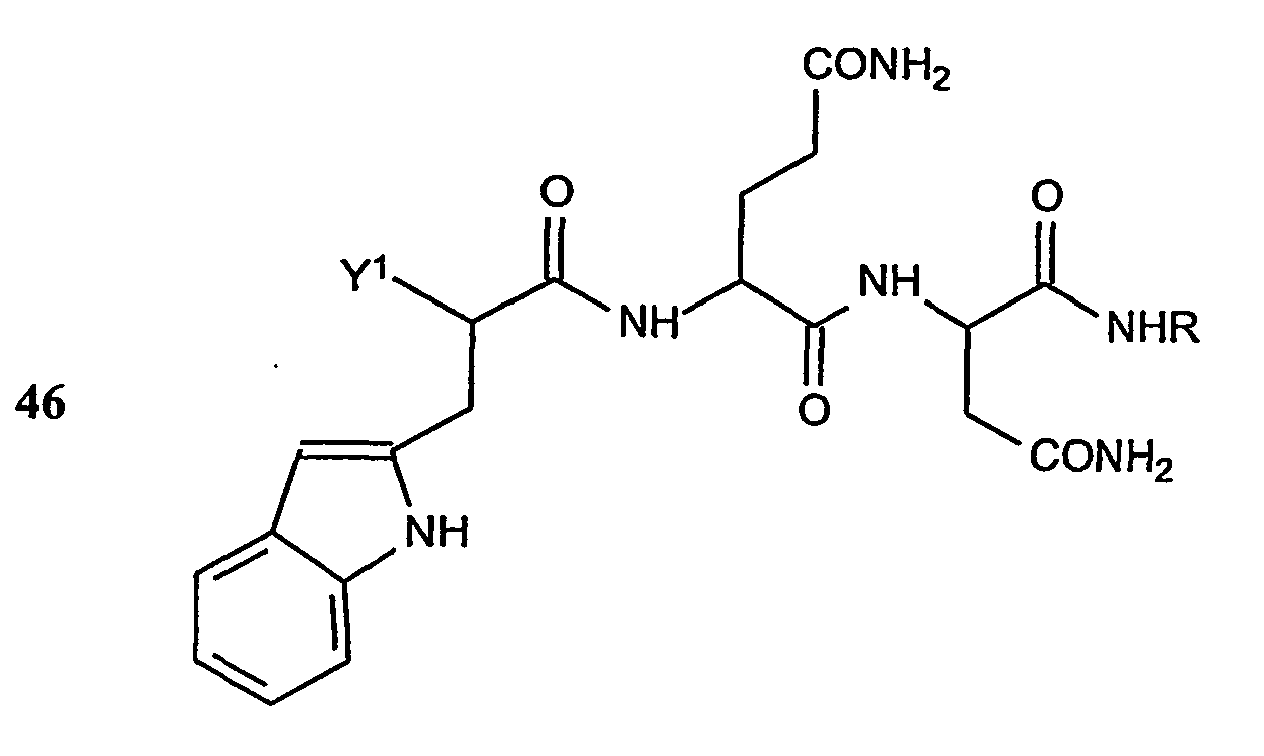
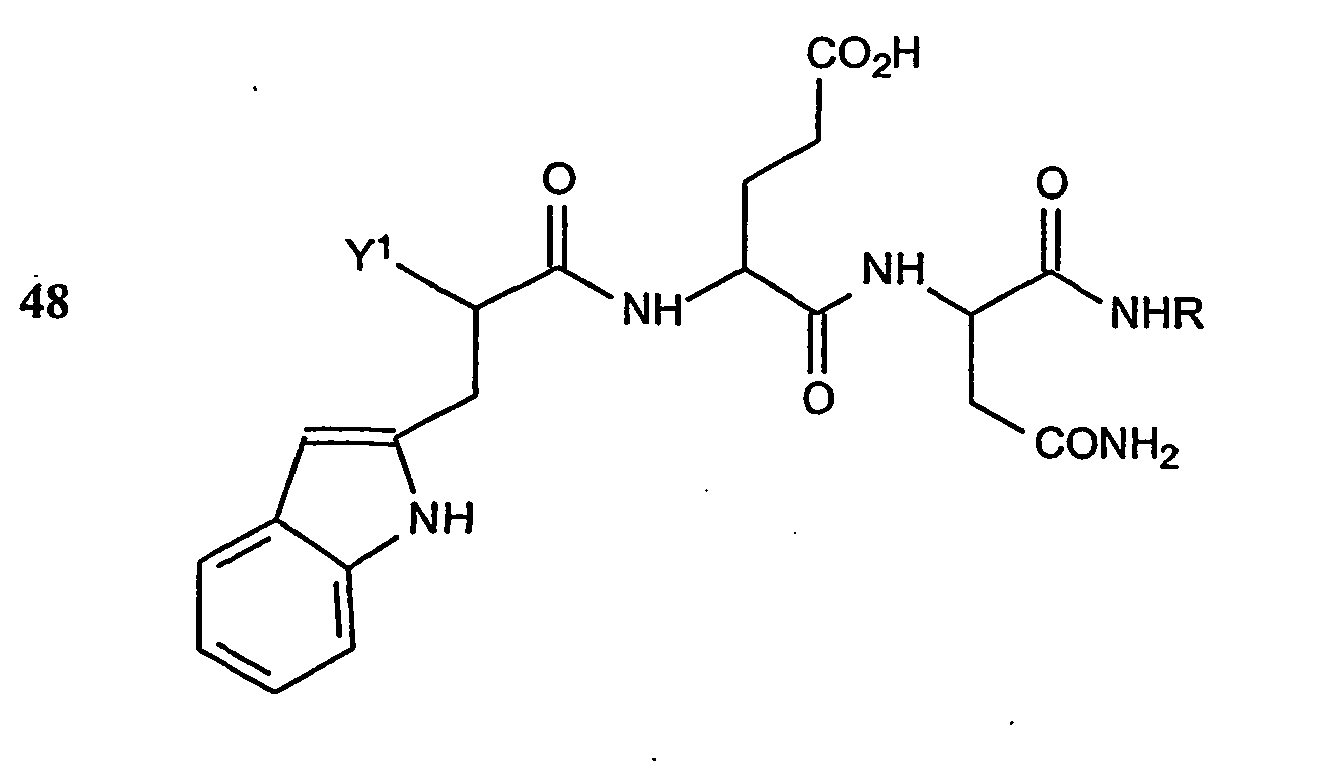

- The present invention provides methods for making a a laspartomycin core peptide that includes culturing the microorganism Streptomyces viridochromogenes, ssp. komabensis (ATCC 29814) in a culture medium to provide laspartomycin. Isolation of laspartomycin followed by cleavage of a lipophilic fragment provides the laspartomycin core peptide.
- Parent cultures of Streptomyces viridochromogenes, ssp. komabensis (ATCC 29814) especially suitable for biochemical synthesis of laspartomycin may be selected by conventional methods known to those of skill in the art. A preferred method for selecting a parent culture which provides improved yields of laspartomycin is described in Example 1.
- Growing inocula and inoculating culturing medium are also well known to those of skill in the art and exemplary methods for Streptomyces viridochromogenes, ssp. komabensis are described in Umezawa et al., United States Patent No.
3,639,582 , and Example 2. - Generally, any culturing medium which supports Streptomyces viridochromogenes, ssp. komabensis growth may be used in the biochemical synthesis of laspartomycin and selection of such medium is within the capability of those of skill in the art. Representative examples of culturing media which supports Streptomyces viridochromogenes, ssp. komabensis growth may be found in Umezawa et al., United States Patent No.
3,639,582 and Examples 3 and 4. - Preferred media, times, temperatures and pH for culturing Streptomyces viridochromogenes, ssp. komabensis that provide good yields of laspartomycin are described in Umezawa et al., United States Patent No.
3,639,582 and Examples 3 and 4. It should be noted that the choice of culturing medium and the quantitative ratio of its constituents directly affects the ratio of the different lipopeptides that comprise laspartomycin. - Generally, laspartomycin may be purified and isolated by any art-known techniques such as high performance liquid chromatography, counter current extraction, centrifugation, filtration, precipitation, ion exchange chromatography, gel electrophoresis, affinity chromatography and the like. The actual conditions used to purify laspartomycin will depend, in part, on factors such as net charge, hydrophobicity, hydrophilicity, etc., and will be apparent to those having skill in the art.
- Preferably, laspartomycin is isolated from the culture medium by extractive procedures. In one preferred embodiment (see e.g., Example 5), the fermentation broth containing laspartomycin is mixed with organic solvent (preferably 1-butanol). While not wishing to be bound by theory, the anionic form of laspartomycin may form a chelate with divalent metal ion that is soluble in organic solvent. The organic phase containing laspartomycin is then combined with an aqueous acid solution at a pH less than about 3.0 (most preferably at a pH of about 2.0). While not wishing to be bound by theory, protonation of the anion of laspartomycin may disrupt the divalent metal chelate form.
- More preferably, (see e.g., Example 6), the fermentation broth containing laspartomycin is acidified to a pH of at least about 3.0 (more preferably to a pH of about 2.0). The cells and any precipitate may then be separated by any conventional method known to those of skill in the art and suspended in water. The pH of the aqueous suspension is adjusted to at least about pH 7.0, a divalent metal ion is added and the pH of the aqueous suspension is adjusted to about 8.0 to about 9.0. Preferably the concentration of divalent metal ion in the aqueous suspension is between about 4 mmol/l and about 10 mmol/l. In one embodiment, the divalent metal ion is selected from the group consisting of calcium, magnesium and zinc. Most preferably, the divalent metal ion is calcium. The aqueous suspension is then extracted with organic solvent (preferably, 1-butanol). The organic phase containing laspartomycin is then combined with an aqueous acid solution at a pH less than about 3.0 (most preferably at a pH of about 2.0).
- Henceforth, in either of the above preferred embodiments, laspartomycin may be partitioned between organic solvent and aqueous solution by conventional methods known to those of skill in the art. Thus, for example, when the organic solvent solution of laspartomycin is treated with a neutral or basic aqueous solution, laspartomycin may be extracted into aqueous solution. Acidification of the aqueous solution of laspartomycin enables extraction of laspartomycin into organic solvent. Preferably, laspartomycin is partitioned between organic solvent and aqueous solution at least twice. Laspartomycin may be isolated as either the free acid (see e.g. Example 7) or a metal salt (see e.g., Examples 5 and 6) using conventional methods known to those of skill in the art.
- Generally, the lipophilic moiety of laspartomycin may be cleaved with an enzyme to provide the laspartomycin core peptide. It should be noted that addition of an appropriate enzyme to the culture medium may provide the laspartomycin core peptide directly, thus obviating the need to isolate laspartomycin. Preferably, however, isolated laspartomycin is treated with an enzyme which may be selected by those of skill in the art. The enzyme may be, for example, a degradative enzyme such as a peptidase, esterase or thiolase, of which numerous examples exist in the art. Preferably, the enzyme is a deacylase.
- In an exemplary embodiment, the cleavage step involves culturing a microorganism that can produce a deacylase in an appropriate culture medium and contacting laspartomycin with the culture medium containing the deacylase. Microorganisms that produce deacylases are well known to those of skill in the art. In a preferred embodiment, the microorganism Actinoplanes utahensis (NRRL 12052) provides a deacylase.
- Parent cultures of Actinoplanes utahensis (NRRL 12052) especially suitable for cleaving the lipophilic fragment of laspartomycin may be selected by methods known to those of skill in the art. A preferred method for selecting a parent culture which provides improved yields of laspartomycin core peptide is described in Example 8.
- Growing inocula and inoculating culturing medium are also well known to those of skill in the art and exemplary methods for Actinoplanes utahensis (NRRL 12052) are described in Boeck et al.,1988, J. Antibiot., 41,1085 and Debono et. al.,1988, J. Antibiotics, 41, 1093 and Example 8.
- Any culturing medium which supports Actinoplanes utahensis (NRRL 12052) growth may be used and selection of such medium is within the capability of those of skill in the art. Representative examples of culturing medium which supports Actinoplanes utahensis (NRRL 12052) growth may be found in Boeck et al., 1988, J. Antibiot., 41, 1085, Debono et. al., 1988, J. Antibiotics, 41,1093 and Example 8.
- Preferred media, times, temperatures and pH for culturing Actinoplanes utahensis (NRRL 12052) that provide good yields of the deacylase are described in Boeck. et al., 1988, J. Antibiot., 41, 1085, Debono et. al., 1988, J. Antibiotics, 41, 1093 and Example 8.
- In a preferred embodiment, laspartomycin is contacted with a culture medium containing Actinoplanes utahensis (NRRL 12052) for about 16 hours at about 29°C to provide the laspartomycin core peptide having the structure:

- It should be noted that contacting laspartomycin with a culture medium containing Actinoplanes utahensis (NRRL 12052) for about 4 hours at about 29°C (see e.g., Example 10) provides material enriched in the laspartomycin core peptide having the structure :

- While not wishing to be bound by theory, the deacylase produced by Actinoplanes utahensis (NRRL 12052) may be an exopeptidase that first cleaves the lipophilic fragment of laspartomycin to provide 54. The exocyclic aspartic acid residue of 54 is then hydrolyzed by extended treatment with deacylase or proteases to provide compound 6.
- The laspartomycin core peptide may be purified and isolated by any art-known techniques such as high performance liquid chromatography, counter current extraction, centrifugation, filtration, precipitation, ion exchange chromatography, gel electrophoresis, affinity chromatography and the like. The actual conditions used to purify the laspartomycin core peptide will depend, in part, on factors such as net charge, hydrophobicity, hydrophilicity, etc., and will be apparent to those having skill in the art. Preferably, the laspartomycin core peptide is isolated by centrifugation and chromatography on reverse phase resin (See e.g., Examples 9 and 10).
- Laspartomycin core peptide derivatives may be made starting from laspartomycin core peptide 6 or laspartomycin core peptide 54. Typically, either 6 or 54 will be produced by deacylation of laspartomycin provided by culturing Streptomyces viridochromogenes, ssp. komabensis (ATCC 29814). However, it may be possible to synthesize either 6 or 54 using methods known in the art for synthesizing cyclic peptides. For example, linear peptides may be prepared using solution phase or solid phase peptide synthesis and then cyclized. Preferably, laspartomycin core peptide 6 will be used as a starting material for the synthesis of laspartomycin core peptide derivatives. Those of skill in the art will realize that any of the methods presented below can also be used to prepare laspartomycin core peptide derivatives from intermediate 54.
- Starting materials useful for preparing laspartomycin core peptide derivatives from the laspartomycin core peptide 6 and intermediates thereof are either commercially available or may be prepared by conventional synthetic methods. A number of general synthetic approaches may be envisioned for converting cyclic peptide 6 to laspartomycin core peptide derivatives. These include but are not limited to the approaches outlined in Schemes I-III.
Scheme 1 Y1-L-X1' + NH(R1)-R → Y1-L-X1N(R1)-R
- In Scheme 1, X1' may be an activated derivative of X1 such as for example, -CO-Z, -OCO-Z, -SO2-Z, -CS-Z, -PO-Z, -OPO-Z,-OC(O)-Z, -NHCO-Z or -NR1CO-Z where Z is a leaving group such as halogen or an activated ester. Methods for making activated derivatives of X1 and for reacting these derivatives with either primary or secondary amines to form the X1-N covalent bond are known to those of skill in the art and may be found in any compendium of standard synthetic methods (See e.g., March, J., Advanced Organic Chemistry; Reactions, Mechanisms and Structure, 4th ed., 1992; Larock, R., Comprehensive Organic Transformations, VCH: New York, 1999; Bodanzsky, M., Principles of Peptide Synthesis; Springer Verlag, 1984; Bodanzsky, M., Practice of Peptide Synthesis; Springer Verlag, 1984). Other synthetic methods based on free radical chemistry, photochemistry or electrochemistry for forming the X1-N bond will be apparent to those of skill in the art.
- Those of skill in the art will appreciate that protection of either Y1 and/or L may be necessary to make activated derivatives of X1 for formation of the X1-N bond. In the event that protection of either Y1 and/or L is necessary to form the X1-N linkage, then deprotection of either Y1 and/or L will be necessary to provide the desired laspartomycin core peptide derivative. Methods for protection and deprotection of common organic functionalities are known to those of skill in the art and may be used as necessary in the synthesis of laspartomycin core peptide derivatives (see e.g. Greene, T.W., Protective Groups in Organic Synthesis, 3rd edition, 1999).
-
Scheme 2 Y1-L3 + L2-X1-N(R1)R → Y1-L-X1N(R1)-R
- Scheme 2 describes a convergent approach where Y1-L-X1N(R1)-R is synthesized by combining two molecules (Y1-L3 and L2-X1-N(R1)R) to form the laspartomycin core peptide derivative. Here L3 and L2 are fragments which, when covalently linked, form the linker L. Such approaches may be particularly useful when L is an oligomer such as a polyamide or poylether. Methods for combining oligomeric subunits such as ether or amide monomers, dimers etc. are known to those of skill in the art. Fragments such as Y1-L3 and L2-X1' (useful in forming the X1-N bond as described above) are either commercially available or may be made by standard synthetic methods.
-
Scheme 3 Yx-L-X1N(R1)-R → Y1-L-X1N(R1)-R
- Finally, simple functional group interchange may be used to prepare Y1-L-X1N(R1)-R from Yx-L-X1N(R1)-R. Here, Yx is a functional group that may be converted to Y1. Many methods for effecting functional group interchange are known to those of skill in organic synthesis (See e.g., March, J., Advanced Organic Chemistry; Reactions, Mechanisms and Structure, 4th ed., 1992; Larock, R., Comprehensive Organic Transformations, VCH: New York, 1999).
- The antimicrobial laspartomycin derivatives of the present invention offer some significant advantages over traditional antibiotics. The antimicrobial laspartomycin derivatives are generally active against many gram positive bacteria. More importantly, the antimicrobial laspartomycin derivatives of the present invention may be effective against methicillin resistant bacteria and/or strains resistant to vancomycin. Thus, the antimicrobial laspartomycin derivatives may inhibit or prevent growth of a number of microbes generally resistant to known antibiotics.
- Antimicrobial laspartomycin derivatives include compounds described by structural Formula (II):
(II) Y2-(X2-X3)-(L)-(X1)-N(R1)-R
or an pharmaceutically acceptable salt or hydrate thereof, wherein: - Y2 is a lipophilic group;
- X2 is a linked group;
- X3 is a linked group; and
- X1, L, N, R1 and R are as defined for Formula (I) in Section 4.2.1 of this Application.
- Connected to X1 in isolated antimicrobial laspartomycin derivatives of Formula (II) is a linking moiety of the formula (X2-X3) where L is a linker and X2 and X3 are linked groups that attach a lipophilic molecule Y2 to the linker L. The nature of linker L and the linked groups X2 and X3 may vary extensively. The linker L has been described and defined in Section 4.2.1 of this Application.
- As will be appreciated by those having skill in the art, a linking moiety such as (X2-X3) will typically be at least bifunctional. Thus, they will have at least one functional group or moiety capable of forming a linkage with the linker and at least one functional group or moiety capable of forming a linkage with a lipophilic group.
- Preferably, linking moiety (X2-X3) taken together is a covalent linkage. In this preferred embodiment, linking moiety (X2-X3) is any covalent linkage that may be formed by any method known to those of skill in the art. Thus, for example, linking moiety (X2-X3) may be any single, double or triple bond that can be formed between two carbon atoms, a carbon atom and a heteroatom or two heteroatoms. For example, (X2-X3) include linkages such as -CH2-CH2-, -CH=CH-, -C=CH-, -CH=CH-, -C≡C-, -NH-CH2-, -N=CH-, -CH2-NH-, -CH=N-, -NH-NH-, -N=N-, -S-S-, -O-O-, -Se-Se-, -S-CH2-, -CH2-S-, -O-CH2-, -CH2-O-, -Se-CH2-, -CH2-Se-, -NH-S-, -P-N-, -N-O- and the corresponding substituted analogs where any suitable hydrogen is substituted with the same or different substituent.
- Preferably, (X2-X3) taken together are selected from the group consisting of -C(O)O-, -O(O)C-, -CONH-, -NHCO-, -CONR1-, -NR1CO-,-C(O)S-, -S(O)C-, -OSO2-, -S(O2)O-, -NHSO2-, -NR1SO2-, -S(O2)NH-, -S(O2)NR1-, -C(S)NH-,-NHC(S)-, -NHP(O)-, -P(O)NH-, OP(O)-, -P(O)O-, SP(O)-, -P(O)S-, -OC(O)NH-, -NHC(O)O-, -OC(O)NR1-, -NR1C(O)O-, -OC(O)O-, -NHC(O)NH-,-NHC(O)NR1-, -NR1C(O)NH- and -NR1C(O)NR1 and the corresponding substituted analogs where any suitable hydrogen is substituted with the same or different substituent. In a preferred embodiment, (X2-X3) taken together are selected from the group consisting of -C(O)O-, -O(O)C-, CONH-, -NHCO-, -CONR1-, -NR1CO-,-C(O)S-, -S(O)C-, -NHSO2-, -NR1SO2, -S(O2)NH-, -S(O2)NR1-, C(S)NH-,-NHC(S)-, -OC(O)NH-, -NHC(O)O-, -OC(O)NR1-, -NR1C(O)O- and -OC(O)O-and the corresponding substituted analogs where any suitable hydrogen is substituted with the same or different substituent. In another preferred embodiment, (X2-X3) taken together are selected from the group consisting of -C(O)O-, -O(O)C-, -CONH-, -NHCO-, -CONR1-, -NR1CO-, -NHSO2-, -NR1SO2, -S(O2)NH-, -S(O2)NR1-,-OC(O)NH-, -NHC(O)O-, -OC(O)NR1- and -NR1C(O)O-and the corresponding substituted analogs where any suitable hydrogen is substituted with the same or different substituent.
- Some embodiments of the linking moiety (X2-X3) combined with linker L include partial structures such as -(X2-X3)-(CH2)n-, where n is between 1 and 8, (X2-X3) taken together are selected from the group consisting of -C(O)O-, -O(O)C-, -CONH-, -NHCO-, -CONR1-, -NR1CO-, -NHSO2-, -NR1SO2, -S(O2)NH-, -S(O2)NR1-,-OC(O)NH-, -NHC(O)O-, -OC(O)NR1- and -NR1C(O)O- and the corresponding analogues where any suitable hydrogen is substituted. Other embodiments of the linking moiety (X2-X3) combined with linker L include representations where X3-L taken together are derived from any amino acid, which may be for example, a D or L α-amino acid, a β-amino acid and a γ-amino acid and X2, for example is -CO- or -SO2-. Taken together X3-L also may also be a dipeptide, a tripeptide or a tetrapeptide derivative comprised of any combination of amino acids. The polarity of the peptide bond in these peptides may be either C→N or N→C.
- Generally, the lipophilic group Y2 will be hydrophobic and when substituted will be substituted with hydrophobic substituents. Those of skill in the art will appreciate that the size and/or length of the lipophilic group will depend, in part, on the nature of fragments such as L, (X2-X3), X1 and R1 that comprise the antimicrobial laspartomycin derivatives.
- In a preferred embodiment, the lipophilic group Y2 is selected from the group consisting of (C6-C25) alkyl optionally substituted with one or more of the same or different R2 groups, (C6-C25) heteroalkyl optionally substituted with one or more of the same or different R2 groups, (C8-C25) aryl optionally substituted with one or more of the same or different R2 groups, (C8-C25) arylaryl optionally substituted with one or more of the same or different R2 groups, (C8-C25) biaryl optionally substituted with one or more of the same or different R2 groups, eight to twenty five membered heteroaryl optionally substituted with one or more of the same or different R2 groups, (C8-C25) arylalkyl optionally substituted with one or more of the same or different R2 groups and eight to twenty five membered heteroarylalkyl optionally substituted with one or more of the same or different R2 groups;
each R2 is independently selected from the group consisting of -OR3, -SR3, -NR3R3, -CN, -NO2, -N3, -C(O)OR3, -C(O)NR3R3, -C(S)NR3R3, -C(NR3)NR3R3, -CHO, -R3CO, -SO2R3, -SOR3, -PO(OR3)2, -PO(OR3), -CO2H, -SO3H, -PO3H, halogen and trihalomethyl;
each R3 is independently selected from the group consisting of hydrogen, (C1-C6) alkyl, (C5-C10) aryl, 5-10 membered heteroaryl, (C6-C16) arylalkyl and 6-16 membered heteroarylalkyl. - In a more preferred embodiment, the lipophilic group Y2 is selected from the group consisting of (C8-C20) alkyl optionally substituted with one or more of the same or different R2 groups, (C8-C20) heteroalkyl optionally substituted with one or more of the same or different R2 groups, (C8-C20) aryl optionally substituted with one or more of the same or different R2 groups, (C8-C20) arylaryl optionally substituted with one or more of the same or different R2 groups, (C8-C20) biaryl optionally substituted with one or more of the same or different R2 groups, eight to twenty membered heteroaryl optionally substituted with one or more of the same or different R2 groups,(C8-C20) arylalkyl optionally substituted with one or more of the same or different R2 groups and eight to twenty membered heteroarylalkyl optionally substituted with one or more of the same or different R2 groups where R2 is as defined above
- In one preferred embodiment, the lipophilic group Y2 is selected from the group consisting of (C8-C20) alkyl optionally substituted with one or more of the same or different R2 groups, (C8-C20) heteroalkyl optionally substituted with one or more of the same or different R2 groups, (C8-C20) aryl optionally substituted with one or more of the same or different R2 groups, (C8-C20) arylaryl optionally substituted with one or more of the same or different R2 groups, (C8-C20) biaryl optionally substituted with one or more of the same or different R2 groups, ten to twenty membered heteroaryl optionally substituted with one or more of the same or different R2 groups, (C8-C20) arylalkyl optionally substituted with one or more of the same or different R2 groups and ten to twenty membered heteroarylalkyl optionally substituted with one or more of the same or different R2 groups. In another preferable embodiment, the lipophilic group Y2 is selected from the group consisting of (C8-C20) alkyl optionally substituted with one or more of the same or different R2 groups. In yet another preferable embodiment, the lipophilic group Y2 is selected from the group consisting of (C10-C16) alkyl optionally substituted with one or more of the same or different R2 groups.
- In an exemplary embodiment of the isolated antimicrobial laspartomycin derivative of Formula (II), X1 is -CO- or -SO2-, (X2-X3) taken together are selected from the group consisting of -C(O)O-, -O(O)C-, -CONH-, -NHCO-, -C(O)S-, -S(O)C-, -OSO2-, -S(O2)O-, -NHSO2-, -S(O2)NH-, -C(S)NH-, -NHC(S)-, -NHP(O)-, -P(O)NH-, OP(O)-, -P(O)O-, -SP(O)-, -P(O)S-, -OC(O)NH-, -NHC(O)O-, -OC(O)NR1-, -NR1C(O)O-, -OC(O)O-, -NHC(O)NH-, -NHC(O)NR1- and -NR1C(O)O-, R1 is hydrogen and L is selected from the group consisting of L1, L2, L3 and L4 where L1, L2, L3 and L4 are as defined in Section 4.2.1 of this Application
- In a preferred embodiment, S1 is a side chain of a genetically encoded α amino acid. Exemplary preferred embodiments of Y2-(X2-X3)-L-X1-N(R1)-R where K is independently selected from the group consisting of oxygen, nitrogen and sulfur include the following compounds where Y2, X2, X3 and R are as previously defined:


- Preferably, in the these embodiments, X3 is selected from the group consisting of -S-, -O- or -NH- and X2 is selected from the group consisting of -CO-, -SO2-, -OC(O)-, -NHC(O)- and -NR1C(O)-. In an alternative embodiment, X2 is selected from the group consisting of -S-, -O- or -NH- and X3 is selected from the group consisting of -CO-, -SO2-,-OC(O)-, -NHC(O)- and -NR1C(O)-.
- In another preferred embodiment of the antimicrobial laspartomycin derivatives, X1 is -CO- or -SO2-, (X2-X3) taken together are selected from the group consisting of -CONH-, -S(O2)NH-, -C(S)NH-, -P(O)NH-, -OC(O)NH-, -OC(O)NR1-, -NHC(O)NH-, and -NHC(O)NR1, R1 is hydrogen, n is as defined in Section 4.2.1 of this Application and L is L1 as defined in Section 4.2.1 of this Application. Preferably, in this embodiment, each S1 is independently a side-chain of a genetically encoded α-amino acid. More preferably, each S1 is independently a side-chain of glycine, asparagine, aspartic acid, glutamine, glutamic acid, tryptophan, , phenylalanine, tyrosine, leucine, alanine, isoleucine or valine. Exemplary preferred embodiments of Y2-(X2-X3)-L-X1-N(R1)-R where each S1 is independently a side-chain of glycine, asparagine, aspartic acid, glutamine, glutamic acid or tryptophan include the following compounds where Y2, (X2-X3) taken together and R are as previously defined:
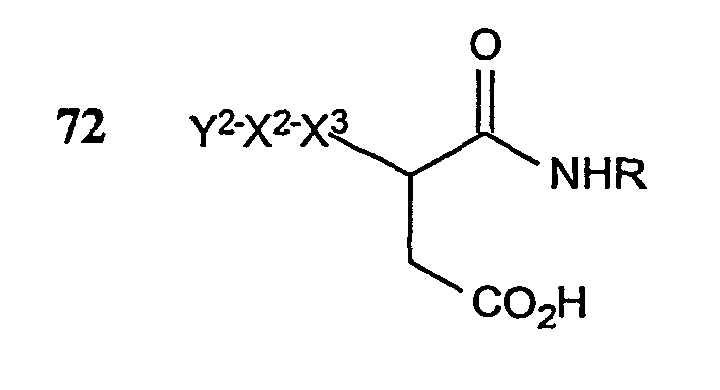

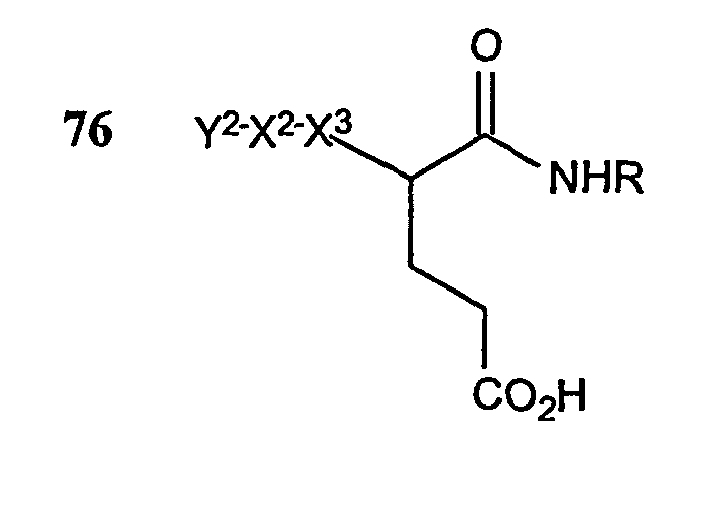


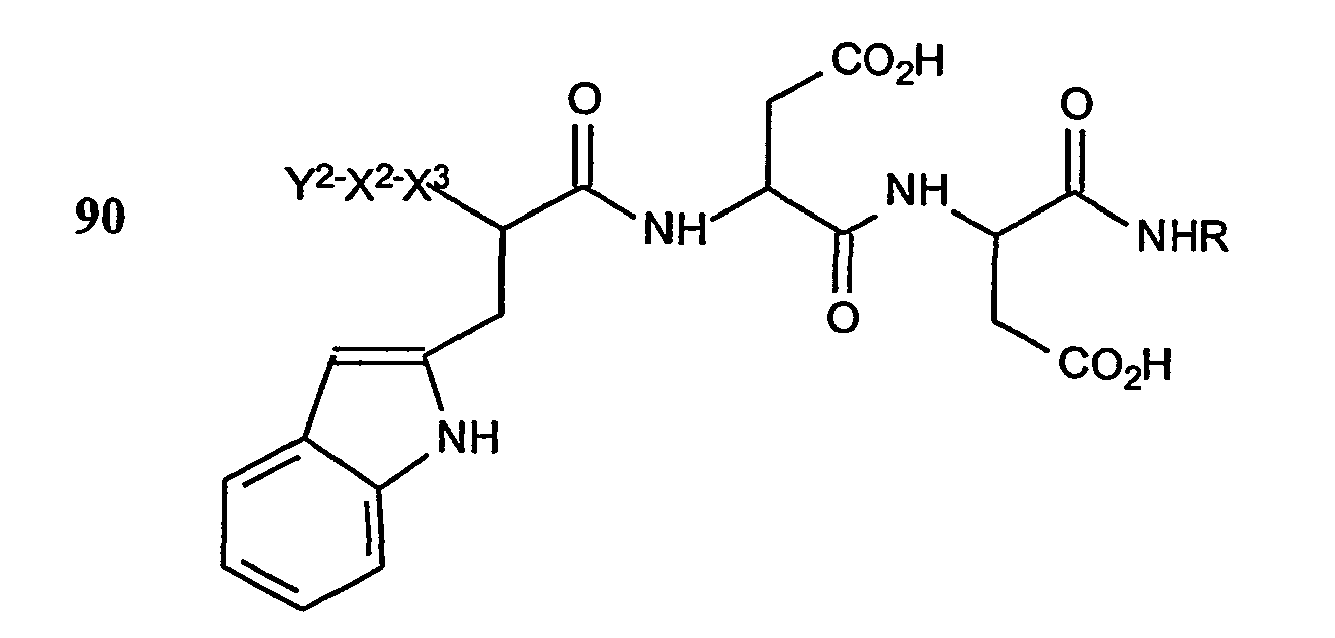


- Preferably, in the these embodiments X3 is selected from the group consisting of -S-, -O- or -NH- and X2 is selected from the group consisting of -CO-, -SO2-, -OC(O)-, -NHC(O)- and -NR1C(O)-. In alternative embodiment, X2 is selected from the group consisting of -S-, -O- or -NH- and X3 is selected from the group consisting of -CO-, -SO2-,-OC(O)-, -NHC(O)- and -NR1C(O)-. Preferably, in the above depicted embodiments the illustrated α amino acids have the L stereochemistry.
- In a preferred embodiment X2-X3 taken together are -CONH- or -SO2NH-. Most preferably, X2-X3 taken together are -CONH-. Particularly preferred embodiments of Y2 include tetradecan-1-yl, nonan-1-yl, decan-1-yl and 12-methyl-tridecan-1-yl.
- Exemplary preferred isolated antimicrobial laspartomycin derivatives according to structural formula II include:


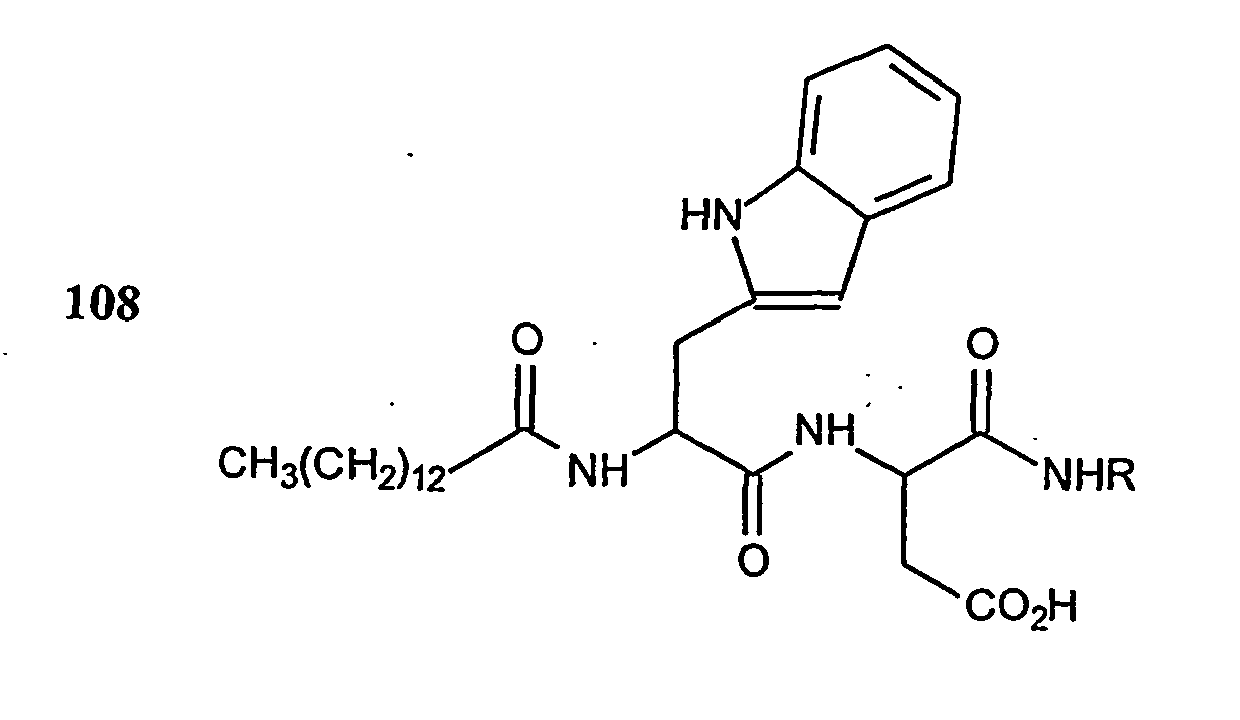


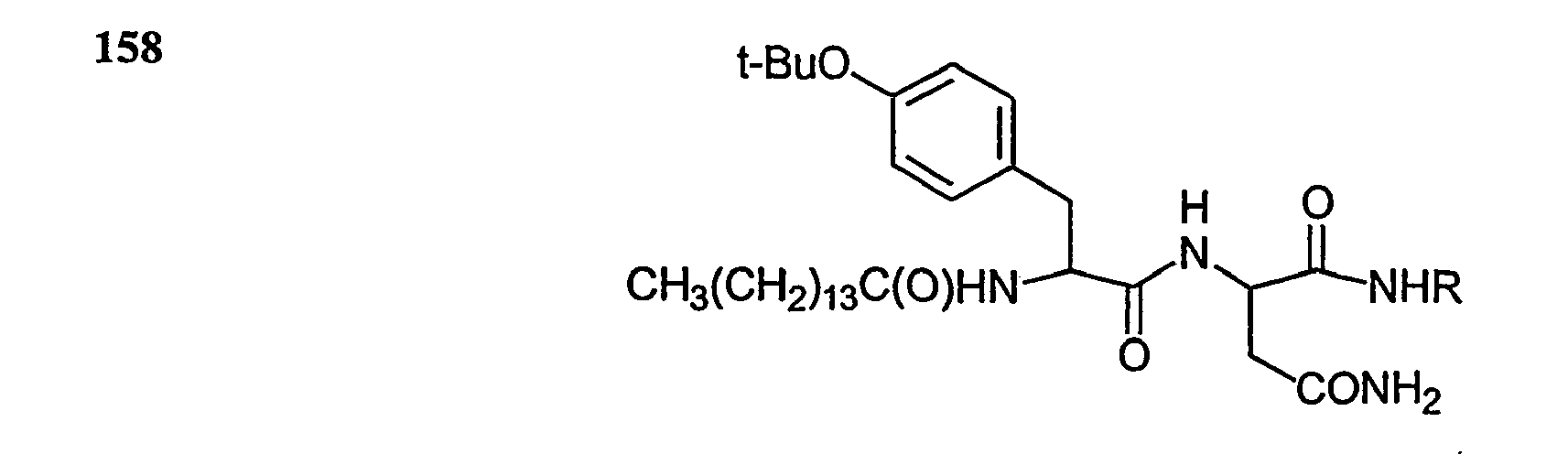




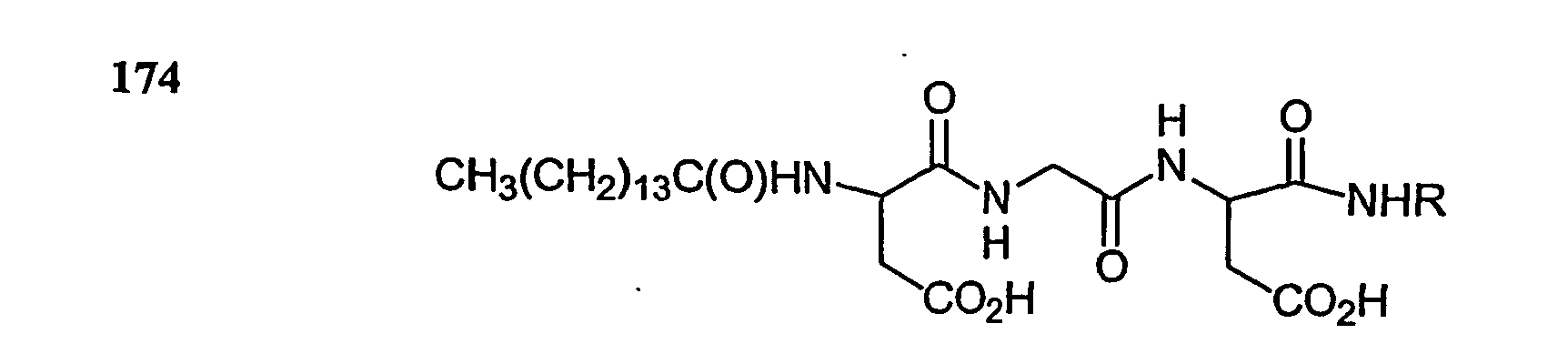

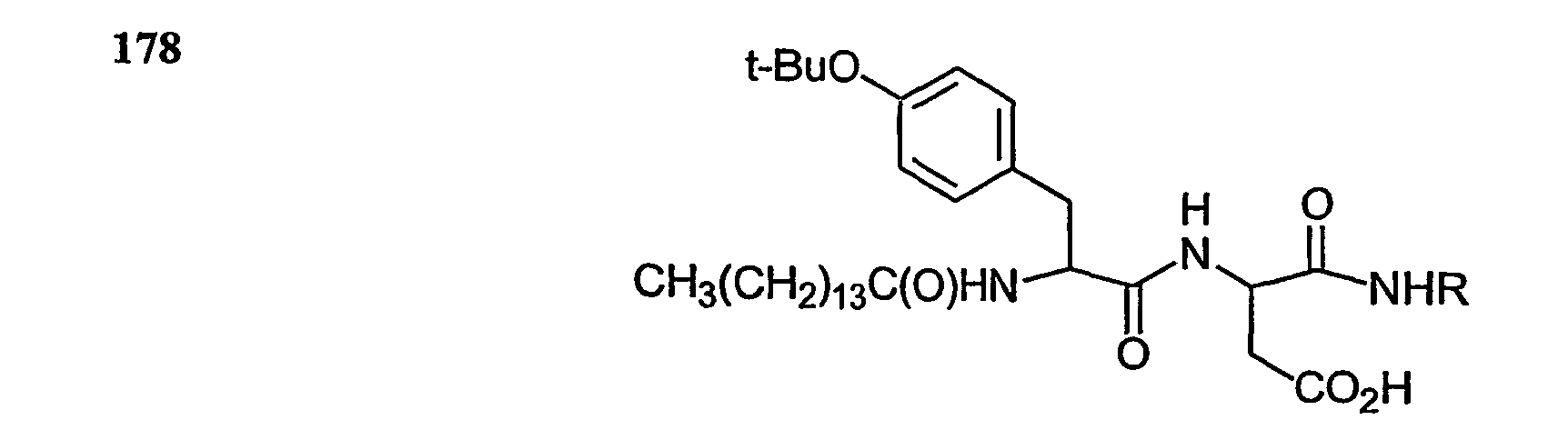
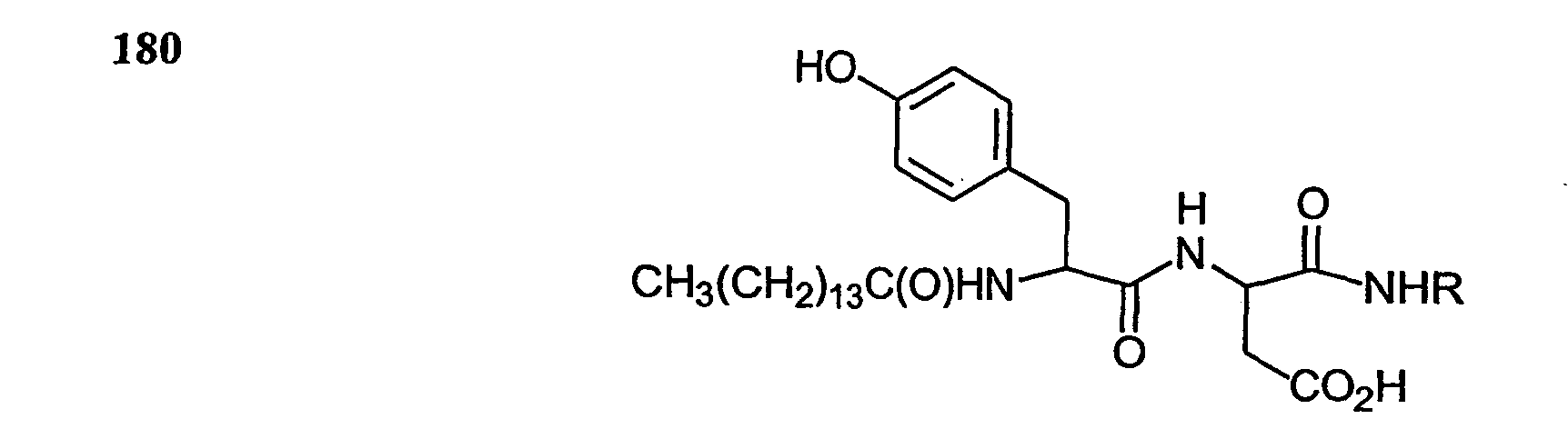


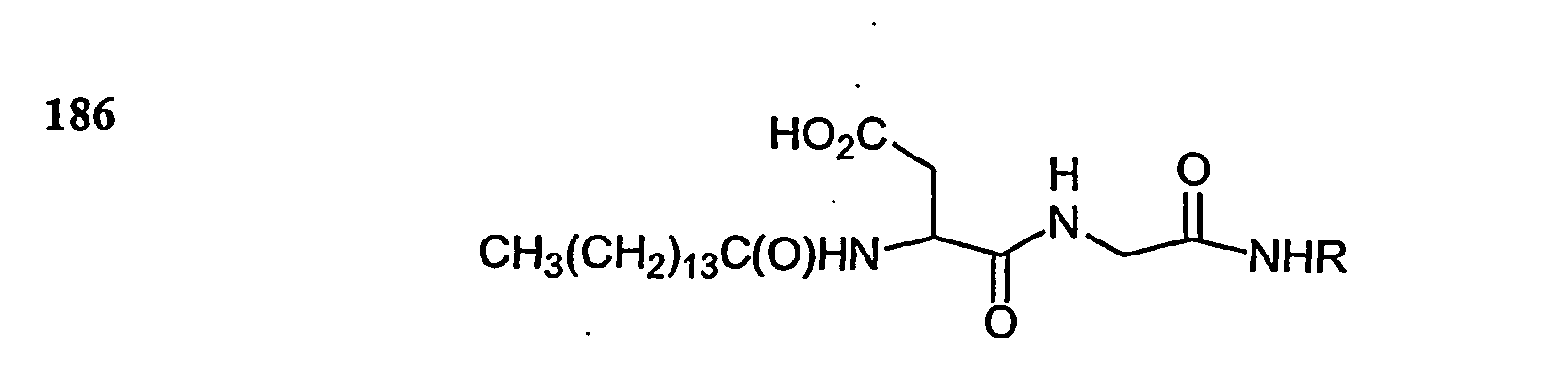
- Antimicrobial laspartomycin derivatives may be synthesized from laspartomycin core peptide 6, laspartomycin core peptide 54 and laspartomycin core peptide derivatives of Formula (I). Laspartomycin core peptide derivatives of Formula (I) may be synthesized by the approaches outlined in Section 4.2.2 of this Application. Those of skill in the art will appreciate that other starting materials may be used in the synthesis of antimicrobial laspartomycin derivatives.
- A number of general synthetic approaches may be envisioned for converting laspartomycin core peptide 6, laspartomycin core peptide 54 and laspartomycin core peptide derivatives of Formula I to antimicrobial laspartomycin derivatives. These include but are not limited to the approaches outlined in Schemes 4 and 5.
-
Scheme 4 Y2-X2-X3-L-X1'+ HN(R1)-R → Y2-X2-X3-L-X1N(R1)-R
- In Scheme 4 a lipophilic fragment Y2 and a linker L, attached via linked groups X2 and X3 are covalently linked to X1' which may be an activated derivative of X1 such as for example, -CO-Z, -OCO-Z, -SO2-Z, -CS-Z, -PO-Z, -OPO-Z,-OC(O)-Z, -NHCO-Z or -NR1CO-Z where Z is a leaving group such as halogen or an activated ester. Methods for making activated derivatives of X1 and for reacting these derivatives with either primary or secondary amines to form the X1-N covalent bond are known to those of skill in the art and may be found in any compendium of standard synthetic methods (See e.g., March, J., Advanced Organic Chemistry; Reactions, Mechanisms and Struscture, 4th ed., 1992; Larock, R., Comprehensive Organic Transformations, VCH: New York, 1999; Bodanzsky, M., Principles of Peptide Synthesis; Springer Verlag, 1984; Bodanzsky, M., Practice of Peptide Synthesis; Springer Verlag, 1984). Other synthetic methods based on free radical chemistry, photochemistry or electrochemistry for forming the X1-N bond will be apparent to those of skill in the art. Formation of the X1-N covalent bond provides the antimicrobial laspartomycin derivative. Methods for making (X2-X3) linkages such as esters, amides phosphoramidites, sulfonamides, carbamates, ureas etc. are also conventional and known to those of skill in the art (See e.g., March, J., Advanced Organic Chemistry; Reactions, Mechanisms and Structure, 4th ed., 1992; Larock, R., Comprehensive Organic Transformations; VCH: New York, 1999; Bodanzsky, M., Principles of Peptide Synthesis; Springer Verlag, 1984; Bodanzsky, M., Practice of Peptide Synthesis; Springer Verlag, 1984)
-
Scheme 5 Y2-X2' + Y1-L-X1N(R1)-R → Y2-X2-X3-L-X1N(R1)-R
- Scheme 5 describes a convergent approach where Y2-X2' (X2' is a derivative of the linked group X2) and Y1-L-X1N(R1)-R are combined to form the (X2-X3) linkage thus providing the antimicrobial laspartomycin derivative. Methods for forming the (X2-X3) linkage are described above. Fragments such as Y2-X2' are either commercially available or may be made by standard synthetic methods. Y1-L-X1N(R1)-R may be made as described in Section 4.2.2 of this application.
- Those of skill in the art will appreciate that protection of either Y2 and/or L may be necessary to form (X2-X3) linkage. In the event that protection of either Y2 and/or L is necessary to form the (X2-X3) linkage, then deprotection of either Y2 and/or L will be necessary to provide the antimicrobial laspartomycin derivative. Methods for protection and deprotection of common organic functionalities are known to those of skill in the art and may be used as necessary in the synthesis of antimicrobial laspartomycin derivatives (see e.g. Greene, T.W., Protective Groups in Organic Synthesis, 3rd edition, 1999).
- Generally, active isolated antimicrobial laspartomycin derivatives of the invention are identified using in vitro screening assay. Indeed, in many instances the isolated antimicrobial laspartomycin derivatives of the invention will be used in vitro as preservatives, topical antimicrobial treatments, etc. Additionally, despite certain apparent limitations of in vitro susceptibility tests, clinical data indicate that a good correlation exists between minimal inhibitory concentration (MIC) test results and in vivo efficacy of antibiotic compounds (Murray, 1994, Antimicrobial Susceptibility Testing, Poupard et al., eds., Plenum Press, NY; Knudsen et al., 1995, Antimicrob. Agents Chemother. 39 (6):1253-1258). Thus, isolated antimicrobial laspartomycin derivatives useful for treating infections and diseases related thereto are also conveniently identified by demonstrated in vitro antimicrobial activity against specified microbial targets.
- Generally, the in vitro antimicrobial activity of antimicrobial agents is tested using standard NCCLS bacterial inhibition assays, or MIC tests (see, National Committee on Clinical Laboratory Standards "Performance Standards for Antimicrobial Susceptibility Testing," NCCLS Document M100-S5 Vol. 14, No. 16, December 1994; "Methods for dilution antimicrobial susceptibility test for bacteria that grow aerobically-Third Edition," Approved Standard M7-A3, National Committee for Clinical Standards, Villanova, PA).
- Alternatively, the antimicrobial laspartomycin derivatives of the invention may be assessed for antimicrobial activity using in vivo models. Again, such models are well-known in the art.
- It will be appreciated that other assays, that are well known in the art or which will become apparent to those having skill in the art upon review of this disclosure, may also be used to identify active isolated antimicrobial laspartomycin derivatives of the invention. Such assays include, for example, the assay described in Lehrer et al., 1988, J. Immunol. Methods 108:153 and Steinberg and Lehrer, "Designer Assays for Antimicrobial Peptides: Disputing the 'One Size Fits All' Theory," In: Antibacterial Peptide Protocols, Shafer, Ed., Humana Press, NJ.
- Generally, isolated antimicrobial laspartomycin derivatives of the invention will exhibit MICs of less than about 64 µg/mL, usually less than about 32 µg/mL, preferably less than about 16 µg/mL and most preferably less than about 4 µg/mL. The antimicrobial laspartomycin derivatives of the invention may also exhibit antifungal activity, having MICs of about 50 µg/mL or less against a variety of fungi in standard in vitro assays.
- Of course, compounds having MICs on the low end of these ranges, or even lower, are preferred. Most preferred for use in treating or preventing systemic infections are antimicrobial laspartomycin derivatives that exhibit significant antimicrobial activity (i.e., less than 4 µg/mL), good water-solubility (at approx. neutral pH) and low toxicity. Toxicity is less of a concern for topical administration, as is water solubility.
- The antimicrobial laspartomycin derivatives of the invention can be used in a wide variety of applications to inhibit the growth of microorganisms or kill microorganisms. For example, the antimicrobial laspartomycin derivatives may be used as disinfectants or as preservatives for materials such as foodstuffs, cosmetics, medicaments and other nutrient containing materials. The antimicrobial laspartomycin derivatives can also be used to treat or prevent diseases related to microbial infection in subjects such as plants and animals.
- For use as a disinfectant or preservative, the antimicrobial laspartomycin derivatives can be added to the desired material singly, as mixtures of antimicrobial laspartomycin derivatives, or in combination with other antifungal and/or antimicrobial agents. The antimicrobial laspartomycin derivatives may be supplied as the compound per se or may be in admixture with a variety of carriers, diluents or excipients, which are well known in the art.
- When used to treat or prevent microbial infections or diseases related thereto the antimicrobial laspartomycin derivatives of the invention can be administered or applied singly, as mixtures of two or more antimicrobial laspartomycin derivatives, in combination with other antifungal, antibiotic or antimicrobial agents or in combination with other pharmaceutically active agents. The antimicrobial laspartomycin derivatives can be administered or applied per se or as pharmaceutical compositions. The specific pharmaceutical formulation will depend upon the desired mode of administration, and will be apparent to those having skill in the art. Numerous compositions for the topical or systemic administration of antibiotics are described in the literature. Any of these compositions may be formulated with the antimicrobial laspartomycin derivatives of the invention.
- Pharmaceutical compositions comprising the antimicrobial laspartomycin derivatives of the invention may be manufactured by means of conventional mixing, dissolving, granulating, dragee-making, levigating, emulsifying, encapsulating, entrapping or lyophilizing processes. Pharmaceutical compositions may be formulated in conventional manner using one or more physiologically acceptable carriers, diluents, excipients or auxiliaries which facilitate processing of the active antimicrobial laspartomycin derivatives into preparations which can be used pharmaceutically. Proper formulation is dependent upon the route of administration chosen.
- For topical administration the antimicrobial laspartomycin derivatives of the invention may be formulated as solutions, gels, ointments, creams, suspensions, etc. as are well-known in the art.
- Systemic formulations include those designed for administration by injection, e.g. subcutaneous, intravenous, intramuscular, intrathecal or intraperitoneal injection, as well as those designed for transdermal, transmucosal, oral or pulmonary administration.
- For injection, the antimicrobial laspartomycin derivatives of the invention may be formulated in aqueous solutions, preferably in physiologically compatible buffers such as Hanks's solution, Ringer's solution, or physiological saline buffer. The solution may contain formulatory agents such as suspending, stabilizing and/or dispersing agents.
- Alternatively, the antimicrobial laspartomycin derivatives may be in powder form for constitution with a suitable vehicle, e.g., sterile pyrogen-free water, before use.
- For transmucosal administration, penetrants appropriate to the barrier to be permeated are used in the formulation. Such penetrants are generally known in the art.
- For oral administration, the antimicrobial laspartomycin derivatives can be readily formulated by combining them with pharmaceutically acceptable carriers well known in the art. Such carriers enable the compounds of the invention to be formulated as tablets, pills, dragees, capsules, liquids, gels, syrups, slurries, suspensions and the like, for oral ingestion by a patient to be treated. For oral solid formulations such as, for example, powders, capsules and tablets, suitable excipients include fillers such as sugars, such as lactose, sucrose, mannitol and sorbitol; cellulose preparations such as maize starch, wheat starch, rice starch, potato starch, gelatin, gum tragacanth, methyl cellulose, hydroxypropylmethyl-cellulose, sodium carboxymethylcellulose, and/or polyvinylpyrrolidone (PVP); granulating agents; and binding agents. If desired, disintegrating agents may be added, such as the cross-linked polyvinylpyrrolidone, agar, or alginic acid or a salt thereof such as sodium alginate. If desired, solid dosage forms may be sugar-coated or enteric-coated using standard techniques.
- For oral liquid preparations such as, for example, suspensions, elixirs and solutions, suitable carriers, excipients or diluents include water, glycols, oils, alcohols, etc. Additionally, flavoring agents, preservatives, coloring agents and the like may be added.
- For buccal administration, the compositions may take the form of tablets, lozenges, etc. formulated in conventional manner.
- For administration by inhalation, the compounds for use according to the present invention are conveniently delivered in the form of an aerosol spray from pressurized packs or a nebulizer, with the use of a suitable propellant, e.g., dichlorodifluoromethane, trichlorofluoromethane, dichlorotetrafluoroethane, carbon dioxide or other suitable gas. In the case of a pressurized aerosol the dosage unit may be determined by providing a valve to deliver a metered amount. Capsules and cartridges of, e.g., gelatin for use in an inhaler or insufflator may be formulated containing a powder mix of the compound and a suitable powder base such as lactose or starch.
- The antimicrobial laspartomycin derivatives may also be formulated in rectal or vaginal compositions such as suppositories or retention enemas, e.g., containing conventional suppository bases such as cocoa butter or other glycerides.
- In addition to the formulations described previously, the antimicrobial laspartomycin derivatives may also be formulated as a depot preparation. Such long acting formulations may be administered by implantation (for example subcutaneously or intramuscularly) or by intramuscular injection. Thus, for example, the compounds may be formulated with suitable polymeric or hydrophobic materials (for example as an emulsion in an acceptable oil) or ion exchange resins, or as sparingly soluble derivatives, for example, as a sparingly soluble salt.
- Alternatively, other pharmaceutical delivery systems may be employed. Liposomes and emulsions are well known examples of delivery vehicles that may be used to deliver the antimicrobial laspartomycin derivatives of the invention. Certain organic solvents such as dimethylsulfoxide also may be employed, although usually at the cost of greater toxicity. Additionally, the antimicrobial laspartomycin derivatives may be delivered using a sustained-release system, such as semipermeable matrices of solid polymers containing the therapeutic agent. Various sustained-release materials have been established and are well known by those skilled in the art. Sustained-release capsules may, depending on their chemical nature, release the compounds for a few weeks up to over 100 days.
- As certain of the carboxylic acids of the antimicrobial laspartomycin derivatives of the invention are acidic, or the lipophilic group or linker may include acidic or basic substituents, the antimicrobial laspartomycin derivatives may be included in any of the above-described formulations as the free acids, the free bases or as pharmaceutically acceptable salts. Pharmaceutically acceptable salts are those salts which retain substantially the antimicrobial activity of the free acids or bases and which are prepared by reaction with bases or acids, respectively. Pharmaceutical salts tend to be more soluble in aqueous and other protic solvents than are the corresponding free base or acid forms.
- The antimicrobial laspartomycin derivatives of the invention, or compositions thereof, will generally be used in an amount effective to achieve the intended purpose. Of course, it is to be understood that the amount used will depend on the particular application.
- For example, for use as a disinfectant or preservative, an antimicrobially effective amount of a antimicrobial laspartomycin derivative, or composition thereof, is applied or added to the material to be disinfected or preserved. By antimicrobial effective amount is meant an amount of antimicrobial laspartomycin derivative or composition that inhibits the growth of, or is lethal to, a target microbe. While the actual amount will depend on a particular target microbe and application, for use as a disinfectant or preservative the antimicrobial laspartomycin derivatives, or compositions thereof, are usually added or applied to the material to be disinfected or preserved in relatively low amounts. Typically, the antimicrobial laspartomycin derivatives comprises less than about 5% by weight of the disinfectant solution or material to be preserved, preferably less than about 1% by weight and more preferably less than about 0.1% by weight. An ordinarily skilled artisan will be able to determine antimicrobially effective amounts of particular antimicrobial laspartomycin derivatives for particular applications without undue experimentation using, for example, the in vitro assays provided in the examples.
- For use to treat or prevent microbial infections, the antimicrobial laspartomycin derivatives of the invention, or compositions thereof, are administered or applied in a therapeutically effective amount. By therapeutically effective amount is meant an amount effective to ameliorate the symptoms of, or ameliorate, treat or prevent microbial infections. Determination of a therapeutically effective amount is well within the capabilities of those skilled in the art, especially in light of the detailed disclosure provided herein.
- As in the case of disinfectants and preservatives a therapeutically effective dose, for topical administration to treat or prevent microbial, yeast, fungal or other infection, can be determined using, for example, the in vitro assays provided in the examples. The treatment may be applied while the infection is visible, or even when it is not visible. An ordinarily skilled artisan will be able to determine therapeutically effective amounts to treat topical infections without undue experimentation.
- For systemic administration, a therapeutically effective dose can be estimated initially from in vitro assays. For example, a dose can be formulated in animal models to achieve a circulating antimicrobial laspartomycin derivative concentration range that includes the IC50 as determined in cell culture (i.e., the concentration of test compound that is lethal to 50% of a cell culture), the MIC as determined in cell culture (i.e., the minimal inhibitory concentration for growth) or the IC100 as determined in cell culture (i.e., the concentration of antimicrobial laspartomycin derivative that is lethal to 100% of a cell culture). Such information can be used to more accurately determine useful doses in humans.
- Initial dosages can also be estimated from in vivo data, e.g., animal models, using techniques that are well known in the art. One having ordinary skill in the art can readily optimize administration to humans based on animal data.
- Alternatively, initial dosages can be determined from the dosages administered of known antimicrobial agents (e.g., laspartomycin) by comparing the IC50, MIC and/or I100 of the specific antimicrobial laspartomycin derivatives with that of a known antimicrobial agent, and adjusting the initial dosages accordingly. The optimal dosage may be obtained from these initial values by routine optimization.
- Dosage amount and interval may be adjusted individually to provide plasma levels of the active antimicrobial laspartomycin derivatives which are sufficient to maintain therapeutic effect. Usual patient dosages for administration by injection range from about 0.1 to 5 mg/kg/day, preferably from about 0.5 to 1 mg/kg/day. Therapeutically effective serum levels may be achieved by administering a single daily dose or multiple doses each day.
- In cases of local administration or selective uptake, the effective local concentration of antimicrobial laspartomycin derivative may not be related to plasma concentration. One having skill in the art will be able to optimize therapeutically effective local dosages without undue experimentation.
- The amount of antimicrobial laspartomycin derivative administered will, of course, be dependent on, among other factors, the subject being treated, the subject's weight, the severity of the affliction, the manner of administration and the judgment of the prescribing physician.
- The antimicrobial therapy may be repeated intermittently while infections are detectable, or even when they are not detectable. The therapy may be provided alone or in combination with other drugs, such as for example other antibiotics or antimicrobials, or other antimicrobial laspartomycin derivatives of the invention.
- Preferably, a therapeutically effective dose of the antimicrobial laspartomycin derivatives described herein will provide therapeutic benefit without causing substantial toxicity. Toxicity of the antimicrobial laspartomycin derivatives can be determined using standard pharmaceutical procedures in cell cultures or experimental animals, e.g., by determining the LD50 (the dose lethal to 50% of the population) or the LD100 (the dose lethal to 100% of the population). The dose ratio between toxic and therapeutic effect is the therapeutic index. Antimicrobial laspartomycin derivatives which exhibit high therapeutic indices are preferred. The data obtained from these cell culture assays and animal studies can be used in formulating a dosage range that is not toxic for use in subjects. The dosage of the antimicrobial laspartomycin derivatives described herein lies preferably within a range of circulating concentrations that include the effective dose with little or no toxicity. The dosage may vary within this range depending upon the dosage form employed and the route of administration utilized. The exact formulation, route of administration and dosage can be chosen by the individual physician in view of the patient's condition (See,, e.g. Fingl et al., 1975, In: The Pharmacological Basis of Therapeutics, Ch.1, p.1).
- The invention having been described, the following examples are presented to illustrate, rather than to limit, the scope of the invention. The examples illustrate various embodiments and features of the present invention.
- The parent culture used for biochemical synthesis of laspartomycin is Streptomyces viridochromogenes ssp. komabensis, (ATCC-29814, BSP-M728) which was selected as follows. A cell suspension of Streptomyces viridochromogenes ssp. komabensis, (ATCC-29814) was diluted so that plating on a nutrient medium gave well separated single colonies after incubation at about 28 °C. A few colonies were isolated and tested by fermentation for improvement in laspartomycin yield on the basis of morphological observations (colony size, surface structure, edge profile, etc.) which are within the capabilities of those of skill in the art. The colony BSP-M728/1, provided higher and more reproducible yields and yielded superior correlation with mycelial density in the fermentation mash. Thus, for at least these reasons, Streptomyces viridochromogenes ssp. komabensis, BSP-M728/1) was selected for biochemical synthesis of laspartomycin.
- Ideally, the biochemical synthesis of laspartomycin is performed by inoculating a medium composed of about 3.0% trypticase soy broth, about 1.0 % corn dextrin and 0.1% CaCO3 in tap water with spore and mycelial scrapings from a slant of Streptomyces viridochromogenes ssp. komabensis, (BSP-M728/1). Incubation of about 50 mL of the inoculated medium at 28 °C on a rotary shaker at about 200 revolutions per minute ("RPM") for about 48 hours provides a substantial and uniform vegetative growth. The growth may then be used to inoculate various fermentation media (See, e.g., Example 3). Preferably, the growth comprises a concentration range of between about 2.0 % to about 3.0 % of the fermentation medium when used to inoculate fermentation medium.
- The inoculum produced in Example 2 may be used to seed a number of fermentation media such as: (1) a medium containing about 2.0% dextrose, about 0.5% beef extract, about 0.5% Bacto-peptone, about 0.5% NaCl and about 0.35% CaCO3 in water; (2) a medium containing about 0.5% dextrose, about 1.5% dextrin, about 1.0% molasses, about 1.0% Bacto-peptone and about 0.1% CaCO3 dissolved in water; and (3) a medium containing about 0.5% dextrose, about 1.5% glycerol, about 0.75% Soytone, about 0.2% NaCl and about 0.1% CaCO3 in water. In typical shaker flask fermentations, about 50 mL of the above media are seeded with the inoculum of Example 2 and are incubated at a temperature of about 28 °C on a rotary shaker at between about 160 and about 180 RPM for a period of between about 4 and about 7 days.
- Biochemical synthesis of laspartomycin is preferably performed in a culture medium containing about 0.5% dextrose, about 1.5% corn dextrin, about 0.75% Soytone, 0.3% NaCl, about 0.1% MgSO4.7H2O and about 0.1% CaCO3 in water. The unadjusted pH of this medium is generally between about 7.2 and about 7.3. The inoculated medium is incubated at a temperature of between about 24 °C to about 34 °C (preferably between about 27 °C to about 29 °C, most preferably about 28 °C) on a rotary shaker at between about 140 and about 200 RPM (preferably between about 160 and about 180 RPM) for a period of between about 4 and about 7 days (preferably, between about 5 and about 6 days) until significant amounts of laspartomycin are synthesized. Harvest pH readings of the medium are between about 8.0 and about 8.6. The yield for laspartomycin is about 600 mg/liter of fermentation medium, while the yield of the C-15 laspartomycin derivative is about 400 mg/liter of fermentation medium. The medium formulation and the quantitative ratio of its members has a direct effect on the ratio of the individual lipopeptide components of laspartomycin.
- About 1.85 liters of fermentation broth produced by the method of Example 4 at pH of about 8.5 was mixed with an equal volume of 1-butanol and the phases allowed to separate. The dark brown aqueous phase was discarded and the slightly colored 1-butanol phase containing laspartomycin was combined with an equal amount of distilled water, stirred and the pH of the mixture was adjusted to about 2.0 with 1 N HCl. The phases were separated and the 1-butanol phase was washed with 1/4 its volume of water, mixed with an equal volume of water and the pH of the mixture was adjusted to about 7.0. The phases again were separated and the pH of the aqueous phase containing laspartomycin was adjusted to about 2.0 and laspartomycin was extracted into 1-butanol and then back into the aqueous phase at a pH of about 7.0. The aqueous phase contained laspartomycin as the partial sodium salt. The solution was evaporated under vacuum to remove residual 1-butanol and then lyophilized to provide about 561 mg of the sodium salt of laspartomycin as a white powder.
- About 1.8 liters of fermentation broth produced by the method of Example 4 was adjusted to about pH 2.0 and allowed to stand at about 4 °C for three hours. The cells and any precipitate were separated by centrifugation and suspended in about 500 mL of water. The pH of the suspension was adjusted to about 7.0 with 1N NaOH and the resulting mixture was stirred at room temperature for approximately one hour. Calcium chloride (about 500 mg) was added to the suspension and the pH of the mixture was adjusted to between about 8.6 and about 9.0 with 1.0 N NaOH. Laspartomycin was extracted from the aqueous suspension by two sequential washings with about 500 mL and then about 100 mL of 1-butanol. While not wishing to be bound by theory, laspartomycin may form a chelate with the added calcium ion. The combined butanol extracts were mixed with an equal volume of distilled water, adjusted to about pH 2.0 with 1 N HCl and rinsed twice with 200 mL of distilled water maintained at about pH 2.0. While not wishing to be bound by theory, the laspartomycin calcium chelate may be disrupted by acidic solutions and calcium ion may be removed by washing with acidic water. The 1-butanol phase containing the antibiotic was separated, mixed with an equal volume of distilled water and the mixture adjusted to about pH 7.0 with 1N NaOH to provide laspartomycin in the aqueous phase. The aqueous phase was separated and laspartomycin was then extracted into 1-butanol at about pH 3.0 and then into an aqueous phase at about pH 7.0. The clear almost colorless aqueous phase was evaporated under vacuum to remove residual 1-butanol and freeze-dried to obtain 668 mg of the sodium salt of laspartomycin as a white powder.
- HPLC of the salt indicated that about 80% of the salt was the C-15 component of laspartomycin. High resolution FAB-mass spectroscopy: calculated for C57H90N12O19 + Na (M+Na)+, 1269.6343, found, 1269.6289 which corresponds to a molecular formula C57H90N12O19 for the C-15 component of laspartomycin.
- Laspartomycin was hydrolyzed with 6N HCl at 120 °C for 16 hours. Amino acid analysis provided the following amino acids in the indicated molar ratios: aspartic acid (3 moles), glycine (3 moles), pipecolic acid (1 mole), allo-threonine (1 mole), isoleucine (1 mole), diaminopropionic acid (1 mole) and proline (1 mole).
- The acid form of laspartomycin was prepared by dissolving about 100 mg of the sodium salt prepared as described in Example 6 into about 10 mL of water and adjusting the pH of the solution to about 2.0 with 0.1 N HCl. The aqueous solution was extracted with about 10 mL of 1-butanol. The organic extract was then washed with about 5 mL of water, mixed with about another 20 mL of water, evaporated under vacuum to obtain an aqueous solution of laspartomycin as the carboxylic acid and freeze-dried to obtain about 77 mg of white powder. FAB-MS m/z :1248 (M+H)+, 1270(M+Na)+, and 1286 (M+K)+ which corresponds to a molecular formula of C57H90N12O19 for the C-15 component of laspartomycin. Elemental analysis: found: C, 52.13; H, 7.58; N, 11.83; O, 28.34.
- Actinoplanes utahensis NRRL 12052 was cultured under submerged aerobic fermentation conditions to provide the deacylase. Because single-colony isolates of the culture were heterogeneous for both morphology and enzyme production capability, selections were made to recover a stable, high-producing variant. Initially, multiple fermentations were carried out using inocula prepared from strain 12052. Vegetative growth yielding the highest deacylating activity was plated on a differential agar, such as CM agar, which contains 0.5% corn steep liquor, 0.5% Bacto peptone, 1.0% soluble starch, 0.05% NaCl, 0.05% CaCl2-2H2O and 2.0% Bacto agar. Colonies were then selected for further evaluation. Generally, small colonies were better enzyme producers than the large colony types. Isolate No. 18 was the highest deacylase producer selected and was routinely used for the production of the deacylase enzyme.
- The high-producing, natural variant was used in a known fermentation protocol (Boeck et al., 1988, J. Antibiot., 41, 1085). A mycelial suspension of the high producing NRRL 12052 variant was grown from a stock culture (preserved in 20% glycerol at -70 °C) in about 10 mL of a medium, which contained about 2.0% sucrose, about 2.0% pre-cooked oatmeal, about 0.5% distiller's grain, about 0.25% yeast, about 0.1% K2BPO4, 0.05% KCl, about 0.05% MgSO4-7H2O and about 0.0002% FeSO4-7H2O in deionized water at about 30°C for about 72 hrs on a rotary shaker orbiting at about 250 RPM. The mycelial suspension was transferred to about 50 mL of PM3 medium, which contained about 2% sucrose, about 1.0% peanut meal, about 0.12% K2BPO4, about 0.05% KH2PO4 and about MgSO4-7H2O in tap water and incubated at a temperature of about 30°C for a period of about 60 to about 90 hrs.
- Two hundred fifty-seven milligrams of laspartomycin in about 12 mL of 0.5M phosphate buffer of about pH 7.2 was added to about 120 mL of deacylase fermentation broth prepared as in Example 8 and incubated for about 16 hours at about 29°C at about 180 rpm. The broth was centrifuged, the centrifugate decanted and solids were extracted with about 40 mL of distilled water. The pooled centrifugates were then applied to a 2.5 x 5.0 cm styrene-divinylbenzene resin column (ENVT™-Chrom P) and the product was eluted with a 10% and 11 % acetonitrile-pH 7.2 phosphate mixture. Pooled fractions were concentrated and the pH was adjusted to about 4.65 by addition of ammonium acetate-acetic acid buffer. The fractions were then applied to a 2.5 x 5.0 cm resin column (ENVI™-Chrom P). The desired material was eluted with a 12.5% acetonitrile-pH 4.65 acetate mixture. The pH of the pooled fractions was adjusted to about 7.8, followed by concentration and freeze-dried to provide about 74 mg of 6 as an off-white solid which was about 97% pure when analyzed by High Pressure Liquid Chromatography ("HPLC") at 215 nm. FAB-MS m/z 910 (HR-FAB-MS of 6 : found 910.4251(M+H)+, calc. 910.4270 for C38H59N11O15 + H). Also obtained was about 14 mg of an isomer of 6 as an off white solid. FAB-MS: m/z 910(M+H)+.
- About 2.5g of laspartomycin was treated with the deacylase broth under conditions similar to those described in Example 9 except where explicitly noted. About 1.0 g of laspartomycin was treated with deacylase at about 2.0 mg/mL for about 3.7 hrs to produce a sample enriched in 54. About 1.5 g of laspartomycin was treated with deacylase at about 5.0 mg/mL for about 20 hours. The fermentation broths were pooled and then processed as described in Example 9 to provide about 100 mg of 54, about 600 mg of 6, and an estimated 150 mg of the isomer of 6. FAB-MS of 54: m/z 1026(M+H)+, 1048(M+Na)+.
- Equimolar amounts of pentadecanoic acid, dicyclohexylcarbodiimide, and 1-hydroxybenzotriazole in tetrahydrofuran was stirred overnight and the reaction mixture was filtered and evaporated to give a crystalline solid. The solid was then slurried in ethyl acetate, filtered and dried to provide pentadecanoyl-1-hydroxybenzotriazole ester. L-aspartic acid 4-O-benzyl ester (0.2578 g, 1.156 mmol) was added to 2 mL of water and 2 mL of tetrahydrofuran followed by 1 mL of saturated sodium bicarbonate solution and stirred until dissolved. A slurry of pentadecanoyl-hydroxybenzotriazole (0.2798g, 0.758 mmol) in 5 mL of water and 5 mL of tetrahydrofuran was added and the reaction mixture was stirred at ambient temperature overnight. The reaction mixture was then poured into 20 mL of water and acidified to about pH 1.0 with 6N hydrochloric acid. The resulting precipitate was chilled, filtered and dried to afford 0.2792g. of pentadecanoyl-L-aspartic-acid-4-O-Benzyl ester in 79% yield. FAB-MS: m/z 448 (M+H)+, 470 (M+Na)+, 492 (M+2Na-H)+.
- A mixture of pentadecanoyl-L-aspartic-acid-4-O-benzyl ester (0.2619g, 0.5851 mmol), 1-hydroxybenzotriazole (0.0895g, 0.5851 mmol), and dicyclohexylcarbodiimde (0.1205g, 0.5851 mmol) in 5.0 mL of tetrahydrofuran was stirred at room temperature overnight. The reaction mixture was filtered and evaporated to dryness at reduced pressure. The resulting oil was slurred in hexane to give .2933 g of pentadecanoyl-L-aspartic-acid-4-O-benzyl-hydroxybenzotriazole ester as a crystalline product ( 88% yield).
- A mixture of 6 (14.8 mg, 0.0162 mmol) and diisopropylethylamine (0.023 mL, 0.1319 mmol) was added to 0.5 mL of dimethylformamide and stirred at room temperature. Aliquots (0.20 mL) of a solution of the hydroxybenzotriazole ester (44.9 mg, 0.0794 mmol) prepared in Example 12 were added to the solution of laspartomycin core peptide derivative over 5 hours. Water was then added and the reaction mixture adsorbed on a 2.5 x 5.0 cm styrene-divinylbenzene resin column (ENVI™-Chrom P), and eluted with pH 7.2 phosphate buffer containing about 45% acetonitrile. Fractions containing the desired product were desalted and freeze dried to obtain 6.0 mg of white powder, the benzyl ester of 100. FAB-MS: m/z 1339 (M+H)+, 1361 (M+Na)+, and 1377 (M+K)+.
- A mixture of 3.0 mg of the benzyl derivative prepared in Example 13, 11 mg of 5% palladium on carbon and 1.0 mL of methanol was hydrogenated at atmospheric pressure overnight. The mixture was filtered through Celite, evaporated to dryness, slurried in water and lyophilized to give 2.0 mg of 100. FAB-MS: m/z 1287 (M+K)+, 1309 (M+K+Na-H)+.
- A mixture of 21.3 mg of laspartomycin, 35 mg of 5% palladium on carbon and 25 mL of methanol was hydrogenated at atmospheric pressure overnight (balloon technique). The mixture was filter through Celite, evaporated to dryness, slurried in water and lyophilized to give 19.4 mg of dihydro-laspartomycin. FAB-MS: mlz 1250 (M + H)+, 1272 (M+Na)+.
- t-Butoxycarbonyl-L-aspartic acid 4-O-butyl-1-hydroxybenzotriazole ester was prepared from t-butoxycarbonyl-4-O-butyl-L-aspartic acid, dicyclohexylcarbodiimide, and 1-hydroxybenzotriazole as described in Example 11 and used as described below.
- A mixture of 6 (15.2 mg, 0.0167 mmol) and diisopropylethlyamine (.025 mL, 0.1437 mmol) in 0.20 mL of dimethylformamide was stirred at room temperature under nitrogen. A solution of t-butyoxycarbonyl-L-aspartic acid-4-O-t-butyl-hydroxybenzotriazole ester (0.030 mL aliquots) containing 0.0496 g (0.1218 mmol) of the activated ester in 0.20 mL was initially added and again after 0.50 hour. The progress of the reaction was followed by HPLC. When the reaction was complete the product was isolated as described in Example 13. Yield of the protected derivative of 54 was 9.0 mg, estimated 90% pure based on HPLC. FAB-MS: m/z 1182 (M+H)+, 1204 (M+Na)+.
- 0.35 mL of trifluoroacetic acid was added to 6.9 mg of the compound prepared in Example 16 and the solution was allowed to stand at room temperature for 1.5 hours. Trifluoroacetic acid was removed and the residue was lyophilized to afford 4.8 mg of 54 as the trifluoroacetate salt. FAB-MS: m/z 1025 (M+H)+, 1047 (M + Na)+, 1063 (M + K)+.
- A solution of 54 (40 mg, 0.039 mmol) in 0.70 mL of dimethylformamide containing 0.050 mL of diisopropylethylamine (0.288 mmol) was stirred at room temperature and 0.35 mL of a solution containing pentadecanoyl-1-hydroxybenzotriazole ester in dimethylformamide, 41 mg (0.112 mmol)was added. After a 1.0 hour period and after a 2.0 hour period an additional 0.17 mL and 0.25 mL of this solution was respectively added. Diisopropylethylamine (0.025 mL) was added after 1.5 hours. The progress of the reaction was followed by HPLC. The product 100 was isolated by the general procedures described in Example 13 except that the solvent to elute the product from the styrene-divinylbenzene resin column (ENVI™-Chrom P) was 33% acetonitrile in water to provide 35 mg of a white powder, estimated 96% pure by HPLC. FAB-MS: m/z 1250(M+H)+,1272(M+Na)+.
- A mixture of p-dodecyloxybenzoic acid (0.3081g, 1.01 mole), 1-hydroxybenzotriazole (0.1559g, 1.02 mmole), and dicyclohexylcarbodiimide (0.2091g, 1.02 mmole) in 3 mL of DMF and 2mL of THF was stirred at room temperature for 30 minutes. A 0.25 mL aliquot of this solution was added to a solution of 54 (0.060g) in 0.25mL of DMF and stirred at room temperature. Additional aliquots of 0.20 mL of the activated ester were added after 40 minutes and 100 minutes. The reaction mixture was quenched by addition of 5.0 mL of methanol and pH was adjusted to pH 7 using pH paper by addition of 1.5 M ammonium hydroxide (0.55 mL). This solution was applied to a 25 x 420 mm column of Sephadex LH-20 equilibrated in methanol. The sample was eluted with methanol at about 0.8 mL/minutes and 7 mL fractions were collected. Product-containing fractions were pooled (retention volumes about 91-112 mL) and methanol was removed under vacuum at 30-35 °C. The residue was dissolved in 8 mL distilled water, the pH adjusted to pH 7 by addition of a small volume of 1.5M ammonium hydroxide, evaluated by HPLC, and freeze dried. Yield: 12.8mg of an off-white solid, 70% by HPLC (215 nm area %); C61H92N12O20; FABMS: m/z 1336 (M+Na)+ (calc. for C61H92N12O20 + Na, 1336).
- Decanesulfonyl-L-phenylalanine (0.1167g, 0.3158 mmole), 1-hydroxybenzotriazole (0.0483 g, 0.3158 mmole), and dicyclohexylcarbodiimide (0.0650g, 0.3158 mmole) in 0.86 mL of DMF was stirred at room temperature for 45 minutes. A 0.20 mL aliquot of this solution was added to a solution of 0.064 g of 54. The reaction mixture was diluted with 4.0 mL of methanol and 0.30 mL of distilled water and the pH was adjusted to about pH 7 using pH paper by addition of 1.5 M ammonium hydroxide. This solution was filtered using a membrane filter (Whatman GD/X, 13mm) and applied to a Sephadex LH-20 column as in Example 19. Product-containing fractions were pooled and methanol was removed under vacuum at 30-35 °C. The residue was further purified by preparative HPLC on a Waters Delta-Pak C-18 column (25x220 mm, radial compression system). The weak eluent was 10% isopropanol buffered with 0.04 M ammonium phosphate (aqueous pH 7.2) and strong eluent was 50% isopropanol buffered with 0.008 M pH 7.2 buffer. The sample residue was dissolved in weak eluent, applied to the column and eluted at room temperature at 10mL/min using a gradient from 100% weak eluent to 20/80 weak/strong eluents over 40 minutes. Product-containing fractions (as determined by analytical HPLC) were pooled and isopropanol was removed under vacuum. The product solution was desalted by adsorption onto a conditioned styrene-divinylbenzene resin cartridge (0.5g EnviChrom-P, Supelco, rinsed with 10mL acetonitrile and 6 mL 12% acetonitrile). After sample application, the cartridge was rinsed with 5 mL of salt-free 12.5% acetonitrile and the product was stripped off the cartridge with 6 mL of 67%acetonitrile. The acetonitrile was removed under vacuum at 30-35 °C, the residue diluted to 10 mL with distilled water then freeze dried. Yield: 10.0 mg white solid, 91% by HPLC (215nm area %); C61H93N13O21S; FABMS: m/z 1376 (M+H)+, 1398(M+Na)+, 1414 (M+K)+(calc. for C61H93N13O21S + H, 1376).
- A mixture of p-decyloxybenzoic acid (0.1085g, 0.390 mmole), diisopropylethylamine (0.068mL, 0.390 mmole), and O-[(ethoxycarbonyl)cyanomethyleneamino]-N,N,N',N'-tetramethyluronium tetrafluoroborate (TOTU) (0.1274g, 0.390 mmole) in 3.0 mL DMF was stirred at room temperature for 1.0 hours. A 0.27mL aliquot of this solution was added to a solution of 54 (0.050g) in 1.0 mL DMF and stirred at room temperature. After 70 minutes, an additional 0.14 mL of the activated ester solution was added. After 90 minutes at room temperature the reaction mix was heated for 40 minutes at 50 °C. The reaction mixture was quenched by dilution with methanol and the pH adjusted to about pH 7 with dilute ammonium hydroxide; the product was isolated on a Sephadex LH-20 column as in Example 19. Product-containing fractions were pooled and methanol was removed under vacuum yielding 43 mg of a light yellow solid. This product was further purified by low resolution chromatography on a styrene-divinylbenzene resin cartridge (0.5 g, EnviChrom-P, Supelco). The LH-20 isolated solid was dissolved in 10 mL of 20% acetonitrile (0.10_M in ammonium phosphate (aqueous pH7.2)) and applied to the open cartridge with gravity flow. The cartridge was eluted with stepwise increasing concentrations of acetontrile in ammonium phosphate (about 0.05 M, pH7.2). The product was eluted with 29% and 33% acetonitrile. Product-containing fractions were pooled, desalted and freeze dried as in Example 20. Yield: 23mg light tan solid, 87% by HPLC (215nm area %); C59H88N12O20; FABMS: m/z 1285 (M+H)+, 1307(M+Na)+, 1323 (M+K)+(calc. for C59H88N12O20 + H, 1285).
- A mixture of dodecylisocyanate (0.0104 g,0.043 mmole) and 54 (0.044g, 0.043 mmole) was stirred in DMF (0.60 mL). After 60 minutes at room temperature, a second 0.0104 mL aliquot of the isocyanate was added and stirred for 60min. The reaction was quenched and product was isolated on Sephadex LH-20 as in Example 19. Product-containing fractions were pooled, methanol removed under vacuum and the product freeze dried from aqueous solution. Yield: 32mg of a white solid, 77% by HPLC (215nm area %); C55H89N13O19; FABMS: m/z 1259 (M+Na)+ (calc. for C55H89N13O19 + Na, 1259).
- A mixture of dodecylchloroformate (0.010 mL) and 54 (0.035 g, 0.034 mmole) in DMF (0.80 mL) was stirred at room temperature. The reaction mixture was diluted with 4.0 mL methanol and the product was isolated on a Sephadex LH-20 column as in Example 19. Methanol was removed under vacuum from the product-containing fractions; the residue was dissolved in 10mL of 14% acetonitrile (AcN) 0.10 M in ammonium phosphate (aqueous pH7.2). This solution was desalted by application to a styrene-divinylbenzene resin cartridge (0.5g, Supelco EnviChrom-P, conditioned with 10mL AcN and 6 mL 14% AcN); the sample-loaded cartridge was rinsed with 6 mL salt-free 14% AcN and the product was stripped off using 6mL of salt-free 67% AcN. AcN was removed under vacuum and the product freeze dried out of aqueous solution. Yield: 11 mg of a white solid, 81% by HPLC (215nm area %); C55H88N12O20; FABMS: m/z 1238 (M+H)+, 1260(M+Na)+, 1276 (N4+K)+(calc. for C55H88N12O20 + H, 1238).
- A mixture of 54 (0.043 8g) and hexadecylisocyanate (0.013mL) in 0.50mL of DMF was stirred at room temperature. After 70 minutes a second portion of the isocyanate was added. The reaction mixture was quenched and the product isolated on a Sephadex LH-20 column as in Example 19. Methanol was removed under vacuum from the product-containing fractions yielding 29mg of a yellow solid. The product was further purified by low resolution reverse phase chromatography as in Example 21. The product was eluted with 40% AcN 0.10 M in ammonium phosphate (aqueous pH7.2). This fraction was diluted with an equal volume of distilled water and desalted as in Example 23; 18mL) of 67% AcN was necessary to elute the product. AcN was removed under vacuum and the product was freeze dried from aqueous solution. Yield: 24mg of an off-white solid, 83% by HPLC (215nm area %); C59H97N13O19; FABMS: m/z 1292 (M+H)+.
- A mixture of 54 (0.0624g) and tetradecylisothiocyanate (0.015 mL) in 0.5 mL DMF was stirred at room temperature for 1.0 hour. A second volume of the isothiocyanate (0.015 mL) was added and the reaction mixture was heated to 50°C for several hours then raised to 60°C and an additional 0.015 mL of the reagent added and heated at 60 °C for 2 hours. A fourth volume of isothiocyanate (0.015 mL) was added and the reaction stirred overnight at room temperature. The reaction mixture was quenched and the product isolated on a Sephadex LH-20 column as in Example 19. Methanol was removed under vacuum from the appropriate pooled fractions yielding 43mg of solid product. This product was further purified on a 0.5g styrene-divinylbenzene resin cartridge as in Example 21; product was eluted with 30% AcN 0.05 M in ammonium phosphate (aqueous pH7.2). Product-containing fractions were pooled, diluted with an equal volume of distilled water, desalted on a 0.5 g resin cartridge as in Example 23, and freeze dried. Yield: 14mg of a white solid, 75% by HPLC (215nm area %); C57H93N13O18S; FABMS: m/z 1280 (M+H)+, 1302(M+Na)+, 1318 (M+K)+(calc. for C57H93N13O18S + H, 1280).
- A mixture of p-dodecanamidobenzoic acid (0.1076g, 0.34 mmole), O-[(ethoxycarbonyl)cyanomethyleneamino]-N,N,N',N'-tetramethyluronium tetrafluoroborate (TOTU) (0.1117g, 0.34 mmole), and diisopropylethylamine (0.059mL, 0.34 mmole) in 1.0 mL of DMF was stirred at room temperature for 1.0 hour. A 0.11 mL aliquot of this solution of the activated ester was added to a solution of 54 (0.0624g) in 0.5 mL of DMF and stirred at room temperature for 1.0 hour. A second aliquot (0.10 mL) of activated ester solution was added after 1.0 hour and a third aliquot (0.10 mL) was added after 1.7 hour. The reaction mixture was quenched and the product was isolated on a Sephadex LH-20 column as in Example 19. Methanol was removed under vacuum from product-containing fractions, yielding 47 mg of solid which was further purified on a 0.5g styrene-divinylbenzene resin cartridge as in Example 21. The product was eluted with 25% AcN 0.06 M in ammonium phosphate (aqueous pH7.2); fractions were desalted and freeze dried as in Example 23. Yield: 24 mg of a white solid, 88% by HPLC (215nm area %); C61H91N13O20; FABMS: m/z 1326.5 (M+H)+, 1348.6(M+Na)+, 1364.5 (M+K)+(calc. for C61H91N13O20 + H, 1326.6).
- A mixture of pentadecanoyl-L-phenylglycine-4-O-t-butyl-aspartic acid (0.1834 g, 0.335 mmole), diisopropylethylamine (0.052mL, 0.298 mmole), and TOTU (0.0979g, 0.298 mmole) in 1.0 mL of DMF was stirred at room temperature for 1.0 hour. A 0.25mL aliquot of the activated ester solution was added to a solution of 54 (0.069g) in 1.0 mL of DMF. After 75 minutes a second 0.50 mL portion of the activated ester solution was added. After 45 minutes the reaction mixture was quenched as in Example 19, centrifuged and membrane filtered (Whatman GD/X, 13mm). Product was isolated from the filtrate on a Sephadex LH-20 column as in Example 19; methanol was removed under vacuum from product-containing fractions, yielding 72mg of solid. The product was further purified on a conditioned styrene-divinylbenzene resin cartridge (5.0g EnviChrom-P). The LH-20 column residue was dissolved in 10mL of 20% AcN 0.08 M in ammonium phosphate (aqueous pH 7.2) and applied to the open cartridge using gravity flow. The cartridge was eluted with stepwise increasing concentrations of AcN in ammonium phosphate (pH 7.2); product eluted with 45.5% AcN 0.04 M in ammonium phosphate. Product-containing fractions were pooled and diluted with an equal volume of distilled water. The resin cartridge was rinsed with salt-free 50% AcN (16 mL), 80% AcN (25 mL) and 20% AcN (20 mL) and the diluted fraction pool was applied to the cartridge for desalting. The cartridge was rinsed with salt-free 14% AcN (26 mL) and the product was stripped off with 67% AcN (30 mL). AcN was removed from the fractions under vacuum and the aqueous solution was freeze dried. Yield: 25 mg of a white solid, 74% by HPLC (215nm area %); C69H107N13O20; FABMS: mlz 1439(M+H)+, 1461(M+Na)+, (calc. for C69H107N13O20 + H, 1439).
- The product of Example 27 (24 mg) was dissolved in 1.0 mL trifluoroacetic acid (TFA) and aged at room temperature for 1.0 hour. TFA was removed under vacuum to yield a small volume of a brownish-yellow oil. The oil was dissolved in 10 mL 20% AcN 0.08 M in ammonium phosphate (aqueous pH 7.2) and decolorized and desalted on a 0.5 g styrene-divinylbenzene cartridge as in Example 23. AcN was removed as an azeotrope under vacuum from the appropriate combined fractions and the aqueous solution was freeze dried. Yield: 22 mg of a white solid, 72% by HPLC (215 nm area %); C65H99N13O20; FABMS: m/z 1383 (M+H)+, 1405(M+Na)+, 1421(M+K)+, (calc. for C65H99N13O20 + H, 1383).
- N-pentadecanoyl-(O-benzyl)-L-glutamic acid was converted to the 1-hydroxybenzotriazole ester using dicyclohexylcarbodiimide in the usual manner and reacted with 6. The reaction mix was quenched and product was isolated on a Sephadex LH-20 column as in Example 21. Methanol was removed from product-containing fractions under vacuum and the product was further purified by low resolution chromatography on a 5 g resin cartridge as in Example 27. Product was eluted with 46% AcN 0.025 M in ammonium phosphate (aqueous pH 7.2). After removal of AcN under vacuum, appropriate fractions were desalted and product isolated by freeze drying as in Example 27. Yield: 20mg of a white solid, about 70% by HPLC (215nm area %); C65H100N12O19; FARMS m/z 1353(M+H)+, 1375(M+Na)+, (calc. for C65H100N12O19+ H,1353.7).
- The product of Example 29 (18 mg) was dissolved in 4.0 mL of methanol and 5% palladium on carbon (50 mg) was added. The mixture was hydrogenated for 2.0 hours (balloon technique), membrane filtered (Whatman GD/X), and the filtrate evaporated to dryness. The residue was dissolved in 10 mL of water by adjusting to pH 7 with dilute ammonium hydroxide then freeze dried. Yield: 13 mg of a white solid, 64% by HPLC (215nm area %); C58H94N12O19; FABMS m/z 1264 (M+H)+, 1286 (M+Na)+, and 1308 (M+2Na)+, (calc. for C58H94N12O19 + H, 1263.7).
- A solution of N-pentadecanoyl-L-phenylalanine (76.8 mg, 0.197 mmole), 1-hydroxybenzotriazole (30.1 mg, 0.197 mmole), and dicyclohexylcarbodiimide (40.6 mg, 0.197 mmole) in 1.0 mL DMF was sonicated and stirred at room temperature for 45 minutes. A 0.25 mL aliquot of this solution was added to 54 (48 mg) in 0.20 mL of DMF and stirred at room temperature for 70 minutes. A second 0.050 mL aliquot of activated ester solution was added and stirred for 40 minutes. The reaction mixture was diluted with 4 mL of methanol, aged 10 minutes at room temperature and filtered through a membrane (Gelman Acro LC13). The product was isolated on a Sephadex LH-20 column as in Example 21. The product was further purified on a 5 g resin cartridge as in Example 27 and eluted from the resin with 46% AcN 0.025M in ammonium phosphate (pH7.2). The product was desalted and freeze dried as in Example 27. Yield: 10 mg of a white solid, 96% by HPLC(215nm area %); C66H101N13O20; FABMS m/z 1396 (M+H)+, 1418(M+Na)+, and 1434 (M+K)+, (calc. for C66H101N13O20 + H, 1396.7).
- N-pentadecanoyl-D-phenylalanine was converted to the activated ester as described in Example 31 for the L-isomer and reacted with 54. The reaction mixture was quenched and product isolated as in Example 31; methanol was removed under vacuum from product-containing fractions yielding 32 mg of solid. The product was further purified and isolated as in Example 31. Yield: 17 mg of a white solid, 97% by HPLC (215nm area %); C66H101N13O20; FABMS m/z 1397 (M+H)+, 1419(M+Na)+ (calc. for C66H101N13O20 + H , 1396.7).
- A solution of α-N-pentadecanoyl-ε-benzyloxycarbonyl-L-lysine (101 mg, 0.20 mmole), 1-hydroxybenzotriazole (31 mg, 0.20 mmole), and dicyclohexylcarbodiimide (41 mg, 0.20 mmole) in 1.5 mL DMF was stirred at room temperature for 45 minutes. A 0.45 mL aliquot of this solution was added to a solution of 54 (52.5 mg) in 0.30 mL of DMF and stirred at room temperature for 60 minutes. The reaction mixture was diluted with 5.0 mL of methanol, filtered through a membrane (Gelman Acro LC13) and the product isolated on a Sephadex LH-20 column as in Example 21. The solid residue was further purified on a 5 g resin cartridge as in Example 27; the product was eluted from the resin with 46% AcN 0.025 M in ammonium phosphate (pH 7.2). Appropriate fractions were desalted and product isolated by freeze drying as in Example 25. Yield: 7 mg of a white solid, 72% by HPLC (215nm area %); C71H110N14O22; FABMS: m/z 1512 (M+H)+, 1534(M+Na)+, and 1550 (M+K)+, (calc. for C71H110N14O22 + H, 1511.8).
- To a solution of 3.8 mg of 152 in 2.0 mL of methanol was added 5.5 mg of 10% palladium on carbon. The mixture was stirred and hydrogenated (balloon technique) at room temperature for 1.0 hours. The catalyst was removed by filtration and the methanol was evaporated at reduced pressure. The residue was dissolved in water and freeze dried. Yield: 2.5 mg, 72% by HPLC (215nm area %); C63H104N14O20; FABMS m/z 1400 (M+Na)+, ( calc. for C63H104N14O20 + Na, 1399.7).
- A mixture of pentadecanoyl-(O-t-butyl)-L-tyrosine (56 mg, 0.121 mmole), 1-hydroxybenzotriazole (19.8 mg, 0.129 mmole), and dicyclohexylcarbodiimide (25 mg, 0.121 mmole) in 0.43 mL of DMF was stirred at room temperature for 45 minutes. A 0.30 mL aliquot of this solution was added to 58 mg of 54 in 0.25mL ofDMF and stirred at room temperature. After 1.0 hours the remainder of the activated ester was added and stirred for 40 minutes. The reaction mix was quenched and product isolated on a Sephadex LH-20 column as in Example 21. Methanol was removed under vacuum from product-containing fractions yielding 25 mg solid residue which was further purified and isolated on a 5 g resin cartridge as in Example 27. Yield: 14 mg, 93% by HPLC (215nm area %); C70H109N13O21; FABMS m/z 1468.5 (M+H)+, 1490.5 (M+Na)+, 1506.3 (M+K)+, (calc. for C70H109N13O21 + H, 1468.8).
- A solution of 178 from Example 35 (11 mg) in 1.5 mL of 95% trifluoroacetic acid (TFA) was stirred at room temperature for 70 minutes. HPLC indicated the reaction was complete. TFA was removed with a stream of dry nitrogen and the residue was dried in vacuo over potassium hydroxide. The resulting dry solid was dissolved in a few mL of water by adding one drop of 3% ammonium hydroxide and freeze dried. Yield: 10 mg, 70% by HPLC (215 nm area %); C66H101N13O21; FABMS m/z 1413 (M+H)+, 1435 (M+Na)+, (calc. for C66H101N13O21 + H, 1412.7).
- N-Hexadecylsulfonyl-(O-t-butyl)-L-aspartic acid (189 mg, 0.395 mmole), 1-hydroxybenzotriazole (55.1 mg, 0.395 mmole) and dicyclohexylcarbodiimide (82.5 mg, 0.395 mmole) in 0.50 mL DMF was stirred at room temperature for 45 minutes. A 0.050 mL aliquot of this solution was added to the tetrabutylammonium salt of 6 (25 mg) in 0.20 mL of DMF and stirred at room temperature for 60 minutes. The reaction mixture was quenched by dilution with 8 mL of 25% acetonitrile (AcN) 0.12 M in ammonium phosphate (pH 7.2), aged at room temperature, then filtered through a membrane (Whatman GD/X). The product was isolated from the filtrate by low resolution reverse phase chromatography on a 5g styrene-divinylbenzene resin cartridge (25x45mm, Supelco EnviChrom-P). The sample-loaded cartridge was eluted with stepwise increasing concentrations of AcN in sodium phosphate (aqueous pH 6.9); product was eluted with 57% AcN 0.010 M in pH 6.9 buffer. Product-containing fractions were pooled, diluted with an equal volume of distilled water and then desalted on the same 5g resin cartridge which had been rinsed with 75% and 25% AcN. The diluted fraction pool was applied to the cartridge, which was rinsed with 16 mL 25% AcN 0.125 M in ammonium phosphate (pH 7.2), then 24 mL salt-free 25% AcN. The product was stripped from the cartridge with 48mL 67% AcN. AcN was removed under vacuum from the strip fraction and the aqueous solution was freeze dried to give the desired product. Yield: 4.7 mg of a white solid, 69% by HPLC (215 nm area %); C62H104N12O20S; FABMS m/z 1392 (M+Na)+.( calc. for C62H104N12O20S + Na , 1391.7).
- A solution of 139 (4.7 mg) in 0.50 mL of 95% trifluoroacetic acid (TFA) was stirred at room temperature for 30 minutes. TFA was removed with a stream of dry nitrogen and the residue was triturated with t-butylmethyl ether and centrifuged. Excess ether was removed and the resulting solid was dissolved in 1.5 mL of water by adding 1 drop of 3% ammonium hydroxide, then freeze dried. Yield: 2.5 mg of solid, 63% by HPLC (215nm area %); C58H96N12O20S; FABMS m/z 1313 (M+H)+, 1335 (M+Na)+, ( calc. for C58H96N12O20S + H, 1313.6)
- α-N-Pentadecanoyl-(N-t-butyloxycarbonyl)-L-tryptophyl-(N-trityl)-L-asparagine was converted to the 1-hydroxybenzotriazole activated ester using dicyclohexylcarbodiimide by the usual protocol (DMF as solvent) and reacted with 6 (63.6 mg) in 0.4 mL DMF for 80 minutes at room temperature. The reaction mixture was quenched and product isolated on a Sephadex LH-20 column as in Example 21. The product was further purified on a 5 g resin cartridge as in Example 27; product was eluted with 66% AcN 0.005 M in ammonium phosphate (pH 7.2). Product-containing fractions were desalted and freeze dried as in Example 27. Yield: 22 mg of a white solid, 79% by HPLC (220 nm area %); C92H125N15O21; FABMS m/z 1777 (M+H)+, 1779 (M+Na)+.( calc. for C92H125N15O21 + H, 1776.9).
- The protected derivative 155 from Example 39 was treated with 1.5 mL of 95% trifluoroacetic acid for 30 minutes at room temperature. The solution was processed as described in Example 38. The ether-precipitated solid was dissolved in 6 mL of water, the pH was adjusted to 4.0 with dilute ammonium hydroxide and then heated at 50 °C for thirty minutes. The solution pH was adjusted to about pH 7.0 with ammonium hydroxide and then freeze dried. Yield: 12 mg, 79% by HPLC (215nm area %); C68H103N15O19; FABMS: m/z 1435 (M+H)+, 1457 (M+Na)+, ( calc. for C68H103N15O19 + H, 1434.8).
- A solution of N-pentadecanoyl-L-tryptophyl-(O-t-butyl)-L-aspartic acid (50 mg, 0.083 mmole), 1-hydroxybenzotriazole (14.6 mg, 0.095 mmole) and dicyclohexylcarbodiimide (17.2 mg, 0.083 mmole) in 0.80 mL DMF was stirred at room temperature for 1.0 hours. A 0.050 mL aliquot of this solution was added to a solution of about 80 mg of 6 in 0.20 mL of DMF. An additional 0.050 mL of the activated ester was added after 100 minutes and stirred for an additional 50 minutes. The reaction mixture was diluted with 6 mL of 33% AcN 0.17 M in ammonium phosphate (pH 7.2) then filtered through a membrane(Whatman GD/X). Two diastereomeric products were isolated by preparative HPLC on a Waters Delta-Pak C18 column (25x110mm). It is assumed that the epimerization ocurred at the α carbon of the aspartic acid residue in the linking side chain. The column was eluted at 10 mL/min at room temperature using a linear gradient from 38% AcN 0.022 M in sodium phosphate (pH 6.9) to 54% AcN 0.016 M in sodium phosphate (pH 6.9) over 60 minutes. Appropriate fractions were pooled for each of the two diastereomeric products; AcN was removed under vacuum and the fractions were desalted on a 3 g resin cartridge as in Example 37. AcN was removed under vacuum from the strip fractions and the aqueous solutions were freeze dried. Yields: D- diastereomer: 18 mg of a white solid, 88% by HPLC (215nm area %); C72H110N14O20; FARMS m/z 1492 (M+H)+, 1514(M+Na)+,(calc. for C72H110N14O20 + H, 1491.8). L- diastereomer: 30 mg of a white solid, 95% by HPLC (215nm area %); C72H110N14O20 FABMS m/z 1492 (M+H)+, 1513(M+Na)+, (calc. for C72H110N14O20 + H, 1491.8).
- A solution of the presumed L-isomer (30 mg) of 133 in 0.50 mL of trifluoroacetic acid (TFA) was stirred at room temperature under argon for 1.0 hours. TFA was removed with a stream of dry nitrogen. The residue was stored over potassium hydroxide in vacuo overnight then dissolved in t-butanol and freeze dried. Yield: 28 mg of solid, 90% by HPLC (215 nm area %); C68H102N14O20; FARMS m/z 1435 (M+H)+, 1457 (M+Na)+, 1473 (M+K)+,(calc. for C68H102N14O20 + H , 1435.7).
- A solution of the presumed D-isomer (18 mg) of 133 in 0.50 mL of trifluoroacetic acid (TFA) was stirred at room temperature under argon for 1.0 hours. TFA was removed with a stream of dry nitrogen. The residue was stored over potassium hydroxide in vacuo overnight then dissolved in t-butanol and freeze dried. Yield: 17 mg of solid, 90% by HPLC (215 nm area %); C68H102N14O20; FABMS m/z 1435 (M+H)+, 1457 (M+Na)+, 1473 (M+K)+,(calc. for C68H102N14O20 + H, 1435.7). This compound did not exhibit any in vitro biological activity.
- N-Pentadecanoyl-(N-t-butyloxycarbonyl)-L-tryptophyl-(N-trityl)-L-asparaginyl-(O-t-butyl)-L-aspartic acid was converted to the activated ester in DMF using 1-hydroxybenzotriazole and dicyclohexylcarbodiimide. This was reacted with 6 (41 mg) in 0.20 mL DMF. The reaction mixture was quenched as in Example 41 and the product was isolated on a 5g resin cartridge as in Example 27. The product was eluted with 67% AcN (no buffer salt). AcN and water were removed under vacuum from the product-containing fractions. Yield: 32 mg of a white solid, 71 % by HPLC (220nm area %); C100H138N16O24-
- The protected peptide derivative prepared in Example 44 (30 mg) was treated with 1.5 mL of 95% TFA and worked up as in Example 40. The hydrolyzed solution was freeeze dried, yielding 13 mg of an off-white solid. This product was dissolved in 1.0 mL of methanol and further purified on a Sephadex LH-20 column (25x80 mm, equilibrated in methanol) which was eluted with methanol. Methanol was removed from product-containing fractions and product was freeze dried from an aqueous solution and adjusted to pH7 with dilute ammonium hydroxide. Yield: 9 mg of a white solid, 80% by HPLC (220 nm area %); C72H108N16O22, FABMS m/z 1551(M+H)+, 1571(M+Na)+, 1588(M+K)+, (calc. for C72H108N16O22 + H, 1549.8).
- A solution of 54 (38 mg ) in 0.20 ml of DMF was treated with 0.20 ml of a DMF solution containing 1.1 equivaents of N-pentadecanoyl-L-alanine 1-hydroxybenzotriazole activated ester ( prepared in the usual manner) and stirred at room temperature. After one hour an additional 0.20 ml of the activated ester solution was added. Forty-five minutes after the second addition the reaction was quenched by pouring into 50 ml of water. The resulting mixture was adjusted to pH 9.5, 94 mg of Ca2Cl was added, and the resulting solution was extracted with 50 ml 1-butanol followed by another 25 milliliters. The combined 1-butanol extracts were evaporated with addition of water (azeotrope) to an aqueous solution which was freeze dried to obtain 20 mg of white powder. This material contained some residual HOBT and was chromatographed on Sephadex LH-20 with MeOH by the standard procedure (see Example 21) to obtain 14 mg of white powder, 89% pure by HPLC(215 nm area %), C60H97N13O20; FABMS mlz 1320 (M+H)+, 1342 (M+Na)+, (calc. for C60H97N13O20 + H, 1320.7).
- Listed below are mass spectral data for various peptide intermediates used to synthesize laspartomycin derivatives in the preceding Examples. The peptide derivatives were listed below were generally prepared by the activated ester method as in Example 20.
Compound* FABMS N-pentadecanoyl-L-phenylglycyl-L-(O-t-butyl)-aspartic acid 547(M+H)+ N-pentadecanoyl-L-phenylglycine methyl ester 90(M+H)+ N-pentadecanoyl-L-phenylglycine 376(M+H)+, 398(M+Na)+ (Prepared by hydrolysis of ester) N-pentadecanoyl-L-(O-benzyl)-glutamic acid 426(M+H)+ N-pentadecanoyl-L -(O-t-butyl)-tyrosine methyl ester 476(M+H)+ N-pentadecanoyl-L -(O-t-butyl)-tyrosine (Prepared by hydrolysis of ester) 462(M+H)+ N-pentadecanoyl-D-phenylalanine 390(M+H)+ N-pentadecanoyl-L-phenylalanine 390(M+H)+ α-N-pentadecanoyl-ε-benzyloxycarbonyl-L-lysine 505 (M+H)+ N-pentadecanoyl-L-alanine (M+Na)+ 314 (M+H)+, 336 N-benzyloxycarbonyl-L-tryptophyl-L-(O-t-butyl) -aspartic acid 510(M+H)+ L-tryptophyl-L-(O-t-butyl)-aspartic acid 376(M+H)+ (Prepared by hydrogenolysis of CBZ derivative) - MIC values were determined by microliter serial dilution using Sraphlococcus aureus strain Smith as the assay organism, which was grown in Mueller-Hinton broth with and without CaCl2.
Name w/o CaCl2 w/CaCl2 Daptomycin 1 0.5 Aspartocin 2 1 Zaomycin 10 1 Laspartomycin 16 2 146 16 4 134 (L) 32 8 134 (D) >64 >64 138 >64 >64 142 >64 >64 144 >64 16 136 >64 >64 182 >64 >64 152 >64 8 154 >64 16 146 16 4 156 >64 8 178 >64 8 180 >64 8 164 >128 >128 166 >128 64 168 128 64 184 >128 >128 174 >128 128 186 >128 >128 112 4 2 116 16 13 118 32 4 120 32 8 122 4 2
Claims (13)
- A method for making a laspartomycin core peptide, salt or hydrate thereof, comprising the steps of:culturing the microorganism Streptomyces viridochromogenes, ssp. komabensis (ATCC 29814) in a culture medium;isolating laspartomycin from the culture medium; andcleaving a lipophilic fragment from the laspartomycin, thereby yielding the laspartomycin core peptide;wherein the laspartomycin core peptide has structural formula (III):
(III) RxNH-R
wherein:Rx is either hydrogen or NH2CH(CH2CO2H)CO- andR is a laspartomycin core cyclic peptide and has the structure:
- A laspartomycin core peptide derivative according to structural formula (I):
(I) Y1-L-X1-N(R1)-R
or a salt or hydrate thereof, wherein:Y1 is a linking group selected from -NH2,-OH, -SH, halogen, -CHO, -R1CO, -SO2H, -N3, -CN, -CO2H, -SO3H, -CO2R1, or -SO3R1;L is a linker;
X1 is selected from -CO-, -SO2, -CS-, -PO-, -OPO-, -OC(O)-, -NHCO- or -NR1CO-;
N is nitrogen;
R1 is selected from hydrogen, (C1-C10) alkyl optionally substituted with one or more of the same or different R2 groups, (C1-C10) heteroalkyl optionally substituted with one or more of the same or different R2 groups, (C5-C10) aryl optionally substituted with one or more of the same or different R2 groups, (C5-C15) arylaryl optionally substituted with one or more of the same or different R2 groups, (C5-C15) biaryl optionally substituted with one or more of the same or different R2 groups, five to ten membered heteroaryl optionally substituted with one or more of the same or different R2 groups, (C6-C16) arylalkyl optionally substituted with one or more of the same or different R2 groups or six to sixteen membered heteroarylalkyl optionally substituted with one or more of the same or different R2 groups;
each R2 is independently selected from -OR3, -SR3, -NR3R3, -CN, -NO2, -N3, -C(O)OR3, -C(O)NR3R3, -C(S)NR3R3, -C(NR3)NR3R3, -CHO, -R3CO, -SO2R3, -SOR3, -PO(OR3)2, -PO(OR3), -CO2H, -SO3H, -PO3H, halogen or trihalomethyl;
each R3 is independently selected from hydrogen, (C1-C6) alkyl, (C5-C10) aryl, 5 - 10 membered heteroaryl, (C6-C16) arylalkyl or six to sixteen membered heteroarylalkyl; and
R is a laspartomycin core cyclic peptide and has the structure: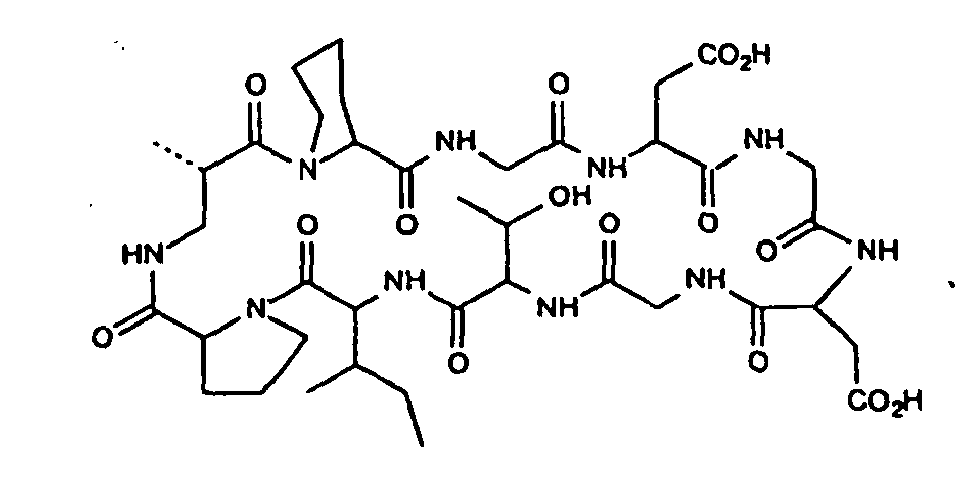
- The laspartomycin core peptide derivative according to claim 2 wherein R1 is hydrogen.
- The laspartomycin core peptide derivative according to any one of claims 2 or 3 wherein Y1 is selected from -SH,-OH, -CO2H or -CO2R1, X1 is carbonyl, and L is selected from:


n is 0, 1, 2 or 3;
each S1 is selected from hydrogen, (C1-C10) alkyl optionally substituted with one or more of the same or different R4 groups, (C1-C10) heteroalkyl optionally substituted with one or more of the same or different R4 groups, (C5- C10) aryl optionally substituted with one or more of the same or different R4 groups, (C5- C15) arylaryl optionally substituted with one or more of the same or different R4 groups, (C5-C15) biaryl optionally substituted with one or more of the same or different R4 groups, five to ten membered heteroaryl optionally substituted with one or more of the same or different R4 groups, (C6-C16) arylalkyl optionally substituted with one or more of the same or different R4 groups or six to sixteen membered heteroarylalkyl optionally substituted with one or more of the same or different R4 groups;
each R4 is independently selected from -OR5, -SR5, -NR5R5 . -CN, -NO2, -N3, -C(O)OR5, -C(O)NR5R5, -C(S)NR5R5, -C(NR5)NR5R5, -CHO, -R5CO, -SO2R5, -SOR5, -PO(OR5)2, -PO(OR5), -CO2H, -SO3H, -PO3H, halogen or trihalomethyl;
each R5 is independently selected from hydrogen, (C1-C6) alkyl, (C5-C10) aryl, 5-10 membered heteroaryl, (C6-C16) arylalkyl or six to sixteen membered heteroarylalkyl; and
each K is independently selected from oxygen, NH, sulfur or phosphorus. - The laspartomycin core peptide of claim 4 wherein each S1 is independently a side-chain of a genetically encoded α-amino acid.
- The antimicrobial laspartomycin derivative of claim 5 wherein the genetically encoded α-amino acid is glycine, asparagine, aspartic acid, glutamine, glutamic acid, tryptophan, phenylalanine, tyrosine, leucine, alanine, isoleucine and valine.
- An antimicrobial laspartomycin derivative according to structural formula (II):
(II) Y2-(X2-X3)-L-X1-N(R1)-R
or an pharmaceutically acceptable salt or hydrate thereof, wherein:
Y2 is a lipophilic group selected from (C6-C25) alkyl optionally substituted with one or more of the same or different R2 groups, and (C6-C25) heteroalkyl optionally substituted with one or more of the same or different R2 groups;
X1 is selected from -CO-, -SO2-, -CS-, -PO-, -OPO-, -OC(O)-, -NHCO- or -NR1CO-;
(X2-X3) taken together are selected from -C(O)O-, -O(O)C-, -CONH-, -NHCO-, -CONR1-, -NR1CO-, -C(O)S-, -S(O)C-, -OSO2-, -S(O2)O-, -NHSO2-, -NR1SO2-, -S(O2)NH-, -S(O2)NR1-, -C(S)NH-, -NHC(S)-, -OC(O)NH-, -NHC(O)O-, -OC(O)NR1-, -NR1C(O)O-, -OC(O)O-, -NHC(O)NH-, -NHC(O)NR1-, -NR1C(O)NH- or -NR1C(O)NR1-
L is
R1 is selected from hydrogen, (C1-C10) alkyl optionally substituted with one or more of the same or different R2 groups, (C1-C10) heteroalkyl optionally substituted with one or more of the same or different R2 groups, (C1-C10) aryl optionally substituted with one or more of the same or different R2 groups, (C5-C10) arylaryl optionally substituted with one or more of the same or different R2 groups, (C5-C15) biaryl optionally substituted with one or more of the same or different R2 groups, five to ten membered heteroaryl optionally substituted with one or more of the same or different R2 groups, (C6-C16) arylalkyl optionally substituted with one or more of the same or different R2 groups or six to sixteen membered heteroarylalkyl optionally substituted with one or more of the same or different R2 groups;
each R2 is independently selected from -OR3, -SR3, -NR3R3, -CN, -NO2, -N3, -C(O)OR3, -C(O)NR3R3, -C(S)NR3R3, -C(NR3)NR3R3, -CHO, -R3CO, -SO2R3, -SOR3, -PO(OR3)2, -PO(OR3), -CO2H, -SO3H, -PO3H, halogen or trihalomethyl;
each R3 is independently selected from hydrogen and (C1-C6) alkyl; and
R is a laspartomycin core cyclic peptide and has the structure:
- The antimicrobial laspartomycin derivative according to claim 7 wherein R1 is hydrogen.
- The antimicrobial laspartomycin derivative according to claim 7 or 8
wherein X1 is -CO- or -SO2-. - The antimicrobial laspartomycin derivative of claims 7-9 wherein the genetically encoded α-amino acid is glycine, asparagine, aspartic acid, glutamine, glutamic acid, tryptophan, phenylalanine, tyrosine, leucine, alanine, isoleucine and valine.
- A pharmaceutical composition comprising a compound according to any one of claims 2-10 and a pharmaceutically acceptable excipient, carrier or diluent.
- A laspartomycin core peptide according to any one of claims 2-6, or an antimicrobial laspartomycin derivative according to any one of claims 7-10, or a pharmaceutical composition according to claim 11, for therapeutic use for treating a microbial infection.
- of a laspartomycin core peptide according to any one of claims 2-6, or an antimicrobial laspartomycin derivative according to any one of claims 7-10, or a pharmaceutical composition according to claim 11, for the manufacture of a medicament for the treatment of microbial infection.
Applications Claiming Priority (7)
| Application Number | Priority Date | Filing Date | Title |
|---|---|---|---|
| US760328 | 1985-07-29 | ||
| US21905900P | 2000-07-17 | 2000-07-17 | |
| US219059P | 2000-07-17 | ||
| US22095000P | 2000-07-26 | 2000-07-26 | |
| US220950P | 2000-07-26 | ||
| US09/760,328 US6511962B1 (en) | 2000-07-17 | 2001-01-12 | Derivatives of laspartomycin and preparation and use thereof |
| PCT/US2001/022353 WO2002005838A1 (en) | 2000-07-17 | 2001-07-17 | Derivatives of laspartomycin and preparation and use thereof |
Publications (3)
| Publication Number | Publication Date |
|---|---|
| EP1309336A1 EP1309336A1 (en) | 2003-05-14 |
| EP1309336A4 EP1309336A4 (en) | 2005-01-05 |
| EP1309336B1 true EP1309336B1 (en) | 2009-05-06 |
Family
ID=27396619
Family Applications (2)
| Application Number | Title | Priority Date | Filing Date |
|---|---|---|---|
| EP01957162A Expired - Lifetime EP1311281B1 (en) | 2000-07-17 | 2001-07-17 | Antimicrobial sulfonamide derivatives of lipopeptide antibiotics |
| EP01953501A Expired - Lifetime EP1309336B1 (en) | 2000-07-17 | 2001-07-17 | Derivatives of laspartomycin and preparation and use thereof |
Family Applications Before (1)
| Application Number | Title | Priority Date | Filing Date |
|---|---|---|---|
| EP01957162A Expired - Lifetime EP1311281B1 (en) | 2000-07-17 | 2001-07-17 | Antimicrobial sulfonamide derivatives of lipopeptide antibiotics |
Country Status (9)
| Country | Link |
|---|---|
| US (1) | US6511962B1 (en) |
| EP (2) | EP1311281B1 (en) |
| JP (2) | JP2004528268A (en) |
| AT (2) | ATE430575T1 (en) |
| AU (2) | AU7594301A (en) |
| CA (2) | CA2450747A1 (en) |
| DE (2) | DE60131085T2 (en) |
| DK (1) | DK1309336T3 (en) |
| WO (1) | WO2002005838A1 (en) |
Families Citing this family (12)
| Publication number | Priority date | Publication date | Assignee | Title |
|---|---|---|---|---|
| US6790829B1 (en) | 1997-07-25 | 2004-09-14 | Seatek Marine Biotechnology, Inc. | Cyclic decapeptide antibiotics |
| US6716962B2 (en) * | 2000-07-17 | 2004-04-06 | Micrologix Biotech Inc. | Extractive purification of lipopeptide antibiotics |
| US6737403B2 (en) * | 2000-07-17 | 2004-05-18 | Micrologix Biotech Inc. | Derivatives of laspartomycin and preparation and use thereof |
| US6750199B2 (en) * | 2000-07-17 | 2004-06-15 | Micrologix Biotech Inc. | Antimicrobial sulfonamide derivatives of lipopeptide antibiotics |
| CA2488803C (en) | 2002-06-06 | 2013-08-13 | Vicuron Pharmaceuticals Inc. | Use of ramoplanin to treat diseases associated with the use of antibiotics |
| US7018996B2 (en) | 2002-07-11 | 2006-03-28 | Wyeth Holdings Corporation | Antibiotics AW998A, AW998B, AW998C and AW998D |
| US20060004185A1 (en) * | 2004-07-01 | 2006-01-05 | Leese Richard A | Peptide antibiotics and peptide intermediates for their prepartion |
| DE102004060750A1 (en) * | 2004-12-15 | 2006-07-13 | Sanofi-Aventis Deutschland Gmbh | Process for the deacylation of lipopeptides |
| AR074874A1 (en) | 2008-12-23 | 2011-02-16 | Biosource Pharm Inc | ANTIBIOTIC COMPOSITIONS FOR THE TREATMENT OF NEGATIVE GRAM INFECTIONS. METHOD. USE. COMPOUND. |
| CA2794841C (en) | 2010-05-20 | 2021-02-23 | Ecolab Usa Inc. | Rheology modified low foaming liquid antimicrobial compositions and methods of use thereof |
| US8415307B1 (en) | 2010-06-23 | 2013-04-09 | Biosource Pharm, Inc. | Antibiotic compositions for the treatment of gram negative infections |
| KR101522625B1 (en) * | 2013-03-15 | 2015-05-22 | 서울대학교산학협력단 | Novel cyclic peptide compound, a use thereof, and a preparing method thereof |
Citations (1)
| Publication number | Priority date | Publication date | Assignee | Title |
|---|---|---|---|---|
| EP0629636A1 (en) * | 1993-06-08 | 1994-12-21 | Hoechst Aktiengesellschaft | Lipopeptides from actinoplanes sp. endowed with pharmacological activity, process for their preparation and their use |
Family Cites Families (18)
| Publication number | Priority date | Publication date | Assignee | Title |
|---|---|---|---|---|
| GB897581A (en) * | 1958-11-14 | 1962-05-30 | American Cyanamid Co | Preparation of a new antibiotic aspartocin |
| US3639582A (en) * | 1967-04-14 | 1972-02-01 | Zaidan Hojin Biseibutsu | Antibiotic laspartomycin |
| FR2124060B1 (en) | 1971-02-02 | 1974-04-12 | Rhone Poulenc Sa | |
| US4331594A (en) | 1978-10-16 | 1982-05-25 | Eli Lilly And Company | A-21978 Antibiotics and process for their production |
| JPS5795992A (en) | 1980-12-04 | 1982-06-15 | Nippon Kayaku Co Ltd | Novel derivative of cephamycin c and its preparation |
| US4524135A (en) | 1982-05-21 | 1985-06-18 | Eli Lilly And Company | A-21978C cyclic peptides |
| US4800157A (en) | 1985-09-09 | 1989-01-24 | Eli Lilly And Company | Process for producing the A-21978C antibiotics |
| CA1315229C (en) | 1987-06-10 | 1993-03-30 | Eli Lilly And Company | Chromatographic purification process |
| US4977083A (en) | 1988-04-11 | 1990-12-11 | Eli Lilly And Company | Processes for preparing A54145 compounds |
| US5028590A (en) | 1988-04-11 | 1991-07-02 | Eli Lilly And Company | Derivatives of A54145 cyclic peptides |
| US5039789A (en) | 1988-04-11 | 1991-08-13 | Eli Lilly And Company | A54145 cyclic peptides |
| US4994270A (en) | 1988-04-11 | 1991-02-19 | Eli Lilly And Company | A54145 antibiotics and process for their production |
| DE4411025A1 (en) * | 1994-03-30 | 1995-10-05 | Hoechst Ag | New lipopeptide A1437 derivs. with modified acyl gp. |
| EP1666587A1 (en) | 1996-06-13 | 2006-06-07 | Astellas Pharma Inc. | Cyclic lipopeptide acylase |
| WO1998000173A2 (en) | 1996-07-03 | 1998-01-08 | Pharmacia & Upjohn Company | Targeted drug delivery using sulfonamide derivatives |
| ZA989835B (en) | 1997-10-29 | 1999-05-05 | Taisho Pharmaceutical Co Ltd | Erythromycin a derivatives |
| ATE473759T1 (en) * | 1998-05-22 | 2010-07-15 | Univ Leland Stanford Junior | BIFUNCTIONAL MOLECULES AND THERAPIES BASED THERAPIES. |
| CN1423656A (en) * | 1999-12-15 | 2003-06-11 | 卡比斯特制药公司 | Lipopeptides as antibacterial agents |
-
2001
- 2001-01-12 US US09/760,328 patent/US6511962B1/en not_active Expired - Fee Related
- 2001-07-17 DE DE60131085T patent/DE60131085T2/en not_active Expired - Lifetime
- 2001-07-17 JP JP2002511770A patent/JP2004528268A/en not_active Withdrawn
- 2001-07-17 AT AT01953501T patent/ATE430575T1/en not_active IP Right Cessation
- 2001-07-17 CA CA002450747A patent/CA2450747A1/en not_active Abandoned
- 2001-07-17 JP JP2002511769A patent/JP2004529065A/en not_active Withdrawn
- 2001-07-17 AT AT01957162T patent/ATE376557T1/en not_active IP Right Cessation
- 2001-07-17 EP EP01957162A patent/EP1311281B1/en not_active Expired - Lifetime
- 2001-07-17 AU AU7594301A patent/AU7594301A/en active Pending
- 2001-07-17 DK DK01953501T patent/DK1309336T3/en active
- 2001-07-17 EP EP01953501A patent/EP1309336B1/en not_active Expired - Lifetime
- 2001-07-17 WO PCT/US2001/022353 patent/WO2002005838A1/en not_active Ceased
- 2001-07-17 DE DE60138629T patent/DE60138629D1/en not_active Expired - Lifetime
- 2001-07-17 AU AU2001275943A patent/AU2001275943B2/en not_active Ceased
- 2001-07-17 CA CA002450372A patent/CA2450372A1/en not_active Abandoned
Patent Citations (1)
| Publication number | Priority date | Publication date | Assignee | Title |
|---|---|---|---|---|
| EP0629636A1 (en) * | 1993-06-08 | 1994-12-21 | Hoechst Aktiengesellschaft | Lipopeptides from actinoplanes sp. endowed with pharmacological activity, process for their preparation and their use |
Also Published As
| Publication number | Publication date |
|---|---|
| EP1311281A1 (en) | 2003-05-21 |
| US6511962B1 (en) | 2003-01-28 |
| DE60131085D1 (en) | 2007-12-06 |
| EP1309336A1 (en) | 2003-05-14 |
| EP1311281A4 (en) | 2005-08-24 |
| JP2004528268A (en) | 2004-09-16 |
| EP1309336A4 (en) | 2005-01-05 |
| DK1309336T3 (en) | 2009-08-24 |
| HK1053613A1 (en) | 2003-10-31 |
| EP1311281B1 (en) | 2007-10-24 |
| JP2004529065A (en) | 2004-09-24 |
| DE60138629D1 (en) | 2009-06-18 |
| CA2450747A1 (en) | 2002-01-24 |
| WO2002005838A1 (en) | 2002-01-24 |
| DE60131085T2 (en) | 2008-08-14 |
| CA2450372A1 (en) | 2002-01-24 |
| AU7594301A (en) | 2002-01-30 |
| ATE376557T1 (en) | 2007-11-15 |
| ATE430575T1 (en) | 2009-05-15 |
| AU2001275943B2 (en) | 2006-04-06 |
Similar Documents
| Publication | Publication Date | Title |
|---|---|---|
| US6511962B1 (en) | Derivatives of laspartomycin and preparation and use thereof | |
| EP1246838A1 (en) | Lipopeptides as antibacterial agents | |
| AU2001275943A1 (en) | Derivatives of laspartomycin and preparation and use thereof | |
| US20100137199A1 (en) | Dab9 DERIVATIVES OF LIPOPEPTIDE ANTIBIOTICS AND METHODS OF MAKING AND USING THE SAME | |
| EP2271665B1 (en) | Highly bridged peptides from actinomadura namibiensis | |
| AU2001278933B2 (en) | Antimicrobial sulfonamide derivatives of lipopeptide antibiotics | |
| HU192955B (en) | Process for producing a-21978 ccyclic peptide derivatives acilyzed with alkoxy-benzoyl-group | |
| US6750199B2 (en) | Antimicrobial sulfonamide derivatives of lipopeptide antibiotics | |
| JPS58213744A (en) | A-21978c cyclic peptide derivative and manufacture | |
| AU2001278933A1 (en) | Antimicrobial sulfonamide derivatives of lipopeptide antibiotics | |
| US6737403B2 (en) | Derivatives of laspartomycin and preparation and use thereof | |
| US20030224475A1 (en) | Lipodepsipeptide antibiotics and methods of preparation | |
| HK1053613B (en) | Derivatives of laspartomycin and preparation and use thereof | |
| HU193528B (en) | Process for preparing a-219780 cyclic peptide-acil derivatives | |
| SK287310B6 (en) | Memno peptides, method for their preparation, compositions containing the same and their medical use | |
| US6025466A (en) | Cyclic hepta-peptide derivative from colonial ascidians, Lissoclinum sp. | |
| EP2493843A1 (en) | 2-amino-3-methyl-hex-5-enoic acid and its use in the production of peptides such as bacitracins | |
| WO2015172047A1 (en) | Cyclic peptide compounds and related methods, salts and compositions | |
| HU193039B (en) | Process for preparing a-21978c cyclic n-substituted peptide derivatives | |
| HK1012009B (en) | Lipopeptides from actinoplanes sp. endowed with pharmacological activity, process for their preparation and their use | |
| HK1012009A1 (en) | Lipopeptides from actinoplanes sp. endowed with pharmacological activity, process for their preparation and their use |
Legal Events
| Date | Code | Title | Description |
|---|---|---|---|
| PUAI | Public reference made under article 153(3) epc to a published international application that has entered the european phase |
Free format text: ORIGINAL CODE: 0009012 |
|
| 17P | Request for examination filed |
Effective date: 20030217 |
|
| AK | Designated contracting states |
Designated state(s): AT BE CH CY DE DK ES FI FR GB GR IE IT LI LU MC NL PT SE TR |
|
| AX | Request for extension of the european patent |
Extension state: AL LT LV MK RO SI |
|
| A4 | Supplementary search report drawn up and despatched |
Effective date: 20041124 |
|
| 17Q | First examination report despatched |
Effective date: 20050629 |
|
| RAP1 | Party data changed (applicant data changed or rights of an application transferred) |
Owner name: MIGENIX INC. |
|
| 17Q | First examination report despatched |
Effective date: 20050629 |
|
| GRAP | Despatch of communication of intention to grant a patent |
Free format text: ORIGINAL CODE: EPIDOSNIGR1 |
|
| GRAS | Grant fee paid |
Free format text: ORIGINAL CODE: EPIDOSNIGR3 |
|
| GRAA | (expected) grant |
Free format text: ORIGINAL CODE: 0009210 |
|
| RAP1 | Party data changed (applicant data changed or rights of an application transferred) |
Owner name: BIOSOURCE PHARM, INC. |
|
| RIN1 | Information on inventor provided before grant (corrected) |
Inventor name: FRANCIS, NOREEN, D. Inventor name: FANTINI, AMADEO, A. Inventor name: BORDERS, DONALD, B. Inventor name: LEESE, RICHARD, A. Inventor name: CURRAN, WILLIAM, V. Inventor name: JAROLMEN, HOWARD |
|
| AK | Designated contracting states |
Kind code of ref document: B1 Designated state(s): AT BE CH CY DE DK ES FI FR GB GR IE IT LI LU MC NL PT SE TR |
|
| REG | Reference to a national code |
Ref country code: GB Ref legal event code: FG4D |
|
| REG | Reference to a national code |
Ref country code: CH Ref legal event code: EP |
|
| RIN2 | Information on inventor provided after grant (corrected) |
Inventor name: LEESE, RICHARD, A. Inventor name: CURRAN, WILLIAM, V. Inventor name: FRANCIS, NOREEN, D. Inventor name: FANTINI, AMADEO, A. Inventor name: JAROLMEN, HOWARD Inventor name: BORDERS, DONALD, B. |
|
| REG | Reference to a national code |
Ref country code: IE Ref legal event code: FG4D |
|
| REF | Corresponds to: |
Ref document number: 60138629 Country of ref document: DE Date of ref document: 20090618 Kind code of ref document: P |
|
| REG | Reference to a national code |
Ref country code: CH Ref legal event code: NV Representative=s name: BUGNION S.A. |
|
| REG | Reference to a national code |
Ref country code: DK Ref legal event code: T3 |
|
| REG | Reference to a national code |
Ref country code: SE Ref legal event code: TRGR |
|
| PG25 | Lapsed in a contracting state [announced via postgrant information from national office to epo] |
Ref country code: FI Free format text: LAPSE BECAUSE OF FAILURE TO SUBMIT A TRANSLATION OF THE DESCRIPTION OR TO PAY THE FEE WITHIN THE PRESCRIBED TIME-LIMIT Effective date: 20090506 Ref country code: AT Free format text: LAPSE BECAUSE OF FAILURE TO SUBMIT A TRANSLATION OF THE DESCRIPTION OR TO PAY THE FEE WITHIN THE PRESCRIBED TIME-LIMIT Effective date: 20090506 Ref country code: ES Free format text: LAPSE BECAUSE OF FAILURE TO SUBMIT A TRANSLATION OF THE DESCRIPTION OR TO PAY THE FEE WITHIN THE PRESCRIBED TIME-LIMIT Effective date: 20090817 Ref country code: PT Free format text: LAPSE BECAUSE OF FAILURE TO SUBMIT A TRANSLATION OF THE DESCRIPTION OR TO PAY THE FEE WITHIN THE PRESCRIBED TIME-LIMIT Effective date: 20090906 |
|
| PG25 | Lapsed in a contracting state [announced via postgrant information from national office to epo] |
Ref country code: BE Free format text: LAPSE BECAUSE OF FAILURE TO SUBMIT A TRANSLATION OF THE DESCRIPTION OR TO PAY THE FEE WITHIN THE PRESCRIBED TIME-LIMIT Effective date: 20090506 Ref country code: MC Free format text: LAPSE BECAUSE OF NON-PAYMENT OF DUE FEES Effective date: 20090731 |
|
| PLBE | No opposition filed within time limit |
Free format text: ORIGINAL CODE: 0009261 |
|
| STAA | Information on the status of an ep patent application or granted ep patent |
Free format text: STATUS: NO OPPOSITION FILED WITHIN TIME LIMIT |
|
| 26N | No opposition filed |
Effective date: 20100209 |
|
| REG | Reference to a national code |
Ref country code: HK Ref legal event code: GR Ref document number: 1053613 Country of ref document: HK |
|
| PG25 | Lapsed in a contracting state [announced via postgrant information from national office to epo] |
Ref country code: GR Free format text: LAPSE BECAUSE OF FAILURE TO SUBMIT A TRANSLATION OF THE DESCRIPTION OR TO PAY THE FEE WITHIN THE PRESCRIBED TIME-LIMIT Effective date: 20090807 |
|
| PGFP | Annual fee paid to national office [announced via postgrant information from national office to epo] |
Ref country code: NL Payment date: 20100724 Year of fee payment: 10 Ref country code: IE Payment date: 20100726 Year of fee payment: 10 Ref country code: CH Payment date: 20100726 Year of fee payment: 10 |
|
| PGFP | Annual fee paid to national office [announced via postgrant information from national office to epo] |
Ref country code: DE Payment date: 20100728 Year of fee payment: 10 Ref country code: SE Payment date: 20100728 Year of fee payment: 10 Ref country code: IT Payment date: 20100726 Year of fee payment: 10 Ref country code: FR Payment date: 20100805 Year of fee payment: 10 |
|
| PGFP | Annual fee paid to national office [announced via postgrant information from national office to epo] |
Ref country code: GB Payment date: 20100726 Year of fee payment: 10 |
|
| PGFP | Annual fee paid to national office [announced via postgrant information from national office to epo] |
Ref country code: DK Payment date: 20100727 Year of fee payment: 10 |
|
| PG25 | Lapsed in a contracting state [announced via postgrant information from national office to epo] |
Ref country code: LU Free format text: LAPSE BECAUSE OF NON-PAYMENT OF DUE FEES Effective date: 20090717 |
|
| PG25 | Lapsed in a contracting state [announced via postgrant information from national office to epo] |
Ref country code: TR Free format text: LAPSE BECAUSE OF FAILURE TO SUBMIT A TRANSLATION OF THE DESCRIPTION OR TO PAY THE FEE WITHIN THE PRESCRIBED TIME-LIMIT Effective date: 20090506 |
|
| PG25 | Lapsed in a contracting state [announced via postgrant information from national office to epo] |
Ref country code: CY Free format text: LAPSE BECAUSE OF FAILURE TO SUBMIT A TRANSLATION OF THE DESCRIPTION OR TO PAY THE FEE WITHIN THE PRESCRIBED TIME-LIMIT Effective date: 20090506 |
|
| REG | Reference to a national code |
Ref country code: NL Ref legal event code: V1 Effective date: 20120201 |
|
| REG | Reference to a national code |
Ref country code: CH Ref legal event code: PL |
|
| REG | Reference to a national code |
Ref country code: SE Ref legal event code: EUG |
|
| REG | Reference to a national code |
Ref country code: DK Ref legal event code: EBP |
|
| GBPC | Gb: european patent ceased through non-payment of renewal fee |
Effective date: 20110717 |
|
| REG | Reference to a national code |
Ref country code: FR Ref legal event code: ST Effective date: 20120330 |
|
| REG | Reference to a national code |
Ref country code: IE Ref legal event code: MM4A |
|
| PG25 | Lapsed in a contracting state [announced via postgrant information from national office to epo] |
Ref country code: LI Free format text: LAPSE BECAUSE OF NON-PAYMENT OF DUE FEES Effective date: 20110731 Ref country code: CH Free format text: LAPSE BECAUSE OF NON-PAYMENT OF DUE FEES Effective date: 20110731 Ref country code: DE Free format text: LAPSE BECAUSE OF NON-PAYMENT OF DUE FEES Effective date: 20120201 Ref country code: FR Free format text: LAPSE BECAUSE OF NON-PAYMENT OF DUE FEES Effective date: 20110801 |
|
| REG | Reference to a national code |
Ref country code: DE Ref legal event code: R119 Ref document number: 60138629 Country of ref document: DE Effective date: 20120201 |
|
| PG25 | Lapsed in a contracting state [announced via postgrant information from national office to epo] |
Ref country code: NL Free format text: LAPSE BECAUSE OF NON-PAYMENT OF DUE FEES Effective date: 20120201 Ref country code: IT Free format text: LAPSE BECAUSE OF NON-PAYMENT OF DUE FEES Effective date: 20110717 |
|
| PG25 | Lapsed in a contracting state [announced via postgrant information from national office to epo] |
Ref country code: GB Free format text: LAPSE BECAUSE OF NON-PAYMENT OF DUE FEES Effective date: 20110717 |
|
| PG25 | Lapsed in a contracting state [announced via postgrant information from national office to epo] |
Ref country code: DK Free format text: LAPSE BECAUSE OF NON-PAYMENT OF DUE FEES Effective date: 20110731 Ref country code: IE Free format text: LAPSE BECAUSE OF NON-PAYMENT OF DUE FEES Effective date: 20110717 |
|
| PG25 | Lapsed in a contracting state [announced via postgrant information from national office to epo] |
Ref country code: SE Free format text: LAPSE BECAUSE OF NON-PAYMENT OF DUE FEES Effective date: 20110718 |