EP1308943A2 - Optical information recording medium - Google Patents
Optical information recording medium Download PDFInfo
- Publication number
- EP1308943A2 EP1308943A2 EP02023911A EP02023911A EP1308943A2 EP 1308943 A2 EP1308943 A2 EP 1308943A2 EP 02023911 A EP02023911 A EP 02023911A EP 02023911 A EP02023911 A EP 02023911A EP 1308943 A2 EP1308943 A2 EP 1308943A2
- Authority
- EP
- European Patent Office
- Prior art keywords
- group
- groups
- recording medium
- optical information
- information recording
- Prior art date
- Legal status (The legal status is an assumption and is not a legal conclusion. Google has not performed a legal analysis and makes no representation as to the accuracy of the status listed.)
- Granted
Links
- 230000003287 optical effect Effects 0.000 title claims abstract description 46
- 239000000758 substrate Substances 0.000 claims abstract description 30
- 238000002835 absorbance Methods 0.000 claims abstract description 26
- 239000000975 dye Substances 0.000 claims description 124
- -1 carboxyester groups Chemical group 0.000 claims description 73
- 150000001875 compounds Chemical class 0.000 claims description 59
- 125000004432 carbon atom Chemical group C* 0.000 claims description 53
- 125000000217 alkyl group Chemical group 0.000 claims description 36
- 229910052751 metal Inorganic materials 0.000 claims description 31
- 239000002184 metal Substances 0.000 claims description 31
- 125000001424 substituent group Chemical group 0.000 claims description 30
- 238000005979 thermal decomposition reaction Methods 0.000 claims description 21
- 238000010521 absorption reaction Methods 0.000 claims description 19
- 125000003545 alkoxy group Chemical group 0.000 claims description 18
- 125000003118 aryl group Chemical group 0.000 claims description 18
- 125000005843 halogen group Chemical group 0.000 claims description 15
- 125000000449 nitro group Chemical group [O-][N+](*)=O 0.000 claims description 11
- 125000004429 atom Chemical group 0.000 claims description 10
- 125000004104 aryloxy group Chemical group 0.000 claims description 9
- 125000003178 carboxy group Chemical group [H]OC(*)=O 0.000 claims description 8
- VMGAPWLDMVPYIA-HIDZBRGKSA-N n'-amino-n-iminomethanimidamide Chemical compound N\N=C\N=N VMGAPWLDMVPYIA-HIDZBRGKSA-N 0.000 claims description 8
- BOLDJAUMGUJJKM-LSDHHAIUSA-N renifolin D Natural products CC(=C)[C@@H]1Cc2c(O)c(O)ccc2[C@H]1CC(=O)c3ccc(O)cc3O BOLDJAUMGUJJKM-LSDHHAIUSA-N 0.000 claims description 8
- 239000013522 chelant Substances 0.000 claims description 6
- 125000003277 amino group Chemical group 0.000 claims description 5
- 125000003710 aryl alkyl group Chemical group 0.000 claims description 5
- 229910052799 carbon Inorganic materials 0.000 claims description 5
- 125000000468 ketone group Chemical group 0.000 claims description 4
- 125000002560 nitrile group Chemical group 0.000 claims description 4
- 229910052757 nitrogen Inorganic materials 0.000 claims description 4
- 125000004433 nitrogen atom Chemical group N* 0.000 claims description 4
- 125000000113 cyclohexyl group Chemical group [H]C1([H])C([H])([H])C([H])([H])C([H])(*)C([H])([H])C1([H])[H] 0.000 claims description 3
- 125000002490 anilino group Chemical group [H]N(*)C1=C([H])C([H])=C([H])C([H])=C1[H] 0.000 claims description 2
- 239000003446 ligand Substances 0.000 claims description 2
- 125000005309 thioalkoxy group Chemical group 0.000 claims description 2
- 239000010410 layer Substances 0.000 description 89
- 238000000576 coating method Methods 0.000 description 20
- 238000000034 method Methods 0.000 description 18
- 230000031700 light absorption Effects 0.000 description 16
- 239000011248 coating agent Substances 0.000 description 14
- 239000000463 material Substances 0.000 description 13
- 125000001997 phenyl group Chemical group [H]C1=C([H])C([H])=C(*)C([H])=C1[H] 0.000 description 11
- 230000035945 sensitivity Effects 0.000 description 11
- 125000004435 hydrogen atom Chemical group [H]* 0.000 description 10
- 239000007788 liquid Substances 0.000 description 10
- 239000011241 protective layer Substances 0.000 description 10
- 239000002904 solvent Substances 0.000 description 10
- 238000000862 absorption spectrum Methods 0.000 description 9
- 125000002887 hydroxy group Chemical group [H]O* 0.000 description 9
- ANRHNWWPFJCPAZ-UHFFFAOYSA-M thionine Chemical compound [Cl-].C1=CC(N)=CC2=[S+]C3=CC(N)=CC=C3N=C21 ANRHNWWPFJCPAZ-UHFFFAOYSA-M 0.000 description 9
- 125000004414 alkyl thio group Chemical group 0.000 description 8
- 238000011156 evaluation Methods 0.000 description 8
- RKJUIXBNRJVNHR-UHFFFAOYSA-N indolenine group Chemical group N1=CCC2=CC=CC=C12 RKJUIXBNRJVNHR-UHFFFAOYSA-N 0.000 description 8
- 229920005989 resin Polymers 0.000 description 8
- 239000011347 resin Substances 0.000 description 8
- 239000000987 azo dye Substances 0.000 description 7
- 125000004093 cyano group Chemical group *C#N 0.000 description 7
- 230000007423 decrease Effects 0.000 description 7
- 125000000623 heterocyclic group Chemical group 0.000 description 7
- PXHVJJICTQNCMI-UHFFFAOYSA-N nickel Substances [Ni] PXHVJJICTQNCMI-UHFFFAOYSA-N 0.000 description 7
- KDLHZDBZIXYQEI-UHFFFAOYSA-N Palladium Chemical compound [Pd] KDLHZDBZIXYQEI-UHFFFAOYSA-N 0.000 description 6
- 125000002252 acyl group Chemical group 0.000 description 6
- 125000005110 aryl thio group Chemical group 0.000 description 6
- 229920001577 copolymer Polymers 0.000 description 6
- RAXXELZNTBOGNW-UHFFFAOYSA-N imidazole Natural products C1=CNC=N1 RAXXELZNTBOGNW-UHFFFAOYSA-N 0.000 description 6
- 150000002500 ions Chemical class 0.000 description 6
- 229910052759 nickel Inorganic materials 0.000 description 6
- 238000002360 preparation method Methods 0.000 description 6
- 239000011701 zinc Substances 0.000 description 6
- JUJWROOIHBZHMG-UHFFFAOYSA-N Pyridine Chemical compound C1=CC=NC=C1 JUJWROOIHBZHMG-UHFFFAOYSA-N 0.000 description 5
- 125000003917 carbamoyl group Chemical group [H]N([H])C(*)=O 0.000 description 5
- 125000001309 chloro group Chemical group Cl* 0.000 description 5
- 229910052802 copper Inorganic materials 0.000 description 5
- 239000010949 copper Substances 0.000 description 5
- 125000004185 ester group Chemical group 0.000 description 5
- 150000002739 metals Chemical class 0.000 description 5
- 125000002496 methyl group Chemical group [H]C([H])([H])* 0.000 description 5
- 125000001624 naphthyl group Chemical group 0.000 description 5
- 229910052763 palladium Inorganic materials 0.000 description 5
- 238000004528 spin coating Methods 0.000 description 5
- 229910052725 zinc Inorganic materials 0.000 description 5
- XEEYBQQBJWHFJM-UHFFFAOYSA-N Iron Chemical compound [Fe] XEEYBQQBJWHFJM-UHFFFAOYSA-N 0.000 description 4
- VYPSYNLAJGMNEJ-UHFFFAOYSA-N Silicium dioxide Chemical compound O=[Si]=O VYPSYNLAJGMNEJ-UHFFFAOYSA-N 0.000 description 4
- PPBRXRYQALVLMV-UHFFFAOYSA-N Styrene Chemical compound C=CC1=CC=CC=C1 PPBRXRYQALVLMV-UHFFFAOYSA-N 0.000 description 4
- 125000004442 acylamino group Chemical group 0.000 description 4
- 230000000052 comparative effect Effects 0.000 description 4
- 238000004132 cross linking Methods 0.000 description 4
- 229910052731 fluorine Inorganic materials 0.000 description 4
- 229910052740 iodine Inorganic materials 0.000 description 4
- 239000001007 phthalocyanine dye Substances 0.000 description 4
- 125000002924 primary amino group Chemical group [H]N([H])* 0.000 description 4
- 229910052709 silver Inorganic materials 0.000 description 4
- ZMXDDKWLCZADIW-UHFFFAOYSA-N N,N-Dimethylformamide Chemical compound CN(C)C=O ZMXDDKWLCZADIW-UHFFFAOYSA-N 0.000 description 3
- RWRDLPDLKQPQOW-UHFFFAOYSA-N Pyrrolidine Chemical compound C1CCNC1 RWRDLPDLKQPQOW-UHFFFAOYSA-N 0.000 description 3
- FZWLAAWBMGSTSO-UHFFFAOYSA-N Thiazole Chemical compound C1=CSC=N1 FZWLAAWBMGSTSO-UHFFFAOYSA-N 0.000 description 3
- 125000004183 alkoxy alkyl group Chemical group 0.000 description 3
- 125000003368 amide group Chemical group 0.000 description 3
- IOJUPLGTWVMSFF-UHFFFAOYSA-N benzothiazole Chemical compound C1=CC=C2SC=NC2=C1 IOJUPLGTWVMSFF-UHFFFAOYSA-N 0.000 description 3
- 229910052742 iron Inorganic materials 0.000 description 3
- 125000000959 isobutyl group Chemical group [H]C([H])([H])C([H])(C([H])([H])[H])C([H])([H])* 0.000 description 3
- 229910052748 manganese Inorganic materials 0.000 description 3
- 238000004519 manufacturing process Methods 0.000 description 3
- 239000000203 mixture Substances 0.000 description 3
- 229920003229 poly(methyl methacrylate) Polymers 0.000 description 3
- 239000004926 polymethyl methacrylate Substances 0.000 description 3
- 125000000168 pyrrolyl group Chemical group 0.000 description 3
- 150000003839 salts Chemical class 0.000 description 3
- 238000004544 sputter deposition Methods 0.000 description 3
- LBUJPTNKIBCYBY-UHFFFAOYSA-N 1,2,3,4-tetrahydroquinoline Chemical compound C1=CC=C2CCCNC2=C1 LBUJPTNKIBCYBY-UHFFFAOYSA-N 0.000 description 2
- UGUHFDPGDQDVGX-UHFFFAOYSA-N 1,2,3-thiadiazole Chemical group C1=CSN=N1 UGUHFDPGDQDVGX-UHFFFAOYSA-N 0.000 description 2
- JYEUMXHLPRZUAT-UHFFFAOYSA-N 1,2,3-triazine Chemical group C1=CN=NN=C1 JYEUMXHLPRZUAT-UHFFFAOYSA-N 0.000 description 2
- HYZJCKYKOHLVJF-UHFFFAOYSA-N 1H-benzimidazole Chemical compound C1=CC=C2NC=NC2=C1 HYZJCKYKOHLVJF-UHFFFAOYSA-N 0.000 description 2
- MVXVYAKCVDQRLW-UHFFFAOYSA-N 1h-pyrrolo[2,3-b]pyridine Chemical compound C1=CN=C2NC=CC2=C1 MVXVYAKCVDQRLW-UHFFFAOYSA-N 0.000 description 2
- SMZOUWXMTYCWNB-UHFFFAOYSA-N 2-(2-methoxy-5-methylphenyl)ethanamine Chemical compound COC1=CC=C(C)C=C1CCN SMZOUWXMTYCWNB-UHFFFAOYSA-N 0.000 description 2
- NIXOWILDQLNWCW-UHFFFAOYSA-N 2-Propenoic acid Natural products OC(=O)C=C NIXOWILDQLNWCW-UHFFFAOYSA-N 0.000 description 2
- KDCGOANMDULRCW-UHFFFAOYSA-N 7H-purine Chemical compound N1=CNC2=NC=NC2=C1 KDCGOANMDULRCW-UHFFFAOYSA-N 0.000 description 2
- UJOBWOGCFQCDNV-UHFFFAOYSA-N 9H-carbazole Chemical compound C1=CC=C2C3=CC=CC=C3NC2=C1 UJOBWOGCFQCDNV-UHFFFAOYSA-N 0.000 description 2
- OKTJSMMVPCPJKN-UHFFFAOYSA-N Carbon Chemical compound [C] OKTJSMMVPCPJKN-UHFFFAOYSA-N 0.000 description 2
- NQRYJNQNLNOLGT-UHFFFAOYSA-N Piperidine Chemical compound C1CCNCC1 NQRYJNQNLNOLGT-UHFFFAOYSA-N 0.000 description 2
- KAESVJOAVNADME-UHFFFAOYSA-N Pyrrole Chemical compound C=1C=CNC=1 KAESVJOAVNADME-UHFFFAOYSA-N 0.000 description 2
- SMWDFEZZVXVKRB-UHFFFAOYSA-N Quinoline Chemical compound N1=CC=CC2=CC=CC=C21 SMWDFEZZVXVKRB-UHFFFAOYSA-N 0.000 description 2
- BQCADISMDOOEFD-UHFFFAOYSA-N Silver Chemical compound [Ag] BQCADISMDOOEFD-UHFFFAOYSA-N 0.000 description 2
- WYURNTSHIVDZCO-UHFFFAOYSA-N Tetrahydrofuran Chemical compound C1CCOC1 WYURNTSHIVDZCO-UHFFFAOYSA-N 0.000 description 2
- YXFVVABEGXRONW-UHFFFAOYSA-N Toluene Natural products CC1=CC=CC=C1 YXFVVABEGXRONW-UHFFFAOYSA-N 0.000 description 2
- 125000005153 alkyl sulfamoyl group Chemical group 0.000 description 2
- 229910052782 aluminium Inorganic materials 0.000 description 2
- 125000004397 aminosulfonyl group Chemical group NS(=O)(=O)* 0.000 description 2
- 125000000751 azo group Chemical group [*]N=N[*] 0.000 description 2
- 150000001721 carbon Chemical group 0.000 description 2
- 229910052804 chromium Inorganic materials 0.000 description 2
- 230000000694 effects Effects 0.000 description 2
- 239000003822 epoxy resin Substances 0.000 description 2
- 125000001495 ethyl group Chemical group [H]C([H])([H])C([H])([H])* 0.000 description 2
- 125000003709 fluoroalkyl group Chemical group 0.000 description 2
- 229910052737 gold Inorganic materials 0.000 description 2
- LNEPOXFFQSENCJ-UHFFFAOYSA-N haloperidol Chemical compound C1CC(O)(C=2C=CC(Cl)=CC=2)CCN1CCCC(=O)C1=CC=C(F)C=C1 LNEPOXFFQSENCJ-UHFFFAOYSA-N 0.000 description 2
- 229910052739 hydrogen Inorganic materials 0.000 description 2
- 239000001257 hydrogen Substances 0.000 description 2
- 229910010272 inorganic material Inorganic materials 0.000 description 2
- 239000011147 inorganic material Substances 0.000 description 2
- 229910052741 iridium Inorganic materials 0.000 description 2
- AWJUIBRHMBBTKR-UHFFFAOYSA-N isoquinoline Chemical compound C1=NC=CC2=CC=CC=C21 AWJUIBRHMBBTKR-UHFFFAOYSA-N 0.000 description 2
- 229910001635 magnesium fluoride Inorganic materials 0.000 description 2
- 239000011572 manganese Substances 0.000 description 2
- 230000008018 melting Effects 0.000 description 2
- 238000002844 melting Methods 0.000 description 2
- 229910044991 metal oxide Inorganic materials 0.000 description 2
- 150000004706 metal oxides Chemical class 0.000 description 2
- 125000004108 n-butyl group Chemical group [H]C([H])([H])C([H])([H])C([H])([H])C([H])([H])* 0.000 description 2
- 239000011368 organic material Substances 0.000 description 2
- RDOWQLZANAYVLL-UHFFFAOYSA-N phenanthridine Chemical compound C1=CC=C2C3=CC=CC=C3C=NC2=C1 RDOWQLZANAYVLL-UHFFFAOYSA-N 0.000 description 2
- 229910052697 platinum Inorganic materials 0.000 description 2
- BASFCYQUMIYNBI-UHFFFAOYSA-N platinum Substances [Pt] BASFCYQUMIYNBI-UHFFFAOYSA-N 0.000 description 2
- 229920000515 polycarbonate Polymers 0.000 description 2
- 239000004417 polycarbonate Substances 0.000 description 2
- 229920005668 polycarbonate resin Polymers 0.000 description 2
- 239000004431 polycarbonate resin Substances 0.000 description 2
- 229920000647 polyepoxide Polymers 0.000 description 2
- 229920001225 polyester resin Polymers 0.000 description 2
- 239000004645 polyester resin Substances 0.000 description 2
- 229920005672 polyolefin resin Polymers 0.000 description 2
- 229920000915 polyvinyl chloride Polymers 0.000 description 2
- 239000004800 polyvinyl chloride Substances 0.000 description 2
- XSCHRSMBECNVNS-UHFFFAOYSA-N quinoxaline Chemical compound N1=CC=NC2=CC=CC=C21 XSCHRSMBECNVNS-UHFFFAOYSA-N 0.000 description 2
- 229910052703 rhodium Inorganic materials 0.000 description 2
- 229910052707 ruthenium Inorganic materials 0.000 description 2
- 125000002914 sec-butyl group Chemical group [H]C([H])([H])C([H])([H])C([H])(*)C([H])([H])[H] 0.000 description 2
- 229910052710 silicon Inorganic materials 0.000 description 2
- 239000000377 silicon dioxide Substances 0.000 description 2
- LIVNPJMFVYWSIS-UHFFFAOYSA-N silicon monoxide Chemical compound [Si-]#[O+] LIVNPJMFVYWSIS-UHFFFAOYSA-N 0.000 description 2
- 239000004332 silver Substances 0.000 description 2
- 238000001228 spectrum Methods 0.000 description 2
- 125000000565 sulfonamide group Chemical group 0.000 description 2
- 125000000999 tert-butyl group Chemical group [H]C([H])([H])C(*)(C([H])([H])[H])C([H])([H])[H] 0.000 description 2
- XOLBLPGZBRYERU-UHFFFAOYSA-N tin dioxide Chemical compound O=[Sn]=O XOLBLPGZBRYERU-UHFFFAOYSA-N 0.000 description 2
- ZSUXOVNWDZTCFN-UHFFFAOYSA-L tin(ii) bromide Chemical compound Br[Sn]Br ZSUXOVNWDZTCFN-UHFFFAOYSA-L 0.000 description 2
- JTDNNCYXCFHBGG-UHFFFAOYSA-L tin(ii) iodide Chemical compound I[Sn]I JTDNNCYXCFHBGG-UHFFFAOYSA-L 0.000 description 2
- 229910052723 transition metal Inorganic materials 0.000 description 2
- 150000003624 transition metals Chemical class 0.000 description 2
- GETQZCLCWQTVFV-UHFFFAOYSA-N trimethylamine Chemical compound CN(C)C GETQZCLCWQTVFV-UHFFFAOYSA-N 0.000 description 2
- 125000000391 vinyl group Chemical group [H]C([*])=C([H])[H] 0.000 description 2
- AIFRHYZBTHREPW-UHFFFAOYSA-N β-carboline Chemical compound N1=CC=C2C3=CC=CC=C3NC2=C1 AIFRHYZBTHREPW-UHFFFAOYSA-N 0.000 description 2
- KYPOHTVBFVELTG-UPHRSURJSA-N (z)-but-2-enedinitrile Chemical compound N#C\C=C/C#N KYPOHTVBFVELTG-UPHRSURJSA-N 0.000 description 1
- 125000004720 1,2-dimethylpropylthio group Chemical group CC(C(C)C)S* 0.000 description 1
- BCMCBBGGLRIHSE-UHFFFAOYSA-N 1,3-benzoxazole Chemical compound C1=CC=C2OC=NC2=C1 BCMCBBGGLRIHSE-UHFFFAOYSA-N 0.000 description 1
- 125000004736 1-ethyl-2-methylpropylthio group Chemical group C(C)C(C(C)C)S* 0.000 description 1
- BMVXCPBXGZKUPN-UHFFFAOYSA-N 1-hexanamine Chemical compound CCCCCCN BMVXCPBXGZKUPN-UHFFFAOYSA-N 0.000 description 1
- AAQTWLBJPNLKHT-UHFFFAOYSA-N 1H-perimidine Chemical compound N1C=NC2=CC=CC3=CC=CC1=C32 AAQTWLBJPNLKHT-UHFFFAOYSA-N 0.000 description 1
- NBUKAOOFKZFCGD-UHFFFAOYSA-N 2,2,3,3-tetrafluoropropan-1-ol Chemical compound OCC(F)(F)C(F)F NBUKAOOFKZFCGD-UHFFFAOYSA-N 0.000 description 1
- KGLPWQKSKUVKMJ-UHFFFAOYSA-N 2,3-dihydrophthalazine-1,4-dione Chemical compound C1=CC=C2C(=O)NNC(=O)C2=C1 KGLPWQKSKUVKMJ-UHFFFAOYSA-N 0.000 description 1
- AFNRMRFWCAJQGP-UHFFFAOYSA-N 2,5,6-trimethyl-1h-benzimidazole Chemical compound CC1=C(C)C=C2NC(C)=NC2=C1 AFNRMRFWCAJQGP-UHFFFAOYSA-N 0.000 description 1
- ZNQVEEAIQZEUHB-UHFFFAOYSA-N 2-ethoxyethanol Chemical compound CCOCCO ZNQVEEAIQZEUHB-UHFFFAOYSA-N 0.000 description 1
- 229940093475 2-ethoxyethanol Drugs 0.000 description 1
- 125000006176 2-ethylbutyl group Chemical group [H]C([H])([H])C([H])([H])C([H])(C([H])([H])*)C([H])([H])C([H])([H])[H] 0.000 description 1
- 125000004732 2-ethylbutylthio group Chemical group C(C)C(CS*)CC 0.000 description 1
- WKYYYUWKFPFVEY-UHFFFAOYSA-N 2-ethylcyclohexan-1-one Chemical compound CCC1CCCCC1=O WKYYYUWKFPFVEY-UHFFFAOYSA-N 0.000 description 1
- 125000004493 2-methylbut-1-yl group Chemical group CC(C*)CC 0.000 description 1
- RZVCEPSDYHAHLX-UHFFFAOYSA-N 3-iminoisoindol-1-amine Chemical compound C1=CC=C2C(N)=NC(=N)C2=C1 RZVCEPSDYHAHLX-UHFFFAOYSA-N 0.000 description 1
- 125000005917 3-methylpentyl group Chemical group 0.000 description 1
- 125000004800 4-bromophenyl group Chemical group [H]C1=C([H])C(*)=C([H])C([H])=C1Br 0.000 description 1
- IYGFIINCQJDWNJ-UHFFFAOYSA-N 4-chloro-2h-triazole Chemical compound ClC1=CNN=N1 IYGFIINCQJDWNJ-UHFFFAOYSA-N 0.000 description 1
- LJUQGASMPRMWIW-UHFFFAOYSA-N 5,6-dimethylbenzimidazole Chemical compound C1=C(C)C(C)=CC2=C1NC=N2 LJUQGASMPRMWIW-UHFFFAOYSA-N 0.000 description 1
- ZCYVEMRRCGMTRW-UHFFFAOYSA-N 7553-56-2 Chemical group [I] ZCYVEMRRCGMTRW-UHFFFAOYSA-N 0.000 description 1
- QTBSBXVTEAMEQO-UHFFFAOYSA-M Acetate Chemical compound CC([O-])=O QTBSBXVTEAMEQO-UHFFFAOYSA-M 0.000 description 1
- 229920002126 Acrylic acid copolymer Polymers 0.000 description 1
- 239000004925 Acrylic resin Substances 0.000 description 1
- 229920000178 Acrylic resin Polymers 0.000 description 1
- 229910018085 Al-F Inorganic materials 0.000 description 1
- 229910018179 Al—F Inorganic materials 0.000 description 1
- WKBOTKDWSSQWDR-UHFFFAOYSA-N Bromine atom Chemical group [Br] WKBOTKDWSSQWDR-UHFFFAOYSA-N 0.000 description 1
- 229910021554 Chromium(II) chloride Inorganic materials 0.000 description 1
- RYGMFSIKBFXOCR-UHFFFAOYSA-N Copper Chemical compound [Cu] RYGMFSIKBFXOCR-UHFFFAOYSA-N 0.000 description 1
- LFQSCWFLJHTTHZ-UHFFFAOYSA-N Ethanol Chemical compound CCO LFQSCWFLJHTTHZ-UHFFFAOYSA-N 0.000 description 1
- VGGSQFUCUMXWEO-UHFFFAOYSA-N Ethene Chemical compound C=C VGGSQFUCUMXWEO-UHFFFAOYSA-N 0.000 description 1
- 239000005977 Ethylene Substances 0.000 description 1
- PIICEJLVQHRZGT-UHFFFAOYSA-N Ethylenediamine Chemical compound NCCN PIICEJLVQHRZGT-UHFFFAOYSA-N 0.000 description 1
- 229910006111 GeCl2 Inorganic materials 0.000 description 1
- 229910006158 GeF2 Inorganic materials 0.000 description 1
- 229910006162 GeI2 Inorganic materials 0.000 description 1
- 229910021600 Germanium(II) bromide Inorganic materials 0.000 description 1
- 239000004831 Hot glue Substances 0.000 description 1
- UFHFLCQGNIYNRP-UHFFFAOYSA-N Hydrogen Chemical compound [H][H] UFHFLCQGNIYNRP-UHFFFAOYSA-N 0.000 description 1
- SIKJAQJRHWYJAI-UHFFFAOYSA-N Indole Chemical compound C1=CC=C2NC=CC2=C1 SIKJAQJRHWYJAI-UHFFFAOYSA-N 0.000 description 1
- CNCOEDDPFOAUMB-UHFFFAOYSA-N N-Methylolacrylamide Chemical compound OCNC(=O)C=C CNCOEDDPFOAUMB-UHFFFAOYSA-N 0.000 description 1
- 229930192627 Naphthoquinone Natural products 0.000 description 1
- 239000000020 Nitrocellulose Substances 0.000 description 1
- ZCQWOFVYLHDMMC-UHFFFAOYSA-N Oxazole Chemical compound C1=COC=N1 ZCQWOFVYLHDMMC-UHFFFAOYSA-N 0.000 description 1
- 239000004698 Polyethylene Substances 0.000 description 1
- 239000004642 Polyimide Substances 0.000 description 1
- 239000004743 Polypropylene Substances 0.000 description 1
- 239000004372 Polyvinyl alcohol Substances 0.000 description 1
- 229910006074 SO2NH2 Inorganic materials 0.000 description 1
- 229910004016 SiF2 Inorganic materials 0.000 description 1
- 239000006087 Silane Coupling Agent Substances 0.000 description 1
- 229910010068 TiCl2 Inorganic materials 0.000 description 1
- 229910010347 TiF2 Inorganic materials 0.000 description 1
- 229910021626 Tin(II) chloride Inorganic materials 0.000 description 1
- XTXRWKRVRITETP-UHFFFAOYSA-N Vinyl acetate Chemical compound CC(=O)OC=C XTXRWKRVRITETP-UHFFFAOYSA-N 0.000 description 1
- HCHKCACWOHOZIP-UHFFFAOYSA-N Zinc Chemical compound [Zn] HCHKCACWOHOZIP-UHFFFAOYSA-N 0.000 description 1
- 229910007928 ZrCl2 Inorganic materials 0.000 description 1
- BBAWTPDTGRXPDG-UHFFFAOYSA-N [1,3]thiazolo[4,5-b]pyridine Chemical group C1=CC=C2SC=NC2=N1 BBAWTPDTGRXPDG-UHFFFAOYSA-N 0.000 description 1
- OTNSELQCFOLCCA-UHFFFAOYSA-N [1,3]thiazolo[4,5-b]quinoline Chemical group C1=CC=C2C=C(SC=N3)C3=NC2=C1 OTNSELQCFOLCCA-UHFFFAOYSA-N 0.000 description 1
- RIUVLOXDBAJYGF-UHFFFAOYSA-N [1,3]thiazolo[5,4-f]quinoline Chemical group N1=CC=CC2=C(SC=N3)C3=CC=C21 RIUVLOXDBAJYGF-UHFFFAOYSA-N 0.000 description 1
- 125000005073 adamantyl group Chemical group C12(CC3CC(CC(C1)C3)C2)* 0.000 description 1
- 125000005075 adamantyloxy group Chemical group C12(CC3CC(CC(C1)C3)C2)O* 0.000 description 1
- 239000012790 adhesive layer Substances 0.000 description 1
- 150000001298 alcohols Chemical class 0.000 description 1
- 125000004453 alkoxycarbonyl group Chemical group 0.000 description 1
- PNEYBMLMFCGWSK-UHFFFAOYSA-N aluminium oxide Inorganic materials [O-2].[O-2].[O-2].[Al+3].[Al+3] PNEYBMLMFCGWSK-UHFFFAOYSA-N 0.000 description 1
- 150000001450 anions Chemical class 0.000 description 1
- 239000001000 anthraquinone dye Substances 0.000 description 1
- DMLAVOWQYNRWNQ-UHFFFAOYSA-N azobenzene Chemical compound C1=CC=CC=C1N=NC1=CC=CC=C1 DMLAVOWQYNRWNQ-UHFFFAOYSA-N 0.000 description 1
- WZJYKHNJTSNBHV-UHFFFAOYSA-N benzo[h]quinoline Chemical compound C1=CN=C2C3=CC=CC=C3C=CC2=C1 WZJYKHNJTSNBHV-UHFFFAOYSA-N 0.000 description 1
- QRUDEWIWKLJBPS-UHFFFAOYSA-N benzotriazole Chemical compound C1=CC=C2N[N][N]C2=C1 QRUDEWIWKLJBPS-UHFFFAOYSA-N 0.000 description 1
- 239000011230 binding agent Substances 0.000 description 1
- HQABUPZFAYXKJW-UHFFFAOYSA-N butan-1-amine Chemical compound CCCCN HQABUPZFAYXKJW-UHFFFAOYSA-N 0.000 description 1
- 229910052793 cadmium Inorganic materials 0.000 description 1
- 229910052791 calcium Inorganic materials 0.000 description 1
- 239000000919 ceramic Substances 0.000 description 1
- 230000008859 change Effects 0.000 description 1
- 229910052801 chlorine Inorganic materials 0.000 description 1
- 229910001914 chlorine tetroxide Inorganic materials 0.000 description 1
- XBWRJSSJWDOUSJ-UHFFFAOYSA-L chromium(ii) chloride Chemical compound Cl[Cr]Cl XBWRJSSJWDOUSJ-UHFFFAOYSA-L 0.000 description 1
- 239000011247 coating layer Substances 0.000 description 1
- 229910017052 cobalt Inorganic materials 0.000 description 1
- 239000010941 cobalt Substances 0.000 description 1
- GUTLYIVDDKVIGB-UHFFFAOYSA-N cobalt atom Chemical compound [Co] GUTLYIVDDKVIGB-UHFFFAOYSA-N 0.000 description 1
- 229910052681 coesite Inorganic materials 0.000 description 1
- 150000004696 coordination complex Chemical class 0.000 description 1
- 229910052906 cristobalite Inorganic materials 0.000 description 1
- 125000002933 cyclohexyloxy group Chemical group C1(CCCCC1)O* 0.000 description 1
- 238000000354 decomposition reaction Methods 0.000 description 1
- 230000006866 deterioration Effects 0.000 description 1
- 125000004663 dialkyl amino group Chemical group 0.000 description 1
- DUVPPTXIBVUIKL-UHFFFAOYSA-N dibromogermanium Chemical compound Br[Ge]Br DUVPPTXIBVUIKL-UHFFFAOYSA-N 0.000 description 1
- KBDJQNUZLNUGDS-UHFFFAOYSA-N dibromosilicon Chemical compound Br[Si]Br KBDJQNUZLNUGDS-UHFFFAOYSA-N 0.000 description 1
- BUMGIEFFCMBQDG-UHFFFAOYSA-N dichlorosilicon Chemical compound Cl[Si]Cl BUMGIEFFCMBQDG-UHFFFAOYSA-N 0.000 description 1
- 150000005690 diesters Chemical class 0.000 description 1
- MGNHOGAVECORPT-UHFFFAOYSA-N difluorosilicon Chemical compound F[Si]F MGNHOGAVECORPT-UHFFFAOYSA-N 0.000 description 1
- YOBCTIIWHLYFII-UHFFFAOYSA-L difluorotitanium Chemical compound F[Ti]F YOBCTIIWHLYFII-UHFFFAOYSA-L 0.000 description 1
- IAGYEMVJHPEPGE-UHFFFAOYSA-N diiodogermanium Chemical compound I[Ge]I IAGYEMVJHPEPGE-UHFFFAOYSA-N 0.000 description 1
- RNRZLEZABHZRSX-UHFFFAOYSA-N diiodosilicon Chemical compound I[Si]I RNRZLEZABHZRSX-UHFFFAOYSA-N 0.000 description 1
- 238000003618 dip coating Methods 0.000 description 1
- 238000001035 drying Methods 0.000 description 1
- 230000007613 environmental effect Effects 0.000 description 1
- 150000002170 ethers Chemical class 0.000 description 1
- 125000001301 ethoxy group Chemical group [H]C([H])([H])C([H])([H])O* 0.000 description 1
- 125000005448 ethoxyethyl group Chemical group [H]C([H])([H])C([H])([H])OC([H])([H])C([H])([H])* 0.000 description 1
- 125000004705 ethylthio group Chemical group C(C)S* 0.000 description 1
- 238000007765 extrusion coating Methods 0.000 description 1
- 125000001153 fluoro group Chemical group F* 0.000 description 1
- 239000007789 gas Substances 0.000 description 1
- 229910052732 germanium Inorganic materials 0.000 description 1
- QHGIKMVOLGCZIP-UHFFFAOYSA-N germanium dichloride Chemical compound Cl[Ge]Cl QHGIKMVOLGCZIP-UHFFFAOYSA-N 0.000 description 1
- GGJOARIBACGTDV-UHFFFAOYSA-N germanium difluoride Chemical compound F[Ge]F GGJOARIBACGTDV-UHFFFAOYSA-N 0.000 description 1
- 239000011521 glass Substances 0.000 description 1
- 230000009477 glass transition Effects 0.000 description 1
- 239000010931 gold Substances 0.000 description 1
- 229910052735 hafnium Inorganic materials 0.000 description 1
- 150000004820 halides Chemical class 0.000 description 1
- 150000008282 halocarbons Chemical class 0.000 description 1
- 229920002681 hypalon Polymers 0.000 description 1
- 125000002883 imidazolyl group Chemical group 0.000 description 1
- 125000005462 imide group Chemical group 0.000 description 1
- 229910052738 indium Inorganic materials 0.000 description 1
- 239000001013 indophenol dye Substances 0.000 description 1
- 239000003999 initiator Substances 0.000 description 1
- 229910001506 inorganic fluoride Inorganic materials 0.000 description 1
- 238000007733 ion plating Methods 0.000 description 1
- 125000002510 isobutoxy group Chemical group [H]C([H])([H])C([H])(C([H])([H])[H])C([H])([H])O* 0.000 description 1
- 125000005921 isopentoxy group Chemical group 0.000 description 1
- 125000001972 isopentyl group Chemical group [H]C([H])([H])C([H])(C([H])([H])[H])C([H])([H])C([H])([H])* 0.000 description 1
- 125000003253 isopropoxy group Chemical group [H]C([H])([H])C([H])(O*)C([H])([H])[H] 0.000 description 1
- 125000001449 isopropyl group Chemical group [H]C([H])([H])C([H])(*)C([H])([H])[H] 0.000 description 1
- 150000002576 ketones Chemical class 0.000 description 1
- ORUIBWPALBXDOA-UHFFFAOYSA-L magnesium fluoride Chemical compound [F-].[F-].[Mg+2] ORUIBWPALBXDOA-UHFFFAOYSA-L 0.000 description 1
- IPJKJLXEVHOKSE-UHFFFAOYSA-L manganese dihydroxide Chemical compound [OH-].[OH-].[Mn+2] IPJKJLXEVHOKSE-UHFFFAOYSA-L 0.000 description 1
- 229910021645 metal ion Inorganic materials 0.000 description 1
- 229920003145 methacrylic acid copolymer Polymers 0.000 description 1
- 125000000956 methoxy group Chemical group [H]C([H])([H])O* 0.000 description 1
- 125000004184 methoxymethyl group Chemical group [H]C([H])([H])OC([H])([H])* 0.000 description 1
- 125000002816 methylsulfanyl group Chemical group [H]C([H])([H])S[*] 0.000 description 1
- 229910052750 molybdenum Inorganic materials 0.000 description 1
- 239000000178 monomer Substances 0.000 description 1
- 125000006606 n-butoxy group Chemical group 0.000 description 1
- 125000004708 n-butylthio group Chemical group C(CCC)S* 0.000 description 1
- 125000003136 n-heptyl group Chemical group [H]C([H])([H])C([H])([H])C([H])([H])C([H])([H])C([H])([H])C([H])([H])C([H])([H])* 0.000 description 1
- 125000001298 n-hexoxy group Chemical group [H]C([H])([H])C([H])([H])C([H])([H])C([H])([H])C([H])([H])C([H])([H])O* 0.000 description 1
- 125000001280 n-hexyl group Chemical group C(CCCCC)* 0.000 description 1
- 125000004718 n-hexylthio group Chemical group C(CCCCC)S* 0.000 description 1
- 125000003935 n-pentoxy group Chemical group [H]C([H])([H])C([H])([H])C([H])([H])C([H])([H])C([H])([H])O* 0.000 description 1
- 125000000740 n-pentyl group Chemical group [H]C([H])([H])C([H])([H])C([H])([H])C([H])([H])C([H])([H])* 0.000 description 1
- 125000004712 n-pentylthio group Chemical group C(CCCC)S* 0.000 description 1
- 125000004123 n-propyl group Chemical group [H]C([H])([H])C([H])([H])C([H])([H])* 0.000 description 1
- 125000004706 n-propylthio group Chemical group C(CC)S* 0.000 description 1
- 150000002791 naphthoquinones Chemical class 0.000 description 1
- 125000005186 naphthyloxy group Chemical group C1(=CC=CC2=CC=CC=C12)O* 0.000 description 1
- 125000005029 naphthylthio group Chemical group C1(=CC=CC2=CC=CC=C12)S* 0.000 description 1
- 125000005484 neopentoxy group Chemical group 0.000 description 1
- 125000001971 neopentyl group Chemical group [H]C([*])([H])C(C([H])([H])[H])(C([H])([H])[H])C([H])([H])[H] 0.000 description 1
- 229910052758 niobium Inorganic materials 0.000 description 1
- 229920001220 nitrocellulos Polymers 0.000 description 1
- 150000002832 nitroso derivatives Chemical class 0.000 description 1
- 125000002868 norbornyl group Chemical group C12(CCC(CC1)C2)* 0.000 description 1
- 125000005295 norbornyloxy group Chemical group C12(CCC(CC1)C2)O* 0.000 description 1
- 125000003261 o-tolyl group Chemical group [H]C1=C([H])C(*)=C(C([H])=C1[H])C([H])([H])[H] 0.000 description 1
- 239000003960 organic solvent Substances 0.000 description 1
- 229910052762 osmium Inorganic materials 0.000 description 1
- VLTRZXGMWDSKGL-UHFFFAOYSA-M perchlorate Chemical compound [O-]Cl(=O)(=O)=O VLTRZXGMWDSKGL-UHFFFAOYSA-M 0.000 description 1
- 125000000951 phenoxy group Chemical group [H]C1=C([H])C([H])=C(O*)C([H])=C1[H] 0.000 description 1
- 125000003356 phenylsulfanyl group Chemical group [*]SC1=C([H])C([H])=C([H])C([H])=C1[H] 0.000 description 1
- IJAPPYDYQCXOEF-UHFFFAOYSA-N phthalazin-1(2H)-one Chemical compound C1=CC=C2C(=O)NN=CC2=C1 IJAPPYDYQCXOEF-UHFFFAOYSA-N 0.000 description 1
- XKJCHHZQLQNZHY-UHFFFAOYSA-N phthalimide Chemical compound C1=CC=C2C(=O)NC(=O)C2=C1 XKJCHHZQLQNZHY-UHFFFAOYSA-N 0.000 description 1
- IEQIEDJGQAUEQZ-UHFFFAOYSA-N phthalocyanine Chemical class N1C(N=C2C3=CC=CC=C3C(N=C3C4=CC=CC=C4C(=N4)N3)=N2)=C(C=CC=C2)C2=C1N=C1C2=CC=CC=C2C4=N1 IEQIEDJGQAUEQZ-UHFFFAOYSA-N 0.000 description 1
- 229920000728 polyester Polymers 0.000 description 1
- 229920000573 polyethylene Polymers 0.000 description 1
- 229920001721 polyimide Polymers 0.000 description 1
- 229920000098 polyolefin Polymers 0.000 description 1
- 229920000379 polypropylene carbonate Polymers 0.000 description 1
- 229920002451 polyvinyl alcohol Polymers 0.000 description 1
- 230000008569 process Effects 0.000 description 1
- 125000002572 propoxy group Chemical group [*]OC([H])([H])C(C([H])([H])[H])([H])[H] 0.000 description 1
- 125000001436 propyl group Chemical group [H]C([*])([H])C([H])([H])C([H])([H])[H] 0.000 description 1
- 125000003373 pyrazinyl group Chemical group 0.000 description 1
- 125000003226 pyrazolyl group Chemical group 0.000 description 1
- PBMFSQRYOILNGV-UHFFFAOYSA-N pyridazine Chemical group C1=CC=NN=C1 PBMFSQRYOILNGV-UHFFFAOYSA-N 0.000 description 1
- UBQKCCHYAOITMY-UHFFFAOYSA-N pyridin-2-ol Chemical group OC1=CC=CC=N1 UBQKCCHYAOITMY-UHFFFAOYSA-N 0.000 description 1
- UMJSCPRVCHMLSP-UHFFFAOYSA-N pyridine Natural products COC1=CC=CN=C1 UMJSCPRVCHMLSP-UHFFFAOYSA-N 0.000 description 1
- 125000000714 pyrimidinyl group Chemical group 0.000 description 1
- WVIICGIFSIBFOG-UHFFFAOYSA-N pyrylium Chemical compound C1=CC=[O+]C=C1 WVIICGIFSIBFOG-UHFFFAOYSA-N 0.000 description 1
- 125000002943 quinolinyl group Chemical group N1=C(C=CC2=CC=CC=C12)* 0.000 description 1
- 229910052702 rhenium Inorganic materials 0.000 description 1
- 239000010948 rhodium Substances 0.000 description 1
- 230000000630 rising effect Effects 0.000 description 1
- 125000005920 sec-butoxy group Chemical group 0.000 description 1
- 125000003548 sec-pentyl group Chemical group [H]C([H])([H])C([H])([H])C([H])([H])C([H])(*)C([H])([H])[H] 0.000 description 1
- 239000010944 silver (metal) Substances 0.000 description 1
- 239000005361 soda-lime glass Substances 0.000 description 1
- 239000003381 stabilizer Substances 0.000 description 1
- ANOBYBYXJXCGBS-UHFFFAOYSA-L stannous fluoride Chemical compound F[Sn]F ANOBYBYXJXCGBS-UHFFFAOYSA-L 0.000 description 1
- 229910052682 stishovite Inorganic materials 0.000 description 1
- 125000001273 sulfonato group Chemical group [O-]S(*)(=O)=O 0.000 description 1
- 229910052715 tantalum Inorganic materials 0.000 description 1
- 125000004213 tert-butoxy group Chemical group [H]C([H])([H])C(O*)(C([H])([H])[H])C([H])([H])[H] 0.000 description 1
- YBRBMKDOPFTVDT-UHFFFAOYSA-N tert-butylamine Chemical compound CC(C)(C)N YBRBMKDOPFTVDT-UHFFFAOYSA-N 0.000 description 1
- 125000005922 tert-pentoxy group Chemical group 0.000 description 1
- YLQBMQCUIZJEEH-UHFFFAOYSA-N tetrahydrofuran Natural products C=1C=COC=1 YLQBMQCUIZJEEH-UHFFFAOYSA-N 0.000 description 1
- CMJCEVKJYRZMIA-UHFFFAOYSA-M thallium(i) iodide Chemical compound [Tl]I CMJCEVKJYRZMIA-UHFFFAOYSA-M 0.000 description 1
- 229920005992 thermoplastic resin Polymers 0.000 description 1
- 229920001187 thermosetting polymer Polymers 0.000 description 1
- OKYDCMQQLGECPI-UHFFFAOYSA-N thiopyrylium Chemical compound C1=CC=[S+]C=C1 OKYDCMQQLGECPI-UHFFFAOYSA-N 0.000 description 1
- AXZWODMDQAVCJE-UHFFFAOYSA-L tin(II) chloride (anhydrous) Chemical compound [Cl-].[Cl-].[Sn+2] AXZWODMDQAVCJE-UHFFFAOYSA-L 0.000 description 1
- 229910021509 tin(II) hydroxide Inorganic materials 0.000 description 1
- 229910052719 titanium Inorganic materials 0.000 description 1
- AUZMWGNTACEWDV-UHFFFAOYSA-L titanium(2+);dibromide Chemical compound Br[Ti]Br AUZMWGNTACEWDV-UHFFFAOYSA-L 0.000 description 1
- ZWYDDDAMNQQZHD-UHFFFAOYSA-L titanium(ii) chloride Chemical compound [Cl-].[Cl-].[Ti+2] ZWYDDDAMNQQZHD-UHFFFAOYSA-L 0.000 description 1
- 125000004665 trialkylsilyl group Chemical group 0.000 description 1
- 239000001003 triarylmethane dye Substances 0.000 description 1
- 229910052905 tridymite Inorganic materials 0.000 description 1
- 150000005691 triesters Chemical class 0.000 description 1
- AAAQKTZKLRYKHR-UHFFFAOYSA-N triphenylmethane Chemical compound C1=CC=CC=C1C(C=1C=CC=CC=1)C1=CC=CC=C1 AAAQKTZKLRYKHR-UHFFFAOYSA-N 0.000 description 1
- 229910052721 tungsten Inorganic materials 0.000 description 1
- 238000001771 vacuum deposition Methods 0.000 description 1
- 229910052720 vanadium Inorganic materials 0.000 description 1
- 229920002554 vinyl polymer Polymers 0.000 description 1
- 229910052727 yttrium Inorganic materials 0.000 description 1
- 229910052726 zirconium Inorganic materials 0.000 description 1
Images

Classifications
-
- G—PHYSICS
- G11—INFORMATION STORAGE
- G11B—INFORMATION STORAGE BASED ON RELATIVE MOVEMENT BETWEEN RECORD CARRIER AND TRANSDUCER
- G11B7/00—Recording or reproducing by optical means, e.g. recording using a thermal beam of optical radiation by modifying optical properties or the physical structure, reproducing using an optical beam at lower power by sensing optical properties; Record carriers therefor
- G11B7/24—Record carriers characterised by shape, structure or physical properties, or by the selection of the material
- G11B7/241—Record carriers characterised by shape, structure or physical properties, or by the selection of the material characterised by the selection of the material
- G11B7/242—Record carriers characterised by shape, structure or physical properties, or by the selection of the material characterised by the selection of the material of recording layers
- G11B7/244—Record carriers characterised by shape, structure or physical properties, or by the selection of the material characterised by the selection of the material of recording layers comprising organic materials only
- G11B7/246—Record carriers characterised by shape, structure or physical properties, or by the selection of the material characterised by the selection of the material of recording layers comprising organic materials only containing dyes
- G11B7/248—Record carriers characterised by shape, structure or physical properties, or by the selection of the material characterised by the selection of the material of recording layers comprising organic materials only containing dyes porphines; azaporphines, e.g. phthalocyanines
-
- G—PHYSICS
- G11—INFORMATION STORAGE
- G11B—INFORMATION STORAGE BASED ON RELATIVE MOVEMENT BETWEEN RECORD CARRIER AND TRANSDUCER
- G11B7/00—Recording or reproducing by optical means, e.g. recording using a thermal beam of optical radiation by modifying optical properties or the physical structure, reproducing using an optical beam at lower power by sensing optical properties; Record carriers therefor
- G11B7/24—Record carriers characterised by shape, structure or physical properties, or by the selection of the material
- G11B7/2407—Tracks or pits; Shape, structure or physical properties thereof
- G11B7/24073—Tracks
- G11B7/24076—Cross sectional shape in the radial direction of a disc, e.g. asymmetrical cross sectional shape
-
- G—PHYSICS
- G11—INFORMATION STORAGE
- G11B—INFORMATION STORAGE BASED ON RELATIVE MOVEMENT BETWEEN RECORD CARRIER AND TRANSDUCER
- G11B7/00—Recording or reproducing by optical means, e.g. recording using a thermal beam of optical radiation by modifying optical properties or the physical structure, reproducing using an optical beam at lower power by sensing optical properties; Record carriers therefor
- G11B7/24—Record carriers characterised by shape, structure or physical properties, or by the selection of the material
- G11B7/2407—Tracks or pits; Shape, structure or physical properties thereof
- G11B7/24073—Tracks
- G11B7/24079—Width or depth
-
- Y—GENERAL TAGGING OF NEW TECHNOLOGICAL DEVELOPMENTS; GENERAL TAGGING OF CROSS-SECTIONAL TECHNOLOGIES SPANNING OVER SEVERAL SECTIONS OF THE IPC; TECHNICAL SUBJECTS COVERED BY FORMER USPC CROSS-REFERENCE ART COLLECTIONS [XRACs] AND DIGESTS
- Y10—TECHNICAL SUBJECTS COVERED BY FORMER USPC
- Y10S—TECHNICAL SUBJECTS COVERED BY FORMER USPC CROSS-REFERENCE ART COLLECTIONS [XRACs] AND DIGESTS
- Y10S430/00—Radiation imagery chemistry: process, composition, or product thereof
- Y10S430/146—Laser beam
Definitions
- the present invention relates to an optical information recording medium, and more particularly to an information recording medium including a light absorbing recording layer including a dye.
- CD-Rs and CD-RWs have been developed for commercial operation, and are widely used as well as read only compact discs (CDs).
- Information can be additionally recorded in CD-Rs and CD-RWs whereas information cannot be recorded in CDs.
- the information signals recorded in CD-Rs and CD-RWs fulfill the specifications of conventional CDs and therefore the recorded information can be reproduced by marketed CD players.
- CD-Rs have to have a high reflectance not less than 65 %, which is one of the specifications of CDs.
- the light absorbing recording layer thereof needs to have a specific complex index of refraction at the wavelength of the recording/reproducing light.
- Dyes have light absorption characteristics suitable for such a light absorbing layer.
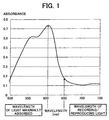
- the light absorption spectrum of the optical information recording medium using a dye is illustrated in Fig. 1.
- the complex index of refraction utilizes the characteristics of the edge portion of the absorption band of the spectrum.
- dyes have a drawback in that the complex index of refraction has a large wavelength dependency.
- an optical information recording medium in which information can be recorded or reproduced using laser light having a wavelength of about 650 nm which is shorter than the wavelength (780 nm) of laser light typically used for recording/reproducing information in conventional CDs.
- the light absorption of the dyes mentioned above for use in the conventional CD-Rs such as pentamethine cyanine dyes and phthalocyanine dyes, have so large wavelength dependency that the dyes cannot have good recording/reproducing characteristics (i.e., information cannot be recorded and reproduced) when laser light having a wavelength of 650 nm is used for information recording and reproducing. This is because the dyes have a large absorption coefficient k, i.e., a small reflectance, at the wavelength of 650 nm.
- These dyes have good optical characteristics at the wavelength of 650 nm, but do not have good optical characteristics against light having a wavelength in a range of from 645 to 670 nm, which light is typically used for DVD+R drives. Namely, when the wavelength of the laser light emitted by a DVD drive changes due to changes of the driving conditions such as environmental conditions, a problem in that information cannot be recorded in the recording medium tends to occur. In particular, since the wavelength of laser light emitted by a light source tends to shift in the long wavelength direction under high temperature conditions, the absorption coefficient k decreases and thereby the recording sensitivity of the recording medium deteriorates.
- DVDs have a recording format different from that of CDs.
- the track pitch length and minimum pit length of DVDs are shorter than those of CDs.
- information can be recorded in DVDs at a density higher than that for CDs by about 6 to 8 times. This is because DVDs have a constitution different from that of CDs.
- CDs have the following constitution:
- DVDs have the following constitution:
- Such high density recording i.e., to record a pit much smaller than that for CDs, cannot be achieved by only adjusting the optical characteristics, and it is needed to adjust the heat decomposition properties of the dyes used. In addition, it is needed to solve a problem in that the jitter of recorded signals is large.
- an object of the present invention is to provide an optical information recording medium which can be used as a DVD-R or a DVD+R and which has good recording characteristics with a small wavelength dependency.
- the present invention contemplates the provision of an optical information recording medium including a substrate in which at least one of a groove and a pit is formed, a recording layer located overlying the substrate and including a dye, and a reflection layer located overlying the recording layer, wherein the optical information recording medium has an absorbance curve with an absorbance L of from 10 to 40 % against light having a wavelength ⁇ of from 645 nm to 670 nm, a ratio (Lmax/Lmin) of a maximum absorbance of the absorbance curve L( ⁇ ) to a minimum absorbance of from 1.0 to 2.0 at the wavelength range of from 645 nm to 670 nm, and a reflectance of from 45 to 85 % against the light having a wavelength ⁇ of from 645 nm to 670 nm.
- absorbance curve means a curve representing absorbance L plotted against light wavelength ⁇ .
- the recording layer preferably includes plural dyes which have different slopes dL/d ⁇ of the absorbance curve L( ⁇ ) at a wavelength of from 645 to 670 nm.
- one of the plural dyes has a positive slope and another dye has a negative slope at the wavelength range of from 645 nm to 670 nm.
- the dye includes a first dye compound ( ⁇ ) having a light absorption spectrum in which a maximum absorption is observed at a wavelength of from 550 nm to 650 nm, and a second dye compound ( ⁇ ) a light absorption spectrum in which a maximum absorption is observed at a wavelength of from 650 nm to 750 nm.
- the molar ratio ( ⁇ / ⁇ ) of the second dye compound to the first dye compound is preferably from 0.005 to 0.2.
- the first and second dye compounds have thermal decomposition temperatures T ⁇ and T ⁇ , respectively, wherein the thermal decomposition temperatures T ⁇ and T ⁇ , are not higher than 400 °C and the difference therebetween is not greater than 100 °C.
- the first dye compound preferably includes a formazan chelate compound having the following formula (I): wherein Z represents a group which can form a polyheterocyclic ring while sharing bond with a carbon atom and a nitrogen atom, wherein the polyheterocyclic ring optionally has a substituent selected from the group consisting of alkyl groups, alkoxy groups, thioalkoxy groups, substituted amino groups, aryl groups, aryloxy groups, anilino groups and keto groups; A represents an alkyl group, an aralkyl group, an aryl group or a cyclohexyl group, which are optionally substituted with a group selected from the group consisting of alkyl groups , alkoxy groups, halogen atoms, keto groups, carboxyl groups, carboxyester groups, nitrile groups and nitro groups; B represents an aryl group, wherein the aryl group is optionally substituted with a group selected from the group consisting of alkyl groups
- the track pitch, depth and width of the groove is preferably from 0.73 to 0.75 ⁇ m, from 1450 to 1650 ⁇ , and 0.21 to 0.31 ⁇ m, respectively.
- the groove is preferably wobbled at substantially a constant frequency to record track information.
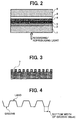
- Fig. 2 illustrates a layer structure of a DVD+R or DVD-R (hereinafter referred to as a recording medium).
- Numerals 1, 2, 3, 4, 5 and 6 denote a substrate, a dye recording layer (i.e., a light absorbing layer) , a reflection layer, a protective layer, an adhesive layer and a second substrate.
- Light irradiates the optical information recording medium from the side of the substrate 1 to record information in the recording medium or reproduce the information recorded therein.
- a guide groove 7 is formed on the surface of the substrate 1 as illustrated in Fig. 3.
- the recording medium has a high reflectance due to multiple interference between both surfaces of the dye recording layer. Therefore, the dye recording layer preferably has optical characteristics such that the refractive index n is large and the absorption coefficient k is relatively small.
- the refractive index n is greater than 2.0 and the absorption coefficient k is from 0.03 to 0.2.
- Such optical characteristics can be obtained by utilizing the characteristics of the edge portion of the long-wavelength side of the light absorbing band of the light absorption spectrum of the dye recording layer.
- both the refractive index n and absorption coefficient k decrease as the wavelength becomes greater than 650 nm.
- the optical information recording medium of the present invention includes a substrate in which at least one of a groove and a pit is formed, a recording layer located overlying the substrate and including a dye, and a reflection layer located overlying the recording layer, wherein the optical information recording medium has an absorbance L of from 10 to 40 % against light having a wavelength ⁇ of from 645 nm to 670 nm, a ratio (Lmax/Lmin) of a maximum absorbance to a minimum absorbance of from 1.0 to 2.0 at the wavelength range of from 645 nm to 670 nm, and a reflectance of from 45 to 85 % against the light having a wavelength ⁇ of from 645 nm to 670 nm.
- the recording medium has light absorbing characteristics suitable for absorbing light having a wavelength of from 645 to 670 nm, which is emitted by DVD drives.
- changes of the light absorbing degree and recording sensitivity are small in the wavelength range.
- the light absorbing degree L is more preferably from 20 to 40 %.
- the optical information recording medium having such optical characteristics as mentioned above can preferably provided by including two or more kinds of dyes, which have different slopes (dL/d ⁇ ) of the light absorption spectrum L ( ⁇ ), in the dye recording layer at least within the wavelength range of 645 nm to 670 nm.
- one of the two or more kinds of dyes has a positive slope and another dye has a negative slope.
- the dye includes a first dye compound ( ⁇ ) having a light absorption spectrum in which a maximum absorption is observed at a wavelength of from 550 nm to 650 nm, and a second dye compound ( ⁇ ) having a light absorption spectrum in which a maximum absorption is observed at a wavelength of from 650 nm to 750 nm.
- the molar ratio ( ⁇ / ⁇ ) of the second dye compound ( ⁇ ) to the first dye compound ( ⁇ ) is preferably from 0.005 to 0.2.
- the ratio When the ratio is less than 0.005, the optical characteristic improving effect is little. In contrast, when the ratio is greater than 0.2, the resultant recording layer has large absorption degree at a wavelength of the recording/reproducing light of from 645 to 670 nm, and thereby the reflectance of the recording medium decreases.
- each of the dye compounds (i.e., ⁇ and ⁇ ) for use in the recording layer preferably has a thermal decomposition temperature not higher than 400 °C, and the difference between the thermal decomposition temperatures of the dye compounds is preferably not greater than 100 °C.
- the thermal decomposition temperature is higher than 400 °C, the power of the laser source has to be increased and in addition the recorded pits tend to have a large jitter.
- the difference between the thermal decomposition temperatures of the dye compounds is greater than 100 °C, pits having a good form cannot be prepared, resulting in increase of jitter of the recorded pits.
- the thermal decomposition temperature of the dye compounds is preferably not lower than 120 °C.
- the thermal decomposition temperature is lower than 120 °C, the durability of the resultant recording medium deteriorates particularly when used under high temperature conditions.
- the recording medium tends to be thermally damaged during the manufacturing processes, resulting in deterioration of productivity of the recording medium.
- the difference between the thermal decomposition temperatures of the dye compounds is defined as a difference between the thermal decomposition temperature of a dye compound having a maximum thermal decomposition temperature and a dye compound having a minimum thermal decomposition temperature.
- the thermal decomposition temperature of the dye compounds is more preferably from 200 to 350 °C, and the difference of the thermal decomposition temperatures is more preferably not greater than 50 °C.
- the thermal decomposition temperature can be determined by a method in which a dye compound set on a thermobalance is heated at a temperature rising speed of 10 °C/min to obtain a glass transition temperature (Tg) curve.
- Tg glass transition temperature
- the thermal decomposition temperature is defined as the inflection point of the Tg curve.
- the dyes for use in the dye recording layer of the optical information recording medium of the present invention include cyanine dyes, phthalocyanine dyes, pyrylium dyes, thiopyrylium dyes, azulenium dyes, squarilium dyes, azo dyes, formazan chelate dyes, dyes containing a metal such as Ni and Cr, naphthoquinone dyes, anthraquinone dyes, indophenol dyes, indoaniline dyes, triphenyl methane dyes, triaryl methane dyes, aminium dyes, diimmonium dyes, nitroso compounds, etc.
- other components such as binder resins and stabilizers can also be included in the dye recording layer.
- the thickness of the dye recording layer is preferably from 100 to 5000 ⁇ , and more preferably from 500 to 3000 ⁇ .
- the recording layer is too thin, the recording sensitivity deteriorates.
- the reflectance of the recording layer decreases.
- formazan chelate dyes, tetraazaporphyradine dyes, cyanine dyes and azo dyes can be preferably used as the dye compound ( ⁇ ) having a maximum absorption at a wavelength of from 550 nm to 650 nm because a recording layer having good film properties can be prepared by a solvent coating method and the optical characteristics of the resultant recording layer can be easily controlled.
- the formazan chelate compounds having a formula (I) are most preferable because of having the following advantages:
- Z in formula (I) is preferably one of a pyridazine ring, a pyrimidine ring, a pyrazine ring and a triazine ring
- M is one of metals of iron, cobalt, nickel, copper, zinc and palladium.
- dye compounds include the compounds disclosed in Published Japanese Patent Application No. 2001-23235 incorporated by reference.
- Suitable tetraazaporphyradine dyes for use in the optical information recording medium include dyes having the following formula (II) : wherein M1 represents a divalent metal atom, a trivalent metal atom having one substituent, a tetravalent metal atom having two substituents or an oxymetal; and R1 and R2 independently represent a linear, branched or ring alkyl group having from 1 to 10 carbon atoms, an alkoxy group having from 1 to 10 carbon atoms, an alkylthio group having from 1 to 10 carbon atoms, an aryl group having from 6 to 20 carbon atoms, an aryloxy group having from 6 to 20 carbon atoms, an arylthio group having from 6 to 20 carbon atoms, a halogen atom, a nitro group, a cyano group, a hydroxyl group or a hydrogen atom.
- M1 represents a divalent metal atom, a trivalent metal atom having one substituent,
- center metal M1 include the following.
- metal atoms of Zn, Ni, Cu and Pd, and metal oxides such as VO and TiO are preferable because the resultant dye has good light absorbing properties (i.e., good recording properties) and can be easily manufactured.
- center metal M1 is one of these metal atoms
- an amino compound tends to easily coordinate with the center metal M1, and thereby the association can be prevented.
- solubility of the resultant dyes to solvents and coating properties (film formability) of the coating liquids can also be improved.
- amino compounds include the following but are not limited thereto.
- amino compounds having a heterocyclic ring having a nitrogen atom therein are preferable because the compounds can prevent phthalocyanine compounds from associating and the resultant dye recording layer has good resistance to heat and light.
- amino compounds having a melting point not lower than 150 °C can be preferably used.
- the melting point is less than 150 °C, the characteristics (particularly optical characteristics) of the recording layer easily change under high humidity conditions.
- imidazole, benzimidazole and thiazole deriavtives are more preferable.
- linear, branched or ring alkyl group having from 1 to 10 carbon atoms include a methyl group, an ethyl group, a propyl group, a n-butyl group, an iso-butyl group, a tert-butyl group, a sec-butyl group, a n-pentyl group, an iso-pentyl group, a neo-pentyl group, a 1-methylbutyl group, a 2-methylbutyl group, a n-hexyl group, a 2-ethylbutyl group, a 3-methylpentyl group, a 2,3-dimethylbutyl group, a n-heptyl group, a n-octyl group, a 2-ethylhexyl group, a n-nonyl group, 2,5,5-trimethylhexyl group, a n-decyl group,
- linear, branched or ring alkoxyl groups having from 1 to 10 carbon atoms include a methoxy group, an ethoxy group, a propoxy group, an iso-propoxy group, a n-butoxy group, an iso-butoxy group, a tert-butoxy group, a sec-butoxy group, a n-pentyloxy group, a neo-pentyloxy group, an iso-pentyloxy group, a tert-pentyloxy group, a 1-methylbutoxy group, a 2-methylbutoxy group, a n-hexyloxy group, a cyclohexyloxy group, an adamantyloxy group, a norbornyloxy group, a 2-chlorobutoxy group, etc.
- linear, branched or ring alkylthio groups having from 1 to 10 carbon atoms include a methylthio group, an ethylthio group, a n-propylthio group, an iso-propylthio group, a n-butylthio group, an iso-butylthio group, a tert-butylthio group, a sec-butylthio group, a n-pentylthio group, a neo-pentylthio group, an iso-pentylthio group, a 1,2-dimethylpropylthio group, a n-hexylthio group, a 1-ethyl-2-methylpropylthio group, a 2-ethylbutylthio group, a cyclohexylthio group, a 2-methyl-1-iso-propylthio group, a n-heptylthio group
- aryl groups having from 6 to 20 carbon atoms include a phenyl group, a 2-methylphenyl group, a 2,4-dimethyphenyl group, a 2,4,6-trimethylphenyl group, a 2-iso-propylphenyl group, a 4-bromophenyl group, a 2,6-dichlorophenyl group, a naphthyl group, etc.
- aryloxy groups having from 6 to 20 carbon atoms include a phenoxy group , a 2-methylphenoxy group, a 2,4-dimethylphenoxy group, a 2,4,6-trimethylphenoxy group, a 2-iso-propylphenoxy group, a 4-bromophenoxy group, a 2,6-dichlorophenoxy group, a naphthyloxy group, etc.
- arylthio groups having from 6 to 20 carbon atoms include a phenylthio group, a 2-methylphenylthio group, a 2,4-dimethylphenylthio group, a 2,4,6-trimethylphenylthio group, a 2-iso-propylphenythio group, a 4-bromophenylthio group, a 2,6-dichlorophenythio group, a naphthylthio group, etc.
- halogen atoms include a fluorine atom, a chlorine atom, a bromine atom and an iodine atom.
- linear or branched alkyl groups, alkoxyl groups and alkylthio groups, which have from 4 to 10 carbon atoms, and aryloxy groups and arylthio groups, which have from 6 to 20 carbon atoms, are preferable because the compounds having these groups can be easily dissolved in solvents and have good film formability.
- groups R1 and R2 can be added to the groups R1 and R2, to improve the recording sensitivity and solubility in solvents and to adjust the light absorption properties of the recording layer such as absorption wavelength.
- groups include a sulfonate group, an amonosulfonate group, a carboxyl group, an amide group, an imide group, etc.
- the tetraazaporphyradine compounds having formula (II) can be easily synthesized by, for example, reacting maleonitrile having substituents R1 and R2 with a metal derivative in alcohol upon application of heat thereto.
- trimethineindolenine type cyanine dyes having the following formula (III) can be preferably used.
- Q3 and Q4 independently represent a group which can form an indolenine ring or a benzoindolenine ring in combination with a pyrrole ring;
- R3 represents a hydrogen atom or a monovalent substituent;
- R4 and R5 independently represent an alkyl group;
- X - represents a monovalent anionic ion.
- Q3 and Q4 independently represent a group which can form an indolenine ring or a benzoindolenine ring in combination with a pyrrole ring.
- the formed ring including Q3 may be the same as or different from the formed ring including Q4.
- the thus formed indolenine ring or benzoindolenine ring may have a substituent such as halogen atoms , alkyl groups , aryl groups , acyl groups , and amino groups .
- R3 represents a hydrogen atom or a monovalent substituent.
- the monovalent substituent include alkyl groups, aryl groups, an azo group, ester groups, acyl groups, halogen atoms and heterocyclic rings. These monovalent substituents (except halogen atoms) can further have a substituent such as halogen atoms, alkyl groups, alkoxy groups, amino groups, heterocyclic ring groups, a nitro group, etc.
- R4 and R5 independently represent an alkyl group which may include a substituent.
- the carbon number of the alkyl group is preferably from 1 to 4.
- Specific examples of the alkyl group include a methyl group, an ethyl group, n- and iso-propyl groups, n-, iso-, sec- and tert-butyl groups, a methoxymethyl group, a methoxyethyl group, an ethoxyethyl group, etc.
- R4 and R5 are unsubstituted alkyl groups or alkoxyalkyl groups.
- at least one of R4 and R5 is preferably an alkoxyalkyl group, and more preferably an alkoxyalkyl group having from 3 to 6 carbon atoms.
- X represents a monovalent anion such as ClO 4 - , I - , BF 4 - , PF 6 - , SbF 6 - , and a paratoluenesulfonic ion.
- azo compounds having the following formula (IV) can be preferably used.
- D represents a heterocyclic ring including at least a nitrogen atom and a carbon atom
- E represents an aromatic ring including at least two carbon atoms
- Y represents a group having an active hydrogen.
- heterocyclic ring D examples include a thiazole ring, a benzothiazole ring, a pyridobenzothiazole ring, a benzopyridothiazole ring, a pyridothiazole ring, a pyridine ring, a quinoline ring, a thiadiazole ring, an imidazole ring, etc.
- the pyridine ring and thiadiazole ring are preferable.
- These heterocyclic rings preferably have one or more substituents.
- substituents include alkyl groups, halogenated alkyl groups, aryl groups, alkoxy groups, halogenated alkoxy groups, aryloxy groups, alkythio groups, halogenated alkylthio groups, arylthio groups, aralkyl groups, halogen atoms, a cyano group, a nitro group, ester groups, carbamoyl groups, acyl groups, acylamino groups, sulfamoyl groups, sulfonamide groups, amide groups, a hydroxyl group, a phenylazo group, a pyridinoazo group, a vinyl group, etc.
- aromatic ring E in formula (IV) examples include a benzene ring, a naphthalene ring, a pyridone ring, a pyridine ring, a pyrazole ring, etc.
- the benzene ring is preferable, and benzene rings having at least one electron-donating substituent are more preferable.
- electron-donating substituents include alkyl groups, halogenated alkyl groups, aryl groups, alkoxy groups, halogenated alkoxy groups, aryloxy groups, alkythio groups, halogenated alkylthio groups, arylthio groups, aralkyl groups, halogen atoms, a cyano group, a nitro group, ester groups, carbamoyl groups, acyl groups, acylamino groups, sulfamoyl groups, sulfonamide groups, amide groups, a hydroxyl group, a phenylazo group, a pyridinoazo group, a vinyl group, etc. These substituents may be further substituted with a substituent.
- the following groups are particularly preferable as the electron donating group.
- the alkyl moieties of the groups mentioned above may be sulfonated, nitrated, cyanized, halogenated, acetylated, or hydroxylated.
- the group Y in formula (IV) is not particularly limited if the ring includes an active hydrogen, but preferably has one or more of the following groups:
- a hydroxyl group, a carboxyl group, -B(OH) 2 , -NHSO 2 R10 (wherein R10 represents a hydrogen atom, a substituted or unsubstituted alkyl group having from 1 to 25 carbon atoms, or a substituted or unsubstituted phenyl group), -CONH 2 , -SO 2 NH 2 , -NH 2 , etc.
- the following groups are particularly preferable.
- R10 A hydroxyl group, a carboxyl group and -NHSO 2 R10 (R10 is defined above).
- the compound can be used as it is when an azo metal complex compound is prepared, but a salt of the compound with a positive ion can also be used for preparing the azo metal complex compound.
- positive ions include inorganic positive ions such as Na + , Li + and K + ; and organic positive ions such as P + (C 6 H 5 ) 4 , N + (C 2 H 5 ) 4 , N + (C 4 H 9 ) 4 and C 6 H 5 N + (CH 3 ) 3 .
- the azo dyes mentioned above are used as a metal complex thereof.
- the metal which can form a complex in combination with an azo dye include transition metals such as Ni, Co, Fe, Ru, Rh, Pd, Cu, Zn, Mn, Os, Ir and Pt.
- transition metals such as Ni, Co, Fe, Ru, Rh, Pd, Cu, Zn, Mn, Os, Ir and Pt.
- Ni, Co, Cu, Pd, Mn and Zn are preferable.
- transition metals When metal complexes are manufactured, these transition metals are used in the form of a salt such as acetate, halide and salts with BF 4 - . As a result, metal complexes in which a metal ion such as Ni 2+ , Co 2+ , Co 3+ , Cu 2+ , Pd 2+ , Mn 2+ and Zn 2+ coordinates with an azo dye can be prepared.
- Suitable dyes for use as the dye compound ( ⁇ ) include phthalocyanine dyes and cyanine dyes because the dyes have good film formability and the optical characteristics of the resultant film can be easily controlled.
- phthalocyanine dyes include dyes having the following formula (V).
- M2 represents a divalent metal atom, a trivalent metal atom having one substituent, a tetravalent metal atom having two substituents or an oxymetal; one group of each of the combinations of A1 with A2, A3 with A4, A5 with A6 and A7 with A8 is independently -OR11, -SR12 or -N(R13) (R14) and the other group is a hydrogen atom, wherein R11, R12, R13 and R14 independently represent a linear, branched or ring alkyl, an alkoxy or an alkylthio group having from 1 to 10 carbon atoms, an aryl group having from 6 to 20 carbon atoms, an aryloxy group or an arylthio group, a halogen atom, a nitro group, a cyano group or a hydrogen atom.
- metal M2 and the groups R11, R12, R13 and R14 include the metals and groups mentioned above for use as the metal M1 and groups R1 and R2 in the tetraazaporphyradine dye having formula (II).
- cyanine dyes for use as the dye compound ( ⁇ ) include pentamethineindolenine cyanine dyes having the following formula (VI). wherein Q3 and Q4 independently represent a group which can form an indolenine ring or a benzoindolenine ring in combination with a pyrrole ring; R3 represents a hydrogen atom or a monovalent substituent; R4 and R5 independently represent an alkyl group; and X - represents a monovalent anionic ion.
- VI pentamethineindolenine cyanine dyes having the following formula (VI). wherein Q3 and Q4 independently represent a group which can form an indolenine ring or a benzoindolenine ring in combination with a pyrrole ring; R3 represents a hydrogen atom or a monovalent substituent; R4 and R5 independently represent an alkyl group; and X - represents a monovalent anionic ion.
- the substrate of the optical information recording medium of the present invention known materials which have been used for conventional information recording media can be used.
- the materials include resins such as acrylic resins (e.g., polymethyl methacrylate), polyvinyl chloride, vinyl chloride copolymers, epoxy resins, polycarbonate resins, amorphous polyolefin resins and polyester resins; glasses such as soda-lime glass; and ceramics.
- resins such as acrylic resins (e.g., polymethyl methacrylate), polyvinyl chloride, vinyl chloride copolymers, epoxy resins, polycarbonate resins, amorphous polyolefin resins and polyester resins
- glasses such as soda-lime glass
- ceramics such as acrylic resins (e.g., polymethyl methacrylate), polyvinyl chloride, vinyl chloride copolymers, epoxy resins, polycarbonate resins, amorphous polyolefin resins and polyester resins.
- polymethyl methacrylate, polycarbonate resins, epoxy resins, amorphous polyolefin resins and polyester resins are preferable in view of dimension stability, transparency and flatness.
- an undercoat layer may be formed between the substrate and the recording layer.
- Suitable materials for use in the undercoat layer include organic materials such as resins, e.g., polymethyl methacrylate, acrylic acid/methacrylic acid copolymers, styrene/maleic anhydride copolymers, polyvinyl alcohol, N-methylolacrylamide, styrene/sulfonic acid copolymers, styrene/vinyl toluene copolymers, chlorosulfonated polyethylene, nitrocellulose, polyvinyl chloride, chlorinated polyolefin, polyester, polyimide, vinyl acetate/vinyl chloride copolymers, ethylene/vinyl acetate copolymers, polyethylene, polypropylene and polycarbonate, and silane coupling agents; and inorganic materials such as metal oxides, e.g., silica and alumina, and inorganic fluorides such as magnesium fluoride.
- resins e.g., polymethyl methacrylate, acrylic acid
- the thickness of the undercoat layer is from 0.005 to 20 ⁇ m, and preferably from 0.01 to 10 ⁇ m.
- a pre-groove may be formed on the substrate or the undercoat layer to form a groove for tracking or to record signals such as address signals.
- the pre-groove layer can be formed by using, for example, a mixture of a monomer (or an oligomer), such as monoesters, diesters, triesters and tetraesters of acrylic acid, with a photopolymerization initiator.
- a monomer or an oligomer
- monoesters such as monoesters, diesters, triesters and tetraesters of acrylic acid
- the reflection layer is formed overlying the recording layer to improve the S/N ratio, reflectance and recording sensitivity of the recording medium.
- Suitable materials for use in the reflection layer include materials having a high reflectance against laser light.
- Specific examples of such materials include metals and semi-metals such as Mg, Se, Y, Ti, Zr, Hf, V, Nb, Ta, Cr, Mo, W, Mn, Re, Fe, Co, Ni, Ru, Rh, Pd, Ir, Pt, Cu, Ag, Au, Zn, Cd, Al, Ca, In, Si, Ge, Te, Pb, Po, Sn and Si.
- Au, Al and Ag are preferable.
- the thickness of the reflection layer is preferably from 100 to 3,000 ⁇ .
- a protective layer may be formed overlying the recording layer (or the reflection layer) to physically and chemically protect the layer or layers.
- Another protective layer may be formed on the opposite side of the substrate to improve the scratch resistance and moisture resistance of the recording medium.
- Suitable materials for use in the protective layer include inorganic materials such as SiO, SiO 2 , MgF 2 and SnO 2 ; and organic materials such as thermoplastic resins, thermosetting resins and ultraviolet crosslinking resins.
- the thickness of the protective layer is preferably from 500 ⁇ to 50 ⁇ m.
- the track pitch, depth and width of the groove are preferably from 0.73 to 0.75 ⁇ m, 1450 to 1650 ⁇ and 0.21 to 0.31 ⁇ m, respectively.
- the broadening of pits recorded in the dye recording layer can be adjusted by the groove, and thereby signals having a small jitter can be recorded.
- the groove has a trapezoid form as illustrated in Fig. 4.
- the width of the groove is defined as the bottom width Wbot.
- the depth of the groove When the depth of the groove is smaller than 1450 ⁇ , the effect of adjusting the form of recording pits deteriorates. In contrast, when the depth is larger than 1650 ⁇ , the reflectance tends to decrease below 45 %, and thereby the recorded signals cannot be reproduced by DVD players.
- the reproduced signals are largely affected by interference between a groove and the adjacent groove, and thereby the amplitude of the wobble signals largely is varied. Namely, when a groove has the same wobbling phase as that of the adjacent groove, the amplitude becomes large, and when a groove has a wobbling phase oposite to that of the adjacent groove, the amplitude becomes small. As a result thereof, precision in reading track signals deteriorates, and the jitter increases.
- track information is recorded therein by wobbling the guide groove or pit lines at substantially a constant frequency.
- the wobbling state of the guide groove can be determined by detecting wobble signals from the track signals.
- Track information is previously recorded on the substrate while the frequency is modulated by FM modulation or phase modulation.
- the track information includes, for example, the address information and rotation frequency of the disc.
- the wobble frequency is preferably constant, but in reality the wobble frequency can be slightly varied to an extent such that a problem does not practically occur, in view of productivity.
- substantially a constant frequency means that the wobble frequency slightly varies to an extent such that a problem does not practically occur.
- the manufacturing method typically includes the following processes.
- the recording layer is typically formed as follows.
- a recording layer i.e., light absorbing layer
- the dyes ( ⁇ ) and ( ⁇ ) as main components is formed directly on a substrate on which a groove or pits are formed, or with a layer therebetween, by a coating method. Namely, at first a coating liquid is prepared by dissolving the dyes ( ⁇ ) and ( ⁇ ) in a solvent to form a coating liquid. Then the coating liquid is coated on a substrate and then dried to form the recording layer.
- Suitable solvents for use in the coating liquid include know organic solvents such as alcohols, cellosolves, halogenated hydrocarbons, ketones and ethers.
- spin coating methods are preferable because the thickness of the coating layer can be easily controlled by adjusting the concentration and viscosity of the coating liquid and changing the drying temperature.
- an undercoat layer may be formed between the substrate and the recording layer to improve the flatness and adhesion of the surface of the substrate and to prevent the properties of the recording layer from changing.
- the undercoat layer can be formed by, for example, dissolving or dispersing one or more of the materials mentioned above for use in the undercoat layer in a proper solvent to prepare a coating liquid, and coating the coating liquid on a substrate by a coating method such as spin coating methods, dip coating methods and extrusion coating methods.
- the reflection layer is formed directly on the recording layer or with a layer therebetween by a vacuum film forming method.
- the reflection layer is typically formed on the recording layer, for example, using one or more of the materials mentioned above for use in the reflection layer and a method such as vacuum deposition methods, sputtering methods and ion plating methods.
- the protective layer is formed on the reflection layer.
- one or more of the materials mentioned above for use in the protective layer are coated on the reflection layer by a method such as vacuum film forming methods and coating methods.
- the protective layer is preferably formed by coating an ultraviolet crosslinking resin using a spin coating method and then crosslinking the resin upon application of ultraviolet rays thereto.
- a dye solution i.e., a recording layer coating liquid
- the recording layer coating liquid was coated by a spin coating on a polycarbonate disc having a diameter of 120 mm and a thickness of 0.6 mm, on which a guide groove having a depth of about 1550 ⁇ and a width of 0.24 ⁇ m was previously formed at a track pitch of 0.74 ⁇ m.
- a recording layer having a thickness of about 1,000 ⁇ was prepared.
- a silver (Ag) reflection layer having a thickness of about 1400 ⁇ was formed on the recording layer by sputtering silver using Ar as the sputtering gas.
- a protective layer having a thickness of about 4 ⁇ m was formed on the reflection layer using an ultraviolet crosslinking resin.
- an optical information recording medium i.e., a DVD+R of the present invention was prepared.
- DVD(8-16) signals were recorded in the recording medium under the following conditions:
- the recording medium has good recording sensitivity even when the recording power of each laser light is not greater than 10 mW.
- Example 1 The procedures for preparation and evaluation of the recording medium in Example 1 were repeated except that the dye compounds ( ⁇ ) and ( ⁇ ) were replaced with the following dyes, respectively, and the solvent was replaced with a mixture solvent of tetrahydrofuran, 2-ethoxyethanol and ethylcyclohexanone.
- Example 1 The procedures for preparation and evaluation of the recording medium in Example 1 were repeated except that the Pentamethinecyanine compound (11) was replaced with a dye compound (13) having formula (V), and the molar ratio of the compounds (1), (2) and (13) was changed to 46 : 46 : 8.
- the jitter fulfills the DVD specification (i.e., not greater than 9 %), but when the width is 0.19 ⁇ m, the jitter cannot fulfill the DVD specification.
- Example 1 The procedures for preparation and evaluation of the recording medium in Example 1 were repeated except that the dye compound ( ⁇ ) was not used (i.e., the recording layer was formed of the compounds (1) and (2)).
- Example 2 The procedures for preparation and evaluation of the recording medium in Example 2 were repeated except that the phthalocyanine compound (12) used as the dye compound ( ⁇ ) was replaced with the following compound (14) having formula (V) and the molar ratio of the compound (3) to the compound (14) was 95 : 5.
- Phthalocyanine compound (14) having formula (V) (M2: Zn; A2, A4, A6, A8: -H A1, A3, A5, A7:
- Example 3 The procedures for preparation and evaluation of the recording medium in Example 3 were repeated except that the molar ratio of the compounds (1), (2) and (13) was changed to 39 : 39: 22.
Landscapes
- Optical Record Carriers And Manufacture Thereof (AREA)
- Thermal Transfer Or Thermal Recording In General (AREA)
Abstract
Description


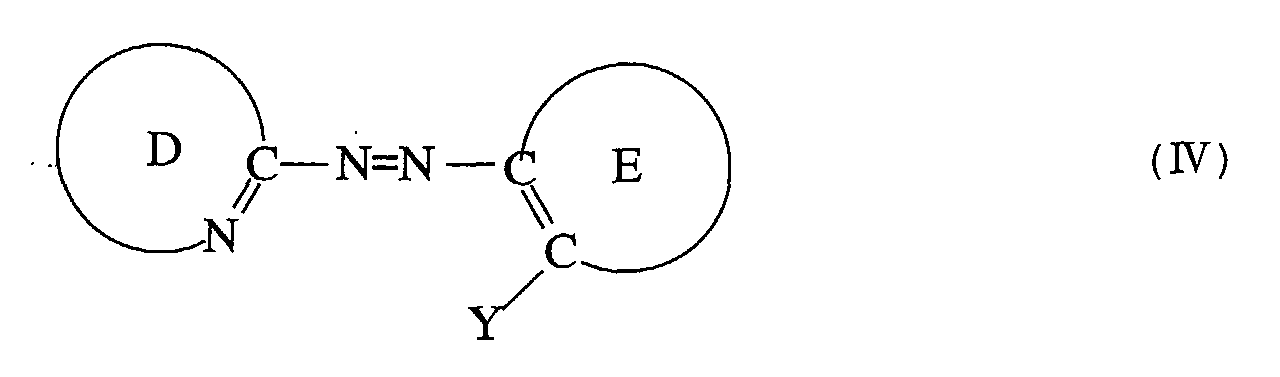
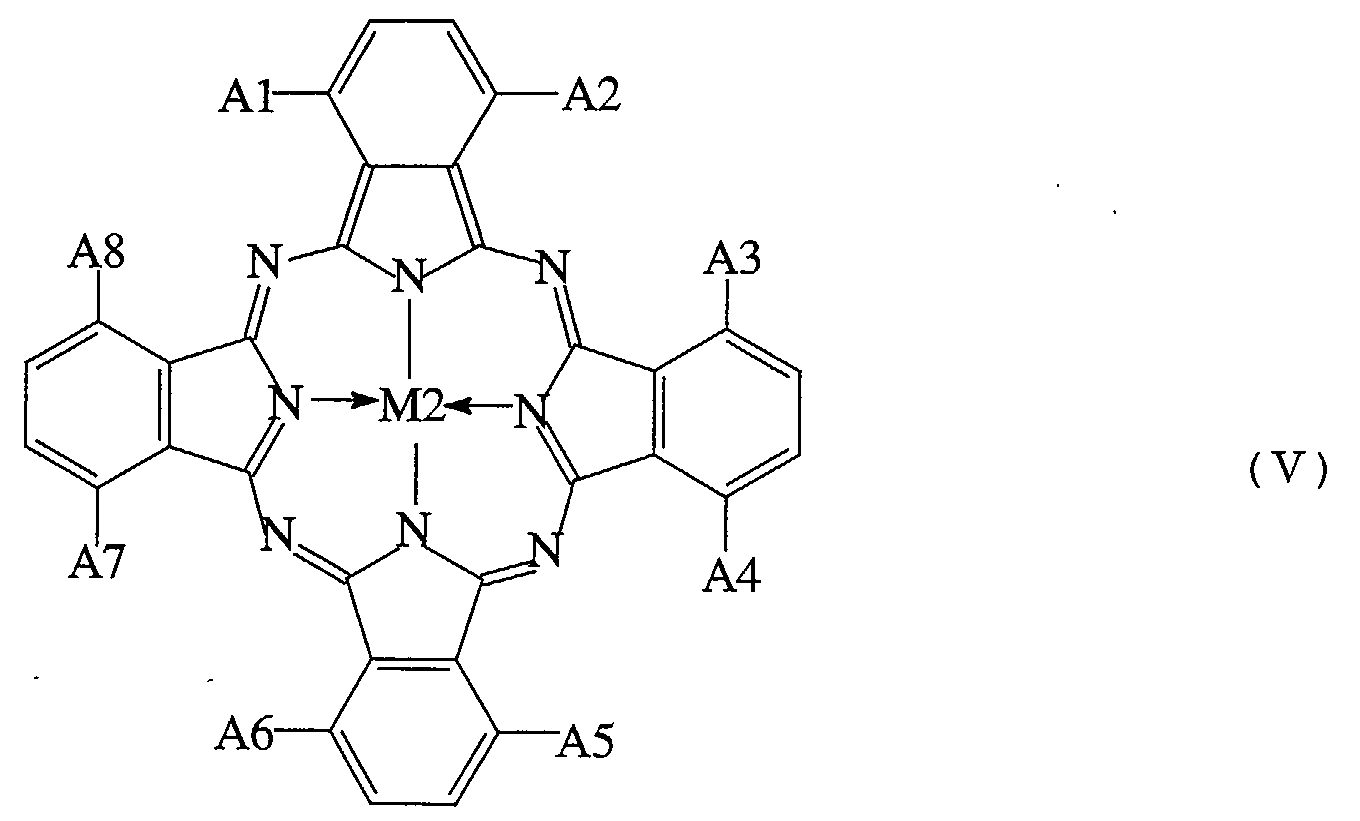
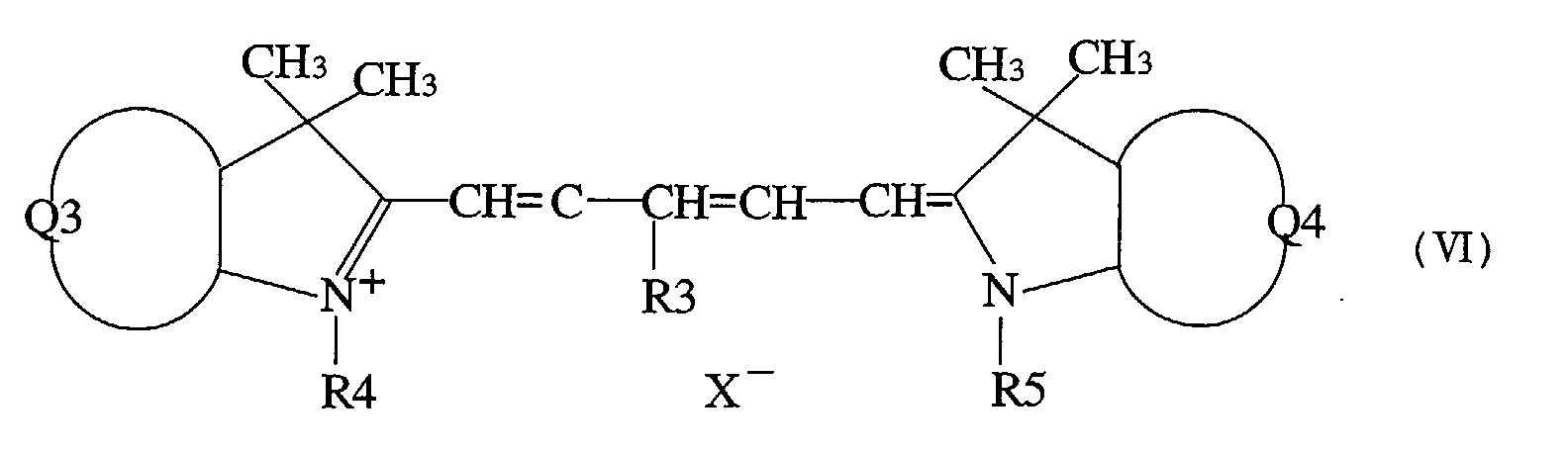


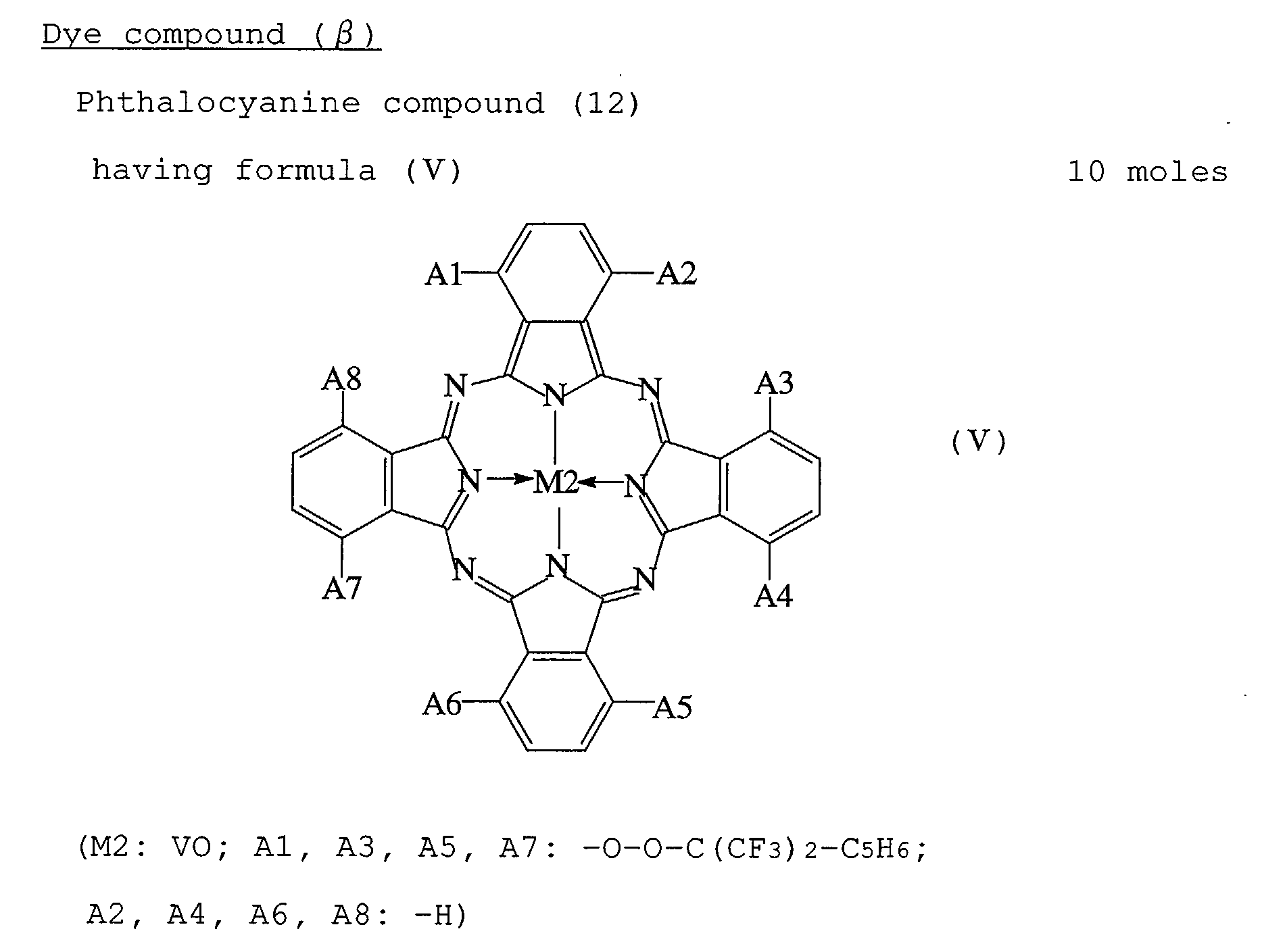

having formula (V)

A1, A3, A5, A7:
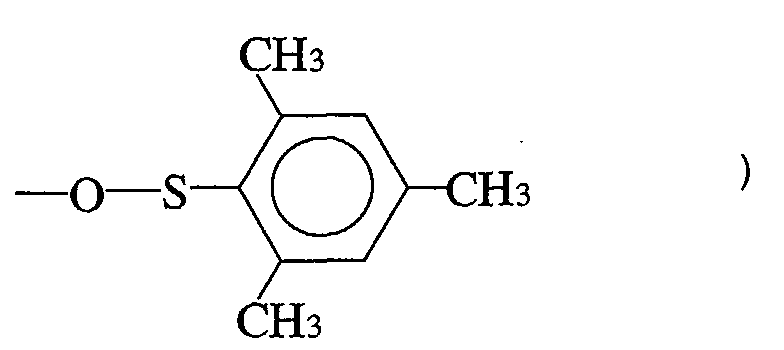
| Dye compound (α) | Wavelength of light maximally absorbed (nm) | dL/dλ | Thermal decomposition temperature (°C) |
| (1) | 550 | Negative (-) | 297 |
| (2) | 612 | Negative (-) | 273 |
| (3) | 577 | Negative (-) | 230 |
| Dye compound (β) | Wavelength of light maximally absorbed (nm) | DL/dλ | Thermal decomposition temperature (°C) |
| (11) | 708 | Positive (+) | 226 |
| (12) | 721 | Positive (+) | 270 |
| (13) | 738 | Positive (+) | 354 |
| (14) | 733 | Positive (+) | 390 |
| (β/α) (%) | |Tα -Tβ| (°C) | L (max-min) | Lmax/Lmin | Reflectance at 655 nm (%) | Recording sensitivity (mW) | ||
| 655 | 670 nm | ||||||
| Ex. 1 | 2 | 71 | 37-21 | 1.8 | 49 | 6.5 | 8.5 |
| Ex. 2 | 10 | 40 | 25-15 | 1.7 | 46 | 8 | 11 |
| Ex. 3 | 8 | 81 | 35-20 | 1.8 | 48 | 6.5 | 9.5 |
| Comp. Ex. 1 | 0 | 24 | 31-10 | 3.1 | 53 | 7 | 15.5 |
| Comp. Ex. 2 | 5 | 160 | 25-12 | 2.1 | 46 | 15.5 | 14 |
| Comp. Ex. 3 | 25 | 81 | 42-30 | 1.4 | 35 | - | - |
| Groove depth (Å) | Groove width (µm) | ||||
| 0.19 | 0.21 | 0.24 | 0.28 | 0.31 | |
| 1350 | - | - | - | 51 | - |
| 1450 | - | 50.5 | - | 50 | - |
| 1550 | - | 50 | - | 49 | - |
| 1650 | 49 | - | - | 47 | 45 |
Claims (9)
- An optical information recording medium comprising:wherein the optical information recording medium has an absorbance curve with an absorbance L of from 10 to 40 % against light having a wavelength λ of from 645 nm to 670 nm, a ratio (Lmax/Lmin) of a maximum absorbance Lmax of the absorbance curve to a minimum absorbance Lmin of from 1.0 to 2.0 at the wavelength range of from 645 nm to 670 nm, and a reflectance of from 45 to 85 % against the light having a wavelength λ of from 645 nm to 670 nm.a substrate in which at least one of a groove and a pit is formed;a recording layer located overlying the substrate and including at least one dye; anda reflection layer located overlying the recording layer,
- The optical information recording medium according to Claim 1, wherein the recording layer comprises plural dyes each having an absorbance curve, and wherein slopes dL/dλ of the respective absorbance curves of the plural dyes are different.
- The optical information recording medium according to Claim 2, wherein at least one of the slopes is positive and at least one of the slopes is negative at the wavelength range of from 645 nm to 670 nm.
- The optical information recording medium according to Claim 1 or 2, wherein the plural dyes comprise a first dye compound (α) and a second dye compound (β), and wherein the absorption curve of the first dye compound (α) has a maximum absorbance at a wavelength of from 550 nm to 650 nm, and the absorbance curve of the second dye compound (β) has a maximum absorbance at a wavelength of from 650 nm to 750 nm.
- The optical information recording medium according to Claim 4, wherein a molar ratio (β/α) of the second dye compound (β) to the first dye compound (α) is from 0.005 to 0.2.
- The optical information recording medium according to Claim 4 or 5, wherein the first dye compound (α) and the second dye compound (β) have thermal decomposition temperatures T α and Tβ, respectively, and wherein each of the thermal decomposition temperatures Tα and Tβ is not higher than 400 °C and the difference therebetween is not greater than 100 °C.
- The optical information recording medium according to any one of Claims 4 to 6, wherein the first dye compound (α) is a formazan chelate compound having the following formula (I) :wherein Z represents a group which forms a polyheterocyclic ring while sharing bond with a carbon atom and a nitrogen atom, wherein the polyheterocyclic ring optionally has a substituent selected from the group consisting of alkyl groups, alkoxy groups, thioalkoxy groups, substituted amino groups, aryl groups, aryloxy groups, anilino groups and keto groups; A represents an alkyl group, an aralkyl group, an aryl group or a cyclohexyl group, which are optionally substituted with a group selected from the group consisting of alkyl groups, alkoxy groups, halogen atoms, keto groups, carboxyl groups, carboxyester groups, nitrile groups and nitro groups; B represents an aryl group, wherein the aryl group is optionally substituted with a group selected from the group consisting of alkyl groups, alkoxy groups, halogen atoms, carboxyl groups, carboxyester groups, nitrile groups and nitro groups; M represents a divalent metal atom; and n represents the number of the formazan ligand.
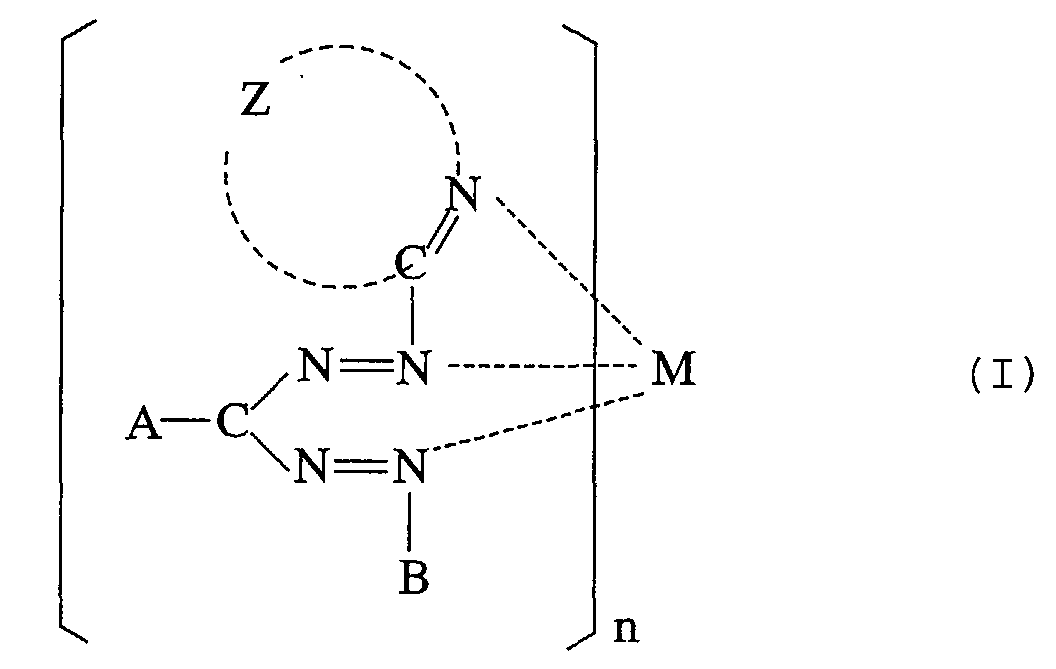
- The optical information recording medium according to any one of Claims 1 to 7, a groove being formed on the substrate at a track pitch of from 0.73 to 0.75 µm, wherein the groove has a depth and a width of from 1450 to 1650 Å and from 0.21 to 0.31 µm, respectively.
- The optical information recording medium according to any one of Claims 1 to 8, a groove being formed on the substrate, wherein the groove is wobbled at substantially a constant frequency.
Applications Claiming Priority (6)
| Application Number | Priority Date | Filing Date | Title |
|---|---|---|---|
| JP2001328104 | 2001-10-25 | ||
| JP2001328104 | 2001-10-25 | ||
| JP2002006706 | 2002-01-15 | ||
| JP2002006706 | 2002-01-15 | ||
| JP2002188278A JP2004062915A (en) | 2001-10-25 | 2002-06-27 | Optical recording medium |
| JP2002188278 | 2002-06-27 |
Publications (3)
| Publication Number | Publication Date |
|---|---|
| EP1308943A2 true EP1308943A2 (en) | 2003-05-07 |
| EP1308943A3 EP1308943A3 (en) | 2003-09-17 |
| EP1308943B1 EP1308943B1 (en) | 2006-05-17 |
Family
ID=27347731
Family Applications (1)
| Application Number | Title | Priority Date | Filing Date |
|---|---|---|---|
| EP02023911A Expired - Lifetime EP1308943B1 (en) | 2001-10-25 | 2002-10-24 | Optical information recording medium |
Country Status (6)
| Country | Link |
|---|---|
| US (2) | US20030124459A1 (en) |
| EP (1) | EP1308943B1 (en) |
| CN (1) | CN1193363C (en) |
| DE (1) | DE60211449T2 (en) |
| ES (1) | ES2262745T3 (en) |
| TW (1) | TWI234156B (en) |
Families Citing this family (14)
| Publication number | Priority date | Publication date | Assignee | Title |
|---|---|---|---|---|
| JP2003276342A (en) * | 2002-03-26 | 2003-09-30 | Tdk Corp | Optical recording medium |
| JP2004082406A (en) * | 2002-08-23 | 2004-03-18 | Tdk Corp | Optical recording medium |
| JP4357848B2 (en) | 2003-02-12 | 2009-11-04 | 株式会社リコー | SQUARYLIUM METAL CHEL COMPOUND AND OPTICAL RECORDING MEDIUM |
| JP2004348880A (en) * | 2003-05-22 | 2004-12-09 | Ricoh Co Ltd | Optical recording medium |
| JP2005044491A (en) * | 2003-07-10 | 2005-02-17 | Ricoh Co Ltd | Optical recording medium and manufacturing method thereof |
| US20050221050A1 (en) * | 2004-03-19 | 2005-10-06 | Michiaki Shinotsuka | Two-layered optical recording medium, method for manufacturing the same, and, method and apparatus for optical recording and reproducing using the same |
| US7767284B2 (en) | 2004-04-28 | 2010-08-03 | Ricoh Company, Ltd. | Optical recording medium, and, method for manufacturing the same, and method and apparatus for optical recording and reproducing thereof |
| US20060067202A1 (en) * | 2004-09-17 | 2006-03-30 | Tohru Yashiro | Optical recording medium, its production method, and recording method of the optical recording medium |
| JP2006155786A (en) * | 2004-11-30 | 2006-06-15 | Toshiba Corp | Information storage medium |
| US20060174256A1 (en) * | 2005-02-03 | 2006-08-03 | Tohru Yashiro | Optical recording medium, production method thereof, and, method and apparatus for recording and reproducing optical recording medium |
| US20060177623A1 (en) * | 2005-02-08 | 2006-08-10 | Tohru Yashiro | Dye-based recordable DVD medium, and method and apparatus for recording and reproducing thereof |
| US7755995B2 (en) | 2005-03-10 | 2010-07-13 | Ricoh Company, Ltd. | Recording and reproducing method for dye-based recordable DVD medium and apparatus for the same |
| US20070183995A1 (en) * | 2006-02-09 | 2007-08-09 | Conopco, Inc., D/B/A Unilever | Compounds useful as agonists of A2A adenosine receptors, cosmetic compositions with A2A agonists and a method for using the same |
| JP5258666B2 (en) * | 2009-04-22 | 2013-08-07 | 株式会社半導体エネルギー研究所 | Method for manufacturing light emitting device and substrate for film formation |
Family Cites Families (45)
| Publication number | Priority date | Publication date | Assignee | Title |
|---|---|---|---|---|
| DE69033550T2 (en) * | 1989-03-03 | 2001-01-18 | Tdk Corp., Tokio/Tokyo | Medium for optical data storage |
| JPH05579A (en) * | 1991-06-25 | 1993-01-08 | Pioneer Electron Corp | Optical recording medium |
| US5294471A (en) * | 1993-02-01 | 1994-03-15 | Eastman Kodak Company | Optical information recording medium using metallized formazan dyes |
| WO1995007189A1 (en) * | 1993-09-09 | 1995-03-16 | Ricoh Company, Ltd. | Optical information recording medium and near-infrared absorbing material used therein |
| US5633106A (en) * | 1994-04-08 | 1997-05-27 | Mitsui Toatsu Chemicals, Inc. | Optical recording media and a method of recording and reproducing information |
| US5968708A (en) * | 1994-04-20 | 1999-10-19 | Ricoh Company, Ltd. | Optical recording medium and method of producing the same |
| JP3286721B2 (en) * | 1994-04-20 | 2002-05-27 | 株式会社リコー | Optical recording medium and manufacturing method thereof |
| JPH07296415A (en) * | 1994-04-20 | 1995-11-10 | Ricoh Co Ltd | Optical recording medium and manufacturing method thereof |
| US5863703A (en) * | 1995-02-10 | 1999-01-26 | Ricoh Company, Ltd. | Optical information recording medium using a phthalocyanine compound |
| JP2791944B2 (en) * | 1995-02-27 | 1998-08-27 | ティーディーケイ株式会社 | Optical recording medium using formazan metal complex dye and optical stabilization method |
| JPH0966671A (en) | 1995-06-19 | 1997-03-11 | Tdk Corp | Optical record medium |
| US5776656A (en) * | 1995-07-28 | 1998-07-07 | Tdk Corporation | Optical recording medium |
| US6214519B1 (en) * | 1995-08-22 | 2001-04-10 | Mitsubishi Chemical Corporation | Optical recording medium |
| JP3281907B2 (en) | 1995-12-20 | 2002-05-13 | 株式会社リコー | Optical recording medium and manufacturing method thereof |
| ES2200088T3 (en) * | 1996-01-29 | 2004-03-01 | Ricoh Company, Ltd | MEDIA OF OPTICAL RECORD OF INFORMATION. |
| JP3486709B2 (en) * | 1996-06-21 | 2004-01-13 | 株式会社リコー | Optical recording medium |
| JP3836192B2 (en) * | 1996-08-05 | 2006-10-18 | 株式会社リコー | Phthalocyanine compounds |
| US5773193A (en) * | 1996-10-16 | 1998-06-30 | Eastman Kodak Company | Optical recording layers containing no k metallized formazan dyes mixed with symmetrical and unsymmetrical cyanine dyes |
| JPH10119434A (en) * | 1996-10-23 | 1998-05-12 | Sony Corp | Optical recording medium |
| JP3273497B2 (en) * | 1996-12-20 | 2002-04-08 | 株式会社リコー | Optical recording medium and manufacturing method thereof |
| JPH10297097A (en) * | 1997-04-28 | 1998-11-10 | Ricoh Co Ltd | Optical recording medium |
| JP3659548B2 (en) * | 1997-07-22 | 2005-06-15 | 株式会社リコー | Optical recording medium |
| JP3309307B2 (en) * | 1997-07-31 | 2002-07-29 | 株式会社リコー | Optical recording medium and manufacturing method thereof |
| JPH1148612A (en) | 1997-08-01 | 1999-02-23 | Mitsui Chem Inc | Optical recording medium |
| JP3286905B2 (en) * | 1997-08-04 | 2002-05-27 | 株式会社リコー | Phthalocyanine compound |
| JPH11138993A (en) * | 1997-11-11 | 1999-05-25 | Matsushita Electric Ind Co Ltd | Optical recording medium and optical recording / reproducing method |
| JPH11283328A (en) * | 1998-02-02 | 1999-10-15 | Ricoh Co Ltd | Optical recording medium, information erasing method and information recording / reproducing system for optical recording medium |
| TW459020B (en) * | 1998-04-18 | 2001-10-11 | Ind Tech Res Inst | Novel cyanine dyes for high density optical recording disk |
| JP3685368B2 (en) * | 1998-08-18 | 2005-08-17 | 株式会社リコー | Optical recording medium |
| US6762008B2 (en) * | 1999-07-06 | 2004-07-13 | Ricoh Company, Ltd. | Optical recording medium |
| JP3933350B2 (en) * | 1999-07-06 | 2007-06-20 | 株式会社リコー | Optical recording medium |
| JP2001026180A (en) * | 1999-07-13 | 2001-01-30 | Hitachi Maxell Ltd | Optical recording medium and recording / reproducing method using the same |
| JP2001093187A (en) | 1999-09-22 | 2001-04-06 | Hitachi Maxell Ltd | Optical recording medium |
| JP3865547B2 (en) * | 1999-11-12 | 2007-01-10 | 株式会社リコー | Optical recording medium and method for manufacturing optical recording medium |
| JP3719889B2 (en) | 1999-11-29 | 2005-11-24 | 株式会社リコー | Recording method and recording apparatus for optical recording medium |
| JP3964086B2 (en) * | 1999-12-13 | 2007-08-22 | 株式会社リコー | Information recording / reproducing device |
| US6599605B2 (en) | 1999-12-16 | 2003-07-29 | Kyowa Hakko Kogyo Co., Ltd. | Squarylium compounds and optical recording media using the same |
| US6558768B2 (en) * | 2000-03-07 | 2003-05-06 | Ricoh Company, Ltd. | Optical recording medium and optical recording and reading method using the same |
| JP4371551B2 (en) * | 2000-08-02 | 2009-11-25 | 市光工業株式会社 | Vehicle lighting |
| US6741547B2 (en) | 2000-08-10 | 2004-05-25 | Ricoh Company, Ltd. | Optical recording medium having short wobble period length |
| US20020037474A1 (en) * | 2000-09-20 | 2002-03-28 | Wen-Yih Liao | Memory Layer of high-density recordable optical recording |
| JP2002127611A (en) * | 2000-10-30 | 2002-05-08 | Ricoh Co Ltd | Optical recording medium and manufacturing method thereof |
| US20030064322A1 (en) * | 2000-12-19 | 2003-04-03 | Yoshinori Koyama | Light absorbing agent |
| US7144677B2 (en) * | 2001-03-21 | 2006-12-05 | Ricoh Company, Ltd. | Optical recording method and optical recording medium |
| US6794005B2 (en) * | 2002-02-12 | 2004-09-21 | Ricoh Company, Ltd. | Optical recording medium, optical recording method and optical recording device |
-
2002
- 2002-10-21 CN CNB021480354A patent/CN1193363C/en not_active Expired - Fee Related
- 2002-10-23 TW TW091124538A patent/TWI234156B/en not_active IP Right Cessation
- 2002-10-24 US US10/280,954 patent/US20030124459A1/en not_active Abandoned
- 2002-10-24 ES ES02023911T patent/ES2262745T3/en not_active Expired - Lifetime
- 2002-10-24 DE DE60211449T patent/DE60211449T2/en not_active Expired - Lifetime
- 2002-10-24 EP EP02023911A patent/EP1308943B1/en not_active Expired - Lifetime
-
2005
- 2005-08-22 US US11/209,474 patent/US7449279B2/en not_active Expired - Fee Related
Also Published As
| Publication number | Publication date |
|---|---|
| DE60211449T2 (en) | 2007-04-19 |
| US20030124459A1 (en) | 2003-07-03 |
| CN1193363C (en) | 2005-03-16 |
| ES2262745T3 (en) | 2006-12-01 |
| US20050282085A1 (en) | 2005-12-22 |
| EP1308943A3 (en) | 2003-09-17 |
| EP1308943B1 (en) | 2006-05-17 |
| TWI234156B (en) | 2005-06-11 |
| DE60211449D1 (en) | 2006-06-22 |
| US7449279B2 (en) | 2008-11-11 |
| CN1414547A (en) | 2003-04-30 |
Similar Documents
| Publication | Publication Date | Title |
|---|---|---|
| EP1308943B1 (en) | Optical information recording medium | |
| JP3273497B2 (en) | Optical recording medium and manufacturing method thereof | |
| US5536548A (en) | Optical recording disk | |
| US6045971A (en) | Optical information recording medium and method of producing the same | |
| US7144677B2 (en) | Optical recording method and optical recording medium | |
| AU783135B2 (en) | Squarylium compound and optical recording medium containing the same | |
| JP3865547B2 (en) | Optical recording medium and method for manufacturing optical recording medium | |
| JP3281907B2 (en) | Optical recording medium and manufacturing method thereof | |
| JP2004272983A (en) | Optical recording / reproducing method | |
| EP1343156A2 (en) | Optical recording medium and fabricating method thereof | |
| JP4143271B2 (en) | Optical recording and playback method | |
| JP2004062915A (en) | Optical recording medium | |
| JP4051303B2 (en) | Optical recording medium and manufacturing method thereof | |
| JP2003281783A (en) | Optical information recording medium | |
| JP2002254819A (en) | Optical information recording medium and method of manufacturing the same | |
| JP3507929B2 (en) | Optical recording medium and manufacturing method thereof | |
| JP2002127611A (en) | Optical recording medium and manufacturing method thereof | |
| JP2002373420A (en) | Optical recording method | |
| JP2002222546A (en) | Optical information recording medium | |
| US20100221482A1 (en) | Optical recording medium and method for manufacturing the same | |
| JP2005053987A (en) | Phthalocyanine compound and optical recording medium obtained using the same | |
| JP2003168241A (en) | Optical recording medium | |
| JP2007245461A (en) | Optical recording medium | |
| JP2005053988A (en) | Phthalocyanine compound and optical recording medium obtained using the same | |
| JP2003200662A (en) | Optical information recording medium |
Legal Events
| Date | Code | Title | Description |
|---|---|---|---|
| PUAI | Public reference made under article 153(3) epc to a published international application that has entered the european phase |
Free format text: ORIGINAL CODE: 0009012 |
|
| AK | Designated contracting states |
Designated state(s): AT BE BG CH CY CZ DE DK EE ES FI FR GB GR IE IT LI LU MC NL PT SE SK TR |
|
| AX | Request for extension of the european patent |
Extension state: AL LT LV MK RO SI |
|
| PUAL | Search report despatched |
Free format text: ORIGINAL CODE: 0009013 |
|
| AK | Designated contracting states |
Kind code of ref document: A3 Designated state(s): AT BE BG CH CY CZ DE DK EE ES FI FR GB GR IE IT LI LU MC NL PT SE SK TR |
|
| AX | Request for extension of the european patent |
Extension state: AL LT LV MK RO SI |
|
| 17P | Request for examination filed |
Effective date: 20030822 |
|
| AKX | Designation fees paid |
Designated state(s): DE ES FR GB IT NL |
|
| 17Q | First examination report despatched |
Effective date: 20050211 |
|
| GRAP | Despatch of communication of intention to grant a patent |
Free format text: ORIGINAL CODE: EPIDOSNIGR1 |
|
| GRAS | Grant fee paid |
Free format text: ORIGINAL CODE: EPIDOSNIGR3 |
|
| GRAA | (expected) grant |
Free format text: ORIGINAL CODE: 0009210 |
|
| AK | Designated contracting states |
Kind code of ref document: B1 Designated state(s): DE ES FR GB IT NL |
|
| PG25 | Lapsed in a contracting state [announced via postgrant information from national office to epo] |
Ref country code: IT Free format text: LAPSE BECAUSE OF FAILURE TO SUBMIT A TRANSLATION OF THE DESCRIPTION OR TO PAY THE FEE WITHIN THE PRESCRIBED TIME-LIMIT;WARNING: LAPSES OF ITALIAN PATENTS WITH EFFECTIVE DATE BEFORE 2007 MAY HAVE OCCURRED AT ANY TIME BEFORE 2007. THE CORRECT EFFECTIVE DATE MAY BE DIFFERENT FROM THE ONE RECORDED. Effective date: 20060517 |
|
| REG | Reference to a national code |
Ref country code: GB Ref legal event code: FG4D |
|
| REF | Corresponds to: |
Ref document number: 60211449 Country of ref document: DE Date of ref document: 20060622 Kind code of ref document: P |
|
| REG | Reference to a national code |
Ref country code: ES Ref legal event code: FG2A Ref document number: 2262745 Country of ref document: ES Kind code of ref document: T3 |
|
| ET | Fr: translation filed | ||
| PLBE | No opposition filed within time limit |
Free format text: ORIGINAL CODE: 0009261 |
|
| STAA | Information on the status of an ep patent application or granted ep patent |
Free format text: STATUS: NO OPPOSITION FILED WITHIN TIME LIMIT |
|
| 26N | No opposition filed |
Effective date: 20070220 |
|
| REG | Reference to a national code |
Ref country code: DE Ref legal event code: R082 Ref document number: 60211449 Country of ref document: DE Representative=s name: MEISSNER, BOLTE & PARTNER GBR, DE Ref country code: DE Ref legal event code: R082 Ref document number: 60211449 Country of ref document: DE Representative=s name: MEISSNER BOLTE PATENTANWAELTE RECHTSANWAELTE P, DE |
|
| REG | Reference to a national code |
Ref country code: DE Ref legal event code: R082 Ref document number: 60211449 Country of ref document: DE Representative=s name: MEISSNER, BOLTE & PARTNER GBR, DE |
|
| REG | Reference to a national code |
Ref country code: FR Ref legal event code: PLFP Year of fee payment: 14 |
|
| REG | Reference to a national code |
Ref country code: FR Ref legal event code: PLFP Year of fee payment: 15 |
|
| REG | Reference to a national code |
Ref country code: FR Ref legal event code: PLFP Year of fee payment: 16 |
|
| REG | Reference to a national code |
Ref country code: FR Ref legal event code: PLFP Year of fee payment: 17 |
|
| PGFP | Annual fee paid to national office [announced via postgrant information from national office to epo] |
Ref country code: NL Payment date: 20191021 Year of fee payment: 18 Ref country code: DE Payment date: 20191021 Year of fee payment: 18 |
|
| PGFP | Annual fee paid to national office [announced via postgrant information from national office to epo] |
Ref country code: FR Payment date: 20191028 Year of fee payment: 18 Ref country code: ES Payment date: 20191122 Year of fee payment: 18 Ref country code: IT Payment date: 20191028 Year of fee payment: 18 |
|
| PGFP | Annual fee paid to national office [announced via postgrant information from national office to epo] |
Ref country code: GB Payment date: 20191021 Year of fee payment: 18 |
|
| REG | Reference to a national code |
Ref country code: DE Ref legal event code: R119 Ref document number: 60211449 Country of ref document: DE |
|
| REG | Reference to a national code |
Ref country code: NL Ref legal event code: MM Effective date: 20201101 |
|
| GBPC | Gb: european patent ceased through non-payment of renewal fee |
Effective date: 20201024 |
|
| PG25 | Lapsed in a contracting state [announced via postgrant information from national office to epo] |
Ref country code: FR Free format text: LAPSE BECAUSE OF NON-PAYMENT OF DUE FEES Effective date: 20201031 Ref country code: DE Free format text: LAPSE BECAUSE OF NON-PAYMENT OF DUE FEES Effective date: 20210501 Ref country code: NL Free format text: LAPSE BECAUSE OF NON-PAYMENT OF DUE FEES Effective date: 20201101 |
|
| PG25 | Lapsed in a contracting state [announced via postgrant information from national office to epo] |
Ref country code: GB Free format text: LAPSE BECAUSE OF NON-PAYMENT OF DUE FEES Effective date: 20201024 |
|
| PG25 | Lapsed in a contracting state [announced via postgrant information from national office to epo] |
Ref country code: IT Free format text: LAPSE BECAUSE OF NON-PAYMENT OF DUE FEES Effective date: 20201024 |
|
| REG | Reference to a national code |
Ref country code: ES Ref legal event code: FD2A Effective date: 20220128 |
|
| PG25 | Lapsed in a contracting state [announced via postgrant information from national office to epo] |
Ref country code: ES Free format text: LAPSE BECAUSE OF NON-PAYMENT OF DUE FEES Effective date: 20201025 |