EP1308921A2 - A method for reducing the power used by emissive display devices - Google Patents
A method for reducing the power used by emissive display devices Download PDFInfo
- Publication number
- EP1308921A2 EP1308921A2 EP02079361A EP02079361A EP1308921A2 EP 1308921 A2 EP1308921 A2 EP 1308921A2 EP 02079361 A EP02079361 A EP 02079361A EP 02079361 A EP02079361 A EP 02079361A EP 1308921 A2 EP1308921 A2 EP 1308921A2
- Authority
- EP
- European Patent Office
- Prior art keywords
- display
- text
- format
- background
- information
- Prior art date
- Legal status (The legal status is an assumption and is not a legal conclusion. Google has not performed a legal analysis and makes no representation as to the accuracy of the status listed.)
- Withdrawn
Links
Images

Classifications
-
- G—PHYSICS
- G09—EDUCATION; CRYPTOGRAPHY; DISPLAY; ADVERTISING; SEALS
- G09G—ARRANGEMENTS OR CIRCUITS FOR CONTROL OF INDICATING DEVICES USING STATIC MEANS TO PRESENT VARIABLE INFORMATION
- G09G3/00—Control arrangements or circuits, of interest only in connection with visual indicators other than cathode-ray tubes
- G09G3/20—Control arrangements or circuits, of interest only in connection with visual indicators other than cathode-ray tubes for presentation of an assembly of a number of characters, e.g. a page, by composing the assembly by combination of individual elements arranged in a matrix no fixed position being assigned to or needed to be assigned to the individual characters or partial characters
- G09G3/22—Control arrangements or circuits, of interest only in connection with visual indicators other than cathode-ray tubes for presentation of an assembly of a number of characters, e.g. a page, by composing the assembly by combination of individual elements arranged in a matrix no fixed position being assigned to or needed to be assigned to the individual characters or partial characters using controlled light sources
- G09G3/30—Control arrangements or circuits, of interest only in connection with visual indicators other than cathode-ray tubes for presentation of an assembly of a number of characters, e.g. a page, by composing the assembly by combination of individual elements arranged in a matrix no fixed position being assigned to or needed to be assigned to the individual characters or partial characters using controlled light sources using electroluminescent panels
- G09G3/32—Control arrangements or circuits, of interest only in connection with visual indicators other than cathode-ray tubes for presentation of an assembly of a number of characters, e.g. a page, by composing the assembly by combination of individual elements arranged in a matrix no fixed position being assigned to or needed to be assigned to the individual characters or partial characters using controlled light sources using electroluminescent panels semiconductive, e.g. using light-emitting diodes [LED]
-
- G—PHYSICS
- G09—EDUCATION; CRYPTOGRAPHY; DISPLAY; ADVERTISING; SEALS
- G09G—ARRANGEMENTS OR CIRCUITS FOR CONTROL OF INDICATING DEVICES USING STATIC MEANS TO PRESENT VARIABLE INFORMATION
- G09G3/00—Control arrangements or circuits, of interest only in connection with visual indicators other than cathode-ray tubes
- G09G3/20—Control arrangements or circuits, of interest only in connection with visual indicators other than cathode-ray tubes for presentation of an assembly of a number of characters, e.g. a page, by composing the assembly by combination of individual elements arranged in a matrix no fixed position being assigned to or needed to be assigned to the individual characters or partial characters
- G09G3/22—Control arrangements or circuits, of interest only in connection with visual indicators other than cathode-ray tubes for presentation of an assembly of a number of characters, e.g. a page, by composing the assembly by combination of individual elements arranged in a matrix no fixed position being assigned to or needed to be assigned to the individual characters or partial characters using controlled light sources
- G09G3/30—Control arrangements or circuits, of interest only in connection with visual indicators other than cathode-ray tubes for presentation of an assembly of a number of characters, e.g. a page, by composing the assembly by combination of individual elements arranged in a matrix no fixed position being assigned to or needed to be assigned to the individual characters or partial characters using controlled light sources using electroluminescent panels
- G09G3/32—Control arrangements or circuits, of interest only in connection with visual indicators other than cathode-ray tubes for presentation of an assembly of a number of characters, e.g. a page, by composing the assembly by combination of individual elements arranged in a matrix no fixed position being assigned to or needed to be assigned to the individual characters or partial characters using controlled light sources using electroluminescent panels semiconductive, e.g. using light-emitting diodes [LED]
- G09G3/3208—Control arrangements or circuits, of interest only in connection with visual indicators other than cathode-ray tubes for presentation of an assembly of a number of characters, e.g. a page, by composing the assembly by combination of individual elements arranged in a matrix no fixed position being assigned to or needed to be assigned to the individual characters or partial characters using controlled light sources using electroluminescent panels semiconductive, e.g. using light-emitting diodes [LED] organic, e.g. using organic light-emitting diodes [OLED]
-
- G—PHYSICS
- G09—EDUCATION; CRYPTOGRAPHY; DISPLAY; ADVERTISING; SEALS
- G09G—ARRANGEMENTS OR CIRCUITS FOR CONTROL OF INDICATING DEVICES USING STATIC MEANS TO PRESENT VARIABLE INFORMATION
- G09G2320/00—Control of display operating conditions
- G09G2320/06—Adjustment of display parameters
- G09G2320/0606—Manual adjustment
-
- G—PHYSICS
- G09—EDUCATION; CRYPTOGRAPHY; DISPLAY; ADVERTISING; SEALS
- G09G—ARRANGEMENTS OR CIRCUITS FOR CONTROL OF INDICATING DEVICES USING STATIC MEANS TO PRESENT VARIABLE INFORMATION
- G09G2320/00—Control of display operating conditions
- G09G2320/06—Adjustment of display parameters
- G09G2320/0626—Adjustment of display parameters for control of overall brightness
-
- G—PHYSICS
- G09—EDUCATION; CRYPTOGRAPHY; DISPLAY; ADVERTISING; SEALS
- G09G—ARRANGEMENTS OR CIRCUITS FOR CONTROL OF INDICATING DEVICES USING STATIC MEANS TO PRESENT VARIABLE INFORMATION
- G09G2330/00—Aspects of power supply; Aspects of display protection and defect management
- G09G2330/02—Details of power systems and of start or stop of display operation
- G09G2330/021—Power management, e.g. power saving
-
- G—PHYSICS
- G09—EDUCATION; CRYPTOGRAPHY; DISPLAY; ADVERTISING; SEALS
- G09G—ARRANGEMENTS OR CIRCUITS FOR CONTROL OF INDICATING DEVICES USING STATIC MEANS TO PRESENT VARIABLE INFORMATION
- G09G2340/00—Aspects of display data processing
- G09G2340/14—Solving problems related to the presentation of information to be displayed
- G09G2340/145—Solving problems related to the presentation of information to be displayed related to small screens
-
- G—PHYSICS
- G09—EDUCATION; CRYPTOGRAPHY; DISPLAY; ADVERTISING; SEALS
- G09G—ARRANGEMENTS OR CIRCUITS FOR CONTROL OF INDICATING DEVICES USING STATIC MEANS TO PRESENT VARIABLE INFORMATION
- G09G3/00—Control arrangements or circuits, of interest only in connection with visual indicators other than cathode-ray tubes
- G09G3/20—Control arrangements or circuits, of interest only in connection with visual indicators other than cathode-ray tubes for presentation of an assembly of a number of characters, e.g. a page, by composing the assembly by combination of individual elements arranged in a matrix no fixed position being assigned to or needed to be assigned to the individual characters or partial characters
- G09G3/22—Control arrangements or circuits, of interest only in connection with visual indicators other than cathode-ray tubes for presentation of an assembly of a number of characters, e.g. a page, by composing the assembly by combination of individual elements arranged in a matrix no fixed position being assigned to or needed to be assigned to the individual characters or partial characters using controlled light sources
Definitions
- the present invention relates to portable display devices presenting formatted information content to users and, in particular, to reducing the power used by such display devices.
- Portable electronic devices are used for many applications. Examples include telephones, personal digital assistants (PDAs), pagers, global positioning systems, digital cameras, and the like. Many of these devices rely on a local power supply with a very limited lifetime. Moreover, many of these devices include a display used to present text, graphics, and images to users.
- PDAs personal digital assistants
- display used to present text, graphics, and images to users.
- Displays in common use for mobile devices are primarily based on liquid crystal displays (LCD).
- Reflective LCD displays take very little power to operate but cannot be seen in the dark, i.e. they require external illumination.
- Transmissive LCD displays utilize a back-light to provide illumination that is blocked (or not) by pixel elements in a display. The back-light illumination is used regardless of the display content. For example, displaying a black screen requires the same amount of power as displaying a white or colored screen.
- emissive displays such as organic light emitting diode (OLED) displays, only use power when emitting light so that displaying a black screen requires no power while displaying a white or colored screen does require power.
- OLED organic light emitting diode
- HTML hypertext markup language
- Information displays with their own illumination source often use a significant fraction of the available power for portable computing and/or communications devices.
- PDAs and cell phones incorporate a display used for presenting both text and images.
- the display can be a significant drain on the power supply of the device and the power supply must be recharged at frequent intervals, limiting the available time that the device is usable between charges. This is inconvenient and reduces the usefulness of the device.
- the need is met according to the present invention by providing a method and system for reducing the power used by a display device having light emitting pixels, including the steps of: receiving formatted information for presentation on the display device; modifying the format of the formatted information to reduce the number and/or intensity of bright pixels in a display of the formatted information; rendering the modified formatted information; and displaying the rendered modified formatted information on the display device.
- the present invention has the advantage that it reduces the power used by an emissive information display.
- the method can be simply and economically implemented by software in a display device having a controller or processor for rendering images to be displayed and is widely applicable to a variety of format standards.
- the present invention employs information format pre-processing for emissive displays.
- emissive display refers to a display wherein each pixel is a light source as opposed to a light modulator, such as an organic light emitting diode (OLED) display.
- OLED organic light emitting diode
- the pre-processing modifies the information format to reduce the number of bright pixels in the display. The pre-processing does not change the information content but does change the appearance of the information that is displayed.
- a pre-processor 10 receives formatted information 12 to be displayed (represented by lines 13 ) and modifies the format of the information to contain fewer bright pixels.
- the modified information 14 is supplied to an emissive display 16 that displays the information in the modified format as shown in Fig. 2.
- the format has been modified to produce light lines on a dark background, thereby utilizing fewer bright pixels in the display.
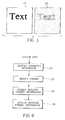
- original textual information content 20 is shown together with the same information content in a modified format 22 . It can be seen from Fig. 3 that more pixels are dark in the modified format 22 than in the original format 20 . Hence, displaying the modified format 22 will require less power than displaying the original format 20 since displaying a dark pixel on an emissive display requires less power than displaying a bright pixel.
- HTML hypertext markup language
- BGCOLOR attributes associated with tables or text
- any modification that reduces the number of bright pixels will reduce the power usage in an emissive display.
- the brightness of the background or text may be reduced.
- Using a light text on a dark background requires less power than the reverse.
- bold text if in a bright format
- the thickness of the text can be modified, for example by changing bright bold text on a dark background to normal text, or by changing dark normal text on a light background to bold text.
- reducing the number of bright pixel elements in a graphic element or image can reduce the total power used by the display.
- graphic elements may be eliminated entirely and replaced with a black background.
- a less drastic alternative is to binarize the image or graphic element by setting every pixel in the image to either one of two values, a darker or a lighter value, depending on whether they are below or above a pre-determined or preselected threshold.
- the values and threshold are chosen so that the average brightness of the image or graphic is reduced.
- the two values may, but need not necessarily, be black and white. The darker or more efficient the two binary values are, the greater the power savings.
- the threshold value should be set so as to maximize the number of pixels set to the darker or more efficient value.
- the information necessary to set the thresholds can be obtained from a histogram of the brightness code values of a particular image to be displayed, or from the histograms of a selection of representative images. This binarizing technique can also be applied to text and background to achieve power savings.
- the degree to which the formatting is modified may be controlled by a viewer. For example, a viewer might enable only text and background color changes, modify a threshold for binarization or the binarized values or, alternatively, eliminate all graphic displays. This control can be managed by setting preferences used by a format modification program in the processor 10 .
- emissive displays may be less efficient in producing certain colors than others, it is also possible to reduce the power usage by using the more efficient colors in preference to the less efficient colors. If, for example, the green pixels are more efficient than red, replacing red with green as a preferred color in text will reduce the power use of the display. The color of the text and the background can also be reversed to save power if the background color is of the same brightness, but less efficient.
- the system and method works as follows.
- the processor 10 receives 24 formatted information to display on a device.
- the processor 10 modifies 26 the format of the information by analyzing the format tags in the formatted information and replacing the tags that will result in more power usage by the display with tags that will result in less power usage.
- the format modification can be done with a software program that reads the file of formatted information, identifies the tags and attributes associated with significant power use, and replaces them with pre-specified alternatives. Complementary attributes are maintained where necessary. For example, if a background is set to black, the text will not be set to the same color but is set to an energy efficient color instead. Likewise, any graphic elements or images can be processed to reduce the number of bright pixels in the displayed information.
- the modified information is then rendered 28 into code values representing the brightness of pixel elements in the display and displayed 30 on the display 16 .
Landscapes
- Engineering & Computer Science (AREA)
- Physics & Mathematics (AREA)
- Computer Hardware Design (AREA)
- General Physics & Mathematics (AREA)
- Theoretical Computer Science (AREA)
- Control Of Indicators Other Than Cathode Ray Tubes (AREA)
- Control Of El Displays (AREA)
Abstract
Description
The pre-processing does not change the information content but does change the appearance of the information that is displayed.
Claims (22)
- A method for reducing the power used by a display device having light emitting pixels, comprising the steps of:a) receiving formatted information for presentation on the display device;b) modifying the format of the formatted information to reduce the number and/or intensity of bright pixels in a display of the formatted information;c) rendering the modified formatted information; andd) displaying the rendered modified formatted information on the display device.
- The method claimed in claim 1, wherein the display device is a portable emissive flat-panel display.
- The method claimed in claim 1, wherein the display device is an OLED display device.
- The method claimed in claim 1, wherein the information includes text formatted with characters presented on a background.
- The method claimed in claim 4, wherein the format includes dark text on a light background and the format modification is the reversal of the brightness of the text and the background.
- The method claimed in claim 4, wherein the format modification is the reversal of the color of the text and the background.
- The method claimed in claim 4, wherein the format modification includes modifying the brightness of the text background.
- The method claimed in claim 4, wherein the format modification includes modifying the brightness of the text.
- The method claimed in claim 4, wherein the display is a color display in which the display of some colors consumes less power than the display of other colors, and the format modification includes modifying the color of the text background.
- The method claimed in claim 9, wherein the format modification is the reversal of the color of the text and the background.
- The method claimed in claim 4, wherein the display is a color display wherein the display of some colors consumes less power than the display of other colors, and the format modification includes modifying the color of the text.
- The method claimed in claim 4, wherein the format modification includes modifying the thickness of the text characters.
- The method claimed in claim 12, wherein the format modification includes changing light bold text on a dark background to normal text.
- The method claimed in claim 12, wherein the format modification includes changing dark normal text on a light background to bold text.
- The method claimed in claim 1, wherein the information includes one or more graphic elements.
- The method claimed in claim 15, wherein the format modification includes modifying the brightness of the one or more of the graphic elements.
- The method claimed in claim 15, wherein the display is a color display wherein the display of some colors consumes less power than the display of other colors, and the format modification includes modifying the color of the one or more graphics.
- The method claimed in claim 15, wherein the format modification includes binarizing the one or more graphic elements.
- The method claimed in claim 15, wherein the format modification includes removing one or more of the graphic elements.
- The method claimed in claim 1, wherein the format modification is user selectable.
- The method claimed in claim 1 wherein the information format is described in a markup language.
- The method claimed in claim 1 wherein the information format is described in hypertext markup language (html).
Applications Claiming Priority (2)
| Application Number | Priority Date | Filing Date | Title |
|---|---|---|---|
| US3840 | 1995-09-15 | ||
| US10/003,840 US7002593B2 (en) | 2001-11-01 | 2001-11-01 | Method for reducing the power used by emissive display devices |
Publications (2)
| Publication Number | Publication Date |
|---|---|
| EP1308921A2 true EP1308921A2 (en) | 2003-05-07 |
| EP1308921A3 EP1308921A3 (en) | 2006-06-28 |
Family
ID=21707838
Family Applications (1)
| Application Number | Title | Priority Date | Filing Date |
|---|---|---|---|
| EP02079361A Withdrawn EP1308921A3 (en) | 2001-11-01 | 2002-10-21 | A method for reducing the power used by emissive display devices |
Country Status (5)
| Country | Link |
|---|---|
| US (1) | US7002593B2 (en) |
| EP (1) | EP1308921A3 (en) |
| JP (1) | JP2003216092A (en) |
| KR (1) | KR100817998B1 (en) |
| TW (1) | TW575856B (en) |
Cited By (12)
| Publication number | Priority date | Publication date | Assignee | Title |
|---|---|---|---|---|
| WO2005116981A1 (en) * | 2004-05-24 | 2005-12-08 | Koninklijke Philips Electronics N.V., | Color display |
| EP1962272A1 (en) * | 2007-02-23 | 2008-08-27 | Samsung SDI Co., Ltd. | Power reduction driving controller, organic light emitting display including the same, and associated methods |
| EP1758357A3 (en) * | 2005-08-22 | 2009-07-29 | LG Electronics Inc. | Apparatus and method for displaying a mobile terminal standby screen |
| US7970272B2 (en) | 2006-08-10 | 2011-06-28 | Research In Motion Limited | Method and apparatus for power management in an electronic device |
| EP2211328A3 (en) * | 2009-01-23 | 2011-11-30 | Samsung Mobile Display Co., Ltd. | Organic light emitting display device, method of driving the same and power saving unit thereof |
| EP2428867A1 (en) * | 2010-09-09 | 2012-03-14 | Research In Motion Limited | System and method for controlling a display according display characteristics |
| CN102867484A (en) * | 2011-07-07 | 2013-01-09 | 中兴通讯股份有限公司 | Display control method and system |
| US8704803B2 (en) | 2004-08-27 | 2014-04-22 | Semiconductor Energy Laboratory Co., Ltd. | Display device and electronic appliance using the display device |
| EP2472498A3 (en) * | 2011-01-04 | 2014-10-15 | Samsung Electronics Co., Ltd. | Method and apparatus for reducing power consumption in mobile terminal |
| GB2526418A (en) * | 2014-03-28 | 2015-11-25 | Lenovo Singapore Pte Ltd | Power-advantaged image data control |
| CN102867484B (en) * | 2011-07-07 | 2016-12-14 | 中兴通讯股份有限公司 | A kind of display control method and system |
| US9824631B2 (en) | 2005-08-12 | 2017-11-21 | Semiconductor Energy Laboratory Co., Ltd. | Display device |
Families Citing this family (25)
| Publication number | Priority date | Publication date | Assignee | Title |
|---|---|---|---|---|
| US6809711B2 (en) * | 2001-05-03 | 2004-10-26 | Eastman Kodak Company | Display driver and method for driving an emissive video display |
| EP1460840A1 (en) * | 2003-03-17 | 2004-09-22 | Deutsche Thomson-Brandt Gmbh | Device and method for reducing burning effects on display means |
| US7506273B2 (en) * | 2003-03-19 | 2009-03-17 | International Business Machines Corporation | Method and system for modifying properties of graphical user interface components |
| US20060050983A1 (en) * | 2004-09-08 | 2006-03-09 | Everest Vit, Inc. | Method and apparatus for enhancing the contrast and clarity of an image captured by a remote viewing device |
| US7614011B2 (en) * | 2004-10-21 | 2009-11-03 | International Business Machines Corporation | Apparatus and method for display power saving |
| US7760210B2 (en) * | 2005-05-04 | 2010-07-20 | Honeywood Technologies, Llc | White-based power savings |
| JP2007072455A (en) * | 2005-08-12 | 2007-03-22 | Semiconductor Energy Lab Co Ltd | Display device |
| JP2007114579A (en) * | 2005-10-21 | 2007-05-10 | Pioneer Electronic Corp | Display device, display method, display system, server, and program |
| US20130342433A9 (en) * | 2007-04-14 | 2013-12-26 | Ananth Sankar | Dynamic backlight control for video displays |
| JP2010145669A (en) * | 2008-12-18 | 2010-07-01 | Brother Ind Ltd | Head mounted display |
| KR101615379B1 (en) * | 2009-10-14 | 2016-04-26 | 삼성전자주식회사 | A wireless terminal having flexible display and method for displaying information in the wireless terminal |
| US8706911B2 (en) | 2010-01-27 | 2014-04-22 | Industrial Technology Research Institute | Power saving display information converting system and method |
| US9218762B2 (en) * | 2010-09-01 | 2015-12-22 | Qualcomm Incorporated | Dimming techniques for emissive displays |
| US9240137B2 (en) * | 2011-02-09 | 2016-01-19 | Qualcomm Innovation Center, Inc. | Method and apparatus for content-based reduction of display power |
| KR20120136628A (en) * | 2011-06-09 | 2012-12-20 | 엘지전자 주식회사 | Apparatus for displaying image and method for operating the same |
| US8847968B2 (en) | 2011-07-12 | 2014-09-30 | Qualcomm Incorporated | Displaying static images |
| US9047835B2 (en) * | 2011-08-17 | 2015-06-02 | Broadcom Corporation | Thermal and power aware graphics processing |
| CN102419955B (en) * | 2011-12-09 | 2015-11-25 | 华为终端有限公司 | The display control method of OLED and equipment, terminal device |
| DE102012205427A1 (en) * | 2012-04-03 | 2013-10-10 | Robert Bosch Gmbh | Method and apparatus for reducing mutual interference of pixels of a pixel group |
| KR102641940B1 (en) * | 2016-11-03 | 2024-02-29 | 삼성전자주식회사 | Display apparatus and control method thereof |
| CN106775548B (en) * | 2016-11-25 | 2018-02-23 | 北京小米移动软件有限公司 | page processing method and device |
| DE102017203511A1 (en) * | 2017-03-03 | 2018-10-04 | Convotherm-Elektrogeräte Gmbh | Method and device for targeted information transfer to customers using cooking appliances and / or cooking appliances of a cooking appliance manufacturer |
| CN107086027A (en) * | 2017-06-23 | 2017-08-22 | 青岛海信移动通信技术股份有限公司 | Character displaying method and device, mobile terminal and storage medium |
| CN110442313B (en) * | 2019-06-27 | 2021-09-21 | 华为技术有限公司 | Display attribute adjusting method and related equipment |
| CN110910827A (en) * | 2019-12-31 | 2020-03-24 | 合肥联宝信息技术有限公司 | Image control method and display device |
Family Cites Families (19)
| Publication number | Priority date | Publication date | Assignee | Title |
|---|---|---|---|---|
| US5248963A (en) * | 1987-12-25 | 1993-09-28 | Hosiden Electronics Co., Ltd. | Method and circuit for erasing a liquid crystal display |
| EP0448350B1 (en) * | 1990-03-23 | 1996-12-27 | Matsushita Electric Industrial Co., Ltd. | Hand held data processing apparatus having reduced power consumption |
| US5363143A (en) * | 1993-09-03 | 1994-11-08 | Thomson Consumer Electronics, Inc. | Side by side picture display with reduced cropping |
| US5598565A (en) * | 1993-12-29 | 1997-01-28 | Intel Corporation | Method and apparatus for screen power saving |
| EP0707301A1 (en) * | 1994-09-14 | 1996-04-17 | Texas Instruments Incorporated | Power management for a display device |
| US6320587B1 (en) * | 1996-08-26 | 2001-11-20 | Fujitsu Limited | Font processing apparatus in network environment and method thereof |
| US6160541A (en) * | 1997-01-21 | 2000-12-12 | Lear Automotive Dearborn Inc. | Power consumption control for a visual screen display by utilizing a total number of pixels to be energized in the image to determine an order of pixel energization in a manner that conserves power |
| US6023714A (en) * | 1997-04-24 | 2000-02-08 | Microsoft Corporation | Method and system for dynamically adapting the layout of a document to an output device |
| US6400371B1 (en) * | 1997-05-16 | 2002-06-04 | Liberate Technologies | Television signal chrominance adjustment |
| JP2002511608A (en) * | 1998-04-15 | 2002-04-16 | ケンブリッジ ディスプレイ テクノロジー リミテッド | Display control device with low power consumption mode |
| IL140611A0 (en) * | 1998-06-29 | 2002-02-10 | Honeywell Inc | Method of and system for detecting and rendering of graphic elements |
| US6313878B1 (en) * | 1998-11-20 | 2001-11-06 | Sony Corporation | Method and structure for providing an automatic hardware-implemented screen-saver function to a display product |
| JP2000347637A (en) * | 1999-06-03 | 2000-12-15 | Matsushita Electric Ind Co Ltd | Display device, computer, and computer system |
| JP2001202053A (en) * | 1999-11-09 | 2001-07-27 | Matsushita Electric Ind Co Ltd | Display device and portable information terminal |
| US6452582B1 (en) * | 1999-12-01 | 2002-09-17 | Garmin Corporation | Method and apparatus for refreshing a liquid crystal display |
| KR100359816B1 (en) * | 2000-01-12 | 2002-11-07 | 엘지전자 주식회사 | Apparatus for converting format |
| KR20010077740A (en) * | 2000-02-08 | 2001-08-20 | 박종섭 | Power saving circuit of a display panel |
| US6825820B2 (en) * | 2000-08-10 | 2004-11-30 | Semiconductor Energy Laboratory Co., Ltd. | Display device and electronic device |
| US6657617B2 (en) * | 2001-06-25 | 2003-12-02 | International Business Machines Corporation | Method, apparatus and computer program product for three dimensional text creation |
-
2001
- 2001-11-01 US US10/003,840 patent/US7002593B2/en not_active Expired - Lifetime
-
2002
- 2002-09-12 TW TW91120879A patent/TW575856B/en not_active IP Right Cessation
- 2002-10-21 EP EP02079361A patent/EP1308921A3/en not_active Withdrawn
- 2002-10-31 JP JP2002317021A patent/JP2003216092A/en active Pending
- 2002-10-31 KR KR1020020066899A patent/KR100817998B1/en not_active Expired - Lifetime
Cited By (17)
| Publication number | Priority date | Publication date | Assignee | Title |
|---|---|---|---|---|
| WO2005116981A1 (en) * | 2004-05-24 | 2005-12-08 | Koninklijke Philips Electronics N.V., | Color display |
| US8704803B2 (en) | 2004-08-27 | 2014-04-22 | Semiconductor Energy Laboratory Co., Ltd. | Display device and electronic appliance using the display device |
| US10319298B2 (en) | 2005-08-12 | 2019-06-11 | Semiconductor Energy Laboratory Co., Ltd. | Display device |
| US9824631B2 (en) | 2005-08-12 | 2017-11-21 | Semiconductor Energy Laboratory Co., Ltd. | Display device |
| EP1758357A3 (en) * | 2005-08-22 | 2009-07-29 | LG Electronics Inc. | Apparatus and method for displaying a mobile terminal standby screen |
| US7639246B2 (en) | 2005-08-22 | 2009-12-29 | Lg Electronics Inc. | Apparatus and method for displaying a mobile terminal standby screen |
| US7970272B2 (en) | 2006-08-10 | 2011-06-28 | Research In Motion Limited | Method and apparatus for power management in an electronic device |
| EP1962272A1 (en) * | 2007-02-23 | 2008-08-27 | Samsung SDI Co., Ltd. | Power reduction driving controller, organic light emitting display including the same, and associated methods |
| US8368684B2 (en) | 2009-01-23 | 2013-02-05 | Samsung Display Co., Ltd. | Organic light emitting display device, method of driving the same and power saving unit thereof |
| EP2211328A3 (en) * | 2009-01-23 | 2011-11-30 | Samsung Mobile Display Co., Ltd. | Organic light emitting display device, method of driving the same and power saving unit thereof |
| EP2428867A1 (en) * | 2010-09-09 | 2012-03-14 | Research In Motion Limited | System and method for controlling a display according display characteristics |
| EP2472498A3 (en) * | 2011-01-04 | 2014-10-15 | Samsung Electronics Co., Ltd. | Method and apparatus for reducing power consumption in mobile terminal |
| CN102867484A (en) * | 2011-07-07 | 2013-01-09 | 中兴通讯股份有限公司 | Display control method and system |
| CN102867484B (en) * | 2011-07-07 | 2016-12-14 | 中兴通讯股份有限公司 | A kind of display control method and system |
| GB2526418A (en) * | 2014-03-28 | 2015-11-25 | Lenovo Singapore Pte Ltd | Power-advantaged image data control |
| GB2526418B (en) * | 2014-03-28 | 2017-02-01 | Lenovo Singapore Pte Ltd | Power-advantaged image data control |
| US9947294B2 (en) | 2014-03-28 | 2018-04-17 | Lenovo (Singapore) Pte. Ltd. | Power advantaged image data control |
Also Published As
| Publication number | Publication date |
|---|---|
| US7002593B2 (en) | 2006-02-21 |
| TW575856B (en) | 2004-02-11 |
| KR100817998B1 (en) | 2008-03-31 |
| US20030080967A1 (en) | 2003-05-01 |
| KR20030038398A (en) | 2003-05-16 |
| EP1308921A3 (en) | 2006-06-28 |
| JP2003216092A (en) | 2003-07-30 |
Similar Documents
| Publication | Publication Date | Title |
|---|---|---|
| US7002593B2 (en) | Method for reducing the power used by emissive display devices | |
| CN102194423B (en) | Method and apparatus for enabling power management of a flat panel display | |
| CN105139792B (en) | Display methods and display device | |
| US7614011B2 (en) | Apparatus and method for display power saving | |
| Chang et al. | DLS: Dynamic backlight luminance scaling of liquid crystal display | |
| CN101847372B (en) | Method and system for determining intensity arrangement of light source | |
| CN103871377B (en) | Display method with strong light visibility and electronic device using the method | |
| EP4283601A1 (en) | Method and apparatus for determining ambient light intensity and storage medium | |
| CN108281125B (en) | Method, device and equipment for adjusting backlight brightness according to human eye characteristics | |
| KR101066053B1 (en) | Systems and methods for reducing power consumption in a device through a content adaptive display | |
| US8706911B2 (en) | Power saving display information converting system and method | |
| KR20070058572A (en) | Variable Brightness LCD Backlight | |
| CN101488323B (en) | A method of backlight adjustment and image processing | |
| KR101233495B1 (en) | Management techniques for video playback | |
| CN106023904A (en) | Display control method and device based on electronic ink screen | |
| CN107256693A (en) | Display methods, display panel and display device | |
| EP2472498A2 (en) | Method and apparatus for reducing power consumption in mobile terminal | |
| Choi et al. | LPBP: Low-power basis profile of the Java 2 micro edition | |
| CN104200787A (en) | Brightness regulating method and device and electronic device | |
| CN112368763A (en) | Control device, display device, and control method | |
| US11217205B2 (en) | Method and apparatus for rendering contents for vision accessibility | |
| JP3859623B2 (en) | Backlight control method for liquid crystal display device | |
| TW200501031A (en) | Display device and controlling method thereof | |
| US20210241703A1 (en) | Control device, display device, and control method | |
| CN112951150A (en) | Energy-saving method, device and equipment for LED display screen and storage medium |
Legal Events
| Date | Code | Title | Description |
|---|---|---|---|
| PUAI | Public reference made under article 153(3) epc to a published international application that has entered the european phase |
Free format text: ORIGINAL CODE: 0009012 |
|
| AK | Designated contracting states |
Designated state(s): AT BE BG CH CY CZ DE DK EE ES FI FR GB GR IE IT LI LU MC NL PT SE SK TR |
|
| AX | Request for extension of the european patent |
Extension state: AL LT LV MK RO SI |
|
| PUAL | Search report despatched |
Free format text: ORIGINAL CODE: 0009013 |
|
| AK | Designated contracting states |
Kind code of ref document: A3 Designated state(s): AT BE BG CH CY CZ DE DK EE ES FI FR GB GR IE IT LI LU MC NL PT SE SK TR |
|
| AX | Request for extension of the european patent |
Extension state: AL LT LV MK RO SI |
|
| RIC1 | Information provided on ipc code assigned before grant |
Ipc: G09G 3/32 20060101ALI20060519BHEP Ipc: G09G 3/20 20060101AFI20030227BHEP |
|
| AKX | Designation fees paid | ||
| REG | Reference to a national code |
Ref country code: DE Ref legal event code: 8566 |
|
| STAA | Information on the status of an ep patent application or granted ep patent |
Free format text: STATUS: THE APPLICATION IS DEEMED TO BE WITHDRAWN |
|
| 18D | Application deemed to be withdrawn |
Effective date: 20061229 |