EP1307048A1 - Digital video information apparatus - Google Patents
Digital video information apparatus Download PDFInfo
- Publication number
- EP1307048A1 EP1307048A1 EP00942453A EP00942453A EP1307048A1 EP 1307048 A1 EP1307048 A1 EP 1307048A1 EP 00942453 A EP00942453 A EP 00942453A EP 00942453 A EP00942453 A EP 00942453A EP 1307048 A1 EP1307048 A1 EP 1307048A1
- Authority
- EP
- European Patent Office
- Prior art keywords
- image contents
- information item
- information
- image
- content
- Prior art date
- Legal status (The legal status is an assumption and is not a legal conclusion. Google has not performed a legal analysis and makes no representation as to the accuracy of the status listed.)
- Ceased
Links
Images






Classifications
-
- H—ELECTRICITY
- H04—ELECTRIC COMMUNICATION TECHNIQUE
- H04N—PICTORIAL COMMUNICATION, e.g. TELEVISION
- H04N21/00—Selective content distribution, e.g. interactive television or video on demand [VOD]
- H04N21/20—Servers specifically adapted for the distribution of content, e.g. VOD servers; Operations thereof
- H04N21/25—Management operations performed by the server for facilitating the content distribution or administrating data related to end-users or client devices, e.g. end-user or client device authentication, learning user preferences for recommending movies
- H04N21/266—Channel or content management, e.g. generation and management of keys and entitlement messages in a conditional access system, merging a VOD unicast channel into a multicast channel
- H04N21/26603—Channel or content management, e.g. generation and management of keys and entitlement messages in a conditional access system, merging a VOD unicast channel into a multicast channel for automatically generating descriptors from content, e.g. when it is not made available by its provider, using content analysis techniques
-
- G—PHYSICS
- G11—INFORMATION STORAGE
- G11B—INFORMATION STORAGE BASED ON RELATIVE MOVEMENT BETWEEN RECORD CARRIER AND TRANSDUCER
- G11B20/00—Signal processing not specific to the method of recording or reproducing; Circuits therefor
- G11B20/10—Digital recording or reproducing
-
- H—ELECTRICITY
- H04—ELECTRIC COMMUNICATION TECHNIQUE
- H04N—PICTORIAL COMMUNICATION, e.g. TELEVISION
- H04N21/00—Selective content distribution, e.g. interactive television or video on demand [VOD]
- H04N21/20—Servers specifically adapted for the distribution of content, e.g. VOD servers; Operations thereof
- H04N21/23—Processing of content or additional data; Elementary server operations; Server middleware
- H04N21/231—Content storage operation, e.g. caching movies for short term storage, replicating data over plural servers, prioritizing data for deletion
- H04N21/23106—Content storage operation, e.g. caching movies for short term storage, replicating data over plural servers, prioritizing data for deletion involving caching operations
-
- H—ELECTRICITY
- H04—ELECTRIC COMMUNICATION TECHNIQUE
- H04N—PICTORIAL COMMUNICATION, e.g. TELEVISION
- H04N21/00—Selective content distribution, e.g. interactive television or video on demand [VOD]
- H04N21/20—Servers specifically adapted for the distribution of content, e.g. VOD servers; Operations thereof
- H04N21/25—Management operations performed by the server for facilitating the content distribution or administrating data related to end-users or client devices, e.g. end-user or client device authentication, learning user preferences for recommending movies
- H04N21/262—Content or additional data distribution scheduling, e.g. sending additional data at off-peak times, updating software modules, calculating the carousel transmission frequency, delaying a video stream transmission, generating play-lists
- H04N21/26283—Content or additional data distribution scheduling, e.g. sending additional data at off-peak times, updating software modules, calculating the carousel transmission frequency, delaying a video stream transmission, generating play-lists for associating distribution time parameters to content, e.g. to generate electronic programme guide data
-
- H—ELECTRICITY
- H04—ELECTRIC COMMUNICATION TECHNIQUE
- H04N—PICTORIAL COMMUNICATION, e.g. TELEVISION
- H04N21/00—Selective content distribution, e.g. interactive television or video on demand [VOD]
- H04N21/20—Servers specifically adapted for the distribution of content, e.g. VOD servers; Operations thereof
- H04N21/27—Server based end-user applications
- H04N21/274—Storing end-user multimedia data in response to end-user request, e.g. network recorder
- H04N21/2743—Video hosting of uploaded data from client
-
- H—ELECTRICITY
- H04—ELECTRIC COMMUNICATION TECHNIQUE
- H04N—PICTORIAL COMMUNICATION, e.g. TELEVISION
- H04N21/00—Selective content distribution, e.g. interactive television or video on demand [VOD]
- H04N21/40—Client devices specifically adapted for the reception of or interaction with content, e.g. set-top-box [STB]; Operations thereof
- H04N21/41—Structure of client; Structure of client peripherals
- H04N21/4104—Peripherals receiving signals from specially adapted client devices
- H04N21/4135—Peripherals receiving signals from specially adapted client devices external recorder
-
- H—ELECTRICITY
- H04—ELECTRIC COMMUNICATION TECHNIQUE
- H04N—PICTORIAL COMMUNICATION, e.g. TELEVISION
- H04N21/00—Selective content distribution, e.g. interactive television or video on demand [VOD]
- H04N21/40—Client devices specifically adapted for the reception of or interaction with content, e.g. set-top-box [STB]; Operations thereof
- H04N21/43—Processing of content or additional data, e.g. demultiplexing additional data from a digital video stream; Elementary client operations, e.g. monitoring of home network or synchronising decoder's clock; Client middleware
- H04N21/431—Generation of visual interfaces for content selection or interaction; Content or additional data rendering
- H04N21/4312—Generation of visual interfaces for content selection or interaction; Content or additional data rendering involving specific graphical features, e.g. screen layout, special fonts or colors, blinking icons, highlights or animations
- H04N21/4316—Generation of visual interfaces for content selection or interaction; Content or additional data rendering involving specific graphical features, e.g. screen layout, special fonts or colors, blinking icons, highlights or animations for displaying supplemental content in a region of the screen, e.g. an advertisement in a separate window
-
- H—ELECTRICITY
- H04—ELECTRIC COMMUNICATION TECHNIQUE
- H04N—PICTORIAL COMMUNICATION, e.g. TELEVISION
- H04N21/00—Selective content distribution, e.g. interactive television or video on demand [VOD]
- H04N21/40—Client devices specifically adapted for the reception of or interaction with content, e.g. set-top-box [STB]; Operations thereof
- H04N21/43—Processing of content or additional data, e.g. demultiplexing additional data from a digital video stream; Elementary client operations, e.g. monitoring of home network or synchronising decoder's clock; Client middleware
- H04N21/433—Content storage operation, e.g. storage operation in response to a pause request, caching operations
- H04N21/4331—Caching operations, e.g. of an advertisement for later insertion during playback
-
- H—ELECTRICITY
- H04—ELECTRIC COMMUNICATION TECHNIQUE
- H04N—PICTORIAL COMMUNICATION, e.g. TELEVISION
- H04N21/00—Selective content distribution, e.g. interactive television or video on demand [VOD]
- H04N21/40—Client devices specifically adapted for the reception of or interaction with content, e.g. set-top-box [STB]; Operations thereof
- H04N21/43—Processing of content or additional data, e.g. demultiplexing additional data from a digital video stream; Elementary client operations, e.g. monitoring of home network or synchronising decoder's clock; Client middleware
- H04N21/433—Content storage operation, e.g. storage operation in response to a pause request, caching operations
- H04N21/4332—Content storage operation, e.g. storage operation in response to a pause request, caching operations by placing content in organized collections, e.g. local EPG data repository
-
- H—ELECTRICITY
- H04—ELECTRIC COMMUNICATION TECHNIQUE
- H04N—PICTORIAL COMMUNICATION, e.g. TELEVISION
- H04N21/00—Selective content distribution, e.g. interactive television or video on demand [VOD]
- H04N21/40—Client devices specifically adapted for the reception of or interaction with content, e.g. set-top-box [STB]; Operations thereof
- H04N21/45—Management operations performed by the client for facilitating the reception of or the interaction with the content or administrating data related to the end-user or to the client device itself, e.g. learning user preferences for recommending movies, resolving scheduling conflicts
- H04N21/462—Content or additional data management e.g. creating a master electronic programme guide from data received from the Internet and a Head-end or controlling the complexity of a video stream by scaling the resolution or bit-rate based on the client capabilities
- H04N21/4622—Retrieving content or additional data from different sources, e.g. from a broadcast channel and the Internet
-
- H—ELECTRICITY
- H04—ELECTRIC COMMUNICATION TECHNIQUE
- H04N—PICTORIAL COMMUNICATION, e.g. TELEVISION
- H04N21/00—Selective content distribution, e.g. interactive television or video on demand [VOD]
- H04N21/40—Client devices specifically adapted for the reception of or interaction with content, e.g. set-top-box [STB]; Operations thereof
- H04N21/47—End-user applications
- H04N21/472—End-user interface for requesting content, additional data or services; End-user interface for interacting with content, e.g. for content reservation or setting reminders, for requesting event notification, for manipulating displayed content
- H04N21/47214—End-user interface for requesting content, additional data or services; End-user interface for interacting with content, e.g. for content reservation or setting reminders, for requesting event notification, for manipulating displayed content for content reservation or setting reminders; for requesting event notification, e.g. of sport results or stock market
-
- H—ELECTRICITY
- H04—ELECTRIC COMMUNICATION TECHNIQUE
- H04N—PICTORIAL COMMUNICATION, e.g. TELEVISION
- H04N21/00—Selective content distribution, e.g. interactive television or video on demand [VOD]
- H04N21/40—Client devices specifically adapted for the reception of or interaction with content, e.g. set-top-box [STB]; Operations thereof
- H04N21/47—End-user applications
- H04N21/478—Supplemental services, e.g. displaying phone caller identification, shopping application
- H04N21/4782—Web browsing, e.g. WebTV
-
- H—ELECTRICITY
- H04—ELECTRIC COMMUNICATION TECHNIQUE
- H04N—PICTORIAL COMMUNICATION, e.g. TELEVISION
- H04N21/00—Selective content distribution, e.g. interactive television or video on demand [VOD]
- H04N21/40—Client devices specifically adapted for the reception of or interaction with content, e.g. set-top-box [STB]; Operations thereof
- H04N21/47—End-user applications
- H04N21/482—End-user interface for programme selection
-
- H—ELECTRICITY
- H04—ELECTRIC COMMUNICATION TECHNIQUE
- H04N—PICTORIAL COMMUNICATION, e.g. TELEVISION
- H04N21/00—Selective content distribution, e.g. interactive television or video on demand [VOD]
- H04N21/60—Network structure or processes for video distribution between server and client or between remote clients; Control signalling between clients, server and network components; Transmission of management data between server and client, e.g. sending from server to client commands for recording incoming content stream; Communication details between server and client
- H04N21/65—Transmission of management data between client and server
- H04N21/658—Transmission by the client directed to the server
-
- H—ELECTRICITY
- H04—ELECTRIC COMMUNICATION TECHNIQUE
- H04N—PICTORIAL COMMUNICATION, e.g. TELEVISION
- H04N21/00—Selective content distribution, e.g. interactive television or video on demand [VOD]
- H04N21/80—Generation or processing of content or additional data by content creator independently of the distribution process; Content per se
- H04N21/83—Generation or processing of protective or descriptive data associated with content; Content structuring
- H04N21/84—Generation or processing of descriptive data, e.g. content descriptors
-
- H—ELECTRICITY
- H04—ELECTRIC COMMUNICATION TECHNIQUE
- H04N—PICTORIAL COMMUNICATION, e.g. TELEVISION
- H04N21/00—Selective content distribution, e.g. interactive television or video on demand [VOD]
- H04N21/80—Generation or processing of content or additional data by content creator independently of the distribution process; Content per se
- H04N21/85—Assembly of content; Generation of multimedia applications
- H04N21/854—Content authoring
- H04N21/8543—Content authoring using a description language, e.g. Multimedia and Hypermedia information coding Expert Group [MHEG], eXtensible Markup Language [XML]
-
- H—ELECTRICITY
- H04—ELECTRIC COMMUNICATION TECHNIQUE
- H04N—PICTORIAL COMMUNICATION, e.g. TELEVISION
- H04N5/00—Details of television systems
- H04N5/76—Television signal recording
- H04N5/78—Television signal recording using magnetic recording
- H04N5/781—Television signal recording using magnetic recording on disks or drums
-
- H—ELECTRICITY
- H04—ELECTRIC COMMUNICATION TECHNIQUE
- H04N—PICTORIAL COMMUNICATION, e.g. TELEVISION
- H04N5/00—Details of television systems
- H04N5/76—Television signal recording
- H04N5/78—Television signal recording using magnetic recording
- H04N5/782—Television signal recording using magnetic recording on tape
-
- H—ELECTRICITY
- H04—ELECTRIC COMMUNICATION TECHNIQUE
- H04N—PICTORIAL COMMUNICATION, e.g. TELEVISION
- H04N7/00—Television systems
- H04N7/16—Analogue secrecy systems; Analogue subscription systems
- H04N7/173—Analogue secrecy systems; Analogue subscription systems with two-way working, e.g. subscriber sending a programme selection signal
- H04N7/17309—Transmission or handling of upstream communications
- H04N7/17318—Direct or substantially direct transmission and handling of requests
Definitions
- the present invention relates to a digital image information device.
- a conventional analog video recorder only shoots an image, and does not perform editing such as cut-and-paste, etc. for the image.
- image editing was performed only in very limited places such as a television station, a studio, etc. The reason is that editing operations themselves are complex, and cannot be implemented by ordinary home equipment.
- EPG electronic program guide
- the same information is only delivered in succession at predetermined intervals, and the delivered contents cannot be changed according to user preferences under the present circumstances. Namely, there is no linkage among such a program information, editing, index, etc., and the program information, etc. are difficult to be reused.
- Fig. 1 exemplifies a display of an electronic program guide (EPG) of a conventional CATV.
- EPG electronic program guide
- a program schedule is displayed on a screen. Additionally, if a user selects one of the programs on this program schedule, information about the program is displayed. In the example shown in Fig. 1, a user selects "Report from Tanzawa" by Tanzawa TV, and the image of the program is displayed in the lower right portion of Fig. 1, and an introductory description of the image is displayed in the lower left portion.
- An object of the present invention is to provide a digital image information device that systematically links a program information and an editing process.
- a first digital image information device which is a digital image information device delivering/receiving image contents on request, comprises; an image contents storing unit storing image contents; an information item storing unit storing the content of an information item about the image contents in correspondence with the image contents; an information item receiving unit receiving the content of the information item about the image contents from a different digital image information device; an extracting unit extracting an information item corresponding to the content of the received information item and its content from the information item storing unit; and an image contents transmitting unit obtaining the image contents corresponding to the content of the extracted information item, and transmitting the obtained contents to the different digital image information device.
- a second digital image information device which is a digital image information device delivering/receiving image contents on request, comprises: an image contents storing unit storing image contents; an information item receiving unit transmitting the content of an information item about the image contents to a different digital image information device; and an image contents storing unit obtaining the image contents corresponding to the content of the transmitted information item from the different digital image information device, and storing the obtained contents in the image contents storing unit.
- an information item for describing image contents in association with image contents is arranged separately from the image contents, and the information indicating the image contents is set in the information item for each image contents, whereby image contents can be efficiently managed, and image contents that satisfies a user request can be easily searched or edited.
- a database that manages edited image information is generated based on the assumption that a recorded image is edited. Furthermore, also additional information such a program information, etc., which is simultaneously transmitted along with an image, is stored in the database, so that an easier-to-use video recorder for a user is provided.
- a recorded image, an edited image, index information etc. can be reproduced by a different machine other than a local recorder, or can be reused by being ported to a personal computer, etc.
- additional information such as a program information, etc. is stored in a database, so that a more expandable implementation is realized, the linkage among the program information, editing, etc. can be made, and the reuse of the program information, etc. can be facilitated.
- a conventional video recorder is a device that simply records an image in a sense.
- a video recorder does not simply record or reproduce an image, but generates a database where configuration information such as the name of a recorded program, genre based on the contents, a person's name, time, etc. are described, special reproduction (index jump, etc.), editing (a deletion of an unnecessary portion, etc.), and the like according to user preferences can be implemented, and besides, a database that can be easily exchanged or edited with a third party is configured.
- a method using an EPG which is transmitted along with a TV transmission, or program information, etc.
- the database is always updated or reconfigured according to user preferences (actions such as an action being recording, marking by user specification, or the like).
- the reconfigured database is referenced by a server which transmits an image, so that information according to the database can be provided to a user.
- the format of a database is represented by a generally used standard, for example, a structured document format such as an XML (eXtended Markup Language) format, etc., and an information exchange not only between a delivery server and a user, but also with a third party is enabled.
- Information of a generated database is handled along with an associated image as a pair, so that a value, which imparts a story to an image and the liking (intention) of a generator side is reflected on, can be added.
- an image and a database are stored, for example, on a removable medium, they can be easily exchanged with a third party via the medium. Needless to say, data of an image and a database can be transferred and exchanged also by using a high-speed network.
- a structured document is a document the structure and the contents of which are represented by a hierarchically predetermined format.
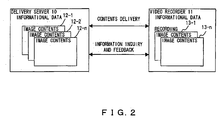
- Fig. 2 shows the concept of the preferred embodiment according to the present invention.
- a video recorder 11 obtains image contents, for example, from a broadcasting station, and records the image contents. At that time, the video recorder 11 simultaneously obtains informational data such as a program information, etc., and records image contents 13-1 to 13-n. At the same time, the video recorder 11 records and uses also the informational data as data indicating the image contents 13-1 to 13-n. However, data obtained from this program information does not fully meet user's needs. Therefore, the user side does not completely satisfy the obtained data. Accordingly, an inquiry about new information is made from the user side (video recorder 11). If the new information exists in the delivery server 10, it immediately delivers the information to the video recorder 11.
- informational data such as a program information, etc.
- the user side is made to newly search for the information, and to update and feed back the information. If new information is input, new image contents 12-1 to 12-n and information, which correspond to the information, are delivered from the delivery server 10, recorded as the image contents 13-1 to 13-n, and are made available on the video recorder 11 side.
- Fig. 3 exemplifies the configuration of a video recorder (client) side.
- the video recorder comprises a data inputting unit 20, a controlling unit 21, a database generating unit 25, reproducing, recording, and editing units 22, 23, and 24, and the like.
- the video recorder generates a database 26 based on the image contents, issues an inquiry request to a delivery server side in order to meet user's needs, and updates the database 26.
- the image contents and an EPG which are transmitted from the delivery server, and information from the Internet, are input to the controlling unit 21 via the data inputting unit 20, from which the image contents, etc. are transmitted to the reproducing unit 22, the recording unit 23, or the editing unit 24.
- reproduction, recording, editing, etc. is performed according to a user instruction input to the controlling unit 21.
- image contents recorded by the recording unit 23 are stored on a videotape, etc.
- the image information is stored by the database generating unit 25 in the database 26 in correspondence with the image contents.
- the database 26 is generated while a user references and updates image contents and image information via the controlling unit 21. Data of the database 26 thus generated is stored onto a disk 27, etc., and used as a local database by the video recorder.
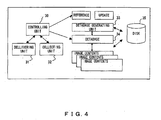
- Fig. 4 exemplifies the configuration of a delivery server.
- a controlling unit 30 delivers image contents or a program information via a delivering unit 31 on a request of a client side (video recorder). Additionally, if new information is requested from the client side via a collecting unit 32, information within the database 34, which is stored onto a disk 35, etc., is searched. If requested information exists, it is immediately delivered from the delivering unit 31 to the client side. If the requested information does not exist, the video recorder attempts to collect the corresponding information.
- the corresponding information is collected by using information that the video recorder obtains from an EPG which indicates image contents at the time of recording, information obtained from the Internet (Web search), and information input from a user.
- EPG electronic program guide
- Web search information obtained from the Internet
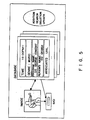
- Fig. 5 exemplifies the information collected by the video recorder (client side).
- the broadcasting time, the program name, the person' s name, the associated URL, etc. of an image are stored in a database. These image contents and image information are recorded onto a storage medium such as an NO, etc. In this case, a user performs a process such as an addition, search, deletion, update, etc. for the image information.
- Fig. 6 is a flowchart showing the sequence for initializing a database on a client side (video recorder).
- step S10 information from the Internet about image contents to be recorded is obtained.
- step S11 information obtained from an EPG that is transmitted along with the image contents is obtained.
- step S12 a user attaches by himself the information about the image contents that the user is to record.
- step S13 these information are stored in association with the image contents, so that an initial database is generated.
- Fig. 7 is a flowchart showing the sequence for making a change or an addition to a database on a client side.
- step S20 a user inputs a request to change a database.
- step S21 it is determined whether or not to request image contents of a delivery server. If the user does not request the image contents of the delivery server, the process is terminated. If the user requests the image contents of the delivery server, an image information item indicated by a particular tag among image information that is configured as a structured document written in an XML, etc., or the image itself is transmitted to the delivery server, and whether or not the image contents or information that the user desires to obtain exists in the database of the delivery server is inquired in step S22. In step S23, the delivery server determines whether or not to be able to provide the information in response to the request from the user. If the delivery server cannot provide the information, the process is terminated. If the delivery server can provide the information, it transmits the information to the client side, which then updates the database in step S24, and the process is terminated.
- Fig. 8 is a flowchart showing the sequence for initializing a database on a delivery server side.
- step S30 a keyword of image contents, which is input by an operator of the delivery server, is obtained.
- step S31 a keyword is automatically obtained from the image with character recognition.
- step S32 a keyword is automatically obtained from the image with voice recognition.
- step S33 a keyword is automatically obtained from the image with pattern recognition.
- the keywords obtained as described above are stored in the database in correspondence with the image contents. In this way, the database on the delivery server side is initialized (step S34).
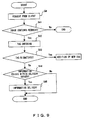
- Fig. 9 is a flowchart showing the sequence for changing a database on a delivery server side.
- step S40 a request from a client (video recorder) is received. Then, in step S41, it is determined whether or not the request is an image contents request. If the request is not the image contents request, the process is terminated. In step S41, if the request is the image contents request, the process proceeds to step S42 where an item (tag) of image information transmitted from the client is checked. In step S43, it is determined whether or not the image information item indicated by the tag matches (mismatches) an item of image information already stored as the database within the delivery server. If the tag does not match, the database within the delivery server is changed by adding the new tag. If the tag matches, it is searched in step S44 whether or not the information requested by the client exists within the delivery server. If the corresponding information does not exist within the delivery server, the process is terminated. If the corresponding information exists, this information is delivered to the client, and the process is terminated.
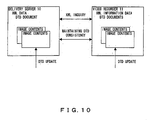
- Fig. 10 explains a preferred embodiment when a communication between a delivery server and a client (video recorder) is made with an XML document.
- An XML is used as a method utilizing a database that collects image contents.
- a DTD Document Type Definition
- DTDs are exchanged and their definitions are made to match, so that image contents desired to be extracted are indicated.
- a program information by way of example, the following items are defined with a DTD as a database on the delivery server 10 side.
- the database is updated on the client side as follows on a request of a user, so that items such an URL, etc. suit the preferences of the user (expanded items are underlined) .
- a tag is made local for the client or global for being fed back to the server.
- a required attribute which indicates whether a tag is either local or global is attached to a movie ID in an ELEMENT definition of the tag, and the tag is made local if this required attribute is "1".
- toiawase.xml is transmitted to the delivery server side, which is made to transmit the image contents corresponding to the item. If the type checking fails, a new type is synchronized with that on the client side, and that type is newly registered also on the delivery server side. Then, image contents are searched based on the item, and delivered as soon as the contents are found on the client side. In this case, an image of the soccer digest starting from 19:00 is transmitted to the client side.
- Fig. 11 is a flowchart showing the sequence of a syntax analysis process of a DTD document on a delivery server side.
- step S50 an XML document is read.
- step S51 a DTD document is read.
- step S52 it is determined whether or not a critical error exists in the DTD document. If a critical error is determined to exist as a result of this determination, it is recognized that information cannot be obtained from the DTD document, and the process is terminated. If a critical error is determined not to exist in the DTD document in step S52, it is determined in step S53 whether or not a syntax error exists in the DTD document. If a syntax error exists, it is determined that information cannot be properly obtained from the DTD document, and the process is terminated.
- step S53 If a syntax error is determined not to exist in step S53, a new tag is loaded from the client side and added to image information in step S54. Then, in step S55, it is determined whether or not all of tags have been checked. If a tag yet to be checked exists, the process goes back to step S53, and the operations are repeated. If it is determined in step S55 that all of the tags have been checked, the process is terminated.
- Fig. 12 explains an XML information exchange between clients.
- the preferred embodiment heretofore stated is the configuration based on a relationship between a server and a client. However, there is no need to build such a hierarchy in all cases. A configuration where equal information devices such as a relationship between clients are used may be available.
- DTD documents are open to one another via a network, for example, the Web, and image contents may be exchanged with another client which makes a search on the network.
- clients 1 through 3 are equal with one another, and with XML DTD documents, the client 1 communicates with the clients 2 and 3, the client 2 communicates with the clients 1 and 3, and the client 3 communicates with the clients 1 and 2, so that a request to examine image contents that any of the clients 1 through 3 desires to obtain exists within a partner client is issued. If the image contents that any of the clients 1 through 3 desires to obtain exists in the partner client, the image contents are obtained via the network. If the image contents that any of the clients 1 through 3 desires to obtain does not exist, image contents are not obtained.
- Each of the clients issues a DTD (a database tag) that each of the clients itself defines on the Web by using the network.
- DTD a database tag
- a configuration required for this is the configuration on the delivery server side in Fig. 4, where an inquiry from an outside is accepted, but an update function for the inquiry is not included.
- the database on the delivery server side must be updated each time a reference is made from the client side. However, if the database is updated at each time, the amount of tag information indiscriminately diverges, and tag information to be processed on the deliver server side overflows on the delivery server side, leading to a risk that the delivery server cannot possibly process the tag information.
- the following methods are executed to suppress divergence.
- the number of new tag registrations is set to 1000. New tags are unconditionally registered up to 1000. However, if the number of new tags exceeds 1000, a new tag is registered by deleting an earlier tag. The process performed in the case where a new tag is already registered falls into the following two types.
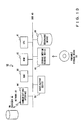
- Fig. 13 explains hardware environment required by a delivery server or a client when the preferred embodiment of the present invention is implemented by software.
- a CPU 41 is connected, via a bus 40, to a ROM 42, a RAM 43, a communications interface 44, a recording device 48, a storage medium reading device 49, and an input/output device 51.
- basic software such as BIOS, etc., which enable an input of a user instruction from the input/output device 51 or an output of a processing result of the CPU 41, when an information device 52 such as a delivery server, a client (video recorder), etc. is powered up.
- the input/output device 51 becomes a man-machine interface such as a display, a mouse, a keyboard, etc., with which a user can manage the delivery server.
- the input/output device 51 is configured by a button for program settings, a remote controller, etc. in order to make a user input the irreducible minimum, if the information device 52 is a video recorder, etc.
- the recording device 48 such as a videotape recorder, a hard disk, etc., records a program executing the processes of the preferred embodiment according to the present invention, and stores image contents or image information. Or, the program, image contents, and image information can be also stored onto a portable storage medium 50 such as a DVD, an MO, a floppy disk, etc.
- the CPU 41 reads the program, image contents, and image information, which are stored onto the portable storage medium 50, by using the storage medium reading device 49, and expands the read program, etc. in the RAM 43, so that the program, etc. are made available.
- the information device 52 has the communications interface 44, communicates with the delivery server or the client via the network, and transmits/receives an XML DTD, so that image contents are downloaded or inquiry information about requested image contents are transmitted.
- an information provider 46 is either the delivery server or the client, or a different information device having a program implementing the preferred embodiment of the present invention. If the information provider 46 is the delivery server or the client, image contents are downloaded via the network 45, or inquiry information about image contents is transmitted as described above. However, if the information provider 46 is a different information device having the program, the program is downloaded into the information device 52, and executed to implement the system according to the preferred embodiment of the present invention.
- the different information device may be a delivery server or a client.
- a recorded image, an edited image, index information, etc. can be reproduced by a machine different from a local recorder, or can be reused by being ported to a personal computer, etc. Furthermore, also additional information such as a program information, etc. is stored in a database, whereby information can be expanded, the linkage among an image, index information, etc. can be easily made, and it becomes easier to reuse the image, the index information, etc.
Landscapes
- Engineering & Computer Science (AREA)
- Signal Processing (AREA)
- Multimedia (AREA)
- Databases & Information Systems (AREA)
- Human Computer Interaction (AREA)
- Business, Economics & Management (AREA)
- Strategic Management (AREA)
- Finance (AREA)
- Marketing (AREA)
- Computer Security & Cryptography (AREA)
- Television Signal Processing For Recording (AREA)
- Two-Way Televisions, Distribution Of Moving Picture Or The Like (AREA)
- Information Retrieval, Db Structures And Fs Structures Therefor (AREA)
Abstract
A delivery server comprises image contents and informational data about the image contents in its storage device. From a video recorder being a client, a request to deliver image contents that a user of the video recorder desires is issued to the delivery server. At this time, the user transmits informational data about the image contents to the delivery server. The delivery server searches for the image contents of the server itself based on the informational data transmitted from the video recorder, and delivers the image contents that the user of the video recorder desires to the video recorder. <IMAGE>
Description
The present invention relates to a digital image
information device.
Recently, the utilization of a device that handles
digital contents not only for professional use but also
for consumer use, such as a storage device that handles
a digital image, a set-top box, a digital camera, etc.
has rapidly accelerated.
Conventionally, it was said that the editing of
an image with MPEG encoding is difficult due to a large
calculation amount and an algorithm. However, because
of the recent speedup of CPUs, also software enables
image editing to some extent, and the utilization field
has been further becoming wider. Furthermore, recently,
a home video has started to be digitized, and there are
expectations for the use also in this field.
To begin with, a conventional analog video
recorder only shoots an image, and does not perform
editing such as cut-and-paste, etc. for the image. Such
image editing was performed only in very limited places
such as a television station, a studio, etc. The reason
is that editing operations themselves are complex, and
cannot be implemented by ordinary home equipment.
Lately, there has been a tendency to digitize a
video recorder, and several companies have released
digital video recorders. With these recorders, image
editing can be easily performed. However, a recorded
image, an edited image, index information, etc. make
sense only when the image is reproduced by a local
recorder. Namely, the image cannot be reproduced by a
different machine, or cannot be reused by being ported
to a personal computer.
In the meantime, recently, digital video
recorders have been becoming very helpful when an
electronic program guide (EPG) is delivered along with
an image and the image is recorded for a conventional
TV or CATV.
However, for the EPG, the same information is only
delivered in succession at predetermined intervals, and
the delivered contents cannot be changed according to
user preferences under the present circumstances.
Namely, there is no linkage among such a program
information, editing, index, etc., and the program
information, etc. are difficult to be reused.
Fig. 1 exemplifies a display of an electronic
program guide (EPG) of a conventional CATV.
As shown in Fig. 1, a program schedule is displayed
on a screen. Additionally, if a user selects one of the
programs on this program schedule, information about
the program is displayed. In the example shown in Fig.
1, a user selects "Report from Tanzawa" by Tanzawa TV,
and the image of the program is displayed in the lower
right portion of Fig. 1, and an introductory description
of the image is displayed in the lower left portion.
Conventional video recorders have the following
problems.
An object of the present invention is to provide
a digital image information device that systematically
links a program information and an editing process.
A first digital image information device
according to the present invention, which is a digital
image information device delivering/receiving image
contents on request, comprises; an image contents
storing unit storing image contents; an information item
storing unit storing the content of an information item
about the image contents in correspondence with the
image contents; an information item receiving unit
receiving the content of the information item about the
image contents from a different digital image
information device; an extracting unit extracting an
information item corresponding to the content of the
received information item and its content from the
information item storing unit; and an image contents
transmitting unit obtaining the image contents
corresponding to the content of the extracted
information item, and transmitting the obtained
contents to the different digital image information
device.
A second digital image information device
according to the present invention, which is a digital
image information device delivering/receiving image
contents on request, comprises: an image contents
storing unit storing image contents; an information item
receiving unit transmitting the content of an
information item about the image contents to a different
digital image information device; and an image contents
storing unit obtaining the image contents corresponding
to the content of the transmitted information item from
the different digital image information device, and
storing the obtained contents in the image contents
storing unit.
According to the present invention, an
information item for describing image contents in
association with image contents is arranged separately
from the image contents, and the information indicating
the image contents is set in the information item for
each image contents, whereby image contents can be
efficiently managed, and image contents that satisfies
a user request can be easily searched or edited.
In a preferred embodiment of the present invention,
a database that manages edited image information is
generated based on the assumption that a recorded image
is edited. Furthermore, also additional information
such a program information, etc., which is
simultaneously transmitted along with an image, is
stored in the database, so that an easier-to-use video
recorder for a user is provided.
Additionally, according to the preferred
embodiment of the present invention, a recorded image,
an edited image, index information etc. can be
reproduced by a different machine other than a local
recorder, or can be reused by being ported to a personal
computer, etc. Furthermore, also additional
information such as a program information, etc. is
stored in a database, so that a more expandable
implementation is realized, the linkage among the
program information, editing, etc. can be made, and the
reuse of the program information, etc. can be
facilitated.
A conventional video recorder is a device that
simply records an image in a sense. However, according
to the preferred embodiment of the present invention,
a video recorder does not simply record or reproduce
an image, but generates a database where configuration
information such as the name of a recorded program, genre
based on the contents, a person's name, time, etc. are
described, special reproduction (index jump, etc.),
editing (a deletion of an unnecessary portion, etc.),
and the like according to user preferences can be
implemented, and besides, a database that can be easily
exchanged or edited with a third party is configured.
For a database, a method using an EPG which is
transmitted along with a TV transmission, or program
information, etc. via the Internet (a TV program is used
as a recording source), a method with which a default
template is generated, and a user himself describes the
contents of the template when recording or reproducing
an image, and the like is adopted. The database is always
updated or reconfigured according to user preferences
(actions such as an action being recording, marking by
user specification, or the like). The reconfigured
database is referenced by a server which transmits an
image, so that information according to the database
can be provided to a user. Furthermore, the format of
a database is represented by a generally used standard,
for example, a structured document format such as an
XML (eXtended Markup Language) format, etc., and an
information exchange not only between a delivery server
and a user, but also with a third party is enabled.
Information of a generated database is handled along
with an associated image as a pair, so that a value,
which imparts a story to an image and the liking
(intention) of a generator side is reflected on, can
be added. If an image and a database are stored, for
example, on a removable medium, they can be easily
exchanged with a third party via the medium. Needless
to say, data of an image and a database can be transferred
and exchanged also by using a high-speed network.
Note that a document generated by using an XML is
provided below as an example of a structured document.
However, the present invention is not limited to this
implementation. A structured document is a document the
structure and the contents of which are represented by
a hierarchically predetermined format.
Fig. 2 shows the concept of the preferred
embodiment according to the present invention.
A video recorder 11 obtains image contents, for
example, from a broadcasting station, and records the
image contents. At that time, the video recorder 11
simultaneously obtains informational data such as a
program information, etc., and records image contents
13-1 to 13-n. At the same time, the video recorder 11
records and uses also the informational data as data
indicating the image contents 13-1 to 13-n. However,
data obtained from this program information does not
fully meet user's needs. Therefore, the user side does
not completely satisfy the obtained data. Accordingly,
an inquiry about new information is made from the user
side (video recorder 11). If the new information exists
in the delivery server 10, it immediately delivers the
information to the video recorder 11. If the new
information does not exist, the user side is made to
newly search for the information, and to update and feed
back the information. If new information is input, new
image contents 12-1 to 12-n and information, which
correspond to the information, are delivered from the
delivery server 10, recorded as the image contents 13-1
to 13-n, and are made available on the video recorder
11 side.
Fig. 3 exemplifies the configuration of a video
recorder (client) side.
The video recorder comprises a data inputting unit
20, a controlling unit 21, a database generating unit
25, reproducing, recording, and editing units 22, 23,
and 24, and the like. The video recorder generates a
database 26 based on the image contents, issues an
inquiry request to a delivery server side in order to
meet user's needs, and updates the database 26.
Namely, the image contents and an EPG, which are
transmitted from the delivery server, and information
from the Internet, are input to the controlling unit
21 via the data inputting unit 20, from which the image
contents, etc. are transmitted to the reproducing unit
22, the recording unit 23, or the editing unit 24. As
a result, reproduction, recording, editing, etc. is
performed according to a user instruction input to the
controlling unit 21. Additionally, image contents
recorded by the recording unit 23 are stored on a
videotape, etc., whereas the image information is stored
by the database generating unit 25 in the database 26
in correspondence with the image contents. The database
26 is generated while a user references and updates
image contents and image information via the controlling
unit 21. Data of the database 26 thus generated is stored
onto a disk 27, etc., and used as a local database by
the video recorder.
Fig. 4 exemplifies the configuration of a delivery
server.
On the delivery server side, a controlling unit
30 delivers image contents or a program information via
a delivering unit 31 on a request of a client side (video
recorder). Additionally, if new information is
requested from the client side via a collecting unit
32, information within the database 34, which is stored
onto a disk 35, etc., is searched. If requested
information exists, it is immediately delivered from
the delivering unit 31 to the client side. If the
requested information does not exist, the video recorder
attempts to collect the corresponding information.
For example, the corresponding information is
collected by using information that the video recorder
obtains from an EPG which indicates image contents at
the time of recording, information obtained from the
Internet (Web search), and information input from a
user.
Fig. 5 exemplifies the information collected by
the video recorder (client side).
In the case shown in Fig. 5, the broadcasting time,
the program name, the person' s name, the associated URL,
etc. of an image are stored in a database. These image
contents and image information are recorded onto a
storage medium such as an NO, etc. In this case, a user
performs a process such as an addition, search, deletion,
update, etc. for the image information.
Fig. 6 is a flowchart showing the sequence for
initializing a database on a client side (video
recorder).
Firstly, in step S10, information from the
Internet about image contents to be recorded is obtained.
Next, in step S11, information obtained from an EPG
that is transmitted along with the image contents is
obtained. Then, in step S12, a user attaches by himself
the information about the image contents that the user
is to record. In step S13, these information are stored
in association with the image contents, so that an
initial database is generated.
Fig. 7 is a flowchart showing the sequence for
making a change or an addition to a database on a client
side.
Firstly, in step S20, a user inputs a request to
change a database. Then, in step S21, it is determined
whether or not to request image contents of a delivery
server. If the user does not request the image contents
of the delivery server, the process is terminated. If
the user requests the image contents of the delivery
server, an image information item indicated by a
particular tag among image information that is
configured as a structured document written in an XML,
etc., or the image itself is transmitted to the delivery
server, and whether or not the image contents or
information that the user desires to obtain exists in
the database of the delivery server is inquired in step
S22. In step S23, the delivery server determines whether
or not to be able to provide the information in response
to the request from the user. If the delivery server
cannot provide the information, the process is
terminated. If the delivery server can provide the
information, it transmits the information to the client
side, which then updates the database in step S24, and
the process is terminated.
Fig. 8 is a flowchart showing the sequence for
initializing a database on a delivery server side.
Firstly, in step S30, a keyword of image contents,
which is input by an operator of the delivery server,
is obtained. Next, in step S31, a keyword is
automatically obtained from the image with character
recognition. Then, in step S32, a keyword is
automatically obtained from the image with voice
recognition. Furthermore, in step S33, a keyword is
automatically obtained from the image with pattern
recognition. Then, the keywords obtained as described
above are stored in the database in correspondence with
the image contents. In this way, the database on the
delivery server side is initialized (step S34).
Fig. 9 is a flowchart showing the sequence for
changing a database on a delivery server side.
Firstly, in step S40, a request from a client
(video recorder) is received. Then, in step S41, it is
determined whether or not the request is an image
contents request. If the request is not the image
contents request, the process is terminated. In step
S41, if the request is the image contents request, the
process proceeds to step S42 where an item (tag) of image
information transmitted from the client is checked. In
step S43, it is determined whether or not the image
information item indicated by the tag matches
(mismatches) an item of image information already stored
as the database within the delivery server. If the tag
does not match, the database within the delivery server
is changed by adding the new tag. If the tag matches,
it is searched in step S44 whether or not the information
requested by the client exists within the delivery
server. If the corresponding information does not exist
within the delivery server, the process is terminated.
If the corresponding information exists, this
information is delivered to the client, and the process
is terminated.
Fig. 10 explains a preferred embodiment when a
communication between a delivery server and a client
(video recorder) is made with an XML document.
In Fig. 10, constituent elements corresponding to
those shown in Fig. 2 are denoted with the same reference
numerals.
Hereinafter, the preferred embodiment where a
database is updated is explained by using an XML.
An XML is used as a method utilizing a database
that collects image contents. As a portion corresponding
to an inquiry item in an XML inquiry, a DTD (Document
Type Definition) is used. DTDs are exchanged and their
definitions are made to match, so that image contents
desired to be extracted are indicated.
As for a program information, by way of example,
the following items are defined with a DTD as a database
on the delivery server 10 side.
Example of information (DTD) on the delivery
server side
The following items are considered as image
information.
image = a program, the name of a person who records an image, recording time, contents
recording time = start time, end time
program = a program name, genre, broadcasting date, summary, contact destination
contact destination = an address, a telephone number (direct-dial/main/facsimile/cellular phone)
address = postal code, prefecture, city, a house number
image = a program, the name of a person who records an image, recording time, contents
recording time = start time, end time
program = a program name, genre, broadcasting date, summary, contact destination
contact destination = an address, a telephone number (direct-dial/main/facsimile/cellular phone)
address = postal code, prefecture, city, a house number
If the above described items are written as a DTD
statement, the statement becomes as follows.

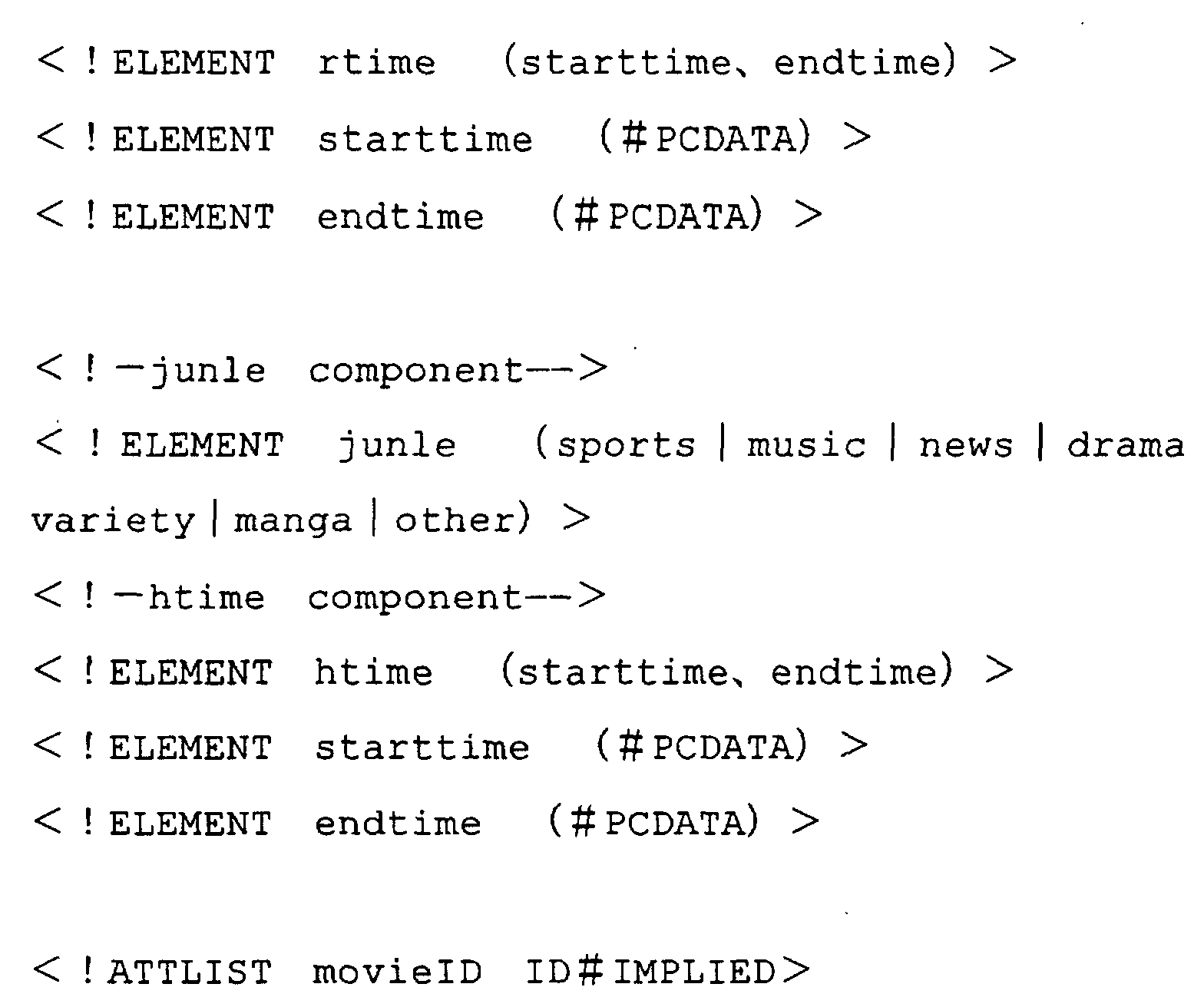
Here, assume that the database is updated on the
client side as follows on a request of a user, so that
items such an URL, etc. suit the preferences of the
user (expanded items are underlined) . Here, it may be
distinguished whether a tag is made local for the
client or global for being fed back to the server. For
this distinguishment, byway of example, it is defined
that a required attribute which indicates whether a
tag is either local or global is attached to a movie
ID in an ELEMENT definition of the tag, and the tag
is made local if this required attribute is "1".
Example of self-made type information that are newly
added and expanded
image = a program, self-made, name, recording time, contents, URL
program = program name, genre, broadcasting date, starring, summary, index
index = start time, end time, tag, ID
starring = star, costar
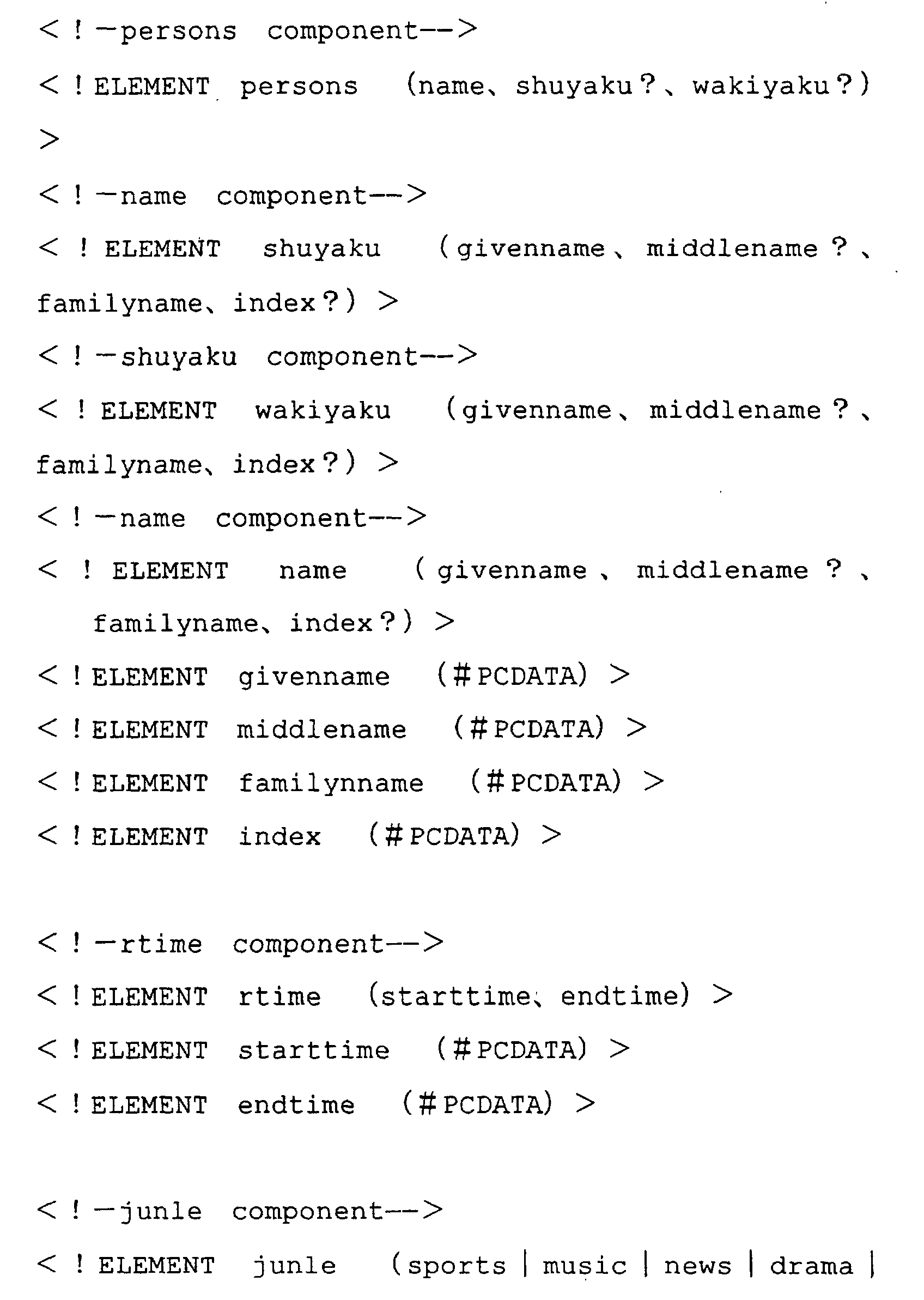

image = a program, self-made, name, recording time, contents, URL
program = program name, genre, broadcasting date, starring, summary, index
index = start time, end time, tag, ID
starring = star, costar
Assuming that the following XML inquiry is
transmitted from the client side to the delivery
server in the case where the above described DTD
definitions on the delivery server and client sides
exist,
 toiawase.xml is transmitted to the delivery
server side, which is made to transmit the image
contents corresponding to the item. If the type
checking fails, a new type is synchronized with that
on the client side, and that type is newly registered
also on the delivery server side. Then, image contents
are searched based on the item, and delivered as soon
as the contents are found on the client side. In this
case, an image of the soccer digest starting from 19:00
is transmitted to the client side.
toiawase.xml is transmitted to the delivery
server side, which is made to transmit the image
contents corresponding to the item. If the type
checking fails, a new type is synchronized with that
on the client side, and that type is newly registered
also on the delivery server side. Then, image contents
are searched based on the item, and delivered as soon
as the contents are found on the client side. In this
case, an image of the soccer digest starting from 19:00
is transmitted to the client side.
Here, assume that the following inquiry mail is
transmitted.
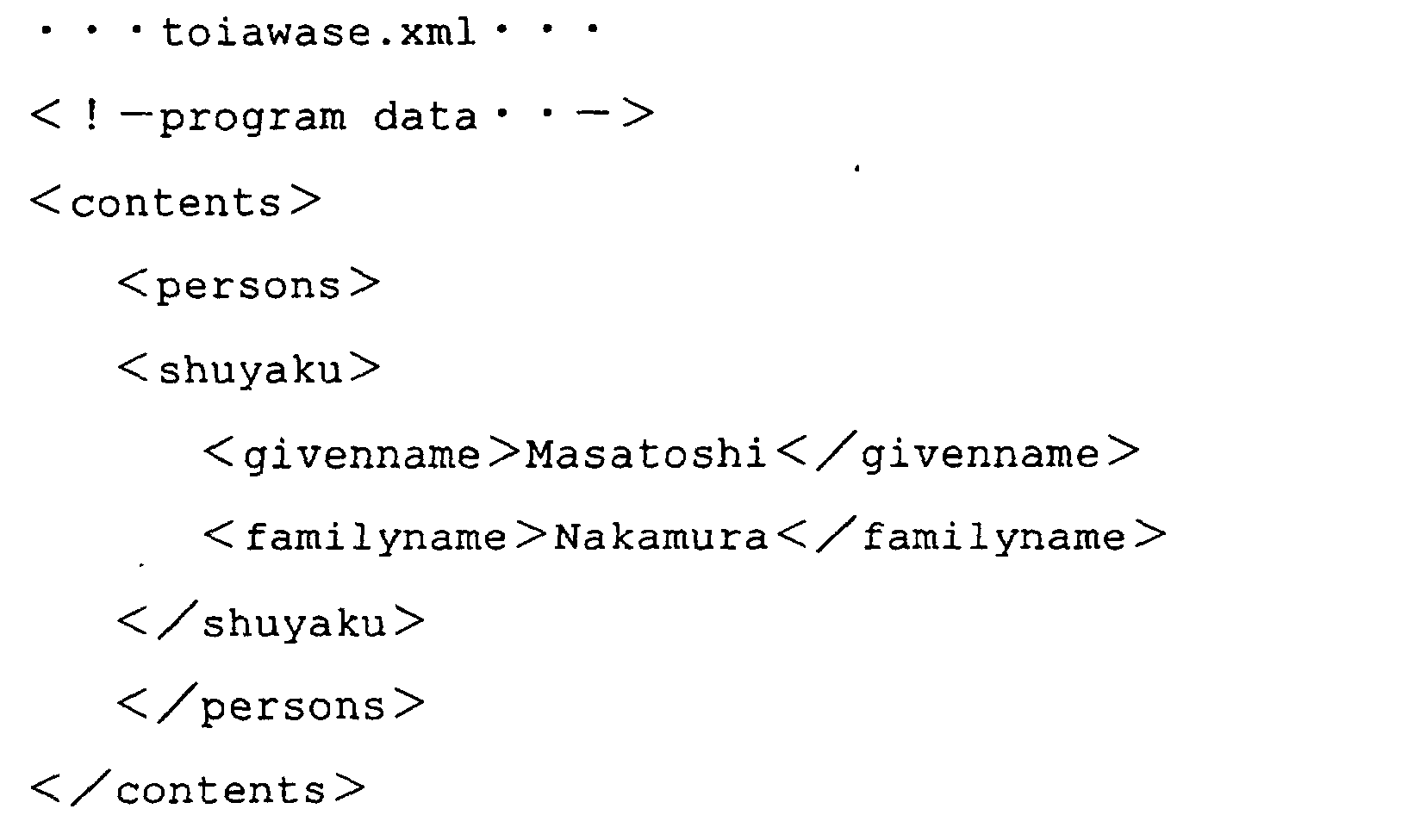
If this inquiry data is transmitted to the
delivery server, there is no tag named "persons" in the
DTD document on the delivery server side. Therefore,
the tag is newly registered. Thereafter, whether or not
"Masatoshi Nakamura" exists in the image contents is
examined by making a keyword search. If "Masatoshi
Nakamura" is found, it is newly added to the image
contents as the data of the tag named "persons", and
the database update is terminated. Additionally, the
found image contents are delivered to the client side.
Fig. 11 is a flowchart showing the sequence of a
syntax analysis process of a DTD document on a delivery
server side.
Firstly, in step S50, an XML document is read. In
step S51, a DTD document is read. Then, in step S52,
it is determined whether or not a critical error exists
in the DTD document. If a critical error is determined
to exist as a result of this determination, it is
recognized that information cannot be obtained from the
DTD document, and the process is terminated. If a
critical error is determined not to exist in the DTD
document in step S52, it is determined in step S53
whether or not a syntax error exists in the DTD document.
If a syntax error exists, it is determined that
information cannot be properly obtained from the DTD
document, and the process is terminated. If a syntax
error is determined not to exist in step S53, a new tag
is loaded from the client side and added to image
information in step S54. Then, in step S55, it is
determined whether or not all of tags have been checked.
If a tag yet to be checked exists, the process goes back
to step S53, and the operations are repeated. If it is
determined in step S55 that all of the tags have been
checked, the process is terminated.
Fig. 12 explains an XML information exchange
between clients.
The preferred embodiment heretofore stated is the
configuration based on a relationship between a server
and a client. However, there is no need to build such
a hierarchy in all cases. A configuration where equal
information devices such as a relationship between
clients are used may be available.
Namely, DTD documents are open to one another via
a network, for example, the Web, and image contents may
be exchanged with another client which makes a search
on the network.
In this case, clients 1 through 3 are equal with
one another, and with XML DTD documents, the client 1
communicates with the clients 2 and 3, the client 2
communicates with the clients 1 and 3, and the client
3 communicates with the clients 1 and 2, so that a request
to examine image contents that any of the clients 1
through 3 desires to obtain exists within a partner
client is issued. If the image contents that any of the
clients 1 through 3 desires to obtain exists in the
partner client, the image contents are obtained via the
network. If the image contents that any of the clients
1 through 3 desires to obtain does not exist, image
contents are not obtained.
Each of the clients issues a DTD (a database tag)
that each of the clients itself defines on the Web by
using the network. A configuration required for this
is the configuration on the delivery server side in Fig.
4, where an inquiry from an outside is accepted, but
an update function for the inquiry is not included.
The database on the delivery server side must be
updated each time a reference is made from the client
side. However, if the database is updated at each time,
the amount of tag information indiscriminately diverges,
and tag information to be processed on the deliver server
side overflows on the delivery server side, leading to
a risk that the delivery server cannot possibly process
the tag information. The following methods are executed
to suppress divergence.
For example, the number of new tag registrations
is set to 1000. New tags are unconditionally registered
up to 1000. However, if the number of new tags exceeds
1000, a new tag is registered by deleting an earlier
tag. The process performed in the case where a new tag
is already registered falls into the following two
types.
Fig. 13 explains hardware environment required by
a delivery server or a client when the preferred
embodiment of the present invention is implemented by
software.
A CPU 41 is connected, via a bus 40, to a ROM 42,
a RAM 43, a communications interface 44, a recording
device 48, a storage medium reading device 49, and an
input/output device 51. In the ROM 42, basic software
such as BIOS, etc., which enable an input of a user
instruction from the input/output device 51 or an output
of a processing result of the CPU 41, when an information
device 52 such as a delivery server, a client (video
recorder), etc. is powered up. Here, for the delivery
server, the input/output device 51 becomes a man-machine
interface such as a display, a mouse, a keyboard, etc.,
with which a user can manage the delivery server.
Meanwhile, for the client, the input/output device 51
is configured by a button for program settings, a remote
controller, etc. in order to make a user input the
irreducible minimum, if the information device 52 is
a video recorder, etc.
The recording device 48, such as a videotape
recorder, a hard disk, etc., records a program executing
the processes of the preferred embodiment according to
the present invention, and stores image contents or
image information. Or, the program, image contents, and
image information can be also stored onto a portable
storage medium 50 such as a DVD, an MO, a floppy disk,
etc. The CPU 41 reads the program, image contents, and
image information, which are stored onto the portable
storage medium 50, by using the storage medium reading
device 49, and expands the read program, etc. in the
RAM 43, so that the program, etc. are made available.
Furthermore, the information device 52 has the
communications interface 44, communicates with the
delivery server or the client via the network, and
transmits/receives an XML DTD, so that image contents
are downloaded or inquiry information about requested
image contents are transmitted. In this case, an
information provider 46 is either the delivery server
or the client, or a different information device having
a program implementing the preferred embodiment of the
present invention. If the information provider 46 is
the delivery server or the client, image contents are
downloaded via the network 45, or inquiry information
about image contents is transmitted as described above.
However, if the information provider 46 is a different
information device having the program, the program is
downloaded into the information device 52, and executed
to implement the system according to the preferred
embodiment of the present invention. In this case, the
different information device may be a delivery server
or a client.
A recorded image, an edited image, index
information, etc. can be reproduced by a machine
different from a local recorder, or can be reused by
being ported to a personal computer, etc. Furthermore,
also additional information such as a program
information, etc. is stored in a database, whereby
information can be expanded, the linkage among an image,
index information, etc. can be easily made, and it
becomes easier to reuse the image, the index information,
etc.
Claims (19)
- A digital image information device delivering/receiving image contents on request, comprising:image contents storing means for storing image contents;information item storing means for storing a content of an information item about the image contents in correspondence with the image contents;information item receiving means for receiving the content of the information item about the image contents from a different digital image information device;extracting means for extracting an information item corresponding to the content of the received information item, and its content from said information item storing means; andimage contents transmitting means for obtaining the image contents corresponding to the content of the extracted information item, and for transmitting obtained image contents to the different digital image information device.
- The digital image information device according to claim 1, wherein
said information item storing means manages/stores each information item according to a format of a structured document. - The digital image information device according to claim 2, wherein
the structured document is a document written in an XML, and in the format complying with a DTD of the XML. - The digital image information device according to claim 1, wherein
if the received information item is not registered to said information item storing means, the received information item is newly stored in correspondence with corresponding image contents. - The digital image information device according to claim 1, wherein
the content of the information item stored in said information item storing means is set by a user of the digital image information device. - The digital image information device according to claim 1, wherein
the content of the information item stored in said information item storing means is set based on a keyword that is obtained with character recognition. - The digital image information device according to claim 1, wherein
the content of the information item stored in said information item storing means is set based on a keyword that is obtained with voice recognition. - The digital image information device according to claim 1, wherein
the content of the information item stored in said information item storing means is set based on a keyword that is obtained with pattern recognition. - A digital image information device delivering/receiving image contents on request, comprising:image contents storing means for storing image contents;information item receiving means for transmitting a content of an information item about image contents to a different digital image information device;image contents storing means for obtaining image contents corresponding to the content of the transmitted information item from the different digital image information device, and for storing obtained contents in said image contents storing means.
- The digital image information device according to claim 9, wherein
the information item is specified according to a format of a structured document. - The digital image information device according to claim 10, wherein
the structured document is a document written in an XML, and in the format complying with a DTD of the XML. - The digital image information device according to claim 11, wherein
the information item can be expanded according to a specification of a user who requests the image contents. - The digital image information device according to claim 9, wherein
the content of the information item is obtained via the Internet. - The digital image information device according to claim 9, wherein
the content of the information item is obtained from an electronic program guide. - The digital image information device according to claim 9, wherein
the content of the information item is input by a user who uses the digital image information device. - A management method for use in a digital image information device delivering/receiving image contents on request, comprising:an image contents storing step of storing image contents;an information item storing step of storing a content of an information item about the image contents in correspondence with the image contents;an information item receiving step of receiving a content of an information item about image contents from a different digital image information device;an extracting step of extracting an information item corresponding to the content of the received information item, and its content from the content stored in the information item storing step; andan image contents transmitting step of obtaining the image contents corresponding to the content of the extracted information item, and transmitting obtained image contents to the different digital image information device.
- A management method for use in a digital image information device delivering/receiving image contents on request, comprising:an image contents storing step of storing image contents;an information item receiving step of transmitting a content of an information item about image contents to a different digital image information device; andan image contents storing step of obtaining image contents corresponding to the content of the transmitted information item from the different digital image information device, and storing obtained image contents in the image contents storing step.
- A storage medium, which can be read by an information device, on which is recorded a program for implementing a management method for use in a digital image information device delivering/receiving image contents to/from an information device on request, the management method comprising:an image contents storing step of storing image contents;an information item storing step of storing a content of an information item about the image contents in correspondence with the image contents;an information item receiving step of receiving the content of the information item about the image contents from a different digital image information device;an extracting step of extracting an information item corresponding to the content of the received information item, and its content from the content stored in the information item storing step; andan image contents transmitting step of obtaining the image contents corresponding to the content of the extracted information item, and transmitting obtained image contents to the different digital image information device.
- A storage medium, which can be read by an information device, on which is recorded a program for implementing a management method for use in a digital image information device delivering/receiving image contents to/from an information device on request, the management method comprising:an image contents storing step of storing image contents;an information item receiving step of transmitting a content of an information item about image contents to a different digital image information device; andan image contents storing step of obtaining the image contents corresponding to the content of the transmitted information item from the different digital image information device, and storing obtained image contents in the image contents storing step.
Applications Claiming Priority (1)
| Application Number | Priority Date | Filing Date | Title |
|---|---|---|---|
| PCT/JP2000/004412 WO2002003690A1 (en) | 2000-07-03 | 2000-07-03 | Digital video information apparatus |
Publications (2)
| Publication Number | Publication Date |
|---|---|
| EP1307048A1 true EP1307048A1 (en) | 2003-05-02 |
| EP1307048A4 EP1307048A4 (en) | 2005-04-20 |
Family
ID=11736218
Family Applications (1)
| Application Number | Title | Priority Date | Filing Date |
|---|---|---|---|
| EP00942453A Ceased EP1307048A4 (en) | 2000-07-03 | 2000-07-03 | APPARATUS FOR DIGITAL VIDEO INFORMATION |
Country Status (3)
| Country | Link |
|---|---|
| US (1) | US20030070173A1 (en) |
| EP (1) | EP1307048A4 (en) |
| WO (1) | WO2002003690A1 (en) |
Cited By (1)
| Publication number | Priority date | Publication date | Assignee | Title |
|---|---|---|---|---|
| EP2296374A3 (en) * | 2003-02-12 | 2012-10-17 | Video Networks IP Holdings Limited | System for capture and selective playback of broadcast programmes |
Families Citing this family (7)
| Publication number | Priority date | Publication date | Assignee | Title |
|---|---|---|---|---|
| US7725467B2 (en) * | 2002-03-29 | 2010-05-25 | Sony Corporation | Information search system, information processing apparatus and method, and information search apparatus and method |
| JP2005531056A (en) * | 2002-06-24 | 2005-10-13 | コーニンクレッカ フィリップス エレクトロニクス エヌ ヴィ | Receiver for receiving markup language data and skin |
| JP4025185B2 (en) * | 2002-12-10 | 2007-12-19 | 株式会社東芝 | Media data viewing apparatus and metadata sharing system |
| JP4020039B2 (en) | 2003-07-08 | 2007-12-12 | オンキヨー株式会社 | Network AV system |
| JP5021894B2 (en) * | 2004-07-07 | 2012-09-12 | Necインフロンティア株式会社 | Event information management system and event information management method used therefor |
| JP4277218B2 (en) * | 2005-02-07 | 2009-06-10 | ソニー株式会社 | Recording / reproducing apparatus, method and program thereof |
| US20090163239A1 (en) * | 2007-12-21 | 2009-06-25 | Nokia Corporation | Method, apparatus and computer program product for generating media content by recording broadcast transmissions |
Family Cites Families (19)
| Publication number | Priority date | Publication date | Assignee | Title |
|---|---|---|---|---|
| JP3258538B2 (en) * | 1994-08-31 | 2002-02-18 | 東光株式会社 | Image receiving device |
| JPH08123820A (en) * | 1994-10-27 | 1996-05-17 | Hitachi Ltd | Online service system |
| US5576755A (en) * | 1994-10-28 | 1996-11-19 | Davis; Bruce | System and method for verification of electronic television program guide data |
| US5751282A (en) * | 1995-06-13 | 1998-05-12 | Microsoft Corporation | System and method for calling video on demand using an electronic programming guide |
| JPH0946689A (en) * | 1995-07-28 | 1997-02-14 | Hitachi Ltd | Video software introduction system and video software introduction method |
| JPH09214904A (en) * | 1996-02-05 | 1997-08-15 | Matsushita Electric Ind Co Ltd | Television receiver and additional information transmission method |
| JPH08336096A (en) * | 1996-06-28 | 1996-12-17 | Sony Corp | Terminal device |
| JP3871377B2 (en) * | 1996-07-22 | 2007-01-24 | 松下電器産業株式会社 | RECORDING DEVICE, RECORDING DEVICE CONTROL METHOD, VIEWING DEVICE, AND VIEWING DEVICE CONTROL METHOD |
| JP3797709B2 (en) * | 1996-07-22 | 2006-07-19 | 松下電器産業株式会社 | Viewing device and recording device |
| JP3871378B2 (en) * | 1996-07-22 | 2007-01-24 | 松下電器産業株式会社 | RECEIVING TERMINAL DEVICE, RECORDING DEVICE AND RECORDING DEVICE CONTROL METHOD |
| JP3484085B2 (en) * | 1998-05-22 | 2004-01-06 | 株式会社リコー | Broadcast-type distribution method, computer-readable recording medium storing a program for causing a computer to execute the method, and content server |
| JP2000013778A (en) * | 1998-06-19 | 2000-01-14 | Nippon Columbia Co Ltd | Server device |
| JP2000013777A (en) * | 1998-06-26 | 2000-01-14 | Matsushita Electric Ind Co Ltd | Video playback device and video storage device |
| US6598046B1 (en) * | 1998-09-29 | 2003-07-22 | Qwest Communications International Inc. | System and method for retrieving documents responsive to a given user's role and scenario |
| JP4042224B2 (en) * | 1998-10-13 | 2008-02-06 | 松下電器産業株式会社 | Data transceiver |
| US7209942B1 (en) * | 1998-12-28 | 2007-04-24 | Kabushiki Kaisha Toshiba | Information providing method and apparatus, and information reception apparatus |
| US6593936B1 (en) * | 1999-02-01 | 2003-07-15 | At&T Corp. | Synthetic audiovisual description scheme, method and system for MPEG-7 |
| US6774926B1 (en) * | 1999-09-03 | 2004-08-10 | United Video Properties, Inc. | Personal television channel system |
| US7908635B2 (en) * | 2000-03-02 | 2011-03-15 | Tivo Inc. | System and method for internet access to a personal television service |
-
2000
- 2000-07-03 EP EP00942453A patent/EP1307048A4/en not_active Ceased
- 2000-07-03 WO PCT/JP2000/004412 patent/WO2002003690A1/en not_active Ceased
-
2002
- 2002-11-22 US US10/301,646 patent/US20030070173A1/en not_active Abandoned
Cited By (1)
| Publication number | Priority date | Publication date | Assignee | Title |
|---|---|---|---|---|
| EP2296374A3 (en) * | 2003-02-12 | 2012-10-17 | Video Networks IP Holdings Limited | System for capture and selective playback of broadcast programmes |
Also Published As
| Publication number | Publication date |
|---|---|
| WO2002003690A1 (en) | 2002-01-10 |
| US20030070173A1 (en) | 2003-04-10 |
| EP1307048A4 (en) | 2005-04-20 |
Similar Documents
| Publication | Publication Date | Title |
|---|---|---|
| KR100988153B1 (en) | Information retrieval system, information processing apparatus and method, information retrieval apparatus and method | |
| US7281054B2 (en) | Contents distribution method, contents information processing device, and computer product | |
| US9043369B2 (en) | Metadata brokering server and methods | |
| JP5740814B2 (en) | Information processing apparatus and method | |
| US8990223B2 (en) | Systems and methods for matching media content data | |
| US7624408B2 (en) | Apparatus, method, and system for information processing, and recording medium | |
| JP4568323B2 (en) | Broadcast program recording device | |
| US20060294212A1 (en) | Information processing apparatus, information processing method, and computer program | |
| CN101364225B (en) | Keyword extraction method | |
| US7953748B2 (en) | Information processing apparatus and information processing method, and computer program | |
| JP2004185456A (en) | Customized content distribution system | |
| EP1307048A1 (en) | Digital video information apparatus | |
| JP2003203088A (en) | Programmable content providing method and system, transmitting terminal, program, recording medium | |
| EP1244309A1 (en) | A method and microprocessor system for forming an output data stream comprising metadata | |
| US20040192382A1 (en) | Personal digest delivery system and method | |
| JP2000253367A (en) | Conversion device and conversion method | |
| JP2005110016A (en) | Delivery video recommendation method, apparatus and program | |
| JP2005222369A (en) | INFORMATION PROVIDING DEVICE, INFORMATION PROVIDING METHOD, INFORMATION PROVIDING PROGRAM, AND RECORDING MEDIUM CONTAINING INFORMATION PROVIDING PROGRAM | |
| KR100879742B1 (en) | IP content service method and apparatus using RSS service | |
| JP3959525B2 (en) | Application server program and application server in video content browsing system | |
| JP3023359B1 (en) | Transmission device, reception device, transmission / reception device, transmission bubble reception method and transmission / reception method | |
| JP2005141507A (en) | Related information presentation device, related information search device, related information presentation method, related information search method, related information presentation program, and related information search program | |
| JP2004040355A (en) | Program index collection and grant method, program index collection and grant device, program index collection and grant program | |
| JP2005148801A (en) | Related information providing method, related information providing apparatus, related information providing program, and recording medium for related information providing program | |
| JP2001211431A (en) | Transmission device, reception device, transmission / reception system, transmission method, and reception method |
Legal Events
| Date | Code | Title | Description |
|---|---|---|---|
| PUAI | Public reference made under article 153(3) epc to a published international application that has entered the european phase |
Free format text: ORIGINAL CODE: 0009012 |
|
| 17P | Request for examination filed |
Effective date: 20021202 |
|
| AK | Designated contracting states |
Designated state(s): DE FR GB |
|
| AX | Request for extension of the european patent |
Extension state: AL LT LV MK RO SI |
|
| A4 | Supplementary search report drawn up and despatched |
Effective date: 20050308 |
|
| 17Q | First examination report despatched |
Effective date: 20050502 |
|
| STAA | Information on the status of an ep patent application or granted ep patent |
Free format text: STATUS: THE APPLICATION HAS BEEN REFUSED |
|
| 18R | Application refused |
Effective date: 20091020 |